...

Tag: brain health

  • B12 Vs B Complex Vitamins for Energy and Focus

    B12 Vs B Complex Vitamins for Energy and Focus

    *A quick heads-up: To support our work in creating in-depth, evidence-based guides, we sometimes link to products we trust. If you make a purchase through one of these links, we may earn a small commission at no extra cost to you. This helps us keep the lights on and continue our research. We appreciate your supportβ€”you can read our full [affiliate disclaimer](https://mindclarityhub.com/affiliate-disclaimer/) for more details.*

    B12 vs. B-Complex Vitamins: Which One Does Your Brain Actually Need?

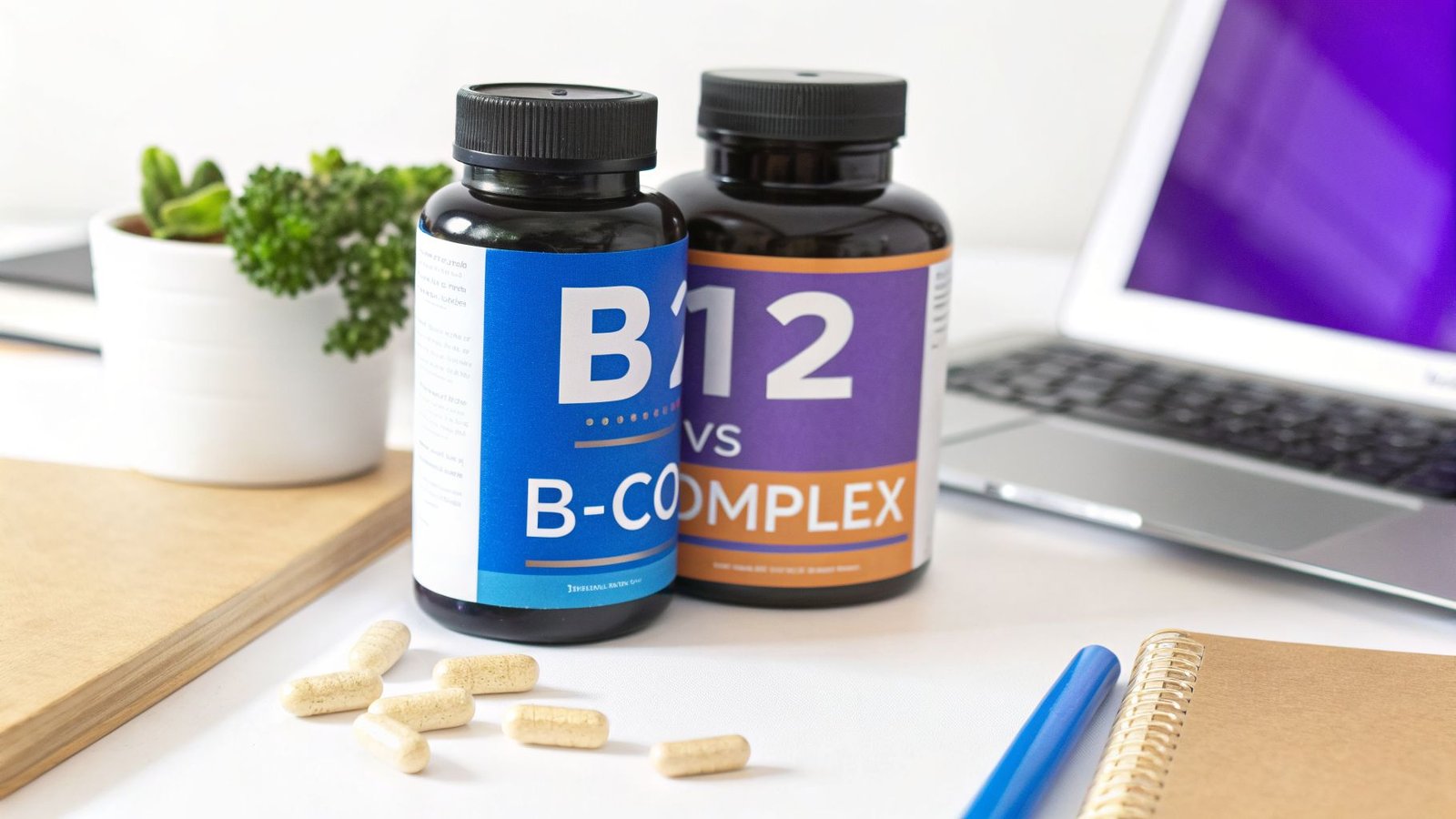
    Walking down the supplement aisle, it’s easy to get lost in a sea of bottles. When it comes to B vitamins, the choice often boils down to two heavy hitters. You can choose a targeted vitamin B12 supplement or a comprehensive B-complex. The real difference in the B12 vs B complex vitamins debate is straightforward. B12 is a single, specialist nutrient. In contrast, a B-complex is a team of all eight B vitamins working in concert.

    Deciding which is right for you isn’t about which is β€œbetter.” Instead, it’s about matching the supplement to your specific biology and diet. It also depends on the demands you’re placing on your brain.

    Vitamin B12, also known as cobalamin, is the precision tool. Its main job is keeping your nerve cells healthy. It also supports the creation of red blood cells. Think of it as mission-critical for your neurological wiring. For instance, B12 is essential for maintaining the myelin sheath. This is the protective coating around your nerves. It allows for rapid-fire communication between brain cellsβ€”the foundation of sharp focus.

    A B-complex, on the other hand, is more like a general-purpose toolkit. It supports your body’s entire energy grid. It delivers all eight B vitamins. Each one has a distinct role in converting food into cellular energy (ATP). This synergistic approach supports everything from your overall metabolism to how your body handles stress.

    A woman in a kitchen looks at two vitamin bottles, one B12 and one B-Complex, comparing the labels to decide which is better for her in the B12 vs B complex vitamins choice.

    Why The Choice Between B12 vs B Complex Vitamins Matters

    The market trends reflect this growing awareness. The global vitamin B12 market is on track to hit USD 406 million by 2034. The broader B-complex market was already valued at a massive USD 3.35 billion back in 2026. This split tells a story. While many people benefit from a broad-spectrum approach, there’s a growing need for targeted B12. This is especially true for those with specific dietary gaps or health risks.

    Understanding the subtle signs of vitamin deficiency can point you in the right direction. For example, a vegan battling persistent brain fog is a prime candidate for a solo B12 supplement. Their diet naturally lacks this nutrient.

    In contrast, a busy professional feeling run-down from chronic stress might get more from a B-complex. Why? Because stress is known to burn through multiple B vitamins, not just one. Using a habit tracker journal can help you see patterns in your energy levels and diet. This can reveal surprising insights into what your body needs.

    Important Note: This article is for educational purposes only. It is not a substitute for professional medical or psychological advice, diagnosis, or treatment. If you are experiencing symptoms of burnout, anxiety, depression, ADHD, or sleep problems, please consult a qualified healthcare provider.

    The Role of Vitamin B12 in Brain Health and Focus

    While a B-complex offers broad support, Vitamin B12 is a specialist for your brain. Known as cobalamin, its job is specific yet critical for sharp cognitive function. If you’ve ever felt that persistent mental fog, understanding B12’s role can be a game-changer.

    Think of your brain’s communication network as a system of electrical wires. From a neuroscience perspective, Vitamin B12 is essential for maintaining the myelin sheath. This is a fatty layer that insulates your nerve fibers. This insulation allows electrical signals to travel quickly and efficiently between brain cells. When your myelin is healthy, your thinking is fast and your focus is sharp.

    A breakdown in this system can slow nerve communication. This often shows up as brain fog and sluggish thinking. By supporting the myelin sheath’s integrity, B12 helps keep your cognitive superhighways clear and fast. This is a key point in the B12 vs B complex vitamins discussion for those seeking mental clarity.

    A bottle of B12 vitamins sits next to a small brain model on a desk, illustrating the link between B12 and brain support in the B12 vs B complex vitamins comparison.

    B12’s Influence on Mood and Motivation

    Beyond nerve insulation, vitamin B12 is a key player in synthesizing neurotransmitters. These are the chemical messengers that regulate your mood and motivation. Specifically, B12 is necessary for producing both dopamine and serotonin.

    • Dopamine is often called the β€œmotivation molecule.” It’s the engine of your brain’s reward system. It drives you to pursue goals and take action.
    • Serotonin plays a huge part in mood stability. It promotes feelings of well-being and calmness.

    When your B12 levels are adequate, your brain has the raw materials for these chemicals. This helps you maintain a balanced mood and a healthy sense of drive.

    Neuroscience Nugget: A B12 shortfall can disrupt this delicate neurotransmitter balance. Behavioral research shows this can lead to apathy, low motivation, and mood swings. It makes building and sticking with positive habits much harder.

    Real-World Scenario: A B12 Focus

    Picture a vegan freelance writer who needs sharp focus. They use a time blocking planner to structure their day but still struggle. They face mental fog and a lack of drive. Since their plant-based diet is low in B12, a deficiency is a real possibility. For this writer, a targeted B12 supplement could address the root problem. It would support the neural speed for quick thinking and the neurotransmitter production for motivation. In this case, a targeted approach is more effective than a general B-complex. You can learn more about other vitamins to help with brain fog in our guide.

    Who Needs Targeted B12 the Most?

    According to the Mayo Clinic, the recommended daily intake for adults is just 2.4 mcg of B12. However, some groups need much more. Older adults, for instance, often have declining stomach acid. This impairs their ability to absorb B12 from food. A higher-dose supplement is often a practical way to protect their neurological health. This need is reflected in market trends. The B12 market in China alone is projected to hit US$101.7 million by 2034, driven by its aging population.

    The Role of B-Complex Vitamins in Energy and Stress

    If B12 is the specialist, a B-complex is the whole crew. It gets your entire energy system back online. Think of it as the general contractor for your body’s metabolism. A B-complex is often the answer when you feel a system-wide drag. It’s not about one pathway; it’s about broad support for the whole production line.

    How The B-Vitamin Team Powers Your Metabolism

    Your body’s energy production is like a sophisticated factory. The food you eat is the raw material. B vitamins are the essential workers at every station. They each have a specific job in converting materials into adenosine triphosphate (ATP). This is your body’s cellular fuel.

    When even one of those workers is out, the assembly line slows down. The result is that all-too-common fatigue. It’s a feeling that another coffee just can’t fix. A B-complex supplement gives you all eight B vitamins. They work together synergistically. This means their combined impact is greater than their individual effects.

    Here’s a quick look at some key players on this energy team:

    • B1 (Thiamine): Critical for turning carbohydrates into glucose, your brain’s primary fuel.
    • B2 (Riboflavin): A core component of enzymes that fire up your mitochondria, your cellular powerhouses.
    • B3 (Niacin): Essential for over 400 enzymatic reactions central to energy conversion.
    • B5 (Pantothenic Acid): Helps create coenzyme A, vital for breaking down fatty acids for fuel.

    When these vitamins are present, your body can efficiently unlock energy from your diet. A shortfall can also amplify the physical symptoms of chronic stress.

    Real-World Scenario: The Overwhelmed Professional

    Imagine a busy professional whose diet is a mix of takeout and quick snacks. They feel a persistent, gnawing fatigue. It’s likely their demanding lifestyle and diet have created small shortfalls across the B-vitamin family. For this person, a B-complex is an excellent strategy. It fills multiple nutritional gaps at once. This offers broad support to their whole metabolic engine. It’s a smarter approach than guessing which single vitamin might be the culprit.

    This broad-spectrum approach is why the B-complex market is booming. It was valued at USD 3.28 billion and is projected to grow. North America holds a 35% market share. Modern diets and high-stress lives can easily leave us with multiple minor deficiencies. Taking a B-complex provides a systemic boost. This is much like exploring healthy alternatives to coffee for energy for a more sustainable fix.

    How to Choose the Right B Vitamin for Your Goals

    Deciding between B12 vs B complex vitamins isn’t about which is better. It’s about understanding your body and goals. The right choice hinges on your diet, lifestyle, and what you’re trying to fix. You might want to sharpen focus for deep work or shake off constant fatigue.

    Making a good decision starts with self-awareness. This is a core theme in my book, The Power of Clarity. Are you solving a specific problem or do you need broader support? Answering that question will point you in the right direction. Browse the library to find more resources that fit your goals.

    Best for Beginners: Starting with B-Complex

    If you’re new to B vitamins and feel generally tired or stressed, a B-complex is an excellent starting point. Stress and a busy lifestyle can deplete multiple B vitamins at once. A comprehensive B-complex acts as a foundational safety net. It replenishes the entire team your body needs for energy and resilience.

    Think of a student juggling classes and a part-time job. Their diet is inconsistent, and they feel perpetually run-down. A B-complex addresses multiple potential weak spots at the same time. It supports the entire metabolic process that turns food into usable energy. It’s a foundational approach to rebuilding from the inside out. For a deeper dive into managing this kind of strain, my book Burnout Interrupted offers practical strategies.

    Best for Busy Professionals: Choosing B12 for Focus

    If your main goal is to sharpen focus or fight specific mental fatigue, a standalone Vitamin B12 is often more direct. This is especially true if you are at a higher risk for deficiency. For example, take a knowledge worker trying to protect time for deep work. They might find themselves sidelined by brain fog in the afternoon. If they follow a vegan diet, a targeted B12 supplement directly addresses the likely nutritional gap. B12 is a precision tool for mental clarity.

    Adults over 50 also often have less stomach acid. This makes it harder to absorb B12 from food. For them, a direct B12 supplement is more efficient. You can learn more in our guide on the best time of day to take vitamin B-12.

    A flowchart helps decide between B12 vs B complex vitamins. It points to B-complex for general fatigue and B12 for sharpened focus.

    Comparison: B12 vs B-Complex at a Glance

    To make the decision clearer, this table breaks down the best choice for a few common scenarios. Use it to quickly find the right fit for your health goals. Compare options below to see what matches your needs.

    ScenarioBest ChoiceWhy It Works
    Vegan or Vegetarian DietVitamin B12Plant-based diets lack natural B12 sources, making targeted supplementation essential.
    General Fatigue & High StressB-ComplexStress depletes multiple B vitamins. A complex replenishes the entire team for energy.
    Age 50+ or Digestive IssuesVitamin B12Absorption of B12 from food declines with age. A direct supplement bypasses this.
    Improving Cognitive FocusVitamin B12Directly supports nerve cell function and neurotransmitter synthesis for mental clarity.

    Ultimately, choosing between B12 vs B complex vitamins comes down to listening to your body. A targeted approach can work wonders for a specific issue. A broad-spectrum supplement provides a solid foundation for overall well-being.

    Editor’s Take: What Actually Works in the B12 vs B Complex Vitamins Debate

    So, what’s the real bottom line in the B12 vs B complex vitamins debate? Here is my honest summary after seeing what works.

    For targeted cognitive enhancement, a standalone Vitamin B12 supplement is your best bet. This is for people who want to sharpen focus, fight specific brain fog, or have a diet low in B12 (like vegans). It’s a precision tool for your neurological health.

    For general fatigue and stress support, a comprehensive B-complex is a much better safety net. This is best for busy professionals, students, or anyone feeling generally run-down. It supports your entire energy system when stress and a poor diet have depleted multiple B vitamins. It’s a full-system solution.

    Who is this advice for? It’s for healthy adults looking to optimize their energy and focus. It’s not for those with serious medical conditions.

    Important Caveat: Supplements are partners, not magic pills. Their power is unlocked when you pair them with good nutrition, stress management, and quality sleep. Something as simple as using an analog alarm clock can create a more restorative sleep routine. This gives any supplement a better foundation to work from.

    Key Takeaways: B12 vs B Complex Vitamins

    • Vitamin B12 is a Specialist: It’s best for targeted cognitive support, fighting brain fog, and addressing specific dietary gaps (e.g., vegan diets, older adults).
    • B-Complex is a Generalist: It’s ideal for combating general fatigue, managing high stress levels, and providing broad metabolic support when your diet is inconsistent.
    • Your Goal is Key: Choose B12 for sharp focus and nerve health. Choose B-complex for overall energy and stress resilience.
    • Lifestyle Matters: Chronic stress and poor diet deplete multiple B vitamins, making a B-complex a good safety net for many modern lifestyles.
    • Consult a Professional: Before starting any new supplement, talk to a healthcare provider. A blood test can confirm deficiencies and guide your choice.

    A Quick Disclaimer and Final Thoughts

    Before you buy anything, please know that some links in this article are affiliate links. That means we might earn a small commission if you purchase something, at no extra cost to you. This content is for educational purposes only. It is not a substitute for professional medical or psychological advice, diagnosis, or treatment. This includes our discussions on other nutrients, like in our guide on magnesium malate vs glycinate. Always talk to your physician or another qualified health provider with any questions about a medical condition.

    FAQ: Your Common Questions on B12 vs B Complex Vitamins

    Even with a clear plan, a few practical questions always come up. Here are straightforward answers to the most common ones about the B12 vs B complex vitamins choice.

    1. Can I take vitamin B12 and a B-complex together?

    Generally, yesβ€”but it’s often unnecessary. Most quality B-complex supplements already contain 100% or more of the daily value for vitamin B12. Adding a separate B12 is usually only needed if you have a diagnosed deficiency and your doctor advises it. Since B vitamins are water-soluble, your body excretes any excess.

    2. How long does it take for B vitamins to work?

    The timeline depends on your starting point. If you have a significant deficiency, you might feel a noticeable shift in energy within a few weeks. For those just β€œtopping off the tank” for wellness, the effects are more subtle and build gradually. Consistency is key; take your supplement daily for at least a month to gauge its impact.

    3. What is the best form of B12 supplement?

    The form matters. You’ll usually see methylcobalamin or cyanocobalamin. Methylcobalamin is the natural, active form your body can use immediately. Cyanocobalamin is a synthetic form that requires conversion, which can be inefficient for some people. For most, methylcobalamin is the superior choice for better bioavailability.

    4. Which foods are high in B vitamins?

    A balanced diet is your first line of defense. For B12, top sources are animal products like fish, meat, eggs, and dairy. This is why vegans are at high risk for deficiency. For other B vitamins, look to leafy greens (B9/folate), whole grains (thiamine), salmon (B6), and legumes, which offer a good mix.

    5. Can B vitamins help my mood?

    Yes, B vitaminsβ€”especially B6, B9 (folate), and B12β€”are critical for brain chemistry. Behavioral psychology shows they act as essential cofactors in producing neurotransmitters like serotonin and dopamine, which regulate how we feel. Supporting these pathways can contribute to a more stable, positive mood. However, they are not a cure for depression or anxiety. This information is for educational purposes and not a substitute for professional psychological care.

  • 10 Proven Ways to Improve Working Memory

    10 Proven Ways to Improve Working Memory

    Affiliate Disclosure: Please note that this article contains affiliate links. If you make a purchase through these links, we may earn a small commission at no extra cost to you. This helps support our work in creating valuable content.

    Feeling like you’re constantly forgetting names, tasks, or where you put your keys? You’re not alone. Our working memory, the brain’s temporary β€˜sticky note’ for managing immediate information, is under constant pressure. Digital overload and endless distractions strain this critical cognitive system. A robust working memory is the engine behind focus, complex problem-solving, and efficient learning. It’s the mental workspace where you actively juggle ideas and make critical decisions. When this system is strained, everything feels harder, from following multi-step instructions to remembering a key detail during a meeting.

    This article moves beyond generic tips. It offers a structured guide on evidence-based ways to improve working memory. We will explore ten specific strategies grounded in neuroscience and psychology. These are designed for busy professionals, students, and anyone looking to sharpen their mental edge. You will learn practical methods like the Memory Palace and information chunking. Forget vague advice; this guide is about actionable techniques for reclaiming your focus. By the end, you’ll have a clear toolkit to help your brain process information more effectively.

    1. The Method of Loci (Memory Palace Technique) to Improve Working Memory

    The Method of Loci, also known as the Memory Palace, is an ancient mnemonic strategy. It powerfully connects your working memory to your long-term spatial memory. This technique involves visualizing a familiar location, such as your home. You mentally β€œplace” pieces of information at specific points along a planned route. By associating new data with a known environment, you give abstract facts a concrete structure. This is one of the most effective ways to improve working memory. It builds on the brain’s natural strength for remembering places.

    • Real-world scenario: Imagine you need to remember five key points for a presentation: market growth, competitor analysis, new strategy, budget, and timeline. In your Memory Palace (your apartment), you could visualize a giant, growing plant (market growth) by the front door. Next, see two rivals (competitor analysis) wrestling on your living room sofa. A detailed map (new strategy) could be spread across your kitchen table. Piles of cash (budget) are overflowing from the sink. Finally, a large clock (timeline) is hanging where your bedroom TV should be.
    A modern American hallway representing one of the ways to improve working memory with the Memory Palace technique.

    Why This Technique Works on a Neurological Level

    Neuroscience shows our brains have a remarkable capacity for spatial navigation. This skill was honed over millennia. Research led by neuroscientist Eleanor Maguire at UCL demonstrated that London taxi drivers have larger posterior hippocampi. This is the brain region associated with spatial memory. The Memory Palace technique taps into this same neural hardware. When you mentally walk through your β€œpalace,” you activate these robust spatial networks. This makes recall feel more like a journey than a test.

    How to Build Your First Memory Palace

    1. Choose Your Palace: Select a location you know intimately. Your childhood home or current apartment are excellent starting points. Familiarity is key so you don’t expend mental energy remembering the layout itself.
    2. Define a Route: Map out a specific, linear path. For example, start at your front door and move into the living room. Then proceed to the kitchen, and finally go upstairs. Always follow the same sequence.
    3. Create Exaggerated Images: To memorize a list, place a bizarre image at each location. Picture your client balancing on the coat rack by the door. Imagine your report printed on giant paper draped over the sofa. See a waterfall of milk cascading over your kitchen counter. The more absurd the image, the more it sticks.
    4. Practice the Walk-Through: Mentally stroll through your palace a few times to solidify the associations. The goal is to see the images pop into your mind as you β€œpass” each location.

    2. Chunking: An Essential Way to Improve Working Memory

    Chunking is a cognitive strategy that directly addresses the natural limits of your working memory. It involves breaking down large pieces of information into smaller, meaningful units. Instead of trying to hold a long string of individual data points, you group them into coherent clusters. This method reduces cognitive load. It makes complex information far more manageable and easier to recall. It’s one of the most fundamental ways to improve working memory. It reorganizes data to fit how our brains are built to process it.

    • Real-world scenario: A new employee needs to learn a 16-digit software activation key: 8409199820231107. Trying to memorize this is nearly impossible. Using chunking, they can group it into meaningful dates: 8409-1998-2023-1107. Or even better, β€œAugust 4th, 1998” and β€œNovember 7th, 2023”. This transforms 16 random items into just two memorable chunks.

    The Psychology Behind Chunking

    The power of chunking was famously highlighted by cognitive psychologist George Miller. In his 1956 paper, he proposed that our working memory has a finite capacity. It typically holds about 5 to 9 items at once. Chunking works by turning multiple items into a single conceptual unit. For example, the sequence 1-9-8-4 becomes one chunk (β€œ1984”). Research on chess masters showed that experts don’t have bigger memories. They just chunk information more effectively, seeing patterns as single units.

    How to Apply Chunking in Your Daily Work

    1. Group by Relationship: Look for natural connections in information. A project manager can chunk 50 tasks into phases like β€œDiscovery,” β€œDesign,” and β€œLaunch.” A student can group historical events by era.
    2. Use Familiar Patterns: Our brains love patterns. A phone number (e.g., 800-555-1234) is a perfect example of chunking. Apply this by grouping your to-do list into categories like β€œEmails,” β€œCalls,” and β€œDeep Work.” A good time blocking planner can help you structure these chunks visually.
    3. Create Meaningful Labels: Give each chunk a simple name. This label acts as a mental handle. For instance, β€œQ3 Marketing Plan” is easier to recall than its 20 individual action items.
    4. Batch Similar Tasks: Apply chunking to your schedule. Instead of answering emails as they arrive, create an β€œemail chunk.” This reduces context switching and preserves mental energy. For a deeper dive, you can learn more about the second brain method here.

    3. Spaced Repetition for Better Working Memory

    Spaced repetition is a powerful learning strategy. It moves information from your fragile working memory into durable long-term storage. Instead of cramming, this technique involves reviewing material at increasing intervals over time. It directly counters the natural memory decay described by the β€œforgetting curve.” By revisiting information right before you’re about to forget it, you strengthen the neural pathways. This makes the memory last longer and require less total study time.

    • Real-world scenario: You’re learning a new language. Instead of studying a list of 20 vocabulary words for an hour straight, you review them for 10 minutes on Day 1. On Day 2, you review them again. Then you wait until Day 4 for the next review, followed by Day 8, and so on. This spaced-out schedule feels less intense but results in much stronger long-term retention.

    Why Spaced Repetition Strengthens Neural Pathways

    This method works because it forces your brain to engage in active recall. This is a more strenuous and effective process than passive review. Each time you retrieve a fading memory, the brain flags it as important. This reinforces the connection through a process called long-term potentiation (LTP). Spaced repetition automates this process. It schedules reviews at the optimal moment to trigger LTP and cement learning. This makes it one of the most efficient ways to improve working memory.

    How to Implement Spaced Repetition

    1. Start with Comprehension: Ensure you fully understand a concept before you begin spacing out reviews. Memorizing without understanding creates isolated, useless facts.
    2. Establish an Initial Schedule: A simple starting point is the 1-3-7 rule. Review new material after one day, then three days later, and then one week later. From there, you can expand.
    3. Use Automation Tools: Digital flashcard systems like Anki or Quizlet use algorithms to schedule reviews. They show you difficult cards more frequently. A good habit tracker journal can also help you manually schedule these review sessions.
    4. Practice Active Recall: Don’t just re-read your notes. When a review is due, actively test yourself. Try to explain the concept aloud or write a summary from memory before checking.
    5. Integrate into Routines: Attach your review sessions to existing habits. For example, spend 10 minutes reviewing flashcards with your morning coffee.

    4. Working Memory Training and N-Back Tasks

    Working memory training involves structured cognitive exercises. They are designed to directly strengthen your ability to hold and manipulate information. One of the most studied forms is the β€œn-back” task. This requires you to monitor a sequence of stimuli and respond when the current one matches the one from β€˜n’ steps earlier. This forces your brain to constantly update information. It acts like a targeted workout for the executive functions of your prefrontal cortex.

    • Real-world scenario: Using an n-back app, you see a series of shapes appearing one by one in different locations on a grid. In a β€œ2-back” task, you must press a button only when the current shape is in the same location as the shape shown two turns ago. This requires you to constantly hold, update, and compare the last two positions in your mind.

    The Neuroscience of Brain Training

    The effectiveness of n-back training stems from its direct engagement with the core components of working memory. Research pioneered by neuroscientist Susanne Jaeggi showed that consistent dual n-back training could lead to improvements in fluid intelligence. The theory is that by repeatedly pushing the limits of your working memory, you stimulate neuroplasticity. This may strengthen the neural circuits responsible for attention control.

    How to Start Working Memory Training

    1. Choose Evidence-Backed Tools: Instead of general β€œbrain games,” opt for applications designed around n-back principles. Apps like Dual N-Back Pro or Brain Wars are good starting points.
    2. Practice Consistently: To see potential benefits, aim for short, regular sessions. Dedicate 15-25 minutes per day, at least five days a week. Consistency is more important than cramming.
    3. Integrate, Don’t Isolate: Use working memory training as a supplement. Combine it with physical exercise, good sleep, and techniques like chunking.
    4. Track Your Progress: Use the app’s built-in metrics to monitor your improvement. Seeing your progress provides motivation. By actively training your brain, you can also learn more about how to train your brain to focus in other areas of your life.

    5. Elaborative Interrogation for Deeper Memory Processing

    Elaborative interrogation is a powerful learning strategy. It strengthens working memory by forcing your brain to engage deeply with new material. Instead of passively reading, this method involves actively questioning information by asking β€œwhy” and β€œhow.” This converts superficial processing into deep encoding. It builds strong neural pathways that transfer information into durable long-term storage. This is one of the most effective ways to improve working memory for complex topics.

    • Real-world scenario: A marketing manager reads a report stating that β€œvideo content on social media increases engagement.” Instead of just accepting this fact, they ask: β€œWhy does video work better than static images? Is it the motion, the storytelling, or the audio? How could our team leverage this principle in our next campaign?” This deep questioning connects the new fact to their existing strategic knowledge.

    Why This Technique Works for Memory Consolidation

    Research from learning scientists has shown that techniques requiring active generation of answers are more effective than passive review. When you ask β€œWhy is this true?”, you activate pre-existing knowledge networks in your brain. This process of linking new facts to old ones creates a richer, more interconnected web of information. This makes the new data easier to retrieve later. There are multiple mental pathways leading to it, reducing the strain on your working memory.

    How to Practice Deep Processing

    1. Ask Probing Questions: As you read a report, continuously pause and ask yourself questions. For example, if you’re reading about a new market trend, ask, β€œWhy is this happening now?”
    2. Generate Self-Explanations: Don’t just read a definition; explain it aloud in your own words. This forces you to process the concept. You can document these thoughts in a dedicated productivity journal to track your understanding.
    3. Apply to Real Scenarios: Constantly connect abstract information to practical situations. An entrepreneur studying a competitor’s success shouldn’t just note their strategy. They should ask, β€œHow could we adapt a similar principle?”
    4. Discuss and Debate: Engage with a colleague about the new information. Articulating your thoughts solidifies your understanding. It also exposes gaps in your knowledge, prompting further deep processing.

    6. Metacognitive Monitoring and Retrieval Practice

    Metacognitive monitoring combined with retrieval practice is a potent strategy for managing and strengthening your working memory. This method involves a two-step process. First, you consciously assess your own knowledge (metacognition). Second, you actively try to recall information from memory (retrieval practice). This creates a powerful feedback loop. You identify what you don’t know and then strengthen those specific memory pathways. This approach turns passive learning into an active, targeted exercise.

    • Real-world scenario: Before a client meeting, a consultant doesn’t just re-read their notes. They take a blank sheet of paper and write down everything they can remember about the client’s goals and challenges. Then, they compare their β€œbrain dump” to their actual notes. The gaps immediately show them exactly what they need to review, making their preparation far more efficient.

    The Psychology of β€œDesirable Difficulty”

    The power of this technique lies in the concept of β€œdesirable difficulty,” a term coined by psychologists. The mental struggle involved in trying to recall information strengthens the neural connections. Research has consistently shown that testing yourself is more effective for long-term retention than re-reading. Metacognition adds a layer of self-awareness. It helps you avoid the β€œillusion of knowing.” This directs your mental energy where it’s needed most.

    How to Implement This Practice

    1. Assess Before You Study: Before diving into a new topic, take a pre-test. This initial assessment establishes a baseline. It highlights the specific gaps in your understanding.
    2. Practice Active Recall: After studying, put your notes away and actively try to recall the information. Write down everything you remember or explain the concept to someone else.
    3. Rate Your Confidence: As you practice retrieval, rate how confident you are in your answer before you check for accuracy. This simple step sharpens your metacognitive skills. To truly master your learning, delve into practical metacognition strategies for students.
    4. Schedule Cumulative Quizzes: Regularly incorporate questions about older topics into your retrieval practice. This reinforces long-term memory. If you want to learn more, find out how to retain more of what you read with proven techniques.

    7. Attention Management to Improve Working Memory

    Attention management is a foundational strategy for protecting your limited working memory. Your cognitive capacity is a finite resource. Every notification and interruption consumes a portion of it. This degrades your ability to think deeply and retain information. By consciously designing your environment to minimize these cognitive drains, you create the conditions for focused work. This is one of the most practical ways to improve working memory performance.

    • Real-world scenario: A writer needs to finish a chapter. Instead of relying on willpower, they turn off their phone’s Wi-Fi. They use an app to block social media sites for two hours. They put on noise canceling headphones and tell their family they are in a β€œdeep work” session. This environmental control protects their working memory from constant interruptions, allowing for sustained focus.
    Productive desk setup with a laptop, alarm clock, phone, and plant, showing ways to improve working memory through focused work habits.

    Why Distractions Overload Your Working Memory

    The concept of β€œattentional residue” explains that when you switch tasks, part of your attention stays on the previous one. This residue clogs your working memory. It makes it harder to concentrate on what’s next. Constant distractions force continuous task-switching. This leads to cognitive fragmentation. By managing your environment and creating focus blocks, you minimize this residue. Discover practical strategies to control your environment to boost your productivity.

    How to Implement Attention Management

    1. Conduct a Distraction Audit: For one week, keep a log of every interruption. This data will reveal your biggest focus-killers. It provides a clear starting point for intervention.
    2. Engineer Your Digital Space: Turn off all non-essential notifications. Use website blockers during work hours to prevent mindless browsing. A well-organized digital workspace is a key part of your overall attention management strategy.
    3. Design Your Physical Environment: Designate a specific spot for deep work. Remove your phone from your desk, perhaps placing it in a phone lock box timer in another room.
    4. Adopt Time-Blocking: Structure your day with β€œmaker time” (uninterrupted focus) and β€œmanager time” (meetings). Batch-check emails at specific times. Establish team-wide norms, like meeting-free afternoons, to protect focus.

    8. Dual Coding and Multimodal Learning

    Dual Coding is a cognitive strategy that engages multiple information channels. This strengthens memory encoding and reduces the strain on your working memory. The core idea is that our brains process information through two primary systems: one for verbal information and another for visual information. When you learn something using both channels, you create two distinct memory traces. This redundancy makes the information more robust and easier to retrieve.

    • Real-world scenario: When trying to understand a complex historical event, you don’t just read the chapter in a textbook. You also watch a documentary that shows maps of the troop movements. You look at photographs from the era. This combination of text (verbal) and visuals (images, maps) creates a much stronger and more durable memory than reading alone.
    A desk with a spiral notebook, digital tablet, and pen, displaying 'Dual Coding' text. A key way to improve working memory is through this multimodal approach.

    Cognitive Science Behind Dual Coding

    This method works by distributing the cognitive load across different processing systems in the brain. Instead of overwhelming the verbal working memory, you offload some processing to the visual system. According to Richard Mayer’s cognitive theory of multimedia learning, meaningful learning occurs when learners actively integrate visual and verbal representations. For example, a tutorial showing code (visual) with a narrator explaining the logic (verbal) engages both systems. This synergy helps your brain build a stronger mental model.

    How to Apply Dual Coding

    1. Combine Visuals and Text: When learning a new process, don’t just read the instructions. Look for or create a flowchart or diagram that illustrates the steps. A simple concept map can connect abstract ideas better than a list.
    2. Narrate Your Actions: If you are learning a hands-on skill, talk through the steps out loud. This pairs the kinesthetic (doing) and visual (seeing) experience with a verbal explanation.
    3. Choose Complementary Media: The goal is for the media types to support, not duplicate, each other. A screenshot shows what to click, while text explains why. This combination is far more effective. A time blocking planner can also help you schedule sessions to review this type of material.

    9. Active Reading Strategies to Improve Working Memory

    Active reading transforms passive consumption of text into an active cognitive process. It profoundly strengthens how information moves from working memory into long-term storage. Unlike passive highlighting, active reading involves a structured conversation with the material. By combining pre-reading, strategic annotation, and post-reading consolidation, you force your brain to engage with the information. This makes it one of the most effective ways to improve working memory for complex topics.

    • Real-world scenario: An executive is reading an industry analysis. Instead of just highlighting interesting sentences, she writes questions in the margins: β€œHow does this threat affect our Q4 launch?” She draws arrows connecting related statistics. At the end of each section, she covers the page and summarizes the key argument in her own words. This active engagement ensures she understands and retains the critical insights.

    Why Active Reading Outperforms Passive Highlighting

    Research has consistently shown that passive reading and highlighting are ineffective study strategies. A meta-analysis confirmed that practices like summarization and self-explanation are far superior for retention. These active methods require you to manipulate information in your working memory. This initiates memory consolidation. When you annotate with a question, you are creating a unique, personal retrieval cue. This links new data to existing knowledge in your brain.

    How to Implement Active Reading

    1. Start with a Framework: Use a proven method like SQ3R (Survey, Question, Read, Recite, Review). Before reading, survey the headings and summary. Formulate questions based on these elements.
    2. Annotate with Purpose: Keep highlighting minimal. Use the margins to write questions, challenge assumptions, or note connections to your own projects.
    3. Pause and Summarize: Every 15-20 minutes, stop reading. Close the document and try to summarize the main points in your own words. This β€œrecite” step is a powerful form of retrieval practice.
    4. Consolidate and Review: After finishing, create a concept map or a brief visual summary. Review your annotations within 24 hours. For a deeper dive, you can learn more about active reading techniques and how to apply them.

    10. Self-Explanation and Teach-Back Protocols

    The Self-Explanation and Teach-Back method is a powerful cognitive strategy. It deepens your understanding and solidifies information in your memory. It involves articulating a concept aloud, either to yourself (self-explanation) or to another person (teach-back). This process forces you to move beyond passive reading. By forcing your brain to structure, simplify, and communicate an idea, you quickly uncover knowledge gaps that silent review often misses.

    • Real-world scenario: After attending a training session on a new software, a team member doesn’t just go back to their desk. They schedule a 30-minute session to β€œteach” the key features to a colleague who couldn’t attend. In the process of preparing and explaining, they realize they are fuzzy on one of the steps. This allows them to seek clarification immediately, solidifying their own knowledge.

    How Teaching Rewires Your Brain for Memory

    This method works because the act of verbalization requires deeper cognitive processing than simply reading. Research in learning sciences shows that explaining concepts forces the brain to organize information logically. It makes connections between new and existing knowledge. When you teach, you are not just reciting facts; you are constructing a mental model. This act of construction strengthens the neural pathways. It’s a fundamental way to improve working memory by making information more meaningful.

    How to Implement Self-Explanation and Teach-Back

    1. Start with Self-Explanation: After learning a new concept, put your notes away. Explain the idea aloud to yourself as if you were teaching a beginner. For programmers, this is β€œrubber ducking.”
    2. Find a β€œStudent”: The next level is teaching someone else. This could be a colleague or a friend. Ask them to listen and ask questions. Their confusion will highlight weak spots in your understanding.
    3. Use Probing Questions: As you explain, actively ask yourself β€œwhy” and β€œhow.” Why does this step come next? How does this connect to what I already know? This prevents shallow memorization.
    4. Teach Without Notes: The real test is explaining a topic from memory. Use your notes only to fill the gaps you discover during the process. This reveals what you’ve truly internalized.

    Best Working Memory Technique For You?

    Choosing the right technique depends on your specific goal. Are you memorizing facts for a test, or trying to understand a complex system? This comparison can help you decide.

    TechniqueBest For Memorizing ListsBest for Understanding ConceptsBest for Long-Term Retention
    Method of Lociβœ…
    Chunkingβœ…
    Spaced Repetitionβœ…βœ…
    Elaborative Interrogationβœ…βœ…
    Teach-Back Protocolβœ…βœ…

    For quick memorization, the Method of Loci and Chunking are excellent choices. For deep, lasting understanding of complex subjects, focus on Elaborative Interrogation and the Teach-Back Protocol. Compare options to find the best fit for your current learning challenge.

    Editor’s Take

    So, what really works when it comes to improving your working memory? While all ten techniques have merit, the most impactful strategies for busy professionals are Attention Management (Environmental Design) and Chunking. Why? Because they address the biggest modern challenges: distraction and information overload. You can’t use sophisticated methods like the Memory Palace if your working memory is constantly being hijacked by notifications.

    Start by creating an environment that protects your focus. This is the non-negotiable foundation. Then, use chunking to make overwhelming projects and data streams manageable. These two practices provide the biggest returns for the least β€œtraining” time. Techniques like Spaced Repetition and N-back training are powerful but require more structured commitment. They are best for those with specific, long-term learning goals, like mastering a language or preparing for a certification.

    Bottom line: First, control your environment. Second, organize the information. Master these two, and you’ve won half the battle for a stronger working memory.

    Key Takeaways: How to Improve Working Memory

    • Protect Your Focus First: Attention management is foundational. You cannot improve working memory if it’s constantly overloaded by distractions. Control your digital and physical environment to create space for deep thinking.
    • Structure Information Actively: Don’t be a passive consumer of information. Use techniques like Chunking, the Method of Loci, and Dual Coding to actively organize what you learn into memorable formats.
    • Engage Deeply, Don’t Just Review: Passive reading is ineffective. Strengthen memory by using active strategies like Elaborative Interrogation, Self-Explanation, and the Teach-Back Protocol to force deeper cognitive processing.
    • Practice Retrieval, Not Just Repetition: The act of recalling information strengthens memory pathways more than simply re-reading it. Use Spaced Repetition and Active Recall to move knowledge from short-term to long-term storage efficiently.
    • Consistency Over Intensity: Small, consistent effortsβ€”like a 15-minute daily review or creating a distraction-free work blockβ€”compound over time to produce significant improvements in cognitive function.

    Disclaimer: This article is for educational and informational purposes only and does not constitute medical or psychological advice. The content is not intended to be a substitute for professional medical advice, diagnosis, or treatment. Always seek the advice of your physician or other qualified health provider with any questions you may have regarding a medical condition. This article may contain affiliate links.

    Ready to build the foundational habits that support a powerful working memory? The strategies in this article work best when paired with a clear, focused mind. Explore the practical systems and neuroscience-backed routines inside The Power of Clarity to reduce mental clutter and sharpen your attention. Start with this chapter to create the mental space your brain needs to thrive.

    Frequently Asked Questions (FAQ)

    1. How long does it take to see improvements in working memory?
    While you can feel immediate benefits from organizational techniques like chunking and attention management, neurological changes from training exercises like N-back tasks or spaced repetition often take 4-8 weeks of consistent practice (e.g., 15-20 minutes, 4-5 times per week) to become noticeable.

    2. Can I improve my working memory permanently?
    Working memory is more like a state of mental fitness than a permanent trait. You can significantly strengthen its capacity and efficiency through consistent practice of the techniques mentioned. However, like physical fitness, if you stop practicing these mental habits, performance may decline. The goal is to integrate these strategies into your daily routines for lasting benefits.

    3. What is the single most important lifestyle factor for working memory?
    While many factors contribute, quality sleep is arguably the most critical. During sleep, particularly deep sleep, the brain consolidates memories, clearing out metabolic waste and transferring important information from short-term to long-term storage. Chronic sleep deprivation severely impairs the prefrontal cortex, which is essential for working memory function.

    4. Are β€œbrain games” a good way to improve working memory?
    The scientific consensus is mixed. While you will get better at the specific game you are playing, the β€œtransfer effect” to real-world cognitive tasks is often limited. For more reliable results, focus on process-based strategies like elaborative interrogation, chunking, and attention management, which are directly applicable to your daily work and learning.

    5. I feel overwhelmed by all these techniques. Which one should I start with?
    Start with Attention Management (#7). It’s the most foundational technique. You can’t effectively use any other memory strategy if your focus is constantly being broken. Begin by turning off non-essential notifications on your phone and computer and creating a dedicated time block for focused work each day. This single change can have an outsized impact.

  • What Is Executive Function And How To Improve It

    What Is Executive Function And How To Improve It

    If you’ve ever known exactly what you need to do but can’t seem to start, you’ve run into your brain’s executive function. Think of it as the project manager in your headβ€”the quiet, behind-the-scenes system that helps you plan, prioritize, and see a task through from idea to done.

    From a behavioral research perspective, this is the set of mental skills that lets you manage time, filter out distractions, and switch gears when a meeting gets moved. It’s not about what you know, but how you use what you know to get things done.

    Affiliate Disclosure: This article contains affiliate links. If you make a purchase through these links, we may earn a small commission at no extra cost to you. This helps us continue to create helpful content.

    Your Brain’s CEO Explained: Understanding Executive Function

    So, what is executive function, really? It’s a group of high-level mental skills, mostly managed by the prefrontal cortexβ€”the brain’s command centerβ€”that govern how you turn intentions into actions. Neuroscience shows this area is crucial for planning and decision-making. It’s the silent operator coordinating your thoughts and behaviors so you can navigate daily life.

    Without strong executive function, life can feel chaotic. Imagine trying to assemble furniture with the instructions scattered all over the floor. You might have all the right pieces, but you grab them in the wrong order, get distracted halfway through, and end up with a wobbly, unfinished mess. Executive function is what lets you follow the instructions step-by-step, stay on task, and build something solid.

    Why Is Understanding Executive Function Important?

    Strong executive skills are the invisible architecture of a well-functioning life. They’re what allow you to:

    • Plan and Prioritize: Figure out which bill to pay first or how to break a big project into smaller, manageable steps.
    • Stay Focused: Tune out a coworker’s conversation or a phone notification so you can actually finish the report you started.
    • Manage Emotions: Take a breath when you feel frustrated instead of firing off a sharp reply. This is a key aspect of emotional regulation, rooted in the prefrontal cortex’s ability to override impulsive reactions.
    • Adapt to Change: Pivot smoothly when your morning plan gets derailed by an unexpected problem.

    These skills aren’t set in stone. They develop throughout our lives and can absolutely be trained and strengthened at any age. Understanding them is the first step toward building better focus and getting your brain to work with you, not against you. If you’re looking for a roadmap, The Power of Clarity offers a practical framework to start building these skills.

    This article is for educational purposes only and is not a substitute for professional medical or psychological advice. If you are concerned about your mental health, please consult a qualified healthcare provider.

    The Three Pillars of Your Brain’s CEO

    To really get a handle on what executive function is, it helps to break it down into its three core components. Think of these as the specialized departments that report to your brain’s CEOβ€”each one managing a different, crucial aspect of your daily productivity and focus.

    Getting these skills to work together is the secret to navigating the complex demands of modern life, from crushing a big project at work to just getting through your personal to-do list.

    This visual concept map shows how these three pillarsβ€”planning, focusing, and adaptingβ€”are the core duties of your brain’s CEO.

    A concept map illustrating the Brain CEO's core functions: planning, focus, execution, adaptation, and learning, which are all part of what is executive function.

    The map highlights how these skills are designed to work in concert, allowing you to effectively manage goals from the initial idea all the way to the finish line.

    Working Memory: The Brain’s Mental Post-it Note

    Working memory is your brain’s temporary mental workspace. Psychology research describes it as a system for holding and juggling information for a short period to complete a task. This isn’t long-term storage; it’s the active, in-the-moment processing you need to get things done.

    Real-World Example: Imagine you’re following a new recipe. Your working memory is what holds the list of ingredients and the sequence of steps in your mind as you move around the kitchen. If it’s weak, you’ll find yourself rereading the same instruction over and over. A strong working memory lets you mentally check off steps and keep the bigger picture in mind.

    If this feels like a constant struggle, you can explore our guide on working memory improvement strategies for practical tips.

    Inhibitory Control: The Impulse Filter

    Inhibitory control, or what most of us call self-control, is your ability to tune out distractions and resist temptation. Neuroscience links this skill to specific brain circuits that help you stay locked on your goals instead of acting on every impulse or whim.

    Real-World Example: You’re trying to finish a report while social media notifications keep popping up on your phone. Inhibitory control is what allows you to ignore the ping and stick with the task at hand. When this skill is drained from a long day, you might find yourself endlessly scrolling, even when you know a deadline is looming. Using a phone lock box timer can be a great external tool to support this mental filter.

    Cognitive Flexibility: The Mental Pivot

    Cognitive flexibility is your brain’s ability to adapt to new information and shift your perspective. It’s what allows you to pivot when plans change unexpectedly, letting you think creatively and see problems from different angles.

    Real-World Example: You have your entire day scheduled, but a key meeting is suddenly canceled. Cognitive flexibility is what enables you to calmly re-prioritize your to-do list and use that newfound time productively, rather than feeling flustered or stuck. It’s the β€œmental pivot” that prevents you from getting derailed by life’s inevitable curveballs.

    To see how these concepts play out in real-time, this table breaks them down into their core jobs and a simple, everyday example.

    The 3 Core Executive Functions at a Glance

    Executive FunctionWhat It DoesEveryday Example
    Working MemoryHolds and manipulates information in your mind for short-term tasks.Remembering a phone number long enough to dial it.
    Inhibitory ControlResists impulses and filters out distractions to stay on task.Ignoring your phone buzzing while you’re in a conversation.
    Cognitive FlexibilityAdapts to new rules, changing plans, and different perspectives.Shifting your project plan when a team member is unexpectedly out sick.

    When these three foundational skills work well together, life feels manageable. When they’re impairedβ€”as is often the case with conditions like ADHD, anxiety, or depressionβ€”it can significantly impact daily life. A 2020 study estimated that symptomatic adult ADHD affects 6.76% of adults worldwide, highlighting just how many people grapple with these challenges every day.

    How Executive Function Shows Up in Your Day-to-Day Life

    Think of your executive function skills as the invisible engine driving your day. When that engine is running smoothly, life just feels more manageable. You can juggle a few different projects, stay calm when things get stressful, and actually follow through on the goals you set for yourself.

    Real-World Example: A great project manager effortlessly tracks deadlines, pivots when a team member calls in sick, and keeps the whole team moving in the right direction. This isn’t magic; it’s strong executive function in action. These skills are tied directly to career growth, sane time management, and a feeling of being in control of your own life. They are a huge part of your overall mental well-being.

    A man in a green blazer uses his smartphone at a desk with a laptop, calendar, and notebook, managing his day with his executive function skills.

    When Your Brain’s CEO Is Overwhelmed

    But what happens when your executive functions get strained? Often due to stress, burnout, or anxiety, daily life can start to feel like an uphill battle. This isn’t a personal failing; it’s a sign that your brain’s management system is overloaded.

    You might notice challenges showing up in a few key ways:

    • Chronic Procrastination: You know a task is important, but getting started feels impossible.
    • Disorganization: Your workspace is a mess, you’re always misplacing your keys, and you struggle to keep track of appointments.
    • Emotional Reactivity: Small frustrations trigger big emotional responses because your impulse control is running on empty.
    • Difficulty with Planning: Breaking a big project into smaller, doable steps feels overwhelming. This can also lead to what’s known as decision fatigue from constantly trying to figure out what to do next.

    When this happens, even a simple tool like a time blocking planner can provide some much-needed external structure. It helps offload the mental work of planning and prioritizing, which frees up your brainpower to actually do the work. Think of it as an external scaffold for your brain’s planning department.

    This content is for educational purposes only and should not be considered a substitute for professional medical or psychological advice, diagnosis, or treatment. Always seek the advice of a qualified health provider with any questions you may have regarding a medical or psychological condition.

    If these patterns sound familiar, it might just be a sign that your β€œbrain CEO” is overworked and needs better support. Building stronger habits and systems isn’t about becoming a productivity machine; it’s about reducing the mental friction in your life so you can get back in control.

    Common Signs Your Executive Function Needs a Boost

    Spotting the signs that your brain’s CEO might be overloaded is the first real step toward giving it the support it needs. These moments aren’t signs of personal failureβ€”they’re just signals from your brain that your cognitive skills could use a little reinforcement. Most of us have been there, especially during times of high stress or burnout.

    A wooden desk with a blue sign displaying "SIGNS TO WATCH" in white letters, alongside a clock, notebook, pen, smartphone, and potted plant, all related to what is executive function.

    It’s important to remember this is educational information. While these signs are common, especially with conditions like ADHD, anxiety, or depression, they’re no substitute for a professional evaluation. For a deeper look at the specific challenges professionals face, you might find our guide on ADHD in the workplace helpful.

    Everyday Indicators of Strained Executive Skills

    If you find yourself nodding along to a few of these points, it might be a good time to explore some supportive strategies.

    • Constant Search Parties: You’re regularly misplacing essentials like your keys, phone, or wallet, turning simple moments into frustrating scavenger hunts.
    • The β€œI’ll Do It Later” Trap: Big projects feel impossible to even start. You know exactly what needs to be done, but taking that first step feels like trying to push a boulder uphill.
    • Time Blindness: You consistently underestimate how long tasks will take, which leads to missed deadlines, chronic lateness, or just a constant feeling of being rushed.
    • Emotional Overwhelm: Small setbacks or unexpected changes trigger a surprisingly strong emotional reaction, leaving you feeling frazzled and completely drained.

    When these skills are taxed, the effects can ripple outward. Research shows a clear link between poor executive functions and significant public health issues. The World Health Organization reports that mental disorders, which often involve executive dysfunction, affect 1 in 10 people globally and are a leading cause of disability. Studies also confirm these core skills predict health behaviors, influencing everything from diet to smoking habits. Learn more about these important research findings.

    Important Note: This list is meant to build self-awareness, not to be a diagnostic tool. If you have serious concerns about your ability to function day-to-day, the best course of action is always to seek advice from a medical or mental health professional. Building awareness is simply the bridge to finding solutions that work.

    How to Choose the Best Strategies to Strengthen Executive Function

    Deciding where to even begin with strengthening your executive function can feel completely overwhelming. With so many different techniques out there, the key isn’t to do everything at once. Instead, think of it as a series of small, targeted adjustments matched to your specific challenges.

    To make this simpler, we can sort these strategies into three main categories. Each one tackles a different part of how you manage your life, from your internal mindset to the world around you. This framework helps you pinpoint what will give you the most leverage right now.

    Best for Beginners: Understanding Your Options

    The most effective approach usually blends small changes from each of these areas.

    • Behavioral Habits: These are the internal routines you build over time. Think of them as direct training for your brain’s β€œCEO.” This could be a mindfulness practice to sharpen your focus or the habit of breaking big, intimidating projects into tiny first steps.

    • Environmental Adjustments: This is all about changing your physical and digital surroundings to lower the mental strain. You’re essentially making it easier for your brain to do the right thing by setting up a dedicated, distraction-free workspace or using apps that block time-wasting websites.

    • Practical Tools: These are external aids that act like scaffolding for your executive skills. A simple pomodoro timer can help you sustain focus in short, manageable bursts, while a habit tracker journal gives you the visual feedback needed to build consistency.


    Figuring out where to start comes down to one question: What’s your biggest struggle right now? Is it starting tasks? Staying focused? Remembering what you need to do? Your answer will point you toward the most effective tool or habit to try first.

    Best for Busy Professionals: How to Choose a Strategy

    If you’re still not sure where to begin, start with whatever feels easiest to implement. For many people, a practical tool offers the quickest win. It provides immediate structure while you work on building those longer-term behavioral habits. Learning how to prioritize tasks effectively is a fantastic first step.

    Here’s a quick comparison to help you decide:

    Strategy TypeBest ForExample Tool/HabitWho It Suits
    BehavioralBuilding long-term focus and self-control.Daily mindfulness practice.Those seeking sustainable internal change.
    EnvironmentalReducing immediate distractions and decision fatigue.Creating a designated work-only space.People who work from home or in busy offices.
    Practical ToolProviding instant structure and external reminders.Using a visual timer for desk work.Anyone needing immediate support and structure.

    Ultimately, the goal is to build a support system that actually works for you. You don’t need some complex, color-coded productivity system to see real results. More often than not, the simplest adjustments end up making the biggest difference. Why not browse the library for books that can guide you on this journey?

    Editor’s Take: What Actually Improves Executive Function?

    Let’s cut through the noise. When it comes to improving executive function, the most powerful tool isn’t some complex new app or a productivity hack you saw on social media. It’s consistency with simple habits.

    For busy professionals trying to stay focused in a world of digital distractions, it’s the small, repeatable actions that deliver the biggest returns. Things like using a visual timer for desk work to carve out dedicated focus blocks, or spending just ten minutes planning your day each morning.

    This advice is best for knowledge workers feeling swamped who want practical, non-clinical strategies. It is not a replacement for medical or psychological care for conditions like ADHD or anxiety. The real goal is to build supportive routines that lower the mental friction in your day. While some people explore options like specialized IV therapies, such as a brain power drip, for their potential cognitive benefits, sustainable change almost always comes back to practical, evidence-based strategies.

    If you’re ready to move beyond quick fixes and want a clear, step-by-step approach, our guide on executive function repair for overwhelmed adults is the perfect place to start.

    Key Takeaways: Your Executive Function Cheat Sheet

    • It’s Your Brain’s CEO: Executive function is a set of mental skills managed by the prefrontal cortex that helps you plan, focus, and execute tasks.
    • Three Core Pillars: The system relies on Working Memory (your mental sticky note), Inhibitory Control (your impulse filter), and Cognitive Flexibility (your ability to pivot).
    • Overload is Common: Stress, burnout, anxiety, and lack of sleep can significantly weaken your executive skills, leading to procrastination, disorganization, and emotional reactivity.
    • You Can Improve It: Your brain is plastic. You can strengthen these skills at any age through consistent habits, environmental changes, and practical tools.
    • Start Small and Simple: Don’t try to overhaul your life overnight. Pick one small, manageable strategy that addresses your biggest pain point and build from there.

    Frequently Asked Questions About Executive Function

    Let’s clear up some of the most common questions that come up when people first start digging into what executive function is and how it really works day-to-day.

    1. Is Executive Dysfunction the Same as ADHD?

    No, but they’re incredibly close cousins. Think of it this way: nearly everyone with ADHD has challenges with executive function, but not everyone with executive function challenges has ADHD. Executive dysfunction is a descriptive term for a set of strugglesβ€”things like planning and focus. ADHD is a clinical, neurodevelopmental condition where significant executive dysfunction is a primary feature. You can also experience a temporary hit to your executive function from stress, burnout, anxiety, or even just a few nights of bad sleep.

    2. Can You Actually Improve Executive Function as an Adult?

    Absolutely. Your brain’s ability to change and form new connections, a process called neuroplasticity, doesn’t stop when you leave your teenage years. While these skills see their biggest growth spurt in childhood, adults can absolutely build stronger executive functions. It happens through consistent practice, building new habits, and leaning on supportive strategies that give your brain the scaffolding it needs to succeed.

    3. What’s the Single Best Tool for Improving Executive Function?

    There’s no magic bullet here, because the β€œbest” tool is the one that solves your specific friction point. The most effective strategy is always to match the support to the problem you’re trying to fix. For losing track of time, a simple visual timer for your desk can be a game-changer. For planning and prioritization, a time blocking planner provides the external structure your brain might be craving. The key is to start with one simple tool that addresses your biggest bottleneck.

    4. How Much Does Sleep Really Impact Executive Function?

    Sleep isn’t a luxury; it’s fundamental maintenance for your brain’s β€œCEO.” While you sleep, your brain is hard at work clearing out metabolic waste and consolidating memories, essentially preparing your prefrontal cortex for the next day. Research from places like Harvard Health makes it clear: even a single night of poor sleep can hobble your ability to focus and manage impulses. Consistent, high-quality sleep is one of the most powerful levers you can pull. For a deeper dive, you can see the book that fits your goal in our library, like Restful Nights.

    5. Can Stress and Burnout Make Executive Function Weaker?

    Yes, and the effect can be profound. When you’re under chronic stress, your brain is flooded with cortisol, a stress hormone that directly interferes with the prefrontal cortex. This is the neurochemical reason why, when you’re burned out or anxious, a simple task like deciding what to eat can feel monumental. Your brain is busy diverting its precious resources to manage what it perceives as a threat, leaving far less energy for high-level thinking and planning.


    Disclaimer: This article is for educational and informational purposes only and does not constitute medical or psychological advice. The content is not intended to be a substitute for professional medical or psychological advice, diagnosis, or treatment. Some links in this article are affiliate links, which means we may earn a commission if you make a purchase at no extra cost to you.

  • Sodium Butyrate Benefits: A Guide to Gut, Brain & Metabolic Wellness

    Sodium Butyrate Benefits: A Guide to Gut, Brain & Metabolic Wellness

    Sodium butyrate is gaining significant attention, and for very good reason. It’s a short-chain fatty acid that acts as the primary fuel for the cells lining your colon. Think of it as a β€œsuper fuel” for your gut. This, in turn, supports brain function and helps calm inflammation throughout your entire body.

    (Affiliate Disclosure: This article contains affiliate links. If you make a purchase through these links, we may earn a small commission at no extra cost to you. This helps support our work in providing science-backed content.)

    What Is Sodium Butyrate and Why Does It Matter?

    Imagine your gut is a bustling city. The city walls are lined with diligent workersβ€”the cells of your colon, or colonocytes. These workers keep everything running smoothly. Sodium butyrate is their main energy source, the power lunch that keeps them strong. Without enough of it, the wall weakens, and the whole city becomes vulnerable.

    The interesting part is you don’t really eat butyrate directly, at least not in large amounts. Your own gut bacteria make it for you. When you eat fiber-rich foods, especially things like resistant starches from cooled potatoes or green bananas, the good bacteria in your colon go to work fermenting that fiber. Butyrate is one of the incredible byproducts they create.

    This is a perfect example of a symbiotic relationship. You feed your gut microbiome, and in return, they produce a compound that is absolutely critical for keeping you healthy. A thriving gut is basically a butyrate-making factory.

    The Role of Sodium Butyrate in Your Body

    But sodium butyrate is far more than just gut fuel. Its influence extends to some of the most critical systems in your body. It connects your gut health to how you think and feel.

    • It seals your gut barrier. Butyrate tightens the junctions between your gut cells. This prevents undigested food particles and toxins from leaking into your bloodstream. This is key to avoiding what’s often called β€œleaky gut.”
    • It’s a powerful anti-inflammatory. It helps regulate the immune response right inside the gut. This calms inflammation at the source before it can become a systemic problem that drains your energy and focus.
    • It communicates with your brain. A healthy, butyrate-fueled gut sends positive signals to the brain via the gut-brain axis. Neuroscience research shows this pathway is vital for mood and cognition. A calm gut really does contribute to a calm, clear mind.

    Mini Scenario: Consider a manager feeling overwhelmed and burnt out. Their mood is low, and focus is scattered. By shifting their diet to include more fiber, they are not just eating healthier. They are fueling the production of butyrate. This helps reduce gut inflammation, sending calming signals to the brain. Over time, this foundational support can make it easier to manage stress and regain mental clarity, perhaps while using a time blocking planner to organize their day.

    Here’s a quick summary table to pull these key functions together.

    Sodium Butyrate at a Glance: Key Functions and Impacts

    This table breaks down how sodium butyrate’s biological jobs translate into real-world benefits for your health and daily performance.

    FunctionWhat It Means for You
    Fuels Colon CellsProvides up to 90% of the energy for cells lining your colon, keeping your gut wall strong and resilient.
    Strengthens Gut BarrierHelps β€œseal” the gut lining, preventing toxins and undigested food from entering the bloodstream.
    Reduces InflammationCalms immune responses in the gut, which can lower overall systemic inflammation.
    Supports Brain HealthInfluences the gut-brain axis, contributing to a stable mood and better mental clarity.

    From fueling your gut wall to calming your mind, it’s clear that this small molecule has a huge impact on how well your body functions day-to-day.

    How Sodium Butyrate Works Inside Your Body

    To really get why sodium butyrate is such a big deal, you have to understand what it’s doing once it shows up in your gut. Think of it less like a single-purpose tool. It’s more like a master foreman overseeing several critical jobs at once. Its work starts in the colon, but the effects quickly ripple out to your brain and immune system.

    Its most fundamental job is to act as the primary fuel source for the cells lining your colon, known as colonocytes. In fact, butyrate provides up to 90% of the energy these cells need to stay healthy and function correctly. This is the stuff that keeps your gut wall strong and secure, almost like the mortar holding bricks together in a wall.

    A strong gut barrier is non-negotiable for good health. When that wall is solid, it does its job well. It keeps undigested food particles, toxins, and microbes contained inside the gut. This prevents them from leaking into your bloodstream where they can kick off all sorts of problems.

    A Powerful Anti-Inflammatory Agent

    Beyond just fueling cells, sodium butyrate is a potent natural anti-inflammatory. It works right there on the ground, inside the gut, to calm down overactive immune responses. Chronic inflammation is a massive drain on your body’s resources. It is tied to a whole host of issues, including that familiar feeling of fatigue and brain fog.

    By taming inflammation at its sourceβ€”the gutβ€”butyrate helps stop it from becoming a body-wide problem. This calming effect is one of the key reasons it has such wide-ranging benefits. If you’re struggling with focus, getting a handle on underlying inflammation can be a huge step forward. You can learn more about tackling this in our guide on vitamins that may help with brain fog.

    A Master Regulator of Your Genes

    Now, here’s where things get really interesting. One of sodium butyrate’s most fascinating roles is as a histone deacetylase (HDAC) inhibitor. That sounds incredibly complex, but the idea behind it is pretty straightforward.

    Your DNA is wound tightly around proteins called histones. HDAC enzymes are what keep it locked down. By inhibiting these enzymes, butyrate helps β€œunwind” your DNA just enough. This makes it easier for your body to access and express beneficial genes. It’s an epigenetic processβ€”like a librarian making sure the most important books are easy to find and read.

    Butyrate acts as an epigenetic switch, helping to turn on genes that protect your cells and turn off those that could cause problems. This contributes to a healthier gut lining and a more balanced immune response.

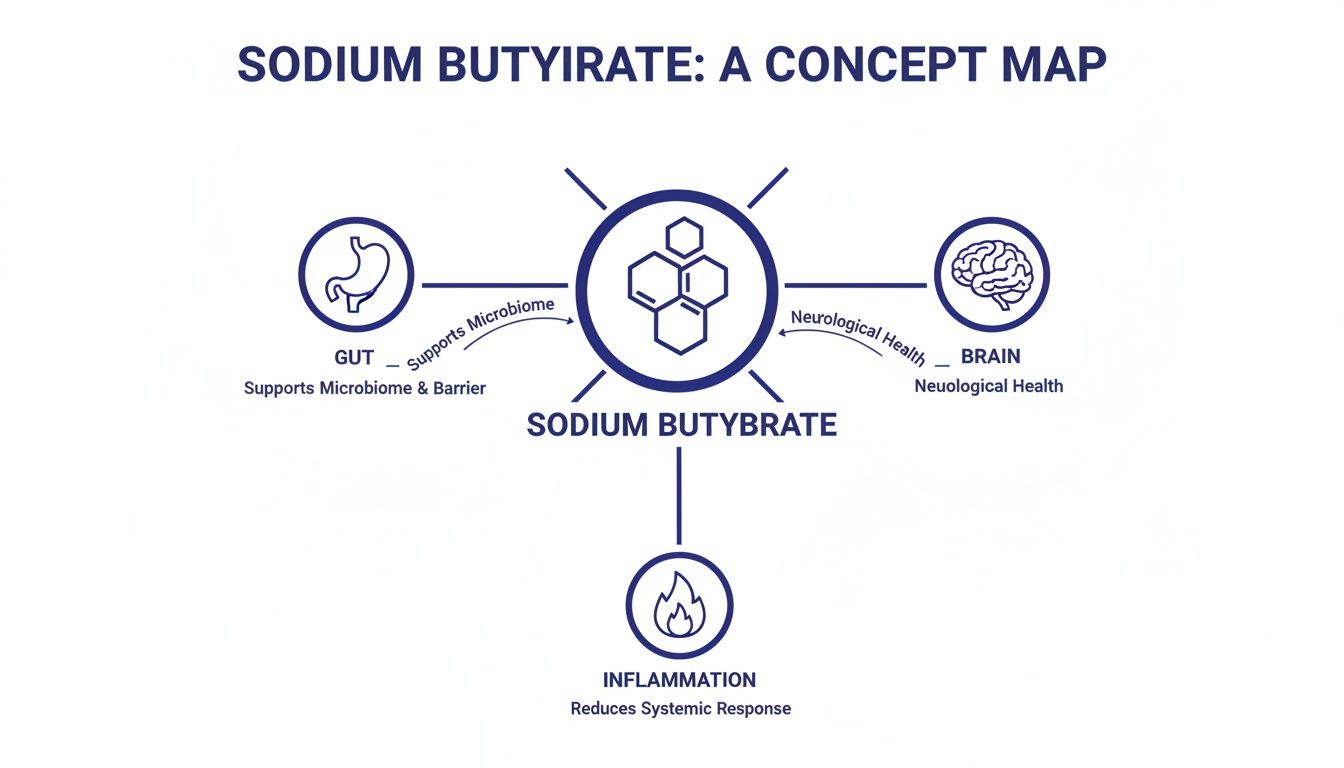
    This infographic shows how butyrate’s actions in the gut radiate outward to influence the brain and reduce systemic inflammation.

    A concept map illustrating the benefits of Sodium Butyrate for gut microbiome, brain health, and reducing inflammation.

    The diagram really drives home how interconnected these systems are. A healthy gut isn’t just about digestion. It’s foundational to how well you think and feel.

    Fueling the Gut-Brain Axis for Enhanced Focus

    This brings us straight to the gut-brain axis. This is the constant, two-way communication superhighway between your digestive system and your brain. A healthy, butyrate-rich gut sends calming, β€œall is well” signals up to the brain. This helps regulate mood and support clear thinking. This connection is well-established in neuroscience.

    On the flip side, a compromised or inflamed gut can send out stress signals. These signals contribute to feelings of anxiety, mental fatigue, or that frustrating brain fog. By fortifying the gut wall and reducing inflammation, butyrate helps ensure the messages traveling along this axis are positive ones. This creates a stable foundation for better mental performance.

    Mini Scenario: A creative professional uses noise canceling headphones to block out distractions, but still struggles with focus. They realize their gut health might be a factor. By increasing fiber intake, they support butyrate production. This strengthens their gut-brain communication, leading to a calmer mind that can better utilize deep work techniques.

    (Educational Disclaimer: This article is for informational purposes only. It is not intended to diagnose, treat, or cure any medical or psychological condition like anxiety, depression, or ADHD. Please consult a qualified healthcare professional for personalized advice.)

    The Core Sodium Butyrate Benefits for Gut Health

    The most powerful and well-researched benefits of sodium butyrate all start right where it’s made: your gut. The best way to think of your gut lining is as a tightly woven fortress wall. In this picture, butyrate is the master mason. It is constantly reinforcing this barrier to keep your inner ecosystem secure and running smoothly.

    Sodium butyrate benefits illustrated by a stone wall with moss and vibrant green sprouts growing above it, next to a β€œGut barrier” sign.

    Its main job is to strengthen the gut barrier. It provides the primary fuel for your colon cells. This helps them maintain the β€œtight junctions”—the microscopic seals that hold the wall together. A strong barrier is your first line of defense against unwanted substances, like undigested food bits and toxins, leaking into your bloodstream. This is the condition many people call β€œleaky gut.”

    This stability at the gut level has a real-world impact on your daily performance. Imagine a freelance designer on a tight deadline. Stress often triggers digestive upset. This then spirals into brain fog and drained energy. By helping to maintain gut integrity, butyrate supports a solid foundation for focus and mental clarity when you’re under pressure. It’s a perfect example of how you can improve digestive health naturally from the inside out.

    Taming Gut Inflammation

    One of butyrate’s most important jobs is calming inflammation right at the source. It acts like a local peacemaker, dialing down the immune response within the gut lining itself. This is a huge deal, because chronic gut inflammation doesn’t just stay in the gut. It can spill over and trigger systemic inflammation that affects your entire body.

    This low-grade, body-wide inflammation is often the hidden culprit behind that persistent fatigue, low mood, or nagging difficulty with concentration. By getting a handle on inflammation at the gut level, butyrate helps conserve your body’s resources. This frees up mental and physical energy for what actually matters, from deep work to creative problem-solving.

    Mini Scenario: An employee feels constantly tired despite getting enough sleep, making it hard to contribute in meetings. They start tracking their habits in a habit tracker journal and notice a link between processed foods and feeling sluggish. By adding more fiber-rich foods, they boost butyrate, reduce gut inflammation, and find their energy levels stabilizing throughout the workday.

    Promoting a Balanced Microbiome

    While butyrate is a product of your gut bacteria, it also turns around and helps create an environment where the good microbes can thrive. This creates a powerful positive feedback loop for your digestive wellness.

    • It favors good bacteria: Butyrate helps create acidic conditions that support the growth of beneficial strains like Lactobacillus and Bifidobacterium.
    • It discourages harmful microbes: A healthy gut environment naturally keeps potentially harmful bacteria from getting out of hand.
    • It enhances resilience: A well-balanced microbiome is much more resilient to disruptions from stress, a poor diet, or even travel.

    Think of butyrate as the head gardener of your internal ecosystem. It doesn’t just feed the existing plants. It actively weeds out the pests and improves the soil. This ensures a vibrant, diverse garden can flourish. If you’re looking for other ways to support your microbiome, you might also want to explore our guide on probiotic supplements for gut health.

    How Sodium Butyrate Improves Your Microbiome

    Your gut microbiome and sodium butyrate have a powerful, two-way relationship. It’s not just that your good gut bacteria make butyrate from fiberβ€”the story gets much better. Butyrate then turns around and acts like a master gardener for your internal ecosystem. It creates the exact conditions those helpful microbes need to thrive.

    This kicks off a powerful positive feedback loop for your gut health. More good bacteria mean more butyrate. More butyrate means an even healthier, more diverse community of good bacteria. It’s a self-reinforcing cycle of wellness that builds on itself.

    Mini Scenario: Someone is trying to establish a healthier routine after a period of high stress. They introduce more legumes and whole grains into their diet. The resulting butyrate production helps rebalance their gut flora. This makes them feel less bloated and more energetic, reinforcing their new healthy habits and making them easier to stick to.

    Fostering a Healthier Microbial Community

    So, how does this work in practice? Sodium butyrate actively encourages a better-balanced gut. It helps create a slightly acidic environment in the colon. This is the perfect sweet spot for beneficial species to multiply while discouraging the troublemakers from taking over. This balance is crucial for a resilient gut.

    Research consistently shows that butyrate specifically promotes the growth of friendly bacteria like Lactobacillus and Blautia. These are the microbes you want on your side. They’re linked to smoother digestion, a stronger immune response, and even a more stable mood. For busy professionals, a stable microbiome can be a game-changer for maintaining energy and mental clarity through stressful periods.

    Even small, consistent habits make a difference here. A student trying to improve their study stamina can get a real edge by focusing on a high-fiber diet. They aren’t just eating healthy. They are actively feeding a microbiome that supports better nutrient absorption and sustained mental performance. Using a visual timer for desk can help them maintain focus during study blocks, powered by a well-fed brain.

    The Power of Diversity and Microbial Shifts

    A diverse microbiome is a strong microbiome. The more varied your internal ecosystem, the better it can handle whatever life throws at it. Studies highlight that sodium butyrate supplementation can give this diversity a significant boost.

    One study showed this effect in stunning detail. Butyrate supplementation triggered a major shift in the gut’s bacterial makeup. The presence of beneficial Lactobacillus jumped from just 5.66% to a remarkable 23.58%. At the same time, another helpful genus, Blautia, grew to 13.27%. You can dive into the full research to see how sodium butyrate fosters this healthier microbial community.

    This kind of microbial shift is a big deal. A more diverse and balanced gut is linked to a stronger immune system, better metabolic health, and clearer communication along the gut-brain axis. For anyone looking to connect their digestive wellness to weight management, this link is key. You can explore this relationship in our guide to gut health and weight loss.

    Sodium Butyrate for Metabolic Health and Weight

    Sodium butyrate’s influence stretches far beyond the gut. It plays a surprisingly helpful role in your overall metabolic health. For busy professionals often stuck in a more sedentary work life, this is a big deal. Emerging science shows this powerful short-chain fatty acid supports how your body manages energy, regulates appetite, and maintains a healthy weight.

    Think of butyrate as a quiet but effective metabolic tune-up. One of its key jobs is to support insulin sensitivity. This is your cells’ ability to efficiently pull glucose from your bloodstream for energy. Better insulin sensitivity is a cornerstone of good metabolic health. It helps you sidestep the kind of energy crashes that can completely derail a productive afternoon.

    This process is deeply connected to how our bodies store and use fuel. As you think about your own metabolic health, it can be useful to recognize the 5 key signs of metabolic syndrome, which can guide proactive conversations with your doctor. Butyrate contributes by shoring up the very systems that keep your metabolism humming along. We dive deeper into this in our guide on fat metabolism and mitochondrial renewal.

    Supporting Weight Management Efforts

    Sodium butyrate also seems to have a say in your appetite signals. It encourages the release of gut hormones like GLP-1 and PYY. These are basically messengers that travel to your brain to say, β€œHey, we’re full.” This can help you feel more satisfied after meals. It makes it easier to manage portions without feeling like you’re fighting constant hunger cues.

    Butyrate is not a weight loss pill. It’s a supportive compound that works from the inside out. It helps regulate the biological signals that control hunger and energy balance to complement a healthy lifestyle.

    Imagine an entrepreneur who pairs a fiber-rich diet with daily activity using an under desk walking pad. The sodium butyrate produced from that fiber reinforces these good habits. It fine-tunes their metabolic health from the gut outward. This is a perfect example of how physical wellness is fundamental to preventing burnout and achieving mental clarityβ€”a core idea in my book, Burnout Interrupted.

    Boosting Your Sodium Butyrate Levels Naturally

    You can absolutely play an active role in your body’s butyrate production. The best place to start is your plate. The most direct and sustainable strategy is to focus on fiber-rich foods. Think of it as giving your gut bacteria the high-quality raw materials they need to do their job.

    While supplements have their place, they work best when they’re supporting an already solid lifestyle, not replacing it.

    Sodium butyrate benefits shown with an overhead shot of fiber-rich foods including oats, legumes, pumpkin seeds, green banana, cucumber, and potatoes.

    Fuel Your Gut with Fiber-Rich Foods

    Your gut microbiome doesn’t just eat anything; it has preferences. It especially thrives on specific fibers like resistant starches. These pass through your small intestine undigested. They arrive in the colon ready for your gut bacteria to ferment them into beautiful butyrate.

    Making a conscious effort to include these foods is the foundation of boosting your levels. Here are some of the best dietary sources to get you started:

    • Resistant Starches: Cooked and then cooled potatoes or rice are fantastic sources. The cooling process actually changes the starch’s structure, making it more β€œresistant” to early digestion.
    • Legumes: Lentils, beans, and chickpeas are packed with the kind of fiber that feeds your most beneficial bacteria.
    • Whole Grains: Oats, barley, and real whole wheat provide a steady supply of fermentable fiber.
    • Green Bananas: Unripe bananas are loaded with resistant starch. As they ripen, that starch naturally converts into sugar, so greener is better for this purpose.
    • Fibrous Vegetables: Don’t forget foods like asparagus, broccoli stems, and artichokes. They’re also great options for a happy gut.

    Mini Scenario: A remote worker wants to avoid the afternoon slump. Instead of reaching for sugary snacks, they prepare a lentil salad with cooled potatoes for lunch. This meal is a powerhouse for butyrate production. It provides sustained energy and supports gut health, helping them stay focused without the crash. A laptop stand for desk can also improve their posture and energy during the day.

    Considering Sodium Butyrate Supplements

    While diet is always the best first step, supplements can offer a more direct boost. This can be especially true for people who have a hard time getting enough fiber. It’s also helpful for those working toward specific gut health goals.

    However, it’s crucial to approach supplementation thoughtfully. A typical dose often ranges from 300 mg to 2,000 mg per day, but this can vary widely. It’s essential to find a high-quality product that doesn’t have a bunch of unnecessary fillers or additives.

    If you are exploring supplements to support your gut, you might also find our article on taking probiotics at night a useful read for timing your routine. Other supplements, like a magnesium glycinate supplement, can also support relaxation and sleep, which are crucial for gut and brain health.

    Editor’s Take

    So, what’s our honest take? The best way to boost butyrate is, and probably always will be, a diet rich in diverse fiber. That’s a win for your entire body, not just your gut. It’s the most reliable, long-term strategy.

    Where supplementation fits in is as a targeted tool. If you’re navigating specific gut issues, have trouble digesting high-fiber foods, or can’t realistically meet your fiber goals through diet alone, a high-quality supplement can be a useful ally. But it is not a magic bullet or a replacement for a healthy lifestyle.

    The real benefits of sodium butyrate circle back to shoring up your gut lining and dialing down inflammation. When you get that right, the ripple effectsβ€”like better mental clarity and more stable energyβ€”tend to follow. Think of it as laying a solid foundation for wellness, not as a direct performance enhancer like a cup of coffee. For anyone struggling with focus, starting with the gut is a smart, long-term play. That kind of foundational thinking is exactly what we explore in my book, The Power of Clarity.

    Key Takeaways: Sodium Butyrate Benefits

    If you’re short on time, here are the core takeaways on sodium butyrate. Think of this as the quick-start guide to understanding what this powerful compound actually does for you.

    • It’s Fuel for Your Gut Lining: Butyrate is the #1 energy source for the cells lining your colon. A well-fed gut barrier is a strong gut barrier. This helps prevent β€œleaky gut” and keeps your internal systems running smoothly.

    • A Powerful Inflammation Fighter: It actively calms inflammation right at the sourceβ€”inside your gut. This can have a ripple effect. It potentially reduces the systemic inflammation that often fuels issues like fatigue and brain fog.

    • It Connects Your Gut and Brain: A healthy gut, rich in butyrate, sends calming signals up to your brain. Neuroscience confirms this gut-brain connection is crucial for supporting a more stable mood, sharper focus, and clearer thinking.

    • Food Is Your Best First Step: The most reliable way to boost butyrate is by feeding your gut bacteria with fiber-rich foods. Think resistant starches like cooled potatoes, plus legumes and whole grains.

    • Supplements Can Offer a Direct Boost: While diet is king, supplementation can give you a direct dose of butyrate. As with any supplement, it’s always smart to chat with your healthcare provider before adding it to your routine. An ergonomic mouse is another small change that can reduce physical stress, indirectly supporting overall wellness.


    (Final Disclaimer: This article contains affiliate links. Purchases made through these links may earn us a small commission at no extra cost to you. The content provided here is for educational purposes only and is not a substitute for professional medical or psychological advice. Always consult a qualified healthcare provider for any health concerns.)

    Frequently Asked Questions (FAQ)

    We’ve covered a lot of ground, but it’s normal to still have a few questions floating around. Let’s tackle some of the most common ones with straightforward, practical answers.

    1. What’s the Best Time of Day to Take Sodium Butyrate?

    Most people find it’s best to take sodium butyrate with a meal. This helps buffer its effects and sidestep any potential stomach upset. This is especially true when you’re just getting started. Ultimately, consistency is what matters most. Find a time that fits neatly into your daily rhythm and stick with it.

    2. How Long Does It Take to See Benefits?

    This is a classic β€œit depends” situation. Some people report better digestion and more predictable gut function within a few weeks. For the deeper, systemic benefitsβ€”like those related to inflammation or the gut-brain axisβ€”you’ll want to give it at least one to three months of consistent use. Think of it as a long-term investment in your gut health, not a quick fix.

    3. Can I Get Enough Butyrate From Diet Alone?

    It’s absolutely possible, but it takes serious dedication. You’d need a diet packed with a huge variety of high-fiber foods and resistant starchesβ€”think lentils, beans, green bananas, and cold potatoes. Frankly, most modern diets just don’t get there. Supplementation is a reliable way to bridge that gap and ensure you’re getting a consistent, therapeutic dose to hit your health goals.

    4. Are There Any Side Effects to Consider?

    Sodium butyrate is generally very well-tolerated. When side effects do pop up, they’re usually mild and temporary. You might experience a bit of bloating or gas as your gut microbiome adjusts. The best way to avoid this is to start with a lower dose and slowly work your way up. This gives your system time to adapt.

    5. What Does Sodium Butyrate Smell Like?

    Let’s be direct: it has a very distinct, pungent smell. People often describe it as sour or like rancid butter. This is completely normal and actually a good sign of its potency. Thankfully, nearly all supplements are encapsulated to contain the odor, so you won’t notice it once you swallow the capsule.

    How Sodium Butyrate Benefits Can Impact Brain Fog

    6. Does Sodium Butyrate Help With Brain Fog?

    Indirectly, yes, and this is a key benefit. It’s not a direct brain booster like caffeine. Instead, by shoring up the gut lining and dialing down inflammation, it powerfully supports the gut-brain axis. A calmer, healthier gut sends much clearer and more positive signals to the brain. Over time, this can lead to improved mental clarity and a noticeable lift in that foggy feeling. It’s about building a better foundation for your brain to work from.

    7. What’s the Difference Between Sodium Butyrate and Tributyrin?

    They’re both excellent ways to get butyrate into your system, just via different routes. Tributyrin is a precursorβ€”a prodrug, reallyβ€”that your body breaks down and converts into three butyrate molecules. Sodium butyrate, on the other hand, is the direct salt form that’s immediately available for your colon cells to use. Both are effective, and the β€œbetter” one often comes down to individual formulation and tolerance.

    8. Will Sodium Butyrate Help Me Lose Weight?

    It’s not a weight-loss pill, but it can be a valuable ally in your efforts. By helping to regulate appetite-related hormones (like GLP-1) and improving insulin sensitivity, it creates a healthier metabolic backdrop. This makes it a great complement to a balanced diet and an active lifestyle. It helps your body work with you, not against you.

    9. Can I Take Sodium Butyrate With Probiotics?

    Yes, and they make a fantastic team. Think of it this way: probiotics are the beneficial bacteria (the β€œseeds”). The fiber you eat provides the raw material for them to make butyrate. Taking a butyrate supplement is like adding extra β€œfertilizer.” It nourishes your gut lining directly, creating an even better environment for those good bacteria to thrive.

    10. Who Should Not Take Sodium Butyrate?

    While it’s generally considered very safe, it’s always smart to talk with your healthcare provider before starting any new supplement. This is especially critical if you are pregnant, breastfeeding, or have a pre-existing medical condition. In particular, check with a doctor if you have issues related to your kidneys or blood pressure, given the sodium content.

    Explore the Mind Clarity Hub Library

    Practical books on focus, digital habits, resilience, and building a calmer mind.

    The Power of Clarity β€” book cover

    The Power of Clarity

    Unlock mental focus, build momentum, and create the life you were meant to live.

    View book β†’
    AI & ChatGPT for Beginners β€” book cover

    AI & ChatGPT for Beginners

    No PhD needed β€” a 2025 guide to AI, prompts, and productivity without coding.

    View book β†’
    Zen in the Digital Jungle β€” book cover

    Zen in the Digital Jungle

    Mindfulness for a chaotic world.

    View book β†’
    The Slow Reset β€” book cover

    The Slow Reset

    Mindful living in a fast-paced world.

    View book β†’
    Perfectly Imperfect β€” book cover

    Perfectly Imperfect

    Stop self-criticism, set boundaries, and embrace the real you.

    View book β†’
    Reclaiming Silence β€” book cover

    Reclaiming Silence

    A dopamine detox guide to finding peace in a noisy world.

    View book β†’
    The Focused Freelancer β€” book cover

    The Focused Freelancer

    Productivity, pricing & positioning for independents in 2025.

    View book β†’
    ChatGPT Side Hustle System β€” book cover

    ChatGPT Side Hustle System

    Launch your AI-driven online business in 30 days.

    View book β†’
    Burnout, Interrupted β€” book cover

    Burnout, Interrupted

    A proven path to restore energy and reclaim your life.

    View book β†’
    Attention Unleashed β€” book cover

    Attention Unleashed

    Focus strategies for the distracted mind.

    View book β†’
    Side Hustle Launchpad β€” book cover

    Side Hustle Launchpad

    Your quick-start guide to extra income.

    View book β†’
    Digital Clarity β€” book cover

    Digital Clarity

    Rewire your brain, escape dopamine traps & regain focus.

    View book β†’
    Break the Scroll β€” book cover

    Break the Scroll

    Reduce screen time and take back control of your life.

    View book β†’
    Climate Compassion β€” book cover

    Climate Compassion

    Transform eco-anxiety into empowered action.

    View book β†’
    Village Mentality β€” book cover

    Village Mentality

    The power of community for mental wellness.

    View book β†’
    Restful Nights β€” book cover

    Restful Nights

    Overcoming sleep anxiety in a 24/7 world.

    View book β†’
    Connected Again β€” book cover

    Connected Again

    Combat loneliness and build meaningful relationships.

    View book β†’
    Focus Recharged β€” book cover

    Focus Recharged

    Mastering attention and productivity in the digital era.

    View book β†’
    Marketing Magic with ChatGPT β€” book cover

    Marketing Magic with ChatGPT

    AI-powered content, campaigns, and copywriting to grow faster.

    View book β†’
    The 6-Figure Creator β€” book cover

    The 6-Figure Creator

    Turn knowledge into passive income with books, courses & AI.

    View book β†’
    Burnout Breakthrough β€” book cover

    Burnout Breakthrough

    Reset your work-life balance and thrive in 2025.

    View book β†’
    The Emotionally Intelligent Man β€” book cover

    The Emotionally Intelligent Man

    A modern guide to self-awareness and communication.

    View book β†’
    AI Personalized Wellness β€” book cover

    AI Personalized Wellness

    Create your custom health plan with data-driven habits.

    View book β†’
    Everyday AI Made Easy β€” book cover

    Everyday AI Made Easy

    Use ChatGPT and smart tools to simplify life.

    View book β†’
    Money Mindfulness β€” book cover

    Money Mindfulness

    A financial wellness guide for Gen Z & Millennials.

    View book β†’
    Startup Smarter with AI β€” book cover

    Startup Smarter with AI

    ChatGPT strategies and tools to grow your business.

    View book β†’
    ChatGPT for Writers & Creators β€” book cover

    ChatGPT for Writers & Creators

    Unlock AI-powered brainstorming, drafting & editing.

    View book β†’
  • Vitamins to Help with Brain Fog for Lasting Mental Clarity

    Vitamins to Help with Brain Fog for Lasting Mental Clarity

    Feeling your way through daily life with a fuzzy mind is draining. While the causes are complex, certain nutrients like B-complex vitamins and Vitamin D are known to support the very systems your brain relies on for clarity. These vitamins play a vital role in energy production and neurotransmitter healthβ€”two of the most important factors for sharp thinking.

    Affiliate Disclosure: This article may contain affiliate links. If you make a purchase through these links, we may earn a small commission at no extra cost to you. We only recommend products we trust.

    The Science of Clearing Your Mental Haze with Vitamins to Help with Brain Fog

    Ever feel like you’re trying to meet a critical deadline, but your thoughts are moving through molasses? Simple tasks feel monumental, and focus is just out of reach. That experience, what we call brain fog, isn’t a personal failing. It’s often a symptom of underlying imbalances in your brain’s chemistry and energy systems, a sign that your neurons may not be getting the fuel they need.

    This guide explores how targeted nutrition can be a powerful tool for reclaiming your mental clarity. We’ll break down the neuroscience behind cognitive function in simple terms. We will also explain how specific nutrients fuel your brain and support its intricate communication networks.

    Understanding the Widespread Impact of Brain Fog

    If you’re struggling with mental fatigue, you are far from alone. Brain fog has become a significant health issue affecting millions. As of September 2023, an estimated 16.5 million working-age adults in the United States reported dealing with cognitive limitations.

    Further research shows that around 28.2% of the population experiences brain fog, with a higher prevalence among women. You can dig deeper into the data on how widespread this has become in recent population studies.

    This article is designed to give you actionable, science-backed insights to help you navigate the haze. By understanding the link between what you eat and how you think, you can find your way back to clear, sharp focus. We break down the core concepts in our related guide on the science of mental fog.

    This content is for educational purposes only and is not a substitute for professional medical or psychological care. If you are experiencing persistent cognitive issues or conditions like anxiety, burnout, ADHD, or depression, please consult a qualified healthcare provider for diagnosis and treatment.

    Our goal is to give you the knowledge to make informed choices. By exploring how specific vitamins and nutrients can help with brain fog, you can start building a foundation for lasting mental clarity and improved cognitive performance.

    Why Your Brain Is Starving for the Right Nutrients

    Think of your brain as a high-performance engine. Its billions of connections, called neurons, are constantly firing to run everything from your deepest thoughts to your next heartbeat. Neuroscience research shows this relentless activity burns through an incredible amount of energy. Therefore, it demands specific, high-quality fuel to run smoothly.

    When that fuel is missing, the entire system sputters. This is the very root of that heavy, frustrating feeling of brain fog. The line connecting what you eat to how clearly you think isn’t just a vague wellness conceptβ€”it’s direct, biological, and powerful.

    How Your Brain Builds Focus from Food

    Your brain’s ability to manufacture its own chemical messengers, known as neurotransmitters, depends completely on the nutrients it gets from your diet. These messengers, like serotonin and dopamine, are the molecules that govern your mood, motivation, and focus. If the right building blocks aren’t available, production grinds to a halt.

    For instance, if you’re not getting enough B vitamins, your brain physically struggles to create the neurotransmitters that keep you sharp and engaged. It’s like a factory trying to assemble a car without the right nuts and bolts. The entire production line just stops.

    At an even deeper level, every single brain cell is powered by tiny engines called mitochondria. These engines need a steady supply of nutrients like CoQ10 and magnesium to generate energy. A shortfall means your brain is literally running on a low battery. This makes it nearly impossible to concentrate or pull up information on command.

    Mini Scenario: Picture a freelance creative pushing through a tight deadline. Surviving on coffee and whatever’s fast, they suddenly find their once-brilliant ideas replaced by a frustrating mental block. This isn’t a failure of talent; it’s a brain deprived of the essential fuel it needs to perform. This demonstrates a real-world consequence of poor nutritional habits on cognitive behavior.

    The Real Cost of Nutritional Gaps

    Even small, seemingly minor nutritional gaps can have an outsized impact on your daily performance. A growing body of research now points to these deficiencies as a major driver of cognitive issues. Scientific studies confirm that imbalances in key micronutrients can directly impair how your neurons fire, leading to the classic symptoms of brain fog. You can read more about these findings on how nutrition affects neuronal function.

    This link is especially critical for knowledge workers, whose demanding schedules and irregular eating habits put them at greater risk. The constant mental exertion depletes resources faster. This makes them more vulnerable to the effects of a nutrient-poor diet.

    • Processing Speed: Without enough omega-3 fatty acids, the protective coating around your neurons can degrade, slowing down the communication speed between brain cells.
    • Memory Recall: A lack of iron can slash oxygen flow to the brain, which directly impacts your ability to form and retrieve memories.
    • Sustained Attention: Unstable blood sugar from processed foods sends your energy on a rollercoaster of spikes and crashes, making steady focus feel like an impossible task.

    This is precisely why a β€œfood-first” approach is so important before you even think about supplements. If you’re interested in exploring how dietary changes can support overall mental well-being, comprehensive strategies like nutrition therapy offer a structured path forward.

    Understanding this fundamental link between your plate and your mind is the first step toward clearing the fog for good. We dig into many of the other underlying factors in our guide explaining what causes brain fog. By giving your brain the raw materials it needs to operate at its peak, you’re setting the stage to think clearly, stay sharp, and feel like yourself again.

    Key Vitamins and Nutrients That Help Combat Brain Fog

    Diving into the world of supplements can feel like navigating a maze. However, a handful of specific vitamins and minerals are well-recognized for their critical role in brain health. Understanding what they do is the first step toward clearing that mental haze. Think of these nutrients as the essential toolkit your brain uses to build, repair, and power its incredibly complex machinery.

    A healthy brain is a well-fueled brain. The right vitamins are the key components of that fuel. They support everything from raw energy production to the speed of your thoughts.

    Let’s break down some of the most important players and how they support these vital processes.

    The B-Complex Vitamins: Your Brain’s Energizers

    Think of B vitamins as the spark plugs for your brain’s engine. This group of eight essential nutrientsβ€”especially B6, B9 (folate), and B12β€”is crucial for just about everything. They are essential from converting food into neural energy to creating the neurotransmitters that regulate your mood and focus.

    A deficiency in B vitamins can stall your brain’s energy production, leaving you feeling sluggish and mentally drained. Neuroscience research consistently shows that healthy levels are linked to sharper cognitive function, particularly as we age. They also help form the myelin sheath, a protective coating around your nerve cells that lets them communicate at top speed.

    Mini Scenario: Imagine a project manager juggling multiple deadlines who suddenly finds their focus slipping. A simple blood test might reveal a B12 deficiency. By adding more B-vitamin-rich foods like leafy greens, eggs, and salmon, they’re giving their brain the raw materials it needs to get back online. This behavioral change directly impacts their cognitive performance at work.

    Vitamin D: The Sunshine Vitamin for a Clearer Mind

    While it’s famous for bone health, Vitamin D also acts as a neurosteroid. It helps to regulate brain function and development. Your brain is packed with Vitamin D receptors, especially in areas responsible for memory and processing information.

    It’s no surprise, then, that low Vitamin D levels have been associated with cognitive impairment and that β€œfoggy” feeling. It plays a key role in protecting your neurons and tamping down inflammation in the brainβ€”a common culprit behind mental fatigue.

    Getting enough sunlight is the primary way to boost Vitamin D. However, many people still fall short. Fatty fish (like salmon and mackerel) and fortified foods can help, but supplementation is often necessary, especially during winter months.

    It’s vital to get your levels checked by a doctor before starting any high-dose supplement. This ensures you’re taking an amount that’s both safe and effective for your specific needs.

    Magnesium: The Brain’s Calming Mineral

    Magnesium is a true multitasker, involved in over 300 biochemical reactions in the body. Many of these reactions are happening right in your brain. It’s essential for nerve transmission and energy production. It also helps regulate the neurotransmitters that promote calmness and focus.

    When magnesium is low, your nervous system can become over-excited, leading to stress, restlessness, and a scattered mind. Think of it as the brake pedal for your brain; it helps you slow down, concentrate, and prevent mental overload.

    Good food sources of magnesium include:

    • Dark leafy greens like spinach and kale
    • Nuts and seeds, especially almonds and pumpkin seeds
    • Legumes and whole grains

    Many forms of magnesium supplements are available. Some, like Magnesium L-threonate, are particularly noted for their ability to cross the blood-brain barrier.

    Omega-3 Fatty Acids: Building Blocks for Brain Cells

    Omega-3s, particularly DHA, are the fundamental building blocks of your brain cells. They are critical for keeping cell membranes fluid and flexible. This allows for fast and efficient communication between neurons. Essentially, they keep your brain’s wiring in top condition.

    A diet lacking in omega-3s can lead to stiff, poorly functioning brain cells. This can slow down your processing speed and contribute to brain fog. To get more of these essential fats, you can turn to fatty fish like salmon or consider a high-quality fish oil or algae-based supplement.

    Essential Nutrients Chart for Cognitive Clarity

    To make this easier to digest, here’s a quick-reference guide to the top nutrients that support cognitive function, what they do, and where to find them.

    NutrientPrimary Brain FunctionTop Food Sources
    B Vitamins (B6, B9, B12)Energy production & neurotransmitter synthesisLeafy greens, eggs, salmon, legumes
    Vitamin DNeuroprotection & inflammation reductionFatty fish, fortified milk, sunlight
    MagnesiumNerve transmission & calming the nervous systemSpinach, almonds, pumpkin seeds, avocado
    Omega-3s (DHA/EPA)Cell membrane health & neuron communicationSalmon, mackerel, walnuts, chia seeds

    This table serves as a simple starting point. A food-first approach is always best, but targeted supplementation can help fill in the gaps when necessary. For a comprehensive exploration of specific nutrients, consider delving into the 10 Best Vitamins for Brain Fog.

    Building Fog-Proof Lifestyle Habits to Support Vitamin Intake

    Vitamins can give your brain the raw materials it needs, but they don’t work in a vacuum. Real, lasting mental clarity comes from pairing smart nutrition with supportive lifestyle habits. These practices are what protect your brain, sharpen its performance, and build resilience against the very things that cause fog in the first place.

    Sharp thinking isn’t built on supplements aloneβ€”it’s forged in the small choices you make every day. When you weave these fog-proof habits into your routine, you create an environment where your brain can finally do its best work.

    Prioritize Sleep as Your Brain’s Cleaning Crew

    Sleep isn’t just downtime; it’s an active, essential maintenance shift for your brain. During deep sleep, the brain’s glymphatic system kicks into high gear. Neuroscience explains this as a highly efficient cleaning crew. It flushes out metabolic waste and toxins that build up during the day, including beta-amyloid proteins linked to cognitive decline.

    When you cut sleep short, you’re basically sending the cleaning crew home early. The result is a pile-up of cellular junk that directly contributes to that sluggish, foggy feeling the next morning. Getting 7-9 hours of quality sleep is one of the most powerful habits you can adopt to wake up with a clearer mind.

    Mini Scenario: A startup founder felt foggy and unproductive, even though she was highly motivated. She decided to implement a strict β€œscreens off” rule an hour before bed, swapping her phone for a physical book. This simple change dramatically improved her sleep, a behavioral shift that allowed her to start waking up with the mental clarity needed to tackle her most complex problems.

    Manage Digital Overload and Reset Your Focus

    Constant pings, notifications, and an endless river of information create what behavioral researchers call β€œcontinuous partial attention.” This digital barrage overstimulates your brain’s reward system, which runs on the neurotransmitter dopamine. Over time, this can actually desensitize your brain. This makes it harder to focus on less stimulating (but more important) work.

    You don’t have to abandon technology, but you do need to use it more intentionally.

    • Time-Blocking: Carve out specific blocks of time for deep work with all notifications silenced. This behavioral technique trains your brain to sustain focus without interruption.
    • Scheduled β€œDopamine Detox”: Set aside periodsβ€”even just a few hours on a weekendβ€”to completely disconnect from screens. This helps reset your brain’s reward pathways and restores your ability to concentrate.
    • Mindful Productivity: Use one tool at a time instead of juggling a dozen tabs and apps. This lowers your cognitive load and frees up precious mental bandwidth.

    Be patient with yourself. The recovery from brain fog isn’t always linear, which is why lifestyle habits are so crucial. While some people recover quickly, others face persistent symptoms for months or even years. One study found that about 65% of subjects recovered naturally. However, another indicated that 84% of long-COVID patients still had symptoms after 24 months. These longitudinal brain fog studies underscore why a combination of nutrition and lifestyle is so important for long-term clarity.

    Building fog-proof habits is about creating a sustainable system that supports your cognitive health day in and day out. It’s the combination of the right nutrients, restorative sleep, and mindful technology use that clears the path to lasting mental clarity. These habits become even more powerful when you connect them with other supportive practices. For instance, a healthy gut microbiome has a huge impact on brain function through the gut-brain axis. You can check out our guide on probiotic supplements for gut health to see how digestive wellness ties directly into a clear mind.

    Editor’s Take: What Truly Works for Brain Fog

    Let’s cut through the noise. While the idea of a magic vitamin for brain fog is tempting, the reality is that supplements are not a silver bullet. Here’s our honest take: a β€˜food-first’ philosophy is the only place to start. Nothing you can buy in a bottle will ever replace the symphony of nutrients found in real, whole foods.

    Think of it like this: supplements are a tune-up for your car. But a nutrient-rich diet is the high-quality fuel it needs to run every single day. Without the right fuel, even a perfectly tuned engine will sputter.

    Who This Advice Is Really For

    This approach is best suited for busy professionals and students dealing with mild to moderate brain fog. This is the kind often triggered by stress, too much screen time, or an inconsistent diet. For this group, combining targeted nutrition with better lifestyle habits can make a huge difference in mental clarity.

    However, this isn’t the answer for everyone.

    If you’re dealing with persistent, severe brain fog or suspect an underlying condition like chronic fatigue, Lyme disease, or a hormonal imbalance, the only appropriate next step is to consult a qualified healthcare provider. They can order the right tests and create a personalized plan that’s safe for you.

    A Few Important Caveats

    Remember, the supplement industry is loosely regulated. This is why getting professional guidance is so important for both safety and effectiveness. A doctor can run blood work to pinpoint actual deficiencies. This prevents you from wasting money on things you don’t need or taking doses that could be harmful.

    Ultimately, the most powerful strategy is holistic. It’s about combining a nutrient-dense diet with the foundational habits your brain cravesβ€”prioritizing sleep, managing stress, and moving your body. This integrated approach is the most reliable path to clearing the fog for good.

    Key Takeaways on Vitamins for Brain Fog

    • Food First, Always: Before reaching for supplements, prioritize a diet rich in B vitamins, Vitamin D, magnesium, and omega-3s from whole food sources.
    • B Vitamins are Brain Fuel: Nutrients like B6, B9, and B12 are critical for your brain’s energy production and the creation of focus-related neurotransmitters.
    • Don’t Forget Lifestyle Habits: Quality sleep, stress management, and mindful technology use are just as important as nutrition for clearing mental fog.
    • Hydration is a Quick Win: Mild dehydration is a common and often overlooked cause of brain fog. Drink water consistently throughout the day.
    • Consult a Professional: For persistent or severe brain fog, always seek medical advice. A healthcare provider can test for specific deficiencies and rule out underlying conditions.

    Your Action Plan for a Clearer Mind

    All this knowledge is great, but putting it into practice is where the real change happens. So, we’ve boiled everything down into a scannable checklist to help you start reclaiming your mental clarity today.

    Think of this list as your launchpad. Each point is a practical, immediate step you can take. These range from simple food swaps to powerful habit shifts that give your brain the support it needs to function at its best.

    Your Daily Clarity Checklist

    • Build Your Plate Around Brain Nutrients: Don’t just eatβ€”fuel your brain. Make a conscious effort to add foods packed with B vitamins, Vitamin D, magnesium, and omega-3s. That means more leafy greens, fatty fish like salmon, and a handful of nuts and seeds. A food-first strategy always builds the strongest foundation.

    • Hydrate Like Your Focus Depends on It (Because It Does): Your brain is mostly water. Even mild dehydration is a notorious, often-missed cause of mental fatigue. Keep a water bottle handy and sip consistently throughout the day to support blood flow and keep your cognitive gears running smoothly.

    • Treat Sleep as a Non-Negotiable: Quality sleep isn’t a luxury; it’s your brain’s nightly cleaning crew. Aim for 7-9 hours a night. This is when your brain clears out the metabolic junk that builds up during the day and directly contributes to that foggy feeling. For a deeper dive, check out our guide on how to get some rest.

    • Schedule β€œMindful Pauses” Away from Screens: Step away from the glow. Seriously. Even just five minutes of stretching, looking out a window, or doing a few deep breaths can significantly lower your cognitive load. These tiny breaks stop mental strain from snowballing into full-blown brain fog.

    • Move Your Body Every Single Day: No, you don’t need a grueling gym session. A simple, brisk walk is one of the best things you can do for your head. It fires up blood flow to the brain, sharpening focus and boosting energy levels almost instantly. Think of it as one of the best β€œvitamins” for brain fog.


    Disclaimer: This content is for educational purposes and is not a substitute for medical or psychological advice. The strategies discussed are intended to support overall wellness. This article may contain affiliate links, which help support our work at no extra cost to you.

    Frequently Asked Questions (FAQ)

    1. What’s the fastest way to get rid of brain fog?

    There is no magic pill. However, the fastest way to find relief is by addressing fundamentals: hydrate immediately, eat a nutrient-dense meal (like salmon and spinach), and prioritize a full night of quality sleep. These actions directly provide your brain with the resources it needs.

    2. Can vitamin deficiencies actually cause brain fog?

    Yes, absolutely. Deficiencies in key nutrients like Vitamin B12, Vitamin D, and magnesium are scientifically linked to cognitive symptoms. They can impair everything from nerve communication speed to energy production within brain cells, which you experience as brain fog.

    3. How long does it take for vitamins to help with brain fog?

    It varies. If you have a significant deficiency, you may notice improvements within a few weeks of targeted supplementation. For most people, consistent intake for one to three months is needed to see a sustained difference as your body replenishes its stores.

    4. Are there any vitamins I should avoid for brain fog?

    It’s more about avoiding incorrect dosages than specific vitamins. High doses of fat-soluble vitamins like A and E can be toxic. Never supplement with iron unless a blood test confirms a deficiency, as excess iron can be harmful. Always consult a doctor.

    5. Can I just take a multivitamin for brain fog?

    A multivitamin can be a good nutritional baseline, but it often isn’t enough to correct a specific deficiency causing your brain fog. The doses are typically too low. Targeted supplementation based on bloodwork is far more effective.

    6. Is it better to get vitamins from food or supplements?

    Food is always the best choice. Whole foods provide a complex array of nutrients that work synergistically in a way pills cannot replicate. Supplements should be used to fill specific, identified gaps in a healthy diet, not replace it.

    7. How do I know which vitamins for brain fog I actually need?

    The only reliable way is through blood testing ordered by a healthcare professional. Guessing can be ineffective and unsafe. A blood panel provides clear data on your vitamin levels, allowing for a targeted and effective approach.

    8. Can stress cause brain fog even if my vitamin levels are normal?

    Yes. Chronic stress elevates the hormone cortisol, which can disrupt neurotransmitter function and cause inflammation in the brain. This can lead to brain fog even with a perfect diet. Managing stress is a critical piece of the puzzle.

    9. Will these vitamins interfere with my medications?

    They might. Certain supplements can interact with prescription medications. For example, magnesium can affect some antibiotics and blood pressure drugs. It is essential to speak with your doctor or pharmacist before starting any new supplement.

    10. If vitamins don’t help my brain fog, what should I do?

    If you’ve addressed nutrition and lifestyle habits without success, consult a medical professional to investigate further. Persistent brain fog can be a symptom of an underlying condition like a thyroid disorder, hormonal imbalance, sleep apnea, or chronic fatigue syndrome.


    At Mind Clarity Hub, we’re focused on science-backed, practical guides to help you reclaim your focus and mental energy. Explore our library of books on productivity, digital wellness, and AI workflows to build a system that supports a clearer mind.

    Discover your next guide to mental clarity at Mind Clarity Hub.

  • How to Reset Your Brain for Focus and Mental Clarity

    How to Reset Your Brain for Focus and Mental Clarity

    Jeremy Jarvis β€” Mind Clarity Hub founder
    Mind Clarity Hub β€’ Research-aware focus & digital wellness

    To truly reset your brain, the focus needs to be on two fronts: reducing chronic stress and digital overload, while at the same time intentionally choosing activities that promote neural repair, like deep sleep and mindfulness. This isn’t about finding a quick fix; it’s a strategic process of restoring your brain’s natural capacity for focus and calm.

    Affiliate Disclosure: Some links in this article may be affiliate links. If you make a purchase, we may earn a small commission at no extra cost to you. This helps support our work in bringing you evidence-backed content.

    Why Your Brain Feels Overloaded and Ready for a Reset

    If you feel mentally scattered, constantly distracted, or like your brain is just running on fumes, you’re not alone. Our modern lives have created a perfect storm for cognitive overload.

    The constant barrage of notifications, the never-ending to-do lists, and the unspoken pressure to always be β€œon” can push our brains well past their functional limits. This isn’t a personal failure; it’s a predictable biological response to an environment that relentlessly demands our attention.

    A stressed man holds his head in front of a laptop as digital notification icons swirl around him, showing the mental overload that makes **how to reset your brain** essential.

    This feeling of being swamped has deep roots in neuroscience. Chronic stress doesn’t just make you feel badβ€”it physically alters your brain’s architecture. Behavioral research shows that prolonged stress can cause the dendritic branchesβ€”the delicate connections between neuronsβ€”to shrink in key areas like the prefrontal cortex, which governs focus and decision-making.

    The good news? These changes are often reversible through a process called neuroplasticity. You have the power to help your brain heal and rewire itself.

    The Cycle of Mental Fatigue

    Mental fatigue usually creeps up on you. It starts with small things, like struggling to focus on one task or feeling irritable for no obvious reason. If left unchecked, this can snowball into a state where your brain feels like it’s permanently stuck in a fog.

    This is where the idea of a β€œbrain reset” comes into play. It’s not about finding a magic β€œoff” switch. It’s about implementing specific, science-backed practices to:

    • Reduce your cognitive load: Intentionally cut back on the amount of information and stimulation your brain is forced to process every day.
    • Restore crucial neural pathways: Engage in activities that encourage brain repair and growth, like quality sleep and focused attention.
    • Recalibrate your reward system: Break the cycle of cheap dopamine hits from distractions that are actively undermining your motivation and focus.

    If you’re already feeling that mental fog, exploring some effective strategies to improve mental clarity and focus can offer some immediate relief.

    Understanding the neurology of how our attention gets hijacked is a critical first step. You can dive deeper into the impact of digital overwhelm in our detailed guide.

    Build a Strong Foundation for Your Brain Reset

    Before you can reset your brain’s softwareβ€”your habits, focus, and moodβ€”you have to get its hardware right. Think of it like a high-performance computer. You wouldn’t try to run complex code on a machine that’s overheating and low on power. The same goes for your brain.

    This foundational layer is built on three non-negotiables: sleep, nutrition, and movement.

    Getting these fundamentals dialed in creates the biological bedrock for any real mental reset. Without them, you’re just building a house on sand. Let’s look at how to fortify each pillar with small, sustainable changes that actually work in the real world.

    Prioritize Sleep to Cleanse and Consolidate Your Brain

    Sleep isn’t just passive rest; it’s an active, essential maintenance period for your mind. While you’re asleep, your brain is hard at work. One of its most critical jobs is handled by the glymphatic system, which acts like a microscopic cleanup crew.

    This system flushes out metabolic junk that builds up during the day, including the beta-amyloid proteins linked to cognitive decline. At the same time, your brain is busy consolidating memoriesβ€”strengthening important neural connections and trimming away the weaker, unnecessary ones. This process is vital for learning and literally helps you wake up with a cleaner, more efficient mental workspace.

    Real-World Scenario: The Late-Night Scroller
    Alex, a project manager, spends an hour scrolling on their phone in bed every night, thinking it helps them β€œwind down.” But they consistently wake up feeling foggy and sluggish, struggling to organize their thoughts. This isn’t just tiredness. The blue light from the screen suppresses melatonin, delaying the deep sleep their brain needs. As a result, those crucial cleanup and memory processes get cut short, leading directly to that feeling of morning brain fog.

    To really support your brain reset, aim for 7-9 hours of quality sleep. This isn’t just about how long you’re in bed, but about consistency and quality. A simple β€œwind-down” routineβ€”like reading a physical book or listening to calm music for 30 minutes before bedβ€”can make a huge difference in your ability to fall and stay asleep.

    A neatly made bed in a dark room with a book and glasses on the nightstand, illustrating a calm sleep environment for a brain reset.

    Fuel Your Brain with Smart Nutrition

    The food you eat directly builds your brain’s structure and fuels its function. Your brain is an incredibly hungry organ, burning through about 20% of your body’s total calories while making up only 2% of your body weight. Giving it the right fuel is non-negotiable for focus, memory, and mood.

    Think of it in terms of key players:

    • Omega-3 Fatty Acids: Found in foods like salmon, walnuts, and flaxseeds, these are the literal building blocks for your brain cell membranes. They’re critical for neuroplasticity and taming inflammation.
    • Complex Carbohydrates: Sources like whole grains, beans, and vegetables provide a slow, steady release of glucoseβ€”the brain’s main power source. This prevents the sharp energy spikes and crashes you get from sugary snacks.
    • Lean Proteins: Foods rich in amino acids, like chicken, eggs, and lentils, are the precursors to neurotransmitters like dopamine and serotonin, which govern your mood, motivation, and focus.

    A simple way to start is to focus on adding whole, unprocessed foods to your diet instead of just trying to eliminate β€œbad” ones. This positive reframing feels far more sustainable. Our guide on 7 brain-resetting habits offers more detailed nutritional strategies you can start using today.

    Real-World Scenario: The Afternoon Brain Fog Fighter
    Maria, a remote graphic designer, used to fight her 2 PM slump with a sugary cereal bar and a big coffee. She’d get a quick jolt, followed by an even deeper crash an hour later that made creative work impossible. She switched her lunch to include grilled chicken (protein), quinoa (complex carbs), and avocado (healthy fats). Now, her energy stays stable all afternoon, wiping out the brain fog and letting her stay locked in on complex design projects.

    Move Your Body to Grow Your Brain

    Physical activity might be the single most powerful tool you have for a brain reset. It does far more than just benefit your body; it sets off a cascade of neurochemical and structural changes in your brain.

    When you do aerobic exercise, your brain releases a protein called Brain-Derived Neurotrophic Factor (BDNF). Neuroscientists often call BDNF β€œMiracle-Gro” for the brain because it supports the survival of your existing neurons and encourages the growth of new onesβ€”a process called neurogenesis.

    Movement also cranks up blood flow to the brain, delivering more oxygen and nutrients where they’re needed most. Even a short walk can give an immediate boost to your executive functions, like planning and attention. It’s a direct way to clear your head.

    You don’t need to run a marathon. The key is consistency. A brisk 15-20 minute walk on your lunch break, a quick yoga session in the morning, or even a few sets of bodyweight exercises can deliver significant cognitive benefits. The goal is to make movement a non-negotiable part of your daily rhythm.

    Use Micro-Resets to Reclaim Your Focus in Minutes

    You don’t need a week-long vacation to reset your brain. Sometimes, you just need a minute.

    When you’re caught in the middle of a chaotic workday, feeling scattered and completely overwhelmed, what you need are tools to reclaim your focus right now. These are called micro-resetsβ€”brief, intentional breaks designed to interrupt the stress cycle and restore your mental energy in minutes.

    The real power of a micro-reset is its ability to directly influence your nervous system. When you feel stressed or frantic, your sympathetic nervous systemβ€”the β€œfight or flight” responseβ€”is running the show. Micro-resets are your way of hitting the brakes, activating your parasympathetic nervous system (the β€œrest and digest” state) to bring your mind and body back to a calm equilibrium.

    The Physiological Sigh for Instant Calm

    One of the most effective and fastest-acting micro-resets is the physiological sigh. This isn’t just taking a deep breath; it’s a specific breathing pattern that research from Stanford’s Huberman Lab shows is the quickest way to voluntarily lower your heart rate and calm your body down.

    It works by maximally inflating the tiny air sacs in your lungs (alveoli), which helps offload excess carbon dioxide from your bloodstream. That chemical shift sends a powerful signal straight to your brain to dial down the stress response.

    Here’s how you do it:

    • Take two sharp inhales through your noseβ€”one deep breath, followed by a second, shorter sip of air right on top of it.
    • Then, let out a long, complete exhale through your mouth, letting all the air out slowly.
    • Repeat this just one to three times. That’s it.

    Real-World Scenario: Before the Big Meeting
    Imagine you have a high-stakes presentation in five minutes. Your heart is pounding and your thoughts are racing. Instead of letting the anxiety spiral, you duck into a quiet corner and take two physiological sighs. Almost instantly, you feel your heart rate slow, allowing you to walk into that meeting with a clear head and a steady voice.

    This simple technique is a powerful tool for resetting your brain’s state in under 60 seconds, giving you immediate control when you feel overwhelmed.

    Infographic showing the Brain Reset Foundation steps: sleep, nutrition, and movement with corresponding icons.

    This visual underscores a key idea: foundational habits like sleep, nutrition, and movement are the pillars supporting any successful brain reset. When you have these in place, micro-resets become even more effective at keeping you sharp and focused all day long.

    Non-Sleep Deep Rest for Mental Restoration

    Another powerful tool is Non-Sleep Deep Rest (NSDR), a term for protocols that guide you into a state of profound relaxation without you actually falling asleep. Think of practices like yoga nidra or certain guided meditations. NSDR is brilliant for replenishing dopamine levelsβ€”crucial for motivation and focusβ€”and has been shown to improve your brain’s ability to consolidate learning.

    Think of it as a guided power nap for your neurons.

    By directing your focus inward and away from external noise, you give your prefrontal cortexβ€”the part of your brain responsible for planning and decision-makingβ€”a much-needed break. This allows it to recover and come back online with renewed strength.

    • When to Use It: It’s perfect for that mid-afternoon slump when you feel mentally drained but can’t take a proper nap. A 10-20 minute NSDR session can be far more restorative than scrolling through your phone.
    • How to Start: Find a quiet place, lie down, and use a guided audio script. There are countless free resources online that can walk you through the process step-by-step.

    Here’s a quick summary of the immediate techniques you can use to reset your focus and calm your nervous system throughout the day.

    Your Quick Brain Reset Toolkit

    TechniqueWhen to UseHow It Works (The Science)Time Required
    Physiological SighHigh-stress moments (before a meeting, after a tough call)Offloads CO2, activating the parasympathetic nervous system to rapidly slow heart rate.1-3 minutes
    Non-Sleep Deep Rest (NSDR)Mid-afternoon energy slump or when feeling mentally drainedGuides the brain into a state of deep rest, replenishing dopamine and resting the prefrontal cortex.10-20 minutes
    Sound RitualWhen you need to quickly shift from a chaotic to a calm stateUses auditory focus to anchor attention and reduce sensory overload, calming the nervous system.3-5 minutes
    Brief Walk OutsideFeeling stuck on a problem or after long screen timeCombines light movement, natural light, and a change of scenery to reset attention and boost mood.5-15 minutes

    These tools are your first line of defense against daily overwhelm, giving you the ability to perform a strategic brain reset whenever and wherever you need it most.

    For even more quick, actionable strategies to improve focus, you can explore techniques perfect for reclaiming attention in minutes. Another powerful method is using sound to guide your mind into a relaxed state; you can learn exactly how with our 3-minute sound ritual guide.

    Reset Your Brain’s Reward System with a Dopamine Detox

    Β 

    Ever feel restless, unmotivated, and constantly reaching for your phone for no real reason? It’s a classic sign that your brain’s reward system is working overtime.

    This system, driven largely by the neurotransmitter dopamine, is wired to push you toward survival. But our modern world has completely hijacked it. The constant pings, endless social feeds, and on-demand entertainment create a steady drip of cheap, easy dopamine hits.

    Over time, your brain adapts to this high level of stimulation, raising its baseline for what feels rewarding. Suddenly, activities that offer a slower, more meaningful payoffβ€”like reading a book, tackling a complex project, or just having a quiet conversationβ€”start to feel dull and unappealing.

    This is where the idea of a β€œdopamine detox” comes in. It’s not about getting rid of dopamine, which is both impossible and a bad idea. Instead, it’s a practical way to recalibrate your brain’s sensitivity and take back control of your attention. By intentionally stepping back from high-dopamine, low-value activities, you let your reward pathways reset. Natural, productive tasks start to feel engaging again.

    Understanding Your Dopamine Triggers

    The first real step is to get honest about your personal dopamine triggers. These are the specific, often mindless, activities you turn to for a quick hit of stimulation, especially when you feel bored, stressed, or are avoiding something difficult.

    Common triggers usually include:

    • Mindlessly scrolling through social media.
    • Checking email or notifications every few minutes.
    • Indulging in shows or short-form videos.
    • Playing mobile games designed with frequent, flashy rewards.

    Once you know your triggers, you can start to consciously reduce your engagement. This doesn’t mean you need to go on a week-long, radical retreat from all technology. A far more sustainable approach is to start small.

    Real-World Scenario: The Procrastinating Creator
    Lena, a freelance writer, noticed a destructive pattern. Every time she sat down to tackle a challenging article, she’d feel an overwhelming urge to check Instagram β€œfor just five minutes.” That five minutes would inevitably bleed into an hour, completely derailing her focus. Her phone was her primary dopamine trigger, offering an easy escape from the mental heavy lifting of deep work.

    Lena’s experience is a perfect example of how a miscalibrated reward system fuels procrastination. Her brain had learned that scrolling delivered a much faster and easier reward than the slow, effortful process of writing.

    A Practical Guide to How To Reset Your Brain With a Dopamine Fast

    A successful dopamine fast, or digital detox, is really about replacing low-value habits with high-value alternatives. The goal isn’t just to remove things; it’s to lower the noise so you can finally hear the signal again.

    Start with a simple, manageable plan:

    1. Tech-Free Evenings: Designate a time each evening, maybe after 8 PM, when all screens go off. Use this time to read a physical book, listen to music, or just talk with family. This creates a much-needed buffer of low stimulation before sleep.
    2. Scheduled Digital β€œSabbath”: Choose one dayβ€”or even just a half-dayβ€”over the weekend to go completely screen-free. Go for a hike, work on a hobby, or visit a museum. The initial restlessness is totally normal; pushing through it is how you begin to reset.
    3. Replace Instead of Remove: When you feel the pull of a trigger, have a low-stimulation alternative ready. Instead of scrolling, pick up a book. Instead of watching videos, go for a short walk.

    The science behind this is pretty fascinating. By consistently choosing these new, low-stimulation activities, you are literally rewiring your brain. MIT neuroscientists found that as you strengthen certain neural connections (synapses) by engaging in new behaviors, the neighboring synapses tied to old habits actually weaken from disuse. This means every time you choose reading over scrolling, you are physically reinforcing your brain’s pathways for focus.

    How to Reset Your Brain With a 25-Minute Writing Ritual That Rebuilds Deep Work

    Applying these ideas, Lena created a simple β€œwriting ritual.” She started putting her phone in another room, set a timer for 25 minutes of focused writing, and promised herself a short walk outside as a reward. The first few days were tough, but soon enough, the satisfaction of completing a writing block became its own reward. She was retraining her brain to value deep work again.

    If you’re curious about the science and common misconceptions, you can explore whether a dopamine detox is real or just a myth in our detailed article.

    Ultimately, a dopamine detox is a powerful tool for anyone looking to reset their brain for better focus, restoring your ability to find motivation and even joy in the things that truly matter.

    How to Reset Your Brain for Lasting Focus with Deliberate Practice

    Quick fixes are great for getting through a tough afternoon, but a true brain reset is about building lasting change. This means moving beyond temporary relief and actively rebuilding your capacity for deep, sustained attention. The most powerful way to do this is through deliberate practiceβ€”intentional activities that tap into your brain’s incredible ability to adapt and rewire itself.

    Focus isn’t some mystical, finite resource you’re born with. It’s a mental muscle. And like any muscle, it gets stronger with consistent, targeted training. When you engage in these practices, you’re not just doing a mental exercise; you’re physically strengthening the neural circuits responsible for attention, especially in your prefrontal cortex.

    A young person resets their focus by writing in a notebook at a wooden desk beside an alarm clock, illustrating **how to reset your brain** with a simple daily ritual.

    This whole idea is rooted in brain plasticity. For a long time, the common belief was that the brain’s structure was more or less fixed after childhood. We now know that’s not true. Compelling research from institutions like the University of Pennsylvania has shown our brains keep significant plasticity well into adulthood, particularly in the regions that govern executive function.

    What does that mean for you? It means that with intentional effort, you can create real, lasting changes in how your brain operates. You can literally build a more focused mind. You can read the full research about these crucial brain development findings here.

    Sharpen Attention with Mindfulness Meditation

    One of the most evidence-backed methods for training your attention is mindfulness meditation. At its core, mindfulness is simply the practice of paying attention to the present moment without getting tangled up in judgment.

    Think of it as doing reps for your prefrontal cortex. Each time your mind wanders during meditation and you gently guide it back to your breath, you are strengthening the neural pathways of focus. It’s a direct workout for your brain’s attention center.

    Even just 10-15 minutes a day can make a noticeable difference. This isn’t about emptying your mindβ€”a common misconception. It’s about noticing where your attention goes and learning to consciously direct it. This practice teaches you to become the master of your focus, not its victim.

    Embrace the Power of Single-Tasking

    In a culture that glorifies doing everything at once, committing to one thing at a time is almost a revolutionary act. The hard truth is, the human brain isn’t built to multitask effectively. What we call multitasking is actually rapid task-switchingβ€”a process that burns through cognitive fuel, ramps up error rates, and leaves you feeling mentally exhausted.

    Single-tasking, on the other hand, is a powerful form of attention training. By dedicating your full focus to one activity for a set period, you teach your brain to stay engaged and resist the siren call of distractions. This builds cognitive stamina and makes deep, concentrated work possible again. You can learn more about the brain benefits by exploring the neuroscience of single-tasking in our in-depth article.

    Real-World Scenario: The Overwhelmed Student
    David was prepping for major exams and felt completely scattered. He’d try to study, but his phone would buzz, he’d remember an email he needed to send, and his focus would shatter within minutes. Feeling desperate, he decided to try a new approach. He started each day with a 10-minute guided mindfulness session to calm his mind. Then, he used the Pomodoro Technique, setting a timer for 25 minutes of pure, uninterrupted studyβ€”no phone, no email, just the textbook. After each block, he’d take a 5-minute break.

    This structured approach changed everything. By combining mindfulness with single-tasking, David was actively rebuilding his ability to concentrate. His study sessions became dramatically more productive, and his retention improved because he was finally allowing his brain to process information without constant interruption. He was learning how to reset his brain for focused work, one block at a time.

    Create New Neural Pathways by Learning a Skill

    Another powerful way to rebuild your focus is to learn something new and genuinely challenging. Whether it’s picking up a musical instrument, learning a new language, or trying a complex craft like woodworking, the act of acquiring a new skill creates fresh neural pathways.

    This process forces your brain to pay close, sustained attention. You have to concentrate to understand new concepts and coordinate new movements. This kind of deep engagement is the antidote to the passive, fragmented attention that scrolling through feeds encourages. It’s an active way to reset your brain and remind it of its incredible capacity for growth and focus.

    Editor’s Take on What Really Works for a Brain Reset

    Let’s be honest about how to reset your brain: there’s no magic bullet. Forget the quick fixes. A true reset comes from layering consistent, foundational habits with intentional mental practices that build on each other over time.

    This advice is best for individuals experiencing mild cognitive fatigue, digital overload, or early stages of burnout. It is not intended to address clinical conditions such as chronic anxiety, depression, or ADHD.

    From my experience and review of the research, two strategies deliver the most dramatic results: disciplined sleep hygiene and a structured reduction in digital noise, like a purposeful dopamine detox. Nothing else clears the fog and restores your focus quite like getting those two things right.

    However, a critical caveat is patience. Neuroplasticityβ€”your brain’s ability to actually rewire itselfβ€”doesn’t happen overnight. It takes consistency. Give yourself several weeks of practicing these habits to notice a real, lasting shift in your focus, mood, and mental stamina. The small efforts you make every day are what compound into a successful brain reset, rebuilding your capacity for deep work and genuine calm.

    Frequently Asked Questions about How to Reset Your Brain

    Navigating a brain reset can bring up a lot of questions. Here are the ten most common ones we see, with straightforward answers to give you clarity and reinforce the strategies from this guide.

    1. How long does it take to truly reset your brain?

    There’s no single timeline, but you can feel immediate relief from micro-resets in just a few minutes. For deeper, more lasting changes in focus and mood from new habitsβ€”like better sleep or a digital detoxβ€”you should commit for at least 3-4 weeks. That’s the rough timeframe it takes for neuroplasticity to start reinforcing new neural pathways.

    2. Is a dopamine detox safe for your mental well-being?

    Yes, when done correctly. A β€œdopamine detox” isn’t about eliminating dopamine, which is impossible. It’s about recalibrating your brain’s reward system by reducing overstimulation from low-value activities (like endless scrolling) so that natural, healthy activities feel rewarding again. It is a safe and effective way to regain control over your attention.

    3. What is the single most important habit for a brain reset?

    While all foundational habits are connected, consistent, high-quality sleep is the bedrock. During sleep, your brain clears out metabolic waste, consolidates memories, and balances crucial neurotransmitters. Without sufficient quality sleep, any other effort to reset your brain will be significantly less effective.

    4. Can you reset your brain from burnout or mental exhaustion?

    Absolutely. A brain reset is a core part of recovering from burnout. Burnout is a state of chronic stress that depletes your cognitive and emotional resources. The strategies in this guideβ€”prioritizing deep rest, reducing stimulation, and rebuilding healthy routinesβ€”are designed to address the root causes of burnout by giving your nervous system a chance to heal.

    5. What are the biggest mistakes to avoid when trying to reset your brain?

    The biggest mistake is aiming for perfection instead of consistency. Trying to change everything at once often leads to feeling overwhelmed and giving up. Start with small, sustainable changes. Another common error is focusing on mental β€œhacks” while ignoring foundational pillars like sleep, nutrition, and movement. You can’t hack your way out of biological exhaustion.

    6. Do I have to meditate to reset my brain?

    Meditation is a powerful, evidence-backed tool for strengthening your prefrontal cortex and training attention, but it’s not the only one. If traditional meditation isn’t for you, other mindfulness practices like focused breathing, taking a quiet walk in nature without your phone, or engaging in a creative hobby can provide similar brain-resetting benefits.

    7. How does nutrition actually impact a brain reset?

    Your diet provides the literal building blocks your brain uses to function. Foods rich in omega-3s, antioxidants, and B vitamins support neuron health and reduce inflammation. Conversely, a diet high in processed foods and sugar can fuel brain fog and mood swings. Good nutrition is a non-negotiable component of a mental reset.

    8. How much exercise is needed to help reset your brain?

    You don’t need to live in the gym. Research shows that as little as 20-30 minutes of moderate aerobic exercise (like a brisk walk) a few times a week is enough to make a real difference. This boosts BDNF, a key protein that supports neuron growth and sharpens cognitive function.

    9. Can listening to certain sounds or music help reset your brain?

    Yes, the right kind of sound can be a fantastic tool for shifting your mental state. Auditory tools like binaural beats, calming nature sounds, or ambient music can help guide your brainwaves into a more relaxed state. This can act as a fast-acting micro-reset, helping you shift from feeling scattered to calm and focused in minutes.

    10. When should I see a doctor instead of trying to reset my brain on my own?

    This guide is for educational purposes and is not a substitute for professional medical advice. While these strategies can help with general fatigue and mild burnout, they are not a treatment for clinical conditions. If you’re experiencing persistent symptoms of depression, severe anxiety, significant memory loss, or an inability to function in your daily life, it is crucial to seek help from a qualified medical doctor or a licensed therapist.


    Disclaimer: The information in this article is for educational purposes only and is not intended as medical or psychological advice. It is not a substitute for professional care. Some of the links in this article may be affiliate links, which means we may earn a small commission if you make a purchase at no extra cost to you.


    At Mind Clarity Hub, we curate science-based books and practical guides to help you master your focus and find calm in a noisy world. Explore our full library of resources on dopamine detox, burnout recovery, and mindful productivity to continue your journey toward mental clarity.

    Explore the Mind Clarity Hub Library

    Practical books on focus, digital habits, resilience, and building a calmer mind.

    The Power of Clarity β€” book cover

    The Power of Clarity

    Unlock mental focus, build momentum, and create the life you were meant to live.

    View book β†’
    AI & ChatGPT for Beginners β€” book cover

    AI & ChatGPT for Beginners

    No PhD needed β€” a 2025 guide to AI, prompts, and productivity without coding.

    View book β†’
    Zen in the Digital Jungle β€” book cover

    Zen in the Digital Jungle

    Mindfulness for a chaotic world.

    View book β†’
    The Slow Reset β€” book cover

    The Slow Reset

    Mindful living in a fast-paced world.

    View book β†’
    Perfectly Imperfect β€” book cover

    Perfectly Imperfect

    Stop self-criticism, set boundaries, and embrace the real you.

    View book β†’
    Reclaiming Silence β€” book cover

    Reclaiming Silence

    A dopamine detox guide to finding peace in a noisy world.

    View book β†’
    The Focused Freelancer β€” book cover

    The Focused Freelancer

    Productivity, pricing & positioning for independents in 2025.

    View book β†’
    ChatGPT Side Hustle System β€” book cover

    ChatGPT Side Hustle System

    Launch your AI-driven online business in 30 days.

    View book β†’
    Burnout, Interrupted β€” book cover

    Burnout, Interrupted

    A proven path to restore energy and reclaim your life.

    View book β†’
    Attention Unleashed β€” book cover

    Attention Unleashed

    Focus strategies for the distracted mind.

    View book β†’
    Side Hustle Launchpad β€” book cover

    Side Hustle Launchpad

    Your quick-start guide to extra income.

    View book β†’
    Digital Clarity β€” book cover

    Digital Clarity

    Rewire your brain, escape dopamine traps & regain focus.

    View book β†’
    Break the Scroll β€” book cover

    Break the Scroll

    Reduce screen time and take back control of your life.

    View book β†’
    Climate Compassion β€” book cover

    Climate Compassion

    Transform eco-anxiety into empowered action.

    View book β†’
    Village Mentality β€” book cover

    Village Mentality

    The power of community for mental wellness.

    View book β†’
    Restful Nights β€” book cover

    Restful Nights

    Overcoming sleep anxiety in a 24/7 world.

    View book β†’
    Connected Again β€” book cover

    Connected Again

    Combat loneliness and build meaningful relationships.

    View book β†’
    Focus Recharged β€” book cover

    Focus Recharged

    Mastering attention and productivity in the digital era.

    View book β†’
    Marketing Magic with ChatGPT β€” book cover

    Marketing Magic with ChatGPT

    AI-powered content, campaigns, and copywriting to grow faster.

    View book β†’
    The 6-Figure Creator β€” book cover

    The 6-Figure Creator

    Turn knowledge into passive income with books, courses & AI.

    View book β†’
    Burnout Breakthrough β€” book cover

    Burnout Breakthrough

    Reset your work-life balance and thrive in 2025.

    View book β†’
    The Emotionally Intelligent Man β€” book cover

    The Emotionally Intelligent Man

    A modern guide to self-awareness and communication.

    View book β†’
    AI Personalized Wellness β€” book cover

    AI Personalized Wellness

    Create your custom health plan with data-driven habits.

    View book β†’
    Everyday AI Made Easy β€” book cover

    Everyday AI Made Easy

    Use ChatGPT and smart tools to simplify life.

    View book β†’
    Money Mindfulness β€” book cover

    Money Mindfulness

    A financial wellness guide for Gen Z & Millennials.

    View book β†’
    Startup Smarter with AI β€” book cover

    Startup Smarter with AI

    ChatGPT strategies and tools to grow your business.

    View book β†’
    ChatGPT for Writers & Creators β€” book cover

    ChatGPT for Writers & Creators

    Unlock AI-powered brainstorming, drafting & editing.

    View book β†’