...

Tag: morning routine

  • Gentle Morning Activation for Sensory-Sensitive Adults

    Gentle Morning Activation for Sensory-Sensitive Adults

    If busy mornings spike your senses, you are not alone. This guide helps you build a gentle morning activation routine for sensory-sensitive adults without harsh alarms, bright shocks, or rushed choices. You will learn a quiet, repeatable flow that starts soft and builds only as much as you need: light, sound, temperature, hydration, and a movement ladder. You also get 10/20/30-minute menus, low-stimulation options, and troubleshooting tips.

    Key takeaways for a sensory-friendly morning routine

    • Use a steady sequence: light β†’ sound β†’ temperature β†’ hydration β†’ movement. Each cue is small, safe, and stackable.
    • Keep choices low. Prepare the night before to reduce decision load.
    • Start dim and quiet. Then add more only if you want it.
    • Use timers, not clocks. Gentle timers reduce deadline anxiety.
    • Have a fallback: a 10-minute micro-routine that gets you out the door calmly.

    Who is this for? Adults who feel jolted by bright rooms, sharp sounds, scratchy clothes, or sudden temperature changes. If your mornings often feel like a wave of input, this flow gives you a way to step in, not dive. It is simple by design, so you can repeat it on hard days, travel days, and ordinary workdays with less energy drain.

    How to use this low-stimulation morning routine

    This article is educational and supports daily self-management. It does not diagnose or treat any condition. If you live with a health concern, pain, dizziness, or sleep issues, talk with a clinician before changing routines. Also, use plain tools you already have. You do not need special gear.

    Start small. Pick one step to improve this week and keep the rest as-is. Next week, refine the second step. This β€œone knob at a time” rule keeps your nervous system from facing five new inputs at once. It also makes it easier to notice which change helped.

    Finally, measure by feel, not by perfection. The goal is a calmer start, steadier energy, and fewer spikes. If you feel a bit more grounded by the last step, you did it right.

    What is a gentle morning activation routine for sensory-sensitive adults?

    A gentle morning activation routine for sensory-sensitive adults is a short, repeatable sequence that wakes your senses without overload. It respects sensitivity to bright light, sudden noise, changing temperatures, tight clothing, and strong flavors or smells. It uses small, predictable cues that build alertness with minimal friction.

    This is not about discipline or willpower. It is about the order and dose of input. When the inputs fit your sensory profile, mornings stop feeling like a test and start feeling like a guided ramp.

    Why sequence matters

    When you map a gentle morning activation routine for sensory-sensitive adults as a flow, you cut overwhelm. First, you invite wakefulness with low, warm light. Next, you nudge your auditory system with a soft cue, not a blast. Then you use temperature to refresh, hydration to refuel, and a short movement ladder to raise energy at your own pace. Because the steps are simple and linear, you avoid stressful branching decisions before you have capacity to make them.

    Order reduces surprise. Intensity stays low until you choose to add more. If you work night shifts or wake before dawn, keep the same sequence and use the dimmest version of each cue so your system still gets a gentle ramp.

    The low-stimulation morning routine that works

    Below is a calm, science-aligned sequence. It is not a medical protocol. It draws on well-known principles about circadian light timing, noise exposure, hydration, and gentle physical activity. Tweak the dose and timing, but try to keep the order the same for two weeks before judging results.

    Step 1: Light in a sensory-friendly morning routine β€” invite wakefulness without glare

    Light is the first cue in a gentle morning activation routine for sensory-sensitive adults. Start with the least stimulating option that still moves you forward.

    • Use a warm bedside lamp or smart bulb at 10–30% brightness for 2–5 minutes.
    • Open curtains a few inches. Let indirect daylight in. Avoid direct glare.
    • If you prefer a sunrise lamp, set it to the softest profile and longer ramp (20–30 minutes).

    Keep color temperature warm (2700–3000K) at first, then shift to neutral later. If screens tempt you, set phone brightness to the lowest readable level and use a warm filter. In shared spaces, bounce light off a wall or ceiling to soften it. Small changes in aim and distance can remove the sting while you still get a helpful cue. Why light first? Timed morning light can help set your circadian clock, which supports daytime alertness and more consistent sleep-wake patterns. See the National Institute of General Medical Sciences overview on circadian rhythms for foundational context (NIGMS). Research also links natural light exposure to improved alertness and mood earlier in the day (NLM review).

    Step 2: Sound in a low-stimulation morning routine β€” choose soft, predictable audio

    Sound comes next in a gentle morning activation routine for sensory-sensitive adults. Keep it low and steady. Sudden changes in volume are more likely to trigger startle responses.

    • Use a gentle chime or soft vibration alarm. Place it within reach to avoid a panicked dash.
    • Try a single-track playlist without vocals at low volume. Ambient, white noise, or soft nature loops can work.
    • Start with 30–60 seconds of audio. Pause if needed. Add more only when useful.

    To make audio safer, pick one track and stick to it for a week so your brain learns the pattern. Set your device to low alert volume and disable loud notifications until after the movement step. If high frequencies bother you, lower treble in your equalizer or choose β€œsoft bell” tones. Earplugs can soften sharp edges while you still hear a cue. Why sound second? Controlled sound can cue movement timing without adding visual load. When noise is an issue, reduce peaks. The World Health Organization notes health risks of environmental noise at higher levels (WHO Environmental Noise Guidelines). You do not need silence; you need predictable, low-intensity audio that you control.

    Step 3: Temperature in a gentle wake-up routine for adults β€” refresh without shock

    Temperature is the third rung in a gentle morning activation routine for sensory-sensitive adults. Use the smallest change that helps you feel awake without triggering a stress response.

    • Briefly rinse your face with cool (not icy) water. Or use a cool damp cloth across forehead and cheeks for 10–20 seconds.
    • Slip on a soft layer you enjoy. Choose fabrics that do not scratch or constrict.
    • Step near an open window for 3–5 slow breaths if weather allows.

    Think gentle contrast, not shock. If cool feels harsh, swap for warm: a robe from a towel warmer, cozy socks, or hands wrapped around a heated mug. Short exposures work better than big swings for many sensitive adults. If a trend like cold showers interests you, start with a cool face splash only and see how your body responds over several days before adding more. Temperature shifts can feel intense. Keep this step short. If you prefer warmer cues, use a cozy robe and warm your hands around a mug. You control the dial.

    Step 4: Hydration in a sensory-friendly morning routine β€” refuel brain and body

    Hydration anchors a gentle morning activation routine for sensory-sensitive adults. Overnight, you do not drink, so even mild dehydration can affect how you feel when you wake.

    • Keep water at your bedside. Take slow sips for 60–90 seconds.
    • Prefer warmer drinks? Consider warm water with lemon if tolerated.
    • Avoid strong flavors if they add sensory load. Plain water is enough.

    Use a cup with a lid if spills worry you. Sensitive teeth? Try room-temperature water. If you take morning medication, follow your clinician’s guidance about timing and fluids. You do not need to β€œchug.” A minute of slow sipping is enough to start. Guidance from Harvard Health suggests daily fluid needs vary by person and context. Morning water can support alertness and overall hydration goals without chasing a fixed number (Harvard Health).

    Step 5: Movement ladder in a low-stimulation morning routine β€” progress only as needed

    Progressive motion rounds out a gentle morning activation routine for sensory-sensitive adults. You do not need to β€œwork out.” You only need to move a little more than you did one minute ago. Stop at the first level that feels good.

    1. Floor or bed (Level A): 3–5 diaphragmatic breaths, ankle circles, wrist circles.
    2. Seated (Level B): shoulder rolls, gentle neck turns, seated cat-cow, heel lifts.
    3. Standing (Level C): wall reach, marching in place, slow side steps.
    4. Flow (Level D): 1–2 mini sun-salutes or a slow hallway walk.

    If you use a wheelchair or sit for comfort, focus on spine length, shoulder mobility, and ankles. If joints feel stiff, try one minute longer at Level A and add heat (a warm pack) before standing. Light activity can reduce tension and support mood. The Anxiety and Depression Association of America notes that even modest physical activity can help reduce feelings of anxiety (ADAA). Keep it short. Keep it gentle. Your goal is a calmer start, not a personal record.

    Quiet floor stretch as part of a gentle morning activation routine for sensory-sensitive adults
    Soft, slow floor work counts. A few breath-led stretches can be enough on sensitive mornings. Photo: Mikhail Nilov, Pexels.

    Tip: If you feel wired or shaky, add 30–60 seconds of paced breathing before moving. Diaphragmatic breathing can help downshift the nervous system (Cleveland Clinic).

    Build a gentle wake-up routine for adults you can keep

    Use the menus below to match your time and energy. Each menu follows the same sequence. You can always stop early if you already feel ready to start your day.

    Make the routine stick with three simple tools. First, anchor it to something you already do, such as turning off your alarm or putting your feet on the floor. Second, set an implementation intention: β€œIf I feel rushed, then I will run the 10-minute menu and stop at Level B.” Third, reduce friction: place your cup, lamp, and clothes within arm’s reach so you do not hunt for them when energy is low.

    Track how you feel after step three and after movement. A quick note like β€œless dizzy, more steady” is enough. Over a week, that note shows progress you might miss in the rush of a single morning.

    10-minute menu for a sensory-friendly morning routine

    Use this 10-minute version of a gentle morning activation routine for sensory-sensitive adults on urgent days when every minute counts. It trades depth for speed while keeping the gentleness that helps you avoid spikes.

    Minute Action Low-stimulation tip
    0–2 Warm bedside lamp or 2-inch curtain open Avert eyes from direct bulb
    2–3 Soft chime or 30 sec nature loop Keep volume just above silence
    3–4 Cool splash or damp cloth on face Test temperature on wrist first
    4–6 Slow water sips Use room-temp water if cold shocks
    6–10 Movement Level Aβ†’B Stop early if β€œenough” feeling arrives

    On some mornings, even 10 minutes is a lot. If needed, do light + hydration only and consider the routine a success. Tomorrow you can add sound or a few seated moves.

    20-minute low-stimulation morning routine menu

    The 20-minute gentle morning activation routine for sensory-sensitive adults balances calm and momentum. It adds a little more time for sound and movement without raising intensity.

    Block Time Action Notes
    Light 0–4 Sunrise lamp at 15–30% or blinds open halfway Warm color temperature if possible
    Sound 4–6 90 sec ambient audio One track, no surprises
    Temperature 6–8 Cool face rinse or warm hands on mug Pick your comfort dial
    Hydration 8–11 200–300 ml water in slow sips Plain or warm
    Movement 11–20 Levels Aβ†’C Pause if overstimulated

    If you work from home, end this menu with a brief β€œtransition cue,” such as opening your laptop only after a breath or two. That small pause can keep the rest of the morning from rushing in at once.

    30-minute gentle wake-up routine for adults

    A 30-minute gentle morning activation routine for sensory-sensitive adults adds depth without sensory spikes. It lets you linger on steps that feel good and build a little more warmth and circulation.

    • Light (0–6): sunrise profile at softest ramp; curtains half open.
    • Sound (6–9): 3 minutes of low instrumental music at steady volume.
    • Temperature (9–12): 1–2 minutes of fresh air or warm shower steam (door ajar).
    • Hydration (12–16): slow sips; then prepare breakfast or a light snack if helpful.
    • Movement (16–30): climb the ladder to Level D, or take a 10-minute quiet walk.

    On days with higher anxiety, consider shorter sound and a longer Level A or B. On low-energy days, keep steps short but add a few more transitions between them so your body keeps moving gently forward.

    Visual map: from dim to done

    Minimal-text workflow: move from dim and quiet to ready.
    • Light: 10–30% warm light β†’ indirect daylight
    • Sound: soft chime β†’ steady ambient loop
    • Temperature: cool splash or warm hands β†’ brief fresh air
    • Hydration: slow sips β†’ optional warm mug
    • Movement: breath and joints β†’ stand and reach β†’ short flow

    Glance at this map before bed. In the morning, follow each arrow until you sense the β€œenough” point. That check-in is your green light to stop, even if you did not complete every option. Consistency beats intensity.

    Low-stimulation morning routine options that work

    You can keep a gentle morning activation routine for sensory-sensitive adults almost silent and dim while still making steady progress.

    • Eyes: Wear a brimmed cap indoors for the first 5 minutes to reduce direct light.
    • Ears: Use foam earplugs or soft over-ear muffs while playing low-volume ambient tracks.
    • Touch: Choose soft layers with flat seams. Avoid scratchy tags. Pre-select clothes the night before.
    • Smell/Taste: Skip strong flavors if they overwhelm. Use plain water or a very mild tea.
    • Movement: Do Level A or B only. Call it a win if you feel calmer.

    Many adults find it helpful to label a small basket β€œmorning ramp.” Keep your cap, earplugs, favorite mug, and a soft layer there. This reduces hunting and keeps stimulation low when you are not yet ready for a search mission.

    Indoor stretch with headphones at low volume during a calm morning
    Predictable audio at a low, steady volume can cue timing without adding stress. Photo: Thirdman, Pexels.

    Answer-first: questions about a sensory-friendly morning routine

    What order should I use?

    Use light β†’ sound β†’ temperature β†’ hydration β†’ movement. This order adds input gradually, which lowers startle and decision load for many sensitive adults.

    How long should a gentle morning activation routine for sensory-sensitive adults take?

    It can be as short as 10 minutes on rushed days or up to 30 minutes when you want more grounding. Pick a length you can repeat most days, not just once.

    Which movement level is β€œright”?

    The first level that leaves you calmer and a bit more awake is right for today. Stop there. You can always add more tomorrow.

    Step-by-step gentle wake-up routine for adults

    1. Light (2–6 min): Turn on a warm lamp at low brightness. Let indirect daylight in.
    2. Sound (1–3 min): Start a soft, single-track ambient loop. Keep volume steady.
    3. Temperature (1–2 min): Cool face splash or hold a warm mug. Keep it brief.
    4. Hydration (2–4 min): Take slow sips of water. Pause between sips.
    5. Movement (4–15 min): Progress Levels Aβ†’C. Breathe slowly. Stop when you feel ready.

    Try a calm β€œvagal reset” if you feel wired

    If your heart feels jumpy or your mind races, a short breathing reset may help. Diaphragmatic breathing can increase parasympathetic activity for many people. Here is a brief instructional video that some readers find useful. It is not medical advice; listen to your body and stop if it feels wrong.

    If your browser blocks embeds, you can open the video here: Watch on YouTube.

    Set up your space for a low-stimulation morning routine

    Place water by the bed on a coaster, lay out soft clothes with itchy tags removed, and set your sunrise or bedside lamp to a low preset. Load a one-track ambient playlist and test the volume. Decide your movement level before sleep so you can follow it tomorrow without more choices. A two-minute setup at night can remove five frictions in the morning.

    Troubleshooting your sensory-friendly morning routine

    • Light too bright? Lower brightness, switch to a warmer bulb, or aim light at a wall.
    • Sound too sharp? Use a softer chime or vibrate only. Muffle with a blanket for a week and fade in slowly.
    • Temperature too intense? Shorten exposure. Try lukewarm first.
    • Water feels sloshy? Take smaller sips. Wait a minute between them.
    • Movement too stimulating? Return to Level A and breathe. Call it done for today.

    If you oversleep, skip sound and temperature and do light + hydration only, then one minute of seated movement. If your partner shares the room, use a directional lamp or clip-on reading light angled at the wall, and switch your alarm to vibration under your pillow. With roommates or kids, keep a pocket version of the routine: a cap, earplugs, and a small water bottle in a bag you can grab and do steps in a quiet hallway.

    If you feel dizzy on standing, add 30 seconds more at Level A, then shift to seated heel pumps before you stand. If you feel flat or unfocused after movement, you may have done too much. Back off a level tomorrow and notice how you feel 10 minutes later.

    Mistakes to avoid

    • Starting with a bright overhead light or loud, varied playlist.
    • Stacking strong coffee, cold shower, news feed, and HIIT first thing.
    • Adding new gadgets before your core flow is steady.
    • Changing three variables at once; adjust one knob per week.

    When in doubt, choose the smallest effective change. You can always add intensity later; it is harder to undo a spike once it happens.

    Why these cues help

    Morning light supports circadian alignment and alertness windows. Gradual sound provides timing without shock. Gentle temperature change engages your senses with a small, controlled nudge. Hydration replenishes fluid after sleep. Simple movement improves circulation and can ease tension that often amplifies sensory overwhelm. None of these steps is mandatory; together, they form a quiet path forward.

    Just as important, the routine lowers β€œchoice load.” You will make hundreds of decisions today. Saving your first decisions for a fixed flow frees energy for later. That alone can make mornings feel safer and more doable.

    7-day plan to build a sensory-friendly morning routine

    Day Focus Goal
    1 Light Find the lowest brightness that still helps
    2 Sound Pick one soft cue and lock the volume
    3 Temperature Test cool splash vs. warm mug
    4 Hydration Decide drink, cup, and place it by bed
    5 Movement Aβ†’B Choose 2–3 moves you enjoy
    6 Movement C Add one standing move, only if ready
    7 Integration Run the full flow at your chosen length

    Each day, note one small win: β€œsofter light felt better,” β€œmusic too busy,” or β€œwarm mug helped.” By day seven, keep what worked and drop what did not. You now have a custom ramp that respects your senses.

    FAQ: gentle morning activation routine for sensory-sensitive adults

    Can I skip a step?

    Yes. If light and hydration are enough today, stop there. The routine is a menu, not a mandate.

    What if I wake before my alarm?

    Start the light step at the lowest setting and take a few slow breaths. You can add sound later if needed.

    Is coffee part of a sensory-friendly morning routine?

    It can be. Many people prefer to drink water first, then coffee after the first 10–15 minutes to avoid a harsh jump in stimulation.

    Can I do this with kids in the house?

    Yes. Use earplugs or muffs to modulate noise, and keep the flow short on busy mornings.

    What if I have chronic pain?

    Stay with Level A or B movement and focus on breath. If pain increases, pause and talk with a clinician.

    Safety and personalization notes

    Everyone’s sensory profile is different. If bright light, sound, temperature changes, or movement trigger symptoms, choose the smallest helpful dose, or skip the step. If you experience dizziness, faintness, chest pain, or unusual shortness of breath, stop and seek medical advice.

    For migraines, consider blue-light–reduced bulbs and extra time at Level A. For touch sensitivity, remove tags and try seamless layers. For temperature sensitivity, avoid extreme cold or heat first thing; gentle contrast often works better.

    Next steps to keep your low-stimulation morning routine

    Set a 30-day reminder to review your notes. Keep what helps, simplify what does not, and celebrate a calmer start you can repeat.

    References


    Start your gentle morning activation routine for sensory-sensitive adults this week. Keep it soft. Keep it short. Keep it yours.

    Helpful resources for your next step

    Affiliate disclosure: As an Amazon Associate, Mind Clarity Hub may earn from qualifying purchases at no extra cost to you. Use this link only if it genuinely helps your planning.

    If Gentle Morning Activation for Sensory-Sensitive Adults is a routine you want to keep using, a simple workbook, planner, or desk tool can make the steps easier to repeat.

    Compare related planners, workbooks, and organization tools on Amazon.

  • Mental Fog Recovery Habits

    Mental Fog Recovery Habits

    If your thoughts feel slow and scattered, use mental fog recovery habits to clear the haze with small, steady steps. This guide keeps it simple. You will build a short daily loop for sleep, light movement, water, and focus that restores a calm, clear head without medical jargon or risky claims.

    Key takeaways

    • Start with a stable sleep window and morning light. That anchors your body clock.
    • Drink water early and often. Mild dehydration can dull thinking.
    • Move gently every day. Short walks and mobility work help focus.
    • Use 25–45 minute focus sprints with short breaks.
    • Wind down at night. Dim light, lower stimulation, and set tomorrow’s first task.

    >m>Last reviewed: . This article is educational and not medical advice.

    Quick self-check for today

    • Did you sleep within the same 8-hour window last night?
    • Drank 500–750 ml of water since waking?
    • Got outside or stood by a bright window for 5–10 minutes?
    • Took a 10-minute brisk walk or stretch break?
    • Is one small task picked for your next focus sprint?

    Which mental fog recovery habits work fastest?

    When your mind feels slow, you need low-effort moves that pay off fast. Start with these five. They are simple, repeatable, and compound over days.

    1. Light and breath in the first hour: Step into daylight or sit at a bright window for 5–10 minutes while taking slow nasal breaths.
    2. Water before caffeine: Drink 300–500 ml of water. Add a pinch of salt or lemon for taste if helpful.
    3. 10-minute walk: Stroll outside or pace your hallway. Keep it easy.
    4. One-page brain sweep: Write every open loop on paper. Star one small next step.
    5. 25-minute focus sprint: Set a timer. Close extra tabs. Do only the starred step.
    A short desk break supports mental fog recovery habits with water, tissues, and a quiet pause.
    Short, kind breaks beat all-day strain. Photo by Kaboompics (Pexels).

    What causes that hazy feel during the day?

    Mental fog has many everyday drivers. It is often a mix of low sleep quality, long stress, dehydration, too little movement, and choppy attention. You can shift each one with small steps.

    • Short or irregular sleep: Sleep loss blunts thinking and mood. A regular sleep schedule helps your brain process memory and attention.CDC
    • Mild dehydration: Even small fluid loss may affect alertness and tasks like short-term memory.NIH/NCBI
    • High, steady stress: Ongoing stress can pull focus and raise fatigue. Mindfulness and breaks can buffer that load.APA
    • Low daylight and little movement: Light anchors your body clock. Light exercise improves mood and thinking skills.Harvard Health
    • Late caffeine and bright screens: Caffeine too late and bright blue light at night can delay sleep.Sleep Foundation, Harvard Health

    These everyday levers are the focus of the habits below. You can steer them without complex tools.

    Build your daily loop for a clear head

    Here is a simple, repeatable loop you can run every day. These mental fog recovery habits stack into a stable routine you can keep even on busy weeks.

    Morning clarity ritual (10–25 minutes)

    • Light first: Step outside or sit by a bright window for 5–10 minutes.
    • Water then coffee: Drink 300–500 ml of water before caffeine.
    • Gentle movement: Two sets of 10 air squats and arm circles, or a 10-minute walk.
    • One-page plan: List tasks, star one. That is your first focus sprint.
    • Focus sprint: 25–45 minutes on the starred task. No apps or tabs beyond what you need.

    Midday rescue (10–20 minutes)

    • Box breathing: Inhale 4, hold 4, exhale 4, hold 4. Repeat 4 rounds.
    • Water break: 300 ml of water, plus a snack with protein and fiber if hungry.
    • Short sunlight + walk: 5–10 minutes if possible.
    • Second sprint: One more 25-minute block on a single task.

    Evening wind-down (30–60 minutes)

    • Screen dim and phone parking: Lower brightness. Park your phone away from bed.
    • Light stretch or tidy: 5–10 minutes to tell your brain the day is done.
    • Set tomorrow’s first step: Write one small task for the morning.
    • Consistent lights-out: Aim for the same time each night.

    How much sleep do you need to clear the fog?

    Most adults do best with 7–9 hours in a stable window. A fixed wake time is the anchor. Also, a pre-bed wind-down helps your brain shift into sleep. Simple sleep hygiene routines work well for many people.CDC, AASM

    Step What to choose Why it helps
    Wake time Pick a time you can hold 7 days Trains your body clock
    Sleep window 7–9 hours based on your needs Gives your brain cleanup time
    Wind-down 30–60 minutes, same order nightly Signals β€œday is done”
    Light at night Dim screens or use night shift Protects melatonin timing

    Among mental fog recovery habits, a stable sleep window is the anchor habit that makes other steps easier.

    When should you stop caffeine for a clearer mind?

    A good rule is to stop caffeine 8–10 hours before bed. For a 10:30 p.m. bedtime, try a 12:30–2:30 p.m. cutoff. You still enjoy the lift, yet it is less likely to disrupt sleep later.Sleep Foundation

    One of the mental fog recovery habits is a firm caffeine cutoff that you can keep most days. Pair it with a water refill for an easy win.

    Does light movement sharpen thinking?

    Yes, for many people. Light to moderate exercise can boost mood and improve memory and thinking skills. You do not need a long workout. A 10–20 minute walk, stair laps, or mobility flow is enough to lift alertness.Harvard Health

    Gentle movement is a core part of mental fog recovery habits. Keep it short and repeatable so you can do it daily.

    Hydration that helps without fuss

    Start with 300–500 ml of water on waking. Then drink a glass with each meal and focus sprint. If you sweat, add more. Mild dehydration can affect attention for some people, so small, steady sips work better than chugging once.NIH/NCBI

    Your 7-day reset plan

    This 7-day reset layers mental fog recovery habits in a calm order. You do not need perfection. Aim for consistency and build momentum.

    Day Focus Small commitments
    Day 1 Light + Water 10 min daylight; 1 glass on waking
    Day 2 Sleep window Pick wake time; 30 min wind-down
    Day 3 Movement 10–15 min walk
    Day 4 Focus One 25–45 min sprint
    Day 5 Stress buffer 4 rounds of box breathing
    Day 6 Nutrition basics Protein + fiber at first meal
    Day 7 Maintenance Plan next week’s windows

    The clear-head cycle at a glance

    >m>Core mental fog recovery habits in a tidy loop you can repeat daily.

    Quick wins vs. longer rebuilds

    Both matter. Quick wins buy clarity now. Longer rebuilds change your baseline over weeks.

    Quick wins (minutes) Longer rebuilds (weeks)
    10-minute walk Consistent 7–9 hour sleep window
    300–500 ml water Regular exercise plan
    5–10 min daylight Reducing late-night screen time
    25-minute focus sprint Habitual morning routine
    4 rounds box breathing Stable caffeine cutoff

    How to use this advice

    • Go tiny: Shrink each step until it feels easy, then add time.
    • Track the loop: Check off sleep, light, move, water, focus, wind-down each day.
    • Adjust: If a step fails 3 days in a row, lower the bar and try again.
    • Avoid extremes: Skip all-nighters, crash diets, or mega workouts. Steady wins.
    • Get help when needed: If fog is severe, long-lasting, or worrying, consider talking with a qualified clinician.
    A short pause during work can reset attention when brain fog rises.
    Pause, breathe, reset. Short rests protect focus. Photo by Edward Jenner (Pexels).

    What should you do when a foggy crash hits mid-task?

    Stop for two minutes. Close your eyes. Do four rounds of box breathing. Stand up, drink water, and step into daylight or a bright space for five minutes. Take a short walk, then restart with a 10-minute micro-sprint on a single step. Small resets beat pushing through.

    Why do routines beat willpower?

    Routines remove choice. Your body clock loves rhythm, and your mind loves fewer decisions. A short, repeatable loop wins more often than a big, irregular push. That is why we lean on routines as the backbone of all the steps here.

    Common mistakes to avoid

    • Chasing hacks while skipping sleep.
    • Drinking coffee first, water never.
    • Forcing long workouts you will not keep.
    • Starting ten tasks instead of finishing one.
    • Bright screens in bed while hoping for great sleep.

    Small tools that help you stay on track

    • Timer app: Any phone timer works for sprints and short breaks.
    • Paper checklist: One page per day for the loop.
    • Eye mask: If your room is bright, a simple mask can help.
    • Refillable bottle: Keep it in sight.

    Fit the loop to your kind of day

    The same mental fog recovery habits can fit many schedules. Use these quick templates and swap steps as needed.

    Work-from-home day

    • Open with light and water. Step to a doorway or balcony if time is tight.
    • Place your first 25–45 minute focus sprint before checking email.
    • Use a 10–15 minute mobility flow between video calls.
    • Take a short outdoor lap after your last call to reset.
    • Begin a 30-minute wind-down one hour before bed. Keep the same order nightly.

    Office commute day

    • Get daylight on the way in. Walk the last block if safe.
    • Batch messages twice: late morning and late afternoon.
    • Hold one 25-minute desk sprint before lunch. Use headphones to block noise.
    • Drink a glass of water with each meeting handoff.
    • Start wind-down soon after arriving home. Dim lights early.

    Parenting-heavy evening

    • Take light and water in the first 10 minutes after waking.
    • Run one short sprint while kids nap or at school. Keep it single-task.
    • Choose a 10-minute walk with a stroller or an indoor step loop.
    • Shrink the wind-down to 10–15 minutes if evenings are full.
    • Set tomorrow’s first step on a sticky note by the kettle.

    Shift-work day

    • Anchor a consistent sleep window that fits your shift pattern.
    • Use bright light soon after waking, even if it is evening.
    • Schedule a focus sprint when your energy is highest in the shift.
    • Hold a firm caffeine cutoff 8–10 hours before your sleep window.
    • Keep a short wind-down with dim light before bed, regardless of clock time.

    Nutrition basics for steadier energy

    Food needs vary. Still, some simple patterns help many people keep steady focus without heavy rules.

    • Build most meals with protein, fiber, and color. For example: eggs or yogurt; whole grains or beans; fruit or veg.
    • Time meals you can keep. A small breakfast works for some; a later first meal works for others. Notice which timing supports clear focus.
    • Pair snacks: protein + fiber. Try nuts and fruit, yogurt and berries, or hummus and carrots.
    • Avoid long stretches without fuel if they leave you irritable or unfocused. A small snack can prevent a crash.
    • Plan a glass of water with each meal and each focus sprint.
    • After big meals, take a 10-minute walk. It feels good and can help you re-focus.

    You can also stack meals with your routine. For example, prep a simple first meal at night so the morning stays calm. Then, right after eating, start your sprint. In short, mental fog recovery habits work best as a set that you can repeat.

    Caffeine and nap playbook

    • Stop caffeine 8–10 hours before your target bedtime. Hold that line most days.
    • If you are sensitive, keep total intake low and move to decaf after late morning.
    • Use a short nap early afternoon if you can. Aim for 10–20 minutes, not longer.
    • Try a β€œcoffee then nap” only if it fits you: sip a small coffee, nap 10–15 minutes, then wake as caffeine starts. Skip this late in the day.
    • Combine any nap with light movement after waking to avoid grogginess.

    Make one choice and keep it for a week. That is how you see the effect. One of the mental fog recovery habits is a clear rule about when your last caffeine happens.

    Workspace tweaks that cut mental noise

    • Light up your work area. Face a window when possible, or add a bright, indirect lamp.
    • Quiet the room. Use earplugs or headphones. Play soft, low-lyric sound if it helps.
    • Set your phone far from your hands during sprints. Turn on Do Not Disturb.
    • Make cues visible: place your water bottle within reach and your walking shoes near the door.
    • Reduce friction. Keep a one-page checklist on your desk. Pre-load the next task the night before.

    Place cues for mental fog recovery habits where you work. Small, obvious prompts help you act without extra thought.

    Advanced focus sprint skills

    • One-line start: Write the first action in seven words or fewer. Example: β€œOpen doc and outline three points.”
    • Finish-line ritual: At the timer, stop, log what you did, and write the next tiny step for later.
    • If–then rescue: β€œIf I get stuck, then I write the obstacle and do a 2-minute action.”
    • Distraction parking lot: Keep a margin for ideas that pop up. Parking them keeps your sprint clean.
    • Micro-closure: Save and close the file you used. Put tools back where they live.
    • Weekly deep session: Book one 60–90 minute block when you feel sharpest. Guard it like a meeting.

    These moves make sprints calmer and easier to repeat. Stack mental fog recovery habits onto these skills so your routine runs on rails.

    Weekly review: protect the basics

    A short review helps you adjust without stress. Do it once each week, ideally on the same day.

    • Check five numbers: nights in your sleep window; minutes of daylight; number of walks; glasses of water; focus sprints done.
    • Pick one blocker to solve. Lower the bar or move the step earlier in the day.
    • Book your anchor times: wake time, first sprint, wind-down.
    • Lay out cues: fill the bottle, place shoes near the door, prep a to-do card.
    • Apply the two-strike rule: if you miss twice, make the step smaller.

    Troubleshooting by symptom

    If mornings feel flat

    • Get bright light within an hour of waking, even at a window.
    • Drink water first, then coffee 60–90 minutes after waking.
    • Do a 5–10 minute brisk walk or mobility flow.

    If afternoons crash

    • Add a protein + fiber snack and water.
    • Take a sunlight break and a short walk.
    • Run a 10-minute micro-sprint to regain momentum.

    If bedtime slips later

    • Start wind-down earlier and keep the same order.
    • Park your phone outside the bedroom.
    • Dim lights 60–90 minutes before bed.

    If cravings spike

    • Check sleep first. Then add a protein + fiber snack.
    • Drink a glass of water and take a 5-minute walk.
    • Reduce long gaps between meals that leave you edgy.

    If stress surges

    • Use four rounds of box breathing.
    • Write the worry on paper, then write a 2-minute next step.
    • Take a brief walk or stretch and return to one task.

    What not to expect

    • No instant cure. Results build with consistency over days and weeks.
    • No one-size-fits-all. Adjust timing and steps to your life.
    • No medical claims. If symptoms are severe or worrying, consider professional care.

    Use mental fog recovery habits as daily supports, not as a diagnosis or treatment.

    A short explainer you can watch today

    If the embed does not load, open the video here: Watch on YouTube.

    More guides for building your reading plan

    Want a deeper dive on sleep, stress, and clarity? See our curated books hub for better sleep and calm focus. Also explore our reviews hub for balanced takes on popular titles. For a printable evening routine, try our sleep hygiene checklist.

    Answers to common questions

    What are the best mental fog recovery habits to start this week?

    Pick two: a fixed wake time and a 10-minute morning light walk. Add water before coffee. These set up better energy and focus for most people.

    How long until I notice a difference?

    Many people feel small gains within 2–3 days of consistent light, water, and earlier wind-down. Deeper shifts in sleep and steady focus often take 2–4 weeks.

    Do I need supplements?

    Not to start. Most gains come from basics: sleep, light, water, movement, and focused work blocks. If you consider supplements, talk with a qualified clinician.

    Can I do this with a shift-work schedule?

    Yes. Hold a consistent sleep window that fits your shifts, use bright light on wake, and keep your wind-down routine. A regular caffeine cutoff still helps.

    What if my evenings are chaotic?

    Shrink wind-down to 10 minutes. Dim lights, park your phone, and write one small task for tomorrow. Consistency beats length.

    Is a blue-light filter enough at night?

    It helps a bit, but dimming screens and room lights works better. Try to combine both when possible.

    How long should my walks be?

    Start with 10 minutes. If you feel good, stretch to 20. Short and daily beats long and rare.

    Do weekends change the plan?

    Hold your wake time if you can. Keep light, water, and one sprint. Flex the rest.

    Trusted sources and further reading

    Final thought

    Start with two mental fog recovery habits today: light and water. Add a 10-minute walk and a small wind-down. Keep going for one week. Small, repeatable steps build a clear, steady mind.

    Helpful resources for your next step

    Affiliate disclosure: As an Amazon Associate, Mind Clarity Hub may earn from qualifying purchases at no extra cost to you. Use this link only if it genuinely helps your planning.

    If Mental Fog Recovery Habits is a routine you want to keep using, a simple workbook, planner, or desk tool can make the steps easier to repeat.

    Compare related planners, workbooks, and organization tools on Amazon.
  • How to Create a Morning Routine: Simple Steps to Start Strong

    How to Create a Morning Routine: Simple Steps to Start Strong

    How to Create a Morning Routine: Simple Steps to Start Strong

    To build a morning routine that actually sticks, you have to understand why it works. This isn’t just about forcing yourself to wake up earlier. It’s about making a few small, intentional choices that set the trajectory for your focus, energy, and mood for the entire day.

    Heads up: This article may contain affiliate links. If you buy something through one of these links, we may earn a small commission at no extra cost to you. Thanks for your support!

    The Science of a Successful Morning

    How you spend the first hour after you wake up has a massive impact on the rest of your day. A structured start isn’t just about feeling organizedβ€”it’s about working with your brain’s natural chemistry, not against it. By consciously choosing your first few actions, you can help regulate key hormones and neurotransmitters that govern everything from your alertness to your stress levels.

    How to create a morning routine: A bedside table holds a glass of water, a small brain model, and an alarm clock, all lit by warm morning sunlight.

    Imagine knowing within the first 10 minutes whether your day is going to soar or stumble. That’s the reality for 37% of Americans. Research from Naturepedic and Talker Research shows how the opening moments of your day can dictate its entire path.

    Top performers consistently lean on simple, evidence-backed actions: 49% make sure they eat breakfast, 46% get a dose of fresh air, and 42% prioritize hydration. They’re setting the tone for success before the day’s chaos even begins.

    How Your Brain Responds to Morning Cues

    When you first wake up, your brain is in a delicate transitional state. The choices you make during this period can either prime it for success or trigger a cycle of distraction and stress.

    For instance, behavioral research shows that grabbing your phone immediately floods your prefrontal cortexβ€”the part of your brain handling decision-making and focusβ€”with a firehose of notifications, emails, and social media updates. This shoves your brain into a reactive, β€œfight-or-flight” mode, spiking cortisol (the stress hormone) before you’ve even had a glass of water.

    Real-World Example: Sarah, an accountant, used to start her day by checking work emails in bed. She felt anxious and overwhelmed before her feet even hit the floor. Her brain was starting the day in a high-alert, cortisol-fueled state, making it harder to focus on her actual tasks later.

    A simple routine, on the other hand, acts as a protective buffer. Activities like hydration, light exposure, and gentle movement send powerful, calming signals to your brain.

    • Hydration: After hours of sleep, your body is naturally dehydrated. A glass of water is the simplest way to rehydrate your cells, supporting cognitive function and helping flush out metabolic waste.
    • Light Exposure: Stepping outside or just opening the blinds tells your internal clock (your circadian rhythm) that the day has officially begun. Neuroscience confirms this helps suppress melatonin (the sleep hormone) and provides a natural, sustainable energy boost.
    • Movement: Even five minutes of stretching gets the blood flowing to your brain, delivering the oxygen and nutrients it needs for better mental clarity and an improved mood.

    This deliberate start preserves your most valuable cognitive resources. Instead of draining your willpower on a dozen small, reactive decisions first thing, you follow a simple, almost automatic sequence. This frees up your best mental energy for the complex problems and creative thinking your day actually demands.

    Building a Foundation for Focus and Calm

    A consistent morning routine also helps tame the amygdala, the brain’s emotional alarm system. It’s often hyperactive in the morning, which can lead to that familiar feeling of anxiety about the day ahead.

    By incorporating just a brief moment of mindfulnessβ€”like a few deep breaths or writing a single sentence in a journalβ€”you activate the prefrontal cortex, which helps regulate those emotional responses. You can discover more about how stillness benefits brain performance in our detailed guide: https://mindclarityhub.com/science-of-stillness-brain-performance-2025/.

    This practice of grounding yourself creates an immediate sense of control and intentionality. It’s a proactive step that shifts your entire mindset from, β€œWhat’s going to come at me today?” to β€œWhat do I want to accomplish today?”


    To make this clearer, let’s break down the foundational components of a great routine into a simple framework. Think of these as the core pillars you can build upon.

    Core Pillars of an Effective Morning Routine

    PillarWhy It Works (The Science)Simple Action Example
    HydrationRehydrates the brain and body after sleep, improving cognitive function and energy levels.Drink a 12-oz glass of water before coffee.
    Light ExposureSignals the circadian rhythm to suppress melatonin and increase alertness naturally.Open the blinds or step outside for 5 minutes.
    MovementIncreases blood flow and oxygen to the brain, enhancing mood and mental clarity.Do 5-10 minutes of light stretching or a short walk.
    Mindfulness/StillnessCalms the amygdala (emotional center) and activates the prefrontal cortex (focus center).Meditate or practice deep breathing for 3-5 minutes.

    These four elements work together to stabilize your brain chemistry, giving you a calm, focused foundation to build your day on.


    A morning routine is a form of decision-making hygiene. By automating your first hour, you protect your most valuable assetβ€”your executive functionβ€”for the work that truly matters.

    Ultimately, crafting a morning routine is less about cramming more tasks into your morning and more about creating a protective space for your mind. It’s a quiet promise to yourself that you will start the day with clarity and purpose, no matter what unfolds later.

    Designing Your Personalized Routine Framework

    Alright, let’s move from the why to the how. This is where you start building a framework that actually fits your lifeβ€”not a carbon copy of some influencer’s perfect morning. The best routines aren’t rigid checklists; they’re flexible systems designed with a clear purpose.

    Before you even think about habits like journaling or meditation, the first and most critical step is to define your primary goal.

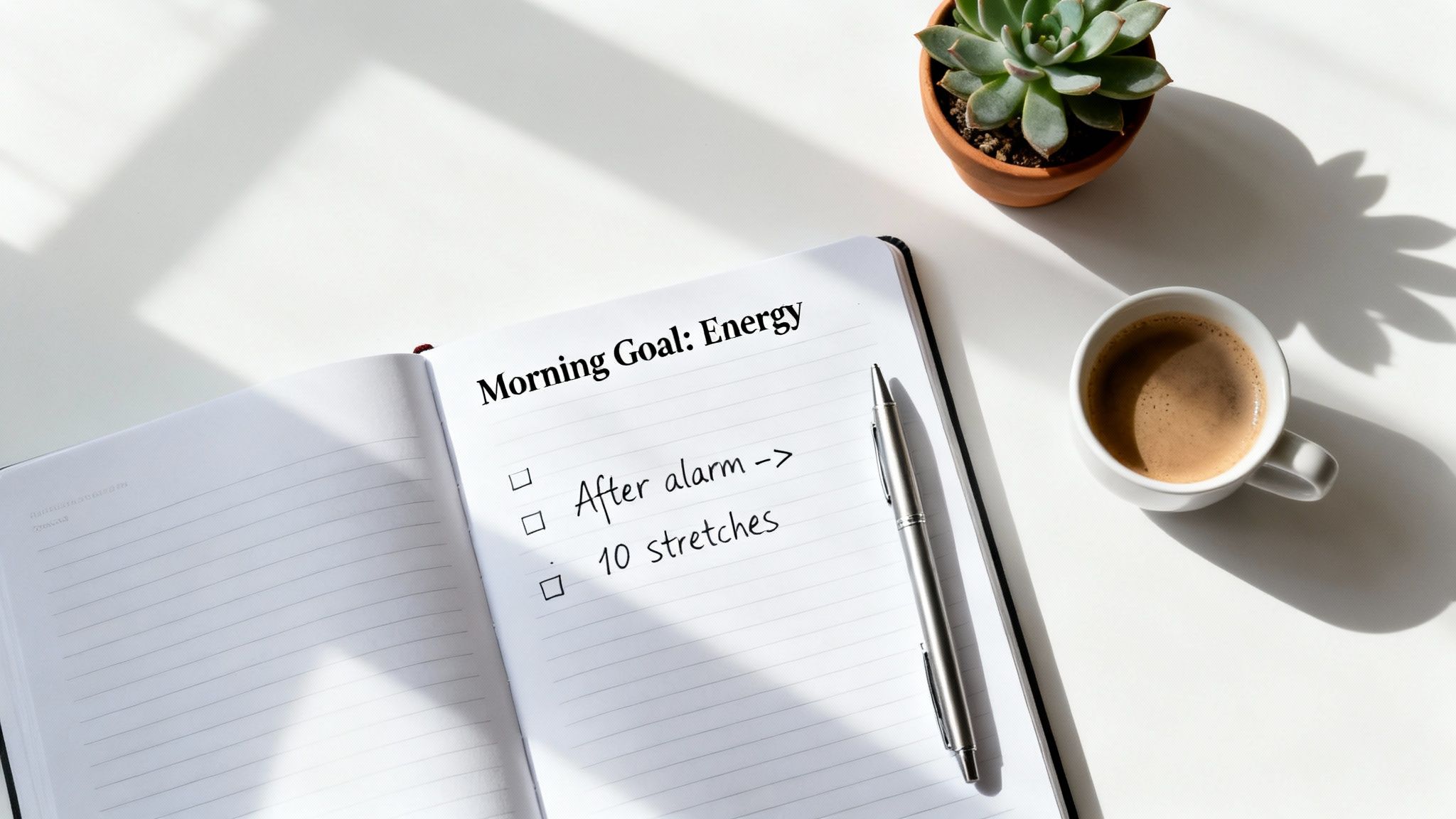
    How to create a morning routine: An open notebook shows a morning goal checklist beside a pen, a coffee cup, and a small succulent plant on a clean desk.

    Seriously, what do you truly need more of right now? Is it sustained energy to power through long afternoons? Sharper focus for a complex project at work? Or just a sense of calm to act as a buffer against daily stress?

    Choosing one main objective is like giving yourself a filter. It helps you cut through the noise and select habits that directly serve that one outcome.

    Define Your Morning’s North Star: Creating a Morning Routine with a Goal

    Your goal gives your routine direction. It makes it so much easier to stick with when your motivation inevitably dips. A routine built for β€œmore energy” is going to look completely different from one designed for β€œless stress.”

    Here are a few common goals and what they’re really about:

    • More Energy: The goal here is to fight off fatigue and that groggy feeling of sleep inertia by stimulating your body and brain.
    • Better Focus: This is all about quieting the mental chatter to prime your prefrontal cortex for deep, meaningful work.
    • Less Stress: This approach focuses on calming the nervous system and dialing down that anticipatory anxiety about the day ahead.
    • Increased Productivity: For this one, you’ll prioritize planning and organizing to create a clear roadmap for your day.

    Once you have your β€œNorth Star,” you can start building with habits that genuinely align with it. This is a core part of managing energy, not time, because it ensures every ounce of effort is invested in activities that actually move the needle for you.

    Identify Your Keystone Habits for Creating a Morning Routine

    Some habits pack a bigger punch than others. They create a positive ripple effect that makes other good behaviors feel easier to adopt. These are what behavioral scientists call keystone habits.

    For many people, making the bed is a classic example. It’s a small, tangible win that gives you an immediate sense of accomplishment. That tiny bit of order can inspire more productivity throughout the rest of your day.

    Your keystone habit doesn’t have to be some monumental feat. It just needs to be the first domino that gets a positive chain reaction going.

    Scenario: The Busy Parent
    Sarah, a mom of two young kids, feels like her mornings are pure chaos. Her goal is to feel less reactive and more grounded. She decides her keystone habit will be drinking a full glass of water before she even leaves her bedroom. This tiny act gives her a moment of quiet autonomy before the day’s demands kick in, making her feel more prepared to handle breakfast and the school run with patience.

    Master the Art of Habit Stacking

    One of the most powerful ways to lock in new behaviors is habit stacking. The idea is simple: you anchor a new habit you want to adopt to an existing one that’s already automatic. This piggybacks on your brain’s natural tendency to form strong neural pathways by linking actions together in a sequence.

    The formula is dead simple: β€œAfter [Current Habit], I will [New Habit].”

    You’re not relying on willpower here; you’re leveraging an established neural pathway. The old habit becomes the trigger for the new one, making it feel almost effortless over time.

    • After my alarm goes off, I will place my feet on the floor and do ten stretches.
    • After I brush my teeth, I will write down one thing I’m grateful for.
    • After I pour my first cup of coffee, I will sit in silence for two minutes.

    This method completely removes the guesswork of β€œwhen” and β€œwhere” you’ll do the new habit, which is often the biggest barrier to staying consistent. If you want to go deeper on this, there are some great practical strategies for creating a morning routine you can stick with.

    Scenario: The Remote Freelancer
    Alex is a freelance writer whose goal is better focus. He often starts his day by scrolling through client emails, which immediately throws him into a reactive state. He decides to use habit stacking to create a buffer. His new rule is, β€œAfter I turn on the coffee pot, I will open my journal and write my top priority for the day.” This five-minute action shifts his mindset from reactive to proactive, ensuring he starts with his own agenda, not someone else’s.

    By starting with a clear goal, identifying a powerful keystone habit, and using habit stacking to weave in new behaviors, you create a personalized framework that works for you, not against you. This approach is far more sustainable than just trying to copy a rigid, one-size-fits-all list of β€œshoulds.”

    Essential Habits for Your Morning Routine

    Now that you have a framework, let’s get to the good stuff: choosing the building blocks. The most powerful morning routines aren’t complicated. They’re built from a handful of small, strategic habits that work together to prime your brain and body for the day.

    Think of these as a menu. You’re not meant to do everything. Instead, you pick and choose based on your main goalβ€”whether that’s more energy, less stress, or sharper focus.

    Each habit has a specific job. Some are designed to gently wake up your cognitive functions, while others exist to calm your nervous system. When you understand the β€œwhy” behind each one, you can build a routine that feels intentional, not just like another thing on your to-do list.

    Mindful Hydration to Wake Up Your Brain

    This might be the simplest yet most overlooked habit of all. After a full night’s sleep, your body is naturally dehydrated, a state that can directly impair cognitive function and leave you feeling sluggish.

    Starting your day with a glass of waterβ€”before coffee, before anything elseβ€”rehydrates your brain and kick-starts your metabolism. It’s a simple biological signal that tells your body it’s time to shift from rest to activity. From a habit-building perspective, it’s also a tiny, immediate win that builds momentum for the rest of your routine.

    Real-World Example: Put a glass of water on your nightstand before you go to bed. This makes hydration the easiest possible choice the second you wake up, even before you think about your phone. It requires zero willpower and sets a positive tone in the first 60 seconds of your day.

    Light Movement to Boost Brain Function

    You don’t need a grueling workout to get the cognitive benefits of morning movement. Just five to ten minutes of light exercise is enough to increase blood flow to the brain, delivering a fresh supply of oxygen and nutrients.

    This activity stimulates the release of brain-derived neurotrophic factor (BDNF), a protein so important for neuron growth that neuroscientists often call it β€œMiracle-Gro for the brain.” A short burst of movement also helps regulate morning cortisol levels, clearing away grogginess and boosting your mood.

    Want to go deeper on this? You can explore the full benefits of early morning exercise.

    • Simple Stretch: A few neck rolls, shoulder shrugs, and a gentle hamstring stretch can do wonders.
    • Quick Walk: Step outside for a five-minute walk. The combination of movement and natural light is a powerful wake-up call.
    • Yoga Poses: A few rounds of Cat-Cow or a couple of Sun Salutations are perfect for awakening your spine.

    A Brief Meditation to Calm Your Amygdala

    Your brain’s alarm system, the amygdala, can be extra sensitive in the morning, easily triggering anxiety about the day’s looming demands. A short meditation practice is a direct way to soothe this response.

    Just a few minutes of focused breathing activates your parasympathetic nervous systemβ€”your body’s β€œrest and digest” mode. This helps shift you out of a reactive, stressed state and into a more centered, proactive one. It strengthens the connection to your prefrontal cortex, the part of your brain that handles focus and emotional regulation.

    Try This: Sit comfortably, close your eyes, and take five slow, deep breaths. Inhale through your nose for a count of four, hold for four, and exhale through your mouth for six. This simple exercise can instantly lower your heart rate and quiet the mental chatter.

    The No-Phone Rule for a Dopamine Detox

    When you reach for your phone first thing, you’re handing over control of your brain’s reward system to an algorithm. The endless scroll of notifications and social media provides unpredictable hits of dopamine, training your brain to crave constant, low-value stimulation all day long.

    A simple β€œno-phone for the first 30 minutes” rule acts as a mini dopamine detox. It creates a small, sacred space for your own thoughts to emerge without outside influence. This allows your brain to start the day with intention rather than distraction, preserving your finite mental energy for what actually matters.

    Journaling for Cognitive Clarity

    Getting your thoughts out of your head and onto paper is a scientifically-backed method for achieving cognitive clarity. The physical act of writing helps you process emotions, organize tangled thoughts, and solidify your intentions for the day.

    This practice essentially offloads mental clutter from your working memory, freeing up cognitive bandwidth for real problem-solving and creative thinking. You don’t need to write for pages; even a few focused sentences can be incredibly effective.

    Simple Journaling Prompts:

    • What is my main focus for today?
    • What is one thing that could make today great?
    • How am I feeling right now, and what do I need?

    Daily routines are a powerful anchor for our overall health. Research shows that disruptions to these patterns are linked to negative health outcomes, while stability brings measurable benefits. For instance, adults with consistent sleep and meal schedules have shown 20-30% better diet quality and reduced risks of chronic disease. Foundational habits are often simple: 65% of people start with brushing their teeth and 60% drink water, giving their brain the 30 minutes it needs to fully wake up. Learn more about the research on daily routines and health.

    Adapting Your Morning Routine to Real Life

    Theory is one thing; putting it into practice when your alarm blares on a Tuesday morning is another beast entirely. The most perfectly crafted routine on paper can shatter under the weight of real lifeβ€”an early meeting pops up, a kid wakes up grumpy, or you’re just not feeling it. The goal isn’t a rigid, unbreakable schedule. It’s a flexible blueprint you can lean on.

    To give you a feel for how these habits can flow together, I’ve put together three adaptable templates. Think of them as starting points, not strict prescriptions. They’re designed for different schedules and goals, showing how you can sequence activities for the biggest impact, even when time is tight.

    Morning Routine Templates at a Glance

    This table offers a quick comparison of the three sample routines. Use it to find a starting point that feels realistic for your current lifestyle and what you want to achieve each morning.

    ActivityThe 20-Min Power StartThe 45-Min Focus FlowThe 60-Min Mindful Morning
    GoalQuick energy and clarity for busy daysPrime the brain for deep, focused workReduce anxiety and build calm intention
    Duration20 minutes45 minutes60 minutes
    Ideal ForParents, commuters, anyone short on timeRemote workers, freelancers, creativesAnyone recovering from burnout or seeking calm
    Core ElementsHydration, dynamic movement, quick planningScreen-free walk, focused journaling, planningMindful hydration, light exercise, meditation

    Each template is built around a core principleβ€”efficiency, focus, or mindfulnessβ€”so you can align your morning actions directly with your daily intentions.

    The 20-Minute Power Start

    This is your high-impact, minimal-time routine. It’s built for busy parents, professionals with a killer commute, or anyone who swears they have β€œno time” for a morning routine. The entire sequence is about efficiency, designed to activate your body and brain quickly to set a proactive tone for the day.

    • 6:00–6:02 AM: Hydrate & Get Light
      • Keep a glass of water on your nightstand and drink it the moment you sit up. While you’re at it, open the blinds. That one-two punch of hydration and light is a powerful signal to your brain to shut down sleep inertia.
    • 6:02–6:07 AM: Dynamic Stretching
      • Just five minutes of simple movementsβ€”neck rolls, arm circles, leg swings. The goal isn’t a workout; it’s to get blood and oxygen moving to your brain.
    • 6:07–6:10 AM: Mindful Breathing
      • While the coffee brews, take three slow, deep breaths. This tiny pause is enough to calm your nervous system and shift you out of a reactive state.
    • 6:10–6:20 AM: Plan & Fuel
      • Grab a quick, protein-rich snack like a shake or a handful of nuts while you identify your top one or two priorities for the day. That’s it. You’re ready to go.

    The 45-Minute Focus Flow

    I designed this one for remote workers, freelancers, and anyone who needs to prime their brain for deep, concentrated work. This routine creates a deliberate buffer between waking up and getting sucked into the digital vortex, helping you start the day with clarity and control over your own attention.

    • 7:00–7:05 AM: Hydrate & Gentle Movement
      • Start with water and a few light stretches to gently wake your body up.
    • 7:05–7:20 AM: Screen-Free Movement
      • Take a 15-minute walk outside. Critically, leave your phone behind. The combination of natural light and physical movement is a potent cocktail for boosting mood and alertness.
    • 7:20–7:30 AM: Focused Journaling
      • Write down your single most important task for the day. This simple act sharpens your focus and commits your brain to a clear objective before other people’s agendas take over.
    • 7:30–7:45 AM: Fuel & Plan
      • Make a simple breakfast. This is also the perfect time to glance at your calendar before you open your inbox.

    The 60-Minute Mindful Morning

    This longer routine is ideal for anyone looking to dial down anxiety, recover from burnout, or just start their day from a place of deep calm and intention. Every step is meant to be slower and more mindful, grounding you before the day’s pressures kick in. (Note: This section is for educational purposes and is not a substitute for professional medical or psychological care for conditions like burnout or anxiety.)

    • 6:30–6:40 AM: Mindful Hydration & Gratitude
      • Slowly drink a glass of warm water with lemon. As you do, think of one thing you’re genuinely grateful for. This simple practice primes your brain for positivity.
    • 6:40–7:00 AM: Light Exercise
      • Engage in 20 minutes of gentle activity, like yoga or a brisk walk. A key to making any routine stick is doing it consistently, and exploring strategies for maintaining consistency, even in a fitness context, offers some great insights here.
    • 7:00–7:15 AM: Meditation or Quiet Reflection
      • Sit in silence or use a guided meditation app. This 15-minute block is crucial for calming the nervous system and strengthening your prefrontal cortexβ€”the part of your brain responsible for focus and emotional regulation.
    • 7:15–7:30 AM: Intentional Breakfast
      • Enjoy a sit-down breakfast without screens. Use this time to savor your food and mentally prepare for what’s ahead.

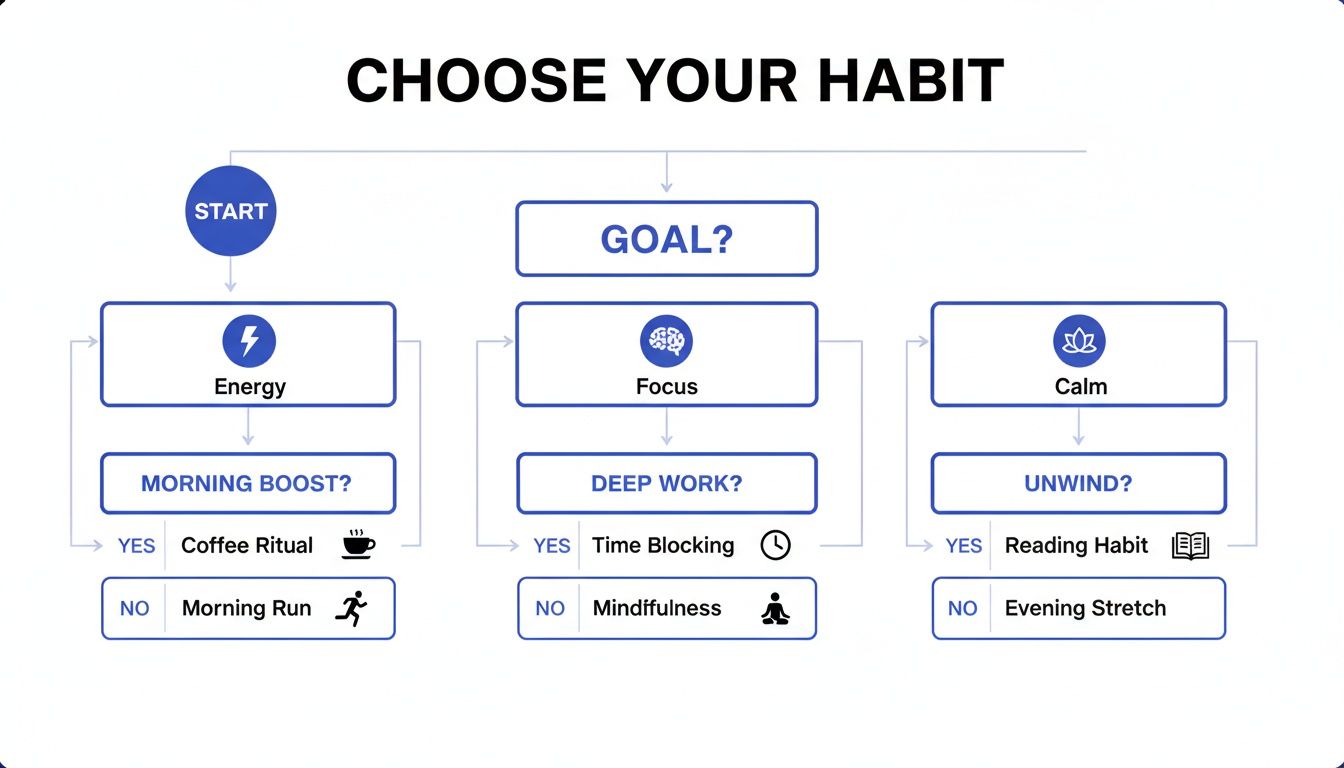
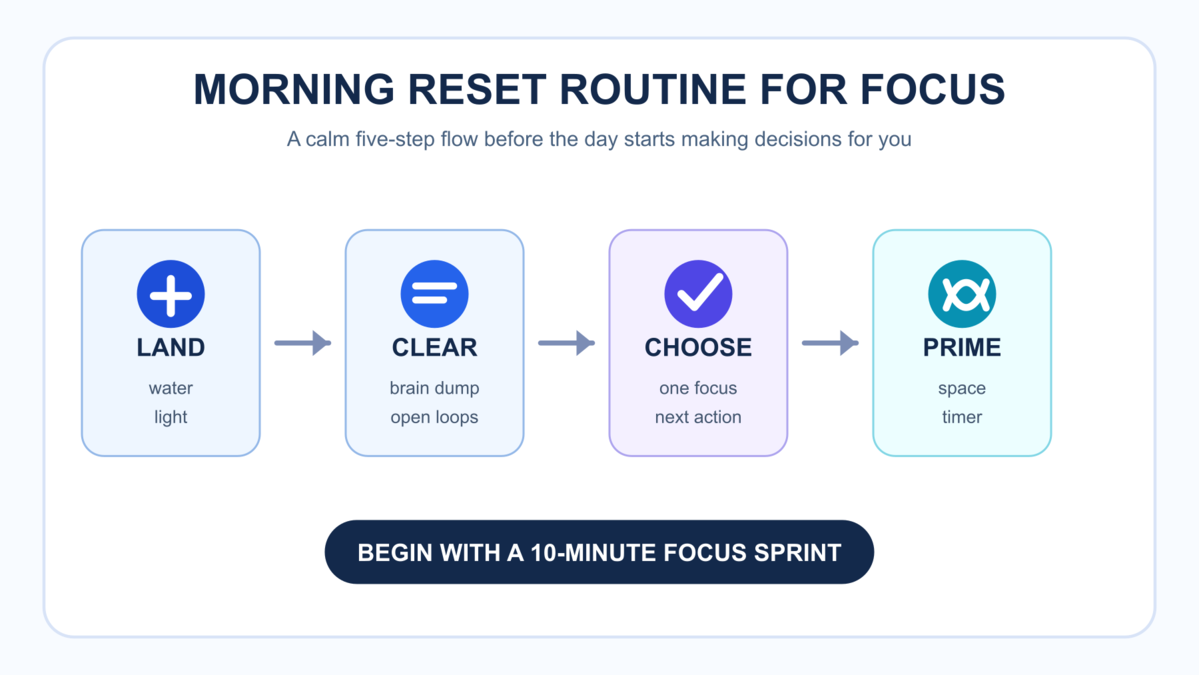
    Not sure which habits to plug into your routine? This flowchart can help you select activities based on whether your primary goal is to feel more energized, focused, or calm.

    How to create a morning routine: A flowchart titled β€œChoose Your Habit” that guides users to pick daily habits based on goals like more energy, better focus, or a calmer mood.

    When you start with your end goal in mind, you can build a routine with activities that directly support that outcome, making it feel purposeful instead of like just another thing on your to-do list.

    Troubleshooting Your Morning Routine Challenges

    Even with the best intentions, a new morning routine can fall apart. Life gets in the way. That early burst of motivation disappears. The alarm clock starts to feel more like an enemy than a tool. Instead of chasing perfection, the real goal is to build a routine that’s resilient enough to survive a bad day. Knowing the common roadblocksβ€”and having a plan for themβ€”is what makes new habits actually stick.

    When You Keep Hitting the Snooze Button

    The siren call of the snooze button is hard to resist, but it’s a battle you’re biologically destined to lose. Every time you hit snooze, you’re not getting more restful sleep; you’re fragmenting it. This triggers sleep inertiaβ€”that heavy, groggy feeling that can linger long after you’re finally up.

    Those repeated alarms jolt your system, messing with your natural wake-up cycle and leaving you in a mental fog. If this feels familiar, understanding what causes brain fog can shed some light on why starting your day this way feels so counterproductive. (Note: Persistent sleep problems or brain fog should be discussed with a healthcare professional.)

    The Fix: Make the snooze button harder to reach. The simplest trick is often the best: move your alarm clock or phone across the room. This forces you to physically get out of bed to silence it. Once you’re on your feet and moving, you’ve already won half the battle against inertia.

    When You Feel Like You Have No Time

    β€œI just don’t have enough time” is probably the number one reason routines fail. This usually comes from an all-or-nothing mindsetβ€”the belief that a routine only β€œcounts” if it’s a solid 30 or 60 minutes long. That’s a trap. It sets you up to quit the moment your schedule gets tight.

    The Fix: Start ridiculously small with the β€œTwo-Minute Rule.” This idea, borrowed from behavioral psychology, is simple: a new habit should take less than two minutes to do. Instead of a 20-minute meditation, commit to two minutes of focused breathing. Instead of a full workout, just do one minute of stretching.

    The point isn’t to get a huge result right away. It’s to master the art of showing up. These tiny, consistent actions build momentum and make the behavior automatic, so you can scale it up later when it feels natural.

    When Your Motivation Fades After a Few Days

    That initial wave of excitement for a new routine is great, but it never lasts. Motivation is an emotion, and emotions fluctuate. Relying on it to build a long-term habit is a recipe for failure. Real consistency comes from having a system that works even on the days you don’t feel like it.

    The Fix: Tie the routine to your identity and make it almost effortless to start. Instead of thinking, β€œI need to start meditating,” reframe it as, β€œI’m the kind of person who values a calm start to the day.” An identity-based goal is far more powerful than a task-based one.

    Then, lower the barrier to entry so it’s easier to do it than to avoid it. Set out your workout clothes, fill your water glass, or place your journal and pen on your desk the night before. This dramatically reduces the activation energyβ€”the effort it takes to get startedβ€”making you far more likely to follow through, even when motivation is low.

    Editor’s Take on What Really Works

    Let’s be honest for a moment. The perfect, Instagram-worthy morning routine is a myth for most of us. The best way forward isn’t about elaborate rituals; it’s about finding a simple sequence you can actually stick with when you’re tired and uninspired.

    For busy professionals feeling overwhelmed by life’s demands, a complicated, hour-long routine is just a recipe for failure. The truth is, a simple 15-minute routine focusing on three core actions delivers about 80% of the potential benefits.

    Start with these three non-negotiables:

    • Hydration: Drink a glass of water before anything else touches your lips.
    • Movement: Do just five minutes of gentle stretching or a quick walk.
    • Mindfulness: Take ten deep breaths or write one sentence in a journal.

    This minimalist approach is designed as a practical starting point, not a complete life overhaul. It’s for anyone who wants to build momentum without feeling defeated before they even begin.

    The real goal is sustainability, not perfection. This small investment provides the structure needed to improve your focus and mood, influencing the delicate balance of dopamine and motivation that shapes your entire day.


    Disclaimer: This article contains affiliate links. If you make a purchase through these links, we may earn a small commission at no extra cost to you. This content is for educational purposes only and is not a substitute for professional medical or psychological advice, diagnosis, or treatment. Always consult with a qualified professional for any health concerns.

    FAQ: Your Guide on How to Create a Morning Routine

    It’s completely normal to have questions when you’re trying to build a new routine from the ground up. Here are some of the most common ones I hear, along with some practical answers to help you sidestep the usual hurdles.

    1. How long does it really take to form a morning routine habit?

    You’ve probably heard the 21-day myth. While it’s a nice, clean number, the reality is a bit messier. Behavioral science research suggests it takes, on average, closer to 66 days for a new behavior to feel automatic. The most important part is consistency, not perfection. If you miss a day, don’t sweat it. Just show up the next morning.

    2. What’s the single most important habit for starting a good morning routine?

    If I had to pick just one, it wouldn’t be a trendy biohack. It’s a simple principle backed by a mountain of neuroscience: get natural light in your eyes within the first hour of waking. This is the most powerful signal you can send to your internal body clock (your circadian rhythm). It tells your brain to shut down melatonin production and kickstart alertness. Just open the curtains or step outside for five minutes.

    3. Does my morning routine have to start at 5 AM?

    Absolutely not. A β€œmorning routine” is about what you do in the first 30-60 minutes after you wake up, not the specific time on the clock. Whether you’re up at 5 AM or 10 AM, the principles are the same. You’re creating an intentional buffer between sleep and the demands of the world. Hydration, movement, and a moment of quiet work just as well at 9 AM as they do before sunrise.

    4. Is checking my phone first thing really that bad for my morning?

    Ideally, you should avoid it. When your phone is the very first thing you reach for, you’re letting external demands dictate your mental state. This floods your brain with notifications and often triggers a reactive, high-stress response by spiking cortisol. Try a β€œno-phone for the first 30 minutes” rule. It allows you to start the day proactively, not reactively.

    5. What’s the difference between a routine and a ritual?

    This is a great question. A routine is just a sequence of actions you follow, like making coffee. A ritual, on the other hand, is a routine that you fill with intention and meaning. Making coffee becomes a ritual when you’re fully present for itβ€”smelling the beans, listening to the water, savoring that first sip without scrolling on your phone. Turning mundane tasks into mindful rituals makes them far more enjoyable and psychologically rewarding.

    6. How can I stick to my routine when I travel?

    The key is to have a pared-down β€œtravel version” of your routine. You can’t replicate your home setup, so don’t even try. Instead, focus on the most essential, portable habits that anchor you. Maybe that’s a 5-minute stretching sequence you can do in any hotel room, a meditation app on your phone, and a firm commitment to drink a glass of water as soon as you wake up.

    7. What if I have young children and my mornings are chaotic?

    Start incredibly small. Your routine might just be one minute long. For example, before getting out of bed, take three deep breaths. Or, while the kids eat breakfast, you do five stretches in the kitchen. The goal isn’t a long, uninterrupted block of time; it’s about finding tiny pockets of intention amidst the chaos.

    8. How do I know if my morning routine is working?

    Pay attention to how you feel around mid-morning and early afternoon. Are you less reactive to stress? Is it easier to focus on your first big task of the day? Do you feel a greater sense of control and calm? These are the real metrics of success, not just whether you checked every box on a list.

    9. What are some good morning routine ideas for more energy?

    For an energy-focused routine, prioritize habits that stimulate your body and brain. Try a short, brisk walk outside (light + movement), a cold splash of water on your face, dynamic stretches like jumping jacks, and a protein-rich breakfast. These actions work together to quickly shake off sleep inertia.

    10. Can creating a morning routine help with focus and ADHD?

    While this guide is not medical advice, many people with ADHD find that a structured morning routine helps with executive function. Predictability reduces decision fatigue, and habits like a quick workout or a β€˜brain dump’ journal entry can help regulate attention and organize thoughts for the day. If you have ADHD, consider discussing routine-building strategies with a healthcare provider or therapist.


    Ready to build a life with more focus, calm, and intention? The books at Mind Clarity Hub provide science-based, actionable roadmaps to help you reclaim your mental space.

    Explore the full library of guides on focus, productivity, and digital wellness at Mind Clarity Hub.

    Explore the Mind Clarity Hub Library

    Practical books on focus, digital habits, resilience, and building a calmer mind.

    The Power of Clarity β€” book cover

    The Power of Clarity

    Unlock mental focus, build momentum, and create the life you were meant to live.

    View book β†’
    AI & ChatGPT for Beginners β€” book cover

    AI & ChatGPT for Beginners

    No PhD needed β€” a 2025 guide to AI, prompts, and productivity without coding.

    View book β†’
    Zen in the Digital Jungle β€” book cover

    Zen in the Digital Jungle

    Mindfulness for a chaotic world.

    View book β†’
    The Slow Reset β€” book cover

    The Slow Reset

    Mindful living in a fast-paced world.

    View book β†’
    Perfectly Imperfect β€” book cover

    Perfectly Imperfect

    Stop self-criticism, set boundaries, and embrace the real you.

    View book β†’
    Reclaiming Silence β€” book cover

    Reclaiming Silence

    A dopamine detox guide to finding peace in a noisy world.

    View book β†’
    The Focused Freelancer β€” book cover

    The Focused Freelancer

    Productivity, pricing & positioning for independents in 2025.

    View book β†’
    ChatGPT Side Hustle System β€” book cover

    ChatGPT Side Hustle System

    Launch your AI-driven online business in 30 days.

    View book β†’
    Burnout, Interrupted β€” book cover

    Burnout, Interrupted

    A proven path to restore energy and reclaim your life.

    View book β†’
    Attention Unleashed β€” book cover

    Attention Unleashed

    Focus strategies for the distracted mind.

    View book β†’
    Side Hustle Launchpad β€” book cover

    Side Hustle Launchpad

    Your quick-start guide to extra income.

    View book β†’
    Digital Clarity β€” book cover

    Digital Clarity

    Rewire your brain, escape dopamine traps & regain focus.

    View book β†’
    Break the Scroll β€” book cover

    Break the Scroll

    Reduce screen time and take back control of your life.

    View book β†’
    Climate Compassion β€” book cover

    Climate Compassion

    Transform eco-anxiety into empowered action.

    View book β†’
    Village Mentality β€” book cover

    Village Mentality

    The power of community for mental wellness.

    View book β†’
    Restful Nights β€” book cover

    Restful Nights

    Overcoming sleep anxiety in a 24/7 world.

    View book β†’
    Connected Again β€” book cover

    Connected Again

    Combat loneliness and build meaningful relationships.

    View book β†’
    Focus Recharged β€” book cover

    Focus Recharged

    Mastering attention and productivity in the digital era.

    View book β†’
    Marketing Magic with ChatGPT β€” book cover

    Marketing Magic with ChatGPT

    AI-powered content, campaigns, and copywriting to grow faster.

    View book β†’
    The 6-Figure Creator β€” book cover

    The 6-Figure Creator

    Turn knowledge into passive income with books, courses & AI.

    View book β†’
    Burnout Breakthrough β€” book cover

    Burnout Breakthrough

    Reset your work-life balance and thrive in 2025.

    View book β†’
    The Emotionally Intelligent Man β€” book cover

    The Emotionally Intelligent Man

    A modern guide to self-awareness and communication.

    View book β†’
    AI Personalized Wellness β€” book cover

    AI Personalized Wellness

    Create your custom health plan with data-driven habits.

    View book β†’
    Everyday AI Made Easy β€” book cover

    Everyday AI Made Easy

    Use ChatGPT and smart tools to simplify life.

    View book β†’
    Money Mindfulness β€” book cover

    Money Mindfulness

    A financial wellness guide for Gen Z & Millennials.

    View book β†’
    Startup Smarter with AI β€” book cover

    Startup Smarter with AI

    ChatGPT strategies and tools to grow your business.

    View book β†’
    ChatGPT for Writers & Creators β€” book cover

    ChatGPT for Writers & Creators

    Unlock AI-powered brainstorming, drafting & editing.

    View book β†’
    Free download: 7-Day Mind Clarity Reset preview

    Free download: 7-Day Mind Clarity Reset

    A short daily reset you can actually stick with (no fluff).

    Helpful resources for your next step

    Affiliate disclosure: As an Amazon Associate, Mind Clarity Hub may earn from qualifying purchases at no extra cost to you. Use this link only if it genuinely helps your planning.

    If How to Create a Morning Routine: Simple Steps to Start Strong is a routine you want to keep using, a simple workbook, planner, or desk tool can make the steps easier to repeat.

    Compare related planners, workbooks, and organization tools on Amazon.