...

Tag: neuroscience of focus

  • Dopamine and Motivation: Master Focus, Build Habits, End Procrastination

    Dopamine and Motivation: Master Focus, Build Habits, End Procrastination

    Dopamine and Motivation: Master Focus, Build Habits, End Procrastination

    Jeremy Jarvis β€” Mind Clarity Hub founder
    Mind Clarity Hub β€’ Research-aware focus & digital wellness

    Ever had a huge project deadline looming, only to find yourself completely lost in emails or scrolling through social media instead? That’s not a failure of willpower. It’s a battle for dopamine and motivation. This powerful brain chemical isn’t really about pleasure; it’s about the drive to chase a goal, creating the β€œwanting” that fuels you long before any reward actually shows up.


    Affiliate Disclosure: We may earn a small commission from affiliate links at no extra cost to you. This helps support our work. This article is for educational purposes and is not a substitute for medical or psychological care.


    Your Brain on Dopamine: A New Way to Understand Motivation

    Have you ever wondered why checking your phone feels so irresistible, yet starting a big project feels like climbing a mountain? The answer is tucked away in how your brain uses a neurotransmitter called dopamine. It’s often mistaken for the β€œpleasure chemical,” but neuroscience reveals its role is far more interesting than that.

    Dopamine is the brain’s core engine for anticipation, effort, and drive. It’s what makes you want to check that notification or finish one more episode of a show. While this chemical messenger is a key player in your brain’s reward system, its main job is to make you seek rewards, not just enjoy them.

    The Real Driver Behind Your Actions: How Dopamine Fuels Motivation

    Think of dopamine as your brain’s motivational currency. It’s released when you anticipate something good might happen, pushing you to take action. This is an ancient system, originally designed to keep us pursuing essential goals like finding food or shelter.

    • Anticipation, Not Reward: Dopamine surges before you get the reward. It’s the craving or desire that drives your behaviorβ€”the feeling of wanting, not the feeling of having.
    • Effort Calculation: Your brain uses dopamine signals to decide if a potential reward is worth the effort. This is why low-effort, high-reward tasks (like scrolling social media) are such powerful dopamine magnets.
    • Learning and Repetition: When an action leads to an unexpected reward, a jolt of dopamine essentially tells your brain: β€œDo that again.” This is how habits get wired in.

    Real-World Scenario: Imagine you’re about to start writing a report. Just thinking about finishing it and getting praise from your boss releases a small amount of dopamine, creating the initial drive to open the document. But then your phone buzzes. The anticipation of seeing a new message is a more immediate and certain dopamine hit, so your brain urges you to pick up the phone instead. This isn’t a lack of discipline; it’s your brain’s reward system choosing the faster, easier prize.
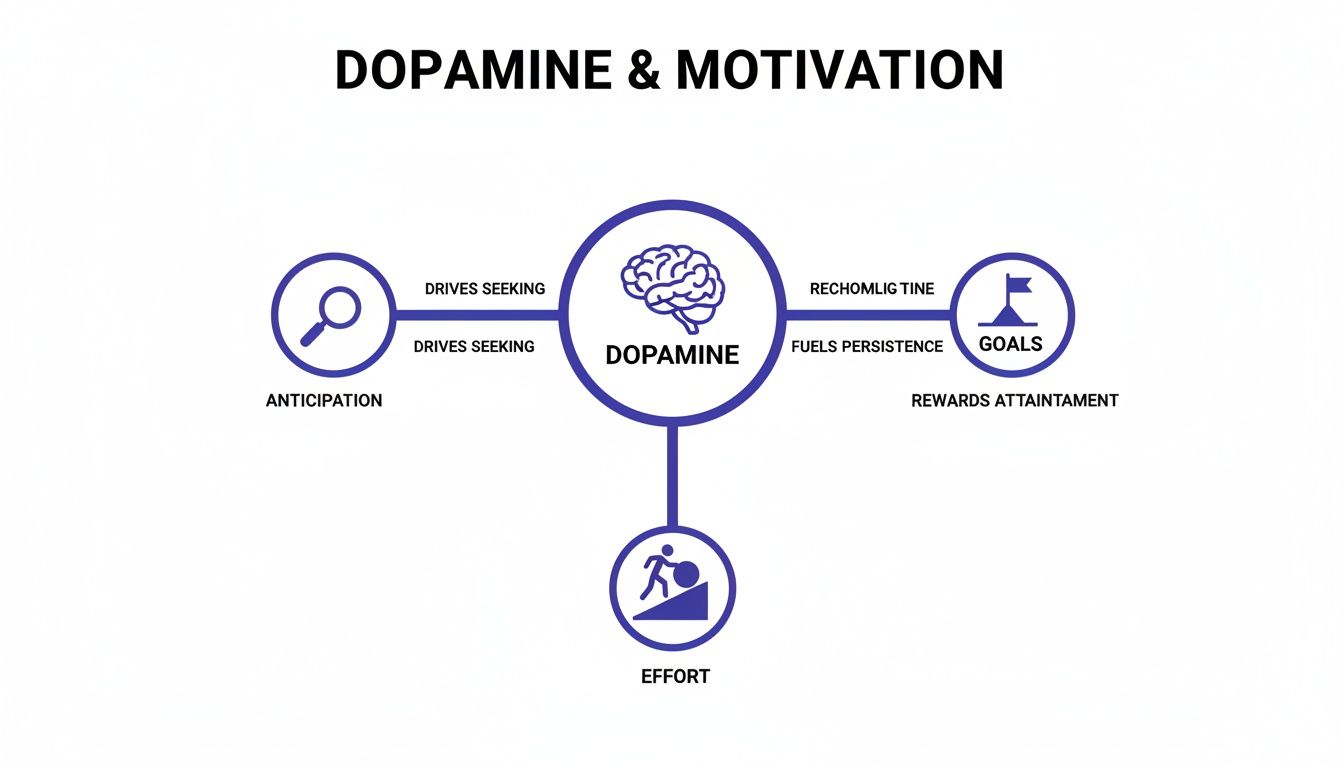
    A diagram illustrates the role of dopamine in driving anticipation, fueling effort, and pursuing goals.

    As the infographic shows, dopamine’s influence starts with anticipating a goal, continues by fueling the effort to get there, and finally solidifies the behavior that led to success. Understanding this cycle is the first step toward mastering your own focus and drive. These motivational circuits are deeply connected to the brain’s emotional core. To learn more about how these systems shape your daily habits, see our guide on limbic system retraining.

    And if you want to dive deeper into optimizing brain function, you might explore the science behind nootropic supplements for enhanced cognitive performance. By grasping how your brain is wired, you can finally build systems that support your goals instead of working against them.

    Debunking Common Myths About Dopamine and Motivation

    The conversation around dopamine and motivation is crowded with buzzwords and oversimplifications. If you really want to manage your focus, you first have to separate the pop-psychology myths from the scientific reality. Many popular ideas sound compelling, but they seriously misrepresent how this powerful neurotransmitter actually works in your brain.

    So, let’s start by clearing up the biggest misconceptions. Understanding what dopamine isn’t is just as important as knowing what it is. This clarity is the foundation for building strategies that actually work, instead of just chasing the latest productivity fad.

    A man thoughtfully writes in a notebook, his head overlaid with a glowing, networked brain, illustrating how dopamine and motivation work.

    To make this easier, here’s a quick look at the most common myths and the science that corrects them.

    Dopamine Myths vs Scientific Reality

    Common MythScientific Explanation
    Dopamine is the β€œpleasure chemical.”Dopamine is the molecule of anticipation and pursuit. It drives the wanting of a reward, not the feeling of pleasure itself.
    You can β€œrun out” of dopamine.Your brain doesn’t run out of dopamine. The real issue is receptor downregulation, where your pathways become less sensitive to stimulation.
    A β€œdopamine detox” means no fun.A detox isn’t about eliminating all stimulation. It’s a strategic reset to reduce hyper-stimulating activities and re-sensitize your reward system.

    With these core distinctions in mind, we can dig a little deeper into why these myths are so persistentβ€”and what the truth means for your focus and drive.

    Myth 1: Dopamine Is the Pleasure Chemical

    This is by far the most stubborn myth out there. While dopamine is absolutely involved in the brain’s reward circuits, it’s not the molecule of pleasure itself. A much better way to think of it is as the molecule of anticipation and pursuit. It’s the neurochemical that creates the feeling of wanting something, driving you to get up and go after it.

    The actual sensation of enjoyment or liking something is more closely tied to other brain chemicals, like opioids and endocannabinoids. Dopamine’s main job is to get you off the couch to chase a goal, whether that’s a promotion at work or another cookie from the jar.

    This isn’t just a minor detail. A major scientific shift now recognizes dopamine as a motivation regulator that responds to the possibility of a reward. Research from Universitat Jaume I shows its activity often spikes before a reward arrives, encouraging us to start and stick with an action. This means your dopamine system is constantly being trained by everything from looming project deadlines to the unpredictable buzz of your phone.

    Myth 2: You Can Run Out of Dopamine

    You can’t β€œrun out” of dopamine like a car runs out of gas. Your brain produces it constantly. The real problem isn’t depletion, it’s the dysregulation of your dopamine pathways. When you’re constantly bombarded with high-dopamine stimuliβ€”like endless social media feeds, addictive video games, or processed foodsβ€”your brain adapts to protect itself.

    Your dopamine receptors can become less sensitive, a process known as receptor downregulation. This means you need more and more of a particular stimulus just to get the same motivational β€œkick.” The fallout? Normal, everyday tasks start to feel dull and uninspiring because they can’t compete with the intense dopamine hits your brain has gotten used to.

    Myth 3: A Dopamine Detox Means Quitting Everything Fun

    The term β€œdopamine detox” is catchy, but it’s often taken to an extreme. A true detox isn’t about avoiding all forms of stimulationβ€”that’s both impractical and unsustainable for pretty much everyone. Instead, it’s about strategically dialing back your exposure to artificial, high-dopamine activities to give your reward pathways a chance to reset.

    A more accurate name might be a β€œdopamine fast” or a β€œdigital reset.” The idea is to consciously step away from the hyper-stimulating inputs, like your phone or streaming services, for a set period. This break helps your brain recalibrate, making natural rewards and important work feel engaging and interesting again. It’s a method for managing your attention, not eliminating a vital brain chemical.

    If you want to go deeper, we’ve broken down the science and practical steps in our guide on whether a dopamine detox is real or a myth.

    How Your Brain Decides If a Task Is Worth the Effort

    Ever wonder why clearing your inbox feels so much easier than starting that massive quarterly report? The answer isn’t laziness. It’s a sophisticated calculation happening deep inside your brain, a process driven by the powerful relationship between dopamine and motivation.

    With every choice you face, your brain runs a lightning-fast, subconscious cost-benefit analysis. Think of dopamine as the internal accountant for this operation. Its main job is to weigh the perceived effort of a task against the size and certainty of its potential reward. This mental math happens constantly, shaping whether you dive into a challenging project or opt for a quick, easy win instead.

    This explains our magnetic pull toward low-effort, high-feedback activities. Checking email, scrolling a social feed, or even just tidying your desktop gives you an immediate, tangible sense of accomplishment. Your brain’s accountant flags these as low-risk, high-return investments, making them incredibly appealing next to a long-term project with a payoff that feels distant and uncertain.

    The Cost-Benefit Calculus of Motivation

    Your brain is, above all, an energy-conservation machine. It’s not trying to sabotage your biggest goals; it’s simply wired to prioritize actions that promise the best return on that precious energy. This internal system is always weighing a few key variables:

    • Required Effort: How much mental or physical energy will this take?
    • Reward Size: How much do I actually care about the outcome?
    • Reward Probability: What are the odds I’ll actually get that reward?
    • Time Delay: How long will I have to wait for the payoff?

    When a task demands high effort for a reward that’s far off and uncertain, your dopamine system signals that it’s a bad deal. That feeling we call procrastination? That’s your brain essentially vetoing the transaction. Knowing this is powerful, because it means you can start re-engineering your tasks to be more β€œdopamine-friendly.”

    Modern neuroscience confirms this isn’t just about feeling pleasure. Dopamine actively shapes how much effort you’re willing to put in. A landmark 2012 Vanderbilt University study found that people described as β€œgo-getters” had higher dopamine signaling in brain areas tied to reward and motivation, like the striatum. In contrast, those who opted for easier tasks with smaller rewards showed more dopamine activity in the anterior insula, a region linked to fatigue and risk aversion. Dopamine, it turns out, is the critical chemical that tunes the brain’s calculation of whether an effort is truly worth making. You can discover more about these dopamine findings on the Vanderbilt University news site.

    Hacking the Effort Equation with Dopamine and Motivation in Mind

    Once you understand this internal accounting system, you can start structuring your work to feel more achievable and rewarding from the start. The goal is simple: make your most important tasks seem like better investments to your brain.

    Breaking a huge project into tiny, concrete steps is the classic example of this principle in action. A massive goal like β€œwrite a 20-page report” sounds exhausting and triggers a high-effort alarm. But a small, clear task like β€œcreate the report outline” or β€œwrite the first paragraph” feels low-effort and provides a quick hit of completion. That small win releases a little dopamine, which actually fuels the motivation to continue.

    Real-World Scenario: A student needs to study for a final exam. The idea of β€œstudying for 4 hours” feels overwhelming. Instead, she breaks it down: β€œRead one chapter,” then β€œReview flashcards for 20 minutes.” Each small completion provides a satisfying dopamine release, making it easier to keep going. She’s hacking the effort equation to make the task more appealing to her brain’s reward system.

    This is one of the core ideas behind the neuroscience of single-tasking, a practice that helps lower cognitive load and makes progress feel real. By reframing the work, you can finally tip the scales in favor of taking action on your biggest goals.

    Practical Strategies to Manage Your Dopamine for Better Motivation

    Knowing the neuroscience behind dopamine and motivation is one thing, but real change comes from putting that knowledge to work. The goal isn’t to fight your brain’s wiringβ€”it’s to work with it. Think of this as a toolkit of evidence-backed strategies designed to help you guide your dopamine system, making focus and productivity feel less like a battle and more like a natural rhythm.

    By making a few deliberate tweaks to your environment and routines, you can gently nudge your motivational circuits toward your long-term goals instead of letting them get hijacked by cheap, short-term distractions.
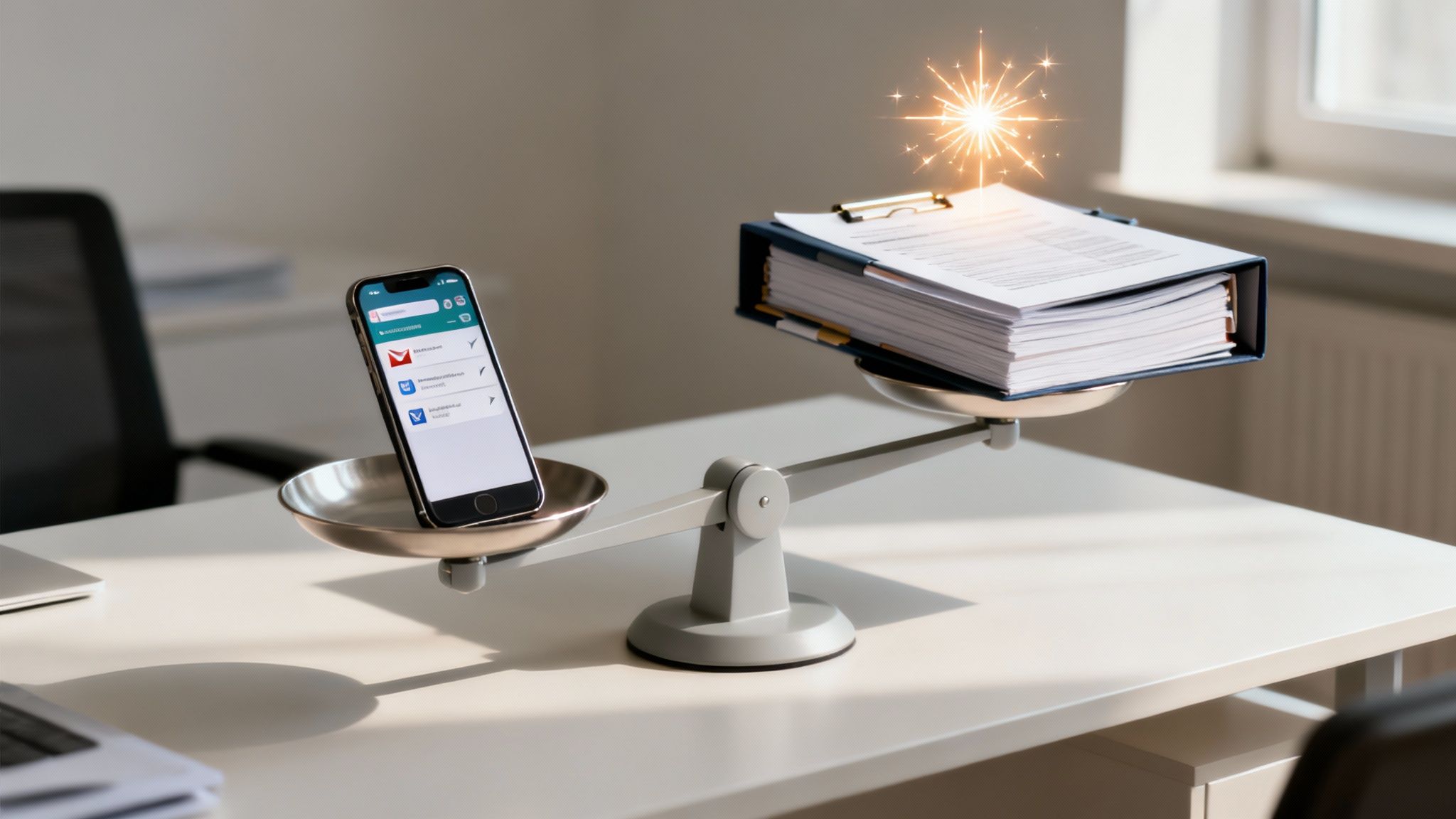
    A balance scale weighing a smartphone against a stack of documents, a great image for illustrating dopamine and motivation.

    We’ll cover four key moves: designing a workspace that supports deep work, using rewards intelligently to keep going, building momentum with habit stacking, and resetting your focus with a practical digital reset.

    Design a Dopamine-Aware Workspace to Enhance Motivation

    Your physical and digital environments are constantly signaling to your brain what it should pay attention to. If your desk is a mess and your screen is a fireworks display of notifications, your brain’s attention is already fractured before you even start. A β€œdopamine-aware” workspace is simply one that’s intentionally designed to sideline the low-effort, high-reward distractions that drain your motivational fuel.

    The principle is dead simple: increase the friction for distracting activities and decrease it for productive ones.

    • Physical Space: Clear your desk of everything but the essentials for your current task. Move your phone to another room or tuck it into a drawerβ€”that small physical barrier makes a huge difference.
    • Digital Space: Use a separate browser profile for work, with no social media logins. Close all the extra tabs and shut down every non-essential notification on your desktop and in your email.
    • Auditory Space: Noise-canceling headphones aren’t just for music; they’re a powerful signal to your brain that it’s time to lock in and focus.

    Real-World Scenario: A freelance writer needs to dive into a big article. She turns her phone off and leaves it in the kitchen. She closes her email client and all browser tabs except for her research. By curating her environment, she makes the most important task the easiest and most appealing path for her brain to take.

    Use Intermittent Rewards to Sustain Effort

    When you’re grinding away on a long, tough project, the final payoff can feel way too distant to fuel today’s motivation. Your brain’s effort calculation flags it as a bad deal. The fix is to slice the project into smaller pieces and sprinkle in small, intermittent rewards along the way.

    This strategy cleverly mimics the variable reward schedules that make things like video games so compelling. When you celebrate small milestones, you create a steady drip of dopamine that reinforces your hard work and keeps you in the game. For a deeper dive, exploring effective strategies for improving focus and concentration can offer some powerful complementary techniques.

    Leverage Habit Stacking for Effortless Momentum

    Trying to build a new positive habit from zero takes a surprising amount of activation energy. β€œHabit stacking” is a brilliant technique that lowers that barrier by piggybacking a new behavior onto an existing one you already do on autopilot. This move leverages your brain’s well-worn neural pathways to build momentum almost effortlessly.

    The formula, made famous by author James Clear, is simple: β€œAfter [Current Habit], I will [New Habit].”

    • After I pour my morning coffee, I will write down my top three priorities for the day.
    • After I finish lunch, I will spend five minutes meditating.
    • After I shut down my computer for the day, I will tidy my desk for 1 minute.

    This approach neatly sidesteps your brain’s effort calculation. The new habit feels less like a monumental task and more like a natural extension of something you were going to do anyway.

    Implement a Practical Digital Reset to Reclaim Dopamine Sensitivity

    Constant exposure to hyper-stimulating digital media can slowly numb your dopamine receptors, making normal, productive work feel bland and unappealing. A practical β€œdigital reset” helps recalibrate that reward system, restoring your ability to find motivation in quieter, less intense activities.

    This doesn’t mean you have to quit technology cold turkey. A targeted, sustainable approach works far better. The goal is to consciously dial back your intake of high-dopamine, low-value digital content for a set period. If you want a full-blown plan, we’ve built one in our guide on how to reset your dopamine for focus and clarity without quitting tech.

    A simple way to start is with a β€œdigital sunset”—avoiding all screens for 60-90 minutes before bed. This not only helps you sleep better but gives your brain a much-needed break from the constant buzz of stimulation.

    Dopamine-Aware Productivity Techniques

    TechniqueHow It WorksExample Application
    Workspace DesignIncreases friction for distractions and reduces it for focused work.Moving your smartphone to another room while working on a deep task.
    Intermittent RewardsProvides small, periodic dopamine boosts to sustain motivation for long projects.Taking a 15-minute walk outside after completing a 90-minute focus block.
    Habit StackingLinks a new, desired habit to an existing, automatic one to lower activation energy.Meditating for 5 minutes immediately after your morning coffee.
    Digital ResetResets dopamine sensitivity by reducing exposure to hyper-stimulating digital media.Implementing a β€œdigital sunset” by avoiding screens for 60-90 minutes before sleep.

    Editor’s Note: What Actually Works for Boosting Motivation

    After digging through the neuroscience and testing these methods, let’s cut to the chase. While every strategy here can sharpen your focus, one stands out for its undeniable impact: designing a distraction-free environment. This is the single most powerful change you can make to fix a broken link between dopamine and motivation.

    Getting rid of the constant pings, alerts, and visual clutter does more than just stop interruptions. It rewires your brain’s effort calculation. When your most important task is also the easiest and most obvious thing to do, your dopamine system starts working for you, not against you.

    A productive desk setup that promotes dopamine and motivation.

    Who this is for: This advice is best for professionals, students, and creatives who feel their productivity is constantly being hijacked by digital distractions and procrastination. It’s for people who know what they should be doing but struggle to find the drive to start and sustain effort.

    Caveats and Limitations: These techniques are for optimizing a generally healthy brain. They are not treatments or cures. If you’re struggling with persistent low motivation, chronic focus issues, or symptoms that feel like burnout, ADHD, anxiety, or depression, the most important step is to consult a healthcare professional. These strategies support well-being but are not a substitute for medical or psychological care.

    The Deeper Science Behind Dopamine and Motivation

    To really get a handle on the relationship between dopamine and motivation, it helps to look past the latest productivity hacks and see the deep scientific history that brought us here. The strategies in this guide aren’t just passing fads; they’re built on more than half a century of rigorous neuroscience.

    The story of dopamine as a key player in motivation isn’t new. Its connection to our drive goes way back, starting with its identification in the human brain in 1957 by Katharine Montagu. Early breakthroughs in Parkinson’s disease gave us a stark picture of just how important it is. Scientists saw that a severe loss of dopamine-producing neurons led to profound problems with both physical movement and the will to start an action.

    The Brain’s Learning Signal

    This history matters because it shows that the whole β€œdopamine and motivation” conversation rests on a solid, well-researched foundation. Midbrain dopamine neurons fire in response to something called prediction errorβ€”the gap between what you expect to happen and what actually does. This signal is what teaches your brain which actions are worth the energy and which ones to avoid, refining how you behave in the future. You can discover more about this foundational research on the National Institutes of Health website.

    This learning mechanism is fundamental. It’s what links your intention to act with the physical follow-through, forming the very basis of any goal-directed behavior. When this system is working well, you feel a natural pull toward meaningful tasks.

    But when our modern world constantly bombards us with high-stimulation, low-effort rewards, this system gets thrown out of whack. The endless notifications and infinite scrolling create a state of being overstimulated, making it much harder to find the drive for less intense, long-term goals. You can learn more about the signs of being overstimulated by micro-dopamine addictions in our detailed article.

    By understanding this deeper context, you can start to see motivation not as some mysterious force to be conquered with willpower, but as a biological system you can intelligently manage.


    Disclaimer: This article contains affiliate links, meaning we may earn a commission if you make a purchase. The content is for educational purposes only and is not a substitute for professional medical or psychological advice. Always consult a healthcare professional for any health concerns.


    Frequently Asked Questions About Dopamine and Motivation

    Here are clear, straightforward answers to the most common questions about the link between dopamine and motivation.

    1. What is the main role of dopamine in motivation?

    Dopamine’s primary role is not to provide pleasure, but to drive the anticipation and pursuit of a reward. It’s the neurochemical that creates the β€œwanting” or β€œcraving” that motivates you to take action toward a goal.

    2. How can I increase dopamine and motivation naturally?

    You can naturally support your dopamine system through regular exercise, getting enough sleep, eating a balanced diet rich in protein, listening to music you enjoy, and practicing mindfulness. Breaking large goals into smaller, achievable steps also provides regular dopamine release.

    3. Does low dopamine cause a lack of motivation?

    Yes, dysregulation in the dopamine system is strongly linked to a lack of motivation. When your dopamine pathways become less sensitive (often due to overstimulation), it takes more effort to feel motivated, and everyday tasks can seem dull or overwhelming. This is a key factor in procrastination and feelings of apathy.

    4. Is dopamine the same as willpower?

    No. Willpower is often seen as a conscious, forceful effort to override impulses. Dopamine is the underlying neurochemical system that influences whether you even feel the drive to exert that effort. Managing your dopamine is about making motivation feel more automatic, rather than relying solely on willpower.

    5. What is a β€œdopamine detox” and does it work?

    A β€œdopamine detox” (or more accurately, a stimulus fast) is a temporary break from high-stimulation activities like social media, video games, and junk food. It works by allowing your dopamine receptors to β€œreset” or re-sensitize, which can restore your ability to find motivation in less intense, more meaningful activities.

    6. Can my diet affect my dopamine and motivation?

    Absolutely. Your brain needs specific nutrients, especially the amino acid tyrosine (found in foods like chicken, almonds, and avocados), to produce dopamine. A balanced diet supports overall brain health, which is the foundation for a well-functioning motivation system.

    7. Why do I lose motivation for long-term goals?

    Long-term goals often fail to provide the immediate dopamine feedback your brain craves. The reward is too distant. To maintain motivation, you must break the goal into small milestones and reward yourself for completing them. This creates a steady stream of dopamine that keeps you engaged.

    8. How does sleep impact dopamine and motivation?

    Sleep is critical for a healthy dopamine system. Poor sleep can reduce the availability of dopamine receptors in your brain, leading to fatigue, mood swings, and a significant drop in motivation. Prioritizing consistent, quality sleep is one of the most effective ways to support your daily drive.

    9. Are there any risks to trying to β€œhack” my dopamine?

    The biggest risk is relying on artificial, high-intensity stimuli (like excessive caffeine, sugar, or constant digital notifications) for motivation. This can lead to receptor downregulation and burnout, making it even harder to feel motivated naturally. The goal should always be to work with your brain’s natural systems, not to constantly override them.

    10. When should I see a doctor about low motivation?

    If you experience persistent low motivation that interferes with your daily life, work, or relationships, and is accompanied by other symptoms like low mood, changes in sleep or appetite, or feelings of hopelessness, it is crucial to consult a doctor or mental health professional. These could be signs of underlying conditions like depression or ADHD, which require professional care. This article is for educational purposes only.


    At Mind Clarity Hub, we turn complex neuroscience into simple, actionable steps. If you’re ready to build systems for lasting focus and calm productivity, we invite you to explore our library of science-backed books and guides.

    Start reclaiming your mental space and momentum today at MindClarityHub.com

    Explore the Mind Clarity Hub Library

    Practical books on focus, digital habits, resilience, and building a calmer mind.
    The Power of Clarity β€” book cover

    The Power of Clarity

    Unlock mental focus, build momentum, and create the life you were meant to live.

    View book β†’
    AI & ChatGPT for Beginners β€” book cover

    AI & ChatGPT for Beginners

    No PhD needed β€” a 2025 guide to AI, prompts, and productivity without coding.

    View book β†’
    Zen in the Digital Jungle β€” book cover

    Zen in the Digital Jungle

    Mindfulness for a chaotic world.

    View book β†’
    The Slow Reset β€” book cover

    The Slow Reset

    Mindful living in a fast-paced world.

    View book β†’
    Perfectly Imperfect β€” book cover

    Perfectly Imperfect

    Stop self-criticism, set boundaries, and embrace the real you.

    View book β†’
    Reclaiming Silence β€” book cover

    Reclaiming Silence

    A dopamine detox guide to finding peace in a noisy world.

    View book β†’
    The Focused Freelancer β€” book cover

    The Focused Freelancer

    Productivity, pricing & positioning for independents in 2025.

    View book β†’
    ChatGPT Side Hustle System β€” book cover

    ChatGPT Side Hustle System

    Launch your AI-driven online business in 30 days.

    View book β†’
    Burnout, Interrupted β€” book cover

    Burnout, Interrupted

    A proven path to restore energy and reclaim your life.

    View book β†’
    Attention Unleashed β€” book cover

    Attention Unleashed

    Focus strategies for the distracted mind.

    View book β†’
    Side Hustle Launchpad β€” book cover

    Side Hustle Launchpad

    Your quick-start guide to extra income.

    View book β†’
    Digital Clarity β€” book cover

    Digital Clarity

    Rewire your brain, escape dopamine traps & regain focus.

    View book β†’
    Break the Scroll β€” book cover

    Break the Scroll

    Reduce screen time and take back control of your life.

    View book β†’
    Climate Compassion β€” book cover

    Climate Compassion

    Transform eco-anxiety into empowered action.

    View book β†’
    Village Mentality β€” book cover

    Village Mentality

    The power of community for mental wellness.

    View book β†’
    Restful Nights β€” book cover

    Restful Nights

    Overcoming sleep anxiety in a 24/7 world.

    View book β†’
    Connected Again β€” book cover

    Connected Again

    Combat loneliness and build meaningful relationships.

    View book β†’
    Focus Recharged β€” book cover

    Focus Recharged

    Mastering attention and productivity in the digital era.

    View book β†’
    Marketing Magic with ChatGPT β€” book cover

    Marketing Magic with ChatGPT

    AI-powered content, campaigns, and copywriting to grow faster.

    View book β†’
    The 6-Figure Creator β€” book cover

    The 6-Figure Creator

    Turn knowledge into passive income with books, courses & AI.

    View book β†’
    Burnout Breakthrough β€” book cover

    Burnout Breakthrough

    Reset your work-life balance and thrive in 2025.

    View book β†’
    The Emotionally Intelligent Man β€” book cover

    The Emotionally Intelligent Man

    A modern guide to self-awareness and communication.

    View book β†’
    AI Personalized Wellness β€” book cover

    AI Personalized Wellness

    Create your custom health plan with data-driven habits.

    View book β†’
    Everyday AI Made Easy β€” book cover

    Everyday AI Made Easy

    Use ChatGPT and smart tools to simplify life.

    View book β†’
    Money Mindfulness β€” book cover

    Money Mindfulness

    A financial wellness guide for Gen Z & Millennials.

    View book β†’
    Startup Smarter with AI β€” book cover

    Startup Smarter with AI

    ChatGPT strategies and tools to grow your business.

    View book β†’
    ChatGPT for Writers & Creators β€” book cover

    ChatGPT for Writers & Creators

    Unlock AI-powered brainstorming, drafting & editing.

    View book β†’
  • A Neuroscience Guide to Improving Focus and Concentration

    A Neuroscience Guide to Improving Focus and Concentration

    A Neuroscience Guide to Improving Focus and Concentration

    Jeremy Jarvis β€” Mind Clarity Hub founder
    Mind Clarity Hub β€’ Research-aware focus & digital wellness

    Improving your focus and concentration starts with being brutally honest about what you’re up against. In a world buzzing with notifications and alerts, the real fight isn’t about managing your timeβ€”it’s about protecting your mental energy from being siphoned off by a thousand tiny interruptions. From a neuroscience perspective, our brains are not designed for the constant task-switching modern life demands. This guide offers practical, research-backed strategies to help you reclaim your attention.

    (Affiliate Disclosure: Please note that this article contains affiliate links. If you make a purchase through these links, we may earn a small commission at no extra cost to you. This helps support our work in creating evidence-based content.)

    The Real Cost of Lost Focus: Improving Focus and Concentration in a Distracted World

    It’s a feeling we all know too well. You sit down, ready to crush that important report. Then, a Slack notification pings. An email with an β€œURGENT” subject line lands. Your phone buzzes. Each tiny interruption yanks you out of the zone.

    This constant back-and-forth has a hidden cognitive cost. Neuroscience tells us our brains are terrible at multitasking. When you switch from one task to another, a piece of your attentionβ€”what researchers call attention residueβ€”gets left behind, stuck on the previous task. It’s like a mental hangover that tanks your performance on whatever you do next.

    The High Price of Interruption

    Picture this: a project manager, Sarah, is trying to review a complex budget spreadsheet. A Slack message pops up. She answers it quickly and flips back to the spreadsheet, but her brain is still half-thinking about that conversation. She has to reread the last few rows just to find her place again, burning precious mental fuel. This mini scenario illustrates how even minor distractions erode our ability to maintain deep focus.

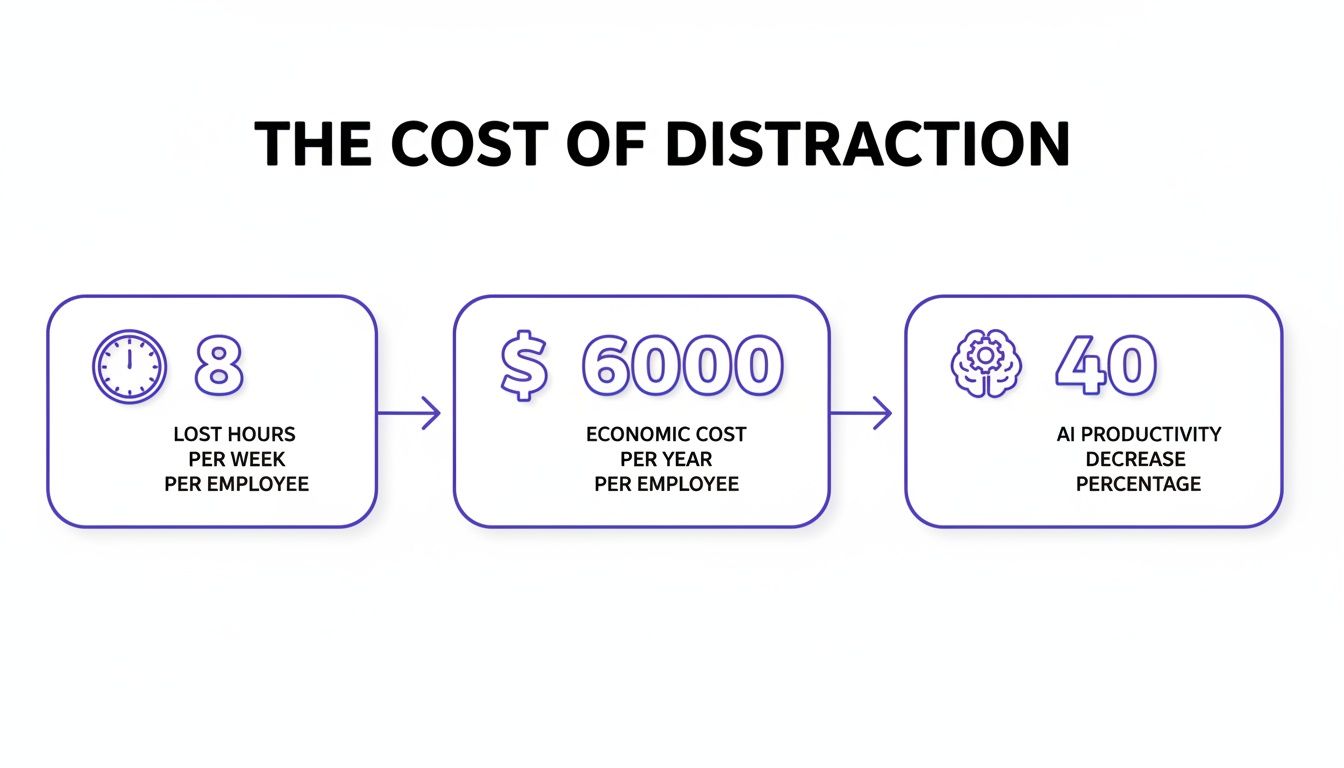
    This isn’t just a personal struggle; it’s an economic disaster. The average US knowledge worker loses a jaw-dropping 127 hours every single year just recovering from distractions. That adds up to a national productivity loss that costs the US economy nearly $1.4 trillion annually. But there’s a flip side: among workers using AI and automation, 79% report being more productive, hinting that the right tools can help us win back our focus. You can see the full research on the hidden costs of distraction here.

    The scale of this problem is massive, and it’s worth seeing it laid out clearly.

    Infographic showing the cost of distraction which is a key barrier to improving focus and concentration: 8 lost hours, $6000 economic cost, 40% AI productivity decrease.

    This isn’t just about feeling a little scattered. Improving focus is an economic and professional necessity.

    Why Your Brain Struggles with Distractions

    Psychologically, our brains are wired to notice new things. It’s an ancient survival instinct that once helped our ancestors spot predators in the grass. Today, that same mechanism is hijacked by the unpredictable rewards of digital notifications.

    Every ping and buzz delivers a tiny hit of dopamine, a neurotransmitter linked to motivation and reward. This process, known as intermittent reinforcement, trains your brain to crave more and more interruptions. It’s a vicious cycle that makes sustained concentration incredibly difficult.

    This constant stimulation does more than just annoy you. It contributes to cognitive overload, making it harder to do the deep, creative thinking that truly matters. To understand this better, you can explore the hidden costs of screen time in our detailed guide.

    Ultimately, the battle for focus is a fight against the subtle but powerful forces that fragment our attention. Recognizing the true cost of these distractions is the first step toward reclaiming your mental clarity and finally achieving your most important goals.

    To get there, we’ll organize our approach around four core pillars. This table gives you a quick roadmap for what’s ahead in this guide.

    The Four Pillars for Improving Focus and Concentration

    PillarCore PrincipleKey Action
    Neuro-Behavioral RoutinesAlign daily habits with your brain’s natural focus cycles.Design a morning routine that protects your peak attention window.
    Environmental DesignShape your physical and digital spaces to minimize friction.Systematically remove distractions and add focus-friendly cues.
    Dopamine RegulationReduce exposure to high-stimulation inputs to restore baseline focus.Implement a β€œlow-information diet” and planned dopamine resets.
    AI-Assisted WorkflowsUse automation to handle low-value tasks and protect deep work.Offload administrative work to AI tools to free up cognitive resources.

    Each of these pillars is a crucial piece of the puzzle. By working on them together, you can build a robust system that not only helps you concentrate but also protects your mental energy for the long haul.

    Please Note: The information provided in this article is for educational purposes only and is not a substitute for professional medical or psychological advice, diagnosis, or treatment. If you are struggling with issues like anxiety, depression, ADHD, burnout, or sleep problems, please consult a qualified healthcare provider.

    How to Design an Environment for Improving Deep Work and Focus

    Your ability to sink into deep, unbroken focus has less to do with willpower than you think. It’s almost entirely shaped by your surroundings. Behavioral psychology has a term for this: attention architecture. The core idea is that your environment is constantly sending subtle cues to your brain, either nudging you toward distraction or inviting you to concentrate.

    Think about it. A cluttered desk piled high with old notes, a half-finished project, and random coffee mugs creates a kind of low-grade mental friction. Your brain has to work harder just to ignore it all. The same goes for a chaotic digital workspace. Every notification, every open tab, and every disorganized file drains a little bit of cognitive energy before you even start on what matters.

    The goal isn’t just to be tidyβ€”it’s to make focus the path of least resistance. To get a handle on the foundational principles, exploring a comprehensive summary of deep work principles is a great place to start.

    Stressed businessman looking intently at a laptop, surrounded by glowing email and notification icons, symbolizing digital overload that hinders improving focus and concentration.

    Optimizing Your Physical Workspace for Better Concentration

    Your physical space is your first line of defense in the battle for your attention. Research has shown that a messy environment can actually elevate cortisol, the stress hormone that messes with your cognitive function. On the flip side, a clean and organized space sends a clear signal to your brain: it’s time for structured, orderly thinking.

    Start by clearing your desk of everything except the absolute essentials for the task at hand. This isn’t just about appearances. Every out-of-place item is what psychologists call an β€œopen loop”—a tiny, unfinished decision your brain has to make or actively ignore. Each one consumes precious mental energy.

    Beyond decluttering, think about these other physical cues:

    • Lighting: Natural light is always best. If that’s not an option, go for cool-toned light (around 5000K-6500K) to boost alertness. Bad lighting causes eye strain and fatigue, which are guaranteed concentration killers.
    • Sound: If you can’t get total silence, a good pair of noise-canceling headphones can create your own personal focus bubble. Sometimes, ambient sounds like white noise or instrumental music can be just the thing to mask distracting background chatter.
    • Ergonomics: You can’t focus if you’re uncomfortable. Discomfort is a powerful distraction. An ergonomic chair and a monitor at the right height prevent physical strain from hijacking your mental resources.

    The way light and sound influence your brain is a whole field of study. You can dive deeper into how light, sound, and architecture affect cognitive performance in our dedicated guide.

    Taming Your Digital Environment for Improved Focus

    Let’s be honest: your digital world is probably a bigger source of distraction than your physical one. The constant barrage of notifications, the sea of open browser tabs, and the mess of disorganized files create a state of perpetual digital chaos. Getting your focus back requires a deliberate, almost ruthless, approach to curating this space.

    The single most impactful thing you can do is a notification audit. Right now. Go into your phone and computer settings and turn off every single notification that isn’t mission-critical. This one action stops tech companies from hijacking your attention whenever they feel like it.

    Real-World Scenario: Alex, a remote developer, was constantly overwhelmed. His desk was a disaster zone of old notes and coffee mugs. His laptop screen was even worseβ€”a jungle of browser tabs and pop-up notifications. His focus was shot, and his stress was through the roof.

    He finally dedicated one afternoon to a total reset. He cleared his desk, set up a second monitor just for his coding environment, and installed a browser extension to block social media during work hours. He also turned off all email and Slack notifications, committing to checking them only three times a day.

    The result? His coding output doubled. He started ending his workdays feeling accomplished instead of drained and frazzled. This is a prime example of environmental design leading to dramatically improved focus and concentration.

    A Checklist for Digital Decluttering

    Creating a screen experience that doesn’t shred your focus is about building new habits and using tools to make them stick.

    • One Task, One Window: If you’re writing, have only your document open. If you’re coding, just your editor. Don’t let your email or chat app sit in your peripheral vision, tempting you away.
    • Use Website Blockers: Tools like Freedom or Cold Turkey are fantastic. They let you block distracting websites for set periods, acting as a guardrail for your easily distractible brain.
    • Organize Your Files: A logical folder system is non-negotiable. Wasting five minutes hunting for a file is a classic focus-killer. It injects frustration and unnecessary cognitive load right when you can’t afford it.
    • Curate Your Desktop: Treat your computer desktop like your physical one. Keep it clear of everything except what you are actively working on right now.

    When you thoughtfully design both your physical and digital environments, you’re not just cleaning up. You’re building a sanctuary for deep workβ€”a system that makes intense focus an automatic, effortless part of your daily routine.

    Mastering Dopamine: A Key to Improving Sustained Concentration

    Ever find yourself scrolling through social media when you should be knee-deep in a report? You’re not alone. That mindless pull is the power of dopamine in action. It’s often called the β€œfeel-good” chemical, but from a neuroscience standpoint, it’s more of a motivation engineβ€”your brain’s way of saying, β€œHey, pay attention! This could be important.”

    Modern apps and platforms have become masters at hijacking this exact system. They use what’s known in behavioral psychology as a variable reward scheduleβ€”the unpredictable thrill of a new like, an unexpected email, or a juicy headline. Because you never know when the next little β€œreward” is coming, your brain stays hooked, constantly seeking another tiny hit.

    This constant chase trains your brain to crave novelty and distraction, making sustained focus on a single, less thrilling task feel almost impossible.

    A well-lit home office desk with a laptop, lamp, headphones, and plant, an ideal environment for improving focus and concentration.

    The result? Our attention is in a state of constant fracture. Sobering research shows that our ability to focus on a single screen has plummeted from 150 seconds in 2004 to a mere 47 seconds by 2023. We switch tasks every 10.5 minutes on average, even though it can take a full 25 minutes to get back into a state of deep focus after an interruption.

    It’s a recipe for chronic distraction.

    Reclaiming Your Brain with a Dopamine Detox

    To push back against this relentless stimulation, one of the most effective strategies is a β€œdopamine detox,” sometimes called dopamine fasting. The idea isn’t to get rid of dopamineβ€”that’s both impossible and unhealthyβ€”but to intentionally cut back on high-dopamine, low-effort activities. By doing this, you give your brain’s reward pathways a chance to reset.

    Think of it like recalibrating your palate. After you stop eating overly sugary foods for a while, the subtle sweetness of a piece of fruit becomes incredibly satisfying again. A dopamine detox does the same for your brain, making normal, productive activities feel engaging and rewarding once more. We explore the science behind this in our guide on whether a dopamine detox is real or just a myth.

    Real-World Scenario: A startup founder named Maria felt creatively drained. Her days were a blur of meetings, emails, and checking industry news on social media. She decided to implement a β€œlow-dopamine Sunday.” For one day each week, she turned off her phone and laptop, avoided all screens, and instead spent her time reading physical books, hiking, and journaling.

    After just a few weeks, she noticed a profound shift. Mondays no longer felt like a drag. She returned to work with fresh ideas and a renewed ability to concentrate on complex strategic problems for hours at a time. This simple weekly reset was a powerful tool for improving her focus and concentration.

    A Sample One-Day Dopamine Detox Plan

    Ready to give it a shot? Here’s a simple plan for a one-day reset. The key is to swap out your high-dopamine habits for activities that are low-stimulation and intentional.

    Activities to AVOID:

    • Social Media: No scrolling through Instagram, X, TikTok, or Facebook.
    • Streaming Entertainment: No Netflix, YouTube, or video games.
    • Internet Browsing: Avoid mindless surfing and news-checking.
    • Processed/Sugary Foods: These can also trigger significant dopamine releases.
    • Music with Lyrics: Instrumental or ambient music is fine, but avoid anything that heavily engages your brain’s language centers.

    Activities to EMBRACE:

    • Reading a Physical Book: Engage your mind without the glare and notifications of a screen.
    • Journaling or Writing by Hand: This is a great way to process thoughts without digital distraction.
    • Walking or Spending Time in Nature: Gentle physical activity in a natural setting is incredibly restorative for the brain.
    • Creative Hobbies: Think drawing, painting, playing a musical instrument, or meditating.
    • Engaging in Face-to-Face Conversation: Connect with others without a screen acting as an intermediary.

    This isn’t about punishment or deprivation. It’s a strategic withdrawal from the noise to allow your brain to recalibrate. By mastering your dopamine triggers, you take back control of your attention, making deep, sustained concentration a skill you can call upon whenever you need it most.

    Build Unbreakable Focus with Structured Routines

    Knowing the theory behind focus is one thing, but real progress comes from turning those ideas into consistent, daily actions. Building unbreakable focus isn’t about finding a magic bullet. It’s about creating structured routines that train your brain over timeβ€”much like exercising a muscle, where small, repeatable efforts lead to huge gains in concentration.

    Instead of burning through willpower, which behavioral research shows is a finite resource, structured methods give you a framework that makes focus your default setting. These routines aren’t about creating a rigid, joyless schedule. They’re about building just enough predictability to free up your mental energy for the work that actually matters. When your brain doesn’t have to constantly decide what to do next, it saves that precious cognitive fuel for deep thinking.

    The Power of Time Blocking and Pomodoro for Improving Focus

    Two of the most effective, evidence-backed techniques for building this kind of structure are time blocking and the Pomodoro Technique. They work beautifully together, helping you manage both your energy and your attention.

    • Time blocking is the simple practice of scheduling your entire day into specific blocks of time, each dedicated to a particular task. Instead of staring at a vague to-do list, your calendar becomes your concrete plan. This forces you to single-task, which is critical for avoiding the β€œattention residue” that kills productivity.
    • The Pomodoro Technique, developed by Francesco Cirillo, involves working in focused 25-minute sprints (called β€œPomodoros”) separated by short 5-minute breaks. After four Pomodoros, you take a longer break of 15-30 minutes. This rhythm is a game-changer for preventing mental fatigue and burnout.

    Why Breaks are Non-Negotiable
    Neuroscience research is clear on this: short, deliberate breaks are essential for restoring your cognitive resources. When you’re locked in, your brain’s prefrontal cortex is working overtime. Taking a short break lets it switch to a more relaxed β€œdiffuse mode,” which is crucial for consolidating memories and sparking creative insights. Skipping breaks doesn’t make you more productive; it just makes you hit a cognitive wall faster.

    A Sample Weekly Focus Schedule

    So, what does this actually look like for a busy professional? Here’s a sample schedule that pulls these principles together to have a real impact on your focus and concentration.

    TimeMondayTuesdayWednesdayThursdayFriday
    9:00 – 10:30Deep Work Block 1 (Strategic Plan)Deep Work Block 1 (Client Project A)Deep Work Block 1 (Content Creation)Deep Work Block 1 (Client Project B)Deep Work Block 1 (Weekly Review)
    10:30 – 11:00Strategic Break (Walk outside)Check & Respond to EmailsStrategic Break (Mindful Stretching)Check & Respond to EmailsAdmin & Planning
    11:00 – 12:30Deep Work Block 2 (Report Writing)Deep Work Block 2 (Client Project A)Meeting BlockDeep Work Block 2 (Client Project B)Flexible Time / Catch-up
    12:30 – 1:30Lunch Break (Screen-free)Lunch Break (Screen-free)Lunch Break (Screen-free)Lunch Break (Screen-free)Lunch Break (Screen-free)
    1:30 – 3:00Shallow Work (Emails, Calls)Meeting BlockDeep Work Block 2 (Content Creation)Meeting BlockFinalize Week’s Tasks
    3:00 – 4:30Meeting BlockShallow Work (Admin Tasks)Shallow Work (Team Syncs)Shallow Work (Follow-ups)Professional Development

    Notice how this structure dedicates the peak morning hoursβ€”when your brain is freshestβ€”to the most demanding cognitive work. Meetings and administrative tasks are pushed to the afternoon, when energy naturally starts to fade.

    For more ideas on how to build a day for peak performance, check out our guide on 7 Powerful Brain Reset Habits.

    How Structured Routines Reduce Overwhelm

    Let’s look at a common scenario: a student cramming for final exams. They have five different subjects to cover and are completely paralyzed by the sheer volume of material. It feels impossible.

    Instead of randomly jumping between topics whenever anxiety strikes, the student decides to try time blocking. They dedicate specific 90-minute blocks to each subject throughout the week. Within each block, they use the Pomodoro Technique to stay on task.

    This simple structure completely transforms their study process. The 25-minute sprints make it much less daunting to just start, and the 5-minute breaks prevent burnout while helping their brain actually consolidate what they’ve just learned.

    By giving every subject its own time slot, they’ve eliminated that nagging, stressful mental chatter of, β€œWhat should I be studying right now?” This structured approach not only boosts retention but also massively reduces anxiety, proving that consistency is always more powerful than last-minute intensity.

    Using AI as a Tool for Improving Focus

    It’s easy to frame technology as the enemy of concentration. But what if we could flip that script? Instead of letting it drain your attention, you can use artificial intelligence as a powerful β€œcognitive co-pilot” to offload mental clutter and fiercely protect your most valuable resourceβ€”your focus.

    The core idea is simple. Every ounce of mental energy you spend on tedious, low-value administrative tasks is energy you can’t redirect toward deep, creative thinking. AI tools are brilliant at automating these repetitive jobs, acting as a buffer between you and the cognitive drains that fragment your day.

    A person writing in a planner on a white desk with tea, a phone, and an alarm clockβ€”tools for improving focus and concentration.

    Automating the Small Stuff to Win Back Big Chunks of Time

    Modern AI can handle a surprising range of administrative and prep work. By setting up just a few smart workflows, you can free up significant brain space and create longer, uninterrupted blocks for the work that actually moves the needle.

    Think about these common focus-killers and how an AI partner can help:

    • Summarizing Long Documents: Instead of spending an hour wading through a dense report just to find three key takeaways, an AI tool like ChatGPT or Claude can pull out the essentials in seconds.
    • Managing Your Schedule: AI assistants like Calendly or Motion can handle the endless back-and-forth of finding a meeting timeβ€”a small task that creates constant, focus-shattering context switching.
    • Drafting Routine Emails: For repetitive communications, AI can generate a solid first draft. This saves you from the mental drag of starting from a blank page over and over again.

    Real-World Scenario: A marketing consultant, Liam, used to spend hours summarizing competitor research and client feedback before he could even start on a new campaign strategy. This prep work left him feeling drained before the real creative thinking even began.

    By building an AI workflow, he now uses a tool to automatically summarize articles and meeting transcripts, pulling out key themes and sentiment. This frees up nearly five hours a week, which he now dedicates entirely to deep strategic work. The result? Better campaigns and a much less frantic schedule, showcasing how AI can be a key asset for improving focus.

    Using AI to Overcome Cognitive Bottlenecks

    Beyond simple automation, AI can also act as a creative partner, helping you push past mental roadblocks. Writer’s block, for instance, is often just a symptom of cognitive overload. An AI assistant can help brainstorm outlines or rephrase a clumsy sentence, breaking the inertia and getting you back into a flow state.

    And we’ve all felt the cognitive load from back-to-back video callsβ€”it’s a major cause of burnout. AI-powered meeting tools like Otter.ai or Fathom can transcribe calls and generate summaries of action items. This frees you up to be fully present in the conversation instead of frantically trying to listen and take notes at the same time. You can learn more about how to use AI for productivity in our comprehensive guide.

    A Mini-Tutorial for Taming Your Inbox with AI

    Your inbox is one of the biggest battlegrounds for your attention. Here’s a quick workflow to turn it back into a streamlined tool for improving focus, not a source of endless distraction.

    1. Set Up Smart Filters: Most modern email clients have AI-powered features. Use them to automatically categorize incoming mail. Create filters that sort messages into buckets like β€œUrgent,” β€œTeam Updates,” β€œNewsletters,” and β€œTo Read Later.”
    2. Use an AI Assistant for Triage: Forward non-urgent but important emails to an AI tool and ask it to summarize them. Then, schedule a specific time block once a day to review these summaries in a batch.
    3. Generate Quick Replies: For routine emails that need a simple response, use your email client’s built-in AI to draft a reply. This reduces decision fatigue and saves precious mental energy for more important work.

    When you thoughtfully integrate AI, you transform technology from a source of distraction into a powerful ally in your quest for sustained concentration.

    Editor’s Take: What Actually Works for Improving Focus?

    Let’s be real for a moment. After digging through all the research and trendy productivity hacks, one thing is crystal clear: there’s no magic pill for improving focus and concentration. The only thing that truly works is a custom-fit blend of smarter habits and a few intentional tweaks to your environment.

    For most busy professionals, the quickest and most noticeable wins will come from combining time blocking with a handful of smart AI tools. Why? Because that combination attacks the two biggest focus killers at once: external distractions and the internal drag of administrative busywork. It frees up a surprising amount of mental energy for the work that actually matters.

    Who This Advice Is Really For

    But what if you’re feeling completely fried and digitally burned out? If that’s you, your best first step is a dopamine detox. It’s less about quitting technology and more about recalibrating your brain’s reward system so that deep, focused work stops feeling like a chore.

    The biggest catch with any of these strategies is consistency.

    Think of these methods like exercise for your brainβ€”the results come from sustained effort over time, not from a single, heroic sprint. The goal is to find what clicks for your unique brain and then stick with it.

    This advice is for anyone ready to move beyond willpower and build a system that actually supports their attention. It’s about making intentional, science-backed changes to your daily rhythms. My advice? Just pick one or two of these strategies and give them a real shot for a few weeks. You might be surprised at what changes.


    Disclaimer: The content in this article is for educational and informational purposes only and is not intended as medical or psychological advice. It also contains affiliate links, and we may earn a commission if you make a purchase through these links, at no additional cost to you.


    FAQ: Your Questions on Improving Focus and Concentration

    1. How long does it take to see real improvements in focus?

    While individual results vary, most people notice a tangible difference within 2-4 weeks of consistent practice. The key is applying strategies like time blocking or reducing notifications daily. It’s about building a new mental habit, which takes time.

    2. Is it better to work for long hours or take more breaks?

    Neuroscience strongly supports taking regular breaks. The Pomodoro Technique (25 minutes on, 5 minutes off) is effective because it prevents mental fatigue and allows your brain to consolidate information, leading to better overall concentration and retention than long, unbroken work sessions.

    3. Can I train my brain to ignore distractions?

    Yes, to an extent. Mindfulness meditation is a scientifically-backed method for training your brain’s attention networks. It teaches you to notice when your mind has wandered and gently bring it back to your point of focus, strengthening your ability to ignore both internal and external distractions over time.

    4. What’s the biggest mistake people make when trying to improve concentration?

    The biggest mistake is relying solely on willpower. Willpower is a finite resource. A much more effective approach is to design your environment and routines to support focus, making concentration the path of least resistance rather than a constant battle.

    5. Does diet really affect my ability to concentrate?

    Absolutely. Your brain consumes about 20% of your body’s energy. A diet high in processed foods and sugar can cause energy spikes and crashes, leading to brain fog. A balanced diet with complex carbs, healthy fats (like omega-3s), and protein provides the sustained energy your brain needs for peak cognitive performance.

    6. Is multitasking always bad for focus?

    For any task that requires cognitive effort, yes. The brain doesn’t truly multitask; it task-switches very quickly, which incurs a β€œcognitive cost” each time. This leads to more errors, takes more time, and is more mentally draining. Single-tasking is far more efficient.

    7. How can I improve my focus if I have a very busy, unpredictable job?

    If your schedule is chaotic, focus on what you can control. Start with a 15-minute β€œfocus sprint” on your most important task first thing in the morning. Turn off all notifications during that time. Even small, protected blocks of deep work can have a huge impact.

    8. Are there any apps that can genuinely help with improving focus?

    Yes. Website blockers like Freedom or Cold Turkey are excellent for creating distraction-free digital environments. Meditation apps like Headspace or Calm can help train your attention. And task management tools that incorporate time blocking can help structure your day for better concentration.

    9. What if I try these techniques and still can’t focus?

    If you consistently struggle with focus and it significantly impacts your life or work, it’s wise to consult a healthcare professional. Underlying conditions like ADHD, anxiety, depression, or sleep disorders can affect concentration, and this article is not a substitute for professional medical or psychological advice.

    10. What is the single most effective habit for long-term focus improvement?

    The most impactful habit is consistently dedicating your peak energy hours (for most people, the morning) to your most important, cognitively demanding taskβ€”and protecting that time ruthlessly from interruptions. This aligns your work with your brain’s natural rhythm for optimal performance.

    Explore the Mind Clarity Hub Library

    Practical books on focus, digital habits, resilience, and building a calmer mind.

    The Power of Clarity β€” book cover

    The Power of Clarity

    Unlock mental focus, build momentum, and create the life you were meant to live.

    View book β†’
    AI & ChatGPT for Beginners β€” book cover

    AI & ChatGPT for Beginners

    No PhD needed β€” a 2025 guide to AI, prompts, and productivity without coding.

    View book β†’
    Zen in the Digital Jungle β€” book cover

    Zen in the Digital Jungle

    Mindfulness for a chaotic world.

    View book β†’
    The Slow Reset β€” book cover

    The Slow Reset

    Mindful living in a fast-paced world.

    View book β†’
    Perfectly Imperfect β€” book cover

    Perfectly Imperfect

    Stop self-criticism, set boundaries, and embrace the real you.

    View book β†’
    Reclaiming Silence β€” book cover

    Reclaiming Silence

    A dopamine detox guide to finding peace in a noisy world.

    View book β†’
    The Focused Freelancer β€” book cover

    The Focused Freelancer

    Productivity, pricing & positioning for independents in 2025.

    View book β†’
    ChatGPT Side Hustle System β€” book cover

    ChatGPT Side Hustle System

    Launch your AI-driven online business in 30 days.

    View book β†’
    Burnout, Interrupted β€” book cover

    Burnout, Interrupted

    A proven path to restore energy and reclaim your life.

    View book β†’
    Attention Unleashed β€” book cover

    Attention Unleashed

    Focus strategies for the distracted mind.

    View book β†’
    Side Hustle Launchpad β€” book cover

    Side Hustle Launchpad

    Your quick-start guide to extra income.

    View book β†’
    Digital Clarity β€” book cover

    Digital Clarity

    Rewire your brain, escape dopamine traps & regain focus.

    View book β†’
    Break the Scroll β€” book cover

    Break the Scroll

    Reduce screen time and take back control of your life.

    View book β†’
    Climate Compassion β€” book cover

    Climate Compassion

    Transform eco-anxiety into empowered action.

    View book β†’
    Village Mentality β€” book cover

    Village Mentality

    The power of community for mental wellness.

    View book β†’
    Restful Nights β€” book cover

    Restful Nights

    Overcoming sleep anxiety in a 24/7 world.

    View book β†’
    Connected Again β€” book cover

    Connected Again

    Combat loneliness and build meaningful relationships.

    View book β†’
    Focus Recharged β€” book cover

    Focus Recharged

    Mastering attention and productivity in the digital era.

    View book β†’
    Marketing Magic with ChatGPT β€” book cover

    Marketing Magic with ChatGPT

    AI-powered content, campaigns, and copywriting to grow faster.

    View book β†’
    The 6-Figure Creator β€” book cover

    The 6-Figure Creator

    Turn knowledge into passive income with books, courses & AI.

    View book β†’
    Burnout Breakthrough β€” book cover

    Burnout Breakthrough

    Reset your work-life balance and thrive in 2025.

    View book β†’
    The Emotionally Intelligent Man β€” book cover

    The Emotionally Intelligent Man

    A modern guide to self-awareness and communication.

    View book β†’
    AI Personalized Wellness β€” book cover

    AI Personalized Wellness

    Create your custom health plan with data-driven habits.

    View book β†’
    Everyday AI Made Easy β€” book cover

    Everyday AI Made Easy

    Use ChatGPT and smart tools to simplify life.

    View book β†’
    Money Mindfulness β€” book cover

    Money Mindfulness

    A financial wellness guide for Gen Z & Millennials.

    View book β†’
    Startup Smarter with AI β€” book cover

    Startup Smarter with AI

    ChatGPT strategies and tools to grow your business.

    View book β†’
    ChatGPT for Writers & Creators β€” book cover

    ChatGPT for Writers & Creators

    Unlock AI-powered brainstorming, drafting & editing.

    View book β†’