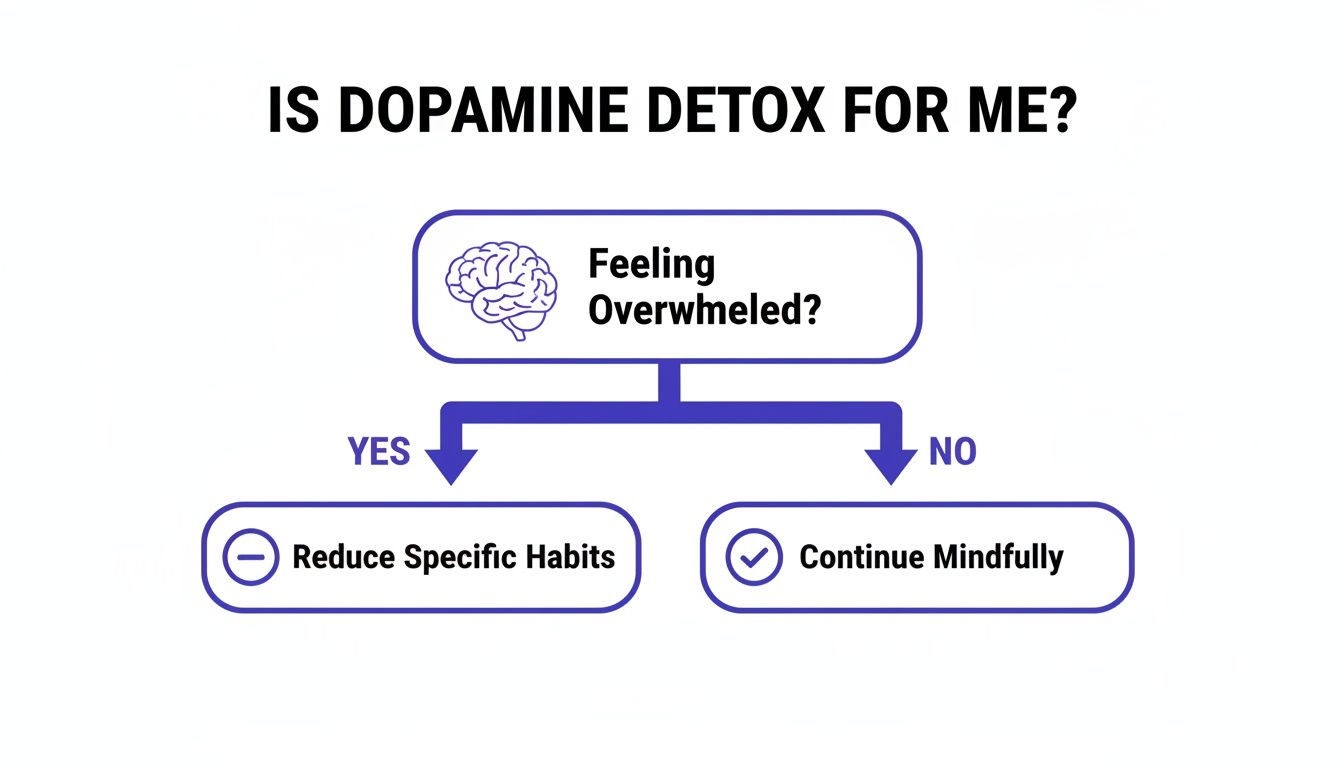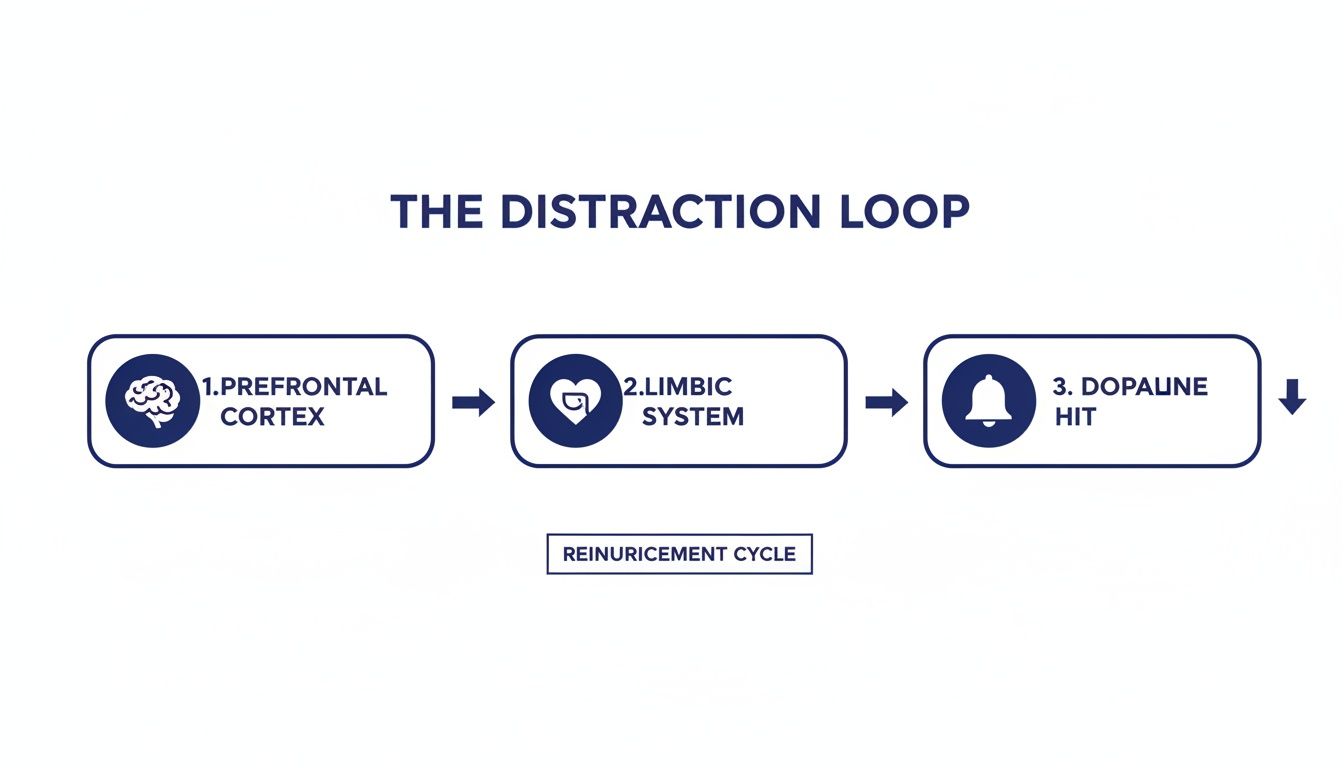

When you’re pulled in a dozen different directions, you’re not just busy—you’re actively draining the part of your brain responsible for smart decisions. When every email and message feels urgent, your brain gets overwhelmed, leading to decision fatigue. This is a real psychological phenomenon. Your prefrontal cortex, the bit that handles planning and focus, runs out of steam, making it hard to concentrate on the work that actually moves the needle.
To fight back, you need a simple, repeatable system to sort through the noise. This isn’t about working harder; it’s about making deliberate choices before you dive in. It’s how you take back control and approach your day with intention instead of just reacting to whatever lands in your inbox.
Affiliate Disclosure: At Mind Clarity Hub, we believe in transparency. This post may contain affiliate links, which means we may earn a small commission if you make a purchase through them, at no extra cost to you. We only recommend products we genuinely believe will add value to our readers.
How To Triage Your Tasks And Stop Drowning In Demands
Feeling pulled in a dozen different directions is a common struggle. When every email, message, and request feels urgent, your brain can easily become overwhelmed, leading to decision fatigue. This is a real psychological phenomenon where the quality of your decisions deteriorates after a long session of decision-making. The prefrontal cortex, responsible for executive functions like planning and focus, gets depleted, making it harder to concentrate on high-impact work.
To combat this, you need a simple, repeatable system to quickly sort through the noise. This isn’t about working harder; it’s about working smarter by making deliberate choices before you dive in. This approach helps you regain control and approach your day with intention rather than just reacting to whatever comes your way.
This article is for educational purposes only and is not a substitute for professional medical or psychological advice. If you are struggling with conditions like anxiety, depression, ADHD, burnout, or sleep problems, please consult a qualified healthcare provider.
The Power Of The Eisenhower Matrix in Managing Competing Priorities
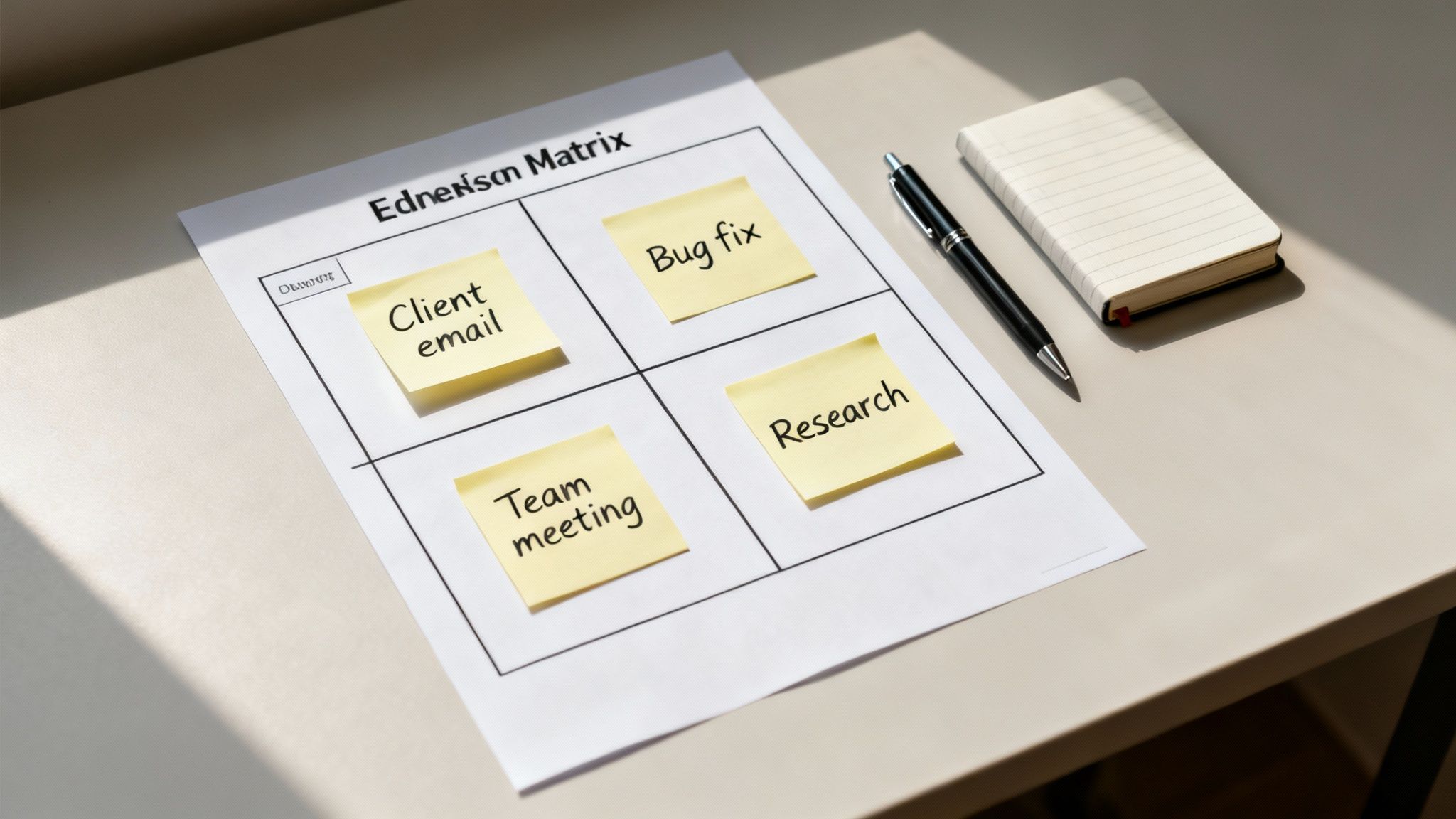
One of the most effective tools for this is the Eisenhower Matrix. It’s a simple framework that helps you categorize tasks into four quadrants based on two criteria: urgency and importance. This behavioral science trick forces you to pause and evaluate what’s in front of you instead of just reacting to the loudest demand.
The matrix is brilliant because it’s so simple. It gives you a visual way to make tough calls quickly, which is exactly what you need when you’re feeling swamped.
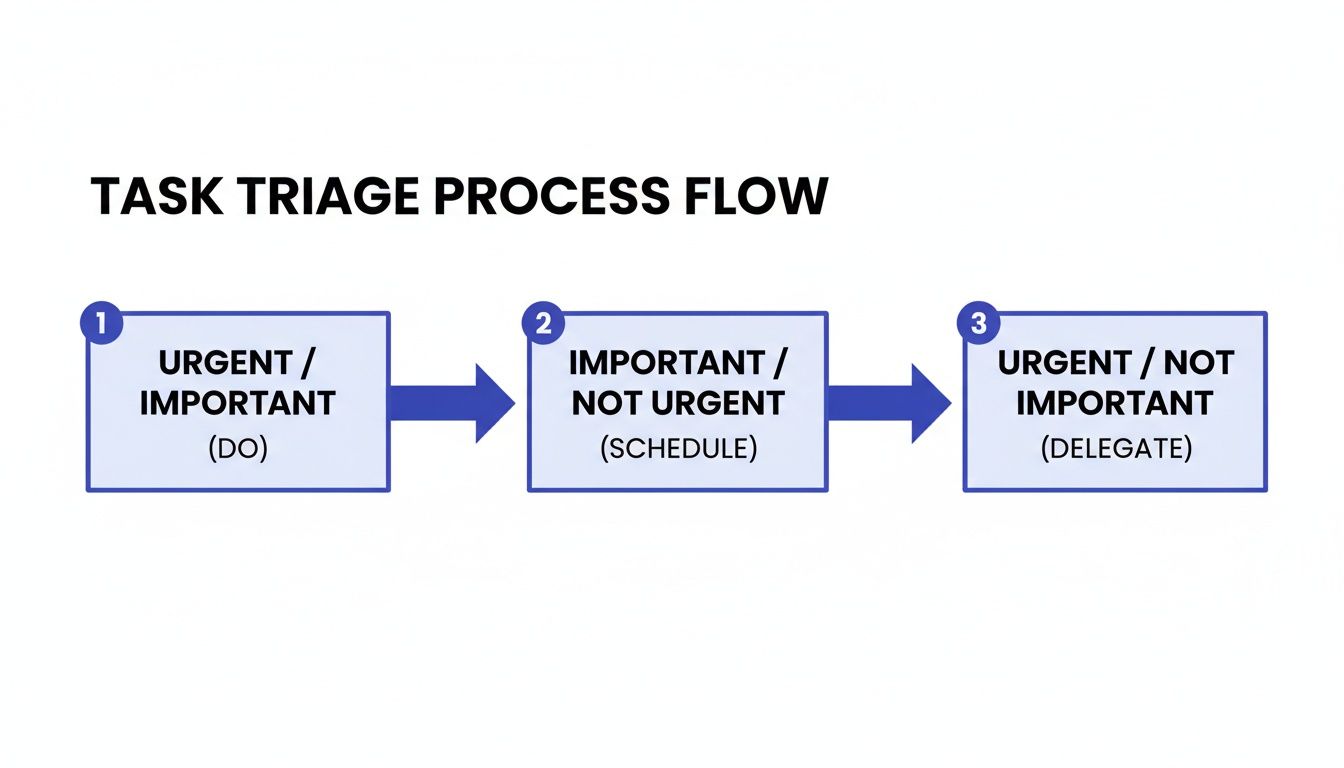
This triage system gives you a clear path forward, helping you allocate your limited time and energy to what truly matters.
The Eisenhower Matrix For Rapid Triage
Use this matrix to quickly categorize tasks and decide what to do next. This helps you focus on what truly matters when you’re managing competing priorities.
| Category | Description & Action | Example Task |
|---|---|---|
| Do (Urgent & Important) | These are your fires and deadlines. Crises with immediate, significant consequences that must be handled now. | A major client reports a critical bug that’s halting their operations. |
| Schedule (Important & Not Urgent) | This is where high-value, strategic work lives. Your goals, planning, and relationship-building. Get these on the calendar. | Preparing the slide deck for next quarter’s strategy presentation. |
| Delegate (Urgent & Not Important) | These are often interruptions from others that feel urgent but don’t align with your core goals. Hand them off if you can. | A colleague needs you to find a file for a meeting you’re not in. |
| Delete (Not Urgent & Not Important) | These are the time-wasters and distractions. Be ruthless about eliminating them from your day. | Scrolling through social media feeds or reading irrelevant newsletters. |
Once you get in the habit of running tasks through this mental filter, you’ll find it becomes second nature, saving you from the constant churn of indecision.
A Real-World Triage Scenario
Let’s make this real. Imagine you’re a project manager and you’ve just sat down with your ergonomic keyboard to start the day. You’re immediately hit with three things:
- An urgent bug fix reported by a major client.
- A flood of unread emails.
- A reminder for a team meeting in one hour.
Without a system, it’s tempting to jump into the emails first. It feels productive, right? Clearing the inbox gives your brain a quick hit of dopamine, a neurotransmitter associated with reward and pleasure.
But with the Eisenhower Matrix, your approach changes completely:
- Do (Urgent & Important): The client’s bug fix. This is a fire. It’s time-sensitive, critical for the business, and your absolute top priority.
- Delegate (Urgent & Not Important): Some of those emails are probably requests that a team member can handle. Instead of becoming a bottleneck, you can use tools to assign and track tasks and keep things moving.
- Schedule (Important & Not Important): That future strategy meeting is important, but preparing for it can happen later. Block out time for it after the crisis is handled.
This quick sorting process saves you from the mental strain of juggling everything at once, which is a major cause of https://mindclarityhub.com/what-is-cognitive-overload/.
Multitasking is a myth. Behavioral research shows that constantly switching between tasks can slash your efficiency by a staggering 40%. By triaging your work first, you commit to single-tasking on what actually matters, protecting your focus and energy for where it counts.
Ultimately, managing competing priorities isn’t about finding more time. It’s about fiercely protecting the time you already have. This initial triage is the first and most critical step in building a workflow that doesn’t leave you burned out. The demands aren’t going away, which makes this skill non-negotiable for anyone trying to do meaningful work.
Master Your Focus With Neuroscience-Backed Techniques
Okay, you’ve sorted your tasks. Now comes the hard part.
The real challenge in managing competing priorities isn’t just deciding what to do—it’s protecting your attention long enough to actually do it without getting pulled in ten different directions. This is where the science of deep work becomes your most valuable asset.
Think of your brain’s executive functions, which live in your prefrontal cortex, like a muscle. When you’re constantly bouncing between emails, a report, and Slack messages, you’re forcing that muscle into a frantic stop-and-start rhythm. This is called context-switching, and it’s a massive drain on your cognitive energy. It makes deep focus feel almost impossible.
Embrace The Power Of Focused Intervals for Managing Priorities
To fight that mental fatigue, you have to work with your brain’s natural rhythms, not against them. One of the most effective ways to do this is the Pomodoro Technique. It’s almost laughably simple, but it works.
You commit to a 25-minute focused sprint on a single task, followed by a non-negotiable 5-minute break. The structure isn’t random; it’s grounded in the psychology of attention restoration. Those short breaks are a mental reset, preventing the burnout that comes from trying to power through for hours on end. They allow your brain to consolidate information and recharge for the next sprint, keeping your performance sharp.
Mini-Scenario: An accountant has a complex financial report to finish. Instead of staring at the spreadsheet for three hours, she sets a visual timer for desk for 25 minutes. She works intensely, then takes a 5-minute break to stretch and grab water. After four such cycles, she’s made significant progress without feeling mentally drained.
By intentionally scheduling breaks, you’re not wasting time. You’re actively managing your cognitive load—a core skill for anyone who’s serious about producing high-quality work without burning out.
This disciplined approach makes a huge difference. A writer trying to finish a tough chapter will get far more done in four focused 25-minute sessions than they would by trying to force three hours of distracted, unfocused effort.
Engineer Your Environment For Deep Work
Let’s be honest: your ability to focus is heavily shaped by your surroundings. Distractions are the enemy of progress, and your environment is probably full of them. Willpower alone is rarely enough to win against the constant pull of notifications.
So, stop relying on it. Proactively remove the temptations before they even have a chance. Creating a distraction-free bubble for your most important work isn’t a luxury; it’s a non-negotiable part of the process.
Here are a few practical moves:
- Silence the Noise: A good pair of noise canceling headphones does more than just block out sound. It sends a powerful signal to your brain—and your colleagues—that it’s time to concentrate.
- Lock Away Distractions: The pull of your phone is real and it is strong. Physically removing it with a simple phone lock box timer for a set period is one of the most effective ways to force yourself to stay on task.
- Signal Your Intent: Let your team or family know when you’re starting a focus block. A quick “Heads up, I’m going dark for the next 60 minutes to finish this proposal” sets clear expectations and minimizes interruptions.
When you design an environment that supports deep work, you stop spending precious mental energy just trying to resist distractions. All that cognitive bandwidth can go toward the important tasks you identified in the first place. You can even improve your workspace with an ergonomic mouse or a useful laptop stand for desk. Ultimately, mastering your focus is how you ensure that once you’ve decided on the right things to do, you have the mental clarity and stamina to execute them well. To go deeper, you can explore our full guide on improving focus and concentration.
Schedule Your Success With Time Blocking And Task Batching
A prioritized list is a great starting point, but it’s only half the battle. A list tells you what matters, but it doesn’t create the time to actually do it. To truly get a handle on managing competing priorities, you have to translate your intentions into a concrete schedule.
This is where the powerful duo of time blocking and task batching comes in. Together, they turn a wish list into a realistic roadmap for your day.
Time blocking is exactly what it sounds like: you dedicate specific, non-negotiable chunks of your calendar to a single type of work. Instead of staring at a long, vague list of things you could do, your calendar gives you a clear, visual plan. This simple act of assigning a job to a time slot dramatically reduces the mental energy you waste just deciding what to tackle next.

From To-Do List To Action Plan
Let’s picture a freelance graphic designer who feels constantly pulled in three directions: creative work, client management, and business admin. The competing demands are causing a ton of stress and absolutely tanking their productivity.
Using a simple time blocking planner, they could give their day some much-needed structure:
- 9:00 AM – 12:00 PM: Deep Creative Work (No emails, no calls. Just pure design time.)
- 12:00 PM – 1:00 PM: Lunch & Walk (A non-negotiable break to reset the brain.)
- 1:00 PM – 3:00 PM: Client Communication Block (Respond to emails, take scheduled calls.)
- 3:00 PM – 4:00 PM: Admin Hour (Invoicing, updating project boards, contracts.)
This schedule does more than just organize tasks—it fiercely protects the designer’s most valuable asset: their focused attention. Instead of reacting to every ping and notification, they have a proactive plan that honors their most important goals.
Leverage Your Brain’s Momentum With Task Batching
Time blocking works even better when you pair it with another brain-friendly technique: task batching. This is all about grouping similar activities together and knocking them out in one dedicated session.
Think about email. Answering messages as they trickle in forces your brain to constantly switch gears, a process that is incredibly expensive from a cognitive standpoint. But what if you answered all your emails in one focused 45-minute block? It’s far more efficient.
This is because of a psychological principle called “cognitive set.” When you focus on one type of task, your brain gets into a rhythm and becomes faster and more effective. Each email you answer becomes a little easier than the last because your mind is already primed for that specific mode of thinking.
By scheduling your time and batching your tasks, you create a system that cuts down on decision fatigue and harnesses your brain’s natural ability to build momentum. This structure is the key to turning reactive chaos into proactive control.
Protecting Your Scheduled Blocks
Of course, the real world is messy and full of interruptions. The secret to making this system stick is to treat your time blocks with the same respect you’d give an important meeting.
- Communicate Your Boundaries: Let colleagues know your schedule. A quick “I’m in a deep work block until noon but will check messages then” sets clear expectations and manages their response time.
- Kill the Notifications: Your scheduled blocks are useless if alerts are constantly yanking you away. Silence your phone, close unnecessary tabs, and turn off desktop notifications.
- Build in Buffer Time: Don’t schedule every single minute of your day. Leave 10-15 minute gaps between blocks to stretch, grab water, or handle a quick, unexpected issue that pops up.
This structured approach transforms your calendar from a passive record of appointments into a powerful tool for execution. It provides the clarity and control you need to finally move from feeling overwhelmed to feeling accomplished. For a deeper look into creating these focus zones, you can learn more about what is deep work and how to cultivate it.
Learn When To Delegate And How To Say No for Better Prioritization
You can’t do everything. More importantly, you shouldn’t be doing everything. One of the biggest leaps you can make in managing a heavy workload is realizing your time and energy are not infinite. To protect them, you have to get really good at two things: strategic delegation and saying a firm, polite “no.”
This isn’t about dodging work. It’s about taking ownership of your focus so you can pour your energy into the high-impact tasks that only you can do. Setting these kinds of boundaries isn’t a sign of weakness; it’s a mark of a professional who understands their priorities and is committed to delivering quality.

A Simple Framework For Smart Delegation
Good delegation doesn’t create more work for you—it creates leverage. The trick is to hand off tasks in a way that avoids confusion and eliminates the need for endless follow-up questions. For a deeper dive, you can explore how to delegate tasks effectively and start reclaiming your most valuable hours.
Here’s a quick framework to make sure every handoff is crystal clear:
- What: Be painfully specific about the task and the desired outcome. What does “done” actually look like? Give them all the context and resources they’ll need right from the start.
- Who: Match the task to the right person. Think about their skills, their current workload, and even their own development goals. Don’t just find someone who is available; find someone who is best suited for the job.
- When: Set a clear and realistic deadline. This should be a conversation, not a command, to ensure you both agree and are committed.
- How: Outline any must-follow processes or standards, but then give them the autonomy to handle the execution. Agree on how you’ll check in on progress so neither of you is left guessing.
This structure turns a vague “Can you look into this?” into a clear, actionable assignment that sets everyone up for success.
The Art Of Saying No Gracefully
Protecting your focus often means turning down requests that pull you away from your most important work. Saying no can feel awkward, but it’s a non-negotiable skill for preventing burnout and staying on track. The key is to be polite, firm, and brief. You don’t owe anyone a long, drawn-out explanation.
Mini-Scenario: Imagine a marketing manager who is head-down planning a major product launch. A colleague from another department asks them to join a new brainstorming committee that meets twice a week. Instead of piling another commitment onto their overflowing plate, they can use a simple script.
“Thanks so much for thinking of me for this committee. While the topic sounds really interesting, my primary focus right now is the Q3 launch, and I need to dedicate all my attention there to make sure it’s a success. I’ll have to pass this time.”
This response is perfect. It’s respectful, it gives a clear reason tied directly to existing business priorities, and it closes the door without damaging the relationship. It’s a textbook example of protecting your most valuable work, a core theme in my book, Burnout Interrupted. You can also create more bandwidth by getting low-value work off your plate entirely. Our guide on https://mindclarityhub.com/how-to-automate-repetitive-tasks/ is packed with strategies for just that.
Build A Weekly Review System That Actually Works
Trying to manage competing priorities without a regular check-in is like trying to navigate a ship without a rudder. You end up reacting to every wave instead of steering toward your destination. This is where a simple, 30-minute weekly review becomes your most powerful tool.
It’s an incredibly high-leverage habit. This small investment of time prevents you from starting Monday morning in a reactive mess, frantically trying to figure out what matters most. Instead, it ensures your daily actions are actually connected to your bigger goals, giving you a sense of clarity and control that lasts all week.
The goal isn’t to create a rigid, hour-by-hour schedule. It’s to set a clear direction, making it far easier to handle the inevitable curveballs life throws your way. This is the cornerstone of any sustainable productivity system.
First, Look Back and Gather Your Data
Before you can plan your week, you need to know what just happened. The first part of any effective review is a quick, honest look back. Think of it as gathering data, not passing judgment.
Ask yourself a few simple, powerful questions:
- What were my biggest wins this past week?
- Where did I get stuck, feel frustrated, or lose momentum?
- Did I actually spend my time on my most important tasks?
This reflection process is more than just a nice idea; it has a real impact on your brain. Neuroscience tells us that regularly reflecting on past events activates the brain’s default mode network. This is the system responsible for integrating past experiences with future goals, which sharpens both your self-awareness and your ability to plan ahead.
Using something like a habit tracker journal can make this feel less like a chore and more like a consistent, automatic practice.
Then, Plan a High-Impact Week
Armed with insights from your reflection, you can now look forward with intention. This is where you map out your “big rocks”—the 3-5 most important things you absolutely need to accomplish in the coming week.
Mini-Scenario: A freelancer reviews her past week and realizes client emails consumed over 10 hours. For the coming week, she identifies her “big rock” as finishing a key project milestone. She blocks out two 3-hour deep work sessions on her calendar specifically for that task before adding anything else.
Pull up your calendar and your master task list. Based on the triage system we covered earlier, decide what truly moves the needle.
Once you have your big rocks, block out time for them first. Treat these blocks like non-negotiable appointments with your most important client: yourself. This proactive scheduling is your best defense against the constant stream of smaller, noisier demands that try to crowd out your deep work. It’s a critical tool for fighting the productivity anxiety that plagues so many of us.
Finally, Reset Your Environment for a Fresh Start
The last step is a quick reset of your physical and digital workspaces. It only takes a few minutes, but the psychological payoff is huge.
Clear off your desk, close out all those unnecessary browser tabs, and do a quick tidy-up of your digital files. You might even use a monitor light bar to improve your workspace lighting. Creating a clean slate reduces visual clutter and mental friction, making it ridiculously easy to dive into focused work first thing on Monday.
This simple ritual signals to your brain that the previous week is complete and a fresh start is here. Juggling endless demands has a real cost; poor employee health, driven by this constant struggle, took a staggering $575 billion toll on US productivity back in 2020. You can find more employee productivity statistics on Yomly.com. A weekly review is a small, personal step toward reclaiming your focus and sanity. For more ideas on effective planning, check out our guide on journals for productivity.
Editor’s Take: What Actually Works for Managing Priorities
After testing countless strategies, the truth about managing competing priorities is simple: a good-enough system you use consistently beats a perfect system you abandon after a week. The Eisenhower Matrix is genuinely effective because it’s fast and forces you to be honest about what’s truly important versus what’s just loud. Time blocking is the game-changer for execution. If it’s not on the calendar, it probably won’t happen.
This advice is best for professionals, students, and freelancers who feel constantly reactive and want to regain control of their workday. It works especially well if you have some autonomy over your schedule. However, these methods can be challenging in jobs where you must be constantly available for unpredictable, urgent tasks (like emergency services or certain customer support roles). Even then, applying these principles to the parts of your job you can control will still provide significant relief.
Key Takeaways for Managing Competing Priorities
- Triage First, Act Second: Use a simple framework like the Eisenhower Matrix to sort tasks by urgency and importance before you start working. This prevents you from wasting energy on low-impact activities.
- Your Brain Needs Breaks: Work in focused intervals (like the Pomodoro Technique) and take scheduled breaks. This respects your brain’s natural rhythms and prevents cognitive fatigue.
- Schedule Your Priorities: A to-do list is not a plan. Move your most important tasks into specific blocks on your calendar to ensure they get done. Using a time blocking planner makes this tangible.
- Protect Your Focus Zone: Proactively manage your environment. Use tools like noise canceling headphones and turn off notifications to create a distraction-free space for deep work.
- Delegate and Decline: You cannot do everything. Learn to strategically delegate tasks and politely say “no” to requests that don’t align with your core priorities. This is essential for preventing burnout.
- The Weekly Review is Non-Negotiable: A consistent 30-minute weekly review to reflect and plan is the cornerstone that holds the entire system together, ensuring you start each week with intention.
A System for Managing Competing Priorities
Look, mastering your workload isn’t a one-time fix. It’s a practice. Building a reliable system to triage, focus, and execute is what turns reactive chaos into proactive control. The strategies in this guide aren’t just theory; they’re a framework for getting your most important work done.
Triage, Focus, Schedule, Protect
Triage Your Tasks First: Before diving into work, you have to know what actually matters. Use a simple tool like the Eisenhower Matrix to separate what’s truly urgent and important from all the noise. This single step stops you from burning energy on low-impact activities.
Work in Focused Bursts: Your brain isn’t built for eight-hour marathons of deep focus. It just isn’t. Lean into that reality with something like the Pomodoro method. Using a pomodoro timer for short, intense sprints followed by real breaks respects your brain’s limits and, counterintuitively, boosts your total output.
Schedule Your Priorities: A to-do list is just a wish list. A plan has a time and a place. Use time blocking to drag your priorities out of a list and drop them into specific slots on your calendar. This turns a vague intention into a concrete commitment, which you can track in a simple productivity journal.
Protect Your Time Fiercely: You can’t do it all, and pretending you can is the fastest path to burnout. Get strategic about it. Learn to delegate tasks that don’t absolutely require your unique skills. And just as important, practice saying a polite but firm “no” to the requests that threaten to derail your most critical work. My book The Focused Freelancer has entire chapters on this.
Maintain Momentum with a Weekly Review: This is the habit that ties everything together. Spend 30 minutes each week looking back at what worked, planning your big priorities for the week ahead, and resetting your workspace. This ensures you start every Monday with clarity instead of confusion.
If you want to go deeper on building these kinds of systems, books like The Power of Clarity offer a full roadmap for creating sustainable focus in a world that wants to fragment it.
Disclaimer: The information in this article is for educational purposes only and is not a substitute for professional medical or psychological advice, diagnosis, or treatment. Always seek the advice of your physician or other qualified health provider with any questions you may have regarding a medical condition. This post may also contain affiliate links, which means we may earn a small commission if you make a purchase, at no extra cost to you.
Frequently Asked Questions About Managing Competing Priorities
Here are answers to common questions about juggling a heavy workload.
1. How do I handle an urgent fire without my whole day going up in smoke?
When a true crisis lands on your desk, pause and ask, “What am I going to postpone to make room for this?” Make a conscious trade-off instead of just piling it on. If it’s merely urgent but not important, try to delegate it or contain it within a very short, focused time block (e.g., 15-25 minutes).
2. What’s the real difference between urgent and important?
Urgent tasks demand immediate attention (e.g., a ringing phone) and are often reactive. Important tasks contribute to your long-term goals (e.g., strategic planning) and are proactive. The goal is to escape the “tyranny of the urgent” and spend most of your energy on what is truly important.
3. My to-do list is a mile long. Where do I even start?
Stop working from the massive list. Each day, identify just 1-3 “Most Important Tasks” (MITs). These are the tasks that, if completed, would make the day a success. Focus on finishing these first before moving on to anything else. A simple habit tracker journal can help you stay on track.
4. How can I get better at saying “no” without feeling guilty?
Practice a simple, polite script. Try: “Thank you for thinking of me, but my current priorities won’t allow me to give this the attention it deserves.” It’s firm, respectful, and frames your “no” as an act of professional responsibility, not rejection.
5. How can I tell if my prioritization system is actually working?
The best sign is feeling a sense of accomplishment at the end of the week, not just exhaustion. Look for concrete evidence: Did you complete your daily MITs? Did you spend more time on important, proactive work? Do you feel more in control of your schedule?
Mastering the Art of Managing Competing Priorities
6. What are the biggest mistakes people make when juggling priorities?
The most common mistakes are: 1) Treating everything as equally important, which lets the loudest task win. 2) Mistaking being busy for being productive (e.g., spending all day in your inbox). 3) Failing to plan, which forces you into a constant state of reaction.
7. Is multitasking ever a good idea?
Neuroscience shows that true multitasking on complex tasks is a myth. What we call multitasking is actually rapid context-switching, which drains mental energy and increases errors. It’s only effective for combining a simple, automatic task with a more demanding one (e.g., listening to music while exercising).
8. How do I stay focused in a noisy, open office?
You must proactively create a “focus bubble.” A good pair of noise canceling headphones is essential. Combine this with time blocking and communicate your schedule to your team (e.g., “I’m in a focus block until 11 AM.”). Protecting your focus also means using tools like blue light blocking glasses to reduce eye strain during long screen sessions.
9. How do I prioritize when all my tasks feel equally important?
This is a sign of cognitive overload. Step back and ask: “If I could only accomplish one thing on this list today to make the biggest impact, what would it be?” Force-ranking your tasks, where you can only have one #1, one #2, etc., is another powerful way to break the “everything is important” deadlock.
10. What if my boss and I disagree on what’s important?
This requires proactive communication. Schedule a brief meeting to align on priorities. Frame it collaboratively: “I want to ensure my efforts are focused on the highest priorities. Can we review my current task list to confirm we’re aligned on what’s most critical for this week?” This shows you are strategic, not just complaining. To learn more, my book The Power of Clarity has a whole section on this.
Free download: 7-Day Mind Clarity Reset
A short daily reset you can actually stick with (no fluff).
Helpful resources for your next step
Affiliate disclosure: As an Amazon Associate, Mind Clarity Hub may earn from qualifying purchases at no extra cost to you. Use this link only if it genuinely helps your planning.
If Managing Competing Priorities With Neuroscience-Backed Focus is a routine you want to keep using, a simple workbook, planner, or desk tool can make the steps easier to repeat.
Compare related planners, workbooks, and organization tools on Amazon.