...

Tag: deep work

  • How to Improve Focus and Concentration for Deep Work

    How to Improve Focus and Concentration for Deep Work

    If you feel like your ability to focus and concentrate is slipping, you’re in good company. This constant battle for your attention isn’t a personal failure. It’s a completely natural response to the hyper-connected world we live in. Getting a handle on the science behind your distracted mind is the first real step toward reclaiming your ability to do deep, meaningful work.

    Affiliate Disclosure: This post may contain affiliate links. If you make a a purchase through these links, we may earn a small commission at no extra cost to you. We only recommend products we trust and believe will add value to our readers.

    Why You Struggle with Focus and Concentration

    That feeling of a scattered mind isn’t just in your headβ€”it’s baked into your brain’s biology. Our brains evolved to react instantly to new threats and opportunities. A rustle in the grass, a flash of movement. That ancient wiring is now constantly being hijacked by digital alerts.

    Person holding a smartphone with colorful app icons beside a laptop reading β€œSCATTERED FOCUS,” highlighting ways to improve focus and concentration.

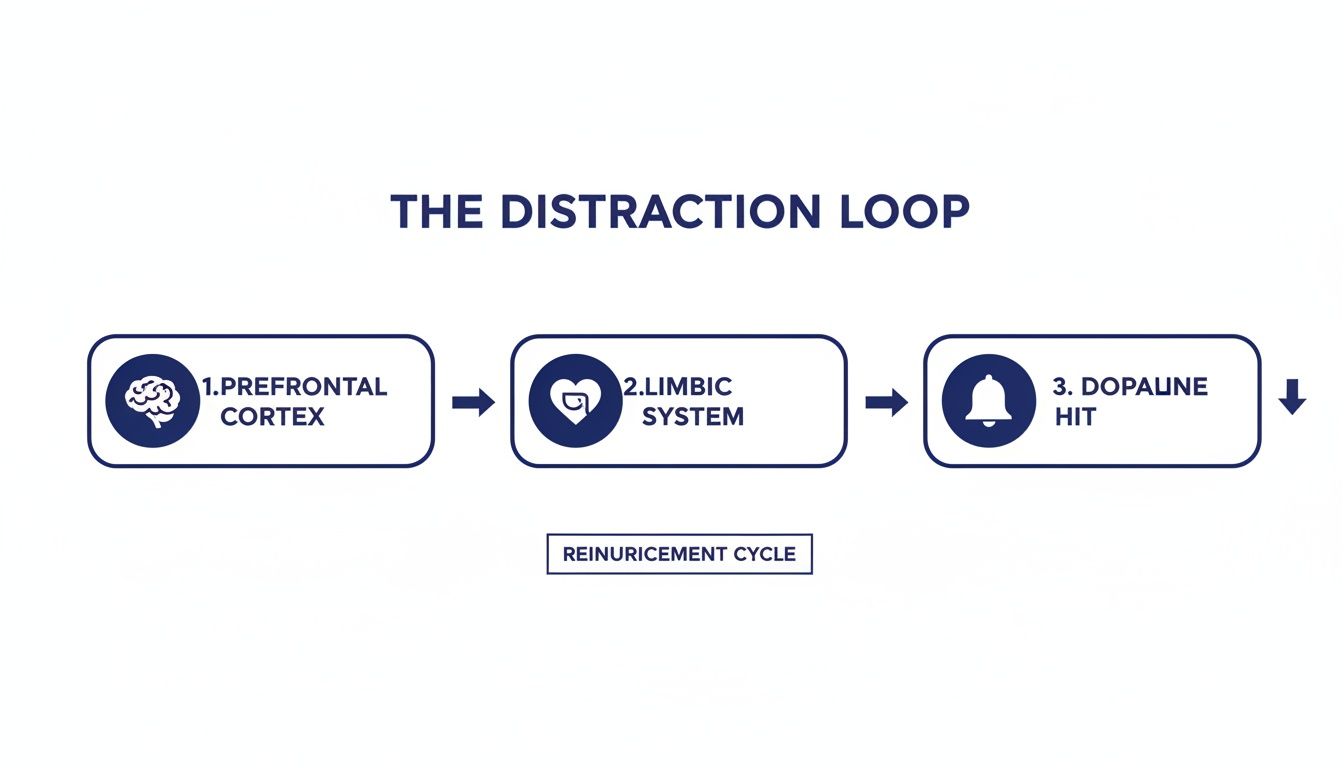
    Each notification, email, or news alert is today’s version of that rustle in the grass. It triggers a tiny hit of dopamine, the neurotransmitter tied to pleasure and reward. Your brain quickly learns to crave these little intermittent rewards, creating a powerful feedback loop that makes it almost impossible to stick with one thing.

    The Overwhelmed Brain CEO

    Think of your prefrontal cortex as your brain’s CEO. It’s the part in charge of high-level jobs like planning, making decisions, and directing your attention where it needs to go. But just like any CEO, it has limited bandwidth.

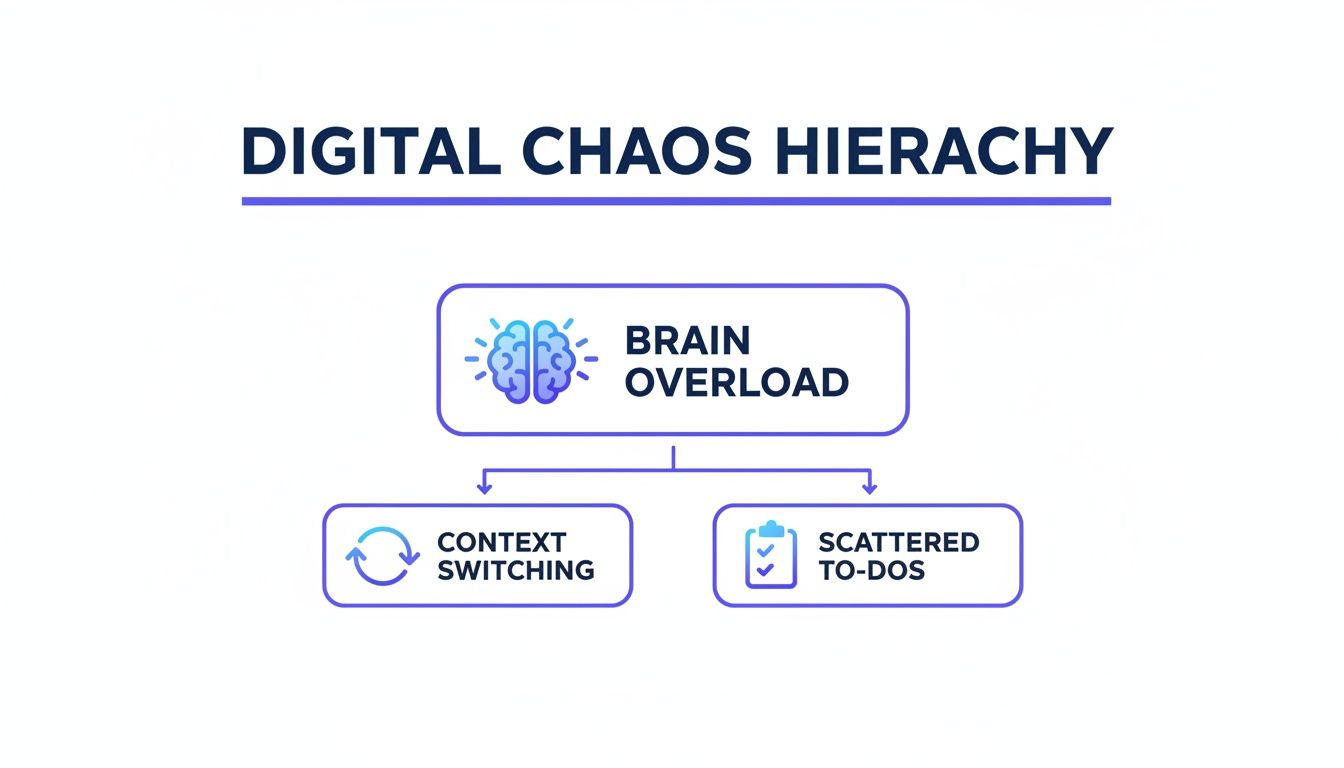
    When you’re constantly bouncing between a report, your inbox, and a social media feed, you’re forcing your brain’s CEO to rapidly switch contexts. This β€œtask-switching” is incredibly draining and inefficient. It fractures your attention, making deep concentration feel like a distant memory.

    If you often find yourself wondering β€œwhy can’t I focus anymore?”, this cognitive overload is almost always the main culprit. You can go deeper into the reasons why focus has become so challenging in our article on the topic.

    Our Shrinking Attention Spans

    The data on this paints a pretty stark picture. Over the last two decades, our average attention span has plummeted. Research shows people now spend only about 47 seconds on any given screen before switching to something else.

    This creates a vicious cycle. Each distraction makes it harder to get back on track, and on average, we only spend about 10 minutes on a task before an interruption pulls us away. If you’re struggling with this, looking at broader strategies can help you improve focus at work and achieve deep work.

    This constant fragmentation isn’t just a minor annoyance; it fundamentally prevents the sustained thought required for creativity, problem-solving, and meaningful progress. Understanding this biological reality is the essential first step.

    The good news is that you can fight back. Once you understand these neurological pulls, you can start putting strategies in place that work with your brain’s nature, not against it. To get a solid grasp of this, you can see the book that fits your goal and start learning how to regain your mental space in The Power of Clarity. This knowledge sets the stage for the practical, actionable solutions we’ll explore next.

    How to Design Your Environment for Deep Work

    Your ability to lock into deep work often has less to do with raw willpower and more to do with your surroundings. A chaotic environment is constantly pinging your brain with signals that it’s time to be distracted. By deliberately designing your workspace, you can send a much clearer message: this is where focus happens.

    β€œDEEP WORK ZONE” sign on a wooden desk with headphones, smartphone, plant, alarm clock, and notebook to improve focus and concentration.

    The first step is to hunt down and remove β€œattentional triggers”—anything in your line of sight or earshot that can yank you away from what matters. From a neuroscience perspective, your brain is wired to notice novelty and unresolved loops. That stack of mail, a buzzing phone, or a cluttered desktop all represent open threads your brain wants to pull on.

    Crafting Your Physical Focus Zone

    It all starts with a dedicated space for focused work, even if it’s just the corner of your bedroom. This simple practice builds a powerful psychological anchor; when you sit down here, your brain understands it’s time to concentrate.

    Start by decluttering your desk until it’s almost bare. Remove everything that isn’t essential for the task at hand. A clear workspace lowers the cognitive load on your brain, freeing up precious mental RAM for the actual work.

    Next, get serious about sensory inputs. Auditory chaos is a notorious focus-killer. A great pair of noise canceling headphones can be a game-changer, creating a bubble of silence that blocks out household chatter or an open-office hum. You can learn more about how light and sound affect cognitive performance in our detailed guide.

    Mastering Your Digital Hygiene

    Your digital environment is just as crucialβ€”if not more soβ€”than your physical one. The endless stream of notifications is engineered to hijack your attention. To take it back, you have to be ruthless.

    • Disable Non-Essential Notifications: Go on a notification diet. Turn off all alerts for email, social media, and news apps on your phone and computer. The only pings that should survive are the ones that are genuinely time-sensitive.
    • Use Blocker Apps: Tools like Freedom or Cold Turkey are your best friends here. They can block distracting websites and apps for set periods, effectively automating your discipline and removing the temptation entirely.
    • Schedule Your Inputs: Instead of letting email and social media be a constant drip-feed, batch them. Schedule specific blocks of time to check in, like 11 AM and 4 PM only. This puts you back in control.

    A β€œdigital sunset” routine is also non-negotiable for protecting your sleep, which is the very foundation of focus. An hour before bed, put all screens away. Wearing blue light blocking glasses in the evening can also help signal to your brain that it’s time to wind down, protecting the melatonin production you need for restorative sleep.

    Best Options for Your Focus Toolkit

    Picking the right tools can make a massive difference in managing your workspace distractions. Here’s a quick comparison to help you find the best fit for your specific challenges and improve your concentration.

    ToolBest ForHow It Improves FocusExample Scenario
    Noise-Canceling HeadphonesOpen offices or noisy home environmentsReduces auditory distractions that pull your attention away from tasks.A remote worker uses them to block out household noise during a deep work session.
    Phone Lock Box TimerChronic phone checkers and social media scrollersCreates a physical barrier to your biggest distraction, forcing a digital detox.A student locks their phone for a 2-hour study block to prevent mindless scrolling.
    Website/App Blocker SoftwareThose who get lost in internet rabbit holesAutomates discipline by making distracting sites inaccessible during work periods.A freelancer blocks social media and news sites from 9 AM to 12 PM daily.
    Monitor Light BarReducing eye strain during long screen sessionsProvides focused, non-glare light, which can reduce fatigue and help maintain concentration.A designer uses one to stay comfortable and focused during late-night projects.

    These simple changes can transform your workspace from a source of endless distraction into a sanctuary for deep work. It’s not about finding a magic bullet, but about intentionally layering small advantages that give your focus a fighting chance.

    Structuring Your Time to Improve Concentration

    A well-designed workspace is a great start, but how you manage your time is what truly shields your focus from the chaos of a normal day. Let’s be honest: the modern workplace often feels like a pinball machine, bouncing you from one reactive task to the next. This leaves almost no room for the deep, intentional work that actually moves the needle.

    Structuring your day isn’t about creating a rigid, joyless schedule. Think of it as building a container for your attention. When you have a clear framework, you offload the mental work of constantly deciding what to do next. This cuts down on decision fatigue and frees up your brain’s precious resources for the work that matters.

    And those resources are under assault. Since 2000, collaborative demands have ballooned by over 50%, with many managers now burning 85% of their week on meetings and messaging alone. Worse, Asana’s Anatomy of Work Index reveals that a staggering 62% of knowledge workers’ hours disappear into β€˜work about work’—not the core projects they were hired to do.

    How to Choose The Best Time Management Technique

    The β€œbest” technique is the one that actually fits your workflow and personality. Some people need long, uninterrupted blocks to get into a flow state, while others thrive on short, intense bursts of effort. Let’s look at a few proven methods so you can find a good match.

    TechniqueBest ForHow It WorksReal-World Scenario
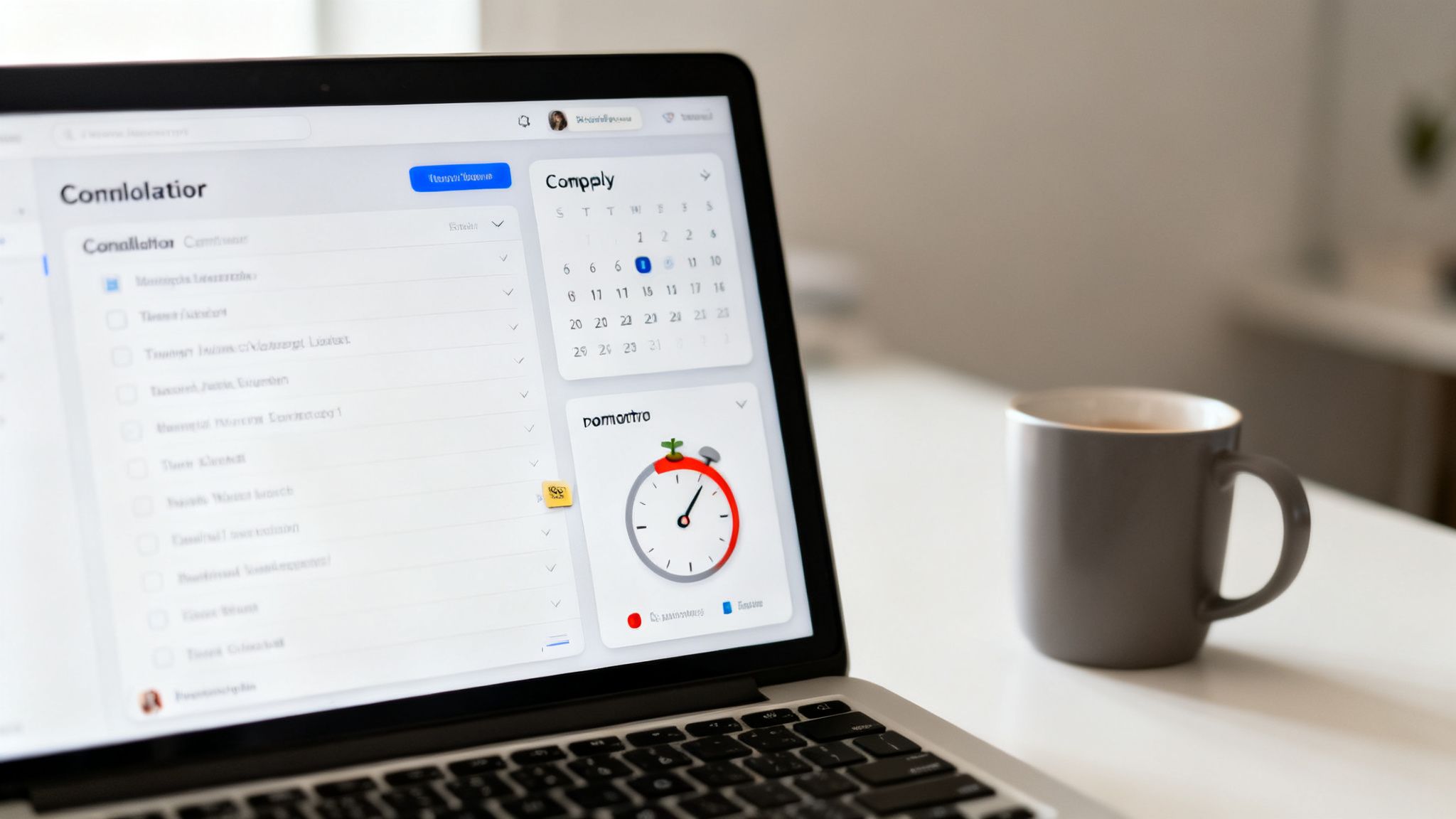
    The Pomodoro TechniqueProcrastinators & anyone overwhelmed by huge tasks.Work in focused 25-minute sprints, with 5-minute breaks in between. This makes intimidating projects feel far more approachable. To learn more, read our deep-dive on what is pomodoro technique.A writer uses a pomodoro timer on their desk to tackle a chapter, breaking it down into four 25-minute sprints with short walks between each one.
    Time BlockingBusy professionals juggling multiple projects and meetings.Every minute of your day is assigned a specific β€œjob” on your calendar, from deep work to checking email. This prevents your schedule from being dictated by others.A project manager blocks out 9–11 AM for β€œDeep Work: Q3 Strategy” and 3–3:30 PM for β€œEmail Triage,” guaranteeing that meetings can’t hijack their most productive hours.
    Themed DaysEntrepreneurs & freelancers with a wide range of responsibilities.Assign a clear theme to each day of the week, like Marketing Mondays, Finance Fridays, or Deep Work Wednesdays.A small business owner dedicates Mondays to creating content and Tuesdays to client outreach, which stops them from constantly switching between different types of thinking.

    The only way to know what works is to experiment. Try one for a week and see how it feels. You might even end up blending methods, like using Pomodoro sprints inside a larger time-blocked schedule.

    Putting Time Structures Into Practice

    Let’s make this real. Imagine a project manager whose calendar is a battlefield of meeting invites, leaving them with no time for the strategic planning that’s actually their most important work.

    To take back control, they start time blocking. Every Sunday evening, they sit down with a time blocking planner and map out the week ahead. The most important change? They schedule a recurring 90-minute β€œDeep Work” session every morning before their first meeting. This block becomes non-negotiable.

    During this protected time, all notifications are silenced, and they focus on nothing but high-level strategy. This simple act of pre-commitment shields their most valuable cognitive hours from the reactive chaos of the day.

    To make this even stickier, you can implement effective habit stacking by anchoring this new routine to an existing one. For instance, our project manager might decide their deep work block always starts right after they finish their morning coffee.

    This approach is so effective because it externalizes decision-making. Instead of relying on sheer willpower to resist distractions all day, the plan is already set. Your brain isn’t wasting energy deciding what to do; it’s simply executing the plan.

    The Lifestyle Habits That Fuel a Focused Mind

    Your ability to concentrate isn’t just about willpower or clever time management tricks. It’s deeply rooted in your biology.

    Think of your brain as a high-performance engine; it needs the right fuel, proper maintenance, and adequate rest to run smoothly. When you neglect these foundational habits, even the best productivity systems will stall out.

    The connection between lifestyle and focus is grounded in neuroscience. Your prefrontal cortex, the brain’s command center for attention and decision-making, is highly sensitive to your physical state. Sleep deprivation, poor nutrition, and a sedentary life directly impair its function, making it harder and harder to sustain attention and resist distractions.

    Prioritize Sleep to Sharpen Your Mind

    Sleep isn’t a luxury; it’s a non-negotiable maintenance process for your brain. During deep sleep, your brain clears out metabolic waste that builds up during the day. When you don’t get enough quality sleep, this junk remains, leading to that foggy, sluggish feeling that makes concentration feel impossible.

    Research consistently shows that even one night of poor sleep can significantly dial down activity in the prefrontal cortex. This means your ability to plan, problem-solve, and stay on task takes a major hit. Building better sleep hygiene is one of the most powerful things you can do for your mind.

    A few tips to get started:

    • Create a consistent schedule: Go to bed and wake up around the same time every day, even on weekends. This helps regulate your body’s internal clock, or circadian rhythm.
    • Optimize your environment: A dark, cool, and quiet room is essential. A quality sleep mask blackout can make a huge difference in blocking out light pollution.
    • Design an evening wind-down: Ditch the screens an hour before bed. Consider a gentle, non-digital routine to signal to your brain that it’s time to rest. You can find more strategies in our book on achieving Restful Nights.
    A diagram illustrating a time management process with three steps: Pomodoro, Time Blocking, and Themed Days.

    This graphic shows how powerful time management techniquesβ€”like the Pomodoro Method, Time Blocking, and Themed Daysβ€”build on one another. These structures are fantastic, but they work best when your brain has the biological foundation to actually execute them.

    Fuel Your Brain with Smart Nutrition and Movement

    What you eat and how often you move have a direct, almost immediate impact on your cognitive function. Your brain consumes about 20% of your body’s total energy, so the quality of fuel you provide it matters immensely.

    Focus on a balanced diet rich in whole foods. Sugary, processed stuff can cause sharp spikes and crashes in blood sugar, which leads to those familiar energy dips and mental fatigue. Instead, opt for complex carbohydrates, healthy fats, and lean proteins to provide a steady stream of energy. Hydration is also key; even mild dehydration can impair your attention and memory.

    Movement is another powerful lever. Physical activity increases blood flow to the brain, delivering more oxygen and nutrients. It also triggers the release of neurochemicals like dopamine and norepinephrine, which play a crucial role in sharpening focus and motivation.

    You don’t need grueling gym sessions to get the benefit. Even a short walk can work wonders. Many people find that an under desk walking pad is a great way to incorporate gentle movement throughout the workday without breaking their flow. For more ideas, you might be interested in our guide on 10 good daily habits to adopt.

    Real-World Example:
    A college student was struggling to keep up with their coursework, constantly feeling distracted and tired. Instead of just trying to study longer, they focused on their lifestyle. They set a strict 11 PM bedtime and started taking 15-minute walk breaks between study sessions. Within two weeks, they noticed a dramatic improvement in their ability to concentrate during lectures and retain information.

    How to Keep Your Focus for the Long Haul (and Sidestep Burnout)

    Intense concentration is a powerful tool, but it’s also a finite resource. Think of it like a muscleβ€”your brain’s ability to lock in and focus gets tired with overuse. Trying to force high-level concentration without a break isn’t discipline; it’s a fast track to cognitive fatigue and, eventually, burnout. The secret isn’t to push harder. It’s to build sustainable habits that balance deep, meaningful work with intentional recovery.

    From a behavioral standpoint, your brain absolutely needs downtime to consolidate what you’ve learned and restore the energy reserves required for executive functions like paying attention. When you’re in a state of chronic stress, your body is swimming in cortisol. Over time, that hormone can actually impair the function of your prefrontal cortexβ€”your brain’s command center for focus. This is exactly why relentless hustle almost always backfires, leaving you with diminishing returns and a profound sense of mental exhaustion.

    Embrace Intentional Rest and Recovery to Improve Your Focus

    To genuinely improve your focus and concentration over the long term, you have to start treating rest as a productive activity in its own right. This means scheduling downtime with the same seriousness you’d schedule a meeting with your boss. This isn’t about being lazy; it’s about strategic, intelligent recovery.

    One of the most effective ways I’ve seen this work is by getting lost in hobbies that have absolutely nothing to do with your day job. Activities that fire up different parts of your brain and body give your main cognitive circuits a desperately needed break.

    • Physical Hobbies: Things like hiking, gardening, or even just playing a sport can boost blood flow to the brain and release endorphins. That’s a double win for improving your mood and melting away stress.
    • Creative Pursuits: Learning an instrument, painting, or getting into woodworking can nudge you into a state of β€œflow” that is both deeply restorative and incredibly satisfying.
    • Mindful Practices: Activities like yoga or simply spending quiet time in nature help calm your nervous system, pulling you out of the chronic β€œfight or flight” mode that so many of us live in.

    By deliberately stepping away from your work, you give your subconscious mind the space it needs to keep chewing on problems in the background. It’s a phenomenon known as the incubation effect, and it’s why your best ideas often show up when you’re in the shower or out for a walk.

    Setting Boundaries to Prevent Cognitive Overload

    A healthier, more sustainable work rhythm is built on a foundation of firm boundaries. If you don’t draw clear lines between your work life and your personal time, your brain never truly gets the chance to switch off and recover. This is where so many well-intentioned focus strategies completely fall apart.

    Setting and, more importantly, enforcing these boundaries is a skill you have to practice. It might look like turning off all work notifications after 6 PM, saying no to non-essential weekend requests, or just communicating your availability clearly to your team. You can find some excellent, real-world burnout prevention strategies in our guide that goes much deeper on this.

    Here’s a real-world example:
    An entrepreneur I know was clocking 70-hour weeks and saw her creativity and decision-making skills absolutely tank. Realizing she was on the verge of burning out, she implemented a strict β€œno-work-on-weekends” rule. To keep herself honest, she used a habit tracker journal to log her restorative activities: Saturday morning hikes and Sunday afternoons spent reading. Within a month, she felt more energized, and her focus during the workweek was sharper than it had been in years. The lesson? Resting wasn’t lost time; it was a direct investment in her performance.

    Editor’s Note: What Really Works to Improve Focus and Concentration

    Let’s cut through the noise. While there are a million focus hacks out there, the ones that actually move the needle usually come down to two things: intentionally designing a distraction-free environment and deliberately structuring your time.

    That’s it. There’s no magic pill here. Consistency will always matter more than perfection.

    This advice is best for knowledge workers, students, and freelancersβ€”anyone who feels like their attention is constantly being pulled in a dozen different directions and wants to get it back.

    That said, if you feel you might be dealing with significant issues like anxiety, depression, ADHD, or burnout, please know this article is for educational purposes only. It is not a substitute for medical or psychological care. The best first step is always to talk to a qualified professional. These techniques are powerful, but they take real effort and need to be adapted to how you actually work.

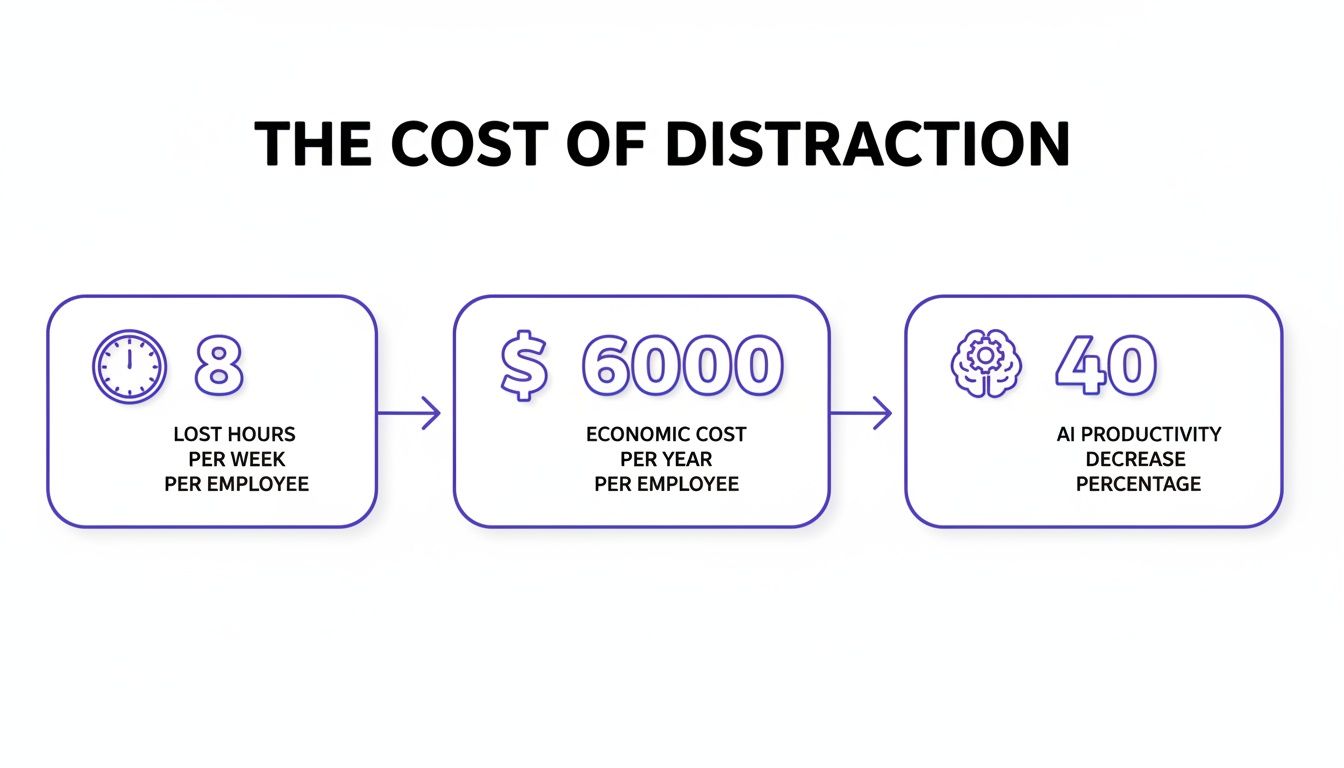
    The challenge we’re all facing is very real, and it has a steep cost. Globally, managers lose a shocking 683 hours every year just to interruptions. In the US alone, this distraction epidemic adds up to an estimated $468 billion in lost productivity annually. You can dig into the staggering cost of lost focus in this study from The Economist.

    Ultimately, getting your focus back is a marathon, not a sprint. The best approach is to start small, be patient with yourself, and build on whatever works.

    Key Takeaways: Your Focus Improvement Checklist

    If you’re ready to start reclaiming your attention, here’s a quick summary of the most important takeaways from this guide. Think of this as your starting checklistβ€”four core principles you can put into practice right away.

    • Shape Your Environment. Start by clearing the decks, both physically and digitally. A clean workspace and a simplified digital setup reduce the constant, low-grade pull on your attention, giving your brain a fighting chance to concentrate.

    • Structure Your Time. Don’t leave focus to chance. Use proven systems like Time Blocking or the Pomodoro method to build intentional rituals for deep work. This isn’t about rigidity; it’s about protecting your most valuable cognitive hours from decision fatigue.

    • Work With Your Biology. Never forget the non-negotiable link between your body and your brain. Quality sleep, regular movement, and proper nutrition are the foundational pillars of a focused mind. You can’t out-strategize a tired brain.

    • Practice Strategic Rest. True focus is a marathon, not a sprint, and your brain needs recovery time. Intentionally schedule downtime to let your cognitive energy recharge. This isn’t lazinessβ€”it’s what prevents burnout and makes sustained concentration possible.


    Disclaimer: The information in this article is for educational purposes only and is not intended as a substitute for professional medical or psychological advice, diagnosis, or treatment. This post may also contain affiliate links, which means we may earn a small commission if you make a purchase through them, at no extra cost to you.

    FAQ: Your Questions on How to Improve Focus and Concentration

    We’ve covered a lot of ground on rebuilding focus from the ground up. Still, a few common questions always pop up when people start putting these ideas into practice. Here are some honest answers.

    1. How long does it take to actually feel a difference in focus?

    You can feel a small, immediate win today. Simple environmental tweaksβ€”like clearing your desk or putting your phone in a drawerβ€”can give you a pocket of clarity almost instantly. However, for deep, lasting change, behavioral research suggests you should expect to put in several weeks of consistent effort. This allows your brain to form new habits through neuroplasticity, making deep focus feel more like your default mode. Be patient. For a primer on this process, The Power of Clarity is a fantastic read.

    2. Can I really improve my concentration in a noisy, distracting job?

    Absolutely, but you can’t fight a chaotic environment with willpower alone. The strategy here is to create β€œfocus pockets”—short, protected blocks of 15 or 25 minutes where you go all-in on a single, high-value task. It’s about quality, not quantity. Then, use tools to build a personal bubble. A solid pair of noise-canceling headphones is non-negotiable in an open office. You also need to communicate your boundaries with a simple desk sign or a β€œHeads Down” status on your team’s chat app.

    3. What’s the best first step to improve focus for a beginner?

    While it’s different for everyone, the single most powerful starting point is creating a distraction-free environment. From a psychological standpoint, your willpower is a finite resource. Every time you have to resist the urge to check your phone or click a notification, you drain that resource. By proactively removing those temptations, you make focus the path of least resistance. Curating your physical and digital workspaces is the foundation that makes all other techniques easier.

    4. Is a β€œdopamine detox” a real way to improve concentration?

    The term is a bit of a misnomer, but the underlying concept is sound. You’re not trying to get rid of dopamine, which is a vital neurotransmitter for motivation. Instead, the goal is to reset your brain’s reward circuitry. Our brains get used to cheap, easy rewards from scrolling social media, which makes slower, meaningful work feel dull. By deliberately cutting back on hyper-stimulating inputs, you lower your baseline and allow your brain to find satisfaction in complex tasks again.

    5. Are focus supplements and nootropics worth trying?

    While some people find that certain supplements, like a magnesium glycinate supplement, may offer a cognitive edge, they are not a magic bullet. They are the potential last 10% of the equation, not the core 90%. The most powerful β€œsupplements” for your brain will always be the fundamentals: high-quality sleep, a balanced diet, consistent physical activity, and strategic work routines. Get those right first. Always.


    At Mind Clarity Hub, we believe focus isn’t something you’re born withβ€”it’s a system you build. If you’re ready to design a personalized system for deep work, the next step is finding the right book for your goals.

    Browse the library to find your next step.

  • What is context switching? Boost Focus with Simple Strategies

    What is context switching? Boost Focus with Simple Strategies

    (A quick heads-up: Some of the links in this article are affiliate links. This means if you decide to purchase something, we may earn a small commission at no extra cost to you. We only recommend tools we genuinely trust and use ourselves.)

    The content on this siteβ€”including any discussions about focus, mood, or habitsβ€”is for educational and informational purposes only. It is not intended to be a substitute for professional medical or psychological advice, diagnosis, or treatment. This includes topics like anxiety, depression, ADHD, burnout, or sleep problems. Always seek the advice of your physician or another qualified health provider with any questions you may have regarding a medical condition. Never disregard professional medical advice or delay in seeking it because of something you have read on this website.

    What Is Context Switching and Why It Sabotages Your Day

    Ever get to the end of a long workday feeling completely drained, but with almost nothing to show for it? You’re not imagining it. The culprit is almost always context switchingβ€”the act of jumping between unrelated tasks, projects, or even different apps on your screen.

    Think of your brain’s focus like a computer’s RAM. Your brain’s prefrontal cortex, which manages executive functions like attention, is designed for serial processing, not parallel. When you focus on one task, it runs beautifully. But try to run twenty different mental programs at once, and everything starts to lag. Each time you leap from drafting a report to checking a Slack notification, your brain has to pay a β€œcognitive tax” to shut down the old context and load up the new one.

    This constant toggling isn’t just a minor annoyance; it’s a productivity killer with roots in our cognitive architecture.

    The Real Cost of Context Switching by Juggling Tasks

    This mental gymnastics has a massive, measurable impact on your performance. Psychological research shows that the constant shift between tasks, apps, and conversations can eat up to 40% of a knowledge worker’s productive time.

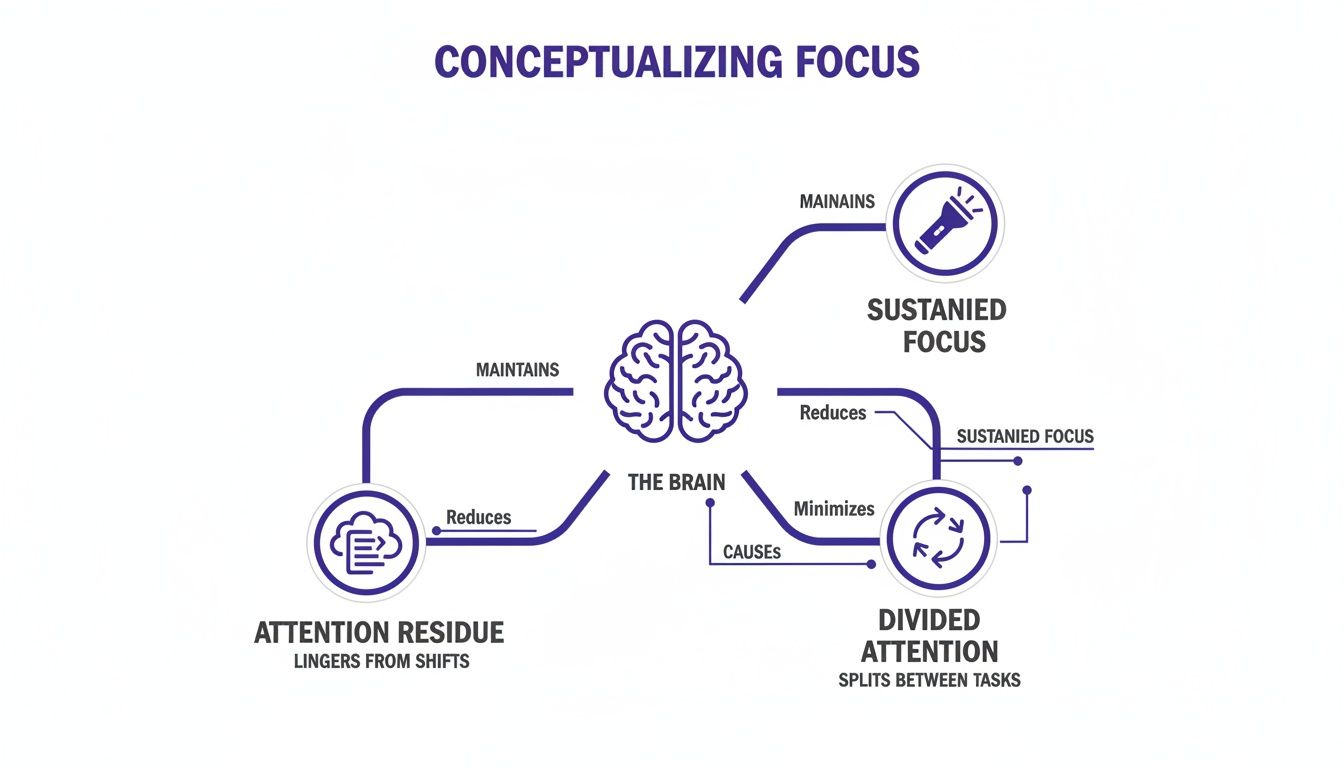
    Let that sink in. An 8-hour day effectively shrinks to just 4.8 hours of real, focused output. This staggering loss comes from a phenomenon called β€œattention residue”—the lingering thoughts from your previous task that stick around and sabotage your focus on the new one. According to research on this cognitive bottleneck, this friction drains your mental energy and can significantly impact performance.

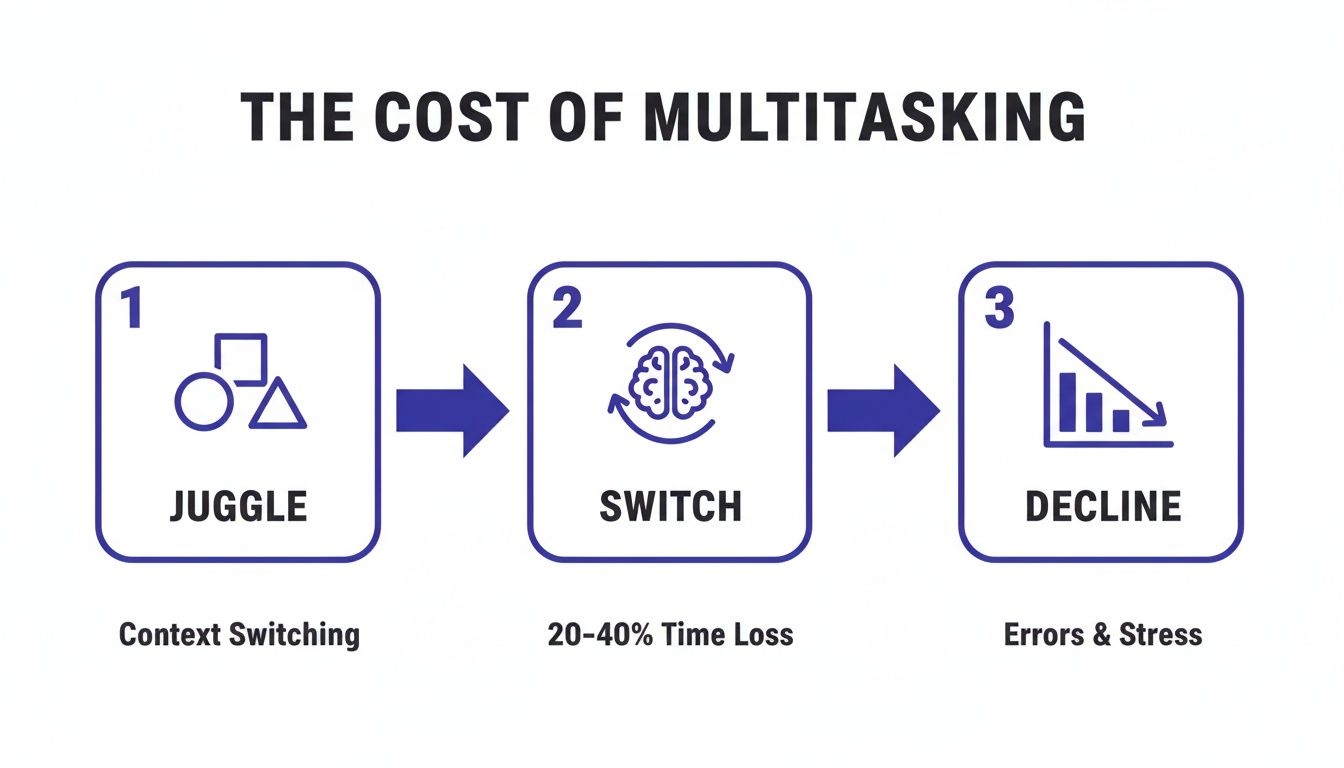
    This visual breaks down how that cognitive cost adds up.

    Concept map detailing the negative impacts of context switching on your brain: productivity loss, stress, and refocus time.

    As you can see, every single switch fragments your attention. It makes deep, meaningful work almost impossible while ratcheting up your mental strain and stress levels.

    The table below offers a quick summary of these hidden costs.

    The Hidden Costs of Context Switching at a Glance

    Area of ImpactKey StatisticReal-World Consequence
    ProductivityUp to 40% of productive time lostFeeling busy all day but having little to show for it; projects drag on.
    Cognitive LoadTakes up to 23 minutes to fully refocusYou’re never fully β€œin the zone,” leading to shallow thinking and more mistakes.
    Error RatePerformance can drop by 40% or moreRushed, sloppy work that requires more time to fix later on.
    Mental EnergyIncreases cortisol and adrenalineLeads to chronic stress, decision fatigue, and eventual burnout.

    These numbers aren’t just abstract data points; they represent the friction you feel every single day when your attention is pulled in too many directions.

    What Context Switching Looks Like in Action

    Spotting context switching is the first step to beating it. It often masquerades as productive β€œmultitasking,” but the two are worlds apart. True multitasking is rare, while context switching is the exhausting reality for most of us. (You can learn more in our guide on how to stop multitasking).

    Here are a few all-too-common examples of context switching at work:

    • Mini Scenario: The Notification Trap. You’re deep into building a presentation, but you pause to instantly reply to a non-urgent email or chat message. Your brain has to unload the complex presentation context, load the email context, formulate a reply, and then painstakingly reload the presentation context.
    • App hopping: You find yourself jumping between your CRM, a spreadsheet, and your project management tool just to pull together information for a single, simple task. Each app jump is a micro-switch that adds to your cognitive load.
    • Meeting interruptions: You’re trying to sneak in some work on a report during a video call, all while attempting to listen and contribute to the conversation. Your brain isn’t doing both; it’s rapidly switching between the two, doing neither well.

    Each of these seemingly small shifts chips away at your focus, drains your energy, and leaves you with that nagging feeling of being perpetually behind. Once you start recognizing these patterns, you can finally begin to take back control of your day. To get started, you can browse the library for a book that fits your focus goals.

    The Neuroscience Behind Your Brain’s Switching Tax

    That fried feeling you get after a day of bouncing between tasks? It’s not just in your head. It’s a biological reality rooted in the very architecture of your brain.

    When you really dig into the neurology of context switching, you start to see why it’s so drainingβ€”and how to work with your brain instead of against it.

    Focused student writing with a brain-and-network overlay and β€œATTENTION RESIDUE” text, illustrating **what is context switching** and its impact on concentration.

    At the center of it all is your prefrontal cortex (PFC). Think of it as your brain’s project manager. It handles all the big-picture stuff: planning, making decisions, and aiming your attention where it needs to go.

    When you settle into a single task, your PFC activates a specific neural network perfectly suited for that job. It’s a clean, efficient connection. But the moment you switch gearsβ€”say, pausing a complex report to answer a β€œquick” emailβ€”you force the PFC into a messy, expensive reboot. It has to inhibit one network and activate an entirely different one. This switch is anything but instant or clean.

    The Lingering Problem of Attention Residue

    Here’s where the real cost kicks in. It’s a phenomenon called attention residue, a term coined by researcher Sophie Leroy. It describes how thoughts and fragments of the last task you were doing cling to your consciousness, getting in the way of the new one.

    Even after you’ve clicked over to that spreadsheet, a part of your brain is still mentally polishing the reply to that email. It’s cognitive static. This means you’re never fully present or engaged in the new task because your brain is trying to run two programs at once with limited power.

    If you want to go deeper into how your brain is built for focus, our guide on the neuroscience of single-tasking is a great next step.

    Mini Scenario: The Meeting Aftermath
    You just wrapped up an intense budget meeting and immediately pivot to writing a creative proposal. But for the next 15 minutes, your mind keeps replaying a tense moment from the call. You reread the same sentence three times. That’s attention residue in action. Your PFC is stuck, unable to fully allocate its resources to the creative work at hand.

    This constant mental friction is incredibly taxing. It burns through glucose, your brain’s main fuel source, far faster than staying on one task ever would. The result is what we all know too well: mental fog, more mistakes, and a weaker ability to think critically. For many, it’s a direct line to burnout, a topic we explore in our book Burnout Interrupted.

    How Modern Work Environments Amplify Context Switching

    That nagging feeling of being pulled in a dozen directions at once? It’s not a personal failure. It’s a design feature of the modern workplace. Today’s digital environments are practically engineered to shatter our focus, creating the perfect storm for relentless context switching.

    Our workdays are now defined by a constant barrage of digital pings. We face endless notifications from team chat apps, a steady stream of emails that all feel urgent, and the unspoken pressure of β€œalways-on” availability. This setup forces us into a reactive, fragmented workflow. Instead of proactively managing our day, we spend it reacting to a firehose of digital demands.

    The Digital Whiplash of Daily Work

    Think about this all-too-common scenario. You sit down to finally write that important report. Minutes later, a Slack notification pops up, pulling you into a conversation about a totally different project. As you try to toggle back, an β€œurgent” email from your boss lands in your inbox. You open it, fire off a reply, then jump into your project management tool to update a task related to that very email.

    Before you know it, 30 minutes have vanished, and you’ve written maybe two sentences of the original report. This constant digital whiplash is the reality for most of us.

    Research from behavioral science shows that the average office worker toggles between different apps and websites around 1,200 times every single day. Even more shocking, many of these switches are followed by another one within just a few seconds. This hyper-stimulus environment is linked to increased levels of cortisol, the stress hormone, contributing to anxiety and fatigue.

    This chaotic workflow makes tools like a good pair of noise canceling headphones feel less like a luxury and more like essential survival gear for anyone trying to carve out a moment of concentration.

    Why App Overload Is a Major Culprit

    The problem gets even worse when you consider the sheer number of tools we’re expected to use. The average employee now juggles around ten different applications every day, from communication platforms to specialized software. Each one lives in its own silo, forcing us to act as the human bridge between them.

    This fragmentation is a primary driver of context switching. You might need to pull data from a CRM, reference a conversation in a chat app, and then plug the results into a spreadsheetβ€”that’s three jarring switches just to complete a single action.

    Each jump adds another layer of cognitive friction, making deep, focused work feel like a constant uphill battle. If your inbox is a major source of this overload, our guide offers practical tips on how to manage email overload and start reclaiming your focus.

    Proven Strategies to Reduce Context Switching

    Knowing that context switching is sabotaging your day is one thing; actually fighting back is another. The good news is you can reclaim huge chunks of your focus with a few intentional strategies. This isn’t about finding more hours in the dayβ€”it’s about protecting the ones you already have.

    The goal is to create an environment where deep, single-tasked work is the default, not the rare exception. By giving your day some structure and removing the constant friction of distractions, you can help your brain stay in a state of flow for much longer.

    Flat lay of an organized desk with a blue alarm clock, headphones, planner, and plant, illustrating **what is context switching** and how time blocking supports focus.

    Embrace Task Batching and Time Blocking to Minimize Context Switching

    Two of the most powerful ways to stop the mental whiplash are task batching and time blocking. They sound similar, but they solve slightly different problems.

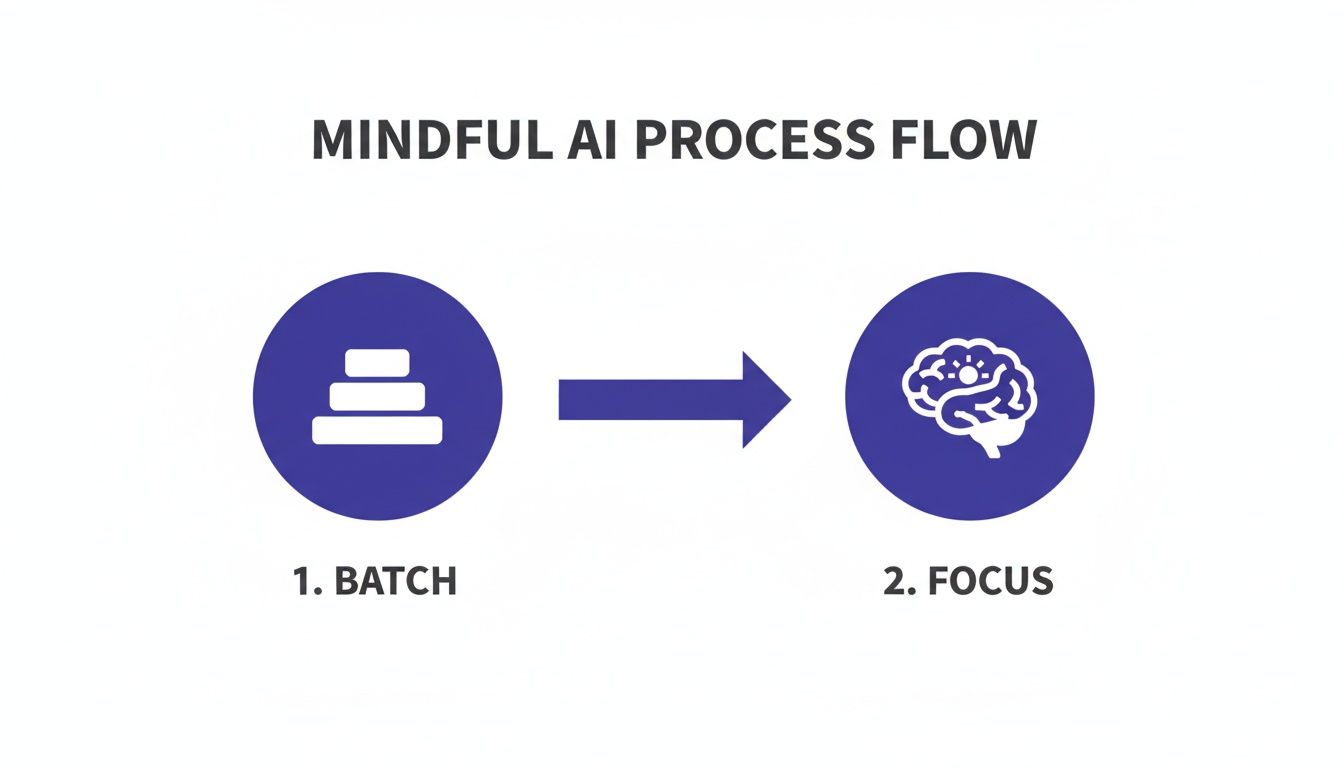
    • Task Batching: This is all about grouping similar, small tasks and knocking them out in one dedicated session. Instead of answering emails the moment they land, you schedule two 30-minute β€œemail sprints.” This simple habit stops shallow work from constantly slicing your high-value time into confetti.
    • Time Blocking: This strategy takes things a step further. You proactively schedule your entire day into specific blocks of time, assigning a single task to a block. A dedicated time blocking planner creates a clear roadmap for your attention, turning your calendar into a shield against random requests. Our guide on how to do deep work dives deeper into frameworks for protecting your time.

    Design Your Focus Environment

    Your physical and digital spaces have a massive impact on your ability to concentrate. You don’t need a silent cabin in the woods; a few small adjustments can make a world of difference.

    Start by taming your digital notifications. Seriously. Turn off all non-essential alerts on your phone and computer. This one simple act puts you back in the driver’s seat, shifting you from a reactive to a proactive state. You decide when to check messages, not the other way around.

    Even your meetings can be part of your focus environment. Setting a few essential ground rules for a meeting ensures that when you do have to collaborate, the time is spent on focused, productive discussion.

    By combining smarter scheduling with a distraction-free environment, you create the ideal conditions for sustained concentration. These methods help you reclaim precious mental energy, a core concept we explore in our book, Digital Clarity. Starting with just one protected 90-minute deep work session each day can profoundly change your output and slash your mental strain.

    How to Choose the Right Tools to Support Deep Work

    While building better habits is the ultimate goal, the right tools can act as powerful guardrails, making it much easier to stay focused. But choosing wisely is key. You want aids that actually reduce context switching, not just another digital distraction that adds to the problem. The best tool for you depends entirely on your personal workflow and your biggest focus-killers.

    Best Option for Beginners: Analog Timers

    A great starting point is deciding between physical and digital aids. An analog tool often has the huge advantage of being single-purpose, which inherently limits its potential to become a distraction itself.

    It really comes down to what kind of friction helps you the most. Do you need the finality of a physical timer, or the custom tracking of a digital app? Here’s a quick comparison to help you think it through.

    Choosing Your Focus Tool: Analog vs. Digital

    FeatureAnalog Tools (e.g., a pomodoro timer)Digital Tools (e.g., Focus App)
    Distraction PotentialLow. A single-purpose device has no other functions or notifications to pull you away.Higher. It lives on your phone or computer, which is a primary source of distractions.
    CustomizationLimited. You typically get fixed time intervals and basic alarms. That’s it.High. Most apps allow for adjustable timers, background soundscapes, and integrations.
    MindfulnessEncourages an intentional separation and a physical break from all your screens.Keeps you tethered to your phone or computer, even during your planned breaks.
    Tracking & DataManual. You’ll need a separate notebook or system for tracking your focus sessions.Automatic. Apps often include analytics on your focus sessions and track your progress over time.

    For many, the tangible nature of a visual timer for desk use is far more effective at building focus habits than an app buried on a phone. When choosing, consider not just the features but the psychological effect the tool will have on you.

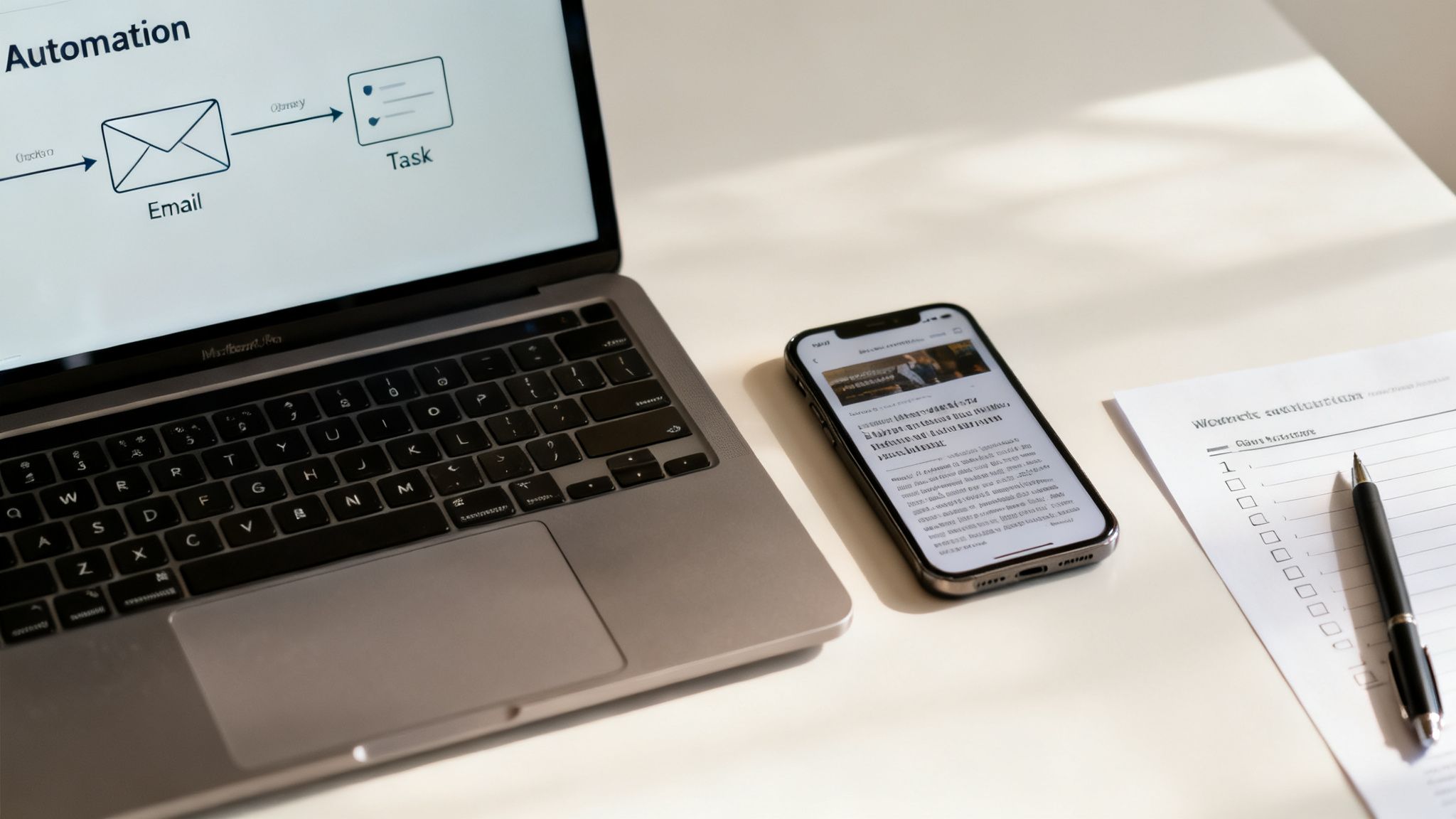
    If you struggle with endless digital distractions, a simple phone lock box timer can create a non-negotiable boundary, physically removing the primary source of interruptions. And to free up mental bandwidth, you can use task automation software to handle repetitive work for you. Compare options if you think a smarter digital solution is the answer, but don’t overlook the power of simple, non-digital solutions.

    Editor’s Take

    The concept of β€œcontext switching” sounds technical, but it’s just a name for that frazzled, unproductive feeling we all know. The core issue isn’t a lack of willpower; it’s that our brains are wired for single-tasking, while our digital environment is built for constant interruption.

    What Actually Works: Time blocking is the single most effective strategy. Physically scheduling a 60-minute β€œdeep work” block on your calendarβ€”and turning off all notifications during that timeβ€”is a game-changer. It feels rigid at first, but it’s liberating. Task batching (e.g., β€œemail hour”) is a close second.

    Who This Is For: This advice is gold for knowledge workers, freelancers, students, and anyone with a degree of control over their schedule. It’s less applicable for roles that are inherently reactive, like emergency services or front-line customer support.

    Important Caveat: Don’t try to implement everything at once. You’ll get overwhelmed and quit. Pick one thingβ€”like turning off Slack notificationsβ€”and stick with it for a week. Small, consistent wins build momentum that lasts.

    Key Takeaways on Context Switching

    Here’s the TL;DR on why context switching drains your energy and what to do about it.

    • Context switching is the hidden tax your brain pays every time you jump between unrelated tasks. Research shows this constant gear-shifting can eat up to 40% of your productive time. It’s not about willpower; it’s a cognitive bottleneck.
    • The modern digital workplace is the primary culprit, with its endless stream of notifications and the pressure to have ten tabs and three chat apps open at all times.
    • You can reclaim that lost time. Proven tactics like time blocking your calendar, task batching similar work (like clearing all your emails at once), and designing a less distracting digital environment are your best defense.
    • Ultimately, no single app can fix this. Real change comes from building a few consistent habits. Start small: protect just one 30-minute block of focused time each day. It’s a simple move, but it’s often the first real step toward getting meaningful work done again.

    Final Disclaimer and Next Steps

    Let’s be honest: there is no magic bullet for eliminating context switching. True, lasting progress comes from building small, sustainable habits.

    (Reminder: This article contains affiliate links, which means we may earn a small commission on purchases at no extra cost to you. The content is for educational purposes and is not a substitute for professional medical or psychological advice.)

    The best way to begin is small. Please don’t try to change your entire workflow this week. Just find one 30-minute window each day, protect it from notifications, and do one thing. That single, focused block is often the most powerful first step you can take.

    And if you’re wrestling with a deeper sense of digital overload and its toll on your mental energy, the strategies we cover in our book, The Power of Clarity, can give you a more structured roadmap for getting back in control.

    Answering Your Questions About Context Switching

    Let’s clear up a few common questions people have when they start trying to rein in the chaos of a fragmented workday.

    1. Is Multitasking Just Another Name for Context Switching?

    Not quite, though they’re deeply related. True multitaskingβ€”the kind where you’re genuinely doing two complex things at the exact same timeβ€”is a myth for over 97% of us, according to neuroscience. Our brains simply aren’t built for parallel processing complex tasks. What we call multitasking is really just rapid context switching in disguise: the frantic toggling between tasks where you pay a hidden mental tax each time.

    2. Can I Train Myself to Be Better at Context Switching?

    While some people might switch a fraction of a second faster, trying to get β€œbetter” at it is like training to become an expert in getting distracted. You’re focusing on the wrong skill. The real win isn’t mastering the switch; it’s needing to switch less often. Your energy is far better spent creating an environment and habits that support deep, single-task work. Reducing interruptions is always more effective.

    3. How Long Does It Really Take to Refocus After an Interruption?

    The most cited psychological research on this is sobering: it can take an average of 23 minutes and 15 seconds to get back to a state of deep focus after you’ve been pulled away. This is due to β€œattention residue.” This is why that β€œquick two-minute question” from a colleague is never just two minutes. The real cost isn’t the interruption itself, but the long, slow climb back to where your brain was before.

    4. Are There Any Hidden Benefits to Context Switching?

    In a few, very specific situations, maybe. For instance, during wide-open creative brainstorming, bouncing between different ideas can sometimes spark an unexpected connection. However, for the other 99% of knowledge workβ€”the writing, coding, analyzing, and strategic planning that fills our daysβ€”it’s a clear net negative. The tiny, occasional upside is completely dwarfed by the massive, consistent costs to your focus and productivity.

    5. What’s the Single Best First Step I Can Take to Reduce Context Switching?

    Turn off all non-essential notifications. Right now. On your computer, on your phone, everywhere. This one simple behavioral change is the foundation for everything else. It immediately puts you back in control, shifting you from a reactive state (where pings and pop-ups run your day) to a proactive one. You get to decide when it’s time to check for messages, not the other way around.

  • How to Prioritize Tasks Effectively: A Science-Backed Guide

    How to Prioritize Tasks Effectively: A Science-Backed Guide

    Feeling paralyzed by a massive to-do list? It’s a modern work epidemic. The answer isn’t about finding more willpower or just working longer hours. It’s about building a smart, simple system to take the load off your brain and make clear choices.

    Affiliate Disclosure: Please note that this article contains affiliate links. If you make a purchase through these links, we may earn a small commission at no extra cost to you. This helps support our work in bringing you research-backed content.

    Why Prioritizing Tasks Feels Impossible in a Distracted World

    You’ve been there. Urgent client emails are piling up, a huge project deadline is looming, and your bookkeeping is three weeks overdue. Instead of picking one thing and starting, you end up doing nothing. You feel frozen by the sheer volume of choices.

    This isn’t a personal failing. It’s a predictable outcome of how our brains handle being overloaded.

    This state often feels like mental exhaustion, a topic we explore in our guide on what causes brain fog. It’s known as decision fatigue. Your brain’s prefrontal cortex is responsible for planning and making choices. It runs on a limited daily energy reserve. Every decision chips away at it. When you constantly jump between tasksβ€”a behavior called context switchingβ€”you drain that reserve even faster. This makes it nearly impossible to think clearly about what actually matters.

    Educational Note: This article provides information for educational purposes only. It is not a substitute for professional medical or psychological advice, diagnosis, or treatment. If you are experiencing symptoms of anxiety, depression, ADHD, burnout, or sleep problems, please consult a qualified healthcare provider.

    The Neuroscience of Overwhelm

    The struggle to prioritize isn’t just a feeling; it’s a documented phenomenon. One research review found that a staggering 98.2% of people struggle with prioritizing tasks effectively. Over 75% face severe difficulty in the middle of a fragmented workday. You can find that data over at Reclaim.ai. This just confirms what we all feel: winging it doesn’t work. Having a system is far more reliable than just hoping for motivation to show up.

    Often, the real challenge isn’t just about the clock. It’s about recognizing the crucial distinction between Energy Management vs Time Management. This has a huge impact on your ability to focus. The goal isn’t just to manage hours. It’s to protect your mental energy for the work that delivers real value.

    Creating a dedicated, focused environment is a practical first step. Something as simple as putting on a pair of noise canceling headphones can signal to your brain that it’s time to concentrate. This dramatically reduces the cognitive cost of blocking out distractions.

    By building a system to offload decisions and protect your focus, you can finally move from feeling overwhelmed to being in control.

    The 4-Step Framework for Effective Task Prioritization

    When you’re feeling overwhelmed, that’s a clear signal your current systemβ€”or lack of oneβ€”isn’t cutting it. To move from chaos to clarity, you need a simple, repeatable framework. The goal is to get all those swirling tasks out of your head and onto the page. There, you can make objective decisions instead of letting a stressed-out brain call the shots.

    This approach is about externalizing your thoughts. You can see them, sort them, and act on them with confidence. This concept is a cornerstone of my book, The Power of Clarity.

    Step 1: Capture Everything in One Place

    Stop using your brain as a storage unit. It’s brilliant at coming up with ideas, but it’s a terrible filing cabinet. Trying to hold onto every single task creates a constant, low-level cognitive strain. This quietly drains your focus and energy throughout the day.

    The fix is simple. Capture every task, idea, and to-do in a single, trusted source. This could be a dedicated productivity journal, a digital app like Todoist, or even a plain notebook. The tool doesn’t matter as much as the consistency. Just get it all down.

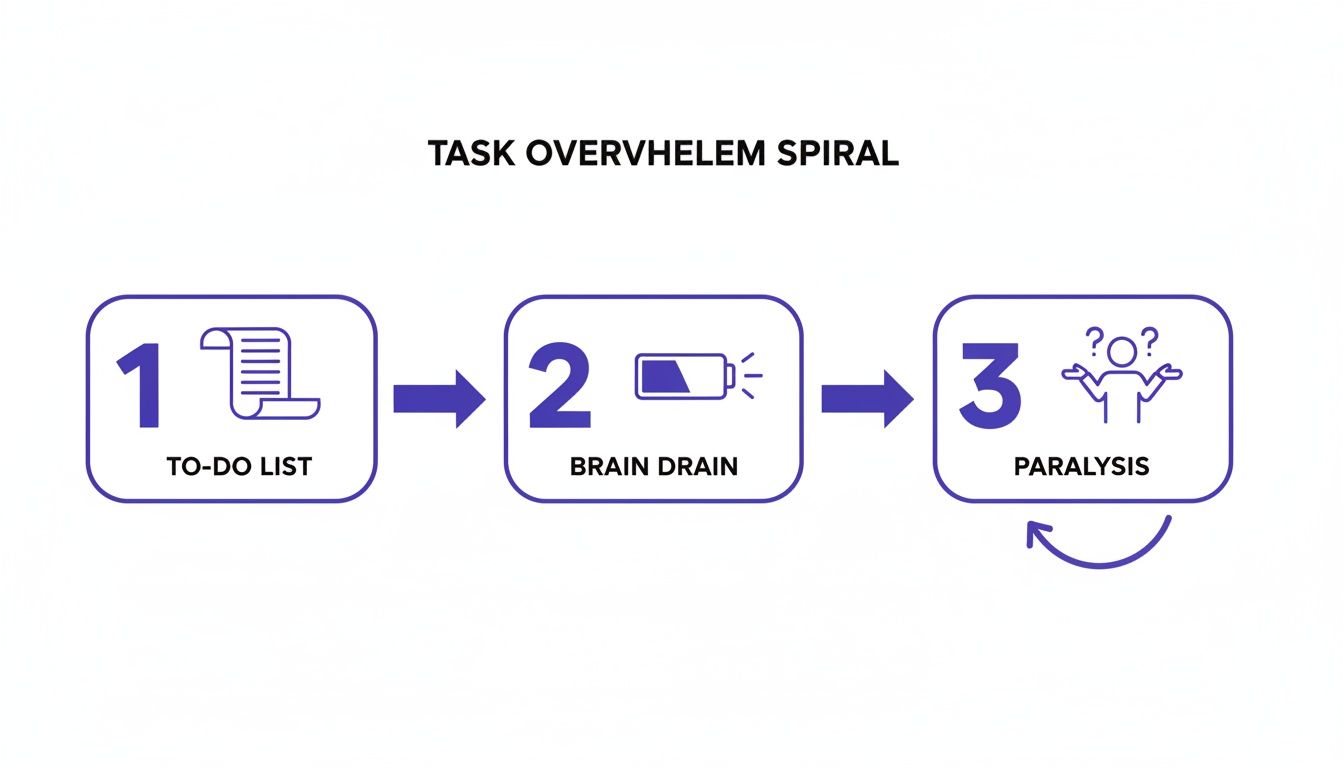
    When that to-do list lives in your head, it’s easy to get caught in a downward spiral. The sheer volume of tasks leads to brain drain, which in turn leads to paralysis. You end up doing nothing because you can’t figure out where to even start.

    Real-World Example: Imagine you’re a freelance writer. Instead of trying to remember client deadlines, article ideas, and invoicing dates, you capture everything. You might jot down β€œFollow up with Client X,” β€œOutline blog post on AI,” and β€œSend invoice for May.” This simple act frees up mental space.

    Diagram illustrating the task overwhelm spiral: To-Do List leads to Brain Drain, then Paralysis.

    This cycle is what keeps so many smart people stuck. The key is to break it at the very first step by getting everything out of your head.

    Step 2: Clarify and Triage Your Task List

    Once everything is captured, it’s time to bring clarity to the chaos. Go through each item on your list. Ask yourself one simple question: β€œWhat does β€˜done’ actually look like for this?”

    A vague task like β€œwork on website” is impossible to prioritize. It’s not a single action. It’s a project in disguise. Break it down into a concrete next step, like β€œwrite the final copy for the β€˜About Us’ page.” This small act of defining the outcome makes the task less intimidating. It’s far easier to assess. This is a vital skill for anyone managing competing priorities, turning abstract worries into steps you can actually take.

    Mini-Scenario: Let’s say your list has β€œplan vacation.” That’s too vague. Clarifying it might produce smaller tasks. Examples include β€œresearch flights to Italy,” β€œbook hotel for first three nights,” and β€œask for time off.” Now you have clear, actionable items.

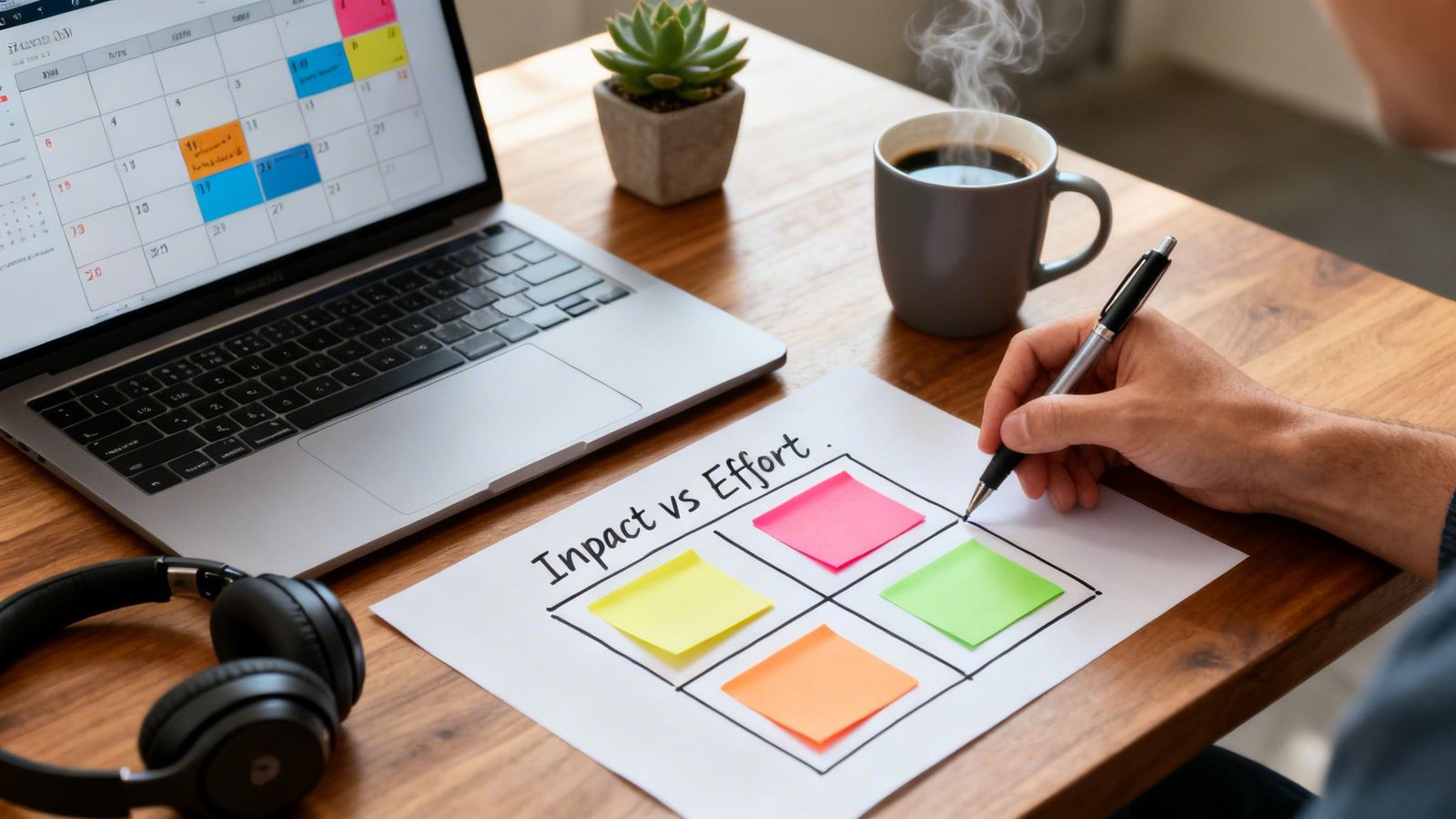
    Step 3: Score Your Priorities With the Impact vs. Effort Matrix

    Now for the fun part. With a list of clear, actionable tasks, you can start scoring them. Use a simple but incredibly powerful tool: the Impact vs. Effort matrix. This is a visual way to sort your tasks quickly. It helps you get past the β€œanalysis paralysis” that can keep you stuck.

    Use this simple matrix to quickly score your tasks. Plotting each task helps overcome analysis paralysis and clarifies your true priorities. It shows you where to focus your energy for the best results.

    CategoryDescriptionAction
    High Impact / Low EffortQuick Wins that deliver significant value with minimal time or energy.Do these first. They build momentum and create immediate results.
    High Impact / High EffortMajor Projects that are crucial for long-term goals but require deep focus.Schedule these. Block out dedicated time on your calendar to make real progress.
    Low Impact / Low EffortFill-in Tasks that are necessary but don’t move the needle much.Batch these. Knock them out in a single, low-energy block of time.
    Low Impact / High EffortTime Sinks that consume a lot of energy for very little return.Avoid or delegate. Question if these tasks need to be done at all.

    Let’s say you’re a small business owner prepping for a product launch. You’d plot your tasks like this:

    • Quick Win: Sending an announcement email to your subscriber list. (High Impact, Low Effort)
    • Major Project: Building the new product pages on your website. (High Impact, High Effort)
    • Fill-in Task: Archiving old project files from last quarter. (Low Impact, Low Effort)
    • Time Sink: Manually redesigning a minor graphic hardly anyone will notice. (Low Impact, High Effort)

    This matrix isn’t just about sorting tasks; it’s about giving yourself permission to focus on what creates real value and to intentionally sideline what doesn’t.

    Step 4: Select and Schedule Your Work

    With your priorities scored and sorted, there’s just one step left: get them on the calendar. A to-do list tells you what you need to do. Your calendar tells you when you’ll do it. For this, a time blocking planner is your best friend.

    Assign your β€œMajor Projects” to dedicated, uninterrupted blocks of deep work. Maybe that’s Tuesday and Thursday mornings from 9 AM to 11 AM. Slot your β€œQuick Wins” in at the start of the week. This builds momentum and creates some early victories.

    This final step turns your abstract list of priorities into a concrete, actionable plan for the week ahead. It leaves no doubt about what to work on and when.

    Protecting Your Focus With Neuroscience-Backed Habits

    A perfectly organized to-do list is useless if your brain is too fried to execute it. Your prioritization system is only as good as the focus you bring to the table. This is where a few simple, science-backed habits can make all the difference. They protect your attention so you can actually do the work that matters.

    One of the most battle-tested methods is the Pomodoro Technique. It’s not just a cute timer. It’s a way of working with your brain’s natural energy cycles, not against them. Behavioral research shows that structured breaks can restore focus. By committing to a focused 25-minute sprint followed by a 5-minute break, you prevent mental fatigue. I highly recommend using a physical pomodoro timer on your desk. It’s a simple visual cue that keeps you off your phone and locked into the task.

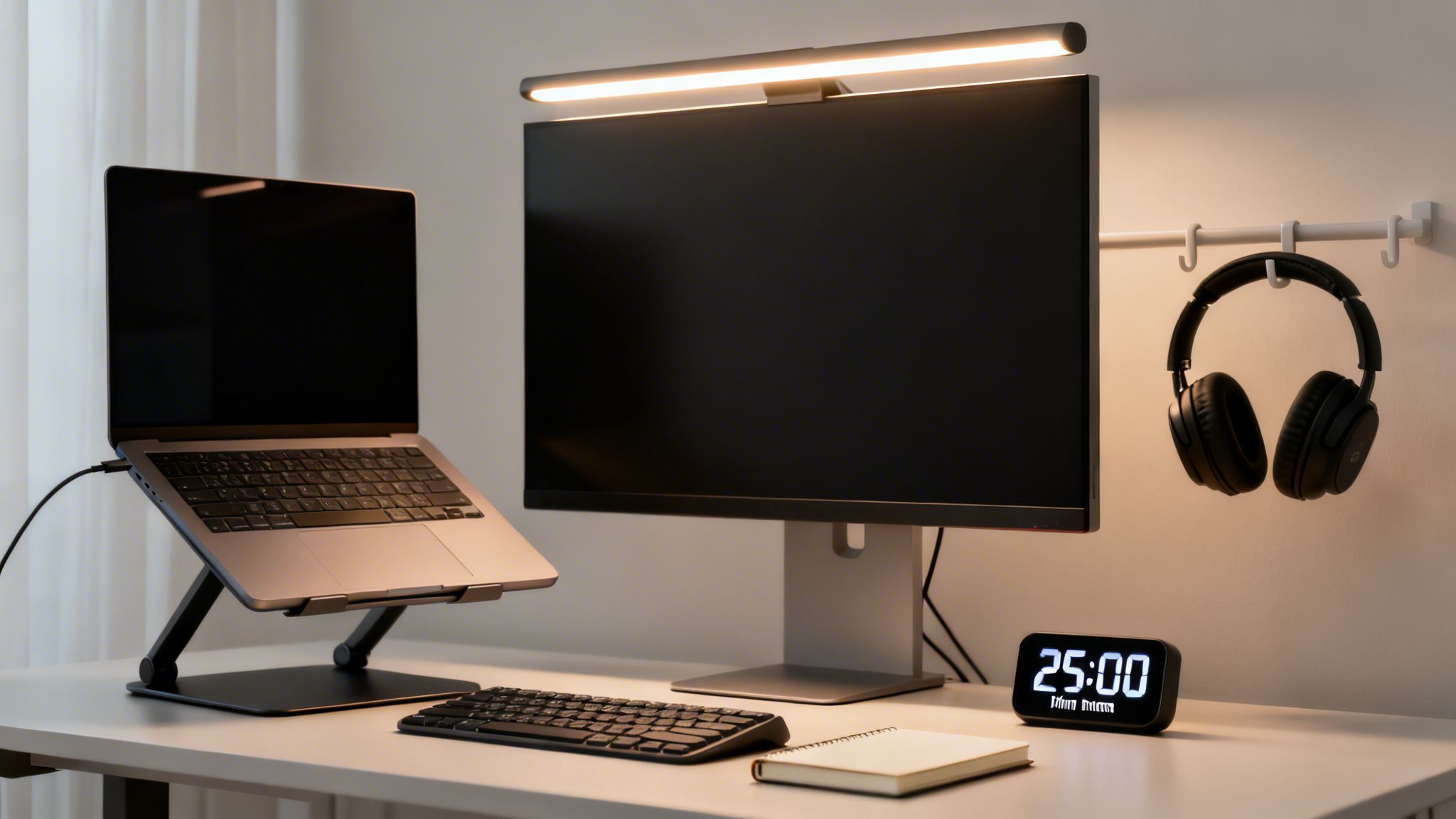
    How to prioritize tasks effectively with a minimalist home office desk setup featuring a laptop, monitor, headphones, and a digital clock.

    Don’t underestimate your physical environment, either. It plays a massive role in your ability to concentrate. An uncomfortable setup creates a low-grade physical stress that quietly drains your mental resources all day. Small ergonomic tweaksβ€”like using a laptop stand for desk to get your screen to eye level or investing in a comfortable ergonomic keyboardβ€”remove that friction and preserve your energy for deep work. You can explore these ideas further in my book on productivity, Focus Recharged.

    Design Your Deep Work Zone for Effective Task Prioritization

    Think of your workspace less like a desk and more like a cockpit designed for focus. Every element should support your goal of sustained concentration, not distract from it. This is a non-negotiable principle for anyone serious about improving focus and concentration.

    Real-World Example: A remote worker I know designed their desk as a dedicated β€œdeep work zone.” They added a monitor light bar to reduce eye strain during long writing sessions. They also physically moved their phone to another room during those blocks, perhaps using a phone lock box timer. This intentional design makes it dramatically easier to slip into a state of flow because you’ve removed temptations ahead of time.

    Immediate feedback is another powerful, often-overlooked tool. Observational studies show that getting high-quality, instant feedback on tasks can improve multitasking performance by 20-30% in controlled settings. Why? Because that feedback loop clarifies priorities on the fly and reassures your brain that your effort is pointed in the right direction.

    Create a Clear End to Your Day

    Finally, one of the most crucial habits for avoiding burnout is building a β€œshutdown ritual.” It doesn’t have to be complicated. At the end of your workday, take five minutes. Review what you accomplished. Capture any new tasks that popped up. Then define your top one or two priorities for tomorrow.

    This small ritual acts as a powerful signal to your brain. It says the workday is officially over. Psychology research suggests that such routines help create boundaries, which are essential for mental recovery. This allows you to mentally disengage and truly recharge, preventing the chronic stress that leads to burnout. Creating a clean break between β€œwork” and β€œrest” is the only way to protect your focus for the long haul, a concept I cover in Burnout Interrupted.

    Using AI and Simple Rules for Effortless Prioritization

    Even the best prioritization system can feel sluggish when you’re staring down a mountain of tasks. This is where modern tools and simple decision-making shortcuts come in. They can dramatically speed up your workflow. This saves precious mental energy for the deep work that actually moves the needle.

    One of the most powerful techniques is assisted triage using artificial intelligence. Instead of manually sorting a chaotic list, you offload the initial heavy lifting to an AI tool.

    Mini-Scenario: Imagine you just wrapped up a one-hour brainstorming session. A project manager could paste the entire meeting transcript into an AI. Then they can ask it to β€œextract and categorize all action items by owner.”

    Just like that, a wall of text becomes a clean, actionable list. It’s a concept we explore more deeply in our guide on how to use AI for productivity.

    Automate Small Decisions with Simple Heuristics

    Beyond high-tech solutions, you can streamline your day with simple rules, or heuristics. These rules kill off tiny decisions before they even start. They are like mental shortcuts that keep decision fatigue at bay.

    Here are two of the most effective ones you can start using immediately:

    • The Two-Minute Rule: Popularized by David Allen, this rule is beautifully simple. If a new task pops up and you can knock it out in two minutes or less, just do it right then. This stops tiny to-dos from cluttering up your list and your mind.
    • The One-Touch Rule for Emails: The moment you open an email, decide its fate. You can archive it, delete it, reply (if it takes less than two minutes), or move it to a β€œto-do” folder for later. The one thing you don’t do is close it and leave it in your inbox to be re-read later.

    To get these rules to stick without getting sidetracked, I’ve found a visual timer for desk works wonders. Setting it for just two minutes creates a real, tangible boundary. It stops you from accidentally falling down a rabbit hole. For an even more comprehensive strategy, check out these tips on how to use AI for productivity effectively.

    The real point of these rules isn’t just about speed. It’s about preserving your best cognitive resources for high-impact work by putting the small stuff on autopilot.

    The data backs this up. While global productivity growth has been slow, AI-heavy firms are reporting 72% higher productivity. They also report 59% better employee satisfaction. Even more impressive, generative AI is boosting knowledge worker efficiency by 66% or more. Integrating smart tools with simple rules isn’t just a nice idea. It’s a proven way to get more of the right things done.

    Editor’s Take: What Really Works to Prioritize Tasks

    After testing dozens of systems, I always come back to two practices that consistently deliver results, especially when life gets chaotic.

    First, the Impact/Effort Matrix is the single best tool for instant clarity. It forces an honest conversation with yourself about what’s truly valuable versus what just feels urgent. This exercise is a game-changer for anyone who struggles to see the forest for the trees. It’s the fastest way to stop majoring in minor things.

    Second, time blocking is the only method that reliably protects my deep work. If a high-impact task doesn’t have a specific block reserved for it on my calendar, it almost never happens. It just gets pushed around by a flood of emails and small requests. A good habit tracker journal can help make this practice stick.

    This combination is best for busy professionals, freelancers, and students. It’s for anyone tired of ending the day feeling busy but not productive. The key caveat is that this system requires a weekly review. You must set aside 30 minutes to clean up your list and plan the week ahead. Without that, even the best system will fall into chaos. The goal isn’t perfection; it’s about building a reliable system for consistent, meaningful progress.

    Key Takeaways on Task Prioritization

    • Externalize Your Brain: Don’t use your mind for storage. Capture every task in a single, trusted system like a notebook or app to free up cognitive resources.
    • Clarify Before You Organize: Vague tasks like β€œwork on report” cause overwhelm. Break them down into specific, actionable steps like β€œdraft report outline” before prioritizing.
    • Use the Impact vs. Effort Matrix: This simple 2Γ—2 grid is the fastest way to sort your tasks into Quick Wins, Major Projects, Fill-in Tasks, and Time Sinks. This visual sorting kills analysis paralysis.
    • Schedule Your Priorities: A to-do list is a wish list until it’s on your calendar. Use time blocking to reserve specific, uninterrupted slots for your most important work.
    • Protect Your Focus: Your system is useless without the mental energy to execute it. Use neuroscience-backed habits like the Pomodoro Technique and create a distraction-free work zone to protect your focus. An ergonomic mouse might seem small, but it reduces physical strain, saving mental energy.
    • Automate Small Decisions: Use simple rules like the β€œTwo-Minute Rule” to handle small tasks immediately. This prevents them from cluttering your mind and list, preserving your decision-making power for what matters.

    Final Words

    When it comes down to it, getting a real handle on your priorities isn’t about a magic app or a single productivity hack. It’s about building a simple, repeatable system that cuts through the noise. It lets you focus on what actually moves the needle. The goal is to move from feeling reactive and overwhelmed to feeling intentional and in control of your day. A great sunrise alarm clock can even help start your day with intention instead of panic.

    The goal isn’t perfection. It’s about building a reliable system that helps you make consistent, meaningful progress on the things that actually matter.


    Disclaimer: This article contains affiliate links. If you purchase a product through these links, we may receive a small commission at no extra cost to you. The content provided here is for educational and informational purposes only and is not a substitute for professional medical or psychological advice, diagnosis, or treatment.

    Frequently Asked Questions (FAQ)

    Even with the best system in place, questions pop up. Life is messy, and a good prioritization framework needs to be flexible enough to handle reality. Here are some of the most common questions about making this stick.

    1. What do I do about unexpected β€œurgent” tasks?

    This is going to happen. The real skill isn’t preventing surprises; it’s learning how to filter them without derailing your entire day. Before you react, run the new task through your system. Ask yourself: β€œIs this truly high-impact for our goals, or is it just someone else’s poor planning disguised as urgency?” If it’s a genuine β€œDo First” crisis, you’ll have to adjust. But if it’s not, your system gives you the confidence to calmly say, β€œI can look at that this afternoon.”

    2. What if everything feels like a high-impact, high-effort task?

    This is a classic sign of overwhelm. When everything feels like the number one priority, it usually means your tasks are too big and vague. A task like β€œLaunch New Product” isn’t a task; it’s a massive project. Your list should have things like β€œDraft the first launch email” or β€œFinalize product photos.” Breaking it down into smaller, concrete actions makes them much easier to score and schedule.

    3. How often should I re-prioritize my list?

    For most people, a two-part rhythm works best: a quick daily check-in and a more thoughtful weekly review.

    • Daily Triage (5-10 minutes): First thing in the morning, give your list and calendar a quick scan to confirm your 1-3 Most Important Tasks for the day.
    • Weekly Review (30 minutes): Set aside a block of time, maybe Friday afternoon, to look back at what you accomplished and map out your big priorities for the week ahead.

    4. How can this system help a procrastinator?

    Procrastination is rarely about laziness. It’s usually a symptom of feeling overwhelmed or unclear. This system tackles that head-on. By forcing you to define a small, clear next step, you lower the barrier to getting started. Pairing this with a pomodoro timer is a game-changer. It’s far less daunting to commit to just 25 minutes of focused work than to face the entire project at once.

    5. My team members all have different priorities. How do we align?

    A shared, visual framework becomes your best friend. Pull up an Impact/Effort Matrix in your next team meeting. Plotting tasks together shifts the conversation from subjective feelings to a more objective discussion about what will move the needle on the team’s shared goals. This single practice can prevent countless conflicts.

    Strategies for how to prioritize tasks effectively

    6. What if I have zero motivation for my high-priority tasks?

    A lack of motivation is often a sign of a disconnect from the β€œwhy” or simple decision fatigue. Reconnect with the task’s purpose. How does finishing it get you closer to a bigger goal? Also, be honest about your energy. If you’re running on empty, you might need to prioritize foundational habits like sleep first. Better sleep, perhaps with a sleep mask blackout or a white noise machine, can dramatically improve your mood and motivation.

    7. How do I stick with this system when I get insanely busy?

    The busier you are, the more you need a system. When things get chaotic, your brain can’t hold all the details. The key is making the habit as frictionless as possible. Keep your capture toolβ€”like a productivity journalβ€”always within arm’s reach. If you fall off the wagon for a day or two, don’t beat yourself up. Just do a quick β€œbrain dump” and jump back in.

    8. What’s the β€œTwo-Minute Rule” and how does it fit in?

    This is a simple but powerful decision rule. It goes like this: if a new task appears and you can do it in two minutes or less, do it immediately instead of adding it to your list. Think of things like answering a quick scheduling email. This prevents tiny tasks from piling up and creating mental clutter.

    9. Are there any apps you recommend for this?

    While a simple notebook is incredibly effective, plenty of digital tools can support this workflow.

    • Todoist is great for capturing tasks and using labels for your priority quadrants.
    • Asana or Trello are excellent for managing team projects with visual boards.
      The best tool is always the one you’ll actually use every single day.

    10. How can I prioritize when I feel completely burned out?

    When you’re burned out, your number one priority is recovery, a topic I detail in my book Burnout Breakthrough. Trying to force productivity will only dig the hole deeper. Be ruthless with your task list. Aggressively cut out any β€œTime Sinks.” Focus only on the handful of things that are truly mission-critical and give yourself permission to let the rest go for now. When your cognitive resources are low, as explained in our article on what is decision fatigue, managing them is everything.

  • How to Stop Multitasking and Reclaim Your Focus

    How to Stop Multitasking and Reclaim Your Focus

    Β 

    Disclosure: This post may contain affiliate links. If you purchase through these links, we may earn a small commission at no extra cost to you. We only recommend products we believe in.

    Β 

    If you want to stop multitasking, you have to see it for what it is. It is not a skill but a habit of rapidly switching between tasks. This constant gear-shifting drains your mental energy and tanks your productivity. The fix is to intentionally focus on one single thing at a time. This involves building an environment that protects you from interruptions.

    The Hidden Costs of Multitasking

    Ever find yourself juggling emails during a meeting while a project deadline looms? You definitely feel busy, but are you actually being productive? This is the core myth of multitasking in action. We believe we’re doing several things at once. However, neuroscience paints a very different picture of this process.

    Our brains aren’t wired to run complex tasks in parallel. What’s really happening is task-switchingβ€”a frantic back-and-forth between activities. Every single time we switch, our brain pays a price. This is crucial for anyone learning how to stop multitasking.

    Understanding the Brain’s β€˜Switch Cost’

    This mental toll is known as the β€œswitch cost.” Think of it like shifting gears in a manual car. There’s a burst of effort and a brief loss of momentum. When you toggle from a spreadsheet to an email and back again, your brain disengages from one set of rules. Then, it must completely reload another. This constant gear-shifting is exhausting for your brain.

    It’s this cognitive friction that leaves you feeling wiped out at the end of the day. You often have little to show for your efforts. You’ve burned more energy managing the act of switching than on the actual work. Over time, this constant drain is a fast track to mental fatigue and burnout. We dive deep into this topic in our book, Burnout Interrupted.

    A Real-World Example of Cognitive Friction

    Let’s look at Alex, a marketing manager. On their screen are three open windows. These include a creative brief for a new campaign, an active team chat, and their email inbox. This setup is common for people who need to learn how to stop multitasking.

    A chat notification pops up. Alex clicks over to answer a β€œquick question.” Just as they finish, an urgent email arrives. They switch again, draft a response, and finally return to the creative brief. But now, the original train of thought is gone. The creative spark is replaced by a sense of mental clutter. Each tiny interruption derailed their focus. This is the switch cost in real-time, sabotaging deep work.

    Alex’s experience is backed by research. A landmark study found that productivity can plummet by as much as 40% when people try to multitask. What we call multitasking is just rapid task-switching. It racks up a hefty cognitive price. In a typical office, it can take up to 23 minutes to regain focus after a single distraction. You can explore the data behind this in this in-depth analysis.

    By the end of the day, Alex has touched many tasks but completed none to a high standard. Their brain feels overworked, and the campaign brief remains unfinished. This cycle of fragmented attention is a direct path to cognitive overload.

    Understanding this hidden cost is the first, most crucial step. Once you recognize that multitasking is an illusionβ€”a draining habitβ€”you can start looking for a better way. The goal isn’t just to get more done. It’s to do better work with far less mental strain.

    Multitasking Myths vs Single-Tasking Reality

    It’s easy to stick with multitasking because we’ve been told it’s a valuable skill. But when you look at cognitive science, the story falls apart. Here’s a breakdown of common myths versus the reality of how your brain works. Learning how to stop multitasking starts with busting these myths.

    Common Myth About MultitaskingScientific Reality of Single-Tasking
    β€œMultitasking makes me more productive and efficient.β€β€œProductivity drops by up to 40%. Single-tasking allows for deep focus, producing higher-quality work in less overall time.”
    β€œI’m good at itβ€”I can handle multiple things at once.β€β€œOur brains can’t truly do two complex tasks simultaneously. You’re just task-switching, which increases errors and mental fatigue.”
    β€œIt’s necessary to keep up in a fast-paced environment.β€β€œSingle-tasking reduces the time lost to re-focusing (up to 23 mins per interruption), making you more agile and responsive.”
    β€œI’ll miss something important if I’m not always connected.β€β€œFocused work blocks followed by intentional check-ins lead to better outcomes than being in a state of constant partial attention.”
    β€œDoing one thing is boring and slow.β€β€œSingle-tasking creates a state of β€˜flow,’ which is deeply engaging and rewarding. It reduces stress and the feeling of overwhelm.”

    Seeing the comparison laid out like this makes it clear. The promise of multitasking is a mirage. The real gains in clarity, quality, and well-being come from embracing how our brains are built. They are designed to do one thing well.

    How to Stop Multitasking: Laying Your Single-Tasking Foundation

    Ready to trade multitasking chaos for the calm of deep focus? This shift doesn’t require a massive life overhaul. It starts with a few foundational habits that gently retrain your brain. You can learn to do one thing at a time, and do it well.

    The first step is simply to stop making your brain switch gears so often. This is where task batching comes in. It’s the simple practice of grouping similar activities together. Then you tackle them in one dedicated block of time. Instead of answering emails as they trickle in, set aside two 30-minute windows for your inbox. This is a powerful strategy for those learning how to stop multitasking.

    This works because it honors how our brains operate best. By sticking to one type of task, you stay in the same cognitive β€œmode.” You avoid the jarring mental leap from jumping between different activities. This preserves your precious mental energy.

    Embrace the Power of Time Blocking

    To put task batching into practice, many people find a time blocking planner is a game-changer. This isn’t just a to-do list. It’s a concrete commitment to how you’ll spend your time.

    • Mini-Scenario: A freelance writer named Sarah used to start her day by checking emails. Then she would check social media, write a few sentences, and jump back to emails. Her mornings felt scattered. By adopting time blocking, she now dedicates 9:00 AM to 10:30 AM exclusively to writing. Her phone is in another room, and her email client is closed. The result? She produces higher-quality work in less time because her focus is totally undivided.

    Frequent multitasking doesn’t just slow you down. It also spikes your stress and burnout risk. This constant context-switching can devour up to 40% of your productive time. You can read the full research on job demands and multitasking to understand the impact.

    The following infographic drives this point home. It shows how the juggle of multitasking inevitably leads to a decline in performance.

    An infographic shows the three costs of multitasking: juggling tasks, switching focus, and resulting in decline, errors, and stress, which is a key concept in how to stop multitasking.

    This visual makes it painfully clear. Every time you switch away from your main task, you pay a hidden cognitive price. This ultimately leads to errors and exhaustion.

    Build Focus Endurance with the Pomodoro Technique

    If a 90-minute focus block feels intimidating, start smaller. The Pomodoro Technique is a fantastic method for building focus endurance. It’s incredibly simple:

    1. Choose one task. Just one.
    2. Set a timer for 25 minutes. A simple pomodoro timer is perfect for this.
    3. Work on that single task without interruption until the timer goes off.
    4. Take a short 5-minute break. Get up, stretch, or look out a window.
    5. Repeat. After four β€œPomodoros,” take a longer break of 15-30 minutes.

    This technique trains your brain to sustain attention in manageable bursts. It provides a structure to resist the urge to switch tasks. It proves to yourself that you can stay focused for a set period. If concentration is a battle, our guide on how to train your brain to focus can help.

    Conduct a Personal Distraction Audit

    Finally, you can’t fight an enemy you can’t see. A distraction audit is a simple exercise to identify your personal focus-killers. For one full workday, keep a notepad handy. Just make a tally mark every time you get distracted or switch tasks on impulse.

    At the end of the day, look at your list. Was it the ping of social media notifications? A noisy coworker? The urge to check the news? Identifying your top three distractions is the first step toward creating a targeted plan to neutralize them. This is a practical step in learning how to stop multitasking.

    Designing Your Distraction-Proof Environment to Stop Multitasking

    Your environment can be your greatest ally or your biggest saboteur. Learning how to stop multitasking often starts with smart, intentional design. When you deliberately engineer your workspaces, you reduce the number of in-the-moment decisions. This helps you control what gets your attention.

    Think of your workspace as a cockpit for deep work. Every element should serve a purpose. Anything that doesn’t needs to go. For most of us, that cleanup process starts with our digital world. It is usually the loudest source of interruptions.

    A neat desk with a laptop on a stand, keyboard, mouse, headphones, plant, and a phone locked in a clear box, showing how to stop multitasking.

    Taming Your Digital Space

    The constant barrage of notifications is the primary enemy of single-tasking. Each ping, buzz, and banner is a siren call for your brain to switch tasks. This triggers that costly mental gear shift. It’s a tax on your attention.

    The first step is to practice a form of digital minimalism. This isn’t about abandoning technology. It’s about using it on your own terms. Turn off all non-essential notifications on your phone and computer. Social media alerts, news, and promotional emails can all wait. You decide when to check them, not the other way around. My book Digital Clarity offers a complete guide on this topic.

    Next, reclaim your browser. It’s so easy for it to become a minefield of distraction. Use extensions to block time-wasting websites during your focus blocks. Get into the habit of closing all unrelated tabs. This simple act creates a clean, focused digital canvas.

    Engineering Your Physical Focus Zone

    The space around you sends powerful cues to your brain. A cluttered desk quietly encourages a cluttered mind. On the flip side, an organized space is a direct invitation to focus. This is a key principle in how to stop multitasking.

    Real-World Scenario: I once coached a remote worker, Maria. Her desk was a mess of old mail, coffee mugs, and tangled wires. Her email pinged constantly. She felt scattered all day. By spending just 15 minutes clearing her desk, silencing her phone, and putting on noise canceling headphones, she transformed her space. The headphones sent a clear β€œdo not disturb” signal to her family.

    These physical cues are surprisingly effective. They help create a ritual that transitions your brain into a state of deep concentration.

    Here are a few simple adjustments that make a huge difference:

    • A Tidy Workspace: A clear desk means fewer visual stimuli competing for your attention. Keep only the essentials for your current task within arm’s reach.
    • Ergonomic Comfort: A proper setup minimizes physical discomfort that can pull you out of a flow state. A laptop stand for desk and a quality ergonomic keyboard can prevent strain.
    • Strategic Boundaries: If you work in a shared environment, physical boundaries are crucial. It’s worth exploring how you can create distraction-free zones.

    Mindful Environmental Design

    Creating a distraction-proof environment isn’t a one-and-done project. It’s an ongoing practice of being mindful. You need to consider how your surroundings affect your state of mind. You can go deeper by learning how light, sound, and architecture affect cognitive performance in our guide.

    By taking control of both your digital and physical environments, you’re building an external support system. You’re making focus the path of least resistance. That’s the real secret to making the single-tasking habit stick for good.

    How to Stop Multitasking by Mastering the Psychology of Deep Focus

    Winning the war against multitasking is mostly an inside job. Changing your environment is a great start. However, the real victory comes from understanding and taming the internal urges that pull you away. This is the heart of learning how to stop multitasking.

    A young person meditates at a desk with a habit tracker notebook and a phone in do not disturb mode, demonstrating how to stop multitasking.

    That constant pull toward distraction is rooted in your brain’s chemistry. Every time you switch tasks, your brain gets a tiny hit of dopamine. This neurotransmitter is tied to pleasure and novelty. It creates a powerful feedback mechanism known as a dopamine-seeking loop.

    Your brain starts to crave the novelty of the next ping or email. It rewards you for switching, not for focusing. This makes multitasking feel compelling, almost addictive. This happens even when you know it’s wrecking your productivity.

    Mindful Awareness Over Willpower

    You can’t break this cycle with brute-force willpower. A much better approach is to cultivate mindful awareness. This is the simple act of noticing the impulse to switch tasks without immediately acting on it. It’s about creating a tiny pause between the urge and your action.

    Scenario: The Focused Student
    Picture Leo, a student studying for an exam. His phone is on his desk, silent. He feels a sudden, intense urge to check it. Instead of grabbing it, he pauses. He takes one deep breath and acknowledges the feeling: β€œThere’s the urge to check my phone.” He doesn’t judge it; he just observes it. After a moment, the intensity fades, and he turns back to his textbook.

    This small moment of non-reaction weakens the dopamine loop. Each time you notice the urge and gently redirect your focus, you’re retraining your brain. Using a simple habit tracker journal can be a fantastic way to log these small wins.

    Think heavy multitaskers are masters of chaos? A classic Stanford study found the opposite. It showed that chronic multitaskers make 50% more errors. They are also slower to switch between tasks than people who focus on one thing. The research makes it clear: multitasking actively erodes the cognitive skills needed for deep work.

    Set Boundaries to Protect Your Focus

    Managing your internal state also means communicating your needs to others. You have to protect your focus time by setting polite but firm boundaries. Many people hesitate to take this step. They worry they’ll seem unhelpful or rude.

    But clear communication is an act of respectβ€”for your own work and for your colleagues. Here are a few simple scripts you can adapt:

    • For interruptions at your desk: β€œI’m in a deep focus session right now. Can I swing by your desk in about an hour when I’m at a good stopping point?”
    • For non-urgent chat messages: β€œThanks for reaching out. I’m heads-down on the project report until 3 PM but will get back to you right after that.”

    These small scripts protect your concentration without damaging relationships. To really nail this, you need practical strategies to stay focused at work.

    Editor’s Take: What Really Works to Stop Multitasking

    Let’s be honest: breaking the multitasking habit is a marathon, not a sprint. This guide is for busy professionals, students, and creators who feel scattered. It is for those who know their current approach isn’t sustainable.

    If you’re looking for the most effective strategies, design a distraction-proof environment. Also, use a pomodoro timer to build your β€˜focus muscles’ in short bursts. These two actions are almost always the most effective.

    For most people, combining a time blocking planner with conscious task batching delivers the quickest results. It creates the structure your brain craves. It also minimizes the cognitive whiplash of constantly switching gears. Exploring the principles of what is deep work can give you a powerful framework.

    A critical caveat: This content is educational and not a substitute for professional care for conditions like ADHD, anxiety, or burnout. It offers general guidance on productivity and focus for a broad audience. Always consult with a qualified professional for personalized advice.

    Ultimately, learning to stop multitasking is less about willpower. It is more about building a system that makes focus the path of least resistance. Small, consistent changes will always beat occasional heroic efforts to β€œjust focus harder.”

    Key Takeaways: How to Stop Multitasking for Good

    • Multitasking is a myth: Your brain is actually task-switching, which drains energy and reduces productivity by up to 40%.
    • Start with structure: Use time blocking and task batching to group similar activities together, minimizing mental gear-shifting.
    • Build focus endurance: Practice the Pomodoro Technique (25 minutes on, 5 minutes off) to train your attention span in manageable intervals.
    • Design your environment: Create a distraction-proof physical and digital workspace by clearing clutter and silencing non-essential notifications.
    • Understand the psychology: Recognize the dopamine-seeking loop that makes multitasking feel addictive and use mindfulness to create a pause before acting on distractions.
    • Set clear boundaries: Politely communicate your focus periods to colleagues to protect your concentration and improve work quality.

    FAQ: Your Questions on How to Stop Multitasking

    Deciding to move away from a habit as wired-in as multitasking is going to bring up some questions. It’s totally normal. Here are some honest answers to the most common concerns.

    1. Is It Ever Okay to Multitask?

    Yes, but it’s all about the kind of tasks you’re pairing. The real distinction is between tasks that need brainpower and those that are automatic. It’s fine to multitask when one activity is routine. Think listening to a podcast while folding laundry or using an under desk walking pad during an audiobook. These work because one task is on autopilot. Where you run into trouble is trying to pair two things that both demand focus. That’s not multitasking; it’s just doing two things badly.

    2. What If My Job Demands I Multitask?

    This is a big one. Many jobs create the illusion that you have to be a master multitasker. But what they usually want is someone who can manage multiple priorities without letting anything drop. Instead of juggling everything, start communicating your workflow. Try batching email and Slack messages into dedicated blocks. Politely let your team know when you’re in a deep work session. You’ll find you produce higher-quality work and are actually more responsive. Learning these boundaries is a huge part of what we cover in Reclaiming Silence.

    3. How Long Does It Take to Break the Multitasking Habit?

    There’s no magic number here. Behavioral science tells us it can take anywhere from a few weeks to several months. The real key is consistency, not perfection. Don’t get discouraged if you slip back into old patterns. Every time you focus on one thingβ€”even for just one Pomodoro session with a visual timer for deskβ€”you’re strengthening the neural pathways for concentration.

    4. Can Multitasking Actually Hurt My Brain?

    Yes, chronic multitasking can have a real cognitive cost. Research shows that heavy multitaskers often struggle more with filtering out irrelevant information. They also have difficulty managing their working memory and switching tasks efficiently. By constantly practicing distraction, you get better at being distracted. The good news is the reverse is also true. You can retrain your brain for deep work with consistent single-tasking.

    5. I Feel Anxious or Bored When I Try to Single-Task. What Should I Do?

    This is an incredibly common feeling. Your brain has likely grown accustomed to the constant dopamine hits from jumping between tasks. When you take that away, it can feel like withdrawal. The fix is to start small. Don’t try to leap into a two-hour deep work session overnight. Use the Pomodoro Technique to practice for just 25 minutes. When that urge to switch tasks pops up, just notice it without acting. This helps you build your tolerance for focus.

    How to Stop Multitasking in a Distracting World

    6. How Do I Actually Start Single-Tasking?

    The best way to start is with a few concrete moves. First, grab a time blocking planner and give your day structure. Second, create a distraction-free bubble by turning off notifications and clearing your workspace. Finally, practice the Pomodoro Technique to build focus endurance. These small, structured steps make the transition feel doable. For a full roadmap, our book The Power of Clarity is a fantastic resource.

    7. What Tools Can Help Me Stop Multitasking?

    A few simple tools can make a huge difference. A physical pomodoro timer gives your focus sessions structure. A productivity journal helps you plan your day with intention. For your environment, quality noise canceling headphones are invaluable. And if your phone is your weakness, a phone lock box timer can be a surprisingly powerful tool.

    8. How Do I Handle Interruptions from Coworkers?

    Handling interruptions gracefully is a skill. It’s all about being polite but firm in protecting your focus. You can use simple scripts like: β€œI’m in a focus block right now, but I can circle back with you at 3 PM.” This approach respects your colleague’s needs while honoring your commitment to your work.

    9. Will Single-Tasking Make Me Fall Behind?

    This is a common fear, but the opposite is almost always true. It might feel slower at first, but single-tasking eliminates the β€œswitch cost.” Because you’re producing higher-quality work with fewer mistakes, you’ll spend far less time on revisions. You’ll end your day with more completed projects, not a long list of half-finished ones.

    10. What If I Have ADHD or Another Condition That Affects Focus?

    If you have a condition like ADHD, strategies like time blocking and using timers can be helpful. However, it’s important to recognize that generic productivity advice may not fully address your unique neurobiology. This article is for educational purposes and is not a substitute for professional medical or psychological advice. It’s crucial to work with a healthcare professional to build a personalized plan.


    Disclaimer: This article is for educational and informational purposes only and does not constitute medical or psychological advice. The content is not intended to be a substitute for professional consultation, diagnosis, or treatment. This post may also contain affiliate links, which means we may earn a small commission on purchases at no extra cost to you.

    At Mind Clarity Hub, we believe reclaiming your focus is the first step toward a more productive and peaceful life. Our collection of books, including Attention Unleashed and The Focused Freelancer, provides science-backed roadmaps to help you master your attention in a world full of distractions.

  • Build Your Ultimate Focus Portal to Boost Productivity

    Build Your Ultimate Focus Portal to Boost Productivity

    Affiliate Disclosure: This post may contain affiliate links. If you make a purchase through these links, we may earn a small commission at no extra cost to you. This support helps us continue to create valuable content.

    A focus portal is your personalized, distraction-free command center. It’s not a single app you download. Instead, it is an entire environment you build. This integrated system of digital tools and daily routines is designed to protect your attention and make deep work possible.

    What Is a Focus Portal and Why You Need One Now

    Ever feel like you’re drowning in a sea of open tabs? Are scattered to-do lists and a never-ending inbox overwhelming you? You’re not alone. This digital chaos drains your mental energy through constant context-switching. Neuroscience research shows this process overloads the prefrontal cortex, the part of your brain responsible for planning and decision-making.

    A focus portal is your defense against that overload. It’s a dedicated space, both digital and mental, that you engineer for concentration. Instead of reacting to a constant barrage of alerts, you create a system that serves your goals. This allows you to proactively engage with your most important work.

    This isn’t just a personal productivity hack; it mirrors a major shift happening in the business world. Companies are scrambling to build centralized hubs for collaboration, with the global enterprise portal market projected to hit USD 93.82 billion by 2035. Why? They know that cutting through the information overload plaguing 70% of digital workers is essential for survival.

    The Science Behind a Dedicated Focus Space

    Your brain thrives on cues. When you consistently use a specific digital setup for demanding work, you create powerful psychological associations. Behavioral psychology refers to this as β€œcontext-dependent learning.” The environment you’re in helps you recall information and get into the right state of mind.

    By designing a focus portal, you’re essentially telling your brain: β€œThis is the place where we concentrate.”

    This approach helps you drop into the state of intense concentration we explore in our guide on what is deep work. Creating this intentional space reduces the cognitive load of deciding what to do next. It also fights the temptation of multitasking. Studies show multitasking can slash your productivity by as much as 40%. A simple phone lock box timer can be a great physical tool to prevent this.

    β€œA focus portal turns your computer from a source of constant distraction into a powerful tool for concentration. It’s about designing your environment to make focus the path of least resistance.”

    Books like The Power of Clarity and Digital Clarity dig deep into these ideas. They show how intentional systems help you escape digital burnout. When you build a focus portal, you are not just organizing your apps. You are structuring your attention and reclaiming your mental energy for what truly matters.

    This article is for educational purposes only. It is not a substitute for professional medical or psychological advice, diagnosis, or treatment. If you are experiencing symptoms of anxiety, depression, ADHD, burnout, or sleep problems, please consult a qualified healthcare provider.

    Designing Your Focus Portal Blueprint

    Before you build a house, you need a blueprint. The same is true for a powerful focus portal. Without a clear plan, your efforts can become just another source of digital clutter. It can become another well-intentioned system that gets abandoned in a week.

    A successful blueprint rests on four core pillars. They work together to create an environment where concentration can actually flourish. These pillars are not separate, but interconnected. A well-designed physical space cues your brain for the mental frameworks you’ll use. Meanwhile, your daily routines reinforce the digital boundaries you’ve set.

    The Four Pillars of an Effective Focus Portal

    A truly effective system addresses every aspect of your work lifeβ€”not just the apps on your screen. Think of these four pillars as the foundation for building your personalized command center for attention.

    • The Digital Environment: This is all about curating your apps and taming notifications. It involves creating a streamlined digital workspace. It’s about deciding what gets your attention and when, instead of letting your devices choose for you.
    • The Physical Space: Your desk, chair, and even the lighting are powerful signals to your brain. Optimizing this space tells your mind, on a subconscious level, that it’s time for deep work. Using an ergonomic keyboard can reduce physical strain, helping your mind focus.
    • The Mental Framework: This is your internal operating system. It includes battle-tested strategies like time blocking and techniques for managing cognitive load. It also includes the mental models you use to approach your work.
    • Daily Routines: These are the simple rituals that bookend your day. A consistent startup and shutdown routine creates structure. It signals a clear, non-negotiable transition between β€œon” and β€œoff.”

    When the digital environment is left to chance, it actively works against you. This leads to a state of constant cognitive overload.

    Digital Chaos Hierarchy diagram with Brain Overload leading to Context Switching and Scattered To-Dos, illustrating the need for a focus portal.

    As you can see, the constant need to switch between tasks and manage disorganized information directly fuels mental fatigue. This makes focused work feel nearly impossible.

    Pillar 1: Your Physical Workspace

    Your physical environment is the first line of defense against distraction. Your brain is highly sensitive to external cues. Therefore, designing a workspace for focus is a non-negotiable first step. The goal here is simple: make concentration the path of least resistance.

    For example, a freelance writer might set up their desk with a good laptop stand for desk to improve posture. They could also use a pair of high-quality noise canceling headphones to block out household sounds. This simple setup creates a clear physical boundary that signals β€œwork time” to both the writer and their family.

    Small changes, like adding a monitor light bar to reduce eye strain during long sessions, can also make a huge difference in how long you can sustain your focus.

    Your brain doesn’t like ambiguity. When your workspace is distinct and used consistently for deep work, you create a powerful habit loop that makes it easier to drop into a state of flow.

    You can find more inspiration by exploring our guide on home office organizing ideas to build the perfect physical foundation for your focus portal.

    Pillar 2: Your Digital Environment

    Next up is your digital world. You have to be intentionalβ€”even ruthlessβ€”about what apps, tabs, and notifications you allow into your awareness. The default settings on our devices are designed for corporate engagement, not for our personal productivity.

    Start by conducting a β€œdigital audit.” Remove any apps from your phone and computer that you don’t use or that consistently pull you away from your priorities. Then, turn off all non-essential notifications. This one action alone can dramatically slash the cognitive cost of context switching.

    A graphic designer could create different browser profiles in Google Chrome for each client. For instance, one profile contains only the links, bookmarks, and logins for β€œClient A.” Another profile is dedicated entirely to β€œClient B.” This kind of segmentation prevents the mental clutter that comes from seeing irrelevant information when you’re trying to focus.

    Choosing Your Focus Portal Core Components

    To build out the physical and digital pillars, you’ll need a few core tools. The table below compares some popular options to help you decide what fits your work style. Remember, the β€œbest” tool is always the one you’ll actually use consistently.

    Component TypePopular Option A (e.g., Notion)Popular Option B (e.g., Trello)Best For…
    Project HubNotion – A flexible, all-in-one workspace for notes, databases, and wikis.Trello – A visual, card-based system for tracking tasks through stages.Notion is great for thinkers who love building custom systems; Trello is ideal for visual, workflow-based projects.
    Task ManagementTodoist – A clean, powerful to-do list app with natural language input.A simple physical notebook or time blocking planner.Todoist excels at capturing and organizing tasks on the fly; a physical planner is better for deliberate, daily planning.
    Distraction BlockerFreedom – An app that blocks distracting websites and apps across all your devices.An under desk walking pad – A way to channel restless energy into movement instead of digital distraction.Freedom is for disciplined digital blocking; a walking pad is for those who think better while moving.
    Physical SetupAn ergonomic chair and adjustable standing desk.A simple desk with a good ergonomic mouse and external keyboard.An ergonomic setup is a long-term investment for full-time remote workers; a simpler setup works well for students or hybrid workers.

    Ultimately, don’t get stuck in analysis paralysis. Pick a simple starting stack. This could be Notion for projects, a notebook for daily tasks, and a good pair of headphones. Then, refine it as you go.

    Pillar 3: Your Mental Framework

    With your physical and digital spaces dialed in, it’s time to build your mental framework. This pillar is all about adopting strategies that align with how your brain actually works. It’s about managing your energy and attention, not just your time.

    Time blocking is a cornerstone of this framework. Instead of working from a long, overwhelming to-do list, you schedule specific blocks of time in your calendar for specific tasks. For example, a marketing manager might block 9-11 AM for β€œWrite Weekly Report” and nothing else. This practice gives your brain the structure it craves and fiercely protects your most important work from interruptions.

    Another key mental model is recognizing the limits of your executive function. These are the brain processes responsible for planning, focusing, and resisting impulses. By reducing the number of small decisions you have to make throughout the day (like what to work on next), you conserve that precious mental resource for the work itself.

    Pillar 4: Your Daily Routines

    Finally, routines tie everything together. They provide the structure that makes your focus portal sustainable over the long haul. These are not rigid, minute-by-minute schedules. Instead, they are flexible rituals that guide your day.

    Your Startup Routine: This is a short sequence of actions you perform at the beginning of each workday. It could be as simple as brewing coffee, reviewing your plan for the day in a productivity journal, and opening only the apps needed for your first task. This ritual gently eases you into a productive state without relying on willpower.

    Your Shutdown Routine: Just as important is how you end your day. A shutdown routine might involve clearing your inbox, planning tomorrow’s top three priorities, and closing all work-related tabs. This creates a clear psychological separation between work and personal life. Consequently, it helps prevent the kind of burnout that creeps up when you never truly unplug. Getting a good night’s rest with a sleep mask blackout can also help you recharge for the next day.

    Crafting Your Digital Command Center

    Alright, let’s get practical. It’s time to build the digital heart of your focus portal: your command center. This isn’t just another dashboard; it’s your single source of truth. It is a central hub that pulls in everything you need and aggressively filters out what you don’t. Think of it as the cockpit for your productivityβ€”designed for clarity, not clutter.

    First things first: you need to choose your hub. This doesn’t have to be complicated. It could be a clean Notion page or a visual Trello board. It could even be a simple, customized browser start page like Momentum. The goal is to create a launchpad for your day. This launchpad stops you from getting sucked into the vortex of your email inbox or social media feeds first thing.

    A laptop displaying productivity apps like a to-do list, calendar, and Pomodoro timer, creating a focus portal.

    Building Your Central Hub

    Let’s ground this with a real-world example. Imagine a freelance writer juggling three main clients. Each client comes with its own tasks, deadlines, and a trail of documents. Instead of wrestling with scattered files and emails, they build a simple dashboard in Notion.

    You can streamline this kind of setup by starting with a dedicated Notion client portal template to centralize information from the get-go.

    Their dashboard might include:

    • A master task list they can filter by client.
    • Quick links to each client’s Google Drive folder.
    • An embedded calendar showing all deadlines at a glance.
    • A scratchpad section for brainstorming and rough notes.

    This simple setup means no more hunting for information. When they start their day, they open this one page. Their entire workload is visible and organized. This cuts down on the β€œdecision fatigue” that comes from constantly figuring out what to do next.

    Taming the Notification Beast

    Once your hub is in place, the next job is to manage notifications. Uncontrolled alerts are the enemy of deep work. From a neuroscience perspective, each ping is a tiny hit of novelty. It hijacks your brain’s attention-switching network and shatters your concentration.

    Setting up β€œFocus Modes” on your phone (iOS) or β€œFocus” on Android is non-negotiable. Don’t just turn them on; customize them. Create different modes for different activities, like β€œDeep Work,” β€œMeetings,” or β€œPersonal Time.”

    For example, a software developer’s β€œDeep Work” mode could block all notifications except for urgent alerts from a specific monitoring system. This creates a digital sanctuary where they can work uninterrupted for sustained periods.

    This proactive approach is so much more effective than relying on willpower to ignore the constant buzzing. You’re designing your environment to support your intentions, not test your discipline. Wearing blue light blocking glasses during these sessions can also reduce digital eye strain.

    The Power of Segmentation and Timers

    To take this a step further, segment your entire digital environment. A powerful but underused technique is creating different browser profiles. You can use them in Chrome, Edge, or Firefox for different contexts.

    Imagine a student working on their thesis while also managing a part-time job. They could have:

    1. A β€œThesis” Profile: Logged into university accounts, with bookmarks only for research databases and writing tools.
    2. A β€œWork” Profile: Logged into their work email and project management software.
    3. A β€œPersonal” Profile: For social media, news, and everything else.

    This separation prevents crossover distractions. When they’re in their β€œThesis” profile, they won’t get a tempting YouTube recommendation or a notification from their work chat. It’s a simple way to build digital walls between the different parts of your life. A gentle analog alarm clock can signal the end of a work session without a jarring digital alert.

    Pairing this strategy with a timer solidifies the habit. Using a simple pomodoro timer, you commit to working within one profile for a 25-minute sprint. When you track these sessions in a time blocking planner, you get a clear visual record of where your attention is actually going.

    Why This Matters More Than Ever

    The need for these intentional systems isn’t just a feeling; the market reflects it. The global Focus App industry was valued at USD 745 million in 2024 and is expected to keep growing. Why? Because over 40% of knowledge workers report struggling with distractions at home.

    Research shows that structured interventions like a focus portal can boost productive time by 30-50%. This is a crucial defense against the burnout affecting a staggering 77% of workers.

    Crafting a digital command center is about taking back control. It’s the move from a reactive state, where your devices dictate your attention, to a proactive one, where your tools serve your goals. And if you’re interested in taking your efficiency even further, check out our guide on powerful https://mindclarityhub.com/ai-tools-for-productivity/ that can plug right into your new command center.

    Using AI and Automation to Sharpen Your Focus

    Let’s be honest: the last thing most of us need is another piece of tech pulling at our attention. But what if artificial intelligence could be the quiet, ruthlessly efficient assistant that powers your focus portal behind the scenes?

    The goal isn’t to chase every shiny new AI tool. Instead, it’s to build smart, simple systems that handle the busywork so you don’t have to.

    Think about the entrepreneur who spends the first hour of every morning just sorting and triaging their inbox. By setting up a single automation with a tool like Zapier, they can have any flagged email automatically turned into a task in their project manager.

    A modern workspace with a laptop displaying an automation workflow, a smartphone, and a checklist, a key part of a focus portal.

    That one workflow might save them five hours a week. More importantly, it protects their most valuable mental energy right at the start of the day.

    Automating the Mundane to Protect Your Attention

    The core principle here is simple: delegate low-value tasks to technology. Your brain’s prefrontal cortexβ€”the part that handles focus and complex decisionsβ€”is an easily drained resource. Every tiny, trivial choice you make, like where to save a file or how to phrase a meeting reminder, chips away at your capacity for deep work.

    AI can shoulder that load. For example, instead of spending 30 minutes wading through a dense industry report, you could use an AI tool to generate a crisp, bullet-point summary in seconds. This lets you grab the key insights without sacrificing a huge slice of your most productive time.

    Here are a few practical automations you can build into your focus portal right away:

    • Email to Task: Automatically send starred emails in Gmail directly to your task manager (like Todoist or Asana).
    • Meeting Agendas: Use an AI writing assistant to create a standard agenda template for any recurring meetings.
    • Content Summaries: Paste the URL of a long article into an AI tool and get the main points back instantly.
    • Social Media Drafts: Generate first drafts for social media posts based on your latest blog content.

    These small efficiencies add up. They create more space for the strategic thinking that actually moves the needle. You can see more examples in our guide on how to use AI for productivity.

    Building an Intelligent System That Works for You

    To make this work, it helps to understand how to compare AI models so you can pick the right tools for the job. A small business owner, for instance, could use an AI-powered scheduler to handle all their client bookings. This completely eliminates the back-and-forth emails that constantly shatter their concentration.

    This isn’t just a productivity hack; it’s a reflection of a massive shift in how work gets done. The market for digital transformationβ€”which includes automation and AI toolsβ€”is projected to hit USD 1,864.94 billion by 2031.

    Businesses are pouring money into these systems because they know streamlined workflows are the key to growth. AI analytics, the fastest-growing part of this market, is already helping automate around 40% of routine tasks. For anyone struggling with distractions, that’s a game-changer. It helps recover much of the 23 minutes typically lost every time our focus breaks.

    By automating decision-making and routine tasks, you’re not just saving time. You are actively preserving your most valuable asset: your ability to think deeply and creatively.

    This principle is the foundation of books like Marketing Magic and The 6-Figure Creator. These books explore how intelligent systems can amplify your impact. When you build automation into your focus portal, it stops being a static organizer. It becomes a dynamic assistant that actively helps you concentrate on what truly matters.

    Maintaining and Adapting Your Focus Portal

    Your focus portal isn’t a trophy you build once and then admire on a shelf. It’s a living system, more like a garden than a sculpture. To keep it effective, you have to tend to it. You need to prune what’s no longer serving you and adapt to the changing seasons of your work and life.

    Without that regular maintenance, even the most perfectly designed system will eventually become a source of clutter itself. A cluttered system increases cognitive load, defeating the portal’s entire purpose.

    The best way I’ve found to handle this is with a simple, recurring maintenance routine. Think of it as a β€œweekly clarity check-in.” This is a dedicated 15-minute block you schedule every Friday afternoon. This isn’t time for doing work; it’s time for working on your work system.

    This short ritual is your best defense against β€œsystem creep.” This is the natural tendency for our digital spaces to accumulate new tools, apps, and workflows until they become bloated and inefficient. It happens to all of us. The brain’s constant desire for novelty can lead you to add things that seem helpful in the moment but ultimately just add complexity. A sunrise alarm clock can help you wake up refreshed, ready to tackle your day with a clear mind.

    The Weekly Clarity Check-In

    During your weekly review, you’ll ask yourself a few simple but powerful questions about your focus portal. The goal here is effectiveness, not perfection, so be honest with your answers.

    • Is my main dashboard getting cluttered? If your central hub looks chaotic, it’s a sign that you need to archive old projects or simplify the layout. A messy dashboard creates subtle cognitive friction every single time you look at it.
    • Are my notification rules still serving me? Did you allow alerts from a new app and forget to turn them off? Now’s the time to revisit your settings. Ensure only the most critical pings are getting through.
    • What felt difficult or frustrating this week? If you constantly struggled to find a specific file or felt distracted during a certain time of day, that’s a signal. It points directly to a friction point in your system that needs a small adjustment.

    Using a simple habit tracker journal can give you invaluable data for this review. Seeing a visual record of your work sprints, distractions, and energy levels helps you make smart, evidence-based tweaks rather than just guessing what needs to change.

    Adapting Your Portal for Different Seasons

    Your work intensity isn’t constant, and your focus portal shouldn’t be either. The system you need for a high-stakes product launch is completely different from the one you need during a quiet holiday period. The key is to be intentional about adapting it.

    A rigid system is a brittle one. The true power of a focus portal lies in its flexibilityβ€”its ability to expand and contract based on your current demands without breaking.

    During a project launch, for example, you might temporarily add a dedicated project dashboard with real-time metrics right on your portal’s homepage. In contrast, during a slower week, you could simplify your view to show only your top three long-term goals. Using a white noise machine can help maintain focus during both intense and quiet periods.

    This is all about managing your energy, not just your time. You must ensure your system supports your current mental state.

    By embracing this cycle of review and refinement, you create a resilient, evolving focus portal that supports you for the long haul. It helps you avoid the kind of system-induced overwhelm that can lead to burnout. This is a topic explored in depth in Burnout Breakthrough.

    Key Takeaways

    • A Focus Portal is a Personalized System: It’s an integrated environment, not a single app. It combines your digital tools, physical space, and daily habits to protect your attention.
    • Build on Four Pillars: A strong portal rests on your Digital Environment, Physical Space, Mental Frameworks (like time blocking), and Daily Routines (startup/shutdown rituals).
    • Your Brain Needs Cues: A dedicated space and consistent routines create powerful psychological triggers that help you enter a state of deep work more easily.
    • Automate to Conserve Energy: Use AI and automation tools to handle repetitive, low-value tasks. This saves your brain’s limited cognitive resources for high-impact work.
    • Regular Maintenance is Crucial: A focus portal requires a weekly 15-minute check-in to stay clean, effective, and aligned with your current priorities. This prevents system bloat and keeps it useful.
    • Adaptability is Key: Your portal should be flexible, changing with the demands of different projects and work seasons. A rigid system will eventually break or be abandoned.

    Editor’s Take

    Here’s the honest truth: the most effective focus portal is one that starts simple and grows with you. The specific apps you choose matter far less than the principles behind themβ€”intention, focus, and firm boundaries.

    This system can be a game-changer for knowledge workers, students, and freelancersβ€”really, for anyone who has some control over their digital world. But I want to be upfront: it takes a real investment of time to get it right, and it won’t run itself. You have to maintain it.

    The payoff, though? It’s more than worth it. You’re trading a bit of setup time for a massive reduction in daily stress and a huge boost in the work that actually matters. It’s a commitment that pays you back, day after day, in clarity and accomplishment. If you’re serious about deep work, this is how you start taking your attention back.

    Frequently Asked Questions About Building a Focus Portal

    We get a lot of questions about what it really takes to design and maintain a personalized focus portal. Here are some of the most common ones, with clear answers.

    1. How long does this actually take to set up?

    The initial setup can be surprisingly fastβ€”as little as one to two hours. That’s enough time to pick your central hub, do a quick desktop clear, and set some basic notification rules. If you want to get fancier with automations, set aside a full afternoon. But remember, a focus portal is meant to evolve. Start small and make tiny improvements each week.

    2. Can I build a focus portal without buying new software?

    Absolutely. You can build an incredibly effective portal using free tools you probably already use. A Google Doc can be your central hub. Your phone’s built-in β€œFocus Mode” can handle notifications. A simple browser extension can block distracting sites. The principles matter more than the price tag.

    3. How do I stick with it when I get really busy?

    This is where your daily startup and shutdown routines become non-negotiable. When you’re slammed, lean on a simple, two-minute startup ritual. Just open your portal and look at your single top priority for the day. That’s it. This consistency creates a powerful habit loop that makes using your portal automatic, especially under pressure.

    4. What’s the biggest mistake people make when starting out?

    Overcomplicating it from day one. People try to build the β€œperfect” system with a dozen new apps and complex automations. This creates a system that’s fragile and exhausting to maintain. The best approach is to start with the simplest possible version. Only add complexity when you feel a specific pain point a new tool would solve.

    5. Is a focus portal a good fit for creative work?

    Yes, it’s practically designed for it. Creative work like writing or design demands long, uninterrupted stretches of concentration. A focus portal creates those conditions by acting as a shield against the context-switching that kills creative flow. It gives your brain the quiet space it needs to connect ideas.

    Optimizing Your Focus Portal for Different Projects

    6. How can I adapt my portal for different projects?

    A great way to handle this is through segmentation. For instance, you could create different browser profiles in Chrome for each major project, each with its own set of bookmarks and logins. Inside your central hub like Notion, create separate pages for each project and link to them from your main portal homepage. This keeps project-specific info contained.

    7. Will this system work if I have ADHD?

    While this guide isn’t medical advice, many people with ADHD find that externalizing their executive functions is a game-changer. A focus portal acts as an β€œexternal brain.” It provides the structure, visual cues, and clear priorities that can make it easier to stay on track. For some, adding a visual timer for desk can also be a fantastic tool to make time feel more concrete.

    8. How often should I tweak or update my focus portal?

    A quick, 15-minute review once a week is perfect. Use that time to clean up your dashboard, check notification settings, and ask what worked and what felt clunky. Consistent, small adjustments are far more effective than massive overhauls. This idea of refinement is a core theme in books like Attention Unleashed.

    9. Can a focus portal genuinely help with work-life balance?

    Definitely. The shutdown routine is the key. By consciously closing down your work systems and planning for tomorrow, you create a clear psychological boundary. This ritual signals to your brain that the workday is over, helping you disengage and be more present. It’s a core concept in Burnout Interrupted. A magnesium glycinate supplement might also support relaxation and sleep.

    10. What’s the very first step I should take today?

    Clear your computer’s desktop. Right now. Drag every file into a new folder named β€œSort Later.” A clean desktop is a clean slate. It instantly reduces visual noise and gives you a feeling of control. It’s a simple, powerful first step toward building a space where you can actually think.


    Disclaimer: This article is for informational and educational purposes only and does not constitute medical or psychological advice. The content is not intended to be a substitute for professional medical advice, diagnosis, or treatment. It may contain affiliate links, which means we may earn a commission if you make a purchase at no extra cost to you.


    Ready to build a life with less distraction and more intention? At Mind Clarity Hub, we publish science-backed books that give you the blueprint for reclaiming your focus. Start your journey with our foundational guides.

    Explore the Books at Mind Clarity Hub

  • Neuroscience-Backed Strategies to Master Your Focus

    Neuroscience-Backed Strategies to Master Your Focus

    Focus is the raw ability to point your conscious attention at one thingβ€”a single task, a complex idea, a meaningful conversationβ€”while letting everything else fade into the background. Think of it as a mental spotlight. When it’s working well, it illuminates what matters, letting your brain process information deeply and efficiently. Mastering this skill is the bedrock of learning, problem-solving, and doing work that actually counts.

    Affiliate Disclosure: Please note that this article may contain affiliate links. If you make a purchase through these links, we may earn a small commission at no extra cost to you. We only recommend products we trust and believe will add value to your journey.

    Why It Feels Impossible to Focus in the Modern World

    You know the feeling. You’re staring at a single, important task, but your brain is ricocheting between unread emails, the phantom buzz of your phone, and that nagging to-do list. If your concentration feels like a flickering lightbulb, you’re not alone. The first step to reclaiming your attention is understanding why it feels so scattered in the first place.

    The struggle starts with our own brain’s wiring. Your prefrontal cortex is the CEO of your attention, responsible for setting goals and tamping down impulses. The problem is, this executive is easily hijacked by the constant pings, dings, and alerts of our digital world.

    Understanding Your Brain’s Flashlight

    A great way to think about your focus is as a flashlight beam. You can either shine it brightly on one specific spot or wave it around wildly, trying to catch glimpses of everything at once. Neuroscience gives us a clearer picture of these two modes:

    • Sustained Focus: This is your brain’s deep-work mode. You’re aiming that flashlight beam steadily on one complex task for a long stretch, which is essential for creative thinking, real learning, and solving tough problems.
    • Divided Attention: This is what happens when you try to shine the flashlight on several things at the same timeβ€”like texting during a meeting. Your brain isn’t truly multitasking; it’s just switching the beam back and forth so fast it creates the illusion of doing both.

    This constant switching, however, comes with a heavy cognitive price. Research from psychology and behavioral science shows that our always-on environment is taking a toll. One widely cited study found the average human attention span has shrunk to just 8 seconds. Worse, all that task-switching can slash your productivity by up to 40% as your brain struggles to get back on track after each interruption.

    The diagram below gives you a visual for how your brain is trying to manage these competing demands.

    A diagram conceptualizing how the brain manages sustained focus, attention residue, and divided attention.

    As you can see, every time you try to split your attention, you leave behind a trail of mental clutter that makes it harder to return to your main task with any real clarity.

    The Problem of Attention Residue

    Every time you switch your focus from Task A to Task B, a little piece of your attention gets left behind, still stuck on Task A. Neuroscientists call this phenomenon attention residue. It’s that mental fog that clouds your thinking after you glance at a quick email and then try to dive back into writing a report.

    Let’s make this real. Imagine you’re a project manager, deep into finalizing a critical budget proposal. An hour in, you’re fully immersed. Then a chat notification pops upβ€”it’s a non-urgent question, but you fire off a quick reply.

    When you turn back to the budget, you can’t just pick up where you left off. Part of your brain is still chewing on the chat message, its implications, and whether your response was clear enough. This mental residue makes it incredibly difficult to regain your previous level of concentration, slowing you down and making mistakes more likely.

    The constant build-up of this residue is a key driver of mental exhaustion, a feeling closely related to the broader experience of digital fatigue.

    This isn’t a personal failing; it’s a feature of the modern attention economy. Apps, platforms, and websites are meticulously engineered to capture and hold your focus for as long as possible. Understanding these external pressures and your brain’s internal responses is the first step toward building stronger focusβ€”a core theme I explore in my book, The Power of Clarity.

    Identifying the Hidden Thieves That Steal Your Attention

    Before you can reclaim your focus, you have to know what’s stealing it in the first place. Think of yourself as a detective at a crime scene where the victim is your attention span. The culprits aren’t always obvious. They’re often silent thieves, operating both in your environment and inside your own head.

    Recognizing these attention thieves is the critical first step. From the endless lure of digital pings to the quiet drain of mental exhaustion, each one chips away at your ability to do the deep, meaningful work you care about.

    A person reads a notebook with a flashlight on a desk beside a laptop and scattered social media icons, creating a late‑night workspace atmosphere that highlights deep focus and intentional creativity.

    External Distractions: The Digital Noise

    The external thieves are the easiest to spot. These are the pings, dings, and visual alerts that constantly yank your attention away from what you’re trying to do. The infinite scroll on social media, the flood of notifications, and the β€œjust one more episode” temptation are all engineered to keep you hooked.

    Each notification delivers a tiny hit of dopamine that hijacks your brain’s reward system, making you crave more. This is a key driver of what some experts call a micro-dopamine addiction, which can make sustained concentration feel almost impossible. Even physical discomfort like the symptoms of digital eye strain can quietly erode your ability to stay on task.

    Your physical world presents its own challenges, too. A cluttered desk creates visual chaos, forcing your brain to work harder just to filter out the noise. Unpredictable background sounds can completely derail your train of thought.

    Real-World Scenario:
    Imagine a freelance writer trying to work from home. Their focus is repeatedly shattered by a barking dog, a delivery at the door, and family members asking questions. Each interruption pulls them out of their deep work state. A simple tool like a pair of noise canceling headphones can create a personal bubble of silence, signaling to their brainβ€”and everyone elseβ€”that it’s time to focus.

    Internal Culprits: The Battle Within

    Internal attention thieves are sneakier but just as destructive. These are the distractions that come from inside your own mind, like anxiety, stress, and plain old mind-wandering. When you’re worried about a deadline or a personal problem, your brain dedicates precious cognitive resources to that worry instead of the task at hand.

    Decision fatigue is another powerful internal thief. Every choice you make, from what to wear to which email to answer first, taps into a finite reserve of mental energy. This is why having dozens of open browser tabs feels so drainingβ€”each one represents an unresolved decision that taxes your prefrontal cortex, the part of your brain you need for focus.

    When your mind is cluttered with unfinished tasks and unresolved decisions, it’s like trying to run a marathon with a backpack full of rocks. Reducing the number of choices you have to make is a powerful way to conserve mental energy for what truly matters.

    Burnout is maybe the biggest internal threat to focus. It’s a state of chronic physical and emotional exhaustion that directly impairs your ability to think clearly. For digital knowledge workers, it’s a massive concern, with a 77% prevalence according to recent polls. This is made worse by constant distractions that cost the global economy an estimated $450-550 billion annually in lost productivity. Professionals lose an average of 2.1 hours daily to notifications alone.

    It is important to view topics like burnout, anxiety, or ADHD as educational concepts in this context, not medical diagnoses. Recognizing signs like persistent exhaustion is the first step toward building sustainable habits. This article is not a substitute for professional care. These are ideas I explore in my book, Burnout Interrupted. To fight back, you might try using a phone lock box timer to physically remove the digital temptation during deep work. That simple act can free up a surprising amount of mental bandwidth.

    Actionable Techniques for Achieving Deep Work

    Knowing what’s stealing your attention is half the battle. Now, let’s turn that knowledge into action. This section is all about powerful, evidence-backed techniques you can use to sharpen your concentration and start producing high-quality work, day in and day out. Think of these as your personal toolkit for building a more resilient focus.

    The real shift happens when you move from a reactive stateβ€”constantly putting out fires and responding to demandsβ€”to a proactive one where you intentionally direct your mental energy. With the right strategies, you can train your brain to enter a state of deep work, which is the bedrock of any meaningful achievement.

    Black over-ear headphones beside a smartphone on a white desk, with floating focus-related digital notes and app icons hovering above the workspace.

    Master the Art of Timeboxing with Pomodoro

    One of the simplest and most effective ways to beat procrastination and build momentum is the Pomodoro Technique. It’s built on a core psychological insight: breaking down huge, intimidating tasks into small, manageable chunks makes them far less scary to start.

    Here’s the breakdown: set a timer for 25 minutes and give that time to a single task, pushing all other distractions aside. When the timer dings, you take a 5-minute break. After four of these cycles, you reward yourself with a longer break of 15–30 minutes.

    This method works so well because it gives your prefrontal cortex a clear, achievable goal. The short sprints create a gentle sense of urgency that keeps you on track, while the built-in breaks prevent you from burning out. Using a simple pomodoro timer on your desk makes it incredibly easy to stick with the rhythm. A visual timer for desk is even better, as it shows time passing without a distracting digital countdown.

    Schedule Deep Work Blocks for High-Impact Tasks

    For bigger, more complex projects that demand sustained concentration, the Pomodoro Technique might not be quite enough. This is where deep work blocks come in. Popularized by author Cal Newport, this strategy involves scheduling long, uninterrupted periodsβ€”typically 90 to 120 minutesβ€”in your calendar for your most important work. For anyone in a demanding field, mastering deep work for developers and protecting focus time is a game-changer.

    During these blocks, the goal is total immersion. That means silencing notifications, closing every unnecessary browser tab, and letting your colleagues know you’re off-limits. You can get a much fuller picture of this powerful concept in our guide on what deep work is.

    Real-World Scenario:
    An entrepreneur needs to write her business plan. Instead of trying to squeeze it in between meetings, she schedules a 90-minute β€œDeep Work Block” from 8:00 AM to 9:30 AM every single day. Her phone goes in another room, email is closed, and that time is reserved exclusively for strategic thinking. A dedicated time blocking planner is the perfect tool for this, ensuring those sessions are treated with the same seriousness as a client meeting.

    Deep work is not a matter of willpower; it is a matter of strategic scheduling. By treating your focus time as a non-negotiable appointment with yourself, you create the structure needed for profound progress.

    Reset Your Reward System with a Dopamine Detox

    If you find yourself constantly craving the next notification or the quick hit from a social media scroll, your brain’s reward system might be overstimulated. A dopamine detox, also called dopamine fasting, is a behavioral strategy designed to hit the reset button.

    It involves intentionally stepping away from high-dopamine activitiesβ€”like social media, video games, and junk foodβ€”for a set period of time. The idea isn’t to eliminate dopamine entirely, but to lower your tolerance for cheap, easy stimulation. This makes your brain more sensitive to the natural, earned rewards that come from accomplishing something meaningful.

    When you cut back your reliance on instant gratification, you start finding real satisfaction in challenging work. Your brain relearns how to associate effort with reward, a cornerstone for building the kind of focus that lasts. Keeping a productivity journal can help you track your progress and reflect on how your relationship with technology is shifting. This practice of intentional work is a central theme in my book, The Focused Freelancer, which offers a complete roadmap for building sustained productivity.

    Optimize Your Environment for Sustained Concentration

    Your ability to lock in and do deep work isn’t just about raw willpower; it’s profoundly shaped by your surroundings and your daily rhythms. To build unwavering concentration, you have to create a foundation that actually supports it. This means moving beyond simple β€œfocus hacks” and deliberately engineering both your physical space and your lifestyle for clarity.

    The Foundational Role of Sleep and Nutrition in Brain Health

    Before you even sit down to work, your capacity for focus has already been set by how well you’ve cared for your brain and body. Sleep isn’t just a nice-to-have; it’s non-negotiable for cognitive performance. During deep sleep, your brain is busy clearing out metabolic waste that builds up while you’re awake.

    When you’re sleep-deprived, your prefrontal cortexβ€”the part of the brain that handles executive functions like attention and decision-makingβ€”is one of the first areas to take a hit. This impairment makes it dramatically harder to fend off distractions and sustain your concentration. While a magnesium glycinate supplement before bed might support sleep quality for some, improving your core sleep hygiene is the most crucial first step. You can explore more strategies for better rest in my book, Restful Nights.

    What you eat directly fuels your brain, too. A diet heavy on processed foods and sugar will almost always lead to energy crashes and mental fog. On the other hand, a balanced diet rich in omega-3s, antioxidants, and complex carbs provides the steady energy your brain needs to perform at its peak.

    Engineer Your Physical Workspace to Enhance Focus

    Your physical environment sends constant, quiet signals to your brain about what it should be doing. A cluttered, chaotic desk creates a kind of visual noise, forcing your brain to burn valuable energy just to filter it out. A clean, organized, and ergonomic workspace does the oppositeβ€”it promotes clarity and lowers your cognitive load.

    Here are a few simple ways to dial in your desk setup:

    • Declutter Daily: Take five minutes at the end of each workday to clear your desk. Starting the morning with a clean slate makes it infinitely easier to dive into your most important work.
    • Prioritize Ergonomics: Discomfort is a powerful distraction. An ergonomic keyboard and an ergonomic mouse prevent the kind of physical strain that can pull your attention away from your tasks.
    • Elevate Your Screen: Using a laptop stand for desk brings your screen to eye level, which improves posture and cuts down on neck strain. A monitor light bar can also reduce eye fatigue without creating screen glare.

    By intentionally designing your workspace, you remove the small, nagging frictions that can so easily derail your concentration. To go deeper, you can learn more about how light, sound, and architecture affect cognitive performance in our detailed guide.

    The Surprising Cognitive Benefits of Movement for Focus

    Sitting still for too long often leads to mental stagnation. It turns out that physical movement, even in small doses, is a surprisingly effective tool for sharpening your focus. Exercise boosts blood flow to the brain, delivering more of the oxygen and nutrients that are vital for healthy cognitive function.

    Research shows that even short bursts of activity can enhance executive functions like attention and working memory. Movement also triggers the production of brain-derived neurotrophic factor (BDNF), a protein that supports the growth of new neurons.

    Real-World Scenario:
    A marketing analyst keeps hitting a wall in the afternoons while analyzing data. To fight back, she adds an under desk walking pad to her workstation. By walking at a slow pace while she works, she keeps blood flowing to her brain, stays energized, and finds it much easier to maintain her focus through the afternoon slump.

    Mindfulness isn’t about emptying your mind; it’s about filling it with awareness of the present moment. By practicing this, you are actively training the β€˜muscle’ of your attention, making it stronger and more resilient against distractions.

    Train Your Attention Muscle with Mindfulness

    Ultimately, focus is a skill. And like any skill, it can be trained. Mindfulness meditation is one of the most powerful exercises for strengthening your attention. The practice is simple: you sit quietly and pay close attention to your breath, gently redirecting your focus back whenever you notice your mind has wandered.

    That simple act of noticing your mind has strayed and then deliberately returning your attention is a direct workout for your prefrontal cortex. With consistent practice, you strengthen the neural circuits responsible for sustained attention. This makes it easier to catch yourself when you get distracted during the workday and consciously guide your focus back to the task at hand. This principle of intentional quiet is a core idea in my book, Reclaiming Silence.

    Editor’s Take: What Actually Works for Better Focus

    With endless β€œproductivity hacks” floating around, it’s easy to get lost in the noise. So, let’s be honest about what really moves the needle for most of usβ€”the busy professionals, freelancers, and students just trying to get a handle on focus.

    Ergonomic standing desk workspace with a laptop, keyboard, plant, and under-desk treadmill to support focus and productivity.

    Here’s my take: Consistency with a few core habits is far more effective than trying every new technique. The real game-changers are mastering time blocking with a simple planner and ruthlessly minimizing digital interruptions. For many, that’s it. A habit tracker journal can be excellent for reinforcing these daily actions. Instead of chasing novelty, double down on what works.

    This advice is best for individuals looking to improve everyday productivity and manage common distractions. It helps rebuild the neural pathways that support sustained attention, a key factor we explore in our guide on dopamine and motivation.

    It’s important to remember these strategies are for managing everyday focus challenges. They are absolutely not a substitute for professional care for clinical conditions like ADHD, anxiety, or burnout. Our goal is simply to provide practical, educational guidance you can trust and apply immediately.

    Key Takeaways: Your Blueprint for Unwavering Focus

    Mastering your focus isn’t about discovering some secret productivity hack. It’s far more practical than that. It’s about consistently applying a handful of core principles until they become the foundation for how you work and live.

    Remember, your ability to concentrate is a skill, not a fixed trait. Like a muscle, it gets stronger with deliberate practice and the right strategies. The first step, always, is getting honest about your personal distraction triggersβ€”both the digital pings and the ones that come from your own thought patterns.

    Here are the essential ideas you can put into practice right away:

    • Own Your Time, Don’t Just Manage It: This is where techniques like the Pomodoro method come in, breaking down giant projects into manageable sprints. Using a time blocking planner helps you design your day with intention, pulling you out of a reactive, β€œwhatever comes next” mindset.
    • Design a Low-Friction Environment: A clear workspace and thoughtful tools, like a good laptop stand for desk, do more than just look niceβ€”they reduce the physical and mental static that drains your attention. Your surroundings have a massive, quiet impact on your ability to concentrate.
    • Get the Basics Right: Never, ever underestimate the power of sleep, nutrition, and movement. A good night’s sleep, perhaps aided by a sleep mask blackout, is non-negotiable for a sharp prefrontal cortex, the part of your brain running the whole attention show.
    • Consistency Trumps Intensity: Building focus is a long game. Sticking with these strategies day after day is far more powerful than trying a new trick every week. It’s this steady, patient effort that creates lasting changeβ€”a core idea we explore in The Power of Clarity.

    Disclaimer: This article contains affiliate links, which means we may earn a small commission if you make a purchase at no extra cost to you. The content provided here is for educational and informational purposes only and does not constitute medical or psychological advice. It is not a substitute for professional care.

    FAQ: Your Questions About Focus Answered

    You’re not alone in trying to sharpen your attention. Below are some of the most common questions people ask when they start this journey, with honest answers grounded in what we know about the brain.

    1. How long does it take to actually feel more focused?

    There’s no magic switch, and it really depends on where you’re starting from and how consistent you are. That said, most people feel small but noticeable wins within a week or two of using simple tactics like the Pomodoro method or clearing their workspace.

    Real, lasting changeβ€”the kind where deep work feels more naturalβ€”is a longer game. You’re building new neural pathways, after all. Expect that to take one to three months of steady practice.

    2. Is multitasking really that bad for my brain?

    From a neuroscience perspective, yes. When it comes to complex tasks, your brain doesn’t truly multitask. Instead, it engages in rapid task-switching, a frantic process of stopping, reorienting, and restarting over and over.

    This is incredibly draining on your mental energy. It also creates β€œattention residue,” where thoughts from the last task you were doing bleed over and make it harder to fully concentrate on the new one.

    3. Can I get focused in a noisy, open-plan office?

    Absolutely, but you have to be more deliberate about it. A good pair of noise-canceling headphones is non-negotiable; they create a crucial bubble of auditory quiet.

    You can also use visual cues to signal to coworkers you’re in a deep work blockβ€”even a small sign on your desk can work wonders. If possible, try to schedule your most demanding work for quieter hours or see if you can book a private room for an hour or two.

    4. If I could only build one habit for better focus, what should it be?

    While so many things help, the absolute foundation is getting consistent, high-quality sleep. Nothing else comes close. Getting an analog alarm clock instead of using your phone can help protect your sleep environment from digital distractions.

    When you’re sleep-deprived, it directly kneecaps your prefrontal cortexβ€”the brain region in charge of attention, decision-making, and impulse control. Without proper rest, every other focus strategy you try will feel like you’re fighting an uphill battle.

    5. Does my diet seriously impact my ability to concentrate?

    It has a huge effect. Your brain is an energy hog, using about 20% of your body’s total calories. The food you eat is its direct fuel.

    A diet heavy in sugar and processed foods creates energy spikes and crashes that lead directly to brain fog. On the other hand, a balanced diet full of complex carbs, healthy fats like omega-3s, and antioxidants provides the steady, reliable energy your brain needs to perform at its peak.

    How Can I Rebuild Focus After Burnout?

    6. What’s the best way to deal with my phone constantly distracting me?

    The most reliable strategy is to create friction. Don’t just rely on willpower; make it physically and digitally harder to get to the distracting stuff.

    A phone lock box timer can be a game-changer, physically removing the temptation for a set period. On the device itself, kill all non-essential notifications, switch your screen to grayscale to make it less appealing, and schedule specific, short windows for checking email or social media. This is a central theme in my book, Break the Scroll.

    7. What is a β€˜dopamine detox’ and does it actually help with focus?

    A β€œdopamine detox” is really about resetting your brain’s reward system. You temporarily take a break from high-stimulation activities like social media, video games, or junk food.

    The goal isn’t to get rid of dopamine, but to lower your brain’s tolerance for constant, easy rewards. This recalibration makes it easier to find motivation and satisfaction in challenging, meaningful work that requires you to stick with it for a while.

    8. How can I possibly focus when I’m feeling anxious or stressed?

    When you’re anxious, your brain’s threat-detection center (the amygdala) is on high alert, hijacking the resources your prefrontal cortex needs to maintain focus.

    One of the most powerful things you can do in that moment is practice a few minutes of deep breathing or mindfulness. It helps calm your nervous system down, quiet the mental noise from the anxiety, and allows you to gently bring your attention back to the task at hand. Remember, this is for managing everyday stress; persistent anxiety requires professional care.

    9. Are there any tools that can genuinely help me focus?

    Yes, but they work best when they support good habits, not replace them. A physical time-blocking planner or a productivity journal can be invaluable for setting clear intentions.

    Timers, like a basic pomodoro timer or a visual timer for your desk, help add structure to your work sessions. Don’t forget ergonomic tools, either. A good laptop stand and an ergonomic keyboard reduce physical discomfortβ€”a sneaky and surprisingly common source of distraction.

    10. I try to focus, but my mind just wanders off. What am I doing wrong?

    You’re not doing anything wrongβ€”mind-wandering is what brains do. Think of your attention like a muscle you’re training, not a switch you flip.

    The real work is in the return. When you notice your mind has drifted, don’t get frustrated. Just gently guide it back to your task. Every single time you do that, you’re strengthening the neural circuits for focus. It’s one mental rep. The goal isn’t a perfectly still mind, but to get quicker at noticing you’re off track and coming back, a core idea we explore in The Power of Clarity.


    Ready to stop the cycle of distraction and start doing your best work? The books at Mind Clarity Hub provide science-backed, step-by-step systems to help you reclaim your attention and build a more focused, productive life.

    Explore the Mind Clarity Hub Book Library Now

    Explore the Mind Clarity Hub Library

    Practical books on focus, digital habits, resilience, and building a calmer mind.

    The Power of Clarity β€” book cover

    The Power of Clarity

    Unlock mental focus, build momentum, and create the life you were meant to live.

    View book β†’
    AI & ChatGPT for Beginners β€” book cover

    AI & ChatGPT for Beginners

    No PhD needed β€” a 2025 guide to AI, prompts, and productivity without coding.

    View book β†’
    Zen in the Digital Jungle β€” book cover

    Zen in the Digital Jungle

    Mindfulness for a chaotic world.

    View book β†’
    The Slow Reset β€” book cover

    The Slow Reset

    Mindful living in a fast-paced world.

    View book β†’
    Perfectly Imperfect β€” book cover

    Perfectly Imperfect

    Stop self-criticism, set boundaries, and embrace the real you.

    View book β†’
    Reclaiming Silence β€” book cover

    Reclaiming Silence

    A dopamine detox guide to finding peace in a noisy world.

    View book β†’
    The Focused Freelancer β€” book cover

    The Focused Freelancer

    Productivity, pricing & positioning for independents in 2025.

    View book β†’
    ChatGPT Side Hustle System β€” book cover

    ChatGPT Side Hustle System

    Launch your AI-driven online business in 30 days.

    View book β†’
    Burnout, Interrupted β€” book cover

    Burnout, Interrupted

    A proven path to restore energy and reclaim your life.

    View book β†’
    Attention Unleashed β€” book cover

    Attention Unleashed

    Focus strategies for the distracted mind.

    View book β†’
    Side Hustle Launchpad β€” book cover

    Side Hustle Launchpad

    Your quick-start guide to extra income.

    View book β†’
    Digital Clarity β€” book cover

    Digital Clarity

    Rewire your brain, escape dopamine traps & regain focus.

    View book β†’
    Break the Scroll β€” book cover

    Break the Scroll

    Reduce screen time and take back control of your life.

    View book β†’
    Climate Compassion β€” book cover

    Climate Compassion

    Transform eco-anxiety into empowered action.

    View book β†’
    Village Mentality β€” book cover

    Village Mentality

    The power of community for mental wellness.

    View book β†’
    Restful Nights β€” book cover

    Restful Nights

    Overcoming sleep anxiety in a 24/7 world.

    View book β†’
    Connected Again β€” book cover

    Connected Again

    Combat loneliness and build meaningful relationships.

    View book β†’
    Focus Recharged β€” book cover

    Focus Recharged

    Mastering attention and productivity in the digital era.

    View book β†’
    Marketing Magic with ChatGPT β€” book cover

    Marketing Magic with ChatGPT

    AI-powered content, campaigns, and copywriting to grow faster.

    View book β†’
    The 6-Figure Creator β€” book cover

    The 6-Figure Creator

    Turn knowledge into passive income with books, courses & AI.

    View book β†’
    Burnout Breakthrough β€” book cover

    Burnout Breakthrough

    Reset your work-life balance and thrive in 2025.

    View book β†’
    The Emotionally Intelligent Man β€” book cover

    The Emotionally Intelligent Man

    A modern guide to self-awareness and communication.

    View book β†’
    AI Personalized Wellness β€” book cover

    AI Personalized Wellness

    Create your custom health plan with data-driven habits.

    View book β†’
    Everyday AI Made Easy β€” book cover

    Everyday AI Made Easy

    Use ChatGPT and smart tools to simplify life.

    View book β†’
    Money Mindfulness β€” book cover

    Money Mindfulness

    A financial wellness guide for Gen Z & Millennials.

    View book β†’
    Startup Smarter with AI β€” book cover

    Startup Smarter with AI

    ChatGPT strategies and tools to grow your business.

    View book β†’
    ChatGPT for Writers & Creators β€” book cover

    ChatGPT for Writers & Creators

    Unlock AI-powered brainstorming, drafting & editing.

    View book β†’
  • What is Deep Work? A Guide to Sharper Focus in a Distracted World

    What is Deep Work? A Guide to Sharper Focus in a Distracted World

    Deep work is the ability to lock in, distraction-free, on a mentally demanding task. It’s a state of intense, single-minded concentration that pushes your brain to its limits. This allows you to produce exceptional work and master complex skills in record time.

    Affiliate Disclosure: This article may contain affiliate links. If you make a purchase through these links, we may earn a small commission at no extra cost to you.

    What Is Deep Work? A Practical Introduction

    Picture a master watchmaker, completely absorbed in their craft. They’ve tuned out the entire world. Consequently, every tiny movement is precise and deliberate. That state of intense, distraction-free focus is the essence of deep work.

    The term was popularized by author Cal Newport. He argues it’s the key to producing anything of value in our increasingly noisy world.

    what is deep work: skilled watchmaker assembling a watch movement with tweezers and magnifiers at a focused workbench

    The opposite of deep work is shallow work. These are the logistical, low-value tasks we often do while distracted. For instance, answering emails, hopping on status calls, or scrolling through feeds. These activities make us feel busy, but they rarely create new, significant value.

    In fact, research shows that the constant task-switching between shallow activities can burn up to 40% of a worker’s productive time. This is due to the mental cost of changing focus. It’s a staggering loss hidden in plain sight. You can discover more insights about these productivity costs on Flown.com.

    Deep Work vs Shallow Work At a Glance

    To quickly spot the difference in your own day, this table breaks down the core characteristics. Use it to identify where your best energy is going. Then, you can start to reclaim it for higher-impact activities.

    CharacteristicDeep WorkShallow Work
    Cognitive StrainHigh; pushes your mental limitsLow; can be done on autopilot
    Attention RequiredFull, sustained concentrationPartial, fragmented attention
    Value CreationHigh; produces new, valuable outputLow; supports existing work
    ReplicabilityHard to replicate; requires expertiseEasy to replicate; requires little skill
    ExamplesWriting a strategic plan, learning a new coding language, analyzing complex dataAnswering routine emails, scheduling meetings, browsing social media
    OutcomeMastery, innovation, high-quality resultsBusyness, maintenance, minimal impact

    Seeing the contrast laid out like this makes it clear why a day packed with shallow work can leave you feeling exhausted. Moreover, you may have little to show for it. The goal isn’t to eliminate shallow work entirelyβ€”it’s often necessary. Instead, you should protect your best energy for the deep work that truly moves the needle. A helpful tool for this can be a productivity journal.

    The Core Difference: Busy vs. Productive

    Understanding deep work starts with seeing the gap between high-impact focus and low-value busyness. Our modern work culture often celebrates the appearance of being busy. For example, a packed calendar, a buzzing phone, or a flurry of Slack messages.

    But this busyness is usually just a collection of shallow tasks. These prevent us from tackling the complex problems that matter.

    Deep work isn’t about working harder; it’s about working smarter on what truly matters. It’s the practice of allocating your best energy to your most important tasks, free from interruption.

    For instance, a marketing manager might spend their day firing off dozens of Slack messages and emails (shallow work). In contrast, a single, uninterrupted 90-minute block spent developing a new campaign strategy (deep work) would create far more value. This focused approach is a core theme in my book, The Power of Clarity.

    This constant connectivity is a recipe for mental exhaustion. Learning what is digital fatigue and how to recover faster is a crucial first step toward reclaiming the energy needed for deep focus.

    Why This Skill Is a Superpower in the Modern Workplace

    Here’s the paradox: in our economy, the ability to perform deep work is becoming increasingly rare. This is happening at the exact same time it’s becoming increasingly valuable.

    The constant flood of notifications has eroded our collective capacity for sustained focus. As a result, anyone who cultivates an environment for deep concentration gains a massive professional advantage.

    They can learn complex subjects faster and solve difficult problems more effectively. In addition, they produce elite-level work that stands out. Cultivating this skill isn’t just about productivity. It’s about reclaiming your attention to find real fulfillment in what you do.

    The Neuroscience Behind Uninterrupted Focus

    Ever wonder why sinking into deep work feels so powerful? It’s not just about willpower. When you get into that state of intense, uninterrupted focus, you’re physically changing your brain for the better. This is the biological engine that helps you master hard things faster and produce work that actually stands out.

    what is deep work: detailed human brain model with illuminated neural pathways across its surface and the word β€œhighway” displayed nearby

    A key process at play here is called myelination. Think of the neural circuits in your brain like small, quiet country roads. Every time you practice a specific skill with intense concentration, your brain wraps those circuits in a fatty tissue called myelin. This coating acts like insulation, letting the electrical signals fire faster and more efficiently.

    In short, deep work turns those slow country roads into a neural superhighway. It’s the same reason a guitarist can eventually switch between chords without thinking. Their brain has built a fast, reliable connection for that exact action through focused repetition.

    The Hidden Cost of Task Switching

    The opposite happens when we constantly jump between tasks. Every time you glance at an email or check a notification, you trigger what’s known as attention residue. It’s a cognitive switching cost. This means that even after you get back to your main task, part of your brain is still thinking about the thing you just looked at.

    This mental fog can sabotage your focus for up to 20 minutes following a single, brief interruption. Your brain simply can’t commit its full resources to the complex problem in front of you. This happens because it’s still processing the leftover thoughts from the last distraction.

    This scientific reality shows that creating an interruption-free zone isn’t a luxury; it’s a cognitive necessity for high-quality thinking.

    Understanding this makes it clear why a good pair of noise canceling headphones or a simple phone lock box timer can have such a dramatic impact. These tools aren’t just blocking out sound; they’re preserving your cognitive resources by preventing the residue that fragments your focus. Protecting your mind this way is at the heart of effective single-tasking, a concept we explore in our guide on the neuroscience of single-tasking.

    Getting into a state of uninterrupted focus often requires a calm mind. You might consider a short practice like a guided meditation to clear your mind before a deep work session. By quieting the mental noise first, you create the ideal conditions for your brain to build those strong, myelinated pathways.

    The Transformative Benefits of Deep Work

    Adopting a deep work practice pays dividends far beyond just a checked-off to-do list. This focused approach can genuinely reshape your career and accelerate your skills. It can also improve your sense of well-being by letting you operate at your cognitive peak. It’s the difference between being merely busy and being truly effective.

    One of the most powerful outcomes is the ability to master complex skills rapidly. As we touched on, intense focus strengthens neural pathways. This means a developer who carves out time for deep work can learn a new coding language in weeks instead of months. This is because their brain is building efficient connections without the constant drag of interruptions.

    Produce Elite-Level Work with the Power of Deep Work

    In a world saturated with digital noise, the quality of your output has become the new currency. Deep work is what allows you to produce work that is difficult to replicate. Consequently, it actually stands out from the crowd.

    Think of a marketer who sets aside an uninterrupted morning using a visual timer for desk. They can craft a game-changing campaign strategy. This task is flat-out impossible to do while fielding a constant stream of Slack messages. This kind of high-quality output is a direct result of achieving a state of flow. When you’re completely immersed in a task, your brain makes novel connections. You can explore our guide on how to achieve a flow state to learn practical techniques for reaching this peak mental condition.

    Find Deeper Fulfillment and Meaning

    Constantly switching between shallow tasks is mentally draining and unsatisfying. You often end the day feeling exhausted but with little sense of real accomplishment. Deep work provides a powerful antidote. It connects your daily efforts directly to meaningful outcomes.

    This sense of purpose comes from applying your full capability to a worthy challenge. Research in psychology shows that humans find deep satisfaction not in passive leisure but in structured, goal-oriented activities that stretch their abilities.

    For anyone feeling scattered, committing to focused work is a powerful step toward managing digital burnout. By intentionally creating space for concentration, you regain a sense of control and pride in your work. This is a key concept in my book, Burnout Interrupted. Protecting your focus also protects your mental energy. Instead of feeling depleted, you end your sessions with a tangible result. This reinforces a positive feedback loop that makes challenging work feel rewarding.

    How to Build Your Deep Work Routine

    Knowing what deep work is and why it matters is one thing. Actually making it a habit is another. The real trick is building a routine that makes intense focus feel natural. It should not feel like a constant battle against your own brain. It’s about reducing the friction it takes to get started.

    First, you need a high-level approachβ€”a philosophy that actually fits your life. Not everyone can just disappear into a cabin for a week. Cal Newport outlines four styles, and one of them will likely feel more realistic for you than the others.

    • The Monastic Approach: This is the most extreme path. You drastically reduce or even eliminate shallow work to maximize deep work. It’s a good fit for people with a single, all-consuming professional goal. For example, an author on a deadline or a scientist cracking a problem.
    • The Bimodal Approach: This model involves splitting your time into clear, extended chunks. You might dedicate two full, uninterrupted days a week to deep work. You would then leave the other three for meetings, email, and everything else. It’s a powerful rhythm if your schedule allows for it.
    • The Rhythmic Approach: For most people, this is the most sustainable method. You build a simple, repeatable habit of doing deep work for the same block of time each day. For instance, the first 90 minutes of every morning. This turns focus into a steady beat. A habit tracker journal can be a great tool for keeping the rhythm going.
    • The Journalistic Approach: This is an advanced technique for the mentally agile. It involves dropping into deep work whenever a pocket of free time appears. It requires an incredible amount of discipline to switch gears on a dime.

    Once you’ve picked a style that feels right, you can start designing the actual sessions.

    A flowchart illustrating the benefits of deep work: master skills, produce quality, and find fulfillment.

    This process is about more than just getting things done. It’s a path toward mastering valuable skills. This in turn allows you to produce work of exceptional quality. Ultimately, this cycle is what leads to a deep sense of professional fulfillment.

    Schedule and Prepare Your Space for Deep Work

    The foundation of any real routine is the schedule. Get out a time blocking planner and book non-negotiable appointments with yourself for deep work. You have to treat this time with the same seriousness you’d give a meeting with your most important client. It’s protected time.

    Next, you need to create rituals that signal to your brain it’s time to focus. These are small, repeatable actions that act as psychological triggers. It could be as simple as clearing your desk, adjusting your laptop stand for desk, or turning on a specific monitor light bar. These cues prime your mind for concentration. We dive deeper into crafting these signals in our guide on how to create a morning routine.

    Execute with Intention and Unwavering Focus

    With your time blocked and your space prepared, the final piece is execution. This is where you have to be ruthless about protecting your attention from distractions.

    Put your phone in another room. Seriously. If that’s not enough, use a phone lock box timer to remove the temptation entirely. To signal your unavailability to others, you might even consider implementing a β€˜Do Not Disturb’ light so colleagues can see at a glance that you’re in the zone.

    But here’s the most critical part: you must have absolute clarity on what you’re trying to achieve. A vague goal like β€œwork on the project” invites procrastination.

    Before you start, define a specific, challenging, and measurable objective. Without a clear target, even the most perfect, distraction-free environment won’t produce meaningful results. My book, The Power of Clarity, offers a complete system for identifying exactly what to focus on for the biggest impact.

    Editor’s Take: What Really Works for Deep Work

    Let’s be honest: becoming a deep work master doesn’t happen overnight. While the principles are powerful, putting them into practice in the real world requires patience and a bit of self-compassion. This advice is best for knowledge workers, creatives, and anyone whose role demands thoughtful problem-solving and strategic thinking. It may be less applicable for roles requiring constant, real-time responsiveness.

    The most sustainable way to get started is with the β€˜Rhythmic’ approach. Forget trying to carve out a perfect four-hour block right away; that’s just a recipe for discouragement. Instead, aim to schedule just 60-90 minutes of protected, focused time each day. A pomodoro timer can be an excellent tool to structure these sessions.

    Consistency is far more important than duration, especially in the beginning. While tools like an ergonomic keyboard and an ergonomic mouse can certainly improve physical comfort during long sessions, the foundational habit is scheduling and fiercely protecting that time. That’s the real core of learning how to focus better at work.

    The key is to start small, stay consistent, and forgive yourself when interruptions inevitably happen. Progress, not perfection, is the goal. Each focused session, no matter how short, builds your capacity for concentration over time.

    This gradual approach lets your brain adapt without feeling overwhelmed. It helps turn deep work into a sustainable part of your professional life. This is better than a stressful, all-or-nothing effort you’re bound to abandon. Improving sleep with a sunrise alarm clock or sleep mask blackout can also dramatically boost your focus reserves for the next day.

    Key Takeaways: Mastering the Skill of Deep Work

    • Deep Work is a Skill: It’s the trained ability to focus without distraction on a cognitively demanding task. It’s not just β€œworking hard”; it’s working with intense, uninterrupted concentration.
    • The Brain Changes: Deep work practices physically change your brain through a process called myelination. This strengthens neural circuits, allowing you to learn faster and perform at a higher level.
    • Shallow Work is the Enemy: Constant multitasking, checking emails, and responding to notifications fragment your attention. This creates β€œattention residue” that kills productivity.
    • Start with a Rhythm: The most sustainable way to start is the β€œRhythmic” approach. Schedule a recurring 60-90 minute block of deep work each day, and protect it fiercely.
    • Environment Over Willpower: Don’t rely on willpower to avoid distractions. Instead, engineer your environment. This includes silencing your phone, using noise-canceling headphones, and communicating your focus time to others.
    • Clarity is Crucial: A deep work session is only as good as the goal you set for it. Before you start, define a specific, measurable outcome for that block of time.

    Frequently Asked Questions About Deep Work

    Even after you’ve got a plan, putting deep work into practice brings up real-world questions. Here are straightforward answers to the most common ones. They are designed to help you bridge the gap between theory and your actual workday.

    1. How Long Should a Deep Work Session Be?

    When you’re just starting out, aim for 60 to 90 minutes. That’s the sweet spot. It’s long enough to get into a state of flow, but not so long that you burn out. As your focus β€œmuscle” gets stronger, you can stretch these sessions to two hours or even more. But always remember, consistency beats duration.

    2. Can I Do Deep Work in a Noisy or Open Office?

    Yes, but you have to be deliberate. High-quality noise canceling headphones are not a luxury here; they’re essential equipment. You can also create a temporary β€œcave” by booking a small conference room or finding an empty office. A simple desk sign can also work wonders to signal to colleagues that you’re in a focus block.

    3. What If My Job Requires Me to Be Constantly Available?

    This is a huge challenge, especially in management or client-facing roles. The answer isn’t to disappear for four hours. Instead, you adopt a β€œbimodal” or β€œrhythmic” approach. Schedule shorter, fiercely protected deep work sessions during known lulls. Communicate your plan to your team so they know when to expect you back online.

    4. How Do I Handle Interruptions from Colleagues or Family?

    The best defense is a good offense: proactive communication. Let people know your deep work schedule ahead of time. For those that still get through, have a polite but firm script ready. Something like, β€œI’m right in the middle of a focused session, can I circle back with you in an hour?” works perfectly.

    5. What’s the Best Time of Day for Deep Work?

    This is 100% personal and depends on your chronotypeβ€”your brain’s natural energy rhythm. Many people have the most cognitive horsepower in the morning. But if you’re a β€œnight owl,” your peak thinking time might be late afternoon. Experiment and track your energy levels in a productivity journal to find your personal prime time.

    Understanding what is deep work and its greatest obstacle

    6. What Is Deep Work’s Biggest Enemy?

    Hands down, the biggest enemy is unstructured connectivity. This is the modern default of being perpetually online and available through email, Slack, and texts. This habit creates an environment of constant context switching. This is the neurological opposite of the sustained focus that deep work requires. You can learn to fight this in Digital Clarity.

    7. Does Listening to Music Count as Deep Work?

    It depends. For many people, instrumental musicβ€”think classical, ambient, or lo-fi beatsβ€”can be a huge help. It blocks out distracting background noise. The key is to avoid music with lyrics, as that can engage the language centers of your brain and create a subtle drag on your focus.

    8. What If I Feel Restless or Unfocused During a Session?

    That’s completely normal, especially when you’re building the habit. Don’t fight the feeling. Instead, acknowledge it and take a very short, scheduled break. A pomodoro timer is brilliant for this. A little restlessness isn’t a sign of failure; it’s a sign you’re stretching your cognitive limits.

    9. How Do I Decide What to Work On During My Sessions?

    Clarity is everything. Before you start a session, you need one specific, challenging, and measurable goal. A vague intention like β€œwork on the quarterly report” invites your brain to wander. A much better goal is: β€œWrite the first draft of the market analysis section.” My book, The Power of Clarity, offers a full framework for setting these kinds of high-impact goals.

    10. How Long Does It Take to Get Good at Deep Work?

    Think of it like training for a marathon. You wouldn’t show up on day one and expect to run 26 miles. Building your capacity for sustained focus is a gradual process that takes weeks, and sometimes months, of consistent practice. Be patient with yourself and celebrate the small wins.


    Disclaimer: This article contains affiliate links, and we may earn a small commission at no extra cost to you. The content is for educational purposes only and is not a substitute for professional medical or psychological advice. Please consult a qualified healthcare provider for any health concerns or before making any decisions related to your health or treatment. This information is not intended to diagnose, treat, cure, or prevent any disease.


    Ready to build a system that makes deep work an effortless part of your daily routine? At Mind Clarity Hub, we specialize in providing science-backed guides to help you master focus, overcome distraction, and achieve your most important goals.

    Explore our full library of books on productivity and mental clarity at https://mindclarityhub.com.

  • How to Train Your Brain to Focus and Master Deep Work

    How to Train Your Brain to Focus and Master Deep Work

    Ever feel like your attention is being pulled in a dozen different directions at once? It’s a common feeling, but here’s the good news: you can absolutely learn how to train your brain to focus. This isn’t about brute-forcing concentration. It’s about methodically building habits that strengthen your attention, one day at a time. This process involves understanding your daily practices, your environment, and a little bit of insight into how your own brain works.

    Affiliate Disclosure: This article may contain affiliate links. If you make a purchase through these links, we may earn a small commission at no extra cost to you. This helps support our work in creating valuable content.

    Why Your Ability to Focus Is a Trainable Skill

    In a world buzzing with notifications and digital noise, it’s easy to think a short attention span is just the new normal. But neuroscience tells a much more optimistic story. Your brain has an incredible ability called neuroplasticity. This is the scientific term for its capacity to rewire itself by forming new neural connections throughout your life.

    This means your focus isn’t a fixed trait you’re stuck with; it’s a mental muscle. Like any muscle, you can strengthen it with the right exercises and routines. Behavioral research shows that consistent practice can lead to measurable improvements in attention control.

    A young Asian woman in a black suit works diligently on a laptop at a sunlit desk, demonstrating how to train your brain to focus.

    Think of this guide as a workout program for your mind. It’s built for busy professionals, entrepreneurs, and students. It provides practical, science-backed techniques that actually stickβ€”not just flimsy quick fixes.

    The Problem With Modern Distractions

    The constant stream of alerts from our devices is actively training our brains for distraction. Each notification delivers a tiny hit of dopamine. This neurotransmitter is linked to pleasure and reward in the brain’s limbic system. Over time, your brain starts craving these small, frequent rewards. This makes it much harder to sink into deep, uninterrupted work that offers a delayedβ€”but far more satisfyingβ€”sense of accomplishment.

    It’s a tough cycle to break. Understanding this neurological loop is the first step in fighting back against constant distraction.

    The real challenge isn’t a lack of willpower; it’s a battle against a neurological feedback loop. Once you understand this, you can stop blaming yourself and start using strategies that work with your brain’s wiring, not against it.

    What This Guide Will Teach You

    We’re going to move way beyond theory and get straight to the actionable stuff. This isn’t about β€œtrying harder.” It’s about training smarter to improve your focus.

    You will learn how to:

    • Understand the Core Science: Get a simple grasp of how your prefrontal cortex and limbic system manage focus and distraction. No PhD required.
    • Build Sustainable Habits: We’ll walk through daily routines and simple cognitive exercises that gradually improve your concentration.
    • Create a Focused Environment: Learn to take control of your digital and physical spaces to shut down interruptions before they start.

    For a wider perspective on how mental training impacts results, exploring the principles of sport psychology for mental performance offers a solid foundation. Top athletes train their minds just as rigorously as their bodies. This skill translates directly to your professional and personal goals.

    Let’s get started building your program for lasting mental clarity.

    Understanding the Neuroscience of Your Attention Span

    To really get a handle on training your brain for focus, you first need to understand the tug-of-war happening inside your head. This isn’t just about willpower; it’s biology. Your brain is a complex machine, and different parts often have competing agendas.

    At the heart of this battle for your attention are two key players: the prefrontal cortex and the limbic system.

    The CEO and the Toddler in Your Brain

    Think of your prefrontal cortex (PFC) as the brain’s CEO. It sits right behind your forehead. The PFC handles all the executive functionsβ€”planning, decision-making, and impulse control. When you decide to sit down and grind through a tough report, your PFC is in charge. It helps you stay on task and think logically.

    But then there’s the limbic system, which acts more like an impulsive toddler. This is a deeper, more ancient part of your brain. It is driven entirely by emotions and the hunt for immediate rewards. It’s constantly scanning for threats or chances for pleasure. This is exactly why a sudden email notification can feel impossibly urgent and compelling.

    Every time you get distracted, it’s usually the limbic system overriding the PFC’s well-laid plans. The promise of a quick dopamine hit from a social media β€œlike” is far more appealing to your inner toddler than the delayed gratification of finishing a project.

    Why Your Focus Fades Throughout the Day

    Ever notice how your concentration is razor-sharp in the morning but completely shot by 3 PM? That’s because your brain runs on a finite supply of what neuroscientists call attentional resources. This mental energy is like a battery. It drains with every decision you make and every distraction you fight off.

    Each time you switch from your work to check an email and then back again, you pay a β€œcognitive cost.” This constant task-switching drains your attentional resources, making it harder to concentrate on what truly matters.

    This constant drain is why building better habits for improving focus and concentration is so critical. It’s not about pushing harder. It’s about being smarter with your mental energy and saving it for the tasks that count.

    The Dopamine Loop That Trains You for Distraction

    Modern technology has perfected the art of hijacking your brain’s reward system. Each notification, like, or comment triggers a small release of dopamine. This neurotransmitter is tied to pleasure and motivation. This creates a powerful feedback loop that’s hard to break.

    • Trigger: Your phone buzzes.
    • Action: You check the notification.
    • Reward: You get a tiny hit of dopamine from your brain’s reward center.

    Over time, this cycle trains your brain to crave these constant, tiny rewards. Your mind learns that distraction feels good. This makes deep, sustained focus feel boring and unrewarding by comparison. Breaking this loop is a fundamental step in retraining your brain for better focus.

    Mini-Scenario: Resisting the Digital Urge

    Picture Sarah, a remote worker trying to finish an important report. Her prefrontal cortex is telling her to focus, but her limbic system is on high alert for distractions. An email notification pops up. Ping. Her limbic system screams, β€œCheck it! It could be important!”

    Sarah resists for a moment, but the urge is too strong. She spends five minutes reading and replying. When she gets back to the report, it takes another ten minutes just to find her train of thought. This cycle repeats all day with social media alerts and news updates. It completely drains her attentional resources and sabotages her efforts to train her brain to focus.

    Building Your Daily Focus Training Routine

    Improving your ability to concentrate isn’t about brute-forcing more willpower. It’s about building a consistent, practical routineβ€”much like training a muscle. Psychological research shows that mental fitness, just like physical fitness, responds best to a structured plan.

    The goal here isn’t to add hours of work to your day. In fact, you can build a powerful foundation with just 15 dedicated minutes. The real secret is consistency, not intensity.

    Start with Targeted Cognitive Exercises to Train Your Brain to Focus

    Think of these as specific workouts for your prefrontal cortex. This is the part of your brain that handles focus and decision-making. They’re designed to strengthen your working memory and attentional control.

    • N-Back Tasks: This exercise is a real workout for your working memory. It involves remembering a sequence of things (like letters you hear) and flagging when the current one matches an item from β€˜n’ steps back. It’s tough but incredibly effective for training your brain to hold and manipulate information.
    • Stroop Tests: You’ve probably seen this one before. The word β€œBLUE” is written in red ink, and you have to say the color of the ink, not read the word. This simple conflict forces your brain to suppress a deeply ingrained habit (reading). This directly trains your impulse control, a key part of focus.

    For a gentle and sustained cognitive lift, many people find incorporating matcha into their routine helps. There’s growing research into matcha’s potential for boosting energy and focus, making it a great natural complement to these exercises.

    Implement Structured Work Protocols

    Beyond quick exercises, the way you structure your actual work has a massive impact on your focus. Two of the most battle-tested methods are Deep Work blocks and the Pomodoro Technique. Both give your day a framework that helps you manage and direct your mental energy where it matters most.

    Our brains are wired for distraction. The moment we feel even a hint of friction or boredom, our emotional brain (the limbic system) takes over. It seeks a quick dopamine hit from something more interesting. These structures help prevent that.

    A flowchart illustrating 'The Distraction Loop' with steps: Prefrontal Cortex, Limbic System, and Dopamine Hit, forming a cycle that shows why it is hard to train your brain to focus.

    This loop shows how an external cue can bypass your rational prefrontal cortex and light up the limbic system. The resulting dopamine reward reinforces the habit of getting off-task. This makes it harder to stay focused next time.

    Mini-Scenario: Deep Work Blocks In Action

    Let’s take a practical example. Imagine a startup founder named Alex whose most critical work is product strategy. But her day is a constant stream of emails and team messages that pull her away.

    To fight this, Alex now schedules two 90-minute β€œDeep Work” sessions into her calendar every morning. During this time, her phone goes in another room. All non-essential tabs are closed, and a timer is set. By treating focus like a non-negotiable appointment, she signals to her brainβ€”and her teamβ€”that this time is protected.

    The Pomodoro Technique for Improved Focus

    If a 90-minute block feels like too much to start with, the Pomodoro Technique is your best friend. It’s wonderfully simple:

    1. Pick oneβ€”and only oneβ€”task.
    2. Set a timer for 25 minutes.
    3. Work without any interruptions until the timer goes off.
    4. Take a real 5-minute break (stand up, stretch, look out a window).
    5. After four of these β€œpomodoros,” take a longer break of 15-30 minutes.

    This method is brilliant because it breaks down big projects into small, manageable chunks. This makes it much easier to just get started.

    Make Your New Habits Stick

    The real trick to making any new routine last is to make it as easy and automatic as possible. A powerful tool from behavioral science for this is called habit stacking. The idea is simple: you link a new habit you want to form with an existing one you already do without thinking.

    Instead of relying on motivation, which comes and goes, habit stacking piggybacks your new focus training onto an established part of your day. It leverages your brain’s existing wiring to build new pathways with less friction.

    For instance, you could stack a 10-minute focus exercise onto your morning coffee. The trigger becomes the coffee itself. The new sequence in your brain becomes: β€œAfter I pour my morning coffee, I will open my n-back training app for one session.”

    You can learn more about building these kinds of powerful, automatic behaviors in our complete guide on how to create a morning routine.

    Your Weekly Focus Training Schedule

    To help you get started, here is a sample weekly schedule. Think of it as a flexible template, not a rigid set of rules. The goal is to integrate these different focus techniques into your life in a way that feels sustainable and effective for you.

    DayMorning (15-20 min)Work Block (90 min)Afternoon (10 min)Evening
    MondayN-Back Training (15 min)Deep Work Block (Strategy/Planning)Mindful Breathing (5 min)Read a book (no screens)
    TuesdayStroop Test Practice (10 min)Pomodoro Sprints (4Γ—25 min) on a key projectWalk outside (no phone)Journal/Reflect
    WednesdayN-Back Training (15 min)Deep Work Block (Creative/Writing)Meditate or sit in silenceUnwind with a hobby
    ThursdayMindful Observation (10 min)Pomodoro Sprints (4Γ—25 min) on admin tasksStretch/Mindful movementConnect with family/friends (no screens)
    FridayReview weekly goals (15 min)Deep Work Block (Finish key tasks)Plan the week aheadDisconnect/Relax
    WeekendOptional: Light focus game or mindful activityUnstructured timeEnjoy nature or a hobbyRest & Recharge

    This schedule provides a rhythm, mixing intense focus sessions with deliberate rest. Adjust the times and activities to fit your own life. The key is to create a predictable pattern that your brain can learn to anticipate. This makes deep focus less of a battle and more of a natural habit.

    Mastering Digital Hygiene and Your Dopamine Levels

    Let’s be honest: digital distractions are the single biggest threat to focus in our modern world. Every ping, buzz, and notification is a tiny papercut on your attention. They slowly drain your mental energy until you’re left feeling scattered and fried.

    Taking control of your digital world isn’t about throwing your phone away. It’s about making technology work for you, not against you. This is what we call digital hygiene.

    It all starts with understanding dopamine. This powerful neurotransmitter is a key part of your brain’s reward system. Tech companies are masters at pulling its levers. Each notification delivers a small, unpredictable reward. This trains your brain to constantly check for more. This cycle creates a state of continuous partial attention, making deep focus feel next to impossible.

    Sunlight streams softly through sheer bedroom curtains, illuminating a cozy bed and a phone in a wooden holder, illustrating how to train your brain to focus by creating a calm environment.

    Taking Back Control of Your Digital Environment to Train Your Brain to Focus

    The first step is to stop letting your devices dictate your attention. You need to create some intentional friction between you and your biggest distractions. This isn’t about raw willpower; it’s about smart environmental design.

    Start with these incredibly practical moves to clean up your digital space:

    • Kill Non-Essential Notifications: Go through your phone and ruthlessly disable alerts for every app that isn’t truly urgent. No, you don’t need to know about a flash sale or a new Instagram post the second it happens.
    • Set Firm App Time Limits: Most smartphones have built-in features to cap your daily time on specific apps. Use them. A hard 15-minute daily limit on TikTok can be a game-changer for reclaiming hours of mindless scrolling.
    • Create a Minimalist Home Screen: Shove distracting apps off your main home screen and into folders on a second or third page. That simple act of adding an extra tap can be just enough to break an impulsive habit.

    The Overlooked Power of a Dopamine Detox

    A β€œdopamine detox” sounds a lot more intense than it is. It’s really just about scheduling intentional, screen-free time. This gives your brain’s reward system a much-needed break from constant overstimulation.

    When you temporarily step back from high-dopamine activities like scrolling social media, you allow your brain to recalibrate. This reset actually helps restore your sensitivity to lower-dopamine, high-reward activities. Examples include reading a book or working on a challenging project. You’re not starving your brain of pleasure. You’re retraining it to find satisfaction in deeper, more meaningful tasks.

    To get a better handle on the science, check out our deep dive on the link between dopamine and motivation in our detailed guide.

    By consciously stepping away from constant digital input, you’re not just avoiding distraction; you’re actively recalibrating your brain’s reward pathways. This makes focused, meaningful work feel less like a chore and more like the rewarding experience it’s supposed to be.

    Mini-Scenario: A Real-World Dopamine Detox

    Take Maria, a freelance graphic designer. She noticed her creativity and focus were tanking, thanks to the constant digital noise. She decided to try two simple rules grounded in digital hygiene.

    First, she established β€œno-screen Sundays.” One day a week, her phone, tablet, and laptop were put away. She spent the day reading, hiking, and actually connecting with friends in person.

    Second, she made her bedroom a phone-free zone. She bought a cheap, old-school alarm clock. She started leaving her phone to charge in the living room overnight.

    The results were immediate and striking. Within a few weeks, Maria reported sleeping better and waking up with far more mental clarity. Her creative blocks started melting away, and her focus during work hours became razor-sharp. She hadn’t changed her work at allβ€”only the digital environment around it.

    Using Technology to Fight Technology

    It might sound ironic, but some of the best tools for enforcing these new boundaries are, well, technology. Think of them as digital guardrails. They help you stick to your intentions when your own resolve starts to wobble.

    Consider trying out a few of these:

    • Freedom: This app blocks distracting websites and apps across all your devices for a set period. It’s perfect for creating protected deep-work sessions.
    • Forest: This is a fun, gamified app where you grow a virtual tree during a focus session. If you leave the app to get distracted, your poor little tree withers and dies.

    • StayFocusd: A simple but effective Chrome extension that lets you set time limits on specific websites. Bye-bye, YouTube rabbit holes.

    Using tools like these isn’t a sign of weakness; it’s a smart strategy. You’re using technology to protect your most valuable asset: your attention.

    How to Measure Your Focus and Overcome Plateaus

    If you want to stick with training your brain, you need to see that it’s actually working. Just like tracking reps at the gym, measuring your mental fitness shows you where you’re making progress. It also helps you spot when you’ve hit a wall. Without some kind of feedback, it’s far too easy to get discouraged and let your new habits slide.

    The good news is that tracking doesn’t need to be complicated. In fact, simpler is usually better. The goal is to build a quick, daily ritual that gives you an honest snapshot of your progress without feeling like a chore.

    Simple Ways to Track Your Focus

    You can start with just a few easy-to-monitor metrics. Pick one or two that resonate with you. Then, log them in a notebook or a digital note at the end of each day.

    • Uninterrupted Sessions: How many Pomodoro or Deep Work sessions did you complete without getting pulled off track? This is a fantastic, objective measure of your sustained attention.
    • Subjective Focus Rating: On a scale of 1-10, how would you rate your overall focus for the day? This subjective score helps you tune into how you feel, connecting your daily actions to your mental state.
    • Distraction Count: Keep a running tally. Just make a quick tick mark in a journal every time you catch yourself compulsively checking your phone or email outside of a planned break.

    For those who prefer a more structured, automated approach, there are plenty of excellent digital tools out there. You can find some of our top recommendations in our guide to the best habit tracking apps.

    Breaking Through a Focus Plateau

    Sooner or later, you’re going to hit a plateau. It’s completely normal. Just like in physical fitness, your brain adapts, and progress can seem to stall out. When this happens, it’s not a sign that you’ve failed. It’s a signal to troubleshoot and adjust your strategy.

    A plateau is simply your brain telling you it’s time for a new challenge or that an underlying factor is draining your energy. It’s an opportunity to refine your training, not abandon it.

    Mini-Scenario: Overcoming a Plateau

    Take Alex, a writer who was successfully crushing four Pomodoro sessions every morning. After a few weeks of solid progress, he suddenly found himself struggling to finish even two. He was stalled and frustrated. So, he went back and reviewed his daily focus log.

    He quickly spotted a pattern: on the days with poor focus ratings, he’d also noted getting less than six hours of sleep the night before. His inconsistent sleep schedule was the hidden energy leak sabotaging his focus. By recommitting to a consistent bedtime, Alex broke through his plateau in less than a week.

    His story is a great reminder that training your brain is a long game with natural ups and downs. By measuring your efforts and paying attention to the dataβ€”even simple dataβ€”you can make smart adjustments and keep moving forward.

    Key Takeaways: How to Train Your Brain for Lasting Focus

    We’ve covered the science and the strategies. Now, let’s boil it all down to the essentialsβ€”the core principles you can lean on when things get noisy again. Think of this as your quick-reference guide. Training your brain is a long game, not a one-time fix.

    • Focus Is a Skill, Not a Gift: Your brain isn’t set in stone. Thanks to neuroplasticity, you can actively strengthen your attention span with consistent practice. It’s a muscleβ€”use it deliberately, and it gets stronger.

    • Your Environment Does the Heavy Lifting: Willpower is overrated and easily depleted. A thoughtfully designed digital and physical space that minimizes distractions is your greatest ally. It works even when your motivation doesn’t.

    • Consistency Beats Intensity, Every Time: A short, daily commitment is far more powerful than heroic, once-a-week efforts. Just fifteen minutes of focused practice each day is enough to build the mental habits that stick.

    • You Have to Manage Your Dopamine: Modern tech has trained our brains to crave distraction. Intentionally unplugging with a β€œdopamine detox”—even for a short periodβ€”helps reset your brain’s reward system, making deep work feel satisfying again.

    • What Gets Measured, Gets Managed: Tracking your focus sessions and how you feel afterward is crucial for staying motivated. It’s not about perfection; it’s about having the data you need to see what’s working and troubleshoot when you hit a plateau.


    Editor’s Take

    Let’s be real for a moment. If I had to pick the single most effective strategy from this entire guide, it’s this: master your environment.

    You can practice all the cognitive exercises you want. But if your phone is buzzing every two minutes and notifications are lighting up your screen, you are fighting a battle you will eventually lose.

    Start by being absolutely ruthless with your notifications. Then, create sacred, screen-free zones and times. Your bedroom is a great place to start. The goal isn’t to get rid of your phone. The goal is to put it back in its place as a tool you control, not the other way around.

    This advice is designed for busy professionals, students, and creatives who feel like their attention is constantly being pulled apart. If you’re struggling with something deeperβ€”like chronic anxiety, burnout, depression, or you suspect you have ADHDβ€”these techniques can certainly help, but they are not a substitute for professional care. Please, talk to a doctor or a mental health professional for a proper diagnosis and treatment plan.


    Disclaimer: This article may contain affiliate links, which means we may earn a small commission if you make a purchase at no extra cost to you. This content is for educational and informational purposes only and does not constitute medical or psychological advice. If you have concerns about anxiety, depression, ADHD, or other conditions, please consult with a qualified professional.

    FAQ: Your Questions on How to Train Your Brain to Focus

    You’ve got questions about training your brain to focus, which is a great sign. It means you’re ready to move from just reading about it to actually doing it. Let’s get straight to the practical answers for the things people ask most often.

    How Long Does It Take to See Results from Brain Training?

    There’s no magic number here, as it really depends on your starting point and how consistent you are. That said, most people report feeling a real, noticeable shift in their ability to handle distractions and hold focus within two to four weeks of daily practice. Behavioral research is clear: small, daily efforts compound into big changes. The key is consistency, not intensity.

    Can These Techniques Help If I Have ADHD?

    Yes, these strategies can be incredibly supportive for anyone looking to manage their attention better, including those with ADHD. Core practices like creating a distraction-free space, using timers to structure work, and breaking big projects into smaller pieces are often recommended as part of a toolkit for managing ADHD symptoms. However, this article is for educational purposes only and is not a substitute for professional medical or psychological care. If you have or suspect you have ADHD, please talk to a qualified healthcare professional.

    What Is the Difference Between Mindfulness and Focus Training?

    This is a fantastic question because the two are deeply connected but serve different functions.

    • Mindfulness is about developing a broad, non-judgmental awareness of the present moment. You’re simply observing your thoughts and feelings without getting swept away.
    • Focus training, on the other hand, is about directed attention. You are deliberately choosing to concentrate on one specific thing while actively filtering out everything else.
      Think of it this way: mindfulness is like turning up the lights to see the whole room clearly, while focus is like pointing a spotlight on a single object.

    Are Brain Training Apps Effective for Improving Focus?

    They can be, if you use them as one tool in a bigger toolkit. The best brain training apps gamify cognitive exercises (like n-back tasks). This makes the daily practice of strengthening your working memory or impulse control much more engaging. But an app by itself isn’t a silver bullet. The biggest improvements always come from combining those exercises with real-world strategies, like optimizing your environment.

    How Do I Stay Motivated to Train My Brain Daily?

    Motivation comes and goes, so don’t rely on it. Build habits instead. Start so small it feels almost ridiculousβ€”like a five-minute focus session. Then, use habit stacking: link your new focus practice to something you already do every day, like right after you pour your morning coffee. Also, track your progress. Seeing a simple chart of your completed focus sessions gives you tangible proof that your effort is paying off.

    Is It Possible to Over-train Your Brain for Focus?

    Absolutely. Just like any muscle, your brain can get fatigued. We often call this cognitive burnout or mental fatigue. If you try to force yourself through hours of intense deep work without any real breaks, your performance will nosedive, and you’ll just end up feeling mentally fried. The answer is to work in focused sprints with genuine rest in betweenβ€”it’s the entire principle behind the Pomodoro Technique.

    What Should I Do on Days I Feel Completely Unfocused?

    First off, don’t beat yourself up about it. Everyone has off days; it’s part of being human. On days when deep work feels impossible, shift gears. Pivot to lower-energy tasks, like cleaning out your inbox or organizing files. Another option is to lean into it and declare it a β€œrecovery” day. Go for a walk, do some light stretching, or get to bed a little earlier. Sometimes the most productive thing you can do for long-term focus is to strategically rest.

    How Do Diet and Exercise Help Train My Brain to Focus?

    Your brain is a physical organ, and its performance is directly linked to your body’s health. Exercise boosts blood flow to the brain, delivering vital oxygen and nutrients. Even a brisk walk can provide a temporary lift in focus. A balanced diet fuels your brain for the long haul. Foods rich in omega-3s and antioxidants support brain health and help regulate mood and energy, which are the very foundation of concentration.

    How Does Sleep Affect My Ability to Train My Brain to Focus?

    Sleep is arguably the single most critical factor for a sharp mind. While you sleep, your brain consolidates memories and clears out metabolic waste that builds up during the day. When you skimp on sleep, you directly impair your prefrontal cortex. This leads to poor impulse control and a shorter attention span. If you’re serious about improving your focus, making 7-9 hours of quality sleep a non-negotiable priority is the first and most important step.

    What Is the Single Most Important Habit for Better Focus?

    If I had to pick just one, it would be this: proactively managing your environment. This means turning off all non-essential notifications, putting your phone completely out of sight during work blocks, and creating a dedicated, clutter-free workspace. Willpower is a finite resource that runs out, but a well-designed environment works on your behalf 24/7. It’s the foundation for learning how to train your brain to focus effectively.


    At Mind Clarity Hub, we specialize in providing science-backed, actionable guides to help you master your focus and productivity. Explore our full library of books and resources to build a system that works for your life.

    Find your path to clarity at https://mindclarityhub.com

    Explore the Mind Clarity Hub Library

    Practical books on focus, digital habits, resilience, and building a calmer mind.

    The Power of Clarity β€” book cover

    The Power of Clarity

    Unlock mental focus, build momentum, and create the life you were meant to live.

    View book β†’
    AI & ChatGPT for Beginners β€” book cover

    AI & ChatGPT for Beginners

    No PhD needed β€” a 2025 guide to AI, prompts, and productivity without coding.

    View book β†’
    Zen in the Digital Jungle β€” book cover

    Zen in the Digital Jungle

    Mindfulness for a chaotic world.

    View book β†’
    The Slow Reset β€” book cover

    The Slow Reset

    Mindful living in a fast-paced world.

    View book β†’
    Perfectly Imperfect β€” book cover

    Perfectly Imperfect

    Stop self-criticism, set boundaries, and embrace the real you.

    View book β†’
    Reclaiming Silence β€” book cover

    Reclaiming Silence

    A dopamine detox guide to finding peace in a noisy world.

    View book β†’
    The Focused Freelancer β€” book cover

    The Focused Freelancer

    Productivity, pricing & positioning for independents in 2025.

    View book β†’
    ChatGPT Side Hustle System β€” book cover

    ChatGPT Side Hustle System

    Launch your AI-driven online business in 30 days.

    View book β†’
    Burnout, Interrupted β€” book cover

    Burnout, Interrupted

    A proven path to restore energy and reclaim your life.

    View book β†’
    Attention Unleashed β€” book cover

    Attention Unleashed

    Focus strategies for the distracted mind.

    View book β†’
    Side Hustle Launchpad β€” book cover

    Side Hustle Launchpad

    Your quick-start guide to extra income.

    View book β†’
    Digital Clarity β€” book cover

    Digital Clarity

    Rewire your brain, escape dopamine traps & regain focus.

    View book β†’
    Break the Scroll β€” book cover

    Break the Scroll

    Reduce screen time and take back control of your life.

    View book β†’
    Climate Compassion β€” book cover

    Climate Compassion

    Transform eco-anxiety into empowered action.

    View book β†’
    Village Mentality β€” book cover

    Village Mentality

    The power of community for mental wellness.

    View book β†’
    Restful Nights β€” book cover

    Restful Nights

    Overcoming sleep anxiety in a 24/7 world.

    View book β†’
    Connected Again β€” book cover

    Connected Again

    Combat loneliness and build meaningful relationships.

    View book β†’
    Focus Recharged β€” book cover

    Focus Recharged

    Mastering attention and productivity in the digital era.

    View book β†’
    Marketing Magic with ChatGPT β€” book cover

    Marketing Magic with ChatGPT

    AI-powered content, campaigns, and copywriting to grow faster.

    View book β†’
    The 6-Figure Creator β€” book cover

    The 6-Figure Creator

    Turn knowledge into passive income with books, courses & AI.

    View book β†’
    Burnout Breakthrough β€” book cover

    Burnout Breakthrough

    Reset your work-life balance and thrive in 2025.

    View book β†’
    The Emotionally Intelligent Man β€” book cover

    The Emotionally Intelligent Man

    A modern guide to self-awareness and communication.

    View book β†’
    AI Personalized Wellness β€” book cover

    AI Personalized Wellness

    Create your custom health plan with data-driven habits.

    View book β†’
    Everyday AI Made Easy β€” book cover

    Everyday AI Made Easy

    Use ChatGPT and smart tools to simplify life.

    View book β†’
    Money Mindfulness β€” book cover

    Money Mindfulness

    A financial wellness guide for Gen Z & Millennials.

    View book β†’
    Startup Smarter with AI β€” book cover

    Startup Smarter with AI

    ChatGPT strategies and tools to grow your business.

    View book β†’
    ChatGPT for Writers & Creators β€” book cover

    ChatGPT for Writers & Creators

    Unlock AI-powered brainstorming, drafting & editing.

    View book β†’
  • A Neuroscience Guide to Improving Focus and Concentration

    A Neuroscience Guide to Improving Focus and Concentration

    A Neuroscience Guide to Improving Focus and Concentration

    Jeremy Jarvis β€” Mind Clarity Hub founder
    Mind Clarity Hub β€’ Research-aware focus & digital wellness

    Improving your focus and concentration starts with being brutally honest about what you’re up against. In a world buzzing with notifications and alerts, the real fight isn’t about managing your timeβ€”it’s about protecting your mental energy from being siphoned off by a thousand tiny interruptions. From a neuroscience perspective, our brains are not designed for the constant task-switching modern life demands. This guide offers practical, research-backed strategies to help you reclaim your attention.

    (Affiliate Disclosure: Please note that this article contains affiliate links. If you make a purchase through these links, we may earn a small commission at no extra cost to you. This helps support our work in creating evidence-based content.)

    The Real Cost of Lost Focus: Improving Focus and Concentration in a Distracted World

    It’s a feeling we all know too well. You sit down, ready to crush that important report. Then, a Slack notification pings. An email with an β€œURGENT” subject line lands. Your phone buzzes. Each tiny interruption yanks you out of the zone.

    This constant back-and-forth has a hidden cognitive cost. Neuroscience tells us our brains are terrible at multitasking. When you switch from one task to another, a piece of your attentionβ€”what researchers call attention residueβ€”gets left behind, stuck on the previous task. It’s like a mental hangover that tanks your performance on whatever you do next.

    The High Price of Interruption

    Picture this: a project manager, Sarah, is trying to review a complex budget spreadsheet. A Slack message pops up. She answers it quickly and flips back to the spreadsheet, but her brain is still half-thinking about that conversation. She has to reread the last few rows just to find her place again, burning precious mental fuel. This mini scenario illustrates how even minor distractions erode our ability to maintain deep focus.

    This isn’t just a personal struggle; it’s an economic disaster. The average US knowledge worker loses a jaw-dropping 127 hours every single year just recovering from distractions. That adds up to a national productivity loss that costs the US economy nearly $1.4 trillion annually. But there’s a flip side: among workers using AI and automation, 79% report being more productive, hinting that the right tools can help us win back our focus. You can see the full research on the hidden costs of distraction here.

    The scale of this problem is massive, and it’s worth seeing it laid out clearly.

    Infographic showing the cost of distraction which is a key barrier to improving focus and concentration: 8 lost hours, $6000 economic cost, 40% AI productivity decrease.

    This isn’t just about feeling a little scattered. Improving focus is an economic and professional necessity.

    Why Your Brain Struggles with Distractions

    Psychologically, our brains are wired to notice new things. It’s an ancient survival instinct that once helped our ancestors spot predators in the grass. Today, that same mechanism is hijacked by the unpredictable rewards of digital notifications.

    Every ping and buzz delivers a tiny hit of dopamine, a neurotransmitter linked to motivation and reward. This process, known as intermittent reinforcement, trains your brain to crave more and more interruptions. It’s a vicious cycle that makes sustained concentration incredibly difficult.

    This constant stimulation does more than just annoy you. It contributes to cognitive overload, making it harder to do the deep, creative thinking that truly matters. To understand this better, you can explore the hidden costs of screen time in our detailed guide.

    Ultimately, the battle for focus is a fight against the subtle but powerful forces that fragment our attention. Recognizing the true cost of these distractions is the first step toward reclaiming your mental clarity and finally achieving your most important goals.

    To get there, we’ll organize our approach around four core pillars. This table gives you a quick roadmap for what’s ahead in this guide.

    The Four Pillars for Improving Focus and Concentration

    PillarCore PrincipleKey Action
    Neuro-Behavioral RoutinesAlign daily habits with your brain’s natural focus cycles.Design a morning routine that protects your peak attention window.
    Environmental DesignShape your physical and digital spaces to minimize friction.Systematically remove distractions and add focus-friendly cues.
    Dopamine RegulationReduce exposure to high-stimulation inputs to restore baseline focus.Implement a β€œlow-information diet” and planned dopamine resets.
    AI-Assisted WorkflowsUse automation to handle low-value tasks and protect deep work.Offload administrative work to AI tools to free up cognitive resources.

    Each of these pillars is a crucial piece of the puzzle. By working on them together, you can build a robust system that not only helps you concentrate but also protects your mental energy for the long haul.

    Please Note: The information provided in this article is for educational purposes only and is not a substitute for professional medical or psychological advice, diagnosis, or treatment. If you are struggling with issues like anxiety, depression, ADHD, burnout, or sleep problems, please consult a qualified healthcare provider.

    How to Design an Environment for Improving Deep Work and Focus

    Your ability to sink into deep, unbroken focus has less to do with willpower than you think. It’s almost entirely shaped by your surroundings. Behavioral psychology has a term for this: attention architecture. The core idea is that your environment is constantly sending subtle cues to your brain, either nudging you toward distraction or inviting you to concentrate.

    Think about it. A cluttered desk piled high with old notes, a half-finished project, and random coffee mugs creates a kind of low-grade mental friction. Your brain has to work harder just to ignore it all. The same goes for a chaotic digital workspace. Every notification, every open tab, and every disorganized file drains a little bit of cognitive energy before you even start on what matters.

    The goal isn’t just to be tidyβ€”it’s to make focus the path of least resistance. To get a handle on the foundational principles, exploring a comprehensive summary of deep work principles is a great place to start.

    Stressed businessman looking intently at a laptop, surrounded by glowing email and notification icons, symbolizing digital overload that hinders improving focus and concentration.

    Optimizing Your Physical Workspace for Better Concentration

    Your physical space is your first line of defense in the battle for your attention. Research has shown that a messy environment can actually elevate cortisol, the stress hormone that messes with your cognitive function. On the flip side, a clean and organized space sends a clear signal to your brain: it’s time for structured, orderly thinking.

    Start by clearing your desk of everything except the absolute essentials for the task at hand. This isn’t just about appearances. Every out-of-place item is what psychologists call an β€œopen loop”—a tiny, unfinished decision your brain has to make or actively ignore. Each one consumes precious mental energy.

    Beyond decluttering, think about these other physical cues:

    • Lighting: Natural light is always best. If that’s not an option, go for cool-toned light (around 5000K-6500K) to boost alertness. Bad lighting causes eye strain and fatigue, which are guaranteed concentration killers.
    • Sound: If you can’t get total silence, a good pair of noise-canceling headphones can create your own personal focus bubble. Sometimes, ambient sounds like white noise or instrumental music can be just the thing to mask distracting background chatter.
    • Ergonomics: You can’t focus if you’re uncomfortable. Discomfort is a powerful distraction. An ergonomic chair and a monitor at the right height prevent physical strain from hijacking your mental resources.

    The way light and sound influence your brain is a whole field of study. You can dive deeper into how light, sound, and architecture affect cognitive performance in our dedicated guide.

    Taming Your Digital Environment for Improved Focus

    Let’s be honest: your digital world is probably a bigger source of distraction than your physical one. The constant barrage of notifications, the sea of open browser tabs, and the mess of disorganized files create a state of perpetual digital chaos. Getting your focus back requires a deliberate, almost ruthless, approach to curating this space.

    The single most impactful thing you can do is a notification audit. Right now. Go into your phone and computer settings and turn off every single notification that isn’t mission-critical. This one action stops tech companies from hijacking your attention whenever they feel like it.

    Real-World Scenario: Alex, a remote developer, was constantly overwhelmed. His desk was a disaster zone of old notes and coffee mugs. His laptop screen was even worseβ€”a jungle of browser tabs and pop-up notifications. His focus was shot, and his stress was through the roof.

    He finally dedicated one afternoon to a total reset. He cleared his desk, set up a second monitor just for his coding environment, and installed a browser extension to block social media during work hours. He also turned off all email and Slack notifications, committing to checking them only three times a day.

    The result? His coding output doubled. He started ending his workdays feeling accomplished instead of drained and frazzled. This is a prime example of environmental design leading to dramatically improved focus and concentration.

    A Checklist for Digital Decluttering

    Creating a screen experience that doesn’t shred your focus is about building new habits and using tools to make them stick.

    • One Task, One Window: If you’re writing, have only your document open. If you’re coding, just your editor. Don’t let your email or chat app sit in your peripheral vision, tempting you away.
    • Use Website Blockers: Tools like Freedom or Cold Turkey are fantastic. They let you block distracting websites for set periods, acting as a guardrail for your easily distractible brain.
    • Organize Your Files: A logical folder system is non-negotiable. Wasting five minutes hunting for a file is a classic focus-killer. It injects frustration and unnecessary cognitive load right when you can’t afford it.
    • Curate Your Desktop: Treat your computer desktop like your physical one. Keep it clear of everything except what you are actively working on right now.

    When you thoughtfully design both your physical and digital environments, you’re not just cleaning up. You’re building a sanctuary for deep workβ€”a system that makes intense focus an automatic, effortless part of your daily routine.

    Mastering Dopamine: A Key to Improving Sustained Concentration

    Ever find yourself scrolling through social media when you should be knee-deep in a report? You’re not alone. That mindless pull is the power of dopamine in action. It’s often called the β€œfeel-good” chemical, but from a neuroscience standpoint, it’s more of a motivation engineβ€”your brain’s way of saying, β€œHey, pay attention! This could be important.”

    Modern apps and platforms have become masters at hijacking this exact system. They use what’s known in behavioral psychology as a variable reward scheduleβ€”the unpredictable thrill of a new like, an unexpected email, or a juicy headline. Because you never know when the next little β€œreward” is coming, your brain stays hooked, constantly seeking another tiny hit.

    This constant chase trains your brain to crave novelty and distraction, making sustained focus on a single, less thrilling task feel almost impossible.

    A well-lit home office desk with a laptop, lamp, headphones, and plant, an ideal environment for improving focus and concentration.

    The result? Our attention is in a state of constant fracture. Sobering research shows that our ability to focus on a single screen has plummeted from 150 seconds in 2004 to a mere 47 seconds by 2023. We switch tasks every 10.5 minutes on average, even though it can take a full 25 minutes to get back into a state of deep focus after an interruption.

    It’s a recipe for chronic distraction.

    Reclaiming Your Brain with a Dopamine Detox

    To push back against this relentless stimulation, one of the most effective strategies is a β€œdopamine detox,” sometimes called dopamine fasting. The idea isn’t to get rid of dopamineβ€”that’s both impossible and unhealthyβ€”but to intentionally cut back on high-dopamine, low-effort activities. By doing this, you give your brain’s reward pathways a chance to reset.

    Think of it like recalibrating your palate. After you stop eating overly sugary foods for a while, the subtle sweetness of a piece of fruit becomes incredibly satisfying again. A dopamine detox does the same for your brain, making normal, productive activities feel engaging and rewarding once more. We explore the science behind this in our guide on whether a dopamine detox is real or just a myth.

    Real-World Scenario: A startup founder named Maria felt creatively drained. Her days were a blur of meetings, emails, and checking industry news on social media. She decided to implement a β€œlow-dopamine Sunday.” For one day each week, she turned off her phone and laptop, avoided all screens, and instead spent her time reading physical books, hiking, and journaling.

    After just a few weeks, she noticed a profound shift. Mondays no longer felt like a drag. She returned to work with fresh ideas and a renewed ability to concentrate on complex strategic problems for hours at a time. This simple weekly reset was a powerful tool for improving her focus and concentration.

    A Sample One-Day Dopamine Detox Plan

    Ready to give it a shot? Here’s a simple plan for a one-day reset. The key is to swap out your high-dopamine habits for activities that are low-stimulation and intentional.

    Activities to AVOID:

    • Social Media: No scrolling through Instagram, X, TikTok, or Facebook.
    • Streaming Entertainment: No Netflix, YouTube, or video games.
    • Internet Browsing: Avoid mindless surfing and news-checking.
    • Processed/Sugary Foods: These can also trigger significant dopamine releases.
    • Music with Lyrics: Instrumental or ambient music is fine, but avoid anything that heavily engages your brain’s language centers.

    Activities to EMBRACE:

    • Reading a Physical Book: Engage your mind without the glare and notifications of a screen.
    • Journaling or Writing by Hand: This is a great way to process thoughts without digital distraction.
    • Walking or Spending Time in Nature: Gentle physical activity in a natural setting is incredibly restorative for the brain.
    • Creative Hobbies: Think drawing, painting, playing a musical instrument, or meditating.
    • Engaging in Face-to-Face Conversation: Connect with others without a screen acting as an intermediary.

    This isn’t about punishment or deprivation. It’s a strategic withdrawal from the noise to allow your brain to recalibrate. By mastering your dopamine triggers, you take back control of your attention, making deep, sustained concentration a skill you can call upon whenever you need it most.

    Build Unbreakable Focus with Structured Routines

    Knowing the theory behind focus is one thing, but real progress comes from turning those ideas into consistent, daily actions. Building unbreakable focus isn’t about finding a magic bullet. It’s about creating structured routines that train your brain over timeβ€”much like exercising a muscle, where small, repeatable efforts lead to huge gains in concentration.

    Instead of burning through willpower, which behavioral research shows is a finite resource, structured methods give you a framework that makes focus your default setting. These routines aren’t about creating a rigid, joyless schedule. They’re about building just enough predictability to free up your mental energy for the work that actually matters. When your brain doesn’t have to constantly decide what to do next, it saves that precious cognitive fuel for deep thinking.

    The Power of Time Blocking and Pomodoro for Improving Focus

    Two of the most effective, evidence-backed techniques for building this kind of structure are time blocking and the Pomodoro Technique. They work beautifully together, helping you manage both your energy and your attention.

    • Time blocking is the simple practice of scheduling your entire day into specific blocks of time, each dedicated to a particular task. Instead of staring at a vague to-do list, your calendar becomes your concrete plan. This forces you to single-task, which is critical for avoiding the β€œattention residue” that kills productivity.
    • The Pomodoro Technique, developed by Francesco Cirillo, involves working in focused 25-minute sprints (called β€œPomodoros”) separated by short 5-minute breaks. After four Pomodoros, you take a longer break of 15-30 minutes. This rhythm is a game-changer for preventing mental fatigue and burnout.

    Why Breaks are Non-Negotiable
    Neuroscience research is clear on this: short, deliberate breaks are essential for restoring your cognitive resources. When you’re locked in, your brain’s prefrontal cortex is working overtime. Taking a short break lets it switch to a more relaxed β€œdiffuse mode,” which is crucial for consolidating memories and sparking creative insights. Skipping breaks doesn’t make you more productive; it just makes you hit a cognitive wall faster.

    A Sample Weekly Focus Schedule

    So, what does this actually look like for a busy professional? Here’s a sample schedule that pulls these principles together to have a real impact on your focus and concentration.

    TimeMondayTuesdayWednesdayThursdayFriday
    9:00 – 10:30Deep Work Block 1 (Strategic Plan)Deep Work Block 1 (Client Project A)Deep Work Block 1 (Content Creation)Deep Work Block 1 (Client Project B)Deep Work Block 1 (Weekly Review)
    10:30 – 11:00Strategic Break (Walk outside)Check & Respond to EmailsStrategic Break (Mindful Stretching)Check & Respond to EmailsAdmin & Planning
    11:00 – 12:30Deep Work Block 2 (Report Writing)Deep Work Block 2 (Client Project A)Meeting BlockDeep Work Block 2 (Client Project B)Flexible Time / Catch-up
    12:30 – 1:30Lunch Break (Screen-free)Lunch Break (Screen-free)Lunch Break (Screen-free)Lunch Break (Screen-free)Lunch Break (Screen-free)
    1:30 – 3:00Shallow Work (Emails, Calls)Meeting BlockDeep Work Block 2 (Content Creation)Meeting BlockFinalize Week’s Tasks
    3:00 – 4:30Meeting BlockShallow Work (Admin Tasks)Shallow Work (Team Syncs)Shallow Work (Follow-ups)Professional Development

    Notice how this structure dedicates the peak morning hoursβ€”when your brain is freshestβ€”to the most demanding cognitive work. Meetings and administrative tasks are pushed to the afternoon, when energy naturally starts to fade.

    For more ideas on how to build a day for peak performance, check out our guide on 7 Powerful Brain Reset Habits.

    How Structured Routines Reduce Overwhelm

    Let’s look at a common scenario: a student cramming for final exams. They have five different subjects to cover and are completely paralyzed by the sheer volume of material. It feels impossible.

    Instead of randomly jumping between topics whenever anxiety strikes, the student decides to try time blocking. They dedicate specific 90-minute blocks to each subject throughout the week. Within each block, they use the Pomodoro Technique to stay on task.

    This simple structure completely transforms their study process. The 25-minute sprints make it much less daunting to just start, and the 5-minute breaks prevent burnout while helping their brain actually consolidate what they’ve just learned.

    By giving every subject its own time slot, they’ve eliminated that nagging, stressful mental chatter of, β€œWhat should I be studying right now?” This structured approach not only boosts retention but also massively reduces anxiety, proving that consistency is always more powerful than last-minute intensity.

    Using AI as a Tool for Improving Focus

    It’s easy to frame technology as the enemy of concentration. But what if we could flip that script? Instead of letting it drain your attention, you can use artificial intelligence as a powerful β€œcognitive co-pilot” to offload mental clutter and fiercely protect your most valuable resourceβ€”your focus.

    The core idea is simple. Every ounce of mental energy you spend on tedious, low-value administrative tasks is energy you can’t redirect toward deep, creative thinking. AI tools are brilliant at automating these repetitive jobs, acting as a buffer between you and the cognitive drains that fragment your day.

    A person writing in a planner on a white desk with tea, a phone, and an alarm clockβ€”tools for improving focus and concentration.

    Automating the Small Stuff to Win Back Big Chunks of Time

    Modern AI can handle a surprising range of administrative and prep work. By setting up just a few smart workflows, you can free up significant brain space and create longer, uninterrupted blocks for the work that actually moves the needle.

    Think about these common focus-killers and how an AI partner can help:

    • Summarizing Long Documents: Instead of spending an hour wading through a dense report just to find three key takeaways, an AI tool like ChatGPT or Claude can pull out the essentials in seconds.
    • Managing Your Schedule: AI assistants like Calendly or Motion can handle the endless back-and-forth of finding a meeting timeβ€”a small task that creates constant, focus-shattering context switching.
    • Drafting Routine Emails: For repetitive communications, AI can generate a solid first draft. This saves you from the mental drag of starting from a blank page over and over again.

    Real-World Scenario: A marketing consultant, Liam, used to spend hours summarizing competitor research and client feedback before he could even start on a new campaign strategy. This prep work left him feeling drained before the real creative thinking even began.

    By building an AI workflow, he now uses a tool to automatically summarize articles and meeting transcripts, pulling out key themes and sentiment. This frees up nearly five hours a week, which he now dedicates entirely to deep strategic work. The result? Better campaigns and a much less frantic schedule, showcasing how AI can be a key asset for improving focus.

    Using AI to Overcome Cognitive Bottlenecks

    Beyond simple automation, AI can also act as a creative partner, helping you push past mental roadblocks. Writer’s block, for instance, is often just a symptom of cognitive overload. An AI assistant can help brainstorm outlines or rephrase a clumsy sentence, breaking the inertia and getting you back into a flow state.

    And we’ve all felt the cognitive load from back-to-back video callsβ€”it’s a major cause of burnout. AI-powered meeting tools like Otter.ai or Fathom can transcribe calls and generate summaries of action items. This frees you up to be fully present in the conversation instead of frantically trying to listen and take notes at the same time. You can learn more about how to use AI for productivity in our comprehensive guide.

    A Mini-Tutorial for Taming Your Inbox with AI

    Your inbox is one of the biggest battlegrounds for your attention. Here’s a quick workflow to turn it back into a streamlined tool for improving focus, not a source of endless distraction.

    1. Set Up Smart Filters: Most modern email clients have AI-powered features. Use them to automatically categorize incoming mail. Create filters that sort messages into buckets like β€œUrgent,” β€œTeam Updates,” β€œNewsletters,” and β€œTo Read Later.”
    2. Use an AI Assistant for Triage: Forward non-urgent but important emails to an AI tool and ask it to summarize them. Then, schedule a specific time block once a day to review these summaries in a batch.
    3. Generate Quick Replies: For routine emails that need a simple response, use your email client’s built-in AI to draft a reply. This reduces decision fatigue and saves precious mental energy for more important work.

    When you thoughtfully integrate AI, you transform technology from a source of distraction into a powerful ally in your quest for sustained concentration.

    Editor’s Take: What Actually Works for Improving Focus?

    Let’s be real for a moment. After digging through all the research and trendy productivity hacks, one thing is crystal clear: there’s no magic pill for improving focus and concentration. The only thing that truly works is a custom-fit blend of smarter habits and a few intentional tweaks to your environment.

    For most busy professionals, the quickest and most noticeable wins will come from combining time blocking with a handful of smart AI tools. Why? Because that combination attacks the two biggest focus killers at once: external distractions and the internal drag of administrative busywork. It frees up a surprising amount of mental energy for the work that actually matters.

    Who This Advice Is Really For

    But what if you’re feeling completely fried and digitally burned out? If that’s you, your best first step is a dopamine detox. It’s less about quitting technology and more about recalibrating your brain’s reward system so that deep, focused work stops feeling like a chore.

    The biggest catch with any of these strategies is consistency.

    Think of these methods like exercise for your brainβ€”the results come from sustained effort over time, not from a single, heroic sprint. The goal is to find what clicks for your unique brain and then stick with it.

    This advice is for anyone ready to move beyond willpower and build a system that actually supports their attention. It’s about making intentional, science-backed changes to your daily rhythms. My advice? Just pick one or two of these strategies and give them a real shot for a few weeks. You might be surprised at what changes.


    Disclaimer: The content in this article is for educational and informational purposes only and is not intended as medical or psychological advice. It also contains affiliate links, and we may earn a commission if you make a purchase through these links, at no additional cost to you.


    FAQ: Your Questions on Improving Focus and Concentration

    1. How long does it take to see real improvements in focus?

    While individual results vary, most people notice a tangible difference within 2-4 weeks of consistent practice. The key is applying strategies like time blocking or reducing notifications daily. It’s about building a new mental habit, which takes time.

    2. Is it better to work for long hours or take more breaks?

    Neuroscience strongly supports taking regular breaks. The Pomodoro Technique (25 minutes on, 5 minutes off) is effective because it prevents mental fatigue and allows your brain to consolidate information, leading to better overall concentration and retention than long, unbroken work sessions.

    3. Can I train my brain to ignore distractions?

    Yes, to an extent. Mindfulness meditation is a scientifically-backed method for training your brain’s attention networks. It teaches you to notice when your mind has wandered and gently bring it back to your point of focus, strengthening your ability to ignore both internal and external distractions over time.

    4. What’s the biggest mistake people make when trying to improve concentration?

    The biggest mistake is relying solely on willpower. Willpower is a finite resource. A much more effective approach is to design your environment and routines to support focus, making concentration the path of least resistance rather than a constant battle.

    5. Does diet really affect my ability to concentrate?

    Absolutely. Your brain consumes about 20% of your body’s energy. A diet high in processed foods and sugar can cause energy spikes and crashes, leading to brain fog. A balanced diet with complex carbs, healthy fats (like omega-3s), and protein provides the sustained energy your brain needs for peak cognitive performance.

    6. Is multitasking always bad for focus?

    For any task that requires cognitive effort, yes. The brain doesn’t truly multitask; it task-switches very quickly, which incurs a β€œcognitive cost” each time. This leads to more errors, takes more time, and is more mentally draining. Single-tasking is far more efficient.

    7. How can I improve my focus if I have a very busy, unpredictable job?

    If your schedule is chaotic, focus on what you can control. Start with a 15-minute β€œfocus sprint” on your most important task first thing in the morning. Turn off all notifications during that time. Even small, protected blocks of deep work can have a huge impact.

    8. Are there any apps that can genuinely help with improving focus?

    Yes. Website blockers like Freedom or Cold Turkey are excellent for creating distraction-free digital environments. Meditation apps like Headspace or Calm can help train your attention. And task management tools that incorporate time blocking can help structure your day for better concentration.

    9. What if I try these techniques and still can’t focus?

    If you consistently struggle with focus and it significantly impacts your life or work, it’s wise to consult a healthcare professional. Underlying conditions like ADHD, anxiety, depression, or sleep disorders can affect concentration, and this article is not a substitute for professional medical or psychological advice.

    10. What is the single most effective habit for long-term focus improvement?

    The most impactful habit is consistently dedicating your peak energy hours (for most people, the morning) to your most important, cognitively demanding taskβ€”and protecting that time ruthlessly from interruptions. This aligns your work with your brain’s natural rhythm for optimal performance.

    Explore the Mind Clarity Hub Library

    Practical books on focus, digital habits, resilience, and building a calmer mind.

    The Power of Clarity β€” book cover

    The Power of Clarity

    Unlock mental focus, build momentum, and create the life you were meant to live.

    View book β†’
    AI & ChatGPT for Beginners β€” book cover

    AI & ChatGPT for Beginners

    No PhD needed β€” a 2025 guide to AI, prompts, and productivity without coding.

    View book β†’
    Zen in the Digital Jungle β€” book cover

    Zen in the Digital Jungle

    Mindfulness for a chaotic world.

    View book β†’
    The Slow Reset β€” book cover

    The Slow Reset

    Mindful living in a fast-paced world.

    View book β†’
    Perfectly Imperfect β€” book cover

    Perfectly Imperfect

    Stop self-criticism, set boundaries, and embrace the real you.

    View book β†’
    Reclaiming Silence β€” book cover

    Reclaiming Silence

    A dopamine detox guide to finding peace in a noisy world.

    View book β†’
    The Focused Freelancer β€” book cover

    The Focused Freelancer

    Productivity, pricing & positioning for independents in 2025.

    View book β†’
    ChatGPT Side Hustle System β€” book cover

    ChatGPT Side Hustle System

    Launch your AI-driven online business in 30 days.

    View book β†’
    Burnout, Interrupted β€” book cover

    Burnout, Interrupted

    A proven path to restore energy and reclaim your life.

    View book β†’
    Attention Unleashed β€” book cover

    Attention Unleashed

    Focus strategies for the distracted mind.

    View book β†’
    Side Hustle Launchpad β€” book cover

    Side Hustle Launchpad

    Your quick-start guide to extra income.

    View book β†’
    Digital Clarity β€” book cover

    Digital Clarity

    Rewire your brain, escape dopamine traps & regain focus.

    View book β†’
    Break the Scroll β€” book cover

    Break the Scroll

    Reduce screen time and take back control of your life.

    View book β†’
    Climate Compassion β€” book cover

    Climate Compassion

    Transform eco-anxiety into empowered action.

    View book β†’
    Village Mentality β€” book cover

    Village Mentality

    The power of community for mental wellness.

    View book β†’
    Restful Nights β€” book cover

    Restful Nights

    Overcoming sleep anxiety in a 24/7 world.

    View book β†’
    Connected Again β€” book cover

    Connected Again

    Combat loneliness and build meaningful relationships.

    View book β†’
    Focus Recharged β€” book cover

    Focus Recharged

    Mastering attention and productivity in the digital era.

    View book β†’
    Marketing Magic with ChatGPT β€” book cover

    Marketing Magic with ChatGPT

    AI-powered content, campaigns, and copywriting to grow faster.

    View book β†’
    The 6-Figure Creator β€” book cover

    The 6-Figure Creator

    Turn knowledge into passive income with books, courses & AI.

    View book β†’
    Burnout Breakthrough β€” book cover

    Burnout Breakthrough

    Reset your work-life balance and thrive in 2025.

    View book β†’
    The Emotionally Intelligent Man β€” book cover

    The Emotionally Intelligent Man

    A modern guide to self-awareness and communication.

    View book β†’
    AI Personalized Wellness β€” book cover

    AI Personalized Wellness

    Create your custom health plan with data-driven habits.

    View book β†’
    Everyday AI Made Easy β€” book cover

    Everyday AI Made Easy

    Use ChatGPT and smart tools to simplify life.

    View book β†’
    Money Mindfulness β€” book cover

    Money Mindfulness

    A financial wellness guide for Gen Z & Millennials.

    View book β†’
    Startup Smarter with AI β€” book cover

    Startup Smarter with AI

    ChatGPT strategies and tools to grow your business.

    View book β†’
    ChatGPT for Writers & Creators β€” book cover

    ChatGPT for Writers & Creators

    Unlock AI-powered brainstorming, drafting & editing.

    View book β†’
  • How to Use AI for Productivity: A Guide to Deep Work

    How to Use AI for Productivity: A Guide to Deep Work

    How to Use AI for Productivity: A Guide to Deep Work

    Jeremy Jarvis β€” Mind Clarity Hub founder
    Mind Clarity Hub β€’ Research-aware focus & digital wellness

    Using AI for productivity doesn’t mean you have to become a programmer overnight. It’s simply about handing off the repetitive, digital busyworkβ€”like summarizing reports or drafting routine emailsβ€”to an AI assistant.

    This frees up your mind to focus on what humans do best: strategic thinking, creative problem-solving, and the kind of deep work that actually moves the needle.

    Mind Clarity Hub is reader-supported. We may earn a small commission at no extra cost to you if you purchase through our links.

    A Practical Start to Using AI for Productivity

    Feeling the pressure to use artificial intelligence but not sure where to begin? You’re not alone. The secret is to stop seeing AI as some complex coding challenge and start treating it like a practical partner, ready to take on the routine tasks that drain your focus and energy.

    The goal isn’t to automate your entire life in a week. It’s about getting small, immediate wins that build your confidence and cut down on digital friction. Psychologically, these small wins trigger a dopamine release in the brain’s reward system, reinforcing the new habit of delegating to AI. Think of it as offloading the tasks that fragment your attention, which helps you sidestep burnout and preserve your limited mental bandwidth for work that truly matters. This is a core idea we explore in our guide on making everyday AI easy and approachable for anyone.

    This isn’t just a personal productivity hack; it’s a real economic shift. Research is already showing a clear line between AI adoption and efficiency gains. For example, a St. Louis Fed analysis found that by August 2024, 44.6% of U.S. firms were already using generative AI. That adoption contributed to a 1.3% jump in labor productivity since late 2022. It’s happening, and it’s working.

    A person works on a laptop at a sunlit desk with a coffee mug and a 'Research - Reply Schedule' notebook, illustrating how to use AI for productivity.
    A focused workspace is key to learning how to use AI for productivity without distraction.

    Three Core AI Productivity Workflows to Start Today

    To get started without the overwhelm, it helps to see where the quickest wins are. Below are three of the most common and impactful ways people are using AI right now to reclaim their time and focus. They require no technical skill, just a willingness to delegate.

    Workflow AreaAI Application ExamplePotential Time Saved Per Week
    Email & Inbox ManagementAsk AI to summarize long email threads or draft a polite β€œno, thank you” response.1-3 hours
    Information SynthesisInstead of reading a 20-page report, ask AI to pull out the key findings and action items.2-4 hours
    Idea OrganizationFeed AI your scattered brainstorming notes and ask it to organize them into a structured outline.1-2 hours

    By starting with these concrete workflows, you begin to build a new habit. You train your brain to spot opportunities for delegation, which frees up your best cognitive resources. It’s not about replacing your intellectβ€”it’s about augmenting it, allowing you to operate at a higher, more strategic level.

    Choosing the Right AI Tools Without the Overwhelm

    The AI tool market is exploding. It’s noisy, chaotic, and it’s easy to feel like you’re already behind if you haven’t signed up for a dozen different apps.

    Here’s the thing: successfully using AI for deep work isn’t about adopting every new tool that hits the market. It’s about being incredibly selective and choosing a few that solve your most annoying, specific problems. Forget the generic top-ten lists and start with a single, clarifying question:

    What is the most repetitive, time-consuming task on my plate right now?

    Your answer points you to your toolkit. Trying to write faster? A large language model like ChatGPT or Claude is your best bet. Need to code more efficiently or manage a complex project? A specialized tool will almost always serve you better. The goal is to build a small, integrated AI stack that actually reduces digital clutter, not adds to it.

    How to Use AI Tools Based on Your Professional Goals

    A marketing manager’s ideal AI setup will look nothing like a software developer’s. This is where intention saves you from chasing the newest shiny object. Instead of collecting tools, map your core responsibilities directly to specific AI capabilities.

    Here’s a practical way to break it down:

    • For Broad Creative & Communication Tasks: General-purpose models like ChatGPT, Claude, and Gemini are fantastic for brainstorming, drafting emails, summarizing long documents, and generating first drafts of content. They’re the Swiss Army knives of the AI world.
    • For Specialized, Technical Work: This is where niche tools shine. A developer using GitHub Copilot for code completion will see massive gains. Likewise, a researcher benefits from an AI research assistant that can synthesize academic papers and complex data sets in minutes.
    • For Automating Routine Processes: Look for single-purpose tools that handle repeatable tasks. This could be an AI transcription service like Otter.ai for your meetings or an AI-powered scheduler that eliminates the back-and-forth of booking calls.

    The money follows the specialists. Menlo Ventures reports that companies poured a massive $37 billion into generative AI this year. Of the $7.3 billion spent on departmental AI, a staggering 55% ($4 billion) went to coding tools alone. This shows a clear trend: focused, task-specific AI is delivering huge returns by helping professionals finish projects much faster.

    Real-World Scenarios for Two Professionals

    Let’s look at how two very different professionals might build their AI productivity systems.

    Scenario 1: The Freelance Content Strategist
    A content strategist’s biggest bottlenecks are usually research, drafting, and editing. Their toolkit is all about streamlining that workflow.

    • ChatGPT-4 or Claude 3: The powerhouse for brainstorming topics, creating detailed outlines, and generating first drafts.
    • GrammarlyGO: Essential for refining tone, catching grammatical errors, and making sure the final copy is polished and professional.
    • A Niche SEO Tool with AI: Used to analyze keyword density, suggest related topics, and optimize content for search engines.

    Scenario 2: The Startup Founder
    A founder is a professional jugglerβ€”handling sales, project management, and investor relations all at once. Their AI stack is built for efficiency and clear communication.

    • An AI Meeting Assistant (like Otter.ai): Automatically transcribes calls, identifies action items, and creates summaries to share with the team. No more β€œwho was supposed to do what?”
    • A CRM with AI Features: Drafts follow-up emails, scores leads, and helps predict which deals are most likely to close.
    • Notion AI: The perfect co-pilot for organizing meeting notes, managing project roadmaps, and instantly turning messy brainstorms into structured, actionable documents.

    In both cases, the tools are chosen to solve a direct business need. This focused approach prevents tool fatigue and ensures you’re getting a real return on your investment of time and money. If you’re looking for a curated list of tools we’ve personally tested, check out our guide on the best AI tools for productivity.

    A Quick Note on Privacy: Always check a tool’s data privacy policy before uploading sensitive information. Reputable services, especially the paid tiers, will explicitly state that your data is not used to train their models. Never paste confidential client information or personal data into a free, public AI tool.

    Mastering the Art of the AI Prompt for Maximum Output

    Getting great results from an AI is all about how you ask. A vague request leads to a generic, unhelpful answer. But a clear, well-structured prompt can turn an AI tool from a simple chatbot into a powerful collaborator, saving you hours of work.

    Think of it like giving directions. β€œTake me downtown” is useless. β€œTake me to the coffee shop at 123 Main Street, avoiding the highway because it’s rush hour” gets you exactly where you need to go. The same principle applies to AI. A crucial step in mastering AI for maximum output involves understanding how to write prompts effectively.

    Close-up of hands typing on a laptop with sticky notes detailing 'Persona, Context, Task, Constraints' to illustrate how to use AI for productivity.
    Effective prompting is a core skill for anyone wanting to learn how to use AI for productivity.

    A Powerful Framework for Perfect AI Prompts

    A simple yet effective way to structure your requests is the PCTC framework. It ensures you give the AI all the information it needs to deliver high-quality, relevant results on the first try.

    • Persona: Tell the AI who to be. β€œAct as a seasoned project manager” will produce a very different output than β€œAct as a friendly customer support agent.” Giving the AI a role provides it with an implicit understanding of the tone, style, and expertise required.
    • Context: Give it the background information. Who is the audience? What is the goal of this task? What information is essential for it to know? The more relevant context you provide, the better the result.
    • Task: State the action you want it to perform. Be explicit. Use action verbs like β€œsummarize,” β€œdraft,” β€œbrainstorm,” β€œtranslate,” or β€œrephrase.”
    • Constraints: Set the boundaries. Define the desired length (β€œin under 200 words”), format (β€œas a bulleted list”), or tone (β€œformal and professional”). This prevents the AI from giving you something unusable.

    Let’s see this in action. A vague request might be: β€œwrite an email about our update.” The AI has no idea what to do with that.

    Now, let’s use the PCTC framework to improve it:

    Before: β€œWrite an email about our update.”

    After: β€œAct as a product manager for a SaaS app. [Persona] Write an email to our paying customers announcing a new feature called β€˜Project Dashboards.’ [Context] The task is to clearly explain the feature’s three main benefits (time savings, better visibility, team collaboration) and encourage them to try it. [Task] Keep the email under 250 words and use a friendly but professional tone. Include a clear call-to-action button at the end. [Constraints]β€œ

    This detailed prompt transforms the AI from a guesser into a strategic partner. It knows its role, its audience, its goal, and its boundaries.

    Iterative Prompting: The Skill of Refining

    You won’t always get the perfect response on your first attempt, and that’s perfectly fine. The real skill in using AI for productivity is iterative promptingβ€”the art of refining your requests based on the AI’s output.

    Think of it as a conversation. The AI gives you a draft, and you provide feedback to steer it closer to your desired outcome. This is where you can truly tailor the output, especially for creative work. If you’re a writer, this process is invaluable; our guide on using https://mindclarityhub.com/chatgpt-for-writers-and-creators/ explores this technique in more detail.

    Mini-Scenario: A Student Outlining a Paper
    A student asks an AI to β€œoutline a term paper on the Roman Empire.” The result is generic and covers thousands of years.

    • Refinement 1: β€œRefine the outline to focus only on the economic factors leading to the fall of the Western Roman Empire.”
    • Refinement 2: β€œNow, add three key academic sources for each section of that new outline.”
    • Refinement 3: β€œExcellent. Reformat the entire outline as a table with columns for β€˜Topic,’ β€˜Key Points,’ and β€˜Supporting Evidence.'”

    By iterating, the student guides the AI from a vague starting point to a highly specific and useful research plan, accomplishing in minutes what might have taken hours of manual organization.

    How to Use AI for Productivity Without Losing Focus

    An AI tool can be your greatest productivity asset or your most tempting distraction. The difference isn’t in the technologyβ€”it’s in how you weave it into your day. Without structure, AI use invites a constant stream of novelty and task-switching that hijacks your brain’s reward system and leaves your attention in pieces.

    From a neuroscience perspective, every time you jump from one task to anotherβ€”like from writing a report to asking an AI a β€œquick question”—your brain pays a steep price. This is called context switching, and research shows it drains your prefrontal cortex, the part of the brain responsible for executive functions like focus and decision-making. The secret is to build a workflow that fiercely protects your attention.

    The Power of Batching AI Tasks

    Instead of letting AI pull you in a dozen different directions all day, try dedicating specific, scheduled blocks of time for all your AI-assisted work. This method, known as task batching, is incredibly effective because it groups similar activities together, letting your brain stay in one β€œmode” for a sustained period.

    Mini-Scenario: An β€œAI Power Hour”
    A project manager schedules an β€œAI Power Hour” from 9 AM to 10 AM every day. During this focused block, they knock out all their AI-related tasks at once:

    • Summarize the notes from their morning meetings.
    • Draft all their social media posts for the week.
    • Brainstorm outlines for three upcoming blog articles.
    • Clear out their inbox by drafting replies to non-urgent emails.

    Once that time is up, they close the AI tools. Completely. They then shift into a period of truly uninterrupted deep work, whether that’s writing, coding, or strategic planning. This creates a powerful boundary that shuts down the reactive, dopamine-fueled impulse to β€œjust ask the AI” whenever a small thought pops up. It’s a practical way to manage your attention and learn how to be present even when you’re using powerful digital tools.

    AI Task Batching vs. Traditional Multitasking

    The difference between a structured AI routine and scattered, reactive use is stark. One preserves your cognitive energy for what matters most, while the other bleeds it dry on shallow, fragmented work.

    ApproachCognitive Impact (Neuroscience)Productivity OutcomeExample Routine
    AI Task BatchingReduces context switching, conserving prefrontal cortex resources needed for focus and decision-making.Higher quality output on deep work tasks; less mental fatigue at the end of the day.9-10 AM: AI Power Hour (emails, summaries, outlines). 10 AM-12 PM: Uninterrupted creative work.
    Traditional MultitaskingConstantly forces the brain to reorient, increasing cognitive load and stress hormone release.Higher error rates, superficial work, and a feeling of being busy but not productive.Answering emails while writing a report and sporadically asking an AI for facts.

    By treating AI as a specialized tool to be used with intentionβ€”not as a constant companionβ€”you stay in control of your focus. This simple shift ensures you are the one directing your attention, not the endless possibilities of the technology.

    Advanced AI Strategies to Automate and Scale Your Work

    Once you’ve gotten the hang of writing good prompts, the real fun begins. This is where you graduate from one-off AI tasks to building automated systems that work for you in the background. It’s the difference between using a calculator and building a financial modelβ€”one solves a problem now, the other solves it forever.

    This next level involves connecting your favorite AI model to the other apps you live in every day. Using no-code platforms like Zapier or Make, you can build some seriously powerful workflows that link your calendar, email, and project management tools directly to an AI. This is strategic delegation, letting you multiply your impact without multiplying your hours.

    Building Your First Automated AI Workflow

    The idea is surprisingly simple: you set a β€œtrigger” in one app that kicks off a series of β€œactions” in others. The AI just acts as the smart bridge in the middle.

    Mini-Scenario: Automating Meeting Follow-ups
    A small business owner or team lead could set this up in an afternoon:

    • The Trigger: A new meeting with a client is saved in your Zoom cloud recordings.
    • The First Action: The recording is automatically sent over to an AI transcription service.
    • The AI Bridge: That transcript is then fed to an LLM (like ChatGPT or Claude) with a very specific prompt: β€œSummarize the key decisions and list all action items from this meeting transcript, with names.”
    • The Final Actions: The AI-generated summary gets posted into a specific Slack channel, and each action item is created as a new task in Asana, neatly assigned to the right person.

    Once you set this up, the entire sequence just runs. No manual effort needed. It turns a boring, multi-step admin headache into a background task that never drops the ball. For anyone looking to build out similar systems, our guide on how to startup smarter with AI digs into more workflows designed for entrepreneurs.

    Introducing AI Agents for More Complex Tasks

    Beyond these straightforward automations, we’re starting to see the rise of AI agents. Think of these as more autonomous systems built to handle multi-step goals with way less hand-holding. While a simple automation follows a fixed, pre-set path, you can give an agent a goal and it will figure out the steps to get there.

    A content creator, for instance, could use an AI agent to handle their entire social media pipeline. They could give it a high-level goal like, β€œCreate and schedule three Instagram posts this week based on my latest blog article.”

    The agent would then get to work:

    • Read and actually understand the blog post.
    • Pull out three distinct, shareable ideas.
    • Write compelling captions and find relevant hashtags for each one.
    • Generate simple, on-brand images to go with the posts.
    • Log into a social media tool and schedule them for the best times.

    This is what a mindful AI workflow looks likeβ€”you batch your strategic thinking and let an autonomous system handle the grunt work of execution.

    A diagram illustrating a mindful approach for how to use AI for productivity, showing a transition from batch processing to focused AI application.

    Caption: A visual representation of a mindful workflow to use AI for productivity.
    Image Description: A simple flowchart diagram shows a process starting with β€˜Raw Inputs (Meetings, Notes, Emails)’ flowing into an β€˜AI Batch Processing’ box, which then splits into two outputs: β€˜Structured Summaries & Tasks’ and β€˜Focused Deep Work Time,’ illustrating a system for using AI to improve productivity.

    This kind of process lets you delegate a whole chunk of related tasks to an AI, which then processes them in the background, freeing you up to stay focused on work that actually requires your full attention.

    The momentum here is just undeniable, and it signals a massive shift in how work gets done. Bloomberg is forecasting the generative AI market will hit $1.3 trillion by 2032. And to underscore that, a recent report found that 57% of companies valued over $1 billion are now AI-powered, which tells you exactly where investors are placing their bets on the future of productivity.

    Editor’s Take: What Really Works for AI Productivity

    Let’s cut through the hype. AI is a powerful tool, but it isn’t a magic wand. After countless hours testing AI productivity workflows, here’s what actually moves the needle in the real world.

    First, start small and be specific. The people who get real results with AI don’t try to automate their entire life in a single weekend. They find one tedious, soul-crushing taskβ€”like summarizing a dense report or transcribing meeting notesβ€”and they master it. This approach gives you an immediate, tangible win. That small victory builds momentum and gives you the confidence to tackle the next thing.

    Second, think of AI as a collaborator, not a replacement for your brain. It’s brilliant at generating a first draft, brainstorming a dozen different angles, or synthesizing a mountain of data. But you still have to bring your critical thinking, your domain expertise, and your unique voice to the final product. The AI gives you the raw clay; you provide the artistry and insight.

    Who This Advice Is Best For

    This guidance is for busy knowledge workersβ€”professionals, entrepreneurs, and freelancersβ€”who are generally comfortable with tech but feel buried under routine administrative or creative busywork. It’s for anyone who wants to claw back their time for deep, meaningful work.

    However, this isn’t for someone looking for a completely hands-off, β€œset it and forget it” button. Using AI for productivity is an active, interactive process, not a passive one. You have to steer it. The timeless principle holds: garbage in, garbage out. The quality of an AI’s output is directly tied to the clarity of your input. A well-crafted prompt is the single most important factor for getting something useful back.

    Ultimately, what works is a mindful, intentional approach. Choose your tools to solve specific problems, not just because they’re trending. Learn to communicate your needs clearly with effective prompts, and slot AI into a workflow that protects your focus. That’s how you actually get more done without just adding more digital noise to your life.


    Disclaimer: The information in this article is for educational purposes only and is not a substitute for professional medical or psychological advice, diagnosis, or treatment. We may earn a commission from affiliate links at no extra cost to you. Always seek the advice of a qualified health provider with any questions regarding a medical condition.

    FAQ: How to Use AI for Productivity

    Here are a few of the most common questions people ask when they start exploring how to use AI for productivity. My goal is to give you clear, direct answers to help you build a workflow that feels effective and intentional.

    Is using AI for productivity just another distraction?

    AI can absolutely make you more productive, but here’s the catch: its value depends entirely on how you use it. If you treat it like a shiny new toy without a clear purpose, it will become just another digital distraction, encouraging shallow, fragmented work. The key is to see it as a specialized tool for a specific job. The people who get the most out of AI integrate it into a structured workflow, like setting aside a dedicated β€œAI admin block” to offload tasks. With clear boundaries, AI becomes a powerful lever for productivity.

    What’s the easiest way for a total beginner to get started with AI for productivity?

    The simplest and most effective way to start is to tackle one low-stakes, repetitive task that gives you an immediate return on your time. A perfect example is summarization. Find a long article, a dense report, or a lengthy email chain. Feed it to a tool like ChatGPT or Claude with a simple prompt: β€œSummarize the key points of this text in five bullet points.” This single action delivers a tangible win in minutes, helping you build confidence. Start small, get a quick win, and build from there.

    How safe is my data when I’m using these public AI tools for productivity?

    This is a critical question. The safety of your information depends entirely on the tool and your subscription level. Major services like ChatGPT and Claude offer paid business or enterprise plans with stronger privacy features, often guaranteeing your data will not be used to train their models. For any sensitive information, use a paid, secure account and always read the privacy policy. Crucial Takeaway: Never paste confidential company data or personally identifiable information (PII) into the free, public versions of AI tools.

    Do I need to learn to code to use AI for productivity?

    Absolutely not. While coding is essential for building custom AI models, the vast majority of today’s productivity gains come from user-friendly, no-code applications. Tools like ChatGPT, Claude, and Gemini are designed to work with natural language. This means the most important skill isn’t coding; it’s promptingβ€”the art of giving the AI clear, specific, and context-rich instructions.


    At Mind Clarity Hub, we focus on providing science-based, practical guides to help you master your focus and build sustainable productivity habits in a demanding world. Explore our library of books and resources to find the clarity you need.

    Explore the Mind Clarity Hub Library

    Practical books on focus, digital habits, resilience, and building a calmer mind.

    The Power of Clarity β€” book cover

    The Power of Clarity

    Unlock mental focus, build momentum, and create the life you were meant to live.

    View book β†’
    AI & ChatGPT for Beginners β€” book cover

    AI & ChatGPT for Beginners

    No PhD needed β€” a 2025 guide to AI, prompts, and productivity without coding.

    View book β†’
    Zen in the Digital Jungle β€” book cover

    Zen in the Digital Jungle

    Mindfulness for a chaotic world.

    View book β†’
    The Slow Reset β€” book cover

    The Slow Reset

    Mindful living in a fast-paced world.

    View book β†’
    Perfectly Imperfect β€” book cover

    Perfectly Imperfect

    Stop self-criticism, set boundaries, and embrace the real you.

    View book β†’
    Reclaiming Silence β€” book cover

    Reclaiming Silence

    A dopamine detox guide to finding peace in a noisy world.

    View book β†’
    The Focused Freelancer β€” book cover

    The Focused Freelancer

    Productivity, pricing & positioning for independents in 2025.

    View book β†’
    ChatGPT Side Hustle System β€” book cover

    ChatGPT Side Hustle System

    Launch your AI-driven online business in 30 days.

    View book β†’
    Burnout, Interrupted β€” book cover

    Burnout, Interrupted

    A proven path to restore energy and reclaim your life.

    View book β†’
    Attention Unleashed β€” book cover

    Attention Unleashed

    Focus strategies for the distracted mind.

    View book β†’
    Side Hustle Launchpad β€” book cover

    Side Hustle Launchpad

    Your quick-start guide to extra income.

    View book β†’
    Digital Clarity β€” book cover

    Digital Clarity

    Rewire your brain, escape dopamine traps & regain focus.

    View book β†’
    Break the Scroll β€” book cover

    Break the Scroll

    Reduce screen time and take back control of your life.

    View book β†’
    Climate Compassion β€” book cover

    Climate Compassion

    Transform eco-anxiety into empowered action.

    View book β†’
    Village Mentality β€” book cover

    Village Mentality

    The power of community for mental wellness.

    View book β†’
    Restful Nights β€” book cover

    Restful Nights

    Overcoming sleep anxiety in a 24/7 world.

    View book β†’
    Connected Again β€” book cover

    Connected Again

    Combat loneliness and build meaningful relationships.

    View book β†’
    Focus Recharged β€” book cover

    Focus Recharged

    Mastering attention and productivity in the digital era.

    View book β†’
    Marketing Magic with ChatGPT β€” book cover

    Marketing Magic with ChatGPT

    AI-powered content, campaigns, and copywriting to grow faster.

    View book β†’
    The 6-Figure Creator β€” book cover

    The 6-Figure Creator

    Turn knowledge into passive income with books, courses & AI.

    View book β†’
    Burnout Breakthrough β€” book cover

    Burnout Breakthrough

    Reset your work-life balance and thrive in 2025.

    View book β†’
    The Emotionally Intelligent Man β€” book cover

    The Emotionally Intelligent Man

    A modern guide to self-awareness and communication.

    View book β†’
    AI Personalized Wellness β€” book cover

    AI Personalized Wellness

    Create your custom health plan with data-driven habits.

    View book β†’
    Everyday AI Made Easy β€” book cover

    Everyday AI Made Easy

    Use ChatGPT and smart tools to simplify life.

    View book β†’
    Money Mindfulness β€” book cover

    Money Mindfulness

    A financial wellness guide for Gen Z & Millennials.

    View book β†’
    Startup Smarter with AI β€” book cover

    Startup Smarter with AI

    ChatGPT strategies and tools to grow your business.

    View book β†’
    ChatGPT for Writers & Creators β€” book cover

    ChatGPT for Writers & Creators

    Unlock AI-powered brainstorming, drafting & editing.

    View book β†’
  • How to Achieve Flow State and Unlock Peak Productivity

    How to Achieve Flow State and Unlock Peak Productivity

    How to Achieve Flow State and Unlock Peak Productivity

    Jeremy Jarvis β€” Mind Clarity Hub founder
    Mind Clarity Hub β€’ Research-aware focus & digital wellness

    Date published:

    To get into a flow state, you need to find that sweet spot between a meaningful challenge and your own skills, set crystal-clear goals, and ruthlessly eliminate distractions. This is that powerful feeling of being β€œin the zone”—a state where you’re so completely absorbed in what you’re doing that time just melts away, focus feels effortless, and your inner critic finally goes quiet.

    Key Takeaways

    • Create the Right Conditions: Flow requires a clear goal, immediate feedback on your progress, and a task that is challenging but not overwhelming.
    • Eliminate Distractions: Design a physical and digital β€œflow sanctuary” by silencing notifications, using blocker apps, and setting clear boundaries to protect your attention.
    • Build Pre-Work Rituals: Consistent warm-up routines, like a 5-minute meditation or reviewing your top priority, signal to your brain that it’s time for deep focus.
    • Work with Your Brain, Not Against It: Use techniques like the Pomodoro Method or 90-minute work sprints to align with your brain’s natural energy cycles and prevent burnout.

    As an Amazon Associate, Mind Clarity Hub may earn from qualifying purchases, at no extra cost to you. We only recommend products we trust.

    What Is the Flow State and How Does It Feel?

    Have you ever been so lost in a project that the rest of the world just fades into the background? Maybe you were painting, writing code, playing an instrument, or deep in a spreadsheet. You look up, and suddenly, hours have passed in what felt like just a few minutes.

    That immersive, deeply focused experience? That’s the flow state.

    How to Achieve Flow State close-up of a person diligently writing in a spiral notebook with a pen on a desk

    The term was coined by psychologist Mihaly Csikszentmihalyi to describe an optimal state of consciousness where we feel our best and perform our best. It’s not about daydreaming or running on autopilot. It’s a state of active, full immersion where your actions and awareness merge into one seamless experience.

    β€œFlow is being completely involved in an activity for its own sake. The ego falls away. Time flies. Every action, movement, and thought follows inevitably from the previous one, like playing jazz.” – Mihaly Csikszentmihalyi

    The Brain Science Behind Being in the Zone

    So, what’s actually happening inside your brain during this peak state? It’s not magicβ€”it’s straight-up neuroscience.

    When you enter flow, your brain kicks off a process called transient hypofrontality. In simple terms, the part of your brain responsible for self-criticism, worrying about the future, and keeping track of timeβ€”the prefrontal cortexβ€”temporarily quiets down. This is an adaptive state where your brain reallocates energy away from abstract thought and toward the sensory processing needed for the task at hand.

    This neurological shift has some incredible effects:

    • The Inner Critic Disappears: With your prefrontal cortex taking a backseat, that nagging voice of self-doubt and overthinking gets silenced. You stop judging every move and just do.
    • Time Perception Warps: The brain’s timekeeping function is also housed in this region, which is why hours can feel like minutes. You’re so present in the moment that tracking time becomes irrelevant.
    • Focus Sharpens: Your brainwaves shift, often showing a boost in gamma waves, which are linked to highly efficient brain communication. This allows different brain regions to work together in harmony, creating laser-like focus.

    At the same time, your brain releases a cocktail of performance-enhancing neurochemicals. Dopamine, the β€œreward chemical,” floods your system, cranking up your motivation and making the process itself feel incredibly satisfying. This creates a positive feedback loop: the deep focus feels good, which makes you want to stay focused.

    Real-World Example: Imagine a rock climber navigating a difficult route. They aren’t thinking about their grocery list or a work deadline. Their prefrontal cortex is quiet, allowing their motor cortex and sensory systems to take over. Every movement gets immediate feedbackβ€”a solid handhold feels right, a slippery one doesn’t. Dopamine is released with each successful move, keeping them locked in and motivated.

    For a deeper dive into how your brain’s chemistry shapes performance, our guide on the science of stillness and brain performance is a great next step.

    The Three Pillars of Flow

    Achieving flow isn’t random; it depends on a very specific set of conditions. Think of it like a recipeβ€”if you’re missing the key ingredients, you can’t bake the cake. Csikszentmihalyi identified three core pillars that are essential for getting into this state.

    1. Clear Goals

    You have to know exactly what you’re trying to do from one moment to the next. Vague objectives create mental friction and decision fatigue, but a clear goal acts as a north star for your attention.

    • Mini Scenario: A writer’s goal isn’t just β€œwrite the chapter.” It’s β€œwrite the next 500 words, focusing on the dialogue between the two main characters.” This clarity eliminates ambiguity and focuses their effort.

    2. Immediate Feedback

    Your brain needs constant updates on whether what you’re doing is working. This feedback doesn’t have to come from someone else; it can be the intrinsic sense that your efforts are moving you closer to your goal.

    • Mini Scenario: A programmer gets immediate feedback when their code runs successfully or throws an error. This instant response allows for quick adjustments, keeping them locked into the problem-solving loop.

    3. The Skill-Challenge Balance

    This is the big one. The task has to be challenging enough to stretch your abilities but not so difficult that it causes anxiety and frustration. It’s a delicate balance.

    • Mini Scenario: A musician finds flow playing a piece that’s just beyond their current comfort zoneβ€”it demands their full concentration but is still achievable with effort. An easy song would lead to boredom, while a nearly impossible one would just make them want to quit.

    When these three conditions click into place, you create the perfect environment for flow to emerge, turning ordinary work into an extraordinary experience.

    Crafting Your Environment for Uninterrupted Flow

    Your ability to drop into a flow state isn’t just an internal switch you flip; it’s profoundly shaped by the world around you. Your environment can be a powerful ally that invites deep focus, or it can be a constant saboteur that yanks you right out of it.

    This is why building a β€œflow sanctuary”—a physical and digital space engineered for uninterrupted workβ€”is one of the most practical moves you can make.

    How to Achieve Flow State: modern workspace with a silver laptop, black headphones, and a small plant on a white desk

    It all starts with a ruthless purge of distractions. In our hyper-connected world, this takes conscious, deliberate effort. You can’t just try to ignore interruptions; you have to design a space where they can’t even reach you in the first place.

    Taming Your Physical Space

    Your physical environment sends constant, subtle signals to your brain. A cluttered desk screams stress and disorder, while a clean, organized space signals clarity and control. The goal is to create a setting where physical discomfort or visual noise won’t snap your concentration.

    Real-World Example: Imagine a graphic designer staring down a tight deadline. Their desk is a disaster zone of stacked papers, tangled cords, and half-finished projects. Every time they try to focus, their eyes wander, and their focus splinters. By taking just 15 minutes to clear their desk, organize their tools, and create a single-purpose zone for their current project, they reduce cognitive load. A clear space makes for a clear mind, making it infinitely easier to sink into deep work.

    You can start with these practical tweaks:

    • Get Your Ergonomics Right: An uncomfortable chair or a poorly positioned monitor creates low-grade physical pain that constantly chips away at your focus. Adjust your chair, screen height, and keyboard to support a neutral posture.
    • Dial in Light and Sound: Your brain is incredibly sensitive to its sensory environment. Natural light is best, but if that’s not an option, use soft, diffused lighting to avoid glare and eye strain. For a deeper dive, check out our guide on how light and sound affect cognitive performance.
    • Set Clear Boundaries: If you share your space, communicate your need for uninterrupted time. A closed door, headphones, or even a simple sign can signal to family or colleagues that you’re in a deep work session and shouldn’t be disturbed.

    Conquering Your Digital Distractions

    As challenging as the physical world can be, your digital environment is often the greater threat to flow. Every notification, email alert, and social media ping is engineered to hijack your attention.

    This is where the concept of attention residue becomes so critical. Behavioral research shows that when you switch from one task to anotherβ€”even for a moment, like glancing at an emailβ€”part of your attention stays stuck on the previous task. This cognitive hangover degrades your performance, making deep focus almost impossible.

    Single-tasking isn’t just a preference; it’s a neurological prerequisite for flow. To get there, you have to build a digital fortress that shields your attention from these constant intrusions.

    Here’s how to fortify your digital workspace:

    • Silence All Notifications: Turn off alerts on your phone, computer, and smartwatch. And don’t just use silent mode; disable the badges and banners that create a persistent visual itch to check something.
    • Use Blocker Apps: Tools like Freedom or Cold Turkey are lifesavers for blocking distracting websites and apps for a set period. This removes the temptation entirely, freeing up your willpower for the actual work.
    • Curate Your Digital Desk: Close every unnecessary tab and application. A minimalist writing app like iA Writer or a focused coding environment strips away visual clutter, helping you stay centered on the task at hand.

    By intentionally designing both your physical and digital spaces, you create the quiet, stable conditions your brain needs to stop fighting distractions and finally enter that state of effortless focus.

    Finding Your Flow Trigger with the Skill-Challenge Balance

    The secret to dropping into a flow state isn’t about white-knuckling your way through a task. It’s far more elegant. The real trigger lies in a delicate psychological principle: the skill-challenge balance. This is the absolute core of Mihaly Csikszentmihalyi’s groundbreaking research, and getting it right is the closest you’ll get to a guaranteed on-ramp for peak focus.

    Think of your attention as a narrow channel. On one side, you have the swamp of boredomβ€”tasks so easy your mind just drifts away. On the other, the raging ocean of anxiety, where a challenge feels so massive you’re paralyzed before you even start.

    Flow happens right down the middle of that channel. It’s that perfect sweet spot where the task in front of you demands every ounce of your concentration because it perfectly matches, and just slightly stretches, what you’re capable of doing.

    The Goldilocks Zone for Your Brain

    This balance is what makes an activity utterly absorbing. Your brain is wired to hunt for challenges it sees as tough but solvable. A task that’s too simple leaves your brain with a ton of leftover bandwidth, so it gets bored and looks for something else to do. A task that’s way too hard kicks your stress response into high gear, flooding you with cortisol and shutting down the very parts of your brain needed for creative thinking.

    But that β€œjust right” challenge? It does something incredible. It lights up your brain’s reward system, releasing a steady drip of dopamine as you make small bits of progress. This little neurological reward creates a powerful feedback loop of motivation and focus, pulling you deeper and deeper into the work.

    • Mini Scenario (The Musician): A guitarist who just learned a few basic chords isn’t going to find flow by attempting a blistering Eddie Van Halen solo. That’s a one-way ticket to the ocean of anxiety. They’ll find it by nailing a simple three-chord song, where the challenge of switching cleanly between G, C, and D is perfectly tuned to their current skill.

    • Mini Scenario (The Data Analyst): A seasoned data analyst won’t get into the zone by running the same old weekly report for the thousandth time. That’s the swamp of boredom. But they will find it by tackling a project that requires them to merge datasets in a new way or master a new visualization toolβ€”a task that stretches their expertise just enough without feeling impossible.

    The payoff for striking this balance is huge. A 10-year McKinsey study found that executives in a flow state are up to 500% more productive. To tap into that, you have to learn to calibrate your work so it stretches you just enough. As recent studies confirm, getting this skill-demand balance right is what triggers the most powerful flow experiences. You can discover more insights on the connection between flow and productivity in recent studies.

    How to Audit and Adjust Your Tasks

    This isn’t just some abstract theoryβ€”it’s a practical tool you can use every day. You can actively engineer your tasks to land in that sweet spot. The trick is to be honest about where you are and adjust accordingly.

    Here’s how to recalibrate your work and find that flow channel.

    If a Task Feels Overwhelming (Too Challenging):

    • Break It Down: A massive project like β€œwrite the business plan” is a recipe for anxiety. Shatter it into tiny, concrete steps like β€œresearch three competitors” or β€œdraft the one-page executive summary.” Each small piece becomes its own manageable challenge.
    • Lower the Stakes: Temporarily reduce the scope. Instead of trying to write a perfect final version, just aim for a β€œshitty first draft.” This dials down the pressure and lets you build momentum. The simple act of focusing on one small piece is key. As our guide on the topic explains, trying to do too much at once just fragments your attention. You can learn about the neuroscience of single-tasking in our detailed guide.

    If a Task Feels Mind-Numbing (Too Easy):

    • Add a Constraint: Give yourself a tighter deadline. Challenge yourself to finish in 75% of the usual time. This little bit of manufactured urgency forces you to focus more deeply.
    • Increase the Difficulty: Add a new layer of complexity. If you’re designing a simple social media graphic, challenge yourself to use a new software feature you’ve been avoiding. If you’re writing a routine email, try to make it the most persuasive or concise one you’ve ever written.

    By consciously tweaking the challenge level of your work, you stop waiting for flow to strike like lightning and start creating the precise conditions your brain needs to find it on command.

    Building the Habits and Rituals That Ignite Focus

    Getting into flow isn’t an accident. It’s the result of preparation. Just like an athlete warms up before a game, you need mental and behavioral triggers that signal to your brain it’s time for deep, focused work. These habits and rituals are the launch sequence for entering the zone.

    Without these cues, you’re leaving your focus to chance. But with a consistent routine, you train your brain to recognize when it’s time to quiet the noise and dive deep, making flow something you can summon on command, not just hope for.

    Designing Your Pre-Flow Warm-Up Ritual

    Think of a warm-up ritual as a cognitive off-ramp, guiding you from the chaotic world of multitasking into the single, focused lane of deep work. From a behavioral psychology perspective, this creates a powerful conditioned response. Your brain learns to associate a specific sequence of actions with the onset of deep concentration.

    It doesn’t need to be complicated. In fact, simpler is better. The key is consistency.

    • Mini-Meditation: Just five minutes of focused breathing can calm your nervous system and clear out the mental chatter, giving you a clean slate.
    • Priority Review: Take a moment to look at your top one to three priorities for the session. This reinforces goal clarityβ€”a critical pillar of flow.
    • Curate Your Playlist: Listening to the same instrumental track or ambient soundscape every time you start can act as an auditory cue, telling your brain it’s go-time.

    Real-World Example: A writer starts every session by making a cup of tea, opening their writing app, and re-reading the last paragraph they wrote. This simple, three-step process bridges the gap between their everyday mindset and their creative focus. Each step acts as a trigger, making the transition into a flow state smoother and more predictable. To explore more of these powerful routines, check out our guide on how to build morning rituals for focus.

    Structuring Attention with Time Management Techniques

    Once you’ve started, the next challenge is sustaining that focus. Your attention isn’t an infinite resource; it operates in cycles. Techniques that honor these natural rhythms can help you stay in the flow channel longer without burning out.

    The Pomodoro Technique is a classic for a reason. You work in focused 25-minute sprints followed by a 5-minute break. This structure creates a sense of healthy urgency and provides regular, built-in recovery periods, stopping mental fatigue before it even starts.

    For more intensive tasks, try 90-minute work sprints. This timing aligns with our brain’s natural energy cycles, known as ultradian rhythms. Working in these focused blocks, followed by a 20-30 minute break, lets you ride your peak energy waves and then fully recharge.

    The goal here isn’t just to manage time, but to manage your attention. By creating a container for your focus, you eliminate the mental energy wasted on deciding what to do next or wondering when you’ll get a break.

    Creating Immediate Feedback Loops to Stay Engaged

    A huge part of sustaining flow is seeing your progress in real time. Your brain thrives on feedback; it needs to know its efforts are paying off. When you see the direct results of your work, it releases dopamine, reinforcing your focus and making the activity itself more rewarding.

    The diagram below shows just how critical it is to find that sweet spot between boredom (too easy) and anxiety (too hard). Flow lives in that perfect balance.

    Diagram illustrating the journey to flow state, showing transitions between boredom, flow, and anxiety.

    This visual highlights that flow exists where the challenge meets your skill levelβ€”a state that’s reinforced by clear, immediate feedback on your performance.

    This isn’t just theory; it’s backed by solid workplace research. Clear goals paired with immediate feedback are cornerstone triggers for flow. In fact, employees who get daily feedback are three times more likely to be highly productive than those who only get it once a year.

    You can build these feedback loops into almost any task:

    • Checklists: For a complex project, breaking it down into a detailed checklist provides a satisfying sense of accomplishment with every item you tick off.
    • Progress Bars: If you’re working on a digital task, seeing a progress bar fill up gives you a clear visual cue of how far you’ve come and how close you are to the finish line.
    • Real-Time Dashboards: For tasks involving data, like sales or marketing, a real-time analytics dashboard provides instant, motivating feedback on your performance.

    To help you get started, here’s a quick summary of some practical techniques you can put into practice today.

    Flow State Rituals and Techniques

    TechniqueBest ForHow It Works
    Pre-Flow Warm-UpStarting a deep work sessionCreates a conditioned response, signaling to your brain that it’s time to focus and transition away from distractions.
    Pomodoro TechniqueShort, focused tasks or breaking down large projectsUses 25-minute work sprints and short breaks to maintain high energy and prevent mental fatigue.
    90-Minute SprintsCreative or complex problem-solvingAligns with the brain’s natural ultradian rhythms, allowing for extended periods of peak focus followed by restorative breaks.
    ChecklistsMulti-step projects or processesProvides immediate, satisfying feedback as you complete small milestones, releasing dopamine and fueling motivation.
    Progress BarsDigital tasks with a clear endpointOffers a constant visual representation of your progress, making the work feel more tangible and engaging.

    By weaving these elements togetherβ€”a pre-work ritual, structured attention sprints, and immediate feedbackβ€”you create a robust system. You stop hoping for flow and start actively inviting it in.

    Troubleshooting Common Barriers to Achieving Flow

    Even with the perfect setup, some days flow just doesn’t happen. You sit down, ready to dive deep, but your brain refuses to cooperate. This is completely normal. The real skill is learning to recognize what’s blocking you and gently guiding your mind back on track.

    When you feel stuck, it’s usually one of a few usual suspects: a racing mind, simple mental fatigue, or the seductive myth of multitasking. Let’s break down how to handle each one.

    Quieting a Racing Mind

    Internal chatter is one of flow’s biggest enemies. You’re trying to focus on a report, but your mind is stuck replaying a conversation, worrying about your to-do list, or jumping ahead to dinner plans. This is your brain’s default mode network (DMN)β€”the part responsible for mind-wanderingβ€”running wild.

    To get into flow, you have to quiet the DMN and fire up your task-positive network.

    • Try a β€œWorry Journal”: Before you start, take five minutes. Write down everything on your mindβ€”worries, ideas, reminders, anything. This β€œbrain dump” gets the thoughts out of your head and onto paper, signaling to your brain that they’re captured and can be handled later.
    • Acknowledge and Redirect: If thoughts pop up mid-session, don’t fight them. That just gives them more power. Instead, notice them without judgment and gently bring your focus back to your breath for a few seconds. This tiny reset is often enough to get back on track without losing all your momentum.

    Think of your racing thoughts like clouds passing in the sky. You don’t have to engage with every single one. By simply observing them and letting them drift by, you can maintain your focus on the clear sky beyond.

    Disclaimer: While these techniques can help manage everyday stress and distraction, they are for educational purposes only. If you are struggling with persistent anxiety, ADHD, or other mental health concerns, please consult a qualified medical or psychological professional.

    Working with Your Brain’s Natural Energy Cycles

    Sometimes, a lack of focus has nothing to do with discipline. It’s just mental fatigue. Your brain is a muscle with finite energy. Trying to force concentration when your cognitive tank is empty is a losing battle that only leads to burnout.

    Behavioral research shows our brains operate on ultradian rhythmsβ€”natural cycles of high-frequency brain activity (around 90 minutes) followed by a necessary period of low-frequency activity (about 20 minutes). Powering through those low points is completely counterproductive.

    Instead of fighting fatigue, work with it. Set a timer and work in focused 75-90 minute blocks. Then, take a real, restorative break. Step away from the screen, stretch, look out a window, get some water. Honoring these cycles allows your brain to recharge, making your next focus session exponentially more effective. Our guide on digital overwhelm and attention hijacking offers a deeper dive into this.

    Defeating the Ultimate Flow Killer: Multitasking

    The belief that we can effectively juggle multiple tasks at once is probably the single greatest enemy of flow. Every time you switch your attentionβ€”from your project to an email, to a notification, then back againβ€”you pay a cognitive price.

    Psychologists call this context switching. Each switch fragments your attention and drains your mental battery. According to research by psychologist Gerald Weinberg, every additional task you juggle can cost 20-80% of your overall productivity. Your brain is constantly having to re-orient itself, which prevents it from ever reaching the deep, sustained concentration that flow requires.

    The solution is simple, but not always easy: commit to single-tasking.

    Close every tab, window, and app that isn’t absolutely essential for the task at hand. If you have to, put your phone in another room. By creating a truly clean runway, you give your brain the uninterrupted space it needs to take off into a flow state.

    Editor’s Note

    Let’s cut through the noise. Getting into a flow state isn’t some mystical switch you flip; it’s a skill, and like any other skill, you build it with intentional practice. After digging through the research and running my own experiments, three strategies stand out as the most reliable for getting into that deep-focus zone.

    First is mastering the skill-challenge balance. You need to find that perfect sweet spot where a task is hard enough to engage you fully but not so hard that it becomes overwhelming. Second, you have to be absolutely ruthless about eliminating distractions, both in your physical space and on your digital devices. And finally, creating a simple pre-work ritualβ€”like a five-minute meditation or just tidying your deskβ€”sends a powerful signal to your brain that it’s time to lock in.

    This advice is for anyone whose work depends on real, sustained concentrationβ€”professionals, students, and creatives alike. But it’s also crucial to have realistic expectations. Nobody maintains a state of flow for eight hours straight. Some days will feel effortless, others will be a grind, and that’s completely normal.

    The goal isn’t constant, perfect flow. It’s about consistently creating the right conditions so it shows up more often. Focus on the setup, and the focus will follow.

    Final Disclaimer

    The content in this article is for educational purposes only and should not be considered a substitute for professional medical or psychological advice, diagnosis, or treatment. Always seek the advice of your physician or other qualified health provider with any questions you may have regarding a medical condition. This post may contain affiliate links, meaning we may earn a small commission on purchases at no extra cost to you.

    Frequently Asked Questions About Flow

    As you start working with flow, a few questions almost always pop up. Here are some straightforward answers pulled from experience and research.

    How Long Does It Take to Actually Get Into a Flow State?

    There’s no magic number, but most people find it takes about 15 to 20 minutes of genuinely uninterrupted focus to slip into the zone. This is assuming you’ve already done the prep workβ€”you have a clear goal, a distraction-free space, and a task that perfectly balances your skill against the challenge.

    The real trick is fiercely protecting that initial warm-up window. A single notification, a quick β€œjust checking one thing” glance at your emailβ€”that’s often enough to reset the clock and force you to start all over again.

    Can I Find Flow While Doing Simple Chores Like Washing Dishes?

    It’s highly unlikely. Flow absolutely requires a meaningful challenge that stretches your skills. Simple, repetitive chores like folding laundry or washing dishes don’t demand that level of active engagement.

    Instead, they usually lead to a state of automaticity. That’s when your mind is free to wander precisely because the task is so easy it doesn’t need your full attention. While that can be a relaxing state, it’s the polar opposite of the deep, dialed-in focus that defines flow. Flow needs your brain to be all in.

    What’s the Difference Between Flow and Hyperfocus?

    This is a great question, because from the inside, they can feel incredibly similar. The key difference really comes down to the quality of the experience and the context around it.

    • Flow State is a consistently positive, holistic state of peak performance. You cultivate it intentionally to do your best work, and it tends to leave you feeling energized and accomplished afterward.
    • Hyperfocus, on the other hand, can sometimes be a trait associated with neurodevelopmental conditions like ADHD. While it involves intense concentration, that focus might not always land on the intended task, and it can sometimes feel difficult to pull yourself away from.

    So, while both involve deep concentration, flow is more of an optimal, balanced state of consciousness that actively boosts your well-being. This article is for informational purposes and not a substitute for a professional diagnosis.

    Is It a Bad Sign If I Can’t Get Into Flow Every Single Day?

    Not at all. In fact, it’s completely normal. It’s crucial to remember that flow is a high-energy, resource-intensive state for your brain. Expecting to be β€œin the zone” for eight hours a day, every day, is a surefire recipe for burnout. For more ideas on how to build sustainable focus habits, you can find visual guides and tips on my Pinterest profile.

    The goal isn’t to live in a constant state of flow. The real skill is learning how to access it more reliably when you need it mostβ€”for your most important, challenging, and creative work.

    Think of flow as a powerful tool you deploy strategically, not a baseline state you have to maintain 24/7. Celebrate the days it shows up, and be patient with yourself on the days it doesn’t.


    Ready to stop fighting distractions and start building a more focused, productive life? At Mind Clarity Hub, we specialize in science-backed guides that help you reclaim your mental space. Explore our collection of books and resources to build the habits that lead to deep work and lasting clarity.

    Explore the full library of resources at Mind Clarity Hub

    Explore the Mind Clarity Hub Library

    Practical books on focus, digital habits, resilience, and building a calmer mind.

    The Power of Clarity β€” book cover

    The Power of Clarity

    Unlock mental focus, build momentum, and create the life you were meant to live.

    View book β†’
    AI & ChatGPT for Beginners β€” book cover

    AI & ChatGPT for Beginners

    No PhD needed β€” a 2025 guide to AI, prompts, and productivity without coding.

    View book β†’
    Zen in the Digital Jungle β€” book cover

    Zen in the Digital Jungle

    Mindfulness for a chaotic world.

    View book β†’
    The Slow Reset β€” book cover

    The Slow Reset

    Mindful living in a fast-paced world.

    View book β†’
    Perfectly Imperfect β€” book cover

    Perfectly Imperfect

    Stop self-criticism, set boundaries, and embrace the real you.

    View book β†’
    Reclaiming Silence β€” book cover

    Reclaiming Silence

    A dopamine detox guide to finding peace in a noisy world.

    View book β†’
    The Focused Freelancer β€” book cover

    The Focused Freelancer

    Productivity, pricing & positioning for independents in 2025.

    View book β†’
    ChatGPT Side Hustle System β€” book cover

    ChatGPT Side Hustle System

    Launch your AI-driven online business in 30 days.

    View book β†’
    Burnout, Interrupted β€” book cover

    Burnout, Interrupted

    A proven path to restore energy and reclaim your life.

    View book β†’
    Attention Unleashed β€” book cover

    Attention Unleashed

    Focus strategies for the distracted mind.

    View book β†’
    Side Hustle Launchpad β€” book cover

    Side Hustle Launchpad

    Your quick-start guide to extra income.

    View book β†’
    Digital Clarity β€” book cover

    Digital Clarity

    Rewire your brain, escape dopamine traps & regain focus.

    View book β†’
    Break the Scroll β€” book cover

    Break the Scroll

    Reduce screen time and take back control of your life.

    View book β†’
    Climate Compassion β€” book cover

    Climate Compassion

    Transform eco-anxiety into empowered action.

    View book β†’
    Village Mentality β€” book cover

    Village Mentality

    The power of community for mental wellness.

    View book β†’
    Restful Nights β€” book cover

    Restful Nights

    Overcoming sleep anxiety in a 24/7 world.

    View book β†’
    Connected Again β€” book cover

    Connected Again

    Combat loneliness and build meaningful relationships.

    View book β†’
    Focus Recharged β€” book cover

    Focus Recharged

    Mastering attention and productivity in the digital era.

    View book β†’
    Marketing Magic with ChatGPT β€” book cover

    Marketing Magic with ChatGPT

    AI-powered content, campaigns, and copywriting to grow faster.

    View book β†’
    The 6-Figure Creator β€” book cover

    The 6-Figure Creator

    Turn knowledge into passive income with books, courses & AI.

    View book β†’
    Burnout Breakthrough β€” book cover

    Burnout Breakthrough

    Reset your work-life balance and thrive in 2025.

    View book β†’
    The Emotionally Intelligent Man β€” book cover

    The Emotionally Intelligent Man

    A modern guide to self-awareness and communication.

    View book β†’
    AI Personalized Wellness β€” book cover

    AI Personalized Wellness

    Create your custom health plan with data-driven habits.

    View book β†’
    Everyday AI Made Easy β€” book cover

    Everyday AI Made Easy

    Use ChatGPT and smart tools to simplify life.

    View book β†’
    Money Mindfulness β€” book cover

    Money Mindfulness

    A financial wellness guide for Gen Z & Millennials.

    View book β†’
    Startup Smarter with AI β€” book cover

    Startup Smarter with AI

    ChatGPT strategies and tools to grow your business.

    View book β†’
    ChatGPT for Writers & Creators β€” book cover

    ChatGPT for Writers & Creators

    Unlock AI-powered brainstorming, drafting & editing.

    View book β†’

  • How to Focus Better at Work: A Neuroscience-Backed Guide

    How to Focus Better at Work: A Neuroscience-Backed Guide

    How to Focus Better at Work: A Neuroscience-Backed Guide

    Jeremy Jarvis β€” Mind Clarity Hub founder

    By

    Founder of Mind Clarity Hub. Research-aware guides on focus, executive function, digital wellness, and practical routines.

    Published: May 27, 2024 Β· Last updated: May 27, 2024

    Trying to get focused work done can feel like swimming against the current. Here’s the thing: it’s not just about willpower. The real secret is understanding that the modern work environment is often actively hostile to deep concentration. The only way to win is to intentionally manage your digital world and fiercely protect your brain’s limited attention with a few smart, science-backed strategies.

    A focused young man in a shirt and tie looks at a laptop with digital communication icons, representing the challenge of maintaining focus at work.

    Β 

    Affiliate note: Some links on this page are affiliate links. If you choose to purchase through them, Mind Clarity Hub may earn a small commission at no extra cost to you. This helps keep the site reader-supported.

    Why Is It So Hard to Focus at Work Now?

    If you’ve ever sat down to tackle a big project only to get derailed by a dozen pings and alerts, you already know the problem firsthand. Today’s workplace is basically an interruption factory. Emails, Slack messages, and meeting reminders create a constant barrage of demands on our attention, making it nearly impossible to sustain the kind of focus needed for truly complex thinking.

    This isn’t a personal failing; it’s a neurological reality. Your brain’s prefrontal cortexβ€”the part responsible for planning, decision-making, and focusβ€”is powerful, but it gets overloaded easily. When you constantly switch between tasks like writing a report, answering an email, and checking a notification, you force it to reconfigure its goals again and again.

    This rapid switching doesn’t just waste time. It creates a kind of cognitive fog known as attention residue. Even after you move on from a quick interruption, a part of your brain is still stuck thinking about the last thing you were doing. This residue degrades your performance, making it much harder to re-engage with what actually matters. You can learn more about how technology hijacks our focus in our guide to the neurology of digital overwhelm.

    The High Cost of Workplace Distractions

    The data paints a pretty stark picture of this modern productivity drain. The table below summarizes just how frequently knowledge workers are pulled away from their primary tasks and what it costs them mentally.

    The High Cost of Workplace DistractionsΒ Β 
    Distraction TypeFrequency (Average)Cognitive Cost
    Digital NotificationsEvery 3-5 minutesHigh attention residue, dopamine disruption
    Unscheduled Calls/Meetings3-4 times per dayComplete task abandonment, high switching cost
    Self-Interruption (e.g., email check)Every 6 minutesReinforces distraction habits, fragments memory

    This isn’t just a minor annoyance; it’s a massive drain on our ability to think deeply. Research from workplace studies consistently shows that after an interruption, it can take an average of 23 minutes to fully regain focus on the original task.

    It’s clear that to get anything meaningful done, we have to fight back against this culture of constant interruption.

    The struggle to focus is a direct consequence of a mismatch between our brain’s ancient wiring and today’s hyper-connected work culture. To succeed, we need to intentionally create pockets of deep, uninterrupted work.

    Understanding this challenge is the first step toward solving it. The good news is that you can get better at focusing by adopting a few specific, neuroscience-backed habits. This guide is your practical toolkit. You’ll learn how to:

    • Defend your attention by optimizing your physical and digital environment

    • Structure your day for sustained periods of deep work

    • Train your brain with mindfulness and strategic breaks

    • Manage your energy, not just your time, for peak mental performance.


    By putting these strategies into action, you can counteract the pull of distraction and reclaim the mental clarity you need to do your best work.

    Design a Workspace That Defends Your Focus

    Your physical environment is constantly sending quiet signals to your brain. A cluttered desk screams chaos and unfinished business, while a clean, organized space invites mental clarity. Learning how to focus better at work starts with being intentional about designing a workspaceβ€”both physical and digitalβ€”that actively defends your attention.

    Think of your workspace as your focus sanctuary. It should be a place where deep work isn’t just possible, but the default. This doesn’t mean you need a corner office with a view; it just requires a few conscious choices about what you allow into your line of sight and earshot.

    Taming Your Physical Environment

    The old saying β€œa clear desk, a clear mind” is more than a clichΓ©; it’s grounded in cognitive science. Every single object in your field of vision demands a tiny slice of your brain’s processing power. A single sticky note might seem harmless, but a dozen of them create a low-level, persistent cognitive load that quietly drains your mental battery.

    Start by stripping your desk down to the bare essentials for the task at hand. Keep your monitor, keyboard, and maybe one notebook. Everything else gets stored out of sight but still within easy reach.

    Real-World Scenario: Sarah’s Focus Transformation
    Sarah, a project manager in a busy open-plan office, felt her attention fraying daily. Her desk was a landscape of old project files, personal trinkets, and half-finished coffee mugs. To reclaim her focus, she spent 15 minutes clearing everything off her desk except her laptop and a single notepad. Then, she put on noise-canceling headphones to mute the office chatter. This simple act of creating a physical β€œfocus zone” dramatically reduced her mental clutter, letting her dive into her work with far fewer self-interruptions.

    The sensory inputs in your space play a massive role, too. Office noise is a notorious focus killer. A good pair of noise-canceling headphones can be a total game-changer, creating a personal bubble of quiet even in a loud environment. Likewise, the quality and temperature of the light around you can significantly affect your alertness and mood. You can learn more about how light and sound affect cognitive performance and the way architecture shapes brain function.

    Conquering Digital Chaos

    Your digital workspace is just as critical as your physical one. Unmanaged notifications are the digital equivalent of someone tapping you on the shoulder every three minutes. Those constant pings from email, team chats, and social media are literally engineered to hijack your attention.

    The single most powerful move you can make is to turn off all non-essential notifications on your computer and phone. Be ruthless. Ask yourself: does this alert truly require my immediate attention, or can it wait until I decide to check?

    • Configure Notification Settings: Dive into your system preferences and app settings. Disable banners, sounds, and badge icons for everything except maybe direct messages from key people or calendar alerts for meetings you absolutely can’t miss.

    • Use Focus Tools: Applications like Freedom or Cold Turkey can temporarily block distracting websites and apps, creating enforced periods of deep work where your willpower gets a break.

    • Implement a β€˜Digital Sunset’: Set a firm time each evening when you completely disengage from work communications. This protects your personal time and allows your brain to fully rechargeβ€”an absolute must for maintaining focus the next day.


    The Remote Work Advantage

    The shift to remote and hybrid work has given us a unique opportunity to design truly personalized focus environments. Recent reports on productivity show that remote workers are often more productive, with some data pointing to a 9% productivity gain over their in-office counterparts. This bump is largely credited to fewer office interruptions and the ability to create a tailored workspace. You can dig into more workplace productivity statistics to see the full picture.

    For anyone working from home, dedicating a specific roomβ€”or even just a cornerβ€”as your designated office helps your brain build a powerful association between that space and focused work. When you step into your home office, you’re signaling to your brain that it’s time to concentrate, making it much easier to slip into a state of flow. By controlling your environment, you control your attention.

    Structure Your Day for Deep Work

    Designing a distraction-free workspace is a huge first step, but how you architect your time is what truly unlocks sustained focus. Willpower alone isn’t enough to power through a day of competing demands and endless pings. The real key to learning how to focus better at work is to intentionally build your schedule around periods of intense, uninterrupted concentration.

    This means you have to move beyond a reactive, β€œfirst-come, first-served” approach to your to-do list. Instead, you proactively block out time for what actually matters. Frameworks like the Pomodoro Technique and time blocking aren’t just trendy productivity hacks; they work because they align with our brain’s natural rhythms of focus and rest.

    Find Your Personal Energy Rhythm

    Ever feel sharp and creative in the morning but struggle to string a sentence together after lunch? That’s not laziness. It’s your chronotype at workβ€”your body’s natural, genetically influenced cycle of sleep and wakefulness.

    Aligning your most demanding tasks with your brain’s peak performance hours is one of the smartest ways to work with your biology instead of fighting it.

    • Early Birds (Larks): Tend to hit their peak focus in the morning, usually from around 8 AM to 12 PM. This is the golden window for tackling complex analytical work, writing, or strategic planning.

    • Night Owls: Often find their cognitive stride later in the day, experiencing peak focus in the late afternoon or even evening. Mornings might be better spent on lighter, administrative tasks.

    • In-Betweeners: Most of us fall somewhere in the middle. We often get a solid block of focus mid-morning and another, smaller one mid-afternoon.


    Try tracking your energy levels for a week. Just jot down when you feel most alert and when you feel foggy. Once you see a pattern, you can start scheduling your most important deep work sessions during those high-energy windows. It’s a game-changer.

    The diagram below breaks down the whole process of creating a focused workflow, from setting up your physical space to preparing your mind.

    A diagram showing the focus workspace process with steps for physical, digital, and mindset.

    This visual is a great reminder that building an environment for focus involves more than just a clean desk. It’s a holistic approach, moving from the tangible things around you to the digital tools you use and, finally, to your own internal state.

    Build a Deep Work Block

    A Deep Work Block is a pre-scheduled, uninterrupted periodβ€”typically 90 minutesβ€”that you dedicate to a single, high-value task. That duration is a sweet spot for many people, as it aligns with the brain’s natural ultradian rhythms of concentration.

    During this block, all notifications are off. Your door is closed (or your chat status is set to β€œDo Not Disturb”). You commit to making progress on one thing and one thing only. For a deeper dive into why this works so well, check out our guide on the neuroscience of single-tasking.

    Real-World Scenario: David’s Strategic Tuesday
    David, a data analyst, has a complex quarterly report due. Instead of chipping away at it between meetings, he blocks two 90-minute β€œDeep Work” sessions on his calendar for Tuesday. The first is at 9:30 AM, his peak focus time. The second is at 2:00 PM. He schedules all his meetings and email catch-up sessions around these blocks, treating them as non-negotiable appointments. By the end of the day, he’s made significant progress on the report, feeling accomplished instead of fragmented.

    Another powerful method is the Pomodoro Technique, developed by Francesco Cirillo. This framework breaks your work into focused 25-minute intervals separated by short 5-minute breaks. It’s incredibly effective for beating procrastination because committing to just 25 minutes feels far less daunting than facing a multi-hour project.

    After four of these β€œPomodoros,” you take a longer break of 15-30 minutes. This technique is excellent for training your attention span and proves that short, intense bursts of single-tasking are often far more productive than long, unfocused stretches of work. It helps you resist the urge for self-interruption and makes your progress feel tangible, one β€œtomato” at a time.

    Train Your Brain with Mindfulness and Strategic Breaks

    Structuring your day and optimizing your environment are powerful external moves. But learning how to focus better at work also means training your internal worldβ€”your actual mind.

    Think of your ability to concentrate not as a fixed trait but as a mental muscle. With the right exercises, you can strengthen it, just like any other muscle. This is where a practice like mindfulness comes in.

    It’s not about emptying your mind or achieving some perfect state of zen. Far from it. Mindfulness is simply the practice of gently guiding your attention back to the present moment whenever it wanders. Neuroscientifically, this strengthens the neural pathways in your prefrontal cortex, the very region responsible for executive functions like attention regulation and impulse control.

    How to focus better at work: a woman meditates in an office chair with eyes closed, with a 5-minute timer on the desk.

    A Simple 5-Minute Mindfulness Exercise

    You don’t need a quiet room or a yoga mat. You can build this focus muscle right at your desk with a simple, five-minute practice.

    • Set a timer. Put five minutes on your phone or computer.

    • Sit comfortably. Sit upright in your chair, feet flat on the floor, hands resting in your lap. You can close your eyes or just soften your gaze toward the floorFocus on your breath. Bring your full attention to the physical sensation of your breath. Notice the air entering your nostrils, filling your lungs, and then leaving your body. Don’t try to change it; just observe.

    • Acknowledge wandering thoughts. Your mind will wander. That’s what minds do. When you notice you’re thinking about a project, an email, or what to have for lunch, gently and without judgment, acknowledge the thought and guide your attention back to your breath

    • Repeat. Continue this process of noticing and returning for the full five minutes.


    That simple act of returning your focus again and again is the exercise. Each time you do it, you’re performing a mental β€œrep” that reinforces your brain’s attentional control circuits. You can explore more about how stillness impacts your mind in our guide on the science of stillness and brain performance.

    Debunking the Myth of β€œPowering Through”

    Just as important as training your focus is knowing when to let it rest. Our culture loves to glorify β€œpowering through” fatigue, but this is a deeply counterproductive strategy. Your brain consumes a tremendous amount of energyβ€”specifically glucoseβ€”to maintain concentration. When those resources run low, your ability to focus, make good decisions, and regulate your impulses plummets.

    Pushing through mental fatigue is like trying to drive a car on an empty tank of gas. You won’t get very far, and you risk damaging the engine. Strategic breaks are non-negotiable for sustained high performance.

    Breaks aren’t a sign of weakness; they are a biological necessity for cognitive restoration. They give your brain a chance to clear out metabolic waste, replenish energy stores, and consolidate information.

    Choosing the Right Break for Your Brain

    Not all breaks are created equal. Mindlessly scrolling through a social media feed, for instance, doesn’t really rest your brain; it just bombards it with a different kind of high-speed stimuli. The key is to choose a break that counteracts the type of mental work you were just doing. Think of it as prescribing the right medicine for your mental state.

    Here’s a quick guide to help you pick the right kind of pause.

    Break TypeWhen to Use ItPrimary Benefit
    Micro-Break (1-2 mins)Between intense focus blocks (e.g., Pomodoros).Look away from the screen, stretch, or stand up. Relieves eye strain and prevents mental fixation.
    Movement Break (5-10 mins)After a long meeting or a 90-minute deep work session.Take a brisk walk. Boosts blood flow to the brain, improving alertness and creativity.
    Nature Break (15-20 mins)When feeling mentally drained or creatively stuck.Walk in a park or look at plants. Proven to restore directed attention and reduce stress.
    Social Break (15 mins)When feeling isolated or unmotivated.Chat with a colleague about non-work topics. Fulfills a core social need and can boost mood.

    By strategically deploying these different types of breaks throughout your day, you can maintain a much higher baseline of focus and prevent the cognitive burnout that comes from trying to stay β€œon” for eight straight hours.

    Manage Your Energy, Not Just Your Time

    You can have the best focus techniques in the world, but they won’t do a thing if your brain is running on fumes. We often treat concentration like a time management problem, but sustained focus is a biological game first and a mental one second. It’s deeply rooted in your physical energy.

    Thinking you can just β€œwill” yourself to focus misses the most critical part of the equationβ€”the actual fuel your brain needs to perform.

    Your physical state directly dictates your mental capacity. When you’re sleep-deprived or poorly nourished, your brain’s prefrontal cortex just can’t function properly. That’s the very area you rely on for attention, planning, and impulse control. To really learn how to focus, you have to become the chief energy officer for your own mind.

    Prioritize High-Quality Sleep

    Sleep is when your brain does its most critical maintenance. It’s not passive rest; it’s an active process of clearing out metabolic junk, consolidating memories, and recharging the very neural circuits you need for deep thinking.

    Even a single night of bad sleep can kneecap the function of your prefrontal cortex. The result? Irritability, brain fog, and a total inability to resist the pull of distraction. Improving your sleep hygiene is one of the most powerful levers you can pull for better daytime focus.

    • Establish a consistent wind-down routine: An hour before bed, dim the lights and put all your screens away. The blue light from phones and laptops actively suppresses melatonin, the hormone that tells your body it’s time to sleep.

    • Create a sleep sanctuary: Your bedroom should be cool, dark, and quiet. Think blackout curtains, a white noise machine, or earplugs. These aren’t luxuries; they’re tools for cognitive performance.

    • Avoid late-day stimulants and heavy meals: Caffeine has a shockingly long half-life and can mess with your sleep architecture for hours. A big meal can also interfere with your body’s ability to settle into deep rest.


    Fuel Your Brain with Smart Nutrition

    The food you eat is the literal fuel for your brain cells. Sugary, processed foods send your blood glucose on a wild rideβ€”a sharp spike followed by a hard crash. This is the dreaded afternoon slump, and it makes sustained concentration feel impossible.

    Instead, aim for meals that provide a slow, steady release of energy. You’re looking for a good balance of complex carbs, lean proteins, and healthy fats.

    Real-World Scenario: Alex’s Midday Energy Overhaul
    Alex, a software developer, used to power through with a sugary soda and a pastry at lunch. By 3 PM, he was staring at his code, completely unable to think. He switched to a grilled chicken salad with quinoa and started snacking on almonds in the afternoon. The change was immediate. His energy stabilized, the fog lifted, and he could stay sharp right through the end of the day.

    This isn’t about a restrictive diet. It’s about giving your brain the stable fuel it needs to do its job.

    Chronic energy depletion is also a hallmark of burnout, a state that can make focus feel utterly out of reach. If you’re dealing with an exhaustion that feels deeper than just one bad night’s sleep, it’s worth exploring strategies for how to recover from burnout.

    Ultimately, managing your physical energy is the non-negotiable foundation for mental clarity. When you treat sleep and nutrition with the same importance as your to-do list, you create the biological conditions your brain needs for deep, productive work.


    Editor’s Take

    As the editor of Mind Clarity Hub, I’ve tried just about every focus technique out there. If there’s one thing I’ve learned, it’s this: there is no magic bullet. The real secret to learning how to focus better at work is finding the right combination of strategies that fits your unique brain, your specific job, and your personality.

    What works wonders for a software developer in a quiet home officeβ€”say, long, uninterrupted 90-minute deep work blocksβ€”would be a recipe for frustration for a project manager in a bustling open office. That PM might find that the Pomodoro Technique, with its short 25-minute sprints, is the only sustainable way to make headway amid constant pings and shoulder taps.

    For years, I bought into the myth that focus was just a matter of willpower. My turning point came when I realized I was fighting my own biology, not a character flaw. The two shifts that made the biggest difference for me were surprisingly simple:

    • Energy Management Over Time Management: I stopped trying to be productive from 9 to 5. Instead, I identified my peak focus window (10 AM to 1 PM) and guarded it fiercely for my most important creative work. The afternoons became my time for meetings and administrative tasks.

    • Environmental Control: I finally invested in a pair of high-quality noise-canceling headphones. It sounds almost trivial, but this single tool let me create a bubble of concentration, signaling to my brainβ€”and just as importantly, to my colleaguesβ€”that I was in a deep work session.


    What Works: The most effective strategies are the ones you can actually stick with. Consistency beats intensity every single time. Start with one small, manageable change, like turning off your phone notifications or scheduling a single 30-minute focus block each day.

    Who It’s Best For: These techniques are for anyone feeling swamped by digital noise and a reactive workday. Environmental control is a lifeline for people in distracting offices, while energy management is a game-changer for remote workers battling burnout.

    Caveats: This isn’t a quick fix. Building focus is a practice, not a one-time event. You will have days when your attention wanders no matter what you do. The goal is progress, not a flawless record.

    Disclaimer: This article is for educational and informational purposes only and does not provide medical, psychological, or financial advice. Always talk with a qualified professional about your specific situation. Some links may be affiliate links, which means Mind Clarity Hub may earn a small commission if you choose to purchase, at no extra cost to you.

    FAQs: Your Questions About Improving Focus Answered

    When you start the journey to reclaim your attention, a lot of practical questions pop up. Here are the answers to some of the most common ones I hear from people learning how to focus better at work.

    How long until I see real improvements in my focus?

    It’s natural to want a quick fix, but rebuilding focus is a gradual process of retraining your brain. Thanks to a principle called neuroplasticity, your brain physically changes and forms new neural pathways with consistent practice.

    You’ll probably notice small wins within the first weekβ€”maybe you feel less frazzled after turning off notifications for an afternoon. But for those changes to become automatic, you’re looking at anywhere from a few weeks to a couple of months. The real key is consistency over intensity. A small, focused practice every single day is far more powerful than one heroic, all-day effort on a Saturday that leaves you exhausted.

    Can these techniques help if I have ADHD?

    Many of the strategies in this guide can be incredibly supportive for people managing ADHD symptoms. Things like creating a distraction-free space, structuring your day with time blocks, and taking strategic breaks all help build the external scaffolding that can make it easier to start a task and stick with it.

    However, it is crucial to be clear: this article is for educational purposes only. It is not a substitute for professional medical or psychological care. If you have or suspect you have ADHD, the most important step is to work with a qualified healthcare professional for a proper diagnosis and a comprehensive treatment plan.

    If I can only do one thing, what’s the best habit to start with?

    Feeling overwhelmed by all the options? Start here. The single best, highest-impact change you can make today is to disable all non-essential notifications on your phone and computer. This one move cuts off the primary source of the digital interruptions that shatter your attention all day long.

    This isn’t just about getting rid of distractions; it’s about taking back control. Instead of letting your devices dictate where your attention goes, you get to decide when it’s time to check for updates. It’s a small change that creates a massive shift from a reactive to a proactive mindset, and it builds a powerful foundation for every other focus habit you want to build. For more visual inspiration on creating a calm and focused life, you can explore ideas on my official Pinterest profile.


    At Mind Clarity Hub, our goal is to provide you with clear, science-backed roadmaps for reclaiming your mental space. Explore our curated guides and books to build the focus you need to thrive. Remember, this content is for educational purposes and is not a substitute for professional diagnosis or treatment.

    Explore the Mind Clarity Hub Library

    Practical books on focus, digital habits, resilience, and building a calmer mind.

    The Power of Clarity β€” book cover

    The Power of Clarity

    Unlock mental focus, build momentum, and create the life you were meant to live.

    View book β†’
    AI & ChatGPT for Beginners β€” book cover

    AI & ChatGPT for Beginners

    No PhD needed β€” a 2025 guide to AI, prompts, and productivity without coding.

    View book β†’
    Zen in the Digital Jungle β€” book cover

    Zen in the Digital Jungle

    Mindfulness for a chaotic world.

    View book β†’
    The Slow Reset β€” book cover

    The Slow Reset

    Mindful living in a fast-paced world.

    View book β†’
    Perfectly Imperfect β€” book cover

    Perfectly Imperfect

    Stop self-criticism, set boundaries, and embrace the real you.

    View book β†’
    Reclaiming Silence β€” book cover

    Reclaiming Silence

    A dopamine detox guide to finding peace in a noisy world.

    View book β†’
    The Focused Freelancer β€” book cover

    The Focused Freelancer

    Productivity, pricing & positioning for independents in 2025.

    View book β†’
    ChatGPT Side Hustle System β€” book cover

    ChatGPT Side Hustle System

    Launch your AI-driven online business in 30 days.

    View book β†’
    Burnout, Interrupted β€” book cover

    Burnout, Interrupted

    A proven path to restore energy and reclaim your life.

    View book β†’
    Attention Unleashed β€” book cover

    Attention Unleashed

    Focus strategies for the distracted mind.

    View book β†’
    Side Hustle Launchpad β€” book cover

    Side Hustle Launchpad

    Your quick-start guide to extra income.

    View book β†’
    Digital Clarity β€” book cover

    Digital Clarity

    Rewire your brain, escape dopamine traps & regain focus.

    View book β†’
    Break the Scroll β€” book cover

    Break the Scroll

    Reduce screen time and take back control of your life.

    View book β†’
    Climate Compassion β€” book cover

    Climate Compassion

    Transform eco-anxiety into empowered action.

    View book β†’
    Village Mentality β€” book cover

    Village Mentality

    The power of community for mental wellness.

    View book β†’
    Restful Nights β€” book cover

    Restful Nights

    Overcoming sleep anxiety in a 24/7 world.

    View book β†’
    Connected Again β€” book cover

    Connected Again

    Combat loneliness and build meaningful relationships.

    View book β†’
    Focus Recharged β€” book cover

    Focus Recharged

    Mastering attention and productivity in the digital era.

    View book β†’
    Marketing Magic with ChatGPT β€” book cover

    Marketing Magic with ChatGPT

    AI-powered content, campaigns, and copywriting to grow faster.

    View book β†’
    The 6-Figure Creator β€” book cover

    The 6-Figure Creator

    Turn knowledge into passive income with books, courses & AI.

    View book β†’
    Burnout Breakthrough β€” book cover

    Burnout Breakthrough

    Reset your work-life balance and thrive in 2025.

    View book β†’
    The Emotionally Intelligent Man β€” book cover

    The Emotionally Intelligent Man

    A modern guide to self-awareness and communication.

    View book β†’
    AI Personalized Wellness β€” book cover

    AI Personalized Wellness

    Create your custom health plan with data-driven habits.

    View book β†’
    Everyday AI Made Easy β€” book cover

    Everyday AI Made Easy

    Use ChatGPT and smart tools to simplify life.

    View book β†’
    Money Mindfulness β€” book cover

    Money Mindfulness

    A financial wellness guide for Gen Z & Millennials.

    View book β†’
    Startup Smarter with AI β€” book cover

    Startup Smarter with AI

    ChatGPT strategies and tools to grow your business.

    View book β†’
    ChatGPT for Writers & Creators β€” book cover

    ChatGPT for Writers & Creators

    Unlock AI-powered brainstorming, drafting & editing.

    View book β†’