
...

Tag: dopamine detox

  • Your Guide to a Dopamine Detox for Lasting Focus

    Your Guide to a Dopamine Detox for Lasting Focus

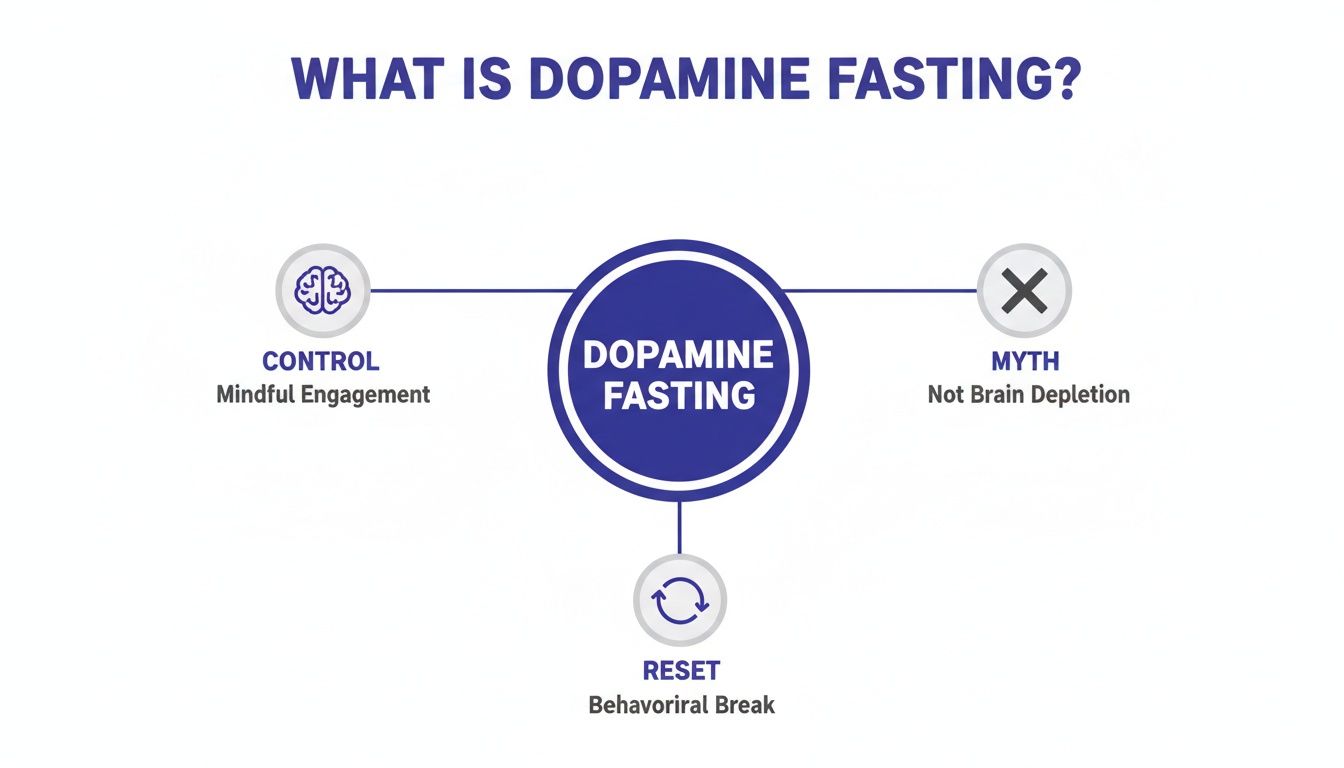
    A dopamine detox is simply a period where you intentionally step away from high-stimulation activities—think social media, streaming marathons, or gaming—to let your brain's reward system reset.

    It’s not about getting rid of dopamine, which is impossible and something you wouldn't want anyway. The real goal is to reduce the constant barrage of overstimulation so you can sharpen your focus, find joy in simpler pleasures again, and just feel more balanced.

    Why You Might Need a Dopamine Detox

    Mind Clarity Hub is reader-supported. When you buy through links on our site, we may earn an affiliate commission at no extra cost to you. We recommend only products we believe in.

    Ever feel like you’re in a constant chase for the next notification, the next scroll, the next little distraction? You’re definitely not alone. According to neuroscience, our brains are hardwired with a powerful reward system fueled by a neurotransmitter called dopamine. This chemical messenger is crucial; it’s what motivates us to seek out things we need for survival and happiness, like a good meal or connecting with friends.

    The problem is, modern life has hijacked this system. We’re drowning in easy, high-impact rewards. Social media feeds, endless Netflix queues, and a nonstop stream of notifications deliver quick, potent hits of dopamine, far more intense than what our brains evolved for.

    Over time, your brain adapts by becoming less sensitive to it. Suddenly, simple activities like reading a book or going for a quiet walk feel… boring. They just can't compete with the intense buzz from our digital lives. This is where the whole concept of a "dopamine detox" comes into play. It’s a practical strategy to let those reward pathways in your brain recalibrate. By temporarily cutting out the high-dopamine triggers, you give your baseline sensitivity a chance to return to normal.

    The Real-World Impact of Dopamine Overload

    Picture a freelance writer on a tight deadline. They sit down to work, but their phone buzzes. Just a quick check. Then an email notification dings. Another quick check. Before they know it, an hour has evaporated, and they’ve written maybe two sentences, leaving them feeling anxious and completely unmotivated. This is a common behavioral loop that a dopamine detox can help break.

    This scenario gets right to the heart of the issue: when your brain is conditioned to expect constant stimulation, focused work feels impossibly hard and unrewarding. As we explore in our guide on dopamine and motivation, this dysregulation is a major player in many modern mental health struggles. When we're chronically overstimulated, it can lead to mood swings, a nosedive in motivation, and poor impulse control.

    At its core, a dopamine detox is about learning how to declutter your mind by turning down the external noise. For some, tools like a phone lock box timer can be a game-changer, creating the physical separation needed to break the cycle.

    Educational Disclaimer: This article is for informational purposes only. It is not a substitute for professional medical or psychological advice, diagnosis, or treatment. If you are struggling with anxiety, depression, ADHD, burnout, or sleep problems, please consult a qualified healthcare provider.

    Signs You Could Benefit From a Reset

    Recognizing that your habits might be working against you is the first real step. If you’re not sure whether you’ve crossed a line, the table below breaks down some of the common signs that your dopamine system is running on fumes.

    See if any of these sound familiar. If they do, a dopamine detox could be a powerful experiment in reclaiming your mental space.

    H4 Signs You Might Benefit from a Dopamine Detox

    Symptom / FeelingWhat It Looks Like in Daily LifePotential Connection to Dopamine
    AnhedoniaActivities you once loved (hobbies, socializing) now feel boring or like a chore.Your brain’s reward baseline is so high from intense stimuli that simpler pleasures no longer register.
    ProcrastinationYou constantly put off important tasks in favor of easy distractions like scrolling or watching videos.Your brain is prioritizing the instant, high-dopamine hit over rewards that require effort and delay.
    Brain FogYou struggle to concentrate, feel mentally sluggish, and have a hard time making decisions.Chronic overstimulation can wear down executive functions like attention and clear thinking.
    IrritabilityYou feel agitated or restless when you can’t access your phone, snacks, or other usual stimuli.This is a mild withdrawal response as your brain craves the dopamine source it has come to expect.
    Poor Impulse ControlYou find yourself mindlessly online shopping, binge-watching, or overeating without really enjoying it.Your reward system is driving your behavior on autopilot, without your conscious input.

    If these symptoms resonate with you, it's a strong signal that a reset could help. By taking a deliberate break, you can rediscover the genuine satisfaction that comes from slower, more meaningful activities—a key theme in the book The Power of Clarity. Pairing this self-awareness with a simple tool like a time blocking planner can also help you start structuring your days with more intention, right from the get-go.

    How to Prepare for Your Dopamine Detox

    Jumping into a dopamine detox without a plan is like setting out on a road trip with no map. Real, lasting success doesn't come from brute-forcing your way through it; it starts with thoughtful preparation. The goal here isn't to endure deprivation. It's about setting yourself up to smoothly reset your system for better mental clarity and focus.

    The first real step is to get brutally honest about your biggest, most persistent dopamine triggers. These are the specific habits that pull you away from your intentions and leave you feeling drained. Think about what you automatically reach for when you're bored, stressed, or just trying to put something off.

    Pinpoint Your Personal Triggers

    To get started, take a hard look at your daily routines. For most of us, the primary culprits are digital, but they can just as easily be related to food, shopping, or other behaviors.

    • Digital Distractions: Which apps do you open without even thinking? Is it the endless scroll on Instagram, the quick-hit videos on TikTok, or the constant buzz of a group chat that you can't seem to ignore?
    • Consumable Habits: Are you reaching for sugary snacks or another coffee for a quick energy spike? Do you find yourself ordering takeout as a reward after a tough day, even when you planned to cook?
    • Behavioral Loops: This could be anything from mindlessly browsing online stores to binge-watching a series you're not even that invested in anymore.

    Once you have a list, you can build a clear plan. Something as simple as a habit tracker journal can be invaluable here, helping you spot the patterns you might otherwise miss. Recognizing these triggers is the first move toward reclaiming your attention, a key concept in Attention Unleashed.

    Set Your Intentions and Environment

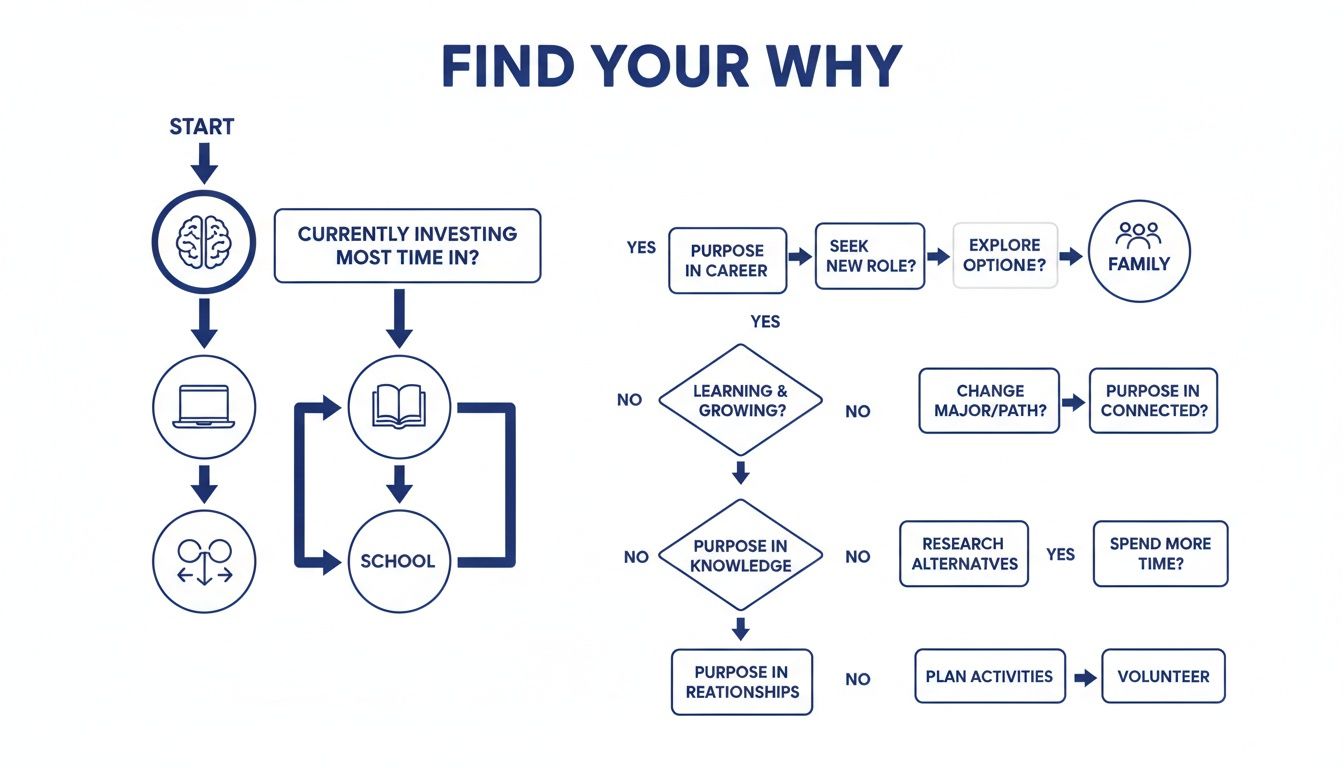
    With your triggers identified, the next step is to define what you're actually trying to achieve. Why are you doing this dopamine detox in the first place? Your answer will be your anchor when things get challenging.

    Your "Why" could be anything from:

    • "I want to be more present with my family in the evenings instead of staring at my phone."
    • "I need to regain deep focus to finish my final project without getting sidetracked."
    • "I want to find joy in quiet, simple activities like reading a book again."

    Write these intentions down in a productivity journal to keep them front and center. From there, it's time to prep your physical and digital spaces to support these goals. This is all about decluttering your environment to minimize friction and distractions. You can find more strategies in our guide to digital detox tips for creating a more focused space.

    For example, a student gearing up for a 7-day detox before final exams. They would start by deleting distracting apps from their phone and computer—not just hiding them, but removing them entirely. Then, they would clean their desk, meal prep healthy snacks to sidestep sugary cravings, and schedule low-stimulation activities like daily walks or meditation. They might even grab a pair of blue light blocking glasses to protect their sleep quality during late-night study sessions.

    This prep phase is about making the right choices the easy choices. By designing an environment that aligns with your goals, you're not relying solely on willpower. You're building a system for success—a powerful way to get back the focus you're looking for.

    Creating a Dopamine Detox Plan for Your Lifestyle

    A successful dopamine detox isn't about grinding through a rigid, one-size-fits-all protocol. It’s about finding a plan that fits your life, your goals, and what you can realistically handle right now.

    Whether you just need a quick circuit breaker or a deeper reset of your daily habits, there’s a path that will work. Each of these plans is designed to gently lower your brain’s reward baseline. By intentionally trading high-stimulation habits for quieter alternatives, you give your dopamine receptors a chance to re-sensitize, making everyday joys feel rewarding again.

    Think of it like this: preparation is everything. Before you start, you need a clear map of your triggers, your intentions, and your plan.

    As the diagram shows, knowing why you’re doing this and what you’ll do instead of your usual habits makes the entire process feel less like a struggle and more like a strategy.

    To make choosing a plan easier, here’s a quick overview of the three main approaches.

    Your Dopamine Detox Plan At a Glance

    DurationPrimary GoalWhat to Avoid (Examples)What to Embrace (Examples)
    24-HourQuick ResetSocial media, streaming, video games, processed sugar, non-essential phone use.Nature walks, reading a physical book, creative hobbies (drawing, writing), quiet reflection.
    7-DayDeep CleanseAll of the above, plus a focus on single-tasking and reducing digital noise during work.Morning walks without a phone, Pomodoro timers, structured offline time, journaling.
    30-DayLifestyle IntegrationMindless scrolling, binge-watching, late-night screen time, constant notifications.Scheduled “boredom” nights, intentional media consumption, firm digital boundaries (e.g., no phone after 9 PM).

    Each of these plans targets a different level of digital fatigue and habit change, so you can pick the one that best matches your current needs.

    The 24-Hour Quick Reset

    Think of this as hitting the emergency stop button. The goal of a one-day detox is to abruptly halt the constant flood of stimulation, giving your mind a brief but potent rest. It’s perfect for a weekend when you feel mentally fried and just need to hear your own thoughts again.

    For just 24 hours, you’ll commit to avoiding your biggest dopamine triggers.

    • What to Restrict: Social media, streaming services, video games, processed foods, and any non-essential phone use. A great first step is using an analog alarm clock so your phone isn’t the first thing you touch.
    • What to Embrace: Go for a long walk in the woods, pick up a physical book, pull out a dusty sketchbook, or simply sit in quiet reflection.

    This short break can feel surprisingly powerful. It shatters the autopilot routine of reaching for your phone at every micro-pause and reminds you that you can exist peacefully without constant input. If you’re interested in going further, our guide on how to reset your dopamine for focus and clarity offers more strategies.

    The 7-Day Deep Cleanse

    A full week gives you enough time to feel real shifts in your mood, focus, and cravings. This plan is ideal if you’re flirting with burnout or feel like your attention is constantly being hijacked by technology.

    Imagine an entrepreneur who starts their day scrolling news feeds, feeling a spike of anxiety before work even begins. For their 7-day detox, they swap that habit for a 20-minute morning walk, leaving their phone at home.

    During the workday, they commit to single-tasking, using a pomodoro timer to structure 25-minute focus blocks. A good pair of noise canceling headphones helps them stay in the zone when the urge to get distracted hits. This type of deep work is a core theme in Focus Recharged.

    By the end of the week, they notice their baseline anxiety has dropped, and their ability to concentrate on deep work has dramatically improved. This is a key move for anyone feeling overwhelmed and needing to reclaim their professional edge.

    The 30-Day Lifestyle Integration

    This month-long plan isn’t about total abstinence; it’s about mindful integration. The goal here is to fundamentally change your relationship with high-dopamine activities, building sustainable habits that stick around long after the 30 days are up.

    This kind of intentional reset is more needed than ever. In the years following the pandemic, digital addiction and compulsive behaviors surged as people sought relief from stress and isolation. One study found that nearly 60% of U.S. adults reported turning to substance abuse or behaviors like internet gambling as a coping mechanism. This shows just how easily our routines can slip into dopamine-chasing cycles when we’re under pressure.

    For a 30-day plan, you don’t eliminate everything. You choose specific behaviors to reduce.

    You might:

    • Set Firm Boundaries: No social media after 9 PM.
    • Schedule “Boredom”: Dedicate one evening a week to quiet, low-stimulation activities like journaling or listening to music without doing anything else.
    • Practice Intentional Consumption: Watch one movie with your full attention instead of binge-watching a series while scrolling on your phone. A visual timer for desk can be a great physical cue to block out dedicated offline time.

    This extended period gives your brain the time it needs to truly adapt. You’re building new, healthier reward pathways that make it easier to find satisfaction in the quiet, slower parts of life.

    Navigating Challenges and Reintegrating Mindfully

    Kicking off a dopamine detox is a huge first step, but the real work—and the real reward—comes from navigating the messy middle. The journey isn’t always a straight line. You’re almost certain to run into intense boredom, nagging cravings for your old digital habits, and maybe even some social pressure from friends who don’t quite get it.

    It’s important to know this is completely normal. In fact, it’s a sign that your brain is starting to do the hard work of recalibrating.

    From a neuroscience perspective, that feeling of boredom is really just the void left behind by constant stimulation. Your brain, accustomed to a firehose of dopamine, is essentially protesting now that the tap has been turned off. The trick isn’t to immediately rush to fill that void. It’s to sit with the discomfort.

    This is where mindfulness becomes your superpower. Instead of fighting a craving, you just… watch it. Observe it without judgment. This simple practice helps weaken the automatic, deeply grooved connection between an impulse and your action. For those looking to deepen this practice, some people find that meditating with crystals to unlock focus and mindfulness can be a useful anchor.

    Overcoming Common Hurdles

    When these uncomfortable feelings show up—and they will—having a game plan is everything. It’s what stops you from snapping back to your old patterns on autopilot.

    • For Boredom: Keep a list of low-stimulation activities handy. Think reading a physical book, taking a walk without your headphones, or just sketching in a notebook. An under desk walking pad can be a fantastic tool here, letting you pair gentle movement with a quiet activity.
    • For Cravings: Try the “urge surfing” technique. Acknowledge the craving is there, remind yourself it’s just a temporary electrical storm in your brain, and then mentally watch it rise and fall like a wave. Each time you do this, you build a little more resilience.
    • For Social Pressure: Just be upfront with your friends. Instead of making excuses, suggest activities that don’t revolve around high-dopamine triggers. Think hiking or cooking a meal together instead of hitting a loud bar or binge-watching a new series.

    These strategies aren’t just about willpower; they’re about building entirely new pathways in your brain. You’re teaching it that satisfaction doesn’t have to come from a screen. For a deeper look at how this works, our guide on the neuroscience of single-tasking explains how focused attention physically reshapes your brain.

    The Art of Mindful Reintegration

    The end of your detox isn’t a finish line. It’s a new starting line. The whole point isn’t to live in a state of permanent deprivation, but to find a sustainable, lasting balance. If you just cannonball back into your old habits, you’ll undo all your hard work in a matter of days.

    The key is to reintroduce technology and other stimuli slowly, and with intention.

    Real-World Scenario: The Remote Worker’s Return
    After a 7-day detox, a remote worker named Alex feels calmer and more focused than she has in years. To protect that feeling, she creates a simple reintegration plan. She only reinstalls the apps that are truly essential to her phone and sets firm time limits. Evenings after 8 PM are now a designated ‘digital-free’ zone, a boundary she clearly communicates to her team. She also optimizes her workspace for focus with a quality ergonomic keyboard and an organized laptop stand for desk.

    This kind of phased approach prevents the shock of overstimulation. You’re teaching your brain a new, healthier relationship with the modern world. You get to decide when and how to engage, rather than letting algorithms dictate your attention. It’s this principle of intentionality that allows for a sustainable balance in our lives. A good ergonomic mouse can also make your screen time more comfortable, reinforcing the positive feeling of working with intention, not compulsion.

    Editor’s Take on Dopamine Detox

    So, what’s the real story with a dopamine detox? Let’s get straight to it.

    The term itself isn’t some rigid clinical diagnosis you’d find in a textbook. It’s much better understood as a modern framework—a useful mental model for resetting our often-unhealthy relationship with the constant buzz of modern life.

    I’ve found that the most effective approach isn’t about painfully eliminating every single thing you enjoy. That’s a recipe for failure. Instead, it’s about intentionally reducing the high-impact, low-effort stimuli and consciously replacing them with activities that offer a slower, more genuine sense of reward.

    Think less about total deprivation and more about rediscovering balance.

    Who Is a Dopamine Detox Best For?

    This kind of reset is incredibly valuable if you’re feeling overwhelmed, scattered, or just plain burned out by the non-stop hum of digital life. If your focus feels fragmented and your motivation has taken a nosedive, a structured detox can work wonders.

    But it’s just as important to know what it isn’t.

    A dopamine detox is a self-improvement tool, not a clinical treatment. It is not a substitute for professional medical or psychological care for conditions like anxiety, depression, or ADHD. The goal is progress, not perfection.

    At the end of the day, the real win isn’t just surviving a detox period. It’s about integrating the lessons learned into a more mindful daily rhythm. Consistent, intentional effort toward finding a healthier equilibrium is what delivers lasting benefits for your focus, mood, and overall well-being.

    You can explore more on building these kinds of sustainable habits in The Power of Clarity.

    Key Takeaways on Your Dopamine Detox Journey

    • It’s a Reset, Not a Removal: Think of it like recalibrating a sensitive instrument. You’re not trying to get rid of dopamine, which is essential. You’re just making your brain less numb to everyday rewards.
    • Identify Triggers: Before you start, get clear on your personal high-dopamine habits, whether it’s social media, sugary snacks, or online shopping. Awareness is the first step.
    • Start Small, Build Momentum: You don’t need to go on a month-long silent retreat to see a change. A simple 24-hour detox can be incredibly powerful for shifting your perspective. Pick a plan that actually fits your life.
    • Embrace Boredom: When you feel that itchy, restless, bored sensation, that’s a good sign. From a behavioral psychology perspective, it’s your brain beginning to adjust. Don’t run from it.
    • Reintegration Is Everything: This isn’t about permanent restriction. The goal is to build a long-term, more intentional relationship with technology and other high-dopamine activities. When you reintroduce them, do it slowly and mindfully.

    Your Dopamine Detox Questions, Answered

    Jumping into a dopamine detox can feel a little strange, and it’s totally normal to have questions. You’re essentially rewiring some deep-seated habits, so a bit of uncertainty comes with the territory. This section is here to clear up the most common questions, giving you the confidence to start your reset and see it through.

    Here are straightforward, no-fluff answers to help you navigate the experience.

    1. What Do I Do If I Feel Miserable or Bored During a Detox?

    Feeling bored, restless, or even a bit down is completely normal, especially in the first few days. That discomfort is actually a good sign. From a neuroscience perspective, it means the process is working. Your brain, used to a firehose of stimulation, is now facing a quiet room and sending out protest signals—cravings—to get back to its noisy baseline.

    Instead of fighting the feeling, try to lean into it. Acknowledge the boredom without judgment. The trick is to have a pre-planned list of low-dopamine activities ready to go, like reading a physical book, taking a walk, journaling, or sketching. This phase is temporary and a crucial part of your brain recalibrating its reward system.

    2. Can I Listen to Music During a Dopamine Detox?

    This is a big one. The answer depends entirely on your goals and how strict you want to be. Music absolutely triggers a dopamine release; research has shown that your favorite songs light up the brain’s reward centers. For a very strict, short-term reset (like 24 hours), it’s best to abstain from music to give your brain a complete rest from external stimuli.

    For longer detoxes, like 7 or 30 days, you can be more flexible. If you decide to include music, consider instrumental, classical, or ambient tracks without lyrics, as they are generally less stimulating. The key is your intention: are you using it as mindless background noise or as a focused, mindful activity?

    3. How Often Should I Do a Dopamine Detox?

    There’s no magic number here; it really depends on your lifestyle, your work, and how you feel. Think of it like a mental health check-up.

    • A monthly 24-hour reset is great for regular maintenance to keep digital habits in check.
    • A quarterly 7-day deep cleanse can be a lifesaver if you’re in a high-stress role or feel burnout creeping in.
    • An annual 30-day integration can help you fundamentally reshape your relationship with technology and other high-dopamine habits for the long haul.

    Pay attention to your own signals. If you notice your focus slipping, procrastination climbing, or simple joys feeling dull, it might be time for another reset.

    4. Will a Dopamine Detox Help with My Sleep Problems?

    For many people, the answer is a resounding yes. Overstimulation, especially from screens right before bed, can disrupt your body’s natural sleep-wake cycle. The blue light from our devices suppresses melatonin, the hormone that signals it’s time to sleep.

    By cutting out late-night scrolling and binge-watching, you give your brain the quiet time it needs to power down. Swapping your phone for a book is a classic for a reason. Combining this with tools like a gentle sunrise alarm clock, a quality sleep mask blackout, and a white noise machine can create a powerful sleep sanctuary. Improving sleep hygiene is a core benefit, and something we explore in our book, Restful Nights. Some also find that a magnesium glycinate supplement helps promote relaxation before bed.

    5. What’s the Difference Between a Dopamine Detox and a Digital Detox?

    The terms are often used interchangeably, but there’s a key distinction. A digital detox is laser-focused on abstaining from digital devices—phones, computers, social media, the works. It’s all about breaking the screen habit, a central topic in Digital Clarity.

    A dopamine detox is broader. While it almost always includes a digital detox, it can also encompass other high-stimulation, non-digital activities. Think processed sugar, compulsive shopping, porn, or gambling. The goal is to reset the brain’s overall reward circuitry, not just your relationship with technology.

    What to expect during your dopamine detox

    6. Can a Dopamine Detox Cure My Anxiety or Depression?

    This is critical: a dopamine detox is a self-improvement strategy, not a cure or medical treatment for clinical conditions like anxiety or depression. While reducing overstimulation and building healthier habits can absolutely improve your mood and lower stress, it doesn’t address the complex biological and psychological roots of these conditions.

    If you are struggling with anxiety, depression, or other mental health concerns, your first step should always be to seek guidance from a qualified healthcare professional. A dopamine detox can be a supportive practice alongside professional care, but it should never, ever replace it.

    7. Why Do I Feel More Irritable or Anxious at First?

    That initial spike in negative feelings is a form of withdrawal. Your brain has grown accustomed to a certain level of dopamine from your daily habits. When you suddenly yank those sources away, your brain’s chemistry is thrown off balance, leading to irritability, restlessness, and anxiety.

    This is actually a positive sign that your brain is beginning to adapt. Stick with it. These feelings typically subside within a few days as your brain’s reward pathways start to find their new, healthier baseline.

    8. Will I Lose My Social Connections During a Detox?

    It’s a valid concern in our hyper-connected world. The key here is to be proactive. Let your close friends and family know you’re taking a break from digital communication for a set period and briefly explain why.

    Better yet, use the detox as an opportunity for more meaningful connection. Instead of texting, suggest meeting for a walk, cooking a meal together, or having a phone-free coffee. You might find the quality of your social interactions improves dramatically when you’re fully present. Rebuilding connections is something we cover in our book Connected Again.

    9. What if I Relapse and Binge on Social Media?

    A relapse isn’t a failure—it’s a data point. If you find yourself slipping back into old habits, don’t beat yourself up. Get curious. Ask yourself what triggered it. Were you feeling stressed? Bored? Lonely?

    Understanding your triggers is the key to building a more resilient strategy for the future. This whole process is about learning what works for you, and occasional missteps are part of that. For more on this, our guide explores if a dopamine detox is real or a myth and how to approach it realistically.

    10. Is This Just a Fad, or Is It Based on Science?

    The term “dopamine detox” is definitely a pop-psychology phrase, but the principles behind it are firmly grounded in neuroscience and behavioral psychology. Core concepts like reward pathways, habit formation, and neural adaptation are well-established.

    The modern phenomenon of “dopamine-scrolling” is a real issue, with billions of us caught in cycles of seeking novelty through endless feeds. This behavior fragments our attention and desensitizes our pleasure centers, making it harder to find joy in everyday life. You can read more about the science behind these digital age challenges on SAGE Journals.

    So, while “dopamine detox” isn’t a clinical term, the practice of temporarily abstaining from high-stimulation activities to reset these pathways is a practical application of solid scientific principles. Adding a simple monitor light bar to your desk can also help reduce eye strain, making intentional screen time more comfortable and less draining.


    Disclaimer: This website is reader-supported. We may earn a small commission from purchases made through our links, at no extra cost to you. This article is intended for educational purposes only and does not constitute medical or psychological advice. Please consult a qualified professional for any health concerns.

  • A Practical Guide to Clarity Mental Health

    A Practical Guide to Clarity Mental Health


    Affiliate Disclosure: This post may contain affiliate links. If you purchase through these links, we may earn a small commission at no extra cost to you.


    Mental clarity isn’t just about feeling “not stressed.” It’s that sharp, grounded state where your thoughts are organized, your focus is steady, and you can process what’s in front of you without feeling scattered. In psychology, this is often linked to executive functions—the set of mental skills that include working memory, flexible thinking, and self-control.

    Think of it as the foundation for everything else. Without it, productivity grinds to a halt and your emotional balance feels shaky at best.

    Understanding Clarity Mental Health and Why It Matters

    Does your day ever feel like a constant battle against digital noise?

    You’re trying to nail down a critical report, but your phone keeps buzzing. Emails pour in. Slack notifications demand an immediate reply. Each little ping pulls your attention away, and by lunchtime, your focus is completely fragmented. This is a common contributor to burnout and anxiety in the modern workplace.

    That feeling—often called “brain fog”—has become the default state for countless professionals, entrepreneurs, and students. Behavioral research suggests this is due to constant context-switching, which depletes our finite cognitive resources. If it sounds familiar, our guide on what causes brain fog breaks down the hidden drivers behind it.

    A focused businessman in a suit uses a smartphone and laptop, surrounded by glowing chat icons, demonstrating the need for clarity mental health.

    This isn’t just a minor annoyance; it points to a much bigger challenge. Globally, over 1 billion people are now living with a mental health condition, a significant jump from 970 million just a few years back. With anxiety and depression leading the way, achieving mental clarity has moved from a “nice-to-have” to a necessary tool for navigating modern life.

    Disclaimer: This article is for educational purposes only and is not a substitute for professional medical or psychological advice, diagnosis, or treatment. If you are experiencing symptoms of anxiety, depression, ADHD, burnout, or sleep problems, please consult a qualified healthcare provider.

    Why a Clear Mind Matters for Your Mental Health Now More Than Ever

    When you achieve mental clarity, you reclaim your cognitive resources. Instead of just reacting to every distraction that pops up, you can finally engage in deep, meaningful work. This process strengthens your ability to manage your mood and behavior effectively.

    This state of focused awareness allows you to:

    • Make Better Decisions: A clear mind weighs options logically, free from the clouds of stress and mental clutter. Neuroscience shows that stress impairs the prefrontal cortex, the brain’s decision-making center.
    • Boost Productivity: When you can fully concentrate on one thing at a time, both the quality and efficiency of your work skyrocket. This is a core principle of behavioral psychology known as “deep work.”
    • Enhance Well-being: Mental clarity dials down the feelings of overwhelm and anxiety, giving you a greater sense of calm and control over your life, which directly impacts your mood.

    Learning to manage our own mental faculties is a game-changer. For a deeper look into this, the concepts around the power of the mind offer practical insights. Ultimately, this guide provides a neuroscience-backed roadmap to help you cut through the noise and get your focus back.

    The Neuroscience of a Cluttered Mind and Poor Clarity Mental Health

    Ever wonder what’s actually happening in your brain when you feel scattered and overwhelmed? It’s not just a vague feeling—it’s a biological response grounded in neuroscience. Getting a handle on the neuroscience behind a cluttered mind is the first real step toward reclaiming your focus and improving your clarity mental health.

    Think of your brain’s prefrontal cortex (PFC) as its Chief Executive Officer. This area, right behind your forehead, is in charge of complex decisions, planning, and holding your focus steady. But just like any CEO, it has a limited capacity and can get completely overloaded.

    When your phone buzzes with notifications or you’re trying to juggle a dozen open tabs, you’re flooding your PFC with more information than it can process. This cognitive overload is a direct cause of mental fog and poor focus.

    How Your Brain’s Focus Gets Hijacked

    Modern digital life has created a perfect storm for cognitive overload. Two key players in this hijack are the neurochemicals dopamine and cortisol, and their effects on your brain and behavior are incredibly powerful.

    • Dopamine Loops: Have you ever found yourself mindlessly scrolling through a social media feed, only to look up and realize an hour has vanished? Many apps are engineered from behavioral psychology principles to trigger a dopamine loop. Dopamine is a neurotransmitter tied to pleasure and motivation. Each notification or “like” delivers a tiny hit of it, training your brain to seek out more and more. This creates a powerful habit cycle that hijacks your attention, making it incredibly difficult to focus on tasks that don’t offer the same instant reward.
    • Cortisol Overload: Chronic stress, whether from looming deadlines or the pressure of constant connectivity, keeps your body stuck in a state of high alert. This floods your system with cortisol, the main stress hormone. While cortisol is useful in short bursts for “fight or flight” moments, neuroscience research shows that sustained high levels are damaging. It can directly impair memory, shrink the prefrontal cortex, and interfere with clear thinking and mood regulation.

    When your brain is constantly chasing dopamine hits and swimming in cortisol, its ability to do deep, focused work is severely compromised. This isn’t a failure of willpower; it’s a predictable neurological reaction affecting your behavior.

    A Real-World Example of Cognitive Overload

    Imagine a remote worker, Alex, who is trying to finalize an important quarterly report. The deadline is just hours away.

    Suddenly, a Slack message from her manager pops up. An email notification follows. Then her phone buzzes with a social media alert. In just five minutes, her brain is forced to switch contexts three separate times. Each one of those switches drains a small amount of mental energy, pulling her further and further away from her main task.

    Her PFC is struggling to keep all the mental “tabs” open—the report data, the manager’s request, the new email. Her brain starts pumping out cortisol because of the deadline pressure, clouding her judgment even more. The quick dopamine hit from checking her phone makes the report seem even more boring and difficult by comparison.

    The result? Alex feels frazzled, unproductive, and mentally exhausted. Her mental clarity has taken a serious hit.

    This scenario shows exactly how our daily digital habits impact our brain’s performance and behavior. The key isn’t to blame ourselves, but to learn how to manage these external triggers. In fact, developing strategies for improving focus and concentration is a core part of rebuilding your mental clarity in a noisy world. By understanding these neurological processes, you can start to work with your brain instead of against it.

    Identifying the Obstacles to Your Clarity Mental Health

    Knowing the science behind a cluttered mind is a great first step. Now, let’s get specific and pinpoint the culprits actively stealing your focus and draining your mental energy. Recognizing these obstacles is what allows you to move from a vague feeling of being overwhelmed to a clear plan for rebuilding your clarity mental health.

    For most of us, mental fog isn’t random. It usually stems from a few common, powerful sources that feed off each other. The four biggest roadblocks are digital overload, chronic stress, poor sleep, and a lack of routine.

    Digital Overload: The Constant Barrage

    Digital overload is what happens when the sheer volume of information, pings, and notifications simply overwhelms your brain’s capacity to process it all. Your prefrontal cortex—the part of your brain in charge of focus and decision-making—gets short-circuited by the constant context switching. This isn’t just a feeling of being busy; it’s a neurological state of perpetual interruption.

    A perfect example is Sarah, a freelance graphic designer. She starts her morning with a solid plan to finish a major client project. But within the first hour, she’s hit with three client emails, a dozen Slack messages, and countless social media alerts. Each ping yanks her focus away, and by noon, she’s frazzled and has made almost zero progress on her most important task. Her mood sours as a result.

    Her productivity tanked not from a lack of skill, but because of constant digital interruptions. This scenario highlights a core problem you can explore further in our guide on the neurology of digital overwhelm and attention hijacking.

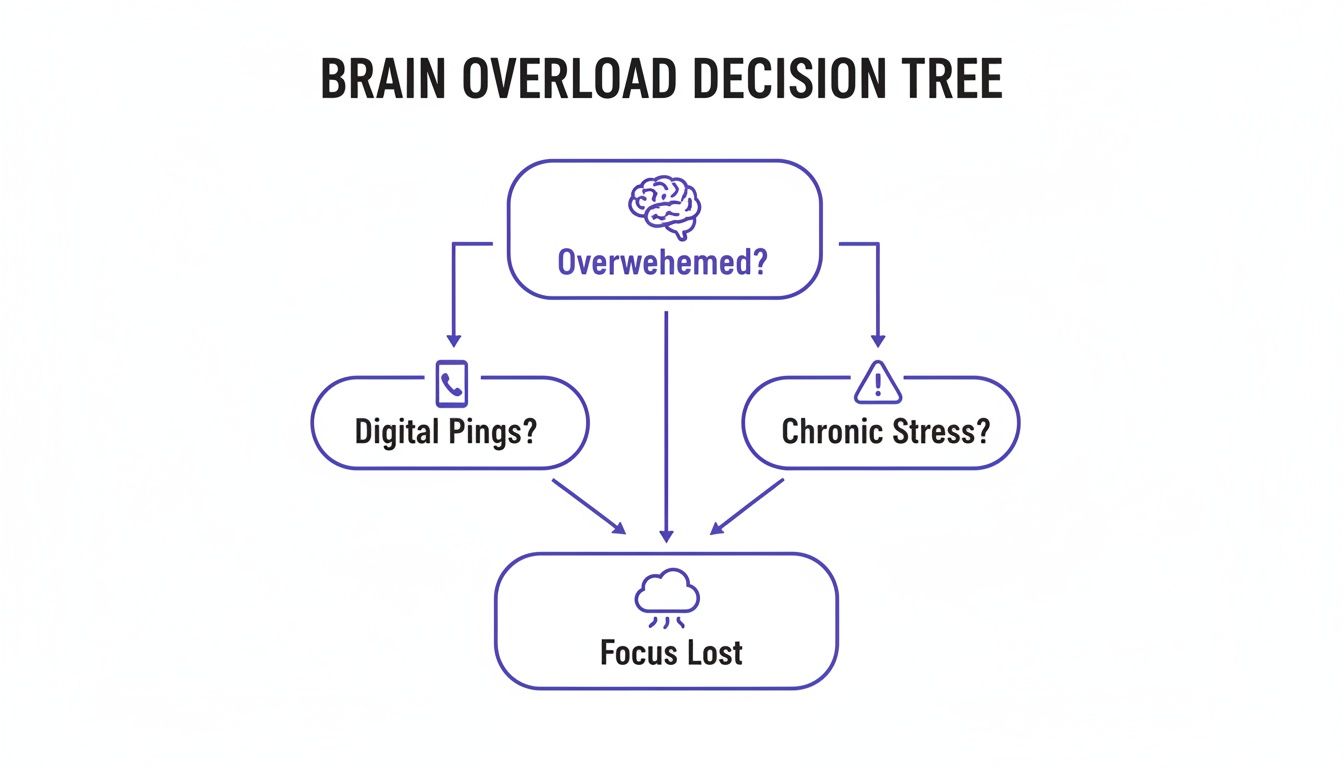
    This chart helps visualize how even tiny interruptions can cascade into a significant loss of focus.

    Decision tree flowchart showing how overwhelm from digital pings and chronic stress results in lost focus, impacting clarity mental health.

    As you can see, both the constant digital pings and the slow burn of chronic stress are direct pathways to feeling overwhelmed and losing your focus.

    To help you connect these concepts to your own experience, the table below breaks down the common causes of mental fog and their tangible effects on daily life.

    Common Obstacles to Mental Clarity and Their Impact

    ObstacleNeurological Impact (Simplified)Real-World Example
    Digital OverloadOverwhelms the prefrontal cortex with constant context switching, leading to attention fragmentation.Bouncing between emails, Slack, and project tabs leaves you feeling busy but unproductive at the end of the day.
    Chronic StressElevates cortisol, which impairs memory, executive function, and clear decision-making.Feeling constantly “on edge” makes it hard to solve complex problems or think creatively under pressure.
    Poor SleepPrevents the brain from clearing metabolic waste and consolidating memories, resulting in grogginess.Forgetting key details from a meeting the previous day because you only got four hours of restless sleep.
    Lack of RoutineLeads to decision fatigue by forcing the brain to make countless minor choices, depleting mental energy.Wasting your best morning energy deciding what to work on first instead of starting your most important task.

    By identifying which of these obstacles are most active in your life, you can choose the right strategies to counter them effectively and start reclaiming your cognitive space.

    Chronic Stress: The Silent Focus Killer

    While a little short-term stress can be motivating, chronic stress does the exact opposite. When you’re constantly under pressure, your body is flooded with the stress hormone cortisol. As we’ve touched on, elevated cortisol levels directly get in the way of memory formation and executive functions, making clear thinking feel next to impossible. This negatively impacts your mood and overall behavior.

    It’s like trying to run complex software on a computer that has a virus chewing up resources in the background—everything slows down, lags, and becomes prone to crashing. Over time, this sustained stress leads to burnout and a persistent state of mental fog.

    Poor Sleep Hygiene: The Unseen Saboteur of Your Brain

    Mental clarity and quality sleep are fundamentally tied together. During deep sleep, your brain is hard at work clearing out metabolic waste products that build up while you’re awake, a process neuroscientists call the glymphatic system. This is also when your brain consolidates memories, moving important information from short-term to long-term storage.

    When you don’t get enough restorative sleep, these vital housekeeping processes get cut short. You’re essentially starting the day with a brain that hasn’t been properly “cleaned,” leaving you feeling groggy, irritable, and mentally slow.

    Take Mark, a college student prepping for finals. He pulls two all-nighters, thinking more study time means better grades. In the exam, however, he struggles to recall concepts he reviewed just hours before. His brain, deprived of the sleep it needed to lock in that information, simply couldn’t hold onto it.

    A single night of poor sleep can significantly reduce cognitive performance. Consistently neglecting sleep is one of the fastest ways to erode your mental clarity.

    Lack of Routine: The Drain of Decision Fatigue

    A day without any structure might sound freeing, but it often has the opposite effect. Without established habits, your brain is forced to make an endless stream of small decisions from the moment you wake up. What should I work on first? When should I take a break? What’s for lunch?

    Each one of these choices, no matter how tiny, consumes a bit of your finite mental energy. This phenomenon, known as decision fatigue in behavioral psychology, wears down your self-control and your ability to make sharp, high-level decisions later on. A solid routine automates the small stuff, saving your best cognitive resources for the work that actually matters.

    Actionable Strategies to Restore Your Clarity Mental Health

    Understanding what’s clouding your mind is the first step. Now, it’s time to actually do something about it.

    Restoring your focus and finding that state of clear thinking doesn’t mean you have to overhaul your entire life overnight. Instead, it’s about weaving small, evidence-backed strategies into your daily rhythm.

    These techniques are designed to work with your brain’s natural wiring, not against it. By making a few practical shifts in your habits, you can start dialing down the mental static and reclaim your best thinking for what truly matters.

    The Gentle Dopamine Detox for Better Brain Function

    The phrase “dopamine detox” often conjures up extreme images, like locking your phone in a safe for a week. A more sustainable—and frankly, more realistic—approach is about creating intentional boundaries, not total deprivation.

    The real goal is simple: give your brain’s reward system a much-needed break from the constant, low-grade stimulation that shatters your attention into a million tiny pieces. This helps reset your focus and improve your mood.

    A powerful way to begin is with a “digital sunset.” This just means setting a firm cutoff time for all screens each evening, ideally 60-90 minutes before you plan to sleep. This one habit dramatically lowers the cognitive buzz that interferes with sleep, which is your brain’s prime time for mental restoration.

    Here’s how to make it stick:

    • Set a hard stop: Pick a non-negotiable time, like 9:00 PM, when you shut down work emails, social media feeds, and news alerts for the night.
    • Swap screens for something analog: Instead of scrolling, pick up a physical book, listen to a calming podcast, or do some light stretching. This helps your brain shift down a gear naturally.
    • Charge your phone in another room: This is a game-changer. Removing the temptation for “one last check” is the easiest way to protect your wind-down period.

    Build a Focused Work Routine with Proven Methods

    When your day lacks structure, your brain is forced to make hundreds of tiny decisions, which leads straight to decision fatigue and wasted mental energy. A focused work routine automates those choices, saving your best cognitive horsepower for deep, meaningful work.

    One of the most effective and time-tested methods for this is the Pomodoro Technique.

    Developed by Francesco Cirillo in the late 1980s, this time-management method is built on a simple psychological insight: our brains work better when we know a break is coming soon. It uses a concept called “timeboxing” to encourage you to dedicate specific, uninterrupted chunks of time to planned tasks.

    The Pomodoro Technique works because it creates a gentle sense of urgency while reassuring your brain that rest is just around the corner. This brilliant balance lowers the mental resistance to starting a tough task and helps you sustain high-quality focus.

    The process is refreshingly simple:

    1. Choose one single task you need to work on.
    2. Set a timer for 25 minutes and give that task your undivided attention. No interruptions.
    3. When the timer goes off, take a short 5-minute break. Get up, stretch, grab some water—just step away from your screen.
    4. After four “Pomodoros,” take a longer, more restorative break of 15-30 minutes.

    This cycle trains your attention span and gives your brain regular chances to rest and consolidate what you’ve just worked on. When mental clutter gets overwhelming, it’s vital to have both immediate and long-term coping mechanisms. You can discover more practical strategies for coping with overwhelming feelings to regain a sense of control and clarity.

    Automate and Delegate with AI Tools for Mental Health

    Let’s be honest: some of the biggest drains on our mental energy today come from repetitive, low-impact administrative tasks. Answering the same questions via email, scheduling meetings back and forth, and summarizing long documents are all necessary evils that tax our cognitive reserves.

    This is where you can intelligently use AI to your advantage.

    By offloading these tasks, you free up your prefrontal cortex to concentrate on the good stuff: complex problem-solving, creative thinking, and strategic planning. Think of AI not as a replacement for your brain, but as a cognitive assistant that handles the busywork. This approach is a powerful way to reclaim your focus and improve your clarity mental health. For more techniques like this, our guide on how to reset your brain offers additional powerful strategies.

    Here are a few ways to put this into practice right now:

    • Email Management: Use tools with AI features to automatically sort your inbox, draft replies to common questions, or create summaries of long, messy email chains.
    • Meeting Support: Let an AI tool transcribe your meetings and generate a clean summary with key action items. This frees you from the mental load of taking detailed notes.
    • Research and Summarization: Instead of slogging through dozens of articles, use an AI assistant to pull out the key findings, giving you the core information in a fraction of the time.

    Implementing even one of these strategies can significantly reduce your daily cognitive load. The key is to start small. Pick a method that tackles your biggest headache and practice it consistently. Over time, these actions compound, creating a strong foundation for lasting mental clarity.

    Disclaimer: The strategies mentioned in this section are for educational purposes. For concerns related to anxiety, depression, ADHD, burnout, or sleep problems, please consult a qualified healthcare professional. This content is not a substitute for medical or psychological care.

    Key Takeaways for Lasting Clarity Mental Health

    Achieving lasting mental clarity isn’t about some grand, one-time fix. It’s about the small, consistent things you do every day to realign your focus and lower your cognitive load. Think of this section as your cheat sheet for a clearer mind.

    Come back to these core ideas anytime you feel that familiar brain fog creeping in. They’re a quick reset to get you back on track for better clarity mental health.

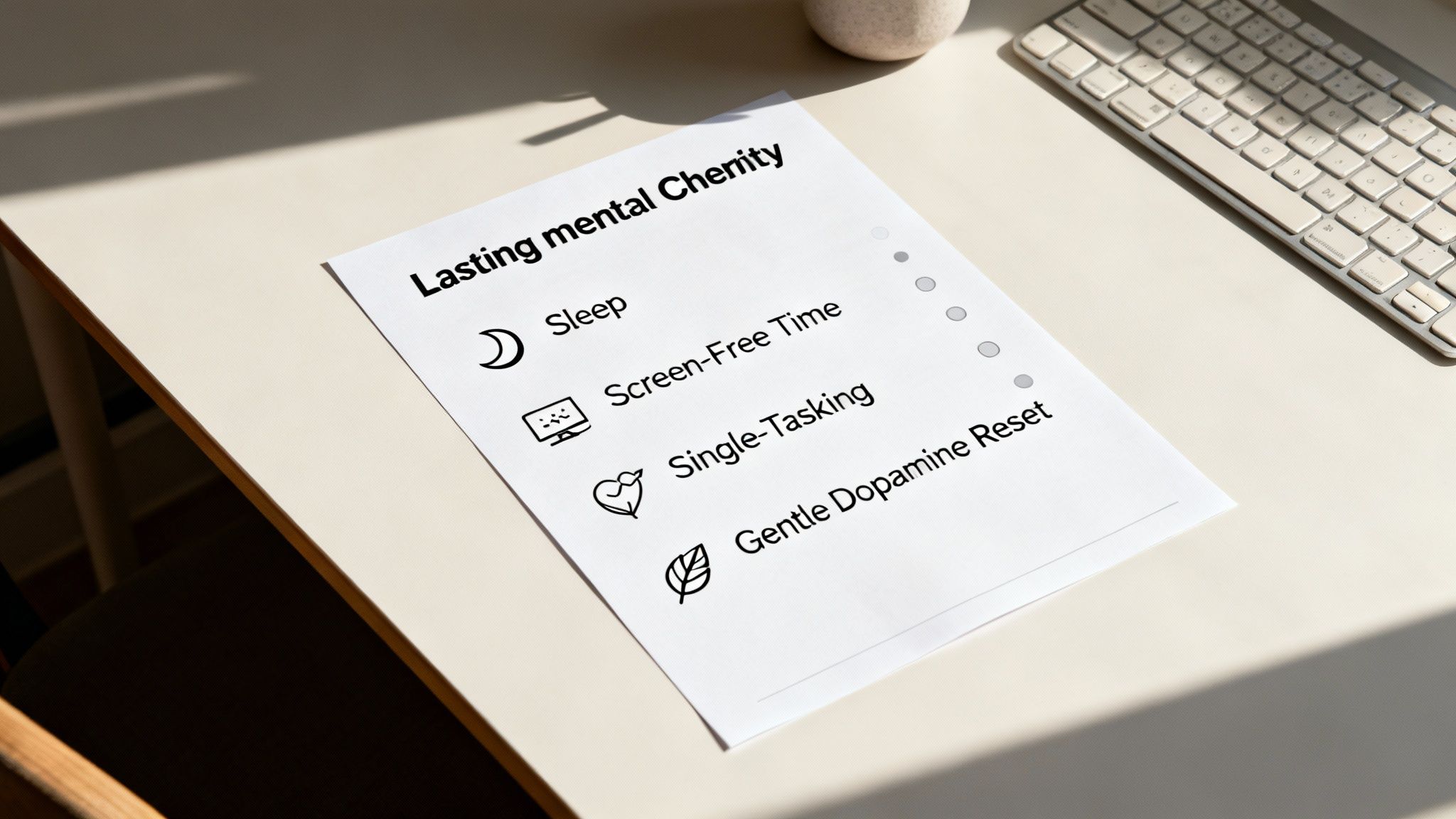
    A checklist on a desk provides tips for lasting mental clarity, including sleep and screen-free time to improve clarity mental health.

    Core Principles for a Clearer Mind

    • Mental clarity is an active state. It’s not just the absence of stress—it’s an organized, sharp mind that allows for better decisions and deeper focus every day.

    • Your brain has limits. The prefrontal cortex, your brain’s CEO, gets overloaded by constant digital pings and chronic stress. This isn’t a personal failure; it’s a predictable neurological response.

    • Pinpoint what’s blocking you. The most common culprits behind mental fog are digital overload, chronic stress, poor sleep, and a lack of routine. Figuring out your main obstacle is the first real step toward a solution.

    • Dopamine loops hijack your attention. Modern apps are engineered to deliver tiny, frequent rewards that train your brain to seek distraction. A gentle dopamine detox helps reset that balance.

    • Structure creates freedom. Routines like the Pomodoro Technique reduce decision fatigue. By automating when and how you work, you save your best mental energy for the tasks that truly count.


    Remember, the goal isn’t perfection—it’s consistent practice. Every small step you take to manage distractions and support your brain’s natural rhythms builds momentum toward sustained mental clarity. These takeaways are your foundation for a more focused, intentional life.

    Editor’s Take: What Really Works for Clarity Mental Health

    Let’s be honest: genuine mental clarity isn’t something you achieve once and then you’re done. It’s a practice—a quiet commitment you make every day to build more intentional habits. This advice is best for busy professionals, students, and creators who feel like modern digital life is slowly draining their cognitive battery.

    What actually works? The most effective strategies are almost always the simplest ones. Things like consistent sleep, carving out screen-free time, and a stubborn refusal to multitask have a powerful ripple effect over time. There’s a real economic incentive, too. While the global cost of anxiety and depression is staggering, some research suggests even a 5% boost in productivity from better mental clarity could unlock hundreds of billions in economic gains. You can explore the full study on the economic impact of mental wellbeing to see the numbers for yourself.

    A critical caveat: this guide is here to help you build better cognitive habits, but it is not a substitute for professional help. If you’re navigating clinical anxiety, depression, or ADHD, please connect with a qualified professional. Progress here is slow and steady, so be patient with yourself as you learn.

    The goal isn’t perfection—it’s consistency. Small, repeated actions are what build real mental clarity and resilience.

    FAQ: Your Clarity Mental Health Questions Answered

    As you start to tune into your own mental state, questions naturally come up. Here, we’ve gathered some of the most common ones we hear from our community, with straightforward answers to reinforce what we’ve covered.

    1. Is brain fog the same as a medical condition?

    For most people, brain fog is a temporary feeling of sluggishness or confusion caused by lifestyle factors like poor sleep, stress, or diet. However, if your brain fog is persistent and severe, it could be a symptom of an underlying medical condition like chronic fatigue syndrome, thyroid issues, or long COVID. This content is educational only; please consult a doctor for diagnosis.

    2. How long should a dopamine detox really last?

    A more accurate term is a dopamine reset. Forget extreme, week-long shutdowns. Instead, focus on building small, consistent boundaries like a “digital sunset” (no screens 60-90 minutes before bed) or a screen-free morning. The goal is consistency over intensity to help your brain become less dependent on constant digital stimulation.

    3. Can you achieve mental clarity with ADHD?

    Yes, absolutely. While ADHD presents unique challenges to focus, achieving clarity is possible by working with your brain’s wiring. Strategies like structured routines (e.g., the Pomodoro Technique), externalizing information with planners, and incorporating movement breaks are incredibly effective. This is educational information, not a substitute for professional ADHD treatment.

    4. What is the difference between mental clarity and mindfulness?

    They are closely related. Mindfulness is the practice of paying attention to the present moment without judgment. Mental clarity is the result—the state of having a sharp, organized, and focused mind that often arises from a consistent mindfulness practice. Think of mindfulness as the act of tidying your mental workspace and clarity as the clean, organized space itself.

    5. How can I stay focused in a noisy office?

    Create a “do not disturb” signal, such as wearing noise-canceling headphones. Use timeboxing to block out specific “deep work” periods on your calendar. If possible, find a quiet space like an empty meeting room for tasks requiring intense concentration. These habits signal to your brain and your colleagues that it’s focus time.

    6. Is burnout just another word for stress?

    No, they are different. Stress is often characterized by over-engagement and urgency—a feeling of “too much.” Burnout is a state of chronic exhaustion, cynicism, and detachment. It’s a feeling of “not enough”—feeling empty, unmotivated, and depleted. Burnout is a more severe condition that requires significant rest and strategic life changes.

    7. Does diet really affect mental clarity?

    Profoundly. Your brain uses about 20% of your body’s calories. A diet high in processed foods and sugar can cause inflammation that impairs cognitive function. Conversely, foods rich in omega-3 fatty acids (like salmon), antioxidants (like berries), and complex carbs (like oats) provide the steady fuel your brain needs for optimal focus and mood.

    8. Can AI tools actually help with burnout?

    Yes, when used intentionally. Burnout is often fueled by a workload of repetitive, low-impact tasks. By using AI to automate things like summarizing meetings, drafting routine emails, or organizing data, you reduce your cognitive load. This frees up your mental energy for the meaningful, creative, and strategic work that feels rewarding.

    9. How do I start building mental clarity today?

    Start small. Don’t try to overhaul your entire life at once. Pick one simple strategy from this guide and commit to it for a week. For example, charge your phone outside your bedroom tonight, try one 25-minute Pomodoro session tomorrow, or take a 10-minute walk without your phone. A small win builds momentum for lasting change.

    10. Why is routine so important for clarity mental health?

    Routines reduce decision fatigue. Every small choice you make throughout the day (what to wear, what to eat, what to work on first) drains a tiny bit of your mental energy. A solid routine automates these minor decisions, preserving your brain’s best resources for complex problem-solving and deep focus, which is crucial for maintaining good clarity mental health.


    Final Disclaimer: This article is for educational purposes and is not a substitute for medical or psychological advice. It may contain affiliate links, which means we may earn a commission on purchases at no extra cost to you. Always consult a healthcare professional for health concerns.


    At Mind Clarity Hub, we curate science-based guides and books to help you cut through the noise and reclaim your focus. Explore our full library of resources designed for busy professionals, students, and anyone looking to build a clearer, more productive life.

    Discover Your Path to Clarity at mindclarityhub.com

  • Finding Your Mental Clarity in a World of Noise

    Finding Your Mental Clarity in a World of Noise

    Finding Your Mental Clarity in a World of Noise

    Mental clarity is that unmistakable feeling of a calm, organized, and focused mind. It’s when your thoughts flow without friction, decisions feel intuitive, and you can lock in on what matters, free from the constant static of distractions and internal noise.

    Key Takeaways

    • Mental clarity is a state of focused, calm thinking, not a personality trait. It’s achievable through specific, science-backed habits.
    • Digital distractions are the primary cause of modern brain fog. They create cognitive overload by forcing your prefrontal cortex to switch tasks constantly, draining your mental energy.
    • Small, consistent habits are more effective than drastic overhauls. Strategies like a mini “dopamine reset,” single-tasking, and creating deep work rituals can recalibrate your brain’s reward system and restore focus.
    • This guide is for educational purposes. The information provided here is not a substitute for professional medical or psychological advice for conditions like anxiety, depression, or ADHD.

    Our editorial team independently researches and recommends products we believe in. If you make a purchase through our links, we may earn a small commission at no extra cost to you.

    What Is Mental Clarity and Why Is It So Hard to Find?

    In a world buzzing with notifications and bottomless to-do lists, finding genuine mental clarity can feel like chasing a ghost. We’ve somehow accepted a state of chronic mental fog as normal, where frantic multitasking is the default and deep, uninterrupted focus is a rare treat.

    Feeling mentally scattered isn’t a personal flaw. From a behavioral psychology perspective, it’s a direct response to an environment that relentlessly chops our attention into tiny, useless pieces, weakening our brain’s ability to maintain focus.

    Businessman in a suit sits at a desk, looking out a window at sunset, with a hot coffee and notebook, demonstrating a state of mental clarity.

    The Slow Erosion of Focus and Its Impact on Mental Clarity

    Think about a typical morning. You wake up and your thumb instinctively opens your email, flooding your brain with other people’s priorities before you’ve even had a sip of coffee. On your commute, you scroll through a chaotic social media feed—a jumble of news, ads, and outrage. This behavior, grounded in habit formation research, shows how easily our brains can be conditioned for distraction.

    By the time you actually sit down to work, your brain has already wrestled with hundreds of micro-distractions. Your focus is depleted before the day has truly begun.

    This isn’t just tiring; it’s neurologically punishing. Every notification, every context switch, costs you a small piece of your cognitive bandwidth. Neuroscience research explains that over time, this constant drain leads to cognitive overload, a state where your brain’s core functions—like planning and decision-making—become sluggish and weak. You can find strategies to reverse this trend in our guides on achieving true mental clarity.

    • Real-World Example: Imagine Sarah, a project manager, trying to write a critical report. In one hour, she gets 15 emails, 5 Slack messages, and 3 social media notifications. Each ping pulls her attention away. By the end of the hour, she’s written only two paragraphs and feels completely drained, a classic symptom of cognitive overload impacting her mental clarity.

    A Widespread Challenge

    This isn’t an isolated struggle. The global mental health crisis has hit staggering levels, and our collective wellbeing still hasn’t bounced back to where it was before the pandemic.

    The Mental State of the World Report 2023 found that the sharp decline in mental wellness we saw from 2019 to 2021 shows no real signs of recovery. For professionals drowning in digital noise, this sustained stress makes the hunt for mental clarity feel harder than ever.

    This guide gets it. Instead of throwing generic advice at you, we’re going to walk through practical, neuroscience-backed strategies to help you reclaim your focus and build a reliable system for lasting mental clarity.

    The Science Behind Why Your Brain Feels Foggy and Lacks Mental Clarity

    That sluggish, foggy feeling isn’t just in your head—it’s a real neurological state with clear, predictable causes. When your brain feels foggy, it’s often a sign that its core resources, like energy and attention, are completely overdrawn.

    Think of your brain’s capacity for focus like a computer’s RAM. Open one program, and it runs smoothly. But open dozens of tabs, run multiple apps, and download files all at once? The whole system slows to a crawl. That’s exactly what happens to your brain when it’s overloaded.

    A man in a suit working on a laptop, with digital circuit board graphics and icons around his head, illustrating the neurological processes behind achieving mental clarity.

    The Role of Your Prefrontal Cortex in Mental Clarity

    The area of your brain running the show is the prefrontal cortex (PFC). It’s your mental CEO, responsible for executive functions like planning, decision-making, and impulse control. When you try to multitask, you’re forcing your PFC to switch contexts rapidly—a process that’s neurologically expensive and burns through your cognitive fuel.

    This constant switching ratchets up what scientists call cognitive load, which is the total amount of mental effort being used in your working memory. A high cognitive load is the root cause of that familiar brain fog, making it incredibly difficult to think deeply or solve complex problems, thus reducing your mental clarity.

    A study found that even brief interruptions can double a person’s error rate and take up to 23 minutes to fully refocus on the original task. This validates the feeling that small distractions have a disproportionately large impact on your mental clarity.

    How Stress and Distractions Fuel the Fog

    When you’re stressed, your body releases cortisol. Neuroscience shows that in high amounts, this hormone can directly interfere with your PFC’s function, essentially locking your brain into a reactive, short-term survival mode. This makes long-term planning and deep focus feel almost impossible.

    At the same time, our digital world is perfectly engineered to exploit our brain’s reward system. Each notification, like, or new email delivers a tiny hit of dopamine, a neurotransmitter tied to pleasure and motivation. Behavioral psychology explains that this creates a powerful feedback loop that trains your brain to seek constant novelty, making sustained focus on a single task feel boring and difficult. To go deeper, you can explore the cognitive science behind why we often forget what we watch.

    • Real-World Example: Consider Mark, who is preparing for a major presentation. The high stakes create stress, elevating his cortisol levels. At the same time, his phone buzzes constantly. His brain, now primed for threat (from cortisol) and reward (from dopamine), struggles to stay on the complex, long-term task. He feels stuck, staring at a blank slide—a perfect storm of stress and distraction destroying his mental clarity.

    Recognizing this pattern is the first step toward reclaiming your focus. You can learn more by exploring the science of mental fog and how to overcome it.

    How the Digital Age Steals Your Mental Clarity

    It’s no accident that deep focus feels like an uphill battle. Our modern world is filled with powerful forces that actively work against our ability to think clearly. These aren’t just minor annoyances—they’re deeply ingrained systems designed to hijack your brain’s natural rhythms.

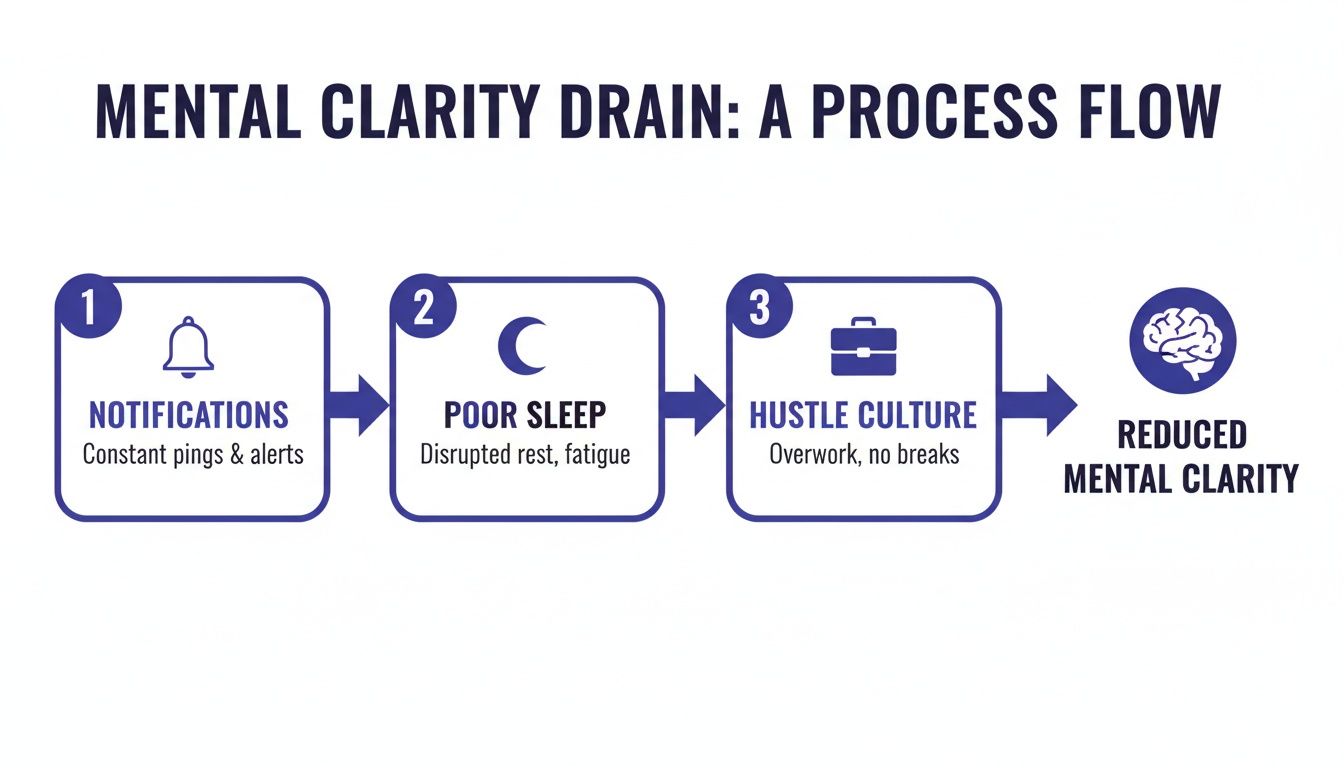
    This constant drain on our mental energy boils down to three primary culprits: relentless digital stimulation, lifestyle habits that weaken our cognitive resilience, and a pervasive “hustle culture” that treats rest as a sign of weakness. Understanding how these pieces fit together is the first step toward reclaiming your focus and improving mental clarity.

    The Science of Digital Distraction

    Social media feeds, breaking news alerts, and endless email chains are engineered to be addictive. They run on a principle known as a variable reward system, the exact same behavioral mechanism that makes slot machines so compelling. Because you never know when you’ll stumble upon a fascinating post or get an important message, your brain receives a small, unpredictable hit of dopamine with every single refresh.

    This process trains your brain to constantly hunt for novelty and stimulation, which makes deep, sustained work feel boring and unrewarding by comparison. Your attention becomes fragmented, always anticipating the next potential reward instead of staying present with the task at hand. You can explore the mechanics of this in our guide to understanding the neurology of digital overwhelm and attention hijacking.

    This isn’t just a feeling; it’s a measurable crisis. Research from Ipsos reveals that a staggering 52% of young adults explicitly say that heavy use of social media and digital devices negatively impacts their mental health. The connection is clear: our digital habits are directly linked to a decline in cognitive clarity. Learn more about these findings on digital device usage.

    Lifestyle Factors and the Hustle Culture Trap

    Beyond our screens, our foundational lifestyle habits play a massive role in our ability to think clearly. Poor sleep, for example, directly impairs the prefrontal cortex’s ability to function. Neuroscience research shows that during sleep, the brain clears out metabolic waste; disrupting this process leads to mental fatigue.

    Compounding these issues is the relentless pressure of “hustle culture,” which celebrates constant productivity and discourages essential downtime. But our brains need periods of rest and unfocused thought to consolidate memories, solve complex problems, and restore cognitive resources. When we skip this crucial recovery time in favor of endless work, we aren’t being more productive—we’re just accelerating our path toward burnout and diminished mental clarity.

    • Real-World Example: Take Maria, an entrepreneur who believes “sleep is for the weak.” She works 14-hour days, fueled by caffeine, and feels a constant pressure to be “on.” Her lack of sleep impairs her decision-making, and she finds herself making simple mistakes. Her mood suffers, and her creativity plummets. This isn’t a sign of dedication; it’s a textbook case of burnout eroding her cognitive function and mental clarity.

    Practical Strategies to Restore Your Mental Clarity

    Knowing what causes brain fog is the first step. Actually reclaiming your focus, though? That takes a deliberate, hands-on approach.

    Lasting mental clarity isn’t something that just happens. It’s built through consistent habits that protect your brain’s very limited resources. Forget trying to overhaul your entire life overnight. The real wins come from small, targeted actions designed to lower your cognitive load and bring back your natural ability to concentrate.

    These methods go straight to the neurological roots of distraction. By consciously managing your brain’s reward system and building an environment that encourages deep thought, you can train your mind to resist the constant pull of stimulation and find a calmer, more organized mental space.

    The Dopamine Reset for Improved Mental Clarity

    Our brains have gotten used to a steady diet of high-dopamine hits, from scrolling social media to compulsively checking email. This constant stimulation makes low-dopamine tasks—like reading a dry report or methodically planning a project—feel almost impossible.

    A dopamine reset, sometimes called a dopamine fast, is a straightforward way to recalibrate your brain’s overworked reward circuits. The goal isn’t to get rid of dopamine, which is impossible and unhealthy. It’s about intentionally stepping away from high-stimulation activities for a set period, allowing your dopamine receptors to reset. This simple break can make normal, productive work feel engaging and rewarding again.

    If you want a deeper dive into this technique, check out our complete guide on how to reset your brain for better focus.

    • Real-World Example: Picture Alex, a freelance writer stuck in a cycle of procrastination. To break free, Alex decides to try a “dopamine reset” for the first 90 minutes of every workday. No phone, no email, no social media. At first, it’s agonizingly boring. But after just a few days, Alex notices the frantic urge for distraction starts to fade. The act of writing itself becomes more satisfying and less of a fight, leading to better mental clarity.

    Cultivating Deep Work Rituals for Enhanced Mental Clarity

    Deep work is the skill of focusing without distraction on a cognitively demanding task. It’s what allows you to produce high-quality results in less time and truly master complex information. But getting into that state takes more than sheer willpower. It requires building rituals and designing an environment that signals to your brain: it’s time to focus now.

    This could be as simple as dedicating a specific chair just for focused work, putting on noise-canceling headphones, or blocking out non-negotiable “deep work” sessions in your calendar. The psychological power of these rituals is consistency. When your brain learns to associate certain cues with uninterrupted concentration, slipping into a state of flow becomes second nature.

    This infographic shows how the tiny interruptions we face all day actively chip away at our mental clarity.

    A process flow diagram showing how notifications, poor sleep, and hustle culture lead to reduced mental clarity.

    You can see the clear line from digital pings to physical exhaustion and cultural pressure, showing how these forces pile up to destroy your focus.

    Embracing Mindful Productivity Through Single-Tasking

    In a culture that worships multitasking, the most powerful act of rebellion for your brain is single-tasking. Psychologically, multitasking is a flat-out myth. What you’re really doing is context-switching—forcing your brain to rapidly toggle between different tasks. This process is incredibly inefficient and a massive drain on your cognitive resources.

    Mindful productivity is about bringing your full attention to one thing at a time. It’s like a workout for your brain’s “attention muscle” and directly reduces the cognitive overload that fuels burnout and brain fog.

    By focusing on one task, you engage the brain’s “executive control network” more effectively. This allows you to filter out irrelevant information, sustain attention, and complete work with a higher degree of accuracy and creativity.

    • Real-World Example: Jen used to pride herself on juggling conference calls while answering emails and planning her afternoon. She felt busy but was constantly behind. After learning about single-tasking, she started dedicating protected 45-minute blocks to one task only. During calls, she closed her laptop and just listened. Her meeting notes became more insightful, her emails were clearer, and she finished her workday feeling accomplished, not just exhausted.

    The Editor’s Take on What Actually Works

    After digging into the research and trying these strategies myself, what really moves the needle? Let’s cut through the noise. The honest answer is that consistency beats complexity every single time.

    Mastering a few foundational habits gets you far better results than chasing a dozen new productivity hacks. The biggest changes are almost always the simplest ones, grounded in how your brain actually works and a healthy respect for its limits.

    What to Focus On for Real Results

    Instead of scattering your energy, pick one strategy that targets your biggest pain point. Each method is built for a different kind of struggle:

    • A Dopamine Reset Is Best For: Anyone who feels that constant, nagging pull toward their phone. If you can’t get through a single task without checking notifications, start here. It helps recalibrate your brain’s reward system so that real work feels engaging again.

    • Deep Work Rituals Are Best For: Professionals, freelancers, or students staring down a deadline. When you absolutely must produce high-quality, focused work, creating a dedicated environment and schedule is non-negotiable for improving mental clarity.


    The real secret isn’t finding the perfect app or a magical technique. It’s about building a non-negotiable routine—like a screen-free morning or firm digital boundaries after work—and sticking with it until it becomes second nature.

    An Important Caveat

    It’s crucial to remember that these strategies are tools for improving focus and productivity, not treatments for clinical conditions.

    If you’re struggling with persistent anxiety, symptoms of depression, ADHD, or severe burnout, these tips are not a substitute for professional care. Please talk to a medical doctor or mental health professional to get the support you need. Our goal is to provide grounded, evidence-based educational advice you can trust to build better habits.

    Building a Sustainable System for Lasting Focus and Mental Clarity

    Genuine mental clarity isn’t a one-time fix. It’s the result of a sustainable system you build, piece by piece.

    We’ve walked through the neuroscience of brain fog and the practical strategies that cut through it. The core lesson is simple but powerful: small, consistent habits are what protect your focus from the constant demands of a noisy world.

    Instead of trying to overhaul your entire life overnight, the most effective approach is to start small. Just pick one strategy that speaks to your biggest challenge right now. Maybe it’s a dopamine reset to finally curb those digital cravings, or maybe it’s committing to single-tasking for just one hour each day.

    This approach builds momentum without creating overwhelm. To really build a sustainable system for lasting focus, understanding how to focus better at work is an indispensable first step.

    The Economic Case for Clarity

    Protecting your focus isn’t just about feeling better; it’s a critical professional asset in a world drowning in distraction.

    Mental health challenges like depression and anxiety cost the global economy an estimated $1 trillion in lost productivity every single year. For professionals, this number sends a clear signal: science-backed systems for maintaining mental clarity are essential economic tools that directly impact your performance and career longevity.

    When you protect your cognitive resources, you are investing in your most valuable asset. This is where the principles of managing your energy, not just your time, become crucial.

    You now have the tools to build a more intentional relationship with your mind and your technology. Remember the goal: start with one small change this week, and let it build from there.

    Disclaimer: The content in this article is for educational purposes only and is not a substitute for professional medical or psychological advice. Some links may be affiliate links, meaning we may earn a small commission at no extra cost to you if you make a purchase. Please consult a qualified professional for any health concerns.

    Frequently Asked Questions About Mental Clarity

    Let’s dig into some of the most common questions people have when they start working on their mental clarity. Think of this as a quick-reference guide with practical, direct advice.

    1. What’s the fastest way to get rid of brain fog?

    While there’s no magic button, the quickest way to disrupt that foggy feeling is to change your physical and sensory state. Get up, stretch, drink a full glass of water, and step outside for five minutes of natural light. This combination of movement, hydration, and a change of scenery provides a powerful reset for an overloaded nervous system and can restore a sense of immediate mental clarity.

    2. How long should a ‘dopamine detox’ actually last?

    A full 24-hour period can offer a significant reset. However, behavioral research suggests that building shorter, sustainable “detox” periods into your daily routine is more effective for long-term mental clarity. For example, practicing a screen-free first 60-90 minutes of your morning creates a healthier dopamine baseline over time.

    3. Can better mental clarity really help my anxiety?

    Yes, but it’s important to understand the relationship. Enhanced mental clarity is not a cure or treatment for a clinical anxiety disorder. However, practices that reduce cognitive overload—like single-tasking and mindfulness—can lower the feeling of being overwhelmed that often fuels anxious thought patterns. This creates a calmer mental state. If you are struggling with anxiety, it is essential to seek guidance from a qualified mental health professional.

    4. How much does my diet actually affect brain fog and mental clarity?

    Your diet plays a massive role. The brain uses about 20% of your body’s calories, so its performance is directly tied to your nutritional intake. Dehydration, blood sugar spikes from processed foods, and a lack of brain-healthy nutrients like omega-3 fatty acids are common culprits behind brain fog. A balanced diet is foundational for achieving and maintaining mental clarity.

    5. How can I practice deep work for better mental clarity in a loud, open office?

    Create a “bubble of focus.” First, use noise-canceling headphones to block auditory distractions. Second, use visual cues, like a small sign on your desk, to signal to colleagues that you are in a focus block. Finally, communicate your schedule clearly to your team, letting them know when you’ll be available for collaboration. This structured approach helps protect your mental clarity even in a chaotic environment.

    6. How is mental clarity different from mindfulness?

    Mindfulness is the practice of paying attention to the present moment without judgment. Mental clarity is the result or state of mind achieved through practices like mindfulness. It’s the feeling of having a calm, focused, and organized mind, which is the outcome of consistent mental training.

    7. Are there any apps that genuinely help with achieving mental clarity?

    Yes, some apps can serve as helpful tools. Apps like Freedom or Cold Turkey are effective for blocking external distractions. Mindfulness apps like Headspace or Calm provide guided meditations that can train your focus. The goal is to use them as aids to build internal focus, not as long-term crutches.

    8. What’s one simple habit I can start today for better mental clarity?

    Implement a “shutdown ritual.” At the end of each workday, take five minutes to write down any unfinished tasks or lingering thoughts for the next day. From a psychological standpoint, this act of “offloading” signals to your brain that the workday is complete, which helps prevent work-related stress from intruding on your personal time and clouding your evening mental clarity.

    9. Can I improve my mental clarity without giving up social media entirely?

    Absolutely. The key is intentional use, not total elimination. Set firm boundaries: schedule specific, brief blocks of time for social media, disable all non-essential notifications, and consciously avoid using it as a default response to boredom. This transforms your behavior from reactive to proactive, preserving your cognitive resources for what matters.

    10. Where can I find more science-backed resources on mental clarity?

    For reliable, evidence-based information, look to reputable sources like Harvard Health, scientific databases like PubMed, and professional organizations such as the American Psychological Association (APA). These resources provide information grounded in peer-reviewed research.


    Ready to build a complete system for lasting focus and calm productivity? Mind Clarity Hub is your home for Jeremy Jarvis’s science-based books on dopamine detox, deep work, and burnout recovery.

    Explore the full library and find your next step toward reclaiming your mental space at https://mindclarityhub.com.

    Explore the Mind Clarity Hub Library

    Practical books on focus, digital habits, resilience, and building a calmer mind.

    The Power of Clarity — book cover

    The Power of Clarity

    Unlock mental focus, build momentum, and create the life you were meant to live.

    View book →
    AI & ChatGPT for Beginners — book cover

    AI & ChatGPT for Beginners

    No PhD needed — a 2025 guide to AI, prompts, and productivity without coding.

    View book →
    Zen in the Digital Jungle — book cover

    Zen in the Digital Jungle

    Mindfulness for a chaotic world.

    View book →
    The Slow Reset — book cover

    The Slow Reset

    Mindful living in a fast-paced world.

    View book →
    Perfectly Imperfect — book cover

    Perfectly Imperfect

    Stop self-criticism, set boundaries, and embrace the real you.

    View book →
    Reclaiming Silence — book cover

    Reclaiming Silence

    A dopamine detox guide to finding peace in a noisy world.

    View book →
    The Focused Freelancer — book cover

    The Focused Freelancer

    Productivity, pricing & positioning for independents in 2025.

    View book →
    ChatGPT Side Hustle System — book cover

    ChatGPT Side Hustle System

    Launch your AI-driven online business in 30 days.

    View book →
    Burnout, Interrupted — book cover

    Burnout, Interrupted

    A proven path to restore energy and reclaim your life.

    View book →
    Attention Unleashed — book cover

    Attention Unleashed

    Focus strategies for the distracted mind.

    View book →
    Side Hustle Launchpad — book cover

    Side Hustle Launchpad

    Your quick-start guide to extra income.

    View book →
    Digital Clarity — book cover

    Digital Clarity

    Rewire your brain, escape dopamine traps & regain focus.

    View book →
    Break the Scroll — book cover

    Break the Scroll

    Reduce screen time and take back control of your life.

    View book →
    Climate Compassion — book cover

    Climate Compassion

    Transform eco-anxiety into empowered action.

    View book →
    Village Mentality — book cover

    Village Mentality

    The power of community for mental wellness.

    View book →
    Restful Nights — book cover

    Restful Nights

    Overcoming sleep anxiety in a 24/7 world.

    View book →
    Connected Again — book cover

    Connected Again

    Combat loneliness and build meaningful relationships.

    View book →
    Focus Recharged — book cover

    Focus Recharged

    Mastering attention and productivity in the digital era.

    View book →
    Marketing Magic with ChatGPT — book cover

    Marketing Magic with ChatGPT

    AI-powered content, campaigns, and copywriting to grow faster.

    View book →
    The 6-Figure Creator — book cover

    The 6-Figure Creator

    Turn knowledge into passive income with books, courses & AI.

    View book →
    Burnout Breakthrough — book cover

    Burnout Breakthrough

    Reset your work-life balance and thrive in 2025.

    View book →
    The Emotionally Intelligent Man — book cover

    The Emotionally Intelligent Man

    A modern guide to self-awareness and communication.

    View book →
    AI Personalized Wellness — book cover

    AI Personalized Wellness

    Create your custom health plan with data-driven habits.

    View book →
    Everyday AI Made Easy — book cover

    Everyday AI Made Easy

    Use ChatGPT and smart tools to simplify life.

    View book →
    Money Mindfulness — book cover

    Money Mindfulness

    A financial wellness guide for Gen Z & Millennials.

    View book →
    Startup Smarter with AI — book cover

    Startup Smarter with AI

    ChatGPT strategies and tools to grow your business.

    View book →
    ChatGPT for Writers & Creators — book cover

    ChatGPT for Writers & Creators

    Unlock AI-powered brainstorming, drafting & editing.

    View book →
  • How to Quit Social Media: A Practical Guide to Reclaiming Your Focus

    How to Quit Social Media: A Practical Guide to Reclaiming Your Focus

    How to Quit Social Media: A Practical Guide to Reclaiming Your Focus

    Jeremy Jarvis — Mind Clarity Hub founder
    Mind Clarity Hub • Research-aware focus & digital wellness

    Learning how to quit social media starts with a simple, powerful realization: you’re not battling a lack of willpower. You’re up against a system engineered to capture your attention. The key is to understand the psychological hooks at play and then strategically dismantle them to reclaim your focus.

    Key Takeaways

    • Understand the Dopamine Loop: Social media platforms are designed to create a cycle of anticipation and reward, releasing dopamine that keeps you scrolling. This is a neurochemical response, not a personal failing.
    • Define Your “Why”: Vague goals don’t work. To quit successfully, you need a specific, personal reason—like being more present with family or reclaiming focus for work—to anchor your commitment.
    • Choose Your Strategy: Decide between going “cold turkey” for a hard reset or a “gradual reduction” for a more sustainable approach, especially if you need social media for work.
    • Create Digital Friction: Make it harder to relapse by deleting apps, logging out everywhere, redesigning your phone’s home screen, and using website blockers to disrupt mindless habits.
    • Replace, Don’t Just Remove: Fill the void left by scrolling with new, rewarding habits. Replace passive consumption with active creation, like reading, journaling, or learning a new skill.

    Affiliate Disclosure: This article contains affiliate links. If you make a purchase through them, we may earn a small commission at no extra cost to you. We only recommend products we trust.

    The Real Reason You Feel Trapped by Social Media

    If you’ve ever tried to cut back on social media and failed, it’s not because you’re weak. It’s because these platforms are masters at creating a powerful psychological pull, often called a dopamine feedback loop. This isn’t just complex jargon; it’s the fundamental reason you feel that irresistible urge to check your phone.

    Here’s how it works from a neuroscience perspective: your brain releases a small hit of dopamine—a neurotransmitter associated with motivation and reward—in anticipation of a potential reward, not from the reward itself. Social media apps exploit this perfectly. Every notification, like, or new post in your feed is an unpredictable little prize. You never know what you’ll find, so your brain releases dopamine, pushing you to scroll “just one more time” to see if something interesting pops up.

    This creates a cycle that’s incredibly hard to break. The more you engage, the more your brain craves these small, inconsistent rewards, making the habit feel automatic and necessary. You might find yourself checking your phone without even thinking while waiting in line, during a work break, or right before bed. That’s the feedback loop in action, strengthening its grip each time you give in.


    How to quit social media: A young man stares at his smartphone while glowing social app icons float above him, symbolizing digital distraction and the urge to unplug.


    Why Quitting Social Media is More Than Just a Bad Habit

    This isn’t just a minor distraction. While this article does not provide medical advice, it’s worth noting that some psychological research suggests that behavioral patterns on social media can resemble addiction. This constant stimulation keeps your brain in a state of high alert, making it difficult to focus on complex tasks, be present in conversations, or even just sit quietly with your own thoughts. Many people find themselves struggling with what feels like a micro-dopamine addiction from being overstimulated, where even small moments of boredom feel unbearable.

    Framing your decision to quit this way is empowering. Instead of blaming yourself, you can see it as a strategic move to protect your most valuable resources: your time, your attention, and your mental energy. It’s about taking back control from algorithms designed to keep you scrolling.

    Please Note: This content is for educational purposes only and is not a substitute for professional medical or psychological advice. If you are struggling with issues like anxiety, depression, or sleep problems, please consult a qualified healthcare provider.

    Finding Your Reason to Quit Social Media

    Just deciding to “use social media less” is a recipe for failure. It’s a nice thought, but it lacks the psychological weight to override a deeply ingrained habit. Without a strong, personal reason anchoring your decision, the powerful pull of the dopamine loop will almost certainly drag you back in. Real, lasting change starts with a crystal-clear “why.”

    Think of your “why” as your North Star. It’s the thing you’ll come back to when the urge to scroll feels overwhelming. This isn’t about vague goals like “being more productive.” It’s about connecting your desire to quit with a tangible, meaningful improvement you want to see in your actual life—a life where you’re in control of your own time and attention.

    How to Quit Social Media by Getting Specific with Triggers and Goals

    Your motivation to log off is deeply personal. It comes from the specific ways these platforms chip away at your life. The first step is to get brutally honest about what sends you down the rabbit hole in the first place.

    Is it boredom during a slow afternoon at work? Procrastination when a big project looms? Or maybe that familiar pang of loneliness late at night? Identifying these behavioral triggers is half the battle. Once you know when and why you scroll, you can decide what you’d rather be doing with that precious time instead.

    Do any of these mini-scenarios feel familiar?

    • The Freelancer: You sit down for a deep work session, but a “quick check” of LinkedIn turns into an hour of mindless scrolling. Suddenly, your focus is shot and you’ve lost valuable billable time. Your “why” could be: “To reclaim my professional focus and hit my deadlines without the constant distraction.”
    • The Student: A huge exam is just days away, but you’re burning hours on TikTok and Instagram. This leads to frantic, last-minute cramming and sky-high stress. Your “why” might be: “To dedicate my study time to actual studying, so I can improve my grades and lower my stress.”
    • The Parent: You find yourself staring at your phone during dinner or while your kids are trying to tell you about their day. You’re physically there, but mentally, you’re gone. Your “why” could be: “To be a more present and engaged parent and create real memories with my children.”

    See the pattern? Each example links the problem (mindless scrolling) to a powerful, positive outcome (better focus, better grades, stronger family bonds). This creates a real emotional investment in your goal. It gives you something to fight for.

    Your “Why” Worksheet for Quitting Social Media

    To make this real, take a few minutes to answer these questions. Don’t just think about them—write them down. The simple act of putting pen to paper (or fingers to keyboard) makes your intentions feel more concrete and powerful.

    Actionable Tip: Grab a notebook or open a doc right now and jot down your answers. Keep this somewhere you can see it. When your resolve wavers, read it. This is your personal anchor.

    Part 1: Naming the Problem

    1. Which social media app is your biggest time and energy sink?
    2. Honestly, how do you feel after a long session on this app? (Anxious, drained, envious, numb, agitated?)
    3. What specific, important things are being pushed aside because of this? (Be specific: “reading a book before bed,” “going for a walk,” “calling my mom back.”)

    Part 2: Picturing the Solution

    1. What is the single biggest improvement you hope to gain from this? (e.g., deeper sleep, better focus at work, more quality time with my partner).
    2. Picture your ideal day one month from now, free from the constant pull of social media. What are you doing with that reclaimed time and mental space? Paint a vivid picture.
    3. Finish this sentence: “I am quitting social media because I want to…”

    By doing this, you’re not just vaguely wishing for a change. You’re creating a clear, actionable vision for the life you want. This vision is what you’ll hold onto. When the reflexive urge to open an app strikes, you can pause, take a breath, and recall your “why”—whether that’s being a more present parent or finally finishing that project you care about.

    That internal reminder is often the only thing standing between giving in and staying on course.

    Choosing Your Path to Quit Social Media: Cold Turkey vs Gradual Reduction

    Once you’ve locked in your “why,” the next big question is how you’re going to pull this off. There’s no single right answer here. The best strategy for you will come down to your personality, your job, and just how deep the scrolling habit really goes.

    You essentially have two choices: go cold turkey and quit all at once, or take a gradual reduction approach and ease your way out. Getting this decision right can be the difference between a successful reset and a frustrating relapse a week later.

    The All-Or-Nothing Approach: Going Cold Turkey to Quit Social Media

    Going cold turkey is exactly what it sounds like: you delete the apps, deactivate your accounts, and make a clean, decisive break. It’s direct and leaves no room for negotiation.

    From a behavioral science standpoint, this is like a hard reset for your brain’s reward system. By removing the source of unpredictable dopamine hits, you force your brain to start recalibrating its baseline for stimulation. This is often the best path for anyone who feels completely burnt out, overwhelmed, or believes their usage patterns are compulsive.

    If you’re the kind of person who finds that a “quick five-minute check” inevitably turns into a two-hour scroll vortex, a total stop might be your only effective move. It cuts off the temptation entirely.

    • Real-World Scenario: A freelance writer realizes their “short breaks” on Instagram are blowing up their workdays, causing them to miss deadlines and feel constantly stressed. They go cold turkey, deleting the app and deactivating their account to create a totally distraction-free workspace and reclaim their focus, starting now.

    The Slow and Steady Method: Gradual Reduction

    The gradual approach is a more measured, step-by-step plan to dial back your social media use over a set period. This method is far less jarring and is often more sustainable, especially for people who can’t—or just don’t want to—vanish from the internet completely.

    This is a smart choice for professionals who rely on platforms like LinkedIn for networking or small business owners who use Facebook for customer communication.

    The process involves systematically chipping away at the behavior, giving your habits time to adjust. You might start by deleting just one app, then restrict your usage to certain times of day on your computer only, and eventually remove more platforms from your life. The principles here are similar to those in our guide on how to reset your dopamine for focus and clarity, which is all about recalibrating your brain without a total disconnect.

    • Real-World Scenario: A small business owner uses Facebook for her customer group but feels drained by endless personal scrolling. She opts for gradual reduction. First, she deletes the app from her phone, committing to check it only on her desktop. Next, she sets a timer for 15 minutes twice a day—for work tasks only—to slowly break the habit of mindless consumption.

    Cold Turkey vs Gradual Reduction: Which Way to Quit Social Media Is Right for You?

    So, how do you pick? This table breaks down the two main strategies to help you find the best fit for your goals and personality.

    FactorCold Turkey (All at Once)Gradual Reduction (Phased Approach)
    Best ForIndividuals feeling overwhelmed, addicted, or who struggle with moderation. Ideal for a fast, clean break.People who need social media for work, have strong social ties online, or prefer making sustainable, long-term changes.
    PacingImmediate and intense. All platforms are removed in one go.Slow and controlled. Usage is reduced over weeks or months based on a set plan.
    Psychological ImpactCan cause initial shock and withdrawal-like symptoms (anxiety, FOMO). High initial difficulty, but gets easier.Less jarring to the system. Requires consistent discipline over a longer period, which can be mentally taxing.
    Relapse RiskHigher risk of an intense “rebound” if the initial void isn’t filled with new habits.Lower risk of intense rebound, but higher risk of slowly sliding back into old habits if rules aren’t strict.
    Primary ChallengeGetting through the first 1-2 weeks of intense cravings and habit adjustment.Maintaining motivation and sticking to self-imposed limits over the long term.

    Ultimately, there’s no “better” option—only the one that aligns with your life. The cold turkey method offers a powerful reset for those at a breaking point, while a gradual reduction provides a more sustainable path for those who need to maintain some level of online presence.

    This flowchart can help you visualize how your core motivation might point you toward one path or the other.

    A flowchart showing how to quit social media by finding your purpose.

    As you can see, if your reasons are tied to professional needs, a phased approach is likely more realistic. But if what you’re after is a deep, personal restoration of focus, a clean break might be exactly what you need.

    Practical Steps for Quitting Social Media: Delete Apps and Secure Your Space

    You’ve got your “why” and a strategy. Now for the hands-on part—actually reclaiming your digital life from the apps themselves. This goes way beyond just dragging an icon to the trash. We’re going to dismantle the entire digital scaffolding that holds your social media habits in place, making it much harder to slip back into old patterns.

    Hands interacting with a smartphone to show how to quit social media.

    The idea is to create intentional digital friction. From a behavioral psychology perspective, this means adding small, deliberate barriers that turn a mindless, automatic behavior into a conscious choice. By making it inconvenient to log back in, you buy yourself those crucial few seconds to remember why you’re doing this and pick a better action.

    The App Deletion Checklist: How to Quit Social Media Securely

    A proper exit strategy ensures you don’t leave personal data behind and makes a potential return more trouble than it’s worth.

    1. Download Your Data First: Before you hit delete, grab your archive. Most platforms like Instagram and Facebook let you download all your photos, posts, and messages. This is non-negotiable. Securing your memories makes the decision to permanently delete an account feel a lot less scary.
    2. Deactivate vs. Delete: Know the difference. Deactivating is just pausing your account; it’s hidden but can be switched back on instantly. Deleting is the real deal, usually with a grace period (like 30 days) before everything is gone for good. If you’re serious, choose deletion.
    3. Tell Your People: Give your close friends, family, or key work contacts a heads-up that you’re leaving a platform. More importantly, give them another way to reach you, like your phone number or email. This stops people from worrying that you’ve vanished and quiets that little voice in your head worried about missing out.
    • Real-World Scenario: Before deleting her Facebook account, Sarah downloads her photo albums to her computer. Then she sends a group text to her five closest friends saying, “Hey! Just letting you know I’m deleting my Facebook account tomorrow to simplify things. My number is the best way to reach me!” This avoids confusion and reinforces her decision.

    Creating Friction to Stop a Relapse

    The real fight isn’t just deleting the app; it’s re-engineering your digital world so that muscle memory doesn’t drag you back. The easier it is to get back on, the more likely you are to relapse during a moment of boredom or weakness.

    Here’s how to build a stronger defense system:

    • Log Out Everywhere: After the apps are gone, open your web browser and manually log out of each social media site. That one extra step of having to remember and type a password is often enough to disrupt an automatic, unthinking visit.
    • Redesign Your Home Screen: Your phone’s home screen is prime real estate for temptation. Get all browser apps off of it. Bury them in a folder on the very last page. Replace them with apps that serve your new goals—a reading app, a meditation tool, or something for learning a language.
    • Use Website Blockers: Install a blocker extension on your computer’s browser (Freedom and StayFocusd are great options). Add every single social media URL to the blocklist. This creates a hard stop when your fingers instinctively type “face…” into the address bar out of pure habit.

    For a more comprehensive fresh start, you might even consider learning how to completely reset your iPhone. It’s an extreme measure, but it’s the ultimate clean slate, wiping away all the hidden triggers and digital clutter that could pull you back. Digging into a full range of digital detox tips can give you even more strategies to lock in these new habits for good.

    Rewiring Your Brain: How to Replace the Social Media Scroll

    Deleting the apps is the easy part. The real challenge is figuring out what to do with the sudden emptiness that follows. Your brain is accustomed to filling every micro-moment—waiting for coffee, standing in line, a break from work—with a quick scroll.

    Without a plan, those moments become powerful triggers for relapse. The key, according to behavioral psychology, is to consciously replace the old habit with a new, fulfilling one. This isn’t just about killing time; it’s about actively rewiring the neural pathways your brain built around the instant gratification of social media.

    A person's hand reaches for a book, a great alternative for how to quit social media.

    From a neuroscience perspective, habits are automated loops in your brain: a cue, a routine, and a reward. Your phone buzzes (the cue), you scroll through a feed (the routine), and you get a tiny hit of dopamine (the reward). To break this cycle, you need to keep the cue but swap out the routine for something that provides a healthier, more sustainable reward.

    Identifying Your Triggers and Building a Replacement Plan

    First, become a detective of your own behavior. For the next few days, notice the specific moments you feel the strongest urge to check your phone. Is it first thing in the morning? During your lunch break? Right before bed? Once you’ve identified these high-risk moments, you can create a menu of “replacement habits.”

    • Mini-Scenario (Morning Coffee): Your cue is sitting down with your coffee. The old routine was scrolling Instagram. Your new routine is to read two pages of a book you’ve placed next to the coffee maker. The reward is a sense of calm and learning instead of anxiety.
    • Mini-Scenario (Work Break): Your cue is hitting a mental wall on a project. The old routine was checking LinkedIn. Your new routine is to stand up, stretch for 60 seconds, and drink a glass of water. The reward is a physical reset and renewed focus.
    • Mini-Scenario (Evening Wind-Down): Your cue is getting into bed. The old routine was watching TikTok videos. Your new routine is to listen to a 10-minute guided meditation or a calming podcast. The reward is better sleep and a less-stimulated mind.

    From Passive Consumption to Active Creation

    One of the most powerful ways to fill the void left by social media is to shift from being a passive consumer to an active creator. These platforms train us to absorb an endless stream of content made by other people. Reclaiming that time and mental energy allows you to make things yourself, which provides a much deeper and more lasting sense of satisfaction.

    This doesn’t mean you have to become a professional artist or writer. “Creation” can be anything that engages your mind and hands in a meaningful way.

    • Journaling your thoughts for ten minutes.
    • Sketching in a notebook.
    • Learning a few chords on a guitar.
    • Trying a new recipe.
    • Organizing one small section of your home.

    These activities engage different parts of your brain than scrolling does. They require focus and problem-solving, and they produce a tangible result. That delivers a sense of accomplishment that a “like” simply can’t match. Exploring how to rewire your brain for focus can give you deeper strategies for making this shift stick.

    Editor’s Take: What Actually Works for Quitting Social Media

    Let’s cut through the noise. The most effective way to quit social media isn’t just about deleting apps. It’s about combining a powerful, deeply personal ‘why’ with practical barriers that make it inconvenient to slide back into old habits. Simply removing the icon from your homescreen isn’t enough; you have to actively build new routines to fill the void. This is a behavioral change process, and it requires patience.

    Who This Advice Is Best For:
    This guide is designed for professionals, students, and anyone feeling the cognitive drain of digital burnout. If you’re ready for a real shift—not just a temporary detox—you’re in the right place. The cold turkey method is best for those who feel their use is out of control, while gradual reduction works well for those who need to maintain a professional online presence.

    Important Caveats:
    The key takeaway isn’t about achieving perfection. It’s about being intentional. Expect to feel bored or restless at first—that’s a sign your brain is recalibrating. Success comes from slowly replacing the automatic, mindless scroll with fulfilling new habits, one small choice at a time. For those looking to build more resilient, direct connections with an audience or community, it’s worth understanding why email lists often outperform social media when you’re not wrestling with an algorithm.


    Disclaimer: This article contains affiliate links. Purchases made through these links may earn us a small commission at no extra cost to you. The content provided is for educational and informational purposes only and is not a substitute for professional medical or psychological advice, diagnosis, or treatment. Always seek the advice of your physician or other qualified health provider with any questions you may have regarding a medical condition.

    FAQ: Your Top 10 Questions on How to Quit Social Media

    Deciding to step away from social media always brings up a few practical worries. It’s a big shift. Here are some straightforward answers to the 10 most common concerns people have.

    1. How do I deal with the fear of missing out (FOMO)?

    FOMO is a real, biological pull exploited by social media. The best way to combat it is to reframe it as JOMO—the “Joy of Missing Out.” Focus on the peace and presence you gain in your own life. You’ll quickly realize you were missing noise, not substance.

    2. Will quitting social media make me lose my friends?

    You won’t lose your real friends. This move clarifies who your true connections are. Proactively text your close friends to let them know you’re leaving the platform and that they can reach you directly. This often strengthens your most important relationships.

    3. What’s the best way to explain my decision to others?

    Keep it simple and confident. A straightforward line like, “I’m taking a break from social media to be more present and focus on some other goals” is all you need. You don’t owe anyone a long explanation.

    4. How long until I start to feel the benefits of quitting?

    Most people report a noticeable drop in anxiety within the first week. The initial period can feel strange or boring as your brain adjusts. After about two to four weeks, benefits like better focus, deeper sleep, and a calmer mind become more pronounced as new habits form.

    5. What should I do if I relapse and re-download an app?

    Don’t see it as a failure. A relapse is just data. Ask yourself what triggered it—boredom, loneliness, stress? Use that insight to strengthen your plan. What replacement activity could you use next time? Then, delete the app again and reconnect with your “why.”

    6. Is it better to deactivate or permanently delete my accounts?

    For a lasting change, permanent deletion is the most powerful choice. Deactivating leaves the door open for an easy return. Deleting creates a firm psychological commitment and adds friction that makes a casual relapse much harder. Remember to download your data first.

    7. Can I quit social media if I need it for my job?

    Yes, but it requires strict boundaries. Use a gradual reduction strategy. Delete the apps from your phone, engage exclusively from a desktop computer, and use website blockers to limit your access to specific work hours. Treat it as a tool, not a constant companion.

    8. How can parents help a teenager reduce their social media use?

    Lead by example by modeling healthy screen habits. Have an open, non-judgmental conversation about how social media makes them feel. Work together to set family-wide rules, like “no phones at the dinner table” or a “digital curfew” an hour before bed.

    9. I feel so bored and restless. Is that normal?

    Yes, this is completely normal and a positive sign. Your brain is used to constant stimulation. That restlessness is a withdrawal symptom as your brain’s dopamine system resets its baseline. Push through it by turning to one of your pre-planned replacement activities.

    10. Will a “dopamine detox” actually help me quit social media?

    Yes. The concept of a “dopamine detox” is an effective framework for this process. By intentionally stepping away from high-stimulation activities like social media, you lower your baseline need for novelty, allowing quieter, more focused activities to feel rewarding again. To learn more, explore our article: “is dopamine detox real or a myth?


    At Mind Clarity Hub, we provide science-based guides and books to help you reclaim your focus in a distracted world. Explore our full library of resources on dopamine detox, mindful productivity, and burnout recovery.

    Find Your Next Read at Mind Clarity Hub

    Explore the Mind Clarity Hub Library

    Practical books on focus, digital habits, resilience, and building a calmer mind.

    The Power of Clarity — book cover

    The Power of Clarity

    Unlock mental focus, build momentum, and create the life you were meant to live.

    View book →
    AI & ChatGPT for Beginners — book cover

    AI & ChatGPT for Beginners

    No PhD needed — a 2025 guide to AI, prompts, and productivity without coding.

    View book →
    Zen in the Digital Jungle — book cover

    Zen in the Digital Jungle

    Mindfulness for a chaotic world.

    View book →
    The Slow Reset — book cover

    The Slow Reset

    Mindful living in a fast-paced world.

    View book →
    Perfectly Imperfect — book cover

    Perfectly Imperfect

    Stop self-criticism, set boundaries, and embrace the real you.

    View book →
    Reclaiming Silence — book cover

    Reclaiming Silence

    A dopamine detox guide to finding peace in a noisy world.

    View book →
    The Focused Freelancer — book cover

    The Focused Freelancer

    Productivity, pricing & positioning for independents in 2025.

    View book →
    ChatGPT Side Hustle System — book cover

    ChatGPT Side Hustle System

    Launch your AI-driven online business in 30 days.

    View book →
    Burnout, Interrupted — book cover

    Burnout, Interrupted

    A proven path to restore energy and reclaim your life.

    View book →
    Attention Unleashed — book cover

    Attention Unleashed

    Focus strategies for the distracted mind.

    View book →
    Side Hustle Launchpad — book cover

    Side Hustle Launchpad

    Your quick-start guide to extra income.

    View book →
    Digital Clarity — book cover

    Digital Clarity

    Rewire your brain, escape dopamine traps & regain focus.

    View book →
    Break the Scroll — book cover

    Break the Scroll

    Reduce screen time and take back control of your life.

    View book →
    Climate Compassion — book cover

    Climate Compassion

    Transform eco-anxiety into empowered action.

    View book →
    Village Mentality — book cover

    Village Mentality

    The power of community for mental wellness.

    View book →
    Restful Nights — book cover

    Restful Nights

    Overcoming sleep anxiety in a 24/7 world.

    View book →
    Connected Again — book cover

    Connected Again

    Combat loneliness and build meaningful relationships.

    View book →
    Focus Recharged — book cover

    Focus Recharged

    Mastering attention and productivity in the digital era.

    View book →
    Marketing Magic with ChatGPT — book cover

    Marketing Magic with ChatGPT

    AI-powered content, campaigns, and copywriting to grow faster.

    View book →
    The 6-Figure Creator — book cover

    The 6-Figure Creator

    Turn knowledge into passive income with books, courses & AI.

    View book →
    Burnout Breakthrough — book cover

    Burnout Breakthrough

    Reset your work-life balance and thrive in 2025.

    View book →
    The Emotionally Intelligent Man — book cover

    The Emotionally Intelligent Man

    A modern guide to self-awareness and communication.

    View book →
    AI Personalized Wellness — book cover

    AI Personalized Wellness

    Create your custom health plan with data-driven habits.

    View book →
    Everyday AI Made Easy — book cover

    Everyday AI Made Easy

    Use ChatGPT and smart tools to simplify life.

    View book →
    Money Mindfulness — book cover

    Money Mindfulness

    A financial wellness guide for Gen Z & Millennials.

    View book →
    Startup Smarter with AI — book cover

    Startup Smarter with AI

    ChatGPT strategies and tools to grow your business.

    View book →
    ChatGPT for Writers & Creators — book cover

    ChatGPT for Writers & Creators

    Unlock AI-powered brainstorming, drafting & editing.

    View book →
  • How to Reset Your Brain for Focus and Mental Clarity

    How to Reset Your Brain for Focus and Mental Clarity

    Jeremy Jarvis — Mind Clarity Hub founder
    Mind Clarity Hub • Research-aware focus & digital wellness

    To truly reset your brain, the focus needs to be on two fronts: reducing chronic stress and digital overload, while at the same time intentionally choosing activities that promote neural repair, like deep sleep and mindfulness. This isn’t about finding a quick fix; it’s a strategic process of restoring your brain’s natural capacity for focus and calm.

    Affiliate Disclosure: Some links in this article may be affiliate links. If you make a purchase, we may earn a small commission at no extra cost to you. This helps support our work in bringing you evidence-backed content.

    Why Your Brain Feels Overloaded and Ready for a Reset

    If you feel mentally scattered, constantly distracted, or like your brain is just running on fumes, you’re not alone. Our modern lives have created a perfect storm for cognitive overload.

    The constant barrage of notifications, the never-ending to-do lists, and the unspoken pressure to always be “on” can push our brains well past their functional limits. This isn’t a personal failure; it’s a predictable biological response to an environment that relentlessly demands our attention.

    A stressed man holds his head in front of a laptop as digital notification icons swirl around him, showing the mental overload that makes **how to reset your brain** essential.

    This feeling of being swamped has deep roots in neuroscience. Chronic stress doesn’t just make you feel bad—it physically alters your brain’s architecture. Behavioral research shows that prolonged stress can cause the dendritic branches—the delicate connections between neurons—to shrink in key areas like the prefrontal cortex, which governs focus and decision-making.

    The good news? These changes are often reversible through a process called neuroplasticity. You have the power to help your brain heal and rewire itself.

    The Cycle of Mental Fatigue

    Mental fatigue usually creeps up on you. It starts with small things, like struggling to focus on one task or feeling irritable for no obvious reason. If left unchecked, this can snowball into a state where your brain feels like it’s permanently stuck in a fog.

    This is where the idea of a “brain reset” comes into play. It’s not about finding a magic “off” switch. It’s about implementing specific, science-backed practices to:

    • Reduce your cognitive load: Intentionally cut back on the amount of information and stimulation your brain is forced to process every day.
    • Restore crucial neural pathways: Engage in activities that encourage brain repair and growth, like quality sleep and focused attention.
    • Recalibrate your reward system: Break the cycle of cheap dopamine hits from distractions that are actively undermining your motivation and focus.

    If you’re already feeling that mental fog, exploring some effective strategies to improve mental clarity and focus can offer some immediate relief.

    Understanding the neurology of how our attention gets hijacked is a critical first step. You can dive deeper into the impact of digital overwhelm in our detailed guide.

    Build a Strong Foundation for Your Brain Reset

    Before you can reset your brain’s software—your habits, focus, and mood—you have to get its hardware right. Think of it like a high-performance computer. You wouldn’t try to run complex code on a machine that’s overheating and low on power. The same goes for your brain.

    This foundational layer is built on three non-negotiables: sleep, nutrition, and movement.

    Getting these fundamentals dialed in creates the biological bedrock for any real mental reset. Without them, you’re just building a house on sand. Let’s look at how to fortify each pillar with small, sustainable changes that actually work in the real world.

    Prioritize Sleep to Cleanse and Consolidate Your Brain

    Sleep isn’t just passive rest; it’s an active, essential maintenance period for your mind. While you’re asleep, your brain is hard at work. One of its most critical jobs is handled by the glymphatic system, which acts like a microscopic cleanup crew.

    This system flushes out metabolic junk that builds up during the day, including the beta-amyloid proteins linked to cognitive decline. At the same time, your brain is busy consolidating memories—strengthening important neural connections and trimming away the weaker, unnecessary ones. This process is vital for learning and literally helps you wake up with a cleaner, more efficient mental workspace.

    Real-World Scenario: The Late-Night Scroller
    Alex, a project manager, spends an hour scrolling on their phone in bed every night, thinking it helps them “wind down.” But they consistently wake up feeling foggy and sluggish, struggling to organize their thoughts. This isn’t just tiredness. The blue light from the screen suppresses melatonin, delaying the deep sleep their brain needs. As a result, those crucial cleanup and memory processes get cut short, leading directly to that feeling of morning brain fog.

    To really support your brain reset, aim for 7-9 hours of quality sleep. This isn’t just about how long you’re in bed, but about consistency and quality. A simple “wind-down” routine—like reading a physical book or listening to calm music for 30 minutes before bed—can make a huge difference in your ability to fall and stay asleep.

    A neatly made bed in a dark room with a book and glasses on the nightstand, illustrating a calm sleep environment for a brain reset.

    Fuel Your Brain with Smart Nutrition

    The food you eat directly builds your brain’s structure and fuels its function. Your brain is an incredibly hungry organ, burning through about 20% of your body’s total calories while making up only 2% of your body weight. Giving it the right fuel is non-negotiable for focus, memory, and mood.

    Think of it in terms of key players:

    • Omega-3 Fatty Acids: Found in foods like salmon, walnuts, and flaxseeds, these are the literal building blocks for your brain cell membranes. They’re critical for neuroplasticity and taming inflammation.
    • Complex Carbohydrates: Sources like whole grains, beans, and vegetables provide a slow, steady release of glucose—the brain’s main power source. This prevents the sharp energy spikes and crashes you get from sugary snacks.
    • Lean Proteins: Foods rich in amino acids, like chicken, eggs, and lentils, are the precursors to neurotransmitters like dopamine and serotonin, which govern your mood, motivation, and focus.

    A simple way to start is to focus on adding whole, unprocessed foods to your diet instead of just trying to eliminate “bad” ones. This positive reframing feels far more sustainable. Our guide on 7 brain-resetting habits offers more detailed nutritional strategies you can start using today.

    Real-World Scenario: The Afternoon Brain Fog Fighter
    Maria, a remote graphic designer, used to fight her 2 PM slump with a sugary cereal bar and a big coffee. She’d get a quick jolt, followed by an even deeper crash an hour later that made creative work impossible. She switched her lunch to include grilled chicken (protein), quinoa (complex carbs), and avocado (healthy fats). Now, her energy stays stable all afternoon, wiping out the brain fog and letting her stay locked in on complex design projects.

    Move Your Body to Grow Your Brain

    Physical activity might be the single most powerful tool you have for a brain reset. It does far more than just benefit your body; it sets off a cascade of neurochemical and structural changes in your brain.

    When you do aerobic exercise, your brain releases a protein called Brain-Derived Neurotrophic Factor (BDNF). Neuroscientists often call BDNF “Miracle-Gro” for the brain because it supports the survival of your existing neurons and encourages the growth of new ones—a process called neurogenesis.

    Movement also cranks up blood flow to the brain, delivering more oxygen and nutrients where they’re needed most. Even a short walk can give an immediate boost to your executive functions, like planning and attention. It’s a direct way to clear your head.

    You don’t need to run a marathon. The key is consistency. A brisk 15-20 minute walk on your lunch break, a quick yoga session in the morning, or even a few sets of bodyweight exercises can deliver significant cognitive benefits. The goal is to make movement a non-negotiable part of your daily rhythm.

    Use Micro-Resets to Reclaim Your Focus in Minutes

    You don’t need a week-long vacation to reset your brain. Sometimes, you just need a minute.

    When you’re caught in the middle of a chaotic workday, feeling scattered and completely overwhelmed, what you need are tools to reclaim your focus right now. These are called micro-resets—brief, intentional breaks designed to interrupt the stress cycle and restore your mental energy in minutes.

    The real power of a micro-reset is its ability to directly influence your nervous system. When you feel stressed or frantic, your sympathetic nervous system—the “fight or flight” response—is running the show. Micro-resets are your way of hitting the brakes, activating your parasympathetic nervous system (the “rest and digest” state) to bring your mind and body back to a calm equilibrium.

    The Physiological Sigh for Instant Calm

    One of the most effective and fastest-acting micro-resets is the physiological sigh. This isn’t just taking a deep breath; it’s a specific breathing pattern that research from Stanford’s Huberman Lab shows is the quickest way to voluntarily lower your heart rate and calm your body down.

    It works by maximally inflating the tiny air sacs in your lungs (alveoli), which helps offload excess carbon dioxide from your bloodstream. That chemical shift sends a powerful signal straight to your brain to dial down the stress response.

    Here’s how you do it:

    • Take two sharp inhales through your nose—one deep breath, followed by a second, shorter sip of air right on top of it.
    • Then, let out a long, complete exhale through your mouth, letting all the air out slowly.
    • Repeat this just one to three times. That’s it.

    Real-World Scenario: Before the Big Meeting
    Imagine you have a high-stakes presentation in five minutes. Your heart is pounding and your thoughts are racing. Instead of letting the anxiety spiral, you duck into a quiet corner and take two physiological sighs. Almost instantly, you feel your heart rate slow, allowing you to walk into that meeting with a clear head and a steady voice.

    This simple technique is a powerful tool for resetting your brain’s state in under 60 seconds, giving you immediate control when you feel overwhelmed.

    Infographic showing the Brain Reset Foundation steps: sleep, nutrition, and movement with corresponding icons.

    This visual underscores a key idea: foundational habits like sleep, nutrition, and movement are the pillars supporting any successful brain reset. When you have these in place, micro-resets become even more effective at keeping you sharp and focused all day long.

    Non-Sleep Deep Rest for Mental Restoration

    Another powerful tool is Non-Sleep Deep Rest (NSDR), a term for protocols that guide you into a state of profound relaxation without you actually falling asleep. Think of practices like yoga nidra or certain guided meditations. NSDR is brilliant for replenishing dopamine levels—crucial for motivation and focus—and has been shown to improve your brain’s ability to consolidate learning.

    Think of it as a guided power nap for your neurons.

    By directing your focus inward and away from external noise, you give your prefrontal cortex—the part of your brain responsible for planning and decision-making—a much-needed break. This allows it to recover and come back online with renewed strength.

    • When to Use It: It’s perfect for that mid-afternoon slump when you feel mentally drained but can’t take a proper nap. A 10-20 minute NSDR session can be far more restorative than scrolling through your phone.
    • How to Start: Find a quiet place, lie down, and use a guided audio script. There are countless free resources online that can walk you through the process step-by-step.

    Here’s a quick summary of the immediate techniques you can use to reset your focus and calm your nervous system throughout the day.

    Your Quick Brain Reset Toolkit

    TechniqueWhen to UseHow It Works (The Science)Time Required
    Physiological SighHigh-stress moments (before a meeting, after a tough call)Offloads CO2, activating the parasympathetic nervous system to rapidly slow heart rate.1-3 minutes
    Non-Sleep Deep Rest (NSDR)Mid-afternoon energy slump or when feeling mentally drainedGuides the brain into a state of deep rest, replenishing dopamine and resting the prefrontal cortex.10-20 minutes
    Sound RitualWhen you need to quickly shift from a chaotic to a calm stateUses auditory focus to anchor attention and reduce sensory overload, calming the nervous system.3-5 minutes
    Brief Walk OutsideFeeling stuck on a problem or after long screen timeCombines light movement, natural light, and a change of scenery to reset attention and boost mood.5-15 minutes

    These tools are your first line of defense against daily overwhelm, giving you the ability to perform a strategic brain reset whenever and wherever you need it most.

    For even more quick, actionable strategies to improve focus, you can explore techniques perfect for reclaiming attention in minutes. Another powerful method is using sound to guide your mind into a relaxed state; you can learn exactly how with our 3-minute sound ritual guide.

    Reset Your Brain’s Reward System with a Dopamine Detox


    Ever feel restless, unmotivated, and constantly reaching for your phone for no real reason? It’s a classic sign that your brain’s reward system is working overtime.

    This system, driven largely by the neurotransmitter dopamine, is wired to push you toward survival. But our modern world has completely hijacked it. The constant pings, endless social feeds, and on-demand entertainment create a steady drip of cheap, easy dopamine hits.

    Over time, your brain adapts to this high level of stimulation, raising its baseline for what feels rewarding. Suddenly, activities that offer a slower, more meaningful payoff—like reading a book, tackling a complex project, or just having a quiet conversation—start to feel dull and unappealing.

    This is where the idea of a “dopamine detox” comes in. It’s not about getting rid of dopamine, which is both impossible and a bad idea. Instead, it’s a practical way to recalibrate your brain’s sensitivity and take back control of your attention. By intentionally stepping back from high-dopamine, low-value activities, you let your reward pathways reset. Natural, productive tasks start to feel engaging again.

    Understanding Your Dopamine Triggers

    The first real step is to get honest about your personal dopamine triggers. These are the specific, often mindless, activities you turn to for a quick hit of stimulation, especially when you feel bored, stressed, or are avoiding something difficult.

    Common triggers usually include:

    • Mindlessly scrolling through social media.
    • Checking email or notifications every few minutes.
    • Indulging in shows or short-form videos.
    • Playing mobile games designed with frequent, flashy rewards.

    Once you know your triggers, you can start to consciously reduce your engagement. This doesn’t mean you need to go on a week-long, radical retreat from all technology. A far more sustainable approach is to start small.

    Real-World Scenario: The Procrastinating Creator
    Lena, a freelance writer, noticed a destructive pattern. Every time she sat down to tackle a challenging article, she’d feel an overwhelming urge to check Instagram “for just five minutes.” That five minutes would inevitably bleed into an hour, completely derailing her focus. Her phone was her primary dopamine trigger, offering an easy escape from the mental heavy lifting of deep work.

    Lena’s experience is a perfect example of how a miscalibrated reward system fuels procrastination. Her brain had learned that scrolling delivered a much faster and easier reward than the slow, effortful process of writing.

    A Practical Guide to How To Reset Your Brain With a Dopamine Fast

    A successful dopamine fast, or digital detox, is really about replacing low-value habits with high-value alternatives. The goal isn’t just to remove things; it’s to lower the noise so you can finally hear the signal again.

    Start with a simple, manageable plan:

    1. Tech-Free Evenings: Designate a time each evening, maybe after 8 PM, when all screens go off. Use this time to read a physical book, listen to music, or just talk with family. This creates a much-needed buffer of low stimulation before sleep.
    2. Scheduled Digital “Sabbath”: Choose one day—or even just a half-day—over the weekend to go completely screen-free. Go for a hike, work on a hobby, or visit a museum. The initial restlessness is totally normal; pushing through it is how you begin to reset.
    3. Replace Instead of Remove: When you feel the pull of a trigger, have a low-stimulation alternative ready. Instead of scrolling, pick up a book. Instead of watching videos, go for a short walk.

    The science behind this is pretty fascinating. By consistently choosing these new, low-stimulation activities, you are literally rewiring your brain. MIT neuroscientists found that as you strengthen certain neural connections (synapses) by engaging in new behaviors, the neighboring synapses tied to old habits actually weaken from disuse. This means every time you choose reading over scrolling, you are physically reinforcing your brain’s pathways for focus.

    How to Reset Your Brain With a 25-Minute Writing Ritual That Rebuilds Deep Work

    Applying these ideas, Lena created a simple “writing ritual.” She started putting her phone in another room, set a timer for 25 minutes of focused writing, and promised herself a short walk outside as a reward. The first few days were tough, but soon enough, the satisfaction of completing a writing block became its own reward. She was retraining her brain to value deep work again.

    If you’re curious about the science and common misconceptions, you can explore whether a dopamine detox is real or just a myth in our detailed article.

    Ultimately, a dopamine detox is a powerful tool for anyone looking to reset their brain for better focus, restoring your ability to find motivation and even joy in the things that truly matter.

    How to Reset Your Brain for Lasting Focus with Deliberate Practice

    Quick fixes are great for getting through a tough afternoon, but a true brain reset is about building lasting change. This means moving beyond temporary relief and actively rebuilding your capacity for deep, sustained attention. The most powerful way to do this is through deliberate practice—intentional activities that tap into your brain’s incredible ability to adapt and rewire itself.

    Focus isn’t some mystical, finite resource you’re born with. It’s a mental muscle. And like any muscle, it gets stronger with consistent, targeted training. When you engage in these practices, you’re not just doing a mental exercise; you’re physically strengthening the neural circuits responsible for attention, especially in your prefrontal cortex.

    A young person resets their focus by writing in a notebook at a wooden desk beside an alarm clock, illustrating **how to reset your brain** with a simple daily ritual.

    This whole idea is rooted in brain plasticity. For a long time, the common belief was that the brain’s structure was more or less fixed after childhood. We now know that’s not true. Compelling research from institutions like the University of Pennsylvania has shown our brains keep significant plasticity well into adulthood, particularly in the regions that govern executive function.

    What does that mean for you? It means that with intentional effort, you can create real, lasting changes in how your brain operates. You can literally build a more focused mind. You can read the full research about these crucial brain development findings here.

    Sharpen Attention with Mindfulness Meditation

    One of the most evidence-backed methods for training your attention is mindfulness meditation. At its core, mindfulness is simply the practice of paying attention to the present moment without getting tangled up in judgment.

    Think of it as doing reps for your prefrontal cortex. Each time your mind wanders during meditation and you gently guide it back to your breath, you are strengthening the neural pathways of focus. It’s a direct workout for your brain’s attention center.

    Even just 10-15 minutes a day can make a noticeable difference. This isn’t about emptying your mind—a common misconception. It’s about noticing where your attention goes and learning to consciously direct it. This practice teaches you to become the master of your focus, not its victim.

    Embrace the Power of Single-Tasking

    In a culture that glorifies doing everything at once, committing to one thing at a time is almost a revolutionary act. The hard truth is, the human brain isn’t built to multitask effectively. What we call multitasking is actually rapid task-switching—a process that burns through cognitive fuel, ramps up error rates, and leaves you feeling mentally exhausted.

    Single-tasking, on the other hand, is a powerful form of attention training. By dedicating your full focus to one activity for a set period, you teach your brain to stay engaged and resist the siren call of distractions. This builds cognitive stamina and makes deep, concentrated work possible again. You can learn more about the brain benefits by exploring the neuroscience of single-tasking in our in-depth article.

    Real-World Scenario: The Overwhelmed Student
    David was prepping for major exams and felt completely scattered. He’d try to study, but his phone would buzz, he’d remember an email he needed to send, and his focus would shatter within minutes. Feeling desperate, he decided to try a new approach. He started each day with a 10-minute guided mindfulness session to calm his mind. Then, he used the Pomodoro Technique, setting a timer for 25 minutes of pure, uninterrupted study—no phone, no email, just the textbook. After each block, he’d take a 5-minute break.

    This structured approach changed everything. By combining mindfulness with single-tasking, David was actively rebuilding his ability to concentrate. His study sessions became dramatically more productive, and his retention improved because he was finally allowing his brain to process information without constant interruption. He was learning how to reset his brain for focused work, one block at a time.

    Create New Neural Pathways by Learning a Skill

    Another powerful way to rebuild your focus is to learn something new and genuinely challenging. Whether it’s picking up a musical instrument, learning a new language, or trying a complex craft like woodworking, the act of acquiring a new skill creates fresh neural pathways.

    This process forces your brain to pay close, sustained attention. You have to concentrate to understand new concepts and coordinate new movements. This kind of deep engagement is the antidote to the passive, fragmented attention that scrolling through feeds encourages. It’s an active way to reset your brain and remind it of its incredible capacity for growth and focus.

    Editor’s Take on What Really Works for a Brain Reset

    Let’s be honest about how to reset your brain: there’s no magic bullet. Forget the quick fixes. A true reset comes from layering consistent, foundational habits with intentional mental practices that build on each other over time.

    This advice is best for individuals experiencing mild cognitive fatigue, digital overload, or early stages of burnout. It is not intended to address clinical conditions such as chronic anxiety, depression, or ADHD.

    From my experience and review of the research, two strategies deliver the most dramatic results: disciplined sleep hygiene and a structured reduction in digital noise, like a purposeful dopamine detox. Nothing else clears the fog and restores your focus quite like getting those two things right.

    However, a critical caveat is patience. Neuroplasticity—your brain’s ability to actually rewire itself—doesn’t happen overnight. It takes consistency. Give yourself several weeks of practicing these habits to notice a real, lasting shift in your focus, mood, and mental stamina. The small efforts you make every day are what compound into a successful brain reset, rebuilding your capacity for deep work and genuine calm.

    Frequently Asked Questions about How to Reset Your Brain

    Navigating a brain reset can bring up a lot of questions. Here are the ten most common ones we see, with straightforward answers to give you clarity and reinforce the strategies from this guide.

    1. How long does it take to truly reset your brain?

    There’s no single timeline, but you can feel immediate relief from micro-resets in just a few minutes. For deeper, more lasting changes in focus and mood from new habits—like better sleep or a digital detox—you should commit for at least 3-4 weeks. That’s the rough timeframe it takes for neuroplasticity to start reinforcing new neural pathways.

    2. Is a dopamine detox safe for your mental well-being?

    Yes, when done correctly. A “dopamine detox” isn’t about eliminating dopamine, which is impossible. It’s about recalibrating your brain’s reward system by reducing overstimulation from low-value activities (like endless scrolling) so that natural, healthy activities feel rewarding again. It is a safe and effective way to regain control over your attention.

    3. What is the single most important habit for a brain reset?

    While all foundational habits are connected, consistent, high-quality sleep is the bedrock. During sleep, your brain clears out metabolic waste, consolidates memories, and balances crucial neurotransmitters. Without sufficient quality sleep, any other effort to reset your brain will be significantly less effective.

    4. Can you reset your brain from burnout or mental exhaustion?

    Absolutely. A brain reset is a core part of recovering from burnout. Burnout is a state of chronic stress that depletes your cognitive and emotional resources. The strategies in this guide—prioritizing deep rest, reducing stimulation, and rebuilding healthy routines—are designed to address the root causes of burnout by giving your nervous system a chance to heal.

    5. What are the biggest mistakes to avoid when trying to reset your brain?

    The biggest mistake is aiming for perfection instead of consistency. Trying to change everything at once often leads to feeling overwhelmed and giving up. Start with small, sustainable changes. Another common error is focusing on mental “hacks” while ignoring foundational pillars like sleep, nutrition, and movement. You can’t hack your way out of biological exhaustion.

    6. Do I have to meditate to reset my brain?

    Meditation is a powerful, evidence-backed tool for strengthening your prefrontal cortex and training attention, but it’s not the only one. If traditional meditation isn’t for you, other mindfulness practices like focused breathing, taking a quiet walk in nature without your phone, or engaging in a creative hobby can provide similar brain-resetting benefits.

    7. How does nutrition actually impact a brain reset?

    Your diet provides the literal building blocks your brain uses to function. Foods rich in omega-3s, antioxidants, and B vitamins support neuron health and reduce inflammation. Conversely, a diet high in processed foods and sugar can fuel brain fog and mood swings. Good nutrition is a non-negotiable component of a mental reset.

    8. How much exercise is needed to help reset your brain?

    You don’t need to live in the gym. Research shows that as little as 20-30 minutes of moderate aerobic exercise (like a brisk walk) a few times a week is enough to make a real difference. This boosts BDNF, a key protein that supports neuron growth and sharpens cognitive function.

    9. Can listening to certain sounds or music help reset your brain?

    Yes, the right kind of sound can be a fantastic tool for shifting your mental state. Auditory tools like binaural beats, calming nature sounds, or ambient music can help guide your brainwaves into a more relaxed state. This can act as a fast-acting micro-reset, helping you shift from feeling scattered to calm and focused in minutes.

    10. When should I see a doctor instead of trying to reset my brain on my own?

    This guide is for educational purposes and is not a substitute for professional medical advice. While these strategies can help with general fatigue and mild burnout, they are not a treatment for clinical conditions. If you’re experiencing persistent symptoms of depression, severe anxiety, significant memory loss, or an inability to function in your daily life, it is crucial to seek help from a qualified medical doctor or a licensed therapist.


    Disclaimer: The information in this article is for educational purposes only and is not intended as medical or psychological advice. It is not a substitute for professional care. Some of the links in this article may be affiliate links, which means we may earn a small commission if you make a purchase at no extra cost to you.


    At Mind Clarity Hub, we curate science-based books and practical guides to help you master your focus and find calm in a noisy world. Explore our full library of resources on dopamine detox, burnout recovery, and mindful productivity to continue your journey toward mental clarity.

    Explore the Mind Clarity Hub Library

    Practical books on focus, digital habits, resilience, and building a calmer mind.

    The Power of Clarity — book cover

    The Power of Clarity

    Unlock mental focus, build momentum, and create the life you were meant to live.

    View book →
    AI & ChatGPT for Beginners — book cover

    AI & ChatGPT for Beginners

    No PhD needed — a 2025 guide to AI, prompts, and productivity without coding.

    View book →
    Zen in the Digital Jungle — book cover

    Zen in the Digital Jungle

    Mindfulness for a chaotic world.

    View book →
    The Slow Reset — book cover

    The Slow Reset

    Mindful living in a fast-paced world.

    View book →
    Perfectly Imperfect — book cover

    Perfectly Imperfect

    Stop self-criticism, set boundaries, and embrace the real you.

    View book →
    Reclaiming Silence — book cover

    Reclaiming Silence

    A dopamine detox guide to finding peace in a noisy world.

    View book →
    The Focused Freelancer — book cover

    The Focused Freelancer

    Productivity, pricing & positioning for independents in 2025.

    View book →
    ChatGPT Side Hustle System — book cover

    ChatGPT Side Hustle System

    Launch your AI-driven online business in 30 days.

    View book →
    Burnout, Interrupted — book cover

    Burnout, Interrupted

    A proven path to restore energy and reclaim your life.

    View book →
    Attention Unleashed — book cover

    Attention Unleashed

    Focus strategies for the distracted mind.

    View book →
    Side Hustle Launchpad — book cover

    Side Hustle Launchpad

    Your quick-start guide to extra income.

    View book →
    Digital Clarity — book cover

    Digital Clarity

    Rewire your brain, escape dopamine traps & regain focus.

    View book →
    Break the Scroll — book cover

    Break the Scroll

    Reduce screen time and take back control of your life.

    View book →
    Climate Compassion — book cover

    Climate Compassion

    Transform eco-anxiety into empowered action.

    View book →
    Village Mentality — book cover

    Village Mentality

    The power of community for mental wellness.

    View book →
    Restful Nights — book cover

    Restful Nights

    Overcoming sleep anxiety in a 24/7 world.

    View book →
    Connected Again — book cover

    Connected Again

    Combat loneliness and build meaningful relationships.

    View book →
    Focus Recharged — book cover

    Focus Recharged

    Mastering attention and productivity in the digital era.

    View book →
    Marketing Magic with ChatGPT — book cover

    Marketing Magic with ChatGPT

    AI-powered content, campaigns, and copywriting to grow faster.

    View book →
    The 6-Figure Creator — book cover

    The 6-Figure Creator

    Turn knowledge into passive income with books, courses & AI.

    View book →
    Burnout Breakthrough — book cover

    Burnout Breakthrough

    Reset your work-life balance and thrive in 2025.

    View book →
    The Emotionally Intelligent Man — book cover

    The Emotionally Intelligent Man

    A modern guide to self-awareness and communication.

    View book →
    AI Personalized Wellness — book cover

    AI Personalized Wellness

    Create your custom health plan with data-driven habits.

    View book →
    Everyday AI Made Easy — book cover

    Everyday AI Made Easy

    Use ChatGPT and smart tools to simplify life.

    View book →
    Money Mindfulness — book cover

    Money Mindfulness

    A financial wellness guide for Gen Z & Millennials.

    View book →
    Startup Smarter with AI — book cover

    Startup Smarter with AI

    ChatGPT strategies and tools to grow your business.

    View book →
    ChatGPT for Writers & Creators — book cover

    ChatGPT for Writers & Creators

    Unlock AI-powered brainstorming, drafting & editing.

    View book →