...

Tag: habit formation

  • Retraining Your Brain: A Science-Backed Guide to Sharpening Your Focus and Habits

    Retraining Your Brain: A Science-Backed Guide to Sharpening Your Focus and Habits

    Retraining your brain isn’t just a trendy phrase. It’s a real process backed by neuroscience to change your thoughts and habits for better focus. At its core, it’s all about neuroplasticity. This is your brain’s natural ability to physically rewire itself based on what you do and think.

    Affiliate disclosure: This post may contain links that earn a small commission at no extra cost to you, helping us create more useful content.

    What It Really Means to Retrain Your Brain

    Let’s cut through the noise. The idea of “retraining your brain” isn’t sci-fi; it’s a practical process grounded in psychology. For decades, many believed the brain becomes “fixed” in adulthood. However, modern neuroscience shows that’s just not true. Your brain is remarkably adaptable.

    A young american man writing in a notebook at a desk with a book titled "Retrain Your Brain", a plant, and tea, representing the process of retraining your brain.

    This incredible ability to change is called neuroplasticity. Think of your brain’s connections like paths in a forest. Trails you walk daily become wide and easy to travel. The ones you ignore get overgrown and hard to find. This process is key to retraining your brain.

    How Your Habits Shape Your Brain’s Wiring

    Every time you practice a new skill or repeat a thought, you strengthen its neural connections. Behavioral research calls this synaptic strengthening. It is how behaviors become automatic habits over time. This process is neutral—it works for both good and bad habits.

    For example, consistently checking your phone creates a neural “superhighway” for distraction. The good news? You can build a different highway—one for sustained focus. That’s what retraining your brain is all about. This guide is your roadmap if you feel mentally foggy or overwhelmed. We’ll explore how simple habits can rewire your brain’s attention systems. With deliberate practice, you can break the distraction cycle. To learn more, browse the library of books like The Power of Clarity.

    Educational Disclaimer: This article is for educational purposes only. It is not a substitute for professional medical or psychological advice, diagnosis, or treatment. If you are experiencing symptoms of anxiety, depression, ADHD, burnout, or sleep problems, please consult a qualified healthcare provider.

    The Science of How Retraining Your Brain Works

    So, how does this actually work? The process of retraining your brain relies on a key neuroscience principle: neuroplasticity. This is your brain’s built-in capacity to reorganize its wiring by forming new neural connections throughout life. It’s biology in action.

    Think of your brain as a dense garden. Your thoughts, emotions, and habits are like trails through it. Each time you repeat an action, you walk down a path, making it more defined. Your daily habits are actively sculpting your brain’s physical structure. Focusing on a task strengthens that circuit. Reaching for a distraction reinforces another.

    Strengthening Good Habits and Weeding Out Bad Ones

    This “gardening” of the mind involves two key activities. You strengthen useful connections and let weak ones fade. When you practice a new skill, your brain releases chemicals that fortify the neural pathways. It’s like watering the flowers you want to grow.

    At the same time, connections you stop using begin to weaken. This natural cleanup process is called synaptic pruning. Your brain is efficient and reallocates resources from neglected pathways. This is the “weeding” part—it clears out clutter so important connections can thrive.

    Real-world scenario: When learning a new language, forming a sentence feels slow. It requires immense mental effort. With consistent practice, the brain builds a dedicated neural “superhighway” for that language. Connections become faster and more automatic. The old struggle fades away.

    This principle applies directly to retraining your focus. Every time you resist checking a notification and return to your task, you are watering the “focus flower” and pulling a “distraction weed.” Over time, staying on task becomes easier. You can learn how this impacts your emotional state by exploring limbic system retraining.

    Your Brain’s Growth Fertilizer: BDNF

    One of the most important molecules in this change is brain-derived neurotrophic factor (BDNF). Think of BDNF as fertilizer for your brain cells. It helps neurons survive and encourages the growth of new ones. Certain activities ramp up BDNF production, preparing the ground for new learning.

    A large body of research shows aerobic exercise can spark neuron growth and sharpen cognitive abilities. For instance, studies show older adults who do moderate cardio see volume increases in the prefrontal cortex and hippocampus. These areas are vital for planning and memory. These changes are linked to fitness gains, elevated BDNF, and better memory. This is a fundamental tool for retraining your brain. An under desk walking pad is a great way to integrate movement while you work.

    Best Option for Starting Your Brain Retraining Journey

    So, where do you begin? For most people, the best first step is a small, consistent physical activity. It’s about creating the right chemical environment for change before starting the heavy lifting.

    Here’s a quick comparison to help you choose your starting point:

    Physical vs. Mental First Approach

    ApproachBest ForWhy It Works (Neuroscience)Example Action
    Physical FirstBeginners or anyone feeling mentally foggy.Boosts BDNF, reduces stress, and creates an ideal biological state for brain change.A 20-minute brisk walk every morning.
    Mental FirstThose with a consistent exercise routine.Directly targets the cognitive skills of attention and focus, building mental endurance.Using a visual timer for desk for 15 minutes of single-tasking.

    By pairing a mental goal with a physical habit, you create a powerful synergy. Understanding this science gives you motivation to stay consistent. This is especially true when old, distracting habits feel strong.

    Your 30-Day Action Plan for Retraining Your Brain

    Ready to put science into practice? Action is what rewires the brain. This section offers a concrete 30-day plan to build momentum without overwhelm. Don’t aim for perfection. The magic of neuroplasticity is in tiny, repeated daily choices.

    Week 1: The Digital Declutter for Brain Health

    Before retraining your brain, you need a clear picture of where your attention goes. For most, it’s scattered across digital inputs. Week one is about building awareness and setting gentle boundaries.

    • Track Your Screen Time: For three days, just observe. Use your phone’s tracker to see where your minutes go. No judgment—just gather data. The results might surprise you.
    • Schedule “No-Phone” Blocks: Carve out one or two 30-minute periods daily to go screen-free. Maybe during morning coffee or after work. For zero temptation, a phone lock box timer is a game-changer; it removes willpower from the equation.
    • Single-Task One Thing Daily: Pick one work task or ritual (like eating) and do it without other screens or sounds. It will feel strange at first. That’s your focus muscles getting a workout.

    Real-world scenario: Sarah was shocked to see she spent over 90 minutes a day on social media. In her first week, she scheduled a 30-minute walk after dinner, leaving her phone at home. The first few days felt boring. By the end of the week, she noticed details in her neighborhood she’d never seen before.

    Week 2: Using Habit Stacking for Better Focus

    Now, it’s time to intentionally build new routines. The most effective way is habit stacking. This psychological concept links a new habit to an established one. This method works by piggybacking on existing neural pathways. You’re adding a small step to an automatic behavior.

    A neuroplasticity process flow diagram showing effort strengthens connections, while lack of reinforcement weakens them when retraining your brain.
    • Pair a Focus Habit with a Daily Ritual. For example: “After my morning coffee, I will open my productivity journal and write my one priority for the day.” Or, “Before I close my laptop, I will tidy my desk for 5 minutes.”
    • Define a Single Daily Priority. Don’t try to tackle everything. Each morning, identify the one task that would make the day a success. Writing it down is a powerful first step in training your brain to seek completion.

    Real-world scenario: Mark always “forgot” to meditate. He stacked it onto brushing his teeth. His new rule: “After I put my toothbrush down, I will sit on my bed and meditate for two minutes.” Brushing his teeth provided a reliable trigger for the new habit.

    Week 3: Practicing Mindful Attention to Retrain Your Brain

    With new structures in place, week three improves your attention quality. This means noticing your thought patterns and gently challenging unhelpful ones. It’s about shifting from being a passenger in your mind to being the driver. This is where cognitive reframing comes in—identifying and shifting negative thoughts. It’s about finding a more balanced perspective.

    Research supports this. A 2020 review in Frontiers in Human Neuroscience found 87% of studies on youth showed significant brain metric shifts from training. Over half linked these brain changes to performance boosts. This suggests consistent protocols can genuinely rewire the brain for better focus.

    Week 4: Committing to Deep Work and Focus

    In the final week, you’ll practice deep work. This is the ability to focus without distraction on a demanding task. It requires a specific ritual and environment.

    • Create a Distraction-Free Zone. Designate a physical space for focused work. Use noise canceling headphones to block auditory interruptions. Let others know you’re in a focus block.
    • Use Timed Focus Sprints. The Pomodoro Technique is perfect. Grab a pomodoro timer and work in 25-minute sprints, followed by a 5-minute break. During the sprint, your only job is the task at hand.
    • Dial-In Your Sleep Hygiene. Brain retraining depends on quality sleep. Sleep helps consolidate memories and clear metabolic waste. A guide like How To Improve Sleep Quality Naturally can dramatically boost your brain’s rewiring ability.

    This 30-day plan is just the beginning. Learning how to do a dopamine detox can also help reset your brain’s reward system.

    How to Choose the Right Tools for Retraining Your Brain

    Moving from ideas to action often means finding the right gear. But for retraining your brain, smarter tools are better than more tools. The goal is to find key aids that make focus the path of least resistance. This guide helps you pick tools that fit your life. A good tool simplifies your process. For example, a physical visual timer for desk will almost always beat another app on your phone for cutting screen time.

    How to Choose Between Digital vs. Analog Tools

    When beginning, creating a clear separation between focused and distracted time is crucial. Your tools should reinforce that boundary. Digital tools can be powerful, but they live on distracting devices. Analog tools offer a single-purpose alternative that pulls you from the screen. They lack notifications or updates. This makes them effective for building single-tasking muscle.

    A simple time blocking planner is powerful. It encourages you to mindfully map out your hours. This creates a proactive plan instead of just reacting. For rewiring behaviors, practical guides like breaking the mouth breathing habit show how our bodies can be retrained with consistent adjustments.

    Choosing between physical and digital isn’t about which is “better.” It’s about what problem you’re solving.

    Comparison: Physical vs. Digital Focus Tools

    Tool TypeBest ForPotential DrawbackExample Product Mention
    Analog TimersReducing screen time and creating a clear visual cue for focus blocks.Lacks advanced features like tracking or custom intervals.pomodoro timer
    Digital AppsTracking productivity data and integrating with digital workflows.Can be a source of distraction if not used carefully.Focus-oriented mobile app
    Physical PlannersIntentional planning and habit tracking away from screens.Not easily shareable or accessible from multiple devices.time blocking planner
    Digital PlannersCollaboration, dynamic scheduling, and calendar integration.The tool itself can become complex and overwhelming.Productivity software

    The right tool removes friction for your desired behavior. A simple tool can be a massive win if it helps you focus. Browse the library to see the book that fits your goal.

    What to Buy First: Best for Beginners

    If you’re just starting and feel paralyzed by options, begin with one simple, physical tool. My recommendation? A habit tracker journal. It gives you a dedicated place to define and monitor the small actions that drive neuroplasticity.

    Physically writing down your goals and checking progress creates a powerful feedback loop. It makes your commitment feel real. You don’t need a complex system, just a consistent one. For a deeper look at the science, learn more about the neuroscience of single-tasking in our article.

    What to Do When Your Brain Training Hits a Wall

    Changing your brain’s habits is rarely a smooth process. The journey is often messy. You might feel like you’re taking one step forward and two steps back. This is completely normal. The key is knowing what to do when setbacks happen.

    Hands at a desk, one stacking zen stones, another writing, with 'KEEP GOING' text, to motivate anyone retraining their brain.

    Roadblock 1: The All-or-Nothing Mindset

    One of the fastest ways to derail progress is all-or-nothing thinking. This is the classic perfectionist trap. If you can’t do a habit perfectly, you figure you might as well not do it at all. This mindset misses the point of neuroplasticity. Your brain rewires through small, consistent efforts.

    The Fix: Use the Two-Minute Rule

    Inspired by James Clear’s work in behavioral psychology, shrink your habit to a two-minute version. The real goal is to simply show up, especially on days with zero motivation.

    • Can’t face a 30-minute workout? Just do two minutes of stretching.
    • Too drained to journal for 15 minutes? Write one sentence in your habit tracker journal.
    • Too distracted to read a chapter? Just read one page.

    This trick keeps momentum alive and reinforces your identity. It’s this consistency that keeps new neural pathways growing.

    Roadblock 2: Frustration with Slow Progress in Retraining Your Brain

    You’ve been diligent, but you still feel scattered. This frustration causes many people to give up. We expect instant results, but real brain change works on a slower timeline.

    Understanding the science is your best friend here. A 2007 study found it took 40 hours of focused effort for significant, lasting changes. Your brain needs a specific, challenging stimulus to rewire. You can read the full research on adaptive practice to see how deliberate this process is.

    The Fix: Focus on the Process, Not the Outcome

    Instead of chasing a feeling, shift your measure of success to the action itself.

    Success in retraining your brain isn’t a feeling; it’s an action. Tracking your actions creates a record of effort that carries you through periods without feeling progress.

    This is a core principle for breaking mental blocks and learning how to stop procrastinating. The feeling of progress will eventually follow the action.

    Scenario: When Your Dopamine Detox Fails

    Let’s walk through a common pitfall. Alex decides on a “dopamine detox,” swearing off all social media and games for a week. By Tuesday, the boredom is unbearable. He caves, scrolls for two hours, and feels like a failure. This is the all-or-nothing trap. A gradual approach works better.

    Alex could have tried:

    • Gradual Reduction: Limiting social media to 30 minutes in the evening.
    • Targeted Abstinence: No games on weekdays, but allowing them on weekends.
    • Mindful Replacement: When the urge hits, go for a 10-minute walk.

    This approach is less of a shock to the brain’s reward system. It builds self-efficacy for long-term success. As I discuss in my book Burnout Interrupted, overcoming hurdles is foundational. Setbacks are data points to adjust your strategy.

    Key Takeaways for Retraining Your Brain

    • Neuroplasticity is a Skill: Your repeated actions physically rewire your brain. You are the architect of your mind’s structure.
    • Consistency Beats Intensity: Small, daily actions create more lasting change than rare, heroic efforts.
    • Movement Supercharges Your Mind: Physical activity boosts BDNF, making your brain more receptive to learning and new habits.
    • Tools Are Assistants, Not Saviors: A habit tracker journal or focus timer only works if you use it consistently with a clear plan.
    • Adopt a Forgiving Mindset: You will have off days. Persistence is the goal. When overwhelmed, shrink the habit to its smallest version and just do that.

    Editor’s Take: What Actually Works for Retraining Your Brain

    Let’s be honest. “Retraining your brain” sounds like a huge project. But after years of digging into the science, the truth is this: it’s a lifelong practice built on small, simple habits. The strategies that deliver the biggest returns are the most fundamental ones.

    Who is this for? This advice is best for self-motivated people feeling overwhelmed by digital noise who want a practical way to regain control over their attention.

    What works? Carving out time for single-tasking, scheduling breaks away from all screens, and weaving short bursts of physical movement into your day. It’s not flashy, but it’s effective.

    Important Caveats: These techniques are powerful for improving focus and mood. However, they are not a substitute for professional care. If you’re dealing with clinical conditions like ADHD, anxiety, or depression, please seek guidance from a qualified medical or psychological professional. Think of these tips as educational support, not treatment. Sustainable change starts with getting the foundations right—the kind of principles we explore in The Power of Clarity.

    Disclaimers & Disclosures

    This post may contain affiliate links, which means we may earn a small commission on purchases at no extra cost to you. The content provided in this article is for educational and informational purposes only and is not intended as a substitute for professional medical or psychological advice, diagnosis, or treatment. Always seek the advice of your physician or other qualified health provider with any questions you may have regarding a medical condition.

    CRITICAL NOTE: This is not a “cure” for clinical anxiety disorders. If you struggle with a condition like GAD or panic disorder, it is essential to get a diagnosis and treatment from a qualified healthcare professional. This guide is for educational purposes only. Start with this chapter in my book Restful Nights for more educational tips.

    FAQs: Your Questions on Retraining Your Brain Answered

    Here are straight, practical answers to common questions about retraining your brain.

    How long does retraining your brain really take?

    You can feel small benefits—like less stress—within a few days of consistent practice. However, neuroscience and behavioral research suggest deep, lasting change takes two to three months of consistent effort to form durable habits. The deeper rewiring of neural pathways is a long-term project. Celebrate small wins, but know that real transformation is a result of sustained effort.

    Can you retrain your brain to manage anxiety?

    Yes, you can retrain your brain to manage anxiety more effectively. Techniques like mindfulness and cognitive reframing strengthen your prefrontal cortex. This part of the brain helps regulate emotional alarm signals from your amygdala. For example, when you feel a wave of panic, you can practice deep breathing. This calms your nervous system, a learned response that strengthens over time.

    What is the single best exercise for brain retraining?

    There’s no single “magic bullet.” But if I had to pick one, it would be single-tasking. In a world that pushes multitasking, intentionally focusing on one thing is a powerful workout for your brain’s attention circuits. It directly counters the habit of distraction. Start small. Try it for just 15 minutes a day. A simple tool like a visual timer for your desk can be surprisingly effective.

    Do I need to buy expensive tools to start?

    Not at all. The most effective tools for retraining your brain are often free. A pen and paper for journaling, the timer on your phone (used with intention), and your own commitment are the real powerhouses. Sure, a dedicated habit tracker journal can be a helpful supplement, but it’s not a prerequisite. Start with the basics and only add tools if they solve a specific problem.

    How do I know if retraining my brain is actually working?

    Progress is often subtle. Look for small, tangible shifts. You’ll know it’s working when you notice little changes: you read for 15 minutes without grabbing your phone; a notification pops up, and you feel less reactive; you complete a complex task with fewer distractions. Track these small wins. They are real-time indicators that neuroplasticity is at work, proving your brain is building new pathways for focus.

  • 10 Good Daily Habits to Supercharge Your Focus in 2026

    10 Good Daily Habits to Supercharge Your Focus in 2026

    Disclosure: This article may contain affiliate links. If you purchase a product through one of our links, we may earn a small commission at no extra cost to you. This helps support our work in creating valuable content.

    In a world saturated with digital noise and endless demands on our attention, the pursuit of productivity can feel overwhelming. The secret to regaining control isn’t found in a single life-altering decision but in the small, consistent actions we take every day. These good daily habits are the foundational building blocks of a focused, intentional, and effective life. They act as a powerful system that runs quietly in the background, automating your success and protecting your most valuable resource: your cognitive energy.

    This guide moves beyond generic advice like “wake up early” or “be positive.” Instead, we will explore ten specific, evidence-backed daily habits designed for busy professionals, freelancers, and anyone feeling the strain of digital fatigue. Each habit is presented as a complete toolkit, grounded in principles of neuroscience and behavioral psychology to explain why it works. You will learn not just what to do, but precisely how to implement it with actionable micro-steps.

    Disclaimer: This article is for educational purposes only and is not a substitute for professional medical or psychological advice, diagnosis, or treatment. If you are experiencing symptoms of anxiety, depression, burnout, or sleep problems, please consult with a qualified healthcare provider.

    Here, you’ll find practical systems to help you cultivate deep work, minimize distractions, and manage your energy without succumbing to burnout. Whether you’re looking to optimize your focus with a reliable productivity journal or reclaim your evenings from screen time, these strategies provide a clear roadmap. Think of this article as your personal blueprint for building a more resilient, productive, and balanced daily routine, one small, powerful habit at a time.

    1. Good Daily Habits Start with a Morning Clarity Ritual

    Imagine starting your day with clarity and purpose, rather than a frantic rush through notifications. This is the goal of the Morning Clarity Ritual, one of the most impactful good daily habits you can adopt. It involves intentionally delaying engagement with email, social media, and news for the first 60 minutes after waking. This practice protects your most valuable asset: your morning attention.

    The Neuroscience of a Calm Start

    Neuroscience shows that your brain’s cortisol levels naturally peak in the morning, providing a biological boost for alertness. Simultaneously, your dopamine sensitivity is at its highest. When you immediately reach for your phone, you allow external agendas—emails from your boss, social media updates—to hijack this peak brain state. This reactive mode triggers decision fatigue early, setting a distracted tone for the entire day. By creating a screen-free buffer, you use this prime cognitive window to set your own intentions, dramatically improving focus and proactive decision-making.

    How to Implement Your Digital Detox Hour

    Making this shift requires a deliberate plan. For example, a freelance writer might start her day by journaling her top three priorities instead of checking client emails. This small change shifts her from a reactive to a proactive mindset.

    • Create a Tech-Free Zone: The simplest step is to leave your phone in another room overnight. If you use it as an alarm, consider switching to an analog alarm clock to break the habit of grabbing your device first thing.
    • Replace, Don’t Remove: Fill the new space with a positive, non-digital activity. Replace scrolling with brewing tea, five minutes of journaling in a habit tracker journal, or gentle stretching.
    • Set Clear Boundaries: Communicate your new routine to family or partners. A simple, “I’m offline until 8 AM to focus,” establishes expectations and creates accountability.

    By reclaiming the first hour, you train your brain to prioritize your goals over digital noise. To build a comprehensive plan tailored to your needs, you can learn more about creating a powerful morning routine and take control of your day from the start.

    2. Deep Work Block Scheduling: A Foundational Daily Habit

    Imagine structuring your workday not by the clock, but by your brain’s natural rhythm for peak focus. Deep Work Block Scheduling is one of the most effective good daily habits for knowledge workers, involving dedicated 90-minute sprints of intense, single-task work. This method moves you from a state of constant distraction to one of profound productivity by aligning your efforts with your mind’s built-in concentration cycles.

    Clean organized workspace by a sunny window with a laptop, productivity timer, notebook, and coffee mug, supporting good daily habits for focus.

    The Neuroscience of Ultradian Rhythms

    Your brain operates on cycles of high and low energy throughout the day, known as ultradian rhythms. Behavioral research shows these cycles last approximately 90-120 minutes, after which cognitive performance naturally declines. Forcing yourself to push past this limit leads to burnout and diminished returns. By working in 90-minute blocks followed by a 15-20 minute restorative break, you honor this biological reality. This prevents “attention residue,” the lingering cognitive load from switching between tasks, allowing you to return to your next block fully recharged.

    How to Implement Your 90-Minute Focus Cycles

    Adopting this rhythm requires treating your focus time as a non-negotiable appointment. For instance, a software developer might block 9:00 AM to 10:30 AM for coding, turn off Slack, and then take a 20-minute walk. This structure protects their most demanding cognitive work.

    • Schedule Your Blocks: Treat your focus cycles like important meetings. Block them out in your calendar using a time blocking planner to signal to yourself and others that this time is unavailable for interruptions.
    • Eliminate Distractions: During each 90-minute cycle, turn off notifications and use a website blocker. Batch all administrative tasks, such as checking email, for the periods outside your deep work blocks.
    • Plan Your Breaks: Your break is as important as the focus period. Intentionally plan non-digital activities like a short walk, stretching, or hydrating. Avoid scrolling social media, as it can deplete your focus before the next cycle begins.

    By systematically scheduling deep work, you create a powerful structure for achieving your most important goals. To fully master this technique, you can learn more about how to do deep work and transform your productivity.

    3. Strategic Notification Elimination as a Daily Habit

    Imagine a workday where your attention isn’t constantly hijacked by pings, buzzes, and pop-ups. This is the power of Strategic Notification Elimination, a foundational practice among good daily habits for reclaiming deep focus. This habit involves systematically disabling all non-essential notifications on your devices, moving from a reactive state of constant interruption to one of intentional engagement.

    The Neuroscience of Interruption

    Our brains are wired to respond to novelty, and a notification is a powerful digital trigger. Each buzz or alert releases a small amount of dopamine, creating an addictive feedback loop that keeps you checking your device. However, this same mechanism also triggers a cortisol response, keeping you in a state of low-grade stress and fractured attention. Behavioral research shows it can take over 20 minutes to fully regain focus after a single interruption. By eliminating these cues, you prevent this addictive cycle, preserving your cognitive resources for meaningful work.

    How to Implement Your Notification Shutdown

    This isn’t about willpower; it’s about system design. A manager could implement this by turning off email pop-ups and setting a status on Slack that says, “In focused work until 11 AM; will respond then.” This communicates boundaries and protects their team’s focus as well.

    • Perform a Ruthless Audit: Go through every app on your phone and computer. Turn off all notifications (badges, sounds, and banners) for anything that is not mission-critical and time-sensitive.
    • Establish Focus Blocks: Use your device’s built-in tools like iOS Focus or Android’s Do Not Disturb modes. Schedule 90-minute blocks where only allowlisted contacts can break through.
    • Batch Your Communication: Instead of reacting in real-time, schedule two or three specific times per day to check email and messages. Placing your phone in a phone lock box timer during work sprints can make this easier to enforce.

    By strategically eliminating notifications, you take back control of your attention. To learn more about curating a focused digital life, explore the principles in my book, Digital Clarity, and build an environment that serves your goals.

    4. Dopamine Detox: A Reset for Your Daily Habits

    Imagine regaining your ability to find joy in simple activities, like reading or a quiet walk, without feeling the constant pull of high-stimulation distractions. This is the purpose of a Dopamine Detox, a planned fast from activities that flood your brain with cheap rewards. This practice is one of the most transformative good daily habits for restoring focus and appreciating natural sources of satisfaction. It involves periodically abstaining from social media, streaming, and other high-dopamine triggers.

    The Neuroscience of a Baseline Reset

    Your brain’s dopamine system is designed for seeking rewards, but modern life constantly overloads it. According to neuroscience research, this chronic overstimulation can downregulate your dopamine receptors, meaning you need bigger and bigger “hits” to feel pleasure. This leads to a state where normal, healthy activities feel dull. A scheduled fast allows these receptors to reset, restoring your sensitivity to dopamine. After a detox, a simple conversation or completing a task can feel genuinely satisfying again.

    How to Implement Your Dopamine Fast

    This isn’t about permanent deprivation but strategic resets. For example, a student feeling burned out from social media might decide to deactivate their accounts from Friday evening to Sunday evening, spending that time hiking and reading instead.

    • Schedule Your First Fast: Start with a manageable 24-hour period on a low-pressure day, like a weekend. Plan non-digital replacement activities in advance, such as hiking, cooking, or working on a puzzle.
    • Create a Low-Stimulation Zone: Make it difficult to access your triggers. Place your devices away, shut down your laptop, and keep sugary snacks out of sight. The goal is to reduce temptation, not to test your willpower.
    • Reintroduce Slowly: After the fast, don’t indulge on everything at once. Reintroduce high-dopamine activities mindfully. This helps you identify which ones most negatively impact your focus and mood, allowing you to build a more balanced digital life.

    By scheduling these resets, you can recalibrate your brain’s reward system for sustained motivation. To dive deeper into this practice, you can learn more about how to do a dopamine detox and reclaim your natural drive.

    5. Intentional Break Rituals: Strategic Recovery Habits

    Recharging your focus isn’t about stopping work; it’s about recovering strategically. The Intentional Break Ritual is a system of structured, non-screen breaks designed to restore your attention and dopamine baseline. Unlike mindless scrolling, which further depletes cognitive resources, these purposeful pauses engage your parasympathetic nervous system, making it one of the most effective good daily habits for sustained productivity.

    A person taking a mindful walk on a path in a sunny park, holding a water bottle, representing good daily habits.

    The Neuroscience of Strategic Recovery

    Attention Restoration Theory from psychology explains that our brains have two attention systems: directed attention (for focused tasks) and involuntary attention (effortlessly engaged by nature). When directed attention is fatigued, a short walk outside can restore it. This “soft fascination” allows the prefrontal cortex to rest. Fully disengaging from work for 15-20 minutes prevents decision fatigue and resets your brain for the next high-focus session, significantly improving its quality.

    How to Implement Your Strategic Recovery Protocol

    The goal is to make breaks non-negotiable recovery sessions. For example, a project manager sets a timer for a 15-minute break after a 90-minute planning session. During that time, they leave their desk to stretch and get a glass of water, avoiding their phone entirely.

    • Schedule and Protect Your Breaks: Treat your breaks like important meetings. Block them out in your calendar to make them a firm commitment.
    • Create a Recovery Menu: Your brain needs variety. Alternate your break activities: a brisk walk, five minutes of guided meditation, or simple stretching by your desk.
    • Fully Disconnect to Reconnect: During your break, put your phone on “Do Not Disturb.” The key is to prevent “work leakage” by completely disengaging from professional thoughts, which allows your brain to truly reset.

    By making your breaks intentional, you transform them into a powerful tool for enhancing focus. To dive deeper into managing your energy and preventing mental exhaustion, discover strategies in our guide to overcoming burnout and reclaim your peak performance.

    6. Evening Digital Sunset: A Crucial Nightly Habit

    Imagine ending your day with restorative calm instead of the stimulating glow of a screen. The Evening Digital Sunset is one of the most powerful good daily habits for cognitive recovery. It involves intentionally disconnecting from all screens—phones, laptops, and TVs—for one to two hours before bedtime, creating a crucial buffer that protects your sleep and recharges your mind for the next day.

    Cozy bedside night scene with a steaming mug, open book, and warm lamp light, reflecting good daily habits before sleep.

    The Neuroscience of Restful Sleep

    Your brain’s sleep-wake cycle is governed by melatonin, a hormone that signals it’s time to rest. According to sleep science, the blue light emitted from digital screens is a potent suppressor of melatonin production. Exposing your eyes to this light in the evening tricks your brain into thinking it’s still daytime, delaying sleep onset and fragmenting vital deep sleep stages. By implementing a screen cutoff, you allow your natural melatonin synthesis to proceed uninterrupted, leading to deeper, more restorative sleep and significantly improved next-day focus.

    How to Implement Your Digital Sunset

    Making this transition is about creating a deliberate, screen-free pre-sleep ritual. A professional working from home could set an alarm for 9 PM, at which point they plug their phone in the kitchen and pick up a book or listen to a podcast until bedtime.

    • Create a Landing Zone: Designate a spot outside your bedroom to charge your devices overnight. This simple change removes the bedside temptation to scroll.
    • Replace and Relax: Fill the new, screen-free time with a calming wind-down activity. Replace social media with reading a physical book, listening to quiet music, or light stretching.
    • Signal the Transition: Dim the lights in your home and switch to warm-toned bulbs in the evening to mimic a natural sunset. Communicate your boundary to others, saying, “I’m offline after 9 PM to wind down.”

    By protecting the hours before sleep from digital interference, you signal to your brain that it is time to recover. To discover more strategies for a healthier tech-life balance, you can explore other effective ways to reduce screen time and reclaim your evenings.

    7. Batch Processing: A Habit for Efficient Communication

    Imagine reclaiming hours of focused work from the constant stream of notifications. This is the power of Batch Processing, one of the most transformative good daily habits for any knowledge worker. It involves grouping similar tasks, like responding to emails and Slack messages, into specific, dedicated time blocks rather than reacting to them as they arrive. This practice directly combats the productivity drain of constant multitasking.

    The Neuroscience of Attention Residue

    Psychology research reveals a phenomenon called “attention residue.” When you switch from one task to another, a part of your cognitive bandwidth remains stuck on the previous task. This residue fragments your focus and reduces cognitive performance. Behavioral research shows that batching tasks minimizes this context-switching cost. By handling all communications at once, you allow your brain to fully disengage and then transition completely to your next high-value activity, preserving mental energy.

    How to Implement Your Batch Processing System

    Adopting an async-first communication model is a deliberate strategy. For example, a remote team leader can set a new norm: “Check emails at 10 AM and 3 PM.” This allows the team to engage in deep work for long stretches without feeling pressure to respond instantly.

    • Schedule Your Batches: Designate specific times for communication. A common starting point is 10 AM, 2 PM, and 4 PM. Add these blocks to your calendar to visually map out your day.
    • Communicate Your System: Set clear expectations. Use an auto-responder for email or a status in Slack that says, “I’m in deep work and will be checking messages at 10 AM and 2 PM.”
    • Eliminate Distractions: When you are in a deep work block, close your email and communication apps completely. Don’t just minimize them. An under desk walking pad can be a great way to stay active during administrative tasks like these.

    By batching shallow tasks, you protect your most valuable windows for creative and strategic thinking. You can learn more about defeating digital distractions and build a system that prioritizes deep, meaningful work.

    8. Intentional Technology Selection & Friction Design

    Imagine a digital life where your tools serve your goals, rather than dictate your attention. This is the essence of Intentional Technology Selection. It involves deliberately choosing tools that support focus and adding “friction” to distracting platforms, making it one of the most effective good daily habits for the modern worker. Instead of defaulting to what’s popular, you design an ecosystem that works for you.

    The Neuroscience of Digital Friction

    Your brain is wired to follow the path of least resistance. Addictive apps are designed with zero friction, using variable rewards and push notifications to trigger dopamine hits and keep you engaged. According to behavioral research, adding friction—such as logging out after each session—interrupts this automated stimulus-response loop. This pause forces your prefrontal cortex, the center for rational thought, to engage. It gives you a moment to ask, “Do I really need to do this now?”

    How to Implement Intentional Technology Use

    Adopting this habit means becoming the architect of your digital world. For instance, a student struggling with social media distraction could delete the apps from their phone and only access them via a web browser on their laptop. This added step provides enough friction to reduce mindless scrolling.

    • Audit and Purge: Review every app on your phone and computer. Ask: Does this tool support or drain my focus? Delete anything that doesn’t serve a clear, productive purpose.
    • Add Intentional Friction: Make it harder to access distracting sites. Log out of social media after each use. Use website blockers during work hours. To truly master your digital environment, explore the best Chrome extensions for productivity.
    • Replace and Upgrade: Swap high-addiction apps for better alternatives. Replace endless scrolling with curated podcasts. Switch from a distracting tablet to a dedicated e-ink device like a Kindle for reading.

    9. Journaling & Reflection: A Habit for Clarity

    Transforming your internal monologue into a structured dialogue, this practice moves journaling from a simple diary to a powerful tool for metacognitive clarity. Unlike unstructured venting, this habit involves intentional reflection to externalize thoughts and identify cognitive patterns. It’s one of the most effective good daily habits for converting chaotic mental noise into actionable insights.

    The Neuroscience of Externalized Thinking

    Neuroscience explains that the act of writing engages multiple brain regions, including the prefrontal cortex, which is responsible for executive functions like planning. When you translate abstract thoughts into written language, you force your brain to structure them logically. This process, known as cognitive offloading, frees up working memory. Research indicates that just 10-15 minutes of daily journaling can reduce anxiety by helping you articulate problems and design solutions with greater clarity.

    How to Implement Your Metacognitive Clarity Practice

    A team lead could use a 5-minute journal entry each morning to outline their top priority and identify one potential obstacle. This simple act primes their brain for proactive problem-solving throughout the day.

    • Choose a Consistent Time: Dedicate a specific time for reflection. Morning journaling sets your intentions for the day, while evening journaling helps process events.
    • Use Simple Prompts: Overcome the blank page by using prompts. Start with questions like, “What is the most important thing I need to accomplish today?” or “What pattern did I notice in my focus today?” A dedicated productivity journal can provide this structure for you.
    • Keep It Simple and Analog: Aim for just three to five sentences to start. Handwriting thoughts can improve retention and provides a welcome break from digital screens, reducing fatigue.

    By consistently externalizing your thoughts, you create a feedback loop that sharpens your thinking. To find the right tools for this habit, you can learn more about journals for productivity and start building deeper self-awareness today.

    10. Movement & Exercise: A Habit for Better Cognition

    Viewing physical activity as a tool for cognitive enhancement transforms it into one of the most powerful good daily habits. Intentional daily movement is a non-negotiable for busy professionals aiming to boost attention and regulate mood naturally. This isn’t about extreme fitness; it’s about using exercise as a direct intervention to optimize your brain’s performance.

    The Neuroscience of a Sharper Mind

    Physical exercise is one of the most effective ways to increase brain-derived neurotrophic factor (BDNF), a protein often called “Miracle-Gro for the brain.” BDNF supports the survival of existing neurons and encourages the growth of new ones, which is critical for learning and memory. Neuroscience research shows that even a 20-minute walk can regulate dopamine pathways, improving focus and motivation for hours afterward. Consistent exercise is a cornerstone habit for mental clarity.

    How to Implement Your Cognitive Boost

    Integrating movement doesn’t require a radical lifestyle change. An executive might replace a mid-morning coffee break with a brisk 15-minute walk outside, returning to their desk feeling more alert and focused than caffeine alone could provide.

    • Start Small and Stack: Begin with a 20-minute walk before you start your workday or during your lunch break.
    • Prioritize Consistency Over Intensity: A daily 20-minute walk is more beneficial for sustained cognitive function than one grueling workout twice a week. Consistency is what drives the long-term changes in brain structure and function.
    • Track the Cognitive Benefit: After exercising, pay close attention to your focus and energy levels. Actively noticing the improvement reinforces the habit loop, making you more likely to stick with it.

    The key to sustained cognitive and physical benefits lies in consistency. For practical strategies on building this crucial habit, you can explore guides on how to stay consistent with your workouts to create a routine that lasts.

    Editor’s Take

    So, what actually works from this list? After years of writing about productivity and testing these habits myself, the two with the highest, most immediate impact are the Morning Clarity Ritual and the Evening Digital Sunset. Protecting the first and last hours of your day from screens creates an incredible buffer for your mind. It sets a proactive tone in the morning and ensures restorative sleep at night, which magnifies the effectiveness of every other habit.

    This advice is best for knowledge workers, freelancers, and students who feel overwhelmed by digital distractions and are looking for sustainable, low-cost ways to regain control over their focus. The biggest limitation is that these habits require consistency. You won’t see a change overnight. But by starting with just one—like leaving your phone out of the bedroom—you can build momentum toward a more focused life.

    Key Takeaways

    • Protect Your Bookends: The most impactful habits are protecting the first hour of your day (Morning Clarity Ritual) and the last hour before sleep (Evening Digital Sunset) from screens.
    • Work With Your Brain, Not Against It: Use 90-minute Deep Work Blocks to align with your brain’s natural ultradian rhythms for peak focus and avoid burnout.
    • Design Your Environment: Reduce reliance on willpower by strategically eliminating notifications, adding friction to distracting apps, and scheduling breaks.
    • Recovery is Productive: Intentional, screen-free breaks and daily physical movement are not luxuries; they are essential for restoring cognitive resources and maintaining long-term focus.
    • Start Small: Don’t try to implement all ten habits at once. Pick one that feels most achievable and commit to it for one week to build sustainable momentum.

    Final Disclaimer and Affiliate Disclosure

    Please remember that the information in this article is for educational and informational purposes only and is not intended as medical or psychological advice. Always consult with a qualified health professional for any health concerns or before making any changes to your routine. This site may contain affiliate links, which means we may receive a small commission if you make a purchase through our links, at no extra cost to you.

    From Information to Action: Your Next Step

    You’ve just navigated a comprehensive blueprint for reclaiming your focus in a digitally saturated world. We’ve explored ten powerful, neuroscience-backed good daily habits, from initiating a Morning Clarity Ritual to implementing an Evening Digital Sunset. Each one is a tool designed not just to make you more productive, but to restore your sense of control.

    The Power of One Percent Better

    The temptation now might be to try implementing all ten habits at once. We strongly advise against that approach. The path to burnout is paved with unsustainable ambitions. Instead, the most effective strategy is to embrace the philosophy of marginal gains. Your goal is not perfection; it is progress.

    Your immediate next step is to choose just one habit from this list. Which one resonated the most? Did the idea of a screen-free first hour feel like a breath of fresh air? Pick the single habit that feels both most impactful and most achievable for you right now.

    Once you’ve chosen your starting point, commit to it for just one week. Seven days. Don’t worry about mastering it. Simply focus on showing up and trying. Observe the effects without judgment. Notice any small shifts in your mood, your focus levels, or your sense of calm. This initial, small win will build the momentum needed to layer on another habit when you’re ready.

    Building Your Personal Operating System

    Think of these good daily habits as the building blocks for your personal operating system. By consciously selecting and integrating them, you move from being a passive recipient of digital noise to an active architect of your own attention. You are not just managing your time; you are managing your cognitive energy.

    This journey is about replacing reactive, draining routines with proactive, energizing ones. It’s about building a life where your technology serves your goals, not the other way around. For a deeper dive into creating systems that support this transformation, my book, The Power of Clarity, offers a complete framework for structuring your life around what matters most.


    Ready to go deeper? If you’re serious about building a focused, intentional life, Mind Clarity Hub offers a complete ecosystem of books and resources designed to help you thrive in the digital age. Explore our library at Mind Clarity Hub to find the perfect guide for your journey toward mastering your attention and achieving your goals.

    Frequently Asked Questions (FAQ)

    1. What are the 3 most important daily habits?

    The three most impactful daily habits for most people are: establishing a screen-free morning routine to set intentions, scheduling dedicated blocks of “deep work” to protect focus, and implementing an evening “digital sunset” to ensure high-quality sleep. These three habits protect your mind at the beginning, middle, and end of the day.

    2. How long does it take to form a good daily habit?

    While the old “21 days” myth is popular, behavioral research shows it’s more complex. On average, it can take anywhere from 18 to 254 days for a new habit to become automatic. The key is not the timeline but consistency. Focus on showing up every day, even if imperfectly, rather than hitting a specific number of days.

    3. Can good daily habits really reduce anxiety or burnout?

    Yes, consistent, positive daily habits can significantly impact your mental well-being. Habits like daily movement, journaling, and intentional breaks help regulate the nervous system, reduce cortisol (the stress hormone), and provide a sense of control, which are all crucial factors in managing feelings of anxiety and preventing burnout. However, this content is educational and not a substitute for professional medical or psychological care.

    4. What if I miss a day? Have I failed?

    Absolutely not. Missing a day is part of the process. The most important rule of habit formation is to “never miss twice.” If you skip a day, simply make sure you get back on track the very next day. Perfection is not the goal; consistency and resilience are.

    5. What is the easiest good daily habit to start with?

    The easiest habit is often one that requires minimal effort and can be “stacked” onto an existing routine. A great starting point is the “Evening Digital Sunset.” Simply plugging your phone in outside your bedroom an hour before sleep is a small, concrete action with a huge payoff for your sleep quality and next-day focus.

  • The Best Books For Self Help That Lead To Real Change

    The Best Books For Self Help That Lead To Real Change

    Affiliate Disclosure: This article may contain affiliate links. If you make a purchase through one of these links, we may earn a small commission at no extra cost to you. This helps support our work.

    Why Most Self-Help Books Don’t Work (and What to Look For Instead)

    Let’s be honest: the self-help aisle can feel like a trap. It’s a sea of bright covers all promising a total life overhaul. Yet, so many deliver little more than a short-lived buzz of motivation. That feeling fades in a week, and you’re right back where you started.

    If this cycle sounds familiar, it’s not a personal failure. The problem is often baked into the book itself. Many popular titles are packed with vague platitudes and feel-good stories. However, they are missing the one thing that actually creates change: a structured, actionable system. They tell you what to do but rarely show you how to fit it into the messy reality of your actual life.

    Disclaimer: This article is for educational purposes only and is not a substitute for professional medical or psychological advice, diagnosis, or treatment. If you are experiencing significant challenges with anxiety, depression, burnout, or sleep, please consult a qualified healthcare provider.

    The Science of Real Change: What to Look for in Books for Self Help

    Lasting personal growth isn’t about a single lightning bolt of inspiration. It’s a skill you build through consistent, deliberate practice. The most powerful books for self help are grounded in behavioral psychology and neuroscience. They treat things like habit formation, focus, and mood as trainable skills.

    These guides give you clear, step-by-step frameworks. These steps help you rewire your brain’s neural pathways through small, repeated actions. For example, consistently using a habit tracker journal provides visual feedback that reinforces new behaviors, strengthening the neural circuits associated with that habit.

    Imagine a freelancer teetering on the edge of burnout. A book full of generic advice like “just be more positive” isn’t going to cut it. What they really need is a concrete recovery plan. For instance, the one in Burnout Interrupted lays out specific, science-backed steps to restore energy and build work habits that actually last. This practical approach is far more effective.

    Here’s a look at a reader surrounded by self-help books—a common sight, given just how massive the industry has become.

    This image reflects a huge global hunger for real solutions. The self-improvement market swelled to $59.22 billion in 2024. It is projected to hit nearly $91 billion by 2029. That’s a staggering number of people looking for answers. You can explore more self-help industry statistics here.

    From Passive Reading to Active Application

    The real key is to stop being a passive consumer of information. You must become an active participant in your own growth. This means choosing books that come with worksheets, checklists, and clear exercises. These are designed to get you doing, not just reading.

    It also means engaging with the material differently. Learning about active reading techniques can transform your results. Instead of just highlighting passages, you’ll learn to question, summarize, and immediately apply what you’re learning. This process turns abstract ideas into tangible improvements in your life.

    How To Choose The Right Books For Self Help

    Finding the right self-help book is a bit like getting a prescription. The most popular pill on the market won’t do a thing if it isn’t designed for what you’re trying to fix. Grabbing a bestseller is easy. But if it doesn’t speak directly to the challenge you’re facing right now, it’s just another book on the shelf.

    The first step, always, is to get crystal clear on what you want to change. Are you trying to sharpen your focus at work? Get a handle on your emotional reactions? Or maybe build healthier habits that actually stick? Each goal points to a totally different aisle in the self-help library.

    For instance, a student drowning in digital distractions doesn’t need a book of vague motivational quotes. They need a targeted manual like Attention Unleashed, which offers specific, neuroscience-based exercises for retraining a scattered brain. That’s the difference between temporary inspiration and a real toolkit.

    A Quick Checklist For Choosing Your Next Book

    Think of a book as an investment of your time and attention. These are your most valuable resources. Before you commit, it’s worth running any potential title through a quick, no-nonsense filter.

    • Is it backed by science? Look for nods to psychology, neuroscience, or behavioral research. A good author won’t just share personal stories. They’ll explain the “why” behind their methods.
    • Is the author credible? Do they have a background in a relevant field? A PhD isn’t a must-have. However, their expertise should be grounded in more than just good vibes.
    • Does it give you things to do? The best books for self help are workshops in a binder. They come with concrete exercises, worksheets, or clear action steps. Application is what turns a good idea into a lasting change.

    To make it even clearer, this decision tree can help you visualize the process.

    As the flowchart shows, starting with a practical plan in mind leads you to a much more effective book. This is better than just searching for a dose of motivation. For more tips on navigating the endless options, check out our guide to finding the best Amazon books.

    To help connect the dots, this table maps common personal development goals to the right kind of book. It also offers a specific example from our library.

    Matching Your Goal To The Right Kind Of Book

    Your Goal

    Book Category To Look For

    Mind Clarity Hub Example

    “I can’t focus on one thing for more than 5 minutes.”Attention Management, Digital WellnessAttention Unleashed
    “My mind feels cluttered and overwhelmed all day.”Cognitive Load, Mental Clarity, BurnoutThe Power of Clarity
    “I feel stuck and procrastinate on important tasks.”Executive Function, Habit FormationExecutive Function Repair
    “My phone and notifications run my life.”Dopamine Detox, Digital MinimalismDigital Clarity

    Each of these examples is designed to be a practical tool, not just a collection of ideas. They give you a clear path from understanding your problem to actively solving it.

    Don’t Overlook Self-Published Gems

    In fast-moving fields like digital wellness or productivity, traditional publishing can be too slow. This is where self-published books really shine. The market is huge—it hit $1.85 billion in 2024 and is projected to more than triple by 2033. With over 2.6 million books self-published in 2023 alone, there’s a flood of timely, niche expertise available.

    The downside? It’s a lot to sort through. That’s why curated libraries like Mind Clarity Hub exist. We do the vetting for you, finding the practical, well-researched, and actionable titles. This way, you don’t have to wade through the noise to find a book that will actually make a difference.

    Your Action Plan For Turning Reading Into Results

    Reading one of the best books for self help without actually doing anything with it is like memorizing a recipe but never cooking the meal. You feel like you know something new, but your life doesn’t change. The real magic happens when you build a bridge between the ideas on the page and your actual daily routine.

    That bridge is built with active reading. This isn’t just about highlighting passages. It’s a hands-on process, grounded in cognitive science, that hardwires knowledge into your brain for later use. Instead of passively absorbing words, you question the text, summarize big ideas, and immediately ask, “How can I use this today?” This small shift from passive consumption to active engagement is what makes insights stick.

    You’re essentially turning reading from a hobby into a personal project. It’s about creating a system where every book becomes a toolkit for real, tangible growth.

    The setup you see here is all about focus. It’s designed to quiet the noise so you can turn what you’ve read into something you do.

    Create Your Implementation Toolkit

    To make this process feel less like a chore, you need the right tools. A simple notebook is a great start. However, a few specialized journals can guide your efforts and make applying new ideas almost automatic.

    • Productivity Journal: At the end of each chapter, use a productivity journal to boil everything down. Jot down the single most important idea and one tiny action you can take in the next 24 hours to test it out.
    • Habit Tracker Journal: Once you pinpoint a new behavior you want to build, a habit tracker journal gives you that satisfying visual feedback. Seriously, the simple act of checking off a box gives your brain a little dopamine hit, reinforcing the new habit.
    • Time Blocking Planner: Vague goals like “I’ll work on this later” are where good intentions go to die. A time blocking planner forces you to carve out a specific time slot, treating your self-improvement with the same seriousness as a work meeting.

    Consider this scenario: an entrepreneur reading The 6-Figure Creator wouldn’t just read about AI. They’d pull out their planner and block 90 minutes on Tuesday morning to actually implement one of the AI workflows. That’s how a concept becomes a real task.

    Design a Focused Reading Environment for Self Help

    Your surroundings have a massive impact on your ability to concentrate and apply what you’re learning. The goal is to lower distractions and cognitive load. This way, your brain can fully lock in on the material.

    A few simple tools can make a world of difference.

    Setting a pomodoro timer for 25-minute sprints creates short, intense bursts of focus. This is far more effective than trying to power through for hours while your mind wanders. Pair that with noise canceling headphones, and you send a clear signal to your brain: it’s time to concentrate. This focused state is crucial for the deep processing that true learning requires.

    This active, tool-based approach is why self-help resources are so effective for so many people. In fact, 62% of Americans believe these books genuinely improve well-being. Sales of journals also shot up 30% in 2022 as more people looked for concrete ways to put these ideas into practice.

    To organize your efforts, try mapping out your goals and the specific steps you’ll take using a structured personal development plan template.

    The real key is to start small, celebrate the tiny wins, and use these simple behavioral tools to make new habits stick. For a deeper dive into making information last, check out our guide on how to retain what you read.

    Building Your Personal Growth Library

    Think of building a self-help library less like collecting books and more like curating a personalized toolkit for modern life. A truly great personal growth library isn’t about having hundreds of titles. It’s about having the right titles for your specific goals, organized so you can grab exactly what you need.

    This is the entire philosophy behind the Mind Clarity Hub collection. We’ve designed a focused library of books for self help that provide practical, actionable systems for growth. Instead of offering vague inspiration, each guide is a clear roadmap for a specific area of your life. An ergonomic keyboard might even make the act of planning your reading more comfortable.

    The organized shelf above shows how you can structure your resources for easy access. It turns a simple collection into a true personal growth command center.

    Finding The Right Book For Your Needs

    To make it easy to find what you’re looking for, our books are organized into clear categories. They address the most common friction points of modern life.

    • Focus & Productivity: This collection is for anyone who feels their attention is constantly under attack. Books like Focus Recharged offer neuroscience-backed systems for deep work. They help you get more done in less time without feeling drained.
    • Digital Wellness: If you feel like your phone runs your life, this section is for you. Guides such as Reclaiming Silence and Break the Scroll provide concrete strategies to reduce screen time and rebuild a healthier relationship with technology.
    • Emotional Well-being: These books focus on the internal skills needed to navigate life’s ups and downs. Titles like The Emotionally Intelligent Man provide frameworks for understanding and managing your emotional responses.

    Our goal is to create a complete ecosystem for sustainable personal development. Each book builds on the others to support your journey. If you’re interested in building a consistent reading habit, our guide on how to read more books offers practical tips to get you started.

    Pairing Books With The Right Tools

    Reading is just the first step. Application is what creates real change. We believe in pairing the knowledge from our books with simple, effective tools. This approach helps you put the ideas into practice, turning abstract concepts into tangible daily habits.

    For example, while reading Digital Clarity, you might use a phone lock box timer to physically create space from your device. This small behavioral nudge makes it dramatically easier to follow the book’s advice. It helps break the cycle of constant notifications.

    Similarly, as you work through the deep work techniques in Focus Recharged, setting up your workspace with a laptop stand for desk can improve your posture and reduce physical discomfort. This lets you stay focused for longer periods, directly supporting the book’s core principles. It’s this combination of knowledge and practical tools that forms the foundation of a truly effective personal growth system.

    Editor’s Take: What Really Works In Self-Help (and What Doesn’t)

    Let’s cut right to it. The most effective books for self help don’t sell you on overnight miracles or life-altering epiphanies. Instead, they offer something far more valuable: specific, science-backed, and actionable steps designed for gradual, sustainable change. Real growth doesn’t come from a single jolt of motivation after a powerful chapter. It’s built from small, repeated actions that become part of your daily rhythm.

    This kind of work isn’t for everyone. It’s for people who are ready to roll up their sleeves. It demands that you read actively, experiment with the concepts, and consistently apply the strategies. It’s about treating personal growth less like a lightning strike and more like a skill you practice.

    This is what it looks like in the real world—actively wrestling with the ideas on the page instead of just letting the words wash over you.

    A person highlighting a key passage in one of their books for self help.

    Simple habits like highlighting and taking notes are the bridge between passively consuming information and actively applying it to your life.

    It’s also crucial to be clear about what these books are for. Think of them as powerful educational tools for managing everyday friction—things like procrastination, distraction, or mild stress. They can help you understand your own patterns and build better routines.

    Important Caveat: Self-help books are not a substitute for professional medical or psychological care. If you are struggling with conditions like clinical anxiety, depression, or severe burnout, please consult a qualified healthcare professional. These books are for educational purposes only and should not be used for diagnosis or treatment.

    Key Takeaways: Your Roadmap from Reading to Real Change

    Let’s boil it all down. This is your cheat sheet for turning the ideas you find in the best books for self help into real, lasting change.

    • Prioritize Action Over Inspiration: Lasting growth isn’t about a single lightning bolt of motivation. It’s a skill you build, one small, consistent action at a time. Choose books grounded in behavioral science, like The Power of Clarity, that offer a clear system.
    • Use Tools to Bridge the Gap: Shift from passively reading to actively applying. Use tools like a productivity journal to pull out key ideas and a time blocking planner to schedule implementation. Creating a focused environment with noise canceling headphones also makes a huge difference.
    • Focus on One Idea at a Time: Don’t try to change everything at once. Pick one concept, create a simple plan, and stick with it. This methodical approach is what turns knowledge into actual behavior. For a structured guide on work-life balance, a book like Burnout Breakthrough is a great place to start.
    • This Is Education, Not Treatment: Remember that self-help books are educational guides. They are not a substitute for professional medical or psychological care for conditions like anxiety, ADHD, or depression.

    Your Actionable Self Help Checklist

    Think of this table as your go-to summary for turning what you read into what you do. It connects each practical step with the science behind why it works.

    Action Step

    The Science Behind It

    Recommended Tool

    Define a clear goal before choosing a book.Primes the brain’s reticular activating system (RAS) to notice relevant information.Productivity journal
    Read actively by taking notes and summarizing.Engages multiple neural pathways, improving memory encoding and retrieval.Highlighting, note-taking
    Create a simple plan for just one idea.Translates abstract concepts into concrete behaviors, fostering habit formation.Time blocking planner
    Create a focused reading environment.Reduces cognitive load and minimizes distractions, allowing for deeper processing.Noise canceling headphones

    Keep this checklist handy. It’s a simple framework. However, it’s the difference between a book that collects dust and one that genuinely changes how you live and work.

    Final Disclaimer

    The information in this article is for educational purposes only and is not a substitute for professional medical or psychological advice, diagnosis, or treatment. Always seek the advice of a qualified health provider with any questions you may have regarding a medical condition. This post may also contain affiliate links, which means we may earn a small commission if you make a purchase at no additional cost to you.

    Frequently Asked Questions About Self-Help Books

    Diving into the world of self-improvement can feel like navigating a massive library with no map. It’s normal to have questions. This section is designed to give you honest, straightforward answers to help you not only choose the right books for self help but actually turn their ideas into real, lasting change.

    1. How do I know if a self-help book is based on real science?

    Look for authors who ground their advice in established principles from psychology, neuroscience, or behavioral science. They’ll often cite sources or explain the research behind their methods. A credible author avoids making wild promises of miraculous results. For example, a book on sleep might recommend a magnesium glycinate supplement and explain the biochemical reasons why it can aid relaxation.

    2. Can reading books for self help replace therapy?

    In a word, no. Self-help books are powerful educational tools for building new skills and understanding your own patterns. However, they are not a substitute for professional diagnosis or treatment from a licensed therapist, especially for clinical conditions like severe anxiety or depression. A book can be a fantastic supplement to therapy, but it can’t replace the guidance of a trained professional.

    3. I’ve read self-help books before and nothing changed. What am I doing wrong?

    This is incredibly common. The problem usually comes down to passive reading rather than active application. Instead of trying to implement an entire book at once, pick one single idea that resonates with you. Create a small, manageable plan to try it for just one week. Using a habit tracker journal can make a huge difference here, helping you stay consistent.

    4. How many self-help books should I read at a time?

    For the best results, stick to just one book. This lets you fully absorb its core ideas and dedicate your mental energy to actually applying them. Trying to juggle multiple books often leads to information overload, making you less likely to take any action at all. It’s about depth, not volume.

    5. What’s the difference between a motivation book and a habit-formation book?

    Motivational books are the spark that gets you started, shifting your mindset. Habit-formation books are the engine that keeps you going, providing structured, science-based systems for lasting behavioral change. For long-term results, habit-focused books are often more practical.

    Where to Find the Best Books for Self Help

    6. Where can I find the best books for self help?

    Finding the best books for self help means looking beyond the bestseller list and toward curated sources that prioritize science-backed, actionable advice. While major retailers offer a huge selection, specialized platforms like Mind Clarity Hub pre-vet books to ensure they provide practical strategies for modern challenges like focus, burnout, and digital wellness.

    7. Are audiobooks as effective as physical books?

    Yes, they absolutely can be if you practice active listening. Just as you might highlight a passage in a physical book, you can pause an audiobook to take notes or reflect on a key idea. Your interaction with the content is what truly matters, not the format.

    8. How can I possibly find time to read with my busy schedule?

    Start smaller than you think is necessary. Aim for just 10-15 minutes a day. Using a visual timer for desk for a short, focused session can make this feel incredibly manageable. Audiobooks also help you integrate reading into your commute or workouts. Remember, consistency over a long period is far more powerful than cramming.

    9. Why do so many self-help books feel repetitive?

    You’ll notice overlap because many books in a subgenre (like productivity) are built on the same core psychological principles. The real value is in finding an author whose approach and examples click with your personal learning style. You’re looking for the right messenger for the message.

    10. What if I disagree with the advice in a self-help book?

    That’s perfectly fine—in fact, it’s a sign that you’re thinking critically. Treat self-help books like a buffet, not a strict prescription. Take the ideas that resonate with you and feel free to leave the rest behind. For instance, while one book might suggest an elaborate morning routine, you might find that simply using an analog alarm clock to wake up without your phone makes the biggest difference for you.


    Ready to move from just reading to actually doing? Mind Clarity Hub offers a curated library of science-backed, actionable books designed to help you build focus, overcome burnout, and thrive in a distracted world.

    Explore the Mind Clarity Hub Library Now

  • Dopamine and Motivation: Master Focus, Build Habits, End Procrastination

    Dopamine and Motivation: Master Focus, Build Habits, End Procrastination

    Dopamine and Motivation: Master Focus, Build Habits, End Procrastination

    Jeremy Jarvis — Mind Clarity Hub founder
    Mind Clarity Hub • Research-aware focus & digital wellness

    Ever had a huge project deadline looming, only to find yourself completely lost in emails or scrolling through social media instead? That’s not a failure of willpower. It’s a battle for dopamine and motivation. This powerful brain chemical isn’t really about pleasure; it’s about the drive to chase a goal, creating the “wanting” that fuels you long before any reward actually shows up.


    Affiliate Disclosure: We may earn a small commission from affiliate links at no extra cost to you. This helps support our work. This article is for educational purposes and is not a substitute for medical or psychological care.


    Your Brain on Dopamine: A New Way to Understand Motivation

    Have you ever wondered why checking your phone feels so irresistible, yet starting a big project feels like climbing a mountain? The answer is tucked away in how your brain uses a neurotransmitter called dopamine. It’s often mistaken for the “pleasure chemical,” but neuroscience reveals its role is far more interesting than that.

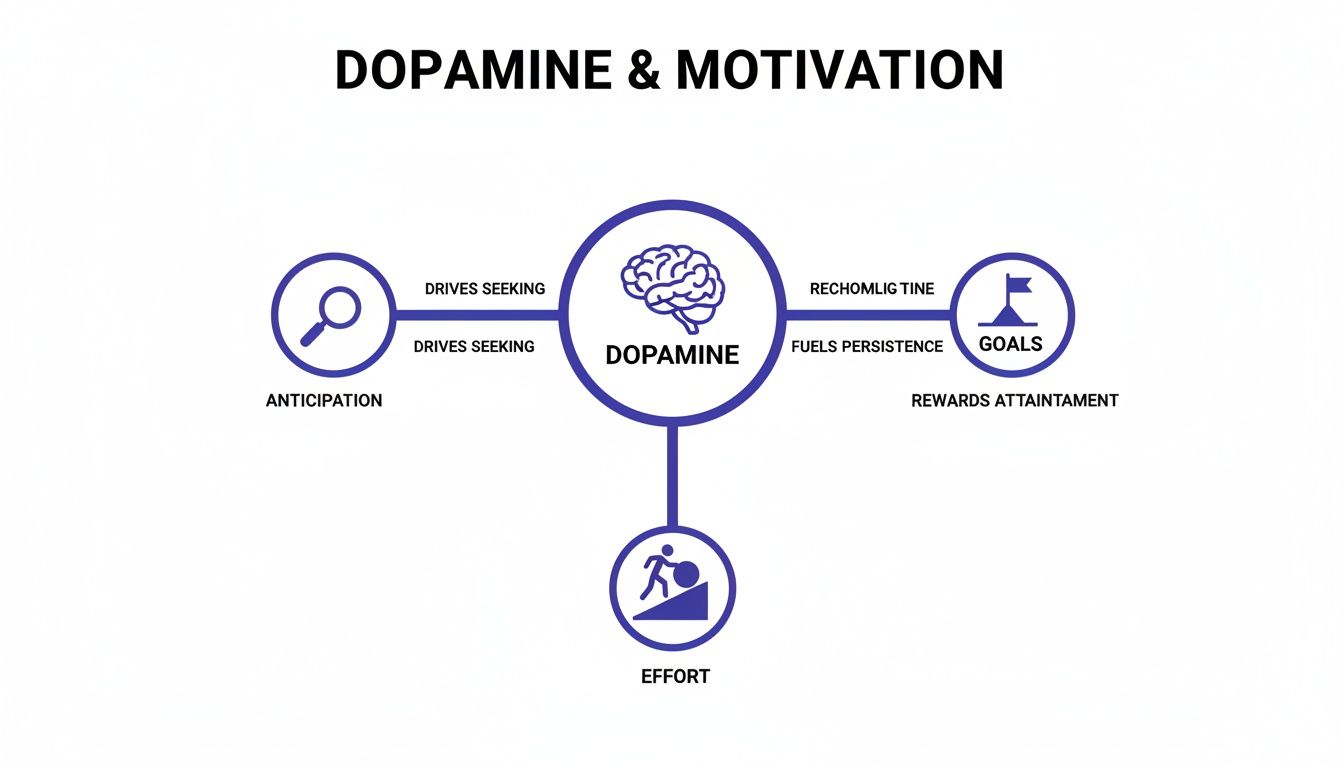
    Dopamine is the brain’s core engine for anticipation, effort, and drive. It’s what makes you want to check that notification or finish one more episode of a show. While this chemical messenger is a key player in your brain’s reward system, its main job is to make you seek rewards, not just enjoy them.

    The Real Driver Behind Your Actions: How Dopamine Fuels Motivation

    Think of dopamine as your brain’s motivational currency. It’s released when you anticipate something good might happen, pushing you to take action. This is an ancient system, originally designed to keep us pursuing essential goals like finding food or shelter.

    • Anticipation, Not Reward: Dopamine surges before you get the reward. It’s the craving or desire that drives your behavior—the feeling of wanting, not the feeling of having.
    • Effort Calculation: Your brain uses dopamine signals to decide if a potential reward is worth the effort. This is why low-effort, high-reward tasks (like scrolling social media) are such powerful dopamine magnets.
    • Learning and Repetition: When an action leads to an unexpected reward, a jolt of dopamine essentially tells your brain: “Do that again.” This is how habits get wired in.

    Real-World Scenario: Imagine you’re about to start writing a report. Just thinking about finishing it and getting praise from your boss releases a small amount of dopamine, creating the initial drive to open the document. But then your phone buzzes. The anticipation of seeing a new message is a more immediate and certain dopamine hit, so your brain urges you to pick up the phone instead. This isn’t a lack of discipline; it’s your brain’s reward system choosing the faster, easier prize.

    A diagram illustrates the role of dopamine in driving anticipation, fueling effort, and pursuing goals.

    As the infographic shows, dopamine’s influence starts with anticipating a goal, continues by fueling the effort to get there, and finally solidifies the behavior that led to success. Understanding this cycle is the first step toward mastering your own focus and drive. These motivational circuits are deeply connected to the brain’s emotional core. To learn more about how these systems shape your daily habits, see our guide on limbic system retraining.

    And if you want to dive deeper into optimizing brain function, you might explore the science behind nootropic supplements for enhanced cognitive performance. By grasping how your brain is wired, you can finally build systems that support your goals instead of working against them.

    Debunking Common Myths About Dopamine and Motivation

    The conversation around dopamine and motivation is crowded with buzzwords and oversimplifications. If you really want to manage your focus, you first have to separate the pop-psychology myths from the scientific reality. Many popular ideas sound compelling, but they seriously misrepresent how this powerful neurotransmitter actually works in your brain.

    So, let’s start by clearing up the biggest misconceptions. Understanding what dopamine isn’t is just as important as knowing what it is. This clarity is the foundation for building strategies that actually work, instead of just chasing the latest productivity fad.

    A man thoughtfully writes in a notebook, his head overlaid with a glowing, networked brain, illustrating how dopamine and motivation work.

    To make this easier, here’s a quick look at the most common myths and the science that corrects them.

    Dopamine Myths vs Scientific Reality

    Common MythScientific Explanation
    Dopamine is the “pleasure chemical.”Dopamine is the molecule of anticipation and pursuit. It drives the wanting of a reward, not the feeling of pleasure itself.
    You can “run out” of dopamine.Your brain doesn’t run out of dopamine. The real issue is receptor downregulation, where your pathways become less sensitive to stimulation.
    A “dopamine detox” means no fun.A detox isn’t about eliminating all stimulation. It’s a strategic reset to reduce hyper-stimulating activities and re-sensitize your reward system.

    With these core distinctions in mind, we can dig a little deeper into why these myths are so persistent—and what the truth means for your focus and drive.

    Myth 1: Dopamine Is the Pleasure Chemical

    This is by far the most stubborn myth out there. While dopamine is absolutely involved in the brain’s reward circuits, it’s not the molecule of pleasure itself. A much better way to think of it is as the molecule of anticipation and pursuit. It’s the neurochemical that creates the feeling of wanting something, driving you to get up and go after it.

    The actual sensation of enjoyment or liking something is more closely tied to other brain chemicals, like opioids and endocannabinoids. Dopamine’s main job is to get you off the couch to chase a goal, whether that’s a promotion at work or another cookie from the jar.

    This isn’t just a minor detail. A major scientific shift now recognizes dopamine as a motivation regulator that responds to the possibility of a reward. Research from Universitat Jaume I shows its activity often spikes before a reward arrives, encouraging us to start and stick with an action. This means your dopamine system is constantly being trained by everything from looming project deadlines to the unpredictable buzz of your phone.

    Myth 2: You Can Run Out of Dopamine

    You can’t “run out” of dopamine like a car runs out of gas. Your brain produces it constantly. The real problem isn’t depletion, it’s the dysregulation of your dopamine pathways. When you’re constantly bombarded with high-dopamine stimuli—like endless social media feeds, addictive video games, or processed foods—your brain adapts to protect itself.

    Your dopamine receptors can become less sensitive, a process known as receptor downregulation. This means you need more and more of a particular stimulus just to get the same motivational “kick.” The fallout? Normal, everyday tasks start to feel dull and uninspiring because they can’t compete with the intense dopamine hits your brain has gotten used to.

    Myth 3: A Dopamine Detox Means Quitting Everything Fun

    The term “dopamine detox” is catchy, but it’s often taken to an extreme. A true detox isn’t about avoiding all forms of stimulation—that’s both impractical and unsustainable for pretty much everyone. Instead, it’s about strategically dialing back your exposure to artificial, high-dopamine activities to give your reward pathways a chance to reset.

    A more accurate name might be a “dopamine fast” or a “digital reset.” The idea is to consciously step away from the hyper-stimulating inputs, like your phone or streaming services, for a set period. This break helps your brain recalibrate, making natural rewards and important work feel engaging and interesting again. It’s a method for managing your attention, not eliminating a vital brain chemical.

    If you want to go deeper, we’ve broken down the science and practical steps in our guide on whether a dopamine detox is real or a myth.

    How Your Brain Decides If a Task Is Worth the Effort

    Ever wonder why clearing your inbox feels so much easier than starting that massive quarterly report? The answer isn’t laziness. It’s a sophisticated calculation happening deep inside your brain, a process driven by the powerful relationship between dopamine and motivation.

    With every choice you face, your brain runs a lightning-fast, subconscious cost-benefit analysis. Think of dopamine as the internal accountant for this operation. Its main job is to weigh the perceived effort of a task against the size and certainty of its potential reward. This mental math happens constantly, shaping whether you dive into a challenging project or opt for a quick, easy win instead.

    This explains our magnetic pull toward low-effort, high-feedback activities. Checking email, scrolling a social feed, or even just tidying your desktop gives you an immediate, tangible sense of accomplishment. Your brain’s accountant flags these as low-risk, high-return investments, making them incredibly appealing next to a long-term project with a payoff that feels distant and uncertain.

    The Cost-Benefit Calculus of Motivation

    Your brain is, above all, an energy-conservation machine. It’s not trying to sabotage your biggest goals; it’s simply wired to prioritize actions that promise the best return on that precious energy. This internal system is always weighing a few key variables:

    • Required Effort: How much mental or physical energy will this take?
    • Reward Size: How much do I actually care about the outcome?
    • Reward Probability: What are the odds I’ll actually get that reward?
    • Time Delay: How long will I have to wait for the payoff?

    When a task demands high effort for a reward that’s far off and uncertain, your dopamine system signals that it’s a bad deal. That feeling we call procrastination? That’s your brain essentially vetoing the transaction. Knowing this is powerful, because it means you can start re-engineering your tasks to be more “dopamine-friendly.”

    Modern neuroscience confirms this isn’t just about feeling pleasure. Dopamine actively shapes how much effort you’re willing to put in. A landmark 2012 Vanderbilt University study found that people described as “go-getters” had higher dopamine signaling in brain areas tied to reward and motivation, like the striatum. In contrast, those who opted for easier tasks with smaller rewards showed more dopamine activity in the anterior insula, a region linked to fatigue and risk aversion. Dopamine, it turns out, is the critical chemical that tunes the brain’s calculation of whether an effort is truly worth making. You can discover more about these dopamine findings on the Vanderbilt University news site.

    Hacking the Effort Equation with Dopamine and Motivation in Mind

    Once you understand this internal accounting system, you can start structuring your work to feel more achievable and rewarding from the start. The goal is simple: make your most important tasks seem like better investments to your brain.

    Breaking a huge project into tiny, concrete steps is the classic example of this principle in action. A massive goal like “write a 20-page report” sounds exhausting and triggers a high-effort alarm. But a small, clear task like “create the report outline” or “write the first paragraph” feels low-effort and provides a quick hit of completion. That small win releases a little dopamine, which actually fuels the motivation to continue.

    Real-World Scenario: A student needs to study for a final exam. The idea of “studying for 4 hours” feels overwhelming. Instead, she breaks it down: “Read one chapter,” then “Review flashcards for 20 minutes.” Each small completion provides a satisfying dopamine release, making it easier to keep going. She’s hacking the effort equation to make the task more appealing to her brain’s reward system.

    This is one of the core ideas behind the neuroscience of single-tasking, a practice that helps lower cognitive load and makes progress feel real. By reframing the work, you can finally tip the scales in favor of taking action on your biggest goals.

    Practical Strategies to Manage Your Dopamine for Better Motivation

    Knowing the neuroscience behind dopamine and motivation is one thing, but real change comes from putting that knowledge to work. The goal isn’t to fight your brain’s wiring—it’s to work with it. Think of this as a toolkit of evidence-backed strategies designed to help you guide your dopamine system, making focus and productivity feel less like a battle and more like a natural rhythm.

    By making a few deliberate tweaks to your environment and routines, you can gently nudge your motivational circuits toward your long-term goals instead of letting them get hijacked by cheap, short-term distractions.

    A balance scale weighing a smartphone against a stack of documents, a great image for illustrating dopamine and motivation.

    We’ll cover four key moves: designing a workspace that supports deep work, using rewards intelligently to keep going, building momentum with habit stacking, and resetting your focus with a practical digital reset.

    Design a Dopamine-Aware Workspace to Enhance Motivation

    Your physical and digital environments are constantly signaling to your brain what it should pay attention to. If your desk is a mess and your screen is a fireworks display of notifications, your brain’s attention is already fractured before you even start. A “dopamine-aware” workspace is simply one that’s intentionally designed to sideline the low-effort, high-reward distractions that drain your motivational fuel.

    The principle is dead simple: increase the friction for distracting activities and decrease it for productive ones.

    • Physical Space: Clear your desk of everything but the essentials for your current task. Move your phone to another room or tuck it into a drawer—that small physical barrier makes a huge difference.
    • Digital Space: Use a separate browser profile for work, with no social media logins. Close all the extra tabs and shut down every non-essential notification on your desktop and in your email.
    • Auditory Space: Noise-canceling headphones aren’t just for music; they’re a powerful signal to your brain that it’s time to lock in and focus.

    Real-World Scenario: A freelance writer needs to dive into a big article. She turns her phone off and leaves it in the kitchen. She closes her email client and all browser tabs except for her research. By curating her environment, she makes the most important task the easiest and most appealing path for her brain to take.

    Use Intermittent Rewards to Sustain Effort

    When you’re grinding away on a long, tough project, the final payoff can feel way too distant to fuel today’s motivation. Your brain’s effort calculation flags it as a bad deal. The fix is to slice the project into smaller pieces and sprinkle in small, intermittent rewards along the way.

    This strategy cleverly mimics the variable reward schedules that make things like video games so compelling. When you celebrate small milestones, you create a steady drip of dopamine that reinforces your hard work and keeps you in the game. For a deeper dive, exploring effective strategies for improving focus and concentration can offer some powerful complementary techniques.

    Leverage Habit Stacking for Effortless Momentum

    Trying to build a new positive habit from zero takes a surprising amount of activation energy. “Habit stacking” is a brilliant technique that lowers that barrier by piggybacking a new behavior onto an existing one you already do on autopilot. This move leverages your brain’s well-worn neural pathways to build momentum almost effortlessly.
    The formula, made famous by author James Clear, is simple: “After [Current Habit], I will [New Habit].”

    • After I pour my morning coffee, I will write down my top three priorities for the day.
    • After I finish lunch, I will spend five minutes meditating.
    • After I shut down my computer for the day, I will tidy my desk for 1 minute.

    This approach neatly sidesteps your brain’s effort calculation. The new habit feels less like a monumental task and more like a natural extension of something you were going to do anyway.

    Implement a Practical Digital Reset to Reclaim Dopamine Sensitivity

    Constant exposure to hyper-stimulating digital media can slowly numb your dopamine receptors, making normal, productive work feel bland and unappealing. A practical “digital reset” helps recalibrate that reward system, restoring your ability to find motivation in quieter, less intense activities.

    This doesn’t mean you have to quit technology cold turkey. A targeted, sustainable approach works far better. The goal is to consciously dial back your intake of high-dopamine, low-value digital content for a set period. If you want a full-blown plan, we’ve built one in our guide on how to reset your dopamine for focus and clarity without quitting tech.

    A simple way to start is with a “digital sunset”—avoiding all screens for 60-90 minutes before bed. This not only helps you sleep better but gives your brain a much-needed break from the constant buzz of stimulation.

    Dopamine-Aware Productivity Techniques

    TechniqueHow It WorksExample Application
    Workspace DesignIncreases friction for distractions and reduces it for focused work.Moving your smartphone to another room while working on a deep task.
    Intermittent RewardsProvides small, periodic dopamine boosts to sustain motivation for long projects.Taking a 15-minute walk outside after completing a 90-minute focus block.
    Habit StackingLinks a new, desired habit to an existing, automatic one to lower activation energy.Meditating for 5 minutes immediately after your morning coffee.
    Digital ResetResets dopamine sensitivity by reducing exposure to hyper-stimulating digital media.Implementing a “digital sunset” by avoiding screens for 60-90 minutes before sleep.

    Editor’s Note: What Actually Works for Boosting Motivation

    After digging through the neuroscience and testing these methods, let’s cut to the chase. While every strategy here can sharpen your focus, one stands out for its undeniable impact: designing a distraction-free environment. This is the single most powerful change you can make to fix a broken link between dopamine and motivation.

    Getting rid of the constant pings, alerts, and visual clutter does more than just stop interruptions. It rewires your brain’s effort calculation. When your most important task is also the easiest and most obvious thing to do, your dopamine system starts working for you, not against you.

    A productive desk setup that promotes dopamine and motivation.

    Who this is for: This advice is best for professionals, students, and creatives who feel their productivity is constantly being hijacked by digital distractions and procrastination. It’s for people who know what they should be doing but struggle to find the drive to start and sustain effort.

    Caveats and Limitations: These techniques are for optimizing a generally healthy brain. They are not treatments or cures. If you’re struggling with persistent low motivation, chronic focus issues, or symptoms that feel like burnout, ADHD, anxiety, or depression, the most important step is to consult a healthcare professional. These strategies support well-being but are not a substitute for medical or psychological care.

    The Deeper Science Behind Dopamine and Motivation

    To really get a handle on the relationship between dopamine and motivation, it helps to look past the latest productivity hacks and see the deep scientific history that brought us here. The strategies in this guide aren’t just passing fads; they’re built on more than half a century of rigorous neuroscience.

    The story of dopamine as a key player in motivation isn’t new. Its connection to our drive goes way back, starting with its identification in the human brain in 1957 by Katharine Montagu. Early breakthroughs in Parkinson’s disease gave us a stark picture of just how important it is. Scientists saw that a severe loss of dopamine-producing neurons led to profound problems with both physical movement and the will to start an action.

    The Brain’s Learning Signal

    This history matters because it shows that the whole “dopamine and motivation” conversation rests on a solid, well-researched foundation. Midbrain dopamine neurons fire in response to something called prediction error—the gap between what you expect to happen and what actually does. This signal is what teaches your brain which actions are worth the energy and which ones to avoid, refining how you behave in the future. You can discover more about this foundational research on the National Institutes of Health website.

    This learning mechanism is fundamental. It’s what links your intention to act with the physical follow-through, forming the very basis of any goal-directed behavior. When this system is working well, you feel a natural pull toward meaningful tasks.

    But when our modern world constantly bombards us with high-stimulation, low-effort rewards, this system gets thrown out of whack. The endless notifications and infinite scrolling create a state of being overstimulated, making it much harder to find the drive for less intense, long-term goals. You can learn more about the signs of being overstimulated by micro-dopamine addictions in our detailed article.

    By understanding this deeper context, you can start to see motivation not as some mysterious force to be conquered with willpower, but as a biological system you can intelligently manage.


    Disclaimer: This article contains affiliate links, meaning we may earn a commission if you make a purchase. The content is for educational purposes only and is not a substitute for professional medical or psychological advice. Always consult a healthcare professional for any health concerns.


    Frequently Asked Questions About Dopamine and Motivation

    Here are clear, straightforward answers to the most common questions about the link between dopamine and motivation.

    1. What is the main role of dopamine in motivation?

    Dopamine’s primary role is not to provide pleasure, but to drive the anticipation and pursuit of a reward. It’s the neurochemical that creates the “wanting” or “craving” that motivates you to take action toward a goal.

    2. How can I increase dopamine and motivation naturally?

    You can naturally support your dopamine system through regular exercise, getting enough sleep, eating a balanced diet rich in protein, listening to music you enjoy, and practicing mindfulness. Breaking large goals into smaller, achievable steps also provides regular dopamine release.

    3. Does low dopamine cause a lack of motivation?

    Yes, dysregulation in the dopamine system is strongly linked to a lack of motivation. When your dopamine pathways become less sensitive (often due to overstimulation), it takes more effort to feel motivated, and everyday tasks can seem dull or overwhelming. This is a key factor in procrastination and feelings of apathy.

    4. Is dopamine the same as willpower?

    No. Willpower is often seen as a conscious, forceful effort to override impulses. Dopamine is the underlying neurochemical system that influences whether you even feel the drive to exert that effort. Managing your dopamine is about making motivation feel more automatic, rather than relying solely on willpower.

    5. What is a “dopamine detox” and does it work?

    A “dopamine detox” (or more accurately, a stimulus fast) is a temporary break from high-stimulation activities like social media, video games, and junk food. It works by allowing your dopamine receptors to “reset” or re-sensitize, which can restore your ability to find motivation in less intense, more meaningful activities.

    6. Can my diet affect my dopamine and motivation?

    Absolutely. Your brain needs specific nutrients, especially the amino acid tyrosine (found in foods like chicken, almonds, and avocados), to produce dopamine. A balanced diet supports overall brain health, which is the foundation for a well-functioning motivation system.

    7. Why do I lose motivation for long-term goals?

    Long-term goals often fail to provide the immediate dopamine feedback your brain craves. The reward is too distant. To maintain motivation, you must break the goal into small milestones and reward yourself for completing them. This creates a steady stream of dopamine that keeps you engaged.

    8. How does sleep impact dopamine and motivation?

    Sleep is critical for a healthy dopamine system. Poor sleep can reduce the availability of dopamine receptors in your brain, leading to fatigue, mood swings, and a significant drop in motivation. Prioritizing consistent, quality sleep is one of the most effective ways to support your daily drive.

    9. Are there any risks to trying to “hack” my dopamine?

    The biggest risk is relying on artificial, high-intensity stimuli (like excessive caffeine, sugar, or constant digital notifications) for motivation. This can lead to receptor downregulation and burnout, making it even harder to feel motivated naturally. The goal should always be to work with your brain’s natural systems, not to constantly override them.

    10. When should I see a doctor about low motivation?

    If you experience persistent low motivation that interferes with your daily life, work, or relationships, and is accompanied by other symptoms like low mood, changes in sleep or appetite, or feelings of hopelessness, it is crucial to consult a doctor or mental health professional. These could be signs of underlying conditions like depression or ADHD, which require professional care. This article is for educational purposes only.


    At Mind Clarity Hub, we turn complex neuroscience into simple, actionable steps. If you’re ready to build systems for lasting focus and calm productivity, we invite you to explore our library of science-backed books and guides.

    Start reclaiming your mental space and momentum today at MindClarityHub.com

    Explore the Mind Clarity Hub Library

    Practical books on focus, digital habits, resilience, and building a calmer mind.

    The Power of Clarity — book cover

    The Power of Clarity

    Unlock mental focus, build momentum, and create the life you were meant to live.

    View book →
    AI & ChatGPT for Beginners — book cover

    AI & ChatGPT for Beginners

    No PhD needed — a 2025 guide to AI, prompts, and productivity without coding.

    View book →
    Zen in the Digital Jungle — book cover

    Zen in the Digital Jungle

    Mindfulness for a chaotic world.

    View book →
    The Slow Reset — book cover

    The Slow Reset

    Mindful living in a fast-paced world.

    View book →
    Perfectly Imperfect — book cover

    Perfectly Imperfect

    Stop self-criticism, set boundaries, and embrace the real you.

    View book →
    Reclaiming Silence — book cover

    Reclaiming Silence

    A dopamine detox guide to finding peace in a noisy world.

    View book →
    The Focused Freelancer — book cover

    The Focused Freelancer

    Productivity, pricing & positioning for independents in 2025.

    View book →
    ChatGPT Side Hustle System — book cover

    ChatGPT Side Hustle System

    Launch your AI-driven online business in 30 days.

    View book →
    Burnout, Interrupted — book cover

    Burnout, Interrupted

    A proven path to restore energy and reclaim your life.

    View book →
    Attention Unleashed — book cover

    Attention Unleashed

    Focus strategies for the distracted mind.

    View book →
    Side Hustle Launchpad — book cover

    Side Hustle Launchpad

    Your quick-start guide to extra income.

    View book →
    Digital Clarity — book cover

    Digital Clarity

    Rewire your brain, escape dopamine traps & regain focus.

    View book →
    Break the Scroll — book cover

    Break the Scroll

    Reduce screen time and take back control of your life.

    View book →
    Climate Compassion — book cover

    Climate Compassion

    Transform eco-anxiety into empowered action.

    View book →
    Village Mentality — book cover

    Village Mentality

    The power of community for mental wellness.

    View book →
    Restful Nights — book cover

    Restful Nights

    Overcoming sleep anxiety in a 24/7 world.

    View book →
    Connected Again — book cover

    Connected Again

    Combat loneliness and build meaningful relationships.

    View book →
    Focus Recharged — book cover

    Focus Recharged

    Mastering attention and productivity in the digital era.

    View book →
    Marketing Magic with ChatGPT — book cover

    Marketing Magic with ChatGPT

    AI-powered content, campaigns, and copywriting to grow faster.

    View book →
    The 6-Figure Creator — book cover

    The 6-Figure Creator

    Turn knowledge into passive income with books, courses & AI.

    View book →
    Burnout Breakthrough — book cover

    Burnout Breakthrough

    Reset your work-life balance and thrive in 2025.

    View book →
    The Emotionally Intelligent Man — book cover

    The Emotionally Intelligent Man

    A modern guide to self-awareness and communication.

    View book →
    AI Personalized Wellness — book cover

    AI Personalized Wellness

    Create your custom health plan with data-driven habits.

    View book →
    Everyday AI Made Easy — book cover

    Everyday AI Made Easy

    Use ChatGPT and smart tools to simplify life.

    View book →
    Money Mindfulness — book cover

    Money Mindfulness

    A financial wellness guide for Gen Z & Millennials.

    View book →
    Startup Smarter with AI — book cover

    Startup Smarter with AI

    ChatGPT strategies and tools to grow your business.

    View book →
    ChatGPT for Writers & Creators — book cover

    ChatGPT for Writers & Creators

    Unlock AI-powered brainstorming, drafting & editing.

    View book →
  • How to Build a Lasting Attitude of Gratitude

    How to Build a Lasting Attitude of Gratitude

    How to Build a Lasting Attitude of Gratitude

    Jeremy Jarvis — Mind Clarity Hub founder
    Mind Clarity Hub • Research-aware focus & digital wellness

    An attitude of gratitude is more than just saying “thank you.” It’s a consistent way of seeing the world, an intentional practice of appreciating the good in your life. This mindset shift actively rewires your brain for greater happiness and resilience, pulling your focus from what’s missing to what’s already there.

    Think of it as building a powerful foundation for positive change, one thankful thought at a time.

    Mindful Gratitude Disclosure: Some links in this article may be affiliate links. If you make a purchase, we may earn a small commission at no extra cost to you. This helps support our work in creating helpful, science-backed content.

    Understanding the Neuroscience of Your Attitude of Gratitude

    Cultivating an attitude of gratitude isn’t just a feel-good philosophy; it’s a practical, brain-changing activity. When you consciously practice being thankful, you’re lighting up key areas of your brain tied to mood, social connection, and reward. According to neuroscience, this process can physically alter your neural pathways over time, nudging positivity to become your brain’s new default setting.

    At its core, gratitude activates the brain’s reward system. When you bring to mind something you’re thankful for, it triggers a release of dopamine and serotonin—two crucial neurotransmitters that boost your mood. The more you do it, the stronger those neural circuits get, making it easier to tap into positive emotions down the road. This is why a simple habit, like jotting down small daily wins, can be so incredibly effective at shaping your behavior.

    Attitude of gratitude moment: smiling man at desk focused on laptop with a “small wins” sticky note and a subtle glowing brain illustration
    A positive attitude of gratitude can rewire your brain for better focus and mood.

    For a busy professional feeling swamped, just acknowledging minor achievements—finishing a report, having a productive meeting—starts to push back against the brain’s natural negativity bias. Behavioral research explains this as our built-in tendency to dwell on bad experiences more than good ones, a leftover survival instinct that doesn’t always serve us in the modern world. Gratitude is a direct counter-practice to this bias.

    How Thankfulness Shapes Your Brain and Focus

    When you practice gratitude, you’re essentially training your attention. Neuroimaging studies have shown that gratitude practices fire up the medial prefrontal cortex, a brain region linked to understanding others’ points of view and feeling relief. In plain language, this mental shift helps you see the positive intentions behind people’s actions and fosters a much deeper sense of connection.

    Gratitude is a tangible practice, not just a fleeting feeling. Research shows that people who actively practice gratitude—through journaling or other exercises—report higher levels of joy and well-being. The act itself invites positive emotions into our lives.

    For example, instead of getting frustrated by a delayed train, someone with a well-practiced attitude of gratitude might use that extra time to appreciate a quiet moment to read or listen to music. This cognitive reframing doesn’t ignore the inconvenience; it just shifts the emotional response toward something more constructive, improving their mood.

    This whole process is closely related to how we can retrain our emotional responses, an area we explore in concepts like limbic system retraining.

    Ultimately, building this mindset is all about consistency. Each small act of thankfulness is like a rep for your brain, strengthening your “gratitude muscle” over time.

    The Real-World Benefits of Practicing Gratitude

    Beyond just feeling a bit better, what does an attitude of gratitude actually do? The real-world benefits are surprisingly far-reaching, transforming not just your headspace but your physical health and social life, too.

    Think of a consistent gratitude practice as a powerful buffer against daily stressors. It works by shifting your brain’s focus. Instead of getting stuck ruminating on worries or frustrations, you actively train your attention on what’s good. This isn’t a quick fix, but a sustained practice that builds a strong foundation for both mental and physical well-being.

    Stronger Health and Better Sleep Through an Attitude of Gratitude

    The ripple effects of gratitude run deep into your physical health. When you experience genuine thankfulness, your brain sends signals to your body that it’s safe, which can help regulate your heart rate and lower blood pressure. According to psychological research, this creates a state of calm that’s far more conducive to restorative rest.

    So many people tell me that a quick gratitude practice before bed helps quiet a racing mind, making it easier to fall and stay asleep. Over time, this improved sleep quality compounds, leading to better energy, sharper focus, and stronger overall health.

    Research has linked gratitude with measurable improvements in longevity. One study found that older women who scored highest on a gratitude questionnaire had a 9% lower risk of all-cause mortality over a four-year period. You can read more about the health findings on gratitude from Harvard.

    Deeper Social Connections

    Gratitude is also one of the most powerful tools for strengthening relationships. When you actively appreciate the people in your life, it changes how you interact with them, fostering deeper bonds and pushing back against feelings of isolation.

    Take a freelance designer who often feels lonely working from home. By consciously practicing gratitude for their clients—appreciating their clear communication, timely payments, or interesting projects—they start to see these professional relationships as genuine human connections. This simple shift can dramatically improve their entire outlook on work and help combat those feelings of isolation. For anyone struggling with this, we have more strategies in our guide on how to deal with loneliness.

    Expressing that gratitude outwardly creates a positive feedback loop. When you thank someone sincerely, it not only makes them feel seen and valued but also reinforces your own positive feelings, solidifying the social connection between you. It’s why an attitude of gratitude is such a key ingredient in building a supportive and fulfilling social life.

    Your Daily Blueprint for an Attitude of Gratitude

    Turning the idea of gratitude into a real, daily habit is where the magic happens. A practical blueprint helps you build and keep an attitude of gratitude, even when life gets hectic or tough. The goal isn’t huge, dramatic gestures; it’s the small, consistent actions that add up over time.

    Forget generic advice that doesn’t really fit into a busy schedule. Let’s dig into a few specific, actionable methods you can start using today.

    Choosing Your Daily Gratitude Practice

    The best gratitude practice is the one you’ll actually do. Whether you have two minutes or twenty, there’s an approach that will work for you.

    Take the classic gratitude journal. This isn’t just a diary; it’s a powerful tool for rewiring your thinking. Instead of just listing things you’re thankful for, the most effective journaling prompts push you to explore why you feel grateful. That extra step is what deepens the mental impact and strengthens the neural pathways tied to positive emotions.

    For example, a remote worker might pair a five-minute journaling session with their morning coffee. By connecting the new habit (journaling) to an existing one (coffee), they’re using a technique from behavioral science called habit stacking to make it stick. You can build a similar routine using our guide to the 7-Minute Clarity Ritual.

    This is how you start to see real benefits, like a better mood, more resilience, and even improved sleep.

    A diagram illustrating the benefits of gratitude, leading to improved mood, resilience, and sleep.

    These daily actions create a positive upward spiral in your well-being. And this isn’t just feel-good thinking; it’s backed by solid research. A huge 2025 meta-analysis covering over 24,000 participants confirmed that gratitude practices like journaling consistently produce real improvements in well-being across different cultures.

    Finding the Right Fit for Your Lifestyle

    So, how do you pick the right practice? It really comes down to your schedule, your personality, and what feels most genuine to you. Not every method works for every person, and that’s perfectly okay.

    To help you find your starting point, here’s a quick comparison of a few popular gratitude exercises.

    Choosing Your Daily Gratitude Practice

    PracticeTime CommitmentBest ForPro Tip
    Gratitude Journal5-10 min/dayIntrospective people who enjoy writing and reflection.Go beyond what you’re grateful for and explore the why. This adds emotional depth and makes the practice more powerful.
    Gratitude Jar1-2 min/dayVisual thinkers and families looking for a simple, shared activity.Write down moments of gratitude on small slips of paper. Read them all at the end of the month for a huge boost.
    Gratitude Letters15-30 min/weekAnyone wanting to strengthen social connections and express thanks directly.Focus on one person each week. Describe the specific, positive impact they had on your life for a more meaningful message.
    Thankful Thoughts30-60 sec/anytimeBusy individuals who need a quick, on-the-go mental reset.Habit-stack this by pairing it with a routine task, like washing your hands or waiting for a file to download.

    Ultimately, the method you choose matters less than the mindset you bring to it.

    The real work is in the simple act of intentionally focusing your attention on what is good, however small. That’s what trains your brain. Pick one of these methods and give it a real try for two weeks. See how it feels—you might be surprised.

    How to Practice an Attitude of Gratitude in a Digital World

    Let’s be honest: staying mindful and grateful can feel like swimming upstream when our phones are buzzing with endless notifications. Digital devices are engineered to grab our attention and keep us scrolling, often pulling us into a reactive, almost robotic state.

    The answer isn’t to throw your phone in a river. It’s about being smarter than your apps. The key is to weave gratitude practices into our digital lives, turning moments of distraction into opportunities for a quick mental reset.


    Gratitude Micro-Practices for a Packed Schedule

    You don’t need an hour-long meditation session to cultivate thankfulness. Gratitude micro-practices are quick, intentional pauses—often lasting less than 60 seconds—that you can sprinkle throughout even the most chaotic days.

    Think of them as tiny circuit breakers for your brain’s autopilot mode. Instead of reflexively grabbing your phone the second you feel bored or anxious, you consciously choose a moment of gratitude. It’s a small act of rebellion against the attention economy.

    Here are a few simple micro-practices you can try today:

    • The Inbox Pause: Before you open your email for the first time, take one deep breath. Bring to mind one person whose work makes your own job just a little bit easier. This tiny habit shifts your mindset from reactive dread to quiet appreciation before the day’s demands take over.
    • The Thankful Thought: Stuck in traffic or waiting for your coffee? Think of one simple, physical thing you’re grateful for right now. Maybe it’s the comfort of your shoes, the warmth of the sun, or the song playing in your headphones. This pulls you back into the present moment.
    • The Connection Moment: The moment you close a social media app, take just 30 seconds to appreciate a real, flesh-and-blood connection in your life—a friend, a partner, a pet. This is a powerful way to counteract the often-hollow feeling of online interactions.

    These small habits are surprisingly powerful. They interrupt the mindless loops and inject a sliver of genuine awareness back into your day.

    Habit Stacking for Digital Clarity

    One of the most effective ways to make these new habits stick is a technique from behavioral psychology called habit stacking. It’s simple: you link a new gratitude habit to an existing digital routine you already do without thinking.

    For example, a startup founder constantly battling afternoon burnout can set a recurring daily calendar reminder on their computer for 2 PM labeled “Gratitude Reset.” When the alarm chimes, they step away from the screen for just one minute and think of one thing that went well that day. It’s a simple, actionable way to fight off mental fatigue without adding another big task to their plate.

    By pairing a gratitude exercise with a digital trigger—like closing a browser tab or ending a video call—you create a powerful new routine. This helps you build a more intentional relationship with your technology.

    This strategy is a cornerstone of a healthier digital life. If you’re looking for more ways to manage your screen time and reclaim your focus, our guide on effective digital detox tips is a great next step.

    When you combine these strategies, you stop letting technology dictate your mental state. Instead, you start using your digital triggers to build a more grounded, positive mindset—one small, intentional action at a time.

    Turning Your Attitude of Gratitude into Meaningful Action

    Gratitude isn’t just an internal feeling; it’s a powerful force for connection when you actually share it. A true attitude of gratitude really gains momentum when you translate those private thoughts into tangible, positive actions.

    Making that shift from feeling to doing is what reinforces the habit and deeply strengthens your relationships.

    By expressing gratitude outwardly, you create a positive feedback loop. Sharing appreciation makes others feel good, which in turn makes you feel good. Behavioral research shows this reinforces the behavior, neurologically locking it in and making the habit much more likely to stick.

    Attitude of gratitude shown as a businessman holds a thank you card with smiling colleagues in an office
    Expressing an attitude of gratitude with meaningful action, like acknowledging a team’s hard work, builds stronger connections.

    From Thought to Action

    The key is to move from a general feeling of thankfulness to a specific, expressed acknowledgment. This doesn’t require grand gestures. The small, sincere actions have the biggest impact.

    For example, a team leader wants to improve group dynamics. Instead of just feeling thankful for her team, she starts each weekly meeting by genuinely acknowledging one person’s specific contribution from the previous week. “Sarah, your detailed analysis on the Q3 report saved us hours. Thank you for being so thorough.” It’s a small act, but it completely transforms the tone of the meeting, fostering a more collaborative and positive environment.

    Action is the bridge between inner gratitude and outer connection. When you express thanks, you aren’t just being polite—you’re actively building a more supportive world for yourself and others.

    This kind of prosocial behavior has actually seen a notable increase globally. Recent analyses show that benevolent acts like helping strangers have remained significantly higher than pre-pandemic levels, suggesting a worldwide rise in gratitude-linked kindness. You can discover more about these global kindness trends in the World Happiness Report.

    Practical Ways to Share Gratitude

    Weaving these actions into your daily life can be simple. The goal is just to be present and specific in your appreciation. For more guidance on this, our article on how to be present in your daily interactions is a great place to start.

    Here are a few concrete examples you can try today:

    • The Specific Thank-You Email: Don’t just send a generic “thanks.” Write to a colleague and detail exactly how their help on a recent project made a difference. Mention a specific skill they used or a challenge they helped you overcome.
    • The Public Shout-Out: If a local coffee shop or business provides outstanding service, don’t just think it—share it. Leave a detailed, glowing review online. This supports the business and spreads that positive energy.
    • The Handwritten Note: In a world of endless digital pings, a simple, handwritten thank-you note for a friend or family member who supported you can feel incredibly meaningful and personal. It cuts through the noise.

    Editor’s Take: What Really Works for an Attitude of Gratitude

    Here’s the honest truth about building an attitude of gratitude: consistency always wins over intensity. A simple, daily three-minute practice is far more effective at rewiring your brain’s focus than an ambitious hour-long session you only manage once a month.

    This advice is best for anyone feeling digitally fatigued, overwhelmed, or just looking for a science-backed way to improve their mood and focus. Think of it as a practical anchor in a chaotic world, helping you reclaim your attention one thankful thought at a time. The key limitation to remember is that while gratitude is a powerful tool for well-being, it is not a cure for clinical conditions like major depression or anxiety disorders. It should be used to complement, never replace, professional care from a licensed therapist or doctor.

    Disclaimer: This article is for educational purposes and is not a substitute for professional medical or psychological advice. Some links in this guide may be affiliate links, meaning we may earn a small commission at no extra cost to you if you make a purchase. If you are experiencing symptoms of anxiety, depression, or burnout, please consult a qualified healthcare provider.

    Frequently Asked Questions About Gratitude

    As you start building this new habit, a few common questions always pop up. Here are some straightforward answers to help you navigate the process with a bit more clarity.

    How Long Until I Actually Feel the Benefits?

    You’ll probably notice a small, immediate mood lift right after a gratitude exercise. That’s the quick hit of feel-good neurotransmitters like dopamine, and it’s a great sign you’re on the right track.

    But the deeper, more lasting changes—like a genuinely resilient mindset and a more positive outlook—take consistency. Lasting neurological shifts, where your brain physically builds and strengthens new positive pathways, typically require several weeks of dedicated, daily practice. Stick with it. The results compound in a way that’s hard to appreciate at first.

    What If I’m Just Not Feeling Grateful Today?

    This is completely normal. In fact, it’s one of the most common hurdles, especially when you’re starting out or just having a tough day. The key is to remember that gratitude is a practice, not just a feeling. It’s a muscle you build through repetition.

    On days like this, start incredibly small. Don’t try to force yourself to feel thankful for big, abstract concepts. Instead, anchor your attention in simple, sensory experiences.

    • The warmth of your coffee mug against your hands.
    • The comfort of a soft blanket or a favorite sweater.
    • The simple fact that your internet connection is working.

    By practicing with these tiny, undeniable truths, you start training your brain to scan for the good. Often, the feeling of gratitude follows the action of looking for it.

    Is a Journal or an App Better for This?

    Honestly, the best tool is whichever one you’ll actually use consistently. Both physical journals and digital apps have their place, and the most important factor is your intentional focus, not the medium itself.

    That said, there’s interesting research suggesting the physical act of writing can have unique cognitive benefits. Forming letters by hand engages more areas of your brain, which can help deepen how you process and remember your thoughts and feelings.

    An app offers convenience and reminders, which can be a game-changer for building the initial habit. A physical journal provides a quiet, screen-free space for deeper reflection. Why not try both and see which one feels more natural for you?


    At Mind Clarity Hub, we build practical, science-backed guides to help you create habits that stick. You can explore our full library of books on focus, digital wellness, and mindful productivity at the Mind Clarity Hub website.