...

Tag: increase focus

  • How to Improve Attention Span in Adults: Simple, Science-Backed Strategies

    How to Improve Attention Span in Adults: Simple, Science-Backed Strategies

    This post may contain affiliate links. If you make a purchase, we may earn a small commission at no extra cost to you.

    Retraining your attention span isn’t about “trying harder” or finding some magic bullet of willpower. It’s about systematically rewiring your brain with small, intentional habits. The process hinges on dialing down digital noise and bringing in smart focus techniques. This gives your brain’s attention circuits a chance to strengthen again.

    Why Your Attention Is Slipping and How to Improve It

    Does this sound familiar? You sit down to finally tackle that critical report. A few minutes in, a cascade of pings and alerts pulls you away. Before you know it, an hour has evaporated, and you’ve barely written a single paragraph. If that hits close to home, you’re not alone.

    The modern world often feels engineered to shatter our concentration. Between constant notifications and infinite social media feeds, sustained focus feels impossible. From a psychology perspective, this isn’t a personal failing. It’s a predictable behavioral response to an overwhelming digital environment.

    The Neuroscience of a Wandering Mind

    At the heart of the problem is a bit of neuroscience called the “digital dopamine loop.” Every time you get a notification or a like, your brain releases a tiny bit of dopamine—a feel-good chemical. It’s a small, fleeting reward that conditions your behavior to check devices again and again.

    Over time, your brain’s reward system gets wired to seek these quick, easy hits. This habit makes it much harder to sink into deep, focused work. Deep work offers a more delayed and less immediate sense of gratification. Your brain essentially learns to prefer distraction over depth. If you often feel mentally scattered, it’s worth understanding more about what causes brain fog.

    This constant switching hijacks our ability to concentrate. Studies show the average adult attention span has now plummeted, making sustained focus a real challenge.

    But here’s the good news: neuroscience research shows you can reclaim your focus. For instance, studies show that just 10 minutes of daily mindfulness can boost attention. This happens by rewiring the brain’s prefrontal cortex, the area responsible for executive functions like focus.

    Real-World Example: Imagine Sarah, a project manager. She used to check her email every 10 minutes, driven by that dopamine hit. She started a new habit: turning off notifications for one hour. At first, it felt difficult. But soon, her brain adapted, and she could work uninterrupted, feeling more accomplished.

    Starting Your Journey to Better Focus

    You can fight back against distraction. Improving your attention is a skill you can build with consistent practice. It all starts with making intentional choices to create a supportive environment. For anyone feeling a persistent decline in concentration, exploring guides on how to improve focus and boost concentration can offer valuable starting points.

    This guide will walk you through foundational strategies:

    • Single-Tasking: The surprisingly powerful art of doing one thing at a time.
    • Strategic Breaks: Using intentional rest to replenish your mental energy.
    • Mindful Technology Use: Taking back control of your devices.

    By adopting these principles, you begin to retrain your brain. You shift from a reactive state to a proactive one, where you command your attention. To build this skill, explore our book, Attention Unleashed.

    This article is educational and not a substitute for medical or psychological advice, especially for conditions like ADHD, anxiety, or depression. Please consult a professional for diagnosis and treatment.

    Build Your Deep Work Foundation to Improve Your Attention Span

    Just deciding to “focus more” is like trying to build a house without a blueprint. It’s a nice thought, but it won’t stand up to the first distraction. To truly rebuild your attention span, you need a solid framework.

    Creating a structured routine isn’t about rigid, joyless discipline. It’s about building a protective shield around your most valuable mental resource: your focus. A routine puts you back in the driver’s seat. It lets you intentionally spend your focus on what actually matters.

    We’ve all been in that frustrating cycle of losing and reclaiming our attention.

    A process flow diagram illustrates three steps to reclaim focus: slipping, distracted, and reclaim.

    The diagram above pinpoints that critical moment of choice. You can stay stuck in that distracted haze, or you can actively pull yourself out with a structured approach.

    The High Cognitive Cost of Context Switching

    Let’s be clear: your brain can’t actually multitask on complex projects. What we call multitasking is really context switching—the mental gymnastics of toggling between tasks. Every time you switch, your brain pays a “cognitive cost.” Behavioral psychology research shows it has to slam the brakes on one task and rummage for the context of the new one.

    This process is incredibly draining. Research from the American Psychological Association found that even brief mental blocks from switching tasks can devour as much as 40 percent of someone’s productive time.

    Real-World Example: Think about a remote worker trying to write a project proposal. They write one sentence, then check an email, then answer a Slack message. Each switch shatters their attention. This makes the core task take far longer. A structured routine is the antidote, allowing you to sink into deep concentration. You can learn more by exploring our guide on what deep work is.

    How to Implement a Structured Focus Routine

    Building this foundation doesn’t mean you have to overhaul your entire life overnight. It starts with a few simple, proven techniques.

    Here are two of my favorite methods to get started:

    • Time Blocking: This is where you schedule your whole day into dedicated blocks for single tasks. Your calendar becomes your non-negotiable guide. For example, a block from 9 AM to 11 AM might be for “Drafting the Q3 Marketing Report.”
    • The Pomodoro Technique: This method uses a timer to break down work into focused sprints, typically 25 minutes, separated by short breaks. It’s a fantastic way to break through procrastination and build your focus endurance.

    This small shift changes everything. You’re training your brain to sustain focus for a manageable chunk of time. The built-in breaks prevent you from burning out. For a deeper dive into these methods, check out our productivity guide, Focus Recharged.

    A strong deep work foundation is all about efficiency. To find more ways to boost your concentration, check out these practical ways to improve productivity at work. By creating a routine, you’re not just managing your time—you’re managing your brain’s energy.

    Design a Distraction-Proof Environment to Improve Attention

    Let’s be honest: our environment usually dictates our focus. If your desk is a mess and your phone buzzes every two minutes, you’re fighting an uphill battle. Reclaiming your attention span isn’t about finding a secret reserve of willpower. It’s about making focus the path of least resistance.

    This means deliberately engineering your surroundings—both digital and physical—to support deep concentration. When your environment is built for focus, you stop wasting precious mental energy. You make focus the easy, default option.

    Desktop focus setup with a notebook, headphones, phone, laptop, and a timer—an organized workspace to improve attention span in adults.

    Perform a Digital Dopamine Reset

    Your digital world is ground zero for modern distraction. Every notification trains your brain to seek novelty. This shatters your ability to stay on one task. A “digital dopamine reset” is about taking back control and re-sensitizing your brain to more important work.

    Start with your smartphone, which is often the biggest offender.

    • Kill Non-Essential Notifications: Go into your settings and turn off all alerts except for those from actual people. Social media likes and news alerts can wait. This single action stops the constant hijacking of your attention.
    • Set Firm App Limits: Use your phone’s built-in screen time features to put daily limits on your most-used apps. When the timer goes off, it’s a clear signal to disengage.
    • Create “No-Phone Zones”: Designate specific areas or times where phones are off-limits. The dinner table is a classic. A simple phone lock box timer can help enforce this habit during family meals, ensuring you’re fully present.

    These steps aren’t about ditching technology. They’re about using it on your terms, a core principle explored in books like Digital Clarity and Break the Scroll.

    Optimize Your Physical Workspace for Focus

    Your physical environment sends powerful cues to your brain. A cluttered desk signals a cluttered mind. An organized space tells your brain it’s time for focused work.

    Think of your workspace as a cockpit for productivity. Every item should have a purpose geared toward maximizing concentration. For more great ideas on this, check out our guide on digital detox tips that can transform your environment.

    Real-World Example: Mark, a freelance developer, struggled with distractions at home. He invested in a pair of quality noise canceling headphones to block out household noise. He also decluttered his desk, leaving only his laptop and a notebook. This simple environmental change dramatically improved his coding sessions.

    By engineering your physical and digital worlds, you remove decision fatigue. This creates a powerful feedback loop: a focused environment promotes focused work.

    How to Choose the Best Focus Technique to Improve Your Attention Span

    Finding a focus strategy that actually sticks isn’t about chasing the most popular trend. It’s about finding a system that works with your brain’s natural rhythm. Not every method is built for every person, so the key is to experiment.

    A freelance writer might find the short, intense sprints of one method energizing. Meanwhile, a project manager needs the clear structure of another to keep all the plates spinning. The goal is to find a system that cuts down on decision fatigue.

    Best Option for Beginners: The Pomodoro Technique

    The Pomodoro Technique is a fantastic starting point for anyone who gets overwhelmed. It works by breaking your day into focused 25-minute sprints, separated by short breaks. This approach gamifies your work and helps train your brain to sustain focus.

    This method is effective because it tackles procrastination head-on. The idea of “write a 10-page report” can be paralyzing. But “work on the report for 25 minutes”? That feels doable. It’s a practical application of time chunking, which helps manage cognitive load. To get the most out of this method, check our guide on what the Pomodoro Technique is.

    Best for Busy Professionals: Time Blocking

    If your day feels like a chaotic mix of meetings, emails, and deep work, Time Blocking might be your answer. This method involves scheduling every part of your day into specific blocks on your calendar. You assign each task a dedicated time slot.

    A marketing director could block 9:00 AM to 11:00 AM for “Q4 Strategy Deck.” This approach turns your calendar into a strategic plan for your attention. It forces you to be realistic about what you can get done. Using a dedicated time blocking planner makes this process even more powerful.

    How to Choose Your Focus Technique

    The right technique comes down to your personality and workflow. A method that feels liberating for one person might feel restrictive for another. This table can help you choose.

    Feature ComparisonPomodoro TechniqueTime Blocking
    Best ForCreative tasks, fighting procrastination, building focus stamina.Busy professionals, managing multiple projects, creating structure.
    Key BenefitMakes large projects feel manageable and prevents burnout.Provides a clear, strategic plan that protects deep work time.
    Potential DownsideConstant breaks can disrupt “flow state” for some tasks.Can feel too rigid for those with unpredictable workflows.
    Good First StepUse a timer for one 25-minute sprint on your most-dreaded task.Block out one 90-minute “focus session” in your calendar for tomorrow.

    After you’ve picked a method, consistency is key. A habit tracker journal is a great way to monitor your progress. Tracking your focused work sessions provides positive reinforcement, which helps strengthen the neural pathways for sustained attention. Now, let’s explore ways to strengthen your brain from the inside out.

    Strengthen Your Brain to Improve Attention with Lifestyle Habits

    External strategies like time blocking are powerful, but lasting focus doesn’t just come from a better calendar. It starts inside your brain and body.

    To truly rebuild your attention span as an adult, you have to build a stronger biological foundation. This means getting serious about the pillars of cognitive function: sleep, exercise, and mental training.

    Think of your brain’s ability to focus like a muscle. If you don’t give it the right fuel and recovery time, it will fatigue quickly. These internal habits are the equivalent of proper nutrition and rest for your mind.

    Adult practicing mindfulness on a purple yoga mat while reading a book, with an orange mug nearby—simple routine to improve attention span in adults.

    Prioritize Sleep to Sharpen Your Prefrontal Cortex

    Sleep isn’t a luxury; it’s a critical maintenance period for your brain. During deep sleep, your brain clears out metabolic waste and consolidates memories. When you’re sleep-deprived, that cleanup process gets short-circuited. This directly impacts your prefrontal cortex—your brain’s command center for attention and impulse control.

    Even one night of bad sleep can leave you feeling foggy. Chronic sleep debt undermines any other effort you make to improve your focus. For those struggling with sleep due to a restless mind, our book Restful Nights offers targeted strategies.

    Real-World Example: Alex was a night owl and often felt groggy. He created a new evening habit. An hour before bed, he put his phone away and used a high-quality sleep mask blackout to create total darkness. Within a week, his mood improved, and he found it much easier to concentrate during his morning meetings.

    Train Your Attention with Simple Cognitive Exercises

    Just as physical exercise strengthens your body, cognitive exercises can strengthen your brain’s focus circuits. These don’t have to be complicated “brain games.” Some of the most effective methods are remarkably simple.

    Reading a physical book is one of the best ways to rebuild your attention span. Unlike scrolling online, a book demands you follow a single narrative without constant distraction. It’s a direct workout for your focus muscles.

    Mindfulness meditation is another powerful tool. It involves training your brain to notice when your attention has wandered and gently guide it back. This simple act is the core repetition that builds a stronger attention span over time. For a deeper dive into how your brain’s reward system plays into all this, learn more about the link between dopamine and motivation.

    Editor’s Take: What Actually Works to Improve Attention

    After years of writing about attention and trying dozens of systems, here’s the honest truth: there’s no magic bullet for a scattered mind. Real, lasting change doesn’t come from a new app or a complicated productivity hack. It’s built on ruthless consistency in a few key areas.

    What Actually Works: For most of us drowning in digital noise, the path back to clarity comes from three things: a fierce commitment to single-tasking, aggressively taming your notifications, and unapologetically prioritizing sleep.

    Who It’s For: This advice is for busy adults feeling overwhelmed by digital distractions who want practical, neuroscience-backed ways to rebuild focus.

    Important Caveats: If you suspect an underlying condition like ADHD or you’re navigating anxiety or burnout, these strategies can help, but they are not a substitute for professional medical or psychological care. The goal is improved focus, not self-diagnosis or treatment. Start small, be consistent, and give yourself grace.

    Key Takeaways: Your Path to Better Focus

    • Understand the “Why”: Your wandering mind is a normal response to a distraction-filled world. The “digital dopamine loop” trains your brain to seek constant novelty.
    • Build a Structure: Use techniques like Time Blocking or the Pomodoro method to create a routine that protects your focus from interruptions.
    • Control Your Environment: A decluttered physical workspace and a curated digital life (with fewer notifications) make focus the path of least resistance.
    • Choose a Method That Fits: Experiment with different focus techniques to find one that aligns with your work style and personality.
    • Prioritize Brain Health: Quality sleep, regular movement, and cognitive exercises like reading are non-negotiable for improving your attention span.

    Disclaimer: This article is for educational purposes and is not a substitute for professional medical or psychological advice. This post may contain affiliate links, which means we may earn a small commission on purchases at no extra cost to you.

    FAQ: Your Questions on How to Improve Attention Span

    1. How long does it take to actually improve my attention span?

    It varies. Many people feel more in control within a few weeks of consistent practice. However, neuroscience research suggests measurable changes in the brain, like from mindfulness, can occur in as little as eight weeks. Consistency is more important than perfection.

    2. Is it really possible for adults to retrain their brain for better focus?

    Yes, absolutely. Thanks to a brain property called neuroplasticity, you can form new neural connections at any age. Every time you resist a distraction and practice single-tasking, you are actively strengthening the brain circuits responsible for sustained attention.

    3. Is multitasking always a bad idea for my attention span?

    For any task that requires genuine mental effort, yes. Behavioral research shows it’s actually rapid “context-switching,” which drains energy and increases errors. However, for simple, automatic tasks (like listening to a podcast while folding laundry), it’s generally harmless.

    4. If I could only build one new habit, what should it be?

    Single-tasking. Committing to doing one thing at a time is the foundational skill for deep focus. It directly counteracts the brain’s learned craving for constant, shallow stimulation from our digital lives.

    5. What about “focus supplements”? Do they help improve attention?

    The supplement world is complex and largely unregulated. While basics like a healthy diet are crucial for brain function, there is no magic pill for focus. Foundational habits like quality sleep and exercise have a far more scientifically proven impact. Always consult a healthcare professional before starting any new supplement.


    Ready to build a real system for lasting focus? Browse our library and find the book that fits your specific goal.
  • How to Improve Attention Span in Adults: A Science-Backed Guide

    How to Improve Attention Span in Adults: A Science-Backed Guide

    Heads up: This post contains affiliate links. If you buy something through a link, we may earn a small commission at no extra cost to you. We only recommend products we trust. Thanks for your support!

    To improve your attention span, the first step is to handle digital distractions while making time for focused work. This two-pronged approach trains your brain to ignore constant pings and interruptions. Consequently, you gradually rebuild the neural pathways you need for deep concentration.

    Why You Feel So Distracted: The Modern Attention Span Dilemma

    Let’s be honest: staying focused feels like a superpower these days. If you can’t get through a single task without instinctively reaching for your phone, you are not alone. This is not a personal failure. It’s a normal response to an environment engineered for interruption.

    A woman focuses on her laptop in a modern office, demonstrating how to improve attention span in adults.

    This article is for educational purposes only and is not a substitute for professional medical or psychological advice. If you are experiencing persistent issues with attention, anxiety, or burnout, please consult a qualified healthcare provider.

    Your Brain on Distraction: The Science of Interruption

    Every notification—an email ding, a social media like, a news alert—delivers a tiny hit of dopamine. This is the brain chemical linked to pleasure and reward. Your brain’s prefrontal cortex manages focus and decision-making. However, it gets rewired to chase these quick, easy rewards.

    This process creates what behavioral psychologists call a “dopamine feedback loop.” This loop makes it incredibly difficult to stick with slower, more demanding work that offers its payoff later. Consequently, your ability to sustain focus diminishes.

    For example, imagine a startup founder trying to draft a critical business plan. What should be a two-hour deep work session bleeds into an entire day. It’s shattered by a constant flood of emails, Slack messages, and the magnetic pull of social media. Each interruption forces a “context switch,” which fragments attention and drains mental energy.

    Attention Is a Trainable Muscle

    But here’s the good news: attention is not a fixed trait you were born with. It’s a cognitive muscle. Just like lifting weights strengthens your biceps, specific habits can strengthen your brain’s ability to focus. Neuroscience research confirms that targeted training can enhance attentional control networks in the brain.

    This guide is built on that powerful idea. You can learn how to improve attention span in adults by consciously reclaiming control from digital noise.

    Recent data highlights how urgent this is. The average adult attention span has plummeted. Some studies show our ability to focus on a single screen has dropped to just 47 seconds. For a deeper dive into how your brain is being subtly hijacked, check out our guide on digital overwhelm.

    As we unpack this dilemma, it’s clear we need a broad toolkit. For more strategies, you can learn how to improve focus and boost concentration. By understanding the mechanics of distraction, you can finally start to take back control.

    Building Your Foundation for Unbreakable Focus

    Before you can win the daily battle against distractions, you have to get the biology right. Think of it this way: you wouldn’t expect a high-performance car to run on cheap fuel. Similarly, you can’t demand elite focus from a brain starved of sleep, proper nutrients, or physical activity.

    This foundational work creates the biological conditions where concentration can happen. Without it, all the focus techniques in the world are just temporary fixes.

    Sleep: Your Brain’s Ultimate Cognitive Reset

    Sleep isn’t just passive downtime; it’s an essential maintenance period for your brain. While you rest, your brain’s glymphatic system—its “cleanup crew”—works overtime. It clears out metabolic toxins that build up during waking hours. This process is non-negotiable for sharp cognitive function, according to sleep science.

    This nightly reset is critical for your prefrontal cortex. This is the command center for attention, planning, and impulse control. When you’re sleep-deprived, this area is one of the first to go offline. That’s why even a single bad night can leave you feeling foggy and unable to concentrate.

    For a deeper look at managing daily routines for better cognitive performance, see our step-by-step guide to repairing executive function.

    How to Choose the Best Sleep Improvement Strategy

    Improving sleep is about getting higher-quality rest. Managing your light exposure is one of the most powerful changes you can make.

    • In the evening: Start a relaxing “wind-down” routine an hour before you plan to sleep. This means dimming the lights and avoiding the blue light from screens. That specific light is notorious for interfering with melatonin, the sleep hormone. A pair of stylish blue light blocking glasses can make a real difference here.
    • In the morning: Instead of a jarring phone alarm, try a sunrise alarm clock. These devices mimic a natural sunrise by gradually brightening your room. This gentle wake-up call helps regulate your circadian rhythm and can leave you feeling more alert.

    Of course, serious disruptions like sleep disorders can severely impair concentration. For anyone struggling, resources on alleviating sleep disorders can be an important part of the solution.

    A Real-World Example

    Picture a remote worker named Sarah who used to end her evenings scrolling on her phone in bed. After switching to a physical book under a warm lamp, she found it much easier to fall asleep. The next morning, waking up to a gradual light instead of a blaring alarm left her feeling calm and ready to tackle her tasks with a clear mind.

    Fueling Your Brain for Sustained Focus

    What you eat directly impacts your brain’s ability to fire on all cylinders. Your brain is an energy hog—it consumes about 20% of your body’s total energy. Therefore, the fuel you give it matters immensely.

    Here’s how to choose foods that boost your brain:

    • Prioritize Omega-3 Fatty Acids: Find these in fatty fish like salmon, walnuts, and flaxseeds. These fats are critical for building brain cell membranes and support cognitive functions.
    • Opt for Complex Carbohydrates: Foods like oatmeal and sweet potatoes provide a slow, steady release of glucose. This is your brain’s primary energy source. This prevents the energy spikes and crashes you get from sugary snacks.
    • Stay Hydrated: Even mild dehydration can impair attention and memory. Keep a water bottle on your desk all day as a visual reminder.

    Exercise: The Natural Way to Improve Attention Span

    Finally, don’t underestimate regular physical activity. It’s one of the most effective tools for improving attention span in adults. When you exercise, you increase blood flow to the brain. This delivers a fresh supply of oxygen and nutrients right where they’re needed.

    Movement also boosts key neurochemicals, including dopamine, norepinephrine, and serotonin. These chemicals play a direct role in regulating mood, motivation, and your ability to maintain focus.

    Even a short, brisk walk can have an immediate effect on your concentration. If you work from a desk, consider an under desk walking pad to incorporate gentle movement. It’s a simple way to stay alert and engaged during long tasks.

    Structuring Your Day to Improve Attention Span

    Having a solid biological foundation is the first step. However, a strong building also needs a good frame. Similarly, improving your attention span requires structuring your day with intention. This is where you shift from hoping for focus to actively training your brain to sustain it.

    The goal isn’t just to get more done. It’s to experience “deep work”—a state of distraction-free concentration. This allows you to master complex information and produce brilliant results in less time. This happens when you create deliberate blocks in your day dedicated to one important task.

    Every time you complete a focus session, you strengthen what psychologists call attentional control. This is your brain’s ability to choose what you pay attention to and ignore the rest. You’re literally building the neural circuits that make concentration easier next time.

    How to Set Up Your First Focus Session

    Getting started is simpler than it sounds. The key is to remove as many decisions and distractions as possible.

    • Define a single, clear task. Don’t just say “work on the project.” Be specific: “Draft the first three paragraphs of the marketing proposal.” A sharp goal eliminates the mental friction of starting.
    • Prepare your environment. This is non-negotiable. Close every unnecessary browser tab. Put your phone in another room or use a phone lock box timer. If you’re in a noisy space, a good pair of noise canceling headphones is one of the best investments for your focus.
    • Set your timer. Use a dedicated timer, not your phone. A simple pomodoro timer on your desk acts as a physical anchor for your commitment. Start with a manageable interval, like 25 minutes.

    During this time, your only job is the task. If a distracting thought pops up, jot it down and immediately return to your work.

    The visual below illustrates how foundational habits create the right conditions for structured focus sessions.

    Diagram illustrating how sleep, nutrition, and exercise contribute to building focus and show how to improve attention span in adults.

    As you can see, your ability to concentrate is built on the quality of your sleep, the fuel you give your body, and whether you’ve moved.

    Best Frameworks for Busy Professionals

    While the basic setup is universal, a few methods can help you apply it consistently. The best approach depends on your work style.

    TechniqueBest ForHow It Works
    The Pomodoro TechniqueBeginners or anyone feeling overwhelmed. It’s excellent for breaking down large projects.Work in focused 25-minute intervals, separated by 5-minute breaks. After four “pomodoros,” take a longer break.
    Time BlockingPeople juggling varied tasks. It’s ideal for managing a mix of meetings and creative work.You assign a specific “block” of time on your calendar for every single task, including emails and breaks.
    90-Minute Focus BlocksExperienced deep workers. Great for complex creative or analytical tasks that demand a flow state.Based on ultradian rhythms, you work in an uninterrupted 90-minute sprint, followed by a 20-30 minute rest period.

    A Real-World Example

    Imagine a freelance graphic designer, Alex, who struggles with constant client emails derailing his creative work. He decides to try time blocking. Using a time blocking planner, he carves out a 90-minute, no-interruptions block from 9:00 AM to 10:30 AM for a key client’s logo. He puts on his headphones, sets his phone to Do Not Disturb, and gets to work. By 10:30, he has made more progress than he did in the entire previous afternoon of scattered effort.

    This structured work is a game-changer for anyone looking to produce high-value output. To explore these methods in greater detail, you can learn more about how to do deep work in our complete guide.

    Ultimately, structuring your day makes focus the default, not the exception. By creating these rituals, you reduce reliance on willpower and build a system that supports sustained attention. For more practical systems, you can browse the library of our books.

    Winning the War on Digital Distractions to Improve Attention

    It’s time to talk about the biggest threat to our focus: our digital devices. They’re brilliant tools, but their design often works against our biology. They train our brains to crave constant, easy stimulation. Winning this war isn’t about ditching technology; it’s about reclaiming control.

    This starts with a practical ‘dopamine reset.’ The idea is to consciously cut back on high-dopamine, low-effort activities (like scrolling social media). This allows your brain to find satisfaction in quieter, more meaningful tasks again. When your brain isn’t getting a hundred tiny rewards per hour from pings, it becomes easier to settle into deep work.

    Your First Move: Disable Non-Essential Notifications

    The single most powerful action to improve your attention span is to silence your phone. Every buzz and ding is an invitation to switch contexts, shattering your concentration.

    From a neuroscience perspective, each notification triggers a small dopamine release. This creates a potent feedback loop where your brain learns to anticipate these interruptions. This makes it incredibly difficult to focus on anything else for long.

    By turning off alerts from social media, news apps, and promotional emails, you break this cycle. You get to decide when to engage, not your apps.

    How to Choose Your First Digital Detox Strategy

    Feeling overwhelmed by a full digital detox? Don’t be. The key is to start with one simple, high-impact change that feels achievable. This approach builds momentum.

    Here’s a quick comparison to help you pick your first step.

    StrategyBest ForYour First Actionable Step
    Notification BatchingBusy professionals who need to stay connected but want to eliminate constant interruptions.Turn off all non-human app alerts. Schedule three specific 15-minute slots per day to check emails and messages.
    The Phone Lock BoxAnyone needing 1-3 hours of pure, uninterrupted focus for creative or analytical work.Start with one 60-minute session for your most important task. Place your phone in a lock box and move it to another room.
    Greyscale ModePeople struggling with mindless scrolling and the addictive pull of visually stimulating apps.Go to your phone’s Accessibility settings and enable greyscale. This makes apps far less appealing and reduces their dopamine hit.

    By choosing just one of these, you can immediately reduce digital noise. For a more detailed guide, explore our practical digital detox tips to build a healthier relationship with your devices.

    Create a Distraction-Free Digital Workspace

    Just as you’d tidy your physical desk, you need to clean up your digital one. A cluttered digital environment with dozens of open tabs is a recipe for fractured attention.

    Here are a few rules for a more focused digital space:

    • One Task, One Window: When working on a report, only have that document and essential research tabs open. Close your email client and anything unrelated.
    • Use Separate Browser Profiles: Create different browser profiles for “Work” and “Personal.” This prevents getting sidetracked by social media bookmarks.
    • Batch Your Checks: Schedule specific times to check email—perhaps at 10 AM, 1 PM, and 4 PM. This transforms email from a constant interruption into a scheduled task.

    Here’s how this looks in the real world:

    Imagine a college student, Maya, preparing for final exams. Her biggest challenge is the compulsive urge to check her phone. She enables greyscale mode to make Instagram less appealing and uses a focus app to block distracting websites for two-hour study blocks. For her most challenging subject, she puts her phone in a lock box. She quickly discovers she can study for hours, retaining more information and feeling less anxious.

    Ultimately, winning the war on digital distractions is about being intentional. It’s a conscious choice to protect your most valuable asset: your attention. To get a clear plan, see the book that fits your goal.

    Training Your Brain with Mindfulness and Cognitive Exercises

    Improving your focus isn’t just about blocking out distractions. It’s also about training your brain from the inside out. When you deliberately engage in mental practices like meditation or deep reading, you’re strengthening the neural networks responsible for attention. Over time, focus starts to feel less like a struggle.

    A woman meditates in her living room, a practical tip on how to improve attention span in adults.

    This internal training taps into a core principle of brain science called neuroplasticity. This is your brain’s incredible ability to rewire itself by forming new connections. Every time you practice a skill, you are physically changing your brain.

    Using Mindfulness to Strengthen Attention Networks

    At its core, mindfulness meditation is a workout for your attention. It’s the repeated practice of bringing your focus to the present moment without judgment. Neuroscience research shows that a consistent mindfulness practice can strengthen the prefrontal cortex. This part of your brain handles attention regulation and impulse control.

    Think of your attention like a puppy that constantly wanders off. Each time you gently bring the puppy back, you’re reinforcing the leash. Similarly, every time your mind wanders during meditation and you guide it back to your breath, you are strengthening your brain’s ability to control its focus.

    Simple 3-Minute Breathing Exercise to Start Now

    1. Sit comfortably with your back straight and let your eyes close.
    2. Place your hands on your lap and bring your attention to your breath.
    3. Notice the feeling of air entering your nostrils, filling your lungs, and then leaving your body. Just observe it.
    4. When your mind inevitably wanders, gently acknowledge it and guide your focus back to your breath.
    5. Repeat this for three minutes. A visual timer for your desk can help you stay on track without a jarring alarm.

    Cognitive Challenges and Brain Plasticity

    Just as physical exercise builds muscle, cognitive challenges build a more resilient brain. Pushing yourself just outside your intellectual comfort zone is a powerful way to improve your attention span. This isn’t about rote memorization; it’s about deep, engaged thinking that forces your brain to build and reinforce new pathways.

    This process makes your brain more efficient at processing information and sustaining focus.

    Best Cognitive Exercises for Beginners

    You don’t need a special app or an expensive program. The key is to choose something that is both genuinely interesting and a little challenging for you.

    ActivityBest ForHow It Improves Focus
    Reading Complex BooksThose who enjoy stories or learning new subjects.Following intricate plots or dense arguments forces sustained concentration and improves working memory.
    Learning a New SkillAnyone seeking a practical challenge (e.g., a musical instrument, a language).Requires intense, focused practice and helps build new neural connections related to memory and motor control.
    Strategic GamesPeople who enjoy puzzles and logical thinking (e.g., chess, sudoku, crosswords).These games demand planning, foresight, and the ability to hold multiple pieces of information in your mind.

    A great place to start is by picking up a book on a topic you’re truly curious about.

    Consider a manager who starts each day with just 10 minutes of meditation. Over time, they find they are less reactive in stressful meetings and more present during important conversations. This small habit creates a powerful ripple effect, helping you become the master of your attention, not a victim of distraction.

    Key Takeaways: How to Improve Your Attention Span

    • Understand the Science: Your brain gets rewired by constant notifications, creating a “dopamine feedback loop” that craves distraction. Recognizing this is the first step to reclaiming control.
    • Build Your Biological Foundation: Prioritize 7-9 hours of quality sleep, eat brain-boosting foods like omega-3s, and incorporate regular physical activity to create the biological conditions for focus.
    • Structure Your Day for Deep Work: Use techniques like the Pomodoro method or time blocking to defend your focus. Create dedicated, uninterrupted sessions for your most important tasks.
    • Win the War on Digital Distractions: The single most effective starting point is to disable all non-essential notifications on your phone. This breaks the reactive cycle and puts you in charge.
    • Train Your Brain Directly: Practice mindfulness meditation and engage in cognitively demanding activities (like reading complex books or learning a new skill) to strengthen your brain’s attention networks through neuroplasticity.

    Editor’s Take

    So, what actually works? Start by silencing all non-essential phone notifications. Right now. It’s the highest-impact, lowest-effort change you can make today. This is especially true for busy professionals and remote workers who feel like their productivity is constantly being shredded. The only catch is consistency; it takes a few weeks for your brain to adapt to the newfound quiet. These strategies are best for adults feeling overwhelmed by digital life, but they require a proactive, not passive, approach to see real change.

    Final Disclaimer and Affiliate Notice

    This article contains affiliate links, which means we may earn a small commission if you make a purchase at no extra cost to you. The content provided here is for educational and informational purposes only and is not a substitute for professional medical or psychological advice, diagnosis, or treatment. Always seek the advice of your physician or other qualified health provider with any questions you may have regarding a medical condition.

    FAQ: How to Improve Attention Span in Adults

    1. How long does it take to improve your attention span?

    There’s no magic switch, but you can feel progress faster than you think. Within a few weeks of consistent effort, you’ll notice small wins, like completing a 25-minute focus session without getting sidetracked. Significant, lasting improvements in sustained deep work often take a few months to solidify as you are retraining neural pathways.

    2. Can you really train your attention like a muscle?

    Absolutely. This is grounded in the neuroscience principle of neuroplasticity. Your brain physically changes based on your habits. Every time you practice focusing—whether through meditation or a single-tasking work block—you strengthen the neural circuits in your prefrontal cortex responsible for attention control.

    3. Is it better to eliminate distractions or just get better at ignoring them?

    Start by eliminating them. Trying to ignore a constantly buzzing phone is a losing battle against a perfectly engineered dopamine machine. Be ruthless about turning off non-essential notifications and clearing your digital workspace. Once you’ve created a quieter environment, your strengthened “attention muscle” can better handle the distractions you can’t control.

    4. Will these techniques help if I think I have ADHD?

    This guide is educational and not a substitute for medical advice. Many of these strategies—like creating structure, minimizing digital noise, and using mindfulness—can be supportive for anyone looking to improve focus. However, ADHD is a complex neurodevelopmental condition. If you suspect you have ADHD, it is essential to work with a qualified healthcare professional for a proper diagnosis and personalized treatment plan.

    5. What is the single best habit to start with today?

    If you do only one thing, make it this: silence all non-essential smartphone notifications. This simple action provides the biggest and most immediate return on your effort. It breaks the addictive, reactive loop of distraction and gives your mind the quiet space it needs to begin rebuilding its capacity for deep focus.


    At Mind Clarity Hub, our work is all about providing science-backed, practical roadmaps to help you regain control. For a structured, A-to-Z approach to building focus from the ground up, check out our book, The Power of Clarity.

  • How to Achieve Flow State and Unlock Peak Productivity

    How to Achieve Flow State and Unlock Peak Productivity

    How to Achieve Flow State and Unlock Peak Productivity

    Jeremy Jarvis — Mind Clarity Hub founder
    Mind Clarity Hub • Research-aware focus & digital wellness

    Date published:

    To get into a flow state, you need to find that sweet spot between a meaningful challenge and your own skills, set crystal-clear goals, and ruthlessly eliminate distractions. This is that powerful feeling of being “in the zone”—a state where you’re so completely absorbed in what you’re doing that time just melts away, focus feels effortless, and your inner critic finally goes quiet.

    Key Takeaways

    • Create the Right Conditions: Flow requires a clear goal, immediate feedback on your progress, and a task that is challenging but not overwhelming.
    • Eliminate Distractions: Design a physical and digital “flow sanctuary” by silencing notifications, using blocker apps, and setting clear boundaries to protect your attention.
    • Build Pre-Work Rituals: Consistent warm-up routines, like a 5-minute meditation or reviewing your top priority, signal to your brain that it’s time for deep focus.
    • Work with Your Brain, Not Against It: Use techniques like the Pomodoro Method or 90-minute work sprints to align with your brain’s natural energy cycles and prevent burnout.

    As an Amazon Associate, Mind Clarity Hub may earn from qualifying purchases, at no extra cost to you. We only recommend products we trust.

    What Is the Flow State and How Does It Feel?

    Have you ever been so lost in a project that the rest of the world just fades into the background? Maybe you were painting, writing code, playing an instrument, or deep in a spreadsheet. You look up, and suddenly, hours have passed in what felt like just a few minutes.

    That immersive, deeply focused experience? That’s the flow state.

    How to Achieve Flow State close-up of a person diligently writing in a spiral notebook with a pen on a desk

    The term was coined by psychologist Mihaly Csikszentmihalyi to describe an optimal state of consciousness where we feel our best and perform our best. It’s not about daydreaming or running on autopilot. It’s a state of active, full immersion where your actions and awareness merge into one seamless experience.

    “Flow is being completely involved in an activity for its own sake. The ego falls away. Time flies. Every action, movement, and thought follows inevitably from the previous one, like playing jazz.” – Mihaly Csikszentmihalyi

    The Brain Science Behind Being in the Zone

    So, what’s actually happening inside your brain during this peak state? It’s not magic—it’s straight-up neuroscience.

    When you enter flow, your brain kicks off a process called transient hypofrontality. In simple terms, the part of your brain responsible for self-criticism, worrying about the future, and keeping track of time—the prefrontal cortex—temporarily quiets down. This is an adaptive state where your brain reallocates energy away from abstract thought and toward the sensory processing needed for the task at hand.

    This neurological shift has some incredible effects:

    • The Inner Critic Disappears: With your prefrontal cortex taking a backseat, that nagging voice of self-doubt and overthinking gets silenced. You stop judging every move and just do.
    • Time Perception Warps: The brain’s timekeeping function is also housed in this region, which is why hours can feel like minutes. You’re so present in the moment that tracking time becomes irrelevant.
    • Focus Sharpens: Your brainwaves shift, often showing a boost in gamma waves, which are linked to highly efficient brain communication. This allows different brain regions to work together in harmony, creating laser-like focus.

    At the same time, your brain releases a cocktail of performance-enhancing neurochemicals. Dopamine, the “reward chemical,” floods your system, cranking up your motivation and making the process itself feel incredibly satisfying. This creates a positive feedback loop: the deep focus feels good, which makes you want to stay focused.

    Real-World Example: Imagine a rock climber navigating a difficult route. They aren’t thinking about their grocery list or a work deadline. Their prefrontal cortex is quiet, allowing their motor cortex and sensory systems to take over. Every movement gets immediate feedback—a solid handhold feels right, a slippery one doesn’t. Dopamine is released with each successful move, keeping them locked in and motivated.

    For a deeper dive into how your brain’s chemistry shapes performance, our guide on the science of stillness and brain performance is a great next step.

    The Three Pillars of Flow

    Achieving flow isn’t random; it depends on a very specific set of conditions. Think of it like a recipe—if you’re missing the key ingredients, you can’t bake the cake. Csikszentmihalyi identified three core pillars that are essential for getting into this state.

    1. Clear Goals

    You have to know exactly what you’re trying to do from one moment to the next. Vague objectives create mental friction and decision fatigue, but a clear goal acts as a north star for your attention.

    • Mini Scenario: A writer’s goal isn’t just “write the chapter.” It’s “write the next 500 words, focusing on the dialogue between the two main characters.” This clarity eliminates ambiguity and focuses their effort.

    2. Immediate Feedback

    Your brain needs constant updates on whether what you’re doing is working. This feedback doesn’t have to come from someone else; it can be the intrinsic sense that your efforts are moving you closer to your goal.
    • Mini Scenario: A programmer gets immediate feedback when their code runs successfully or throws an error. This instant response allows for quick adjustments, keeping them locked into the problem-solving loop.

    3. The Skill-Challenge Balance

    This is the big one. The task has to be challenging enough to stretch your abilities but not so difficult that it causes anxiety and frustration. It’s a delicate balance.

    • Mini Scenario: A musician finds flow playing a piece that’s just beyond their current comfort zone—it demands their full concentration but is still achievable with effort. An easy song would lead to boredom, while a nearly impossible one would just make them want to quit.

    When these three conditions click into place, you create the perfect environment for flow to emerge, turning ordinary work into an extraordinary experience.

    Crafting Your Environment for Uninterrupted Flow

    Your ability to drop into a flow state isn’t just an internal switch you flip; it’s profoundly shaped by the world around you. Your environment can be a powerful ally that invites deep focus, or it can be a constant saboteur that yanks you right out of it.

    This is why building a “flow sanctuary”—a physical and digital space engineered for uninterrupted work—is one of the most practical moves you can make.

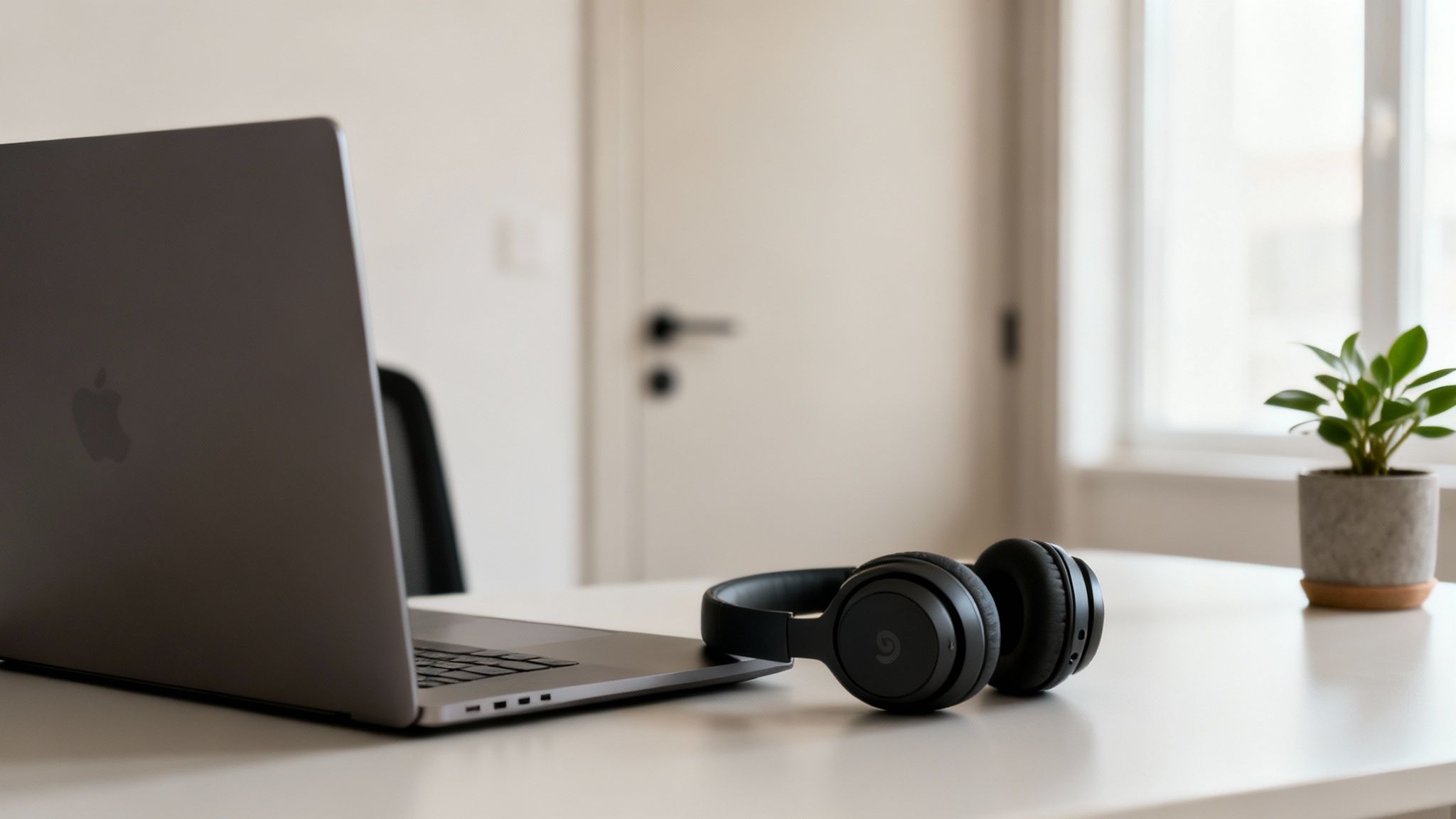
    How to Achieve Flow State: modern workspace with a silver laptop, black headphones, and a small plant on a white desk

    It all starts with a ruthless purge of distractions. In our hyper-connected world, this takes conscious, deliberate effort. You can’t just try to ignore interruptions; you have to design a space where they can’t even reach you in the first place.

    Taming Your Physical Space

    Your physical environment sends constant, subtle signals to your brain. A cluttered desk screams stress and disorder, while a clean, organized space signals clarity and control. The goal is to create a setting where physical discomfort or visual noise won’t snap your concentration.

    Real-World Example: Imagine a graphic designer staring down a tight deadline. Their desk is a disaster zone of stacked papers, tangled cords, and half-finished projects. Every time they try to focus, their eyes wander, and their focus splinters. By taking just 15 minutes to clear their desk, organize their tools, and create a single-purpose zone for their current project, they reduce cognitive load. A clear space makes for a clear mind, making it infinitely easier to sink into deep work.

    You can start with these practical tweaks:

    • Get Your Ergonomics Right: An uncomfortable chair or a poorly positioned monitor creates low-grade physical pain that constantly chips away at your focus. Adjust your chair, screen height, and keyboard to support a neutral posture.
    • Dial in Light and Sound: Your brain is incredibly sensitive to its sensory environment. Natural light is best, but if that’s not an option, use soft, diffused lighting to avoid glare and eye strain. For a deeper dive, check out our guide on how light and sound affect cognitive performance.
    • Set Clear Boundaries: If you share your space, communicate your need for uninterrupted time. A closed door, headphones, or even a simple sign can signal to family or colleagues that you’re in a deep work session and shouldn’t be disturbed.

    Conquering Your Digital Distractions

    As challenging as the physical world can be, your digital environment is often the greater threat to flow. Every notification, email alert, and social media ping is engineered to hijack your attention.

    This is where the concept of attention residue becomes so critical. Behavioral research shows that when you switch from one task to another—even for a moment, like glancing at an email—part of your attention stays stuck on the previous task. This cognitive hangover degrades your performance, making deep focus almost impossible.

    Single-tasking isn’t just a preference; it’s a neurological prerequisite for flow. To get there, you have to build a digital fortress that shields your attention from these constant intrusions.

    Here’s how to fortify your digital workspace:

    • Silence All Notifications: Turn off alerts on your phone, computer, and smartwatch. And don’t just use silent mode; disable the badges and banners that create a persistent visual itch to check something.
    • Use Blocker Apps: Tools like Freedom or Cold Turkey are lifesavers for blocking distracting websites and apps for a set period. This removes the temptation entirely, freeing up your willpower for the actual work.
    • Curate Your Digital Desk: Close every unnecessary tab and application. A minimalist writing app like iA Writer or a focused coding environment strips away visual clutter, helping you stay centered on the task at hand.

    By intentionally designing both your physical and digital spaces, you create the quiet, stable conditions your brain needs to stop fighting distractions and finally enter that state of effortless focus.

    Finding Your Flow Trigger with the Skill-Challenge Balance

    The secret to dropping into a flow state isn’t about white-knuckling your way through a task. It’s far more elegant. The real trigger lies in a delicate psychological principle: the skill-challenge balance. This is the absolute core of Mihaly Csikszentmihalyi’s groundbreaking research, and getting it right is the closest you’ll get to a guaranteed on-ramp for peak focus.

    Think of your attention as a narrow channel. On one side, you have the swamp of boredom—tasks so easy your mind just drifts away. On the other, the raging ocean of anxiety, where a challenge feels so massive you’re paralyzed before you even start.

    Flow happens right down the middle of that channel. It’s that perfect sweet spot where the task in front of you demands every ounce of your concentration because it perfectly matches, and just slightly stretches, what you’re capable of doing.

    The Goldilocks Zone for Your Brain

    This balance is what makes an activity utterly absorbing. Your brain is wired to hunt for challenges it sees as tough but solvable. A task that’s too simple leaves your brain with a ton of leftover bandwidth, so it gets bored and looks for something else to do. A task that’s way too hard kicks your stress response into high gear, flooding you with cortisol and shutting down the very parts of your brain needed for creative thinking.

    But that “just right” challenge? It does something incredible. It lights up your brain’s reward system, releasing a steady drip of dopamine as you make small bits of progress. This little neurological reward creates a powerful feedback loop of motivation and focus, pulling you deeper and deeper into the work.

    • Mini Scenario (The Musician): A guitarist who just learned a few basic chords isn’t going to find flow by attempting a blistering Eddie Van Halen solo. That’s a one-way ticket to the ocean of anxiety. They’ll find it by nailing a simple three-chord song, where the challenge of switching cleanly between G, C, and D is perfectly tuned to their current skill.

    • Mini Scenario (The Data Analyst): A seasoned data analyst won’t get into the zone by running the same old weekly report for the thousandth time. That’s the swamp of boredom. But they will find it by tackling a project that requires them to merge datasets in a new way or master a new visualization tool—a task that stretches their expertise just enough without feeling impossible.

    The payoff for striking this balance is huge. A 10-year McKinsey study found that executives in a flow state are up to 500% more productive. To tap into that, you have to learn to calibrate your work so it stretches you just enough. As recent studies confirm, getting this skill-demand balance right is what triggers the most powerful flow experiences. You can discover more insights on the connection between flow and productivity in recent studies.

    How to Audit and Adjust Your Tasks

    This isn’t just some abstract theory—it’s a practical tool you can use every day. You can actively engineer your tasks to land in that sweet spot. The trick is to be honest about where you are and adjust accordingly.

    Here’s how to recalibrate your work and find that flow channel.

    If a Task Feels Overwhelming (Too Challenging):

    • Break It Down: A massive project like “write the business plan” is a recipe for anxiety. Shatter it into tiny, concrete steps like “research three competitors” or “draft the one-page executive summary.” Each small piece becomes its own manageable challenge.
    • Lower the Stakes: Temporarily reduce the scope. Instead of trying to write a perfect final version, just aim for a “shitty first draft.” This dials down the pressure and lets you build momentum. The simple act of focusing on one small piece is key. As our guide on the topic explains, trying to do too much at once just fragments your attention. You can learn about the neuroscience of single-tasking in our detailed guide.

    If a Task Feels Mind-Numbing (Too Easy):

    • Add a Constraint: Give yourself a tighter deadline. Challenge yourself to finish in 75% of the usual time. This little bit of manufactured urgency forces you to focus more deeply.
    • Increase the Difficulty: Add a new layer of complexity. If you’re designing a simple social media graphic, challenge yourself to use a new software feature you’ve been avoiding. If you’re writing a routine email, try to make it the most persuasive or concise one you’ve ever written.

    By consciously tweaking the challenge level of your work, you stop waiting for flow to strike like lightning and start creating the precise conditions your brain needs to find it on command.

    Building the Habits and Rituals That Ignite Focus

    Getting into flow isn’t an accident. It’s the result of preparation. Just like an athlete warms up before a game, you need mental and behavioral triggers that signal to your brain it’s time for deep, focused work. These habits and rituals are the launch sequence for entering the zone.

    Without these cues, you’re leaving your focus to chance. But with a consistent routine, you train your brain to recognize when it’s time to quiet the noise and dive deep, making flow something you can summon on command, not just hope for.

    Designing Your Pre-Flow Warm-Up Ritual

    Think of a warm-up ritual as a cognitive off-ramp, guiding you from the chaotic world of multitasking into the single, focused lane of deep work. From a behavioral psychology perspective, this creates a powerful conditioned response. Your brain learns to associate a specific sequence of actions with the onset of deep concentration.

    It doesn’t need to be complicated. In fact, simpler is better. The key is consistency.

    • Mini-Meditation: Just five minutes of focused breathing can calm your nervous system and clear out the mental chatter, giving you a clean slate.
    • Priority Review: Take a moment to look at your top one to three priorities for the session. This reinforces goal clarity—a critical pillar of flow.
    • Curate Your Playlist: Listening to the same instrumental track or ambient soundscape every time you start can act as an auditory cue, telling your brain it’s go-time.

    Real-World Example: A writer starts every session by making a cup of tea, opening their writing app, and re-reading the last paragraph they wrote. This simple, three-step process bridges the gap between their everyday mindset and their creative focus. Each step acts as a trigger, making the transition into a flow state smoother and more predictable. To explore more of these powerful routines, check out our guide on how to build morning rituals for focus.

    Structuring Attention with Time Management Techniques

    Once you’ve started, the next challenge is sustaining that focus. Your attention isn’t an infinite resource; it operates in cycles. Techniques that honor these natural rhythms can help you stay in the flow channel longer without burning out.

    The Pomodoro Technique is a classic for a reason. You work in focused 25-minute sprints followed by a 5-minute break. This structure creates a sense of healthy urgency and provides regular, built-in recovery periods, stopping mental fatigue before it even starts.

    For more intensive tasks, try 90-minute work sprints. This timing aligns with our brain’s natural energy cycles, known as ultradian rhythms. Working in these focused blocks, followed by a 20-30 minute break, lets you ride your peak energy waves and then fully recharge.

    The goal here isn’t just to manage time, but to manage your attention. By creating a container for your focus, you eliminate the mental energy wasted on deciding what to do next or wondering when you’ll get a break.

    Creating Immediate Feedback Loops to Stay Engaged

    A huge part of sustaining flow is seeing your progress in real time. Your brain thrives on feedback; it needs to know its efforts are paying off. When you see the direct results of your work, it releases dopamine, reinforcing your focus and making the activity itself more rewarding.

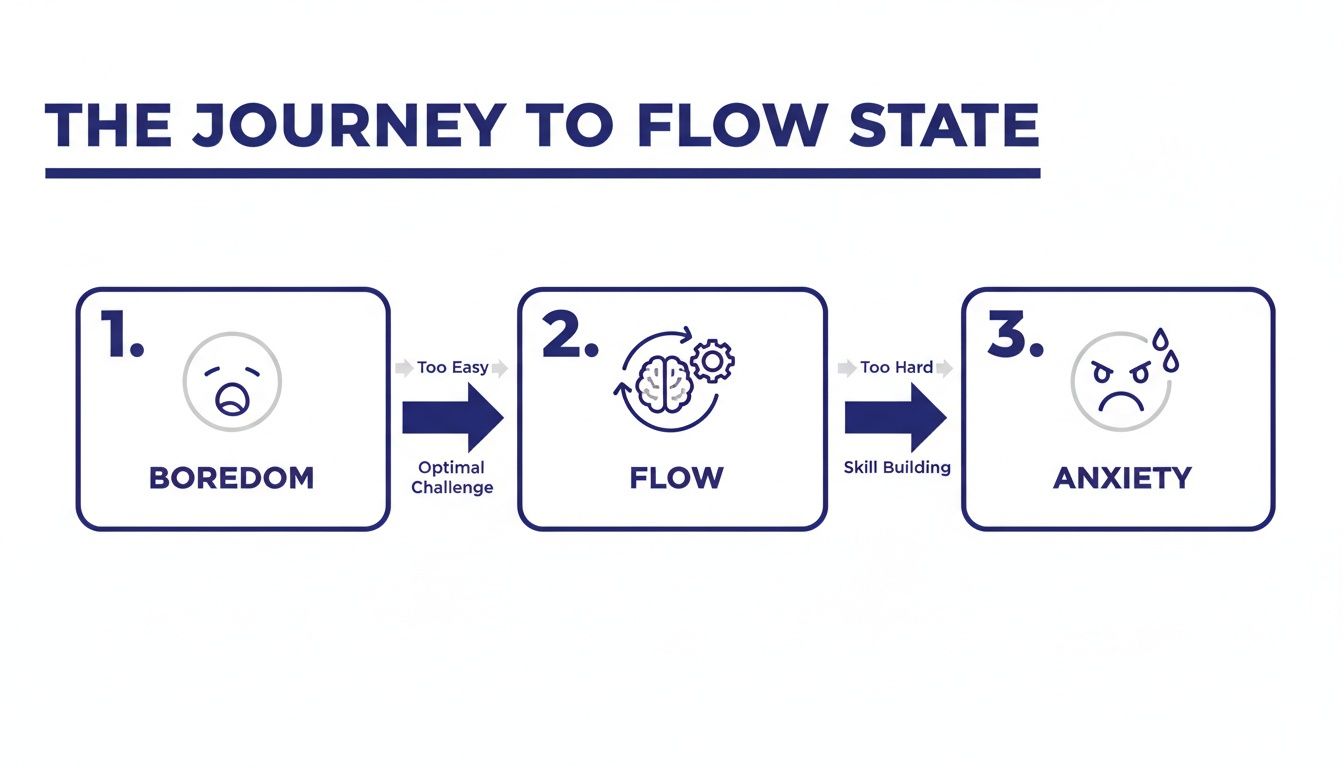
    The diagram below shows just how critical it is to find that sweet spot between boredom (too easy) and anxiety (too hard). Flow lives in that perfect balance.

    Diagram illustrating the journey to flow state, showing transitions between boredom, flow, and anxiety.

    This visual highlights that flow exists where the challenge meets your skill level—a state that’s reinforced by clear, immediate feedback on your performance.

    This isn’t just theory; it’s backed by solid workplace research. Clear goals paired with immediate feedback are cornerstone triggers for flow. In fact, employees who get daily feedback are three times more likely to be highly productive than those who only get it once a year.

    You can build these feedback loops into almost any task:

    • Checklists: For a complex project, breaking it down into a detailed checklist provides a satisfying sense of accomplishment with every item you tick off.
    • Progress Bars: If you’re working on a digital task, seeing a progress bar fill up gives you a clear visual cue of how far you’ve come and how close you are to the finish line.
    • Real-Time Dashboards: For tasks involving data, like sales or marketing, a real-time analytics dashboard provides instant, motivating feedback on your performance.

    To help you get started, here’s a quick summary of some practical techniques you can put into practice today.

    Flow State Rituals and Techniques

    TechniqueBest ForHow It Works
    Pre-Flow Warm-UpStarting a deep work sessionCreates a conditioned response, signaling to your brain that it’s time to focus and transition away from distractions.
    Pomodoro TechniqueShort, focused tasks or breaking down large projectsUses 25-minute work sprints and short breaks to maintain high energy and prevent mental fatigue.
    90-Minute SprintsCreative or complex problem-solvingAligns with the brain’s natural ultradian rhythms, allowing for extended periods of peak focus followed by restorative breaks.
    ChecklistsMulti-step projects or processesProvides immediate, satisfying feedback as you complete small milestones, releasing dopamine and fueling motivation.
    Progress BarsDigital tasks with a clear endpointOffers a constant visual representation of your progress, making the work feel more tangible and engaging.

    By weaving these elements together—a pre-work ritual, structured attention sprints, and immediate feedback—you create a robust system. You stop hoping for flow and start actively inviting it in.

    Troubleshooting Common Barriers to Achieving Flow

    Even with the perfect setup, some days flow just doesn’t happen. You sit down, ready to dive deep, but your brain refuses to cooperate. This is completely normal. The real skill is learning to recognize what’s blocking you and gently guiding your mind back on track.

    When you feel stuck, it’s usually one of a few usual suspects: a racing mind, simple mental fatigue, or the seductive myth of multitasking. Let’s break down how to handle each one.

    Quieting a Racing Mind

    Internal chatter is one of flow’s biggest enemies. You’re trying to focus on a report, but your mind is stuck replaying a conversation, worrying about your to-do list, or jumping ahead to dinner plans. This is your brain’s default mode network (DMN)—the part responsible for mind-wandering—running wild.

    To get into flow, you have to quiet the DMN and fire up your task-positive network.

    • Try a “Worry Journal”: Before you start, take five minutes. Write down everything on your mind—worries, ideas, reminders, anything. This “brain dump” gets the thoughts out of your head and onto paper, signaling to your brain that they’re captured and can be handled later.
    • Acknowledge and Redirect: If thoughts pop up mid-session, don’t fight them. That just gives them more power. Instead, notice them without judgment and gently bring your focus back to your breath for a few seconds. This tiny reset is often enough to get back on track without losing all your momentum.

    Think of your racing thoughts like clouds passing in the sky. You don’t have to engage with every single one. By simply observing them and letting them drift by, you can maintain your focus on the clear sky beyond.

    Disclaimer: While these techniques can help manage everyday stress and distraction, they are for educational purposes only. If you are struggling with persistent anxiety, ADHD, or other mental health concerns, please consult a qualified medical or psychological professional.

    Working with Your Brain’s Natural Energy Cycles

    Sometimes, a lack of focus has nothing to do with discipline. It’s just mental fatigue. Your brain is a muscle with finite energy. Trying to force concentration when your cognitive tank is empty is a losing battle that only leads to burnout.

    Behavioral research shows our brains operate on ultradian rhythms—natural cycles of high-frequency brain activity (around 90 minutes) followed by a necessary period of low-frequency activity (about 20 minutes). Powering through those low points is completely counterproductive.

    Instead of fighting fatigue, work with it. Set a timer and work in focused 75-90 minute blocks. Then, take a real, restorative break. Step away from the screen, stretch, look out a window, get some water. Honoring these cycles allows your brain to recharge, making your next focus session exponentially more effective. Our guide on digital overwhelm and attention hijacking offers a deeper dive into this.

    Defeating the Ultimate Flow Killer: Multitasking

    The belief that we can effectively juggle multiple tasks at once is probably the single greatest enemy of flow. Every time you switch your attention—from your project to an email, to a notification, then back again—you pay a cognitive price.

    Psychologists call this context switching. Each switch fragments your attention and drains your mental battery. According to research by psychologist Gerald Weinberg, every additional task you juggle can cost 20-80% of your overall productivity. Your brain is constantly having to re-orient itself, which prevents it from ever reaching the deep, sustained concentration that flow requires.

    The solution is simple, but not always easy: commit to single-tasking.

    Close every tab, window, and app that isn’t absolutely essential for the task at hand. If you have to, put your phone in another room. By creating a truly clean runway, you give your brain the uninterrupted space it needs to take off into a flow state.

    Editor’s Note

    Let’s cut through the noise. Getting into a flow state isn’t some mystical switch you flip; it’s a skill, and like any other skill, you build it with intentional practice. After digging through the research and running my own experiments, three strategies stand out as the most reliable for getting into that deep-focus zone.

    First is mastering the skill-challenge balance. You need to find that perfect sweet spot where a task is hard enough to engage you fully but not so hard that it becomes overwhelming. Second, you have to be absolutely ruthless about eliminating distractions, both in your physical space and on your digital devices. And finally, creating a simple pre-work ritual—like a five-minute meditation or just tidying your desk—sends a powerful signal to your brain that it’s time to lock in.

    This advice is for anyone whose work depends on real, sustained concentration—professionals, students, and creatives alike. But it’s also crucial to have realistic expectations. Nobody maintains a state of flow for eight hours straight. Some days will feel effortless, others will be a grind, and that’s completely normal.

    The goal isn’t constant, perfect flow. It’s about consistently creating the right conditions so it shows up more often. Focus on the setup, and the focus will follow.

    Final Disclaimer

    The content in this article is for educational purposes only and should not be considered a substitute for professional medical or psychological advice, diagnosis, or treatment. Always seek the advice of your physician or other qualified health provider with any questions you may have regarding a medical condition. This post may contain affiliate links, meaning we may earn a small commission on purchases at no extra cost to you.

    Frequently Asked Questions About Flow

    As you start working with flow, a few questions almost always pop up. Here are some straightforward answers pulled from experience and research.

    How Long Does It Take to Actually Get Into a Flow State?

    There’s no magic number, but most people find it takes about 15 to 20 minutes of genuinely uninterrupted focus to slip into the zone. This is assuming you’ve already done the prep work—you have a clear goal, a distraction-free space, and a task that perfectly balances your skill against the challenge.

    The real trick is fiercely protecting that initial warm-up window. A single notification, a quick “just checking one thing” glance at your email—that’s often enough to reset the clock and force you to start all over again.

    Can I Find Flow While Doing Simple Chores Like Washing Dishes?

    It’s highly unlikely. Flow absolutely requires a meaningful challenge that stretches your skills. Simple, repetitive chores like folding laundry or washing dishes don’t demand that level of active engagement.

    Instead, they usually lead to a state of automaticity. That’s when your mind is free to wander precisely because the task is so easy it doesn’t need your full attention. While that can be a relaxing state, it’s the polar opposite of the deep, dialed-in focus that defines flow. Flow needs your brain to be all in.

    What’s the Difference Between Flow and Hyperfocus?

    This is a great question, because from the inside, they can feel incredibly similar. The key difference really comes down to the quality of the experience and the context around it.

    • Flow State is a consistently positive, holistic state of peak performance. You cultivate it intentionally to do your best work, and it tends to leave you feeling energized and accomplished afterward.
    • Hyperfocus, on the other hand, can sometimes be a trait associated with neurodevelopmental conditions like ADHD. While it involves intense concentration, that focus might not always land on the intended task, and it can sometimes feel difficult to pull yourself away from.

    So, while both involve deep concentration, flow is more of an optimal, balanced state of consciousness that actively boosts your well-being. This article is for informational purposes and not a substitute for a professional diagnosis.

    Is It a Bad Sign If I Can’t Get Into Flow Every Single Day?

    Not at all. In fact, it’s completely normal. It’s crucial to remember that flow is a high-energy, resource-intensive state for your brain. Expecting to be “in the zone” for eight hours a day, every day, is a surefire recipe for burnout. For more ideas on how to build sustainable focus habits, you can find visual guides and tips on my Pinterest profile.

    The goal isn’t to live in a constant state of flow. The real skill is learning how to access it more reliably when you need it most—for your most important, challenging, and creative work.

    Think of flow as a powerful tool you deploy strategically, not a baseline state you have to maintain 24/7. Celebrate the days it shows up, and be patient with yourself on the days it doesn’t.


    Ready to stop fighting distractions and start building a more focused, productive life? At Mind Clarity Hub, we specialize in science-backed guides that help you reclaim your mental space. Explore our collection of books and resources to build the habits that lead to deep work and lasting clarity.

    Explore the full library of resources at Mind Clarity Hub

    Explore the Mind Clarity Hub Library

    Practical books on focus, digital habits, resilience, and building a calmer mind.

    The Power of Clarity — book cover

    The Power of Clarity

    Unlock mental focus, build momentum, and create the life you were meant to live.

    View book →
    AI & ChatGPT for Beginners — book cover

    AI & ChatGPT for Beginners

    No PhD needed — a 2025 guide to AI, prompts, and productivity without coding.

    View book →
    Zen in the Digital Jungle — book cover

    Zen in the Digital Jungle

    Mindfulness for a chaotic world.

    View book →
    The Slow Reset — book cover

    The Slow Reset

    Mindful living in a fast-paced world.

    View book →
    Perfectly Imperfect — book cover

    Perfectly Imperfect

    Stop self-criticism, set boundaries, and embrace the real you.

    View book →
    Reclaiming Silence — book cover

    Reclaiming Silence

    A dopamine detox guide to finding peace in a noisy world.

    View book →
    The Focused Freelancer — book cover

    The Focused Freelancer

    Productivity, pricing & positioning for independents in 2025.

    View book →
    ChatGPT Side Hustle System — book cover

    ChatGPT Side Hustle System

    Launch your AI-driven online business in 30 days.

    View book →
    Burnout, Interrupted — book cover

    Burnout, Interrupted

    A proven path to restore energy and reclaim your life.

    View book →
    Attention Unleashed — book cover

    Attention Unleashed

    Focus strategies for the distracted mind.

    View book →
    Side Hustle Launchpad — book cover

    Side Hustle Launchpad

    Your quick-start guide to extra income.

    View book →
    Digital Clarity — book cover

    Digital Clarity

    Rewire your brain, escape dopamine traps & regain focus.

    View book →
    Break the Scroll — book cover

    Break the Scroll

    Reduce screen time and take back control of your life.

    View book →
    Climate Compassion — book cover

    Climate Compassion

    Transform eco-anxiety into empowered action.

    View book →
    Village Mentality — book cover

    Village Mentality

    The power of community for mental wellness.

    View book →
    Restful Nights — book cover

    Restful Nights

    Overcoming sleep anxiety in a 24/7 world.

    View book →
    Connected Again — book cover

    Connected Again

    Combat loneliness and build meaningful relationships.

    View book →
    Focus Recharged — book cover

    Focus Recharged

    Mastering attention and productivity in the digital era.

    View book →
    Marketing Magic with ChatGPT — book cover

    Marketing Magic with ChatGPT

    AI-powered content, campaigns, and copywriting to grow faster.

    View book →
    The 6-Figure Creator — book cover

    The 6-Figure Creator

    Turn knowledge into passive income with books, courses & AI.

    View book →
    Burnout Breakthrough — book cover

    Burnout Breakthrough

    Reset your work-life balance and thrive in 2025.

    View book →
    The Emotionally Intelligent Man — book cover

    The Emotionally Intelligent Man

    A modern guide to self-awareness and communication.

    View book →
    AI Personalized Wellness — book cover

    AI Personalized Wellness

    Create your custom health plan with data-driven habits.

    View book →
    Everyday AI Made Easy — book cover

    Everyday AI Made Easy

    Use ChatGPT and smart tools to simplify life.

    View book →
    Money Mindfulness — book cover

    Money Mindfulness

    A financial wellness guide for Gen Z & Millennials.

    View book →
    Startup Smarter with AI — book cover

    Startup Smarter with AI

    ChatGPT strategies and tools to grow your business.

    View book →
    ChatGPT for Writers & Creators — book cover

    ChatGPT for Writers & Creators

    Unlock AI-powered brainstorming, drafting & editing.

    View book →