
Last updated: December 2025
Welcome to the Mind Clarity Hub focus and digital wellness blog—a home for calm, science-informed guidance in an always-on world. Here you will find long-form articles that translate neuroscience, psychology, and attention research into practical routines you can actually live with.
As you explore the posts below, you will discover step-by-step frameworks for rebuilding focus, easing digital fatigue, setting healthier boundaries with screens, and protecting your mental clarity in 2025 and beyond. Bookmark this page whenever you need grounded support—not quick hacks—for your brain, your habits, and your digital life.
About Mind Clarity Hub
Mind Clarity Hub is written and curated by Jeremy Jarvis, a researcher and author focused on attention, digital wellness, and executive function. Articles on this blog are grounded in peer-reviewed research, clinical summaries, and real-world experience helping readers navigate screen time, mental fatigue, and focus in modern life.
When relevant, posts reference organizations such as the American Psychological Association and current cognitive science research, so you can trace ideas back to established sources instead of generic productivity hacks.
- 12 Key Signs of Mental Fatigue You Shouldn’t Ignore
 Ever feel like your brain is just… done? The telltale signs of mental fatigue often sneak up on us. You might notice a persistent brain fog that won't lift. Perhaps you have a short fuse with loved ones.… Read more: 12 Key Signs of Mental Fatigue You Shouldn’t Ignore
 - Decoding Emotional Unavailability in Men: A Practical Guide
 Emotional unavailability in men isn't a character flaw; it's a pattern of avoiding deep emotional connection. Think of it as a defense mechanism, often built over time from past hurts, societal pressure, or ingrained habits. From a neuroscience… Read more: Decoding Emotional Unavailability in Men: A Practical Guide
 - What is Dopamine Fasting? Explore What is Dopamine Fasting and More
 Let's get one thing straight: dopamine fasting isn't about getting rid of dopamine. That's impossible, and frankly, a terrible idea. Instead, think of it as a structured timeout from the relentless pings, endless scrolls, and cheap hits of… Read more: What is Dopamine Fasting? Explore What is Dopamine Fasting and More
 - Why Understanding Emotional Men Is Key to Mental Health
 Affiliate Disclosure: Mind Clarity Hub is reader-supported. To keep our content evidence-based and free, we may earn a small commission when you buy through links on our site (at no extra cost to you). This helps us create… Read more: Why Understanding Emotional Men Is Key to Mental Health
 - Social Media Detox Benefits: Boost Focus, Sleep, and Well-Being
 Affiliate Disclosure: This article may contain affiliate links. If you purchase through these links, we may earn a small commission at no extra cost to you. This helps support our work in bringing you evidence-based content. Feeling like… Read more: Social Media Detox Benefits: Boost Focus, Sleep, and Well-Being
 - How to Do Deep Work: A Practical Guide to Unlocking Real Focus
 To truly do deep work, you have to carve out specific, scheduled blocks of time for a single, high-value task. This means creating a space completely free from the usual suspects—email, social media pings, and phone notifications. It's… Read more: How to Do Deep Work: A Practical Guide to Unlocking Real Focus
 - How to Stop Multitasking and Reclaim Your Focus
 Disclosure: This post may contain affiliate links. If you purchase through these links, we may earn a small commission at no extra cost to you. We only recommend products we believe in. If you want to stop multitasking,… Read more: How to Stop Multitasking and Reclaim Your Focus
 - Build Your Ultimate Focus Portal to Boost Productivity
 Affiliate Disclosure: This post may contain affiliate links. If you make a purchase through these links, we may earn a small commission at no extra cost to you. This support helps us continue to create valuable content. A… Read more: Build Your Ultimate Focus Portal to Boost Productivity
 - How to Concentrate While Studying Even When You Don’t Want To
 Learning how to concentrate while studying isn’t about brute force or sheer willpower. It’s about building a simple, repeatable system that works with your brain's natural rhythms—not against them. The secret is using timed, focused sprints followed by… Read more: How to Concentrate While Studying Even When You Don’t Want To
 - The Best Books For Self Help That Lead To Real Change
 Affiliate Disclosure: This article may contain affiliate links. If you make a purchase through one of these links, we may earn a small commission at no extra cost to you. This helps support our work. Why Most Self-Help… Read more: The Best Books For Self Help That Lead To Real Change
 - Managing Competing Priorities With Neuroscience-Backed Focus
 When you’re pulled in a dozen different directions, you’re not just busy—you’re actively draining the part of your brain responsible for smart decisions. When every email and message feels urgent, your brain gets overwhelmed, leading to decision fatigue.… Read more: Managing Competing Priorities With Neuroscience-Backed Focus
 - Neuroscience-Backed Strategies to Master Your Focus
 Focus is the raw ability to point your conscious attention at one thing—a single task, a complex idea, a meaningful conversation—while letting everything else fade into the background. Think of it as a mental spotlight. When it’s working… Read more: Neuroscience-Backed Strategies to Master Your Focus
 - Improving critical thinking skills: A practical guide to smarter decisions
 Improving your critical thinking skills isn’t about some massive overnight personality change. It’s really about the small, conscious shift from a reactive, emotional gut-check to a more analytical, evidence-based mindset. It’s learning to hit pause, question your own… Read more: Improving critical thinking skills: A practical guide to smarter decisions
 - Sodium Butyrate Benefits: A Guide to Gut, Brain & Metabolic Wellness
 Sodium butyrate is gaining significant attention, and for very good reason. It’s a short-chain fatty acid that acts as the primary fuel for the cells lining your colon. Think of it as a “super fuel” for your gut.… Read more: Sodium Butyrate Benefits: A Guide to Gut, Brain & Metabolic Wellness
 - How to Do a Dopamine Detox to Reclaim Your Focus
 A dopamine detox is just a conscious break from the high-stimulation activities constantly hijacking your brain’s reward system. It’s not about eliminating a vital brain chemical; from a neuroscience perspective, it’s about hitting the reset button on your… Read more: How to Do a Dopamine Detox to Reclaim Your Focus
 - How to Overcome Analysis Paralysis: Quick Steps for Clarity
 Affiliate Disclosure: Please note that this article contains affiliate links. If you make a purchase through these links, we may earn a small commission at no extra cost to you. This helps support our work in creating helpful… Read more: How to Overcome Analysis Paralysis: Quick Steps for Clarity
 - What Is a Dopamine Detox and How Does It Actually Work?
 A dopamine detox is a popular name for a simple idea: taking a deliberate break from things that give you an instant, high-stimulation buzz. Think of it as a reset button for your brain’s reward system, not a… Read more: What Is a Dopamine Detox and How Does It Actually Work?
 - How to Organize Your Thoughts for Mental Clarity and Focus
 This article may contain affiliate links. If you purchase a product through one of our links, we may earn a small commission at no extra cost to you. To get a handle on your thoughts, the first move… Read more: How to Organize Your Thoughts for Mental Clarity and Focus
 - How to Dopamine Detox and Reclaim Your Focus
 A dopamine detox is simply a strategic break from the firehose of high-stimulation activities that saturate modern life. The goal isn’t to eliminate dopamine—that’s impossible and wouldn’t be good for you anyway. Instead, it’s about resetting your brain’s… Read more: How to Dopamine Detox and Reclaim Your Focus
 - 10 Powerful Active Reading Techniques to Deepen Focus in 2026
 Disclosure: This post may contain affiliate links. If you purchase through them, we may earn a small commission at no extra cost to you. We only recommend products we trust. Do you ever finish a chapter of a… Read more: 10 Powerful Active Reading Techniques to Deepen Focus in 2026
 - Your Guide to a Dopamine Detox for Lasting Focus
 A dopamine detox is simply a period where you intentionally step away from high-stimulation activities—think social media, streaming marathons, or gaming—to let your brain's reward system reset. It’s not about getting rid of dopamine, which is impossible and… Read more: Your Guide to a Dopamine Detox for Lasting Focus
 - What Is Decision Fatigue and How Can You Overcome It? A Practical Guide
 Heads up: This article contains affiliate links. If you buy something through a link, we may earn a small commission at no extra cost to you. Your support helps us create helpful content like this! Medical Disclaimer The… Read more: What Is Decision Fatigue and How Can You Overcome It? A Practical Guide
 - A Guide to Prostavive Powder for Prostate Health
 Prostavive powder is a natural supplement that’s gotten a lot of attention from men looking to be proactive about their prostate health as they age. It’s formulated with a specific blend of plant extracts and minerals aimed at… Read more: A Guide to Prostavive Powder for Prostate Health
 - What is Deep Work? A Guide to Sharper Focus in a Distracted World
 Deep work is the ability to lock in, distraction-free, on a mentally demanding task. It’s a state of intense, single-minded concentration that pushes your brain to its limits. This allows you to produce exceptional work and master complex… Read more: What is Deep Work? A Guide to Sharper Focus in a Distracted World
 - A Smart Shopper’s Guide to Prostavive Amazon Listings
 When you type “prostavive amazon” into a search bar, you’re tapping into a huge, often confusing, marketplace for men’s health supplements. Prostavive itself is a dietary supplement formulated to support prostate health. Like many others, it uses a… Read more: A Smart Shopper’s Guide to Prostavive Amazon Listings
 - How to Stop Procrastinating Using Neuroscience
 To stop procrastinating, you first have to understand what it really is: an emotional response, not a character flaw. It’s your brain’s go-to coping mechanism for avoiding negative feelings like anxiety, boredom, or self-doubt. The real key isn’t… Read more: How to Stop Procrastinating Using Neuroscience
 - Prostavive Review: Key Facts, Ingredients & Real Results for Prostate Support
 If you’re a man of a certain age, you start to notice little changes. Maybe you’re waking up more at night. Or perhaps you feel that urgent “gotta go” feeling more than you used to. It’s a common… Read more: Prostavive Review: Key Facts, Ingredients & Real Results for Prostate Support
 - Can you take probiotics at night for better sleep and gut health?
 Yes, you can absolutely take probiotics at night. In fact, for many people, it’s the most effective time to take them. While the real goal is just being consistent, taking your supplement when stomach acid is at its… Read more: Can you take probiotics at night for better sleep and gut health?
 - Prostavive Colibrim Review: An Honest Look At Its Claims
 Prostavive Colibrim is a natural dietary supplement designed to support prostate health and improve urinary function, especially for men navigating age-related changes. Its formula aims to help maintain a normal prostate size and promote better urinary flow. It… Read more: Prostavive Colibrim Review: An Honest Look At Its Claims
 - An Honest Look at Prostavive Reviews and Results
 If you’re digging into Prostavive reviews, you’re probably just trying to get a straight answer: does this stuff actually work? The general feeling out there is that Prostavive might offer some decent support for urinary issues and prostate… Read more: An Honest Look at Prostavive Reviews and Results
 - Your Guide to the Ultimate Acid Reflux Diet Plan
 If you’ve ever dealt with the relentless burn of acid reflux, you know it’s more than just a little heartburn. It’s the kind of nagging discomfort that can derail a productive afternoon. It can also wreck a good… Read more: Your Guide to the Ultimate Acid Reflux Diet Plan
 - A Deep Dive Into Prostavive for Prostate Wellness
 Prostavive is a dietary supplement built with natural ingredients. It is formulated to support long-term prostate health and normal urinary function. The whole idea is to offer a plant-based approach for men. This is especially for those who… Read more: A Deep Dive Into Prostavive for Prostate Wellness
 - What Is the Best Time of Day to Take Vitamin B12 for Energy and Focus?
 Affiliate Disclosure: This article may contain affiliate links. If you make a purchase through these links, we may earn a small commission at no extra cost to you. We only recommend products we trust and believe will add… Read more: What Is the Best Time of Day to Take Vitamin B12 for Energy and Focus?
 - The 12 Best AI Tools for Content Creation in 2026
 Affiliate Disclosure: This post may contain affiliate links. If you make a purchase through these links, we may earn a small commission at no extra cost to you. This helps support our work in bringing you valuable content.… Read more: The 12 Best AI Tools for Content Creation in 2026
 - The 12 Best AI Writing Tools for Students in 2026
 Affiliate Disclosure: Please note that this article contains affiliate links. If you make a purchase through these links, we may earn a small commission at no extra cost to you. This helps support our work in bringing you… Read more: The 12 Best AI Writing Tools for Students in 2026
 - Ikaria Lean Belly Juice Review: Does This Weight Management Drink Really Work?
 So, what exactly is Ikaria Lean Belly Juice? Put simply, it’s a powdered supplement designed to help your body manage stubborn fat. The whole idea is inspired by the remarkably healthy, long-living people from a small Greek island… Read more: Ikaria Lean Belly Juice Review: Does This Weight Management Drink Really Work?
 - Vitamins to Help with Brain Fog for Lasting Mental Clarity
 Feeling your way through daily life with a fuzzy mind is draining. While the causes are complex, certain nutrients like B-complex vitamins and Vitamin D are known to support the very systems your brain relies on for clarity.… Read more: Vitamins to Help with Brain Fog for Lasting Mental Clarity
 - Ikaria Lean Belly Juice: A Deep Dive on Ingredients and Results
 So, what exactly is Ikaria Lean Belly Juice? In a market flooded with wellness supplements, this one stands out by focusing on a very specific target: ceramides. It’s a powdered superfood blend that you mix with water, designed… Read more: Ikaria Lean Belly Juice: A Deep Dive on Ingredients and Results
 - How to Get Some Rest and Recharge Your Energy Today
 Affiliate Disclosure: Just so you know, some of the links in this article are affiliate links. If you decide to buy something through one of them, we might earn a small commission—at no extra cost to you, of… Read more: How to Get Some Rest and Recharge Your Energy Today
 - The Truth About Lean Belly Juice For Busy ProfessionalsLet’s cut through the marketing hype. What is “lean belly juice,” really? The term is a catch-all for a growing category of wellness drinks. These range from commercial powders to homemade concoctions. They all promise to support metabolism… Read more: The Truth About Lean Belly Juice For Busy Professionals
- Can Music Help You Sleep The Science of Sound and Restful Nights
 Let’s get straight to the point: yes, the right kind of music can absolutely help you sleep. This isn’t just wishful thinking; it’s a strategy grounded in solid science. From a neuroscience perspective, the right sounds can physically… Read more: Can Music Help You Sleep The Science of Sound and Restful Nights
 - Your Guide to the Amazon Store Books Kindle Section
 So, you’re ready to find some of Jeremy Jarvis’s books, but maybe you’re not sure where to start. Think of this as your personal roadmap to navigating the massive digital bookshelf that is the amazon store—specifically for books… Read more: Your Guide to the Amazon Store Books Kindle Section
 - Why You Get a Crash From Coffee and How to Stop It
 That familiar jolt from your morning coffee feels like a non-negotiable part of the day. But what about the frustrating energy slump that follows a few hours later, derailing your focus right when you need it most? This… Read more: Why You Get a Crash From Coffee and How to Stop It
 - Kindle books in amazon: Your Quick Guide to Finding & Reading Ebooks
 If you’ve ever browsed Amazon for a book, you’ve almost certainly seen the “Kindle Edition.” In simple terms, a Kindle book is just the digital version of a physical book. Instead of a paperback arriving at your door,… Read more: Kindle books in amazon: Your Quick Guide to Finding & Reading Ebooks
 - How to Take Notes for a Book You Actually Remember
 Effective note-taking is more than just highlighting. It’s an active process—a conversation where you question, summarize, and connect the author’s ideas to your own life. This guide is all about turning passive reading into lasting knowledge by creating… Read more: How to Take Notes for a Book You Actually Remember
 - A Guide to Kindle Books on Amazon for Busy Readers
 Let’s be honest: finding time to read feels like a luxury most of us can’t afford. Your to-do list is already overflowing. The idea of adding “read a book” feels impossible. But what if the problem isn’t… Read more: A Guide to Kindle Books on Amazon for Busy Readers
 - How to Calm Down Fast Using Science-Backed Methods
 When you feel overwhelmed and your heart starts racing, it’s not just in your head. Your body has flipped a switch into its sympathetic nervous system—the classic “fight or flight” mode designed for survival. From a neuroscience perspective,… Read more: How to Calm Down Fast Using Science-Backed Methods
 - Your Guide to Finding the Best Amazon Books
 Welcome to your practical guide for mastering the world of Amazon Books. With a digital library that feels endless, finding the right book—one that genuinely improves your focus and well-being—can feel like a job in itself. This guide… Read more: Your Guide to Finding the Best Amazon Books
 - How to Automate Repetitive Tasks and Reclaim Your Focus
 This article may contain affiliate links. If you make a purchase, we may earn a small commission at no extra cost to you. Our recommendations are always based on merit and relevance. Learning how to automate repetitive tasks… Read more: How to Automate Repetitive Tasks and Reclaim Your Focus
 - A Practical Guide to Clarity Mental Health
 Affiliate Disclosure: This post may contain affiliate links. If you purchase through these links, we may earn a small commission at no extra cost to you. Mental clarity isn’t just about feeling “not stressed.” It’s that… Read more: A Practical Guide to Clarity Mental Health
 - How to Overcome Mental Exhaustion with a Science-Backed Plan
 Overcoming mental exhaustion isn’t a one-shot fix. It’s a combination of immediate relief strategies and longer-term habit changes designed to get your head above water and keep it there. The goal is to reduce your cognitive load, restore… Read more: How to Overcome Mental Exhaustion with a Science-Backed Plan
 - Mastering Mental Clarity for Unbeatable Focus
 *Affiliate Disclosure: Please note that this article contains affiliate links. If you make a purchase through these links, we may earn a small commission at no additional cost to you.* In a world drowning in notifications and endless… Read more: Mastering Mental Clarity for Unbeatable Focus
 - How to Train Your Brain to Focus and Master Deep Work
 Ever feel like your attention is being pulled in a dozen different directions at once? It’s a common feeling, but here’s the good news: you can absolutely learn how to train your brain to focus. This isn’t about… Read more: How to Train Your Brain to Focus and Master Deep Work
 - Finding Your Mental Clarity in a World of Noise
 Mental clarity is that unmistakable feeling of a calm, organized, and focused mind. It’s when your thoughts flow without friction, decisions feel intuitive, and you can lock in on what matters, free from the constant static of distractions… Read more: Finding Your Mental Clarity in a World of Noise
 - A Science-Backed Guide to Improving Problem Solving Skills
 Getting better at solving problems isn’t about grinding harder—it’s about thinking smarter. It’s a deliberate process of breaking down challenges, seeing around corners, and actually learning from what happens. This guide gives you a practical, no-fluff program for… Read more: A Science-Backed Guide to Improving Problem Solving Skills
 - Top Picks: Best Habit Tracking Apps for Daily Routines
 Establishing new habits can feel like an uphill battle. Whether you’re a professional aiming for deep work, a student managing deadlines, or anyone trying to recover from digital burnout, the initial motivation often fades. This is where the… Read more: Top Picks: Best Habit Tracking Apps for Daily Routines
 - How to Create a Morning Routine: Simple Steps to Start Strong
 To build a morning routine that actually sticks, you have to understand why it works. This isn’t just about forcing yourself to wake up earlier. It’s about making a few small, intentional choices that set the trajectory for… Read more: How to Create a Morning Routine: Simple Steps to Start Strong
 - How to Quit Social Media: A Practical Guide to Reclaiming Your Focus
 Learning how to quit social media starts with a simple, powerful realization: you’re not battling a lack of willpower. You’re up against a system engineered to capture your attention. The key is to understand the psychological hooks at… Read more: How to Quit Social Media: A Practical Guide to Reclaiming Your Focus
 - How to Manage Chronic Stress for a Calmer, More Productive Life
 Tackling chronic stress isn’t about finding one magic fix. It’s about building a practical, two-part toolkit: one set of tools for immediate relief when you’re overwhelmed, and another for building long-term resilience through daily habits. This dual approach… Read more: How to Manage Chronic Stress for a Calmer, More Productive Life
 - What Causes Brain Fog and How to Finally Find Your Focus
 Brain fog isn’t just a catchy phrase—it’s that frustrating, molasses-slow feeling when your thoughts refuse to connect. It’s caused by a perfect storm of modern pressures, from chronic stress and poor sleep to inflammation and nutrient gaps. From… Read more: What Causes Brain Fog and How to Finally Find Your Focus
 - 10 Remote Work Best Practices for Sustainable Productivity in 2026
 Remote work promised autonomy and flexibility, but for many, it has delivered digital exhaustion, blurred boundaries, and a persistent feeling of being ‘always on.’ The solution isn’t to work longer or harder; it’s to work with more intention… Read more: 10 Remote Work Best Practices for Sustainable Productivity in 2026
 - How to Avoid Burnout at Work Proven Strategies to Reclaim Your Energy
 To sidestep burnout, you have to get intentional about managing your workload, building in real recovery time, and staying connected to why your work matters in the first place. This isn’t about white-knuckling it or pushing harder. It’s… Read more: How to Avoid Burnout at Work Proven Strategies to Reclaim Your Energy
 - Dopamine and Motivation: Master Focus, Build Habits, End Procrastination
 Ever had a huge project deadline looming, only to find yourself completely lost in emails or scrolling through social media instead? That’s not a failure of willpower. It’s a battle for dopamine and motivation. This powerful brain chemical… Read more: Dopamine and Motivation: Master Focus, Build Habits, End Procrastination
 - 10 Research-Backed Burnout Prevention Strategies That Work in 2026
 In a culture that relentlessly champions productivity, burnout has become a pervasive, silent epidemic. It transcends simple fatigue, manifesting as a state of chronic physical and emotional exhaustion that can critically undermine your health, well-being, and professional life.… Read more: 10 Research-Backed Burnout Prevention Strategies That Work in 2026
 - Peak Productivity By Managing Energy Not Time
 We’ve all been sold a myth: that the secret to getting more done is to master your calendar. We cram our days with color-coded blocks, lean on sophisticated apps, and try to wring every last drop of productivity… Read more: Peak Productivity By Managing Energy Not Time
 - How to Improve Focus at Work and Reclaim Your Attention
 Improving your focus at work isn’t about brute-force willpower; it’s a strategic battle against constant interruptions. To win, you first have to understand what distractions truly cost you. They’re far more expensive than just a few lost seconds.… Read more: How to Improve Focus at Work and Reclaim Your Attention
 - What Is Cognitive Overload and How to Fix It
 Ever feel like your brain has too many tabs open? It slows down, stutters, and struggles with even the simplest tasks. That feeling has a name: cognitive overload. It’s not a personal failure but a biological signal that… Read more: What Is Cognitive Overload and How to Fix It
 - A Neuroscience Guide to Improving Focus and Concentration
 Improving your focus and concentration starts with being brutally honest about what you’re up against. In a world buzzing with notifications and alerts, the real fight isn’t about managing your time—it’s about protecting your mental energy from being… Read more: A Neuroscience Guide to Improving Focus and Concentration
 - How to Reset Your Brain for Focus and Mental Clarity
 To truly reset your brain, the focus needs to be on two fronts: reducing chronic stress and digital overload, while at the same time intentionally choosing activities that promote neural repair, like deep sleep and mindfulness. This isn’t… Read more: How to Reset Your Brain for Focus and Mental Clarity
 - 10 Science-Backed Ways to Reduce Screen Time in 2026
 We all know we should use our screens less, but generic advice like “just turn it off” or “go outside” rarely sticks for long. The constant pull of notifications, infinite scrolls, and vibrant app icons isn’t a simple… Read more: 10 Science-Backed Ways to Reduce Screen Time in 2026
 - How to Retain What You Read Using Neuroscience
 Let’s be honest: retaining what you read feels like a constant battle. The secret isn’t reading more, it’s changing how you read. It all comes down to a simple shift from passive consumption to active engagement. You have… Read more: How to Retain What You Read Using Neuroscience
 - The 12 Best AI Tools for Productivity in 2026: Work Smarter, Not Harder
 In a typical workday, the human brain juggles an endless stream of tasks, notifications, and deadlines. This constant context-switching creates a heavy “cognitive load,” a term from psychology describing the mental effort used in our working memory. When… Read more: The 12 Best AI Tools for Productivity in 2026: Work Smarter, Not Harder
 - A Science-Based Plan on How to Read More Books
 The real secret to reading more isn’t about finding more time—it’s about understanding how your brain has been rewired by the digital world and then gently rewiring it back. Grounded in behavioral science, the key is to acknowledge… Read more: A Science-Based Plan on How to Read More Books
 - 10 Science-Backed Workplace Stress Management Techniques
 Workplace stress is more than just a bad day; it’s a persistent drain on your energy, focus, and overall well-being that can lead to chronic burnout. The constant pressure of deadlines, overflowing inboxes, and navigating complex team dynamics… Read more: 10 Science-Backed Workplace Stress Management Techniques
 - How to Balance Life and Work: A Practical Guide for Real Results
 Pulled in a million directions? You’re not the only one. The goal here isn’t to chase that mythical 50/50 split between work and life. Instead, this is a sustainable system for taking back control of your energy and… Read more: How to Balance Life and Work: A Practical Guide for Real Results
 - How to Use AI for Writing Without Losing Your Voice
 Think of AI not as an author, but as a strategic partner. It’s a tool to help you brainstorm ideas, structure outlines, draft messy first versions, and polish your final work. The real magic happens when you give… Read more: How to Use AI for Writing Without Losing Your Voice
 - How to Use AI for Productivity: A Guide to Deep Work
 Using AI for productivity doesn’t mean you have to become a programmer overnight. It’s simply about handing off the repetitive, digital busywork—like summarizing reports or drafting routine emails—to an AI assistant. This frees up your mind to focus… Read more: How to Use AI for Productivity: A Guide to Deep Work
 - The 12 Best AI Tools for Productivity to Reclaim Your Focus in 2025
 Your day starts with a clear plan, but it’s quickly derailed by a flood of emails, constant notifications, and the relentless mental juggling of a dozen open tabs. This constant context switching overwhelms your prefrontal cortex, the brain’s… Read more: The 12 Best AI Tools for Productivity to Reclaim Your Focus in 2025
 - How to Take Notes from Book for Maximum Retention
 Learning how to take notes from books is really about one thing: turning passive reading into an active conversation with the author. The goal is to physically engage with the material, whether you’re writing by hand or typing.… Read more: How to Take Notes from Book for Maximum Retention
 - Journals for Productivity: An Essential Guide to Focus
 Productivity journals are specialized notebooks or apps built to help you wrestle your goals, tasks, and habits into a coherent system. Think of it as more than just a glorified to-do list; a well-designed journal is a command… Read more: Journals for Productivity: An Essential Guide to Focus
 - 10 Actionable Goals for Self-Improvement to Transform Your Focus in 2025
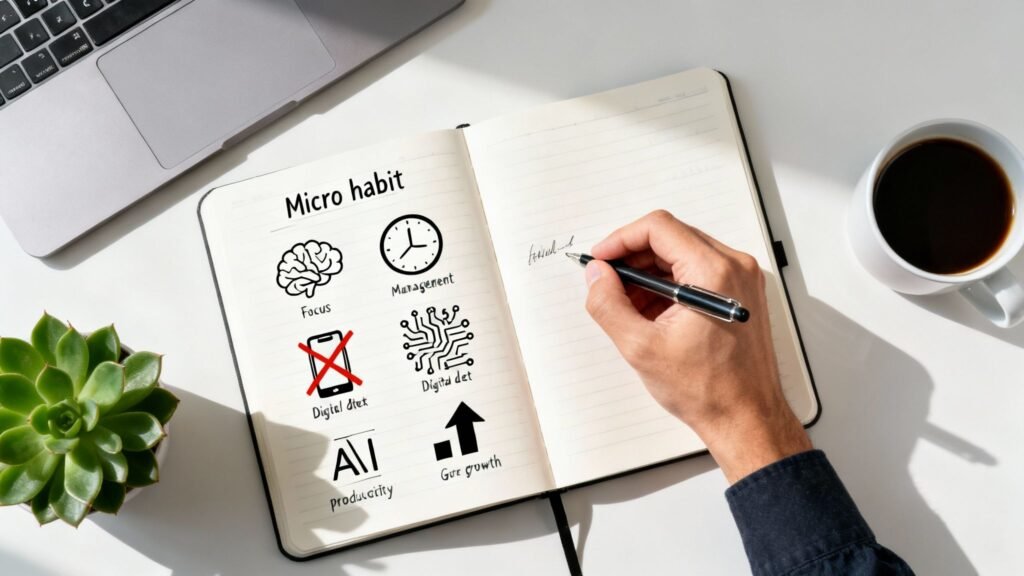 The pursuit of self-improvement often feels like a vague, never-ending marathon. We set ambitious resolutions only to see them fade by February because they lack structure, clarity, and practical steps. This cycle of starting strong and losing momentum… Read more: 10 Actionable Goals for Self-Improvement to Transform Your Focus in 2025
 - How to Build a Lasting Attitude of Gratitude
 An attitude of gratitude is more than just saying “thank you.” It’s a consistent way of seeing the world, an intentional practice of appreciating the good in your life. This mindset shift actively rewires your brain for greater… Read more: How to Build a Lasting Attitude of Gratitude
 - How to Be Present and Reclaim Your Focus in a Busy World
 Feeling scattered? Like your brain is juggling a dozen tabs while notifications ping, emails pile up, and your to-do list just keeps growing? You’re not alone. The answer isn’t to force a perfectly empty mind—that’s a recipe for… Read more: How to Be Present and Reclaim Your Focus in a Busy World
 - What Is Blank Mind Syndrome and How Can You Reclaim Your Focus
 Have you ever been right in the middle of making a crucial point, maybe in a big meeting, only for your thoughts to completely vanish? Or maybe you’ve sat staring at a blank page, a deadline breathing down… Read more: What Is Blank Mind Syndrome and How Can You Reclaim Your Focus
 - Your Guide to Limbic System Retraining for Focus and Calm
 Think of your brain’s limbic system as its emotional alarm. After a period of intense stress or burnout, that alarm can become way too sensitive, triggering a huge reaction to something small. Limbic system retraining is a collection… Read more: Your Guide to Limbic System Retraining for Focus and Calm
 - 10 Science-Backed Digital Detox Tips to Reclaim Your Focus in 2025
 In a world of endless notifications and infinite scrolls, reclaiming your mental space can feel impossible. The constant digital noise isn’t just distracting; research in neuroscience and psychology shows it reshapes our brain’s reward pathways, shortens attention spans,… Read more: 10 Science-Backed Digital Detox Tips to Reclaim Your Focus in 2025
 - The Ultimate Guide to Early Morning Exercise Routines
 The best early morning exercise routine is the one you actually stick with, even if it’s just for 10-15 minutes. Kicking off your day with a bit of movement gets your metabolism going, sharpens your focus, and can… Read more: The Ultimate Guide to Early Morning Exercise Routines
 - 10 Brilliant Home Office Organizing Ideas for Clarity and Focus in 2025
 A well-organized workspace does more than just look good; it can fundamentally change how you think and work. The right **home office organizing ideas** aren’t simply about finding a place for your pens. Instead, they are about designing… Read more: 10 Brilliant Home Office Organizing Ideas for Clarity and Focus in 2025
 - 10 Science-Backed Remote Work Productivity Tips for 2025
 The shift to remote work offers unparalleled flexibility, but it also presents a unique set of challenges to our focus and efficiency. Without the built-in structure of a traditional office, the lines between work and life can easily… Read more: 10 Science-Backed Remote Work Productivity Tips for 2025
 - How to Manage Email Overload and Reclaim Your Inbox
 If your inbox feels less like a tool and more like a battleground, you’re not alone. Learning how to manage email overload is a critical skill in today’s digital world. That sinking feeling of being buried under an… Read more: How to Manage Email Overload and Reclaim Your Inbox
 - How to Improve Focus While Studying A Practical Guide
 Having a hard time staying locked in on a textbook? The real secret to how to improve focus while studying is to work with your brain’s natural wiring, not fight against it. According to behavioral science, focus isn’t… Read more: How to Improve Focus While Studying A Practical Guide
 - Unlock Focus: how to improve mental clarity for peak productivity
 How to Improve Mental Clarity for Peak Productivity Affiliate Disclosure: Purchases may generate a small commission at no extra cost to you. In this comprehensive guide, you’ll discover how to improve mental clarity with practical, science-backed strategies you… Read more: Unlock Focus: how to improve mental clarity for peak productivity
 - The Quiet Crisis: Why So Many People Feel Unfocused and Lost Right Now
 The Quiet Crisis: Why So Many People Feel Unfocused and Lost Right Now A grounded look at why your brain feels scattered, stuck, or off-track—and how to find direction again without burning everything down. By Jeremy Jarvis Founder… Read more: The Quiet Crisis: Why So Many People Feel Unfocused and Lost Right Now
 - How to Achieve Flow State and Unlock Peak Productivity
 Date published: 12-17-25 To get into a flow state, you need to find that sweet spot between a meaningful challenge and your own skills, set crystal-clear goals, and ruthlessly eliminate distractions. This is that powerful feeling of being… Read more: How to Achieve Flow State and Unlock Peak Productivity
 - Attention Longevity: How to Protect Your Focus As You Age
 Attention Longevity: How to Protect Your Focus As You Age How to keep your attention sharp, flexible, and steady across the decades—without pretending you are 25 forever. By Jeremy Jarvis Founder of Mind Clarity Hub • Research-grounded guides… Read more: Attention Longevity: How to Protect Your Focus As You Age
 - How to Focus Better at Work: A Neuroscience-Backed Guide
 Published: May 27, 2024 · Last updated: May 27, 2024 Trying to get focused work done can feel like swimming against the current. Here’s the thing: it’s not just about willpower. The real secret is understanding that the… Read more: How to Focus Better at Work: A Neuroscience-Backed Guide
 - How to Increase Productivity at Work and Reclaim Your Focus
 Let’s be honest: the old idea of productivity is broken. For years, we were told that getting more done meant grinding harder and pushing through exhaustion. But that “hustle” mindset usually just leads to burnout, not meaningful results.… Read more: How to Increase Productivity at Work and Reclaim Your Focus
 - The Hidden Costs of Screen Time: What 2025 Research Shows About Your Brain
 The Hidden Costs of Screen Time: What 2025 Research Shows About Your Brain A realistic look at how modern screen time affects your focus, mood, and nervous system—and how to recover without quitting technology. By Jeremy Jarvis Founder… Read more: The Hidden Costs of Screen Time: What 2025 Research Shows About Your Brain
 - How to Deal With Loneliness and Build Real Connections
 Published: December 14, 2025 Disclosure: This article may contain affiliate links, which means that if you choose to make a purchase, I may earn a commission. This commission comes at no additional cost to you. Dealing with loneliness… Read more: How to Deal With Loneliness and Build Real Connections
 - How to Recover from Burnout: A Science-Backed Guide
 Published: December 14, 2025 Recovering from burnout isn’t a marathon you start running on day one. It begins with an immediate, intentional stop. The goal is to halt the cycle of exhaustion before you even think about rebuilding.… Read more: How to Recover from Burnout: A Science-Backed Guide
Research-grounded articles on focus, digital wellness, and modern attention
The Mind Clarity Hub blog brings together a focus and digital wellness blog in one place, so you do not have to sort through scattered advice on social media. Each article is designed to translate neuroscience, psychology, and cognitive science into practical steps you can use in everyday life—even when you are tired, busy, or overwhelmed.
Here you will find deep dives such as Why Can’t I Focus Anymore? (Real Causes, Not Clichés) , The Hidden Costs of Screen Time: What 2025 Research Shows About Your Brain , and What Is Digital Fatigue and How Do I Recover Faster? . Taken together, they form a library for anyone who feels mentally overloaded, unfocused, or stuck in constant distraction.
How to use this blog to rebuild clarity and attention
Because attention struggles rarely have a single cause, it helps to move through this focus and digital wellness blog in layers. First, explore the core problem pieces that explain mental fog, digital overload, attention drift, and executive function challenges. Then, gradually experiment with the practical routines and tools described in each article.
For understanding what is happening under the surface, start with:
- Why Do I Feel Mentally Exhausted After Doing Nothing? – how “fake rest,” passive scrolling, and background stress drain your brain and attention span.
- Modern Attention Diet & Dopamine Detox – why dopamine, habits, and high-stimulation feeds quietly reshape your focus, motivation, and mental clarity.
- Why You Can’t Read Long Articles Anymore – step-by-step ways to rebuild reading stamina and deep thinking in a short-form world.
Once those foundations are clearer, you can move into systems and routines that support long-term clarity. Useful starting points include:
- The Neuroscience of Single-Tasking – how to design work blocks that protect deep focus instead of inviting constant multitasking.
- The “Clarity Morning” Routine for Executive Function – a 10–12 minute morning ramp that steadies your brain and reduces decision fatigue before the day fills up.
- How Long Does It Take to Rewire Your Brain for Focus? – realistic timelines for attention change, habit rewiring, and cognitive resilience.
Topics you will find across the Mind Clarity Hub blog
As you scroll through the articles on this page, you will notice several themes repeating. This is intentional. Modern distraction has many entry points, so this blog approaches them from multiple angles while staying grounded in science-aware, human-first explanations.
Common topics include:
- Chronic distraction and attention drift – why it is so hard to stay focused in open-tab, open-app days.
- Screen time and digital overwhelm – how screens affect sleep, mood, and cognitive performance over time.
- Brain fog and mental fatigue – the subtle ways stress, poor rest, and sensory overload cloud thinking.
- Executive function and decision fatigue – why planning, prioritizing, and starting tasks often feel heavier than they “should.”
- Routines, habits, and daily structure – practical frameworks for rebuilding rhythm without becoming rigid.
- Attention longevity and aging – how to protect focus, memory, and cognitive health as you get older.
- Meaning, purpose, and direction – how clarity connects to values, relationships, and the stories you tell yourself about your life.
Because each piece stands alone, you can jump into any topic that feels most urgent. However, when you read across several articles, you start to see a bigger picture of how your brain, body, environment, and technology habits interact to shape your focus.
A calm, science-aware alternative to productivity hype
Many readers arrive here feeling burned out on productivity hacks that ignore mental health, chronic stress, and nervous-system limits. The Mind Clarity Hub blog is intentionally different. Articles are written in plain language, cite current research where useful, and emphasize sustainable changes over quick fixes.
Instead of pushing you to “optimize every minute,” the writing here helps you notice what your brain is already trying to tell you. For example, if you feel more scattered after “resting” with your phone, pieces like Why Do I Feel Mentally Exhausted After Doing Nothing? explain why that happens in the first place. This kind of context turns vague guilt into concrete, changeable patterns around screen time, rest, and recovery.
You will also see frequent references to organizations such as the American Psychological Association , along with sleep and cognitive neuroscience research, so you can trace ideas back to a broader evidence base. That blend of lived experience, readable science, and practical tools is at the heart of this focus and digital wellness blog.
Navigating by themes: from screen time to attention longevity
As the archive grows, it can help to think in themes instead of reading strictly in date order. For instance, you might start with the “why” behind your fog, then move into routines, and finally into long-term attention longevity and resilience.
A few helpful mini-pathways include:
- Screen time and nervous system health: start with the 2025 screen time research article, then pair it with pieces on digital fatigue and “rest” that does not feel restful.
- Executive function and daily structure: read the Clarity Morning routine, then layer on single-tasking and habit rewiring guides to build a more stable workday.
- Feeling lost, stuck, or directionless: combine articles such as The Quiet Crisis: Why So Many People Feel Unfocused and Lost Right Now with pieces on values, meaning, and tiny clarity projects.
- Aging, focus, and cognitive health: explore guides like Attention Longevity: How to Protect Your Focus As You Age to understand how to care for your brain across the decades.
By following these small pathways, you turn the blog from “a long list of posts” into a guided curriculum for mental clarity, digital balance, and cognitive health.
Turning insight into small, realistic experiments
Reading about focus is helpful; however, change happens when you turn insight into small experiments. That is why many Mind Clarity Hub articles end with one-week or two-week “micro challenges” you can actually try in real life.
For instance, you might:
- Test a simple “no-phone first hour” experiment alongside the Clarity Morning routine.
- Run a seven-day screen-time audit inspired by the screen time and digital fatigue guides.
- Try one new single-tasking block each workday and track how your brain feels after two weeks.
- Adjust your evening habits using tips from the screen time and sleep articles, then notice what changes in your morning clarity.
Because these experiments are small, they respect the reality of busy schedules, family responsibilities, chronic health issues, and variable energy. You do not have to “fix your life” overnight. You only need to keep nudging your nervous system toward a calmer, clearer baseline.
Why this archive exists: a home base for clarity seekers
This page exists as a single place where you can see every Mind Clarity Hub article on focus, digital wellness, attention, and clarity in one view. When life gets noisy again—as it inevitably does—you can return here and quickly find the next piece that matches what you are struggling with right now.
Over time, this blog archive becomes a kind of personal reference library. You might revisit the digital fatigue articles during a demanding work season, then lean on the attention longevity or screen time guides as your routines shift. You may even share specific posts with friends, family, or colleagues who describe the same fog and distraction you have felt.
As new posts are added, they build on earlier work instead of repeating generic advice. That means the longer you stay connected to Mind Clarity Hub, the more detailed and tailored your mental “toolkit” becomes.
Keep exploring: your brain is still capable of change
Finally, it is worth saying clearly: feeling distracted, unfocused, or mentally tired does not mean you are broken. It means your brain is responding to a fast, loud environment. The purpose of this blog is to give you kinder language, better frameworks, and realistic tools so you can respond back.
As you explore the posts on this page, move slowly. Bookmark the pieces that resonate, return to them when you have more energy, and pick one or two ideas at a time to test. With steady, compassionate adjustments, it is entirely possible to build a life that is more focused, more intentional, and gentler on your nervous system—even in a world that constantly pulls your attention away.
Mind Clarity Hub blog FAQ
Who is the Mind Clarity Hub blog for?
The blog is for anyone who feels distracted, mentally exhausted, or overwhelmed by screen time and wants research-aware, practical guidance instead of quick-fix productivity hacks.
Are these focus and digital wellness articles based on research?
Yes. Posts draw on neuroscience, psychology, and cognitive science. Whenever possible, they link to recognized organizations and summaries from sources such as the American Psychological Association.
How should I navigate the Mind Clarity Hub blog if I feel burned out?
If you feel burned out, start with the articles on mental fatigue, digital overwhelm, and executive function, then move into routines like the Clarity Morning and single-tasking guides. The archive intro above suggests reading paths.
Do these articles replace medical or psychological advice?
No. The blog is educational, not diagnostic. If your focus, mood, or sleep problems are severe or long-lasting, it is important to talk with a qualified healthcare or mental health professional.