...

Tag: digital wellness

  • Excessive Screen Time Effects: Reclaim Your Focus and Well-Being

    Excessive Screen Time Effects: Reclaim Your Focus and Well-Being

    Affiliate Disclosure: This article may contain affiliate links. If you make a purchase through these links, we may earn a small commission at no extra cost to you. We only recommend products we trust.

    From mental fog and a fried attention span to poor sleep and a vague sense of burnout, the effects of too much screen time are becoming a daily reality. If you feel your digital habits are leaving you with drained focus and constant overwhelm, you’re not imagining it. Neuroscience and behavioral research show this is a measurable tax on your well-being.

    This article is for educational purposes only and is not a substitute for professional medical or psychological advice. If you have concerns about conditions like anxiety, depression, or sleep problems, please consult a healthcare professional.

    Why Your Screen Time Is Stealing Your Focus

    If you end your workday feeling mentally scrambled, you’re in good company. It’s a hallmark experience for busy professionals. But it’s more than a feelingβ€”it’s a quiet drain on your finite cognitive resources. This mental exhaustion is often a direct result of hours spent staring at glowing rectangles.

    Projections show that by 2026, the average person will spend a staggering 6 hours and 45 minutes glued to a screen daily. That’s nearly 47 hours a week, or roughly 40% of our waking lives. For remote workers, this isn’t just a statistic; it’s a silent thief of deep work.

    The Brain Science Behind Being β€œAlways On”

    This isn’t a problem of weak willpower. The relentless stream of information, pings, and multitasking demands from our devices chips away at our ability to sustain attention. From a neuroscience perspective, your brain’s prefrontal cortex is responsible for focus and planning. Constant interruptions force it to switch tasks rapidly, which is exhausting.

    Think of your focus like a muscle that gets tired. Each notification and task-switch fatigues it. By day’s end, it’s too worn out for deep thought. You feel scattered, drained, and unproductive. Reclaiming your focus is possible. Learning how to rebuild attention in a world of distraction is the first step.

    This guide will unpack the cognitive science behind excessive screen time effects. It will give you actionable strategies to take back your focus and mental clarity.

    The Cognitive Cost of Constant Digital Noise

    Have you ever sat down to work, only to find yourself bouncing between tasks? That’s not a failure of willpower. It’s what happens when our brains adapt to an environment of constant digital noise. This is a core part of the excessive screen time effects we all feel.

    Each alert trains your brain to expect novelty. This constant disruption short-circuits your prefrontal cortex, the brain’s command center for planning and staying on task. Over time, deep, concentrated work starts to feel difficult, even boring, as your brain gets wired for distraction.

    The Dopamine Loop: How Your Attention Span Shrinks

    Think of social media alerts as a tiny slot machine for your brain. Each new post or like is an unpredictable reward. This triggers a small hit of dopamine, the brain chemical tied to motivation. Your brain quickly learns to chase these quick hits, creating a powerful feedback loop.

    This β€œdopamine loop” hijacks your brain’s natural reward system. Your brain starts to prioritize the fast, easy rewards from your screen. The delayed gratification from finishing a real-world task feels less appealing. As a result, your ability to stay focused shrinks. Behavioral research on attention switching costs shows that even brief interruptions make it much harder to regain focus.

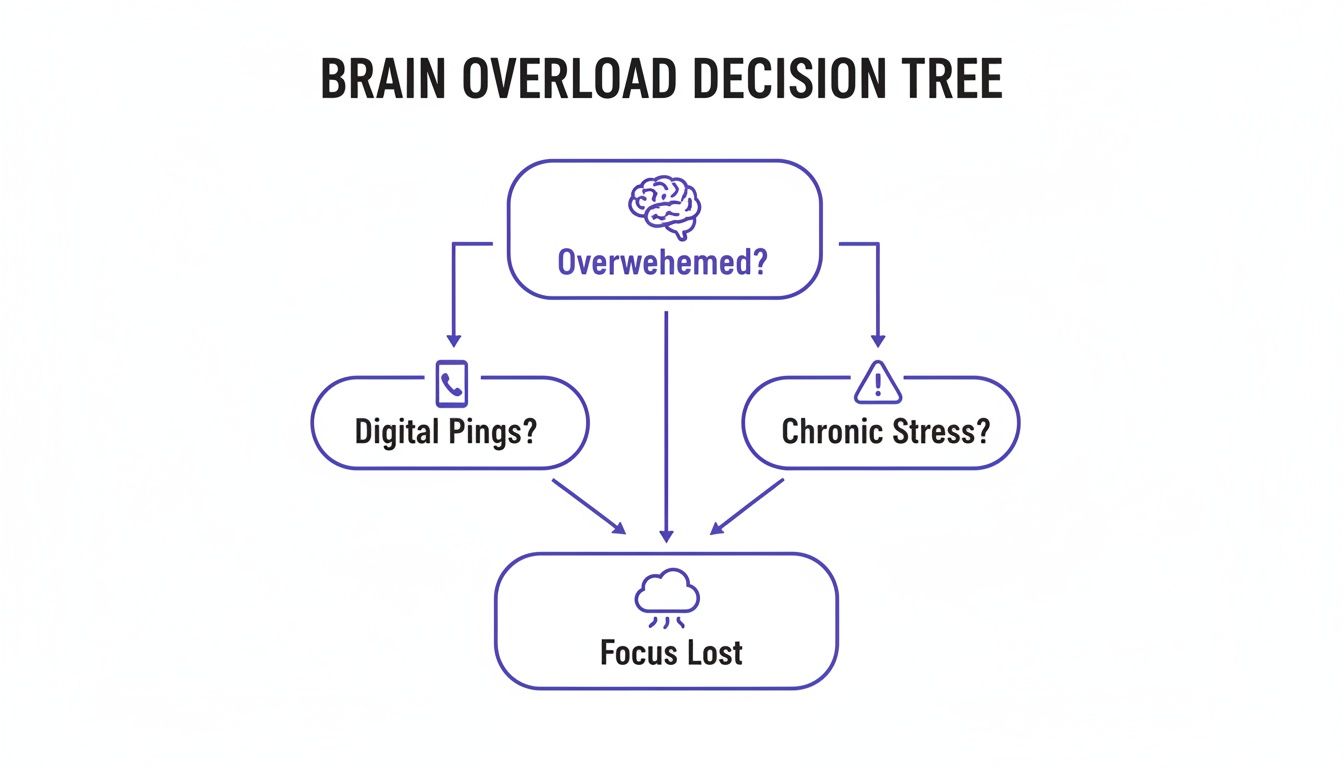
    This map shows how device usage leads to a drain on mental resources.

    A concept map illustrating how time spent on screen time leads to mental drain and negative effects, which is one of the excessive screen time effects.

    As you can see, the path from screen time to cognitive drain is clear, resulting in many negative effects.

    A Real-World Scenario of Excessive Screen Time Effects

    Imagine a freelance writer named Alex. They block three hours to finish a critical report. They start strong, but an email notification pops up. Alex replies, but the flow is gone. A few minutes later, their phone buzzes. Just a quick look, they think. Twenty minutes of scrolling later, Alex feels frustrated and behind schedule. This cycle repeats, turning a three-hour task into an all-day struggle. This pattern is a classic sign of cognitive overload, where the brain’s processing capacity is overwhelmed.

    How to Break the Cycle and Reclaim Your Focus

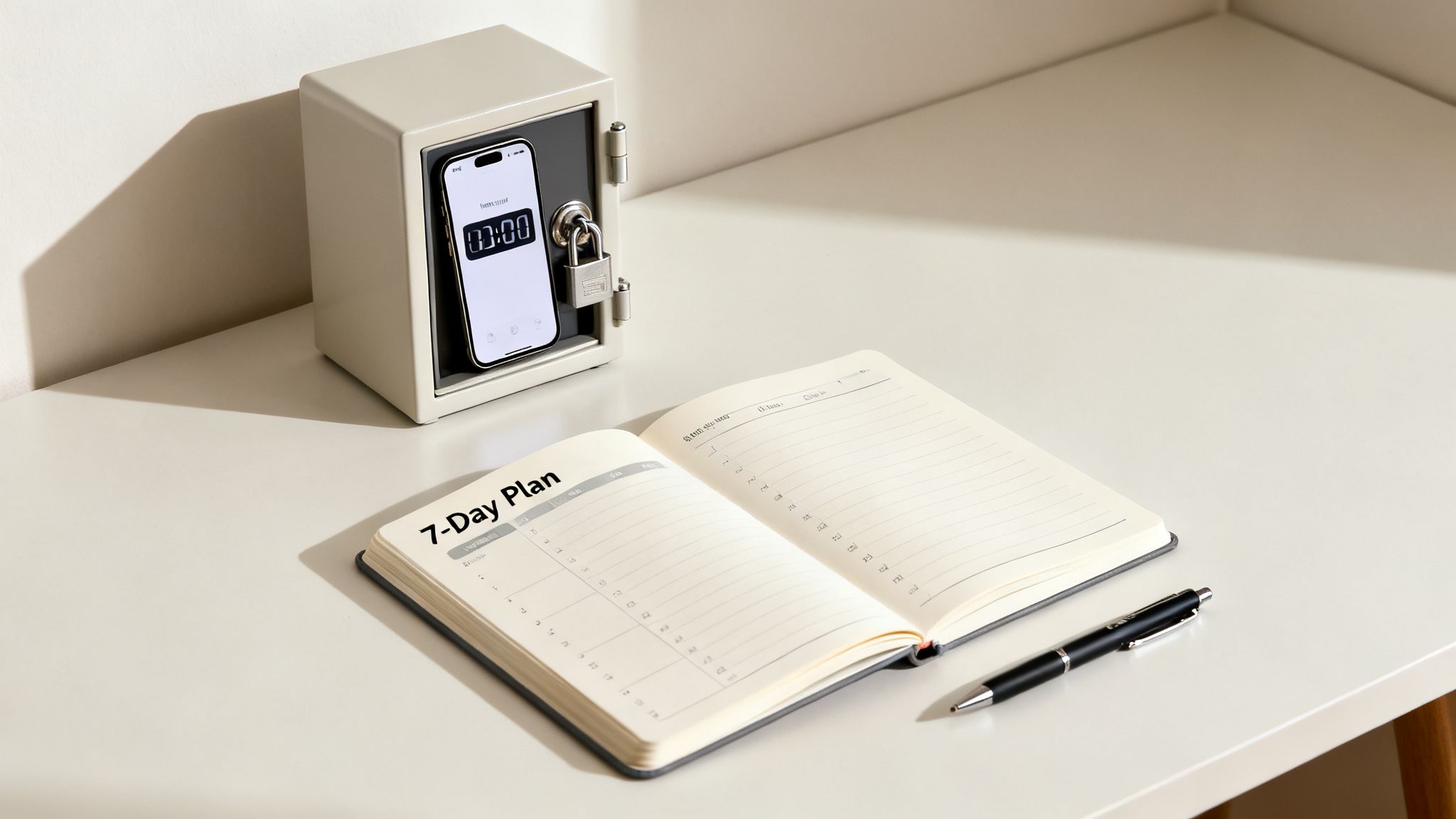
    The first step is creating intentional periods of zero distractions. You must actively build an environment where deep work is possible. For some, this means putting their smartphone under lock and key. A phone lock box timer is a simple but surprisingly effective tool for this. It creates a physical barrier between you and the dopamine loop.

    By setting aside tech-free time, you allow your prefrontal cortex to do its job. You retrain your brain to find satisfaction in deep work again. Start exploring frameworks to build better habits and regain your focus.

    The Physical Toll of Excessive Screen Time Effects

    The cognitive strain is just one side of the coin. The excessive screen time effects also show up in very real, physical ways. Hours spent hunched over a screen exert a tangible toll on our bodies.

    A man in glasses looking at a laptop, which is an example of one of the excessive screen time effects.

    The post-pandemic world has cemented high screen use into our routines. Adolescent use has doubled to a staggering 7.7 hours daily. The patterns for remote workers aren’t far behind. The physical fallout is wide-ranging, from disrupted sleep to a spike in mental health issues tied to screen habits.

    Digital Eye Strain and Computer Vision Syndrome

    Staring at a screen for hours forces your eyes to work much harder. This overload often leads to digital eye strain, also known as Computer Vision Syndrome.

    The symptoms can be sneaky, building throughout the day. They often include:

    • Dry, irritated eyes because you’re blinking less.
    • Blurry vision as your eye muscles get exhausted.
    • Headaches that cluster around your temples or behind your eyes.

    A simple strategy is the 20-20-20 rule. Every 20 minutes, look at something 20 feet away for 20 seconds. It’s a tiny reset for your eye muscles. If eye strain is a constant battle, our guide explains how to reduce digital eye strain.

    The Rise of Tech Neck and Poor Posture

    Our bodies weren’t designed to hunch over screens. That familiar postureβ€”leaning forward, head tilted downβ€”puts immense strain on your neck and upper back. This β€œtech neck” can progress from daily stiffness to chronic pain.

    For example, Sarah is a remote project manager. She finishes her day with a throbbing headache and an aching, stiff neck. She spends her day leaning into her laptop. This forward-head posture adds up to 40 extra pounds of pressure on her cervical spine. The pain has become an unwelcome side effect of her job.

    An ergonomic setup isn’t a luxury; it’s a crucial fix. Using a simple laptop stand for desk elevates your screen to eye level. This encourages a neutral spine position and can dramatically reduce physical stress.

    How Screen Time Wrecks Your Sleep

    Perhaps the most significant physical consequence is how excessive screen time dismantles our sleep. Our devices emit high-energy visible light, also known as blue light.

    From a neuroscience standpoint, blue light in the evening tricks your brain. It thinks it’s still daytime. It directly suppresses the production of melatonin, the hormone that signals it’s time to wind down. Without that crucial melatonin signal, your body struggles to prepare for rest. Many people find that wearing blue light blocking glasses for a few hours before bed helps buffer this effect.

    For gamers, weaving in activities like in-game cardio can be a creative way to offset a sedentary habit.

    The Emotional and Social Side of Excessive Screen Time Effects

    Beyond physical strain, the most damaging effects of excessive screen time creep into our emotional and social lives. The very tools designed to connect us can paradoxically make us feel deeply alone.

    Projections show that by 2026, the average person will spend 141 minutes on social media daily. This firehose of curated content creates a warped sense of reality. Our own messy lives can feel inadequate in comparison, which quietly chips away at self-worth.

    A young man on a couch looks at his phone, a sign of excessive screen time effects.

    The Rise of Digital Burnout

    When the pressure to be constantly online becomes too much, it can trigger digital burnout. This isn’t just feeling tired of your phone. It’s a state of emotional and physical exhaustion tied to prolonged digital stress. It manifests as chronic overwhelm, cynicism, and a disconnect from your goals.

    Think of a solopreneur named Maria. She’s online from dawn till dusk. She manages social feeds, answers emails, and networks online. She’s more β€œconnected” than ever, yet feels profoundly isolated and anxious. The constant digital noise has left her drained.

    This is a classic case of digital burnout. The quantity of connection has suffocated its quality. The experience can feel profoundly lonely. Learning how to deal with loneliness in our hyper-connected world is an essential modern skill.

    How to Rebuild Real-World Connections

    The fix isn’t just logging off; it’s replacing screen time with something nourishing. Pushing back against the emotional fallout means a conscious shift toward real-world interaction.

    • Schedule β€œAnalog” Time: Deliberately carve out screen-free periods. This could be a walk without your phone or reading a physical book.
    • Prioritize Face-to-Face Interaction: Make a real effort to see people in person. In-person conversation provides a depth of connection that texts can’t replicate.
    • Monitor Your Digital Habits: A simple habit tracker journal helps you see where your time goes. More importantly, it shows how that time makes you feel. This awareness is the first step toward meaningful change. Browse the library to find a book to help you reconnect.

    By stepping away from the screen, you create space for rest and authentic social connection. This is a central theme in books like Burnout Interrupted, and Connected Again.

    How to Choose Your Digital Reset Strategy

    Realizing the toll of endless screen time is the first step. The next is figuring out what to do about it. You don’t have to throw your phone in a river. You just need a practical strategy that fits your actual life.

    The two most common paths are a β€œhard reset” (digital detox) and a β€œsoft reset” (digital declutter). Each has its place, depending on how burned out you feel.

    Best Option for a Full Reset: The Digital Detox

    A digital detox is a short, sharp break from all non-essential technology. It’s like a circuit breaker for your brain’s reward system. This approach is best if you feel completely overwhelmed and drained by your digital life. Cutting off the stream of notifications starves your brain of the cheap dopamine hits it expects. This is powerful for breaking addictive cycles.

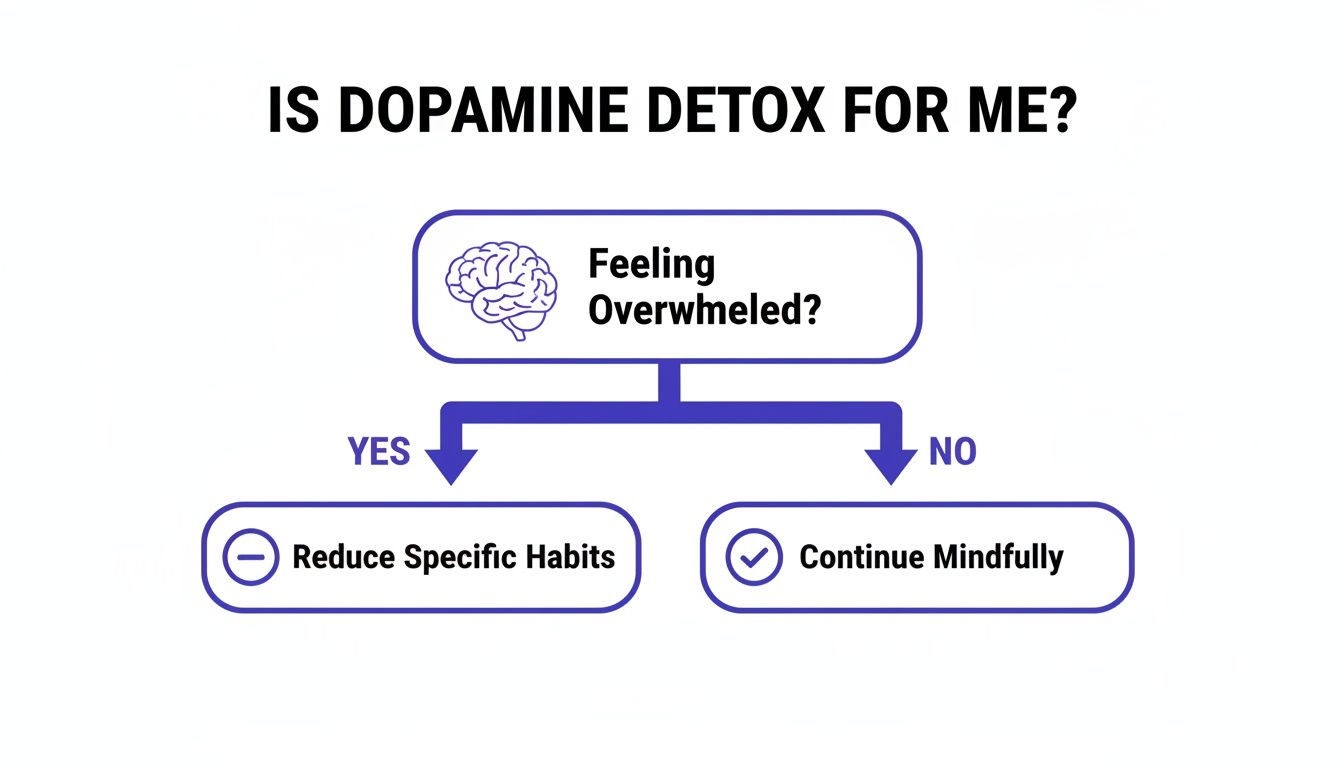
    However, a total detox can be tough if your job requires you to be online. If a 24– or 72-hour break sounds impossible, you can adapt. Our guide on how to do a dopamine detox shows you how to find a version that works for you.

    Best for Busy Professionals: The Digital Declutter

    A digital declutter is less about a shutdown and more about building healthier habits. You systematically create and enforce rules around how you use your devices. This approach is perfect for busy professionals who need to stay connected on their own terms.

    A few examples include:

    • Setting a firm β€œno phones at the dinner table” rule.
    • Deleting time-wasting apps.
    • Turning off all non-essential notifications.

    This method is less intense but demands consistent discipline. It’s about making small, conscious choices that add up over time. Compare options to see which method fits your lifestyle best.

    Comparison: Digital Detox vs. Digital Declutter

    Tool/StrategyBest ForMain BenefitPotential Downside
    Digital DetoxSevere burnout; breaking addictive cyclesQuick, powerful reset for your nervous system and attention.Hard to schedule; risk of returning to old habits.
    Digital DeclutterSustainable, long-term habit changeIntegrates into busy life; builds lasting mindfulness.Slower results; requires ongoing discipline.
    Phone Lock BoxForcing distraction-free work blocksCreates a physical barrier to your biggest distraction.Doesn’t build the internal habit of self-control.
    Time BlockingStructuring your day for deep workProtects your focus; makes β€œoffline” time intentional.Can feel rigid; requires planning ahead.

    Ultimately, whether you choose a hard reset or a softer declutter, the most important thing is to begin. You can find more great advice on how to limit screen time. The goal isn’t perfection; it’s progress.

    Editor’s Take: What Actually Works to Combat Excessive Screen Time Effects

    After wading through all the research, here’s my honest take. Gadgets are fine, but they aren’t a magic bullet. A phone lock box timer can force a screen break, but lasting change comes from redesigning your environment and mindset. The most powerful strategy isn’t a single tool; it’s a commitment to intentionality. You have to decide your attention is a valuable resource and protect it.

    Who This Advice Is Best For

    There’s no one-size-fits-all fix. The best approach depends on your personality and how you work.

    • For busy professionals: Time-blocking is your greatest ally. You must schedule deep work blocks and β€œoffline” time. It’s non-negotiable. You can find great systems for this in books like Focus Recharged.

    • For creatives and thinkers: You must schedule β€œboredom.” Your best ideas rarely show up when you’re scrolling. Carve out time for walks without a podcast or just for being still. This is where your brain gets space to connect ideas. See the book that fits your goal to learn more.


    The most important thing to remember is that consistency beats intensity. A perfect digital detox is useless if you snap back to old habits. Small, daily choicesβ€”like putting your phone away during mealsβ€”compound into real, lasting well-being.

    Key Takeaways: Your Action Plan for Screen Time

    Let’s cut through the digital noise. Here is a quick summary of the most important takeaways for managing your relationship with screens. Use this as your reference to get your focus, health, and mental space back.

    Understanding the Real Effects of Excessive Screen Time

    • A Drained Brain: Constant pings wear down your prefrontal cortex. That endless loop of quick rewards from apps hijacks your dopamine system. This makes deep work feel almost impossible and chips away at your attention span.
    • A Tired Body: Hours staring at a screen lead to real physical problems. We’re talking digital eye strain, β€œtech neck,” and posture issues. The blue light from our devices also messes with melatonin, the hormone that helps you sleep.
    • An Emotional Toll: Heavy screen use, particularly on social media, is linked to feeling more lonely, anxious, and burned out. The curated lives we see online can twist our sense of self and reality.

    How to Start Taking Back Control

    • Set Intentional Boundaries: Decide to take action. Start with simple rules like the 20-20-20 rule for your eyes. Carve out screen-free zones and schedule β€œoffline” time. Using a time blocking planner can make this feel concrete.
    • Redesign Your Environment for Focus: Make deep work the easy choice. Simple tweaks can have a huge impact. Get your monitor at eye level with a laptop stand for desk. Wear blue light blocking glasses in the evening to protect your sleep.
    • Give Yourself a Reset: You need to break the cycle. A β€œhard reset,” like a weekend digital detox, can jolt your system out of addictive loops. A β€œsoft reset”—like a digital declutterβ€”can help you build healthier long-term habits. For a deeper dive, books like Break the Scroll offer a great starting point.

    Disclaimer: This article contains affiliate links. Purchases made may earn us a small commission at no extra cost to you. The content provided is for educational and informational purposes only and is not a substitute for professional medical or psychological advice, diagnosis, or treatment.

    Frequently Asked Questions About Excessive Screen Time Effects

    Here, we’ll tackle some of the most common questions about the effects of screen time. This is a quick-reference guide to help you move from understanding to action.

    How much screen time is too much?

    There isn’t one magic number. β€œExcessive” depends on your lifestyle and how screen time makes you feel. A good benchmark is when it consistently interferes with essential activities. These include sleep, real-world social connection, and work performance. For adults, if you notice eye strain, bad sleep, or mental fog, it’s a sign to cut back. For kids, the American Academy of Pediatrics suggests no more than one hour daily for ages 2-5 and firm limits for older children.

    What are the first signs of digital burnout?

    Digital burnout creeps in slowly. It often shows up as emotional and physical exhaustion. You might notice a nagging mental fatigue, even after a full night’s sleep. Other early warning signs include a growing cynicism toward online tasks, feeling irritable after scrolling, and a drop in productivity. If these patterns sound familiar, your digital habits may be causing unsustainable stress.

    Can the cognitive effects of too much screen time be reversed?

    Yes, absolutely. Your brain has a remarkable capacity to change, a concept known as neuroplasticity. While chronic screen overload can weaken your focus, you can rebuild your attention span. This happens by intentionally creating an environment that encourages deep focus. By practicing habits like time-blocking and taking screen-free breaks, you actively retrain your brain. It takes consistency, but you can regain your cognitive clarity. For a structured approach, The Power of Clarity offers a great roadmap.

    What’s a simple 5-minute habit to reduce screen time effects today?

    One of the most effective habits is the β€œFirst and Last” rule. For the first five minutes after you wake up and the last five before sleep, do not look at your phone. It’s that simple. To make it easier, you can switch to a simple analog alarm clock instead of your phone. This tiny change has an outsized impact. In the morning, it lets your brain wake up naturally. In the evening, it protects your melatonin production, helping your brain prepare for restorative sleep.

    How can I use my phone more mindfully, not just less?

    Mindful phone use is about shifting from restriction to intention. Instead of just trying to use your phone less, focus on using it better. Before you instinctively pick up your phone, pause and ask yourself: β€œWhat am I using this for?” This small pause is surprisingly powerful. It breaks the cycle of mindless scrolling and forces you to have a clear purpose. Once you’ve completed that task, put the phone down. This practice transforms your device from a distraction back into a useful tool you control.

  • Unlock Focus: how to overcome social media addiction and reclaim your time

    Unlock Focus: how to overcome social media addiction and reclaim your time

    To get a handle on social media addiction, you have to understand the brain science that keeps you hooked. From there, you can take a mindful look at your own triggers. Then, you can start replacing mindless scrolling with habits that actually feel good. This isn’t about willpowerβ€”it’s about intentionally designing a better system for your brain.

    Affiliate Disclosure: This article may contain affiliate links. If you make a purchase through these links, we may earn a small commission at no extra cost to you. This helps support our work in creating evidence-based content.

    Understanding the Science Behind Your Scroll

    It’s a feeling most of us know all too well. You pick up your phone to check one thing. Suddenly, an hour is gone. You’re left feeling anxious, unfocused, and a little drained.

    This isn’t a personal failure. It’s a predictable response to platforms engineered to capture and hold your attention.

    These apps tap directly into your brain’s reward system. Every like, share, and notification acts as a small, unpredictable reward. Behavioral research shows this patternβ€”known as intermittent reinforcementβ€”is a powerful way to form a habit. It’s the same mechanism that makes slot machines so compelling.

    Young man checking his smartphone while journaling at his desk, illustrating how to overcome social media addiction by replacing scrolling with reflection.

    The Dopamine Loop and Your Focus

    When you get a social media notification, your brain releases a hit of dopamine. This is a neurotransmitter tied to pleasure and motivation. But it’s not just about feeling good in the moment. It’s about anticipation. Your brain learns to crave the possibility of a reward. This is why you feel that persistent urge to check your phone.

    You can learn more about the deep connection between dopamine and your motivation in our detailed guide.

    This process creates a powerful feedback loop that’s hard to escape:

    • Trigger: You feel bored, anxious, or hear a notification.
    • Action: You open an app and start scrolling.
    • Reward: You find a funny video or a friend’s update. Dopamine is released.
    • Investment: You spend more time on the app, reinforcing the cycle.

    Over time, your brain gets desensitized. It needs more stimulation to get the same satisfaction. This is why normal activities can start to feel dull. It’s the core reason why β€œjust stopping” is so incredibly difficult.

    Why Regaining Control Is Possible

    Here’s the good news: this is not a permanent state. You can absolutely reverse this process.

    Study after study shows that intentional changes have a massive impact. Recent APA polling data found that 50% of adults who actively cut back on social media reported major improvements in well-being.

    Even better, other research shows people who reduced usage saw a 47% drop in feelings of anxiety after just two weeks. If you are struggling with anxiety, depression, or other mental health concerns, this article is for educational purposes only. Please consult a qualified medical or psychological professional for diagnosis and treatment.

    Understanding the science is the first and most important step. This reframes the problem entirely. It’s not about willpower; it’s about needing a better system to outsmart the one designed to hook you. This guide will give you a practical plan to break free.

    How to Overcome Social Media Addiction by Uncovering Your Triggers

    Before you can change a habit, you must understand it. Trying to quit without knowing your triggers is like navigating a new city with a blindfold. A mindful digital audit is your most powerful first step.

    This isn’t about shaming yourself over screen time. For the next three days, act like a detective. Gather clues about your own behavior. The goal is to connect the action (picking up your phone) with the context (what happened right before).

    Flat lay of a notebook, pen, coffee, and smartphone with β€œTRACK TRIGGERS” overlay, showing how to overcome social media addiction by spotting habits.

    How to Run Your 3-Day Audit

    For this audit, just tracking minutes isn’t enough. We need to go deeper. The real magic happens when you focus on the moments before you scroll. This is a foundational concept in behavioral psychology. Habits are cued by specific internal or external triggers.

    We’re going to figure out what purpose social media really serves you. A good habit tracker journal is helpful for this. It turns that vague feeling of being β€œaddicted” into clear data you can work with.

    For the next three days, each time you open a social media app, just pause. Grab your journal or a notes app. Quickly jot down the answers to three simple questions:

    1. What was I doing right before this? (e.g., waiting for a file, finishing a meeting, sitting on the couch)
    2. What was I feeling right before this? (e.g., bored, anxious, lonely, stressed, tired)
    3. What am I hoping to get from this? (e.g., a distraction, a connection, a mental break)

    This simple practice builds awareness. It interrupts the automatic nature of the habit. It brings the behavior out into the open.

    Identifying Your Unique Scroll Triggers

    After your three-day audit, you’ll almost certainly see clear patterns emerge. These patterns are your roadmap. They reveal the underlying needs your scrolling habit is trying to meet.

    Mini Scenario: A freelance graphic designer, Sarah, felt she was losing hours to Instagram every day. After her audit, she discovered her two main triggers:

    • Trigger 1: Creative Block. When she felt stuck, she opened Instagram for β€œinspiration.” An hour later, she’d feel more anxious. The underlying need? A break from cognitive strain.
    • Trigger 2: Loneliness. As a remote worker, she felt a strong urge to scroll around 5 PM. The underlying need? Social connection.

    Sarah’s audit revealed her social media use wasn’t a β€œbad habit.” It was her brain’s attempt to solve real problemsβ€”fatigue and isolation. Now she can find better solutions.

    This process of gaining self-awareness is a core theme in our book, The Power of Clarity. It guides you in identifying hidden patterns that drive your daily actions. For more ideas, you might find it helpful to explore other ways to reduce screen time.

    With this new self-knowledge, you’re no longer fighting blindly. You’re equipped to find effective replacements for the scroll. We’ll cover that next.

    It’s Time for a Strategic Dopamine Reset

    With your audit data in hand, you see how social media hooks you. Now it’s time to step away. Give your brain chemistry a chance to rebalance. This is often called a digital detox.

    This isn’t about punishment. It’s an intervention to recalibrate your brain’s reward system. The constant stimulation from social media desensitizes your dopamine receptors. As a result, normal activities feel flat.

    By removing these high-dopamine triggers for a short periodβ€”usually 48 hours to 7 daysβ€”you give those receptors a rest. It’s like letting your ears recover after a loud concert. When you step back into a quieter world, you can hear subtle sounds again.

    Your Action Plan for a Social Media Reset

    The difference between a successful reset and a failed one is planning. Just deciding to β€œstay offline” is a recipe for failure. The void left by scrolling can feel overwhelming. You have to be deliberate.

    Here are concrete steps that work:

    • Delete the Apps. Temporarily delete all social media apps from your phone. This adds a crucial layer of friction. It makes it harder to relapse into a mindless scroll.
    • Create a Physical Barrier. The pull to check your phone is strong. Using a phone lock box timer can be an absolute game-changer. Set it for a few hours while you work or for the entire evening.
    • Schedule Engaging Alternatives. This is the most important part. Before your reset starts, fill the time you’d normally spend scrolling. If you scroll out of boredom, plan a project. If it’s loneliness, schedule a real-life coffee date.

    Mini Scenario: Mark, a marketing manager, planned a weekend reset. He deleted his apps Friday afternoon. Saturday was for a long hike. Sunday was for a new recipe and starting a novel. By filling his time with immersive activities, he barely noticed his phone was gone.

    This β€œscreen fasting” approach is backed by data. Structured time away helps around 63% of people reverse depressive symptoms linked to compulsive social media use. Remember, this article is for educational purposes only and not a substitute for professional psychological care.

    A dopamine reset is a powerful circuit breaker. It proves to your brain you can thrive without constant digital input. This experience builds the confidence you’ll need for long-term success. Our guide on how to do a dopamine detox has more detail. This period of recalibration is a core tenet of our book, Break the Scroll: A Digital Detox Framework.

    Design Your Environment for Better Focus

    Relying on willpower to quit social media is like trying to stay dry in a downpour without an umbrella. A smarter approach is to redesign the environment that triggers the habit. This is grounded in decades of behavioral psychology.

    Your space, both digital and physical, is your strongest ally. The goal is to add small points of friction. These are tiny obstacles that make it harder to slip into old patterns. That pause often interrupts the automatic pull of the feed.

    β€œPHONE FREE ZONE” sign above a table with an open book, glasses, and a smartphone, showing how to overcome social media addiction with phone-free habits.

    Declutter Your Digital Space to Sideline Distractions

    Since your phone is the primary home for this habit, let’s start there. We’re going to make your social media apps less attractive and harder to access.

    • Silence Non-Essential Notifications: Those red badges and pop-ups are powerful external cues. Go into your phone’s settings now. Kill all notifications for social media apps. Keep alerts only for direct, human-to-human communication.
    • Turn Down the Visual Noise: Social media icons are engineered with bright, dopamine-triggering colors. A surprisingly effective trick is to switch your phone’s display to grayscale. Without vibrant hues, the apps become instantly less stimulating.
    • Bury the Junk Apps: Drag time-wasting apps off your home screen. Tuck them away inside a folder named β€œBlack Hole.” This simple act of adding extra taps creates enough friction to make you pause.

    Mini Scenario: A project manager was constantly distracted by LinkedIn. She silenced alerts, moved the app to an β€œAfter 5 PM” folder, and set her phone to grayscale. The urge to check it during the day plummeted because the cues were gone.

    How to Choose Your Best Digital Tweak

    Feeling overwhelmed? Don’t be. The secret is to pick one change that offers a high return for low effort in your situation. This simple comparison can help you decide what to buy first for your digital life.

    Comparison: Which Tweak to Start With?

    • Turning Off Notifications: Best for beginners and busy professionals. It’s a simple, high-impact first step that cuts down on constant interruptions and protects focus.
    • Going Grayscale: Excellent for beginners as it immediately breaks the visual β€œpull” of apps. It can be impractical for professionals who need to see color on their phones.
    • Burying Your Apps: A great, low-commitment strategy for everyone. It creates an intentional barrier without the finality of deleting anything.

    Just start with one. After a few days, try adding another. These small changes are the building blocks of an intentional digital life. Browse our Focus Portal for more strategies.

    Reclaim Your Physical Space From Your Phone

    Creating intentional boundaries in your physical environment is just as critical. The first step is to establish β€œno-phone zones” in your home. These are sacred spaces where your phone isn’t welcome. The two most important are the dinner table and the bedroom. This protects your sleep from the disruptive effects of blue light.

    Speaking of sleep, a pair of blue light blocking glasses can be a game-changer for your evening routine. Research shows blue light from screens can suppress melatonin production. This makes it much harder to fall and stay asleep. Poor sleep quality can worsen issues like burnout and anxiety. This article is not a substitute for professional medical care for these conditions.

    Replace the Scroll with Fulfilling Habits

    Simply trying to stop a behavior rarely works. Habits stick around because they serve a purpose. To break free from compulsive scrolling, you must replace it with a better habit. This new habit should satisfy the same underlying need.

    This is where the process gets creative and rewarding. Instead of fighting an urge, you’re consciously redirecting it. You’re choosing an activity that leaves you feeling energized, not drained.

    Match the Habit to the Trigger

    Your personal audit data is the map. If you scroll when you’re bored, your brain craves stimulation, not Instagram. If you scroll when lonely, your mind wants connection.

    Here are practical examples of how to connect a replacement habit to your trigger:

    • Trigger: Boredom. Instead of opening a feed, try a 10-minute walk outside. If stuck at your desk, an under desk walking pad can work wonders.
    • Trigger: Procrastination. This urge is often a flight response from a difficult task. Instead, grab a pomodoro timer and commit to one 25-minute work sprint.
    • Trigger: Loneliness. When that feeling hits, seek real connection. Schedule a quick call or coffee chat with a friend.

    Mini Scenario: A college student realized her late-night scrolling was fueled by anxiety. She wanted to β€œturn her brain off.” She started putting her phone in another room an hour before bed and reading a book. Within a week, she was falling asleep faster and felt more prepared for class.

    Best Option for Building New Routines

    Matching the right activity to your trigger is the secret sauce. The goal is to find a genuinely fulfilling alternative. This approach is fundamental to building good daily habits that support your well-being. This table can help you brainstorm.

    How to Choose a Replacement Habit

    Trigger (The β€˜Why’ Behind Your Scroll)Replacement Habit (What to Do Instead)Best For…
    Boredom / UnderstimulationListen to a 15-min podcast, read a book chapter, do a quick puzzle.Busy professionals with short breaks.
    Procrastination / Task AnxietyUse a Pomodoro timer for 25 minutes, break the task into one small step.Students and anyone facing complex projects.
    Loneliness / Seeking ConnectionCall a friend or family member, schedule a coffee chat.Remote workers and individuals feeling isolated.
    Stress / Needing an EscapePractice a 5-minute mindfulness exercise, stretch, or take a short walk.Anyone feeling overwhelmed by work or life.

    Finding the right replacement is a personal journey. Don’t be afraid to experiment. A great way to replace screen time is with fun board games for families that help you put down your phones.

    You can also explore our books. Connected Again helps deepen relationships. Focus Recharged is for building better productivity habits. See the book that fits your goal to get started.

    A diagram shows three stages: 'Trigger,' 'Pause,' and 'Replace,' illustrating how to break a bad habit loop. Alt text: A diagram showing how to overcome social media addiction with a habit replacement flow.

    Editor’s Take

    What’s the bottom line on how to overcome social media addiction? It’s not about finding a magic bullet or white-knuckling through temptation. It’s about building self-awareness and designing better systems. These make focus the path of least resistance.

    This advice is best for self-motivated people who feel their focus slipping away. It’s for those who likely don’t need a full-blown clinical intervention. The key is understanding your brain’s reward system and then working with it, not against it. The combination of a short-term β€œdopamine reset” followed by environmental design and habit replacement is what actually works.

    Important caveat: Getting a handle on this is a process. You will probably relapse, and that’s normal. The goal isn’t perfection; it’s progress. Use each slip-up as data to tweak your system.

    Key Takeaways

    • Understand the Dopamine Loop: Social media is designed with intermittent rewards that create a craving cycle in your brain.
    • Conduct a Digital Audit: Spend three days tracking why and when you scroll to identify your personal triggers (e.g., boredom, loneliness, stress).
    • Perform a Dopamine Reset: Take a short break (48 hours to 7 days) by deleting social media apps to re-sensitize your brain’s reward system.
    • Redesign Your Environment: Make scrolling harder by turning off notifications, using grayscale mode, and creating β€œno-phone zones.”
    • Replace, Don’t Just Remove: Actively choose a fulfilling replacement habit (like a walk or calling a friend) that addresses the underlying need your scrolling was trying to meet.

    Disclaimer: This article may contain affiliate links, which means purchases may generate a commission for us at no extra cost to you. The content provided is for educational and informational purposes only. It is not intended as, and should not be understood or construed as, medical or psychological advice, diagnosis, or treatment. Always seek the advice of your physician or other qualified health provider with any questions you may have regarding a medical condition or mental health concern.

    FAQ: How to Overcome Social Media Addiction

    1. How long does it take to overcome social media addiction?


    There’s no magic number. It’s less about a β€œcure” and more about building new habits. Behavioral science suggests it takes weeks or months of consistent effort to form new neural pathways. The initial dopamine reset might take a week, but lasting change comes from steady practice.

    2. Should I quit cold turkey or just cut back?


    A hybrid approach often works best. Start with a β€œcold turkey” reset for 48 hours to a week. This breaks the compulsive cycle. Afterward, a gradual approach is more sustainable. Reintroduce apps with strict boundaries, like time limits or specific use cases (e.g., desktop only for work).

    3. What if I need social media for my job?


    The goal is to be an intentional user, not an absent one. Set clear rules. For example, only use professional social media on your desktop. Schedule posts in batches using a tool. Or, use time-blocked sprints where you set a timer, do what you need to, and then log off.

    4. How do I know if my efforts are actually working?


    You’ll notice small, quiet signs of progress. You might wake up without immediately reaching for your phone. You can sit through a meal without the itch to scroll. That background hum of anxiety may fade. You’ll find yourself able to focus on a single task for longer periods.

    5. What should I do when I relapse and start scrolling again?


    A relapse is not a failure; it is data. It’s an inevitable part of the process. Instead of self-blame, get curious. What triggered it? Were you bored, stressed, or lonely? Use that information to adjust your system and make it more resilient for next time. Compassion is key for sustainable change. Our book, Perfectly Imperfect, can help you cultivate this skill.

  • How to Improve Attention Span in Adults: Simple, Science-Backed Strategies

    How to Improve Attention Span in Adults: Simple, Science-Backed Strategies

    This post may contain affiliate links. If you make a purchase, we may earn a small commission at no extra cost to you.

    Retraining your attention span isn’t about β€œtrying harder” or finding some magic bullet of willpower. It’s about systematically rewiring your brain with small, intentional habits. The process hinges on dialing down digital noise and bringing in smart focus techniques. This gives your brain’s attention circuits a chance to strengthen again.

    Why Your Attention Is Slipping and How to Improve It

    Does this sound familiar? You sit down to finally tackle that critical report. A few minutes in, a cascade of pings and alerts pulls you away. Before you know it, an hour has evaporated, and you’ve barely written a single paragraph. If that hits close to home, you’re not alone.

    The modern world often feels engineered to shatter our concentration. Between constant notifications and infinite social media feeds, sustained focus feels impossible. From a psychology perspective, this isn’t a personal failing. It’s a predictable behavioral response to an overwhelming digital environment.

    The Neuroscience of a Wandering Mind

    At the heart of the problem is a bit of neuroscience called the β€œdigital dopamine loop.” Every time you get a notification or a like, your brain releases a tiny bit of dopamineβ€”a feel-good chemical. It’s a small, fleeting reward that conditions your behavior to check devices again and again.

    Over time, your brain’s reward system gets wired to seek these quick, easy hits. This habit makes it much harder to sink into deep, focused work. Deep work offers a more delayed and less immediate sense of gratification. Your brain essentially learns to prefer distraction over depth. If you often feel mentally scattered, it’s worth understanding more about what causes brain fog.

    This constant switching hijacks our ability to concentrate. Studies show the average adult attention span has now plummeted, making sustained focus a real challenge.

    But here’s the good news: neuroscience research shows you can reclaim your focus. For instance, studies show that just 10 minutes of daily mindfulness can boost attention. This happens by rewiring the brain’s prefrontal cortex, the area responsible for executive functions like focus.

    Real-World Example: Imagine Sarah, a project manager. She used to check her email every 10 minutes, driven by that dopamine hit. She started a new habit: turning off notifications for one hour. At first, it felt difficult. But soon, her brain adapted, and she could work uninterrupted, feeling more accomplished.

    Starting Your Journey to Better Focus

    You can fight back against distraction. Improving your attention is a skill you can build with consistent practice. It all starts with making intentional choices to create a supportive environment. For anyone feeling a persistent decline in concentration, exploring guides on how to improve focus and boost concentration can offer valuable starting points.

    This guide will walk you through foundational strategies:

    • Single-Tasking: The surprisingly powerful art of doing one thing at a time.
    • Strategic Breaks: Using intentional rest to replenish your mental energy.
    • Mindful Technology Use: Taking back control of your devices.

    By adopting these principles, you begin to retrain your brain. You shift from a reactive state to a proactive one, where you command your attention. To build this skill, explore our book, Attention Unleashed.

    This article is educational and not a substitute for medical or psychological advice, especially for conditions like ADHD, anxiety, or depression. Please consult a professional for diagnosis and treatment.

    Build Your Deep Work Foundation to Improve Your Attention Span

    Just deciding to β€œfocus more” is like trying to build a house without a blueprint. It’s a nice thought, but it won’t stand up to the first distraction. To truly rebuild your attention span, you need a solid framework.

    Creating a structured routine isn’t about rigid, joyless discipline. It’s about building a protective shield around your most valuable mental resource: your focus. A routine puts you back in the driver’s seat. It lets you intentionally spend your focus on what actually matters.

    We’ve all been in that frustrating cycle of losing and reclaiming our attention.

    A process flow diagram illustrates three steps to reclaim focus: slipping, distracted, and reclaim.

    The diagram above pinpoints that critical moment of choice. You can stay stuck in that distracted haze, or you can actively pull yourself out with a structured approach.

    The High Cognitive Cost of Context Switching

    Let’s be clear: your brain can’t actually multitask on complex projects. What we call multitasking is really context switchingβ€”the mental gymnastics of toggling between tasks. Every time you switch, your brain pays a β€œcognitive cost.” Behavioral psychology research shows it has to slam the brakes on one task and rummage for the context of the new one.

    This process is incredibly draining. Research from the American Psychological Association found that even brief mental blocks from switching tasks can devour as much as 40 percent of someone’s productive time.

    Real-World Example: Think about a remote worker trying to write a project proposal. They write one sentence, then check an email, then answer a Slack message. Each switch shatters their attention. This makes the core task take far longer. A structured routine is the antidote, allowing you to sink into deep concentration. You can learn more by exploring our guide on what deep work is.

    How to Implement a Structured Focus Routine

    Building this foundation doesn’t mean you have to overhaul your entire life overnight. It starts with a few simple, proven techniques.

    Here are two of my favorite methods to get started:

    • Time Blocking: This is where you schedule your whole day into dedicated blocks for single tasks. Your calendar becomes your non-negotiable guide. For example, a block from 9 AM to 11 AM might be for β€œDrafting the Q3 Marketing Report.”
    • The Pomodoro Technique: This method uses a timer to break down work into focused sprints, typically 25 minutes, separated by short breaks. It’s a fantastic way to break through procrastination and build your focus endurance.

    This small shift changes everything. You’re training your brain to sustain focus for a manageable chunk of time. The built-in breaks prevent you from burning out. For a deeper dive into these methods, check out our productivity guide, Focus Recharged.

    A strong deep work foundation is all about efficiency. To find more ways to boost your concentration, check out these practical ways to improve productivity at work. By creating a routine, you’re not just managing your timeβ€”you’re managing your brain’s energy.

    Design a Distraction-Proof Environment to Improve Attention

    Let’s be honest: our environment usually dictates our focus. If your desk is a mess and your phone buzzes every two minutes, you’re fighting an uphill battle. Reclaiming your attention span isn’t about finding a secret reserve of willpower. It’s about making focus the path of least resistance.

    This means deliberately engineering your surroundingsβ€”both digital and physicalβ€”to support deep concentration. When your environment is built for focus, you stop wasting precious mental energy. You make focus the easy, default option.

    Desktop focus setup with a notebook, headphones, phone, laptop, and a timerβ€”an organized workspace to improve attention span in adults.

    Perform a Digital Dopamine Reset

    Your digital world is ground zero for modern distraction. Every notification trains your brain to seek novelty. This shatters your ability to stay on one task. A β€œdigital dopamine reset” is about taking back control and re-sensitizing your brain to more important work.

    Start with your smartphone, which is often the biggest offender.

    • Kill Non-Essential Notifications: Go into your settings and turn off all alerts except for those from actual people. Social media likes and news alerts can wait. This single action stops the constant hijacking of your attention.
    • Set Firm App Limits: Use your phone’s built-in screen time features to put daily limits on your most-used apps. When the timer goes off, it’s a clear signal to disengage.
    • Create β€œNo-Phone Zones”: Designate specific areas or times where phones are off-limits. The dinner table is a classic. A simple phone lock box timer can help enforce this habit during family meals, ensuring you’re fully present.

    These steps aren’t about ditching technology. They’re about using it on your terms, a core principle explored in books like Digital Clarity and Break the Scroll.

    Optimize Your Physical Workspace for Focus

    Your physical environment sends powerful cues to your brain. A cluttered desk signals a cluttered mind. An organized space tells your brain it’s time for focused work.

    Think of your workspace as a cockpit for productivity. Every item should have a purpose geared toward maximizing concentration. For more great ideas on this, check out our guide on digital detox tips that can transform your environment.

    Real-World Example: Mark, a freelance developer, struggled with distractions at home. He invested in a pair of quality noise canceling headphones to block out household noise. He also decluttered his desk, leaving only his laptop and a notebook. This simple environmental change dramatically improved his coding sessions.

    By engineering your physical and digital worlds, you remove decision fatigue. This creates a powerful feedback loop: a focused environment promotes focused work.

    How to Choose the Best Focus Technique to Improve Your Attention Span

    Finding a focus strategy that actually sticks isn’t about chasing the most popular trend. It’s about finding a system that works with your brain’s natural rhythm. Not every method is built for every person, so the key is to experiment.

    A freelance writer might find the short, intense sprints of one method energizing. Meanwhile, a project manager needs the clear structure of another to keep all the plates spinning. The goal is to find a system that cuts down on decision fatigue.

    Best Option for Beginners: The Pomodoro Technique

    The Pomodoro Technique is a fantastic starting point for anyone who gets overwhelmed. It works by breaking your day into focused 25-minute sprints, separated by short breaks. This approach gamifies your work and helps train your brain to sustain focus.

    This method is effective because it tackles procrastination head-on. The idea of β€œwrite a 10-page report” can be paralyzing. But β€œwork on the report for 25 minutes”? That feels doable. It’s a practical application of time chunking, which helps manage cognitive load. To get the most out of this method, check our guide on what the Pomodoro Technique is.

    Best for Busy Professionals: Time Blocking

    If your day feels like a chaotic mix of meetings, emails, and deep work, Time Blocking might be your answer. This method involves scheduling every part of your day into specific blocks on your calendar. You assign each task a dedicated time slot.

    A marketing director could block 9:00 AM to 11:00 AM for β€œQ4 Strategy Deck.” This approach turns your calendar into a strategic plan for your attention. It forces you to be realistic about what you can get done. Using a dedicated time blocking planner makes this process even more powerful.

    How to Choose Your Focus Technique

    The right technique comes down to your personality and workflow. A method that feels liberating for one person might feel restrictive for another. This table can help you choose.

    Feature ComparisonPomodoro TechniqueTime Blocking
    Best ForCreative tasks, fighting procrastination, building focus stamina.Busy professionals, managing multiple projects, creating structure.
    Key BenefitMakes large projects feel manageable and prevents burnout.Provides a clear, strategic plan that protects deep work time.
    Potential DownsideConstant breaks can disrupt β€œflow state” for some tasks.Can feel too rigid for those with unpredictable workflows.
    Good First StepUse a timer for one 25-minute sprint on your most-dreaded task.Block out one 90-minute β€œfocus session” in your calendar for tomorrow.

    After you’ve picked a method, consistency is key. A habit tracker journal is a great way to monitor your progress. Tracking your focused work sessions provides positive reinforcement, which helps strengthen the neural pathways for sustained attention. Now, let’s explore ways to strengthen your brain from the inside out.

    Strengthen Your Brain to Improve Attention with Lifestyle Habits

    External strategies like time blocking are powerful, but lasting focus doesn’t just come from a better calendar. It starts inside your brain and body.

    To truly rebuild your attention span as an adult, you have to build a stronger biological foundation. This means getting serious about the pillars of cognitive function: sleep, exercise, and mental training.

    Think of your brain’s ability to focus like a muscle. If you don’t give it the right fuel and recovery time, it will fatigue quickly. These internal habits are the equivalent of proper nutrition and rest for your mind.

    Adult practicing mindfulness on a purple yoga mat while reading a book, with an orange mug nearbyβ€”simple routine to improve attention span in adults.

    Prioritize Sleep to Sharpen Your Prefrontal Cortex

    Sleep isn’t a luxury; it’s a critical maintenance period for your brain. During deep sleep, your brain clears out metabolic waste and consolidates memories. When you’re sleep-deprived, that cleanup process gets short-circuited. This directly impacts your prefrontal cortexβ€”your brain’s command center for attention and impulse control.

    Even one night of bad sleep can leave you feeling foggy. Chronic sleep debt undermines any other effort you make to improve your focus. For those struggling with sleep due to a restless mind, our book Restful Nights offers targeted strategies.

    Real-World Example: Alex was a night owl and often felt groggy. He created a new evening habit. An hour before bed, he put his phone away and used a high-quality sleep mask blackout to create total darkness. Within a week, his mood improved, and he found it much easier to concentrate during his morning meetings.

    Train Your Attention with Simple Cognitive Exercises

    Just as physical exercise strengthens your body, cognitive exercises can strengthen your brain’s focus circuits. These don’t have to be complicated β€œbrain games.” Some of the most effective methods are remarkably simple.

    Reading a physical book is one of the best ways to rebuild your attention span. Unlike scrolling online, a book demands you follow a single narrative without constant distraction. It’s a direct workout for your focus muscles.

    Mindfulness meditation is another powerful tool. It involves training your brain to notice when your attention has wandered and gently guide it back. This simple act is the core repetition that builds a stronger attention span over time. For a deeper dive into how your brain’s reward system plays into all this, learn more about the link between dopamine and motivation.

    Editor’s Take: What Actually Works to Improve Attention

    After years of writing about attention and trying dozens of systems, here’s the honest truth: there’s no magic bullet for a scattered mind. Real, lasting change doesn’t come from a new app or a complicated productivity hack. It’s built on ruthless consistency in a few key areas.

    What Actually Works: For most of us drowning in digital noise, the path back to clarity comes from three things: a fierce commitment to single-tasking, aggressively taming your notifications, and unapologetically prioritizing sleep.

    Who It’s For: This advice is for busy adults feeling overwhelmed by digital distractions who want practical, neuroscience-backed ways to rebuild focus.

    Important Caveats: If you suspect an underlying condition like ADHD or you’re navigating anxiety or burnout, these strategies can help, but they are not a substitute for professional medical or psychological care. The goal is improved focus, not self-diagnosis or treatment. Start small, be consistent, and give yourself grace.

    Key Takeaways: Your Path to Better Focus

    • Understand the β€œWhy”: Your wandering mind is a normal response to a distraction-filled world. The β€œdigital dopamine loop” trains your brain to seek constant novelty.
    • Build a Structure: Use techniques like Time Blocking or the Pomodoro method to create a routine that protects your focus from interruptions.
    • Control Your Environment: A decluttered physical workspace and a curated digital life (with fewer notifications) make focus the path of least resistance.
    • Choose a Method That Fits: Experiment with different focus techniques to find one that aligns with your work style and personality.
    • Prioritize Brain Health: Quality sleep, regular movement, and cognitive exercises like reading are non-negotiable for improving your attention span.

    Disclaimer: This article is for educational purposes and is not a substitute for professional medical or psychological advice. This post may contain affiliate links, which means we may earn a small commission on purchases at no extra cost to you.

    FAQ: Your Questions on How to Improve Attention Span

    1. How long does it take to actually improve my attention span?

    It varies. Many people feel more in control within a few weeks of consistent practice. However, neuroscience research suggests measurable changes in the brain, like from mindfulness, can occur in as little as eight weeks. Consistency is more important than perfection.

    2. Is it really possible for adults to retrain their brain for better focus?

    Yes, absolutely. Thanks to a brain property called neuroplasticity, you can form new neural connections at any age. Every time you resist a distraction and practice single-tasking, you are actively strengthening the brain circuits responsible for sustained attention.

    3. Is multitasking always a bad idea for my attention span?

    For any task that requires genuine mental effort, yes. Behavioral research shows it’s actually rapid β€œcontext-switching,” which drains energy and increases errors. However, for simple, automatic tasks (like listening to a podcast while folding laundry), it’s generally harmless.

    4. If I could only build one new habit, what should it be?

    Single-tasking. Committing to doing one thing at a time is the foundational skill for deep focus. It directly counteracts the brain’s learned craving for constant, shallow stimulation from our digital lives.

    5. What about β€œfocus supplements”? Do they help improve attention?

    The supplement world is complex and largely unregulated. While basics like a healthy diet are crucial for brain function, there is no magic pill for focus. Foundational habits like quality sleep and exercise have a far more scientifically proven impact. Always consult a healthcare professional before starting any new supplement.


    Ready to build a real system for lasting focus? Browse our library and find the book that fits your specific goal.

  • How to Improve Attention Span in Adults: A Science-Backed Guide

    How to Improve Attention Span in Adults: A Science-Backed Guide

    Heads up: This post contains affiliate links. If you buy something through a link, we may earn a small commission at no extra cost to you. We only recommend products we trust. Thanks for your support!

    To improve your attention span, the first step is to handle digital distractions while making time for focused work. This two-pronged approach trains your brain to ignore constant pings and interruptions. Consequently, you gradually rebuild the neural pathways you need for deep concentration.

    Why You Feel So Distracted: The Modern Attention Span Dilemma

    Let’s be honest: staying focused feels like a superpower these days. If you can’t get through a single task without instinctively reaching for your phone, you are not alone. This is not a personal failure. It’s a normal response to an environment engineered for interruption.

    A woman focuses on her laptop in a modern office, demonstrating how to improve attention span in adults.

    This article is for educational purposes only and is not a substitute for professional medical or psychological advice. If you are experiencing persistent issues with attention, anxiety, or burnout, please consult a qualified healthcare provider.

    Your Brain on Distraction: The Science of Interruption

    Every notificationβ€”an email ding, a social media like, a news alertβ€”delivers a tiny hit of dopamine. This is the brain chemical linked to pleasure and reward. Your brain’s prefrontal cortex manages focus and decision-making. However, it gets rewired to chase these quick, easy rewards.

    This process creates what behavioral psychologists call a β€œdopamine feedback loop.” This loop makes it incredibly difficult to stick with slower, more demanding work that offers its payoff later. Consequently, your ability to sustain focus diminishes.

    For example, imagine a startup founder trying to draft a critical business plan. What should be a two-hour deep work session bleeds into an entire day. It’s shattered by a constant flood of emails, Slack messages, and the magnetic pull of social media. Each interruption forces a β€œcontext switch,” which fragments attention and drains mental energy.

    Attention Is a Trainable Muscle

    But here’s the good news: attention is not a fixed trait you were born with. It’s a cognitive muscle. Just like lifting weights strengthens your biceps, specific habits can strengthen your brain’s ability to focus. Neuroscience research confirms that targeted training can enhance attentional control networks in the brain.

    This guide is built on that powerful idea. You can learn how to improve attention span in adults by consciously reclaiming control from digital noise.

    Recent data highlights how urgent this is. The average adult attention span has plummeted. Some studies show our ability to focus on a single screen has dropped to just 47 seconds. For a deeper dive into how your brain is being subtly hijacked, check out our guide on digital overwhelm.

    As we unpack this dilemma, it’s clear we need a broad toolkit. For more strategies, you can learn how to improve focus and boost concentration. By understanding the mechanics of distraction, you can finally start to take back control.

    Building Your Foundation for Unbreakable Focus

    Before you can win the daily battle against distractions, you have to get the biology right. Think of it this way: you wouldn’t expect a high-performance car to run on cheap fuel. Similarly, you can’t demand elite focus from a brain starved of sleep, proper nutrients, or physical activity.

    This foundational work creates the biological conditions where concentration can happen. Without it, all the focus techniques in the world are just temporary fixes.

    Sleep: Your Brain’s Ultimate Cognitive Reset

    Sleep isn’t just passive downtime; it’s an essential maintenance period for your brain. While you rest, your brain’s glymphatic systemβ€”its β€œcleanup crew”—works overtime. It clears out metabolic toxins that build up during waking hours. This process is non-negotiable for sharp cognitive function, according to sleep science.

    This nightly reset is critical for your prefrontal cortex. This is the command center for attention, planning, and impulse control. When you’re sleep-deprived, this area is one of the first to go offline. That’s why even a single bad night can leave you feeling foggy and unable to concentrate.

    For a deeper look at managing daily routines for better cognitive performance, see our step-by-step guide to repairing executive function.

    How to Choose the Best Sleep Improvement Strategy

    Improving sleep is about getting higher-quality rest. Managing your light exposure is one of the most powerful changes you can make.

    • In the evening: Start a relaxing β€œwind-down” routine an hour before you plan to sleep. This means dimming the lights and avoiding the blue light from screens. That specific light is notorious for interfering with melatonin, the sleep hormone. A pair of stylish blue light blocking glasses can make a real difference here.
    • In the morning: Instead of a jarring phone alarm, try a sunrise alarm clock. These devices mimic a natural sunrise by gradually brightening your room. This gentle wake-up call helps regulate your circadian rhythm and can leave you feeling more alert.

    Of course, serious disruptions like sleep disorders can severely impair concentration. For anyone struggling, resources on alleviating sleep disorders can be an important part of the solution.

    A Real-World Example

    Picture a remote worker named Sarah who used to end her evenings scrolling on her phone in bed. After switching to a physical book under a warm lamp, she found it much easier to fall asleep. The next morning, waking up to a gradual light instead of a blaring alarm left her feeling calm and ready to tackle her tasks with a clear mind.

    Fueling Your Brain for Sustained Focus

    What you eat directly impacts your brain’s ability to fire on all cylinders. Your brain is an energy hogβ€”it consumes about 20% of your body’s total energy. Therefore, the fuel you give it matters immensely.

    Here’s how to choose foods that boost your brain:

    • Prioritize Omega-3 Fatty Acids: Find these in fatty fish like salmon, walnuts, and flaxseeds. These fats are critical for building brain cell membranes and support cognitive functions.
    • Opt for Complex Carbohydrates: Foods like oatmeal and sweet potatoes provide a slow, steady release of glucose. This is your brain’s primary energy source. This prevents the energy spikes and crashes you get from sugary snacks.
    • Stay Hydrated: Even mild dehydration can impair attention and memory. Keep a water bottle on your desk all day as a visual reminder.

    Exercise: The Natural Way to Improve Attention Span

    Finally, don’t underestimate regular physical activity. It’s one of the most effective tools for improving attention span in adults. When you exercise, you increase blood flow to the brain. This delivers a fresh supply of oxygen and nutrients right where they’re needed.

    Movement also boosts key neurochemicals, including dopamine, norepinephrine, and serotonin. These chemicals play a direct role in regulating mood, motivation, and your ability to maintain focus.

    Even a short, brisk walk can have an immediate effect on your concentration. If you work from a desk, consider an under desk walking pad to incorporate gentle movement. It’s a simple way to stay alert and engaged during long tasks.

    Structuring Your Day to Improve Attention Span

    Having a solid biological foundation is the first step. However, a strong building also needs a good frame. Similarly, improving your attention span requires structuring your day with intention. This is where you shift from hoping for focus to actively training your brain to sustain it.

    The goal isn’t just to get more done. It’s to experience β€œdeep work”—a state of distraction-free concentration. This allows you to master complex information and produce brilliant results in less time. This happens when you create deliberate blocks in your day dedicated to one important task.

    Every time you complete a focus session, you strengthen what psychologists call attentional control. This is your brain’s ability to choose what you pay attention to and ignore the rest. You’re literally building the neural circuits that make concentration easier next time.

    How to Set Up Your First Focus Session

    Getting started is simpler than it sounds. The key is to remove as many decisions and distractions as possible.

    • Define a single, clear task. Don’t just say β€œwork on the project.” Be specific: β€œDraft the first three paragraphs of the marketing proposal.” A sharp goal eliminates the mental friction of starting.
    • Prepare your environment. This is non-negotiable. Close every unnecessary browser tab. Put your phone in another room or use a phone lock box timer. If you’re in a noisy space, a good pair of noise canceling headphones is one of the best investments for your focus.
    • Set your timer. Use a dedicated timer, not your phone. A simple pomodoro timer on your desk acts as a physical anchor for your commitment. Start with a manageable interval, like 25 minutes.

    During this time, your only job is the task. If a distracting thought pops up, jot it down and immediately return to your work.

    The visual below illustrates how foundational habits create the right conditions for structured focus sessions.

    Diagram illustrating how sleep, nutrition, and exercise contribute to building focus and show how to improve attention span in adults.

    As you can see, your ability to concentrate is built on the quality of your sleep, the fuel you give your body, and whether you’ve moved.

    Best Frameworks for Busy Professionals

    While the basic setup is universal, a few methods can help you apply it consistently. The best approach depends on your work style.

    TechniqueBest ForHow It Works
    The Pomodoro TechniqueBeginners or anyone feeling overwhelmed. It’s excellent for breaking down large projects.Work in focused 25-minute intervals, separated by 5-minute breaks. After four β€œpomodoros,” take a longer break.
    Time BlockingPeople juggling varied tasks. It’s ideal for managing a mix of meetings and creative work.You assign a specific β€œblock” of time on your calendar for every single task, including emails and breaks.
    90-Minute Focus BlocksExperienced deep workers. Great for complex creative or analytical tasks that demand a flow state.Based on ultradian rhythms, you work in an uninterrupted 90-minute sprint, followed by a 20-30 minute rest period.

    A Real-World Example

    Imagine a freelance graphic designer, Alex, who struggles with constant client emails derailing his creative work. He decides to try time blocking. Using a time blocking planner, he carves out a 90-minute, no-interruptions block from 9:00 AM to 10:30 AM for a key client’s logo. He puts on his headphones, sets his phone to Do Not Disturb, and gets to work. By 10:30, he has made more progress than he did in the entire previous afternoon of scattered effort.

    This structured work is a game-changer for anyone looking to produce high-value output. To explore these methods in greater detail, you can learn more about how to do deep work in our complete guide.

    Ultimately, structuring your day makes focus the default, not the exception. By creating these rituals, you reduce reliance on willpower and build a system that supports sustained attention. For more practical systems, you can browse the library of our books.

    Winning the War on Digital Distractions to Improve Attention

    It’s time to talk about the biggest threat to our focus: our digital devices. They’re brilliant tools, but their design often works against our biology. They train our brains to crave constant, easy stimulation. Winning this war isn’t about ditching technology; it’s about reclaiming control.

    This starts with a practical β€˜dopamine reset.’ The idea is to consciously cut back on high-dopamine, low-effort activities (like scrolling social media). This allows your brain to find satisfaction in quieter, more meaningful tasks again. When your brain isn’t getting a hundred tiny rewards per hour from pings, it becomes easier to settle into deep work.

    Your First Move: Disable Non-Essential Notifications

    The single most powerful action to improve your attention span is to silence your phone. Every buzz and ding is an invitation to switch contexts, shattering your concentration.

    From a neuroscience perspective, each notification triggers a small dopamine release. This creates a potent feedback loop where your brain learns to anticipate these interruptions. This makes it incredibly difficult to focus on anything else for long.

    By turning off alerts from social media, news apps, and promotional emails, you break this cycle. You get to decide when to engage, not your apps.

    How to Choose Your First Digital Detox Strategy

    Feeling overwhelmed by a full digital detox? Don’t be. The key is to start with one simple, high-impact change that feels achievable. This approach builds momentum.

    Here’s a quick comparison to help you pick your first step.

    StrategyBest ForYour First Actionable Step
    Notification BatchingBusy professionals who need to stay connected but want to eliminate constant interruptions.Turn off all non-human app alerts. Schedule three specific 15-minute slots per day to check emails and messages.
    The Phone Lock BoxAnyone needing 1-3 hours of pure, uninterrupted focus for creative or analytical work.Start with one 60-minute session for your most important task. Place your phone in a lock box and move it to another room.
    Greyscale ModePeople struggling with mindless scrolling and the addictive pull of visually stimulating apps.Go to your phone’s Accessibility settings and enable greyscale. This makes apps far less appealing and reduces their dopamine hit.

    By choosing just one of these, you can immediately reduce digital noise. For a more detailed guide, explore our practical digital detox tips to build a healthier relationship with your devices.

    Create a Distraction-Free Digital Workspace

    Just as you’d tidy your physical desk, you need to clean up your digital one. A cluttered digital environment with dozens of open tabs is a recipe for fractured attention.

    Here are a few rules for a more focused digital space:

    • One Task, One Window: When working on a report, only have that document and essential research tabs open. Close your email client and anything unrelated.
    • Use Separate Browser Profiles: Create different browser profiles for β€œWork” and β€œPersonal.” This prevents getting sidetracked by social media bookmarks.
    • Batch Your Checks: Schedule specific times to check emailβ€”perhaps at 10 AM, 1 PM, and 4 PM. This transforms email from a constant interruption into a scheduled task.

    Here’s how this looks in the real world:

    Imagine a college student, Maya, preparing for final exams. Her biggest challenge is the compulsive urge to check her phone. She enables greyscale mode to make Instagram less appealing and uses a focus app to block distracting websites for two-hour study blocks. For her most challenging subject, she puts her phone in a lock box. She quickly discovers she can study for hours, retaining more information and feeling less anxious.

    Ultimately, winning the war on digital distractions is about being intentional. It’s a conscious choice to protect your most valuable asset: your attention. To get a clear plan, see the book that fits your goal.

    Training Your Brain with Mindfulness and Cognitive Exercises

    Improving your focus isn’t just about blocking out distractions. It’s also about training your brain from the inside out. When you deliberately engage in mental practices like meditation or deep reading, you’re strengthening the neural networks responsible for attention. Over time, focus starts to feel less like a struggle.

    A woman meditates in her living room, a practical tip on how to improve attention span in adults.

    This internal training taps into a core principle of brain science called neuroplasticity. This is your brain’s incredible ability to rewire itself by forming new connections. Every time you practice a skill, you are physically changing your brain.

    Using Mindfulness to Strengthen Attention Networks

    At its core, mindfulness meditation is a workout for your attention. It’s the repeated practice of bringing your focus to the present moment without judgment. Neuroscience research shows that a consistent mindfulness practice can strengthen the prefrontal cortex. This part of your brain handles attention regulation and impulse control.
    Think of your attention like a puppy that constantly wanders off. Each time you gently bring the puppy back, you’re reinforcing the leash. Similarly, every time your mind wanders during meditation and you guide it back to your breath, you are strengthening your brain’s ability to control its focus.

    Simple 3-Minute Breathing Exercise to Start Now

    1. Sit comfortably with your back straight and let your eyes close.
    2. Place your hands on your lap and bring your attention to your breath.
    3. Notice the feeling of air entering your nostrils, filling your lungs, and then leaving your body. Just observe it.
    4. When your mind inevitably wanders, gently acknowledge it and guide your focus back to your breath.
    5. Repeat this for three minutes. A visual timer for your desk can help you stay on track without a jarring alarm.

    Cognitive Challenges and Brain Plasticity

    Just as physical exercise builds muscle, cognitive challenges build a more resilient brain. Pushing yourself just outside your intellectual comfort zone is a powerful way to improve your attention span. This isn’t about rote memorization; it’s about deep, engaged thinking that forces your brain to build and reinforce new pathways.

    This process makes your brain more efficient at processing information and sustaining focus.

    Best Cognitive Exercises for Beginners

    You don’t need a special app or an expensive program. The key is to choose something that is both genuinely interesting and a little challenging for you.

    ActivityBest ForHow It Improves Focus
    Reading Complex BooksThose who enjoy stories or learning new subjects.Following intricate plots or dense arguments forces sustained concentration and improves working memory.
    Learning a New SkillAnyone seeking a practical challenge (e.g., a musical instrument, a language).Requires intense, focused practice and helps build new neural connections related to memory and motor control.
    Strategic GamesPeople who enjoy puzzles and logical thinking (e.g., chess, sudoku, crosswords).These games demand planning, foresight, and the ability to hold multiple pieces of information in your mind.

    A great place to start is by picking up a book on a topic you’re truly curious about.

    Consider a manager who starts each day with just 10 minutes of meditation. Over time, they find they are less reactive in stressful meetings and more present during important conversations. This small habit creates a powerful ripple effect, helping you become the master of your attention, not a victim of distraction.

    Key Takeaways: How to Improve Your Attention Span

    • Understand the Science: Your brain gets rewired by constant notifications, creating a β€œdopamine feedback loop” that craves distraction. Recognizing this is the first step to reclaiming control.
    • Build Your Biological Foundation: Prioritize 7-9 hours of quality sleep, eat brain-boosting foods like omega-3s, and incorporate regular physical activity to create the biological conditions for focus.
    • Structure Your Day for Deep Work: Use techniques like the Pomodoro method or time blocking to defend your focus. Create dedicated, uninterrupted sessions for your most important tasks.
    • Win the War on Digital Distractions: The single most effective starting point is to disable all non-essential notifications on your phone. This breaks the reactive cycle and puts you in charge.
    • Train Your Brain Directly: Practice mindfulness meditation and engage in cognitively demanding activities (like reading complex books or learning a new skill) to strengthen your brain’s attention networks through neuroplasticity.

    Editor’s Take

    So, what actually works? Start by silencing all non-essential phone notifications. Right now. It’s the highest-impact, lowest-effort change you can make today. This is especially true for busy professionals and remote workers who feel like their productivity is constantly being shredded. The only catch is consistency; it takes a few weeks for your brain to adapt to the newfound quiet. These strategies are best for adults feeling overwhelmed by digital life, but they require a proactive, not passive, approach to see real change.

    Final Disclaimer and Affiliate Notice

    This article contains affiliate links, which means we may earn a small commission if you make a purchase at no extra cost to you. The content provided here is for educational and informational purposes only and is not a substitute for professional medical or psychological advice, diagnosis, or treatment. Always seek the advice of your physician or other qualified health provider with any questions you may have regarding a medical condition.

    FAQ: How to Improve Attention Span in Adults

    1. How long does it take to improve your attention span?

    There’s no magic switch, but you can feel progress faster than you think. Within a few weeks of consistent effort, you’ll notice small wins, like completing a 25-minute focus session without getting sidetracked. Significant, lasting improvements in sustained deep work often take a few months to solidify as you are retraining neural pathways.

    2. Can you really train your attention like a muscle?

    Absolutely. This is grounded in the neuroscience principle of neuroplasticity. Your brain physically changes based on your habits. Every time you practice focusingβ€”whether through meditation or a single-tasking work blockβ€”you strengthen the neural circuits in your prefrontal cortex responsible for attention control.

    3. Is it better to eliminate distractions or just get better at ignoring them?

    Start by eliminating them. Trying to ignore a constantly buzzing phone is a losing battle against a perfectly engineered dopamine machine. Be ruthless about turning off non-essential notifications and clearing your digital workspace. Once you’ve created a quieter environment, your strengthened β€œattention muscle” can better handle the distractions you can’t control.

    4. Will these techniques help if I think I have ADHD?

    This guide is educational and not a substitute for medical advice. Many of these strategiesβ€”like creating structure, minimizing digital noise, and using mindfulnessβ€”can be supportive for anyone looking to improve focus. However, ADHD is a complex neurodevelopmental condition. If you suspect you have ADHD, it is essential to work with a qualified healthcare professional for a proper diagnosis and personalized treatment plan.

    5. What is the single best habit to start with today?

    If you do only one thing, make it this: silence all non-essential smartphone notifications. This simple action provides the biggest and most immediate return on your effort. It breaks the addictive, reactive loop of distraction and gives your mind the quiet space it needs to begin rebuilding its capacity for deep focus.


    At Mind Clarity Hub, our work is all about providing science-backed, practical roadmaps to help you regain control. For a structured, A-to-Z approach to building focus from the ground up, check out our book, The Power of Clarity.

  • The Inbox Zero Method: A Neuroscience-Backed Guide to Reclaiming Focus

    The Inbox Zero Method: A Neuroscience-Backed Guide to Reclaiming Focus

    Let’s be honest: the term β€œinbox zero method” sounds a little intimidating. It conjures images of a perfectly empty inbox, 24/7, a state of digital grace that feels completely out of reach. But that’s not really the point.

    This method is less about achieving a literal zero and more about a mental shift. It’s a system for processing email so it no longer drains your attention or dictates how you spend your day. You learn to make quick, decisive choices on every message, turning your inbox from a source of low-grade anxiety into a tool you actually control.

    Disclosure: This post contains affiliate links. If you make a purchase, we may earn a small commission at no extra cost to you. We only recommend products we trust.

    Why Your Brain Craves the Inbox Zero Method

    Staring at a wall of unread emails does something subtle but corrosive to your brain. It triggers a low-grade stress response, a constant hum of unfinished business that pulls at the edges of your focus. Each unread message is an open loopβ€”an unanswered question, a pending task, a decision you haven’t made yet. Neuroscience shows our brains are wired to notice and worry about these β€œopen loops,” which drains our mental resources.

    This is where the true value of the inbox zero method clicks into place. It’s not just about organization; it’s about reducing cognitive load.

    Productivity expert Merlin Mann, who first developed the system, framed it perfectly. The goal isn’t an empty inbox; it’s spending zero time and mental energy worrying about your inbox. For so many of us, email feels like eliminating manual work and administrative quicksand that swallows up our most productive hours. The Inbox Zero method offers a way out, helping you achieve the focus detailed in books like The Power of Clarity.

    The Science Behind Email Overload and the Inbox Zero Method

    From a neuroscience perspective, a cluttered inbox is a direct pipeline to decision fatigue. Your brain has a finite capacity for making good choices each day. Forcing it to constantly re-evaluate hundreds of emailsβ€”Should I open this? Reply now? Defer?β€”depletes that resource, leaving you with less mental horsepower for the work that actually matters.

    Every time you switch from a deep task to glance at an email notification, you also create what psychologists call attention residue. Thoughts about that email linger in your mind, preventing you from giving your full attention back to your primary task. You can learn more about this effect in our guide on the neuroscience of single-tasking. By processing emails in a structured, batched way, you minimize these costly mental switches.

    Mini Scenario: Imagine you’re writing a report and an email alert pops up. You glance at itβ€”it’s a non-urgent question from a colleague. Even though you don’t reply, your brain is now partly thinking about that question, making it harder to get back into the flow of writing your report.

    The 5 Core Actions of the Inbox Zero Method

    At the heart of the Inbox Zero system are five simple, powerful actions. This isn’t a complex workflow you need to memorize; it’s a decision-making tree for every single email that lands in front of you.

    Understanding these five moves is the first step to taking back control.

    ActionWhat It MeansWhen to Use It
    DeleteImmediately get rid of emails that are irrelevant or don’t require action. Think junk mail, old promotions, and CC’d threads you don’t need.Use this for the vast majority of non-essential emails. Be ruthless. It’s the fastest way to reduce clutter.
    DelegateForward the email to the person or team who is better equipped to handle it. Then, archive it so it’s out of your sight.Perfect for when a request falls outside your role, expertise, or current priorities.
    RespondIf a reply will take less than two minutes, answer it right away. This simple rule prevents small tasks from piling up and becoming a source of dread.Ideal for quick confirmations, brief answers, or simple acknowledgments that close the loop.
    DeferMove emails requiring more than two minutes of work into a separate β€œAction” or β€œTo-Do” folder. Schedule time to handle them later.Use this for complex requests, research tasks, or thoughtful replies that need your full attention.
    DoIf an email contains a quick task (like scheduling a meeting or uploading a file) that takes less than two minutes, do it immediately.This is for fast actions that are quicker to complete on the spot than to track in a separate system.

    Once you get comfortable with these five options, you’ll find that very few emails can stump you. You’ll have a clear, repeatable process for turning a chaotic inbox into a clean, actionable workspace.

    Mastering the Five Decisions: How the Inbox Zero Method Works in Practice

    Let’s move from theory to practice, because this is where the inbox zero method really clicks. It’s less of a complex system and more of a series of rapid-fire choices you make to retrain your brain for efficiency. When you open your inbox, you’re not just seeing messages; you’re facing a sequence of small decisions. Making them swiftly is what prevents mental clutter and saves your precious cognitive energy.

    Back in 2007, Merlin Mann gave the productivity world a massive upgrade when he laid out this system. His core idea boils down to making one of five decisive moves on every single email: Delete, Delegate, Respond, Defer, or Do. Considering that studies show the average worker gets derailed by email alerts around 11 times per hour, Mann’s framework is a powerful way to cut through the noise. You can read more about Merlin Mann’s original framework and its impact to see the full history.

    This simple decision tree is the heart of the whole process.

    Flowchart illustrating the Inbox Zero decision tree for managing new emails based on actionability and urgency.

    As the visual shows, most emails can be handled with an immediate, simple action. This is keyβ€”it stops them from ever becoming a source of lingering stress in the first place.

    The Two-Minute Rule: A Powerful Psychological Win

    One of the most potent tactics in the entire system is the two-minute rule. The idea is dead simple: if you can read and fully handle an email in less than two minutes, do it right now. Don’t file it, don’t flag it, just do it. This isn’t just about being fast; it’s a brilliant piece of behavioral psychology.

    Every time you complete a small task, your brain gets a tiny hit of dopamine, the neurotransmitter tied to reward and motivation. These little wins build momentum, making you feel accomplished and better prepared to tackle the bigger, heavier items on your list. It’s how you stop minor pings from piling up into a mountain of dread.

    Real-World Example: A colleague pings you for a link to a shared document. Instead of flagging it for later, you find the link and fire it off in 45 seconds. By using the two-minute rule, you’ve just closed a mental loop instantly, freeing up that much more of your attention.

    Delete or Unsubscribe: Your First Line of Defense

    Your first and most common decision should always be Delete. Get ruthless. Promotional junk, irrelevant CC threads, newsletters you signed up for three years ago and never readβ€”they all need to go.

    For any junk that keeps coming back, take the extra five seconds to hit Unsubscribe. This is a high-leverage move. You’re not just deleting one email; you’re preventing dozens of future ones from ever hitting your inbox.

    Delegate and Defer with Purpose

    Not every email that lands in your inbox is actually your problem to solve. Learning to Delegate is a critical skill, whether you’re a manager or part of a team.

    • Scenario: A client sends you a technical question that’s really meant for the IT department. Instead of fumbling for an answer, you forward it to the right person with a quick β€œFYI – can you take a look at this?” and then you archive the original. Done.

    For the emails that genuinely need a thoughtful reply or more than two minutes of work, the Defer action is your best friend. This is where you move the message out of your inbox and into a dedicated folder (I like to use names like β€œ@Action” or β€œ@Reply”).

    This simple act transforms your inbox from a messy, anxiety-inducing to-do list into a clean processing station. You’ll tackle those deferred emails during a scheduled block of time, maybe using a pomodoro timer to stay locked in. This approach is a powerful antidote to the mental drain of a constantly full inboxβ€”a key strategy for managing what psychologists call decision fatigue.

    Building Your System with Folders and Automation

    A trustworthy system is the engine that actually powers the inbox zero method. This is where we stop just making decisions and start building a simple, powerful structure right inside your email clientβ€”whether that’s Gmail, Outlook, or something else. The goal isn’t to create a complex library of folders, but a streamlined workflow that does the heavy lifting for you.

    You only need a few key folders to get started. I’ve found that a simple two-folder system that lines up with the β€œDefer” action we talked about is more than enough. This structure turns your inbox back into what it was always meant to be: a processing station, not a permanent home for your to-do list.

    Inbox zero method setup with a laptop displaying an email client with organized folders and a clock on a bright desk.

    Creating Your Core Folders for the Inbox Zero Method

    Let’s build that framework. Here’s a little trick I’ve used for years: start your folder names with the β€œ@” symbol. It keeps these critical folders pinned right at the top of your list for easy access.

    • @Action: This is for any email that requires a real task or a thoughtful response taking more than two minutes. Think of it as your dedicated to-do list, totally separate from the chaos of new mail hitting your inbox.
    • @Waiting For: Use this for emails where you’ve delegated something or you’re waiting on a reply from someone else. It lets you track all your open loops without having them sit in your main inbox, creating mental clutter.

    Here’s a real-world scenario. You get a project update that requires you to review a document. It’ll probably take you about 20 minutes. Instead of leaving it in your inbox where it will nag at you all day, you immediately move it to your @Action folder. Later, during a scheduled work block, you’ll go through that folder and give the task your full attention.

    Unlocking the Magic of Automation

    Okay, now let’s put your email client to work for you. The real secret to making the inbox zero method stick for the long haul is automation. Filters and rules are your best friends here, automatically sorting all the low-priority messages so you never even have to touch them.

    You can set up rules to automatically:

    • Move all your newsletters into a β€œReading” folder.
    • File away receipts and shipping notifications into a β€œPurchases” folder.
    • Send calendar invites and system alerts to a dedicated β€œNotifications” folder.

    This kind of pre-sorting means that when you finally do open your inbox, you’re only looking at messages that truly need your brainpower. You can learn more about setting up these kinds of workflows in our guide on how to automate repetitive tasks. To take it a step further, consider using an AI email responder to handle routine queries and keep things tidy.

    Protecting Your Focus with Batch Processing

    This might be the most crucial habit of all: batch processing. It just means checking and processing your email at scheduled times only. This practice is a direct counterpunch to the damaging effects of attention residueβ€”that’s the term psychologists use for how thoughts of a previous task linger and wreck your performance on the next one.

    When you constantly check email, your brain never fully disengages from it, leaving a cognitive fog that prevents deep work. Batching protects those deep work sessions.

    Imagine setting your visual timer for desk for two 25-minute email blocks each dayβ€”one at 10 AM and one at 4 PM. Outside of those times, email is closed. Off. Done. This simple ritual reclaims hours of fractured attention and transforms it back into focused, productive time. Pairing this with a good time blocking planner helps you commit to these focus sessions.

    The Hidden Benefits: Well-Being and Security

    The real magic of the Inbox Zero method isn’t just a clean digital slate. It goes much deeper, touching everything from your personal well-being to your digital security. Let’s be honest: a chaotic, overflowing inbox isn’t just a source of stressβ€”it’s a gaping vulnerability.

    Think about it. Malicious phishing emails, the kind designed to steal your credentials or deploy malware, thrive in clutter. They’re designed to blend in, and a sea of unread messages is the perfect camouflage.

    Inbox zero method concept showing a smiling woman with headphones using a laptop, with an email notification icon and a security shield symbol.

    When your inbox is clear, suspicious messages have nowhere to hide. They stick out like a sore thumb, making it easy to spot and delete them before they can do any harm. This isn’t a small thing, especially when you consider that a staggering 80-90% of malware infections start with a malicious email.

    By keeping your inbox tidy, you’re shrinking your personal β€œattack surface” and making a cybercriminal’s job much harder. It’s a simple system that doubles as a powerful security habit, as you can learn more about the urgency of email security.

    Gaining Psychological Calm and Control with the Inbox Zero Method

    Beyond the practical security perks, mastering your inbox delivers a profound psychological payoff. That constant visual nag of an overflowing inbox? It fuels a low-grade, persistent anxiety that hums in the background of your day. A clear system replaces that feeling of being overwhelmed with a genuine sense of control and accomplishment.

    This newfound orderliness sharpens your decision-making. Instead of succumbing to decision fatigue from endlessly re-reading the same messages, you learn to make swift, confident choices. This mental clarity is crucial for sidestepping the kind of chronic stress that leads straight to professional burnout. If that strain feels familiar, our guide on how to recover from burnout offers strategies to get back on track.

    Mini Scenario: A team lead introduces clear email protocols inspired by this method. They cut unnecessary internal email traffic by 30%, reducing team-wide stress and boosting morale by ensuring everyone feels more in command of their workday.

    Ultimately, the goal is to completely reshape your relationship with email. Using tools like noise canceling headphones during your scheduled email blocks can deepen this sense of calm, creating a focused bubble where you are fully in charge. The result is less daily anxiety, sharper focus, and a much more sustainable way to manage your digital life.

    How to Turn the Inbox Zero Method Into a Lasting Habit

    Getting to inbox zero once is a great feeling. Keeping it that way is a whole different ballgame. The real trick is turning the inbox zero method from a one-time spring clean into a daily, automatic routine. It’s less about forcing yourself through a chore and more about rewiring your brain’s workflow.

    The key to making it stick? Start small. Behavioral science is pretty clear on this: trying to build a massive new habit overnight is a recipe for burnout. So instead of demanding a perfectly empty inbox every single day from the get-go, just commit to 15 minutes of focused email processing. That’s it.

    This is a classic habit-stacking approachβ€”you anchor the new behavior to one you already do. For example, you might decide to process your email right after you pour your morning coffee. The old habit (coffee) becomes the trigger for the new one (email triage). Keeping a simple habit tracker journal to tick off your progress gives your brain a nice visual reward, which reinforces the new routine and makes it far more likely to stick around.

    Overcoming Common Habit Obstacles

    As you build this new routine, two psychological hurdles are almost guaranteed to pop up: perfectionism and the fear of missing out (FOMO).

    Perfectionism is that nagging voice whispering that if you can’t clear every single email, you’ve failed for the day. You have to fight this by redefining what β€œsuccess” means. Clearing just your most important messages during your allotted time? That’s a win.

    Then there’s FOMO, the feeling that if you aren’t checking your email constantly, you’ll miss something urgent. This is where boundaries become non-negotiable. Think of a student struggling with distractions while studying. By using something as simple as a phone lock box timer to create an interruption-free work block, they train their brain to focus. The world doesn’t end in 30 minutes, and the important work gets done. You can dig deeper into managing these digital impulses in our guide to understanding dopamine and motivation.

    At the end of the day, email overload leads to around 11 hourly interruptions, completely shattering any chance of deep work. The real genius of the inbox zero method is that it forces you to treat email as a channel for action, not a messy digital storage unit. Research into habit formation suggests it takes roughly 66 days for a new behavior to feel automatic. For anyone trying to avoid burnout, this process aligns perfectly with the principles of getting things done, a core theme in our book on burnout, Burnout Interrupted.

    Editor’s Take: What Actually Works Here

    The real goal of the inbox zero method isn’t to maintain a perfectly empty inbox foreverβ€”that idea alone can create a whole new kind of stress. The real win is clawing back the mental energy you pour into email every day. It’s about reclaiming your focus for the work that actually moves the needle.

    Who It’s Best For: This system is a game-changer for people swimming in high volumes of actionable mailβ€”think project managers, founders, or busy freelancers. If you only get a handful of emails a day, it might feel like using a sledgehammer to crack a nut.

    What Actually Works: If you only take two habits from this entire guide, make them batch processing and the famous β€˜two-minute rule.’ Even a basic ergonomic setup, like a good laptop stand for desk and an ergonomic mouse, can make your focused email sessions more comfortable and effective.

    Important Caveats: Don’t chase perfection. The point is progress, not a flawless record. Some days will be messy, and that’s okay. Steal what works for you and ditch the rest. Consistency with a β€œgood enough” system will always beat chasing a perfect one you never stick to. Think of Inbox Zero less as a rigid dogma and more as a framework for intention. The true aim isn’t zero emails, but zero mental clutter from your inbox.

    Key Takeaways: The Inbox Zero Method

    • Shift Your Mindset: The goal isn’t a literally empty inbox, but spending zero wasted mental energy on email. It’s about reducing cognitive load and anxiety.
    • Use the Five Actions: Every email can be handled with one of five choices: Delete, Delegate, Respond, Defer, or Do. This creates a fast, decisive workflow.
    • Embrace the Two-Minute Rule: If an email can be handled in less than two minutes, do it immediately. This builds momentum and prevents small tasks from piling up.
    • Automate and Organize: Use a simple folder system (like @Action and @Waiting For) and set up rules to automatically filter newsletters, receipts, and notifications.
    • Protect Your Focus with Batch Processing: Check email in scheduled blocks (e.g., twice a day) instead of reacting to every notification. This is crucial for deep work.
    • Start Small to Build the Habit: Don’t try to be perfect overnight. Commit to 15-minute processing sessions and use habit-stacking to make the routine stick.
    • Recognize the Deeper Benefits: A clean inbox improves more than productivity; it enhances your mental well-being, reduces stress, and even bolsters your digital security.

    FAQ: Your Inbox Zero Method Questions Answered

    When you first hear about Inbox Zero, it’s easy to get tangled in the details. Is it a rigid system? A productivity cult? Let’s clear up some of the most common questions so you can see how this actually works in a real, messy work life.

    1. What does β€œInbox Zero” actually mean?

    It’s not about keeping a literally empty inbox 24/7. That would be a nightmare. The term, coined by productivity expert Merlin Mann, means keeping zero mental energy tied up in your email. It’s a system to process messages so your inbox stops feeling like a chaotic, anxiety-inducing to-do list.

    2. How much time should I realistically spend on email each day?

    A great place to start is with two or three dedicated blocks of 15-30 minutes. The real magic isn’t the exact time, but the habit of batch processing. You handle email at specific, scheduled moments instead of letting notifications dictate your entire day. This protects the uninterrupted stretches you need for deep work.

    3. Is the Inbox Zero Method a good fit for everyone?

    It shines brightest for people drowning in a high volume of actionable emailsβ€”like project managers, founders, and freelancers. If you only get a handful of messages a day, a full-blown system might be overkill. However, core principles like the two-minute rule are valuable for just about anyone.

    4. What happens if I can’t hit zero every single day?

    Nothing! That’s completely normal and expected. The goal here is consistency, not perfection. If you end the day with a few emails still sitting there, you haven’t failed. This is about progress and reducing stress, not adopting another rigid standard to beat yourself up with.

    5. If I only start with two things, what should they be?

    Focus on these two habits first, and you’ll feel a massive shift:

    • Batch processing: Check your email at set times. No more, no less.
    • The two-minute rule: If a task or reply takes less than two minutes, do it right then and there.
      Mastering just these two can cut your email-related clutter and anxiety by more than half.

    Making the Inbox Zero Method Work for You

    6. Do I need to buy a fancy app for this?

    Absolutely not. You don’t need any special software. The entire system is built on features already inside modern email clients like Gmail or Outlookβ€”things like folders, labels, and filters. The most powerful β€œtool” is your decision-making framework, not an app.

    7. What do I do with the thousands of emails already in my inbox?

    Don’t try to process them one by one. You’ll burn out before you even start. Instead, declare β€œemail bankruptcy.” Create a folder called something like β€œOld Archive [Date]” and drag everything older than a month into it. Poof. Done. Now you can start fresh with your new system today.

    8. Can this method work in a team environment?

    Yes, and it can be incredibly powerful. When a team agrees on clear protocols for delegating, responding, and using subject lines, it dramatically reduces internal back-and-forth. Important messages get the attention they deserve, and collective productivity gets a serious boost.

    9. I feel anxious about not checking my email constantly. What do I do?

    This is a very real fear of missing out (FOMO). The best way to overcome it is with small experiments. Start by turning off notifications. Commit to just one or two short, distraction-free work blocks. You will quickly discover that almost nothing is so urgent it can’t wait an hour. You’re teaching your nervous system that it’s safe to focus.

    10. Can Inbox Zero genuinely improve my work-life balance?

    Without a doubt. By setting firm boundaries around when and how you engage with your inbox, you stop it from bleeding into your evenings, weekends, and personal time. This is one of the most crucial steps you can take to prevent burnout and reclaim your life from the endless hum of notifications, a topic explored in Burnout Breakthrough.


    Disclaimer & Disclosure: This article is for educational and informational purposes only and does not constitute medical or psychological advice. Always consult a qualified professional for any health concerns, including topics like anxiety, depression, or burnout. This content also contains affiliate links; if you purchase a product through one of these links, we may receive a small commission at no extra cost to you.

    Ready to build a system that finally gives you control over your focus and productivity? The books at Mind Clarity Hub are designed to be actionable roadmaps, not just theory. Start with The Power of Clarity to build the foundational habits that make systems like Inbox Zero stick for good.

  • What is Dopamine Fasting? Explore What is Dopamine Fasting and More

    What is Dopamine Fasting? Explore What is Dopamine Fasting and More

    Let’s get one thing straight: dopamine fasting isn’t about getting rid of dopamine. That’s impossible, and frankly, a terrible idea. Instead, think of it as a structured timeout from the relentless pings, endless scrolls, and cheap hits of stimulation that leave our brains feeling wired and tired.

    Affiliate disclaimer: This post contains affiliate links. If you buy through them, I may earn a small commission at no extra cost to you.

    Understanding the True Meaning of Dopamine Fasting

    So, what are we actually talking about when we say β€œdopamine fasting”? The term itself, which caught fire in Silicon Valley, is a bit of a misnomer. From a neuroscience perspective, you can’t fast from dopamine any more than you can fast from breathing. Dopamine is a crucial neurotransmitter. It is a chemical messenger deeply involved in motivation, focus, and how we experience reward.

    The real goal here is to reduce our exposure to the constant, overwhelming, and often artificial dopamine triggers that hijack our brain’s attention circuits.

    Imagine your brain’s reward system works like your taste buds. If you spend weeks eating nothing but hyper-sugary, processed junk food, a crisp, sweet apple starts to taste bland. In the same way, when your brain is constantly flooded with high-dopamine hits from notifications and infinite feeds, simple pleasures like reading a book or taking a quiet walk can feel painfully boring. This practice is about giving your brain a much-needed break from the digital β€œjunk food.”

    A Tool for Regaining Control Over Your Habits

    The concept was originally framed in 2019 by psychiatrist Dr. Cameron Sepah. He based it on principles from cognitive behavioral therapy (CBT). Its purpose wasn’t to achieve a state of blank-minded bliss. Instead, it was to help people manage impulsive and problematic behaviorsβ€”especially those tied to our devices. This is a psychological approach, not a biological one.

    For example, consider the habit of compulsively checking your phone. The average person checks their phone a staggering 144 times a day. This constant seeking behavior overloads our brain’s reward circuits. A dopamine fast is a conscious decision to step away from these triggers. This gives those neural pathways a chance to reset. You can learn more about the science behind reducing these impulsive behaviors and how it can boost focus.

    By temporarily removing the firehose of intense stimulation, you effectively lower your brain’s tolerance for it. This makes everyday, low-dopamine activities feel more engaging and satisfying again.

    The core idea isn’t deprivation; it’s about becoming more intentional with your attention. It’s a proactive strategy to manage the overwhelming digital environment, a central theme in my book, Digital Clarity.

    To get a clearer picture, it helps to separate the real, evidence-informed principles from the internet myths.

    Dopamine Fasting At a Glance: What It Is vs. What It Isn’t

    This table cuts through the noise. It clarifies what a real dopamine fast is trying to achieve, versus the common misconceptions floating around online.

    Core Principle (What It Is)Common Misconception (What It Isn’t)
    Reducing Impulsive Behaviors: A structured break from specific, problematic habits like compulsive scrolling or gaming.Eliminating All Pleasure: An attempt to avoid all enjoyable activities, social contact, and even food.
    Resetting Your Reward System: Temporarily lowering exposure to high-stimulation triggers to appreciate simpler things.β€œLowering Dopamine Levels”: The false idea that you can or should literally decrease the amount of dopamine in your brain.
    Based on CBT Principles: A therapeutic technique to regain control over your attention and actions.An Extreme Ascetic Practice: A contest to see how much suffering or boredom you can endure for spiritual purity.
    Intentional & Scheduled: A planned, time-limited break (e.g., a few hours, one day a week) from specific triggers.A Total Life Shutdown: A vague commitment to being β€œoffline” without a clear goal or structure.

    Ultimately, the goal is not to live a life devoid of pleasure. It’s about regaining your sensitivity to the natural, sustainable rewards all around you.

    In the end, dopamine fasting is a practical tool for resetting your baseline for stimulation. It’s a way to find joy in simpler things again, sharpen your focus, and break the cycle of compulsive digital consumption. You might even find that after a short, intentional break, your ability to concentrate skyrockets. This can be supported with tools like a good pair of noise canceling headphones during deep work sessions.

    The Neuroscience Behind What is Dopamine Fasting and Your Focus

    To really get what a dopamine fast is all about, we have to look at the why behind it. That means digging into your brain’s powerful, ancient wiring, but in simple terms. At the heart of it all is a network called the mesolimbic pathway. You can just think of this as the brain’s β€œreward circuit.”

    A common myth is that dopamine is the β€œpleasure chemical.” Behavioral research shows it’s much more accurate to call it the β€œmotivation molecule.” Its main job isn’t to make you feel good after you get something; it’s to make you want it in the first place. Therefore, dopamine is all about anticipation and seeking.

    This anticipation is what wires our habits. When your phone buzzes, your brain doesn’t release a surge of dopamine because of the notification itself. It does so in anticipation of what it could beβ€”a like, a message, an exciting headline. This creates a powerful feedback loop that can lead to compulsive checking and, eventually, that drained feeling of digital burnout.

    Hedonic Adaptation: The Brain’s Tolerance Trap

    Here’s where things get tricky. Over time, your brain gets used to this constant flood of high-stimulation rewards. The psychological term for this is hedonic adaptation. If you keep exposing your brain to intense, easy-to-get hits of novelty and validation, its baseline for what feels satisfying slowly creeps higher.

    Imagine this real-world scenario: you start a new job and the praise from your boss feels incredibly rewarding. Over time, as praise becomes routine, it loses its impact. You need bigger and bigger wins to feel the same level of satisfaction. The same thing happens with your brain’s reward system. Constant digital pings make quiet, focused activitiesβ€”like reading a book or thinking through a problemβ€”feel unfulfilling, even painfully boring. This is often why your mood might feel flat or restless.

    This is a great visual for understanding how a dopamine fast is meant to workβ€”not as a way to β€œempty” your brain, but to reset your response to these triggers.

    A diagram explaining what is dopamine fasting as mindful engagement, a behavioral break, and not brain depletion.

    As the diagram shows, the goal isn’t total depletion. It’s about taking a mindful step back to regain control over your behavioral triggers. The key is to separate the real science from the internet myths. Consequently, you can use the practice as a tool for living more intentionally.

    Identifying Your Personal Dopamine Triggers

    The first step toward recalibrating your brain’s reward system is simple awareness. What are your specific high-dopamine triggers? For many of us, it’s social media. However, it could just as easily be online shopping, video games, or compulsively checking the news.

    Using a habit tracker journal can be an incredibly effective way to pinpoint the exact behaviors that pull you into these loops. For example, by simply logging when you feel the urge to check your phone or get distracted, you start to see the patterns hiding in plain sight. This self-monitoring is a core principle in behavioral psychology.

    Understanding how these neural pathways shape your motivation is the foundation for effective strategies to improve focus and concentration. This is really the end goal of this whole practice. This scientific grounding makes a dopamine fast feel less like a weird internet trend and more like a practical tool. Instead of just β€œbeing bored,” you are actively working with your brain’s neurochemistry to restore its natural balance.

    By recognizing how dopamine drives your behavior, you can start to make more conscious choices about where you direct your attention. You can learn more in our deep dive into the relationship between dopamine and motivation.

    Realistic Benefits and Common Misconceptions of Dopamine Fasting

    When you first hear about dopamine fasting, it’s easy to get lost in the hype. Let’s cut through the noise and talk about the real benefits you might actually feel. We will also clear up some huge misunderstandings about how it works.

    At its core, a sensible dopamine fast is really just a behavioral reset, not some kind of biological hack. You’re not trying to eliminate dopamine. You’re just trying to manage your relationship with the high-stimulation habits that leave your brain feeling fried. This distinction is critical for understanding the practice’s true value.

    Two identical men in a home setting, one using a smartphone and the other reading a book, demonstrating what is dopamine fasting.

    What Are the Real Benefits?

    People who try a moderate version of this often report a significant shift in their mental clarity. By intentionally stepping away from the constant buzz of notifications and endless feeds, you create actual mental space. This usually leads to a few key things:

    • Sharper Focus: When your brain isn’t constantly waiting for the next digital hit, it gets a lot easier to concentrate on one thing at a time. For instance, a student might find they can study for an hour without checking their phone after just a week of evening fasts. This is why a pomodoro timer can feel so powerful during a fast.
    • Reduced Impulsivity: Stepping back from your usual triggers helps weaken that compulsive urge to check your phone or click on a notification. Behavioral research shows this β€œpause” between stimulus and response is key to breaking habits. You start acting more intentionally.
    • Renewed Appreciation for Simple Things: After a period of lower stimulation, a quiet walk, a good conversation, or reading a physical book can feel genuinely rewarding again. Your brain’s sensitivity to natural, subtle pleasures starts to come back. This is the essence of recalibrating your reward system.

    These benefits are all about creating sustainable habits that protect your focus and energy. This is a core theme I explore in my book, Burnout Breakthrough.

    Debunking Common Dopamine Fasting Myths

    The name β€œdopamine fasting” is catchy, but it’s also scientifically sloppy. This has led to some pretty harmful misconceptions. The biggest myth is the idea that you canβ€”or shouldβ€”literally β€œfast” from dopamine. This is biologically impossible and misses the entire point.

    Key Misconception: You are not depleting your brain of a vital chemical. Instead, you are giving your brain’s reward pathways a break from overstimulation, similar to how you’d rest your ears after a loud concert. This is a behavioral strategy.

    Another dangerous idea is that this practice requires extreme self-denial, like avoiding eye contact or all human interaction. This is not only unhealthy but completely counterproductive. The goal is to reduce your dependence on problematic, impulsive behaviors, not to cut yourself off from the world. If you’re trying to figure out if your own habits are becoming a problem, you can learn more about the signs of being overstimulated in our guide.

    Even with the shaky science behind the name, the practical benefits are often real. A review of over 500 cases showed a 55% drop in impulsive actions and a 40% boost in focus among participants who tried a structured break. However, it’s crucial to know its limits; extreme versions have been linked to an 18% increase in self-reported loneliness. To dig into the scientific critiques and benefits, you can explore detailed analyses of how desire works in real life.

    Disclaimer: This article is for educational purposes only. It is not a substitute for professional medical or psychological advice, diagnosis, or treatment. If you are struggling with issues like anxiety, depression, or ADHD, please consult a qualified healthcare provider.

    How to Start a Dopamine Fast: A Practical Guide

    Getting started with a dopamine fast is a lot simpler than it sounds. You don’t need to retreat to a silent monastery for a week. The real goal is to create intentional, scheduled breaks from your specific high-stimulation habits. This gives your brain’s reward system a chance to recalibrate.

    Think of it less as a harsh deprivation and more as a conscious step back. The aim isn’t perfection; it’s about taking a manageable first step. Start with a level that feels doable, and you can always adjust as you go. For an even deeper look, check out our 2025 guide on how to reset your dopamine for focus and clarity.

    Dopamine Fast checklist, smartphone locked in a box, a visual timer for desk, and tea on a desk illustrate what is dopamine fasting.

    Tier 1: The Beginner’s Four-Hour Digital Detox

    This is the perfect entry point for anyone feeling overwhelmed by constant pings and notifications. It’s a small commitment with a surprisingly noticeable impact on your mental clarity.

    The Goal: Dedicate a four-hour block once or twice a week to consciously unplug from your biggest digital distractions. This could be a Sunday morning or a weekday eveningβ€”whatever fits your real life.

    What to Avoid:

    • Social Media: No scrolling through Instagram, TikTok, or Facebook feeds.
    • Streaming Services: Step away from Netflix, YouTube, and other video platforms.
    • Compulsive News Checking: Close the news apps and websites.
    • Mobile Gaming: Put down any games on your phone or tablet.

    Low-Stimulation Alternatives:

    • Read a physical book or magazine.
    • Go for a walk in nature without your phone.
    • Listen to calm, instrumental music.
    • Write in a productivity journal about your thoughts, goals, or worries.
    • Engage in a quiet hobby like drawing, knitting, or gardening.

    A great real-world example is to reclaim your lunch break. Instead of scrolling while you eat, set a visual timer for desk for 25 minutes and read a chapter of a book. This tiny change is powerful because it interrupts a deeply ingrained habit loop.

    Tier 2: The Half-Day Stimulation Reduction

    Ready to go a little deeper? This intermediate level expands your fast to a half-day. It also includes more than just digital triggers. This helps your brain grow accustomed to longer periods of quiet and focus.

    The Goal: Set aside a 12-hour period, perhaps from 8 PM one evening to 8 AM the next morning, once a week. Doing this overnight is especially powerful for improving sleep quality.

    Additional Things to Avoid:

    • Junk Food: Skip the highly processed, sugary, or salty snacks.
    • Podcasts and Audiobooks: While often great, they still provide constant external input.
    • Excessive Online Shopping: No mindless browsing for things you don’t actually need.

    Low-Stimulation Alternatives:

    • Prepare a simple, healthy meal from scratch.
    • Have a real, face-to-face conversation with a friend or family member.
    • Do some light stretching or yoga, perhaps with a sleep mask blackout to reduce sensory input.
    • Organize a small area of your home, like a messy bookshelf or a cluttered drawer.

    Tier 3: The Full 24-Hour Reset

    This is the advanced level, designed for a much deeper recalibration of your reward circuits. It’s a full day dedicated to minimal external stimulation. This allows for significant mental rest and genuine reflection. While it requires more planning, it also offers the most profound benefits.

    The Goal: Choose one full 24-hour period per monthβ€”like from Saturday evening to Sunday eveningβ€”to engage in a comprehensive fast.

    To make this deeper reset stick, a phone lock box timer can be an invaluable tool. It physically removes the temptation, making it far easier to follow through on your commitment. This act of creating structure reinforces the mindfulness themes I explore in my book, Reclaiming Silence.

    A full-day fast isn’t about deprivation; it’s about rediscovering what your mind can do when it’s not constantly reacting to external pings. It’s an opportunity for deep thought, creativity, and genuine rest.

    Editor’s Take: What Really Works With Dopamine Fasting

    Let’s be honest right up front: β€œdopamine fasting” is a terrible, scientifically inaccurate name. However, it represents a powerful behavioral reset. Its real value has little to do with dopamine levels. Instead, it is everything to do with its roots in cognitive behavioral therapy (CBT), which is all about managing impulsive habits.

    This practice is a game-changer for busy professionals, students, and creatives who feel drained by digital burnout and persistent brain fog. It is not, however, a substitute for professional care. If you’re struggling with clinical conditions like depression, severe anxiety, or ADHD, please seek help from a qualified medical or psychological professional.

    Who Actually Benefits and How

    In our experience, consistency with smaller fasts is far more effective than a rare, extreme 72-hour retreat. The real magic happens with tiny, repeatable changes to your habits.

    Think of a simple β€œno-screen Sunday morning” or using a phone lock box timer for just a few hours each evening. These small wins are how you learn to rewire your brain for focus over time. They build momentum that actually lasts.

    The biggest limitation? This is a tool for managing habits, not a cure for underlying mental health issues. Think of it as tidying your mental workspaceβ€”incredibly useful, but it’s not the same as rebuilding the foundation of the building.

    For the best results, pair your fasting periods with proactive scheduling. Using a time blocking planner to carve out dedicated slots for deep, focused work can completely transform your productivity. This is a strategy I detail in my book, Focus Recharged.

    The goal isn’t to live a life of bleak self-denial. It’s to intentionally create pockets of quiet so you can regain control over your attention and find more joy in the simple, everyday things.

    Ultimately, what really works is a gentle, consistent approach. You don’t need to go to extremes. Just start by protecting one hour of your day from digital noise, and see how it feels. You might be surprised.

    Key Takeaways on What Is Dopamine Fasting

    For those who want the quick summary, here are the big ideas to hold onto. Think of this as the cheat sheet for understanding what dopamine fasting is really aboutβ€”and what it isn’t.

    • It’s a Behavioral Reset, Not Dopamine Removal: The goal isn’t to eliminate dopamineβ€”that’s impossible. It’s really about taking a structured break from high-stimulation habits to let your brain’s reward system find its balance again, a core idea in my book, The Power of Clarity.

    • The Real Target is Impulsivity: At its heart, this is a tool from cognitive behavioral therapy (CBT) to help you get a handle on compulsive behaviors, like that mindless phone scroll.

    • It Works by Resetting Your Reward Threshold: When you intentionally step away from intense, artificial dopamine triggers, you lower your brain’s tolerance for them. This makes quiet activities feel genuinely rewarding again.

    • The Payoff is Better Focus and Mood: People who practice this consistently often report sharper concentration and a renewed sense of appreciation for everyday life, once the digital noise is turned down.

    • Start Small and Be Consistent: You don’t need a silent retreat. A simple four-hour digital detox once a weekβ€”maybe with a visual timer for your deskβ€”is far more sustainable and effective.

    • This Isn’t a Medical Treatment: It can be a powerful tool for managing habits and attention, but it’s no substitute for professional care for conditions like anxiety, depression, or ADHD.


    Dopamine Fasting FAQ: Your Questions, Answered

    Jumping into a practice like dopamine fasting always brings up good questions. Instead of leaving you to guess, I’ve gathered the most common ones I hear. I’ve answered them in plain language. Think of this as a quick reference to clear up any confusion and help you get started with confidence.

    1. How Often Should I Actually Do a Dopamine Fast?

    There’s no magic number hereβ€”the right frequency is whatever fits your life without feeling like a punishment. The goal is consistency over intensity.

    • For Beginners: Start small. Try a scheduled fast once or twice a week. A four-hour break from screens on a Sunday morning or a β€œno phone after 9 PM” rule on weeknights is a fantastic, surprisingly powerful starting point.
    • For Intermediate Practitioners: A half-day fast once a week can offer a more substantial reset for your brain without throwing your whole schedule into chaos.
    • For a Deeper Reset: A full 24-hour fast is a bigger commitment. Save this for once a month or once a quarter when you can properly plan for it and really sink into the quiet.

    The key is finding a rhythm that feels restorative, not restrictive. A simple habit tracker journal can help you figure out what balance works best for you.

    2. What Can I Actually Do During a Fast?

    The whole point is to swap high-stimulation, impulsive behaviors for low-stimulation, intentional ones. It’s like trading digital junk food for activities that actually nourish your mind.

    Approved β€œLow-Dopamine” Activities:

    • Reading a physical book or magazine.
    • Journaling, writing, or planning out your week.
    • Going for a walk, ideally in nature (and without headphones).
    • Light exercise like stretching or yoga.
    • Meditating or just sitting quietly.
    • Drawing, painting, or another quiet, screen-free hobby.
    • Having a real, face-to-face conversation.
    • Organizing a single drawer or a small corner of your home.

    As a rule of thumb, choose activities that are calming and don’t give you an instant rush of entertainment or validation. Using an under desk walking pad while reading can be a great low-stimulation combination.

    3. What Are the Biggest Mistakes People Make?

    Most people stumble when they first try a dopamine fast. This usually happens because they aim for perfection instead of just making progress. Here are the most common traps to avoid:

    • Going Too Extreme, Too Soon: Jumping from being constantly connected to attempting a 72-hour silent retreat is a recipe for burnout. Start with a few hours and build your confidence from there.
    • Confusing It with Self-Punishment: This isn’t about being miserable or avoiding all joy. It’s about consciously choosing less stimulating activities to give your brain a break.
    • Not Planning Alternatives: A vague goal like β€œI won’t scroll” is a weak plan. A strong plan is deciding what you will do instead. Have a book picked out or a walking route in mind before you start.
    • Forgetting It’s a Behavioral Tool: A dopamine fast is not a magical cure for clinical anxiety, depression, or ADHD. It’s a technique to help you manage impulsive habits. If you’re struggling with a clinical condition, please talk to a professional.

    4. What’s the Difference Between a Dopamine Fast and a Digital Detox?

    This is a great question because the terms are often used interchangeably, but they have slightly different aims.

    A digital detox is laser-focused on taking a break from digital devicesβ€”your phone, computer, tablet, and TV. The main goal is to reduce screen time and the mental exhaustion that comes with it. If you’re feeling fried by notifications, you might want to learn more about what digital fatigue is and how to recover faster.

    A dopamine fast, while it almost always involves a digital detox, is broader. It’s about reducing all sources of cheap, high-stimulation rewards to help reset your brain’s reward pathways. This could include junk food, online shopping, or even constant background music.

    In short, a digital detox is a type of dopamine fast, but a true dopamine fast can include non-digital habits, too.

    5. Can I Still Listen to Music or Podcasts?

    This really depends on your goal for the fast. If you’re doing a β€œlight” version to break a specific social media habit, listening to some calm, instrumental music is probably fine.

    But for a deeper reset, it’s best to avoid them. Podcasts, audiobooks, and music with lyrics are still forms of external input that keep your brain occupied. The real magic happens when you allow for genuine boredom and quiet reflection. This is impossible when someone else’s voice or a catchy song is filling the space.

    Understanding What is Dopamine Fasting for Mood and Behavior

    6. Will a Dopamine Fast Help with My Anxiety or Depression?

    While many people report feeling calmer and more present after a fast, it is not a treatment for clinical anxiety or depression. These are serious medical conditions that require professional care from a doctor or therapist. A dopamine fast is an educational tool for managing behavior, not a cure.

    A fast can be a helpful supplementary practice for managing daily stress and improving your relationship with technology. It might help you feel less β€œwired and tired.” But it doesn’t address the underlying neurochemical and psychological roots of mood disorders. If you’re experiencing symptoms of burnout or sleep problems, please consult a healthcare professional.

    7. How Long Does It Take to Feel the Benefits?

    This really varies from person to person. Some people feel a noticeable jump in mental clarity after a single four-hour fast. The feeling of not being constantly pulled toward their phone can be an immediate relief.

    For more lasting changesβ€”like a genuine appreciation for simple things and a real drop in impulsivityβ€”it usually takes several weeks of consistent practice. The benefits accumulate over time, just like with exercise. A good ergonomic keyboard can make your work time more comfortable, encouraging longer focus sessions.

    8. Is It Okay to Fast from Socializing or Human Contact?

    No, this is a harmful and common misconception. The original, evidence-based idea of dopamine fasting is about curbing problematic, impulsive behaviorsβ€”mostly those tied to technology and other artificial highs.

    Avoiding healthy social interaction is counterproductive. It can lead to loneliness and isolation, which is the opposite of well-being. A dopamine fast should help you be more present in your social life, not avoid it. The goal is to put your phone away when you’re with people, not to avoid the people themselves. True connection is a natural and healthy source of positive feeling.

    9. What if I Fail or Can’t Stick to It?

    First, let’s get rid of the word β€œfail.” This isn’t a test you pass or fail; it’s a practice. Like any new skill, it takes time. If you planned a four-hour fast and only made it for two hours before checking your phone, that’s still two hours of reduced stimulation you wouldn’t have had otherwise. That’s a win.

    Be kind to yourself. Get curious about what triggered you to break the fast. Were you bored? Anxious? Did a specific notification get you? Use that insight to make your next attempt a little easier. Maybe you need to put your phone in another room or use a phone lock box timer. Progress, not perfection, is the name of the game.

    10. Can a Dopamine Fast Actually Help Me Sleep Better?

    Absolutely. For many, better sleep is one of the quickest and most noticeable benefits. Our devices, with their bright blue light and stimulating content, are notorious for messing with our natural sleep-wake cycles (our circadian rhythm).

    Practicing a dopamine fast in the evening can work wonders. This means putting away screens, avoiding intense content, and skipping sugary snacks for a few hours before bed. It gives your mind a chance to wind down naturally. Pairing this routine with a good pair of blue light blocking glasses can further boost your body’s melatonin production, leading to deeper, more restorative rest. You could also try a white noise machine to create a calm environment.


    Disclaimer: This article contains affiliate links, which means we may earn a small commission on purchases at no extra cost to you. The content provided is for educational and informational purposes only and does not constitute medical or psychological advice.

    At Mind Clarity Hub, we’re dedicated to providing you with science-backed strategies to reclaim your focus and mental energy. Explore our full library of books designed to help you thrive. Find your next read at Mind Clarity Hub.

  • Social Media Detox Benefits: Boost Focus, Sleep, and Well-Being

    Social Media Detox Benefits: Boost Focus, Sleep, and Well-Being

    Affiliate Disclosure: This article may contain affiliate links. If you purchase through these links, we may earn a small commission at no extra cost to you. This helps support our work in bringing you evidence-based content.

    Feeling like your focus is fractured and your mind is constantly racing? You’re not alone. The core social media detox benefits aren’t just about feeling a little less busyβ€”they include a measurable return of mental clarity, deeper focus, and a significant drop in background anxiety.

    This isn’t just another wellness trend. It is a strategic way to reclaim your mental space in a world designed to fragment it.

    Why a Social Media Detox Is Your Secret Weapon for Mental Clarity

    If you’ve ever found yourself scrolling through feeds long after you meant to go to sleep, you already know how quietly draining it can be. Stepping back from that endless stream isn’t about escaping modern life. It’s about intentionally resetting your brain’s reward system so you can find focus and well-being that actually lasts.

    This guide moves past the usual hype to give you science-backed insights and practical steps. We’ll look at how to dial down digital burnout and build healthier habits that stick. Taking deliberate control of your digital world is one of the most powerful things you can do to find calmβ€”a central theme in my book, The Power of Clarity.

    A person enjoying the social media detox benefits of peace and quiet in nature.

    Reset Your Brain and Reclaim Your Attention

    The constant hum of notifications and the subtle pressure to be always-on can leave your nervous system completely overloaded. Behavioral research suggests this state of hypervigilance can lead to mental fatigue. A detox offers a much-needed break from this cycle. This gives your mind a real chance to recover from chronic overstimulation.

    And the benefits often show up faster than you’d think.

    • Improved Focus and Concentration: Without the constant digital pings pulling you away, your ability to concentrate on complex, meaningful tasks improves dramatically. A simple pomodoro timer can structure this newfound focus. For instance, a student might find they can study for a full 25-minute block without interruption for the first time in months.
    • Reduced Anxiety and Stress: When you step away from the curated highlight reels and the stressful 24/7 news cycle, your cortisol levels can actually drop. This helps you feel calmer, more grounded, and more present in your own life. For example, you might notice you’re less irritable with family after work because your mind isn’t still processing online arguments.
    • Better Sleep Quality: You’ve probably heard it before, but neuroscience confirms that the blue light from screens really does disrupt melatonin production. Logging off earlier, perhaps with help from blue light blocking glasses, can lead directly to deeper, more restorative rest. Imagine falling asleep faster instead of tossing and turning with a buzzing mind.

    Ultimately, a social media detox is about making intentional choices. It’s a tool that empowers you to engage with technology on your own terms. This shift toward intentionality is the key to preventing digital burnout, a topic I cover in depth in my other book, Burnout Breakthrough.

    How Social Media Rewires Your Brain and How a Detox Can Help

    Ever find yourself mindlessly scrolling, knowing you should stop, but unable to resist just one more post? There’s a powerful neuroscientific reason for that. It’s wired directly into your brain’s reward system.

    Social media platforms are engineered to work a lot like a digital slot machine. They serve up unpredictable rewardsβ€”a like, a comment, a new follow. These rewards trigger a small release of dopamine, the brain’s β€œfeel-good” neurotransmitter.

    This constant, unpredictable drip of dopamine creates a powerful feedback loop. Every notification you get reinforces the scrolling habit, training your brain to crave more. Over time, your brain can adapt to this flood of stimulation through a process called dopamine downregulation. Your dopamine receptors become less sensitive. This makes it harder to find joy in everyday, offline pleasures.

    The result is often a state of chronic distraction. Your attention span shrinks. Your ability to focus on deep, meaningful work gets fractured. This constant stimulation also keeps your nervous system on a low-level alert, which can leave you feeling anxious and overwhelmed. If you want to go deeper on this, our guide on how a dopamine detox works is a great next step.

    Resetting Your Brain’s Reward System

    A social media detox acts like a reset button for your brain’s overstimulated reward pathways. When you intentionally step away from these constant digital triggers, you give your dopamine receptors a much-needed break. This allows them to recalibrate and recover their sensitivity.

    This process helps restore your ability to find satisfaction in lower-stimulation activities. These include reading a book, having an uninterrupted conversation, or just sitting with your own thoughts. It’s a critical step toward reclaiming your focus and feeling more present in your own life.

    This simple diagram shows how that restored clarity directly improves your focus and well-being.

    A diagram illustrating social media detox benefits, showing mental clarity improves focus, enhances well-being, and reduces social comparison.

    As you can see, the core benefit is restoring mental clarity. That clarity is what allows you to do deep, focused work while also improving your overall emotional state.

    This isn’t just a niche concern; it’s a growing movement. Many people are now intentionally seeking β€œlow-dopamine living” to escape the full-body fatigue that comes from being overstimulated. They’re setting permanent boundaries to move away from the trap of endless doomscrolling. This aligns with the broader challenges discussed in resources on Social Media and Addiction, which explore the deeper behavioral patterns at play.

    The Surprising Mental Health Benefits of a Short Break

    The positive shift you can feel from a social media detox is often surprisingly fast and very real. It’s not just about feeling less distracted; it’s about a measurable change in your emotional well-being. Even a short break can dial down the background hum of anxiety and comparison that so often runs beneath modern life.

    Taking this time away gives your nervous system a chance to recover from constant stimulation. This break helps reduce feelings of anxiety, low mood, and the sleep problems so often tied to heavy social media use.

    Think of a remote worker who spends an hour doomscrolling before bed every night. They usually feel wired and on edge, making it hard to fall asleep. After just one week off the feeds, they find it much easier to wind down. This leads to deeper rest and a calmer start to the next day. This positive cycle is amplified by simple tools that support better sleep hygiene. Using a comfortable sleep mask blackout to block light or a gentle sunrise alarm clock to wake up naturally can make a huge difference. For those looking to dive deeper into sleep science, my book Restful Nights offers a complete guide.

    Woman sleeping peacefully as a sunrise alarm clock and real morning light fill the room, highlighting social media detox benefits like calmer nights and easier wake-ups.

    Seeing the Data on Mental Wellness

    These benefits aren’t just anecdotalβ€”they’re backed by compelling research. Recent studies highlight just how impactful even a one-week break can be on key mental health markers.

    One notable psychological study confirmed what many overwhelmed adults have long suspected. Researchers found that a one-week social media break led to significant mental health boosts for young adults. Anxiety dropped by 16.1%, depression by 24.8%, and insomnia by 14.5%.

    The results also revealed that the benefits were highly personalized. Some users saw dramatic relief while others simply shifted their screen time to different apps. This underscores that a detox is not a one-size-fits-all solution. You can read the full research about these nuanced mental health boosts.

    Educational Disclaimer: Please note, this article is for educational purposes only and is not a substitute for professional medical or psychological advice. If you are experiencing symptoms of anxiety, depression, sleep problems, burnout, or ADHD, please consult a qualified healthcare provider. This content does not claim to diagnose, treat, or cure any condition.

    These findings show that one of the core benefits of a social media detox is the creation of mental space. This space lets you reconnect with yourself, improve your sleep quality, and lower your stress levels in a very tangible way.

    Exploring other relaxation techniques can compound these effects, too. For example, you might be interested in learning if music can help you sleep as you build out a calmer nightly routine.

    Your Practical Guide to a Successful Social Media Detox

    Ready to get some of your time and attention back? A real social media detox is more than just deleting apps from your phone. It’s about creating a clear, manageable plan so you can actually feel the benefits we’ve been talking about.

    First, get clear on your β€œwhy.” What are you hoping to gain from this? Is it sharper focus for your work? Better sleep? Or maybe just being more present with the people you care about? Whatever it is, write it down. Keeping a simple habit tracker journal can be a surprisingly powerful way to stay motivated when the initial novelty wears off.

    Next, pick a realistic timeframe. A full week is a fantastic goal, but even a 48-hour weekend break can be enough to hit the reset button on your brain.

    Smartphone locked in a small safe with a timer beside an open planner and pen on a white desk, showing social media detox benefits through a structured digital detox routine.

    Handling the Initial Urges

    Let’s be honest: the first few days can feel a little strange. Your brain has been trained to reach for that scroll, and it will take a minute to adjust. The key is to have a plan for when that automatic urge strikes.

    Physical barriers work wonders here. Something as simple as a phone lock box timer creates a non-negotiable β€œno-phone” period. This makes it impossible to slip up during family dinner or a deep work session. You’re not relying on willpower; you’re changing the environment.

    The research backs this up. One study showed that a one-week social media break slashed daily use from 1.9 hours down to just 0.5 hours. The mental health impact was significant. Depression symptoms dropped by nearly 25% and anxiety by 16.1%. Having a few effective ways to stay off social media in your back pocket is a game-changer for making these results stick.

    Your 7-Day Social Media Detox Starter Plan

    To help you hit the ground running, here is a sample plan for your first week. Each day has a simple focus and a replacement activity. This helps you fill the time you’re getting back in a meaningful way.

    DayFocus for the DaySuggested Activity
    1Mindful Mornings – Avoid checking your phone for the first hour.Drink a glass of water, stretch, or read a chapter of a book.
    2Engage Your Senses – Notice the world around you.Go for a walk without headphones and focus on sights and sounds.
    3Creative Outlet – Channel your energy into making something.Sketch, write, cook a new recipe, or work on a DIY project.
    4Deep Connection – Reach out to someone offline.Call a friend or family member for a real conversation.
    5Focused Work – Tackle a project without digital interruptions.Use a visual timer for desk to complete a focused work block.
    6Mindful Relaxation – Practice calming your mind.Try a guided meditation, do some light yoga, or listen to music.
    7Reflection – Notice how you feel after a week away.Journal about your experience and plan your re-entry strategy.

    Think of this as a starting point, not a rigid set of rules. The goal is to rediscover what it feels like to be in control of your own attention. For more strategies on building lasting mental clarity, you might be interested in our guide on digital detox tips.

    Reclaim Your Focus and Supercharge Your Productivity

    For busy professionals, one of the most powerful social media detox benefits is the return of deep, sustained focus. It’s the kind of quiet clarity you feel when you’re not constantly being pulled away by notifications. Your brain can finally engage fully with complex tasks. This leads to higher-quality work and more creative insights.

    A quieter mind is a more effective mind. Without the endless stream of digital noise, your brain’s prefrontal cortex can actually do its job without interruption. This is the area in charge of planning and decision-making. This lets you think more strategically and solve the kinds of problems that demand your full attention. Many professionals find that exploring different ways to reduce screen time directly translates into a more productive day.

    Young man journaling at a sunlit desk with headphones and a timer, demonstrating social media detox benefits through focused, distraction-free note-taking.

    Create Your Ideal Deep Work Environment

    Imagine a freelancer who dedicates their detox week to outlining next quarter’s business strategy. They capture their best ideas in a productivity journal. This is done completely free from the usual pings that would fracture their train of thought. This is the kind of meaningful progress a detox makes possible.

    You can amplify these benefits by setting up an environment that actively supports deep work.

    • Silence the Noise: A pair of high-quality noise-canceling headphones creates an instant bubble of concentration. It’s a powerful signal to your brainβ€”and to othersβ€”that it’s time to focus.
    • Structure Your Time: A simple Pomodoro timer is a fantastic tool for breaking your work into focused 25-minute sprints. It makes large, intimidating tasks feel much more approachable.
    • Capture Your Thoughts: Keeping a dedicated journal or notebook handy ensures that brilliant ideas don’t get lost when you’re in a state of flow.

    This intentional approach to focus is a skill that pays huge dividends long after your detox ends. Mastering these habits is the key to unlocking consistent productivity. By stepping away from the scroll, you give yourself the mental space needed to do your best, most impactful work.

    Editor’s Take on What Actually Works

    Let’s be honest: the biggest wins from a social media detox come from being intentional, not perfect. While taking a full week off can feel like a complete reset, even just carving out a few β€œno-scroll” evenings or a quiet weekend can make a massive difference. You don’t need an all-or-nothing mindset to start feeling the positive shifts in your focus and mood.

    This is for anyone who feels mentally scattered, creatively stuck, or like they’re creeping toward burnout. It’s for those moments when you realize your attention doesn’t quite feel like your own anymore. A huge piece of the puzzle is getting a handle on your brain’s reward system, which you can dig into by understanding dopamine and motivation.

    The biggest catch? A detox isn’t a magic wand. Its real power is in using that quiet space to build smarter, more mindful habits for when you decide to log back on. The long-term victory isn’t about quitting social media forever; it’s about learning to use it on your own terms.

    Wrapping Up: Your Next Move

    So, what have we really learned here? The big idea is that a social media detox isn’t about demonizing technology. It’s about taking back the reins of your own attention to genuinely improve your mood, deepen your ability to focus, and get better sleep.

    Your next step doesn’t have to be dramatic. Just start small. Pick one evening this week, put your phone away on purpose, and just notice how it feels.

    If you’re ready to go deeper and build a more intentional life, my books The Power of Clarity and Reclaiming Silence offer a structured path. They are designed to guide you from a state of distraction toward a more fulfilling and focused life, one small step at a time.

    Key Takeaways

    • Reclaim Your Focus: A detox quiets the digital noise, allowing your brain’s prefrontal cortex to function better for deep work and concentration.
    • Improve Your Mood: Stepping away from curated feeds reduces social comparison and anxiety, leading to a significant drop in stress hormones like cortisol.
    • Enhance Sleep Quality: Avoiding screens before bed helps your brain produce melatonin naturally, resulting in more restorative sleep.
    • Reset Your Brain’s Reward System: Taking a break allows your dopamine receptors to recalibrate, making everyday offline activities feel more rewarding again.
    • Strengthen Real-World Connections: A detox encourages intentional, offline interactions, which can deepen relationships far more than online engagement.
    • Start Small and Be Intentional: You don’t need a month-long break to see results. A weekend detox can be powerful, and the goal is to build healthier, long-term habits.

    Disclaimer: This article contains affiliate links. Purchases made may earn a small commission at no extra cost to you. The content provided here is for educational purposes only and is not a substitute for professional medical or psychological advice.

    Answering Your Questions About Social Media Detox Benefits

    Thinking about taking a break from social media? It’s natural to have questions. Here are some honest answers to the most common ones. This covers everything from how long to unplug to what to do when you feel that phantom buzz in your pocket.

    1. How Long Should a Social Media Detox Last?

    There’s no magic number here. The right length is whatever feels meaningful and manageable for you. It’s not about hitting an arbitrary target; it’s about giving your brain a real chance to reset.

    • A weekend (48-72 hours): This is a fantastic place to start. It’s long enough to break the twitchy habit of constant checking. You can notice a real shift in your mood and focus, but it’s short enough not to feel overwhelming.
    • One week: This is often the sweet spot for a deeper reset. A full seven days gives your brain’s dopamine receptors a genuine opportunity to recalibrate. This is when people often report significant improvements in sleep quality and a drop in background anxiety.
    • 30 days or more: A month-long break can be a genuinely profound experience. It gives you enough time to not just pause old habits but to actively build new, lasting ones. This is where you can seriously reevaluate your entire relationship with technology.

    The key is to start small. A successful weekend detox builds the confidence you need to try a longer one later. Using a simple habit tracker journal can be a great way to see your progress and stay motivated.

    2. Will I Feel Lonely or Bored During a Detox?

    Almost certainly, yesβ€”especially in the first few days. And that’s completely normal. Social media has become the default filler for every empty moment in the day. The first step is just to notice that.

    Instead of seeing boredom as a problem, try reframing it as a signal. Boredom is often the quiet space where creativity finally has room to breathe. When you feel lonely, let that be a cue to seek out real connection. Call a friend you haven’t spoken to in a while. Schedule a coffee date. Spend uninterrupted time with your family with your phones away in a phone lock box timer.

    This kind of intentional outreach builds stronger, more meaningful relationships than a thousand passive likes ever could. If you want to explore this idea further, my book Connected Again offers a practical guide to rebuilding those bonds.

    3. What Are the Biggest Productivity Benefits of a Social Media Detox?

    For busy professionals, the productivity gains are often the most tangible and celebrated social media detox benefits. When you’re not being pulled away by a constant stream of notifications and updates, your ability to sink into deep, uninterrupted work skyrockets. You’ll likely notice:

    • Sustained Concentration: Your attention span will feel like it’s stretching back out. This allows you to wrestle with complex problems and stay with them until they’re solved.
    • Higher Quality Work: With fewer context shifts fragmenting your focus, you can produce more thoughtful, creative, and polished work in less time.
    • Better Time Management: You will be stunned at how many hours you reclaim. Those little five-minute checks add up. A simple time blocking planner can help you redirect that found time toward your most important priorities.

    4. How Do I Reintroduce Social Media Healthily After a Detox?

    Reintegrating social media is just as important as the break itself. The goal is not to snap back to your old habits. You want to return with intention and a clear set of rules that serve you.

    First, reflect on what you learned during your time away. What did you truly enjoy about being offline? What, if anything, did you genuinely miss? Use these insights to build a new relationship with these platforms.

    • Curate Your Feed: Be ruthless. Unfollow any account that makes you feel anxious, inadequate, envious, or angry. Your feed is your mental environmentβ€”you get to be the architect.
    • Set Time Limits: Don’t rely on willpower. Use your phone’s built-in app timers to set a strict daily budget for social media and stick to it.
    • Schedule Check-in Times: Instead of letting social media bleed into every corner of your day, designate specific times for it. For example, during your lunch break. This turns it from a constant drip into a controlled activity.

    5. What Should I Do If I Feel a Strong Urge to Check My Phone?

    When that powerful urge to scroll hitsβ€”and it willβ€”the key is to have a plan ready. You’re not just stopping an old habit; you’re replacing it with a better one.

    Keep a book on your desk. Stand up and do a few quick stretches. Take a five-minute walk around the block. The goal is to create a tiny bit of space between the urge and the action.

    Physical barriers are also your best friend here. They take willpower out of the equation. Keep your phone in another room while you work, or use an analog alarm clock instead of your phone’s. It might feel extreme at first, but it’s one of the most effective ways to make your new habits stick.

    Discovering the Core Social Media Detox Benefits

    6. Can a Detox Really Improve My Sleep?

    Yes, absolutely. Neuroscientific evidence is clear on this. The blue light from screens suppresses the production of melatonin, the hormone that tells your brain it’s time to sleep. By putting your phone away at least an hour before bed, you allow your natural sleep cycle to take over. Many people report falling asleep faster and waking up feeling more refreshed after just a few days. Using a white noise machine can further enhance your sleep environment.

    7. What Are Some Good Replacement Activities?

    The key is to find activities that are engaging and offline. Consider reading a book, listening to music or a podcast, going for a walk in nature, or cooking a new recipe. Hobbies like sketching, journaling, or learning a musical instrument are also fantastic ways to fill the time. The goal is to replace a passive habit (scrolling) with an active, fulfilling one. You can track your new habits in a productivity journal.

    8. Will I Miss Out on Important News or Events?

    This is a common fear, often called FOMO (Fear of Missing Out). In reality, truly important news will reach you through other channels, like friends, family, or major news websites checked intentionally. A detox helps you shift from a reactive consumption of news (what the algorithm feeds you) to a proactive one, where you choose what information you engage with and when. You can also explore books like my own, Attention Unleashed, to better manage your focus.

    9. How Can a Detox Benefit My Real-Life Relationships?

    When your attention isn’t constantly fragmented by your phone, you can be more present with the people you’re with. You’ll find yourself listening more deeply in conversations and making more meaningful eye contact. This increased presence can dramatically improve the quality of your relationships, making your friends and family feel more valued and heard. It’s a key step in strengthening bonds, a topic I explore in Connected Again.

    10. Is It Okay to Do a Partial Detox, Like Just Quitting One App?

    Definitely. An all-or-nothing approach can be intimidating and lead to failure. If Instagram is your biggest time sink, start by just deleting that one app for a week. Or you could try a β€œno-social-media-after-9-PM” rule. These smaller, targeted detoxes are often more sustainable and can still provide significant mental health and focus benefits. They are excellent first steps toward building a healthier relationship with technology.


    At Mind Clarity Hub, our goal is to provide practical, science-backed strategies to help you reclaim your focus and build a more intentional life. For a deeper dive into mastering your attention, check out our foundational guide, The Power of Clarity, available now on Amazon.

  • What Is a Dopamine Detox and How Does It Actually Work?

    What Is a Dopamine Detox and How Does It Actually Work?

    A dopamine detox is a popular name for a simple idea: taking a deliberate break from things that give you an instant, high-stimulation buzz. Think of it as a reset button for your brain’s reward system, not a way to get rid of dopamine altogether. Dopamine is a vital neurotransmitter you need for motivation, learning, and everyday function.

    From a neuroscience perspective, the real goal is to lower your tolerance for constant stimulation. This helps you find more joy and focus in quieter, less intense activities again. The practice is about managing compulsive behaviors, not self-deprivation.

    ***Affiliate Disclosure:** This post may contain affiliate links. If you make a purchase, we may earn a small commission at no extra cost to you.*

    What Is a Dopamine Detox in Simple Terms?

    Let’s cut right through the hype. A β€œdopamine detox” isn’t about literally flushing a chemical out of your brain. Instead, think of it as a strategic reset for your brain’s delicate reward wiring.

    Imagine eating nothing but intensely sugary foods for weeks. An apple would suddenly taste bland and boring, right? Your brain’s reward pathways work in a similar way. When they are constantly flooded with pings from social media, endless video game levels, and breaking news alerts, that overstimulation makes quiet, everyday life feel dull. This practice is about intentionally stepping away from those high-dopamine triggers. You give your mental palate a chance to recover its natural sensitivity. Consequently, you can find more engagement in simpler, more meaningful things.

    The Real Goal Behind the Buzzword

    The term was popularized by Dr. Cameron Sepah, a California psychologist who based the practice on principles of cognitive behavioral therapy (CBT). It’s less about self-deprivation and more about managing impulsive, compulsive behaviors. Behavioral research shows that this approach can help regulate our responses to environmental triggers.

    With an estimated 4.9 billion social media users worldwide in 2023, this idea offers a practical shield against digital burnout. I explore how to manage these inputs in more detail in my book, Digital Clarity.

    By temporarily removing β€œjunk food” stimuli, you give your brain a chance to recalibrate. A 2023 review, for example, found that people in a dopamine fasting program showed 25% lower anxiety scores after just a 48-hour break. You can read more about these findings on Medical News Today.

    The core idea is simple: by abstaining from hyper-stimulating activities, you regain control over your attention and find more satisfaction in less intense, more natural rewards.

    Taking a break isn’t about punishment. It’s about empowerment. It’s a conscious choice to stop letting algorithms dictate your mood and focus. For more in-depth strategies, you can explore our complete series on managing dopamine for better focus.

    High-Dopamine Triggers vs. Mindful Alternatives

    To make this practical, let’s look at a few common habits. The key is swapping high-stimulation activities for more mindful ones. Sometimes a physical barrier helps, like using a phone lock box timer to put space between you and your biggest distraction. Here’s a quick comparison of those compulsive behaviors versus healthier activities that build a more sustained sense of focus and contentment.

    High-Dopamine Triggers vs. Mindful Alternatives

    High-Dopamine Habit (Instant Reward)Mindful Alternative (Sustained Reward)
    Endlessly scrolling social media feedsReading a chapter of a book
    Binge-watching a TV series for hoursGoing for a 30-minute walk outside
    Playing fast-paced video gamesWorking on a creative hobby (drawing, writing)
    Checking notifications every few minutesPracticing 10 minutes of mindfulness or meditation
    Consuming sugary snacks or drinksPreparing a healthy, home-cooked meal
    Compulsive online shoppingJournaling your thoughts in a productivity journal

    This table gets to the heart of what is a dopamine detox. It’s all about replacing low-value, high-stimulation habits with activities that provide a more lasting sense of fulfillment. In the end, you’re not just taking something away; you’re adding something much better in its place.

    The Real Science Behind Dopamine and Your Brain

    A person with headphones writes in a notebook, studying brain anatomy with a model and drawing, to understand what is a dopamine detox.

    To really get what a β€œdopamine detox” is about, we need to look at how your brain actually works, without confusing jargon. The first thing to get straight is that dopamine isn’t just a β€œpleasure chemical.” Neuroscience shows it’s much more about motivation, craving, and anticipation.

    Think of dopamine as the neurotransmitter that says, β€œHey, pay attention! This could be important.” It’s the chemical that drives you to seek out rewards. In our evolutionary past, this system was absolutely crucial for survival. It pushed us to find food, water, and connection. The trouble is, modern technology has gotten incredibly good at exploiting this ancient brain wiring.

    How Technology Hijacks Your Brain’s Motivation System

    Many of the apps and platforms we use every day are designed like slot machines for your brain. They’re built around unpredictable rewardsβ€”a like, a new comment, a surprising video. These rewards keep your dopamine system on high alert, constantly anticipating the next little hit.

    This constant stream of tiny, unpredictable rewards trains your brain to crave more. It’s why you might feel an almost irresistible pull to check your phone for no reason at all. It’s not a moral failure or a lack of willpower; it’s your brain’s motivation circuit being expertly hijacked.

    Behavioral psychologists call this a compulsion loop. The anticipation of a potential reward (like a notification) triggers a dopamine release, which drives the action (checking your phone). This creates a powerful, often subconscious, habit loop.

    Sometimes, the simplest way to counteract this is to create an environment that gives your brain a fighting chance. Tools as simple as a pair of high-quality noise canceling headphones can physically block out distractions, helping you reclaim your focus.

    Real-World Example: The Tug-of-War in Your Brain

    Let’s picture Alex, a professional trying to finish an important report. They sit down at their desk, open the document, and commit to focusing. But their phone is right there, screen up.

    1. The Trigger: A notification flashes on the screen.
    2. The Brain’s Response: Alex’s brain releases a small spike of dopamine in anticipation of a potential reward. Is it a message from a friend? An important email? A social media comment? The mystery is the point.
    3. The Tug-of-War: The logical part of Alex’s brain (the prefrontal cortex) knows the report is the priority. However, the more primitive, dopamine-driven part is now highly motivated to find out what that notification is.
    4. The Action: That dopamine-driven urge often wins. Alex picks up the phone, derailing their focus and making it much harder to get back to the report. You can learn more about the link between dopamine and motivation in our detailed guide.

    This cycle repeats itself dozens of times a day, draining your mental energy. A dopamine detox aims to break this very cycle by intentionally removing these triggers. The goal isn’t to get rid of dopamine. It’s to let your brain’s reward pathways β€œcool down,” reducing the constant pull of digital distractions. As a result, you can regain control over what truly motivates you.

    Disclaimer: This article is for educational purposes only. It is not a substitute for professional medical or psychological advice, diagnosis, or treatment. If you are struggling with conditions like ADHD, anxiety, depression, burnout, or sleep problems, please consult a qualified healthcare provider.

    Debunking Myths About Dopamine Fasting

    The term β€œdopamine detox” is catchy, but it’s also a magnet for confusion. Let’s clear the air and separate the science-backed principles from the internet fiction. Getting this right is the key to making it work.

    One of the biggest myths is that a real dopamine detox means locking yourself in a dark room and doing absolutely nothing. This extreme, unsustainable idea misses the entire point. A proper detox is about strategically pausing specific, problematic behaviorsβ€”not shutting down every form of stimulation.

    It’s Not a Cure for Clinical Conditions

    Another dangerous myth is that a dopamine detox can fix clinical conditions like depression, anxiety, or ADHD. While dialing back digital overload can absolutely improve your mood and focus, it is not a treatment or cure for diagnosed mental health conditions.

    These conditions involve complex neurochemical and psychological factors that require professional care. Think of a detox as a supportive practice for your overall well-being. However, never let it replace guidance from a doctor or therapist. For a deeper look, our article on whether a dopamine detox is real or just a myth adds more context.

    A dopamine detox is a behavioral tool, not a medical intervention. The goal is to reset your relationship with high-stimulation habits, not to treat underlying psychological disorders.

    Balance Over Extreme Deprivation

    A sustainable approach is always about balance, not extreme deprivation. It’s about consciously disengaging from your personal, high-stimulation time-wasters. As I talk about in my book Burnout Breakthrough, recovering from chronic stress is about creating sustainable systems. It is not about short-term, extreme fasts that just slingshot you back to old habits.

    Think of it this way: instead of disappearing for a whole weekend, you might start by using a phone lock box timer for a few hours each evening. This simple move carves out protected time. It lets you replace mindless scrolling with something that actually fills you up.

    Here’s a real-world mini-scenario:

    • The Myth-Based Approach: Sarah feels overwhelmed and decides to try a dopamine detox. She spends her entire Saturday in her room with the lights off, trying not to think. She ends up feeling bored, anxious, and quickly gives up. She concludes the whole thing is impossible.
    • The Practical Approach: Mark feels the same burnout but takes a different path. He knows his biggest time-sink is scrolling social media after work. So, he decides to put his phone in a drawer from 7 PM to 9 PM every night. In that window, he reads a book from his Reclaiming Silence reading list, works on a puzzle, or just talks with his family.

    Mark’s method is targeted, manageable, and replaces a compulsive habit with a rewarding one. This is the true spirit of a dopamine detoxβ€”it’s not about eliminating joy, but about rediscovering it in healthier, more sustainable places.

    How To Start a Practical Dopamine Detox

    So, you’re ready to give this a try? Fantastic. The key is to sidestep the extreme, all-or-nothing approaches you see online. Success isn’t about total sensory deprivation. It’s about taking strategic, intentional breaks from the specific habits that leave you feeling drained and unfocused.

    The single most important step is to plan ahead. Simply removing a habit without deciding what to put in its place is a recipe for boredom. Think about it: what will you do with that newfound time? Scheduling both your β€œoffline” periods and the activities that will fill them makes the whole process feel structured and purposeful, not like a punishment.

    Not sure if this is the right move for you right now? This quick decision tree can help clarify things.

    A flowchart titled 'Is Dopamine Detox For Me?' with a question 'Feeling Overwhelmed?' Yes leads to 'Reduce Specific Habits', No leads to 'Continue Mindfully' which helps you understand what is a dopamine detox.

    The flowchart gets at a simple but powerful idea. A dopamine detox is most useful as a targeted tool to reduce specific habits when you’re feeling overwhelmed by them.

    Three Scalable Dopamine Detox Plans

    To make this practical, I’ve broken down the process into three scalable levels. Forget the one-size-fits-all model. The goal is to find a rhythm that works with your life, not against it. Pick the plan that feels like a gentle stretch, not a painful split.

    Choose a plan that fits your lifestyle. This table outlines three different levels of a dopamine detox. These range from a gentle start to a more immersive experience.

    Detox LevelDurationKey RestrictionsRecommended Activities
    The Beginner’s Reset1–3 hours dailyNo social media, news feeds, or video games.Read a physical book, walk without your phone, listen to an album, cook a new recipe.
    The Intermediate ChallengeA half-day (4–6 hours) once a weekNo non-essential screens (TV, streaming), no online shopping, no work email (barring emergencies).Work on a creative project, visit a museum, spend quality time with family, organize a room.
    The Advanced Deep DiveA full 24 hours, once per month or quarterNo internet, smartphone, or non-essential computer use. No television.Journaling, engaging in a favorite hobby, spending a day in nature, completing a DIY project.

    Remember, these are templates, not rigid rules. The real power comes from adapting them to your own triggers and goals. Let’s dig into what each level looks like in the real world.

    The Beginner’s Reset

    This is the perfect entry point. It’s all about creating a small, manageable pocket of disconnected time each day. It won’t turn your life upside down.

    A student, for example, might commit to putting their phone in another room for two hours every evening while they study. This small act removes the constant temptation to check notifications, allowing for deeper focus. Using a simple pomodoro timer on their desk can help structure these focused blocks of time.

    The Intermediate Challenge

    Once you’re comfortable with the daily reset, this level helps you reclaim larger chunks of time. This is where you really start to notice a shift in your mental clarity.

    Think of a freelancer who declares Saturday mornings a β€œscreen-free zone.” Instead of instinctively checking client emails, they spend that time hiking or working on a personal passion project. They are not just avoiding screens; they are redirecting that energy toward something restorative. An ergonomic keyboard could make their passion project of writing a novel even more comfortable.

    The Advanced Deep Dive

    This is a more immersive experience designed for a significant mental reset. It takes a bit more planning but can offer profound benefits. It creates a full day of disconnection from digital noise.

    An entrepreneur might schedule a 24-hour unplug once a month. They let their team know, set an auto-responder, and spend the day completely offline. They might spend their time reading, thinking, and planning without a single digital interruption.

    As you get the hang of this, you’ll find it complements other mental wellness practices. For instance, exploring practical strategies for reducing anxiety without medication can teach you self-regulation skills. These skills make managing your attention feel more natural.

    For a complete walkthrough on integrating these ideas without having to quit technology entirely, check out our full guide on how to reset your dopamine for focus and clarity.

    Editor’s Take: What Actually Works and Who It’s For

    Let’s be honest: β€œdopamine detox” is a brilliant name, but it’s not scientifically precise. You can’t actually β€œdetox” from a neurotransmitter your brain needs to function. What people are really talking about is stimulus control. This is a proven technique from cognitive behavioral therapy. It’s all about managing your environment and your reactions to it.

    What truly works has nothing to do with extreme self-denial. Instead, it’s about creating intentional breaks from your specific compulsive behaviors. This could be endlessly scrolling Instagram, binge-watching Netflix, or compulsively refreshing news alerts.

    Who Is This Really For and What Are the Limits?

    This kind of reset is most powerful for people feeling digitally overwhelmed and finding less joy in everyday life. It’s for those whose brains have simply gotten used to a constant firehose of high-intensity stimulation.

    However, it is not a cure for clinical burnout, anxiety, or ADHD. If you are wrestling with those, please seek professional guidance. This is a behavioral tweak, not a medical treatment.

    The real magic happens when you use that β€œdetox” time to reconnect with meaningful offline activities. It’s about replacing a bad habit, not just leaving a void. Something as simple as a habit tracker journal can help you pinpoint what to replace and track the positive ripple effects on your focus and mood.

    Ultimately, the most effective approach is a mindful, targeted reduction of your personal time-wasters. This allows your brain’s reward system to recalibrate, helping you regain control over your attention. For more guidance on creating a healthier relationship with your devices, explore these powerful digital detox tips. This small shift can help you rediscover the quiet satisfaction found in less intense, more fulfilling activities.

    Key Takeaways: What Is a Dopamine Detox?

    • Behavioral Reset, Not Chemical Flush: A dopamine detox is about taking a strategic break from high-stimulation habits to rest your brain’s reward pathways.
    • Goal Is Re-Sensitizing: The purpose is to lower your tolerance for digital noise, helping you find more joy in simpler, everyday activities.
    • You Can’t β€˜Detox’ from Dopamine: Dopamine is an essential neurotransmitter for motivation. The practice focuses on managing behaviors, not eliminating the chemical.
    • Start Small and Be Strategic: The best approach is to start with small, manageable breaks from one specific compulsive habit, like using a visual timer for desk to enforce a no-phone period.
    • It’s Not a Medical Cure: While beneficial for focus and mood, it is not a treatment for clinical conditions like ADHD, anxiety, or depression. Always consult a healthcare professional for these concerns.

    Final Thoughts: Reclaiming Your Focus

    Let’s pull all this together. A dopamine detox is a powerful tool when understood correctly.

    It’s a behavioral reset, not a chemical flush. The real goal is to re-sensitize your brain to the simple joys of life. By lowering your tolerance for constant digital noise, you can rediscover engagement in activities that may have started to feel flat or boring. Remember, you can’t actually β€œdetox” from the essential neurotransmitter dopamine. You are simply managing the behaviors that overstimulate its pathways.

    The smartest way to approach this is with small, manageable breaks. Don’t try to go monk-mode overnight. Just focus on swapping one compulsive habit, like mindless scrolling, for something more fulfilling. This could be reading a chapter of a real book like The Power of Clarity or taking a walk outside.

    Ultimately, this isn’t about punishing yourself; it’s about reclaiming your attention. By intentionally managing how you engage with stimulating activities, you’re taking a powerful step toward avoiding the productivity trap that leaves so many of us feeling scattered and overwhelmed.


    Disclaimer: This content is for educational purposes and is not a substitute for professional medical or psychological advice. This post may contain affiliate links; we may earn a small commission from purchases at no extra cost to you.


    Frequently Asked Questions About the Dopamine Detox

    Jumping into a practice like a dopamine detox always brings up questions. To help you get started with confidence, here are answers to the most common things people ask.

    1. How long does a dopamine detox take to work?

    There’s no magic number hereβ€”it really depends on your starting habits. That said, most people report feeling a real shift in mental clarity and fewer cravings after just three to seven days of consistently cutting back. Deeper changes, like a genuine appreciation for simpler things, usually start showing up after two to four weeks. Consistency is more important than a single perfect day.

    2. What should I do when I feel bored or restless?

    Feeling bored is a huge sign that the process is actually working. Your brain is recalibrating to a lower baseline of stimulation. Instead of fighting boredom, reframe it as an open space for your mind to wander. When restlessness hits, have a list of simple, offline things to do. You could go for a walk, tidy up a small area, or scribble down your thoughts in a productivity journal.

    3. Can I listen to music or exercise during a detox?

    Yes, for almost everyone, exercise is highly encouraged. It’s a fantastic, natural way to lift your mood. Swapping screen time for a walk on an under desk walking pad is a perfect example. Music is more nuanced. If you use it as quiet background sound, it’s probably fine. But if you find yourself compulsively using high-energy music to chase a β€œrush,” you might want to try taking a short break.

    4. Is a dopamine detox the same as a digital detox?

    They’re closely related but not exactly the same. A digital detox is laser-focused on taking a break from screens. A dopamine detox is broader. It’s about reducing any compulsive behavior that gives you a quick, intense reward. This includes tech but could also mean things like overeating sugary foods. Think of it this way: all digital detoxes are a form of dopamine detox, but not all dopamine detoxes are strictly digital.

    5. How often should I do a dopamine detox?

    The right frequency is whatever works for your life. There are no rigid rules. Here are a few sustainable models:

    • Daily: Carve out a 1-2 hour break from your biggest distractions every evening.
    • Weekly: Plan a half-day β€œunplug” every weekend.
    • Monthly or Quarterly: Schedule a full 24-hour deep dive to completely reset.
      A time blocking planner can be a great tool for scheduling these periods in advance.

    What is a dopamine detox and how do I start?

    The easiest way is to start incredibly small. Don’t try to go cold turkey for 24 hours on day one. Instead, pick one specific, high-dopamine behavior you want to reduce and a short, specific time to abstain from it. A great starting point is the β€œfirst and last hour” rule. Just commit to not looking at your phone for the first hour after you wake up and the last hour before you go to sleep. This one simple change can have a massive impact on your focus and sleep quality. Swapping your phone for a book like Reclaiming Silence can make this transition feel much smoother.

    7. What if I fail or break the rules of my detox?

    It’s not a failure; it’s just data. If you slip up, just notice what happened without judging yourself. What was the trigger? What were you feeling right before? This whole practice is about building self-awareness, not getting a perfect score. Just reset and try again. Forgive yourself and remember that every small effort to be more intentional is a win.

    8. Will a dopamine detox help with burnout or sleep problems?

    Cutting back on constant stimulation can definitely help lower the feelings of overwhelm that feed burnout. For sleep, reducing screen time, especially an hour before bed, can improve sleep quality. Blue light blocking glasses can also help. Howeverβ€”and this is criticalβ€”a dopamine detox is not a substitute for professional medical or psychological care. If you are struggling with severe burnout or sleep problems, please talk to a healthcare professional. For more on burnout recovery, you might find Burnout Interrupted to be a helpful resource.

    9. Can I still be social during a dopamine detox?

    Absolutely! In fact, real, in-person social connection is one of the best things you can do during a detox. It’s a healthy, natural source of fulfillment. The goal is to avoid compulsive digital behaviors, not all forms of pleasure. The key is the quality of the interaction. Mindlessly scrolling through a social media feed is an isolating activity. Having a focused, distraction-free conversation with a friend is deeply rewarding.

    10. Does a dopamine detox permanently change your brain?

    A short-term detox won’t permanently rewire your brain, but it can absolutely kickstart meaningful changes in your habits. With consistent practice, you help your brain become less dependent on intense, artificial stimuli. It becomes better at finding real satisfaction in everyday life. The long-term benefit comes from integrating the principles of stimulus control into your daily routine. By regularly choosing intentional activities over compulsive ones, you gradually strengthen the neural pathways tied to focus and self-regulation, a topic we explore in depth in The Power of Clarity.

    A person writes in a journal at a clean desk, applying the principles of what is a dopamine detox.

    At Mind Clarity Hub, we believe that reclaiming your focus is the first step toward living a more intentional and fulfilling life. Our books and resources are designed to give you the science-backed tools you need to thrive in a distracting world. Explore our full library of guides on focus, productivity, and digital wellness today.

    Find Your Next Read at Mind Clarity Hub

  • How to Dopamine Detox and Reclaim Your Focus

    How to Dopamine Detox and Reclaim Your Focus

    A dopamine detox is simply a strategic break from the firehose of high-stimulation activities that saturate modern life. The goal isn’t to eliminate dopamineβ€”that’s impossible and wouldn’t be good for you anyway. Instead, it’s about resetting your brain’s reward pathways.

    The idea is to lower your tolerance for constant, easy rewards so you can once again find genuine joy and motivation in simpler, more meaningful activities. It’s a powerful way to reclaim your focus and break free from cycles of compulsive behavior that leave you feeling drained.

    Affiliate Disclosure: This article may contain affiliate links. If you purchase a product through one of these links, we may earn a small commission at no additional cost to you.

    What a Dopamine Detox Really Means

    Let’s clear up one of the biggest misunderstandings right away. The term β€œdopamine detox” is catchy, but it’s a bit of a misnomer. You can’t actually detox from dopamine. It’s a vital neurotransmitter your brain produces naturally. Neuroscience shows it plays a crucial role in everything from motivation and memory to motor control.

    A better way to think of it is as a deliberate recalibration. It’s about consciously stepping back from the constant flood of high-dopamine activities that feel normal today. These are the behaviors that give you instant, effortless gratificationβ€”like endlessly scrolling social media, binge-watching an entire series in one sitting, or losing hours to video games.

    Why High-Dopamine Habits Hijack Your Brain

    From a neuroscience perspective, your brain is wired to seek rewards and repeat whatever behavior led to them. When you check your phone and see a notification, your brain serves up a little hit of dopamine. It feels good. Over time, though, your brain adapts to this high level of stimulation.

    This constant exposure can raise your β€œhedonic set point”—your baseline for what feels pleasurable. As that baseline creeps up, activities that offer a slower, more natural dopamine release, like reading a book or going for a walk, can start to feel flat-out boring. You find yourself needing more and more intense stimuli just to feel normal. To dig deeper into this, you can learn more about the reality of dopamine detoxes and their myths in our full guide.

    This isn’t a failure of willpower. It’s a biological response to an environment engineered to capture your attention. The goal is to lower that baseline so you can once again appreciate everyday joys.

    A Real-World Example of a Dopamine Imbalance

    Consider Alex, a talented graphic designer. Before starting any big project, Alex falls into a familiar pattern. He opens Instagram for β€œjust a minute” of inspiration. An hour later, he’s deep in a rabbit hole of reels, feeling more drained and anxious than motivated.

    The project deadline looms, but the deep, focused work required feels monumental compared to the easy satisfaction of another scroll. This cycle of procrastination and digital distraction leaves him feeling unproductive and numb to his own creative passion. He’s trapped in a high-dopamine loop that sabotages the very work he loves.

    This pattern is incredibly common. Even before the pandemic, studies showed the global prevalence of digital addiction was already at 6%. But the pandemic threw fuel on the fire. In the U.S., nearly 60% of adults reported an increase in compulsive behaviors like internet gambling and binge eating during that time, as documented by the National Library of Medicine.

    Recognizing your own β€œAlex” moments is the first critical step. A simple habit tracker journal can be an incredibly effective tool for identifying the specific high-dopamine triggers that pull you off course and helping you decide if a reset is the right move for you.

    Why Your Brain Loves Distraction (and Hates Deep Work)

    Have you ever sat down to do something important, only to find yourself an hour later scrolling through TikTok videos or hopping between news articles? You’re not alone, and it’s not a failure of willpower. It’s a predictable feature of how your brain is wired to work in our modern digital environment.

    Think of it this way: our apps and platforms are built on a powerful psychological engine called a variable reinforcement schedule. This is the exact same mechanism that makes slot machines so addictive. You pull the lever (or scroll the feed) never knowing when you’ll get a rewardβ€”a funny video, a surprising message, an interesting headline.

    This constant unpredictability trains your brain to crave easy, novel stimulation. Every scroll that delivers something new gives you a tiny hit of dopamine, reinforcing the behavior. Over time, your brain adapts. Deep, focused work starts to feel neurologically boring and unsatisfying by comparison. It’s like being offered a sugary snack versus a healthy meal; one gives you an instant rush but leaves you feeling worse, while the other takes more effort but actually builds long-term health.

    The Battle for Your Attention

    Let’s make this real. Maria is a student cramming for a final exam. She gets her textbook open, settles in at her desk, and within minutes, her phone buzzes. β€œI’ll just check it for a second,” she tells herself. Twenty minutes later, she’s deep in a social media rabbit hole, the textbook completely forgotten.

    Maria’s experience isn’t a personal failing. She’s fighting a battle against some of the most powerful psychological triggers ever designed. The quick, easy dopamine hits from her phone are far more appealing to her brain than the delayed gratification of mastering a tough concept. This is the cycle of distraction that leaves so many of us feeling overwhelmed and unable to concentrate. You can learn more about the neurology of digital overwhelm in our detailed article.

    This pattern is so common it’s sometimes called β€œdopamine-scrolling”—a habitual, almost unconscious pursuit of novel content that can eat up huge chunks of our day.

    The scale of this problem is pretty staggering. Research from 2020 showed that over a billion people were spending an average of 3 hours a day scrolling through social media. For a busy professional, that adds up to a massive loss of productive timeβ€”somewhere between 19 to 26 full work weeks lost to scrolling every single year. You can dig into the research on scrolling behaviors to see just how deep the impact goes.

    Breaking the Cycle with Simple Tools

    The first step to regaining control is to create a bit of friction between you and your high-dopamine habits. It’s about making the easy thing a little harder. For anyone who wants a comprehensive set of strategies, our book, Focus Recharged: A Practical Guide to Reclaiming Your Attention, is packed with ways to build a more focused life.

    Sometimes, the most powerful tool is a physical one. A phone lock box timer can be a game-changer. By making your phone completely inaccessible for a set amount of time, you force a mandatory break from your biggest source of distraction. This gives your brain the quiet space it needs to recalibrate and finally engage in the more meaningful, low-dopamine activities you’ve been putting off.

    How to Plan Your Personalized Dopamine Detox

    A successful dopamine detox isn’t about following a rigid, one-size-fits-all rulebook. It’s about designing a reset that actually fits your life, your goals, and your schedule. The most effective approach is one you can stick with. That means choosing an intensity and duration that makes sense for you right now.

    The core idea is refreshingly simple: you consciously swap out high-dopamine, low-effort habits for low-dopamine, high-fulfillment activities. Think of it as trading mindless social media scrolling, binge-watching, or sugary snacks for reading a physical book, taking a long walk, or diving into a creative hobby. You’re giving your brain’s reward system a much-needed break from the constant barrage of overstimulation.

    This cycle of distraction often follows a predictable pattern: a trigger sparks a craving, which leads to a compulsive action.

    A simple notification can kick off a craving in your brain that leads directly to the familiar action of scrolling. Getting clear on this loop is the first real step toward breaking it.

    Choosing Your Detox Level

    To get you started, we’ve laid out three distinct levels. Pick the one that feels achievable and lines up with what you need most at the moment.

    • Level 1: The 24-Hour Reset. This is the perfect entry point. It’s just a single day dedicated to unplugging from your biggest digital temptations. It’s short enough to feel manageable but long enough to interrupt a compulsive cycle and give you a real taste of mental clarity.

    • Level 2: The 3-Day Recalibration. This mid-level option offers a more substantial break from the noise. A three-day period allows your brain to genuinely start resetting its baseline sensitivity to rewards. It’s an ideal fit for a long weekend when you can fully lean into new, healthier patterns without work getting in the way.

    • Level 3: The 7-Day Deep Dive. This is for anyone ready for a more profound reset. A full week away from your go-to high-dopamine habits can have a huge impact on your focus, mood, and motivation. It requires more planning, but it also offers the greatest potential for lasting change.


    Experience with similar protocols, especially in the context of problematic gaming, shows that even a 3-day screen-free period can lead to a significant drop in compulsive behaviors. You can see how this principle works in a clinical setting on Psychiatrictimes.com and understand how it applies more broadly.

    Your Dopamine Detox Plan at a Glance

    Choose the detox level that best fits your schedule and goals. This table outlines the core rules and suggested replacement activities for each duration.

    Detox LevelActivities to AvoidRecommended Replacement Activities
    24-Hour ResetSocial media, news feeds, streaming video, video games, junk food, and online shopping.Read a physical book, go for a walk in nature, journal, try a new recipe, or pick up a creative hobby like drawing.
    3-Day RecalibrationEverything in Level 1, plus podcasts, non-essential web browsing, and stimulating music.All Level 1 activities, plus light exercise like yoga, meditation, screen-free time with loved ones, or organizing a cluttered space.
    7-Day Deep DiveEverything in Levels 1 & 2, plus caffeine, processed sugar, and all forms of digital entertainment.All Level 1 & 2 activities, plus volunteering, tackling a home improvement project, writing letters, or exploring your local area on foot.

    Using a simple time blocking planner can be a game-changer here. It helps you structure your days. And it makes it much easier to stick to your new routine when you feel boredom creeping in.

    Your Pre-Detox Starter Checklist

    A little prep work can make all the difference between a successful detox and one that fizzles out. Don’t just jump in cold; take a few moments to set yourself up for success.

    1. Inform Your People. Give your close friends and family a heads-up that you’ll be less available. This manages their expectations and keeps them from worrying when you don’t text back right away.
    2. Prepare Your Environment. This is crucial. Delete the most tempting apps from your phone. Put the gaming console in a closet. Stock your kitchen with healthy, whole foods so you aren’t lured by sugary snacks. Make the right choice the easy choice.
    3. Schedule Your Time. Boredom is the number one enemy of a dopamine detox. Use a productivity journal or a simple calendar to map out what you’ll do instead of scrolling. Having a plan is your best defense against falling back into old habits. For more on this, check out our guide on how to create a morning routine.

    Important Disclaimer: This article provides educational information and is not a substitute for professional medical or psychological advice. If you are struggling with conditions like anxiety, depression, ADHD, or burnout, please consult a qualified healthcare professional.

    Navigating the Rough Patches (and How to Push Through)

    Making the call to do a dopamine detox is a big step, but let’s be honest: the first few days can feel surprisingly rough. Your brain is used to a firehose of easy stimulation, and it’s going to push back. Hard. Getting ahead of the common hurdlesβ€”the crushing boredom, the intense cravings, and even the social awkwardnessβ€”is the key to making it through to the other side.

    That initial withdrawal from constant pings and notifications can be jarring. You might feel restless, irritable, or hit with a profound sense of emptiness. This is totally normal. It’s a sign your brain is recalibrating and adjusting to a much quieter, lower-stimulation baseline.

    What to Do When You’re Bored Out of Your Mind

    Boredom will likely be the first and biggest challenge to hit you. We’ve trained ourselves to fill every spare second with a scroll or a click, so true quiet can feel deeply uncomfortable. But here’s the reframe: boredom isn’t the enemy. Behavioral research suggests it’s often the necessary quiet space that comes right before a creative breakthrough or a moment of genuine self-reflection.

    Instead of running from it, lean into it. See it as an invitation from your brain to think, create, or just be. Get a β€œboredom toolkit” ready before you start, so you have somewhere to channel that restless energy.

    • A Journal and Pen: Use the quiet to jot down thoughts, sketch ideas, or map out a project.
    • A Physical Book: Have a real, paper book ready to goβ€”fiction or non-fiction, your choice.
    • A Simple Puzzle: A jigsaw or Sudoku puzzle can engage your analytical mind without a screen.
    • A Musical Instrument: If you play, this is the perfect time to reconnect with it.

    Riding the Wave of Intense Cravings

    The pull to check your go-to high-dopamine apps will be strong. When those cravings strike, you can use a powerful mindfulness trick called β€œurge surfing.” Instead of fighting the urge or caving, you just observe it.

    Imagine David. It’s day two of his detox, and he feels an almost physical need to check his work email. Instead of reaching for his phone, he just sits with the feeling. He notices the tightness in his shoulders, the anxious thoughts. He doesn’t judge them; he just watches them pass like clouds, breathing through it. After a few minutes, the intensity fades. The wave passes.

    This practice teaches you that cravings are temporary. By noticing them without acting, you start to break the automatic link between the trigger and the compulsive behavior. You get your control back.

    Dealing with Social Pressure and Your Environment

    Telling people you’re on a detox can feel… weird. Friends and family might not get why you’re suddenly offline or not replying to messages. A simple, straightforward heads-up usually works best.

    β€œHey, just letting you know I’m taking a short break from my phone and social media for a few days to clear my head and get my focus back. I’ll be back online on [Date].”

    Setting up your physical environment is just as critical. If you’re trying to work or study, every little distraction can pull you off course. A solid pair of noise canceling headphones can be a game-changer, creating a bubble of focus that signals to others (and to your own brain) that you’re in deep-work mode. If that constant sense of digital drain is a recurring theme for you, you might want to read our guide on what digital fatigue is and how to recover from it.

    For a much deeper dive into creating a mental space that supports focus, our book Reclaiming Silence offers practical strategies for finding quiet in a world that never stops talking.

    Life After the Detox: Reintegrating Technology Mindfully

    Finishing a dopamine detox is a huge accomplishment. But the real win isn’t the break itself; it’s using the clarity you just fought for to build a healthier, more intentional relationship with technology from here on out. Think of the detox as a powerful reset button, not a permanent escape.

    The goal now is to reintroduce your digital tools without slipping back into the old, compulsive habits. This is where you turn a short-term experiment into lasting change, putting yourself back in the driver’s seat of your own attention.

    Creating Your Mindful Tech Blueprint

    The trick is to replace automatic, mindless behaviors with conscious, deliberate choices. This means setting clear, simple boundaries around how and when you use your devices. You’re turning your environment from a source of constant distraction into a space that actually supports your focus.

    Here are a few practical strategies I’ve seen work wonders:

    • Schedule Tech Time. Just like a meeting, block out specific times in your calendar for checking email and scrolling social media. This prevents the constant, low-grade distraction of β€œjust checking” all day long. A visual timer for desk can be a great physical cue to keep you honest.
    • Kill Non-Essential Notifications. Go into your phone’s settings and ruthlessly turn off every single alert that doesn’t come from an actual human being you need to hear from. This one change can dramatically reduce how many times your attention gets hijacked during the day.
    • Curate Your Digital World. Unfollow any account that makes you feel anxious, envious, or just plain drained. Actively seek out and follow creators, writers, and pages that inspire you, teach you something, or genuinely make you laugh. Make your feeds a place you choose to visit, not a place you get sucked into.

    The Power of a Digital Sunset

    One of the most impactful habits you can build post-detox is what I call the β€œdigital sunset.” It’s simple: you disconnect from all screensβ€”phones, laptops, tablets, TVsβ€”at least one hour before you plan to go to sleep.

    The blue light from these screens is notorious for messing with your brain’s production of melatonin, the hormone that tells your body it’s time to rest.

    A digital sunset isn’t just about avoiding blue light. It’s about giving your mind the quiet, unstructured space it needs to wind down, process the day, and prepare for genuinely restorative sleep.

    To make this routine stick, you can integrate a few tools that support better sleep hygiene. Wearing a pair of blue light blocking glasses in the evening can help take the edge off any necessary screen time. Even better, swap your phone’s jarring alarm for a gentle sunrise alarm clock, which makes waking up a much calmer, more natural experience.

    These small, consistent actions are what make the benefits of your detox last. They help you build a more mindful digital life, which is a core theme in our book, Digital Clarity: Reclaiming Your Focus in a World of Distractions.

    And as you look for healthy alternatives to digital stimulation, don’t forget one of the most powerful tools we have. Exploring the science-backed mental health benefits of nature can offer a profound and sustainable way to reset your brain.

    Editor’s Take on What Really Works

    Let’s be honest. A 24-hour β€˜detox’ isn’t a neurological miracle. It’s a fantastic pattern interruptβ€”an amazing tool for breaking the cycle of mindless, energy-sucking habits.

    But the lasting change? That comes from the new, intentional routines you build after the detox is over.

    This structured reset is designed for professionals, students, and creators who feel their attention is shattered and need a clear path back to focus. It’s not a substitute for professional help if you’re dealing with clinical addiction, anxiety, or depression.

    Remember, the goal here is progress, not perfection. Shaving off even a small amount of high-dopamine screen time is a huge win. Think of this detox as a catalystβ€”a powerful first step toward building a more intentional, less reactive life. It’s about taking back control over your attention, which is the whole point of our book, The Power of Clarity.

    A successful detox is less about what you restrict for a day and more about what you discover about your own habitsβ€”and what you choose to do differently moving forward. That self-awareness is the real prize.

    Key Takeaways: How to Dopamine Detox Effectively

    • A dopamine detox is not about eliminating dopamine but recalibrating your brain’s reward pathways by avoiding high-stimulation activities.
    • The goal is to lower your tolerance for constant rewards so that simpler, more meaningful activities feel enjoyable again.
    • High-dopamine habits like endless scrolling create a cycle of craving and reward, raising your baseline for pleasure and making focused work feel boring.
    • Start by identifying your personal high-dopamine triggers, such as social media, binge-watching, or junk food.
    • Plan your detox by choosing a duration (e.g., 24 hours, 3 days, 7 days) and preparing replacement activities like reading, walking, or creative hobbies.
    • Expect initial discomfort like boredom and cravings; use mindfulness techniques like β€œurge surfing” to manage them.
    • The most crucial part of a successful detox is reintegrating technology mindfully afterward by setting clear boundaries and creating new, intentional habits.

    Your Dopamine Detox Action Plan

    So, where do you go from here? The best way to start is with a simple, no-nonsense checklist. Think of this as your quick-start guide to pulling back from the noise and reclaiming your focus.

    The entire process of learning how to do a dopamine detox is really a journey of self-awareness, not a punishing exercise in restriction.

    • Know Your β€œWhy”: Remember, the goal isn’t to get rid of dopamine. It’s to reset your brain’s sensitivity so you can find satisfaction in things that truly matter, not just the next notification.

    • Identify Your Triggers: Get honest about the specific, high-dopamine habits that drain your attention and energy the most. Is it the infinite scroll on Instagram? The quick-hit videos on TikTok? Pinpoint your biggest time sinks

    • Choose Your Timeline: Pick a detox length that actually fits your life right now. Whether you choose 1, 3, or 7 days, the best plan is one you can stick with without completely overwhelming yourself.

    • Replace, Don’t Just Restrict: This is crucial. Instead of leaving a void, proactively plan fulfilling, low-stimulation activities to fill the space. A bored mind will almost always run back to old habits.

    • Plan for the Slump: Expect to feel bored. Expect cravings. It’s a normal part of the process. Have a β€œboredom toolkit” ready with things like a book, a walking route, or a journal to get you through the rough patches.

    • Reintegrate with Intention: After the detox, the real work begins. The goal is to build intentional, sustainable habits around your technology. For more ideas on making those changes stick, check out these essential digital detox tips.


    Frequently Asked Questions About Dopamine Detoxing

    If you’re thinking about trying a dopamine detox, you probably have a few questions. That’s a good thingβ€”it means you’re being thoughtful. Let’s walk through some of the most common ones that come up.

    1. So, Can You Really Detox From Dopamine?

    Let’s clear this up right away: the term β€œdopamine detox” is a bit of a catchy misnomer. You can’t actually get rid of dopamine, and you wouldn’t want to. It’s an essential neurotransmitter that your brain needs for motivation, movement, and a whole lot more. A better way to think of it is as a dopamine fast or a reward pathway reset. You’re not eliminating dopamine; you’re just taking a deliberate break from the firehose of easy, high-stimulation rewards. This gives your brain’s tolerance a chance to come back down, letting simpler, more natural pleasures feel good again.

    2. How Long Until I Actually Feel a Difference?

    This really depends on you and your goals. Many people report a noticeable bump in mental clarity and a drop in cravings after just 24 to 72 hours. That initial stretch is fantastic for breaking the cycle of compulsive phone-checking or scrolling. But for a more significant reset of those reward pathways, a longer periodβ€”like a full weekβ€”is often where the magic happens. The real, lasting benefits, though, don’t come from the detox itself. They come from using that newfound clarity to build healthier, more intentional habits afterward.

    3. Is a Dopamine Detox a Good Idea for ADHD?

    This is a tricky one, and there’s no single answer. Some people with ADHD find that a structured break from the usual flood of stimulation helps them feel less impulsive and more in control of their focus. The quiet can sometimes make it easier to manage their internal world. For others, though, stripping away external structure and stimulation can be seriously overwhelming and make things worse.

    A critical note: If you have ADHD or any other neurodevelopmental condition, please approach this with caution. This guide is for educational purposes. Always talk to a medical or psychological professional before you make any big changes to your routines or lifestyle.

    4. What Are the Side Effects? Am I Going to Feel Awful?

    As your brain starts to adjust to a lower level of stimulation, you might hit some bumps. It can feel a bit like withdrawal, and while it’s usually temporary, it can definitely be uncomfortable for a day or two. Here’s what you might run into:

    • Boredom and Restlessness: This is almost guaranteed. It’s the number one hurdle and often the hardest part.
    • Irritability or Moodiness: Your brain is used to getting its quick reward hits, and it’s not happy about the change.
    • Headaches and Fatigue: This is especially common if you’re also cutting back on things like caffeine or sugar at the same time.
    • A Jolt of Anxiety: The sudden silence can feel jarring and strange at first.
      These feelings usually start to fade after the first couple of days as your brain recalibrates. A pro tip: using a white noise machine at night can be surprisingly helpful for calming a restless mind and getting better sleep during this phase.

    5. Can I Listen to Music During a Detox?

    It really depends on how strict you want to be. For a hardcore, deep-dive detox, the usual advice is to skip music. Why? Because it can be another source of easy, passive pleasure that you’re trying to take a break from. But for a lighter reset, listening to some calm, instrumental music is probably fine. The real question to ask yourself is about your intention. Are you putting on music to escape the feeling of boredom, or are you mindfully enjoying it? Be honest with yourself.

    How to Dopamine Detox: Making the Benefits Last

    6. How Do I Make the Benefits Actually Stick?

    This is the most important question of all. A dopamine detox isn’t a one-and-done fix. The whole point is to use the mental space you create to build a more mindful relationship with technology and other high-dopamine habits moving forward. Once your detox period is over, focus on bringing things back in with clear boundaries. That means scheduling specific times for social media, killing all non-essential notifications, and making sure you keep prioritizing those low-stimulation, genuinely fulfilling activities like reading, walking in nature, or exercising. Our book, Break the Scroll: A Digital Detox to Reclaim Your Time, gives you a complete roadmap for making these changes last.

    7. What’s the Difference Between a Dopamine Detox and a Digital Detox?

    They’re very similar concepts, but a dopamine detox is broader. A digital detox focuses specifically on abstaining from screens and digital technology. A dopamine detox takes it a step further by encouraging a break from any high-stimulation, instant gratification activity. This could include junk food, compulsive shopping, or even excessive socializing, in addition to digital devices. You can learn how to build better habits in our book, Attention Unleashed.

    8. Is It Okay to Exercise During a Dopamine Detox?

    Yes, absolutely! In fact, light to moderate exercise is a fantastic replacement activity. Physical activities like walking, yoga, or stretching are considered low-dopamine because the reward is natural and earned through effort, rather than passively received. It’s a healthy way to manage restlessness and improve your mood during the detox period. An under desk walking pad is a great way to integrate gentle movement into your day.

    9. Will a Dopamine Detox Help with Burnout?

    A dopamine detox can be a helpful tool for managing feelings of burnout, especially digital burnout. By forcing a break from the constant stimulation and demands of the digital world, it can create space for mental rest and recovery. However, burnout is a complex issue often linked to work-related stress. A detox can help reset your focus, but it’s not a cure. Addressing the root causes of burnout is essential for long-term recovery, a topic we cover in Burnout Interrupted.

    10. Can I Still Work During a Dopamine Detox?

    Yes, you can absolutely work. The goal is to eliminate unnecessary and compulsive high-dopamine activities, not all productive tasks. For most people, work is a necessary, low-dopamine activity that provides a sense of purpose. The key is to structure your work environment to support the detox. This means turning off non-essential notifications, avoiding recreational web browsing, and using tools like a pomodoro timer to stay focused on one task at a time.


    Disclaimer: The information in this article, including affiliate links to products like a sleep mask blackout, is for educational purposes only. It is not intended as a substitute for professional medical or psychological diagnosis, advice, or treatment. Always seek the advice of a qualified health provider with any questions you may have regarding a medical condition.

  • Your Guide to a Dopamine Detox for Lasting Focus

    Your Guide to a Dopamine Detox for Lasting Focus

    A dopamine detox is simply a period where you intentionally step away from high-stimulation activitiesβ€”think social media, streaming marathons, or gamingβ€”to let your brain's reward system reset.

    It’s not about getting rid of dopamine, which is impossible and something you wouldn't want anyway. The real goal is to reduce the constant barrage of overstimulation so you can sharpen your focus, find joy in simpler pleasures again, and just feel more balanced.

    Why You Might Need a Dopamine Detox

    Mind Clarity Hub is reader-supported. When you buy through links on our site, we may earn an affiliate commission at no extra cost to you. We recommend only products we believe in.

    Ever feel like you’re in a constant chase for the next notification, the next scroll, the next little distraction? You’re definitely not alone. According to neuroscience, our brains are hardwired with a powerful reward system fueled by a neurotransmitter called dopamine. This chemical messenger is crucial; it’s what motivates us to seek out things we need for survival and happiness, like a good meal or connecting with friends.

    The problem is, modern life has hijacked this system. We’re drowning in easy, high-impact rewards. Social media feeds, endless Netflix queues, and a nonstop stream of notifications deliver quick, potent hits of dopamine, far more intense than what our brains evolved for.

    Over time, your brain adapts by becoming less sensitive to it. Suddenly, simple activities like reading a book or going for a quiet walk feel… boring. They just can't compete with the intense buzz from our digital lives. This is where the whole concept of a "dopamine detox" comes into play. It’s a practical strategy to let those reward pathways in your brain recalibrate. By temporarily cutting out the high-dopamine triggers, you give your baseline sensitivity a chance to return to normal.

    The Real-World Impact of Dopamine Overload

    Picture a freelance writer on a tight deadline. They sit down to work, but their phone buzzes. Just a quick check. Then an email notification dings. Another quick check. Before they know it, an hour has evaporated, and they’ve written maybe two sentences, leaving them feeling anxious and completely unmotivated. This is a common behavioral loop that a dopamine detox can help break.

    This scenario gets right to the heart of the issue: when your brain is conditioned to expect constant stimulation, focused work feels impossibly hard and unrewarding. As we explore in our guide on dopamine and motivation, this dysregulation is a major player in many modern mental health struggles. When we're chronically overstimulated, it can lead to mood swings, a nosedive in motivation, and poor impulse control.

    At its core, a dopamine detox is about learning how to declutter your mind by turning down the external noise. For some, tools like a phone lock box timer can be a game-changer, creating the physical separation needed to break the cycle.

    Educational Disclaimer: This article is for informational purposes only. It is not a substitute for professional medical or psychological advice, diagnosis, or treatment. If you are struggling with anxiety, depression, ADHD, burnout, or sleep problems, please consult a qualified healthcare provider.

    Signs You Could Benefit From a Reset

    Recognizing that your habits might be working against you is the first real step. If you’re not sure whether you’ve crossed a line, the table below breaks down some of the common signs that your dopamine system is running on fumes.

    See if any of these sound familiar. If they do, a dopamine detox could be a powerful experiment in reclaiming your mental space.

    H4 Signs You Might Benefit from a Dopamine Detox

    Symptom / FeelingWhat It Looks Like in Daily LifePotential Connection to Dopamine
    AnhedoniaActivities you once loved (hobbies, socializing) now feel boring or like a chore.Your brain’s reward baseline is so high from intense stimuli that simpler pleasures no longer register.
    ProcrastinationYou constantly put off important tasks in favor of easy distractions like scrolling or watching videos.Your brain is prioritizing the instant, high-dopamine hit over rewards that require effort and delay.
    Brain FogYou struggle to concentrate, feel mentally sluggish, and have a hard time making decisions.Chronic overstimulation can wear down executive functions like attention and clear thinking.
    IrritabilityYou feel agitated or restless when you can’t access your phone, snacks, or other usual stimuli.This is a mild withdrawal response as your brain craves the dopamine source it has come to expect.
    Poor Impulse ControlYou find yourself mindlessly online shopping, binge-watching, or overeating without really enjoying it.Your reward system is driving your behavior on autopilot, without your conscious input.

    If these symptoms resonate with you, it's a strong signal that a reset could help. By taking a deliberate break, you can rediscover the genuine satisfaction that comes from slower, more meaningful activitiesβ€”a key theme in the book The Power of Clarity. Pairing this self-awareness with a simple tool like a time blocking planner can also help you start structuring your days with more intention, right from the get-go.

    How to Prepare for Your Dopamine Detox

    Jumping into a dopamine detox without a plan is like setting out on a road trip with no map. Real, lasting success doesn't come from brute-forcing your way through it; it starts with thoughtful preparation. The goal here isn't to endure deprivation. It's about setting yourself up to smoothly reset your system for better mental clarity and focus.

    The first real step is to get brutally honest about your biggest, most persistent dopamine triggers. These are the specific habits that pull you away from your intentions and leave you feeling drained. Think about what you automatically reach for when you're bored, stressed, or just trying to put something off.

    Pinpoint Your Personal Triggers

    To get started, take a hard look at your daily routines. For most of us, the primary culprits are digital, but they can just as easily be related to food, shopping, or other behaviors.

    • Digital Distractions: Which apps do you open without even thinking? Is it the endless scroll on Instagram, the quick-hit videos on TikTok, or the constant buzz of a group chat that you can't seem to ignore?
    • Consumable Habits: Are you reaching for sugary snacks or another coffee for a quick energy spike? Do you find yourself ordering takeout as a reward after a tough day, even when you planned to cook?
    • Behavioral Loops: This could be anything from mindlessly browsing online stores to binge-watching a series you're not even that invested in anymore.

    Once you have a list, you can build a clear plan. Something as simple as a habit tracker journal can be invaluable here, helping you spot the patterns you might otherwise miss. Recognizing these triggers is the first move toward reclaiming your attention, a key concept in Attention Unleashed.

    Set Your Intentions and Environment

    With your triggers identified, the next step is to define what you're actually trying to achieve. Why are you doing this dopamine detox in the first place? Your answer will be your anchor when things get challenging.

    Your "Why" could be anything from:

    • "I want to be more present with my family in the evenings instead of staring at my phone."
    • "I need to regain deep focus to finish my final project without getting sidetracked."
    • "I want to find joy in quiet, simple activities like reading a book again."

    Write these intentions down in a productivity journal to keep them front and center. From there, it's time to prep your physical and digital spaces to support these goals. This is all about decluttering your environment to minimize friction and distractions. You can find more strategies in our guide to digital detox tips for creating a more focused space.

    For example, a student gearing up for a 7-day detox before final exams. They would start by deleting distracting apps from their phone and computerβ€”not just hiding them, but removing them entirely. Then, they would clean their desk, meal prep healthy snacks to sidestep sugary cravings, and schedule low-stimulation activities like daily walks or meditation. They might even grab a pair of blue light blocking glasses to protect their sleep quality during late-night study sessions.

    This prep phase is about making the right choices the easy choices. By designing an environment that aligns with your goals, you're not relying solely on willpower. You're building a system for successβ€”a powerful way to get back the focus you're looking for.

    Creating a Dopamine Detox Plan for Your Lifestyle

    A successful dopamine detox isn't about grinding through a rigid, one-size-fits-all protocol. It’s about finding a plan that fits your life, your goals, and what you can realistically handle right now.

    Whether you just need a quick circuit breaker or a deeper reset of your daily habits, there’s a path that will work. Each of these plans is designed to gently lower your brain’s reward baseline. By intentionally trading high-stimulation habits for quieter alternatives, you give your dopamine receptors a chance to re-sensitize, making everyday joys feel rewarding again.

    Think of it like this: preparation is everything. Before you start, you need a clear map of your triggers, your intentions, and your plan.

    As the diagram shows, knowing why you’re doing this and what you’ll do instead of your usual habits makes the entire process feel less like a struggle and more like a strategy.

    To make choosing a plan easier, here’s a quick overview of the three main approaches.

    Your Dopamine Detox Plan At a Glance

    DurationPrimary GoalWhat to Avoid (Examples)What to Embrace (Examples)
    24-HourQuick ResetSocial media, streaming, video games, processed sugar, non-essential phone use.Nature walks, reading a physical book, creative hobbies (drawing, writing), quiet reflection.
    7-DayDeep CleanseAll of the above, plus a focus on single-tasking and reducing digital noise during work.Morning walks without a phone, Pomodoro timers, structured offline time, journaling.
    30-DayLifestyle IntegrationMindless scrolling, binge-watching, late-night screen time, constant notifications.Scheduled β€œboredom” nights, intentional media consumption, firm digital boundaries (e.g., no phone after 9 PM).

    Each of these plans targets a different level of digital fatigue and habit change, so you can pick the one that best matches your current needs.

    The 24-Hour Quick Reset

    Think of this as hitting the emergency stop button. The goal of a one-day detox is to abruptly halt the constant flood of stimulation, giving your mind a brief but potent rest. It’s perfect for a weekend when you feel mentally fried and just need to hear your own thoughts again.

    For just 24 hours, you’ll commit to avoiding your biggest dopamine triggers.

    • What to Restrict: Social media, streaming services, video games, processed foods, and any non-essential phone use. A great first step is using an analog alarm clock so your phone isn’t the first thing you touch.
    • What to Embrace: Go for a long walk in the woods, pick up a physical book, pull out a dusty sketchbook, or simply sit in quiet reflection.

    This short break can feel surprisingly powerful. It shatters the autopilot routine of reaching for your phone at every micro-pause and reminds you that you can exist peacefully without constant input. If you’re interested in going further, our guide on how to reset your dopamine for focus and clarity offers more strategies.

    The 7-Day Deep Cleanse

    A full week gives you enough time to feel real shifts in your mood, focus, and cravings. This plan is ideal if you’re flirting with burnout or feel like your attention is constantly being hijacked by technology.

    Imagine an entrepreneur who starts their day scrolling news feeds, feeling a spike of anxiety before work even begins. For their 7-day detox, they swap that habit for a 20-minute morning walk, leaving their phone at home.

    During the workday, they commit to single-tasking, using a pomodoro timer to structure 25-minute focus blocks. A good pair of noise canceling headphones helps them stay in the zone when the urge to get distracted hits. This type of deep work is a core theme in Focus Recharged.

    By the end of the week, they notice their baseline anxiety has dropped, and their ability to concentrate on deep work has dramatically improved. This is a key move for anyone feeling overwhelmed and needing to reclaim their professional edge.

    The 30-Day Lifestyle Integration

    This month-long plan isn’t about total abstinence; it’s about mindful integration. The goal here is to fundamentally change your relationship with high-dopamine activities, building sustainable habits that stick around long after the 30 days are up.

    This kind of intentional reset is more needed than ever. In the years following the pandemic, digital addiction and compulsive behaviors surged as people sought relief from stress and isolation. One study found that nearly 60% of U.S. adults reported turning to substance abuse or behaviors like internet gambling as a coping mechanism. This shows just how easily our routines can slip into dopamine-chasing cycles when we’re under pressure.

    For a 30-day plan, you don’t eliminate everything. You choose specific behaviors to reduce.

    You might:

    • Set Firm Boundaries: No social media after 9 PM.
    • Schedule β€œBoredom”: Dedicate one evening a week to quiet, low-stimulation activities like journaling or listening to music without doing anything else.
    • Practice Intentional Consumption: Watch one movie with your full attention instead of binge-watching a series while scrolling on your phone. A visual timer for desk can be a great physical cue to block out dedicated offline time.

    This extended period gives your brain the time it needs to truly adapt. You’re building new, healthier reward pathways that make it easier to find satisfaction in the quiet, slower parts of life.

    Navigating Challenges and Reintegrating Mindfully

    Kicking off a dopamine detox is a huge first step, but the real workβ€”and the real rewardβ€”comes from navigating the messy middle. The journey isn’t always a straight line. You’re almost certain to run into intense boredom, nagging cravings for your old digital habits, and maybe even some social pressure from friends who don’t quite get it.

    It’s important to know this is completely normal. In fact, it’s a sign that your brain is starting to do the hard work of recalibrating.

    From a neuroscience perspective, that feeling of boredom is really just the void left behind by constant stimulation. Your brain, accustomed to a firehose of dopamine, is essentially protesting now that the tap has been turned off. The trick isn’t to immediately rush to fill that void. It’s to sit with the discomfort.

    This is where mindfulness becomes your superpower. Instead of fighting a craving, you just… watch it. Observe it without judgment. This simple practice helps weaken the automatic, deeply grooved connection between an impulse and your action. For those looking to deepen this practice, some people find that meditating with crystals to unlock focus and mindfulness can be a useful anchor.

    Overcoming Common Hurdles

    When these uncomfortable feelings show upβ€”and they willβ€”having a game plan is everything. It’s what stops you from snapping back to your old patterns on autopilot.

    • For Boredom: Keep a list of low-stimulation activities handy. Think reading a physical book, taking a walk without your headphones, or just sketching in a notebook. An under desk walking pad can be a fantastic tool here, letting you pair gentle movement with a quiet activity.
    • For Cravings: Try the β€œurge surfing” technique. Acknowledge the craving is there, remind yourself it’s just a temporary electrical storm in your brain, and then mentally watch it rise and fall like a wave. Each time you do this, you build a little more resilience.
    • For Social Pressure: Just be upfront with your friends. Instead of making excuses, suggest activities that don’t revolve around high-dopamine triggers. Think hiking or cooking a meal together instead of hitting a loud bar or binge-watching a new series.

    These strategies aren’t just about willpower; they’re about building entirely new pathways in your brain. You’re teaching it that satisfaction doesn’t have to come from a screen. For a deeper look at how this works, our guide on the neuroscience of single-tasking explains how focused attention physically reshapes your brain.

    The Art of Mindful Reintegration

    The end of your detox isn’t a finish line. It’s a new starting line. The whole point isn’t to live in a state of permanent deprivation, but to find a sustainable, lasting balance. If you just cannonball back into your old habits, you’ll undo all your hard work in a matter of days.

    The key is to reintroduce technology and other stimuli slowly, and with intention.

    Real-World Scenario: The Remote Worker’s Return
    After a 7-day detox, a remote worker named Alex feels calmer and more focused than she has in years. To protect that feeling, she creates a simple reintegration plan. She only reinstalls the apps that are truly essential to her phone and sets firm time limits. Evenings after 8 PM are now a designated β€˜digital-free’ zone, a boundary she clearly communicates to her team. She also optimizes her workspace for focus with a quality ergonomic keyboard and an organized laptop stand for desk.

    This kind of phased approach prevents the shock of overstimulation. You’re teaching your brain a new, healthier relationship with the modern world. You get to decide when and how to engage, rather than letting algorithms dictate your attention. It’s this principle of intentionality that allows for a sustainable balance in our lives. A good ergonomic mouse can also make your screen time more comfortable, reinforcing the positive feeling of working with intention, not compulsion.

    Editor’s Take on Dopamine Detox

    So, what’s the real story with a dopamine detox? Let’s get straight to it.

    The term itself isn’t some rigid clinical diagnosis you’d find in a textbook. It’s much better understood as a modern frameworkβ€”a useful mental model for resetting our often-unhealthy relationship with the constant buzz of modern life.

    I’ve found that the most effective approach isn’t about painfully eliminating every single thing you enjoy. That’s a recipe for failure. Instead, it’s about intentionally reducing the high-impact, low-effort stimuli and consciously replacing them with activities that offer a slower, more genuine sense of reward.

    Think less about total deprivation and more about rediscovering balance.

    Who Is a Dopamine Detox Best For?

    This kind of reset is incredibly valuable if you’re feeling overwhelmed, scattered, or just plain burned out by the non-stop hum of digital life. If your focus feels fragmented and your motivation has taken a nosedive, a structured detox can work wonders.

    But it’s just as important to know what it isn’t.

    A dopamine detox is a self-improvement tool, not a clinical treatment. It is not a substitute for professional medical or psychological care for conditions like anxiety, depression, or ADHD. The goal is progress, not perfection.

    At the end of the day, the real win isn’t just surviving a detox period. It’s about integrating the lessons learned into a more mindful daily rhythm. Consistent, intentional effort toward finding a healthier equilibrium is what delivers lasting benefits for your focus, mood, and overall well-being.

    You can explore more on building these kinds of sustainable habits in The Power of Clarity.

    Key Takeaways on Your Dopamine Detox Journey

    • It’s a Reset, Not a Removal: Think of it like recalibrating a sensitive instrument. You’re not trying to get rid of dopamine, which is essential. You’re just making your brain less numb to everyday rewards.
    • Identify Triggers: Before you start, get clear on your personal high-dopamine habits, whether it’s social media, sugary snacks, or online shopping. Awareness is the first step.
    • Start Small, Build Momentum: You don’t need to go on a month-long silent retreat to see a change. A simple 24-hour detox can be incredibly powerful for shifting your perspective. Pick a plan that actually fits your life.
    • Embrace Boredom: When you feel that itchy, restless, bored sensation, that’s a good sign. From a behavioral psychology perspective, it’s your brain beginning to adjust. Don’t run from it.
    • Reintegration Is Everything: This isn’t about permanent restriction. The goal is to build a long-term, more intentional relationship with technology and other high-dopamine activities. When you reintroduce them, do it slowly and mindfully.

    Your Dopamine Detox Questions, Answered

    Jumping into a dopamine detox can feel a little strange, and it’s totally normal to have questions. You’re essentially rewiring some deep-seated habits, so a bit of uncertainty comes with the territory. This section is here to clear up the most common questions, giving you the confidence to start your reset and see it through.

    Here are straightforward, no-fluff answers to help you navigate the experience.

    1. What Do I Do If I Feel Miserable or Bored During a Detox?

    Feeling bored, restless, or even a bit down is completely normal, especially in the first few days. That discomfort is actually a good sign. From a neuroscience perspective, it means the process is working. Your brain, used to a firehose of stimulation, is now facing a quiet room and sending out protest signalsβ€”cravingsβ€”to get back to its noisy baseline.

    Instead of fighting the feeling, try to lean into it. Acknowledge the boredom without judgment. The trick is to have a pre-planned list of low-dopamine activities ready to go, like reading a physical book, taking a walk, journaling, or sketching. This phase is temporary and a crucial part of your brain recalibrating its reward system.

    2. Can I Listen to Music During a Dopamine Detox?

    This is a big one. The answer depends entirely on your goals and how strict you want to be. Music absolutely triggers a dopamine release; research has shown that your favorite songs light up the brain’s reward centers. For a very strict, short-term reset (like 24 hours), it’s best to abstain from music to give your brain a complete rest from external stimuli.

    For longer detoxes, like 7 or 30 days, you can be more flexible. If you decide to include music, consider instrumental, classical, or ambient tracks without lyrics, as they are generally less stimulating. The key is your intention: are you using it as mindless background noise or as a focused, mindful activity?

    3. How Often Should I Do a Dopamine Detox?

    There’s no magic number here; it really depends on your lifestyle, your work, and how you feel. Think of it like a mental health check-up.

    • A monthly 24-hour reset is great for regular maintenance to keep digital habits in check.
    • A quarterly 7-day deep cleanse can be a lifesaver if you’re in a high-stress role or feel burnout creeping in.
    • An annual 30-day integration can help you fundamentally reshape your relationship with technology and other high-dopamine habits for the long haul.

    Pay attention to your own signals. If you notice your focus slipping, procrastination climbing, or simple joys feeling dull, it might be time for another reset.

    4. Will a Dopamine Detox Help with My Sleep Problems?

    For many people, the answer is a resounding yes. Overstimulation, especially from screens right before bed, can disrupt your body’s natural sleep-wake cycle. The blue light from our devices suppresses melatonin, the hormone that signals it’s time to sleep.

    By cutting out late-night scrolling and binge-watching, you give your brain the quiet time it needs to power down. Swapping your phone for a book is a classic for a reason. Combining this with tools like a gentle sunrise alarm clock, a quality sleep mask blackout, and a white noise machine can create a powerful sleep sanctuary. Improving sleep hygiene is a core benefit, and something we explore in our book, Restful Nights. Some also find that a magnesium glycinate supplement helps promote relaxation before bed.

    5. What’s the Difference Between a Dopamine Detox and a Digital Detox?

    The terms are often used interchangeably, but there’s a key distinction. A digital detox is laser-focused on abstaining from digital devicesβ€”phones, computers, social media, the works. It’s all about breaking the screen habit, a central topic in Digital Clarity.

    A dopamine detox is broader. While it almost always includes a digital detox, it can also encompass other high-stimulation, non-digital activities. Think processed sugar, compulsive shopping, porn, or gambling. The goal is to reset the brain’s overall reward circuitry, not just your relationship with technology.

    What to expect during your dopamine detox

    6. Can a Dopamine Detox Cure My Anxiety or Depression?

    This is critical: a dopamine detox is a self-improvement strategy, not a cure or medical treatment for clinical conditions like anxiety or depression. While reducing overstimulation and building healthier habits can absolutely improve your mood and lower stress, it doesn’t address the complex biological and psychological roots of these conditions.

    If you are struggling with anxiety, depression, or other mental health concerns, your first step should always be to seek guidance from a qualified healthcare professional. A dopamine detox can be a supportive practice alongside professional care, but it should never, ever replace it.

    7. Why Do I Feel More Irritable or Anxious at First?

    That initial spike in negative feelings is a form of withdrawal. Your brain has grown accustomed to a certain level of dopamine from your daily habits. When you suddenly yank those sources away, your brain’s chemistry is thrown off balance, leading to irritability, restlessness, and anxiety.

    This is actually a positive sign that your brain is beginning to adapt. Stick with it. These feelings typically subside within a few days as your brain’s reward pathways start to find their new, healthier baseline.

    8. Will I Lose My Social Connections During a Detox?

    It’s a valid concern in our hyper-connected world. The key here is to be proactive. Let your close friends and family know you’re taking a break from digital communication for a set period and briefly explain why.

    Better yet, use the detox as an opportunity for more meaningful connection. Instead of texting, suggest meeting for a walk, cooking a meal together, or having a phone-free coffee. You might find the quality of your social interactions improves dramatically when you’re fully present. Rebuilding connections is something we cover in our book Connected Again.

    9. What if I Relapse and Binge on Social Media?

    A relapse isn’t a failureβ€”it’s a data point. If you find yourself slipping back into old habits, don’t beat yourself up. Get curious. Ask yourself what triggered it. Were you feeling stressed? Bored? Lonely?

    Understanding your triggers is the key to building a more resilient strategy for the future. This whole process is about learning what works for you, and occasional missteps are part of that. For more on this, our guide explores if a dopamine detox is real or a myth and how to approach it realistically.

    10. Is This Just a Fad, or Is It Based on Science?

    The term β€œdopamine detox” is definitely a pop-psychology phrase, but the principles behind it are firmly grounded in neuroscience and behavioral psychology. Core concepts like reward pathways, habit formation, and neural adaptation are well-established.

    The modern phenomenon of β€œdopamine-scrolling” is a real issue, with billions of us caught in cycles of seeking novelty through endless feeds. This behavior fragments our attention and desensitizes our pleasure centers, making it harder to find joy in everyday life. You can read more about the science behind these digital age challenges on SAGE Journals.

    So, while β€œdopamine detox” isn’t a clinical term, the practice of temporarily abstaining from high-stimulation activities to reset these pathways is a practical application of solid scientific principles. Adding a simple monitor light bar to your desk can also help reduce eye strain, making intentional screen time more comfortable and less draining.


    Disclaimer: This website is reader-supported. We may earn a small commission from purchases made through our links, at no extra cost to you. This article is intended for educational purposes only and does not constitute medical or psychological advice. Please consult a qualified professional for any health concerns.

  • A Practical Guide to Clarity Mental Health

    A Practical Guide to Clarity Mental Health

    Β 

    Affiliate Disclosure: This post may contain affiliate links. If you purchase through these links, we may earn a small commission at no extra cost to you.

    Β 

    Mental clarity isn’t just about feeling β€œnot stressed.” It’s that sharp, grounded state where your thoughts are organized, your focus is steady, and you can process what’s in front of you without feeling scattered. In psychology, this is often linked to executive functionsβ€”the set of mental skills that include working memory, flexible thinking, and self-control.

    Think of it as the foundation for everything else. Without it, productivity grinds to a halt and your emotional balance feels shaky at best.

    Understanding Clarity Mental Health and Why It Matters

    Does your day ever feel like a constant battle against digital noise?

    You’re trying to nail down a critical report, but your phone keeps buzzing. Emails pour in. Slack notifications demand an immediate reply. Each little ping pulls your attention away, and by lunchtime, your focus is completely fragmented. This is a common contributor to burnout and anxiety in the modern workplace.

    That feelingβ€”often called β€œbrain fog”—has become the default state for countless professionals, entrepreneurs, and students. Behavioral research suggests this is due to constant context-switching, which depletes our finite cognitive resources. If it sounds familiar, our guide on what causes brain fog breaks down the hidden drivers behind it.

    A focused businessman in a suit uses a smartphone and laptop, surrounded by glowing chat icons, demonstrating the need for clarity mental health.

    This isn’t just a minor annoyance; it points to a much bigger challenge. Globally, over 1 billion people are now living with a mental health condition, a significant jump from 970 million just a few years back. With anxiety and depression leading the way, achieving mental clarity has moved from a β€œnice-to-have” to a necessary tool for navigating modern life.

    Disclaimer: This article is for educational purposes only and is not a substitute for professional medical or psychological advice, diagnosis, or treatment. If you are experiencing symptoms of anxiety, depression, ADHD, burnout, or sleep problems, please consult a qualified healthcare provider.

    Why a Clear Mind Matters for Your Mental Health Now More Than Ever

    When you achieve mental clarity, you reclaim your cognitive resources. Instead of just reacting to every distraction that pops up, you can finally engage in deep, meaningful work. This process strengthens your ability to manage your mood and behavior effectively.

    This state of focused awareness allows you to:

    • Make Better Decisions: A clear mind weighs options logically, free from the clouds of stress and mental clutter. Neuroscience shows that stress impairs the prefrontal cortex, the brain’s decision-making center.
    • Boost Productivity: When you can fully concentrate on one thing at a time, both the quality and efficiency of your work skyrocket. This is a core principle of behavioral psychology known as β€œdeep work.”
    • Enhance Well-being: Mental clarity dials down the feelings of overwhelm and anxiety, giving you a greater sense of calm and control over your life, which directly impacts your mood.

    Learning to manage our own mental faculties is a game-changer. For a deeper look into this, the concepts around the power of the mind offer practical insights. Ultimately, this guide provides a neuroscience-backed roadmap to help you cut through the noise and get your focus back.

    The Neuroscience of a Cluttered Mind and Poor Clarity Mental Health

    Ever wonder what’s actually happening in your brain when you feel scattered and overwhelmed? It’s not just a vague feelingβ€”it’s a biological response grounded in neuroscience. Getting a handle on the neuroscience behind a cluttered mind is the first real step toward reclaiming your focus and improving your clarity mental health.

    Think of your brain’s prefrontal cortex (PFC) as its Chief Executive Officer. This area, right behind your forehead, is in charge of complex decisions, planning, and holding your focus steady. But just like any CEO, it has a limited capacity and can get completely overloaded.

    When your phone buzzes with notifications or you’re trying to juggle a dozen open tabs, you’re flooding your PFC with more information than it can process. This cognitive overload is a direct cause of mental fog and poor focus.

    How Your Brain’s Focus Gets Hijacked

    Modern digital life has created a perfect storm for cognitive overload. Two key players in this hijack are the neurochemicals dopamine and cortisol, and their effects on your brain and behavior are incredibly powerful.

    • Dopamine Loops: Have you ever found yourself mindlessly scrolling through a social media feed, only to look up and realize an hour has vanished? Many apps are engineered from behavioral psychology principles to trigger a dopamine loop. Dopamine is a neurotransmitter tied to pleasure and motivation. Each notification or β€œlike” delivers a tiny hit of it, training your brain to seek out more and more. This creates a powerful habit cycle that hijacks your attention, making it incredibly difficult to focus on tasks that don’t offer the same instant reward.
    • Cortisol Overload: Chronic stress, whether from looming deadlines or the pressure of constant connectivity, keeps your body stuck in a state of high alert. This floods your system with cortisol, the main stress hormone. While cortisol is useful in short bursts for β€œfight or flight” moments, neuroscience research shows that sustained high levels are damaging. It can directly impair memory, shrink the prefrontal cortex, and interfere with clear thinking and mood regulation.

    When your brain is constantly chasing dopamine hits and swimming in cortisol, its ability to do deep, focused work is severely compromised. This isn’t a failure of willpower; it’s a predictable neurological reaction affecting your behavior.

    A Real-World Example of Cognitive Overload

    Imagine a remote worker, Alex, who is trying to finalize an important quarterly report. The deadline is just hours away.

    Suddenly, a Slack message from her manager pops up. An email notification follows. Then her phone buzzes with a social media alert. In just five minutes, her brain is forced to switch contexts three separate times. Each one of those switches drains a small amount of mental energy, pulling her further and further away from her main task.

    Her PFC is struggling to keep all the mental β€œtabs” openβ€”the report data, the manager’s request, the new email. Her brain starts pumping out cortisol because of the deadline pressure, clouding her judgment even more. The quick dopamine hit from checking her phone makes the report seem even more boring and difficult by comparison.

    The result? Alex feels frazzled, unproductive, and mentally exhausted. Her mental clarity has taken a serious hit.

    This scenario shows exactly how our daily digital habits impact our brain’s performance and behavior. The key isn’t to blame ourselves, but to learn how to manage these external triggers. In fact, developing strategies for improving focus and concentration is a core part of rebuilding your mental clarity in a noisy world. By understanding these neurological processes, you can start to work with your brain instead of against it.

    Identifying the Obstacles to Your Clarity Mental Health

    Knowing the science behind a cluttered mind is a great first step. Now, let’s get specific and pinpoint the culprits actively stealing your focus and draining your mental energy. Recognizing these obstacles is what allows you to move from a vague feeling of being overwhelmed to a clear plan for rebuilding your clarity mental health.

    For most of us, mental fog isn’t random. It usually stems from a few common, powerful sources that feed off each other. The four biggest roadblocks are digital overload, chronic stress, poor sleep, and a lack of routine.

    Digital Overload: The Constant Barrage

    Digital overload is what happens when the sheer volume of information, pings, and notifications simply overwhelms your brain’s capacity to process it all. Your prefrontal cortexβ€”the part of your brain in charge of focus and decision-makingβ€”gets short-circuited by the constant context switching. This isn’t just a feeling of being busy; it’s a neurological state of perpetual interruption.

    A perfect example is Sarah, a freelance graphic designer. She starts her morning with a solid plan to finish a major client project. But within the first hour, she’s hit with three client emails, a dozen Slack messages, and countless social media alerts. Each ping yanks her focus away, and by noon, she’s frazzled and has made almost zero progress on her most important task. Her mood sours as a result.

    Her productivity tanked not from a lack of skill, but because of constant digital interruptions. This scenario highlights a core problem you can explore further in our guide on the neurology of digital overwhelm and attention hijacking.

    This chart helps visualize how even tiny interruptions can cascade into a significant loss of focus.

    Decision tree flowchart showing how overwhelm from digital pings and chronic stress results in lost focus, impacting clarity mental health.

    As you can see, both the constant digital pings and the slow burn of chronic stress are direct pathways to feeling overwhelmed and losing your focus.

    To help you connect these concepts to your own experience, the table below breaks down the common causes of mental fog and their tangible effects on daily life.

    Common Obstacles to Mental Clarity and Their Impact

    ObstacleNeurological Impact (Simplified)Real-World Example
    Digital OverloadOverwhelms the prefrontal cortex with constant context switching, leading to attention fragmentation.Bouncing between emails, Slack, and project tabs leaves you feeling busy but unproductive at the end of the day.
    Chronic StressElevates cortisol, which impairs memory, executive function, and clear decision-making.Feeling constantly β€œon edge” makes it hard to solve complex problems or think creatively under pressure.
    Poor SleepPrevents the brain from clearing metabolic waste and consolidating memories, resulting in grogginess.Forgetting key details from a meeting the previous day because you only got four hours of restless sleep.
    Lack of RoutineLeads to decision fatigue by forcing the brain to make countless minor choices, depleting mental energy.Wasting your best morning energy deciding what to work on first instead of starting your most important task.

    By identifying which of these obstacles are most active in your life, you can choose the right strategies to counter them effectively and start reclaiming your cognitive space.

    Chronic Stress: The Silent Focus Killer

    While a little short-term stress can be motivating, chronic stress does the exact opposite. When you’re constantly under pressure, your body is flooded with the stress hormone cortisol. As we’ve touched on, elevated cortisol levels directly get in the way of memory formation and executive functions, making clear thinking feel next to impossible. This negatively impacts your mood and overall behavior.

    It’s like trying to run complex software on a computer that has a virus chewing up resources in the backgroundβ€”everything slows down, lags, and becomes prone to crashing. Over time, this sustained stress leads to burnout and a persistent state of mental fog.

    Poor Sleep Hygiene: The Unseen Saboteur of Your Brain

    Mental clarity and quality sleep are fundamentally tied together. During deep sleep, your brain is hard at work clearing out metabolic waste products that build up while you’re awake, a process neuroscientists call the glymphatic system. This is also when your brain consolidates memories, moving important information from short-term to long-term storage.

    When you don’t get enough restorative sleep, these vital housekeeping processes get cut short. You’re essentially starting the day with a brain that hasn’t been properly β€œcleaned,” leaving you feeling groggy, irritable, and mentally slow.

    Take Mark, a college student prepping for finals. He pulls two all-nighters, thinking more study time means better grades. In the exam, however, he struggles to recall concepts he reviewed just hours before. His brain, deprived of the sleep it needed to lock in that information, simply couldn’t hold onto it.

    A single night of poor sleep can significantly reduce cognitive performance. Consistently neglecting sleep is one of the fastest ways to erode your mental clarity.

    Lack of Routine: The Drain of Decision Fatigue

    A day without any structure might sound freeing, but it often has the opposite effect. Without established habits, your brain is forced to make an endless stream of small decisions from the moment you wake up. What should I work on first? When should I take a break? What’s for lunch?

    Each one of these choices, no matter how tiny, consumes a bit of your finite mental energy. This phenomenon, known as decision fatigue in behavioral psychology, wears down your self-control and your ability to make sharp, high-level decisions later on. A solid routine automates the small stuff, saving your best cognitive resources for the work that actually matters.

    Actionable Strategies to Restore Your Clarity Mental Health

    Understanding what’s clouding your mind is the first step. Now, it’s time to actually do something about it.

    Restoring your focus and finding that state of clear thinking doesn’t mean you have to overhaul your entire life overnight. Instead, it’s about weaving small, evidence-backed strategies into your daily rhythm.

    These techniques are designed to work with your brain’s natural wiring, not against it. By making a few practical shifts in your habits, you can start dialing down the mental static and reclaim your best thinking for what truly matters.

    The Gentle Dopamine Detox for Better Brain Function

    The phrase β€œdopamine detox” often conjures up extreme images, like locking your phone in a safe for a week. A more sustainableβ€”and frankly, more realisticβ€”approach is about creating intentional boundaries, not total deprivation.

    The real goal is simple: give your brain’s reward system a much-needed break from the constant, low-grade stimulation that shatters your attention into a million tiny pieces. This helps reset your focus and improve your mood.

    A powerful way to begin is with a β€œdigital sunset.” This just means setting a firm cutoff time for all screens each evening, ideally 60-90 minutes before you plan to sleep. This one habit dramatically lowers the cognitive buzz that interferes with sleep, which is your brain’s prime time for mental restoration.

    Here’s how to make it stick:

    • Set a hard stop: Pick a non-negotiable time, like 9:00 PM, when you shut down work emails, social media feeds, and news alerts for the night.
    • Swap screens for something analog: Instead of scrolling, pick up a physical book, listen to a calming podcast, or do some light stretching. This helps your brain shift down a gear naturally.
    • Charge your phone in another room: This is a game-changer. Removing the temptation for β€œone last check” is the easiest way to protect your wind-down period.

    Build a Focused Work Routine with Proven Methods

    When your day lacks structure, your brain is forced to make hundreds of tiny decisions, which leads straight to decision fatigue and wasted mental energy. A focused work routine automates those choices, saving your best cognitive horsepower for deep, meaningful work.

    One of the most effective and time-tested methods for this is the Pomodoro Technique.

    Developed by Francesco Cirillo in the late 1980s, this time-management method is built on a simple psychological insight: our brains work better when we know a break is coming soon. It uses a concept called β€œtimeboxing” to encourage you to dedicate specific, uninterrupted chunks of time to planned tasks.

    The Pomodoro Technique works because it creates a gentle sense of urgency while reassuring your brain that rest is just around the corner. This brilliant balance lowers the mental resistance to starting a tough task and helps you sustain high-quality focus.

    The process is refreshingly simple:

    1. Choose one single task you need to work on.
    2. Set a timer for 25 minutes and give that task your undivided attention. No interruptions.
    3. When the timer goes off, take a short 5-minute break. Get up, stretch, grab some waterβ€”just step away from your screen.
    4. After four β€œPomodoros,” take a longer, more restorative break of 15-30 minutes.

    This cycle trains your attention span and gives your brain regular chances to rest and consolidate what you’ve just worked on. When mental clutter gets overwhelming, it’s vital to have both immediate and long-term coping mechanisms. You can discover more practical strategies for coping with overwhelming feelings to regain a sense of control and clarity.

    Automate and Delegate with AI Tools for Mental Health

    Let’s be honest: some of the biggest drains on our mental energy today come from repetitive, low-impact administrative tasks. Answering the same questions via email, scheduling meetings back and forth, and summarizing long documents are all necessary evils that tax our cognitive reserves.

    This is where you can intelligently use AI to your advantage.

    By offloading these tasks, you free up your prefrontal cortex to concentrate on the good stuff: complex problem-solving, creative thinking, and strategic planning. Think of AI not as a replacement for your brain, but as a cognitive assistant that handles the busywork. This approach is a powerful way to reclaim your focus and improve your clarity mental health. For more techniques like this, our guide on how to reset your brain offers additional powerful strategies.

    Here are a few ways to put this into practice right now:

    • Email Management: Use tools with AI features to automatically sort your inbox, draft replies to common questions, or create summaries of long, messy email chains.
    • Meeting Support: Let an AI tool transcribe your meetings and generate a clean summary with key action items. This frees you from the mental load of taking detailed notes.
    • Research and Summarization: Instead of slogging through dozens of articles, use an AI assistant to pull out the key findings, giving you the core information in a fraction of the time.

    Implementing even one of these strategies can significantly reduce your daily cognitive load. The key is to start small. Pick a method that tackles your biggest headache and practice it consistently. Over time, these actions compound, creating a strong foundation for lasting mental clarity.

    Disclaimer: The strategies mentioned in this section are for educational purposes. For concerns related to anxiety, depression, ADHD, burnout, or sleep problems, please consult a qualified healthcare professional. This content is not a substitute for medical or psychological care.

    Key Takeaways for Lasting Clarity Mental Health

    Achieving lasting mental clarity isn’t about some grand, one-time fix. It’s about the small, consistent things you do every day to realign your focus and lower your cognitive load. Think of this section as your cheat sheet for a clearer mind.

    Come back to these core ideas anytime you feel that familiar brain fog creeping in. They’re a quick reset to get you back on track for better clarity mental health.

    A checklist on a desk provides tips for lasting mental clarity, including sleep and screen-free time to improve clarity mental health.

    Core Principles for a Clearer Mind

    • Mental clarity is an active state. It’s not just the absence of stressβ€”it’s an organized, sharp mind that allows for better decisions and deeper focus every day.

    • Your brain has limits. The prefrontal cortex, your brain’s CEO, gets overloaded by constant digital pings and chronic stress. This isn’t a personal failure; it’s a predictable neurological response.

    • Pinpoint what’s blocking you. The most common culprits behind mental fog are digital overload, chronic stress, poor sleep, and a lack of routine. Figuring out your main obstacle is the first real step toward a solution.

    • Dopamine loops hijack your attention. Modern apps are engineered to deliver tiny, frequent rewards that train your brain to seek distraction. A gentle dopamine detox helps reset that balance.

    • Structure creates freedom. Routines like the Pomodoro Technique reduce decision fatigue. By automating when and how you work, you save your best mental energy for the tasks that truly count.


    Remember, the goal isn’t perfectionβ€”it’s consistent practice. Every small step you take to manage distractions and support your brain’s natural rhythms builds momentum toward sustained mental clarity. These takeaways are your foundation for a more focused, intentional life.

    Editor’s Take: What Really Works for Clarity Mental Health

    Let’s be honest: genuine mental clarity isn’t something you achieve once and then you’re done. It’s a practiceβ€”a quiet commitment you make every day to build more intentional habits. This advice is best for busy professionals, students, and creators who feel like modern digital life is slowly draining their cognitive battery.

    What actually works? The most effective strategies are almost always the simplest ones. Things like consistent sleep, carving out screen-free time, and a stubborn refusal to multitask have a powerful ripple effect over time. There’s a real economic incentive, too. While the global cost of anxiety and depression is staggering, some research suggests even a 5% boost in productivity from better mental clarity could unlock hundreds of billions in economic gains. You can explore the full study on the economic impact of mental wellbeing to see the numbers for yourself.

    A critical caveat: this guide is here to help you build better cognitive habits, but it is not a substitute for professional help. If you’re navigating clinical anxiety, depression, or ADHD, please connect with a qualified professional. Progress here is slow and steady, so be patient with yourself as you learn.

    The goal isn’t perfectionβ€”it’s consistency. Small, repeated actions are what build real mental clarity and resilience.

    FAQ: Your Clarity Mental Health Questions Answered

    As you start to tune into your own mental state, questions naturally come up. Here, we’ve gathered some of the most common ones we hear from our community, with straightforward answers to reinforce what we’ve covered.

    1. Is brain fog the same as a medical condition?

    For most people, brain fog is a temporary feeling of sluggishness or confusion caused by lifestyle factors like poor sleep, stress, or diet. However, if your brain fog is persistent and severe, it could be a symptom of an underlying medical condition like chronic fatigue syndrome, thyroid issues, or long COVID. This content is educational only; please consult a doctor for diagnosis.

    2. How long should a dopamine detox really last?

    A more accurate term is a dopamine reset. Forget extreme, week-long shutdowns. Instead, focus on building small, consistent boundaries like a β€œdigital sunset” (no screens 60-90 minutes before bed) or a screen-free morning. The goal is consistency over intensity to help your brain become less dependent on constant digital stimulation.

    3. Can you achieve mental clarity with ADHD?

    Yes, absolutely. While ADHD presents unique challenges to focus, achieving clarity is possible by working with your brain’s wiring. Strategies like structured routines (e.g., the Pomodoro Technique), externalizing information with planners, and incorporating movement breaks are incredibly effective. This is educational information, not a substitute for professional ADHD treatment.

    4. What is the difference between mental clarity and mindfulness?

    They are closely related. Mindfulness is the practice of paying attention to the present moment without judgment. Mental clarity is the resultβ€”the state of having a sharp, organized, and focused mind that often arises from a consistent mindfulness practice. Think of mindfulness as the act of tidying your mental workspace and clarity as the clean, organized space itself.

    5. How can I stay focused in a noisy office?

    Create a β€œdo not disturb” signal, such as wearing noise-canceling headphones. Use timeboxing to block out specific β€œdeep work” periods on your calendar. If possible, find a quiet space like an empty meeting room for tasks requiring intense concentration. These habits signal to your brain and your colleagues that it’s focus time.

    6. Is burnout just another word for stress?

    No, they are different. Stress is often characterized by over-engagement and urgencyβ€”a feeling of β€œtoo much.” Burnout is a state of chronic exhaustion, cynicism, and detachment. It’s a feeling of β€œnot enough”—feeling empty, unmotivated, and depleted. Burnout is a more severe condition that requires significant rest and strategic life changes.

    7. Does diet really affect mental clarity?

    Profoundly. Your brain uses about 20% of your body’s calories. A diet high in processed foods and sugar can cause inflammation that impairs cognitive function. Conversely, foods rich in omega-3 fatty acids (like salmon), antioxidants (like berries), and complex carbs (like oats) provide the steady fuel your brain needs for optimal focus and mood.

    8. Can AI tools actually help with burnout?

    Yes, when used intentionally. Burnout is often fueled by a workload of repetitive, low-impact tasks. By using AI to automate things like summarizing meetings, drafting routine emails, or organizing data, you reduce your cognitive load. This frees up your mental energy for the meaningful, creative, and strategic work that feels rewarding.

    9. How do I start building mental clarity today?

    Start small. Don’t try to overhaul your entire life at once. Pick one simple strategy from this guide and commit to it for a week. For example, charge your phone outside your bedroom tonight, try one 25-minute Pomodoro session tomorrow, or take a 10-minute walk without your phone. A small win builds momentum for lasting change.

    10. Why is routine so important for clarity mental health?

    Routines reduce decision fatigue. Every small choice you make throughout the day (what to wear, what to eat, what to work on first) drains a tiny bit of your mental energy. A solid routine automates these minor decisions, preserving your brain’s best resources for complex problem-solving and deep focus, which is crucial for maintaining good clarity mental health.


    Final Disclaimer: This article is for educational purposes and is not a substitute for medical or psychological advice. It may contain affiliate links, which means we may earn a commission on purchases at no extra cost to you. Always consult a healthcare professional for health concerns.


    At Mind Clarity Hub, we curate science-based guides and books to help you cut through the noise and reclaim your focus. Explore our full library of resources designed for busy professionals, students, and anyone looking to build a clearer, more productive life.

    Discover Your Path to Clarity at mindclarityhub.com

  • 10 Science-Backed Digital Detox Tips to Reclaim Your Focus in 2025

    10 Science-Backed Digital Detox Tips to Reclaim Your Focus in 2025

    10 Science-Backed Digital Detox Tips to Reclaim Your Focus in 2025

    Jeremy Jarvis β€” Mind Clarity Hub founder
    Mind Clarity Hub β€’ Research-aware focus & digital wellness

    In a world of endless notifications and infinite scrolls, reclaiming your mental space can feel impossible. The constant digital noise isn’t just distracting; research in neuroscience and psychology shows it reshapes our brain’s reward pathways, shortens attention spans, and can elevate stress levels. This persistent state of being β€œon” contributes to burnout, hampers deep work, and leaves many feeling perpetually overwhelmed.

    But what if you could take back control without disconnecting completely? This guide offers 10 practical, science-backed digital detox tips designed specifically for busy professionals and students. We will move beyond generic advice like β€œuse your phone less” and dive into specific, actionable strategies you can implement immediately.

    You will learn how to:

    • Set up physical and temporal boundaries with your devices.
    • Use technology to mindfully manage your technology use.
    • Rebuild your focus with structured work-rest cycles.
    • Replace mindless scrolling with intentional, restorative activities.

    A note about affiliate links: This article may contain affiliate links. If you make a purchase through one of these links, Mind Clarity Hub may earn a small commission at no extra cost to you. We only recommend products and services we believe in.

    These aren’t just vague suggestions; they are concrete routines to help you build healthier habits, improve your mood, and sharpen your focus in a sustainable way. Our approach is grounded in behavioral science to help you reclaim your attention without sacrificing productivity. Ready to find clarity and break free from digital overload? Let’s begin.

    1. Set Designated Phone-Free Zones

    One of the most effective digital detox tips involves reclaiming your physical environment from the constant presence of screens. Creating designated β€œphone-free zones” establishes clear boundaries, signaling to your brain that certain spaces are reserved for rest, connection, or focus, not digital engagement. This practice physically separates you from the source of constant notifications and the temptation of endless scrolling.

    The core principle is rooted in environmental design, a concept from behavioral psychology suggesting our surroundings heavily influence our actions. By making your phone inaccessible in specific areas, you reduce the cognitive load of constantly resisting its pull. This is not just about willpower; it’s about creating an environment where willpower isn’t as necessary.

    Real-world example: Imagine your dining table is piled with mail and clutter. You’re more likely to eat on the couch. But if it’s clear and set, you’ll use it for meals. The same goes for your phone. If it’s on the dining table, you’ll check it between bites. If you create a rule that phones stay in a charging basket in the living room during dinner, you naturally create space for conversation.

    Digital detox tips β€” cozy bedroom with a wooden bed, nightstand, warm lamp, open book, and a β€œNo Phones” sign, representing a phone-free bedroom zone for better sleep and focus.

    Why It Works for Focus and Wellbeing

    Keeping phones out of the bedroom is particularly powerful. Research from institutions like the National Sleep Foundation consistently links pre-sleep screen use to disrupted sleep patterns. The blue light emitted by devices can suppress melatonin, the hormone that regulates your sleep-wake cycle, making it harder to fall asleep and reducing sleep quality. By making the bedroom a phone-free zone, you protect this crucial recovery period, leading to better mood, cognitive function, and overall health. Similarly, a device-free dining table encourages mindful eating and deeper social connections, turning mealtime into a genuine opportunity for conversation and presence.

    Actionable Steps to Create Your Zones

    Implementing this strategy is straightforward with a few practical steps:

    • Start with the Bedroom: This single change offers the highest return on investment for your well-being. Purchase a simple alarm clock to replace your phone’s alarm function.
    • Establish a β€œCharging Dock”: Create a central charging station in a common area like the living room or kitchen. Make it a household rule that all devices β€œsleep” there overnight.
    • Communicate the Boundaries: Involve everyone in your household. Discuss why you’re creating these zones and agree on the rules together to ensure buy-in.
    • Enrich the Space: Replace the digital void with appealing analog alternatives. Stock your bedroom nightstand with books or a journal. Place a deck of cards or a board game near the dining table to encourage interaction after meals.

    2. Implement a Digital Sunset (No Screens After Specific Time)

    One of the most impactful digital detox tips is to establish a strict evening cutoff for all screen use, a practice often called a β€œdigital sunset.” This involves powering down smartphones, laptops, tablets, and televisions at a set time each night, typically 60 to 90 minutes before you plan to sleep. This ritual creates a crucial buffer period that allows your mind to unwind and your body to prepare for restorative rest, directly countering the stimulating effects of digital engagement.

    The science behind a digital sunset is tied to our natural circadian rhythms. Our bodies are designed to respond to light cues, producing the sleep hormone melatonin as darkness falls. By creating an artificial β€œdusk” free from screen light, you support this biological process instead of disrupting it. This isn’t about simply avoiding social media drama before bed; it’s a fundamental strategy for aligning your modern lifestyle with your evolutionary biology for better sleep and reduced evening anxiety.

    Real-world example: Sarah, a marketing manager, used to answer work emails until 10:30 PM, then scroll social media in bed. She felt wired and couldn’t sleep. After implementing a 9 PM digital sunset, she replaced screen time with reading a novel and light stretching. Within a week, she reported falling asleep faster and waking up feeling more refreshed, demonstrating how a simple boundary can transform sleep quality.

    Digital detox tips β€” a person reading a physical book on a sofa during a vibrant sunset, away from digital screens, representing an evening β€œdigital sunset” routine for better sleep and focus.

    Why It Works for Sleep and Mental Clarity

    The primary benefit of a digital sunset is its profound effect on sleep quality. As sleep researcher Matthew Walker explains, the blue light from screens is particularly potent at suppressing melatonin. Shutting down devices an hour before bed allows melatonin levels to rise naturally, making it easier to fall asleep and achieve deeper, more restorative sleep cycles. This leads to improved mood, sharper focus, and better cognitive performance the next day. The hidden costs of screen time are often most apparent in our sleep patterns, and this strategy directly addresses the root cause. Learn more about the hidden costs of screen time on mindclarityhub.com.

    Actionable Steps to Create Your Sunset

    Making this a consistent habit requires a proactive plan. Here’s how to get started:

    • Set a Sunset Alarm: Use your phone to set a recurring daily alarm for 15 minutes before your designated cutoff time. This serves as a β€œwind-down” warning.
    • Define Your Analog Activities: Decide in advance what you will do with your screen-free time. Plan to read a book, listen to a podcast or calming music, journal, or do some light stretching.
    • Communicate Your Boundaries: Let friends, family, and colleagues know you are unavailable after a certain hour. A simple β€œI go offline after 9 PM to recharge for the next day” is usually sufficient.
    • Charge Devices Elsewhere: As with phone-free zones, establish a charging station outside the bedroom to remove the temptation to grab your device if you wake up during the night.

    3. Use App Limiters and Screen Time Tracking Tools

    One of the most practical digital detox tips is to leverage technology against itself. Using built-in tools like Apple’s Screen Time or Google’s Digital Wellbeing, you can gain objective insight into your digital habits and create firm, automated boundaries. These features track how much time you spend on specific apps and websites, providing a clear, data-driven picture of your consumption patterns that often surprises users.

    This approach is grounded in the principle of self-monitoring, a cornerstone of cognitive-behavioral therapy. By making your unconscious digital behaviors visible, these tools move you from mindless scrolling to mindful awareness. They don’t just rely on your willpower to change; they create a system of accountability that automatically enforces your intentions.

    Real-world example: Alex was convinced he only spent β€œa little time” on Instagram. His first weekly Screen Time report revealed he was averaging two hours per day. Seeing the hard data was a wake-up call. He set a 45-minute daily limit. The first few days, he hit the limit by noon, which forced him to become more intentional about when he opened the app instead of using it as a default time-filler.

    Why It Works for Awareness and Accountability

    The true power of these tools lies in revealing the gap between our intended use and our actual behavior. Weekly reports can pinpoint exactly which apps are consuming the most time, helping you identify digital triggers. According to research on habit formation, awareness is the first step toward change. Seeing a report that you spent seven hours on social media in a week makes the abstract problem of β€œtoo much screen time” concrete and measurable, motivating you to set specific, achievable reduction goals.

    Actionable Steps to Use Tracking Tools Effectively

    Implementing this strategy is about setting smart, sustainable limits, not just cutting yourself off completely.

    • Establish a Baseline: Before setting any limits, let the app run for one full week to gather data. This gives you a realistic starting point.
    • Set Gradual Limits: If you currently spend 90 minutes a day on a particular app, set your initial limit to 75 minutes. Drastic cuts often backfire; aim for small, consistent reductions.
    • Utilize β€œDowntime” Features: Schedule blocks of time, such as during the first hour of your workday or after 9 PM, when most apps are automatically blocked. This is highly effective for protecting deep work sessions and sleep routines.
    • Review Weekly Reports: Make it a Sunday ritual to review your screen time report. Identify trends, celebrate successes, and adjust your limits for the upcoming week based on your findings and goals.

    4. Practice the Pomodoro Technique with Digital Focus

    One of the most effective digital detox tips is not about avoiding work, but about structuring it intelligently. The Pomodoro Technique provides a framework for deep, focused work by breaking your day into managed intervals. This method involves intense, single-tasking work sessions (typically 25 minutes) followed by short, rejuvenating breaks, creating a rhythm that naturally builds offline moments into your schedule.

    Developed by Francesco Cirillo in the 1980s, the technique is grounded in the psychological principle that frequent breaks can improve mental agility and sustain concentration over long periods. By committing to a short burst of uninterrupted focus, you train your brain to resist the constant lure of notifications, emails, and social media. This turns your work time into a productive sanctuary, free from the digital noise that fragments attention and drains mental energy.

    Real-world example: A student writing a research paper feels overwhelmed and keeps checking their phone. By using the Pomodoro Technique, they commit to just 25 minutes of writing with their phone in another room. The timer goes off, and they take a 5-minute break to stretch. After four β€œPomodoros,” they’ve accomplished nearly two hours of focused work that would have otherwise taken all afternoon due to distractions.

    Why It Works for Focus and Wellbeing

    The Pomodoro Technique directly combats the cognitive strain of multitasking. By dedicating a β€œPomodoro” to a single task, you reduce context-switching, which is the mental cost of shifting your attention between different activities. This allows you to enter a state of deep concentration more easily, often referred to as a β€œflow state.” The built-in breaks are equally crucial; they act as a cognitive reset, preventing burnout and allowing your brain to consolidate information. This structure not only boosts productivity but also reinforces the boundary between focused work and restorative rest, a key element of a successful digital detox. Learn more about how to achieve a state of focused concentration.

    Actionable Steps to Implement This Technique

    Integrating Pomodoro into your workflow is simple and requires minimal setup:

    • Choose a Physical Timer: Avoid using your phone’s timer, as it can be a source of distraction. A simple kitchen timer or a dedicated desk timer works best to keep your workspace screen-free.
    • Define Your Task: Before starting the timer, clearly define the one task you will focus on for the next 25 minutes. Write it down to solidify your commitment.
    • Honor the Breaks: When the timer rings, step away from your screen completely. Use the 5-minute break to stretch, grab a glass of water, or look out a window. Avoid checking your phone.
    • Track Your Progress: Keep a simple log of how many Pomodoros you complete each day. This provides a sense of accomplishment and helps you understand your productivity patterns. After every four Pomodoros, take a longer break of 15-30 minutes.

    5. Implement a Weekly Digital Sabbath (24-Hour Device Detox)

    While creating phone-free zones helps reclaim physical space, a Digital Sabbath reclaims a significant block of time. This practice involves designating one full 24-hour period each week, typically on a weekend, to completely disconnect from all screens. It’s an extended reset that provides deep recovery from the constant cognitive demands of our hyper-connected lives, inspired by ancient traditions like the Jewish Sabbath (Shabbat) but adapted for a secular, modern context.

    The principle behind this powerful digital detox tip is to allow your brain’s attentional systems a chance to fully recover and your dopamine pathways to reset. Chronic screen use keeps our brains in a state of high alert and constant, low-grade stimulation. A full day of disconnection breaks this cycle, offering a profound opportunity for rest, genuine social connection, and reflection, something often advocated by digital wellness leaders and even practiced by Silicon Valley executives seeking to preserve their focus.

    Real-world example: A family feels disconnected, spending Saturdays on separate devices. They decide to try a Digital Sabbath from Friday evening to Saturday evening. They put their phones in a box and spend the day hiking, playing board games, and cooking together. The first time feels strange, but soon it becomes their favorite day of the week, a time for genuine connection without digital interruption.

    Why It Works for Mental Clarity and Creativity

    Taking a full 24-hour break from digital inputs allows your brain to shift from reactive, short-term thinking to more creative and introspective modes. Without the constant stream of notifications and information, the brain’s β€œdefault mode network,” which neuroscience links to creativity and self-reflection, can become more active. This extended period of quiet is essential for consolidating memories, solving complex problems, and reducing mental fatigue. By reclaiming silence, you create the mental space necessary for new ideas and deeper insights to emerge.

    Actionable Steps to Plan Your Digital Sabbath

    Successfully implementing a weekly unplugging day requires a bit of preparation:

    • Schedule It Consistently: Choose the same day each week (e.g., from sundown Friday to sundown Saturday) to build a consistent rhythm and make it a non-negotiable part of your routine.
    • Inform Your Contacts: Let key friends, family, and colleagues know you will be offline. This manages expectations and prevents you from feeling anxious about being unreachable. You can set an auto-responder on your email.
    • Plan Analog Activities: Don’t leave a void; fill the time with engaging offline activities. Plan a hike, visit a museum, cook a new recipe, or work on a creative project.
    • Remove Temptation: Physically put your devices away in a drawer or another room. Out of sight truly helps keep them out of mind. If 24 hours feels daunting, start with a 12-hour period and gradually extend it.

    6. Replace Scrolling with Intentional Offline Activities

    A powerful strategy for a successful digital detox involves not just removing a habit, but consciously replacing it. Simply stopping mindless scrolling leaves a vacuum that your brain will rush to fill, often with the same old digital habit. Replacing that time with pre-planned, fulfilling offline activities addresses the core of behavioral change by substituting a low-value habit with a high-value one, making the transition more sustainable and rewarding.

    This approach is grounded in the principles of habit formation, famously detailed by authors like James Clear in Atomic Habits. The core idea is that to break a bad habit, you must make it unattractive and difficult, while simultaneously making a good habit obvious, attractive, and easy. By having appealing analog alternatives ready to go, you are not relying on sheer willpower to resist your phone; you are simply choosing a more engaging and fulfilling option that is already at your fingertips.

    Real-world example: Every evening, Mark would collapse on the couch and scroll through news feeds for an hour. To break the habit, he placed his guitar on a stand right next to the couch. Now, instead of picking up his phone, he picks up the guitar and practices for 15-20 minutes. He replaced a passive, draining habit with an active, skill-building one by making the new habit more accessible than the old one.

    Digital detox tips β€” a desk with an open notebook, pen, watercolor palette, a board game, and running shoes set out for an offline reset.

    Why It Works for Fulfillment and Skill-Building

    Mindless scrolling often provides a temporary hit of dopamine but leaves you feeling drained and unaccomplished. Intentional offline activities, whether it’s learning a new chord on a guitar, finishing a chapter in a book, or going for a walk, provide a deeper sense of satisfaction and progress. This practice actively shifts your brain from a state of passive consumption to one of active engagement and creation. Over time, this builds new skills, deepens your knowledge, and fosters a stronger sense of self-efficacy and purpose, directly combating the feelings of emptiness that can follow excessive screen time.

    Actionable Steps to Replace the Habit

    Implementing this habit replacement strategy is about preparation and intention:

    • Create an β€œActivity Menu”: Brainstorm and write down a visible list of at least 10 offline activities you genuinely enjoy or want to try. Post it somewhere you’ll see it often, like on your fridge or desk.
    • Make Hobbies Accessible: Reduce the friction to starting. Keep your book on your nightstand, your running shoes by the door, or your art supplies on your desk. The easier it is to start, the more likely you are to do it.
    • Schedule Your Activities: Intentionally block out time in your calendar for your hobbies, especially during periods you are most likely to scroll, such as after work or before bed.
    • Join an Offline Group: Add a layer of social accountability and connection by joining a book club, sports league, or local maker space. This makes the new habit more engaging and harder to skip.

    7. Use Smartphone Alternatives (Basic Phones or Dumb Phones)

    For those seeking a more definitive digital detox, replacing your smartphone with a basic or β€œdumb” phone is the most direct route. This strategy involves switching to a device limited to core functions like calls and texts, effectively removing the portals to social media, endless email, and addictive apps. It’s a powerful method that forces a fundamental shift in your relationship with technology, moving from constant consumption to intentional connection.

    The principle behind this is a form of choice architecture, a behavioral science concept where you intentionally constrain your options to guide yourself toward a desired outcome. By eliminating the source of distraction entirely, you sidestep the need for constant self-control. This approach is gaining traction, with devices like the Light Phone II being marketed specifically to individuals looking to escape the hyper-connected world and reclaim their attention.

    Real-world example: An artist finds that her smartphone is killing her creativity, as she’s constantly distracted by notifications and social media comparisons. She switches to a basic phone for her daily driver but keeps her smartphone at her studio, treating it like a specialized work tool for uploading photos or checking emails once a day. This hybrid approach allows her to stay connected for work while being fully present and creative in her personal life.

    Digital detox tips β€” a vintage gray mobile phone on a wooden table, with a modern smartphone stored in a drawer

    Why It Works for Deep Focus and Presence

    Adopting a basic phone eliminates the neurological loop of variable rewards that keeps us hooked. Without notifications, likes, or infinite feeds, the brain is no longer anticipating the next dopamine hit, which allows your baseline dopamine levels to reset. This can lead to a profound increase in your ability to engage in deep work, be fully present in conversations, and find satisfaction in slower, analog activities. It’s one of the most effective digital detox tips because it addresses the root of the problem, not just the symptoms, freeing up immense mental bandwidth.

    Actionable Steps to Make the Switch

    Transitioning to a basic phone requires preparation but can be managed smoothly:

    • Start with a Trial Period: Commit to a one-week or one-month experiment. This lowers the psychological barrier and allows you to assess the real-world impact before fully committing.
    • Adopt a Hybrid Approach: Consider using a basic phone for your personal life on evenings and weekends, while keeping a smartphone strictly for work hours. This balances connectivity needs with personal well-being.
    • Inform Your Inner Circle: Let close friends, family, and colleagues know you are switching and may be less responsive. Managing expectations is key to a smooth transition.
    • Plan for Essentials: If you rely on your smartphone for essentials like GPS or banking, keep it in your car or bag for specific tasks only, rather than as a primary communication device.

    8. Create a Notification Purge and Customization Strategy

    One of the most powerful yet overlooked digital detox tips is to seize control of your notifications. A notification purge involves systematically disabling all non-essential alerts and customizing the remaining few to be less intrusive. This strategy directly combats the reactive, always-on state that constant pings, banners, and badges create, allowing you to engage with your digital world on your own terms, not in response to an algorithm’s demand for your attention.

    The principle is grounded in the psychology of intermittent variable rewards, the same mechanism that makes slot machines addictive. Each notification carries the potential for a social reward or important information, training your brain to crave the next one. By eliminating the majority of these interruptions, you break the cycle of distraction and reduce the cognitive cost of constantly switching tasks.

    Real-world example: During a busy workday, a programmer keeps getting pulled out of a complex coding problem by news alerts and social media pings. Frustrated, she spends 10 minutes turning off all notifications except for direct messages from her team’s Slack channel. For the rest of the day, she’s able to stay in a β€œflow state” for long periods, solving the problem in half the time it would have normally taken.

    Digital detox tips β€” smartphone screen showing customized notification settings with most toggled off, highlighting a minimalist setup

    Why It Works for Focus and Wellbeing

    Constant notifications are a primary driver of fractured attention. Research on β€œattention residue” shows that even after a brief interruption, a part of your cognitive resources remains stuck on the previous task or notification, impairing your ability to perform deep work. By implementing a notification strategy, you create longer, uninterrupted blocks of time, which are essential for complex problem-solving and creative thinking. This reduces mental fatigue, lowers stress, and is a key step to rebuild attention in a world of distraction. A quieter digital life directly supports a calmer and more focused mind.

    Actionable Steps to Create Your Strategy

    Implementing a notification purge is a liberating process with immediate benefits:

    • Start with a β€œSilent Reset”: Go into your settings and turn off notifications for every single app. This creates a clean slate and forces you to be intentional about what you let back in.
    • Whitelist the Essentials: One by one, re-enable only critical notifications. This typically includes phone calls and messages from your primary contacts and calendar alerts. Everything else remains off.
    • Disable Badges and Previews: Turn off the red number badges on app icons and lock screen notification previews. These visual cues create a persistent, low-grade anxiety and a compulsion to β€œclear” them.
    • Master β€œDo Not Disturb”: Schedule β€œDo Not Disturb” or β€œFocus” modes for work blocks, meals, and sleep. Customize them to allow calls from specific emergency contacts to get through.
    • Batch Your Checking: Designate specific times in your day, perhaps once in the morning and once in the afternoon, to open social media or email apps and catch up on what you’ve missed. This turns a reactive habit into a proactive task.

    9. Establish Social Accountability and Detox Partners

    Embarking on a digital detox journey alone can be challenging, as individual willpower often waivers. Establishing social accountability transforms the process from a solitary struggle into a shared, supportive mission. By enlisting a detox partner or joining a community, you create a powerful external motivation system that reinforces your commitment and celebrates your progress.

    This strategy is grounded in the principles of social commitment theory, which shows that people are significantly more likely to follow through on goals they have publicly declared or shared with others. The act of stating your intentions to someone else creates a psychological contract, making you less likely to abandon your efforts.

    Real-world example: Two colleagues both struggle with checking work email late into the evening. They agree to be β€œdetox partners.” They share their weekly screen time reports with each other and send a quick message at 8 PM saying β€œoffline for the night!” This simple check-in system adds a layer of positive peer pressure, and both find it much easier to stick to their goal of disconnecting after hours.

    Why It Works for Motivation and Consistency

    Accountability introduces a positive form of social pressure that helps maintain momentum. When you know a partner will be checking in on your screen time goals, you are more motivated to stick to them. This system is particularly effective for busy professionals and students who can easily fall back into old habits under stress. Communities like the popular Reddit forum r/nosurf provide a space to share struggles and successes, proving you are not alone in your challenges. This sense of camaraderie is a powerful antidote to the isolation that can sometimes accompany digital overuse.

    Actionable Steps to Build Your Support System

    Finding the right accountability structure is key to making this one of the most effective digital detox tips in your toolkit:

    • Choose a Compatible Partner: Team up with a friend, colleague, or family member who shares similar digital wellness goals. Ensure your objectives and commitment levels are aligned.
    • Schedule Regular Check-ins: Set up a recurring weekly or bi-weekly call or meeting to discuss progress, challenges, and strategies. This formalizes the commitment.
    • Share Specific Metrics: Move beyond vague statements. Share tangible data, like weekly screen time reports or the number of phone-free hours you achieved, to track progress objectively.
    • Join an Online Community: If a local partner isn’t an option, explore online groups. Facebook groups dedicated to digital minimalism or forums like r/nosurf offer vast networks of support.
    • Celebrate Wins Together: Acknowledge and celebrate small victories, like a successful phone-free weekend or hitting a screen time reduction goal. Positive reinforcement builds long-term motivation.

    10. Practice Mindful Smartphone Usage with Intentional Access

    This digital detox tip shifts your smartphone usage from a reflexive, automatic habit to a conscious, deliberate choice. By strategically introducing small obstacles, or β€œfriction,” between you and your device, you disrupt the mindless feedback loop that leads to endless scrolling. This practice forces a moment of pause, giving your rational brain a chance to ask, β€œDo I really need to check my phone right now, or am I just acting on impulse?”

    The principle is grounded in behavioral psychology and popularized by figures like Cal Newport in his book Deep Work. It acknowledges that our environment often dictates our actions. If a phone is within easy reach, we will grab it without thinking. By making access slightly more difficult, you replace a frictionless, dopamine-driven habit with an intentional action, reclaiming control over your attention one deliberate choice at a time.

    Real-world example: To curb her habit of checking social media while working, a freelancer places her phone in a stylish wooden box on a bookshelf across the room. The simple act of having to stand up, walk across the room, and open the box is enough β€œfriction” to make her pause. Most of the time, she realizes she doesn’t actually need to check it and sits back down, preserving her focus.

    Why It Works for Focus and Wellbeing

    Every time you effortlessly unlock your phone, you reinforce a neural pathway. Introducing friction weakens this connection. Forcing yourself to enter a complex password, walk to another room, or open a physical box gives you a crucial window to override the impulse. This isn’t about blocking access entirely; it’s about ensuring every interaction is a conscious decision. This practice is a powerful way to manage your brain’s reward system. To understand more about this, explore our guide on how you can reset your dopamine for focus and clarity on mindclarityhub.com.

    Actionable Steps to Create Your Zones

    Implementing intentional access involves adding small but effective barriers:

    • Create Physical Distance: During focused work, place your phone in another room. The simple act of having to get up and walk to retrieve it is often enough to deter mindless checks.
    • Use Digital Barriers: Disable Face ID or fingerprint unlock and use a strong, alphanumeric password that you must type manually. The slight delay forces you to consider if accessing the app is worth the effort.
    • Add an β€œApp Lock”: Use built-in features or third-party apps that require an additional password or gesture to open specific problematic apps like social media or email.
    • Embrace Grayscale Mode: Go to your phone’s accessibility settings and enable the grayscale filter. Removing the vibrant, stimulating colors makes the screen significantly less appealing and reduces its psychological pull.
    • Practice the β€œ10-Minute Pause”: When you feel the urge to check your phone for a non-urgent reason, set a timer for 10 minutes. More often than not, the impulse will pass before the timer goes off.

    10-Point Digital Detox Strategy Comparison

    StrategyImplementation Complexity πŸ”„Resource Requirements ⚑Expected Outcomes πŸ“ŠKey Advantages ⭐Ideal Use Cases & Tips πŸ’‘
    Set Designated Phone-Free ZonesModerate β€” needs household agreement and consistencyLow β€” signage, charging station, physical spaceImproved sleep, richer meals, fewer unconscious checksReduces ambient exposure; promotes psychological separationFamilies/households; start with bedroom, place charger outside room
    Implement a Digital Sunset (No Screens After Specific Time)Low β€” set and enforce an evening cutoffLow β€” reminders, optional blue‑light glassesFaster sleep onset, reduced evening anxietyAligns with circadian rhythm; simple to adopt30–60 min before bed; use alarms, replace screens with calming rituals
    Use App Limiters & Screen Time Tracking ToolsLow β€” initial setup then maintenanceLow–Medium β€” built‑in OS tools or third‑party appsGreater awareness, measurable usage reductionAutomated limits and analytics for accountabilityUse OS features, set realistic limits, review weekly reports
    Practice the Pomodoro Technique with Digital FocusLow β€” habit change with simple structureLow β€” timer (physical preferred)Boosted productivity and regular screen‑free breaksStructured focus intervals with predictable restUse physical timer, take screen‑free breaks, adapt interval length
    Implement a Weekly Digital Sabbath (24‑Hour Detox)High β€” planning, communication, and consistency requiredMedium β€” advance planning, auto‑responders, offline activitiesDeep rest, dopamine reset, stronger relationshipsExtended recovery and creativity boostPick same day weekly, inform contacts, start with shorter trial (12 hrs)
    Replace Scrolling with Intentional Offline ActivitiesModerate β€” requires planning and habit substitutionMedium β€” materials, memberships, scheduled timeNew skills, improved well‑being, reduced cravingsProvides tangible rewards that replace digital habitsCreate visible list of activities, keep materials handy, schedule sessions
    Use Smartphone Alternatives (Basic/Dumb Phones)High β€” major lifestyle and workflow adjustmentMedium β€” purchasing device, potential separate toolsDramatic drop in distractions; sustained focus gainsNear‑complete elimination of app temptationsTrial period first, inform contacts, consider hybrid phone for work
    Create a Notification Purge & Customization StrategyLow β€” quick settings changes, periodic reviewLow β€” time to configure settingsFewer interruptions, higher task completion ratesHigh impact for minimal effort; immediate reliefDisable non‑essentials, whitelist critical contacts, batch checks
    Establish Social Accountability & Detox PartnersModerate β€” coordination and vulnerability neededLow–Medium β€” time for check‑ins, community platformsHigher adherence, shared motivation and tipsStrong external reinforcement increases success ratesChoose similar goals partner, schedule regular check‑ins, share metrics
    Practice Mindful Smartphone Usage with Intentional AccessLow β€” behavioral friction techniquesLow β€” drawers, passwords, timers, grayscale modeReduced habitual checking; increased conscious useKeeps device utility while preventing impulsive useStore phone out of reach, add multiple access steps, wait 10 minutes before unlocking

    Editor’s Take: What Really Works?

    After reviewing and testing these digital detox tips, what’s the bottom line? The most effective strategies are those that change your environment and create frictionβ€”not the ones that rely on pure willpower.

    • What Actually Works Best: Combining Tip #1 (Phone-Free Zones), specifically the bedroom, with Tip #8 (Notification Purge) delivers the biggest and fastest improvements to focus and sleep. These two tips alone can dramatically reduce subconscious digital dependency.
    • Who This Is For: These tips are ideal for professionals, students, or anyone who feels their attention is fragmented but can’t completely disconnect. They are about creating a smarter, more intentional relationship with technology, not abandoning it.
    • Important Caveats: A β€œDigital Sabbath” (Tip #5) is powerful but can be impractical for those with on-call jobs or family caregiving responsibilities. Similarly, a β€œdumb phone” (Tip #7) is a big leap. Start with smaller, more sustainable changes like setting app limits and creating intentional offline activities. Success comes from consistency, not radical, short-lived efforts.

    Your Next Steps Toward Digital Clarity

    Embarking on a digital detox isn’t about rejecting technology. It’s about reclaiming your autonomy and forging a more intentional relationship with the devices that shape your day. Throughout this guide, we’ve explored a powerful arsenal of science-backed digital detox tips, moving far beyond generic advice to provide actionable frameworks for busy professionals, students, and anyone feeling the cognitive weight of constant connectivity. You now have a toolkit designed not for deprivation, but for empowerment.

    The journey to digital clarity is not a one-time fix but an ongoing practice of mindful adjustments. It’s about recognizing that every notification, every infinite scroll, and every mindless check-in has a neurological cost. The strategies we’ve covered, from implementing a β€œDigital Sunset” to creating phone-free zones, are designed to lower that cost by rebuilding the boundaries that technology has systematically eroded. These aren’t just tricks to reduce screen time; they are methods for reclaiming your most valuable resources: your focus, your time, and your mental energy.

    Recapping Your Path to Intentional Technology Use

    Let’s distill the core principles we’ve discussed into a clear, actionable summary. Your success hinges on moving from passive consumption to active, intentional engagement with your digital world.

    • Boundary Creation: The most effective digital detox tips involve creating clear, non-negotiable boundaries. This includes physical boundaries, like designated phone-free zones (the dinner table, the bedroom), and temporal boundaries, such as a Digital Sunset routine or a full Weekly Digital Sabbath. These act as firewalls for your attention.
    • Mindful Awareness: True change begins with awareness. Using app limiters and screen time trackers isn’t about shaming yourself; it’s about gathering data. Understanding exactly where your time goes is the first step toward redirecting it toward more fulfilling activities.
    • Intentional Action: Swap mindless habits with mindful alternatives. Instead of defaulting to scrolling, have a list of intentional offline activities ready. When you do use your devices, practice mindful smartphone usage by asking β€œWhy?” before you unlock your screen. This small pause can break the cycle of subconscious, dopamine-seeking behavior.
    • Systemic Overhaul: For lasting change, you need to address the system, not just the symptoms. A notification purge is a prime example of this. By turning off non-essential alerts, you are fundamentally altering your phone’s ability to interrupt you, shifting the power dynamic back in your favor.

    Reclaim Your Focus: Turn Technology Into a Tool, Not a Trigger

    The ultimate goal of these digital detox tips is to transform your relationship with technology from one of reactive distraction to one of purposeful utility. It’s about making your devices work for you, not the other way around. Start with the one or two strategies that feel most achievable and build from there. Consistency, not perfection, is the key to lasting digital well-being.


    Important Disclaimer: This article is for educational purposes only and is not a substitute for professional medical or psychological advice, diagnosis, or treatment. If you are experiencing symptoms of anxiety, depression, burnout, or sleep problems, please consult a qualified healthcare provider. This article may contain affiliate links.

    Ready to build a complete system for focus and productivity? If these digital detox tips resonated with you, the Mind Clarity Hub offers a comprehensive library of resources, including printable worksheets, guided challenges, and advanced productivity frameworks to help you master your attention. Take the next step in your journey and explore our full suite of tools at Mind Clarity Hub.


    Frequently Asked Questions (FAQ)

    1. What is a digital detox?
    A digital detox is a period during which a person voluntarily refrains from using digital devices such as smartphones, computers, and social media platforms. The goal is to reduce stress, improve focus, and reconnect with the physical world and in-person social interactions. It can range from a few hours to several days or longer.

    2. How long should a digital detox last?
    There’s no single answer. A short detox can be a β€œdigital sunset” of 1-2 hours before bed. A medium-length detox could be a 24-hour β€œDigital Sabbath” over a weekend. Some people opt for a week-long detox on vacation. The best duration depends on your goals; even small, consistent breaks can be highly effective.

    3. Will a digital detox help with anxiety or burnout?
    Many people report feeling less anxious and overwhelmed after reducing their digital consumption. A detox can help by quieting the constant stream of information and social pressure. However, while these tips can be a helpful part of a wellness strategy, they are not a cure or treatment for clinical anxiety, depression, or burnout. If you are struggling, it is essential to seek help from a medical or mental health professional.

    Digital Detox for Remote Work: How to Stay Online Without Staying Distracted

    4. Can I do a digital detox if my job requires me to be online?
    Absolutely. A digital detox for a working professional is about creating boundaries, not complete abandonment. Focus on strategies like a β€œdigital sunset” (no screens after work hours), a notification purge to minimize interruptions during the day, and using the Pomodoro Technique to schedule offline breaks. The goal is to control technology, not let it control you.

    5. What’s the easiest digital detox tip to start with?
    The two easiest and most impactful tips for beginners are: 1) Charging your phone outside your bedroom at night. This single change can significantly improve sleep quality. 2) Turning off all non-essential notifications. You will be amazed at how much calmer and more focused you feel without the constant pings and buzzes.

    Explore the Mind Clarity Hub Library

    Practical books on focus, digital habits, resilience, and building a calmer mind.

    The Power of Clarity β€” book cover

    The Power of Clarity

    Unlock mental focus, build momentum, and create the life you were meant to live.

    View book β†’
    AI & ChatGPT for Beginners β€” book cover

    AI & ChatGPT for Beginners

    No PhD needed β€” a 2025 guide to AI, prompts, and productivity without coding.

    View book β†’
    Zen in the Digital Jungle β€” book cover

    Zen in the Digital Jungle

    Mindfulness for a chaotic world.

    View book β†’
    The Slow Reset β€” book cover

    The Slow Reset

    Mindful living in a fast-paced world.

    View book β†’
    Perfectly Imperfect β€” book cover

    Perfectly Imperfect

    Stop self-criticism, set boundaries, and embrace the real you.

    View book β†’
    Reclaiming Silence β€” book cover

    Reclaiming Silence

    A dopamine detox guide to finding peace in a noisy world.

    View book β†’
    The Focused Freelancer β€” book cover

    The Focused Freelancer

    Productivity, pricing & positioning for independents in 2025.

    View book β†’
    ChatGPT Side Hustle System β€” book cover

    ChatGPT Side Hustle System

    Launch your AI-driven online business in 30 days.

    View book β†’
    Burnout, Interrupted β€” book cover

    Burnout, Interrupted

    A proven path to restore energy and reclaim your life.

    View book β†’
    Attention Unleashed β€” book cover

    Attention Unleashed

    Focus strategies for the distracted mind.

    View book β†’
    Side Hustle Launchpad β€” book cover

    Side Hustle Launchpad

    Your quick-start guide to extra income.

    View book β†’
    Digital Clarity β€” book cover

    Digital Clarity

    Rewire your brain, escape dopamine traps & regain focus.

    View book β†’
    Break the Scroll β€” book cover

    Break the Scroll

    Reduce screen time and take back control of your life.

    View book β†’
    Climate Compassion β€” book cover

    Climate Compassion

    Transform eco-anxiety into empowered action.

    View book β†’
    Village Mentality β€” book cover

    Village Mentality

    The power of community for mental wellness.

    View book β†’
    Restful Nights β€” book cover

    Restful Nights

    Overcoming sleep anxiety in a 24/7 world.

    View book β†’
    Connected Again β€” book cover

    Connected Again

    Combat loneliness and build meaningful relationships.

    View book β†’
    Focus Recharged β€” book cover

    Focus Recharged

    Mastering attention and productivity in the digital era.

    View book β†’
    Marketing Magic with ChatGPT β€” book cover

    Marketing Magic with ChatGPT

    AI-powered content, campaigns, and copywriting to grow faster.

    View book β†’
    The 6-Figure Creator β€” book cover

    The 6-Figure Creator

    Turn knowledge into passive income with books, courses & AI.

    View book β†’
    Burnout Breakthrough β€” book cover

    Burnout Breakthrough

    Reset your work-life balance and thrive in 2025.

    View book β†’
    The Emotionally Intelligent Man β€” book cover

    The Emotionally Intelligent Man

    A modern guide to self-awareness and communication.

    View book β†’
    AI Personalized Wellness β€” book cover

    AI Personalized Wellness

    Create your custom health plan with data-driven habits.

    View book β†’
    Everyday AI Made Easy β€” book cover

    Everyday AI Made Easy

    Use ChatGPT and smart tools to simplify life.

    View book β†’
    Money Mindfulness β€” book cover

    Money Mindfulness

    A financial wellness guide for Gen Z & Millennials.

    View book β†’
    Startup Smarter with AI β€” book cover

    Startup Smarter with AI

    ChatGPT strategies and tools to grow your business.

    View book β†’
    ChatGPT for Writers & Creators β€” book cover

    ChatGPT for Writers & Creators

    Unlock AI-powered brainstorming, drafting & editing.

    View book β†’
  • How to Manage Email Overload and Reclaim Your Inbox

    How to Manage Email Overload and Reclaim Your Inbox

    How to Manage Email Overload and Reclaim Your Inbox

    Jeremy Jarvis β€” Mind Clarity Hub founder
    Mind Clarity Hub β€’ Research-aware focus & digital wellness

    If your inbox feels less like a tool and more like a battleground, you’re not alone. Learning how to manage email overload is a critical skill in today’s digital world. That sinking feeling of being buried under an avalanche of messages is a shared modern experience. Consequently, it’s not a personal failingβ€”it’s a systemic problem of scale, and the first step to fixing it is understanding why it’s so draining.

    Affiliate Disclosure: This post may contain affiliate links. If you make a purchase through these links, we may earn a small commission at no extra cost to you. We only recommend products we trust and believe will add value to our readers.

    Why Email Overload Feels Like a Constant Battle

    The numbers behind the overwhelm are staggering. We’re closing in on 4.9 billion email users worldwide, and the daily flood of messages is expected to hit nearly 400 billion by 2027. For the average professional, that consequently breaks down to over 100 messages hitting your inbox every single day.

    But this constant digital deluge isn’t just a logistical headache; it’s a cognitive one. Every notification, every unread count, and every interruption pulls at your mental resources. This is where the real fight for focus begins.

    The Hidden Cognitive Cost of Constant Switching

    Your brain isn’t built for the relentless task-switching that modern email demands. From a neuroscience perspective, each time you glance at a new message while working on something else, you trigger a psychological phenomenon known as β€œattention residue.” This term describes how thoughts about the previous task linger in your working memory, which in turn degrades your focus on the new one.

    Even a quick 30-second check can leave a mental fog that drags down your cognitive performance for minutes. This constant switching drains your prefrontal cortex, the part of the brain responsible for executive functions like decision-making and impulse control. It’s the fast track to a state of digital overwhelm, where your brain’s attention systems are perpetually hijacked.

    The Real-World Impact of Email Chaos

    The consequences of a chaotic inbox stretch far beyond just feeling β€œbusy.” An out-of-control email habit quietly chips away at your productivity, your mood, and even your ability to think clearly.

    It’s one thing to feel this anecdotally, but seeing the contrast laid out can be a powerful motivator for change.

    The Hidden Costs of an Overloaded Inbox vs The Gains of Control

    Area of ImpactCost of OverloadBenefit of Management
    Mental FocusConstant interruptions create β€œattention residue,” making deep work difficult and leading to more errors.Scheduled email blocks protect long periods of uninterrupted focus, improving work quality.
    Decision FatigueMaking hundreds of small, repetitive decisions about emails depletes mental energy for important tasks.A clear triage system (like the one we’ll cover) automates decisions, preserving cognitive resources.
    ProductivityTime is lost not just to reading emails, but to refocusing afterward. This β€œswitching cost” adds up.Batch processing similar emails together minimizes context switching and gets more done in less time.
    Well-being & MoodAn ever-present β€œunread” count can be a source of chronic, low-level anxiety and a feeling of being behind.Achieving β€œinbox zero” provides a sense of accomplishment and control, reducing work-related stress.

    Once you truly grasp this β€œwhy,” the path forward becomes much clearer. You’re not just organizing messages; you’re redesigning your relationship with a tool that has come to dominate your time and attention. By acknowledging the psychological weight of it all, you can finally build a system that works with your brain, not against it.

    The Triage Framework: A Key to Managing Email Overload

    Now that you know the cognitive price of email chaos, it’s time to build a system that protects your brain. To get a handle on email overload, you need a simple, repeatable process for making quick, decisive choices. Forget staring at an email and wondering what to do. This triage framework gives you a clear path for every single message that lands in your inbox.

    This approach is a modern take on the classic β€œ4Ds” of productivityβ€”Delete, Delegate, Do, and Defer. Each category acts as a mental bucket, helping you make a final decision on an email the first time you touch it. The goal here is to stamp out decision fatigue, which is that drained feeling you get when a long string of choices erodes your willpower. When you systematize your inbox decisions, you save that precious mental energy for the work that actually moves the needle.

    This simple decision tree shows you how to filter any new message.

    A flowchart illustrating an email decision-making process for managing new emails.

    As the visual shows, every email forces a choice. Having a clear system takes a huge load off your mind.

    Category 1: Delete and Unsubscribe Aggressively

    The most powerful action you can take is hitting β€˜delete.’ This isn’t just about clearing clutter; it’s about reclaiming your attention from things that don’t serve your goals.

    Your new rule is simple: if an email is irrelevant, unhelpful, or from a list you don’t remember joining, get rid of it. But don’t just delete it. Take the extra five seconds to unsubscribe. This is a high-leverage move that prevents dozens of future emails from ever reaching you, stopping the problem at its source.

    • Mini-Scenario: A project manager gets daily promo emails from a software tool her team tested six months ago. Instead of deleting it every morning, she scrolls to the bottom, hits β€œunsubscribe,” and permanently removes that distraction.

    Category 2: Delegate with Clarity

    Not every email that lands in your inbox is actually your responsibility. Many messages are tasks disguised as information, and your job is to route them to the right person.

    Effective delegation means forwarding the email with clear, concise instructions. Don’t just forward it and hope for the best. Briefly state what needs to be done, who owns it, and when it’s due. Once you’ve sent it off, archive the original email so it’s no longer a mental distraction.

    • Mini-Scenario: A small business owner gets an email from a customer with a technical question. She forwards it to her support specialist with a quick note: β€œCan you handle this and reply by EOD? Let me know if you need anything.” Then, she archives it.

    Category 3: Do It Now with the Two-Minute Rule

    This category is all about quick wins. The β€œtwo-minute rule” is a cornerstone of getting your email under control. The rule is simple: if you can read, understand, and act on an email in two minutes or less, do it immediately.

    Putting off these small tasks just creates a backlog of mental clutter. A quick reply prevents it from lingering in your inbox and your mind. This rapid-fire action helps build momentum and gives you a satisfying sense of progress. For anyone who struggles with getting started, learning to improve your executive function skills can make applying rules like this feel much more automatic.

    • Mini-Scenario: A team member emails their manager to confirm a meeting time. The manager sees it, replies β€œConfirmed, thanks for setting it up!” and archives the thread. The entire interaction takes less than 30 seconds.

    Category 4: Defer to Your System

    This is for everything elseβ€”the emails that demand more than two minutes of thought or action. These are the messages that usually sit in your inbox, creating low-grade anxiety. The key here is to defer them to the right place, which is not your inbox.

    Your inbox is a terrible to-do list. Instead of letting complex emails fester, move them into a system built for action.

    • If it requires a chunk of time: Turn it into a calendar event. Block out a specific time to work on the task requested in the email.
    • If it’s a task or project: Add it to your task management app (like Todoist, Asana, or Trello) and give it a deadline.
    • If you need it for reference later: Archive it in a specific folder so you can find it when you actually need it.

    Once you’ve moved the task to its proper home, archive the email. Your inbox stays clean, and the task is captured in a system you trust. This is how you finally stop living out of your inbox and start managing your commitments with intention.

    Building Your Digital Fortress: Automation for Email Overload

    A smart triage framework is your strategy, but technology is what makes it stick. Manually sorting every single message is a one-way ticket to burnout. The real key to sustainable inbox control is teaching your email client to do the heavy lifting for you.

    This is where you build a digital fortressβ€”an automated system that manages the incoming flood before it ever has a chance to demand your attention.

    Alt text (with keyphrase): A laptop on a white desk showing a folder-based email filing system with a β€œProjects” pop-up for how to manage email overload.

    This whole process is grounded in a core psychological principle: reducing stimulus overload. When your brain is constantly hit with a wall of undifferentiated information (like a messy inbox), it burns through precious mental energy just trying to figure out what matters. Filters and rules act as your personal pre-screening system, presenting you with a cleaner, calmer environment that fiercely protects your focus.

    Automating Your Triage with Smart Filters

    Smart filters are the bedrock of an automated inbox. They’re just simple β€œif-then” commands that you set up once and let run forever. Think of them as loyal gatekeepers who sort your mail according to your exact instructions, no questions asked.

    The goal isn’t to create dozens of complex rules overnight. That’s just another form of overwhelm. Instead, start with the biggest sources of noise and work your way down.

    Here are the most impactful filters to set up first:

    • The Newsletter Rule: Create a filter that looks for common newsletter phrases like β€œunsubscribe” or β€œmanage your subscription.” Set it to automatically move these messages to a β€œReading List” folder and mark them as read. This gets them out of your primary inbox so you can batch-read them later.
    • The Notification Rule: Hunt down all those automated notifications from project tools, Google Docs, or social media (think noreply@project-tool.com). Make a rule that sends them straight to a β€œNotifications” folder, skipping the inbox entirely.
    • The Receipt Rule: Filter for keywords like β€œreceipt,” β€œinvoice,” or β€œorder confirmation.” Automatically apply a β€œReceipts” label and archive them. This keeps your main inbox clear of all that transactional clutter.

    Create a VIP Inbox for Undivided Attention

    While filtering out the noise is critical, highlighting the signal is just as important. A VIP (or Priority) Inbox is an absolute game-changer. It’s a special view that only shows you messages from your most important contacts, ensuring you never miss a critical update from your boss, key clients, or family.

    Most email clients, including Gmail (with its β€œPriority Inbox” feature) and Outlook (with β€œFocused Inbox”), make this easy. You’re essentially creating a whitelist of senders whose messages always get front-and-center treatment.

    Why This Works: By creating a VIP list, you’re telling your brain which stimuli deserve immediate attention. This works with your brain’s natural filtering mechanisms, allowing you to ignore the background chatter and conserve mental energy for high-stakes communication.

    Real-World Scenarios Putting Rules into Action

    Let’s see how this actually plays out.

    • Scenario 1: The Project Manager
      Maria is juggling three huge projects: Alpha, Bravo, and Charlie. She’s constantly digging through her inbox trying to find client-specific emails. To fix this, she creates three dead-simple rules:

      • Rule 1: If an email is from @client-alpha.com, move it to the β€œProject Alpha” folder.
      • Rule 2: If an email is from @client-bravo.com, move it to the β€œProject Bravo” folder.
      • Rule 3: If an email is from @client-charlie.com, move it to the β€œProject Charlie” folder.
      • The Result: Her main inbox is now reserved for internal team messages and unassigned items. All client communication is neatly pre-sorted, saving her tons of time and reducing the mental load of constant searching.
    • Scenario 2: The Freelance Designer
      David works with five regular clients who are his bread and butter. He also gets dozens of inquiries, newsletters, and promotional emails every day. He sets up a simple VIP system:

      • Action 1: He adds the email addresses of his five key clients to his β€œVIP” or β€œFavorites” list.
      • Action 2: He configures his email client to send a notification only when a VIP email arrives. All other notifications are silenced.
      • The Result: David is no longer distracted by every single incoming message. He can focus on deep work, confident that he won’t miss a truly urgent note from a high-priority client. This simple setup is a powerful way to increase productivity at work by protecting your most valuable asset: your attention.

    The Art of Batching and Scheduling to Manage Email

    Automating your inbox is a huge leap forward, but to really beat email overload, you have to change your habits, not just your settings. This means breaking free from the reactive cycle of checking your inbox every time a new message hits.

    The single most powerful way to do this? Email batching.

    Person using a tablet with a keyboard to plan an email-checking schedule with time blocks, showing how to manage email overload.

    Batching is simple: you process email at specific, scheduled times instead of responding the second messages arrive. It sounds minor, but this small shift has a profound effect on your ability to focus.

    The High Cognitive Cost of Constant Interruptions

    Every time you switch from a task to check an emailβ€”even for a few secondsβ€”you pay a heavy cognitive price. This isn’t just a feeling; it’s a real, measurable loss.

    Some studies show that office workers can spend a staggering 20% to 28% of their week just on email. The raw hours are bad enough, but the real damage comes from interruptions. A single email check can derail your focus, and it can take your brain another 10-20 minutes to get back into a deep-work state.

    Batching groups all your email activity into dedicated windows. This lets your brain stay in a single β€œmode,” processing similar tasks efficiently without the jarring cost of context-switching. You can dive deeper into the powerful cognitive benefits by understanding the neuroscience of single-tasking.

    Designing Your Email Schedule

    There’s no magic, one-size-fits-all schedule here. The right rhythm depends entirely on your role and your team’s needs. The key is to be intentional about it.

    Here are a few popular schedules to get you started:

    • The Three-Block Day (Most Common): Process email at 10:00 AM, 1:00 PM, and 4:00 PM. This carves out long, uninterrupted work blocks in the morning and afternoon, which works for most professionals.
    • The Bookend Day (For Deep Workers): Hit your inbox once at the start of the day (9:00 AM) and once before you wrap up (4:30 PM). This is perfect for roles that demand deep concentration, like writing, coding, or analysis.
    • The Manager’s Pulse (For Team Leads): Use shorter, more frequent checks. Think four 15-minute blocks spread throughout the day. This keeps you responsive to your team without getting stuck in the inbox.

    Communicating Your New Boundaries

    A new schedule only works if you communicate it. People are used to near-instant replies, so you have to gently reset their expectations. You don’t want them thinking you’re ignoring them.

    Here are two easy ways to do this:

    1. Update Your Email Signature: Add a simple, friendly line to your signature.
      • Example: β€œPlease note: I check emails at 10 AM and 4 PM to focus on my work. For urgent matters, please call or text.”
    2. Use a Temporary Auto-Responder: If you’re heading into a deep-work session, flip on an auto-responder.
      • Example: β€œThanks for your message! I’m in a focused work session until 2 PM and will respond then. If this is an emergency, you can reach me at [phone number].”

    This proactive communication prevents misunderstandings and reinforces your commitment to managing your time effectively. It shows respect for their needs and your own.

    Using Technology and AI to Your Advantage

    Once you’ve nailed down a consistent email schedule, the next real leap forward comes from letting technology handle the boring, repetitive stuff for you. Automation and AI aren’t just buzzwords for Silicon Valley anymore; they’re practical tools anyone can use to claw back time and mental energy from their inbox.

    Think about it: every time you manually sort a newsletter, summarize a long thread, or type out a routine reply, you’re burning through your brain’s limited daily supply of focus. By offloading those predictable tasks to a machine, you get to save that precious cognitive fuel for the kind of deep, creative thinking that actually moves the needle in your work.

    Speed Up Replies with Email Templates

    How many times a day do you type out the exact same email? Whether you’re sending a new client your welcome packet, confirming a meeting time, or just answering a frequently asked question, these messages are prime candidates for automation.

    Creating a handful of email templates for your most common replies is one of the simplest, highest-impact changes you can make. Nearly every modern email client, from Gmail to Outlook, has this feature built right in.

    • Here’s a real-world example: A freelance graphic designer gets asked for her portfolio and pricing multiple times a week. Instead of retyping that info every single time, she created a template with a friendly greeting, a link to her work, and her attached rate sheet. What used to take her ten minutes now takes ten seconds. That’s a huge win.

    Let AI Do the Heavy Lifting

    Artificial intelligence is quickly becoming an indispensable email assistant. AI toolsβ€”either built into your email client or available as add-onsβ€”can help you process information faster and draft replies without staring at a blank screen.

    This isn’t about letting a robot take over your voice. It’s about giving yourself a running start. When you’re faced with a ridiculously long email thread, you can ask an AI to pull out the key points and action items. When you need to send a tricky email, you can ask it to draft a polite, professional starting point.

    Why This Works: Using AI to summarize a long thread offloads the cognitive task of synthesis from your brain. This act conserves your executive functionsβ€”like planning and decision-makingβ€”for the actual work that follows, rather than depleting them on just understanding the conversation.

    It helps you overcome the initial inertia and saves a surprising amount of time.

    Practical AI Prompts for Your Inbox

    You don’t need to be a tech wizard to use AI effectively. Simple, direct prompts with an assistant like ChatGPT, Gemini, or Copilot can radically speed up your workflow.

    Try these prompts the next time you’re stuck:

    1. To get the gist of a long thread:
      • Prompt: β€œSummarize the key decisions and action items from this email thread.”
    2. To draft a professional reply:
      • Prompt: β€œDraft a polite and professional email declining this meeting invitation due to a scheduling conflict. Suggest a follow-up call next week.”
    3. To clarify a vague request:
      • Prompt: β€œDraft a friendly email asking for more specific details about the project mentioned here. Ask for the deadline, budget, and key deliverables.”

    Learning how to β€œtalk” to these tools is a skill that pays dividends. If you want more ideas on weaving AI into your daily routine, our guide on making everyday AI easy and practical is a great place to start.

    The table below gives a clearer picture of how different automation techniques stack up in terms of saving you time and mental energy.

    Email Automation Impact Comparison

    Automation TechniqueWhat It DoesPotential Time Saved Per Week
    Email TemplatesStores pre-written responses for common emails.1-2 hours
    AI SummariesCondenses long email threads into key points.1-3 hours
    AI DraftsGenerates a first draft for replies or new emails.2-4 hours
    Snooze/Follow-UpHides an email and brings it back to your inbox later.30-60 minutes

    As you can see, even small automation habits compound into significant time savings, freeing you from low-value tasks. The impact of these tools is real and measurable. Studies show that using folder rules and smart filters can slash manual sorting time. And as AI features like priority inboxes and auto-categorization get smarter, they’re becoming one of the most effective ways to combat email overload. You can dig into more of the data behind these effective strategies on Vib.tech.

    Editor’s Note on What Really Works

    Let’s be honestβ€”most β€œemail hacks” fail because they only treat symptoms. What truly works is building a simple, repeatable system that reduces decision-making. The strategies in this guide are designed for professionals who feel reactive and want to reclaim proactive control over their time and focus. The key is combining a clear triage framework with smart automation. However, if your role demands instant responsiveness (like in emergency services or high-level customer support), you’ll need to adapt these methods significantly, likely relying more on aggressive VIP filters rather than strict email batching schedules.


    Disclaimer: This article contains affiliate links, which means we may earn a small commission if you make a purchase through them, at no extra cost to you. This content is for educational and informational purposes only. It is not intended to be a substitute for professional medical advice, diagnosis, or treatment. Always seek the advice of your physician or other qualified health provider with any questions you may have regarding a medical condition.

    FAQ: Your Questions on Managing Email Overload Answered

    Switching up your entire email workflow can feel like a huge leap, so it’s completely natural to have a few questions. Let’s dig into some of the most common concerns that pop up when people finally decide to get their inbox under control.

    What if my job requires immediate responsiveness?

    This is a common concern, especially for those in client-facing or leadership roles. The goal isn’t to ignore urgent messages; it’s to build a system that filters out the noise so you can actually see what’s truly urgent. The first step is creating a rock-solid VIP filter for your boss, key clients, or direct reports. You can set up unique mobile notifications just for this group while silencing everything else. Consequently, a real emergency can still get through instantly, but you’re no longer derailed by every non-critical message.

    How long does this system take to feel natural?

    Habits don’t form overnight. From a behavioral psychology standpoint, you are overwriting years of ingrained, reactive patterns with new, proactive ones. Give yourself a solid two to three weeks of consistent effort. The first few days will feel clunky as you consciously apply the triage framework and fight the muscle memory of constant checking. Be patient; soon, the new system will become second nature, and the sense of calm and control will be its own reward.

    What are the best tools for email management?

    While the built-in tools in Gmail and Outlook are surprisingly powerful, a few other apps can give you some extra leverage.

    • SaneBox: This tool uses AI to learn what’s important to you, automatically moving non-urgent emails to a separate folder for you to process later. It’s like having a personal assistant for your inbox.
    • Superhuman: If you live in your inbox and value speed, this premium client is built for it. It’s packed with keyboard shortcuts that let you fly through email.
    • Clean Email: This one is a lifesaver for big clean-up jobs. It’s fantastic for bulk unsubscribing and archiving thousands of old messages in one go.

    Ultimately, the best tool is the one that fits your workflow. I recommend starting with the free features in your current email client before investing in a paid service.


    We hope this guide provides the clarity you need to conquer your inbox. At Mind Clarity Hub, we provide science-based guides to help you reclaim your focus in a distracted world.

    For more visual tips on productivity and digital wellness, be sure to check out my resources on Pinterest.

    Explore the Mind Clarity Hub Library

    Practical books on focus, digital habits, resilience, and building a calmer mind.

    The Power of Clarity β€” book cover

    The Power of Clarity

    Unlock mental focus, build momentum, and create the life you were meant to live.

    View book β†’
    AI & ChatGPT for Beginners β€” book cover

    AI & ChatGPT for Beginners

    No PhD needed β€” a 2025 guide to AI, prompts, and productivity without coding.

    View book β†’
    Zen in the Digital Jungle β€” book cover

    Zen in the Digital Jungle

    Mindfulness for a chaotic world.

    View book β†’
    The Slow Reset β€” book cover

    The Slow Reset

    Mindful living in a fast-paced world.

    View book β†’
    Perfectly Imperfect β€” book cover

    Perfectly Imperfect

    Stop self-criticism, set boundaries, and embrace the real you.

    View book β†’
    Reclaiming Silence β€” book cover

    Reclaiming Silence

    A dopamine detox guide to finding peace in a noisy world.

    View book β†’
    The Focused Freelancer β€” book cover

    The Focused Freelancer

    Productivity, pricing & positioning for independents in 2025.

    View book β†’
    ChatGPT Side Hustle System β€” book cover

    ChatGPT Side Hustle System

    Launch your AI-driven online business in 30 days.

    View book β†’
    Burnout, Interrupted β€” book cover

    Burnout, Interrupted

    A proven path to restore energy and reclaim your life.

    View book β†’
    Attention Unleashed β€” book cover

    Attention Unleashed

    Focus strategies for the distracted mind.

    View book β†’
    Side Hustle Launchpad β€” book cover

    Side Hustle Launchpad

    Your quick-start guide to extra income.

    View book β†’
    Digital Clarity β€” book cover

    Digital Clarity

    Rewire your brain, escape dopamine traps & regain focus.

    View book β†’
    Break the Scroll β€” book cover

    Break the Scroll

    Reduce screen time and take back control of your life.

    View book β†’
    Climate Compassion β€” book cover

    Climate Compassion

    Transform eco-anxiety into empowered action.

    View book β†’
    Village Mentality β€” book cover

    Village Mentality

    The power of community for mental wellness.

    View book β†’
    Restful Nights β€” book cover

    Restful Nights

    Overcoming sleep anxiety in a 24/7 world.

    View book β†’
    Connected Again β€” book cover

    Connected Again

    Combat loneliness and build meaningful relationships.

    View book β†’
    Focus Recharged β€” book cover

    Focus Recharged

    Mastering attention and productivity in the digital era.

    View book β†’
    Marketing Magic with ChatGPT β€” book cover

    Marketing Magic with ChatGPT

    AI-powered content, campaigns, and copywriting to grow faster.

    View book β†’
    The 6-Figure Creator β€” book cover

    The 6-Figure Creator

    Turn knowledge into passive income with books, courses & AI.

    View book β†’
    Burnout Breakthrough β€” book cover

    Burnout Breakthrough

    Reset your work-life balance and thrive in 2025.

    View book β†’
    The Emotionally Intelligent Man β€” book cover

    The Emotionally Intelligent Man

    A modern guide to self-awareness and communication.

    View book β†’
    AI Personalized Wellness β€” book cover

    AI Personalized Wellness

    Create your custom health plan with data-driven habits.

    View book β†’
    Everyday AI Made Easy β€” book cover

    Everyday AI Made Easy

    Use ChatGPT and smart tools to simplify life.

    View book β†’
    Money Mindfulness β€” book cover

    Money Mindfulness

    A financial wellness guide for Gen Z & Millennials.

    View book β†’
    Startup Smarter with AI β€” book cover

    Startup Smarter with AI

    ChatGPT strategies and tools to grow your business.

    View book β†’
    ChatGPT for Writers & Creators β€” book cover

    ChatGPT for Writers & Creators

    Unlock AI-powered brainstorming, drafting & editing.

    View book β†’