A quick20 minute nap isn’t a luxury—it’s a scientifically validated tool for sharpening your mind, boosting alertness, and kickstarting creativity. This short rest is just enough time to give your brain a cognitive tune-up without the groggy hangover that comes with longer naps.
Affiliate Disclosure: This post may contain affiliate links. If you make a purchase, we may earn a small commission at no extra cost to you.
Why a 20 Minute Nap Unlocks Your Brain’s Potential
Far from being a sign of laziness, a strategic 20 minute nap is one of the most effective resets you can use. This is especially true when you hit that midday slump and notice the first 12 key signs of mental fatigue. The magic is in the timing and the brain science behind it.
When you doze off for about 20 minutes, you dip into the first two stages of non-REM sleep (N1 and N2). During this light sleep, your brain gets to work. It clears out adenosine, a chemical that builds up while you’re awake and makes you feel sleepy. Think of it as your brain’s cleaning crew tidying up your mental workspace. This process is why you wake up feeling sharper and more alert.
Real-World Example: Imagine you’re a designer trying to finish a project by a deadline. By 2 PM, you feel foggy and unfocused. Instead of pushing through, you take a 20-minute nap. When you wake up, that mental fog has lifted, and you can focus on the details again.
Spark Creativity and Solve Problems With a 20 Minute Nap
But a quick nap does more than just fight off sleepiness. Neuroscience research shows it can actually help you solve stubborn problems. Imagine you’re hitting a wall on a project, staring at a puzzle your brain just won’t crack. A 2023 study from the University of Hamburg found that a short nap could be the key to your next “eureka” moment.
In the study, researchers had participants work on a puzzle with a hidden pattern. An incredible 85.7% of the nappers who entered the N2 sleep stage figured it out afterward. Compare that to just 55.5% of those who stayed awake. That’s a nearly 30% advantage in insightful problem-solving, all from a brief rest.
This shows that even a short nap helps your brain forge new connections, giving you a serious edge. The broader Napping Benefits extend to overall well-being. They confirm that this habit doesn’t just make you feel better—it helps you think better. Something as simple as a sleep mask blackout can help you signal to your brain that it’s time to rest, creating the perfect environment for that restorative 20-minute reset.
How to Take the Perfect 20 Minute Nap
There’s an art to the perfect 20 minute nap. It’s not just about closing your eyes and hoping for the best; it’s a specific skill you can build. When you get it right, a short nap becomes a powerful tool for rebooting your brain, not a recipe for feeling groggy. The trick is to work with your body’s natural rhythms, not against them.
That midday wave of sleepiness you feel after lunch isn’t a sign of weakness. It’s your body’s internal clock, or circadian rhythm, taking its natural dip. Behavioral psychology suggests leaning into this is the secret to falling asleep quickly and waking up refreshed.
For most people, the sweet spot for a 20 minute nap falls somewhere between 1 PM and 3 PM. Napping in this window aligns perfectly with that natural dip in alertness. Just as importantly, it’s early enough in the day that it won’t steal from your ability to get a full night’s sleep later.
Best Way to Create Your Ideal Napping Environment
Once you’ve found your time, the next piece of the puzzle is your environment. To make a short nap work, you need to send clear signals to your brain that it’s time to power down. This is true even if it’s just for a little while.
A great nap space really comes down to three simple things. It needs to be cool, dark, and quiet. Think of it as a mini-version of creating a healthy sleep environment.
Cool: A room that’s slightly cool helps trigger the small drop in body temperature that naturally happens before you fall asleep.
Dark: Light is your brain’s most powerful “stay awake” signal. Blackout curtains are great. However, a good sleep mask blackout is a nap-saver, especially in a bright room or office.
Quiet: Sudden noises are the enemy of a light nap. If you can’t guarantee silence, a pair of noise canceling headphones is your best friend. You can also see whether music can help you sleep.
A remote worker I know carves out a nap in her time blocking planner every afternoon. She slips on her headphones, pulls on a sleep mask, and sets a timer. That simple ritual lets her brain completely switch off. As a result, she comes back to her desk feeling genuinely sharp.
Set a Timer to Prevent Groggy After-Effects
This might be the most important rule of the power nap: you have to wake up on time. The whole point of a 20 minute nap is to get the restorative benefits of light sleep. You want to avoid slipping into the deep sleep stages.
Oversleeping is what causes sleep inertia. This is that sluggish, disoriented feeling that can make you feel even worse than before you lay down.
Always set an alarm. Your phone will do the job. However, using a simple analog alarm clock can help you resist checking notifications before and after you rest. I recommend setting it for 20-25 minutes. This gives you a few minutes to drift off but ensures you wake up before you sink too deep. Consequently, you’ll pop back up feeling recharged and ready to go.
What to Buy First for Your 20 Minute Nap Sanctuary
You don’t need a high-tech sleep pod to build a great napping spot. The goal isn’t to buy everything on some master list. Instead, solve your single biggest problem first.
So, ask yourself: what’s the one thing that most often gets in the way of a good 20 minute nap?
Maybe it’s bright office lights or the sound of your family moving around. Or perhaps it’s an uncomfortable chair that won’t let you relax. Your answer points you directly to your first and most effective purchase.
Best Nap Aids for Your Environment
If you’re trying to nap in a bright or noisy space, your first priority is simple. Block out the world. You have to create an artificial pocket of darkness and quiet.
For this, a high-quality sleep mask blackout and a solid pair of noise-canceling headphones are your best friends. Together, they create an instant sensory deprivation chamber. This signals to your brain that it’s time to power down, even in the middle of the afternoon.
But if your environment is already dark and quiet, the problem is likely comfort. In that case, a supportive neck pillow or an ergonomic cushion will give you a far better return than a sleep mask you don’t really need.
Light and sound are powerful environmental cues. They directly shape your brain’s ability to focus and rest. You can go deeper into the science by exploring how architecture affects cognitive performance. The right tool is simply the one that removes your biggest point of friction.
As this flowchart shows, a successful nap hinges on a few key decisions. Nail the time, control your environment, and use the right method to wake up.
How to Choose Your Ideal Nap Aid
To find the best starting point for your personal nap kit, compare the tools below. Each one is designed to solve a specific, common napping problem. Compare options to see which fits your needs.
Tool
Best For
Key Benefit
Sleep Mask Blackout
Bright rooms or napping during the day
Blocks light to signal rest to your brain.
Noise-Canceling Headphones
Noisy offices, homes, or coffee shops
Creates a bubble of silence to prevent interruptions.
White Noise Machine
Unpredictable background sounds
Masks sudden noises that can jolt you awake.
Analog Alarm Clock
Avoiding phone distractions before and after your nap
Ensures a reliable wakeup without the risk of scrolling.
You don’t need all of these at once. Just start with the one that targets your most immediate challenge. As a result, you’ll be well on your way to mastering the 20 minute nap.
How a 20 Minute Nap Sustains Alertness and Focus
That dreaded 2 PM brain fog isn’t just a feeling; it’s a physical process. As your day wears on, a chemical called adenosine slowly builds up in your brain. This chemical signals that it’s time to sleep. A short 20 minute nap acts like a targeted reset. It clears out just enough adenosine to refresh your brain without causing grogginess.
It’s a quick, biological tune-up for your mind.
Real-World Example: A long-haul truck driver feels their attention drifting after hours on the road. They pull over for a planned 20-minute nap. The short rest clears adenosine from their brain, restoring their vigilance and making the rest of their drive safer.
This mental refresh translates directly into better performance. This is especially true when you need to hold onto your concentration. Instead of grabbing another coffee—which just temporarily blocks adenosine receptors—a nap actually lowers the levels of the chemical itself. You can read more in our guide on the crash from coffee.
The Science of Sustained Vigilance from a 20 Minute Nap
The connection between short naps and renewed focus isn’t just a productivity hack. It’s backed by solid neuroscience. Researchers have confirmed that a quick nap is one of the most effective ways to maintain what they call “vigilance.” This is your ability to stay alert and responsive over long periods.
A landmark study on this topic drives the point home.
Researchers found that subjects who took a 20-minute nap around 2 PM not only felt significantly less sleepy. They also performed much better on cognitive tasks afterward. Their brain scans confirmed it, showing patterns linked to heightened alertness. Meanwhile, the group that didn’t nap saw their performance steadily drop. You can discover more about these findings on vigilance.
This tells us that a midday nap isn’t laziness. It’s a smart strategy that works with our body’s natural circadian dip to keep our minds sharp. If you struggle with focus, poor habits might be the cause. My book, The Power of Clarity, can help you build better routines.
Editor’s Take: What Actually Works for a 20 Minute Nap
Here’s the honest truth: the 20 minute nap can be a game-changer for clearing out afternoon brain fog. It’s a powerful tool, but only if you approach it with some ground rules.
I see it work best for people fighting that heavy 2–3 PM slump. These are the people who need a sharp mental reset but don’t have time for a full siesta. Think of it as a targeted intervention, not a cure-all.
A nap is a supplement, not a substitute. If you are running on fumes from chronic sleep debt, a 20-minute doze won’t fix the underlying problem. Deep, restorative nighttime sleep is non-negotiable.
If you’re wrestling with ongoing exhaustion, anxiety, or burnout, it’s worth talking to a medical professional. This article is for educational purposes only. It is not a substitute for professional medical or psychological care. A book like Restful Nights can offer strategies for anxiety-related sleep issues, but it can’t replace proper medical advice.
The biggest hurdle for some people is “sleep inertia”—that groggy feeling after waking. The good news is that keeping your nap to 20 minutes or less usually prevents it. A “caffeine nap” (drinking coffee right before you lie down) is a surprisingly effective trick to wake up feeling alert. From my own experience, a good sleep mask blackout is a tiny investment that makes a huge difference.
Key Takeaways: Mastering the 20 Minute Nap
Stick to 10-20 Minutes: This is the ideal duration to boost alertness without causing grogginess.
Nap in the Early Afternoon: The best time is between 1 PM and 3 PM to align with your body’s natural energy dip.
Create a Restful Environment: A cool, dark, and quiet space is essential. Use tools like a sleep mask or noise-canceling headphones.
Always Set an Alarm: An alarm prevents oversleeping and ensures your nap doesn’t interfere with nighttime sleep.
Don’t Replace Nightly Sleep: A 20-minute nap is a supplement for focus, not a cure for chronic sleep deprivation.
Frequently Asked Questions About the 20 Minute Nap
1. Is a 10-minute nap as good as a 20-minute one?
Yes, a 10-minute nap is also very effective. Any rest in the 10-20 minute window provides a cognitive boost by keeping you in the light stages of sleep. A 10-minute nap is like a quick espresso shot for your brain. A 20-minute nap offers a more complete refresh.
2. What if I can’t fall asleep during my 20 minute nap time?
Don’t worry about it. Even just resting quietly with your eyes closed, a practice known as “quiet wakefulness,” can be beneficial. This reduces stress hormones and helps you conserve mental energy. With consistent practice, your brain will learn to associate this time with rest, making it easier to fall asleep.
3. Will a 20 minute nap interfere with my sleep at night?
For most people, a short nap between 1 PM and 3 PM will not interfere with nighttime sleep. This timing aligns with your natural circadian dip. However, napping too late in the afternoon can disrupt your sleep-wake cycle. So, it’s best to avoid napping after 4 PM.
4. What is a “caffeine nap” and does it actually work?
A caffeine nap involves drinking coffee or tea right before your 20-minute nap. It works because caffeine takes about 20-30 minutes to kick in. By the time your nap is over, the caffeine starts to take effect. This provides a double benefit of rest and a stimulant boost, leading to increased alertness.
5. Should I take a 20 minute nap if I have insomnia or anxiety?
If you have a diagnosed sleep disorder like insomnia, or conditions like anxiety or depression, it is crucial to consult a doctor or sleep specialist before starting a napping routine. While beneficial for many, napping can sometimes complicate these conditions. This content is for educational purposes only and is not medical advice. For strategies on managing a racing mind at night, see the book that fits your goal, like Restful Nights.
Disclaimer: This article contains affiliate links. If you purchase through a link, we may earn a small commission at no extra cost to you. The content provided is for educational and informational purposes only and does not constitute medical or psychological advice. Always consult with a qualified professional for any health concerns or before making any changes to your health regimen.
To get a handle on social media addiction, you have to understand the brain science that keeps you hooked. From there, you can take a mindful look at your own triggers. Then, you can start replacing mindless scrolling with habits that actually feel good. This isn’t about willpower—it’s about intentionally designing a better system for your brain.
Affiliate Disclosure: This article may contain affiliate links. If you make a purchase through these links, we may earn a small commission at no extra cost to you. This helps support our work in creating evidence-based content.
Understanding the Science Behind Your Scroll
It’s a feeling most of us know all too well. You pick up your phone to check one thing. Suddenly, an hour is gone. You’re left feeling anxious, unfocused, and a little drained.
This isn’t a personal failure. It’s a predictable response to platforms engineered to capture and hold your attention.
These apps tap directly into your brain’s reward system. Every like, share, and notification acts as a small, unpredictable reward. Behavioral research shows this pattern—known as intermittent reinforcement—is a powerful way to form a habit. It’s the same mechanism that makes slot machines so compelling.
The Dopamine Loop and Your Focus
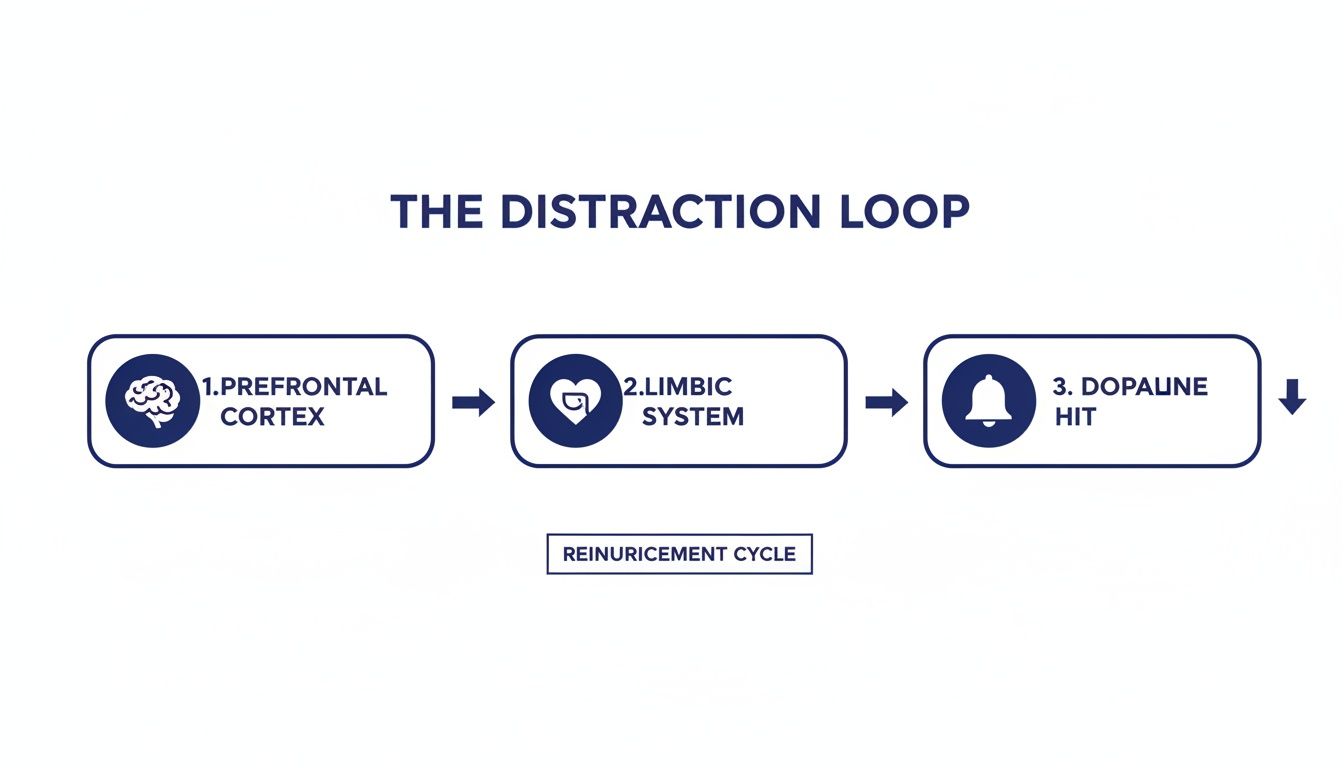
When you get a social media notification, your brain releases a hit of dopamine. This is a neurotransmitter tied to pleasure and motivation. But it’s not just about feeling good in the moment. It’s about anticipation. Your brain learns to crave the possibility of a reward. This is why you feel that persistent urge to check your phone.
This process creates a powerful feedback loop that’s hard to escape:
Trigger: You feel bored, anxious, or hear a notification.
Action: You open an app and start scrolling.
Reward: You find a funny video or a friend’s update. Dopamine is released.
Investment: You spend more time on the app, reinforcing the cycle.
Over time, your brain gets desensitized. It needs more stimulation to get the same satisfaction. This is why normal activities can start to feel dull. It’s the core reason why “just stopping” is so incredibly difficult.
Why Regaining Control Is Possible
Here’s the good news: this is not a permanent state. You can absolutely reverse this process.
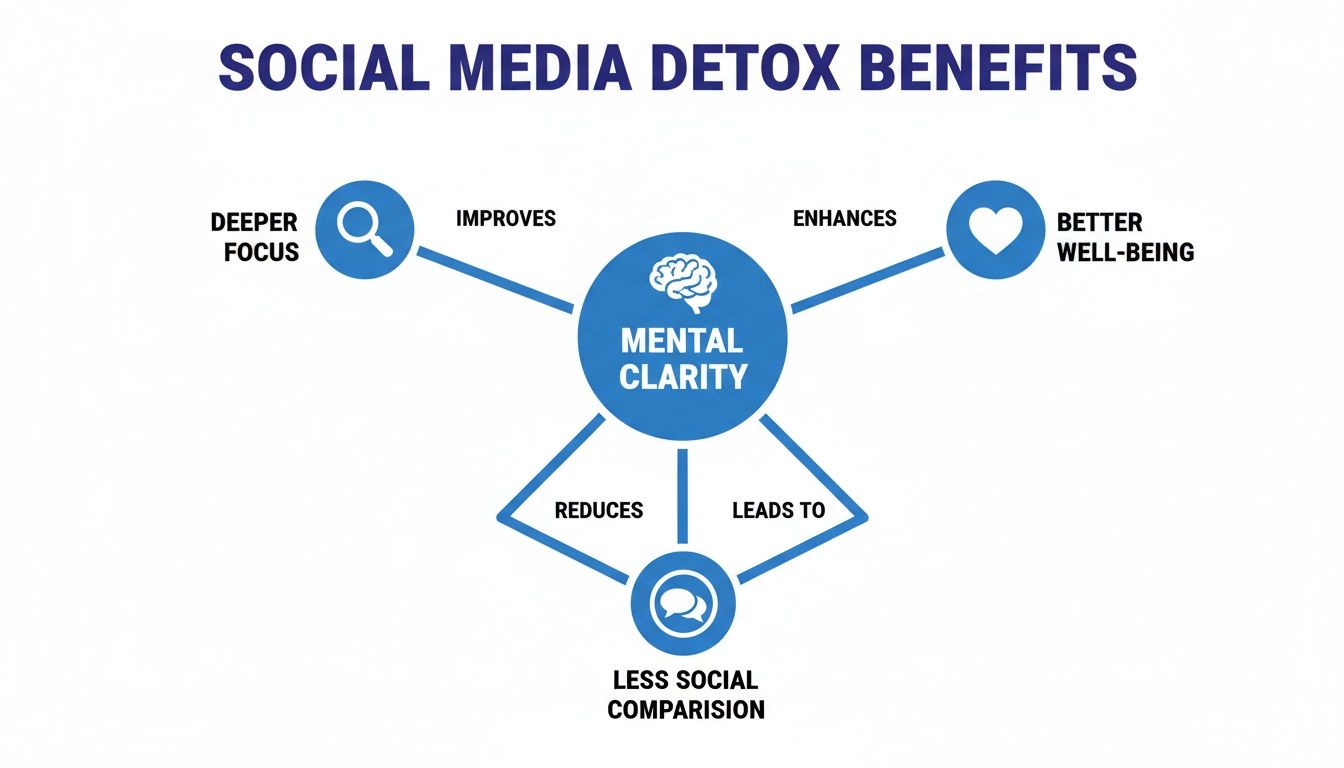
Study after study shows that intentional changes have a massive impact. Recent APA polling data found that 50% of adults who actively cut back on social media reported major improvements in well-being.
Even better, other research shows people who reduced usage saw a 47% drop in feelings of anxiety after just two weeks. If you are struggling with anxiety, depression, or other mental health concerns, this article is for educational purposes only. Please consult a qualified medical or psychological professional for diagnosis and treatment.
Understanding the science is the first and most important step. This reframes the problem entirely. It’s not about willpower; it’s about needing a better system to outsmart the one designed to hook you. This guide will give you a practical plan to break free.
How to Overcome Social Media Addiction by Uncovering Your Triggers
Before you can change a habit, you must understand it. Trying to quit without knowing your triggers is like navigating a new city with a blindfold. A mindful digital audit is your most powerful first step.
This isn’t about shaming yourself over screen time. For the next three days, act like a detective. Gather clues about your own behavior. The goal is to connect the action (picking up your phone) with the context (what happened right before).
How to Run Your 3-Day Audit
For this audit, just tracking minutes isn’t enough. We need to go deeper. The real magic happens when you focus on the moments before you scroll. This is a foundational concept in behavioral psychology. Habits are cued by specific internal or external triggers.
We’re going to figure out what purpose social media really serves you. A good habit tracker journal is helpful for this. It turns that vague feeling of being “addicted” into clear data you can work with.
For the next three days, each time you open a social media app, just pause. Grab your journal or a notes app. Quickly jot down the answers to three simple questions:
What was I doing right before this? (e.g., waiting for a file, finishing a meeting, sitting on the couch)
What was I feeling right before this? (e.g., bored, anxious, lonely, stressed, tired)
What am I hoping to get from this? (e.g., a distraction, a connection, a mental break)
This simple practice builds awareness. It interrupts the automatic nature of the habit. It brings the behavior out into the open.
Identifying Your Unique Scroll Triggers
After your three-day audit, you’ll almost certainly see clear patterns emerge. These patterns are your roadmap. They reveal the underlying needs your scrolling habit is trying to meet.
Mini Scenario: A freelance graphic designer, Sarah, felt she was losing hours to Instagram every day. After her audit, she discovered her two main triggers:
Trigger 1: Creative Block. When she felt stuck, she opened Instagram for “inspiration.” An hour later, she’d feel more anxious. The underlying need? A break from cognitive strain.
Trigger 2: Loneliness. As a remote worker, she felt a strong urge to scroll around 5 PM. The underlying need? Social connection.
Sarah’s audit revealed her social media use wasn’t a “bad habit.” It was her brain’s attempt to solve real problems—fatigue and isolation. Now she can find better solutions.
This process of gaining self-awareness is a core theme in our book, The Power of Clarity. It guides you in identifying hidden patterns that drive your daily actions. For more ideas, you might find it helpful to explore other ways to reduce screen time.
With this new self-knowledge, you’re no longer fighting blindly. You’re equipped to find effective replacements for the scroll. We’ll cover that next.
It’s Time for a Strategic Dopamine Reset
With your audit data in hand, you see how social media hooks you. Now it’s time to step away. Give your brain chemistry a chance to rebalance. This is often called a digital detox.
This isn’t about punishment. It’s an intervention to recalibrate your brain’s reward system. The constant stimulation from social media desensitizes your dopamine receptors. As a result, normal activities feel flat.
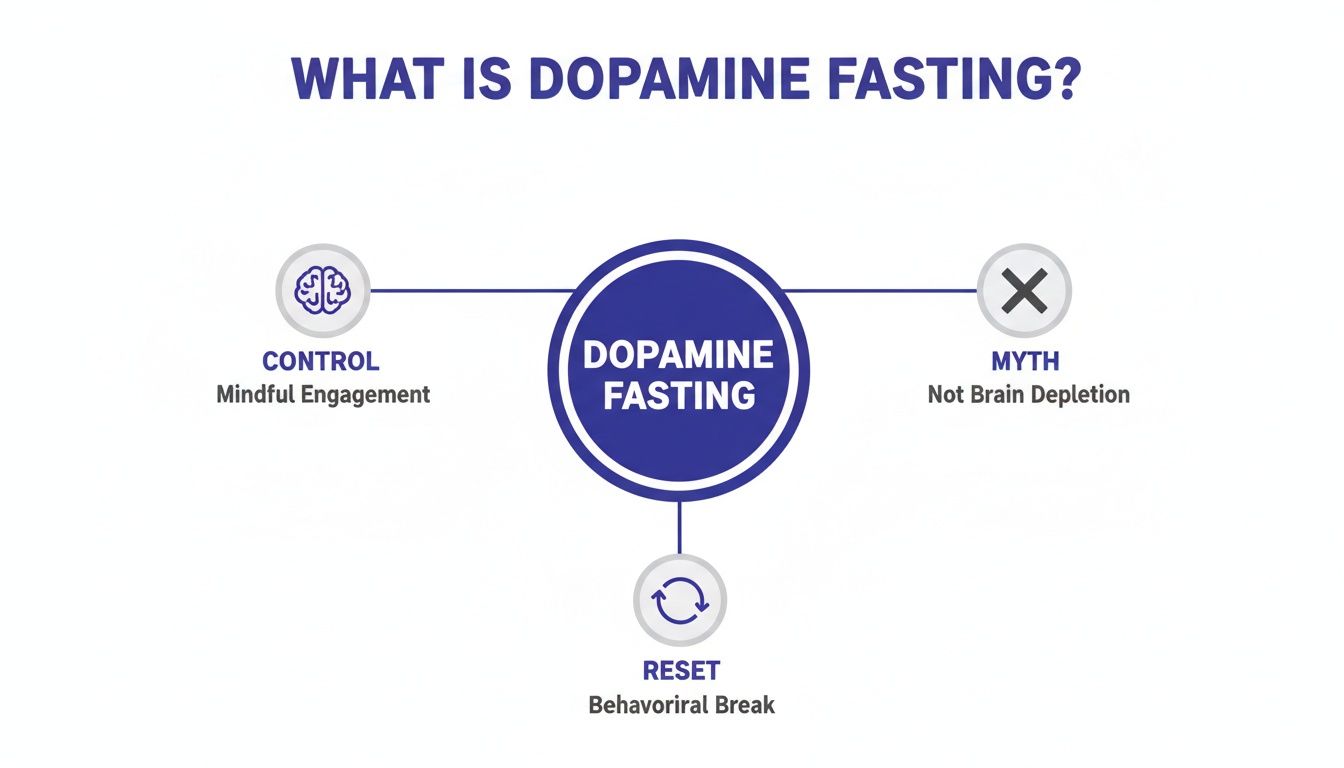
By removing these high-dopamine triggers for a short period—usually 48 hours to 7 days—you give those receptors a rest. It’s like letting your ears recover after a loud concert. When you step back into a quieter world, you can hear subtle sounds again.
Your Action Plan for a Social Media Reset
The difference between a successful reset and a failed one is planning. Just deciding to “stay offline” is a recipe for failure. The void left by scrolling can feel overwhelming. You have to be deliberate.
Here are concrete steps that work:
Delete the Apps. Temporarily delete all social media apps from your phone. This adds a crucial layer of friction. It makes it harder to relapse into a mindless scroll.
Create a Physical Barrier. The pull to check your phone is strong. Using a phone lock box timer can be an absolute game-changer. Set it for a few hours while you work or for the entire evening.
Schedule Engaging Alternatives. This is the most important part. Before your reset starts, fill the time you’d normally spend scrolling. If you scroll out of boredom, plan a project. If it’s loneliness, schedule a real-life coffee date.
Mini Scenario: Mark, a marketing manager, planned a weekend reset. He deleted his apps Friday afternoon. Saturday was for a long hike. Sunday was for a new recipe and starting a novel. By filling his time with immersive activities, he barely noticed his phone was gone.
This “screen fasting” approach is backed by data. Structured time away helps around 63% of people reverse depressive symptoms linked to compulsive social media use. Remember, this article is for educational purposes only and not a substitute for professional psychological care.
A dopamine reset is a powerful circuit breaker. It proves to your brain you can thrive without constant digital input. This experience builds the confidence you’ll need for long-term success. Our guide on how to do a dopamine detox has more detail. This period of recalibration is a core tenet of our book, Break the Scroll: A Digital Detox Framework.
Design Your Environment for Better Focus
Relying on willpower to quit social media is like trying to stay dry in a downpour without an umbrella. A smarter approach is to redesign the environment that triggers the habit. This is grounded in decades of behavioral psychology.
Your space, both digital and physical, is your strongest ally. The goal is to add small points of friction. These are tiny obstacles that make it harder to slip into old patterns. That pause often interrupts the automatic pull of the feed.
Declutter Your Digital Space to Sideline Distractions
Since your phone is the primary home for this habit, let’s start there. We’re going to make your social media apps less attractive and harder to access.
Silence Non-Essential Notifications: Those red badges and pop-ups are powerful external cues. Go into your phone’s settings now. Kill all notifications for social media apps. Keep alerts only for direct, human-to-human communication.
Turn Down the Visual Noise: Social media icons are engineered with bright, dopamine-triggering colors. A surprisingly effective trick is to switch your phone’s display to grayscale. Without vibrant hues, the apps become instantly less stimulating.
Bury the Junk Apps: Drag time-wasting apps off your home screen. Tuck them away inside a folder named “Black Hole.” This simple act of adding extra taps creates enough friction to make you pause.
Mini Scenario: A project manager was constantly distracted by LinkedIn. She silenced alerts, moved the app to an “After 5 PM” folder, and set her phone to grayscale. The urge to check it during the day plummeted because the cues were gone.
How to Choose Your Best Digital Tweak
Feeling overwhelmed? Don’t be. The secret is to pick one change that offers a high return for low effort in your situation. This simple comparison can help you decide what to buy first for your digital life.
Comparison: Which Tweak to Start With?
Turning Off Notifications: Best for beginners and busy professionals. It’s a simple, high-impact first step that cuts down on constant interruptions and protects focus.
Going Grayscale: Excellent for beginners as it immediately breaks the visual “pull” of apps. It can be impractical for professionals who need to see color on their phones.
Burying Your Apps: A great, low-commitment strategy for everyone. It creates an intentional barrier without the finality of deleting anything.
Just start with one. After a few days, try adding another. These small changes are the building blocks of an intentional digital life. Browse our Focus Portal for more strategies.
Reclaim Your Physical Space From Your Phone
Creating intentional boundaries in your physical environment is just as critical. The first step is to establish “no-phone zones” in your home. These are sacred spaces where your phone isn’t welcome. The two most important are the dinner table and the bedroom. This protects your sleep from the disruptive effects of blue light.
Speaking of sleep, a pair of blue light blocking glasses can be a game-changer for your evening routine. Research shows blue light from screens can suppress melatonin production. This makes it much harder to fall and stay asleep. Poor sleep quality can worsen issues like burnout and anxiety. This article is not a substitute for professional medical care for these conditions.
Replace the Scroll with Fulfilling Habits
Simply trying to stop a behavior rarely works. Habits stick around because they serve a purpose. To break free from compulsive scrolling, you must replace it with a better habit. This new habit should satisfy the same underlying need.
This is where the process gets creative and rewarding. Instead of fighting an urge, you’re consciously redirecting it. You’re choosing an activity that leaves you feeling energized, not drained.
Match the Habit to the Trigger
Your personal audit data is the map. If you scroll when you’re bored, your brain craves stimulation, not Instagram. If you scroll when lonely, your mind wants connection.
Here are practical examples of how to connect a replacement habit to your trigger:
Trigger: Boredom. Instead of opening a feed, try a 10-minute walk outside. If stuck at your desk, an under desk walking pad can work wonders.
Trigger: Procrastination. This urge is often a flight response from a difficult task. Instead, grab a pomodoro timer and commit to one 25-minute work sprint.
Trigger: Loneliness. When that feeling hits, seek real connection. Schedule a quick call or coffee chat with a friend.
Mini Scenario: A college student realized her late-night scrolling was fueled by anxiety. She wanted to “turn her brain off.” She started putting her phone in another room an hour before bed and reading a book. Within a week, she was falling asleep faster and felt more prepared for class.
Best Option for Building New Routines
Matching the right activity to your trigger is the secret sauce. The goal is to find a genuinely fulfilling alternative. This approach is fundamental to building good daily habits that support your well-being. This table can help you brainstorm.
How to Choose a Replacement Habit
Trigger (The ‘Why’ Behind Your Scroll)
Replacement Habit (What to Do Instead)
Best For…
Boredom / Understimulation
Listen to a 15-min podcast, read a book chapter, do a quick puzzle.
Busy professionals with short breaks.
Procrastination / Task Anxiety
Use a Pomodoro timer for 25 minutes, break the task into one small step.
Students and anyone facing complex projects.
Loneliness / Seeking Connection
Call a friend or family member, schedule a coffee chat.
Remote workers and individuals feeling isolated.
Stress / Needing an Escape
Practice a 5-minute mindfulness exercise, stretch, or take a short walk.
You can also explore our books. Connected Again helps deepen relationships. Focus Recharged is for building better productivity habits. See the book that fits your goal to get started.
Editor’s Take
What’s the bottom line on how to overcome social media addiction? It’s not about finding a magic bullet or white-knuckling through temptation. It’s about building self-awareness and designing better systems. These make focus the path of least resistance.
This advice is best for self-motivated people who feel their focus slipping away. It’s for those who likely don’t need a full-blown clinical intervention. The key is understanding your brain’s reward system and then working with it, not against it. The combination of a short-term “dopamine reset” followed by environmental design and habit replacement is what actually works.
Important caveat: Getting a handle on this is a process. You will probably relapse, and that’s normal. The goal isn’t perfection; it’s progress. Use each slip-up as data to tweak your system.
Key Takeaways
Understand the Dopamine Loop: Social media is designed with intermittent rewards that create a craving cycle in your brain.
Conduct a Digital Audit: Spend three days tracking why and when you scroll to identify your personal triggers (e.g., boredom, loneliness, stress).
Perform a Dopamine Reset: Take a short break (48 hours to 7 days) by deleting social media apps to re-sensitize your brain’s reward system.
Redesign Your Environment: Make scrolling harder by turning off notifications, using grayscale mode, and creating “no-phone zones.”
Replace, Don’t Just Remove: Actively choose a fulfilling replacement habit (like a walk or calling a friend) that addresses the underlying need your scrolling was trying to meet.
Disclaimer: This article may contain affiliate links, which means purchases may generate a commission for us at no extra cost to you. The content provided is for educational and informational purposes only. It is not intended as, and should not be understood or construed as, medical or psychological advice, diagnosis, or treatment. Always seek the advice of your physician or other qualified health provider with any questions you may have regarding a medical condition or mental health concern.
FAQ: How to Overcome Social Media Addiction
1. How long does it take to overcome social media addiction?
There’s no magic number. It’s less about a “cure” and more about building new habits. Behavioral science suggests it takes weeks or months of consistent effort to form new neural pathways. The initial dopamine reset might take a week, but lasting change comes from steady practice.
2. Should I quit cold turkey or just cut back?
A hybrid approach often works best. Start with a “cold turkey” reset for 48 hours to a week. This breaks the compulsive cycle. Afterward, a gradual approach is more sustainable. Reintroduce apps with strict boundaries, like time limits or specific use cases (e.g., desktop only for work).
3. What if I need social media for my job?
The goal is to be an intentional user, not an absent one. Set clear rules. For example, only use professional social media on your desktop. Schedule posts in batches using a tool. Or, use time-blocked sprints where you set a timer, do what you need to, and then log off.
4. How do I know if my efforts are actually working?
You’ll notice small, quiet signs of progress. You might wake up without immediately reaching for your phone. You can sit through a meal without the itch to scroll. That background hum of anxiety may fade. You’ll find yourself able to focus on a single task for longer periods.
5. What should I do when I relapse and start scrolling again?
A relapse is not a failure; it is data. It’s an inevitable part of the process. Instead of self-blame, get curious. What triggered it? Were you bored, stressed, or lonely? Use that information to adjust your system and make it more resilient for next time. Compassion is key for sustainable change. Our book, Perfectly Imperfect, can help you cultivate this skill.
Retraining your brain isn’t just a trendy phrase. It’s a real process backed by neuroscience to change your thoughts and habits for better focus. At its core, it’s all about neuroplasticity. This is your brain’s natural ability to physically rewire itself based on what you do and think.
Affiliate disclosure: This post may contain links that earn a small commission at no extra cost to you, helping us create more useful content.
What It Really Means to Retrain Your Brain
Let’s cut through the noise. The idea of “retraining your brain” isn’t sci-fi; it’s a practical process grounded in psychology. For decades, many believed the brain becomes “fixed” in adulthood. However, modern neuroscience shows that’s just not true. Your brain is remarkably adaptable.
This incredible ability to change is called neuroplasticity. Think of your brain’s connections like paths in a forest. Trails you walk daily become wide and easy to travel. The ones you ignore get overgrown and hard to find. This process is key to retraining your brain.
How Your Habits Shape Your Brain’s Wiring
Every time you practice a new skill or repeat a thought, you strengthen its neural connections. Behavioral research calls this synaptic strengthening. It is how behaviors become automatic habits over time. This process is neutral—it works for both good and bad habits.
For example, consistently checking your phone creates a neural “superhighway” for distraction. The good news? You can build a different highway—one for sustained focus. That’s what retraining your brain is all about. This guide is your roadmap if you feel mentally foggy or overwhelmed. We’ll explore how simple habits can rewire your brain’s attention systems. With deliberate practice, you can break the distraction cycle. To learn more, browse the library of books like The Power of Clarity.
Educational Disclaimer: This article is for educational purposes only. It is not a substitute for professional medical or psychological advice, diagnosis, or treatment. If you are experiencing symptoms of anxiety, depression, ADHD, burnout, or sleep problems, please consult a qualified healthcare provider.
The Science of How Retraining Your Brain Works
So, how does this actually work? The process of retraining your brain relies on a key neuroscience principle: neuroplasticity. This is your brain’s built-in capacity to reorganize its wiring by forming new neural connections throughout life. It’s biology in action.
Think of your brain as a dense garden. Your thoughts, emotions, and habits are like trails through it. Each time you repeat an action, you walk down a path, making it more defined. Your daily habits are actively sculpting your brain’s physical structure. Focusing on a task strengthens that circuit. Reaching for a distraction reinforces another.
Strengthening Good Habits and Weeding Out Bad Ones
This “gardening” of the mind involves two key activities. You strengthen useful connections and let weak ones fade. When you practice a new skill, your brain releases chemicals that fortify the neural pathways. It’s like watering the flowers you want to grow.
At the same time, connections you stop using begin to weaken. This natural cleanup process is called synaptic pruning. Your brain is efficient and reallocates resources from neglected pathways. This is the “weeding” part—it clears out clutter so important connections can thrive.
Real-world scenario: When learning a new language, forming a sentence feels slow. It requires immense mental effort. With consistent practice, the brain builds a dedicated neural “superhighway” for that language. Connections become faster and more automatic. The old struggle fades away.
This principle applies directly to retraining your focus. Every time you resist checking a notification and return to your task, you are watering the “focus flower” and pulling a “distraction weed.” Over time, staying on task becomes easier. You can learn how this impacts your emotional state by exploring limbic system retraining.
Your Brain’s Growth Fertilizer: BDNF
One of the most important molecules in this change is brain-derived neurotrophic factor (BDNF). Think of BDNF as fertilizer for your brain cells. It helps neurons survive and encourages the growth of new ones. Certain activities ramp up BDNF production, preparing the ground for new learning.
A large body of research shows aerobic exercise can spark neuron growth and sharpen cognitive abilities. For instance, studies show older adults who do moderate cardio see volume increases in the prefrontal cortex and hippocampus. These areas are vital for planning and memory. These changes are linked to fitness gains, elevated BDNF, and better memory. This is a fundamental tool for retraining your brain. An under desk walking pad is a great way to integrate movement while you work.
Best Option for Starting Your Brain Retraining Journey
So, where do you begin? For most people, the best first step is a small, consistent physical activity. It’s about creating the right chemical environment for change before starting the heavy lifting.
Here’s a quick comparison to help you choose your starting point:
Physical vs. Mental First Approach
Approach
Best For
Why It Works (Neuroscience)
Example Action
Physical First
Beginners or anyone feeling mentally foggy.
Boosts BDNF, reduces stress, and creates an ideal biological state for brain change.
A 20-minute brisk walk every morning.
Mental First
Those with a consistent exercise routine.
Directly targets the cognitive skills of attention and focus, building mental endurance.
Using a visual timer for desk for 15 minutes of single-tasking.
By pairing a mental goal with a physical habit, you create a powerful synergy. Understanding this science gives you motivation to stay consistent. This is especially true when old, distracting habits feel strong.
Your 30-Day Action Plan for Retraining Your Brain
Ready to put science into practice? Action is what rewires the brain. This section offers a concrete 30-day plan to build momentum without overwhelm. Don’t aim for perfection. The magic of neuroplasticity is in tiny, repeated daily choices.
Week 1: The Digital Declutter for Brain Health
Before retraining your brain, you need a clear picture of where your attention goes. For most, it’s scattered across digital inputs. Week one is about building awareness and setting gentle boundaries.
Track Your Screen Time: For three days, just observe. Use your phone’s tracker to see where your minutes go. No judgment—just gather data. The results might surprise you.
Schedule “No-Phone” Blocks: Carve out one or two 30-minute periods daily to go screen-free. Maybe during morning coffee or after work. For zero temptation, a phone lock box timer is a game-changer; it removes willpower from the equation.
Single-Task One Thing Daily: Pick one work task or ritual (like eating) and do it without other screens or sounds. It will feel strange at first. That’s your focus muscles getting a workout.
Real-world scenario: Sarah was shocked to see she spent over 90 minutes a day on social media. In her first week, she scheduled a 30-minute walk after dinner, leaving her phone at home. The first few days felt boring. By the end of the week, she noticed details in her neighborhood she’d never seen before.
Week 2: Using Habit Stacking for Better Focus
Now, it’s time to intentionally build new routines. The most effective way is habit stacking. This psychological concept links a new habit to an established one. This method works by piggybacking on existing neural pathways. You’re adding a small step to an automatic behavior.
Pair a Focus Habit with a Daily Ritual. For example: “After my morning coffee, I will open my productivity journal and write my one priority for the day.” Or, “Before I close my laptop, I will tidy my desk for 5 minutes.”
Define a Single Daily Priority. Don’t try to tackle everything. Each morning, identify the one task that would make the day a success. Writing it down is a powerful first step in training your brain to seek completion.
Real-world scenario: Mark always “forgot” to meditate. He stacked it onto brushing his teeth. His new rule: “After I put my toothbrush down, I will sit on my bed and meditate for two minutes.” Brushing his teeth provided a reliable trigger for the new habit.
Week 3: Practicing Mindful Attention to Retrain Your Brain
With new structures in place, week three improves your attention quality. This means noticing your thought patterns and gently challenging unhelpful ones. It’s about shifting from being a passenger in your mind to being the driver. This is where cognitive reframing comes in—identifying and shifting negative thoughts. It’s about finding a more balanced perspective.
Research supports this. A 2020 review in Frontiers in Human Neuroscience found 87% of studies on youth showed significant brain metric shifts from training. Over half linked these brain changes to performance boosts. This suggests consistent protocols can genuinely rewire the brain for better focus.
Week 4: Committing to Deep Work and Focus
In the final week, you’ll practice deep work. This is the ability to focus without distraction on a demanding task. It requires a specific ritual and environment.
Create a Distraction-Free Zone. Designate a physical space for focused work. Use noise canceling headphones to block auditory interruptions. Let others know you’re in a focus block.
Use Timed Focus Sprints. The Pomodoro Technique is perfect. Grab a pomodoro timer and work in 25-minute sprints, followed by a 5-minute break. During the sprint, your only job is the task at hand.
Dial-In Your Sleep Hygiene. Brain retraining depends on quality sleep. Sleep helps consolidate memories and clear metabolic waste. A guide like How To Improve Sleep Quality Naturally can dramatically boost your brain’s rewiring ability.
This 30-day plan is just the beginning. Learning how to do a dopamine detox can also help reset your brain’s reward system.
How to Choose the Right Tools for Retraining Your Brain
Moving from ideas to action often means finding the right gear. But for retraining your brain, smarter tools are better than more tools. The goal is to find key aids that make focus the path of least resistance. This guide helps you pick tools that fit your life. A good tool simplifies your process. For example, a physical visual timer for desk will almost always beat another app on your phone for cutting screen time.
How to Choose Between Digital vs. Analog Tools
When beginning, creating a clear separation between focused and distracted time is crucial. Your tools should reinforce that boundary. Digital tools can be powerful, but they live on distracting devices. Analog tools offer a single-purpose alternative that pulls you from the screen. They lack notifications or updates. This makes them effective for building single-tasking muscle.
A simple time blocking planner is powerful. It encourages you to mindfully map out your hours. This creates a proactive plan instead of just reacting. For rewiring behaviors, practical guides like breaking the mouth breathing habit show how our bodies can be retrained with consistent adjustments.
Choosing between physical and digital isn’t about which is “better.” It’s about what problem you’re solving.
Comparison: Physical vs. Digital Focus Tools
Tool Type
Best For
Potential Drawback
Example Product Mention
Analog Timers
Reducing screen time and creating a clear visual cue for focus blocks.
Lacks advanced features like tracking or custom intervals.
pomodoro timer
Digital Apps
Tracking productivity data and integrating with digital workflows.
Can be a source of distraction if not used carefully.
Focus-oriented mobile app
Physical Planners
Intentional planning and habit tracking away from screens.
Not easily shareable or accessible from multiple devices.
time blocking planner
Digital Planners
Collaboration, dynamic scheduling, and calendar integration.
The tool itself can become complex and overwhelming.
Productivity software
The right tool removes friction for your desired behavior. A simple tool can be a massive win if it helps you focus. Browse the library to see the book that fits your goal.
What to Buy First: Best for Beginners
If you’re just starting and feel paralyzed by options, begin with one simple, physical tool. My recommendation? A habit tracker journal. It gives you a dedicated place to define and monitor the small actions that drive neuroplasticity.
Physically writing down your goals and checking progress creates a powerful feedback loop. It makes your commitment feel real. You don’t need a complex system, just a consistent one. For a deeper look at the science, learn more about the neuroscience of single-tasking in our article.
What to Do When Your Brain Training Hits a Wall
Changing your brain’s habits is rarely a smooth process. The journey is often messy. You might feel like you’re taking one step forward and two steps back. This is completely normal. The key is knowing what to do when setbacks happen.
Roadblock 1: The All-or-Nothing Mindset
One of the fastest ways to derail progress is all-or-nothing thinking. This is the classic perfectionist trap. If you can’t do a habit perfectly, you figure you might as well not do it at all. This mindset misses the point of neuroplasticity. Your brain rewires through small, consistent efforts.
The Fix: Use the Two-Minute Rule
Inspired by James Clear’s work in behavioral psychology, shrink your habit to a two-minute version. The real goal is to simply show up, especially on days with zero motivation.
Can’t face a 30-minute workout? Just do two minutes of stretching.
Too drained to journal for 15 minutes? Write one sentence in your habit tracker journal.
Too distracted to read a chapter? Just read one page.
This trick keeps momentum alive and reinforces your identity. It’s this consistency that keeps new neural pathways growing.
Roadblock 2: Frustration with Slow Progress in Retraining Your Brain
You’ve been diligent, but you still feel scattered. This frustration causes many people to give up. We expect instant results, but real brain change works on a slower timeline.
Understanding the science is your best friend here. A 2007 study found it took 40 hours of focused effort for significant, lasting changes. Your brain needs a specific, challenging stimulus to rewire. You can read the full research on adaptive practice to see how deliberate this process is.
The Fix: Focus on the Process, Not the Outcome
Instead of chasing a feeling, shift your measure of success to the action itself.
Success in retraining your brain isn’t a feeling; it’s an action. Tracking your actions creates a record of effort that carries you through periods without feeling progress.
This is a core principle for breaking mental blocks and learning how to stop procrastinating. The feeling of progress will eventually follow the action.
Scenario: When Your Dopamine Detox Fails
Let’s walk through a common pitfall. Alex decides on a “dopamine detox,” swearing off all social media and games for a week. By Tuesday, the boredom is unbearable. He caves, scrolls for two hours, and feels like a failure. This is the all-or-nothing trap. A gradual approach works better.
Alex could have tried:
Gradual Reduction: Limiting social media to 30 minutes in the evening.
Targeted Abstinence: No games on weekdays, but allowing them on weekends.
Mindful Replacement: When the urge hits, go for a 10-minute walk.
This approach is less of a shock to the brain’s reward system. It builds self-efficacy for long-term success. As I discuss in my book Burnout Interrupted, overcoming hurdles is foundational. Setbacks are data points to adjust your strategy.
Key Takeaways for Retraining Your Brain
Neuroplasticity is a Skill: Your repeated actions physically rewire your brain. You are the architect of your mind’s structure.
Consistency Beats Intensity: Small, daily actions create more lasting change than rare, heroic efforts.
Movement Supercharges Your Mind: Physical activity boosts BDNF, making your brain more receptive to learning and new habits.
Tools Are Assistants, Not Saviors: A habit tracker journal or focus timer only works if you use it consistently with a clear plan.
Adopt a Forgiving Mindset: You will have off days. Persistence is the goal. When overwhelmed, shrink the habit to its smallest version and just do that.
Editor’s Take: What Actually Works for Retraining Your Brain
Let’s be honest. “Retraining your brain” sounds like a huge project. But after years of digging into the science, the truth is this: it’s a lifelong practice built on small, simple habits. The strategies that deliver the biggest returns are the most fundamental ones.
Who is this for? This advice is best for self-motivated people feeling overwhelmed by digital noise who want a practical way to regain control over their attention.
What works? Carving out time for single-tasking, scheduling breaks away from all screens, and weaving short bursts of physical movement into your day. It’s not flashy, but it’s effective.
Important Caveats: These techniques are powerful for improving focus and mood. However, they are not a substitute for professional care. If you’re dealing with clinical conditions like ADHD, anxiety, or depression, please seek guidance from a qualified medical or psychological professional. Think of these tips as educational support, not treatment. Sustainable change starts with getting the foundations right—the kind of principles we explore in The Power of Clarity.
Disclaimers & Disclosures
This post may contain affiliate links, which means we may earn a small commission on purchases at no extra cost to you. The content provided in this article is for educational and informational purposes only and is not intended as a substitute for professional medical or psychological advice, diagnosis, or treatment. Always seek the advice of your physician or other qualified health provider with any questions you may have regarding a medical condition.
CRITICAL NOTE: This is not a “cure” for clinical anxiety disorders. If you struggle with a condition like GAD or panic disorder, it is essential to get a diagnosis and treatment from a qualified healthcare professional. This guide is for educational purposes only. Start with this chapter in my book Restful Nights for more educational tips.
FAQs: Your Questions on Retraining Your Brain Answered
Here are straight, practical answers to common questions about retraining your brain.
How long does retraining your brain really take?
You can feel small benefits—like less stress—within a few days of consistent practice. However, neuroscience and behavioral research suggest deep, lasting change takes two to three months of consistent effort to form durable habits. The deeper rewiring of neural pathways is a long-term project. Celebrate small wins, but know that real transformation is a result of sustained effort.
Can you retrain your brain to manage anxiety?
Yes, you can retrain your brain to manage anxiety more effectively. Techniques like mindfulness and cognitive reframing strengthen your prefrontal cortex. This part of the brain helps regulate emotional alarm signals from your amygdala. For example, when you feel a wave of panic, you can practice deep breathing. This calms your nervous system, a learned response that strengthens over time.
What is the single best exercise for brain retraining?
There’s no single “magic bullet.” But if I had to pick one, it would be single-tasking. In a world that pushes multitasking, intentionally focusing on one thing is a powerful workout for your brain’s attention circuits. It directly counters the habit of distraction. Start small. Try it for just 15 minutes a day. A simple tool like a visual timer for your desk can be surprisingly effective.
Do I need to buy expensive tools to start?
Not at all. The most effective tools for retraining your brain are often free. A pen and paper for journaling, the timer on your phone (used with intention), and your own commitment are the real powerhouses. Sure, a dedicated habit tracker journal can be a helpful supplement, but it’s not a prerequisite. Start with the basics and only add tools if they solve a specific problem.
How do I know if retraining my brain is actually working?
Progress is often subtle. Look for small, tangible shifts. You’ll know it’s working when you notice little changes: you read for 15 minutes without grabbing your phone; a notification pops up, and you feel less reactive; you complete a complex task with fewer distractions. Track these small wins. They are real-time indicators that neuroplasticity is at work, proving your brain is building new pathways for focus.
This post may contain affiliate links. Purchases may generate a small commission at no extra cost to the reader. We only recommend products we trust.
Clearing your mind isn’t about some mystical, impossible-to-achieve zen state. It’s about using specific, practical techniques—backed by neuroscience and psychology—to dial down mental noise. These methods help sharpen your focus and regain control.
The best methods are often the simplest ones you can do right now. This includes using controlled breathing to calm your nervous system. You can also get racing thoughts out of your head and onto paper. Deliberately creating an environment with fewer distractions also works wonders. These aren’t just feel-good tricks; they are proven strategies for regaining cognitive control and finding clarity.
Please note: This article is for educational purposes only. It is not a substitute for professional medical or psychological advice, diagnosis, or treatment for conditions like anxiety, depression, burnout, or ADHD. Please consult a qualified healthcare provider for any health concerns.
Why a Clear Mind Is Your Greatest Professional Asset
Ever find yourself staring at your screen, drowning in a sea of notifications? Does your brain feel like a browser with way too many tabs open? That state of mental clutter isn’t just a feeling; it’s a genuine cognitive state. This state directly torpedoes your professional effectiveness.
In today’s world, your ability to think clearly is a powerful asset. It helps you stay productive and make sharp decisions.
From a neuroscience perspective, a “cluttered mind” is what happens when your prefrontal cortex gets overwhelmed. This part of the brain is the hub for decision-making and focus. Constant digital pings, an endless to-do list, and unresolved worries compete for its limited resources.
This mental overload makes it nearly impossible to concentrate on what actually matters. For most professionals, this inevitably leads to missed deadlines and half-finished projects. It also causes that familiar feeling of persistent brain fog.
The Real Cost of Mental Clutter
Imagine a project manager named Sarah. She has an important proposal due, but her phone buzzes with new emails. At the same time, she’s mentally replaying a tense morning meeting. She also worries about a family commitment later that evening. She tries to focus, but her attention keeps splintering. This is the overwhelm we all recognize.
This isn’t just a personal struggle; it has a massive economic impact. Mental health conditions that cloud our thinking affect over a billion people. They cost the global economy $1 trillion annually in lost productivity.
On the flip side, simple mindfulness practices have been shown to cut anxiety symptoms. They can reduce symptoms by up to 30% in just eight weeks. This shows that taking small, intentional steps can have a significant effect.
The core idea behind books like The Power of Clarity is that mental clarity isn’t about an empty mind. It’s about learning to direct your focus where you want it to go, even amidst chaos. Start with this chapter to learn foundational techniques.
This guide is your practical, science-backed roadmap to do just that. We’ll walk through actionable strategies that help you quiet the noise. From quick resets to daily routines, you’ll build lasting focus. By applying these techniques, you can turn overwhelm into a solvable problem, sharpening your focus and improving your concentration.
Quick Mind-Clearing Techniques When You’re Overwhelmed
You’re caught in a stress spiral right before a big meeting. Your heart is racing, and your thoughts are scattered. You definitely don’t have time for a long meditation session.
What you need are quick, practical “micro-practices.” These are tiny resets grounded in physiology that can calm your nervous system in minutes. These are go-to techniques for busy people who need to clear their minds, fast.
With mental health challenges affecting millions, fast-acting tools are essential. A groundbreaking 2023 Stanford study found that just five minutes of daily cyclic sighing slashed anxiety. It also reduced perceived stress, outperforming standard mindfulness meditation.
This simple practice hacks the vagus nerve. It sends a powerful signal to your body to slow down, boosting your mood almost instantly. If you want to dig into the physiology, you can read the full research on breathwork’s effects.
The Cyclic Sigh: A 60-Second Way to Clear Your Mind
The cyclic sigh is probably the fastest way to interrupt your body’s fight-or-flight response. It works by off-loading excess carbon dioxide. This kicks your parasympathetic nervous system—your body’s “rest and digest” mode—into gear.
Here’s the simple pattern:
Take a deep inhale through your nose.
Without exhaling, take another short, sharp inhale to completely fill your lungs.
Exhale slowly and completely through your mouth. Make the exhale longer than both inhales.
Repeat this 2–3 times. You should feel a near-instant wave of calm. For busy professionals, finding these small moments to manage mental clutter is non-negotiable. Other physical techniques, like Swedish massage therapy, can also target the physical symptoms of stress.
Real-World Scenario: An entrepreneur is five minutes from a high-stakes investor pitch. Her heart is pounding, and her thoughts are a tangled mess. She closes her laptop, leans back, and does three rounds of cyclic sighing. Her heart rate slows, and the mental fog lifts. She walks into the meeting with confidence.
The 5-4-3-2-1 Grounding Method to Stop Spiraling Thoughts
When your mind is stuck in an anxious thought loop, the 5-4-3-2-1 grounding method is a lifesaver. This psychological technique uses your five senses to pull your attention out of your head. It anchors you in the present moment. It’s a powerful way to short-circuit rumination by forcing your brain to focus on tangible details.
Here’s how it works:
5: Name FIVE things you see (your monitor, a pen, a plant).
4: Notice FOUR things you can touch (the texture of your desk, your shirt).
3: Acknowledge THREE things you can hear (the computer hum, distant traffic).
2: Identify TWO things you can smell (your coffee, the air from the vent).
1: Focus on ONE thing you can taste (mint, a sip of water).
This practice is effective because it’s hard for your brain to worry about abstract fears. It’s too busy cataloging sensory details in the here and now. If you’re looking for more ways to interrupt anxious thoughts, check out our guide on how to calm down effectively.
To make these practices stick, try pairing them with a pomodoro timer. Set it for 25 minutes of focused work, followed by a 5-minute break. Use that break for cyclic sighing or a grounding exercise. This proves you can reclaim your focus and clear your mind in just minutes.
How to Clear Your Mind with a Brain Dump
If your mind feels like a browser with too many tabs open, the brain dump is your reset button. While quick micro-practices offer in-the-moment relief, this method offers a deeper, more organized way to clear mental clutter. It’s a powerful tool for wrestling back control when you feel completely overwhelmed.
That feeling of having a thousand unfinished thoughts isn’t just in your head. Researchers call it the Zeigarnik effect. It describes our brain’s tendency to get stuck on incomplete tasks. These unfinished items linger in your working memory, draining your cognitive bandwidth.
A brain dump directly counters this. By getting every thought, worry, and to-do item out of your head, you signal to your brain that these items are captured. This simple act frees up your mind to finally focus on one thing at a time.
The Three-Step Process for an Effective Brain Dump
An effective brain dump isn’t just messy scribbling. It’s a three-part process: capture, categorize, and create a plan. This structure turns chaos into a clear roadmap for action.
Here’s how to do it right.
First, set a timer for 10–15 minutes for unfiltered writing. Grab a notebook—many find a dedicated productivity journal works wonders—and write down everything on your mind. Don’t filter, judge, or organize yet. This is pure capture.
Work projects with looming deadlines.
That awkward conversation you keep putting off.
Groceries you need for dinner.
A brilliant idea for a side hustle.
Worrying about a bill you might have forgotten to pay.
Next, it’s time to categorize the clutter. Once your mind feels emptier, review your list and group similar items. Most thoughts fall into a few common categories:
Urgent Tasks: Things that must be done today or tomorrow.
Important (Not Urgent): Longer-term projects and essential planning.
Worries/Concerns: Things causing stress outside your immediate control.
Ideas/Someday: Creative thoughts or tasks for the future.
Finally, create a concrete action plan. This step makes all the difference. For each item in your “Urgent” and “Important” buckets, define the very next physical action. Instead of “finish report,” write “email Sarah for sales data.” This transforms overwhelming stressors into small, manageable steps.
Real-World Scenario: A freelance designer feels paralyzed by their workload. Client revisions, new project proposals, and invoicing swirl in their head. They grab their journal, set a timer for 15 minutes, and dump every task. Afterward, they categorize the list and realize only three tasks are truly urgent. The mountain of overwhelm shrinks into a clear, actionable plan.
Not everyone’s brain works the same way. Your brain dump method shouldn’t be one-size-fits-all. The key is to find a format that feels natural and helps you move from overwhelmed to organized.
Here are a few popular methods and who they work best for.
Brain Dump Method
Best For
Key Feature
Simple List
Quick, daily check-ins and straightforward tasks.
Fast and easy; just get it all down on a single page.
Mind Mapping
Visual thinkers and complex, interconnected ideas.
Shows relationships between different thoughts and tasks.
Four-Quadrant Matrix
Prioritizing tasks based on urgency and importance.
Separates tasks into “Do,” “Decide,” “Delegate,” and “Delete.”
Digital Notes
Those who prefer typing and easy editing.
Searchable and can be easily reorganized or shared.
Ultimately, the goal is to land on a system that helps you clear your mind consistently. Whether you use a simple notepad, a digital app, or a structured journal, externalizing your thoughts makes the difference.
How to Choose the Right Reset Strategy to Clear Your Mind
Not all mental clutter is created equal. The solution for a mind racing before a presentation is different from the fix for a creative rut. The trick is matching the right method to the right moment.
Sometimes, your brain feels like an overflowing inbox of tasks. Other times, it just feels stuck. The first step is to get honest about what kind of “stuck” you’re feeling. A flash of anxiety calls for a different tool than chronic digital distraction.
A solid morning routine often builds these resets in automatically. Exploring effective Morning Routines For Mental Clarity can be a great way to start defining your strategies.
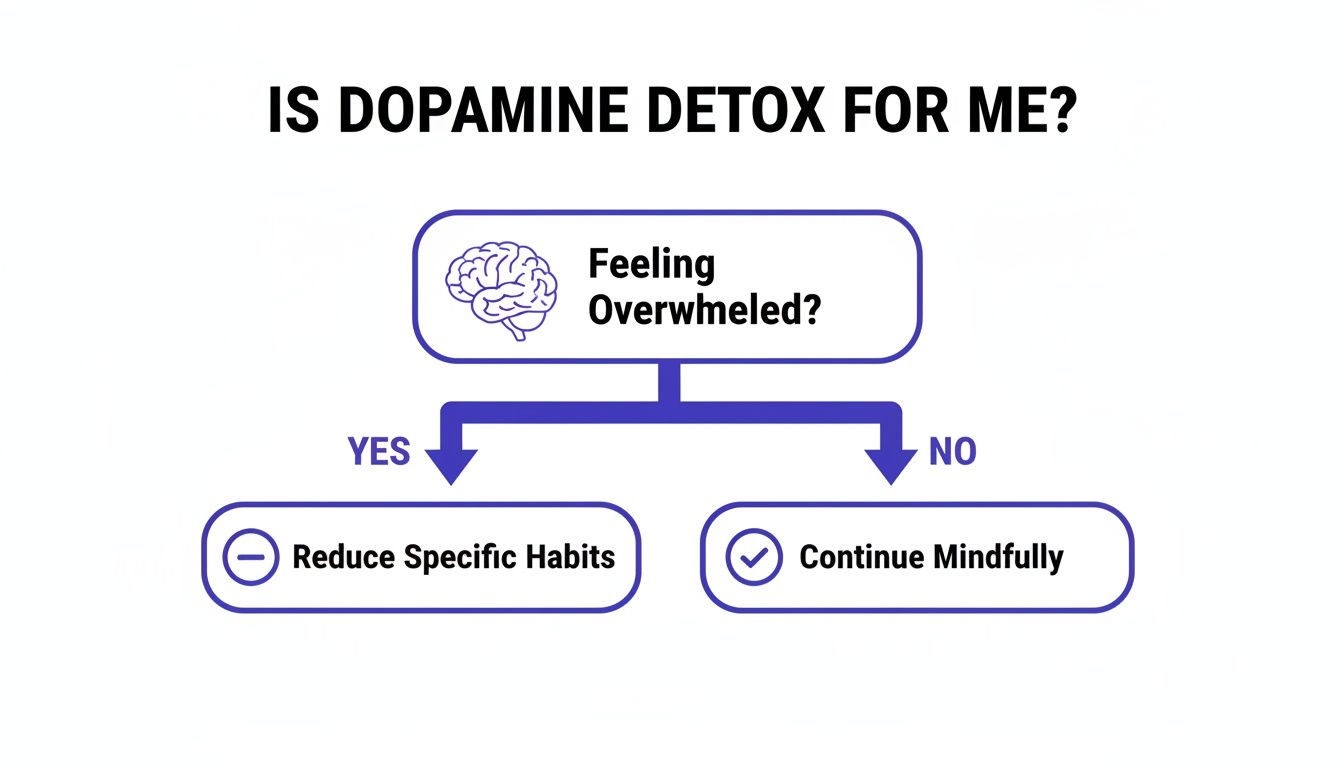
This simple decision tree can help you figure out where to begin.
The takeaway is simple: if you’re overwhelmed, get those thoughts out of your head before you attempt to focus.
Best Reset Method for Your Situation
To make a confident choice, it helps to see your options side-by-side. Match the technique not just to your problem, but also to the time you realistically have. A busy parent’s five-minute reset is just as valid as a CEO scheduling an hour for deep thinking.
This is where a time blocking planner can be a game-changer. It helps you intentionally schedule these vital resets. You can block out 15 minutes for a brain dump or 30 minutes for a walk, treating that time as a non-negotiable appointment.
Which Mind Clearing Method Is Right for You? A Comparison
Use this table to choose the best strategy based on how much time you have and what you need to accomplish.
Let’s put this into a real-world context. A marketing manager is stuck on a campaign slogan. Staring at the screen is only making it worse. She glances at the table and opts for a Clarity Walk. After 20 minutes outside, new ideas finally start to flow. This is more effective than the breathwork she might use before a tense client call. Compare options to find what fits your needs best.
Choosing the right reset is also about managing your brain’s reward system. If you’re battling constant digital distraction, a structured dopamine detox might be the most powerful long-term strategy for reclaiming your focus.
Design a Low-Distraction Life for Lasting Clarity
Quick fixes are great for putting out fires. However, lasting mental clarity isn’t about heroic, one-off efforts. It’s about building an environment that quietly supports your focus. This means intentionally designing your daily life to have fewer built-in distractions.
Instead of constantly reacting to mental clutter, you start proactively preventing it. We’ll start with your digital world—the biggest source of noise. Then we’ll move on to your physical space. This is how you build sustainable habits that protect your attention.
Best Way to Engineer Your Digital Environment
Let’s be honest: your digital life is probably the primary source of mental noise. The constant pings and infinite-scroll feeds are not neutral. They actively train your brain to crave distraction. This is a battle for your attention, and you need a strategy to win it back.
Sometimes, a hard reset like a “dopamine detox” can help recalibrate your brain’s overstimulated reward system. This isn’t about giving up technology, but about using it on your own terms. Start by tackling the low-hanging fruit.
Silence non-essential notifications. Go through your phone’s settings now and turn off alerts for every app that isn’t mission-critical. Your focus is worth more than a “like.”
Curate your feeds with intention. Unfollow accounts that make you feel anxious or angry. Replace that noise with content that is genuinely inspiring or educational.
Set firm digital boundaries. Designate specific, limited times for checking email and social media. Outside those windows, those apps stay closed. This creates space for uninterrupted deep work.
When you take these steps, you’re not just removing distractions; you’re reshaping your brain’s habits. For a deeper dive, our guide on digital detox tips offers a clear roadmap.
How to Design a Physical Space for Focus
Your physical surroundings send subtle cues to your brain about how to behave. A cluttered desk in a chaotic room screams “distraction.” On the other hand, a clean, organized space tells your brain it’s time to concentrate. This doesn’t require a major overhaul. Small, deliberate changes can have a large impact on your mental peace.
Real-World Scenario: A remote worker named Alex constantly struggled with focus. Their “office” was the noisy kitchen table. Feeling drained, Alex redesigned their environment. They cleared a small desk in a quiet corner, invested in quality noise-canceling headphones, and put up a “Focus Zone” sign. This simple act of creating a dedicated space dramatically improved their productivity.
Even tiny rituals can signal a shift. Clearing your desk completely each day creates a clean slate for the next morning. This prevents today’s mental clutter from spilling into tomorrow. Try adding a plant or using a specific lamp only when you’re doing focused work. These little cues help your brain make the switch.
Editor’s Take: What Actually Works to Clear Your Mind
Let’s be honest about what it takes to clear your head. The most sophisticated, science-backed technique is useless if it doesn’t fit into your messy life. The best method is always the one you’ll stick with.
For busy people feeling functionally overwhelmed—but not dealing with a clinical mental health crisis—two approaches give you the biggest return. The five-minute Cyclic Sighing technique is a powerful, immediate reset for in-the-moment stress. And a weekly 15-minute Brain Dump is your best defense against the creeping chaos of a cluttered to-do list.
Who This Is Really For
This advice is for anyone feeling mentally scattered by daily demands, digital noise, and a heavy workload. If you’re looking for practical strategies to sharpen your focus and quiet your mind, these methods are for you. However, it’s crucial to know their limits. These are tools for mental hygiene, not treatment.
My Advice: Start Small, and I Mean Small
From my own experience, tiny changes deliver the biggest results. For example, a simple investment in a phone lock box timer can be a game-changer. It creates a physical boundary that your brain can’t easily negotiate its way around.
So here’s my advice: don’t try to overhaul your life at once. Start with one small habit. This could be a daily five-minute sighing practice or a single weekly brain dump. Master that one thing until it feels automatic.
Then, and only then, build on it. When you’re learning how to clear your mind, simplicity is your superpower. To build these habits, see the book that fits your goal in our library. For a deeper look at sustainable focus, the frameworks in The Power of Clarity are a great next step.
Key Takeaways: How to Clear Your Mind
Feeling clearer already? That’s a great start. But the real goal is to sustain that clarity when life inevitably gets noisy again. Think of these strategies as your go-to toolkit.
For Instant Calm, Use Your Breath
When stress suddenly spikes, your fastest route to relief is physiological. Use Cyclic Sighing—two sharp inhales through the nose, then one long, slow exhale through the mouth. Research shows this quickly dials down your body’s alarm system.
Schedule a Weekly Brain Dump
Don’t wait for mental clutter to become a crisis. Set aside 15 minutes once a week to get every task, worry, and idea onto paper. A simple habit tracker journal can work wonders for this, externalizing the load so your brain doesn’t have to carry it.
Design a Low-Distraction Space
Your environment shapes your focus. Take back control. Silence non-essential phone notifications and carve out a dedicated workspace. These simple shifts create powerful psychological cues that tell your brain it’s time to concentrate.
Disclaimer: This article may contain affiliate links. Purchases may generate a small commission at no extra cost to you. The content provided is for educational and informational purposes only. It does not constitute medical or psychological advice, diagnosis, or treatment. Always consult a qualified healthcare professional with any health concerns.
Frequently Asked Questions About Clearing Your Mind
Making sense of how to clear your mind in real life often brings up a few common questions. Let’s walk through some of the most frequent ones.
1. How can I clear my mind in just two minutes?
When short on time, the physiological sigh is one of the fastest ways to reset your nervous system. Research from Stanford shows it’s remarkably effective. Simply take two quick inhales through your nose, then let out one long, slow exhale through your mouth. Do this two or three times for an almost immediate sense of calm.
2. Does clearing your mind really improve productivity?
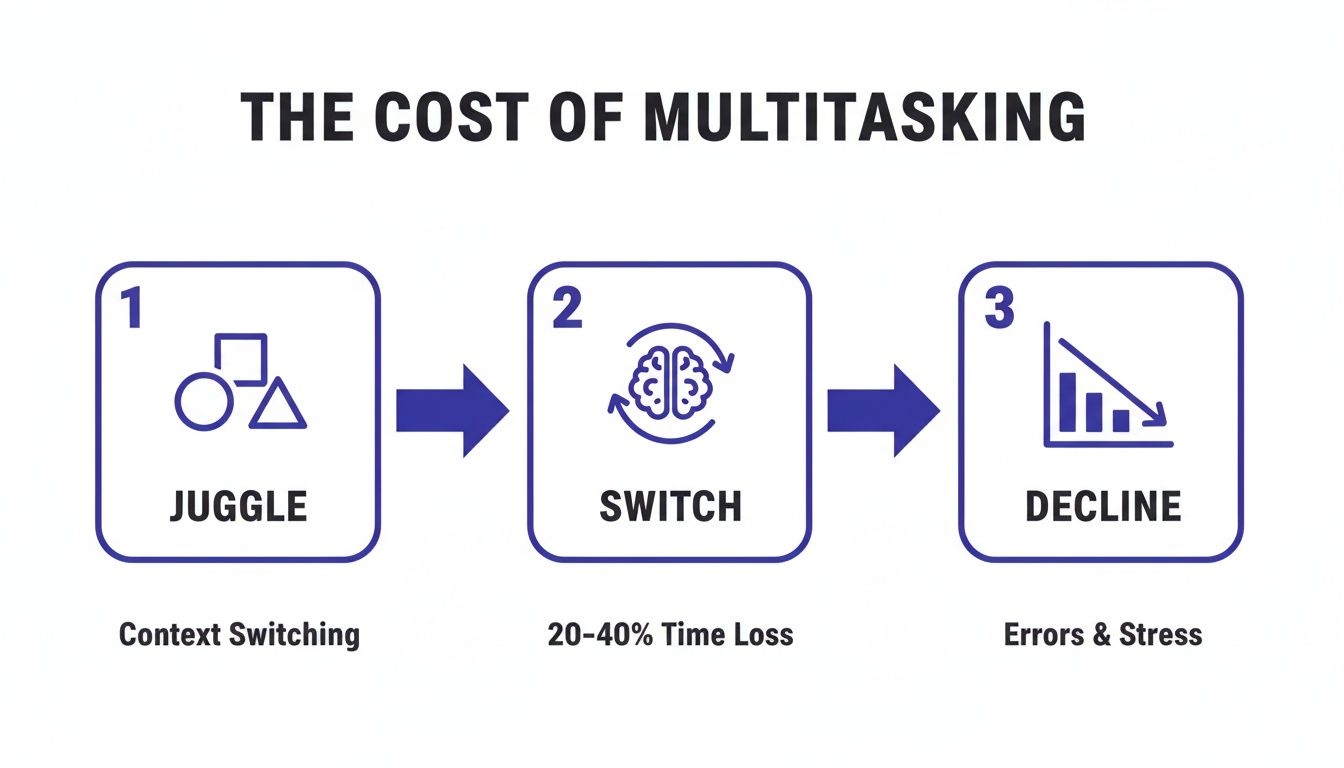
Absolutely. A clear mind is a productive mind. When you aren’t mentally juggling dozens of stray thoughts, you reduce costly task-switching. This frees you up to make better, faster decisions. That newfound mental space allows for the deep, sustained focus needed for high-quality work. It’s the direct antidote to brain fog.
3. Meditation didn’t work for me. What should I try next?
That’s a very common experience. If traditional meditation feels like a struggle, you’re not alone. Many people find more active methods work much better. A Clarity Walk (walking for 20-30 minutes without audio input) or a structured Brain Dump gets racing thoughts onto paper. These tangible practices are often a game-changer for those who find it hard to sit still.
4. How often should I do a brain dump to clear my mind?
A weekly brain dump is a great rhythm for preventing mental clutter. Think of it as routine maintenance for your mind. However, don’t be rigid. A brain dump is a tool you can use anytime you feel that sense of overload creeping in. It’s especially powerful before a big project or at the end of a hectic day.
5. Can these techniques help with sleep problems?
Yes, they can significantly improve your ability to fall asleep. The brain dump, in particular, is effective when done about an hour before bed. By offloading worries and to-dos onto paper, you quiet the racing thoughts that keep you awake. For a deeper dive, the book Restful Nights provides targeted strategies for calming an anxious mind before sleep.
If you’ve ever known exactly what you need to do but can’t seem to start, you’ve run into your brain’s executive function. Think of it as the project manager in your head—the quiet, behind-the-scenes system that helps you plan, prioritize, and see a task through from idea to done.
From a behavioral research perspective, this is the set of mental skills that lets you manage time, filter out distractions, and switch gears when a meeting gets moved. It’s not about what you know, but how you use what you know to get things done.
Affiliate Disclosure: This article contains affiliate links. If you make a purchase through these links, we may earn a small commission at no extra cost to you. This helps us continue to create helpful content.
Your Brain’s CEO Explained: Understanding Executive Function
So, what is executive function, really? It’s a group of high-level mental skills, mostly managed by the prefrontal cortex—the brain’s command center—that govern how you turn intentions into actions. Neuroscience shows this area is crucial for planning and decision-making. It’s the silent operator coordinating your thoughts and behaviors so you can navigate daily life.
Without strong executive function, life can feel chaotic. Imagine trying to assemble furniture with the instructions scattered all over the floor. You might have all the right pieces, but you grab them in the wrong order, get distracted halfway through, and end up with a wobbly, unfinished mess. Executive function is what lets you follow the instructions step-by-step, stay on task, and build something solid.
Why Is Understanding Executive Function Important?
Strong executive skills are the invisible architecture of a well-functioning life. They’re what allow you to:
Plan and Prioritize: Figure out which bill to pay first or how to break a big project into smaller, manageable steps.
Stay Focused: Tune out a coworker’s conversation or a phone notification so you can actually finish the report you started.
Manage Emotions: Take a breath when you feel frustrated instead of firing off a sharp reply. This is a key aspect of emotional regulation, rooted in the prefrontal cortex’s ability to override impulsive reactions.
Adapt to Change: Pivot smoothly when your morning plan gets derailed by an unexpected problem.
These skills aren’t set in stone. They develop throughout our lives and can absolutely be trained and strengthened at any age. Understanding them is the first step toward building better focus and getting your brain to work with you, not against you. If you’re looking for a roadmap, The Power of Clarity offers a practical framework to start building these skills.
This article is for educational purposes only and is not a substitute for professional medical or psychological advice. If you are concerned about your mental health, please consult a qualified healthcare provider.
The Three Pillars of Your Brain’s CEO
To really get a handle on what executive function is, it helps to break it down into its three core components. Think of these as the specialized departments that report to your brain’s CEO—each one managing a different, crucial aspect of your daily productivity and focus.
Getting these skills to work together is the secret to navigating the complex demands of modern life, from crushing a big project at work to just getting through your personal to-do list.
This visual concept map shows how these three pillars—planning, focusing, and adapting—are the core duties of your brain’s CEO.
The map highlights how these skills are designed to work in concert, allowing you to effectively manage goals from the initial idea all the way to the finish line.
Working Memory: The Brain’s Mental Post-it Note
Working memory is your brain’s temporary mental workspace. Psychology research describes it as a system for holding and juggling information for a short period to complete a task. This isn’t long-term storage; it’s the active, in-the-moment processing you need to get things done.
Real-World Example: Imagine you’re following a new recipe. Your working memory is what holds the list of ingredients and the sequence of steps in your mind as you move around the kitchen. If it’s weak, you’ll find yourself rereading the same instruction over and over. A strong working memory lets you mentally check off steps and keep the bigger picture in mind.
Inhibitory control, or what most of us call self-control, is your ability to tune out distractions and resist temptation. Neuroscience links this skill to specific brain circuits that help you stay locked on your goals instead of acting on every impulse or whim.
Real-World Example: You’re trying to finish a report while social media notifications keep popping up on your phone. Inhibitory control is what allows you to ignore the ping and stick with the task at hand. When this skill is drained from a long day, you might find yourself endlessly scrolling, even when you know a deadline is looming. Using a phone lock box timer can be a great external tool to support this mental filter.
Cognitive Flexibility: The Mental Pivot
Cognitive flexibility is your brain’s ability to adapt to new information and shift your perspective. It’s what allows you to pivot when plans change unexpectedly, letting you think creatively and see problems from different angles.
Real-World Example: You have your entire day scheduled, but a key meeting is suddenly canceled. Cognitive flexibility is what enables you to calmly re-prioritize your to-do list and use that newfound time productively, rather than feeling flustered or stuck. It’s the “mental pivot” that prevents you from getting derailed by life’s inevitable curveballs.
To see how these concepts play out in real-time, this table breaks them down into their core jobs and a simple, everyday example.
The 3 Core Executive Functions at a Glance
Executive Function
What It Does
Everyday Example
Working Memory
Holds and manipulates information in your mind for short-term tasks.
Remembering a phone number long enough to dial it.
Inhibitory Control
Resists impulses and filters out distractions to stay on task.
Ignoring your phone buzzing while you’re in a conversation.
Cognitive Flexibility
Adapts to new rules, changing plans, and different perspectives.
Shifting your project plan when a team member is unexpectedly out sick.
When these three foundational skills work well together, life feels manageable. When they’re impaired—as is often the case with conditions like ADHD, anxiety, or depression—it can significantly impact daily life. A 2020 study estimated that symptomatic adult ADHD affects 6.76% of adults worldwide, highlighting just how many people grapple with these challenges every day.
How Executive Function Shows Up in Your Day-to-Day Life
Think of your executive function skills as the invisible engine driving your day. When that engine is running smoothly, life just feels more manageable. You can juggle a few different projects, stay calm when things get stressful, and actually follow through on the goals you set for yourself.
Real-World Example: A great project manager effortlessly tracks deadlines, pivots when a team member calls in sick, and keeps the whole team moving in the right direction. This isn’t magic; it’s strong executive function in action. These skills are tied directly to career growth, sane time management, and a feeling of being in control of your own life. They are a huge part of your overall mental well-being.
When Your Brain’s CEO Is Overwhelmed
But what happens when your executive functions get strained? Often due to stress, burnout, or anxiety, daily life can start to feel like an uphill battle. This isn’t a personal failing; it’s a sign that your brain’s management system is overloaded.
You might notice challenges showing up in a few key ways:
Chronic Procrastination: You know a task is important, but getting started feels impossible.
Disorganization: Your workspace is a mess, you’re always misplacing your keys, and you struggle to keep track of appointments.
Emotional Reactivity: Small frustrations trigger big emotional responses because your impulse control is running on empty.
Difficulty with Planning: Breaking a big project into smaller, doable steps feels overwhelming. This can also lead to what’s known as decision fatigue from constantly trying to figure out what to do next.
When this happens, even a simple tool like a time blocking planner can provide some much-needed external structure. It helps offload the mental work of planning and prioritizing, which frees up your brainpower to actually do the work. Think of it as an external scaffold for your brain’s planning department.
This content is for educational purposes only and should not be considered a substitute for professional medical or psychological advice, diagnosis, or treatment. Always seek the advice of a qualified health provider with any questions you may have regarding a medical or psychological condition.
If these patterns sound familiar, it might just be a sign that your “brain CEO” is overworked and needs better support. Building stronger habits and systems isn’t about becoming a productivity machine; it’s about reducing the mental friction in your life so you can get back in control.
Common Signs Your Executive Function Needs a Boost
Spotting the signs that your brain’s CEO might be overloaded is the first real step toward giving it the support it needs. These moments aren’t signs of personal failure—they’re just signals from your brain that your cognitive skills could use a little reinforcement. Most of us have been there, especially during times of high stress or burnout.
It’s important to remember this is educational information. While these signs are common, especially with conditions like ADHD, anxiety, or depression, they’re no substitute for a professional evaluation. For a deeper look at the specific challenges professionals face, you might find our guide on ADHD in the workplace helpful.
Everyday Indicators of Strained Executive Skills
If you find yourself nodding along to a few of these points, it might be a good time to explore some supportive strategies.
Constant Search Parties: You’re regularly misplacing essentials like your keys, phone, or wallet, turning simple moments into frustrating scavenger hunts.
The “I’ll Do It Later” Trap: Big projects feel impossible to even start. You know exactly what needs to be done, but taking that first step feels like trying to push a boulder uphill.
Time Blindness: You consistently underestimate how long tasks will take, which leads to missed deadlines, chronic lateness, or just a constant feeling of being rushed.
Emotional Overwhelm: Small setbacks or unexpected changes trigger a surprisingly strong emotional reaction, leaving you feeling frazzled and completely drained.
When these skills are taxed, the effects can ripple outward. Research shows a clear link between poor executive functions and significant public health issues. The World Health Organization reports that mental disorders, which often involve executive dysfunction, affect 1 in 10 people globally and are a leading cause of disability. Studies also confirm these core skills predict health behaviors, influencing everything from diet to smoking habits. Learn more about these important research findings.
Important Note: This list is meant to build self-awareness, not to be a diagnostic tool. If you have serious concerns about your ability to function day-to-day, the best course of action is always to seek advice from a medical or mental health professional. Building awareness is simply the bridge to finding solutions that work.
How to Choose the Best Strategies to Strengthen Executive Function
Deciding where to even begin with strengthening your executive function can feel completely overwhelming. With so many different techniques out there, the key isn’t to do everything at once. Instead, think of it as a series of small, targeted adjustments matched to your specific challenges.
To make this simpler, we can sort these strategies into three main categories. Each one tackles a different part of how you manage your life, from your internal mindset to the world around you. This framework helps you pinpoint what will give you the most leverage right now.
Best for Beginners: Understanding Your Options
The most effective approach usually blends small changes from each of these areas.
Behavioral Habits: These are the internal routines you build over time. Think of them as direct training for your brain’s “CEO.” This could be a mindfulness practice to sharpen your focus or the habit of breaking big, intimidating projects into tiny first steps.
Environmental Adjustments: This is all about changing your physical and digital surroundings to lower the mental strain. You’re essentially making it easier for your brain to do the right thing by setting up a dedicated, distraction-free workspace or using apps that block time-wasting websites.
Practical Tools: These are external aids that act like scaffolding for your executive skills. A simple pomodoro timer can help you sustain focus in short, manageable bursts, while a habit tracker journal gives you the visual feedback needed to build consistency.
Figuring out where to start comes down to one question: What’s your biggest struggle right now? Is it starting tasks? Staying focused? Remembering what you need to do? Your answer will point you toward the most effective tool or habit to try first.
Best for Busy Professionals: How to Choose a Strategy
If you’re still not sure where to begin, start with whatever feels easiest to implement. For many people, a practical tool offers the quickest win. It provides immediate structure while you work on building those longer-term behavioral habits. Learning how to prioritize tasks effectively is a fantastic first step.
Here’s a quick comparison to help you decide:
Strategy Type
Best For
Example Tool/Habit
Who It Suits
Behavioral
Building long-term focus and self-control.
Daily mindfulness practice.
Those seeking sustainable internal change.
Environmental
Reducing immediate distractions and decision fatigue.
Creating a designated work-only space.
People who work from home or in busy offices.
Practical Tool
Providing instant structure and external reminders.
Ultimately, the goal is to build a support system that actually works for you. You don’t need some complex, color-coded productivity system to see real results. More often than not, the simplest adjustments end up making the biggest difference. Why not browse the library for books that can guide you on this journey?
Editor’s Take: What Actually Improves Executive Function?
Let’s cut through the noise. When it comes to improving executive function, the most powerful tool isn’t some complex new app or a productivity hack you saw on social media. It’s consistency with simple habits.
For busy professionals trying to stay focused in a world of digital distractions, it’s the small, repeatable actions that deliver the biggest returns. Things like using a visual timer for desk work to carve out dedicated focus blocks, or spending just ten minutes planning your day each morning.
This advice is best for knowledge workers feeling swamped who want practical, non-clinical strategies. It is not a replacement for medical or psychological care for conditions like ADHD or anxiety. The real goal is to build supportive routines that lower the mental friction in your day. While some people explore options like specialized IV therapies, such as a brain power drip, for their potential cognitive benefits, sustainable change almost always comes back to practical, evidence-based strategies.
Key Takeaways: Your Executive Function Cheat Sheet
It’s Your Brain’s CEO: Executive function is a set of mental skills managed by the prefrontal cortex that helps you plan, focus, and execute tasks.
Three Core Pillars: The system relies on Working Memory (your mental sticky note), Inhibitory Control (your impulse filter), and Cognitive Flexibility (your ability to pivot).
Overload is Common: Stress, burnout, anxiety, and lack of sleep can significantly weaken your executive skills, leading to procrastination, disorganization, and emotional reactivity.
You Can Improve It: Your brain is plastic. You can strengthen these skills at any age through consistent habits, environmental changes, and practical tools.
Start Small and Simple: Don’t try to overhaul your life overnight. Pick one small, manageable strategy that addresses your biggest pain point and build from there.
Frequently Asked Questions About Executive Function
Let’s clear up some of the most common questions that come up when people first start digging into what executive function is and how it really works day-to-day.
1. Is Executive Dysfunction the Same as ADHD?
No, but they’re incredibly close cousins. Think of it this way: nearly everyone with ADHD has challenges with executive function, but not everyone with executive function challenges has ADHD. Executive dysfunction is a descriptive term for a set of struggles—things like planning and focus. ADHD is a clinical, neurodevelopmental condition where significant executive dysfunction is a primary feature. You can also experience a temporary hit to your executive function from stress, burnout, anxiety, or even just a few nights of bad sleep.
2. Can You Actually Improve Executive Function as an Adult?
Absolutely. Your brain’s ability to change and form new connections, a process called neuroplasticity, doesn’t stop when you leave your teenage years. While these skills see their biggest growth spurt in childhood, adults can absolutely build stronger executive functions. It happens through consistent practice, building new habits, and leaning on supportive strategies that give your brain the scaffolding it needs to succeed.
3. What’s the Single Best Tool for Improving Executive Function?
There’s no magic bullet here, because the “best” tool is the one that solves your specific friction point. The most effective strategy is always to match the support to the problem you’re trying to fix. For losing track of time, a simple visual timer for your desk can be a game-changer. For planning and prioritization, a time blocking planner provides the external structure your brain might be craving. The key is to start with one simple tool that addresses your biggest bottleneck.
4. How Much Does Sleep Really Impact Executive Function?
Sleep isn’t a luxury; it’s fundamental maintenance for your brain’s “CEO.” While you sleep, your brain is hard at work clearing out metabolic waste and consolidating memories, essentially preparing your prefrontal cortex for the next day. Research from places like Harvard Health makes it clear: even a single night of poor sleep can hobble your ability to focus and manage impulses. Consistent, high-quality sleep is one of the most powerful levers you can pull. For a deeper dive, you can see the book that fits your goal in our library, like Restful Nights.
5. Can Stress and Burnout Make Executive Function Weaker?
Yes, and the effect can be profound. When you’re under chronic stress, your brain is flooded with cortisol, a stress hormone that directly interferes with the prefrontal cortex. This is the neurochemical reason why, when you’re burned out or anxious, a simple task like deciding what to eat can feel monumental. Your brain is busy diverting its precious resources to manage what it perceives as a threat, leaving far less energy for high-level thinking and planning.
Disclaimer:This article is for educational and informational purposes only and does not constitute medical or psychological advice. The content is not intended to be a substitute for professional medical or psychological advice, diagnosis, or treatment. Some links in this article are affiliate links, which means we may earn a commission if you make a purchase at no extra cost to you.
Affiliate Disclosure: This post may contain affiliate links. If you make a purchase through these links, we may earn a small commission at no extra cost to you. This helps support our work in bringing you valuable content.
Working memory is the brain’s active workspace, a temporary holding area where you manipulate information to complete tasks, solve problems, and make decisions. It’s the mental notepad that holds a phone number while you find a pen, the cognitive engine that processes a colleague’s feedback during a meeting, and the focus filter that lets you follow a complex recipe. When it’s sharp, you feel clear, productive, and in control. When it’s overloaded, you experience brain fog, lose your train of thought, and struggle with simple mental tasks. Neuroscience research shows that this system, primarily managed by the prefrontal cortex, has a very limited capacity, which is why the feeling of juggling too many mental tabs is a direct symptom of working memory strain.
Working Memory Improvement Strategies That Reduce Cognitive Load and Boost Daily Focus
Improving this critical cognitive function isn’t about magical brain hacks or grueling mental gymnastics. It’s about implementing practical, evidence-based systems that reduce cognitive load and enhance your brain’s natural ability to process information. The working memory improvement strategies in this guide are designed for immediate application, helping you manage information more effectively without burnout. You will learn how to structure tasks to prevent overload, use powerful mnemonic techniques to encode information, and build daily habits that support sustained cognitive performance.
This article provides a comprehensive roundup of actionable techniques, moving beyond generic advice to give you step-by-step instructions grounded in cognitive psychology and neuroscience. We will cover short-term drills, long-term lifestyle adjustments, and smart ways to use external aids. Whether you’re a professional aiming for deeper focus, a student looking for better retention, or anyone feeling the strain of information overload, these strategies offer a clear path to a sharper, more reliable working memory.
Disclaimer: This article is for educational purposes only and is not a substitute for professional medical or psychological advice. If you are struggling with conditions like anxiety, depression, ADHD, burnout, or sleep problems, please consult a qualified healthcare provider.
1. Chunking to Improve Your Working Memory
Chunking is a powerful cognitive strategy for organizing information into smaller, meaningful units. This process significantly reduces the cognitive load on your working memory. Instead of trying to recall a long string of individual items, your brain groups related elements into a single “chunk.” This allows you to hold and process more complex information efficiently, making it one of the most effective working memory improvement strategies. This technique leverages the brain’s natural ability to detect patterns, a principle famously explored in psychologist George A. Miller’s research on memory capacity.
This method is more intuitive than it sounds and is something you already do daily. A phone number, for instance, isn’t remembered as ten separate digits (5551234567) but as three chunks (555-123-4567). This simple grouping makes the number vastly easier to recall.
Real-World Example: Applying Chunking
Imagine you have a long, unstructured to-do list for a new project. It feels overwhelming. Instead of tackling 20 individual items, you “chunk” them:
Chunk 2 (Drafting): Outline proposal, write first draft, create slides.
Chunk 3 (Review): Get feedback from team, revise draft, submit for approval.
Now, your brain only has to track three items, not twenty, making the project feel manageable.
Key Insight: Chunking works by creating meaningful connections between individual pieces of information. By assigning a higher-level meaning to a group of items, you only need to hold the “chunk” in your working memory, not every single component part.
By consciously implementing chunking, you can handle more complex data, reduce mental strain, and enhance your ability to focus on what truly matters. It’s a foundational skill for deep work and a cornerstone of efficient knowledge management. For more on structuring your focus, explore the principles in The Power of Clarity.
2. The Method of Loci (Memory Palace)
The Method of Loci, also known as the Memory Palace, is an ancient mnemonic technique that leverages your brain’s powerful spatial memory. It involves mentally placing information you need to remember along a familiar physical route, like your home or commute. By visualizing a journey through this space, you can retrieve information by “seeing” it where you left it. This method powerfully connects abstract data to concrete imagery, making it one of the most enduring working memory improvement strategies. Neuroscience shows this technique taps into the hippocampus, a brain region critical for both memory formation and spatial navigation.
This powerful technique was famously used by ancient Roman orators to recall long speeches without notes. By associating each point of their speech with a specific location in a villa, they could mentally “walk” through the space to remember the sequence. Modern memory champions use the same principle to memorize decks of cards and long strings of numbers.
Real-World Example: Applying the Memory Palace
Let’s say you need to remember the five key points for a presentation. You choose your apartment as your Memory Palace.
Front Door: Place the introduction here. Imagine a giant, flashing “Welcome” sign.
Entryway Table: The first key point (e.g., market trends). Picture a chart of rising trends sitting on the table.
Living Room Couch: The second key point (e.g., customer feedback). Visualize your clients sitting on your couch giving you a thumbs-up.
Kitchen Counter: The third key point (e.g., financial data). See stacks of money on the counter.
Back Door: The conclusion. Imagine a giant “The End” sign blocking the exit.
To recall your points, you simply “walk” through your apartment.
Key Insight: The Method of Loci works by translating difficult-to-remember information into a format the brain excels at: visual-spatial data. Creating bizarre or exaggerated mental images strengthens these associations, making recall nearly effortless.
By building and practicing with a memory palace, you can significantly expand the amount of sequential information you hold in your working memory. This ancient tool is a game-changer for public speaking, studying, and organizing complex tasks.
3. Spaced Repetition for Better Long-Term Recall
Spaced repetition is an evidence-based learning technique that leverages the “spacing effect” to transfer information from your short-term working memory into durable, long-term storage. Instead of cramming information in one session, this method involves reviewing it at increasing intervals over time. This process interrupts the natural forgetting curve, signaling to your brain that the information is important and reinforcing the neural pathways needed for recall. As a result, it is one of the most efficient working memory improvement strategies for retaining knowledge.
This technique, pioneered by psychologist Hermann Ebbinghaus, works by making your brain work just hard enough to retrieve the memory. Each successful retrieval at a progressively longer interval strengthens the memory’s trace, making it less likely to be forgotten. A software developer, for instance, might review a new coding pattern after one day, then three days, then a week, cementing the concept far more effectively than reading the documentation five times in one afternoon.
Real-World Example: Applying Spaced Repetition
You are learning key details about a new client. You create a few digital flashcards with their company name, key contacts, and business goals.
Day 1: You review the flashcards in the morning.
Day 2: You review them again.
Day 4: The app prompts you to review them.
Day 8: You get another prompt.
By the big meeting on Day 10, the information is solidly in your memory without any last-minute cramming. A simple habit tracker journal can help you stay consistent with these review sessions.
Key Insight: Spaced repetition optimizes learning by timing reviews at the precise moment you are about to forget something. This “desirable difficulty” forces your brain to work harder to retrieve the information, which in turn strengthens the memory for long-term retention.
By systematically spacing out your learning, you commit information to memory more effectively, reduce the need for last-minute cramming, and build a reliable foundation of knowledge. To learn more about building effective learning habits, explore the systems in Focus Recharged.
4. Active Recall & The Testing Effect Strategy
Active recall is a learning process centered on deliberately retrieving information from your memory. In contrast to passively rereading or reviewing material, this method forces your brain to actively reconstruct knowledge, creating much stronger neural pathways. Research on the “Testing Effect,” pioneered by scientists like Henry Roediger and Jeffrey Karpicke, demonstrates that the act of retrieval itself is a powerful memory enhancer. This effortful process is one of the most potent working memory improvement strategies because it solidifies information for long-term storage, freeing up working memory for new tasks.
This technique fundamentally changes how you interact with information. Instead of just recognizing familiar concepts, you are challenged to produce them from scratch. This cognitive effort signals to your brain that the information is important and worth holding onto, making it more accessible for future use.
Real-World Example: Applying Active Recall
After reading a chapter in a business book, instead of just highlighting passages:
Close the book.
Open a blank document or notebook page.
Write down everything you can remember from the chapter, including the main ideas and key examples.
This simple act forces your brain to retrieve the information, not just recognize it. This is why learning how to retain information when studying is so critical.
Key Insight: Active recall works because it treats your brain like a muscle. Each time you successfully retrieve a piece of information, you strengthen the neural connection to it, making it easier and faster to access the next time.
By making active recall a regular habit, you shift from being a passive consumer of information to an active participant in your own learning. This leads to more robust knowledge that you can depend on when you need it most. Discover more about building effective learning habits in How to Retain What You Read.
5. Working Memory Load Management (Cognitive Load Theory)
Cognitive Load Theory (CLT) is based on the scientific premise that working memory has a finite capacity. Developed by psychologist John Sweller, this theory suggests that learning and performance are optimized when tasks are designed to match this limit. Managing your cognitive load means actively reducing unnecessary mental processing, freeing up precious cognitive resources. This makes it one of the most essential working memory improvement strategies for knowledge workers. By consciously designing your workflow to minimize mental strain, you can enhance focus, reduce errors, and make better decisions.
This principle explains why a cluttered digital workspace feels so overwhelming. Every notification, open tab, and unnecessary visual element consumes a small piece of your working memory. In contrast, a minimalist environment allows your brain to dedicate its full capacity to the task at hand. It’s about working smarter, not harder, by aligning your tasks with your brain’s natural architecture.
Real-World Example: Applying Cognitive Load Theory
Your manager sends a complex email with five different requests buried in long paragraphs. Your working memory is immediately strained trying to track them all.
The Problem: High cognitive load.
The Solution: You copy each request into a numbered list in a separate task manager app.
By externalizing the information and simplifying its presentation, you’ve reduced the cognitive load. Now you can focus on completing one task at a time instead of holding all five in your head. A time blocking planner is perfect for visualizing and simplifying your schedule.
Key Insight: Your working memory is a finite resource. Cognitive Load Theory teaches you to treat it as such by intentionally removing distractions (extraneous load) and simplifying complex tasks (intrinsic load) so you can focus on what truly matters for growth and learning (germane load).
By managing your cognitive load, you prevent mental fatigue and create an environment where deep work can flourish. It is a foundational strategy for anyone looking to sustain high-level performance without burnout. To understand the consequences of ignoring these limits, you can learn more about what happens during cognitive overload.
6. Elaboration (Linking New Information to Existing Knowledge)
Elaboration is a cognitive process where you actively connect new information to your existing knowledge, creating a rich, interconnected web in your long-term memory. Instead of passively absorbing facts, you process them deeply by questioning, explaining, or finding analogies. This method strengthens retrieval pathways, making it easier to pull information back into your conscious mind. As one of the most robust working memory improvement strategies, it moves learning from rote memorization to genuine understanding, a concept rooted in Craik & Lockhart’s “Levels of Processing” theory in psychology.
This technique is about giving new data context and meaning. When a project manager relates a new agile methodology to a successful past project, they are using elaboration. They aren’t just learning rules; they are integrating the new framework into a pre-existing mental model of what works. This connection makes the new information stickier and more accessible.
Real-World Example: Applying Elaboration
You’re learning about a new software product your company is launching.
Passive Learning: Reading the feature list.
Elaboration: You ask yourself, “How is this new feature like the one in our old software, but better? How would my biggest client use this to solve their main problem?”
By linking the new information to your existing knowledge of clients and old software, you create a deeper, more meaningful understanding that’s easier to recall.
Key Insight: Elaboration transforms passive reception into active engagement. By forcing your brain to build connections, you are creating multiple mental hooks for the new information, making it significantly easier to recall and apply under pressure.
By making elaboration a habit, you not only improve your working memory but also deepen your expertise. This active learning approach is fundamental to improving your problem-solving skills and becoming a more insightful, adaptable professional.
7. Attention Restoration & Focused Attention Intervals (Pomodoro & Deep Work Blocks)
Focused attention intervals are a disciplined approach to managing your cognitive energy. This method involves structuring your work into dedicated blocks of intense focus followed by deliberate rest periods. This cyclical pattern prevents the cognitive fatigue that degrades working memory. By aligning with the brain’s natural ultradian rhythms, this is one of the most sustainable working memory improvement strategies for long-term productivity and mental clarity. This concept was famously explored by sleep researcher Nathaniel Kleitman and popularized in modern productivity by Cal Newport’s “Deep Work” and Francesco Cirillo’s Pomodoro Technique.
This strategy works by treating your attention like a muscle that requires both exertion and recovery. Instead of pushing through hours of continuous, low-quality work, you alternate between peak performance and complete rest. A common application is the Pomodoro Technique: 25 minutes of focused work on a single task, followed by a 5-minute break. This prevents mental overload and keeps your working memory sharp and ready for the next interval.
Real-World Example: Applying Focused Intervals
You have to write a complex report. Instead of staring at a blank page for two hours straight:
Set a pomodoro timer for 25 minutes. During this time, you only write—no emails, no phone, no distractions.
When the timer rings, you take a 5-minute break to stretch or grab a glass of water.
You repeat this cycle four times, then take a longer 20-minute break.
This structured approach keeps your focus sharp and prevents the burnout that clouds working memory.
Key Insight: The power of focused intervals lies in the quality of both the work and the rest. Protecting your attention from distractions during work blocks is just as important as protecting your breaks from work-related stimuli. This discipline is what restores your working memory capacity.
By adopting focused attention intervals, you can produce higher-quality work in less time, reduce mental fatigue, and maintain a high level of cognitive performance throughout the day. To learn more about the specifics of this popular technique, you can explore the Pomodoro method in detail.
Best Options for Getting Started with Working Memory Improvement
Deciding where to begin depends on your biggest challenge. Do you struggle with retaining new information or managing daily tasks? Here’s a quick comparison to help you choose.
Best For…
Start With This Strategy
Why It Works
Next Step
Busy Professionals
External Encoding
Immediately reduces mental clutter by offloading tasks and reminders to a trusted system.
8. External Encoding & Off-Loading (Writing, Diagramming, Digital Tools)
External encoding is the strategic practice of moving information out of your head and into an external, reliable format. This process, often called “off-loading,” dramatically reduces the strain on your working memory. Instead of juggling tasks, ideas, and complex details internally, you capture them in notes, diagrams, or digital tools. This liberates cognitive resources, making it one of the most practical working memory improvement strategies for busy professionals. The principle was famously systemized by productivity consultant David Allen in his Getting Things Done methodology, which emphasizes capturing everything in a trusted external system.
This behavioral psychology technique acknowledges that your brain is for having ideas, not for holding them. For remote workers, this might mean using Notion or Obsidian as a digital “second brain” to track projects and knowledge. For engineers, it means maintaining detailed documentation instead of relying on memory for complex system specs. By externalizing, you create space for deeper thinking, analysis, and creative problem-solving.
Real-World Example: Applying External Encoding
You’re in a meeting, and brilliant ideas and action items are flying around.
Without Off-loading: You try to remember everything. By the time you get back to your desk, you’ve forgotten half of it.
With Off-loading: You open a notes app or a productivity journal and jot down every idea and task as it’s mentioned.
Your working memory is now free to actively participate in the conversation instead of struggling to hold onto information.
Key Insight: Your working memory is a temporary, limited workspace, not a permanent storage drive. External encoding treats it as such, using reliable external tools for storage and retrieval so your mind can focus on high-value cognitive tasks like analysis and creativity.
By consistently off-loading information, you build a reliable system that supports your cognitive functions, preventing mental clutter and burnout. It’s a foundational habit for anyone looking to manage complex work effectively.
9. Interleaving (Mixed Practice Over Blocked Practice)
Interleaving is a potent learning technique where you mix different but related topics or skills during a single practice session. Instead of practicing one skill repeatedly before moving to the next (blocked practice), interleaving forces your brain to constantly retrieve and apply different solutions. This method strengthens neural pathways and improves your ability to distinguish between concepts, making it one of the most durable working memory improvement strategies. Research by cognitive psychologists like Doug Rohrer has consistently shown that this “desirable difficulty” leads to more robust, long-term learning.
This approach initially feels less intuitive and more challenging than mastering one thing at a time. For example, a sales professional might find it easier to practice handling pricing objections for an hour straight. However, mixing in practice on competitor-related and feature-related objections in the same session builds a more flexible and responsive skill set that better mirrors real-world client conversations.
Real-World Example: Applying Interleaving
You need to learn three different functions in a spreadsheet program (e.g., VLOOKUP, Pivot Tables, Conditional Formatting).
Interleaving: On Monday, you do one VLOOKUP problem, then one Pivot Table problem, then one Conditional Formatting problem, and repeat the cycle.
While it feels harder, interleaving forces your brain to choose the right tool for the job each time, leading to deeper, more flexible learning.
Key Insight: Interleaving enhances learning by forcing your brain to discriminate between different types of problems and select the correct strategy. This active retrieval and comparison process creates stronger, more flexible memories than the passive repetition of blocked practice.
By deliberately mixing your practice, you train your brain for the complexity of the real world, where problems rarely appear in neatly blocked categories. This cognitive workout is a powerful way to turn fragile knowledge into lasting skill. For more on building resilient focus, see the methods in Attention Unleashed.
Metacognition, or “thinking about your thinking,” is the practice of monitoring your own cognitive processes to adjust your strategies. This involves actively assessing what you know, identifying gaps in your understanding, and recognizing when you need to change your approach. This self-awareness prevents you from wasting cognitive resources on ineffective methods, making it one of the most sophisticated working memory improvement strategies. Research in educational psychology, pioneered by John Flavell, shows that well-calibrated metacognition is a key differentiator in efficient learning and problem-solving.
This strategy helps you distinguish between the feeling of familiarity and true comprehension. For example, after reading a complex report, you might feel like you understand it, but metacognition prompts you to actively test that assumption. This prevents the overconfidence described by researchers Dunning and Kruger in their famous behavioral studies, ensuring your working memory is allocated to mastering information, not just passively reviewing it.
Real-World Example: Applying Metacognition
You’re preparing for an important client presentation.
Without Metacognition: You read through your slides five times and feel confident because they look familiar.
With Metacognition: You read through your slides once, then turn away and try to explain the core message of each slide out loud. You quickly realize you’re fuzzy on slide #3, so you focus your remaining prep time there.
This self-monitoring identifies your actual weaknesses, allowing you to study more efficiently.
Key Insight: Strategic self-monitoring works by making your learning process an active, conscious effort. By regularly checking your confidence against objective evidence (like self-testing), you direct your working memory’s limited capacity toward areas that need the most attention, leading to more robust and reliable knowledge.
By consciously practicing metacognition, you transform from a passive information consumer into an active, strategic learner. This approach not only improves memory but also builds the intellectual humility required for continuous growth. For more on developing self-awareness in your professional life, see the frameworks in The Power of Clarity.
How to Choose the Best Working Memory Tools
Selecting the right tools can accelerate your progress. Here’s how a few popular options compare for different needs.
For Digital Organization: A time blocking planner is excellent for visual learners who need to structure their day. It helps manage cognitive load by laying out tasks clearly, so your brain doesn’t have to juggle a schedule internally. It’s a great first step for externalizing your day.
For Focused Work: A pomodoro timer is a simple but powerful device. Its non-digital, tactile nature helps create a clear boundary between work and rest. This is ideal for anyone easily distracted by phone timers or browser extensions.
For Consistent Habits: A habit tracker journal is perfect for implementing strategies like Spaced Repetition or Active Recall. The physical act of checking off a daily review session reinforces the behavior, making it more likely to stick.
For Reduced Distractions: For those who work in noisy environments, a good pair of noise canceling headphones can be a game-changer. They directly reduce the extraneous cognitive load from auditory distractions, freeing up working memory for the task at hand.
Editor’s Take
Let’s be honest: not all these strategies will work for everyone, and some require more effort than others. Based on our research and application, the most impactful strategies for immediate results are External Encoding and Focused Attention Intervals. Why? Because they don’t require you to fundamentally change how you learn, but rather how you manage your work. Simply offloading your to-do list and working in focused 25-minute sprints can dramatically reduce mental fog. These are best for busy professionals who feel overwhelmed. More complex techniques like the Memory Palace are incredibly powerful but best for specific goals, like memorizing a speech, rather than daily use. The key is to start small: pick one strategy, apply it for a week, and see how it feels.
Key Takeaways: From Theory to Daily Practice
The most critical insight to carry forward is that working memory is not a fixed trait but a dynamic skill. It responds directly to how you manage your attention, structure information, and care for your cognitive health.
Internal vs. External Strategies: A powerful approach combines strengthening your internal capacity (like using the Method of Loci) with smart external off-loading (like using a to-do list or digital tools). You don’t need to hold everything in your head; you just need a reliable system.
Active Engagement is Non-Negotiable: Passive learning is the enemy of strong working memory. Techniques like the testing effect and elaboration force you to actively engage with material, creating stronger neural pathways and making information stick.
Environment Shapes Performance: Your cognitive capacity is profoundly influenced by your surroundings. Managing distractions, implementing focused work blocks, and even reducing digital noise are fundamental working memory improvement strategies.
Be Proactive, Not Reactive: Instead of waiting for brain fog to set in, proactively design your workflow to support your working memory. Chunk projects, schedule focus blocks, and externalize reminders before you feel overwhelmed.
Disclaimer: The information in this article is for educational purposes only and should not be considered a substitute for professional medical or psychological advice. The affiliate links included help support our content creation at no extra cost to you.
Frequently Asked Questions (FAQ)
1. What is the fastest way to improve working memory?
The fastest strategy for immediate relief is External Encoding. By writing down tasks, ideas, and reminders in a trusted system (like a notebook or app), you immediately free up mental bandwidth. This reduces the cognitive load your working memory has to carry, providing a quick sense of clarity and focus.
2. Can working memory be permanently improved?
While you can’t increase its raw capacity, you can dramatically improve its efficiency. Consistent use of strategies like chunking, spaced repetition, and active recall builds stronger neural pathways for encoding and retrieval. This makes your use of working memory so effective that it feels like you have more of it.
3. How does sleep affect working memory?
Sleep is critical. During deep sleep, the brain consolidates memories, transferring important information from temporary stores (like working memory) to long-term storage. A lack of quality sleep impairs this process, leading to a noticeable decline in working memory function, focus, and clarity the next day.
4. Are “brain training” games effective for working memory?
Research suggests that while brain training games can make you better at the games themselves, this improvement often doesn’t transfer to real-world tasks. Strategies like active recall and managing cognitive load, which are applied directly to your work and learning, are generally more effective for practical working memory improvement.
5. How is working memory different from short-term memory?
Short-term memory is like a temporary storage folder; it simply holds information for a brief period. Working memory is an active workspace. It not only holds information but also manipulates, organizes, and uses it to complete a task, such as solving a math problem in your head or following a multi-step recipe.
Ready to build the focus and mental clarity that powers a high-performance mind? The strategies in this article are a fantastic start, and if you want to dive deeper into creating sustainable systems for productivity and well-being, explore the resources at Mind Clarity Hub. Our books, like The Power of Clarity, are designed to help you cut through the noise and unlock your full cognitive potential.
Heads up: Purchases through our links may earn us a small commission at no extra cost to you. We only recommend products we trust.
ADHD and short-term memory problems often feel like you’re trying to write on a sticky note that just won’t stick. The issue has nothing to do with your intelligence or how hard you’re trying. Instead, it’s a direct hit to your working memory, a core brain system that ADHD frequently disrupts.
This makes it incredibly hard for your brain to hold onto information and actually do something with it.
Disclaimer: This article is for educational purposes only. It is not a substitute for professional medical or psychological advice, diagnosis, or treatment for conditions like anxiety, depression, ADHD, or sleep problems. Always seek the advice of your physician or other qualified health provider with any questions you may have.
Why Your Brain’s Sticky Note Keeps Falling Off
If you’ve ever walked into a room and completely blanked on why you went there, you know the flash of frustration that comes with a memory glitch. For someone with Attention-Deficit/Hyperactivity Disorder (ADHD), this isn’t just an occasional hiccup. It’s a persistent, daily battle that can undermine your work, strain relationships, and chip away at your self-esteem.
This whole experience is tangled up in what we call ADHD short-term memory, but a much better term for it is working memory.
Understanding Your Mental Workspace: How ADHD Affects Short-Term Memory
Think of your working memory as your brain’s countertop or temporary mental desk. It’s the small, active space where you place information you need to use right now.
This could be holding a phone number in your head just long enough to dial it, keeping the steps of a recipe in mind while you cook, or juggling a manager’s instructions as you start a task.
For a neurotypical brain, that mental countertop is pretty reliable. Things stay put long enough for you to use them. For a brain wired with ADHD, that countertop is slippery and cluttered.
Neuroscience Insight: This isn’t a character flaw; it’s a well-documented difference in brain function. Research from psychology and neuroscience consistently points to the prefrontal cortex—the brain’s “project manager”—as a key player. In ADHD, variations in this region’s activity and dopamine regulation make it much harder to keep information active and online, especially when distractions pop up.
When the Workspace Gets Overwhelmed
Because this mental workspace is so easily cleared, even simple tasks can become a struggle. A constant flood of new thoughts, background noise, or even a sudden emotion can wipe the countertop clean before you’ve had a chance to finish.
This constant mental juggling is a huge reason why so many people with ADHD live with a persistent sense of brain fog. If that sounds familiar, you can dig deeper into the underlying causes of brain fog in our detailed guide.
Here’s how this can show up in real life:
Mid-Sentence Drift: You completely lose your train of thought during a conversation because a new idea barges in.
Vanishing To-Do’s: You think of three things you need to do, but by the time you grab a pen, you can only recall one of them.
Instruction Overload: Your boss gives you a three-step task, and you’re already fuzzy on steps two and three just moments later.
For many, a time-blocking planner can be a game-changer. It gets all those mental to-dos out of your head and onto paper, freeing up precious brainpower. Now that we’ve laid the groundwork for what is happening, let’s explore the specific brain science behind these memory lapses.
The Brain Science Behind ADHD and Short Term Memory Lapses
To really get why short-term memory can feel so slippery with ADHD, we need to peek behind the curtain at the brain’s “project manager”—the prefrontal cortex (PFC). This is the part of your brain in charge of high-level mental skills called executive functions. These functions are responsible for directing your attention, organizing information, and hitting the brakes on impulses.
When you get a new piece of information—a phone number, a meeting time, a grocery list item—your PFC is supposed to grab it, hold it in your working memory, and file it away correctly. But in an ADHD brain, that whole process can get a bit scrambled. It’s not that the memory storage is broken; it’s more like the filing system is completely overwhelmed.
Your Brain’s Overwhelmed Project Manager and Its Impact on ADHD Short Term Memory
Think of a project manager trying to juggle five different email threads, answer a ringing phone, and listen to a coworker’s question all at once. That’s a pretty good picture of the PFC in an ADHD brain. It’s constantly trying to manage incoming data. Because regulating attention is a core challenge, it sometimes drops an important piece of information before it can be properly logged.
This isn’t just a metaphor; it’s rooted in neuroscience. The ADHD brain often shows differences in the structure, function, and development of the PFC. Key chemical messengers like dopamine and norepinephrine, which help manage attention and motivation, tend to work differently. This can make it much harder for the PFC to signal which information is a priority. As a result, everything feels equally urgent, leading to a state of constant mental clutter.
The graphic below shows how this breakdown in the process can lead to forgetfulness.
This illustrates a key point: the issue isn’t a lack of memory space. The problem is an overwhelmed filtering system that struggles to get information encoded in the first place.
The Science of Working Memory Deficits in ADHD
This isn’t just an idea; it’s backed by a mountain of behavioral research. Working memory challenges are a hallmark of ADHD, affecting a huge majority of people with the condition.
Recent studies show a direct link between these memory glitches and how the PFC operates. For instance, working memory deficits are seen in 62% to 85% of children with ADHD. Brain imaging studies have found that during tasks requiring working memory, there’s often reduced blood flow and activation in parts of the prefrontal cortex. It’s not that the brain can’t store information, but that it processes it in a way that makes it harder to hold onto temporarily.
This explains why someone with ADHD might forget an instruction they received just seconds ago. The information never made it past the brain’s cluttered “inbox” to be properly processed and stored.
Real-World Scenario: A team member, Alex, is in a meeting. His manager outlines a three-step action plan. As the manager speaks, Alex gets distracted by a notification on his laptop. Then a new idea for a separate project pops into his head. By the time he refocuses, he only remembers the first step clearly and the other two are a complete blur. The information was present, but his PFC couldn’t hold onto it long enough to encode it.
Because of this constant mental juggling, many people with ADHD find that external tools are essential for offloading some of that cognitive work. Using simple, external supports like a visual timer for desk can create structured focus blocks, reducing the load on the PFC and making it easier to process one thing at a time. Strengthening these skills is a core part of managing ADHD, and a great next step is learning how to start improving your focus and concentration with targeted strategies.
Recognizing Common ADHD Short Term Memory Patterns
Does your day often feel like a frantic, non-stop search for your keys, phone, or wallet? If that sounds painfully familiar, you’re in good company. The way ADHD impacts short-term memory isn’t just about big, dramatic moments of forgetting. It shows up in these small, frustrating episodes that pile up and create real stress.
These aren’t just random slip-ups. They’re persistent patterns that reveal the unique wiring of an ADHD brain. Getting to know these common scenarios is the first step toward finding strategies that actually work. Just as importantly, it helps you give yourself a bit of grace.
Everyday Signs of ADHD Short Term Memory Challenges
Let’s ground this in a few real-world examples. Seeing your own experience in these patterns can help you separate ADHD-related memory struggles from typical, everyday forgetfulness.
Losing Your Train of Thought: You’re in the middle of explaining a great idea at work, and then… poof. Your mind is a total blank. You know the thought was important, but it has completely vanished into thin air.
Forgetting Verbal Instructions: Your partner asks you to grab three specific things from the bedroom. By the time you’ve walked up the stairs, you can only remember one of them. The other two are a complete mystery.
Misplacing Essential Items: This is the classic—finding your phone in the refrigerator or spending ten minutes hunting for the sunglasses perched right on top of your head. It happens so often it becomes a source of chronic, low-grade frustration.
Struggling to Recall Details: You hang up from a 15-minute phone call. When someone asks for a key detail—a name, a date, a number—you’ve got nothing. You were definitely listening, but the information just didn’t stick.
ADHD Forgetfulness vs. Typical Forgetfulness: Understanding the Difference
The real difference isn’t just what gets forgotten, but the frequency, persistence, and impact of the forgetting. Everyone misplaces their keys now and then. For someone with ADHD, it can be a near-daily event that makes them late for work and sours the entire morning.
Think of your working memory as your brain’s mental countertop. For a neurotypical brain, there’s usually enough space to juggle a few items. For an ADHD brain, that countertop is smaller, slipperier, and someone is constantly tossing more things onto it.
Behavioral research shows that up to 75-81% of children with ADHD face significant working memory deficits, a system tightly linked to short-term recall. This isn’t a minor quirk. It’s a core challenge that ripples through daily life, from following a recipe to remembering a new phone number.
To make this clearer, here’s a quick table to help you spot the difference between common memory slips and patterns that might point toward ADHD.
ADHD Forgetfulness vs Typical Forgetfulness
Scenario
Typical Forgetfulness
Potential ADHD-Related Pattern
Losing Keys
Forgetting where you put them once in a while during a busy week.
Constantly misplacing them multiple times a week, creating significant daily stress.
Following Conversations
Zoning out briefly during a long, uninteresting meeting.
Frequently losing the thread of conversations, even when you are trying to pay attention.
Remembering Tasks
Forgetting one item from a long grocery list.
Forgetting multiple crucial steps in a work process you were just told.
Recalling Names
Struggling to remember the name of a person you met once.
Immediately forgetting the name of someone you were just introduced to.
If these “ADHD-Related Patterns” feel deeply familiar, it could be a sign that your brain’s “sticky note” system needs more deliberate support. This is an incredibly common struggle, especially for professionals. We dive into it in our guide on managing ADHD in the workplace.
The key isn’t to force your brain to be “better” through sheer willpower. The solution is to build external systems and routines that hold information for you. Creating a structure that works with your brain—not against it—is the most sustainable path forward.
How To Choose The Right Tools For Your ADHD Short Term Memory
Trying to manage ADHD-related memory issues isn’t about forcing your brain to work harder. It’s about giving it better tools so it can work smarter. The right external aids act like an extension of your mind. They offload the cognitive burden of remembering everything so you can focus on what actually matters.
Forget a one-size-fits-all approach. The real goal is to build a personalized support system that fits your unique workflow and how your brain is wired. These tools aren’t crutches; they are smart, strategic scaffolds that help you function at your best.
Best for Busy Professionals: Digital vs. Analog Systems
The first big decision is whether to lean into digital or analog tools. Neither one is automatically better—the best system is the one you will actually use day in and day out.
Digital Tools (Apps, Calendars): These are incredibly powerful because they’re always with you and can be automated. You can set recurring reminders, sync across all your devices, and connect different parts of your life. The catch? Your phone or computer can be a massive source of distraction.
Analog Tools (Planners, Notebooks): For many, the physical act of writing things down actually helps encode them in memory. A good time blocking planner gives you a distraction-free space to map out your day. It provides a clear, tangible overview of your commitments without the risk of a tempting notification derailing you.
Often, a hybrid approach is the sweet spot. You might use a digital calendar for appointments but keep a physical notebook handy to capture those fleeting ideas and build your daily to-do list.
Best for Beginners: What to Buy First For Immediate Impact
If you’re feeling overwhelmed by all the options, just start with one high-impact tool that solves your biggest pain point. For a lot of people, that’s managing time and staying focused during work sprints.
A simple pomodoro timer is an excellent first step. This little tool helps you break your work into focused chunks (usually 25 minutes), followed by a short break. The technique dramatically reduces the load on your working memory. It prevents those long, draining work sessions that lead to burnout and forgetfulness.
Psychology Insight: The Pomodoro Technique works because it creates a gentle sense of urgency and structure. It externalizes time management, freeing up the mental energy you’d otherwise spend just trying to stay on task. This structured approach helps prevent the mental fatigue that makes ADHD memory issues so much worse.
Comparison: Choosing Task Management Tools for ADHD Short Term Memory
Picking a system to manage your tasks is a game-changer. Here’s a quick comparison to help you figure out what might fit your brain.
Tool Type
Best For
Key Advantage
Potential Drawback
Digital Task Managers
Tech-savvy users who need reminders and collaboration features.
Accessibility across all devices and powerful automation.
Can be overly complex and a source of digital distraction.
Physical Planners
Visual thinkers who benefit from writing things down by hand.
Distraction-free and promotes better memory encoding through writing.
Less portable and lacks automated reminders.
Whiteboards/Sticky Notes
People who need constant, highly visible reminders for key tasks.
Keeps priorities front-and-center in your physical space.
Can become cluttered and is not ideal for long-term planning.
Ultimately, the goal is to build a system you trust completely. This creates the habit of “externalizing” information the moment you receive it. This is a cornerstone of managing an ADHD brain. To support this process, many people also explore other avenues for cognitive enhancement. For instance, a well-researched guide on Brain health supplements can offer insights into nutrients that support focus, memory, and overall mental clarity.
By finding the right tools, you can build what some people call a “second brain.” Learn more about how to create your own second brain system in our complete guide. Take the time to compare options and find what clicks with your daily rhythm.
Practical Strategies To Strengthen Your Daily Recall With ADHD
If you’re living with ADHD-related memory challenges, the goal isn’t to force a “better” brain—it’s to find better strategies. Instead of fighting your brain’s natural wiring, you can lean into practical, evidence-based techniques that work with it. These methods help offload the immense cognitive burden of trying to hold everything in your head. This frees up that precious mental workspace for what actually matters.
The core principle is simple: externalize everything. Your brain is for having ideas, not just for holding them. By building reliable external systems, you create a powerful backup for your working memory.
Master the Art of Chunking Information
One of the most effective ways to make new information stick is to break it down. “Chunking” means grouping large pieces of data into smaller, more manageable units. The ADHD brain can easily get overwhelmed by a long string of disconnected facts. However, it handles small, related clusters much more effectively.
Real-World Example: Imagine you need to remember a new client’s phone number, 5558675309. Trying to hold all ten digits in your head is a recipe for frustration. Instead, you instinctively “chunk” it into a more memorable pattern like 555-867-5309. That tiny behavioral shift reduces the cognitive load from ten individual items down to just three.
This works for more than just numbers. You can chunk a complex project into three main phases. Or group your grocery list by aisle (produce, dairy, pantry). Chunking makes information less intimidating and far easier for your brain to encode. For a deeper dive, our guide on how to retain what you read offers related strategies.
Embrace Mnemonic Devices and Visualization
Mnemonic devices are memory aids that help you link something new to something you already know. They can be songs, rhymes, acronyms, or vivid mental images. They work because they add emotional or sensory context to otherwise dry facts. This makes them “stickier” for the brain.
Student Scenario: A student studying for a history test needs to remember the order of the first five U.S. presidents: Washington, Adams, Jefferson, Madison, and Monroe. They could create a silly sentence like: “Wise Adam Juggled Many Monkeys.” The bizarre mental image makes the sequence much easier to recall than the names alone.
Visualization is a powerful partner to this. By creating a rich, detailed picture in your mind, you engage more of your brain in the memory-making process.
Externalize Your Memory with Purpose
This is arguably the most critical habit for managing ADHD-related memory issues. You have to get tasks, ideas, and appointments out of your head and into a trusted system immediately. This isn’t a sign of weakness; it’s a strategic use of tools to support how your brain actually works.
A simple productivity journal can be invaluable for capturing meeting action items before they vanish into thin air. The goal is to reduce the time an important detail has to live only in your working memory.
Behavioral research shows that the “central executive” part of the brain, which is responsible for encoding information, is often where the bottleneck occurs in ADHD. The most actionable takeaway is to externalize memory using tools like checklists and apps. Doing so can lead to functional gains of up to 25% in working memory performance.
Implementing Practical Note Taking Strategies on a tablet or in a notebook can make this process feel a lot less like a chore. It becomes more like a natural extension of your thinking.
Boost Memory with Lifestyle Habits
Finally, never underestimate the powerful neurological link between your daily habits and your memory. High-quality sleep, for example, is when your brain consolidates memories. It transfers them from fragile short-term storage to more stable long-term files.
Likewise, regular exercise boosts blood flow to the brain. It also increases the production of proteins that support brain cell health and growth.
Creating an environment that helps you focus is also vital. A good pair of noise-canceling headphones can filter out the auditory distractions that might otherwise wipe your mental slate clean just as you’re trying to remember something important.
Key Takeaways on ADHD Short Term Memory
Here’s what you really need to know.
If you’re just skimming, these are the most important takeaways about ADHD and short-term memory. It’s the core of what we’ve covered, boiled down into a quick, scannable summary.
This Isn’t an Intelligence Problem: Forgetfulness with ADHD comes from snags in your brain’s executive functions—specifically, attention and working memory. It has absolutely zero to do with how smart you are. It’s about how your brain queues up and manages information.
External Tools Are Your Best Friends: Using planners, alarms, apps, and lists isn’t a crutch; it’s a brilliant strategy. Every time you offload a reminder onto paper or a device, you free up precious mental bandwidth. A simple habit tracker journal can be a game-changer for building this habit.
Science-Backed Strategies Actually Help: Things like chunking big projects into smaller pieces, using mnemonics to make facts stick, and building solid routines can make a world of difference. These aren’t just clever tricks; they’re methods that work with your brain’s wiring instead of fighting against it.
Self-Compassion Is Mandatory: Living with memory glitches is frustrating, period. The most crucial first step is to internalize that this is a neurological difference, not a character flaw. Be kind and patient with yourself as you figure out what systems work for you. See the book that fits your goal and start building a better system today.
A quick reminder: This article contains affiliate links, which means we may earn a small commission on purchases at no extra cost to you. The content provided here is for educational purposes only and should not be considered a substitute for professional medical or psychological advice, diagnosis, or treatment. Always consult with a qualified healthcare provider for any health concerns.
Editor’s Take
Let’s get straight to it: there’s no magic pill for ADHD short-term memory. The only approach that consistently works is combining reliable external systems with strategies that play to your brain’s strengths, not its weaknesses.
This advice is for professionals and students who are tired of chasing quick fixes and are ready to build supportive routines. The key thing to know upfront is that these methods demand patience and practice. What works wonders for one person might do nothing for another.
Sometimes, a shockingly simple tool can be more effective than a complex app. For instance, a phone lock box timer doesn’t just manage distractions; it creates the dedicated, single-focus time needed to properly encode information in the first place, tackling a root cause of why you forget.
The core idea is to stop expecting your brain to hold onto everything. Instead, you build an external system you can trust completely. This frees up your finite mental energy for what it’s best at: thinking, creating, and solving problems.
This whole journey is about finding the right mix of tools and habits that slot into your unique life and workflow. If you want to explore systems that create this kind of structure and reduce mental clutter, the book The Power of Clarity is a solid place to start.
Frequently Asked Questions About ADHD Short Term Memory
We’ve walked through the science, the signs, and the strategies. Now, let’s tie it all together by tackling some of the most common and practical questions that come up when we talk about ADHD and short-term memory.
Is ADHD short-term memory loss the same as dementia?
No, they are fundamentally different conditions and not related. The memory glitches in ADHD are almost always about problems with attention and executive function, which get in the way of encoding information properly in the first place. Think of it like a filing clerk who gets distracted before they can put a document in the right cabinet—the information never really gets stored.
Dementia, on the other hand, involves the progressive loss of brain cells. This process damages and destroys memories that were already successfully filed away years ago.
Can memory skills improve with practice for someone with ADHD?
Yes, but it’s crucial to understand what you’re practicing. You can’t “train” away the underlying neurological differences that affect working memory. However, you can dramatically improve your functional memory by getting really good at using external tools and consistent strategies.
The skill you’re building is the reliable habit of using systems—like a planner, a digital app, or the simple act of writing things down immediately. With enough repetition, these routines become second nature, compensating for working memory limits and seriously boosting your ability to recall what matters.
Do ADHD medications help with short-term memory?
For many people, they can make a noticeable difference. Stimulant medications often improve focus and attention by helping the prefrontal cortex—the brain’s project manager—work more efficiently. When your attention is better regulated, it’s easier to grab and hold onto new information, which is the exact job of working memory.
That said, medication is just one tool in the toolbox, not a magic fix. How well it works varies from person to person. It’s most effective when you combine it with strong behavioral strategies and organizational habits.
What is the single most important habit for supporting ADHD memory?
Without a doubt, it’s the habit of externalizing everything immediately. This means getting any important task, idea, or piece of information out of your head and into a trusted external system the moment you receive it.
Whether that system is a notebook, a calendar alert, or a voice memo, the goal is to free up your mental RAM. This practice creates a reliable backup for your working memory, massively reducing the cognitive load of trying to hold onto everything at once.
Why do I remember random trivia but not important tasks?
This is a classic ADHD experience, and it comes down to the brain’s interest-based attention system. Your brain’s reward pathways fire up and release more dopamine when you come across something novel, funny, or personally fascinating. That dopamine hit acts like a chemical “save” button, making that information “stickier” and easier to recall.
Mundane but important tasks—like taking out the trash or replying to a boring email—don’t trigger that same neurological reward. Because of that, your brain has a much harder time prioritizing them, encoding them into memory, and bringing them back to mind when you need them.
At Mind Clarity Hub, our goal is to provide science-backed, practical roadmaps to help you regain focus and build sustainable habits. If you’re ready to create systems that work with your brain, not against it, start by exploring our library of books designed for busy minds.
Breaking free from social media addiction isn’t about willpower. It starts with understanding the neurological and psychological hooks designed to keep you scrolling. Once you see that platforms are built for prolonged engagement, you can stop blaming yourself. Then, you can start taking strategic action. This shift in perspective is the first real step toward reclaiming your time and focus.
*( This article may contain affiliate links. If you buy something through one of our links, we might earn a small commission at no extra cost to you. Thanks for your support!)*
Why You Can’t Stop Scrolling (and How to Change It)
Ever opened Instagram for “just a minute” and then looked up to find 45 minutes have vanished? You’re not alone. This isn’t a personal failure. In fact, it’s a feature, not a bug, rooted in sophisticated behavioral psychology. Social media platforms are engineered to capture and hold your attention. They do this by tapping directly into your brain’s reward system.
The key player here is a neurotransmitter called dopamine. Often misunderstood as just the “feel-good” chemical, its real job is more about motivation and anticipation. According to neuroscience, dopamine drives you to seek out things your brain thinks will bring pleasure. This includes food, connection, and yes, that little red notification bubble.
The Dopamine Reward Loop Explained
Social media apps create an intensely compelling dopamine loop. Every like, positive comment, or interesting post delivers a small hit of dopamine. Because it feels good, your brain urges you to repeat the action that caused it. This means scrolling, refreshing, and checking for more updates.
This cycle is supercharged by what psychologists call a variable reward schedule. It’s the same mechanic that makes slot machines so addictive. You never know when the next reward—a great meme or a message from a friend—will show up. This unpredictability makes the seeking behavior incredibly hard to stop. Your brain gets hooked on the possibility of a reward.
A Real-World Scenario Unfolding
Let’s look at Maya, a freelance designer on a tight deadline. She sits down to work and opens her design software. She tells herself she’ll just check notifications for a second before she starts. Ten minutes later, she’s deep in a rabbit hole of vacation photos and political arguments.
The Trigger: A moment of boredom or friction right before a challenging task.
The Action: Opening a social media app for a quick “break.”
The Variable Reward: Seeing a few likes on her recent post, giving her a small dopamine hit and a sense of social validation.
The Result: The quick check-in stretches into an hour. Maya’s focus is shattered, her anxiety about the deadline spikes, and she feels guilty. This is a classic feedback loop that can lead to burnout. My book, Burnout Breakthrough, explores this cycle in detail.
Maya’s experience shows how these platforms hijack our focus exactly when we need it most. The brain often prefers the quick, easy rewards of social media over delayed gratification. To get a better handle on these reward pathways, our guide on how to do a dopamine detox is a great next step.
Understanding the broader impact of social media on mental health helps explain why this is more than just wasted time. These patterns directly affect our mood, focus, and well-being. By seeing the machine for what it is, you can finally start building strategies to counteract it.
Important Note: This article is for educational purposes only. It is not intended as a substitute for professional medical or psychological advice, diagnosis, or treatment for conditions like anxiety, depression, ADHD, or burnout. Always seek the advice of your physician or another qualified health provider with any questions you may have regarding a medical condition.
Your First Step in Breaking Social Media Addiction: A Non-Judgmental Habit Audit
Before you can change a habit, you have to get honest about what it actually is. This isn’t about shaming yourself for how much time you spend online. Instead, the goal is to become a curious observer of your own behavior. This process—a non-judgmental habit audit—is the foundation for everything else. It shifts you from reacting mindlessly to acting intentionally.
Most of us reach for our phones without even thinking. The action is automatic, a deeply grooved pattern in our daily rhythm. A habit audit is your chance to press pause and ask, “Wait, why did I just do that?” It’s about connecting the dots between your internal feelings and your external actions.
Uncovering Your Personal Triggers
Every habit kicks off with a trigger—a cue that tells your brain to go into autopilot. For social media, these triggers are often emotional, environmental, or situational. Your first job is to figure out what yours are.
For the next few days, just try to notice what happens right before you open a social media app. You don’t need a fancy system; a scrap of paper or a notes app is perfect. Some people find a dedicated productivity journal helps them spot patterns over time.
Think about this scenario: Alex is a student trying to cram for exams. He sits down, opens his textbook, and reads one paragraph. Immediately, a wave of boredom mixed with overwhelm washes over him. Without a second thought, he grabs his phone and opens TikTok.
The trigger here wasn’t a notification. It was the uncomfortable feeling of boredom and the stress of a difficult task. The automatic behavior was opening the app for a quick escape. Alex isn’t “lazy”—his brain is just taking the path of least resistance to get away from discomfort. Spotting that pattern is the entire point of the audit.
A Simple Self-Assessment Checklist
To guide your audit, start asking yourself these questions throughout the day. Jot down your answers without any judgment.
When do I scroll most? (e.g., first thing in the morning, during work breaks, late at night)
Where am I when I scroll? (e.g., in bed, at my desk, on the couch watching TV)
How do I feel right before I open an app? (e.g., bored, anxious, lonely, stressed, tired)
What am I avoiding or procrastinating on? (e.g., a difficult work project, a chore, a tough conversation)
How do I feel after scrolling for 20 minutes? (e.g., more anxious, numb, guilty, energized)
Tracking your answers will reveal your unique social media blueprint. For many, this process illuminates just how deep the habit runs. Globally, an estimated 210 million people struggle with social media addiction. The issue is especially sharp for younger people, with some studies showing US teens average 4.8 hours on social media daily. For Gen Z freelancers and professionals, 60% report spending over four hours a day on these apps, which can double their risk for anxiety and depression.
By simply observing your patterns, you take back power. You move from being a passive participant in a habit loop to an active architect of your attention. This self-awareness is the cornerstone of building a healthier digital life.
Building this awareness is the real work of this first step. After a few days, you might notice that you only open Instagram when you feel lonely. Or perhaps you dive into X (formerly Twitter) when you’re putting off a work task. That knowledge is gold.
Once you know your triggers, you can start building strategies to address them directly—something we explore in our guide on the best habit tracking apps. This foundational step transforms the vague goal of “spending less time on my phone” into a concrete, actionable plan for reclaiming your focus.
A 3-Phase Plan for Breaking Your Social Media Habit
Knowing what triggers your scrolling is half the battle. Building a concrete plan to change the habit is the other, more important half.
A structured digital detox isn’t about suddenly cutting yourself off and just hoping you’ll stick with it. That approach almost always backfires. Instead, think of this as a deliberate process with clear stages. These stages guide you toward a healthier relationship with your devices. This makes breaking a social media habit feel less like a monumental chore and more like a manageable project.
We’ll walk through this journey in three phases: Preparation, Action, and Reintegration. Each one builds on the last. They help you reset your brain’s overloaded reward system and create changes that actually last. It’s less like a sprint and more like retraining a muscle.
The first step is all about setting the stage for success. Before you even think about reducing your time on the apps, you need to consciously redesign your digital environment. The goal is to remove the constant, low-level temptations that slowly drain your willpower. This is how you shift the odds in your favor from the very start.
The single most powerful thing you can do right now is a notification audit. Go into your phone’s settings and turn off every single non-essential notification. Be ruthless. This means no more alerts for likes, comments, new followers, or vague app updates. The only notifications that should remain are from real people trying to reach you in real-time.
This tiny change has a massive impact. It immediately breaks the variable reward schedule that keeps you hooked. Without the constant pings and buzzes pulling your attention away from your life, you’re no longer being summoned by the apps. You get to decide when to engage, which puts you squarely back in the driver’s seat.
Your Week-By-Week Digital Detox Framework
To make this process feel less abstract, here’s a sample schedule. Think of it as a guide to gradually reduce your social media dependence. This helps minimize that feeling of overwhelm and builds habits that can actually stick.
Week
Primary Goal
Key Actions
1
Awareness & Environment Prep
Audit & Prune: Conduct the full notification audit. Unfollow accounts that trigger negative feelings. Delete any social media apps you haven’t used in over a month. Don’t worry about reducing time yet; just clean up the space.
2
Initial Dopamine Reset
The 24-72 Hour Break: Choose a period this week for a complete break. Delete the most problematic apps from your phone (you can always reinstall them later). Proactively schedule at least three alternative activities you genuinely enjoy. Notice the discomfort and boredom—that’s a signal the reset is working.
3
Boundary Setting & Reintegration
Mindful Reinstallation: Reinstall only one or two essential apps. Set firm time limits using your phone’s built-in screen time tools (e.g., 30 minutes per day). Schedule specific “social media blocks” into your day instead of checking randomly. This moves it from a compulsive habit to a planned activity.
4
Habit Replacement & Long-Term Strategy
Strengthen Alternatives: Focus on deepening your engagement with the offline hobbies and connections you planned in Week 2. Make one of them a non-negotiable part of your weekly routine. Create a “relapse plan” for stressful days: what will you do instead of scrolling when you feel the urge? Your goal is intentional use, not just less use.
This framework isn’t rigid—feel free to adapt it to your own life and pace. The key is the progression from cleaning your environment to resetting your brain. Finally, you can build a new, more intentional relationship with these tools.
Phase 2: Action And Dopamine Reset
Now you’re ready for the core of the detox. The main goal here is to give your brain a genuine break from the hyper-stimulation of social media. This allows your dopamine receptors to down-regulate. This is a scientific way of saying it helps normal, everyday activities feel interesting and rewarding again.
A fantastic way to kick this off is with a 24- to 72-hour complete break from all social media. Don’t just log out—delete the apps from your phone. This is crucial for breaking the muscle memory of tapping that icon without even thinking.
This period will probably feel uncomfortable. You might notice waves of boredom, restlessness, or even anxiety. That’s a completely normal part of the process. It’s your brain adjusting to a much lower, healthier level of stimulation.
The only way to get through it successfully is to proactively plan alternative activities. If you leave a void where scrolling used to be, your brain will desperately try to fill it.
Get physical: Go for a long walk without headphones, try a new workout class, or just spend time in a park.
Pick up something analog: Read a physical book, sketch in a notebook, or do a puzzle. Anything that uses your hands and doesn’t involve a screen.
Connect with people offline: Schedule a coffee with a friend. Have a focused, device-free dinner with your family.
This process is all about interrupting the automatic habit loop your brain has been running on autopilot.
As the chart shows, a trigger leads to the action of scrolling. A detox makes you aware of that connection. This way, you can consciously choose a different, healthier response.
For anyone who struggles with focus during work hours, physical barriers can be a game-changer. I’ve seen clients have incredible success using a phone lock box timer during critical work blocks. It creates an enforced separation that willpower alone often can’t provide. This makes focus the path of least resistance. If you’re looking for more ideas, check out these excellent 15 tools to minimize digital distractions.
Phase 3: Mindful Reintegration
After your reset period, the final phase isn’t about jumping right back into your old habits. It’s about mindfully reintegrating social media into your life. However, this time you’ll have new, firm boundaries. The goal isn’t necessarily total abstinence forever (unless that’s what you want). It’s about intentional, controlled use.
Start by reinstalling only one or two of the apps you genuinely find valuable. Before you do, ask yourself: What positive role does this app actually play in my life? Is it for connecting with close family, or is it just a tool for killing time? Be honest and ruthless in your curation.
While you’re at it, unfollow any accounts that make you feel anxious, envious, or “less than.” Your feed should be a source of inspiration and connection, not a constant trigger for stress and comparison.
Finally, establish a completely new routine for your usage. Instead of checking your phone whenever you have a spare second, schedule specific “social media blocks” into your calendar. Maybe it’s 15 minutes after lunch and another 15 in the evening. This structured approach transforms social media from a constant, nagging distraction into a planned, contained activity. For more helpful guidance on structuring your time, read our digital detox tips.
Building a Fulfilling Life Beyond the Screen
Let’s be honest: breaking a social media habit purely through restriction is a recipe for frustration. True, lasting change rarely comes from willpower alone. Instead, it comes from replacement.
It’s about building a life so engaging and genuinely fulfilling that the digital world starts to lose its grip. This isn’t just wishful thinking; it’s a powerful psychological approach called crowding out.
Instead of white-knuckling your way through cravings, you proactively fill your time with meaningful offline activities. Pretty soon, these new, rewarding pursuits leave less time and mental space for mindless scrolling. You don’t have to fight the urge nearly as hard when you’re genuinely excited about something else.
Rediscovering Analog Joys and Breaking Social Media Addiction
The trick is to swap the cheap, fleeting dopamine hits from social media with more sustainable sources of satisfaction. This means reconnecting with hobbies that engage your mind and body in a tangible, real-world way. It’s about finding that state of flow in something that doesn’t involve a screen.
I see this all the time. A remote worker realizes their constant Instagram checks are really a symptom of loneliness. So, instead of just deleting the app, they join a local sports league. The scheduled practices and teamwork begin to “crowd out” the empty hours they used to fill with scrolling. This tackles the root cause—a need for connection—head-on.
Or think about an entrepreneur feeling burnt out, whose endless scrolling is just a clever form of procrastination. By signing up for a pottery class, they discover a new creative outlet. The tactile, focused nature of shaping clay provides a mental reset that a digital feed could never offer.
How to Start Crowding Out Your Scrolling Habit
Building this new life doesn’t require a massive, overnight overhaul. It starts with small, intentional additions to your weekly routine.
Schedule One Analog Activity Per Week: Put it on your calendar like a non-negotiable appointment. Maybe it’s a hike, a trip to a museum, or a coffee date with a friend where phones stay in your pockets.
Revisit a Childhood Hobby: What did you love to do before the internet took over? Drawing, playing an instrument, or building models can reawaken parts of your brain that have been lying dormant.
Learn a Physical Skill: Sign up for something that demands your full physical and mental presence—like a dance class, rock climbing, or martial arts. These activities are fantastic for rebuilding your ability to focus on one thing at a time.
Create Something Tangible: Bake bread from scratch, knit a scarf, or try some simple woodworking. The deep sense of accomplishment that comes from making something with your hands is something a “like” can never replicate.
Keeping track of these new habits is key to building momentum. Many people find that using a simple habit tracker journal is a great way to visually monitor their progress and celebrate those small wins, reinforcing the positive changes you’re making.
The goal isn’t just to stop a bad habit, but to start a better life. When your offline world is rich with connection, creativity, and purpose, the allure of the digital world naturally begins to fade.
This whole strategy shifts the dynamic. It transforms the process from one of deprivation into one of discovery and joy. As you explore the many social media detox benefits, you’ll realize that gaining more time is just the start. The real prize is what you choose to do with it.
Editor’s Take: What Actually Works for Breaking Social Media Addiction
Let’s cut through the noise. There’s no magic button for breaking a social media habit that’s gone too far. Real, lasting success comes from a combination of consistency and self-compassion. It does not come from a sudden lurch into digital monk mode.
From my experience, trying to win with willpower alone is a losing game. It’s a finite resource that burns out fast. It is no match for platforms engineered by thousands of people to hold your attention.
So, what actually works? A two-pronged approach that makes good behaviors easier and unwanted ones harder.
Effective Strategies That Stick
First up is environmental design. This is all about creating just enough friction to force you to be intentional. Disabling all non-human notifications is non-negotiable. Seriously. Do it right now.
Another incredibly effective tactic is physically removing your phone from your immediate workspace. A great visual timer for desk can help you commit to phone-free work blocks. It makes the decision-making process completely visual and external, preserving your mental energy.
The second, and arguably more important, piece of the puzzle is habit replacement. You can’t just create a void; you have to fill it with something valuable. This means proactively scheduling offline activities that provide genuine satisfaction and connection. It’s about rediscovering analog joys that offer a more sustainable sense of reward than a fleeting digital ‘like’.
For a deeper dive into the brain science behind this, you can learn more about dopamine and motivation in our detailed guide.
The core idea is to shift from a mindset of restriction to one of intentional replacement. You’re not just quitting something; you’re actively building a more engaging life beyond the screen.
Who This Advice Is For
This approach is best suited for busy professionals, students, and anyone who feels their productivity, focus, and well-being are being drained by social media overuse. It’s for people who are ready to build mindful habits and reclaim their attention.
However, it’s crucial to know the limitations here. If you feel that your social media use is severely affecting your mental health or is linked to symptoms of anxiety or depression, this guide is not a substitute for professional help. Please seek support from a qualified mental health provider.
Key Takeaways: Your Path to Digital Freedom
Breaking free from compulsive scrolling isn’t about a magic bullet or a perfect, screen-free life. It’s a journey built on self-awareness and small, intentional actions. The goal is to get honest about your unique triggers, redesign your environment to make focus easier, and actively build a life that’s more engaging than what any screen can offer. Here’s a recap of the core strategies that get you there:
Understand the Science: Stop blaming willpower. Recognize that platforms use dopamine-driven variable reward loops, a concept from behavioral psychology, to keep you hooked.
Conduct a Habit Audit: Get curious about your triggers. Identify the emotions (boredom, stress, loneliness) that lead you to scroll mindlessly.
Redesign Your Environment: Make focus the easy option. Turn off non-essential notifications, set time limits, and create physical distance from your phone during important tasks.
Focus on Habit Replacement: Don’t just restrict—replace. Fill the time you used to spend scrolling with meaningful, analog hobbies that provide a deeper sense of fulfillment.
Practice Self-Compassion: Expect setbacks. A relapse is a learning opportunity, not a failure. Forgive yourself and get back on track.
For a more structured approach to designing these kinds of intentional systems, you might find the frameworks in The Power of Clarity especially helpful.
Disclaimer: This article may contain affiliate links. Purchases made through these links may earn us a small commission at no extra cost to you. The content provided here is for educational and informational purposes only and is not a substitute for professional medical or psychological advice, diagnosis, or treatment.
Frequently Asked Questions About Breaking Social Media Addiction
1. How long does it really take to break a social media addiction?
There’s no magic number, as it varies for everyone. Behavioral psychology research suggests it can take from a few weeks to several months to form new habits that override old ones. The key is not speed, but consistency. Focus on small, sustainable wins rather than a perfect, overnight transformation.
2. Do I have to delete all my social media accounts?
No, an all-or-nothing approach isn’t practical for most people. The goal is to shift from mindless scrolling to intentional use. Focus on building healthier boundaries. For instance, schedule specific check-in times and curate your feed to be more positive. A good time blocking planner can help you regain control without unplugging completely.
3. What if I relapse and binge-scroll for a whole evening?
First, understand that relapsing is a normal part of changing any deep-seated behavior. It doesn’t erase your progress. Instead of self-criticism, treat it as a learning opportunity. Ask yourself what triggered it—stress, boredom, loneliness? Use that insight to adjust your plan, forgive yourself, and get back on track.
4. Can something as simple as a phone lock box actually work?
Yes, and for many people, it works incredibly well. Willpower is a finite resource that gets tired. A phone lock box timer doesn’t rely on your willpower; it creates a simple physical barrier. By separating yourself from your phone, you redesign your environment to make the right choice the easy choice, saving your mental energy.
5. My job requires me to be on social media. How do I apply this?
This is a common challenge. The key is creating clear boundaries between professional and personal use. Try using different devices or browser profiles for work. Set firm “work blocks” for social media tasks and stick to them. When you log on, have a specific task in mind—post the update, answer messages, then log out. Don’t let yourself get pulled into the feed.
Let’s get one thing straight: dopamine fasting isn’t about getting rid of dopamine. That’s impossible, and frankly, a terrible idea. Instead, think of it as a structured timeout from the relentless pings, endless scrolls, and cheap hits of stimulation that leave our brains feeling wired and tired.
Affiliate disclaimer: This post contains affiliate links. If you buy through them, I may earn a small commission at no extra cost to you.
Understanding the True Meaning of Dopamine Fasting
So, what are we actually talking about when we say “dopamine fasting”? The term itself, which caught fire in Silicon Valley, is a bit of a misnomer. From a neuroscience perspective, you can’t fast from dopamine any more than you can fast from breathing. Dopamine is a crucial neurotransmitter. It is a chemical messenger deeply involved in motivation, focus, and how we experience reward.
The real goal here is to reduce our exposure to the constant, overwhelming, and often artificial dopamine triggers that hijack our brain’s attention circuits.
Imagine your brain’s reward system works like your taste buds. If you spend weeks eating nothing but hyper-sugary, processed junk food, a crisp, sweet apple starts to taste bland. In the same way, when your brain is constantly flooded with high-dopamine hits from notifications and infinite feeds, simple pleasures like reading a book or taking a quiet walk can feel painfully boring. This practice is about giving your brain a much-needed break from the digital “junk food.”
A Tool for Regaining Control Over Your Habits
The concept was originally framed in 2019 by psychiatrist Dr. Cameron Sepah. He based it on principles from cognitive behavioral therapy (CBT). Its purpose wasn’t to achieve a state of blank-minded bliss. Instead, it was to help people manage impulsive and problematic behaviors—especially those tied to our devices. This is a psychological approach, not a biological one.
For example, consider the habit of compulsively checking your phone. The average person checks their phone a staggering 144 times a day. This constant seeking behavior overloads our brain’s reward circuits. A dopamine fast is a conscious decision to step away from these triggers. This gives those neural pathways a chance to reset. You can learn more about the science behind reducing these impulsive behaviors and how it can boost focus.
By temporarily removing the firehose of intense stimulation, you effectively lower your brain’s tolerance for it. This makes everyday, low-dopamine activities feel more engaging and satisfying again.
The core idea isn’t deprivation; it’s about becoming more intentional with your attention. It’s a proactive strategy to manage the overwhelming digital environment, a central theme in my book, Digital Clarity.
To get a clearer picture, it helps to separate the real, evidence-informed principles from the internet myths.
Dopamine Fasting At a Glance: What It Is vs. What It Isn’t
This table cuts through the noise. It clarifies what a real dopamine fast is trying to achieve, versus the common misconceptions floating around online.
Core Principle (What It Is)
Common Misconception (What It Isn’t)
Reducing Impulsive Behaviors: A structured break from specific, problematic habits like compulsive scrolling or gaming.
Eliminating All Pleasure: An attempt to avoid all enjoyable activities, social contact, and even food.
Resetting Your Reward System: Temporarily lowering exposure to high-stimulation triggers to appreciate simpler things.
“Lowering Dopamine Levels”: The false idea that you can or should literally decrease the amount of dopamine in your brain.
Based on CBT Principles: A therapeutic technique to regain control over your attention and actions.
An Extreme Ascetic Practice: A contest to see how much suffering or boredom you can endure for spiritual purity.
Intentional & Scheduled: A planned, time-limited break (e.g., a few hours, one day a week) from specific triggers.
A Total Life Shutdown: A vague commitment to being “offline” without a clear goal or structure.
Ultimately, the goal is not to live a life devoid of pleasure. It’s about regaining your sensitivity to the natural, sustainable rewards all around you.
In the end, dopamine fasting is a practical tool for resetting your baseline for stimulation. It’s a way to find joy in simpler things again, sharpen your focus, and break the cycle of compulsive digital consumption. You might even find that after a short, intentional break, your ability to concentrate skyrockets. This can be supported with tools like a good pair of noise canceling headphones during deep work sessions.
The Neuroscience Behind What is Dopamine Fasting and Your Focus
To really get what a dopamine fast is all about, we have to look at the why behind it. That means digging into your brain’s powerful, ancient wiring, but in simple terms. At the heart of it all is a network called the mesolimbic pathway. You can just think of this as the brain’s “reward circuit.”
A common myth is that dopamine is the “pleasure chemical.” Behavioral research shows it’s much more accurate to call it the “motivation molecule.” Its main job isn’t to make you feel good after you get something; it’s to make you want it in the first place. Therefore, dopamine is all about anticipation and seeking.
This anticipation is what wires our habits. When your phone buzzes, your brain doesn’t release a surge of dopamine because of the notification itself. It does so in anticipation of what it could be—a like, a message, an exciting headline. This creates a powerful feedback loop that can lead to compulsive checking and, eventually, that drained feeling of digital burnout.
Hedonic Adaptation: The Brain’s Tolerance Trap
Here’s where things get tricky. Over time, your brain gets used to this constant flood of high-stimulation rewards. The psychological term for this is hedonic adaptation. If you keep exposing your brain to intense, easy-to-get hits of novelty and validation, its baseline for what feels satisfying slowly creeps higher.
Imagine this real-world scenario: you start a new job and the praise from your boss feels incredibly rewarding. Over time, as praise becomes routine, it loses its impact. You need bigger and bigger wins to feel the same level of satisfaction. The same thing happens with your brain’s reward system. Constant digital pings make quiet, focused activities—like reading a book or thinking through a problem—feel unfulfilling, even painfully boring. This is often why your mood might feel flat or restless.
This is a great visual for understanding how a dopamine fast is meant to work—not as a way to “empty” your brain, but to reset your response to these triggers.
As the diagram shows, the goal isn’t total depletion. It’s about taking a mindful step back to regain control over your behavioral triggers. The key is to separate the real science from the internet myths. Consequently, you can use the practice as a tool for living more intentionally.
Identifying Your Personal Dopamine Triggers
The first step toward recalibrating your brain’s reward system is simple awareness. What are your specific high-dopamine triggers? For many of us, it’s social media. However, it could just as easily be online shopping, video games, or compulsively checking the news.
Using a habit tracker journal can be an incredibly effective way to pinpoint the exact behaviors that pull you into these loops. For example, by simply logging when you feel the urge to check your phone or get distracted, you start to see the patterns hiding in plain sight. This self-monitoring is a core principle in behavioral psychology.
Understanding how these neural pathways shape your motivation is the foundation for effective strategies to improve focus and concentration. This is really the end goal of this whole practice. This scientific grounding makes a dopamine fast feel less like a weird internet trend and more like a practical tool. Instead of just “being bored,” you are actively working with your brain’s neurochemistry to restore its natural balance.
By recognizing how dopamine drives your behavior, you can start to make more conscious choices about where you direct your attention. You can learn more in our deep dive into the relationship between dopamine and motivation.
Realistic Benefits and Common Misconceptions of Dopamine Fasting
When you first hear about dopamine fasting, it’s easy to get lost in the hype. Let’s cut through the noise and talk about the real benefits you might actually feel. We will also clear up some huge misunderstandings about how it works.
At its core, a sensible dopamine fast is really just a behavioral reset, not some kind of biological hack. You’re not trying to eliminate dopamine. You’re just trying to manage your relationship with the high-stimulation habits that leave your brain feeling fried. This distinction is critical for understanding the practice’s true value.
What Are the Real Benefits?
People who try a moderate version of this often report a significant shift in their mental clarity. By intentionally stepping away from the constant buzz of notifications and endless feeds, you create actual mental space. This usually leads to a few key things:
Sharper Focus: When your brain isn’t constantly waiting for the next digital hit, it gets a lot easier to concentrate on one thing at a time. For instance, a student might find they can study for an hour without checking their phone after just a week of evening fasts. This is why a pomodoro timer can feel so powerful during a fast.
Reduced Impulsivity: Stepping back from your usual triggers helps weaken that compulsive urge to check your phone or click on a notification. Behavioral research shows this “pause” between stimulus and response is key to breaking habits. You start acting more intentionally.
Renewed Appreciation for Simple Things: After a period of lower stimulation, a quiet walk, a good conversation, or reading a physical book can feel genuinely rewarding again. Your brain’s sensitivity to natural, subtle pleasures starts to come back. This is the essence of recalibrating your reward system.
These benefits are all about creating sustainable habits that protect your focus and energy. This is a core theme I explore in my book, Burnout Breakthrough.
Debunking Common Dopamine Fasting Myths
The name “dopamine fasting” is catchy, but it’s also scientifically sloppy. This has led to some pretty harmful misconceptions. The biggest myth is the idea that you can—or should—literally “fast” from dopamine. This is biologically impossible and misses the entire point.
Key Misconception: You are not depleting your brain of a vital chemical. Instead, you are giving your brain’s reward pathways a break from overstimulation, similar to how you’d rest your ears after a loud concert. This is a behavioral strategy.
Another dangerous idea is that this practice requires extreme self-denial, like avoiding eye contact or all human interaction. This is not only unhealthy but completely counterproductive. The goal is to reduce your dependence on problematic, impulsive behaviors, not to cut yourself off from the world. If you’re trying to figure out if your own habits are becoming a problem, you can learn more about the signs of being overstimulated in our guide.
Even with the shaky science behind the name, the practical benefits are often real. A review of over 500 cases showed a 55% drop in impulsive actions and a 40% boost in focus among participants who tried a structured break. However, it’s crucial to know its limits; extreme versions have been linked to an 18% increase in self-reported loneliness. To dig into the scientific critiques and benefits, you can explore detailed analyses of how desire works in real life.
Disclaimer: This article is for educational purposes only. It is not a substitute for professional medical or psychological advice, diagnosis, or treatment. If you are struggling with issues like anxiety, depression, or ADHD, please consult a qualified healthcare provider.
How to Start a Dopamine Fast: A Practical Guide
Getting started with a dopamine fast is a lot simpler than it sounds. You don’t need to retreat to a silent monastery for a week. The real goal is to create intentional, scheduled breaks from your specific high-stimulation habits. This gives your brain’s reward system a chance to recalibrate.
Think of it less as a harsh deprivation and more as a conscious step back. The aim isn’t perfection; it’s about taking a manageable first step. Start with a level that feels doable, and you can always adjust as you go. For an even deeper look, check out our 2025 guide on how to reset your dopamine for focus and clarity.
Tier 1: The Beginner’s Four-Hour Digital Detox
This is the perfect entry point for anyone feeling overwhelmed by constant pings and notifications. It’s a small commitment with a surprisingly noticeable impact on your mental clarity.
The Goal: Dedicate a four-hour block once or twice a week to consciously unplug from your biggest digital distractions. This could be a Sunday morning or a weekday evening—whatever fits your real life.
What to Avoid:
Social Media: No scrolling through Instagram, TikTok, or Facebook feeds.
Streaming Services: Step away from Netflix, YouTube, and other video platforms.
Compulsive News Checking: Close the news apps and websites.
Mobile Gaming: Put down any games on your phone or tablet.
Engage in a quiet hobby like drawing, knitting, or gardening.
A great real-world example is to reclaim your lunch break. Instead of scrolling while you eat, set a visual timer for desk for 25 minutes and read a chapter of a book. This tiny change is powerful because it interrupts a deeply ingrained habit loop.
Tier 2: The Half-Day Stimulation Reduction
Ready to go a little deeper? This intermediate level expands your fast to a half-day. It also includes more than just digital triggers. This helps your brain grow accustomed to longer periods of quiet and focus.
The Goal: Set aside a 12-hour period, perhaps from 8 PM one evening to 8 AM the next morning, once a week. Doing this overnight is especially powerful for improving sleep quality.
Additional Things to Avoid:
Junk Food: Skip the highly processed, sugary, or salty snacks.
Podcasts and Audiobooks: While often great, they still provide constant external input.
Excessive Online Shopping: No mindless browsing for things you don’t actually need.
Low-Stimulation Alternatives:
Prepare a simple, healthy meal from scratch.
Have a real, face-to-face conversation with a friend or family member.
Do some light stretching or yoga, perhaps with a sleep mask blackout to reduce sensory input.
Organize a small area of your home, like a messy bookshelf or a cluttered drawer.
Tier 3: The Full 24-Hour Reset
This is the advanced level, designed for a much deeper recalibration of your reward circuits. It’s a full day dedicated to minimal external stimulation. This allows for significant mental rest and genuine reflection. While it requires more planning, it also offers the most profound benefits.
The Goal: Choose one full 24-hour period per month—like from Saturday evening to Sunday evening—to engage in a comprehensive fast.
To make this deeper reset stick, a phone lock box timer can be an invaluable tool. It physically removes the temptation, making it far easier to follow through on your commitment. This act of creating structure reinforces the mindfulness themes I explore in my book, Reclaiming Silence.
A full-day fast isn’t about deprivation; it’s about rediscovering what your mind can do when it’s not constantly reacting to external pings. It’s an opportunity for deep thought, creativity, and genuine rest.
Editor’s Take: What Really Works With Dopamine Fasting
Let’s be honest right up front: “dopamine fasting” is a terrible, scientifically inaccurate name. However, it represents a powerful behavioral reset. Its real value has little to do with dopamine levels. Instead, it is everything to do with its roots in cognitive behavioral therapy (CBT), which is all about managing impulsive habits.
This practice is a game-changer for busy professionals, students, and creatives who feel drained by digital burnout and persistent brain fog. It is not, however, a substitute for professional care. If you’re struggling with clinical conditions like depression, severe anxiety, or ADHD, please seek help from a qualified medical or psychological professional.
Who Actually Benefits and How
In our experience, consistency with smaller fasts is far more effective than a rare, extreme 72-hour retreat. The real magic happens with tiny, repeatable changes to your habits.
Think of a simple “no-screen Sunday morning” or using a phone lock box timer for just a few hours each evening. These small wins are how you learn to rewire your brain for focus over time. They build momentum that actually lasts.
The biggest limitation? This is a tool for managing habits, not a cure for underlying mental health issues. Think of it as tidying your mental workspace—incredibly useful, but it’s not the same as rebuilding the foundation of the building.
For the best results, pair your fasting periods with proactive scheduling. Using a time blocking planner to carve out dedicated slots for deep, focused work can completely transform your productivity. This is a strategy I detail in my book, Focus Recharged.
The goal isn’t to live a life of bleak self-denial. It’s to intentionally create pockets of quiet so you can regain control over your attention and find more joy in the simple, everyday things.
Ultimately, what really works is a gentle, consistent approach. You don’t need to go to extremes. Just start by protecting one hour of your day from digital noise, and see how it feels. You might be surprised.
Key Takeaways on What Is Dopamine Fasting
For those who want the quick summary, here are the big ideas to hold onto. Think of this as the cheat sheet for understanding what dopamine fasting is really about—and what it isn’t.
It’s a Behavioral Reset, Not Dopamine Removal: The goal isn’t to eliminate dopamine—that’s impossible. It’s really about taking a structured break from high-stimulation habits to let your brain’s reward system find its balance again, a core idea in my book, The Power of Clarity.
The Real Target is Impulsivity: At its heart, this is a tool from cognitive behavioral therapy (CBT) to help you get a handle on compulsive behaviors, like that mindless phone scroll.
It Works by Resetting Your Reward Threshold: When you intentionally step away from intense, artificial dopamine triggers, you lower your brain’s tolerance for them. This makes quiet activities feel genuinely rewarding again.
The Payoff is Better Focus and Mood: People who practice this consistently often report sharper concentration and a renewed sense of appreciation for everyday life, once the digital noise is turned down.
Start Small and Be Consistent: You don’t need a silent retreat. A simple four-hourdigital detox once a week—maybe with a visual timer for your desk—is far more sustainable and effective.
This Isn’t a Medical Treatment: It can be a powerful tool for managing habits and attention, but it’s no substitute for professional care for conditions like anxiety, depression, or ADHD.
Dopamine Fasting FAQ: Your Questions, Answered
Jumping into a practice like dopamine fasting always brings up good questions. Instead of leaving you to guess, I’ve gathered the most common ones I hear. I’ve answered them in plain language. Think of this as a quick reference to clear up any confusion and help you get started with confidence.
1. How Often Should I Actually Do a Dopamine Fast?
There’s no magic number here—the right frequency is whatever fits your life without feeling like a punishment. The goal is consistency over intensity.
For Beginners: Start small. Try a scheduled fast once or twice a week. A four-hour break from screens on a Sunday morning or a “no phone after 9 PM” rule on weeknights is a fantastic, surprisingly powerful starting point.
For Intermediate Practitioners: A half-day fast once a week can offer a more substantial reset for your brain without throwing your whole schedule into chaos.
For a Deeper Reset: A full 24-hour fast is a bigger commitment. Save this for once a month or once a quarter when you can properly plan for it and really sink into the quiet.
The key is finding a rhythm that feels restorative, not restrictive. A simple habit tracker journal can help you figure out what balance works best for you.
2. What Can I Actually Do During a Fast?
The whole point is to swap high-stimulation, impulsive behaviors for low-stimulation, intentional ones. It’s like trading digital junk food for activities that actually nourish your mind.
Approved “Low-Dopamine” Activities:
Reading a physical book or magazine.
Journaling, writing, or planning out your week.
Going for a walk, ideally in nature (and without headphones).
Light exercise like stretching or yoga.
Meditating or just sitting quietly.
Drawing, painting, or another quiet, screen-free hobby.
Having a real, face-to-face conversation.
Organizing a single drawer or a small corner of your home.
As a rule of thumb, choose activities that are calming and don’t give you an instant rush of entertainment or validation. Using an under desk walking pad while reading can be a great low-stimulation combination.
3. What Are the Biggest Mistakes People Make?
Most people stumble when they first try a dopamine fast. This usually happens because they aim for perfection instead of just making progress. Here are the most common traps to avoid:
Going Too Extreme, Too Soon: Jumping from being constantly connected to attempting a 72-hour silent retreat is a recipe for burnout. Start with a few hours and build your confidence from there.
Confusing It with Self-Punishment: This isn’t about being miserable or avoiding all joy. It’s about consciously choosing less stimulating activities to give your brain a break.
Not Planning Alternatives: A vague goal like “I won’t scroll” is a weak plan. A strong plan is deciding what you will do instead. Have a book picked out or a walking route in mind before you start.
Forgetting It’s a Behavioral Tool: A dopamine fast is not a magical cure for clinical anxiety, depression, or ADHD. It’s a technique to help you manage impulsive habits. If you’re struggling with a clinical condition, please talk to a professional.
4. What’s the Difference Between a Dopamine Fast and a Digital Detox?
This is a great question because the terms are often used interchangeably, but they have slightly different aims.
A digital detox is laser-focused on taking a break from digital devices—your phone, computer, tablet, and TV. The main goal is to reduce screen time and the mental exhaustion that comes with it. If you’re feeling fried by notifications, you might want to learn more about what digital fatigue is and how to recover faster.
A dopamine fast, while it almost always involves a digital detox, is broader. It’s about reducing all sources of cheap, high-stimulation rewards to help reset your brain’s reward pathways. This could include junk food, online shopping, or even constant background music.
In short, a digital detox is a type of dopamine fast, but a true dopamine fast can include non-digital habits, too.
5. Can I Still Listen to Music or Podcasts?
This really depends on your goal for the fast. If you’re doing a “light” version to break a specific social media habit, listening to some calm, instrumental music is probably fine.
But for a deeper reset, it’s best to avoid them. Podcasts, audiobooks, and music with lyrics are still forms of external input that keep your brain occupied. The real magic happens when you allow for genuine boredom and quiet reflection. This is impossible when someone else’s voice or a catchy song is filling the space.
Understanding What is Dopamine Fasting for Mood and Behavior
6. Will a Dopamine Fast Help with My Anxiety or Depression?
While many people report feeling calmer and more present after a fast, it is not a treatment for clinical anxiety or depression. These are serious medical conditions that require professional care from a doctor or therapist. A dopamine fast is an educational tool for managing behavior, not a cure.
A fast can be a helpful supplementary practice for managing daily stress and improving your relationship with technology. It might help you feel less “wired and tired.” But it doesn’t address the underlying neurochemical and psychological roots of mood disorders. If you’re experiencing symptoms of burnout or sleep problems, please consult a healthcare professional.
7. How Long Does It Take to Feel the Benefits?
This really varies from person to person. Some people feel a noticeable jump in mental clarity after a single four-hour fast. The feeling of not being constantly pulled toward their phone can be an immediate relief.
For more lasting changes—like a genuine appreciation for simple things and a real drop in impulsivity—it usually takes several weeks of consistent practice. The benefits accumulate over time, just like with exercise. A good ergonomic keyboard can make your work time more comfortable, encouraging longer focus sessions.
8. Is It Okay to Fast from Socializing or Human Contact?
No, this is a harmful and common misconception. The original, evidence-based idea of dopamine fasting is about curbing problematic, impulsive behaviors—mostly those tied to technology and other artificial highs.
Avoiding healthy social interaction is counterproductive. It can lead to loneliness and isolation, which is the opposite of well-being. A dopamine fast should help you be more present in your social life, not avoid it. The goal is to put your phone away when you’re with people, not to avoid the people themselves. True connection is a natural and healthy source of positive feeling.
9. What if I Fail or Can’t Stick to It?
First, let’s get rid of the word “fail.” This isn’t a test you pass or fail; it’s a practice. Like any new skill, it takes time. If you planned a four-hour fast and only made it for two hours before checking your phone, that’s still two hours of reduced stimulation you wouldn’t have had otherwise. That’s a win.
Be kind to yourself. Get curious about what triggered you to break the fast. Were you bored? Anxious? Did a specific notification get you? Use that insight to make your next attempt a little easier. Maybe you need to put your phone in another room or use a phone lock box timer. Progress, not perfection, is the name of the game.
10. Can a Dopamine Fast Actually Help Me Sleep Better?
Absolutely. For many, better sleep is one of the quickest and most noticeable benefits. Our devices, with their bright blue light and stimulating content, are notorious for messing with our natural sleep-wake cycles (our circadian rhythm).
Practicing a dopamine fast in the evening can work wonders. This means putting away screens, avoiding intense content, and skipping sugary snacks for a few hours before bed. It gives your mind a chance to wind down naturally. Pairing this routine with a good pair of blue light blocking glasses can further boost your body’s melatonin production, leading to deeper, more restorative rest. You could also try a white noise machine to create a calm environment.
Disclaimer: This article contains affiliate links, which means we may earn a small commission on purchases at no extra cost to you. The content provided is for educational and informational purposes only and does not constitute medical or psychological advice.
Affiliate Disclosure: This article may contain affiliate links. If you purchase through these links, we may earn a small commission at no extra cost to you. This helps support our work in bringing you evidence-based content.
Feeling like your focus is fractured and your mind is constantly racing? You’re not alone. The core social media detox benefits aren’t just about feeling a little less busy—they include a measurable return of mental clarity, deeper focus, and a significant drop in background anxiety.
This isn’t just another wellness trend. It is a strategic way to reclaim your mental space in a world designed to fragment it.
Why a Social Media Detox Is Your Secret Weapon for Mental Clarity
If you’ve ever found yourself scrolling through feeds long after you meant to go to sleep, you already know how quietly draining it can be. Stepping back from that endless stream isn’t about escaping modern life. It’s about intentionally resetting your brain’s reward system so you can find focus and well-being that actually lasts.
This guide moves past the usual hype to give you science-backed insights and practical steps. We’ll look at how to dial down digital burnout and build healthier habits that stick. Taking deliberate control of your digital world is one of the most powerful things you can do to find calm—a central theme in my book, The Power of Clarity.
Reset Your Brain and Reclaim Your Attention
The constant hum of notifications and the subtle pressure to be always-on can leave your nervous system completely overloaded. Behavioral research suggests this state of hypervigilance can lead to mental fatigue. A detox offers a much-needed break from this cycle. This gives your mind a real chance to recover from chronic overstimulation.
And the benefits often show up faster than you’d think.
Improved Focus and Concentration: Without the constant digital pings pulling you away, your ability to concentrate on complex, meaningful tasks improves dramatically. A simple pomodoro timer can structure this newfound focus. For instance, a student might find they can study for a full 25-minute block without interruption for the first time in months.
Reduced Anxiety and Stress: When you step away from the curated highlight reels and the stressful 24/7 news cycle, your cortisol levels can actually drop. This helps you feel calmer, more grounded, and more present in your own life. For example, you might notice you’re less irritable with family after work because your mind isn’t still processing online arguments.
Better Sleep Quality: You’ve probably heard it before, but neuroscience confirms that the blue light from screens really does disrupt melatonin production. Logging off earlier, perhaps with help from blue light blocking glasses, can lead directly to deeper, more restorative rest. Imagine falling asleep faster instead of tossing and turning with a buzzing mind.
Ultimately, a social media detox is about making intentional choices. It’s a tool that empowers you to engage with technology on your own terms. This shift toward intentionality is the key to preventing digital burnout, a topic I cover in depth in my other book, Burnout Breakthrough.
How Social Media Rewires Your Brain and How a Detox Can Help
Ever find yourself mindlessly scrolling, knowing you should stop, but unable to resist just one more post? There’s a powerful neuroscientific reason for that. It’s wired directly into your brain’s reward system.
Social media platforms are engineered to work a lot like a digital slot machine. They serve up unpredictable rewards—a like, a comment, a new follow. These rewards trigger a small release of dopamine, the brain’s “feel-good” neurotransmitter.
This constant, unpredictable drip of dopamine creates a powerful feedback loop. Every notification you get reinforces the scrolling habit, training your brain to crave more. Over time, your brain can adapt to this flood of stimulation through a process called dopamine downregulation. Your dopamine receptors become less sensitive. This makes it harder to find joy in everyday, offline pleasures.
The result is often a state of chronic distraction. Your attention span shrinks. Your ability to focus on deep, meaningful work gets fractured. This constant stimulation also keeps your nervous system on a low-level alert, which can leave you feeling anxious and overwhelmed. If you want to go deeper on this, our guide on how a dopamine detox works is a great next step.
Resetting Your Brain’s Reward System
A social media detox acts like a reset button for your brain’s overstimulated reward pathways. When you intentionally step away from these constant digital triggers, you give your dopamine receptors a much-needed break. This allows them to recalibrate and recover their sensitivity.
This process helps restore your ability to find satisfaction in lower-stimulation activities. These include reading a book, having an uninterrupted conversation, or just sitting with your own thoughts. It’s a critical step toward reclaiming your focus and feeling more present in your own life.
This simple diagram shows how that restored clarity directly improves your focus and well-being.
As you can see, the core benefit is restoring mental clarity. That clarity is what allows you to do deep, focused work while also improving your overall emotional state.
This isn’t just a niche concern; it’s a growing movement. Many people are now intentionally seeking “low-dopamine living” to escape the full-body fatigue that comes from being overstimulated. They’re setting permanent boundaries to move away from the trap of endless doomscrolling. This aligns with the broader challenges discussed in resources on Social Media and Addiction, which explore the deeper behavioral patterns at play.
The Surprising Mental Health Benefits of a Short Break
The positive shift you can feel from a social media detox is often surprisingly fast and very real. It’s not just about feeling less distracted; it’s about a measurable change in your emotional well-being. Even a short break can dial down the background hum of anxiety and comparison that so often runs beneath modern life.
Taking this time away gives your nervous system a chance to recover from constant stimulation. This break helps reduce feelings of anxiety, low mood, and the sleep problems so often tied to heavy social media use.
Think of a remote worker who spends an hour doomscrolling before bed every night. They usually feel wired and on edge, making it hard to fall asleep. After just one week off the feeds, they find it much easier to wind down. This leads to deeper rest and a calmer start to the next day. This positive cycle is amplified by simple tools that support better sleep hygiene. Using a comfortable sleep mask blackout to block light or a gentle sunrise alarm clock to wake up naturally can make a huge difference. For those looking to dive deeper into sleep science, my book Restful Nights offers a complete guide.
Seeing the Data on Mental Wellness
These benefits aren’t just anecdotal—they’re backed by compelling research. Recent studies highlight just how impactful even a one-week break can be on key mental health markers.
One notable psychological study confirmed what many overwhelmed adults have long suspected. Researchers found that a one-week social media break led to significant mental health boosts for young adults. Anxiety dropped by 16.1%, depression by 24.8%, and insomnia by 14.5%.
The results also revealed that the benefits were highly personalized. Some users saw dramatic relief while others simply shifted their screen time to different apps. This underscores that a detox is not a one-size-fits-all solution. You can read the full research about these nuanced mental health boosts.
Educational Disclaimer: Please note, this article is for educational purposes only and is not a substitute for professional medical or psychological advice. If you are experiencing symptoms of anxiety, depression, sleep problems, burnout, or ADHD, please consult a qualified healthcare provider. This content does not claim to diagnose, treat, or cure any condition.
These findings show that one of the core benefits of a social media detox is the creation of mental space. This space lets you reconnect with yourself, improve your sleep quality, and lower your stress levels in a very tangible way.
Exploring other relaxation techniques can compound these effects, too. For example, you might be interested in learning if music can help you sleep as you build out a calmer nightly routine.
Your Practical Guide to a Successful Social Media Detox
Ready to get some of your time and attention back? A real social media detox is more than just deleting apps from your phone. It’s about creating a clear, manageable plan so you can actually feel the benefits we’ve been talking about.
First, get clear on your “why.” What are you hoping to gain from this? Is it sharper focus for your work? Better sleep? Or maybe just being more present with the people you care about? Whatever it is, write it down. Keeping a simple habit tracker journal can be a surprisingly powerful way to stay motivated when the initial novelty wears off.
Next, pick a realistic timeframe. A full week is a fantastic goal, but even a 48-hour weekend break can be enough to hit the reset button on your brain.
Handling the Initial Urges
Let’s be honest: the first few days can feel a little strange. Your brain has been trained to reach for that scroll, and it will take a minute to adjust. The key is to have a plan for when that automatic urge strikes.
Physical barriers work wonders here. Something as simple as a phone lock box timer creates a non-negotiable “no-phone” period. This makes it impossible to slip up during family dinner or a deep work session. You’re not relying on willpower; you’re changing the environment.
The research backs this up. One study showed that a one-week social media break slashed daily use from 1.9 hours down to just 0.5 hours. The mental health impact was significant. Depression symptoms dropped by nearly 25% and anxiety by 16.1%. Having a few effective ways to stay off social media in your back pocket is a game-changer for making these results stick.
Your 7-Day Social Media Detox Starter Plan
To help you hit the ground running, here is a sample plan for your first week. Each day has a simple focus and a replacement activity. This helps you fill the time you’re getting back in a meaningful way.
Day
Focus for the Day
Suggested Activity
1
Mindful Mornings – Avoid checking your phone for the first hour.
Drink a glass of water, stretch, or read a chapter of a book.
2
Engage Your Senses – Notice the world around you.
Go for a walk without headphones and focus on sights and sounds.
3
Creative Outlet – Channel your energy into making something.
Sketch, write, cook a new recipe, or work on a DIY project.
4
Deep Connection – Reach out to someone offline.
Call a friend or family member for a real conversation.
5
Focused Work – Tackle a project without digital interruptions.
Use a visual timer for desk to complete a focused work block.
6
Mindful Relaxation – Practice calming your mind.
Try a guided meditation, do some light yoga, or listen to music.
7
Reflection – Notice how you feel after a week away.
Journal about your experience and plan your re-entry strategy.
Think of this as a starting point, not a rigid set of rules. The goal is to rediscover what it feels like to be in control of your own attention. For more strategies on building lasting mental clarity, you might be interested in our guide on digital detox tips.
Reclaim Your Focus and Supercharge Your Productivity
For busy professionals, one of the most powerful social media detox benefits is the return of deep, sustained focus. It’s the kind of quiet clarity you feel when you’re not constantly being pulled away by notifications. Your brain can finally engage fully with complex tasks. This leads to higher-quality work and more creative insights.
A quieter mind is a more effective mind. Without the endless stream of digital noise, your brain’s prefrontal cortex can actually do its job without interruption. This is the area in charge of planning and decision-making. This lets you think more strategically and solve the kinds of problems that demand your full attention. Many professionals find that exploring different ways to reduce screen time directly translates into a more productive day.
Create Your Ideal Deep Work Environment
Imagine a freelancer who dedicates their detox week to outlining next quarter’s business strategy. They capture their best ideas in a productivity journal. This is done completely free from the usual pings that would fracture their train of thought. This is the kind of meaningful progress a detox makes possible.
You can amplify these benefits by setting up an environment that actively supports deep work.
Silence the Noise: A pair of high-quality noise-canceling headphones creates an instant bubble of concentration. It’s a powerful signal to your brain—and to others—that it’s time to focus.
Structure Your Time: A simple Pomodoro timer is a fantastic tool for breaking your work into focused 25-minute sprints. It makes large, intimidating tasks feel much more approachable.
Capture Your Thoughts: Keeping a dedicated journal or notebook handy ensures that brilliant ideas don’t get lost when you’re in a state of flow.
This intentional approach to focus is a skill that pays huge dividends long after your detox ends. Mastering these habits is the key to unlocking consistent productivity. By stepping away from the scroll, you give yourself the mental space needed to do your best, most impactful work.
Editor’s Take on What Actually Works
Let’s be honest: the biggest wins from a social media detox come from being intentional, not perfect. While taking a full week off can feel like a complete reset, even just carving out a few “no-scroll” evenings or a quiet weekend can make a massive difference. You don’t need an all-or-nothing mindset to start feeling the positive shifts in your focus and mood.
This is for anyone who feels mentally scattered, creatively stuck, or like they’re creeping toward burnout. It’s for those moments when you realize your attention doesn’t quite feel like your own anymore. A huge piece of the puzzle is getting a handle on your brain’s reward system, which you can dig into by understanding dopamine and motivation.
The biggest catch? A detox isn’t a magic wand. Its real power is in using that quiet space to build smarter, more mindful habits for when you decide to log back on. The long-term victory isn’t about quitting social media forever; it’s about learning to use it on your own terms.
Wrapping Up: Your Next Move
So, what have we really learned here? The big idea is that a social media detox isn’t about demonizing technology. It’s about taking back the reins of your own attention to genuinely improve your mood, deepen your ability to focus, and get better sleep.
Your next step doesn’t have to be dramatic. Just start small. Pick one evening this week, put your phone away on purpose, and just notice how it feels.
If you’re ready to go deeper and build a more intentional life, my booksThe Power of Clarity and Reclaiming Silence offer a structured path. They are designed to guide you from a state of distraction toward a more fulfilling and focused life, one small step at a time.
Key Takeaways
Reclaim Your Focus: A detox quiets the digital noise, allowing your brain’s prefrontal cortex to function better for deep work and concentration.
Improve Your Mood: Stepping away from curated feeds reduces social comparison and anxiety, leading to a significant drop in stress hormones like cortisol.
Enhance Sleep Quality: Avoiding screens before bed helps your brain produce melatonin naturally, resulting in more restorative sleep.
Reset Your Brain’s Reward System: Taking a break allows your dopamine receptors to recalibrate, making everyday offline activities feel more rewarding again.
Strengthen Real-World Connections: A detox encourages intentional, offline interactions, which can deepen relationships far more than online engagement.
Start Small and Be Intentional: You don’t need a month-long break to see results. A weekend detox can be powerful, and the goal is to build healthier, long-term habits.
Disclaimer:This article contains affiliate links. Purchases made may earn a small commission at no extra cost to you. The content provided here is for educational purposes only and is not a substitute for professional medical or psychological advice.
Answering Your Questions About Social Media Detox Benefits
Thinking about taking a break from social media? It’s natural to have questions. Here are some honest answers to the most common ones. This covers everything from how long to unplug to what to do when you feel that phantom buzz in your pocket.
1. How Long Should a Social Media Detox Last?
There’s no magic number here. The right length is whatever feels meaningful and manageable for you. It’s not about hitting an arbitrary target; it’s about giving your brain a real chance to reset.
A weekend (48-72 hours): This is a fantastic place to start. It’s long enough to break the twitchy habit of constant checking. You can notice a real shift in your mood and focus, but it’s short enough not to feel overwhelming.
One week: This is often the sweet spot for a deeper reset. A full seven days gives your brain’s dopamine receptors a genuine opportunity to recalibrate. This is when people often report significant improvements in sleep quality and a drop in background anxiety.
30 days or more: A month-long break can be a genuinely profound experience. It gives you enough time to not just pause old habits but to actively build new, lasting ones. This is where you can seriously reevaluate your entire relationship with technology.
The key is to start small. A successful weekend detox builds the confidence you need to try a longer one later. Using a simple habit tracker journal can be a great way to see your progress and stay motivated.
2. Will I Feel Lonely or Bored During a Detox?
Almost certainly, yes—especially in the first few days. And that’s completely normal. Social media has become the default filler for every empty moment in the day. The first step is just to notice that.
Instead of seeing boredom as a problem, try reframing it as a signal. Boredom is often the quiet space where creativity finally has room to breathe. When you feel lonely, let that be a cue to seek out real connection. Call a friend you haven’t spoken to in a while. Schedule a coffee date. Spend uninterrupted time with your family with your phones away in a phone lock box timer.
This kind of intentional outreach builds stronger, more meaningful relationships than a thousand passive likes ever could. If you want to explore this idea further, my book Connected Again offers a practical guide to rebuilding those bonds.
3. What Are the Biggest Productivity Benefits of a Social Media Detox?
For busy professionals, the productivity gains are often the most tangible and celebrated social media detox benefits. When you’re not being pulled away by a constant stream of notifications and updates, your ability to sink into deep, uninterrupted work skyrockets. You’ll likely notice:
Sustained Concentration: Your attention span will feel like it’s stretching back out. This allows you to wrestle with complex problems and stay with them until they’re solved.
Higher Quality Work: With fewer context shifts fragmenting your focus, you can produce more thoughtful, creative, and polished work in less time.
Better Time Management: You will be stunned at how many hours you reclaim. Those little five-minute checks add up. A simple time blocking planner can help you redirect that found time toward your most important priorities.
4. How Do I Reintroduce Social Media Healthily After a Detox?
Reintegrating social media is just as important as the break itself. The goal is not to snap back to your old habits. You want to return with intention and a clear set of rules that serve you.
First, reflect on what you learned during your time away. What did you truly enjoy about being offline? What, if anything, did you genuinely miss? Use these insights to build a new relationship with these platforms.
Curate Your Feed: Be ruthless. Unfollow any account that makes you feel anxious, inadequate, envious, or angry. Your feed is your mental environment—you get to be the architect.
Set Time Limits: Don’t rely on willpower. Use your phone’s built-in app timers to set a strict daily budget for social media and stick to it.
Schedule Check-in Times: Instead of letting social media bleed into every corner of your day, designate specific times for it. For example, during your lunch break. This turns it from a constant drip into a controlled activity.
5. What Should I Do If I Feel a Strong Urge to Check My Phone?
When that powerful urge to scroll hits—and it will—the key is to have a plan ready. You’re not just stopping an old habit; you’re replacing it with a better one.
Keep a book on your desk. Stand up and do a few quick stretches. Take a five-minute walk around the block. The goal is to create a tiny bit of space between the urge and the action.
Physical barriers are also your best friend here. They take willpower out of the equation. Keep your phone in another room while you work, or use an analog alarm clock instead of your phone’s. It might feel extreme at first, but it’s one of the most effective ways to make your new habits stick.
Discovering the Core Social Media Detox Benefits
6. Can a Detox Really Improve My Sleep?
Yes, absolutely. Neuroscientific evidence is clear on this. The blue light from screens suppresses the production of melatonin, the hormone that tells your brain it’s time to sleep. By putting your phone away at least an hour before bed, you allow your natural sleep cycle to take over. Many people report falling asleep faster and waking up feeling more refreshed after just a few days. Using a white noise machine can further enhance your sleep environment.
7. What Are Some Good Replacement Activities?
The key is to find activities that are engaging and offline. Consider reading a book, listening to music or a podcast, going for a walk in nature, or cooking a new recipe. Hobbies like sketching, journaling, or learning a musical instrument are also fantastic ways to fill the time. The goal is to replace a passive habit (scrolling) with an active, fulfilling one. You can track your new habits in a productivity journal.
8. Will I Miss Out on Important News or Events?
This is a common fear, often called FOMO (Fear of Missing Out). In reality, truly important news will reach you through other channels, like friends, family, or major news websites checked intentionally. A detox helps you shift from a reactive consumption of news (what the algorithm feeds you) to a proactive one, where you choose what information you engage with and when. You can also explore books like my own, Attention Unleashed, to better manage your focus.
9. How Can a Detox Benefit My Real-Life Relationships?
When your attention isn’t constantly fragmented by your phone, you can be more present with the people you’re with. You’ll find yourself listening more deeply in conversations and making more meaningful eye contact. This increased presence can dramatically improve the quality of your relationships, making your friends and family feel more valued and heard. It’s a key step in strengthening bonds, a topic I explore in Connected Again.
10. Is It Okay to Do a Partial Detox, Like Just Quitting One App?
Definitely. An all-or-nothing approach can be intimidating and lead to failure. If Instagram is your biggest time sink, start by just deleting that one app for a week. Or you could try a “no-social-media-after-9-PM” rule. These smaller, targeted detoxes are often more sustainable and can still provide significant mental health and focus benefits. They are excellent first steps toward building a healthier relationship with technology.
At Mind Clarity Hub, our goal is to provide practical, science-backed strategies to help you reclaim your focus and build a more intentional life. For a deeper dive into mastering your attention, check out our foundational guide, The Power of Clarity, available now on Amazon.
To truly do deep work, you have to carve out specific, scheduled blocks of time for a single, high-value task. This means creating a space completely free from the usual suspects—email, social media pings, and phone notifications. It’s about building rituals that signal to your brain that it’s time to lock in and concentrate.
(Affiliate Disclosure: This article may contain affiliate links. If you purchase through a link, we may earn a small commission at no extra cost to you. We only recommend products we believe in.)
What Is Deep Work and Why It Matters Now More Than Ever
Most workdays feel like a losing battle against interruptions. We bounce between emails, Slack messages, and “urgent” requests, ending the day feeling busy but not truly productive.
This constant, reactive state is what author Cal Newport calls shallow work. It’s the logistical, low-value stuff that fills our calendars but doesn’t move the needle. Think administrative tasks, quick replies, and sorting through your inbox.
In stark contrast, deep work is the ability to focus without distraction on a cognitively demanding task. It’s the zone where you produce your best, most valuable work, pushing your skills to their limit. It’s the difference between clearing 50 minor emails and spending two uninterrupted hours drafting a critical business strategy.
To make this distinction crystal clear, here’s a quick breakdown of what separates the two.
Deep Work vs Shallow Work: A Quick Comparison
This table breaks down the fundamental differences between deep and shallow work. It helps you quickly identify which activities drain your focus versus which ones drive meaningful results.
Characteristic
Deep Work
Shallow Work
Cognitive Demand
High; requires intense concentration
Low; can be done while distracted
Value Creation
High; produces new, valuable output
Low; supports existing value, logistical
Distraction Level
Zero distractions
High; often performed with interruptions
Skill Improvement
Pushes and improves your skills
Does not require or build new skills
Examples
Writing a book, coding a new feature
Answering emails, scheduling meetings
Replicability
Hard to replicate; requires expertise
Easy to replicate; can be outsourced
Once you see the difference, it’s hard to unsee it. You start noticing just how much of the day gets eaten up by the shallow end of the pool. This leaves little time or energy for the deep work that actually matters.
The Science Behind Intense Focus
Deep work isn’t just a trendy productivity hack; it’s rooted in neuroscience. When you engage in intense, single-minded focus, your brain can enter a state of flow. In this state, you become fully immersed in the activity.
During flow, your brain releases neurotransmitters like dopamine and norepinephrine. These chemicals enhance focus, motivation, and creative problem-solving. This is why time seems to fly by when you’re deeply engaged in a challenging project.
Furthermore, our brains operate on natural cycles of energy and rest known as ultradian rhythms. These cycles last about 90 to 120 minutes. Aligning your deep work sessions with these rhythms—working intensely for 90 minutes followed by a short break—allows you to maximize your cognitive output without experiencing burnout. It’s about working with your brain’s biology, not against it.
Why Deep Work Is a Superpower Today
The modern workplace is practically designed to prevent deep work. A staggering report from Gallup revealed that the average office worker is only productive for 2 hours and 53 minutes of an eight-hour day. The rest of their time is consumed by distractions. This environment makes the ability to concentrate deeply an increasingly rare—and valuable—skill.
In an economy where knowledge work is paramount, the ability to perform deep work is like a superpower. It allows you to learn complex things quickly and produce high-quality results at an elite level.
Imagine a marketer named Sarah. Her goal is to develop a new campaign strategy. But her day is fragmented by Slack notifications, impromptu meetings, and a constant stream of emails. She tries to work on the strategy in 15-minute bursts between interruptions. The result? A disjointed, uninspired plan that lacks creative depth.
Now, picture Sarah applying deep work principles. She blocks out a 90-minute session in her calendar, puts her phone away, and closes her email and Slack tabs. Free from distractions, she can fully immerse herself in the task. She connects ideas, thinks critically, and produces a brilliant strategy in a single session.
You can’t expect to do deep, meaningful work in an environment designed for distraction. Every corner of your physical and digital space sends cues to your brain. A cluttered desk and a screen buzzing with notifications signal chaos and multitasking. On the flip side, a clean, dedicated workspace tells your brain it’s time to concentrate.
Creating this sanctuary for focus is a foundational step. It’s not about having a perfect, magazine-worthy office. It’s about intentionally designing a small pocket of your world to support your most important thinking. Whether it’s a dedicated room or just a specific chair at the kitchen table, the key is consistency.
Engineer Your Physical Environment
Your brain forms powerful associations between locations and activities. When you consistently perform deep work in the same spot, that space becomes a trigger for focus. This concept, known as context-dependent memory, means just sitting down in your “deep work chair” can help you slide into a state of concentration more quickly.
Take Alex, a remote software developer working from his small apartment. Initially, he worked from his couch—the same place where he watches TV and scrolls social media. His brain associated the couch with relaxation and distraction, making focus feel like an uphill battle.
He decided it was time to change things. So he picked a quiet, rarely used corner of his living room and turned it into a work-only zone. A proper desk went in first, followed by a comfortable ergonomic keyboard to make long sessions easier. Then he set one clear rule: that spot was only for coding and deep thinking. To support better posture, he added a laptop stand for desk. Once the boundary was real and consistent, the results showed up fast. Before long, his brain started treating that corner as a cue for focus, and getting into a productive state each day felt much more natural.
Declutter Your Visual Field
Visual clutter is mental clutter. A messy desk piled with old mugs, random papers, and tangled wires creates a low-grade cognitive load that constantly pulls at your attention. You don’t have to become a minimalist, but you do need to clear your immediate line of sight of anything unrelated to your current task.
A clean, organized workspace isn’t just about aesthetics; it reduces the number of decisions your brain has to make. By removing visual distractions, you free up mental bandwidth that can be redirected toward your deep work task.
Before each deep work session, take two minutes to tidy your space. Put away anything you don’t need. This small ritual acts as a “reset” button, signaling a clean slate for your mind. You can find more practical tips in our guide to home office organizing ideas to create a truly productive environment.
Eliminate Auditory and Digital Interruptions
Your physical space is only half the battle. Digital and auditory distractions are often the real culprits that derail deep focus. This is where you have to get ruthless about protecting your attention.
Silence Your Biggest Distraction: Your smartphone is the most powerful interruption device ever created. The most effective move is often to make it physically inaccessible. A phone lock box timer is a fantastic tool for this. You set the timer, lock your phone inside, and can’t get it back until the time is up. It removes temptation entirely.
Create a Sound Cocoon: Unexpected noises—a barking dog, a loud conversation, construction outside—can instantly shatter your concentration. High-quality noise canceling headphones are essential for creating an auditory bubble where you control the soundscape.
Curate Your Focus Soundtrack: For some people, silence can be just as distracting. Low-fi music, ambient sounds, or a simple white noise machine can help mask distracting background noise and promote a calm, focused state. Beyond just the sounds, understanding the Lofi aesthetic can help you curate a digital mood that supports calm.
By taking deliberate steps to control your physical and digital environments, as outlined in books like Reclaiming Silence, you build a fortress for your focus. This prep work isn’t procrastination; it’s the essential groundwork that makes deep work possible. It tells your brain, “This time and this space are sacred.”
Building the Rituals That Make Deep Work a Habit
Sustainable deep work isn’t about brute-force willpower; it’s about creating smart systems that run on autopilot. If you rely on motivation alone, you’re signing up for a rollercoaster. Our energy and mood swing wildly from one day to the next.
The real goal is to build simple, repeatable rituals that cue your brain it’s time to focus. When you do this right, concentration becomes the path of least resistance, not a constant uphill battle.
This whole idea is grounded in solid behavioral science. Habits are just shortcuts our brains create to save energy. By designing a deliberate “start-up” routine, you build a powerful psychological trigger. Over time, the mere act of performing this ritual will slide you into a state of focus more easily. This conserves your precious mental reserves just to get started.
Design Your Pre-Work Ritual
Think of your pre-work ritual as a warm-up for your mind. It should be a short sequence of actions—lasting no more than 5-10 minutes—that you perform every single time before a deep work session. Consistency is what wires it into your brain.
This ritual acts as a clear dividing line. It’s a conscious transition from the shallow, distracting world into your protected focus time.
Here are a few components you can mix and match to build your own:
Set the Scene: Tidy your desk, pour a specific drink like coffee or tea, and turn on a monitor light bar to give your workspace a focused glow.
Define Your Goal: Open a productivity journal and write down the single, specific goal you want to accomplish. Clarity is everything.
Start the Clock: Set a visual timer for desk for your chosen duration. Watching the time tick down creates a sense of positive urgency and keeps you honest.
A writer’s ritual, for instance, might be: pour a mug of green tea, open a fresh document, turn on a specific focus playlist, and set a pomodoro timer for 25 minutes. It’s simple, quick, and repeatable. You can find more ideas for structuring your day by learning how to create a morning routine that supports your focus goals.
Master Your Time with Proven Methods
Once your ritual is complete, you need a structure for the work itself. Just diving in can leave you feeling scattered and overwhelmed. Two of the most effective methods are timeboxing and the Pomodoro Technique. Both of these add much-needed boundaries to your focus sessions.
Timeboxing is the practice of assigning a fixed time period—a “box”—to a specific activity. During that block, you work only on that task. This is incredibly powerful for chipping away at larger projects. You can use a dedicated time blocking planner to schedule these blocks in advance, treating them like unbreakable appointments with yourself.
The power of timeboxing lies in its commitment. By deciding in advance what you’ll work on and for how long, you eliminate the constant mental negotiation of “What should I do next?” This frees up cognitive resources for the actual deep work.
The Pomodoro Technique is a cyclical system. You work in focused 25-minute sprints, separated by 5-minute breaks. After four of these “pomodoros,” you take a longer break of 15-30 minutes. This method is brilliant for maintaining high energy levels and preventing mental fatigue, as the frequent breaks help your brain recharge.
Mini-Scenario: A Busy Parent’s Deep Work Plan
Let’s look at Maya, a freelance designer and parent to two young kids. Her schedule is a chaotic mess, and long, quiet stretches of time are a fantasy. She feels like deep work just isn’t for people like her.
Instead of aiming for some unrealistic four-hour monastic session, Maya adapts. She hunts for reliable pockets of time in her day and finds two: from 6:00 AM to 7:00 AM before the kids wake up, and from 1:00 PM to 2:00 PM during their nap.
She uses a timeboxing approach, scheduling these two 60-minute blocks in her habit tracker journal. Her start-up ritual is dead simple: make a coffee, put on her headphones, and open her design software. For that one hour, she works exclusively on her most important client project. No exceptions.
By creating a system that fits the reality of her life, Maya consistently banks two hours of high-quality deep work every single day. As the principles in Focus Recharged suggest, it’s not about finding the perfect system; it’s about building one that actually works for you.
Taming Digital Distractions and Reclaiming Your Attention
Your phone and inbox are the biggest enemies of deep work. That’s not an exaggeration. Each notification, ping, and buzz is a tiny interruption that fractures your focus. It yanks you out of deep thought and back into the shallow, reactive world.
Taking back control isn’t about willpower. It’s about strategically re-engineering your relationship with technology.
This battle for your attention is happening inside your own brain. Every social media like, email notification, and news alert delivers a tiny hit of dopamine. This is the neurotransmitter tied to pleasure and reward. Over time, your brain starts craving these small, frequent rewards. This makes the sustained, quiet focus needed for deep work feel boring and almost painfully difficult.
Reset Your Brain with a Dopamine Detox
The idea of a “dopamine detox” is about intentionally cutting back on these constant, low-value stimuli. By doing this, you help reset your brain’s reward circuits. This makes it more sensitive to the deeper, more lasting satisfaction that comes from accomplishing something truly challenging.
This doesn’t mean you have to go live in a cabin in the woods. It’s about creating deliberate, practical boundaries to reduce endless hyper-stimulation.
Here’s where to start:
Kill Non-Essential Notifications. Go through your phone and computer settings right now. Disable notifications for everything except the absolute essentials (think phone calls or critical calendar reminders). Every banner and badge you kill is one less battle your brain has to fight.
Schedule Your Distractions. Instead of checking email and social media whenever the urge strikes, schedule specific “check-in” times. Maybe you decide to check your inbox at 11:00 AM and 4:00 PM only. This small shift puts you back in the driver’s seat.
Use Tech to Fight Tech. Install website and app blockers on your devices. Set them to block distracting sites like Twitter, news aggregators, and YouTube during your scheduled deep work blocks. This creates an external barrier that makes it harder to give in to that mindless browsing reflex.
By putting these strategies into practice, you start rewiring your brain to seek satisfaction from focus, not distraction. If you’re looking for more ways to manage your tech use, check out our guide on practical digital detox tips.
Build a Fortress Around Your Focus Time
Once you’ve started managing your brain’s cravings, the next step is to build a practical system. This system protects your deep work sessions from outside intrusions. This is where you get tactical about managing your digital environment.
One of the most powerful strategies is to adopt an “offline by default” mindset. Start your deep work session with the Wi-Fi turned off. Only connect to the internet when you have a specific, pre-defined task that requires it, like looking up a particular piece of research.
When you treat the internet as a tool you pull out for specific jobs—rather than a constant environment you live in—you fundamentally change its power over your attention. It becomes a servant to your goals, not the master of your time.
If your work involves long hours in front of a screen, especially in the evening, think about wearing blue light blocking glasses. A growing body of research suggests that exposure to blue light at night can disrupt your body’s production of melatonin. This is the hormone that regulates sleep. Protecting your sleep with a good sleep mask blackout is also crucial for maintaining the cognitive energy you need for deep work.
The ultimate goal, as detailed in the book Digital Clarity, is to transform technology from a source of constant interruption into a set of powerful tools that you command. It’s about moving from a reactive posture to a proactive one, ensuring your digital world supports your deepest goals instead of sabotaging them. This shift is foundational to making deep work a sustainable practice.
Using Smart AI to Create More Time for Deep Work
It’s easy to see artificial intelligence as just another distraction. It can feel like one more shiny object pulling you away from what matters. But when you flip the script, AI can become your single best ally in the quest for more deep work.
The trick is to stop seeing it as an entertainment source and start treating it like a hyper-efficient assistant. Its job? To take on all the shallow, robotic tasks that currently chip away at your day.
Think about all the time sunk into low-value work: summarizing dense reports, drafting boilerplate emails, or wrangling research into an outline. These are perfect jobs for an AI. By offloading this cognitive clutter, you save your best mental energy for the strategic and creative thinking that actually moves the needle.
Making AI Your Productivity Partner
The real goal here is to use AI to automate the prep work that comes before a deep work session. Think of it as clearing the runway so you have a long, uninterrupted stretch for takeoff. Instead of spending an hour manually pulling data for a new project, you could ask an AI tool to compile and summarize the key points in just a few minutes.
The data backs this up. Generative AI users are 33% more productive per hour, saving an average of 5.4% of their work time. In real-world experiments, teams have seen 15% faster issue resolution and 34% quicker task completion when they bring AI into the mix. By automating the shallow stuff, you are literally buying back time for the deep work that matters most. Discover more insights about these productivity statistics on high5test.com.
AI doesn’t do the deep work for you; it creates the time and space for you to do the deep work yourself. It handles the ‘what’ and ‘how’ of shallow tasks so you can focus on the ‘why’ and ‘what if’ of complex problems.
A Creator’s Real-World AI Workflow
Let’s make this concrete. Imagine a content creator named Leo. His most valuable work—the thing that actually grows his business—is writing insightful articles. This requires hours of focused thought.
Before he started using AI, a huge chunk of his time was eaten up by shallow tasks. These included keyword research, brainstorming titles, and creating social media blurbs. Now, Leo has a smarter workflow.
He uses an AI tool to generate a list of relevant keywords and analyze what his competitors are writing about.
He asks it to brainstorm 20 potential headlines for his next article, giving him a great starting point.
After he’s finished his deep writing session, he feeds the final article to the AI. Then, he asks it to generate five different social media posts to promote it.
The result? His precious deep work sessions are now reserved purely for the creative act of writing. He’s not just working faster; the quality of his output has gone up because his best energy is going to the right place. To get a more detailed look at these kinds of systems, check out our full guide on how to use AI for productivity.
Editor’s Take
Let’s be honest about what it takes to do deep work. It’s about consistency, not perfection. This simple shift in mindset is a game-changer for anyone whose job requires real concentration—from writers and developers to strategists and researchers.
But here’s where the advice often falls apart: it can feel impossible in highly reactive roles, like customer service, or jobs with a constant stream of unpredictable demands. The key is to adapt these principles to your real life, not just copy a guru’s four-hour morning routine. Don’t get discouraged if that feels out of reach.
Start smaller. Way smaller. Even 30 minutes of genuinely uninterrupted focus is a massive win. One of the best investments you can make is a simple analog alarm clock to keep time without the black hole of your phone sitting on your desk. For people working from home, an under desk walking pad can also be a great way to stay active without breaking focus.
The real goal is to build a sustainable habit, not to achieve a perfect daily streak. Small, consistent efforts compound. Trust the process.
Key Takeaways on How to Do Deep Work
Schedule It: Treat deep work like a non-negotiable meeting. Block 60-90 minute sessions in your calendar and protect that time fiercely.
Create Rituals: Develop a simple pre-work routine to signal to your brain that it’s time to focus. Consistency is more important than complexity.
Eliminate Distractions: Design your physical and digital environment for focus. This means silencing notifications, using noise-canceling headphones, and putting your phone out of reach.
Work with Your Brain: Align your work sessions with your natural energy cycles (ultradian rhythms). Work in focused sprints of around 90 minutes, followed by a real break.
Automate Shallow Tasks: Use tools, including AI, to offload low-value, repetitive work. This frees up your best mental energy for the tasks that truly matter.
Rest Intentionally: Deep work requires intense energy. Build in genuine downtime and create a clear “shutdown” ritual at the end of the day to prevent burnout.
Your Deep Work Questions, Answered
As you start carving out time for deep work, a few common questions and sticking points always seem to pop up. Think of this section as a quick troubleshooting guide. It’s based on years of helping people navigate these exact challenges.
How Much Deep Work Should I Actually Aim for Each Day?
There’s no magic number here. When you’re just starting, a single, uninterrupted 30-60 minute session is a massive win. Seriously. The goal is consistency, not a heroic multi-hour slog on day one.
For most knowledge workers, a sustainable target to build toward is two to four hours a day. This is usually split into 60-90 minute chunks. Trying to push past four hours of truly intense, concentrated work is a recipe for burnout. I cover this topic in depth in Burnout Breakthrough. Focus on the quality of your attention, not just the minutes on the clock.
What’s the Best Time of Day to Practice Deep Work?
The best time is your time—the window when you have the most mental energy and the fewest built-in interruptions. For a lot of people, that’s first thing in the morning before the day’s chaos really kicks in. The brain is fresh, and willpower hasn’t been chipped away yet. Using a sunrise alarm clock can help you wake up gently and start your day with focus.
But if you’re a night owl who does your best thinking after dark, that’s your window. The key isn’t the specific time on the clock. It’s identifying your personal peak performance hours and then fiercely protecting them on your calendar.
How Do I Handle Interruptions from Colleagues or Family?
This one comes down to a mix of clear boundaries and upfront communication. At the office, block out deep work time on your shared calendar. Also, flip your status to “Do Not Disturb.” These simple signals tell colleagues you’re off-limits for anything non-urgent.
At home, it’s about having a direct conversation. Explain what deep work is and why you need that protected time. A simple sign on your door or a pair of big headphones can serve as a powerful visual cue: “I’m in the zone, please don’t interrupt unless it’s a real emergency.”
Can I Listen to Music During a Deep Work Session?
Yes, but you have to be strategic. The wrong kind of music can sabotage your focus. Anything with lyrics tends to be a bad idea. It activates the language centers in your brain, forcing your attention to compete with itself.
Your best bet is instrumental, ambient, or electronic music with a steady, repetitive beat. The goal is to create a sound cocoon that masks distracting background noise without demanding your active attention.
Many people find that using the same playlist every single time becomes a powerful part of their focus ritual. It’s like a Pavlovian bell for your brain, signaling that it’s time to get to work.
What if My Mind Wanders During a Session?
It will. That’s completely normal, especially when you’re building this new muscle. The goal isn’t to achieve a perfectly silent mind. It’s to get better at noticing when your attention has drifted and gently guiding it back.
When you realize you’re thinking about your grocery list instead of your report, just acknowledge it without judgment. Then, return your focus to the task. Using a timer can be a great external anchor; seeing the time tick down adds gentle pressure to stay on course. Every time you redirect your focus, you’re doing a rep for your attention muscles.
How to do deep work in an open office?
It’s tough, no doubt, but it’s not impossible. A good pair of noise-canceling headphones is non-negotiable. They are the single most important tool for creating a private bubble of concentration in a sea of noise. An ergonomic mouse can also help you stay comfortable during long sessions.
Next, become a focus opportunist. Does your office have quiet rooms, phone booths, or an empty conference room? Claim one for your deep work block. You can also try “time-shifting”—coming in an hour early or staying an hour late to take advantage of the natural quiet time in the office.
Does This Mean I Have to Quit Social Media?
Of course not. The goal isn’t to become a digital monk; it’s to be intentional. The problem with social media isn’t the platforms themselves. It is the way mindless, impulsive scrolling fragments your attention and erodes your ability to concentrate for long periods.
Instead of checking apps whenever you feel a flicker of boredom, schedule your social media time. Decide you’ll spend 15 minutes scrolling during your lunch break or after your deep work is done for the day. This simple shift puts you back in the driver’s seat.
How Long Does It Take to Get Good at This?
Building your deep work “muscle” is a process. You’ll likely feel small improvements within a week or two of consistent practice. But for it to become a deeply ingrained habit that feels almost automatic? That might take a few months.
Be patient. Some days will be easier than others. It can be really helpful to track your sessions in a journal to see just how far you’ve come. Treat this as a skill you’re developing over time, not an on/off switch you’re supposed to flip.
What if My Job Is Mostly “Shallow Work”?
Even in the most reactive roles, there are almost always hidden opportunities for depth. Look for tasks that involve strategy, planning, or learning—things that create future value. Maybe it’s finally documenting a process, analyzing last quarter’s data, or learning a new piece of software.
Even if you can only carve out one 30-minute block each day for a high-value task, that consistent effort will compound dramatically over time. This will boost both your value and your job satisfaction.
How Do I Avoid Burning Out from All This Intense Focus?
The antidote to intense focus is intentional rest. Our brains naturally operate in cycles. Research on ultradian rhythms suggests we work best in focused bursts of about 90 minutes, followed by a genuine 15-20 minute break. Taking a quality magnesium glycinate supplement may also support relaxation and cognitive function, but consult a doctor first.
During that break, you have to truly disconnect. Step away from all screens. Stretch, walk around, or just stare out a window. It’s also crucial to have a firm “shutdown ritual” at the end of the day to create a clean break between your work life and your personal life. That boundary is essential for long-term sustainability, a concept explored in Burnout Interrupted.
Disclaimer: This article contains affiliate links, which means we may earn a small commission if you make a purchase at no extra cost to you. The content provided is for educational and informational purposes only. It is not a substitute for professional medical advice, diagnosis, or treatment. If you have concerns about anxiety, depression, ADHD, burnout, sleep problems, or other health conditions, please consult a qualified healthcare provider.
Mind Clarity Hub is dedicated to providing science-based, actionable guidance to help you master focus and productivity. To dive deeper into these concepts, explore Jeremy Jarvis’s complete library of books. Start your journey with the foundational guide, The Power of Clarity, and learn to build a life of intention and focus.
Disclosure: This post may contain affiliate links. If you purchase through these links, we may earn a small commission at no extra cost to you. We only recommend products we believe in.
If you want to stop multitasking, you have to see it for what it is. It is not a skill but a habit of rapidly switching between tasks. This constant gear-shifting drains your mental energy and tanks your productivity. The fix is to intentionally focus on one single thing at a time. This involves building an environment that protects you from interruptions.
The Hidden Costs of Multitasking
Ever find yourself juggling emails during a meeting while a project deadline looms? You definitely feel busy, but are you actually being productive? This is the core myth of multitasking in action. We believe we’re doing several things at once. However, neuroscience paints a very different picture of this process.
Our brains aren’t wired to run complex tasks in parallel. What’s really happening is task-switching—a frantic back-and-forth between activities. Every single time we switch, our brain pays a price. This is crucial for anyone learning how to stop multitasking.
Understanding the Brain’s ‘Switch Cost’
This mental toll is known as the “switch cost.” Think of it like shifting gears in a manual car. There’s a burst of effort and a brief loss of momentum. When you toggle from a spreadsheet to an email and back again, your brain disengages from one set of rules. Then, it must completely reload another. This constant gear-shifting is exhausting for your brain.
It’s this cognitive friction that leaves you feeling wiped out at the end of the day. You often have little to show for your efforts. You’ve burned more energy managing the act of switching than on the actual work. Over time, this constant drain is a fast track to mental fatigue and burnout. We dive deep into this topic in our book, Burnout Interrupted.
A Real-World Example of Cognitive Friction
Let’s look at Alex, a marketing manager. On their screen are three open windows. These include a creative brief for a new campaign, an active team chat, and their email inbox. This setup is common for people who need to learn how to stop multitasking.
A chat notification pops up. Alex clicks over to answer a “quick question.” Just as they finish, an urgent email arrives. They switch again, draft a response, and finally return to the creative brief. But now, the original train of thought is gone. The creative spark is replaced by a sense of mental clutter. Each tiny interruption derailed their focus. This is the switch cost in real-time, sabotaging deep work.
Alex’s experience is backed by research. A landmark study found that productivity can plummet by as much as 40% when people try to multitask. What we call multitasking is just rapid task-switching. It racks up a hefty cognitive price. In a typical office, it can take up to 23 minutes to regain focus after a single distraction. You can explore the data behind this in this in-depth analysis.
By the end of the day, Alex has touched many tasks but completed none to a high standard. Their brain feels overworked, and the campaign brief remains unfinished. This cycle of fragmented attention is a direct path to cognitive overload.
Understanding this hidden cost is the first, most crucial step. Once you recognize that multitasking is an illusion—a draining habit—you can start looking for a better way. The goal isn’t just to get more done. It’s to do better work with far less mental strain.
Multitasking Myths vs Single-Tasking Reality
It’s easy to stick with multitasking because we’ve been told it’s a valuable skill. But when you look at cognitive science, the story falls apart. Here’s a breakdown of common myths versus the reality of how your brain works. Learning how to stop multitasking starts with busting these myths.
Common Myth About Multitasking
Scientific Reality of Single-Tasking
“Multitasking makes me more productive and efficient.”
“Productivity drops by up to 40%. Single-tasking allows for deep focus, producing higher-quality work in less overall time.”
“I’m good at it—I can handle multiple things at once.”
“Our brains can’t truly do two complex tasks simultaneously. You’re just task-switching, which increases errors and mental fatigue.”
“It’s necessary to keep up in a fast-paced environment.”
“Single-tasking reduces the time lost to re-focusing (up to 23 mins per interruption), making you more agile and responsive.”
“I’ll miss something important if I’m not always connected.”
“Focused work blocks followed by intentional check-ins lead to better outcomes than being in a state of constant partial attention.”
“Doing one thing is boring and slow.”
“Single-tasking creates a state of ‘flow,’ which is deeply engaging and rewarding. It reduces stress and the feeling of overwhelm.”
Seeing the comparison laid out like this makes it clear. The promise of multitasking is a mirage. The real gains in clarity, quality, and well-being come from embracing how our brains are built. They are designed to do one thing well.
How to Stop Multitasking: Laying Your Single-Tasking Foundation
Ready to trade multitasking chaos for the calm of deep focus? This shift doesn’t require a massive life overhaul. It starts with a few foundational habits that gently retrain your brain. You can learn to do one thing at a time, and do it well.
The first step is simply to stop making your brain switch gears so often. This is where task batching comes in. It’s the simple practice of grouping similar activities together. Then you tackle them in one dedicated block of time. Instead of answering emails as they trickle in, set aside two 30-minute windows for your inbox. This is a powerful strategy for those learning how to stop multitasking.
This works because it honors how our brains operate best. By sticking to one type of task, you stay in the same cognitive “mode.” You avoid the jarring mental leap from jumping between different activities. This preserves your precious mental energy.
Embrace the Power of Time Blocking
To put task batching into practice, many people find a time blocking planner is a game-changer. This isn’t just a to-do list. It’s a concrete commitment to how you’ll spend your time.
Mini-Scenario: A freelance writer named Sarah used to start her day by checking emails. Then she would check social media, write a few sentences, and jump back to emails. Her mornings felt scattered. By adopting time blocking, she now dedicates 9:00 AM to 10:30 AM exclusively to writing. Her phone is in another room, and her email client is closed. The result? She produces higher-quality work in less time because her focus is totally undivided.
Frequent multitasking doesn’t just slow you down. It also spikes your stress and burnout risk. This constant context-switching can devour up to 40% of your productive time. You can read the full research on job demands and multitasking to understand the impact.
The following infographic drives this point home. It shows how the juggle of multitasking inevitably leads to a decline in performance.
This visual makes it painfully clear. Every time you switch away from your main task, you pay a hidden cognitive price. This ultimately leads to errors and exhaustion.
Build Focus Endurance with the Pomodoro Technique
If a 90-minute focus block feels intimidating, start smaller. The Pomodoro Technique is a fantastic method for building focus endurance. It’s incredibly simple:
Choose one task. Just one.
Set a timer for 25 minutes. A simple pomodoro timer is perfect for this.
Work on that single task without interruption until the timer goes off.
Take a short 5-minute break. Get up, stretch, or look out a window.
Repeat. After four “Pomodoros,” take a longer break of 15-30 minutes.
This technique trains your brain to sustain attention in manageable bursts. It provides a structure to resist the urge to switch tasks. It proves to yourself that you can stay focused for a set period. If concentration is a battle, our guide on how to train your brain to focus can help.
Conduct a Personal Distraction Audit
Finally, you can’t fight an enemy you can’t see. A distraction audit is a simple exercise to identify your personal focus-killers. For one full workday, keep a notepad handy. Just make a tally mark every time you get distracted or switch tasks on impulse.
At the end of the day, look at your list. Was it the ping of social media notifications? A noisy coworker? The urge to check the news? Identifying your top three distractions is the first step toward creating a targeted plan to neutralize them. This is a practical step in learning how to stop multitasking.
Designing Your Distraction-Proof Environment to Stop Multitasking
Your environment can be your greatest ally or your biggest saboteur. Learning how to stop multitasking often starts with smart, intentional design. When you deliberately engineer your workspaces, you reduce the number of in-the-moment decisions. This helps you control what gets your attention.
Think of your workspace as a cockpit for deep work. Every element should serve a purpose. Anything that doesn’t needs to go. For most of us, that cleanup process starts with our digital world. It is usually the loudest source of interruptions.
Taming Your Digital Space
The constant barrage of notifications is the primary enemy of single-tasking. Each ping, buzz, and banner is a siren call for your brain to switch tasks. This triggers that costly mental gear shift. It’s a tax on your attention.
The first step is to practice a form of digital minimalism. This isn’t about abandoning technology. It’s about using it on your own terms. Turn off all non-essential notifications on your phone and computer. Social media alerts, news, and promotional emails can all wait. You decide when to check them, not the other way around. My book Digital Clarity offers a complete guide on this topic.
Next, reclaim your browser. It’s so easy for it to become a minefield of distraction. Use extensions to block time-wasting websites during your focus blocks. Get into the habit of closing all unrelated tabs. This simple act creates a clean, focused digital canvas.
Engineering Your Physical Focus Zone
The space around you sends powerful cues to your brain. A cluttered desk quietly encourages a cluttered mind. On the flip side, an organized space is a direct invitation to focus. This is a key principle in how to stop multitasking.
Real-World Scenario: I once coached a remote worker, Maria. Her desk was a mess of old mail, coffee mugs, and tangled wires. Her email pinged constantly. She felt scattered all day. By spending just 15 minutes clearing her desk, silencing her phone, and putting on noise canceling headphones, she transformed her space. The headphones sent a clear “do not disturb” signal to her family.
These physical cues are surprisingly effective. They help create a ritual that transitions your brain into a state of deep concentration.
Here are a few simple adjustments that make a huge difference:
A Tidy Workspace: A clear desk means fewer visual stimuli competing for your attention. Keep only the essentials for your current task within arm’s reach.
Ergonomic Comfort: A proper setup minimizes physical discomfort that can pull you out of a flow state. A laptop stand for desk and a quality ergonomic keyboard can prevent strain.
Strategic Boundaries: If you work in a shared environment, physical boundaries are crucial. It’s worth exploring how you can create distraction-free zones.
Mindful Environmental Design
Creating a distraction-proof environment isn’t a one-and-done project. It’s an ongoing practice of being mindful. You need to consider how your surroundings affect your state of mind. You can go deeper by learning how light, sound, and architecture affect cognitive performance in our guide.
By taking control of both your digital and physical environments, you’re building an external support system. You’re making focus the path of least resistance. That’s the real secret to making the single-tasking habit stick for good.
How to Stop Multitasking by Mastering the Psychology of Deep Focus
Winning the war against multitasking is mostly an inside job. Changing your environment is a great start. However, the real victory comes from understanding and taming the internal urges that pull you away. This is the heart of learning how to stop multitasking.
That constant pull toward distraction is rooted in your brain’s chemistry. Every time you switch tasks, your brain gets a tiny hit of dopamine. This neurotransmitter is tied to pleasure and novelty. It creates a powerful feedback mechanism known as a dopamine-seeking loop.
Your brain starts to crave the novelty of the next ping or email. It rewards you for switching, not for focusing. This makes multitasking feel compelling, almost addictive. This happens even when you know it’s wrecking your productivity.
Mindful Awareness Over Willpower
You can’t break this cycle with brute-force willpower. A much better approach is to cultivate mindful awareness. This is the simple act of noticing the impulse to switch tasks without immediately acting on it. It’s about creating a tiny pause between the urge and your action.
Scenario: The Focused Student Picture Leo, a student studying for an exam. His phone is on his desk, silent. He feels a sudden, intense urge to check it. Instead of grabbing it, he pauses. He takes one deep breath and acknowledges the feeling: “There’s the urge to check my phone.” He doesn’t judge it; he just observes it. After a moment, the intensity fades, and he turns back to his textbook.
This small moment of non-reaction weakens the dopamine loop. Each time you notice the urge and gently redirect your focus, you’re retraining your brain. Using a simple habit tracker journal can be a fantastic way to log these small wins.
Think heavy multitaskers are masters of chaos? A classic Stanford study found the opposite. It showed that chronic multitaskers make 50% more errors. They are also slower to switch between tasks than people who focus on one thing. The research makes it clear: multitasking actively erodes the cognitive skills needed for deep work.
Set Boundaries to Protect Your Focus
Managing your internal state also means communicating your needs to others. You have to protect your focus time by setting polite but firm boundaries. Many people hesitate to take this step. They worry they’ll seem unhelpful or rude.
But clear communication is an act of respect—for your own work and for your colleagues. Here are a few simple scripts you can adapt:
For interruptions at your desk: “I’m in a deep focus session right now. Can I swing by your desk in about an hour when I’m at a good stopping point?”
For non-urgent chat messages: “Thanks for reaching out. I’m heads-down on the project report until 3 PM but will get back to you right after that.”
These small scripts protect your concentration without damaging relationships. To really nail this, you need practical strategies to stay focused at work.
Editor’s Take: What Really Works to Stop Multitasking
Let’s be honest: breaking the multitasking habit is a marathon, not a sprint. This guide is for busy professionals, students, and creators who feel scattered. It is for those who know their current approach isn’t sustainable.
If you’re looking for the most effective strategies, design a distraction-proof environment. Also, use a pomodoro timer to build your ‘focus muscles’ in short bursts. These two actions are almost always the most effective.
For most people, combining a time blocking planner with conscious task batching delivers the quickest results. It creates the structure your brain craves. It also minimizes the cognitive whiplash of constantly switching gears. Exploring the principles of what is deep work can give you a powerful framework.
A critical caveat: This content is educational and not a substitute for professional care for conditions like ADHD, anxiety, or burnout. It offers general guidance on productivity and focus for a broad audience. Always consult with a qualified professional for personalized advice.
Ultimately, learning to stop multitasking is less about willpower. It is more about building a system that makes focus the path of least resistance. Small, consistent changes will always beat occasional heroic efforts to “just focus harder.”
Key Takeaways: How to Stop Multitasking for Good
Multitasking is a myth: Your brain is actually task-switching, which drains energy and reduces productivity by up to 40%.
Start with structure: Use time blocking and task batching to group similar activities together, minimizing mental gear-shifting.
Build focus endurance: Practice the Pomodoro Technique (25 minutes on, 5 minutes off) to train your attention span in manageable intervals.
Design your environment: Create a distraction-proof physical and digital workspace by clearing clutter and silencing non-essential notifications.
Understand the psychology: Recognize the dopamine-seeking loop that makes multitasking feel addictive and use mindfulness to create a pause before acting on distractions.
Set clear boundaries: Politely communicate your focus periods to colleagues to protect your concentration and improve work quality.
FAQ: Your Questions on How to Stop Multitasking
Deciding to move away from a habit as wired-in as multitasking is going to bring up some questions. It’s totally normal. Here are some honest answers to the most common concerns.
1. Is It Ever Okay to Multitask?
Yes, but it’s all about the kind of tasks you’re pairing. The real distinction is between tasks that need brainpower and those that are automatic. It’s fine to multitask when one activity is routine. Think listening to a podcast while folding laundry or using an under desk walking pad during an audiobook. These work because one task is on autopilot. Where you run into trouble is trying to pair two things that both demand focus. That’s not multitasking; it’s just doing two things badly.
2. What If My Job Demands I Multitask?
This is a big one. Many jobs create the illusion that you have to be a master multitasker. But what they usually want is someone who can manage multiple priorities without letting anything drop. Instead of juggling everything, start communicating your workflow. Try batching email and Slack messages into dedicated blocks. Politely let your team know when you’re in a deep work session. You’ll find you produce higher-quality work and are actually more responsive. Learning these boundaries is a huge part of what we cover in Reclaiming Silence.
3. How Long Does It Take to Break the Multitasking Habit?
There’s no magic number here. Behavioral science tells us it can take anywhere from a few weeks to several months. The real key is consistency, not perfection. Don’t get discouraged if you slip back into old patterns. Every time you focus on one thing—even for just one Pomodoro session with a visual timer for desk—you’re strengthening the neural pathways for concentration.
4. Can Multitasking Actually Hurt My Brain?
Yes, chronic multitasking can have a real cognitive cost. Research shows that heavy multitaskers often struggle more with filtering out irrelevant information. They also have difficulty managing their working memory and switching tasks efficiently. By constantly practicing distraction, you get better at being distracted. The good news is the reverse is also true. You can retrain your brain for deep work with consistent single-tasking.
5. I Feel Anxious or Bored When I Try to Single-Task. What Should I Do?
This is an incredibly common feeling. Your brain has likely grown accustomed to the constant dopamine hits from jumping between tasks. When you take that away, it can feel like withdrawal. The fix is to start small. Don’t try to leap into a two-hour deep work session overnight. Use the Pomodoro Technique to practice for just 25 minutes. When that urge to switch tasks pops up, just notice it without acting. This helps you build your tolerance for focus.
How to Stop Multitasking in a Distracting World
6. How Do I Actually Start Single-Tasking?
The best way to start is with a few concrete moves. First, grab a time blocking planner and give your day structure. Second, create a distraction-free bubble by turning off notifications and clearing your workspace. Finally, practice the Pomodoro Technique to build focus endurance. These small, structured steps make the transition feel doable. For a full roadmap, our book The Power of Clarity is a fantastic resource.
7. What Tools Can Help Me Stop Multitasking?
A few simple tools can make a huge difference. A physical pomodoro timer gives your focus sessions structure. A productivity journal helps you plan your day with intention. For your environment, quality noise canceling headphones are invaluable. And if your phone is your weakness, a phone lock box timer can be a surprisingly powerful tool.
8. How Do I Handle Interruptions from Coworkers?
Handling interruptions gracefully is a skill. It’s all about being polite but firm in protecting your focus. You can use simple scripts like: “I’m in a focus block right now, but I can circle back with you at 3 PM.” This approach respects your colleague’s needs while honoring your commitment to your work.
9. Will Single-Tasking Make Me Fall Behind?
This is a common fear, but the opposite is almost always true. It might feel slower at first, but single-tasking eliminates the “switch cost.” Because you’re producing higher-quality work with fewer mistakes, you’ll spend far less time on revisions. You’ll end your day with more completed projects, not a long list of half-finished ones.
10. What If I Have ADHD or Another Condition That Affects Focus?
If you have a condition like ADHD, strategies like time blocking and using timers can be helpful. However, it’s important to recognize that generic productivity advice may not fully address your unique neurobiology. This article is for educational purposes and is not a substitute for professional medical or psychological advice. It’s crucial to work with a healthcare professional to build a personalized plan.
Disclaimer: This article is for educational and informational purposes only and does not constitute medical or psychological advice. The content is not intended to be a substitute for professional consultation, diagnosis, or treatment. This post may also contain affiliate links, which means we may earn a small commission on purchases at no extra cost to you.
At Mind Clarity Hub, we believe reclaiming your focus is the first step toward a more productive and peaceful life. Our collection of books, including Attention Unleashed and The Focused Freelancer, provides science-backed roadmaps to help you master your attention in a world full of distractions.
A dopamine detox is just a conscious break from the high-stimulation activities constantly hijacking your brain’s reward system. It’s not about eliminating a vital brain chemical; from a neuroscience perspective, it’s about hitting the reset button on your behavioral habits.
You temporarily step away from triggers like social media, processed junk food, and endless streaming. The goal? To restore your natural motivation and find real joy in simpler, quieter activities again. It’s about recalibrating your focus, not waging war on your own brain chemistry.
Affiliate Disclosure: This article may contain affiliate links. If you purchase through them, we may earn a small commission at no additional cost to you.
What a Dopamine Detox Really Means
First, let’s clear up a huge misunderstanding. The term “dopamine detox” is a catchy, but slightly inaccurate, phrase. You cannot—and absolutely would not want to—literally get rid of dopamine. From a neuroscience standpoint, it’s a crucial neurotransmitter that drives motivation, memory, and even how you move.
Think of it instead as a behavioral reset designed to fight back against the overstimulation of modern life.
Our brains have a delicate baseline for pleasure and pain, a concept from behavioral psychology. When we constantly bombard ourselves with easy, high-reward hits—endless TikTok scrolling, binge-watching an entire series, grabbing another sugary snack—we flood our reward pathways. This repeated stimulation desensitizes our brains.
Soon enough, it takes more and more stimulation to feel the same level of pleasure. This is precisely why a quiet walk in the park or reading a book can start to feel painfully boring. You’re not broken; your brain has just adapted its habits to a much higher “volume” of reward.
Understanding the Behavioral Science
A dopamine detox is really just a period of intentional abstinence from these potent, artificial rewards. The whole point is to let your brain’s reward system recalibrate back to its natural baseline. It’s an idea grounded in behavioral science and shares principles with Cognitive Behavioral Therapy (CBT), a well-established psychological approach.
This concept gained a lot of traction around 2019, thanks in large part to Dr. Anna Lembke from Stanford University. She explained how modern life bombards us with stimuli, making it dangerously easy to fall into compulsive habits. In fact, a 2023 literature review found that people who followed routines similar to a dopamine detox showed a 30-40% reduction in impulsive behaviors, like compulsively checking phone notifications, in just a few weeks.
This process isn’t about punishment or extreme deprivation. It’s about creating enough quiet space to rediscover satisfaction in less intense, more sustainable activities. After a day without your phone, the simple joy of a real conversation or the satisfaction of finishing a small project can feel profoundly rewarding again.
Why It Matters for Focus and Mood
That constant overstimulation directly impacts your ability to focus and regulate your mood. When your brain is trained to expect constant novelty and excitement, a concept central to behavioral research, it struggles with the sustained attention needed for deep work or meaningful connection.
Here’s what this behavioral reset actually aims to do:
Restore Sensitivity: By taking a break, your brain becomes more sensitive to natural, everyday rewards.
Improve Focus: Without the constant digital pings and alerts, your brain can finally enter deeper states of concentration.
Build Self-Awareness: You start to notice your triggers and impulsive behaviors much more clearly.
Enhance Motivation: Simple, productive tasks start to feel genuinely satisfying instead of like massive chores.
Ultimately, figuring out how to do a dopamine detox is less about a rigid set of rules and more about building a more intentional relationship with the world around you. It’s a powerful tool for anyone feeling scattered, unmotivated, or just plain overwhelmed by the noise of modern life. For a deeper dive, you might want to explore our guide on whether a dopamine detox is real or just a myth.
Preparing for a Successful Dopamine Detox
Let’s be honest: jumping into a dopamine detox without a plan is a recipe for frustration. Most people who try it this way tap out by noon.
The real goal isn’t just to survive a day without your usual comforts. It’s to create an environment where you can actually learn something from the experience. Success starts with thoughtful preparation, and this phase is all about building self-awareness—a key principle in psychology.
Think of it like this: you’re creating a roadmap before you start driving. By figuring out your specific high-dopamine triggers and lining up healthier alternatives, you’re setting yourself up for a much smoother and more insightful journey.
Identify Your Personal High-Dopamine Triggers
First, you need to get brutally honest with yourself. What are the specific activities you turn to for a quick, easy rush of pleasure or distraction? These are your high-dopamine triggers, and they’re unique to your habits and brain.
For some, it’s the endless scroll through TikTok. For others, it’s binge-watching an entire season of a show in one weekend, reaching for sugary snacks when stressed, or compulsively checking work emails after hours.
Take a few minutes and write down your top 3-5 triggers. A simple habit tracker journal can be a great tool here, helping you spot behavioral patterns you might not have noticed. Just seeing these habits on paper is the first crucial step toward getting a handle on them.
Real-World Example: Alex, a busy parent, realizes their main trigger is scrolling through their phone during the few quiet moments they get. They decide to use a phone lock box timer for two hours after the kids go to bed, creating a forced break that encourages reading or conversation instead. This simple behavioral intervention helps reset their evening mood.
Create a List of Low-Stimulation Alternatives
Once you know what you’re avoiding, you need a plan for what you’ll do instead. Staring at a blank wall will make this whole thing feel like a punishment, and that’s not the point. The key is to have a pre-approved list of fulfilling, low-stimulation activities ready to go.
These activities shouldn’t give you the same instant gratification as your triggers. They should be calming, engaging, or gently productive.
Here are a few ideas to get you started:
Go for a walk in nature—without headphones.
Read a physical book or magazine.
Journal your thoughts and feelings.
Engage in a creative hobby like drawing, painting, or playing an instrument.
Do some light stretching or meditation.
Tidy up a small space in your home.
Prepare a simple, healthy meal from scratch.
Having this list ready prevents decision fatigue when you inevitably feel that first pang of boredom. If you suspect your habits run a little deeper, it might be worth learning more about the signs of what some call a micro-dopamine addiction.
Structure Your Environment for Success
Finally, you need to tweak your physical and digital spaces to support your goals. This just means reducing the environmental cues that trigger your impulsive behaviors, a concept known in behavioral psychology as stimulus control. It’s about making your desired actions easier and your undesired ones harder. For instance, using a comfortable laptop stand for desk and an ergonomic keyboard can make focused work more pleasant than slouching over a screen.
Mini-Scenario: A student prepping for a study-focused detox day might set up an auto-reply on their email and move their smartphone to another room entirely. If you work from home, simply organizing your desk and setting up a monitor light bar to reduce eye strain can reduce friction and make focused work feel more natural.
Before you start, run through this simple checklist. It helps you get your environment and mindset dialed in, which makes a huge difference.
Your Dopamine Detox Pre-Flight Checklist
Use this checklist to prepare your environment and mindset for a successful dopamine detox.
Preparation Step
Action Item
Why It Helps
Tech & Notifications
Turn off all non-essential notifications on your phone, computer, and tablet.
Reduces the constant pings that hijack your attention and trigger compulsive checking behaviors.
Physical Environment
Move high-dopamine items (e.g., phone, game console, junk food) out of sight.
Behavioral psychology shows that “out of sight, out of mind” adds friction, making it harder to give in to cravings.
Schedule & Commitments
Block out your detox time on your calendar. Let friends/family know you’ll be offline.
Prevents social pressure or forgotten appointments from derailing your plan and affecting your mood.
Mindset & Goals
Write down why you are doing this detox and what you hope to gain from it.
Connects you to your motivation, a crucial psychological tool when boredom or cravings hit.
Low-Stimulation List
Have your list of approved low-dopamine activities visible (e.g., on the fridge).
Eliminates decision fatigue and gives you an immediate, positive alternative when you feel restless.
Taking just 20 minutes to complete this checklist can be the difference between a frustrating day and a genuinely restorative one. You’re not just removing the bad; you’re intentionally making space for the good.
Finding the Right Detox Protocol for You
Choosing a dopamine detox isn’t about picking the most extreme option you can find. It’s about finding a protocol that actually fits your life and what you need right now. A one-size-fits-all approach rarely works because everyone’s relationship with high-stimulation habits is different. The key is to select a path that feels challenging but genuinely achievable.
This flowchart can help you visualize a good starting point for your personal reset.
As you can see, readiness is everything. From there, you can dive into identifying your triggers or take a step back to plan. Below, we’ll explore three structured protocols to help you choose the right level of commitment for your first attempt.
The 24-Hour Digital Reset for Beginners
This is the perfect entry point. The 24-hour reset is a gentle introduction, designed to help you eliminate non-essential tech and highly processed foods for a single day. Think of it as a trial run, best suited for a Saturday or another day with minimal obligations.
The goal here isn’t to upend your life, just to create a small pocket of quiet in your week. Instead of rolling over to grab your phone, you might switch to an analog alarm clock and start your day with a bit more intention.
Mini-Scenario: For their 24-hour reset, Jamie starts their morning with a walk—no headphones, no podcasts. They just notice the sounds around them. They make breakfast and eat it without a screen in front of their face. In the afternoon, they finally organize that messy closet, a simple behavior that brings a surprising sense of accomplishment.
The 3-Day Weekend Refresh
Ready to go a little deeper? The 3-day refresh takes the principles of the 24-hour reset and stretches them across an entire weekend. This protocol moves beyond just digital and food triggers by asking you to reduce other sensory inputs, too.
That might mean abstaining from music or podcasts, especially while doing other things. The idea is to challenge your brain’s reliance on constant background noise, a habit that neuroscience shows can impede deep focus, allowing for genuine boredom and mental clarity to finally surface.
While this feels like a very modern, tech-focused idea, its roots run deep. The concept of temporary abstinence to reset the mind traces back to ancient Stoic practices, now refined by modern neuroscience. It’s no fad; Google searches for “dopamine detox” shot up by 1,200% between 2019 and 2023. A 2024 review found that people who tried it reported a 35% reduction in feelings of overwhelm and productivity gains equal to an extra 1.5 focused hours per day. You can learn more about the science behind these approaches from Medical News Today.
The 7-Day Deep Dive for a Full Reset
The 7-day protocol is a more intensive challenge. It’s best for those who have already tried a shorter detox or feel a pressing need for a major behavioral reset. This week-long commitment offers a profound opportunity to observe your habits, cravings, and mental patterns without all the usual noise.
Because it’s a full week, this detox requires more planning, especially around work and social life. It’s less about total isolation and more about radically simplifying your sensory diet. You might still use your computer for essential work, but you’d be strict about avoiding any non-essential screen time.
Scenario: A freelance writer feeling completely burnt out and struggling with their mood decides to try a 7-day deep dive. She lets her clients know she’ll only check email once a day, puts her phone in a drawer, and dedicates her non-work hours to long walks, cooking simple meals, and rediscovering her old love for painting. By day four, the initial restlessness gives way to a sense of calm she hasn’t felt in years, a shift in her brain’s baseline state. She even finds our book, Reclaiming Silence, helpful for this journey.
Choosing the right protocol is the first real step. If you’re looking for more guidance on restoring your brain’s natural reward system, check out our detailed guide on how to reset your dopamine without completely quitting tech. Just remember, the best plan is always the one you can actually stick with.
Navigating Common Challenges and Staying on Track
Let’s be real for a moment. Deciding to do a dopamine detox is one thing; actually sticking with it when your brain starts screaming for a distraction is something else entirely. It can be tough. Feelings of intense boredom, restlessness, and a nagging fear of missing out (FOMO) aren’t just possible—they’re pretty much guaranteed.
This is completely normal. From a neuroscience perspective, think of it as withdrawal symptoms from a state of chronic overstimulation. Your brain’s reward pathways are so accustomed to frequent, high-intensity hits of novelty that the sudden quiet can feel genuinely jarring. Disclaimer: This article is for educational purposes only. If you are experiencing symptoms of anxiety, depression, burnout, or sleep problems, please consult a medical or psychological professional. This content is not a substitute for professional care.
Understanding that these feelings are a core part of the recalibration process is the first step. The goal isn’t to avoid discomfort altogether, but to learn how to sit with it without caving.
Adapting the Detox to Your Life
The single biggest mistake I see people make is adopting a rigid, all-or-nothing mindset. If a full 24-hour detox feels completely impossible with your current schedule, don’t just throw the whole idea out. Adapt it.
Start with a Mini-Detox: Try a two-hour block in the evening after work. Put your phone in another room, turn off the TV, and grab a book or a sketchbook.
Create a “Work-Approved” Detox: If your job demands screen time, you can still dramatically lower the stimulation. Use only essential tools and apps. Turn off every single non-essential notification.
Modify for Family Life: As a parent, you can’t just check out for a day. Instead, create a “family-focused” detox where you put all devices away during meals or dedicated playtime.
The key is making this practice sustainable for your life. It’s a tool for managing your focus, not an impossible test designed to make you feel like a failure. If the digital side of things is your biggest hurdle, our guide on how to quit social media offers more targeted strategies.
Overcoming Boredom and Restlessness
When the boredom hits hard, your brain will scream for a quick fix. This is the moment your detox truly begins. Instead of fighting the feeling, try to just sit with it. Behavioral psychology teaches us to acknowledge the restlessness without immediately reacting. This is where your pre-planned list of low-stimulation activities becomes your lifeline.
Real-World Scenario: Maria, a remote worker, starts her detox and feels incredibly antsy by 10 AM. Instead of instinctively reaching for her phone, she grabs her noise canceling headphones for quiet, sets a visual timer for desk for a 25-minute focused work block, and then takes a genuine screen-free break to stretch by a window. This structured approach helps manage her impulsive behaviors.
This kind of adaptive approach is backed by some encouraging data. Recent wellness trends show that people adopting these protocols reported 28% higher life satisfaction scores after just 30 days. One landmark study even found that 52% of participants cut their binge-eating episodes in half, linking the change directly to re-sensitizing their reward pathways.
For students battling digital burnout, these methods are showing an efficacy that rivals many popular mindfulness apps. While there’s a small risk of isolation with extreme approaches, balanced and flexible strategies like these easily mitigate that concern. You can explore the full review on PubMed Central.
By anticipating these hurdles and having a flexible plan ready, you can stay on track and turn a difficult process into a profoundly rewarding one.
Integrating Mindful Habits for Lasting Focus
A successful dopamine detox isn’t just about white-knuckling it through a few days of boredom. The real, lasting benefits only show up after it’s over.
This is where you turn a temporary reset into a more intentional way of life. It’s about mindfully reintroducing technology and other high-stimulation activities, rather than letting the floodgates open and sliding right back into old behavioral patterns.
This shift from total abstinence to conscious moderation is the crucial step. It’s how you make the changes stick, a core concept in habit formation research.
Mindfully Reintroducing Technology
Instead of immediately falling back into old habits, you need to create new rules of engagement. The awareness you gained during the detox is your greatest tool here. Your brain’s reward pathways are more sensitive now, so you can be far more selective about what you allow back in.
Here are a few practical strategies I’ve seen work well:
Schedule Your Scrolling: Designate specific, limited times to check social media—maybe 15 minutes after lunch and 15 minutes in the evening. A pomodoro timer is a great ally for keeping yourself honest.
Curate Your Feeds: Be ruthless. Unfollow any account that drains your energy or makes you feel inadequate. Actively seek out and follow content that is inspiring, educational, or genuinely calming.
Disable Non-Essential Notifications: Those constant pings and badges are designed by behavioral engineers to pull you back in. Turn off all but the most critical alerts to protect your newfound mental space.
This isn’t about demonizing technology. It’s about using it on your own terms. For more on this, my book Digital Clarity is a great resource.
Embracing a Low-Dopamine Lifestyle
To keep your brain’s reward system from getting overloaded again, it’s essential to continue embracing low-stimulation activities. These become the bedrock of your new routine, helping you find joy and satisfaction without needing an intense dopamine hit.
Real-World Scenario: David, who used to unwind with three hours of Netflix, now ends his day differently. He swaps the binge-watch for 30 minutes of reading while wearing blue light blocking glasses, followed by a calming bedtime routine with a sunrise alarm clock set for the morning. This small behavioral shift makes a massive difference in sleep quality and next-day focus.
The goal is to maintain a healthy balance between high-dopamine and low-dopamine activities. This is the key to sustained focus, better mood regulation, and a more intentional life.
Thinking about how your physical space impacts your mental space is also a huge part of this. A cluttered desk or a messy room creates low-grade visual static that drains your focus without you even realizing it. Learning how to reclaim your focus through organization is a powerful, and often overlooked, piece of the puzzle.
By thoughtfully managing how you reintroduce stimuli, your detox becomes more than just a break. It transforms into the foundation for a more focused life, a core theme we explore in our guide on how to create a morning routine.
Editor’s Take on What Really Works
Let’s be clear: the term ‘dopamine detox’ is a catchy, slightly inaccurate label for something incredibly useful. Nobody is actually detoxing from dopamine. Instead, you’re giving your brain an intentional, structured break from the relentless overstimulation of modern life.
Think of it as a behavioral reset, grounded in solid cognitive science.
This practice is most powerful for people who feel scattered, mentally foggy, or are sliding into that familiar state of mild burnout. It is not a cure for clinical depression, anxiety, or ADHD. If you’re dealing with symptoms of a serious mental health condition, the right move is always to connect with a qualified professional. For those dealing with burnout, my book Burnout Breakthrough may offer helpful strategies, but it is not a substitute for therapy.
The biggest win from a detox isn’t the quiet period itself, but the self-awareness that comes after. It throws a spotlight on your automatic habits—the mindless scrolling, the constant checking—and gives you the leverage to build a more intentional relationship with technology. This is where a simple tool like a productivity journal can be invaluable for capturing those a-ha moments.
Ultimately, the goal isn’t just deprivation; it’s mindful moderation. A detox recalibrates your reward system so you can find genuine enjoyment in simpler, more sustainable activities again. It’s about taking back the reins of your own attention, a theme I explore in much greater depth in my book, The Power of Clarity.
Key Takeaways on How to Do a Dopamine Detox
It’s a Behavioral Reset, Not a Chemical Cleanse: You are not removing dopamine. You’re taking a break from high-stimulation behaviors to let your brain’s reward system recalibrate.
Preparation is Crucial: Identify your personal triggers (like social media or junk food) and have a list of low-stimulation alternatives ready before you start.
Choose a Protocol That Fits Your Life: A 24-hour reset is great for beginners, while a 3-day or 7-day detox offers a deeper dive. The best plan is one you can actually stick to.
Embrace Boredom and Discomfort: Feeling restless is a normal and expected part of the process. It’s a sign that your brain is adjusting.
The Goal is Lasting Change: A successful detox leads to mindful reintroduction of technology and habits, not a return to old patterns. Focus on building a more intentional lifestyle post-detox.
Your Dopamine Detox Questions, Answered
Let’s tackle some of the most common questions that come up when you’re figuring out how to do a dopamine detox.
1. What Can I Actually Do During a Dopamine Detox?
Think simple, tangible, and low-stimulation. You’re looking for activities that don’t give you that instant hit of reward.
Great options include walking in nature, reading a physical book (not on a screen!), journaling with a pen and paper, meditating, or even just tidying up a single room. Cooking a simple meal from scratch without a podcast blaring in the background is another fantastic choice.
2. Is It Okay to Listen to Music or Podcasts?
For a strict, by-the-book detox, it’s best to avoid them. A core goal here is to reduce the constant sensory input that keeps our brains buzzing. Background chatter from a podcast or even your favorite playlist can get in the way of your mind truly settling down.
If the silence feels overwhelming at first, that’s normal. As a compromise, you could try some instrumental music at a very low volume.
3. Am I Going to Feel Awful the Whole Time?
Honestly, you might feel pretty rough at first. It’s incredibly common to feel bored, restless, and even a little grumpy or irritable in the beginning.
Don’t panic—these are actually good signs! It means your brain is adjusting to a lower, more natural level of stimulation. For most people, these feelings are strongest in the first few hours and then start to fade, often replaced by a surprising sense of calm and clarity.
4. What If I Have to Work or Look After My Kids?
A dopamine detox should fit your life, not bulldoze it. If you have non-negotiable responsibilities, you simply create a “modified” detox. This isn’t cheating; it’s being realistic.
This might look like using your computer only for essential work tasks—no casual browsing, no social media checks. For parents, it could mean scheduling your quiet, detox-friendly activities during your children’s nap time or after they’ve gone to bed.
5. Can a Dopamine Detox Help with My ADHD or Anxiety?
While some people with these conditions report that reducing overstimulation helps them manage their symptoms, a dopamine detox is not a treatment or a cure.
If you’re struggling with anxiety, depression, ADHD, burnout, or any other mental health concern, it is absolutely essential to seek guidance from a qualified medical or psychological professional. This article is for educational purposes only and should not be taken as medical advice.
How to do a dopamine detox safely
6. How Often Should I Do a Dopamine Detox?
This really depends on you and your lifestyle. Some people get huge benefits from a full 24-hour reset once a month to really clear the slate.
Others find more value in shorter, more frequent “mini-detoxes,” like carving out a two-hour screen-free block every single evening. The key isn’t a rigid schedule but finding a consistent rhythm that helps you feel more balanced and in control.
7. What Are the Biggest Benefits I Can Expect?
After a detox, people often report feeling calmer, more focused, and less reactive to the little stressors of daily life.
One of the coolest effects is that simple pleasures start to feel much more rewarding again. A quiet cup of tea, a good conversation, or the feeling of the sun on your face can feel incredibly rich. It’s a powerful way to raise your self-awareness around your digital habits. For more on this, check out my book on attention, Attention Unleashed.
8. How Do I Avoid Slipping Back into Old Habits?
The magic word is mindful reintroduction. Don’t just flip the switch and turn everything back on at once—that’s a recipe for falling right back into the same patterns.
Instead, set specific, intentional rules for yourself. Maybe that means only checking social media at designated times of the day, or committing to keeping your phone out of the bedroom for good. Using a good time blocking planner can be a game-changer for structuring your days with more intention post-detox.
9. Is There a Single ‘Right’ Way to Do This?
Absolutely not. The best approach is the one that is challenging enough to make a difference but sustainable enough for you to actually complete.
Don’t be afraid to tweak the rules to fit your own life. The goal here is to learn about your own patterns and triggers, not to follow some rigid, perfect script.
10. Does a Dopamine Detox Actually Get Rid of Dopamine?
Nope, and you wouldn’t want it to! Dopamine is a vital neurotransmitter that your brain needs for motivation, learning, and basic function.
The term “dopamine detox” is really just a popular, catchy phrase for a behavioral reset. You’re not eliminating dopamine; you’re simply taking a break from the behaviors that cause unnaturally high and frequent dopamine spikes, giving your brain’s sensitive reward system a chance to recalibrate to a healthier baseline.
Disclaimer: This article is for educational purposes only and is not a substitute for professional medical or psychological advice. Some links in this article are affiliate links, which means we may earn a small commission if you make a purchase, at no extra cost to you.
At Mind Clarity Hub, we believe that understanding your brain is the first step toward reclaiming your focus and building a more intentional life. If you’re ready to go deeper and create lasting change, explore my book, The Power of Clarity, for a step-by-step guide to mastering your attention.
A dopamine detox is a popular name for a simple idea: taking a deliberate break from things that give you an instant, high-stimulation buzz. Think of it as a reset button for your brain’s reward system, not a way to get rid of dopamine altogether. Dopamine is a vital neurotransmitter you need for motivation, learning, and everyday function.
From a neuroscience perspective, the real goal is to lower your tolerance for constant stimulation. This helps you find more joy and focus in quieter, less intense activities again. The practice is about managing compulsive behaviors, not self-deprivation.
***Affiliate Disclosure:** This post may contain affiliate links. If you make a purchase, we may earn a small commission at no extra cost to you.*
What Is a Dopamine Detox in Simple Terms?
Let’s cut right through the hype. A “dopamine detox” isn’t about literally flushing a chemical out of your brain. Instead, think of it as a strategic reset for your brain’s delicate reward wiring.
Imagine eating nothing but intensely sugary foods for weeks. An apple would suddenly taste bland and boring, right? Your brain’s reward pathways work in a similar way. When they are constantly flooded with pings from social media, endless video game levels, and breaking news alerts, that overstimulation makes quiet, everyday life feel dull. This practice is about intentionally stepping away from those high-dopamine triggers. You give your mental palate a chance to recover its natural sensitivity. Consequently, you can find more engagement in simpler, more meaningful things.
The Real Goal Behind the Buzzword
The term was popularized by Dr. Cameron Sepah, a California psychologist who based the practice on principles of cognitive behavioral therapy (CBT). It’s less about self-deprivation and more about managing impulsive, compulsive behaviors. Behavioral research shows that this approach can help regulate our responses to environmental triggers.
With an estimated 4.9 billion social media users worldwide in 2023, this idea offers a practical shield against digital burnout. I explore how to manage these inputs in more detail in my book, Digital Clarity.
By temporarily removing “junk food” stimuli, you give your brain a chance to recalibrate. A 2023 review, for example, found that people in a dopamine fasting program showed 25% lower anxiety scores after just a 48-hour break. You can read more about these findings on Medical News Today.
The core idea is simple: by abstaining from hyper-stimulating activities, you regain control over your attention and find more satisfaction in less intense, more natural rewards.
Taking a break isn’t about punishment. It’s about empowerment. It’s a conscious choice to stop letting algorithms dictate your mood and focus. For more in-depth strategies, you can explore our complete series on managing dopamine for better focus.
High-Dopamine Triggers vs. Mindful Alternatives
To make this practical, let’s look at a few common habits. The key is swapping high-stimulation activities for more mindful ones. Sometimes a physical barrier helps, like using a phone lock box timer to put space between you and your biggest distraction. Here’s a quick comparison of those compulsive behaviors versus healthier activities that build a more sustained sense of focus and contentment.
High-Dopamine Triggers vs. Mindful Alternatives
High-Dopamine Habit (Instant Reward)
Mindful Alternative (Sustained Reward)
Endlessly scrolling social media feeds
Reading a chapter of a book
Binge-watching a TV series for hours
Going for a 30-minute walk outside
Playing fast-paced video games
Working on a creative hobby (drawing, writing)
Checking notifications every few minutes
Practicing 10 minutes of mindfulness or meditation
This table gets to the heart of what is a dopamine detox. It’s all about replacing low-value, high-stimulation habits with activities that provide a more lasting sense of fulfillment. In the end, you’re not just taking something away; you’re adding something much better in its place.
The Real Science Behind Dopamine and Your Brain
To really get what a “dopamine detox” is about, we need to look at how your brain actually works, without confusing jargon. The first thing to get straight is that dopamine isn’t just a “pleasure chemical.” Neuroscience shows it’s much more about motivation, craving, and anticipation.
Think of dopamine as the neurotransmitter that says, “Hey, pay attention! This could be important.” It’s the chemical that drives you to seek out rewards. In our evolutionary past, this system was absolutely crucial for survival. It pushed us to find food, water, and connection. The trouble is, modern technology has gotten incredibly good at exploiting this ancient brain wiring.
How Technology Hijacks Your Brain’s Motivation System
Many of the apps and platforms we use every day are designed like slot machines for your brain. They’re built around unpredictable rewards—a like, a new comment, a surprising video. These rewards keep your dopamine system on high alert, constantly anticipating the next little hit.
This constant stream of tiny, unpredictable rewards trains your brain to crave more. It’s why you might feel an almost irresistible pull to check your phone for no reason at all. It’s not a moral failure or a lack of willpower; it’s your brain’s motivation circuit being expertly hijacked.
Behavioral psychologists call this a compulsion loop. The anticipation of a potential reward (like a notification) triggers a dopamine release, which drives the action (checking your phone). This creates a powerful, often subconscious, habit loop.
Sometimes, the simplest way to counteract this is to create an environment that gives your brain a fighting chance. Tools as simple as a pair of high-quality noise canceling headphones can physically block out distractions, helping you reclaim your focus.
Real-World Example: The Tug-of-War in Your Brain
Let’s picture Alex, a professional trying to finish an important report. They sit down at their desk, open the document, and commit to focusing. But their phone is right there, screen up.
The Trigger: A notification flashes on the screen.
The Brain’s Response: Alex’s brain releases a small spike of dopamine in anticipation of a potential reward. Is it a message from a friend? An important email? A social media comment? The mystery is the point.
The Tug-of-War: The logical part of Alex’s brain (the prefrontal cortex) knows the report is the priority. However, the more primitive, dopamine-driven part is now highly motivated to find out what that notification is.
The Action: That dopamine-driven urge often wins. Alex picks up the phone, derailing their focus and making it much harder to get back to the report. You can learn more about the link between dopamine and motivation in our detailed guide.
This cycle repeats itself dozens of times a day, draining your mental energy. A dopamine detox aims to break this very cycle by intentionally removing these triggers. The goal isn’t to get rid of dopamine. It’s to let your brain’s reward pathways “cool down,” reducing the constant pull of digital distractions. As a result, you can regain control over what truly motivates you.
Disclaimer: This article is for educational purposes only. It is not a substitute for professional medical or psychological advice, diagnosis, or treatment. If you are struggling with conditions like ADHD, anxiety, depression, burnout, or sleep problems, please consult a qualified healthcare provider.
Debunking Myths About Dopamine Fasting
The term “dopamine detox” is catchy, but it’s also a magnet for confusion. Let’s clear the air and separate the science-backed principles from the internet fiction. Getting this right is the key to making it work.
One of the biggest myths is that a real dopamine detox means locking yourself in a dark room and doing absolutely nothing. This extreme, unsustainable idea misses the entire point. A proper detox is about strategically pausing specific, problematic behaviors—not shutting down every form of stimulation.
It’s Not a Cure for Clinical Conditions
Another dangerous myth is that a dopamine detox can fix clinical conditions like depression, anxiety, or ADHD. While dialing back digital overload can absolutely improve your mood and focus, it is not a treatment or cure for diagnosed mental health conditions.
These conditions involve complex neurochemical and psychological factors that require professional care. Think of a detox as a supportive practice for your overall well-being. However, never let it replace guidance from a doctor or therapist. For a deeper look, our article on whether a dopamine detox is real or just a myth adds more context.
A dopamine detox is a behavioral tool, not a medical intervention. The goal is to reset your relationship with high-stimulation habits, not to treat underlying psychological disorders.
Balance Over Extreme Deprivation
A sustainable approach is always about balance, not extreme deprivation. It’s about consciously disengaging from your personal, high-stimulation time-wasters. As I talk about in my book Burnout Breakthrough, recovering from chronic stress is about creating sustainable systems. It is not about short-term, extreme fasts that just slingshot you back to old habits.
Think of it this way: instead of disappearing for a whole weekend, you might start by using a phone lock box timer for a few hours each evening. This simple move carves out protected time. It lets you replace mindless scrolling with something that actually fills you up.
Here’s a real-world mini-scenario:
The Myth-Based Approach: Sarah feels overwhelmed and decides to try a dopamine detox. She spends her entire Saturday in her room with the lights off, trying not to think. She ends up feeling bored, anxious, and quickly gives up. She concludes the whole thing is impossible.
The Practical Approach: Mark feels the same burnout but takes a different path. He knows his biggest time-sink is scrolling social media after work. So, he decides to put his phone in a drawer from 7 PM to 9 PM every night. In that window, he reads a book from his Reclaiming Silence reading list, works on a puzzle, or just talks with his family.
Mark’s method is targeted, manageable, and replaces a compulsive habit with a rewarding one. This is the true spirit of a dopamine detox—it’s not about eliminating joy, but about rediscovering it in healthier, more sustainable places.
How To Start a Practical Dopamine Detox
So, you’re ready to give this a try? Fantastic. The key is to sidestep the extreme, all-or-nothing approaches you see online. Success isn’t about total sensory deprivation. It’s about taking strategic, intentional breaks from the specific habits that leave you feeling drained and unfocused.
The single most important step is to plan ahead. Simply removing a habit without deciding what to put in its place is a recipe for boredom. Think about it: what will you do with that newfound time? Scheduling both your “offline” periods and the activities that will fill them makes the whole process feel structured and purposeful, not like a punishment.
Not sure if this is the right move for you right now? This quick decision tree can help clarify things.
The flowchart gets at a simple but powerful idea. A dopamine detox is most useful as a targeted tool to reduce specific habits when you’re feeling overwhelmed by them.
Three Scalable Dopamine Detox Plans
To make this practical, I’ve broken down the process into three scalable levels. Forget the one-size-fits-all model. The goal is to find a rhythm that works with your life, not against it. Pick the plan that feels like a gentle stretch, not a painful split.
Choose a plan that fits your lifestyle. This table outlines three different levels of a dopamine detox. These range from a gentle start to a more immersive experience.
Detox Level
Duration
Key Restrictions
Recommended Activities
The Beginner’s Reset
1–3 hours daily
No social media, news feeds, or video games.
Read a physical book, walk without your phone, listen to an album, cook a new recipe.
The Intermediate Challenge
A half-day (4–6 hours) once a week
No non-essential screens (TV, streaming), no online shopping, no work email (barring emergencies).
Work on a creative project, visit a museum, spend quality time with family, organize a room.
The Advanced Deep Dive
A full 24 hours, once per month or quarter
No internet, smartphone, or non-essential computer use. No television.
Journaling, engaging in a favorite hobby, spending a day in nature, completing a DIY project.
Remember, these are templates, not rigid rules. The real power comes from adapting them to your own triggers and goals. Let’s dig into what each level looks like in the real world.
The Beginner’s Reset
This is the perfect entry point. It’s all about creating a small, manageable pocket of disconnected time each day. It won’t turn your life upside down.
A student, for example, might commit to putting their phone in another room for two hours every evening while they study. This small act removes the constant temptation to check notifications, allowing for deeper focus. Using a simple pomodoro timer on their desk can help structure these focused blocks of time.
The Intermediate Challenge
Once you’re comfortable with the daily reset, this level helps you reclaim larger chunks of time. This is where you really start to notice a shift in your mental clarity.
Think of a freelancer who declares Saturday mornings a “screen-free zone.” Instead of instinctively checking client emails, they spend that time hiking or working on a personal passion project. They are not just avoiding screens; they are redirecting that energy toward something restorative. An ergonomic keyboard could make their passion project of writing a novel even more comfortable.
The Advanced Deep Dive
This is a more immersive experience designed for a significant mental reset. It takes a bit more planning but can offer profound benefits. It creates a full day of disconnection from digital noise.
An entrepreneur might schedule a 24-hour unplug once a month. They let their team know, set an auto-responder, and spend the day completely offline. They might spend their time reading, thinking, and planning without a single digital interruption.
As you get the hang of this, you’ll find it complements other mental wellness practices. For instance, exploring practical strategies for reducing anxiety without medication can teach you self-regulation skills. These skills make managing your attention feel more natural.
Editor’s Take: What Actually Works and Who It’s For
Let’s be honest: “dopamine detox” is a brilliant name, but it’s not scientifically precise. You can’t actually “detox” from a neurotransmitter your brain needs to function. What people are really talking about is stimulus control. This is a proven technique from cognitive behavioral therapy. It’s all about managing your environment and your reactions to it.
What truly works has nothing to do with extreme self-denial. Instead, it’s about creating intentional breaks from your specific compulsive behaviors. This could be endlessly scrolling Instagram, binge-watching Netflix, or compulsively refreshing news alerts.
Who Is This Really For and What Are the Limits?
This kind of reset is most powerful for people feeling digitally overwhelmed and finding less joy in everyday life. It’s for those whose brains have simply gotten used to a constant firehose of high-intensity stimulation.
However, it is not a cure for clinical burnout, anxiety, or ADHD. If you are wrestling with those, please seek professional guidance. This is a behavioral tweak, not a medical treatment.
The real magic happens when you use that “detox” time to reconnect with meaningful offline activities. It’s about replacing a bad habit, not just leaving a void. Something as simple as a habit tracker journal can help you pinpoint what to replace and track the positive ripple effects on your focus and mood.
Ultimately, the most effective approach is a mindful, targeted reduction of your personal time-wasters. This allows your brain’s reward system to recalibrate, helping you regain control over your attention. For more guidance on creating a healthier relationship with your devices, explore these powerful digital detox tips. This small shift can help you rediscover the quiet satisfaction found in less intense, more fulfilling activities.
Key Takeaways: What Is a Dopamine Detox?
Behavioral Reset, Not Chemical Flush: A dopamine detox is about taking a strategic break from high-stimulation habits to rest your brain’s reward pathways.
Goal Is Re-Sensitizing: The purpose is to lower your tolerance for digital noise, helping you find more joy in simpler, everyday activities.
You Can’t ‘Detox’ from Dopamine: Dopamine is an essential neurotransmitter for motivation. The practice focuses on managing behaviors, not eliminating the chemical.
Start Small and Be Strategic: The best approach is to start with small, manageable breaks from one specific compulsive habit, like using a visual timer for desk to enforce a no-phone period.
It’s Not a Medical Cure: While beneficial for focus and mood, it is not a treatment for clinical conditions like ADHD, anxiety, or depression. Always consult a healthcare professional for these concerns.
Final Thoughts: Reclaiming Your Focus
Let’s pull all this together. A dopamine detox is a powerful tool when understood correctly.
It’s a behavioral reset, not a chemical flush. The real goal is to re-sensitize your brain to the simple joys of life. By lowering your tolerance for constant digital noise, you can rediscover engagement in activities that may have started to feel flat or boring. Remember, you can’t actually “detox” from the essential neurotransmitter dopamine. You are simply managing the behaviors that overstimulate its pathways.
The smartest way to approach this is with small, manageable breaks. Don’t try to go monk-mode overnight. Just focus on swapping one compulsive habit, like mindless scrolling, for something more fulfilling. This could be reading a chapter of a real book like The Power of Clarity or taking a walk outside.
Ultimately, this isn’t about punishing yourself; it’s about reclaiming your attention. By intentionally managing how you engage with stimulating activities, you’re taking a powerful step toward avoiding the productivity trap that leaves so many of us feeling scattered and overwhelmed.
Disclaimer: This content is for educational purposes and is not a substitute for professional medical or psychological advice. This post may contain affiliate links; we may earn a small commission from purchases at no extra cost to you.
Frequently Asked Questions About the Dopamine Detox
Jumping into a practice like a dopamine detox always brings up questions. To help you get started with confidence, here are answers to the most common things people ask.
1. How long does a dopamine detox take to work?
There’s no magic number here—it really depends on your starting habits. That said, most people report feeling a real shift in mental clarity and fewer cravings after just three to seven days of consistently cutting back. Deeper changes, like a genuine appreciation for simpler things, usually start showing up after two to four weeks. Consistency is more important than a single perfect day.
2. What should I do when I feel bored or restless?
Feeling bored is a huge sign that the process is actually working. Your brain is recalibrating to a lower baseline of stimulation. Instead of fighting boredom, reframe it as an open space for your mind to wander. When restlessness hits, have a list of simple, offline things to do. You could go for a walk, tidy up a small area, or scribble down your thoughts in a productivity journal.
3. Can I listen to music or exercise during a detox?
Yes, for almost everyone, exercise is highly encouraged. It’s a fantastic, natural way to lift your mood. Swapping screen time for a walk on an under desk walking pad is a perfect example. Music is more nuanced. If you use it as quiet background sound, it’s probably fine. But if you find yourself compulsively using high-energy music to chase a “rush,” you might want to try taking a short break.
4. Is a dopamine detox the same as a digital detox?
They’re closely related but not exactly the same. A digital detox is laser-focused on taking a break from screens. A dopamine detox is broader. It’s about reducing any compulsive behavior that gives you a quick, intense reward. This includes tech but could also mean things like overeating sugary foods. Think of it this way: all digital detoxes are a form of dopamine detox, but not all dopamine detoxes are strictly digital.
5. How often should I do a dopamine detox?
The right frequency is whatever works for your life. There are no rigid rules. Here are a few sustainable models:
Daily: Carve out a 1-2 hour break from your biggest distractions every evening.
Weekly: Plan a half-day “unplug” every weekend.
Monthly or Quarterly: Schedule a full 24-hour deep dive to completely reset. A time blocking planner can be a great tool for scheduling these periods in advance.
What is a dopamine detox and how do I start?
The easiest way is to start incredibly small. Don’t try to go cold turkey for 24 hours on day one. Instead, pick one specific, high-dopamine behavior you want to reduce and a short, specific time to abstain from it. A great starting point is the “first and last hour” rule. Just commit to not looking at your phone for the first hour after you wake up and the last hour before you go to sleep. This one simple change can have a massive impact on your focus and sleep quality. Swapping your phone for a book like Reclaiming Silence can make this transition feel much smoother.
7. What if I fail or break the rules of my detox?
It’s not a failure; it’s just data. If you slip up, just notice what happened without judging yourself. What was the trigger? What were you feeling right before? This whole practice is about building self-awareness, not getting a perfect score. Just reset and try again. Forgive yourself and remember that every small effort to be more intentional is a win.
8. Will a dopamine detox help with burnout or sleep problems?
Cutting back on constant stimulation can definitely help lower the feelings of overwhelm that feed burnout. For sleep, reducing screen time, especially an hour before bed, can improve sleep quality. Blue light blocking glasses can also help. However—and this is critical—a dopamine detox is not a substitute for professional medical or psychological care. If you are struggling with severe burnout or sleep problems, please talk to a healthcare professional. For more on burnout recovery, you might find Burnout Interrupted to be a helpful resource.
9. Can I still be social during a dopamine detox?
Absolutely! In fact, real, in-person social connection is one of the best things you can do during a detox. It’s a healthy, natural source of fulfillment. The goal is to avoid compulsive digital behaviors, not all forms of pleasure. The key is the quality of the interaction. Mindlessly scrolling through a social media feed is an isolating activity. Having a focused, distraction-free conversation with a friend is deeply rewarding.
10. Does a dopamine detox permanently change your brain?
A short-term detox won’t permanently rewire your brain, but it can absolutely kickstart meaningful changes in your habits. With consistent practice, you help your brain become less dependent on intense, artificial stimuli. It becomes better at finding real satisfaction in everyday life. The long-term benefit comes from integrating the principles of stimulus control into your daily routine. By regularly choosing intentional activities over compulsive ones, you gradually strengthen the neural pathways tied to focus and self-regulation, a topic we explore in depth in The Power of Clarity.
At Mind Clarity Hub, we believe that reclaiming your focus is the first step toward living a more intentional and fulfilling life. Our books and resources are designed to give you the science-backed tools you need to thrive in a distracting world. Explore our full library of guides on focus, productivity, and digital wellness today.
A dopamine detox is simply a strategic break from the firehose of high-stimulation activities that saturate modern life. The goal isn’t to eliminate dopamine—that’s impossible and wouldn’t be good for you anyway. Instead, it’s about resetting your brain’s reward pathways.
The idea is to lower your tolerance for constant, easy rewards so you can once again find genuine joy and motivation in simpler, more meaningful activities. It’s a powerful way to reclaim your focus and break free from cycles of compulsive behavior that leave you feeling drained.
Affiliate Disclosure: This article may contain affiliate links. If you purchase a product through one of these links, we may earn a small commission at no additional cost to you.
What a Dopamine Detox Really Means
Let’s clear up one of the biggest misunderstandings right away. The term “dopamine detox” is catchy, but it’s a bit of a misnomer. You can’t actually detox from dopamine. It’s a vital neurotransmitter your brain produces naturally. Neuroscience shows it plays a crucial role in everything from motivation and memory to motor control.
A better way to think of it is as a deliberate recalibration. It’s about consciously stepping back from the constant flood of high-dopamine activities that feel normal today. These are the behaviors that give you instant, effortless gratification—like endlessly scrolling social media, binge-watching an entire series in one sitting, or losing hours to video games.
Why High-Dopamine Habits Hijack Your Brain
From a neuroscience perspective, your brain is wired to seek rewards and repeat whatever behavior led to them. When you check your phone and see a notification, your brain serves up a little hit of dopamine. It feels good. Over time, though, your brain adapts to this high level of stimulation.
This constant exposure can raise your “hedonic set point”—your baseline for what feels pleasurable. As that baseline creeps up, activities that offer a slower, more natural dopamine release, like reading a book or going for a walk, can start to feel flat-out boring. You find yourself needing more and more intense stimuli just to feel normal. To dig deeper into this, you can learn more about the reality of dopamine detoxes and their myths in our full guide.
This isn’t a failure of willpower. It’s a biological response to an environment engineered to capture your attention. The goal is to lower that baseline so you can once again appreciate everyday joys.
A Real-World Example of a Dopamine Imbalance
Consider Alex, a talented graphic designer. Before starting any big project, Alex falls into a familiar pattern. He opens Instagram for “just a minute” of inspiration. An hour later, he’s deep in a rabbit hole of reels, feeling more drained and anxious than motivated.
The project deadline looms, but the deep, focused work required feels monumental compared to the easy satisfaction of another scroll. This cycle of procrastination and digital distraction leaves him feeling unproductive and numb to his own creative passion. He’s trapped in a high-dopamine loop that sabotages the very work he loves.
This pattern is incredibly common. Even before the pandemic, studies showed the global prevalence of digital addiction was already at 6%. But the pandemic threw fuel on the fire. In the U.S., nearly 60% of adults reported an increase in compulsive behaviors like internet gambling and binge eating during that time, as documented by the National Library of Medicine.
Recognizing your own “Alex” moments is the first critical step. A simple habit tracker journal can be an incredibly effective tool for identifying the specific high-dopamine triggers that pull you off course and helping you decide if a reset is the right move for you.
Why Your Brain Loves Distraction (and Hates Deep Work)
Have you ever sat down to do something important, only to find yourself an hour later scrolling through TikTok videos or hopping between news articles? You’re not alone, and it’s not a failure of willpower. It’s a predictable feature of how your brain is wired to work in our modern digital environment.
Think of it this way: our apps and platforms are built on a powerful psychological engine called a variable reinforcement schedule. This is the exact same mechanism that makes slot machines so addictive. You pull the lever (or scroll the feed) never knowing when you’ll get a reward—a funny video, a surprising message, an interesting headline.
This constant unpredictability trains your brain to crave easy, novel stimulation. Every scroll that delivers something new gives you a tiny hit of dopamine, reinforcing the behavior. Over time, your brain adapts. Deep, focused work starts to feel neurologically boring and unsatisfying by comparison. It’s like being offered a sugary snack versus a healthy meal; one gives you an instant rush but leaves you feeling worse, while the other takes more effort but actually builds long-term health.
The Battle for Your Attention
Let’s make this real. Maria is a student cramming for a final exam. She gets her textbook open, settles in at her desk, and within minutes, her phone buzzes. “I’ll just check it for a second,” she tells herself. Twenty minutes later, she’s deep in a social media rabbit hole, the textbook completely forgotten.
Maria’s experience isn’t a personal failing. She’s fighting a battle against some of the most powerful psychological triggers ever designed. The quick, easy dopamine hits from her phone are far more appealing to her brain than the delayed gratification of mastering a tough concept. This is the cycle of distraction that leaves so many of us feeling overwhelmed and unable to concentrate. You can learn more about the neurology of digital overwhelm in our detailed article.
This pattern is so common it’s sometimes called “dopamine-scrolling”—a habitual, almost unconscious pursuit of novel content that can eat up huge chunks of our day.
The scale of this problem is pretty staggering. Research from 2020 showed that over a billion people were spending an average of 3 hours a day scrolling through social media. For a busy professional, that adds up to a massive loss of productive time—somewhere between 19 to 26 full work weeks lost to scrolling every single year. You can dig into the research on scrolling behaviors to see just how deep the impact goes.
Breaking the Cycle with Simple Tools
The first step to regaining control is to create a bit of friction between you and your high-dopamine habits. It’s about making the easy thing a little harder. For anyone who wants a comprehensive set of strategies, our book, Focus Recharged: A Practical Guide to Reclaiming Your Attention, is packed with ways to build a more focused life.
Sometimes, the most powerful tool is a physical one. A phone lock box timer can be a game-changer. By making your phone completely inaccessible for a set amount of time, you force a mandatory break from your biggest source of distraction. This gives your brain the quiet space it needs to recalibrate and finally engage in the more meaningful, low-dopamine activities you’ve been putting off.
How to Plan Your Personalized Dopamine Detox
A successful dopamine detox isn’t about following a rigid, one-size-fits-all rulebook. It’s about designing a reset that actually fits your life, your goals, and your schedule. The most effective approach is one you can stick with. That means choosing an intensity and duration that makes sense for you right now.
The core idea is refreshingly simple: you consciously swap out high-dopamine, low-effort habits for low-dopamine, high-fulfillment activities. Think of it as trading mindless social media scrolling, binge-watching, or sugary snacks for reading a physical book, taking a long walk, or diving into a creative hobby. You’re giving your brain’s reward system a much-needed break from the constant barrage of overstimulation.
This cycle of distraction often follows a predictable pattern: a trigger sparks a craving, which leads to a compulsive action.
A simple notification can kick off a craving in your brain that leads directly to the familiar action of scrolling. Getting clear on this loop is the first real step toward breaking it.
Choosing Your Detox Level
To get you started, we’ve laid out three distinct levels. Pick the one that feels achievable and lines up with what you need most at the moment.
Level 1: The 24-Hour Reset. This is the perfect entry point. It’s just a single day dedicated to unplugging from your biggest digital temptations. It’s short enough to feel manageable but long enough to interrupt a compulsive cycle and give you a real taste of mental clarity.
Level 2: The 3-Day Recalibration. This mid-level option offers a more substantial break from the noise. A three-day period allows your brain to genuinely start resetting its baseline sensitivity to rewards. It’s an ideal fit for a long weekend when you can fully lean into new, healthier patterns without work getting in the way.
Level 3: The 7-Day Deep Dive. This is for anyone ready for a more profound reset. A full week away from your go-to high-dopamine habits can have a huge impact on your focus, mood, and motivation. It requires more planning, but it also offers the greatest potential for lasting change.
Experience with similar protocols, especially in the context of problematic gaming, shows that even a 3-day screen-free period can lead to a significant drop in compulsive behaviors. You can see how this principle works in a clinical setting on Psychiatrictimes.com and understand how it applies more broadly.
Your Dopamine Detox Plan at a Glance
Choose the detox level that best fits your schedule and goals. This table outlines the core rules and suggested replacement activities for each duration.
Detox Level
Activities to Avoid
Recommended Replacement Activities
24-Hour Reset
Social media, news feeds, streaming video, video games, junk food, and online shopping.
Read a physical book, go for a walk in nature, journal, try a new recipe, or pick up a creative hobby like drawing.
3-Day Recalibration
Everything in Level 1, plus podcasts, non-essential web browsing, and stimulating music.
All Level 1 activities, plus light exercise like yoga, meditation, screen-free time with loved ones, or organizing a cluttered space.
7-Day Deep Dive
Everything in Levels 1 & 2, plus caffeine, processed sugar, and all forms of digital entertainment.
All Level 1 & 2 activities, plus volunteering, tackling a home improvement project, writing letters, or exploring your local area on foot.
Using a simple time blocking planner can be a game-changer here. It helps you structure your days. And it makes it much easier to stick to your new routine when you feel boredom creeping in.
Your Pre-Detox Starter Checklist
A little prep work can make all the difference between a successful detox and one that fizzles out. Don’t just jump in cold; take a few moments to set yourself up for success.
Inform Your People. Give your close friends and family a heads-up that you’ll be less available. This manages their expectations and keeps them from worrying when you don’t text back right away.
Prepare Your Environment. This is crucial. Delete the most tempting apps from your phone. Put the gaming console in a closet. Stock your kitchen with healthy, whole foods so you aren’t lured by sugary snacks. Make the right choice the easy choice.
Schedule Your Time. Boredom is the number one enemy of a dopamine detox. Use a productivity journal or a simple calendar to map out what you’ll do instead of scrolling. Having a plan is your best defense against falling back into old habits. For more on this, check out our guide on how to create a morning routine.
Important Disclaimer: This article provides educational information and is not a substitute for professional medical or psychological advice. If you are struggling with conditions like anxiety, depression, ADHD, or burnout, please consult a qualified healthcare professional.
Navigating the Rough Patches (and How to Push Through)
Making the call to do a dopamine detox is a big step, but let’s be honest: the first few days can feel surprisingly rough. Your brain is used to a firehose of easy stimulation, and it’s going to push back. Hard. Getting ahead of the common hurdles—the crushing boredom, the intense cravings, and even the social awkwardness—is the key to making it through to the other side.
That initial withdrawal from constant pings and notifications can be jarring. You might feel restless, irritable, or hit with a profound sense of emptiness. This is totally normal. It’s a sign your brain is recalibrating and adjusting to a much quieter, lower-stimulation baseline.
What to Do When You’re Bored Out of Your Mind
Boredom will likely be the first and biggest challenge to hit you. We’ve trained ourselves to fill every spare second with a scroll or a click, so true quiet can feel deeply uncomfortable. But here’s the reframe: boredom isn’t the enemy. Behavioral research suggests it’s often the necessary quiet space that comes right before a creative breakthrough or a moment of genuine self-reflection.
Instead of running from it, lean into it. See it as an invitation from your brain to think, create, or just be. Get a “boredom toolkit” ready before you start, so you have somewhere to channel that restless energy.
A Journal and Pen: Use the quiet to jot down thoughts, sketch ideas, or map out a project.
A Physical Book: Have a real, paper book ready to go—fiction or non-fiction, your choice.
A Simple Puzzle: A jigsaw or Sudoku puzzle can engage your analytical mind without a screen.
A Musical Instrument: If you play, this is the perfect time to reconnect with it.
Riding the Wave of Intense Cravings
The pull to check your go-to high-dopamine apps will be strong. When those cravings strike, you can use a powerful mindfulness trick called “urge surfing.” Instead of fighting the urge or caving, you just observe it.
Imagine David. It’s day two of his detox, and he feels an almost physical need to check his work email. Instead of reaching for his phone, he just sits with the feeling. He notices the tightness in his shoulders, the anxious thoughts. He doesn’t judge them; he just watches them pass like clouds, breathing through it. After a few minutes, the intensity fades. The wave passes.
This practice teaches you that cravings are temporary. By noticing them without acting, you start to break the automatic link between the trigger and the compulsive behavior. You get your control back.
Dealing with Social Pressure and Your Environment
Telling people you’re on a detox can feel… weird. Friends and family might not get why you’re suddenly offline or not replying to messages. A simple, straightforward heads-up usually works best.
“Hey, just letting you know I’m taking a short break from my phone and social media for a few days to clear my head and get my focus back. I’ll be back online on [Date].”
Setting up your physical environment is just as critical. If you’re trying to work or study, every little distraction can pull you off course. A solid pair of noise canceling headphones can be a game-changer, creating a bubble of focus that signals to others (and to your own brain) that you’re in deep-work mode. If that constant sense of digital drain is a recurring theme for you, you might want to read our guide on what digital fatigue is and how to recover from it.
For a much deeper dive into creating a mental space that supports focus, our book Reclaiming Silence offers practical strategies for finding quiet in a world that never stops talking.
Life After the Detox: Reintegrating Technology Mindfully
Finishing a dopamine detox is a huge accomplishment. But the real win isn’t the break itself; it’s using the clarity you just fought for to build a healthier, more intentional relationship with technology from here on out. Think of the detox as a powerful reset button, not a permanent escape.
The goal now is to reintroduce your digital tools without slipping back into the old, compulsive habits. This is where you turn a short-term experiment into lasting change, putting yourself back in the driver’s seat of your own attention.
Creating Your Mindful Tech Blueprint
The trick is to replace automatic, mindless behaviors with conscious, deliberate choices. This means setting clear, simple boundaries around how and when you use your devices. You’re turning your environment from a source of constant distraction into a space that actually supports your focus.
Here are a few practical strategies I’ve seen work wonders:
Schedule Tech Time. Just like a meeting, block out specific times in your calendar for checking email and scrolling social media. This prevents the constant, low-grade distraction of “just checking” all day long. A visual timer for desk can be a great physical cue to keep you honest.
Kill Non-Essential Notifications. Go into your phone’s settings and ruthlessly turn off every single alert that doesn’t come from an actual human being you need to hear from. This one change can dramatically reduce how many times your attention gets hijacked during the day.
Curate Your Digital World. Unfollow any account that makes you feel anxious, envious, or just plain drained. Actively seek out and follow creators, writers, and pages that inspire you, teach you something, or genuinely make you laugh. Make your feeds a place you choose to visit, not a place you get sucked into.
The Power of a Digital Sunset
One of the most impactful habits you can build post-detox is what I call the “digital sunset.” It’s simple: you disconnect from all screens—phones, laptops, tablets, TVs—at least one hour before you plan to go to sleep.
The blue light from these screens is notorious for messing with your brain’s production of melatonin, the hormone that tells your body it’s time to rest.
A digital sunset isn’t just about avoiding blue light. It’s about giving your mind the quiet, unstructured space it needs to wind down, process the day, and prepare for genuinely restorative sleep.
To make this routine stick, you can integrate a few tools that support better sleep hygiene. Wearing a pair of blue light blocking glasses in the evening can help take the edge off any necessary screen time. Even better, swap your phone’s jarring alarm for a gentle sunrise alarm clock, which makes waking up a much calmer, more natural experience.
And as you look for healthy alternatives to digital stimulation, don’t forget one of the most powerful tools we have. Exploring the science-backed mental health benefits of nature can offer a profound and sustainable way to reset your brain.
Editor’s Take on What Really Works
Let’s be honest. A 24-hour ‘detox’ isn’t a neurological miracle. It’s a fantastic pattern interrupt—an amazing tool for breaking the cycle of mindless, energy-sucking habits.
But the lasting change? That comes from the new, intentional routines you build after the detox is over.
This structured reset is designed for professionals, students, and creators who feel their attention is shattered and need a clear path back to focus. It’s not a substitute for professional help if you’re dealing with clinical addiction, anxiety, or depression.
Remember, the goal here is progress, not perfection. Shaving off even a small amount of high-dopamine screen time is a huge win. Think of this detox as a catalyst—a powerful first step toward building a more intentional, less reactive life. It’s about taking back control over your attention, which is the whole point of our book, The Power of Clarity.
A successful detox is less about what you restrict for a day and more about what you discover about your own habits—and what you choose to do differently moving forward. That self-awareness is the real prize.
Key Takeaways: How to Dopamine Detox Effectively
A dopamine detox is not about eliminating dopamine but recalibrating your brain’s reward pathways by avoiding high-stimulation activities.
The goal is to lower your tolerance for constant rewards so that simpler, more meaningful activities feel enjoyable again.
High-dopamine habits like endless scrolling create a cycle of craving and reward, raising your baseline for pleasure and making focused work feel boring.
Start by identifying your personal high-dopamine triggers, such as social media, binge-watching, or junk food.
Plan your detox by choosing a duration (e.g., 24 hours, 3 days, 7 days) and preparing replacement activities like reading, walking, or creative hobbies.
Expect initial discomfort like boredom and cravings; use mindfulness techniques like “urge surfing” to manage them.
The most crucial part of a successful detox is reintegrating technology mindfully afterward by setting clear boundaries and creating new, intentional habits.
Your Dopamine Detox Action Plan
So, where do you go from here? The best way to start is with a simple, no-nonsense checklist. Think of this as your quick-start guide to pulling back from the noise and reclaiming your focus.
The entire process of learning how to do a dopamine detox is really a journey of self-awareness, not a punishing exercise in restriction.
Know Your “Why”: Remember, the goal isn’t to get rid of dopamine. It’s to reset your brain’s sensitivity so you can find satisfaction in things that truly matter, not just the next notification.
Identify Your Triggers: Get honest about the specific, high-dopamine habits that drain your attention and energy the most. Is it the infinite scroll on Instagram? The quick-hit videos on TikTok? Pinpoint your biggest time sinks
Choose Your Timeline: Pick a detox length that actually fits your life right now. Whether you choose 1, 3, or 7 days, the best plan is one you can stick with without completely overwhelming yourself.
Replace, Don’t Just Restrict: This is crucial. Instead of leaving a void, proactively plan fulfilling, low-stimulation activities to fill the space. A bored mind will almost always run back to old habits.
Plan for the Slump: Expect to feel bored. Expect cravings. It’s a normal part of the process. Have a “boredom toolkit” ready with things like a book, a walking route, or a journal to get you through the rough patches.
Reintegrate with Intention: After the detox, the real work begins. The goal is to build intentional, sustainable habits around your technology. For more ideas on making those changes stick, check out these essential digital detox tips.
Frequently Asked Questions About Dopamine Detoxing
If you’re thinking about trying a dopamine detox, you probably have a few questions. That’s a good thing—it means you’re being thoughtful. Let’s walk through some of the most common ones that come up.
1. So, Can You Really Detox From Dopamine?
Let’s clear this up right away: the term “dopamine detox” is a bit of a catchy misnomer. You can’t actually get rid of dopamine, and you wouldn’t want to. It’s an essential neurotransmitter that your brain needs for motivation, movement, and a whole lot more. A better way to think of it is as a dopamine fast or a reward pathway reset. You’re not eliminating dopamine; you’re just taking a deliberate break from the firehose of easy, high-stimulation rewards. This gives your brain’s tolerance a chance to come back down, letting simpler, more natural pleasures feel good again.
2. How Long Until I Actually Feel a Difference?
This really depends on you and your goals. Many people report a noticeable bump in mental clarity and a drop in cravings after just 24 to 72 hours. That initial stretch is fantastic for breaking the cycle of compulsive phone-checking or scrolling. But for a more significant reset of those reward pathways, a longer period—like a full week—is often where the magic happens. The real, lasting benefits, though, don’t come from the detox itself. They come from using that newfound clarity to build healthier, more intentional habits afterward.
3. Is a Dopamine Detox a Good Idea for ADHD?
This is a tricky one, and there’s no single answer. Some people with ADHD find that a structured break from the usual flood of stimulation helps them feel less impulsive and more in control of their focus. The quiet can sometimes make it easier to manage their internal world. For others, though, stripping away external structure and stimulation can be seriously overwhelming and make things worse.
A critical note: If you have ADHD or any other neurodevelopmental condition, please approach this with caution. This guide is for educational purposes. Always talk to a medical or psychological professional before you make any big changes to your routines or lifestyle.
4. What Are the Side Effects? Am I Going to Feel Awful?
As your brain starts to adjust to a lower level of stimulation, you might hit some bumps. It can feel a bit like withdrawal, and while it’s usually temporary, it can definitely be uncomfortable for a day or two. Here’s what you might run into:
Boredom and Restlessness: This is almost guaranteed. It’s the number one hurdle and often the hardest part.
Irritability or Moodiness: Your brain is used to getting its quick reward hits, and it’s not happy about the change.
Headaches and Fatigue: This is especially common if you’re also cutting back on things like caffeine or sugar at the same time.
A Jolt of Anxiety: The sudden silence can feel jarring and strange at first. These feelings usually start to fade after the first couple of days as your brain recalibrates. A pro tip: using a white noise machine at night can be surprisingly helpful for calming a restless mind and getting better sleep during this phase.
5. Can I Listen to Music During a Detox?
It really depends on how strict you want to be. For a hardcore, deep-dive detox, the usual advice is to skip music. Why? Because it can be another source of easy, passive pleasure that you’re trying to take a break from. But for a lighter reset, listening to some calm, instrumental music is probably fine. The real question to ask yourself is about your intention. Are you putting on music to escape the feeling of boredom, or are you mindfully enjoying it? Be honest with yourself.
How to Dopamine Detox: Making the Benefits Last
6. How Do I Make the Benefits Actually Stick?
This is the most important question of all. A dopamine detox isn’t a one-and-done fix. The whole point is to use the mental space you create to build a more mindful relationship with technology and other high-dopamine habits moving forward. Once your detox period is over, focus on bringing things back in with clear boundaries. That means scheduling specific times for social media, killing all non-essential notifications, and making sure you keep prioritizing those low-stimulation, genuinely fulfilling activities like reading, walking in nature, or exercising. Our book, Break the Scroll: A Digital Detox to Reclaim Your Time, gives you a complete roadmap for making these changes last.
7. What’s the Difference Between a Dopamine Detox and a Digital Detox?
They’re very similar concepts, but a dopamine detox is broader. A digital detox focuses specifically on abstaining from screens and digital technology. A dopamine detox takes it a step further by encouraging a break from any high-stimulation, instant gratification activity. This could include junk food, compulsive shopping, or even excessive socializing, in addition to digital devices. You can learn how to build better habits in our book, Attention Unleashed.
8. Is It Okay to Exercise During a Dopamine Detox?
Yes, absolutely! In fact, light to moderate exercise is a fantastic replacement activity. Physical activities like walking, yoga, or stretching are considered low-dopamine because the reward is natural and earned through effort, rather than passively received. It’s a healthy way to manage restlessness and improve your mood during the detox period. An under desk walking pad is a great way to integrate gentle movement into your day.
9. Will a Dopamine Detox Help with Burnout?
A dopamine detox can be a helpful tool for managing feelings of burnout, especially digital burnout. By forcing a break from the constant stimulation and demands of the digital world, it can create space for mental rest and recovery. However, burnout is a complex issue often linked to work-related stress. A detox can help reset your focus, but it’s not a cure. Addressing the root causes of burnout is essential for long-term recovery, a topic we cover in Burnout Interrupted.
10. Can I Still Work During a Dopamine Detox?
Yes, you can absolutely work. The goal is to eliminate unnecessary and compulsive high-dopamine activities, not all productive tasks. For most people, work is a necessary, low-dopamine activity that provides a sense of purpose. The key is to structure your work environment to support the detox. This means turning off non-essential notifications, avoiding recreational web browsing, and using tools like a pomodoro timer to stay focused on one task at a time.
Disclaimer: The information in this article, including affiliate links to products like a sleep mask blackout, is for educational purposes only. It is not intended as a substitute for professional medical or psychological diagnosis, advice, or treatment. Always seek the advice of a qualified health provider with any questions you may have regarding a medical condition.
A dopamine detox is simply a period where you intentionally step away from high-stimulation activities—think social media, streaming marathons, or gaming—to let your brain's reward system reset.
It’s not about getting rid of dopamine, which is impossible and something you wouldn't want anyway. The real goal is to reduce the constant barrage of overstimulation so you can sharpen your focus, find joy in simpler pleasures again, and just feel more balanced.
Why You Might Need a Dopamine Detox
Mind Clarity Hub is reader-supported. When you buy through links on our site, we may earn an affiliate commission at no extra cost to you. We recommend only products we believe in.
Ever feel like you’re in a constant chase for the next notification, the next scroll, the next little distraction? You’re definitely not alone. According to neuroscience, our brains are hardwired with a powerful reward system fueled by a neurotransmitter called dopamine. This chemical messenger is crucial; it’s what motivates us to seek out things we need for survival and happiness, like a good meal or connecting with friends.
The problem is, modern life has hijacked this system. We’re drowning in easy, high-impact rewards. Social media feeds, endless Netflix queues, and a nonstop stream of notifications deliver quick, potent hits of dopamine, far more intense than what our brains evolved for.
Over time, your brain adapts by becoming less sensitive to it. Suddenly, simple activities like reading a book or going for a quiet walk feel… boring. They just can't compete with the intense buzz from our digital lives. This is where the whole concept of a "dopamine detox" comes into play. It’s a practical strategy to let those reward pathways in your brain recalibrate. By temporarily cutting out the high-dopamine triggers, you give your baseline sensitivity a chance to return to normal.
The Real-World Impact of Dopamine Overload
Picture a freelance writer on a tight deadline. They sit down to work, but their phone buzzes. Just a quick check. Then an email notification dings. Another quick check. Before they know it, an hour has evaporated, and they’ve written maybe two sentences, leaving them feeling anxious and completely unmotivated. This is a common behavioral loop that a dopamine detox can help break.
This scenario gets right to the heart of the issue: when your brain is conditioned to expect constant stimulation, focused work feels impossibly hard and unrewarding. As we explore in our guide on dopamine and motivation, this dysregulation is a major player in many modern mental health struggles. When we're chronically overstimulated, it can lead to mood swings, a nosedive in motivation, and poor impulse control.
At its core, a dopamine detox is about learning how to declutter your mind by turning down the external noise. For some, tools like a phone lock box timer can be a game-changer, creating the physical separation needed to break the cycle.
Educational Disclaimer: This article is for informational purposes only. It is not a substitute for professional medical or psychological advice, diagnosis, or treatment. If you are struggling with anxiety, depression, ADHD, burnout, or sleep problems, please consult a qualified healthcare provider.
Signs You Could Benefit From a Reset
Recognizing that your habits might be working against you is the first real step. If you’re not sure whether you’ve crossed a line, the table below breaks down some of the common signs that your dopamine system is running on fumes.
See if any of these sound familiar. If they do, a dopamine detox could be a powerful experiment in reclaiming your mental space.
H4 Signs You Might Benefit from a Dopamine Detox
Symptom / Feeling
What It Looks Like in Daily Life
Potential Connection to Dopamine
Anhedonia
Activities you once loved (hobbies, socializing) now feel boring or like a chore.
Your brain’s reward baseline is so high from intense stimuli that simpler pleasures no longer register.
Procrastination
You constantly put off important tasks in favor of easy distractions like scrolling or watching videos.
Your brain is prioritizing the instant, high-dopamine hit over rewards that require effort and delay.
Brain Fog
You struggle to concentrate, feel mentally sluggish, and have a hard time making decisions.
Chronic overstimulation can wear down executive functions like attention and clear thinking.
Irritability
You feel agitated or restless when you can’t access your phone, snacks, or other usual stimuli.
This is a mild withdrawal response as your brain craves the dopamine source it has come to expect.
Poor Impulse Control
You find yourself mindlessly online shopping, binge-watching, or overeating without really enjoying it.
Your reward system is driving your behavior on autopilot, without your conscious input.
If these symptoms resonate with you, it's a strong signal that a reset could help. By taking a deliberate break, you can rediscover the genuine satisfaction that comes from slower, more meaningful activities—a key theme in the book The Power of Clarity. Pairing this self-awareness with a simple tool like a time blocking planner can also help you start structuring your days with more intention, right from the get-go.
How to Prepare for Your Dopamine Detox
Jumping into a dopamine detox without a plan is like setting out on a road trip with no map. Real, lasting success doesn't come from brute-forcing your way through it; it starts with thoughtful preparation. The goal here isn't to endure deprivation. It's about setting yourself up to smoothly reset your system for better mental clarity and focus.
The first real step is to get brutally honest about your biggest, most persistent dopamine triggers. These are the specific habits that pull you away from your intentions and leave you feeling drained. Think about what you automatically reach for when you're bored, stressed, or just trying to put something off.
Pinpoint Your Personal Triggers
To get started, take a hard look at your daily routines. For most of us, the primary culprits are digital, but they can just as easily be related to food, shopping, or other behaviors.
Digital Distractions: Which apps do you open without even thinking? Is it the endless scroll on Instagram, the quick-hit videos on TikTok, or the constant buzz of a group chat that you can't seem to ignore?
Consumable Habits: Are you reaching for sugary snacks or another coffee for a quick energy spike? Do you find yourself ordering takeout as a reward after a tough day, even when you planned to cook?
Behavioral Loops: This could be anything from mindlessly browsing online stores to binge-watching a series you're not even that invested in anymore.
Once you have a list, you can build a clear plan. Something as simple as a habit tracker journal can be invaluable here, helping you spot the patterns you might otherwise miss. Recognizing these triggers is the first move toward reclaiming your attention, a key concept in Attention Unleashed.
Set Your Intentions and Environment
With your triggers identified, the next step is to define what you're actually trying to achieve. Why are you doing this dopamine detox in the first place? Your answer will be your anchor when things get challenging.
Your "Why" could be anything from:
"I want to be more present with my family in the evenings instead of staring at my phone."
"I need to regain deep focus to finish my final project without getting sidetracked."
"I want to find joy in quiet, simple activities like reading a book again."
Write these intentions down in a productivity journal to keep them front and center. From there, it's time to prep your physical and digital spaces to support these goals. This is all about decluttering your environment to minimize friction and distractions. You can find more strategies in our guide to digital detox tips for creating a more focused space.
For example, a student gearing up for a 7-day detox before final exams. They would start by deleting distracting apps from their phone and computer—not just hiding them, but removing them entirely. Then, they would clean their desk, meal prep healthy snacks to sidestep sugary cravings, and schedule low-stimulation activities like daily walks or meditation. They might even grab a pair of blue light blocking glasses to protect their sleep quality during late-night study sessions.
This prep phase is about making the right choices the easy choices. By designing an environment that aligns with your goals, you're not relying solely on willpower. You're building a system for success—a powerful way to get back the focus you're looking for.
Creating a Dopamine Detox Plan for Your Lifestyle
A successful dopamine detox isn't about grinding through a rigid, one-size-fits-all protocol. It’s about finding a plan that fits your life, your goals, and what you can realistically handle right now.
Whether you just need a quick circuit breaker or a deeper reset of your daily habits, there’s a path that will work. Each of these plans is designed to gently lower your brain’s reward baseline. By intentionally trading high-stimulation habits for quieter alternatives, you give your dopamine receptors a chance to re-sensitize, making everyday joys feel rewarding again.
Think of it like this: preparation is everything. Before you start, you need a clear map of your triggers, your intentions, and your plan.
As the diagram shows, knowing why you’re doing this and what you’ll do instead of your usual habits makes the entire process feel less like a struggle and more like a strategy.
To make choosing a plan easier, here’s a quick overview of the three main approaches.
Your Dopamine Detox Plan At a Glance
Duration
Primary Goal
What to Avoid (Examples)
What to Embrace (Examples)
24-Hour
Quick Reset
Social media, streaming, video games, processed sugar, non-essential phone use.
All of the above, plus a focus on single-tasking and reducing digital noise during work.
Morning walks without a phone, Pomodoro timers, structured offline time, journaling.
30-Day
Lifestyle Integration
Mindless scrolling, binge-watching, late-night screen time, constant notifications.
Scheduled “boredom” nights, intentional media consumption, firm digital boundaries (e.g., no phone after 9 PM).
Each of these plans targets a different level of digital fatigue and habit change, so you can pick the one that best matches your current needs.
The 24-Hour Quick Reset
Think of this as hitting the emergency stop button. The goal of a one-day detox is to abruptly halt the constant flood of stimulation, giving your mind a brief but potent rest. It’s perfect for a weekend when you feel mentally fried and just need to hear your own thoughts again.
For just 24 hours, you’ll commit to avoiding your biggest dopamine triggers.
What to Restrict: Social media, streaming services, video games, processed foods, and any non-essential phone use. A great first step is using an analog alarm clock so your phone isn’t the first thing you touch.
What to Embrace: Go for a long walk in the woods, pick up a physical book, pull out a dusty sketchbook, or simply sit in quiet reflection.
This short break can feel surprisingly powerful. It shatters the autopilot routine of reaching for your phone at every micro-pause and reminds you that you can exist peacefully without constant input. If you’re interested in going further, our guide on how to reset your dopamine for focus and clarity offers more strategies.
The 7-Day Deep Cleanse
A full week gives you enough time to feel real shifts in your mood, focus, and cravings. This plan is ideal if you’re flirting with burnout or feel like your attention is constantly being hijacked by technology.
Imagine an entrepreneur who starts their day scrolling news feeds, feeling a spike of anxiety before work even begins. For their 7-day detox, they swap that habit for a 20-minute morning walk, leaving their phone at home.
During the workday, they commit to single-tasking, using a pomodoro timer to structure 25-minute focus blocks. A good pair of noise canceling headphones helps them stay in the zone when the urge to get distracted hits. This type of deep work is a core theme in Focus Recharged.
By the end of the week, they notice their baseline anxiety has dropped, and their ability to concentrate on deep work has dramatically improved. This is a key move for anyone feeling overwhelmed and needing to reclaim their professional edge.
The 30-Day Lifestyle Integration
This month-long plan isn’t about total abstinence; it’s about mindful integration. The goal here is to fundamentally change your relationship with high-dopamine activities, building sustainable habits that stick around long after the 30 days are up.
This kind of intentional reset is more needed than ever. In the years following the pandemic, digital addiction and compulsive behaviors surged as people sought relief from stress and isolation. One study found that nearly 60% of U.S. adults reported turning to substance abuse or behaviors like internet gambling as a coping mechanism. This shows just how easily our routines can slip into dopamine-chasing cycles when we’re under pressure.
For a 30-day plan, you don’t eliminate everything. You choose specific behaviors to reduce.
You might:
Set Firm Boundaries: No social media after 9 PM.
Schedule “Boredom”: Dedicate one evening a week to quiet, low-stimulation activities like journaling or listening to music without doing anything else.
Practice Intentional Consumption: Watch one movie with your full attention instead of binge-watching a series while scrolling on your phone. A visual timer for desk can be a great physical cue to block out dedicated offline time.
This extended period gives your brain the time it needs to truly adapt. You’re building new, healthier reward pathways that make it easier to find satisfaction in the quiet, slower parts of life.
Navigating Challenges and Reintegrating Mindfully
Kicking off a dopamine detox is a huge first step, but the real work—and the real reward—comes from navigating the messy middle. The journey isn’t always a straight line. You’re almost certain to run into intense boredom, nagging cravings for your old digital habits, and maybe even some social pressure from friends who don’t quite get it.
It’s important to know this is completely normal. In fact, it’s a sign that your brain is starting to do the hard work of recalibrating.
From a neuroscience perspective, that feeling of boredom is really just the void left behind by constant stimulation. Your brain, accustomed to a firehose of dopamine, is essentially protesting now that the tap has been turned off. The trick isn’t to immediately rush to fill that void. It’s to sit with the discomfort.
This is where mindfulness becomes your superpower. Instead of fighting a craving, you just… watch it. Observe it without judgment. This simple practice helps weaken the automatic, deeply grooved connection between an impulse and your action. For those looking to deepen this practice, some people find that meditating with crystals to unlock focus and mindfulness can be a useful anchor.
Overcoming Common Hurdles
When these uncomfortable feelings show up—and they will—having a game plan is everything. It’s what stops you from snapping back to your old patterns on autopilot.
For Boredom: Keep a list of low-stimulation activities handy. Think reading a physical book, taking a walk without your headphones, or just sketching in a notebook. An under desk walking pad can be a fantastic tool here, letting you pair gentle movement with a quiet activity.
For Cravings: Try the “urge surfing” technique. Acknowledge the craving is there, remind yourself it’s just a temporary electrical storm in your brain, and then mentally watch it rise and fall like a wave. Each time you do this, you build a little more resilience.
For Social Pressure: Just be upfront with your friends. Instead of making excuses, suggest activities that don’t revolve around high-dopamine triggers. Think hiking or cooking a meal together instead of hitting a loud bar or binge-watching a new series.
These strategies aren’t just about willpower; they’re about building entirely new pathways in your brain. You’re teaching it that satisfaction doesn’t have to come from a screen. For a deeper look at how this works, our guide on the neuroscience of single-tasking explains how focused attention physically reshapes your brain.
The Art of Mindful Reintegration
The end of your detox isn’t a finish line. It’s a new starting line. The whole point isn’t to live in a state of permanent deprivation, but to find a sustainable, lasting balance. If you just cannonball back into your old habits, you’ll undo all your hard work in a matter of days.
The key is to reintroduce technology and other stimuli slowly, and with intention.
Real-World Scenario: The Remote Worker’s Return After a 7-day detox, a remote worker named Alex feels calmer and more focused than she has in years. To protect that feeling, she creates a simple reintegration plan. She only reinstalls the apps that are truly essential to her phone and sets firm time limits. Evenings after 8 PM are now a designated ‘digital-free’ zone, a boundary she clearly communicates to her team. She also optimizes her workspace for focus with a quality ergonomic keyboard and an organized laptop stand for desk.
This kind of phased approach prevents the shock of overstimulation. You’re teaching your brain a new, healthier relationship with the modern world. You get to decide when and how to engage, rather than letting algorithms dictate your attention. It’s this principle of intentionality that allows for a sustainable balance in our lives. A good ergonomic mouse can also make your screen time more comfortable, reinforcing the positive feeling of working with intention, not compulsion.
Editor’s Take on Dopamine Detox
So, what’s the real story with a dopamine detox? Let’s get straight to it.
The term itself isn’t some rigid clinical diagnosis you’d find in a textbook. It’s much better understood as a modern framework—a useful mental model for resetting our often-unhealthy relationship with the constant buzz of modern life.
I’ve found that the most effective approach isn’t about painfully eliminating every single thing you enjoy. That’s a recipe for failure. Instead, it’s about intentionally reducing the high-impact, low-effort stimuli and consciously replacing them with activities that offer a slower, more genuine sense of reward.
Think less about total deprivation and more about rediscovering balance.
Who Is a Dopamine Detox Best For?
This kind of reset is incredibly valuable if you’re feeling overwhelmed, scattered, or just plain burned out by the non-stop hum of digital life. If your focus feels fragmented and your motivation has taken a nosedive, a structured detox can work wonders.
But it’s just as important to know what it isn’t.
A dopamine detox is a self-improvement tool, not a clinical treatment. It is not a substitute for professional medical or psychological care for conditions like anxiety, depression, or ADHD. The goal is progress, not perfection.
At the end of the day, the real win isn’t just surviving a detox period. It’s about integrating the lessons learned into a more mindful daily rhythm. Consistent, intentional effort toward finding a healthier equilibrium is what delivers lasting benefits for your focus, mood, and overall well-being.
You can explore more on building these kinds of sustainable habits in The Power of Clarity.
Key Takeaways on Your Dopamine Detox Journey
It’s a Reset, Not a Removal: Think of it like recalibrating a sensitive instrument. You’re not trying to get rid of dopamine, which is essential. You’re just making your brain less numb to everyday rewards.
Identify Triggers: Before you start, get clear on your personal high-dopamine habits, whether it’s social media, sugary snacks, or online shopping. Awareness is the first step.
Start Small, Build Momentum: You don’t need to go on a month-long silent retreat to see a change. A simple 24-hour detox can be incredibly powerful for shifting your perspective. Pick a plan that actually fits your life.
Embrace Boredom: When you feel that itchy, restless, bored sensation, that’s a good sign. From a behavioral psychology perspective, it’s your brain beginning to adjust. Don’t run from it.
Reintegration Is Everything: This isn’t about permanent restriction. The goal is to build a long-term, more intentional relationship with technology and other high-dopamine activities. When you reintroduce them, do it slowly and mindfully.
Your Dopamine Detox Questions, Answered
Jumping into a dopamine detox can feel a little strange, and it’s totally normal to have questions. You’re essentially rewiring some deep-seated habits, so a bit of uncertainty comes with the territory. This section is here to clear up the most common questions, giving you the confidence to start your reset and see it through.
Here are straightforward, no-fluff answers to help you navigate the experience.
1. What Do I Do If I Feel Miserable or Bored During a Detox?
Feeling bored, restless, or even a bit down is completely normal, especially in the first few days. That discomfort is actually a good sign. From a neuroscience perspective, it means the process is working. Your brain, used to a firehose of stimulation, is now facing a quiet room and sending out protest signals—cravings—to get back to its noisy baseline.
Instead of fighting the feeling, try to lean into it. Acknowledge the boredom without judgment. The trick is to have a pre-planned list of low-dopamine activities ready to go, like reading a physical book, taking a walk, journaling, or sketching. This phase is temporary and a crucial part of your brain recalibrating its reward system.
2. Can I Listen to Music During a Dopamine Detox?
This is a big one. The answer depends entirely on your goals and how strict you want to be. Music absolutely triggers a dopamine release; research has shown that your favorite songs light up the brain’s reward centers. For a very strict, short-term reset (like 24 hours), it’s best to abstain from music to give your brain a complete rest from external stimuli.
For longer detoxes, like 7 or 30 days, you can be more flexible. If you decide to include music, consider instrumental, classical, or ambient tracks without lyrics, as they are generally less stimulating. The key is your intention: are you using it as mindless background noise or as a focused, mindful activity?
3. How Often Should I Do a Dopamine Detox?
There’s no magic number here; it really depends on your lifestyle, your work, and how you feel. Think of it like a mental health check-up.
A monthly 24-hour reset is great for regular maintenance to keep digital habits in check.
A quarterly 7-day deep cleanse can be a lifesaver if you’re in a high-stress role or feel burnout creeping in.
An annual 30-day integration can help you fundamentally reshape your relationship with technology and other high-dopamine habits for the long haul.
Pay attention to your own signals. If you notice your focus slipping, procrastination climbing, or simple joys feeling dull, it might be time for another reset.
4. Will a Dopamine Detox Help with My Sleep Problems?
For many people, the answer is a resounding yes. Overstimulation, especially from screens right before bed, can disrupt your body’s natural sleep-wake cycle. The blue light from our devices suppresses melatonin, the hormone that signals it’s time to sleep.
By cutting out late-night scrolling and binge-watching, you give your brain the quiet time it needs to power down. Swapping your phone for a book is a classic for a reason. Combining this with tools like a gentle sunrise alarm clock, a quality sleep mask blackout, and a white noise machine can create a powerful sleep sanctuary. Improving sleep hygiene is a core benefit, and something we explore in our book, Restful Nights. Some also find that a magnesium glycinate supplement helps promote relaxation before bed.
5. What’s the Difference Between a Dopamine Detox and a Digital Detox?
The terms are often used interchangeably, but there’s a key distinction. A digital detox is laser-focused on abstaining from digital devices—phones, computers, social media, the works. It’s all about breaking the screen habit, a central topic in Digital Clarity.
A dopamine detox is broader. While it almost always includes a digital detox, it can also encompass other high-stimulation, non-digital activities. Think processed sugar, compulsive shopping, porn, or gambling. The goal is to reset the brain’s overall reward circuitry, not just your relationship with technology.
What to expect during your dopamine detox
6. Can a Dopamine Detox Cure My Anxiety or Depression?
This is critical: a dopamine detox is a self-improvement strategy, not a cure or medical treatment for clinical conditions like anxiety or depression. While reducing overstimulation and building healthier habits can absolutely improve your mood and lower stress, it doesn’t address the complex biological and psychological roots of these conditions.
If you are struggling with anxiety, depression, or other mental health concerns, your first step should always be to seek guidance from a qualified healthcare professional. A dopamine detox can be a supportive practice alongside professional care, but it should never, ever replace it.
7. Why Do I Feel More Irritable or Anxious at First?
That initial spike in negative feelings is a form of withdrawal. Your brain has grown accustomed to a certain level of dopamine from your daily habits. When you suddenly yank those sources away, your brain’s chemistry is thrown off balance, leading to irritability, restlessness, and anxiety.
This is actually a positive sign that your brain is beginning to adapt. Stick with it. These feelings typically subside within a few days as your brain’s reward pathways start to find their new, healthier baseline.
8. Will I Lose My Social Connections During a Detox?
It’s a valid concern in our hyper-connected world. The key here is to be proactive. Let your close friends and family know you’re taking a break from digital communication for a set period and briefly explain why.
Better yet, use the detox as an opportunity for more meaningful connection. Instead of texting, suggest meeting for a walk, cooking a meal together, or having a phone-free coffee. You might find the quality of your social interactions improves dramatically when you’re fully present. Rebuilding connections is something we cover in our book Connected Again.
9. What if I Relapse and Binge on Social Media?
A relapse isn’t a failure—it’s a data point. If you find yourself slipping back into old habits, don’t beat yourself up. Get curious. Ask yourself what triggered it. Were you feeling stressed? Bored? Lonely?
Understanding your triggers is the key to building a more resilient strategy for the future. This whole process is about learning what works for you, and occasional missteps are part of that. For more on this, our guide explores if a dopamine detox is real or a myth and how to approach it realistically.
10. Is This Just a Fad, or Is It Based on Science?
The term “dopamine detox” is definitely a pop-psychology phrase, but the principles behind it are firmly grounded in neuroscience and behavioral psychology. Core concepts like reward pathways, habit formation, and neural adaptation are well-established.
The modern phenomenon of “dopamine-scrolling” is a real issue, with billions of us caught in cycles of seeking novelty through endless feeds. This behavior fragments our attention and desensitizes our pleasure centers, making it harder to find joy in everyday life. You can read more about the science behind these digital age challenges on SAGE Journals.
So, while “dopamine detox” isn’t a clinical term, the practice of temporarily abstaining from high-stimulation activities to reset these pathways is a practical application of solid scientific principles. Adding a simple monitor light bar to your desk can also help reduce eye strain, making intentional screen time more comfortable and less draining.
Disclaimer:This website is reader-supported. We may earn a small commission from purchases made through our links, at no extra cost to you. This article is intended for educational purposes only and does not constitute medical or psychological advice. Please consult a qualified professional for any health concerns.
Feeling your way through daily life with a fuzzy mind is draining. While the causes are complex, certain nutrients like B-complex vitamins and Vitamin D are known to support the very systems your brain relies on for clarity. These vitamins play a vital role in energy production and neurotransmitter health—two of the most important factors for sharp thinking.
Affiliate Disclosure: This article may contain affiliate links. If you make a purchase through these links, we may earn a small commission at no extra cost to you. We only recommend products we trust.
The Science of Clearing Your Mental Haze with Vitamins to Help with Brain Fog
Ever feel like you’re trying to meet a critical deadline, but your thoughts are moving through molasses? Simple tasks feel monumental, and focus is just out of reach. That experience, what we call brain fog, isn’t a personal failing. It’s often a symptom of underlying imbalances in your brain’s chemistry and energy systems, a sign that your neurons may not be getting the fuel they need.
This guide explores how targeted nutrition can be a powerful tool for reclaiming your mental clarity. We’ll break down the neuroscience behind cognitive function in simple terms. We will also explain how specific nutrients fuel your brain and support its intricate communication networks.
Understanding the Widespread Impact of Brain Fog
If you’re struggling with mental fatigue, you are far from alone. Brain fog has become a significant health issue affecting millions. As of September 2023, an estimated 16.5 million working-age adults in the United States reported dealing with cognitive limitations.
Further research shows that around 28.2% of the population experiences brain fog, with a higher prevalence among women. You can dig deeper into the data on how widespread this has become in recent population studies.
This article is designed to give you actionable, science-backed insights to help you navigate the haze. By understanding the link between what you eat and how you think, you can find your way back to clear, sharp focus. We break down the core concepts in our related guide on the science of mental fog.
This content is for educational purposes only and is not a substitute for professional medical or psychological care. If you are experiencing persistent cognitive issues or conditions like anxiety, burnout, ADHD, or depression, please consult a qualified healthcare provider for diagnosis and treatment.
Our goal is to give you the knowledge to make informed choices. By exploring how specific vitamins and nutrients can help with brain fog, you can start building a foundation for lasting mental clarity and improved cognitive performance.
Why Your Brain Is Starving for the Right Nutrients
Think of your brain as a high-performance engine. Its billions of connections, called neurons, are constantly firing to run everything from your deepest thoughts to your next heartbeat. Neuroscience research shows this relentless activity burns through an incredible amount of energy. Therefore, it demands specific, high-quality fuel to run smoothly.
When that fuel is missing, the entire system sputters. This is the very root of that heavy, frustrating feeling of brain fog. The line connecting what you eat to how clearly you think isn’t just a vague wellness concept—it’s direct, biological, and powerful.
How Your Brain Builds Focus from Food
Your brain’s ability to manufacture its own chemical messengers, known as neurotransmitters, depends completely on the nutrients it gets from your diet. These messengers, like serotonin and dopamine, are the molecules that govern your mood, motivation, and focus. If the right building blocks aren’t available, production grinds to a halt.
For instance, if you’re not getting enough B vitamins, your brain physically struggles to create the neurotransmitters that keep you sharp and engaged. It’s like a factory trying to assemble a car without the right nuts and bolts. The entire production line just stops.
At an even deeper level, every single brain cell is powered by tiny engines called mitochondria. These engines need a steady supply of nutrients like CoQ10 and magnesium to generate energy. A shortfall means your brain is literally running on a low battery. This makes it nearly impossible to concentrate or pull up information on command.
Mini Scenario: Picture a freelance creative pushing through a tight deadline. Surviving on coffee and whatever’s fast, they suddenly find their once-brilliant ideas replaced by a frustrating mental block. This isn’t a failure of talent; it’s a brain deprived of the essential fuel it needs to perform. This demonstrates a real-world consequence of poor nutritional habits on cognitive behavior.
The Real Cost of Nutritional Gaps
Even small, seemingly minor nutritional gaps can have an outsized impact on your daily performance. A growing body of research now points to these deficiencies as a major driver of cognitive issues. Scientific studies confirm that imbalances in key micronutrients can directly impair how your neurons fire, leading to the classic symptoms of brain fog. You can read more about these findings on how nutrition affects neuronal function.
This link is especially critical for knowledge workers, whose demanding schedules and irregular eating habits put them at greater risk. The constant mental exertion depletes resources faster. This makes them more vulnerable to the effects of a nutrient-poor diet.
Processing Speed: Without enough omega-3 fatty acids, the protective coating around your neurons can degrade, slowing down the communication speed between brain cells.
Memory Recall: A lack of iron can slash oxygen flow to the brain, which directly impacts your ability to form and retrieve memories.
Sustained Attention: Unstable blood sugar from processed foods sends your energy on a rollercoaster of spikes and crashes, making steady focus feel like an impossible task.
This is precisely why a “food-first” approach is so important before you even think about supplements. If you’re interested in exploring how dietary changes can support overall mental well-being, comprehensive strategies like nutrition therapy offer a structured path forward.
Understanding this fundamental link between your plate and your mind is the first step toward clearing the fog for good. We dig into many of the other underlying factors in our guide explaining what causes brain fog. By giving your brain the raw materials it needs to operate at its peak, you’re setting the stage to think clearly, stay sharp, and feel like yourself again.
Key Vitamins and Nutrients That Help Combat Brain Fog
Diving into the world of supplements can feel like navigating a maze. However, a handful of specific vitamins and minerals are well-recognized for their critical role in brain health. Understanding what they do is the first step toward clearing that mental haze. Think of these nutrients as the essential toolkit your brain uses to build, repair, and power its incredibly complex machinery.
A healthy brain is a well-fueled brain. The right vitamins are the key components of that fuel. They support everything from raw energy production to the speed of your thoughts.
Let’s break down some of the most important players and how they support these vital processes.
The B-Complex Vitamins: Your Brain’s Energizers
Think of B vitamins as the spark plugs for your brain’s engine. This group of eight essential nutrients—especially B6, B9 (folate), and B12—is crucial for just about everything. They are essential from converting food into neural energy to creating the neurotransmitters that regulate your mood and focus.
A deficiency in B vitamins can stall your brain’s energy production, leaving you feeling sluggish and mentally drained. Neuroscience research consistently shows that healthy levels are linked to sharper cognitive function, particularly as we age. They also help form the myelin sheath, a protective coating around your nerve cells that lets them communicate at top speed.
Mini Scenario: Imagine a project manager juggling multiple deadlines who suddenly finds their focus slipping. A simple blood test might reveal a B12 deficiency. By adding more B-vitamin-rich foods like leafy greens, eggs, and salmon, they’re giving their brain the raw materials it needs to get back online. This behavioral change directly impacts their cognitive performance at work.
Vitamin D: The Sunshine Vitamin for a Clearer Mind
While it’s famous for bone health, Vitamin D also acts as a neurosteroid. It helps to regulate brain function and development. Your brain is packed with Vitamin D receptors, especially in areas responsible for memory and processing information.
It’s no surprise, then, that low Vitamin D levels have been associated with cognitive impairment and that “foggy” feeling. It plays a key role in protecting your neurons and tamping down inflammation in the brain—a common culprit behind mental fatigue.
Getting enough sunlight is the primary way to boost Vitamin D. However, many people still fall short. Fatty fish (like salmon and mackerel) and fortified foods can help, but supplementation is often necessary, especially during winter months.
It’s vital to get your levels checked by a doctor before starting any high-dose supplement. This ensures you’re taking an amount that’s both safe and effective for your specific needs.
Magnesium: The Brain’s Calming Mineral
Magnesium is a true multitasker, involved in over 300 biochemical reactions in the body. Many of these reactions are happening right in your brain. It’s essential for nerve transmission and energy production. It also helps regulate the neurotransmitters that promote calmness and focus.
When magnesium is low, your nervous system can become over-excited, leading to stress, restlessness, and a scattered mind. Think of it as the brake pedal for your brain; it helps you slow down, concentrate, and prevent mental overload.
Good food sources of magnesium include:
Dark leafy greens like spinach and kale
Nuts and seeds, especially almonds and pumpkin seeds
Legumes and whole grains
Many forms of magnesium supplements are available. Some, like Magnesium L-threonate, are particularly noted for their ability to cross the blood-brain barrier.
Omega-3 Fatty Acids: Building Blocks for Brain Cells
Omega-3s, particularly DHA, are the fundamental building blocks of your brain cells. They are critical for keeping cell membranes fluid and flexible. This allows for fast and efficient communication between neurons. Essentially, they keep your brain’s wiring in top condition.
A diet lacking in omega-3s can lead to stiff, poorly functioning brain cells. This can slow down your processing speed and contribute to brain fog. To get more of these essential fats, you can turn to fatty fish like salmon or consider a high-quality fish oil or algae-based supplement.
Essential Nutrients Chart for Cognitive Clarity
To make this easier to digest, here’s a quick-reference guide to the top nutrients that support cognitive function, what they do, and where to find them.
Nutrient
Primary Brain Function
Top Food Sources
B Vitamins (B6, B9, B12)
Energy production & neurotransmitter synthesis
Leafy greens, eggs, salmon, legumes
Vitamin D
Neuroprotection & inflammation reduction
Fatty fish, fortified milk, sunlight
Magnesium
Nerve transmission & calming the nervous system
Spinach, almonds, pumpkin seeds, avocado
Omega-3s (DHA/EPA)
Cell membrane health & neuron communication
Salmon, mackerel, walnuts, chia seeds
This table serves as a simple starting point. A food-first approach is always best, but targeted supplementation can help fill in the gaps when necessary. For a comprehensive exploration of specific nutrients, consider delving into the 10 Best Vitamins for Brain Fog.
Building Fog-Proof Lifestyle Habits to Support Vitamin Intake
Vitamins can give your brain the raw materials it needs, but they don’t work in a vacuum. Real, lasting mental clarity comes from pairing smart nutrition with supportive lifestyle habits. These practices are what protect your brain, sharpen its performance, and build resilience against the very things that cause fog in the first place.
Sharp thinking isn’t built on supplements alone—it’s forged in the small choices you make every day. When you weave these fog-proof habits into your routine, you create an environment where your brain can finally do its best work.
Prioritize Sleep as Your Brain’s Cleaning Crew
Sleep isn’t just downtime; it’s an active, essential maintenance shift for your brain. During deep sleep, the brain’s glymphatic system kicks into high gear. Neuroscience explains this as a highly efficient cleaning crew. It flushes out metabolic waste and toxins that build up during the day, including beta-amyloid proteins linked to cognitive decline.
When you cut sleep short, you’re basically sending the cleaning crew home early. The result is a pile-up of cellular junk that directly contributes to that sluggish, foggy feeling the next morning. Getting 7-9 hours of quality sleep is one of the most powerful habits you can adopt to wake up with a clearer mind.
Mini Scenario: A startup founder felt foggy and unproductive, even though she was highly motivated. She decided to implement a strict “screens off” rule an hour before bed, swapping her phone for a physical book. This simple change dramatically improved her sleep, a behavioral shift that allowed her to start waking up with the mental clarity needed to tackle her most complex problems.
Manage Digital Overload and Reset Your Focus
Constant pings, notifications, and an endless river of information create what behavioral researchers call “continuous partial attention.” This digital barrage overstimulates your brain’s reward system, which runs on the neurotransmitter dopamine. Over time, this can actually desensitize your brain. This makes it harder to focus on less stimulating (but more important) work.
You don’t have to abandon technology, but you do need to use it more intentionally.
Time-Blocking: Carve out specific blocks of time for deep work with all notifications silenced. This behavioral technique trains your brain to sustain focus without interruption.
Scheduled “Dopamine Detox”: Set aside periods—even just a few hours on a weekend—to completely disconnect from screens. This helps reset your brain’s reward pathways and restores your ability to concentrate.
Mindful Productivity: Use one tool at a time instead of juggling a dozen tabs and apps. This lowers your cognitive load and frees up precious mental bandwidth.
Be patient with yourself. The recovery from brain fog isn’t always linear, which is why lifestyle habits are so crucial. While some people recover quickly, others face persistent symptoms for months or even years. One study found that about 65% of subjects recovered naturally. However, another indicated that 84% of long-COVID patients still had symptoms after 24 months. These longitudinal brain fog studies underscore why a combination of nutrition and lifestyle is so important for long-term clarity.
Building fog-proof habits is about creating a sustainable system that supports your cognitive health day in and day out. It’s the combination of the right nutrients, restorative sleep, and mindful technology use that clears the path to lasting mental clarity. These habits become even more powerful when you connect them with other supportive practices. For instance, a healthy gut microbiome has a huge impact on brain function through the gut-brain axis. You can check out our guide on probiotic supplements for gut health to see how digestive wellness ties directly into a clear mind.
Editor’s Take: What Truly Works for Brain Fog
Let’s cut through the noise. While the idea of a magic vitamin for brain fog is tempting, the reality is that supplements are not a silver bullet. Here’s our honest take: a ‘food-first’ philosophy is the only place to start. Nothing you can buy in a bottle will ever replace the symphony of nutrients found in real, whole foods.
Think of it like this: supplements are a tune-up for your car. But a nutrient-rich diet is the high-quality fuel it needs to run every single day. Without the right fuel, even a perfectly tuned engine will sputter.
Who This Advice Is Really For
This approach is best suited for busy professionals and students dealing with mild to moderate brain fog. This is the kind often triggered by stress, too much screen time, or an inconsistent diet. For this group, combining targeted nutrition with better lifestyle habits can make a huge difference in mental clarity.
However, this isn’t the answer for everyone.
If you’re dealing with persistent, severe brain fog or suspect an underlying condition like chronic fatigue, Lyme disease, or a hormonal imbalance, the only appropriate next step is to consult a qualified healthcare provider. They can order the right tests and create a personalized plan that’s safe for you.
A Few Important Caveats
Remember, the supplement industry is loosely regulated. This is why getting professional guidance is so important for both safety and effectiveness. A doctor can run blood work to pinpoint actual deficiencies. This prevents you from wasting money on things you don’t need or taking doses that could be harmful.
Ultimately, the most powerful strategy is holistic. It’s about combining a nutrient-dense diet with the foundational habits your brain craves—prioritizing sleep, managing stress, and moving your body. This integrated approach is the most reliable path to clearing the fog for good.
Key Takeaways on Vitamins for Brain Fog
Food First, Always: Before reaching for supplements, prioritize a diet rich in B vitamins, Vitamin D, magnesium, and omega-3s from whole food sources.
B Vitamins are Brain Fuel: Nutrients like B6, B9, and B12 are critical for your brain’s energy production and the creation of focus-related neurotransmitters.
Don’t Forget Lifestyle Habits: Quality sleep, stress management, and mindful technology use are just as important as nutrition for clearing mental fog.
Hydration is a Quick Win: Mild dehydration is a common and often overlooked cause of brain fog. Drink water consistently throughout the day.
Consult a Professional: For persistent or severe brain fog, always seek medical advice. A healthcare provider can test for specific deficiencies and rule out underlying conditions.
Your Action Plan for a Clearer Mind
All this knowledge is great, but putting it into practice is where the real change happens. So, we’ve boiled everything down into a scannable checklist to help you start reclaiming your mental clarity today.
Think of this list as your launchpad. Each point is a practical, immediate step you can take. These range from simple food swaps to powerful habit shifts that give your brain the support it needs to function at its best.
Your Daily Clarity Checklist
Build Your Plate Around Brain Nutrients: Don’t just eat—fuel your brain. Make a conscious effort to add foods packed with B vitamins, Vitamin D, magnesium, and omega-3s. That means more leafy greens, fatty fish like salmon, and a handful of nuts and seeds. A food-first strategy always builds the strongest foundation.
Hydrate Like Your Focus Depends on It (Because It Does): Your brain is mostly water. Even mild dehydration is a notorious, often-missed cause of mental fatigue. Keep a water bottle handy and sip consistently throughout the day to support blood flow and keep your cognitive gears running smoothly.
Treat Sleep as a Non-Negotiable: Quality sleep isn’t a luxury; it’s your brain’s nightly cleaning crew. Aim for 7-9 hours a night. This is when your brain clears out the metabolic junk that builds up during the day and directly contributes to that foggy feeling. For a deeper dive, check out our guide on how to get some rest.
Schedule “Mindful Pauses” Away from Screens: Step away from the glow. Seriously. Even just five minutes of stretching, looking out a window, or doing a few deep breaths can significantly lower your cognitive load. These tiny breaks stop mental strain from snowballing into full-blown brain fog.
Move Your Body Every Single Day: No, you don’t need a grueling gym session. A simple, brisk walk is one of the best things you can do for your head. It fires up blood flow to the brain, sharpening focus and boosting energy levels almost instantly. Think of it as one of the best “vitamins” for brain fog.
Disclaimer: This content is for educational purposes and is not a substitute for medical or psychological advice. The strategies discussed are intended to support overall wellness. This article may contain affiliate links, which help support our work at no extra cost to you.
Frequently Asked Questions (FAQ)
1. What’s the fastest way to get rid of brain fog?
There is no magic pill. However, the fastest way to find relief is by addressing fundamentals: hydrate immediately, eat a nutrient-dense meal (like salmon and spinach), and prioritize a full night of quality sleep. These actions directly provide your brain with the resources it needs.
2. Can vitamin deficiencies actually cause brain fog?
Yes, absolutely. Deficiencies in key nutrients like Vitamin B12, Vitamin D, and magnesium are scientifically linked to cognitive symptoms. They can impair everything from nerve communication speed to energy production within brain cells, which you experience as brain fog.
3. How long does it take for vitamins to help with brain fog?
It varies. If you have a significant deficiency, you may notice improvements within a few weeks of targeted supplementation. For most people, consistent intake for one to three months is needed to see a sustained difference as your body replenishes its stores.
4. Are there any vitamins I should avoid for brain fog?
It’s more about avoiding incorrect dosages than specific vitamins. High doses of fat-soluble vitamins like A and E can be toxic. Never supplement with iron unless a blood test confirms a deficiency, as excess iron can be harmful. Always consult a doctor.
5. Can I just take a multivitamin for brain fog?
A multivitamin can be a good nutritional baseline, but it often isn’t enough to correct a specific deficiency causing your brain fog. The doses are typically too low. Targeted supplementation based on bloodwork is far more effective.
6. Is it better to get vitamins from food or supplements?
Food is always the best choice. Whole foods provide a complex array of nutrients that work synergistically in a way pills cannot replicate. Supplements should be used to fill specific, identified gaps in a healthy diet, not replace it.
7. How do I know which vitamins for brain fog I actually need?
The only reliable way is through blood testing ordered by a healthcare professional. Guessing can be ineffective and unsafe. A blood panel provides clear data on your vitamin levels, allowing for a targeted and effective approach.
8. Can stress cause brain fog even if my vitamin levels are normal?
Yes. Chronic stress elevates the hormone cortisol, which can disrupt neurotransmitter function and cause inflammation in the brain. This can lead to brain fog even with a perfect diet. Managing stress is a critical piece of the puzzle.
9. Will these vitamins interfere with my medications?
They might. Certain supplements can interact with prescription medications. For example, magnesium can affect some antibiotics and blood pressure drugs. It is essential to speak with your doctor or pharmacist before starting any new supplement.
10. If vitamins don’t help my brain fog, what should I do?
If you’ve addressed nutrition and lifestyle habits without success, consult a medical professional to investigate further. Persistent brain fog can be a symptom of an underlying condition like a thyroid disorder, hormonal imbalance, sleep apnea, or chronic fatigue syndrome.
At Mind Clarity Hub, we’re focused on science-backed, practical guides to help you reclaim your focus and mental energy. Explore our library of books on productivity, digital wellness, and AI workflows to build a system that supports a clearer mind.
Ever feel like your attention is being pulled in a dozen different directions at once? It’s a common feeling, but here’s the good news: you can absolutely learn how to train your brain to focus. This isn’t about brute-forcing concentration. It’s about methodically building habits that strengthen your attention, one day at a time. This process involves understanding your daily practices, your environment, and a little bit of insight into how your own brain works.
Affiliate Disclosure: This article may contain affiliate links. If you make a purchase through these links, we may earn a small commission at no extra cost to you. This helps support our work in creating valuable content.
Why Your Ability to Focus Is a Trainable Skill
In a world buzzing with notifications and digital noise, it’s easy to think a short attention span is just the new normal. But neuroscience tells a much more optimistic story. Your brain has an incredible ability called neuroplasticity. This is the scientific term for its capacity to rewire itself by forming new neural connections throughout your life.
This means your focus isn’t a fixed trait you’re stuck with; it’s a mental muscle. Like any muscle, you can strengthen it with the right exercises and routines. Behavioral research shows that consistent practice can lead to measurable improvements in attention control.
Think of this guide as a workout program for your mind. It’s built for busy professionals, entrepreneurs, and students. It provides practical, science-backed techniques that actually stick—not just flimsy quick fixes.
The Problem With Modern Distractions
The constant stream of alerts from our devices is actively training our brains for distraction. Each notification delivers a tiny hit of dopamine. This neurotransmitter is linked to pleasure and reward in the brain’s limbic system. Over time, your brain starts craving these small, frequent rewards. This makes it much harder to sink into deep, uninterrupted work that offers a delayed—but far more satisfying—sense of accomplishment.
It’s a tough cycle to break. Understanding this neurological loop is the first step in fighting back against constant distraction.
The real challenge isn’t a lack of willpower; it’s a battle against a neurological feedback loop. Once you understand this, you can stop blaming yourself and start using strategies that work with your brain’s wiring, not against it.
What This Guide Will Teach You
We’re going to move way beyond theory and get straight to the actionable stuff. This isn’t about “trying harder.” It’s about training smarter to improve your focus.
You will learn how to:
Understand the Core Science: Get a simple grasp of how your prefrontal cortex and limbic system manage focus and distraction. No PhD required.
Build Sustainable Habits: We’ll walk through daily routines and simple cognitive exercises that gradually improve your concentration.
Create a Focused Environment: Learn to take control of your digital and physical spaces to shut down interruptions before they start.
For a wider perspective on how mental training impacts results, exploring the principles of sport psychology for mental performance offers a solid foundation. Top athletes train their minds just as rigorously as their bodies. This skill translates directly to your professional and personal goals.
Let’s get started building your program for lasting mental clarity.
Understanding the Neuroscience of Your Attention Span
To really get a handle on training your brain for focus, you first need to understand the tug-of-war happening inside your head. This isn’t just about willpower; it’s biology. Your brain is a complex machine, and different parts often have competing agendas.
At the heart of this battle for your attention are two key players: the prefrontal cortex and the limbic system.
The CEO and the Toddler in Your Brain
Think of your prefrontal cortex (PFC) as the brain’s CEO. It sits right behind your forehead. The PFC handles all the executive functions—planning, decision-making, and impulse control. When you decide to sit down and grind through a tough report, your PFC is in charge. It helps you stay on task and think logically.
But then there’s the limbic system, which acts more like an impulsive toddler. This is a deeper, more ancient part of your brain. It is driven entirely by emotions and the hunt for immediate rewards. It’s constantly scanning for threats or chances for pleasure. This is exactly why a sudden email notification can feel impossibly urgent and compelling.
Every time you get distracted, it’s usually the limbic system overriding the PFC’s well-laid plans. The promise of a quick dopamine hit from a social media “like” is far more appealing to your inner toddler than the delayed gratification of finishing a project.
Why Your Focus Fades Throughout the Day
Ever notice how your concentration is razor-sharp in the morning but completely shot by 3 PM? That’s because your brain runs on a finite supply of what neuroscientists call attentional resources. This mental energy is like a battery. It drains with every decision you make and every distraction you fight off.
Each time you switch from your work to check an email and then back again, you pay a “cognitive cost.” This constant task-switching drains your attentional resources, making it harder to concentrate on what truly matters.
This constant drain is why building better habits for improving focus and concentration is so critical. It’s not about pushing harder. It’s about being smarter with your mental energy and saving it for the tasks that count.
The Dopamine Loop That Trains You for Distraction
Modern technology has perfected the art of hijacking your brain’s reward system. Each notification, like, or comment triggers a small release of dopamine. This neurotransmitter is tied to pleasure and motivation. This creates a powerful feedback loop that’s hard to break.
Trigger: Your phone buzzes.
Action: You check the notification.
Reward: You get a tiny hit of dopamine from your brain’s reward center.
Over time, this cycle trains your brain to crave these constant, tiny rewards. Your mind learns that distraction feels good. This makes deep, sustained focus feel boring and unrewarding by comparison. Breaking this loop is a fundamental step in retraining your brain for better focus.
Mini-Scenario: Resisting the Digital Urge
Picture Sarah, a remote worker trying to finish an important report. Her prefrontal cortex is telling her to focus, but her limbic system is on high alert for distractions. An email notification pops up. Ping. Her limbic system screams, “Check it! It could be important!”
Sarah resists for a moment, but the urge is too strong. She spends five minutes reading and replying. When she gets back to the report, it takes another ten minutes just to find her train of thought. This cycle repeats all day with social media alerts and news updates. It completely drains her attentional resources and sabotages her efforts to train her brain to focus.
Building Your Daily Focus Training Routine
Improving your ability to concentrate isn’t about brute-forcing more willpower. It’s about building a consistent, practical routine—much like training a muscle. Psychological research shows that mental fitness, just like physical fitness, responds best to a structured plan.
The goal here isn’t to add hours of work to your day. In fact, you can build a powerful foundation with just 15 dedicated minutes. The real secret is consistency, not intensity.
Start with Targeted Cognitive Exercises to Train Your Brain to Focus
Think of these as specific workouts for your prefrontal cortex. This is the part of your brain that handles focus and decision-making. They’re designed to strengthen your working memory and attentional control.
N-Back Tasks: This exercise is a real workout for your working memory. It involves remembering a sequence of things (like letters you hear) and flagging when the current one matches an item from ‘n’ steps back. It’s tough but incredibly effective for training your brain to hold and manipulate information.
Stroop Tests: You’ve probably seen this one before. The word “BLUE” is written in red ink, and you have to say the color of the ink, not read the word. This simple conflict forces your brain to suppress a deeply ingrained habit (reading). This directly trains your impulse control, a key part of focus.
For a gentle and sustained cognitive lift, many people find incorporating matcha into their routine helps. There’s growing research into matcha’s potential for boosting energy and focus, making it a great natural complement to these exercises.
Implement Structured Work Protocols
Beyond quick exercises, the way you structure your actual work has a massive impact on your focus. Two of the most battle-tested methods are Deep Work blocks and the Pomodoro Technique. Both give your day a framework that helps you manage and direct your mental energy where it matters most.
Our brains are wired for distraction. The moment we feel even a hint of friction or boredom, our emotional brain (the limbic system) takes over. It seeks a quick dopamine hit from something more interesting. These structures help prevent that.
This loop shows how an external cue can bypass your rational prefrontal cortex and light up the limbic system. The resulting dopamine reward reinforces the habit of getting off-task. This makes it harder to stay focused next time.
Mini-Scenario: Deep Work Blocks In Action
Let’s take a practical example. Imagine a startup founder named Alex whose most critical work is product strategy. But her day is a constant stream of emails and team messages that pull her away.
To fight this, Alex now schedules two 90-minute “Deep Work” sessions into her calendar every morning. During this time, her phone goes in another room. All non-essential tabs are closed, and a timer is set. By treating focus like a non-negotiable appointment, she signals to her brain—and her team—that this time is protected.
The Pomodoro Technique for Improved Focus
If a 90-minute block feels like too much to start with, the Pomodoro Technique is your best friend. It’s wonderfully simple:
Pick one—and only one—task.
Set a timer for 25 minutes.
Work without any interruptions until the timer goes off.
Take a real 5-minute break (stand up, stretch, look out a window).
After four of these “pomodoros,” take a longer break of 15-30 minutes.
This method is brilliant because it breaks down big projects into small, manageable chunks. This makes it much easier to just get started.
Make Your New Habits Stick
The real trick to making any new routine last is to make it as easy and automatic as possible. A powerful tool from behavioral science for this is called habit stacking. The idea is simple: you link a new habit you want to form with an existing one you already do without thinking.
Instead of relying on motivation, which comes and goes, habit stacking piggybacks your new focus training onto an established part of your day. It leverages your brain’s existing wiring to build new pathways with less friction.
For instance, you could stack a 10-minute focus exercise onto your morning coffee. The trigger becomes the coffee itself. The new sequence in your brain becomes: “After I pour my morning coffee, I will open my n-back training app for one session.”
To help you get started, here is a sample weekly schedule. Think of it as a flexible template, not a rigid set of rules. The goal is to integrate these different focus techniques into your life in a way that feels sustainable and effective for you.
Day
Morning (15-20 min)
Work Block (90 min)
Afternoon (10 min)
Evening
Monday
N-Back Training (15 min)
Deep Work Block (Strategy/Planning)
Mindful Breathing (5 min)
Read a book (no screens)
Tuesday
Stroop Test Practice (10 min)
Pomodoro Sprints (4×25 min) on a key project
Walk outside (no phone)
Journal/Reflect
Wednesday
N-Back Training (15 min)
Deep Work Block (Creative/Writing)
Meditate or sit in silence
Unwind with a hobby
Thursday
Mindful Observation (10 min)
Pomodoro Sprints (4×25 min) on admin tasks
Stretch/Mindful movement
Connect with family/friends (no screens)
Friday
Review weekly goals (15 min)
Deep Work Block (Finish key tasks)
Plan the week ahead
Disconnect/Relax
Weekend
Optional: Light focus game or mindful activity
Unstructured time
Enjoy nature or a hobby
Rest & Recharge
This schedule provides a rhythm, mixing intense focus sessions with deliberate rest. Adjust the times and activities to fit your own life. The key is to create a predictable pattern that your brain can learn to anticipate. This makes deep focus less of a battle and more of a natural habit.
Mastering Digital Hygiene and Your Dopamine Levels
Let’s be honest: digital distractions are the single biggest threat to focus in our modern world. Every ping, buzz, and notification is a tiny papercut on your attention. They slowly drain your mental energy until you’re left feeling scattered and fried.
Taking control of your digital world isn’t about throwing your phone away. It’s about making technology work for you, not against you. This is what we call digital hygiene.
It all starts with understanding dopamine. This powerful neurotransmitter is a key part of your brain’s reward system. Tech companies are masters at pulling its levers. Each notification delivers a small, unpredictable reward. This trains your brain to constantly check for more. This cycle creates a state of continuous partial attention, making deep focus feel next to impossible.
Taking Back Control of Your Digital Environment to Train Your Brain to Focus
The first step is to stop letting your devices dictate your attention. You need to create some intentional friction between you and your biggest distractions. This isn’t about raw willpower; it’s about smart environmental design.
Start with these incredibly practical moves to clean up your digital space:
Kill Non-Essential Notifications: Go through your phone and ruthlessly disable alerts for every app that isn’t truly urgent. No, you don’t need to know about a flash sale or a new Instagram post the second it happens.
Set Firm App Time Limits: Most smartphones have built-in features to cap your daily time on specific apps. Use them. A hard 15-minute daily limit on TikTok can be a game-changer for reclaiming hours of mindless scrolling.
Create a Minimalist Home Screen: Shove distracting apps off your main home screen and into folders on a second or third page. That simple act of adding an extra tap can be just enough to break an impulsive habit.
The Overlooked Power of a Dopamine Detox
A “dopamine detox” sounds a lot more intense than it is. It’s really just about scheduling intentional, screen-free time. This gives your brain’s reward system a much-needed break from constant overstimulation.
When you temporarily step back from high-dopamine activities like scrolling social media, you allow your brain to recalibrate. This reset actually helps restore your sensitivity to lower-dopamine, high-reward activities. Examples include reading a book or working on a challenging project. You’re not starving your brain of pleasure. You’re retraining it to find satisfaction in deeper, more meaningful tasks.
By consciously stepping away from constant digital input, you’re not just avoiding distraction; you’re actively recalibrating your brain’s reward pathways. This makes focused, meaningful work feel less like a chore and more like the rewarding experience it’s supposed to be.
Mini-Scenario: A Real-World Dopamine Detox
Take Maria, a freelance graphic designer. She noticed her creativity and focus were tanking, thanks to the constant digital noise. She decided to try two simple rules grounded in digital hygiene.
First, she established “no-screen Sundays.” One day a week, her phone, tablet, and laptop were put away. She spent the day reading, hiking, and actually connecting with friends in person.
Second, she made her bedroom a phone-free zone. She bought a cheap, old-school alarm clock. She started leaving her phone to charge in the living room overnight.
The results were immediate and striking. Within a few weeks, Maria reported sleeping better and waking up with far more mental clarity. Her creative blocks started melting away, and her focus during work hours became razor-sharp. She hadn’t changed her work at all—only the digital environment around it.
Using Technology to Fight Technology
It might sound ironic, but some of the best tools for enforcing these new boundaries are, well, technology. Think of them as digital guardrails. They help you stick to your intentions when your own resolve starts to wobble.
Consider trying out a few of these:
Freedom: This app blocks distracting websites and apps across all your devices for a set period. It’s perfect for creating protected deep-work sessions.
Forest: This is a fun, gamified app where you grow a virtual tree during a focus session. If you leave the app to get distracted, your poor little tree withers and dies.
StayFocusd: A simple but effective Chrome extension that lets you set time limits on specific websites. Bye-bye, YouTube rabbit holes.
Using tools like these isn’t a sign of weakness; it’s a smart strategy. You’re using technology to protect your most valuable asset: your attention.
How to Measure Your Focus and Overcome Plateaus
If you want to stick with training your brain, you need to see that it’s actually working. Just like tracking reps at the gym, measuring your mental fitness shows you where you’re making progress. It also helps you spot when you’ve hit a wall. Without some kind of feedback, it’s far too easy to get discouraged and let your new habits slide.
The good news is that tracking doesn’t need to be complicated. In fact, simpler is usually better. The goal is to build a quick, daily ritual that gives you an honest snapshot of your progress without feeling like a chore.
Simple Ways to Track Your Focus
You can start with just a few easy-to-monitor metrics. Pick one or two that resonate with you. Then, log them in a notebook or a digital note at the end of each day.
Uninterrupted Sessions: How many Pomodoro or Deep Work sessions did you complete without getting pulled off track? This is a fantastic, objective measure of your sustained attention.
Subjective Focus Rating: On a scale of 1-10, how would you rate your overall focus for the day? This subjective score helps you tune into how you feel, connecting your daily actions to your mental state.
Distraction Count: Keep a running tally. Just make a quick tick mark in a journal every time you catch yourself compulsively checking your phone or email outside of a planned break.
For those who prefer a more structured, automated approach, there are plenty of excellent digital tools out there. You can find some of our top recommendations in our guide to the best habit tracking apps.
Breaking Through a Focus Plateau
Sooner or later, you’re going to hit a plateau. It’s completely normal. Just like in physical fitness, your brain adapts, and progress can seem to stall out. When this happens, it’s not a sign that you’ve failed. It’s a signal to troubleshoot and adjust your strategy.
A plateau is simply your brain telling you it’s time for a new challenge or that an underlying factor is draining your energy. It’s an opportunity to refine your training, not abandon it.
Mini-Scenario: Overcoming a Plateau
Take Alex, a writer who was successfully crushing four Pomodoro sessions every morning. After a few weeks of solid progress, he suddenly found himself struggling to finish even two. He was stalled and frustrated. So, he went back and reviewed his daily focus log.
He quickly spotted a pattern: on the days with poor focus ratings, he’d also noted getting less than six hours of sleep the night before. His inconsistent sleep schedule was the hidden energy leak sabotaging his focus. By recommitting to a consistent bedtime, Alex broke through his plateau in less than a week.
His story is a great reminder that training your brain is a long game with natural ups and downs. By measuring your efforts and paying attention to the data—even simple data—you can make smart adjustments and keep moving forward.
Key Takeaways: How to Train Your Brain for Lasting Focus
We’ve covered the science and the strategies. Now, let’s boil it all down to the essentials—the core principles you can lean on when things get noisy again. Think of this as your quick-reference guide. Training your brain is a long game, not a one-time fix.
Focus Is a Skill, Not a Gift: Your brain isn’t set in stone. Thanks to neuroplasticity, you can actively strengthen your attention span with consistent practice. It’s a muscle—use it deliberately, and it gets stronger.
Your Environment Does the Heavy Lifting: Willpower is overrated and easily depleted. A thoughtfully designed digital and physical space that minimizes distractions is your greatest ally. It works even when your motivation doesn’t.
Consistency Beats Intensity, Every Time: A short, daily commitment is far more powerful than heroic, once-a-week efforts. Just fifteen minutes of focused practice each day is enough to build the mental habits that stick.
You Have to Manage Your Dopamine: Modern tech has trained our brains to crave distraction. Intentionally unplugging with a “dopamine detox”—even for a short period—helps reset your brain’s reward system, making deep work feel satisfying again.
What Gets Measured, Gets Managed: Tracking your focus sessions and how you feel afterward is crucial for staying motivated. It’s not about perfection; it’s about having the data you need to see what’s working and troubleshoot when you hit a plateau.
Editor’s Take
Let’s be real for a moment. If I had to pick the single most effective strategy from this entire guide, it’s this: master your environment.
You can practice all the cognitive exercises you want. But if your phone is buzzing every two minutes and notifications are lighting up your screen, you are fighting a battle you will eventually lose.
Start by being absolutely ruthless with your notifications. Then, create sacred, screen-free zones and times. Your bedroom is a great place to start. The goal isn’t to get rid of your phone. The goal is to put it back in its place as a tool you control, not the other way around.
This advice is designed for busy professionals, students, and creatives who feel like their attention is constantly being pulled apart. If you’re struggling with something deeper—like chronic anxiety, burnout, depression, or you suspect you have ADHD—these techniques can certainly help, but they are not a substitute for professional care. Please, talk to a doctor or a mental health professional for a proper diagnosis and treatment plan.
Disclaimer: This article may contain affiliate links, which means we may earn a small commission if you make a purchase at no extra cost to you. This content is for educational and informational purposes only and does not constitute medical or psychological advice. If you have concerns about anxiety, depression, ADHD, or other conditions, please consult with a qualified professional.
FAQ: Your Questions on How to Train Your Brain to Focus
You’ve got questions about training your brain to focus, which is a great sign. It means you’re ready to move from just reading about it to actually doing it. Let’s get straight to the practical answers for the things people ask most often.
How Long Does It Take to See Results from Brain Training?
There’s no magic number here, as it really depends on your starting point and how consistent you are. That said, most people report feeling a real, noticeable shift in their ability to handle distractions and hold focus within two to four weeks of daily practice. Behavioral research is clear: small, daily efforts compound into big changes. The key is consistency, not intensity.
Can These Techniques Help If I Have ADHD?
Yes, these strategies can be incredibly supportive for anyone looking to manage their attention better, including those with ADHD. Core practices like creating a distraction-free space, using timers to structure work, and breaking big projects into smaller pieces are often recommended as part of a toolkit for managing ADHD symptoms. However, this article is for educational purposes only and is not a substitute for professional medical or psychological care. If you have or suspect you have ADHD, please talk to a qualified healthcare professional.
What Is the Difference Between Mindfulness and Focus Training?
This is a fantastic question because the two are deeply connected but serve different functions.
Mindfulness is about developing a broad, non-judgmental awareness of the present moment. You’re simply observing your thoughts and feelings without getting swept away.
Focus training, on the other hand, is about directed attention. You are deliberately choosing to concentrate on one specific thing while actively filtering out everything else. Think of it this way: mindfulness is like turning up the lights to see the whole room clearly, while focus is like pointing a spotlight on a single object.
Are Brain Training Apps Effective for Improving Focus?
They can be, if you use them as one tool in a bigger toolkit. The best brain training apps gamify cognitive exercises (like n-back tasks). This makes the daily practice of strengthening your working memory or impulse control much more engaging. But an app by itself isn’t a silver bullet. The biggest improvements always come from combining those exercises with real-world strategies, like optimizing your environment.
How Do I Stay Motivated to Train My Brain Daily?
Motivation comes and goes, so don’t rely on it. Build habits instead. Start so small it feels almost ridiculous—like a five-minute focus session. Then, use habit stacking: link your new focus practice to something you already do every day, like right after you pour your morning coffee. Also, track your progress. Seeing a simple chart of your completed focus sessions gives you tangible proof that your effort is paying off.
Is It Possible to Over-train Your Brain for Focus?
Absolutely. Just like any muscle, your brain can get fatigued. We often call this cognitive burnout or mental fatigue. If you try to force yourself through hours of intense deep work without any real breaks, your performance will nosedive, and you’ll just end up feeling mentally fried. The answer is to work in focused sprints with genuine rest in between—it’s the entire principle behind the Pomodoro Technique.
What Should I Do on Days I Feel Completely Unfocused?
First off, don’t beat yourself up about it. Everyone has off days; it’s part of being human. On days when deep work feels impossible, shift gears. Pivot to lower-energy tasks, like cleaning out your inbox or organizing files. Another option is to lean into it and declare it a “recovery” day. Go for a walk, do some light stretching, or get to bed a little earlier. Sometimes the most productive thing you can do for long-term focus is to strategically rest.
How Do Diet and Exercise Help Train My Brain to Focus?
Your brain is a physical organ, and its performance is directly linked to your body’s health. Exercise boosts blood flow to the brain, delivering vital oxygen and nutrients. Even a brisk walk can provide a temporary lift in focus. A balanced diet fuels your brain for the long haul. Foods rich in omega-3s and antioxidants support brain health and help regulate mood and energy, which are the very foundation of concentration.
How Does Sleep Affect My Ability to Train My Brain to Focus?
Sleep is arguably the single most critical factor for a sharp mind. While you sleep, your brain consolidates memories and clears out metabolic waste that builds up during the day. When you skimp on sleep, you directly impair your prefrontal cortex. This leads to poor impulse control and a shorter attention span. If you’re serious about improving your focus, making 7-9 hours of quality sleep a non-negotiable priority is the first and most important step.
What Is the Single Most Important Habit for Better Focus?
If I had to pick just one, it would be this: proactively managing your environment. This means turning off all non-essential notifications, putting your phone completely out of sight during work blocks, and creating a dedicated, clutter-free workspace. Willpower is a finite resource that runs out, but a well-designed environment works on your behalf 24/7. It’s the foundation for learning how to train your brain to focus effectively.
At Mind Clarity Hub, we specialize in providing science-backed, actionable guides to help you master your focus and productivity. Explore our full library of books and resources to build a system that works for your life.
Brain fog isn’t just a catchy phrase—it’s that frustrating, molasses-slow feeling when your thoughts refuse to connect. It’s caused by a perfect storm of modern pressures, from chronic stress and poor sleep to inflammation and nutrient gaps.
From a neuroscience perspective, it helps to think of it less as a medical diagnosis and more as a signal flare from your brain. Something is out of balance, and it’s disrupting your ability to think with your usual sharpness.
Affiliate Disclosure: Please note that this article contains affiliate links. If you make a purchase through these links, we may earn a small commission at no extra cost to you. We only recommend products we trust and believe will be of value to our readers.
What Is Brain Fog and Why Does It Feel So Overwhelming?
Ever sit down to tackle an important email, only to find the words just won’t come? Your thoughts feel sticky and slow, like you’re trying to think through a thick haze. That’s the classic brain fog experience—a state of cognitive drag that gets in the way of concentration, memory, and clear thinking.
While the term has become more visible lately, especially with long COVID, the feeling itself is universal. It’s the mental equivalent of trying to drive in a dense fog; you know the road is there, but you can’t see it clearly enough to move forward confidently.
This article is for educational purposes only and is not a substitute for professional medical or psychological advice, diagnosis, or treatment. If you are experiencing symptoms related to anxiety, depression, ADHD, burnout, or other health concerns, please consult a qualified healthcare provider.
Your Brain’s Check-Engine Light
Instead of seeing brain fog as a personal failure, it helps to reframe it as your brain’s check-engine light. It’s a physiological warning that your cognitive resources are running on empty.
From a neuroscience standpoint, that “fog” often points to disruptions in how your brain cells (neurons) communicate. For example, chronic stress floods your system with cortisol, a hormone that directly interferes with your prefrontal cortex—the brain’s hub for focus, planning, and executive function. When it’s under siege by these stress chemicals, everything feels harder.
Mini-Scenario: Imagine you’re in a team meeting, and your boss asks for your input on a project you know well. But when you open your mouth, you can’t find the right words. Your mind feels blank. This isn’t about not knowing the answer; it’s your brain’s communication network being temporarily disrupted by factors like poor sleep or high stress.
Quick Answer: What Are the Main Causes of Brain Fog?
To help you quickly identify the primary triggers behind the feeling of mental slowness and fatigue, this table summarizes the most common culprits.
Primary Cause
How It Contributes to Brain Fog
Chronic Stress & Burnout
High cortisol levels disrupt prefrontal cortex function, impairing focus and memory.
Poor Sleep Quality
Prevents the brain from clearing metabolic waste, leading to next-day cognitive drag.
Inflammation
Systemic inflammation can cross the blood-brain barrier, affecting neural communication.
Nutrient Deficiencies
Lack of key nutrients like B vitamins, omega-3s, or iron can slow down brain energy production.
Understanding these connections is the first step toward clearing the fog. Each cause represents a lever you can pull to start restoring your mental clarity.
This concept map shows how major lifestyle factors—stress, sleep, and diet—are all directly wired to that feeling of mental fog.
As you can see, brain fog isn’t just one thing. It’s a symptom that emerges when these interconnected systems fall out of sync.
Figuring out what causes brain fog is the first, most critical step toward reclaiming your mental sharpness. Throughout this guide, we’ll dig into each of these root causes and connect them to practical, science-backed strategies. For a deeper dive into the biology, you can explore the science of mental fog in our comprehensive article.
Our goal is to give you the knowledge you need to feel empowered, not overwhelmed. This feeling is manageable once you understand where it’s coming from.
How Stress and Burnout Hijack Your Brain’s Performance
Ever feel like your brain is an overheating computer with dozens of tabs open, each one demanding attention? That’s not just a feeling; it’s a near-perfect analogy for how chronic stress causes brain fog. This is a measurable biological process that can temporarily downgrade your cognitive performance.
When you’re under constant pressure, your body’s ancient “fight or flight” system gets stuck in the “on” position. From a behavioral research standpoint, this system, run by the hypothalamic-pituitary-adrenal (HPA) axis, floods your body with hormones like adrenaline and cortisol. While incredibly useful for escaping a real threat, a nonstop flow of these chemicals is toxic to clear thinking.
This prolonged state of high alert is the fast track to burnout—a condition of deep emotional, physical, and mental exhaustion. Brain fog is one of burnout’s most defining cognitive symptoms, turning everyday mental tasks into uphill battles.
This section discusses concepts related to stress and burnout for educational purposes. It is not a substitute for professional psychological or medical advice. If you are struggling, please consult a qualified healthcare provider.
The Cortisol Effect on Your Brain
Think of cortisol as your body’s built-in alarm system. In short bursts, it’s incredibly helpful. But when stress becomes chronic—day after day of tight deadlines, financial worries, or emotional strain—cortisol levels stay elevated.
This constant hormonal bath begins to wear down key brain regions responsible for higher-level thinking. Neuroscience research shows that sustained high cortisol can physically alter your brain’s architecture in several ways:
It weakens the Prefrontal Cortex (PFC): This is your brain’s CEO, in charge of decision-making, focus, and impulse control. Chronic cortisol disrupts communication between neurons here, making it harder to concentrate and organize your thoughts.
It shrinks the Hippocampus: This sea-horse-shaped structure is vital for learning and memory. Elevated cortisol can reduce its size and impair its ability to create and retrieve memories—which is why you might forget a colleague’s name mid-sentence when you’re overwhelmed.
Neuroscience Nugget: Chronic stress effectively puts your brain’s “thinking” centers offline while keeping its “reacting” centers (like the amygdala) on high alert. This is why, under pressure, you’re more likely to have an emotional outburst than a brilliant insight.
This explains why what causes brain fog during stressful periods isn’t a lack of effort but a biological disability. Your brain is allocating all its resources to perceived survival, leaving little left for complex problem-solving.
A Real-World Burnout Scenario
Imagine Sarah, a freelance graphic designer juggling three major projects with overlapping deadlines. For weeks, she works late nights, skips meals, and constantly checks her email for client feedback.
At first, she feels productive, running on adrenaline. But soon, the chronic stress takes its toll. She starts making simple mistakes in her designs—misaligning text, using the wrong color codes—things she would normally catch instantly. When a client provides feedback, she finds it difficult to process the request and feels defensive instead of collaborative.
Sarah’s brain fog isn’t a sign of incompetence. It’s a direct result of her HPA axis being stuck in overdrive. Her prefrontal cortex is so bogged down by cortisol that her executive functions—attention to detail, emotional regulation, and problem-solving—are severely compromised. Her brain is stuck in survival mode, not creative mode.
This cycle is a hallmark of professional burnout. If this scenario feels familiar, it may be helpful to explore resources on how to recover from burnout and restore your mental energy. Recognizing the biological roots of stress-induced brain fog is the first step toward breaking the cycle.
Daily Habits That Cause Brain Fog
It’s not always the big, dramatic stressors that leave your mind feeling cloudy. More often than not, the most powerful triggers of brain fog are hiding in plain sight, woven directly into our daily routines.
These seemingly small habits can pile up over time, systematically draining your cognitive reserves. The result? That frustrating feeling of being slow, unfocused, and mentally exhausted. The good news is that understanding these lifestyle factors is empowering because they’re often the most direct and actionable areas for improvement.
Let’s break down three of the most common culprits behind that mental haze and explore why they have such a profound effect on your brain’s performance.
The High Cost of Sleep Deprivation
Sleep isn’t just passive downtime; it’s an active, essential maintenance period for your brain. One of its most vital jobs is managed by the glymphatic system, which you can think of as your brain’s dedicated cleaning crew.
This network kicks into high gear during deep sleep, flushing out metabolic waste and toxic proteins that accumulate while you’re awake. When you consistently get less than the recommended seven to nine hours of sleep, you’re essentially cutting the cleaning shift short. This leads to a buildup of cellular junk that directly interferes with how efficiently your neurons communicate.
Neuroscience Nugget: Imagine a city that never runs its garbage collection. At first, it’s a minor inconvenience. But after a few nights, the accumulated waste starts to clog the streets, slowing down traffic and disrupting the entire system. That’s what’s happening inside your brain after a few nights of poor sleep.
Mini-Scenario: The All-Nighter’s Toll
Picture a student named Alex pulling an all-nighter to cram for a big exam. Fueled by energy drinks, he manages to study through the night. The next morning, he feels wired but strangely disconnected. When he sits down for the test, he can’t recall key formulas he reviewed just hours before. His thinking is slow, and he struggles to structure his answers.
Alex’s brain fog is a direct result of skipping his brain’s cleaning cycle. The buildup of metabolic waste is physically slowing down his neural processing speed and memory recall, making all his hard work far less effective.
How Nutrient Gaps Slow Down Your Brain
Your brain is an incredibly energy-hungry organ. It consumes about 20% of your body’s total calories despite making up only 2% of its weight. To run smoothly, it needs a steady supply of specific micronutrients that act as key players in producing energy and creating neurotransmitters.
When your diet lacks these essential building blocks, your brain’s performance suffers. It’s like trying to run a high-performance car on low-grade fuel—it will still run, but sluggishly and inefficiently. Three nutrient categories are frequently tied to brain fog:
B Vitamins (especially B12 and B9/Folate): These are vital for creating the red blood cells that carry oxygen to the brain. They’re also crucial for synthesizing neurotransmitters like dopamine and serotonin, which regulate your focus and mood.
Omega-3 Fatty Acids (EPA & DHA): These healthy fats are the primary building blocks of your brain cell membranes. A shortage can make these membranes rigid, slowing down the electrical signals between neurons.
Magnesium: This mineral is a workhorse, involved in over 300 biochemical reactions in the body, including many that support nerve transmission and energy production inside your brain cells.
A diet high in processed foods and sugar only makes things worse by promoting inflammation. A balanced diet full of whole foods, on the other hand, provides the clean fuel needed for a sharp mind. This constant cycle of poor nutrition and the hunt for a quick energy fix can even contribute to behavioral patterns like a micro-dopamine addiction, which you can read more about here.
The Surprising Impact of Mild Dehydration
One of the most overlooked yet potent causes of brain fog is simple dehydration. Even a tiny drop in your body’s hydration levels—as little as a 2% loss in body water—can significantly mess with cognitive functions like attention, memory, and decision-making.
Your brain is roughly 75% water and relies on proper hydration to maintain the balance of electrolytes (like sodium and potassium) that your nerve cells need to fire correctly. When you’re dehydrated, this delicate electrical signaling gets disrupted.
On top of that, dehydration can temporarily cause your brain tissue to shrink, pulling it away from the skull. This physical change can lead to headaches and that general feeling of mental sluggishness. The fix is often straightforward yet profound: consistently drinking enough water throughout the day. For many people battling that afternoon slump, the real issue isn’t a lack of caffeine—it’s a lack of water.
The Hidden Link Between Inflammation and Brain Fog
While everyone talks about stress and poor sleep, one of the most powerful—and often overlooked—drivers of brain fog is systemic inflammation. Think of inflammation as your body’s internal fire alarm. When it spots a threat like an injury or an infection, it sounds the alarm and sends immune cells rushing to the scene.
This is a good thing; it’s how you heal. But what happens when that alarm gets stuck in the “on” position? Chronic issues like a poor diet, a stubborn illness, or gut problems can create a low-grade, smoldering fire that spreads throughout your entire body. This isn’t just about sore joints. It directly impacts your brain.
Tiny inflammatory molecules called cytokines can actually cross the protective blood-brain barrier, gumming up the works and disrupting communication between your neurons. This is a process called neuroinflammation, and it’s a key reason you feel that mental sludge, forget words, or can’t seem to focus.
The Gut-Brain Axis Connection
A huge amount of chronic inflammation starts in your gut. Your digestive system and brain are in constant conversation through a pathway known as the gut-brain axis. If the community of bacteria in your intestines—your microbiome—is out of balance, it can send inflammatory signals straight up to your brain.
Imagine your gut lining as a tightly secured border. When it’s healthy, only good stuff like nutrients gets through. But if it gets damaged or “leaky” from a bad diet or chronic stress, inflammatory particles can escape into your bloodstream and set off that body-wide fire alarm.
Analogy: Your gut-brain axis is like a superhighway. When there’s a multi-car pileup (gut imbalance), it doesn’t just stop local traffic. Emergency signals flood the network, disrupting operations miles away at the central command center—your brain.
This connection is real. That foggy feeling you get after eating a bunch of processed junk isn’t just in your head; it’s a physiological response that started in your gut. It’s a clear example of how your diet is directly tied to brain fog. For those exploring this hidden link, studies suggest that practices like using an infrared sauna for inflammation can be a natural approach to reducing the body’s inflammatory load.
Infection, Illness, and Post-Viral Brain Fog
Another major trigger for neuroinflammation is your body’s response to getting sick. When your immune system goes to war against a virus or bacteria, it unleashes a massive wave of cytokines. This is necessary to win the fight, but that intense inflammatory response can hang around long after you’ve recovered, leaving persistent brain fog in its wake.
This has become impossible to ignore with Long COVID. Millions of people who recovered from the initial illness now find they can’t sustain deep focus, struggle to find the right words, or feel mentally wiped out after simple tasks.
This isn’t a personal failing; it’s a direct consequence of post-viral inflammation messing with the brain. Analysis of over 273,000 individuals found that up to 26% of people report cognitive symptoms like impaired concentration three to six months after infection. With an estimated 16.5 million working-age adults in the United States alone now reporting some cognitive limitation, this is a massive public health concern.
Whether it’s simmering in your gut or lingering after an illness, inflammation is a key piece of the brain fog puzzle. Tackling it can have huge benefits, as we explore in our guide on inflammation, fatigue, and weight plateaus.
When to See a Doctor About Brain Fog
Most of the time, brain fog is just a temporary signal that your lifestyle needs a tune-up—a little more sleep, a little less stress, or a better approach to nutrition. But how do you know when that mental sluggishness is pointing to something more serious?
Knowing the difference is key to advocating for your health without unnecessary alarm. While small adjustments can clear the fog for many, persistent or severe symptoms are worth a conversation with a healthcare professional. Think of it as gathering data; your symptoms are the clues, and your doctor is there to help you interpret them.
Red Flags That Signal a Deeper Issue
Some symptoms shouldn’t be ignored. If your brain fog shows up alongside any of the following red flags, it’s a clear sign to schedule a medical evaluation. This isn’t meant to cause panic, but to empower you to take your symptoms seriously.
Key warning signs to watch for include:
Sudden and Severe Onset: The fog appears abruptly and intensely, rather than developing slowly over weeks or months.
Persistent Symptoms: It just won’t lift, even after you’ve diligently improved your sleep, diet, and stress for several weeks.
Other Neurological Signs: You’re also experiencing symptoms like severe or unusual headaches, numbness or tingling, vision changes, or problems with balance and coordination.
Significant Functional Impairment: Your cognitive struggles are severe enough to interfere with your ability to work, manage daily tasks, or maintain your relationships.
Important Note: This information is for educational purposes only and is not a substitute for professional medical advice. If you are experiencing symptoms related to anxiety, depression, ADHD, or other health concerns, please consult a qualified healthcare provider.
The Impact of Illness on Long-Term Brain Fog
Sometimes, brain fog is the lingering ghost of a past illness, a condition often seen in post-viral syndromes. Research on Long COVID gives us a powerful window into how the severity and length of an illness can be tied to cognitive symptoms long after the infection is gone.
One fascinating two-year follow-up study of hospitalized COVID-19 patients found that 87.8% still reported at least one brain fog symptom two years later. The severity of the initial illness really mattered; patients who experienced acute respiratory distress had worse global cognition scores than those with milder cases.
These findings show that while brain fog can improve, it can also stick around for a very long time. It also highlights why a professional consultation is so important if your symptoms kicked in after you were sick. You can read the full research about these post-COVID findings here.
How to Prepare for Your Doctor’s Appointment
To make that conversation as productive as possible, you need to go in prepared. A doctor will have a much easier time helping you if you can provide clear, organized information about what you’ve been experiencing.
Start by keeping a symptom journal for a week or two before your visit. Your goal is to track when your brain fog is at its worst and what, if anything, seems to make it better.
What to Track in Your Journal:
Symptom Details: Describe the feeling. Is it memory loss? Trouble focusing? An inability to find the right word?
Timing and Patterns: Does it hit at a certain time of day? Does it get worse after eating certain foods or after specific activities?
Lifestyle Factors: Log your sleep duration and quality, daily stress levels, diet, and how much water you’re drinking.
Full Symptom List: Include any other physical or emotional symptoms you’re dealing with, even if they seem totally unrelated.
Bringing this data helps your doctor see the bigger picture. It moves you much closer to understanding what causes brain fog in your specific case and helps them rule out any underlying medical conditions more efficiently.
Editor’s Take: What Actually Clears Brain Fog
Here’s the straightforward truth: for most people, brain fog isn’t a permanent state. It’s a warning light. It’s your brain’s way of signaling that it’s overwhelmed by burnout, chronic stress, or simply a lack of fundamental care.
Before you start chasing complex bio-hacks, master the basics. Consistent 7-8 hour sleep, proper hydration, and managing stress with non-negotiable breaks are the pillars of mental clarity. For many, addressing these core needs is the most effective way to start feeling sharper again. You can find more structured techniques in our guide on how to reset your brain.
This advice is most effective for lifestyle-induced brain fog. If your symptoms are severe, appeared suddenly, persist despite lifestyle changes, or follow an illness, the single most important step is to consult a healthcare professional. They can help you investigate underlying medical causes and get to the root of what causes brain fog in your specific situation.
Final Disclaimer & Affiliate Notice: The information in this article is for educational purposes only and is not intended as a substitute for professional medical or psychological advice, diagnosis, or treatment. Please consult a qualified healthcare provider for any health concerns or before making any changes to your health regimen. This content may also contain affiliate links, which means we may earn a small commission on purchases at no extra cost to you.
Frequently Asked Questions (FAQ)
When your mind feels cloudy, it’s natural to have questions. Here’s a breakdown of the most common ones we hear, with clear answers to help you understand what’s going on and what steps you can take to regain your mental sharpness.
1. How long does brain fog typically last?
This depends entirely on the root cause. If it’s from a single night of poor sleep or mild dehydration, you might feel clear again within a day after resting and rehydrating. However, for brain fog tied to chronic burnout or stress, it can linger for weeks or even months until the underlying issues are addressed. In post-viral cases like Long COVID, symptoms can persist for many months or years.
2. Can my diet really cause brain fog?
Absolutely. A diet high in processed foods, sugar, and unhealthy fats can promote systemic inflammation, which directly impacts brain function. Likewise, deficiencies in key nutrients like B vitamins (especially B12), omega-3 fatty acids, and iron can slow down the energy production your brain needs to think clearly.
3. Is brain fog a symptom of anxiety or depression?
Yes, it is a very common cognitive symptom of both. In psychology, it’s understood that chronic anxiety keeps your brain in a “fight-or-flight” state, diverting resources away from the prefrontal cortex needed for clear thinking. Depression can similarly dampen cognitive function, making it hard to concentrate and recall information. If your brain fog is accompanied by persistent low mood or worry, consulting a mental health professional is recommended.
4. Does too much screen time contribute to what causes brain fog?
Without a doubt. Behavioral research shows that constant notifications and information overload from screens create cognitive exhaustion. The blue light from screens can also disrupt melatonin production, harming sleep quality. This combination of mental fatigue and poor sleep is a perfect recipe for what many call “digital brain fog.”
5. What are the first practical steps to fight brain fog?
Start with the foundational habits. For one week, prioritize these three actions:
Protect Your Sleep: Aim for 7-8 hours of quality sleep to allow your brain’s glymphatic (waste-clearing) system to work.
Hydrate Consistently: Drink water throughout the day. Even mild dehydration can impair cognitive function.
Take “Cognitive Breaks”: Step away from your screen for 5 minutes every hour to give your prefrontal cortex a chance to rest and reset.
Yes, many prescription and over-the-counter drugs can have cognitive side effects that feel like brain fog. Common culprits can include some antihistamines, sleep aids, antidepressants, and certain blood pressure medications. If you suspect a medication is the cause, speak with your doctor. Do not stop taking any prescribed medication without medical guidance.
7. What is the link between hormones and brain fog?
Hormonal fluctuations are a major cause of brain fog, particularly for women. Changes in estrogen levels during the menstrual cycle, perimenopause, and pregnancy can significantly affect neurotransmitters in the brain that control memory and focus. Similarly, thyroid imbalances (both hypo- and hyperthyroidism) can disrupt brain metabolism and lead to mental sluggishness.
8. Will a “dopamine detox” cure my brain fog?
A “dopamine detox” (reducing high-stimulation activities like social media) can help combat the cognitive overload that contributes to brain fog. It improves focus by giving your brain a break. However, it will not “cure” brain fog caused by underlying physiological issues like inflammation, nutrient gaps, or a medical condition. It’s a helpful tool for digital burnout, but not a complete solution for all causes.
9. What is the difference between normal tiredness and brain fog?
Tiredness is primarily a physical sensation of sleepiness or bodily fatigue. Brain fog is a cognitive state. You can feel physically rested but mentally slow, fuzzy, and unable to concentrate. Conversely, you can be physically exhausted after a workout but still mentally sharp. The key difference is whether the impairment is in your body or your mind’s processing speed.
10. When should I see a doctor about brain fog?
You should consult a healthcare professional if your brain fog:
Appeared suddenly and is severe.
Persists for weeks despite improving your sleep, diet, and stress levels.
Is accompanied by other serious symptoms like severe headaches, numbness, vision changes, or difficulty with balance.
A doctor can help rule out underlying medical conditions that may be the primary cause of your cognitive symptoms.
Feeling scattered? Like your brain is juggling a dozen tabs while notifications ping, emails pile up, and your to-do list just keeps growing? You’re not alone.
The answer isn’t to force a perfectly empty mind—that’s a recipe for frustration. Instead, learning how to be present is a skill you build with small, consistent actions, gently guiding your attention back to the here and now. This guide offers practical, evidence-based strategies to help you navigate a busy world with greater calm and clarity.
This article may contain affiliate links. If you make a purchase through these links, we may earn a small commission at no extra cost to you. We only recommend products we trust. Thank you for your support.
The Four Pillars of Presence for Modern Professionals
In a world that’s practically engineered to pull at our attention, being present is a superpower. It’s more than just putting your phone away. It’s about intentionally structuring your focus, your environment, and your routines to work with your brain, not against it.
Modern neuroscience shows us that presence isn’t some innate talent people are born with; it’s a trainable capacity. By consistently practicing small, targeted actions, you can actually rewire your brain’s attention networks to better resist the constant pull of distraction. This is a concept known as neuroplasticity, where the brain’s structure and function can change based on experience.
We can break this down into four core strategies:
Mindful Anchoring: Using sensory input—like your breath or the feeling of your feet on the floor—to ground your attention in the present moment when your mind starts to wander.
Intentional Transitions: Creating brief mental ‘air gaps’ between tasks. This simple practice helps you reset your focus and stops mental clutter from one meeting bleeding into the next.
Digital Environment Design: Structuring your digital workspace to minimize automatic distractions. The goal is to make focus the path of least resistance.
Neuroscience-Backed Routines: Building small habits that signal to your brain it’s time to concentrate, leaning on the science of how habits actually form.
This infographic gives you a quick visual breakdown of the core strategies we’ll be digging into throughout this guide.
Each of these pillars represents a practical area where you can make small changes that lead to huge improvements in your ability to stay present and focused.
To make this even clearer, here’s a quick summary of how these pillars work in practice.
Four Pillars of Presence for Modern Professionals
A summary of the key strategies covered in this guide to help you learn how to be present.
Strategy
Core Principle
Real-World Application
Mindful Anchoring
Grounding attention in physical sensation to counter mental drift.
Taking three slow breaths before joining a video call to center your focus.
Intentional Transitions
Creating a deliberate pause between tasks to reset cognitive load.
Closing all tabs and walking around your desk for 60 seconds after finishing a report.
Digital Environment Design
Reducing environmental triggers that hijack focus automatically.
Turning off all non-essential desktop notifications and using a “focus mode” app.
Neuroscience-Backed Routines
Using consistent cues to signal “focus time” to the brain.
Starting your workday with the same 15-minute, single-tasking ritual every morning.
Think of these pillars not as a rigid checklist but as a flexible framework. You don’t need to master all four at once.
Putting the Pillars into Practice
Instead, pick the one area that speaks to your biggest challenge right now.
Real-World Example: If you find yourself constantly derailed by notifications, starting with Digital Environment Design will give you the most immediate relief. On the other hand, if your days are a blur of back-to-back meetings where you feel mentally checked out, focusing on Intentional Transitions can be a game-changer.
By integrating these pillars into your daily life, you’re not just fighting distraction—you’re proactively building a foundation for deep work and mental clarity. It’s a shift from a reactive mindset to an intentional one.
Why Your Brain Is Wired for Distraction (and How to Be Present Anyway)
If you’ve ever sat down to write an important email, only to find yourself mentally replaying a conversation from yesterday, you’re not alone. That mental drift isn’t a personal failure. It’s a core feature of your brain’s architecture, and understanding it is the first step toward reclaiming your focus in a world designed to pull you away.
At the center of this is a neural network called the Default Mode Network (DMN). Think of it as your brain’s autopilot. When you’re not engaged in a specific, demanding task, the DMN kicks in, letting your mind wander through old memories, future plans, and daydreams. While this is essential for creativity and self-reflection, it’s also the biological source of that nagging inability to stay in the moment.
The Dopamine Loop of Modern Tech
The DMN’s tendency to wander gets supercharged by our digital world. Every notification, like, or new email triggers a tiny hit of dopamine, the neurotransmitter tied to reward and motivation. Behavioral psychology research shows this creates a powerful feedback loop: your brain gets a small jolt of novelty, it craves more, and it learns to constantly seek out these interruptions.
Over time, this process trains your attention to be fractured. Your brain becomes conditioned to expect—and even hunt for—the next stimulus, making sustained focus feel almost impossible. It’s like trying to have a deep conversation in a room where someone keeps tapping you on the shoulder.
Scenario in Action: A freelance designer sits down to work on a critical project. Her phone is on silent, but her brain, conditioned by years of digital pings, starts to feel restless. Without a conscious thought, her mind drifts to her grocery list, then to a snippet of a podcast she heard, and finally to the urge to just “quickly check” her inbox. This isn’t a lack of willpower; it’s a deeply ingrained, dopamine-seeking habit at work.
Your Brain Is Malleable, Not Broken
Here’s the good news: your brain is incredibly adaptable. This concept, known as neuroplasticity, means you can intentionally retrain your attention. Just like you can build physical muscle through repetition at the gym, you can strengthen your “focus muscle” with the right practices.
By using techniques that gently guide your attention back to a single point, you can weaken the pull of the DMN and build stronger pathways in the brain regions responsible for executive control. This is the whole game when it comes to learning how to be present. It’s not about fighting your brain; it’s about giving it a new, more intentional direction. Understanding the neuroscience of single-tasking gives you a powerful roadmap for reclaiming your attention, one moment at a time.
Simple Mindfulness Anchors: Your Toolkit for How to Be Present
Knowing your brain is wired for distraction is one thing; having a practical toolkit to gently guide it back is another. This is where mindfulness anchors come in.
Think of them not as complex meditation, but as quick, discreet “mental push-ups” you can do anywhere to strengthen your focus and learn how to be present in just a few seconds.
These anchors work by pulling your attention out of the chaotic stream of thoughts about the past or future and grounding it in the physical, sensory reality of the present moment. This simple act interrupts the brain’s autopilot—what neuroscientists call the Default Mode Network—and activates the regions responsible for intentional focus.
The 5-4-3-2-1 Grounding Technique
One of the most effective anchors is the 5-4-3-2-1 method. It’s powerful because it engages all your senses, making it incredibly difficult for your mind to keep wandering. Best of all, it’s completely silent and can be done anywhere without anyone knowing.
Notice 5 things you can see: Look around you and mentally name five distinct objects. Don’t just glance—really see them. A pen on your desk, a crack in the ceiling, the specific shade of blue on your screen’s border.
Notice 4 things you can feel: Bring your awareness to physical sensations right now. The warmth of your coffee mug, the texture of your chair against your back, the solid feeling of your feet on the floor.
Notice 3 things you can hear: Listen for three distinct sounds, tuning in to your environment. Maybe it’s the hum of your computer, the sound of distant traffic, or even the subtle sound of your own breathing.
Notice 2 things you can smell: This one can be tricky, so it forces you to pay closer attention. The faint aroma of coffee, the scent of a book, or even the neutral, clean smell of the air in the room.
Notice 1 thing you can taste: A sip of water, the lingering taste of your last meal, or simply the sensation of your tongue in your mouth.
Real-World Example: An entrepreneur is minutes away from a high-stakes investor pitch. Her heart is racing, and her mind is spinning with “what-ifs.” Sitting in the waiting area, she discreetly runs through the 5-4-3-2-1 exercise. By the time her name is called, her nervous system has settled, and her focus is sharp and grounded in the room, not in her anxiety. This is a powerful demonstration of how to be present under pressure.
Micro-Anchors for Everyday Moments
You don’t always need a full, structured technique. Any sensory detail can become a “micro-anchor” to pull you back to the now. These small habits, when practiced consistently, can genuinely rewire neural pathways over time, improving your ability to manage stress and concentrate on demand.
The Sound Anchor: Instead of immediately reacting to a notification, just pause and listen to the sound it makes. This simple act turns a jarring distraction into a mindfulness cue. For a deeper practice, you could try our 3-minute sound ritual to reset your focus.
The Breath Anchor: Before you open your email client, take just three slow, deliberate breaths. Actually feel the air enter your lungs and then leave. This creates a tiny buffer between tasks, preventing that feeling of mental clutter from building up.
The Taste Anchor: When you take that first sip of coffee in the morning, actually taste it. Notice its warmth, its bitterness, its aroma. Do this instead of drinking it on autopilot while scrolling through your phone.
This growing interest in mindfulness isn’t just a wellness trend; it’s a global shift. With global meditation practice rising from 29% in 2018 to a projected 35% in 2025, more and more people are seeking ways to find calm in the chaos.
And it works. Studies reveal that workplace meditation can boost focus for 86% of employees and cut stress for 82%, proving these small anchors can have a massive impact.
Designing Your Digital Environment for Deep Focus and Presence
Cultivating presence isn’t just an internal mental game. Your external world—specifically, the digital environment where you spend hours each day—plays a massive role. It can either support your focus or systematically dismantle it. By intentionally designing this space, you can make being present the path of least resistance.
This isn’t about sheer willpower; it’s about architecture. Behavioral research is clear: we are heavily influenced by environmental cues. When your desktop is a chaotic landscape of notifications and tempting icons, your brain expends precious cognitive energy just trying to stay on task.
Taking Command of Your Technology
The real goal here is to slash the constant decision fatigue that fuels distraction. Instead of forcing yourself to decide not to click on a notification every two minutes, you eliminate the notification entirely. This frees up mental bandwidth for the deep work that actually matters.
Real-World Example: A remote worker named Alex felt constantly overwhelmed. His desktop was a mess of project folders, his phone buzzed incessantly, and he kept multiple social media tabs open “just in case.” He was always busy but rarely productive. Alex decided to take control. He moved all non-essential icons off his desktop, shut down every single notification except for calendar alerts, and installed an app-blocking extension on his browser. The first few days felt strange, even a little boring. But soon, he found he could sink into his work for an hour or more without a single interruption. He wasn’t fighting his technology anymore; he had designed it to support his focus.
Practical Steps for a Distraction-Free Workspace
Creating a focused digital environment doesn’t require a complete tech overhaul. It’s about small, high-impact changes. One of the most powerful strategies is task batching, where you schedule specific, limited times for activities like checking email instead of letting them interrupt you all day.
Curate a Minimalist Desktop: Keep only the applications and files for your current project on your main desktop. Drag everything else into a single folder to kill the visual clutter.
Use Blocking Tools: Browser extensions like Freedom or StayFocusd are non-negotiable for serious focus. They block access to time-wasting websites during your work hours, removing the temptation entirely.
Schedule Your Distractions: Set aside two or three 15-minute blocks per day to check email, Slack, and social media. Outside of those times, keep them closed. Our guide on effective digital detox tips offers more strategies for this.
This shift toward mindful technology use is part of a much larger movement. Globally, 275 million people now practice some form of meditation to counter digital burnout. In the U.S. alone, adult use has more than tripled to 14.2% (35.2 million people), a clear signal of the widespread desire to reclaim attention from our devices.
How to Be Present by Building Brain-Friendly Rituals
The moments before and between your tasks are just as important as the tasks themselves. This is where presence is either won or lost. Building small, consistent rituals is a powerful way to signal to your brain that it’s time to shift gears and concentrate, tapping into the simple psychology of habit formation.
These aren’t complicated, time-consuming routines. Think of them as brief, intentional actions that create a clear mental boundary between distraction and deep work. They act as a cue, telling your brain’s attention networks to come online and get ready.
Pre-Work and Shutdown Rituals
How you bookend your day can dramatically shape your ability to stay present. A simple pre-work ritual primes your mind for focus, while a shutdown ritual helps you cleanly disengage, preventing work thoughts from spilling into your personal time.
Five-Minute Brain Dump: Before you even think about opening your email, grab a notebook. Write down every stray thought, nagging to-do, and lingering worry that’s cluttering your mind. This act of getting the noise out of your head frees up precious cognitive space for the work ahead. We explore more ideas in our guide to morning rituals for focus.
End-of-Day Shutdown: When you’re ready to wrap up, take two minutes. Briefly review what you accomplished and jot down your top one or two priorities for tomorrow. Then, say a simple phrase out loud like, “Work is complete.” This creates a clear psychological endpoint for the day.
Real-World Example: A project manager used to feel completely frazzled and mentally scattered from back-to-back calls. She started a tiny transition ritual: between each call, she stands up, stretches her arms overhead for 30 seconds, and takes three deep breaths. This small habit acts as a mental reset button, allowing her to enter each new meeting fully present instead of carrying the stress from the last one.
This isn’t just theory; it’s backed by a clear link between mindfulness practices and improved focus. A recent 2025 Meditation Practice Report revealed that 56.6% of practitioners meditate daily. For busy workers, these short rituals translate to an incredible 82% reduction in stress and an 86% gain in focus.
Editor’s Note: What Actually Works for Being Present
Let’s be honest, you don’t need a dozen new habits. For busy professionals, learning how to be present really comes down to two core principles that deliver the biggest impact.
First, you have to create intentional digital boundaries to reduce the constant pull of distractions. Second, it’s about practicing short, daily mindfulness anchors that ground your attention when things get chaotic.
This advice is specifically for professionals, students, or anyone who feels their attention is constantly fragmented but doesn’t have time for lengthy meditation sessions. The most practical first step is to pick one tiny practice—something like a two-minute breathing exercise before you open your laptop—and stick with it for a week. To truly succeed, you need to understand how to rebuild attention in a world of distraction.
Important Caveat: The key here is that this isn’t a quick fix for a wandering mind. True presence is built with gentle, consistent practice over weeks, not in one afternoon. Consistency with a small habit beats sporadic, intense efforts every single time. This is not a treatment for chronic conditions like ADHD, anxiety, or burnout, but a set of skills to improve daily focus.
Your Questions on How to Be Present, Answered
As you start weaving these practices into your life, questions will inevitably pop up. That’s a good sign—it means you’re engaged in the process. Here are a few common ones I hear, along with some practical answers to keep you grounded on the path.
How Long Does This Actually Take to Work?
You can feel a real, immediate shift from a single exercise. Try the 5-4-3-2-1 technique we covered earlier, and you’ll likely notice a tangible sense of calm right away. That’s a genuine, short-term win. But building a durable sense of presence—the kind that sticks with you through a chaotic workday—is more like building muscle. It’s a gradual process that involves forging new neural pathways. Most behavioral research suggests you’ll notice significant, lasting improvements in your focus and overall calm after 2-4 weeks of daily practice. Even 5-10 minutes a day is enough to start seeing a change.
Can I Practice Presence if I Have ADHD or Anxiety?
Absolutely. In fact, many people with conditions like ADHD and anxiety find these techniques to be incredibly supportive. The core of these practices—training your attention and calming your nervous system—can help manage some of the daily challenges associated with these conditions. However, it is crucial to remember that this article is for educational purposes only. The information provided is not a substitute for professional medical or psychological advice, diagnosis, or treatment. Always seek the advice of your physician or other qualified health provider with any questions you may have regarding a medical condition.
What if My Mind Just… Won’t Stop Wandering?
Welcome to the club. A wandering mind isn’t a sign of failure; it’s a sign that you have a perfectly normal human brain. The goal here is not to achieve a perfectly silent, empty mind. That’s one of the biggest myths out there. The real practice is the gentle act of noticing. You notice your mind has drifted off, and you kindly, without judgment, guide it back to your anchor (your breath, a sound, a sensation). Every time you notice you’ve wandered and you bring your attention back, you’ve just done one rep for your focus muscle. Be patient with yourself.
Disclaimer: This article is for informational and educational purposes only and does not constitute medical or psychological advice. The content is not intended to be a substitute for professional medical advice, diagnosis, or treatment. This post may contain affiliate links, which means we may receive a small commission if you make a purchase through a link, at no additional cost to you.
Explore the Mind Clarity Hub Library
Practical books on focus, digital habits, resilience, and building a calmer mind.
Think of your brain’s limbic system as its emotional alarm. After a period of intense stress or burnout, that alarm can become way too sensitive, triggering a huge reaction to something small. Limbic system retraining is a collection of practices designed to turn down the sensitivity on that alarm system, using your brain’s incredible ability to rewire itself.
A quick heads-up:This post may contain affiliate links. If you make a purchase through one of our links, we may earn a small commission at no extra cost to you. We only recommend products we trust.
Your Brain’s Emotional Alarm System
Ever found yourself completely losing it over a minor setback? Maybe a slightly critical email sends your heart pounding, or a last-minute change of plans leaves you feeling a wave of anxiety that just feels… disproportionate.
That’s not a personal failure. In neuroscience terms, it’s often a sign that your limbic system has become sensitized.
This deep-seated network of brain structures, including the amygdala and hippocampus, is basically your emotional headquarters. Behavioral research shows it’s in charge of processing feelings, filing away memories, and kicking off your fight-or-flight response. When you go through prolonged stress, trauma, or burnout, this system can get stuck on high alert.
What Happens When the Alarm Is Stuck On
A hyper-reactive limbic system feels like an internal smoke detector that goes off every time you toast a piece of bread. Even when there’s no real fire, the alarm is blaring. From a psychological perspective, this state of constant alert can show up in a few key ways:
Heightened Emotional Reactions: Small triggers lead to big feelings.
Real-World Example: You misplace your keys and feel a surge of intense frustration that ruins your morning, rather than just a moment of annoyance.
Persistent Anxiousness: A low-grade hum of worry or unease that follows you around all day.
Real-World Example: You’re constantly replaying conversations in your head, worrying about what you said or how others perceived you, even when there’s no logical reason to.
Difficulty Focusing: Your brain is so busy scanning for threats that it struggles to concentrate on the task at hand. This is a huge contributor to what most of us call mental fog. You can find a deeper dive on this in our guide to the science of mental fog.
Physical Symptoms: The chronic stress from a nervous system stuck in overdrive can lead to fatigue, sleep problems, and even digestive issues.
Important Note: This article is for educational purposes and is not a substitute for professional medical or psychological advice. If you’re struggling with symptoms related to anxiety, depression, burnout, ADHD, or sleep problems, please consult a qualified healthcare provider for diagnosis and treatment.
How Retraining Rewires Your Brain
The whole point of limbic system retraining isn’t to stuff your emotions down—it’s to change your brain’s automatic reaction to them. It works because of neuroplasticity, a core concept in neuroscience that describes the brain’s amazing capacity to reorganize itself by forming new connections.
Think of it like forging a new path in a dense forest. The old, well-worn path (your reactive habit) is easy to slip back into. But if you intentionally start clearing a new trail, it takes conscious effort at first. With enough repetition, that new path becomes the default, and the old one slowly gets overgrown from disuse.
This isn’t just a nice metaphor; it’s grounded in biology. Neuroimaging studies show that persistent stress can physically ramp up activity in limbic areas like the amygdala. But those same studies are also showing that targeted practices can create measurable changes, calming that reactivity back down.
By consistently engaging in specific exercises, you can literally teach this ancient part of your brain to respond with more calm and less alarm. You’re not broken—your alarm system just needs a tune-up.
The Four Pillars of Your Retraining Practice
Limbic system retraining isn’t about memorizing a rigid set of complicated rules. It’s much more practical than that. The whole practice is built on a foundation of four core pillars that work together in a continuous cycle based on principles of behavioral psychology.
Think of these not as strict steps you follow in order, but as a framework that gives you a repeatable process for consciously guiding your brain’s reactions.
This framework gives you something tangible to lean on when you’re dealing with triggers—from small, daily annoyances to major, life-altering stressors. Once you understand how each pillar works, you can start applying these ideas in your own life, right away.
Awareness: The Art of Noticing
The first and most crucial pillar is Awareness. This is simply the practice of spotting the exact moment your internal alarm system gets tripped. It’s about learning to recognize the subtle physical and mental cues that signal a limbic response is kicking in, long before it snowballs into a full-blown reaction.
This isn’t about judging yourself; it’s pure, curious observation. Your only job here is to become a scientist of your own inner world.
So, what does this actually look like? You might notice:
A physical sensation: That sudden tightness in your chest, a familiar knot in your stomach, or your shoulders tensing up toward your ears.
An emotional shift: A quick flash of irritation when someone cuts you off, a wave of dread before a meeting, or a surge of defensiveness during a conversation.
A recurring thought: “I can’t handle this,” “They’re going to be so angry,” or “This is guaranteed to be a disaster.”
Real-World Example: You’re a freelancer and an email from a big client lands in your inbox with the subject line “Urgent feedback.” Before you even open it, you feel your heart pick up speed and a sense of dread wash over you. That moment—of simply noticing the physical and emotional shift—is Awareness in action.
Interruption: Creating a Conscious Pause
Once you’re aware that a trigger has set off your internal alarm, the next pillar is Interruption. This is where you deliberately create a pause—a tiny wedge of space—between the trigger and your automatic reaction. The whole point is to stop the old, well-worn neural pathway from firing on autopilot.
An interruption doesn’t need to be dramatic. It’s often just a simple, conscious action that breaks the pattern and yanks you back into the present moment.
Effective interruption techniques can be:
Verbal: Silently or audibly saying a simple word like “Pause,” “Stop,” or “Hold.” This acts as a clear command to your brain to halt the automatic process.
Physical: Clenching and unclenching your fists, pressing your feet firmly into the floor, or taking a single, slow, deep breath. These actions ground you in your body.
Mental: Visualizing a big red stop sign in your mind’s eye or picturing a gate closing on that reactive thought pattern.
Real-World Example: After noticing the dread from the client email (Awareness), you deliberately place your hand on your desk and take one slow, deep breath before clicking to open it. This tiny action breaks the immediate panic response and gives you a split second of control.
Replacement: Choosing a New Response
After you’ve successfully interrupted the old pattern, you arrive at the third pillar: Replacement. This is the most creative and empowering part of the process. In that moment of choice you just created, your task is to intentionally select a new, more constructive thought, feeling, or behavior.
This isn’t about forced positivity or pretending a problem doesn’t exist. It’s about consciously choosing a response that serves your well-being better than the old, reactive one did. You are actively laying the groundwork for a brand-new neural pathway.
The old automatic thought might be, “This client is going to tear my work apart. I’m going to lose this contract.”
A new replacement thought could be, “This is just feedback. It’s a normal part of the creative process and will help me deliver an even better final product.”
Real-World Example: Instead of opening the email with a feeling of doom, you consciously think, “Okay, feedback is how I improve. I’m ready to learn.” This shifts your mental state from threat to opportunity before you’ve even read the first word.
Repetition: Making the New Path Stick
The final pillar, Repetition, is what makes this entire practice work for the long haul. A single conscious choice is a fantastic start, but true, lasting change comes from repeating the new pattern over and over again until it becomes your new default.
This is neuroplasticity in its most practical form. Every single time you move through the cycle of Awareness, Interruption, and Replacement, you strengthen the new neural connection. You are, quite literally, carving a new, healthier path in your brain.
Real-World Example: Every time you receive a potentially stressful email, you repeat the cycle: notice the feeling, take a breath, and reframe your mindset before opening it. After a few weeks, you notice the initial jolt of panic is much weaker because the new, calmer response is becoming your brain’s new habit.
Building a Retraining Routine That Actually Sticks
The whole point of limbic retraining is to reduce stress, not add another overwhelming task to your to-do list. Success here isn’t about intensity; it’s about sustainability. We’re aiming to weave tiny, powerful practices into the fabric of your day until they feel as natural as brushing your teeth.
When you start small and make consistency the priority, you build a practice that genuinely supports you instead of feeling like a chore.
This is about lowering the barrier to entry so low that you can still do it on your worst days. It’s the gentle, repeated effort that slowly carves out new neural pathways and makes a lasting difference in how your brain responds to the world.
The Power of Habit Stacking
One of the smartest ways to make a new behavior stick is habit stacking. The idea, popularized by author James Clear, is brilliantly simple: you link your new, tiny retraining exercise to a habit you already do on autopilot. This hijacks an existing neural superhighway to build your new one.
You’re not trying to magically find more time in your day. You’re just attaching a new micro-habit to an old one, turning otherwise dead moments into opportunities for intentional change.
Here’s what this looks like in the real world:
While your coffee brews: Instead of letting your mind race ahead to the day’s anxieties, intentionally bring to mind one thing you’re grateful for.
Real-World Example: As you wait for your morning tea, you think, “I’m grateful for this quiet moment before the day starts.”
While you brush your teeth: Stand firmly and just notice the sensation of your feet on the floor. This simple act of grounding can interrupt an anxious thought loop and pull you right back into the present moment.
Real-World Example: As you brush, you focus entirely on the feeling of the bristles and the taste of the toothpaste, giving your brain a two-minute break from worrying.
Before you check your phone: Just before you unlock the screen to start scrolling, take one single, conscious breath.
Real-World Example: Your hand reaches for your phone, but you pause, inhale slowly, and ask, “Am I checking this with intention, or just out of habit?”
Sample Routines You Can Adapt
Remember, consistency beats intensity every single time. It’s better to do two minutes every day than 30 minutes once a month. Having a few go-to mini-routines gives you structure without feeling rigid. Think of these as flexible templates you can adjust to your energy and schedule.
The Five-Minute Morning Mindset
Starting your day with intention can set the tone for everything that follows. Before you even think about emails or news, dedicate just five minutes to calibrating your nervous system for calm.
Hydrate and Breathe: As you drink your first glass of water, take three slow, deep breaths. Feel the air fill your lungs and then leave your body. This anchors you in the here and now.
Set One Gentle Intention: Ask yourself, “What feeling do I want to cultivate today?” Maybe it’s calm, maybe it’s focus, or maybe it’s just patience. This isn’t a goal to achieve; it’s an emotional state to return to.
Positive Recall: Bring to mind one small thing you are genuinely looking forward to today. It could be a cup of tea, a conversation, or five minutes of sunshine. This shifts your brain from anticipatory anxiety to positive expectation.
The Evening Wind-Down for Screen Fatigue
In our digitally wired world, the transition from “on” to “off” is a huge challenge. All that screen time can keep your nervous system in a state of low-grade agitation, wrecking your ability to get restorative sleep. An evening wind-down signals to your brain that it’s safe to power down.
Tech Transition: Set an alarm for 30-60 minutes before you want to sleep. When it rings, all screens go away. This creates a non-negotiable boundary between the day’s stimulation and your mind’s need for rest.
Somatic Scan: Lie down and bring a gentle awareness to your body. Without judgment, just notice any areas of tension—your jaw, your shoulders, your hands—and consciously invite them to soften.
Gratitude Reflection: Mentally list three specific things that went well during your day, no matter how tiny. This practice is scientifically shown to counteract the brain’s negativity bias, which gets louder when we’re tired.
If you find yourself really struggling with digital overload, creating these intentional breaks is crucial. We have a full guide with more practical digital detox tips to help you reclaim your focus and quiet the mental noise.
These techniques aren’t just theory. Early participant-reported data from one self-directed program showed an average ~25% reduction in anxiety and a ~36% improvement in energy and cognition within the first six weeks. While this isn’t from a controlled clinical trial, it gives a sense of the real-world improvements people are finding. You can read more about these preliminary findings from self-directed neuroplasticity programs from LymeDisease.org.
How to Track Your Progress and Stay Motivated
When you start a journey like limbic system retraining, it’s a real commitment. So how do you actually know if all that effort is paying off? The key isn’t to get bogged down in complicated metrics. It’s about simple, consistent observation.
Tracking your progress gives you tangible proof that change is happening. That proof is absolutely essential for staying motivated, especially when the work feels tough.
Instead of chasing some perfect score, the real goal is to notice the small, subtle shifts over time. Honestly, this practice of self-awareness is a huge part of the retraining process itself.
Simple and Effective Tracking Methods
You really don’t need a fancy app or a complicated spreadsheet. A simple notebook or even a note on your phone is all it takes to build a feedback loop that reinforces your progress. From my experience, the most effective methods are always the ones that are easiest to stick with.
Here are two practical ways to monitor your journey:
The Reactivity Score: Before you begin an interruption exercise, quickly rate the intensity of your emotional or physical reaction on a scale of 1 to 10. After the exercise, rate it again. Seeing a drop from a 7 to a 5 is a huge win. It’s concrete evidence that you just successfully shifted your own state.
Real-World Example: You get a stressful text and rate your anxiety an 8. You take three deep breaths (interrupt), then remind yourself you can handle it (replace). You re-rate your anxiety and find it’s now a 6. That’s a measurable victory.
The Focus Journal: At the end of each day, take just two minutes. Jot down any moments where you felt genuinely present or focused. It could be a five-minute conversation where you didn’t get distracted or a brief window of deep work. This practice helps you start noticing positive changes that are otherwise easy to overlook.
Real-World Example: You write: “Today, I read three whole pages of a book without checking my phone. Felt good.”
Navigating Plateaus and Frustration
There will absolutely be days when you feel stuck, frustrated, or like you’re taking a step backward. This is a normal and expected part of any deep behavioral change. A “bad day” doesn’t erase your progress; in fact, it’s often a sign that your brain is hard at work, adapting.
When you hit a plateau, resist the urge to just push harder or judge yourself. Instead, get curious.
Were there new stressors? A lack of sleep or a really busy week can temporarily make your system more sensitive. That’s okay.
Is your practice feeling stale? Sometimes, just trying a different replacement thought or a new interruption technique is all it takes to reignite your momentum.
Are you celebrating the small wins? Acknowledging even the most minor victories is crucial for long-term motivation.
Remember, the goal isn’t perfection; it’s persistence. Each time you return to your practice after a difficult moment, you are strengthening the neural pathways of resilience itself.
The Power of Celebrating Small Victories
Motivation is fueled by evidence of success. With limbic retraining, the most important successes are often the smallest and most internal. They won’t earn you a promotion or applause from others, but they are the bedrock of lasting change.
What does a small victory actually look like?
Catching a negative thought before it spirals out of control.
Remembering to take a deep breath when you feel your shoulders tense up.
Choosing to go for a walk instead of doomscrolling when you feel overwhelmed.
These moments are where the real work happens. Every single one is a rep for your brain, strengthening the new, desired response. Keep a running list of these small wins in your journal. On days when you feel discouraged, reading through that list will be a powerful reminder of just how far you’ve already come.
Editor’s Take: What Really Works with Limbic System Retraining
Let’s be perfectly clear: limbic system retraining isn’t a magic pill. It’s a dedicated practice that demands patience, a good dose of self-compassion, and, most importantly, consistency. The real power isn’t in some expensive, branded course, but in the simple, daily work of applying its core principles.
Who it’s best for: This approach is most effective for individuals dealing with general stress, high emotional reactivity, or mild burnout who are ready for a structured, self-guided method to build resilience. It’s for people who want a practical toolkit to manage their reactions in the moment.
What actually works: The true change happens in the consistent, sometimes tedious, work of noticing your patterns and consciously choosing a different response. Small, repeatable actions—like a single deep breath before answering a stressful email—are far more impactful than one intense session a week. Habit stacking is your best friend here.
Important caveats: This is not a substitute for professional therapy, especially for trauma, severe anxiety, or depression. While the principles are sound, the formal scientific evidence is still emerging. A 2023–2024 synthesis of research on neuroplasticity interventions from this academic review noted that while many studies show promise, they often have small sample sizes and need more long-term follow-up. Think of this as a powerful set of skills to complement, not replace, professional care.
When to Seek Professional Support
The self-guided practices in this guide are powerful tools for building emotional resilience, but it’s just as important to understand their limits.
The techniques here are designed to help you manage everyday emotional reactivity and build a stronger foundation for focus and calm. They are not intended to diagnose, treat, or cure any medical or mental health condition like clinical anxiety, depression, ADHD, or PTSD.
Knowing the Difference Between Self-Help and Treatment
Think of limbic system retraining like nutrition or exercise—it’s a foundational practice for well-being. It can be a fantastic complement to a professional treatment plan, but it should never replace one.
It’s crucial to consult with a qualified professional if you’re experiencing symptoms that significantly get in the way of your daily life, relationships, or ability to function. Pay close attention if you notice:
Persistent feelings of sadness, hopelessness, or emptiness.
Overwhelming anxiety, panic attacks, or chronic worry you can’t seem to shake.
Intrusive memories or flashbacks related to a traumatic event.
An inability to cope with daily stress, leading to conditions like burnout.
A licensed therapist, psychologist, or medical doctor can give you an accurate diagnosis and create a comprehensive treatment strategy tailored to your specific needs. They can help you understand the root cause of your symptoms and recommend evidence-based therapies, medication, or other interventions that go beyond what self-guided work can do.
When Professional Guidance Is a Must
If your symptoms are severe, persistent, or seem to be getting worse, seeking professional help is the most important step you can take. A healthcare provider can help you navigate complex conditions where self-guided methods alone just aren’t enough.
For instance, while these exercises might help manage the stress that comes with burnout, they don’t replace the need for a structured recovery plan. For a deeper look at this, our guide explains in detail how to recover from burnout with professional input.
Ultimately, your well-being is the top priority. Using these retraining techniques alongside professional support can create a powerful, well-rounded approach to improving your mental and emotional health. Please don’t delay seeking help if you feel you need it.
Disclaimer:The information in this article is for educational and informational purposes only and is not intended to be a substitute for professional medical or psychological advice, diagnosis, or treatment. Always seek the advice of your physician or other qualified health provider with any questions you may have regarding a medical condition. This article may also contain affiliate links, which means we may earn a small commission if you make a purchase at no extra cost to you.
FAQ: Common Questions About Limbic System Retraining
How long does limbic system retraining take to work?
There’s no set timeline, as it depends on consistency. Many people report noticing small, subtle shifts—like catching a reactive thought faster—within 2 to 4 weeks of daily practice. More significant, lasting changes in mood and behavior often take several months of dedicated effort. The key is consistent, gentle repetition, not intensity.
Is limbic retraining just a different name for mindfulness?
No, though they are related. Mindfulness is primarily about observing your thoughts and feelings without judgment. Limbic system retraining is a more active process: after observing a trigger (Awareness), you deliberately Interrupt the automatic reaction and Replace it with a new, chosen response. Mindfulness is a great tool for the awareness step, but retraining focuses on actively rewiring specific patterns.
Can I use these techniques if I’m in therapy?
Absolutely. Limbic retraining can be an excellent practical tool to complement the work you’re doing with a licensed therapist or psychologist. It provides in-the-moment strategies for managing the reactions you might be exploring in therapy. However, it is essential to discuss any new self-help practices with your healthcare provider to ensure they are appropriate for your specific situation. This guide is for educational purposes only and is not medical advice.
What’s the best time of day to practice?
The best time is whenever you will actually do it. Many people find success with “habit stacking”—linking a small practice to an existing daily habit. For example, practicing a one-minute breathing exercise while your coffee brews or doing a brief gratitude reflection after brushing your teeth. Consistency is more important than the specific time of day. For some, a big part of creating that space involves reducing digital noise, a concept explored in discussions about whether a doping detox is real or just a myth.
The journey to a calmer, more focused mind is a personal one, and the tools in this guide are designed to support you every step of the way. For more science-backed guides on focus, burnout recovery, and mindful productivity, explore our resources at Mind Clarity Hub.
Explore the Mind Clarity Hub Library
Practical books on focus, digital habits, resilience, and building a calmer mind.
In a world of endless notifications and infinite scrolls, reclaiming your mental space can feel impossible. The constant digital noise isn’t just distracting; research in neuroscience and psychology shows it reshapes our brain’s reward pathways, shortens attention spans, and can elevate stress levels. This persistent state of being “on” contributes to burnout, hampers deep work, and leaves many feeling perpetually overwhelmed.
But what if you could take back control without disconnecting completely? This guide offers 10 practical, science-backed digital detox tips designed specifically for busy professionals and students. We will move beyond generic advice like “use your phone less” and dive into specific, actionable strategies you can implement immediately.
You will learn how to:
Set up physical and temporal boundaries with your devices.
Use technology to mindfully manage your technology use.
Rebuild your focus with structured work-rest cycles.
Replace mindless scrolling with intentional, restorative activities.
A note about affiliate links:This article may contain affiliate links. If you make a purchase through one of these links, Mind Clarity Hub may earn a small commission at no extra cost to you. We only recommend products and services we believe in.
These aren’t just vague suggestions; they are concrete routines to help you build healthier habits, improve your mood, and sharpen your focus in a sustainable way. Our approach is grounded in behavioral science to help you reclaim your attention without sacrificing productivity. Ready to find clarity and break free from digital overload? Let’s begin.
1. Set Designated Phone-Free Zones
One of the most effective digital detox tips involves reclaiming your physical environment from the constant presence of screens. Creating designated “phone-free zones” establishes clear boundaries, signaling to your brain that certain spaces are reserved for rest, connection, or focus, not digital engagement. This practice physically separates you from the source of constant notifications and the temptation of endless scrolling.
The core principle is rooted in environmental design, a concept from behavioral psychology suggesting our surroundings heavily influence our actions. By making your phone inaccessible in specific areas, you reduce the cognitive load of constantly resisting its pull. This is not just about willpower; it’s about creating an environment where willpower isn’t as necessary.
Real-world example:Imagine your dining table is piled with mail and clutter. You’re more likely to eat on the couch. But if it’s clear and set, you’ll use it for meals. The same goes for your phone. If it’s on the dining table, you’ll check it between bites. If you create a rule that phones stay in a charging basket in the living room during dinner, you naturally create space for conversation.
Why It Works for Focus and Wellbeing
Keeping phones out of the bedroom is particularly powerful. Research from institutions like the National Sleep Foundation consistently links pre-sleep screen use to disrupted sleep patterns. The blue light emitted by devices can suppress melatonin, the hormone that regulates your sleep-wake cycle, making it harder to fall asleep and reducing sleep quality. By making the bedroom a phone-free zone, you protect this crucial recovery period, leading to better mood, cognitive function, and overall health. Similarly, a device-free dining table encourages mindful eating and deeper social connections, turning mealtime into a genuine opportunity for conversation and presence.
Actionable Steps to Create Your Zones
Implementing this strategy is straightforward with a few practical steps:
Start with the Bedroom: This single change offers the highest return on investment for your well-being. Purchase a simple alarm clock to replace your phone’s alarm function.
Establish a “Charging Dock”: Create a central charging station in a common area like the living room or kitchen. Make it a household rule that all devices “sleep” there overnight.
Communicate the Boundaries: Involve everyone in your household. Discuss why you’re creating these zones and agree on the rules together to ensure buy-in.
Enrich the Space: Replace the digital void with appealing analog alternatives. Stock your bedroom nightstand with books or a journal. Place a deck of cards or a board game near the dining table to encourage interaction after meals.
2. Implement a Digital Sunset (No Screens After Specific Time)
One of the most impactful digital detox tips is to establish a strict evening cutoff for all screen use, a practice often called a “digital sunset.” This involves powering down smartphones, laptops, tablets, and televisions at a set time each night, typically 60 to 90 minutes before you plan to sleep. This ritual creates a crucial buffer period that allows your mind to unwind and your body to prepare for restorative rest, directly countering the stimulating effects of digital engagement.
The science behind a digital sunset is tied to our natural circadian rhythms. Our bodies are designed to respond to light cues, producing the sleep hormone melatonin as darkness falls. By creating an artificial “dusk” free from screen light, you support this biological process instead of disrupting it. This isn’t about simply avoiding social media drama before bed; it’s a fundamental strategy for aligning your modern lifestyle with your evolutionary biology for better sleep and reduced evening anxiety.
Real-world example:Sarah, a marketing manager, used to answer work emails until 10:30 PM, then scroll social media in bed. She felt wired and couldn’t sleep. After implementing a 9 PM digital sunset, she replaced screen time with reading a novel and light stretching. Within a week, she reported falling asleep faster and waking up feeling more refreshed, demonstrating how a simple boundary can transform sleep quality.
Why It Works for Sleep and Mental Clarity
The primary benefit of a digital sunset is its profound effect on sleep quality. As sleep researcher Matthew Walker explains, the blue light from screens is particularly potent at suppressing melatonin. Shutting down devices an hour before bed allows melatonin levels to rise naturally, making it easier to fall asleep and achieve deeper, more restorative sleep cycles. This leads to improved mood, sharper focus, and better cognitive performance the next day. The hidden costs of screen time are often most apparent in our sleep patterns, and this strategy directly addresses the root cause. Learn more about the hidden costs of screen time on mindclarityhub.com.
Actionable Steps to Create Your Sunset
Making this a consistent habit requires a proactive plan. Here’s how to get started:
Set a Sunset Alarm: Use your phone to set a recurring daily alarm for 15 minutes before your designated cutoff time. This serves as a “wind-down” warning.
Define Your Analog Activities: Decide in advance what you will do with your screen-free time. Plan to read a book, listen to a podcast or calming music, journal, or do some light stretching.
Communicate Your Boundaries: Let friends, family, and colleagues know you are unavailable after a certain hour. A simple “I go offline after 9 PM to recharge for the next day” is usually sufficient.
Charge Devices Elsewhere: As with phone-free zones, establish a charging station outside the bedroom to remove the temptation to grab your device if you wake up during the night.
3. Use App Limiters and Screen Time Tracking Tools
One of the most practical digital detox tips is to leverage technology against itself. Using built-in tools like Apple’s Screen Time or Google’s Digital Wellbeing, you can gain objective insight into your digital habits and create firm, automated boundaries. These features track how much time you spend on specific apps and websites, providing a clear, data-driven picture of your consumption patterns that often surprises users.
This approach is grounded in the principle of self-monitoring, a cornerstone of cognitive-behavioral therapy. By making your unconscious digital behaviors visible, these tools move you from mindless scrolling to mindful awareness. They don’t just rely on your willpower to change; they create a system of accountability that automatically enforces your intentions.
Real-world example:Alex was convinced he only spent “a little time” on Instagram. His first weekly Screen Time report revealed he was averaging two hours per day. Seeing the hard data was a wake-up call. He set a 45-minute daily limit. The first few days, he hit the limit by noon, which forced him to become more intentional about when he opened the app instead of using it as a default time-filler.
Why It Works for Awareness and Accountability
The true power of these tools lies in revealing the gap between our intended use and our actual behavior. Weekly reports can pinpoint exactly which apps are consuming the most time, helping you identify digital triggers. According to research on habit formation, awareness is the first step toward change. Seeing a report that you spent seven hours on social media in a week makes the abstract problem of “too much screen time” concrete and measurable, motivating you to set specific, achievable reduction goals.
Actionable Steps to Use Tracking Tools Effectively
Implementing this strategy is about setting smart, sustainable limits, not just cutting yourself off completely.
Establish a Baseline: Before setting any limits, let the app run for one full week to gather data. This gives you a realistic starting point.
Set Gradual Limits: If you currently spend 90 minutes a day on a particular app, set your initial limit to 75 minutes. Drastic cuts often backfire; aim for small, consistent reductions.
Utilize “Downtime” Features: Schedule blocks of time, such as during the first hour of your workday or after 9 PM, when most apps are automatically blocked. This is highly effective for protecting deep work sessions and sleep routines.
Review Weekly Reports: Make it a Sunday ritual to review your screen time report. Identify trends, celebrate successes, and adjust your limits for the upcoming week based on your findings and goals.
4. Practice the Pomodoro Technique with Digital Focus
One of the most effective digital detox tips is not about avoiding work, but about structuring it intelligently. The Pomodoro Technique provides a framework for deep, focused work by breaking your day into managed intervals. This method involves intense, single-tasking work sessions (typically 25 minutes) followed by short, rejuvenating breaks, creating a rhythm that naturally builds offline moments into your schedule.
Developed by Francesco Cirillo in the 1980s, the technique is grounded in the psychological principle that frequent breaks can improve mental agility and sustain concentration over long periods. By committing to a short burst of uninterrupted focus, you train your brain to resist the constant lure of notifications, emails, and social media. This turns your work time into a productive sanctuary, free from the digital noise that fragments attention and drains mental energy.
Real-world example:A student writing a research paper feels overwhelmed and keeps checking their phone. By using the Pomodoro Technique, they commit to just 25 minutes of writing with their phone in another room. The timer goes off, and they take a 5-minute break to stretch. After four “Pomodoros,” they’ve accomplished nearly two hours of focused work that would have otherwise taken all afternoon due to distractions.
Why It Works for Focus and Wellbeing
The Pomodoro Technique directly combats the cognitive strain of multitasking. By dedicating a “Pomodoro” to a single task, you reduce context-switching, which is the mental cost of shifting your attention between different activities. This allows you to enter a state of deep concentration more easily, often referred to as a “flow state.” The built-in breaks are equally crucial; they act as a cognitive reset, preventing burnout and allowing your brain to consolidate information. This structure not only boosts productivity but also reinforces the boundary between focused work and restorative rest, a key element of a successful digital detox. Learn more about how to achieve a state of focused concentration.
Actionable Steps to Implement This Technique
Integrating Pomodoro into your workflow is simple and requires minimal setup:
Choose a Physical Timer: Avoid using your phone’s timer, as it can be a source of distraction. A simple kitchen timer or a dedicated desk timer works best to keep your workspace screen-free.
Define Your Task: Before starting the timer, clearly define the one task you will focus on for the next 25 minutes. Write it down to solidify your commitment.
Honor the Breaks: When the timer rings, step away from your screen completely. Use the 5-minute break to stretch, grab a glass of water, or look out a window. Avoid checking your phone.
Track Your Progress: Keep a simple log of how many Pomodoros you complete each day. This provides a sense of accomplishment and helps you understand your productivity patterns. After every four Pomodoros, take a longer break of 15-30 minutes.
5. Implement a Weekly Digital Sabbath (24-Hour Device Detox)
While creating phone-free zones helps reclaim physical space, a Digital Sabbath reclaims a significant block of time. This practice involves designating one full 24-hour period each week, typically on a weekend, to completely disconnect from all screens. It’s an extended reset that provides deep recovery from the constant cognitive demands of our hyper-connected lives, inspired by ancient traditions like the Jewish Sabbath (Shabbat) but adapted for a secular, modern context.
The principle behind this powerful digital detox tip is to allow your brain’s attentional systems a chance to fully recover and your dopamine pathways to reset. Chronic screen use keeps our brains in a state of high alert and constant, low-grade stimulation. A full day of disconnection breaks this cycle, offering a profound opportunity for rest, genuine social connection, and reflection, something often advocated by digital wellness leaders and even practiced by Silicon Valley executives seeking to preserve their focus.
Real-world example:A family feels disconnected, spending Saturdays on separate devices. They decide to try a Digital Sabbath from Friday evening to Saturday evening. They put their phones in a box and spend the day hiking, playing board games, and cooking together. The first time feels strange, but soon it becomes their favorite day of the week, a time for genuine connection without digital interruption.
Why It Works for Mental Clarity and Creativity
Taking a full 24-hour break from digital inputs allows your brain to shift from reactive, short-term thinking to more creative and introspective modes. Without the constant stream of notifications and information, the brain’s “default mode network,” which neuroscience links to creativity and self-reflection, can become more active. This extended period of quiet is essential for consolidating memories, solving complex problems, and reducing mental fatigue. By reclaiming silence, you create the mental space necessary for new ideas and deeper insights to emerge.
Actionable Steps to Plan Your Digital Sabbath
Successfully implementing a weekly unplugging day requires a bit of preparation:
Schedule It Consistently: Choose the same day each week (e.g., from sundown Friday to sundown Saturday) to build a consistent rhythm and make it a non-negotiable part of your routine.
Inform Your Contacts: Let key friends, family, and colleagues know you will be offline. This manages expectations and prevents you from feeling anxious about being unreachable. You can set an auto-responder on your email.
Plan Analog Activities: Don’t leave a void; fill the time with engaging offline activities. Plan a hike, visit a museum, cook a new recipe, or work on a creative project.
Remove Temptation: Physically put your devices away in a drawer or another room. Out of sight truly helps keep them out of mind. If 24 hours feels daunting, start with a 12-hour period and gradually extend it.
6. Replace Scrolling with Intentional Offline Activities
A powerful strategy for a successful digital detox involves not just removing a habit, but consciously replacing it. Simply stopping mindless scrolling leaves a vacuum that your brain will rush to fill, often with the same old digital habit. Replacing that time with pre-planned, fulfilling offline activities addresses the core of behavioral change by substituting a low-value habit with a high-value one, making the transition more sustainable and rewarding.
This approach is grounded in the principles of habit formation, famously detailed by authors like James Clear in Atomic Habits. The core idea is that to break a bad habit, you must make it unattractive and difficult, while simultaneously making a good habit obvious, attractive, and easy. By having appealing analog alternatives ready to go, you are not relying on sheer willpower to resist your phone; you are simply choosing a more engaging and fulfilling option that is already at your fingertips.
Real-world example:Every evening, Mark would collapse on the couch and scroll through news feeds for an hour. To break the habit, he placed his guitar on a stand right next to the couch. Now, instead of picking up his phone, he picks up the guitar and practices for 15-20 minutes. He replaced a passive, draining habit with an active, skill-building one by making the new habit more accessible than the old one.
Why It Works for Fulfillment and Skill-Building
Mindless scrolling often provides a temporary hit of dopamine but leaves you feeling drained and unaccomplished. Intentional offline activities, whether it’s learning a new chord on a guitar, finishing a chapter in a book, or going for a walk, provide a deeper sense of satisfaction and progress. This practice actively shifts your brain from a state of passive consumption to one of active engagement and creation. Over time, this builds new skills, deepens your knowledge, and fosters a stronger sense of self-efficacy and purpose, directly combating the feelings of emptiness that can follow excessive screen time.
Actionable Steps to Replace the Habit
Implementing this habit replacement strategy is about preparation and intention:
Create an “Activity Menu”: Brainstorm and write down a visible list of at least 10 offline activities you genuinely enjoy or want to try. Post it somewhere you’ll see it often, like on your fridge or desk.
Make Hobbies Accessible: Reduce the friction to starting. Keep your book on your nightstand, your running shoes by the door, or your art supplies on your desk. The easier it is to start, the more likely you are to do it.
Schedule Your Activities: Intentionally block out time in your calendar for your hobbies, especially during periods you are most likely to scroll, such as after work or before bed.
Join an Offline Group: Add a layer of social accountability and connection by joining a book club, sports league, or local maker space. This makes the new habit more engaging and harder to skip.
7. Use Smartphone Alternatives (Basic Phones or Dumb Phones)
For those seeking a more definitive digital detox, replacing your smartphone with a basic or “dumb” phone is the most direct route. This strategy involves switching to a device limited to core functions like calls and texts, effectively removing the portals to social media, endless email, and addictive apps. It’s a powerful method that forces a fundamental shift in your relationship with technology, moving from constant consumption to intentional connection.
The principle behind this is a form of choice architecture, a behavioral science concept where you intentionally constrain your options to guide yourself toward a desired outcome. By eliminating the source of distraction entirely, you sidestep the need for constant self-control. This approach is gaining traction, with devices like the Light Phone II being marketed specifically to individuals looking to escape the hyper-connected world and reclaim their attention.
Real-world example:An artist finds that her smartphone is killing her creativity, as she’s constantly distracted by notifications and social media comparisons. She switches to a basic phone for her daily driver but keeps her smartphone at her studio, treating it like a specialized work tool for uploading photos or checking emails once a day. This hybrid approach allows her to stay connected for work while being fully present and creative in her personal life.
Why It Works for Deep Focus and Presence
Adopting a basic phone eliminates the neurological loop of variable rewards that keeps us hooked. Without notifications, likes, or infinite feeds, the brain is no longer anticipating the next dopamine hit, which allows your baseline dopamine levels to reset. This can lead to a profound increase in your ability to engage in deep work, be fully present in conversations, and find satisfaction in slower, analog activities. It’s one of the most effective digital detox tips because it addresses the root of the problem, not just the symptoms, freeing up immense mental bandwidth.
Actionable Steps to Make the Switch
Transitioning to a basic phone requires preparation but can be managed smoothly:
Start with a Trial Period: Commit to a one-week or one-month experiment. This lowers the psychological barrier and allows you to assess the real-world impact before fully committing.
Adopt a Hybrid Approach: Consider using a basic phone for your personal life on evenings and weekends, while keeping a smartphone strictly for work hours. This balances connectivity needs with personal well-being.
Inform Your Inner Circle: Let close friends, family, and colleagues know you are switching and may be less responsive. Managing expectations is key to a smooth transition.
Plan for Essentials: If you rely on your smartphone for essentials like GPS or banking, keep it in your car or bag for specific tasks only, rather than as a primary communication device.
8. Create a Notification Purge and Customization Strategy
One of the most powerful yet overlooked digital detox tips is to seize control of your notifications. A notification purge involves systematically disabling all non-essential alerts and customizing the remaining few to be less intrusive. This strategy directly combats the reactive, always-on state that constant pings, banners, and badges create, allowing you to engage with your digital world on your own terms, not in response to an algorithm’s demand for your attention.
The principle is grounded in the psychology of intermittent variable rewards, the same mechanism that makes slot machines addictive. Each notification carries the potential for a social reward or important information, training your brain to crave the next one. By eliminating the majority of these interruptions, you break the cycle of distraction and reduce the cognitive cost of constantly switching tasks.
Real-world example:During a busy workday, a programmer keeps getting pulled out of a complex coding problem by news alerts and social media pings. Frustrated, she spends 10 minutes turning off all notifications except for direct messages from her team’s Slack channel. For the rest of the day, she’s able to stay in a “flow state” for long periods, solving the problem in half the time it would have normally taken.
Why It Works for Focus and Wellbeing
Constant notifications are a primary driver of fractured attention. Research on “attention residue” shows that even after a brief interruption, a part of your cognitive resources remains stuck on the previous task or notification, impairing your ability to perform deep work. By implementing a notification strategy, you create longer, uninterrupted blocks of time, which are essential for complex problem-solving and creative thinking. This reduces mental fatigue, lowers stress, and is a key step to rebuild attention in a world of distraction. A quieter digital life directly supports a calmer and more focused mind.
Actionable Steps to Create Your Strategy
Implementing a notification purge is a liberating process with immediate benefits:
Start with a “Silent Reset”: Go into your settings and turn off notifications for every single app. This creates a clean slate and forces you to be intentional about what you let back in.
Whitelist the Essentials: One by one, re-enable only critical notifications. This typically includes phone calls and messages from your primary contacts and calendar alerts. Everything else remains off.
Disable Badges and Previews: Turn off the red number badges on app icons and lock screen notification previews. These visual cues create a persistent, low-grade anxiety and a compulsion to “clear” them.
Master “Do Not Disturb”: Schedule “Do Not Disturb” or “Focus” modes for work blocks, meals, and sleep. Customize them to allow calls from specific emergency contacts to get through.
Batch Your Checking: Designate specific times in your day, perhaps once in the morning and once in the afternoon, to open social media or email apps and catch up on what you’ve missed. This turns a reactive habit into a proactive task.
9. Establish Social Accountability and Detox Partners
Embarking on a digital detox journey alone can be challenging, as individual willpower often waivers. Establishing social accountability transforms the process from a solitary struggle into a shared, supportive mission. By enlisting a detox partner or joining a community, you create a powerful external motivation system that reinforces your commitment and celebrates your progress.
This strategy is grounded in the principles of social commitment theory, which shows that people are significantly more likely to follow through on goals they have publicly declared or shared with others. The act of stating your intentions to someone else creates a psychological contract, making you less likely to abandon your efforts.
Real-world example:Two colleagues both struggle with checking work email late into the evening. They agree to be “detox partners.” They share their weekly screen time reports with each other and send a quick message at 8 PM saying “offline for the night!” This simple check-in system adds a layer of positive peer pressure, and both find it much easier to stick to their goal of disconnecting after hours.
Why It Works for Motivation and Consistency
Accountability introduces a positive form of social pressure that helps maintain momentum. When you know a partner will be checking in on your screen time goals, you are more motivated to stick to them. This system is particularly effective for busy professionals and students who can easily fall back into old habits under stress. Communities like the popular Reddit forum r/nosurf provide a space to share struggles and successes, proving you are not alone in your challenges. This sense of camaraderie is a powerful antidote to the isolation that can sometimes accompany digital overuse.
Actionable Steps to Build Your Support System
Finding the right accountability structure is key to making this one of the most effective digital detox tips in your toolkit:
Choose a Compatible Partner: Team up with a friend, colleague, or family member who shares similar digital wellness goals. Ensure your objectives and commitment levels are aligned.
Schedule Regular Check-ins: Set up a recurring weekly or bi-weekly call or meeting to discuss progress, challenges, and strategies. This formalizes the commitment.
Share Specific Metrics: Move beyond vague statements. Share tangible data, like weekly screen time reports or the number of phone-free hours you achieved, to track progress objectively.
Join an Online Community: If a local partner isn’t an option, explore online groups. Facebook groups dedicated to digital minimalism or forums like r/nosurf offer vast networks of support.
Celebrate Wins Together: Acknowledge and celebrate small victories, like a successful phone-free weekend or hitting a screen time reduction goal. Positive reinforcement builds long-term motivation.
10. Practice Mindful Smartphone Usage with Intentional Access
This digital detox tip shifts your smartphone usage from a reflexive, automatic habit to a conscious, deliberate choice. By strategically introducing small obstacles, or “friction,” between you and your device, you disrupt the mindless feedback loop that leads to endless scrolling. This practice forces a moment of pause, giving your rational brain a chance to ask, “Do I really need to check my phone right now, or am I just acting on impulse?”
The principle is grounded in behavioral psychology and popularized by figures like Cal Newport in his book Deep Work. It acknowledges that our environment often dictates our actions. If a phone is within easy reach, we will grab it without thinking. By making access slightly more difficult, you replace a frictionless, dopamine-driven habit with an intentional action, reclaiming control over your attention one deliberate choice at a time.
Real-world example:To curb her habit of checking social media while working, a freelancer places her phone in a stylish wooden box on a bookshelf across the room. The simple act of having to stand up, walk across the room, and open the box is enough “friction” to make her pause. Most of the time, she realizes she doesn’t actually need to check it and sits back down, preserving her focus.
Why It Works for Focus and Wellbeing
Every time you effortlessly unlock your phone, you reinforce a neural pathway. Introducing friction weakens this connection. Forcing yourself to enter a complex password, walk to another room, or open a physical box gives you a crucial window to override the impulse. This isn’t about blocking access entirely; it’s about ensuring every interaction is a conscious decision. This practice is a powerful way to manage your brain’s reward system. To understand more about this, explore our guide on how you can reset your dopamine for focus and clarity on mindclarityhub.com.
Actionable Steps to Create Your Zones
Implementing intentional access involves adding small but effective barriers:
Create Physical Distance: During focused work, place your phone in another room. The simple act of having to get up and walk to retrieve it is often enough to deter mindless checks.
Use Digital Barriers: Disable Face ID or fingerprint unlock and use a strong, alphanumeric password that you must type manually. The slight delay forces you to consider if accessing the app is worth the effort.
Add an “App Lock”: Use built-in features or third-party apps that require an additional password or gesture to open specific problematic apps like social media or email.
Embrace Grayscale Mode: Go to your phone’s accessibility settings and enable the grayscale filter. Removing the vibrant, stimulating colors makes the screen significantly less appealing and reduces its psychological pull.
Practice the “10-Minute Pause”: When you feel the urge to check your phone for a non-urgent reason, set a timer for 10 minutes. More often than not, the impulse will pass before the timer goes off.
10-Point Digital Detox Strategy Comparison
Strategy
Implementation Complexity 🔄
Resource Requirements ⚡
Expected Outcomes 📊
Key Advantages ⭐
Ideal Use Cases & Tips 💡
Set Designated Phone-Free Zones
Moderate — needs household agreement and consistency
Choose similar goals partner, schedule regular check‑ins, share metrics
Practice Mindful Smartphone Usage with Intentional Access
Low — behavioral friction techniques
Low — drawers, passwords, timers, grayscale mode
Reduced habitual checking; increased conscious use
Keeps device utility while preventing impulsive use
Store phone out of reach, add multiple access steps, wait 10 minutes before unlocking
Editor’s Take: What Really Works?
After reviewing and testing these digital detox tips, what’s the bottom line? The most effective strategies are those that change your environment and create friction—not the ones that rely on pure willpower.
What Actually Works Best: Combining Tip #1 (Phone-Free Zones), specifically the bedroom, with Tip #8 (Notification Purge) delivers the biggest and fastest improvements to focus and sleep. These two tips alone can dramatically reduce subconscious digital dependency.
Who This Is For: These tips are ideal for professionals, students, or anyone who feels their attention is fragmented but can’t completely disconnect. They are about creating a smarter, more intentional relationship with technology, not abandoning it.
Important Caveats: A “Digital Sabbath” (Tip #5) is powerful but can be impractical for those with on-call jobs or family caregiving responsibilities. Similarly, a “dumb phone” (Tip #7) is a big leap. Start with smaller, more sustainable changes like setting app limits and creating intentional offline activities. Success comes from consistency, not radical, short-lived efforts.
Your Next Steps Toward Digital Clarity
Embarking on a digital detox isn’t about rejecting technology. It’s about reclaiming your autonomy and forging a more intentional relationship with the devices that shape your day. Throughout this guide, we’ve explored a powerful arsenal of science-backed digital detox tips, moving far beyond generic advice to provide actionable frameworks for busy professionals, students, and anyone feeling the cognitive weight of constant connectivity. You now have a toolkit designed not for deprivation, but for empowerment.
The journey to digital clarity is not a one-time fix but an ongoing practice of mindful adjustments. It’s about recognizing that every notification, every infinite scroll, and every mindless check-in has a neurological cost. The strategies we’ve covered, from implementing a “Digital Sunset” to creating phone-free zones, are designed to lower that cost by rebuilding the boundaries that technology has systematically eroded. These aren’t just tricks to reduce screen time; they are methods for reclaiming your most valuable resources: your focus, your time, and your mental energy.
Recapping Your Path to Intentional Technology Use
Let’s distill the core principles we’ve discussed into a clear, actionable summary. Your success hinges on moving from passive consumption to active, intentional engagement with your digital world.
Boundary Creation: The most effective digital detox tips involve creating clear, non-negotiable boundaries. This includes physical boundaries, like designated phone-free zones (the dinner table, the bedroom), and temporal boundaries, such as a Digital Sunset routine or a full Weekly Digital Sabbath. These act as firewalls for your attention.
Mindful Awareness: True change begins with awareness. Using app limiters and screen time trackers isn’t about shaming yourself; it’s about gathering data. Understanding exactly where your time goes is the first step toward redirecting it toward more fulfilling activities.
Intentional Action: Swap mindless habits with mindful alternatives. Instead of defaulting to scrolling, have a list of intentional offline activities ready. When you do use your devices, practice mindful smartphone usage by asking “Why?” before you unlock your screen. This small pause can break the cycle of subconscious, dopamine-seeking behavior.
Systemic Overhaul: For lasting change, you need to address the system, not just the symptoms. A notification purge is a prime example of this. By turning off non-essential alerts, you are fundamentally altering your phone’s ability to interrupt you, shifting the power dynamic back in your favor.
Reclaim Your Focus: Turn Technology Into a Tool, Not a Trigger
The ultimate goal of these digital detox tips is to transform your relationship with technology from one of reactive distraction to one of purposeful utility. It’s about making your devices work for you, not the other way around. Start with the one or two strategies that feel most achievable and build from there. Consistency, not perfection, is the key to lasting digital well-being.
Important Disclaimer: This article is for educational purposes only and is not a substitute for professional medical or psychological advice, diagnosis, or treatment. If you are experiencing symptoms of anxiety, depression, burnout, or sleep problems, please consult a qualified healthcare provider. This article may contain affiliate links.
Ready to build a complete system for focus and productivity? If these digital detox tips resonated with you, the Mind Clarity Hub offers a comprehensive library of resources, including printable worksheets, guided challenges, and advanced productivity frameworks to help you master your attention. Take the next step in your journey and explore our full suite of tools at Mind Clarity Hub.
Frequently Asked Questions (FAQ)
1. What is a digital detox? A digital detox is a period during which a person voluntarily refrains from using digital devices such as smartphones, computers, and social media platforms. The goal is to reduce stress, improve focus, and reconnect with the physical world and in-person social interactions. It can range from a few hours to several days or longer.
2. How long should a digital detox last? There’s no single answer. A short detox can be a “digital sunset” of 1-2 hours before bed. A medium-length detox could be a 24-hour “Digital Sabbath” over a weekend. Some people opt for a week-long detox on vacation. The best duration depends on your goals; even small, consistent breaks can be highly effective.
3. Will a digital detox help with anxiety or burnout? Many people report feeling less anxious and overwhelmed after reducing their digital consumption. A detox can help by quieting the constant stream of information and social pressure. However, while these tips can be a helpful part of a wellness strategy, they are not a cure or treatment for clinical anxiety, depression, or burnout. If you are struggling, it is essential to seek help from a medical or mental health professional.
Digital Detox for Remote Work: How to Stay Online Without Staying Distracted
4. Can I do a digital detox if my job requires me to be online? Absolutely. A digital detox for a working professional is about creating boundaries, not complete abandonment. Focus on strategies like a “digital sunset” (no screens after work hours), a notification purge to minimize interruptions during the day, and using the Pomodoro Technique to schedule offline breaks. The goal is to control technology, not let it control you.
5. What’s the easiest digital detox tip to start with? The two easiest and most impactful tips for beginners are: 1) Charging your phone outside your bedroom at night. This single change can significantly improve sleep quality. 2) Turning off all non-essential notifications. You will be amazed at how much calmer and more focused you feel without the constant pings and buzzes.
Explore the Mind Clarity Hub Library
Practical books on focus, digital habits, resilience, and building a calmer mind.
Published: May 27, 2024 · Last updated: May 27, 2024
Trying to get focused work done can feel like swimming against the current. Here’s the thing: it’s not just about willpower. The real secret is understanding that the modern work environment is often actively hostile to deep concentration. The only way to win is to intentionally manage your digital world and fiercely protect your brain’s limited attention with a few smart, science-backed strategies.
Affiliate note: Some links on this page are affiliate links. If you choose to purchase through them, Mind Clarity Hub may earn a small commission at no extra cost to you. This helps keep the site reader-supported.
Why Is It So Hard to Focus at Work Now?
If you’ve ever sat down to tackle a big project only to get derailed by a dozen pings and alerts, you already know the problem firsthand. Today’s workplace is basically an interruption factory. Emails, Slack messages, and meeting reminders create a constant barrage of demands on our attention, making it nearly impossible to sustain the kind of focus needed for truly complex thinking.
This isn’t a personal failing; it’s a neurological reality. Your brain’s prefrontal cortex—the part responsible for planning, decision-making, and focus—is powerful, but it gets overloaded easily. When you constantly switch between tasks like writing a report, answering an email, and checking a notification, you force it to reconfigure its goals again and again.
This rapid switching doesn’t just waste time. It creates a kind of cognitive fog known as attention residue. Even after you move on from a quick interruption, a part of your brain is still stuck thinking about the last thing you were doing. This residue degrades your performance, making it much harder to re-engage with what actually matters. You can learn more about how technology hijacks our focus in our guide to the neurology of digital overwhelm.
The High Cost of Workplace Distractions
The data paints a pretty stark picture of this modern productivity drain. The table below summarizes just how frequently knowledge workers are pulled away from their primary tasks and what it costs them mentally.
The High Cost of Workplace Distractions
Distraction Type
Frequency (Average)
Cognitive Cost
Digital Notifications
Every 3-5 minutes
High attention residue, dopamine disruption
Unscheduled Calls/Meetings
3-4 times per day
Complete task abandonment, high switching cost
Self-Interruption (e.g., email check)
Every 6 minutes
Reinforces distraction habits, fragments memory
This isn’t just a minor annoyance; it’s a massive drain on our ability to think deeply. Research from workplace studies consistently shows that after an interruption, it can take an average of 23 minutes to fully regain focus on the original task.
It’s clear that to get anything meaningful done, we have to fight back against this culture of constant interruption.
The struggle to focus is a direct consequence of a mismatch between our brain’s ancient wiring and today’s hyper-connected work culture. To succeed, we need to intentionally create pockets of deep, uninterrupted work.
Understanding this challenge is the first step toward solving it. The good news is that you can get better at focusing by adopting a few specific, neuroscience-backed habits. This guide is your practical toolkit. You’ll learn how to:
Defend your attention by optimizing your physical and digital environment
Structure your day for sustained periods of deep work
Train your brain with mindfulness and strategic breaks
Manage your energy, not just your time, for peak mental performance.
By putting these strategies into action, you can counteract the pull of distraction and reclaim the mental clarity you need to do your best work.
Design a Workspace That Defends Your Focus
Your physical environment is constantly sending quiet signals to your brain. A cluttered desk screams chaos and unfinished business, while a clean, organized space invites mental clarity. Learning how to focus better at work starts with being intentional about designing a workspace—both physical and digital—that actively defends your attention.
Think of your workspace as your focus sanctuary. It should be a place where deep work isn’t just possible, but the default. This doesn’t mean you need a corner office with a view; it just requires a few conscious choices about what you allow into your line of sight and earshot.
Taming Your Physical Environment
The old saying “a clear desk, a clear mind” is more than a cliché; it’s grounded in cognitive science. Every single object in your field of vision demands a tiny slice of your brain’s processing power. A single sticky note might seem harmless, but a dozen of them create a low-level, persistent cognitive load that quietly drains your mental battery.
Start by stripping your desk down to the bare essentials for the task at hand. Keep your monitor, keyboard, and maybe one notebook. Everything else gets stored out of sight but still within easy reach.
Real-World Scenario: Sarah’s Focus Transformation Sarah, a project manager in a busy open-plan office, felt her attention fraying daily. Her desk was a landscape of old project files, personal trinkets, and half-finished coffee mugs. To reclaim her focus, she spent 15 minutes clearing everything off her desk except her laptop and a single notepad. Then, she put on noise-canceling headphones to mute the office chatter. This simple act of creating a physical “focus zone” dramatically reduced her mental clutter, letting her dive into her work with far fewer self-interruptions.
The sensory inputs in your space play a massive role, too. Office noise is a notorious focus killer. A good pair of noise-canceling headphones can be a total game-changer, creating a personal bubble of quiet even in a loud environment. Likewise, the quality and temperature of the light around you can significantly affect your alertness and mood. You can learn more about how light and sound affect cognitive performance and the way architecture shapes brain function.
Conquering Digital Chaos
Your digital workspace is just as critical as your physical one. Unmanaged notifications are the digital equivalent of someone tapping you on the shoulder every three minutes. Those constant pings from email, team chats, and social media are literally engineered to hijack your attention.
The single most powerful move you can make is to turn off all non-essential notifications on your computer and phone. Be ruthless. Ask yourself: does this alert truly require my immediate attention, or can it wait until I decide to check?
Configure Notification Settings: Dive into your system preferences and app settings. Disable banners, sounds, and badge icons for everything except maybe direct messages from key people or calendar alerts for meetings you absolutely can’t miss.
Use Focus Tools: Applications like Freedom or Cold Turkey can temporarily block distracting websites and apps, creating enforced periods of deep work where your willpower gets a break.
Implement a ‘Digital Sunset’: Set a firm time each evening when you completely disengage from work communications. This protects your personal time and allows your brain to fully recharge—an absolute must for maintaining focus the next day.
The Remote Work Advantage
The shift to remote and hybrid work has given us a unique opportunity to design truly personalized focus environments. Recent reports on productivity show that remote workers are often more productive, with some data pointing to a 9% productivity gain over their in-office counterparts. This bump is largely credited to fewer office interruptions and the ability to create a tailored workspace. You can dig into more workplace productivity statistics to see the full picture.
For anyone working from home, dedicating a specific room—or even just a corner—as your designated office helps your brain build a powerful association between that space and focused work. When you step into your home office, you’re signaling to your brain that it’s time to concentrate, making it much easier to slip into a state of flow. By controlling your environment, you control your attention.
Structure Your Day for Deep Work
Designing a distraction-free workspace is a huge first step, but how you architect your time is what truly unlocks sustained focus. Willpower alone isn’t enough to power through a day of competing demands and endless pings. The real key to learning how to focus better at work is to intentionally build your schedule around periods of intense, uninterrupted concentration.
This means you have to move beyond a reactive, “first-come, first-served” approach to your to-do list. Instead, you proactively block out time for what actually matters. Frameworks like the Pomodoro Technique and time blocking aren’t just trendy productivity hacks; they work because they align with our brain’s natural rhythms of focus and rest.
Find Your Personal Energy Rhythm
Ever feel sharp and creative in the morning but struggle to string a sentence together after lunch? That’s not laziness. It’s your chronotype at work—your body’s natural, genetically influenced cycle of sleep and wakefulness.
Aligning your most demanding tasks with your brain’s peak performance hours is one of the smartest ways to work with your biology instead of fighting it.
Early Birds (Larks): Tend to hit their peak focus in the morning, usually from around 8 AM to 12 PM. This is the golden window for tackling complex analytical work, writing, or strategic planning.
Night Owls: Often find their cognitive stride later in the day, experiencing peak focus in the late afternoon or even evening. Mornings might be better spent on lighter, administrative tasks.
In-Betweeners: Most of us fall somewhere in the middle. We often get a solid block of focus mid-morning and another, smaller one mid-afternoon.
Try tracking your energy levels for a week. Just jot down when you feel most alert and when you feel foggy. Once you see a pattern, you can start scheduling your most important deep work sessions during those high-energy windows. It’s a game-changer.
The diagram below breaks down the whole process of creating a focused workflow, from setting up your physical space to preparing your mind.
This visual is a great reminder that building an environment for focus involves more than just a clean desk. It’s a holistic approach, moving from the tangible things around you to the digital tools you use and, finally, to your own internal state.
Build a Deep Work Block
A Deep Work Block is a pre-scheduled, uninterrupted period—typically 90 minutes—that you dedicate to a single, high-value task. That duration is a sweet spot for many people, as it aligns with the brain’s natural ultradian rhythms of concentration.
During this block, all notifications are off. Your door is closed (or your chat status is set to “Do Not Disturb”). You commit to making progress on one thing and one thing only. For a deeper dive into why this works so well, check out our guide on the neuroscience of single-tasking.
Real-World Scenario: David’s Strategic Tuesday David, a data analyst, has a complex quarterly report due. Instead of chipping away at it between meetings, he blocks two 90-minute “Deep Work” sessions on his calendar for Tuesday. The first is at 9:30 AM, his peak focus time. The second is at 2:00 PM. He schedules all his meetings and email catch-up sessions around these blocks, treating them as non-negotiable appointments. By the end of the day, he’s made significant progress on the report, feeling accomplished instead of fragmented.
Another powerful method is the Pomodoro Technique, developed by Francesco Cirillo. This framework breaks your work into focused 25-minute intervals separated by short 5-minute breaks. It’s incredibly effective for beating procrastination because committing to just 25 minutes feels far less daunting than facing a multi-hour project.
After four of these “Pomodoros,” you take a longer break of 15-30 minutes. This technique is excellent for training your attention span and proves that short, intense bursts of single-tasking are often far more productive than long, unfocused stretches of work. It helps you resist the urge for self-interruption and makes your progress feel tangible, one “tomato” at a time.
Train Your Brain with Mindfulness and Strategic Breaks
Structuring your day and optimizing your environment are powerful external moves. But learning how to focus better at work also means training your internal world—your actual mind.
Think of your ability to concentrate not as a fixed trait but as a mental muscle. With the right exercises, you can strengthen it, just like any other muscle. This is where a practice like mindfulness comes in.
It’s not about emptying your mind or achieving some perfect state of zen. Far from it. Mindfulness is simply the practice of gently guiding your attention back to the present moment whenever it wanders. Neuroscientifically, this strengthens the neural pathways in your prefrontal cortex, the very region responsible for executive functions like attention regulation and impulse control.
A Simple 5-Minute Mindfulness Exercise
You don’t need a quiet room or a yoga mat. You can build this focus muscle right at your desk with a simple, five-minute practice.
Set a timer. Put five minutes on your phone or computer.
Sit comfortably. Sit upright in your chair, feet flat on the floor, hands resting in your lap. You can close your eyes or just soften your gaze toward the floorFocus on your breath. Bring your full attention to the physical sensation of your breath. Notice the air entering your nostrils, filling your lungs, and then leaving your body. Don’t try to change it; just observe.
Acknowledge wandering thoughts. Your mind will wander. That’s what minds do. When you notice you’re thinking about a project, an email, or what to have for lunch, gently and without judgment, acknowledge the thought and guide your attention back to your breath
Repeat. Continue this process of noticing and returning for the full five minutes.
That simple act of returning your focus again and again is the exercise. Each time you do it, you’re performing a mental “rep” that reinforces your brain’s attentional control circuits. You can explore more about how stillness impacts your mind in our guide on the science of stillness and brain performance.
Debunking the Myth of “Powering Through”
Just as important as training your focus is knowing when to let it rest. Our culture loves to glorify “powering through” fatigue, but this is a deeply counterproductive strategy. Your brain consumes a tremendous amount of energy—specifically glucose—to maintain concentration. When those resources run low, your ability to focus, make good decisions, and regulate your impulses plummets.
Pushing through mental fatigue is like trying to drive a car on an empty tank of gas. You won’t get very far, and you risk damaging the engine. Strategic breaks are non-negotiable for sustained high performance.
Breaks aren’t a sign of weakness; they are a biological necessity for cognitive restoration. They give your brain a chance to clear out metabolic waste, replenish energy stores, and consolidate information.
Choosing the Right Break for Your Brain
Not all breaks are created equal. Mindlessly scrolling through a social media feed, for instance, doesn’t really rest your brain; it just bombards it with a different kind of high-speed stimuli. The key is to choose a break that counteracts the type of mental work you were just doing. Think of it as prescribing the right medicine for your mental state.
Here’s a quick guide to help you pick the right kind of pause.
Break Type
When to Use It
Primary Benefit
Micro-Break (1-2 mins)
Between intense focus blocks (e.g., Pomodoros).
Look away from the screen, stretch, or stand up. Relieves eye strain and prevents mental fixation.
Movement Break (5-10 mins)
After a long meeting or a 90-minute deep work session.
Take a brisk walk. Boosts blood flow to the brain, improving alertness and creativity.
Nature Break (15-20 mins)
When feeling mentally drained or creatively stuck.
Walk in a park or look at plants. Proven to restore directed attention and reduce stress.
Social Break (15 mins)
When feeling isolated or unmotivated.
Chat with a colleague about non-work topics. Fulfills a core social need and can boost mood.
By strategically deploying these different types of breaks throughout your day, you can maintain a much higher baseline of focus and prevent the cognitive burnout that comes from trying to stay “on” for eight straight hours.
Manage Your Energy, Not Just Your Time
You can have the best focus techniques in the world, but they won’t do a thing if your brain is running on fumes. We often treat concentration like a time management problem, but sustained focus is a biological game first and a mental one second. It’s deeply rooted in your physical energy.
Thinking you can just “will” yourself to focus misses the most critical part of the equation—the actual fuel your brain needs to perform.
Your physical state directly dictates your mental capacity. When you’re sleep-deprived or poorly nourished, your brain’s prefrontal cortex just can’t function properly. That’s the very area you rely on for attention, planning, and impulse control. To really learn how to focus, you have to become the chief energy officer for your own mind.
Prioritize High-Quality Sleep
Sleep is when your brain does its most critical maintenance. It’s not passive rest; it’s an active process of clearing out metabolic junk, consolidating memories, and recharging the very neural circuits you need for deep thinking.
Even a single night of bad sleep can kneecap the function of your prefrontal cortex. The result? Irritability, brain fog, and a total inability to resist the pull of distraction. Improving your sleep hygiene is one of the most powerful levers you can pull for better daytime focus.
Establish a consistent wind-down routine: An hour before bed, dim the lights and put all your screens away. The blue light from phones and laptops actively suppresses melatonin, the hormone that tells your body it’s time to sleep.
Create a sleep sanctuary: Your bedroom should be cool, dark, and quiet. Think blackout curtains, a white noise machine, or earplugs. These aren’t luxuries; they’re tools for cognitive performance.
Avoid late-day stimulants and heavy meals: Caffeine has a shockingly long half-life and can mess with your sleep architecture for hours. A big meal can also interfere with your body’s ability to settle into deep rest.
Fuel Your Brain with Smart Nutrition
The food you eat is the literal fuel for your brain cells. Sugary, processed foods send your blood glucose on a wild ride—a sharp spike followed by a hard crash. This is the dreaded afternoon slump, and it makes sustained concentration feel impossible.
Instead, aim for meals that provide a slow, steady release of energy. You’re looking for a good balance of complex carbs, lean proteins, and healthy fats.
Real-World Scenario: Alex’s Midday Energy Overhaul Alex, a software developer, used to power through with a sugary soda and a pastry at lunch. By 3 PM, he was staring at his code, completely unable to think. He switched to a grilled chicken salad with quinoa and started snacking on almonds in the afternoon. The change was immediate. His energy stabilized, the fog lifted, and he could stay sharp right through the end of the day.
This isn’t about a restrictive diet. It’s about giving your brain the stable fuel it needs to do its job.
Chronic energy depletion is also a hallmark of burnout, a state that can make focus feel utterly out of reach. If you’re dealing with an exhaustion that feels deeper than just one bad night’s sleep, it’s worth exploring strategies for how to recover from burnout.
Ultimately, managing your physical energy is the non-negotiable foundation for mental clarity. When you treat sleep and nutrition with the same importance as your to-do list, you create the biological conditions your brain needs for deep, productive work.
Editor’s Take
As the editor of Mind Clarity Hub, I’ve tried just about every focus technique out there. If there’s one thing I’ve learned, it’s this: there is no magic bullet. The real secret to learning how to focus better at work is finding the right combination of strategies that fits your unique brain, your specific job, and your personality.
What works wonders for a software developer in a quiet home office—say, long, uninterrupted 90-minute deep work blocks—would be a recipe for frustration for a project manager in a bustling open office. That PM might find that the Pomodoro Technique, with its short 25-minute sprints, is the only sustainable way to make headway amid constant pings and shoulder taps.
For years, I bought into the myth that focus was just a matter of willpower. My turning point came when I realized I was fighting my own biology, not a character flaw. The two shifts that made the biggest difference for me were surprisingly simple:
Energy Management Over Time Management: I stopped trying to be productive from 9 to 5. Instead, I identified my peak focus window (10 AM to 1 PM) and guarded it fiercely for my most important creative work. The afternoons became my time for meetings and administrative tasks.
Environmental Control: I finally invested in a pair of high-quality noise-canceling headphones. It sounds almost trivial, but this single tool let me create a bubble of concentration, signaling to my brain—and just as importantly, to my colleagues—that I was in a deep work session.
What Works: The most effective strategies are the ones you can actually stick with. Consistency beats intensity every single time. Start with one small, manageable change, like turning off your phone notifications or scheduling a single 30-minute focus block each day.
Who It’s Best For: These techniques are for anyone feeling swamped by digital noise and a reactive workday. Environmental control is a lifeline for people in distracting offices, while energy management is a game-changer for remote workers battling burnout.
Caveats: This isn’t a quick fix. Building focus is a practice, not a one-time event. You will have days when your attention wanders no matter what you do. The goal is progress, not a flawless record.
Disclaimer: This article is for educational and informational purposes only and does not provide medical, psychological, or financial advice. Always talk with a qualified professional about your specific situation. Some links may be affiliate links, which means Mind Clarity Hub may earn a small commission if you choose to purchase, at no extra cost to you.
FAQs: Your Questions About Improving Focus Answered
When you start the journey to reclaim your attention, a lot of practical questions pop up. Here are the answers to some of the most common ones I hear from people learning how to focus better at work.
How long until I see real improvements in my focus?
It’s natural to want a quick fix, but rebuilding focus is a gradual process of retraining your brain. Thanks to a principle called neuroplasticity, your brain physically changes and forms new neural pathways with consistent practice.
You’ll probably notice small wins within the first week—maybe you feel less frazzled after turning off notifications for an afternoon. But for those changes to become automatic, you’re looking at anywhere from a few weeks to a couple of months. The real key is consistency over intensity. A small, focused practice every single day is far more powerful than one heroic, all-day effort on a Saturday that leaves you exhausted.
Can these techniques help if I have ADHD?
Many of the strategies in this guide can be incredibly supportive for people managing ADHD symptoms. Things like creating a distraction-free space, structuring your day with time blocks, and taking strategic breaks all help build the external scaffolding that can make it easier to start a task and stick with it.
However, it is crucial to be clear: this article is for educational purposes only. It is not a substitute for professional medical or psychological care. If you have or suspect you have ADHD, the most important step is to work with a qualified healthcare professional for a proper diagnosis and a comprehensive treatment plan.
If I can only do one thing, what’s the best habit to start with?
Feeling overwhelmed by all the options? Start here. The single best, highest-impact change you can make today is to disable all non-essential notifications on your phone and computer. This one move cuts off the primary source of the digital interruptions that shatter your attention all day long.
This isn’t just about getting rid of distractions; it’s about taking back control. Instead of letting your devices dictate where your attention goes, you get to decide when it’s time to check for updates. It’s a small change that creates a massive shift from a reactive to a proactive mindset, and it builds a powerful foundation for every other focus habit you want to build. For more visual inspiration on creating a calm and focused life, you can explore ideas on my official Pinterest profile.
At Mind Clarity Hub, our goal is to provide you with clear, science-backed roadmaps for reclaiming your mental space. Explore our curated guides and books to build the focus you need to thrive. Remember, this content is for educational purposes and is not a substitute for professional diagnosis or treatment.
Explore the Mind Clarity Hub Library
Practical books on focus, digital habits, resilience, and building a calmer mind.
To provide the best experiences, we use technologies like cookies to store and/or access device information. Consenting to these technologies will allow us to process data such as browsing behavior or unique IDs on this site. Not consenting or withdrawing consent, may adversely affect certain features and functions.
Functional
Always active
The technical storage or access is strictly necessary for the legitimate purpose of enabling the use of a specific service explicitly requested by the subscriber or user, or for the sole purpose of carrying out the transmission of a communication over an electronic communications network.
Preferences
The technical storage or access is necessary for the legitimate purpose of storing preferences that are not requested by the subscriber or user.
Statistics
The technical storage or access that is used exclusively for statistical purposes.The technical storage or access that is used exclusively for anonymous statistical purposes. Without a subpoena, voluntary compliance on the part of your Internet Service Provider, or additional records from a third party, information stored or retrieved for this purpose alone cannot usually be used to identify you.
Marketing
The technical storage or access is required to create user profiles to send advertising, or to track the user on a website or across several websites for similar marketing purposes.