...

Tag: focus

  • Monthly Reset Checklist: Home, Calendar, Money, and Mind

    Monthly Reset Checklist: Home, Calendar, Money, and Mind

    Monthly Reset Checklist: Home, Calendar, Money, and Mind

    Your month runs better when you reset on purpose. This practical monthly reset checklist gives you a calm, repeatable flow to tidy your space, clean up your calendar, review money, and clear your mind. You can finish the core reset in about 90 minutes, then go deeper if you want.

    Key takeaways

    • Use one simple monthly reset checklist to prevent decision fatigue and regain control of home, schedule, money, and headspace.
    • Time-box the reset in four blocks: Home (20–25 min), Calendar (20–25 min), Money (25–30 min), Mind (20–25 min).
    • Start light: quick wins first, then one deep task per area if time allows.

    What is a monthly reset checklist?

    A monthly reset checklist is a short, step-by-step list you follow once each month to close open loops and simplify the next four weeks. It covers your physical space, your time commitments, your finances, and your mental load. Because it repeats, it lowers friction. You do not need to remember everything. You just follow the path, check items off, and start the month fresh.

    Also, a consistent routine reduces context switching. Research shows switching tasks adds hidden costs and harms focus. The American Psychological Association notes that task switching creates time and accuracy penalties, even when you feel fast. See APA’s overview on multitasking for details and examples (APA: Multitasking and switching costs).

    Before you start: set scope, time, and tools

    Plan the reset as a friendly appointment with yourself. Because you time-box it, it will not sprawl.

    • Pick your timing: The last Friday of the month, the first Sunday morning, or the evening before a new month.
    • Set a 90-minute cap: Four 20–25 minute blocks with 2–3 minute transitions.
    • Gather tools: A timer, sticky notes, a pen, your phone or laptop, and a laundry basket for quick tidying.
    • Pick your checklist home: A paper planner page, a notes app, or a task app. Keep it in the same place every month.
    • Create a landing zone: Use a tray or box to collect stray papers, mail, receipts, and items to file.

    Therefore, you will move through each area with fewer stops and fewer choices.

    Monthly reset checklist: Home and space

    This first block clears friction in the places you use every day. This is not a full clean. Remove blockers instead. Set a calm baseline.

    • Do a fast 10-minute sweep of your main surfaces: desk, kitchen counters, dining table, and nightstand.
    • Empty your landing zone: recycle junk mail, file important papers, and put stray items back.
    • Reset your desk: dust, wipe, coil or clip cables, and remove one unused item.
    • Clear your bag or backpack: toss old receipts, consolidate notes, and restock pens and chargers.
    • Restock essentials: printer paper, sticky notes, envelopes, pantry basics, and light bulbs.
    • Choose one small maintenance task: tighten a loose handle, replace a worn sponge, or oil a squeaky hinge.
    • Refresh your entryway: put seasonal items in or out, and place a spare umbrella or tote.
    • Do a 5-minute laundry and dishes catch-up to avoid morning pile-ups.
    • Declutter your desktop (computer): create an β€œInbox YYYY-MM” folder, drag loose files in, and sort top priority only.
    • Archive last month’s phone photos to a folder named β€œYYYY-MM” and delete obvious duplicates.
    Home reset: quick wins vs deep dives
    Area Quick win (5–10 min) Deep dive (optional, 20–40 min)
    Desk Wipe, coil cables, remove one item Drawer clean-out and file system tweak
    Kitchen Clear counters, restock trash bags Fridge shelf clean and pantry audit
    Entryway Shoes and mail tray reset Hooks, bins, and seasonal gear swap
    Bag Receipts out, pens in Pocket-by-pocket reorg and checklist card
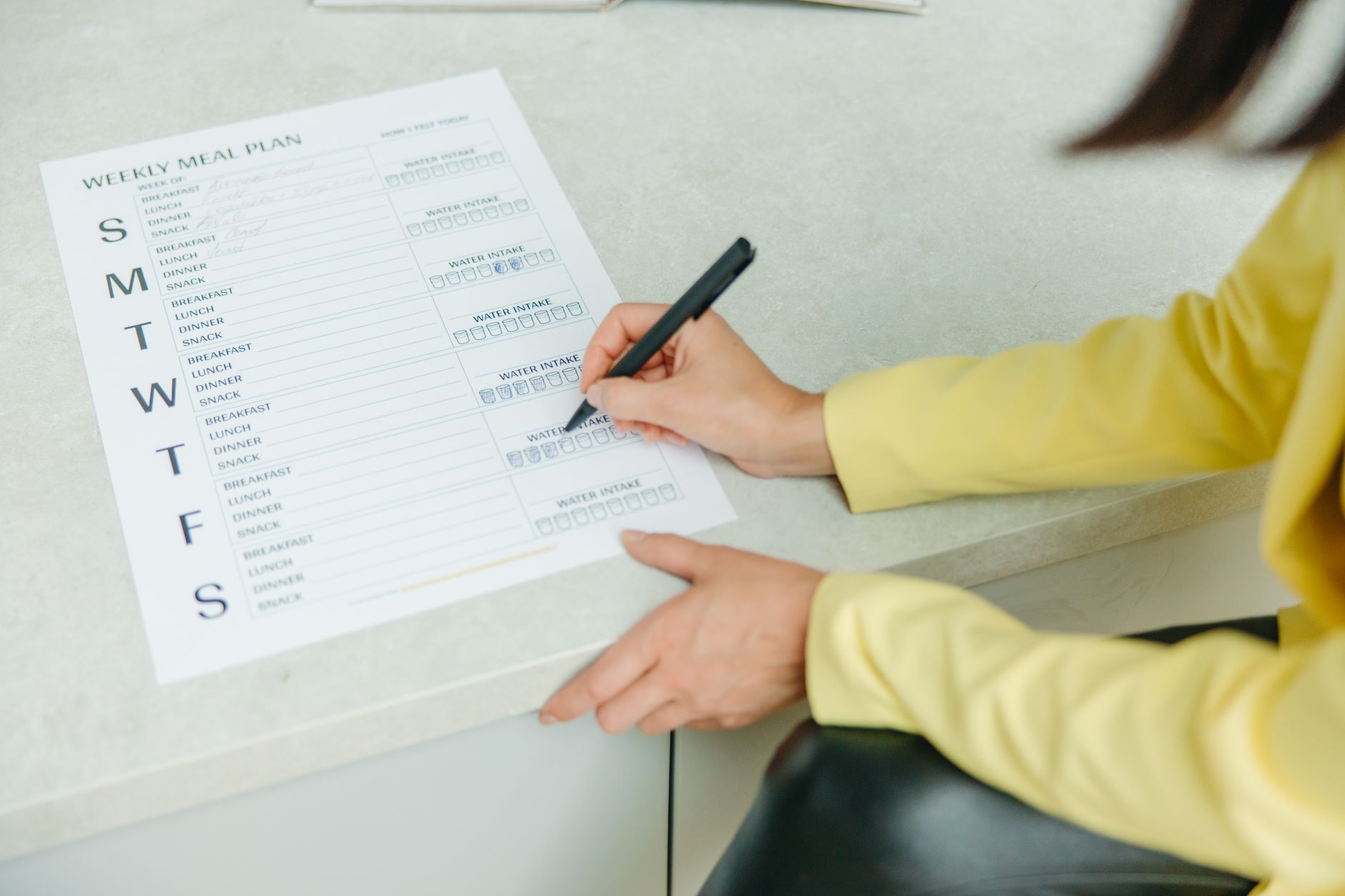
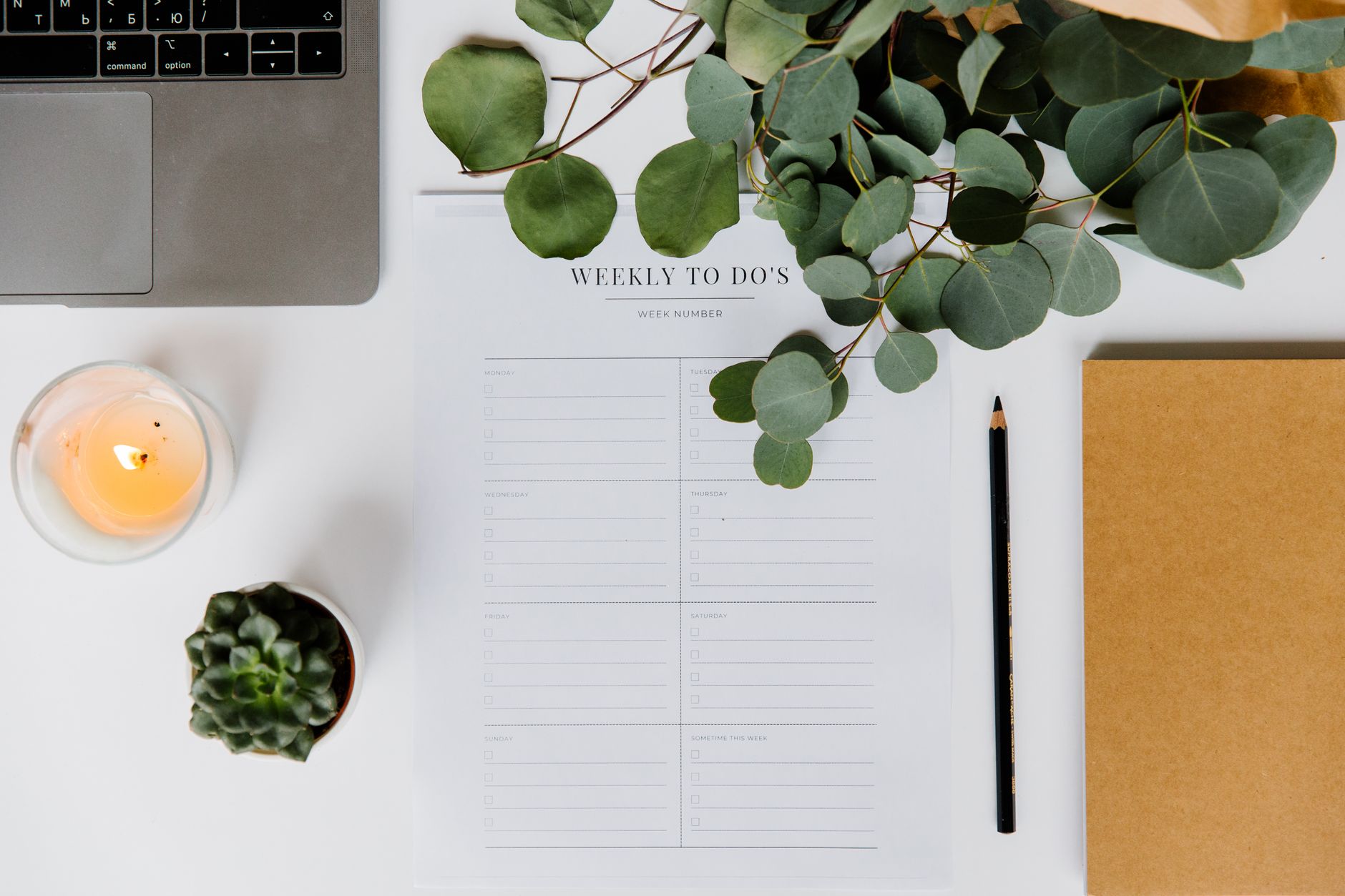
    Writing a monthly reset checklist for meals and home basics
    Use a single page for your home and meal mini-resets. Photo: Yaroslav Shuraev via Pexels.

    Pexels image by Yaroslav Shuraev. Source: https://www.pexels.com/photo/a-person-holding-a-black-pen-writing-on-white-paper-8844564/

    Monthly reset checklist: Calendar and time

    This second block gets your schedule aligned with what matters. It removes ghost meetings and protects deep work. Microsoft’s Work Trend Index reports persistent meeting overload and digital debt. A monthly view helps you right-size your schedule for the weeks ahead (Microsoft WorkLab: Work Trend Index).

    • Open a month view. Scan for heavy weeks. Add buffer days after travel or deadlines.
    • Cancel or decline meetings that no longer have a clear owner, agenda, or decision.
    • Batch recurring admin into one slot. For example, expenses on the 28th.
    • Time-block deep work for your top one or two goals. Protect at least two 90-minute blocks per week.
    • Schedule catch-up time after large meetings and at month midpoints.
    • Set one weekly review reminder and one mini-inbox clean reminder.
    • Note time-sensitive chores: filter swaps, renewals, travel prep, or school forms.
    • Share key dates with partners or teammates and confirm who owns what.

    Because you use intention and a wide view, you prevent overflow before it starts.

    Recurring commitments: keep, pause, or drop?
    Item Signal to keep Signal to pause Signal to drop
    Weekly meeting Decisions made and actions assigned No decisions for 2–3 weeks No owner, no agenda, no outcomes
    Class or club Energy and progress increase Neutral energy and schedule conflict Stress without benefit
    Newsletter Useful weekly signal Useful monthly only Never read; unsubscribe

    Want a deeper time-blocking guide? See how to protect deep work with calendar blocks.

    Monthly reset checklist: Money review

    This third block reduces money stress. It replaces vague worry with a simple review. You do not need a perfect system. You need one consistent routine. The Consumer Financial Protection Bureau offers straightforward budgeting tools and advice that you can adapt to your situation (CFPB: Budgeting tools and tips).

    • Reconcile accounts: match transactions and categorize the last month.
    • Schedule all known bills and add due-date reminders.
    • Check subscriptions. Cancel one you did not use.
    • Scan spending by category. Note one area to trim by a small amount next month.
    • Plan irregulars: gifts, travel, renewals, and annual services coming up in the next 90 days.
    • Transfer planned savings at the start of the month so you do not spend it by accident.
    • Capture money tasks in your system: claims to file, forms to sign, refunds to request.
    Money check cadence
    Task Monthly Quarterly Annually
    Reconcile & categorize Yes β€” β€”
    Subscriptions audit Quick scan Full review β€”
    Insurance/benefits check β€” Coverage skim Full policy review
    Tax prep folder clean Add docs Organize File/close

    For a simple budget starter, see Consumer.gov: Making a budget.

    Monthly reset checklist for your mind

    This final block clears mental clutter. It helps you end one chapter and start another. Keep it light, honest, and short. You are not writing a memoir. You are setting the next month up to work.

    • Write five wins from last month. They can be small.
    • Note three lessons. Keep each to one sentence.
    • List two things to continue and one to stop.
    • Pick one key theme for the new month. For example, β€œFinish and ship.”
    • Set two to four outcomes you can measure by month end.
    • Choose a quick digital declutter: mute one noisy chat, unfollow a stale feed, and trim one email newsletter.
    • Plan rest. Add one no-screen evening per week. Reducing task switching helps focus and reduces overload (APA on multitasking costs).

    Nielsen Norman Group has useful guidance on lists and task design that you can adapt to personal workflows (NN/g: To‑Do Lists and UX).

    Checklist boxes marked during a calm monthly reset checklist
    Short, clear steps beat long, vague lists. Photo: Nataliya Vaitkevich via Pexels.

    Pexels image by Nataliya Vaitkevich. Source: https://www.pexels.com/photo/close-up-photo-of-checklist-on-white-paper-6837789/

    Protect your data during the reset

    Also add a quick digital safety pass. It takes minutes and can prevent a month of headaches. The 3‑2‑1 backup strategy is a well-known baseline: keep three copies on two types of media with one offsite. See the U.S. CISA’s overview for a simple explanation (CISA: 3‑2‑1 backup strategy).

    • Back up your phone and laptop.
    • Export your password manager’s emergency kit (store securely).
    • Update your main apps and OS if pending.
    • Review recovery emails and phone numbers for key accounts.

    In addition, consider printing an access checklist for a trusted contact and storing it safely. A short note with where to find backups, how to reach your web host or bank, and what not to share can make a stressful day easier for everyone.

    How long should a monthly reset checklist take?

    Most people finish a core pass in 60–120 minutes. Start with 90 minutes. Because you will repeat it next month, you can leave deep tasks for later. If you are new, take two passes in the first cycle: one light, one deeper on the highest-friction area.

    Which tools should I use for the reset?

    Use whatever is fast for you. Some people like paper. Some like a notes or tasks app. Many do both: a one-page overview on paper and live tasks in an app. Keep your monthly list in the same place. Meanwhile, use a simple timer. Any phone timer works.

    Paper: One page per month in your planner or a printed sheet. Keep it visible where you actually start the reset.

    Apps: Use your calendar for events, a to‑do app for tasks, and a notes app for reflections. Create one tag or folder to group each month’s items.

    Storage: One folder per month labeled β€œYYYY‑MM,” with subfolders for finances, photos, and documents so you can file quickly during the session.

    Watch a monthly reset checklist walkthrough

    If the embed does not load, open the video here: Monthly Reset Checklist πŸ’œ Make one that works.

    Use this monthly reset checklist template

    Copy this structure into your planner or app. You can print it, too. Because it is short, you can see the whole month in one view.

    • Home: 10-minute sweep; landing zone; desk reset; restock; one fix; bag reset; quick dishes/laundry; desktop tidy; photo archive.
    • Calendar: Scan month; cancel or pause; batch admin; protect deep work; add buffers; weekly review; add time-sensitive chores; share dates.
    • Money: Reconcile; schedule bills; cancel one subscription; scan categories; plan irregulars; transfer savings; capture money tasks.
    • Mind: Five wins; three lessons; two continue; one stop; set theme; set outcomes; small digital declutter; plan rest.

    Monthly Reset Flow (90 minutes)

    Follow four calm blocks. Check the box, then move on.

    1. Home (20–25 min) β†’ surfaces, restock, one fix
    2. Calendar (20–25 min) β†’ cancel, block, buffer
    3. Money (25–30 min) β†’ reconcile, schedule, scan
    4. Mind (20–25 min) β†’ wins, theme, outcomes

    Tip: Play the same playlist each month to build a ritual.

    A 90‑minute reset, minute by minute

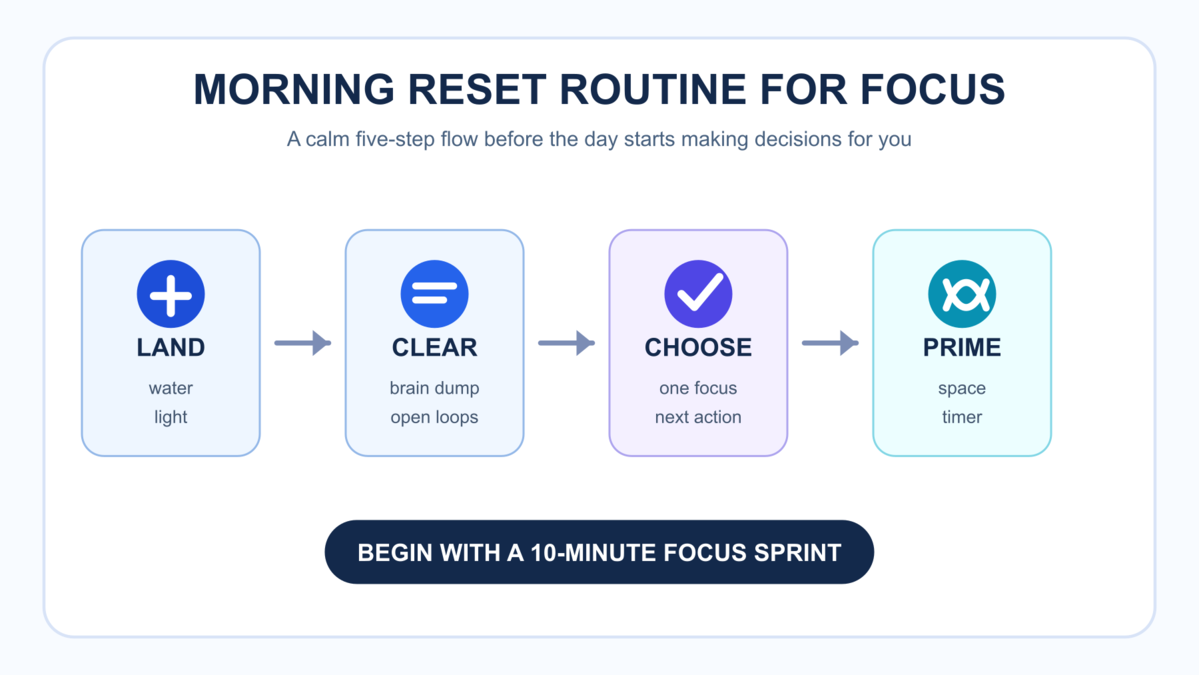
    00:00–03:00: Set the tone. Fill a water bottle, open your one‑page list, and start a calm playlist. A small ritual signals your brain that this is a focused session.

    03:00–10:00: Do the Home sweep. Clear the main surfaces you touch each day. Wipe, put away, and leave one small touchpoint better than you found it.

    10:00–15:00: Empty the landing zone to zero. Sort mail and receipts. Trash what you do not need. File what you must keep. Move at a steady, no‑drama pace.

    15:00–20:00: Reset the desk. Dust, manage cables, remove a single unused item. One less object equals one less distraction next week.

    20:00–25:00: Restock and fix one thing. Add printer paper, swap a sponge, or tighten a hinge. Quick maintenance prevents future friction.

    25:00–30:00: Transition. Stretch, breathe, and flip to Calendar. A brief pause keeps energy steady.

    Minutes 30–60: Calendar reset

    30:00–40:00: Scan a month view. Spot heavy weeks, travel, and deadlines. Add recovery buffers so the busy days do not spill into the next ones.

    40:00–45:00: Cancel and batch. Decline meetings without owners or agendas. Group admin into a single slot so small chores stop scattering your week.

    45:00–50:00: Protect deep work. Block two 90‑minute focus windows each week for your top goal. Name them so others see why they matter.

    50:00–55:00: Share the highlights. Send a short note or invite updates so partners or teammates know what changed.

    55:00–60:00: Transition. Stand, take a sip, and open your money tool of choice.

    Minutes 60–90: Money and mind reset

    60:00–70:00: Reconcile accounts. Categorize last month’s transactions and confirm balances. Close the loop while details are still fresh.

    70:00–75:00: Schedule bills and audit subscriptions. Add reminders and cancel one thing you didn’t use.

    75:00–80:00: Review categories. Pick one area to trim next month by a small, realistic amount. Small gains compound.

    80:00–85:00: Plan irregulars and move savings. Note gifts, renewals, or travel within 90 days and transfer planned savings now so it is not spent by accident.

    85:00–90:00: Mind reset. Write five wins, three lessons, and two to continue. Choose one theme and two to four measurable outcomes. Add one no‑screen evening for rest.

    Why this structure works

    This design reduces choices and batching costs. You do quick wins first so you feel lighter. Then you make one small improvement per area. Therefore you build momentum without burnout. Over time, the same monthly reset checklist compounds into cleaner spaces, better calendars, calmer budgets, and clearer minds.

    Common mistakes and easy fixes

    • Mistake: Trying to do a full deep clean. Fix: Keep a separate list for deep projects. Schedule one per month.
    • Mistake: Planning the perfect month. Fix: Add buffers and recovery time. Protect energy, not just hours.
    • Mistake: Skipping the money check. Fix: Set one small money win each month, like canceling one subscription.
    • Mistake: Writing vague goals. Fix: Set two to four outcomes you can measure by month end.
    • Mistake: Letting the list sprawl. Fix: Keep one page. If it does not fit, it does not ship.

    Deepen your reset (optional add‑ons)

    Home: If you have extra energy, do a 20‑minute pantry audit and a quick fridge shelf clean. This keeps food waste down and makes weekday meals simpler.

    Calendar: Run a brief meeting audit. Merge two touchpoints into one or shift a weekly to a biweekly if decisions are thin.

    Money: Draft a one‑page spending plan for the next quarter. Focus on three categories you can actually influence.

    Mind: Write a short month story: what happened, what mattered, and what is next. One paragraph is enough.

    Make it sticky: cues, rewards, and tracking

    Habits stick when the setup is obvious and the payoff feels good. First, create a visible cue: a calendar event on the last Friday or a printed card on your desk labeled β€œReset at 5 p.m.” Next, bundle a small reward: favorite tea or a playlist you only play during the session. Finally, track the streak. A simple checkbox or habit app builds momentum because you can see progress.

    If your month goes sideways, use an if‑then plan: β€œIf I miss Friday, then I’ll run a 60‑minute Saturday reset.” Friction is the enemy, so keep tools close: a labeled tray for mail, a notes template pinned in your app, and a saved calendar view for month scans. Environment beats willpower.

    Also, keep the checklist short. When it grows, decisions creep back in. Review quarterly, swap one weak item for one that removes a real blocker, and keep the core stable so you do not start from scratch each time.

    Run a light team reset without more meetings

    Teams can adapt the same rhythm in under 20 minutes. Share a one‑page doc with three prompts: what to stop, what to continue, and what to change next month. Each owner updates their section asynchronously before the last workday. Then a short stand‑up or comment thread handles conflicts and merges.

    For calendars, color‑code deep work blocks and agree on a default response for invites without agendas: tentative or decline. Keep a β€œparking lot” list for ideas that do not fit this month. If you must meet, schedule a single 15‑minute β€œCalendar Cleanup” and stick to decisions, not status updates.

    Finance‑wise, a shared checklist helps: invoice dates, expense deadlines, and renewals due. A consistent β€œbilling day” each month prevents end‑of‑quarter scrambles. The result is less thrash and more predictable weeks.

    Seasonal tweaks and life events

    Some months carry special weight. At quarter‑ends, add a slightly deeper money look: compare planned versus actual in two or three categories and adjust. During back‑to‑school, add forms, supplies, and carpool shifts to the calendar scan. Before major holidays, front‑load shipping dates and recovery buffers so rest actually happens.

    Travel‑heavy months benefit from extra buffers after flights and fewer recurring meetings in the middle weeks. Moving or renovation months call for a smaller core reset with a focus on documents, bills, and a tiny home surface you can control. The key is to keep the core identical while swapping one or two optional tasks that match the season.

    Even quiet months matter. Use them to simplify: unsubscribe from a stale newsletter, archive old project folders, or shorten a recurring meeting you now outgrew. Consistency, not intensity, builds the payoff.

    How do I keep my monthly reset checklist fresh?

    Review it quarterly. Replace any item you always skip with something you will actually do. In addition, you can rotate one deep task per area each month so you do not get stuck on the same problem. Keep the core short and stable.

    Will this work for families or teams?

    Yes. Share the list and give each person one clear role. For families, share calendar highlights and money tasks that affect everyone. For teams, adapt the list to shared calendars and recurring project reviews. Use the same rhythm to reduce uncertainty and last-minute rushes.

    Examples: three ways to run the reset

    Choose your reset style
    Style When How it feels Best for
    Solo sprint Sunday morning Quiet and focused Individuals with busy weekdays
    Partner power-hour Weeknight Short and social Shared homes, shared bills
    Team reset Last workday Aligned and clear Projects and small teams

    Frequently asked questions

    What should be on a monthly reset checklist?

    Include four parts: Home (quick tidy and restock), Calendar (scan and block), Money (reconcile and plan), and Mind (reflect and set outcomes). Keep the whole list on one page.

    How often should I update my monthly reset checklist?

    Update it quarterly or when life changes. Swap an item that does not help for one that removes a real blocker you noticed.

    Can I do the reset in two sessions?

    Yes. Do Home and Calendar in one 45-minute session, then Money and Mind in the next. Split across two days if that feels better.

    What if I fall behind?

    Do a β€œhalf reset.” Pick the one area that would make everything else easier. Finish that, then return to a full reset next month.

    Should I include health or fitness items?

    You can add non-medical planning items such as scheduling walks or blocking rest days. Keep medical guidance to your clinician’s advice.

    Next steps

    Save this page, copy the template, and schedule your first 90‑minute session. To keep momentum, explore these guides: Tips to reduce screen time for better focus, Protect deep work with smarter calendar blocks, Build a simple focus routine you can stick to, and Remote‑work productivity tips and techniques.

    Finally, make it yours. Adjust the monthly reset checklist after your first run. Keep what works. Remove the rest. Because it repeats, small gains add up month after month.

  • Brain Dump Checklist: Turn Mental Noise Into a Clear Next Step List

    Brain Dump Checklist: Turn Mental Noise Into a Clear Next Step List

    If your thoughts feel loud and scattered, this brain dump checklist will help you capture everything and turn it into a clear next-step list you can act on today. Because your head is not a storage unit, you need a simple flow: capture, clarify, organize, and review. As a result, youÒ€ℒll free up attention, reduce decision fatigue, and make steady progress without carrying it all in working memory.

    Brain Dump Checklist: Key Takeaways

    • A brain dump works because it offloads short-term memory and reduces mental friction so you can think and act with more clarity.
    • Use a repeatable checklist: Capture everything, Clarify meaning, Organize outcomes, Review next steps.
    • Start with a 10-minute timer, a trigger list, and a simple way to tag items as Next Action, Project, Calendar, Waiting, or Reference.

    What is a thought download checklist?

    A brain dump checklist is a short, structured set of prompts and steps you run every time you want to unload mental clutter. Instead of keeping tasks, worries, and ideas in your head, you put them in a trusted place. Then you clarify each one and sort them into the right bucket. Therefore, you finish with a tidy list of concrete next steps you can start now, not a chaotic wall of sticky notes.

    Many people meet this idea through the GTD mind sweep, Bullet Journal rapid logging, or a simple notepad. The method is flexible. However, the repeatable checklist is what ensures you capture everything, not just the easiest items.

    Why Does a Brain Dump Checklist Work?

    There are three helpful ideas behind this practice:

    • Cognitive offloading: When you record information outside your head, you free up limited working memory for problem-solving. Research on cognitive offloading explains why tools like lists and reminders reduce mental load and errors. See a review in Trends in Cognitive Sciences for a plain-language overview of how and why this works (Trends in Cognitive Sciences).
    • Working memory is limited: Your mind can only hold a handful of items at once. Writing things down removes that bottleneck so you can focus. The APAÒ€ℒs entry on working memory is a useful primer (American Psychological Association).
    • Zeigarnik effect: Unfinished tasks tend to stay mentally active. A clear capture-and-clarify loop reduces that nagging open loop. Britannica has a concise explanation (Encyclopaedia Britannica).

    Because of these factors, a consistent checklist becomes a light, reliable way to reduce cognitive load and get into focused work faster.

    The 4-step brain dump checklist

    Use this simple flow every time:

    1. Capture: Get everything out without judging. Words, fragments, tasks, worries, ideas.
    2. Clarify: Ask Ò€œWhat does this mean?Ò€ and Ò€œIs there a next step?Ò€ Keep it short.
    3. Organize: Sort into Next Action, Project, Calendar, Waiting For, or Reference.
    4. Review: Pick 1Γ’β‚¬β€œ3 next steps you will do today, and schedule the rest.

    Principles that keep the checklist light

    • Keep capture and clarify separate. Also, do not organize while you dump.
    • Use short, plain words. Because speed beats perfection in this step.
    • Set a timer to limit the session and avoid overthinking.
    A minimalist notebook ready for quick capture.
    Use a simple page to run your checklist. Photo by Nataliya Vaitkevich via Pexels.

    How Do You Run a Brain Dump Checklist in 10 Minutes?

    HereÒ€ℒs a quick-start you can run during a break or before you log off for the day. This 10-minute brain dump checklist acts like a reset button when you feel overloaded.

    1. Set a 3-minute timer for pure capture. Write everything, one line per thought. Do not sort yet.
    2. Set another 3-minute timer for clarify. Add a few words to each line so the meaning is obvious tomorrow.
    3. Set 2 minutes to star the 1Γ’β‚¬β€œ3 items you will do next. Keep it small.
    4. Use the last 2 minutes to move starred items to your Next list or todayÒ€ℒs calendar.

    Therefore, in 10 minutes you reset your head, pick a path, and prevent tomorrowÒ€ℒs you from starting in a fog.

    Brain Dump Checklist Trigger Prompts

    Trigger prompts help you remember what you would otherwise miss. The official GTD Mind Sweep Trigger List is a thorough starting point (GTD Trigger List PDF). Adapt it to your life using the prompts below.

    Trigger prompts by life area
    Area Prompt Examples
    Work Deadlines, meetings, stakeholders Prep Q3 brief; schedule 1:1s; send handoff email
    Home Repairs, supplies, routines Fix loose handle; order filters; laundry rhythm
    Admin Bills, renewals, paperwork Update license; expense receipts; renew domain
    Health & energy Sleep, meals, movement Plan grocery list; book a walk with a friend
    Learning Courses, books, skills Outline next module; capture reading notes
    Errands Stores, pickups, deliveries Pick up package; return item; buy stamps
    Waiting For Follow-ups and replies Reply from Alex; new laptop ETA; invoice status

    Because your life changes, your triggers should change. Add or remove prompts until your printable checklist makes you think Ò€œOh right, that!Ò€ two or three times each run.

    Turn a thought download checklist into next steps

    After the capture, move line by line and decide what each one is. Use the five simple outcomes below. This is adapted from GTDÒ€ℒs organize stage, which keeps your system tidy without overbuilding it.

    From raw thought to concrete outcome
    Raw thought Outcome bucket Example next step
    Ò€œTeam offsite?Ò€ Project Create doc: Offsite agenda draft
    Ò€œLeaky faucetÒ€ Next Action Text landlord photo of leak
    Ò€œDentist checkupÒ€ Calendar Book appointment for any weekday morning
    Ò€œWaiting on logo filesÒ€ Waiting For Ping Eliza: logo files status
    Ò€œInteresting AI bookÒ€ Reference / Someday Add to reading queue with a one-line note

    Therefore, you end with an actionable list, a short projects list, and fewer open loops. A small, steady routine ensures you always know what to do with what you captured.

    Avoid these mind sweep checklist mistakes

    • Sorting while you capture. Instead, finish capture, then clarify.
    • Writing vague lines. Also, add 3Γ’β‚¬β€œ6 words to make the meaning obvious.
    • Skipping the review. Finally, choose 1Γ’β‚¬β€œ3 next steps before you stop.

    Paper vs app: tools to run your mind sweep checklist

    Use whatever you will open daily. Because tools shape behavior, match them to your context.

    Paper and app options for your checklist
    Tool Best for Pros Consider
    Notebook + pen Quick capture anywhere Zero friction; no battery; natural Manual transfer to lists later
    Notes app (Apple/Google) Ubiquitous, simple Syncs across devices; fast Easy to clutter without tags
    Todoist/Things Action-focused people Quick next-step sorting; dates Projects view can tempt over-structure
    Notion Builders and documenters Flexible databases; tags; templates Setup time; keep the checklist short
    Obsidian Linked notes and ideas Backlinks; plain text; plugins Requires a light process to avoid sprawl

    If you prefer a one-page weekly database, create a Notion page that pairs your brain dump with a simple Next Actions gallery. For a ready pattern, see how we map a week in our planning articles, then adapt that simple shape to your own board. Also, if youÒ€ℒre rebuilding your deep work routine, you may like our guide on staying focused during intense reading; it shows how to protect attention once your list is clear (maintain deep focus while reading dense technical specs).

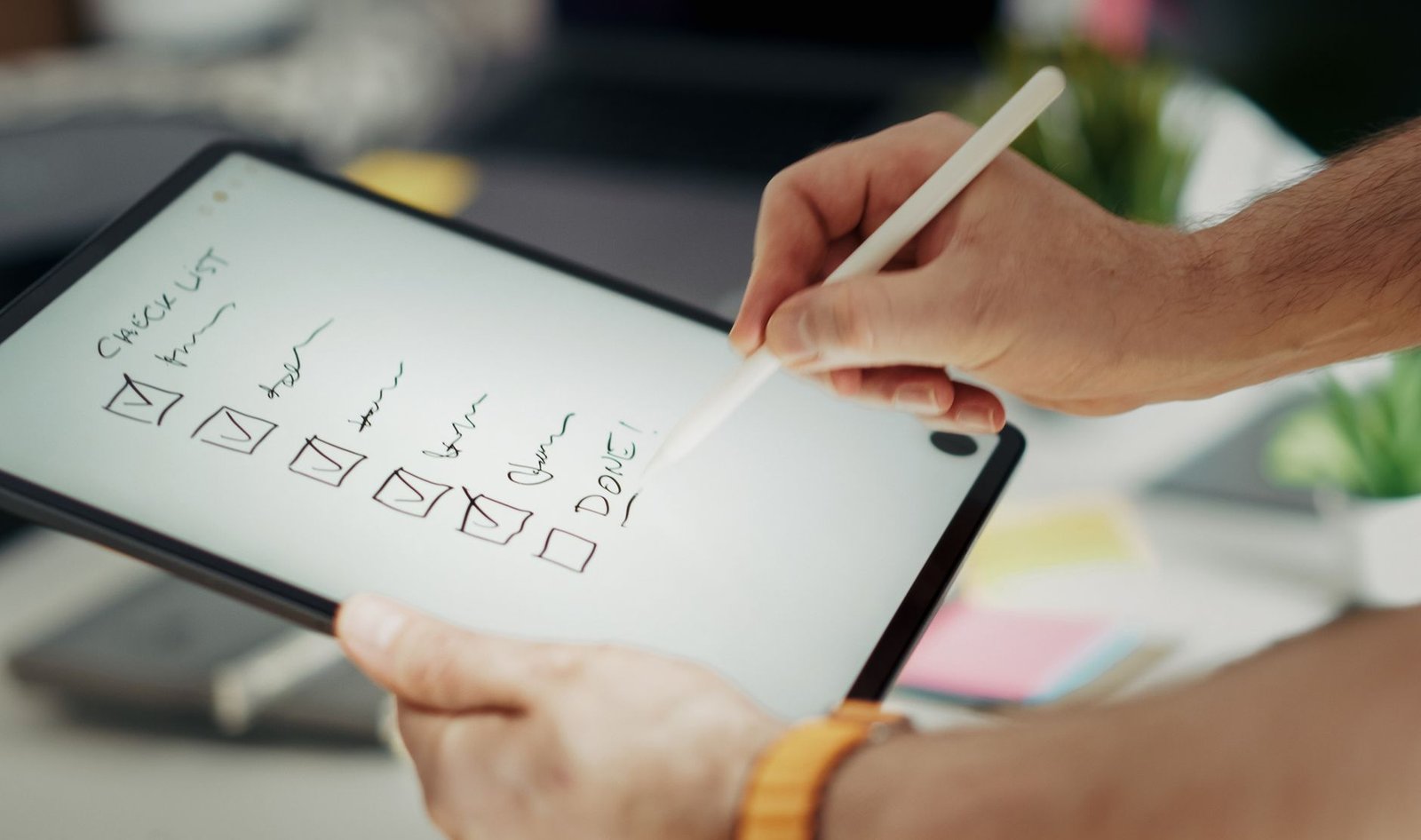
    Hand writing a checklist in a notebook to plan next steps.
    Keep the flow fast: capture now, clarify later. Photo by Jakub Zerdzicki via Pexels.

    Brain Dump Checklist Deep Dive: Capture to Review

    The four steps look simple. Yet each step hides small choices that make or break the session. Use the guidance below to keep momentum and avoid rework.

    Brain Dump Checklist Step 1: Capture

    • Write one short line per thought. Fragments are fine. Do not edit.
    • Prefer verbs. For example, write Ò€œEmail supplierÒ€ instead of Ò€œsupplier.Ò€
    • Use a timer. It creates a clear boundary and stops perfectionism.
    • Scan your inbox and calendar for 60 seconds. Add anything that tugs.
    • Close apps and tabs for this step. Fewer cues, cleaner dump.

    Tip: If your mind goes blank, use three quick lensesÒ€”work, personal, and adminÒ€”and list one thing for each. It will unstick the flow.

    Brain Dump Checklist Step 2: Clarify

    • Ask two questions: Ò€œWhat is this?Ò€ and Ò€œWhatÒ€ℒs the next visible step?Ò€
    • Keep next steps physically small (under 15Γ’β‚¬β€œ20 minutes when possible).
    • For a multi-step outcome, mark it as a Project and define the very first step.
    • For an item tied to a specific date or time, move it to your calendar.
    • When an item needs someone else first, move it to Waiting For and add a follow-up date.

    Good clarification converts fog into motion. It should take seconds per line, not minutes.

    Brain Dump Checklist Step 3: Organize

    1. Use five buckets: Next Action, Project, Calendar, Waiting For, Reference.

    2. Tag Next Actions with a context (e.g., @Laptop, @Errands, @Calls).

    3. Give Projects a clear outcome, a why, and the next visible step.

    4. Move Reference to its home (notes app, wiki, or a folder) the same day.

    5. Batch Waiting For items and review them at set times.

    Fewer buckets reduce thinking overhead. The buckets above cover nearly all cases without needing a complex system.

    Brain Dump Checklist Step 4: Review

    • Pick 1Γ’β‚¬β€œ3 Next Actions for today. Choose low-resistance items first.
    • Schedule or defer the rest. If it matters, give it a slot.
    • Close the loop. Put tools away and start the first chosen task.

    By ending with a short action list, you reduce choice overload and build trust in your system.

    Decision rules that remove friction

    When decisions are pre-made, you think less and move faster. Use the rules below whenever you sort items. A short set of rules keeps your brain dump checklist smooth under pressure.

    Simple decision rules for clarify and organize
    Rule Use it when… What to do
    Two-minute rule Task is tiny and clear Do it now instead of tracking it
    Single vs multi-step test You are unsure if it is a Project If more than one step, create a Project and define the first step
    Calendar test It must happen on a date/time Put it on the calendar or set a dated reminder
    Ownership check Someone else must act first Move to Waiting For and add a follow-up date
    Reference vs action test Information has no action File it in Reference and add a one-line note if needed
    Energy match Your energy is low Pick the easiest Next Action to create momentum

    Use contexts and energy tags

    Contexts tell you where a task fits best. Energy tags tell you when to do it. Together they stop you from staring at a long list.

    1. Contexts: @Laptop, @Phone, @Errands, @Home, @Office, @DeepWork.

    2. Energy: High, Medium, Low. Add a simple label after the task.

    3. Use cases: During a short break, filter to @Phone + Low and make two quick calls.

    As a result, you pick actions that fit the moment instead of forcing hard work at the wrong time.

    Make the thought download checklist a habit

    Habits form when the cue and the action are tight. Keep the ritual small and linked to an existing step.

    1. Cue: End of workday chime, first coffee, or opening your planner.

    2. Action: Start a 3-minute capture. Set a timer before writing.

    3. Reward: Tick a small Ò€œDoneÒ€ box, close your laptop, or play a short song.

    4. Environment: Keep your capture tool open by default.

    Because the ritual is short, you will use it even on busy days. Consistency is more valuable than a perfect session.

    What routine keeps your system working?

    A light weekly review maintains trust. Meanwhile, a short daily check keeps momentum without micromanaging life. A simple cadence keeps your brain dump checklist working week after week.

    Daily and weekly review rhythm
    Cadence Time Checklist
    Daily shutdown 10 minutes Run a mini brain dump; star 1Γ’β‚¬β€œ3; calendar check
    Weekly review 30Γ’β‚¬β€œ45 minutes Full brain dump; clarify; organize; plan next week
    Monthly reset 45Γ’β‚¬β€œ60 minutes Archive done; prune someday; refresh triggers

    Because remote work blurs edges, many readers stack a 5-minute capture before lunch and a 10-minute capture at shutdown. It pairs well with a short attention reset routine (try an attention reset) and a weekly planning pass (Notion weekly planner template ideas).

    Adapt the mind sweep checklist to your role

    Students

    1. Use course codes as tags (BIO201, HIST110). Add @Study, @Lab, @Group.

    2. During capture, scan your syllabus for due dates and add them to Calendar.

    3. Break large assignments into 20Γ’β‚¬β€œ30 minute chunks to avoid last-minute rush.

    Managers

    1. Split capture into People, Projects, Metrics. Add 1Γ’β‚¬β€œ2 items per person weekly.

    2. Batch Ò€œWaiting ForÒ€ follow-ups to two windows each day to cut context switching.

    3. Turn recurring 1:1 notes into a mini checklist so prep is quick and repeatable.

    Parents and caregivers

    1. Keep a shared family list for errands and appointments.

    2. Use @Phone + Low to make quick bookings while waiting in lines.

    3. Review the calendar with others once a week to reduce surprises.

    See a week-long experiment

    HereÒ€ℒs a short video diary where a creator tries a daily brain dump for a week. Watch how a simple list lowers friction and creates motion.

    Open the video in a new tab

    Copy-and-run brain dump checklist templates

    Use the templates below as a starting point. Then edit them to fit your day.

    Paper template (index card or A5)

    1. Header: Date and Ò€œBrain DumpÒ€

    2. Timer: 10 minutes total (3 capture + 3 clarify + 2 star + 2 move)

    3. Sections: Work / Home / Admin / Waiting / Ideas

    4. Footer: Ò€œChoose 1Γ’β‚¬β€œ3 nowÒ€ checkbox row

    App template (Notion/Todoist)

    1. Fields: Text, Tag, Outcome (Next, Project, Calendar, Waiting, Ref), Due

    2. Views: Inbox (unclear), Next (due soon), Waiting (follow-ups), Projects

    3. Automation: Today view filters Outcome = Next and Due Ò‰€ today+2

    Build it in your favorite app

    Notion setup in 5 minutes

    1. Create a database named Ò€œCapture.Ò€ Add properties: Tag (multi-select), Outcome (select), Due (date), Energy (select), Context (select).

    2. Add a Gallery view for Projects and a Table view for Next Actions.

    3. Create a filter for the Today view: Outcome is Next AND (Due is empty OR Due is within 2 days).

    4. Add a template button that pre-fills Outcome = Next and Energy = Medium.

    5. Save a Weekly Review template page with a short checklist and link your Capture database inside it.

    Once this is set, running the brain dump checklist takes less time than thinking about it. You press a template, type, sort, and start.

    Todoist or Things

    1. Create a Project called Ò€œInboxÒ€ for raw capture. Keep it at the top.

    2. Use Sections for Next, Waiting For, and Projects (or use labels like @waiting).

    3. Create filters: Ò€œToday+2Ò€ and Ò€œWaiting:overdueÒ€ for quick scans.

    4. Use the mobile widget so a new task is one tap away.

    5. During clarify, add one verb to each task so it is obvious later.

    Notes app

    1. Pin a single note called Ò€œCapture.Ò€

    2. Start lines with a hyphen and one verb. Keep it plain text.

    3. At review time, move actions to your calendar or task app. Archive the note weekly.

    How Do You Troubleshoot a Brain Dump Checklist?

    1. Ò€œI donÒ€ℒt know where to start.Ò€ Set a 2-minute timer and write three fragments. Momentum beats clarity at the start.

    2. Ò€œMy list is too long.Ò€ Limit daily picks to 1Γ’β‚¬β€œ3. Move the rest to Projects or Next without guilt.

    3. Ò€œI keep rewriting the same items.Ò€ Add a small why beneath the task or turn it into a calendar block.

    4. Ò€œI forget to review.Ò€ Tie review to a fixed cue (shutdown alarm, last meeting).

    5. Ò€œI overbuild the system.Ò€ Keep five buckets. If you add more, prune them during the monthly reset.

    Measure progress

    You do not need complex analytics. A few light metrics show whether the checklist helps.

    1. Daily picks: Did you choose 1Γ’β‚¬β€œ3 and do at least one? Yes/No.

    2. Review streak: How many days in a row did you run capture?

    3. Open loops: Count of Waiting For items. Is it shrinking weekly?

    4. Stress note: One line at shutdown: lower, same, or higher than yesterday.

    As the numbers stabilize, you will feel more in control. If they drift, simplify the flow.

    How remote workers can tune the mind sweep checklist

    1. Use work and personal sections so you can close the laptop cleanly.

    2. Batch Ò€œWaiting ForÒ€ items and follow-ups to two windows per day.

    3. Protect focus blocks. Also, reduce screen time during deep work (digital detox strategies).

    How we built this simple brain dump checklist

    We blended field-tested systems (GTDÒ€ℒs mind sweep and Bullet JournalÒ€ℒs rapid logging) with cognitive offloading research and kept only what helps in a busy digital day. For source materials, see the GTD Trigger List (official PDF), Bullet Journal basics (Bullet Journal Learn), a review of cognitive offloading (Trends in Cognitive Sciences), the APA on working memory (APA dictionary), and Britannica on the Zeigarnik effect (Britannica).

    Frequently asked questions

    What is the difference between this process and a to-do list?

    A brain dump checklist is a process for unloading and sorting everything in your head. It includes prompts and steps. A to-do list is the result of that process: clear, actionable items. Therefore, run the dump first, then shape a small list for today.

    How often should I run my brain dump checklist?

    Use a 5Γ’β‚¬β€œ10 minute version daily (often at shutdown) and a longer 30Γ’β‚¬β€œ45 minute version weekly. Also, run a quick capture any time you feel scattered. Because the checklist is short, it takes less time than wrestling with mental clutter.

    Can I do a mind sweep without GTD?

    Yes. You can use the same capture Ò†’ clarify Ò†’ organize Ò†’ review loop without adopting GTD wholesale. The checklist exists to give you a reliable routine, not to lock you into a complex system.

    What if my list gets too long?

    Limit outcomes. Move only 1Γ’β‚¬β€œ3 items to Ò€œToday,Ò€ park the rest on Next or Projects, and schedule when needed. In addition, prune your Ò€œSomeday/MaybeÒ€ list during the monthly reset so your system stays light.

    Is there a best time of day to run it?

    Two good slots are first thing in the morning and the daily shutdown. Morning sets direction. Shutdown clears leftovers and protects off-hours. Choose one and stick with it so the habit runs on autopilot.


    Next steps

    1. Print or save your own one-page brain dump checklist.

    2. Pick a 10-minute slot today and run it once. Then star 1Γ’β‚¬β€œ3 items.

    3. Protect two focus blocks this week. If you need help, try our deep focus guide.

    4. Reduce ambient noise in your day with a light digital detox strategy.

    5. Set up a simple weekly board: start with our Notion weekly planner template ideas.

    Finally, keep this thought: your brain is for thinking, not for storage. A small, steady brain dump checklist turns noise into motion.

    Helpful resources for your next step

    Affiliate disclosure: As an Amazon Associate, Mind Clarity Hub may earn from qualifying purchases at no extra cost to you. Use this link only if it genuinely helps your planning.

    If Brain Dump Checklist: Turn Mental Noise Into a Clear Next Step List is a routine you want to keep using, a simple workbook, planner, or desk tool can make the steps easier to repeat.

    Compare related planners, workbooks, and organization tools on Amazon.

  • Desk Organization Ideas for Focus: What to Keep, Move, and Remove

    Desk Organization Ideas for Focus: What to Keep, Move, and Remove

    If you want steady attention without the constant pull of clutter, these desk organization ideas for focus will help you build a clear, calm workspace you can reset fast. In this guide, you will learn what to keep within reach, what to move into drawers or shelves, and what to remove entirely so your eyes and hands meet only what matters in the moment.

    Think of your desk as a control panel. If every knob and switch is labeled and placed on purpose, you can start quickly and stay in flow. A simple system, backed by a few ergonomic checkpoints, turns order into your default. As a result, your brain stops negotiating with small messes, you reduce micro-decisions, and you move through work with a steadier rhythm.

    Key takeaways for a focus-friendly desk setup

    • Decide your primary task for the next block and stage only those tools.
    • Use the Keep–Move–Remove rule to clear visual noise in minutes.
    • Create three zones: Immediate Reach, Near Reach, and Off-Desk Storage.
    • Place one capture tool (notepad or app) within your dominant-hand reach.
    • Anchor cables and hide spares to remove micro-distractions.
    • End each day with a 3-minute reset so tomorrow starts clear.

    Why desk organization ideas for focus work

    Visual clutter competes for your attention. When the visual field holds too many unrelated items, your brain must filter and refocus more often. That switching costs time and mental energy. Also, a clean, orderly space primes you for more deliberate choices. For example, research in Psychological Science found that neat environments nudged people toward healthier, more conventional choices, while messy ones nudged creativity but also impulsivity (Vohs, Redden, Rahinel, 2013; DOI link).

    Because body position also shapes comfort and concentration, combine tidy surfaces with sound ergonomics. Mayo Clinic’s office ergonomics guide explains how to align chair height, monitor distance, and keyboard position to reduce strain that breaks focus (Mayo Clinic: Office ergonomics). For specific workstation details, OSHA’s computer workstations eTool shows safe placements for screen, mouse, and chair (OSHA eTool).

    Finally, visual simplicity improves scanning. In UX research, removing visual clutter reduces cognitive load and makes the important content pop (Nielsen Norman Group: Visual Clutter). The same principle applies to your desk: fewer, clearer signals make the next right action obvious.

    When you make order predictableβ€”same places, same labelsβ€”you teach your attention where to look. That is why simple, repeatable placement rules beat one-time purges. You save effort today and also tomorrow, because your hands and eyes learn a consistent path.

    Keep–Move–Remove: a rule for an organized desk for deep work

    Use this 3-step filter to stage any task and recover calm quickly. It is simple, repeatable, and merciless on noise.

    1. Keep: Items you will use in the next 60–90 minutes for the current task block.
    2. Move: Tools you use often, but not this block. Place them in near drawers, trays, or a shelf within 1–2 arm lengths.
    3. Remove: Anything unrelated to the work at hand, duplicates, and decor that crowds your sightline. Store off-desk or let it go.

    Because this is a decision rule, not a one-time purge, you can apply it every time you shift work modes. That habit is the engine behind all desk organization ideas for focus.

    To calibrate the rule, think in β€œblocks.” For example, a one-hour writing block needs only your outline, draft, and capture pad. A planning block needs your calendar and one worksheet. A meeting block needs an agenda, timer, and notes app. By naming the block first, you decide the few tools that qualify as β€œKeep,” which makes saying β€œMove” or β€œRemove” easier.

    Also, set a visible cue to trigger the rule. A small sticky note on your monitor bezel with β€œK–M–R?” or a 60-second phone reminder at the top of each block can be enough to spark action without thinking.

    What to keep for desk organization ideas for focus

    Keep only what reduces friction for the very next action. That usually means:

    • Your primary screen and one input device (keyboard/mouse or laptop trackpad).
    • One capture tool: a small notepad or a single notes app open for quick thoughts.
    • A water bottle or mug, placed to avoid spills near electronics.
    • Lighting you control (task lamp aligned to your non-dominant side to reduce shadows).
    • One small, meaningful object if it genuinely calms you. Keep it low-profile.

    Therefore, if you are writing, keep the outline, manuscript, and reference notes. Coders can keep the IDE and issue list. For planning, keep the calendar and a single worksheet. Everything else moves down a zone or goes away until you need it. When in doubt, ask, β€œWill I touch this in the next 60 minutes?” If not, move it.

    What to move in desk organization ideas for focus

    Move these to drawers, vertical file sorters, or a shelf within easy reach:

    • Chargers, spare cables, and adapters in a single labeled pouch or cable box.
    • Reference notebooks and current project folders in a thin vertical sorter.
    • Writing tools in a shallow drawer tray, not a cup that invites clutter.
    • Headphones on a hook under the desk or along a shelf edge.
    • Sticky notes and index cards stacked in a drawer divider.

    Also, store backups and less-used tools farther away. The more steps it takes to retrieve an item, the stronger your intention should be to use it. That placement rule supports desk organization ideas for focus without extra willpower. If you frequently reach for something stored far away, promote it to Near Reach and demote something else.

    What to remove for desk organization ideas for focus

    Remove items that hijack attention or block movement:

    • Old coffee cups, spare plates, or food wrappers.
    • Decor that crowds your monitor edges or blocks light.
    • Stacks of unsorted paper. Batch-process these weekly in a dedicated block.
    • Duplicate pens, cords, or gadgets. Keep your favorites and donate the rest.
    • Loud desk toys, unless you rely on them for fidgeting. Even then, place them away from the main sightline.

    Instead of fighting habits, reroute them. If you doodle, keep a single doodle pad and recycle old pages weekly. Snack at your desk? Set a small, washable coaster in a consistent, spill-safe spot. For variety, rotate one personal item monthly so your space stays fresh without growing crowded.

    Zone your workspace for desk organization ideas for focus

    Think in three concentric zones. This layout reduces choices and saves reach time.

    • Immediate Reach (Zone A): Hands rest here. Keyboard, mouse, writing pad, and the current document live in this zone.
    • Near Reach (Zone B): One or two arm lengths. Drawers, a vertical file, and a small supply tray sit here.
    • Off-Desk Storage (Zone C): Shelves, bins, or a cabinet for archived files, backups, and seasonal gear.

    Because each zone has a purpose, you stop re-deciding where things go. That is the hidden power behind desk organization ideas for focus: structure that makes order the default.

    Item Recommended Zone Why
    Laptop/Monitor Zone A Primary work surface and view
    Keyboard & Mouse Zone A Fine motor control; keep neutral posture
    Notepad / Capture pad Zone A Quick ideas without switching apps
    Headphones Zone B Grab fast; not blocking your view
    Reference folder Zone B Open when needed; store upright
    Spare cables Zone C Only needed occasionally
    Archived papers Zone C Keep off the desk entirely

    Left-handed or right-handed? Mirror your layout so your capture pad and mouse match your dominant hand. If you use a drawing tablet, treat it as a Zone A tool during creative blocks and slide it to Zone B afterward. Small sliders or felt pads under trays make these moves silent and easy.

    Ergonomics for a focus-friendly desk setup

    Good ergonomics keep you focused by removing aches and strain that pull you out of flow. Use these well-supported placements:

    • Set monitor top at or slightly below eye level. Keep the screen about an arm’s length away (OSHA: Monitor placement).
    • Keep shoulders relaxed, elbows near your sides, and wrists straight. Adjust chair height so thighs are parallel to the floor (Mayo Clinic: Chair & desk height).
    • Place the mouse close to the keyboard and at the same height to reduce reaching (OSHA: Input devices).

    Light matters, too. Aim for adjustable task light that does not glare on the screen. Reduce reflections by placing lamps to the side of your monitor, not behind it. Stand and stretch between blocks to reset posture. These small changes prevent the micro-discomforts that can chip away at attention.

    10-minute reset for an organized desk for deep work

    Use this mini-process any time your space starts to sprawl. It keeps momentum without a big cleanup.

    1. Stage the current task (2 minutes): Put the single most important document or app front and center.
    2. Keep (3 minutes): Return only what serves the next hour.
    3. Move (3 minutes): File project folders upright; return tools to drawer dividers.
    4. Remove (2 minutes): Trash, recycle, or bin items for later donation.

    As a result, you cap clutter before it multiplies. This short ritual reinforces all desk organization ideas for focus with almost no effort.

    If 10 minutes feels long, run a β€œ2–2–2–2–2” pass (two minutes per step). Speed beats perfection. The goal is to reset the stage so the next block begins without friction.

    What belongs in each drawer for a focus-friendly desk setup

    Assign a job to every drawer. Then label the front lip with a short word so you do not need to think.

    Drawer Contents Tips
    Top right (dominant hand) Everyday tools: 2 pens, highlighter, sticky tabs, small stapler Use a shallow tray; limit each slot to 1–2 items
    Top left Headphones, timer, microfiber cloth Coil cords; add a small sachet for dust control
    Middle Project folders A–D Upright dividers prevent piles
    Bottom Tech pouch: chargers, spare mouse, backup drive One labeled pouch keeps cables invisible

    Keep drawer labels ultra-clear: β€œWrite,” β€œAudio,” β€œProjects,” β€œTech.” If it takes more than a second to decide where a tool lives, the label needs work. Color cues can help, but words beat color alone. The aim is to make returning an item so obvious that you do it on autopilot.

    Use a single capture lane for desk organization ideas for focus

    Because stray ideas pop up during focused work, give them one home. Keep a half-sheet notepad or a single notes app in Zone A. Write it, park it, and return to the task. Later, process these notes into your task manager or calendar.

    Make the capture lane a one-way street. You only write in it while working. You do not organize it until the block ends. This small boundary keeps you from slipping into planning mode when you should be producing.

    How much decor is too much?

    Start with one calming object, one plant, or one photo. Observe for a week. If your eyes drift too often, reduce. If your mood lifts without breaking flow, keep it. Also, place decor out of your main sightline. Meanwhile, avoid tall items beside the monitor that create visual edges you will keep checking.

    If you value inspiration, rotate a single quote card weekly rather than pinning many at once. Novelty keeps motivation high without turning the desk into a bulletin board.

    Power and cables in a focus-friendly desk setup

    Cables create visual noise. Hide length inside a simple under-desk raceway or a cable box. Use short Velcro ties and label both ends of each cord. Finally, keep one spare charging cable in the tech pouch rather than draped across the desk.

    To route once and forget: measure cable paths, stick the raceway, drop excess length inside, and add a small label near the power strip (β€œMonitor,” β€œLaptop,” β€œLamp”). If a device fails, you can diagnose fast without pulling everything apart.

    Organizers that support an organized desk for deep work

    Choose organizers that vanish into the background and constrain quantity. Shallow drawer trays, a single vertical file, and one cable box are high-impact, low-visibility tools. Avoid deep desktop caddies that encourage dumping.

    When you test an organizer, ask: does it make returning the tool easier than leaving it out? If yes, it is a keeper. If not, it becomes future clutter. Favor containers that fit exactly the items you own, not extra β€œjust in case” space.

    Decision checkpoints for a focus-friendly desk setup

    Before you start: Name the block (for example, β€œOutline chapter 2 for 60 minutes”). Stage only what serves it.

    Mid-block: If you reach for a tool not on the desk, ask whether the task has drifted. If yes, park the new idea on your capture pad.

    After you finish: Run a 3-minute reset. Keep–Move–Remove, then stop.

    These quick prompts act like rails. They keep the block on track without adding effort.

    Desk organization ideas for focus in a shared space

    When you share a table or kitchen counter, use a slim portable caddy or a zip pouch. Because setup and teardown must be fast, group your core kit: laptop, charger, mouse, notepad, pen, and headphones. Also, claim a small wall pocket or shelf nearby for project folders so the surface stays clear.

    Consider sound and light. If others are around, keep headphones in Near Reach and face your monitor away from traffic. A small, foldable screen riser can lift your camera to eye height and hide cables without occupying much space. Pack down in the same order every time so teardown is automatic.

    Rapid declutter for a focus-friendly desk setup

    Sometimes watching a simple system in motion helps you apply it. This short video shows a practical approach to reducing surface clutter fast.

    Open this video on YouTube if your browser blocks embeds.

    Paper control for desk organization ideas for focus

    Paper becomes clutter when it has no landing zone. Create three thin, upright folders: In, Decide, and Out.

    In: Raw inputs. Process this every other day.

    Decide: Forms, invoices, and items waiting for a quick choice. Clear it in a 15-minute block.

    Out: Mail to send or items to hand off. Empty it daily.

    Therefore, the pile disappears because each sheet has a next step and a time window. For references you keep, add a tiny date stamp in the top-right corner. It helps you archive or shred with confidence during weekly maintenance.

    Map each task with desk organization ideas for focus

    For work you do often, save a tiny layout card or a phone photo of your ideal arrangement. Then, when you switch to that task, re-create the layout in 60 seconds. This small ritual keeps your desk organization ideas for focus alive without rethinking them.

    Task Type Layout Notes Essentials
    Writing Keyboard centered, notes pad right, reference PDF left Blue pen, outline, water
    Coding Monitor at arm’s length, issue list on second window Headphones, notepad for bugs
    Planning Calendar open, one worksheet, calculator in drawer Highlighter, sticky tabs
    Meetings Agenda front and center, camera at eye height Timer, notes app

    Layout photos reduce decision fatigue. Even a scribbled sketch works. The goal is not beautyβ€”it is speed. A reliable layout lets you start the block in seconds.

    Keep–Move–Remove flow for an organized desk for deep work

    Because you can see the loop at a glance, you will remember to apply it. This is the heart of desk organization ideas for focus.

    Common mistakes that block a focus-friendly desk setup

    • Keeping back-stock on the desk: Store extras elsewhere. Keep only one of each tool within reach.
    • Deep, catch-all trays: Use shallow dividers that cap quantity and make every item visible.
    • Multiple capture tools: Use one pad or app so ideas have a single home.
    • Unlabeled drawers: A one-word label ends rummaging.
    • Letting cables roam: Tie and route them once. Then forget them.

    Fixes compound. Each small improvement removes one kind of frictionβ€”reach, sightline, or decision. Stack enough of these wins and your desk becomes a quiet partner, not a project.

    Measure progress toward an organized desk for deep work

    Track just two signals for a week:

    • Start time to first focused minute: From sitting down to doing the first significant action. Aim to cut this by 50%.
    • Number of mid-block context switches: Count how often you grab an unrelated item or open a new app.

    Also, note posture. If your shoulders are tense or your eyes sting, revisit your ergonomics using the Mayo Clinic and OSHA guidance linked above.

    Create a baseline on day one. Then repeat the same tasks midweek and after seven days. If your start time drops and switches fall, your system is working. If not, adjust zones or trim the visible tools until the numbers move.

    Weekly maintenance for a focus-friendly desk setup

    Do one short ritual on Friday afternoon or Monday morning:

    1. Clear inbox folders (In, Decide, Out) and file what is done.
    2. Dust the desk and monitor, then reset marks for chair and screen positions.
    3. Restock a one-week supply of sticky tabs or index cards, not a month’s.
    4. Review your layout photos and adjust any that felt off.

    This is housekeeping for your attention. A 15–20 minute sweep preserves the structure you built and stops small messes from becoming a weekend chore.

    Desk organization ideas for focus with a tidy laptop, notebook, and coffee at a clean workspace
    Keep only the tools for this block in Immediate Reach. Photo: Vlada Karpovich via Pexels (source: Pexels).
    Minimal white desk with notebook and pen set for deep work and focus
    Neutral surfaces cut visual noise. Photo: Pixabay via Pexels (source: Pexels).

    One-tray method for desk organization ideas for focus

    Place one thin desktop tray or file sorter at the far side of the desk. During a block, anything not needed moves into that tray immediately. After the block, process the tray. You will be amazed how this tiny tool amplifies your desk organization ideas for focus day after day.

    This is a parking lot, not a storage bin. If items still sit there after two blocks, decide whether they belong in Zone B, Zone C, or out of your workspace entirely.

    Optional tools to consider (use sparingly)

    • Under-desk cable raceway
    • Shallow drawer dividers
    • Vertical file sorter (3–5 slots, not 12)

    Use tools that solve a specific problem you have today. Add one, test it for a week, and remove it if it does not reduce friction. The right tool disappears into the background and makes tidy behavior easier than messy behavior.

    Amazon picks you might actually use

    Affiliate disclosure: Some links in this guide may be affiliate links. If you buy through them, Mind Clarity Hub may earn a commission at no extra cost to you. As an Amazon Associate, Mind Clarity Hub may earn from qualifying purchases.

    One simple organizer can make a big difference when you need a defined home for everyday tools: Shallow drawer organizer (search results) β€” choose a low-profile tray that fits your top drawer and caps quantity.

    More guides for desk organization ideas for focus

    Build a broader system that supports calm focus across tasks and tools with these related reads:

    FAQ: Common questions about a focus-first desk

    How often should I reset my desk?

    Reset it at the end of each day with a 3-minute Keep–Move–Remove sweep. Also, do a 15–20 minute weekly reset to restock, dust, and file. These small habits keep your desk organization ideas for focus working without a big cleanup later. If you miss a day, do a quick 2-minute triage in the morning and catch up on the weekend.

    What if I do several types of work at one desk?

    Save a tiny layout photo for each common task. When you switch, rebuild that layout in 60 seconds. Store task-specific tools in labeled folders or pouches to make swaps smooth. A rolling cart or shelf can hold kits for fast handoffs in shared spaces.

    Should I hide everything for maximum focus?

    Not always. Keep essential tools in Immediate Reach and the rest in Near Reach. If you hide too much, setup time rises and you will avoid starting. Aim for fast access with low visual noise. If you hesitate to begin, slightly increase what is visible for that task.

    How many personal items are okay?

    Start with one. If it helps mood without stealing attention, keep it. If you catch your eyes drifting, reduce it or move it out of your direct sightline. Rotate items to keep novelty high and clutter low.

    How do I stop paper from piling up?

    Use three upright folders labeled In, Decide, and Out. Process them on a schedule. Also, scan or photograph documents you only need to reference and store the files in a simple, dated folder system. A standing 10-minute β€œpaper power-up” twice a week is enough for most desks.

    Putting it all together

    Because your attention is precious, build a desk that fights for it. Stage only what you need, zone your tools, and run a short daily reset. With these desk organization ideas for focus, you will spend less time rearranging and more time doing work that matters.

    Start with one shelf, one drawer, and one 10-minute reset. Then keep going. In a week, your desk will feel lighter. In a month, your layout will feel natural. And each workday will begin with a clear signal: it is time to do the next right thing.

  • One-Hour Life Admin Reset: Bills, Inbox, Calendar, and Next Steps

    One-Hour Life Admin Reset: Bills, Inbox, Calendar, and Next Steps

    If the loose ends of adult life keep stacking up, use this one hour life admin reset to clear bills, tame your inbox, audit your calendar, and set next steps you’ll actually keep. In 60 focused minutes, you’ll sweep the small but important tasks that steal attention and create a clean runway for your week.

    Key takeaways for your weekly life admin reset

    • Work in tight 10-minute blocks with a clear focus each block.
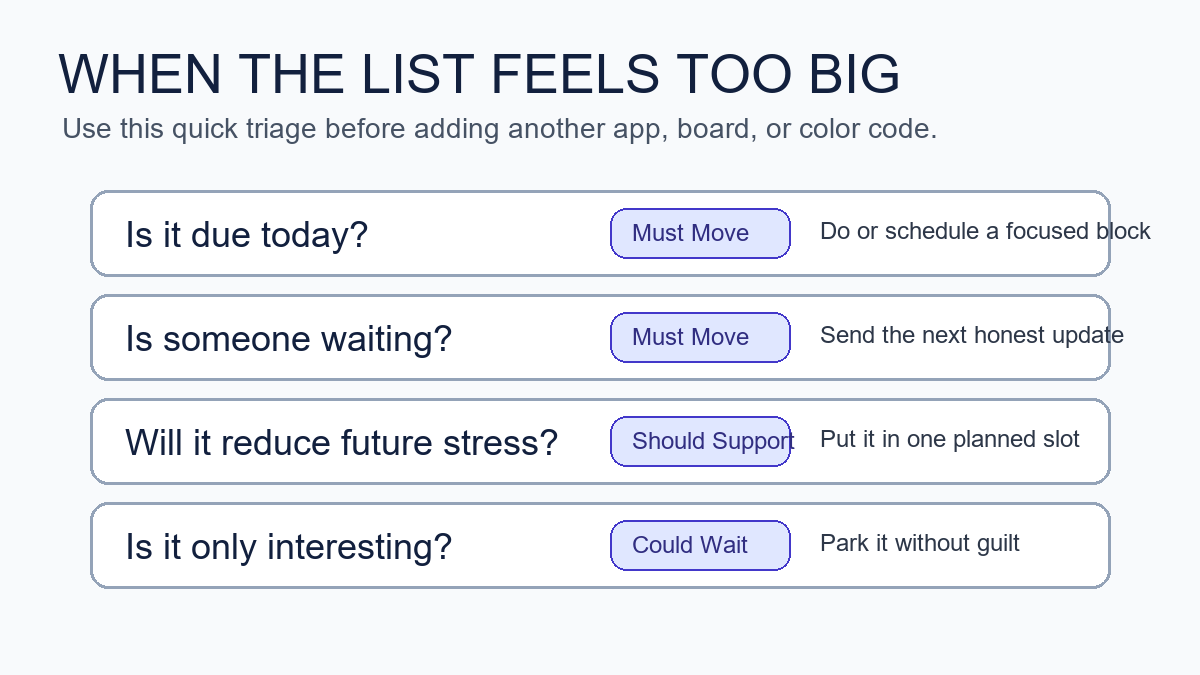
    • Use simple decision rules: delete, defer, do, delegate.
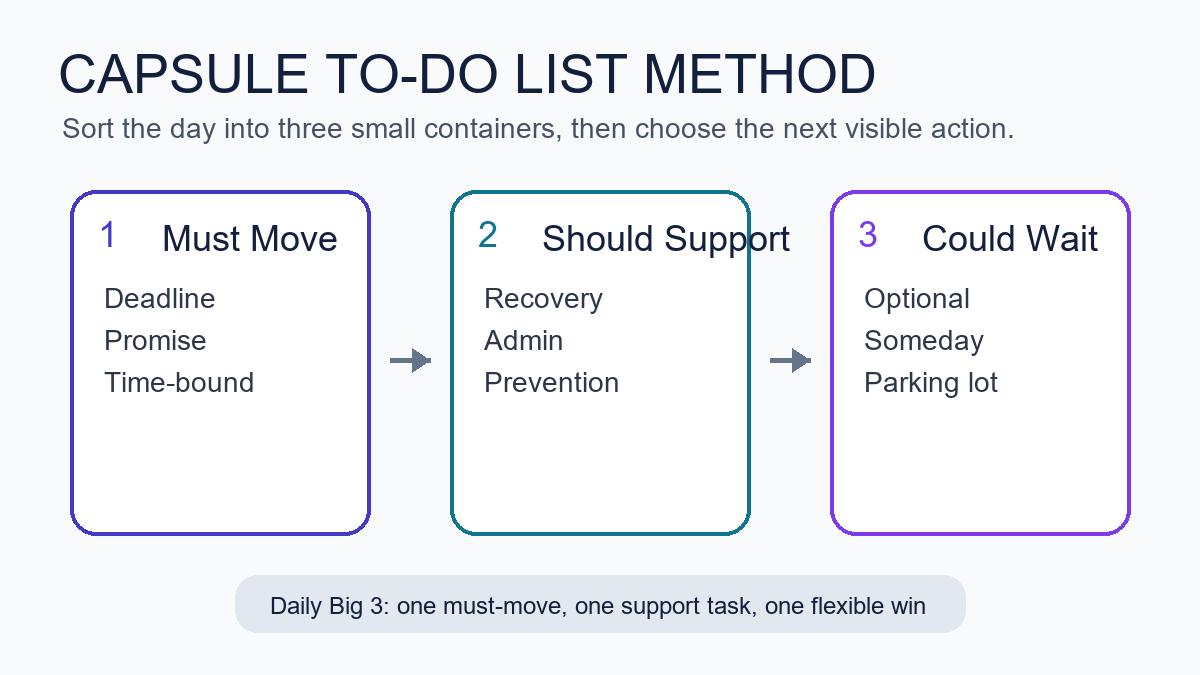
    • Separate β€œnext steps” from β€œnice-to-do” items to protect your future time.
    • End with 3-5 concrete follow-up appointments and reminders, not a long wish list.
    • Repeat the reset weekly or biweekly so mess never piles too high.

    What is a one hour life admin reset?

    A one hour life admin reset is a short, structured sprint to clear small tasks that weigh on your mind: unpaid bills, lingering emails, calendar conflicts, loose forms, and tiny fixes. It is not a marathon. It is a timed, practical sweep so you leave with fewer open loops and a light plan for what comes next.

    Because the window is short, you rely on rules more than willpower. You make quick calls, capture a few follow-ups, and protect your attention. This lowers decision fatigue and frees energy for the work that matters most. Research shows switching tasks comes with mental costs; fewer switches and clear rules reduce that friction (see APA on task switching and multitasking).

    In practice, it feels like clearing a jammed drawer. First, you surface what is on top. Next, you make simple β€œkeep or toss” calls. Finally, you put back only what supports the week ahead. Because the scope is small, you finish the hour with momentum rather than fatigue.

    Example: It’s Friday at 4:00 p.m. You pay two utility bills, archive 28 emails, send two quick replies, block 90 minutes Tuesday for the DMV, and set three follow-ups. You end with a lighter inbox, a settled calendar, and a dated note to handle the slower insurance claim.

    Why a 60-minute window works

    Short, time-boxed bursts help you focus and finish. You decide in advance what you will do in each block and when you will stop. This is a classic timeboxing move: define a task and bind it to a fixed, short block so you avoid perfection traps and endless rabbit holes.

    Also, constraints create clarity. When you only have 10 minutes, you stop polishing and start deciding. Because the finish line is near, it is easier to start and keep moving. You get a quick win, which builds momentum for the next block.

    In addition, β€œimplementation intentions” (the if-then plans of when and where you act) help turn intentions into actions. For example: β€œIf it’s Friday at 4:00 p.m., then I start my reset with bills.” Anchoring your reset to a cue improves follow-through. Likewise, ending with a brief β€œnext steps” ritual gives your brain closure so you can switch off more easily after work.

    Before you start: your reset kit

    Set the stage so your hour runs smooth. Silence notifications, clear your desk, and fill a glass of water. If possible, open a single browser window with only the tabs you need. Small setup moves reduce friction and help you stay on track when the timer is running.

    • Timer: set 6 blocks of 10 minutes each.
    • Short list: bills to check, inbox to triage, calendar to review, quick tasks basket.
    • Decision rules posted where you can see them.
    • Login details and 2-step verification ready for bill portals.
    • Notebook or notes app open for β€œNext Steps” and a β€œParking Lot.”
    Reset kit at a glance
    Item Why it helps Notes
    10-minute timer Creates urgency and focus Use a phone timer or a simple web timer
    Rules card Reduces decision fatigue Delete, Defer, Do, Delegate
    Secure logins Fast, safe bill management Enable 2-step verification where possible
    Notes app Capture next steps Keep β€œNext Steps” separate from β€œParking Lot”

    One hour life admin reset: 60-minute playbook

    Here is your minute-by-minute plan. Start your one hour life admin reset with a visible timer. Stop when the timer ends. If an item runs long, move on and place it in the Parking Lot with a date.

    Customize the blocks if you need to. For instance, if bills are quiet this week, shorten that block to five minutes and give the extra five to your inbox. Conversely, if your calendar is chaotic, extend the calendar audit and trim quick tasks. The rules stay the same: keep blocks short, make fast calls, and avoid rabbit holes.

    Suggested 60-minute block plan
    Minutes Focus Goal Examples
    0–5 Prep & rules Open tools, list targets, start timer Open bills, inbox, calendar tabs; rules card in view
    5–15 Bills sweep Pay/confirm 2–4 items Utilities, rent, subscriptions check, note due dates
    15–25 Inbox triage Clear 20–40 emails Delete, archive, 2-minute replies, flag 3 follow-ups
    25–35 Calendar audit Resolve conflicts and block key work Confirm meetings, add buffers, schedule errands
    35–50 Quick tasks Finish 5–10 tiny items Forms, renewals, address updates, password reset
    50–60 Next steps & close 3–5 dated follow-ups Create calendar holds and reminders, review wins

    Step 1 (0–5): Set rules and targets

    Write your top three areas: bills, inbox, calendar. Post your rules where you can see them. Decide now: when the timer buzzes, you move on. This tiny agreement with yourself keeps the hour from expanding and protects your attention.

    Step 2 (5–15): Bills sweepβ€”life admin power hour

    Open your bill accounts and recent statements. Pay or confirm what you can in this block. If a bill requires extra documents, note the item in Next Steps and move on.

    • Confirm due dates.
    • Check for surprise charges or duplicate subscriptions.
    • Set or review autopay and reminders for stable bills.

    Be careful with recurring payments. Free trials and auto-renewals can create unwanted charges if you forget to cancel. Set calendar reminders for trial end dates and review your subscriptions regularly.

    Step 3 (15–25): Inbox triage for your weekly life admin reset

    Move fast. Do not read every word of every message. Use the subject, sender, and first line to decide. Then apply your rules.

    Fast email decisions
    Action Trigger Example
    Delete Not needed, no action, or duplicate Expired sale, old newsletter, duplicate alert
    Defer Takes more than 2 minutes Form to complete, long request, research item
    Do Under 2 minutes Confirm, quick reply, file attachment
    Delegate Not yours to handle Forward with context to the right person

    For deferred emails, add a one-line next step to your list (e.g., β€œWed 10:00β€”send proof to Alex”). Then archive or snooze the message to the date you chose so it resurfaces when you can act. If you have a large backlog, search for easy wins first (for example, sort by sender or use a query like older_than:30d to archive stale notices quickly). Next, create a lightweight β€œVIP” filter so important senders never get lost.

    Step 4 (25–35): Calendar audit

    Scan the next two weeks. First, clear conflicts. Second, add buffers around demanding blocks. Third, time-box priority work and errands. Finally, confirm key meetings.

    • Block preparation time for any meeting that needs it.
    • Add 5–10 minute buffers between long calls to reset.
    • Bundle errands in one trip to avoid scattered drives.

    Time-boxing your day can help limit context switching. Short, named blocks for focused tasks protect attention and make completion likely. As you review, ask three questions: Can this be shorter? Can this move later? Can this be declined or replaced with an async update?

    Step 5 (35–50): Quick tasks

    Pull from your β€œtwo-minute” bin. Do not start anything that needs deep work. Keep items tiny. If a task grows, stop and park it with a date.

    • Renew a library card or membership.
    • Update a shipping address or profile.
    • Download and file a receipt.
    • Resend a calendar invite with the correct link.
    • Request a missing statement.

    Step 6 (50–60): Next steps and close for the one hour life admin reset

    End strong. Choose 3–5 concrete follow-ups and place them on dates and times. Then pick a day and time for your next one hour life admin reset. Take a breath. You are done.

    Two helpful add-ons: First, write a one-line summary of what you finished (this locks in the win). Second, leave yourself a short β€œstart here” note for the next session so future-you can jump in without hesitation.

    Decision rules you can trust

    Simple rules reduce mental strain. When you know the rule, you can act right away. Print this small table and keep it near your desk.

    Decision rules for life admin
    Rule Definition When to use it
    Delete Remove it permanently Not useful, not actionable, or out of date
    Defer Schedule it for the right time Needs more than 2–5 minutes or more info
    Do Finish now Under 2 minutes, low risk, high clarity
    Delegate Hand it to the right person Not your role or best done by someone else

    When in doubt, size the task. If it is under 2 minutes and low risk, do it now. If it needs thought, write a one-line next action and date it. Because the rule is simple, you avoid rethinking the same small choice over and over.

    What tools do you need?

    Use what you have. Keep it simple. A notes app for two pages (one for dated Next Steps and one for a Parking Lot), your email client with archive shortcuts and snooze, and your calendar showing the next two weeks will cover almost everything. If you prefer paper, keep a single page for Next Steps and a single page for the Parking Lot. For passwords, rely on a secure manager and turn on 2-step verification for bill sites. Above all, avoid changing tools during the reset itselfβ€”consistency beats novelty here.

    Brief desk reset during a 60-minute life admin reset: a person pauses at a laptop with notes and glasses nearby.
    Short breaks help you protect focus. Photo by www.kaboompics.com via Pexels.

    Source: Pexels. Photographer: www.kaboompics.com.

    How should you handle bills in your reset?

    Keep bill time short and secure. Pay or schedule what you can. If a site needs you to hunt through old paperwork, stop and schedule a 20-minute follow-up. Do not let a single complex bill eat your entire hour.

    • Use 2-step verification on bill portals for added safety.
    • Set calendar reminders for trial end dates and renewals.
    • Consider autopay for stable, predictable bills; still review monthly.

    Also, be cautious with free trials and subscriptions. Many renew by default, and forgetting to cancel can cost you. Put a reminder on the date you should review the charge.

    Autopay quick guide
    Bill type Stable? Suggested action Safety note
    Fixed utilities (internet, rent) Yes Enable autopay Set a monthly β€œreview charges” reminder
    Variable services (electricity) Sometimes Consider autopay + alert Enable usage alerts to catch spikes
    Free trials / promos No Avoid autopay Set a reminder before the renewal date

    How can you triage email faster without missing important messages?

    Work top-down and apply the rules. Start with obvious deletions. Then hit 2-minute replies. Finally, flag and defer 3–5 messages that deserve focus later. Use filters to keep newsletters out of your main inbox and send billing alerts to a folder you check in your reset.

    • Unsubscribe from content you no longer read.
    • Create a β€œWaiting” label for items that need someone else’s action.
    • Use snooze to bring a message back on the date you can respond.

    For noisy lists, auto-archive newsletters with a label so you can read them on your terms. Meanwhile, pin deadlines and approvals. Because the reset is short, capture a next action for anything complex and move on.

    How do you time-box calendar work without overfilling days?

    Be realistic. Name blocks by outcome, not by effort. β€œSubmit tax form” is clear. β€œTaxes???” is vague. Add buffers before and after intense blocks. Keep at least one open hour daily for the unexpected.

    • Rename blocks as verbs: β€œCall”, β€œDraft”, β€œSubmit”, β€œPay”.
    • Place deep work before noon if your energy is higher then.
    • Batch errands into a single window once per week.

    As you place holds, think in themes: admin, calls, errands, decision time. Grouping similar work reduces the cost of switching. If a day is already packed, move a non-urgent item to your next reset instead of cramming it in.

    Quick sizing: Do it now or schedule it?
    Item type Time needed Action
    Tiny confirmation Under 2 minutes Do now
    Short form or call 5–10 minutes Finish in Quick Tasks block
    Document hunt 15–30 minutes Schedule a dated follow-up
    Complex decision 30+ minutes Park it and plan a focused session

    When should you run a one hour life admin reset?

    Pick a consistent cue so it becomes automatic. For many, Friday afternoon works well. The week is fresh in mind, and you can roll into the weekend lighter. Others prefer Monday first thing or Sunday evening. The best time is the one you protect.

    As a result, the habit forms. A repeating slot prevents pile-ups. Your brain learns that loose ends get handled soon, which reduces background stress the rest of the week. If it helps, stack the reset with something you already do (for example, right after your weekly team wrap-up).

    If your one hour life admin reset doesn’t finish everything

    That is normal. The goal is not to clear every inbox or task. The goal is to reduce clutter, make fast calls, and date the few follow-ups that matter. Perfection is not needed. Progress is.

    Therefore, use your Parking Lot. Anything that does not fit goes there with a review date. In your next reset, start by skimming that list and pulling in what still matters.

    Use an β€œexit ramp” if you feel behind: in the last minute, stop doing and write three quick linesβ€”what you finished, what you will do next, and when. This keeps the reset contained and sets up a clean restart.

    Mistakes to avoid

    • Letting one tricky bill eat 30 minutes. Stop and schedule it.
    • Turning the inbox block into a reading session. Skim, then decide.
    • Overfilling your calendar with back-to-back blocks. Leave buffers.
    • Capturing 20 β€œmaybes” as Next Steps. Choose 3–5 real ones.
    • Switching tools mid-session. Use the same simple setup each week.

    Security and privacy basics for your reset

    • Use a password manager rather than reusing passwords.
    • Turn on 2-step verification for financial and billing portals.
    • Be cautious with links in emails; go directly to the site when paying.
    • Put trial renewals and subscription checks on your calendar.
    Timer for a 60-minute life admin reset on a clean desk.
    Short, named blocks keep your reset moving. Photo by Surja Raj via Pexels.

    Source: Pexels. Photographer: Surja Raj.

    Automation you can set in 10 minutes

    Do not automate everything at once. Start small. Pick one stable bill (such as internet) to put on autopay and add a monthly β€œreview charges” reminder. Set a simple email filter so newsletters skip the inbox into a β€œRead Later” label you check on your terms. Finally, create a recurring calendar reminder called β€œSubscriptions reviewβ€”15 minutes” so renewals never sneak past you. Because you are layering these automations over a weekly reset, they make life easier without hiding important details.

    Why a one hour life admin reset reduces stress

    Life admin tasks linger as mental tabs. When you sweep them quickly and place follow-ups on dates, you close loops and reduce background tension. Short, committed plans (if-then cues) increase the odds you act. Also, limiting context switching preserves energy for deeper work later. The point is not to do everything; it is to remove friction so the right things happen at the right time.

    Lightweight templates to copy

    Use these short lines during your reset and tweak as needed: Quick replyβ€”β€œThanks for this. I’ll review and get back to you by [day].”; Delegateβ€”β€œAdding [Name] here. They’re the best person to help with this.”; Confirmβ€”β€œConfirming [meeting] on [date/time]. See you then.” Saving a few simple scripts removes typing friction and keeps your tone consistent.

    Daily micro-reset vs the one hour life admin reset

    Many people like a 10-minute daily micro-reset. It is not a replacement for your weekly life admin reset, but it can keep small items from piling up. Use it to clear a handful of messages and check tomorrow’s calendar. Meanwhile, keep the deeper cleanup and decision-making in the weekly session where it fits best.

    Optional Amazon resources

    Affiliate disclosure: Some links in this guide may be affiliate links. If you buy through them, Mind Clarity Hub may earn a commission at no extra cost to you.

    If you like paper tools, a simple undated weekly planner or a small habit tracker can make your one hour life admin reset smoother. Choose clean layouts with space for 3–5 priorities.

    Browse undated weekly planners on Amazon

    One hour life admin reset: FAQs

    How often should a one hour life admin reset happen?

    Run it weekly or every other week. Consistency matters more than the exact day. Anchor it to the same cueβ€”like Friday at 4:00 p.m.β€”so it becomes automatic.

    What if I have only 30 minutes?

    Halve the plan. Do bills for 8–10 minutes, inbox for 10–12 minutes, and a 5–8 minute Next Steps block. Still end by dating 3 follow-ups.

    Can I share the reset with a partner or roommate?

    Yes. A joint session can align bills, schedules, and errands. Keep shared tasks in one list, agree on 3–5 follow-ups, and put holds on the calendar while you are together.

    What if new urgent items pop up during the hour?

    Capture them in the Parking Lot. Only break the block if the item is truly time-sensitive and cannot wait 30–40 minutes.

    How do I stop the one hour life admin reset from growing into a big cleanup project?

    Honor the timer. Move on when time is up. If you uncover a project (like changing banks), park it and schedule a separate focused session.

    Next steps you can take today

    • Pick your weekly cue and add your first one hour life admin reset to the calendar.
    • Print or save the decision rules table.
    • Set up 2-step verification on at least one bill account.

    Helpful sources

    More guides to support your plan

    Finally, book your first slot now. Then run your one hour life admin reset this week. You will finish lighter, clearer, and ready for the work that matters most.

  • How to Make Routines Stick Without Starting Over Every Week

    How to Make Routines Stick Without Starting Over Every Week

    Quick answer: To make routines stick, make the routine small, attach it to a stable cue, remove friction, rehearse the same first step, and review it weekly. A routine fails less often when it is built as a low-pressure system instead of a promise to become a different person overnight.

    Most people do not need a more intense routine. They need a routine that survives normal life. The useful question is not β€œHow do I become perfectly consistent?” It is β€œWhat version of this routine can I restart quickly after a busy day, low-energy morning, sick child, late meeting, or rough night of sleep?”

    This guide shows how to make routines stick without starting over every week. It is designed for readers who want calmer mornings, better focus, tidier evenings, and a realistic path back after missed days. It also connects naturally to the Mind Clarity Hub reading path, because routines become easier when your books, tools, and environment all point toward the same next action.

    What makes routines stick?

    Routines stick when they have a clear cue, a small enough action, a repeatable context, and a quick reward or relief signal. In plain terms, the routine needs an obvious starting bell, a first step you can do even when tired, and a reason your brain believes the action is worth repeating.

    The habit formation literature supports this practical pattern. A widely cited review in the British Journal of General Practice explains that repeating a chosen behavior in a consistent context helps a behavior become more automatic over time. That does not mean a routine becomes effortless in one week. It means repetition plus context gives the routine a better chance than motivation alone.

    A sticky routine is also specific. β€œBe more organized” is a hope. β€œAfter I pour coffee, I open my planner and choose one must-do task” is a routine. The second version has a cue, an action, and a finish line.

    Why do routines fall apart after a few days?

    Routines usually fall apart because they are too large, too vague, too dependent on mood, or too disconnected from the day you actually live. A perfect morning routine that needs ninety quiet minutes will not survive a home, commute, family, or workday that rarely offers ninety quiet minutes.

    Another common problem is hidden friction. The notebook is in another room. Workout clothes are in the laundry. A crowded app has too many screens. A vague task is written in a way that requires deciding again. Each tiny barrier makes the routine easier to skip.

    Stress also changes what people can execute. The CDC notes that work stress and mental health are shaped by demands, resources, and working conditions. A personal routine cannot fix every workload or life constraint. It can, however, reduce avoidable decisions and make the next step easier to find when capacity is limited.

    How to make routines stick in real life

    Start with the smallest version that still proves the identity of the routine. To build a reading routine, read one page. For a desk reset, clear only the cup, trash, and notebook. When planning is the goal, choose one task for tomorrow. Small routines matter because they protect the repetition before you expand the result.

    Use the same cue for at least two weeks. The cue can be time, place, or a prior action. After brushing teeth, open the book. Once work is logged off, clear the desk for three minutes. After dinner, put the phone on the charger. A stable cue reduces the need to negotiate with yourself each time.

    Then remove the first barrier. Put the book on the pillow, the planner beside the coffee maker, the shoes by the door, or the timer button on your phone home screen. The goal is to make starting the routine feel like the easiest available path.

    How to make routines stick with a short written checklist
    A routine is easier to repeat when the next step is visible. Photo by Lukas via Pexels.

    The how to make routines stick framework

    Use this five-part framework before blaming yourself for a routine that keeps breaking. Most routines need one small design repair, not a total restart. If you are learning how to make routines stick, work through the columns and fix the weakest part first.

    Part Question to ask Simple repair
    Cue What tells me to begin? Attach the routine to a stable action that already happens.
    Size Can I do the first version on a hard day? Shrink the routine until it takes five minutes or less.
    Friction What makes starting annoying? Put supplies in place before the cue arrives.
    Reward What relief do I notice after finishing? Name the benefit immediately: clearer desk, calmer morning, easier tomorrow.
    Review How will I adjust without quitting? Use a weekly check instead of daily self-criticism.

    This is intentionally plain. Complicated habit dashboards can be motivating for some people, but many readers need fewer moving parts. If tracking the routine becomes harder than doing the routine, track less.

    How long does it take for a routine to stick?

    There is no universal number of days. Habit formation depends on the behavior, person, context, and consistency. A 2024 systematic review and meta-analysis in Healthcare found that habit-based interventions vary widely, which is a better practical message than the old idea that every habit takes the same number of days.

    Use a two-week test for design and a two-month runway for automaticity. After two weeks, you can usually tell whether the routine is too large, badly timed, or missing a cue. After two months, you have more evidence about whether the context and reward are strong enough to keep repeating. That slower view is central to how to make routines stick without chasing a new method every Monday.

    Do not treat a missed day as proof that the routine failed. Missed days are data. When the cue was weak, strengthen the cue. If the routine was too long, shrink the minimum version. When the routine did not matter, replace it with one that solves a real problem.

    What is the best first routine to build?

    The best first routine is the one that makes tomorrow easier. For most people, that is a closing routine, not a dramatic morning routine. A five-minute evening close can set out supplies, choose the first task, and reduce morning decisions.

    If mornings are the main pain point, build a launch routine with only three pieces: wake cue, body cue, and first useful action. For example, drink water, open the curtains, and write the first task. Avoid adding exercise, journaling, reading, meditation, inbox review, cleaning, and meal prep all at once.

    If workdays are messy, choose a work-start or work-shutdown routine. Mind Clarity Hub already has a dedicated guide for an evening shutdown routine for remote workers, so this article focuses on the habit mechanics that help any routine survive.

    How can habit stacking help routines stick?

    Habit stacking means placing a new action next to an existing action. The existing action becomes the cue. The new routine borrows reliability from something you already do. This works best when the new action is tiny and the cue is stable.

    The American Psychological Association has summarized habit research around context, cues, and repeated behavior. The practical takeaway is simple: do not wait for a perfect mental state. Put the behavior where a reliable cue can find it.

    Habit stack examples

    • After I start the coffee, I open my planner and choose one must-do task.
    • Laptop charger cue: I clear my desk for three minutes.
    • Toothbrush cue: I read one page of a book.
    • Last-meeting cue: I write tomorrow’s first task.
    • Dinner cue: I put the phone outside the bedroom for the first hour of wind-down.

    Each example is small on purpose. You can always add more later. The first goal is not to impress yourself. The first goal is to create a repeatable path back. In practice, how to make routines stick often comes down to making the first step obvious enough to repeat.

    How to make routines stick on low-energy days

    Design every important routine with a minimum version. A minimum version is the smallest action that keeps the routine alive. It protects continuity when the full routine is not realistic.

    For a cleaning routine, the minimum may be clearing one surface. A reading routine may shrink to one page. Focus can begin by opening the task list and setting a ten-minute timer. Planning may mean writing tomorrow’s first task on a sticky note.

    Routine Full version Minimum version
    Morning reset Water, light, planner, movement, first task Water, light, one task
    Desk reset Clear desk, file notes, set tomorrow’s work Remove trash and place notebook beside laptop
    Reading Twenty minutes with notes One page with no notes
    Exercise Thirty-minute workout Shoes on and five minutes of movement
    Weekly planning Calendar, tasks, meals, budget, errands Calendar scan and three outcomes

    Minimum versions are not cheating. They are how a routine stays connected to real life. The more often you restart quickly, the less often you need a dramatic reset. If someone asks how to make routines stick during stressful weeks, the honest answer usually starts with the minimum version.

    What role does environment play in making routines stick?

    Environment shapes routines because cues often live outside your head. A stable place, time, object, or sequence can trigger the next action before you spend energy deciding. Research in Frontiers in Psychology has examined context stability and automaticity in intentional habit building, which fits the everyday idea that routines become easier when the setting is predictable.

    Change the room before you change the whole routine. Put the planner where you drink coffee. Keep the book where you sit at night. Move the charger outside the bedroom. Place a small basket by the door. The visible cue should make the next step obvious.

    Environment can also block the old pattern. If the phone is the problem, do not depend only on willpower. Move it, charge it elsewhere, turn on focus mode, or place a book in the spot where the phone usually lands.

    How to make routines stick with simple tracking

    Track the minimum signal that helps you learn. For many routines, a simple check mark is enough. If a tracker creates pressure, switch to a weekly review question: What helped this routine happen, and what got in the way?

    Use three labels if you need nuance: full, minimum, missed. A minimum day still counts because the routine stayed alive. A missed day counts as information. This prevents the all-or-nothing thinking that makes people abandon routines after one imperfect week.

    For readers who enjoy trackers, the guide to simple habit tracker ideas can help. Keep the tracker in service of the routine, not the other way around.

    How to make routines stick after missed days

    Restart with the next cue, not with a punishment plan. If you missed last night, use tonight’s cue. If you missed this morning, use tomorrow’s wake cue. Do not add extra work to β€œmake up” for the miss unless the task truly requires it.

    A restart script helps. Write one sentence before the miss happens: β€œWhen I miss a day, I do the minimum version at the next cue.” That sentence removes a future argument. You are not deciding whether you failed. You are following the restart rule. This is one of the most practical parts of how to make routines stick because it protects the second start.

    This is especially useful for routines tied to mental clarity. Stressful weeks can disrupt even well-designed systems. A routine that includes a built-in restart is more durable than a routine that depends on a perfect streak.

    What routines support books, focus, and deeper learning?

    A reading routine is one of the best ways to make self-improvement practical. Instead of collecting more advice, choose a small reading block and one place for notes. The Jeremy Jarvis books hub is the broad starting point if you want a guided path through focus, digital clarity, and practical self-improvement books.

    If your routine problem is digital distraction, Digital Clarity and Break the Scroll are better next steps than adding another app. If your routine problem is follow-through at work, Focus Recharged fits the reader who wants clearer priorities and fewer attention leaks.

    For product-style choices, such as planners, timers, lamps, or focus tools, use the reviews and science deep dives hub. A routine article should not force product decisions into the middle of habit design.

    Simple planning board for making routines stick in a busy week
    Shared routines need clear ownership, not just good intentions. Photo by fauxels via Pexels.

    How do you make family or shared routines stick?

    Shared routines need ownership and visible handoffs. A family routine, team routine, or household routine fails when everyone agrees in theory but no one knows who does the next visible action. Put names, times, and backup rules on the routine.

    For example, a school-night routine might include packing bags after dinner, checking tomorrow’s calendar, and placing shoes by the door. Each step needs one owner. A team shutdown routine might include updating the project board, naming the next blocker, and sending one handoff note before the day ends.

    Keep shared routines shorter than you think they should be. If a routine requires everyone to be patient, rested, and fully available, it is too fragile. The goal is a simple sequence that still works when people are distracted.

    What should you avoid when learning how to make routines stick?

    Avoid building a routine around guilt. Guilt can create a short burst of action, but it does not make the routine easier to repeat. The routine should solve a real friction point, not prove your worth.

    Avoid adding too many routines at once. One new routine that works is more valuable than six routines that collapse by Thursday. Once the cue and minimum version feel reliable, add one small layer.

    Avoid copying a routine without adapting it. A creator’s 5 a.m. routine, a CEO’s calendar block, or a wellness influencer’s reset may not fit your constraints. Borrow the design principle, not the entire schedule.

    A seven-day plan for how to make routines stick

    Use this seven-day plan as a low-pressure experiment. The plan is not meant to transform everything in a week. It helps you build one routine well enough to test.

    1. Day 1: Pick one routine and write the real problem it solves.
    2. Second day: Choose the cue and put the supplies where the cue happens.
    3. Third day: Do only the minimum version and stop while it still feels easy.
    4. Fourth day: Repeat the cue and minimum version. Notice friction without judging it.
    5. Fifth day: Add one small upgrade if the minimum version is stable.
    6. Sixth day: Practice the restart rule on purpose by naming the next cue.
    7. Seventh day: Review what helped, what blocked you, and what to shrink or move.

    This plan works because it treats routine design as a learning loop. You are not proving discipline. You are discovering the cue, size, and environment that make the behavior repeatable. That is how to make routines stick with evidence from your real week, not just advice from a template.

    How do you know a routine is finally sticking?

    A routine is sticking when starting takes less negotiation, missed days are easier to recover from, and the routine creates a real benefit you can feel. You may still need reminders. That is fine. The signal is that the routine has become easier to restart and less dependent on a big emotional push.

    Signal What it means Next adjustment
    You start with less debate The cue is working Keep the cue stable for another two weeks.
    You use the minimum version on hard days The routine can survive stress Protect the minimum version before expanding.
    You recover after missed days The restart rule is working Keep misses neutral and specific.
    The routine solves a real pain The reward is clear Name the benefit after each repetition.
    Tracking feels light The system supports action Avoid adding extra metrics too soon.

    If none of these signals appear, the routine may be too large, too vague, or attached to the wrong cue. Repair one part at a time. A routine that needs repair is not a failed routine. It is a draft.

    Frequently asked questions about making routines stick

    How do I make routines stick if I get bored quickly?

    Keep the cue stable but vary the optional layer. For example, keep the same reading cue, but choose different books. Keep the same desk-reset cue, but rotate music or timer length. Stability belongs in the start; variety belongs after the routine begins.

    Should I build a morning routine or evening routine first?

    Build the routine that removes the most friction from tomorrow. For many people, an evening close is easier because it prepares the morning. If mornings are chaotic, start with a three-step launch routine instead of a long ideal schedule.

    What if my routine depends on other people?

    Turn the routine into a visible handoff. Name the owner, time, and backup rule for each step. Shared routines need fewer assumptions and more visible signals.

    Do habit trackers help routines stick?

    Habit trackers help when they keep the routine visible and simple. They hurt when tracking becomes a second chore or creates all-or-nothing pressure. Track full, minimum, and missed days if a binary streak feels too harsh.

    Can AI help me make routines stick?

    AI can help turn a messy goal into a short checklist, suggest a minimum version, or summarize weekly patterns. Feed the result back into your normal planner or notes so the AI output does not become another place to manage.

    The bottom line on how to make routines stick

    The most reliable way to make routines stick is to design for repeatability before intensity. Choose one routine, attach it to a stable cue, shrink the first action, remove friction, and review it weekly. Keep a minimum version for hard days and a restart rule for missed days.

    Once the routine is stable, expand it slowly. Add a longer reading block, a fuller planning session, or a deeper desk reset only after the first step is easy to repeat. A routine that can restart quickly is more valuable than a routine that looks perfect and disappears by Friday.

    Helpful resources for your next step

    Affiliate disclosure: As an Amazon Associate, Mind Clarity Hub may earn from qualifying purchases at no extra cost to you. Use this link only if it genuinely helps your planning.

    If How to Make Routines Stick Without Starting Over Every Week is a routine you want to keep using, a simple workbook, planner, or desk tool can make the steps easier to repeat.

    Compare related planners, workbooks, and organization tools on Amazon.

  • Minimalist Productivity System: Fewer Tools, Better Follow-Through

    Minimalist Productivity System: Fewer Tools, Better Follow-Through

    Quick answer: A minimalist productivity system is a small set of trusted places for tasks, calendar commitments, notes, and review. It works because it reduces capture points, lowers switching, and makes the next action obvious without asking you to manage a complicated tool stack.

    A minimalist productivity system is not about doing less work that matters. It is about removing the extra decisions around the work. When every task lives in a different app, every reminder has a different rule, and every note has a different home, the system itself becomes another job. A lighter setup gives you one place to look, one way to choose, and one habit for closing the loop.

    This guide is for busy adults, remote workers, creators, students, and small teams who want better follow-through without rebuilding life around a new app. You will build a simple four-part system, test it for two weeks, and connect it to the broader Mind Clarity Hub reading path only where it helps. The goal is calm control, not a perfect dashboard.

    What is a minimalist productivity system?

    A minimalist productivity system is a repeatable workflow with the fewest tools needed to capture, decide, do, and review work. In practice, that usually means one calendar, one task list, one note home, and one short review ritual. Anything else has to earn its place by making decisions easier.

    The system should answer four questions quickly: What must happen on a specific day? What is the next action? Where are the supporting notes? When will I review open loops? If those answers are scattered, the setup is not minimalist yet, even if the interface looks clean.

    Research on attention supports the practical reason for this approach. The American Psychological Association explains task-switching costs and notes that moving between complex tasks can take a toll on productivity. A system with fewer places to check reduces avoidable switching before the work even begins.

    Who needs a minimalist productivity system most?

    You may need a minimalist productivity system if you keep improving your tools but still miss tasks, avoid planning, or feel tense when you open your dashboard. The problem may not be discipline. It may be tool sprawl. Each extra inbox, board, label, and automation asks for attention.

    This is especially common for people who read productivity advice often. A method sounds useful, so you add it. A template looks impressive, so you copy it. Another app promises focus, so you test it. After a while, your planning system has more moving parts than the week it was meant to support.

    • You capture tasks in messages, sticky notes, apps, notebooks, and memory.
    • You spend more time reorganizing tasks than completing them.
    • Your calendar and task list disagree about what matters today.
    • Project notes become hard to find.
    • Reviews feel too large to face.
    • A new app becomes tempting every few weeks.

    Why does a minimalist productivity system improve follow-through?

    A minimalist productivity system improves follow-through by making the next step easier to see. Follow-through often fails before the work starts. You open the laptop, look at five possible places, remember several half-finished plans, and lose energy deciding where to begin. A small system removes that first layer of friction.

    The workplace context matters too. CDC worker mental health guidance points to demands, resources, stress, and job conditions as real factors in burnout and strain. A personal system cannot fix every workload problem. Still, it can create clearer boundaries around what is yours, what is waiting, and what needs a conversation.

    The practical win is not aesthetic minimalism. It is trust. If your task list is short enough to review, your calendar is honest enough to protect time, and your notes are easy enough to find, you stop carrying every open loop in your head.

    Minimalist productivity system notebook with a small daily task list
    A small task list is easier to trust than a crowded dashboard. Photo by Lukas via Pexels.

    The four parts of a minimalist productivity system

    Keep the system to four homes: calendar, tasks, notes, and review. Each home has one job. The calendar holds time-specific commitments. The task list holds next actions. Notes hold reference material. The review catches loose ends before they become stress.

    Do not let one tool do every job unless it truly stays simple. Many people can keep tasks and notes in the same app, but the jobs should remain separate. A note about a project is not the same thing as the next action. A someday idea is not the same thing as a dated commitment.

    System part What belongs there What does not belong there
    Calendar Appointments, deadlines, focus blocks, review time Every possible task
    Task list Clear next actions you can finish or move Long reference notes
    Notes Project context, links, drafts, decisions Unprocessed obligations
    Review Loose ends, stalled work, cleanup choices A full life audit every day

    How do you build a minimalist productivity system in one hour?

    Build the first version quickly. A minimalist productivity system should start plain, because the first week is a test. You can make it prettier later if it keeps working. Set a timer for one hour and make decisions that are good enough to use tomorrow.

    Step 1: Pick one capture inbox

    Choose one place where new tasks go before they are sorted. It can be a notebook page, an app inbox, or a single document. The rule matters more than the tool: new obligations go there first. If something arrives by email or chat, convert it into the capture inbox when it becomes a real task.

    Step 2: Create three task lanes

    Use three lanes: today, this week, and later. Today should stay short. This week holds real commitments that are not due today. Later catches useful tasks that should not compete for current attention. More lanes may feel precise, but precision can become maintenance.

    Step 3: Make the calendar honest

    Put meetings, appointments, deadlines, and real focus blocks on the calendar. Add buffers if work often runs long. Microsoft Work Trend Index research on the infinite workday describes how meetings, messages, and after-hours work can fragment focus, so your calendar should protect work time instead of only recording meetings.

    Step 4: Choose one note home

    Pick one place for project notes and reference material. Use plain titles, such as β€œClient launch notes” or β€œHome office reset ideas.” Avoid building a complex taxonomy at the start. Search and a few simple names are usually enough for the first month.

    Step 5: Schedule one weekly review

    Add a 20-minute weekly review. The review clears the capture inbox, moves tasks between lanes, checks the calendar, and closes finished work. Without a review, even the cleanest system slowly becomes a storage closet.

    What should stay out of a minimalist productivity system?

    Keep out anything that creates more sorting than action. A system can become cluttered even when every piece is useful in theory. If a field, label, or automation does not help you choose the next action, remove it for now.

    • Status labels you rarely use.
    • Priority systems with more than three levels.
    • Separate apps for similar tasks.
    • Daily templates that take longer to fill out than to act on.
    • Automations you do not understand well enough to repair.
    • Habit trackers for habits you are not currently practicing.

    This is where minimalism becomes practical. The best system is not the one with the fewest features. It is the one with the fewest features that still handles your real life.

    Minimalist productivity system examples for different lives

    Your setup should match the kind of work you actually do. A freelancer, parent, manager, student, and creator may all use the same four-part structure, but their rules will differ. Start with the smallest version that protects the decisions you make most often.

    Situation Minimal setup Most important rule
    Remote worker Calendar, task app, weekly review note Protect two focus blocks before checking low-priority messages.
    Freelancer Client board, invoice reminder, project notes Every client task gets a next action and due date.
    Student Class calendar, assignment list, study notes Assignments enter the system the day they are assigned.
    Parent or caregiver Shared calendar, family admin list, simple notes Home tasks need owners, not just reminders.
    Creator Idea inbox, production list, publishing calendar Ideas do not become projects until they have a next action.

    Notice that each example avoids a giant command center. A minimalist productivity system works best when it fits into a normal week. The system should be visible enough to guide you and small enough to survive a busy day.

    How do you choose tools without overbuilding?

    Choose tools by friction, not reputation. A beautiful app is a poor fit if you avoid opening it. Paper is not outdated if it helps you think. Shared spreadsheets are not boring if they keep team work clear. The right tool is the one you trust under pressure.

    Use a three-question test before adding anything new. Does this tool remove a repeated decision? Does it replace an existing tool instead of adding another place to check? Will I still understand the system when I am tired? If the answer is no, wait.

    Paper, app, or hybrid?

    Paper works well for daily focus because it limits overediting. Apps work well for recurring reminders, search, and shared work. A hybrid setup can work if the boundary is clear. For example, use paper for today’s plan and an app for weekly tasks. Do not keep full duplicate lists in both places.

    What about AI tools?

    AI can help summarize notes, draft checklists, or turn a messy brain dump into categories. It should not become a second brain that you never review. If you use AI, feed the result back into your normal task, calendar, or note home. Otherwise, AI output becomes another loose end.

    How can a minimalist productivity system reduce mental load?

    A minimalist productivity system reduces mental load by replacing memory with trusted defaults. Instead of deciding where to put every task, you already know. Rather than rereading every note, you know which review will surface it. For options that are not active today, you park them outside the current field.

    The NIOSH Science Bulletin on workplace mental health summarizes research showing that chronic exposure to occupational stress can affect mental health. A simple personal system is not a treatment plan, and it cannot repair harmful work design by itself. It can, however, make workload visible enough to discuss, renegotiate, or reduce.

    That visibility is a form of relief. When commitments are written down, sorted, and reviewed, you can stop using worry as a reminder system.

    Simple team planning board for a minimalist productivity system
    Minimal systems still need clear ownership, especially when work is shared. Photo by fauxels via Pexels.

    What daily routine keeps the system working?

    Use a daily open and close. The open takes five minutes. Check the calendar, choose one must-do task, and pick two smaller actions if capacity allows. The close takes five minutes. Mark what finished, move what did not, and write the first task for tomorrow.

    Keep the routine short enough that it still works on tired days. A minimalist productivity system fails when the review ritual becomes too precious. If only two minutes are available, check the calendar and choose the next action. That still counts.

    1. Open: Check fixed commitments first.
    2. Choose: Pick one task that makes the day meaningful or lighter.
    3. Limit: Keep today’s list short enough to finish.
    4. Close: Move unfinished items without self-criticism.
    5. Prepare: Write tomorrow’s first action in plain words.

    What weekly review keeps a minimalist productivity system clean?

    The weekly review is the maintenance habit. It prevents the system from becoming a pile of good intentions. Set a 20-minute timer and move through the same checklist each week. Stop when the timer ends. A partial review done weekly is better than a perfect review you avoid.

    A 20-minute weekly review checklist

    • Clear the capture inbox into today, this week, later, or delete.
    • Scan the calendar for deadlines, meetings, travel, errands, and recovery time.
    • Choose three outcomes that would make the week feel stable.
    • Check stalled projects for a missing next action.
    • Archive notes that are no longer active.
    • Pick one system rule to simplify if the week felt heavy.

    The last item matters. A minimalist productivity system should get lighter as you learn. If a rule creates resistance, adjust it. Remove categories that never help. Add structure only to projects that truly need it.

    For shared work, add one extra review question: who owns the next visible action? Microsoft has also reported that inefficient meetings and unclear goals are common productivity disruptors in Work Trend Index research. A short ownership check can prevent a simple personal system from hiding team ambiguity.

    How do you avoid keyword and task cannibalization in your own system?

    Writers use the word cannibalization when pages compete for the same search intent. Personal systems can have a similar problem. Two lists compete for the same task. Two calendars compete for the same time. Three note apps compete for the same idea. The result is uncertainty.

    Fix overlap by assigning one job to one place. The calendar owns time. The task list owns next actions. Notes own support material. The review owns cleanup. When a new tool appears, ask which job it replaces. If it does not replace a job, it probably adds one.

    How should this connect to books and deeper learning?

    Use deeper reading when it supports a specific change. The Jeremy Jarvis books hub is the broadest starting point for Mind Clarity Hub readers. If your main problem is attention and follow-through, Focus Recharged is the cleaner next step. If the issue is digital noise, compare it with Digital Clarity or Break the Scroll.

    For tools, supplements, or product-style decisions, use the reviews and science deep dives hub instead of forcing product research into this setup guide. A minimalist productivity system should keep the next step clear, so each internal link should answer a real reader need.

    Common mistakes with a minimalist productivity system

    The first mistake is making the system too pretty before it proves useful. Good design can help, but decoration often hides uncertainty. Build the rule first, then improve the surface.

    The second mistake is confusing simple with vague. A short task such as β€œwebsite” is not a next action. Write β€œdraft intro for website page” or β€œsend homepage notes to designer.” Minimalism needs clarity, not shorthand that only makes sense when you are already calm.

    The third mistake is adding categories to avoid decisions. Tags can be useful, but they should not replace choosing. If everything is marked important, nothing is important. If every task has five labels, the labels are probably serving the system more than the user.

    How do you know the system is working?

    A minimalist productivity system is working when you can find the next action quickly, trust the calendar, review open loops without dread, and finish more of what matters without constantly changing tools. The signal is not that life becomes empty. The signal is that work feels easier to enter and easier to leave.

    Track a few light metrics for two weeks. Count how many days you used the open and close routine. Notice whether missed tasks declined. Ask whether your task list feels smaller at the end of the week. The best metric is honest follow-through, not the number of features used.

    Signal Good direction Adjustment if it stalls
    Daily list size Shorter and more realistic Move optional items to later.
    Task starts Less delay before beginning Rewrite tasks as smaller actions.
    Calendar trust Fewer surprise conflicts Add buffers and review deadlines weekly.
    Review habit More consistent Cut review time to 10 minutes for two weeks.
    Tool switching Less checking and copying Remove one duplicate capture point.

    FAQ about a minimalist productivity system

    How many tools should a minimalist productivity system use?

    Most people can start with two or three tools: a calendar, a task list, and a note home. Paper can replace the daily task list if you still keep one trusted place for weekly tasks.

    Is a minimalist productivity system enough for complex projects?

    Yes, if you add structure only where complexity exists. Keep the main system simple, then give large projects their own notes, milestones, or shared boards when needed.

    What is the best app for a minimalist productivity system?

    The best app is the one you already trust and can open quickly. Todoist, Apple Reminders, Google Tasks, Notion, Trello, a spreadsheet, or a notebook can all work if the rules stay clear.

    Should I track habits in the same system?

    Track only the habits you are actively practicing. Too many habit rows turn the system into a scoreboard. Start with one habit that supports follow-through, such as a daily close routine.

    How long should I test the system before changing it?

    Test it for two weeks before making major changes. Small fixes are fine, but constant redesign prevents trust. The system needs enough normal days to show what works.

    Minimalist productivity system bottom line

    A minimalist productivity system gives every commitment a clear home and every day a short starting point. Use one calendar, one task list, one note home, and one review ritual. Remove tools that duplicate decisions. Keep the system plain until it earns more structure. Better follow-through usually comes from less friction, not more control panels.

    If the first version feels too small, that may be a feature. Small systems reveal whether the rule works before you invest in a bigger structure. Once the habit is stable, you can add a project board, recurring checklist, or automation for one repeated pain point at a time.

    Helpful resources for your next step

    Affiliate disclosure: As an Amazon Associate, Mind Clarity Hub may earn from qualifying purchases at no extra cost to you. Use this link only if it genuinely helps your planning.

    If Minimalist Productivity System: Fewer Tools, Better Follow-Through is a routine you want to keep using, a simple workbook, planner, or desk tool can make the steps easier to repeat.

    Compare related planners, workbooks, and organization tools on Amazon.

  • Mental Clutter Examples: How to Notice and Reduce the Noise

    Mental Clutter Examples: How to Notice and Reduce the Noise

    If your head feels loud even in a quiet room, you are not alone. This guide shows mental clutter examples you can spot today and simple ways to reduce them without complex systems. These patterns are common, human, and fixable with small steps you can repeat.

    Quick promise: you will learn how to name what<ces noisy, pick a tiny next step, and give your brain a breather without shaming yourself. This is educational support, not medical advice.

    Here is how we will work: notice the noise, lower new input, and take one small action that moves you forward. As you practice, your attention will feel steadier for longer. You do not need to overhaul your life to feel relief. You only need one clear move, repeated often.

    Key takeaways

    • Name it to tame it: labeling a thought pattern reduces its grip.
    • Small resets beat big makeovers: start with 30-second actions.
    • Clear inputs first: fewer alerts and tabs create instant space.
    • Use a weekly reset to close loops and prevent backlog.
    • Compassion is fuel: progress grows when pressure drops.

    What are mental clutter examples?

    Mental clutter is the backlog of thoughts, open loops, pings, and self-talk that compete for your attention. It can come from stress, lack of sleep, too many choices, or unfinished tasks. Mental clutter does not mean there a flaw in you. It often means your brain is juggling too much with too little recovery.

    In practice, mental clutter examples often look like rumination about the past, worry about the future, alerts that break your focus, and piles of half-finished notes. You might also notice messy handoffs between apps, vague reminders that make you stall, or a calendar with no breathing room.

    Try a quick self-check: ask, What is pulling my mind right now? If you can list three unrelated pulls within 30 seconds, your load is likely high. That is a cue to pause input and take one reset. You can return to the rest after you come up for air.

    For example, imagine you are preparing a report while your phone buzzes with social alerts and a teammate DM. Your mind also loops on a conversation from yesterday. That mixβ€”context switching plus unfinished emotionβ€”makes the work feel heavier than it is. One focused reset can unlock the next step.

    Mental clutter examples shown by a messy desk with notes and alerts.
    A cluttered desk can mirror a cluttered mind. Photo by Tara Winstead, via Pexels. Source: Pexels page.

    Which mental clutter examples show up at work?

    • Decision fatigue: too many choices for small tasks drain energy.
    • Notification overload: chats, emails, and badges break deep work.
    • Tab sprawl: dozens of open tabs just in case.
    • Zombie meetings: recurring calls without a clear purpose.
    • Vague tasks: to-dos like Start report without a first action.
    • Parking-lot promises: Ill circle back with no place to track it.
    • Perfection loops: endless tweaking that never ships.
    • Guess-work priorities: not knowing what matters today.
    • Unbatched email: constant checking instead of using focused blocks.
    • Invisible work: small favors that eat an afternoon.

    At work, start by protecting one block for deep focus. Mute non-urgent alerts, close extra tabs, and rewrite one vague task as a clear next action. If meetings drain you, insert a 10-minute buffer between calls and keep a running doc for decisions and follow-ups. When a request arrives, ask, Where does this fit among today top three? That simple question reduces guess-work priorities.

    Perfection loops deserve a kind boundary. Try this script: This is good enough for the goal. Ill ship the 80%, collect feedback, and improve next round. Shipping creates relief and real data. Tinkering creates delay.

    Which examples of mental clutter show up at home?

    Home clutter often hides in open loops. Laundry waits in the washer; dishes soak; mail piles. Each one tugs at your attention. Pick one surface you see dailyβ€”like the kitchen counterβ€”set a 5-minute timer, and clear only that sightline. The small win lowers noise across the evening.

    Calendars can create clutter too. Back-to-back plans remove your recovery time, so light frictions (like cooking dinner) feel heavy. Add two 10-minute buffers to your week and decline one low-value event. If family logistics live in your head, move them to a shared note or a simple wall calendar. Write who, where, and when in plain words.

    Food and sleep add hidden load. Whats for dinner? can become a nightly debate. Make a short list of three default meals and keep the ingredients on hand. Late-night scrolling also steals tomorrows focus. Choose a bedtime range and plug in your phone across the room. A simple alarm clock helps you keep the boundary.

    Mindset clutter shows up at home as I should statements, comparison traps on social feeds, and DIY projects started before the last one is done. Replace I should work out with a plan: Walk 10 minutes after lunch. Replace Ill fix the sink today with a first move: Order the part. You can add more laterβ€”after the first step is done.

    What about inner talk and moodare those examples of mental clutter too?

    Yes. Thought patterns can add load even when the room is tidy. Here are inner-focused examples you can listen for:

    • Rumination: replaying past scenes you cannot change. The APA defines rumination as repetitive, passive focus on distress and its possible causes and consequences, which can deepen distress (APA Dictionary).
    • Catastrophizing: assuming the worst outcome and planning for disaster.
    • All-or-nothing thinking: If its not perfect, its a failure.
    • Mind reading: believing you know others thoughts without evidence.
    • Unclear boundaries: saying yes when you want to say no.
    • Unfinished business: delayed conversations and avoided decisions.
    • Identity clutter: labels like Im bad at focus that block change.

    A short practice helps: write the loud thought in 35 words, label it (fear, plan, or story), and choose a 5-minute action. If the thought is a story about what someone thinks, you might decide to wait for actual data. If its a plan, you can schedule it or take its first step now.

    How do mental clutter examples affect attention and energy?

    Because your attention is limited, every alert, worry, and open loop competes with work that matters. Cognitive load theory shows that excess input harms learning and performance. You do not need the theory to act, but it helps to remember this: fewer inputs free more working memory for deep tasks. Also, sleep changes how well you regulate attention and emotion. The National Heart, Lung, and Blood Institute notes that sleep supports memory, learning, and moodconsistent sleep improves function the next day (NHLBI).

    In short: limit fresh input, close one loop, and give your brain a little rest. Those three moves return more energy than they cost.

    Which mental clutter examples signal overload right now?

    Use this quick scan to check your load today. If two or more are true, reduce inputs before adding new tasks.

    • You cannot recall what you did in the last 90 minutes.
    • You open an app and forget why.
    • You re-read the same line three times.
    • You feel jumpy when a notification sounds.
    • Small asks feel giant.
    • Your shoulders and jaw stay tight.

    These mental clutter examples are signals, not verdicts. Use them as data to pick a reset below.

    Examples of mental clutter by type: how do they compare?

    Different kinds of input need different first steps. Compare common types and a starter move.

    Type Typical signs Risk if ignored First move
    Digital clutter Badges, tabs, auto-play, inbox pings Constant context switching Mute non-urgent alerts for 60 minutes
    Task clutter Vague to-dos, no next action Procrastination loops Rewrite 3 items as verb + object + context
    Calendar clutter Back-to-back meetings Decision fatigue Insert 10-min buffers, decline 1 low-value event
    Thought clutter Rumination, all-or-nothing talk Low mood, tunnel thinking Write-and-shelve: 2-minute brain dump
    Environment clutter Visual mess in sightline Background stress Clear 1 surface you see while working

    How can I reduce examples of mental clutter quickly?

    Speed matters when you feel overloaded. Use this menu to turn common friction into action, fast.

    Reset Time What to do Why it helps
    30-second breath 0:30 Inhale 4, hold 4, exhale 6, repeat 4 times Downshifts arousal, increases control
    One-note brain dump 2:00 Write every worry as a 35 word line Externalizes load so you can sort later
    Mute storm 1:00 Snooze non-urgent alerts for an hour Stops new input while you clear old
    Next action rewrite 5:00 Pick 3 vague tasks and rewrite as verbs Removes friction to start
    Surface sweep 5:00 Clear one visual field you stare at in work Reduces background stress
    Focus block 15:00 One task, timer on, do not check apps Builds momentum and proof you can act

    Stuck? First steps to cut mental clutter signs

    1. Stop new inputs. Mute chats and email for 3060 minutes.
    2. Do a fast scan. Write 5 noisy items in 35 words each.
    3. Sort. Mark each as task, note, boundary, or feeling.
    4. Act small. Pick one 5-minute action you can finish now.
    5. Close well. Log what you did. Breathe. Reopen inputs with care.

    Because the goal is relief, not perfection, you can repeat this flow anytime. Keep it light so it is easy to use when you are tired. If you stall, halve the action and try again.

    A weekly reset to prevent mental clutter signs

    Prevention beats cleanup. Use a 3045 minute reset once a week to lower next weeks noise. Many people find Sunday or Friday afternoon helpful.

    • Calendar: decline one low-value meeting, add two 10-minute buffers.
    • Tasks: pick your Big 3 for the week and first next actions.
    • Inbox: archive old threads; star or flag only what youll touch Monday.
    • Surfaces: clear your main sightline at work and one spot at home.
    • Energy: choose two sleep anchors (bed and wake time ranges).

    Meanwhile, keep a small log of items you cleared. Reviewing your list builds confidence and shows what to prevent next time. If your week overloads often, protect one no-meeting block and one admin block. Tiny guardrails prevent big messes.

    How to write better tasks so they start faster

    Vague tasks are friction. Use this pattern to make starting easy:

    • Verb + object + context: Draft 3 bullets for Q2 intro in Notion.
    • Make it visible: put the next action where you will see it during work.
    • Size for now: if you have 15 minutes, write a 15-minute version.

    If you feel stuck, ask: What would a 2-minute version look like? Write that version. Starting small is not giving up; it is getting real.

    Digital boundaries to cut mental clutter signs

    Many examples of mental clutter come from phones and laptops. Try this two-step change that keeps you in control without going off-grid:

    1. Shape the defaults. Turn off badges for social apps, set Do Not Disturb for one daily focus block, and move tempting apps off the first screen.
    2. Use batch windows. Check email and messages in blocks (for example, 11:30 and 4:00). In between, close the apps.

    Harvard Health notes that mindfulness practices can reduce stress and help regulate attention, which pairs well with digital boundaries (Harvard Health). Even two minutes of breath plus mute can change your next hour.

    Reduce decision fatigue and mental clutter examples

    Decision fatigue makes each later choice harder. The Cleveland Clinic explains that too many decisions can reduce willpower and lead to avoidance (Cleveland Clinic). Use small templates to keep energy for work that counts:

    • Create a default lunch list of 3 easy options.
    • Use a simple outfit capsule for workdays.
    • Set a standard start routine for the first 20 minutes of work.
    • Batch small yes/no choices once a day.

    A short script lowers choice friction: What is my default here? If the default is good enough, go with it and move on. Save custom decisions for high-impact work.

    Sleep and movement: fewer mental clutter signs

    Sleep and light movement are quiet superpowers. Sleep loss raises stress reactivity and reduces focus. The National Heart, Lung, and Blood Institute links good sleep to better mood and cognition (NHLBI). Gentle movementlike a 10-minute walk can lift energy without overdoing it. You do not need a perfect plan. Aim for a bit better, most days.

    Try habit stacking: pair a 10-minute walk with something you already do (after coffee or lunch). For sleep, choose a calming cue 30 minutes before bed: dim lights, light stretch, or a warm shower. Consistency beats intensity.

    Tired person at a desk clearing small tasks to reduce mental clutter.
    Small wins add up. Photo by Cup of Couple, via Pexels. Source: Pexels page.

    Turn mental clutter examples into a 10-day micro-plan

    Use this light plan to build momentum. Repeat any day that helps. Skip what does not. The goal is steadier focus, not perfection.

    Day Focus Action Why it helps
    1 Alerts Mute 3 non-urgent app alerts for 24 hours Cuts fresh input so you can clear backlog
    2 Tasks Rewrite 5 vague tasks into clear next actions Removes start friction and confusion
    3 Mind dump Brain dump for 2 minutes; star 1 item to do now Externalizes load and creates a next move
    4 Calendar Insert two 10-minute buffers this week Adds recovery to protect focus
    5 Environment Clear one sightline surface where you work Reduces visual noise and stress
    6 Movement Take a 10-minute walk after lunch, no phone Boosts mood without heavy effort
    7 Sleep Choose a bedtime range and stay within 30 minutes Stabilizes energy and focus the next day
    8 Food Create 3 default meals for busy days Fewer decisions; steady fuel
    9 Email Batch email into two windows; close it outside those times Stops drip-distraction and context loss
    10 Review Review your list of examples of mental clutter and note 3 wins Reinforces progress and reveals patterns to prevent

    Tools that help without becoming clutter

    Use light tools that reduce friction. Paper index cards, a single-notebook list, or a simple notes app can be enough. The goal is to make your next step visible when you need it, not to build a perfect system.

    A simple two-bucket setup works well: Capture (everything lands here) and Today (35 items you will actually do). Move items from Capture to Today during a short morning plan or your weekly reset. If an item lingers for weeks, downgrade it or delete it. Space is a resource.

    Affiliate disclosure: Some links in this guide may be affiliate links. If you buy through them, Mind Clarity Hub may earn a commission at no extra cost to you. As an Amazon Associate, Mind Clarity Hub may earn from qualifying purchases.

    Optional resource: a dated or undated focus planner can make next actions and buffers easier to see. See focus planners on Amazon.

    Keep progress gentle: fewer examples of mental clutter

    • Track wins, not just tasks. Note one clear thing you finished.
    • Use a done for now rule. Ship the 80% that solves the core need.
    • Limit to one change per area per week.
    • Ask for help when needed. Shared logistics lower load for everyone.

    When your energy dips, shrink the plan: pick a 2-minute action, breathe, and log the win. Progress compounds when pressure drops.

    FAQ

    Is mental clutter the same as a diagnosis?

    No. Mental clutter is a common experience, not a diagnosis. If worries, low mood, or focus problems disrupt daily life, a licensed clinician can help. This guide offers education and simple habits only.

    Are mental clutter examples the same as procrastination?

    They overlap. Some mental clutter examples are the result of procrastination (like a growing task list). Others cause it (like vague tasks or too many alerts). Clear the input first, then take one small action.

    How long does it take to feel relief?

    Often minutes. Muting alerts, breathing for 30 seconds, or rewriting three tasks can ease pressure today. Bigger relief builds over a few weeks as resets become a routine.

    What if journaling makes me spiral?

    Keep it brief and bounded. Use a 2-minute timer, write short lines, and end by picking one small action. If writing still pulls you into rumination, skip it and use physical resets (walk, breath, clear a surface).

    How do I help a partner or teammate?

    Model small changes and invite, do not insist. Share one tactic that helped you, such as 10-minute buffers or batch messaging. Respect different work styles and any medical needs.

    What if my workload is the real issue?

    Sometimes the system is the problem, not you. Log the scope, ask about priorities, and show trade-offs. Then remove low-value work or delay it. Use your weekly reset to protect deep-work blocks.

    More ways to cut mental clutter examples daily

    Finally, remember this: the goal is not to eliminate every distraction. The goal is to build a life where the important things have room. Keep this list of mental clutter examples nearby, and use one tiny step to reclaim the next hour.


    Sources for further reading:

  • ADHD-Friendly Decluttering Tips: Small Steps That Reduce Friction

    ADHD-Friendly Decluttering Tips: Small Steps That Reduce Friction

    ADHD-friendly decluttering tips work best when they reduce decisions, movement, and shame at the same time. The goal is not to turn your home into a staged photo. The goal is to make one small zone easier to use today.

    Here is the quick answer. Pick one visible zone, set a short timer, remove only the obvious trash and obvious returns first, park uncertain items in one labeled reset bin, and stop before the task turns into a whole-room project. Then give the items you keep a visible home that is easy to reach and easy to reset.

    This guide is educational, not medical advice. If ADHD symptoms are disrupting work, relationships, finances, sleep, or safety, it is worth talking with a qualified clinician. For the practical clutter problem, though, you do not need a perfect system. You need a kind system that works on a low-energy day.

    Quick Answer: What Are ADHD-Friendly Decluttering Tips?

    ADHD-friendly decluttering tips are small, low-friction ways to clear clutter without relying on long motivation, perfect categorizing, or an all-day reset. They use short time boxes, visible containers, fewer categories, body-doubling options, and simple maintenance loops.

    • Start with one zone: a chair, counter, drawer, nightstand, desk corner, or entryway bowl.
    • Make the first pass decision-free: trash, dishes, laundry, items that already have a home, and obvious donations.
    • Use one reset bin: park unclear items so you do not stop the whole session.
    • Choose visible storage: clear bins, open baskets, hooks, labels, trays, and drop zones beat hidden perfection.
    • End with a reset cue: a photo, checklist, timer, or daily two-minute return.

    The difference is compassion plus design. A typical decluttering plan says, β€œsort everything.” An ADHD-friendly plan says, β€œremove the friction that makes sorting collapse.”

    Why ADHD-Friendly Decluttering Tips Need a Different Shape

    ADHD can affect attention, task completion, organization, and impulse control. The CDC notes that adults with ADHD can struggle with staying organized and completing lengthy tasks unless they are interesting. Source: CDC ADHD in adults overview. That matters because traditional decluttering advice often depends on exactly those pressure points.

    A long sorting session asks you to hold categories in mind, remember the purpose of the room, decide the future value of every object, carry items to multiple places, and keep working after the novelty fades. That is a lot of executive function for a task that already feels emotionally loaded.

    CHADD, an ADHD education and advocacy organization, describes organization as a real challenge for many adults with ADHD and recommends practical structure for home and office spaces. Source: CHADD on organizing home and office space.

    So the better question is not β€œWhy can’t I just clean this up?” The better question is β€œWhat part of this system is asking for too many steps?” Once you answer that, the clutter stops being a character problem and becomes a design problem.

    What Should You Declutter First When Everything Feels Urgent?

    Start with the zone that creates the most daily friction. Do not start with the largest room. Start with the area that repeatedly steals time, attention, or emotional energy.

    Good first zones include the landing spot where keys disappear, the desk corner where bills pile up, the bathroom counter that slows your morning, the nightstand that keeps you scrolling, or the kitchen surface that blocks meals. These zones are small enough to finish and visible enough to reward your brain.

    Use this selection rule: choose the smallest area that, once clearer, will make tomorrow easier. A five-minute entryway reset may do more for your daily life than a heroic garage cleanout that remains unfinished.

    Clutter pain First zone Best first move Stop point
    You lose essentials Entryway, bag, or desk tray Create one visible drop zone Keys, wallet, glasses, and badge have homes
    You avoid paperwork One paper stack Separate action papers from archive papers One action folder exists
    Mornings feel chaotic Bathroom counter or dresser top Remove items not used tomorrow morning Only daily items remain visible
    Work feels noisy Desk surface Clear a laptop-width work zone You can start work without moving piles
    Decisions freeze you One drawer or shelf Make a no-decision pass first Unclear items are in one reset bin

    The No-Decision Pass: The Easiest ADHD-Friendly Decluttering Tip

    The no-decision pass is the best first move because it creates visible progress before your brain has to solve harder questions. Set a timer for five to ten minutes. Touch only items that require almost no thought.

    1. Throw away obvious trash.
    2. Carry dishes to the kitchen.
    3. Put dirty clothes in the laundry.
    4. Return obvious items that already have a home.
    5. Place obvious donations in a bag by the door.
    6. Put uncertain items into one reset bin.

    Do not open the reset bin during the first pass. The bin is not a failure. It is a pause button. It keeps one hard decision from stopping the whole reset.

    This is one reason ADHD-friendly decluttering tips should use phases instead of giant categories. The first phase creates motion. Next, the second phase makes decisions. Finally, the third phase creates homes. Trying to do all three at once is what turns a drawer into a floor-wide project.

    ADHD-friendly decluttering tips shown with a calm desk, notebook, and organized work surface.
    A clear work surface gives your brain one visible starting point. Photo by cottonbro studio via Pexels.

    How Long Should an ADHD Decluttering Session Be?

    Most people do better with a short session they can repeat than a long session they dread. Try 10 minutes for a starter reset, 20 minutes for a normal zone, and 45 minutes only when you have energy, supplies, and a clear endpoint.

    NIMH describes ADHD as involving persistent patterns of inattention, hyperactivity, and impulsivity that can interfere with daily functioning. Source: NIMH ADHD overview. For decluttering, this means a session should protect attention instead of testing it.

    A timer helps because it gives the task a wall. Without a wall, the brain may treat decluttering as endless, which makes starting harder. With a wall, the agreement is simple: work until the timer ends, then stop or intentionally choose one more round.

    • Five minutes: clear one micro-zone, such as a chair or sink edge.
    • Ten minutes: complete a no-decision pass.
    • Twenty minutes: sort one drawer, counter, or bag.
    • Forty-five minutes: reset a small room only if the exit plan is ready.

    Stopping on purpose is part of the system. If you push until you are exhausted, your brain may learn that decluttering is unsafe, boring, and too expensive. A repeatable stop builds trust.

    ADHD-Friendly Decluttering Tips for Decision Fatigue

    Decision fatigue is often the hidden blocker. The item is not physically heavy, but the question around it is. Do I need this? What if I need it later? Where should it go? Who gave it to me? What if I waste money by letting it go?

    Use fewer categories. Four is usually enough: keep here, return elsewhere, donate, and unsure. If that still feels hard, use only two categories for the first round: obvious yes and not now.

    The β€œnot now” category matters because it keeps momentum alive. Put those items into a reset bin with a date. If you do not open the bin for 30 to 60 days, you have useful evidence. You may still keep some things, but the decision is no longer happening in the middle of a clutter pile.

    For sentimental items, use a photo-first rule. Take a picture, write one sentence about the memory, and then decide whether the physical object still deserves space. Sometimes the memory needs honoring, not the item.

    What Storage Works Best for ADHD Brains?

    The best storage is visible, reachable, labeled, and forgiving. If a system requires opening a closet, lifting a lid, moving three things, and remembering a category name, it may fail on a busy day.

    Use storage that reduces the steps between noticing an item and putting it away. Hooks beat hangers for daily jackets. Open bins beat stacked boxes for active supplies. Clear containers beat mystery tubs. A tray beats a pile when the contents belong together.

    Item type ADHD-friendly home Why it helps
    Keys, wallet, glasses Entry tray or wall hook One visible landing spot removes searching
    Mail and forms One action folder plus one archive box Prevents mixed paper stacks
    Chargers and cables Clear pouch by device type Makes duplicates easier to spot
    Daily toiletries Counter tray or top drawer divider Keeps morning steps visible
    Hobby supplies Open bin with a large label Supports starting and stopping

    Labels do not need to be cute. Large, plain labels are often better. The system should make the next action obvious when you are tired, distracted, or moving quickly.

    ADHD-Friendly Decluttering Tips for Paper, Clothes, and Digital Spillover

    Paper clutter, clothes, and digital clutter often feed each other. A bill is missed because it is under clothes. Returns get delayed because the receipt is in email. Desks stay crowded when the laptop remains open and the physical surface never gets reset.

    How ADHD-friendly decluttering tips handle paper without sorting everything

    Make one action folder. During the first pass, do not create ten paper categories. Pull only papers that require action: pay, sign, call, schedule, submit, return, or scan. Everything else can go into an archive box for later sorting.

    For a deeper paper method, use Mind Clarity Hub’s paper clutter triage system. That guide focuses on paper decisions so this article can stay focused on ADHD-friendly decluttering tips for the whole space.

    How ADHD-friendly decluttering tips handle clothes mixed with clutter

    Do not start by deciding your whole wardrobe. First separate clean, dirty, and not-sure. Move dirty clothes to laundry. Keep clean clothes in one visible basket if folding is too much today. Place not-sure clothes in a dated try-on bag or donation bag.

    If a clothing system only works when everything is folded perfectly, it may be too fragile. Use drawer dividers, open bins, hooks, or outfit zones if they make the return step easier.

    How ADHD-friendly decluttering tips handle digital spillover

    Digital clutter can keep physical clutter alive. If receipts, screenshots, reminders, and notes live everywhere, you may keep paper β€œjust in case.” Use one capture inbox for tasks and one folder for records. For screens, pair this with the digital declutter checklist.

    Can Body Doubling Help With Decluttering?

    Body doubling means doing a task while another person is present, either in the room, on a call, or through a virtual co-working session. The other person does not need to supervise. Their presence can make starting and continuing easier.

    Understood has discussed how clutter can carry emotion and frustration for people with ADHD, and its ADHD coach episode frames the problem with practical support rather than blame. Source: Understood ADHD coach episode on clutter.

    Use body doubling carefully. Ask for presence, not criticism. A useful script is: β€œI am clearing this desk for 20 minutes. Please stay on the call while I do the no-decision pass. I do not need advice unless I ask.”

    If another person tends to increase shame, use a quieter form: a video timer, a decluttering podcast, a muted co-working room, or a written text check-in with a friend.

    ADHD-Friendly Decluttering Tips for Low-Energy Days

    Low-energy days need a different version of the plan. Do not wait for the day when you feel ready to overhaul the room. Build a fallback version that works when you have only a little attention, a little patience, and a small window before the next obligation.

    Use the minimum viable reset. Pick up five items, empty one bag, clear one chair, or return only the objects that belong in another room. If that is all you do, the session still counts. The point is to keep the relationship with decluttering small enough that you do not avoid it next time.

    A useful low-energy rule is β€œmake it easier to restart.” You do not have to finish the whole zone. You can gather loose items into one bin, put the bin where you will see it, and leave a note with the next action. For example: β€œSort desk bin for 10 minutes,” or β€œTake donation bag to car.”

    • When you are tired: remove only trash and dishes.
    • For restless energy: use a carry basket and return items room by room.
    • When overwhelm hits: sit down and sort one small container.
    • For decision avoidance: create a dated reset bin and stop.

    These ADHD-friendly decluttering tips are deliberately modest. A system that only works on your best day is not really your system. A system that works on an ordinary day is more valuable.

    ADHD-Friendly Decluttering Tips for Maintenance

    The reset is only half the work. Maintenance is where many systems fail because the new setup demands more effort than the old habit. A good maintenance system should be short, visible, and tied to something already happening.

    1. Use a closing shift: reset one surface for two minutes before bed.
    2. Keep returns near exits: put library books, donations, packages, and errands by the door.
    3. Make supplies local: keep wipes, trash bags, or a mini bin near the area that needs them.
    4. Take a reset photo: use it as a visual target, not a perfection standard.
    5. Schedule a weekly sweep: choose one repeating 20-minute slot for reset bins.

    The maintenance goal is not spotless. The goal is β€œeasy to return.” If a zone takes more than a few minutes to reset, the storage may need changing.

    What Mistakes Make Decluttering Harder With ADHD?

    The biggest mistake is pulling everything out before you know where your energy will end. That creates a larger visual mess, adds urgency, and makes stopping feel like failure.

    • Starting too large: whole-room resets create too many decisions.
    • Buying bins first: containers should solve a known problem, not create a fantasy system.
    • Hiding active items: if you use it daily, make it easy to see and return.
    • Mixing memory with utility: sentimental sorting needs a different pace than daily clutter.
    • Skipping the exit plan: donation bags and trash need a next destination.
    • Using shame as fuel: shame may start a sprint, but it rarely builds a maintainable system.

    When a mistake happens, shrink the task. Return to one zone, one timer, one bin, and one visible home.

    A 30-Minute ADHD-Friendly Decluttering Plan

    Use this when you want a complete, realistic session that does not take over the day.

    Minutes 0-3: choose the zone

    Name the exact boundary. β€œDesk” is too vague. β€œThe left side of my desk and the mail pile” is better. Take a quick before photo if visual progress helps.

    Minutes 3-10: no-decision pass

    Remove trash, dishes, laundry, and obvious returns. Do not sort the hard stuff yet. Put unclear items in the reset bin.

    Minutes 10-20: make the useful items visible

    Group active items by use. Create one home for essentials. Use a tray, open bin, folder, or hook. Avoid complex categories.

    Minutes 20-27: handle the exit pile

    Take trash out. Put donations by the door. Move returns to the room where they belong. If you cannot finish, label the bag with the next action.

    Minutes 27-30: set the next reset cue

    Take an after photo, write one maintenance rule, or add a weekly timer. The cue should be tiny enough that you can do it on a tired day.

    How This Supports a Calmer Reading and Planning Habit

    Decluttering supports more than the room. It protects the attention you need for reading, planning, and follow-through. If you are building a personal reset routine, the Jeremy Jarvis books hub collects practical workbooks and self-help guides that pair well with small home and focus resets.

    If you want to compare tools before buying anything, the Mind Clarity Hub reviews and science deep dives page is the better next stop. It keeps product and book decisions separate from the immediate decluttering task.

    For a related home reset that does not focus on ADHD, read Small Space Reset Routine. For a planning companion, try Paper Planner vs Digital Planner.

    First-Hand Editor Note

    This article is built from a practical workflow lens: reduce the number of choices, make next actions visible, and separate starting from sorting. The advice is intentionally modest because the most useful clutter system is one you can repeat when motivation is low.

    Last reviewed: July 4, 2026. Medical and mental-health source links were checked for general educational alignment, but this guide does not diagnose or treat ADHD.

    FAQ About ADHD-Friendly Decluttering Tips

    What is the fastest ADHD-friendly decluttering tip?

    The fastest tip is the no-decision pass. Set a timer for five to ten minutes and remove only trash, dishes, laundry, obvious returns, and obvious donations. Put uncertain items in one reset bin.

    Should I declutter by room or by category?

    For ADHD-friendly decluttering, start by zone rather than room or category. A small zone gives you a clear finish line. Categories can work later, but they often create too many decisions at the start.

    Are clear bins better for ADHD?

    Clear bins can help when visibility matters. They are not required, but visible storage, large labels, open baskets, hooks, and trays often reduce the memory load of putting things away.

    What should I do with items I cannot decide about?

    Use a dated reset bin. Put uncertain items in the bin, write the date on it, and review it later. This keeps the session moving without forcing every decision at once.

    How do I keep clutter from coming back?

    Build a short maintenance loop. Reset one surface for two minutes, keep exit items by the door, and review the reset bin weekly. If the loop feels too hard, simplify the storage.

    Helpful next step: If this topic is something you want to keep practicing, compare simple tools that can support the routine.

    Affiliate disclosure: Mind Clarity Hub may earn a commission when you use qualifying partner links, at no extra cost to you. Recommendations are chosen for reader usefulness and fit.

    Compare useful tools and planners on Amazon

  • Paper Planner vs Digital Planner: How to Choose the Right System

    Paper Planner vs Digital Planner: How to Choose the Right System

    Paper planner vs digital planner is not a personality test. It is a fit question: which planning surface helps you remember, choose, and follow through with less friction this week?

    The short answer is simple. Use a paper planner when you need calm focus, memory, sketching, or a daily commitment you can see. Use a digital planner when you need reminders, repeating tasks, search, sharing, and a calendar that travels with you. Use a hybrid system when your real life includes both deep focus and moving deadlines.

    This guide gives you a practical way to choose. It does not assume that paper is wiser or that apps are more modern. The best planner is the one that lowers mental clutter, captures what matters, and gives you a clear next action when your day gets noisy.

    Quick Answer: Which Planner Should You Choose?

    Choose paper if your main problem is scattered attention, overplanning, or forgetting what you decided. Choose digital if your main problem is missed reminders, changing schedules, shared commitments, or tasks that need to repeat automatically. Choose both if you want a dependable calendar plus a calm daily page.

    • Best paper use: daily top three, weekly intention, brain dump, reflection, habit marks, and project sketching.
    • Best digital use: appointments, recurring bills, reminders, shared events, time blocks, searchable notes, and task handoff.
    • Best hybrid use: digital calendar as the source of truth, paper page as the daily focus board.

    If you already own both, do not add another tool yet. Instead, decide what each planner is allowed to hold. Most planner stress comes from duplicate systems, not from the planner format itself.

    The real paper planner vs digital planner decision should begin with your failure point. If tasks disappear after you write them, you need better reminders. If tasks multiply until the day feels impossible, you need a calmer decision surface. If both happen, you need a hybrid plan with fewer rules.

    Why The Paper Planner vs Digital Planner Debate Feels So Personal

    Planning is not just storage. A planner becomes a small map of what you think deserves your attention. That is why switching tools can feel surprisingly emotional. A paper planner feels steady because it has physical edges. A digital planner feels freeing because it follows you across devices.

    The problem starts when one tool is asked to do every job. A notebook is great at slowing you down enough to decide, but it will not ping you before a dentist appointment. A calendar app can remind you at the right time, but it can also turn into a crowded stack of alerts you stop trusting.

    A calmer planning system separates three jobs: capture, decide, and remind. Capture means getting the thought out of your head. Decide means choosing what matters. Remind means surfacing the action at the right time. Paper is often strongest at decide. Digital is often strongest at remind.

    That is why a useful paper planner vs digital planner comparison should not ask which tool is more serious. It should ask which tool protects attention at the moment you usually lose it.

    What Does Research Suggest About Paper Planning?

    Paper planning has one clear advantage: it creates a richer physical memory trace for many people. A University of Tokyo study found that students who used a paper datebook showed stronger brain activity during later memory retrieval than students who used tablet or phone calendars. The researchers pointed to the spatial and tactile details of paper as one likely reason. Source: University of Tokyo paper notebook study.

    That does not mean a paper planner is always better. The study was about recording and remembering a schedule, not running a whole modern life. Still, it matches what many people feel: handwriting forces a tiny pause. You have to choose words, place them on a page, and see the shape of the week. That pause can be useful when your real problem is not lack of storage, but lack of clarity.

    Paper also reduces some decision noise. You cannot open one more tab inside a notebook. You cannot accidentally check email from a weekly spread. If screens pull your attention away from the thing you were planning, paper can act as a quiet boundary.

    In a practical paper planner vs digital planner setup, this makes paper especially useful for the moment of commitment. Write the task, rewrite it in simpler language, and decide what done will look like before the day starts.

    Paper planner vs digital planner setup with a notebook and laptop on a calm desk.
    Use the paper page for deciding and the digital calendar for reminders. Photo by cottonbro studio via Pexels.

    What Does Digital Planning Do Better?

    Digital planning wins when timing, repetition, search, and sharing matter. Google Calendar can create tasks, show dated tasks on the calendar, add notifications, and display pending tasks. Source: Google Calendar Help. Google Tasks also connects with Workspace apps and can place dated tasks on Calendar. Source: Google Workspace Tasks.

    That matters because memory is unreliable when life gets full. A paper list can help you choose the right action, but a digital reminder can bring that action back when the context changes. If your appointments move, your partner needs visibility, or your work depends on recurring due dates, a digital planner is not a distraction. It is infrastructure.

    Digital tools are also better for review. You can search for a meeting note, drag a task to next week, attach a file, or duplicate a project checklist. For people who manage family logistics, client work, health appointments, travel dates, or team deadlines, a digital planner can protect commitments that would otherwise be easy to miss.

    That is the digital side of the paper planner vs digital planner tradeoff: the app may feel less calming, but it can prevent missed handoffs, forgotten dates, and repeated manual rewriting.

    Paper Planner vs Digital Planner: Side-by-Side Comparison

    Need Paper planner Digital planner Best choice
    Remembering priorities Strong because handwriting and page layout create context Useful, but easy to bury in lists Paper or hybrid
    Appointments Simple if dates rarely change Strong because alerts and edits are easy Digital
    Recurring tasks Manual rewriting required Strong for repeat rules and notifications Digital
    Daily focus Excellent for one visible page Good if the app stays uncluttered Paper
    Shared planning Weak unless everyone sees the notebook Strong for family or team visibility Digital
    Stress reduction Strong when it limits inputs Strong when it prevents missed tasks Hybrid

    Paper Planner vs Digital Planner Decision Rules

    Use these rules when you feel stuck between tools. First, anything with a clock belongs in digital. Second, anything that needs reflection belongs on paper. Third, anything that repeats belongs in digital until it becomes automatic. Fourth, anything that creates a meaningful choice belongs on paper before it becomes a commitment.

    This keeps the paper planner vs digital planner choice grounded in behavior instead of aesthetics. A beautiful notebook will not solve missed reminders. A powerful app will not solve unclear priorities. The tool should meet the friction directly.

    For example, a weekly workout plan can live in both places without becoming duplicate work. The recurring workout block belongs on the digital calendar. The paper planner holds today’s version: β€œWalk 20 minutes after lunch” or β€œStrength circuit before dinner.” One system remembers. The other system focuses.

    Who Should Use A Paper Planner?

    A paper planner is a good fit if your biggest planning problem is deciding what deserves attention. It works well for people who overcollect tasks, bounce between apps, or feel more grounded when they can physically write the day.

    Paper is especially useful for weekly reviews. You can draw boxes, circle themes, make arrows, and notice patterns without turning the review into database maintenance. If your work requires thinking, writing, teaching, coaching, designing, planning content, or leading yourself through complex projects, the slower pace can be a feature.

    Paper also helps when your nervous system needs a lower-stimulation surface. A notebook does not show notifications. It does not tempt you to optimize the template. You open the page, write the date, choose the next step, and move.

    Choose paper if these sound familiar

    • You remember better when you write things by hand.
    • You abandon apps after over-customizing them.
    • You need a daily page that stays visible on your desk.
    • You want a calmer evening or morning planning ritual.
    • You think better with arrows, boxes, margins, and sketches.

    Who Should Use A Digital Planner?

    A digital planner is a good fit if your biggest planning problem is timing. Maybe deadlines change. Maybe you need repeating reminders. Maybe other people need to see your calendar. Maybe you have too many appointments to trust a notebook that stays on one desk.

    Digital planning is not just about being more productive. It is about reducing avoidable memory load. The Google Calendar API documentation defines reminders as alarms triggered before events. Source: Google Calendar reminders documentation. That simple feature can protect your attention because you do not have to keep checking the time in your head.

    Digital is also better for long-term storage. You can search years of notes, move a task to next month, or attach a document. If your life includes clients, school portals, medical appointments, travel, shared parenting, or team projects, digital planning can keep the moving parts from becoming mental clutter.

    Choose digital if these sound familiar

    • You miss tasks unless a device reminds you.
    • Your schedule changes several times a week.
    • You coordinate plans with family, clients, or coworkers.
    • You need recurring tasks for bills, workouts, chores, or reviews.
    • You want search, attachments, and cross-device access.

    What Is The Best Hybrid Planning System?

    The best hybrid planning system has one rule: digital stores the calendar; paper runs the day. That keeps your digital planner as the trusted source for dates and reminders while your paper planner becomes a calm decision surface.

    Here is the simplest version. Put every appointment, deadline, recurring task, and shared commitment in your digital calendar or task app. Then, once a day, copy only the useful parts into your paper planner: top three tasks, one time block, one errand, and one small recovery cue.

    This avoids the trap of maintaining two complete systems. Your paper planner does not need every future event. Your digital planner does not need every thought. Each tool has a job.

    If you remember only one paper planner vs digital planner rule, make it this: do not copy everything. Transfer decisions, not databases. A paper page should shrink the day, not recreate your app by hand.

    A 10-minute weekly setup

    1. Open your digital calendar and scan the next seven days.
    2. Write fixed appointments into your weekly paper spread only if they affect your daily decisions.
    3. Choose three weekly priorities, not twelve.
    4. Assign one focus block to each priority in the digital calendar.
    5. Move repeating chores and reminders into the app so you stop rewriting them.
    6. Leave open space on paper for real life.

    That last step matters. A packed page can feel productive when you write it, then punishing when life changes. Calm planning leaves margin on purpose.

    How Do You Prevent Planner Overload?

    Planner overload happens when every tool becomes a second brain, a calendar, a diary, a project manager, and a wish list at the same time. The fix is not a prettier template. The fix is a boundary.

    Use the three-lane rule. Lane one is the calendar: events, deadlines, reminders, and time blocks. Lane two is the focus page: today, this week, and the next visible action. Lane three is the someday list: ideas that are not commitments yet. Do not let someday items crowd the daily page.

    This also reduces decision fatigue. A conceptual analysis published in the nursing literature describes decision fatigue as a state linked to impaired decision-making after repeated choices. Source: Decision Fatigue: A Conceptual Analysis. For everyday planning, the lesson is practical: fewer active choices can make follow-through easier.

    What Should Go In Each Planner?

    Use this list as a quick boundary map. You can adjust it, but do not skip the act of assigning jobs.

    Put these in your digital planner

    • Appointments with times.
    • Shared family, client, or team events.
    • Recurring tasks and bills.
    • Travel dates and confirmation details.
    • Reminders that need to surface away from your desk.
    • Reference notes you may need to search later.

    Put these in your paper planner

    • Your top three tasks for the day.
    • A short brain dump before planning.
    • Weekly intention and reflection prompts.
    • Habit marks that benefit from visibility.
    • Project sketches, outlines, and decision notes.
    • One small recovery cue, such as a walk or screen break.

    Which Planner Is Better For ADHD, Anxiety, Or Burnout?

    There is no universal best planner for ADHD, anxiety, burnout, or any other lived experience. A planner is not treatment. It is a support tool, and the right tool depends on what kind of friction you are trying to lower.

    If reminders are the issue, digital is often safer. If visual overwhelm is the issue, paper may feel calmer. If task initiation is the issue, a hybrid setup can help: the phone reminds you, the paper page tells you exactly where to start.

    Use compassionate language with yourself. A missed task is data, not proof that you need a more complicated system. Ask one question: did the task fail because I did not see it, did not choose it, or did not have energy for it? Visibility, choice, and energy need different fixes.

    What About Planner Apps, Notion, Todoist, And Apple Calendar?

    The same principle applies no matter which app you use. Notion is strong for dashboards and project notes. Todoist is strong for tasks and recurring lists. Apple Calendar, Google Calendar, and Outlook are strong for appointments and shared schedules. A tablet planner can feel close to paper if you handwrite, but it still lives on a device that can invite distraction.

    Do not choose an app because it looks impressive in a setup video. Choose it because it makes the next action easier to see. If an app needs an hour of maintenance every week before it helps you, it may be a hobby, not a planning system.

    A Simple Decision Tree For Your Next Planner

    Use these questions before buying anything new.

    1. Do I miss appointments? If yes, digital calendar first.
    2. Do I overfill my day? If yes, paper daily page first.
    3. Do other people need my schedule? If yes, digital source of truth.
    4. Do I forget what I decided? If yes, handwriting and weekly review.
    5. Do I keep rewriting the same tasks? If yes, digital repeating tasks.
    6. Do I avoid planning because the system is too complex? If yes, remove one tool for two weeks.

    If two answers point in different directions, you probably need hybrid planning. That is not failure. It is normal life.

    This is the most honest answer in the paper planner vs digital planner debate. A single tool can be elegant, but a simple two-tool system can be more resilient when your week includes focus work, family logistics, deadlines, and recovery.

    Try This 7-Day Planner Fit Test

    Run a one-week test before changing your whole setup. A week is long enough to reveal friction and short enough to avoid another abandoned system.

    Day 1: Set the rules

    Write one sentence for each tool. Example: β€œGoogle Calendar holds dates and reminders. My notebook holds today’s focus.” Put the rules where you can see them.

    Days 2-5: Use the daily transfer

    Each morning, scan your digital calendar. Copy only today’s top three and one time-sensitive item onto paper. If a task needs a reminder, leave it digital too.

    Day 6: Review friction

    Ask what failed. Did you forget to check the notebook? Did an app send too many alerts? Did you copy too much? Fix one friction point only.

    Day 7: Decide what stays

    Keep the parts that helped. Remove the parts you maintained only because they looked organized. A planning system should earn its place by making your week easier to run.

    How This Supports A Clearer Reading And Growth Plan

    A planner is also a reading tool. If you want to use books for real change, you need a place where insights become actions. The Jeremy Jarvis books hub can help you choose practical self-help and focus books, but the gain comes from scheduling one idea into life.

    Try this after your next chapter. Write one sentence on paper: β€œThe idea I will test is…” Then put the test on your digital calendar. That turns reading into a visible experiment instead of another highlight you never revisit.

    For deeper comparisons and evidence-aware guides, the Mind Clarity Hub reviews and science deep dives page is a useful next stop. Pair research with a planner you will actually open.

    Common Mistakes To Avoid

    • Keeping two complete calendars. This creates duplicate maintenance and conflicting truth.
    • Buying a new planner before naming the problem. Start with friction, not stationery.
    • Using paper for reminders away from home. Put time-sensitive alerts in digital.
    • Using digital tools for every thought. Keep a low-stakes brain dump surface.
    • Turning planning into procrastination. Stop when the next action is clear.

    FAQ: Paper Planner vs Digital Planner

    Is a paper planner better than a digital planner?

    A paper planner is better for daily focus, handwriting, reflection, and reducing screen distraction. A digital planner is better for reminders, recurring tasks, shared calendars, and search. The best choice depends on the job.

    Can I use a paper planner and Google Calendar together?

    Yes. Use Google Calendar for appointments and reminders, then copy only the daily priorities into your paper planner. This keeps one digital source of truth while preserving a calm paper focus page.

    What is the best planner for people who forget tasks?

    If you forget tasks because you do not see them at the right time, use a digital planner with reminders. If you forget tasks because you never choose priorities, use a paper daily page or a hybrid system.

    Should I buy a new planner or fix my current system?

    Fix your current system first. Remove duplicate lists, assign one job to each tool, and run a seven-day fit test. Buy something new only when you can name the exact friction it solves.

    How many planners should I use?

    Most people need one calendar source, one daily focus surface, and one someday list. That can be one app, one notebook, or a simple hybrid. More tools usually mean more maintenance.

    Final Recommendation

    If you want the calmest answer, use a hybrid setup: digital for the calendar, paper for the day. This gives your future self reminders and your present self focus. It also keeps planning from becoming another complicated project.

    Start tonight with a small test. Put every appointment in your digital calendar. Open one paper page. Write tomorrow’s top three, one time block, and one thing you will not do. That is enough structure to move without carrying the whole week in your head.

    Helpful resources for your next step

    Affiliate disclosure: As an Amazon Associate, Mind Clarity Hub may earn from qualifying purchases at no extra cost to you. Use this link only if it genuinely helps your planning.

    If Paper Planner vs Digital Planner: How to Choose the Right System is a routine you want to keep using, a simple workbook, planner, or desk tool can make the steps easier to repeat.

    Compare related planners, workbooks, and organization tools on Amazon.

  • Morning Reset Routine for Focus: A Gentle Start That Works

    Morning Reset Routine for Focus: A Gentle Start That Works

    Quick answer: A morning reset routine for focus is a short sequence that helps you land in the day, clear mental clutter, choose one priority, and begin with a small focus sprint. It is not a perfect 5 a.m. lifestyle plan. It is a practical reset you can run in 10 to 20 minutes before email, messages, and other people start shaping your attention.

    If your mornings start with a phone, a rushed drink, and an instant list of everyone else’s needs, focus has to fight uphill. The goal of this routine is simple: remove avoidable friction before the first real task. You give your body a few cues, move loose thoughts out of your head, pick the next useful action, and start before the day becomes noisy.

    This guide is written for busy adults, remote workers, students, creators, and anyone who wants a calmer first hour without pretending life is perfectly controllable. Use the whole flow when you can. Use the three-minute version when the morning is already messy.

    What Is a Morning Reset Routine for Focus?

    A morning reset routine for focus is a repeatable set of small actions that lowers decision load before your first meaningful work block. It usually includes a body cue, a quick capture step, one priority decision, and a protected start.

    The reset works because it separates preparation from performance. Instead of asking your brain to wake up, triage, plan, and produce at the same time, you give each job a small place. You do not need a special planner, a long meditation, or a productivity app. You need a sequence you can trust even when you are tired.

    For Mind Clarity Hub readers, this routine also supports the same idea behind the Jeremy Jarvis books hub: clear systems beat vague motivation. If you want a deeper companion for daily attention and follow-through, the Focus Recharged productivity book is the most natural next step.

    Why Does Morning Focus Break So Easily?

    Morning focus breaks when your attention gets claimed before you choose where it should go. A phone notification, an open inbox, a messy desk, or a half-remembered obligation can become the first steering wheel of the day.

    Sleep quality matters too. The National Heart, Lung, and Blood Institute notes that poor or insufficient sleep can make it harder to focus on tasks and think clearly. That does not mean a morning routine can replace rest. It means the routine should be gentle enough for a real human morning, not built around heroic willpower.

    Movement also helps. The CDC explains that physical activity can support thinking, learning, and problem-solving. A focus reset does not need to become a workout. Even a short walk, light mobility, or a few minutes of standing movement can tell your body that the day has started.

    The third pressure is work design. Microsoft WorkLab has reported that meetings, messages, and app switching can crowd the hours when many people are trying to do focused work. That is why this routine protects the start. It gives your best attention somewhere to go before scattered inputs multiply.

    Morning Reset Routine for Focus: The 5-Step Flow

    The easiest version of a morning reset routine for focus has five steps: land, clear, choose, prime, and begin. Each step is small. Each step answers one question your brain would otherwise keep reopening.

    Morning reset routine for focus five-step workflow: land, clear, choose, prime, and begin
    A five-step visual workflow for turning a rushed morning into one clear focus sprint.

    Step 1: Land Before You Plan

    Start with a physical cue before you ask your mind to make decisions. Drink water. Open a curtain. Step outside for a minute if that is realistic. Stretch your neck and shoulders. Put both feet on the floor and take a few slower breaths.

    This step is intentionally basic. It prevents the routine from becoming another thinking task. You are not trying to optimize your nervous system with a complicated protocol. You are helping your body receive the message that it is morning and that you are safe enough to choose the next action.

    Step 2: Clear the Open Loops

    Write down the loose thoughts that are already trying to pull attention: errands, replies, worries, ideas, reminders, and small tasks. Keep this to three minutes. The goal is capture, not organization.

    A good brain dump might include β€œsend invoice,” β€œcheck school form,” β€œfinish outline,” β€œreply to Jordan,” and β€œbuy coffee filters.” Once those thoughts are outside your head, they stop competing as loudly with your first focus block. If your list is long, circle only the items that matter today.

    Step 3: Choose One Focus Target

    Ask: What would make this morning feel meaningfully started? Pick one answer. Not five. Not a full life plan. One focus target.

    Good targets are concrete: draft the introduction, review the budget, outline the client email, process ten receipts, read one chapter, or plan the top three tasks. Weak targets are vague: be productive, catch up, get organized, or fix everything. A morning reset routine for focus works best when the target can survive contact with a normal day.

    Step 4: Prime the Space

    Prepare only what the first task needs. Close unrelated tabs. Put the phone away or turn on a focus mode. Place the notebook, document, or tool in front of you. Set a timer for 10, 15, or 25 minutes.

    Priming is not procrastination if it is short and specific. It becomes avoidance when you spend 45 minutes choosing music, cleaning the whole room, or rebuilding your task system. Keep the rule simple: prepare the launchpad, then launch.

    Step 5: Begin With a Small Sprint

    Start the first focus sprint before checking the inbox. Ten minutes is enough. The goal is not to finish the project. The goal is to prove that attention has a direction.

    Once the sprint starts, do not renegotiate the whole day. If a thought appears, write it on a capture line and return to the task. If the task is too large, shrink it. Write the first paragraph. Name the file. Open the spreadsheet. Sort the first five items. Progress that can be seen is easier to continue.

    How Long Should a Morning Reset Routine for Focus Take?

    A morning reset routine for focus should take 10 to 20 minutes on a normal day. On a rushed day, use the three-minute version: water, one-line brain dump, one next action.

    Longer is not always better. A routine that takes 60 minutes may feel good on a quiet weekend and fail on a Tuesday. The best routine is short enough to repeat when the house is loud, the calendar is crowded, or you did not sleep perfectly.

    Available Time What to Do Best Use Case
    3 minutes Water, capture three thoughts, choose one next action Late start or family-heavy morning
    10 minutes Land, brain dump, pick focus, clear space, start timer Most workdays
    20 minutes Add light movement, quick review, and a longer first sprint Deep work, studying, writing, planning

    What Should You Avoid During a Morning Reset Routine for Focus?

    Avoid anything that turns the reset into a second job. The morning reset should reduce choices, not create a new performance standard.

    • Avoid the inbox first. Email turns your morning into a reaction list before you choose a direction.
    • Avoid social feeds. They add other people’s urgency, mood, and comparison before your own priorities are named.
    • Avoid full-system rebuilding. Do not redesign your planner during the reset. Use the system you have today.
    • Avoid vague goals. β€œFocus more” is not a task. β€œOutline the first section” is a task.
    • Avoid self-criticism. A reset is a return point, not proof that you failed yesterday.

    How Do You Pick the First Priority in a Morning Reset Routine for Focus?

    Pick the first priority by looking for the task that reduces the most useful friction. It may be important, urgent, emotionally heavy, or simply the task that unlocks the rest of the day.

    Use this quick filter when everything feels equally loud:

    1. What has a real deadline or consequence?
    2. Which task would make other tasks easier once it is started?
    3. Name the thing that has been mentally open for too long.
    4. What can I move forward in 10 minutes?

    If two tasks compete, choose the one with the clearest next action. Clarity beats size in the first sprint. You can handle larger planning later, after attention has warmed up.

    Morning Reset Routine for Focus Examples

    Examples make the routine easier to adapt. The structure stays the same, but the first priority changes by life context.

    Reader Reset Focus First Sprint
    Remote worker Close yesterday’s open loops before meetings start Write the status update and send one key reply
    Student Begin the hardest study block before checking messages Review notes and create five recall questions
    Parent Protect one small adult priority after the household launch Process the appointment form or plan dinner
    Creator Make one draft move before research expands Write the opening scene, outline, or script hook

    How Can You Personalize the Morning Reset Without Overbuilding It?

    Personalize the reset by changing the cue, the capture tool, and the first sprint length while keeping the same order. The order matters because it protects attention from jumping straight into planning before your body and environment are ready.

    If you like paper, keep one index card near your desk. Write the date, one focus target, and the first visible action. When the sprint ends, move the card into a small stack. This gives you proof that the routine is working without building a complicated tracking system.

    If you prefer digital tools, use one pinned note called β€œmorning reset.” Keep the note boring. Add five lines only: land, clear, choose, prime, begin. A notes app can support attention, but it can also become a doorway into messages, files, and tabs. Open only the reset note before the first sprint.

    If you are a verbal processor, record a 60-second voice note. Say what is on your mind, name the priority, and state the next action. Then stop. Do not turn the reset into a morning podcast to yourself. The value comes from choosing a direction, not from explaining every detail.

    If you share space with other people, make the routine visible and quiet. A small card on the table can say, β€œfirst focus sprint.” Headphones, a closed door, or a specific chair can become the signal. The reset should not require everyone else to change their morning before you can begin.

    Morning Reset Routine for Focus Mistakes to Avoid

    The most common mistake is making the routine too impressive. A reset that looks beautiful but needs perfect conditions will disappear when life gets normal. Build the version you can do on an average weekday.

    Another mistake is adding too many wellness goals. Morning sunlight, movement, journaling, breakfast, reading, and planning can all be useful. Still, the reset has one job: help you begin the first meaningful focus block. Add other habits only when they support that job.

    A third mistake is treating the reset as a mood test. You do not have to feel inspired before you begin. You only have to make the next action visible enough that starting is easier than avoiding. In practice, the first five minutes often create the focus you were waiting to feel.

    Finally, do not use the reset to hide from hard prioritizing. If every day begins with easy admin while the important work keeps moving forward untouched, the routine has become a comfort loop. Put one meaningful task near the front at least a few days each week.

    What If You Wake Up Tired?

    If you wake up tired, make the routine smaller and more physical. Do not punish yourself with a complex planning session. Start with water, light, a gentle movement cue, and one low-friction task.

    The NHLBI’s sleep guidance is a useful reminder: lack of quality sleep can affect clear thinking and attention. A morning routine can help you begin, but it cannot erase a pattern of poor sleep. If sleep problems are persistent or disruptive, treat sleep as a core system to improve and talk with a qualified clinician when needed.

    On low-energy days, choose a β€œminimum viable focus” target. That might mean answering the one message blocking a project, creating a rough outline, or setting up tomorrow’s first task. This keeps trust with yourself without pretending your energy is unlimited.

    How Can Remote Workers Use a Morning Reset Routine for Focus?

    Remote workers can use a morning reset routine for focus to create a boundary between home mode and work mode. Without a commute, the brain often lacks a clear transition. A short reset can become that transition.

    Try this version:

    • Leave the phone outside the workspace for the first sprint.
    • Write the first work block on paper before opening chat.
    • Check the calendar only after the focus target is named.
    • Set one visible stop point for the first task.
    • Keep a capture note for messages that can wait.

    The American Psychological Association has also highlighted the value of breaks for energy and well-being. For remote work, that matters because the morning reset is only the first anchor. You still need pauses during the day so your focus does not depend on one perfect start.

    How Is a Morning Reset Routine for Focus Different From a Morning Routine?

    A morning routine may include exercise, breakfast, reading, journaling, family care, chores, or commuting. A morning reset routine for focus is narrower. It exists to help attention choose a direction.

    That difference is helpful. You can keep your normal morning life and still add the reset. It does not require replacing breakfast, parenting, prayer, exercise, or quiet time. It simply creates a short bridge between waking up and beginning meaningful work.

    What Tools Do You Need for a Morning Reset Routine for Focus?

    You need fewer tools than you think. A notebook and timer are enough. Notes apps can work. Task apps can work too. Even a sticky note is fine.

    Useful tools include:

    • A capture page for open loops
    • A daily card with one focus target
    • A timer for the first sprint
    • A focus mode or app blocker if your phone is the main leak
    • A short checklist you can reuse without thinking

    If tools become the main project, simplify. The reset should be portable. It should work in a notebook, on a hotel desk, at a kitchen table, or before a work shift.

    How Should You Review the Routine Each Week?

    Review the routine once a week for five minutes. Ask what helped, what dragged, and what made starting harder than it needed to be. This review is not a grade. It is a design check.

    Look for patterns. Maybe the routine works when your phone stays in another room. The brain dump may get too large when you skip a weekly planning session. Your first sprint might be easier after movement but harder after opening news. These observations tell you where the system needs less friction.

    Keep one small adjustment for the next week. Move the checklist. Shorten the capture step. Choose the first task the night before. Put the book, notebook, or laptop file in place before bed. Small changes compound because they make the reset easier to start.

    How Do You Make the Routine Stick?

    Make the routine stick by attaching it to a cue you already have. Try it after coffee. Use it after brushing teeth. Start after school drop-off. Run it after opening the laptop. The cue matters more than the perfect time.

    Keep the checklist visible for two weeks. Use the same words every day: land, clear, choose, prime, begin. Repetition lowers the decision cost. Once the pattern feels familiar, you will not need to negotiate every step.

    Also track friction, not perfection. If you skip three days, ask what made the reset too hard. Was it too long? Did it require a quiet room? Did it start after the inbox was already open? Fix the design instead of blaming your character.

    What If Your Morning Is Chaotic?

    If your morning is chaotic, run the reset after the chaos settles. A reset does not have to happen at sunrise. It can happen at 8:47 a.m., in a parked car, at a desk, or after the kids leave.

    Use this short script:

    I am here. The day has already started, but I can still choose the next useful action.

    Then write one sentence: β€œThe next useful action is…” Finish the sentence. Start there. This is the entire emergency version of the morning reset routine for focus.

    How We Use This Advice at Mind Clarity Hub

    Mind Clarity Hub publishes practical systems for attention, reading, planning, and calmer follow-through. This article is based on a tool-agnostic method: reduce morning decision load, protect one first focus block, and support the body without making medical promises.

    Source-backed claims in this guide are limited to broad, practical points about sleep, physical activity, breaks, and attention pressure. For deeper reading, see the CDC on physical activity and brain health, the NHLBI on sleep and clear thinking, the APA on breaks, and Microsoft WorkLab on modern focus pressure.

    For a book-based next step, visit the Mind Clarity books hub. A focused productivity path starts with Focus Recharged. Comparison-style guides and evidence notes live in the reviews and science deep dives hub.

    Morning Reset Routine for Focus Checklist

    Use this checklist tomorrow. Keep it short enough that you can finish before the day gets crowded.

    1. Drink water or use another simple body cue.
    2. Open light or step outside briefly when possible.
    3. Capture loose thoughts for three minutes.
    4. Choose one focus target for the morning.
    5. Write the next visible action.
    6. Close unrelated tabs and move the phone away.
    7. Set a timer for 10 to 25 minutes.
    8. Begin before checking the inbox.

    FAQ

    What is the best morning reset routine for focus?

    The best morning reset routine for focus is one you can repeat: land with a body cue, clear open loops, choose one priority, prime your space, and begin a short focus sprint.

    Can a morning reset routine replace sleep?

    No. A morning reset can help you start with less friction, but it does not replace enough quality sleep. If poor sleep is frequent, treat sleep as a separate health and schedule priority.

    Should I meditate during the reset?

    Meditation can help some people, but it is optional. If it supports your attention, use two to five minutes. If it becomes another obstacle, use breathing, light movement, or a short written check-in.

    How do I use this if I have ADHD?

    Keep the reset external and visible: a printed checklist, a timer, a short capture list, and one next action. This guide is educational and not a treatment plan, so adapt it with professional support if needed.

    Should I check my calendar before choosing a priority?

    Yes, but keep it brief. Look for fixed commitments, then choose your first focus target. Avoid opening messages or inboxes until the target is written down.

    What is the three-minute version?

    The three-minute version is water, capture, choose. Drink water, write down the loudest loose thoughts, and name the next useful action. Then begin for five to ten minutes.

    Helpful Sources

    Helpful resources for your next step

    Affiliate disclosure: As an Amazon Associate, Mind Clarity Hub may earn from qualifying purchases at no extra cost to you. Use this link only if it genuinely helps your planning.

    If Morning Reset Routine for Focus: A Gentle Start That Works is a routine you want to keep using, a simple workbook, planner, or desk tool can make the steps easier to repeat.

    Compare related planners, workbooks, and organization tools on Amazon.

  • Evening Shutdown Routine for Remote Workers: Close the Day With Less Stress

    Evening Shutdown Routine for Remote Workers: Close the Day With Less Stress

    An evening shutdown routine for remote workers helps you close loops, switch off, and start tomorrow calm. In this guide, you will get a clear plan you can run in 10Γ’β‚¬β€œ45 minutes, along with scripts, templates, a checklist, and simple tools that make it stick.

    Key takeaways

    • End your day on purpose. A brief shutdown removes loose ends and protects your off-time.
    • Use a short checklist. It keeps the routine fast and repeatable, even on busy days.
    • Write a one-line plan for tomorrow. Your brain stops spinning when it knows the next move.
    • Reduce friction. Fewer tabs, tighter notifications, and a clean desk help you switch off.
    • Start small. Ten minutes is enough to change how your evening feels.

    What is an evening shutdown routine for remote workers?

    It is a short, repeatable process that closes your workday so you can detach from work and rest. You make a quick pass through your open loops, set a realistic plan for tomorrow, and build a small Ò€œoff switchÒ€ ritual. Because the steps are simple and written down, you can run them even when you are tired. This is why an evening shutdown routine for remote workers works so well: it takes decision-making out of the moment and replaces it with a friendly script.

    Why a remote work evening routine helps your brain and sleep

    Our brains need clear boundaries to recover after work. Research shows that psychological detachment from work supports well-being and reduces burnout risk. The American Psychological Association reports that detachment and recovery experiences are linked to improved energy and less stress after hours.

    • Psychological detachment improves next-day focus and mood (see APA overview).
    • Good sleep begins before bed. Healthy sleep hygiene and a calm wind-down improve both sleep quality and timing (CDC guidance).
    • Evening screen exposure can delay sleep by affecting melatonin. A calmer, low-light close helps signal shutdown to your brain (Harvard Health on blue light).

    Also, remote workers often see Ò€œafter-hours creep.Ò€ MicrosoftÒ€ℒs Work Trend Index found a rise in later-evening work peaks, which can blur the line between life and work. A clear, fast shutdown pushes back against this trend and protects your evenings.

    Sources: APA: Detaching from work to recover; CDC: Sleep hygiene basics; Harvard Health: Blue light and sleep; Microsoft WorkLab: The triple-peak workday.

    Build your evening shutdown routine for remote workers in 10 steps

    You can customize these steps, but keep the order steady. A consistent script makes your evening shutdown routine for remote workers fast and automatic.

    1. Close with a phrase. Say a simple line out loud: Ò€œShutdown complete. IÒ€ℒm off until tomorrow.Ò€ It sounds small, but it marks the boundary.
    2. Zero your inboxes. Triage email, DMs, and missed calls with the 4 Ds: Do (2 minutes or less), Defer (into a task), Delegate, or Delete. Avoid deep replies now.
    3. Capture loose ends. Dump any open tasks, ideas, or worries into your single task list. DonÒ€ℒt keep it in your head.
    4. Scan your calendar. Look at tomorrowÒ€ℒs meetings and hard commitments. Spot prep needs now.
    5. Pick the next three. Choose up to three important tasks for tomorrow. Fewer is better. Write them where you will see them first thing.
    6. Write your one-line plan. Ò€œAt 8:30 a.m., open Project X doc and draft the intro.Ò€ Make it tiny and concrete. This is the bridge back to work.
    7. Park your work. Save files, close project tabs, and put your to-do tool at the top of tomorrowÒ€ℒs view. Leave the path clean.
    8. Set guardrails. Silence work apps outside your chosen hours. Turn off badges and lock away your laptop if you can.
    9. Reset your space. Tidy your desk. Fill your water. Put your notebook and pen where your hands land in the morning.
    10. Do a 60-second mind exhale. Breathe, stretch, or take a short walk. This is the body signal that work is done.

    How long should a workday shutdown routine take?

    Most days, 10Γ’β‚¬β€œ15 minutes is enough. Complex project days may need 25Γ’β‚¬β€œ30 minutes. High-stakes deadlines can take 45 minutes if you must create a detailed handoff or plan. What matters is that you pick a realistic window and run it. If time is tight, a three-step close still works: triage, pick the next three, write a one-line plan. That keeps your evening shutdown routine for remote workers alive on the busiest days.

    Evening shutdown routine for remote workers: time ranges

    Time Window When to Use Focus Outcome
    10Γ’β‚¬β€œ12 min Normal days Triage, plan three, park tabs Fast, clean exit
    20Γ’β‚¬β€œ25 min Heavy email or shifting priorities Deeper triage, clearer plan No loose ends
    35Γ’β‚¬β€œ45 min Complex handoffs or deadlines Notes, files, calendar buffers Strong morning ramp

    Two styles for your remote work evening routine

    Not every day needs the same level of shutdown. You can keep two versions and choose the one that fits your energy and workload.

    The minimal close is the safety net. It is three parts: triage light, pick the next three, write a one-line plan. That is it. You still say your closing phrase. You still park tabs. Yet you stop before you start fixing things. Use it on days with back-to-back calls or when family needs you now.

    The full close follows the 10 steps. It cleans up the day, leaves notes for your future self, and locks down devices. Use it when stakes are higher, or when tomorrow has meetings you cannot miss. The point is choice with a rule: you always do one of the two. This reduces decision fatigue and builds trust in your shutdown ritual for remote work.

    Here is a simple way to decide. When you have less than 12 minutes, run the minimal version. With 20 minutes or more, run the full version. If you are unsure, start small. You can always add five minutes to finish parking tabs or writing a handoff note.

    Role-specific examples that make it real

    Engineers can end with a tiny commit and a note. Save work-in-progress with a short comment: what you changed and what comes next. Park tabs to the code review page. Your one-line plan can be Ò€œ9:00, run failing test, fix null check in auth.Ò€ It is short and specific. You will be back in flow fast.

    Designers can capture open questions. Drop a line in the file: what problem the next frame solves and which constraints matter most. Close the big artboards and leave the exact next frame zoomed in. Write a one-liner like Ò€œ10:00, sketch mobile nav variant B, compare tap targets.Ò€

    Remote roles that need clearer handoffs

    Product managers can leave a decision log bullet. If a choice is pending, write the options and who owns the call. Put a 15-minute buffer before the standup to prep the talking points. Your one-line plan could be Ò€œ8:45, pull dashboard, confirm NPS trend for slide 3.Ò€

    Sales or support roles can separate the urgent from the open. Reply fast to anything you can close in two minutes. Everything else becomes a task with a due date. Leave your CRM on tomorrowÒ€ℒs filter. Use a one-liner like Ò€œ9:15, call ACME, confirm renewal terms first.Ò€ That sequence prevents late-night checking.

    People managers can collect wins and blockers. Jot two lines for your team note: who shipped what, and which blocker needs help tomorrow. Park your performance doc at the top. Your one-line plan could be Ò€œ9:30, send kudos to Maya; book 20 min to unblock FE deploy.Ò€ Clarity fuels calm leadership.

    Founders and solo operators can protect the edge between tasks and vision. End by moving one tiny strategic action into tomorrowÒ€ℒs first 30 minutes. Your one-liner might be Ò€œ7:45, outline 3 bullets for pricing page test.Ò€ This stops the blend of admin and strategy from leaking into the evening.

    Habit science: make your shutdown ritual for remote work automatic

    Habits form when a clear cue leads to a small routine and a quick reward. Use that loop here. Start with a fixed cue. It can be a calendar alert, a desk lamp, or the end of your last recurring meeting. Keep the action tiny at first: open your checklist and say your phrase. Then give yourself a low-effort reward, like starting a playlist you love while you tidy your desk.

    Design the path. Put your checklist where your eyes land. Pin it in your task tool. Keep a Ò€œShutdownÒ€ bookmark folder with the tabs you need only for closing time: inbox, calendar, task list. Remove everything that tempts deep work. The easier the path, the more days you will run the routine.

    Stack it on top of something you already do. For example, finish your last call, open the checklist at once, and then make tea. That stack keeps the order the same. Over time, you will feel the urge to close things as soon as the cue fires. That is the sign the habit is taking root.

    Finally, remove friction at night. Turn on a Do Not Disturb schedule that starts at your stop time. Put your laptop on a shelf or in a bag. If you must check something, use a single allowed channel. Everything else can wait for your next workday.

    ADHD, anxiety, and caregiver realities

    Some days are loud or chaotic. If you live with ADHD, anxiety, or care for others, a rigid routine can feel brittle. So build a softer version that still protects you. Anchor it to a strong cue, like the start of meal prep, school pickup, or a daily medication time. Then cap the routine at 10 minutes. A short, repeatable close beats a long, skipped one.

    Externalize wins. At the end of your three steps, write one line about what went well. This calms worry and reduces the drive to reopen your laptop. If you feel stuck, use a Ò€œbody doubleÒ€ by sitting in a quiet coworking room or on a video call while you run the steps. The shared presence helps you finish.

    Keep capture simple. Use voice notes to dump tasks when energy is low. Drop them into your task app in the morning. Use a single sticky phrase for anxiety spirals: Ò€œCaptured for tomorrow.Ò€ Then read your one-line plan out loud and leave the room. Small physical cues matter.

    Time zones, on-call, and weekend resets

    Global teams need tighter handoffs. When you work across time zones, pick a clear overlap window and a standard handoff format. In your shutdown, add one sentence that states owner, next step, and deadline. That single line can save hours of back-and-forth while others sleep.

    On-call weeks are different. Define one urgent channel and silence the rest. Keep a tiny Ò€œre-shutdownÒ€ if a page arrives. After the fix, write a next-step note and say your closing phrase again. This helps your brain switch off twice in one night.

    Weekends benefit from a Ò€œdouble-close.Ò€ Do the normal shutdown on Friday. Then, on Sunday evening, run a 10-minute reset: check your calendar, pick the next three, and write the one-liner. Monday morning will feel lighter, and you will sleep better on Sunday night.

    How to measure your workday shutdown routine

    You can track progress without heavy tools. Use two kinds of measures. Lead measures are actions you control. Lag measures are results you notice. A simple lead measure is Ò€œDid I run the shutdown today?Ò€ Log yes or no. Another is Ò€œDid I write a one-line plan?Ò€ Keep a streak on a small calendar.

    Lag measures can be simple, too. How many nights did you avoid reopening your laptop? How many weekdays did you stop within 15 minutes of your target time? How many mornings did you start with your one-liner instead of email? Check these each week. If numbers drift, return to the minimal version and rebuild the habit.

    Qualitative signs matter. Are evenings calmer? Do you fall asleep faster? Do you feel less dread on Sunday night? These are valid signals. Write one line each Friday about how the routine felt. Over a month, trends will show up.

    What goes in the last 30 minutes of your remote work evening routine?

    Use this map to decide what to do now versus tomorrow morning. Keep it light late in the day. Protect deep work for daylight hours.

    Task Type Examples Time Needed Place It
    Housekeeping File save, repo commit, desk reset 1Γ’β‚¬β€œ5 min Now
    Triage Inbox zero, DM replies under 2 min 5Γ’β‚¬β€œ15 min Now
    Light planning Pick the next three, write a one-liner 3Γ’β‚¬β€œ6 min Now
    Deep thinking Architecture, long proposals 30Γ’β‚¬β€œ90+ min Tomorrow
    Quick reviews Skim doc, drop 2Γ’β‚¬β€œ3 bullets 5Γ’β‚¬β€œ10 min Now (if helpful)
    Admin Timesheet, expense snapshot 5Γ’β‚¬β€œ10 min Now or Friday
    Casual man buttoning shirt in home kitchen while running an evening shutdown routine for remote workers
    Transition cues matter. A simple change of clothes can signal Ò€œwork is over.Ò€ Photo by RDNE Stock project via Pexels.

    Boundaries that support your remote work evening routine

    Boundaries work best when they are simple and visible. Also, you need both digital and physical guardrails.

    • Pick hard stop times for your workdays. Put them on your calendar as daily events.
    • Silence work apps outside work hours. Turn off badges and banners.
    • Use separate profiles or users for work and personal. Different wallpapers help your brain switch modes.
    • Park your laptop in a cabinet or bag after the shutdown. Out of sight helps.
    • Leave a handoff note if others depend on you. Ò€œNext step is X; blocked on Y; ETA Z.Ò€

    Short video: boundaries and small routines reduce after-hours creep and support your evening shutdown routine for remote workers.

    If the video does not load, open it here: Remote Work Habits: Use Boundaries and Routines to Stay Productive.

    Emergency protocol for your workday shutdown routine

    Real emergencies happen. However, you can still protect most of your evening with a clear playbook.

    • Define Ò€œemergency.Ò€ Agree as a team what truly needs same-day attention.
    • Set one path in. Use a single channel for urgent pings. Mute everything else.
    • Time-box it. Offer a short window for a triage response, not a full work session.
    • Make a next-step note. Add a handoff in your task tool and return to your evening.
    • Run a tiny re-shutdown. One line in your notes and your closing phrase bring the boundary back.

    Sync your household to protect your shutdown ritual for remote work

    Remote work lives inside a home with other people. Therefore, align cues and expectations so your evening starts smoothly.

    • Use a visible signal. A lamp, door hanger, or status tile that flips to Ò€œoff.Ò€
    • Share your stop time. Tell your household when you plan to finish, and what help you need to protect it.
    • Create a handoff activity. A 10-minute walk, music, or making tea with someone at home marks the shift.
    • Set device rules. Put phones and laptops away during meals or first-hour-after-work time.
    A person preparing coffee while working remotely on a laptop in a cozy kitchen setup
    Pair your shutdown with a simple habit, like making tea. It becomes a reliable Ò€œwork is overÒ€ anchor. Photo by Vlada Karpovich via Pexels.

    Optional tools that support your shutdown ritual for remote work

    Tools are optional. Use them to remove friction, not to create more steps. Keep your stack light.

    • Task capture: Any notes app or a task manager you already trust.
    • Calendar buffers: Add 10Γ’β‚¬β€œ15 minute daily events for shutdown and Ò€œfirst focus.Ò€
    • Notification profiles: Set a Work profile that turns off at your stop time.
    • Space reset: A tray or shelf where the laptop lives after hours.

    Affiliate disclosure: Some links in this guide may be affiliate links. If you buy through them, Mind Clarity Hub may earn a commission at no extra cost to you.

    Helpful, low-fuss resources (optional): Simple evening routine planners on Amazon Ò€” paper prompts that support an evening shutdown routine for remote workers. Also see Deep Work by Cal Newport (search) for ideas on focus and boundaries.

    Mistakes that break a shutdown ritual for remote work

    • Making it too long. Keep it tight. Ten minutes most days.
    • Doing real work in shutdown time. Triage and park, not build.
    • Changing the order every day. A fixed script makes habits easy.
    • Skipping the one-line plan. This small step relieves worry at night.
    • Leaving notifications on. One badge can pull you back in.

    Sample scripts for your remote work evening routine: 15, 30, and 45 minutes

    Use these as-is or tweak them to fit your role.

    Evening shutdown routine for remote workers: 15Γ’β‚¬β€˜min script

    • 00:00Γ’β‚¬β€œ02:00 Ò€” Say your closing phrase and open your checklist.
    • 02:00Γ’β‚¬β€œ07:00 Ò€” Inbox triage with the 4 Ds. No deep replies.
    • 07:00Γ’β‚¬β€œ09:00 Ò€” Calendar scan for tomorrow; spot prep and blockers.
    • 09:00Γ’β‚¬β€œ12:00 Ò€” Pick the next three; write a one-line plan.
    • 12:00Γ’β‚¬β€œ15:00 Ò€” Save files, close tabs, reset desk, silence work apps.

    Evening shutdown routine for remote workers: 30Γ’β‚¬β€˜min script

    • 00:00Γ’β‚¬β€œ05:00 Ò€” Close with phrase; quick review of todayÒ€ℒs wins and lessons.
    • 05:00Γ’β‚¬β€œ15:00 Ò€” Inbox/DM triage, task capture, delegate or defer.
    • 15:00Γ’β‚¬β€œ20:00 Ò€” Calendar and prep notes for key meetings.
    • 20:00Γ’β‚¬β€œ25:00 Ò€” Pick three priorities; add buffers; leave a handoff note.
    • 25:00Γ’β‚¬β€œ30:00 Ò€” Park tabs and tools; space reset; 60-second breathing.

    45Γ’β‚¬β€˜min deep handoff for your remote work evening routine

    • 00:00Γ’β‚¬β€œ10:00 Ò€” Full triage, backlog sweep for any dangling threads.
    • 10:00Γ’β‚¬β€œ20:00 Ò€” Draft a brief status note for your team or future self.
    • 20:00Γ’β‚¬β€œ30:00 Ò€” Prep files, links, and calendar blocks for tomorrow.
    • 30:00Γ’β‚¬β€œ40:00 Ò€” Choose three, write your one-line plan, and schedule buffers.
    • 40:00Γ’β‚¬β€œ45:00 Ò€” Final check; shutdown phrase; step away.

    FAQs

    Is an evening shutdown routine for remote workers different from an office routine?

    The core steps are the same. However, remote work needs stronger physical cues (close the laptop, change clothes, leave the room) because the environment is shared with your personal life.

    What if my team expects instant replies at night?

    Agree on a true-emergency channel and response window. Then, document normal response times for non-urgent messages. Boundaries are clearer when they are visible and shared.

    Can I do my shutdown at a different time?

    Yes. If evenings are hectic, run it 30 minutes before your last meeting, then do a 60-second close when you actually stop. Consistency matters more than the exact time.

    Will this help my sleep?

    It can. A short, calm close reduces mental load and late-night rumination. Pair it with healthy sleep habits, like dim light and fewer screens before bed (see CDC and Harvard Health resources above).

    How do I keep it from growing too big?

    Lock the steps and the time box. If the box overflows, move work to tomorrow, not into the shutdown. Keep the routine small and sacred.

    Next steps to strengthen your remote work evening routine

    Wrap-up

    Start an evening shutdown routine for remote workers tonight. Keep it short. Write your one-line plan. Say your closing phrase. Then step into your evening with less stress and more clarity.

  • Digital Hygiene for Slack and Teams: A Weekly Reset Routine

    Digital Hygiene for Slack and Teams: A Weekly Reset Routine

    If your day disappears into pings and pop-ups, this weekly Slack and Teams digital hygiene routine to reduce notifications will help you regain calm, protect deep work, and still respond when it matters. Use it as a 30–40 minute Friday reset or a Monday kickoff.

    In hybrid teams, your attention is a shared resource. A small, steady routine beats a once-a-year cleanup. The steps below turn notification chaos into a quiet, predictable signal system everyone can trust.

    Key takeaways β€” Slack and Teams weekly reset to cut notifications

    • Make noise intentional: keep urgent signals on, mute the rest.
    • Do a fast channel audit weekly; archive or hide stale rooms.
    • Use Do Not Disturb and quiet hours to create focus blocks.
    • Set keyword alerts only for true risks or deadlines.
    • Document team norms so people know how to reach you in a pinch.

    What is a weekly Slack and Teams digital hygiene routine to reduce notifications?

    It’s a short, structured sweep that prunes channels, resets notification rules, reviews keyword alerts, sets Do Not Disturb hours, and archives or hides stale chats. The outcome is fewer surprises and faster focus. Done weekly, it prevents drift back into noisy defaults and supports predictable collaboration for hybrid teams.

    How to use this guide β€” weekly Slack and Teams notification cleanup

    Block 30–40 minutes at the same time every week. Move through the steps in order. If your team owns organization-wide settings, adapt the team-level notes. If not, apply the personal settings now and propose the shared norms at your next working agreement review.

    First, silence interruptions while you run your weekly Slack and Teams digital hygiene routine to reduce notifications. Turn on DND, close email, and set a 7‑minute timer per step. Next, open both Slack and Teams side by side so choices match across tools. Then, keep your calendar visible so you can align DND and quiet hours to real focus blocks.

    As you go, write one sentence that explains your urgent path (for example, β€œUse @mention + the word β€˜urgent’ for blockers, else I reply by 3 PM”). After the reset, post that sentence to your status and team space. Finally, save a simple checklist so the routine feels light. Consistency matters more than perfection.

    The 30-minute Weekly Reset at a glance β€” weekly Slack and Teams notification cleanup

    1. Channel audit: leave, mute, pin.
    2. Notification rules: set global, then per-channel.
    3. Keyword alerts: keep only high-signal terms.
    4. DND/Quiet Hours: protect focus blocks.
    5. Archive stale chats and tidy threads.
    6. Share norms and update status.

    Tip: Timebox each step to 5–7 minutes so you finish in one sitting.

    Before you start β€” weekly chat hygiene routine for Slack and Teams

    Map your week. Look at deadlines, on-call windows, and meetings with real stakes. Decide where you must see activity right away and where a twice‑daily check is fine. This upfront clarity reduces second‑guessing in the settings that follow.

    Define β€œurgent” with your team. Urgent should mean β€œblocks delivery” or β€œsafety” or β€œcustomer impact,” not β€œa preference.” Choose one urgent path and publish it. For example: β€œIf something blocks you, @mention me with β€˜urgent’ in the same message.” That simple rule improves triage.

    Create a notification budget. Pick a daily cap for banners (for instance, 10). If you hit it, you must mute, narrow, or archive something. Because you set a limit, every alert has to earn its place on your screen.

    Finally, decide where you will review non‑urgent work. You might use the Slack Later queue and the Teams Activity feed at two fixed times. During this weekly Slack and Teams digital hygiene routine to reduce notifications, you are redesigning your environment to support those habits.

    Step 1 β€” Channel audit: what should stay, move, or go? β€” weekly chat hygiene routine for Slack and Teams

    Start your sweep with a channel inventory. Use this weekly Slack and Teams digital hygiene routine to reduce notifications to prune down to what really supports your work this week. Keep only the rooms tied to current deliverables and the small number that cover risk and care (on‑call, incidents, customer escalations).

    In Slack β€” weekly Slack and Teams notification cleanup

    Open your channel list and pin the 5–8 rooms where you will ship this week. Mute social or low‑signal rooms so badges do not stack up; you can still peek when you choose. If a channel has been quiet for a month and you do not rely on it, leave it or hide it. Use sections (for example, Priority, Projects, Learning) so the most important rooms sit at the top of your list. See Slack’s help on muting: Mute channels and DMs.

    In Microsoft Teams β€” Slack and Teams weekly reset to cut notifications

    Pin the teams and channels that matter this week and unpin the rest. Turn off channel notifications for low‑signal rooms; keep @mentions on for critical ones. Hide channels you rarely open and follow a few key channels so activity appears in your feed. Reference: Manage notifications in Teams.

    Fast channel audit: Slack vs. Teams (5–7 minutes)
    Action Slack Teams
    Pin priorities Pin 5–8 must-watch channels Pin channels inside key teams
    Mute low-signal Mute social/noise rooms Set channel notifications to Off
    Leave/Hide Leave unused channels Hide unused channels
    Group Use sections (Priority, Projects) Group by pin order; name pins by phase

    Step 2 β€” Reset notification rules so only signal gets through β€” Slack and Teams weekly reset to cut notifications

    Next, tune notifications globally, then per channel. This weekly Slack and Teams digital hygiene routine to reduce notifications keeps alerts rare and clear, while mentions and direct messages still get through.

    In Slack β€” weekly chat hygiene routine for Slack and Teams

    Set your global setting to Mentions & direct messages. Turn on notifications for threads you reply to so follow‑ups do not get lost. At the channel level, switch only a few urgent rooms to All new messages, and return them to Mentions when the risk window ends. Keep a subtle sound for DMs and disable banners for everything else. Guide: Manage your notifications.

    In Microsoft Teams β€” weekly Slack and Teams notification cleanup

    Open Settings β†’ Notifications and use Custom. Let @mentions and replies alert you. Send likes and reactions to the feed. For key channels, use All activity only while you are on‑call; otherwise use Mentions & replies. During focus time, filter the Activity feed by Unread or @mentions.

    Default vs. Focus-mode notifications
    Setting Default (collab) Focus mode
    Slack global Mentions & DMs Mentions & DMs
    Slack per-channel Mentions (most), All (few) Mentions only
    Teams global Custom: @mentions, replies on Custom: fewer banners, feed-only
    Teams per-channel Mentions & replies Mentions only

    Step 3 β€” Keyword alerts: only for true risks and time-critical work β€” Slack and Teams weekly reset to cut notifications

    Keyword alerts can save a launch or wake you for an outage. They can also flood your phone if you overuse them. Keep them narrow, time‑bound, and shared with your team so expectations match the noise you accept.

    In Slack β€” weekly Slack and Teams notification cleanup

    Use highlight words for 3–7 terms that reflect active risks, SLAs, or sprint goals. Scope alerts to business hours unless you are on‑call, and remove or pause expired keywords during the weekly reset. Docs: Set keywords to highlight important messages.

    In Microsoft Teams β€” weekly chat hygiene routine for Slack and Teams

    Teams does not have built‑in highlight words like Slack. For critical channels, set channel notifications to All activity only during the window that matters. If your organization allows it, create a Microsoft Power Automate flow that alerts you when a message includes a defined term in a specific channel. Turn the flow off as soon as the risk window closes. Start here: Power Automate + Teams overview.

    Keyword alert options
    Platform Built-in feature Automation option Good use cases
    Slack Highlight words None needed for basics Incident terms, customer names, ticket IDs
    Teams Channel notifications (no highlight words) Power Automate keyword flow* On-call alerts, go-live windows, escalation

    >m>*Check your org policies before enabling flows.

    Step 4 β€” Do Not Disturb and quiet hours: protect deep work β€” weekly Slack and Teams notification cleanup

    Even perfect notification rules will interrupt deep work if you never close the door. Use Do Not Disturb (Slack) and Quiet Hours/Days (Teams mobile) as the door. Also pair them with your OS focus features (Windows Focus assist, macOS Focus) so banners pause across apps.

    In Slack β€” Slack and Teams weekly reset to cut notifications

    Set a daily DND block during your focus window. Allow overrides only for true emergencies and share who can override DND. Add a short status such as β€œHeads down 9–11; mention β€˜urgent’ if blocking.” Reference: Set your Do Not Disturb hours.

    In Microsoft Teams β€” weekly chat hygiene routine for Slack and Teams

    On mobile, set Quiet hours and Quiet days so off‑hours stay off. During a focus block on desktop, reduce banners and use feed‑only alerts. Add a presence note such as β€œFocus until 2 PM; reply after.” Guide: Set quiet hours and quiet days.

    Map your focus blocks
    Day Focus window Slack DND Teams quiet hours
    Mon 9:30–11:30 DND 9:25–11:35 Quiet notifications during block
    Wed 1:00–3:00 DND 12:55–3:05 Quiet notifications during block
    Fri 10:00–12:00 DND 9:55–12:05 Quiet notifications during block

    Step 5 β€” Archive stale chats and sunset old teams β€” weekly Slack and Teams notification cleanup

    Dead rooms create anxiety and search noise. When work is done, close the door. Archiving puts a clear finish line on a project and keeps history searchable.

    In Slack β€” weekly chat hygiene routine for Slack and Teams

    Archive channels when the project ends or the work moves to a permanent space. Before archiving, post a final note with links to docs and decisions so people know where to look next. Guide: Archive or unarchive a channel.

    In Microsoft Teams β€” Slack and Teams weekly reset to cut notifications

    Archive a team to make it read‑only while keeping content searchable. For channels that are simply low‑use, hide them instead of archiving the entire team. Guide: Archive or restore a team.

    Therefore, fewer active rooms mean fewer alerts competing for your brain. This weekly Slack and Teams digital hygiene routine to reduce notifications turns closure into an advantage.

    Step 6 β€” Put focus time on the calendar and align team norms β€” Slack and Teams weekly reset to cut notifications

    Protecting your time works best when others support it. Add two or three focus blocks to your calendar and set Slack DND and Teams Quiet hours to match. This weekly Slack and Teams digital hygiene routine to reduce notifications works because the boundaries are visible, consistent, and shared.

    Publish your urgent path and expected response times. For example: β€œI check the Activity feed at 11:30 and 4:00. If you are blocked, @mention me with β€˜urgent’ for a same‑day reply.” Pin that note in a team space and put a short version in your status.

    Finally, agree on when to use chat vs. email vs. the task tool. Push decisions and next steps to the task tool so chat can stay lighter and searchable.

    Hybrid teammate typing in Slack and Teams while tuning notification settings during a weekly Slack and Teams digital hygiene routine to reduce notifications
    Pin the few channels that matter this week, and mute the rest. Photo: Mikhail Nilov via Pexels.

    Source: Pexels β€” Mikhail Nilov

    Settings checklist β€” Slack weekly reset to cut notifications

    Run this exact list each week. The small upkeep keeps chaos away. This weekly Slack and Teams digital hygiene routine to reduce notifications is most effective when you repeat it.

    • Channels: Pin 5–8 priority rooms; mute social/low-signal; leave unused.
    • Notifications (global): Mentions & DMs; thread replies on; subtle sound for DMs.
    • Per-channel rules: Mentions for most; All for truly urgent rooms only.
    • Highlight words: Keep 3–7 active terms; remove expired ones.
    • Do Not Disturb: Daily focus block set; allow limited overrides.
    • Status: β€œHeads down until [time], tag @me for blockers.”
    • Archive: Close completed project channels with a final summary post.

    Settings checklist β€” Microsoft Teams weekly reset to cut notifications

    Mirror the same intent with Teams’ features. The goal is less noise, faster signal. Use this weekly Slack and Teams digital hygiene routine to reduce notifications as your model.

    • Pin channels you need; hide the rest. Follow key channels for feed visibility.
    • Notifications (global): Custom for @mentions and replies; reactions off.
    • Per-channel rules: Mentions for most; All activity during on-call windows only.
    • Keyword-like alerts: Only if needed via Power Automate; disable when the window closes.
    • Quiet hours/days (mobile): Match your focus calendar blocks.
    • Status/presence: β€œFocus until [time]; reply after.”
    • Archive or hide: Archive completed teams; hide stale channels.

    Hybrid team norms that make the tech work better β€” weekly Slack and Teams notification cleanup

    • Define β€œurgent” and list the approved way to reach someone after hours.
    • Post your team’s standard focus windows so meetings avoid those times.
    • Choose one channel for decisions and one for drafts to stop duplication.
    • Rotate on-call windows rather than keeping all alerts on, all the time.

    Common pitfalls (and fixes) β€” weekly chat hygiene routine for Slack and Teams

    • Turning on All messages everywhere. Fix: Reserve it for a few rooms during short risk windows.
    • Too many highlight words or flows. Fix: Cap at 3–7, remove weekly.
    • No archive habit. Fix: Close rooms at project wrap; link to docs first.
    • Unknown urgent path. Fix: Publish the after-hours plan in your team README.
    Laptop with chat apps open during a weekly Slack and Teams digital hygiene routine to reduce notifications
    Set quiet hours to match your calendar so notifications pause during deep work. Photo: Mikhail Nilov via Pexels.

    Source: Pexels β€” Mikhail Nilov

    Weekly, monthly, and quarterly maintenance β€” Slack and Teams weekly reset to cut notifications

    Maintenance cadence
    Cadence Actions
    Weekly Channel audit; reset per-channel rules; prune keywords; confirm DND/quiet hours; archive finished rooms
    Monthly Review team norms; update focus blocks for the next sprint; remove unused pins
    Quarterly Full channel/teams cleanup; refresh sections/pins; re-educate on urgent pathways

    Mini playbooks for common roles β€” Slack and Teams weekly reset to cut notifications

    Product manager: Keep pins tight to the current roadmap, one decision room, and one stakeholder channel. Turn off channel banners for general chatter. Use keyword alerts for the sprint name and the release train only during the go‑live window. Archive last sprint’s war‑room channel after you post a wrap‑up with links to the retro and the final scope.

    Engineer on‑call week: For 5 days, switch the incident and on‑call channels to All activity. Everywhere else, use Mentions only. Add an on‑call status with a phone backup if your org requires it. When your shift ends, revert those rooms to Mentions, remove temporary keywords, and turn off automation flows so your weekend stays quiet.

    Marketing lead in launch mode: Pin the owner channel, approvals, and the channel where paid media updates land. Use a short set of highlight words (launch code name, promo hash) for one week. After launch day, reduce to Mentions, remove keywords, and archive the temporary approvals channel with a final post that points to the campaign report.

    Metrics: how to know it’s working β€” weekly Slack and Teams notification cleanup

    Track banners per day. If you still see more than your budget, mute more rooms or push more activity to feed‑only. Count how many times you break DND for non‑emergencies; work with your team to fix the root cause instead.

    Look at your signal mix. Mentions and DMs should account for most interruptions. If most alerts come from All activity channels, you likely need to reduce them. As a test, switch one busy room to Mentions only for a week and measure output.

    Finally, check how often you repeat instructions about reaching you. If confusion persists, restate the urgent path in your status and channel descriptions. A clear path is a key outcome of a weekly Slack and Teams digital hygiene routine to reduce notifications.

    Troubleshooting β€” weekly chat hygiene routine for Slack and Teams

    β€œI missed something urgent.” Tighten the urgent path and reduce ambiguity. Ask people to @mention you with one agreed keyword. For a short risk window, switch only the relevant channel to All activity and set a reminder to switch back.

    β€œI still get pinged too much.” Start with the loudest channel. Move it to Mentions only for seven days. If pushback appears, share your goal and the team’s urgent path. Most teams adapt quickly once the path is obvious.

    β€œMobile duplicates every alert.” In Slack, limit mobile push to when you are inactive on desktop. In Teams, set Quiet hours on your phone. Align both with calendar focus blocks so only one device talks at a time.

    β€œKeywords are noisy.” Keep them time‑bound and few. Three to seven terms are enough. Remove them at the end of each reset. This habit is central to a weekly Slack and Teams digital hygiene routine to reduce notifications.

    β€œMy team won’t follow norms.” Write them down, keep them short, and revisit monthly. Celebrate when people use the urgent path well. Small wins make the norms stick.

    Why this works for hybrid teams β€” weekly Slack and Teams notification cleanup

    Hybrid work adds time zones and office days. Signals scatter. A light, repeatable routine ensures everyone knows when and how to reach you. As a result, you get fewer interruptions, steadier progress, and friendlier handoffs.

    Because you reset weekly, small mistakes do not compound. You pin what matters now, remove what expired, and post clear norms. This loop builds trust: people see you reply fast to true urgency and they learn to route non‑urgent work into threads and the task tool.

    Over time, your team’s language tightens too. Mentions become precise. Threads carry decisions. And your calendar reflects real focus, reinforced by a weekly Slack and Teams digital hygiene routine to reduce notifications.

    FAQ β€” weekly Slack and Teams notification cleanup

    How often should hybrid teams revisit these settings?

    Do the short sweep weekly and the deeper review monthly. The weekly Slack and Teams digital hygiene routine to reduce notifications keeps drift away. The monthly review catches structural shifts like a new project or team.

    Which notifications should I keep on during focus time?

    Keep direct messages and @mentions. Turn channel banners off except for short risk windows. Use your Activity feed in Teams and thread alerts in Slack to check on your terms.

    Can I do this if I don’t control our org’s settings?

    Yes. Personal settings, pins, mutes, and DND/quiet hours are all in your control. Propose the shared norms to your manager and teammates so emergency paths are clear.

    What’s a healthy number of pinned channels?

    Five to eight pins is a good weekly target. If you need more, group by phase (Now/Next/Later) so your eyes land on the right list first.

    How do I avoid overusing keyword alerts?

    Use them for time‑bound risks and remove them during your weekly reset. If you automate in Teams with Power Automate, turn the flow off when the window ends.

    More guides to build a calmer workday β€” Slack and Teams weekly reset to cut notifications

    Optional tools that pair well with your weekly reset β€” weekly Slack and Teams notification cleanup

    Affiliate disclosure: Some links in this guide may be affiliate links. If you buy through them, Mind Clarity Hub may earn a commission at no extra cost to you.

    Want a short, practical read on guarding attention? Consider the book Deep Work by Cal Newport. Use it to reinforce your focus blocks and team norms.


    >m>Last reviewed: 2026-06-27. Product interfaces and settings can change. See the official help articles linked above for the latest steps.

    Sources and official guides β€” weekly Slack and Teams notification cleanup

  • End-of-Day Shutdown Checklist for Remote Workers

    End-of-Day Shutdown Checklist for Remote Workers

    Quick answer: an end-of-day shutdown checklist for remote workers is a short closing routine that captures loose tasks, chooses tomorrow’s first step, closes communication loops, resets your desk, and gives your brain a clear signal that work is done.

    If you work from home, the end of the workday can feel strangely invisible. There is no commute, no office door, and no shared moment when everyone leaves. Your laptop may sit three feet from the sofa. Messages may keep arriving on your phone. Meanwhile, your mind may keep replaying unfinished work while dinner, family, errands, or rest are already asking for attention.

    This guide gives you a practical end-of-day shutdown checklist for remote workers that takes about 15 minutes. It is built for busy adults who want less mental carryover, not a perfect productivity system. Use it at the same time most days, keep it visible, and treat it as a bridge between work mode and personal time.

    End-of-day shutdown checklist for remote workers on a cozy desk with a laptop and notebook
    A simple desk, notebook, and laptop are enough for a remote work shutdown routine when the checklist is clear.

    What Is an End-of-Day Shutdown Checklist for Remote Workers?

    An end-of-day shutdown checklist for remote workers is a repeatable set of closing actions you complete before you leave work. It is not just a to-do list. It answers four questions: what is done, what is still open, what needs attention tomorrow, and what signal tells your brain to stop scanning for work.

    The checklist matters because remote work blurs physical and mental boundaries. Microsoft described the modern knowledge-work pattern as an β€œinfinite workday”, with frequent interruptions and work activity stretching into evening hours. You do not need a dramatic life overhaul to push back. You need a small closing system that is easy to repeat when you are tired.

    Why Do Remote Workers Need an End-of-Day Shutdown Checklist?

    Remote workers need a shutdown routine because the brain often keeps unfinished tasks active. When work has no clean stopping point, you may keep checking messages, mentally rehearsing tomorrow’s problems, or feeling guilty about tasks that were never realistic for one day.

    The American Psychological Association’s Work in America survey shows that psychological well-being remains a major workplace concern. Remote work can help with flexibility, but flexibility without boundaries can turn into always-on availability. A shutdown checklist creates friction around that drift.

    It also protects tomorrow. A messy ending makes the next morning heavier because you have to rediscover your work state before you can make progress. A clean ending gives future-you a starting line.

    Remote work problem Shutdown checklist response Why it helps
    Loose tasks keep looping Capture every open loop in one trusted place The task is stored, so your mind does not have to rehearse it
    Messages arrive after hours Send final replies or schedule them for tomorrow You reduce ambiguity without training people to expect instant evening responses
    Tomorrow feels vague Choose one first meaningful action The morning begins with motion instead of decision load
    The desk still looks active Close tabs, clear the surface, and put tools away Your environment stops inviting another work session

    The 15-Minute End-of-Day Shutdown Checklist for Remote Workers

    This end-of-day shutdown checklist for remote workers has seven steps. You can complete the full version in 15 minutes or the short version in five. The key is order: capture first, decide second, communicate third, close fourth.

    1. Capture Every Open Loop

    Start by writing down every loose task, promise, question, and worry that is still taking up mental space. Use one notebook, task app, or daily planning file. Do not organize yet. The goal is to get the work out of your head before you judge it.

    • Unfinished tasks from today
    • Messages you still owe
    • Decisions waiting on someone else
    • Ideas you do not want to lose
    • Personal reminders that appeared during work

    Keep this step plain. If you start rebuilding your whole project system, the checklist becomes a second work session. A shutdown routine should lower mental noise, not create a productivity project.

    2. Mark What Is Actually Done

    Next, mark the day’s completed work. This sounds small, but it helps your brain see progress. Remote workers often end the day staring at what remains. That habit can make a productive day feel like a failure.

    Write three finished items, even if they are modest. A finished client reply counts. Drafting an outline counts. So does a hard conversation that moved a decision forward. This is not hype. It is a factual record that the day had output.

    3. Pick Tomorrow’s First Meaningful Action

    Choose one action that will make tomorrow easier. It should be specific enough that you can start without rethinking the whole project. β€œWork on proposal” is vague. β€œOpen proposal, revise pricing paragraph, and send to Sam by 10:30” is useful.

    This is where the end-of-day shutdown checklist for remote workers becomes a morning support tool. Your goal is not to plan every hour. Your goal is to remove the first decision from tomorrow.

    4. Close Communication Loops

    Check email, Slack, Teams, or your main communication tool once. Send only what truly needs to be sent today. For everything else, schedule a reply, create a task, or leave it for the next work block.

    This step protects boundaries. The Microsoft Work Trend data shows how easily digital communication fragments the day. A closing check lets you be responsible without keeping the door open all night.

    5. Reset Tabs, Files, and Notes

    Close browser tabs that do not support tomorrow’s first action. Save files. Rename downloads. Put meeting notes where they belong. If you need a tab tomorrow, add the link to tomorrow’s task instead of leaving twenty tabs open as reminders.

    Remote work makes digital clutter feel invisible until it slows you down. A two-minute digital reset prevents the next morning from starting inside yesterday’s mess.

    6. Prepare the Physical Work Boundary

    Clear the desk enough that it no longer looks like active work. Put the notebook in one place. Plug in your laptop if needed. Move coffee cups and dishes. If your workspace is also your living space, close the laptop, cover the keyboard, or place work tools in a tray.

    This physical cue is especially useful when you do not have a separate office. The goal is to change the scene so your brain receives a visible signal: this part of the day is complete.

    7. Use a Closing Phrase or Action

    End with a short phrase or action. Cal Newport has long recommended a work shutdown ritual with a clear ending phrase; his version is direct and memorable. You can read his original explanation at CalNewport.com.

    Use language that feels natural, such as β€œWork is closed,” β€œShutdown complete,” or β€œBack tomorrow at 9.” Then stand up, turn off the desk lamp, walk outside, stretch, or move to a non-work room. The phrase is not magic. It is a repeatable signal.

    How Long Should an End-of-Day Shutdown Checklist for Remote Workers Take?

    A remote work shutdown should usually take 10 to 15 minutes. If it takes longer than 20 minutes, the checklist may be too complex or you may be doing real work during the shutdown window.

    Use this timing guide:

    Available time Best version What to include
    5 minutes Emergency close Capture open loops, pick tomorrow’s first action, close laptop
    10 minutes Standard close Capture, mark done, set tomorrow, check messages, reset desk
    15 minutes Full close All seven checklist steps plus a short transition walk or stretch
    30 minutes Weekly review only Use for Friday review, not daily shutdown

    What Should You Put on an End-of-Day Shutdown Checklist for Remote Workers?

    Put only actions that make the next transition easier. A good end-of-day shutdown checklist for remote workers is short enough to use on a hard day. If it needs perfect energy, it will fail when you need it most.

    Use this printable-style version:

    1. Capture loose tasks and promises.
    2. Mark three things that are done.
    3. Move unfinished work to the right list.
    4. Choose tomorrow’s first meaningful action.
    5. Send or schedule essential replies.
    6. Close extra tabs and save open files.
    7. Clear the desk enough to change the scene.
    8. Set device boundaries for the evening.
    9. Say the closing phrase.
    10. Leave the work area for at least five minutes.

    How Do You Handle Messages After Shutdown?

    Handle after-hours messages with a simple rule before they arrive. For example: urgent client issues go to phone, standard messages wait until tomorrow, and team questions are answered during the next communication block.

    If your role requires evening coverage, define the coverage window. A boundary does not have to mean silence. It means people know what to expect. A scheduled reply can be useful because it lets you write the response while the context is fresh without sending the signal that you are available all evening.

    Use a short line like this when needed: β€œI saw this and will handle it in my first block tomorrow.” That sentence closes the loop without opening a new work session.

    What If You Work Flexible or Split Hours?

    If you work split hours, run a smaller shutdown after each major work block. The checklist is not tied to 5 p.m. It is tied to transition. Parents may use it before school pickup. Freelancers may use it before a client call break. Night workers may use it after a late focus block.

    The flexible version has three anchors: capture the open loop, choose the next return point, and make the workspace visibly inactive. That gives you the benefit even when your schedule is irregular.

    How Does This Support Burnout Prevention?

    A shutdown routine supports burnout prevention by reducing unfinished-work rumination and protecting recovery time. It is not a cure for unmanageable workload, poor leadership, or chronic overwork. However, it can help you notice when your work is consistently exceeding the container you have available.

    Research on remote work, occupational stress, mental health, and burnout points to complex relationships among workload, stress, and well-being. That is why this article avoids promising that a checklist can fix every problem. A checklist gives you a daily boundary. Bigger workload problems may still need workload negotiation, staffing changes, clinical support, or a different role.

    Still, the daily signal matters. Recovery starts more easily when work has a closing shape.

    Which Version Fits Your Work Style?

    Use the checklist version that matches your real friction. A manager, freelancer, parent, and deep-work creator may all need different emphasis.

    Work style Main risk Checklist emphasis
    Remote team lead Messages and decisions spill into the evening Close communication loops and set response expectations
    Freelancer Client work and admin blend together Choose tomorrow’s first paid action and track unpaid admin
    Parent working from home Work stops abruptly when family time begins Use the five-minute emergency close before transition points
    Creative or writer Ideas keep looping after the laptop closes Capture ideas in a parking lot and leave one restart note

    End-of-Day Shutdown Checklist for Remote Workers: A One-Week Setup Plan

    The easiest way to install the habit is to test it for one week instead of redesigning your entire routine. A one-week trial gives you enough repetition to notice friction, but it is short enough that you do not need a big commitment. Use the same checklist every day, then adjust only after you have real evidence.

    Day 1: Put the End-of-Day Shutdown Checklist for Remote Workers Where You Work

    Place the checklist beside your keyboard, inside your planner, or at the top of your task app. The location matters because the end of the workday is when memory is least reliable. If the checklist is hidden, you will default to whatever you already do: one more email, one more tab, one more half-finished thought.

    Set a calendar reminder 20 minutes before your usual stopping point. Name it plainly, such as β€œclose work.” When the reminder appears, stop starting new tasks. Your only job is to land the plane.

    Days 2 and 3: Protect the First Five Minutes

    For the next two days, focus only on the first five minutes. Capture open loops, choose tomorrow’s first action, and close the laptop. Do not worry if the rest of the checklist is imperfect. A partial shutdown that happens is better than a complete shutdown you avoid.

    This is also where you learn whether your chosen tool works. If a paper notebook feels calming, keep it. If paper gets lost, move the checklist into your task manager. The right tool is the one that lowers friction at the exact moment you want to stop working.

    Days 4 and 5: Add Communication Boundaries

    Once the capture habit is working, add the message rule. Decide which channel gets one final check and which channels stay closed. Most remote workers do not need to review every inbox at shutdown. They need to know whether anything truly urgent requires a response before tomorrow.

    Use status language if your team relies on async work. A simple note like β€œoffline for the evening; next replies tomorrow morning” can lower ambiguity. If that feels too formal, use a status emoji, calendar block, or scheduled send. The method is flexible; the boundary should be clear.

    Day 6: Review What Still Leaks Into the Evening

    On the sixth day, notice what still follows you after shutdown. It may be a specific client, a vague project, a messy calendar, or a personal errand that keeps appearing during work. Add one small fix for that leak. For example, create a waiting-for list, add a family reminder to your personal calendar, or move recurring client follow-ups into a Friday admin block.

    Day 7: Repeat the End-of-Day Shutdown Checklist for Remote Workers

    At the end of the week, keep the steps that made evenings quieter. Cut anything that felt decorative. Then repeat the lean version for another week. The best end-of-day shutdown checklist for remote workers is not the longest checklist. It is the one you can use when you are busy, tired, and tempted to leave work half-open.

    How Can You Make the Habit Stick?

    Make the habit stick by attaching it to an existing cue. Use your final meeting, school pickup alarm, dinner prep, or calendar block as the trigger. Put the checklist where you can see it. Do not trust memory at the end of a long day.

    Keep a two-line log for one week:

    • Did I complete the shutdown checklist today?
    • Did tomorrow start with less friction?

    After seven days, remove any step you avoided repeatedly. That avoidance is useful data. The step may be too vague. It may belong in a weekly review. Or it may actually be a work task, not a shutdown task.

    End-of-Day Shutdown Checklist for Remote Workers: Common Mistakes

    The most common mistake is turning the shutdown into more work. If you start rewriting your project plan, cleaning the whole office, or answering every low-priority message, you have left shutdown mode.

    • Mistake: checking every app. Better: check only the channels where something truly urgent could appear.
    • Mistake: planning tomorrow hour by hour. Better: choose the first meaningful action and leave detailed planning for the morning.
    • Mistake: leaving tabs open as reminders. Better: save the link inside the task.
    • Mistake: using the checklist only on easy days. Better: use a five-minute version on chaotic days.
    • Mistake: expecting instant calm. Better: track whether the routine lowers friction over one to two weeks.

    How We Built This Checklist

    This guide blends the approved Mind Clarity Hub cluster plan with current cached site signals. Fresh Bing Webmaster data showed remote work productivity and focus-related queries. Cached GA4 data showed traffic to remote work productivity, focus reset, books, and related planning pages. Cached GSC data showed existing impressions around burnout, focus, ADHD routine, and productivity topics.

    The Semrush MCP keyword report was unavailable because the current Semrush plan does not include MCP access. GSC and GA4 refresh attempts returned OAuth HTTP 400 errors during this run, so the post uses the latest cached exports and the approved cluster plan. That is acceptable under the pipeline when blockers are logged.

    The content direction is practical and non-clinical: define the method, give the checklist, show variations, support claims with credible sources, and link readers to deeper Mind Clarity Hub book resources when they want a broader reset plan.

    More Guides for Closing Work Cleanly

    If this checklist helps, pair it with the Mind Clarity Hub books page for a broader reading path on focus, burnout, and calmer routines. For remote workers trying to rebuild energy after long seasons of stress, The Work-Life Reset Workbook is the most relevant next step. If the deeper issue is sustained work exhaustion, see Burnout Breakthrough.

    You may also like Focus Routine for Remote Work and Inbox Zero, Without the Stress. They support the same reader goal from different angles: fewer loose loops, fewer reactive starts, and more intentional work blocks.

    FAQ About the End-of-Day Shutdown Checklist for Remote Workers

    Is an end-of-day shutdown checklist for remote workers the same as time blocking?

    No. Time blocking plans work into calendar space. An end-of-day shutdown checklist for remote workers closes the current workday, stores open loops, and prepares the next start point.

    What if I never finish everything by the end of the day?

    The checklist assumes you will not finish everything. Its job is to decide where unfinished work belongs so it does not keep looping in your head all evening.

    Should I use a paper checklist or a digital checklist?

    Use whichever you will actually repeat. Paper adds a physical boundary. Digital works well if your work already lives in a task manager. The system matters less than the daily cue.

    Can this help if my workplace expects after-hours replies?

    It can help you define the real expectation. If after-hours replies are required, set a coverage window and keep the full shutdown after that window. If they are not required, use scheduled replies and clear status notes.

    How soon will the checklist feel automatic?

    Many people need one to two weeks before the checklist feels natural. Start with the five-minute version so the habit survives busy days.

    The Bottom Line

    An end-of-day shutdown checklist for remote workers gives the workday a clean edge. It captures what is unfinished, honors what is complete, points tomorrow in the right direction, and gives your body a clear transition out of work mode.

    Start tonight with the short version: capture open loops, choose tomorrow’s first action, close the laptop, and say one closing phrase. Repeat it for a week. The win is not a perfect evening. The win is a workday that stops asking for your attention after it is done.

    Helpful resources for your next step

    Affiliate disclosure: As an Amazon Associate, Mind Clarity Hub may earn from qualifying purchases at no extra cost to you. Use this link only if it genuinely helps your planning.

    If End-of-Day Shutdown Checklist for Remote Workers is a routine you want to keep using, a simple workbook, planner, or desk tool can make the steps easier to repeat.

    Compare related planners, workbooks, and organization tools on Amazon.

  • The Capsule To-Do List Method for Overwhelmed Professionals

    The Capsule To-Do List Method for Overwhelmed Professionals

    Quick answer: the capsule to-do list method for overwhelmed professionals is a simple way to turn one noisy task list into three small containers: Must Move, Should Support, and Could Wait. You still capture everything, but you only plan from the capsules that match today. That keeps urgent work visible, protects recovery tasks, and gives lower-value ideas a place to wait without hijacking your focus.

    If your list keeps growing while your attention keeps shrinking, the problem may not be discipline. It may be list design. A single running list treats a client deadline, a benefits form, a half-formed idea, a Slack favor, and a book you want to read as if they all belong in the same mental room. Overloaded professionals need a smaller decision surface. The capsule method gives each task a job before you decide whether it deserves your energy today.

    This guide is practical, not clinical advice. Use it as a workday clarity system, especially when your calendar is crowded, your inbox is loud, and you need a humane way to pick the next step. If work stress is affecting sleep, health, safety, or daily functioning, use workplace support, medical care, or a qualified professional alongside any productivity system.

    What is the capsule to-do list method for overwhelmed professionals?

    The capsule method is a three-part task triage system. Instead of sorting tasks by project, app, color, or mood, you sort them by what they do for your day. Must Move tasks protect promises and deadlines. Should Support tasks reduce future friction. Could Wait tasks are useful, interesting, or optional, but not needed today.

    The point is not to create a prettier list. The point is to reduce the number of choices you face each time you ask, β€œWhat should I do now?” That question gets expensive when every item looks equally available. With capsules, you can look at the right container first.

    • Must Move: deadline-driven, promise-driven, or risk-reducing work that genuinely needs action today.
    • Should Support: planning, admin, cleanup, health, recovery, and prevention tasks that make tomorrow easier.
    • Could Wait: nice-to-have ideas, research rabbit holes, optional improvements, and someday tasks.

    For most workdays, the final plan becomes a Daily Big 3: one Must Move, one Should Support, and one flexible win from either capsule. That is enough structure to create momentum without pretending you can finish everything.

    Capsule to-do list method workflow with must move, should support, and could wait task groups
    The capsule method keeps the day inside three small task containers instead of one endless list.

    Who should use a capsule task list?

    A capsule task list works best for professionals who have too many incoming tasks and too few clean decision points. That includes remote workers, freelancers, managers, creators, founders, consultants, caregivers with paid work, and anyone whose day mixes deep work with messages, errands, and emotional load.

    It is also useful when your current system has become a second job. If you spend more time grooming a task manager than doing the work, the capsule method can sit on top of the tool you already use. You can run it in a notebook, Microsoft To Do, Apple Reminders, Todoist, Notion, Trello, Asana, Google Tasks, or a plain text file. The capsule is the decision rule, not the software.

    Why does one long to-do list feel so draining?

    One long list is draining because it creates repeated priority decisions. Every glance asks your brain to compare unlike things: a hard deadline, a vague worry, a household errand, a creative idea, and a message you have avoided. That is a lot of context switching before the actual work begins.

    Work stress research often points to the pressure created when job demands exceed the time, resources, or control people have available. OSHA’s workplace stress overview and CDC/NIOSH workplace stress guidance both emphasize that stress is not only about individual attitude; it is also shaped by workload, control, demands, and support. A better list cannot fix a broken workload, but it can make today’s demands easier to see.

    The capsule method helps because it separates capture from commitment. You can write everything down without giving everything a vote. That distinction matters. A captured task says, β€œI will not forget this.” A committed task says, β€œI will spend attention on this soon.” Mixing those two states is where many lists become stressful.

    How do the three capsules work?

    Each capsule answers one question. Must Move asks, β€œWhat has a real consequence if it does not move today?” Should Support asks, β€œWhat would make life easier if I handled a small piece of it?” Could Wait asks, β€œWhat is worth keeping but not worth carrying in today’s attention?”

    Must Move tasks protect deadlines and trust

    Must Move is the smallest and strictest capsule. This capsule includes work with a real due date, a person waiting on you, a safety or money consequence, or a decision that blocks other people. A task does not belong here just because it feels loud. The real test is whether delay has a specific cost.

    Examples include sending the client revision due today, paying a bill before a late fee, approving a contractor’s draft so they can continue, filing the required form, preparing the meeting decision, or giving a direct update when you cannot finish on time. If half your list is Must Move, the capsule is telling you something important: you may need to renegotiate scope, move meetings, ask for help, or reduce optional work.

    Should Support tasks lower future friction

    Should Support is the capsule most overwhelmed professionals skip, then miss. This capsule includes cleanup, planning, recovery, maintenance, and prevention. These tasks rarely scream, but they make the next work block smoother.

    Examples include clearing the top of your desk, writing tomorrow’s first step, refilling medication or supplies, closing browser tabs, updating a project note, taking a real lunch, setting a focus block, backing up files, or doing a five-minute inbox sweep. These are not moral chores. They are support rails. One small support task can prevent a later pile-up.

    Could Wait tasks get parked without guilt

    Could Wait is not a trash can. Think of it as a parking lane. It protects good ideas from interrupting real commitments and gives you a place to put tasks that are interesting but not timely.

    Examples include redesigning a template, researching a new app, outlining a future offer, improving a shelf, reading a saved article, buying nicer stationery, or reorganizing a folder that is already usable. These tasks may matter later. Today, they need to stop competing with deadlines and recovery.

    How do you set up the capsule to-do list method in ten minutes?

    Start with a blank page or a fresh note. Do not begin inside your current list if it is already noisy. The setup takes ten minutes because the goal is not a perfect inventory. The goal is to create a usable working view for the next twenty-four hours. For this reason, the capsule to-do list method for overwhelmed professionals should start as a daily page, not a full productivity rebuild.

    1. Dump the visible tasks. Write every work, admin, home, and personal task currently pulling at your attention.
    2. Mark real due dates. Circle only the items with true deadlines, promises, fees, meetings, or people waiting.
    3. Create three headers. Use Must Move, Should Support, and Could Wait.
    4. Move each task once. Do not rank everything. Just place each item into one capsule.
    5. Choose a Daily Big 3. Pick one Must Move task, one Should Support task, and one flexible win.
    6. Define the next visible action. Rewrite each chosen task as a concrete action you can start.

    The last step is where the system becomes useful. β€œProposal” is not an action. β€œWrite the pricing paragraph for the proposal” is. β€œInbox” is not an action. β€œReply to Jordan with the revised launch date” is. The smaller the first action, the easier it is to start when your mind feels full.

    What belongs in Must Move, Should Support, and Could Wait?

    Use the capsule rules below when a task feels ambiguous. Ambiguity is normal. The method works because it gives you a repeatable sorting question instead of forcing you to trust your mood.

    Capsule Sorting question Good examples Common mistake
    Must Move What has a real consequence if it does not move today? Deadline, client reply, payment, blocker, required decision Adding anything that feels emotionally loud
    Should Support What would reduce friction for tomorrow or later today? Plan first step, tidy desk, prep notes, take recovery break Treating support work as optional until everything breaks
    Could Wait What is worth keeping but not worth carrying today? Ideas, research, upgrades, someday improvements Letting parked ideas sneak back into today’s plan

    How many tasks should be in each capsule?

    For one day, keep Must Move to one to three tasks. Keep Should Support to one to four tasks. Could Wait can be larger because it is not today’s commitment list. If Must Move has more than three items, choose the one that protects the most trust, money, time, or safety first. This limit is where the capsule to-do list method for overwhelmed professionals becomes different from a normal catch-all list.

    This limit is not about being soft. It is about being honest. A list of twelve top priorities is usually a wish list with anxiety attached. A short capsule plan gives you a chance to finish the right work, then choose again.

    How do you choose your Daily Big 3?

    Your Daily Big 3 should be small enough to complete on a normal day, not an imaginary perfect day. Choose one task that must move, one support task that improves the operating conditions, and one flexible win. If the day collapses, finish the Must Move task and the smallest possible support action. That still counts as a useful day.

    Here is a simple selection rule:

    • First pick: the task that protects the most trust or prevents the biggest consequence.
    • Second pick: the support task that makes starting or stopping easier.
    • Third pick: a flexible win that would feel satisfying but can move if needed.

    For example, a freelance designer might choose: send the homepage revision, clean up tomorrow’s client notes, and draft three portfolio captions. A manager might choose: approve the launch decision, prepare a one-page meeting agenda, and clear the two oldest direct reports’ questions. A parent working from home might choose: submit the payroll form, pack tomorrow’s school items, and outline the next focus block.

    What if everything feels urgent?

    If everything feels urgent, slow the sort down. Ask four questions: Is it due today? Is someone blocked? Will delay create a fee, safety issue, or trust problem? Can a smaller update reduce the consequence? Most lists become clearer after those questions.

    Capsule to-do list method decision guide for sorting an oversized task list
    A quick triage guide helps overloaded professionals decide what belongs in today’s capsules.

    When urgency is real, the capsule method does not ask you to meditate over the list. It asks you to reduce the work to the next honest move. That might be β€œsend the update,” β€œask for the missing file,” β€œmove the meeting,” or β€œfinish the smallest acceptable version.” Urgency often gets worse when you carry silent uncertainty. A short update can sometimes protect trust better than another hour of hidden struggle.

    Can the capsule method work with Microsoft To Do, Notion, Todoist, or paper?

    Yes. The capsule method is tool-agnostic. Microsoft To Do’s My Day feature, for example, is built around choosing what matters for the day. That fits the capsule idea well because you can keep a larger task bank while selecting a smaller daily view. A paper notebook works just as well if it helps you think clearly. The capsule to-do list method for overwhelmed professionals is the sorting rule, not a software subscription.

    Use the tool that creates the least friction. If you already trust a digital task manager, create three labels or sections. If apps tempt you into redesigning the system, use paper for the daily capsule and keep the app as a storage place. The method should make the next action easier, not give you a new dashboard to maintain.

    Tool Best setup Watch-out
    Paper notebook Three headers and a boxed Daily Big 3 Recopying too much every day
    Microsoft To Do Three lists plus My Day for selected tasks Letting old tasks pile up without review
    Todoist or Things Labels for capsules and Today for active picks Overusing priority flags
    Notion or Trello Three board columns and one daily card Designing views instead of choosing work

    How is this different from the Eisenhower Matrix?

    The Eisenhower Matrix sorts work by urgency and importance. The capsule method sorts work by its role in your day. Both can help. The matrix is strong when you need to decide whether to do, schedule, delegate, or delete. The capsule to-do list method for overwhelmed professionals is stronger when you already have a mixed list and need a calmer daily working view.

    Use the Eisenhower Matrix when your main problem is priority judgment. Use capsules when your main problem is attention load. You can also combine them: use urgency and importance to identify Must Move tasks, then use Should Support and Could Wait to protect the rest of the day from becoming all emergency response.

    How should overwhelmed professionals write tasks so they are easier to start?

    Write tasks as visible actions, not vague outcomes. The more tired or overloaded you feel, the more concrete the task should be. A good task begins with a verb and ends with an object you can recognize.

    • Change β€œpresentation” to β€œdraft the three-slide outline.”
    • Change β€œtaxes” to β€œdownload bank statements for April through June.”
    • Change β€œclient problem” to β€œsend Sam the two options and ask for the decision.”
    • Change β€œget organized” to β€œclear the left side of the desk and throw out receipts.”
    • Change β€œbook marketing” to β€œadd the new article link to the books hub notes.”

    This matters for AI-search readers too: a useful productivity guide should answer the exact action question, not only define a concept. The capsule method is effective because it converts a foggy list into a short set of executable verbs.

    What should you do when a capsule task is too big?

    If a task is too big, split it by the next handoff. A handoff is the point where someone else can respond, a file can be reviewed, a draft can rest, or the next decision becomes clearer. Splitting by handoff is usually more practical than splitting by time.

    For example, β€œfinish report” might become β€œwrite the findings bullets,” β€œsend the draft to Priya,” and β€œschedule the final edit block.” Only one of those may belong in today’s Must Move capsule. The rest can be Should Support or Could Wait.

    How do you review the capsules at the end of the day?

    End the day with a five-minute capsule review. Do not rebuild the whole system. Move unfinished Must Move tasks to tomorrow only if they still have a real consequence. Move support tasks forward if they still reduce friction. Delete or park anything that has lost relevance.

    1. Mark what moved, even if it did not finish.
    2. Write one sentence about the next visible action.
    3. Move tomorrow’s true Must Move item into view.
    4. Choose one support task that helps you start clean.
    5. Close the list before you start browsing optional tasks.

    This shutdown ritual pairs naturally with Mind Clarity Hub’s broader work-life reset approach. If you want a deeper structure for closing loops, the Work-Life Reset Workbook gives you a calmer way to review energy, tasks, and boundaries. For focus-specific routines, the Focus Recharged productivity book is a closer next step.

    What are the most common capsule method mistakes?

    The most common mistake is turning every capsule into a full project list. Must Move should be narrow. Should Support should be realistic. Could Wait should not be reviewed every hour. If all three capsules are crowded, the method loses its value.

    • Putting feelings in Must Move: a task can feel urgent without being deadline-critical.
    • Skipping Should Support: support work prevents future overwhelm and protects recovery.
    • Opening Could Wait too often: parked ideas should not become a distraction menu.
    • Writing unclear tasks: vague nouns make starting harder.
    • Using too many tools: the capsule is the method; the app is only the container.

    How can you make the capsule to-do list method for overwhelmed professionals stick?

    Make the method smaller than your ambition. Use it for one workday before turning it into a weekly dashboard. Put the three capsule headers somewhere obvious. Choose the Daily Big 3 before opening your inbox when possible. If you cannot avoid messages first, do a two-minute rescue sort after the first wave of replies.

    The capsule to-do list method for overwhelmed professionals sticks when it becomes a reset move, not a personality test. You can restart it any day. You do not need a streak. You need a clear place to put today’s real commitments, tomorrow’s support, and the ideas that can wait.

    Where should this fit in a broader clarity system?

    Use capsules as the daily task layer. Pair them with a weekly planning routine, a midweek reset, and a simple shutdown checklist. If you are building a larger reading or self-improvement plan, start from the Jeremy Jarvis books hub. If you compare tools, supplements, or focus products, use the Mind Clarity Hub reviews hub so your decisions stay evidence-aware and disclosure-forward.

    For related routines, read the Wednesday midweek reset when your week starts drifting, and the evening smartphone boundaries checklist when your task list follows you into bed. The capsule method works better when your workday has both a start line and a stop line.

    What sources shaped this advice?

    This guide uses practical task design plus source-backed workplace stress and productivity context. OSHA’s workplace stress overview and CDC/NIOSH’s workplace stress bulletin informed the caution that list systems cannot replace workload support. Microsoft’s To Do help and My Day guidance informed the tool-agnostic daily-list advice. Asana’s Eisenhower Matrix guide informed the comparison with urgency-and-importance prioritization.

    FAQ about the capsule to-do list method

    Is the capsule to-do list method for overwhelmed professionals just another name for time blocking?

    No. Time blocking assigns tasks to calendar space. The capsule to-do list method for overwhelmed professionals sorts tasks before scheduling. You can use capsules first, then time block the Daily Big 3 if your calendar allows it.

    Should I keep a master list?

    Yes, if it helps you trust that nothing is lost. Keep the master list separate from the daily capsule view. The master list captures possibilities. The capsules choose today’s working commitments.

    What if my boss or clients keep adding tasks?

    Add new tasks to the right capsule, then check what must move out. A new urgent task should replace something, not silently expand the day. If too many items are Must Move, send an expectation-setting update or ask for priority order.

    Can this work for ADHD or anxiety?

    It may help some people because it reduces visible choices and turns vague tasks into next actions. It is not a diagnosis or treatment tool. If symptoms affect your health, safety, or daily functioning, use professional support alongside practical systems.

    Do I need a special planner?

    No. Use a notebook, a notes app, a task manager, or a whiteboard. The special part is the rule: sort into Must Move, Should Support, and Could Wait before choosing the Daily Big 3.

    Helpful resources for your next step

    Affiliate disclosure: As an Amazon Associate, Mind Clarity Hub may earn from qualifying purchases at no extra cost to you. Use this link only if it genuinely helps your planning.

    If The Capsule To-Do List Method for Overwhelmed Professionals is a routine you want to keep using, a simple workbook, planner, or desk tool can make the steps easier to repeat.

    Compare related planners, workbooks, and organization tools on Amazon.

  • Create a Focus Zone in an Open-Plan Studio Apartment

    Create a Focus Zone in an Open-Plan Studio Apartment

    Create a Focus Zone in an Open-Plan Studio Apartment

    Living in an open-plan studio apartment offers unique challenges. It can be hard to separate work from relaxation. Distractions are everywhere. This guide provides a practical focus zone setup guide for open-plan studio apartments. You will learn how to create a dedicated space for concentration. This space will help you boost productivity and maintain mental clarity.

    A focus zone is more than just a desk. It is an environment designed to minimize interruptions. It helps you get into a state of deep work. For studio apartment dwellers, this means using clever strategies. We will cover visual boundaries, sound management, and smart lighting. These tactics help you carve out a productive nook, even in a small space.

    Contemporary open-plan living room with integrated home office and minimalist decor.
    A well-designed studio apartment can integrate a focus zone seamlessly.

    Why Do You Need a Dedicated Focus Zone?

    In an open-plan studio, your living room, bedroom, and workspace often share the same area. This can blur the lines between activities. It makes it harder for your brain to switch gears. A dedicated focus zone signals to your mind that it’s time to concentrate. This helps improve your work quality and reduces stress.

    Without a clear boundary, work tasks can spill into your relaxation time. This leads to burnout. Creating a specific area helps you mentally β€œleave” work when you step away. This separation is vital for your mental well-being. The American Psychological Association highlights that managing stress is crucial for overall health. A clear work-life boundary, even in a small space, contributes to this.

    How Does a Focus Zone Improve Productivity?

    A designated focus zone helps you avoid multitasking. When you have a specific place for work, you are less likely to get sidetracked by other activities. This leads to deeper concentration. Deep concentration means you complete tasks more efficiently. You also produce higher quality work.

    It also reduces decision fatigue. You don’t have to decide where to work each day. Your focus zone is always ready. This saves mental energy for your actual tasks. Over time, this consistency trains your brain. It associates that specific area with productivity.

    Setting Up Visual Boundaries in a Studio Apartment

    Visual boundaries are key in an open-plan space. They create a sense of separation without building walls. These boundaries help define your focus zone. They tell your brain and others that this area is for concentration.

    What Are the Best Ways to Create Visual Separation?

    There are several effective ways to create visual boundaries. These methods are often budget-friendly and flexible. They can be adjusted as your needs change.

    • Room Dividers: These are classic solutions. Options include folding screens, freestanding bookshelves, or even large plants. A bookshelf can offer both separation and storage.
    • Curtains or Drapes: Hanging curtains from the ceiling can create a soft, flexible boundary. You can pull them open or closed as needed.
    • Rugs: A distinct rug under your desk area visually anchors your focus zone. It separates it from the rest of the apartment.
    • Furniture Arrangement: Position your desk with its back to a wall or facing a window. Use other furniture, like a sofa, to create a natural barrier behind your workspace.
    A person with pink hair working on architectural plans in a modern office interior.
    Even a small desk area can become a powerful focus zone with the right setup.

    Using Portable Elements for Flexibility

    Studio apartments often require flexibility. Portable elements allow you to adapt your space. A portable caddy is an excellent tool for this. It keeps all your work essentials in one place. You can move it easily when you need to use your desk for other activities.

    Consider a rolling cart or a sturdy tote bag. Fill it with your laptop, notebooks, pens, and any other tools you need. When it’s time to work, roll out the caddy. When you’re done, roll it away. This helps maintain a clear distinction between work and leisure. It reinforces the idea of a temporary, yet dedicated, focus zone.

    Managing Sound and Noise in an Open-Plan Space

    Noise is a major distraction in any open-plan environment. In a studio, sounds from your kitchen, living area, or even outside can break your concentration. Effective sound management is crucial for a productive focus zone.

    Strategies for Sound Reduction and Management

    You don’t need to soundproof your entire apartment. Simple strategies can make a big difference.

    • Noise-Canceling Headphones: These are an investment, but they are highly effective. They block out ambient noise, allowing you to concentrate on your work or calming music.
    • White Noise Machine or App: White noise can mask distracting sounds. It creates a consistent auditory environment. This helps your brain tune out sudden noises.
    • Soft Furnishings: Rugs, curtains, and upholstered furniture absorb sound. They reduce echoes and overall noise levels in your apartment.
    • Strategic Placement: If possible, place your focus zone away from high-traffic areas or noisy appliances like the refrigerator.

    The CDC emphasizes the importance of a calm environment for mental health. Reducing noise can lower stress and improve your ability to relax. This is especially important when your living and working spaces overlap.

    Lighting Cues for Your Focus Zone

    Lighting plays a significant role in setting the mood and enhancing productivity. Different types of light can signal to your brain whether it’s time to work or relax. Using lighting cues helps define your focus zone.

    How to Use Lighting to Enhance Focus

    Thoughtful lighting can make your focus zone more effective. It can also reduce eye strain.

    • Task Lighting: A dedicated desk lamp provides direct light for your work. Choose one with adjustable brightness and color temperature. Cooler, brighter light can boost alertness.
    • Natural Light: Position your desk near a window if possible. Natural light improves mood and reduces eye fatigue. Use sheer curtains to diffuse harsh sunlight.
    • Ambient Lighting: Use softer, warmer ambient lighting in the rest of your studio. This contrasts with your brighter task lighting. It helps differentiate your focus zone from relaxation areas.
    • Smart Bulbs: These allow you to change light color and intensity with an app. You can program β€œfocus” settings with brighter, cooler light. Then switch to β€œrelax” settings with warmer, dimmer light.

    Proper lighting also contributes to better sleep hygiene. The Sleep Foundation recommends minimizing bright lights before bed. By having distinct lighting for your focus zone, you can avoid using stimulating light in your relaxation areas during the evening.

    Focus Zone Setup Checklist

    Use this checklist to create your ideal focus zone.

    • Define boundaries: Room divider, rug, or furniture arrangement.
    • Minimize distractions: Clear clutter, turn off notifications.
    • Manage sound: Noise-canceling headphones or white noise.
    • Optimize lighting: Task lamp, natural light, smart bulbs.
    • Organize essentials: Portable caddy for work tools.
    • Personalize: Add inspiring but not distracting decor.
    • Establish routine: Start and end work at consistent times.
    • Take breaks: Step away from the zone regularly.
    • Reset daily: Clear the space after each work session.

    Essential Gear for a Budget-Friendly Focus Zone

    You don’t need to spend a lot to create an effective focus zone. Many useful items are affordable. They can be found at various retailers.

    Item Purpose Budget-Friendly Options
    Desk Primary workspace Small folding desk, wall-mounted desk, IKEA LACK table
    Chair Ergonomic support Ergonomic office chair (used), dining chair with cushion, kneeling chair
    Room Divider Visual separation Folding screen (bamboo/fabric), tall bookshelf, large plant
    Rug Defines space, absorbs sound Small area rug from discount store, thrift store find
    Desk Lamp Task lighting LED desk lamp with adjustable arm, clip-on lamp
    Noise-Canceling Headphones Sound management Affordable over-ear headphones, in-ear earbuds
    Portable Caddy Organizes essentials Rolling cart, sturdy fabric tote bag, stackable bins
    White Noise Machine/App Masks distractions Basic white noise machine, free smartphone app
    Storage Solutions Keeps clutter away Wall shelves, under-desk drawers, magazine files

    Where Can I Find Affordable Focus Zone Gear?

    Look for deals at second-hand stores, online marketplaces, and discount retailers. IKEA, Target, and Walmart often have budget-friendly options. Don’t be afraid to repurpose items you already own. A sturdy dining chair can work as a desk chair with a good cushion. A simple side table can become a compact desk.

    Affiliate disclosure: Some links in this guide may be affiliate links. If you buy through them, Mind Clarity Hub may earn a commission at no extra cost to you.

    For additional resources on productivity and organization, consider these helpful tools:

    Explore Productivity Planners and Workbooks on Amazon

    Maintaining Your Focus Zone: The Daily Reset

    Creating a focus zone is the first step. Maintaining its effectiveness is just as important. A daily reset routine helps keep your space clear and ready for the next work session. It also helps you mentally transition out of work mode.

    Why is a Daily Reset Important for Studio Apartments?

    In a studio, your workspace is always visible. Clutter can quickly accumulate and become a constant reminder of unfinished tasks. This can lead to stress and make it harder to relax. A daily reset ensures your focus zone doesn’t bleed into your living space. It keeps your apartment feeling like a home, not just an office.

    This practice aligns with principles of mental well-being. The National Institute of Mental Health (NIMH) suggests that a tidy environment can reduce feelings of overwhelm. It promotes a sense of control. A daily reset helps you achieve this, even in a small space.

    Your Focus Zone Daily Reset Checklist

    Follow these simple steps at the end of each workday:

    • Clear the Desk: Put away all papers, notebooks, and stray items.
    • Store Equipment: Place your laptop, monitor, and other electronics back into their designated spots or portable caddy.
    • Tidy Up: Wipe down your desk surface. Straighten your chair.
    • Adjust Lighting: Switch off your task lamp. Turn on softer ambient lighting for the evening.
    • Close Visual Barriers: If you used a room divider or curtains, close them to visually β€œput away” your workspace.
    • Mental Shift: Take a deep breath. Acknowledge that work is done for the day.

    This routine takes only a few minutes. It creates a clear separation between your work life and personal life. This is vital for mental clarity and preventing burnout in an open-plan studio.

    Advanced Tips for Maximizing Your Studio Focus Zone

    Once you have the basics down, consider these advanced strategies. They can further enhance your focus zone’s effectiveness.

    Incorporating Biophilic Design Elements

    Biophilic design brings nature indoors. It can improve mood, reduce stress, and boost concentration. Even in a small studio, you can add natural elements.

    • Plants: A small desk plant or a larger floor plant can add life and freshness. Choose low-maintenance varieties.
    • Natural Materials: Opt for wood, cork, or stone textures in your desk accessories.
    • Natural Scents: Use essential oil diffusers with calming scents like lavender or invigorating scents like peppermint.

    Optimizing Your Digital Environment

    Your digital space is as important as your physical space. Keep it tidy and distraction-free.

    • Desktop Organization: Use folders to keep your computer desktop clean.
    • App Management: Close unnecessary tabs and applications. Use productivity apps to block distracting websites.
    • Notification Control: Turn off notifications on your phone and computer during focus times.

    The Role of Feng Shui in Small Spaces

    Feng Shui is an ancient Chinese practice. It focuses on arranging your environment to create harmony and balance. For a studio apartment, it can help optimize energy flow. This can support your focus and well-being.

    Consider the placement of your desk. Ideally, it should face the door but not be directly in line with it. This gives you a sense of command and security. Avoid placing your back to a window, as this can feel unsettling. Keep your focus zone clutter-free to allow positive energy to flow.

    Learn more about maximizing your apartment’s potential with Feng Shui principles.

    Frequently Asked Questions About Focus Zones

    Q: Can I create a focus zone without buying new furniture?

    A: Yes, absolutely. You can use existing furniture to define your space. For example, place your desk behind a sofa. Use a large plant or a tall lamp as a visual marker. A distinct rug can also help without adding new furniture.

    Q: How do I deal with roommates or family members in an open-plan space?

    A: Communication is key. Set clear expectations about when your focus zone is in use. Use visual cues like a β€œdo not disturb” sign. Noise-canceling headphones are also very effective. You can also agree on specific β€œquiet hours” for the apartment.

    Q: What if my studio apartment is extremely small?

    A: Even in very small spaces, a focus zone is possible. Consider a wall-mounted desk that folds down when not in use. Use a portable caddy to store all your work items. Focus on sound management and lighting cues. These are powerful tools for mental separation, even without much physical space.

    Q: How often should I clean and organize my focus zone?

    A: A daily reset is highly recommended. This involves clearing your desk and putting away work items. A deeper clean and organization session once a week or every two weeks can prevent clutter buildup. This keeps your focus zone fresh and inviting.

    Conclusion

    Creating a dedicated focus zone in an open-plan studio apartment is achievable. It is also highly beneficial. By implementing visual boundaries, managing sound, and using smart lighting, you can transform a corner of your home into a productivity powerhouse. Remember the importance of a daily reset to maintain mental clarity and work-life balance.

    This focus zone setup guide for open-plan studio apartments provides practical steps. It empowers you to design a space that supports your concentration. It helps you achieve your goals. A well-designed focus zone is an investment in your productivity and overall well-being. Start small, be consistent, and enjoy the benefits of a more focused life.

    Simple follow-through check for focus zone setup guide for open-plan studio apartments

    Before you turn this advice into a new system, choose one small action that can be repeated on a normal day. The best clarity tools are the ones that still work when the calendar is full, energy is low, or the workspace is imperfect. For focus zone setup guide for open-plan studio apartments, start with the lowest-friction step, then notice whether it makes the next task easier to begin.

    Keep the routine visible and easy to reset. A short checklist, a labeled folder, a planning page, or a single reminder can do more than a complicated setup that only works once. If the process feels heavy, reduce the number of steps until it becomes something you can trust again tomorrow.

    How can you make focus zone setup guide for open-plan studio apartments easier to keep?

    A helpful routine should reduce friction rather than become another task to manage. Start by deciding where the action will happen, what cue will start it, and what counts as enough on a low-energy day. This keeps the plan grounded in real life. It also prevents the common mistake of building a system that only works when everything is quiet.

    Use source-backed claims carefully. Everyday planning, sleep, stress, and focus habits can support wellbeing, but they are not medical treatment. If a symptom is severe, persistent, or unsafe, professional support matters. For ordinary habit design, the practical goal is smaller: create a repeatable cue, remove one avoidable barrier, and give yourself a way to restart without shame.

    Check What to confirm Best next step
    Energy Choose one low-friction step that works on a normal weekday. Shorten the routine before adding tools.
    Environment Check whether the setup works in the real room, desk, or schedule you use. Move the cue into sight and remove one barrier.
    Evidence Use credible health or productivity sources for claims. Avoid treatment promises and keep advice practical.
    Follow-through Decide how you will reset after a missed day. Use a two-minute restart instead of an all-or-nothing plan.

    Which sources can keep the advice grounded?

    What should you test this week?

    • Pick one cue that already happens daily, such as opening a laptop, making coffee, or closing a notebook.
    • Choose a version of the habit that takes two minutes or less.
    • Write the restart rule before you miss a day.
    • Review after seven days and remove the step that caused the most friction.

    This simple review turns focus zone setup guide for open-plan studio apartments from a vague intention into a small operating loop. You are not trying to prove discipline. You are trying to make the next useful action easier to notice and easier to repeat.

    Simple follow-through check for focus zone setup guide for open-plan studio apartments

    Before you turn this advice into a new system, choose one small action that can be repeated on a normal day. The best clarity tools are the ones that still work when the calendar is full, energy is low, or the workspace is imperfect. For focus zone setup guide for open-plan studio apartments, start with the lowest-friction step, then notice whether it makes the next task easier to begin.

    Keep the routine visible and easy to reset. A short checklist, a labeled folder, a planning page, or a single reminder can do more than a complicated setup that only works once. If the process feels heavy, reduce the number of steps until it becomes something you can trust again tomorrow.

    How can you make focus zone setup guide for open-plan studio apartments easier to keep?

    A helpful routine should reduce friction rather than become another task to manage. Start by deciding where the action will happen, what cue will start it, and what counts as enough on a low-energy day. This keeps the plan grounded in real life. It also prevents the common mistake of building a system that only works when everything is quiet.

    Use source-backed claims carefully. Everyday planning, sleep, stress, and focus habits can support wellbeing, but they are not medical treatment. If a symptom is severe, persistent, or unsafe, professional support matters. For ordinary habit design, the practical goal is smaller: create a repeatable cue, remove one avoidable barrier, and give yourself a way to restart without shame.

    Check What to confirm Best next step
    Energy Choose one low-friction step that works on a normal weekday. Shorten the routine before adding tools.
    Environment Check whether the setup works in the real room, desk, or schedule you use. Move the cue into sight and remove one barrier.
    Evidence Use credible health or productivity sources for claims. Avoid treatment promises and keep advice practical.
    Follow-through Decide how you will reset after a missed day. Use a two-minute restart instead of an all-or-nothing plan.

    Which sources can keep the advice grounded?

    What should you test this week?

    • Pick one cue that already happens daily, such as opening a laptop, making coffee, or closing a notebook.
    • Choose a version of the habit that takes two minutes or less.
    • Write the restart rule before you miss a day.
    • Review after seven days and remove the step that caused the most friction.

    This simple review turns focus zone setup guide for open-plan studio apartments from a vague intention into a small operating loop. You are not trying to prove discipline. You are trying to make the next useful action easier to notice and easier to repeat.

  • Tame Your Tabs: Session-Based Browser Groups for Anxious Brains

    Tame Your Tabs: Session-Based Browser Groups for Anxious Brains

    If your browser feels like a second to-do list, the fix is not more willpower. It is a better container. Session-based browser groups give each kind of work its own lane, so research, writing, admin, and personal tabs stop colliding in one noisy strip across the top of your screen.

    This guide shows you a calm browser tab wrangling method for anxious brains: how to group tabs by session instead of by vague intention, how to cap each group before it starts to sprawl, and how to reset your browser at the end of the day without losing what matters. The goal is not a perfect browser. The goal is less cognitive drag and faster re-entry into focused work.

    Editor note: This method is built for people who open tabs as reminders, postpone decisions by leaving pages visible, or feel uneasy closing tabs they might need later. It is also shaped by the practical constraints of knowledge work: switching contexts, saving sources, and coming back to projects after interruptions.

    Key takeaways

    • Session-based browser groups work best when each group matches one active mode of work, not a broad life category.
    • Most people need only four to five active groups: now, next, reference, admin, and personal.
    • A hard cap on tabs per group prevents visual clutter from quietly becoming mental clutter.
    • A short midday reset and a two-minute shutdown stop tab creep better than occasional giant cleanups.
    • This method pairs naturally with digital declutter habits, deeper reading, and calmer work blocks.

    What is a browser tab wrangling method?

    A browser tab wrangling method is a repeatable system for deciding where tabs belong, how long they stay open, and what happens when you are done with them. It replaces emotional tab keeping with rules. Instead of treating every open page as equally urgent, you sort pages by current session, near-term use, long-term reference, or safe closure.

    Many people try to organize tabs by topic alone: work, home, shopping, travel, reading. That looks tidy for a day, then collapses. Why? Because your brain does not work on one topic at a time. It works in sessions. You write for 40 minutes, answer admin messages for 15, review sources for 20, then switch again. Session-based browser groups mirror that real pattern, which is why they feel lighter in practice.

    The method in this article is designed to answer one simple question whenever a new tab appears: What session does this belong to right now? That single question reduces hesitation, duplicate tabs, and the habit of leaving everything open just in case.

    Why do too many tabs make anxious brains feel worse?

    Too many tabs create more than a messy browser. They create constant context cues. Every favicon, half-read headline, and unfinished document becomes a small reminder that something still wants attention. The American Psychological Association notes that switching between tasks carries real efficiency costs and can increase errors, especially when the work is complex and mentally demanding. See the APA overview on multitasking and switching costs.

    That matters because tabs are visual invitations to switch. Even if you stay on one page, the rest of the strip quietly advertises all the other things you could be doing. Gloria MarkÒ€ℒs attention research, summarized by the APA, also links frequent attention switching with more stress and poorer focus regulation. See APAÒ€ℒs interview on shrinking attention spans.

    For an anxious brain, this can feel like unfinished life admin sitting in plain view. You may keep tabs open because closing them feels risky, yet keeping them open keeps the task psychologically active. Session-based browser groups help because they lower decision noise. You are no longer staring at thirty unrelated prompts. You are looking at one active lane.

    How do session-based browser groups work?

    Session-based browser groups organize tabs by the type of attention you need for the next block of work. Instead of a permanent Ò€œresearchÒ€ bucket that grows forever, you create groups like:

    • Work now: the tabs for the task you are actively doing in this block.
    • Waiting or next: pages you will likely need later today, but not right now.
    • Reference: stable sources or tools you return to often.
    • Admin: email, calendars, forms, and account tasks.
    • Personal: optional tabs that should not leak into a focus block.

    The power comes from using time and attention as your sorting system. When your current session ends, you either close the group, archive it, or move the few remaining tabs into a more accurate lane. This keeps your browser aligned with reality instead of with accumulated intentions from three days ago.

    Group What belongs there Suggested cap Close rule
    Work now Draft, source, document, task tracker, and one communication tab if essential 5-7 tabs Close or move leftovers when the block ends
    Waiting / next Tabs for the next block, follow-ups, or items blocked on someone else 5 tabs Promote only when you start that session
    Reference Guidelines, dashboards, stable research pages, and recurring tools 8 tabs Review once a week; close stale items
    Admin Email, billing, calendar, support, and operational forms 4 tabs Shut down when admin time ends
    Personal Shopping, reading for later, travel, social, and non-work errands 4 tabs Keep closed during deep work unless intentional
    A laptop and papers laid out for a session-based browser groups reset routine
    A simple desk reset makes session-based browser groups easier to maintain day after day. Photo: Christina Morillo via Pexels.

    What should go into session-based browser groups?

    The easiest mistake is making groups too broad. Ò€œResearchÒ€ is too broad. Ò€œMarketingÒ€ is too broad. Ò€œThings to readÒ€ is too broad. The group label should tell you what you are doing in this session, not just the subject area.

    Better examples look like this:

    • Write article intro instead of content
    • Compare browser settings instead of research
    • Pay bills and answer invoices instead of admin
    • Plan next week reading list instead of books

    That level of specificity matters because anxious brains often keep tabs open to preserve context. A precise label gives the context back to you. You do not need twelve tabs sitting in sight to remember what they are for. Your group name already holds the intention.

    If you are supporting focus and reading habits, this also creates a cleaner bridge to longer-form attention. You can finish a browser session, close the group, and move into a deeper offline block with one clear next step. That is one reason this article links naturally to the Mind Clarity books hub and to book pages such as Digital Clarity and Break the Scroll.

    How do you set up session-based browser groups in 15 minutes?

    You do not need a giant digital overhaul. A short setup is enough. The purpose is to create an easy default, not an elaborate browser architecture.

    Step 1: Audit what your open tabs are trying to do

    Look at every open tab and sort it mentally into one of four buckets: active work, waiting, reference, or emotional clutter. Emotional clutter includes tabs you opened because you were curious, worried, or afraid to forget something. This step matters because it shows you that many tabs are not active tools. They are placeholders for unfinished decisions.

    Step 2: Create four starter groups

    Create your first four groups as Now, Next, Reference, and Admin. If you want a fifth, use Personal. Keep the names plain. Fancy systems are harder to maintain. The objective is friction reduction.

    All major browsers now support some version of grouping or workspace-based separation. Google explains how to group, move, and save related tabs in Chrome in its official help docs: Manage tabs in Chrome. Firefox now includes built-in tab groups on desktop: Mozilla Support: Tab groups in Firefox. Safari supports tab groups and even Focus-linked separation on Apple devices: Group tabs in Safari on Mac.

    Step 3: Move tabs by session, not by guilt

    Put only the tabs you need for your current block into Now. Move near-term tabs into Next. Put stable references into Reference. If a tab does not fit any real session, close it or bookmark it. This is the moment where the method works or fails. If you keep Ò€œjust in caseÒ€ tabs everywhere, your groups become decorated clutter.

    Step 4: Set a cap before the group starts growing

    Pick a number and commit to it. For most people, five to seven tabs in the active group is enough. When the group hits the cap, you cannot add a tab until you close, replace, or move one. That rule sounds small, but it breaks the habit of using tabs as a stress buffer.

    Step 5: Add a shutdown rule

    At the end of a work block or workday, close the Now group. Move only truly needed leftovers into Next or Reference. This keeps session-based browser groups from turning into permanent storage. Your browser is a work surface, not a museum of unfinished thinking.

    Browser Useful feature Why it helps this method
    Chrome Tab groups Quick color labels and easy drag-and-drop grouping for short work sessions
    Edge Workspaces and sleeping tabs Supports project separation and helps reduce background tab load
    Firefox Built-in tab groups Useful for simple native grouping without extra extensions
    Safari Tab groups and Focus integration Lets you tie a calmer browsing set to a specific work or personal mode

    Which browser features support session-based browser groups best?

    You do not need to switch browsers for this system, but you should use the native features your current browser already offers.

    Chrome: Chrome makes fast grouping easy, which is enough for most people. If your workday changes quickly, ChromeÒ€ℒs group-and-move flow is simple to maintain.

    Microsoft Edge: Edge adds another useful layer with Workspaces, which Microsoft describes as a way to group related tabs into a single workspace you can revisit later. That makes it especially good for project-level separation. See Microsoft Edge Workspaces. Edge also includes performance tools such as sleeping tabs, which can reduce background drag from too many open pages: Edge performance features.

    Firefox: FirefoxÒ€ℒs native tab groups are a strong option if you want fewer account-tied layers and a straightforward desktop grouping flow.

    Safari: Safari becomes especially useful if you already use Apple Focus modes, because you can pair a calmer browsing set with a specific work context. Apple documents both tab groups and Focus-linked filtering in its support pages: Choose a Tab Group for a Focus on Mac.

    The important point is not the feature race. It is consistency. Pick the browser features that make your session labels visible and your cleanup routine easy.

    What should you do when tab anxiety spikes in the middle of the day?

    Sometimes the system breaks because you are tired, rushed, or trying to hold too many decisions at once. When that happens, do not attempt a full reorganization. Run an emergency reset.

    • Pause for 60 seconds and ask, Ò€œWhat is the one session I am actually in?Ò€
    • Move every unrelated tab into Next or Reference.
    • Close duplicates immediately.
    • Bookmark anything that is truly useful but not needed today.
    • Return to one active group with no more than seven tabs.

    This works because you are reducing options, not solving everything. The point of session-based browser groups is to make recovery easier when your attention has already scattered.

    If you notice this It usually means Reset move
    Multiple versions of the same article or doc You are searching for certainty, not information Keep one source of truth and close the rest
    Social, shopping, and work tabs mixed together Your active session has lost boundaries Move non-work tabs into Personal and collapse the group
    So many tabs that titles disappear Your visual field is now carrying memory load Close duplicates and enforce the cap
    Avoiding closure because you might need it later You need a bookmark or notes habit, not more open tabs Save one note, then close the tab

    When should you review session-based browser groups?

    Review them at three levels:

    • Midday: a 90-second cleanup after lunch or after your second major work block.
    • Shutdown: a two-minute end-of-day closeout where the active group disappears.
    • Weekly: a deeper pass on the reference group, bookmarks, and saved reading list.

    A simple weekly rhythm helps. On Monday, create the few groups your week actually needs. From Tuesday through Thursday, keep your active work inside one main group and one backup group only. On Friday, clear the reference lane, save anything worth keeping, and close the rest. This rhythm makes session-based browser groups feel ordinary instead of like another system you have to maintain.

    The weekly review is where this system starts supporting reading, learning, and book traffic more directly. If you are collecting articles, source links, or ideas from Mind Clarity Hub, use the weekly review to decide what becomes a note, what becomes an action, and what becomes a deeper read from the books hub. This is how you stop tabs from impersonating a reading plan.

    If you want a companion routine for the larger digital environment, pair this guide with the newer digital declutter checklist. The declutter piece handles apps, notifications, files, and photos. This article handles the live browser surface where attention usually leaks first.

    Common mistakes that make the system fall apart

    Using groups as archives. If a group becomes permanent storage, it is not a session anymore. Use bookmarks, notes, or a read-later tool for long-term keeping.

    Creating too many groups. Five good groups beat twelve clever ones. The more groups you manage, the more micro-decisions you create.

    Naming groups too vaguely. Vague names force you to inspect tabs to understand what they are for. Good names reduce that extra scan.

    Skipping the shutdown. The method depends on closure. If you never close the active lane, tomorrow inherits yesterdayÒ€ℒs noise.

    Confusing references with active work. Reference tabs should support a task, not dominate your field of view. If you are not using a source in the next block, it should not be in Now.

    How does this method support focus, calmer work, and better reading?

    Tab discipline matters because it protects transition quality. When you finish one online task and shift to another, your brain does not reset instantly. Fewer open cues make it easier to complete the switch cleanly. That is why this system pairs well with calmer focus books and digital clarity titles rather than just with Ò€œproductivity hacks.Ò€

    If your main struggle is digital overstimulation, start with Break the Scroll. If your broader issue is noisy inputs and diffuse attention, Digital Clarity is the more direct match. If you want a wider overview of focus-supporting reads, browse the full Jeremy Jarvis books collection.

    In practical terms, a cleaner browser also improves your reading behavior. You are more likely to finish one article, capture one insight, or move into one chapter when your screen is not broadcasting twelve competing intentions. That is not dramatic. It is just the cumulative effect of fewer friction points.

    How can you make session-based browser groups stick?

    Make the method visible and automatic. Use the same group names every day. Put a sticky note near your desk that says: Now, Next, Reference, Admin. Build one shutdown shortcut into your routine, such as closing the active group right after you note tomorrowÒ€ℒs first task.

    You can also lower friction by pairing the method with one simple rule outside the browser:

    • Keep one capture note for links you want later.
    • Use bookmarks only for stable references, not everything interesting.
    • Run email in its own admin lane instead of keeping inbox tabs open all day.
    • Open social or shopping tabs only inside an intentional personal session.

    If you work remotely, this method can also reduce the visual chaos that often grows around Slack, docs, dashboards, and browser-based tools. It will not solve every remote-work stressor, but it can stop your browser from becoming a live feed of every possible obligation at once.

    Frequently asked questions about session-based browser groups

    Are session-based browser groups better than bookmarking everything?

    They solve a different problem. Bookmarks store information for later. Session-based browser groups keep the current work surface clean and usable. Most people need both: groups for active attention and bookmarks for durable storage.

    How many session-based browser groups should I have open at once?

    Usually four or five. If you often have more than that, the system is probably carrying too much future work in the present moment.

    Should I create separate groups for every project?

    Only if you are actively switching between them the same day. Otherwise, keep project links in notes or bookmarks and activate the project group only when that session starts.

    What if I need lots of tabs for research?

    Use a short research session, capture the useful links, and close the rest. If you need persistent research access, move only the best sources into the reference group. The aim is not zero tabs. It is intentional tabs.

    Can session-based browser groups help with anxiety?

    They can reduce one common trigger: visual overload from too many unfinished digital cues. They are not treatment, but they can make your work surface calmer and easier to trust.

    Try these next

    If this method helped you see your browser more clearly, keep going with a broader digital reset. Start with the Digital Declutter Checklist, then explore the full Mind Clarity books hub for deeper frameworks on focus, digital overload, burnout, and calmer productivity. If digital distraction is your biggest pain point, Break the Scroll is the most direct next read.

    Helpful resources for your next step

    Affiliate disclosure: As an Amazon Associate, Mind Clarity Hub may earn from qualifying purchases at no extra cost to you. Use this link only if it genuinely helps your planning.

    If Tame Your Tabs: Session-Based Browser Groups for Anxious Brains is a routine you want to keep using, a simple workbook, planner, or desk tool can make the steps easier to repeat.

    Compare related planners, workbooks, and organization tools on Amazon.

  • Digital Declutter Checklist: Reset Your Screens Without Overwhelm

    Digital Declutter Checklist: Reset Your Screens Without Overwhelm

    When your phone pings all day and tabs pile up, your mind never gets a true pause. This digital declutter checklist gives you a calm, step-by-step way to reset screens, files, and feeds without wiping your life. You will move from noise to clarity, one small, confident action at a time.

    Key takeaways before you start

    • Back up first so you can delete with confidence.
    • Cut notifications to only what you must act on now.
    • Use one simple folder system across devices.
    • Build tiny upkeep habits so clutter does not return.
    • Protect attention with Focus/Do Not Disturb modes and clear app limits.

    Digital Declutter Checklist: Quick Start

    If you only have 30 minutes, this digital declutter checklist gets you a fast win and visible relief.

    1. Silence the noise: Turn on Focus/Do Not Disturb for one hour.
    2. Close chaos: Bookmark open tabs you still need, then close all tabs.
    3. Clear space: Empty Trash/Recycle Bin and delete Downloads older than 30 days.
    4. Tame your phone: Move only your 4Γ’β‚¬β€œ6 daily apps to the dock; move the rest off your first screen.
    5. Email triage: Unsubscribe from 10 lowΓ’β‚¬β€˜value senders; archive the rest.
    6. Set a rule: Create one new inbox filter or rule that files newsletters automatically.

    What is a digital declutter checklist?

    A digital declutter checklist is a focused list of actions that reduces screen noise, cleans storage, and protects attention. It turns a fuzzy goalÒ€”Ò€œget organized onlineÒ€Ò€”into small moves you can finish today. Because interruptions and clutter tax working memory and raise error risk, a simple process helps you make fewer, better decisions. Research shows interruptions and task switching degrade performance and increase time to complete work (Nielsen Norman Group) and carry measurable switching costs (American Psychological Association).

    If your main goal is to cut total daily screen hours, start with our guide to ways to reduce screen time. This digital declutter checklist is narrower: it helps you clean the digital environment itself so your devices feel calmer and easier to use.

    Set your scope and rules up front

    Decide your limits before you sort. That way, choices get easier and faster. First, set a time box. Work in short passes: 25Γ’β‚¬β€œ30 minutes, then a break. Next, pick a target area for today: phone home screen, inbox, or filesÒ€”one at a time. Finally, write down three simple rules you will follow.

    Rule 1: One home screen, one dock. Only daily tools live here. Everything else moves to folders or the app library. Because this trims choice, you save time each unlock.

    Rule 2: One folder map across devices. Mirror the same topΓ’β‚¬β€˜level names on your computer and cloud drive. Consistency cuts search time and prevents reΓ’β‚¬β€˜sorting later.

    Rule 3: Two message windows per day. Check email and chat at set times (for example, 11:30 a.m. and 4:30 p.m.). Outside those windows, use Focus/DND. If you must stay reachable, allow exceptions for key people and calls.

    Before you touch apps, capture your digital declutter checklist in three rules like these. Put them on a sticky note or a note pinned in your task app. Then start. Small, steady moves win.

    Backup steps for your digital cleanup checklist

    Before bulk deletes, make a fresh backup so you can move faster with less fear.

    • Computer: Create a system image or full userΓ’β‚¬β€˜folder backup to an external drive.
    • Phone: Ensure iCloud or Google One backup is current.
    • Cloud: Export a copy of critical folders to local storage.

    Why it matters: Backups protect you from accidental loss and ransomware. See guidance on regular backups from CISA (U.S. Cybersecurity & Infrastructure Security Agency).

    Device and account audit for this screen declutter plan

    Start with the places that hit your attention every hour. Then sweep the rest.

    Phone home screen: Keep only everyday tools on page one; everything else moves to labeled folders.

    Notifications: Off by default. Turn on only for timeΓ’β‚¬β€˜critical people, calls, or logistics.

    Email: Unsubscribe and filter. Make your inbox a toΓ’β‚¬β€˜do, not a storage unit.

    Downloads/Desktop: Clear or file everything into a simple folder tree.

    Browser: Close stacks of tabs. Capture anything still needed into bookmarks or a reading queue.

    Photos: Remove obvious duplicates and screenshots. Add albums for key life areas.

    Security: Turn on 2FA. Update weak or reused passwords.

    How do you calm notifications without missing what matters?

    Notifications are not all equal. You need only a few to reach you now. The rest can wait in an inbox or app badge.

    Goal iPhone/iPad Android
    Silence nonΓ’β‚¬β€˜urgent alerts Use Focus to allow only specific people/apps (Apple Support) Use Do Not Disturb with exceptions (Android Help)
    Batch the rest Schedule a Summary for lowΓ’β‚¬β€˜priority apps Set Notification categories to Silent
    Stop lockΓ’β‚¬β€˜screen hijacks Turn off Time Sensitive for nonΓ’β‚¬β€˜essentials Disable popΓ’β‚¬β€˜ups; allow badges only

    Tip: Allow messages and calls from your inner circle. Also allow calendar alerts for travel or meetings. However, block social, shopping, and news pings; check them on your terms.

    Home screens: tidy layout in your device declutter guide

    Less on the screen means faster choices. Design your first screen like a calm desk.

    • Dock: Phone, messages, calendar, maps, notes, and your task appÒ€”no more than six.
    • First page: Create two rows of your top eight tools.
    • Folders: Group by verbÒ€”Read, Create, Money, LearnÒ€”instead of brand names.
    • Widgets: Keep one glanceable widget if it truly saves time (calendar, toΓ’β‚¬β€˜do, timer).
    Using a digital declutter checklist to streamline a tablet home screen with only essential apps.
    Streamline your first screen so choices are fast. Photo: Jakub Zerdzicki via Pexels (source).

    Use your email for action, not storage

    Email becomes calm when you make it automatic and shortΓ’β‚¬β€˜lived.

    • Create one filter that files newsletters to a β€œRead Later” label/folder (Gmail filters).
    • Unsubscribe from at least 10 senders today.
    • Archive messages after you act; do not keep a crowded inbox as a reminder list.
    • Use canned replies for routine requests.

    Templates you can copy:

    Goal Gmail example Outlook example
    Newsletters to Read Later Match: has:newsletter OR category:promotions; Action: Skip Inbox, Apply label β€œRead Later” Condition: Subject includes β€œunsubscribe”; Action: Move to β€œRead Later”
    Receipts and invoices to Finance Match: subject:(receipt OR invoice) OR from:(no-reply@paypal.com); Action: Apply label β€œFinance”, Mark as read Condition: Subject contains β€œreceipt” or β€œinvoice”; Action: Move to β€œFinance”
    VIP always visible Match: from:(boss@example.com OR team@company.com); Action: Star, Never send to Spam Condition: From contains key contacts; Action: Mark as Important

    Rule of thumb: If an email will take under two minutes, do it now. If it takes longer, move it to your task app with a due date.

    A digital declutter checklist for files and folders

    Files clutter drives your attention too. Build one simple structure, then stick to it across devices.

    Action Examples Result
    Delete Duplicates, installers, old screenshots Instant space gain and faster search
    Keep Active projects, legal docs, current receipts Easy access to what you use now
    Archive Past years, finished work, tax receipts Out of sight but safe for reference

    Folder map idea:

    • Home/Work split at the top level.
    • Inside each: 01-Admin, 02-Finance, 03-Projects, 04-Assets, 05-Archive.
    • Use dates like 2026-05-14 for sortable names.

    Now sweep: Clear Desktop into Projects or Archive. Empty Downloads except installers you still need.

    Naming rules that save clicks

    Clear, consistent names make search and sorting effortless. Use short words, dates, and versions. Avoid spaces when tools are picky; hyphens and underscores are safe. Most of all, keep the pattern the same everywhere.

    Pattern Example When to use
    YYYY-MM-DD_Project_Name 2026-05-14_Project-Brief.docx Daily notes, briefs, and logs you sort by date
    Area-Topic_v## ClientA-Proposal_v03.pdf Anything with versions; keeps the latest obvious
    Type_Project_Asset IMG_ProjectA_Header_1920x1080.png Design/media assets where size matters

    Tip: When you export files from apps, rename them at once. Then file them into your map. This twoΓ’β‚¬β€˜step loop keeps your system clean by default.

    Photos and media: a device declutter guide

    Photos should spark memory, not guilt. Start with easy wins.

    • Delete recent duplicates and throwaway screenshots.
    • Create three simple albums: Family & Friends, Work & Docs, Travel & Places (or your life roles).
    • Set automatic upload so you never think about backups.
    • Use Ò€œFree up spaceÒ€ after upload on your phone (Google Photos help).

    Do a 15Γ’β‚¬β€˜minute sweep each month. Small passes beat heroic onceΓ’β‚¬β€˜aΓ’β‚¬β€˜year efforts.

    Reviewing a digital declutter checklist while organizing photos and documents on a tablet.
    Keep photos meaningful. Remove duplicates and file the rest into a few clear albums. Photo: Jakub Zerdzicki via Pexels (source).

    Smarter browsing for your screen declutter plan

    Tabs are not a toΓ’β‚¬β€˜do list. They are a tax. Turn clutter into lists you control.

    • Close all tabs after saving active ones to a single β€œNext” folder.
    • Use a readΓ’β‚¬β€˜itΓ’β‚¬β€˜later app or your browserÒ€ℒs reading list for long articles.
    • Bookmark by verb or outcome (β€œResearch”, β€œBuy soon”, β€œLearn”) instead of site names.
    • Set your browser to open a calm start page, not yesterdayÒ€ℒs tab pile.

    Security basics in your digital cleanup checklist

    Peace of mind is part of clarity. A few moves raise your baseline security fast.

    • Use a password manager to create long, unique passwords; this aligns with modern guidance for memorized secrets (NIST SP 800Γ’β‚¬β€˜63B).
    • Turn on twoΓ’β‚¬β€˜factor authentication (2FA) wherever possible (National Cybersecurity Alliance).
    • Review app permissions quarterly; remove camera, mic, and location access that apps do not need.
    • Update your OS and apps; schedule autoΓ’β‚¬β€˜updates outside work hours.

    Also review recovery info. Confirm your recovery email and phone number are current. Store backup codes in your password managerÒ€ℒs secure notes.

    Platform recipes: Focus and Do Not Disturb

    iPhone and iPad: Open Settings > Focus. Create a Work Focus and a Personal Focus. Allow calls from Favorites and your team as needed. Add only essential apps to Allowed Notifications. Then, under Focus Filters, hide personal calendars during Work and mute work email in Personal. Finally, schedule each Focus to turn on at set times or when you arrive at key locations.

    Android: Open Settings > Notifications > Do Not Disturb. In Schedules, set work hours and sleep hours. Add exceptions for calls from starred contacts. Then visit perΓ’β‚¬β€˜app settings to demote social and shopping alerts to Silent. If your phone supports it, use Modes or Routines to switch wallpapers, enable Dark theme, and adjust volume when DND activates. This gives a clear visual cue and saves taps.

    After setup, test it. Ask a friend to message you from a nonΓ’β‚¬β€˜priority app. You should see nothing during DND. Then send a call from a priority contact. It should come through. Tweak until it fits your day.

    Calm your feeds: social, news, and subscriptions

    Unfollow and mute: Trim accounts that spark stress or lowΓ’β‚¬β€˜value scrolling. Keep a short list of people and topics you truly care about. Because your feed trains your attention, choose what it teaches you.

    Stop autoplay: Turn off autoplay video in each app. This one switch returns minutes per session and cuts the urge to binge.

    Replace doomscroll time: Keep a goalΓ’β‚¬β€˜tied reading list. Queue longΓ’β‚¬β€˜form pieces that serve your work or learning. Open that list when you catch yourself opening a feed.

    Consolidate newsletters: Send them to one folder with a rule. Review weekly. If you skip an author three weeks in a row, unsubscribe.

    Cloud cleanup and one clear folder tree

    Using one structure across services keeps your brain from context switching. Mirror your local folder map in your cloud drive.

    Top Folder Examples Action
    01-Admin ID scans, HR docs, policies Keep; set readΓ’β‚¬β€˜only for originals
    02-Finance Invoices, receipts, taxes Archive by year; encrypt sensitive files
    03-Projects Current work, drafts, assets Keep active; archive finished items
    04-Assets Logos, templates, photos Standardize names; dedupe
    05-Archive Past clients, old versions Zip and store; remove from search scope

    See the whole flow at a glance

    1. Pause

    Focus/DND on

    2. Backup

    Phone Ò€’ Computer Ò€’ Cloud

    3. Reduce

    Notifications Ò€’ Tabs Ò€’ Trash

    4. Organize

    Home screens Ò€’ Folders Ò€’ Filters

    5. Protect

    Password manager Ò€’ 2FA Ò€’ Updates

    6. Maintain

    Daily 5 Ò€’ Weekly 20 Ò€’ Monthly 60

    This simple visual mirrors the steps in your plan. Move left to right, then loop back for quick upkeep passes.

    Upkeep routines for your digital cleanup checklist

    Habits keep your gains. Make them tiny, timed, and tied to routines you already do.

    Daily 5 minutes

    • Clear todayÒ€ℒs screenshots and downloads.
    • Archive or reply to any email that takes under two minutes.
    • Check your calendar and top 3 tasks for tomorrow.

    Weekly 20 minutes

    • Run updates on phone and computer.
    • Sweep your desktop and inbox to zero or to a short action list.
    • Review Focus/DND exceptions; remove noisy apps.
    • Add the digital declutter checklist to a recurring reminder.

    Monthly 60 minutes

    • Photo sweep: delete dupes, file the rest into albums.
    • Cloud drive sweep: archive finished projects.
    • Browser sweep: clear old bookmarks and reading list items.
    • Security sweep: rotate any weak or reused passwords; verify 2FA backup codes.

    Measure your progress

    What you track improves. Pick a few simple metrics and review them after two weeks. Then adjust your rules. After two weeks, compare numbers to the day you started this digital declutter checklist.

    Metric How to measure Good target
    Notifications per day Check weekly average in Screen Time/Digital Wellbeing Down 30Γ’β‚¬β€œ50%
    Inbox at dayÒ€ℒs end Count messages in Inbox at 5 p.m. < 20, with rules handling the rest
    Files on Desktop Count items each Friday < 10, all current
    Open tabs Count before shutdown < 8, all active

    If a target feels hard, lower it. Then raise it again next month. Progress over perfection.

    Automation ideas: small helpers, big win

    Automation keeps clutter from growing back. Start with one helper per area.

    Email: Add a second rule that files shipping updates and receipts to Finance. Star VIPs. Everything else can wait for your two windows.

    Files: Use your OS to autoΓ’β‚¬β€˜move new screenshots to a Screenshots folder. On export, your editor can write to the right folder and name patternÒ€”set that once.

    Mobile routines: Schedule Focus/DND and Sleep modes. Let your device change wallpapers and hide badges at night. A visual shift lowers the urge to check.

    Notes and scans: Set your scanner app to save PDFs straight into 01Γ’β‚¬β€˜Admin or 02Γ’β‚¬β€˜Finance. Name them with dates by default. Less dragging, fewer piles.

    Example walkthrough: a one-hour reset

    Minutes 0Γ’β‚¬β€œ5: Turn on Focus/DND. Start a timer for 25 minutes. Open your cloud or external drive and confirm backups are current.

    Minutes 5Γ’β‚¬β€œ15: Home screen. Move only six daily apps to the dock. Create two rows of top tools. Everything else goes into four verbΓ’β‚¬β€˜named folders.

    Minutes 15Γ’β‚¬β€œ25: Notifications. Allow calls and messages from favorites. Demote social, shopping, and news to Silent. Turn off lockΓ’β‚¬β€˜screen banners for nonΓ’β‚¬β€˜essentials.

    Break 5 minutes: Stand, breathe, drink water. Short breaks help you think better.

    Minutes 30Γ’β‚¬β€œ45: Inbox. Create a Read Later rule for newsletters. Unsubscribe from ten senders. Archive everything older than last week that does not need action.

    Minutes 45Γ’β‚¬β€œ55: Files. Clear your Desktop into Projects or Archive. Delete junk from Downloads older than 30 days.

    Minutes 55Γ’β‚¬β€œ60: Browser. Save active tabs to a single Next folder. Close all tabs. Set a clean start page.

    Results: Fewer pings, a calmer first screen, and an inbox that can breathe. Next, schedule your weekly 20 and monthly 60. Small loops keep gains alive.

    Accessibility and energy settings that help focus

    Comfort supports attention. If screens feel harsh, try Dark mode or reduce white point (iOS) or enable Dark theme and color correction (Android). Lowering motion and parallax can also help some people feel calmer.

    Consider turning off icon badges for nonΓ’β‚¬β€˜essential apps. Badges act like red stop signs. If you need reachability, keep badges only for messages, calendar, and calls. Everything else can wait for your review windows.

    Finally, enable Low Power/Power Saving modes during deep work. You will get fewer background refreshes and, often, fewer distractions.

    When should you run a digital declutter checklist?

    Use it when friction rises. If you hesitate before tapping your phone or dread your inbox, it is time. Also, run it before a new season or big project. Fresh structure makes deep work easier.

    Troubleshooting: when clutter keeps coming back

    If your system drifts, the cause is usually scope or rules. First, your scope may be too big. Shrink it to one screen or one folder. Then schedule a 20Γ’β‚¬β€˜minute loop. Next, your rules may be unclear. Rewrite them in one line each and pin them. Finally, your devices may not match. Mirror your folder map and favorites across phone and computer so moves feel the same.

    When in doubt, return to the steps in your plan. Reset Focus/DND, clear one surface (screen, inbox, or desktop), and archive what is done. Repeat next week. Consistency beats intensity.

    Common pitfalls to avoid

    • Deleting before backing up. Always back up first.
    • Organizing before reducing. First remove, then sort.
    • OverΓ’β‚¬β€˜labeling folders. Names should be short and obvious.
    • Letting exceptions pile up. Review Focus/DND rules monthly.
    • Making it a weekend marathon. Short, regular passes win.

    Practical examples for fast wins

    Rename with dates: Use a YYYYΓ’β‚¬β€˜MMΓ’β‚¬β€˜DD prefix so files sort by day. Example: 2026Γ’β‚¬β€˜05Γ’β‚¬β€˜14_ProjectΓ’β‚¬β€˜Brief.docx.

    One Intake folder: Save all new files to a single Intake spot. Then sort during your weekly 20 minutes.

    One task app: Move todos out of notes and email. Create tasks with clear verbs and due dates.

    Close tabs with a timer: Set 10 minutes. Save the keepers to a Next folder. Close the rest without guilt.

    Will this work across work and personal life?

    Yes, because it is principleΓ’β‚¬β€˜based. You apply the same steps to both, but keep them separate in your folder tree and calendars. Boundaries reduce accidental leakage and stress.

    References and further reading

    The Cost of Interrupted Work (Nielsen Norman Group)

    Multitasking: Switching Costs (American Psychological Association)

    The Importance of Backing Up Your Data (CISA)

    Use Focus on iPhone (Apple Support)

    Use Do Not Disturb on Android (Google Support)

    Digital Identity Guidelines: Authentication and Lifecycle (NIST SP 800Γ’β‚¬β€˜63B)

    Enable TwoΓ’β‚¬β€˜Factor Authentication (NCA)

    Free Up Space in Google Photos (Google Support)

    Create Rules and Filters in Gmail (Google Support)

    FAQ: device declutter guide

    How often should I run a digital declutter checklist?

    Run a light pass weekly and a deeper pass monthly. Also, run it before large projects or season changes, when your tools and focus need a reset.

    What should I declutter first?

    Start with notifications and your first phone screen. Those hit your attention all day. Then sweep your inbox, desktop, and Downloads.

    Will deleting apps speed up my phone?

    It can help if storage is tight or background activity is heavy. The bigger win is fewer interruptions and faster choices on your home screen.

    How do I choose what to delete vs. archive?

    Delete duplicates, installers, and throwaway files. Archive finished projects and records you may need later. Keep only current work at hand.

    What if I work in a regulated industry?

    Follow your organizationÒ€ℒs retention rules first. When in doubt, archive with clear labels and dates, and confirm policies before deletion.

    Next steps for deeper focus

    Want to go further with calm attention and digital clarity? Explore our book recommendations and inΓ’β‚¬β€˜depth reviews for building a focused reading plan that sticks:

    WrapΓ’β‚¬β€˜up

    Clarity grows when your tools get simpler. Use this digital declutter checklist to reset, then protect your gains with tiny upkeep. As your screens quiet down, your mind gets room to think.

    Helpful resources for your next step

    Affiliate disclosure: As an Amazon Associate, Mind Clarity Hub may earn from qualifying purchases at no extra cost to you. Use this link only if it genuinely helps your planning.

    If Digital Declutter Checklist: Reset Your Screens Without Overwhelm is a routine you want to keep using, a simple workbook, planner, or desk tool can make the steps easier to repeat.

    Compare related planners, workbooks, and organization tools on Amazon.

  • ADHD-Friendly Email Batching System for Team Leads

    ADHD-Friendly Email Batching System for Team Leads

    If you lead a team and feel buried by pings, you are not alone. This adhd-friendly email batching system for team leads gives you a clear path to keep response times fair while protecting deep work. You will use three short daily email blocks, triage labels that make choices easy, canned responses to move fast, and simple inbox guards so noise stays low without missing urgent items.

    Key takeaways

    • Use three daily batches (Morning Triage, Midday Reply, Late-Day Close) with clear goals and strict start/stop.
    • Apply triage labels: 2‑min (do now), Delegate (hand off), Schedule (plan it). Never reread the same message twice.
    • Turn off default email pop-ups. Allow only VIP senders and on-call routes to break through.
    • Preload canned replies for the top 10 requests so you can reply in under 30 seconds.
    • Publish your team’s response norms (SLA, escalation path) to reduce β€œis this urgent?” confusion.

    Why an ADHD-friendly email batching system for team leads lowers stress

    Constant email checking drains focus. Experimental field research found that limiting checks reduced daily stress compared with checking as usual. In one study, participants who batched checks felt less stressed and more in control of their time. Another randomized field trial showed that batching smartphone notifications three times per day improved attention and mood, while turning all notifications off increased anxiety for many people. The message is simple: fewer, planned checks beat always-on β€” and β€œnone at all” is not the answer for a manager who supports a team.

    For many team leads, especially those who struggle with working memory or impulsive context switching, batching reduces decision points. You make a plan once. Then you follow it. Short, predictable sessions are easier to enter and to finish. That lowers mental load. It also reduces the urge to β€œjust peek,” which often becomes 15 lost minutes.

    Managers cannot simply mute every channel. People need you. Batching gives you a stable rhythm while VIP and incident rules cover real risks. Your nervous system learns that nothing bad happens when you wait 90 minutes to check. Over a few days, this calm routine pays you back with steadier focus, fewer re-reads, and a kinder mood at the end of the day.

    What is an adhd-friendly email batching system for team leads?

    It is a simple, three-block day with tight guardrails. Each block has a purpose, a time cap, and a short checklist so your brain does not have to renegotiate rules each time.

    • Morning Triage (15–20 min): Clear new mail with labels. Reply only to sub‑2‑minute items.
    • Midday Reply (30–40 min): Work through the β€œSchedule” label. Draft or paste canned replies. Book next steps.
    • Late-Day Close (15–20 min): Tie off Delegated items, send nudges, and set tomorrow’s first task.

    Because the rules are explicit, you spend less energy deciding and more time doing. You do not need to be perfect. You only need to be consistent.

    ADHD-safe email batching for managers: the 3-block day

    Here is the simplest way to place the three blocks during a standard workday. Shift by 30–60 minutes to match your team’s rhythm.

    • Block 1 β€” Morning Triage: 9:15–9:35
    • Block 2 β€” Midday Reply: 12:30–1:10
    • Block 3 β€” Late-Day Close: 4:15–4:35

    If you cover multiple time zones or an on-call rotation, add a micro-check (2–3 minutes) at the top of each hour you are on-call only to look for the agreed β€œurgent” signals, then step out again.

    Build a neurodivergent-friendly email routine

    Make it simple, visual, and consistent. Put each batch on your calendar with a bold color. Add the checklist in the calendar description so you see it every time. Use the same labels and reply templates across your inbox and phone, so no matter where you check from, the rules are the same.

    Team lead email batching workflow: roles and SLAs

    Managers worry that batching slows responses. The fix is to share norms. Post a short β€œemail and escalation policy” in your team space. Keep it kind and clear.

    • Standard email SLA: Replies within one business day. Most replies happen in the two daytime batches.
    • Urgent within 2 hours: Use β€œURGENT:” in subject and ping in chat with the word β€œEscalation”.
    • Emergencies (prod down, safety): Call the on-call number or trigger the incident channel.

    Then make the path visible. Pin it in your chat. Add the key sentence to your email signature if that fits your culture. Remind partners during hand-offs. A simple line such as, β€œI check email in planned batches; for urgent items use β€˜URGENT:’ + chat ping,” creates safety for both sides.

    Tell your team that you run an adhd-friendly email batching system for team leads so you can protect deep work and still be dependable. When people know the rules, they stop guessing and start trusting. Over time, fewer messages will claim to be urgent. The signal improves because the path is clear.

    Make choices easy with triage labels

    The fastest inbox is the one with only three choices. Use these triage labels in every batch. Touch each message once.

    Label What it means Examples
    2‑min Reply or act in under two minutes, now. β€œYes, approved.” β€œLooks good.” β€œHere’s the link.”
    Delegate Hand off with context and a due date. Forward to ops with 2 bullets and a date.
    Schedule Needs >2 minutes. Plan it in the Midday Reply block or book a task. Draft a brief, review a doc, summarize a meeting.

    Rules that stick:

    • If it is a 2‑min reply, do it now. Do not move it.
    • If you delegate, add a date and ask for confirmation. Star it or add β€œWaiting” so it surfaces at Close.
    • If you schedule, create a task or calendar slot right away. Then archive the message so the inbox stays light.

    Inbox guards for a neurodivergent-friendly email routine

    Default notifications are too loud for thoughtful work. Build guards that allow only defined exceptions.

    • Turn off new mail alerts for your desktop and phone.
    • Allow VIP senders (your manager, critical stakeholders) to break through.
    • Route true incidents through a separate channel with push + sound while on-call.

    Set these once, then forget them.

    These guardrails make an adhd-friendly email batching system for team leads reliable. Urgent items still reach you; the rest waits for your next batch. To help your brain switch modes, add a tiny β€œpre-flight”: close chat, open your email tool, set a 15–40 minute timer, and keep only one browser tab open. When the timer ends, stop. This boundary trains focus and keeps the routine from creeping.

    Manager setting up an adhd-friendly email batching system for team leads on a laptop.
    Email batching works best when the rules are visible in your calendar and inbox. Photo: Mikhail Nilov via Pexels.

    Set up Gmail for your ADHD-friendly email batching system for team leads

    Here is how to wire Gmail so your adhd-friendly email batching system for team leads runs on rails. You will create labels, filters, and templates. Then you will turn off pop-ups.

    Start small. Create one filter for VIPs and one for newsletters. Test each by sending yourself a sample message. In the filter builder, use β€œSearch” first to preview results before you click β€œCreate filter.” Pick label colors that pop. Keep the three triage labels pinned near the top. At the end of each batch, star any β€œWaiting” item that needs a later nudge. On Friday, scan your filters and archive stale promos so focus stays clean.

    Labels to create

    • 2‑min
    • Delegate
    • Schedule
    • Waiting
    • VIP

    Sample Gmail filters (copy the idea, adjust to your org)

    If this… Then do this… Why it helps
    From: your manager AND subject has your project name Apply label: VIP; Mark as Important; Never send to spam VIPs can break through Focus modes if you allow VIP alerts.
    Subject starts with: URGENT: OR [INCIDENT] Star it; Apply label: VIP; Skip the inbox for non-urgent newsletters Makes real incidents visible while your other filters keep noise low.
    From: noreply@ OR marketing@ OR contains β€œunsubscribe” Skip Inbox; Apply label: Newsletters Removes bulk mail from your decision space.
    To: team-leads@yourcompany.com Apply label: Schedule Shared updates go to your Midday Reply block.
    From: your direct reports Apply label: Team; Mark Important Team emails are easy to scan during batches.

    Docs: Create Gmail filters and labels. Templates: Create email templates. Notifications: Desktop notifications.

    Gmail canned responses you can paste today

    • Approve (2‑min): β€œApproved. Proceed as outlined. If a blocker appears, ping me in chat.”
    • Not now (Schedule): β€œThanks for the context. I’ve added this to today’s Midday Reply block. Expect an update by [time/day].”
    • Delegate: β€œThanks. I’m handing this to [Name] who owns [area]. They’ll reply by [date]. I’ll stay looped for decisions.”
    • Meeting deflector: β€œCould we confirm by email first? If we still need to meet, please add a 15‑minute slot with 3 goals.”
    • Doc request: β€œPlease link the doc and note the decision you need. I’ll review in my next email batch.”

    Save these under Templates so you can insert with two clicks or a shortcut. Tiny scripts like this make an adhd-friendly email batching system for team leads feel fast without burning decision energy.

    Team lead email batching workflow: Outlook steps

    Outlook has strong tools for your routine: Rules, Categories, Focused Inbox, and Quick Steps. Use them to run your adhd-friendly email batching system for team leads with fewer clicks.

    Quick Steps are the secret sauce. Build one that applies β€œDelegate,” moves the email to a β€œDelegated” folder, and CCs you. Build another that applies β€œSchedule” and creates a To‑Do flag. With one click each, you reduce friction and keep decisions uniform. Train Focused Inbox for a week by moving low‑value mail to β€œOther.” On mobile, match categories and notifications so the same rules apply wherever you check.

    Outlook setup checklist

    • Create Categories: 2‑min (green), Delegate (orange), Schedule (blue), Waiting (gray), VIP (red).
    • Turn on Focused Inbox and train it by moving newsletters to Other.
    • Add Quick Steps: β€œDelegate + Move + CC Me,” β€œSchedule + Move to To‑Do,” and β€œReply with Template.”

    Sample Outlook rules

    Condition Action Note
    From manager OR subject has your project code Assign Category: VIP; Mark as Important; Play sound (optional) Allows VIP alerts during Focus Assist if configured.
    Subject begins with URGENT: or [INCIDENT] Assign Category: VIP; Move copy to a β€œHot” folder Hot folder is your on-call scan source.
    From listserv or contains β€œunsubscribe” Move to β€œNewsletters”; Mark as Read Bulk mail never clogs Focused Inbox.
    From direct reports Assign Category: Team; Keep in Focused Inbox Makes team mail easy to scan in batches.

    Docs: Outlook Rules, Quick Steps, Focused Inbox.

    What belongs in each batch of your team lead email batching workflow

    Use the same checklist every day so your brain can relax into the routine.

    Morning Triage (15–20 minutes)

    • Scan new messages. Apply 2‑min, Delegate, or Schedule. Reply only to 2‑min items.
    • Forward any β€œDelegate” with a due date and context. Add β€œWaiting.”
    • Book time or tasks for all β€œSchedule” items. Archive the original emails.

    Midday Reply (30–40 minutes)

    • Open the β€œSchedule” label/folder. Work top to bottom.
    • Use canned replies to move fast. Attach links, decisions, and dates.
    • Stop on time. Leave anything unfinished for tomorrow’s Midday block.

    Late-Day Close (15–20 minutes)

    • Check β€œWaiting.” Send short nudges if needed.
    • Confirm tomorrow’s first 30 minutes of deep work.
    • Close the day: inbox at zero or a low number you can name.

    If you finish early, stop and step away. If you run out of β€œSchedule” items, review the Team label or plan tomorrow. When you are on-call, add the 2‑minute hourly scan for the β€œHot” folder only. These small rules keep your day stable.

    Sample batch-block calendar template

    Copy this into your calendar notes or task tool. This makes your adhd-friendly email batching system for team leads visible and hard to forget.

    Day Morning Triage Midday Reply Late-Day Close Notes
    Monday 09:15–09:35 12:30–13:10 16:15–16:35 Staff sync at 10:00; use canned updates.
    Tuesday 09:15–09:35 12:30–13:10 16:15–16:35 On-call 13:00–15:00; add 2‑min scans hourly.
    Wednesday 09:15–09:35 12:30–13:10 16:15–16:35 1:1s afternoon; keep Midday tight.
    Thursday 09:15–09:35 12:30–13:10 16:15–16:35 Review backlog in Midday block first.
    Friday 09:15–09:35 12:30–13:10 16:00–16:20 Week wrap: send weekly summary.

    Announce your team lead email batching workflow policy

    Share this short note in your team channel and pin it:

    β€œI run email in three short daily batches to protect deep work and support you well. Most emails get replies by end of day. If something is urgent, start the subject with β€˜URGENT:’ and ping me in chat. For incidents, use the incident channel or call on-call. Thank you for helping us respond fast to the right things.”

    Clarity helps everyone. It also reduces anxiety for team members who worry they are being ignored. If you work with external partners who live in email, adapt the message and include the phone or on-call route. For teams with heavy CC culture, add: β€œPlease avoid FYI CCs unless action is needed.” That line alone can cut dozens of low‑value emails each week.

    ADHD-safe email batching for managers: guardrails that stick

    • Calendar blocks are non‑negotiable. Treat them like meetings with yourself.
    • Close your inbox between batches. If you must peek, use a 2‑minute timer.
    • Keep the three labels visible at all times. Hide everything else behind the β€œMore” fold.
    • Use a small reward after each batch: a walk, tea, or music. Positive loops matter.

    What about chat and meetings?

    Batching email is easier when you also tame chat and calendar noise.

    • Set chat status to β€œHeads down” during deep work. Use DND except for VIP/incident.
    • Decline or shorten recurring meetings without clear outcomes. Offer a template update instead.
    • Bundle 1:1 notes and status updates in a single weekly doc. Reduce off-cycle emails.

    Respect that brains vary. Some teammates do best with clear labels and brief, written updates. Others need a quick call. Keep the rules, but allow small, humane tweaks. Use neutral language like β€œbatch,” β€œguardrails,” and β€œsignals.” That framing avoids blame, supports neurodivergent colleagues, and makes the workflow easier to adopt.

    Tool walkthrough: see one smart Outlook trick

    This short video shows a practical rule flow that pairs well with batching. Watch and then add one Quick Step today.

    If the embed does not load, watch on YouTube: Inbox a mess? Try this Outlook hack I used at Microsoft.

    Quiet home workspace with a laptop and tea for focused email batching.
    Short, calm email blocks help you keep promises and protect deep work. Photo: alleksana via Pexels.

    FAQ: ADHD-friendly email batching system for team leads

    Here are straight answers to common questions from managers who try batching for the first time.

    Won’t batching slow me down with stakeholders?

    No. Most stakeholders want clear expectations. When you share SLAs and escalation paths, people trust your system. The Midday Reply block keeps projects moving. VIP/incident rules catch the rest.

    How do I handle true emergencies?

    Define β€œurgent” with your team. Use clear subject tags like β€œURGENT:” and a chat ping. During on-call windows, add a 2‑minute hourly scan for the Hot folder. Otherwise, do not keep the inbox open.

    What if my executive replies at 11 p.m.?

    Do not mirror unhealthy hours unless agreed for on-call. Reply in your next batch unless the executive used the urgent path. If late-night replies are expected, add a fourth micro-batch in the evening with a 10‑minute cap.

    How do I avoid falling behind?

    Keep the Midday block sacred. Reduce meeting load where possible, and answer common asks with templates. Review your filters every Friday to keep noise out. Spend the final 5 minutes of Close on β€œWaiting.”

    Can I customize times for different time zones?

    Yes. Slide the three blocks so at least one falls in your team’s shared overlap. If you cover APAC and AMER, use an early Morning Triage and a later Close. Keep the Midday Reply near your team’s main overlap.

    Is an adhd-friendly email batching system for team leads too rigid?

    No. It is flexible by design. You can shift block times or add a short fourth check during launches. The point is to make decision rules and guardrails visible so you do not rely on willpower.

    How to review and improve your system

    • Weekly: Check your VIP list and filters. Remove one noisy sender or rule each week.
    • Monthly: Audit your canned replies. Update phrasing and add one new template.
    • Quarterly: Share your norms with new stakeholders. Ask, β€œWhat would make this smoother for you?”

    Measure what matters so you can see progress. Track three simple numbers for two weeks: average response time during business hours, count of emails you processed per batch, and number of inbox peeks outside batches. Look for a steady drop in off‑batch peeks and a rise in messages handled per Midday block. If response time slips, add five minutes to Midday or prune one recurring meeting. Small, steady tweaks beat big swings.

    Quick reference: setup links

    Evidence on batching and stress: Kushlev & Dunn (2015); batching notifications field trial: Fitz et al. (2019); interruptions research: Mark et al.; Gmail filters and templates: Filters, Templates; Outlook rules and Quick Steps: Rules, Quick Steps; device focus modes: Apple Focus, Android DND, Windows Focus Assist.

    Next steps to use your ADHD-friendly email batching system for team leads

    Block your three batches for the next two weeks. Add the triage labels. Load five canned replies. Then review how it felt. Because this adhd-friendly email batching system for team leads is simple and visible, you will feel the relief fast. If you want deeper frameworks for building calm routines, explore our curated books hub or check practical tools in our reviews. Start today with one small change and protect your next hour of focus.

    Helpful resources for your next step

    Affiliate disclosure: As an Amazon Associate, Mind Clarity Hub may earn from qualifying purchases at no extra cost to you. Use this link only if it genuinely helps your planning.

    If ADHD-Friendly Email Batching System for Team Leads is a routine you want to keep using, a simple workbook, planner, or desk tool can make the steps easier to repeat.

    Compare related planners, workbooks, and organization tools on Amazon.

  • The Capsule To-Do List Method for Overwhelmed Professionals

    The Capsule To-Do List Method for Overwhelmed Professionals

    If your task list feels like quicksand, the capsule to-do list method for overwhelmed professionals can give you a calm, flexible way to plan your day. It combines short lists, tight limits, and a clear Daily Big 3 so you can make steady progress without the noise. This guide shows you how to use the capsule to-do list method for overwhelmed professionals step by step, with a simple template, examples, and proven rules.

    Key takeaways for the capsule planning method

    • Limit your life to just three capsule categories (for example: Core Work, Support, Personal).
    • Choose a Daily Big 3: the three most meaningful tasks you will protect today.
    • Sort everything else into time boxes, quick wins, or a parking lot. Keep it short.
    • Review once in the morning and once near day’s end. Adjust without guilt.
    • Use simple estimates and avoid filling more than 60–70% of your day with planned work.

    What is the capsule to-do list method for overwhelmed professionals?

    It is a light framework that shrinks your task universe into three stable categories, then highlights a Daily Big 3 you will actually finish. Think of it like a minimalist wardrobe for your work: fewer decisions, better fit. You get a compact list that stays readable on one screen or one notebook page, with clear rules for what goes where.

    Why this β€œcapsule” approach works

    Decision fatigue increases as choices pile up, which erodes the quality of your decisions later in the day. Research and commentary from the American Psychological Association discuss the costs of constant choices and switching attention (APA: Multitaskingβ€”Switching Costs). Also, cognitive load builds when information is hard to organize, which raises error rates and slows you down (Nielsen Norman Group: Cognitive Load). Short, consistent categories reduce that load. Finally, unfinished work keeps tugging at your mind (the Zeigarnik effect), so small, closed lists help you feel done more often (Britannica: Zeigarnik Effect).

    Quick-start template for the capsule task list for busy professionals

    Below is a one-page layout you can drop into a notes app or notebook. Keep it visible all day, and reset it each morning.

    Section Purpose How to Use
    Capsule Categories (3 only) Stable buckets for your work and life Define once. Examples: Core Work, Support, Personal. Do not add a fourth.
    Daily Big 3 Protected, meaningful tasks for today Choose 3 max. One per capsule is a good default.
    Time-Boxed Tasks Work with planned duration blocks Plan 30–90 minute blocks. Leave 30–40% of day open.
    Quick Wins (≀2 min) Fast tasks to batch between blocks Do in a small burst. Never let this grow beyond 5–7 items.
    Parking Lot Later candidates, not for today Hold ideas safely. Review during your weekly reset.

    Set up your three categories in a three-category to-do list

    Choose categories that fit 80–90% of your recurring work. Keep them stable for at least a month. Most people do well with one β€œmaker” lane, one β€œsupport” lane, and one β€œlife” lane.

    Capsule Typical Tasks Examples Not Included
    Core Work Deep work that moves key outcomes Design sprint, analysis, writing, coding, client strategy Random Slack pings, admin chores
    Support Coordination and upkeep 1:1s, inbox triage, reporting, handoffs, approvals Long projects that need focus
    Personal Health, home, and learning Workout, meal prep, reading, finance review Work tasks that can live in Core or Support

    Because your categories are stable, your brain burns fewer cycles every morning. Instead of asking β€œWhere should this go?” you can move straight to how and when you will do it. That is the core strength of the capsule to-do list method for overwhelmed professionals.

    Workspace with notes showing the capsule to-do list method for overwhelmed professionals
    Keep your list small and visible. Photo: PNW Production via Pexels. Source: Pexels.

    Choose your Daily Big 3 in the capsule planning method

    The Daily Big 3 anchors your day. Pick three tasks that change outcomes, not just activity. One task per capsule category is a simple default. Also, choose a mix that you can defend when interruptions arrive.

    • Impact first: Will finishing this move a key metric or deliverable?
    • Clarity next: Can you state the finish line in one short sentence?
    • Time last: Will this fit into today’s 60–70% planned time?
    Example Role Daily Big 3 Why These?
    Marketing Manager 1) Draft Q3 campaign brief; 2) Finalize webinar outline; 3) 45-min pipeline review Two maker items, one support review. Clear finish lines.
    Software Engineer 1) Implement auth hook; 2) Write 6 tests for signup; 3) Pair review 1 PR Two code tasks, one collaboration task. Small, shippable chunks.
    Founder 1) Investor update; 2) Hiring scorecard rev 1; 3) 60-min sales calls (2) One narrative, one system, one sales block. Business leverage.
    Teacher 1) Grade period 2 essays (8); 2) Plan Friday lab; 3) Parent email batch One batch, one plan, one support batch. Realistic time boxes.

    Sort tasks fast in a three-category to-do list

    Everything that does not make your Big 3 goes into a time box, a two-minute quick win, or the parking lot. The rules below keep your list from bloating.

    If the task is… Then… Notes
    ≀ 2 minutes Do now or batch 5–7 at a break Keep quick wins small to avoid drift
    15–90 minutes Time-box it on your calendar Prefer 30–60 min for focus
    Big or vague Split into 30–90 minute slices Write a clear β€œdone when…”
    Not needed today Send to parking lot Revisit weekly; no guilt

    Why the capsule to-do list method for overwhelmed professionals works

    Interruptions and task switching carry a cognitive tax that reduces accuracy and speed. The American Psychological Association summarizes how switching tasks hurts performance (APA: Multitaskingβ€”Switching Costs). In addition, UX research groups show that high cognitive load raises error rates and slows problem solving (Nielsen Norman Group). Also, unfinished tasks tug at your attention, which keeps the stress loop going (Britannica). The capsule method breaks this loop by giving you a small, finished list every day.

    Finally, the planning fallacy nudges us to underestimate work. A brief time-box and estimate makes the gap visible before you overbook. See the APA Dictionary entry on the planning fallacy for background.

    Turn your capsule task list into time you can defend

    A plan is only useful if you can keep it safe. Protecting your Daily Big 3 does not mean saying no to everything. It means saying β€œnot now” with context.

    • Block your Big 3 on your calendar first. Treat them like meetings with yourself.
    • Leave white space: 30–40% of your day open for support tasks and surprises.
    • Batch the small stuff: two 20–30 minute windows for quick wins and replies.
    • Put one recovery buffer after your longest deep-work block.

    Simple estimation that is good enough

    Use a tiny scale so you can judge the day fast.

    Size Time Box Use For
    S 15–30 min Replies, micro-edits, small queries
    M 30–45 min Draft a section, fix a bug, outline a lesson
    L 60–90 min Write, code, design, analysis, grading batch

    If more than four L blocks show up in one day, cut or split something. Therefore, you keep energy and accuracy up while making visible progress.

    Grab-and-go capsule planning template (copy/paste)

    Date: ________   Theme (optional): __________
    
    Capsules (3 only)
    1) Core Work: _________________________________
    2) Support: ___________________________________
    3) Personal: __________________________________
    
    Daily Big 3 (finish these)
    1) ____________________________________________
    2) ____________________________________________
    3) ____________________________________________
    
    Time-Boxed Tasks
    - [ ] Task: ____________  Size: S/M/L  Block: ____
    - [ ] Task: ____________  Size: S/M/L  Block: ____
    
    Quick Wins (≀2 min, max 7)
    - [ ] __________________
    - [ ] __________________
    
    Parking Lot (not for today)
    - [ ] __________________
    - [ ] __________________
    
    End of Day Review
    - [ ] Big 3 done?
    - [ ] Move or drop?
    - [ ] Note one lesson.
    

    Visual map of the capsule planning method workflow

    Examples across roles using the capsule task list for busy professionals

    Use these prompts to see how a small page can hold a full day without bloat.

    Example: Product designer

    • Capsules: Core Work (flows), Support (reviews), Personal (health)
    • Daily Big 3: (1) Redesign onboarding step 2 (L); (2) Review 2 PRDs (M); (3) 30‑min run (M)
    • Time-Boxed: (a) User test note pass (M); (b) Research sync (S); (c) Component cleanup (M)
    • Quick Wins: Send 2 stakeholder updates; archive old files
    • Parking Lot: Explore animation for empty state

    Example: Operations lead

    • Capsules: Core Work (process), Support (people), Personal (admin)
    • Daily Big 3: (1) Draft Q4 capacity plan (L); (2) Vendor RFP shortlist (M); (3) Payroll check (S)
    • Time-Boxed: Standup (S); Risk log update (S); Team 1:1s (M/M)
    • Quick Wins: Ship 3 confirmation emails
    • Parking Lot: Warehouse layout change ideas

    Example: Freelancer

    • Capsules: Core Work (client), Support (pipeline), Personal (learning)
    • Daily Big 3: (1) Client A homepage draft (L); (2) Send 2 proposals (M); (3) 45‑min course lesson (M)
    • Time-Boxed: Invoices (S); Proof one article (M)
    • Quick Wins: 4 follow-ups; file receipts
    • Parking Lot: Blog topic brainstorm

    Fit meetings and messages into your three-category to-do list

    Meetings and messages often live in Support. However, not every meeting is support. A design review that produces a decision for a core deliverable can live in Core Work. Meanwhile, a one-off status chat may live in Support. Put work where it changes outcomes, not where it merely happens.

    Defend your Big 3 without burning bridges

    • Use time boxing as your first β€œno.” Point to your schedule and offer the first open block.
    • Offer a lighter alternative. For example, β€œSend me the top 3 questions by noon.”
    • Ask for an exchange. β€œHappy to take that today. Which current item should we delay?”

    Morning setup for the capsule planning method in 10 minutes

    1. Glance at your three capsules. Add any new tasks quickly.
    2. Pick your Daily Big 3. State each finish line (β€œDone when…”).
    3. Time-box 30–90 minute blocks for Big 3 and two support windows.
    4. Place one buffer. As a result, you absorb surprises without breaking.
    5. Confirm that only 60–70% of your day is planned. Drop or split if too full.

    Evening review for the capsule task list for busy professionals

    1. Mark what you finished. Celebrate small wins.
    2. Move or drop anything left. Because dropping is a choice, do it deliberately.
    3. Write one lesson: β€œI started late because… Next time I will…”
    4. Stage one seed for tomorrow’s Big 3 so your morning is fast.
    To-do list and notebook beside a small plant on a desk
    Keep it one page. Limit choices. Source: RDNE Stock project via Pexels.

    Pitfalls to avoid in the capsule planning method

    Most failures come from too many categories, Big 3 items that are too vague, or overbooking. Use this list to steer around the common traps.

    Pitfall Why It Hurts Fix
    Adding a 4th or 5th capsule More choices, more switching Merge into your existing 3. The capsule to-do list method for overwhelmed professionals depends on strict limits.
    Big 3 items that are projects, not tasks No clear finish line; hard to start Split into 30–90 minute slices. Write β€œDone when…”
    Planning 90–100% of your day No slack; stress spikes with any surprise Cap at 60–70% planned time. Reserve buffers.
    Letting Quick Wins swell beyond 7 Churn and drift Batch or drop. Ask if a short email could close it now.
    Vague time boxes Calendar lies to you Give each block a verb and a concrete output.

    When to bend the three-category to-do list rules

    Occasionally, real life needs a fourth temporary capsule, such as β€œCrisis.” If so, pause one of the usual three and add the temporary one for a few days only. Also, if your Big 3 die three days in a row, stop and run a mini-retro: Were tasks too big? Did you have hidden dependencies? Did you plan during your worst energy window?

    How to use this advice

    This is a planning method, not medical advice. It will not remove every stressor. It will help you make better trade-offs. Start small: run the system for one week before you judge it. Then, adjust the names of your capsules and the size of your time boxes to fit your work and life.

    Weekly review and maintenance for the capsule planning method

    The weekly review keeps your three categories crisp and your Daily Big 3 choices easy. With a short reset, the capsule to-do list method for overwhelmed professionals stays light and sharp all week.

    1. Prune the parking lot. Group items by theme, delete stale ideas, and bubble up two candidates for next week.
    2. Refresh capsule examples. Under each category, list two current examples so you remember what β€œbelongs” there.
    3. Scan upcoming deadlines. Mark any must-ship items and pre-slice them into L or M blocks you can place early in the week.
    4. Do a capacity check. Estimate total L/M blocks available (work hours Γ— 0.6 or 0.7). If demand exceeds capacity, drop or delay now.
    5. Write a short intention. One line for the week’s theme helps you pick a clear Big 3 each day.
    Weekly Step Time Output Tip
    Parking Lot Prune 5–10 min 3–5 viable candidates Delete twice as much as you keep
    Capsule Refresh 5 min 2 example tasks per capsule Keep examples visible on your template
    Deadline Scan 5 min List of must-ship items Pre-slice large items into L/M blocks
    Capacity Math 3 min L/M block budget Plan only 60–70% of your hours
    Weekly Intention 2 min One-line theme Use it to break ties in your Big 3

    If your review reveals a patternβ€”such as Support ballooning every Wednesdayβ€”adjust your calendar once. For example, move your longest Core Work block to mornings on Mon/Tue/Thu and reserve a Support-heavy afternoon midweek.

    Integrations: calendar, email, and project tools with a three-category to-do list

    The method is tool-agnostic. Still, a few integrations make the day smoother without adding overhead. You can keep your capsule task list for busy professionals in a notes app and connect it to your calendar and project tools in simple ways.

    • Calendar: Create a color per capsule. Drop L/M blocks directly on your calendar. Name blocks with verbs and outputs (for example, β€œDraft brief v1”).
    • Email: Batch triage during Support windows. Star or label items that will become time-boxed tasks. If a thread takes over two minutes, convert it to a task and schedule it.
    • Project boards: Keep only active slices on your Today swimlane. Everything else lives in the parking lot or the main backlog.
    • Meetings: Add a one-line goal to each invite. During the meeting, list the smallest next step and decide the capsule category before you leave.
    • Notes and docs: Pin your daily template to the top of your notes. Link each Daily Big 3 item to its working document.
    Area Minimal Setup Failure Mode Fix
    Calendar 3 colors, 60–70% planned Overstuffed days Cut or move blocks weekly
    Email 2 daily triage windows All-day drip Turn off notifications outside windows
    Projects Today swimlane only Too many active cards Enforce a small WIP limit
    Meetings One-line goal Vague action items Decide capsule and next step before ending

    When you pair these light integrations with the capsule to-do list method for overwhelmed professionals, you reduce friction without creating a second job of β€œmanaging the system.” Keep it simple and review weekly.

    Metrics and signals: track progress with the capsule to-do list method for overwhelmed professionals

    What you measure shapes your behavior. Pick a few signals that keep you honest and motivated. The goal is not to hit 100% every day, but to see trends and adjust early. A short weekly glance at these numbers will tighten your feedback loop.

    Metric Target Why It Matters Action If Off-Track
    Daily Big 3 completion ~70–90% avg Shows if your priorities are realistic Make Big 3 smaller; schedule earlier
    Plan accuracy ≀ 1 task rolled over/day Signals overbooking or vague tasks Split tasks; add buffers
    Support time 20–40% of day Healthy maintenance vs. thrash Batch messages; tighten meetings
    Deep-work blocks protected 1–3/day Focus time is when outcomes move Block earlier; defend with context
    Quick wins count ≀ 7 Avoids drift into busywork Batch or delete ruthlessly

    If you see two weeks of low Big 3 completion, revisit estimation and dependencies. Because the capsule to-do list method for overwhelmed professionals prizes clarity over volume, shrinking tasks is a winning move, not a failure. Likewise, if Support time is spiking, create one β€œoffice hours” block and direct requests there.

    FAQ

    Who should use the capsule to-do list method for overwhelmed professionals?

    Use it if you juggle deep work and support work daily. It is especially helpful for managers, makers who attend many meetings, solo founders, teachers, and freelancers. The small list and Daily Big 3 reduce switching and decision fatigue.

    How do I review with the capsule to-do list method for overwhelmed professionals?

    Do two short reviews. In the morning, pick the Daily Big 3 and time-box. In the evening, mark done, move or drop leftovers, and write one lesson. Weekly, prune your parking lot and refresh capsule examples.

    Can teams adopt this method together?

    Yes. Teams can name shared capsules (for example, Build, Support, Growth), align on a Daily Big 3 per person, and agree to protect deep-work blocks. Also, use one standup to align time boxes for the day.

    What if my day explodes with emergencies?

    Switch to a crisis capsule for the day. Move unfinished Big 3 to tomorrow’s plan or split them. Then, in your evening review, choose one system fix that would prevent a similar blowup.

    Do I need a special app?

    No. Any notes app or paper works. However, a calendar for time boxing helps. Keep your template one swipe or one page away so you can review it at a glance.

    Further reading and sources

    Next steps

    Want a deeper system for calm focus? Explore our reading hub for productivity frameworks that pair well with capsules. Also, see templates you can print and use this week. To start, try the capsule to-do list method for overwhelmed professionals for five workdays and measure your Big 3 completion rate.


    Editorial note: We keep this guide practical and update references when core research changes. Last reviewed for clarity and sources: .

    Helpful resources for your next step

    Affiliate disclosure: As an Amazon Associate, Mind Clarity Hub may earn from qualifying purchases at no extra cost to you. Use this link only if it genuinely helps your planning.

    If The Capsule To-Do List Method for Overwhelmed Professionals is a routine you want to keep using, a simple workbook, planner, or desk tool can make the steps easier to repeat.

    Compare related planners, workbooks, and organization tools on Amazon.

  • A Microbreak Routine to Cut Screen Fatigue Without Losing Flow

    A Microbreak Routine to Cut Screen Fatigue Without Losing Flow

    If screens tire your eyes and stiffen your back, a microbreak routine for screen fatigue relief can help you reset without losing flow. This guide gives you evidence-backed intervals, a 60-second posture reset, a 20-20-20 eye relief script, and easy browser reminders. You will also get a one-page routine card you can print or pin next to your monitor.

    Key takeaways for your screen break routine

    • Use the 20-20-20 eye rule every 20 minutes for 20 seconds to reduce strain and dryness.
    • Add a 60–90 second posture reset every 30–40 minutes to ease neck, shoulder, and back tension.
    • Stand and walk for 3–5 minutes every 90–120 minutes to refresh blood flow and alertness.
    • Set friction-free browser or OS reminders so breaks happen even on busy days.
    • Keep breaks brief and consistent so you maintain focus and protect your energy.

    What is a microbreak routine for screen fatigue relief?

    A microbreak is a short, planned pause from the screen or static posture. It lasts seconds to a few minutes. The goal is to reset your visual focus, posture, and attention before discomfort builds. A microbreak routine for screen fatigue relief strings these tiny resets together across your day. It uses a simple rhythm and small actions. Because the breaks are short, you return to the task with less strain and steadier focus.

    Research supports short, regular breaks. Brief mental breaks can reset attention and improve performance on sustained tasks. Ergonomic guidance also encourages posture changes and micro-movements to reduce musculoskeletal load at computer workstations. Eye care groups recommend the 20-20-20 rule to ease digital eye strain. These streams of evidence point to a practical plan that fits real work.

    Why this screen break routine works

    Three pillars guide this routine: eyes, posture, and attention. When you manage all three, comfort rises and errors fall.

    • Eyes: The American Academy of Ophthalmology promotes the 20-20-20 rule. Every 20 minutes, look at something 20 feet away for 20 seconds. This reduces accommodative spasm and dryness from reduced blink rates.
    • Posture: OSHA’s computer workstation guidance emphasizes neutral posture and frequent posture change to reduce static load on the neck, shoulders, and lower back. Very short movement breaks can help unload tissues and restore comfort.
    • Attention: Brief and rare breaks in sustained attention tasks can prevent performance drops over time. Even a few seconds to switch focus can help your brain reset.

    Put together, these points favor a microbreak routine for screen fatigue relief that is easy to remember and hard to skip.

    In addition, short resets help with β€œdecision fatigue.” After many small choices, your next choice can slow down. A 20-second distant gaze or a one-minute posture reset offers a micro-reset that restores mental clarity without pulling you into a new task. As a result, you return with steadier attention for the next block of work.

    Sources for the above recommendations:

    How the screen break routine fits a real workday

    Here is a practical structure you can follow from your first email to your shutdown ritual. It is simple on purpose. Also, it scales with your workload.

    Work mode Every 20 min Every 30–40 min Every 90–120 min Notes
    Standard focus (most tasks) 20-20-20 eyes (20s) Posture reset (60–90s) Walk/move (3–5 min) Use this by default for steady output.
    Deep work (high focus) Soft blink + distant gaze (10–20s) Micro-move at 40–50 min Walk/move at 100–120 min Keep breaks predictable to protect flow.
    Meeting-heavy (video calls) Look away during slide changes (10–20s) Neck and shoulder roll between meetings (60s) Stand between back-to-backs (3 min) Use chat breaks to reset posture and eyes.

    Because the actions are short, you can place them at natural seams in the task. For example, run the eye break as you wait for a file to save. Then stand and do the posture reset after you send a draft. Over time, you will see more of these β€œmicro-openings,” such as compile times, page loads, or meeting handoffs.

    Your first week with eye and posture microbreaks

    Start with one rhythm and keep it for five days. This makes tracking and tuning easier.

    1. Pick the Standard focus track from the table above.
    2. Install two reminders: a 20-minute eye cue and a 40-minute posture cue.
    3. Write the eye script on a sticky note until it feels automatic.
    4. Print the routine card below. Keep it next to your keyboard.
    5. At the end of each day, rate eye strain and neck/back comfort from 1–5. Adjust one thing for the next day.

    After a week, you will know which interval needs more support. Then you can swap the 40-minute posture reset to 35 or 45 as needed. If you already feel great, stay the course for another week to lock in the habit.

    How often should you run eye and posture microbreaks?

    Short answer: more often than you think, but for less time. The 20-20-20 rule is a quick and reliable visual reset. A 60–90 second posture break every 30–40 minutes reduces static load. A longer 3–5 minute movement window every 90–120 minutes restores blood flow. This cadence keeps the benefits high and the costs low. It also keeps your microbreak routine for screen fatigue relief easy to remember.

    Posture reset for your screen break routine

    Follow this simple sequence. You can do it seated or standing. Move within a comfortable, pain-free range. If anything hurts, skip it.

    1. Un-hunch and lengthen: Sit tall or stand with feet hip-width. Imagine a string lifting the crown of your head.
    2. Shoulder rolls: 5 slow circles back, then 5 forward. Breathe out as your shoulders drop.
    3. Neck mobility: Look left-right 3 times. Nod yes 3 times. Tilt ear to shoulder 2 times each side.
    4. Open the chest: Interlace fingers behind your back or place hands on the desk edge. Gently draw shoulder blades together for 10 seconds. Release.
    5. Hip and hamstring wake-up: While standing, hinge at hips and reach toward the floor or thighs. Hold a gentle stretch for 10 seconds. Rise slowly.

    That is it. You have unloaded big muscle groups, expanded your breathing, and re-centered your posture. This pairs well with a microbreak routine for screen fatigue relief because it is fast and repeatable.

    20-20-20 eye relief script (say it out loud)

    Try this short script. Saying it helps you follow through.

    β€œEyes up. Find a far point. Breathe in. Blink soft and slow. Twenty seconds. Return.”

    Tips to make it work:

    • Pick a landmark at least 20 feet away. A tree out a window or a wall corner in a big room works.
    • Close your eyes for one breath if they feel dry. Add two slow blinks.
    • As a result, your ciliary muscles relax and tear film can recover.

    Use the script within your microbreak routine for screen fatigue relief so your eyes reset before strain builds.

    Micro-moves for eye and posture microbreaks

    • Calf pumps: Rise onto toes for 10 slow reps. Then rock back on heels 10 reps.
    • Wall or desk push-ups: 10–15 slow reps while keeping shoulders down.
    • Figure-4 hip stretch: Cross ankle over opposite knee. Sit tall and hinge forward for 10–20 seconds each side.
    • Forearm and wrist stretch: Extend one arm. Gently pull fingers back and then flex for 10 seconds each side.
    • Seated march: Sit tall and lift one knee, then the other, for 30–45 seconds.

    These moves are brief. They help you reset blood flow and tissue load so you can return to work ready to focus. If you wear business clothes or work in a shared office, choose discreet options like calf pumps and wrist stretches.

    Worker using a microbreak routine for screen fatigue relief: looking away from laptop and relaxing shoulders.
    Use natural seams in your task to look away, blink, and reset your posture. Photo by Anna Tarazevich via Pexels.

    Description and provenance: Realistic stock photo licensed via Pexels. Photographer: Anna Tarazevich. Source: Pexels image 6173668.

    Tools to cue your screen break routine without derailing flow

    Reminders should be quick to set, hard to miss, and easy to dismiss. Here are three simple routes.

    Option Best for How it cues you Setup speed
    Browser alarms Chromebook, web-first users Tab chime + badge Fast
    OS notifications Windows/macOS power users Native toast/banners Fast
    Calendar pings People who live in calendars Popup at set intervals Moderate

    Add browser reminders for eye and posture microbreaks

    1. In Chrome or Edge, open a new tab. Search β€œonline interval timer 20 minutes.” Pick a simple one that runs in a pinned tab.
    2. Pin the tab. Right-click the tab, choose Pin. Also, set the timer to loop with a soft sound.
    3. Open a second timer for 40 minutes and pin it too. Name tabs β€œEyes 20” and β€œPosture 40.”

    Set OS-level reminders for your screen break routine

    • Windows: Open Clock > Timer. Create 20m and 40m timers. Toggle sound to low. Pin Clock to the taskbar.
    • macOS: Open Reminders. Make a list β€œMicrobreaks.” Add recurring reminders: Every 20m β€œEyes,” Every 40m β€œPosture.” Turn on notifications.
    • Linux: Use your desktop’s clock or a light-weight notifier like a cron job that runs a local notification command.

    Use calendar pings for your digital eye strain microbreak plan

    1. Create a calendar named β€œBreaks.”
    2. Add a repeating event from 9:00–5:00 with 20-minute notifications (some apps allow repeated reminders on one event; if not, create two: one for 20m, one for 40m).
    3. Color it light gray so it stays in the background.

    Whichever method you choose, keep the cue gentle. The goal is a microbreak routine for screen fatigue relief that runs in the background, not a loud interruption.

    Does this screen break routine protect deep work?

    Yes, if you keep actions brief and predictable. The brain handles planned, low-friction switches far better than surprise interruptions. A 10–20 second eye shift and a one-minute posture reset will not erase context. In fact, they reduce fatigue that can push you to task-switch. Therefore, keep the cadence steady. Also, stack the actions at natural seams like compile times, save dialogs, page loads, or meeting transitions.

    Eye and posture microbreaks when you cannot leave your desk

    Stay seated, and do a micro-version:

    • Eyes: Close them for one slow breath, then look far for 10 seconds.
    • Posture: Scoot to the chair edge. Sit tall. Do 5 shoulder rolls and 3 neck nods.
    • Movement: Heel-toe pumps and seated marches for 30 seconds.

    This still counts. Also, the consistency keeps your microbreak routine for screen fatigue relief on track.

    Quick fixes inside a screen break routine

    Symptom Likely driver Quick microbreak fix
    Dry, burning eyes Reduced blink rate 20-20-20 script + two soft blinks
    Neck ache Forward head posture Sit tall, chin tuck, shoulder rolls (60s)
    Upper back tightness Rounded posture Chest openers + standing hinge (60–90s)
    Foggy focus Sustained attention fatigue Look far, 3 deep breaths, short walk (2–3 min)

    Build your cadence for eye and posture microbreaks

    Not everyone needs the same interval. Your work type, display setup, and sleep quality all matter. Use this three-step loop to dial it in:

    1. Start Standard cadence: 20-20-20 every 20 minutes; posture reset every 40 minutes; 3–5 minute walk every 100–120 minutes.
    2. Track comfort and focus once per day. A 1–5 scale is enough.
    3. Adjust only one lever each week. For example, move posture to 35 minutes if neck ache persists, or extend the long break from 100 to 90 minutes if you feel foggy.

    As a result, your microbreak routine for screen fatigue relief will match your body and schedule.

    One-page card for your screen break routine

    Copy, print, or pin this mini card. Keep it in view. Read it once each morning as part of your startup ritual.

    Microbreak Routine β€” Keep Flow, Cut Fatigue

    • Every 20 min: 20-20-20 eyes β€” Look 20 ft away for 20s. Blink softly.
    • Every 35–40 min: Posture reset β€” Sit/stand tall. Shoulder rolls x5. Neck moves x3. Open chest 10s. Hinge 10s.
    • Every 100–120 min: Walk/move 3–5 min β€” breathe, swing arms, reset stance.
    • Script: β€œEyes up, find far point, slow blinks, twenty seconds, return.”
    • Notes: Keep cues gentle. Stack at natural seams. Log comfort 1–5 at day end.

    Make it yours: adjust one lever per week.

    Place this card where you will see it. The visible reminder keeps your microbreak routine for screen fatigue relief on autopilot.

    Visual guide: eye and posture microbreaks loop


    A simple loop showing a focus block leading to brief eye, posture, and movement breaks before returning to focus.

    Focus
    (20–40m)

    Eyes
    20s

    Posture
    60–90s

    Move
    3–5m

    Repeat

    Keep your loop short: Eyes (20s), Posture (60–90s), Move (3–5m), and return to focus.

    Desk setup to support your screen break routine

    Ergonomics will not replace breaks, but it can reduce the strain that forces them. Use these quick checks:

    • Screen height: Top line of text at or just below eye level.
    • Distance: About an arm’s length from your eyes to the display.
    • Chair: Hips slightly above knees. Feet flat. Lumbar support snug.
    • Keyboard and mouse: Elbows near 90Β°. Shoulders relaxed, not hiked.
    • Lighting: Reduce glare. Increase ambient light if your screen is the brightest thing in the room.

    Good setup plus a microbreak routine for screen fatigue relief keeps effort low and gain high.

    Make the habit stick: cues, routine, and reward

    Habits grow when the loop is clear. First, pick a cue you will always notice, like a soft chime or a calendar badge. Next, run the tiny routine: a 20-second gaze or a 60–90 second posture reset. Finally, add a small reward. For example, sip water, check a box on a paper tracker, or tap a streak app. That quick win teaches your brain to repeat the action.

    Here is a simple formula you can use: β€œAfter I hit Save, I look far for 20 seconds.” Or, β€œAfter I send a message, I do shoulder rolls for 60 seconds.” By pairing a fixed work event to each action, you do not have to rely on willpower.

    If you manage a team, consider setting shared norms. For instance, add a 20-second blink-and-breathe pause at the top of long meetings. This models healthy focus without adding meeting time.

    Troubleshoot reminders without losing momentum

    If reminders feel annoying, lower the volume or switch to a silent banner. You can also bundle cues into fewer pop-ups: one calendar event set to alert at 20 and 40 minutes. If you are heads-down, let a single cycle pass and catch up on the next cue. The goal is consistency across the day, not perfection on every tick.

    Prefer tactile prompts? Keep a small stress ball on your desk. When you notice it under your palm, that is your trigger to look far and do two deep breaths. On mobile, use a focus-mode schedule that silences most apps but allows break notifications.

    Accessibility and customization notes

    Contact lenses can dry out during screen work. If you use lenses, the 20-20-20 gaze and soft blinks often help. You can also close your eyes for one relaxed breath. Migraine-prone readers may benefit from warmer display color and reduced brightness, especially in the evening. If you have limited mobility, choose upper-body moves like shoulder rolls, neck mobility, and wrist stretches. Always move within a comfortable, pain-free range. If you have medical questions, consult a qualified clinician for personalized guidance.

    How to use this advice safely

    This guide is educational. It does not diagnose, treat, or prevent disease. If you have pain, vision changes, or other health concerns, talk with a qualified clinician. Move within a comfortable, pain-free range. Stop any action that causes pain, dizziness, or numbness.

    FAQ: digital eye strain microbreak plan

    Will breaks make me lose my place?

    Short, predictable microbreaks help you keep context. You are not switching tasks. You are giving your body and eyes a quick reset so you can stay with the task longer.

    Is the 20-20-20 rule enough by itself?

    No. It helps the eyes, but posture and movement matter too. Pair the eye script with a 60–90 second posture reset every 30–40 minutes for best results.

    What if my job is meeting-heavy?

    Use slide transitions and pauses to look away and blink. Between meetings, stand and do a 60-second reset. Even 30 seconds helps if you are short on time.

    Can I batch breaks into one longer break?

    Long breaks have value, but batching removes the micro-doses that prevent buildup. Keep the microbreak routine for screen fatigue relief, and still enjoy a real lunch and an afternoon walk.

    How do I make this stick?

    Automate reminders, keep actions tiny, and track comfort once a day. Celebrate streaks, not seconds. Over time, you will do the steps by habit.

    Research and further reading

    More ways to support focus between eye and posture microbreaks

    Build a daily system that protects deep work and your well-being. Explore the Mind Clarity Hub books library for frameworks you can use this month, check our reviews hub for tools that support posture, lighting, and healthy breaks, and try a daily focus warmup to prime your brain before you open your inbox.

    At-home desk worker practicing a one-minute posture reset between tasks as part of a microbreak routine.
    A 60–90 second reset helps your neck and shoulders recover while your mind stays on task. Photo by Kaboompics via Pexels.

    Description and provenance: Realistic stock photo licensed via Pexels. Photographer: Kaboompics. Source: Pexels image 5908779.

    Put your screen break routine together today

    Start with two timers and the eye script. Keep the actions tiny and repeatable. Because the routine is simple, you will actually use it. Your body will thank you, and your work will benefit from steadier focus. Most of all, your microbreak routine for screen fatigue relief will become automatic within two weeks.

    Helpful resources for your next step

    Affiliate disclosure: As an Amazon Associate, Mind Clarity Hub may earn from qualifying purchases at no extra cost to you. Use this link only if it genuinely helps your planning.

    If A Microbreak Routine to Cut Screen Fatigue Without Losing Flow is a routine you want to keep using, a simple workbook, planner, or desk tool can make the steps easier to repeat.

    Compare related planners, workbooks, and organization tools on Amazon.

  • Best Focus Recovery Routine For Knowledge Workers

    Best Focus Recovery Routine For Knowledge Workers

    If you handle complex work on a screen, the best focus recovery routine for knowledge workers can help you regain momentum without burning out. This guide gives you a clear framework, short resets you can run today, and evidence-backed habits that protect your attention over time. You will also find decision trees, checklists, and a few tools to make recovery fast and repeatable.

    Key takeaways and quick start

    • Use the best focus recovery routine for knowledge workers daily and adjust weekly.
    • Run the 5–15–30 reset rule: 5 minutes for a micro-stall, 15 minutes for mental fog, 30 minutes for full reboot.
    • Protect one deep-work block each morning; triage, then re-enter work with a single-task commitment.
    • Move, breathe, hydrate, and rest your eyes: short body resets restore cognitive control.
    • End the day with a 7-minute shutdown to lower mental load and improve recovery while you sleep.

    What is the best focus recovery routine for knowledge workers?

    The best focus recovery routine for knowledge workers is a simple, testable playbook that you run whenever your attention slips. It has three parts you can remember under pressure:

    • Recognize the stall: name the state (frazzled, foggy, frozen) and what triggered it.
    • Reset your body and inputs: brief movement, breathing, light change, hydration, and a screen reset.
    • Re-enter with one small, certain step: a 3–10 minute starter task that reboots momentum.

    How to use this advice well

    This routine is educational and practical. It does not diagnose or treat any condition. If you suspect a medical issue (for example, sleep disorders, anxiety, or ADHD), talk with a qualified clinician. Use this guide as a daily operating system for your attention at work.

    Why short resets actually work

    Brief breaks prevent vigilance fatigue. Research from the University of Illinois shows that short diversions can restore attention on sustained tasks by resetting how the brain monitors stimuli over time (University of Illinois).

    Also, light physical activity is linked with better cognition and executive function, which supports faster re-entry after a stall (CDC on physical activity and brain health).

    Meanwhile, your eyes need recovery, too. The American Optometric Association notes that following the 20-20-20 rule (every 20 minutes, look at something 20 feet away for 20 seconds) helps reduce digital eye strain that can sap attention (AOA: Computer Vision Syndrome).

    5–15–30: The timed reset protocol

    Start with the smallest intervention that works. If it fails, step up.

    5-minute micro-reset (for light distraction)

    • Stand, roll shoulders, and do 10 slow breaths (4–6 second exhales).
    • Hydrate and do a 20–20–20 eye break.
    • Mute notifications for 25 minutes. Park every open window into one tab group.
    • Set a 10-minute timer and do the first ugly draft or outline only.

    This 5-minute reset is part of the best focus recovery routine for knowledge workers. Because it is brief, you can run it many times each day without losing momentum.

    15-minute reboot (for mental fog or context overload)

    • Five minutes of brisk walking or light mobility.
    • Two minutes of box breathing (4–4–4–4 count).
    • Five minutes to clear your desk and write a one-sentence outcome for the next block.
    • Three minutes to set up a single-task workspace: one tab, one app, one note.

    30-minute deep reset (for full drain or repeated stalls)

    • Move outside if possible. Walk without earbuds or calls.
    • Grab a protein-rich snack and water. Avoid a second large coffee late in the day.
    • Write a short plan: the next three tasks and the first tiny step for each.
    • Re-enter with a 25-minute deep-work timer, then take a 5-minute break.

    Which reset should you choose right now?

    Match your state to the smallest reset that will help. Use this quick map.

    Your current state Pick this reset First action
    Distracted by pings 5-minute Mute, breathe 10x, 10-minute starter
    Mental fog, slow recall 15-minute Walk 5 minutes, box-breathe, clear desk
    Stalled twice in a row 30-minute Outside walk and plan the next three tasks
    Eye strain or headache 5–15-minute 20–20–20 eye rest, dim screen, water
    Late-day slump 15–30-minute Movement, protein snack, plan shutdown

    Morning deep-work anchor

    Because mornings often hold your best cognitive energy, protect one 60–90 minute block for your highest-leverage work. Therefore, front-load one task that moves a goal, not just your inbox. Also, put communication at the bookends (first 10–15 minutes and last 10–15 minutes) if your role allows it.

    How do you test the best focus recovery routine for knowledge workers?

    • Pick one metric for the week: number of 25-minute deep blocks or time to re-enter after a stall.
    • Run the same reset recipe for four days before you change it.
    • Review on Friday: What worked, what dragged, what to keep.
    Planning the best focus recovery routine for knowledge workers during a coffee break.
    Coffee break between deep-work blocks. Photo by Alena Darmel via Pexels.

    Midday recovery block

    Use a 20–30 minute block as part of the best focus recovery routine for knowledge workers when your energy dips after lunch. Instead of a second heavy coffee, try this:

    • 10 minutes of outside light and a short walk.
    • 5 minutes of stretching the hip flexors, neck, and thoracic spine.
    • 2–3 minutes of nasal breathing with long exhales.
    • 5–10 minutes of silent planning: write tomorrow’s top one task if needed.

    As a result, you will often return calmer and more certain about your next step.

    End-of-day shutdown ritual

    Your shutdown ritual anchors the best focus recovery routine for knowledge workers. Keep it under 7 minutes so you actually do it.

    • Scan calendar and tasks for tomorrow. Decide your top one task.
    • Capture any open loops on paper. Put each on a later list or a calendar slot.
    • Close all tabs and windows. Leave only the one file you will start tomorrow.
    • Place a sticky note on your keyboard with your starting action.

    Because you clear mental residue, your sleep and next-morning focus improve (HBR: Manage Your Energy, Not Your Time; see the concept of recovery and ultradian cycles).

    Weekly review and refuel

    A weekly review locks in the best focus recovery routine for knowledge workers. Keep it light but honest.

    Review prompt What to note
    What threw my focus? Time of day, app, person, type of task
    Which reset worked fastest? 5 / 15 / 30 minutes and why
    What will I test next week? One habit: earlier start, strict tab rule, outside light
    What will I remove? One meeting, one alert, one low-value task

    What should you do in the first 90 seconds of any reset?

    Start with the body. It is the shortest route to calmer cognition.

    • Posture: Stand tall or sit upright; expand your chest.
    • Breath: Ten slow breaths (inhale through the nose, long exhale).
    • Eyes: Look at distant objects for 60 seconds; blink gently.
    • Water: Drink a glass.

    Because your nervous system governs attention, these actions create conditions where focus can return.

    How long should a recovery cycle take?

    Most stalls resolve with a 5- or 15-minute reset. If you stall twice in a row, go to a 30-minute deep reset and protect a 25-minute single-task sprint afterward. Meanwhile, schedule at least one 60–90 minute deep block daily to reduce the number of stalls you face.

    Is caffeine helping or hurting your resets?

    It depends on timing and dose. A small morning coffee can help alertness. However, caffeine late in the afternoon can harm sleep, which reduces tomorrow’s focus (CDC: Sleep and alertness). Therefore, pair a midday walk and water before you reach for more caffeine.

    How do you stop constant context switching?

    Create single-task β€œscenes.” For example, place one window in full screen, hide the dock, and keep only the single file needed. Also, move chat and email into two short windows per day if your role allows it. Finally, use a visible timer so you protect the boundary.

    For a practical walkthrough, see our step-by-step guide on reducing app and tab thrash: Stop context switching in 5 steps.

    Common focus leaks and quick fixes

    • Leak: Slack and email drive your day. Fix: Two communication windows + VIP alerts only.
    • Leak: You chase small wins. Fix: Morning deep block on one needle-moving task.
    • Leak: Visual clutter. Fix: Clear desk + one-screen rule for 25 minutes.
    • Leak: Eye strain. Fix: 20–20–20 rule and softer, warmer light in late afternoon.
    Man enjoying quiet reading time at home with coffee and pastry while planning a calmer workday.
    Low-stimulus breaks restore mental energy. Photo by Polina Tankilevitch via Pexels.

    Reset recipes by time and trigger

    Time you have Trigger Recipe
    3–5 min Ping storm Silence alerts, 10 breaths, eye rest, 10-min starter
    10–15 min Mental fog Walk 5, box breathe 2, desk clear 5, write one-sentence goal
    25–30 min Stalled twice Outside walk, water + protein, write next 3, 25-min focus
    60–90 min Strategic work Deep block: one task, one app, timer, visible do-not-disturb

    Checklist: Your single-task workspace

    • One app or one browser tab only; hide everything else.
    • Phone out of reach and face down (or in another room).
    • Physical note with the next tiny step in view.
    • Timer started, end time visible.
    • Water within reach; light adjusted.

    Light, posture, and ergonomics for faster resets

    Small physical tweaks reduce friction and speed re-entry. First, set your body up for calm control. Then, shape light and sound so your brain has fewer pulls.

    • Chair height: hips slightly above knees; feet flat or on a footrest.
    • Monitor top at or just below eye level; screen about an arm’s length away.
    • Keyboard near elbow height; wrists neutral; shoulders relaxed.
    • Light from the side, not behind your screen; reduce glare and harsh contrast.
    • Use warmer light late in the day; dim brightness to match the room.
    • Place a distant visual target in view to support quick eye breaks.
    • Stand for short stints: 5–10 minutes each hour if it feels good.
    • Lower noise with over-ear headphones or soft room treatments.

    Because these changes are simple, you can test them today and keep only what helps.

    App and device settings that help re-entry

    Next, tune your tools so resets stick. You do not need a new app. Instead, make the defaults calmer.

    • Use built-in Focus or Do Not Disturb modes on your phone and computer.
    • Schedule notification summaries and allow VIP exceptions only.
    • Batch email fetch to every 30–60 minutes instead of push.
    • Pin a timer app; keep it visible during deep blocks.
    • Create a β€œone-task” desktop: full-screen app + dock hidden.
    • Save tab groups by project; close everything else in one click.
    • Set Slack/Teams status to β€œHeads down until :30” with auto-clear.
    • Use keyboard shortcuts to open today’s file and start a 25-minute timer.
    • Turn off badges (red dots) on non-critical apps.
    • Make a two-click offline mode for writing and analysis apps.

    As a result, you spend less willpower suppressing pings and more on the work.

    Meeting and team norms that protect focus

    Focus is social. Clear norms make your routine easier. Here are scripts you can try.

    • Calendar holds: β€œFocus block 9:00–10:15. I’ll reply after 10:30.”
    • Status note: β€œHeads down for 25 minutes. Ping if urgent; I’ll check on the break.”
    • Batching ask: β€œCan we collect non-urgent items for one 2:30 check-in?”
    • Meeting trim: β€œWhat is the single decision? Can we decide async with a 5-bullet brief?”
    • Office hours: β€œI’m open 3:00–4:00 daily for quick questions.”
    • Escalation path: β€œIf it blocks a customer today, text me; otherwise add it to the doc.”

    When your team shares these patterns, interruptions drop and deep blocks hold.

    Environment playbook: office, home, and travel

    Different spaces create different friction. Use a small playbook to adapt fast.

    Environment Top friction Fast fix Backup plan
    Open office Noise and walk-ups Noise-canceling headphones; status card on desk Quiet huddle room for the first deep block
    Home Household tasks Visual boundary (door sign; timer on table) Short sprints: 20 on, 5 off, repeat 3x
    Travel Unstable Wi‑Fi Offline pack: docs, briefs, reading queue Phone hotspot for one upload window per hour
    Hot desk Clutter and setup time Go-bag: laptop stand, mouse, earbuds Pre-saved workspace photo to rebuild fast
    Shared home office Overlapping calls Staggered focus blocks on a shared calendar Text cue to toggle β€œquiet minutes” as needed

    Metrics that show recovery is working

    Measure a little so you can improve a lot. Track outcomes, not vanity stats.

    Metric How to track Weekly target
    Time to re-enter (TTR) Minutes from reset start to first focused minute ≀ 3 minutes after micro-resets
    Deep blocks per day Count 60–90 minute sessions protected 1–2 per day
    Interruptions per block Tally external pings during deep work 0–2 per block
    Eye-rest count 20-second breaks each hour 3+ per hour
    Shutdown completion Did you run the 7-minute list? 4–5 days per week

    Review once per week. Then, choose one lever to nudge next week.

    14-day focus recovery sprint

    Run a short sprint to embed these habits. Keep it simple and visible.

    • Days 1–3: Set a morning deep block. Practice the 5-minute reset twice per day. Log TTR.
    • Days 4–6: Add the 15-minute reboot after lunch. Turn on Focus mode and trim two notifications.
    • Day 7: Review your notes. Keep what worked. Drop what did not.
    • Days 8–10: Protect one meeting-free hour. Test a single-task scene. Track interruptions per block.
    • Days 11–13: Add the 7-minute shutdown. Create tomorrow’s sticky note each evening.
    • Day 14: Score the sprint. Decide one change to keep for the month.

    By the end, your reset steps feel automatic, and your team knows your pattern.

    Example day and week templates

    Use these as starting points. Adjust for your role and time zone.

    • Example day: 8:30 scan and triage (10 min) β†’ 9:00–10:15 deep block β†’ 10:15 messages (10 min) β†’ 10:30–12:00 collaborate β†’ 12:00 lunch + walk (20 min) β†’ 1:00–1:30 recovery block β†’ 1:30–3:30 project work (with one 5-min reset) β†’ 3:30 messages (15 min) β†’ 4:30 shutdown (7 min).
    • Example week: Mon ship plan; Tue/Tue AM deep research; Wed collaborate; Thu maker day; Fri review + admin. Add one 30-minute reset on your hardest day.

    If your calendar is heavy, thread 20-minute sprints between calls and keep a visible timer.

    Nutrition and hydration guardrails

    You do not need a strict plan. You do need steady energy. Try these simple moves.

    • Keep water within reach; sip before you add another coffee.
    • Choose a light, protein-forward snack when you feel a slump.
    • Set a caffeine cut-off in the afternoon to protect sleep.
    • Avoid a heavy sugar hit before deep work; pick steady fuel instead.
    • Pair long meetings with a short walk or stretch before and after.

    Because your brain runs on your body’s rhythm, gentle guardrails help attention last.

    Sleep and evening wind-down

    Sleep pays tomorrow’s focus. A short evening routine helps recovery.

    • Keep a regular sleep window when possible.
    • Dim lights one hour before bed; set screens to warmer tones.
    • Write tomorrow’s first step on a sticky note; place it on your keyboard.
    • Do two minutes of slow breathing or a light stretch.

    As you sleep better, resets get shorter and deep blocks get easier.

    Troubleshooting: if this, then try

    When a reset falls flat, match the symptom to a simple next step.

    Symptom Likely cause Try next Measure
    Can’t start Fear of messy first step 2-minute ugly draft + 10-minute timer TTR under 3 minutes
    Keep checking chat App pull and habit loop Full-screen one app + status + timer visible Interruptions per block ≀ 2
    Eyes burn Screen glare and no breaks 20–20–20 + dim screen + blink more 3 eye rests per hour
    Afternoon crash Light, food, and posture Outside light + protein snack + short walk Energy stable 2–4 p.m.
    Task hopping Unclear outcome Write one-sentence goal before each block Blocks finished as planned
    Meeting fatigue No buffer or variety 5-minute movement between calls Less end-of-day fog
    Resets take too long Wrong tier for the stall Step up from 5 β†’ 15 β†’ 30 minutes Reset success within 2 tries

    When should you take a longer break?

    If you hit a pattern of stalls that do not respond to a 30-minute reset, you may be over your daily cognitive load. Therefore, stop for today’s deep work and shift into admin tasks, or wind down. As a result, you protect tomorrow’s energy and avoid spirals of frustration.

    How does mindfulness fit in?

    Brief mindfulness practices can improve attention regulation, which helps you notice and interrupt stalls faster. Evidence reviews suggest mindfulness can support executive control and working memory, which are central to task switching and sustained focus (Systematic review: Mindfulness and attention).

    Should you nap?

    Short, early afternoon naps (10–20 minutes) can improve alertness without harming nighttime sleep for many people. However, avoid late, long naps if they impair sleep. If a nap is impractical, choose a 15-minute walk outside to leverage light and movement.

    Putting it all together

    In short, run a small reset, protect one deep block, and close your day cleanly. Then, improve one lever each week. Over time, this becomes your best focus recovery routine for knowledge workers embedded in your calendar, your tools, and your team norms.

    Books and deeper practice

    Want a deeper system for sustained attention and healthier inputs? Explore our curated reading hub and a focused detox playbook that pairs well with this routine:

    Build your own best focus recovery routine for knowledge workers with one book-backed experiment each week.

    Helpful video on burnout recovery basics

    Burnout and depleted energy often sit underneath attention stalls. This short overview covers simple recovery actions you can start today.

    If the embed does not load, watch on YouTube: 3 Tips For Burnout Recovery.

    FAQ

    What is the best focus recovery routine for knowledge workers if I only have 10 minutes?

    Run a 10-minute re-entry: silence alerts, take 10 slow breaths, do a 60-second eye reset, write a one-sentence goal, and start a 7-minute timer for the first ugly draft.

    How many deep-work blocks should I aim for each day?

    For most roles, one to two 60–90 minute blocks are plenty. Quality beats quantity. Protect them, and use the rest of the day for collaboration and admin.

    What if I cannot stop notifications due to my job?

    Create micro-windows. For example, 15–20 minutes of heads-down time followed by a 3–5 minute message check. Align with your team so expectations match the pattern.

    How do I make this routine stick?

    Attach it to triggers you already have: first coffee, after lunch, end of day. Keep a visible checklist. Review weekly and adjust one element at a time.

    Does the environment matter?

    Yes. Softer late-day light, less clutter, and a comfortable posture reduce friction. If you cannot change your workspace, use headphones, a single full-screen window, and a visible timer.


    More guides for building your reading plan

    Sources and further reading

    • University of Illinois: brief diversions can restore focus on sustained tasks β€” link
    • CDC: Physical activity and brain health β€” link
    • American Optometric Association: Computer Vision Syndrome and 20-20-20 β€” link
    • Harvard Business Review: Manage Your Energy, Not Your Time β€” link
    • NIH/PMC review: Mindfulness-based interventions and attention β€” link
    Free download: 7-Day Mind Clarity Reset preview

    Free download: 7-Day Mind Clarity Reset

    A short daily reset you can actually stick with (no fluff).

    Helpful resources for your next step

    Affiliate disclosure: As an Amazon Associate, Mind Clarity Hub may earn from qualifying purchases at no extra cost to you. Use this link only if it genuinely helps your planning.

    If Best Focus Recovery Routine For Knowledge Workers is a routine you want to keep using, a simple workbook, planner, or desk tool can make the steps easier to repeat.

    Compare related planners, workbooks, and organization tools on Amazon.

  • Neuroscience-Backed Strategies to Master Your Focus

    Neuroscience-Backed Strategies to Master Your Focus

    Focus is the raw ability to point your conscious attention at one thingβ€”a single task, a complex idea, a meaningful conversationβ€”while letting everything else fade into the background. Think of it as a mental spotlight. When it’s working well, it illuminates what matters, letting your brain process information deeply and efficiently. Mastering this skill is the bedrock of learning, problem-solving, and doing work that actually counts.

    Affiliate Disclosure: Please note that this article may contain affiliate links. If you make a purchase through these links, we may earn a small commission at no extra cost to you. We only recommend products we trust and believe will add value to your journey.

    Why It Feels Impossible to Focus in the Modern World

    You know the feeling. You’re staring at a single, important task, but your brain is ricocheting between unread emails, the phantom buzz of your phone, and that nagging to-do list. If your concentration feels like a flickering lightbulb, you’re not alone. The first step to reclaiming your attention is understanding why it feels so scattered in the first place.

    The struggle starts with our own brain’s wiring. Your prefrontal cortex is the CEO of your attention, responsible for setting goals and tamping down impulses. The problem is, this executive is easily hijacked by the constant pings, dings, and alerts of our digital world.

    Understanding Your Brain’s Flashlight

    A great way to think about your focus is as a flashlight beam. You can either shine it brightly on one specific spot or wave it around wildly, trying to catch glimpses of everything at once. Neuroscience gives us a clearer picture of these two modes:

    • Sustained Focus: This is your brain’s deep-work mode. You’re aiming that flashlight beam steadily on one complex task for a long stretch, which is essential for creative thinking, real learning, and solving tough problems.
    • Divided Attention: This is what happens when you try to shine the flashlight on several things at the same timeβ€”like texting during a meeting. Your brain isn’t truly multitasking; it’s just switching the beam back and forth so fast it creates the illusion of doing both.

    This constant switching, however, comes with a heavy cognitive price. Research from psychology and behavioral science shows that our always-on environment is taking a toll. One widely cited study found the average human attention span has shrunk to just 8 seconds. Worse, all that task-switching can slash your productivity by up to 40% as your brain struggles to get back on track after each interruption.

    The diagram below gives you a visual for how your brain is trying to manage these competing demands.

    A diagram conceptualizing how the brain manages sustained focus, attention residue, and divided attention.

    As you can see, every time you try to split your attention, you leave behind a trail of mental clutter that makes it harder to return to your main task with any real clarity.

    The Problem of Attention Residue

    Every time you switch your focus from Task A to Task B, a little piece of your attention gets left behind, still stuck on Task A. Neuroscientists call this phenomenon attention residue. It’s that mental fog that clouds your thinking after you glance at a quick email and then try to dive back into writing a report.

    Let’s make this real. Imagine you’re a project manager, deep into finalizing a critical budget proposal. An hour in, you’re fully immersed. Then a chat notification pops upβ€”it’s a non-urgent question, but you fire off a quick reply.

    When you turn back to the budget, you can’t just pick up where you left off. Part of your brain is still chewing on the chat message, its implications, and whether your response was clear enough. This mental residue makes it incredibly difficult to regain your previous level of concentration, slowing you down and making mistakes more likely.

    The constant build-up of this residue is a key driver of mental exhaustion, a feeling closely related to the broader experience of digital fatigue.

    This isn’t a personal failing; it’s a feature of the modern attention economy. Apps, platforms, and websites are meticulously engineered to capture and hold your focus for as long as possible. Understanding these external pressures and your brain’s internal responses is the first step toward building stronger focusβ€”a core theme I explore in my book, The Power of Clarity.

    Identifying the Hidden Thieves That Steal Your Attention

    Before you can reclaim your focus, you have to know what’s stealing it in the first place. Think of yourself as a detective at a crime scene where the victim is your attention span. The culprits aren’t always obvious. They’re often silent thieves, operating both in your environment and inside your own head.

    Recognizing these attention thieves is the critical first step. From the endless lure of digital pings to the quiet drain of mental exhaustion, each one chips away at your ability to do the deep, meaningful work you care about.

    A person reads a notebook with a flashlight on a desk beside a laptop and scattered social media icons, creating a late‑night workspace atmosphere that highlights deep focus and intentional creativity.

    External Distractions: The Digital Noise

    The external thieves are the easiest to spot. These are the pings, dings, and visual alerts that constantly yank your attention away from what you’re trying to do. The infinite scroll on social media, the flood of notifications, and the β€œjust one more episode” temptation are all engineered to keep you hooked.

    Each notification delivers a tiny hit of dopamine that hijacks your brain’s reward system, making you crave more. This is a key driver of what some experts call a micro-dopamine addiction, which can make sustained concentration feel almost impossible. Even physical discomfort like the symptoms of digital eye strain can quietly erode your ability to stay on task.

    Your physical world presents its own challenges, too. A cluttered desk creates visual chaos, forcing your brain to work harder just to filter out the noise. Unpredictable background sounds can completely derail your train of thought.

    Real-World Scenario:
    Imagine a freelance writer trying to work from home. Their focus is repeatedly shattered by a barking dog, a delivery at the door, and family members asking questions. Each interruption pulls them out of their deep work state. A simple tool like a pair of noise canceling headphones can create a personal bubble of silence, signaling to their brainβ€”and everyone elseβ€”that it’s time to focus.

    Internal Culprits: The Battle Within

    Internal attention thieves are sneakier but just as destructive. These are the distractions that come from inside your own mind, like anxiety, stress, and plain old mind-wandering. When you’re worried about a deadline or a personal problem, your brain dedicates precious cognitive resources to that worry instead of the task at hand.

    Decision fatigue is another powerful internal thief. Every choice you make, from what to wear to which email to answer first, taps into a finite reserve of mental energy. This is why having dozens of open browser tabs feels so drainingβ€”each one represents an unresolved decision that taxes your prefrontal cortex, the part of your brain you need for focus.

    When your mind is cluttered with unfinished tasks and unresolved decisions, it’s like trying to run a marathon with a backpack full of rocks. Reducing the number of choices you have to make is a powerful way to conserve mental energy for what truly matters.

    Burnout is maybe the biggest internal threat to focus. It’s a state of chronic physical and emotional exhaustion that directly impairs your ability to think clearly. For digital knowledge workers, it’s a massive concern, with a 77% prevalence according to recent polls. This is made worse by constant distractions that cost the global economy an estimated $450-550 billion annually in lost productivity. Professionals lose an average of 2.1 hours daily to notifications alone.

    It is important to view topics like burnout, anxiety, or ADHD as educational concepts in this context, not medical diagnoses. Recognizing signs like persistent exhaustion is the first step toward building sustainable habits. This article is not a substitute for professional care. These are ideas I explore in my book, Burnout Interrupted. To fight back, you might try using a phone lock box timer to physically remove the digital temptation during deep work. That simple act can free up a surprising amount of mental bandwidth.

    Actionable Techniques for Achieving Deep Work

    Knowing what’s stealing your attention is half the battle. Now, let’s turn that knowledge into action. This section is all about powerful, evidence-backed techniques you can use to sharpen your concentration and start producing high-quality work, day in and day out. Think of these as your personal toolkit for building a more resilient focus.

    The real shift happens when you move from a reactive stateβ€”constantly putting out fires and responding to demandsβ€”to a proactive one where you intentionally direct your mental energy. With the right strategies, you can train your brain to enter a state of deep work, which is the bedrock of any meaningful achievement.

    Black over-ear headphones beside a smartphone on a white desk, with floating focus-related digital notes and app icons hovering above the workspace.

    Master the Art of Timeboxing with Pomodoro

    One of the simplest and most effective ways to beat procrastination and build momentum is the Pomodoro Technique. It’s built on a core psychological insight: breaking down huge, intimidating tasks into small, manageable chunks makes them far less scary to start.

    Here’s the breakdown: set a timer for 25 minutes and give that time to a single task, pushing all other distractions aside. When the timer dings, you take a 5-minute break. After four of these cycles, you reward yourself with a longer break of 15–30 minutes.

    This method works so well because it gives your prefrontal cortex a clear, achievable goal. The short sprints create a gentle sense of urgency that keeps you on track, while the built-in breaks prevent you from burning out. Using a simple pomodoro timer on your desk makes it incredibly easy to stick with the rhythm. A visual timer for desk is even better, as it shows time passing without a distracting digital countdown.

    Schedule Deep Work Blocks for High-Impact Tasks

    For bigger, more complex projects that demand sustained concentration, the Pomodoro Technique might not be quite enough. This is where deep work blocks come in. Popularized by author Cal Newport, this strategy involves scheduling long, uninterrupted periodsβ€”typically 90 to 120 minutesβ€”in your calendar for your most important work. For anyone in a demanding field, mastering deep work for developers and protecting focus time is a game-changer.

    During these blocks, the goal is total immersion. That means silencing notifications, closing every unnecessary browser tab, and letting your colleagues know you’re off-limits. You can get a much fuller picture of this powerful concept in our guide on what deep work is.

    Real-World Scenario:
    An entrepreneur needs to write her business plan. Instead of trying to squeeze it in between meetings, she schedules a 90-minute β€œDeep Work Block” from 8:00 AM to 9:30 AM every single day. Her phone goes in another room, email is closed, and that time is reserved exclusively for strategic thinking. A dedicated time blocking planner is the perfect tool for this, ensuring those sessions are treated with the same seriousness as a client meeting.

    Deep work is not a matter of willpower; it is a matter of strategic scheduling. By treating your focus time as a non-negotiable appointment with yourself, you create the structure needed for profound progress.

    Reset Your Reward System with a Dopamine Detox

    If you find yourself constantly craving the next notification or the quick hit from a social media scroll, your brain’s reward system might be overstimulated. A dopamine detox, also called dopamine fasting, is a behavioral strategy designed to hit the reset button.

    It involves intentionally stepping away from high-dopamine activitiesβ€”like social media, video games, and junk foodβ€”for a set period of time. The idea isn’t to eliminate dopamine entirely, but to lower your tolerance for cheap, easy stimulation. This makes your brain more sensitive to the natural, earned rewards that come from accomplishing something meaningful.

    When you cut back your reliance on instant gratification, you start finding real satisfaction in challenging work. Your brain relearns how to associate effort with reward, a cornerstone for building the kind of focus that lasts. Keeping a productivity journal can help you track your progress and reflect on how your relationship with technology is shifting. This practice of intentional work is a central theme in my book, The Focused Freelancer, which offers a complete roadmap for building sustained productivity.

    Optimize Your Environment for Sustained Concentration

    Your ability to lock in and do deep work isn’t just about raw willpower; it’s profoundly shaped by your surroundings and your daily rhythms. To build unwavering concentration, you have to create a foundation that actually supports it. This means moving beyond simple β€œfocus hacks” and deliberately engineering both your physical space and your lifestyle for clarity.

    The Foundational Role of Sleep and Nutrition in Brain Health

    Before you even sit down to work, your capacity for focus has already been set by how well you’ve cared for your brain and body. Sleep isn’t just a nice-to-have; it’s non-negotiable for cognitive performance. During deep sleep, your brain is busy clearing out metabolic waste that builds up while you’re awake.

    When you’re sleep-deprived, your prefrontal cortexβ€”the part of the brain that handles executive functions like attention and decision-makingβ€”is one of the first areas to take a hit. This impairment makes it dramatically harder to fend off distractions and sustain your concentration. While a magnesium glycinate supplement before bed might support sleep quality for some, improving your core sleep hygiene is the most crucial first step. You can explore more strategies for better rest in my book, Restful Nights.

    What you eat directly fuels your brain, too. A diet heavy on processed foods and sugar will almost always lead to energy crashes and mental fog. On the other hand, a balanced diet rich in omega-3s, antioxidants, and complex carbs provides the steady energy your brain needs to perform at its peak.

    Engineer Your Physical Workspace to Enhance Focus

    Your physical environment sends constant, quiet signals to your brain about what it should be doing. A cluttered, chaotic desk creates a kind of visual noise, forcing your brain to burn valuable energy just to filter it out. A clean, organized, and ergonomic workspace does the oppositeβ€”it promotes clarity and lowers your cognitive load.

    Here are a few simple ways to dial in your desk setup:

    • Declutter Daily: Take five minutes at the end of each workday to clear your desk. Starting the morning with a clean slate makes it infinitely easier to dive into your most important work.
    • Prioritize Ergonomics: Discomfort is a powerful distraction. An ergonomic keyboard and an ergonomic mouse prevent the kind of physical strain that can pull your attention away from your tasks.
    • Elevate Your Screen: Using a laptop stand for desk brings your screen to eye level, which improves posture and cuts down on neck strain. A monitor light bar can also reduce eye fatigue without creating screen glare.

    By intentionally designing your workspace, you remove the small, nagging frictions that can so easily derail your concentration. To go deeper, you can learn more about how light, sound, and architecture affect cognitive performance in our detailed guide.

    The Surprising Cognitive Benefits of Movement for Focus

    Sitting still for too long often leads to mental stagnation. It turns out that physical movement, even in small doses, is a surprisingly effective tool for sharpening your focus. Exercise boosts blood flow to the brain, delivering more of the oxygen and nutrients that are vital for healthy cognitive function.

    Research shows that even short bursts of activity can enhance executive functions like attention and working memory. Movement also triggers the production of brain-derived neurotrophic factor (BDNF), a protein that supports the growth of new neurons.

    Real-World Scenario:
    A marketing analyst keeps hitting a wall in the afternoons while analyzing data. To fight back, she adds an under desk walking pad to her workstation. By walking at a slow pace while she works, she keeps blood flowing to her brain, stays energized, and finds it much easier to maintain her focus through the afternoon slump.

    Mindfulness isn’t about emptying your mind; it’s about filling it with awareness of the present moment. By practicing this, you are actively training the β€˜muscle’ of your attention, making it stronger and more resilient against distractions.

    Train Your Attention Muscle with Mindfulness

    Ultimately, focus is a skill. And like any skill, it can be trained. Mindfulness meditation is one of the most powerful exercises for strengthening your attention. The practice is simple: you sit quietly and pay close attention to your breath, gently redirecting your focus back whenever you notice your mind has wandered.

    That simple act of noticing your mind has strayed and then deliberately returning your attention is a direct workout for your prefrontal cortex. With consistent practice, you strengthen the neural circuits responsible for sustained attention. This makes it easier to catch yourself when you get distracted during the workday and consciously guide your focus back to the task at hand. This principle of intentional quiet is a core idea in my book, Reclaiming Silence.

    Editor’s Take: What Actually Works for Better Focus

    With endless β€œproductivity hacks” floating around, it’s easy to get lost in the noise. So, let’s be honest about what really moves the needle for most of usβ€”the busy professionals, freelancers, and students just trying to get a handle on focus.

    Ergonomic standing desk workspace with a laptop, keyboard, plant, and under-desk treadmill to support focus and productivity.

    Here’s my take: Consistency with a few core habits is far more effective than trying every new technique. The real game-changers are mastering time blocking with a simple planner and ruthlessly minimizing digital interruptions. For many, that’s it. A habit tracker journal can be excellent for reinforcing these daily actions. Instead of chasing novelty, double down on what works.

    This advice is best for individuals looking to improve everyday productivity and manage common distractions. It helps rebuild the neural pathways that support sustained attention, a key factor we explore in our guide on dopamine and motivation.

    It’s important to remember these strategies are for managing everyday focus challenges. They are absolutely not a substitute for professional care for clinical conditions like ADHD, anxiety, or burnout. Our goal is simply to provide practical, educational guidance you can trust and apply immediately.

    Key Takeaways: Your Blueprint for Unwavering Focus

    Mastering your focus isn’t about discovering some secret productivity hack. It’s far more practical than that. It’s about consistently applying a handful of core principles until they become the foundation for how you work and live.

    Remember, your ability to concentrate is a skill, not a fixed trait. Like a muscle, it gets stronger with deliberate practice and the right strategies. The first step, always, is getting honest about your personal distraction triggersβ€”both the digital pings and the ones that come from your own thought patterns.

    Here are the essential ideas you can put into practice right away:

    • Own Your Time, Don’t Just Manage It: This is where techniques like the Pomodoro method come in, breaking down giant projects into manageable sprints. Using a time blocking planner helps you design your day with intention, pulling you out of a reactive, β€œwhatever comes next” mindset.
    • Design a Low-Friction Environment: A clear workspace and thoughtful tools, like a good laptop stand for desk, do more than just look niceβ€”they reduce the physical and mental static that drains your attention. Your surroundings have a massive, quiet impact on your ability to concentrate.
    • Get the Basics Right: Never, ever underestimate the power of sleep, nutrition, and movement. A good night’s sleep, perhaps aided by a sleep mask blackout, is non-negotiable for a sharp prefrontal cortex, the part of your brain running the whole attention show.
    • Consistency Trumps Intensity: Building focus is a long game. Sticking with these strategies day after day is far more powerful than trying a new trick every week. It’s this steady, patient effort that creates lasting changeβ€”a core idea we explore in The Power of Clarity.

    Disclaimer: This article contains affiliate links, which means we may earn a small commission if you make a purchase at no extra cost to you. The content provided here is for educational and informational purposes only and does not constitute medical or psychological advice. It is not a substitute for professional care.

    FAQ: Your Questions About Focus Answered

    You’re not alone in trying to sharpen your attention. Below are some of the most common questions people ask when they start this journey, with honest answers grounded in what we know about the brain.

    1. How long does it take to actually feel more focused?

    There’s no magic switch, and it really depends on where you’re starting from and how consistent you are. That said, most people feel small but noticeable wins within a week or two of using simple tactics like the Pomodoro method or clearing their workspace.

    Real, lasting changeβ€”the kind where deep work feels more naturalβ€”is a longer game. You’re building new neural pathways, after all. Expect that to take one to three months of steady practice.

    2. Is multitasking really that bad for my brain?

    From a neuroscience perspective, yes. When it comes to complex tasks, your brain doesn’t truly multitask. Instead, it engages in rapid task-switching, a frantic process of stopping, reorienting, and restarting over and over.

    This is incredibly draining on your mental energy. It also creates β€œattention residue,” where thoughts from the last task you were doing bleed over and make it harder to fully concentrate on the new one.

    3. Can I get focused in a noisy, open-plan office?

    Absolutely, but you have to be more deliberate about it. A good pair of noise-canceling headphones is non-negotiable; they create a crucial bubble of auditory quiet.

    You can also use visual cues to signal to coworkers you’re in a deep work blockβ€”even a small sign on your desk can work wonders. If possible, try to schedule your most demanding work for quieter hours or see if you can book a private room for an hour or two.

    4. If I could only build one habit for better focus, what should it be?

    While so many things help, the absolute foundation is getting consistent, high-quality sleep. Nothing else comes close. Getting an analog alarm clock instead of using your phone can help protect your sleep environment from digital distractions.

    When you’re sleep-deprived, it directly kneecaps your prefrontal cortexβ€”the brain region in charge of attention, decision-making, and impulse control. Without proper rest, every other focus strategy you try will feel like you’re fighting an uphill battle.

    5. Does my diet seriously impact my ability to concentrate?

    It has a huge effect. Your brain is an energy hog, using about 20% of your body’s total calories. The food you eat is its direct fuel.

    A diet heavy in sugar and processed foods creates energy spikes and crashes that lead directly to brain fog. On the other hand, a balanced diet full of complex carbs, healthy fats like omega-3s, and antioxidants provides the steady, reliable energy your brain needs to perform at its peak.

    How Can I Rebuild Focus After Burnout?

    6. What’s the best way to deal with my phone constantly distracting me?

    The most reliable strategy is to create friction. Don’t just rely on willpower; make it physically and digitally harder to get to the distracting stuff.

    A phone lock box timer can be a game-changer, physically removing the temptation for a set period. On the device itself, kill all non-essential notifications, switch your screen to grayscale to make it less appealing, and schedule specific, short windows for checking email or social media. This is a central theme in my book, Break the Scroll.

    7. What is a β€˜dopamine detox’ and does it actually help with focus?

    A β€œdopamine detox” is really about resetting your brain’s reward system. You temporarily take a break from high-stimulation activities like social media, video games, or junk food.

    The goal isn’t to get rid of dopamine, but to lower your brain’s tolerance for constant, easy rewards. This recalibration makes it easier to find motivation and satisfaction in challenging, meaningful work that requires you to stick with it for a while.

    8. How can I possibly focus when I’m feeling anxious or stressed?

    When you’re anxious, your brain’s threat-detection center (the amygdala) is on high alert, hijacking the resources your prefrontal cortex needs to maintain focus.

    One of the most powerful things you can do in that moment is practice a few minutes of deep breathing or mindfulness. It helps calm your nervous system down, quiet the mental noise from the anxiety, and allows you to gently bring your attention back to the task at hand. Remember, this is for managing everyday stress; persistent anxiety requires professional care.

    9. Are there any tools that can genuinely help me focus?

    Yes, but they work best when they support good habits, not replace them. A physical time-blocking planner or a productivity journal can be invaluable for setting clear intentions.

    Timers, like a basic pomodoro timer or a visual timer for your desk, help add structure to your work sessions. Don’t forget ergonomic tools, either. A good laptop stand and an ergonomic keyboard reduce physical discomfortβ€”a sneaky and surprisingly common source of distraction.

    10. I try to focus, but my mind just wanders off. What am I doing wrong?

    You’re not doing anything wrongβ€”mind-wandering is what brains do. Think of your attention like a muscle you’re training, not a switch you flip.

    The real work is in the return. When you notice your mind has drifted, don’t get frustrated. Just gently guide it back to your task. Every single time you do that, you’re strengthening the neural circuits for focus. It’s one mental rep. The goal isn’t a perfectly still mind, but to get quicker at noticing you’re off track and coming back, a core idea we explore in The Power of Clarity.


    Ready to stop the cycle of distraction and start doing your best work? The books at Mind Clarity Hub provide science-backed, step-by-step systems to help you reclaim your attention and build a more focused, productive life.

    Explore the Mind Clarity Hub Book Library Now

    Explore the Mind Clarity Hub Library

    Practical books on focus, digital habits, resilience, and building a calmer mind.

    The Power of Clarity β€” book cover

    The Power of Clarity

    Unlock mental focus, build momentum, and create the life you were meant to live.

    View book β†’
    AI & ChatGPT for Beginners β€” book cover

    AI & ChatGPT for Beginners

    No PhD needed β€” a 2025 guide to AI, prompts, and productivity without coding.

    View book β†’
    Zen in the Digital Jungle β€” book cover

    Zen in the Digital Jungle

    Mindfulness for a chaotic world.

    View book β†’
    The Slow Reset β€” book cover

    The Slow Reset

    Mindful living in a fast-paced world.

    View book β†’
    Perfectly Imperfect β€” book cover

    Perfectly Imperfect

    Stop self-criticism, set boundaries, and embrace the real you.

    View book β†’
    Reclaiming Silence β€” book cover

    Reclaiming Silence

    A dopamine detox guide to finding peace in a noisy world.

    View book β†’
    The Focused Freelancer β€” book cover

    The Focused Freelancer

    Productivity, pricing & positioning for independents in 2025.

    View book β†’
    ChatGPT Side Hustle System β€” book cover

    ChatGPT Side Hustle System

    Launch your AI-driven online business in 30 days.

    View book β†’
    Burnout, Interrupted β€” book cover

    Burnout, Interrupted

    A proven path to restore energy and reclaim your life.

    View book β†’
    Attention Unleashed β€” book cover

    Attention Unleashed

    Focus strategies for the distracted mind.

    View book β†’
    Side Hustle Launchpad β€” book cover

    Side Hustle Launchpad

    Your quick-start guide to extra income.

    View book β†’
    Digital Clarity β€” book cover

    Digital Clarity

    Rewire your brain, escape dopamine traps & regain focus.

    View book β†’
    Break the Scroll β€” book cover

    Break the Scroll

    Reduce screen time and take back control of your life.

    View book β†’
    Climate Compassion β€” book cover

    Climate Compassion

    Transform eco-anxiety into empowered action.

    View book β†’
    Village Mentality β€” book cover

    Village Mentality

    The power of community for mental wellness.

    View book β†’
    Restful Nights β€” book cover

    Restful Nights

    Overcoming sleep anxiety in a 24/7 world.

    View book β†’
    Connected Again β€” book cover

    Connected Again

    Combat loneliness and build meaningful relationships.

    View book β†’
    Focus Recharged β€” book cover

    Focus Recharged

    Mastering attention and productivity in the digital era.

    View book β†’
    Marketing Magic with ChatGPT β€” book cover

    Marketing Magic with ChatGPT

    AI-powered content, campaigns, and copywriting to grow faster.

    View book β†’
    The 6-Figure Creator β€” book cover

    The 6-Figure Creator

    Turn knowledge into passive income with books, courses & AI.

    View book β†’
    Burnout Breakthrough β€” book cover

    Burnout Breakthrough

    Reset your work-life balance and thrive in 2025.

    View book β†’
    The Emotionally Intelligent Man β€” book cover

    The Emotionally Intelligent Man

    A modern guide to self-awareness and communication.

    View book β†’
    AI Personalized Wellness β€” book cover

    AI Personalized Wellness

    Create your custom health plan with data-driven habits.

    View book β†’
    Everyday AI Made Easy β€” book cover

    Everyday AI Made Easy

    Use ChatGPT and smart tools to simplify life.

    View book β†’
    Money Mindfulness β€” book cover

    Money Mindfulness

    A financial wellness guide for Gen Z & Millennials.

    View book β†’
    Startup Smarter with AI β€” book cover

    Startup Smarter with AI

    ChatGPT strategies and tools to grow your business.

    View book β†’
    ChatGPT for Writers & Creators β€” book cover

    ChatGPT for Writers & Creators

    Unlock AI-powered brainstorming, drafting & editing.

    View book β†’
    Free download: 7-Day Mind Clarity Reset preview

    Free download: 7-Day Mind Clarity Reset

    A short daily reset you can actually stick with (no fluff).

    Helpful resources for your next step

    Affiliate disclosure: As an Amazon Associate, Mind Clarity Hub may earn from qualifying purchases at no extra cost to you. Use this link only if it genuinely helps your planning.

    If Neuroscience-Backed Strategies to Master Your Focus is a routine you want to keep using, a simple workbook, planner, or desk tool can make the steps easier to repeat.

    Compare related planners, workbooks, and organization tools on Amazon.