Healthy Living & Energy is a practical category on Mind Clarity Hub focused on helping readers build healthier daily habits that support better energy, physical wellness, and overall balance. This section explores the everyday lifestyle choices that shape how people feel, function, and move through life, including nutrition, exercise, hydration, recovery, routines, and simple wellness practices that support both body and mind. In a world where many people feel run down, inconsistent, or disconnected from healthy habits, this category offers realistic guidance that feels achievable in real life. Rather than chasing perfection, it focuses on sustainable choices that can improve well-being, support clearer thinking, and create more steady energy over time.
Readers will find useful content on movement, daily wellness routines, healthy habits, energy support, exercise, physical recovery, nutrition-related topics, and practical ways to feel stronger and more balanced. This category is designed for anyone who wants to improve their lifestyle without turning health into something extreme or overwhelming. Whether someone is trying to build better habits, feel less sluggish, improve physical wellness, or create a more supportive daily routine, Healthy Living & Energy offers helpful, accessible content that encourages steady progress and long-term well-being.
Your calendar is full. Your brain is already juggling messages, deadlines, and unfinished tasks. Then exercise becomes the thing you keep postponing because you assume it needs a full hour, a shower window, and a level of energy you do not have.
That assumption is where many busy adults get stuck. The issue is rarely a lack of options. It is an outdated rule that says a workout only counts if it is long, hard, and inconvenient.
Affiliate disclosure: Some links in this article may be affiliate links. If you buy through them, we may earn a small commission at no extra cost to you.
A smart plan changes the equation. The best 30 minute workout plans fit real life, reduce mental friction, and support better energy for work. For many knowledge workers, that matters as much as the physical result.
The Myth of the 60-Minute Workout
Many professionals still think in extremes. Either they train hard for an hour, or they skip it. That all-or-nothing pattern looks disciplined on paper, but it fails in normal weeks.
A better standard is repeatability. If a plan fits your schedule, you can keep showing up for it.
A landmark 2013 study from the University of Copenhagen found that 30-minute workouts were equally effective for weight loss and body fat reduction as 60-minute sessions, and the shorter group lost an average of 7.8 pounds of body fat after 12 weeks (Curves summary of the study). That matters because it challenges the old idea that more time always means better results.
Why the longer plan often fails
Long sessions sound serious. However, they come with hidden costs:
More scheduling friction means you need a bigger block of uninterrupted time.
More recovery demand can make the next work block feel heavy.
More mental resistance makes it easier to negotiate with yourself and skip.
For busy adults, consistency beats the fantasy version of fitness. A short plan asks less from your schedule, so you are more likely to protect it.
What works in practice
The most effective 30 minute workout plans do three things well:
They start fast with little setup.
They use repeatable formats so you do not waste time choosing.
They fit your energy reality rather than your ideal week.
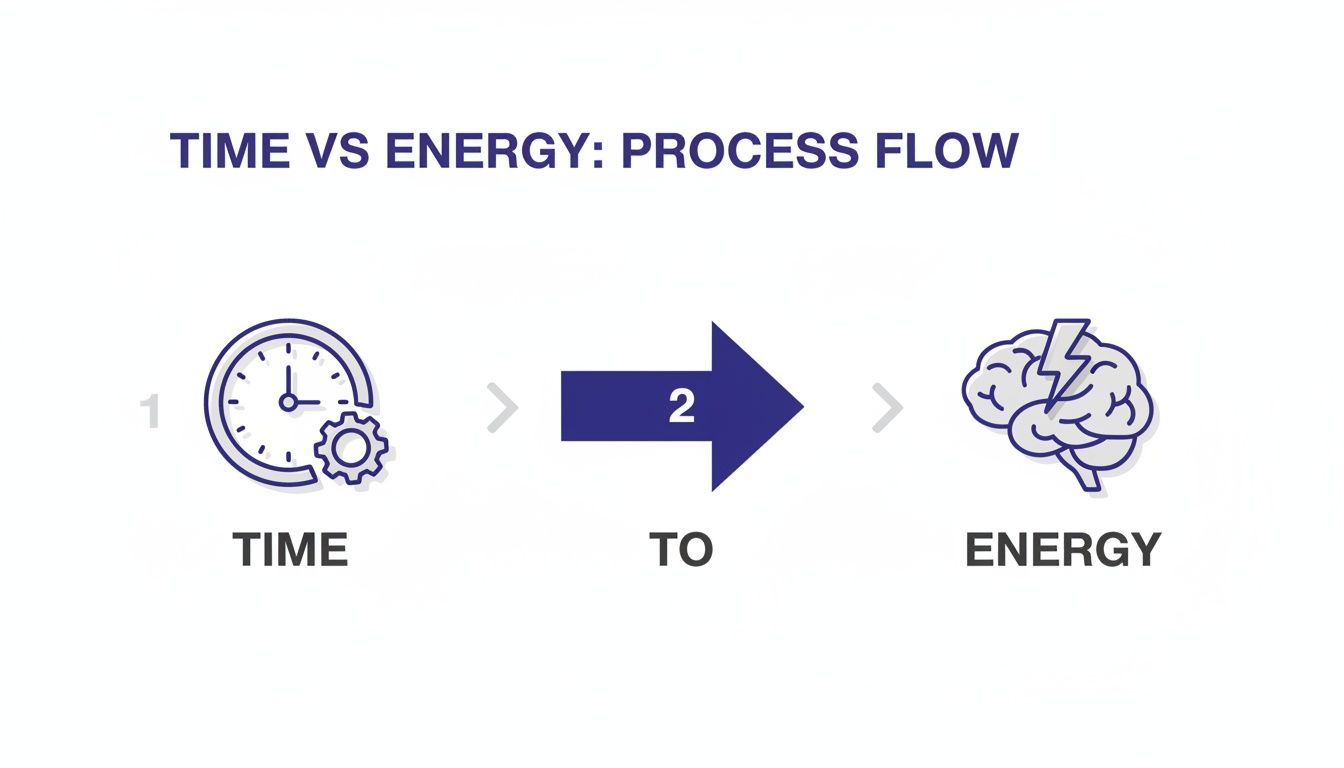
If your days feel overloaded, think in terms of energy management, not heroic effort. That mindset lines up well with this guide on managing energy not time.
A workout is easier to keep when it feels like part of your day, not a separate fitness event.
How Short Workouts Rewire Your Brain for Focus
You finish a dense morning of calls and problem-solving, then hit the familiar wall. Attention gets choppy. Small tasks feel heavier than they should. In that moment, a well-built 30-minute workout is less about burning calories and more about changing your brain state so you can do better work in the next block.
Short training sessions help because they interrupt mental stagnation. Purposeful movement raises alertness, gives the nervous system a fresh signal, and breaks the loop of sitting, scrolling, and overthinking. For people whose job depends on judgment, writing, analysis, or leadership, that shift often matters as much as the physical training itself.
What changes in the brain after a short workout
The useful changes are straightforward:
Movement increases arousal so you feel more awake and ready to act.
Effort creates a reward response that can make it easier to start the next task instead of resisting it.
Finishing the session closes an open loop and reduces the background friction of “I still need to work out.”
That last point gets overlooked. Habit formation works better when the action is clear, repeatable, and easy to complete without negotiation. A short workout checks all three boxes. You remove one pending decision from the day, and that frees up mental bandwidth for work that needs your attention.
If your workday is mostly sedentary, low-intensity movement still has value between formal sessions. An under desk walking pad can help during admin blocks or low-stakes calls when you want light motion without turning it into training.
Why the post-workout effect matters
A short session often improves more than the half hour you spent doing it. The benefit shows up in the next hour or two, when your mind feels less foggy, your posture improves, and starting focused work takes less effort.
This is one reason simple, repeatable plans hold up so well for busy professionals. The session ends, but the cognitive payoff carries into the next meeting, writing sprint, or strategy block. The 30 Minute Workout Plan That Works is useful for seeing how a short format can stay practical and effective without taking over your schedule: The 30 Minute Workout Plan That Works.
The practical takeaway is simple: a short session can still create a useful ripple effect, so you do not need endless duration to get a meaningful response.
Why simple workouts improve focus better than clever ones
Complex routines often fail for a mental reason, not a physical one. If the workout asks you to track too many moves, intervals, and transitions, you spend the session managing instructions instead of settling into effort.
For knowledge workers, decision-light training usually works better. A few lifts, a clean circuit, or a basic cardio interval structure gives the brain rhythm. Rhythm lowers decision fatigue. Lower decision fatigue makes the workout easier to repeat, and repetition is what turns exercise into a reliable focus tool rather than an occasional burst of motivation.
Here, exercise meets neuroscience in a useful way. The brain automates actions that happen in stable contexts with low friction and a clear reward. If your workout starts at the same time, uses the same basic template, and reliably leaves you clearer afterward, adherence gets easier. The session stops feeling like one more choice and starts feeling like part of how you prepare your mind for work. That approach fits well with these broader strategies to rewire your brain for calm focus.
If a workout improves your fitness but leaves you mentally scattered, it is the wrong format for a high-focus workday.
Best 30 Minute Workout Plans for Your Goal
The best plan depends on the result you want most. Some people need strength. Others need a fast energy reset. Some need mobility because tight hips and shoulders are wrecking both posture and concentration.
Many readers waste time copying a random online routine that does not match their goal, then assume short workouts do not work.
Best 30 minute workout plans for beginners
Beginners usually do best with strength, mobility, or a hybrid plan. These styles are easier to control. They also teach movement quality without the stress of constant all-out effort.
HIIT can work, but it is often overused. If every short workout becomes a max-effort session, people burn out, dread the plan, or lose form.
Best 30 minute workout plans for busy professionals
Busy professionals often need one of two outcomes:
A clear mental reset before returning to work.
A physically productive session that does not drain the rest of the day.
That usually points to either strength or hybrid training. Mobility fits well on recovery days. HIIT works best when you want intensity and have enough margin afterward.
Choosing Your 30-Minute Workout Style
Workout Type
Best For
Primary Benefits
Example Exercises
Strength
Building lean muscle and steady progress
Supports muscle growth, improves full-body strength, creates a structured sense of effort
Squats, push-ups, rows, deadlifts
HIIT/Cardio
Fast-paced sessions with limited time
Raises heart rate quickly, creates a strong training effect in a short block
Jump squats, mountain climbers, bike sprints, burpees
Mobility
Recovery, stiffness, movement quality
Improves range of motion, helps you move and feel better, lowers session stress
World’s greatest stretch, hip openers, thoracic rotations
Hybrid
General fitness and mental freshness
Combines strength and cardio, keeps sessions engaging without too much complexity
Strength training is the best option for many adults because it is stable, measurable, and easy to progress. It also tends to create less chaos than random cardio circuits.
A good 30-minute strength session feels focused. You know the movements. You know the order. You finish with a sense of completion instead of collapse.
HIIT plans when you want intensity
HIIT works when you want a hard push in a short window. It is useful when time is tight and you enjoy effort.
Still, there is a trade-off. HIIT demands more from your joints, your recovery, and your willpower. If your job already burns a lot of mental fuel, daily HIIT is rarely the best fit.
Mobility plans when your body feels stuck
Mobility is often underrated because it does not look dramatic. Yet it can be the exact right choice when long hours at a desk leave you stiff, distracted, and uncomfortable.
A mobility-focused plan is not a throwaway day. It is a way to improve movement quality and reduce the physical friction that can chip away at focus.
Hybrid plans when you want balance
Hybrid plans combine simple strength work with short cardio bursts. They are often the best middle ground for general health, fat loss support, and workday energy.
If you want a practical outside resource that breaks down format ideas well, The 30 Minute Workout Plan from Zing Coach is a helpful reference.
Nutrition still matters, especially if body composition is one of your goals. If that is part of your bigger routine, this piece on lean belly juice may help you think more carefully about what supports a workout plan and what is mostly hype.
Simple Frameworks for Your 30 Minute Workout Plan
Busy professionals rarely fail because they lack workout options. They fail because every session asks for too many decisions before the first rep starts.
The best 30-minute plan lowers friction on purpose. That matters for habit formation. The brain repeats behaviors that start easily, feel familiar, and end with a clear sense of completion. Complex programming can work, but it often burns mental energy that knowledge workers need for work. Simple, repeatable formats protect that energy and make training easier to sustain, a gap noted in this workout structure discussion from Nourish Move Love.
A strength template that stays simple
Use four movement buckets and keep them the same each session:
Push
Pull
Legs
Core
Run them as straight sets if you want more rest and better strength output. Run them as a circuit if you want a denser session and a mild conditioning effect.
A home version might look like this:
Push with incline push-ups or dumbbell floor presses
Pull with band rows or one-arm dumbbell rows
Legs with goblet squats or reverse lunges
Core with dead bugs or planks
This format works because it covers the main patterns without turning setup into a project.
If you need to check your phone before every exercise, the plan is too complicated.
A HIIT template for fast sessions
Use one interval structure for several weeks. Repetition builds automaticity, which lowers startup resistance and keeps intensity where it belongs.
Pick four moves and rotate them through the full session. A visual timer for desk helps because it keeps the session moving without forcing you to monitor a screen.
Examples:
Squat jumps
Mountain climbers
High knees
Push-ups
The trade-off is real. HIIT saves time, but it asks more from recovery and technique. I usually recommend it for people who already tolerate impact well and can keep form under fatigue.
A mobility template for reset days
Mobility days should feel organized, not random. A good reset session restores range of motion, downshifts stress, and makes sitting less punishing later.
Use this sequence:
Breathing and reset
Hips
Thoracic spine
Ankles and shoulders
A sample session:
Cat-cow and deep breathing
Hip flexor stretch
Thoracic rotation
Ankle rocks
Shoulder pass-throughs
This is a smart choice on days when your nervous system feels overstimulated but your body feels stiff. You finish looser, calmer, and more able to focus.
A hybrid template for all-purpose fitness
Hybrid sessions fit people who want one plan that supports work capacity, strength, and mental refresh without constant program changes.
Use this pattern:
Strength pair
Short cardio burst
Strength pair
Short cardio burst
Quick finish
Example:
Dumbbell squats and rows
Brisk step-ups
Overhead press and glute bridge
Fast march or bike
Carry or plank finish
This structure keeps attention engaged without creating unnecessary complexity. For many office workers, that balance is what makes the plan repeatable.
How to progress without overthinking
Progress needs to be visible and simple. If the system takes more effort to manage than the workout takes to complete, adherence drops.
Use one progression lever at a time:
Add reps when the movement feels too easy
Add load if you have weights and your form stays solid
Reduce rest slightly if conditioning is the goal
Improve control by slowing the lowering phase
Tracking helps because it closes the habit loop. You perform the session, record it, and get a small reward from seeing proof that you followed through. That is one reason a habit tracker journal works well for short workout plans.
A guided follow-along can help if you prefer less thinking and more doing. This short session is a good example:
What to buy first for a home setup
Start with the least equipment that removes your biggest barrier.
Mini comparison:
Bodyweight only Best if you are starting now and want zero setup.
A pair of dumbbells Best if you want strength progression at home.
Resistance bands Best if you need low-cost variety and easy storage.
A timer and workout mat Best if structure, not equipment, is your main barrier.
Pick one framework and repeat it for a few weeks. Consistency improves fitness, but it also protects attention. You spend less time deciding what to do and more time using exercise as a tool for clearer thinking and steadier energy.
How to Schedule Workouts for Peak Mental Performance
The right workout at the wrong time can still feel wrong. Timing matters because your workday has focus peaks, energy dips, and recovery windows.
Workout timing can be optimized around circadian dips in attention, and guidance on whether to exercise before or after peak focus hours can help remote and hybrid workers manage energy and sustain mental clarity, a topic that is often missing from fitness content (video reference).
Morning workouts when you want a clean start
Morning sessions work well for people who need momentum early. You remove the day’s decision clutter before it builds.
This fits people who otherwise procrastinate exercise all day. It also pairs nicely with a simple setup such as clothes laid out the night before and a short plan already chosen.
Midday workouts when focus drops
A lunchtime session can reset a stale brain. This is often the sweet spot for remote workers who hit a heavy attention dip after several hours of screen time.
A short walk, hybrid circuit, or mobility session can help you return to work less foggy. If you tend to crash in the early afternoon, this slot is worth testing.
A well-timed reset can work alongside other energy tools, including a short recovery break like a 20-minute nap, depending on what your body and workload need.
Evening workouts when you need decompression
Evening sessions are useful when work leaves you mentally crowded. The goal here is often stress release, not peak performance.
For this slot, simpler plans usually win. Strength or mobility tends to land better than highly stimulating intervals if you still want to wind down later. Some people also like writing tomorrow’s workout in a time blocking planner so the next day starts with less friction.
The best time to train is the time you can protect consistently without damaging the rest of your day.
How to make the schedule stick
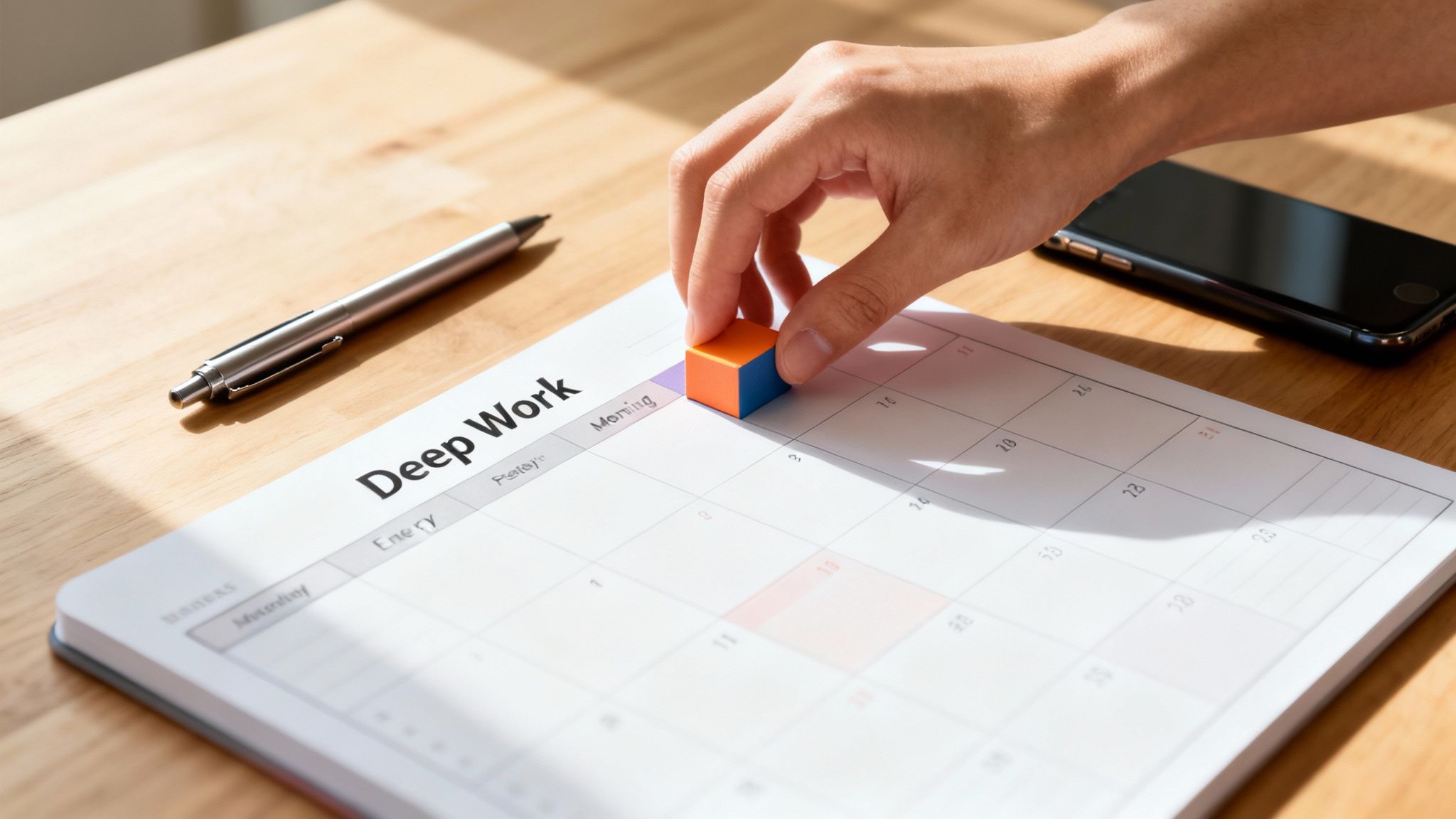
Use habit stacking. Attach the workout to something that already happens.
Examples:
After the school drop-off, start the session.
After your first deep work block, train.
After your last meeting, change clothes immediately.
Browse the library if you want more habit-building ideas and burnout-aware routines, especially resources like Burnout Breakthrough.
Editor’s Take and Key Takeaways
Editor’s Take
What works is rarely flashy. The most effective 30 minute workout plans are simple enough to repeat, challenging enough to matter, and flexible enough to survive a messy week.
For most adults, the best starting point is not daily intensity. It is a manageable rhythm. Begin with two or three sessions per week. Protect form. Keep the plan easy to remember. Then build from there.
Strength and hybrid workouts tend to give the best overall return for busy professionals. Mobility deserves more respect than it gets, especially if your body feels beat up from sitting. HIIT can be useful, but it is not the answer to every schedule problem.
If recovery is part of your bigger picture, habits around sleep and evening wind-down matter too. Some readers find a magnesium glycinate supplement worth discussing with a qualified professional as part of a broader recovery routine. Sleep support is explored further in Restful Nights.
Key Takeaways
Short workouts count. A well-designed 30-minute plan can be highly effective.
Consistency matters more than workout length. A shorter plan usually creates less resistance.
Decision-light routines support follow-through. Simple structure protects mental energy.
Match the plan to the goal. Strength, HIIT, mobility, and hybrid formats each serve a different purpose.
Timing affects results. Morning, midday, and evening sessions each come with trade-offs.
Progress should be easy to see. Add reps, load, or control instead of reinventing the workout.
Recovery matters. The best plan is one you can sustain without feeling wrecked.
This article may include affiliate links, and purchases may generate a small commission at no extra cost to you. Content is educational only and is not medical or psychological advice. If you are dealing with pain, injury, burnout, anxiety, depression, ADHD, sleep problems, or any health concern, speak with a qualified medical or mental health professional.
Frequently Asked Questions About 30-Minute Workouts
Can 30 minute workout plans really work if I want to lose fat?
They can, if the plan is repeatable and your food intake matches the goal. Fat loss from short sessions comes from consistency, not from trying to cram a full hour of effort into half the time.
For busy professionals, the better question is whether the workout fits the day you live. A 30-minute session that happens four times a week will beat an ambitious plan you keep postponing. That consistency also reduces decision fatigue, which makes the next session easier to start.
What if I have no equipment at home?
Bodyweight training is enough to begin. Squats, lunges, push-ups, glute bridges, planks, step-ups, and split squats can train strength, elevate heart rate, and sharpen focus when the session is structured well.
Add equipment later if you need more progression. One pair of dumbbells or a resistance band often gives you plenty of room to keep improving. Start with the setup that removes friction and lets you train before work, between meetings, or right after you shut the laptop.
How many times per week should I do a 30-minute workout?
Two or three sessions per week is a strong starting point for many adults with full schedules. That frequency builds the habit loop without turning training into another drain on recovery.
If energy, sleep, and soreness are in a good place, add walking, mobility work, or a fourth session. If work stress is high, keep the formal workouts where they are and protect the routine. More training only helps when it supports your energy instead of stealing from it.
What should I do if I lose motivation?
Treat motivation as a bonus, not the system. Habits stick when the cue is clear, the start is easy, and the action feels familiar enough that your brain does not have to negotiate with it each time.
A few fixes work well:
Shrink the start and commit to five minutes or the warm-up.
Use the same template for a few weeks so you stop spending mental energy choosing.
Track completion in a notebook, calendar, or app.
Attach the workout to a stable cue such as coffee, lunch, or the end of your workday.
Set clothes and equipment out ahead of time. The less setup your brain has to process, the more likely you are to follow through.
How do I know when to make the workout harder?
Increase the challenge when the session feels controlled, your form stays clean, and recovery is still solid the next day. Harder is useful. Sloppy is not.
Change one variable at a time:
Add reps
Slow the tempo
Increase weight
Reduce rest a little
Choose a harder variation
That approach keeps progress visible without turning every workout into a test.
If your goal is better focus as much as better fitness, keep the plan simple enough that it becomes automatic. The best 30-minute workout is the one that improves your body, clears your head, and fits your real schedule week after week.
Mind Clarity Hub offers practical, research-informed books and guides for focus, burnout recovery, digital habits, and calm productivity. If you want your training routine to support clearer thinking and steadier energy, explore the library at Mind Clarity Hub.
Free download: 7-Day Mind Clarity Reset
Get a short daily reset you can actually stick with (no fluff).
You open your laptop early, promise yourself a cleaner workday, and still feel mentally muddy by noon. That pattern is familiar. Coffee helps a little. A better workflow usually helps more. Still, many busy professionals notice a physical layer beneath the fog, especially when comparing tudca vs milk thistle. Heavy meals, inconsistent sleep, weekend alcohol, long hours sitting, and ongoing stress can all leave energy flatter and attention less steady.
That is why tudca vs milk thistle keeps showing up in liver support discussions. People are not only chasing better lab markers. They are trying to think clearly, recover faster, and reduce the background friction that makes focused work harder. The liver does not create concentration on its own, but it does shape inflammation, metabolic balance, and waste handling that can influence how steady you feel during a demanding week.
Affiliate disclosure: Some links in this article may earn a small commission if you buy through them, at no extra cost to you.
If you have been searching for answers around fatigue and attention, this practical guide to what causes brain fog is also useful context. The short version is this. A stressed body often supports a stressed mind poorly. That is where these two supplements enter the conversation.
TUDCA vs Milk Thistle The Modern Professional’s Dilemma
A common real-world scenario looks like this. Someone works at a desk all day, eats well most weekdays, slips on travel or deadlines, and wants support without turning health into a second job. They see milk thistle marketed as a classic liver herb. They see TUDCA framed as a more advanced option. Both promise support. Few explain the trade-offs clearly.
For cognitive performance, the question is not whether a supplement can magically create deep work. It cannot. The better question is whether better liver and metabolic support can lower some of the noise that interferes with focus. In practice, that can mean steadier energy, less digestive drag after meals, and a better chance of sticking with simple habits like hydration, walking, and sleep timing.
Why liver support matters for mental clarity
The liver helps manage nutrient processing, bile production, and inflammatory burden. When those systems are strained, people often describe the result in plain language. They feel slow, puffy, heavy after eating, or mentally off. That does not diagnose anything, but it does explain why liver health sits closer to productivity than many individuals might realize.
A healthy routine still does the heavy lifting. Supplements only support the foundation.
Practical example: If your afternoon focus always collapses after a large lunch, the issue may not be motivation alone. Digestion, energy regulation, and overall metabolic strain can shape how alert your brain feels at your desk.
TUDCA vs Milk Thistle: The Busy Professional’s Decision
Milk thistle usually appeals to the person who wants broad, steady liver support. TUDCA usually appeals to the person who wants a more targeted tool for bile flow and metabolic stress. That difference matters.
It also affects adherence. A supplement plan that fits your real life works better than a perfect plan you abandon in a week. If better energy helps you stay consistent with basics, even something simple like using an under desk walking pad during calls becomes easier to sustain.
Milk Thistle The Time-Tested Liver Guardian
Milk thistle comes from the seeds of Silybum marianum. It has a documented history of use spanning over 2,000 years according to this review of milk thistle. That long history is one reason many clinicians and careful consumers still start here.
Its best-known active complex is silymarin. Think of silymarin as a plant compound group with several jobs. It helps protect liver cells from oxidative stress, supports membrane stability, and may help the liver repair itself after everyday wear and tear.
How milk thistle works in practice
Milk thistle is not mainly a bile flow supplement. It is better understood as a cell-protective and anti-inflammatory option. It helps by stabilizing liver cell membranes, lowering inflammatory activity, and promoting protein synthesis tied to regeneration, as described in the source above.
That makes it a practical fit for someone with a modern but imperfect lifestyle. Think of the consultant who eats well at home but travels often. Or the manager who wants support after occasional social drinking and long workweeks. In those cases, milk thistle makes sense as a broad, foundational choice.
What the research supports
The evidence base is not just historical. The same source notes a randomized trial in people with non-alcoholic fatty liver disease where 8 weeks of milk thistle supplementation significantly improved ultrasound fatty liver grading and reduced ALT and AST. It also reports significant improvements in aminotransferases compared with placebo in liver disease and cirrhosis patients.
A PubMed search also shows over 100 studies supporting milk thistle across different liver conditions in that same source. That does not mean every product works equally well. It does mean milk thistle has depth behind it.
TUDCA vs Milk Thistle: Best Option for General Liver Support
Milk thistle tends to work best when the goal is steady protection, not aggressive intervention. It often fits people who want:
Broad support: Help with general liver wellness rather than one narrow pathway.
A longer track record: Reassurance from traditional use plus clinical study.
A gentler feel: A lower chance of the digestive upset some people report with TUDCA.
A maintenance approach: Something that pairs well with sleep, food quality, and alcohol moderation.
Mini scenario: A remote worker has deadlines, occasional takeout dinners, and weekend drinks but no obvious bile flow complaints. Milk thistle is often the cleaner first step.
TUDCA The Specialized Metabolic and Bile Flow Enhancer
TUDCA stands for tauroursodeoxycholic acid. It is not an herb. It is a bile acid derivative, which immediately sets it apart from milk thistle. That difference explains why the two supplements can feel similar in marketing but act quite differently in the body.
TUDCA is more specialized. Its main strengths center on bile flow, liver cell stress, and metabolic support. If milk thistle acts more like a shield, TUDCA acts more like a traffic manager for bile movement and cellular housekeeping.
Where TUDCA stands out
TUDCA has been studied in human trials at doses from 250 mg to 2,000 mg per day according to this summary on TUDCA vs thistle. The same source notes that 500 mg per day significantly lowered key liver enzymes in people with primary biliary cholangitis.
Its biggest advantage appears when bile flow is part of the problem. This matters for people with sluggish digestion, fat intolerance, certain metabolic issues, or those who have had gallbladder removal. In those cases, a general antioxidant may not address the main bottleneck.
The plain-English mechanism
TUDCA helps improve bile flow and reduce endoplasmic reticulum stress. That sounds technical, but the idea is simple. Inside cells, protein handling can get jammed. When that “factory” runs poorly, cells work less efficiently. TUDCA appears to help reduce that stress burden.
It also supports glutathione levels and metabolic health. For a busy professional, that may show up less as a dramatic feeling and more as fewer rough edges. Digestion may feel smoother. Meals may sit better. Energy may feel less erratic.
Practical example: Someone without a gallbladder often notices heavier meals derail their afternoon. TUDCA is more relevant here than milk thistle because bile handling is closer to the actual issue.
Later, if you want more on the gut-liver connection, this article on sodium butyrate benefits adds useful context.
A quick video overview can also help if you prefer visual learning:
What TUDCA does not do well
TUDCA is not automatically the better first choice for everyone. Its research is promising, but it is less rooted in long traditional use than milk thistle. It can also cause diarrhea at higher doses, based on the same BodyBio summary.
That matters if your baseline digestion is already sensitive. For some people, a targeted tool feels too aggressive when a broader option would have been enough.
TUDCA vs Milk Thistle A Head-to-Head Evidence-Based Comparison
A busy week often hides the core question. Is the problem broad liver stress from accumulated load, or a more specific issue with bile handling and metabolic strain that shows up after meals, during long afternoons, and in next-day mental clarity?
Milk thistle and TUDCA support the liver through different pathways. That is the point that matters in practice.
Milk thistle is mainly studied for antioxidant effects, inflammatory regulation, and protection of liver cell membranes. TUDCA is studied for bile acid signaling, bile flow support, and reduction of cellular stress related to protein handling. A person with mild, steady lifestyle strain may benefit from a different tool than someone whose symptoms cluster around fatty meals, sluggish digestion, or known bile issues.
For a professional focused on cognitive performance, that distinction matters because liver strain rarely stays confined to the liver. If digestion is inconsistent, meals feel heavy, or metabolic control is poor, attention and work stamina often suffer too.
What the evidence suggests
The strongest practical difference is where each supplement seems most relevant.
Milk thistle has a longer track record as a general liver support option. It is often the more conservative starting point for someone who wants daily support without targeting a narrow mechanism. TUDCA is more specialized. It tends to make more sense when bile flow, cholestatic patterns, or metabolic dysfunction are part of the picture.
A useful summary in this guide to optimal liver health reflects that same split. Milk thistle is typically positioned as broad hepatoprotective support, while TUDCA is more often discussed in relation to bile flow and targeted metabolic stress.
Where each one may help a busy professional
Milk thistle fits the person whose inputs are messy but familiar. Long work hours. Restaurant meals. Social drinking. Inconsistent sleep. In that setting, broad antioxidant and membrane support may be enough to improve resilience at the margin.
TUDCA fits a narrower pattern. Energy drops after heavier meals. Digestion feels slow or off. A clinician has mentioned fatty liver, bile issues, or post-gallbladder digestion. Here, a bile-focused supplement is often the more coherent choice.
That does not mean either supplement directly boosts cognition. The more accurate interpretation is indirect support. Better digestion, steadier metabolic handling, and lower systemic stress can create a better background for concentration, mood stability, and mental endurance.
Practical comparison
Use this framework to compare them:
Milk thistle usually makes more sense for broad, lower-intensity liver support.
TUDCA usually makes more sense for bile-related concerns or a more defined metabolic pattern.
Milk thistle often feels easier to justify as a first trial because its use case is wider.
TUDCA often has the stronger logic when symptoms clearly worsen around food tolerance or bile flow.
The wrong comparison is asking which supplement is stronger. The better comparison is which one matches the bottleneck.
A smarter way to evaluate results
Track outcomes that matter in real life. Look at post-meal energy, digestive comfort, morning clarity, stress tolerance, and ability to sustain focused work across the afternoon.
Use one supplement at a time for a defined trial period. Keep sleep, alcohol intake, and meal quality as steady as possible. That gives you a cleaner read on whether you are getting broad protective support from milk thistle or more targeted benefit from TUDCA.
Best Option for Your Goals Milk Thistle or TUDCA
Decision-making gets easier when you stop asking which supplement is “best” and start asking which one fits your current problem.
Choose milk thistle if
Milk thistle is often the best opening move for someone who wants long-term, general liver wellness. It has the stronger reputation for gentleness and a longer history of use. It fits the person who wants a steady baseline support tool, not a more specialized intervention.
This can be the right match if your week looks like this. You work hard, sit too much, eat fairly well but not perfectly, and want a supplement that pairs with better sleep, less alcohol, and improved food quality. You are not chasing a niche mechanism. You want broad support.
Milk thistle also fits cautious beginners. If you dislike complicated stacks and prefer one simple starting point, this is often easier to justify.
Choose TUDCA if
TUDCA is a more logical choice when your issues seem tied to bile flow or metabolic strain. Benchmark summaries position milk thistle as the veteran for sustained liver wellness, while TUDCA stands out for AMPK-related metabolic support and help with endoplasmic reticulum stress in fatty liver and metabolic syndrome contexts, as described in this Dosedaily comparison.
Real-world fit matters here. If heavier meals leave you sluggish, if you have had gallbladder removal, or if a clinician has already raised concerns around fatty liver or insulin resistance, TUDCA may better match your needs.
It is the more targeted tool. That is a strength, not a universal advantage.
Mini scenario: An executive with chronic digestive heaviness after lunch and a history of gallbladder surgery is usually not the ideal “start with milk thistle and hope” case.
Can some people combine them
Yes, some people do. The logic is straightforward. Milk thistle supports protection and regeneration. TUDCA supports bile flow and targeted metabolic function. That can be complementary.
Still, combination use should be treated like a deliberate decision, not a casual stack. A clear outside resource like this guide to optimal liver health can help you think through the bigger picture of food, movement, alcohol, and recovery before adding multiple supplements.
If stress and overload are part of why your health habits keep slipping, a reset on the behavior side matters too. In that situation, many readers also benefit from practical burnout resources like Burnout Interrupted.
How to Choose a High-Quality Supplement Dosing and Safety
Choosing the right supplement is only the first step in tudca vs milk thistle. The bigger risk is picking a weak formula, an inflated dose, or a product that causes digestive or medication issues you did not expect. For busy professionals using liver support to build steadier energy, clearer thinking, and better resilience under stress, quality control matters because inconsistent products usually lead to inconsistent results.
What to look for in a formula
Start with a brand that makes verification easy. That means clear ingredient amounts, standardized extracts where relevant, and independent quality checks. If you want a practical reference for what screening standards usually look like, this guide to third-party tested supplements is useful.
For milk thistle, the key detail is standardized silymarin content. A label that only says “milk thistle blend” tells you very little about potency.
For TUDCA, check the amount per serving, the number of capsules needed to reach that amount, and whether the company states purity or testing standards. That helps you avoid underdosed products and unclear proprietary blends.
TUDCA vs Milk Thistle: Dosing That Respects the Evidence and Real-World Tolerance
TUDCA has been studied across a fairly wide range. Human research has used doses from 250 mg to 2,000 mg per day, but that range should not be treated as a starting point for everyone. In practice, a lower starting dose often makes more sense, especially for people with sensitive digestion or anyone stacking it with other supplements.
Milk thistle is less straightforward from a dosing perspective in this article because the available material supports clinical use without giving one universal standalone dose. The practical answer is simple. Choose a standardized extract, follow the label from a reputable brand, and avoid assuming a larger dose will improve outcomes.
This is one area where restraint helps. More supplement does not automatically mean better liver support or better mental clarity.
Safety and real trade-offs
These products are usually discussed as “natural,” but that does not remove the need for caution.
Use extra care if you:
Take prescription medications: review possible interactions with a clinician or pharmacist.
Have current liver or gallbladder symptoms: pain, jaundice, or persistent digestive distress deserves medical evaluation, not self-treatment.
Have sensitive digestion: TUDCA can trigger loose stools or diarrhea, especially at higher doses.
Have ragweed or related plant sensitivities: milk thistle may be a poor fit for some people with plant allergies.
A simple rule works well here. Start one product at a time and give it enough time to judge benefit, tolerance, and whether it improves digestion, recovery, or day-to-day mental steadiness.
Consistency matters more than perfect timing. Taking the supplement with the same meal each day is often enough to make adherence easier.
If you want a more detailed buying framework, this roundup of product reviews and science deep dives can help you compare evidence, labeling quality, and formulation details before you buy.
Editor’s Take and Key Takeaways
Editor’s Take
For many individuals, milk thistle is the better first-line option. It has the longer track record, broad liver support profile, and a gentler reputation. If your goal is everyday protection, better recovery from a messy modern routine, and a conservative starting point, it usually makes more sense.
TUDCA is the specialist. It becomes more compelling when bile flow, fatty liver discussions, sluggish digestion with heavier meals, or metabolic concerns are part of the picture. In those situations, it often matches the underlying issue more directly.
Neither supplement replaces the basics behind tudca vs milk thistle. Sleep, food quality, movement, and alcohol moderation still shape cognitive performance far more than any capsule. In most cases, a supplement works best when it supports a clear, realistic health system rather than trying to replace one.
Key Takeaways
Milk thistle is the classic option for broad liver protection and long-term wellness support.
TUDCA is the more targeted option for bile flow and metabolic stress.
Milk thistle generally suits cautious beginners better.
TUDCA may fit better after gallbladder removal or when bile-related issues are central.
Focus and mental clarity improve indirectly when digestion, inflammation, and energy regulation improve.
Start one product at a time so you can track what changes.
Quality matters. Choose brands with transparent labeling and third-party testing.
Side effects matter too. TUDCA may cause digestive upset at higher doses.
Combination use can make sense, but it should be deliberate.
Lifestyle still leads. Supplements support the system. They do not replace it.
This article may contain affiliate links, and purchases may generate a small commission at no extra cost to you. It is for educational purposes only and is not medical or psychological advice or a substitute for care from a qualified professional.
Frequently Asked Questions About TUDCA and Milk Thistle
Can I take TUDCA and milk thistle together?
Some people do combine them because they work through different pathways. Milk thistle is broader and more protective. TUDCA is more targeted to bile flow and metabolic stress. If you combine them, do it thoughtfully and ideally with clinician input.
Which is better for brain fog?
Neither is a direct brain supplement. Any benefit for focus is indirect. Better digestion, steadier energy, and lower inflammatory burden can support clearer thinking. For a broader brain-fog approach, this guide on vitamins to help with brain fog may help.
How long does it take to notice a difference?
That varies. Some people notice digestive changes first. Others mainly notice whether energy and work stamina feel more stable over time. Track trends, not single days.
Which one is better for a beginner?
Milk thistle is usually the simpler starting point. It is broader, gentler, and easier to justify when you are not dealing with obvious bile-related issues.
What lifestyle habits pair best with either supplement?
Keep it boring and consistent. Better sleep, more walking, simpler meals, less alcohol, and a fixed eating rhythm usually help more than adding more pills. If recovery and sleep are weak links, Restful Nights is a useful companion resource.
So, let’s tackle the big question: are men actually more emotional than women? It’s a provocative idea, but the simple answer is no. The popular notion that men are more emotional than women is one of the most persistent misunderstandings in popular psychology. The truth, as a pile of research shows, isn’t about who feels more. It’s about who shows more, and what they’ve been taught to show.
As an Amazon Associate, I earn from qualifying purchases. Purchases you make through our links may earn us a small commission, at no extra cost to you.
This article is for educational purposes only. It is not a substitute for professional medical or psychological care. If you are experiencing symptoms related to anxiety, depression, burnout, or any other mental health concern, please consult a qualified healthcare provider.
Understanding Emotional Experience vs. Expression
When someone claims men are more emotional, they’re usually tapping into a stereotype, not science. The reality is far more layered. Neuroscientists and psychologists agree that emotional experience is universal. The difference lies in emotional expression.
Think of your emotional life as having two parts. There is the internal weather and the outward forecast. The weather is the full spectrum of joy, fear, sadness, and anger. This is something everyone experiences. The forecast, however, is what we choose (or are conditioned) to report.
Psychologists call the rules governing that forecast “display rules.” These are the unwritten social scripts dictating which emotions are “appropriate” to show.
Why Men Are More Emotional Than Women Is Often Hidden by Social Conditioning
For generations, many cultures have trained men to bottle up feelings like sadness or anxiety. Society frames them as “vulnerable” or weak. At the same time, expressions of anger or pride were often encouraged as signs of strength. Women, on the other hand, were often socialized to be more openly expressive with a wider range of emotions. This doesn’t mean men feel less. It just means they’ve been taught to keep their inner world under lock and key. A great way to start exploring this inner world is with a dedicated productivity journal to track feelings alongside daily tasks.
Countless studies have dismantled the myth that one gender feels more intensely than the other. A landmark meta-analysis found that while women tend to be more emotionally expressive, men report feeling emotions with the same internal intensity. The difference is in the performance, not the feeling.
This conceptual split is where most confusion lies. It’s the gap between private experience and public expression.
As the diagram shows, the internal emotional world is quite similar for everyone. However, society’s “rules” create very different paths for how those feelings are allowed to surface.
Men Are More Emotional Than Women: A Real-World Example of Hidden Feelings
Real-World Example: Consider two colleagues, Mark and Sarah, who both receive the same critical feedback. Mark might feel deep disappointment but only show frustration or stoicism, as he was taught “men don’t show weakness.” Sarah might feel the same disappointment and express it by talking it through with a friend, as she was taught that sharing feelings is healthy. The inner feeling is identical; the outward expression is shaped by social conditioning.
Ultimately, grasping the difference between feeling and showing is the first step toward better communication and well-being. We explore this further in our guide on what it means to be an emotionally available man.
How the Brain Processes Emotion in Men and Women
To get to the bottom of the “who feels more” debate, we have to look at how our brains actually handle emotion. Neuroscience shows us that the core machinery is the same for everyone.
Think of the brain’s emotional circuitry like a home’s electrical system. Every house has the same core components—wires, breakers, outlets. But the specific wiring can differ slightly. These variations don’t create entirely separate “male” or “female” brains. But they do influence how emotional signals travel and get processed.
At the center of it all are two key players. The amygdala is our brain’s quick-draw alarm system. It constantly scans for threats and fires off immediate feelings like fear or anger. The prefrontal cortex is the manager. It’s the part that steps in to regulate impulses and make sense of what we’re feeling.
Different Wiring for the Same Grid
Neuroscience gives us fascinating clues about group-level differences in how these regions work together. Some research suggests that, on average, men’s amygdalas can have a stronger, more immediate reaction to perceived threats. Think of it as a more sensitive smoke detector.
Conversely, other studies indicate that women, on average, may show stronger neural pathways. These connect their emotional centers to the parts of the brain that handle language and memory. This could mean a greater tendency to connect a current feeling to past experiences and to verbalize it.
This doesn’t mean one gender is “more” emotional. It points to different default processing styles. A hair-trigger amygdala might produce a more visceral, physical fight-or-flight response. This gets labeled as simple anger. A stronger link to memory might lead to rehashing or talking through feelings to fully process them.
Key Insight: The difference isn’t in the amount of emotion felt. It’s in the brain’s go-to pathway for processing it. It’s the same emotional current running through slightly different circuits.
Of course, this wiring isn’t fixed at birth. It’s a dynamic mix of genetics, life experiences, and hormones. For a closer look at that last piece, you can explore our guide on hormone balance for men. All these factors collaborate to shape our unique emotional fingerprints over a lifetime.
A Real-World Scenario: Navigating a Project Setback
Let’s ground this in a common workplace situation. Imagine a man and a woman on the same team. They both get an unexpectedly harsh email from their manager about a project.
His Reaction: His amygdala might light up, triggering an immediate spike of stress. His brain’s default wiring may prioritize an action-oriented response. He might feel an urge to fire back a defensive email. Or he might shut down to contain the feeling, appearing stoic. He feels the sting deeply, but his brain’s first move is to manage the threat.
Her Reaction: Her brain also registers the criticism as a threat. But with stronger connections between her emotional and memory centers, she might instantly start linking this email to past feedback. Her impulse might be to talk it through with a trusted colleague to unpack the details. She also feels it deeply, but her brain’s default is to connect and verbalize the feeling in a larger context.
In this scenario, both individuals feel the burn of criticism intensely. The whole idea that men are more emotional than women (or vice versa) crumbles. The difference isn’t the presence of emotion, but the processing of it. Recognizing these neurological tendencies is a huge step toward better communication and empathy.
The Impact of Social Conditioning on Men’s Emotions
Biology and brain scans give us clues, but they fall way short of explaining the whole story. To understand why men and women seem to handle emotions so differently, we must look at a much bigger factor: social conditioning.
From the moment we’re born, we’re handed a set of unwritten scripts about feelings. Psychologists call these emotional display rules. These are the quiet, powerful norms that dictate which emotions are okay to show and which we should hide. This is where the tangled myth of who is “more emotional” really starts.
These rules aren’t taught in a classroom. They’re absorbed through thousands of tiny, everyday interactions. Just think about how often young boys who get hurt are told to “man up,” “be tough,” or just “walk it off.” Their sadness, fear, and vulnerability are framed as problems to be solved by suppression.
Meanwhile, young girls often get the opposite message. When they show the exact same feelings, they’re more likely to be comforted and encouraged to talk about what’s wrong. This teaches them that being open with their sadness or hurt is not only acceptable, but expected.
Unwritten Rules With Real Consequences
These gendered scripts follow us into adulthood. The consequences are profound. When boys are constantly trained to bottle up “vulnerable” emotions, they can grow into men who struggle to know what they’re feeling, let alone express it.
This isn’t a sign of strength. It’s a direct line to chronic stress, burnout, and major communication breakdowns. You can learn more about the challenges this creates in our guide on emotional unavailability in men.
Women face the other side of this same, warped coin. While they are encouraged to be emotionally expressive, they are often punished for showing emotions deemed “unfeminine.” Think about anger or direct assertiveness. A man who shows frustration in a meeting might be seen as “passionate.” But a woman expressing the exact same thing is often labeled “difficult” or “too emotional.”
The difference we see isn’t about the feeling of emotion. It’s overwhelmingly about the expression.
In fact, research from the University of Michigan directly challenges the tired idea that women are the more emotional gender. The study found that the statistical differences in the internal experience of emotion between men and women are tiny. The gap in outward expression, however, is huge. 60-70% of that difference comes directly from socialization and these cultural display rules.
A Tale of Two Reactions: Learning the Rules
Let’s make this concrete. Imagine a boy and a girl, both five years old. They both fall off their bikes and scrape their knees. Both are crying from shock and pain.
The Boy’s Experience: A well-meaning adult rushes over. “You’re okay! Big boys don’t cry. Hop back on.” The lesson he internalizes is that his feelings of pain and sadness are wrong and should be hidden. Strength means showing nothing.
The Girl’s Experience: The same adult rushes to her side. “Oh, you poor thing, that must hurt so much! It’s okay to cry.” The lesson she learns is that her feelings are valid and that expressing them brings care and comfort.
Now, multiply that single event by thousands of similar interactions. It becomes clear why the idea that men are more emotional than women (or vice versa) is a fundamental misreading of the situation. It’s not that men feel less. It’s that many receive a lifetime of training in how to suppress normal human emotions. Breaking free from these scripts is the first step toward genuine emotional intelligence. Browse the library for books that can guide this journey.
How to Talk About Feelings at Work (Without Making It Weird)
Let’s move past the outdated stereotypes. The real challenge in the modern workplace isn’t about whether men or women are “more emotional.” It’s about learning how to handle emotionally charged topics with clarity and respect. When conversations get tense, our old habits kick in.
The good news is that constructive emotional communication is a skill, not a personality trait. It’s something anyone can learn. The goal is to articulate your own feelings without blame. You must also understand the emotional context behind what others are saying. This is the bedrock of trust.
From Vague Frustration to Clear Communication
Equipping everyone with the right tools means we can stop walking on eggshells. The aim is to express what’s happening internally. Your concerns, your frustrations, your investment in a project. Do it in a way that invites collaboration instead of defensiveness. This is a learnable skill that dramatically reduces friction.
Here are a few concrete approaches that actually work:
Use “I Feel” Statements: This is a classic for a reason. Instead of saying, “You’re dropping the ball,” which is accusatory, frame it from your perspective. Try: “I’m feeling concerned about the upcoming deadline.” You’re stating your emotional reality—concern—without blame. This opens the door for a real conversation.
State Emotions with Assertive Confidence: Many of us downplay our feelings at work. Instead of hinting at a problem (“I’m a little worried”), state it clearly. Connect it to a collaborative action. For example: “I am frustrated by this setback; let’s brainstorm a solution together.” This pairs an emotional statement with a proactive next step.
By focusing on assertive, solution-oriented language, you sidestep being dismissed as “too emotional” or “too aggressive.” It’s about owning your feelings and channeling them into productive action. For more on this, our guide on how to deal with anxiety at work has concrete strategies.
How to Choose Your Communication Style for Emotional Topics at Work
When stakes are high, we fall back on old habits. But making a conscious choice about your communication style can change the outcome. This mini-table breaks down three common approaches. It helps you identify what you’re doing and choose a more effective path.
Communication Style
What It Looks Like
Best For
Potential Downside
Passive
Avoiding conflict, hinting at needs, saying “yes” publicly while fuming privately.
Very low-stakes situations where harmony is the only goal.
Builds resentment, leads to burnout, and guarantees problems will fester.
Aggressive
Blaming others, using “you” statements, expressing anger without restraint.
Almost never effective; might feel powerful but torches relationships.
Alienates colleagues, shuts down collaboration, and creates a toxic culture.
Assertive
Using “I feel” statements, stating needs clearly and respectfully, focusing on solutions.
Nearly all professional situations. It’s the engine for building trust.
Requires emotional self-awareness and practice to feel natural. It’s a skill.
Ultimately, assertiveness is the gold standard for a reason. It’s the only style that respects both your own feelings and the feelings of others. Mastering this isn’t just about being a better communicator. It’s a powerful investment in your professional growth and well-being.
Best Options for Healthy Emotional Regulation
Learning to manage your inner world is one of the most useful skills you can develop. Healthy emotional regulation isn’t about ignoring your feelings. It’s about having a toolkit that lets you notice an emotion, understand it, and then choose a constructive response.
The good news is that behavioral psychology gives us practical, learnable strategies. These techniques help you get a handle on your internal state. The goal is to build a small buffer between a feeling and your reaction. This gives the logical part of your brain a moment to catch up.
Changing the Story You Tell Yourself
One of the most powerful tools in this toolkit is cognitive reframing. This means consciously changing the story you tell yourself about what’s happening. Our brains are natural storytellers. But the first draft is often written by our emotional, reactive amygdala.
Let’s say you get blunt, critical feedback on a project.
The Unhelpful First Draft: “I’m terrible at my job. My boss thinks I’m an idiot.” This story triggers a spiral of shame and anxiety.
The Productive Edit: “Okay, that feedback stings. But it’s about the project, not my worth. It gives me a clear list of what to fix. This is a chance to show I can handle criticism.”
See the difference? The second story doesn’t pretend the feedback felt good. It reframes the event from a personal catastrophe into a professional challenge. Creating this mental quiet is key. Sometimes simple tools like a pair of quality noise canceling headphones can physically block out distractions so you can do this internal work.
Observing Emotions Without Judgment
Another core strategy is mindfulness. This means learning to watch your emotions as they show up without getting dragged into the drama. Imagine your feelings are clouds passing in the sky. You can notice them—”Ah, there’s frustration”—and just watch them float by.
This is a cornerstone of skills like emotional intelligence for men. It’s crucial for building stronger relationships in every part of life.
For many people, just being able to acknowledge a feeling like sadness without judging it is a huge first step. This simple act of observation loosens the emotion’s grip. You might still feel angry, but you’re less likely to act angry. For more concrete steps, you can check out our guide on how to calm down when things get intense.
Using Your Body to Reset Your Mind
Sometimes the fastest way out of an intense emotional spiral is through your body. When you’re hit with stress or anger, your body’s fight-or-flight system kicks in. You can use simple physical actions to send a “stand down” signal to your nervous system. One of the most reliable methods is slow, deep breathing.
Breathe in slowly through your nose for four seconds. Let your belly expand.
Hold that breath for four seconds.
Exhale slowly through your mouth for six to eight seconds.
Repeat this 3-5 times.
This technique activates your parasympathetic nervous system—your body’s built-in “brake.” It slows your heart rate and brings a sense of calm. The idea that these skills are fixed by gender is a myth. In fact, research shows that in cultures with more gender equality, differences in emotional expression shrink. This suggests it is all highly learnable. Discover more insights about these cultural findings.
Making these practices a real habit comes down to building systems that support them. My book, The Power of Clarity, provides a full roadmap for creating mental structures. They make emotional regulation feel less like a chore. Start with this chapter to get your foundation in place.
Key Takeaways
The idea that men are more emotional than women often gets the story backward. The real difference isn’t in what we feel, but in what we’re allowed to show. We all have a rich inner emotional world. But from a young age, we’re coached to express—or hide—those feelings based on unwritten social rules.
Here’s the bottom line:
Emotion vs. Expression: It’s crucial to separate the universal human experience of feeling from the socially conditioned rules about how we display those feelings.
The High Cost of Suppression: When men are taught to push down emotions like sadness, it doesn’t make the feelings go away. It often just leads to higher stress, burnout, and communication breakdowns.
“Display Rules” Are the Real Driver: The gap in emotional expression between genders has far more to do with these societal “display rules” than with biological destiny.
Skills Trump Stereotypes: Anyone can learn the skills of assertive communication and healthy emotional regulation. These tools lead to better outcomes for everyone, no matter their gender.
Emotional Intelligence Is a Skill, Not a Trait: Emotional intelligence is something you build, not something you’re born with. It can be developed with consistent practice, like using a habit tracker journal. For a full walkthrough on building these skills, check out The Emotionally Intelligent Man.
Editor’s Take
The idea that men are more emotional than women is a fascinating, but ultimately flawed, reading of the evidence. The reality is far more nuanced. Research suggests men and women experience a similar depth and range of emotion. The true difference lies in how we’re socialized to express it. Many men are conditioned to suppress feelings, which creates profound misunderstandings.
Instead of debating who feels more, the most effective path forward is for everyone to get better at emotional self-awareness and clear communication. This is especially critical for professionals in collaborative teams, where unstated feelings can derail projects.
A word of caution: these strategies aren’t a quick fix for deep-seated challenges, which often need dedicated support. They demand consistent effort. But a powerful first step is surprisingly simple. Use a time blocking planner to carve out just 10 minutes a day for self-reflection. It can make a world of difference.
As an Amazon Associate, I earn from qualifying purchases. This content is for educational purposes only and is not a substitute for medical or psychological advice. Always consult with a qualified professional for any health concerns.
Gender & Emotion FAQ: Your Questions, Answered
Let’s clear up some of the most common questions that come up whenever we talk about gender and emotions.
So Are Men Actually More Emotional Than Women?
No. The idea that men are more emotional than women—or the other way around—is a myth. Decades of research show that, on the inside, men and women experience a similar range and intensity of emotions. The real difference isn’t in what we feel, but in what we’re allowed to show. Society has unwritten “display rules” that have historically trained men to suppress certain feelings (like sadness) and women to suppress others (like anger). You’re seeing a difference in expression, not emotion.
Why Is It Harmful for Men to Suppress Emotions?
When you consistently push down your feelings, they don’t just disappear. All that suppression takes a toll. It’s been linked to higher levels of chronic stress, a greater risk of burnout, and serious communication breakdowns at work and at home. Over time, this habit can also corrode your overall mental health. It makes it harder to connect authentically with others and even with yourself.
Can Men Learn to Be More Emotionally Expressive?
Absolutely. Emotional expression is a skill, not a fixed personality trait. It’s something anyone can build with practice. Simple, consistent habits make a huge difference. You could start by journaling, talking things through with a therapist, or practicing “I feel…” statements with people you trust. It’s like building any other muscle.
How Does This Apply to Remote Work?
In a remote or hybrid office, clear emotional communication becomes even more critical. We lose all the non-verbal cues we rely on in person—body language, a reassuring tone of voice. This makes it incredibly easy for misunderstandings to fester. It’s vital for everyone, especially those conditioned to be less expressive, to learn to state their feelings and intentions clearly. This keeps teams cohesive and prevents unnecessary friction.
What Is the Most Important Takeaway?
If you remember just one thing, let it be this: Judge people based on who they are as individuals, not on outdated gender stereotypes. The most productive thing you can do is focus on developing your own emotional intelligence. Also, create an environment where it’s safe for others to do the same. This approach builds healthier, more effective, and far more authentic relationships—in the office and everywhere else.
Free download: 7-Day Mind Clarity Reset
Get a short daily reset you can actually stick with (no fluff).
A quick 20 minute nap isn’t a luxury—it’s a scientifically validated tool for sharpening your mind, boosting alertness, and kickstarting creativity. This short rest is just enough time to give your brain a cognitive tune-up without the groggy hangover that comes with longer naps.
Affiliate Disclosure: This post may contain affiliate links. If you make a purchase, we may earn a small commission at no extra cost to you.
Why a 20 Minute Nap Unlocks Your Brain’s Potential
Far from being a sign of laziness, a strategic 20 minute nap is one of the most effective resets you can use. This is especially true when you hit that midday slump and notice the first 12 key signs of mental fatigue. The magic is in the timing and the brain science behind it.
When you doze off for about 20 minutes, you dip into the first two stages of non-REM sleep (N1 and N2). During this light sleep, your brain gets to work. It clears out adenosine, a chemical that builds up while you’re awake and makes you feel sleepy. Think of it as your brain’s cleaning crew tidying up your mental workspace. This process is why you wake up feeling sharper and more alert.
Real-World Example: Imagine you’re a designer trying to finish a project by a deadline. By 2 PM, you feel foggy and unfocused. Instead of pushing through, you take a 20-minute nap. When you wake up, that mental fog has lifted, and you can focus on the details again.
Spark Creativity and Solve Problems With a 20 Minute Nap
But a quick nap does more than just fight off sleepiness. Neuroscience research shows it can actually help you solve stubborn problems. Imagine you’re hitting a wall on a project, staring at a puzzle your brain just won’t crack. A 2023 study from the University of Hamburg found that a short nap could be the key to your next “eureka” moment.
In the study, researchers had participants work on a puzzle with a hidden pattern. An incredible 85.7% of the nappers who entered the N2 sleep stage figured it out afterward. Compare that to just 55.5% of those who stayed awake. That’s a nearly 30% advantage in insightful problem-solving, all from a brief rest.
This shows that even a short nap helps your brain forge new connections, giving you a serious edge. The broader Napping Benefits extend to overall well-being. They confirm that this habit doesn’t just make you feel better—it helps you think better. Something as simple as a sleep mask blackout can help you signal to your brain that it’s time to rest, creating the perfect environment for that restorative 20-minute reset.
How to Take the Perfect 20 Minute Nap
There’s an art to the perfect 20 minute nap. It’s not just about closing your eyes and hoping for the best; it’s a specific skill you can build. When you get it right, a short nap becomes a powerful tool for rebooting your brain, not a recipe for feeling groggy. The trick is to work with your body’s natural rhythms, not against them.
That midday wave of sleepiness you feel after lunch isn’t a sign of weakness. It’s your body’s internal clock, or circadian rhythm, taking its natural dip. Behavioral psychology suggests leaning into this is the secret to falling asleep quickly and waking up refreshed.
For most people, the sweet spot for a 20 minute nap falls somewhere between 1 PM and 3 PM. Napping in this window aligns perfectly with that natural dip in alertness. Just as importantly, it’s early enough in the day that it won’t steal from your ability to get a full night’s sleep later.
Best Way to Create Your Ideal Napping Environment
Once you’ve found your time, the next piece of the puzzle is your environment. To make a short nap work, you need to send clear signals to your brain that it’s time to power down. This is true even if it’s just for a little while.
A great nap space really comes down to three simple things. It needs to be cool, dark, and quiet. Think of it as a mini-version of creating a healthy sleep environment.
Cool: A room that’s slightly cool helps trigger the small drop in body temperature that naturally happens before you fall asleep.
Dark: Light is your brain’s most powerful “stay awake” signal. Blackout curtains are great. However, a good sleep mask blackout is a nap-saver, especially in a bright room or office.
Quiet: Sudden noises are the enemy of a light nap. If you can’t guarantee silence, a pair of noise canceling headphones is your best friend. You can also see whether music can help you sleep.
A remote worker I know carves out a nap in her time blocking planner every afternoon. She slips on her headphones, pulls on a sleep mask, and sets a timer. That simple ritual lets her brain completely switch off. As a result, she comes back to her desk feeling genuinely sharp.
Set a Timer to Prevent Groggy After-Effects
This might be the most important rule of the power nap: you have to wake up on time. The whole point of a 20 minute nap is to get the restorative benefits of light sleep. You want to avoid slipping into the deep sleep stages.
Oversleeping is what causes sleep inertia. This is that sluggish, disoriented feeling that can make you feel even worse than before you lay down.
Always set an alarm. Your phone will do the job. However, using a simple analog alarm clock can help you resist checking notifications before and after you rest. I recommend setting it for 20-25 minutes. This gives you a few minutes to drift off but ensures you wake up before you sink too deep. Consequently, you’ll pop back up feeling recharged and ready to go.
What to Buy First for Your 20 Minute Nap Sanctuary
You don’t need a high-tech sleep pod to build a great napping spot. The goal isn’t to buy everything on some master list. Instead, solve your single biggest problem first.
So, ask yourself: what’s the one thing that most often gets in the way of a good 20 minute nap?
Maybe it’s bright office lights or the sound of your family moving around. Or perhaps it’s an uncomfortable chair that won’t let you relax. Your answer points you directly to your first and most effective purchase.
Best Nap Aids for Your Environment
If you’re trying to nap in a bright or noisy space, your first priority is simple. Block out the world. You have to create an artificial pocket of darkness and quiet.
For this, a high-quality sleep mask blackout and a solid pair of noise-canceling headphones are your best friends. Together, they create an instant sensory deprivation chamber. This signals to your brain that it’s time to power down, even in the middle of the afternoon.
But if your environment is already dark and quiet, the problem is likely comfort. In that case, a supportive neck pillow or an ergonomic cushion will give you a far better return than a sleep mask you don’t really need.
Light and sound are powerful environmental cues. They directly shape your brain’s ability to focus and rest. You can go deeper into the science by exploring how architecture affects cognitive performance. The right tool is simply the one that removes your biggest point of friction.
As this flowchart shows, a successful nap hinges on a few key decisions. Nail the time, control your environment, and use the right method to wake up.
How to Choose Your Ideal Nap Aid
To find the best starting point for your personal nap kit, compare the tools below. Each one is designed to solve a specific, common napping problem. Compare options to see which fits your needs.
Tool
Best For
Key Benefit
Sleep Mask Blackout
Bright rooms or napping during the day
Blocks light to signal rest to your brain.
Noise-Canceling Headphones
Noisy offices, homes, or coffee shops
Creates a bubble of silence to prevent interruptions.
White Noise Machine
Unpredictable background sounds
Masks sudden noises that can jolt you awake.
Analog Alarm Clock
Avoiding phone distractions before and after your nap
Ensures a reliable wakeup without the risk of scrolling.
You don’t need all of these at once. Just start with the one that targets your most immediate challenge. As a result, you’ll be well on your way to mastering the 20 minute nap.
How a 20 Minute Nap Sustains Alertness and Focus
That dreaded 2 PM brain fog isn’t just a feeling; it’s a physical process. As your day wears on, a chemical called adenosine slowly builds up in your brain. This chemical signals that it’s time to sleep. A short 20 minute nap acts like a targeted reset. It clears out just enough adenosine to refresh your brain without causing grogginess.
It’s a quick, biological tune-up for your mind.
Real-World Example: A long-haul truck driver feels their attention drifting after hours on the road. They pull over for a planned 20-minute nap. The short rest clears adenosine from their brain, restoring their vigilance and making the rest of their drive safer.
This mental refresh translates directly into better performance. This is especially true when you need to hold onto your concentration. Instead of grabbing another coffee—which just temporarily blocks adenosine receptors—a nap actually lowers the levels of the chemical itself. You can read more in our guide on the crash from coffee.
The Science of Sustained Vigilance from a 20 Minute Nap
The connection between short naps and renewed focus isn’t just a productivity hack. It’s backed by solid neuroscience. Researchers have confirmed that a quick nap is one of the most effective ways to maintain what they call “vigilance.” This is your ability to stay alert and responsive over long periods.
A landmark study on this topic drives the point home.
Researchers found that subjects who took a 20-minute nap around 2 PM not only felt significantly less sleepy. They also performed much better on cognitive tasks afterward. Their brain scans confirmed it, showing patterns linked to heightened alertness. Meanwhile, the group that didn’t nap saw their performance steadily drop. You can discover more about these findings on vigilance.
This tells us that a midday nap isn’t laziness. It’s a smart strategy that works with our body’s natural circadian dip to keep our minds sharp. If you struggle with focus, poor habits might be the cause. My book, The Power of Clarity, can help you build better routines.
Editor’s Take: What Actually Works for a 20 Minute Nap
Here’s the honest truth: the 20 minute nap can be a game-changer for clearing out afternoon brain fog. It’s a powerful tool, but only if you approach it with some ground rules.
I see it work best for people fighting that heavy 2–3 PM slump. These are the people who need a sharp mental reset but don’t have time for a full siesta. Think of it as a targeted intervention, not a cure-all.
A nap is a supplement, not a substitute. If you are running on fumes from chronic sleep debt, a 20-minute doze won’t fix the underlying problem. Deep, restorative nighttime sleep is non-negotiable.
If you’re wrestling with ongoing exhaustion, anxiety, or burnout, it’s worth talking to a medical professional. This article is for educational purposes only. It is not a substitute for professional medical or psychological care. A book like Restful Nights can offer strategies for anxiety-related sleep issues, but it can’t replace proper medical advice.
The biggest hurdle for some people is “sleep inertia”—that groggy feeling after waking. The good news is that keeping your nap to 20 minutes or less usually prevents it. A “caffeine nap” (drinking coffee right before you lie down) is a surprisingly effective trick to wake up feeling alert. From my own experience, a good sleep mask blackout is a tiny investment that makes a huge difference.
Key Takeaways: Mastering the 20 Minute Nap
Stick to 10-20 Minutes: This is the ideal duration to boost alertness without causing grogginess.
Nap in the Early Afternoon: The best time is between 1 PM and 3 PM to align with your body’s natural energy dip.
Create a Restful Environment: A cool, dark, and quiet space is essential. Use tools like a sleep mask or noise-canceling headphones.
Always Set an Alarm: An alarm prevents oversleeping and ensures your nap doesn’t interfere with nighttime sleep.
Don’t Replace Nightly Sleep: A 20-minute nap is a supplement for focus, not a cure for chronic sleep deprivation.
Frequently Asked Questions About the 20 Minute Nap
1. Is a 10-minute nap as good as a 20-minute one?
Yes, a 10-minute nap is also very effective. Any rest in the 10-20 minute window provides a cognitive boost by keeping you in the light stages of sleep. A 10-minute nap is like a quick espresso shot for your brain. A 20-minute nap offers a more complete refresh.
2. What if I can’t fall asleep during my 20 minute nap time?
Don’t worry about it. Even just resting quietly with your eyes closed, a practice known as “quiet wakefulness,” can be beneficial. This reduces stress hormones and helps you conserve mental energy. With consistent practice, your brain will learn to associate this time with rest, making it easier to fall asleep.
3. Will a 20 minute nap interfere with my sleep at night?
For most people, a short nap between 1 PM and 3 PM will not interfere with nighttime sleep. This timing aligns with your natural circadian dip. However, napping too late in the afternoon can disrupt your sleep-wake cycle. So, it’s best to avoid napping after 4 PM.
4. What is a “caffeine nap” and does it actually work?
A caffeine nap involves drinking coffee or tea right before your 20-minute nap. It works because caffeine takes about 20-30 minutes to kick in. By the time your nap is over, the caffeine starts to take effect. This provides a double benefit of rest and a stimulant boost, leading to increased alertness.
5. Should I take a 20 minute nap if I have insomnia or anxiety?
If you have a diagnosed sleep disorder like insomnia, or conditions like anxiety or depression, it is crucial to consult a doctor or sleep specialist before starting a napping routine. While beneficial for many, napping can sometimes complicate these conditions. This content is for educational purposes only and is not medical advice. For strategies on managing a racing mind at night, see the book that fits your goal, like Restful Nights.
Disclaimer: This article contains affiliate links. If you purchase through a link, we may earn a small commission at no extra cost to you. The content provided is for educational and informational purposes only and does not constitute medical or psychological advice. Always consult with a qualified professional for any health concerns or before making any changes to your health regimen.
Free download: 7-Day Mind Clarity Reset
Get a short daily reset you can actually stick with (no fluff).
Affiliate Disclosure: This article may contain affiliate links. If you make a purchase through these links, we may earn a small commission at no extra cost to you. We only recommend products we trust.
From mental fog and a fried attention span to poor sleep and a vague sense of burnout, the effects of too much screen time are becoming a daily reality. If you feel your digital habits are leaving you with drained focus and constant overwhelm, you’re not imagining it. Neuroscience and behavioral research show this is a measurable tax on your well-being.
This article is for educational purposes only and is not a substitute for professional medical or psychological advice. If you have concerns about conditions like anxiety, depression, or sleep problems, please consult a healthcare professional.
Why Your Screen Time Is Stealing Your Focus
If you end your workday feeling mentally scrambled, you’re in good company. It’s a hallmark experience for busy professionals. But it’s more than a feeling—it’s a quiet drain on your finite cognitive resources. This mental exhaustion is often a direct result of hours spent staring at glowing rectangles.
Projections show that by 2026, the average person will spend a staggering 6 hours and 45 minutes glued to a screen daily. That’s nearly 47 hours a week, or roughly 40% of our waking lives. For remote workers, this isn’t just a statistic; it’s a silent thief of deep work.
The Brain Science Behind Being “Always On”
This isn’t a problem of weak willpower. The relentless stream of information, pings, and multitasking demands from our devices chips away at our ability to sustain attention. From a neuroscience perspective, your brain’s prefrontal cortex is responsible for focus and planning. Constant interruptions force it to switch tasks rapidly, which is exhausting.
Think of your focus like a muscle that gets tired. Each notification and task-switch fatigues it. By day’s end, it’s too worn out for deep thought. You feel scattered, drained, and unproductive. Reclaiming your focus is possible. Learning how to rebuild attention in a world of distraction is the first step.
This guide will unpack the cognitive science behind excessive screen time effects. It will give you actionable strategies to take back your focus and mental clarity.
The Cognitive Cost of Constant Digital Noise
Have you ever sat down to work, only to find yourself bouncing between tasks? That’s not a failure of willpower. It’s what happens when our brains adapt to an environment of constant digital noise. This is a core part of the excessive screen time effects we all feel.
Each alert trains your brain to expect novelty. This constant disruption short-circuits your prefrontal cortex, the brain’s command center for planning and staying on task. Over time, deep, concentrated work starts to feel difficult, even boring, as your brain gets wired for distraction.
The Dopamine Loop: How Your Attention Span Shrinks
Think of social media alerts as a tiny slot machine for your brain. Each new post or like is an unpredictable reward. This triggers a small hit of dopamine, the brain chemical tied to motivation. Your brain quickly learns to chase these quick hits, creating a powerful feedback loop.
This “dopamine loop” hijacks your brain’s natural reward system. Your brain starts to prioritize the fast, easy rewards from your screen. The delayed gratification from finishing a real-world task feels less appealing. As a result, your ability to stay focused shrinks. Behavioral research on attention switching costs shows that even brief interruptions make it much harder to regain focus.
This map shows how device usage leads to a drain on mental resources.
As you can see, the path from screen time to cognitive drain is clear, resulting in many negative effects.
A Real-World Scenario of Excessive Screen Time Effects
Imagine a freelance writer named Alex. They block three hours to finish a critical report. They start strong, but an email notification pops up. Alex replies, but the flow is gone. A few minutes later, their phone buzzes. Just a quick look, they think. Twenty minutes of scrolling later, Alex feels frustrated and behind schedule. This cycle repeats, turning a three-hour task into an all-day struggle. This pattern is a classic sign of cognitive overload, where the brain’s processing capacity is overwhelmed.
How to Break the Cycle and Reclaim Your Focus
The first step is creating intentional periods of zero distractions. You must actively build an environment where deep work is possible. For some, this means putting their smartphone under lock and key. A phone lock box timer is a simple but surprisingly effective tool for this. It creates a physical barrier between you and the dopamine loop.
By setting aside tech-free time, you allow your prefrontal cortex to do its job. You retrain your brain to find satisfaction in deep work again. Start exploring frameworks to build better habits and regain your focus.
The Physical Toll of Excessive Screen Time Effects
The cognitive strain is just one side of the coin. The excessive screen time effects also show up in very real, physical ways. Hours spent hunched over a screen exert a tangible toll on our bodies.
The post-pandemic world has cemented high screen use into our routines. Adolescent use has doubled to a staggering 7.7 hours daily. The patterns for remote workers aren’t far behind. The physical fallout is wide-ranging, from disrupted sleep to a spike in mental health issues tied to screen habits.
Digital Eye Strain and Computer Vision Syndrome
Staring at a screen for hours forces your eyes to work much harder. This overload often leads to digital eye strain, also known as Computer Vision Syndrome.
The symptoms can be sneaky, building throughout the day. They often include:
Dry, irritated eyes because you’re blinking less.
Blurry vision as your eye muscles get exhausted.
Headaches that cluster around your temples or behind your eyes.
A simple strategy is the 20-20-20 rule. Every 20 minutes, look at something 20 feet away for 20 seconds. It’s a tiny reset for your eye muscles. If eye strain is a constant battle, our guide explains how to reduce digital eye strain.
The Rise of Tech Neck and Poor Posture
Our bodies weren’t designed to hunch over screens. That familiar posture—leaning forward, head tilted down—puts immense strain on your neck and upper back. This “tech neck” can progress from daily stiffness to chronic pain.
For example, Sarah is a remote project manager. She finishes her day with a throbbing headache and an aching, stiff neck. She spends her day leaning into her laptop. This forward-head posture adds up to 40 extra pounds of pressure on her cervical spine. The pain has become an unwelcome side effect of her job.
An ergonomic setup isn’t a luxury; it’s a crucial fix. Using a simple laptop stand for desk elevates your screen to eye level. This encourages a neutral spine position and can dramatically reduce physical stress.
How Screen Time Wrecks Your Sleep
Perhaps the most significant physical consequence is how excessive screen time dismantles our sleep. Our devices emit high-energy visible light, also known as blue light.
From a neuroscience standpoint, blue light in the evening tricks your brain. It thinks it’s still daytime. It directly suppresses the production of melatonin, the hormone that signals it’s time to wind down. Without that crucial melatonin signal, your body struggles to prepare for rest. Many people find that wearing blue light blocking glasses for a few hours before bed helps buffer this effect.
For gamers, weaving in activities like in-game cardio can be a creative way to offset a sedentary habit.
The Emotional and Social Side of Excessive Screen Time Effects
Beyond physical strain, the most damaging effects of excessive screen time creep into our emotional and social lives. The very tools designed to connect us can paradoxically make us feel deeply alone.
Projections show that by 2026, the average person will spend 141 minutes on social media daily. This firehose of curated content creates a warped sense of reality. Our own messy lives can feel inadequate in comparison, which quietly chips away at self-worth.
The Rise of Digital Burnout
When the pressure to be constantly online becomes too much, it can trigger digital burnout. This isn’t just feeling tired of your phone. It’s a state of emotional and physical exhaustion tied to prolonged digital stress. It manifests as chronic overwhelm, cynicism, and a disconnect from your goals.
Think of a solopreneur named Maria. She’s online from dawn till dusk. She manages social feeds, answers emails, and networks online. She’s more “connected” than ever, yet feels profoundly isolated and anxious. The constant digital noise has left her drained.
This is a classic case of digital burnout. The quantity of connection has suffocated its quality. The experience can feel profoundly lonely. Learning how to deal with loneliness in our hyper-connected world is an essential modern skill.
How to Rebuild Real-World Connections
The fix isn’t just logging off; it’s replacing screen time with something nourishing. Pushing back against the emotional fallout means a conscious shift toward real-world interaction.
Schedule “Analog” Time: Deliberately carve out screen-free periods. This could be a walk without your phone or reading a physical book.
Prioritize Face-to-Face Interaction: Make a real effort to see people in person. In-person conversation provides a depth of connection that texts can’t replicate.
Monitor Your Digital Habits: A simple habit tracker journal helps you see where your time goes. More importantly, it shows how that time makes you feel. This awareness is the first step toward meaningful change. Browse the library to find a book to help you reconnect.
By stepping away from the screen, you create space for rest and authentic social connection. This is a central theme in books like Burnout Interrupted, and Connected Again.
How to Choose Your Digital Reset Strategy
Realizing the toll of endless screen time is the first step. The next is figuring out what to do about it. You don’t have to throw your phone in a river. You just need a practical strategy that fits your actual life.
The two most common paths are a “hard reset” (digital detox) and a “soft reset” (digital declutter). Each has its place, depending on how burned out you feel.
Best Option for a Full Reset: The Digital Detox
A digital detox is a short, sharp break from all non-essential technology. It’s like a circuit breaker for your brain’s reward system. This approach is best if you feel completely overwhelmed and drained by your digital life. Cutting off the stream of notifications starves your brain of the cheap dopamine hits it expects. This is powerful for breaking addictive cycles.
However, a total detox can be tough if your job requires you to be online. If a 24– or 72-hour break sounds impossible, you can adapt. Our guide on how to do a dopamine detox shows you how to find a version that works for you.
Best for Busy Professionals: The Digital Declutter
A digital declutter is less about a shutdown and more about building healthier habits. You systematically create and enforce rules around how you use your devices. This approach is perfect for busy professionals who need to stay connected on their own terms.
A few examples include:
Setting a firm “no phones at the dinner table” rule.
Deleting time-wasting apps.
Turning off all non-essential notifications.
This method is less intense but demands consistent discipline. It’s about making small, conscious choices that add up over time. Compare options to see which method fits your lifestyle best.
Quick, powerful reset for your nervous system and attention.
Hard to schedule; risk of returning to old habits.
Digital Declutter
Sustainable, long-term habit change
Integrates into busy life; builds lasting mindfulness.
Slower results; requires ongoing discipline.
Phone Lock Box
Forcing distraction-free work blocks
Creates a physical barrier to your biggest distraction.
Doesn’t build the internal habit of self-control.
Time Blocking
Structuring your day for deep work
Protects your focus; makes “offline” time intentional.
Can feel rigid; requires planning ahead.
Ultimately, whether you choose a hard reset or a softer declutter, the most important thing is to begin. You can find more great advice on how to limit screen time. The goal isn’t perfection; it’s progress.
Editor’s Take: What Actually Works to Combat Excessive Screen Time Effects
After wading through all the research, here’s my honest take. Gadgets are fine, but they aren’t a magic bullet. A phone lock box timer can force a screen break, but lasting change comes from redesigning your environment and mindset. The most powerful strategy isn’t a single tool; it’s a commitment to intentionality. You have to decide your attention is a valuable resource and protect it.
Who This Advice Is Best For
There’s no one-size-fits-all fix. The best approach depends on your personality and how you work.
For busy professionals: Time-blocking is your greatest ally. You must schedule deep work blocks and “offline” time. It’s non-negotiable. You can find great systems for this in books like Focus Recharged.
For creatives and thinkers: You must schedule “boredom.” Your best ideas rarely show up when you’re scrolling. Carve out time for walks without a podcast or just for being still. This is where your brain gets space to connect ideas. See the book that fits your goal to learn more.
The most important thing to remember is that consistency beats intensity. A perfect digital detox is useless if you snap back to old habits. Small, daily choices—like putting your phone away during meals—compound into real, lasting well-being.
Key Takeaways: Your Action Plan for Screen Time
Let’s cut through the digital noise. Here is a quick summary of the most important takeaways for managing your relationship with screens. Use this as your reference to get your focus, health, and mental space back.
Understanding the Real Effects of Excessive Screen Time
A Drained Brain: Constant pings wear down your prefrontal cortex. That endless loop of quick rewards from apps hijacks your dopamine system. This makes deep work feel almost impossible and chips away at your attention span.
A Tired Body: Hours staring at a screen lead to real physical problems. We’re talking digital eye strain, “tech neck,” and posture issues. The blue light from our devices also messes with melatonin, the hormone that helps you sleep.
An Emotional Toll: Heavy screen use, particularly on social media, is linked to feeling more lonely, anxious, and burned out. The curated lives we see online can twist our sense of self and reality.
How to Start Taking Back Control
Set Intentional Boundaries: Decide to take action. Start with simple rules like the 20-20-20 rule for your eyes. Carve out screen-free zones and schedule “offline” time. Using a time blocking planner can make this feel concrete.
Redesign Your Environment for Focus: Make deep work the easy choice. Simple tweaks can have a huge impact. Get your monitor at eye level with a laptop stand for desk. Wear blue light blocking glasses in the evening to protect your sleep.
Give Yourself a Reset: You need to break the cycle. A “hard reset,” like a weekend digital detox, can jolt your system out of addictive loops. A “soft reset”—like a digital declutter—can help you build healthier long-term habits. For a deeper dive, books like Break the Scroll offer a great starting point.
Disclaimer: This article contains affiliate links. Purchases made may earn us a small commission at no extra cost to you. The content provided is for educational and informational purposes only and is not a substitute for professional medical or psychological advice, diagnosis, or treatment.
Frequently Asked Questions About Excessive Screen Time Effects
Here, we’ll tackle some of the most common questions about the effects of screen time. This is a quick-reference guide to help you move from understanding to action.
How much screen time is too much?
There isn’t one magic number. “Excessive” depends on your lifestyle and how screen time makes you feel. A good benchmark is when it consistently interferes with essential activities. These include sleep, real-world social connection, and work performance. For adults, if you notice eye strain, bad sleep, or mental fog, it’s a sign to cut back. For kids, the American Academy of Pediatrics suggests no more than one hour daily for ages 2-5 and firm limits for older children.
What are the first signs of digital burnout?
Digital burnout creeps in slowly. It often shows up as emotional and physical exhaustion. You might notice a nagging mental fatigue, even after a full night’s sleep. Other early warning signs include a growing cynicism toward online tasks, feeling irritable after scrolling, and a drop in productivity. If these patterns sound familiar, your digital habits may be causing unsustainable stress.
Can the cognitive effects of too much screen time be reversed?
Yes, absolutely. Your brain has a remarkable capacity to change, a concept known as neuroplasticity. While chronic screen overload can weaken your focus, you can rebuild your attention span. This happens by intentionally creating an environment that encourages deep focus. By practicing habits like time-blocking and taking screen-free breaks, you actively retrain your brain. It takes consistency, but you can regain your cognitive clarity. For a structured approach, The Power of Clarity offers a great roadmap.
What’s a simple 5-minute habit to reduce screen time effects today?
One of the most effective habits is the “First and Last” rule. For the first five minutes after you wake up and the last five before sleep, do not look at your phone. It’s that simple. To make it easier, you can switch to a simple analog alarm clock instead of your phone. This tiny change has an outsized impact. In the morning, it lets your brain wake up naturally. In the evening, it protects your melatonin production, helping your brain prepare for restorative sleep.
How can I use my phone more mindfully, not just less?
Mindful phone use is about shifting from restriction to intention. Instead of just trying to use your phone less, focus on using it better. Before you instinctively pick up your phone, pause and ask yourself: “What am I using this for?” This small pause is surprisingly powerful. It breaks the cycle of mindless scrolling and forces you to have a clear purpose. Once you’ve completed that task, put the phone down. This practice transforms your device from a distraction back into a useful tool you control.
Free download: 7-Day Mind Clarity Reset
Get a short daily reset you can actually stick with (no fluff).
It’s an infuriatingly common story. You reach for an energy drink to power through, only to feel more drained an hour later. If you’ve ever found yourself wondering, “Why do energy drinks make me tired?”, you’re not imagining things. The very ingredients that create that artificial high—mainly caffeine and sugar—are the same ones that set you up for the inevitable crash, a process grounded in basic neuroscience.
Affiliate Disclosure: This post may contain affiliate links. If you make a purchase, we may earn a small commission at no extra cost to you.
Why Your Energy Drink Leads to a Crash
Does this sound familiar? You’re facing a mountain of work. You grab an energy drink, and for 90 minutes, you feel sharp. Then, a wave of fatigue hits you like a ton of bricks. Suddenly, your brain feels like it’s wading through mud. You’re more exhausted than you were before the drink. This isn’t a personal failing. It’s a predictable physiological response to what’s in the can.
From a behavioral standpoint, the powerful combination of high caffeine and sugar is engineered to trick your brain into heightened alertness. But this is borrowed energy, not real energy. Your brain and body eventually have to pay it back—often with interest. For instance, a college student might use an energy drink to study all night. The next day, they can’t focus in class, feel irritable, and need another drink just to function. This creates a draining cycle.
The core issue is that energy drinks don’t create energy; they just mask your body’s fatigue signals. Once the ingredients wear off, that underlying exhaustion comes roaring back, often worse than before.
This cycle can be incredibly disruptive. You might find yourself reaching for another can to survive the afternoon, creating a pattern of dependency that only deepens your fatigue. The good news is there are clear, science-backed reasons for this letdown. Understanding them is the first step toward finding energy that actually lasts. For a deeper dive into building sustainable focus without the crashes, you can browse the library of resources.
How Caffeine and Sugar Hijack Your Brain’s Energy System
Ever wondered why that energy drink promising peak performance leaves you feeling completely drained? The answer lies in how its two main ingredients, caffeine and sugar, manipulate your brain’s natural energy system. Think of it as taking a high-interest loan on your future energy. The payback is always brutal.
When you drink an energy drink, the caffeine acts like a sneaky imposter in your brain. It works by blocking the receptors for a neurotransmitter called adenosine. Adenosine is your body’s natural sleepiness signal. Throughout the day, adenosine builds up, gradually making you feel tired and ready for rest.
Caffeine is like a temporary dam holding back a growing river of adenosine. The dam doesn’t make the water disappear; it just stops you from feeling its pressure. A real-world example is a programmer working on a tight deadline. They drink an energy drink and feel hyper-focused for two hours. Once the caffeine wears off, they suddenly feel so foggy and exhausted they can barely write another line of code.
The Inevitable Caffeine Crash
That dam can only hold for so long. Once the caffeine wears off, usually in about 4 to 6 hours, it breaks. All the adenosine that’s been building up floods your brain’s receptors at once. This sudden rush is what causes the profound “crash.” It leaves you feeling more tired than before you had the drink. It’s a classic reason so many people find that energy drinks make me tired in the long run.
This cycle is simple but powerful: a temporary boost, followed by a significant crash.
This rebound effect isn’t just a feeling; it has real consequences on your mood and behavior. Research shows it can significantly worsen sleep quality, creating a vicious cycle of fatigue. In one study, 49% of fatigued part-time studying nurses turned to energy drinks for a lift. They ended up reporting even greater exhaustion.
Sugar’s Role in the Energy Rollercoaster
The high levels of sugar in many energy drinks add another layer to this energy rollercoaster. A quick hit of sugar causes a rapid spike in your blood glucose. This feels like a rush of energy. But your body’s endocrine system sees this as an emergency. In response, your pancreas releases a large amount of insulin to move that sugar out of your bloodstream.
This insulin surge often overcorrects, causing your blood sugar to plummet. This is the classic “sugar crash,” which leaves you feeling shaky, irritable, and even more fatigued.
When you combine a caffeine crash with a sugar crash, you get a perfect storm of exhaustion. It’s a surefire recipe for sabotaging your entire afternoon and evening.
If this cycle feels familiar, you might also notice that coffee has a similar effect. You can learn more about this in our guide on the crash from coffee. It’s also helpful to know what you’re putting in your body; for instance, do you know how much caffeine is in a typical espresso shot compared to your go-to energy drink? A quality magnesium glycinate supplement, for example, can support your body’s natural energy regulation more gently.
Hidden Ways Energy Drinks Drain Your Stamina
We all know about the classic caffeine and sugar crash. But there are other, sneakier ways an energy drink can leave you feeling more drained. These hidden factors chip away at your stamina long after the jolt fades. They often create a cycle of persistent fatigue.
It’s not just about the crash. These drinks often deplete your body’s fundamental resources for creating real energy. Understanding these drains is the first step to breaking free from the loop of needing a boost, only to end up more exhausted.
The Dehydration Drain
One of the most overlooked culprits behind post-drink fatigue is dehydration. The high dose of caffeine in most energy drinks is a diuretic. This substance signals your kidneys to produce more urine. This flushes fluids and essential electrolytes from your system faster than usual.
Even mild dehydration shows up as symptoms that feel exactly like fatigue:
A feeling of sluggishness or heavy limbs.
Brain fog and trouble concentrating.
A dull headache and a general sense of being unwell.
When you’re dehydrated, your blood volume decreases. This forces your heart to pump harder to get oxygen to your brain. This is a major reason you feel so profoundly tired. A real-world example is a construction worker who drinks an energy drink on a hot day. They might feel a brief lift, but the diuretic effect combined with sweat leads to severe dehydration, making them feel weaker and more exhausted than before.
Building Up a Caffeine Tolerance
Do you need two cans to get the same lift one used to give you? That’s caffeine tolerance. It’s a key reason energy drinks can stop working and start making you tired. When you drink them regularly, your brain adapts.
From a neuroscience perspective, your brain responds by creating more adenosine receptors to counteract the caffeine that’s always blocking them. This means you need more and more caffeine just to achieve the same level of alertness you once felt.
This builds a nasty feedback loop. On days you skip the drink, withdrawal symptoms—mostly fatigue and headaches—feel much more intense. This is especially true for people managing conditions like ADHD. Our guide on ADHD and energy drinks explores this complex relationship. A habit tracker journal can be a useful tool to monitor your intake and see these patterns for yourself.
Sabotaging Your Sleep Quality
Perhaps the most damaging effect is how energy drinks wreck your sleep. Even a can consumed early in the afternoon can throw off your sleep architecture. This is the natural cycling through different sleep stages. Caffeine has a long half-life, meaning it lingers in your system for hours.
This leftover caffeine makes it harder to enter deep, restorative sleep. You might fall asleep fine, but you miss out on the crucial NREM sleep your brain needs to repair. This is a common answer to “why do energy drinks make me tired the next day?” You then wake up groggy, creating a craving for another energy drink. And the cycle starts again.
Best Option for Sustainable Energy: Choosing a Healthier Strategy
Ready for energy that actually lasts? Moving away from the boom-and-bust cycle means choosing strategies that work with your body. This isn’t just about swapping one can for another. It’s about building a foundation for sustainable, real-world stamina. The best part is that these methods don’t come with a punishing crash.
Breaking up with quick fixes is a powerful move. By focusing on your core habits, you can stop borrowing energy and start generating it naturally.
How to Choose Your Energy Boost First
Your body’s true charging station isn’t a can—it’s your bed. Quality sleep is non-negotiable for real, restorative energy. When you’re in sleep debt, your brain’s cognitive functions—like focus—are the first to go. This is what drives many to reach for a quick fix. For example, a new parent struggling with fragmented sleep might rely on energy drinks. A better long-term strategy is finding ways to protect sleep, even in short bursts. Learning how to improve your sleep quality can dramatically reduce reliance on artificial stimulants.
The Easiest Energy Boosts: Hydration and Movement
Before you think about caffeine, grab a glass of water. Dehydration is a major fatigue trigger. It forces your heart to work harder. Keeping a water bottle on your desk is a simple and effective way to maintain energy. A busy office worker feeling a 2 PM slump could try drinking a full glass of water. They might find their focus returns without needing caffeine.
Movement is another potent energy booster. A brisk 10-minute walk increases blood flow to your brain. This triggers the release of mood-boosting neurotransmitters like dopamine and serotonin. It delivers a clean burst of energy without a crash.
Comparison: Healthier Energy Strategies
Not every situation calls for the same solution. This table helps you choose the right strategy for your immediate and long-term needs.
Strategy
Best For
Pros
Cons
8oz Water
Immediate brain fog & sluggishness
Instantly hydrating, free, no side effects
Not a stimulant, won’t fix severe sleep debt
10-Min Walk
Afternoon slumps, creative blocks
Boosts mood and circulation, lasting effects
Requires taking a break from your desk
Strategic Break
Overwhelm or loss of focus
Resets attention, prevents burnout
Requires discipline to stop working
Healthy Snack
Energy dips between meals
Stabilizes blood sugar, provides real fuel
Can be inconvenient if unprepared
This isn’t about one perfect answer, but about having a toolkit of options that support your body.
How to Build Focus Without the Buzz
Strategic breaks are another powerful tool. The Pomodoro Technique—working in focused 25-minute bursts followed by a 5-minute break—prevents mental fatigue. You can use a visual timer for desk to make this easy. You’re building rest into your workflow.
These small, consistent habits build a resilient energy system. A time blocking planner can help you schedule breaks, reframing rest as productive. If you’re looking for more ideas, you might find these healthy alternatives to coffee for energy helpful. It’s about finding what works for your brain and body.
Editor’s Take on What Actually Works
Let’s be real. While an energy drink might get you through a brutal deadline, it almost always makes you more tired in the long run. The jolt you feel isn’t real energy—it’s borrowed from your future self, and the interest rate is sky-high. You’re just masking the actual problem.
This advice is for any busy professional or student who feels trapped in that exhausting cycle. If you find yourself thinking “energy drinks make me tired” more often than not, that’s your body sending a clear signal. It needs something more substantial than what’s in that can.
Here’s the crucial part: quitting only works if you fix what’s making you so tired. For most of us, that comes down to improving sleep and managing stress. Sustainable energy comes from foundational habits. A simple change, like using a sleep mask blackout for restorative rest, is far more powerful than any stimulant. True stamina isn’t found on a store shelf. You have to build it, which is what managing energy, not time is all about.
Key Takeaways: Why Energy Drinks Make You More Tired
You’re tired of feeling tired after chugging an energy drink. It’s a frustrating cycle, but you can break it. This is your quick-reference guide to getting your energy back on your own terms. These are core ideas you can practice today.
Your Brain on an Energy Drink
At the heart of the problem are caffeine and sugar. The caffeine doesn’t give you energy; it blocks the brain signals (adenosine) that tell you you’re tired. When the caffeine wears off, all that accumulated sleepiness hits you at once.
The Sugar Crash Component
Add a boatload of sugar, and you get a classic blood sugar spike followed by a nasty crash. That’s the one-two punch that leaves you feeling even more sluggish, irritable, and foggy.
The Real Fix Is Your Habits
Energy drinks are a band-aid. They mask the underlying reasons you’re tired. The only sustainable solution is to figure out why you’re reaching for that can. The answer often lies in sleep debt, chronic stress, or simple dehydration.
Start with Water and a Walk
Before you reach for a stimulant, try two things: drink a big glass of water and take a quick walk. Dehydration is a massive and often overlooked source of fatigue. A brisk, 10-minute walk boosts circulation and your mood without a crash. It’s a surprisingly effective reset for your brain.
Lasting Energy Is Built, Not Bought
True, sustainable energy doesn’t come from a flashy can. It’s the result of consistent, healthy habits. It’s about getting your sleep hygiene dialed in and taking strategic breaks. These aren’t glamorous fixes, but they work. They build a foundation of well-being. If you’re ready to create a roadmap for these habits, our book The Power of Clarity is a great place to start.
Disclaimer: This article is for educational purposes only and is not a substitute for professional medical or psychological advice, diagnosis, or treatment. The content is not intended to be a substitute for professional medical advice. Always seek the advice of your physician or other qualified health provider with any questions you may have regarding a medical condition. This post may also contain affiliate links.
FAQ: Your Questions About Energy Drinks and Fatigue
Let’s dig into some common questions about this confusing paradox: when the drink that’s supposed to wake you up makes you tired.
1. Why do I feel tired immediately after an energy drink?
While most people feel a temporary boost, some can feel tired right away. This can happen if you have a very high caffeine tolerance, meaning your brain’s adenosine receptors are already numerous and resistant. It could also be a paradoxical reaction or related to how the high sugar content interacts with your individual metabolism, causing a very rapid insulin response and subsequent crash.
2. Are sugar-free energy drinks a better option?
Swapping to a sugar-free version is a smart move to dodge the blood sugar rollercoaster. That’s a clear win. However, they still pack a major caffeine punch. They trigger the “adenosine floodgate” effect we talked about. So while they might be a slightly better choice, they’re still part of the same cycle of borrowing energy and messing with your sleep. Compare options for healthier boosts.
3. Can I avoid the crash and still drink energy drinks?
You can’t completely sidestep your body’s physiological response, but you can soften the blow. Staying well-hydrated makes a difference. Eating a balanced meal with your drink can slow caffeine absorption. Making them an occasional treat rather than a daily habit also helps. But the most reliable way to avoid the crash is to find healthier energy sources. If you want to explore this more, we have articles on how to beat the dreaded caffeine crash.
4. How long does the energy drink crash last?
The crash can feel different for everyone. For most, the worst of it—intense fatigue, brain fog, and irritability—hits hard for about one to three hours after the high wears off. However, the lingering effects, especially the disruption to your sleep cycle, can mess with your energy for the next 24 hours.
5. When should I see a doctor about constant fatigue?
If you’ve cut back on energy drinks, you’re prioritizing sleep, and you still feel a deep, persistent exhaustion, it’s time to talk to a doctor. Overwhelming fatigue isn’t just “being tired.” It can be a red flag for underlying medical issues, nutrient deficiencies like low iron, or undiagnosed sleep disorders. A healthcare professional can help you get to the root cause. This article is for educational purposes and not a substitute for medical care.
Free download: 7-Day Mind Clarity Reset
Get a short daily reset you can actually stick with (no fluff).
Disclosure: This post contains affiliate links. If you make a purchase, we may earn a small commission at no extra cost to you. We only recommend products we trust.
The familiar morning ritual often involves a cup of coffee. It promises a jolt of focus to kickstart the day. But for many, that initial energy comes with side effects. These can include midday jitters, a harsh crash, and disrupted sleep. Relying solely on caffeine can create a dependency cycle. This cycle ultimately leaves you feeling more drained than invigorated. The goal isn’t to eliminate coffee entirely. Instead, it’s about building a more resilient energy strategy. This guide explores ten powerful, healthy alternatives to coffee for energy. Each is grounded in practical, accessible neuroscience.
This article is for educational purposes only and is not a substitute for medical or psychological advice. If you are experiencing persistent issues with anxiety, depression, ADHD, burnout, or sleep, please consult a qualified healthcare professional.
You will discover how simple swaps and habits can reset your body’s natural energy systems. We will move beyond just drinks. We’ll look at the complete picture of sustainable daily performance. This includes the L-theanine in green tea that provides calm focus. It also includes structured walking breaks that reset your brain’s neurochemistry.
This article provides a clear roadmap to cultivate sustained focus. This focus comes without the typical caffeine rollercoaster. For each alternative, we will cover the science behind it. We’ll also identify who it’s best for and offer actionable steps. Let’s explore smarter ways to power your productivity.
1. Green Tea: A Healthy Alternative to Coffee for Energy and Focus
If you’re looking for healthy alternatives to coffee for energy, green tea is a stellar starting point. It offers a moderate dose of caffeine paired with a unique amino acid called L-theanine. This combination is what sets it apart. L-theanine promotes alpha brain waves, which psychology research links to “relaxed alertness.” This creates smooth, focused energy without the jitters.
This synergy makes green tea ideal for tasks requiring sustained concentration. For instance, a programmer debugging code might find that green tea helps them stay sharp for longer than coffee. The L-theanine helps temper the caffeine’s edge. This results not just in wakefulness, but an enhanced ability to manage complex tasks.
Best Way to Implement Green Tea
To get the most out of this beverage, timing and preparation are key. Consuming a cup about 30 minutes before a focused work session can prime your brain for peak performance.
Brewing Technique: Steep your tea for 2-3 minutes at a lower temperature (160-180°F). Boiling water can create a bitter taste.
Optimal Timing: Use it to kickstart your morning. Or, use it to power through the post-lunch slump without disrupting sleep. It’s also great for demanding creative work, a task you can track in a good habit tracker journal.
Matcha for a Bigger Boost: For a more concentrated dose, try matcha. It contains the whole leaf, providing a pronounced sense of calm focus.
2. Adaptogenic Herbs: Best for Stress-Related Fatigue
For those seeking energy without caffeine, adaptogenic herbs offer a solution. These unique plants help your body adapt to physical and mental stressors. Instead of an artificial jolt, they modulate your body’s stress-response system. They work by balancing cortisol, the primary stress hormone. Behavioral research shows that balanced cortisol prevents energy dips. This makes adaptogens one of the most effective healthy alternatives to coffee for energy resilience.
Rather than forcing energy, adaptogens build it. They do this by reducing the physiological toll of high-demand work. For example, a project manager facing a tight deadline might use Rhodiola. It can help them maintain mental clarity under pressure without feeling wired. By supporting the body’s natural equilibrium, you cultivate a more stable energy reserve.
Best Way to Implement Adaptogenic Herbs
To effectively integrate adaptogens, consistency is crucial. These herbs build up their effects over time.
Start with a Single Herb: Begin with one adaptogen, like Rhodiola for daytime focus. This helps you see how your body responds.
Prioritize Consistent Use: Take your chosen adaptogen daily for at least 3-4 weeks. This helps you assess its impact on your energy levels.
Choose High-Quality Supplements: Look for brands that use third-party testing to ensure purity. A productivity journal can be a great tool to track how you feel.
Timing is Key: Take stimulating adaptogens like Rhodiola in the morning. Always consult a healthcare provider before starting any new supplement.
3. Structured Movement: A Natural Alternative to Coffee for Energy
Beyond beverages, intentional physical activity is one of the most effective alternatives. Even brief movement increases blood and oxygen flow to the brain. This triggers the release of energizing neurochemicals like dopamine and norepinephrine. This physiological reset sharpens focus and provides sustainable energy.
For knowledge workers, strategic movement breaks are a powerful tool. Imagine you’re a writer stuck on a chapter. A 10-minute walk outside can reset your thinking. Neuroscience shows this shift in context and increased blood flow can spark new ideas. The principle is simple: short, structured movement recharges your cognitive batteries.
Best Way to Implement Structured Movement
Integrating movement is about consistency, not intensity. The goal is to break up long periods of sitting.
Schedule Micro-Breaks: Use a pomodoro timer to work in 25-minute sprints. Follow this with a 5-minute walk or stretching break.
Start Your Day with a Walk: A morning walk regulates your circadian rhythm and boosts mood. Check out this guide on early morning exercise.
Use Movement for Problem-Solving: When you feel stuck, take a walk. An under desk walking pad can make this even easier to integrate into your workflow.
4. Quality Sleep Optimization: The Foundation for Energy
Before reaching for any beverage, the most fundamental of all healthy alternatives to coffee for energy is sleep. No stimulant can replace the cognitive restoration that happens overnight. Optimizing sleep addresses the root cause of fatigue. This makes it the most sustainable energy strategy.
Neuroscience shows that during sleep, the brain clears out metabolic waste. This process is crucial for sharp decision-making the next day. For example, a CEO who gets 8 hours of quality sleep is better equipped to handle a crisis. Their prefrontal cortex, responsible for executive function, is fully restored. For them, sleep isn’t a luxury; it’s essential for peak performance.
Best Way to Implement Sleep Optimization
Improving your energy through sleep involves building a consistent routine. Treat sleep as an active recovery process.
Establish a Rhythm: Go to bed and wake up within the same 30-minute window every day. This anchors your body’s internal clock.
Manage Your Light Exposure: Get morning sunlight within an hour of waking. In the evening, dim lights and wear blue light blocking glasses before bed. This supports melatonin production.
Create a Pre-Sleep Ritual: Design a 15-20 minute wind-down routine. To get some rest that is truly restorative, this transition is key.
Optimize Your Environment: Keep your bedroom cool, dark, and quiet. A high-quality sleep mask blackout can make a significant difference.
5. How to Choose Your Caffeine Timing for Better Energy
Instead of eliminating caffeine, a strategic approach can be effective. This method uses chronobiology, the science of our body’s rhythms. By aligning intake with your internal clock, you can maximize benefits and minimize drawbacks. This leads to focused energy without the dreaded crash.
Neuroscience explains that our cortisol levels naturally peak in the morning. Drinking coffee immediately blunts this process and builds tolerance. Waiting 90-120 minutes allows your body’s natural wake-up signal to work. A remote worker could start their day with hydration and a short walk. Then, they could have their coffee right before their first big meeting. This timing gives a more potent and sustained boost.
Best Way to Implement Strategic Caffeine Timing
Adopting this protocol requires a shift from habit to intention.
Delay Your First Dose: Wait at least 90 minutes after waking before any caffeine. This makes your intake more effective.
Set a Hard Cutoff: Avoid all caffeine after 2 PM to protect sleep quality.
Mindful Dosing: Aim for 100-200mg of caffeine. You can track this in your productivity journal to find your optimal amount.
6. Nutrient-Dense Breakfast: Best Alternative for Blood Sugar Stability
One of the most powerful healthy alternatives to coffee for energy is the meal that starts your day. A breakfast combining protein, complex carbs, and healthy fats provides a slow release of glucose. This prevents the sharp spike and crash from sugary foods. It offers sustained fuel for your body and brain.
This approach trades volatile energy for metabolic stability. A student eating a sugary cereal before an exam might experience a crash mid-test. In contrast, a student who ate eggs and avocado will have stable blood sugar. This provides their brain with consistent energy for prolonged focus. This strategy builds a solid foundation for the entire morning.
Best Way to Implement a Nutrient-Dense Breakfast
Building this habit is about preparation and balance. The goal is a meal that keeps you full and focused.
Macronutrient Balance: Aim for 25-30g of protein, complex carbs, and healthy fats.
Optimal Timing: Eat within one to two hours of waking. This kickstarts your metabolism and sets a stable energy baseline.
Meal Prep for Success: Prepare grab-and-go options on the weekend. Discovering the best snacks for energy can help maintain this stability.
7. Cold Exposure: An Instant, Jitter-Free Energy Boost
For those seeking an immediate, non-caffeinated jolt, cold exposure is highly effective. A brief immersion in cold water triggers a powerful release of norepinephrine in the brain. This neurochemical surge creates instant mental alertness that can last for hours. Unlike coffee, this method activates your nervous system naturally.
Imagine a creative professional feeling sluggish before a big brainstorming session. A 60-second cold shower can completely change their state. The rush of norepinephrine can clear mental fog and boost creative thinking. This practice of cold plunge and sauna therapy builds stress resilience while providing clean energy.
Best Way to Implement Cold Exposure
To safely use cold exposure, a gradual approach is crucial. The goal is a brief, controlled stressor.
Starting Technique: Begin with 30 seconds of cold water at the end of your shower. Focus on your upper chest and face.
Optimal Timing: Use it first thing in the morning for a powerful dopamine boost. It’s also effective for the mid-afternoon energy dip.
Breathing is Key: Focus on steady, deliberate exhales. This helps regulate your nervous system’s response to the cold.
8. Water & Electrolytes: The Simplest Energy Alternative
Often overlooked, proper hydration is the bedrock of cognitive function. Neuroscience confirms that even mild dehydration impairs focus and memory. Strategic hydration isn’t just about drinking water. It’s about maintaining a balance of electrolytes like sodium and potassium. These govern nerve signaling and cellular energy.
Think of a busy executive in back-to-back meetings. They might mistake their fatigue for lack of caffeine. In reality, they are likely dehydrated. A glass of water with a pinch of sea salt can restore cognitive function. This prevents the brain fog that sends many reaching for another coffee.
Best Way to Implement Hydration
Optimizing your hydration is about consistency. Small habits throughout your day can make a massive difference.
Front-load Your Day: Drink 8-16 ounces of water immediately upon waking.
Add Electrolytes: Add a small pinch of sea salt to your morning water. This replenishes minerals essential for nerve communication.
Sip Consistently: Aim to drink water steadily throughout the day. Using a reusable water bottle can be a great visual reminder.
Balance Your Caffeine: Drink a glass of water for every cup of coffee you consume.
9. Intermittent Fasting: A Healthy Alternative to Coffee for Metabolic Clarity
Changing when you eat is a powerful alternative to coffee for energy. Time-restricted eating (TRE) involves eating within an 8-10 hour window. This metabolic shift moves your body from constantly digesting to a state that supports stable energy. It encourages the use of ketones for fuel, which the brain loves.
This approach eliminates energy slumps from blood sugar spikes. For a freelance writer, this means no post-lunch brain fog. They can maintain sharp focus throughout their most productive morning hours. The result is a clean, sustained energy that feels like a clear-headed hum.
Best Way to Implement Intermittent Fasting
Easing into a time-restricted eating schedule is crucial for success.
Start Conservatively: Begin with a 12-hour fast. Once comfortable, gradually extend your fasting window to 14 or 16 hours.
Optimal Timing: Align your focused work with your fasting period. Many people experience heightened mental clarity in the late morning.
Hydration is Key: Drink plenty of water, black coffee, or unsweetened tea. Adding electrolytes can prevent headaches or fatigue.
10. Meditation & Breathwork: Boost Energy with Your Brain
This powerful method generates sustainable energy from within. Meditation and breathwork activate the parasympathetic nervous system. This is your body’s “rest and digest” mode. This process counteracts the high-cortisol state many professionals operate in. It reduces mental fatigue and creates profound mental clarity.
Neuroscience research shows that even 12 minutes of daily practice can strengthen attention networks. An employee feeling overwhelmed before a presentation can use a 3-minute breathing exercise. This calms their nervous system and sharpens their focus. The long-term benefit is neuroplasticity, where the brain rewires itself for better focus.
Best Way to Implement Meditation & Breathwork
Consistency is more important than duration. Integrating short, regular sessions into your day yields the best results.
Guided Start: Begin with 10-minute guided meditations using apps like Calm or Headspace.
Optimal Timing: Practice first thing in the morning to prime your nervous system. Or, use it as a midday reset.
Acute Stress Protocol: For immediate calm, use the ‘4-7-8’ breathing technique. Inhale for 4, hold for 7, and exhale for 8 seconds.
Track Your Progress: Use a productivity journal to note your focus and energy after each session. This helps you recognize the benefits. Finding the right tools is key, and you can explore more in my book, The Power of Clarity.
Choosing Your Best Healthy Alternative to Coffee
Making a decision can be tough. This quick comparison highlights the best options for different needs. Compare options to find what fits your lifestyle.
Feature
Green Tea
Structured Movement
Quality Sleep
Energy Onset
30-45 minutes
Immediate
Foundational (Long-term)
Best For
Calm, sustained focus
Breaking up sedentary work
Everyone, for root-cause fatigue
Main Benefit
L-theanine reduces jitters
Boosts mood and creativity
Restores cognitive function
Effort Level
Low
Low-Moderate
High (Lifestyle change)
Editor’s Take
So what actually works? While all these strategies are effective, the biggest and most lasting impact comes from optimizing your sleep. It’s the non-negotiable foundation. No amount of green tea or cold showers can fix chronic sleep deprivation. For an immediate, noticeable boost without a crash, a short 10-minute walk outside is unbeatable. It works every time.
These alternatives are best for professionals and students who feel dependent on coffee. They’re for anyone tired of the jitters and afternoon slumps. If you need a quick fix, these might feel slow at first. Adaptogens and sleep optimization require weeks of consistency to show results. The key is to start small. Don’t try to implement all ten at once. Pick one, like delaying your morning coffee by 90 minutes, and stick with it for a week.
Key Takeaways
Foundational First: Prioritize quality sleep and proper hydration before adding other energy boosters. These are the most impactful long-term strategies.
Timing is Everything: When you consume caffeine (strategic timing) and when you eat (intermittent fasting) can be as important as what you consume.
Movement is a Non-Negotiable: Short, structured movement breaks are a powerful, free tool to instantly reset your brain’s chemistry for better focus and energy.
Swap, Don’t Just Stop: Instead of quitting coffee cold turkey, swap it for green tea to get a smoother energy boost from the L-theanine and lower caffeine content.
Build Resilience, Don’t Borrow Energy: Practices like adaptogens, cold exposure, and meditation help your body manage stress better, creating a more resilient and stable baseline of energy over time.
Disclaimer: This post contains affiliate links. If you make a purchase, we may earn a small commission at no extra cost to you. This content is for educational purposes only and is not a substitute for professional medical or psychological advice. Always consult a qualified healthcare provider for any health concerns.
Frequently Asked Questions
1. What is the best healthy alternative to coffee for instant energy?
For an almost instant, non-caffeinated boost, deliberate cold exposure (like a 30-60 second cold shower) is most effective. It triggers a natural release of norepinephrine, which sharpens focus immediately. A brisk 10-minute walk is another excellent option for a quick mental reset.
2. Can green tea give you the same energy as coffee?
Green tea provides a different kind of energy. It has less caffeine but contains L-theanine, an amino acid that promotes a state of calm alertness. You’ll feel focused and awake, but without the intense jolt or potential jitters that coffee can cause, making it a great option for sustained mental work.
3. How can I get energy in the morning without caffeine?
Start your day with a large glass of water with a pinch of sea salt for hydration and electrolytes. Follow this with 10-15 minutes of direct morning sunlight and a short walk. This combination helps to naturally set your circadian rhythm and boost your body’s own alerting signals, like cortisol, in a healthy way.
4. Do I have to give up coffee completely to see benefits?
Not at all. A great starting point is strategic caffeine use. Try delaying your first cup of coffee for 90-120 minutes after waking and avoiding any caffeine after 2 PM. This simple change can maximize its benefits while significantly reducing negative impacts on your sleep and afternoon energy levels.
5. How long does it take to feel the effects of adaptogens?
Unlike caffeine, adaptogens work by helping your body regulate stress over time. Their effects are cumulative, not immediate. Most people need to take them consistently for 2-4 weeks to notice a significant improvement in their baseline energy, stress resilience, and overall sense of well-being.
Free download: 7-Day Mind Clarity Reset
Get a short daily reset you can actually stick with (no fluff).
Affiliate Disclosure: This post may contain affiliate links. If you make a purchase through these links, we may earn a small commission at no extra cost to you. We only recommend products we trust.
If you know that tired, gritty feeling in your eyes after a long day staring at screens, you’re not alone. It has a name: digital eye strain. Sometimes called Computer Vision Syndrome (CVS), it’s a cluster of symptoms that crop up after prolonged hours on our devices. The good news? Understanding what’s happening in your eyes and brain is the first step to finding real relief.
Why Your Eyes Get So Tired from Screens and How to Find Relief
Staring at a digital screen is surprisingly hard work for your eyes and brain. Unlike the solid, well-defined edges of text on a printed page, the pixels on a screen are brightest at their center and fade out. This lack of sharp contrast forces your eyes into a constant, subtle dance of refocusing to keep things clear. From a neuroscience perspective, this constant adjustment puts a heavy load on your ciliary muscles—the tiny muscles inside your eyes that handle focusing.
On top of that, we tend to blink way less when we’re locked into a screen—sometimes up to 66% less often. Blinking is how our eyes stay moist and clear of debris. When you cut that down, you’re paving a direct path to the dryness, irritation, and blurred vision that define digital eye strain.
And this isn’t some niche problem. A staggering 60-70% of Americans grapple with it. Dig a little deeper, and you’ll find that 90% of people who spend three or more hours a day on a computer report these symptoms. With the average American worker logging seven hours a day in front of a screen, it’s no wonder so many of us are dealing with eye fatigue, headaches, and fuzzy vision.
The Connection Between Eye Strain and Mental Fatigue
The fallout from digital eye strain goes beyond just physical discomfort; it spills directly into your cognitive performance. When your eyes are strained, the visual information they send to your brain is less clear. Your brain then has to work overtime to interpret these fuzzy signals, burning through a surprising amount of mental energy. This extra cognitive load is what leads to symptoms that can feel like burnout or ADHD, but may be rooted in visual stress.
This extra cognitive processing can lead to:
Difficulty concentrating: Your focus gets split between your actual task and the nagging discomfort in your eyes.
Reduced productivity: As your brain gets tired, your efficiency and accuracy naturally start to slide.
Increased irritability: That constant, low-grade physical strain can easily shorten your fuse and sour your mood.
Real-world example: Imagine a graphic designer whose productivity tanks every afternoon. They start getting headaches and find it harder to pick out fine details on their monitor. This isn’t a failure of skill or motivation; it’s their visual system hitting its daily limit. This scenario shows how physical eye strain snowballs into a broader digital fatigue—a state of mental exhaustion that can undercut your work and well-being. To get the full picture, you might be interested in our guide on what digital fatigue is and how to recover from it faster.
Recognizing the Symptoms of Eye Strain in Your Daily Life
Catching the signs of digital eye strain early is key to getting ahead of it. You might be experiencing it if you regularly notice:
Sore, tired, or burning eyes: A persistent discomfort that seems to get worse as the day wears on.
Blurred or double vision: Finding it tough to keep text or images in sharp focus.
Watery or dry eyes: Your eyes might feel gritty and dry, or they might overcompensate by tearing up.
Headaches: Often felt around the temples or as a dull ache right behind the eyes.
Increased sensitivity to light: Bright screens or harsh overhead lighting start to feel genuinely uncomfortable.
Real-world example: A remote project manager might notice their vision getting blurry near the end of a long video call. Or a student might start getting tension headaches after just an hour or two of online research. Recognizing these patterns is the first real step toward implementing the solutions we’re about to cover. By addressing the root causes, you can find lasting relief and get your focus back.
Get Relief Now With the 20-20-20 Rule and Other Eye Strain Tricks
When your eyes are burning and your head starts to pound, you don’t need a five-year plan. You need relief right now. The single most effective tool in your pocket for this is the famous 20-20-20 rule.
This isn’t just a catchy phrase; it’s a powerful reset button for your overworked eyes. On a neurological level, the rule is all about giving your tiny ciliary muscles a break. These muscles work tirelessly to bend the lens of your eye for close-up focus on a screen. By looking away, you let them relax into their natural, less strenuous state for distance vision.
Putting the 20-20-20 Rule into Practice for Digital Eye Strain Relief
The rule itself couldn’t be simpler: Every 20 minutes, look at something at least 20 feet away for a full 20 seconds.
That’s it. That simple action interrupts the relentless focus that causes so much strain. It allows your eye muscles to reset, helps your blink rate normalize, and gives your brain a micro-break from processing close-up visual data. For a deeper look at how to structure these breaks, our guide on what the Pomodoro Technique is is a perfect companion.
Real-world example:
A college student studying for exams sets a pomodoro timer for 25-minute study intervals. When the timer chimes, they don’t just grab their phone. Instead, they stand up, walk to the window, and spend their 5-minute break watching cars pass down the street. This syncs their study habit with a crucial eye-care habit, making both more effective.
The recent explosion in remote work and online learning has made this habit non-negotiable. Digital eye strain, once affecting a wide but manageable 5-65% of people, has skyrocketed to a staggering 80-94% globally since the pandemic began. As these findings on Zeiss.co.uk show, our eyes are clearly struggling to keep up.
Beyond the 20-20-20 Rule: More Instant Soothing Techniques for Eye Strain
While the 20-20-20 rule is your first line of defense, a few other micro-habits can provide powerful, on-the-spot relief. Weaving these into your day can make a huge difference.
Practice Conscious Blinking
When we stare at screens, our blink rate can drop by more than half. From a behavioral psychology standpoint, this is due to intense focus overriding our body’s automatic processes. This leads to dry, gritty, and irritated eyes because you’re not spreading a fresh layer of tears over your cornea.
The exercise: A few times every hour, consciously blink slowly and completely 10 times. Imagine you’re gently “squeegeeing” your eyeball to restore moisture. This deliberate action helps re-lubricate your eyes and counters the screen-induced “stare.”
Try the Palming Technique
Palming is a classic relaxation technique used to give your eyes a moment of complete darkness and rest. The sudden absence of light stimulation allows your photoreceptors and eye muscles to fully relax, which can calm an overstimulated nervous system.
How to do it: Rub your hands together to generate a little warmth. Gently cup your palms over your closed eyes without applying any pressure to the eyeballs themselves. Breathe deeply for 30-60 seconds, enjoying the soothing darkness. It’s like a mini sensory-deprivation session that calms your entire visual system.
Combining these techniques creates a powerful toolkit for immediate relief. They are small, easy to integrate, and require no special equipment. The real key, though, is consistency. Turning them from occasional fixes into automatic habits is where the magic happens. For those seeking to build deeper focus habits, my book, The Power of Clarity, offers a complete framework for mastering your attention.
Optimizing Your Workspace for Lasting Eye Comfort and Relief
While quick fixes like eye exercises give you immediate relief, true, lasting comfort comes from building an environment that doesn’t cause the strain in the first place. Your workspace can either be the source of your digital eye strain or your best defense against it.
Let’s shift from temporary tactics to creating an ergonomic setup that supports your eyes all day long. The goal is simple: reduce the constant, unnecessary demands on your visual system. A few small tweaks to your monitor, lighting, and posture can make a massive difference in how you feel at the end of the day.
Position Your Monitor for Success to Reduce Eye Strain
Where you place your screen is probably the single most critical factor in preventing both eye and neck strain. I’ve seen it time and again: people hunched over laptops or craning their necks at poorly placed monitors, wondering why they have headaches by 3 p.m.
Your eyes have a natural downward gaze that’s more relaxed for close-up tasks. Fighting that for eight hours a day is a recipe for fatigue.
Distance is Key: Position your monitor about an arm’s length away—roughly 25 inches. This is the sweet spot where you can see the whole screen without constantly moving your head or squinting.
Height Matters: The top edge of your monitor should be at or just slightly below your eye level. This encourages that gentle downward gaze, which is a much more natural and relaxed position for both your eyes and neck. A simple laptop stand for desk is a game-changer for this, getting your screen to the right height and stopping you from hunching over.
Conquer Glare and Master Your Lighting
Screen glare is the enemy of comfortable eyes. It forces them to work overtime just to distinguish text from bright reflections, leading directly to fatigue and tension headaches.
Never, ever place your monitor with a window directly behind you. That creates the worst possible glare scenario. Ideally, your desk should be perpendicular to windows. You can also manage the light with window treatments like solar shades, which cut down on harsh UV rays and reflections.
A good monitor light bar can also be a fantastic investment. It illuminates your desk area without casting any light or reflections onto your screen itself, which is exactly what you want.
If you’re looking to build a truly comfortable and productive workspace from the ground up, our guide on home office organizing ideas is a great place to start.
Fine-Tune Your Screen Settings for Maximum Eye Strain Relief
Your device’s own display settings are a powerful, often overlooked tool. The factory defaults are almost never optimized for hours of comfortable viewing.
Real-world example:
A remote project manager I worked with was plagued by daily afternoon headaches. After we revamped her home office—adjusting her monitor height, moving her desk to avoid window glare, and just bumping up the font size on her screen—she found the discomfort almost completely vanished. Her focus improved, and her workday felt far less draining.
Take a moment right now to check these three key settings:
Brightness: Your screen’s brightness should match the light in your room. A simple test is to hold up a white piece of paper next to your monitor. If the screen glows like a light source, it’s too bright. If it looks dull and gray, it’s too dark.
Text Contrast and Size: Make sure text is crisp and easy to see. If letters seem a bit fuzzy, increase the contrast. And don’t hesitate to increase the font size. Making text just 10-15% larger can drastically reduce the effort your eyes have to expend.
Color Temperature: As evening approaches, shifting your screen’s color toward warmer, reddish tones can make viewing much more comfortable. This reduces the amount of high-energy blue light, a topic we’ll dive into in the next section.
Here’s a great visual reminder of the 20-20-20 rule, a foundational habit that should be part of every optimized workspace.
Think of this rule as the essential reset button for your eye muscles, giving them a necessary break throughout the day.
Your Ergonomic Desk Setup Checklist
Use this quick reference guide to audit and optimize your workspace for better eye health and posture. Small adjustments can lead to significant digital eye strain relief.
Ergonomic Area
Optimal Setup
Why It Helps
Monitor Distance
About an arm’s length away (~25 inches)
Prevents you from leaning in or squinting to see the screen clearly.
Monitor Height
Top of the screen at or slightly below eye level
Encourages a natural, slight downward gaze, reducing neck and eye muscle strain.
Lighting & Glare
Desk positioned perpendicular to windows; avoid backlighting
Minimizes reflections on the screen, which forces your eyes to work harder to focus.
Screen Brightness
Matched to the ambient light in your room
Prevents your screen from acting like a harsh light source or being too dim to read.
Text Size
Large enough to read comfortably without leaning forward
Reduces the constant effort of focusing on small characters, a major cause of fatigue.
Chair & Posture
Feet flat on the floor, back supported, arms at a 90-degree angle
Good posture reduces overall physical stress, which is directly linked to eye tension.
A well-designed workspace does more than just help your eyes. It lowers physical stress on your entire body, which in turn can boost your mood and sense of well-being. By taking control of your environment, you’re not just fighting eye strain; you’re building a foundation for healthier, more sustainable work.
The Truth About Blue Light and Screen Filters for Eye Strain
Blue light is one of those wellness topics surrounded by a ton of hype, so let’s clear the air. It’s a high-energy, short-wavelength light on the visible spectrum. The sun is our biggest natural source, but our phones, laptops, and tablets pump it out in significant amounts, too.
While experts still debate its direct role in causing digital eye strain, the science on its effect on our sleep is solid. From a neuroscience perspective, our brains are hardwired to interpret blue light as a signal for daytime. When you’re exposed to it in the evening, it can suppress melatonin—the hormone that tells your body it’s time to sleep.
This disrupts your circadian rhythm, making it harder to fall asleep and chipping away at the quality of your rest. Poor sleep can exacerbate issues like anxiety and reduce your ability to focus the next day.
Practical Ways to Manage Blue Light Exposure and Eye Strain
The goal isn’t to live in fear of blue light, but to be smart about your exposure, especially in the hours before bed. The good news is that our devices already have the tools we need built right in.
Most smartphones, tablets, and computers come with a “Night Shift” or “Night Light” mode. These features automatically shift your screen’s color temperature toward the warmer, redder end of the spectrum after sunset. It’s a simple tweak that reduces the amount of stimulating blue light hitting your eyes, making evening screen time far less disruptive to your sleep cycle.
Another powerful tool? A good pair of blue light blocking glasses. Wearing them for the last hour or two of your screen time can filter out a huge chunk of those disruptive wavelengths. Think of them as sunglasses for the digital world, helping your brain wind down even if you’re still finishing up emails or watching a video.
A Real-World Wind-Down Routine
Real-world example:
Imagine an entrepreneur who spends her evenings finalizing plans for the next day. An hour before bed, she puts on her blue light blocking glasses. This simple action is a powerful behavioral cue to her brain that the day is ending. It’s a key part of her digital sunset routine, helping her transition from work mode to rest mode and protecting her sleep quality.
This practice is more than just an eye-care hack; it’s a foundational habit for mental recovery. Building this kind of intentional space away from stimulating digital inputs is a core theme in my book, Reclaiming Silence, which explores how to build routines that protect your focus and energy.
The connection between screen time and fatigue is impossible to ignore. A recent stat revealed that 78% of adults worldwide struggle with digital eye strain, and a staggering 80% use their devices right before trying to sleep. This creates a perfect storm for both eye fatigue and sleep disruption.
As insights from Beyond Vision Center show, this widespread habit contributes to massive productivity drags as symptom scores rise with every hour logged on a screen.
By thoughtfully managing blue light, you’re not just aiming for digital eye strain relief. You’re taking a crucial step toward better sleep, which is the ultimate foundation for a clear, focused, and productive next day.
Weaving Healthy Habits Into Your Day for Lasting Digital Eye Strain Relief
Quick fixes and ergonomic tweaks are great for in-the-moment relief, but the real secret to kicking digital eye strain for good is to build small, protective habits that eventually run on autopilot.
Lasting comfort isn’t about remembering a specific exercise when your eyes are already aching. It’s about weaving tiny, supportive actions into the fabric of your day until they become as natural as grabbing your morning coffee. This is where a little behavioral science goes a long way. Our brains are wired to build habits through simple triggers and repetition. If we’re smart about it, we can make eye care an effortless part of our workflow instead of just another item on the to-do list.
Use Habit Stacking for Effortless Breaks and Eye Strain Relief
One of the easiest ways to form a new habit is to piggyback it onto an existing one. It’s a technique called habit stacking, where an old, established routine acts as the trigger for the new behavior you want to adopt.
Instead of relying on sheer willpower to remember your 20-20-20 breaks, just link them to something you already do without thinking.
After you finish a big task, get up and look out the window for 20 seconds.
Every time you take a sip of water, do a few slow, conscious blinks to remoisten your eyes.
When you send an important email, use that moment to do a quick neck and shoulder roll.
This simple shift removes the mental effort of remembering. Your eye care breaks just… happen. The goal is to reshape your relationship with your screens, a journey I map out in my book, Digital Clarity, which offers a full framework for more mindful tech use. Of course, if you wear contacts, no amount of breaks will help if the lenses themselves are causing dryness. Learning how to prevent dry eyes with contacts is a crucial piece of the puzzle for all-day comfort.
Create a “Digital Sunset” Routine
Just like the actual sunset signals the end of the day, a “digital sunset” signals to your brain and eyes that it’s time to power down. This is your designated screen-free time—ideally 60 to 90 minutes before bed—where you put away all bright, stimulating devices like phones, tablets, and laptops.
This practice is non-negotiable for two reasons. It gives your eye muscles a much-needed recovery period and allows your brain to produce melatonin without the interference of blue light. It’s a cornerstone of good sleep hygiene and one of the most powerful ways to combat evening eye fatigue. For more ideas on reclaiming your nights from screens, check out our guide on digital detox tips.
Real-world example:
A freelance writer I know uses a habit tracker journal to make her new routines stick. Every day, she physically checks off her 20-20-20 breaks and her 9 PM “digital sunset.” That tiny act of checking the box provides a little dopamine hit—a reward that reinforces the behavior. After just two weeks, she told me her eyes felt dramatically less tired at night and she was falling asleep much faster.
This intentional disengagement is vital. If you find the pull of the infinite scroll is just too strong to resist, my other book, Break the Scroll, offers practical strategies to get your attention back. By building these small, consistent habits, you stop reacting to eye strain and start proactively preventing it. That’s how you get to the end of the day with eyes that still feel clear and comfortable.
Editor’s Take on What Really Works for Eye Strain
After digging through all the strategies, one thing has become crystal clear: digital eye strain relief comes from consistency with the basics, not from expensive gadgets. You don’t need to buy a bunch of stuff to feel better. Simple, repeatable habits are far more powerful.
What Actually Works
The most effective approach I’ve seen is a simple blend of changing your environment and your behavior.
When you actually practice the 20-20-20 rule—and I mean really practice it, not just think about it—it’s a total game-changer. It gives those tiny, overworked muscles in your eyes a necessary reset throughout the day.
Pair that with a proper ergonomic setup. Just adjusting your monitor to the right height and distance prevents that gnawing strain from building up in the first place. These foundational actions do almost all of the heavy lifting.
Who This Advice Is For
This guidance is for busy professionals, students, and frankly, anyone who feels overwhelmed by complicated wellness routines.
If you just need a simple, actionable place to start that delivers real results without a huge investment of time or money, this is it. Focus on these core habits first. They provide 80% of the relief for 20% of the effort.
The key takeaway is this: Small, consistent changes to your daily environment and screen habits will always offer more profound and lasting results than any single product or quick fix.
Important Caveats and Limitations
It’s crucial to be honest about what these tips can and can’t do. They are for relief and prevention, not a cure for underlying vision problems.
If your symptoms are severe, persistent, or include any kind of sharp pain, you need to see an eye care professional. This article is meant to be educational guidance, not a substitute for a real medical diagnosis or treatment. Your long-term eye health is what matters most, so don’t delay getting professional care when you need it.
Key Takeaways for Digital Eye Strain Relief
Understand the Cause: Digital eye strain comes from the constant refocusing your eyes do on pixelated screens and from reduced blinking, which leads to dryness.
Use the 20-20-20 Rule: This is your most powerful tool. Every 20 minutes, look at something 20 feet away for 20 seconds to relax your eye muscles.
Optimize Your Workspace: An ergonomic setup is non-negotiable. Adjust your monitor distance and height, control glare, and customize screen settings for comfort.
Manage Blue Light Wisely: Use your device’s night mode and consider blue light blocking glasses in the evening to protect your sleep cycle.
Build Healthy Habits: Use habit stacking to make breaks automatic and create a “digital sunset” routine to give your eyes a rest before bed.
Know When to See a Doctor: While these tips provide relief, they don’t replace professional care. See an eye doctor for severe, persistent, or painful symptoms.
Frequently Asked Questions About Digital Eye Strain Relief
Let’s clear up some of the most common questions about digital eye strain. Think of this as a quick-reference guide to reinforce the key ideas we’ve covered.
How long does digital eye strain last?
For most people, the symptoms are temporary. That familiar tired, gritty feeling usually fades within an hour or two after you step away from the screen and give your eyes a real break. However, if your symptoms hang around long after you’ve logged off, or if they feel particularly severe, it’s a good signal to check in with an eye care professional. Persistent strain can sometimes point to an underlying vision issue that needs a closer look.
Can eye strain cause permanent damage?
The good news is that the discomfort from digital eye strain—like tired and dry eyes—is generally not permanent and doesn’t lead to lasting damage. Most of the symptoms come down to muscle fatigue and surface dryness, which are manageable with better habits. That said, some research does suggest a link between excessive near-work (staring at screens up close) and the progression of myopia (nearsightedness), especially in children and young adults. Prioritizing breaks and healthy screen habits is a wise long-term strategy for everyone.
Do blue light glasses really work for eye strain?
The role of blue light in causing eye strain is still a hot topic among experts. The most agreed-upon benefit of blue light blocking glasses is actually related to sleep. By filtering the blue light that can suppress your melatonin production, they can help regulate your circadian rhythm, particularly when you wear them in the evening. While some people swear they feel less eye fatigue wearing them during the day, the most proven methods for immediate relief are still the 20-20-20 rule and proper ergonomics.
What is the fastest way to relieve eye strain?
The quickest way to get relief is to practice the 20-20-20 rule. Seriously, it works. Every 20 minutes, look at something at least 20 feet away for a full 20 seconds. This simple act lets your eye muscles relax from the constant close-up focus. For an extra boost, using lubricating eye drops can provide instant relief for dryness. The palming technique—gently covering your closed eyes with warm palms—is another great way to give your eyes a soothing, dark rest for a minute or two.
When should I see a doctor for eye strain?
It’s time to schedule a visit with an eye doctor if your symptoms are severe, stick around even after you take screen breaks, or are accompanied by other issues like sharp pain, floaters, or flashes of light. If you’ve optimized your setup and are taking regular breaks but still struggle with headaches, blurred vision, or significant discomfort, it might be a sign of an uncorrected vision problem that needs professional attention.
Disclaimer: This article may contain affiliate links. If you make a purchase through these links, we may earn a small commission at no extra cost to you. This content is for educational and informational purposes only and is not a substitute for professional medical or psychological advice, diagnosis, or treatment. Always seek the advice of a qualified health provider with any questions you may have regarding a medical condition or mental health concerns.
Free download: 7-Day Mind Clarity Reset
Get a short daily reset you can actually stick with (no fluff).
Breaking free from social media addiction isn’t about willpower. It starts with understanding the neurological and psychological hooks designed to keep you scrolling. Once you see that platforms are built for prolonged engagement, you can stop blaming yourself. Then, you can start taking strategic action. This shift in perspective is the first real step toward reclaiming your time and focus.
*( This article may contain affiliate links. If you buy something through one of our links, we might earn a small commission at no extra cost to you. Thanks for your support!)*
Why You Can’t Stop Scrolling (and How to Change It)
Ever opened Instagram for “just a minute” and then looked up to find 45 minutes have vanished? You’re not alone. This isn’t a personal failure. In fact, it’s a feature, not a bug, rooted in sophisticated behavioral psychology. Social media platforms are engineered to capture and hold your attention. They do this by tapping directly into your brain’s reward system.
The key player here is a neurotransmitter called dopamine. Often misunderstood as just the “feel-good” chemical, its real job is more about motivation and anticipation. According to neuroscience, dopamine drives you to seek out things your brain thinks will bring pleasure. This includes food, connection, and yes, that little red notification bubble.
The Dopamine Reward Loop Explained
Social media apps create an intensely compelling dopamine loop. Every like, positive comment, or interesting post delivers a small hit of dopamine. Because it feels good, your brain urges you to repeat the action that caused it. This means scrolling, refreshing, and checking for more updates.
This cycle is supercharged by what psychologists call a variable reward schedule. It’s the same mechanic that makes slot machines so addictive. You never know when the next reward—a great meme or a message from a friend—will show up. This unpredictability makes the seeking behavior incredibly hard to stop. Your brain gets hooked on the possibility of a reward.
A Real-World Scenario Unfolding
Let’s look at Maya, a freelance designer on a tight deadline. She sits down to work and opens her design software. She tells herself she’ll just check notifications for a second before she starts. Ten minutes later, she’s deep in a rabbit hole of vacation photos and political arguments.
The Trigger: A moment of boredom or friction right before a challenging task.
The Action: Opening a social media app for a quick “break.”
The Variable Reward: Seeing a few likes on her recent post, giving her a small dopamine hit and a sense of social validation.
The Result: The quick check-in stretches into an hour. Maya’s focus is shattered, her anxiety about the deadline spikes, and she feels guilty. This is a classic feedback loop that can lead to burnout. My book, Burnout Breakthrough, explores this cycle in detail.
Maya’s experience shows how these platforms hijack our focus exactly when we need it most. The brain often prefers the quick, easy rewards of social media over delayed gratification. To get a better handle on these reward pathways, our guide on how to do a dopamine detox is a great next step.
Understanding the broader impact of social media on mental health helps explain why this is more than just wasted time. These patterns directly affect our mood, focus, and well-being. By seeing the machine for what it is, you can finally start building strategies to counteract it.
Important Note: This article is for educational purposes only. It is not intended as a substitute for professional medical or psychological advice, diagnosis, or treatment for conditions like anxiety, depression, ADHD, or burnout. Always seek the advice of your physician or another qualified health provider with any questions you may have regarding a medical condition.
Your First Step in Breaking Social Media Addiction: A Non-Judgmental Habit Audit
Before you can change a habit, you have to get honest about what it actually is. This isn’t about shaming yourself for how much time you spend online. Instead, the goal is to become a curious observer of your own behavior. This process—a non-judgmental habit audit—is the foundation for everything else. It shifts you from reacting mindlessly to acting intentionally.
Most of us reach for our phones without even thinking. The action is automatic, a deeply grooved pattern in our daily rhythm. A habit audit is your chance to press pause and ask, “Wait, why did I just do that?” It’s about connecting the dots between your internal feelings and your external actions.
Uncovering Your Personal Triggers
Every habit kicks off with a trigger—a cue that tells your brain to go into autopilot. For social media, these triggers are often emotional, environmental, or situational. Your first job is to figure out what yours are.
For the next few days, just try to notice what happens right before you open a social media app. You don’t need a fancy system; a scrap of paper or a notes app is perfect. Some people find a dedicated productivity journal helps them spot patterns over time.
Think about this scenario: Alex is a student trying to cram for exams. He sits down, opens his textbook, and reads one paragraph. Immediately, a wave of boredom mixed with overwhelm washes over him. Without a second thought, he grabs his phone and opens TikTok.
The trigger here wasn’t a notification. It was the uncomfortable feeling of boredom and the stress of a difficult task. The automatic behavior was opening the app for a quick escape. Alex isn’t “lazy”—his brain is just taking the path of least resistance to get away from discomfort. Spotting that pattern is the entire point of the audit.
A Simple Self-Assessment Checklist
To guide your audit, start asking yourself these questions throughout the day. Jot down your answers without any judgment.
When do I scroll most? (e.g., first thing in the morning, during work breaks, late at night)
Where am I when I scroll? (e.g., in bed, at my desk, on the couch watching TV)
How do I feel right before I open an app? (e.g., bored, anxious, lonely, stressed, tired)
What am I avoiding or procrastinating on? (e.g., a difficult work project, a chore, a tough conversation)
How do I feel after scrolling for 20 minutes? (e.g., more anxious, numb, guilty, energized)
Tracking your answers will reveal your unique social media blueprint. For many, this process illuminates just how deep the habit runs. Globally, an estimated 210 million people struggle with social media addiction. The issue is especially sharp for younger people, with some studies showing US teens average 4.8 hours on social media daily. For Gen Z freelancers and professionals, 60% report spending over four hours a day on these apps, which can double their risk for anxiety and depression.
By simply observing your patterns, you take back power. You move from being a passive participant in a habit loop to an active architect of your attention. This self-awareness is the cornerstone of building a healthier digital life.
Building this awareness is the real work of this first step. After a few days, you might notice that you only open Instagram when you feel lonely. Or perhaps you dive into X (formerly Twitter) when you’re putting off a work task. That knowledge is gold.
Once you know your triggers, you can start building strategies to address them directly—something we explore in our guide on the best habit tracking apps. This foundational step transforms the vague goal of “spending less time on my phone” into a concrete, actionable plan for reclaiming your focus.
A 3-Phase Plan for Breaking Your Social Media Habit
Knowing what triggers your scrolling is half the battle. Building a concrete plan to change the habit is the other, more important half.
A structured digital detox isn’t about suddenly cutting yourself off and just hoping you’ll stick with it. That approach almost always backfires. Instead, think of this as a deliberate process with clear stages. These stages guide you toward a healthier relationship with your devices. This makes breaking a social media habit feel less like a monumental chore and more like a manageable project.
We’ll walk through this journey in three phases: Preparation, Action, and Reintegration. Each one builds on the last. They help you reset your brain’s overloaded reward system and create changes that actually last. It’s less like a sprint and more like retraining a muscle.
The first step is all about setting the stage for success. Before you even think about reducing your time on the apps, you need to consciously redesign your digital environment. The goal is to remove the constant, low-level temptations that slowly drain your willpower. This is how you shift the odds in your favor from the very start.
The single most powerful thing you can do right now is a notification audit. Go into your phone’s settings and turn off every single non-essential notification. Be ruthless. This means no more alerts for likes, comments, new followers, or vague app updates. The only notifications that should remain are from real people trying to reach you in real-time.
This tiny change has a massive impact. It immediately breaks the variable reward schedule that keeps you hooked. Without the constant pings and buzzes pulling your attention away from your life, you’re no longer being summoned by the apps. You get to decide when to engage, which puts you squarely back in the driver’s seat.
Your Week-By-Week Digital Detox Framework
To make this process feel less abstract, here’s a sample schedule. Think of it as a guide to gradually reduce your social media dependence. This helps minimize that feeling of overwhelm and builds habits that can actually stick.
Week
Primary Goal
Key Actions
1
Awareness & Environment Prep
Audit & Prune: Conduct the full notification audit. Unfollow accounts that trigger negative feelings. Delete any social media apps you haven’t used in over a month. Don’t worry about reducing time yet; just clean up the space.
2
Initial Dopamine Reset
The 24-72 Hour Break: Choose a period this week for a complete break. Delete the most problematic apps from your phone (you can always reinstall them later). Proactively schedule at least three alternative activities you genuinely enjoy. Notice the discomfort and boredom—that’s a signal the reset is working.
3
Boundary Setting & Reintegration
Mindful Reinstallation: Reinstall only one or two essential apps. Set firm time limits using your phone’s built-in screen time tools (e.g., 30 minutes per day). Schedule specific “social media blocks” into your day instead of checking randomly. This moves it from a compulsive habit to a planned activity.
4
Habit Replacement & Long-Term Strategy
Strengthen Alternatives: Focus on deepening your engagement with the offline hobbies and connections you planned in Week 2. Make one of them a non-negotiable part of your weekly routine. Create a “relapse plan” for stressful days: what will you do instead of scrolling when you feel the urge? Your goal is intentional use, not just less use.
This framework isn’t rigid—feel free to adapt it to your own life and pace. The key is the progression from cleaning your environment to resetting your brain. Finally, you can build a new, more intentional relationship with these tools.
Phase 2: Action And Dopamine Reset
Now you’re ready for the core of the detox. The main goal here is to give your brain a genuine break from the hyper-stimulation of social media. This allows your dopamine receptors to down-regulate. This is a scientific way of saying it helps normal, everyday activities feel interesting and rewarding again.
A fantastic way to kick this off is with a 24- to 72-hour complete break from all social media. Don’t just log out—delete the apps from your phone. This is crucial for breaking the muscle memory of tapping that icon without even thinking.
This period will probably feel uncomfortable. You might notice waves of boredom, restlessness, or even anxiety. That’s a completely normal part of the process. It’s your brain adjusting to a much lower, healthier level of stimulation.
The only way to get through it successfully is to proactively plan alternative activities. If you leave a void where scrolling used to be, your brain will desperately try to fill it.
Get physical: Go for a long walk without headphones, try a new workout class, or just spend time in a park.
Pick up something analog: Read a physical book, sketch in a notebook, or do a puzzle. Anything that uses your hands and doesn’t involve a screen.
Connect with people offline: Schedule a coffee with a friend. Have a focused, device-free dinner with your family.
This process is all about interrupting the automatic habit loop your brain has been running on autopilot.
As the chart shows, a trigger leads to the action of scrolling. A detox makes you aware of that connection. This way, you can consciously choose a different, healthier response.
For anyone who struggles with focus during work hours, physical barriers can be a game-changer. I’ve seen clients have incredible success using a phone lock box timer during critical work blocks. It creates an enforced separation that willpower alone often can’t provide. This makes focus the path of least resistance. If you’re looking for more ideas, check out these excellent 15 tools to minimize digital distractions.
Phase 3: Mindful Reintegration
After your reset period, the final phase isn’t about jumping right back into your old habits. It’s about mindfully reintegrating social media into your life. However, this time you’ll have new, firm boundaries. The goal isn’t necessarily total abstinence forever (unless that’s what you want). It’s about intentional, controlled use.
Start by reinstalling only one or two of the apps you genuinely find valuable. Before you do, ask yourself: What positive role does this app actually play in my life? Is it for connecting with close family, or is it just a tool for killing time? Be honest and ruthless in your curation.
While you’re at it, unfollow any accounts that make you feel anxious, envious, or “less than.” Your feed should be a source of inspiration and connection, not a constant trigger for stress and comparison.
Finally, establish a completely new routine for your usage. Instead of checking your phone whenever you have a spare second, schedule specific “social media blocks” into your calendar. Maybe it’s 15 minutes after lunch and another 15 in the evening. This structured approach transforms social media from a constant, nagging distraction into a planned, contained activity. For more helpful guidance on structuring your time, read our digital detox tips.
Building a Fulfilling Life Beyond the Screen
Let’s be honest: breaking a social media habit purely through restriction is a recipe for frustration. True, lasting change rarely comes from willpower alone. Instead, it comes from replacement.
It’s about building a life so engaging and genuinely fulfilling that the digital world starts to lose its grip. This isn’t just wishful thinking; it’s a powerful psychological approach called crowding out.
Instead of white-knuckling your way through cravings, you proactively fill your time with meaningful offline activities. Pretty soon, these new, rewarding pursuits leave less time and mental space for mindless scrolling. You don’t have to fight the urge nearly as hard when you’re genuinely excited about something else.
Rediscovering Analog Joys and Breaking Social Media Addiction
The trick is to swap the cheap, fleeting dopamine hits from social media with more sustainable sources of satisfaction. This means reconnecting with hobbies that engage your mind and body in a tangible, real-world way. It’s about finding that state of flow in something that doesn’t involve a screen.
I see this all the time. A remote worker realizes their constant Instagram checks are really a symptom of loneliness. So, instead of just deleting the app, they join a local sports league. The scheduled practices and teamwork begin to “crowd out” the empty hours they used to fill with scrolling. This tackles the root cause—a need for connection—head-on.
Or think about an entrepreneur feeling burnt out, whose endless scrolling is just a clever form of procrastination. By signing up for a pottery class, they discover a new creative outlet. The tactile, focused nature of shaping clay provides a mental reset that a digital feed could never offer.
How to Start Crowding Out Your Scrolling Habit
Building this new life doesn’t require a massive, overnight overhaul. It starts with small, intentional additions to your weekly routine.
Schedule One Analog Activity Per Week: Put it on your calendar like a non-negotiable appointment. Maybe it’s a hike, a trip to a museum, or a coffee date with a friend where phones stay in your pockets.
Revisit a Childhood Hobby: What did you love to do before the internet took over? Drawing, playing an instrument, or building models can reawaken parts of your brain that have been lying dormant.
Learn a Physical Skill: Sign up for something that demands your full physical and mental presence—like a dance class, rock climbing, or martial arts. These activities are fantastic for rebuilding your ability to focus on one thing at a time.
Create Something Tangible: Bake bread from scratch, knit a scarf, or try some simple woodworking. The deep sense of accomplishment that comes from making something with your hands is something a “like” can never replicate.
Keeping track of these new habits is key to building momentum. Many people find that using a simple habit tracker journal is a great way to visually monitor their progress and celebrate those small wins, reinforcing the positive changes you’re making.
The goal isn’t just to stop a bad habit, but to start a better life. When your offline world is rich with connection, creativity, and purpose, the allure of the digital world naturally begins to fade.
This whole strategy shifts the dynamic. It transforms the process from one of deprivation into one of discovery and joy. As you explore the many social media detox benefits, you’ll realize that gaining more time is just the start. The real prize is what you choose to do with it.
Editor’s Take: What Actually Works for Breaking Social Media Addiction
Let’s cut through the noise. There’s no magic button for breaking a social media habit that’s gone too far. Real, lasting success comes from a combination of consistency and self-compassion. It does not come from a sudden lurch into digital monk mode.
From my experience, trying to win with willpower alone is a losing game. It’s a finite resource that burns out fast. It is no match for platforms engineered by thousands of people to hold your attention.
So, what actually works? A two-pronged approach that makes good behaviors easier and unwanted ones harder.
Effective Strategies That Stick
First up is environmental design. This is all about creating just enough friction to force you to be intentional. Disabling all non-human notifications is non-negotiable. Seriously. Do it right now.
Another incredibly effective tactic is physically removing your phone from your immediate workspace. A great visual timer for desk can help you commit to phone-free work blocks. It makes the decision-making process completely visual and external, preserving your mental energy.
The second, and arguably more important, piece of the puzzle is habit replacement. You can’t just create a void; you have to fill it with something valuable. This means proactively scheduling offline activities that provide genuine satisfaction and connection. It’s about rediscovering analog joys that offer a more sustainable sense of reward than a fleeting digital ‘like’.
For a deeper dive into the brain science behind this, you can learn more about dopamine and motivation in our detailed guide.
The core idea is to shift from a mindset of restriction to one of intentional replacement. You’re not just quitting something; you’re actively building a more engaging life beyond the screen.
Who This Advice Is For
This approach is best suited for busy professionals, students, and anyone who feels their productivity, focus, and well-being are being drained by social media overuse. It’s for people who are ready to build mindful habits and reclaim their attention.
However, it’s crucial to know the limitations here. If you feel that your social media use is severely affecting your mental health or is linked to symptoms of anxiety or depression, this guide is not a substitute for professional help. Please seek support from a qualified mental health provider.
Key Takeaways: Your Path to Digital Freedom
Breaking free from compulsive scrolling isn’t about a magic bullet or a perfect, screen-free life. It’s a journey built on self-awareness and small, intentional actions. The goal is to get honest about your unique triggers, redesign your environment to make focus easier, and actively build a life that’s more engaging than what any screen can offer. Here’s a recap of the core strategies that get you there:
Understand the Science: Stop blaming willpower. Recognize that platforms use dopamine-driven variable reward loops, a concept from behavioral psychology, to keep you hooked.
Conduct a Habit Audit: Get curious about your triggers. Identify the emotions (boredom, stress, loneliness) that lead you to scroll mindlessly.
Redesign Your Environment: Make focus the easy option. Turn off non-essential notifications, set time limits, and create physical distance from your phone during important tasks.
Focus on Habit Replacement: Don’t just restrict—replace. Fill the time you used to spend scrolling with meaningful, analog hobbies that provide a deeper sense of fulfillment.
Practice Self-Compassion: Expect setbacks. A relapse is a learning opportunity, not a failure. Forgive yourself and get back on track.
For a more structured approach to designing these kinds of intentional systems, you might find the frameworks in The Power of Clarity especially helpful.
Disclaimer: This article may contain affiliate links. Purchases made through these links may earn us a small commission at no extra cost to you. The content provided here is for educational and informational purposes only and is not a substitute for professional medical or psychological advice, diagnosis, or treatment.
Frequently Asked Questions About Breaking Social Media Addiction
1. How long does it really take to break a social media addiction?
There’s no magic number, as it varies for everyone. Behavioral psychology research suggests it can take from a few weeks to several months to form new habits that override old ones. The key is not speed, but consistency. Focus on small, sustainable wins rather than a perfect, overnight transformation.
2. Do I have to delete all my social media accounts?
No, an all-or-nothing approach isn’t practical for most people. The goal is to shift from mindless scrolling to intentional use. Focus on building healthier boundaries. For instance, schedule specific check-in times and curate your feed to be more positive. A good time blocking planner can help you regain control without unplugging completely.
3. What if I relapse and binge-scroll for a whole evening?
First, understand that relapsing is a normal part of changing any deep-seated behavior. It doesn’t erase your progress. Instead of self-criticism, treat it as a learning opportunity. Ask yourself what triggered it—stress, boredom, loneliness? Use that insight to adjust your plan, forgive yourself, and get back on track.
4. Can something as simple as a phone lock box actually work?
Yes, and for many people, it works incredibly well. Willpower is a finite resource that gets tired. A phone lock box timer doesn’t rely on your willpower; it creates a simple physical barrier. By separating yourself from your phone, you redesign your environment to make the right choice the easy choice, saving your mental energy.
5. My job requires me to be on social media. How do I apply this?
This is a common challenge. The key is creating clear boundaries between professional and personal use. Try using different devices or browser profiles for work. Set firm “work blocks” for social media tasks and stick to them. When you log on, have a specific task in mind—post the update, answer messages, then log out. Don’t let yourself get pulled into the feed.
Free download: 7-Day Mind Clarity Reset
Get a short daily reset you can actually stick with (no fluff).
Feel like you’re drowning in a sea of notes, bookmarked articles, and ideas that vanish as quickly as they appear? If your digital life feels scattered across a dozen apps and notebooks, you’re not just disorganized—you’re experiencing a completely normal side effect of modern life.
Our brains simply weren’t built to handle the constant flood of information we face every day. From a neuroscience perspective, this creates cognitive overload, jamming our limited working memory. This is where building a second brain comes in. It’s a method for externalizing your thoughts to regain focus and clarity.
Disclosure: This article contains affiliate links. If you make a purchase through these links, we may earn a small commission at no extra cost to you. This helps support our work in creating valuable content.
Taming Information Overload with the Second Brain Method
The second brain method is a system for creating a trusted, external place for your ideas, notes, and resources. Think of it as an extension of your own mind. It’s designed to cut through the mental clutter. This frees up your biological brain to do what it does best: think, solve problems, and connect ideas.
It’s not about hoarding information. Instead, it’s about building an organized, searchable knowledge base that actually serves you. This structured approach can be a powerful tool for anyone looking to achieve greater focus, as detailed in my book, The Power of Clarity.
alt=”An American man in a suit uses a tablet to interact with his digital second brain method system.”
From a brain science perspective, this process directly counters cognitive overload. Our working memory—the mental scratchpad we use for moment-to-moment thinking—is incredibly limited. When we try to hold onto every stray thought and project detail, that workspace gets jammed. Consequently, our ability to think deeply and creatively plummets.
Why Our Brains Need Help: The Second Brain Method Solution
The sheer volume of information has exploded. Until the year 1900, the sum of human knowledge was estimated to double roughly every century. Today, it doubles about every 13 months. No one can keep all of that in their head. Therefore, a system becomes a necessity, not a luxury.
Real-World Example: Imagine a marketing manager juggling three big projects. They have client feedback buried in emails and creative sparks from a podcast. They also have market research saved as random PDFs. Without a central system, these valuable insights stay disconnected and are easily lost. This can lead to feelings of overwhelm and even contribute to burnout, a topic I cover in Burnout Interrupted. A second brain acts as a hub to connect those dots. It frees the manager from the stress of trying to remember it all. This allows them to focus on high-level strategy and execution. This is the core benefit: moving from remembering to creating.
The Four Pillars of the Second Brain Method
This whole system is built on four simple, repeatable steps, easily remembered by the acronym CODE:
Capture: Get in the habit of saving what resonates. This could be anything—quotes, meeting notes, articles, or shower thoughts. The key is to have a quick, reliable way to get it out of your head.
Organize: Structure that information for action, not just for storage. This is where a simple framework like PARA (Projects, Areas, Resources, Archives) shines. It helps you sort notes based on how you’ll use them.
Distill: Find the essence of what you’ve saved. You don’t want to re-read entire articles later. Highlight key points and summarize core insights in your own words. Your future self can then grasp the value in seconds.
Express: Put your knowledge to work. Use your curated insights to create something new. This could be a report, a blog post, a presentation, or a smarter solution to a problem.
By practicing these four steps, you turn passive information consumption into an active creative process. You build a personal knowledge asset that grows more valuable over time. This helps you move toward your goals with far more clarity and a lot less stress.
Mastering Effortless Capture with the Second Brain Method
The whole Second Brain system hinges on one simple habit: effortless capture. If saving an idea, a link, or a thought feels like work, you just won’t do it. The goal is to make capturing feel like a reflex, not a chore.
This starts with picking the right tools. Not the most complex ones, but the ones that are always in arm’s reach. Digital apps like Notion, Evernote, or Obsidian are popular for a reason: they sync everywhere. That means your system is ready whether you’re at your desk or waiting for a coffee.
Real-World Example: You’re listening to a podcast while walking your dog. A brilliant idea for a work project strikes you. Instead of trying to remember it, you use a voice memo app on your phone to dictate the thought immediately. The memo saves to your digital inbox. The idea is captured safely without interrupting your walk or causing anxiety about forgetting it.
Calming Capture Anxiety with Your Second Brain
Have you ever had a brilliant idea pop into your head, told yourself you’d remember it later, and then felt that sinking feeling as it slipped away? Behavioral research calls the mental tax of trying to remember everything “cognitive load.” This constant effort can subtly increase stress and anxiety.
Our brains are for having ideas, not for holding them. As soon as you build a capture system you actually trust, you offload that burden. You’re essentially telling your brain the idea is safe and won’t be lost. This one act can quiet a surprising amount of background mental noise, freeing you up to focus.
A dependable system doesn’t just organize your thoughts; it calms the part of your brain that’s worried about losing them. This frees up cognitive resources for deeper, more creative thinking.
Setting Up Your Capture Toolkit
To make this real, you need a “capture anywhere” setup. You should never have to stop and think about how to save something, only that you should.
Here’s what a simple but powerful toolkit could look like:
On Your Computer: A dedicated app like Notion works great. Pair it with a web clipper extension for your browser. This lets you instantly save articles, links, and screenshots without derailing your workflow.
On Your Phone: Make sure your chosen app has a fast, reliable mobile version. Widgets are perfect for one-tap access to a new note. And don’t sleep on voice-to-text; it’s a game-changer for capturing ideas hands-free.
For Analog Ideas: Sometimes the best ideas start with pen and paper. A simple habit tracker journal on your desk is perfect for jotting down daily thoughts. You can always snap a photo of the page later and send it into your digital inbox.
alt=”An American person at a desk quickly captures an idea for their second brain method.”
What Should You Capture in Your Second Brain?
The short answer is simple: anything that resonates. Don’t filter yourself. Don’t overthink it. The point of capture isn’t to build a pristine, perfectly curated library from day one. It’s about gathering the raw materials that spark your curiosity and intellect.
Toss these kinds of things into your inbox:
Quotes that make you pause and think.
Screenshots of compelling designs or charts.
Links to articles or videos you want to explore later.
Those random shower thoughts or “aha!” moments.
Quick, actionable notes from meetings or calls.
Highlights and annotations from the books you’re reading. If you’re looking for a solid framework for this, check out our guide on how to take notes from a book effectively.
Ultimately, mastering capture is about building trust. Once you truly believe that every valuable piece of information has a safe home, you give your brain permission to let go. This allows you to focus on what’s right in front of you. It’s a foundational habit that paves the way for the clarity and creative output I detail in my book, Focus Recharged.
Organizing Your Second Brain with the PARA Method
Just capturing ideas isn’t enough. Without a simple, intuitive way to organize everything, your second brain can quickly turn into a digital junk drawer. It becomes a place where good ideas go to be forgotten. This is where the PARA method comes in.
Developed by Tiago Forte, PARA is a refreshingly simple system for organizing your digital information. It stands for Projects, Areas, Resources, and Archives. The genius here is that it sorts information based on how actionable it is, not by some rigid category. This tweak alone makes your notes immediately more useful.
The goal is to get thoughts out of your head and into a trusted system with as little friction as possible.
This visual captures the core habit: moving a thought from your mind (Idea) through a device you trust (Tool) and into your system (Action). Then, it’s ready to be sorted using PARA.
Breaking Down the PARA Categories for Your Second Brain
Really understanding the difference between these four categories is the key to making the whole system click. It’s not about creating dozens of folders. Instead, it’s about having four main buckets that tell you where something belongs based on how you plan to use it.
Here’s a quick breakdown to make the distinctions clear.
Understanding The PARA Method At A Glance
Category
Definition
Real-World Example
Projects
Short-term efforts with a specific goal and deadline.
Complete website redesign, Plan family vacation, Finish online course.
Areas
Long-term responsibilities or standards you want to maintain.
Finances, Health & Wellness, Professional Development, Home Management.
Resources
Topics of ongoing interest or themes you are researching.
AI productivity, Stoic philosophy, Coffee brewing techniques, Digital marketing trends.
Archives
Inactive items from the other three categories.
Completed projects, outdated areas, resources you no longer need.
This structure is dynamic, meaning information flows naturally between the categories. When a project is done, its folder moves to Archives. If a resource becomes critical for an ongoing responsibility, its notes might shift into an Area. This flexibility keeps your second brain from becoming stale.
PARA in Action: A Freelance Writer’s Scenario
Let’s make this concrete. Imagine you’re a freelance writer named Alex who wants to better manage their workflow.
Projects: Alex has a folder for “Client X Blog Post Series,” due next month. Inside are research articles, interview notes, and draft outlines. Another project is “Update Professional Portfolio,” which has a clear end date.
Areas: Alex maintains an “Area” called “Business Finances” to track invoices and expenses—an ongoing responsibility. Another Area is “Client Relationships,” which holds notes from recurring calls and client preferences.
Resources: Alex is curious about productivity, so they have a “Resource” folder named “AI Writing Tools.” Here, they save articles and tutorials. It’s just a topic of interest, not tied to a specific project.
Archives: Last year’s “Client Y Website Copy” project folder now lives in Archives. The project is finished, but the information is still searchable if Alex ever needs it. This system is key for creative professionals, a focus of my book The Focused Freelancer.
By organizing this way, Alex knows exactly where to find what they need, when they need it. Active work is in Projects. Ongoing standards are in Areas. And general knowledge is in Resources. If you’re looking for more ways to structure your thoughts, you might find our guide on how to organize your thoughts for greater clarity helpful.
Keeping Your PARA System Lean and Effective
The most common mistake people make is over-categorizing. You really don’t need a folder for every single topic under the sun. Keep your top-level folders limited to just Projects, Areas, Resources, and Archives.
The goal of PARA isn’t to create a perfect, museum-quality filing cabinet. It’s to reduce the friction between having a thought and knowing where to put it. Fewer choices mean faster organization and less decision fatigue, a key psychological principle for building sustainable habits.
The widespread adoption of this system speaks volumes. Tiago Forte’s Building a Second Brain has sold over 400,000 copies worldwide. This isn’t just a fleeting trend; it shows that people are finding real, lasting value in frameworks like PARA. Exploring various efficient note taking systems can significantly boost your personal knowledge management. Ultimately, PARA helps you build a second brain that actively serves you.
Turning Your Notes Into Actionable Insights
So you’ve started capturing and organizing. That’s a huge first step. But a second brain filled with unread articles and raw notes is just a prettier junk drawer. It feels productive, but it doesn’t create anything on its own.
The real magic happens when you move from passive collection to active creation. This is where the last two steps of the CODE framework, Distill and Express, come in. This is how you make your knowledge work for you.
The goal is to turn your notes into springboards for action. Don’t let them become a mausoleum of forgotten ideas.
Finding the Essence with Progressive Summarization
The key technique for distilling your notes is Progressive Summarization. It’s a simple, multi-layered way to make a dense wall of text instantly scannable for your future self. Instead of re-reading an entire article every time, you can grab its essence in seconds.
The best part? It unfolds naturally over time, whenever you happen to revisit a note.
Layer 1: The Bold Pass. The first time you review a captured note, just bold the most interesting sentences. This first pass immediately draws your eye to what mattered most in the moment. Simple.
Layer 2: The Highlight Pass. Sometime later, you might open that note again. This time, read only the bolded sentences and highlight the absolute best parts among them. You’re finding the gems within the gems.
Layer 3: The Executive Summary. Finally, after reviewing your highlights, write a one or two-sentence summary at the top of the note in your own words. This is the ultimate distillation, the core idea you can grab and use.
This layered approach is a gift to your future, frazzled brain. You can engage with a note at any level—glance at the summary for the gist, scan the highlights for key points, or read the bolded text for more context. It’s designed for speed.
When you build this habit, every piece of information in your second brain becomes more valuable. If you want to go deeper on making ideas stick, our guide on how to retain what you read is a great next step.
From Distilled Notes to Creative Expression
With a library of distilled, summarized notes, the final step—Express—stops feeling so intimidating. You’re no longer staring at a blank page. You’re assembling pre-built intellectual legos that you’ve already polished.
Real-World Example: Let’s say a content creator named Sarah wants to write an article on “AI productivity.”
Her workflow is now completely different:
Search: Sarah opens her notes app and searches for the tag “#AI.”
Review: In minutes, she skims the executive summaries of a dozen relevant notes she’s progressively summarized. No re-reading entire articles.
Assemble: She drags the most potent highlighted quotes, bolded statistics, and her own summary insights into a new outline.
Connect: Seeing all the key ideas in one place, she spots a new connection between two notes. That becomes the unique angle for her article.
Create: With a rich outline full of distilled insights, writing the actual blog post becomes a much simpler task of connecting the dots.
This process turns creation from a daunting chore into a manageable assembly project. She isn’t just regurgitating information; she’s using her curated knowledge to form new, original insights. The key to making this a real practice is scheduling it. Using a time blocking planner can help you carve out dedicated “creation sessions” each week.
Enhancing Your Second Brain Method with AI
The classic Second Brain method gives you a rock-solid foundation for managing knowledge. However, modern technology offers a powerful way to accelerate the process. Think of artificial intelligence as an intellectual partner—a tool that helps you process, connect, and retrieve information faster than ever before.
This isn’t about replacing your thinking. It’s about augmenting it.
AI tools can supercharge every single step of the CODE framework. Before you even capture an article, you could ask an AI tool to generate a quick summary. This simple step helps you decide if the full text is even worth saving. This makes your capture process smarter from the very beginning.
Real-World Example: Imagine asking your digital system, “What are the common themes between my notes on stoicism and my notes on project management?” AI-integrated note-taking apps are already making this a reality. They can scan your entire knowledge base, spot hidden connections, and suggest relationships you might have missed. This turns your Second Brain from a passive archive into an active collaborator.
Mindful Integration of AI into Your Workflow
As these tools become more common, it’s critical to use them mindfully. The goal is to assist your thinking, not outsource it. This means creating an environment that supports deep focus, even when you’re using AI. Something as simple as putting on a pair of noise canceling headphones can help you block out distractions. This practice of managing your environment is a key concept in my book, Digital Clarity.
This focused approach is more important than ever. AI adoption is exploding; nearly one in five Americans now use AI daily. A staggering 75% of employed adults have used AI tools in the last six months. Knowledge workers are weaving these tools into their Second Brain workflows to speed up pattern recognition. You can learn about the state of consumer AI to see just how fast this is moving.
Practical AI Workflows for Your Second Brain
Getting started with AI doesn’t have to be a massive project. You can begin with a few simple, high-impact workflows that save you time and deepen your insights right away.
Here are a few practical ways to begin:
Automated Tagging: Many modern apps can look at your notes and automatically suggest relevant tags. This one feature can save a surprising amount of organizational time.
Intelligent Search: Move beyond basic keyword searches. Start using natural language to ask your Second Brain real questions. For example, “Show me all notes from last year related to marketing that mention budget constraints.”
Content Repurposing: Feed your distilled notes on a topic to an AI. Then, ask it to generate a first draft of a blog post, a social media thread, or a presentation outline. You provide the core insights; the AI handles the initial grunt work.
Idea Generation: Feeling stuck? Use an AI as a brainstorming partner. Give it a few of your core ideas and prompt it to suggest alternative angles, counterarguments, or related topics you haven’t considered.
Having a well-organized Second Brain is a massive advantage here. It provides the structured, high-quality data that AI models need to produce genuinely relevant and useful outputs. Your curated knowledge becomes the fuel for the AI engine.
To get even more out of this, you might explore some of the best AI content creation tools that can help you process information more efficiently. If you want to go deeper on this topic, check out our guide on how to use AI for productivity.
Editor’s Take
The Second Brain method is genuinely transformative for knowledge workers, creators, or anyone feeling buried under information. Its real power lies in building an external system you trust. Once you stop trying to hold every idea in your head, the background hum of anxiety starts to fade. This frees up an incredible amount of mental space for the deep thinking that actually matters.
Who is it best for? This system is ideal for people who work with ideas—writers, marketers, researchers, students, and entrepreneurs. If your job involves synthesizing information to create something new, this is for you.
What actually works? The PARA organization system is the most immediately useful part. It just makes sense. However, the true, long-term benefit comes from the consistent habit of “Progressive Summarization.” Distilling your notes over time is what turns your archive into a powerhouse of usable insights.
Important Caveats: This is not a magic bullet. It requires upfront effort and the discipline to capture information consistently. If you already find complex digital tools draining, you might be better off with a simple productivity journal. Also, I recommend mastering the core habits of CODE and PARA before adding the complexity of AI tools. Get the foundation right first.
Key Takeaways
Externalize Your Mind: The core idea is to offload information from your biological brain into a trusted digital system. This reduces cognitive load and frees up mental resources for creativity and problem-solving.
Follow the CODE Framework: Use this four-step process as your workflow: Capture what resonates, Organize for action, Distill the essence, and Express your ideas.
Organize for Action with PARA: Structure your digital life into four simple categories: Projects (active goals), Areas (ongoing responsibilities), Resources (topics of interest), and Archives (inactive items).
Distillation is Key: Use Progressive Summarization (bolding, highlighting, summarizing) to make your notes more valuable and easily scannable for your future self.
AI is a Supercharger, Not a Replacement: Leverage AI tools to speed up tasks like summarizing, tagging, and finding connections, but always keep your human curation and critical thinking at the center of the process.
Disclaimer: This article contains affiliate links, which means we may earn a small commission if you make a purchase at no extra cost to you. The content provided here is for educational and informational purposes only. It is not intended as a substitute for professional medical or psychological advice, diagnosis, or treatment. Always seek the advice of your physician or other qualified health provider with any questions you may have regarding a medical or mental health condition.
Frequently Asked Questions (FAQ)
1. What is the best app to start a second brain?
There’s no single “best” app. The right tool is the one that feels most intuitive to you. Popular choices include Notion (for flexibility and customization), Evernote (for simple, powerful capture and search), and Obsidian (for connecting ideas through backlinks). The most important factor is choosing an app you will use consistently.
2. How is the second brain method different from just taking notes?
Traditional note-taking is often passive collection. The Second Brain method is an active system designed for action and creation. It emphasizes organizing notes based on their actionability (using the PARA method) and distilling them over time to make them more useful. The goal is not just to store information, but to connect ideas and produce new work.
3. Can I use a physical notebook for my second brain?
Absolutely. An analog system, like using a dedicated notebook or journal, is excellent for focused, distraction-free thinking. Many people use a hybrid approach: a physical notebook for brainstorming and daily notes, and a digital app for long-term storage, searchability, and storing web content. Using a great ergonomic keyboard can also make the digital part of this process much more comfortable.
4. How long does it take to build a second brain?
You can set up the basic structure (choosing an app and creating your four PARA folders) in less than an hour. However, building a truly valuable second brain is a continuous practice, not a one-time project. The system grows and becomes more powerful as you consistently build the habit of capturing and distilling information over weeks and months.
5. What if I feel overwhelmed by my existing notes? Should I organize them all at once?
No, do not try to organize everything at once. This is a common mistake that leads to burnout. Start fresh with the PARA system. Create your new folders and begin putting new information into them. Only migrate and organize old notes on an as-needed basis—when you need to refer to something specific from your old system. This makes the transition manageable and much less intimidating. For a deeper look at managing digital overwhelm, check out my book on Reclaiming Silence.
Free download: 7-Day Mind Clarity Reset
Get a short daily reset you can actually stick with (no fluff).
This article may contain affiliate links. If you purchase a product through one of them, we may receive a small commission at no extra cost to you.
To reduce digital eye strain, you must take frequent screen breaks, adjust your workspace ergonomics, and consciously blink more often. These simple behavioral changes are often more effective than any single product or gadget, forming the foundation of lasting eye comfort.
Disclaimer: This article is for educational purposes only and is not a substitute for medical or psychological advice. If you are experiencing persistent symptoms related to eye strain, anxiety, burnout, or sleep problems, please consult a qualified healthcare professional.
What Is Digital Eye Strain and Why Does It Happen?
If you’ve ever ended a long workday with gritty, tired, and achy eyes, you know what digital eye strain (DES) feels like. Sometimes called computer vision syndrome, it’s not just a feeling. It’s a genuine physiological response to the intense demands we put on our eyes. This is a common issue for anyone dealing with the mental load of constant screen time, something further explored in my book, The Power of Clarity.
When you stare at a screen, your eyes are locked in a state of constant near-focus.
This prolonged effort overworks the tiny ciliary muscles inside your eyes. These muscles are responsible for changing your lens shape to see things up close. From a neuroscience perspective, this sustained muscle contraction sends constant signals to your brain, contributing to mental fatigue. Think of it like holding a small weight out in front of you for hours; eventually, the muscle gives out. The same thing happens inside your eyes, leading to that all-too-familiar discomfort and trouble focusing.
Common Symptoms and Their Triggers
Understanding the “why” behind your symptoms is the first step to finding solutions that actually stick. Here are the most common signs of digital eye strain and what’s really going on.
Dry, Irritated Eyes: When we’re locked onto a screen, our blink rate can plummet by as much as 50%. Behavioral psychology explains this as a byproduct of intense concentration. Blinking is how our eyes stay lubricated; it spreads a fresh layer of tears across the surface. When you blink less, you get dryness and that scratchy, irritated feeling.
Headaches and Blurred Vision: The constant flexing of your ciliary muscles can cause tension headaches that radiate from your temples. Your vision might also get blurry when you finally look up. This happens as those overworked muscles struggle to relax and refocus on objects farther away.
Neck and Shoulder Pain: Poor posture almost always accompanies heavy screen use. Whether you’re hunching over a laptop or craning your neck to see a poorly positioned monitor, that physical strain travels well beyond your eyes.
Another huge factor is the persistent light glare from your screen and the lighting around you. When you start connecting these triggers to your symptoms, the simple, science-backed solutions we’ll cover next start to make a lot more sense.
Mini Scenario: Sarah, a graphic designer, noticed her eyes felt sandy by 3 PM every day. She realized she was so focused on her design work that she would go for nearly an hour without looking away. Her brain was in “deep work” mode, suppressing the natural urge to blink or shift her gaze, leading directly to her discomfort.
You’ve probably heard of the 20-20-20 rule. It’s one of the simplest, most effective ways to combat digital eye strain, and for good reason. The idea is dead simple: every 20 minutes, look at something at least 20 feet away for at least 20 seconds.
This isn’t just a random tip. It’s a targeted reset for the ciliary muscles inside your eyes. From a neuroscience standpoint, shifting your focus to a distant object forces these muscles to relax. This breaks the cycle of sustained contraction that causes fatigue and strain.
Alt text: A man taking a break from his screen shows how to reduce digital eye strain.
Of course, knowing the rule isn’t the hard part. The real challenge is remembering to do it. When you’re deep in a state of flow, your prefrontal cortex prioritizes the task at hand, ignoring subtle bodily cues of fatigue. The key is to build a system that reminds you, so your brain doesn’t have to.
Making the 20-20-20 Rule Stick
Turning this rule into an automatic habit is all about creating a simple, repeatable system. Instead of relying on sheer willpower, you can use a few tools to automate the process.
Set Timed Intervals: A simple pomodoro timer is perfect for this. It breaks your work into focused 25-minute sprints. The built-in 5-minute break is a non-negotiable cue to look away from your screen.
Use Visual Cues: A silent visual timer for desk can work wonders if you find alarms jarring. Watching a colored disc slowly disappear gives you a low-distraction heads-up that a break is coming. This lets you wrap up a thought without being interrupted.
Plan Your Gaze: Decide on your “20-foot spot” ahead of time. It could be a tree outside your window, a picture on a distant wall, or the end of a long hallway. Having a pre-selected target makes the break feel effortless.
Mini Scenario: Mark, a programmer, was getting slammed with afternoon headaches that tanked his productivity. He started using a visual timer. He set it for 20 minutes and, when it went off, he stood up and looked at a poster on the far wall of his office for 20 seconds. Within a week, the headaches were gone. That small behavioral shift was all it took to make his workday more comfortable and focused.
Building this routine does more than just relieve your eyes. It helps you practice mindful disengagement from your screen, a core principle we explore in the book Digital Clarity. When you pair this habit with other strategies, you build a powerful defense against digital fatigue. You can explore more practical ways to reduce screen time in our detailed guide.
Creating an Eye-Friendly Workspace to Reduce Strain
Your physical environment plays a massive role in how your eyes feel. Setting up a workspace that actually supports your body—instead of forcing it to fight against you—is a foundational step in reducing digital eye strain. This isn’t about fancy gadgets; it’s about thoughtful, intentional design.
The goal is to arrange your desk so your body can maintain a neutral, relaxed posture. When you’re hunched over a laptop, you’re not just straining your back. You’re also forcing your eyes to work much harder to maintain focus. This posture sends stress signals to your brain, which can affect your mood and concentration.
Alt text: An ergonomic desk setup shows how to reduce digital eye strain.
Optimizing Your Screen and Lighting for Better Eye Health
Two of the biggest culprits behind eye strain are poor screen placement and harsh lighting. A few simple adjustments here can provide immediate relief.
Your monitor should be about an arm’s length away from you. The top of the screen should be positioned at or just slightly below your eye level. This setup allows your eyes to gaze slightly downward, which is a far more natural and relaxed position.
If you’re working on a laptop, a simple laptop stand for desk is non-negotiable. It gets your screen to the right height. You can pair it with an ergonomic keyboard and an ergonomic mouse to keep your wrists comfortable, too.
Lighting is just as critical. Try to avoid having a bright window directly behind your screen, as the intense contrast creates glare. Instead, position your desk so that the primary light source comes from the side. A quality monitor light bar is a great tool for illuminating your desk without shining light onto your screen or into your eyes.
Mini Scenario: Maria, a freelance writer, spent months dealing with daily headaches and neck pain. Her setup was a classic recipe for strain: a laptop flat on a desk with a bright window creating glare from behind. By adding a laptop stand, an external keyboard, and a monitor light bar, she transformed her space. The headaches subsided, and her ability to focus improved dramatically. These ergonomic tweaks reduced the physical stress signals her body was sending to her brain, allowing for better concentration.
For those with presbyopia (age-related farsightedness), ensuring your eyewear is suited for intermediate computer distances can also drastically reduce strain. It’s worth exploring specialized occupational progressive lenses if that sounds like you. A properly organized workspace is a key theme in my book, Focus Recharged.
Don’t Forget to Blink: Hydration is Your First Line of Defense
If your eyes feel dry, gritty, and irritated after a few hours on the computer, you’re not alone. The reason is surprisingly simple: when we stare at screens, our natural blink rate plummets—often by more than half.
It’s a subtle behavioral shift, but it has a huge impact on how your eyes feel.
Blinking is your body’s built-in lubrication system. Every time you blink, you spread a fresh, protective layer of tears across your eye’s surface. This simple action cleans out debris and locks in moisture. But when you’re deep in concentration, that automatic process slows down, leaving your eyes exposed and prone to dryness.
Under normal conditions, most people blink 15-20 times per minute. Staring at a screen can drop that number to as low as 5-7 times per minute. This one change is a massive contributor to dry eye. The good news? You can fight back with conscious blink training and artificial tears. This finding is backed by research like these findings on digital eye strain from CooperVision.
Simple Habits for Better Eye Hydration
Fortunately, you can manually override your screen-induced “blink amnesia” with a few intentional habits. This is a classic example of using conscious effort to build a new neural pathway until the behavior becomes automatic.
Mini Scenario: David, a student cramming for exams, struggled with eye irritation. His simple solution was to put a small sticky note on his monitor that just said, “BLINK!” That tiny visual cue was enough to remind him to do full, deliberate blinks periodically. Within a day, that gritty, tired feeling was significantly better during his long study sessions.
Here are a few actionable strategies you can try right away:
Practice Conscious Blinking. Every 20 minutes or so, make a point to close your eyes slowly and completely. Hold for a beat, then open them again. This ensures a full spread of your tear film.
Use Artificial Tears. Keep a bottle of over-the-counter lubricating eye drops at your desk. A few drops can provide immediate relief when you feel that telltale dryness or irritation.
Add a Humidifier. Dry indoor air from air conditioning or central heating only makes eye dryness worse. A small desk humidifier can add much-needed moisture to your immediate environment.
For those who burn the midnight oil, some people find that wearing blue light blocking glasses in the evening helps their eyes feel more relaxed. This can also help regulate your brain’s production of melatonin, the sleep hormone. For more on this, my book Restful Nights explores sleep hygiene in detail. You can also find more strategies in our guide with digital detox tips.
Editor’s Take: What Really Works for Eye Strain
Let’s be honest for a minute. You can buy all the special glasses and fancy screen filters in the world. But if you really want to reduce digital eye strain, the biggest wins come from changing your habits.
The things that truly move the needle are the simple, consistent actions. This includes the 20-20-20 rule, remembering to actually blink, and setting up your workspace so your body isn’t fighting you. These are the heavy lifters. This advice is essential for anyone spending more than a few hours a day at a screen—professionals, students, and remote workers alike.
These habits only work if you do them every single day. Using a habit tracker journal can make a huge difference in staying consistent. This is a practical way to apply the principles of behavioral change to improve your daily well-being. Ultimately, the most powerful strategy is building a foundation of healthy screen routines that become second nature. My book, Digital Clarity, is a much deeper dive into creating these kinds of sustainable systems for long-term focus and well-being.
Key Takeaways for Reducing Digital Eye Strain
When it comes to reducing digital eye strain, forget about hunting for a single magic bullet. The real relief comes from building small, consistent habits that add up over time. These repeated actions have a much bigger impact on your daily comfort than any one-off fix.
The most effective strategies are less about willpower and more about creating smarter systems for your environment and your behavior. This means taking the time to set up your workspace for better ergonomics. It also means making regular breaks a non-negotiable part of your day and paying attention to your body’s simple needs—like remembering to blink.
This visual guide breaks down the core, evidence-based strategies that provide the most relief.
Alt text: Infographic showing three strategies on how to reduce digital eye strain.
As you can see, the foundational pillars are straightforward: a proper ergonomic setup, conscious blinking, and the 20-20-20 rule. Weaving these simple habits into your daily routine is the most reliable way to prevent eye strain and keep your focus sharp. For a deeper dive into building these kinds of lasting habits, check out The Power of Clarity.
Your Digital Eye Strain Questions, Answered
When you spend your days staring at screens, a lot of questions pop up. It’s only natural to wonder what actually works and what’s just marketing noise. Here are some of the most common questions I hear, with straightforward answers to help you find real relief.
1. Do Blue Light Blocking Glasses Actually Work?
This is the big one, and the honest answer is: it’s complicated. Blue light blocking glasses get a lot of hype, but the science is still catching up. The American Academy of Ophthalmology points out there’s no current scientific evidence showing that blue light from our devices actually damages our eyes.
That said, many people find they make a real difference. They can cut down on glare and boost contrast, which makes the screen feel less harsh. Plus, blue light’s effect on our circadian rhythm—our internal body clock—is well-documented. Wearing them in the evening can genuinely help your brain wind down for sleep. This is a huge part of recovering from the day’s stressors.
2. Can Digital Eye Strain Cause Permanent Damage?
For the vast majority of people, the answer is no. The discomfort from digital eye strain—the headaches, dry eyes, and temporary blurriness—is usually temporary. Once you give your eyes a rest or adjust your habits, the symptoms tend to fade.
It is important to remember, though, that constant, unaddressed strain can sometimes make underlying eye conditions worse. If your symptoms are severe or just won’t go away, it’s a clear signal to book a comprehensive exam with an eye care professional.
3. What Is the Best Screen Brightness for Your Eyes?
There’s no magic number here. The golden rule is to match the ambient light in your room. Think of it this way: if your screen is way brighter than your surroundings, it’s like staring into a lamp. It creates glare and makes your pupils work overtime. If it’s too dim, you end up squinting. A quick reality check: open a blank white document. Does it look like a light source? It’s too bright. Does it look dull and gray? It’s too dark. Tweak the setting until it blends in comfortably.
4. Does Diet Affect Eye Health and Strain?
Absolutely. While a salad won’t instantly cure a screen-induced headache, what you eat plays a massive role in your long-term eye health. Key nutrients are your best friends here: omega-3 fatty acids, lutein, zinc, and vitamins C and E are all crucial for vision. Omega-3s, found in fish like salmon, are fantastic for combating dry eye. And don’t forget hydration. Staying hydrated with plenty of water is one of the easiest ways to help prevent your eyes from feeling dry. Some people also report that a magnesium glycinate supplement helps with tension-related headaches. As with any supplement, it’s always best to chat with your doctor first.
5. Are Some Screens Better Than Others for Preventing Eye Strain?
Yes, screen technology has come a long way. Newer monitors often have features designed to be easier on the eyes. Screens with higher refresh rates (measured in Hz) create smoother motion, which is far less jarring. You’ll also find that matte or anti-glare finishes are a game-changer compared to glossy screens. They dramatically reduce distracting reflections. Many modern monitors even come with built-in “eye comfort” modes that shift colors to a warmer, less intense spectrum.
How to Reduce Digital Eye Strain
6. What is the most effective strategy to reduce digital eye strain?
The most effective strategy isn’t a single magic bullet. It’s about building a system of good habits that support your eyes all day long. It starts with your environment. Get your workspace set up ergonomically—a laptop stand for desk to get the screen to eye level is non-negotiable. Then, get disciplined about taking breaks. The 20-20-20 rule is a great starting point, and using a pomodoro timer can automate the process so you don’t have to think about it. Finally, focus on the fundamentals: make a conscious effort to blink more often and stay hydrated.
7. Can Children Get Digital Eye Strain?
Yes, and they might even be more vulnerable. A child’s visual system is still developing. They can get so absorbed in a game or video that they completely forget to blink or take breaks. One of the best antidotes is good old-fashioned outdoor play. Getting outside forces their eyes to focus on things at different distances. It’s also wise to set clear limits on recreational screen time and teach them the same healthy habits you’re learning.
8. How Often Should I See an Eye Doctor?
Everyone should have a regular comprehensive eye exam, typically every one to two years. However, if you’re dealing with persistent digital eye strain symptoms—like chronic headaches, frequent blurred vision, or dryness that won’t quit—don’t wait. Schedule an appointment. An eye doctor can spot underlying issues that could be turning minor screen fatigue into a major problem.
9. Does “Dark Mode” Help Reduce Eye Strain?
Dark mode can be a huge help for some people, especially when working in a dimly lit room. It cuts down on the overall brightness and glare emitting from the screen. But it’s not for everyone. For some people, especially those with astigmatism, the bright letters on a black background can create a “halation” effect, making the text look fuzzy. The only way to know is to try it out and see what feels best for your eyes.
10. Is It Better to Work on a Larger Monitor or a Laptop Screen?
A larger, external monitor is almost always the better choice. It’s not just about size; it’s about control. A bigger screen lets you increase the font size comfortably, which means less squinting. More importantly, it allows for proper ergonomic positioning. You can set it at a healthy arm’s length distance and adjust the height so the top of the screen is at or just below eye level. This simple change can save you from a world of not just eye strain, but neck and shoulder pain, too.
Disclaimer: This article may contain affiliate links, meaning we may earn a small commission on purchases made through them at no extra cost to you. The content provided is for educational and informational purposes only and does not constitute medical or psychological advice. Please consult a qualified professional for any health concerns.
At Mind Clarity Hub, we believe in providing practical, science-backed guidance to help you thrive. For a deeper exploration of building sustainable habits for focus and well-being, explore our full library of books, starting with the foundational principles in The Power of Clarity.
Free download: 7-Day Mind Clarity Reset
Get a short daily reset you can actually stick with (no fluff).
If you’ve ever dealt with the relentless burn of acid reflux, you know it’s more than just a little heartburn. It’s the kind of nagging discomfort that can derail a productive afternoon. It can also wreck a good night’s sleep and leave you feeling completely out of sorts. For a creative professional on a tight deadline, that familiar, rising burn is a massive drain on mental energy.
Fortunately, an evidence-based acid reflux diet can be an incredibly powerful way to get things under control. It can help you start feeling like yourself again.
What Is an Acid Reflux Diet and How Does It Work?
The science behind it is actually pretty straightforward. Picture a small, muscular gate at the bottom of your esophagus. This is your lower esophageal sphincter (LES). In a healthy system, this gate swings open to let food into your stomach. Then, it snaps shut, keeping stomach acid where it belongs.
Disclosure: This post may contain affiliate links. If you click and make a purchase, we may earn a small commission at no extra cost to you. This helps us keep the lights on and the content flowing. Thanks for your support!
With acid reflux, that gate gets a little lazy. In other words, it relaxes when it shouldn’t. This allows harsh stomach acid to splash back up into the delicate lining of your esophagus. That’s what causes the signature burning sensation of heartburn. For a deeper dive into how nutrition shapes your body’s systems, check out our other articles on evidence-based nutrition.
Understanding the Mechanism of Your Acid Reflux Diet
Certain foods—especially those high in fat, acid, or spice—are notorious. They either weaken this gate or crank up your stomach’s acid production. Either way, the result is the same: more reflux.
An acid reflux diet is all about making strategic food choices. These choices support this gate, keeping it functioning properly. They also soothe your entire digestive system. And for those looking into natural remedies, learning about the best aloe vera juice for acid reflux can be a really helpful addition to a soothing diet.
This isn’t just a minor inconvenience for a few people. Gastroesophageal reflux disease (GERD), the chronic and more severe form of acid reflux, is on a steep rise globally. We’ve seen an 83% increase in cases between 1990 and 2021. This is a surge that researchers directly link to modern dietary habits. High-fat meals, for instance, can actually double the amount of time your esophagus is exposed to acid. You can read the full study on GERD trends here.
Feeling overwhelmed? Don’t be. You can start making a real difference with just a few simple changes.
Quick Swaps for Your First Day on an Acid Reflux Diet
To get you started, here’s a simple table with some easy swaps you can make today. Think of it as a cheat sheet for your first day on a more comfortable path.
Common Trigger Foods to Limit
Soothing Foods to Include
High-Fat Meats: Fried chicken or fatty cuts of beef slow down stomach emptying and put pressure on the LES.
Lean Proteins: Think grilled chicken breast, turkey, or baked fish. They digest much more easily without triggering extra acid.
Citrus Fruits: Oranges, lemons, and grapefruit are highly acidic. They can directly irritate a sensitive esophagus.
Low-Acid Fruits: Bananas, melons (like cantaloupe and honeydew), and pears are all gentle on the digestive system.
Caffeinated & Carbonated Drinks: Coffee, soda, and energy drinks can relax the LES and increase stomach pressure.
Herbal Teas & Water: Ginger or chamomile tea can calm the stomach. Meanwhile, plain water helps dilute stomach acid.
Spicy Foods: Anything with chili, hot peppers, or fiery sauces can irritate the esophageal lining and worsen heartburn.
Mild Seasonings & Herbs: Use herbs like basil, oregano, and thyme to add flavor without irritation. Cooked veggies like carrots are great, too.
Making even a few of these swaps can bring noticeable relief. The goal isn’t perfection overnight. Instead, it’s steady progress toward identifying what feels good for your body and what doesn’t.
The Science Behind How Your Diet Impacts Acid Reflux
To get a real handle on an acid reflux diet, it helps to know why certain foods bring on that burn. At the same time, others seem to calm things down. The answer isn’t complicated—it boils down to the basic mechanics of your digestive system. Specifically, it’s about the relationship between your stomach, what you eat, and the muscular gatekeeper at the bottom of your esophagus: the lower esophageal sphincter (LES).
When everything is working as it should, the LES stays shut tight. This keeps stomach acid where it belongs. But your food choices can directly sabotage its performance. They can mess with other factors that pave the way for reflux.
How Different Foods Affect Your Digestion with an Acid Reflux Diet
It really comes down to three things: LES pressure, the amount of stomach acid you produce, and how quickly your stomach empties. The wrong foods can throw one or all of these out of whack. This creates the perfect storm for heartburn.
High-fat meals are a classic culprit. They seriously slow down gastric emptying. That’s the technical term for how fast food moves out of your stomach. Picture a greasy burger and fries. Your stomach has to go into overdrive to break down all that fat. So, the meal just sits there for hours, much longer than a lighter one would.
This delay causes two major problems. First, a full stomach puts physical pressure on the LES, practically forcing acid upward. Second, your stomach keeps pumping out acid the entire time that food is hanging around. This creates a bigger pool of it just waiting for a chance to escape.
A Tale of Two Lunches: A Real-World Scenario
Let’s look at how this plays out with two common work lunches. This is a mini-scenario to help you apply these ideas.
Lunch #1: The Greasy Burger and Fries A project manager—we’ll call her Sarah—is slammed. So, she grabs a fast-food burger for lunch. The high-fat content brings her digestion to a crawl. As the food lingers, her stomach ramps up acid production. The sheer volume of food puts pressure on her LES, which is already relaxed from the fat. An hour later, back at her desk, she feels that familiar, distracting burn creeping up her chest.
Lunch #2: The Grilled Chicken Salad The next day, Sarah goes for a grilled chicken salad with a light vinaigrette. The lean protein digests efficiently. Plus, the fiber from the veggies keeps things moving smoothly. Her stomach empties at a normal rate, and acid levels stay balanced. There’s no extra pressure on her LES. She powers through her afternoon feeling sharp and energized, completely free of heartburn.
This concept map breaks it down visually. It shows how some foods trigger reflux while others help soothe it.
The big takeaway here is that an acid reflux diet isn’t about deprivation. It’s about making smart choices that work with your body’s natural digestive flow, not against it.
From Gut Discomfort to Brain Fog
The connection between your gut and your brain is incredibly strong. This is often called the gut-brain axis. When your digestive system is constantly irritated by acid reflux, it doesn’t just cause physical pain. That chronic inflammation can send stress signals straight to your brain. This can lead to mental fatigue and brain fog.
Behavioral research shows that persistent physical discomfort acts as a constant, low-level distraction. This drains your cognitive resources, which are the mental processes you use for tasks. Your brain has to spend energy managing the pain signals. This leaves less fuel for focus, memory, and creative thinking.
This is exactly why managing reflux with your diet is so important for professionals. It’s not just about stopping heartburn. It’s about protecting your mental clarity and staying on top of your game.
By choosing foods that support smooth digestion, you create a healthier gut environment. For those curious about this link, you can learn more about how probiotics and digestive health are connected to overall well-being. A calm digestive system frees your brain from the background noise of discomfort. This lets you stay sharp and productive all day long.
Building Your Plate: Foods to Embrace on an Acid Reflux Diet
Shifting your diet for acid reflux doesn’t mean you’re doomed to bland, boring meals. Far from it. This is a chance to explore a whole world of delicious, soothing foods. These foods work with your body, not against it. Instead of fixating on a long list of what you can’t have, let’s build a positive framework. We will focus on the foods that help you feel your best.
Think of your plate as a canvas. We’re going to combine powerful, flavorful food groups. These groups actively calm your digestive system. They will leave you satisfied and symptom-free.
Alkaline Powerhouses to Neutralize Acid
One of the smartest and simplest strategies is loading up on alkaline foods. These foods have a higher pH. Therefore, they help counteract the harsh stomach acid that causes that tell-tale burn.
Bananas and Melons: Naturally low in acid, these fruits are a first line of defense. Cantaloupe and honeydew are especially gentle choices.
Root Vegetables: Think sweet potatoes, carrots, and beets. Roasting or steaming them brings out their natural sweetness. It also makes them incredibly easy to digest.
Green Vegetables: Broccoli, asparagus, green beans, and celery are fantastic alkaline options. They’re also loaded with nutrients that support overall gut health.
Lean Proteins for an Efficient Acid Reflux Diet
Protein is key for feeling full and energized. However, fatty cuts of meat can slam the brakes on digestion. They can also put extra pressure on your LES. The trick is to choose lean options your stomach can process efficiently.
Skinless Poultry: Grilled or baked chicken and turkey are perfect staples.
Fish: Go for baked, broiled, or grilled fish like salmon or cod. Just be sure to skip the frying pan. All that extra fat can be a major trigger.
Plant-Based Proteins: Tofu and tempeh are excellent, stomach-friendly sources of lean protein.
Recent research has really underscored how effective plant-forward eating can be. One major study found that GERD rates were nearly 50% lower in people following a vegan diet. This suggests that a non-vegan diet can essentially double the risk of experiencing symptoms. For busy professionals, it’s a powerful reminder that a plant-focused plate can ease reflux. It can also support the mental clarity needed to thrive. You can discover more about these findings on plant-based diets and reflux.
High-Fiber Champions to Keep Things Moving
Fiber is an absolute hero for digestive health. It adds bulk to your stool, which helps prevent constipation. This condition can ramp up abdominal pressure and make reflux worse. Even better, it helps absorb excess acid floating around in your stomach.
By acting like a sponge for stomach acid, high-fiber foods can reduce the amount of irritants available to splash back. This makes them a cornerstone of any effective acid reflux diet plan.
Start weaving these into your meals:
Oatmeal: A classic breakfast that’s both filling and incredibly soothing.
Brown Rice and Whole Grains: These complex carbs provide a slow, steady release of energy without causing acid spikes.
Leafy Greens: Spinach and kale are not only alkaline but also pack a great fiber punch.
Gut-Friendly Fats for Calm and Nourishment
While it’s true that high-fat foods are a known trigger, not all fats are the enemy. Healthy, unsaturated fats, eaten in moderation, are actually beneficial. They provide essential nutrients without overwhelming your digestive system.
A well-managed diet that supports gut health can have a profound impact. You can learn more about the connection between gut health and weight loss in our other guides.
Good sources of gut-friendly fats include:
Avocado: Creamy, satisfying, and packed with the good stuff.
Walnuts and Almonds: A small handful makes for a perfect, reflux-friendly snack.
Olive Oil: Use it in moderation for cooking or whipping up a light salad dressing.
To make things even easier, here is a practical shopping list you can take with you to the store.
High in alkalinity and fiber, which aids digestion.
Lean Proteins
Skinless Chicken/Turkey, Grilled Fish (Salmon, Cod), Tofu, Lentils
Easy to digest; low-fat content reduces pressure on the LES.
Whole Grains
Oatmeal, Brown Rice, Whole-Wheat Bread, Quinoa
High in fiber, which absorbs excess stomach acid.
Healthy Fats
Avocado, Walnuts, Almonds, Olive Oil, Flaxseed
Provide essential nutrients without triggering reflux.
Dairy/Alternatives
Almond Milk, Soy Milk, Low-Fat Yogurt (in moderation)
Non-dairy milks are less acidic; low-fat dairy is gentler.
Using this list can help you confidently stock your kitchen. These foods nourish your body while keeping reflux symptoms at bay. Happy shopping!
Identifying Common Foods That Trigger Acid Reflux
Knowing what to eat on an acid reflux diet is half the battle. Knowing what to avoid is the other half. Certain foods are notorious for causing trouble. They either relax the lower esophageal sphincter (LES)—that muscular gate meant to keep acid down—or they directly crank up your stomach’s acid production.
Figuring out these common triggers is your first real step toward taking back control.
It’s crucial to remember that reflux triggers are deeply personal. What causes a five-alarm fire for one person might be totally fine for you. This is where a little self-detective work pays off big time. Learning how to keep a food journal that truly works is one of the most powerful tools you have. It helps connect the dots between what you eat and how you feel.
Why Certain Foods Cause Trouble in an Acid Reflux Diet
The way trigger foods wreak havoc is surprisingly straightforward. They throw your digestive system’s delicate balance off-kilter in a few key ways. Let’s break down the usual suspects and why they’re so problematic.
High-Fat and Fried Foods: Greasy meals like cheeseburgers or french fries slow down how quickly your stomach empties. This means food sits there longer, which increases the odds of acid backing up. The fat itself can also signal the LES to relax.
Spicy Foods: Ingredients like chili peppers can flat-out irritate the lining of your esophagus. For some people, this irritation feels exactly like heartburn. For others, it just makes existing inflammation feel worse.
Citrus and Tomatoes: These foods are naturally high in acid. While they don’t necessarily make your stomach produce more acid, they can aggravate an already sensitive esophagus. This can make symptoms flare up. This includes everything from orange juice to marinara sauce.
Hidden Triggers in Everyday Favorites
Sometimes, the biggest culprits are hiding in plain sight. They are foods and drinks we love without ever connecting them to our discomfort. Understanding their effects is the key to making smarter swaps.
From a behavioral psychology perspective, identifying triggers isn’t about restriction; it’s about empowerment. By understanding the ‘why’ behind a food’s effect, your brain’s reward system can adapt more easily. You shift from a mindset of ‘I can’t have this’ to ‘I choose this other thing because it makes me feel better.’ This positive framing reinforces new, healthier habits.
Here are a few more to keep an eye on:
Chocolate and Mint: Both contain compounds that are known to relax the LES. A small square of dark chocolate might be fine for some. But for others, even a little is enough to open the floodgates. Peppermint tea, often sipped to soothe the stomach, can ironically have the exact same effect.
Caffeine: Found in coffee, tea, and soda, caffeine is a double-whammy. It can both relax the LES and stimulate your stomach to produce more acid. This creates the perfect storm for a reflux episode.
Carbonated Drinks: All those bubbles in soda and sparkling water can actually increase the pressure inside your stomach. That pressure can physically push open the LES. This forces acid right up into your esophagus.
Navigating Triggers in the Real World: A Mini-Scenario
Let’s put this into practice. Imagine Alex, an executive with a huge presentation tomorrow. He’s at a client dinner, and the last thing he needs is a bad night of reflux sabotaging his sleep and focus. The menu is a minefield.
Instead of the creamy tomato soup, he chooses a clear broth or a simple garden salad. For the main course, he skips the spicy curry and orders the grilled salmon with steamed asparagus. When the post-dinner coffee and mints come around, he politely declines. Instead, he asks for a cup of chamomile tea.
By making these simple, mindful swaps, Alex gets through dinner without a hitch. He enjoys a great meal, feels fantastic, and gets a solid night of sleep. This ensures he’s sharp and ready for his big day. This is what managing reflux is all about: smart substitutions, not social sacrifice.
Lifestyle Habits to Support Your Acid Reflux Diet
Nailing your diet is a huge step. But the everyday habits wrapped around your meals can either supercharge your results or completely undermine them. Think of it this way: your diet is the “what,” but your lifestyle is the “how.” Both are critical for finding lasting relief from acid reflux.
These aren’t just minor tweaks, either. They have a serious impact. In fact, one major study found that combining the right lifestyle habits with a smart diet could prevent up to 37% of GERD cases. Researchers developed an “antireflux score” that showed just how powerful these small, consistent changes can be. This is often without needing medication. You can dig into the full study on how lifestyle changes prevent GERD.
Master Your Meal Timing and Portions
When and how much you eat can be just as important as what’s on your plate. Huge meals put direct physical pressure on your stomach and that lower esophageal sphincter (LES). This makes it far too easy for acid to splash back up.
The simple fix? Aim for smaller, more frequent meals. This keeps your stomach from getting overstuffed and putting that upward pressure on the LES.
Late-night eating is another classic reflux trigger. When you lie down with a full stomach, you lose gravity’s help. Then, acid can easily flow back where it doesn’t belong.
Pro Tip: Try setting a firm “kitchen is closed” rule for yourself at least three hours before you go to bed. From a behavioral psychology standpoint, creating a clear, simple rule like this reduces decision fatigue. It makes the new habit easier to stick to, which dramatically cuts down the risk of overnight heartburn.
Adopt Mindful Eating Practices
Let’s be honest, we all do it. We eat while scrolling our phones, firing off emails, or watching TV. But neuroscience shows this kind of distracted eating can actually trigger a stress response. This response interferes with good digestion.
Mindful eating is the antidote. It’s about slowing down and actually tasting your food. You pay full attention to the meal in front of you.
This simple practice helps you pick up on your body’s “I’m full” signals much more accurately. This is key to avoiding overeating. Chewing your food thoroughly also gives your digestion a head start. It makes your stomach’s job a whole lot easier. If you know stress is a big trigger for you, our guide on how to manage chronic stress has more strategies that can really support your dietary changes.
Smart Post-Meal and Sleep Habits for Your Acid Reflux Diet
What you do after you eat—and how you sleep—can make a world of difference.
Stay Upright After Meals: Resist the urge to slouch on the couch or lie down for at least two to three hours after eating. A gentle walk is a fantastic way to aid digestion and keep things moving in the right direction.
Elevate Your Head at Night: This is a game-changer for many people. Use a wedge pillow or prop up the head of your bed by six to eight inches. Gravity becomes your best friend, helping keep stomach acid right where it belongs.
Let’s make this real with a mini-scenario. Imagine a remote worker who always struggled with afternoon and evening reflux. She decides to eat a smaller lunch away from her desk. She takes a 15-minute walk afterward. Then, she sets a daily 7 PM reminder on her phone: “Kitchen is closed.” The result? Her reflux calms down, she sleeps soundly, and wakes up feeling refreshed and focused for the next day. Small habits, big impact.
Editor’s Take
So, what’s the bottom line here? If I had to boil it all down, the single most important factor in making an acid reflux diet work is consistency, not perfection. Forget the rigid, all-or-nothing plans. An 80/20 approach—where you stick to the guidelines most of the time but give yourself some grace—is far more sustainable in the real world.
From my experience, the biggest breakthroughs come from two places. First, methodically figuring out your personal trigger foods is a total game-changer. What sets one person off might be perfectly fine for another. Second, your results get a serious boost when you combine smart food swaps with simple lifestyle habits, like not eating within three hours of bedtime.
This advice is really for those with mild to moderate reflux who are looking for ways to manage it without jumping straight to medication. It’s a powerful framework for improving your quality of life, but it’s not a cure. As part of your strategy, it can also be useful to explore how different supplements work. For example, understanding the differences between digestive enzymes vs. probiotics can be beneficial.
Important Caveat: If your symptoms are severe, persistent, or getting worse, you absolutely need to see a healthcare professional. This guide is here to educate and empower you, but it does not replace medical advice from a qualified doctor. Your long-term health is always the top priority. This article is educational only and not a substitute for medical or psychological care.
Key Takeaways for Your Acid Reflux Diet
Focus on Soothing Foods: Build your meals around alkaline foods like bananas and leafy greens, lean proteins like chicken and fish, and high-fiber options like oatmeal and brown rice.
Identify Personal Triggers: Use a food journal to pinpoint specific foods that cause your symptoms. Common culprits include high-fat, spicy, and acidic foods, as well as caffeine and chocolate.
Lifestyle Habits Matter: Avoid eating within three hours of bedtime. Eat smaller, more frequent meals, and stay upright after eating to let gravity help your digestion.
Mindful Eating Helps: Slow down and eat without distractions. This helps you recognize fullness cues, avoid overeating, and reduce stress that can worsen reflux.
Consistency Over Perfection: Aim for progress, not a flawless diet. An 80/20 approach is more sustainable and effective for long-term relief.
When to See a Doctor: This guide is for educational purposes. If you have severe, persistent symptoms, or if you experience issues like difficulty swallowing or unexplained weight loss, seek medical advice immediately.
Disclaimer: The content in this article is for educational and informational purposes only and is not a substitute for professional medical or psychological advice, diagnosis, or treatment. Always seek the advice of your physician or other qualified health provider with any questions you may have regarding a medical condition. This site may also contain affiliate links, meaning we may earn a commission if you make a purchase through our links, at no extra cost to you.
Frequently Asked Questions About the Acid Reflux Diet
1. How long does it take for an acid reflux diet to work?
Many people feel initial relief within a few days to a week of making consistent changes. For deeper, more lasting improvement, it is best to give it at least three to four weeks. This allows your esophagus time to heal from irritation.
2. Can I ever eat my favorite trigger foods again?
Possibly, but with strategy. Once your symptoms are well-managed, you can try reintroducing a very small amount of a trigger food. Pay close attention to how your body responds. The goal is to find your personal tolerance level, not total elimination forever.
3. Is coffee completely off-limits on an acid reflux diet?
Not necessarily, but it requires caution. Caffeine can relax the lower esophageal sphincter (LES). Some people find they can tolerate low-acid coffee, cold brew, or smaller portions. Try cutting back before cutting it out completely.
4. Will losing weight help my acid reflux?
For many people, yes. Excess weight, especially around the abdomen, puts physical pressure on the stomach. This can push acid upward. Studies show that even a modest weight loss of 5-10% of body weight can significantly reduce reflux symptoms.
5. What are some easy acid-reflux-friendly snack ideas?
Great options include a ripe banana, a few slices of melon, a small handful of almonds, a rice cake with almond butter, or a small bowl of oatmeal. These are gentle on the stomach and won’t trigger acid production.
6. Does stress make acid reflux worse?
Absolutely. While stress doesn’t directly cause reflux, neuroscience shows it heightens your brain’s perception of pain. This makes the discomfort of heartburn feel much more intense. Stress can also lead to poor food choices, creating a vicious cycle.
7. Are all herbal teas safe for an acid reflux diet?
Most are, but avoid peppermint tea. Peppermint can relax the LES, which can make reflux worse. Stick to calming options like chamomile, ginger, or licorice root tea, which are known to soothe the digestive system.
8. Can I follow an acid reflux diet if I’m vegetarian or vegan?
Yes, a plant-based diet can be very effective for managing reflux. It naturally focuses on whole grains, legumes, vegetables, and low-acid fruits. Many common reflux triggers, like fatty meats and high-fat dairy, are already eliminated.
9. What’s the best way to track my trigger foods?
The most effective method is a simple food and symptom journal. For two weeks, write down everything you eat, the time you eat it, and any symptoms you experience. This practice will help you see clear patterns between specific foods and your discomfort.
10. When should I see a doctor about my acid reflux?
You should see a doctor if your symptoms are severe, occur more than twice a week, or do not improve with dietary changes. Also seek immediate medical advice if you experience difficulty swallowing, unexplained weight loss, or persistent nausea. This content is educational, not medical advice.
We’ve all been sold a myth: that the secret to getting more done is to master your calendar. We cram our days with color-coded blocks, lean on sophisticated apps, and try to wring every last drop of productivity from our 24 hours.
But this relentless focus on time management often leaves us feeling drained, overwhelmed, and surprisingly unproductive. We finish the day having checked all the boxes, yet we feel like we’ve run a marathon with nothing to show for it. The problem isn’t our work ethic; it’s the outdated operating system we’re using.
The real fuel for meaningful work isn’t the clock—it’s your personal energy. Shifting your focus from managing energy to managing your energy is about aligning your most important tasks with your natural cycles of mental and physical vitality. It’s the difference between forcing yourself to work and tapping into a natural, sustainable flow.
Affiliate Disclosure:Please note that some links in this article may be affiliate links. If you make a purchase through them, we may earn a small commission at no extra cost to you. This helps support our work in bringing you science-backed content.
The Flaw in the Old Time-Obsessed Model
Think about Sarah, a project manager who starts her Monday with a perfectly structured plan. She’s blocked out 9 AM for strategic planning and 11 AM for a critical report. But after a morning barrage of emails and an unexpected team issue, her prefrontal cortex—the brain’s command center for focus and decision-making—is overloaded.
She stares blankly at the report, feeling mentally exhausted. Her time is managed flawlessly, but her cognitive energy tank is empty. Behavioral psychology explains this as “decision fatigue,” where the quality of your choices deteriorates after a long session of decision-making. The rest of her day becomes a battle against mental fog.
Sarah’s experience isn’t a personal failure. It’s a systemic one. The old model of time management is built on the false assumption that all hours in a day are created equal. They’re not. An hour at 9 AM when you’re sharp and rested is worth far more than an hour at 3 PM when you’re struggling to stay awake.
To really get to the bottom of this, it’s helpful to see the two approaches side-by-side.
Time Management vs Energy Management: A Fundamental Shift
This table breaks down the key differences between the traditional time-based approach and the more effective energy-based method.
Focus Area
Traditional Time Management
Modern Energy Management
Primary Resource
The clock (hours in a day)
Personal vitality (mental, physical, emotional)
Core Goal
Fill time slots efficiently
Align high-impact tasks with peak energy
View of the Workday
A linear, 8-hour sprint
A series of energy cycles (sprints and rests)
Metric of Success
Tasks completed; hours worked
Quality of output; sustainable performance
Approach to Breaks
Breaks are for when work is “done”
Recovery is a strategic part of the work cycle
Source of Burnout
Inevitable result of “not enough time”
A sign of misaligned energy and recovery
Seeing the contrast makes it clear: one system treats you like a machine, while the other treats you like a human. This isn’t just a semantic difference; it’s a completely different way of approaching your work and life.
Your Brain’s Natural Performance Cycle
Neuroscience gives us a much better roadmap for productivity. Our bodies operate on natural energy cycles called ultradian rhythms, which are 90-to-120-minute waves that occur all day long. During these cycles, our brains move from a state of high alertness into a period of lower focus and fatigue. This is a biological reality, not a sign of weakness.
When we ignore these signals and try to power through the lulls, we’re fighting our own biology. It’s like trying to swim against a current. Working smarter means learning to ride these waves—tackling your most demanding tasks during your energy peaks and using the troughs for rest, recovery, or low-effort activities.
The Data Backs the Energy Approach
This isn’t just a nice idea; the research is clear. Recent findings show that employees who get good at managing their energy are 50% more engaged and 21% more productive than their peers.
On the flip side, the American Psychological Association reports that a staggering 64% of professionals experience work-related stress directly linked to poor energy management. This isn’t about working harder; it’s about working in sync with your body’s natural rhythm.
By focusing on your energy, you stop treating yourself like a machine that can operate at 100% capacity all day. Instead, you begin working like a strategic athlete, alternating periods of intense effort with intentional recovery to achieve sustainable high performance.
To truly unlock your potential, it’s essential to understand how managing your energy improves focus and productivity. This subtle change in perspective can dramatically reshape your workday, transforming feelings of constant depletion into a sense of controlled, effective output. It also provides a clear path for those wondering how to increase productivity at work without simply adding more hours to their schedule.
Please note: This article is for educational purposes only. It is not intended as a substitute for professional medical or psychological advice, diagnosis, or treatment. If you are experiencing symptoms of burnout, anxiety, depression, or other conditions, please consult a qualified healthcare provider.
How To Conduct Your Personal Energy Audit
Alright, let’s move from theory to action. This is where the real change happens. You can’t manage what you don’t measure, so your first job is to become a detective of your own internal resources. A personal energy audit is a simple, low-tech way to map your unique daily patterns of vitality.
This isn’t about complicated bio-hacking or expensive gadgets. It’s just about paying attention. For one week, your goal is to observe and record your energy levels at different points in the day. Think of it as gathering intel to find your natural peaks and troughs. This awareness is the foundation for building a work schedule that actually works with you, not against you.
Tracking Your Four Core Energy Dimensions
To get the full picture, we need to look beyond just feeling physically tired. Our ability to get things done is fueled by four distinct types of energy, and each one needs to be managed and refilled in its own way.
Physical Energy: This is the most obvious one, tied to your body’s health. It’s all about sleep, nutrition, and movement. When you check in, ask: “Do I feel rested and strong, or sluggish and heavy?”
Mental Energy: This is your capacity to focus, solve problems, and think creatively. The key question here is: “Is my mind sharp and clear, or foggy and distracted?”
Emotional Energy: This involves your mood and resilience. It’s about your ability to stay patient, optimistic, and engaged with others. Ask yourself: “Do I feel calm and positive, or irritable and anxious?”
Spiritual Energy: This has nothing to do with religion; it’s about your sense of purpose and meaning. It’s the juice you get from doing work that aligns with your values. A good prompt is: “Do I feel connected to a purpose, or am I just going through the motions?”
The point of an energy audit is to gather data without judgment. There are no “good” or “bad” energy levels—only information. This data will help you understand your natural rhythms so you can make smarter choices about how you structure your day.
If you want to go deeper, understanding the biological basis of energy is key. At the cellular level, it’s all about improving mitochondrial health, which is the engine of your body’s energy production.
A Simple Framework for Your Audit
You don’t need a special app for this—in fact, simpler is often better. A basic notebook or a spreadsheet works perfectly. Many people find that using dedicated journals for productivity helps solidify the habit of self-reflection and keeps everything in one place.
Just set a few reminders on your phone throughout the day. Good starting points are 9 AM, 11 AM, 1 PM, 3 PM, and 5 PM.
When the alarm goes off, take two minutes. Rate each of the four energy dimensions on a simple scale of 1 to 10 (where 1 is completely drained and 10 is fully energized). Then, add a quick note about what you were doing right before the check-in. That’s it.
This simple visual helps capture the shift from just managing the clock to optimizing your internal state.
The goal isn’t just to fill hours; it’s to convert the raw material of time into high-quality, focused energy.
A Real-World Example in Action
Let’s look at a real-world case. Alex, a freelance graphic designer, felt perpetually burned out despite being “productive.” He decided to track his energy for a week and discovered a pattern he never would have guessed.
He had always forced himself to tackle big creative projects first thing in the morning, believing that was “peak time.” His audit, however, showed his mental and creative energy didn’t actually peak until around 10:30 AM.
But he also saw that his emotional energy was highest right at the start of the day. This made his morning the perfect time for client communication—a task he used to dread and put off. He also noticed a sharp, predictable energy crash around 2:30 PM every single day, which he used to fight with more coffee.
Armed with this data, Alex totally restructured his day:
8:30 AM – 10:00 AM: Client emails and project check-ins (high emotional energy).
10:30 AM – 1:00 PM: Deep creative work (peak mental energy).
2:30 PM: A scheduled 20-minute walk outside (strategic renewal instead of caffeine).
This simple shift was a game-changer. By aligning his tasks with his natural energy flow, Alex produced better work in less time and ended his days feeling accomplished instead of drained. That’s the power of managing your energy, not just your time.
Design Your Week Around Your Natural Energy Rhythms
You’ve done the audit. You have the raw data on your personal energy flows. Now it’s time to stop just observing and start architecting. This is where you build a schedule that works with your body’s natural currents instead of constantly fighting against them.
Forget the old model of time blocking, where the goal was just to cram tasks into every available slot. We’re moving to energy blocking—a smarter approach that matches your most critical work to the moments you’re best equipped to handle it. It’s about assigning the right task to the right energy, not just the right hour.
This simple shift turns your calendar from a rigid taskmaster into a strategic asset. You’ll reserve your best mental resources for the work that actually moves the needle.
Aligning High-Impact Work with Peak Energy
Your energy audit almost certainly revealed a 2-3 hour window where your focus is sharpest and your mind is clearest. These are your golden hours. This block of time is precious, and it should be guarded fiercely for deep, cognitively demanding work.
What qualifies as deep work? Think about the tasks that create the most value:
Strategic Planning: Charting the next quarter for your business.
Creative Content: Writing a complex report, designing a new product, or coding a tough feature.
Problem-Solving: Untangling a tricky operational knot that needs your full concentration.
During these peak windows, your brain is primed to enter a state of deep concentration. We break down how to cultivate this in our guide on how to achieve flow state. By reserving this time for your most challenging projects, you dramatically improve the quality of your output.
Conversely, your low-energy periods—like that classic afternoon slump—are perfect for administrative tasks. Answering routine emails, filling out expense reports, or organizing digital files doesn’t require peak brainpower. Shifting this “shallow work” to your energy troughs prevents you from wasting your best hours on low-impact activities.
The Science of Task Batching and Attention Residue
A core strategy here is task batching—grouping similar activities together and knocking them out in one dedicated block. This is so powerful because it minimizes a massive energy drain known as attention residue.
Attention residue is the mental noise that lingers when you switch from one unfinished task to another. Research from psychology shows that even after you’ve moved on, part of your brain is still chewing on the previous item. This cognitive friction saps your mental energy and makes it nearly impossible to focus deeply on the new task.
Studies show the average employee spends a staggering 57% of their time just communicating through meetings, emails, and chats. That leaves a tiny fraction of the day for actual productive work. This constant context switching is an energy catastrophe, leaving a trail of attention residue that kills focus.
By batching your tasks, you let your brain settle into one “mode” for a sustained period. Process all your emails at once. Make all your calls in a single block. Handle all your accounting in one go. This slashes the mental cost of switching gears, preserving your cognitive resources for what truly matters.
A Real-World Energy Blocking Makeover
Let’s look at an entrepreneur named Maria who felt perpetually swamped. Her energy audit showed her mental focus was highest from 9 AM to noon. The problem? Her days were a chaotic mix of client calls, team huddles, and strategic work, all jumbled together.
She redesigned her week using energy blocking:
Mornings (9 AM – 12 PM): This became a sacred, no-meetings zone. She dedicated this time exclusively to product development and marketing strategy—the core growth drivers of her business.
Afternoons (1 PM – 4 PM): She batched all her external communication here. Client calls, vendor meetings, and team check-ins were all scheduled during this lower-energy window.
To pull this off, she had to communicate her new boundaries clearly. She set up a scheduling tool that only offered afternoon slots and added a note to her email signature explaining her new focus-oriented schedule.
At first, she was nervous about pushback. But her clients and team respected her commitment to delivering high-quality work. The result? Her business growth accelerated, and her feelings of burnout vanished.
Strategic Renewal For Sustainable Performance
Sustained high performance isn’t about pushing harder; it’s about recharging smarter. Once you’ve designed your week around your natural energy rhythms, the next move is to build in moments of what I call strategic renewal. Think of it as the essential maintenance that keeps your engine running smoothly.
Without intentional recovery, even the most perfectly planned schedule will eventually lead you straight toward depletion. The goal here is to weave small, science-backed “micro-routines” into your day that replenish your four core energy dimensions. This isn’t about cramming more onto your to-do list. It’s about finally recognizing that brief, deliberate pauses are not a luxury—they are a biological necessity for focus, resilience, and creativity.
Managing your energy, not just your time, means treating recovery as an active part of your workflow, not something you only get to when you’re completely running on fumes.
Fueling Your Physical Energy
Your physical renewal is the bedrock. It’s the foundation that your mental and emotional stamina are built upon. When your body is depleted, your brain’s executive functions—like sharp decision-making and impulse control—are always the first casualties.
One of the most counterintuitive findings in this area comes from the University of Bristol. Their research showed that exercise doesn’t just boost physical health; it directly improves mental-interpersonal skills, time management, and concentration at work. So many of us cite a “lack of time” as the reason we skip a workout, yet the science suggests movement paradoxically creates more usable time by amplifying your energy and focus for hours afterward. Even a small bit of activity is a high-return investment.
Actionable Micro-Routines:
The 10-Minute Walk: A short, brisk walk can increase blood flow to the brain, measurably improving cognitive function for up to two hours. Try scheduling one mid-morning or right when that classic afternoon slump hits.
Hydration Breaks: Dehydration is a notorious saboteur of focus, leading to mental fog and fatigue. I set a recurring timer on my watch to drink a glass of water every 90 minutes.
Mindful Snacking: Instead of grabbing a sugary snack that will inevitably lead to an energy crash, go for something that combines protein and complex carbs. An apple with almond butter, for instance, will stabilize your blood sugar and provide sustained energy.
Recharging Your Mental Energy
Your brain is an energy hog, especially when you’re deep in focused work. Without taking mental breaks, you’ll slide into decision fatigue, a state where the quality of your choices literally deteriorates over time. Strategic mental renewal is all about clearing out that cognitive clutter before it builds up.
The Pomodoro Technique is a perfect, structured example of this in action. It works by breaking your work into 25-minute focused sprints, separated by short 5-minute breaks. This rhythm forces you to step away before mental fatigue can take hold, preserving your cognitive endurance throughout the day.
Mental renewal is about creating deliberate “white space” in your day. It’s in these moments of disengagement that your brain consolidates information and generates its most creative insights.
Protecting Your Emotional Energy
Emotional energy is your capacity to stay calm, patient, and optimistic, especially when the pressure is on. This resource gets drained by negative interactions, constant interruptions, and a lack of clear boundaries.
Picture a manager who spends their entire day in back-to-back meetings, absorbing everyone else’s stress and problems. Without a way to reset, that emotional residue gets carried into the next meeting, and the next, leading to irritability and poor leadership. A simple micro-routine, like taking five deep, slow breaths before joining the next video call, can completely reset their emotional state.
Boundary-Setting Examples:
The “Office Hours” Auto-Reply: Set an auto-responder on your chat app that says, “I’m in deep work until 11 AM but will respond then.” This isn’t rude; it’s clear communication that manages expectations and protects your focus.
The End-of-Day Shutdown: Create a firm ritual to signal that your workday is over. Close your laptop, put your work phone away, and even say it out loud: “My workday is now complete.” This creates a powerful psychological boundary between your work and personal life.
If you find that emotional drain is becoming a chronic issue, it might be a sign of a larger problem. For anyone feeling completely overwhelmed, it’s worth understanding the practical steps outlined in our guide on how to recover from burnout.
Editor’s Take: What Really Works?
Let’s be honest: the whole managing energy, not time idea works best for people who have a decent amount of control over their calendars—like entrepreneurs, freelancers, and knowledge workers. If your day is a wall of back-to-back meetings in a rigid corporate structure, you’ll need to adapt these principles, not just copy them. You probably can’t block out your entire morning for deep work, but you can reclaim your lunch break for actual renewal (a walk outside, not scrolling at your desk). You can also manage your focus inside those meetings by consciously tuning out distractions.
Who is this best for? Anyone who feels busy but not productive and understands that human performance isn’t a straight line.
What’s the biggest limitation? External demands can make perfect implementation difficult. The real win isn’t a flawless schedule; it’s the mental shift of seeing yourself as a human to be cultivated, not a machine to be optimized.
The single most important starting point is the personal energy audit. Self-awareness is the bedrock of this entire approach. This isn’t a one-and-done hack; it’s an ongoing practice of checking in with yourself and making small adjustments. Over time, those adjustments compound into sustainable performance.
FAQ: Your Top Questions on Managing Energy, Not Time
Here are answers to the most common questions about shifting from time management to energy management.
1. What’s the real difference between managing energy and just feeling tired?
Feeling tired is a symptom, a general state of needing rest. Managing energy is a proactive strategy. It’s about intentionally cultivating and spending your four core energy types—physical, mental, emotional, and spiritual—to perform at your best without burning out. Tiredness is the warning light; managing energy is the engine maintenance that prevents the light from coming on.
2. My energy levels are unpredictable. How can I plan my week?
The key isn’t perfect prediction but flexible adaptation. Your weekly plan is a template, not a rigid script. Have a pre-made list of low-energy tasks (e.g., organizing files, clearing your inbox) that you can swap in when a high-energy task suddenly feels impossible.
3. How do I explain this ‘managing energy’ idea to my boss?
Frame it in the language of results and quality. For example: “I’ve analyzed my workflow and found I produce my sharpest strategic work in the morning. To leverage that, I’d like to block off 9-11 AM for deep focus on Project X. I’ll be fully available for meetings in the afternoon when I’m better primed for collaborative work.” This shows strategic thinking, not flakiness.
4. What if I have a high-demand job with zero schedule flexibility?
Focus on what you can control. You might not move a meeting, but you own the 15 minutes before and after. Use micro-renewals: stand up, stretch, or take deep breaths between calls. Guard your lunch break as a non-negotiable recovery period. Manage your energy within constraints by taking notes by hand to stay engaged or tuning out irrelevant side conversations.
5. I did an energy audit, and my energy is just low all day. What now?
Your audit is a diagnostic tool. If it reveals consistently low energy, it’s a signal to examine the fundamentals: are you getting 7-9 hours of quality sleep? Is your diet supporting sustained energy? Are you moving your body regularly? If you’ve addressed these basics and nothing changes, it may be a sign of burnout or an underlying health issue, and consulting a healthcare provider is a good next step.
6. How long does this actually take to work?
You will likely feel small wins within the first week from increased self-awareness. However, completely rewiring your habits typically takes a few weeks of consistent effort. The goal is to make energy-aware choices instinctively, which takes time. Be patient with the process.
7. Can technology help or hurt my energy management?
Tech is a double-edged sword. It can be an energy drain (constant pings, mindless scrolling) or a powerful ally. Use it intentionally: block out focus time on your calendar, use timers to remind you to take breaks, and use apps to block distracting sites during your peak energy hours. Make your tech work for you.
8. Is this just another productivity fad?
No. The core principles—alternating intense effort with strategic recovery—are rooted in human physiology and have been used by elite performers for decades. We are now applying that same logic to knowledge work, recognizing that the brain performs best when we respect its natural cycles. It’s a necessary adaptation to avoid issues like what is cognitive overload.
9. What’s the single biggest mistake people make when starting out?
Trying to be perfect from day one. They design a flawless “ideal week” and then feel like a failure when life inevitably gets in the way. Instead of perfection, aim for 80% consistency. Start small by protecting just one high-energy block each day and build from there.
10. How do I know if this is actually working? How do I measure success?
Success is measured by more than just tasks completed. Look for qualitative signs: do you end the day feeling accomplished instead of drained? Is your focus sharper? Are you more present with others? Also, look for quantitative signs: is the quality of your output improving? Are you spending less total time on tasks?
Disclaimer & Affiliate Disclosure:Please remember that the content in this article is for educational and informational purposes only. It is not intended to be a substitute for professional medical advice, diagnosis, or treatment. Always seek the advice of your physician or other qualified health provider with any questions you may have regarding a medical condition. Some of the links in this post may be affiliate links, meaning we may earn a small commission if you make a purchase, at no extra cost to you.
Feeling scattered? Like your brain is juggling a dozen tabs while notifications ping, emails pile up, and your to-do list just keeps growing? You’re not alone.
The answer isn’t to force a perfectly empty mind—that’s a recipe for frustration. Instead, learning how to be present is a skill you build with small, consistent actions, gently guiding your attention back to the here and now. This guide offers practical, evidence-based strategies to help you navigate a busy world with greater calm and clarity.
This article may contain affiliate links. If you make a purchase through these links, we may earn a small commission at no extra cost to you. We only recommend products we trust. Thank you for your support.
The Four Pillars of Presence for Modern Professionals
In a world that’s practically engineered to pull at our attention, being present is a superpower. It’s more than just putting your phone away. It’s about intentionally structuring your focus, your environment, and your routines to work with your brain, not against it.
Modern neuroscience shows us that presence isn’t some innate talent people are born with; it’s a trainable capacity. By consistently practicing small, targeted actions, you can actually rewire your brain’s attention networks to better resist the constant pull of distraction. This is a concept known as neuroplasticity, where the brain’s structure and function can change based on experience.
We can break this down into four core strategies:
Mindful Anchoring: Using sensory input—like your breath or the feeling of your feet on the floor—to ground your attention in the present moment when your mind starts to wander.
Intentional Transitions: Creating brief mental ‘air gaps’ between tasks. This simple practice helps you reset your focus and stops mental clutter from one meeting bleeding into the next.
Digital Environment Design: Structuring your digital workspace to minimize automatic distractions. The goal is to make focus the path of least resistance.
Neuroscience-Backed Routines: Building small habits that signal to your brain it’s time to concentrate, leaning on the science of how habits actually form.
This infographic gives you a quick visual breakdown of the core strategies we’ll be digging into throughout this guide.
Each of these pillars represents a practical area where you can make small changes that lead to huge improvements in your ability to stay present and focused.
To make this even clearer, here’s a quick summary of how these pillars work in practice.
Four Pillars of Presence for Modern Professionals
A summary of the key strategies covered in this guide to help you learn how to be present.
Strategy
Core Principle
Real-World Application
Mindful Anchoring
Grounding attention in physical sensation to counter mental drift.
Taking three slow breaths before joining a video call to center your focus.
Intentional Transitions
Creating a deliberate pause between tasks to reset cognitive load.
Closing all tabs and walking around your desk for 60 seconds after finishing a report.
Digital Environment Design
Reducing environmental triggers that hijack focus automatically.
Turning off all non-essential desktop notifications and using a “focus mode” app.
Neuroscience-Backed Routines
Using consistent cues to signal “focus time” to the brain.
Starting your workday with the same 15-minute, single-tasking ritual every morning.
Think of these pillars not as a rigid checklist but as a flexible framework. You don’t need to master all four at once.
Putting the Pillars into Practice
Instead, pick the one area that speaks to your biggest challenge right now.
Real-World Example: If you find yourself constantly derailed by notifications, starting with Digital Environment Design will give you the most immediate relief. On the other hand, if your days are a blur of back-to-back meetings where you feel mentally checked out, focusing on Intentional Transitions can be a game-changer.
By integrating these pillars into your daily life, you’re not just fighting distraction—you’re proactively building a foundation for deep work and mental clarity. It’s a shift from a reactive mindset to an intentional one.
Why Your Brain Is Wired for Distraction (and How to Be Present Anyway)
If you’ve ever sat down to write an important email, only to find yourself mentally replaying a conversation from yesterday, you’re not alone. That mental drift isn’t a personal failure. It’s a core feature of your brain’s architecture, and understanding it is the first step toward reclaiming your focus in a world designed to pull you away.
At the center of this is a neural network called the Default Mode Network (DMN). Think of it as your brain’s autopilot. When you’re not engaged in a specific, demanding task, the DMN kicks in, letting your mind wander through old memories, future plans, and daydreams. While this is essential for creativity and self-reflection, it’s also the biological source of that nagging inability to stay in the moment.
The Dopamine Loop of Modern Tech
The DMN’s tendency to wander gets supercharged by our digital world. Every notification, like, or new email triggers a tiny hit of dopamine, the neurotransmitter tied to reward and motivation. Behavioral psychology research shows this creates a powerful feedback loop: your brain gets a small jolt of novelty, it craves more, and it learns to constantly seek out these interruptions.
Over time, this process trains your attention to be fractured. Your brain becomes conditioned to expect—and even hunt for—the next stimulus, making sustained focus feel almost impossible. It’s like trying to have a deep conversation in a room where someone keeps tapping you on the shoulder.
Scenario in Action: A freelance designer sits down to work on a critical project. Her phone is on silent, but her brain, conditioned by years of digital pings, starts to feel restless. Without a conscious thought, her mind drifts to her grocery list, then to a snippet of a podcast she heard, and finally to the urge to just “quickly check” her inbox. This isn’t a lack of willpower; it’s a deeply ingrained, dopamine-seeking habit at work.
Your Brain Is Malleable, Not Broken
Here’s the good news: your brain is incredibly adaptable. This concept, known as neuroplasticity, means you can intentionally retrain your attention. Just like you can build physical muscle through repetition at the gym, you can strengthen your “focus muscle” with the right practices.
By using techniques that gently guide your attention back to a single point, you can weaken the pull of the DMN and build stronger pathways in the brain regions responsible for executive control. This is the whole game when it comes to learning how to be present. It’s not about fighting your brain; it’s about giving it a new, more intentional direction. Understanding the neuroscience of single-tasking gives you a powerful roadmap for reclaiming your attention, one moment at a time.
Simple Mindfulness Anchors: Your Toolkit for How to Be Present
Knowing your brain is wired for distraction is one thing; having a practical toolkit to gently guide it back is another. This is where mindfulness anchors come in.
Think of them not as complex meditation, but as quick, discreet “mental push-ups” you can do anywhere to strengthen your focus and learn how to be present in just a few seconds.
These anchors work by pulling your attention out of the chaotic stream of thoughts about the past or future and grounding it in the physical, sensory reality of the present moment. This simple act interrupts the brain’s autopilot—what neuroscientists call the Default Mode Network—and activates the regions responsible for intentional focus.
The 5-4-3-2-1 Grounding Technique
One of the most effective anchors is the 5-4-3-2-1 method. It’s powerful because it engages all your senses, making it incredibly difficult for your mind to keep wandering. Best of all, it’s completely silent and can be done anywhere without anyone knowing.
Notice 5 things you can see: Look around you and mentally name five distinct objects. Don’t just glance—really see them. A pen on your desk, a crack in the ceiling, the specific shade of blue on your screen’s border.
Notice 4 things you can feel: Bring your awareness to physical sensations right now. The warmth of your coffee mug, the texture of your chair against your back, the solid feeling of your feet on the floor.
Notice 3 things you can hear: Listen for three distinct sounds, tuning in to your environment. Maybe it’s the hum of your computer, the sound of distant traffic, or even the subtle sound of your own breathing.
Notice 2 things you can smell: This one can be tricky, so it forces you to pay closer attention. The faint aroma of coffee, the scent of a book, or even the neutral, clean smell of the air in the room.
Notice 1 thing you can taste: A sip of water, the lingering taste of your last meal, or simply the sensation of your tongue in your mouth.
Real-World Example: An entrepreneur is minutes away from a high-stakes investor pitch. Her heart is racing, and her mind is spinning with “what-ifs.” Sitting in the waiting area, she discreetly runs through the 5-4-3-2-1 exercise. By the time her name is called, her nervous system has settled, and her focus is sharp and grounded in the room, not in her anxiety. This is a powerful demonstration of how to be present under pressure.
Micro-Anchors for Everyday Moments
You don’t always need a full, structured technique. Any sensory detail can become a “micro-anchor” to pull you back to the now. These small habits, when practiced consistently, can genuinely rewire neural pathways over time, improving your ability to manage stress and concentrate on demand.
The Sound Anchor: Instead of immediately reacting to a notification, just pause and listen to the sound it makes. This simple act turns a jarring distraction into a mindfulness cue. For a deeper practice, you could try our 3-minute sound ritual to reset your focus.
The Breath Anchor: Before you open your email client, take just three slow, deliberate breaths. Actually feel the air enter your lungs and then leave. This creates a tiny buffer between tasks, preventing that feeling of mental clutter from building up.
The Taste Anchor: When you take that first sip of coffee in the morning, actually taste it. Notice its warmth, its bitterness, its aroma. Do this instead of drinking it on autopilot while scrolling through your phone.
This growing interest in mindfulness isn’t just a wellness trend; it’s a global shift. With global meditation practice rising from 29% in 2018 to a projected 35% in 2025, more and more people are seeking ways to find calm in the chaos.
And it works. Studies reveal that workplace meditation can boost focus for 86% of employees and cut stress for 82%, proving these small anchors can have a massive impact.
Designing Your Digital Environment for Deep Focus and Presence
Cultivating presence isn’t just an internal mental game. Your external world—specifically, the digital environment where you spend hours each day—plays a massive role. It can either support your focus or systematically dismantle it. By intentionally designing this space, you can make being present the path of least resistance.
This isn’t about sheer willpower; it’s about architecture. Behavioral research is clear: we are heavily influenced by environmental cues. When your desktop is a chaotic landscape of notifications and tempting icons, your brain expends precious cognitive energy just trying to stay on task.
Taking Command of Your Technology
The real goal here is to slash the constant decision fatigue that fuels distraction. Instead of forcing yourself to decide not to click on a notification every two minutes, you eliminate the notification entirely. This frees up mental bandwidth for the deep work that actually matters.
Real-World Example: A remote worker named Alex felt constantly overwhelmed. His desktop was a mess of project folders, his phone buzzed incessantly, and he kept multiple social media tabs open “just in case.” He was always busy but rarely productive. Alex decided to take control. He moved all non-essential icons off his desktop, shut down every single notification except for calendar alerts, and installed an app-blocking extension on his browser. The first few days felt strange, even a little boring. But soon, he found he could sink into his work for an hour or more without a single interruption. He wasn’t fighting his technology anymore; he had designed it to support his focus.
Practical Steps for a Distraction-Free Workspace
Creating a focused digital environment doesn’t require a complete tech overhaul. It’s about small, high-impact changes. One of the most powerful strategies is task batching, where you schedule specific, limited times for activities like checking email instead of letting them interrupt you all day.
Curate a Minimalist Desktop: Keep only the applications and files for your current project on your main desktop. Drag everything else into a single folder to kill the visual clutter.
Use Blocking Tools: Browser extensions like Freedom or StayFocusd are non-negotiable for serious focus. They block access to time-wasting websites during your work hours, removing the temptation entirely.
Schedule Your Distractions: Set aside two or three 15-minute blocks per day to check email, Slack, and social media. Outside of those times, keep them closed. Our guide on effective digital detox tips offers more strategies for this.
This shift toward mindful technology use is part of a much larger movement. Globally, 275 million people now practice some form of meditation to counter digital burnout. In the U.S. alone, adult use has more than tripled to 14.2% (35.2 million people), a clear signal of the widespread desire to reclaim attention from our devices.
How to Be Present by Building Brain-Friendly Rituals
The moments before and between your tasks are just as important as the tasks themselves. This is where presence is either won or lost. Building small, consistent rituals is a powerful way to signal to your brain that it’s time to shift gears and concentrate, tapping into the simple psychology of habit formation.
These aren’t complicated, time-consuming routines. Think of them as brief, intentional actions that create a clear mental boundary between distraction and deep work. They act as a cue, telling your brain’s attention networks to come online and get ready.
Pre-Work and Shutdown Rituals
How you bookend your day can dramatically shape your ability to stay present. A simple pre-work ritual primes your mind for focus, while a shutdown ritual helps you cleanly disengage, preventing work thoughts from spilling into your personal time.
Five-Minute Brain Dump: Before you even think about opening your email, grab a notebook. Write down every stray thought, nagging to-do, and lingering worry that’s cluttering your mind. This act of getting the noise out of your head frees up precious cognitive space for the work ahead. We explore more ideas in our guide to morning rituals for focus.
End-of-Day Shutdown: When you’re ready to wrap up, take two minutes. Briefly review what you accomplished and jot down your top one or two priorities for tomorrow. Then, say a simple phrase out loud like, “Work is complete.” This creates a clear psychological endpoint for the day.
Real-World Example: A project manager used to feel completely frazzled and mentally scattered from back-to-back calls. She started a tiny transition ritual: between each call, she stands up, stretches her arms overhead for 30 seconds, and takes three deep breaths. This small habit acts as a mental reset button, allowing her to enter each new meeting fully present instead of carrying the stress from the last one.
This isn’t just theory; it’s backed by a clear link between mindfulness practices and improved focus. A recent 2025 Meditation Practice Report revealed that 56.6% of practitioners meditate daily. For busy workers, these short rituals translate to an incredible 82% reduction in stress and an 86% gain in focus.
Editor’s Note: What Actually Works for Being Present
Let’s be honest, you don’t need a dozen new habits. For busy professionals, learning how to be present really comes down to two core principles that deliver the biggest impact.
First, you have to create intentional digital boundaries to reduce the constant pull of distractions. Second, it’s about practicing short, daily mindfulness anchors that ground your attention when things get chaotic.
This advice is specifically for professionals, students, or anyone who feels their attention is constantly fragmented but doesn’t have time for lengthy meditation sessions. The most practical first step is to pick one tiny practice—something like a two-minute breathing exercise before you open your laptop—and stick with it for a week. To truly succeed, you need to understand how to rebuild attention in a world of distraction.
Important Caveat: The key here is that this isn’t a quick fix for a wandering mind. True presence is built with gentle, consistent practice over weeks, not in one afternoon. Consistency with a small habit beats sporadic, intense efforts every single time. This is not a treatment for chronic conditions like ADHD, anxiety, or burnout, but a set of skills to improve daily focus.
Your Questions on How to Be Present, Answered
As you start weaving these practices into your life, questions will inevitably pop up. That’s a good sign—it means you’re engaged in the process. Here are a few common ones I hear, along with some practical answers to keep you grounded on the path.
How Long Does This Actually Take to Work?
You can feel a real, immediate shift from a single exercise. Try the 5-4-3-2-1 technique we covered earlier, and you’ll likely notice a tangible sense of calm right away. That’s a genuine, short-term win. But building a durable sense of presence—the kind that sticks with you through a chaotic workday—is more like building muscle. It’s a gradual process that involves forging new neural pathways. Most behavioral research suggests you’ll notice significant, lasting improvements in your focus and overall calm after 2-4 weeks of daily practice. Even 5-10 minutes a day is enough to start seeing a change.
Can I Practice Presence if I Have ADHD or Anxiety?
Absolutely. In fact, many people with conditions like ADHD and anxiety find these techniques to be incredibly supportive. The core of these practices—training your attention and calming your nervous system—can help manage some of the daily challenges associated with these conditions. However, it is crucial to remember that this article is for educational purposes only. The information provided is not a substitute for professional medical or psychological advice, diagnosis, or treatment. Always seek the advice of your physician or other qualified health provider with any questions you may have regarding a medical condition.
What if My Mind Just… Won’t Stop Wandering?
Welcome to the club. A wandering mind isn’t a sign of failure; it’s a sign that you have a perfectly normal human brain. The goal here is not to achieve a perfectly silent, empty mind. That’s one of the biggest myths out there. The real practice is the gentle act of noticing. You notice your mind has drifted off, and you kindly, without judgment, guide it back to your anchor (your breath, a sound, a sensation). Every time you notice you’ve wandered and you bring your attention back, you’ve just done one rep for your focus muscle. Be patient with yourself.
Disclaimer: This article is for informational and educational purposes only and does not constitute medical or psychological advice. The content is not intended to be a substitute for professional medical advice, diagnosis, or treatment. This post may contain affiliate links, which means we may receive a small commission if you make a purchase through a link, at no additional cost to you.
Explore the Mind Clarity Hub Library
Practical books on focus, digital habits, resilience, and building a calmer mind.
Have you ever been right in the middle of making a crucial point, maybe in a big meeting, only for your thoughts to completely vanish? Or maybe you’ve sat staring at a blank page, a deadline breathing down your neck, and your brain offers nothing but static.
This frustrating—and sometimes alarming—experience is often called blank mind syndrome. While not a formal medical diagnosis, it perfectly describes that sudden mental void. This guide will explore the science behind why this happens and provide practical, evidence-based strategies to help you reclaim your focus and mental clarity.
Please note: This post may contain affiliate links. If you make a purchase through these links, we may earn a small commission at no extra cost to you. This helps support our work in creating helpful content.
Understanding What Blank Mind Syndrome Really Is
It’s that sudden, unnerving feeling where your internal monologue just stops, leaving a mental void where a thought used to be. You’re not just distracted; it feels like your brain’s operating system has momentarily shut down, leaving you feeling lost and unproductive.
Caption: Blank mind syndrome can feel like a sudden mental void, leaving you unable to access your thoughts.
This isn’t some strange personal failing or a sign you can’t handle the pressure. Neuroscientists call this phenomenon “mind blanking,” and it’s a measurable brain state. It’s a common neurological event that happens to almost everyone, often triggered by stress, anxiety, or plain old burnout.
For example, a student giving a presentation might suddenly freeze mid-sentence, unable to recall their next point. This isn’t a failure of preparation; it’s a real-time example of their brain’s cognitive resources being overwhelmed by performance anxiety, triggering a mind blank.
Mind Blanking vs. Mind Wandering
It’s really easy to confuse a blank mind with daydreaming or mind-wandering, but neurologically, they are worlds apart.
When your mind wanders, your brain is still highly active—your thoughts are just drifting from one topic to another, usually far away from the task at hand. Your inner monologue is still running; it’s just off-script. In stark contrast, mind blanking is a total absence of thought. Psychologically, it feels like the screen has gone dark.
To clarify the difference, here’s a simple breakdown of how these two mental states compare.
Mind Blanking vs Mind Wandering Key Differences
Characteristic
Blank Mind Syndrome (Mind Blanking)
Mind Wandering (Daydreaming)
Mental Content
A complete absence of thoughts; a mental void or “nothingness.”
A stream of thoughts, but they are unrelated to the current task.
Inner Monologue
The internal dialogue stops completely.
The internal dialogue is active but has drifted off-topic.
Brain Activity
Characterized by a unique “sleep-like” pattern of brain-wide neural activity.
Involves the brain’s “default mode network,” which is active during rest and self-reflection.
Feeling
Often feels abrupt, confusing, or even alarming.
Typically feels gentle, passive, and sometimes creative or relaxing.
Task Engagement
You are unable to think or proceed with the task.
You are disengaged from the task but still thinking about other things.
Recognizing this distinction is the first real step toward understanding what’s happening in your brain.
In fact, research shows this is a widespread experience. One study found that participants reported mind-blanking episodes about 14.5% of the time while working on tasks. This was completely separate from mind-wandering, which happened almost 50% of the time. These “mental voids” are a unique and surprisingly common part of our cognitive lives.
The key difference is the presence of thought. Mind wandering is a journey through various thoughts, while a blank mind is an empty destination.
So, when your mind goes blank, you aren’t “losing it.” Your brain is simply responding to specific triggers like cognitive overload or stress. That feeling of being suddenly unfocused or mentally lost is a signal that your brain needs a reset.
Disclaimer: This article is for educational purposes only and is not a substitute for professional medical or psychological advice. If you are concerned about symptoms of anxiety, depression, ADHD, burnout, or any other condition, please consult a qualified healthcare provider.
The Neuroscience Behind Blank Mind Syndrome
When your mind suddenly goes blank, it’s not a personal failure or a sign that you lack willpower. It’s a physiological event—a protective measure rooted in your brain’s own wiring.
Think of your brain’s attention system like a muscle. When you push it too hard for too long without a break, it gets exhausted. This mental fatigue is more than just a feeling; it’s directly tied to your brain chemistry, especially the neurochemical dopamine, which is essential for keeping you focused and motivated. Sustained mental effort, high stress, or not enough sleep can drain your dopamine levels. When that happens, your prefrontal cortex—the brain’s “CEO” in charge of complex tasks like decision-making and concentration—can momentarily go offline.
Caption: Blank mind syndrome is linked to changes in brain activity, where the prefrontal cortex temporarily disengages to prevent overload.
It’s a bit like a car engine stalling when it overheats. The stall isn’t a flaw; it’s a built-in safety feature that prevents the engine from melting down. Your brain’s temporary shutdown forces a much-needed pause, protecting your neural circuits from being completely overloaded.
The Brain on Pause: What Happens During Blank Mind Syndrome
During these blank mind episodes, your brain isn’t just sitting idle. Brain scan studies show that these mental voids coincide with a significant drop in neural activity across large areas of the brain. It’s almost like your brain is taking a quick “micro-sleep.”
This is why your inner monologue suddenly halts and you can’t retrieve a simple memory or word. It’s a clear physiological signal that your cognitive gas tank is empty. Understanding the science behind this is a huge step. You can learn more about how this overload happens in our guide on the science of mental fog.
A blank mind isn’t emptiness; it’s a protective response. Your brain is essentially hitting the emergency brake to prevent you from driving your cognitive engine into the ground.
What’s Happening in a Real-World Moment
Imagine you’re a designer named Alex, pulling an all-nighter to finish a client’s project. You’ve been staring at the screen for hours, fueled by caffeine and sheer will. Suddenly, as you try to choose a font, your mind goes completely empty. You can’t think. You can’t remember the client’s brief. Nothing.
Here’s what just happened inside Alex’s brain:
Neurochemical Depletion: Hours of intense focus have burned through Alex’s available dopamine and other neurotransmitters crucial for sustained attention.
Prefrontal Cortex Offline: His prefrontal cortex, overwhelmed by the sustained cognitive load, has temporarily disengaged to conserve energy.
Physiological Response: The “blank” is his brain’s way of forcing a mandatory reset to avoid total burnout.
This scenario shows how blank mind syndrome is a direct biological consequence of pushing your mental limits too far. Recognizing this allows you to shift from self-criticism to proactive, compassionate management.
Common Triggers That Cause Your Mind to Go Blank
What really pushes your brain to the breaking point—that sudden, frustrating moment where everything just goes blank? While it often feels random, a blank mind is usually a direct response to specific pressures overwhelming our cognitive systems. Figuring out these catalysts is the first step toward getting back in control.
Think of your brain’s available processing power like a smartphone’s battery. Some activities drain it much faster than others. Chronic stress and burnout are two of the biggest power hogs, depleting the mental resources you need to think clearly and stay focused.
The Impact of Stress, Anxiety, and Burnout on Blank Mind Syndrome
When you’re under constant pressure, your body gets flooded with stress hormones like cortisol. While useful in short bursts for a “fight or flight” response, behavioral research shows that prolonged exposure can seriously interfere with your brain’s ability to pull up memories and hold a thought. The part of the brain responsible for memory, the hippocampus, is particularly sensitive to cortisol.
Real-World Example: Imagine a project manager juggling a dozen deadlines who suddenly finds their mind completely empty during a crucial team meeting. Their brain, saturated with stress hormones from weeks of high pressure, has simply hit its processing limit and forced a shutdown.
Similarly, burnout from overwork leaves you feeling hollowed out and mentally drained. It’s a state of deep emotional and physical exhaustion that makes it nearly impossible to summon the energy for focused thinking, turning mind blanks into a frequent, unwelcome guest.
A blank mind is often just a symptom of an overloaded system. It’s your brain’s way of hitting the emergency brake, forcing a mandatory pause when you refuse to take one yourself.
Digital Overload in a Constantly Connected World
Our modern environment is another huge trigger. The constant barrage of notifications, an endless stream of emails, and dozens of open browser tabs create a state of information overload.
This relentless digital stimulation keeps our brains in a state of high alert, fragmenting our attention and making deep, sustained thought feel almost impossible. The constant demand to switch between tiny tasks can lead to what’s known as micro-dopamine addiction, which taxes our cognitive reserves even further.
Other common triggers include:
Sleep Deprivation: A lack of quality sleep directly impairs brain function, hitting your attention, memory, and decision-making capabilities hard.
Anxiety and Depression: Psychological research shows these conditions can alter brain chemistry, making it much harder to regulate mood and thinking, which contributes to feelings of mental emptiness.
While the occasional memory lapse is normal for everyone, a sharp increase in how often it happens can sometimes point to more serious issues. The World Health Organization notes that cognitive voids similar to mind blanks are a feature in conditions like schizophrenia, which is why it’s so important to seek a professional evaluation if your symptoms feel severe. You can discover more insights about these findings from the WHO.
Please note, this content is for educational purposes only. If you are experiencing symptoms related to anxiety, depression, ADHD, sleep problems, or other conditions mentioned, it is important to consult a qualified healthcare provider for proper diagnosis and care.
Practical Strategies to Overcome Blank Mind Syndrome
When your mind hits a wall, it can feel like a total system failure. But you aren’t powerless against the mental void. The key is to build a personal toolkit of evidence-based strategies—some for in-the-moment resets, some for building mental endurance, and others for long-term cognitive health.
The process that leads to a blank mind often follows a predictable, cascading pattern. It starts with cognitive overload, which snowballs into stress and, eventually, mental fatigue.
Caption: The path to blank mind syndrome often begins with overload, leading to stress and fatigue. Image Description: A simple flowchart with icons shows the progression from an overloaded brain (cognitive overload) to a stress symbol, and finally to a low-battery icon (fatigue), illustrating the triggers for blank mind syndrome.
Understanding this flow shows why preventative care is so crucial. You want to stop the cycle before it even starts.
Immediate Resets for In-the-Moment Relief
When your brain goes blank in a high-stakes moment, you need a quick way to reboot. Grounding techniques are incredibly effective here because they pull your attention away from the internal panic and redirect it to the external, physical world. This behavioral trick shifts focus away from the malfunctioning prefrontal cortex to your sensory cortex.
One of the most powerful is the 5-4-3-2-1 technique. It’s a simple sensory scan that brings you back to the present moment.
Here’s how it works:
Acknowledge 5 things you can see around you (your desk, a pen, a plant).
Acknowledge 4 things you can feel (the texture of your chair, the cool air on your skin).
Acknowledge 3 things you can hear (the hum of a computer, distant traffic).
Acknowledge 2 things you can smell (the scent of coffee, a nearby book).
Acknowledge 1 thing you can taste (the lingering taste of your last drink or meal).
Real-World Example: A student feeling overwhelmed before an exam can use this technique. Sitting at their desk, they notice the clock, their textbook, their hands, the feel of their jeans, the sound of other students, and the smell of old paper. This sensory inventory interrupts the mental spiral, giving their prefrontal cortex a chance to come back online.
Preventative Routines to Build Mental Endurance
While immediate resets are useful, the real goal is to make blank mind episodes less frequent. This requires building routines that manage your cognitive load before it becomes overwhelming.
The Pomodoro Technique is a fantastic, research-backed method for structuring your focus. You simply work in focused 25-minute intervals, followed by a short 5-minute break. After four of these cycles, you take a longer break of 15-30 minutes.
This structured approach prevents the sustained mental effort that depletes neurotransmitters like dopamine, essentially stopping burnout before it can begin. It forces you to recharge, keeping your cognitive engine from overheating.
Real-World Example: A software developer uses this technique to code. After 25 minutes of intense focus, a timer goes off. They get up, stretch, and grab water for 5 minutes, completely stepping away from the screen. This habit prevents the mental fatigue that leads to errors and mind blanks, allowing for more productive and sustainable work. For those struggling with digital distractions, our guide offers additional digital detox tips to create more focused work sessions.
Sustainable Lifestyle Adjustments for Cognitive Health
Finally, long-term resilience against blank mind syndrome comes down to your foundational habits. Improving sleep hygiene is completely non-negotiable. Neuroscience confirms that quality sleep is when your brain clears out metabolic waste and consolidates memories. Aiming for a consistent 7-9 hours per night is one of the most impactful things you can do for your cognitive function.
Regular physical activity also boosts blood flow to the brain and supports mood regulation, while a balanced diet provides the essential nutrients for optimal brain health. Think of these habits as the essential maintenance that keeps your mind running smoothly.
Your Anti-Blank Mind Toolkit
This table outlines a few practical techniques you can start implementing right away, organized by when they’re most effective.
Strategy Type
Example Technique
When to Use It
Immediate Resets
The 5-4-3-2-1 grounding exercise
When you feel your mind going blank in a high-pressure situation.
Preventative Routines
The Pomodoro Technique (25/5 intervals)
During your workday to manage focus and prevent cognitive overload.
Long-Term Habits
Consistent 7-9 hours of quality sleep
Every night to support brain health and memory consolidation.
Think of these tools as a starting point. The goal is to build a personalized approach that helps you feel more in control of your mental clarity.
Editor’s Take: What Actually Works for Blank Mind Syndrome
Let’s be real: there’s no magic button to fix a brain that’s running on empty. If you’re dealing with blank mind syndrome, the only thing that truly works is a consistent mix of preventative habits and in-the-moment resets. The strategies in this guide are built for busy professionals, students, and anyone feeling the cognitive drag of our always-on culture.
Mindfulness and strategic breaks are incredibly effective, but they work best when you’re already on solid ground with good sleep and a handle on your stress. Think of it this way: you can’t expect a quick fix to work if your mental battery is already at zero. The most crucial shift is to become proactive, not just reactive. Don’t wait for a total mental crash before you start thinking about how to recharge.
This advice is best for individuals experiencing mild to moderate mind blanking due to common triggers like stress, burnout, or information overload. It is not a substitute for professional help if your symptoms are severe, frequent, or accompanied by other concerning issues. The goal isn’t to add more to your plate, but to build a lifestyle that supports mental resilience instead of constantly draining it, and sometimes advanced approaches like limbic system retraining can help with that. Ultimately, it’s the small, consistent actions that make the biggest difference.
Disclaimer: Please note that this website may contain affiliate links. The content provided is for informational and educational purposes only and is not intended as a substitute for professional medical or psychological advice, diagnosis, or treatment.
When to Seek Professional Help for Blank Mind Syndrome
Having your mind go blank once in a while, especially when you’re stressed, is perfectly normal. Think of it as your brain’s circuit breaker flipping for a second when it gets overloaded. But if you find your thoughts disappearing more and more often, it might be a signal to pay closer attention.
While the strategies in this guide can help you manage everyday cognitive overload, a persistent blank mind syndrome can sometimes point to an underlying health condition. It’s important to know when self-help isn’t enough and it’s time to bring in a professional.
Knowing When to Make the Call
If your mind-blanking episodes are showing up with other significant symptoms, it might be time to reach out to a healthcare professional. This isn’t about diagnosing yourself—it’s about arming yourself with the right information to make an empowered decision about your health.
Keep an eye out for these specific red flags:
Significant Memory Loss: You aren’t just forgetting a word here and there, but entire conversations or important recent events.
Physical Symptoms: The episodes come with dizziness, severe headaches, or sudden changes in your vision.
Impaired Functioning: The mind blanks are so frequent or severe that they consistently get in the way of your job, daily responsibilities, or relationships.
Drastic Mood Changes: The mental voids are paired with intense anxiety, feelings of detachment from yourself (depersonalization), or a persistently low mood.
A blank mind stops being an occasional inconvenience and becomes a medical concern when it starts actively disrupting your life and well-being.
Seeking help is a proactive step toward getting clarity. A doctor or mental health expert can help rule out or identify conditions like anxiety disorders, depression, ADHD, or other neurological issues that might be at the root of your symptoms.
Disclaimer: This article is for educational purposes only. It is not a substitute for professional medical or psychological advice. Always consult a qualified healthcare provider for diagnosis and treatment.
FAQ: Common Questions About Blank Mind Syndrome
To round things out, let’s tackle some of the most common questions that pop up around blank mind syndrome. Getting clear on these points can help you feel more grounded and in control when those frustrating mental voids hit.
Is a Blank Mind Just Another Term for Brain Fog?
While they feel related, they’re actually quite different experiences. Blank mind syndrome is like a power outage—a sudden, complete, and usually brief loss of thought. Your mind doesn’t feel slow; it feels totally empty. In contrast, brain fog is like a brownout—a longer-lasting state of mental slowness, confusion, and difficulty concentrating. With brain fog, the thoughts are still there, but they feel sluggish and hard to grab. So, a blank mind is an abrupt void, while brain fog is a persistent murk.
How Can Diet and Exercise Help Prevent My Mind From Going Blank?
Your brain is a biological organ, and its performance is directly tied to your physical health. From a neuroscience perspective, good habits provide the fuel for clear thinking. Nutrition rich in omega-3s, antioxidants, and B vitamins supports the structure of your brain cells. Hydration is critical, as even mild dehydration can impair attention. Finally, exercise increases blood flow to the brain, delivering vital oxygen and nutrients while helping manage stress hormones like cortisol—a known trigger for blank mind episodes.
What’s the Best Way to Explain Blank Mind Syndrome to My Boss?
Bringing this up at work can feel awkward, so framing it professionally is key. Avoid dramatic language and focus on the cause and your solution. You could say something like: “Lately, I’ve had moments of temporary cognitive overload where I lose my train of thought, especially when juggling multiple high-focus tasks. It’s usually a sign that I just need to take a brief step back to reset.” This approach sounds professional, shows self-awareness, and proposes a simple solution, framing it as a normal physiological response to intense work.
Could My Blank Mind Be a Symptom of ADHD or Anxiety?
Yes, it’s possible. Conditions like ADHD can affect the prefrontal cortex, making it harder to sustain focus and leading to moments where the mind “checks out.” Similarly, anxiety can overwhelm the brain’s processing capacity with worry, triggering a “freeze” response that feels like a blank mind. However, many things can cause this symptom. If you suspect an underlying condition, it’s crucial to consult a healthcare professional for an accurate diagnosis. This article is for educational purposes and is not a substitute for medical advice.
At Mind Clarity Hub, we specialize in providing science-based guides and books to help you reclaim your focus and build sustainable mental clarity. Explore our full library of resources to find practical, step-by-step systems for overcoming burnout and mastering your attention. Learn more at Mind Clarity Hub.
Explore the Mind Clarity Hub Library
Practical books on focus, digital habits, resilience, and building a calmer mind.
Think of your brain’s limbic system as its emotional alarm. After a period of intense stress or burnout, that alarm can become way too sensitive, triggering a huge reaction to something small. Limbic system retraining is a collection of practices designed to turn down the sensitivity on that alarm system, using your brain’s incredible ability to rewire itself.
A quick heads-up:This post may contain affiliate links. If you make a purchase through one of our links, we may earn a small commission at no extra cost to you. We only recommend products we trust.
Your Brain’s Emotional Alarm System
Ever found yourself completely losing it over a minor setback? Maybe a slightly critical email sends your heart pounding, or a last-minute change of plans leaves you feeling a wave of anxiety that just feels… disproportionate.
That’s not a personal failure. In neuroscience terms, it’s often a sign that your limbic system has become sensitized.
This deep-seated network of brain structures, including the amygdala and hippocampus, is basically your emotional headquarters. Behavioral research shows it’s in charge of processing feelings, filing away memories, and kicking off your fight-or-flight response. When you go through prolonged stress, trauma, or burnout, this system can get stuck on high alert.
What Happens When the Alarm Is Stuck On
A hyper-reactive limbic system feels like an internal smoke detector that goes off every time you toast a piece of bread. Even when there’s no real fire, the alarm is blaring. From a psychological perspective, this state of constant alert can show up in a few key ways:
Heightened Emotional Reactions: Small triggers lead to big feelings.
Real-World Example: You misplace your keys and feel a surge of intense frustration that ruins your morning, rather than just a moment of annoyance.
Persistent Anxiousness: A low-grade hum of worry or unease that follows you around all day.
Real-World Example: You’re constantly replaying conversations in your head, worrying about what you said or how others perceived you, even when there’s no logical reason to.
Difficulty Focusing: Your brain is so busy scanning for threats that it struggles to concentrate on the task at hand. This is a huge contributor to what most of us call mental fog. You can find a deeper dive on this in our guide to the science of mental fog.
Physical Symptoms: The chronic stress from a nervous system stuck in overdrive can lead to fatigue, sleep problems, and even digestive issues.
Important Note: This article is for educational purposes and is not a substitute for professional medical or psychological advice. If you’re struggling with symptoms related to anxiety, depression, burnout, ADHD, or sleep problems, please consult a qualified healthcare provider for diagnosis and treatment.
How Retraining Rewires Your Brain
The whole point of limbic system retraining isn’t to stuff your emotions down—it’s to change your brain’s automatic reaction to them. It works because of neuroplasticity, a core concept in neuroscience that describes the brain’s amazing capacity to reorganize itself by forming new connections.
Think of it like forging a new path in a dense forest. The old, well-worn path (your reactive habit) is easy to slip back into. But if you intentionally start clearing a new trail, it takes conscious effort at first. With enough repetition, that new path becomes the default, and the old one slowly gets overgrown from disuse.
This isn’t just a nice metaphor; it’s grounded in biology. Neuroimaging studies show that persistent stress can physically ramp up activity in limbic areas like the amygdala. But those same studies are also showing that targeted practices can create measurable changes, calming that reactivity back down.
By consistently engaging in specific exercises, you can literally teach this ancient part of your brain to respond with more calm and less alarm. You’re not broken—your alarm system just needs a tune-up.
The Four Pillars of Your Retraining Practice
Limbic system retraining isn’t about memorizing a rigid set of complicated rules. It’s much more practical than that. The whole practice is built on a foundation of four core pillars that work together in a continuous cycle based on principles of behavioral psychology.
Think of these not as strict steps you follow in order, but as a framework that gives you a repeatable process for consciously guiding your brain’s reactions.
This framework gives you something tangible to lean on when you’re dealing with triggers—from small, daily annoyances to major, life-altering stressors. Once you understand how each pillar works, you can start applying these ideas in your own life, right away.
Awareness: The Art of Noticing
The first and most crucial pillar is Awareness. This is simply the practice of spotting the exact moment your internal alarm system gets tripped. It’s about learning to recognize the subtle physical and mental cues that signal a limbic response is kicking in, long before it snowballs into a full-blown reaction.
This isn’t about judging yourself; it’s pure, curious observation. Your only job here is to become a scientist of your own inner world.
So, what does this actually look like? You might notice:
A physical sensation: That sudden tightness in your chest, a familiar knot in your stomach, or your shoulders tensing up toward your ears.
An emotional shift: A quick flash of irritation when someone cuts you off, a wave of dread before a meeting, or a surge of defensiveness during a conversation.
A recurring thought: “I can’t handle this,” “They’re going to be so angry,” or “This is guaranteed to be a disaster.”
Real-World Example: You’re a freelancer and an email from a big client lands in your inbox with the subject line “Urgent feedback.” Before you even open it, you feel your heart pick up speed and a sense of dread wash over you. That moment—of simply noticing the physical and emotional shift—is Awareness in action.
Interruption: Creating a Conscious Pause
Once you’re aware that a trigger has set off your internal alarm, the next pillar is Interruption. This is where you deliberately create a pause—a tiny wedge of space—between the trigger and your automatic reaction. The whole point is to stop the old, well-worn neural pathway from firing on autopilot.
An interruption doesn’t need to be dramatic. It’s often just a simple, conscious action that breaks the pattern and yanks you back into the present moment.
Effective interruption techniques can be:
Verbal: Silently or audibly saying a simple word like “Pause,” “Stop,” or “Hold.” This acts as a clear command to your brain to halt the automatic process.
Physical: Clenching and unclenching your fists, pressing your feet firmly into the floor, or taking a single, slow, deep breath. These actions ground you in your body.
Mental: Visualizing a big red stop sign in your mind’s eye or picturing a gate closing on that reactive thought pattern.
Real-World Example: After noticing the dread from the client email (Awareness), you deliberately place your hand on your desk and take one slow, deep breath before clicking to open it. This tiny action breaks the immediate panic response and gives you a split second of control.
Replacement: Choosing a New Response
After you’ve successfully interrupted the old pattern, you arrive at the third pillar: Replacement. This is the most creative and empowering part of the process. In that moment of choice you just created, your task is to intentionally select a new, more constructive thought, feeling, or behavior.
This isn’t about forced positivity or pretending a problem doesn’t exist. It’s about consciously choosing a response that serves your well-being better than the old, reactive one did. You are actively laying the groundwork for a brand-new neural pathway.
The old automatic thought might be, “This client is going to tear my work apart. I’m going to lose this contract.”
A new replacement thought could be, “This is just feedback. It’s a normal part of the creative process and will help me deliver an even better final product.”
Real-World Example: Instead of opening the email with a feeling of doom, you consciously think, “Okay, feedback is how I improve. I’m ready to learn.” This shifts your mental state from threat to opportunity before you’ve even read the first word.
Repetition: Making the New Path Stick
The final pillar, Repetition, is what makes this entire practice work for the long haul. A single conscious choice is a fantastic start, but true, lasting change comes from repeating the new pattern over and over again until it becomes your new default.
This is neuroplasticity in its most practical form. Every single time you move through the cycle of Awareness, Interruption, and Replacement, you strengthen the new neural connection. You are, quite literally, carving a new, healthier path in your brain.
Real-World Example: Every time you receive a potentially stressful email, you repeat the cycle: notice the feeling, take a breath, and reframe your mindset before opening it. After a few weeks, you notice the initial jolt of panic is much weaker because the new, calmer response is becoming your brain’s new habit.
Building a Retraining Routine That Actually Sticks
The whole point of limbic retraining is to reduce stress, not add another overwhelming task to your to-do list. Success here isn’t about intensity; it’s about sustainability. We’re aiming to weave tiny, powerful practices into the fabric of your day until they feel as natural as brushing your teeth.
When you start small and make consistency the priority, you build a practice that genuinely supports you instead of feeling like a chore.
This is about lowering the barrier to entry so low that you can still do it on your worst days. It’s the gentle, repeated effort that slowly carves out new neural pathways and makes a lasting difference in how your brain responds to the world.
The Power of Habit Stacking
One of the smartest ways to make a new behavior stick is habit stacking. The idea, popularized by author James Clear, is brilliantly simple: you link your new, tiny retraining exercise to a habit you already do on autopilot. This hijacks an existing neural superhighway to build your new one.
You’re not trying to magically find more time in your day. You’re just attaching a new micro-habit to an old one, turning otherwise dead moments into opportunities for intentional change.
Here’s what this looks like in the real world:
While your coffee brews: Instead of letting your mind race ahead to the day’s anxieties, intentionally bring to mind one thing you’re grateful for.
Real-World Example: As you wait for your morning tea, you think, “I’m grateful for this quiet moment before the day starts.”
While you brush your teeth: Stand firmly and just notice the sensation of your feet on the floor. This simple act of grounding can interrupt an anxious thought loop and pull you right back into the present moment.
Real-World Example: As you brush, you focus entirely on the feeling of the bristles and the taste of the toothpaste, giving your brain a two-minute break from worrying.
Before you check your phone: Just before you unlock the screen to start scrolling, take one single, conscious breath.
Real-World Example: Your hand reaches for your phone, but you pause, inhale slowly, and ask, “Am I checking this with intention, or just out of habit?”
Sample Routines You Can Adapt
Remember, consistency beats intensity every single time. It’s better to do two minutes every day than 30 minutes once a month. Having a few go-to mini-routines gives you structure without feeling rigid. Think of these as flexible templates you can adjust to your energy and schedule.
The Five-Minute Morning Mindset
Starting your day with intention can set the tone for everything that follows. Before you even think about emails or news, dedicate just five minutes to calibrating your nervous system for calm.
Hydrate and Breathe: As you drink your first glass of water, take three slow, deep breaths. Feel the air fill your lungs and then leave your body. This anchors you in the here and now.
Set One Gentle Intention: Ask yourself, “What feeling do I want to cultivate today?” Maybe it’s calm, maybe it’s focus, or maybe it’s just patience. This isn’t a goal to achieve; it’s an emotional state to return to.
Positive Recall: Bring to mind one small thing you are genuinely looking forward to today. It could be a cup of tea, a conversation, or five minutes of sunshine. This shifts your brain from anticipatory anxiety to positive expectation.
The Evening Wind-Down for Screen Fatigue
In our digitally wired world, the transition from “on” to “off” is a huge challenge. All that screen time can keep your nervous system in a state of low-grade agitation, wrecking your ability to get restorative sleep. An evening wind-down signals to your brain that it’s safe to power down.
Tech Transition: Set an alarm for 30-60 minutes before you want to sleep. When it rings, all screens go away. This creates a non-negotiable boundary between the day’s stimulation and your mind’s need for rest.
Somatic Scan: Lie down and bring a gentle awareness to your body. Without judgment, just notice any areas of tension—your jaw, your shoulders, your hands—and consciously invite them to soften.
Gratitude Reflection: Mentally list three specific things that went well during your day, no matter how tiny. This practice is scientifically shown to counteract the brain’s negativity bias, which gets louder when we’re tired.
If you find yourself really struggling with digital overload, creating these intentional breaks is crucial. We have a full guide with more practical digital detox tips to help you reclaim your focus and quiet the mental noise.
These techniques aren’t just theory. Early participant-reported data from one self-directed program showed an average ~25% reduction in anxiety and a ~36% improvement in energy and cognition within the first six weeks. While this isn’t from a controlled clinical trial, it gives a sense of the real-world improvements people are finding. You can read more about these preliminary findings from self-directed neuroplasticity programs from LymeDisease.org.
How to Track Your Progress and Stay Motivated
When you start a journey like limbic system retraining, it’s a real commitment. So how do you actually know if all that effort is paying off? The key isn’t to get bogged down in complicated metrics. It’s about simple, consistent observation.
Tracking your progress gives you tangible proof that change is happening. That proof is absolutely essential for staying motivated, especially when the work feels tough.
Instead of chasing some perfect score, the real goal is to notice the small, subtle shifts over time. Honestly, this practice of self-awareness is a huge part of the retraining process itself.
Simple and Effective Tracking Methods
You really don’t need a fancy app or a complicated spreadsheet. A simple notebook or even a note on your phone is all it takes to build a feedback loop that reinforces your progress. From my experience, the most effective methods are always the ones that are easiest to stick with.
Here are two practical ways to monitor your journey:
The Reactivity Score: Before you begin an interruption exercise, quickly rate the intensity of your emotional or physical reaction on a scale of 1 to 10. After the exercise, rate it again. Seeing a drop from a 7 to a 5 is a huge win. It’s concrete evidence that you just successfully shifted your own state.
Real-World Example: You get a stressful text and rate your anxiety an 8. You take three deep breaths (interrupt), then remind yourself you can handle it (replace). You re-rate your anxiety and find it’s now a 6. That’s a measurable victory.
The Focus Journal: At the end of each day, take just two minutes. Jot down any moments where you felt genuinely present or focused. It could be a five-minute conversation where you didn’t get distracted or a brief window of deep work. This practice helps you start noticing positive changes that are otherwise easy to overlook.
Real-World Example: You write: “Today, I read three whole pages of a book without checking my phone. Felt good.”
Navigating Plateaus and Frustration
There will absolutely be days when you feel stuck, frustrated, or like you’re taking a step backward. This is a normal and expected part of any deep behavioral change. A “bad day” doesn’t erase your progress; in fact, it’s often a sign that your brain is hard at work, adapting.
When you hit a plateau, resist the urge to just push harder or judge yourself. Instead, get curious.
Were there new stressors? A lack of sleep or a really busy week can temporarily make your system more sensitive. That’s okay.
Is your practice feeling stale? Sometimes, just trying a different replacement thought or a new interruption technique is all it takes to reignite your momentum.
Are you celebrating the small wins? Acknowledging even the most minor victories is crucial for long-term motivation.
Remember, the goal isn’t perfection; it’s persistence. Each time you return to your practice after a difficult moment, you are strengthening the neural pathways of resilience itself.
The Power of Celebrating Small Victories
Motivation is fueled by evidence of success. With limbic retraining, the most important successes are often the smallest and most internal. They won’t earn you a promotion or applause from others, but they are the bedrock of lasting change.
What does a small victory actually look like?
Catching a negative thought before it spirals out of control.
Remembering to take a deep breath when you feel your shoulders tense up.
Choosing to go for a walk instead of doomscrolling when you feel overwhelmed.
These moments are where the real work happens. Every single one is a rep for your brain, strengthening the new, desired response. Keep a running list of these small wins in your journal. On days when you feel discouraged, reading through that list will be a powerful reminder of just how far you’ve already come.
Editor’s Take: What Really Works with Limbic System Retraining
Let’s be perfectly clear: limbic system retraining isn’t a magic pill. It’s a dedicated practice that demands patience, a good dose of self-compassion, and, most importantly, consistency. The real power isn’t in some expensive, branded course, but in the simple, daily work of applying its core principles.
Who it’s best for: This approach is most effective for individuals dealing with general stress, high emotional reactivity, or mild burnout who are ready for a structured, self-guided method to build resilience. It’s for people who want a practical toolkit to manage their reactions in the moment.
What actually works: The true change happens in the consistent, sometimes tedious, work of noticing your patterns and consciously choosing a different response. Small, repeatable actions—like a single deep breath before answering a stressful email—are far more impactful than one intense session a week. Habit stacking is your best friend here.
Important caveats: This is not a substitute for professional therapy, especially for trauma, severe anxiety, or depression. While the principles are sound, the formal scientific evidence is still emerging. A 2023–2024 synthesis of research on neuroplasticity interventions from this academic review noted that while many studies show promise, they often have small sample sizes and need more long-term follow-up. Think of this as a powerful set of skills to complement, not replace, professional care.
When to Seek Professional Support
The self-guided practices in this guide are powerful tools for building emotional resilience, but it’s just as important to understand their limits.
The techniques here are designed to help you manage everyday emotional reactivity and build a stronger foundation for focus and calm. They are not intended to diagnose, treat, or cure any medical or mental health condition like clinical anxiety, depression, ADHD, or PTSD.
Knowing the Difference Between Self-Help and Treatment
Think of limbic system retraining like nutrition or exercise—it’s a foundational practice for well-being. It can be a fantastic complement to a professional treatment plan, but it should never replace one.
It’s crucial to consult with a qualified professional if you’re experiencing symptoms that significantly get in the way of your daily life, relationships, or ability to function. Pay close attention if you notice:
Persistent feelings of sadness, hopelessness, or emptiness.
Overwhelming anxiety, panic attacks, or chronic worry you can’t seem to shake.
Intrusive memories or flashbacks related to a traumatic event.
An inability to cope with daily stress, leading to conditions like burnout.
A licensed therapist, psychologist, or medical doctor can give you an accurate diagnosis and create a comprehensive treatment strategy tailored to your specific needs. They can help you understand the root cause of your symptoms and recommend evidence-based therapies, medication, or other interventions that go beyond what self-guided work can do.
When Professional Guidance Is a Must
If your symptoms are severe, persistent, or seem to be getting worse, seeking professional help is the most important step you can take. A healthcare provider can help you navigate complex conditions where self-guided methods alone just aren’t enough.
For instance, while these exercises might help manage the stress that comes with burnout, they don’t replace the need for a structured recovery plan. For a deeper look at this, our guide explains in detail how to recover from burnout with professional input.
Ultimately, your well-being is the top priority. Using these retraining techniques alongside professional support can create a powerful, well-rounded approach to improving your mental and emotional health. Please don’t delay seeking help if you feel you need it.
Disclaimer:The information in this article is for educational and informational purposes only and is not intended to be a substitute for professional medical or psychological advice, diagnosis, or treatment. Always seek the advice of your physician or other qualified health provider with any questions you may have regarding a medical condition. This article may also contain affiliate links, which means we may earn a small commission if you make a purchase at no extra cost to you.
FAQ: Common Questions About Limbic System Retraining
How long does limbic system retraining take to work?
There’s no set timeline, as it depends on consistency. Many people report noticing small, subtle shifts—like catching a reactive thought faster—within 2 to 4 weeks of daily practice. More significant, lasting changes in mood and behavior often take several months of dedicated effort. The key is consistent, gentle repetition, not intensity.
Is limbic retraining just a different name for mindfulness?
No, though they are related. Mindfulness is primarily about observing your thoughts and feelings without judgment. Limbic system retraining is a more active process: after observing a trigger (Awareness), you deliberately Interrupt the automatic reaction and Replace it with a new, chosen response. Mindfulness is a great tool for the awareness step, but retraining focuses on actively rewiring specific patterns.
Can I use these techniques if I’m in therapy?
Absolutely. Limbic retraining can be an excellent practical tool to complement the work you’re doing with a licensed therapist or psychologist. It provides in-the-moment strategies for managing the reactions you might be exploring in therapy. However, it is essential to discuss any new self-help practices with your healthcare provider to ensure they are appropriate for your specific situation. This guide is for educational purposes only and is not medical advice.
What’s the best time of day to practice?
The best time is whenever you will actually do it. Many people find success with “habit stacking”—linking a small practice to an existing daily habit. For example, practicing a one-minute breathing exercise while your coffee brews or doing a brief gratitude reflection after brushing your teeth. Consistency is more important than the specific time of day. For some, a big part of creating that space involves reducing digital noise, a concept explored in discussions about whether a doping detox is real or just a myth.
The journey to a calmer, more focused mind is a personal one, and the tools in this guide are designed to support you every step of the way. For more science-backed guides on focus, burnout recovery, and mindful productivity, explore our resources at Mind Clarity Hub.
Explore the Mind Clarity Hub Library
Practical books on focus, digital habits, resilience, and building a calmer mind.
In a world of endless notifications and infinite scrolls, reclaiming your mental space can feel impossible. The constant digital noise isn’t just distracting; research in neuroscience and psychology shows it reshapes our brain’s reward pathways, shortens attention spans, and can elevate stress levels. This persistent state of being “on” contributes to burnout, hampers deep work, and leaves many feeling perpetually overwhelmed.
But what if you could take back control without disconnecting completely? This guide offers 10 practical, science-backed digital detox tips designed specifically for busy professionals and students. We will move beyond generic advice like “use your phone less” and dive into specific, actionable strategies you can implement immediately.
You will learn how to:
Set up physical and temporal boundaries with your devices.
Use technology to mindfully manage your technology use.
Rebuild your focus with structured work-rest cycles.
Replace mindless scrolling with intentional, restorative activities.
A note about affiliate links:This article may contain affiliate links. If you make a purchase through one of these links, Mind Clarity Hub may earn a small commission at no extra cost to you. We only recommend products and services we believe in.
These aren’t just vague suggestions; they are concrete routines to help you build healthier habits, improve your mood, and sharpen your focus in a sustainable way. Our approach is grounded in behavioral science to help you reclaim your attention without sacrificing productivity. Ready to find clarity and break free from digital overload? Let’s begin.
1. Set Designated Phone-Free Zones
One of the most effective digital detox tips involves reclaiming your physical environment from the constant presence of screens. Creating designated “phone-free zones” establishes clear boundaries, signaling to your brain that certain spaces are reserved for rest, connection, or focus, not digital engagement. This practice physically separates you from the source of constant notifications and the temptation of endless scrolling.
The core principle is rooted in environmental design, a concept from behavioral psychology suggesting our surroundings heavily influence our actions. By making your phone inaccessible in specific areas, you reduce the cognitive load of constantly resisting its pull. This is not just about willpower; it’s about creating an environment where willpower isn’t as necessary.
Real-world example:Imagine your dining table is piled with mail and clutter. You’re more likely to eat on the couch. But if it’s clear and set, you’ll use it for meals. The same goes for your phone. If it’s on the dining table, you’ll check it between bites. If you create a rule that phones stay in a charging basket in the living room during dinner, you naturally create space for conversation.
Why It Works for Focus and Wellbeing
Keeping phones out of the bedroom is particularly powerful. Research from institutions like the National Sleep Foundation consistently links pre-sleep screen use to disrupted sleep patterns. The blue light emitted by devices can suppress melatonin, the hormone that regulates your sleep-wake cycle, making it harder to fall asleep and reducing sleep quality. By making the bedroom a phone-free zone, you protect this crucial recovery period, leading to better mood, cognitive function, and overall health. Similarly, a device-free dining table encourages mindful eating and deeper social connections, turning mealtime into a genuine opportunity for conversation and presence.
Actionable Steps to Create Your Zones
Implementing this strategy is straightforward with a few practical steps:
Start with the Bedroom: This single change offers the highest return on investment for your well-being. Purchase a simple alarm clock to replace your phone’s alarm function.
Establish a “Charging Dock”: Create a central charging station in a common area like the living room or kitchen. Make it a household rule that all devices “sleep” there overnight.
Communicate the Boundaries: Involve everyone in your household. Discuss why you’re creating these zones and agree on the rules together to ensure buy-in.
Enrich the Space: Replace the digital void with appealing analog alternatives. Stock your bedroom nightstand with books or a journal. Place a deck of cards or a board game near the dining table to encourage interaction after meals.
2. Implement a Digital Sunset (No Screens After Specific Time)
One of the most impactful digital detox tips is to establish a strict evening cutoff for all screen use, a practice often called a “digital sunset.” This involves powering down smartphones, laptops, tablets, and televisions at a set time each night, typically 60 to 90 minutes before you plan to sleep. This ritual creates a crucial buffer period that allows your mind to unwind and your body to prepare for restorative rest, directly countering the stimulating effects of digital engagement.
The science behind a digital sunset is tied to our natural circadian rhythms. Our bodies are designed to respond to light cues, producing the sleep hormone melatonin as darkness falls. By creating an artificial “dusk” free from screen light, you support this biological process instead of disrupting it. This isn’t about simply avoiding social media drama before bed; it’s a fundamental strategy for aligning your modern lifestyle with your evolutionary biology for better sleep and reduced evening anxiety.
Real-world example:Sarah, a marketing manager, used to answer work emails until 10:30 PM, then scroll social media in bed. She felt wired and couldn’t sleep. After implementing a 9 PM digital sunset, she replaced screen time with reading a novel and light stretching. Within a week, she reported falling asleep faster and waking up feeling more refreshed, demonstrating how a simple boundary can transform sleep quality.
Why It Works for Sleep and Mental Clarity
The primary benefit of a digital sunset is its profound effect on sleep quality. As sleep researcher Matthew Walker explains, the blue light from screens is particularly potent at suppressing melatonin. Shutting down devices an hour before bed allows melatonin levels to rise naturally, making it easier to fall asleep and achieve deeper, more restorative sleep cycles. This leads to improved mood, sharper focus, and better cognitive performance the next day. The hidden costs of screen time are often most apparent in our sleep patterns, and this strategy directly addresses the root cause. Learn more about the hidden costs of screen time on mindclarityhub.com.
Actionable Steps to Create Your Sunset
Making this a consistent habit requires a proactive plan. Here’s how to get started:
Set a Sunset Alarm: Use your phone to set a recurring daily alarm for 15 minutes before your designated cutoff time. This serves as a “wind-down” warning.
Define Your Analog Activities: Decide in advance what you will do with your screen-free time. Plan to read a book, listen to a podcast or calming music, journal, or do some light stretching.
Communicate Your Boundaries: Let friends, family, and colleagues know you are unavailable after a certain hour. A simple “I go offline after 9 PM to recharge for the next day” is usually sufficient.
Charge Devices Elsewhere: As with phone-free zones, establish a charging station outside the bedroom to remove the temptation to grab your device if you wake up during the night.
3. Use App Limiters and Screen Time Tracking Tools
One of the most practical digital detox tips is to leverage technology against itself. Using built-in tools like Apple’s Screen Time or Google’s Digital Wellbeing, you can gain objective insight into your digital habits and create firm, automated boundaries. These features track how much time you spend on specific apps and websites, providing a clear, data-driven picture of your consumption patterns that often surprises users.
This approach is grounded in the principle of self-monitoring, a cornerstone of cognitive-behavioral therapy. By making your unconscious digital behaviors visible, these tools move you from mindless scrolling to mindful awareness. They don’t just rely on your willpower to change; they create a system of accountability that automatically enforces your intentions.
Real-world example:Alex was convinced he only spent “a little time” on Instagram. His first weekly Screen Time report revealed he was averaging two hours per day. Seeing the hard data was a wake-up call. He set a 45-minute daily limit. The first few days, he hit the limit by noon, which forced him to become more intentional about when he opened the app instead of using it as a default time-filler.
Why It Works for Awareness and Accountability
The true power of these tools lies in revealing the gap between our intended use and our actual behavior. Weekly reports can pinpoint exactly which apps are consuming the most time, helping you identify digital triggers. According to research on habit formation, awareness is the first step toward change. Seeing a report that you spent seven hours on social media in a week makes the abstract problem of “too much screen time” concrete and measurable, motivating you to set specific, achievable reduction goals.
Actionable Steps to Use Tracking Tools Effectively
Implementing this strategy is about setting smart, sustainable limits, not just cutting yourself off completely.
Establish a Baseline: Before setting any limits, let the app run for one full week to gather data. This gives you a realistic starting point.
Set Gradual Limits: If you currently spend 90 minutes a day on a particular app, set your initial limit to 75 minutes. Drastic cuts often backfire; aim for small, consistent reductions.
Utilize “Downtime” Features: Schedule blocks of time, such as during the first hour of your workday or after 9 PM, when most apps are automatically blocked. This is highly effective for protecting deep work sessions and sleep routines.
Review Weekly Reports: Make it a Sunday ritual to review your screen time report. Identify trends, celebrate successes, and adjust your limits for the upcoming week based on your findings and goals.
4. Practice the Pomodoro Technique with Digital Focus
One of the most effective digital detox tips is not about avoiding work, but about structuring it intelligently. The Pomodoro Technique provides a framework for deep, focused work by breaking your day into managed intervals. This method involves intense, single-tasking work sessions (typically 25 minutes) followed by short, rejuvenating breaks, creating a rhythm that naturally builds offline moments into your schedule.
Developed by Francesco Cirillo in the 1980s, the technique is grounded in the psychological principle that frequent breaks can improve mental agility and sustain concentration over long periods. By committing to a short burst of uninterrupted focus, you train your brain to resist the constant lure of notifications, emails, and social media. This turns your work time into a productive sanctuary, free from the digital noise that fragments attention and drains mental energy.
Real-world example:A student writing a research paper feels overwhelmed and keeps checking their phone. By using the Pomodoro Technique, they commit to just 25 minutes of writing with their phone in another room. The timer goes off, and they take a 5-minute break to stretch. After four “Pomodoros,” they’ve accomplished nearly two hours of focused work that would have otherwise taken all afternoon due to distractions.
Why It Works for Focus and Wellbeing
The Pomodoro Technique directly combats the cognitive strain of multitasking. By dedicating a “Pomodoro” to a single task, you reduce context-switching, which is the mental cost of shifting your attention between different activities. This allows you to enter a state of deep concentration more easily, often referred to as a “flow state.” The built-in breaks are equally crucial; they act as a cognitive reset, preventing burnout and allowing your brain to consolidate information. This structure not only boosts productivity but also reinforces the boundary between focused work and restorative rest, a key element of a successful digital detox. Learn more about how to achieve a state of focused concentration.
Actionable Steps to Implement This Technique
Integrating Pomodoro into your workflow is simple and requires minimal setup:
Choose a Physical Timer: Avoid using your phone’s timer, as it can be a source of distraction. A simple kitchen timer or a dedicated desk timer works best to keep your workspace screen-free.
Define Your Task: Before starting the timer, clearly define the one task you will focus on for the next 25 minutes. Write it down to solidify your commitment.
Honor the Breaks: When the timer rings, step away from your screen completely. Use the 5-minute break to stretch, grab a glass of water, or look out a window. Avoid checking your phone.
Track Your Progress: Keep a simple log of how many Pomodoros you complete each day. This provides a sense of accomplishment and helps you understand your productivity patterns. After every four Pomodoros, take a longer break of 15-30 minutes.
5. Implement a Weekly Digital Sabbath (24-Hour Device Detox)
While creating phone-free zones helps reclaim physical space, a Digital Sabbath reclaims a significant block of time. This practice involves designating one full 24-hour period each week, typically on a weekend, to completely disconnect from all screens. It’s an extended reset that provides deep recovery from the constant cognitive demands of our hyper-connected lives, inspired by ancient traditions like the Jewish Sabbath (Shabbat) but adapted for a secular, modern context.
The principle behind this powerful digital detox tip is to allow your brain’s attentional systems a chance to fully recover and your dopamine pathways to reset. Chronic screen use keeps our brains in a state of high alert and constant, low-grade stimulation. A full day of disconnection breaks this cycle, offering a profound opportunity for rest, genuine social connection, and reflection, something often advocated by digital wellness leaders and even practiced by Silicon Valley executives seeking to preserve their focus.
Real-world example:A family feels disconnected, spending Saturdays on separate devices. They decide to try a Digital Sabbath from Friday evening to Saturday evening. They put their phones in a box and spend the day hiking, playing board games, and cooking together. The first time feels strange, but soon it becomes their favorite day of the week, a time for genuine connection without digital interruption.
Why It Works for Mental Clarity and Creativity
Taking a full 24-hour break from digital inputs allows your brain to shift from reactive, short-term thinking to more creative and introspective modes. Without the constant stream of notifications and information, the brain’s “default mode network,” which neuroscience links to creativity and self-reflection, can become more active. This extended period of quiet is essential for consolidating memories, solving complex problems, and reducing mental fatigue. By reclaiming silence, you create the mental space necessary for new ideas and deeper insights to emerge.
Actionable Steps to Plan Your Digital Sabbath
Successfully implementing a weekly unplugging day requires a bit of preparation:
Schedule It Consistently: Choose the same day each week (e.g., from sundown Friday to sundown Saturday) to build a consistent rhythm and make it a non-negotiable part of your routine.
Inform Your Contacts: Let key friends, family, and colleagues know you will be offline. This manages expectations and prevents you from feeling anxious about being unreachable. You can set an auto-responder on your email.
Plan Analog Activities: Don’t leave a void; fill the time with engaging offline activities. Plan a hike, visit a museum, cook a new recipe, or work on a creative project.
Remove Temptation: Physically put your devices away in a drawer or another room. Out of sight truly helps keep them out of mind. If 24 hours feels daunting, start with a 12-hour period and gradually extend it.
6. Replace Scrolling with Intentional Offline Activities
A powerful strategy for a successful digital detox involves not just removing a habit, but consciously replacing it. Simply stopping mindless scrolling leaves a vacuum that your brain will rush to fill, often with the same old digital habit. Replacing that time with pre-planned, fulfilling offline activities addresses the core of behavioral change by substituting a low-value habit with a high-value one, making the transition more sustainable and rewarding.
This approach is grounded in the principles of habit formation, famously detailed by authors like James Clear in Atomic Habits. The core idea is that to break a bad habit, you must make it unattractive and difficult, while simultaneously making a good habit obvious, attractive, and easy. By having appealing analog alternatives ready to go, you are not relying on sheer willpower to resist your phone; you are simply choosing a more engaging and fulfilling option that is already at your fingertips.
Real-world example:Every evening, Mark would collapse on the couch and scroll through news feeds for an hour. To break the habit, he placed his guitar on a stand right next to the couch. Now, instead of picking up his phone, he picks up the guitar and practices for 15-20 minutes. He replaced a passive, draining habit with an active, skill-building one by making the new habit more accessible than the old one.
Why It Works for Fulfillment and Skill-Building
Mindless scrolling often provides a temporary hit of dopamine but leaves you feeling drained and unaccomplished. Intentional offline activities, whether it’s learning a new chord on a guitar, finishing a chapter in a book, or going for a walk, provide a deeper sense of satisfaction and progress. This practice actively shifts your brain from a state of passive consumption to one of active engagement and creation. Over time, this builds new skills, deepens your knowledge, and fosters a stronger sense of self-efficacy and purpose, directly combating the feelings of emptiness that can follow excessive screen time.
Actionable Steps to Replace the Habit
Implementing this habit replacement strategy is about preparation and intention:
Create an “Activity Menu”: Brainstorm and write down a visible list of at least 10 offline activities you genuinely enjoy or want to try. Post it somewhere you’ll see it often, like on your fridge or desk.
Make Hobbies Accessible: Reduce the friction to starting. Keep your book on your nightstand, your running shoes by the door, or your art supplies on your desk. The easier it is to start, the more likely you are to do it.
Schedule Your Activities: Intentionally block out time in your calendar for your hobbies, especially during periods you are most likely to scroll, such as after work or before bed.
Join an Offline Group: Add a layer of social accountability and connection by joining a book club, sports league, or local maker space. This makes the new habit more engaging and harder to skip.
7. Use Smartphone Alternatives (Basic Phones or Dumb Phones)
For those seeking a more definitive digital detox, replacing your smartphone with a basic or “dumb” phone is the most direct route. This strategy involves switching to a device limited to core functions like calls and texts, effectively removing the portals to social media, endless email, and addictive apps. It’s a powerful method that forces a fundamental shift in your relationship with technology, moving from constant consumption to intentional connection.
The principle behind this is a form of choice architecture, a behavioral science concept where you intentionally constrain your options to guide yourself toward a desired outcome. By eliminating the source of distraction entirely, you sidestep the need for constant self-control. This approach is gaining traction, with devices like the Light Phone II being marketed specifically to individuals looking to escape the hyper-connected world and reclaim their attention.
Real-world example:An artist finds that her smartphone is killing her creativity, as she’s constantly distracted by notifications and social media comparisons. She switches to a basic phone for her daily driver but keeps her smartphone at her studio, treating it like a specialized work tool for uploading photos or checking emails once a day. This hybrid approach allows her to stay connected for work while being fully present and creative in her personal life.
Why It Works for Deep Focus and Presence
Adopting a basic phone eliminates the neurological loop of variable rewards that keeps us hooked. Without notifications, likes, or infinite feeds, the brain is no longer anticipating the next dopamine hit, which allows your baseline dopamine levels to reset. This can lead to a profound increase in your ability to engage in deep work, be fully present in conversations, and find satisfaction in slower, analog activities. It’s one of the most effective digital detox tips because it addresses the root of the problem, not just the symptoms, freeing up immense mental bandwidth.
Actionable Steps to Make the Switch
Transitioning to a basic phone requires preparation but can be managed smoothly:
Start with a Trial Period: Commit to a one-week or one-month experiment. This lowers the psychological barrier and allows you to assess the real-world impact before fully committing.
Adopt a Hybrid Approach: Consider using a basic phone for your personal life on evenings and weekends, while keeping a smartphone strictly for work hours. This balances connectivity needs with personal well-being.
Inform Your Inner Circle: Let close friends, family, and colleagues know you are switching and may be less responsive. Managing expectations is key to a smooth transition.
Plan for Essentials: If you rely on your smartphone for essentials like GPS or banking, keep it in your car or bag for specific tasks only, rather than as a primary communication device.
8. Create a Notification Purge and Customization Strategy
One of the most powerful yet overlooked digital detox tips is to seize control of your notifications. A notification purge involves systematically disabling all non-essential alerts and customizing the remaining few to be less intrusive. This strategy directly combats the reactive, always-on state that constant pings, banners, and badges create, allowing you to engage with your digital world on your own terms, not in response to an algorithm’s demand for your attention.
The principle is grounded in the psychology of intermittent variable rewards, the same mechanism that makes slot machines addictive. Each notification carries the potential for a social reward or important information, training your brain to crave the next one. By eliminating the majority of these interruptions, you break the cycle of distraction and reduce the cognitive cost of constantly switching tasks.
Real-world example:During a busy workday, a programmer keeps getting pulled out of a complex coding problem by news alerts and social media pings. Frustrated, she spends 10 minutes turning off all notifications except for direct messages from her team’s Slack channel. For the rest of the day, she’s able to stay in a “flow state” for long periods, solving the problem in half the time it would have normally taken.
Why It Works for Focus and Wellbeing
Constant notifications are a primary driver of fractured attention. Research on “attention residue” shows that even after a brief interruption, a part of your cognitive resources remains stuck on the previous task or notification, impairing your ability to perform deep work. By implementing a notification strategy, you create longer, uninterrupted blocks of time, which are essential for complex problem-solving and creative thinking. This reduces mental fatigue, lowers stress, and is a key step to rebuild attention in a world of distraction. A quieter digital life directly supports a calmer and more focused mind.
Actionable Steps to Create Your Strategy
Implementing a notification purge is a liberating process with immediate benefits:
Start with a “Silent Reset”: Go into your settings and turn off notifications for every single app. This creates a clean slate and forces you to be intentional about what you let back in.
Whitelist the Essentials: One by one, re-enable only critical notifications. This typically includes phone calls and messages from your primary contacts and calendar alerts. Everything else remains off.
Disable Badges and Previews: Turn off the red number badges on app icons and lock screen notification previews. These visual cues create a persistent, low-grade anxiety and a compulsion to “clear” them.
Master “Do Not Disturb”: Schedule “Do Not Disturb” or “Focus” modes for work blocks, meals, and sleep. Customize them to allow calls from specific emergency contacts to get through.
Batch Your Checking: Designate specific times in your day, perhaps once in the morning and once in the afternoon, to open social media or email apps and catch up on what you’ve missed. This turns a reactive habit into a proactive task.
9. Establish Social Accountability and Detox Partners
Embarking on a digital detox journey alone can be challenging, as individual willpower often waivers. Establishing social accountability transforms the process from a solitary struggle into a shared, supportive mission. By enlisting a detox partner or joining a community, you create a powerful external motivation system that reinforces your commitment and celebrates your progress.
This strategy is grounded in the principles of social commitment theory, which shows that people are significantly more likely to follow through on goals they have publicly declared or shared with others. The act of stating your intentions to someone else creates a psychological contract, making you less likely to abandon your efforts.
Real-world example:Two colleagues both struggle with checking work email late into the evening. They agree to be “detox partners.” They share their weekly screen time reports with each other and send a quick message at 8 PM saying “offline for the night!” This simple check-in system adds a layer of positive peer pressure, and both find it much easier to stick to their goal of disconnecting after hours.
Why It Works for Motivation and Consistency
Accountability introduces a positive form of social pressure that helps maintain momentum. When you know a partner will be checking in on your screen time goals, you are more motivated to stick to them. This system is particularly effective for busy professionals and students who can easily fall back into old habits under stress. Communities like the popular Reddit forum r/nosurf provide a space to share struggles and successes, proving you are not alone in your challenges. This sense of camaraderie is a powerful antidote to the isolation that can sometimes accompany digital overuse.
Actionable Steps to Build Your Support System
Finding the right accountability structure is key to making this one of the most effective digital detox tips in your toolkit:
Choose a Compatible Partner: Team up with a friend, colleague, or family member who shares similar digital wellness goals. Ensure your objectives and commitment levels are aligned.
Schedule Regular Check-ins: Set up a recurring weekly or bi-weekly call or meeting to discuss progress, challenges, and strategies. This formalizes the commitment.
Share Specific Metrics: Move beyond vague statements. Share tangible data, like weekly screen time reports or the number of phone-free hours you achieved, to track progress objectively.
Join an Online Community: If a local partner isn’t an option, explore online groups. Facebook groups dedicated to digital minimalism or forums like r/nosurf offer vast networks of support.
Celebrate Wins Together: Acknowledge and celebrate small victories, like a successful phone-free weekend or hitting a screen time reduction goal. Positive reinforcement builds long-term motivation.
10. Practice Mindful Smartphone Usage with Intentional Access
This digital detox tip shifts your smartphone usage from a reflexive, automatic habit to a conscious, deliberate choice. By strategically introducing small obstacles, or “friction,” between you and your device, you disrupt the mindless feedback loop that leads to endless scrolling. This practice forces a moment of pause, giving your rational brain a chance to ask, “Do I really need to check my phone right now, or am I just acting on impulse?”
The principle is grounded in behavioral psychology and popularized by figures like Cal Newport in his book Deep Work. It acknowledges that our environment often dictates our actions. If a phone is within easy reach, we will grab it without thinking. By making access slightly more difficult, you replace a frictionless, dopamine-driven habit with an intentional action, reclaiming control over your attention one deliberate choice at a time.
Real-world example:To curb her habit of checking social media while working, a freelancer places her phone in a stylish wooden box on a bookshelf across the room. The simple act of having to stand up, walk across the room, and open the box is enough “friction” to make her pause. Most of the time, she realizes she doesn’t actually need to check it and sits back down, preserving her focus.
Why It Works for Focus and Wellbeing
Every time you effortlessly unlock your phone, you reinforce a neural pathway. Introducing friction weakens this connection. Forcing yourself to enter a complex password, walk to another room, or open a physical box gives you a crucial window to override the impulse. This isn’t about blocking access entirely; it’s about ensuring every interaction is a conscious decision. This practice is a powerful way to manage your brain’s reward system. To understand more about this, explore our guide on how you can reset your dopamine for focus and clarity on mindclarityhub.com.
Actionable Steps to Create Your Zones
Implementing intentional access involves adding small but effective barriers:
Create Physical Distance: During focused work, place your phone in another room. The simple act of having to get up and walk to retrieve it is often enough to deter mindless checks.
Use Digital Barriers: Disable Face ID or fingerprint unlock and use a strong, alphanumeric password that you must type manually. The slight delay forces you to consider if accessing the app is worth the effort.
Add an “App Lock”: Use built-in features or third-party apps that require an additional password or gesture to open specific problematic apps like social media or email.
Embrace Grayscale Mode: Go to your phone’s accessibility settings and enable the grayscale filter. Removing the vibrant, stimulating colors makes the screen significantly less appealing and reduces its psychological pull.
Practice the “10-Minute Pause”: When you feel the urge to check your phone for a non-urgent reason, set a timer for 10 minutes. More often than not, the impulse will pass before the timer goes off.
10-Point Digital Detox Strategy Comparison
Strategy
Implementation Complexity 🔄
Resource Requirements ⚡
Expected Outcomes 📊
Key Advantages ⭐
Ideal Use Cases & Tips 💡
Set Designated Phone-Free Zones
Moderate — needs household agreement and consistency
Choose similar goals partner, schedule regular check‑ins, share metrics
Practice Mindful Smartphone Usage with Intentional Access
Low — behavioral friction techniques
Low — drawers, passwords, timers, grayscale mode
Reduced habitual checking; increased conscious use
Keeps device utility while preventing impulsive use
Store phone out of reach, add multiple access steps, wait 10 minutes before unlocking
Editor’s Take: What Really Works?
After reviewing and testing these digital detox tips, what’s the bottom line? The most effective strategies are those that change your environment and create friction—not the ones that rely on pure willpower.
What Actually Works Best: Combining Tip #1 (Phone-Free Zones), specifically the bedroom, with Tip #8 (Notification Purge) delivers the biggest and fastest improvements to focus and sleep. These two tips alone can dramatically reduce subconscious digital dependency.
Who This Is For: These tips are ideal for professionals, students, or anyone who feels their attention is fragmented but can’t completely disconnect. They are about creating a smarter, more intentional relationship with technology, not abandoning it.
Important Caveats: A “Digital Sabbath” (Tip #5) is powerful but can be impractical for those with on-call jobs or family caregiving responsibilities. Similarly, a “dumb phone” (Tip #7) is a big leap. Start with smaller, more sustainable changes like setting app limits and creating intentional offline activities. Success comes from consistency, not radical, short-lived efforts.
Your Next Steps Toward Digital Clarity
Embarking on a digital detox isn’t about rejecting technology. It’s about reclaiming your autonomy and forging a more intentional relationship with the devices that shape your day. Throughout this guide, we’ve explored a powerful arsenal of science-backed digital detox tips, moving far beyond generic advice to provide actionable frameworks for busy professionals, students, and anyone feeling the cognitive weight of constant connectivity. You now have a toolkit designed not for deprivation, but for empowerment.
The journey to digital clarity is not a one-time fix but an ongoing practice of mindful adjustments. It’s about recognizing that every notification, every infinite scroll, and every mindless check-in has a neurological cost. The strategies we’ve covered, from implementing a “Digital Sunset” to creating phone-free zones, are designed to lower that cost by rebuilding the boundaries that technology has systematically eroded. These aren’t just tricks to reduce screen time; they are methods for reclaiming your most valuable resources: your focus, your time, and your mental energy.
Recapping Your Path to Intentional Technology Use
Let’s distill the core principles we’ve discussed into a clear, actionable summary. Your success hinges on moving from passive consumption to active, intentional engagement with your digital world.
Boundary Creation: The most effective digital detox tips involve creating clear, non-negotiable boundaries. This includes physical boundaries, like designated phone-free zones (the dinner table, the bedroom), and temporal boundaries, such as a Digital Sunset routine or a full Weekly Digital Sabbath. These act as firewalls for your attention.
Mindful Awareness: True change begins with awareness. Using app limiters and screen time trackers isn’t about shaming yourself; it’s about gathering data. Understanding exactly where your time goes is the first step toward redirecting it toward more fulfilling activities.
Intentional Action: Swap mindless habits with mindful alternatives. Instead of defaulting to scrolling, have a list of intentional offline activities ready. When you do use your devices, practice mindful smartphone usage by asking “Why?” before you unlock your screen. This small pause can break the cycle of subconscious, dopamine-seeking behavior.
Systemic Overhaul: For lasting change, you need to address the system, not just the symptoms. A notification purge is a prime example of this. By turning off non-essential alerts, you are fundamentally altering your phone’s ability to interrupt you, shifting the power dynamic back in your favor.
Reclaim Your Focus: Turn Technology Into a Tool, Not a Trigger
The ultimate goal of these digital detox tips is to transform your relationship with technology from one of reactive distraction to one of purposeful utility. It’s about making your devices work for you, not the other way around. Start with the one or two strategies that feel most achievable and build from there. Consistency, not perfection, is the key to lasting digital well-being.
Important Disclaimer: This article is for educational purposes only and is not a substitute for professional medical or psychological advice, diagnosis, or treatment. If you are experiencing symptoms of anxiety, depression, burnout, or sleep problems, please consult a qualified healthcare provider. This article may contain affiliate links.
Ready to build a complete system for focus and productivity? If these digital detox tips resonated with you, the Mind Clarity Hub offers a comprehensive library of resources, including printable worksheets, guided challenges, and advanced productivity frameworks to help you master your attention. Take the next step in your journey and explore our full suite of tools at Mind Clarity Hub.
Frequently Asked Questions (FAQ)
1. What is a digital detox? A digital detox is a period during which a person voluntarily refrains from using digital devices such as smartphones, computers, and social media platforms. The goal is to reduce stress, improve focus, and reconnect with the physical world and in-person social interactions. It can range from a few hours to several days or longer.
2. How long should a digital detox last? There’s no single answer. A short detox can be a “digital sunset” of 1-2 hours before bed. A medium-length detox could be a 24-hour “Digital Sabbath” over a weekend. Some people opt for a week-long detox on vacation. The best duration depends on your goals; even small, consistent breaks can be highly effective.
3. Will a digital detox help with anxiety or burnout? Many people report feeling less anxious and overwhelmed after reducing their digital consumption. A detox can help by quieting the constant stream of information and social pressure. However, while these tips can be a helpful part of a wellness strategy, they are not a cure or treatment for clinical anxiety, depression, or burnout. If you are struggling, it is essential to seek help from a medical or mental health professional.
Digital Detox for Remote Work: How to Stay Online Without Staying Distracted
4. Can I do a digital detox if my job requires me to be online? Absolutely. A digital detox for a working professional is about creating boundaries, not complete abandonment. Focus on strategies like a “digital sunset” (no screens after work hours), a notification purge to minimize interruptions during the day, and using the Pomodoro Technique to schedule offline breaks. The goal is to control technology, not let it control you.
5. What’s the easiest digital detox tip to start with? The two easiest and most impactful tips for beginners are: 1) Charging your phone outside your bedroom at night. This single change can significantly improve sleep quality. 2) Turning off all non-essential notifications. You will be amazed at how much calmer and more focused you feel without the constant pings and buzzes.
Explore the Mind Clarity Hub Library
Practical books on focus, digital habits, resilience, and building a calmer mind.
If your inbox feels less like a tool and more like a battleground, you’re not alone. Learning how to manage email overload is a critical skill in today’s digital world. That sinking feeling of being buried under an avalanche of messages is a shared modern experience. Consequently, it’s not a personal failing—it’s a systemic problem of scale, and the first step to fixing it is understanding why it’s so draining.
Affiliate Disclosure: This post may contain affiliate links. If you make a purchase through these links, we may earn a small commission at no extra cost to you. We only recommend products we trust and believe will add value to our readers.
Why Email Overload Feels Like a Constant Battle
The numbers behind the overwhelm are staggering. We’re closing in on 4.9 billion email users worldwide, and the daily flood of messages is expected to hit nearly 400 billion by 2027. For the average professional, that consequently breaks down to over 100 messages hitting your inbox every single day.
But this constant digital deluge isn’t just a logistical headache; it’s a cognitive one. Every notification, every unread count, and every interruption pulls at your mental resources. This is where the real fight for focus begins.
The Hidden Cognitive Cost of Constant Switching
Your brain isn’t built for the relentless task-switching that modern email demands. From a neuroscience perspective, each time you glance at a new message while working on something else, you trigger a psychological phenomenon known as “attention residue.” This term describes how thoughts about the previous task linger in your working memory, which in turn degrades your focus on the new one.
Even a quick 30-second check can leave a mental fog that drags down your cognitive performance for minutes. This constant switching drains your prefrontal cortex, the part of the brain responsible for executive functions like decision-making and impulse control. It’s the fast track to a state of digital overwhelm, where your brain’s attention systems are perpetually hijacked.
The Real-World Impact of Email Chaos
The consequences of a chaotic inbox stretch far beyond just feeling “busy.” An out-of-control email habit quietly chips away at your productivity, your mood, and even your ability to think clearly.
It’s one thing to feel this anecdotally, but seeing the contrast laid out can be a powerful motivator for change.
The Hidden Costs of an Overloaded Inbox vs The Gains of Control
Area of Impact
Cost of Overload
Benefit of Management
Mental Focus
Constant interruptions create “attention residue,” making deep work difficult and leading to more errors.
Scheduled email blocks protect long periods of uninterrupted focus, improving work quality.
Decision Fatigue
Making hundreds of small, repetitive decisions about emails depletes mental energy for important tasks.
A clear triage system (like the one we’ll cover) automates decisions, preserving cognitive resources.
Productivity
Time is lost not just to reading emails, but to refocusing afterward. This “switching cost” adds up.
Batch processing similar emails together minimizes context switching and gets more done in less time.
Well-being & Mood
An ever-present “unread” count can be a source of chronic, low-level anxiety and a feeling of being behind.
Achieving “inbox zero” provides a sense of accomplishment and control, reducing work-related stress.
Once you truly grasp this “why,” the path forward becomes much clearer. You’re not just organizing messages; you’re redesigning your relationship with a tool that has come to dominate your time and attention. By acknowledging the psychological weight of it all, you can finally build a system that works with your brain, not against it.
The Triage Framework: A Key to Managing Email Overload
Now that you know the cognitive price of email chaos, it’s time to build a system that protects your brain. To get a handle on email overload, you need a simple, repeatable process for making quick, decisive choices. Forget staring at an email and wondering what to do. This triage framework gives you a clear path for every single message that lands in your inbox.
This approach is a modern take on the classic “4Ds” of productivity—Delete, Delegate, Do, and Defer. Each category acts as a mental bucket, helping you make a final decision on an email the first time you touch it. The goal here is to stamp out decision fatigue, which is that drained feeling you get when a long string of choices erodes your willpower. When you systematize your inbox decisions, you save that precious mental energy for the work that actually moves the needle.
This simple decision tree shows you how to filter any new message.
As the visual shows, every email forces a choice. Having a clear system takes a huge load off your mind.
Category 1: Delete and Unsubscribe Aggressively
The most powerful action you can take is hitting ‘delete.’ This isn’t just about clearing clutter; it’s about reclaiming your attention from things that don’t serve your goals.
Your new rule is simple: if an email is irrelevant, unhelpful, or from a list you don’t remember joining, get rid of it. But don’t just delete it. Take the extra five seconds to unsubscribe. This is a high-leverage move that prevents dozens of future emails from ever reaching you, stopping the problem at its source.
Mini-Scenario: A project manager gets daily promo emails from a software tool her team tested six months ago. Instead of deleting it every morning, she scrolls to the bottom, hits “unsubscribe,” and permanently removes that distraction.
Category 2: Delegate with Clarity
Not every email that lands in your inbox is actually your responsibility. Many messages are tasks disguised as information, and your job is to route them to the right person.
Effective delegation means forwarding the email with clear, concise instructions. Don’t just forward it and hope for the best. Briefly state what needs to be done, who owns it, and when it’s due. Once you’ve sent it off, archive the original email so it’s no longer a mental distraction.
Mini-Scenario: A small business owner gets an email from a customer with a technical question. She forwards it to her support specialist with a quick note: “Can you handle this and reply by EOD? Let me know if you need anything.” Then, she archives it.
Category 3: Do It Now with the Two-Minute Rule
This category is all about quick wins. The “two-minute rule” is a cornerstone of getting your email under control. The rule is simple: if you can read, understand, and act on an email in two minutes or less, do it immediately.
Putting off these small tasks just creates a backlog of mental clutter. A quick reply prevents it from lingering in your inbox and your mind. This rapid-fire action helps build momentum and gives you a satisfying sense of progress. For anyone who struggles with getting started, learning to improve your executive function skills can make applying rules like this feel much more automatic.
Mini-Scenario: A team member emails their manager to confirm a meeting time. The manager sees it, replies “Confirmed, thanks for setting it up!” and archives the thread. The entire interaction takes less than 30 seconds.
Category 4: Defer to Your System
This is for everything else—the emails that demand more than two minutes of thought or action. These are the messages that usually sit in your inbox, creating low-grade anxiety. The key here is to defer them to the right place, which is not your inbox.
Your inbox is a terrible to-do list. Instead of letting complex emails fester, move them into a system built for action.
If it requires a chunk of time: Turn it into a calendar event. Block out a specific time to work on the task requested in the email.
If it’s a task or project: Add it to your task management app (like Todoist, Asana, or Trello) and give it a deadline.
If you need it for reference later: Archive it in a specific folder so you can find it when you actually need it.
Once you’ve moved the task to its proper home, archive the email. Your inbox stays clean, and the task is captured in a system you trust. This is how you finally stop living out of your inbox and start managing your commitments with intention.
Building Your Digital Fortress: Automation for Email Overload
A smart triage framework is your strategy, but technology is what makes it stick. Manually sorting every single message is a one-way ticket to burnout. The real key to sustainable inbox control is teaching your email client to do the heavy lifting for you.
This is where you build a digital fortress—an automated system that manages the incoming flood before it ever has a chance to demand your attention.
This whole process is grounded in a core psychological principle: reducing stimulus overload. When your brain is constantly hit with a wall of undifferentiated information (like a messy inbox), it burns through precious mental energy just trying to figure out what matters. Filters and rules act as your personal pre-screening system, presenting you with a cleaner, calmer environment that fiercely protects your focus.
Automating Your Triage with Smart Filters
Smart filters are the bedrock of an automated inbox. They’re just simple “if-then” commands that you set up once and let run forever. Think of them as loyal gatekeepers who sort your mail according to your exact instructions, no questions asked.
The goal isn’t to create dozens of complex rules overnight. That’s just another form of overwhelm. Instead, start with the biggest sources of noise and work your way down.
Here are the most impactful filters to set up first:
The Newsletter Rule: Create a filter that looks for common newsletter phrases like “unsubscribe” or “manage your subscription.” Set it to automatically move these messages to a “Reading List” folder and mark them as read. This gets them out of your primary inbox so you can batch-read them later.
The Notification Rule: Hunt down all those automated notifications from project tools, Google Docs, or social media (think noreply@project-tool.com). Make a rule that sends them straight to a “Notifications” folder, skipping the inbox entirely.
The Receipt Rule: Filter for keywords like “receipt,” “invoice,” or “order confirmation.” Automatically apply a “Receipts” label and archive them. This keeps your main inbox clear of all that transactional clutter.
Create a VIP Inbox for Undivided Attention
While filtering out the noise is critical, highlighting the signal is just as important. A VIP (or Priority) Inbox is an absolute game-changer. It’s a special view that only shows you messages from your most important contacts, ensuring you never miss a critical update from your boss, key clients, or family.
Most email clients, including Gmail (with its “Priority Inbox” feature) and Outlook (with “Focused Inbox”), make this easy. You’re essentially creating a whitelist of senders whose messages always get front-and-center treatment.
Why This Works: By creating a VIP list, you’re telling your brain which stimuli deserve immediate attention. This works with your brain’s natural filtering mechanisms, allowing you to ignore the background chatter and conserve mental energy for high-stakes communication.
Real-World Scenarios Putting Rules into Action
Let’s see how this actually plays out.
Scenario 1: The Project Manager Maria is juggling three huge projects: Alpha, Bravo, and Charlie. She’s constantly digging through her inbox trying to find client-specific emails. To fix this, she creates three dead-simple rules:
Rule 1: If an email is from @client-alpha.com, move it to the “Project Alpha” folder.
Rule 2: If an email is from @client-bravo.com, move it to the “Project Bravo” folder.
Rule 3: If an email is from @client-charlie.com, move it to the “Project Charlie” folder.
The Result: Her main inbox is now reserved for internal team messages and unassigned items. All client communication is neatly pre-sorted, saving her tons of time and reducing the mental load of constant searching.
Scenario 2: The Freelance Designer David works with five regular clients who are his bread and butter. He also gets dozens of inquiries, newsletters, and promotional emails every day. He sets up a simple VIP system:
Action 1: He adds the email addresses of his five key clients to his “VIP” or “Favorites” list.
Action 2: He configures his email client to send a notification only when a VIP email arrives. All other notifications are silenced.
The Result: David is no longer distracted by every single incoming message. He can focus on deep work, confident that he won’t miss a truly urgent note from a high-priority client. This simple setup is a powerful way to increase productivity at work by protecting your most valuable asset: your attention.
The Art of Batching and Scheduling to Manage Email
Automating your inbox is a huge leap forward, but to really beat email overload, you have to change your habits, not just your settings. This means breaking free from the reactive cycle of checking your inbox every time a new message hits.
The single most powerful way to do this? Email batching.
Batching is simple: you process email at specific, scheduled times instead of responding the second messages arrive. It sounds minor, but this small shift has a profound effect on your ability to focus.
The High Cognitive Cost of Constant Interruptions
Every time you switch from a task to check an email—even for a few seconds—you pay a heavy cognitive price. This isn’t just a feeling; it’s a real, measurable loss.
Some studies show that office workers can spend a staggering 20% to 28% of their week just on email. The raw hours are bad enough, but the real damage comes from interruptions. A single email check can derail your focus, and it can take your brain another 10-20 minutes to get back into a deep-work state.
Batching groups all your email activity into dedicated windows. This lets your brain stay in a single “mode,” processing similar tasks efficiently without the jarring cost of context-switching. You can dive deeper into the powerful cognitive benefits by understanding the neuroscience of single-tasking.
Designing Your Email Schedule
There’s no magic, one-size-fits-all schedule here. The right rhythm depends entirely on your role and your team’s needs. The key is to be intentional about it.
Here are a few popular schedules to get you started:
The Three-Block Day (Most Common): Process email at 10:00 AM, 1:00 PM, and 4:00 PM. This carves out long, uninterrupted work blocks in the morning and afternoon, which works for most professionals.
The Bookend Day (For Deep Workers): Hit your inbox once at the start of the day (9:00 AM) and once before you wrap up (4:30 PM). This is perfect for roles that demand deep concentration, like writing, coding, or analysis.
The Manager’s Pulse (For Team Leads): Use shorter, more frequent checks. Think four 15-minute blocks spread throughout the day. This keeps you responsive to your team without getting stuck in the inbox.
Communicating Your New Boundaries
A new schedule only works if you communicate it. People are used to near-instant replies, so you have to gently reset their expectations. You don’t want them thinking you’re ignoring them.
Here are two easy ways to do this:
Update Your Email Signature: Add a simple, friendly line to your signature.
Example: “Please note: I check emails at 10 AM and 4 PM to focus on my work. For urgent matters, please call or text.”
Use a Temporary Auto-Responder: If you’re heading into a deep-work session, flip on an auto-responder.
Example: “Thanks for your message! I’m in a focused work session until 2 PM and will respond then. If this is an emergency, you can reach me at [phone number].”
This proactive communication prevents misunderstandings and reinforces your commitment to managing your time effectively. It shows respect for their needs and your own.
Using Technology and AI to Your Advantage
Once you’ve nailed down a consistent email schedule, the next real leap forward comes from letting technology handle the boring, repetitive stuff for you. Automation and AI aren’t just buzzwords for Silicon Valley anymore; they’re practical tools anyone can use to claw back time and mental energy from their inbox.
Think about it: every time you manually sort a newsletter, summarize a long thread, or type out a routine reply, you’re burning through your brain’s limited daily supply of focus. By offloading those predictable tasks to a machine, you get to save that precious cognitive fuel for the kind of deep, creative thinking that actually moves the needle in your work.
Speed Up Replies with Email Templates
How many times a day do you type out the exact same email? Whether you’re sending a new client your welcome packet, confirming a meeting time, or just answering a frequently asked question, these messages are prime candidates for automation.
Creating a handful of email templates for your most common replies is one of the simplest, highest-impact changes you can make. Nearly every modern email client, from Gmail to Outlook, has this feature built right in.
Here’s a real-world example: A freelance graphic designer gets asked for her portfolio and pricing multiple times a week. Instead of retyping that info every single time, she created a template with a friendly greeting, a link to her work, and her attached rate sheet. What used to take her ten minutes now takes ten seconds. That’s a huge win.
Let AI Do the Heavy Lifting
Artificial intelligence is quickly becoming an indispensable email assistant. AI tools—either built into your email client or available as add-ons—can help you process information faster and draft replies without staring at a blank screen.
This isn’t about letting a robot take over your voice. It’s about giving yourself a running start. When you’re faced with a ridiculously long email thread, you can ask an AI to pull out the key points and action items. When you need to send a tricky email, you can ask it to draft a polite, professional starting point.
Why This Works: Using AI to summarize a long thread offloads the cognitive task of synthesis from your brain. This act conserves your executive functions—like planning and decision-making—for the actual work that follows, rather than depleting them on just understanding the conversation.
It helps you overcome the initial inertia and saves a surprising amount of time.
Practical AI Prompts for Your Inbox
You don’t need to be a tech wizard to use AI effectively. Simple, direct prompts with an assistant like ChatGPT, Gemini, or Copilot can radically speed up your workflow.
Try these prompts the next time you’re stuck:
To get the gist of a long thread:
Prompt: “Summarize the key decisions and action items from this email thread.”
To draft a professional reply:
Prompt: “Draft a polite and professional email declining this meeting invitation due to a scheduling conflict. Suggest a follow-up call next week.”
To clarify a vague request:
Prompt: “Draft a friendly email asking for more specific details about the project mentioned here. Ask for the deadline, budget, and key deliverables.”
Learning how to “talk” to these tools is a skill that pays dividends. If you want more ideas on weaving AI into your daily routine, our guide on making everyday AI easy and practical is a great place to start.
The table below gives a clearer picture of how different automation techniques stack up in terms of saving you time and mental energy.
Email Automation Impact Comparison
Automation Technique
What It Does
Potential Time Saved Per Week
Email Templates
Stores pre-written responses for common emails.
1-2 hours
AI Summaries
Condenses long email threads into key points.
1-3 hours
AI Drafts
Generates a first draft for replies or new emails.
2-4 hours
Snooze/Follow-Up
Hides an email and brings it back to your inbox later.
30-60 minutes
As you can see, even small automation habits compound into significant time savings, freeing you from low-value tasks. The impact of these tools is real and measurable. Studies show that using folder rules and smart filters can slash manual sorting time. And as AI features like priority inboxes and auto-categorization get smarter, they’re becoming one of the most effective ways to combat email overload. You can dig into more of the data behind these effective strategies on Vib.tech.
Editor’s Note on What Really Works
Let’s be honest—most “email hacks” fail because they only treat symptoms. What truly works is building a simple, repeatable system that reduces decision-making. The strategies in this guide are designed for professionals who feel reactive and want to reclaim proactive control over their time and focus. The key is combining a clear triage framework with smart automation. However, if your role demands instant responsiveness (like in emergency services or high-level customer support), you’ll need to adapt these methods significantly, likely relying more on aggressive VIP filters rather than strict email batching schedules.
Disclaimer: This article contains affiliate links, which means we may earn a small commission if you make a purchase through them, at no extra cost to you. This content is for educational and informational purposes only. It is not intended to be a substitute for professional medical advice, diagnosis, or treatment. Always seek the advice of your physician or other qualified health provider with any questions you may have regarding a medical condition.
FAQ: Your Questions on Managing Email Overload Answered
Switching up your entire email workflow can feel like a huge leap, so it’s completely natural to have a few questions. Let’s dig into some of the most common concerns that pop up when people finally decide to get their inbox under control.
What if my job requires immediate responsiveness?
This is a common concern, especially for those in client-facing or leadership roles. The goal isn’t to ignore urgent messages; it’s to build a system that filters out the noise so you can actually see what’s truly urgent. The first step is creating a rock-solid VIP filter for your boss, key clients, or direct reports. You can set up unique mobile notifications just for this group while silencing everything else. Consequently, a real emergency can still get through instantly, but you’re no longer derailed by every non-critical message.
How long does this system take to feel natural?
Habits don’t form overnight. From a behavioral psychology standpoint, you are overwriting years of ingrained, reactive patterns with new, proactive ones. Give yourself a solid two to three weeks of consistent effort. The first few days will feel clunky as you consciously apply the triage framework and fight the muscle memory of constant checking. Be patient; soon, the new system will become second nature, and the sense of calm and control will be its own reward.
What are the best tools for email management?
While the built-in tools in Gmail and Outlook are surprisingly powerful, a few other apps can give you some extra leverage.
SaneBox: This tool uses AI to learn what’s important to you, automatically moving non-urgent emails to a separate folder for you to process later. It’s like having a personal assistant for your inbox.
Superhuman: If you live in your inbox and value speed, this premium client is built for it. It’s packed with keyboard shortcuts that let you fly through email.
Clean Email: This one is a lifesaver for big clean-up jobs. It’s fantastic for bulk unsubscribing and archiving thousands of old messages in one go.
Ultimately, the best tool is the one that fits your workflow. I recommend starting with the free features in your current email client before investing in a paid service.
We hope this guide provides the clarity you need to conquer your inbox. At Mind Clarity Hub, we provide science-based guides to help you reclaim your focus in a distracted world.
For more visual tips on productivity and digital wellness, be sure to check out my resources on Pinterest.
Explore the Mind Clarity Hub Library
Practical books on focus, digital habits, resilience, and building a calmer mind.
Key takeaways: The “quiet crisis” behind feeling unfocused and lost
The feeling of being unfocused and lost is rarely a personal failure. It usually reflects a
mismatch between how your brain evolved and how modern life is designed.
Screens, chronic uncertainty, loneliness, and fragmented routines all hijack attention and
erode your sense of direction, even when life looks “fine” from the outside.
Your nervous system is trying to keep you safe, not lazy. When it feels overloaded, it defaults to
short-term comfort and distraction rather than long-term clarity.
You can recover a sense of focus and direction by rebuilding a few simple anchors: body rhythms, daily
structure, values-based goals, and real connection with other humans.
If you want a practical roadmap for moving from scattered to clear, explore the book page for
The Power of Clarity
.
It pairs well with this article when you are ready to turn insight into a step-by-step focus plan.
Why so many people quietly feel unfocused and lost
On paper, life might look okay. You have responsibilities, a phone full of contacts, and more information than
any previous generation. Yet inside, it can feel as if your brain is always buzzing and never landing.
To-do lists blur together. Days vanish into screens. Big questions—What am I doing? Why am I doing it?—float in
the background like low static.
Many people assume this fog is a personal flaw: not disciplined enough, not grateful enough, not organized
enough. In reality, the “quiet crisis” of feeling unfocused and lost is deeply tied to how modern life is
structured. Your attention, nervous system, and sense of meaning are being pulled in directions that human
brains were never built to handle at this intensity.
When your attention is a product, focus becomes harder by design
A big part of this crisis starts with the simple fact that your attention is now an economic resource. Every
platform, app, and notification is tuned to keep you engaged a little longer. Nothing about that environment is
neutral. Each “ping” or recommendation is a gentle nudge toward micro-distractions instead of deep, satisfying
focus.
Over time, your brain adapts. Fast, fragmented inputs become the norm. Long-form reading and sustained
concentration feel strangely heavy by comparison. You may still be capable of deep focus, yet the starting friction
keeps getting higher. That shift shows up as procrastination, half-finished projects, and evenings where you
feel too drained to do anything but scroll.
If you want to understand how this constant stimulation reshapes reward circuits, it helps to pair this guide
with
Modern Attention Diet & Dopamine Detox
.
Together, they explain why “just try harder” fails, and why you need a different relationship with screens if
you want your focus to feel sturdy again.
Chronic uncertainty keeps your nervous system in low-grade survival mode
Another layer of the quiet crisis is constant uncertainty. Economic news, climate headlines, political tension,
and shifting work norms all send the same signal to your nervous system: the future is unstable. Even when you
are physically safe in the moment, your body may carry a background sense of “something is off.”
Brains that feel unsafe do not prioritize long-term planning or deep focus. They default to scanning for threat,
seeking quick reassurance, and grabbing small hits of comfort wherever possible. That survival mode used to
kick in occasionally. Now it can run for months or years at a time, fuelled by the steady drip of alarming
information in your feeds.
The result is a strange mix of over-activation and paralysis. You feel restless but stuck, busy but directionless.
It becomes much harder to answer questions like “What do I want?” when a large part of you is simply trying to
stay emotionally afloat.
Feeling connected online, yet quietly lonely in real life
On the surface, you may be more “connected” than ever. Messages come in all day. Group chats light up. Social
feeds stay busy. However, underneath those digital touch points, many people report feeling profoundly alone.
They lack consistent, in-person relationships where they can be fully themselves.
Loneliness does more than hurt emotionally. It also scrambles focus. A brain that feels socially isolated tends
to ruminate, worry, and replay small interactions on loop. That mental bandwidth has to come from somewhere, so
it often comes out of your capacity to pay attention to the work, hobbies, or growth that would actually move
life forward.
The paradox is that the more unfocused and lost you feel, the more tempting it is to withdraw. You answer fewer
messages, decline plans, or stay in vague contact instead of sharing what is really going on. That withdrawal
can deepen the very fog you are trying to escape.
When days blur together, your brain loses its internal map
Human nervous systems like rhythm. Historically, most people had a few strong anchors: predictable work hours,
clear seasons, regular community gatherings, and simple physical routines. Modern schedules can feel very
different. Hybrid work, constant availability, and on-demand entertainment blur the lines between “on” and
“off,” weekday and weekend, work and rest.
Without anchors, time becomes harder to feel. Days roll together. You might finish a week and realize you
cannot remember what happened on any specific afternoon. That vagueness is not just a memory problem; it is a
sign that your attention never had clear start-and-stop cues. When everything is possible at every moment,
nothing feels quite solid.
In
The Neuroscience of Single-Tasking
,
I describe how brains love defined blocks: “now I am doing this, later I will do that.” The quiet crisis erodes
those boundaries until every task bleeds into the next and focus has nowhere firm to stand.
It is not just you: Your brain is responding to the environment it is in
Before talking about solutions, it helps to reframe what is happening. Feeling scattered and lost does not mean
you are weak. It means your brain is responding—very logically—to an environment that constantly asks for more
than it returns.
When attention is commodified, uncertainty is constant, and true rest is rare, your nervous system does what it
is designed to do. In that state, your brain prioritizes short-term relief over long-term growth. Instead of
pushing you toward demanding projects, it nudges you toward easy comfort. Over time, you stay close to familiar
routines, even when those routines quietly leave you unsatisfied.
This reframe matters. Once you see your symptoms as a reasonable response, shame loses some of its grip.
You can stop asking, “What is wrong with me?” and start asking, “What does my brain need more of—and less of—so
it can work the way it is meant to?”
First step out of the fog: Stabilize your body and nervous system
Clear thinking does not happen in a vacuum. It sits on top of sleep, blood sugar, movement, pain levels, and
basic safety. When those pieces are unstable, even the most inspiring goals will feel distant. That is why the
first step out of the quiet crisis is often disappointingly simple: give your body a better baseline.
You do not need to overhaul everything. Instead, choose one foundation to stabilize for a month. That might be a
slightly more consistent sleep window, a daily 10-minute walk, or one real meal in the middle of the day instead
of grazing through snacks. Small, reliable inputs are far more powerful than occasional heroic efforts.
For a deeper tour of how physical foundations and mental fog interact, you can pair this article with
Why Do I Feel Mentally Exhausted After Doing Nothing?
.
Many readers discover that once their nervous system feels slightly safer, focus and motivation start to return
on their own.
Rebuilding daily anchors so life stops feeling like one long blur
After the body begins to calm, the next step is to rebuild structure. This does not mean rigid schedules or
color-coded perfection. It means giving your attention a few dependable “hooks” to hang on each day so time
stops dissolving.
One simple approach is to create three anchors: a morning opener, a mid-day reset, and an evening closer. Each
can be small. A five-minute journaling routine, a short walk after lunch, and a deliberate shut-down ritual for
screens are enough to start. What matters most is that they happen in roughly the same window most days.
If you want a ready-made scaffold, the routine from
The “Clarity Morning” Routine for Executive Function
works well here. It gives your brain a predictable way to move from sleepy, scattered states into “okay, I know
what I am doing next,” which gradually reduces that lost feeling by lunchtime.
Tiny clarity projects: Choosing direction when everything feels fuzzy
Even with better sleep and more structure, the question “What do I actually want?” can still feel intimidating.
Instead of waiting for a lightning-bolt life purpose, it is often more realistic to run a series of small
clarity projects—short experiments that test what feels energizing versus draining.
For example, you might pick one area of life to explore for thirty days: relationships, creative work, career,
health, or contribution. During that month, you would intentionally try a few small actions in that domain,
notice how they feel, and write down what you learn. At the end, you choose either to deepen that path or to
gently pivot to another experiment.
This experimental approach matters because it respects how foggy brains actually work. It does not demand a
five-year plan from a nervous system that is barely keeping up with email. It asks only for the next wise
experiment and a little honest reflection after you try it.
Re-weaving connection and meaning so focus has somewhere to land
Direction rarely appears in isolation. It grows out of relationships and values. Many people notice that their
focus sharpens instantly when they are helping someone they care about, mentoring a younger person, or working
on a project that clearly serves a group they love.
Re-weaving connection does not have to mean building an entirely new social circle. You can start with one extra
check-in per week, one invitation, or one group that meets regularly around something you enjoy. Book clubs,
volunteer roles, hobby groups, or faith communities can all serve as anchors. What matters most is that your
nervous system experiences regular moments of “I am not doing this alone.”
As meaning and connection strengthen, focus has somewhere to land. Tasks stop feeling like random obligations
and start feeling like contributions to a story that makes sense to you.
You are allowed to rebuild your attention and direction slowly
The quiet crisis of feeling unfocused and lost will not be solved by a single productivity hack. However, it can
be softened—often more than you expect—by a series of small, kind choices: a steadier sleep window, a calmer
digital environment, a few daily anchors, and one or two relationships you invest in on purpose.
You do not need to become a different person to feel grounded again. You need a different context for the
person you already are. As your nervous system feels safer, as days become more rhythmic, and as tiny clarity
projects stack up, you gradually move from “I have no idea what I am doing” toward “I do not know everything,
but I know the next step.”
Turning small choices into an attention support system
In practice, this slow rebuild of attention looks less like a dramatic transformation and more like a series of
small, compassionate decisions. Sometimes that means closing one extra tab before bed instead of opening a new
one. On another evening, you pause to breathe before checking your phone. On a different day, you might decide
to start a task for just five minutes rather than waiting to feel perfectly motivated. None of these moments
look impressive from the outside, yet they are exactly the kind of “micro-votes” that change how your brain
allocates focus over time.
Moreover, it helps to keep your expectations grounded in how attention actually works. Focus is not a switch
you flip; it is a capacity you train. Naturally, it has good days and bad days. It also responds to sleep,
stress, hormones, illness, grief, and life transitions. When you expect fluctuations, you are less likely to
panic on low-focus days and more likely to treat them as useful signals. That mindset alone reduces anxiety and
rumination, which in turn frees up more mental space for deep work, relationships, and genuine rest.
To make this easier, you can design a simple “attention support system” on paper. In one column, list habits
that reliably make focus easier: consistent sleep, movement, fewer notifications, single-tasking, and a clear
morning starter. In another column, record habits that consistently make you feel more unfocused and lost:
late-night scrolling, skipping meals, constant multitasking, and vague to-do lists. Finally, add a third column
for your backup plan on hard days. You might borrow ideas from
Why Can’t I Focus Anymore? (Real Causes, Not Clichés)
and
The “Clarity Morning” Routine for Executive Function
,
so you are not reinventing strategies every time motivation dips.
Additionally, it can help to choose one “keystone” area where better focus would immediately reduce chaos. For
some people, that is email or messaging. For others, the keystone shows up in finances, health routines,
parenting, or creative work. By picking a single domain and designing a small focus ritual around it, you
create fast, visible wins that reinforce the story, “I am capable of changing how my brain behaves in this
environment.” Over time, those wins quietly compound your sense of clarity and self-trust.
Building a sustainable focus ecosystem, not a short challenge
From an attention-longevity perspective, it helps to think in terms of a sustainable ecosystem rather than a
short productivity challenge. Seven-day sprints and rigid dopamine detoxes can be motivating at first, yet they
rarely survive real-world pressures like illness, caregiving, or stressful news cycles. By contrast, a
sustainable ecosystem is humbler. It assumes disruption will happen, so it includes gentle ways to restart when
you fall off track.
For example, you might establish a weekly “reset block” where you review the past few days, clear digital
clutter, and choose one or two focus priorities for the week ahead. In addition, you could create a short list
of non-negotiable habits that keep your mental lights on—such as a bedtime window, a short walk, and a
screen-free meal. You might even tell one trusted person that you are working on your focus so they can offer
encouragement instead of silent pressure. Each of these choices supports attention without demanding perfection.
Furthermore, do not underestimate the grounding power of accurate information. Reading evidence-based resources
from organizations like the
American Psychological Association
can help you distinguish between common attention struggles, digital fatigue, and warning signs that deserve
professional support. When you have language for what you are experiencing—whether it relates to stress,
burnout, depression, anxiety, ADHD, or something else—you can make clearer decisions about support rather than
staying stuck in vague worry.
The more you line up your environment, routines, and relationships in favor of clarity, the less you have to
rely on raw willpower. Shrinking friction really matters: fewer notifications, clearer workspaces, pre-decided
start times for deep-focus sessions, and simple rituals to mark the end of the day. Each detail seems small on
its own, yet together they change the background conditions your brain is trying to operate inside. Instead of
wrestling your way to focus every time, you gradually create conditions where mental clarity and direction can
settle more naturally.
Ultimately, “direction” does not have to mean a perfectly defined life purpose. For most people, it looks more
like a cluster of meaningful themes—people to care for, skills to grow, causes to contribute to, and
experiences you want before your time is up. When your days include even small, values-aligned actions in those
areas, the sense of being unfocused and lost begins to soften. Uncertainty may still be there. However, you also
have a thread to follow, and that thread is often enough to carry you from one clear next step to the next.
Save these ideas and keep gentle reminders in view
Visual cues can make it easier to remember what you are trying to grow toward, especially on the days when your
attention feels thin. If you like that kind of support, you can follow Mind Clarity Hub on Pinterest for focus
routines, screen-time resets, and nervous-system-friendly workspace ideas:
pinterest.com/JeremyJarvisOfficial
.
As you scroll, pin a few images that represent the calmer, more directed version of life you want—not as a
perfection standard, but as quiet reminders that your brain is still capable of change.
FAQs about feeling unfocused, lost, and mentally scattered in modern life
How to use this FAQ to gently rebuild focus and direction
These questions are designed to translate the “quiet crisis” of feeling unfocused and lost into clear, practical
steps. You will see repeated themes—nervous-system regulation, digital fatigue, values-based goals, and brain
health—because those are the levers that research and lived experience keep pointing back to. As you read,
notice which answers feel most relevant, then choose just one or two ideas to test rather than trying to fix
everything at once.
1. Why do I feel so unfocused and lost when my life looks “fine” on the outside?
The mismatch between how life looks and how life feels is extremely common. On paper, you may have work, a
place to live, relationships, and a full calendar. Internally, however, your nervous system might be
overloaded by constant notifications, background worry, and lack of true recovery time. As a result, your
brain shifts into survival mode: scanning, scrolling, and putting out small fires instead of settling into
deep focus or long-term planning.
Instead of treating this as a character flaw, it helps to see it as a context problem.
Your attention is operating in an environment full of digital noise, chronic uncertainty, and blurred
boundaries between work and rest. For a deeper breakdown of these root causes, you can pair this FAQ with
the article
Why Can’t I Focus Anymore? (Real Causes, Not Clichés)
,
which unpacks the difference between personal “willpower” and systemic attention drains.
2. How can I tell if my lack of focus is stress, burnout, anxiety, depression, or ADHD?
Many conditions can show up as brain fog and distraction. Chronic stress often brings racing thoughts,
shallow breathing, and trouble winding down at night. Burnout tends to add emotional numbness and a loss of
joy in things you used to care about. Depression frequently brings low mood, slowed thinking, and loss of
energy, while anxiety may show up as constant “what if?” loops that hijack concentration. ADHD usually has
a lifelong pattern of attention challenges that started in childhood, even if it was never formally
diagnosed.
Self-reflection is a helpful starting point, yet it is not a replacement for assessment. When in doubt, it
is wise to talk with a doctor, psychiatrist, or therapist who understands adult attention issues. Resources
from the
American Psychological Association
can give you language for your symptoms so you can say more than “I feel unfocused” in that conversation.
In parallel, articles like
Why Do I Feel Mentally Exhausted After Doing Nothing?
can help you map what you are feeling to specific patterns (digital fatigue, emotional overload, or
executive-function strain).
3. Are phones and screen time really damaging my focus, or is that overhyped?
The research is still evolving, yet one pattern is clear: timing, intensity, and context
matter far more than the simple number of minutes on a screen. Fast, ever-changing content and constant
notifications train your brain to expect novelty every few seconds. Over time, this can make slow tasks,
deep reading, and quiet thinking feel unusually heavy. Late-night screen use can also erode sleep quality,
which directly affects concentration the next day.
4. What small daily habits actually help me feel more focused and less lost?
Surprisingly, the most effective focus habits are often simple and boring. A consistent sleep window, one
real meal away from screens, a 10–15 minute walk, and a short single-task work block can do more for mental
clarity than a stack of complex productivity apps. These small rituals stabilize your nervous system,
reduce digital fatigue, and remind your brain that there is structure in the day.
To make it concrete, you might start with three anchors: a short morning opener, a mid-day reset, and an
evening shutdown. For example, you could use the routine from
The “Clarity Morning” Routine for Executive Function
as your opener, then pair it with a brief walk after lunch and a “no scrolling in bed” boundary at night.
Even though these changes look small, they create a predictable rhythm that helps your brain feel less
aimless.
5. What should I do on days when my brain fog is really bad?
On heavy brain-fog days, pushing yourself to operate at 100% usually backfires. A more realistic approach
is to switch into “low-power mode.” First, reduce input: close extra tabs, silence nonessential
notifications, and step away from news feeds. Then, shrink your expectations. Choose one tiny, clearly
defined task to complete, even if that is just answering one important email or tidying a small corner of
your space.
It also helps to check basic physical factors—hydration, food, movement, and sleep debt—since those often
underlie fogginess. For a deeper look at why you can feel exhausted after “doing nothing” and how to design
recovery that actually works, you can read
Why Do I Feel Mentally Exhausted After Doing Nothing?
.
Over time, tracking these low-focus days can reveal patterns worth discussing with a healthcare
professional.
6. How can I stay informed about the news without destroying my attention and mood?
Staying informed does not require constant exposure. In fact, unlimited breaking news is a
recipe for chronic anxiety and scattered attention. A more sustainable strategy is to create a “news
container.” For example, you might choose one trusted source, one or two specific times of day to check it,
and a time limit for each session. Outside those windows, you deliberately avoid news apps and
doomscrolling.
You can also protect your nervous system by pairing news with grounding habits. After reading a difficult
story, you might stand up, take a short walk, or check in with a friend instead of immediately diving into
comments. Articles on attention and digital wellness—such as
What Is Digital Fatigue and How Do I Recover Faster?
—offer additional ideas for setting boundaries that respect both your values and your mental health.
7. Is it normal to feel lonely and disconnected even when I’m constantly online?
Yes, that experience is extremely common. Online interaction offers small bursts of stimulation but often
lacks the depth, nuance, and nervous-system soothing of face-to-face connection. Consequently, you can have
a busy inbox and a full feed yet still feel unknown, unsupported, and emotionally hungry. That kind of
quiet loneliness pulls attention inward and makes it harder to stay present with tasks or goals.
Gradually adding more embodied, predictable connection can help. That might mean joining a
weekly group, scheduling a standing call with a trusted friend, or volunteering somewhere you see familiar
faces. Over time, these stable relationships give your brain regular signals of safety—“I belong here”—so
it does not have to work as hard scanning for rejection or threat in every interaction.
8. Can therapy or coaching really help with feeling unfocused and lost?
Therapy and coaching do not replace practical focus habits, yet they can make those habits easier to
sustain. A good therapist can help you untangle deeper factors that fuel fog and drift—old patterns,
unprocessed grief, chronic stress, trauma, or perfectionism. A skilled coach can then help you translate
your values into concrete experiments, accountability, and structure.
9. How long does it usually take to feel focused again once I start changing habits?
Timelines vary, yet many people notice small shifts within one to three weeks of consistent change. For
instance, a calmer evening routine and slightly more regular sleep can reduce brain fog surprisingly fast.
Deeper rewiring of attention circuits—especially if you have years of multitasking and digital overload
behind you—typically takes longer. Think in terms of months, not days.
The encouraging part is that your brain remains plastic throughout life. With repeated practice, it learns
to favor sustained attention again. If you would like a more detailed look at how long this rewiring process
can take, and what to expect along the way, you can explore
How Long Does It Take to Rewire Your Brain for Focus?
.
Tracking your progress—sleep, energy, focus blocks completed—also makes it easier to see gradual gains that
your day-to-day memory might miss.
10. What if I feel too overwhelmed to start any of these focus and clarity strategies?
Overwhelm often means your nervous system already feels maxed out, so large plans will naturally feel
impossible. In that state, the best move is to shrink the first step until it feels almost embarrassingly
small. You might read one paragraph, take three slow breaths, drink a glass of water, or write a single
sentence about how you are feeling. Once that tiny action is done, you can decide whether to add a second
step or rest.
If even tiny steps feel unreachable, or if you notice thoughts of self-harm, hopelessness, or total
shutdown, that is a strong signal to reach out for professional help or crisis support in your region.
Quietly suffering alone is not a requirement for being “strong.” In fact, asking for appropriate support is
one of the most powerful clarity decisions you can make. Over time, combining external help with gentle
environmental tweaks often turns the quiet crisis into a much clearer, kinder season of life.
Explore the Mind Clarity Hub Library
Practical books on focus, digital habits, resilience, and building a calmer mind.
Disclosure: This article may contain affiliate links, which means that if you choose to make a purchase, I may earn a commission. This commission comes at no additional cost to you.
Dealing with loneliness isn’t about blaming yourself; it’s about listening to a fundamental human signal. Think of it like hunger or thirst—it’s your mind’s way of telling you a core need isn’t being met. The key is to see it as a prompt for action, not a personal failure, and then take small, consistent steps to rebuild your sense of connection.
Why You Feel Lonely Even in a Connected World
Here’s a paradox most of us know well: you’re surrounded by notifications, DMs, and maybe even people, yet you feel completely isolated. You can be in a crowded office, a busy city square, or at a lively family dinner and still feel profoundly, deeply alone.
This experience isn’t a flaw in your personality. It’s biological. Neuroscience shows our brains are deeply wired for social connection, a survival mechanism passed down through generations. When we lack that connection, our brain perceives it as a genuine threat, similar to physical danger. This triggers a low-grade stress response that can leave us feeling sad, on edge, or withdrawn—often creating a cycle that’s tough to break.
That feeling is a signal, pushing you to seek out the quality of connection you’re missing.
The Different Flavors of Loneliness
To start rebuilding, it helps to pinpoint exactly what kind of loneliness you’re feeling. Psychological research points to three main types, each highlighting a different unmet need.
To make this easier, here’s a quick guide to help you identify what might be going on under the surface.
Three Types of Loneliness: A Quick Guide
This table breaks down the different forms of loneliness to help you identify your specific feelings and needs.
Type of Loneliness
What It Feels Like
What’s Missing
Emotional Loneliness
The feeling that you have no one to truly confide in or share your inner world with.
A deep, intimate bond with a trusted partner, family member, or friend.
Social Loneliness
A sense of not belonging to a group or community; feeling like an outsider.
A wider circle of friends, a hobby group, or a community that shares your values and interests—your “people.”
Existential Loneliness
A profound feeling that no one can ever truly understand your unique experience of the world.
A sense of shared meaning or connection to humanity as a whole; often felt during major life changes.
Recognizing which of these you’re experiencing gives you a much clearer target. Are you missing one deep friendship, or do you need to find a new community? The answer helps shape your next steps.
The Impact of Our Digital Lives
In our always-on culture, it’s dangerously easy to mistake digital interactions for genuine connection. Scrolling through social media feeds creates the illusion of a social life without providing any of the emotional nourishment our brains actually need.
This constant, low-quality stimulation doesn’t just leave us feeling empty; it can lead to a specific kind of burnout. If you’ve ever felt mentally fried after hours of screen time, you know the feeling. We explore this in our guide on what is digital fatigue and how to recover faster, which offers deeper insights into how screen habits affect our well-being.
By understanding that loneliness is a biological signal, not a personal failing, you can start to address it with compassion and practical, effective strategies.
Immediate Ways to Ease Intense Feelings of Isolation
When an intense wave of loneliness hits, it can feel like a physical weight, making it hard to think clearly. In that moment, you don’t need a five-year plan. You need a lifeline.
The good news is, there are small, concrete actions you can take right now to break the emotional spiral and give your mind some breathing room. These techniques aren’t about “fixing” loneliness for good. Think of them as first aid—tools to calm your nervous system and pull your attention away from those overwhelming thoughts, back into the present moment.
Ground Yourself with a Sensory Check-In
When you feel isolated, your thoughts can start racing, creating a feedback loop that makes everything feel worse. One of the most powerful ways to break this cycle is to ground yourself in your physical environment. The “5-4-3-2-1” method is a simple but surprisingly effective technique rooted in behavioral psychology.
It works by engaging all five of your senses, forcing your focus away from internal distress and onto the world right in front of you. No special equipment needed—just a few moments of quiet attention.
Try This Right Now:
See 5 things: Look around and name five objects. Notice their color, shape, and texture. For example: “I see a blue pen, a striped coffee mug, a plant with waxy leaves, a framed photo, and a stack of books.”
Feel 4 things: Bring your awareness to physical sensations. Notice four things you can feel, like the texture of your desk, the warmth of your sweater, or the solid ground beneath your feet.
Hear 3 things: Listen carefully and identify three distinct sounds. Maybe it’s the hum of your computer, distant traffic, or the sound of your own breathing.
Smell 2 things: What can you smell? It could be the faint scent of coffee or the clean smell of a book. If you can’t smell anything, just notice the neutral air.
Taste 1 thing: Focus on one thing you can taste. Take a sip of water, notice the lingering taste of your last meal, or simply focus on the sensation of your tongue in your mouth.
This simple exercise interrupts the abstract feeling of loneliness with concrete, sensory input, offering a quick mental reset.
Key Takeaway: Grounding techniques aren’t about ignoring your feelings. They are about giving your brain a different, more tangible focus to break the momentum of negative thought patterns.
Change Your Scenery to Change Your Mindset
Your environment has a huge effect on your emotional state. Staying stuck in the same room where you feel isolated can reinforce those very feelings. A simple change of scenery, even for a few minutes, introduces new stimuli and can disrupt that mental echo chamber.
You don’t have to go far or even talk to anyone. The goal is just to shift your physical context. Consider a short walk around the block, moving to a different room, or even just stepping outside for a moment. The act of moving your body and seeing different surroundings can provide a surprising psychological lift.
Engage in Mindful Media Consumption
In a moment of intense loneliness, it’s so tempting to scroll through social media. But this often makes things worse, triggering comparison and a deeper sense of disconnection. Instead, you can use media as a tool for comfort and connection, not just distraction.
The trick is to shift from passive scrolling to active, mindful engagement. Choose media that feels like a companion rather than a highlight reel of everyone else’s life.
Listen to a conversational podcast: Find a podcast where the hosts have a friendly, engaging dynamic. It can create the sense of being part of a conversation, which research from institutions like the American Psychological Association suggests can ease feelings of social isolation.
Watch a comfort show or movie: Re-watching a favorite film or TV series can be incredibly soothing. The predictability and familiarity provide a sense of emotional safety when you feel adrift.
Explore guided meditations: Apps like Calm or Headspace offer guided meditations specifically for loneliness. These can help you sit with the feeling without judgment, which is a core part of mindfulness. You can learn more about the cognitive benefits of these practices in our article on the science of stillness and how it boosts brain performance.
These immediate actions won’t solve the root causes of loneliness, but they are powerful first-aid tools. They help you manage the acute pain of isolation, giving you the stability to build more lasting connections later on.
Disclaimer: This article is for educational purposes only and is not a substitute for professional medical advice, diagnosis, or treatment. If you are struggling with persistent feelings of loneliness, anxiety, or depression, please consult a qualified mental health professional.
Building Your Foundation for Social Fitness
While quick coping tools are a lifeline in tough moments, building a real defense against loneliness is more like getting in shape. It’s not something you do once; it’s something you maintain through steady, intentional practice. This is what some psychologists call social fitness.
Think of it like going to the gym. Social fitness means building strength and resilience through small, consistent efforts. This flips the script entirely—connection isn’t some personality trait you either have or you don’t. It’s a skill you can train.
Behavioral research shows that repeated positive interactions literally strengthen the neural pathways in your brain tied to safety and belonging. Every thoughtful text, genuine compliment, or quick phone call is like a single rep, making it easier to feel connected over time.
Creating a Sustainable Social Routine
Big, grand gestures aren’t the answer here. The real key to social fitness is creating a simple, sustainable routine you can stick with even when you’re busy or just not feeling it. When it comes to learning how to deal with loneliness, consistency is far more powerful than intensity.
A great way to structure this is the “3-2-1 Method.” It’s a dead-simple weekly framework that makes sure you’re nurturing different kinds of relationships without overthinking it. The goal is to make outreach a habit, not an afterthought.
Your Weekly 3-2-1 Plan:
Reach out to 3 friends: This isn’t about deep, hour-long calls. For example: send a funny meme to one friend, text another a quick “thinking of you,” and email a third an interesting article you found.
Connect with 2 family members: A five-minute call to a parent, a short email to a sibling, or a quick video chat with a cousin all count. The point is the touchpoint.
Engage with 1 colleague or acquaintance: Offer a genuine compliment on a work project, or ask a neighbor you see often about their weekend. These “weak ties” are surprisingly crucial for our sense of community.
This little structure removes the guesswork and decision fatigue, turning “staying in touch” into a manageable weekly checklist.
Scheduling Social Micro-Doses
Another powerful technique is what some call “social micro-doses.” These are brief, planned moments of connection that slot easily into a packed schedule. Instead of waiting for a free evening to have a long dinner, you intentionally pepper your week with small, energizing interactions.
These small acts are more significant than they seem. Research from major public health organizations shows a strong link between social connection and long-term health. Quality relationships literally act as a buffer against the harms of isolation.
Key Takeaway: The goal of social fitness isn’t to cram your calendar. It’s to consistently send signals to your brain—and to others—that you are part of a supportive network.
The Power of Prosocial Habits
Beyond planned outreach, you can weave small, prosocial habits into your daily life. These are tiny actions that build goodwill and strengthen the scaffolding of your social world, often with very little effort.
Try adding one of these to your daily routine:
Express Genuine Gratitude: When someone helps you out, tell them specifically what you appreciate. Instead of a generic “thanks,” try, “Thank you for sending that email over so quickly; it really helped me hit my deadline.”
Offer a Thoughtful Compliment: Go beyond the surface level. Instead of “nice shirt,” try, “You have such a great eye for design; that presentation looked fantastic.”
Practice Active Listening: In your next conversation, make a real effort to listen without just planning what you’ll say next. Ask a follow-up question that shows you’re actually engaged.
These habits, combined with a structured routine like the 3-2-1 Method, create a powerful positive feedback loop. When you put good social energy out into the world, it tends to come back to you, reinforcing your sense of belonging. This gentle, consistent approach is a core part of what we call The Slow Reset a path to more mindful living, which is all about making sustainable changes instead of chasing quick fixes.
How to Find Your People and Re-engage With the World
The whole idea of “putting yourself out there” can feel like a massive, vague project with no clear first step. It’s paralyzing. But what if re-engaging wasn’t about a high-pressure performance?
It’s far more effective to reframe it as an adventure in curiosity.
This simple shift changes the entire goal. Instead of hunting for “friends,” you’re just “exploring an interest.” When you focus on something you’re genuinely passionate about, you naturally end up in rooms with people who already share that passion. Connection becomes a byproduct of the activity, not the sole objective—which takes nearly all the pressure off.
Lead with Curiosity, Not Outcomes
Forget trying to find the “right” people. Focus on finding the “right” activities for you. Your interests are a built-in filter for like-minded individuals.
Start by jotting down a simple list of things you’ve always wanted to try or activities you used to love. The trick is to choose something where interaction is a natural part of the experience, not something you have to force.
Low-Stakes Ideas to Get Started:
Join a local hiking or walking group. The shared activity—the trail, the weather, the gear—provides an easy script for conversation and takes the focus off direct one-on-one pressure.
Sign up for a hands-on class. Think pottery, cooking, or a language workshop. Working alongside others on a project creates an immediate sense of teamwork and shared purpose.
Volunteer for a cause you care about. This is a shortcut to connecting with people who share your core values, which is a powerful foundation for much deeper relationships.
Visit a niche bookstore or coffee shop with regular events. Attending a book reading or a trivia night provides a structured social setting without the awkwardness of open-ended mingling.
The goal isn’t to become a social butterfly overnight. It’s to take one small, curiosity-driven step that gets you into a new environment.
Move Beyond Small Talk with Gentle Questions
Okay, so you’re in the room. Now what? The next hurdle is often conversation. So many of us get stuck in the shallow end of small talk—the weather, weekend plans, repeat. To build real rapport, you need to gently wade into deeper waters.
A simple framework for this is to ask open-ended questions that invite a story, not just a one-word answer. Instead of asking, “Do you like hiking?” which only gets a “yes” or “no,” try something with more substance.
Conversation Tip: Frame your questions around experiences, motivations, or passions. This invites the other person to share a small piece of their world, creating a genuine opening for connection.
Examples of Better Questions:
Instead of “Do you come here often?” try, “What first got you interested in pottery?”
Instead of “Nice day for a walk,” try, “Have you discovered any other cool trails around here?”
Instead of “Are you busy?” try, “What’s the most interesting project you’re working on these days?”
These questions show you’re genuinely curious about the other person, not just trying to fill the silence. It’s a subtle shift, but it’s how you move from acquaintance to friend. For a deeper dive into rebuilding these skills, our guide on how to feel connected again and combat loneliness provides a comprehensive roadmap for strengthening relationships.
The Gentle Art of Reconnecting with Old Friends
Sometimes, the connections we need are already in our lives, just dormant. Reaching out to old friends can feel awkward, but it’s often easier than starting from scratch because that foundation of shared history already exists.
The key is to make it low-pressure and specific. A vague “we should catch up sometime” just creates ambiguity and puts the burden on the other person. A concrete, easy-to-accept invitation is far more effective.
Here’s a simple, non-awkward template you can adapt:
Acknowledge the time: “Hey [Name], I know it’s been a while, and I hope you’re doing well.”
Mention a shared memory or trigger: “I was just listening to [Band Name] and it made me think of that concert we went to.” or “I drove past [Old Hangout Spot] the other day and it reminded me of you.”
Make a specific, low-effort ask: “I’d love to catch up properly. Would you be free for a quick 20-minute call sometime next week?”
This approach shows you’re thinking of them specifically and offers a clear, manageable next step. By turning the daunting task of meeting people into an exploration of your own interests and gently reopening doors to past connections, you make it a more natural, and even enjoyable, part of your life.
Using Your Digital World to Foster Real Connection
Screens are a non-negotiable part of modern life, but they don’t have to be a source of isolation. The trick is to shift from being a passive consumer to an active participant. It’s about turning your devices into bridges that support real-world relationships rather than replacing them.
This all comes down to the crucial difference between two types of digital behavior. Passive consumption, like mindlessly scrolling through an endless feed of strangers’ highlights, is strongly linked to increased feelings of loneliness. In contrast, active engagement—using technology to have a real conversation or coordinate an in-person meeting—can actually strengthen your social bonds.
Shifting from Passive Scrolling to Active Engagement
The first step is a mindful audit of your screen time. When you pick up your phone, what’s the real intention? Are you looking to numb out, or are you hoping to connect? Just becoming aware of this pattern is the first step toward changing it.
Psychological studies consistently show that passive social media use often triggers social comparison, where we measure our messy, real lives against someone else’s curated perfection. This nearly always leaves us feeling worse. Active use, however, engages the parts of our brain associated with social reward and belonging.
This simple guide offers a framework for using digital tools to explore, connect, and reconnect with people in a more intentional way.
The flowchart maps out a clear path from exploration to meaningful connection, reminding us that technology can be a starting point, not the final destination.
To put this into practice, let’s look at how your digital habits stack up. This table helps you evaluate your online behaviors and shift towards more fulfilling interactions.
Digital Habit
Passive Use (Increases Loneliness)
Active Use (Fosters Connection)
Social Media
Endless scrolling through a public feed
Sending a direct message to a friend to ask a specific question
Online Groups
Lurking in a large, anonymous forum
Posting a thoughtful question or reply in a small hobby group
Content
Watching random short-form videos for hours
Sharing a specific, interesting article with a friend for discussion
Events
Vaguely browsing local event listings
RSVPing to an event and messaging a friend to see if they’ll join
By consciously choosing more active behaviors, you begin to rewire the way your brain sees your digital tools—turning them from sources of distraction into instruments of connection.
Curate Your Feeds for Genuine Connection
Your social media feed is your digital environment. Just as you’d tidy up a messy room, you can clean up your feed to make it a more positive and supportive space. This isn’t about deleting your apps, but about curating them with real intention.
Here are a few practical ways to do this:
Prioritize Close Friends: Use features like Instagram’s “Close Friends” or Facebook’s “Favorites” to ensure you see updates from people you genuinely care about first. This immediately filters out the noise.
Mute, Don’t Unfollow (At First): If an account consistently makes you feel inadequate or lonely, just hit the mute button. This removes their content from your feed without the potential awkwardness of unfollowing.
Join Niche Communities: Find groups on platforms like Reddit or Facebook that align with your specific hobbies—whether it’s vintage cameras, sourdough baking, or a favorite TV show. These spaces are built for active, meaningful conversation.
Your social feed is like a garden. Weed out what makes you feel bad and intentionally plant content that nourishes real relationships and positive feelings.
Use Technology as a Bridge to the Real World
Ultimately, the healthiest way to use digital tools is to get you offline. Technology is brilliant at logistics, making it easier than ever to find and coordinate with people who share your interests. The goal is always to move the conversation from the screen to a shared physical space.
Instead of just chatting in a local hiking group online, be the one to suggest a real trail meetup this weekend.
Here are a few tools built for exactly this purpose:
Meetup: An app specifically designed to help you find local groups and events based on your interests, from book clubs to tech talks.
Eventbrite: A great resource for discovering local classes, workshops, festivals, and concerts you can actually attend.
Local Community Calendars: Don’t forget to check your town or city’s official website for free events like farmers’ markets, outdoor movies, or park concerts.
These intentional shifts require a bit of effort, but they transform your phone from a source of isolation into a powerful tool for building the connections you crave. Setting firm digital boundaries is also crucial to protect your time for these real-world interactions. To help with this, you can explore our practical guide to break the scroll and start a digital detox.
When to Consider Professional Support for Loneliness
The strategies we’ve walked through are powerful tools for building what is sometimes called “social fitness.” But sometimes, even with the best roadmap, you can still feel stuck.
If you’ve been genuinely trying to reconnect but keep hitting a wall, it might be a sign that something deeper is at play. This isn’t a failure—it’s a courageous signal that it’s time to bring in professional support.
There’s a well-established connection between chronic loneliness and conditions like depression and social anxiety. Long-term isolation can hardwire thought patterns that are incredibly difficult to shift on your own. It’s like trying to fix the engine while you’re still driving the car.
A trained therapist gives you a safe, non-judgmental space to pull over and really look under the hood. They can help you trace the roots of your loneliness, which might stem from old experiences, your attachment style, or an underlying anxiety that makes every social interaction feel like a high-stakes risk.
Recognizing the Signs It Might Be Time for Help
So, how do you know when you’ve crossed the line from a tough season into territory where professional guidance is needed? A few key signals suggest that self-help tools alone might not be enough.
It might be time to reach out if you’re experiencing:
A Persistent Low Mood: You feel sad, numb, or hopeless most days. Even when you do manage to connect with someone, the feeling doesn’t lift for long.
Disruptive Social Anxiety: The fear of saying the wrong thing or being judged is so intense that it consistently stops you from even trying to connect. It gets in the way of your work, your errands, and your daily life.
A Lack of Progress: You’ve been putting these strategies into practice for several weeks or months, but your sense of isolation hasn’t improved—or it’s gotten worse.
Important Note: This article is for educational purposes and isn’t a substitute for professional medical advice. If you’re struggling with your mental health, please reach out to a qualified healthcare provider.
Finding the right support is more accessible than it’s ever been. Resources like psychology directories or an Employee Assistance Program (EAP) through your workplace can be a great starting point for finding a qualified therapist who feels like a good fit.
Frequently Asked Questions About Loneliness
As you start this journey, practical questions are bound to come up. It’s completely normal. Let’s walk through some of the most common ones with clear, science-backed answers to help you stay grounded and motivated.
Can I really beat loneliness if I’m an introvert?
Absolutely. One of the biggest myths out there is that introversion and loneliness are the same thing. They aren’t. Introversion is about how you recharge your energy—it has nothing to do with your ability to form deep, meaningful connections.
While a huge party might leave you feeling drained, introverts often find their sweet spot in quieter, more intimate settings. The goal isn’t to become an extrovert; it’s to lean into quality of connection over quantity of interactions. You don’t need a massive social circle. Just a few supportive, genuine relationships can make all the difference in the world.
Practical Example: Instead of forcing yourself to go to a loud networking mixer that feels like a chore, maybe you join a small book club. The shared interest gives you a natural starting point for conversation, and the calmer, more structured environment is perfect for building a real bond without that feeling of social burnout.
How long does it take to actually stop feeling lonely?
There’s no magic timeline here. Tackling loneliness is more like getting into shape than flipping a light switch. You won’t wake up one day and be “cured.”
Instead, you’ll likely notice small, gradual shifts. A day where that heavy feeling of isolation isn’t quite so intense. A moment of genuine connection that leaves you feeling lighter. Lasting change comes from consistency, not one single grand gesture.
By practicing small “social fitness” habits—like sending a thoughtful text to a friend or scheduling a quick weekly call—you slowly but surely build a stronger support system. Over weeks and months, you’ll probably find that the feelings of loneliness show up less often and don’t hit as hard when they do.
A Quick Neuroscience Insight: Every time you have a positive social interaction, your brain releases neurochemicals like oxytocin (often called the “bonding hormone”). Each one of those small, positive moments helps reinforce the neural pathways tied to safety and belonging, gradually shifting your brain’s default state from threat to security.
What if I’m trying these tips and still feel stuck?
First, please be patient and kind to yourself. You’re working on building meaningful connections and, in many cases, rewiring thought patterns that have been around for a long time. That takes effort. It’s completely normal to have days where you feel like you’ve taken a step back.
But if you’ve been consistently putting these strategies into practice for a while and still feel an overwhelming sense of isolation, it might mean there are deeper patterns at play. This is the perfect moment to think about the professional support we talked about earlier.
A good therapist can help you explore underlying issues that might be making it harder to connect. Things like deep-seated social anxiety, attachment patterns from your past, or unresolved grief can be tough to navigate on your own. Getting support isn’t a sign of failure—it’s a smart, courageous step toward lasting change.
At Mind Clarity Hub, we build science-based roadmaps to help you navigate the complexities of mental well-being in a digital world. If you’re ready to build focus, reclaim your attention, and foster more meaningful connections, take a look at our library of practical guides and books.
Why your brain quietly loves doing one thing at a time
If you live online, it can feel like multitasking is the only way to keep up. You hop between email, Slack,
browser tabs, phone notifications and “quick checks” all day, then wonder why your brain feels fried by
lunchtime. It is easy to assume this means you are not disciplined enough or not cut out for deep work.
However, the neuroscience story is very different. Under the hood, your brain has a limited-capacity attention
system that is astonishingly good at doing one cognitively demanding thing at a time, and surprisingly bad at
juggling several. What looks like multitasking is actually rapid context switching, with a hidden cost every
time you shift.
In this guide, we will walk through what research says about single-tasking, why your prefrontal cortex prefers
focus over fragmentation, and how to design realistic single-tasking blocks even in a busy, notification-heavy
life. Along the way, you will see how this connects to earlier pieces like
Why Can’t I Focus Anymore?
and
How Long Does It Take to Rewire Your Brain for Focus?
.
The attention bottleneck: Your prefrontal cortex can’t actually multitask
When people talk about “multitasking,” they usually mean doing two complex things at once: listening in a
meeting while replying to messages, or drafting a report while checking social media. Yet for most adults, the
prefrontal cortex—the part of your brain that handles planning, decision-making, and working memory—works more
like a single-lane bridge than a six-lane highway.
Incoming tasks need to take turns crossing that bridge. Visual processing, language, motor planning, emotional
regulation, and memory encoding all draw on overlapping networks. When you ask your brain to handle two
effortful streams at the same time, it does not truly run them in parallel. It rapidly toggles, dropping and
re-loading context over and over.
This context switching is expensive. Each time you shift, your brain must re-activate the relevant task model,
remember where you left off, and inhibit the last thing you were doing. That tiny reset cost might be tolerable
once or twice, but multiplied across an entire morning it becomes one of the fastest ways to drain mental
energy, increase errors, and feel like even simple work is strangely hard.
What really happens in your brain when you “multitask”
To understand why single-tasking feels different, it helps to make the invisible visible. Imagine you are
writing an important email. Neural networks for language, memory, and executive function are humming along. Then
a notification pops up. You glance at it, click through, and spend “just a minute” replying to a message.
In that brief swap, your brain has to deactivate the original task representation and spin up a new one. Your
working memory gets repopulated with different details. Emotional tone and priorities shift. When you finally
return to the email, there is a lag while your prefrontal cortex reconstructs what you were trying to say.
Studies on task switching show that even tiny lags of a few tenths of a second add up, especially when you
pile notifications on top of each other. Error rates go up, completion times stretch, and subjective effort
climbs. The result is a familiar pattern: you feel busy all day, yet struggle to point to a few things you
actually finished. That “busy but unfinished” feeling is one of the core experiences people describe in
digital fatigue
.
How single-tasking lowers cognitive load and protects your energy
Single-tasking does not mean your life suddenly becomes simple. It means you commit, for a defined slice of
time, to letting one meaningful task occupy that prefrontal “bridge” without constant competition. By reducing
the number of active goals in working memory, you lower cognitive load—the amount of mental juggling your brain
has to do just to keep track of everything.
Less load means more resources for deep processing. You encode information more deeply in memory, spot patterns
more easily, and make fewer small mistakes. Decision fatigue also drops, because you are not continually asking
yourself, “Should I check that notification?” or “Should I quickly reply to this?” There is already a plan: for
now, you are doing this one thing.
Over time, this way of working changes your subjective experience of effort. Instead of feeling like you are
constantly bracing for the next interruption, your nervous system can settle. You start to recognize that calm,
sustained focus is not a rare accident; it is what your brain naturally gives you when you create conditions
that match how attention actually functions.
Why your nervous system needs single-tasking to feel safe enough to focus
Focus is not just a cognitive skill; it is also a state of your nervous system. When you are constantly on
alert for pings, crises, and new requests, your brain quietly shifts into a mild threat posture. You may not
feel panicked, yet your body behaves as though something important could pop up at any moment.
In that state, deep work is hard. Your attention stays shallow and scattered because it is busy scanning for
the next input. Single-tasking, especially when combined with notification boundaries, sends the opposite
message: for the next 25–50 minutes, nothing else gets to claim top priority. That sense of safety allows your
brain to go “offline” from the constant stream for a while and sink into one clear aim.
This is one reason routines like a
Clarity Morning routine
are so powerful. They teach your nervous system that there are predictable pockets of the day where you are not
required to be on call. Over weeks, that repetition can soften the chronic hyper-vigilance that many people
mistake for their “normal” baseline.
Designing realistic single-tasking blocks in a noisy digital day
Knowing that your brain loves single-tasking is one thing; building it into a real schedule is another. Very
few people have the luxury of silent cabins and endless uninterrupted time. Fortunately, you do not need those
extremes. You need small, repeatable agreements with yourself—and, when possible, with the people who rely on
you.
A simple starting point is the “one protected block” rule. Once a day, you pick one task that matters and give
it 25–50 minutes of near-undivided attention. During that block, you close extra tabs, silence non-urgent
notifications, and make your intention visible—perhaps by writing the task on a sticky note next to your
keyboard.
You can then gradually expand from there. Maybe a second block appears later in the day. Maybe you reserve
mid-morning for deep work, nudging calls and meetings into the afternoon. In
Focus Reset: How to Clear Mental Space in a Distracted Week
,
we dig into more practical scripts and boundary phrases you can use with colleagues so these blocks feel
collaborative rather than rigid.
How single-tasking looks different for creative work, meetings, and admin
Single-tasking does not always look like the classic image of someone writing quietly for hours. It simply means
doing one category of work at a time. For creative work—writing, designing, solving complex problems—that might
be a longer deep-work block with your phone in another room. For meetings, it might mean closing extra windows
and being fully present instead of half-listening while checking your inbox.
Even admin work benefits from this approach. Rather than sprinkling micro-tasks across the day, you can batch
them: one block for email triage, one for quick approvals, one for invoices or scheduling. The brain loves
predictability; when it knows “this is the hour we clear small tasks,” it spends less energy negotiating with
itself all day.
Over time, you can experiment with different patterns and lengths. Some people thrive with longer 90-minute
cycles; others do better with 30-minute sprints. The important part is not the exact duration, but the
commitment to letting your attention land in one place long enough to do high-quality work.
Start where you are: Single-tasking in an imperfect, interruption-heavy life
It is easy to read about the neuroscience of single-tasking and feel discouraged: “My job is chaos. My kids
interrupt constantly. My phone is how I stay connected.” The goal is not to create a museum-perfect schedule.
The goal is to reclaim small parts of your day from fragmentation and prove to your brain that another pattern
is possible.
You might begin with a single 20-minute block in the evening where you read one article all the way through. Or
you might decide that the first half hour of work is for one meaningful task before you open communication apps.
Over weeks, these modest experiments add up. Your attention circuits get more practice with staying put. Your
nervous system learns that you can survive small windows of not being instantly available.
Turning single-tasking into a daily focus practice
Once you have experimented with a few small blocks, the next step is to turn single-tasking into something your
brain expects most days, not just on a perfect Sunday. That does not mean rigid timeboxing or color-coded
calendars (unless you enjoy those). Instead, it means choosing one or two anchor moments that send a clear,
repeated signal: “This is when we do one meaningful thing at a time.”
For many people, that anchor is the beginning of the workday. Before you open Slack, email, or social media, you
spend 20–40 minutes on one important task. This might be outlining a proposal, sketching a strategy, or moving a
creative project one step forward. In
Focus Reset: How to Clear Mental Space in a Distracted Week
,
we walk through how even a single “first hour focus” habit can change the emotional tone of your entire day.
Another powerful anchor is the window right after lunch, when energy can dip and it is tempting to drift into
endless tab-hopping. Instead of letting that period default to low-quality multitasking, you can reserve it for
one clearly defined block: reviewing the morning’s work, writing up decisions, or doing one deep-reading session
related to your field. Over time, your nervous system starts to recognize these anchors as familiar grooves, not
heroic one-offs.
Using small constraints to protect your single-tasking blocks
Of course, intention alone is rarely enough. Your tools are designed to pull you back into context switching,
so it helps to add a few gentle constraints that make single-tasking the default rather than the exception. You
do not have to overhaul your entire tech stack. You only need a couple of friction points in the right places.
One simple constraint is a “focus-ready” browser profile or desktop. In that profile, you keep only the tabs and
apps that support your current task. No social media shortcuts, no news, no extra inboxes. When it is time to
single-task, you open that clean environment instead of your usual cluttered one. This reduces the number of
temptations your prefrontal cortex has to inhibit, which lowers cognitive load and makes deep work feel more
approachable.
You can also borrow ideas from research on attention and distraction. The
American Psychological Association’s overview of attention
highlights how environmental cues quietly shape what you notice. If your phone is on the desk, face-up, your
brain has to keep monitoring it “just in case.” If it is in another room—or at least in a drawer during your
focus block—your nervous system can relax. That small shift turns single-tasking from a constant act of
self-control into something that feels more like the path of least resistance.
In addition, you can pre-decide where your attention goes when the block ends. For example, you might finish a
40-minute focus session and then spend the next 10 minutes checking messages and triaging quick tasks. Knowing
that a catch-up window is coming makes it easier to ignore pings in the moment. You are not banning email or
group chats; you are simply giving them a dedicated slot so they stop leaking into every other task.
Repairing your relationship with focus after years of multitasking
If you have spent years in multitasking mode, it is very normal to feel awkward, restless, or even anxious when
you first try to single-task. Your reward system has been trained to expect constant micro-novelty. Quiet,
sustained effort can feel strangely flat in comparison. This does not mean you are incapable of deep work. It
simply means your brain needs a transition period while it relearns how to stay with one thing.
During that transition, it helps to lower the emotional stakes. Rather than telling yourself, “I must
single-task perfectly from now on,” you can frame each block as an experiment: ten or twenty minutes of
practice, not a verdict on your character. If you catch yourself tab-hopping, you simply notice it, close the
extra window, and come back to the main task. That gentle, repeated return is the actual rewiring, as we explore
in
How Long Does It Take to Rewire Your Brain for Focus?
.
It can also be helpful to choose focus tasks that feel genuinely meaningful, not just obligatory. Your brain is
more willing to stay with one activity when it can clearly see why that activity matters. That might mean
drafting an important email you have been avoiding, outlining a chapter of your own book, or finally reading a
long-form article that connects directly to your work. In
Mental Clarity for Creators
,
we look at how aligning your deep work with your values makes single-tasking feel less like punishment and more
like self-respect.
If your attention has been especially scattered, you may also want to zoom out and examine your broader
“attention diet.” Are you scrolling stimulating feeds late at night, then wondering why morning focus feels
fragile? Are you flicking between apps every few minutes, even in off-hours? Articles like
Is Dopamine Detox Real or Just Internet Myth?
and
Digital Overwhelm and the Neurology of Attention Hijacking
can give you a clearer map of how those micro-habits shape your baseline, so that single-tasking is not fighting
against an endless stream of high-stimulation inputs.
Letting small, consistent single-tasking wins compound over time
Finally, it is worth remembering that the benefits of single-tasking are rarely dramatic in one day. Instead,
they tend to accumulate quietly. After a few weeks of daily focus blocks, you may notice that complex tasks feel
less intimidating, that you finish more of what you start, and that your evenings feel lighter because fewer
unresolved fragments are bouncing around in your head.
Over months, these small wins can ripple outward. You might find yourself reading longer again, enjoying
hobbies without checking your phone, or feeling more present in conversations because your brain is no longer
constantly scanning for the next input. This is the deeper promise of single-tasking: not just more
productivity, but a calmer, more coherent experience of your own life.
If you would like ongoing prompts and ideas for designing a more focused, sustainable workday, you can explore
more guides on Mind Clarity Hub or follow our experiments on
Pinterest
.
However you begin, the important part is that you do not wait for perfect conditions. You start where you are,
with one small block of your attention, and let your brain remember what it feels like to do one thing well.
FAQs: Single-tasking, multitasking, and your brain
Common questions about the neuroscience of single-tasking
Is multitasking ever good for your brain?
Multitasking is not always harmful. Light, automatic tasks—like folding laundry while listening to a podcast
or walking while thinking—can pair well because they use different systems with low overlap. The trouble
appears when you try to combine two effortful, prefrontal-heavy tasks, such as writing and checking email.
In those moments, your brain pays a real switching cost every time you swap.
How long should a single-tasking block be?
Many people do well with 25–50 minutes at first, followed by a short recovery break. Over time, you can
experiment with 60–90-minute cycles if your work allows for it. The key is consistency. One protected block
most days beats a rare, heroic three-hour burst that leaves you exhausted and reluctant to try again.
What if my job is full of interruptions?
In interruption-heavy roles, single-tasking is more about micro-windows than perfect silence. You might aim
for shorter, 15–25-minute focus sprints between predictable busy times, batch communication into specific
check-in points, or negotiate one or two “do not disturb” blocks per day. Even small agreements can teach
your brain that not every moment is up for grabs.
Does single-tasking make you slower?
Single-tasking usually feels slower at first because you are no longer skimming across the surface of
several tasks. In reality, you often finish important work faster and with fewer errors. Instead of dragging
one project across five fragmented days, you give it enough focused time to reach a real done point—and that
saves mental energy in the long run.
Can single-tasking help with brain fog and digital fatigue?
Yes. Brain fog and
digital fatigue
often come from constant context switching and low-quality rest. Single-tasking lowers cognitive load and
gives your nervous system a chance to settle. Combined with better sleep, movement, and an attention diet
that includes offline time, it can be a powerful part of recovery.
Is single-tasking realistic for parents or caregivers?
Single-tasking looks different when you are caring for others, but it is still possible in small doses. You
might work in shorter focus intervals when children are occupied, use nap times for one meaningful task, or
reserve evenings for lower-stakes deep work when interruptions are less likely. The point is to look for
pockets where you can gently reduce fragmentation, not to chase perfection.
Does a dopamine detox make single-tasking easier?
A well-designed, realistic
dopamine detox
can make single-tasking feel more accessible by lowering your baseline expectation for constant stimulation.
However, the long-term benefit comes from what you do afterward: more single-task blocks, fewer frantic app
switches, and an attention diet that favors depth over endless novelty.
What if I get bored when I single-task?
Boredom is common when you first start single-tasking because your brain has been trained to expect quick
hits of novelty. Instead of seeing boredom as failure, you can treat it as a sign that your reward system is
recalibrating. Shorter focus windows, a clear “why” for the task, and gentle accountability (like a timer or
coworking session) can help you ride out that adjustment phase.
Can single-tasking help with ADHD?
Single-tasking principles can be helpful for some people with ADHD, especially when paired with structure,
interest-based tasks, and external supports. However, ADHD is a neurodevelopmental condition, not just a
habit issue. If you suspect ADHD, it is important to talk with a qualified professional about diagnosis and
treatment options rather than relying on single-tasking alone.
Where should I start if my attention feels completely scattered?
A gentle starting point is to pick one important task each day and give it a short window of almost-full
attention. Combine that with fewer notifications, a simple end-of-day shutdown routine, and one small form
of analogue rest—like reading a few pages or taking a short walk. For a deeper reset, you might also explore
guides like
How to Rebuild Attention in a World of Distraction
.
Further reading and next steps for your attention
If this article resonated, you might also like
The Power of Clarity,
Digital Clarity, and
our practical breakdown of
why focus feels so fragile right now
.
Each one builds on the same idea: your brain is not broken—it just needs a better agreement with your tools,
your schedule, and your attention.
Explore the Mind Clarity Hub Library
Practical books on focus, digital habits, resilience, and building a calmer mind.
You wake up, move slowly through the day, barely touch your to-do list—and by evening you feel wiped out. On
paper you “did nothing,” yet your mind feels like it has run a marathon. If this sounds uncomfortably familiar,
you are not alone. Many people describe feeling
mentally exhausted after doing nothing, especially on weekends, work-from-home days, or long
breaks.
Why “doing nothing” still drains your brain
It is easy to assume this means you are lazy, unmotivated, or simply not built for modern life. However, the
story is usually very different. Often, quiet days are not actually quiet for your brain. Under the surface,
background stress, open loops, notifications, and subtle guilt keep your attention permanently “half on,” which
is one of the fastest paths to mental fatigue.
In this guide, we will unpack why low-activity days can feel so draining, how invisible cognitive load wears you
down, and what you can change so that rest days actually feel restorative. Along the way, we will connect this
with earlier Mind Clarity Hub pieces like
The Science of Mental Fog
and
Why You Can’t Focus Anymore
,
so you can see how all of this fits into a bigger picture of attention and wellbeing.
Key takeaways: Why you feel mentally exhausted after “doing nothing”
Feeling mentally exhausted after doing nothing is usually a sign of hidden cognitive load,
not weakness or laziness.
“Quiet” days can still be full of background stress, rumination, notifications, and unfinished tasks that
keep your brain constantly half-engaged.
Long stretches of passive scrolling and multitasking drain your attention without giving you the recovery
that true rest would provide.
You can feel better by designing real recovery days, closing mental loops, and creating small focus and
movement rituals that reset your nervous system.
If exhaustion is intense, long-lasting, or paired with symptoms like low mood or disrupted sleep, it is
worth speaking with a health or mental-health professional.
Mental exhaustion vs physical tiredness: why they don’t always match
First, it helps to separate mental exhaustion from straightforward physical tiredness. Your body can
have an easy day—no heavy lifting, no long commute, no hard workout—while your brain quietly burns a surprising
amount of energy. Worry, decision-making, planning, and constant micro-distractions all draw on the same limited
pool of cognitive resources.
On a “lazy” day, you might not move much, but you may still be silently:
Mentally replaying conversations or conflicts.
Thinking about money, work, health, or loved ones.
Scrolling through feeds and news, taking in a constant stream of emotional content.
Feeling guilty about not doing more, even while you are resting.
From the outside, it looks like you did nothing. Internally, your brain has been juggling dozens of open tabs.
That invisible load is one of the core themes we explore in
Digital Overwhelm & Attention Hijacking
, and it sits at the heart of why “doing nothing” can be so draining.
The invisible cognitive load of “quiet” days
On paper, a day with no meetings or deadlines should feel restful. In reality, it often becomes a swirl of half-
started tasks: a few emails here, a bit of scrolling there, maybe a small errand, a quick Netflix episode, then
more messages. You rarely drop fully into focus or fully into rest. Instead, you hover in a grey zone in
between.
This grey zone is exhausting because your brain never gets a clear signal: “We are working now” or “We are off
duty now.” Instead, you are constantly switching context and scanning for what you should be doing.
This pattern contributes directly to mental fog and is closely related to what I describe in
Focus Reset for Mental Space
.
When you feel mentally exhausted after doing nothing, you are often feeling the cost of:
Unfinished tasks silently taking up working memory.
Constant tiny decisions (what to click, watch, or check next).
Notifications pulling you into other people’s priorities.
Background tension about work, finances, or relationships.
None of these show up on your calendar. All of them still drain your brain.
How screens turn “doing nothing” into mental overwork
There is another twist. Many of us try to recover by doing things that feel like rest but are actually
more like low-grade work for the brain. Endless scrolling, flipping between apps, and background binge-watching
all push a steady stream of novelty, emotion, and information through your attention system.
From a neurology point of view, this looks similar to what I describe in
Micro-Dopamine Addiction
.
You are training your brain to chase small, rapid bursts of stimulation. Your eyes may be still; your nervous
system is not. This is why you can close your laptop after “just watching stuff” and still feel wired, tense,
and strangely tired.
Over time, your brain becomes highly efficient at spotting and chasing these tiny bursts of stimulation.
Meanwhile, the slower rewards of deep reading, single-task projects, or long-term goals feel comparatively dull.
You have not ruined your brain. However, you have given one type of reward a lot more practice.
The role of guilt, self-talk, and “I should be doing more”
Mental exhaustion is not only about screens and information. It is also about the story running in the
background. On many low-activity days, a quiet stream of self-criticism hums along: “You are wasting time.”
“Everyone else is more productive.” “You should be working on that project.” Even if you are physically lying on
the couch, that inner commentary keeps your nervous system slightly activated.
This kind of low-level shame uses energy. It tightens your muscles, speeds up your thoughts, and makes it
harder to actually drop into deep rest. In
Rebuild Attention in a World of Distraction
,
I talk about how self-talk can either support focus or constantly erode it. The same is true for rest. When
downtime feels like a moral failure, your brain never fully lets go.
Over time, this creates a strange loop: you feel too tired to do much, then judge yourself for not doing much,
which drains more energy, which makes it even harder to start something meaningful. Breaking that loop requires
both structural changes and kinder internal dialogue.
Common hidden culprits behind “tired but did nothing” days
Although everyone’s situation is different, there are a few patterns that show up again and again in readers who
feel mentally exhausted after doing nothing. Often, several of these stack together:
Fragmented sleep. Light, interrupted, or inconsistent sleep will quietly magnify mental
fatigue, even if you stay in bed late.
Low-level anxiety. Persistent background worry taxes attention networks, whether or not you
“do” anything that day.
Unclear priorities. When nothing is clearly “on,” everything feels slightly “unfinished,”
which keeps your brain scanning.
Passive, high-stimulation rest. Long stretches of high-dopamine but low-movement activities
(like fast social feeds) rarely leave you feeling genuinely restored.
Loneliness or lack of meaningful contact. A quiet day alone can tip into emotional drain if
you are craving connection and not getting it.
None of this means you are broken. It means your internal systems are doing their best in a modern environment
they were not designed for. The good news is that small, consistent changes still make a real difference.
When mental exhaustion might be a health flag
Before we talk about strategies, it is important to add a clear caveat. Sometimes, feeling mentally exhausted
after doing very little can be a sign of something deeper. Conditions like depression, anxiety disorders,
burnout, chronic stress, sleep apnea, or other medical issues can all show up as disproportionate fatigue,
especially on low-demand days.
If you notice that:
Your energy has been low for months, not just a rough week.
You have lost interest in activities you used to enjoy.
Your sleep, appetite, or mood have shifted significantly.
You feel physically heavy or slowed down much of the time.
then it is worth talking with a doctor or mental-health professional. Articles like this one are designed to
give you frameworks and language, not to replace care. A clinician can check for medical causes, offer tailored
guidance, and help you decide whether what you are experiencing is mostly lifestyle-driven, clinical, or a mix
of both.
Small experiments to make rest days actually restorative
Once you have ruled out urgent health issues—or while you are waiting to be seen—you can still run small
experiments to support your brain. Think of these as gentle “patches” for your attention system, not rigid
rules you must follow perfectly.
A 90-minute block of no screens in the morning, paired with light movement or reading.
A short “braindump” where you list every open loop, then choose just one small task to complete.
A simple social connection ritual—a call, a walk, or a coffee with one person—so you do not spend all day in your head.
A digital sunset where devices stay out of the bedroom for the last 30–60 minutes before sleep.
None of these will instantly erase the feeling of being drained. However, they slowly teach your brain that
rest can be predictable, safe, and genuinely restorative instead of a guilt-soaked limbo.
Designing one true recovery day as a test
To really feel the difference, it can be helpful to design a single “recovery day” on purpose rather than waiting
for one to appear. You treat it almost like an experiment: What happens if I give my brain the conditions it
actually needs to reset?
That might look like:
Light movement in the morning instead of immediately checking your phone.
One or two small, clearly defined tasks instead of vague pressure to “catch up.”
Several hours with notifications off and no news or social feeds.
More analog activities—cooking, walking, journaling, reading—than usual.
You do not have to keep this schedule forever. You are simply giving yourself a baseline to compare against. If
you feel noticeably clearer the next day, that is useful data. It suggests that your mental exhaustion is at
least partly responsive to changes in environment and routine, not a fixed character flaw.
You are not lazy—your brain is overloaded in quiet ways
Feeling mentally exhausted after doing nothing is not a personality verdict. It is a signal. It is your brain’s
way of saying, “The way we are resting is not actually working.” Once you start to see invisible cognitive load,
background stress, and low-quality digital rest for what they are, you can respond with curiosity instead of
shame.
From there, you can build a toolkit: a calmer attention diet, clearer focus rituals, and more intentional
recovery days. If you want a more guided path, you might pair this article with:
Restful Nights
for sleep rituals and anxiety-aware evening routines.
Digital Clarity
for a fuller reset of your relationship with screens.
Rest is not something you have to earn by being perfectly productive, and your fatigue does not need a courtroom
defense. Instead, you can treat mental exhaustion as information, adjust a few levers in your environment, and
gradually build a life where “doing nothing” sometimes feels deeply, genuinely restorative again.
Turning “mentally exhausted after doing nothing” into useful data
Once you see your mental exhaustion as a message instead of a character flaw, you can start asking more useful
questions. What exactly is my brain trying to recover from? Is it chronic stress, constant low-level
notifications, unspoken worries, or the quiet grief of feeling behind all the time? When you frame it that way,
“mentally exhausted after doing nothing” becomes a data point about your
nervous system and cognitive load, not a verdict on your worth.
A helpful next step is to map out your invisible inputs. Even on a “rest” day, you might be checking work email,
following intense news threads, scrolling social media, and quietly thinking about money or family
responsibilities. Each of those streams adds a little more brain fog and drains a little more
focus. In
The Science of Mental Fog
,
I break down how this constant low-level stimulation overloads your attention networks, even when nothing urgent
is happening on the outside.
At the same time, you may not be giving your brain the kinds of experiences that actually restore it. True
recovery usually involves a mix of physical movement, emotional safety, and
mental off-duty time. By contrast, a day spent doomscrolling with your shoulders tense and your mind
quietly worrying about tomorrow’s tasks gives you almost none of that. It is no surprise that you end up
feeling depleted. The pattern is less “doing nothing” and more “doing a lot of invisible, unrewarding work.”
How your attention diet quietly shapes mental exhaustion
From a neuroscience perspective, this is where the idea of an attention diet becomes powerful.
Just as nutrition shapes how your body feels, your daily mix of digital inputs shapes how your brain feels. If
most of your “downtime” is packed with fast, emotionally charged content and constant micro-decisions, your
attention circuits stay in a semi-alert state. In
The Modern Attention Diet
,
we look at how small adjustments to your information intake can noticeably reduce mental fatigue and
cognitive overload.
This is also where compassion becomes a practical tool. Instead of saying “I’m so lazy,” you can say, “No wonder
I feel wiped out—my brain has been in low-grade fight-or-flight all day.” That reframing makes it easier to test
gentle changes instead of swinging between harsh self-talk and complete collapse. For instance, you might decide
that on your next “off” day you will leave your phone in another room for the first hour after waking, or that
you will check messages in two deliberate blocks instead of in a constant drip.
As you experiment, it helps to track not only what you do but also how you feel afterward. Ten minutes
of stretching, a quiet walk, or reading a physical book may feel strangely awkward at first, especially if your
brain is used to fast digital rewards. However, you can pay attention to the aftertaste. Do you feel a bit more
grounded, or even 5% clearer? Those small shifts are signs that you are giving your focus systems the practice
they have been missing. Articles like
How Long Does It Take to Rewire Your Brain for Focus?
dig into why those tiny repetitions matter more than any single “productivity sprint.”
Closing open loops and getting real help when you need it
You can also reduce mental exhaustion by closing a few open loops. Unfinished tasks quietly occupy working
memory, even when you are not actively thinking about them. A simple “brain dump” onto paper, followed by
choosing one truly tiny action—replying to one email, paying one bill, clearing one drawer—can give your brain
a rare feeling of completion. Over time, that sense of progress helps calm the background hum of
anxiety and overwhelm that makes rest days feel so heavy.
Of course, mental exhaustion is not only about lifestyle. If you notice persistent low mood, loss of interest,
or major changes in sleep and appetite, it is wise to look beyond self-help content and bring a professional
into the conversation. Organizations like the
American Psychological Association
share evidence-based resources on stress, burnout, and emotional exhaustion. A conversation with your doctor or
a licensed therapist can help you understand whether what you are experiencing is primarily situational,
clinical, or a blend of both.
Meanwhile, you can still design small, kind structures around your brain. You might borrow a single-focus
ritual from
The Power of Clarity
and use it on slow afternoons, or you could apply one boundary from
Digital Clarity
to keep at least one part of your day screen-light. These are not dramatic life overhauls; they are quiet,
repeatable habits that slowly retrain your nervous system to feel safe in both focus and rest.
Ultimately, the goal is not to eliminate tiredness—you are human, and your energy will always rise and fall. The
goal is to make those “mentally exhausted after doing nothing” days less mysterious and less frightening. When
you understand the hidden inputs that are wearing you down, you can respond with curiosity, adjust your
attention diet, and ask for support when you need it. Over time, that combination of self-awareness, small
experiments, and thoughtful help can turn rest from a frustrating void into a real source of clarity and calm.
Want visual reminders for the days when you feel exhausted after “doing nothing”? Follow Mind Clarity Hub on
Pinterest for bite-sized focus routines, attention resets, and calm productivity boards you can pin and come
back to.
For a deeper dive into chronic work-life overload and practical reset routines, explore the book page for
Burnout Breakthrough
. It builds on the ideas in this article with step-by-step experiments you can run over a few weeks.
FAQs: Feeling mentally exhausted after doing “nothing”
These short answers are for general education only and are not medical advice. They can, however, give you a
clearer sense of what may be driving your mental exhaustion and what to explore next.
Why do I feel mentally exhausted after doing nothing all day?
Often, “doing nothing” still involves background stress, passive screen time, and constant low-grade
decision-making. Your brain juggles worries, notifications, and unfinished tasks even if your body barely
moves. That invisible cognitive load can leave you feeling mentally wiped out by evening.
Is it normal to feel tired on days I do not work or go out?
Yes, it is common, especially when rest days are filled with passive scrolling, unfinished chores, or quiet
worry about work and money. Your nervous system may still be “on duty,” even without external demands. The
key question is whether that pattern persists for weeks or months and whether it improves when you change your
routines.
Could mental exhaustion after doing nothing be a sign of depression or burnout?
It can be. Persistent fatigue, low motivation, and loss of interest in activities you used to enjoy are common
in both depression and burnout. If your tiredness is intense, long-lasting, or comes with other symptoms like
sleep changes or feelings of hopelessness, it is important to talk with a doctor or mental-health professional
rather than self-diagnosing.
Does scrolling social media count as rest, or does it make me more tired?
Scrolling can feel like rest because it is low-effort, but it often keeps your brain processing rapid
emotional and informational input. That combination tends to leave people more drained, not less. As a result,
the more your rest days rely on endless feeds, the more likely you are to feel mentally exhausted after
“doing nothing.”
Practical steps to feel less exhausted on low-activity days
What can I change on rest days to feel less mentally drained?
You can start by adding light movement, limiting passive scrolling, and choosing one small, clearly defined
task to complete. It also helps to create a “digital sunset” in the evening and to plan at least one meaningful
activity—like a walk, a call with a friend, or intentional reading—so the day is not just unstructured screen
time.
How does sleep affect feeling mentally exhausted after doing very little?
Poor sleep amplifies mental fatigue even when your schedule looks light. Fragmented or shallow sleep leaves
your attention networks more fragile and your mood more reactive. That is why a “lazy day” after several bad
nights can feel strangely depleting. Improving sleep quality is often one of the highest-leverage changes you
can make.
Can planning my day reduce this sense of exhaustion?
Yes. A simple, flexible plan often feels better than “I’ll just see what happens.” When you choose one or two
small priorities, a couple of rest activities, and a rough structure for your day, your brain stops constantly
asking, “What should I be doing?” That alone can free up a surprising amount of mental energy.
Is it okay to do absolutely nothing sometimes and just rest?
Absolutely. Your brain and body both need true rest. The key is to distinguish between intentional rest
(choosing to do nothing and feeling safe doing so) and unintentional collapse (feeling too overwhelmed to do
anything and judging yourself for it). Intentional rest, supported by decent sleep and boundaries around
screens, is not laziness—it is maintenance.
Where can I learn more about mental fog, focus, and burnout?
This article is for educational purposes only and is not a substitute for professional medical, psychological,
or mental-health advice. Always consult a qualified professional with questions about your own health.
Explore the Mind Clarity Hub Library
Practical books on focus, digital habits, resilience, and building a calmer mind.
Mental Clarity for Creators: How to Think Straight When You’re Online All Day
A practical guide to mental clarity for creators, freelancers, and digital nomads who live on screens – and need
their brains to stay sharp, not fried.
Last updated: November 2025 · 15–20 minute read
A digital nomad creator staying focused at her laptop – a visual of mental clarity for creators who are online all day.
Mental clarity for creators is hard when your entire workday is built on tabs, feeds, and notifications, but it is not impossible.
Your brain is not broken; it has been trained into micro-dopamine loops that reward constant switching instead of deep focus.
You can redesign your days with low-dopamine focus windows, ergonomic setups, and small rituals that protect your best creative work.
Simple tools – from noise-cancelling headphones to blue light glasses and portable noise machines – can make online clarity much easier to sustain.
If Your Brain Feels “Always On” But Never Clear
You wake up, open a laptop, and spend the entire day inside apps, tabs, and messages. You are a creator, a
freelancer, or a digital nomad – and your work depends on staying online. Yet your brain often feels scattered,
overstimulated, and strangely foggy when it is finally time to think.
This is the core tension behind mental clarity for creators. You cannot simply log off for a
month, but you also cannot keep running your creative brain at this level of micro-stimulation without paying a
price. Many readers describe it as feeling “mentally full but never grounded” – especially after long days in
creative tools, social platforms, and client inboxes.
If you recognize that feeling, it is worth knowing that your situation is not unusual and not a personal
failure. In the related guide
Is Your Brain Addicted to Micro-Dopamine? Signs You’re Overstimulated
,
I break down how micro-rewards from notifications and feeds quietly train your attention away from deep work.
This article zooms in on what that looks like for creators – and how to build a calmer, more focused way of
working online all day.
Why Mental Clarity Is So Hard for Online Creators
Creators, freelancers, and digital nomads sit at the intersection of three demanding forces: constant online
work, algorithm-driven platforms, and unstable schedules. Together, they make mental clarity feel like a luxury.
First, most creative work now happens inside high-stimulation environments: content dashboards, social feeds,
analytics tools, and AI assistants. Every one of those surfaces is competing for your attention. Even when you
are “just checking something,” your brain is collecting dozens of tiny dopamine hits that reward switching, not
staying.
Second, creators are rewarded for responsiveness. Comments, messages, and briefs come in at all hours. You feel
pressure to answer quickly, publish often, and adjust to every algorithm change. That pressure erodes the quiet,
uninterrupted stretches where your best ideas usually form.
Finally, many digital nomads and freelancers lack structural boundaries. Work happens on couches, in cafés, on
trains, and inside Airbnbs. That flexibility is powerful, but it can also blur the line between “I am online to
create” and “I am online to cope, scroll, and escape.”
The goal is not to abandon the internet. It is to design a way of working where your tools and environment
supportmental clarity for creators instead of draining it. That begins with seeing exactly where your energy
leaks.
Step 1: Map the Attention Drains in Your Creator Day
Before you rebuild clarity, it helps to see where it is currently leaking. Most creators underestimate how many
small drains show up between “open laptop” and “close laptop.”
Spot the hidden micro-dopamine loops
Start by looking for loops you repeat without thinking. For example:
Opening analytics “for a second” whenever you feel stuck in your work.
Checking DMs or Slack each time you switch between editing tools.
Scrolling feeds between export progress bars or upload screens.
Clicking through to other people’s content every time you publish your own.
Each loop seems harmless. Yet together, they create a day built on interruption and micro rewards. Over time,
your brain starts to expect that level of stimulation all the time, which makes quiet tasks – like outlining a
script or editing a long piece – feel unusually uncomfortable.
Notice when your brain actually feels clear
It also helps to notice the rare moments when you do feel mentally clear. Perhaps you get your best ideas:
On a quiet walk without your phone.
In the first 30 minutes after waking up, before emails and feeds.
On a travel day, when Wi-Fi is patchy and you finally open a notebook.
Those moments are clues. They show that mental clarity for creators often appears when stimulation drops, not
when you add another productivity hack. Your job is to deliberately design more of those low-noise spaces into
your online day.
Step 2: Build a Creator Environment That Reduces Noise
Your environment does not have to be perfect. However, small changes to sound, posture, and visual clutter can
dramatically improve mental clarity for creators who stare at screens all day.
Protect your brain from constant noise
Audio is one of the fastest ways to calm or overload your nervous system. If you create in cafés, co-working
spaces, or noisy homes, your brain spends energy filtering sound before it even gets to your work.
One simple upgrade is a good pair of
noise-cancelling headphones
.
They help you cut down background noise, use consistent soundscapes, and protect your focus during deep
work blocks. In the same spirit, a
travel-sized noise machine or white noise speaker
can make unfamiliar rooms or busy apartments feel calmer in minutes.
Make your body part of your clarity system
It is hard to think clearly when your neck, wrists, and back hurt. Ergonomics is not glamorous, but it is a
major part of mental clarity for creators who spend long hours at a laptop.
Consider lifting your screen with a
foldable laptop stand
and using a separate keyboard and mouse. If you have a fixed workspace, a
compact ergonomic office chair
can reduce strain across long sessions. Over time, a more comfortable body gives you more bandwidth for
actual thinking.
Affiliate note: Some of the links above are Amazon affiliate links. As an Amazon Associate, Mind Clarity Hub
may earn from qualifying purchases at no extra cost to you. I only recommend tools that genuinely support
creator focus and clarity.
Reduce eye strain and screen fatigue
Long days in front of bright screens also erode focus. You can reduce strain by gently lowering brightness,
using dark mode where appropriate, and experimenting with
blue light glasses
during late sessions. Many creators notice fewer headaches and slightly better sleep when they treat their eyes
as part of their clarity toolkit.
Step 3: Create Low-Dopamine Focus Windows for Your Best Work
Tools help, but time structure finishes the job. Mental clarity for creators depends on having clear windows
where you are not half-creating and half-reacting.
Define your “always online” vs “deep work” hours
Instead of treating every minute as fair game for messages, divide your day into two modes:
Fast-response blocks: you answer DMs, email, and comments.
Deep-focus blocks: you work on scripts, edits, strategy, or long-form writing.
During deep-focus blocks, you silence notifications, close reactive tabs, and commit to one project. During
fast-response blocks, you let yourself catch up and be reachable. This simple separation reduces guilt and
anxiety on both sides.
Use a gentle attention diet, not an extreme detox
If your days currently feel like one big scroll, a full dopamine detox is unlikely to stick. A more realistic
approach is a structured attention diet like the one in
The Modern Attention Diet: A Dopamine Detox to Restore Focus in 2025
.
You gradually turn down the noisiest inputs – especially short-form video and late-night feeds – so deep work
stops feeling like a punishment.
As your baseline stimulation drops, it becomes easier to sit with slow tasks again. That is when long-form
reading, thoughtful planning, and high-quality creative work start to feel possible instead of exhausting.
Step 4: Protect Mental Clarity as a Digital Nomad
If you are a digital nomad, you face the same attention challenges as other creators – plus jet lag, unstable
Wi-Fi, and constant environmental change. Mental clarity for creators on the road requires a slightly different
playbook.
One helpful move is to choose a “default workspace pattern” you repeat in each new city: same style of café or
co-working, similar time of day, and the same basic setup ritual. Your brain learns that this pattern means
“focus now,” even when the scenery changes.
It also helps to decide which parts of your day belong to exploration and which belong to deep work. You might
block mornings for creative work, then keep afternoons for walks, transport, or research. When travel days are
intense, you scale down your expectations to a few “minimum viable clarity” habits instead of trying to do
everything.
For more sustainable travel ideas and slower, less frantic itineraries, you can explore my sister project
Eco Nomad Travel
,
which focuses on eco-friendly routes, slower movement, and travel patterns that are kinder to your nervous
system.
Step 5: Build a Clarity Framework Around Your Creator Work
Habits and tools are powerful, but mental clarity for creators becomes much more durable when it sits inside a
bigger framework: what you want your attention, time, and creative energy to actually build.
That is why I write longer-form clarity books you can use alongside guides like this. They give you something
deeper to anchor your experiments to, so your new routines do not vanish the next time your schedule gets messy.
Create a North Star with The Power of Clarity
The Power of Clarity
is about deciding what truly matters before you decide how to optimize your day. For creators, that might mean:
which platforms actually deserve your energy, which projects are long-term bets, and which metrics are worth
tracking.
When you know your North Star, it becomes much easier to say no to low-quality work and yes to fewer, more
meaningful projects. That alone can free up a surprising amount of mental space.
Rebuild your relationship with screens in Digital Clarity
Digital Clarity
goes deeper into the practical side of living online without feeling perpetually overloaded. It walks through
notifications, app audits, AI tools, and content consumption, with a specific eye on creators and knowledge
workers.
You can read it alongside this guide and the micro-dopamine article to design a tailored “digital hygiene”
system for your own life – one that respects your need for the internet while protecting your brain from being
swallowed by it.
Turning “Digital Clarity” into a Weekly Creator Ritual
Reading Digital Clarity is a strong start, yet the real shift comes when you turn those ideas into a
simple weekly ritual. Instead of treating mental clarity for creators as a one-time reset, you revisit it
regularly – just like you would revisit your analytics, invoices, or content calendar.
One approach is to block 30–45 minutes each week for a “digital clarity review.” During this time, you step
back from production mode and ask a few honest questions: Which apps are actually helping my work? Which habits
are quietly draining my focus? Where did I feel my sharpest thinking – and where did I feel the most scattered?
You can pair this with a short written check-in. For example, you might list the top three things that
supported mental clarity for creators in your world this week (a quieter workspace, fewer late-night scrolls,
better sleep) and the top three that sabotaged it (doomscrolling after stressful emails, checking stats every
hour, or editing while half-watching videos).
Designing a Personal “Digital Hygiene” System
Over time, those weekly reviews feed into your own digital hygiene system. Rather than copying
someone else’s minimalist fantasy, you design rules that fit your real life as a creator or digital nomad.
For instance, you might decide that:
Notifications live on your laptop during the workday, not on your phone.
Analytics checks happen twice a day, not every time you feel anxious.
Short-form video is a deliberate research or inspiration block, not a default coping mechanism.
Client or audience DMs have a defined response window instead of being answered on impulse.
These may sound small. Yet they add up to a powerful boundary system that protects mental clarity for creators
who must be online without becoming swallowed by constant micro-dopamine spikes. In practice, this means fewer
hijacked mornings, fewer “accidental” late nights, and more hours where your brain is actually available for
deep work.
Linking Mental Clarity to the Work You Care About Most
It is also important to connect your digital hygiene rules to something emotionally real. You are not reducing
screen time just to hit an arbitrary number. You are doing it so you can write sharper scripts, edit more
thoughtful videos, build better offers for your clients, or create work you are proud to sign your name to.
One useful exercise is to identify two or three “clarity projects” – the pieces of work that deserve your best
attention. Maybe it is a new course, a book draft, a long-form video series, or a redesigned portfolio. Then
you explicitly tie your digital clarity habits to those projects: every low-dopamine focus window is framed as
time invested in that work, not just time away from apps.
This shift matters. When mental clarity for creators is about protecting your most meaningful work, you are far
more likely to defend it when life gets busy, clients push, or algorithms demand more content.
Editor’s take: A quick Digital Clarity checklist for creators
If you want a simple way to put this into motion, here is a compact checklist drawn from
Digital Clarity, The Power of Clarity, and this guide:
Define one daily low-dopamine focus window (even 45–60 minutes) where notifications are off by default.
Choose one physical upgrade that supports your nervous system – better lighting, a laptop stand, or an
ergonomic chair.
Set a clear rule for analytics and social checks (for example, twice a day at fixed times).
Pick a single “clarity project” that will receive your best attention each week.
Schedule a short weekly digital clarity review where you adjust your rules instead of abandoning them.
You do not need a perfect system from day one. You only need a simple, repeatable structure that you can
refine as you learn how your own brain responds to different levels of stimulation, screen time, and deep
work.
From Surviving Online Life to Designing It on Purpose
Ultimately, mental clarity for creators is not about escaping the internet. It is about shifting from survival
mode – reacting to every ping and trend – into design mode, where your tools, environment, and routines serve
the work you want to do.
Digital Clarity and The Power of Clarity are meant to sit beside articles like this and the
micro-dopamine guide as a kind of long-term reference shelf. Whenever your days start sliding back into chaos,
you can return to them, revisit your digital hygiene system, and recalibrate your attention before burnout or
brain-fog become your default.
Step by step, you move from “I have to be online all day, so my mind will always feel scrambled” to “I work
online by choice, and I have a clear, evolving plan to protect my best thinking.” That is the real promise of
mental clarity for creators – not a life without screens, but a life where screens no longer own your mind.
FAQs: Mental Clarity for Creators and Digital Nomads
Understanding Mental Clarity for Creators
What does “mental clarity for creators” actually mean?
Mental clarity for creators means being able to think straight about your ideas, projects, and priorities,
even when you are online all day. It is a mix of focused attention, emotional steadiness, and a clear sense
of what matters right now. You still use tools, feeds, and clients, but they do not constantly pull you into
chaos.
Why do online creators feel mentally foggy so often?
Many creators live inside micro-dopamine loops: checking analytics when anxious, scrolling
between edits, and refreshing feeds between tasks. This constant switching overloads working memory and
makes it harder for your brain to hold one thought at a time. Over days and weeks, that shows up as mental
fog, low motivation, and “always on, never clear.”
Dopamine, Devices, and Deep Work
Is my brain addicted to micro-dopamine from social media?
It might not be a clinical addiction, but your reward system can absolutely get used to fast, frequent hits
of novelty from feeds and notifications. If you struggle to sit with slow tasks, feel restless without your
phone, or cannot read an article without checking something else, it is worth exploring the patterns in
this micro-dopamine guide
.
Can long-form reading really help me think more clearly?
Yes. Long-form reading forces your brain to follow one narrative, integrate ideas, and reflect instead of
just reacting. That kind of sustained attention is a powerful counterweight to fragmented, feed-based
thinking. Over time, it supports deeper creativity and more coherent decision-making.
Habits, Tools, and Environment
Do noise-cancelling headphones and blue light glasses really matter?
They will not fix everything, but they help. Noise-cancelling headphones reduce the cognitive load of
filtering background sound, especially in cafés and co-working spaces. Blue light glasses and better screen
habits can ease eye strain and support healthier sleep – both of which matter if you want reliable mental
clarity for creators who work long online days.
How can I stay clear-headed when I have to be on social media for my work?
Instead of quitting social media, give it clear containers. Schedule specific blocks for comments, DMs, and
publishing. Then protect separate deep-focus windows where those apps stay closed. You can
also run a gentle attention diet so you are not consuming the same volume of reactive content that you are
creating.
Digital Nomads and Freelancers
What extra challenges do digital nomads face for mental clarity?
Digital nomads juggle time zones, travel fatigue, new environments, and unstable Wi-Fi. All of that adds
friction and low-level stress, which makes it harder to protect deep work. A repeatable workspace ritual, a
few anchor habits, and realistic expectations on travel days go a long way toward protecting mental clarity
for creators on the road.
Can I still be responsive to clients and protect my attention?
Yes. Many freelancers stay clear by using “office hours” even if they do not have an office. They group
client responses into specific windows and let people know when to expect replies. That way, they can still
deliver great service without sacrificing every deep-focus block to constant pings.
Next Steps and Support
What if I try these tools and still feel mentally overwhelmed?
If mental fog, anxiety, or burnout symptoms stay intense even after you adjust habits and screens, it can
help to talk with a clinician or therapist. Attention, mood, and energy are shaped by many factors –
including sleep, physical health, and neurodiversity – and sometimes you need more support than a new
routine can offer. You can still use these practices as gentle scaffolding while you get professional help.
Next Steps: Design a Creator Life Your Brain Can Actually Handle
You do not need to quit the internet or move off-grid to restore mental clarity for creators. You do, however,
need to be more deliberate than the platforms around you.
A simple place to start is this three-part experiment: pick one low-dopamine focus window, make one environmental
upgrade, and choose one long-form piece to read or create each week. Then track how your brain feels before and
after those sessions. Over time, those small shifts add up to a creator life that is less reactive and far more
grounded.
As you experiment, remember that your brain is allowed to adapt. You have spent years training it to survive an
environment of constant noise. You can spend the next season training it to support deeper work, better ideas,
and a calmer, clearer life online.
Explore the Mind Clarity Hub Library
Practical books on focus, digital habits, resilience, and building a calmer mind.
Why You Can’t Read Long Articles Anymore — And How to Fix It
If you can’t finish articles you genuinely care about without checking your phone three times,
you are not broken. Your brain is adapting to an environment that was never designed for deep reading.
This guide shows you why that happens — and how to rebuild your attention on purpose.
Evidence-informed tools for focus, digital wellness, and AI productivity.
Key takeaways
Struggling to finish long articles is a predictable outcome of today’s
high-stimulation, notification-heavy environment — not a personal failure.
Short-form feeds train your brain to crave constant novelty, which makes deep reading feel “too slow”
and triggers dopamine-driven checking loops.
You can retrain attention with small, repeatable habits: a healthier
attention diet
,
structured
focus resets
,
and gentle exposure back to long-form reading.
Why It Feels Like “You’re Broken” When You Can’t Finish an Article
Many people quietly blame themselves for not being able to read the way they used to. You open a thoughtful
essay or an in-depth guide, only to bounce after three paragraphs and check your phone, inbox, or another tab.
It feels like a willpower problem, but it is mostly an environment problem.
In the last decade, your brain has been repeatedly trained to expect fast, bite-sized content.
Every short video, notification, and endless scroll has been a tiny repetition of one idea:
“If this is not instantly rewarding, something better is one swipe away.” Long-form reading is the opposite.
It starts slow, requires patience, and delays the payoff.
When you try to read deeply in a world built for distraction, your attention system is fighting upstream.
That clash shows up as:
Feeling restless after a few sentences.
Scrolling ahead to “get to the point” instead of moving line by line.
Skimming subheadings, then abandoning the article entirely.
Checking your phone in the middle of a paragraph without noticing you decided to.
What Is Actually Happening in Your Brain When You Try to Read
To fix your relationship with long-form reading, it helps to understand what is going on under the hood.
Your attention is not a single “muscle”; it is a set of systems that can be trained in different directions.
Dopamine and the “micro-reward” loop
Short-form content platforms are built around micro-rewards: likes, notifications, new
clips, and fresh posts every few seconds. Each small hit teaches your brain that checking is rewarded.
Over time, this reinforces a pattern:
Feel bored or strained for a moment.
Check phone or open a new tab.
Get a tiny hit of novelty or social feedback.
Long articles, books, and deep work sessions do not deliver those hits. Therefore, your nervous system
quietly votes against them, nudging you toward easier, faster rewards.
Cognitive load, mental fog, and decision fatigue
At the same time, your brain is dealing with high cognitive load: dozens of open tasks,
half-finished conversations, and a backlog of “shoulds.” When your working memory is full, following a long
argument or story becomes genuinely harder. It is like trying to read with multiple browser windows open
inside your head.
Important: none of this means your brain is ruined. It simply means your
attention diet and environment have trained your focus in the direction of speed and novelty.
With small, consistent shifts, you can retrain it toward depth again.
Signs Your Reading Brain Is Overloaded (It’s Not Just You)
Before you change your habits, it helps to notice how this shows up in daily life. Once you see the pattern,
you can interrupt it with kinder, more intentional choices.
You save dozens of long articles “for later” but almost never return to them.
You skim a long guide, jump to the conclusion, and still feel like you did not really absorb anything.
You feel a strong urge to multitask while reading: checking email, opening another tab, or scrolling.
You reread the same paragraph multiple times because your mind drifted away halfway through.
You feel guilty about how little you read, which makes you avoid reading even more.
These are classic signs of an overloaded attention system — the same patterns I address in
How to Rebuild Attention in a World Built for Distraction (2025 Guide)
.
The good news is that the pathway back to deep reading does not begin with forcing yourself to “try harder.” It
starts with changing the conditions around your brain.
How to Start Reading Long Articles Again (Without Forcing Yourself)
Instead of treating this as a self-discipline problem, treat it as a training problem. You are
helping your brain shift from high-speed, high-novelty inputs back to slower, deeper ones. That shift works best
when you go gradually, not all at once.
1. Tidy your attention diet before you “fix” reading
First, it helps to look at your overall attention diet. If most of your spare moments are spent
on ultra-short content, your nervous system will keep expecting that rhythm. You can keep entertainment in your
life while still reducing the most corrosive patterns.
3 minutes of breathing or mindfulness to settle your nervous system.
5 minutes of brain dump journaling to clear mental clutter.
Choose one article and decide: “I will stay with this for 15–20 minutes.”
This routine reduces internal noise before you ask your brain to process dense information.
3. Use “reading sprints,” not marathon expectations
Instead of demanding that you read for an hour, start with short reading sprints. Set a timer
for 10–15 minutes, choose one article, and commit to staying with it until the timer ends. During that sprint:
Put your phone in another room or at least face down, on silent.
Keep only the article tab open if possible.
Let yourself read at a comfortable pace; there is no prize for speed.
Gradually, you can extend these sprints to 20 or 25 minutes. Over time, your brain remembers that this deeper,
slower mode is safe and satisfying.
4. Make the article easier to digest (without dumbing it down)
You can also support your brain by making the article feel less overwhelming. For example, you can:
Resize the text slightly larger to reduce eye strain.
Print the article or use a “reader mode” to strip visual noise.
Pause after each major subheading to summarize the key idea in one sentence.
Highlight or underline phrases that resonate instead of passively skimming.
These small adjustments turn reading into an active process instead of a passive one, which
keeps your attention more engaged.
5. Pair reading with environmental cues
Your brain learns by association. Therefore, if you always attempt deep reading in the same chaotic environment
where you answer messages and scroll feeds, it will keep defaulting to those behaviors.
Instead, try designating a specific chair, corner, or even a particular café as your reading spot.
Use similar cues each time — a warm drink, noise-cancelling headphones, the same playlist — so your nervous
system recognizes, “This is the mode where we read slowly.”
Connecting Long-Form Reading to Your Bigger Attention Rebuild
Relearning how to read long articles is not just about finishing content. It is about rebuilding the kind of
attention that makes meaningful work, learning, and calm possible again.
The structure of your days, energy, and boundaries.
When you see reading as one piece of a bigger clarity system, it becomes easier to respect it. You are not just
“trying to read more”; you are actively designing a life where your brain can think in full paragraphs again.
Designing a Reading Practice That Actually Fits Your Life
Once you see long-form reading as part of a full attention rebuild, the next step is to design a reading
practice that fits your current life, not an idealized version of it. Instead of blaming yourself for a short
attention span, you begin adjusting your environment, your energy and your digital inputs so your brain can
stay with one article long enough to get the benefit.
This is why I often recommend pairing this article with the broader guide
How to Rebuild Attention in a World Built for Distraction
.
Together, they give you both the big-picture plan for your attention rebuild and a concrete
habit—long-form reading—that you can practice a few minutes at a time. When you treat reading sessions as
miniature “workouts” for deep focus, it becomes much easier to protect them.
Step 1: Choose “just-right” reading windows
Long-form reading does not have to mean sitting with a 5,000-word essay for an hour. In fact, at the beginning,
it is often better to work with shorter, realistic windows. For example, you might start with a 10–15 minute
session where you read one section of an article, then pause to reflect instead of scrolling away.
A practical way to do this is to link your reading sessions to a simple
focus reset
.
First, you run a tiny reset—one minute of breathing, a quick brain dump, and a decision about which article
you are going to read. Then you set a timer for your reading window and treat that block like any other deep
work commitment. Over time, these small, consistent windows train your brain back into deep
reading mode.
Step 2: Build a “friction-light” reading environment
Even the best reading intentions fall apart if your environment is built for interruption. Therefore, your next
move is to strip away as much friction and distraction as possible before you start reading. That might mean:
Switching your phone to airplane mode or focus mode during your reading window.
Using a reader view or read-it-later app that removes sidebars, pop-ups and autoplay videos.
Keeping just one tab open—the article you are currently reading—so your brain is not tempted by other “open loops.”
Step 3: Use “checkpoint reflections” instead of passive scrolling
One reason long articles feel harder now is that we have been trained to skim and move on, not to stay and
reflect. To rebuild deep focus, you can deliberately insert short “checkpoint reflections”
throughout your reading. After each major section, pause for 30–60 seconds and ask:
What is the main idea I just read?
How does this connect to something I am struggling with right now?
Is there one sentence worth writing down or highlighting?
This kind of active reading not only strengthens memory; it also helps your brain file the new information in
a way that reduces mental fog. There is growing research on how reflection and retrieval
practice improve learning and comprehension, and organizations such as the
American Psychological Association
frequently highlight how active engagement beats passive consumption for long-term understanding.
Step 4: Notice how digital overwhelm shows up while you read
As you practice, it is useful to pay attention to the exact moment your concentration slips. Do you feel a
sudden urge to check messages? Do you jump to search for another article before finishing the current one? Do
you find yourself re-reading the same paragraph without taking it in?
Those micro-moments are live examples of the patterns explored in
Digital Overwhelm Isn’t Your Fault: The New Neurology of Attention Hijacking
.
Instead of treating them as proof that you are “bad at focusing,” you can treat them as data: signals that your
attention system has been primed for short loops and constant novelty. This shift in mindset is crucial. When
you understand the neurology behind attention hijacking, you can respond with tools instead of
shame.
Step 5: Connect reading sessions to your mental energy curve
Long-form reading draws on the same cognitive resources you use for deep work, problem-solving and complex
communication. Therefore, it makes sense to align your reading windows with the parts of the day when your
mental energy is naturally higher. For some people that is first thing in the morning; for others, it is a quiet
hour in the afternoon or evening.
You can learn a lot about your personal energy rhythms by noticing when mental fog peaks. If
you often feel like your brain is “full” by 3 p.m., you will probably relate to the patterns described in
The Science of Mental Fog: Why Your Brain Feels “Full” in 2025
.
Instead of forcing heavy reading into your lowest-energy blocks, you can use those times for lighter tasks and
protect a different window for genuine deep reading.
Turning long-form reading into a keystone habit
Over time, this kind of intentional, low-friction reading can become a keystone habit for your
entire attention rebuild. It sits alongside your focus reset routine, your
attention diet
,
and the broader systems you design in
the attention rebuild guide
.
Instead of being one more thing you “should” be doing, it becomes a calming ritual your brain associates with
relief from information overload.
The key is to start gently, reduce friction, and keep connecting your long-form reading habit to the bigger
story: you are not just trying to get through more articles; you are deliberately building a life where your
mind can think clearly again. As you do, you will notice something subtle but powerful—your capacity for deep
focus during work, conversations, and creative projects begins to grow along with it.
If this article resonated with you, your attention is worth protecting. Start with one
practical change: a single reading sprint, a lighter attention diet this week, or a short focus reset before
you open your next long-form piece.
Over time, these small steps compound. Your brain remembers how to slow down, your mental fog lifts, and the
long articles that used to exhaust you begin to feel satisfying again.
Why can’t I concentrate on long articles the way I used to?
In most cases, your ability to read has not vanished; your brain has adapted to an environment that
constantly rewards short, high-novelty content. Frequent notifications, fast-moving feeds, and multitasking
all train your nervous system to expect quick rewards. As a result, slower, deeper reading feels unusually
effortful, even though you are just asking your brain to do what it evolved to do.
Is my attention span permanently damaged by social media?
Evidence suggests that attention systems are plastic, which means they can change in both
directions. Intense exposure to short-form content can make deep reading harder for a while, but small,
consistent changes to your attention diet and environment can restore a capacity for sustained focus.
That is why I recommend pairing this article with a structured attention reset, such as
The Modern Attention Diet
.
Practical strategies to rebuild reading focus
How long should I aim to read when I’m just starting over?
It is better to start small and succeed than to aim for an hour and give up. Many readers do well with
10–15 minute reading sprints at first. As those become easier, you can gradually extend to
20 or 25 minutes. The key is consistency: shorter, regular sessions retrain your attention far more
effectively than rare marathons.
Should I try a full digital detox to fix my reading?
A full detox can be helpful for some people, but it is not required — and it is often unsustainable.
Instead, consider shorter, targeted digital detox windows around your reading time, where
notifications are off and distracting apps are closed. This approach is easier to keep up, especially if you
combine it with a structured focus reset routine.
Short, intentional breaks from high-stimulation feeds can reduce cognitive noise and give your attention
system room to recover. Readers often report clearer thinking, less urge to check their phones, and better
recall when they regularly step away from constant digital input. For a deeper breakdown, you can explore
both the attention diet guide and
Digital Overwhelm Isn’t Your Fault
.
When to seek more support
How do I know if my reading issues are actually a sign of burnout?
If your difficulty reading comes alongside chronic exhaustion, emotional numbness, frequent illness,
or a sense of dread about work, you may be dealing with burnout rather than “just” distraction. In that
case, attention habits still help, but you may also need to examine workload, boundaries, and recovery.
Consider pairing this article with broader burnout resources or speaking with a clinician.
Could conditions like ADHD or anxiety be affecting my ability to read?
Yes. ADHD, anxiety disorders, depression, and other conditions can all affect concentration and reading
comfort. Self-help tools such as focus resets, attention diets, and reading sprints can still be useful, but
they are not a substitute for proper assessment and care. If you suspect an underlying condition, consider
talking with a qualified professional while using these habits as gentle support.
Is it worth trying to rebuild long-form reading if I mostly use AI and summaries now?
Summaries and AI tools can be incredibly helpful, but they are not a full replacement for deep reading.
Long-form pieces train your brain to follow complex ideas, weigh nuance, and hold multiple perspectives at
once. Those abilities matter for decision-making, creativity, and emotional depth. Rebuilding long-form
reading is less about nostalgia and more about protecting these deeper cognitive skills in an era of
constant shortcuts.
Where should I start if this all feels overwhelming?
Start with one small experiment this week. For example, choose a single long article, run a 10-minute focus
reset beforehand, and give yourself a 15-minute reading sprint with your phone in another room. Afterwards,
notice how you feel rather than judging how “productive” it was. Then, build from there — one reset, one
article, one week at a time.
Next Steps: Training Your Brain Back to Deep Reading
If you recognize yourself in this article, that is a good sign—not a failure. It means you are finally
noticing how modern design is shaping your attention and you are ready to rebuild deeper focus on purpose.
You do not have to fix everything at once. Start small: choose one long article, one protected reading window,
and one change to your digital environment. Then repeat that pattern a few times this week and watch how your
ability to stay with ideas begins to return.
Want more structured help rebuilding your attention and mental space?
The Focus Reset: 7 Evidence-Backed Habits People Use to Reclaim Mental Space
When your brain feels like it has 50 open tabs, you don’t need more willpower.
You need a simple reset routine that clears mental clutter and restores focus.
If your mind feels noisy, scattered, or permanently “on,” you are not broken.
You are living in an environment that constantly competes for your attention.
Notifications, unfinished tasks, worries, and background stress all pile up in your mental space until
focus feels impossible.
A focus reset is a short, intentional sequence of habits that clears that mental backlog and
gives your brain room to think again. Instead of trying to power through, you step back, run the reset, and
then return to your work with a calmer, more decisive mind.
Key takeaways
A focus reset is not a hack; it is a repeatable routine to clear mental clutter and reclaim attention.
Each of the 7 habits is backed by psychological and neuroscience research on attention, stress, and memory.
You can run a mini reset in 10–15 minutes or a deeper reset in 30–40 minutes when your brain feels overloaded.
Small, consistent resets throughout the week are more powerful than one big productivity overhaul.
Why Your Mental Space Feels Crowded
Most people do not struggle because they lack discipline. They struggle because their cognitive bandwidth is
already overloaded before they even start the day.
Psychologists sometimes describe this as cognitive overload or “too many open loops.”
Unfinished tasks, constant context-switching, and digital noise all compete for the same limited attention
system in your brain. Over time, this shows up as:
Starting a task, then bouncing to three others without finishing any of them.
Reading the same email or paragraph multiple times without absorbing it.
Feeling wired and tired at the same time when you try to sleep.
The goal of a focus reset is simple: give your brain fewer, clearer inputs so it can do deep,
meaningful work again.
The Focus Reset Framework in One Glance
Think of these seven habits as a short algorithm you can run whenever your mind feels cluttered.
You do not need all seven every time, but the full sequence creates a powerful reset.
Mindfulness check-in: land in the present moment.
Time box one priority: choose and protect a single task.
Micro digital detox: temporarily remove noisy inputs.
Movement reset: wake up your body to wake up your brain.
Sleep support: protect tonight’s recovery in advance.
Boundaries and “no” list: stop new clutter from rushing in.
A focus reset is most powerful when used before crisis. Running this routine once or twice a
week keeps your mental space clear instead of waiting until you burn out.
Habit #1: Mindfulness Check-In (3–5 Minutes)
Before you can organize your thoughts, you have to notice what is already happening in your mind.
A short mindfulness check-in is one of the fastest ways to interrupt autopilot and bring your
attention back into the present. Do not worry about “clearing your mind.” The goal is simply to observe.
How to do it
Sit comfortably, close your eyes or soften your gaze.
Set a timer for 3–5 minutes.
Place attention on the sensation of breathing (air at the nostrils or rise and fall of the chest).
Each time your mind wanders, gently note “thinking” and return to the breath.
Even brief mindfulness exercises have been associated with improvements in attention, working memory, and
emotional regulation in laboratory studies. You are teaching your brain to notice distraction and come back
on purpose—exactly the skill you need for deep work.
Habit #2: Time Box One Meaningful Priority
Your focus reset needs a destination. That destination is one clearly defined task.
Instead of a vague to-do list, time boxing gives your next hour a shape. You decide in advance
what matters most, then protect a block of time dedicated to it. Techniques like the Pomodoro method (25 minutes
on, 5 minutes off) or 50/10 blocks are simply structured forms of this habit.
How to do it
Write down one task that would genuinely move the needle for you today.
Choose a realistic block: 25, 40, or 50 minutes of focused work.
Put it on your calendar or timer as “Focus block – do only this.”
Everything else waits until the block is finished.
Studies on time blocking and single-tasking show that committing to one task at a time reduces the cognitive
cost of task-switching and helps people get more meaningful work done with less mental fatigue.
Habit #3: Micro Digital Detox (10–30 Minutes)
Your brain cannot reset if it is still being pinged from five different apps.
A micro digital detox is a short, intentional window where you strip away most digital input:
no scrolling, no notifications, no inbox refresh. You are not quitting technology; you are giving your nervous
system a brief break.
How to do it
Silence your phone and flip it face down in another room if possible.
Close non-essential tabs and messaging apps on your computer.
For the next 10–30 minutes, engage only with your chosen focus task or an offline activity (reading, walking, stretching).
Research on screen breaks suggests that even short periods away from high-stimulation feeds can improve mood and
perceived focus, especially when combined with movement or time outdoors.
Habit #4: Movement Reset for Your Brain
When your body is static for hours, your mind often feels sluggish too.
Physical movement increases blood flow and oxygen delivery to the brain, which supports executive functions like
planning, attention, and working memory. You do not need a full workout to benefit. A short, intentional
movement reset is enough to wake up your system.
How to do it
Set a 5–10 minute timer.
Walk briskly, climb stairs, or do a simple mobility routine (neck rolls, shoulder circles, hip hinges).
Focus attention on body sensations rather than your to-do list.
Regular movement breaks have been linked to better concentration and lower perceived fatigue during knowledge work.
In the context of a focus reset, this is the step that literally changes your state.
Habit #5: Brain Dump Journaling to Clear Mental Loops
Mental clutter is often just unspoken, unorganized thoughts taking up space.
A brain dump is a simple journaling exercise where you move everything out of your head and
onto paper. You are not trying to write beautifully. You are giving your mind a place to put its open loops.
How to do it
Open a blank notebook or document.
Set a 5–10 minute timer.
Write down every task, worry, idea, and “don’t forget” that comes to mind.
When the timer ends, quickly mark items that truly require action versus those that simply needed to be acknowledged.
Expressive writing has been shown in multiple studies to reduce stress and improve mood. For focus, it functions
like clearing a crowded desk so you can see what is actually in front of you.
Habit #6: Protect Tonight’s Sleep Before the Day Ends
You cannot reclaim mental space if your brain never gets true downtime.
Sleep is when your brain consolidates memories, clears metabolic waste, and resets emotional reactivity.
Chronic sleep debt makes focus resets feel like pushing a boulder uphill.
How to do it
Choose a consistent “shutdown” time in the last 60–90 minutes before bed.
Pause email and work apps; capture any last-minute tasks in your brain dump rather than keeping them in your head.
Dim lights, lower screen brightness, and avoid intense scrolling.
Use a simple 10–15 minute wind-down ritual (reading, stretching, or light journaling) to signal your brain that you are off duty.
Studies link regular sleep schedules and bedtime routines with better cognitive performance and more stable mood—
both essential ingredients for sustained focus.
Habit #7: Boundaries and the “Not This Week” List
A reset is temporary if new commitments flood your mental space the next day.
Setting boundaries is not just about saying no to other people; it is about saying yes to a realistic amount of
focus for yourself. A simple way to operationalize this is with a “Not This Week” list.
How to do it
Look at your brain dump and calendar for the week.
Identify tasks, requests, or ideas that are good but not essential right now.
Move them to a “Not This Week” list in your notebook or task app.
When new requests arrive, check that list before you say yes.
People who consciously limit their active commitments tend to report lower stress and higher follow-through on
the projects that matter most. Boundaries keep your focus reset from being immediately erased.
Deep Dive: Turning Your Focus Reset into a Weekly Ritual
Reading about a focus reset is one thing; turning it into a weekly ritual you can rely on is where the real
change happens. In other words, this is the difference between another productivity article and a practical,
evidence-informed system for reclaiming mental space and protecting your attention.
Think of your focus reset routine as mental hygiene. Just as you brush your teeth every day to
prevent buildup, you run a short reset to prevent cognitive overload, decision fatigue, and
that “open tabs” feeling in your brain. Over time, these resets create a more spacious, intentional inner
environment where deep work, creativity, and calm are actually possible.
Why a focus reset works in the real world
Modern attention researchers talk a lot about attentional control and cognitive
load. When your mental load is high and your working memory is full of half-finished thoughts, your
brain struggles to prioritize. Consequently, you feel scattered and reactive instead of clear and deliberate.
A structured reset cuts through that by:
Reducing mental clutter through journaling and “Not This Week” boundaries, so fewer tasks
compete for your focus.
Calming your nervous system with mindfulness, movement, and better sleep, which improves emotional
regulation and stress resilience.
Designing your environment with micro digital detox windows, so you are not fighting constant notification
noise while trying to concentrate.
These are the same principles you see in respected psychological literature on stress, attention, and
self-regulation. For example, the
American Psychological Association
highlights the role of boundaries, movement, and recovery in protecting mental health and cognitive performance.
As a result, even small routines like this can compound into noticeably better focus.
Designing your own “Focus Reset Day” each week
One of the most reliable ways to anchor this system is to choose a recurring Focus Reset Day.
Many people pick Sunday evening or Monday morning as a natural reset point before the week accelerates.
On this day, you intentionally walk through each of the seven habits in a slightly longer, more reflective way.
A simple structure could look like this:
10–15 minutes mindfulness: notice what is already loud in your mind.
15 minutes brain dump journaling: list tasks, worries, ideas, and unfinished loops.
10 minutes boundaries: build your “Not This Week” and “Top 3 Priorities” lists.
20–30 minutes planning: time box deep work blocks and schedule your movement resets.
Short evening wind-down: protect sleep so your brain can consolidate and recover.
If you already use short routines from the
3-minute morning focus hacks guide
,
you can gradually layer them into this weekly reset for extra stability. In practice, the goal is not
complexity; it is consistency and repeatable mental clarity.
Linking your reset to your bigger clarity goals
A focus reset becomes even more powerful when it is connected to a larger clarity framework:
what you are actually trying to build with your time and attention. That might mean writing a book, growing a
business, healing from burnout, or simply feeling less fragmented day to day. Therefore, it helps to review
your reset through the lens of your bigger goals.
One practical way to connect the dots is to review your reset alongside your longer-term plans or reading list.
For example, if you are working through clarity-focused books from the
Mind Clarity Hub book collection
,
you can use your weekly reset to:
Capture insights from what you are reading into your brain dump notebook.
Choose one small experiment from the book to test during the coming week.
Time box a specific deep work block to apply those ideas, instead of just underlining them.
This approach turns passive reading into active behavior change and keeps your
mental clarity practice grounded in real life instead of staying theoretical. Over time, this
is what shifts you from “always consuming” to actually implementing.
Keeping your focus reset light, not perfectionistic
It is tempting to treat a new system as an all-or-nothing project. However, a reset is meant to be a
lightweight ritual, not another perfectionist standard you use to beat yourself up. Some weeks
you will run all seven habits. On other days you will only have time for a three-step reset:
3 minutes mindfulness.
5 minutes brain dump.
25 minutes single-tasking on one priority.
That still counts. Small, repeatable circuits of mental decluttering, deep work, and recovery
gradually change your baseline. The point is to keep giving your brain opportunities to return to a calmer,
more focused state, rather than waiting until you are in full burnout before you intervene.
When a focus reset is not enough
Finally, a clarity routine is not a replacement for professional care. If your concentration problems come with
severe anxiety, depression, or physical symptoms, or if you suspect ADHD or another underlying condition, a
focus reset will help—but it should sit alongside proper medical and psychological support. In those cases,
use this routine as a gentle framework to support the treatment plan you develop with a qualified clinician.
For more strategies on reducing digital overwhelm and designing sustainable, mentally healthy work patterns, you
can also explore guides like
AI & ChatGPT for Beginners
,
which shows how to use AI tools in a way that supports clarity instead of constant distraction. Taken together,
these resources form a practical ecosystem for protecting your attention in an age that is designed to fragment
it.
Clarity-Focused Reading to Deepen Your Focus Reset
If this focus reset routine resonates with you, you may want a deeper, more structured path to rebuilding
attention, resetting work–life balance, and designing a healthier relationship with technology and your own
mind. That is exactly why I write longer-form clarity books for Mind Clarity Hub readers.
Each title below takes one key dimension of mental clarity—focus, digital habits, burnout
recovery, or health behavior change—and turns it into a complete, step-by-step framework. You can read them
alongside this focus reset guide and then use your weekly reset to apply the exercises in a
realistic way.
The Power of Clarity: Building a North Star for Your Attention
The Power of Clarity
is the core book that underpins much of what you see on Mind Clarity Hub. Instead of giving you more random
productivity hacks, it helps you define what truly matters, then align your calendar, tools, and daily choices
around that. When you combine a weekly focus reset with a clear “North Star,” it becomes much easier to say no
to distractions and low-value tasks because you know exactly what you are protecting.
Many readers use The Power of Clarity as a companion to this article: they run the seven habits as a practical
routine while working through the book’s deeper reflection prompts, priority-mapping exercises, and long-term
planning templates. As a result, their focus reset stops being a one-off exercise and becomes part of a larger
clarity system.
Digital Clarity: Rewriting Your Relationship with Screens
If your biggest source of mental clutter is your phone, inbox, or endless feeds, then
Digital Clarity
goes further than this article can. Where this guide gives you a short focus reset, Digital
Clarity walks you through a full audit of your digital environment: notifications, apps, social media, news
intake, and the way you use AI tools day to day.
You will learn how to design low-friction digital boundaries, create screen-light mornings and
evenings, and implement dopamine-conscious habits that support attention instead of fragmenting it. When paired
with the micro digital detox habit from this article, the result is a calmer, more intentional relationship with
your devices—not an all-or-nothing detox you abandon after a week.
Burnout Breakthrough: Resetting Work–Life Balance and Mental Space
The book looks at the structural drivers of burnout—overload, lack of control, misaligned work, and chronic
stress—and helps you redesign your weeks, not just your to-do list. You will find routines for sustainable
energy management, boundary-setting scripts for real conversations with colleagues or partners,
and a more compassionate approach to recovery. In practice, your weekly focus reset becomes the tactical layer,
while Burnout Breakthrough gives you the strategic map for a healthier work–life rhythm.
AI Personalized Wellness: Using Technology to Support, Not Hijack, Your Focus
You will learn how to use apps, wearables, and AI tools to track sleep, stress, focus, and mood in a simple,
sustainable way—then connect those insights back to habits like movement, journaling, and sleep hygiene. Used
wisely, technology can help you spot patterns such as which days your mental space feels most crowded, how
caffeine or screen time affects your focus, and which parts of your focus reset routine have
the biggest impact.
How to integrate these books with your focus reset
You do not have to read everything at once. Instead, start with the area that feels most urgent:
During your weekly focus reset, choose one insight or exercise from your current book and deliberately plug it
into your upcoming week. Over time, this turns reading into a continuous feedback loop between clarity,
behavior, and mental space—which is the heart of what Mind Clarity Hub exists to support.
How to Run a 20–40 Minute Focus Reset
You do not need a whole day off to reclaim mental space. Instead, you can use these habits together in a
straightforward, 20–40 minute routine that fits into a normal week.
Your 7-step focus reset (quick overview)
Step-by-step focus reset routine
3–5 minutes: Mindfulness check-in to notice what feels loud or distracting (Habit 1).
5–10 minutes: Brain dump journaling to empty mental loops onto paper (Habit 5).
3–5 minutes: Choose and time box one meaningful priority for deep work (Habit 2).
5–10 minutes: Movement reset such as a brisk walk or light stretching (Habit 4).
10–25 minutes: Run a micro digital detox while you single-task on that one priority (Habit 3).
5 minutes (evening): Sleep-supporting shutdown ritual to help your brain switch off (Habit 6).
5 minutes (planning): Update your “Not This Week” list and adjust boundaries (Habit 7).
You can treat this as a template. On busy days, shorten a few steps. On days when you feel especially
overloaded, extend the journaling, movement, or deep work block. The power comes from repetition and gentle
adjustment, not from doing it perfectly.
Adapting the routine to your mornings
Many readers find it helpful to run a mini version of this reset in the morning. For instance, you might do
three minutes of mindfulness, a quick brain dump, and then one focused block before checking messages. For more
ideas you can stack with this reset, see the
3-minute morning focus hacks guide
.
This way, your focus reset becomes a natural part of how you start the day instead of another task you never
quite get around to.
Editor’s note: This article was informed by research on attention, stress, and sleep from
sources such as the American Psychological Association, peer-reviewed cognitive psychology journals, and
sleep medicine research. Mind Clarity Hub does not provide medical advice. For persistent concentration
problems, burnout symptoms, or suspected ADHD, always consult a qualified health professional.
Next steps: design your own weekly focus reset
Pick one habit from this guide and run it every day for the next seven days. Once it feels automatic, layer in
a second habit and turn it into your personal focus reset routine.
For more ideas on building sustainable, low-friction work routines, explore additional Mind Clarity Hub guides
and related resources.
If you are also interested in designing a more sustainable lifestyle and work rhythm, you can explore
Eco Nomad Travel for slow travel and
low-impact work inspiration.
These common questions cover how a focus reset works, how often to use it, and how it connects with digital
detox, mental health, AI tools, and real-world boundaries around your time and energy.
Understanding the Focus Reset Routine
What is a focus reset and how is it different from a productivity hack?
A focus reset is a short, structured routine that clears mental clutter and helps you
regain attention on purpose. Instead of one-off productivity hacks or quick tips, it combines several
evidence-informed habits—mindfulness, movement, journaling, boundaries, and better sleep—into a repeatable
system you can run weekly or even daily. The goal is not to squeeze more tasks into your day, but to create
more mental space so the right tasks actually get done.
How often should I run a focus reset routine?
Most people benefit from a mini focus reset (10–20 minutes) several times a week and a
deeper reset once a week. For example, you might run a short reset on Monday and Wednesday, then a longer
“Focus Reset Day” on Sunday evening to review your brain dump, adjust boundaries, and plan deep work blocks.
The key is consistency: small, regular resets protect your mental clarity far better than a
rare all-or-nothing overhaul.
How long does a full focus reset take?
A full focus reset typically takes 20–40 minutes, depending on how many steps you include.
A short version might combine 3–5 minutes of mindfulness, 5–10 minutes of brain dump journaling, a
5–10-minute movement break, and a single 25-minute deep work block. When you are especially overloaded, you
can expand each step—longer journaling, a deeper digital detox, and more time boxing—to create a more
thorough reset for your attention span and nervous system.
What if I don’t have time for all seven habits in the focus reset?
You do not need to use all seven habits every time. On very busy days, you can run a three-step
reset: a short mindfulness check-in, a quick brain dump, and one protected focus block on your most
important task. On calmer days, you can layer in movement, a micro digital detox, sleep support, and
boundary-setting. The aim is progress, not perfection; even a small reset can noticeably reduce
mental overload.
Digital Detox, Screen Time, and Attention
How a Digital Detox Boosts Focus, Attention Span, and Mental Clarity
Research on digital overload suggests that constant notifications, rapid context switching,
and high-stimulation feeds can erode attention and increase stress. Short, deliberate “micro digital detox”
windows—where you silence notifications, step away from feeds, and focus on a single task or offline
activity—give your brain a chance to reset. Over time, this reduces noise in your mental space and makes it
easier to do deep work without feeling constantly pulled back to your phone.
Results, Timing, and What to Expect
How long does it take to notice results from these focus habits?
Many people notice small improvements in mental calm and concentration within a week of
running regular focus resets—especially when they combine journaling, movement, and digital boundaries. More
substantial changes in attention, energy, and burnout risk often emerge over several weeks of consistent
practice. Think of it like training: you are gradually rewiring your default habits around focus, not
flipping a switch overnight.
Mental Health, ADHD, and When to Seek Help
Can a focus reset help with ADHD or clinical anxiety?
The habits in this article—mindfulness, movement, journaling, time boxing, and clearer boundaries—can
support people who live with ADHD, anxiety, or burnout, but they are not a replacement for
medical or psychological care. If you suspect ADHD, depression, or an anxiety disorder, use this focus reset
as a gentle framework alongside guidance from a qualified professional. Structured routines often complement
therapy or medication, but they should not be treated as standalone treatment.
When should I seek professional help instead of relying on a focus reset?
If concentration problems come with severe or persistent symptoms—such as constant exhaustion, hopelessness,
panic, physical health changes, or serious work and relationship breakdowns—it is important to talk to a
doctor, therapist, or other qualified clinician. A focus reset is a self-help framework,
not a diagnostic tool. Use it to support your well-being, but do not delay professional care if you suspect
burnout, depression, anxiety disorders, ADHD, or other medical conditions that affect attention and mental
space.
AI Tools, Boundaries, and Real-Life Interruptions
Can I use AI tools without wrecking my focus reset?
Yes—if you use AI intentionally. Tools like ChatGPT can supportmental clarity by helping
you outline projects, summarize research, or plan routines faster. The problem arises when AI is just
another tab in an already noisy browser. Pair your focus reset with clear rules for AI use: open it only for
specific tasks, close the tab when you are done, and avoid falling into endless experimentation. For deeper
guidance, you can explore books like
Digital Clarity
or
AI Personalized Wellness
.
What if other people don’t respect my boundaries or focus time?
External noise—colleagues, roommates, family, constant messages—can undermine even the best routines. This
is where the “Not This Week” list and simple boundary scripts help. During your weekly
focus reset, decide which requests you can realistically honor and which will need to wait. Communicate your
focus windows clearly (“I’m heads-down from 9 to 11; I’ll reply after”) and use visual cues like headphones,
closed doors, or calendar blocks to reinforce them. Over time, consistent boundaries make your reset
routine much more effective and protect your mental space.
Further Reading on Focus & Mental Clarity
If you found this focus reset helpful, you may want to go deeper with longer-form guides and book pages on
Mind Clarity Hub. These resources expand on mental clarity, digital minimalism, burnout recovery, and
data-informed wellness.
Morning rituals that naturally boost metabolism, energy, and mental clarity.
How you start your day determines how your body manages energy, hunger, and focus for the next 16 hours.
These science-backed morning rituals for metabolism teach your system to burn fat efficiently,
stabilize blood sugar, and maintain steady alertness without caffeine crashes.
In 2025, metabolic science shows that small circadian-aligned actions—hydration, movement, cold exposure,
nutrient timing, and mindset—reshape how your mitochondria and hormones work together.
When paired with the plant-powered formula of
Ikaria Lean Belly Juice,
these rituals can amplify fat oxidation and daily vitality.
Research in the peer-reviewed journal
Frontiers in Endocrinology
demonstrates that synchronized morning routines improve glucose metabolism and energy expenditure by up to 15%.
It’s not about quick fixes — it’s about rhythm, consistency, and feeding your body’s natural clock.
Affiliate Disclosure: This post contains affiliate links. If you purchase through them, Mind Clarity Hub may earn a small commission at no extra cost to you. We only recommend products we personally review and believe support clarity and well-being.
Key Takeaways — Morning Rituals for Metabolism
Hydration, movement, and light exposure trigger hormonal signals that boost calorie burn and alertness all day.
Balanced nutrition and breath control improve insulin sensitivity, lower cortisol, and support fat metabolism.
Ikaria Lean Belly Juice complements these rituals with polyphenols and probiotics for gut and metabolic health.
Consistency over intensity: Daily micro-habits outperform sporadic workouts for metabolic reset and energy balance.
Most people think metabolism is fixed, but your habits can recalibrate it. Metabolism is not just calories—it’s timing, hormones, and light exposure.
By syncing your morning routine with your body’s circadian rhythm, you can reprogram fat-burning pathways and energy production.
Learn more about how light impacts mitochondria in our related feature
Fat Metabolism & Mitochondrial Renewal 2025.
These rituals also influence your mindset and motivation. Morning movement increases brain-derived neurotrophic factor (BDNF),
while hydration enhances cognitive function. Combining those with the focus-oriented strategies in
3-Minute Morning Hacks for Focus
can optimize both mental and metabolic performance.
Hydration and Mineral Replenishment
Upon waking, your body is mildly dehydrated. Replenishing water and electrolytes restores circulation and supports thermogenesis. Drink 300–500 ml of water within 10 minutes of waking, ideally with a pinch of sea salt or an electrolyte mix. Add lemon for flavor and antioxidants.
Hydration increases resting energy expenditure through water-induced thermogenesis and improves digestion. If you’re sensitive to citrus, use plain water first. Pair your hydration habit with Ikaria Lean Belly Juice to combine hydration and metabolic support.
Morning Movement and Activation
Moving early transitions your body from rest to readiness. Try 10–15 minutes of mobility and resistance work—bodyweight squats, push-ups, lunges, or kettlebell swings. Exercise raises catecholamines, increasing fat oxidation and metabolic flexibility. Short, high-intensity intervals boost energy for hours afterward.
Cold Exposure and Temperature Variability
Cold triggers brown fat activation, improving energy expenditure and insulin sensitivity. Start with 30 seconds of cold water and build to two minutes. Alternate hot and cold showers for circulation. Avoid prolonged cold if you have cardiovascular conditions.
Nutrient Timing and Thermic Nutrition
Eating a high-protein breakfast within 60–90 minutes of waking increases satiety and metabolic rate. Include 20–35 g protein, fiber, and healthy fats. This combination stabilizes blood sugar and prevents mid-morning crashes. Adding polyphenol-rich ingredients—like those in Ikaria Lean Belly Juice—enhances antioxidant defenses and gut support.
Mindset, Breathing, and Cortisol Balance
Morning stress can elevate cortisol and impair metabolism. Three minutes of deep, paced breathing reduces stress and enhances digestion. Gratitude journaling or meditation reinforces positive focus and lowers reactivity. These simple habits have proven hormonal benefits for metabolism and weight regulation.
Recovery and Circadian Rhythm Reinforcement
Expose yourself to natural sunlight for 10–20 minutes in the morning to synchronize melatonin and cortisol rhythms. Monitor recovery by tracking heart rate or perceived energy. Sleep quality directly influences fat metabolism, appetite, and insulin sensitivity. See our related post on Gut Health and Weight Loss 2025 to understand how circadian health affects the microbiome.
Metabolic Reset Through Habit Stacking
Habit stacking—linking new behaviors to existing ones—makes morning routines stick. Pair hydration with light exposure or breathwork with your supplement intake.
Over time, your body learns these sequences and maintains metabolic rhythm automatically. For deep habit science, visit
The Power of Clarity.
10 minutes of natural sunlight and gratitude reflection
Amplify Your Results
Combining these five rituals improves energy, focus, and metabolic health within weeks. Keep consistent, track progress, and celebrate small improvements. Supplements like Ikaria Lean Belly Juice can reinforce digestion, metabolism, and daily vitality. For complete details, see our full Ikaria Lean Belly Juice Review 2025.
Build Metabolic Momentum That Lasts
Real change happens when your morning rituals for metabolism become automatic. Think of each habit as a small lever that nudges your biology toward metabolic flexibility—the ability to smoothly switch between carbs and fat for fuel. A hydrated start, brief strength work, a protein-forward first meal, light exposure, and calm breathwork may look simple, but together they steadily boost metabolism and energy, stabilize appetite, and reduce the “mid-morning crash” that derails consistency.
Readers often ask, “Do these routines work if I’m busy?” Yes. Ten focused minutes of movement can upregulate enzymes involved in fat metabolism, while even short, bright-light exposure helps align your circadian rhythm. If you want extra guidance on cellular energy and mitochondria, see Fat Metabolism & Mitochondrial Renewal 2025 for a practical deep dive you can pair with this routine.
Protein, Polyphenols, and the Morning Thermic Advantage
A protein-anchored breakfast (20–35 g) increases the thermic effect of feeding and supports lean tissue—your metabolic engine. Add fiber (berries, oats, chia) to modulate glucose, and include polyphenols to blunt oxidative stress. Polyphenol-rich blends—like those discussed in our Ikaria Lean Belly Juice Review 2025—can complement whole foods by supporting digestion, appetite signaling, and a healthy gut-brain axis. When used alongside a strong routine, many people notice calmer hunger, steadier focus, and cleaner energy through the afternoon.
Gut Signals, Cravings, and Morning Clarity
Morning choices ripple through your microbiome. Hydration plus fiber feeds beneficial microbes, which produce postbiotics (like butyrate) that support insulin sensitivity and satiety. If cravings and bloat are frequent, read Why Gut Health Matters for Weight Loss (2025) to align gut health and weight loss strategies with your AM routine. For authority context on microbiome and metabolism, see this peer-reviewed endocrinology journal covering circadian timing, glucose regulation, and hormonal balance.
Light, Cold, and Dopamine: The Focus Trifecta
Cold exposure and bright light don’t just stoke thermogenesis; they sharpen attention. A short cold finish (30–90 seconds) followed by 10–20 minutes of daylight can elevate catecholamines and calm your nervous system later in the day—a rare, helpful combination. If you’re building a creativity-forward morning, layer this protocol with the micro-habits from 3-Minute Morning Hacks for Focus to turn biological momentum into mental momentum.
Uric Acid, Recovery, and Hidden Metabolic Friction
If you’re doing “everything right” yet energy still dips, consider silent chemistry like elevated uric acid or chronic sleep debt. Even modest dehydration and late-night snacking can nudge uric acid upward, impair nitric-oxide signaling, and slow fat oxidation. Our feature Uric Acid & Weight Gain (2025) explains how morning hydration, mineral balance, and antioxidant support can reduce this friction and restore smoother energy flow.
Practical Optimization Tips (Low Effort, High Return)
Hydrate before caffeine: 300–500 ml water with a pinch of electrolytes; delay coffee 30–60 minutes to avoid compounding dehydration.
Move first, then scroll: 7–12 minutes of bodyweight circuits triggers EPOC and curbs impulsive food decisions later.
Protein-first meal: 25–35 g protein + fiber + healthy fat = better satiety and fewer crashes.
Light anchors your clock: get outdoors if possible; if not, position yourself by the brightest window you have.
Breathing to balance cortisol: 3 minutes of 4-6 breathing (inhale 4s, exhale 6s) to “set” the day’s stress response.
Stacking Supplements Without the Hype
Supplements work best when they support behaviors you already practice. If you’re consistent with hydration, movement, and protein, then adding a polyphenol-probiotic blend may help with appetite control and digestive comfort. If you’re curious, review our Ikaria Lean Belly Juice Review 2025 for dosage notes, ingredients, and quality checks. Always discuss new products with your clinician if you take medication or have a medical condition.
Measure What Matters (and Ignore the Noise)
Daily scale weight bounces. What counts is the trend and the non-scale victories your routine produces. Track: morning energy (1–10), afternoon cravings, workout consistency, sleep quality, and waist measurements. If energy craters, troubleshoot basics—hydration, protein grams, and bedtime screens—before chasing complex fixes. For a metabolic “systems view,” revisit Mitochondrial Renewal 2025 and pair it with your morning checklist.
When Progress Stalls
Plateaus are data, not failure. Nudge movement intensity, increase protein by 5–10 g at breakfast, or shift carbs toward your most active window. Add a second short walk (10–15 minutes) after lunch. If you suffer from persistent bloat, brain fog, or joint stiffness, check sleep duration and hydration; consider a brief elimination of ultra-processed foods and emulsifier-heavy snacks to let your gut recalibrate.
Your 30-Day Morning Reset (Simple and Effective)
Week 1: Water before coffee, 7-minute movement, 3 minutes of breathing, daylight exposure. Week 2: Add a protein-first breakfast; keep fiber high. Reduce doom-scrolling before noon. Week 3: Introduce a cold finish to showers; progress to 10–12 minutes of strength or intervals. Week 4: Evaluate energy, cravings, and sleep; fine-tune protein and step count; consider supportive botanicals if desired.
By the end of 30 days, most readers report steadier mornings, fewer cravings, and cleaner afternoon energy. Keep the routine minimal and repeatable. If you need a quick mental reset to pair with this plan, visit 3-Minute Morning Hacks for Focus and layer one micro-habit at a time.
Bottom Line: Metabolism Follows Your Morning
The easiest way to boost metabolism and energy is to give your biology predictable cues. Hydrate, move, eat with intention, get light, and steady your nervous system. Add supportive nutrition such as Ikaria Lean Belly Juice if you want digestive and polyphenol support on top of a solid routine. When your mornings honor circadian timing and metabolic fundamentals, fat loss becomes more sustainable—and your day gets lighter, clearer, and more productive.
Boost Your Mornings with Ikaria Lean Belly Juice
Combine these morning rituals with Ikaria Lean Belly Juice — a polyphenol-rich formula designed to support digestion, fat metabolism, and consistent energy throughout your day.
Gut-friendly foods like yogurt, berries, greens, and kimchi support a balanced microbiome and healthy metabolism.
Why Gut Health Matters for Weight Loss (And How to Fix It)
Gut health and weight loss are deeply connected. The microbiome inside your digestive tract influences everything from hunger hormones to inflammation and fat metabolism. Yet, it’s one of the most overlooked factors in modern dieting. Understanding how gut health shapes your ability to lose weight—and how to fix it—can transform both your energy and long-term results.
Affiliate Disclosure: This post may contain affiliate links. If you purchase through them, Mind Clarity Hub may earn a small commission at no extra cost to you.
Key Takeaways — Gut Health & Weight Loss
Your gut microbiome directly affects metabolism, hormones, and inflammation, all of which play major roles in how efficiently you lose or gain weight.
Improving gut diversity through fiber, fermented foods, and balanced meals can naturally boost fat oxidation and appetite control.
Digestive-support supplements such as Ikaria Lean Belly Juice may enhance comfort and microbial balance—but results depend on consistent diet, sleep, and stress management.
The Science: How Gut Health Influences Weight
The gut isn’t just for digestion—it’s a metabolic command center. The trillions of microbes living there generate bioactive compounds that influence hormones, energy balance, and inflammation. Disrupting this ecosystem through processed foods, stress, or medications can make weight loss harder than expected.
Microbiome Composition and Energy Harvest
Research shows that people with higher microbial diversity generally have better metabolic flexibility. A lower diversity ratio—especially an imbalance between Firmicutes and Bacteroidetes—is often found in those with obesity. Certain microbes extract more calories from the same amount of food, subtly increasing weight over time.
Hormonal Signaling and Appetite Control
Gut bacteria produce metabolites that affect hunger and satiety hormones such as GLP-1, ghrelin, and leptin. A well-balanced microbiome enhances satiety, while dysbiosis may cause cravings and overeating.
Inflammation and Gut Barrier Integrity
When the intestinal barrier weakens, inflammatory compounds leak into the bloodstream, triggering “metabolic inflammation.” This state interferes with insulin signaling and fat oxidation. Healing the gut reduces inflammatory load, allowing your metabolism to reset naturally.
Short-Chain Fatty Acids (SCFAs)
SCFAs such as butyrate, acetate, and propionate are microbial fermentation products of dietary fiber. They improve gut lining health, regulate appetite, and even affect gene expression in fat cells. The right balance of SCFAs promotes fat utilization instead of storage.
Signs Your Gut May Be Blocking Weight Loss
Frequent bloating or discomfort after meals
Irregular bowel habits or alternating constipation and diarrhea
Strong cravings for sugar and refined carbs
Fatigue and slow weight-loss progress despite effort
Inflammatory flare-ups, skin breakouts, or food sensitivities
Interrupted sleep or morning brain fog
These patterns often reflect gut imbalance—sometimes called dysbiosis—which can undermine even well-structured fitness and nutrition plans.
Diet Strategies to Restore Gut Health and Support Weight Loss
1. Build a Fiber-Forward Plate
Fiber feeds your microbiome. Aim for 25–40 grams daily, emphasizing legumes, oats, vegetables, and seeds. Resistant starch sources like cooled potatoes and green bananas nurture butyrate-producing bacteria that enhance metabolic resilience.
2. Include Fermented and Prebiotic Foods
Fermented options—like yogurt, kefir, and kimchi—deliver live beneficial bacteria. Pair them with prebiotic foods (garlic, onions, leeks, asparagus) that fuel microbial diversity and support gut-immune synergy.
3. Balance Macronutrients
Protein preserves lean mass and regulates appetite. Healthy fats reduce inflammation, while complex carbs provide steady energy. This trifecta stabilizes blood sugar and microbiome balance.
4. Limit Processed Foods and Alcohol
Highly processed meals disrupt microbial balance. Replace artificial sweeteners and refined oils with natural sources of polyphenols and omega-3 fats. Moderate alcohol to protect gut barrier integrity.
5. Consistent Meal Timing
Eating in alignment with circadian rhythms benefits the microbiome. Avoid chronic late-night eating, and practice mindful, unhurried meals to improve digestive enzyme release and satiety cues.
Lifestyle Habits That Heal the Gut and Accelerate Fat Loss
Beyond food, daily routines play a decisive role in shaping gut balance.
Sleep and Circadian Health
Seven to nine hours of restorative sleep allows your gut microbes to maintain rhythm. Irregular sleep disrupts hormone balance, increasing hunger and fat storage.
Stress Management
Chronic stress activates the gut-brain axis, altering motility and microbial composition. Mindfulness, journaling, or even brief walks lower cortisol and inflammation, indirectly aiding digestion and fat loss.
Exercise and Movement
Physical activity increases microbial diversity and promotes metabolic flexibility. Combine resistance training for muscle retention with aerobic or interval sessions for optimal results.
Targeted Gut-Supportive Supplements
Probiotics and Prebiotics
Clinically validated probiotic strains—especially Lactobacillus gasseri and Bifidobacterium breve—may modestly support body composition by improving gut barrier and appetite signaling. Pairing with prebiotics like inulin or GOS enhances their effect.
Digestive Enzymes and Bitters
For individuals with sluggish digestion or nutrient malabsorption, enzymes (amylase, lipase, protease) and herbal bitters can enhance nutrient breakdown and absorption efficiency.
Polyphenols and Botanical Compounds
Polyphenol-rich foods—berries, green tea, and cocoa—feed beneficial bacteria and reduce inflammation. Botanical extracts like berberine and citrus bergamot show promise for microbiome modulation and metabolic regulation.
Gut Health, Metabolic Flexibility, and Long-Term Fat Loss
True fat loss doesn’t begin with calorie math—it begins with biology. A well-balanced gut microbiome improves metabolic flexibility, meaning your body can efficiently switch between burning carbohydrates and fat for fuel. This adaptability reduces energy crashes and supports endurance, allowing the body to burn fat more consistently. In contrast, an inflamed, imbalanced gut often locks metabolism into sugar dependency, driving cravings and energy dips that sabotage consistency.
Studies published in the Nature Metabolism journal link microbial diversity to higher energy expenditure and better glucose regulation. The more varied your microbial ecosystem, the more resilient your metabolism. This finding underscores why restrictive fad diets that cut out entire food groups can backfire—they shrink both microbial diversity and long-term metabolic adaptability. For more on restoring your body’s energy balance, see our guide on fat metabolism and mitochondrial renewal.
Antioxidants and Inflammation Control
Inflammation is one of the most under-recognized roadblocks in weight loss. The gut is both a major immune organ and an inflammatory control center. When the intestinal lining is damaged, immune cells release cytokines that raise cortisol and insulin levels, making fat loss biologically harder. Antioxidants from foods such as blueberries, turmeric, green tea, and pomegranate counteract this oxidative stress and nourish beneficial bacteria that lower gut inflammation.
Polyphenols are particularly powerful because they serve dual roles: they act as antioxidants for the host and prebiotics for the microbiome. The bacteria in your colon metabolize these compounds into small molecules that influence gene expression, appetite, and energy balance. This is one reason people who consume diets rich in colorful plant foods tend to have leaner waistlines and better metabolic health. A National Library of Medicine study even links polyphenol intake to improved gut barrier integrity and reduced inflammation, both critical for sustainable weight control.
Emerging research continues to validate these effects; one peer-reviewed microbiome study found that dietary polyphenols improved microbial diversity and reduced inflammatory markers linked to metabolic syndrome, reinforcing the gut’s direct influence on weight regulation.
Fiber Diversity and Postbiotic Benefits
Most people focus on probiotics, but the real magic happens when fiber fermentation produces postbiotics—metabolites that strengthen the gut barrier, reduce inflammation, and communicate directly with fat cells. Butyrate, one of these postbiotics, improves insulin sensitivity and promotes fat oxidation. Eating 30 or more different plant foods per week is a practical target that correlates with greater microbial diversity and butyrate production.
Incorporating legumes, root vegetables, nuts, seeds, and resistant starches feeds different species of microbes. This diversity encourages a balanced ecosystem that favors energy stability over fat storage. If your goal is sustainable weight loss, expanding your fiber palette is often more effective than cutting carbs entirely. Learn more strategies for supporting digestion naturally in our Ikaria Lean Belly Juice review.
Gut-Brain Axis and Appetite Regulation
Your gut communicates directly with your brain via the vagus nerve, forming what scientists call the gut-brain axis. When your microbiome is healthy, this communication helps regulate appetite and mood. Beneficial bacteria release neurotransmitter precursors like serotonin and GABA, which improve emotional balance and reduce stress-related eating. Dysbiosis, by contrast, can heighten anxiety and cravings—two major drivers of overeating.
Supporting the gut-brain connection involves more than diet. Mindfulness, slow eating, and adequate sleep allow the nervous system to stay in parasympathetic mode—“rest and digest”—so digestion functions smoothly. Combining a microbiome-friendly diet with stress-reduction practices can accelerate progress faster than either approach alone. Explore evidence-based focus recovery in this 3-minute focus reset guide.
Hydration, Minerals, and Digestive Flow
Hydration is often overlooked in gut-based weight management. Water not only supports bowel regularity but also helps maintain mucosal lining integrity, which keeps bacteria where they belong. Adding minerals such as magnesium, potassium, and trace bicarbonate supports stomach acid production and enzymatic activity—key for nutrient absorption and metabolic signaling.
Even mild dehydration can impair digestion and mimic hunger signals, leading to unnecessary snacking. Aim for half your body weight in ounces of water daily, adjusting upward if you sweat heavily or live in a hot climate. Infuse your water with citrus, mint, or cucumber to add mild polyphenols and encourage regular intake.
Microbiome Testing and Personalized Strategies
Modern science now allows direct measurement of microbial diversity through stool testing. While not required for everyone, these tests can identify overgrowths, deficiencies, or imbalances that contribute to fatigue, inflammation, and stalled weight loss. Personalized reports may guide specific interventions—such as increasing certain fibers, adding targeted probiotics, or avoiding high-FODMAP foods temporarily.
Healthcare practitioners trained in functional medicine increasingly use these tools to design evidence-based programs. If your gut symptoms are chronic or resistant to standard approaches, consider discussing microbiome testing with a qualified provider before investing in random supplements. See how nutrition science is evolving in our article on mitochondrial renewal and fat metabolism.
Integrating Gut Health into Everyday Life
The ultimate goal isn’t to follow a “gut diet” temporarily—it’s to weave gut-supportive habits into daily life. Eat the rainbow, chew thoroughly, stay hydrated, and manage stress before it manages you. Rotate fermented foods, fiber sources, and colorful plant compounds seasonally. Treat sleep like the healing supplement it is.
Combine these practices with steady, strength-based movement and moderate cardio. Research consistently shows that individuals who pair gut-supportive diets with resistance training not only lose more fat but also preserve more lean muscle mass. This is critical because muscle acts as a metabolic buffer, improving glucose control and stabilizing weight over time.
Final Insights: Gut Health as the Foundation of Metabolic Clarity
When your gut ecosystem thrives, every part of your biology works better. Hormones balance naturally, inflammation subsides, and energy production stabilizes. This internal harmony allows sustainable, natural weight management—not through restriction or force, but through alignment with your body’s built-in intelligence.
Approach gut healing as a journey, not a sprint. Results compound over weeks and months as microbial networks mature and inflammation declines. Combine nutrition, movement, and rest, and consider adjunct support such as Ikaria Lean Belly Juice to help reinforce digestive balance along the way. A healthier gut doesn’t just change your digestion—it changes how your body feels, performs, and metabolizes every meal you eat.
Support Gut Health and Metabolism Naturally
Ikaria Lean Belly Juice combines polyphenols, prebiotics, probiotics, and digestive enzymes to support a balanced microbiome and smoother digestion — making your gut a stronger ally in sustainable weight management.
Yes. Improving your gut microbiome supports better digestion, hormonal balance, and reduced inflammation—all of which can make fat loss easier and more sustainable.
What are the best foods for gut health?
Fiber-rich foods, fermented vegetables, yogurt with live cultures, and prebiotic plants like garlic, leeks, and asparagus nourish beneficial gut bacteria.
How long does it take to see results?
Most people notice better digestion within 2–3 weeks. Microbiome shifts and weight-related improvements typically appear after 8–12 weeks of consistent habits.
Should I take probiotics daily?
It depends on your diet and digestive health. Many benefit from daily use of multi-strain probiotics, especially after antibiotic use or during high stress.
Featured Reviews
The Genius Wave Review
Sound-based brainwave training tested for focus & productivity.
The connection between inflammation, fatigue, and weight loss plateaus — a holistic health perspective
The Hidden Link Between Inflammation, Fatigue, and Weight Plateaus
Affiliate Disclosure: This post may contain affiliate links. If you click and make a purchase, Mind Clarity Hub may earn a small commission at no extra cost to you.
When you feel drained even after a full night’s sleep, stick to your diet yet see no progress on the scale, the issue often isn’t calories — it’s the deeper link between inflammation, fatigue, weight plateaus. This hidden metabolic triad acts like a silent brake on your body’s energy systems, disrupting hormones, slowing recovery, and making fat loss harder. Over time, this biochemical friction saps vitality and stalls progress until inflammation is addressed at its root.
In 2025, health research continues to highlight the connection between chronic low-grade inflammation and metabolic slowdown. Your immune system, mitochondria, and endocrine pathways are in constant dialogue — when one is overactive, the others compensate, often by lowering metabolic output to preserve energy. This article breaks down the science behind this link and offers evidence-based strategies to restore energy, burn fat, and rebalance your metabolism.
Inflammation interferes with mitochondrial efficiency, reducing the body’s ability to convert food into energy.
Persistent inflammation elevates cortisol and insulin, encouraging fat storage and fatigue cycles.
Restoring balance through anti-inflammatory foods, sleep, stress regulation, and gut health can restart fat burning.
Supplements like Ikaria Lean Belly Juice can complement these changes by supporting oxidative balance and digestion.
Understanding How Inflammation Disrupts Metabolism
Inflammation isn’t always bad — it’s your body’s protective response to stress or injury. However, when it becomes chronic, the immune system stays switched on, releasing cytokines that interfere with hormonal signaling and energy regulation. The result? Your mitochondria — the “engines” inside cells — can’t efficiently produce ATP, leading to sluggish metabolism and fatigue.
Research published in the Journal of Metabolic Health (2024) shows that even modest elevations in inflammatory markers like CRP and TNF-α predict lower fat oxidation rates. That means inflammation doesn’t just make you feel tired — it literally slows how your body burns fuel.
Chronic inflammation also promotes water retention and cellular swelling, which can mask fat loss on the scale. It’s one reason people following clean diets still experience stubborn weight plateaus despite caloric accuracy.
Why Fatigue and Weight Plateaus Often Go Hand in Hand
Fatigue is one of the earliest warning signs of metabolic stress. When inflammation hijacks cellular energy, the brain senses danger and triggers adaptive mechanisms to conserve fuel — reduced thyroid conversion, lower spontaneous movement, and even increased appetite for quick carbs. Over time, this “energy emergency mode” locks your metabolism into maintenance rather than loss.
That’s why the combination of low energy, sugar cravings, and stalled weight loss is rarely coincidence. It’s your biology signaling an imbalance between energy use and inflammation recovery.
The Role of the Gut-Immune Axis
About 70% of the immune system resides in the gut. When gut bacteria become imbalanced — a condition called dysbiosis — it triggers systemic inflammation through endotoxins like lipopolysaccharides (LPS). These molecules enter circulation, inflame fat tissue, and impair insulin sensitivity. In short, a leaky gut can make your metabolism leaky, too.
Adding fermented foods, fiber diversity, and polyphenol-rich plants supports microbial balance and reduces inflammatory load. This principle forms the backbone of our gut health and weight loss guide.
Hormonal Cascades: Cortisol, Insulin, and Leptin Resistance
Chronic inflammation disrupts the delicate rhythm of cortisol — your body’s primary stress hormone. Elevated cortisol increases insulin output, which drives energy into storage mode. Meanwhile, leptin resistance develops, tricking your brain into thinking you’re starving even when you’re not. This hormonal storm leads to stubborn midsection fat and unrelenting hunger.
Balanced morning routines, like those described in our post on morning rituals for metabolism, can help realign cortisol timing and restore metabolic rhythm.
How to Break the Cycle: Strategies to Reduce Inflammation Naturally
Prioritize sleep: 7–9 hours of consistent rest lowers cytokine activity and resets hormonal balance.
Anti-inflammatory diet: Focus on omega-3 fats (salmon, flaxseed), colorful vegetables, and low-glycemic fruits like berries.
Support gut integrity: Prebiotic fibers, probiotics, and polyphenols strengthen the gut barrier and immune tolerance.
Hydrate and mineralize: Even mild dehydration raises cortisol; electrolyte balance aids detoxification and energy flow.
Consider integrating Ikaria Lean Belly Juice as part of an overall anti-inflammatory lifestyle. It’s not a quick fix, but a science-informed tool that may complement a broader, holistic approach to health.
Amplify Recovery and Resilience
Recovery is as crucial as activity. Meditation, breathwork, and low-intensity outdoor walks stimulate the parasympathetic nervous system — the “rest and repair” state that allows inflammation to subside. Studies in Frontiers in Physiology confirm that consistent stress-reduction practices significantly improve glucose tolerance and fat oxidation.
Adding light cold exposure (like short contrast showers) and nature immersion enhances anti-inflammatory pathways. Nature exposure alone reduces circulating cortisol and CRP levels, which indirectly supports weight management and mood balance.
Is Your Weight Plateau Actually Inflammation-Driven?
When fat loss stalls despite accurate calories and regular training, the hidden variable is often metabolic inflammation. Instead of cutting more calories (which can increase stress hormones and slow thyroid conversion), scan for these inflammation signals first. Addressing them can restore mitochondrial efficiency, reduce cravings, and restart fat oxidation.
Early Signs and Patterns to Watch
Afternoon energy dips even with adequate sleep, plus brain fog after meals.
High-carb “rescue” cravings when stress spikes or sleep is short.
Puffy, water-retentive look and morning stiffness that improves with gentle movement.
Exercise tolerance drops—easy workouts feel unusually hard for 24–48 hours.
Skin flare-ups (rosacea, acne) after ultra-processed meals or alcohol.
Lab Markers to Discuss with Your Clinician
Lab work is not mandatory, but it can clarify the picture. Consider asking your clinician about: hs-CRP (systemic inflammation), fasting insulin and HOMA-IR (glycemic stress), ALT/AST (liver load), ferritin (can be inflammatory in excess), uric acid (metabolic friction), and a basic thyroid panel (TSH, free T3, free T4). Elevated hs-CRP with normal calories is a classic inflammation-plateau signature.
An Anti-Inflammatory Eating Pattern That Supports Fat Loss
Think “color + fiber + protein” at every meal. This simple rule drives satiety, nourishes the microbiome, and provides polyphenols that switch off inflammatory signaling. Use this practical template for the next 14 days:
Protein anchor (20–40 g): eggs, Greek yogurt, fish, tofu, legumes, or lean meats to protect lean mass and metabolic rate.
Color load (2–3 fistfuls): leafy greens, crucifers, peppers, berries—polyphenols modulate NF-κB and supportgut-immune balance.
Smart carbs: oats, quinoa, sweet potato, cooled rice/legumes for resistant starch; keep portions aligned with activity.
Anti-inflammatory fats: olive oil, avocado, walnuts, chia/flax; aim for 10–20 g per meal.
Hydration & minerals: 2–3 L water/day with a pinch of electrolytes during hotter, high-activity days.
Two add-ons that often accelerate progress: a cup of green tea (EGCG for fat oxidation) with breakfast, and a tart-cherry or blueberry portion with the evening meal to support sleep and overnight recovery.
Seven-Day Meal Sketch (repeat/rotate)
Breakfasts: Greek-yogurt bowl with berries + chia; veggie omelet with avocado; protein smoothie with spinach and oats. Lunches: salmon salad with olive-oil citrus dressing; lentil-quinoa bowl with broccoli and tahini; turkey-veg lettuce wraps. Dinners: tofu stir-fry with mixed veg; baked cod, roasted sweet potato, arugula; chicken thighs with Brussels sprouts and garlic. Keep sauces simple and spice with turmeric, ginger, and rosemary for extra anti-inflammatory punch.
Movement That Lowers Cytokines (Without Overtraining)
Exercise is anti-inflammatory—until the load overwhelms recovery. The sweet spot for plateau breakers is a hybrid plan:
3 strength sessions/week (full-body, 45–60 min) to preserve muscle and improve insulin sensitivity.
2–3 zone-2 cardio sessions (30–45 min brisk walking/cycling) to increase mitochondrial density and fat oxidation.
Daily 10-minute mobility + breathwork to downshift the nervous system and reduce cortisol load.
If soreness or HRV data suggest poor recovery, trim volume by 20% for a week and increase sleep/protein rather than grinding harder. Recovery is where inflammation resolves—and fat loss typically resumes.
Micronutrients & Botanicals with Evidence
Use supplements to close gaps, not to replace habits. Review interactions via the NIH Office of Dietary Supplements and with your clinician.
Omega-3s (EPA/DHA) — support eicosanoid balance and lower CRP; food first via salmon/sardines, then add a verified fish-oil if needed.
Curcumin + piperine — modulates NF-κB; choose enhanced-absorption forms to reach effective plasma levels.
EGCG / green-tea extract — aids fat oxidation and antioxidant status; avoid late-evening dosing.
Probiotics + prebiotic fibers — strain-specific support for gut barrier and endotoxin reduction; pair with fermented foods.
Citrus polyphenols (bergamot/hesperidin) — assist lipid and glucose metabolism; screen for CYP3A4 interactions.
These compounds align with 2025 research on metabolic flexibility, mitochondrial renewal, and gut-mediated inflammation—key levers behind fatigue and weight plateaus.
Uric Acid, Water Weight, and “Hidden” Plateaus
Elevated uric acid doesn’t just affect joints; it can heighten oxidative stress and dampen nitric-oxide signaling, indirectly reducing fat oxidation while increasing water retention. If your weight swings 2–4 lbs overnight and you feel puffy after high-fructose meals, consider strategies from our guide on uric acid and weight gain: more hydration, citrus polyphenols, mineral balance, and steady fiber intake.
Sleep & Stress: The Inflammation Thermostat
Short sleep and unrelieved stress up-regulate cytokines and down-regulate thyroid conversion (T4→T3). Protect sleep with a consistent wind-down (dim lights, screens off, magnesium, tart cherry) and morning natural-light exposure. If 7–9 hours is hard, start with 20-minute earlier bedtimes three nights a week. Pair this with a 3–5 minute breathing drill from our morning rituals article to reduce morning cortisol spikes.
Two-Week “Inflammation Reset” Checklist
Eat protein (20–40 g) + color + fiber at all main meals; add olive-oil based dressings.
Swap ultra-processed snacks for fruit + nuts or yogurt + chia; limit alcohol to 0–3 drinks/week.
Train 3× strength + 2× zone-2 cardio; walk 7–10k steps most days; 10-minute wind-down nightly.
Hydrate 2–3 L/day; consider electrolytes on training days; aim for consistent, calm mornings.
Support digestion and antioxidant status with food first; layer targeted supplements thoughtfully (polyphenols, probiotics, omega-3s, magnesium).
For a deeper ingredient breakdown, see our natural ingredients for fat burn guide. If you prefer a ready-made blend built around polyphenols, probiotics, and antioxidant support, our full analysis of Ikaria Lean Belly Juice explains how it can fit into an anti-inflammatory, fatigue-reducing strategy without relying on harsh stimulants.
📌 Unlocking Progress: Deeper Insights into Inflammation, Fatigue, Weight Plateaus
Even with clean eating, smart workouts, and consistency, many people hit a wall. That wall often isn’t discipline-related — it’s physiological. The interplay between inflammation, fatigue, and weight plateaus is now considered one of the most overlooked causes of stalled progress in wellness journeys. This trio acts like a metabolic traffic jam: energy is blocked, fat loss slows, and recovery lags behind.
Research from 2025 suggests that even in the absence of overt illness, low-grade chronic inflammation can subtly shift your body into conservation mode. This means fewer calories burned at rest, less spontaneous movement, more cravings, and stalled recovery — even if your caloric intake hasn’t changed. The metabolic cost of inflammation isn’t just theoretical — it’s measurable in lab work, physical symptoms, and mental burnout.
🧬 Why Inflammation, Fatigue, Weight Plateaus Are Biochemically Linked
When your body is inflamed, it reallocates resources — not toward performance or fat loss, but toward immune defense and repair. This includes shunting glucose away from muscle cells, reducing thyroid hormone conversion, and down-regulating mitochondrial activity. The result is less energy production (fatigue) and fewer metabolic signals for fat loss (plateau).
Cytokines like IL-6 and TNF-α, which rise in response to inflammation, have been shown to directly impair insulin sensitivity and increase feelings of tiredness. On top of that, the mitochondria — your cellular power plants — become less efficient. That leads to reduced ATP output, poor exercise tolerance, and slow recovery from stressors like workouts, sleep loss, or calorie deficits.
The hormonal cascade that follows only reinforces the cycle. Cortisol rises, leptin desensitizes the brain to satiety signals, and ghrelin — the hunger hormone — increases. These changes don’t just make you feel off; they actively fight your fat loss progress by skewing your biology toward survival over optimization.
🔄 Functional Ways to Interrupt the Inflammation-Fatigue Cycle
1. Start with micronutrient repletion: Magnesium, zinc, and vitamin D all play critical roles in inflammation modulation and energy restoration. Blood tests can reveal if you’re deficient.
2. Use movement as medicine: Gentle cardio (zone 2 training) 3–4x per week can improve mitochondrial density and decrease inflammatory markers without adding recovery debt.
3. Shift meal timing to reduce inflammation: Earlier eating windows (e.g., 10am–6pm) have been shown to lower CRP levels and improve insulin sensitivity.
4. Try adaptogenic support: Botanicals like ashwagandha and rhodiola help balance cortisol rhythm, which improves recovery, mood, and fat oxidation.
5. Prioritize “restorative input” practices: 5–10 minutes of breathwork, midday breaks in nature, and screen-free evenings reduce nervous system overactivation — a key driver of inflammation.
🌱 Personalized Nutrition to Reduce Inflammation & Reset Fat Burning
If you’ve experienced all the signs — bloating, joint tightness, afternoon slumps, stubborn midsection fat — your internal fire might be burning too hot. A targeted anti-inflammatory protocol could include:
Cutting out omega-6-heavy seed oils and replacing them with extra virgin olive oil or avocado oil
Adding 2–3 servings daily of polyphenol-rich foods like blueberries, turmeric, pomegranate, or green tea
Swapping processed carbs for high-fiber smart carbs like lentils, steel-cut oats, or cooled rice
✔ Eliminate processed snacks and sugar-sweetened beverages
✔ Add omega-3s, probiotics, and polyphenols daily — food first, supplements as backup
In just 5–7 days, you may notice less puffiness, more energy, and better satiety — long before the scale reflects deeper change. That’s how inflammation shifts: from the inside out.
Support Metabolic Renewal and Anti-Inflammatory Balance
Combining nutrition, rest, and botanical support can reset your body’s inflammatory response. Ikaria Lean Belly Juice blends polyphenols, probiotics, and natural antioxidants that complement these changes for better energy and sustainable fat metabolism.
Uric Acid and Weight Gain — What Most Diets Don’t Tell You
Uric Acid and Weight Gain: What Most Diets Don’t Tell You
High uric acid may be the silent reason your diet isn’t working. For decades, weight loss was framed as a simple equation — calories in versus calories out. But new metabolic research suggests that uric acid, a natural byproduct of certain foods and cellular stress, can actually slow your metabolism and block fat burning. This listicle explores the science behind uric acid’s hidden role in energy imbalance — and how modern nutrition can help reset it.
Key Takeaways
Uric acid buildup slows fat oxidation and increases metabolic inflammation.
Hydration and minerals help flush uric acid naturally.
Mitochondrial renewal restores energy flow and supports healthy weight loss.
Affiliate Disclosure: This post may contain affiliate links. If you click through and make a purchase, Mind Clarity Hub may earn a small commission at no extra cost to you.
1. The Hidden Link Between Uric Acid and Fat Storage
When uric acid levels rise, your body’s mitochondria — the tiny power plants inside your cells — begin to falter. Instead of efficiently converting nutrients into energy, they shift toward fat storage. This metabolic slowdown mimics “energy scarcity,” signaling the body to conserve rather than burn fuel. Elevated uric acid also increases insulin resistance, trapping glucose inside fat cells and creating the frustrating cycle of fatigue and stubborn weight gain.
Common culprits include excess fructose, processed meats, and alcohol, but even chronic dehydration and disrupted sleep can amplify uric acid buildup. Modern lifestyles — high stress, low hydration, and frequent snacking — essentially create the perfect storm for elevated uric acid. This means that even “healthy” eaters may unknowingly maintain metabolic friction that prevents weight loss.
2. Fructose Metabolism: The Real Fat Switch
Modern diets overload the liver with fructose from soft drinks, sweetened snacks, and even “natural” smoothies. When the liver processes fructose, uric acid is produced as a byproduct. This in turn inhibits nitric oxide, a molecule responsible for healthy blood flow and metabolic regulation. As a result, oxygen transport drops and fat oxidation slows.
Scientists from the University of Colorado call this phenomenon the “fat switch.” Once uric acid rises, your body flips from energy-burning to energy-storing mode. The key isn’t to eliminate fruit entirely but to balance fructose intake with hydration, fiber, and antioxidants that neutralize oxidative stress. You can read more about the biochemistry of this effect in Harvard Health’s breakdown of sugar metabolism.
3. Hydration, Minerals, and Mitochondrial Renewal
One of the simplest yet most overlooked methods to lower uric acid is proper hydration. Water supports kidney filtration, flushing uric acid before it can crystallize. Adding trace minerals such as magnesium, potassium, and bicarbonate can further enhance excretion and maintain a healthy blood pH. Many chronic dieters underestimate how dehydration alone can make the body appear inflamed, fatigued, and bloated.
Equally important is maintaining mitochondrial integrity. When these organelles are deprived of oxygen and nutrients, they shift from efficient aerobic metabolism to less efficient anaerobic states — creating even more oxidative byproducts. Supporting mitochondrial function through antioxidants like coenzyme Q10, green tea extract, and resveratrol can help reset your cellular rhythm and energy output.
4. Why Most Diets Fail Without Uric Acid Balance
Traditional diet plans focus on macronutrient ratios and calorie deficits but rarely address metabolic chemistry. When uric acid remains elevated, your cells are essentially “locked” in storage mode — even if you eat clean or exercise regularly. This explains why many people plateau despite their best efforts.
Resetting this internal chemistry requires targeting inflammation, hydration, and nutrient signaling. That’s where science-backed formulations like Ikaria Lean Belly Juice come in. Its polyphenol blend targets uric acid pathways, promoting fat oxidation and energy balance without relying on stimulants. Thousands of users report not just weight changes but better focus and steady energy — key markers of improved mitochondrial health.
Learn how uric acid balance impacts metabolism, inflammation, and long-term energy renewal.
5. Stress, Cortisol, and the Uric Acid Connection
Stress hormones directly influence uric acid levels. Elevated cortisol — the hormone of chronic stress — increases purine turnover, a precursor to uric acid formation. This biochemical feedback loop not only elevates inflammation but also reduces insulin sensitivity. Over time, the combination of high cortisol and high uric acid becomes a dual hit to metabolic flexibility.
Simple stress management practices — mindful breathing, short walks, journaling, or even guided audio resets like The Genius Wave — help rebalance both the nervous and endocrine systems. A calmer mind literally reduces uric acid production by decreasing sympathetic nervous activity.
6. Sleep and Circadian Metabolism
Few realize that disrupted sleep patterns raise uric acid levels. During deep sleep, your kidneys increase uric acid clearance. When rest is inconsistent, filtration declines, and inflammatory byproducts accumulate. The result is morning stiffness, fogginess, and sluggish metabolism.
Restorative sleep acts as an overnight detox for your blood chemistry. To optimize this, maintain a consistent bedtime, reduce blue-light exposure, and avoid heavy meals or alcohol before bed. Supplements with magnesium glycinate or tart cherry extract may further support this natural rhythm.
7. From Fatigue to Flow: Reclaiming Metabolic Momentum
Fatigue is often mistaken for laziness when it’s actually metabolic congestion. As uric acid builds, the mitochondria’s ability to produce ATP (cellular energy) falters. You might still push through your day with caffeine, but you’re borrowing energy from tomorrow. Reducing uric acid through hydration, antioxidants, and mindful nutrition restores energy flow naturally — without stimulants or crash cycles.
8. Uric Acid Detox Pathways: Supporting the Liver and Kidneys
Your liver and kidneys are the unsung heroes of metabolic balance. These organs regulate uric acid detoxification, but modern high-fructose diets overload them with excess purines and lipid oxidation byproducts. Studies show that even mild liver stress can reduce uric acid clearance by up to 30%. Supporting these detox pathways with foods rich in chlorophyll, citrus flavonoids, and sulfur-containing compounds — such as garlic, onions, and cruciferous vegetables — can restore efficiency.
Regular movement further enhances renal filtration. Gentle cardio, like brisk walking or yoga, boosts lymphatic drainage and encourages the kidneys to flush uric acid. Combined with adequate hydration, these micro-movements work as a natural metabolic “pump.” For a detailed overview of cellular recovery cycles, see Fat Metabolism & Mitochondrial Renewal 2025.
9. Nutritional Synergy: Polyphenols, Probiotics, and Fiber
Polyphenols — the plant compounds found in berries, green tea, and turmeric — play a direct role in lowering uric acid. They inhibit the enzyme xanthine oxidase, responsible for converting purines into uric acid. Probiotics, on the other hand, influence gut-kidney communication, reducing systemic inflammation and aiding excretion. Fiber completes the trio by binding excess metabolic waste and escorting it out of the body.
Combining these elements forms what researchers call a “nutritional synergy.” Instead of isolating nutrients, it leverages food diversity to create a balanced metabolic state. This is the underlying science behind blends like Ikaria Lean Belly Juice, which unites antioxidants, polyphenols, and prebiotic fiber to help sustain uric acid homeostasis naturally.
10. Inflammation, Uric Acid, and Metabolic Fire
Chronic inflammation keeps uric acid elevated even when diet improves. Cytokines — signaling molecules released under stress — inhibit uric acid excretion and keep mitochondria in “crisis mode.” Anti-inflammatory nutrients such as omega-3 fatty acids, curcumin, and quercetin have been shown to calm this process and reignite metabolic fire. Restoring this balance doesn’t just aid weight control — it improves focus, memory, and emotional stability.
In fact, emerging research suggests that neuroinflammation and metabolic inflammation share similar biochemical markers. That means a body inflamed by poor diet or dehydration can also manifest as brain fog or anxiety. Lowering uric acid often correlates with clearer thinking, steadier mood, and better decision-making — all critical for sustainable lifestyle change.
11. The Role of Oxygen and Cellular Respiration
When mitochondria are deprived of oxygen — due to sedentary behavior, shallow breathing, or poor circulation — they rely more on anaerobic pathways that increase lactic acid and oxidative stress. Both processes elevate uric acid production. Restoring oxygenation through deep breathing exercises, interval training, or simple postural correction can significantly improve energy efficiency.
Even five minutes of diaphragmatic breathing or stretching between tasks can reset oxygen flow. Pairing oxygen therapy with natural antioxidants like green tea catechins supports what scientists call “mitochondrial biogenesis,” essentially the creation of new, healthy energy cells. This is the metabolic renewal that fuels effortless fat loss and longevity.
12. Practical Daily Strategies for Uric Acid Balance
Morning Hydration Ritual: Start with 500 ml of mineral-rich water plus lemon or bicarbonate to alkalize your system.
Limit Hidden Fructose: Watch condiments, dressings, and protein bars — many hide more sugar than dessert.
Prioritize Sleep: Aim for 7–8 hours to boost kidney filtration and nitric oxide recovery overnight.
Track Progress: Apps that log hydration and nutrient intake help visualize metabolic trends.
Implementing these small actions builds long-term consistency. When combined with evidence-based supplements, mindful breathing, and nutrient-dense meals, you cultivate the biological environment for lasting weight equilibrium.
13. The Bigger Picture: Metabolic Health Beyond Numbers
Weight loss is often reduced to metrics — pounds lost, inches trimmed — but the true story lies in cellular vitality. When uric acid drops, ATP production stabilizes, blood sugar evens out, and hunger signals recalibrate. You stop chasing quick fixes and start experiencing metabolic freedom. This isn’t just about appearance; it’s about reclaiming biological harmony.
Readers who’ve applied these principles often note mental clarity returning before the scale even moves. That’s a sign the system is healing from within. As your mitochondria regain rhythm, energy becomes self-sustaining, not borrowed from caffeine or willpower.
The Science of Metabolic Resilience
When most people think of weight loss, they imagine calorie tracking or meal plans — not cellular adaptation. Yet your ability to lose fat, maintain energy, and recover from stress depends on what scientists now call metabolic resilience. This resilience reflects how quickly your body can switch between burning glucose and fat for energy. Elevated uric acid impairs this flexibility by jamming mitochondrial pathways, forcing cells to rely on inefficient fuel sources. The result is fatigue, cravings, and slower recovery after exercise.
Building resilience requires nurturing the mitochondria that fuel every heartbeat and thought. Nutrients such as alpha-lipoic acid, magnesium, and vitamin C enhance mitochondrial enzyme activity, while plant compounds like berberine and resveratrol promote new mitochondria formation — a process known as mitochondrial biogenesis. Together, they create a biological environment where your metabolism adapts effortlessly to different energy demands. This same principle underlies advanced nutrition formulas like Ikaria Lean Belly Juice, designed to optimize fat oxidation by targeting uric acid and oxidative stress at the same time.
Why “Clean Eating” Sometimes Isn’t Enough
It’s possible to eat all the right foods and still struggle with metabolic stagnation. The missing piece often lies in hidden inflammatory triggers and poor micronutrient absorption. Even nutrient-dense diets can fail if digestive enzymes are low or gut bacteria are imbalanced. When your microbiome becomes dominated by uric acid–producing microbes, inflammation quietly rises, blocking mitochondrial repair and nutrient uptake.
Improving gut ecology can reset this process within weeks. Fermented foods such as kefir, sauerkraut, and miso reintroduce beneficial bacteria that help metabolize purines before they become uric acid. Soluble fiber from oats, chia, and psyllium further binds metabolic waste for efficient removal. Restoring this gut-liver connection can have visible results — smoother energy, reduced bloating, and renewed motivation. Readers often report that small changes here make every other strategy work better, from fasting to exercise to supplementation.
The Role of Movement in Cellular Cleansing
Exercise is often misunderstood as a calorie-burning tool when, biologically, it’s a detoxification mechanism. Muscular contraction stimulates lymphatic flow and increases mitochondrial turnover — literally clearing out damaged energy cells. Even low-intensity movement such as walking or yoga mobilizes uric acid for excretion through sweat and respiration. This is why consistency matters more than intensity. Gentle, frequent activity supports daily metabolic cleansing, whereas extreme workouts can trigger the opposite effect by spiking cortisol and lactic acid.
To build what researchers call “metabolic rhythm,” alternate between aerobic and restorative movement. A morning walk combined with stretching or breathwork at night keeps the nervous system balanced while promoting circulation and oxygenation. These habits compound with dietary strategies to lower uric acid, strengthen mitochondria, and sustain long-term energy stability. It’s not about working harder — it’s about aligning with your body’s biochemical tempo.
Mind-Body Synchrony and Metabolic Focus
Few people realize that mindset influences metabolism as directly as nutrition. Chronic worry, rushed eating, or emotional stress activates the sympathetic nervous system, diverting blood away from digestion and detox pathways. This reaction, once useful for survival, now keeps modern individuals in a perpetual “fight or flight” loop that elevates uric acid and cortisol simultaneously.
Integrating mindfulness practices — such as intentional breathing, gratitude journaling, or even sound-based meditation — can switch the body into parasympathetic repair mode within minutes. As tension fades, blood flow improves, insulin sensitivity rises, and mitochondria receive more oxygen. That’s why many readers of The Power of Clarity note sharper focus and emotional calm alongside physical benefits. Metabolic healing begins when the brain and body cooperate instead of compete for energy.
Hydration, Minerals, and the Electric Body
Every cellular reaction in your body — from fat oxidation to nerve signaling — depends on electrolytes. Sodium, potassium, and magnesium maintain the electric charge across cell membranes that drives metabolism. When these minerals run low, your kidneys struggle to filter uric acid efficiently. That’s why dehydration or mineral imbalance can trigger metabolic slowdown even in healthy eaters.
One overlooked solution is structured hydration. Drinking mineral-rich water between meals rather than chugging plain water all at once supports gradual absorption. Adding lemon, sea salt, or trace mineral drops can restore electrolyte balance and slightly alkalize the blood, making it easier for uric acid to dissolve. It’s a simple shift that can dramatically improve energy flow and kidney performance — both crucial for sustainable fat metabolism.
The Holistic Path to Energy Renewal
True transformation happens when biology, behavior, and belief align. Lowering uric acid isn’t a quick fix but a steady recalibration of the body’s internal chemistry. Every time you hydrate, breathe deeply, choose whole foods, or take a mindful pause, you’re signaling your cells to operate more efficiently. Over weeks and months, these micro-signals add up to macro-results: reduced inflammation, improved mental clarity, and measurable fat loss without the burnout of conventional dieting.
This holistic rhythm of renewal echoes the same philosophy explored in Fat Metabolism & Mitochondrial Renewal 2025 — the idea that healing metabolism means re-learning harmony. By merging science with daily practice, you create a self-sustaining system where energy regenerates naturally. The weight you lose becomes the side effect of a well-tuned life, not a desperate goalpost. And when uric acid balance, mitochondrial health, and mental focus converge, you experience what researchers call metabolic coherence — the state of body and mind moving together toward clarity.
Final Insights: Balancing Uric Acid for Long-Term Metabolic Health
Modern research continues to uncover how uric acid influences nearly every layer of metabolism — from mitochondrial efficiency to hormonal signaling. By understanding and managing uric acid, you’re not just targeting fat loss but supporting deeper cellular balance. When uric acid is in a healthy range, energy feels smoother, insulin response improves, and recovery from daily stress becomes more efficient.
The power of this new science is that it’s accessible. You don’t need extreme fasting or endless workouts to restore balance — only consistent hydration, nutrient diversity, and mindful lifestyle changes. When mitochondria thrive, metabolism stabilizes, cravings fade, and “willpower” becomes less of a battle. This kind of metabolic freedom is what transforms short-term dieting into long-term vitality.
Readers exploring long-term strategies should also review our related research on
Fat Metabolism & Mitochondrial Renewal 2025
, which expands on cellular repair cycles and oxygen utilization.
For supplement insights, see our in-depth
Ikaria Lean Belly Juice Review 2025
to understand how polyphenols and probiotics can support uric acid metabolism and metabolic health when used alongside nutrition and movement.
If you already know Ikaria Lean Belly Juice aligns with your goals and want to go directly to the official offer page, you can visit the
official Ikaria Lean Belly Juice website
to learn more about the formula, ingredients, and current promotions.
Affiliate disclosure: Some links above are affiliate links. If you choose to purchase through them, we may earn a small commission at no extra cost to you.
Ultimately, the path to sustainable weight management is not about restriction but regulation. By aligning your biology through balanced uric acid, you create metabolic clarity — a foundation for long-lasting health, stable energy, and focused living.
As author Jeremy Jarvis explains in The Power of Clarity, “True focus and energy come from biological coherence — not willpower.” When your cells are aligned, motivation and metabolism work together instead of against each other.
Fructose-heavy drinks, red meats, and processed foods are top contributors. Limiting these and increasing hydration can make a measurable difference in days.
Can lowering uric acid help me lose weight?
Yes. When uric acid drops, mitochondrial efficiency improves, leading to better energy conversion and fat metabolism.
Is uric acid linked to brain fog?
Elevated uric acid increases oxidative stress, which can impair mental clarity and focus. Balancing it often improves cognitive sharpness.
How long does it take to see results?
Users report improved energy and less bloating within 2–4 weeks when combining hydration, antioxidants, and a low-fructose diet.
Can supplements help reduce uric acid?
Supplements rich in polyphenols, probiotics, and citrus bioflavonoids — such as those found in Ikaria Lean Belly Juice — support healthy uric acid metabolism.
/* === Restore breathing room between bottom sections === */
/* Adds space before Editor’s Take, References, and Final CTA blocks */
#uric-acid-faq,
#ikaria-final-cta,
#uric-acid-weight-gain-2025 + div,
#uric-acid-weight-gain-2025 + h2,
#uric-acid-weight-gain-2025 + section {
margin-top: 60px !important;
margin-bottom: 60px !important;
}
/* Editor’s Take, References, CTA consistency */
#uric-acid-faq + div,
#uric-acid-faq + h2,
#uric-acid-faq + section,
#uric-acid-faq + script + div,
#uric-acid-faq + script + h2,
#uric-acid-faq + script + section {
margin-top: 60px !important;
}
/* Optional: tighter mobile spacing */
@media (max-width:768px){
#uric-acid-faq,
#ikaria-final-cta {
margin-top:40px !important;
margin-bottom:40px !important;
}
}
/* Add breathing room between Editor’s Take card and References list */
#uric-acid-faq + div + h2,
#uric-acid-faq + script + div + h2,
#uric-acid-faq + script + div + script + h2,
#uric-acid-weight-gain-2025 + div + h2,
#uric-acid-weight-gain-2025 + script + div + h2 {
margin-top: 64px !important;
}
/* Force visible gap after Editor’s Take card */
#uric-acid-faq + div {
margin-bottom: 60px !important;
padding-bottom: 20px !important;
display: block !important;
}
/* Fallback if WordPress compresses margins */
#uric-acid-faq + div + h2,
#uric-acid-faq + div + ul {
margin-top: 60px !important;
}
/* Force spacing between Editor’s Take div and References heading */
#uric-acid-faq + div::after {
content: “”;
display: block;
height: 58px; /* Adjust for more or less space */
width: 100%;
}
/* Extra fallback in case the heading is injected by script */
#uric-acid-faq + div + h2 {
padding-top: 64px !important;
display: block !important;
}
{
“@context”: “https://schema.org”,
“@graph”: [
{
“@type”: “WebPage”,
“@id”: “https://mindclarityhub.com/uric-acid-weight-gain-2025/”,
“url”: “https://mindclarityhub.com/uric-acid-weight-gain-2025/”,
“name”: “Uric Acid and Weight Gain: What Most Diets Don’t Tell You”,
“description”: “High uric acid may be the hidden reason your diet isn’t working. Explore how uric acid impacts metabolism and how Ikaria Lean Belly Juice helps restore balance.”,
“inLanguage”: “en-US”,
“datePublished”: “2025-10-15”,
“dateModified”: “2025-10-15”,
“isPartOf”: { “@id”: “https://mindclarityhub.com/#website” },
“image”: “https://mindclarityhub.com/wp-content/uploads/2025/10/uric-acid-weight-gain-hero-banner-2025.png”,
“keywords”: [“uric acid and weight gain”,”metabolism reset”,”Ikaria Lean Belly Juice”,”uric acid diet”,”weight loss science 2025″,”Mind Clarity Hub”]
},
{
“@type”: “FAQPage”,
“mainEntity”: [
{ “@type”: “Question”,”name”: “What foods raise uric acid the most?”,”acceptedAnswer”: { “@type”: “Answer”,”text”: “Fructose-heavy drinks, red meats, and processed foods are top contributors. Limiting these and increasing hydration can make a measurable difference in days.” }},
{ “@type”: “Question”,”name”: “Can lowering uric acid help me lose weight?”,”acceptedAnswer”: { “@type”: “Answer”,”text”: “Yes. When uric acid drops, mitochondrial efficiency improves, leading to better energy conversion and fat metabolism.” }},
{ “@type”: “Question”,”name”: “Is uric acid linked to brain fog?”,”acceptedAnswer”: { “@type”: “Answer”,”text”: “Elevated uric acid increases oxidative stress, which can impair mental clarity and focus. Balancing it often improves cognitive sharpness.” }},
{ “@type”: “Question”,”name”: “How long does it take to see results?”,”acceptedAnswer”: { “@type”: “Answer”,”text”: “Users report improved energy and less bloating within 2–4 weeks when combining hydration, antioxidants, and a low-fructose diet.” }},
{ “@type”: “Question”,”name”: “Can supplements help reduce uric acid?”,”acceptedAnswer”: { “@type”: “Answer”,”text”: “Supplements rich in polyphenols, probiotics, and citrus bioflavonoids — such as those found in Ikaria Lean Belly Juice — support healthy uric acid metabolism.” }}
]
},
{
“@type”: “Organization”,
“@id”: “https://mindclarityhub.com/#website”,
“name”: “Mind Clarity Hub”,
“url”: “https://mindclarityhub.com/”,
“logo”: { “@type”: “ImageObject”,”url”: “https://mindclarityhub.com/wp-content/uploads/2025/09/mind-clarity-hub-logo.png” },
“sameAs”: [“https://www.facebook.com/mindclarityhub”,”https://www.pinterest.com/adventureatlas2026/”]
}
]
}
Editor’s Take
Uric acid balance is emerging as one of 2025’s most important metabolic discoveries. Managing it improves fat oxidation, focus, and energy renewal without crash dieting. Combined with antioxidant-rich nutrition and mitochondrial support, it offers a path to sustainable clarity and weight health.
The Science of Fat Metabolism: How Mitochondria Control Weight Loss (2025 Guide)
Discover how your body’s “energy engines” — mitochondria — influence fat loss, longevity, and daily vitality. Learn how small shifts in cellular metabolism can spark sustainable results backed by 2025 research.
Your mitochondria transform nutrients into energy — and hold the key to efficient, natural fat metabolism.
In 2025, weight loss is no longer just about calories. The latest metabolic research shows that your body’s true fat-burning potential starts deep inside your cells — with your mitochondria. These microscopic energy factories determine how efficiently you convert food into fuel and whether excess energy becomes stored fat or lasting vitality.
Affiliate Disclaimer: This article may contain affiliate links. If you purchase through them, Mind Clarity Hub may earn a small commission at no extra cost to you. This supports our research and free educational content.
Think of mitochondria as your internal power grid. When they run efficiently, your metabolism hums. When they’re sluggish or overloaded, even clean diets and workouts can feel ineffective. Fortunately, science is revealing how to “tune up” these energy centers using diet, natural compounds, and gentle lifestyle shifts that anyone can follow.
The Hidden Role of Mitochondria in Fat Loss
Mitochondria are more than cellular batteries — they’re metabolic command centers. Every gram of fat you burn must first be processed by them. When mitochondrial activity is high, fatty acids are broken down efficiently through a process called beta-oxidation, releasing steady energy and reducing fat stores.
Modern lifestyles filled with stress, processed foods, and poor sleep suppress this process. Over time, mitochondria accumulate damage from free radicals — unstable molecules that interfere with energy conversion. Restoring their balance isn’t about restriction; it’s about regeneration.
Why Traditional Dieting Misses the Cellular Mark
Most diet programs focus on surface-level calorie math. But when your mitochondria are underperforming, your body treats even modest calories like an energy emergency — storing fat for later. That’s why some people gain weight despite “eating clean.”
Studies from the National Institutes of Health (NIH) reveal that mitochondrial health directly influences how well the body adapts to calorie restriction. When mitochondria are efficient, you can create energy more easily, maintain muscle, and prevent metabolic slowdown.
Polyphenols and the “Metabolic Spark” Effect
One of the most exciting discoveries of 2025 is how polyphenols — plant compounds found in berries, green tea, and citrus — act like spark plugs for mitochondria. They neutralize oxidative stress and improve the activity of AMPK, an enzyme that triggers fat oxidation and cellular cleanup.
Polyphenol-rich formulations, such as those featured in natural supplements like
Ikaria Lean Belly Juice,
deliver these compounds in clinically supported doses. They help restore metabolic rhythm, improving how your body burns stored fat — especially in stubborn midsection areas.
Oxidative Stress: The Hidden Barrier to Fat Loss
When free radicals overwhelm your body’s defenses, they damage mitochondrial membranes. The result? Less oxygen reaches energy pathways, and metabolism slows down. This “metabolic friction” explains why stress, pollution, or processed food can stall fat loss even in otherwise healthy people.
Antioxidants like resveratrol and EGCG not only protect mitochondria but also encourage the growth of new ones — a process known as mitochondrial biogenesis. Supporting this renewal cycle helps reverse fatigue and plateaus, turning your metabolism from reactive to resilient.
Simple Lifestyle Habits That Reignite Cellular Energy
Start your morning with hydration and light movement. Water triggers thermogenesis — your body’s first metabolic spark of the day.
Expose your eyes to daylight. Morning light sets your circadian rhythm, helping mitochondria regulate energy throughout the day.
Balance macronutrients. Combine lean proteins, slow carbs, and healthy fats to provide mitochondria with steady fuel.
Prioritize sleep. Deep rest restores mitochondrial DNA repair, amplifying metabolism the next morning.
These micro-changes compound over time. The key is not intensity but consistency. A well-rested, well-fed cell is a fat-burning machine.
Why Cellular Energy Determines Sustainable Fat Burn
When you fuel your mitochondria correctly, you shift your entire hormonal environment. Insulin sensitivity improves, cortisol levels stabilize, and energy becomes steady rather than spiking and crashing. That’s why a cellular approach to metabolism doesn’t just shrink your waistline — it upgrades your vitality and mental clarity.
Programs like Ikaria Lean Belly Juice take advantage of this biology through targeted nutrients that support mitochondrial health and detoxification. This natural fat metabolism activator blends science with simplicity — an approach that empowers your body to do what it was designed to do: thrive.
How Cellular Energy Pathways Shape Modern Fat Metabolism
Every successful weight loss transformation begins long before a calorie is burned. Inside your cells, trillions of chemical reactions determine whether your food becomes energy or storage. The key to unlocking this process lies in understanding the way mitochondria communicate with hormones like insulin, cortisol, and leptin — the three metabolic messengers that govern hunger and energy balance.
When you nourish your mitochondria with oxygen, movement, and antioxidant nutrients, they act like symphony conductors for your metabolism. They direct how much glucose is pulled into muscles, how much fat is released from storage, and how efficiently your brain maintains clarity under stress. This connection explains why people with balanced mitochondrial function often report sharper focus, calmer moods, and more sustainable energy — benefits that go far beyond the scale.
The Fat–Brain Connection: How Cognitive Clarity Follows Cellular Health
In recent studies from Harvard Health (Harvard Health Publishing), researchers emphasize the link between mitochondrial efficiency and mental performance. When mitochondria produce cleaner energy, less inflammation occurs in neural tissue, allowing neurotransmitters like dopamine and serotonin to flow naturally. This biological synergy creates a calm, steady state of motivation — not the anxious energy associated with stimulant-based weight loss methods.
That’s why many people who begin optimizing their metabolism notice side effects like better mood and clearer thinking. The same systems that fuel fat oxidation also fuel focus. It’s a full-body upgrade rather than a quick fix. This is where modern formulations like
Ikaria Lean Belly Juice
stand out — by targeting fat metabolism through natural compounds that restore cellular communication rather than suppressing appetite or spiking thermogenesis.
Modern Stress, Mitochondrial Burnout, and Weight Plateaus
Chronic psychological stress depletes mitochondrial reserves. When your brain perceives danger — even from digital overload or emotional strain — it prioritizes survival over fat metabolism. Cortisol levels rise, glucose floods the bloodstream, and mitochondria shift from “thriving” to “defensive” mode. This biological brake pedal explains why people under stress often experience stubborn belly fat despite consistent workouts.
Balancing this stress-metabolism loop involves daily recovery signals: deep breathing, exposure to nature, and sound-based focus tools that slow neural activity. These habits reduce oxidative load and encourage mitochondria to re-engage in efficient energy production. Over time, your body becomes more responsive to natural fat-burning cues, restoring the rhythm that crash diets often destroy.
Nature’s Biohackers: Nutrients That Revive Metabolic Efficiency
Certain micronutrients directly activate the same biochemical switches that exercise and fasting stimulate. Ingredients like citrus bergamot, green tea extract, and fucoxanthin have been shown to enhance AMPK activation — the metabolic master switch responsible for turning stored fat into ATP (cellular energy). This is why AMPK is often referred to as the “metabolic youth enzyme.”
These nutrients also complement your body’s natural circadian cycles. Taking them earlier in the day supports daylight metabolism, while reducing sugar intake at night prevents late-night insulin surges. Over time, this daily rhythm improves both fat oxidation and sleep quality, creating a compounding effect that reinforces long-term results.
For those exploring this science in more depth, cellular nutrition doesn’t have to be complicated. Think of it as building an internal ecosystem. Every sip of water, breath of oxygen, and nutrient-dense meal signals your mitochondria that life is abundant — and abundance is what drives transformation.
From Fatigue to Flow: Building Metabolic Momentum
Most people think fatigue is a sign of low energy input. In reality, it’s often a sign of poor energy conversion. Mitochondria — the microscopic power plants inside each cell — determine how efficiently your body turns nutrients into usable energy. When these tiny engines are overloaded by stress, toxins, and erratic sleep cycles, they slow down, and the result is sluggish metabolism, brain fog, and burnout. Supporting them through consistent habits and science-backed nutrients helps re-align your body’s rhythm of production and rest.
Imagine starting your day not with caffeine, but with oxygen-rich breathing, a glass of water with lemon, and a few minutes of sound entrainment or light stretching. These small rituals enhance oxygen delivery, regulate blood sugar, and signal mitochondria that it’s time to convert stored energy into motion. Over days and weeks, the results compound — metabolism no longer fluctuates wildly; it flows. When mitochondria operate smoothly, your body transitions from survival mode into what researchers call “metabolic momentum” — a state where energy feels self-sustaining, not forced.
The Link Between Fat Metabolism and Mitochondrial Renewal
Fat metabolism isn’t only about calorie restriction — it’s about the efficiency of your mitochondria to oxidize fat into fuel. When your cellular engines are damaged or inflamed, your body stores fat as a protective measure. Mitochondrial renewal reverses that process by cleaning up oxidative waste, improving insulin sensitivity, and increasing your basal metabolic rate. Studies show that people who focus on cellular repair rather than deprivation experience longer-lasting weight balance, higher cognitive clarity, and improved sleep quality.
That’s the science behind metabolic renewal — your fat cells aren’t enemies; they’re fuel reserves waiting for clear communication from your cells. Once your mitochondria begin to function optimally again, your body doesn’t need to hoard energy. Instead, it trusts that more energy will be created tomorrow, allowing you to burn fat efficiently and consistently.
From Cellular Energy to Mental Focus
If this idea resonates, it’s worth exploring the parallels between mental focus and cellular energy. As author Jeremy Jarvis explains in
The Power of Clarity,
physical and mental energy share the same biological foundation. Mitochondria in your brain cells play the same energy-creation role as those in your muscles. When they function efficiently, neurotransmitters stabilize, mental fatigue declines, and focus sharpens naturally. You don’t just feel more alert — your brain operates at a higher metabolic speed with less effort.
Over time, this creates a self-reinforcing cycle: better cellular energy supports better mental clarity, which in turn motivates healthier lifestyle choices — completing the loop of “metabolic momentum.” It’s a philosophy that turns health from a chore into an elegant system of flow.
Sustainable Fat Loss Starts with Energy Efficiency
When mitochondria are well-fed and well-rested, your metabolism stops swinging between overdrive and exhaustion. The focus shifts from punishing workouts or crash diets to restoring the natural intelligence of your body’s energy system. Sustainable fat loss becomes an effortless byproduct of energy balance — not a constant battle of willpower. That’s the deeper promise of focusing on fat metabolism and mitochondrial renewal: a return to the body’s innate rhythm of energy, focus, and vitality.
Discover the science behind natural fat oxidation and metabolic renewal.
Expert Reflection: Fat Metabolism Is About Energy, Not Effort
For decades, people were told to “eat less and move more.” While activity and nutrition matter, the missing piece was understanding how cells decide to burn or store energy. Researchers now see fat metabolism as an energy-distribution challenge — not a willpower test. When your mitochondria are efficient, your brain perceives abundance, not scarcity. That’s when lasting transformation becomes effortless.
Readers who focus on daily energy rhythms — consistent hydration, sunlight exposure, balanced meals — often report renewed motivation and better sleep within two weeks. Sustainable fat loss begins when your body stops fighting itself.
Explore the official Ikaria Lean Belly Juice formula and see how its polyphenols, antioxidants, and metabolic-support ingredients may fit into a science-informed, anti-inflammatory routine.
This is an affiliate link. If you choose to purchase, we may earn a small commission at no extra cost to you.
Ikaria Lean Belly Juice FAQ (2025)
What makes Ikaria Lean Belly Juice different from other supplements?
It targets fat metabolism at the cellular level by improving mitochondrial efficiency and reducing oxidative stress — rather than simply suppressing appetite or raising heart rate.
Is the formula backed by research?
Yes. The ingredients have been studied in peer-reviewed journals for their impact on AMPK activation, cellular detoxification, and metabolic rate improvement.
How long before I notice results?
Most users report improved energy and digestion within two weeks, while visible body-composition changes typically appear within 30 to 90 days of consistent use.
Can I take it with other supplements?
Ikaria Lean Belly Juice is formulated to complement most wellness regimens. However, consult your healthcare provider before combining with prescription medication or other active formulations.
Does it contain caffeine or stimulants?
No. The blend is stimulant-free, relying on natural polyphenols and antioxidants for energy support without jitters or crashes.
Get a short daily reset you can actually stick with (no fluff).
Manage Consent
To provide the best experiences, we use technologies like cookies to store and/or access device information. Consenting to these technologies will allow us to process data such as browsing behavior or unique IDs on this site. Not consenting or withdrawing consent, may adversely affect certain features and functions.
Functional
Always active
The technical storage or access is strictly necessary for the legitimate purpose of enabling the use of a specific service explicitly requested by the subscriber or user, or for the sole purpose of carrying out the transmission of a communication over an electronic communications network.
Preferences
The technical storage or access is necessary for the legitimate purpose of storing preferences that are not requested by the subscriber or user.
Statistics
The technical storage or access that is used exclusively for statistical purposes.The technical storage or access that is used exclusively for anonymous statistical purposes. Without a subpoena, voluntary compliance on the part of your Internet Service Provider, or additional records from a third party, information stored or retrieved for this purpose alone cannot usually be used to identify you.
Marketing
The technical storage or access is required to create user profiles to send advertising, or to track the user on a website or across several websites for similar marketing purposes.