...

Category: Stress, Burnout & Mental Wellness

Stress, Burnout & Mental Wellness is a core category on Mind Clarity Hub dedicated to helping readers navigate overwhelm, emotional exhaustion, anxiety, and the mental strain of modern life with more clarity and support. This section explores the real impact of chronic stress, work pressure, emotional fatigue, burnout, and nervous system overload while offering practical, research-aware strategies for recovery and resilience. In a culture that often rewards overwork and constant availability, this category helps readers step back, understand what is draining their energy, and build healthier ways to protect their mental well-being. Rather than encouraging perfection or toxic productivity, it focuses on sustainable healing, emotional balance, self-awareness, and realistic methods for feeling better over time.

Readers will find helpful articles on burnout recovery, anxiety at work, emotional regulation, mental fatigue, resilience, self-care, stress management, and the small daily changes that can restore a sense of calm and control. This category is designed for anyone who feels mentally overloaded, stretched too thin, or stuck in cycles of pressure and exhaustion. Whether someone is trying to recover from burnout, manage daily stress more effectively, support their emotional health, or create a more balanced lifestyle, Stress, Burnout & Mental Wellness offers practical content that helps readers feel more grounded, supported, and capable of moving forward with greater peace and stability.

  • How to Take an Effective Break From Work (and Why It’s Not a Luxury)

    How to Take an Effective Break From Work (and Why It’s Not a Luxury)

    Taking a break from work isn’t a sign of weakness—it’s a strategic tool for keeping your focus sharp, your thinking clear, and your best work sustainable. By stepping away on purpose, you give your brain’s cognitive systems the chance to reset. This is non-negotiable for high-quality performance and sidestepping mental burnout.

    Let’s be real: modern work culture often treats non-stop hustle like a badge of honor. We power through fatigue, work through lunch, and answer emails long after the day is done. We tell ourselves that more time “on” must equal more work completed. This approach isn’t just flawed; it’s a direct route to sabotaging the very productivity we’re chasing. A huge body of behavioral research confirms it. The constant pressure to perform without rest is a well-known recipe for disaster, and the data backs it up.

    Affiliate Disclosure: This article may contain affiliate links. If you make a purchase through one of these links, we may earn a small commission at no extra cost to you. This helps support our work in creating valuable, research-informed content.

    Modern workplace studies and historical data paint a sobering picture. A Gallup report on the global workplace highlights a costly trend of plummeting employee engagement. This leads to staggering productivity losses. A huge chunk of this stems from relentless work without enough recovery. Your brain’s attention system simply isn’t built for endless focus. It runs in cycles of peak performance followed by necessary recovery. Pushing past that natural rhythm doesn’t work.

    The Brain on Overdrive: Why a Break from Work is Crucial

    Think of your focus like a muscle. When you force it to lift heavy mental weights for hours, your prefrontal cortex gets exhausted. This is the brain region responsible for executive functions like decision-making and concentration. This cognitive fatigue leads to problems you might recognize all too well.

    You might experience:

    • An inability to concentrate on a single task.
    • More careless mistakes than you normally would.
    • Feeling irritable, emotionally drained, or just “done.”
    • A nosedive in your creative problem-solving ability.

    This state has a name: mental fatigue. From a neuroscience perspective, prolonged focus depletes neurotransmitters needed for sharp thinking. If these symptoms are hitting close to home, it might be worth exploring the 12 key signs of mental fatigue to get a clearer picture. An effective break from work acts as a hard reset for these cognitive functions. It allows them to recover. Even very short pauses can make a surprising difference in replenishing your mental energy.

    • Mini Scenario: A software developer has been staring at code for two hours. They take a five-minute break to walk to the kitchen for a glass of water. During that brief pause, their brain shifts away from the intense analytical task. This gives those overworked neural pathways a rest. When they return, they often spot a bug that was invisible just minutes before. A simple pomodoro timer is great for structuring these essential work-rest cycles.

    A Note on Deeper Issues: For profound challenges like burnout, anxiety, or depression that breaks alone can’t fix, seeking professional mental health support is an essential step. This article is for educational purposes and is not a substitute for professional medical or psychological advice.

    Taking a break is a powerful tool. However, it’s just one part of a larger toolkit for building a healthy, sustainable work life. By reframing breaks as a strategic advantage, you can unlock higher levels of productivity. You’ll also protect your mental health. To get started on building this new habit, you can browse the library to find your path to digital clarity.

    The Science of Rest: An Effective Break From Work

    Ever feel like your brain just hits a wall mid-afternoon? You’re staring at the screen, but nothing is sinking in. It’s a feeling most of us know well. The impulse is often to push through. However, the truth is, your brain is signaling that it needs a pause. The trick is knowing which kind of pause it needs.

    Not all breaks are created equal. Matching the break to your brain’s needs is the secret to making your time off truly restorative. When you’re deep in focus, your prefrontal cortex—the part of your brain handling logic and decision-making—is working overtime. Like any muscle, it gets tired. A strategic break from work is how you let it recover.

    How Microbreaks Restore Immediate Focus

    Think of a microbreak as a quick pit stop for your brain. These are very short pauses, usually just one to five minutes. They are designed for a rapid mental reset during a demanding task, not deep rest. It’s like letting your cognitive engine cool for a moment before you redline it again.

    These tiny pauses are surprisingly powerful for staving off mental fatigue. Behavioral research shows they give your prefrontal cortex a momentary rest. This helps you sustain high performance over a much longer stretch.

    • Mini Scenario: A data analyst has been staring at a complex financial model for the last hour. Her eyes feel strained, and she’s rereading the same lines without progress. She decides to take a three-minute microbreak. She gets up, does a quick stretch, glances out the window, and grabs a glass of water. When she sits back down, her mind feels clearer. She almost immediately spots a tiny error in a formula she’d been glossing over.

    This is the power of stepping away. In our world of non-stop digital pings, these brief respites are non-negotiable. In fact, research shows that encouraging breaks can slash burnout rates by up to 50%. With nearly half of all U.S. workers reporting burnout, it’s stunning that companies encouraging breaks see twice as many employees report zero burnout. You can find more on these mental health statistics on Meditopia.

    An American office worker taking a break from work by stretching at her desk.

    This cycle is the natural rhythm of high-performance work. Hustle depletes our resources, leading toward burnout. A well-timed break isn’t an interruption of the process; it’s a vital part of it. It restores our ability to focus again.

    Using Scheduled Breaks to Boost Creativity

    While microbreaks are for refreshing focus, longer scheduled breaks of 15-30 minutes serve a completely different purpose. These more substantial pauses give your brain permission to switch into its Default Mode Network (DMN). Neuroscience calls this your brain’s “daydreaming” state. It’s where your brain wanders freely, consolidates memories, and forges new connections between ideas.

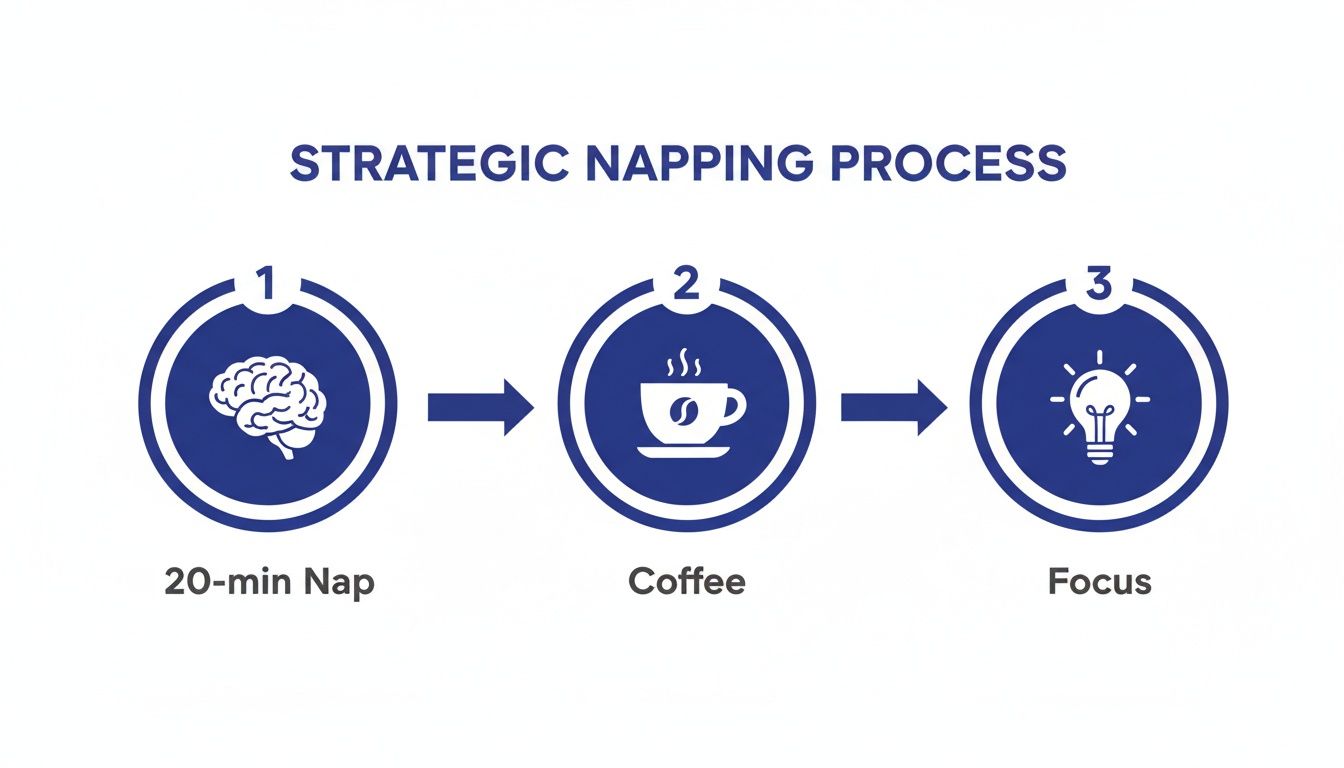
    This DMN activation is where the magic happens for creativity and problem-solving. It’s during these longer breaks that you get those “aha!” moments. This happens when you’re not actively trying to solve something. Even a quick power nap can do wonders for clearing out mental cobwebs. If you’re intrigued, our guide on the benefits of a 20-minute nap is a great place to start.

    • Mini Scenario: A writer is completely stuck on a chapter. The words feel clunky and the narrative is going nowhere. Frustration is mounting. She sets a timer for 20 minutes and heads out for a brisk walk, leaving her phone behind. As she walks, her mind drifts. Then, seemingly out of nowhere, a new plot twist materializes. This breakthrough only happened because she gave her brain the unstructured time it needed to get creative.

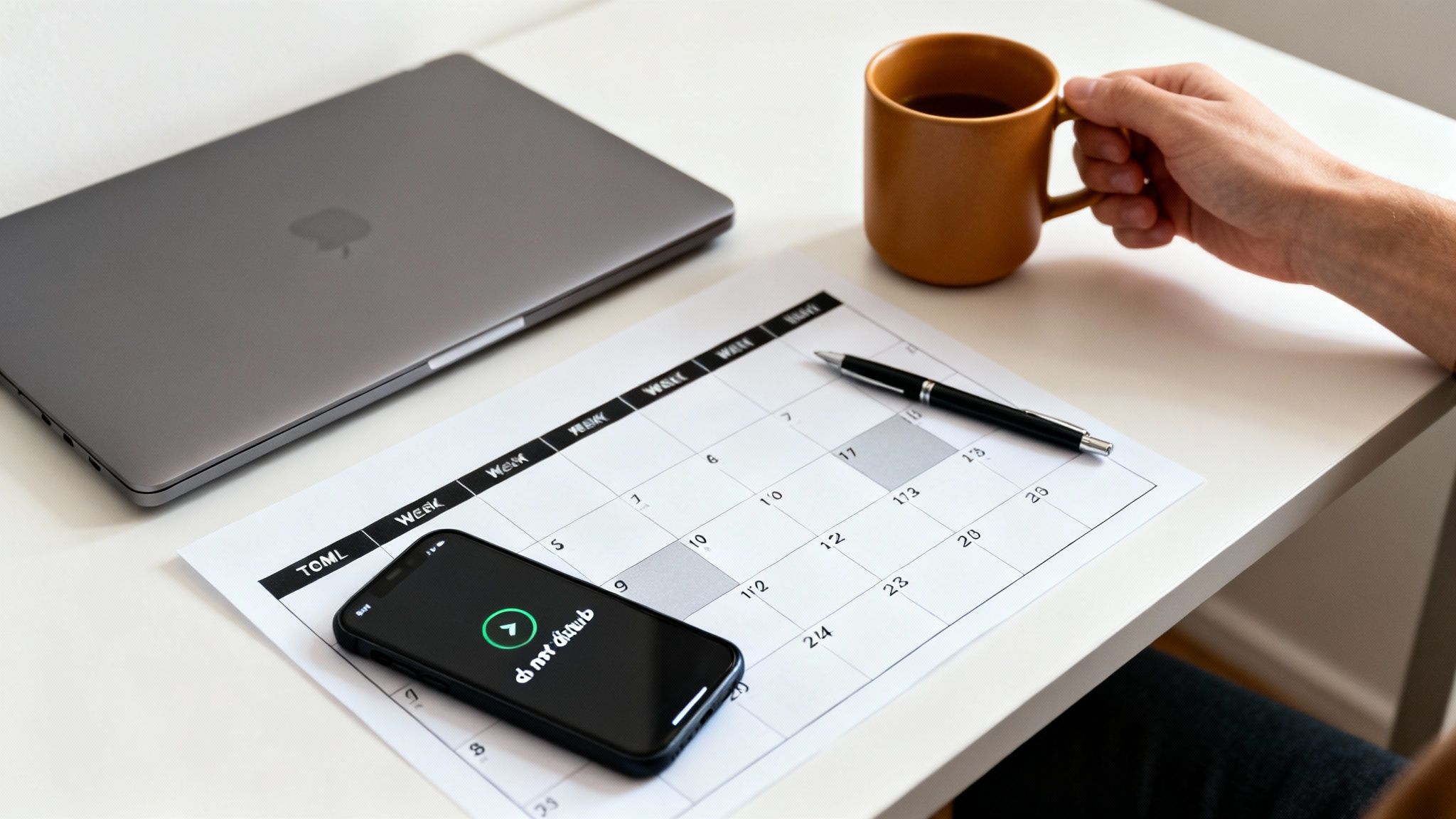
    To ensure these essential pauses happen, many people find success with a time blocking planner. When you schedule breaks with the same seriousness as a client meeting, you make a concrete commitment to your well-being and performance. For more strategies, you can explore the frameworks in our book, Focus Recharged.

    Best Option for a Break from Work: Micro vs. Scheduled?

    How do you pick the right tool for the job? This quick comparison can help you decide whether you need a quick reset or a longer creative pause. The best choice depends on your immediate goal.

    Comparison: Choosing Your Break Type

    • Choose a Microbreak (1–5 mins) if: Your goal is to restore immediate focus during an intense, single task. Example: Standing up to stretch or looking out the window.
    • Choose a Scheduled Break (15–30 mins) if: Your goal is to boost creativity, solve a complex problem, or recover between major tasks. Example: Taking a walk or a short power nap.
    • Choose a Digital Detox Break (1+ hour) if: You feel mentally foggy and overstimulated from screen time. Example: Putting your phone away and reading a physical book.
    • Choose a Walking Break if: You feel physically stiff and mentally sluggish. An under desk walking pad is a shopper-style favorite for integrating movement without stopping work entirely.

    Ultimately, both types of breaks are crucial. The goal isn’t to stop working, but to work smarter by honoring your brain’s natural rhythms. A microbreak keeps your engine from overheating. A scheduled break is where you refuel for the next leg of the journey.

    Planning Your Digital Detox: A True Break From Work

    In our always-on work lives, the screen is often the last thing we see at night. It’s also the first thing we check in the morning. This isn’t just tiring for our eyes. It keeps our nervous systems in a quiet but persistent state of high alert.

    Every notification and email chime can trigger a small stress response in the brain, releasing cortisol. This prevents our brains from ever truly disengaging and reaching a state of deep, restorative rest. A real break from work has to include a break from our screens. That’s what a digital detox is all about. It’s a deliberate period where you step away from devices to give your mind a chance to downshift.

    An American family having a screen-free dinner, a great way to take a break from work and technology.

    This state of hyper-arousal is the exact opposite of what your brain needs for genuine restoration. Without periods of digital quiet, you can feel “off” even when you’re not working. A digital detox isn’t about ditching technology forever. It’s about learning to use it on your own terms. Our full guide with more digital detox tips can offer more ideas for how to get started.

    How to Start Your Digital Detox Break from Work

    A digital detox can be as short as a few hours or as long as a full weekend. The key is to start small and build momentum. You don’t need a grand plan for a week-long retreat to start feeling the difference.

    Here are a few practical ways to begin:

    • The Evening Cutoff: Designate a “digital cutoff” time each evening, maybe 90 minutes before you plan to sleep. This gives your brain time to transition away from stimulating blue light. Psychology studies show this light can interfere with melatonin production and disrupt your sleep.
    • Screen-Free Meals: Make a simple rule: no phones at the dinner table. This helps you be more present with your family or yourself. It improves both your relationships and your relationship with food.
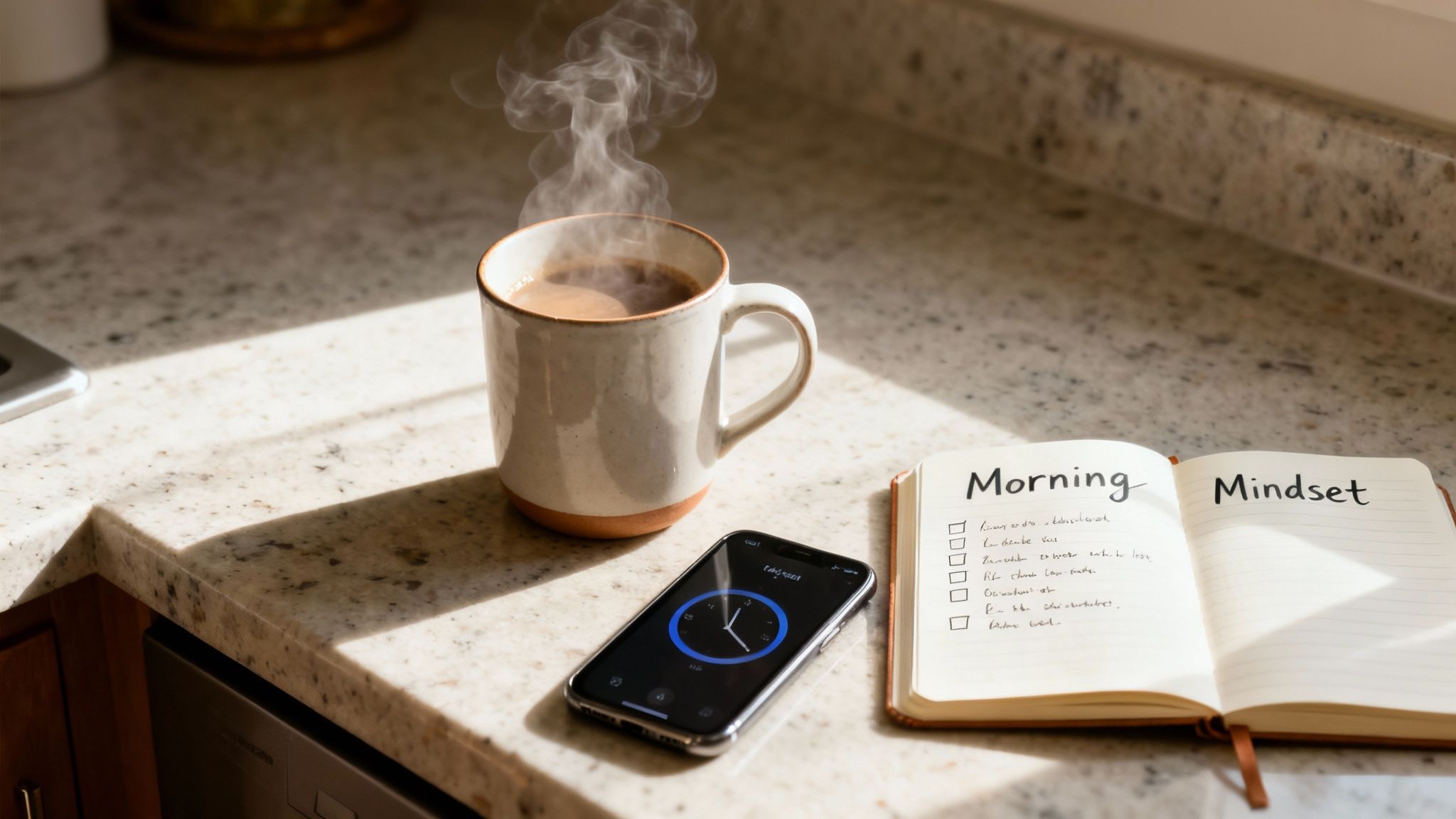
    • Tech-Free Mornings: Instead of reaching for your phone first thing, spend the first 30 minutes of your day without screens. Use this time for meditation, journaling in a productivity journal, or just enjoying a quiet cup of coffee.

    The goal is to create small pockets of time where your brain isn’t being constantly bombarded. This is a core idea we explore in our book, Digital Clarity, which offers a full roadmap for reclaiming your attention.

    A digital detox isn’t about escaping reality; it’s about reconnecting with it. By intentionally disconnecting, you create space to reconnect with yourself, your thoughts, and the people right in front of you.

    Digital Detox in the Real World

    • Mini Scenario 1: The Freelancer’s Creativity Reset
      A freelance graphic designer feels completely drained. Her ideas are stale, and she spends hours scrolling for “inspiration,” only to feel more exhausted. She implements “No-Screen Saturdays.” Every Saturday, she puts her phone in a drawer. She spends the day on analog activities: visiting a museum, sketching, or cooking. This break from screens allows her brain’s default mode network to activate. This sparks fresh, original ideas when she returns to her desk on Monday.

    • Mini Scenario 2: The Remote Worker Protecting Family Time
      A remote project manager finds work bleeding into his evenings with “quick checks” of his email. His family feels his distraction. To solve this, he buys a phone lock box timer. Every day at 6 PM, his phones go into the box, set for three hours. This physical barrier removes the temptation, allowing him to be fully present with his family.


    These examples show how a digital detox can be a powerful and practical strategy. You can browse the library to find your path to digital clarity and build habits that work for your life.

    How to Ask for a Longer Break From Work

    When you’re deep in burnout, a few short breaks can feel like trying to put out a forest fire with a water pistol. They just don’t cut it. Sometimes, what you really need is a more substantial pause—a sabbatical or an extended leave—to truly recover and reset. Of course, approaching your boss with this kind of request can feel incredibly intimidating. But it doesn’t have to be a confrontation.

    The secret is to frame your request for a longer break from work as a mutual win. You get the time you desperately need to recharge. The company gets back a refreshed, more strategic, and re-engaged employee. This simple shift changes the conversation from what you need to take to what value your return will bring.

    Frame the Request as a Mutual Benefit

    Instead of leading with how exhausted you are, start the conversation by focusing on the long-term benefits for the company. A well-rested employee is more creative and a better problem-solver. They are also far less likely to quit. You can position your leave as a strategic investment in your continued contribution to the team.

    From a neuroscience standpoint, chronic stress absolutely tanks the cognitive resources needed for high-level thinking. An extended break allows your brain to recover from that depletion. It restores critical functions like strategic planning and innovative thought. These are the very skills your employer values most.

    How to Choose Your Approach: Presenting a Plan

    A manager’s first thought is almost always, “But how will the work get done?” The most effective way to calm this fear is to walk into the meeting with a solution already in hand. Don’t just ask for time off. Present a thoughtful, detailed plan that shows you’ve considered the logistics from their perspective.

    Your plan should cover a few key things:

    • Project Status: A clean summary of all your current projects, including their status, next steps, and deadlines.
    • Temporary Ownership: Smart suggestions for which colleagues could cover specific responsibilities. This makes the transition feel manageable.
    • Documentation: An offer to create detailed guides for your essential tasks to minimize disruptions and support your team.

    Mini Scenario: A Seamless Handover

    Sarah, a senior marketing manager, realizes she needs a six-week leave to avoid total burnout. Instead of just announcing her exhaustion, she schedules a meeting with her director. She comes prepared with a document outlining her projects. Critically, she proposes that her direct report take the lead on a major campaign. She frames it as a fantastic growth opportunity for him. She also volunteers to spend two weeks before her leave creating a comprehensive handover guide. By doing this, Sarah isn’t just asking for a favor. She’s showing her commitment to her team’s success. This makes it so much easier for her director to say “yes.” This proactive approach is a key theme in our book on overcoming professional exhaustion, Burnout Interrupted.

    This kind of forethought demonstrates responsibility and respect for your colleagues’ workload. For more on navigating these tricky conversations, our guide on how to balance life and work can help. Finally, do your homework on the financial side and be ready to set clear expectations. Dig into your company’s leave policy. Start planning your personal finances well ahead of time. When you have the conversation, be clear about your availability—or lack thereof—during your leave. This ensures your break is truly restorative.

    Best Tools to Help You Take a Break From Work

    Knowing you need a break is easy. Actually taking one during a demanding workday is another story. The right tools can act as simple, powerful cues. They help you build the habit of stepping away before your energy tanks. They’re not about adding more complexity. Instead, they simplify the decision to pause, turning it into an automatic part of your workflow.

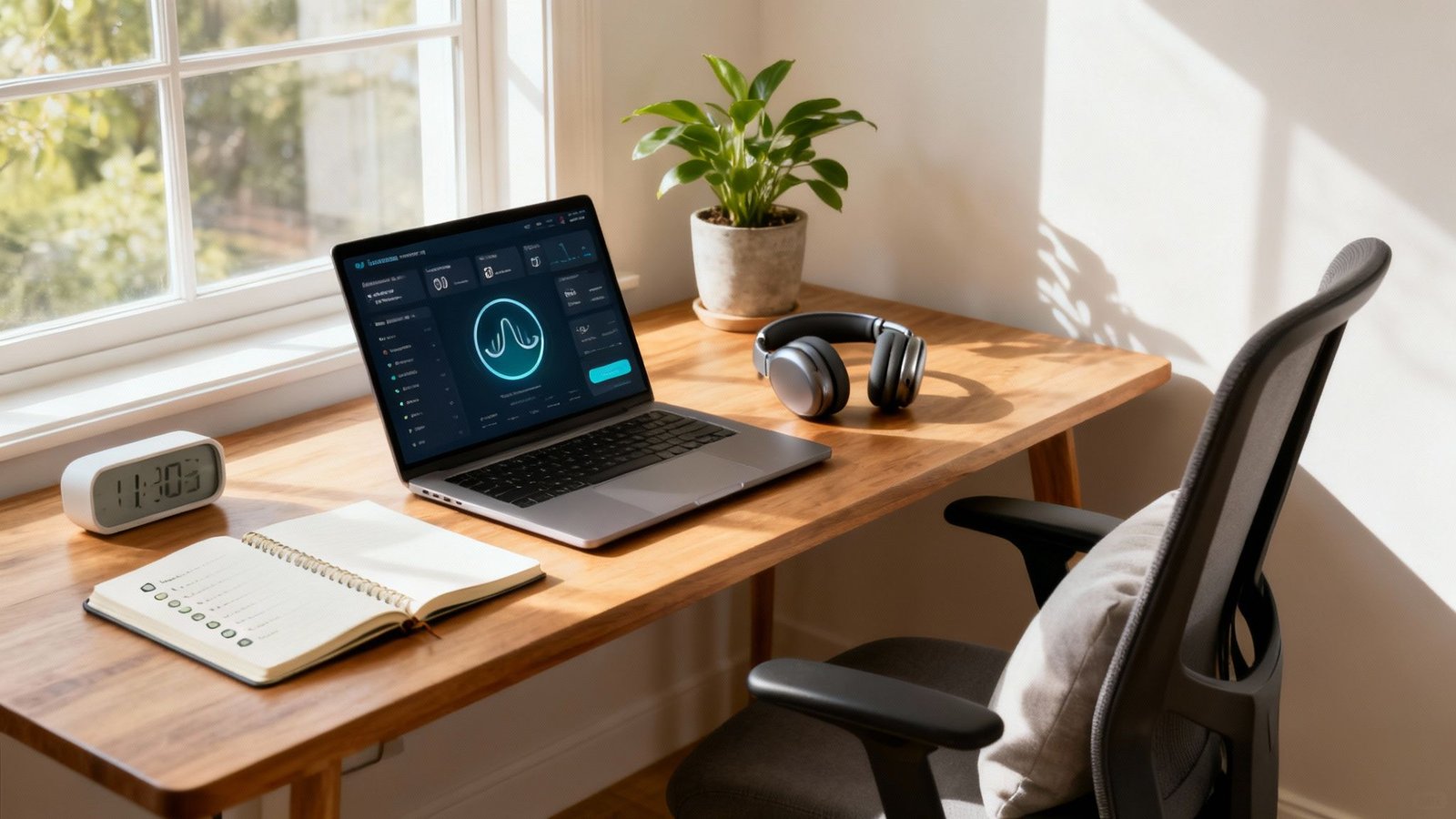
    An American person's desk setup with a laptop, headphones, a visual timer for a desk, and a mug, ready for a well-deserved break from work.

    The goal is to find what slots into your specific work style and environment. This makes consistency feel effortless.

    Best for Busy Professionals: Habit-Building Tools

    If you’re the type who gets lost in a task and forgets to look up for hours, a timer is your best friend. A physical pomodoro timer is fantastic for this. There’s a real, satisfying commitment in turning the dial. Its eventual ring is an unmissable signal that it’s time to stop. It’s a simple, screen-free way to enforce the work-rest cycles your brain craves.

    For a more subtle nudge, especially in an open office, a visual timer for desk works wonders. These often use shrinking color blocks or a quiet dial to show time passing at a glance. This keeps you aware of your focus block without a startling alarm.

    By making your break schedule visible, you offload the mental effort of time-tracking. This frees up cognitive resources, letting you stay immersed in your task until the timer—not your own willpower—tells you it’s time for a pause.

    The most effective break habits are built on a foundation of clarity and intention. We explore how to build that foundation in our book, The Power of Clarity.

    Best for Improving Break Quality

    A break isn’t very restorative if you spend it scrolling through emails or listening to office chatter. Creating a small pocket of calm is where certain tools truly shine. High-quality noise canceling headphones are a game-changer. They don’t just block out sound; they send a clear, universal “do not disturb” signal. This simple tool allows you to use your break for a quick meditation or just enjoy a rare moment of true silence. That quiet helps lower your nervous system’s arousal, which is critical for recovering from mentally demanding work. Ready to get focused? [Compare options] for headphones that fit your work style.

    If you’re looking to schedule these moments, you might find our guide to the best time blocking apps useful.

    How to Choose Your Break-Enhancing Tool

    So how do you pick the right tool for you? It really just depends on the problem you’re trying to solve. This quick comparison can help you decide where to start.

    ToolBest ForKey Benefit
    Pomodoro TimerStructured work sprints and short breaks.Enforces the Pomodoro Technique, building discipline.
    Time Blocking PlannerScheduling longer, intentional breaks and deep work.Proactively protects time for rest and focus.
    Noise Canceling HeadphonesCreating a quiet environment for focus or rest.Reduces auditory distractions, signaling ‘do not disturb’.
    Under Desk Walking PadIncorporating light physical activity during work.Combats sedentary behavior, boosts energy.

    The best tool is always the one you’ll actually use. Start with just one, see how it feels, and don’t be afraid to experiment. [Start with this chapter] in our book to find the right habit for you.

    Editor’s Take: What Really Works for Taking a Break From Work

    Here’s the honest truth about taking a break: the best strategy is always the one you actually use. We all dream of a long, restorative sabbatical, but for most busy professionals, it’s a fantasy. What really moves the needle is consistency, not intensity.

    For knowledge workers, freelancers, and anyone with some control over their calendar, the single most effective place to start is with microbreaks. Committing to a five-minute pause every hour is infinitely more realistic—and impactful—than planning an elaborate vacation you never take. These small, frequent resets are what stop mental fatigue from piling up. They can turn an afternoon slog into a period of clear, focused work.

    Who This Advice Is Best For

    This approach is most practical for people who have autonomy over their schedule. If you’re in a highly structured or monitored role, you might need to get creative. This could mean using your existing short breaks more intentionally. You could also start a conversation about building a healthier work culture. The core principle, however, stays the same: small, consistent breaks are more powerful than infrequent, long ones.

    When you’re looking for restorative breaks, don’t forget to explore options closer to home. Sometimes, special staycation opportunities can give you that crucial change of pace without the stress and expense of travel. The goal is to find a rhythm you can sustain. If you struggle with consistency, a physical cue like a visual timer for desk can be a game-changer. It takes the mental load off of remembering to pause. For a deeper dive into building these foundational habits, our book The Power of Clarity offers a step-by-step framework.

    Key Takeaways: How to Master the Break From Work

    If there’s only one thing you remember from this guide, let it be this: taking a real break from work isn’t a sign of weakness. It’s a non-negotiable part of doing consistently great work and protecting your mental health. Here are the core ideas to keep in your back pocket.

    • Breaks are biological, not optional. Your brain’s attention is a finite resource. When you try to push through mental fatigue, you aren’t being productive—you’re setting yourself up for mistakes and burnout. Breaks refuel those cognitive tanks.

    • Match the break to the moment. A quick microbreak (1–5 minutes) is perfect for resetting your focus during an intense task. A longer, scheduled break (15–30 minutes) is what you need to let your mind wander, activate its creative Default Mode Network, and solve tricky problems.

    • A true digital detox is essential. Constant screen time keeps your nervous system on high alert. You can’t fully disengage and recover if your brain is still monitoring pings and notifications. Intentionally stepping away from screens is where real rest begins.

    • Frame long breaks as a win for everyone. When asking for extended leave, don’t frame it as a personal escape. Present it as a strategic investment that benefits the company. A well-thought-out handover plan proves your responsibility and makes it easier for your manager to say “yes.”

    • Build consistency with simple tools. Turning breaks into a regular habit doesn’t have to be hard. Simple aids like a pomodoro timer or a time-blocked planner can make breaks automatic. For a deeper look at building habits that stick, our guide on The Power of Clarity is a great place to start.


    Disclaimer: This article is for educational purposes only and is not a substitute for professional medical or psychological advice, diagnosis, or treatment. The content is not intended to make any diagnostic, treatment, or cure claims regarding conditions like anxiety, depression, ADHD, burnout, or sleep problems. Some links in this post are affiliate links, meaning we may earn a commission if you make a purchase at no extra cost to you.

    Frequently Asked Questions About Taking a Break From Work

    Learning how to take strategic, effective breaks can feel like building a new muscle. Here are some of the most common questions we get, with honest answers to help you move from feeling guilty about rest to using it as a tool for better work.

    How long should a break from work actually be?

    The honest answer? It depends entirely on what you’re trying to achieve. For a quick mental reset during a heavy focus session, a microbreak of 1 to 5 minutes is often all you need. If you’re trying to recharge between big meetings or creative tasks, a more substantial scheduled break of 15 to 30 minutes is a better fit. And when you’re feeling a deeper screen fatigue, a digital detox of a few hours can make a world of difference.

    Is it really that bad to skip breaks at work?

    Yes, it really is. Consistently pushing through without breaks is a guaranteed path toward burnout. Your brain’s capacity for focused attention isn’t infinite; it’s a resource that gets drained. Forcing yourself to work nonstop leads to mental fatigue, a spike in errors, and a nosedive in creative problem-solving. Breaks are a biological requirement for sustained high performance. Skipping them is like trying to drive a car across the country without stopping for gas.

    What are the signs I need a longer break, like a sabbatical?

    Short breaks are for daily fatigue, but some warning signs call for a much bigger reset. If you feel a sense of chronic exhaustion that a weekend can’t fix, a deep cynicism about your job, and a nagging feeling of professional ineffectiveness, you’re likely experiencing burnout. These are signals that short breaks are no longer enough. When you feel a profound lack of motivation that sticks around for weeks, that’s a strong sign you need a longer break from work to genuinely recover.

    Can stepping away from work actually make me more productive?

    Absolutely. It feels like a paradox, but one of the best things you can do for your productivity is to stop working—strategically. Brief breaks restore the attentional resources you need to stay focused and prevent mental drain. Longer breaks allow your brain’s Default Mode Network to light up. This brain state is essential for insight and creative breakthroughs. You’ll often solve your most stubborn problems when you’re not actively wrestling with them.

    What are some good, simple activities for a short work break?

    The best short break activities pull you away from your screen and into your body, even for a few moments. The goal is to change your physical and mental state.

    • Stand up and stretch. Get the tension out of your shoulders and back.
    • Walk to get a glass of water. You get movement and hydration in one go.
    • Look out a window for 60 seconds. Give your eyes a rest from close-up screen focus.
    • Listen to one favorite song. Music is one of the fastest ways to shift your mood.
    • Do a few rounds of box breathing. A simple breathing exercise can instantly calm a frazzled nervous system.
  • Good vs Bad Stress: A Guide to Peak Performance

    Good vs Bad Stress: A Guide to Peak Performance

    We all talk about being “stressed out,” but not all stress is the enemy. The difference between good vs bad stress often comes down to your perception of it—and how long it sticks around.

    Good stress, or eustress, is that jolt of focused energy that feels like a motivating challenge. But bad stress, or distress, is the kind that feels chronic and overwhelming, leaving you feeling drained and out of control.

    Heads up: Some links in this article are affiliate links. If you make a purchase, we may earn a small commission at no extra cost to you. Your support helps us create more helpful content like this!

    Understanding Good vs Bad Stress: Is Your Stress Helping or Hurting You?

    Not all stress is created equal. The real question is whether the pressure you’re feeling is pushing you forward or holding you down. The answer separates what psychologists call eustress from its more draining cousin, distress.

    Think of eustress as a performance-enhancing boost. It’s that sharp, focused energy you get right before a big presentation. It’s also the adrenaline that helps you power through to meet a tight deadline. Your brain gives you a short, controlled burst of cortisol and adrenaline. According to neuroscience, this dials up your focus and motivation just when you need it.

    For instance, a student cramming for an exam feels eustress. The pressure helps them focus and retain information. The stress ends once the test is over, allowing their system to return to normal.

    Distress, on the other hand, is what most of us actually mean when we say we’re “stressed.” This is the chronic, long-term pressure that feels completely unmanageable. It usually comes from situations where you feel stuck or powerless, like a crushing workload that never ends. Behavioral research shows this nonstop activation of your body’s stress response leads to mental fatigue and irritability. It also causes a serious drop in performance.

    A real-world example is an employee facing constant job insecurity. The never-ending worry drains their mental resources, making it hard to perform their daily tasks effectively.

    It’s a lot like physical exercise. Applying the principle of progressive overload training shows how applying structured physical stress actually makes you stronger. The same is true for your mind. Understanding the different kinds of mental stress is the first step toward managing it. You can learn more about this by exploring the 3 types of stress in our detailed guide.

    This infographic breaks down the key differences between that motivating “good stress” and the draining “bad stress” we all want to avoid.

    Infographic comparing good vs bad stress with their characteristics.

    The visual makes it clear: eustress is a short-term motivator that feels exciting. In contrast, distress is a long-term drain that feels overwhelming and unpleasant.

    Eustress vs Distress: Key Differences at a Glance

    To make it even clearer, here’s a quick breakdown of how these two types of stress show up. This table helps you spot the difference in your mind, body, and performance in seconds.

    CharacteristicEustress (Good Stress)Distress (Bad Stress)
    Psychological FeelingExciting, motivating, a sense of challengeOverwhelming, anxious, a sense of threat
    DurationShort-term, manageableLong-term, chronic, feels endless
    Physical ReactionEnergizing, increased heart rate (temporary)Draining, leads to fatigue, headaches, sleep issues
    Performance OutcomeEnhances focus and performanceImpairs concentration and productivity
    Sense of ControlYou feel in control and capable of handling itYou feel a lack of control and helplessness

    Looking at them side-by-side, the contrast is stark. Eustress feels like a challenge you can rise to. Distress feels like a threat you’re sinking under.

    The Science of How Good vs Bad Stress Affects Your Brain

    To really get the difference between good and bad stress, you have to look at what’s happening inside your head. Your brain reacts to any pressure with a chemical response built for survival. The key is whether that response is a short sprint or a grinding, endless marathon.

    When you’re up against a challenge that feels manageable—nailing a big presentation—your brain releases a controlled, short burst of hormones. These include adrenaline and cortisol. This isn’t the enemy. This is the very definition of eustress, or good stress.

    This chemical surge is like rocket fuel for your prefrontal cortex. This is the part of your brain that handles planning, focus, and making sharp decisions.

    • Adrenaline gets your heart pumping. It delivers a rush of energy to your muscles and brain.
    • Cortisol, in these small, quick doses, actually sharpens your memory. It helps you lock in on the task at hand.

    The result is that you feel alert, motivated, and ready to perform at your best. It’s your brain’s natural performance-enhancement system kicking in when you need it most.

    A man thinks about the difference between good vs bad stress, with a glowing brain illustration next to him.

    When Good Stress Turns Destructive and Becomes Bad Stress

    The script flips completely with distress, or bad stress. This happens when pressure feels chronic, overwhelming, and inescapable. Think of constant worry over losing your job or a workload that never shrinks.

    In this state, your brain isn’t just getting a quick splash of cortisol; it’s marinating in it for days or weeks. This has the exact opposite effect. Chronic cortisol exposure can start to impair the prefrontal cortex. This leads to that all-to-familiar feeling of “brain fog” where you can’t think straight.

    Chronic stress keeps your brain’s alarm system—the amygdala—stuck in the “on” position. This constant state of fight-or-flight drains your cognitive batteries, making it harder to focus, recall information, and regulate your mood.

    This isn’t just a feeling; it’s a massive problem. A 2023 survey from the American Psychological Association found that 77% of U.S. workers felt stress from their jobs in the last month. For a huge portion of them, this wasn’t the motivating kind. A staggering 57% reported negative side effects like burnout and a total loss of drive.

    Taming the Amygdala in a Real-World Scenario

    Think about an employee who comes to work every day anxious about rumored layoffs. That constant, low-grade threat keeps their amygdala firing and their cortisol levels high. They find it impossible to focus in meetings and forget important deadlines. Their behavior changes, and they become more irritable with colleagues. Their brain is stuck in survival mode, not performance mode.

    This is where you can learn more about retraining your brain’s limbic system to get back in the driver’s seat.

    One surprisingly simple, science-backed way to dial this down is to get the thoughts out of your head. Using a productivity journal helps offload anxious loops and mental clutter. This simple act of writing reduces the cognitive load. It helps calm the overactive amygdala and lets your prefrontal cortex come back online. You start to feel in control again, simply because you’ve given your brain a hand.

    How to Recognize Bad Stress Before Burnout Hits

    The line between a motivating challenge and draining pressure is incredibly thin. Learning to spot the difference is the single most important skill for preventing burnout. When good stress slips into chronic, bad stress, your mind and body start sending distress signals. Ignoring them is like ignoring the check engine light on your car.

    Catching these signs early is an act of self-preservation. It gives you the chance to step in before stress leads to total exhaustion. This is especially true in unhealthy work environments. Toxic workplaces have fueled a mental health crisis. Employees there are more than twice as likely to report poor mental health compared to those in supportive settings.

    This article is for educational purposes only. It is not a substitute for medical or psychological care for conditions like anxiety, depression, burnout, or sleep problems. Please consult a qualified professional for diagnosis and treatment.

    Cognitive Signs of Bad Stress

    When distress takes over, your thinking is one of the first things to go. Your prefrontal cortex handles high-level planning and decision-making. It gets overloaded by a constant drip of cortisol.

    • Indecisiveness: You struggle with simple choices, like what task to tackle first. It feels like your brain is frozen.
    • Brain Fog and Poor Concentration: You have to reread the same email three times. Your focus feels scattered.
    • Constant Worrying: You can’t turn off the anxious thoughts. You replay conversations or spiral into worst-case scenarios.

    Think of a project manager under pressure for weeks. She might stare at her to-do list for thirty minutes, completely paralyzed. She is unable to decide where to start. That paralysis is a classic cognitive sign that good stress has become harmful.

    A person experiencing warning signs of the difference between good vs bad stress at a desk.

    Emotional and Physical Red Flags of Bad Stress

    Distress also shows up in your mood and your body. The overactivation of your brain’s fear center, the amygdala, can leave you emotionally volatile. It can also make you feel physically sick.

    Emotional Signs:

    • Irritability and Short Temper: You snap at family or colleagues over things that normally wouldn’t bother you.
    • Feeling Overwhelmed: You have that constant feeling of drowning in responsibilities.
    • Loss of Motivation: The activities you used to enjoy now feel like a total chore.

    Physical Signs:

    • Chronic Fatigue: No matter how much you sleep, you wake up feeling exhausted.
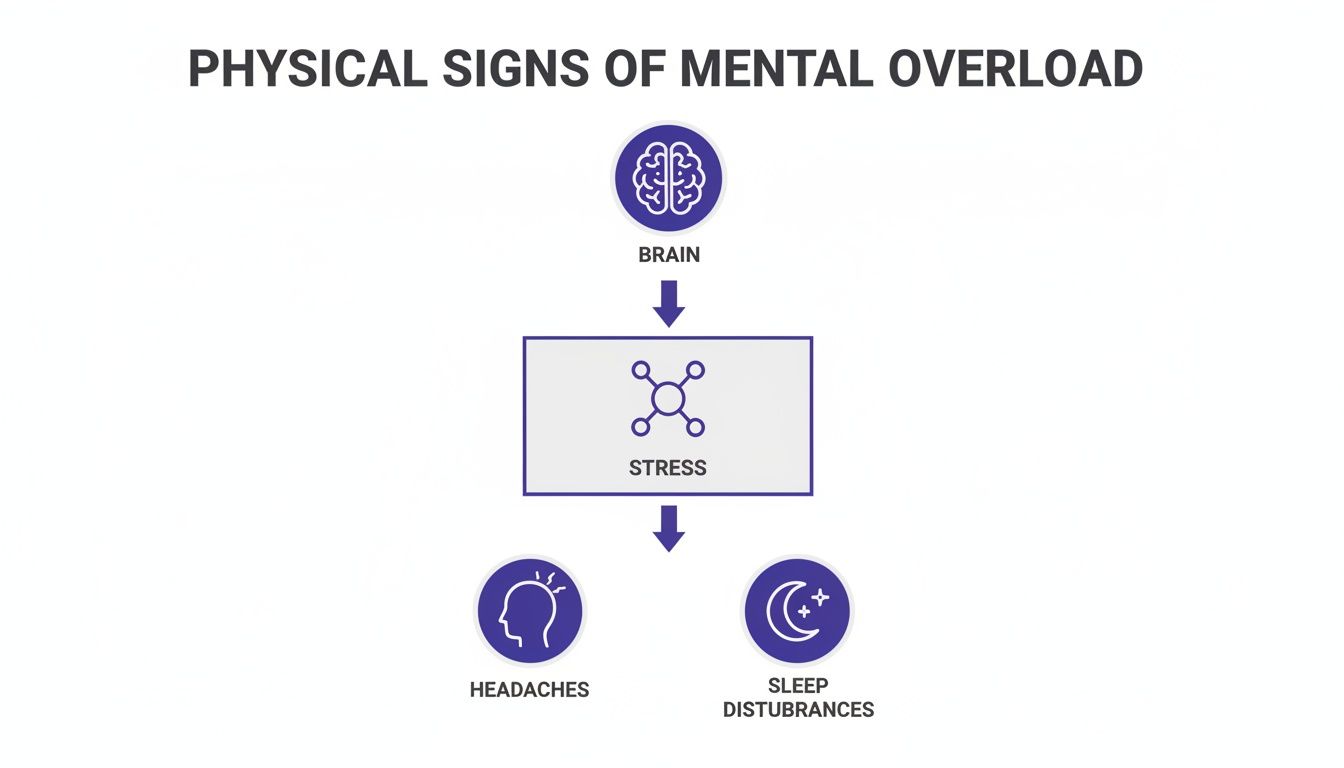
    • Frequent Headaches or Muscle Pain: You notice persistent tension headaches or unexplained aches.
    • Sleep Problems: You either can’t fall asleep, can’t stay asleep, or wake up at 3 a.m. with your mind racing.

    Imagine a graphic designer who loves her work but has been pulling late nights. She starts getting tension headaches every afternoon. She snaps at her partner for a simple question. These are clear emotional and physical warnings that her stress load is unsustainable. This can snowball into broader issues like mental fatigue, a topic in our guide to the 12 key signs of mental fatigue.

    Behavioral Changes to Watch For

    Finally, bad stress changes what you do. These shifts in your habits are often unconscious coping mechanisms. Unfortunately, they just end up making the problem worse.

    “Burnout isn’t a sudden event; it’s a slow erosion of spirit caused by unchecked distress. Recognizing the early behavioral shifts—procrastination, social withdrawal, and neglect of self-care—is your first line of defense.”

    Key behavioral signs to look for include:

    1. Procrastination: You start putting off important tasks because they feel too daunting.
    2. Social Withdrawal: You begin declining invitations from friends or avoiding coworkers.
    3. Changes in Habits: You might find yourself turning to junk food or mindless scrolling to “numb out.”

    When distress goes unchecked, it can escalate into full-blown burnout. Getting a handle on early indicators is crucial. For a deeper look, you can explore these work burnout signs, causes, and recovery strategies. If you spot these patterns, it’s a clear signal to re-evaluate.

    How to Choose Your Stress Management Strategy

    Once you can spot the signs of distress, the next question is what to do about it. Choosing the right action moves you from feeling stuck to feeling capable again.

    Psychologists sort coping strategies into two main buckets. Knowing which one to use is key to managing stress effectively. This choice can shift your brain from a helpless state into a problem-solving one.

    Problem-Focused vs. Emotion-Focused Coping

    The two core approaches are problem-focused coping and emotion-focused coping. One isn’t automatically better. Their power depends on whether you can change what’s causing the stress.

    • Problem-Focused Coping: This is about taking direct, practical action to change the stressor itself.
    • Emotion-Focused Coping: This is about managing your emotional response to the stressor when the situation is out of your hands.

    If your schedule is a chaotic mess, using a time blocking planner to create structure is a problem-focused fix. But if you’re stuck in an unexpected traffic jam, you can’t make the cars disappear. Practicing deep breathing is an emotion-focused move.

    Comparison: Problem-Focused vs. Emotion-Focused Tools

    Choosing the right tool for the job is essential. Here’s a quick comparison to help you decide which path to take.

    Tool TypeBest For…Example Action
    Time Blocking PlannerControllable tasks & schedulesStructuring your week to prevent overwhelm
    Habit Tracker JournalBuilding resilience over timeSticking to a relaxing evening routine
    Noise-Canceling HeadphonesManaging environmental stressorsCreating a focus zone in a loud office
    Sleep Mask BlackoutImproving rest and recoveryEnsuring deep, restorative sleep

    Best Option for Controllable Stressors

    Problem-focused coping is your best bet when you have some control over the thing causing you distress. It’s about digging up the root of the problem. This is how you stop the same stressor from coming back.

    Here’s what that looks like in the real world:

    • An Overwhelming Workload: Instead of stewing in anxiety, you schedule a meeting to renegotiate deadlines.
    • A Messy, Intimidating Project: You break the project into tiny, manageable steps. “Launch campaign” becomes “draft one email.”
    • Constant Office Distractions: You create a focused bubble by putting on noise-canceling headphones and letting your team know you’re in a deep work block.

    These actions directly reduce the power of the stressor. Taking a step gives your brain a sense of agency, which helps quiet the amygdala’s alarm bells.

    Best for Busy Professionals with Uncontrollable Stressors

    Emotion-focused coping is your lifeline when the stressor is outside of your control. You can’t stop a flight from being canceled or single-handedly change a toxic company culture. In these moments, trying to “fix” the unfixable just adds frustration.

    The goal, instead, is to soothe your own nervous system and manage your internal state.

    Emotion-focused strategies don’t solve the external problem, but they solve the internal one by preventing your emotional reaction from making a bad situation worse.

    A few effective strategies include:

    • Mindfulness and Meditation: Focusing on your breath can put the brakes on your body’s stress response.
    • Physical Movement: A brisk walk releases endorphins, natural mood elevators that help your brain reset.
    • Grounding Routines: Using a habit tracker journal to stick with a relaxing evening ritual can improve sleep and build resilience.

    The key is to shift your focus from what you can’t change to what you can: your own internal weather. You can browse the library to find resources that fit your goals.

    Practical Ways to Turn Bad Stress into Good Stress

    Knowing the signs of bad stress is the first step. The next is taking practical action to reframe those threats into challenges. This mental shift, known as cognitive reappraisal, is how you consciously turn dread into a chance to grow.

    Flipping distress into eustress really comes down to reclaiming your sense of control and managing your energy. You can’t always change what’s happening, but you can almost always adjust your response.

    A person's hands sorting cards to reframe their mindset about good vs bad stress.

    Reframing Your Mindset

    The first strategy is all in your head. It’s about deliberately changing how you interpret a stressful situation. Instead of seeing a big project as a threat, reframe it as a chance to learn and stretch your skills.

    This isn’t just “thinking positive”; it’s a neurological trick. When you tell your brain a situation is a “challenge” instead of a “threat,” you change the chemical cocktail it produces. You get the focused, energizing response of eustress instead of the draining flood of distress.

    A study on workplace stress found a strong link between high stress and low productivity. Employees lost over 5 work hours per week just thinking about their stressors. By reframing, you spend less time worrying and more time solving. You can discover more about this productivity paradox in the full research.

    Example in Action:
    Imagine a freelance writer gets critical feedback from a client.

    • Distress Reaction (Threat): “They hate my work. I’m going to lose this client.” This thinking leads to anxiety.
    • Eustress Reaction (Challenge): “Okay, this is my chance to really nail their brand voice and show how adaptable I am.” This leads to focused, productive edits.

    Increasing Your Sense of Control

    The second strategy is to take practical action, no matter how small. A major source of distress is feeling powerless. When you break a huge stressor into tiny steps, you give yourself a powerful sense of agency.

    This is a core principle we discuss in our book, Focus Recharged: A Productivity Guide. Each small step you complete gives your brain a little win. This releases a bit of dopamine and builds momentum.

    Example in Action:
    The same freelancer is now looking at the needed revisions.

    1. Old Approach (Overwhelmed): Stares at the document, feeling crushed.
    2. New Approach (In Control): Breaks the task down. “Step 1: Reread all feedback. Step 2: Revise only the intro. Step 3: Use a pomodoro timer to work for just 25 minutes.”

    Each completed step makes the project feel less like an insurmountable mountain. For an even deeper dive into calming your nervous system, check out our guide on how to calm down effectively.

    Scheduling Intentional Recovery

    Finally, you can’t turn bad stress into good stress without recovery. Eustress is useful precisely because it’s short-lived. To keep it from tipping into distress, you have to intentionally schedule downtime.

    Recovery isn’t just about hours of sleep; it’s about high-quality rest. This means creating an environment that supports deep, restorative sleep. Simple tools can make a huge difference here.

    Example in Action:
    Our freelancer finishes the revisions and sends them off.

    • Poor Recovery: Stays up late, anxiously doomscrolling on their phone.
    • Intentional Recovery: Puts the phone away an hour before bed. Uses a comfortable sleep mask blackout to block light, signaling to their brain it’s time to shut down.

    This proactive approach to rest ensures they have the mental resources to face the next day’s challenges with energy. To build systems that manage pressure, see the frameworks in ‘The Power of Clarity’.

    Key Takeaways: Good vs Bad Stress

    • Eustress Motivates, Distress Drains: Good stress (eustress) is a short-term challenge that boosts focus, while bad stress (distress) is chronic pressure that leads to exhaustion.
    • Know the Warning Signs: Recognize cognitive signs like brain fog, emotional signs like irritability, and behavioral changes like social withdrawal to catch bad stress early.
    • Your Brain on Stress: Eustress causes a helpful, short burst of cortisol and adrenaline. Distress leads to a chronic flood that impairs brain function.
    • Choose the Right Coping Strategy: Use problem-focused coping for controllable stressors and emotion-focused coping for situations you can’t change.
    • Reframe Your Mindset: Shifting your perspective from “threat” to “challenge” can change your brain’s chemical response and turn distress into eustress.
    • Prioritize Recovery: Intentional rest and quality sleep are non-negotiable for preventing good stress from becoming bad stress.

    Editor’s Take: What Really Works for Managing Stress

    When it comes to the divide between good and bad stress, the goal isn’t to wipe all pressure from your life. That’s impossible. What really works is building a personal toolkit for managing your energy.

    This is especially true for busy professionals. The most effective approach combines two things. First, proactive strategies that reduce unnecessary friction, like smart planning. This is the core idea we explore in our book, The Power of Clarity.

    Second, you need reactive strategies for when stress inevitably breaks through. This is where tools like mindfulness and cognitive reframing become your best friends.

    This advice is best for: Individuals navigating the everyday pressures of work and life. It is not a substitute for professional help with clinical anxiety, depression, or burnout. The foundation of any good strategy is self-awareness.

    The most resilient people operate on a hybrid model. They might use a time blocking planner to proactively structure their week. They also know how to take five deep breaths when a meeting goes sideways. Start with this chapter to build your own hybrid model.

    Cultivating this balance is what turns you from a victim of your circumstances into an active manager of your own energy and focus.


    Disclaimer: Some links in this article may be affiliate links. We may earn a commission on purchases at no extra cost to you. This content is for educational purposes only and is not a substitute for professional medical or psychological advice. Always consult a qualified healthcare provider for any health concerns or before making any decisions related to your health or treatment.

    FAQ: Your Questions on Good vs. Bad Stress

    Here are a few honest answers to the questions we hear most often about the difference between good and bad stress, with a focus on how these ideas play out in real life.

    1. Can good stress turn into bad stress?

    Yes, absolutely. This is one of the most important things to understand. Eustress, or “good” stress, is helpful because it’s short-lived. It’s a jolt of energy to meet a deadline. But if that pressure never lets up—if there’s no recovery period—it will curdle into distress. The excitement of a new project is eustress. But if it demands 14-hour days for months, the motivation burns out and gets replaced by chronic fatigue. That’s the crossover point.

    2. What is the number one sign that stress is bad for me?

    One of the most reliable red flags is a feeling of chronic fatigue paired with a deep loss of motivation. This isn’t just being tired after a long week. It’s a bone-deep exhaustion that sleep doesn’t seem to touch. When you start losing interest in work, hobbies, and relationships you once found meaningful, that’s a major signal. Behavioral psychology suggests this emotional numbness means your body’s stress-response system is running on empty.

    3. How can I explain bad stress to my manager?

    Frame the conversation around concrete business outcomes and resource needs, not just your feelings. Saying “I’m too stressed” can sound like a personal problem. Instead, get specific and solution-oriented. You could say: “I’m committed to these projects, but the current workload is making it hard to maintain quality. Could we prioritize the most critical tasks? I want to make sure we’re set up to succeed.” This positions you as a proactive partner focused on performance.

    4. Are stress management apps effective?

    For many people, yes—but with a caveat. Apps can be excellent tools for building emotion-focused coping skills. Guided meditations and breathing exercises can help calm your nervous system in a high-pressure moment. However, they are not a cure. Think of them as a tool for managing your reaction to stress, not for solving the root cause. An app can help you feel less anxious, but it can’t fix an unmanageable workload.

    5. Does exercise really help with stress?

    Yes, and the science is incredibly clear. When you get your body moving, your brain releases endorphins. These neurochemicals act as natural mood-lifters. At the same time, exercise helps your body metabolize excess stress hormones, like cortisol. Even a brisk 10-minute walk can be enough to hit the reset button. Regular exercise helps regulate your sleep, improve your mood, and build resilience. If you’re having trouble building that routine, a resource like Restful Nights can offer structured guidance.

  • How to Improve Self Discipline: A Science-Backed Guide

    How to Improve Self Discipline: A Science-Backed Guide

    If you’ve ever tried to build self-discipline, you know the old advice to just “have more willpower.” It’s a nice idea, but research shows it’s mostly wrong. Real discipline isn’t about gritting your teeth harder; it’s about understanding how your brain works and building smarter systems around its quirks.

    The whole game is about making good behaviors easier and distractions harder. Do that consistently, and you literally rewire your brain for focus.

    Affiliate Disclosure: This article may contain affiliate links. If you make a purchase through one of these links, we may earn a small commission at no extra cost to you. This helps support our work in creating evidence-based content.

    The Neuroscience of Willpower: Why Self Discipline Feels Hard

    Have you ever sat down to tackle a big project, full of good intentions, only to find yourself scrolling through your phone 10 minutes later? That internal tug-of-war isn’t a sign of weakness—it’s neuroscience in action. Sticking to your goals often feels like an uphill battle because different parts of your brain are competing for control.

    Think of it this way: you have two key players in your head.

    • The Planner: Your prefrontal cortex (PFC) is the thoughtful, long-term planner. It handles decision-making, focus, and delaying gratification. This is the part of your brain that knows you should work on that report.
    • The Seeker: Your limbic system, on the other hand, is the instant-gratification seeker. It’s wired for immediate rewards and responds powerfully to anything promising a quick hit of pleasure, like the buzz of a notification.

    When you face a choice between a hard task and an easy distraction, these two systems go head-to-head. The limbic system screams for the easy, pleasurable option. Meanwhile, the PFC quietly argues for the long-term benefit. This is exactly why relying on willpower alone is a losing strategy for building self-discipline.

    Why Willpower Fails and How to Improve Self Discipline Instead

    Willpower is a finite resource. Neuroscientists often compare the prefrontal cortex to a muscle—it gets tired with overuse. Every decision you make and every temptation you resist depletes this energy. When you’re stressed or tired, your PFC has less fuel. This makes it far harder to say no to distractions.

    A distracted person checking their phone instead of studying shows how to improve self discipline while working beside a laptop and open book.

    This explains why so many well-intentioned goals fall apart. Some research suggests only about 10% of New Year’s resolutions are actually achieved, with a lack of self-discipline being a primary culprit.

    The solution isn’t to just “try harder.” It’s to train your brain. Neuroscientists have seen that when you successfully delay gratification, you strengthen neural pathways in your prefrontal cortex. This makes it easier to make disciplined choices in the future. The secret is to stop seeing self-discipline as a trait and start treating it as a skill you can build.

    Key Insight: Self-discipline is less about resisting temptation in the moment and more about creating systems that reduce your exposure to temptation in the first place.

    A Real-World Scenario: The Remote Worker’s Dilemma

    Imagine Sarah, a remote worker, needs to finish a complex client proposal by the end of the day. Her desk is a battlefield of temptations. Her personal phone buzzes with group chat notifications. A browser tab is open to a flash sale. Her TV remote is within arm’s reach.

    Her prefrontal cortex knows the proposal is the priority. However, her limbic system is drawn to the immediate, easy dopamine hits from the phone, the sale, and the TV show. Each time she resists a buzz or a pop-up, she uses up a little bit of her willpower.

    Instead of fighting this losing battle all day, Sarah can get smarter about her discipline by changing her environment. She could use a phone lock box timer to physically remove her phone for a few hours. By making the distraction harder to access, she conserves her mental energy for the actual proposal.

    Every time she does this, she’s not just getting work done; she’s training her brain to prioritize focus. To learn more about how your brain’s reward system works, you might be interested in our article on dopamine and motivation. Small, consistent choices like these build the “muscle” of discipline over time, making focus the default rather than a constant struggle.

    How to Improve Self Discipline with Micro-Habits and Clear Goals

    The real secret to improving self-discipline isn’t some massive, overnight transformation. It’s about starting ridiculously small. Huge ambitions like “get fit” or “write a book” are so daunting they often lead to procrastination. The first step feels like a giant leap.

    A far more effective path is to build momentum with ‘micro-habits.’ These are tiny, almost effortless daily actions—so small they’re hard to say no to. Instead of vowing to hit the gym for an hour, your micro-habit might just be putting on your workout clothes. Instead of “write a book,” it’s “write 100 words a day.”

    Flat lay of a desk with an open daily planner, coffee, pen, and a plant, illustrating how to improve self discipline through tiny wins daily.

    The Psychology of Small Wins for Self-Discipline

    This approach works because it cleverly hacks your brain’s reward system. Each time you complete a micro-habit, your brain releases a small hit of dopamine. This is the neurotransmitter tied to pleasure and motivation. This creates a powerful positive feedback loop.

    Completing that tiny task feels good. This reinforces the behavior and makes you more likely to repeat it tomorrow. It’s a surprisingly effective way to build confidence and momentum. Over time, these tiny actions stack up, leading to significant progress without ever feeling overwhelming.

    The goal is to make the starting line so easy to cross that you can’t say no. Discipline then becomes less about forcing yourself and more about following the path of least resistance you’ve already created.

    How to Sharpen Your Focus with SMART Goals

    Micro-habits are the engine, but you still need a map. This is where clear, well-defined goals come into play. Vague objectives are absolute motivation killers. For giving your efforts laser focus, the SMART goal framework is an excellent tool.

    Your goals need to be:

    • Specific: What exactly are you trying to achieve? Don’t just say “eat healthier”; say “eat one serving of vegetables with every dinner.”
    • Measurable: How will you track progress? Using a habit tracker journal to check off your daily micro-habit is a fantastic way to make your wins visible.
    • Achievable: Is the goal actually realistic? Setting an impossible target is just a recipe for failure. Start with something you know you can do.
    • Relevant: Does this goal align with your bigger life vision? Your ‘why’ is a powerful source of fuel when things get tough.
    • Time-bound: When will you achieve this? A deadline creates a healthy sense of urgency.

    Real-World Scenario: The Overwhelmed Entrepreneur

    Let’s look at an entrepreneur, Alex, who wants to grow their business. Alex feels completely paralyzed by the huge goal of “doubling revenue.”

    Using the micro-habit and SMART goal approach, Alex breaks it down.

    • Vague Goal: Double revenue.
    • SMART Goal: Increase new client sign-ups by 10% in the next quarter by making five cold outreach calls per day.
    • Micro-Habit: Open the CRM and dial the first number on the list.

    Alex tracks this one daily action in a simple journal. The first day, making those calls feels hard. But checking the box provides that small dopamine hit. By day five, it’s already getting easier. After a few weeks, it becomes an automatic part of the morning routine.

    This tiny, consistent action builds unstoppable momentum. Alex is no longer fixated on the massive goal of doubling revenue. Instead, Alex focuses on the manageable task of making five calls. It’s all about understanding how to stay consistent and build habits that actually stick. By focusing on the process, the outcome starts to take care of itself. For more support in defining your goals, start by reading a book like The Power of Clarity.

    If you’re looking for more ways to keep track of your new routines, you can also check out our guide to the best habit tracking apps on the market today.

    Design Your Environment for Effortless Discipline

    Trying to build self-discipline with sheer willpower alone is a recipe for burnout. It’s like trying to swim upstream against a powerful current. You might make progress for a bit, but eventually, you get exhausted. That exhaustion is real. Your brain’s prefrontal cortex, the hub for focus and long-term thinking, genuinely gets tired.

    There’s a much smarter way to play the game. Instead of white-knuckling your way through temptation, you become the architect of your own world. You design your environment to do the heavy lifting for you.

    This idea is sometimes called choice architecture. It’s the art of setting up your surroundings so that good habits become the default, easy option. Bad habits, on the other hand, become a pain to access. You’re not fighting temptation; you’re strategically making it inconvenient. The burden shifts from your finite willpower to your physical space. Disciplined choices then start to feel almost automatic.

    Best for Beginners: Add Friction to Bad Habits

    The principle here is beautifully simple: make it harder to do the things that derail you. Every extra step you add between yourself and a bad habit acts as a circuit breaker. It gives your better judgment a moment to step in. This is a powerful way to manage distractions and save your mental energy for what actually matters.

    Here’s what this looks like in the real world:

    • Tame Digital Distractions: Don’t just put your phone on silent. When you need to focus, physically move it to another room. A phone lock box timer works wonders here. The physical barrier turns mindless scrolling from an unconscious twitch into a deliberate process.
    • Curb Unhealthy Snacking: Don’t just “decide” you won’t eat junk food. That rarely works when you’re tired or stressed. Instead, move cookies to a high shelf, hide them in an opaque container, or stop buying them in the first place.
    • Stop Endless Binge-Watching: Unplug your TV after you use it. Or, log out of all your streaming services. That tiny bit of effort is often just enough friction to make you pause and ask, “Do I really want to do this?”

    This isn’t about being extreme. It’s about making your desired behavior the path of least resistance.

    Remove Friction from Good Habits

    On the flip side, you want to make your positive habits ridiculously easy to start. Your goal is to shrink the number of steps between you and the action you want to take. The easier it is to begin, the more likely you are to actually do it.

    This is a fundamental piece of learning how to improve self-discipline without constantly draining your mental batteries.

    Key Insight: When you design your environment for success, you’re not just hoping for discipline—you’re engineering it. You make the right choice the easy choice.

    A landmark study followed 1,000 children for over 40 years. It found that childhood self-control was a massive predictor of adult success, from financial health to life satisfaction. But here’s the hopeful part: the research also shows this skill isn’t fixed. It can be built later in life through intentional practices. Designing an environment that supports your goals is one of them. You can read the full research about these self-control findings to see just how deep the long-term impact goes.

    A Real-World Scenario: The Freelancer’s Deep Work Zone

    Let’s look at a freelance writer, Ben, who keeps getting sidetracked while working from home. Instead of just “trying harder,” he decides to architect a “deep work” zone.

    He invests in a comfortable chair and a good pair of noise canceling headphones to block out sounds. Before each work block, he makes his coffee, turns his phone completely off, and closes every non-essential browser tab. His desk is clear of everything but his laptop and a notebook.

    This ritual and dedicated space signal to his brain that it’s time to focus. In this specific environment, focus becomes the default behavior.

    For anyone working from home, this kind of environmental design is a game-changer. If you want to build your own productivity sanctuary, you might find some great ideas in our guide on 10 brilliant home office organizing ideas for clarity and focus.

    Ben’s headphones and clean desk remove the friction from starting work. His powered-off phone adds friction to getting distracted. That’s how you build self-discipline that actually lasts.

    How to Choose the Best Self Discipline Technique for You

    You’ve started to clear the clutter from your environment. This makes it easier to do the right thing and harder to do the wrong one. That’s a huge win. But an empty runway is only half the battle. Now you need a flight plan.

    Relying on raw willpower to get through the day is like trying to drive cross-country without a map. It’s exhausting, and you’ll probably get lost. A structured self-discipline technique, on the other hand, gives your day a framework. It offloads the mental work of deciding what to do and when to do it. This frees up your energy for the actual work.

    The goal here isn’t to find the “perfect” system. It’s about finding one that feels most natural for your brain and your daily demands. What works for a writer needing quiet focus will be a terrible fit for a project manager in meetings. Let’s look at three proven methods to see which one clicks for you.

    Why Choosing a System Improves Self-Discipline

    Choosing the right technique is a lot like choosing the right tool for a job. You need to match the tool to the specific problem you’re trying to solve. Is your biggest challenge distraction? Or is it procrastination on big, scary tasks?

    This is the same principle we covered when designing your environment. You make proactive choices before your willpower is ever tested.

    A flowchart titled "Designing Your Environment," asking "Temptation?" and suggesting a lock box or gym clothes.

    alt=”Flowchart showing how to improve self discipline by designing your environment to manage temptation”

    Just like that flowchart shows, discipline often comes down to simple choices you make ahead of time. Picking a technique is the same. It’s about choosing a system that proactively solves your biggest hurdle to getting things done.

    Comparison: Which Self-Discipline Tool is Right for You?

    To get started, let’s compare three of the most popular and effective methods. Each one offers a different angle on managing your focus and tasks. Compare options below to see what fits best.

    TechniqueCore PrincipleBest For
    Pomodoro TechniqueWork in focused 25-minute intervals with short breaks. This maintains concentration and prevents burnout.Creatives, students, and those easily distracted. A pomodoro timer is the key tool.
    Time BlockingSchedule every part of your day into specific blocks. This treats tasks like appointments and eliminates decision fatigue.Busy professionals and remote workers juggling multiple projects. A time blocking planner is perfect.
    ‘Eat the Frog’Tackle your most difficult task first thing in the morning. This builds powerful momentum for the rest of the day.Procrastinators who need a strong start to feel productive. A clear to-do list is essential.

    Think of these techniques as different starting points. One might feel like an immediate fit. Another might seem completely alien to your workflow. That’s perfectly fine.

    The Pomodoro Technique is especially powerful because it works with your brain’s natural ability to focus, not against it. Our brains aren’t built for eight straight hours of deep concentration. The built-in breaks prevent the mental fatigue that so often kills discipline. You can learn more about the science behind this in our guide on the Pomodoro Technique and its benefits. For a deeper dive into structured focus, you can browse the library of our books on productivity, like Focus Recharged.

    Ultimately, the best technique is the one you’ll actually use. Don’t be afraid to experiment. You could even try combining them. For instance, you could use ‘Eat the Frog’ to identify your biggest task, then use Pomodoro cycles to power through it. The point is to move from a vague intention to a concrete plan of action.

    How to Stay Disciplined When Motivation Fades

    Motivation is a fantastic spark, but it’s a terrible fuel source. It’s a feeling that comes and goes. Relying on it is a surefire way to get stranded when inspiration runs dry. True, lasting progress comes from self-discipline—the system that carries you forward even on the days you just don’t feel like it.

    This is where you have to shift your strategy from chasing a feeling to building reliable systems. A brilliant approach from behavioral science is temptation bundling. The idea is simple: you pair an action you want to do with a habit you need to do.

    For instance, you only let yourself listen to your favorite podcast while you’re meal-prepping for the week. Or maybe you save that addictive audiobook for your daily session on an under desk walking pad. This strategy “bundles” an instant reward with a disciplined act, making the habit itself feel much more attractive.

    The Critical Role of Self-Compassion in Discipline

    When you inevitably slip up—and you will, because everyone does—your first reaction is everything. For most of us, the instinct is to fire up the self-criticism. But research consistently shows this is the worst thing you can do. Berating yourself after a mistake actually drains the mental resources in your prefrontal cortex. It makes it harder to get back on track.

    Self-compassion isn’t an excuse; it’s a recovery strategy. Acknowledging a misstep without harsh judgment allows your brain to regroup and re-engage with your goals much faster.

    Think of it this way: if a friend stumbles, do you yell at them or help them up? Treat yourself with that same kindness. This practice builds resilience, which is a cornerstone of any sustainable self-discipline.

    A 2023 study highlighted the powerful link between high self-discipline and reduced procrastination. It found that autonomous motivation—turning discipline into an internal, self-driven value—was a massive factor. This shows that when external motivation vanishes, a well-practiced sense of inner discipline is what keeps you going. You can learn more about these self-control findings and see how internal drive impacts success.

    Manage Your Brain’s Energy Reserves for Better Discipline

    Your brain’s discipline center, the prefrontal cortex, is highly sensitive to your physical state. Its two biggest enemies are poor sleep and high stress. When you’re running on empty from sleep deprivation or chronic stress, your brain has to divert energy to basic survival functions. That leaves less in the tank for complex tasks like impulse control and long-term planning.

    This is why managing sleep and stress isn’t a fluffy “nice-to-have.” It’s non-negotiable for anyone serious about building real self-discipline. Improving your sleep hygiene or starting a simple mindfulness practice isn’t a distraction from your goals; it’s a foundational part of achieving them. For those struggling specifically with sleep, our book, Restful Nights, offers practical, science-backed strategies.

    ***Disclaimer:** This article contains affiliate links and is for educational purposes only. The content is not intended to be a substitute for professional medical or psychological advice, diagnosis, or treatment. Always seek the advice of your physician or other qualified health provider with any questions you may have regarding a medical condition.*

    The Editor’s Take: What Actually Works for Building Self-Discipline

    After digging through all the research and real-world strategies, it’s clear that building self-discipline isn’t about finding some secret reserve of willpower. It’s about working smarter with the brain you have.

    If you only take two ideas from this entire guide, make them these. They deliver the most change with the least amount of daily struggle.

    First, shrink the change. Break your goals down into “micro-habits”—actions so small they feel almost ridiculous. This isn’t about lacking ambition; it’s a strategic way to get small, consistent wins that rewire your brain for follow-through without triggering overwhelm.

    Second, redesign your environment. Stop trying to win a battle against your surroundings every single day. Instead, make your desired habits the easy, obvious choice and your bad habits inconvenient. This outsources the hard work of discipline to your environment, making focus the path of least resistance.

    Who Is This Advice Best For?

    This blend of tiny habits and smart environmental design is a game-changer for busy professionals, students, or anyone juggling a dozen competing priorities. It creates a system that holds up even on days when you’re tired, stressed, or just plain uninspired—which is most days for most of us.

    It’s also important to be honest about where this advice has its limits. If you’re navigating conditions like severe ADHD, deep burnout, or depression, these strategies can certainly help. But they are not a replacement for professional guidance from a doctor or therapist.

    If you consistently struggle to follow through on commitments, looking at the deeper reasons is a critical part of the process. Above all, be patient with yourself. Self-discipline isn’t a switch you flip; it’s a skill you build, one realistic day at a time.

    Key Takeaways to Improve Self Discipline

    Building self-discipline isn’t about having more willpower than everyone else. It’s a skill, and like any skill, it can be trained. This guide has walked you through the science and the real-world steps to strengthen your focus and follow-through.

    Think of this as your quick-reference list for the moments when you feel your motivation start to fade.

    Self-discipline is a skill, not a character trait. It’s a trainable system involving your brain, your habits, and your environment.

    Here are the most important principles to remember as you build a more disciplined life.

    • Treat Discipline Like a Muscle. Your ability to resist temptation and stay focused is a trainable skill, not a fixed resource. Like a muscle, it gets stronger with small, consistent efforts. Each time you stick to a small commitment, you’re literally strengthening the neural pathways in your prefrontal cortex. This is the part of your brain responsible for executive function.

    • Start with Micro-Habits. The fastest way to overwhelm yourself is to set massive goals. Instead, break them down into laughably small daily actions. These “small wins” are crucial. They create a positive feedback loop in your brain, building momentum and making it easier to show up again tomorrow.

    • Architect Your Environment. Relying on pure willpower to resist distractions is exhausting and, frankly, a losing battle. A much smarter approach is to design your surroundings to make good habits the path of least resistance. This shifts the burden from your brain to your environment.

    • Find Your Technique. There’s no one-size-fits-all system for focus. You have to experiment. Try proven methods like Pomodoro sessions for focused sprints or Time Blocking to structure your day. You can also use the Eat the Frog strategy to tackle your hardest task first. Find what clicks with your natural work style.

    • Practice Self-Compassion. You will slip up. Everyone does. When it happens, the worst thing you can do is indulge in self-criticism. This just depletes your mental resources further. The key is to acknowledge the misstep without judgment and gently guide yourself back on track. That is the real work of discipline.


    FAQ: Your Questions on How to Improve Self Discipline

    As you start putting these ideas into practice, a few questions almost always come up. Here are some honest answers to the most common ones.

    1. How long does it really take to build self-discipline?

    There’s no single answer here, and anyone who gives you one is guessing. Research on habit formation famously found it can take anywhere from 18 to 254 days for a new behavior to feel automatic. The real key isn’t a date on the calendar; it’s consistency. Forget the deadline. Focus on showing up for the small, daily actions. The goal isn’t to sprint toward a finish line called “discipline.” It’s to slowly build a lifestyle where disciplined choices feel more and more natural.

    2. Can you have too much self-discipline?

    Absolutely. When discipline curdles into rigid obsession, it can lead to burnout, anxiety, and a fragile system that shatters at the first sign of real-world chaos. Healthy discipline is flexible. It knows when to push, but it also knows when to rest, adapt, and practice self-compassion. If your quest for discipline is making you miserable or constantly stressed, that’s a red flag. It might be time to ease up, rethink your methods, or even talk things over with a mental health professional.

    3. What’s the single most important thing for improving self-discipline?

    If I had to pick one, it’s having a crystal-clear ‘why.’ This is your intrinsic motivation—that deep, personal, almost emotional reason you’re doing this in the first place. When you’re deeply connected to a purpose, it’s much easier to say no to short-term distractions and yes to the choices that serve your future self. Your ‘why’ is the fuel that keeps the engine running on days when willpower and motivation are nowhere to be found. Gaining this insight is a core theme in our book, The Power of Clarity.

    4. Are willpower and self-discipline the same thing?

    They’re related, but definitely not the same. Think of willpower as a finite mental muscle or a battery. It gets drained by stress, decision fatigue, and resisting temptation all day. Self-discipline, on the other hand, is the skill of building systems, habits, and environments that reduce your daily reliance on willpower. For example, using willpower is gritting your teeth to not eat the junk food in your pantry. Self-discipline is not buying it in the first place.

    5. I have ADHD or anxiety. How should I adapt these strategies?

    The strategies in this guide—starting small, designing your environment, using external reminders—can be incredibly helpful. That said, conditions like ADHD and anxiety create very real, unique challenges for executive function, focus, and emotional regulation. It is absolutely essential to see this article as educational information, not a substitute for medical advice. We strongly recommend working with a doctor, therapist, or psychiatrist to create a support plan that’s tailored to your brain and your needs.

  • Harness The Memory Wave for Supercharged Focus: Unlock Your Brain’s True Potential

    Harness The Memory Wave for Supercharged Focus: Unlock Your Brain’s True Potential

    (Affiliate Disclosure: This post contains affiliate links. If you buy something through these links, we may earn a small commission at no extra cost to you. We only recommend products we truly trust.)

    Imagine your brain is a library that takes in new books (information) all day long. At night, a team of invisible librarians shows up to sort, catalog, and shelve every single one. This behind-the-scenes organizing is a real, neuroscience-backed process we call The Memory Wave.

    It’s not some new productivity trend. It is a fundamental process that makes learning and remembering possible. When you feel mentally foggy or struggle to recall details, it’s often because this natural cycle has been disrupted.

    This guide is for educational purposes only and is not a substitute for professional medical or psychological advice regarding conditions like anxiety, depression, ADHD, or burnout.

    What Is The Memory Wave and Why It Matters

    The Memory Wave is the powerful, natural rhythm your brain uses to turn messy daily experiences into organized, long-term knowledge. This memory consolidation happens mostly during rest and deep sleep. It is when your mind gets to work making sense of everything you’ve taken in.

    Think of it as your brain’s nightly software update. It’s the critical process that converts fleeting thoughts and facts into something solid you can recall later. Without it, learning grinds to a halt.

    The problem is, modern life is practically designed to disrupt this cycle. The constant buzz of notifications, the pressure to be online, and the endless stream of digital noise create a kind of mental static. From a psychological perspective, this cognitive overload exhausts your executive functions, which are the brain skills responsible for focus and memory.

    This interference is a direct cause of some very common struggles:

    • Mental Fog: That feeling like you can’t think straight or pull up the right word.
    • Learning Plateaus: You keep studying, but nothing new seems to stick.
    • Digital Burnout: Feeling utterly exhausted and unmotivated after a day staring at screens.
    • Poor Focus: Your attention keeps scattering, making it impossible to stick with one task.

    Understanding The Memory Wave isn’t just interesting trivia; it’s the key to getting your cognitive footing back. When you learn to work with this natural brain rhythm instead of constantly fighting it, you can unlock a level of mental performance that feels almost forgotten.

    For a deeper dive into attention itself, check out our guide on improving focus and concentration.

    Riding The Memory Wave for Peak Performance

    Riding The Memory Wave simply means aligning your daily habits with your brain’s biological need to process and rest. It’s about creating small, intentional pockets of quiet that let your mind do its essential background work.

    This could be as simple as stepping away from your desk, blocking out the world with a pair of noise canceling headphones, or just letting your mind wander for a few minutes without a screen in front of it.

    For example, a professional feels completely drained after a day of back-to-back video calls. Instead of forcing herself to answer more emails, she takes a 15-minute walk—and leaves her phone behind. During that short break, her brain’s prefrontal cortex gets a much-needed rest, kicking off the first phase of consolidation and starting to sort through the day’s conversations.

    Later that night, during deep sleep, the full Memory Wave takes over. This helps transfer the important details into her long-term memory. The result? She wakes up with a clearer head, easily recalling the key action items from the day before.

    This guide will show you exactly how to build a lifestyle that supports this vital process, pulling from the core principles in my book, The Power of Clarity. You’ll learn how to push back against mental fatigue and ride The Memory Wave toward deeper focus and much faster learning.

    The Science of How Your Brain Consolidates Memories

    Let’s look under the hood to see how the memory wave actually works, without the confusing jargon. Think of it like this: your brain has a dedicated overnight crew whose only job is to organize the chaos of your day into lasting knowledge. This process is called memory consolidation, and it’s where fleeting experiences become permanent fixtures.

    At the heart of this are specific patterns of brain activity, primarily sleep spindles and sharp-wave ripples. These aren’t just random brain static; they are coordinated bursts of neural firing that act like a sophisticated filing system. This system is crucial for transferring information from your brain’s temporary inbox (the hippocampus) to its vast, permanent library (the neocortex).

    This article is for educational purposes only. It is not intended as medical or psychological advice for conditions like ADHD, anxiety, or sleep problems.

    Your Brain’s Overnight Filing Crew

    Imagine a busy librarian at the end of the day. The front desk is piled high with returned books, new arrivals, and random notes. This is your hippocampus—the brain region responsible for initial learning and forming new memories. It’s great for holding onto things for a little while, but its capacity is limited.

    When you sleep, the librarian gets to work. This is when sleep spindles and sharp-wave ripples kick in, creating what we call the memory wave.

    • Sleep Spindles: These are short, intense bursts of brain activity. They help strengthen the neural connections associated with new memories, like putting a protective cover on a new book.
    • Sharp-Wave Ripples: These are like high-speed data transfers. They move memories from the crowded front desk of the hippocampus to the permanent shelves of the neocortex for long-term storage.

    This diagram helps visualize how your brain uses the memory wave to sort, store, and lock in information every single night.

    A diagram illustrates 'The Memory Wave' process: Initial Processing, Sorting, Storing, and Focusing, with a reinforcement cycle to ride the memory wave.

    This nightly crew ensures you don’t just learn something for a moment. You can actually recall and use it days, weeks, or even years later. It’s a cyclical process of sorting, storing, and reinforcing that’s powered by these natural brain rhythms.

    From Brain Waves to Real-World Wins

    This neurological housekeeping has a direct impact on your daily performance. When the memory wave functions properly, you experience tangible benefits. You can recall key details from a client meeting last week. You can master a new piece of software with less effort. And you can connect ideas in creative ways that just weren’t there before.

    Understanding this process often brings us to the importance of sleep itself. For more, explore the science behind deep sleep and its role in cognitive function. If you want to dig deeper into your own sleep patterns, our article on the differences between core and deep sleep is a great next step.

    Let’s bring this back to a mini-scenario. Alex, a project manager, spends his evenings scrolling on his phone until he dozes off. Behavioral research shows this habit disrupts the natural production of melatonin, the sleep hormone. His sleep is shallow, and his brain’s filing crew is constantly interrupted. The next day, he struggles to remember important feedback from his team and feels mentally sluggish.

    In contrast, Maria, an analyst, ends her day by reading a book and wakes up naturally with a gentle sunrise alarm clock. Her deep, restorative sleep allows the memory wave to run uninterrupted. She wakes up feeling sharp, easily recalling complex data points and contributing insightful ideas during her morning meeting.

    The difference isn’t raw intelligence; it’s alignment with her brain’s natural rhythms. This is the power you can unlock. By supporting this nightly process, you’re not just hoping for a better memory—you’re actively building one, every single night.

    How Modern Life Disrupts Your Natural Memory Wave

    Your brain’s memory wave evolved for a world that simply doesn’t exist anymore—a world with clear lines between doing things and resting. Modern life, with its constant digital static, throws a wrench into these essential brain rhythms.

    Imagine your brain’s overnight memory process as a team of librarians trying to file away the day’s books. Now imagine they have to do it in a library where the lights are flickering, alarms are blaring, and people keep shouting at them. That’s your brain on digital overload.

    Erratic sleep, chronic stress, and a firehose of information are the main culprits. They stop the librarians from doing their job, leaving your mental shelves a mess. This is exactly why you can feel “wired but tired” after a long day online or forget something you just learned.

    An American person at a work desk with a laptop displaying 'Digital Overload' and message bubbles, showing the disruption of the memory wave.

    The Two Main Disruptors of The Memory Wave

    Two key factors are constantly working against your brain’s ability to turn experiences into lasting memories. These are the stress hormone cortisol and the blue light from your screens. Remember, this information is for educational context about focus and mood. It is not diagnostic advice for anxiety or depression.

    1. Chronic Stress and Cortisol

    When you’re always under pressure, your body pumps out excess cortisol. Neuroscience research shows that while it’s helpful for short-term threats, chronically high levels of cortisol directly interfere with your hippocampus, the brain’s memory hub.

    It’s like a frantic manager bursting into the library every few minutes, scattering the books and yelling about a new emergency. This chaos leads directly to that frustrating feeling of mental fog. It makes it almost impossible to retain new information.

    2. Blue Light and Sleep Disruption

    The blue light beaming from your phone, tablet, and computer is a powerful signal. It tells your brain to suppress melatonin, the hormone that says, “It’s time to wind down for sleep.”

    Using screens late at night is like shining a bright light in the librarians’ eyes right as they’re starting their most important work. This delays and shortens the deep sleep stages where the memory wave is most powerful. Even if you lie in bed for eight hours, the quality of your rest is fundamentally compromised. You can learn more about the science behind the effects of excessive screen time.

    A Real-World Scenario of Disruption

    Let’s look at Sarah, a marketing manager. Her day starts with scrolling emails in bed and ends with watching a series on her tablet. In between, she’s in back-to-back virtual meetings, juggling multiple projects, and battling a constant stream of notifications.

    She feels perpetually behind and finds herself forgetting key details from conversations that happened just hours ago. Her behavior of constant screen use creates a negative feedback loop.

    Sarah’s brain is swimming in cortisol from stress, and her sleep cycle is completely out of whack from all the blue light. Her memory wave is weak and fragmented. A simple tool like a phone lock box timer could help her create a non-negotiable digital-free window before bed. This gives her brain a chance to prepare for rest.

    This cycle of disruption isn’t a small inconvenience. It’s a major roadblock to high performance, fueling burnout, mental fatigue, and a feeling of being constantly overwhelmed. It’s a systemic problem that needs a systemic solution, which is exactly why we designed a program to help you push back against these modern disruptors. For a structured plan to combat this, see my book Digital Clarity.

    Best Option for Busy Professionals: A Daily Protocol to Ride The Memory Wave

    Knowing the theory is one thing, but putting it into practice is what actually creates change. So, let’s get practical. This is a simplified daily protocol inspired by the full Memory Wave program, designed to help you sync your brain’s natural memory rhythms with your demanding schedule.

    Think of this less as a rigid set of rules and more as a framework for working with your brain, not against it. It breaks your day into three critical phases: Morning Ignition, Workday Focus & Consolidation, and Evening Wind-Down. Each step is a direct investment in your memory wave. It builds a foundation for deeper focus, better learning, and sustainable energy.

    An American professional working at a bright desk, using the memory wave to create a Daily Memory Plan.

    Morning Ignition Routine

    How you begin your day sends powerful signals to your brain. It sets the stage for everything that follows. The goal here is to give your internal clock (your circadian rhythm) a clear, unambiguous cue that the day has started.

    1. Get Light Exposure: Within 30 minutes of waking, get 10-15 minutes of natural sunlight. This is the single most effective way to tell your brain to stop producing melatonin and kickstart the cortisol rhythm that promotes alertness. If it’s dark outside, a bright lamp will do the trick.

    2. Hydrate Immediately: Your brain is roughly 75% water. After a long night, it’s dehydrated. A large glass of water right after waking helps rehydrate your entire system. This shakes off that morning grogginess and improves cognitive function.

    3. Delay Caffeine: This one might feel tough. But try waiting 90 minutes before that first cup of coffee. This allows your body’s natural morning cortisol spike to peak and begin to fade. This prevents the dreaded afternoon crash and actually makes the caffeine more effective when you do drink it.

    This simple morning sequence helps stabilize your energy, ensuring your brain is primed and ready for the day instead of starting from a deficit.

    Workday Focus and Consolidation

    Your workday shouldn’t be a marathon sprint toward burnout. Instead, picture it as a series of intense focus sessions followed by strategic recovery. This is where you consciously manage your energy to give your brain the micro-breaks it needs to start consolidating new information.

    The biggest mistake most professionals make is trying to power through for hours on end. They believe more time at the desk equals more output. The neuroscience shows this is completely counterproductive.

    A great way to structure these blocks is with a time blocking planner. By scheduling your deep work sessions, you commit to distraction-free focus while also building in necessary breaks.

    Workday Example for Mastering the Memory Wave

    A software developer needs to write a complex new feature.

    • Focus Block (90 mins): She puts her phone in another room, closes all unnecessary tabs, and works exclusively on the coding task.
    • Consolidation Break (20 mins): She steps away from her desk entirely. No checking email, no quick scrolls. She might walk around the office, get a glass of water, or just stare out a window. During this “unfocused” downtime, her brain is quietly starting to organize the complex information she just learned.
    • Repeat: She repeats this cycle a couple more times before taking a longer lunch break.

    This rhythm prevents mental fatigue. It allows the early stages of the memory wave to begin, even in the middle of a busy workday. You can find more practical techniques in our full guide on ways to improve working memory.

    Evening Wind-Down Ritual

    The evening isn’t just about relaxing. It’s about preparing your brain for its most important memory work of the day: overnight consolidation. The goal is to systematically reduce stimulation and ease your mind into a state of rest.

    • Digital Shutdown: Set a firm cutoff time for all screens—phones, laptops, TVs—at least 60 minutes before bed. For the sake of your sleep quality and memory, this is non-negotiable. The blue light from screens actively suppresses melatonin, the hormone that tells your body it’s time for sleep.

    • Engage in a Quiet Activity: Swap the screen for a physical book, listen to some calming music, or do a few light stretches. This helps your mind transition away from the high-alert, problem-solving state of the workday.

    • Create a Dark, Cool Environment: Make your bedroom a sanctuary for sleep. Ensure it’s completely dark and a little on the cool side. This optimizes your sleep quality. It allows you to spend more time in the deep sleep stages where the memory wave is strongest.

    This protocol provides the basic structure to get you started. The full Memory Wave system offers a complete, detailed plan with advanced techniques and personalized schedules to fit any lifestyle.

    Get the complete, detailed protocol by purchasing The Memory Wave program today.

    Start Riding The Memory Wave Now

    How to Choose the Right Strategy for Memory Enhancement

    When your brain feels foggy and your memory starts to slip, the first instinct is to reach for a quick fix. We’ve all been there—downloading the latest productivity app or trying a generic sleep tip from a blog. We sometimes just grit our teeth and try to force our way through the haze.

    But these one-off tricks rarely stick. They’re like putting a bandage on a problem that needs a real foundation. They don’t get to the root of why your focus and memory feel so strained in the first place.

    The most effective strategy is one that works with your brain’s natural rhythms, not against them. That’s the entire philosophy behind The Memory Wave program. It’s not just another tool. It’s a complete framework designed to align your daily life with the biological cycles your brain needs to perform at its best.

    What to Buy First: A Comparison of Memory Enhancement Tools

    Not all approaches to improving your mind are created equal. Let’s be honest about how The Memory Wave program stacks up against the usual suspects. Seeing the differences makes it clear why a complete system is a far better bet for busy professionals who need results that actually last. This is especially true for those dealing with mental fatigue and sleep problems, but please remember this is educational content, not medical advice.

    Feature ComparisonThe Memory Wave ProgramProductivity AppsGeneric Sleep Advice
    FoundationHolistic, based on neuroscience of memory consolidationTask management only, no biological basisSuperficial tips, lacks personalization and depth
    FocusIntegrates work, rest, and sleep cyclesFocuses only on waking hoursFocuses only on sleep duration, not quality
    OutcomeSustainable focus, deep learning, and burnout preventionShort-term organization boostMinimal, inconsistent improvement
    Best ForProfessionals seeking lasting cognitive enhancementBasic task trackingIndividuals with very minor sleep issues

    As the table shows, productivity apps and generic tips are surface-level fixes. They might help you feel a bit more organized for a day or two. But they won’t build the underlying cognitive strength you need to thrive.

    Even a powerful tool like the spaced repetition study method is just one piece of the puzzle. It works best when it’s part of a bigger, supportive structure.

    The Memory Wave program provides that structure. It’s a complete system designed to repair the broken link between your daily habits and your brain’s fundamental need to process and store information. This approach doesn’t just lead to a better memory—it leads to a calmer, more focused, and more resilient mind. If you’re exploring similar concepts, you might also find our The Genius Wave Review insightful.

    Ready to stop patching holes and start building a solid foundation for your mental performance? It’s time to choose the one strategy that addresses the real issue.

    Compare options for The Memory Wave program and transform your focus.

    Choose the Complete System

    Key Takeaways

    Here’s a quick rundown of what the memory wave is, why it gets derailed in modern life, and how you can work with it instead of against it.

    • The memory wave is your brain’s natural, overnight filing system. It is the neuroscience process, mostly happening during sleep, that turns the day’s information into stable, long-term memories. This process is the foundation for real learning, sharp focus, and mental clarity.

    • Modern life is a constant interruption. The two biggest culprits are chronic stress and the relentless blue light from our screens. Both directly interfere with your brain’s ability to run its memory consolidation cycle, leading straight to brain fog, fatigue, and burnout.

    • Strategic rest is just as productive as focused work. Your brain absolutely requires downtime to sort, file, and make sense of information. Deliberate, short breaks during the day and a screen-free wind-down routine at night are not luxuries—they are essential for supporting the memory wave.

    • You can actively strengthen this brain process. Simple, science-backed habits make a huge difference. Getting morning sunlight, staying hydrated, using focus blocks to structure your workday, and fiercely protecting your sleep are all powerful ways to enhance your brain’s built-in memory system. A time blocking planner is an excellent tool for turning these intentions into a real schedule.


    When you start aligning your daily routines with your brain’s natural rhythm, you stop fighting your own biology and start working with it. The result is a calmer, clearer mind that learns and remembers more effectively.

    Editor’s Take

    So, is The Memory Wave program the real deal? In short, yes—but it’s not a magic pill for your brain. The program’s strength isn’t in some secret trick. Its power is in its surprisingly simple premise: working with your brain’s natural rhythm of focus and memory consolidation, not against it. Think of it as a sustainable operating system for your mind, not a quick software patch.

    This framework is built for the busy professional who feels perpetually behind, mentally scattered, or right on the edge of burnout. If you’re looking for a science-backed structure to help you get your focus back and make new information actually stick, it’s a solid fit. It connects the “why” (the neuroscience) with the “how” (the daily habits).

    The main thing to know is that it demands consistency. This isn’t a program you can passively absorb; it’s an active shift in your daily life. You have to actually commit to the routines—especially the digital wind-down—to give your memory wave a chance to do its work. For anyone willing to put in that effort, the payoff is a real, noticeable return of mental clarity and performance.


    Disclaimer: The links in this post, including those above, are affiliate links. We may earn a commission if you make a purchase at no extra cost to you. This content is for educational purposes only and is not a substitute for professional medical or psychological advice.

    The Memory Wave: Frequently Asked Questions

    When you start connecting your daily focus to your brain’s natural rhythms, a lot of questions come up. Here are some of the most common ones I hear, with honest, practical answers.

    1. How long until I actually feel a difference with the memory wave?

    This isn’t an overnight fix, but it’s faster than you might think. Many people feel a real shift in their mental clarity and energy within the first 1-2 weeks of using the habits consistently. The key word there is consistency. These routines give your brain the predictable signals it needs to adapt. The initial boost is great, but the deeper, more lasting improvements in focus and memory come from making this a part of your daily life over time.

    2. Can I just use these ideas without buying the memory wave program?

    Of course. The core principles—getting morning light, taking strategic breaks, and managing evening screens—are powerful on their own. I encourage you to start with them. The science behind them is available to everyone. The program exists because most busy people don’t have time to piece everything together from scratch. It provides a clear, step-by-step system that removes the guesswork and helps you build the habits in the right order. Think of it as a clear roadmap versus trying to navigate with a handful of random directions.

    3. Is “The Memory Wave” a real scientific term?

    “The Memory Wave” is our way of giving a simple name to a very real neuroscience process. The actual science involves things like memory consolidation. This happens through complex brain wave patterns like sleep spindles and sharp-wave ripples. Frankly, those terms aren’t very memorable. We use “The Memory Wave” as a plain-language handle for the biological rhythms your brain uses to file away information and recover. The science is 100% real; the name just makes it easier to apply in your daily life.

    4. How is this different from other productivity hacks for focus?

    Most productivity methods are obsessed with managing your waking hours. They give you tools for your to-do list but ignore the biology that determines how much energy you have to tackle that list in the first place. The Memory Wave is different because it’s built on your entire 24-hour cycle. It directly connects your daytime focus with the critical overnight recovery your brain needs to function well. Instead of offering surface-level organizing tricks, it gets to the biological root of mental fatigue and brain fog.

    5. Will riding the memory wave actually help with my brain fog?

    Yes, this is one of the most common reasons people start the program. Many users report a significant reduction in that feeling of constant brain fog. By improving the quality of your sleep and reducing the cognitive overload you face during the day, you’re giving your brain the two things it needs most to function clearly. You’re cleaning out the junk files and letting the system run smoothly again. Remember, while this can improve mood and behavior, it is not a treatment for any medical condition.


    Ready to stop feeling foggy and start building sustainable focus? This complete system will guide you.

    Discover The Full Memory Wave Program

  • Feeling Overwhelmed? Understand the 3 Types of Stress to Regain Control

    Feeling Overwhelmed? Understand the 3 Types of Stress to Regain Control

    Affiliate Disclosure: Purchases made through links in this article may generate a small commission for us at no extra cost to you. We only recommend products we trust.

    Stress is a universal human experience, but not all stress is created equal. The vague feeling of being “stressed out” can stem from very different sources. Each one affects your brain, body, and productivity in unique ways. Understanding the specific type of stress you’re facing is the first step toward effectively managing it. Without this clarity, you might apply the wrong solution to the wrong problem. This leads to more frustration and potential burnout. If you’re feeling the weight of the world, it’s helpful to know what to do when feeling overwhelmed and regain calm.

    This guide moves beyond generic advice. It provides a clear breakdown of the common forms of stress impacting busy professionals. We will explore the distinct characteristics of acute, episodic acute, and chronic stress. For each type, you’ll learn its symptoms and its impact on cognitive functions. More importantly, we provide actionable strategies to manage each one. You’ll find specific tips, such as using a time blocking planner to regain control of your schedule. This article is your roadmap to identifying the 3 types of stress accurately. It helps you respond with targeted techniques that restore your mental clarity.

    Disclaimer: This article is for educational purposes only. It is not a substitute for professional medical or psychological advice, diagnosis, or treatment. Always seek the advice of your physician or other qualified health provider with any questions you may have regarding a medical or mental health condition.

    1. Acute Stress: The Immediate Challenge Response

    Acute stress is your body’s most common and immediate reaction to a new challenge. It’s the intense, short-lived feeling of pressure that helps you navigate specific threats. This concept is rooted in Walter Cannon’s “fight-or-flight” framework. This type of stress isn’t inherently bad; in fact, it’s a vital survival mechanism. A surge of adrenaline and cortisol sharpens your focus and boosts your energy. It prepares you to act decisively. For knowledge workers, this often translates to a sudden burst of productivity right before a deadline.

    A businessman working on a laptop, illustrating one of the 3 types of stress: acute stress.

    The problem arises when these intense episodes occur too frequently without adequate recovery.

    • Mini-Scenario: Imagine you’re a freelancer and a client requests urgent revisions on a Friday afternoon. Your heart rate increases, and your brain diverts resources toward immediate problem-solving. This is acute stress in action. While effective in the moment, living in this state of high alert can be draining. Your sympathetic nervous system is triggered, making it hard to relax afterward.

    The Neuroscience Behind This Type of Stress and Your Focus

    When you experience acute stress, your brain’s amygdala, the “threat detector,” signals the hypothalamus. This sets off a chain reaction, flooding your body with hormones like adrenaline. This neurochemical surge is what gives you that feeling of being “on.” It enhances short-term memory and alertness. However, the prefrontal cortex, responsible for complex decision-making, can become impaired. You become reactive, not strategic. This is a normal brain response, but it’s designed for short-term use.

    Practical Strategies to Manage Acute Stress

    Managing acute stress is not about eliminating it. It is about controlling the response and ensuring quick recovery. This prevents it from escalating into more damaging stress types.

    Strategy 1: Develop an Acute Stress Protocol

    Don’t wait for a crisis to decide how you’ll handle it. Create a simple checklist of actions to take when you feel overwhelmed.

    • Your Protocol Might Include:
      • Acknowledge the feeling without judgment (“I am feeling stressed by this deadline.”).
      • Stand up and take three deep breaths using the box breathing technique.
      • Drink a glass of cold water to ground yourself.
      • If possible, take a five-minute walk to another room.

    Strategy 2: Implement Post-Stress Recovery Rituals

    After a high-stakes meeting, your nervous system needs to downshift. Build in immediate recovery time. Schedule a 15-minute buffer in your calendar after a major presentation. Use that time to stretch or listen to a calming song. This signals to your body that the threat has passed. It allows your parasympathetic (rest-and-digest) system to take over. Learning effective techniques is a valuable skill. For an in-depth guide, explore our resources on how to calm your nervous system.

    Best Option for Busy Professionals: Optimizing Your Workflow

    Your environment plays a significant role in managing the 3 types of stress.

    • Create Boundaries: Physically separate your work and personal spaces if you can. This creates a psychological barrier that helps you disconnect.
    • Time-Block Demanding Tasks: Use a dedicated time blocking planner to group intense tasks. This allows you to mentally prepare for high-demand periods.
    • Automate Decisions: Use digital tools to handle routine tasks like scheduling. This frees up mental bandwidth to manage unexpected stressors. This is a core principle in The Power of Clarity, which focuses on building systems to protect your attention. See the book that fits your goal.

    2. Episodic Acute Stress: The Cycle of Perpetual Urgency

    Episodic acute stress happens when acute stress becomes a recurring pattern. It’s the experience of living in a state of perpetual urgency. You lurch from one crisis to the next without a chance to fully recover. Burnout experts Christina Maslach and Michael Leiter identify it as a key driver of exhaustion. This type of stress is common for entrepreneurs and freelancers. It happens when systems for managing work aren’t well-defined. This leads to a relentless cycle of firefighting.

    A cluttered desk with sticky notes, illustrating one of the 3 types of stress: episodic acute stress.

    This state is characterized by frequent, self-inflicted crises.

    • Mini-Scenario: A startup founder is managing funding pressures, product development, and team issues all at once. The nervous system remains partially activated between these high-pressure events. Full recovery is blocked. This leads to persistent anxiety, irritability, and a steady erosion of your ability to handle new challenges.

    The Neuroscience Behind This Type of Stress and Your Focus

    When you repeatedly trigger the acute stress response, your body doesn’t have time to return to its baseline. Your amygdala stays on high alert. Your system is continually primed with low levels of cortisol and adrenaline. This keeps your brain in a reactive mode. It makes it difficult to engage the prefrontal cortex for deep, strategic thinking. Over time, this chronic activation can impair memory and lead to decision fatigue. Even small choices feel overwhelming.

    Practical Strategies to Manage Episodic Acute Stress

    Managing this form of stress requires shifting from a reactive mindset to a proactive one. It’s about breaking the cycle of constant emergencies.

    How to Choose Your First Step

    To break the cycle, you need to regain control. Start by either auditing your tasks or creating better boundaries.

    FeatureUrgency AuditBuilding Boundaries
    Main GoalIdentify what’s truly urgent vs. what’s not.Reclaim control over your time and attention.
    Best ForProfessionals who feel “busy” but not productive.People who feel constantly interrupted and available.
    First ActionLog every “urgent” task for one week.Designate specific times for checking email/Slack.
    Tool SuggestionA simple notebook or productivity app.A phone lock box timer to enforce digital rules.

    Strategy 1: Conduct an ‘Urgency Audit’

    Most things labeled “urgent” are not true emergencies. Track every task you classify as urgent for one week.

    • Your Audit Protocol:
      • Use a notebook to log each “urgent” item.
      • Note the actual consequence of not doing it immediately.
      • At the end of the week, review the list. Use this data to separate truly urgent tasks from merely important ones.

    Strategy 2: Build Buffers and Boundaries

    Constant availability fuels episodic acute stress. Reclaim control by creating intentional buffers.

    • Build Time Buffers: Add a 25% time buffer to all project estimates. If a task takes four hours, schedule five.
    • Set Communication Boundaries: Designate specific times for checking email. Turn off notifications outside these windows. A phone lock box timer can be a great tool to enforce these digital boundaries.

    Strategy 3: Systematize Your Workflow

    Reduce cognitive load by creating systems that automate decisions.

    • Automate and Delegate: Use AI tools for routine tasks. Delegate work that doesn’t align with your core priorities. This is a central theme in The Power of Clarity.
    • Establish a Shutdown Ritual: End your workday with a 15-minute routine to review progress and plan the next day. This signals to your brain that the workday is over. Building this habit is crucial for long-term well-being and building resilience at work.

    3. Chronic Stress: The Long-Term Overload

    Chronic stress is the relentless, grinding pressure that persists for weeks, months, or even years. Unlike the other types of stress, it often arises from ongoing situations with no clear end. Research by neuroscientist Bruce McEwen has shown how this sustained pressure reshapes the brain and body. For knowledge workers, it’s the quiet hum of overload from a toxic work environment or persistent financial strain.

    The danger of chronic stress lies in its insidiousness. The body’s stress response system remains in a low-grade activated state.

    • Mini-Scenario: A remote worker with blurred work-life boundaries works 10+ hours daily. They feel constantly tired but accept it as “normal.” Over time, this leads to significant health issues, cognitive decline, or total burnout.

    The Neuroscience Behind This Type of Stress and Your Focus

    With chronic stress, the continuous release of cortisol begins to damage the very systems designed for survival. Bruce McEwen’s research on “allostatic load” explains this wear and tear. Elevated cortisol can shrink the hippocampus, an area critical for learning and memory. It also impairs the prefrontal cortex, leading to poor judgment and impulsivity. You become forgetful and indecisive because your brain’s hardware is under siege.

    Practical Strategies to Manage Chronic Stress

    Managing chronic stress requires a deliberate, long-term approach focused on recovery and boundary-setting.

    Best for Beginners: Start with a Stressor Audit

    You cannot manage what you do not measure. A stressor audit helps you identify the sources of your chronic load.

    • Your Audit and Boundary Plan:
      • List every ongoing stressor in your work and personal life.
      • Categorize them: Controllable, Influenceable, or Uncontrollable.
      • For controllable stressors, create firm boundaries. Examples include non-negotiable work hours or a “no email” time after 6 PM.
      • For uncontrollable stressors, focus on acceptance and emotional processing. A productivity journal can be an excellent tool for this.

    Strategy 2: Prioritize Daily Recovery and Deep Sleep

    Your body cannot heal from chronic stress without adequate rest. Recovery isn’t a luxury; it’s a biological necessity.

    • Build in Recovery: Schedule at least 30 minutes of calming activity daily, like a walk in nature or gentle yoga.
    • Make Sleep Priority #1: Chronic stress is nearly impossible to overcome without 7-9 hours of quality sleep. A sleep mask blackout and a consistent bedtime can significantly improve sleep architecture.

    Strategy 3: Simplify Your Environment and Seek Support

    Chronic stress often leads to isolation. Simplifying your digital life and strengthening social connections are powerful antidotes.

    • Reduce Decision Fatigue: Use the frameworks in The Power of Clarity to automate low-stakes decisions. Browse the library for more on this.
    • Strengthen Social Buffers: Schedule regular time with supportive friends or family. Connection is a primary stress buffer.
    • Seek Professional Help: A therapist can provide tools to reframe negative thought patterns. For deep-seated stress, consider if systemic change is necessary. For a complete guide, explore our resources on how to manage chronic stress and find relief.
    A business professional at a desk with 'Stress Accumulation' folder, illustrating one of the 3 types of stress.

    What About Positive Stress?

    Not all stress is harmful. Eustress is the beneficial stress that comes from facing a meaningful challenge. It’s the “good stress” that motivates growth and sharpens performance.

    • Mini-Scenario: A creator publishing their first book feels a mix of excitement and pressure. This is a challenging but manageable task that builds confidence and provides a sense of accomplishment.

    When you perceive a challenge as positive, your brain releases dopamine alongside adrenaline. This enhances motivation and learning. Your prefrontal cortex remains online, supporting strategic thinking. The key is to cycle between these challenges and periods of deep recovery. Aligning your work with your core values, as detailed in The Power of Clarity, is essential for cultivating this positive stress. Using tools like noise canceling headphones can help create the focused environment needed to tackle these meaningful challenges.

    Editor’s Take

    Understanding the 3 types of stress is powerful, but let’s be honest: real-world application is what counts. Acute stress is unavoidable, so the most effective strategy is a pre-planned, 2-minute “reset” ritual (like box breathing). For episodic acute stress, the game-changer is an “urgency audit.” Most people find that 80% of their “crises” are manufactured. This audit is best for overwhelmed professionals who feel busy but unproductive. Finally, tackling chronic stress requires major changes, not quick fixes. Prioritizing 7-9 hours of sleep and scheduling daily recovery time are non-negotiable. These strategies are not a cure for conditions like anxiety or burnout but are foundational habits for anyone looking to build resilience.

    Key Takeaways

    • Three Main Types: Stress is not monolithic. It’s crucial to distinguish between acute (short-term), episodic acute (recurring), and chronic (long-term) stress to manage it effectively.
    • Neuroscience Matters: Each type of stress has a different impact on your brain. Acute stress can sharpen focus briefly, while chronic stress degrades memory and decision-making by altering brain structures like the hippocampus.
    • From Reactive to Proactive: The key to managing all types of stress is shifting from a reactive “firefighting” mode to a proactive one by building systems, setting boundaries, and auditing stressors.
    • Recovery is Not Optional: Your brain and body cannot handle sustained pressure without deliberate recovery. Scheduling daily rest, prioritizing sleep, and implementing shutdown rituals are essential for preventing burnout.
    • Positive Stress (Eustress) is a Goal: The ultimate aim isn’t to eliminate stress but to cultivate eustress—positive, motivating challenges that foster growth. This requires aligning work with values and ensuring challenges are manageable.

    Final Thoughts: Mastering the 3 Types of Stress

    Navigating the demands of modern life means stress is a certainty. The key is to understand its language. By learning to distinguish between the 3 types of stress, you gain a powerful advantage. You move from being a passive recipient of pressure to an active manager of your own well-being.

    This article has armed you with knowledge and practical, neuroscience-backed strategies. These are concrete actions you can take today.

    Your Action Plan for Stress Mastery

    1. Start with Identification: For one week, log your stress responses in a notebook. Ask: Is this acute, episodic, or chronic? Labeling it creates psychological distance.
    2. Implement One Micro-Routine: Pick one small strategy from this guide. Maybe it’s a two-minute breathing exercise or using a phone lock box timer for one hour. Small wins build momentum.
    3. Integrate Movement: Incorporating mindful movement practices can be a powerful way to release physical tension where stress is often stored.
    4. Review and Refine: At the end of the week, look at your log. What were the triggers? Which strategies helped? This proactive approach is central to preventing stress from escalating.

    Mastering the 3 types of stress is about shortening your recovery time. The goal is to build resilience, allowing you to bounce back faster from challenges. This preserves your energy for the deep, meaningful work that truly matters.


    Disclaimer & Disclosure: The content in this article is for educational and informational purposes only and does not constitute medical or psychological advice. Always consult a qualified professional for health concerns. This post may contain affiliate links, meaning we may earn a commission if you purchase through them, at no extra cost to you.

    Frequently Asked Questions (FAQ)

    1. What are the 3 main types of stress?
    The three main types of stress are acute stress (a short-term reaction to a specific event), episodic acute stress (frequent, recurring episodes of acute stress), and chronic stress (long-term, sustained pressure from an ongoing situation). Understanding which type you’re experiencing is key to managing it.

    2. Is all stress bad for you?
    No, not all stress is bad. Eustress, or “positive stress,” is beneficial. It comes from facing a meaningful and manageable challenge. It can motivate you, enhance performance, and lead to a sense of accomplishment. The key is that the stressor is perceived as an opportunity, not a threat.

    3. How does chronic stress affect the brain?
    Chronic stress keeps cortisol levels consistently high, which can damage the brain over time. According to neuroscience research, it can shrink the hippocampus (affecting memory and learning) and impair the prefrontal cortex (hindering decision-making and emotional regulation), making you more reactive and forgetful.

    4. What is the single most effective strategy for managing episodic acute stress?
    The most effective starting point is often an “urgency audit.” This involves tracking all “urgent” tasks for a week to identify which are true emergencies versus manufactured crises. This helps you break the cycle of constant firefighting by revealing where your time and energy are really going.

    5. When should I seek professional help for stress?
    You should seek professional help if stress is interfering with your daily life, work, or relationships. If you experience persistent symptoms of anxiety, depression, burnout, or sleep problems, or if you feel you cannot cope on your own, it’s important to consult a doctor, therapist, or other qualified healthcare provider. This article is for educational purposes and is not a substitute for professional care.

  • Anxiety and Work: Practical Strategies to Thrive at Your Job

    Anxiety and Work: Practical Strategies to Thrive at Your Job

    That feeling you get when you stare at your inbox and your heart starts racing? It’s become an all-too-familiar part of professional life for so many of us. The constant pressure to perform, mixed with the reality of being plugged in 24/7, means the line between anxiety and work has never been blurrier. If this sounds like your daily grind, you’re definitely not alone.

    Affiliate Disclosure: Please note that this article contains affiliate links. If you make a purchase through these links, we may earn a small commission at no extra cost to you. This helps support our work in creating valuable content.

    The Reality of Anxiety and Work in Modern Careers

    The nonstop pings, the weight of looming deadlines, and the quiet fear of falling behind can lock your brain into a persistent state of high alert. This isn’t just “normal stress”—it’s a systemic problem baked into today’s demanding work culture. This state is driven by your brain’s threat-detection system, which can become chronically overactive. Many of us feel like we’re running a marathon with no finish line, and that takes a serious toll, both personally and professionally.

    A man views his laptop screen with an 'Inbox Anxiety' graphic appearing on the right, a common source of anxiety and work stress.

    This article is for educational purposes only and is not a substitute for professional medical or psychological advice, diagnosis, or treatment. Always seek the advice of your physician or other qualified health provider with any questions you may have regarding a medical condition like anxiety, depression, ADHD, burnout, or sleep problems.

    Why Work-Related Anxiety Is on the Rise

    So, what’s driving this surge in work-related anxiety? A few key factors are at play. For one, the boundaries between our personal and professional lives have practically dissolved, especially with remote and hybrid work becoming the norm. This “always-on” expectation makes it feel impossible to truly disconnect and allow your brain to recharge its cognitive resources.

    For instance, think about a marketing specialist working from home. Their day starts with checking emails before their feet even hit the floor. It then ends with a late-night Slack reply. This constant connection never allows their brain to shift out of work mode. This behavioral habit fuels a cycle of chronic stress. You can find more strategies for handling these pressures in our guide on workplace stress management techniques.

    Other major contributors to work anxiety include:

    • Job Insecurity: Economic jitters and rapid technological shifts leave many of us worrying about stability.
    • High-Performance Pressure: The relentless need to prove your value can breed perfectionism and a deep-seated fear of failure.
    • Lack of Control: Feeling like you have no say over your workload, deadlines, or schedule is a huge source of stress.
    • Financial Worries: Concerns over salary and personal debt just add another heavy layer of pressure to the mix.

    It’s clear that addressing this issue from all angles is crucial. This is why fostering robust financial wellness for employees has become such a critical part of the conversation around workplace well-being.

    The Personal and Professional Costs of Anxiety and Work

    Unchecked anxiety doesn’t just clock out at 5 p.m. It seeps into every corner of your life, impacting your relationships, your sleep, and your overall health. Professionally, it can kill creativity, sabotage decision-making, and pave a direct path to burnout.

    Recognizing the reality of anxiety and work is the first step toward finding sustainable ways to build a calmer, more fulfilling career. And sometimes, the simplest tools can help. To fight back against digital distractions, a phone lock box timer can be a surprisingly effective way to carve out dedicated, uninterrupted focus periods.

    How Anxiety Impacts Your Brain and Work Performance

    Ever wonder why it feels impossible to focus when anxiety takes hold? It’s not a lack of willpower; it’s your brain’s biology. When you’re dealing with chronic stress from work, your brain activates its ancient ‘fight-or-flight’ system. This floods your body with stress hormones like cortisol. This chemical surge is brilliant for short-term survival—like dodging a threat. However, it is not so great for navigating complex projects or tight deadlines.

    Think of your brain like a computer with way too many tabs open. Each tab is a worry, a looming deadline, or a demanding task. Behavioral research shows that when cortisol levels are high, it’s as if all those tabs start refreshing at once. This cognitive overload drains your system’s processing power. Everything slows down, sputters, and sometimes, freezes completely.

    A laptop screen displays a digital brain graphic, symbolizing an overloaded brain due to anxiety and work.

    The Hijacking of Your Executive Functions by Anxiety

    This state of high alert directly interferes with your brain’s prefrontal cortex. This is the hub responsible for your executive functions. These are the high-level mental skills you lean on every single day at work to get things done.

    When anxiety hijacks your brain, you might notice:

    • Impaired Decision-Making: You feel frozen when facing choices, even small ones. Neuroscience explains that anxiety narrows your focus to perceived threats, making it incredibly hard to weigh options logically.
    • Reduced Creative Thinking: The fight-or-flight response is all about survival, not innovation. Finding creative solutions to problems feels impossible when your mind is preoccupied with worry.
    • Memory Lapses: High cortisol can interfere with your brain’s ability to form and retrieve memories. You might forget what was said in a meeting or struggle to recall key information for a report.

    This isn’t just a feeling; it’s a widespread reality. Just picture a solopreneur grinding through emails at midnight, heart racing because missing one deadline feels like a catastrophe. This scenario is all too common, with a staggering 43% of US adults reporting higher anxiety levels. This spike is rippling through our workplaces, fueled by economic fears and job uncertainty, costing the US economy over $300 billion annually in lost productivity.

    The Vicious Cycle of Anxiety and Fatigue

    The fallout from anxiety doesn’t just stop when you log off for the day. Chronic stress is notorious for disrupting sleep. Anxious thoughts can keep you tossing and turning, robbing you of the deep, restorative rest your brain desperately needs to function.

    This creates a vicious cycle: poor sleep leaves you fatigued and less resilient to stress the next day, which in turn amplifies your anxiety. This cycle makes it even harder to concentrate and manage your emotions at work.

    For example, a project manager who sleeps poorly due to work stress might find themselves irritable. They may procrastinate on important tasks. Their fatigue makes them more susceptible to feeling overwhelmed. This only pours more fuel on the anxiety fire. Keeping a simple productivity journal to track the patterns between your sleep, mood, and work performance can be a real eye-opener, helping you connect the dots.

    Recognizing these links is the first step toward taking back your focus. You can find more practical strategies for this in our guide on improving focus and concentration.

    How to Identify Your Unique Anxiety Triggers at Work

    To get a handle on work anxiety, you have to become a detective of your own stress patterns. What ignites your anxiety might barely register for a colleague. Pinpointing your unique triggers is the crucial first step. It is about gaining self-awareness, not assigning blame.

    Common workplace triggers often fall into a few familiar categories. Think overwhelming workloads, vague expectations from your boss, or dealing with a difficult coworker. For remote and hybrid workers, the “always-on” culture is a huge one. That constant hum of notifications and the subtle pressure to always appear busy can be major sources of anxiety.

    A distressed American man at a desk with laptop, smartphone showing an app, and a speech bubble 'IDENTIFY TRIGGERS' to manage anxiety and work.

    If you feel this, you are not alone. Imagine starting your day with a knot already forming in your stomach. That’s the reality for 77% of American workers who report feeling stressed by their jobs. When that stress becomes chronic, it can lead to burnout and other mental health challenges. This is especially true in toxic environments where workers are over three times more likely to suffer. This constant pressure elevates cortisol, which ironically impairs the very decision-making skills you need to navigate the workday. You can explore more on this from the American Psychological Association.

    Becoming a Detective of Your Anxiety and Work Stress

    So, where do you start? Begin by paying close attention to your body and mind throughout the workday. When do you feel that familiar tightness in your chest or the sudden urge to procrastinate? Is it right after a specific weekly meeting? Or maybe when an email from a particular person lands in your inbox?

    Think about it this way: a remote employee feels increasingly drained and irritable by the end of each day. By paying attention, she realizes her anxiety spikes every time a Slack notification pops up after 5 p.m. She also feels a low-level dread from the pressure to keep her status “green” to prove she’s working. For her, the triggers aren’t just “work” in general; they’re after-hours notifications and performance visibility pressure.

    Best Way for Beginners to Start Their Investigation

    For one week, try a simple experiment. Use a notebook or a habit tracker journal to jot down when you feel a spike in anxiety. You don’t need a complicated system.

    When you feel that shift, ask yourself these four simple questions:

    • What was I just doing? (e.g., preparing for a presentation, reading an email from my manager)
    • Who was I interacting with? (e.g., my boss, a demanding client)
    • What was I thinking about? (e.g., a looming deadline, a past mistake, or the sheer number of things on my to-do list)
    • Where was I? (e.g., at my desk, in a noisy open office, on a video call)

    This process connects your internal feelings to external events. It’s not about finding someone or something to blame. It’s about seeing the patterns that have been hiding in plain sight.

    Over time, you’ll start to see clear trends emerge from the noise. This self-knowledge is the foundation for creating any meaningful, lasting change. This is exactly the kind of insight we explore in The Power of Clarity. The book provides a full roadmap for understanding your internal world to quiet the external noise. See the book that fits your goal and take the first step toward a calmer, more focused work life.

    Simple Tactics for Managing Anxiety in the Moment

    When anxiety and work collide, you don’t need a five-year plan. You need a circuit breaker. That sudden spike of panic—heart hammering, thoughts racing—demands something practical you can do right now to get your feet back on the ground.

    These on-the-spot tactics are designed for that exact moment. The goal is to gently pull your brain’s attention away from the spiraling worry. This anchors it in the present. This process, often called grounding, is a powerful way to interrupt your body’s ‘fight-or-flight’ response. It signals to your nervous system that you are safe and dials down the flood of stress hormones.

    Grounding Techniques for Instant Calm

    One of the quickest and most discreet grounding tools is the 5-4-3-2-1 technique. It’s brilliant because it forces your brain to shift from internal chaos to the neutral reality of your immediate environment. No one even has to know you’re doing it.

    Here’s how it works:

    • 5: Silently name FIVE things you can see around you. Your monitor, a pen, a scuff on the floor, the plant on a coworker’s desk, a light fixture.
    • 4: Notice FOUR things you can touch. Feel the texture of your shirt, the cool metal of your water bottle, the smooth surface of your phone, the grain of the desk.
    • 3: Listen for THREE things you can hear. The low hum of the server room, distant chatter, the click of your own keyboard, the sound of traffic outside.
    • 2: Identify TWO things you can smell. Maybe it’s the faint scent of coffee from the breakroom or the hand lotion you just used.
    • 1: Acknowledge ONE thing you can taste. This might be the lingering flavor of your morning tea, a mint, or just the neutral taste in your mouth.

    This sensory checklist short-circuits an anxious thought loop by giving your mind a simple, concrete job to do. For more guided practices, check out our dedicated page on how to calm down in stressful situations.

    Breathing to Reset Your Nervous System

    Another powerful tool is right under your nose. When you feel anxious, your breathing almost always becomes shallow and rapid, which only fuels the panic. Intentionally slowing your breathing sends a direct signal of safety to your brain, based on principles of behavioral psychology.

    A simple and memorable technique is box breathing. Imagine a marketing professional about to present to a high-stakes client. She feels her heart pounding. Stepping into a quiet corner for two minutes, she does this:

    1. Inhale slowly to a count of four.
    2. Hold her breath for a count of four.
    3. Exhale slowly to a count of four.
    4. Hold again for a count of four.

    After just a few rounds, this steady rhythm helps regulate her heart rate and quiet the mental noise. This allows her to walk into that meeting feeling composed and ready.

    Create an Instant Sanctuary

    Sometimes, anxiety isn’t just coming from your thoughts—it’s coming from sensory overload. The open-office chatter, the constant pings, the visual clutter. You can find immediate relief by creating a micro-sanctuary.

    A pair of quality noise-canceling headphones can be a game-changer. They instantly block out a chaotic environment and give your brain the quiet it needs to focus. Similarly, structuring your time can stop overwhelm before it starts. Using a Pomodoro timer to break a massive project into focused 25-minute sprints makes the work feel manageable. This prevents that “where do I even start?” panic that so often triggers anxiety at work.

    How to Build Long-Term Systems for Sustainable Calm

    While in-the-moment tactics are essential for surviving a spike of anxiety, lasting peace comes from building systems that reduce the friction between anxiety and work in the first place. This is about moving from simply coping with stress to genuinely thriving. It means looking beyond immediate reactions and architecting a calmer work life from the ground up.

    The goal here isn’t just to feel better for an hour. It is to design an ecosystem that supports your mental well-being by default. We’ll explore three core areas: structural changes to your workflow, environmental adjustments to your workspace, and behavioral routines that build healthier habits.

    A Starting Point for Overwhelmed Professionals

    The modern work landscape often feels like it’s actively working against our well-being. In fact, overall well-being recently hit its second-lowest point in eight years. With 77% of workers reporting monthly stress and a staggering 80% of US employees battling productivity anxiety, it’s obvious that systemic issues like crushing workloads are a huge part of the problem.

    For freelancers and knowledge workers drowning in this reality, resources like The Focused Freelancer can be a lifeline. The book helps you build distraction-proof workflows that restore a feeling of control. This isn’t just about you—it’s a widespread trend, as research from The Myers-Briggs Company confirms.

    This decision tree shows how to think about managing anxiety by separating immediate tactics from sustainable, long-term strategies.

    A decision tree flowchart illustrating steps for managing anxiety and work, covering immediate and long-term strategies.

    The key insight is simple: while in-the-moment relief is crucial, real progress comes from proactively building systems that prevent anxiety from taking root. You can learn more about building resilience at work to thrive under pressure in our related guide.

    Best Option for Busy Professionals: How to Choose Your Starting Point

    Not sure where to begin? The best strategy depends entirely on what’s causing the most friction for you. A freelancer drowning in an endless task list might need to overhaul their workflow first. Meanwhile, an office worker who can’t focus through the noise should start with their environment.

    A time blocking planner is an excellent tool for implementing any of these changes. It helps you carve out dedicated time for new habits and structural adjustments. It’s also important to remember that organizations play a huge role. Leaders can significantly reduce anxiety by focusing on building high-performing teams with psychological safety and making sure roles are crystal clear. You can compare options to find what suits you best.

    Choosing Your Anxiety Management Strategy

    Use this table to compare these long-term strategies and find the best starting point for reducing your work-related anxiety. Focus on the area that addresses your biggest challenge first.

    Strategy TypeWhat It InvolvesBest For You If…
    Structural (Workflow)Time blocking, task batching, and setting clear daily priorities.You feel constantly overwhelmed by a never-ending to-do list.
    Environmental (Workspace)Decluttering, optimizing lighting, and using tools like an ergonomic keyboard.Your physical surroundings feel chaotic and distracting.
    Behavioral (Habits)Creating firm start/end times, scheduling regular breaks, and digital detoxes.You struggle to disconnect from work and feel “always on.”
    Relational (Boundaries)Saying ‘no’ to non-essential tasks and managing meeting requests.You feel pressured by coworker or client demands.

    Each of these strategies serves as a pillar for a calmer, more controlled work life. Instead of just reacting, you’re building a foundation. The frameworks in Burnout Breakthrough offer a complete roadmap for creating this sustainable balance. It helps you move from feeling exhausted and powerless to feeling focused and empowered.

    Key Takeaways for Managing Work Anxiety

    If you’re wrestling with work anxiety, it helps to know you’re not just dealing with a “feeling.” You’re managing a complex biological response to modern work. Here are the core ideas to remember as you build a calmer, more focused professional life.

    • Know the “Why” Behind the Feeling: Work anxiety isn’t a character flaw. It’s what happens when chronic stress floods your brain with cortisol, which directly impairs focus, decision-making, and memory. This creates a vicious cycle where feeling anxious makes it harder to work, which in turn creates more anxiety.

    • Become a Stress Detective: You can’t manage what you don’t measure. The first step is to get clear on your specific workplace triggers. Are it the endless notifications? An overwhelming workload? Vague feedback? Start tracking when and why your anxiety spikes. A simple habit tracker journal can help you spot the patterns.

    • Have In-the-Moment Tools Ready: When anxiety suddenly surges, you need a way to interrupt the spiral. Grounding techniques like the 5-4-3-2-1 method or simple box breathing are not just clever tricks. They are research-backed ways to signal to your nervous system that you’re safe, anchoring you in the present moment for immediate relief.

    • Build Systems for Long-Term Calm: Lasting change comes from redesigning your work life, not just reacting to stress. This means proactively creating better workflows, optimizing your environment, and setting firm boundaries. Using a time blocking planner is a great first step to regain a sense of control over your schedule and defend your focus.


    Editor’s Take

    When we talk about handling the tangle of anxiety and work, it’s tempting to look for a magic bullet. But the people who genuinely get a handle on it aren’t the ones who find a single, perfect fix. They’re the ones who commit to consistency over perfection.

    The most effective path forward combines two things: immediate, in-the-moment tactics for when your heart is pounding before a meeting, and foundational, long-term shifts in how you approach your job. One without the other is like constantly bailing water out of a boat without ever bothering to patch the hole.

    These strategies are really designed for professionals who know their work is taking a toll on their mental health. You might feel perpetually on edge or just plain exhausted by it all, but you’re not in a full-blown crisis yet. You’re at the point where you’re ready to do something proactive to get back in control.

    Here’s the crucial part, though: this isn’t a passive process. These strategies demand self-awareness and patience. You are actively building new mental and behavioral muscles, and just like in the gym, that takes time and consistent practice. There are no quick fixes here.

    The aim isn’t to erase every last drop of stress from your life—that’s not realistic, and frankly, it’s not even a useful goal. The real objective is to make meaningful progress. It’s about getting to a place where you feel calmer, more focused, and more capable—a place where you, not your anxiety, are in the driver’s seat.


    Disclaimer: This content is for educational purposes only and is not a substitute for professional medical or psychological advice. It may contain affiliate links, which means we may earn a commission if you make a purchase through our links, at no extra cost to you.

    Frequently Asked Questions About Anxiety and Work

    It’s completely normal to have questions as you start to untangle the knots between anxiety and your job. Let’s walk through some of the most common ones with clear, straightforward answers to help you figure out your next steps.

    How Can I Tell the Difference Between Normal Work Stress and an Anxiety Problem?

    This is a crucial distinction, and one a lot of people struggle with. Think of it this way: normal work stress is usually temporary and tied to something specific, like a huge presentation or a looming deadline. You feel the pressure, for sure, but once the event is over, you feel yourself return to your normal baseline. It’s your brain’s appropriate response to a tough but manageable situation.

    An anxiety problem feels different. It’s more persistent and pervasive, often feeling way out of proportion to the actual situation at hand. The feeling can stick around long after a stressful project is finished. You might notice physical signs like a racing heart, mental loops of constant worry, or find yourself avoiding certain tasks or people. If that feeling of dread has become your constant companion at work, it’s likely more than just stress.

    What Is the Best First Step if My Workload Is Causing My Anxiety?

    When your to-do list is the primary source of your anxiety, the single best first step is to get clear on the facts. Before you can have a productive conversation with your manager, you need to understand the specifics yourself.

    For one week, track your tasks and exactly how long they take. You don’t need a fancy app; a simple notebook or a productivity journal works perfectly. The goal is to gather data that shifts the conversation from a vague “I feel overwhelmed” to a concrete “Completing these ten tasks consistently requires 50 hours, but I’m scheduled for 40.” This objective approach makes it much easier to brainstorm real solutions, like reprioritizing projects or adjusting deadlines.

    Can Apps or Productivity Tools Really Help With Workplace Anxiety?

    Yes, they absolutely can—but it’s important to see them as tools, not cures. Their power is all in how you use them. For example, a time blocking planner won’t magically shrink your workload. However, it can give you a profound sense of control by helping you structure your day and protect your focus. In the same way, using a simple visual timer for desk tasks can break an overwhelming project into bite-sized chunks. This is a great way to sidestep procrastination.

    Wellness and meditation apps are also genuinely useful for practicing in-the-moment calming techniques, like guided breathing exercises. The key is to view these tools as support systems for building better habits, not as a replacement for addressing the root causes of what’s making you anxious in the first place.

    My Anxiety Is Worse Now That I Work From Home. What Can I Do?

    You are not alone in this—it’s an incredibly common experience. Remote work has a way of blurring the lines between your job and your personal life. This can create an “always on” feeling that fuels anxiety. Without the physical separation of an office, it can be hard for your brain to get the signal that it’s okay to switch off.

    The most effective approach is to intentionally recreate the boundaries that an office used to provide for you.

    • Create a Startup/Shutdown Ritual: Have a clear set of actions that bookend your day. This could be as simple as making a cup of tea and opening your planner to start. It could also mean closing all tabs and putting your laptop away to end.
    • Designate a Workspace: Even if it’s just a corner of a room, have a dedicated spot that is for work and work only.
    • Schedule Your Breaks: Put lunch and short breaks on your calendar and treat them like real appointments. Step away from your screen.

    These small habits signal to your brain when it’s time to be in work mode. Just as importantly, they signal when it’s time to rest. For a deeper dive into setting these kinds of boundaries, our book Digital Clarity offers a complete roadmap.

    When Should I Stop Trying to Manage Anxiety on My Own and See a Doctor or Therapist?

    Self-help strategies are powerful and can make a huge difference, but they do have their limits. It’s time to seek professional help if your anxiety is:

    • Significantly getting in the way of your ability to function at work or at home.
    • Causing persistent physical symptoms like trouble sleeping, stomach issues, or chronic headaches.
    • Leading you to consistently avoid important tasks, social events, or responsibilities.
    • Making you feel hopeless or like things will never get any better.

    There is absolutely no weakness in asking for help. A therapist or doctor can give you a proper diagnosis. They can also work with you to create a treatment plan that’s actually tailored to your needs. If the strategies you’re trying on your own aren’t bringing you relief, reaching out to a professional is the strongest and most responsible next step you can take for yourself.

  • Unlock Focus: how to overcome social media addiction and reclaim your time

    Unlock Focus: how to overcome social media addiction and reclaim your time

    To get a handle on social media addiction, you have to understand the brain science that keeps you hooked. From there, you can take a mindful look at your own triggers. Then, you can start replacing mindless scrolling with habits that actually feel good. This isn’t about willpower—it’s about intentionally designing a better system for your brain.

    Affiliate Disclosure: This article may contain affiliate links. If you make a purchase through these links, we may earn a small commission at no extra cost to you. This helps support our work in creating evidence-based content.

    Understanding the Science Behind Your Scroll

    It’s a feeling most of us know all too well. You pick up your phone to check one thing. Suddenly, an hour is gone. You’re left feeling anxious, unfocused, and a little drained.

    This isn’t a personal failure. It’s a predictable response to platforms engineered to capture and hold your attention.

    These apps tap directly into your brain’s reward system. Every like, share, and notification acts as a small, unpredictable reward. Behavioral research shows this pattern—known as intermittent reinforcement—is a powerful way to form a habit. It’s the same mechanism that makes slot machines so compelling.

    Young man checking his smartphone while journaling at his desk, illustrating how to overcome social media addiction by replacing scrolling with reflection.

    The Dopamine Loop and Your Focus

    When you get a social media notification, your brain releases a hit of dopamine. This is a neurotransmitter tied to pleasure and motivation. But it’s not just about feeling good in the moment. It’s about anticipation. Your brain learns to crave the possibility of a reward. This is why you feel that persistent urge to check your phone.

    You can learn more about the deep connection between dopamine and your motivation in our detailed guide.

    This process creates a powerful feedback loop that’s hard to escape:

    • Trigger: You feel bored, anxious, or hear a notification.
    • Action: You open an app and start scrolling.
    • Reward: You find a funny video or a friend’s update. Dopamine is released.
    • Investment: You spend more time on the app, reinforcing the cycle.

    Over time, your brain gets desensitized. It needs more stimulation to get the same satisfaction. This is why normal activities can start to feel dull. It’s the core reason why “just stopping” is so incredibly difficult.

    Why Regaining Control Is Possible

    Here’s the good news: this is not a permanent state. You can absolutely reverse this process.

    Study after study shows that intentional changes have a massive impact. Recent APA polling data found that 50% of adults who actively cut back on social media reported major improvements in well-being.

    Even better, other research shows people who reduced usage saw a 47% drop in feelings of anxiety after just two weeks. If you are struggling with anxiety, depression, or other mental health concerns, this article is for educational purposes only. Please consult a qualified medical or psychological professional for diagnosis and treatment.

    Understanding the science is the first and most important step. This reframes the problem entirely. It’s not about willpower; it’s about needing a better system to outsmart the one designed to hook you. This guide will give you a practical plan to break free.

    How to Overcome Social Media Addiction by Uncovering Your Triggers

    Before you can change a habit, you must understand it. Trying to quit without knowing your triggers is like navigating a new city with a blindfold. A mindful digital audit is your most powerful first step.

    This isn’t about shaming yourself over screen time. For the next three days, act like a detective. Gather clues about your own behavior. The goal is to connect the action (picking up your phone) with the context (what happened right before).

    Flat lay of a notebook, pen, coffee, and smartphone with “TRACK TRIGGERS” overlay, showing how to overcome social media addiction by spotting habits.

    How to Run Your 3-Day Audit

    For this audit, just tracking minutes isn’t enough. We need to go deeper. The real magic happens when you focus on the moments before you scroll. This is a foundational concept in behavioral psychology. Habits are cued by specific internal or external triggers.

    We’re going to figure out what purpose social media really serves you. A good habit tracker journal is helpful for this. It turns that vague feeling of being “addicted” into clear data you can work with.

    For the next three days, each time you open a social media app, just pause. Grab your journal or a notes app. Quickly jot down the answers to three simple questions:

    1. What was I doing right before this? (e.g., waiting for a file, finishing a meeting, sitting on the couch)
    2. What was I feeling right before this? (e.g., bored, anxious, lonely, stressed, tired)
    3. What am I hoping to get from this? (e.g., a distraction, a connection, a mental break)

    This simple practice builds awareness. It interrupts the automatic nature of the habit. It brings the behavior out into the open.

    Identifying Your Unique Scroll Triggers

    After your three-day audit, you’ll almost certainly see clear patterns emerge. These patterns are your roadmap. They reveal the underlying needs your scrolling habit is trying to meet.

    Mini Scenario: A freelance graphic designer, Sarah, felt she was losing hours to Instagram every day. After her audit, she discovered her two main triggers:

    • Trigger 1: Creative Block. When she felt stuck, she opened Instagram for “inspiration.” An hour later, she’d feel more anxious. The underlying need? A break from cognitive strain.
    • Trigger 2: Loneliness. As a remote worker, she felt a strong urge to scroll around 5 PM. The underlying need? Social connection.

    Sarah’s audit revealed her social media use wasn’t a “bad habit.” It was her brain’s attempt to solve real problems—fatigue and isolation. Now she can find better solutions.

    This process of gaining self-awareness is a core theme in our book, The Power of Clarity. It guides you in identifying hidden patterns that drive your daily actions. For more ideas, you might find it helpful to explore other ways to reduce screen time.

    With this new self-knowledge, you’re no longer fighting blindly. You’re equipped to find effective replacements for the scroll. We’ll cover that next.

    It’s Time for a Strategic Dopamine Reset

    With your audit data in hand, you see how social media hooks you. Now it’s time to step away. Give your brain chemistry a chance to rebalance. This is often called a digital detox.

    This isn’t about punishment. It’s an intervention to recalibrate your brain’s reward system. The constant stimulation from social media desensitizes your dopamine receptors. As a result, normal activities feel flat.

    By removing these high-dopamine triggers for a short period—usually 48 hours to 7 days—you give those receptors a rest. It’s like letting your ears recover after a loud concert. When you step back into a quieter world, you can hear subtle sounds again.

    Your Action Plan for a Social Media Reset

    The difference between a successful reset and a failed one is planning. Just deciding to “stay offline” is a recipe for failure. The void left by scrolling can feel overwhelming. You have to be deliberate.

    Here are concrete steps that work:

    • Delete the Apps. Temporarily delete all social media apps from your phone. This adds a crucial layer of friction. It makes it harder to relapse into a mindless scroll.
    • Create a Physical Barrier. The pull to check your phone is strong. Using a phone lock box timer can be an absolute game-changer. Set it for a few hours while you work or for the entire evening.
    • Schedule Engaging Alternatives. This is the most important part. Before your reset starts, fill the time you’d normally spend scrolling. If you scroll out of boredom, plan a project. If it’s loneliness, schedule a real-life coffee date.

    Mini Scenario: Mark, a marketing manager, planned a weekend reset. He deleted his apps Friday afternoon. Saturday was for a long hike. Sunday was for a new recipe and starting a novel. By filling his time with immersive activities, he barely noticed his phone was gone.

    This “screen fasting” approach is backed by data. Structured time away helps around 63% of people reverse depressive symptoms linked to compulsive social media use. Remember, this article is for educational purposes only and not a substitute for professional psychological care.

    A dopamine reset is a powerful circuit breaker. It proves to your brain you can thrive without constant digital input. This experience builds the confidence you’ll need for long-term success. Our guide on how to do a dopamine detox has more detail. This period of recalibration is a core tenet of our book, Break the Scroll: A Digital Detox Framework.

    Design Your Environment for Better Focus

    Relying on willpower to quit social media is like trying to stay dry in a downpour without an umbrella. A smarter approach is to redesign the environment that triggers the habit. This is grounded in decades of behavioral psychology.

    Your space, both digital and physical, is your strongest ally. The goal is to add small points of friction. These are tiny obstacles that make it harder to slip into old patterns. That pause often interrupts the automatic pull of the feed.

    “PHONE FREE ZONE” sign above a table with an open book, glasses, and a smartphone, showing how to overcome social media addiction with phone-free habits.

    Declutter Your Digital Space to Sideline Distractions

    Since your phone is the primary home for this habit, let’s start there. We’re going to make your social media apps less attractive and harder to access.

    • Silence Non-Essential Notifications: Those red badges and pop-ups are powerful external cues. Go into your phone’s settings now. Kill all notifications for social media apps. Keep alerts only for direct, human-to-human communication.
    • Turn Down the Visual Noise: Social media icons are engineered with bright, dopamine-triggering colors. A surprisingly effective trick is to switch your phone’s display to grayscale. Without vibrant hues, the apps become instantly less stimulating.
    • Bury the Junk Apps: Drag time-wasting apps off your home screen. Tuck them away inside a folder named “Black Hole.” This simple act of adding extra taps creates enough friction to make you pause.

    Mini Scenario: A project manager was constantly distracted by LinkedIn. She silenced alerts, moved the app to an “After 5 PM” folder, and set her phone to grayscale. The urge to check it during the day plummeted because the cues were gone.

    How to Choose Your Best Digital Tweak

    Feeling overwhelmed? Don’t be. The secret is to pick one change that offers a high return for low effort in your situation. This simple comparison can help you decide what to buy first for your digital life.

    Comparison: Which Tweak to Start With?

    • Turning Off Notifications: Best for beginners and busy professionals. It’s a simple, high-impact first step that cuts down on constant interruptions and protects focus.
    • Going Grayscale: Excellent for beginners as it immediately breaks the visual “pull” of apps. It can be impractical for professionals who need to see color on their phones.
    • Burying Your Apps: A great, low-commitment strategy for everyone. It creates an intentional barrier without the finality of deleting anything.

    Just start with one. After a few days, try adding another. These small changes are the building blocks of an intentional digital life. Browse our Focus Portal for more strategies.

    Reclaim Your Physical Space From Your Phone

    Creating intentional boundaries in your physical environment is just as critical. The first step is to establish “no-phone zones” in your home. These are sacred spaces where your phone isn’t welcome. The two most important are the dinner table and the bedroom. This protects your sleep from the disruptive effects of blue light.

    Speaking of sleep, a pair of blue light blocking glasses can be a game-changer for your evening routine. Research shows blue light from screens can suppress melatonin production. This makes it much harder to fall and stay asleep. Poor sleep quality can worsen issues like burnout and anxiety. This article is not a substitute for professional medical care for these conditions.

    Replace the Scroll with Fulfilling Habits

    Simply trying to stop a behavior rarely works. Habits stick around because they serve a purpose. To break free from compulsive scrolling, you must replace it with a better habit. This new habit should satisfy the same underlying need.

    This is where the process gets creative and rewarding. Instead of fighting an urge, you’re consciously redirecting it. You’re choosing an activity that leaves you feeling energized, not drained.

    Match the Habit to the Trigger

    Your personal audit data is the map. If you scroll when you’re bored, your brain craves stimulation, not Instagram. If you scroll when lonely, your mind wants connection.

    Here are practical examples of how to connect a replacement habit to your trigger:

    • Trigger: Boredom. Instead of opening a feed, try a 10-minute walk outside. If stuck at your desk, an under desk walking pad can work wonders.
    • Trigger: Procrastination. This urge is often a flight response from a difficult task. Instead, grab a pomodoro timer and commit to one 25-minute work sprint.
    • Trigger: Loneliness. When that feeling hits, seek real connection. Schedule a quick call or coffee chat with a friend.

    Mini Scenario: A college student realized her late-night scrolling was fueled by anxiety. She wanted to “turn her brain off.” She started putting her phone in another room an hour before bed and reading a book. Within a week, she was falling asleep faster and felt more prepared for class.

    Best Option for Building New Routines

    Matching the right activity to your trigger is the secret sauce. The goal is to find a genuinely fulfilling alternative. This approach is fundamental to building good daily habits that support your well-being. This table can help you brainstorm.

    How to Choose a Replacement Habit

    Trigger (The ‘Why’ Behind Your Scroll)Replacement Habit (What to Do Instead)Best For…
    Boredom / UnderstimulationListen to a 15-min podcast, read a book chapter, do a quick puzzle.Busy professionals with short breaks.
    Procrastination / Task AnxietyUse a Pomodoro timer for 25 minutes, break the task into one small step.Students and anyone facing complex projects.
    Loneliness / Seeking ConnectionCall a friend or family member, schedule a coffee chat.Remote workers and individuals feeling isolated.
    Stress / Needing an EscapePractice a 5-minute mindfulness exercise, stretch, or take a short walk.Anyone feeling overwhelmed by work or life.

    Finding the right replacement is a personal journey. Don’t be afraid to experiment. A great way to replace screen time is with fun board games for families that help you put down your phones.

    You can also explore our books. Connected Again helps deepen relationships. Focus Recharged is for building better productivity habits. See the book that fits your goal to get started.

    A diagram shows three stages: 'Trigger,' 'Pause,' and 'Replace,' illustrating how to break a bad habit loop. Alt text: A diagram showing how to overcome social media addiction with a habit replacement flow.

    Editor’s Take

    What’s the bottom line on how to overcome social media addiction? It’s not about finding a magic bullet or white-knuckling through temptation. It’s about building self-awareness and designing better systems. These make focus the path of least resistance.

    This advice is best for self-motivated people who feel their focus slipping away. It’s for those who likely don’t need a full-blown clinical intervention. The key is understanding your brain’s reward system and then working with it, not against it. The combination of a short-term “dopamine reset” followed by environmental design and habit replacement is what actually works.

    Important caveat: Getting a handle on this is a process. You will probably relapse, and that’s normal. The goal isn’t perfection; it’s progress. Use each slip-up as data to tweak your system.

    Key Takeaways

    • Understand the Dopamine Loop: Social media is designed with intermittent rewards that create a craving cycle in your brain.
    • Conduct a Digital Audit: Spend three days tracking why and when you scroll to identify your personal triggers (e.g., boredom, loneliness, stress).
    • Perform a Dopamine Reset: Take a short break (48 hours to 7 days) by deleting social media apps to re-sensitize your brain’s reward system.
    • Redesign Your Environment: Make scrolling harder by turning off notifications, using grayscale mode, and creating “no-phone zones.”
    • Replace, Don’t Just Remove: Actively choose a fulfilling replacement habit (like a walk or calling a friend) that addresses the underlying need your scrolling was trying to meet.

    Disclaimer: This article may contain affiliate links, which means purchases may generate a commission for us at no extra cost to you. The content provided is for educational and informational purposes only. It is not intended as, and should not be understood or construed as, medical or psychological advice, diagnosis, or treatment. Always seek the advice of your physician or other qualified health provider with any questions you may have regarding a medical condition or mental health concern.

    FAQ: How to Overcome Social Media Addiction

    1. How long does it take to overcome social media addiction?


    There’s no magic number. It’s less about a “cure” and more about building new habits. Behavioral science suggests it takes weeks or months of consistent effort to form new neural pathways. The initial dopamine reset might take a week, but lasting change comes from steady practice.

    2. Should I quit cold turkey or just cut back?


    A hybrid approach often works best. Start with a “cold turkey” reset for 48 hours to a week. This breaks the compulsive cycle. Afterward, a gradual approach is more sustainable. Reintroduce apps with strict boundaries, like time limits or specific use cases (e.g., desktop only for work).

    3. What if I need social media for my job?


    The goal is to be an intentional user, not an absent one. Set clear rules. For example, only use professional social media on your desktop. Schedule posts in batches using a tool. Or, use time-blocked sprints where you set a timer, do what you need to, and then log off.

    4. How do I know if my efforts are actually working?


    You’ll notice small, quiet signs of progress. You might wake up without immediately reaching for your phone. You can sit through a meal without the itch to scroll. That background hum of anxiety may fade. You’ll find yourself able to focus on a single task for longer periods.

    5. What should I do when I relapse and start scrolling again?


    A relapse is not a failure; it is data. It’s an inevitable part of the process. Instead of self-blame, get curious. What triggered it? Were you bored, stressed, or lonely? Use that information to adjust your system and make it more resilient for next time. Compassion is key for sustainable change. Our book, Perfectly Imperfect, can help you cultivate this skill.

  • Retraining Your Brain: A Science-Backed Guide to Sharpening Your Focus and Habits

    Retraining Your Brain: A Science-Backed Guide to Sharpening Your Focus and Habits

    Retraining your brain isn’t just a trendy phrase. It’s a real process backed by neuroscience to change your thoughts and habits for better focus. At its core, it’s all about neuroplasticity. This is your brain’s natural ability to physically rewire itself based on what you do and think.

    Affiliate disclosure: This post may contain links that earn a small commission at no extra cost to you, helping us create more useful content.

    What It Really Means to Retrain Your Brain

    Let’s cut through the noise. The idea of “retraining your brain” isn’t sci-fi; it’s a practical process grounded in psychology. For decades, many believed the brain becomes “fixed” in adulthood. However, modern neuroscience shows that’s just not true. Your brain is remarkably adaptable.

    A young american man writing in a notebook at a desk with a book titled "Retrain Your Brain", a plant, and tea, representing the process of retraining your brain.

    This incredible ability to change is called neuroplasticity. Think of your brain’s connections like paths in a forest. Trails you walk daily become wide and easy to travel. The ones you ignore get overgrown and hard to find. This process is key to retraining your brain.

    How Your Habits Shape Your Brain’s Wiring

    Every time you practice a new skill or repeat a thought, you strengthen its neural connections. Behavioral research calls this synaptic strengthening. It is how behaviors become automatic habits over time. This process is neutral—it works for both good and bad habits.

    For example, consistently checking your phone creates a neural “superhighway” for distraction. The good news? You can build a different highway—one for sustained focus. That’s what retraining your brain is all about. This guide is your roadmap if you feel mentally foggy or overwhelmed. We’ll explore how simple habits can rewire your brain’s attention systems. With deliberate practice, you can break the distraction cycle. To learn more, browse the library of books like The Power of Clarity.

    Educational Disclaimer: This article is for educational purposes only. It is not a substitute for professional medical or psychological advice, diagnosis, or treatment. If you are experiencing symptoms of anxiety, depression, ADHD, burnout, or sleep problems, please consult a qualified healthcare provider.

    The Science of How Retraining Your Brain Works

    So, how does this actually work? The process of retraining your brain relies on a key neuroscience principle: neuroplasticity. This is your brain’s built-in capacity to reorganize its wiring by forming new neural connections throughout life. It’s biology in action.

    Think of your brain as a dense garden. Your thoughts, emotions, and habits are like trails through it. Each time you repeat an action, you walk down a path, making it more defined. Your daily habits are actively sculpting your brain’s physical structure. Focusing on a task strengthens that circuit. Reaching for a distraction reinforces another.

    Strengthening Good Habits and Weeding Out Bad Ones

    This “gardening” of the mind involves two key activities. You strengthen useful connections and let weak ones fade. When you practice a new skill, your brain releases chemicals that fortify the neural pathways. It’s like watering the flowers you want to grow.

    At the same time, connections you stop using begin to weaken. This natural cleanup process is called synaptic pruning. Your brain is efficient and reallocates resources from neglected pathways. This is the “weeding” part—it clears out clutter so important connections can thrive.

    Real-world scenario: When learning a new language, forming a sentence feels slow. It requires immense mental effort. With consistent practice, the brain builds a dedicated neural “superhighway” for that language. Connections become faster and more automatic. The old struggle fades away.

    This principle applies directly to retraining your focus. Every time you resist checking a notification and return to your task, you are watering the “focus flower” and pulling a “distraction weed.” Over time, staying on task becomes easier. You can learn how this impacts your emotional state by exploring limbic system retraining.

    Your Brain’s Growth Fertilizer: BDNF

    One of the most important molecules in this change is brain-derived neurotrophic factor (BDNF). Think of BDNF as fertilizer for your brain cells. It helps neurons survive and encourages the growth of new ones. Certain activities ramp up BDNF production, preparing the ground for new learning.

    A large body of research shows aerobic exercise can spark neuron growth and sharpen cognitive abilities. For instance, studies show older adults who do moderate cardio see volume increases in the prefrontal cortex and hippocampus. These areas are vital for planning and memory. These changes are linked to fitness gains, elevated BDNF, and better memory. This is a fundamental tool for retraining your brain. An under desk walking pad is a great way to integrate movement while you work.

    Best Option for Starting Your Brain Retraining Journey

    So, where do you begin? For most people, the best first step is a small, consistent physical activity. It’s about creating the right chemical environment for change before starting the heavy lifting.

    Here’s a quick comparison to help you choose your starting point:

    Physical vs. Mental First Approach

    ApproachBest ForWhy It Works (Neuroscience)Example Action
    Physical FirstBeginners or anyone feeling mentally foggy.Boosts BDNF, reduces stress, and creates an ideal biological state for brain change.A 20-minute brisk walk every morning.
    Mental FirstThose with a consistent exercise routine.Directly targets the cognitive skills of attention and focus, building mental endurance.Using a visual timer for desk for 15 minutes of single-tasking.

    By pairing a mental goal with a physical habit, you create a powerful synergy. Understanding this science gives you motivation to stay consistent. This is especially true when old, distracting habits feel strong.

    Your 30-Day Action Plan for Retraining Your Brain

    Ready to put science into practice? Action is what rewires the brain. This section offers a concrete 30-day plan to build momentum without overwhelm. Don’t aim for perfection. The magic of neuroplasticity is in tiny, repeated daily choices.

    Week 1: The Digital Declutter for Brain Health

    Before retraining your brain, you need a clear picture of where your attention goes. For most, it’s scattered across digital inputs. Week one is about building awareness and setting gentle boundaries.

    • Track Your Screen Time: For three days, just observe. Use your phone’s tracker to see where your minutes go. No judgment—just gather data. The results might surprise you.
    • Schedule “No-Phone” Blocks: Carve out one or two 30-minute periods daily to go screen-free. Maybe during morning coffee or after work. For zero temptation, a phone lock box timer is a game-changer; it removes willpower from the equation.
    • Single-Task One Thing Daily: Pick one work task or ritual (like eating) and do it without other screens or sounds. It will feel strange at first. That’s your focus muscles getting a workout.

    Real-world scenario: Sarah was shocked to see she spent over 90 minutes a day on social media. In her first week, she scheduled a 30-minute walk after dinner, leaving her phone at home. The first few days felt boring. By the end of the week, she noticed details in her neighborhood she’d never seen before.

    Week 2: Using Habit Stacking for Better Focus

    Now, it’s time to intentionally build new routines. The most effective way is habit stacking. This psychological concept links a new habit to an established one. This method works by piggybacking on existing neural pathways. You’re adding a small step to an automatic behavior.

    A neuroplasticity process flow diagram showing effort strengthens connections, while lack of reinforcement weakens them when retraining your brain.
    • Pair a Focus Habit with a Daily Ritual. For example: “After my morning coffee, I will open my productivity journal and write my one priority for the day.” Or, “Before I close my laptop, I will tidy my desk for 5 minutes.”
    • Define a Single Daily Priority. Don’t try to tackle everything. Each morning, identify the one task that would make the day a success. Writing it down is a powerful first step in training your brain to seek completion.

    Real-world scenario: Mark always “forgot” to meditate. He stacked it onto brushing his teeth. His new rule: “After I put my toothbrush down, I will sit on my bed and meditate for two minutes.” Brushing his teeth provided a reliable trigger for the new habit.

    Week 3: Practicing Mindful Attention to Retrain Your Brain

    With new structures in place, week three improves your attention quality. This means noticing your thought patterns and gently challenging unhelpful ones. It’s about shifting from being a passenger in your mind to being the driver. This is where cognitive reframing comes in—identifying and shifting negative thoughts. It’s about finding a more balanced perspective.

    Research supports this. A 2020 review in Frontiers in Human Neuroscience found 87% of studies on youth showed significant brain metric shifts from training. Over half linked these brain changes to performance boosts. This suggests consistent protocols can genuinely rewire the brain for better focus.

    Week 4: Committing to Deep Work and Focus

    In the final week, you’ll practice deep work. This is the ability to focus without distraction on a demanding task. It requires a specific ritual and environment.

    • Create a Distraction-Free Zone. Designate a physical space for focused work. Use noise canceling headphones to block auditory interruptions. Let others know you’re in a focus block.
    • Use Timed Focus Sprints. The Pomodoro Technique is perfect. Grab a pomodoro timer and work in 25-minute sprints, followed by a 5-minute break. During the sprint, your only job is the task at hand.
    • Dial-In Your Sleep Hygiene. Brain retraining depends on quality sleep. Sleep helps consolidate memories and clear metabolic waste. A guide like How To Improve Sleep Quality Naturally can dramatically boost your brain’s rewiring ability.

    This 30-day plan is just the beginning. Learning how to do a dopamine detox can also help reset your brain’s reward system.

    How to Choose the Right Tools for Retraining Your Brain

    Moving from ideas to action often means finding the right gear. But for retraining your brain, smarter tools are better than more tools. The goal is to find key aids that make focus the path of least resistance. This guide helps you pick tools that fit your life. A good tool simplifies your process. For example, a physical visual timer for desk will almost always beat another app on your phone for cutting screen time.

    How to Choose Between Digital vs. Analog Tools

    When beginning, creating a clear separation between focused and distracted time is crucial. Your tools should reinforce that boundary. Digital tools can be powerful, but they live on distracting devices. Analog tools offer a single-purpose alternative that pulls you from the screen. They lack notifications or updates. This makes them effective for building single-tasking muscle.

    A simple time blocking planner is powerful. It encourages you to mindfully map out your hours. This creates a proactive plan instead of just reacting. For rewiring behaviors, practical guides like breaking the mouth breathing habit show how our bodies can be retrained with consistent adjustments.

    Choosing between physical and digital isn’t about which is “better.” It’s about what problem you’re solving.

    Comparison: Physical vs. Digital Focus Tools

    Tool TypeBest ForPotential DrawbackExample Product Mention
    Analog TimersReducing screen time and creating a clear visual cue for focus blocks.Lacks advanced features like tracking or custom intervals.pomodoro timer
    Digital AppsTracking productivity data and integrating with digital workflows.Can be a source of distraction if not used carefully.Focus-oriented mobile app
    Physical PlannersIntentional planning and habit tracking away from screens.Not easily shareable or accessible from multiple devices.time blocking planner
    Digital PlannersCollaboration, dynamic scheduling, and calendar integration.The tool itself can become complex and overwhelming.Productivity software

    The right tool removes friction for your desired behavior. A simple tool can be a massive win if it helps you focus. Browse the library to see the book that fits your goal.

    What to Buy First: Best for Beginners

    If you’re just starting and feel paralyzed by options, begin with one simple, physical tool. My recommendation? A habit tracker journal. It gives you a dedicated place to define and monitor the small actions that drive neuroplasticity.

    Physically writing down your goals and checking progress creates a powerful feedback loop. It makes your commitment feel real. You don’t need a complex system, just a consistent one. For a deeper look at the science, learn more about the neuroscience of single-tasking in our article.

    What to Do When Your Brain Training Hits a Wall

    Changing your brain’s habits is rarely a smooth process. The journey is often messy. You might feel like you’re taking one step forward and two steps back. This is completely normal. The key is knowing what to do when setbacks happen.

    Hands at a desk, one stacking zen stones, another writing, with 'KEEP GOING' text, to motivate anyone retraining their brain.

    Roadblock 1: The All-or-Nothing Mindset

    One of the fastest ways to derail progress is all-or-nothing thinking. This is the classic perfectionist trap. If you can’t do a habit perfectly, you figure you might as well not do it at all. This mindset misses the point of neuroplasticity. Your brain rewires through small, consistent efforts.

    The Fix: Use the Two-Minute Rule

    Inspired by James Clear’s work in behavioral psychology, shrink your habit to a two-minute version. The real goal is to simply show up, especially on days with zero motivation.

    • Can’t face a 30-minute workout? Just do two minutes of stretching.
    • Too drained to journal for 15 minutes? Write one sentence in your habit tracker journal.
    • Too distracted to read a chapter? Just read one page.

    This trick keeps momentum alive and reinforces your identity. It’s this consistency that keeps new neural pathways growing.

    Roadblock 2: Frustration with Slow Progress in Retraining Your Brain

    You’ve been diligent, but you still feel scattered. This frustration causes many people to give up. We expect instant results, but real brain change works on a slower timeline.

    Understanding the science is your best friend here. A 2007 study found it took 40 hours of focused effort for significant, lasting changes. Your brain needs a specific, challenging stimulus to rewire. You can read the full research on adaptive practice to see how deliberate this process is.

    The Fix: Focus on the Process, Not the Outcome

    Instead of chasing a feeling, shift your measure of success to the action itself.

    Success in retraining your brain isn’t a feeling; it’s an action. Tracking your actions creates a record of effort that carries you through periods without feeling progress.

    This is a core principle for breaking mental blocks and learning how to stop procrastinating. The feeling of progress will eventually follow the action.

    Scenario: When Your Dopamine Detox Fails

    Let’s walk through a common pitfall. Alex decides on a “dopamine detox,” swearing off all social media and games for a week. By Tuesday, the boredom is unbearable. He caves, scrolls for two hours, and feels like a failure. This is the all-or-nothing trap. A gradual approach works better.

    Alex could have tried:

    • Gradual Reduction: Limiting social media to 30 minutes in the evening.
    • Targeted Abstinence: No games on weekdays, but allowing them on weekends.
    • Mindful Replacement: When the urge hits, go for a 10-minute walk.

    This approach is less of a shock to the brain’s reward system. It builds self-efficacy for long-term success. As I discuss in my book Burnout Interrupted, overcoming hurdles is foundational. Setbacks are data points to adjust your strategy.

    Key Takeaways for Retraining Your Brain

    • Neuroplasticity is a Skill: Your repeated actions physically rewire your brain. You are the architect of your mind’s structure.
    • Consistency Beats Intensity: Small, daily actions create more lasting change than rare, heroic efforts.
    • Movement Supercharges Your Mind: Physical activity boosts BDNF, making your brain more receptive to learning and new habits.
    • Tools Are Assistants, Not Saviors: A habit tracker journal or focus timer only works if you use it consistently with a clear plan.
    • Adopt a Forgiving Mindset: You will have off days. Persistence is the goal. When overwhelmed, shrink the habit to its smallest version and just do that.

    Editor’s Take: What Actually Works for Retraining Your Brain

    Let’s be honest. “Retraining your brain” sounds like a huge project. But after years of digging into the science, the truth is this: it’s a lifelong practice built on small, simple habits. The strategies that deliver the biggest returns are the most fundamental ones.

    Who is this for? This advice is best for self-motivated people feeling overwhelmed by digital noise who want a practical way to regain control over their attention.

    What works? Carving out time for single-tasking, scheduling breaks away from all screens, and weaving short bursts of physical movement into your day. It’s not flashy, but it’s effective.

    Important Caveats: These techniques are powerful for improving focus and mood. However, they are not a substitute for professional care. If you’re dealing with clinical conditions like ADHD, anxiety, or depression, please seek guidance from a qualified medical or psychological professional. Think of these tips as educational support, not treatment. Sustainable change starts with getting the foundations right—the kind of principles we explore in The Power of Clarity.

    Disclaimers & Disclosures

    This post may contain affiliate links, which means we may earn a small commission on purchases at no extra cost to you. The content provided in this article is for educational and informational purposes only and is not intended as a substitute for professional medical or psychological advice, diagnosis, or treatment. Always seek the advice of your physician or other qualified health provider with any questions you may have regarding a medical condition.

    CRITICAL NOTE: This is not a “cure” for clinical anxiety disorders. If you struggle with a condition like GAD or panic disorder, it is essential to get a diagnosis and treatment from a qualified healthcare professional. This guide is for educational purposes only. Start with this chapter in my book Restful Nights for more educational tips.

    FAQs: Your Questions on Retraining Your Brain Answered

    Here are straight, practical answers to common questions about retraining your brain.

    How long does retraining your brain really take?

    You can feel small benefits—like less stress—within a few days of consistent practice. However, neuroscience and behavioral research suggest deep, lasting change takes two to three months of consistent effort to form durable habits. The deeper rewiring of neural pathways is a long-term project. Celebrate small wins, but know that real transformation is a result of sustained effort.

    Can you retrain your brain to manage anxiety?

    Yes, you can retrain your brain to manage anxiety more effectively. Techniques like mindfulness and cognitive reframing strengthen your prefrontal cortex. This part of the brain helps regulate emotional alarm signals from your amygdala. For example, when you feel a wave of panic, you can practice deep breathing. This calms your nervous system, a learned response that strengthens over time.

    What is the single best exercise for brain retraining?

    There’s no single “magic bullet.” But if I had to pick one, it would be single-tasking. In a world that pushes multitasking, intentionally focusing on one thing is a powerful workout for your brain’s attention circuits. It directly counters the habit of distraction. Start small. Try it for just 15 minutes a day. A simple tool like a visual timer for your desk can be surprisingly effective.

    Do I need to buy expensive tools to start?

    Not at all. The most effective tools for retraining your brain are often free. A pen and paper for journaling, the timer on your phone (used with intention), and your own commitment are the real powerhouses. Sure, a dedicated habit tracker journal can be a helpful supplement, but it’s not a prerequisite. Start with the basics and only add tools if they solve a specific problem.

    How do I know if retraining my brain is actually working?

    Progress is often subtle. Look for small, tangible shifts. You’ll know it’s working when you notice little changes: you read for 15 minutes without grabbing your phone; a notification pops up, and you feel less reactive; you complete a complex task with fewer distractions. Track these small wins. They are real-time indicators that neuroplasticity is at work, proving your brain is building new pathways for focus.

  • The 12 Best Time Blocking Apps to Reclaim Your Focus in 2026

    The 12 Best Time Blocking Apps to Reclaim Your Focus in 2026

    *Disclosure: This post may contain affiliate links. If you make a purchase through these links, we may earn a small commission at no extra cost to you. This helps support our work in creating valuable content.*

    Tired of endless to-do lists that never seem to shrink? Do you end your day feeling busy but not productive, wondering where all the time went? The problem often isn’t a lack of effort but a lack of intention. Time blocking offers a powerful solution, moving you from a reactive state of fighting fires to a proactive one where you control your schedule and your focus. This method involves assigning a specific purpose to every block of time in your day, ensuring your most important tasks get the dedicated attention they deserve.

    This detailed guide is designed to help you find the best time blocking apps for your specific needs, whether you’re a busy professional, a student, a freelancer, or an entrepreneur. We move beyond generic feature lists to provide a deep, research-informed analysis of 12 leading platforms. You will find clear pros and cons, ideal user profiles, and practical setup examples for tools like Motion, Sunsama, and Reclaim.ai. We’ll explore how each app handles integrations, privacy, and distraction controls, offering an honest assessment of its limitations.

    Best Time Blocking Apps to Redesign Your Workflow for Deep Work and Sustainable Productivity

    For each option, you’ll see screenshots and direct links to help you make an informed decision without the marketing fluff. Our goal is to equip you with the knowledge to choose a system that doesn’t just organize your calendar but fundamentally redesigns your workflow for deep work and sustainable performance. If you’re building a complete productivity stack, especially for a distributed team, you might also find value in exploring the best tools for remote work to boost your productivity in 2026. Let’s find the right tool to help you reclaim your time.

    1. Motion (UseMotion)

    Motion positions itself as more than just a calendar, acting as an AI-powered assistant that automates the entire time blocking process. Instead of manually dragging tasks into calendar slots, you simply list what you need to do, set deadlines, and assign priorities. Motion’s algorithm then builds a dynamic daily schedule for you, automatically finding the best times for tasks, meetings, and dedicated focus work.

    A screenshot of the Motion (UseMotion) app interface showing a calendar with scheduled tasks and projects, illustrating its use as one of the best time blocking apps for AI productivity.

    This app stands out because of its intelligent rescheduling. If an urgent meeting pops up, Motion automatically rearranges your lower-priority tasks to fit the new event, ensuring your most critical work still gets done. From a neuroscience perspective, this automation reduces cognitive load—the mental effort required to make decisions. By offloading scheduling, you preserve your brain’s executive functions for the actual task, not the planning.

    Example Scenario: Imagine a project manager, Sarah, has a report due Friday. She puts it in Motion. An unexpected client call gets booked for Wednesday afternoon, right during her planned writing time. Instead of panicking, Sarah sees Motion instantly move her writing block to Thursday morning, protecting her deadline without any manual effort.

    Key Details & Use Case

    • Best For: Individuals and teams who want an automated, “set-it-and-forget-it” scheduling system and hate manual planning.
    • Pricing: Starts at $19 per month (billed annually) for the Individual plan. The Team plan is $12 per user per month (billed annually). A 7-day free trial is available.
    • Pros: The AI-driven scheduling saves significant planning time and adapts to changes automatically. Its team features provide excellent workload visibility.
    • Cons: The reliance on automation can feel restrictive for users who prefer precise manual control over their calendar. It requires a level of trust in the AI’s decisions.
    • Website: https://www.usemotion.com

    2. Sunsama

    Sunsama offers a mindful approach to productivity, positioning itself as a “calm” daily planner. Instead of heavy automation, it centers your workflow around intentional daily planning rituals. You start each day by pulling tasks from integrations like Asana, Trello, or Slack, estimating their duration, and then dragging them directly onto your calendar. This deliberate process helps you build a realistic, sustainable schedule that prevents overcommitment.

    A screenshot of the Sunsama app interface showing a clean daily planning view with tasks listed next to a calendar, highlighting it as one of the best time blocking apps for mindful scheduling.

    This platform excels at helping you reflect and shut down at the end of the day. Sunsama prompts you to review what you accomplished and plan the next day, creating a clear boundary between work and personal time. This focus on intentionality makes it one of the best time blocking apps for professionals who feel overwhelmed by back-to-back schedules and endless task lists. Behavioral research shows that such “shutdown rituals” can reduce work-related anxiety and improve sleep by signaling to your brain that the workday is officially over. For those who want more manual control, a physical time blocking planner can complement Sunsama’s digital approach.

    Example Scenario: David, a freelance writer, often works late and feels burned out. Using Sunsama, he starts his day by choosing only three key articles to work on. At 5:30 PM, the app prompts his shutdown ritual. He reviews his progress, moves unfinished tasks to tomorrow, and closes his laptop, feeling a sense of accomplishment rather than stress.

    Key Details & Use Case

    • Best For: Individuals and teams who want a guided, mindful approach to daily planning and want to avoid burnout.
    • Pricing: Starts at $20 per month for the annual plan. No free forever plan is available, but they offer a 14-day free trial.
    • Pros: The guided daily planning and shutdown rituals promote work-life balance. Its clean, distraction-free interface encourages focus and realistic goal-setting.
    • Cons: It lacks the powerful automatic rescheduling found in AI-driven competitors. The subscription cost is higher than many simpler to-do list apps.
    • Website: https://www.sunsama.com

    3. Reclaim.ai

    Reclaim.ai is a smart calendar assistant designed to automatically find the best time for your tasks, habits, and focus work. It operates by syncing with your primary calendar and intelligently blocking out time based on flexible rules you set. You can tell it to schedule your daily workout, protect two hours for deep work, or ensure you have a lunch break, and Reclaim will find the optimal, least disruptive slots for these activities.

    A screenshot of the Reclaim.ai app interface showing a color-coded calendar, illustrating its use as one of the best time blocking apps for time blocking.

    This platform excels at defending your time while remaining flexible. Its time blocks are created as “free” or “busy” events, so colleagues can schedule meetings over lower-priority habits, which Reclaim will then automatically reschedule. This intelligent defense system makes it one of the best time blocking apps for team members who need to protect their focus without creating calendar conflicts. This automated negotiation prevents decision fatigue, which occurs when the quality of your decisions deteriorates after a long session of decision-making. By automating this constant negotiation for time, it helps prevent the mental fatigue that leads to what is cognitive overload.

    Example Scenario: An engineer, Maria, wants to build a habit of reading documentation for 30 minutes daily. She tells Reclaim to schedule it anytime in the afternoon. Her manager schedules a team sync over her reading block. Reclaim automatically moves her reading habit to a later slot that day without Maria needing to do anything, ensuring the habit doesn’t get skipped.

    Key Details & Use Case

    • Best For: Professionals and teams in the Google ecosystem who need an automated way to defend focus time and build routines without rigid manual scheduling.
    • Pricing: A free “Lite” plan is available. Paid plans start at $8 per user per month (billed annually). A 14-day free trial of paid features is offered.
    • Pros: The flexible rules allow tasks and habits to coexist with a dynamic meeting schedule. It scales exceptionally well from individual use to large teams with its analytics and scheduling links.
    • Cons: The platform is heavily optimized for the Google Calendar ecosystem, limiting its effectiveness for others. The extensive feature set can feel complex to new users.
    • Website: https://reclaim.ai

    How to Choose the Best Time Blocking App for You

    Choosing between AI automation and manual control is a key decision. Here’s a quick comparison to help you find the best fit.

    FeatureAI-Powered (e.g., Motion, Reclaim.ai)Manual Control (e.g., Sunsama, Akiflow)
    Best ForBusy professionals who hate planning and want their schedule to adapt automatically.Individuals who prefer a hands-on, intentional approach to crafting their day.
    ProsReduces planning time and cognitive load; automatically adapts to conflicts.Provides a high sense of control; encourages mindful and realistic planning.
    ConsCan feel rigid or unpredictable; requires trusting the algorithm’s choices.Requires more daily effort; can be tedious if your schedule changes frequently.
    Core PrincipleEfficiency and automation.Intentionality and mindfulness.

    For a deeper dive into building focus, start with the foundational principles in The Power of Clarity to ensure your new system aligns with your core goals.

    4. Akiflow

    Akiflow positions itself as a universal inbox and command center designed for speed and control. Instead of relying on AI to build your schedule, it gives power users a keyboard-driven workflow to consolidate tasks from multiple sources (like Slack, Gmail, and Asana) and drag them directly into their calendar. This makes it one of the best time blocking apps for those who want to centralize their inputs and manually craft their day with maximum efficiency.

    A screenshot of the Akiflow app interface showing a calendar with tasks and time slots, which makes it one of the best time blocking apps for manual control and speed.

    The app’s standout feature is its Command Bar, which allows you to capture tasks, create events, and navigate the interface without ever touching your mouse. Akiflow is built around the idea of quick capture and deliberate planning, separating the “inbox” of tasks from the “calendar” of commitments. From a psychological standpoint, this separation mirrors the “capture” and “clarify” steps of popular productivity methods like Getting Things Done (GTD), reducing mental clutter by getting ideas out of your head quickly.

    Example Scenario: A marketing manager, Leo, gets task requests via email, Slack, and Trello. Using Akiflow’s command bar, he captures a Slack message as a task in seconds. Later, during his morning planning session, he drags that task and others from his inbox onto his calendar, building a realistic daily plan in under five minutes.

    Key Details & Use Case

    • Best For: Power users, developers, and professionals who juggle tasks from many different platforms and prefer keyboard shortcuts for rapid, manual planning.
    • Pricing: Starts at $24.99 per month (billed annually). A 7-day free trial is available.
    • Pros: The Command Bar and extensive keyboard shortcuts make planning incredibly fast. It offers powerful integrations to pull tasks from virtually anywhere.
    • Cons: The learning curve is steeper for those not accustomed to keyboard-centric workflows. It lacks the automatic rescheduling of AI-powered tools.
    • Website: https://akiflow.com

    5. Morgen

    Morgen offers a unified approach to time management, combining a powerful calendar with task management, scheduling links, and AI-assisted planning. It’s designed for users who appreciate manual control but also want intelligent suggestions to optimize their day. Instead of forcing full automation, Morgen acts as a co-pilot, helping you find the best slots for your tasks within a framework you still command, making it one of the best time blocking apps for those who like a hands-on approach.

    A screenshot of the Morgen app interface showing a calendar view with time-blocked tasks and events, highlighting its features as one of the best time blocking apps for daily planners.

    The platform truly shines with its exceptional cross-platform support, offering native apps for Windows, macOS, Linux, iOS, and Android. This ensures a consistent experience no matter what device you use. Its AI Planner can suggest a schedule based on your to-do list, but you always have the final say, allowing you to drag and drop items with precision. This balance helps you maintain a sense of agency over your schedule, which psychological research links to higher motivation and lower stress levels.

    Example Scenario: Chen is a data scientist who uses a Linux machine at work and a Mac at home. With Morgen, he gets a native app experience on both. He uses the AI planner to suggest a schedule for his analysis tasks, but manually adjusts one block to the late afternoon, knowing that’s when he is most focused for deep analytical work.

    Key Details & Use Case

    • Best For: Professionals and individuals who use multiple operating systems (especially Linux users) and want a blend of manual calendar control with optional AI assistance.
    • Pricing: The Personal plan is $9 per month (billed annually). The Pro plan is $14 per month (billed annually). A 14-day free trial is available.
    • Pros: Excellent native app support across all major desktop and mobile platforms. Combines strong manual planning tools with helpful AI features and scheduling links.
    • Cons: There is no permanent free tier. The price might seem high for users who are already accustomed to the basic features of free calendars like Google or Outlook.
    • Website: https://www.morgen.so

    6. SkedPal

    SkedPal operates as an intelligent scheduler that plans your entire work week based on your priorities and preferred time windows. Instead of just a simple calendar, it uses an AI-powered engine to organize your tasks from a backlog into a realistic, protected schedule. You tell SkedPal what needs to get done and when you prefer to do certain types of work, and its algorithm builds a dynamic agenda for you, ensuring your calendar reflects your true priorities.

    A screenshot of the SkedPal app interface displaying an AI-generated calendar with color-coded tasks, highlighting its utility as one of the best time blocking apps for intelligent scheduling.

    This app is distinguished by its deep, rule-based customization. You can create “Time Maps” to designate specific blocks for deep work, shallow tasks, or personal appointments, and SkedPal will only schedule tasks within those windows. This aligns with research on “chronotypes” and energy management, allowing you to match high-energy tasks with your peak mental performance times. This level of control makes it one of the best time blocking apps for users with complex backlogs and highly variable weeks who need a system that adapts on its own. To really dial in your focus, a good pair of noise canceling headphones can be a game-changer during these scheduled deep work blocks.

    Example Scenario: A consultant, Priya, knows she is sharpest in the morning and best at emails in the afternoon. She creates a “Deep Work” Time Map from 9 AM to 12 PM and an “Admin” Time Map from 3 PM to 5 PM. SkedPal automatically schedules her strategic client reports in the morning and her invoicing tasks in the afternoon, optimizing her energy.

    Key Details & Use Case

    • Best For: Professionals and individuals with a large volume of tasks and a need for nuanced, rule-based automatic scheduling.
    • Pricing: Starts at $14.95 per month (billed monthly) or $119.40 per year for the Personal plan. A 14-day free trial is available.
    • Pros: The sophisticated scheduling rules provide a high degree of control, creating realistic and adaptable schedules. It quickly replans your calendar as unexpected events occur.
    • Cons: The setup process has a learning curve due to its extensive customization options. Its interface feels more functional and less modern than some newer competitors.
    • Website: https://www.skedpal.com

    Best Option for Notion Users: Notion Calendar

    For those already living inside the Notion ecosystem, Notion Calendar (formerly Cron) is a game-changer. It integrates your schedule directly with your projects, notes, and databases. Instead of treating your calendar as a separate tool, it becomes the command center for your Notion workspace, allowing you to link events directly to the relevant documents and tasks. This creates a seamless workflow where your time blocks are contextually connected to your work.

    A screenshot of the Notion Calendar (formerly Cron) app interface, showing a clean calendar layout with events linked to Notion pages, illustrating its use as one of the best time blocking apps for Notion users.

    The app’s strength lies in its speed, minimalist design, and deep integration. You can quickly share availability, manage multiple time zones, and use keyboard shortcuts to navigate your week efficiently. This tight integration reduces “context switching”—the mental cost of shifting between different apps and tasks—which frees up cognitive resources. While it lacks AI auto-scheduling, it excels at providing a unified planning environment for Notion power users.

    Example Scenario: A content creator plans their YouTube videos in a Notion database. With Notion Calendar, they create a “Script Writing” event on their calendar and directly link it to the script’s Notion page. When the time block arrives, they click the event and are instantly taken to the correct document, eliminating friction.

    Key Details & Use Case

    • Best For: Individuals and teams who use Notion as their primary workspace and want a deeply integrated calendar.
    • Pricing: Free to use. A Notion account (which has free and paid tiers) is required.
    • Pros: The seamless Notion integration connects your schedule directly to your work. Its clean interface is fast and a joy to use.
    • Cons: The experience is best with Google Calendar; Microsoft 365 support is more limited. It lacks the advanced, automatic scheduling features found in dedicated AI tools.
    • Website: https://www.notion.com/product/calendar

    Best Option for Apple Power Users: Fantastical

    Fantastical has long been celebrated in the Apple ecosystem for its elegant design and powerful features, making it a top choice for manual time blocking. Its standout feature is the natural-language input, which allows you to type “Team meeting with Alex on Friday at 3pm for 1 hour /work” and watch as Fantastical instantly creates a perfectly scheduled calendar event. This intuitive process removes friction, making the act of blocking out your time quick and almost conversational.

    A screenshot of the Fantastical app interface, highlighting its clean design and calendar view with color-coded events, showcasing its effectiveness as one of the best time blocking apps for Apple users.

    While it doesn’t automate your schedule like AI-driven apps, Fantastical provides a superior user experience for those who prefer hands-on control. Its “Openings” feature lets you share your availability with others, and “Proposals” helps find a meeting time that works for everyone, reducing back-and-forth emails. Recently expanding to Windows, it’s now a cross-platform solution for users who appreciate meticulous design and seamless integration with calendars like iCloud, Google, and Microsoft 365. This makes it one of the best time blocking apps for a refined planning experience. It’s a great digital alternative to a physical time blocking planner.

    Example Scenario: A designer, Chloe, needs to block out time for a new project. She simply types, “Work on logo concepts from 1-4pm tomorrow at the studio,” and Fantastical schedules it instantly. Later, she uses “Proposals” to suggest three different times for a client review, letting the client pick what works best for them directly from an email.

    Key Details & Use Case

    • Best For: Apple users (and now Windows users) who want a premium, beautifully designed calendar for manual time blocking and scheduling.
    • Pricing: Core features are free. Flexibits Premium, which unlocks most advanced features, starts at $4.75 per month (billed annually). A 14-day free trial is available.
    • Pros: Exceptional user interface and natural-language processing make scheduling effortless. Strong integrations with other apps and calendar services.
    • Cons: Its most powerful features are locked behind a subscription. It lacks the automatic scheduling found in AI-powered competitors.
    • Website: https://flexibits.com/fantastical

    9. Microsoft Outlook (with Microsoft 365)

    For millions working in corporate environments, Microsoft Outlook is the default hub for communication and scheduling. It evolves from a simple email client into a powerful time blocking tool when combined with a Microsoft 365 subscription. You can create detailed appointments for focus work, color-code them by category (e.g., deep work, admin, meetings), and drag emails directly onto your calendar to create task-based time blocks. Its strength lies in its deep integration within the Microsoft ecosystem.

    The platform stands out for its enterprise-grade features. Shared calendars make team-wide time blocking visible and collaborative, while integrations with Microsoft To Do and OneNote allow for seamless task management. For organizations with the right subscription, the integrated Copilot AI can assist in finding meeting times and summarizing email threads to plan your day more efficiently. It is one of the best time blocking apps for those who need a compliant, secure, and all-in-one solution that merges email, tasks, and scheduling without leaving a single suite. To help with focus at the office, a simple visual timer for desk can be a great physical cue for colleagues that you’re in a do-not-disturb block.

    Example Scenario: A finance team uses shared Outlook calendars to coordinate their month-end closing process. The team lead blocks “Focus Time: Financial Reporting” on her calendar, which automatically shows her as “Busy” to others, preventing interruptions while she works on critical spreadsheets integrated with the same Microsoft suite.

    Key Details & Use Case

    • Best For: Professionals and teams deeply embedded in the Microsoft 365 ecosystem who need a unified, enterprise-ready tool for email, meetings, and time blocking.
    • Pricing: Available with Microsoft 365 subscriptions, starting at $6 per user per month for Business Basic. Standalone versions of Outlook are also available.
    • Pros: Excellent integration with other Microsoft apps like Teams and To Do. Strong security, compliance, and administrative controls make it ideal for corporate use.
    • Cons: Feels heavier and less nimble than dedicated planning apps. The most useful time blocking features require a paid Microsoft 365 subscription.
    • Website: https://www.microsoft.com/microsoft-365/outlook

    10. Google Calendar

    For those who prefer a built-in, no-frills solution, Google Calendar has evolved into a surprisingly capable time blocking tool. Instead of requiring a third-party app, you can create dedicated “Focus time” blocks directly on your schedule, which can automatically decline conflicting meetings. Its native task integration also allows you to schedule specific to-dos from Google Tasks, turning your agenda into an actionable plan without leaving the ecosystem you already use.

    Google Calendar showing tasks and focus time blocks, making it one of the best time blocking apps for users in the Google ecosystem.

    This platform stands out for its seamless integration and accessibility. Since it’s already the default for millions, there’s no learning curve or new software to adopt. For those using Google Calendar as a primary time blocking tool, mastering how to add tasks to Google Calendar can significantly streamline your planning. Creating these dedicated focus blocks serves as a form of “precommitment,” a behavioral science technique where you commit to a future action, making you more likely to follow through and protect your deep work sessions from interruptions.

    Example Scenario: A student needs to study for two different exams. They create a two-hour “Focus time” block for “Biology Chapter Review” and another for “History Paper Outline.” Google Calendar automatically declines a new invitation for a club meeting that conflicts with the biology block, protecting their planned study session.

    Key Details & Use Case

    • Best For: Individuals and teams deeply embedded in the Google Workspace ecosystem who need a simple, free, and integrated time blocking solution.
    • Pricing: Free with a Google account. Advanced features are included with paid Google Workspace subscriptions.
    • Pros: It’s completely free and already familiar to most users, making team adoption and calendar sharing effortless. Task-blocking reduces the need to create fake meeting invites to protect your time.
    • Cons: Task management features are basic compared to dedicated project management tools. It lacks the advanced scheduling AI and analytics of specialized apps like Motion or Reclaim.ai.
    • Website: https://workspace.google.com/products/calendar/

    11. Todoist

    Todoist is a renowned task manager that excels at time blocking through its powerful calendar integrations. Instead of being a dedicated calendar app, it allows you to sync your tasks, complete with durations, to your existing Google or Outlook calendar. This turns your trusted to-do list into a practical planning tool, where you can drag and drop tasks into specific time slots, effectively building a daily schedule without leaving the ecosystem you already use.

    A screenshot of the Todoist app interface, showing a to-do list alongside a calendar, illustrating its function as one of the best time blocking apps for task management.

    The app’s main appeal is its simplicity and reliability, combined with a robust feature set like natural-language input and detailed filters. The two-way sync is seamless; completing a task in Todoist checks it off on your calendar, and moving a calendar event updates the task’s due date. This makes it one of the best time blocking apps for individuals who want to add scheduling capabilities to their world-class task management system, rather than adopting an entirely new, complex platform. This approach is perfect for those who already own a favorite time blocking planner and want a digital companion.

    Example Scenario: Ben uses Todoist to manage all his home and work tasks. He sets up the Google Calendar integration. Every morning, he reviews his “Today” list in Todoist and then switches to his calendar view. He drags his three most important tasks into open slots, giving them a specific time and duration, turning his abstract list into a concrete plan.

    Key Details & Use Case

    • Best For: Individuals and teams who already love Todoist for task management and want to add manual time blocking using their existing calendar.
    • Pricing: A free plan is available with limitations. The Pro plan starts at $4 per month (billed annually). The Business plan is $6 per user per month (billed annually).
    • Pros: The simple, reliable task system becomes calendar-first via sync. It works perfectly with any calendar you already use, keeping your workflow centralized.
    • Cons: It lacks any built-in auto-scheduling and relies entirely on manual planning or third-party integrations. The calendar sync is also limited to one provider at a time.
    • Website: https://todoist.com

    12. Routine

    Routine aims to be an “OS for work,” consolidating your tasks, notes, calendar, and contacts into a single, unified workspace. It is built for executives, freelancers, and managers who want to reduce the friction of switching between multiple applications. The platform’s core strength lies in its straightforward drag-and-drop time blocking, allowing you to pull tasks from your lists directly onto your calendar to schedule focus time with ease.

    A screenshot of the Routine app interface showing tasks being dragged onto a calendar, illustrating its use as one of the best time blocking apps for consolidating workflows.

    This integrated approach makes Routine one of the best time blocking apps for professionals seeking a command center for their productivity. Unique features like a menu-bar widget for quick capture and AI-powered meeting notes help you process information without breaking your flow. By keeping everything in one place, you minimize the “attention residue” that psychology research shows can impair performance when you switch between tasks and apps too frequently.

    Example Scenario: An entrepreneur, Fatima, starts her day in Routine. She reviews her tasks, then drags her top three priorities—”Finalize Pitch Deck,” “Call Investor,” and “Review Financials”—onto her calendar. During a call, she uses Routine’s note-taking feature to capture action items, which appear directly in her task list, ready to be scheduled later.

    Key Details & Use Case

    • Best For: Professionals and freelancers who want an all-in-one hub to centralize tasks, notes, and calendar management, and who prefer manual time blocking.
    • Pricing: A free Basic plan is available. The Personal Pro plan is $10 per month (billed annually). A 7-day free trial of the pro plan is offered.
    • Pros: The all-in-one design significantly reduces app switching. Its modern user interface makes manual time blocking simple and intuitive.
    • Cons: As a newer platform, it lacks the extensive third-party automations of more established tools. Key features like AI notes are behind the paywall.
    • Website: https://routine.co

    Editor’s Note

    After extensive testing, the best time blocking app truly depends on your tolerance for automation versus your desire for control.

    What Actually Works: The most effective approach for many is a hybrid one. Use an automated tool like Reclaim.ai to intelligently defend your focus time and schedule recurring habits (like workouts or breaks). Then, use a manual planner like Sunsama or even just Google Calendar for your top 1-3 most important tasks of the day. This gives you the best of both worlds: automated defense of your time and manual intention for your priorities.

    Who This Is Best For:

    • For the overwhelmed professional: Start with Motion. Its “set it and forget it” nature removes the burden of planning, which is a huge win when you’re already overloaded.
    • For the mindful planner: Sunsama is unparalleled. Its ritual-based workflow helps prevent burnout and encourages a healthier relationship with work.
    • For the tech power-user: Akiflow is your command center. If you live by keyboard shortcuts and pull tasks from a dozen sources, nothing is faster.

    Important Caveats: No app can fix a fundamentally over-scheduled life. These tools reveal your capacity; they don’t create more of it. Be prepared to say “no” and cut back on commitments when your shiny new app shows you there literally aren’t enough hours in the day. The tool is a mirror, not a magic wand.


    Key Takeaways: Mastering Your Schedule with Time Blocking Apps

    • Choose Your Philosophy: Decide if you want an AI to automate your schedule (Motion, Reclaim.ai) or if you prefer manual, intentional control (Sunsama, Fantastical). This is the most critical first step.
    • Automation Reduces Cognitive Load: Tools that auto-schedule and reschedule tasks free up mental energy that would otherwise be spent on planning, allowing you to focus on execution.
    • Manual Planning Builds Intention: Apps that require you to drag and drop tasks onto a calendar force you to be more realistic and deliberate about your daily commitments, which can help prevent burnout.
    • Integration is Key: The best time blocking app for you must seamlessly connect with your existing calendar (Google, Outlook) and task sources (Asana, Slack, etc.) to avoid friction.
    • A Tool is Not a Strategy: The app is just the vehicle. The real change comes from building habits around it, like daily planning, weekly reviews, and protecting your focus blocks from distractions. Pair your app with strategies from books like Focus Recharged for maximum effect.

    Final Thoughts: Choosing the Right Time Blocking App for Your Workflow

    The journey to mastering your time doesn’t end with choosing a tool; it begins there. Throughout this guide, we’ve explored a wide range of the best time blocking apps, from AI-powered schedulers like Motion to elegantly simple calendar managers like Notion Calendar. We’ve seen how tools like Sunsama prioritize mindful planning, while Akiflow excels at unifying scattered tasks into a single, actionable view. Each app offers a unique philosophy and feature set, designed for different personalities, professions, and productivity goals.

    The most critical takeaway is that no single app is universally perfect. The “best” tool is the one that aligns with your brain’s natural tendencies and the specific demands of your work. An entrepreneur juggling multiple ventures might find SkedPal’s complex scheduling rules a lifesaver. Conversely, a student or freelancer might thrive with the focused, daily planning approach of a tool like Sunsama or the simplicity of Google Calendar paired with Todoist. The goal is not just to find a feature-rich app but to find a system you can trust and stick with. Compare options in the table above to start.

    Implementing Your New System for Lasting Change

    Once you’ve selected an app, remember that the tool is just one part of the equation. True productivity gains come from the habits you build around it. Start small. Don’t try to time block every minute of your day from the outset. Begin by blocking out your most important tasks, your “deep work” sessions, and essential breaks. Consider pairing your digital tool with a physical one, like a dedicated time blocking planner, to reinforce your intentions.

    Treat the first few weeks as an experiment. Pay attention to what works and what doesn’t. Are you consistently overestimating how long tasks will take? Are you forgetting to schedule downtime? Adjust your approach based on real-world feedback. The ultimate goal is to create a system that reduces friction and mental clutter, giving you more space to think, create, and perform at your best. This intentional approach is the foundation of sustainable productivity, helping you reclaim your focus one block at a time.


    Disclaimer: This article is for educational purposes only and is not a substitute for professional medical or psychological advice, diagnosis, or treatment. The content may contain affiliate links, which means we may earn a small commission on purchases made through our links at no extra cost to you.


    Frequently Asked Questions (FAQ)

    1. What is the core principle of time blocking?

    Time blocking is a time management method that involves scheduling every part of your day. Instead of working from a simple to-do list, you assign each task—including breaks and travel—a specific “block” of time on your calendar. This proactive approach helps ensure that your priorities get dedicated attention and prevents you from simply reacting to whatever comes up next.

    2. Can’t I just use Google Calendar for time blocking?

    Absolutely. Google Calendar is a fantastic starting point and one of the best time blocking apps for those who need a simple, free solution. You can create events for each task, use the “Focus Time” feature to auto-decline meetings, and integrate Google Tasks. However, dedicated apps often add powerful features like AI auto-scheduling, better task consolidation from other apps, and guided planning rituals that Google Calendar lacks.

    3. What’s the difference between an AI scheduler and a manual time blocking app?

    An AI scheduler (like Motion or Reclaim.ai) automatically finds the best time for your tasks based on their priority and your existing schedule. If a conflict arises, it automatically reshuffles your tasks for you. A manual app (like Sunsama or Fantastical) provides a powerful interface for you to drag and drop tasks onto your calendar yourself, giving you full control and forcing more intentional planning.

    4. How does time blocking help with focus and reduce procrastination?

    Time blocking helps improve focus by creating a clear intention for each part of your day. Psychologically, this acts as a “precommitment.” When you have a block on your calendar that says “Write project report from 2-4 PM,” it’s much harder to procrastinate than when it’s just an item on a long to-do list. It reduces decision fatigue because you’ve already decided what to work on and when.

    5. How long should a time block be?

    There’s no single perfect length, but many people find success with blocks between 60 and 90 minutes for deep, focused work. This aligns with the brain’s natural ultradian rhythms (cycles of high and low alertness). For smaller, administrative tasks, blocks of 25-30 minutes (like the Pomodoro Technique) can work well. The key is to schedule short breaks between blocks to rest and recharge your focus.

  • Mastering The Zero Inbox Method To Reclaim Your Focus

    Mastering The Zero Inbox Method To Reclaim Your Focus

    Heads up: This post contains affiliate links. If you buy something through a link, we may earn a small commission at no extra cost to you. We only recommend products we trust. Thanks for your support!

    The zero inbox method is a system for processing emails with one clear goal: keeping your inbox empty, or nearly empty, at all times.

    It’s not about deleting everything in sight. Instead, it’s about making a quick, decisive call on every single email that arrives: delete, delegate, respond, defer, or do. This simple practice stops your inbox from becoming a stressful, cluttered, and endless to-do list.

    Why the Zero Inbox Method Matters for Your Brain

    That wall of unread emails you stare at every morning? It’s more than just a messy digital habit. From a neuroscience perspective, it’s a silent drain on your brain’s resources. It directly sabotages your ability to do meaningful work.

    Every unread message represents an open loop. This is a micro-decision your brain feels compelled to process. It chips away at your mental energy before you’ve even had your coffee. This low-level, constant demand leads straight to what psychologists call decision fatigue. Behavioral research is clear: the quality of our decisions craters after a long session of making choices. Your cluttered inbox forces you to make hundreds of tiny, often meaningless, decisions before you even start your most important tasks for the day.

    The Real Cost of Context Switching

    Each time you even glance at an email notification, your brain performs a “context switch.” This yanks your attention from your main task over to the inbox. The problem isn’t just the interruption itself; it’s the long recovery time.

    Psychological studies show that after checking and handling emails, it can take several minutes to regain your previous level of focus. This constant back-and-forth fragments your attention. It also makes it nearly impossible to enter a state of deep work, a state of peak concentration.

    • Mini-Scenario: Sarah, a project manager, is finalizing a critical project plan with a deadline two hours away. As she works, notifications for new messages and unimportant CCs keep popping up. Even without opening them, her focus shatters. She sees a subject line from her boss. Her mind immediately starts wondering what it’s about, completely derailing her train of thought.

    This is a perfect, everyday example of how a chaotic inbox directly torpedoes productivity. The zero inbox method isn’t just a tidiness hack; it’s a strategic system for reclaiming your mental clarity. Understanding what is cognitive overload helps explain why managing this digital noise is so crucial. A huge part of reclaiming your focus also lies in implementing strong, proactive email communication best practices.

    Drowning in Digital Communication: The Zero Inbox Method Solution

    The sheer volume of email we face is staggering. Global email traffic is projected to hit 392.5 billion emails sent and received daily.

    For the average knowledge worker, this breaks down to around 117 emails hitting their inbox every single day. The cognitive cost is real and measurable. Microsoft data found that workers are interrupted about every two minutes. This leads to significant “cognitive recovery costs” as they struggle to refocus. You can explore more data on how email impacts focus on this detailed analysis.

    By adopting the zero inbox method, you’re not just cleaning up. You’re building a defensive strategy against this digital flood. It’s a necessary approach for anyone who wants to protect their focus and energy.

    The 5 Core Actions Of The Zero Inbox Method

    The real secret to Inbox Zero isn’t a complex new app. It’s a simple, decisive triage system built around 5 core actions. It’s not about getting to zero messages for the sake of it. It’s about making a quick, firm decision on every email you touch. Think of it less like a passive holding pen. Think of it more like an active processing station for your digital life. The goal is to spend less mental energy in your inbox so you have more for the work that matters.

    This idea was first mapped out by productivity expert Merlin Mann in 2006. His core insight was brilliant: the problem isn’t the volume of email, but the mental real estate it occupies. He famously defined ‘zero’ not as zero messages, but as “the amount of time an employee’s brain is in his inbox.” The five-action system he created—Delete, Delegate, Respond, Defer, and Do—is still the gold standard. You can find more on the origin story over on Ohai.ai’s blog.

    Letting emails pile up has a real, tangible cost. It actively sabotages your focus and output.

    Infographic showing the cost of an unmanaged email inbox, leading to clutter, focus drain, and productivity loss when not using the zero inbox method.

    As the visual shows, an unchecked inbox creates a direct line from digital clutter to a serious drop in productivity. It’s an attention drain we can no longer afford.

    Delete or Archive Fearlessly

    Your first and most powerful move is to either delete or archive. Be ruthless here. A huge portion of your inbox is likely informational. This includes CC’d conversations, automated reports, or newsletters you’ve already skimmed. The “delete” key is your new best friend for anything you’ll never need again.

    For anything you might need to reference later, hit “Archive.” This whisks the email out of your immediate view but keeps it safe and searchable. The psychological payoff is enormous. Every archived email is a closed mental loop, freeing up your cognitive bandwidth.

    • Mini-Scenario: An automated daily sales report lands in your inbox. You glance at the key metric, see everything is on track, and immediately hit “Archive.” The task is done. Total time spent: three seconds.

    Delegate to the Right Person

    Just because an email landed in your inbox doesn’t mean it’s your job. A critical skill for the zero inbox method is quickly spotting tasks that belong to someone else.

    When you do this, don’t just forward the email with a vague “FYI.” That just creates more work and confusion. Instead, add a single, clear sentence at the top explaining what needs to happen.

    • Mini-Scenario: A customer emails you with a technical bug report. You forward it straight to the support team with a note: “Hi team, can you please help this customer with their login issue and CC me on the resolution? Thanks.” The task is now off your plate.

    Respond Immediately with the Two-Minute Rule

    The two-minute rule is a cornerstone of this system. It’s simple: if you can read, understand, and reply in under two minutes, do it right then and there.

    This simple habit prevents tiny, easy tasks from piling up into a mountain of dread. A quick response gets the item out of your inbox and, more importantly, out of your head. It never even gets a chance to fester on your to-do list.

    • Mini-Scenario: A colleague pings you: “Are you free for a quick 15-minute call tomorrow at 2 PM?” Instead of letting it sit, you glance at your calendar and reply instantly: “Yep, 2 PM works. Sending an invite now.” Done.

    Defer for Deeper Work

    Of course, some emails require more thought than two minutes. These are the messages you defer. But here’s the crucial part: deferring does not mean leaving it in your inbox to “deal with later.” Your inbox is a terrible to-do list.

    Instead, you need to move the task to a dedicated system. This could be your task manager, a calendar event, or even a simple productivity journal. This action clears the email from your inbox while guaranteeing the task won’t be forgotten.

    • Mini-Scenario: Your boss sends a detailed proposal and asks for feedback. You know this needs at least 30 minutes of focused attention. You immediately move the email to a “To-Do” folder. Then you create a task in your planner: “Friday, 10 AM: Review and send feedback on X proposal.” Then you archive the original email, confident the work is captured.

    Do It Now

    Finally, there’s the “Do” category. These are tasks that are both important and can be completed relatively quickly, maybe a bit longer than two minutes. They’re high-priority items you can knock out during your scheduled email-processing time. Making these firm decisions is a core part of building mental clarity, a theme we explore in our book, The Power of Clarity.

    • Mini-Scenario: You get an urgent email to approve a small expense report that’s holding up a team member’s reimbursement. You open the link, review the items, click “approve,” and archive the email. The whole thing takes five minutes and is done on the spot. For more strategies like this, read our guide on how to manage email overload.

    Setting Up Your Inbox for Automated Zero Inbox Method Success

    If you’re sorting every single email by hand, you’re on a fast track to decision fatigue. The real secret to a sustainable zero inbox method habit isn’t willpower; it’s smart automation. By teaching your email client what to do for you, you create a much calmer inbox. Only the truly important messages—the ones sent by actual humans—will be waiting for your attention.

    The goal here is to build a system that pre-sorts all the digital noise. This lets you engage with your inbox on your own terms. Instead of constantly reacting to a flood of new messages, you get to manage it proactively. This is a foundational principle we explore in our book, Digital Clarity, because it shifts you from a reactive posture to an intentional one.

    A person using the zero inbox method on a laptop displaying an automated inbox, while holding a smartphone.

    Create Your Automatic Filing System

    Your first move is to set up a few simple filters and rules. Think of these as your own personal digital assistant. They work 24/7 to keep your primary inbox clean before you even see it. Both Gmail and Outlook have powerful, built-in tools for exactly this.

    The idea is simple: you identify a type of email and tell your inbox what to do with it. For example, you can create rules that:

    • Auto-Archive Newsletters: Any email from a mailing list can be set to “Mark as Read” and “Archive.” It skips the inbox entirely but is still there if you need to search for it.
    • Label Client Communication: Emails from specific client domains (like @clientcompany.com) can be automatically tagged with a “Clients” label, making them easy to spot.
    • Filter Low-Priority Notifications: Internal system alerts or project management pings (like “new comment added”) can be filtered into a separate folder you only check once a day.

    Best Automation Rule for Beginners

    If you’re just starting your zero inbox method journey, one rule delivers an outsized impact. It is a filter for all your newsletters and marketing emails. These messages often make up the bulk of inbox clutter.

    To get started, just find a recent newsletter in your inbox. In Gmail, click the three-dot menu and select “Filter messages like these.” From there, you can create a filter that automatically archives these messages and applies a “Newsletters” label. This one move can dramatically quiet the noise in your inbox overnight.

    Mini-Scenario: A Freelancer’s Setup

    Alex, a freelance graphic designer, is constantly juggling emails. They receive messages from three active clients, pitches from potential leads, invoices from software subscriptions, and at least a dozen marketing newsletters. It’s a mess.

    To get a handle on it, Alex sets up these three rules:

    1. Rule 1 (Clients): Emails from @clientA.com, @clientB.com, and @clientC.com are automatically labeled “Active Clients” and stay in the inbox. These are top priority.
    2. Rule 2 (Admin): Emails with words like “invoice,” “receipt,” or “payment” from services like Adobe or Dropbox get labeled “Admin” and archived. Alex just reviews this folder once a week.
    3. Rule 3 (Marketing): Emails from known marketing lists are automatically marked as read, labeled “Newsletters,” and archived. They never even hit the main inbox.

    Instantly, Alex’s inbox is transformed. Instead of 50 mixed messages, only the 5-7 critical client emails are waiting. The mental load is lifted. You can find more strategies like this in our guide on how to automate repetitive tasks.

    How to Choose Your Automation Level

    Not everyone needs a complex web of rules. The right amount of automation depends on your role and how much email you get. A good way to decide is to observe your inbox for a day. What are the most common types of low-value emails you receive? Start by creating filters for those. Then, browse the library of options to see what fits your goal.

    Automation Level Comparison

    Automation LevelWho It’s ForExample Rule
    BasicPeople with low email volume or just starting with the zero inbox method.Auto-archive and label all newsletters.
    IntermediateFreelancers or managers juggling multiple projects.Separate rules for each client; filter internal notifications.
    AdvancedExecutives or those in high-volume communication roles.Complex rules for VIP senders, specific keywords, and team routing.

    You can always adjust your system as your workflow changes. The key is to start small and build on what works for you.

    Finally, remember that automation works best with solid time management. Once your inbox is calmer, you can schedule specific blocks for processing email. Using a time blocking planner helps you dedicate focused periods to your inbox. This prevents that constant, distracting “just checking” habit that slowly drains your day.

    Choosing The Right Tools For The Zero Inbox Method

    While the zero inbox method is really a mindset, the right tools can act as powerful guardrails for your new habits. Think of it less as buying more gear and more as building a personalized support system. The goal here is to make smart, targeted choices that reinforce your focus and make automation feel seamless.

    This is all about creating an environment where your brain can do its best work. From a neuroscience perspective, that means reducing the external stimuli that trigger context switching. When you create dedicated blocks of time for email, you are far more effective if you can eliminate the distractions that constantly pull your attention away.

    Best Focus Tools for the Zero Inbox Method

    Protecting your scheduled email processing time is non-negotiable. This is where physical tools can be surprisingly effective. They create clear, tangible boundaries that both you and others can see.

    Investing in a good pair of noise canceling headphones is a game-changer. They create an instant bubble of concentration. This signals to your brain—and just as importantly, to your colleagues—that you are in a deep work session. This simple act reduces the cognitive load of processing ambient sounds, freeing up mental resources.

    Another powerful ally is a visual timer for desk. Setting it for a 25-minute email sprint leverages a psychological principle known as timeboxing. The visual cue of a shrinking timer creates a healthy sense of urgency and commitment. It helps you stick to the task without getting sidetracked.

    Best Triage and Automation Tools

    Your primary tools are the email clients you already use, like Gmail and Outlook. Their built-in features for filters, labels, and rules are the foundation of your automated success. However, a few third-party apps and services can take this a step further.

    For those who find themselves constantly pulled away by technology, finding strategies to manage digital distractions is crucial. We explore this in-depth in our book, Burnout Interrupted. It offers practical roadmaps for creating healthier digital boundaries that stick.

    Your Zero Inbox Method Toolkit Comparison

    Choosing the right tool depends on your specific needs and email volume. This comparison breaks down the options to help you decide what to start with.

    Tool CategoryWhat It DoesBest for BeginnersBest for Busy Professionals
    Email Triage AppsOffers built-in snoozing, keyboard shortcuts, and fast triage features.Native Gmail/Outlook features are a great starting point.Apps like Superhuman or Spark are built for maximum speed.
    Time ManagementHelps you schedule and protect dedicated email processing sessions.A simple phone timer or blocking off time in your digital calendar works well.A physical visual timer for desk creates a clear and respected focus zone.
    Focus AidsHardware that helps you concentrate during your scheduled email time.Simply turning off all notifications on your computer and phone is highly effective.Investing in quality noise canceling headphones actively blocks out external noise.
    Automation ServicesServices like Unroll.me or SaneBox to automatically filter unimportant emails.Manually unsubscribing from newsletters each day helps build awareness of clutter.Using an automated service saves significant time by managing newsletter clutter for you.


    Ultimately, the best tools integrate smoothly into your workflow without adding friction. You don’t need all of them. Start with one or two that address your biggest pain points. Compare options to find the best fit. For instance, many people find that exploring AI-powered assistants can be a significant step up in their productivity. You can learn more about how to leverage AI tools for productivity in our dedicated guide. Remember, every tool should serve the primary goal: spending less of your brain’s valuable time inside the inbox.

    Now that you have your tools, let’s look at what can go wrong.

    Common Inbox Zero Mistakes To Avoid

    Getting started with the zero inbox method is a huge step toward reclaiming your focus. But the journey almost always has a few bumps. Someone gets excited, tries the system, gets frustrated, and gives up, concluding it doesn’t work.

    But the problem usually isn’t the method itself. It’s a few common, fixable mistakes in how it’s applied. By understanding these pitfalls ahead of time, you can sidestep them and build a habit that actually sticks.

    A frustrated american man holds his head while a computer screen displays 'Avoid Mistakes' with an email icon, a common challenge with the zero inbox method.

    Chasing Perfection Over Progress

    The single biggest mistake is taking “zero” literally. This creates a perfectionistic obsession where even one email at the end of the day feels like a failure. Psychologically, this all-or-nothing thinking is a recipe for burnout. Your brain starts to see the task as impossibly rigid, which leads to anxiety and avoidance.

    The real goal isn’t an empty screen; it’s an empty mind. “Zero” doesn’t mean zero messages; it means “zero time wasted thinking about email.” The true objective is to simply make a decision on every email and get it out of sight.

    Mini-Scenario: The Post-Vacation Avalanche

    Imagine returning from a week off to find 300+ emails. The perfectionist approach? Sit there for hours, trying to clear every single one. You’d quickly get overwhelmed and quit.

    A better way is to accept that it will take time. First, scan for anything truly urgent. Then, bulk archive or delete all the newsletters and non-critical CCs. Finally, schedule two or three dedicated 30-minute blocks over the next day to process the rest. That’s progress, not perfection.

    Using Your Inbox as a To-Do List

    Another critical error is letting important but non-urgent emails sit there as reminders. This turns your inbox—a space for communication—into a disorganized, high-stress task list. Every time you open your email, you’re hit with a wall of pending work. This quietly fuels a state of chronic, low-level stress and may contribute to feelings of anxiety.

    The fix is to immediately move any email that requires real work (more than two minutes) into a dedicated system. This creates a clean separation between communication and tasks.

    • Move It Out: When an email with a real task lands, get it out of your inbox. Transfer the actual work to an external tool you trust.
    • Be Specific: A productivity journal or a task app is perfect for this. Write down the specific action and a deadline.
    • Archive Immediately: Once the task is captured somewhere else, archive the email. Your inbox is now clear, and the task is safely logged where it belongs.

    Failing to Schedule Email Time

    Finally, many people fail because they don’t treat email like a scheduled task. They leave their inbox open all day long, letting it constantly interrupt their real work. This reactive approach is the enemy of the zero inbox method, which is built on proactive, batch processing.

    By constantly reacting to pings, you’re fragmenting your attention and draining your cognitive resources. The mental cost of these constant choices is very real—it’s a major contributor to what psychologists call decision fatigue.

    The only sustainable way forward is to schedule specific times to process email. This flips the script from reactive to proactive. It puts you back in control of your attention and energy.

    Key Takeaways: The Zero Inbox Method

    • It’s a Mindset, Not a Number: The goal is not a literal “zero” messages, but zero time wasted thinking about what’s in your inbox. Make a decision on every email.
    • Use the 5 Core Actions: Your strategy for every email is one of five things: Delete, Delegate, Respond (if under 2 mins), Defer (move to a task list), or Do.
    • Automation is Your Ally: Set up filters to automatically archive newsletters and sort low-priority mail. This keeps your main inbox for human-to-human communication.
    • Schedule Your Email Time: Process email in scheduled batches instead of reacting to notifications all day. This protects your focus and prevents context switching.
    • Your Inbox is Not a To-Do List: Move tasks out of your inbox and into a dedicated system like a planner or task app. This reduces mental clutter and stress.

    Disclaimer: This article contains affiliate links. Purchases may generate a small commission at no extra cost to you. The content provided is for educational and informational purposes only and is not a substitute for professional medical or psychological advice, diagnosis, or treatment.


    Editor’s Take

    So, what’s the real story with the zero inbox method? Let’s be honest: the true value isn’t a perfectly empty inbox. That’s just a side effect.

    The real win is the mental freedom that comes from building a decisive, scheduled processing habit. This system is a game-changer for knowledge workers, freelancers, and anyone feeling crushed by digital communication. It is a powerful tool to reduce cognitive load and the mental strain that can contribute to burnout.

    That said, it might be a tough fit for roles that demand constant, real-time email monitoring. Remember, this is a system, not a magic wand. It works best when you pair it with clear communication boundaries and smart time management.

    These are the core ideas we dive into in The Power of Clarity, which offers a full roadmap for building the decisive mindset needed to make the zero inbox method a lasting success.

    Frequently Asked Questions About the Zero Inbox Method

    As you start to put these ideas into practice, a few common questions always seem to pop up. Here are some honest answers based on helping people wrestle their inboxes into submission.

    How long does it take to reach inbox zero the first time?

    The initial clear-out is the biggest hurdle. If you have thousands of messages, set aside 2-3 hours for the first purge. Be ruthless. Bulk-archive anything older than a month. Aggressively delete old newsletters. The goal is momentum, not perfection. You are creating a clean slate so the new habits can stick.

    What if my job requires me to be in my email all day?

    You can still use the principles of the zero inbox method. Instead of staying in your inbox, schedule frequent but short “processing blocks.” Try a 20-minute email sprint every hour. During that sprint, apply the five core actions (Delete, Delegate, Respond, Defer, Do). This respects your job’s demands but stops email from hijacking your day.

    Is it okay to have a few emails in my inbox at the end of the day?

    Absolutely. “Zero” is more a state of mind than a literal number. The real goal is to have zero unanswered questions about what’s left. If you sign off with three emails you’ve intentionally deferred to handle tomorrow, you’ve won. The problem isn’t having emails; it’s having a pile of undecided messages that create mental static and anxiety.

    What is the two-minute rule and should I always follow it?

    The two-minute rule is a guideline: if a task takes less than two minutes, do it immediately. It’s fantastic for clearing out quick hits. However, if you are in a state of deep focus, do not break your concentration for a trivial email. Protect your focus first. Let that quick reply wait for your next scheduled email block.

    Can I use the zero inbox method on my phone?

    Yes, and you should! Your phone is perfect for quick triage—deleting, archiving, and fast replies. Use small pockets of downtime, like waiting in line, to clear out junk. For longer, more thoughtful replies, it’s almost always better to wait until you are at a proper keyboard. Some people even find a phone lock box timer useful for creating firm boundaries with their devices.

    For a broader look at how automation can supercharge these efforts, you might find some useful ideas in these answers to common business automation questions.


    Mind Clarity Hub helps readers find the perfect book to build focus and restore calm. If you’re struggling with distraction and information overload, the next step is building durable habits.

    See our book on building lasting focus systems.

  • A Guide to the Zero Inbox Method and Reclaiming Focus

    A Guide to the Zero Inbox Method and Reclaiming Focus

    The zero inbox method isn’t just about tidiness; it’s a system for handling email so your inbox stays empty, or close to it, most of the time. The real goal is to stop your email from becoming a chaotic, anxiety-inducing to-do list that someone else controls.

    Why Your Overloaded Inbox Is a Cognitive Problem

    Affiliate Disclosure: This post may contain affiliate links. If you make a purchase, we may earn a small commission at no extra cost to you. We only recommend products we trust.**

    That constant ping of new messages isn’t just an annoyance—it’s actively draining your brain’s resources. The feeling of being buried in email is a genuine cognitive and psychological problem, not just a matter of poor organization.

    And the scale of the problem is staggering. In 2025, global daily email traffic hit 376.4 billion messages. The average office worker also gets around 117 emails and another 153 Teams messages every single day. This relentless, multi-channel flood has a real cognitive cost. Research confirms that every time you’re pulled away from a task, it takes significant mental effort to get back on track.

    The Science of a Cluttered Inbox

    Your brain treats every single unread email like an open loop—a task that’s been started but not finished. This creates a low-grade hum of mental tension that follows you all day. From a neuroscience perspective, this constant task-switching depletes glucose in the prefrontal cortex, the part of your brain responsible for focus and decision-making.

    Psychologists call this attention residue. Even after you close the email tab, a part of your brain is still chewing on that vague client request or the “urgent” subject line from your boss. This lingering cognitive load splinters your focus, making it incredibly difficult to sink into deep, meaningful work.

    “A person’s brain, I think, is the most important thing. And the inbox is a place where a lot of people’s brains live. A lot of people’s brains are in their inbox.” – Merlin Mann, creator of the Zero Inbox Method

    This is precisely why the zero inbox method feels so powerful. Its purpose isn’t just to see an empty screen. It’s about reclaiming your mental clarity by systematically closing those open loops and stopping your inbox from dictating your priorities. You can learn more about how this digital clutter contributes to what is known as cognitive overload in our detailed guide.

    From Chaos to Calm: A Real-World Scenario

    Imagine Alex, a project manager, sitting down to start the day. They open their laptop to an inbox with 247 unread emails. They frantically scan for fires to put out, reply to a couple of messages, and flag others for later, but the sheer volume is paralyzing. By 10 AM, they’ve touched dozens of emails but haven’t actually accomplished anything substantial. Their focus is completely shot.

    Now, picture Alex two weeks after adopting the zero inbox method. They open their email and see just three new messages. They have a system now. One email is deleted, another gets a quick reply, and the third is deferred into a scheduled task block in their time blocking planner. In less than ten minutes, their inbox is clear.

    Their mind is calm, ready to tackle the day’s real priorities, free from the background hum of an overflowing inbox. This is the mental freedom the zero inbox method is designed to deliver.

    The Five Actions That Power the Inbox Zero Method

    At its core, the Inbox Zero method isn’t magic—it’s a system for making quick, decisive choices. This whole approach was designed to fight back against the mental clutter that drains our attention and regain a sense of control.

    The idea came from productivity expert Merlin Mann way back in 2007. His goal was never a literally empty inbox. Instead, he wanted to reduce “the amount of time an employee’s brain is in his inbox.” To get there, he created a simple but powerful framework: for every single email, you take one of five possible actions.

    Each action turns your passive, cluttered inbox into an active processing station, freeing up your brainpower for work that actually matters. This flowchart nails the critical first choice you face with every new message—either process it decisively or let it slowly drain your focus.

    Decision tree flowchart illustrating steps to manage email overwhelm and achieve a controlled inbox using the zero inbox method.

    This decision tree shows how the method forces a choice, stopping emails from piling up and becoming another source of cognitive load.

    1. Delete or Archive

    Honestly, the most empowering action is often the simplest. If an email is irrelevant, spam, or needs zero input from you, delete it immediately. For messages you might need for reference later but don’t need to act on, just hit Archive.

    Psychologically, this is a huge win. Deleting provides a satisfying sense of closure. It tells your brain, “This is done,” which prevents it from becoming one of those nagging open loops that sap your mental energy all day.

    • Real-World Example: That promotional newsletter from a service you no longer use pops up. Instead of letting it sit, you hit “Delete” and “Unsubscribe” in one smooth motion. You just saved your future self from dozens of pointless distractions.

    2. Delegate It

    You aren’t always the right person to handle every single request that lands in your inbox. If an email is better suited for a colleague or another department, the right move is to forward it immediately.

    Effective delegation is a game-changer, whether you’re a leader or part of a team. It ensures tasks get to the person best equipped to handle them, preventing bottlenecks and making the whole operation run smoother. A key part of this is practicing effective email etiquette to keep your hand-offs clear and cut down on back-and-forth.

    • Real-World Example: A customer emails you, a marketing manager, about a billing issue. You immediately forward it to the accounting team and CC the customer, letting them know they’re in good hands. The task is now off your plate and with the right expert.

    3. Respond Now

    This one is all about the famous “two-minute rule.” If you can read, understand, and fire off a reply in under two minutes, do it right then and there.

    Putting off a quick reply often takes more mental energy than just dealing with it. Your brain has to log the task, remember to come back to it, and then re-read the entire email later. Responding right away saves you from that cognitive tax.

    • Real-World Example: Your boss shoots you an email asking if you’re free for a quick call at 3 PM. Instead of flagging it, you glance at your calendar and reply, “Yep, 3 PM works!” It takes ten seconds, and the loop is closed.

    4. Defer It for Later

    Let’s be real: not every email can be handled in two minutes. For tasks that require deeper thought, research, or a more detailed response, the action is to defer it. This is where your inbox meets your task management system.

    The key is to move the task out of your inbox and into a dedicated system—a calendar event, a to-do list, or a productivity journal. This keeps your inbox clean while making sure important work doesn’t fall through the cracks. For an in-depth guide to reclaiming your focus, you might find Attention Unleashed particularly useful.

    • Real-World Example: A client sends over a detailed project brief that needs at least an hour of review before you can reply. You create a new task in your project management app—”Review Client Brief”—and schedule it for tomorrow morning. Then, you archive the email. Done.

    5. Do the Task

    Finally, if an email contains a quick task you can knock out in just a few minutes, do it immediately. This is a little different from just responding; it’s about executing a small, self-contained action.

    Checking these quick to-dos off the list prevents them from piling up into a mountain of small, annoying obligations. Plus, according to behavioral psychology, completing small tasks provides a small dopamine hit, creating positive momentum that can carry you through the rest of your workday.

    • Real-World Example: A colleague pings you with a link to a document and asks for your approval. You click the link, review the two sentences that need your sign-off, hit “Approve,” and archive the email. The whole thing takes less than a minute.

    Building Your System With Filters and Automation

    Knowing the five core actions is one thing. Putting them into practice is where you really start to feel the Inbox Zero method click. This is where the magic happens, turning theory into a tangible system inside email clients like Gmail and Outlook.

    Automation is your best friend here. Its entire job is to handle the repetitive, low-value emails so your brain doesn’t have to. Every newsletter you filter, every client email you label—that’s one less decision you have to make.

    This is a direct counterattack on decision fatigue, a very real state where the quality of your choices nosedives after you’ve made too many of them. By automating the small stuff, you save your best mental energy for work that actually moves the needle.

    A laptop on a desk showing email management with 'AUTOMATE INBOX' and 'Waiting for' messages, alongside a notebook and plant, demonstrating the zero inbox method.

    Setting Up Smart Filters and Labels

    Filters are the quiet workhorses of Inbox Zero. Think of them as a digital assistant that sorts your mail before it ever has a chance to distract you.

    You can set up rules for pretty much anything—newsletters, receipts, notifications from project management tools, or emails from a specific client. The goal is to get these emails out of your main inbox and into designated folders or tagged with labels. They don’t clutter your view, and you can review them in batches when you’re ready. For instance, setting up a rule to automatically forward email from Outlook can be a game-changer for streamlining specific tasks, like getting all your invoices over to your accounting software without lifting a finger.

    Here are a few essential filters to build first:

    • Newsletters & Promotions: Create a filter for common phrases like “unsubscribe” or “view in browser.” Set it to automatically archive these emails and apply a “Newsletters” label.
    • Project-Specific: Filter emails from certain clients or with project-specific keywords (e.g., “Project Phoenix”). Have these skip the inbox and go straight to a “Project Phoenix” folder.
    • Notifications: Tame the flood of automated alerts from apps like Asana, Slack, or Google Docs. Send them all to a “Notifications” folder you can skim once a day.

    Real-World Scenario: A Freelancer’s Automated Workflow

    Let’s look at Maria, a freelance graphic designer. Her inbox was a constant source of distraction, with a mix of messages from three main clients, a ton of newsletters, and endless software notifications.

    She decided to get serious about Inbox Zero by setting up a few key automations in Gmail:

    1. Client Filters: She created a filter for each client based on their email domain (e.g., from:@clientA.com). Each filter automatically applies a colored label—”Client A,” “Client B,” “Client C”—and archives the message so it skips the main inbox.
    2. Action Labels: She made two more labels: “Action Required” and “Waiting For.” As she processes her email, she manually adds one of these to important client messages that need a follow-up.
    3. Newsletter Rule: She set up a broad filter that catches most promotional emails and sends them directly to an “Inspiration & News” folder, keeping them out of sight until she’s ready for them.

    The result? Her main inbox now only shows emails that don’t fit a pre-existing rule. She can quickly scan her labeled emails to see what’s urgent. Her workflow went from reactive chaos to organized, proactive control. To dive deeper into building a system like this, check out our guide on how to manage email overload.

    Using Templates and Reinforcing the Habit

    Another powerful automation is the simple template, or canned response. Just think about the emails you write over and over again: acknowledging a new request, sending a standard quote, or answering a frequently asked question.

    Creating a template for these saves an incredible amount of time and mental energy. Most email clients have this feature built right in.

    The final piece is making these new habits stick. Using a habit tracker journal can make a huge difference here. Each day you set up a new filter or use a template, check it off. That small, satisfying action helps lock the behavior in until it becomes a completely natural part of your email routine.

    Choosing the Best Tools for Your Zero Inbox Method

    While the Inbox Zero method is a mindset, the right tools are the scaffolding that makes your new habits stick. Your toolkit doesn’t need to be fancy or complicated. In fact, starting with what you already have is almost always the best way to begin.

    The tools you pick should solve your specific pain points. For most people, the built-in features inside Gmail or Outlook are more than enough to get the job done. They offer powerful filtering, labeling, and templating features without adding another subscription to your budget.

    But if you’re staring down hundreds of emails every single day, a dedicated app might give you the extra horsepower you need to stay afloat.

    This choice isn’t just about software; it’s about creating a focused environment. From a behavioral science angle, setting firm boundaries around when and how you process email is everything. This is where physical tools can be surprisingly powerful. A simple pomodoro timer on your desk creates a potent psychological trigger. When that timer starts, your brain learns it’s time to deal with email—and nothing else.

    Best for Beginners: Native Email Features

    If you’re just getting started with the zero inbox method, don’t overcomplicate things. Stick with the platform you already use. Both Gmail and Outlook have a surprisingly robust set of free features that are perfect for building your system from the ground up.

    • Filters and Rules: You can teach your inbox to automatically sort newsletters, receipts, and low-priority notifications without needing a third-party app.
    • Labels and Folders: These are your best friends for organizing emails by project, client, or priority. They’re essential for creating a clean, actionable view of what’s left.
    • Templates (Canned Responses): Stop typing the same reply over and over. Saving pre-written responses for common questions saves an incredible amount of time and mental energy.

    This approach lets you master the core principles of Inbox Zero—processing, filtering, and organizing—before you even think about paying for more advanced software. You’ll build foundational habits without getting distracted by a bunch of new features you don’t need yet.

    Best for Busy Professionals: Dedicated Email Apps

    Once you have a solid routine down, you might notice your workflow could be more efficient. This is where dedicated email apps like Superhuman or Spark enter the picture. These tools are built from the ground up for people who live in their inbox and offer features designed for pure speed.

    The goal is to find a tool that reduces friction, not adds another layer of complexity. If an app requires a steep learning curve, it might hinder your progress more than it helps.

    Think about upgrading to one of these apps if you find yourself needing:

    • Advanced Keyboard Shortcuts: The ability to navigate and process your entire inbox without ever touching your mouse is a game-changer for high-volume users.
    • AI-Powered Sorting: Smart inboxes can automatically surface what’s important and hide the noise, so you’re only dealing with what truly matters.
    • Integrated Task Management: Turn emails directly into to-do items in your favorite project manager without leaving the app.

    And if your biggest battle is with constant interruptions, a physical tool like a phone lock box timer can create a fortress of focus. It physically removes the temptation to check your phone, allowing you to dedicate your full attention to your scheduled email blocks. For more ideas, you can explore some of the best AI tools for productivity to see how other technologies can streamline your day.

    How to Choose Your Zero Inbox Method Approach

    Picking the right approach is personal. What works for a high-volume executive won’t be the right fit for a freelancer just starting out. This table breaks down the most common strategies to help you find the best fit for your workflow and personality.

    ApproachBest ForKey BenefitPotential Downside
    Native Email ClientBeginners and budget-conscious users.Free and already integrated into your workflow.Requires more manual setup of filters and rules.
    Dedicated Email AppsPower users managing high email volume.Advanced features like AI summaries and shortcuts.Often requires a paid subscription.
    Time-Blocking & BatchingThose prone to constant distraction.Protects deep work time and reduces context switching.Requires discipline to avoid checking email.
    AI-Assisted WorkflowBusy executives and teams needing efficiency.Automated sorting, summarization, and replies.Privacy considerations and potential for AI errors.

    Ultimately, the best tool is the one you’ll actually use consistently. Don’t be afraid to experiment. Try the native features first, and if you hit a wall, then explore a dedicated app. The goal isn’t a perfect system overnight; it’s a sustainable one that gives you back your time and attention. Compare options to find a system that resonates with you.

    How to Make the Zero Inbox Method a Lasting Habit

    Getting to inbox zero for the first time is a rush. That feeling of calm and control? It’s addictive. But the real work—and the real payoff—isn’t in the initial cleanup. It’s in turning that one-time win into a durable, automatic habit.

    Desk setup with open planner, 'Reset' mug, laptop, and plant for using the zero inbox method. Purple background says 'MAKE IT HABIT'.

    This is all about the science of habit formation. Every time you process an email using the five core actions, you’re strengthening neural pathways. What once took deliberate, conscious effort eventually becomes second nature. It’s not about perfection; it’s about consistency.

    The Psychology of Sticking With It

    The secret to making this last is to focus on small, repeatable actions. Forget trying to maintain a perfectly empty inbox every single day. Behavioral research is clear: it’s the repetition that rewires our brains, making new behaviors feel less like a chore and more like a reflex.

    Research by Phillippa Lally shows it takes, on average, about 66 days for a new behavior like this to become automatic. And the investment is tiny—just 2-5 seconds per email to make a decision. The difference between success and failure isn’t the framework itself; it’s the commitment to processing your inbox in small, regular batches.

    That’s why consistency is so much more powerful than intensity. A small, daily commitment to triage your email does more to build the habit than one heroic cleanup session every few months.

    Practical Strategies for a Lasting Habit

    To make this sustainable, you need some practical guardrails. These are the things that keep you on track when you’re busy, overwhelmed, or just don’t feel like it.

    • Schedule a Weekly “Reset.” Look, nobody is perfect. You’re going to have days where the system breaks down. Instead of feeling guilty about it, block off a non-negotiable 30 minutes every Friday afternoon to clear out any backlog. This little ritual ensures you start every week with a clean slate.
    • Resist the Morning Check. This is one of the most destructive habits out there. Checking your email first thing in the morning immediately puts you in a reactive state, letting other people’s priorities hijack your day before it’s even started. Get your most important task for the day done before you even open your inbox.
    • Track Your Progress. Visual cues are incredibly powerful motivators. Using one of the best habit tracking apps can give you that satisfying hit of progress, reinforcing the new behavior each time you stick to your email blocks.

    A note on well-being: This article is for educational purposes only. If you are experiencing significant stress, anxiety, or symptoms of burnout from digital overload, please consult with a qualified medical or mental health professional. This content is not a substitute for professional care for conditions like ADHD or sleep problems.

    Editor’s Take on the Zero Inbox Method

    Honestly, the zero inbox method is a game-changer, but not for its most famous promise. The real magic isn’t the empty screen; it’s the decisiveness it forces. It transforms your inbox from a passive receptacle of other people’s demands into an active processing station where you are in charge.

    Who is it best for? It’s ideal for knowledge workers, freelancers, and managers who need to protect large chunks of time for deep work. If your job’s value comes from focused creation or strategic thinking, this system is a powerful defense against distractions.

    Important Caveats: This is not a great fit for roles requiring constant, real-time responses, like customer support or live event coordination. In those cases, aggressive filtering and templating are more practical than strict batching. Also, remember the goal is mental clarity, not perfection. Obsessing over a literal “zero” every hour is just trading one form of anxiety for another. Adapt the principles to fit your real-world needs.

    Key Takeaways for the Zero Inbox Method

    • It’s a Mindset, Not a Number: The goal is to spend zero mental energy worrying about your inbox, not necessarily to have zero emails in it at all times.
    • The 5 Actions Are Your Foundation: For every email, choose one action: Delete, Delegate, Respond (if <2 mins), Defer (to a task list), or Do (if <2 mins).
    • Automation is Your Ally: Use filters, rules, and labels to sort incoming mail automatically. This saves your decision-making energy for what matters.
    • Batch Processing Protects Focus: Schedule 2-3 specific times to check and process email. Avoid leaving your inbox open all day to prevent constant context-switching.
    • Consistency Trumps Intensity: A little bit of processing every day builds a lasting habit far better than a massive cleanup once a month.

    Disclaimer: The information in this article is for educational purposes only and is not a substitute for professional medical or psychological advice, diagnosis, or treatment. The content may also include affiliate links, which means we may earn a small commission on purchases at no extra cost to you.

    FAQ: Common Questions About the Zero Inbox Method

    1. Is the goal to have literally zero emails in my inbox?

    No, not necessarily. The true goal is to spend “zero brain time” worrying about what’s lurking in your inbox. It means every email has been assessed and has a place—even if that place is sitting in the inbox awaiting a scheduled follow-up. Control, not emptiness, is the real victory.

    2. How often should I check my email with this method?

    For most people, scheduling 2-3 specific blocks of time per day to process email is most effective. This “batching” prevents constant interruptions. According to neuroscience, this reduces the cognitive cost of task-switching, preserving your focus for deep work.

    3. What if my job requires me to be responsive all day?

    You can adapt the method. Instead of batching twice a day, you might need shorter, more frequent check-ins. The key is to keep it intentional. During those checks, fully process what you can (delete, delegate, respond). The goal is to avoid leaving your inbox open as a constant background distraction.

    4. How long does it take to get used to the zero inbox method?

    Be patient. You’re rewiring a long-standing habit. Behavioral research suggests it can take around 66 days for a new behavior to feel automatic. Focus on consistency over perfection in the first few weeks. Each time you stick to the process, you strengthen the new neural pathway.

    5. Can this method truly help with feeling overwhelmed or anxious?

    Yes. An overflowing inbox often functions as an unstructured, anxiety-inducing to-do list controlled by others. By giving every email a clear destination, you reduce the cognitive load and restore a sense of order. This feeling of control is a powerful psychological antidote to the stress of digital overload.


    Ready to build a system that goes beyond your inbox and brings focus to your entire life? Start by reading The Power of Clarity, our foundational guide to calm productivity.

    See the book that fits your goal

  • 10 Good Daily Habits to Supercharge Your Focus in 2026

    10 Good Daily Habits to Supercharge Your Focus in 2026

    Disclosure: This article may contain affiliate links. If you purchase a product through one of our links, we may earn a small commission at no extra cost to you. This helps support our work in creating valuable content.

    In a world saturated with digital noise and endless demands on our attention, the pursuit of productivity can feel overwhelming. The secret to regaining control isn’t found in a single life-altering decision but in the small, consistent actions we take every day. These good daily habits are the foundational building blocks of a focused, intentional, and effective life. They act as a powerful system that runs quietly in the background, automating your success and protecting your most valuable resource: your cognitive energy.

    This guide moves beyond generic advice like “wake up early” or “be positive.” Instead, we will explore ten specific, evidence-backed daily habits designed for busy professionals, freelancers, and anyone feeling the strain of digital fatigue. Each habit is presented as a complete toolkit, grounded in principles of neuroscience and behavioral psychology to explain why it works. You will learn not just what to do, but precisely how to implement it with actionable micro-steps.

    Disclaimer: This article is for educational purposes only and is not a substitute for professional medical or psychological advice, diagnosis, or treatment. If you are experiencing symptoms of anxiety, depression, burnout, or sleep problems, please consult with a qualified healthcare provider.

    Here, you’ll find practical systems to help you cultivate deep work, minimize distractions, and manage your energy without succumbing to burnout. Whether you’re looking to optimize your focus with a reliable productivity journal or reclaim your evenings from screen time, these strategies provide a clear roadmap. Think of this article as your personal blueprint for building a more resilient, productive, and balanced daily routine, one small, powerful habit at a time.

    1. Good Daily Habits Start with a Morning Clarity Ritual

    Imagine starting your day with clarity and purpose, rather than a frantic rush through notifications. This is the goal of the Morning Clarity Ritual, one of the most impactful good daily habits you can adopt. It involves intentionally delaying engagement with email, social media, and news for the first 60 minutes after waking. This practice protects your most valuable asset: your morning attention.

    The Neuroscience of a Calm Start

    Neuroscience shows that your brain’s cortisol levels naturally peak in the morning, providing a biological boost for alertness. Simultaneously, your dopamine sensitivity is at its highest. When you immediately reach for your phone, you allow external agendas—emails from your boss, social media updates—to hijack this peak brain state. This reactive mode triggers decision fatigue early, setting a distracted tone for the entire day. By creating a screen-free buffer, you use this prime cognitive window to set your own intentions, dramatically improving focus and proactive decision-making.

    How to Implement Your Digital Detox Hour

    Making this shift requires a deliberate plan. For example, a freelance writer might start her day by journaling her top three priorities instead of checking client emails. This small change shifts her from a reactive to a proactive mindset.

    • Create a Tech-Free Zone: The simplest step is to leave your phone in another room overnight. If you use it as an alarm, consider switching to an analog alarm clock to break the habit of grabbing your device first thing.
    • Replace, Don’t Remove: Fill the new space with a positive, non-digital activity. Replace scrolling with brewing tea, five minutes of journaling in a habit tracker journal, or gentle stretching.
    • Set Clear Boundaries: Communicate your new routine to family or partners. A simple, “I’m offline until 8 AM to focus,” establishes expectations and creates accountability.

    By reclaiming the first hour, you train your brain to prioritize your goals over digital noise. To build a comprehensive plan tailored to your needs, you can learn more about creating a powerful morning routine and take control of your day from the start.

    2. Deep Work Block Scheduling: A Foundational Daily Habit

    Imagine structuring your workday not by the clock, but by your brain’s natural rhythm for peak focus. Deep Work Block Scheduling is one of the most effective good daily habits for knowledge workers, involving dedicated 90-minute sprints of intense, single-task work. This method moves you from a state of constant distraction to one of profound productivity by aligning your efforts with your mind’s built-in concentration cycles.

    Clean organized workspace by a sunny window with a laptop, productivity timer, notebook, and coffee mug, supporting good daily habits for focus.

    The Neuroscience of Ultradian Rhythms

    Your brain operates on cycles of high and low energy throughout the day, known as ultradian rhythms. Behavioral research shows these cycles last approximately 90-120 minutes, after which cognitive performance naturally declines. Forcing yourself to push past this limit leads to burnout and diminished returns. By working in 90-minute blocks followed by a 15-20 minute restorative break, you honor this biological reality. This prevents “attention residue,” the lingering cognitive load from switching between tasks, allowing you to return to your next block fully recharged.

    How to Implement Your 90-Minute Focus Cycles

    Adopting this rhythm requires treating your focus time as a non-negotiable appointment. For instance, a software developer might block 9:00 AM to 10:30 AM for coding, turn off Slack, and then take a 20-minute walk. This structure protects their most demanding cognitive work.

    • Schedule Your Blocks: Treat your focus cycles like important meetings. Block them out in your calendar using a time blocking planner to signal to yourself and others that this time is unavailable for interruptions.
    • Eliminate Distractions: During each 90-minute cycle, turn off notifications and use a website blocker. Batch all administrative tasks, such as checking email, for the periods outside your deep work blocks.
    • Plan Your Breaks: Your break is as important as the focus period. Intentionally plan non-digital activities like a short walk, stretching, or hydrating. Avoid scrolling social media, as it can deplete your focus before the next cycle begins.

    By systematically scheduling deep work, you create a powerful structure for achieving your most important goals. To fully master this technique, you can learn more about how to do deep work and transform your productivity.

    3. Strategic Notification Elimination as a Daily Habit

    Imagine a workday where your attention isn’t constantly hijacked by pings, buzzes, and pop-ups. This is the power of Strategic Notification Elimination, a foundational practice among good daily habits for reclaiming deep focus. This habit involves systematically disabling all non-essential notifications on your devices, moving from a reactive state of constant interruption to one of intentional engagement.

    The Neuroscience of Interruption

    Our brains are wired to respond to novelty, and a notification is a powerful digital trigger. Each buzz or alert releases a small amount of dopamine, creating an addictive feedback loop that keeps you checking your device. However, this same mechanism also triggers a cortisol response, keeping you in a state of low-grade stress and fractured attention. Behavioral research shows it can take over 20 minutes to fully regain focus after a single interruption. By eliminating these cues, you prevent this addictive cycle, preserving your cognitive resources for meaningful work.

    How to Implement Your Notification Shutdown

    This isn’t about willpower; it’s about system design. A manager could implement this by turning off email pop-ups and setting a status on Slack that says, “In focused work until 11 AM; will respond then.” This communicates boundaries and protects their team’s focus as well.

    • Perform a Ruthless Audit: Go through every app on your phone and computer. Turn off all notifications (badges, sounds, and banners) for anything that is not mission-critical and time-sensitive.
    • Establish Focus Blocks: Use your device’s built-in tools like iOS Focus or Android’s Do Not Disturb modes. Schedule 90-minute blocks where only allowlisted contacts can break through.
    • Batch Your Communication: Instead of reacting in real-time, schedule two or three specific times per day to check email and messages. Placing your phone in a phone lock box timer during work sprints can make this easier to enforce.

    By strategically eliminating notifications, you take back control of your attention. To learn more about curating a focused digital life, explore the principles in my book, Digital Clarity, and build an environment that serves your goals.

    4. Dopamine Detox: A Reset for Your Daily Habits

    Imagine regaining your ability to find joy in simple activities, like reading or a quiet walk, without feeling the constant pull of high-stimulation distractions. This is the purpose of a Dopamine Detox, a planned fast from activities that flood your brain with cheap rewards. This practice is one of the most transformative good daily habits for restoring focus and appreciating natural sources of satisfaction. It involves periodically abstaining from social media, streaming, and other high-dopamine triggers.

    The Neuroscience of a Baseline Reset

    Your brain’s dopamine system is designed for seeking rewards, but modern life constantly overloads it. According to neuroscience research, this chronic overstimulation can downregulate your dopamine receptors, meaning you need bigger and bigger “hits” to feel pleasure. This leads to a state where normal, healthy activities feel dull. A scheduled fast allows these receptors to reset, restoring your sensitivity to dopamine. After a detox, a simple conversation or completing a task can feel genuinely satisfying again.

    How to Implement Your Dopamine Fast

    This isn’t about permanent deprivation but strategic resets. For example, a student feeling burned out from social media might decide to deactivate their accounts from Friday evening to Sunday evening, spending that time hiking and reading instead.

    • Schedule Your First Fast: Start with a manageable 24-hour period on a low-pressure day, like a weekend. Plan non-digital replacement activities in advance, such as hiking, cooking, or working on a puzzle.
    • Create a Low-Stimulation Zone: Make it difficult to access your triggers. Place your devices away, shut down your laptop, and keep sugary snacks out of sight. The goal is to reduce temptation, not to test your willpower.
    • Reintroduce Slowly: After the fast, don’t indulge on everything at once. Reintroduce high-dopamine activities mindfully. This helps you identify which ones most negatively impact your focus and mood, allowing you to build a more balanced digital life.

    By scheduling these resets, you can recalibrate your brain’s reward system for sustained motivation. To dive deeper into this practice, you can learn more about how to do a dopamine detox and reclaim your natural drive.

    5. Intentional Break Rituals: Strategic Recovery Habits

    Recharging your focus isn’t about stopping work; it’s about recovering strategically. The Intentional Break Ritual is a system of structured, non-screen breaks designed to restore your attention and dopamine baseline. Unlike mindless scrolling, which further depletes cognitive resources, these purposeful pauses engage your parasympathetic nervous system, making it one of the most effective good daily habits for sustained productivity.

    A person taking a mindful walk on a path in a sunny park, holding a water bottle, representing good daily habits.

    The Neuroscience of Strategic Recovery

    Attention Restoration Theory from psychology explains that our brains have two attention systems: directed attention (for focused tasks) and involuntary attention (effortlessly engaged by nature). When directed attention is fatigued, a short walk outside can restore it. This “soft fascination” allows the prefrontal cortex to rest. Fully disengaging from work for 15-20 minutes prevents decision fatigue and resets your brain for the next high-focus session, significantly improving its quality.

    How to Implement Your Strategic Recovery Protocol

    The goal is to make breaks non-negotiable recovery sessions. For example, a project manager sets a timer for a 15-minute break after a 90-minute planning session. During that time, they leave their desk to stretch and get a glass of water, avoiding their phone entirely.

    • Schedule and Protect Your Breaks: Treat your breaks like important meetings. Block them out in your calendar to make them a firm commitment.
    • Create a Recovery Menu: Your brain needs variety. Alternate your break activities: a brisk walk, five minutes of guided meditation, or simple stretching by your desk.
    • Fully Disconnect to Reconnect: During your break, put your phone on “Do Not Disturb.” The key is to prevent “work leakage” by completely disengaging from professional thoughts, which allows your brain to truly reset.

    By making your breaks intentional, you transform them into a powerful tool for enhancing focus. To dive deeper into managing your energy and preventing mental exhaustion, discover strategies in our guide to overcoming burnout and reclaim your peak performance.

    6. Evening Digital Sunset: A Crucial Nightly Habit

    Imagine ending your day with restorative calm instead of the stimulating glow of a screen. The Evening Digital Sunset is one of the most powerful good daily habits for cognitive recovery. It involves intentionally disconnecting from all screens—phones, laptops, and TVs—for one to two hours before bedtime, creating a crucial buffer that protects your sleep and recharges your mind for the next day.

    Cozy bedside night scene with a steaming mug, open book, and warm lamp light, reflecting good daily habits before sleep.

    The Neuroscience of Restful Sleep

    Your brain’s sleep-wake cycle is governed by melatonin, a hormone that signals it’s time to rest. According to sleep science, the blue light emitted from digital screens is a potent suppressor of melatonin production. Exposing your eyes to this light in the evening tricks your brain into thinking it’s still daytime, delaying sleep onset and fragmenting vital deep sleep stages. By implementing a screen cutoff, you allow your natural melatonin synthesis to proceed uninterrupted, leading to deeper, more restorative sleep and significantly improved next-day focus.

    How to Implement Your Digital Sunset

    Making this transition is about creating a deliberate, screen-free pre-sleep ritual. A professional working from home could set an alarm for 9 PM, at which point they plug their phone in the kitchen and pick up a book or listen to a podcast until bedtime.

    • Create a Landing Zone: Designate a spot outside your bedroom to charge your devices overnight. This simple change removes the bedside temptation to scroll.
    • Replace and Relax: Fill the new, screen-free time with a calming wind-down activity. Replace social media with reading a physical book, listening to quiet music, or light stretching.
    • Signal the Transition: Dim the lights in your home and switch to warm-toned bulbs in the evening to mimic a natural sunset. Communicate your boundary to others, saying, “I’m offline after 9 PM to wind down.”

    By protecting the hours before sleep from digital interference, you signal to your brain that it is time to recover. To discover more strategies for a healthier tech-life balance, you can explore other effective ways to reduce screen time and reclaim your evenings.

    7. Batch Processing: A Habit for Efficient Communication

    Imagine reclaiming hours of focused work from the constant stream of notifications. This is the power of Batch Processing, one of the most transformative good daily habits for any knowledge worker. It involves grouping similar tasks, like responding to emails and Slack messages, into specific, dedicated time blocks rather than reacting to them as they arrive. This practice directly combats the productivity drain of constant multitasking.

    The Neuroscience of Attention Residue

    Psychology research reveals a phenomenon called “attention residue.” When you switch from one task to another, a part of your cognitive bandwidth remains stuck on the previous task. This residue fragments your focus and reduces cognitive performance. Behavioral research shows that batching tasks minimizes this context-switching cost. By handling all communications at once, you allow your brain to fully disengage and then transition completely to your next high-value activity, preserving mental energy.

    How to Implement Your Batch Processing System

    Adopting an async-first communication model is a deliberate strategy. For example, a remote team leader can set a new norm: “Check emails at 10 AM and 3 PM.” This allows the team to engage in deep work for long stretches without feeling pressure to respond instantly.

    • Schedule Your Batches: Designate specific times for communication. A common starting point is 10 AM, 2 PM, and 4 PM. Add these blocks to your calendar to visually map out your day.
    • Communicate Your System: Set clear expectations. Use an auto-responder for email or a status in Slack that says, “I’m in deep work and will be checking messages at 10 AM and 2 PM.”
    • Eliminate Distractions: When you are in a deep work block, close your email and communication apps completely. Don’t just minimize them. An under desk walking pad can be a great way to stay active during administrative tasks like these.

    By batching shallow tasks, you protect your most valuable windows for creative and strategic thinking. You can learn more about defeating digital distractions and build a system that prioritizes deep, meaningful work.

    8. Intentional Technology Selection & Friction Design

    Imagine a digital life where your tools serve your goals, rather than dictate your attention. This is the essence of Intentional Technology Selection. It involves deliberately choosing tools that support focus and adding “friction” to distracting platforms, making it one of the most effective good daily habits for the modern worker. Instead of defaulting to what’s popular, you design an ecosystem that works for you.

    The Neuroscience of Digital Friction

    Your brain is wired to follow the path of least resistance. Addictive apps are designed with zero friction, using variable rewards and push notifications to trigger dopamine hits and keep you engaged. According to behavioral research, adding friction—such as logging out after each session—interrupts this automated stimulus-response loop. This pause forces your prefrontal cortex, the center for rational thought, to engage. It gives you a moment to ask, “Do I really need to do this now?”

    How to Implement Intentional Technology Use

    Adopting this habit means becoming the architect of your digital world. For instance, a student struggling with social media distraction could delete the apps from their phone and only access them via a web browser on their laptop. This added step provides enough friction to reduce mindless scrolling.

    • Audit and Purge: Review every app on your phone and computer. Ask: Does this tool support or drain my focus? Delete anything that doesn’t serve a clear, productive purpose.
    • Add Intentional Friction: Make it harder to access distracting sites. Log out of social media after each use. Use website blockers during work hours. To truly master your digital environment, explore the best Chrome extensions for productivity.
    • Replace and Upgrade: Swap high-addiction apps for better alternatives. Replace endless scrolling with curated podcasts. Switch from a distracting tablet to a dedicated e-ink device like a Kindle for reading.

    9. Journaling & Reflection: A Habit for Clarity

    Transforming your internal monologue into a structured dialogue, this practice moves journaling from a simple diary to a powerful tool for metacognitive clarity. Unlike unstructured venting, this habit involves intentional reflection to externalize thoughts and identify cognitive patterns. It’s one of the most effective good daily habits for converting chaotic mental noise into actionable insights.

    The Neuroscience of Externalized Thinking

    Neuroscience explains that the act of writing engages multiple brain regions, including the prefrontal cortex, which is responsible for executive functions like planning. When you translate abstract thoughts into written language, you force your brain to structure them logically. This process, known as cognitive offloading, frees up working memory. Research indicates that just 10-15 minutes of daily journaling can reduce anxiety by helping you articulate problems and design solutions with greater clarity.

    How to Implement Your Metacognitive Clarity Practice

    A team lead could use a 5-minute journal entry each morning to outline their top priority and identify one potential obstacle. This simple act primes their brain for proactive problem-solving throughout the day.

    • Choose a Consistent Time: Dedicate a specific time for reflection. Morning journaling sets your intentions for the day, while evening journaling helps process events.
    • Use Simple Prompts: Overcome the blank page by using prompts. Start with questions like, “What is the most important thing I need to accomplish today?” or “What pattern did I notice in my focus today?” A dedicated productivity journal can provide this structure for you.
    • Keep It Simple and Analog: Aim for just three to five sentences to start. Handwriting thoughts can improve retention and provides a welcome break from digital screens, reducing fatigue.

    By consistently externalizing your thoughts, you create a feedback loop that sharpens your thinking. To find the right tools for this habit, you can learn more about journals for productivity and start building deeper self-awareness today.

    10. Movement & Exercise: A Habit for Better Cognition

    Viewing physical activity as a tool for cognitive enhancement transforms it into one of the most powerful good daily habits. Intentional daily movement is a non-negotiable for busy professionals aiming to boost attention and regulate mood naturally. This isn’t about extreme fitness; it’s about using exercise as a direct intervention to optimize your brain’s performance.

    The Neuroscience of a Sharper Mind

    Physical exercise is one of the most effective ways to increase brain-derived neurotrophic factor (BDNF), a protein often called “Miracle-Gro for the brain.” BDNF supports the survival of existing neurons and encourages the growth of new ones, which is critical for learning and memory. Neuroscience research shows that even a 20-minute walk can regulate dopamine pathways, improving focus and motivation for hours afterward. Consistent exercise is a cornerstone habit for mental clarity.

    How to Implement Your Cognitive Boost

    Integrating movement doesn’t require a radical lifestyle change. An executive might replace a mid-morning coffee break with a brisk 15-minute walk outside, returning to their desk feeling more alert and focused than caffeine alone could provide.

    • Start Small and Stack: Begin with a 20-minute walk before you start your workday or during your lunch break.
    • Prioritize Consistency Over Intensity: A daily 20-minute walk is more beneficial for sustained cognitive function than one grueling workout twice a week. Consistency is what drives the long-term changes in brain structure and function.
    • Track the Cognitive Benefit: After exercising, pay close attention to your focus and energy levels. Actively noticing the improvement reinforces the habit loop, making you more likely to stick with it.

    The key to sustained cognitive and physical benefits lies in consistency. For practical strategies on building this crucial habit, you can explore guides on how to stay consistent with your workouts to create a routine that lasts.

    Editor’s Take

    So, what actually works from this list? After years of writing about productivity and testing these habits myself, the two with the highest, most immediate impact are the Morning Clarity Ritual and the Evening Digital Sunset. Protecting the first and last hours of your day from screens creates an incredible buffer for your mind. It sets a proactive tone in the morning and ensures restorative sleep at night, which magnifies the effectiveness of every other habit.

    This advice is best for knowledge workers, freelancers, and students who feel overwhelmed by digital distractions and are looking for sustainable, low-cost ways to regain control over their focus. The biggest limitation is that these habits require consistency. You won’t see a change overnight. But by starting with just one—like leaving your phone out of the bedroom—you can build momentum toward a more focused life.

    Key Takeaways

    • Protect Your Bookends: The most impactful habits are protecting the first hour of your day (Morning Clarity Ritual) and the last hour before sleep (Evening Digital Sunset) from screens.
    • Work With Your Brain, Not Against It: Use 90-minute Deep Work Blocks to align with your brain’s natural ultradian rhythms for peak focus and avoid burnout.
    • Design Your Environment: Reduce reliance on willpower by strategically eliminating notifications, adding friction to distracting apps, and scheduling breaks.
    • Recovery is Productive: Intentional, screen-free breaks and daily physical movement are not luxuries; they are essential for restoring cognitive resources and maintaining long-term focus.
    • Start Small: Don’t try to implement all ten habits at once. Pick one that feels most achievable and commit to it for one week to build sustainable momentum.

    Final Disclaimer and Affiliate Disclosure

    Please remember that the information in this article is for educational and informational purposes only and is not intended as medical or psychological advice. Always consult with a qualified health professional for any health concerns or before making any changes to your routine. This site may contain affiliate links, which means we may receive a small commission if you make a purchase through our links, at no extra cost to you.

    From Information to Action: Your Next Step

    You’ve just navigated a comprehensive blueprint for reclaiming your focus in a digitally saturated world. We’ve explored ten powerful, neuroscience-backed good daily habits, from initiating a Morning Clarity Ritual to implementing an Evening Digital Sunset. Each one is a tool designed not just to make you more productive, but to restore your sense of control.

    The Power of One Percent Better

    The temptation now might be to try implementing all ten habits at once. We strongly advise against that approach. The path to burnout is paved with unsustainable ambitions. Instead, the most effective strategy is to embrace the philosophy of marginal gains. Your goal is not perfection; it is progress.

    Your immediate next step is to choose just one habit from this list. Which one resonated the most? Did the idea of a screen-free first hour feel like a breath of fresh air? Pick the single habit that feels both most impactful and most achievable for you right now.

    Once you’ve chosen your starting point, commit to it for just one week. Seven days. Don’t worry about mastering it. Simply focus on showing up and trying. Observe the effects without judgment. Notice any small shifts in your mood, your focus levels, or your sense of calm. This initial, small win will build the momentum needed to layer on another habit when you’re ready.

    Building Your Personal Operating System

    Think of these good daily habits as the building blocks for your personal operating system. By consciously selecting and integrating them, you move from being a passive recipient of digital noise to an active architect of your own attention. You are not just managing your time; you are managing your cognitive energy.

    This journey is about replacing reactive, draining routines with proactive, energizing ones. It’s about building a life where your technology serves your goals, not the other way around. For a deeper dive into creating systems that support this transformation, my book, The Power of Clarity, offers a complete framework for structuring your life around what matters most.


    Ready to go deeper? If you’re serious about building a focused, intentional life, Mind Clarity Hub offers a complete ecosystem of books and resources designed to help you thrive in the digital age. Explore our library at Mind Clarity Hub to find the perfect guide for your journey toward mastering your attention and achieving your goals.

    Frequently Asked Questions (FAQ)

    1. What are the 3 most important daily habits?

    The three most impactful daily habits for most people are: establishing a screen-free morning routine to set intentions, scheduling dedicated blocks of “deep work” to protect focus, and implementing an evening “digital sunset” to ensure high-quality sleep. These three habits protect your mind at the beginning, middle, and end of the day.

    2. How long does it take to form a good daily habit?

    While the old “21 days” myth is popular, behavioral research shows it’s more complex. On average, it can take anywhere from 18 to 254 days for a new habit to become automatic. The key is not the timeline but consistency. Focus on showing up every day, even if imperfectly, rather than hitting a specific number of days.

    3. Can good daily habits really reduce anxiety or burnout?

    Yes, consistent, positive daily habits can significantly impact your mental well-being. Habits like daily movement, journaling, and intentional breaks help regulate the nervous system, reduce cortisol (the stress hormone), and provide a sense of control, which are all crucial factors in managing feelings of anxiety and preventing burnout. However, this content is educational and not a substitute for professional medical or psychological care.

    4. What if I miss a day? Have I failed?

    Absolutely not. Missing a day is part of the process. The most important rule of habit formation is to “never miss twice.” If you skip a day, simply make sure you get back on track the very next day. Perfection is not the goal; consistency and resilience are.

    5. What is the easiest good daily habit to start with?

    The easiest habit is often one that requires minimal effort and can be “stacked” onto an existing routine. A great starting point is the “Evening Digital Sunset.” Simply plugging your phone in outside your bedroom an hour before sleep is a small, concrete action with a huge payoff for your sleep quality and next-day focus.

  • The Inbox Zero Method: A Neuroscience-Backed Guide to Reclaiming Focus

    The Inbox Zero Method: A Neuroscience-Backed Guide to Reclaiming Focus

    Let’s be honest: the term “inbox zero method” sounds a little intimidating. It conjures images of a perfectly empty inbox, 24/7, a state of digital grace that feels completely out of reach. But that’s not really the point.

    This method is less about achieving a literal zero and more about a mental shift. It’s a system for processing email so it no longer drains your attention or dictates how you spend your day. You learn to make quick, decisive choices on every message, turning your inbox from a source of low-grade anxiety into a tool you actually control.

    Disclosure: This post contains affiliate links. If you make a purchase, we may earn a small commission at no extra cost to you. We only recommend products we trust.

    Why Your Brain Craves the Inbox Zero Method

    Staring at a wall of unread emails does something subtle but corrosive to your brain. It triggers a low-grade stress response, a constant hum of unfinished business that pulls at the edges of your focus. Each unread message is an open loop—an unanswered question, a pending task, a decision you haven’t made yet. Neuroscience shows our brains are wired to notice and worry about these “open loops,” which drains our mental resources.

    This is where the true value of the inbox zero method clicks into place. It’s not just about organization; it’s about reducing cognitive load.

    Productivity expert Merlin Mann, who first developed the system, framed it perfectly. The goal isn’t an empty inbox; it’s spending zero time and mental energy worrying about your inbox. For so many of us, email feels like eliminating manual work and administrative quicksand that swallows up our most productive hours. The Inbox Zero method offers a way out, helping you achieve the focus detailed in books like The Power of Clarity.

    The Science Behind Email Overload and the Inbox Zero Method

    From a neuroscience perspective, a cluttered inbox is a direct pipeline to decision fatigue. Your brain has a finite capacity for making good choices each day. Forcing it to constantly re-evaluate hundreds of emails—Should I open this? Reply now? Defer?—depletes that resource, leaving you with less mental horsepower for the work that actually matters.

    Every time you switch from a deep task to glance at an email notification, you also create what psychologists call attention residue. Thoughts about that email linger in your mind, preventing you from giving your full attention back to your primary task. You can learn more about this effect in our guide on the neuroscience of single-tasking. By processing emails in a structured, batched way, you minimize these costly mental switches.

    Mini Scenario: Imagine you’re writing a report and an email alert pops up. You glance at it—it’s a non-urgent question from a colleague. Even though you don’t reply, your brain is now partly thinking about that question, making it harder to get back into the flow of writing your report.

    The 5 Core Actions of the Inbox Zero Method

    At the heart of the Inbox Zero system are five simple, powerful actions. This isn’t a complex workflow you need to memorize; it’s a decision-making tree for every single email that lands in front of you.

    Understanding these five moves is the first step to taking back control.

    ActionWhat It MeansWhen to Use It
    DeleteImmediately get rid of emails that are irrelevant or don’t require action. Think junk mail, old promotions, and CC’d threads you don’t need.Use this for the vast majority of non-essential emails. Be ruthless. It’s the fastest way to reduce clutter.
    DelegateForward the email to the person or team who is better equipped to handle it. Then, archive it so it’s out of your sight.Perfect for when a request falls outside your role, expertise, or current priorities.
    RespondIf a reply will take less than two minutes, answer it right away. This simple rule prevents small tasks from piling up and becoming a source of dread.Ideal for quick confirmations, brief answers, or simple acknowledgments that close the loop.
    DeferMove emails requiring more than two minutes of work into a separate “Action” or “To-Do” folder. Schedule time to handle them later.Use this for complex requests, research tasks, or thoughtful replies that need your full attention.
    DoIf an email contains a quick task (like scheduling a meeting or uploading a file) that takes less than two minutes, do it immediately.This is for fast actions that are quicker to complete on the spot than to track in a separate system.

    Once you get comfortable with these five options, you’ll find that very few emails can stump you. You’ll have a clear, repeatable process for turning a chaotic inbox into a clean, actionable workspace.

    Mastering the Five Decisions: How the Inbox Zero Method Works in Practice

    Let’s move from theory to practice, because this is where the inbox zero method really clicks. It’s less of a complex system and more of a series of rapid-fire choices you make to retrain your brain for efficiency. When you open your inbox, you’re not just seeing messages; you’re facing a sequence of small decisions. Making them swiftly is what prevents mental clutter and saves your precious cognitive energy.

    Back in 2007, Merlin Mann gave the productivity world a massive upgrade when he laid out this system. His core idea boils down to making one of five decisive moves on every single email: Delete, Delegate, Respond, Defer, or Do. Considering that studies show the average worker gets derailed by email alerts around 11 times per hour, Mann’s framework is a powerful way to cut through the noise. You can read more about Merlin Mann’s original framework and its impact to see the full history.

    This simple decision tree is the heart of the whole process.

    Flowchart illustrating the Inbox Zero decision tree for managing new emails based on actionability and urgency.

    As the visual shows, most emails can be handled with an immediate, simple action. This is key—it stops them from ever becoming a source of lingering stress in the first place.

    The Two-Minute Rule: A Powerful Psychological Win

    One of the most potent tactics in the entire system is the two-minute rule. The idea is dead simple: if you can read and fully handle an email in less than two minutes, do it right now. Don’t file it, don’t flag it, just do it. This isn’t just about being fast; it’s a brilliant piece of behavioral psychology.

    Every time you complete a small task, your brain gets a tiny hit of dopamine, the neurotransmitter tied to reward and motivation. These little wins build momentum, making you feel accomplished and better prepared to tackle the bigger, heavier items on your list. It’s how you stop minor pings from piling up into a mountain of dread.

    Real-World Example: A colleague pings you for a link to a shared document. Instead of flagging it for later, you find the link and fire it off in 45 seconds. By using the two-minute rule, you’ve just closed a mental loop instantly, freeing up that much more of your attention.

    Delete or Unsubscribe: Your First Line of Defense

    Your first and most common decision should always be Delete. Get ruthless. Promotional junk, irrelevant CC threads, newsletters you signed up for three years ago and never read—they all need to go.

    For any junk that keeps coming back, take the extra five seconds to hit Unsubscribe. This is a high-leverage move. You’re not just deleting one email; you’re preventing dozens of future ones from ever hitting your inbox.

    Delegate and Defer with Purpose

    Not every email that lands in your inbox is actually your problem to solve. Learning to Delegate is a critical skill, whether you’re a manager or part of a team.

    • Scenario: A client sends you a technical question that’s really meant for the IT department. Instead of fumbling for an answer, you forward it to the right person with a quick “FYI – can you take a look at this?” and then you archive the original. Done.

    For the emails that genuinely need a thoughtful reply or more than two minutes of work, the Defer action is your best friend. This is where you move the message out of your inbox and into a dedicated folder (I like to use names like “@Action” or “@Reply”).

    This simple act transforms your inbox from a messy, anxiety-inducing to-do list into a clean processing station. You’ll tackle those deferred emails during a scheduled block of time, maybe using a pomodoro timer to stay locked in. This approach is a powerful antidote to the mental drain of a constantly full inbox—a key strategy for managing what psychologists call decision fatigue.

    Building Your System with Folders and Automation

    A trustworthy system is the engine that actually powers the inbox zero method. This is where we stop just making decisions and start building a simple, powerful structure right inside your email client—whether that’s Gmail, Outlook, or something else. The goal isn’t to create a complex library of folders, but a streamlined workflow that does the heavy lifting for you.

    You only need a few key folders to get started. I’ve found that a simple two-folder system that lines up with the “Defer” action we talked about is more than enough. This structure turns your inbox back into what it was always meant to be: a processing station, not a permanent home for your to-do list.

    Inbox zero method setup with a laptop displaying an email client with organized folders and a clock on a bright desk.

    Creating Your Core Folders for the Inbox Zero Method

    Let’s build that framework. Here’s a little trick I’ve used for years: start your folder names with the “@” symbol. It keeps these critical folders pinned right at the top of your list for easy access.

    • @Action: This is for any email that requires a real task or a thoughtful response taking more than two minutes. Think of it as your dedicated to-do list, totally separate from the chaos of new mail hitting your inbox.
    • @Waiting For: Use this for emails where you’ve delegated something or you’re waiting on a reply from someone else. It lets you track all your open loops without having them sit in your main inbox, creating mental clutter.

    Here’s a real-world scenario. You get a project update that requires you to review a document. It’ll probably take you about 20 minutes. Instead of leaving it in your inbox where it will nag at you all day, you immediately move it to your @Action folder. Later, during a scheduled work block, you’ll go through that folder and give the task your full attention.

    Unlocking the Magic of Automation

    Okay, now let’s put your email client to work for you. The real secret to making the inbox zero method stick for the long haul is automation. Filters and rules are your best friends here, automatically sorting all the low-priority messages so you never even have to touch them.

    You can set up rules to automatically:

    • Move all your newsletters into a “Reading” folder.
    • File away receipts and shipping notifications into a “Purchases” folder.
    • Send calendar invites and system alerts to a dedicated “Notifications” folder.

    This kind of pre-sorting means that when you finally do open your inbox, you’re only looking at messages that truly need your brainpower. You can learn more about setting up these kinds of workflows in our guide on how to automate repetitive tasks. To take it a step further, consider using an AI email responder to handle routine queries and keep things tidy.

    Protecting Your Focus with Batch Processing

    This might be the most crucial habit of all: batch processing. It just means checking and processing your email at scheduled times only. This practice is a direct counterpunch to the damaging effects of attention residue—that’s the term psychologists use for how thoughts of a previous task linger and wreck your performance on the next one.

    When you constantly check email, your brain never fully disengages from it, leaving a cognitive fog that prevents deep work. Batching protects those deep work sessions.

    Imagine setting your visual timer for desk for two 25-minute email blocks each day—one at 10 AM and one at 4 PM. Outside of those times, email is closed. Off. Done. This simple ritual reclaims hours of fractured attention and transforms it back into focused, productive time. Pairing this with a good time blocking planner helps you commit to these focus sessions.

    The Hidden Benefits: Well-Being and Security

    The real magic of the Inbox Zero method isn’t just a clean digital slate. It goes much deeper, touching everything from your personal well-being to your digital security. Let’s be honest: a chaotic, overflowing inbox isn’t just a source of stress—it’s a gaping vulnerability.

    Think about it. Malicious phishing emails, the kind designed to steal your credentials or deploy malware, thrive in clutter. They’re designed to blend in, and a sea of unread messages is the perfect camouflage.

    Inbox zero method concept showing a smiling woman with headphones using a laptop, with an email notification icon and a security shield symbol.

    When your inbox is clear, suspicious messages have nowhere to hide. They stick out like a sore thumb, making it easy to spot and delete them before they can do any harm. This isn’t a small thing, especially when you consider that a staggering 80-90% of malware infections start with a malicious email.

    By keeping your inbox tidy, you’re shrinking your personal “attack surface” and making a cybercriminal’s job much harder. It’s a simple system that doubles as a powerful security habit, as you can learn more about the urgency of email security.

    Gaining Psychological Calm and Control with the Inbox Zero Method

    Beyond the practical security perks, mastering your inbox delivers a profound psychological payoff. That constant visual nag of an overflowing inbox? It fuels a low-grade, persistent anxiety that hums in the background of your day. A clear system replaces that feeling of being overwhelmed with a genuine sense of control and accomplishment.

    This newfound orderliness sharpens your decision-making. Instead of succumbing to decision fatigue from endlessly re-reading the same messages, you learn to make swift, confident choices. This mental clarity is crucial for sidestepping the kind of chronic stress that leads straight to professional burnout. If that strain feels familiar, our guide on how to recover from burnout offers strategies to get back on track.

    Mini Scenario: A team lead introduces clear email protocols inspired by this method. They cut unnecessary internal email traffic by 30%, reducing team-wide stress and boosting morale by ensuring everyone feels more in command of their workday.

    Ultimately, the goal is to completely reshape your relationship with email. Using tools like noise canceling headphones during your scheduled email blocks can deepen this sense of calm, creating a focused bubble where you are fully in charge. The result is less daily anxiety, sharper focus, and a much more sustainable way to manage your digital life.

    How to Turn the Inbox Zero Method Into a Lasting Habit

    Getting to inbox zero once is a great feeling. Keeping it that way is a whole different ballgame. The real trick is turning the inbox zero method from a one-time spring clean into a daily, automatic routine. It’s less about forcing yourself through a chore and more about rewiring your brain’s workflow.

    The key to making it stick? Start small. Behavioral science is pretty clear on this: trying to build a massive new habit overnight is a recipe for burnout. So instead of demanding a perfectly empty inbox every single day from the get-go, just commit to 15 minutes of focused email processing. That’s it.

    This is a classic habit-stacking approach—you anchor the new behavior to one you already do. For example, you might decide to process your email right after you pour your morning coffee. The old habit (coffee) becomes the trigger for the new one (email triage). Keeping a simple habit tracker journal to tick off your progress gives your brain a nice visual reward, which reinforces the new routine and makes it far more likely to stick around.

    Overcoming Common Habit Obstacles

    As you build this new routine, two psychological hurdles are almost guaranteed to pop up: perfectionism and the fear of missing out (FOMO).

    Perfectionism is that nagging voice whispering that if you can’t clear every single email, you’ve failed for the day. You have to fight this by redefining what “success” means. Clearing just your most important messages during your allotted time? That’s a win.

    Then there’s FOMO, the feeling that if you aren’t checking your email constantly, you’ll miss something urgent. This is where boundaries become non-negotiable. Think of a student struggling with distractions while studying. By using something as simple as a phone lock box timer to create an interruption-free work block, they train their brain to focus. The world doesn’t end in 30 minutes, and the important work gets done. You can dig deeper into managing these digital impulses in our guide to understanding dopamine and motivation.

    At the end of the day, email overload leads to around 11 hourly interruptions, completely shattering any chance of deep work. The real genius of the inbox zero method is that it forces you to treat email as a channel for action, not a messy digital storage unit. Research into habit formation suggests it takes roughly 66 days for a new behavior to feel automatic. For anyone trying to avoid burnout, this process aligns perfectly with the principles of getting things done, a core theme in our book on burnout, Burnout Interrupted.

    Editor’s Take: What Actually Works Here

    The real goal of the inbox zero method isn’t to maintain a perfectly empty inbox forever—that idea alone can create a whole new kind of stress. The real win is clawing back the mental energy you pour into email every day. It’s about reclaiming your focus for the work that actually moves the needle.

    Who It’s Best For: This system is a game-changer for people swimming in high volumes of actionable mail—think project managers, founders, or busy freelancers. If you only get a handful of emails a day, it might feel like using a sledgehammer to crack a nut.

    What Actually Works: If you only take two habits from this entire guide, make them batch processing and the famous ‘two-minute rule.’ Even a basic ergonomic setup, like a good laptop stand for desk and an ergonomic mouse, can make your focused email sessions more comfortable and effective.

    Important Caveats: Don’t chase perfection. The point is progress, not a flawless record. Some days will be messy, and that’s okay. Steal what works for you and ditch the rest. Consistency with a “good enough” system will always beat chasing a perfect one you never stick to. Think of Inbox Zero less as a rigid dogma and more as a framework for intention. The true aim isn’t zero emails, but zero mental clutter from your inbox.

    Key Takeaways: The Inbox Zero Method

    • Shift Your Mindset: The goal isn’t a literally empty inbox, but spending zero wasted mental energy on email. It’s about reducing cognitive load and anxiety.
    • Use the Five Actions: Every email can be handled with one of five choices: Delete, Delegate, Respond, Defer, or Do. This creates a fast, decisive workflow.
    • Embrace the Two-Minute Rule: If an email can be handled in less than two minutes, do it immediately. This builds momentum and prevents small tasks from piling up.
    • Automate and Organize: Use a simple folder system (like @Action and @Waiting For) and set up rules to automatically filter newsletters, receipts, and notifications.
    • Protect Your Focus with Batch Processing: Check email in scheduled blocks (e.g., twice a day) instead of reacting to every notification. This is crucial for deep work.
    • Start Small to Build the Habit: Don’t try to be perfect overnight. Commit to 15-minute processing sessions and use habit-stacking to make the routine stick.
    • Recognize the Deeper Benefits: A clean inbox improves more than productivity; it enhances your mental well-being, reduces stress, and even bolsters your digital security.

    FAQ: Your Inbox Zero Method Questions Answered

    When you first hear about Inbox Zero, it’s easy to get tangled in the details. Is it a rigid system? A productivity cult? Let’s clear up some of the most common questions so you can see how this actually works in a real, messy work life.

    1. What does “Inbox Zero” actually mean?

    It’s not about keeping a literally empty inbox 24/7. That would be a nightmare. The term, coined by productivity expert Merlin Mann, means keeping zero mental energy tied up in your email. It’s a system to process messages so your inbox stops feeling like a chaotic, anxiety-inducing to-do list.

    2. How much time should I realistically spend on email each day?

    A great place to start is with two or three dedicated blocks of 15-30 minutes. The real magic isn’t the exact time, but the habit of batch processing. You handle email at specific, scheduled moments instead of letting notifications dictate your entire day. This protects the uninterrupted stretches you need for deep work.

    3. Is the Inbox Zero Method a good fit for everyone?

    It shines brightest for people drowning in a high volume of actionable emails—like project managers, founders, and freelancers. If you only get a handful of messages a day, a full-blown system might be overkill. However, core principles like the two-minute rule are valuable for just about anyone.

    4. What happens if I can’t hit zero every single day?

    Nothing! That’s completely normal and expected. The goal here is consistency, not perfection. If you end the day with a few emails still sitting there, you haven’t failed. This is about progress and reducing stress, not adopting another rigid standard to beat yourself up with.

    5. If I only start with two things, what should they be?

    Focus on these two habits first, and you’ll feel a massive shift:

    • Batch processing: Check your email at set times. No more, no less.
    • The two-minute rule: If a task or reply takes less than two minutes, do it right then and there.
      Mastering just these two can cut your email-related clutter and anxiety by more than half.

    Making the Inbox Zero Method Work for You

    6. Do I need to buy a fancy app for this?

    Absolutely not. You don’t need any special software. The entire system is built on features already inside modern email clients like Gmail or Outlook—things like folders, labels, and filters. The most powerful “tool” is your decision-making framework, not an app.

    7. What do I do with the thousands of emails already in my inbox?

    Don’t try to process them one by one. You’ll burn out before you even start. Instead, declare “email bankruptcy.” Create a folder called something like “Old Archive [Date]” and drag everything older than a month into it. Poof. Done. Now you can start fresh with your new system today.

    8. Can this method work in a team environment?

    Yes, and it can be incredibly powerful. When a team agrees on clear protocols for delegating, responding, and using subject lines, it dramatically reduces internal back-and-forth. Important messages get the attention they deserve, and collective productivity gets a serious boost.

    9. I feel anxious about not checking my email constantly. What do I do?

    This is a very real fear of missing out (FOMO). The best way to overcome it is with small experiments. Start by turning off notifications. Commit to just one or two short, distraction-free work blocks. You will quickly discover that almost nothing is so urgent it can’t wait an hour. You’re teaching your nervous system that it’s safe to focus.

    10. Can Inbox Zero genuinely improve my work-life balance?

    Without a doubt. By setting firm boundaries around when and how you engage with your inbox, you stop it from bleeding into your evenings, weekends, and personal time. This is one of the most crucial steps you can take to prevent burnout and reclaim your life from the endless hum of notifications, a topic explored in Burnout Breakthrough.


    Disclaimer & Disclosure: This article is for educational and informational purposes only and does not constitute medical or psychological advice. Always consult a qualified professional for any health concerns, including topics like anxiety, depression, or burnout. This content also contains affiliate links; if you purchase a product through one of these links, we may receive a small commission at no extra cost to you.

    Ready to build a system that finally gives you control over your focus and productivity? The books at Mind Clarity Hub are designed to be actionable roadmaps, not just theory. Start with The Power of Clarity to build the foundational habits that make systems like Inbox Zero stick for good.

  • 12 Key Signs of Mental Fatigue You Shouldn’t Ignore

    12 Key Signs of Mental Fatigue You Shouldn’t Ignore

    Ever feel like your brain is just… done? The telltale signs of mental fatigue often sneak up on us. You might notice a persistent brain fog that won’t lift. Perhaps you have a short fuse with loved ones. Trouble focusing on simple tasks is another common signal. Finally, a deep-seated exhaustion that a good night’s sleep can’t seem to touch often appears.

    This isn’t just about being tired. Instead, it’s a state of cognitive burnout where your mental resources are completely spent.

    (Our posts may contain affiliate links. If you purchase through these links, we may earn a small commission at no extra cost to you.)

    What Is Mental Fatigue and What Does It Feel Like?

    Think of your brain’s daily energy supply like a smartphone battery. Every complex problem you solve drains that battery. Every decision you make also takes a toll. Even spending hours on video calls can deplete your energy. Consequently, mental fatigue is what happens when you hit that dreaded 1%.

    Your brain feels sluggish. Your thinking gets fuzzy. As a result, simple tasks suddenly feel like climbing a mountain.

    Neuroscience gives us a clearer picture of what’s happening under the hood. This feeling of depletion is often linked to an overworked prefrontal cortex. This is the part of your brain responsible for executive functions like planning, focus, and self-control. When it runs out of gas, your brain’s performance drops. It’s just like a phone that starts lagging when its battery is almost dead.

    Learning to recognize these signals early is the first step toward preventing a full-blown shutdown.

    The Four Main Categories of Symptoms

    Mental fatigue rarely stays confined to your head. In fact, it’s a full-body experience that ripples out. It affects your emotions, actions, and even your physical health.

    It tends to show up in four key areas:

    • Cognitive Signs: This is the classic “brain fog” territory. For example, you might struggle to recall simple words. Or you may find decision-making exhausting. You might also notice your attention span is shorter than a mayfly’s. We dive deeper into this feeling in our guide on what causes brain fog.

    • Emotional Signs: Feeling unusually irritable, cynical, or detached? That could be mental fatigue talking. For instance, small frustrations can feel monumental. This can lead to mood swings, heightened anxiety, or a sense of being emotionally numb.

    • Behavioral Signs: Procrastination often kicks into high gear. As a real-world example, you might find yourself withdrawing from friends. You could also make more careless mistakes at work. Or you might watch your productivity nosedive as you stare at a task without starting.

    • Physical Signs: The mind-body connection is incredibly strong. Mental exhaustion can manifest physically as tension headaches or sleep disturbances like insomnia. It can even cause mysterious aches and pains. This heavy, drained feeling is sometimes compared to the relentless fatigue and ‘fibro fog’ that accompanies certain chronic conditions.


    To give you a clearer picture, here’s a quick summary of the signs to watch for in yourself.

    Quick Overview of Mental Fatigue Signs

    A summary of the primary indicators of mental fatigue, categorized for easy identification in your daily life.

    CategoryCommon Signs of Mental Fatigue
    CognitiveBrain fog, difficulty concentrating, poor memory, indecisiveness, reduced creativity.
    EmotionalIrritability, anxiety, cynicism, apathy, feeling overwhelmed, mood swings.
    BehavioralProcrastination, social withdrawal, making more errors, reduced productivity, low motivation.
    PhysiologicalHeadaches, insomnia or sleep issues, unexplained body aches, fatigue, digestive problems.

    Recognizing these patterns is the crucial first step. It’s your brain’s way of sending up a flare. It lets you know it’s time to ease up on the cognitive throttle and recharge.

    Exploring the Cognitive and Behavioral Signs of Mental Fatigue

    When mental fatigue creeps in, its first casualties are almost always your thinking and your actions. The cognitive signs can feel like a dense fog rolling into your mind. This makes everything you do feel like you’re wading through mud.

    This “brain fog” isn’t just a vague feeling; it has real roots in neuroscience. It’s often a sign that your prefrontal cortex is overworked. Think of this brain region as your mental CEO. It’s in charge of high-level stuff like planning, making decisions, and staying focused. When you’ve pushed it too hard for too long, it starts to get sluggish. For instance, you might find yourself rereading the same paragraph five times. Or you could stare at a simple to-do list, unable to decide what’s most important.

    A young man leans very close to his laptop screen, an example of physical strain from the signs of mental fatigue.

    From Brain Fog to Behavioral Changes

    It doesn’t take long for that mental slowdown to spill over into your behavior. One of the most common signs you’ll see is procrastination. And no, this isn’t about laziness. Instead, it’s actually a self-preservation tactic. It is your brain’s way of hitting the brakes when it’s too drained to handle another complex thought.

    For example, a project manager who usually nails every deadline might suddenly lose hours scrolling through social media. This happens instead of building out the next project plan. Their brain is actively dodging the mental effort required for the task. This avoidance is a clear signal that their cognitive resources are running on fumes. If this feels familiar, you might want to read our guide on what is cognitive overload.

    Another major behavioral shift is a nagging desire to quit or find a new job. This urge often points to deep disengagement, fueled by that same cognitive drain. While global burnout hit a staggering 48%, the desire to job search was reported by 30% of employees feeling change fatigue and 23% dealing with high stress. This desire to escape is what happens when a mind is so exhausted that focus disappears and productivity takes a nosedive.

    Your brain is not a machine. When it starts sending signals like procrastination or disengagement, it’s asking for rest, not more discipline. Trying to power through only makes the fatigue worse.

    Here’s an actionable step: try using a productivity journal to track your focus levels. Just jotting down when you feel sharp versus when the brain fog sets in can help you spot the patterns behind your mental drain. Recognizing these cognitive and behavioral red flags is the first move toward creating more sustainable work habits. For anyone ready to build a system that protects their focus, our book The Power of Clarity offers a complete roadmap.

    How Mental Exhaustion Affects Your Emotions

    When your brain is running on fumes, your emotions are often the first to send up a flare. Mental exhaustion can dramatically shorten your fuse. It leaves you feeling unusually irritable, anxious, or even cynical about things you normally care about.

    If you find yourself snapping over small things or feeling a sense of dread about your day, it’s not a character flaw. Rather, it’s a clear signal that your mind is overloaded and desperately needs a break.

    This happens because sustained cognitive stress throws your brain’s emotional regulation system off-kilter. Specifically, it messes with the amygdala. This is the part of your brain that acts like an emotional smoke detector. An overactive amygdala makes you far more reactive to minor frustrations that you’d normally just brush off.

    Think of a remote worker who has been stuck in back-to-back video calls all day. When a family member asks a simple question, they snap. Their reaction isn’t about the question. Instead, it’s a symptom of a brain that has zero capacity left to process one more piece of input, no matter how small.

    The Rise of Change Fatigue and Anxiety

    In today’s fast-moving workplaces, constant organizational shifts can fuel a low-grade but persistent state of anxiety. Psychologists call this “change fatigue,” and it’s a huge driver of mental exhaustion. It’s that emotionally frayed feeling you get when the goalposts seem to move every other week.

    This isn’t just a feeling; the data backs it up. Recent research found a staggering 83% of millennials reported feeling more anxious at work than they did the previous year. This spike in anxiety is strongly tied to change fatigue. Shifting policies on remote work and time off negatively impacted two-thirds of workers. You can read the full research on workplace change fatigue here.

    The emotional signs of mental fatigue—like irritability and anxiety—are not character flaws. They are biological signals from a brain that has been pushed beyond its sustainable limits.

    One of the simplest ways to start creating a calmer internal environment is to reduce sensory overstimulation. A good pair of noise canceling headphones can make a surprisingly big difference. They give your brain fewer things to process at once. If you find yourself wrestling with emotional exhaustion at work, our book, Burnout Interrupted, offers practical strategies to get back on solid ground.

    It’s important to note that while these feelings can overlap with symptoms of clinical anxiety or depression, this article is for educational purposes only. If you’re concerned about your mental health, please talk to a qualified healthcare professional. You can also explore our guide to learn more about how to manage chronic stress.

    The Physical Signs That Signal Mental Overload

    Mental exhaustion doesn’t just stay in your head. In fact, it creates real, tangible effects throughout your body. The mind-body connection isn’t some abstract concept—it’s a powerful two-way street. When your brain is overloaded, your physical health often pays the price. These signals are your body’s way of waving a white flag, telling you the mental battery is critically low.

    This all comes down to your brain’s stress system. When you’re under constant cognitive strain, your brain keeps the emergency broadcast system on. This triggers a steady drip of stress hormones like cortisol. While helpful in short bursts, chronic exposure leads to physical wear and tear. This is where those persistent tension headaches, digestive issues, or unexplained muscle aches come from.

    A field of wildflowers is a reminder of the need for rest to combat the signs of mental fatigue.

    Why You Feel Wired but Tired

    One of the most confusing signs of mental fatigue is how it messes with your sleep. You might feel utterly drained all day. However, the moment your head hits the pillow, your mind starts racing. This classic “wired but tired” feeling is a hallmark of an overstimulated nervous system.

    Your brain has been revved up to a high RPM from the day’s mental demands. It simply struggles to downshift into a restful state. This often leads to insomnia or fragmented, poor-quality sleep, which only digs the hole of fatigue deeper. Think of a student cramming for exams. Even if they’re in bed for eight hours, the constant headaches and restless nights mean they’re not getting restorative sleep. Their brain is just too activated.

    Simple environmental tweaks can make a surprisingly big difference here. Wearing blue light blocking glasses in the evening can help your brain get the message that it’s time to produce melatonin. This hormone signals sleep. Likewise, using a sunrise alarm clock can gently ease you awake. This supports a more natural sleep-wake cycle instead of a jarring alarm that just adds to the grogginess.

    Paying close attention to these physical cues is crucial for catching mental fatigue early. If you’re also wrestling with cognitive issues, you might want to explore our guide on vitamins that can help with brain fog for a more holistic approach to getting your clarity back.

    Mental Fatigue vs. Burnout vs. Depression: Understanding the Differences

    It’s crucial to tell the difference between mental fatigue, burnout, and depression. While they can feel similar on the surface, they come from different places. They also need very different kinds of support. Mistaking one for another is a fast track to frustration. This is especially true when a good night’s sleep doesn’t fix a problem that runs much deeper.

    Getting clear on the nuances helps you name what you’re actually going through. This is the first step toward getting the right kind of help.

    A simple phone analogy can help draw the lines:

    • Mental Fatigue: Think of your brain like a smartphone at the end of a long day. You’ve used it heavily, and now the battery is drained. A solid overnight charge (a good rest) brings it right back to 100%.
    • Burnout: This is more like a damaged phone battery. No matter how long you plug it in, it just can’t hold a full charge anymore. It drains alarmingly fast, even with light use.
    • Depression: This isn’t a battery problem; it’s an issue with the phone’s entire operating system. A core glitch is affecting every single function, making it hard to do anything at all.

    Spotting the Key Distinctions

    Mental fatigue is mostly about cognitive exhaustion. It’s that feeling of being mentally “full” or “fried” after a long period of intense focus or decision-making. The good news is that it’s usually short-term. It gets much better with genuine rest and a break from the strain.

    Burnout, however, is a much more chronic state tied specifically to unmanaged workplace stress. It’s defined by a toxic trio of symptoms: deep cynicism, a feeling of detachment from your work, and a nagging sense of ineffectiveness. We cover this in depth in our guide on how to recover from burnout.

    This diagram shows how that relentless mental strain can start to show up physically.

    A diagram showing how the brain's signs of mental fatigue can lead to physical symptoms like headaches and sleep issues.

    As you can see, when your brain is overloaded, it triggers the body’s stress response systems. This isn’t just an abstract feeling. In fact, it can directly cause very real symptoms like tension headaches and disrupted sleep.

    Depression is a clinical mood disorder that casts a shadow over your entire life, not just your job. It involves a persistent low mood and a loss of interest in things you once enjoyed. Feelings of hopelessness are also common and almost always require professional care to navigate.

    A habit tracker journal can be a surprisingly helpful tool here. By jotting down your daily energy levels and moods, you start to see patterns. This data is not just for you. It can be incredibly useful when you talk to a doctor or therapist.

    Mental Fatigue vs. Burnout vs. Depression

    Understanding the key differences between these related but distinct conditions is the first step toward finding the right path forward. This table breaks down the core distinctions.

    AspectMental FatigueBurnoutDepression
    Primary CauseProlonged cognitive effort, overstimulation.Chronic, unmanaged workplace stress.Complex interplay of biological, psychological, and social factors.
    DurationTypically short-term; resolves with rest.Long-term; requires significant intervention.Persistent; often requires clinical treatment.
    Core FeelingBrain feels ‘full’ or ‘drained’.Cynicism, detachment, and inefficacy.Pervasive low mood, hopelessness, and anhedonia.
    ScopePrimarily affects cognitive performance.Mainly related to one’s job.Affects all aspects of life.

    Ultimately, knowing what you’re up against empowers you to seek the right kind of support. This helps you avoid trying solutions that don’t match the problem.

    Disclaimer: This information is for educational purposes only and is not a substitute for professional diagnosis or treatment. If you are concerned about your symptoms, please consult a qualified healthcare provider.

    Practical Strategies to Combat Mental Fatigue

    Recognizing the signs of mental fatigue is the first half of the battle; taking action is the second. Moving from awareness to recovery means adopting practical, evidence-informed strategies. These protect your brain’s limited resources. These aren’t just quick fixes. Instead, they’re techniques to help you manage your mental energy and prevent the deep exhaustion that leads to burnout.

    The goal here is to build a toolkit of habits that work for your brain, not against it. You’d be surprised how much of a difference small, consistent adjustments can make in how you feel day-to-day.

    A bright workspace with tools like a timer and headphones to help combat the signs of mental fatigue.

    Structure Your Focus and Breaks

    One of the most powerful ways to stop mental overload before it starts is to be intentional. You must be deliberate about how you structure your work sessions. The Pomodoro Technique is a fantastic method. You work in focused 25-minute bursts separated by short breaks. Using a simple pomodoro timer enforces these boundaries. This gives your prefrontal cortex a much-needed chance to rest and recharge between demanding tasks.

    Similarly, time blocking is a game-changer. By scheduling specific blocks of time for deep work, you’re actively preventing multitasking. This is a notorious cognitive drain. This approach protects your focus and stops you from constantly switching contexts. This constant switching is one of the biggest culprits behind mental fatigue. You can organize this schedule easily with a time blocking planner.

    Reduce Digital and Physical Strain

    Your environment plays a massive role in your mental energy. Constant digital pings and notifications keep your brain in a state of high alert. As you can imagine, this is exhausting. Taking deliberate steps to quiet this noise is crucial for recovery. For a deeper dive into managing your digital world, our book, Digital Clarity, is a great place to start.

    Physical discomfort also quietly chips away at your mental reserves. Simple ergonomic adjustments can make a huge difference here. Using an ergonomic keyboard or a laptop stand for desk reduces low-grade physical stress. This stress slowly drains your mental stamina all day long. A good monitor light bar can also reduce eye strain significantly.

    Don’t underestimate the impact of your work environment. Workplace stress is a huge factor, with 77% of US workers experiencing it. This stress snowballs into burnout for 57% of them. Furthermore, 31% report feeling emotionally exhausted. These numbers reveal how unchecked stress bleeds directly into mental fatigue. This is especially true when you consider that 76% of people in toxic work settings say their job harms their mental health. You can discover more insights about these workplace well-being findings from the American Psychological Association.

    Ultimately, one of the most effective strategies is also one of the most fundamental. Focus on how to improve sleep quality to ensure you wake up truly restored. You can also create dedicated distraction-free time. Using a phone lock box timer can physically remove the temptation to scroll, giving your brain a genuine break.

    Key Takeaways on Mental Fatigue

    • Mental fatigue is cognitive, not just physical: It’s a sign that your brain’s processing resources are depleted from prolonged mental effort, which is different from simple sleepiness.
    • Symptoms appear in four key areas: Look for signs in your thinking (brain fog), emotions (irritability), behavior (procrastination), and body (headaches, sleep issues).
    • It’s distinct from burnout and depression: Mental fatigue is usually short-term and improves with rest, whereas burnout is chronic and work-related, and depression is a clinical mood disorder affecting all life areas.
    • Proactive strategies are essential: You can combat mental fatigue with practical steps like using the Pomodoro Technique, time blocking, reducing digital distractions, and prioritizing high-quality sleep.
    • Your environment matters: Both digital noise and physical discomfort contribute to mental drain. Creating a calm, ergonomic workspace can preserve your cognitive energy.
    • Listen to your body’s signals: These signs are not weaknesses; they are important data from your brain and body telling you it’s time to recharge.

    Disclaimer: This article contains affiliate links. If you make a purchase, we may earn a small commission at no extra cost to you. The content here is for educational purposes and should not be taken as a substitute for professional medical or psychological advice.

    Editor’s Take

    After diving deep into the signs and science, it’s easy to get lost in complex solutions. But in my experience, the most powerful strategy for managing mental fatigue is refreshingly simple: consistently prioritize intentional rest and set firm boundaries.

    This advice is aimed squarely at busy professionals, students, and freelancers. It is for anyone feeling that familiar brain-fried overwhelm but who isn’t yet dealing with clinical burnout or depression. Think of these strategies as preventative maintenance for your mind. They are not a cure for chronic conditions that need and deserve professional support.

    The biggest wins often come from surprisingly low-tech changes. Scheduling a daily walk without your phone, for instance, can be very effective. Or, using an analog alarm clock to create a screen-free bedroom can work wonders. Even just turning off non-essential notifications can restore more mental energy than any complicated productivity system. It’s the small, consistent acts of disconnection that truly move the needle.

    Your Questions on Mental Fatigue, Answered

    As you start to notice the signs of mental fatigue, questions naturally come up. It’s a fuzzy, frustrating experience. Getting clear answers is the first step toward feeling better. We’ve gathered some of the most common questions we hear to give you that clarity right now.

    1. How Is Mental Fatigue Different from Just Being Tired?

    Think of it this way: regular tiredness is your body’s battery running low. A good night’s sleep is like plugging it in to recharge. Usually, you wake up feeling refreshed.

    Mental fatigue, on the other hand, is when your brain’s processing power is overloaded. Sleep helps, but it often isn’t enough. You might wake up still feeling that sluggish, “brain full” sensation. This is because the cognitive load hasn’t actually been cleared.

    2. Can My Diet and Hydration Really Affect Mental Fatigue?

    Absolutely. Your brain is an incredibly energy-hungry organ. Even mild dehydration has been shown to mess with your cognitive function. It can make focus and memory feel harder.

    The same goes for food. A diet heavy in processed foods can lead to energy crashes and inflammation. However, a balanced diet gives your brain the steady fuel it needs to operate. It’s not about perfection, but consistent fuel and water make a huge difference. A good magnesium glycinate supplement might also support relaxation and brain health.

    3. Does Exercise Make Mental Fatigue Worse?

    This is a huge misconception. When you’re mentally fried, the last thing you want to do is move. But moderate physical activity is one of the best tools for recovery. This could be a brisk walk or a few stretches.

    Exercise isn’t just about burning energy. It boosts blood flow to the brain and triggers the release of endorphins. This can sharpen your focus, improve your mood, and leave you feeling more mentally energized. An under desk walking pad is a great way to sneak this in without it feeling like a chore.

    4. How Long Does It Take to Recover from Mental Fatigue?

    There’s no one-size-fits-all answer here. The recovery timeline really depends on how deep the fatigue runs. It also depends on what’s causing it.

    For a mild case, a weekend of true disconnection and intentional rest might be enough to reset. But if you’re dealing with more chronic mental exhaustion, it could take several weeks of consistent effort. This means prioritizing sleep, setting firm boundaries, and using strategies like a visual timer for desk to manage focus.

    5. Can I Experience Mental Fatigue Even If I Love My Job?

    Yes, and this is incredibly common. Mental fatigue has nothing to do with whether you like your work. Instead, it’s about the sheer cognitive load.

    Even work that is deeply meaningful and engaging can be mentally taxing. Passion doesn’t make your brain immune to overload. Without building in adequate recovery time, even the most fulfilling job can lead to serious mental exhaustion.

    What Are Some Less Obvious Signs of Mental Fatigue?

    6. What Are Some Less Obvious Signs of Mental Fatigue?

    Beyond the classic brain fog and irritability, mental fatigue can show up in more subtle ways. You might notice a total loss of creativity. Or you could feel a sense of detachment from things you normally enjoy.

    It can even manifest physically. For example, you might find yourself with an upset stomach more often. You may also notice you’re becoming clumsy. And pay attention to your crutches. Are you relying more on coffee or a sugary snack to push through the afternoon?

    7. Is Procrastination Always a Sign of Mental Fatigue?

    Not always, but there’s a very strong link. When your brain is overloaded, its primary goal is self-preservation. It will naturally start avoiding any task that requires a heavy cognitive lift.

    What looks and feels like procrastination is often just your brain’s defense mechanism kicking in. A productivity journal can be a great, non-judgmental tool to help you spot these patterns as they happen.

    8. How Can I Tell if My Sleep Problems Are From Mental Fatigue?

    One of the clearest signs is that “wired but tired” feeling. You’ve been dragging yourself through the day, completely exhausted. But the moment your head hits the pillow, your mind starts racing.

    This is a classic symptom of an overstimulated nervous system. It goes hand-in-hand with mental overload. Creating a truly dark, quiet space with something like a sleep mask blackout can help calm those inputs. It signals to your brain that it’s safe to rest.

    9. Can Technology Contribute to My Mental Fatigue?

    Definitely. Our digital environment is a huge source of cognitive load. The constant notifications and context-switching between apps demand a massive amount of your brain’s processing power. The blue light from screens also contributes.

    Setting intentional boundaries with your technology isn’t just a nice idea. In fact, it’s a crucial step in recovering from mental fatigue. For a full guide on how to do this, check out our book, Digital Clarity.

    10. When Should I Seek Professional Help for My Symptoms?

    If your symptoms are sticking around, it’s time to talk to someone. This is especially true if they get in the way of your daily life. If they are not getting better with rest or lifestyle changes, professional help is key.

    A doctor or therapist can help you rule out any underlying medical conditions. They can also offer support and strategies tailored to what you’re going through. You don’t have to figure this out alone.


    Ready to build a system that prevents mental burnout before it starts? Explore the full library of practical, science-backed guides at Mind Clarity Hub. Start with our foundational book, The Power of Clarity, to create a calmer, more productive life.

  • Why Understanding Emotional Men Is Key to Mental Health

    Why Understanding Emotional Men Is Key to Mental Health

    Affiliate Disclosure: Mind Clarity Hub is reader-supported. To keep our content evidence-based and free, we may earn a small commission when you buy through links on our site (at no extra cost to you). This helps us create more resources for reclaiming your focus. Thanks for your support.

    Why Understanding Emotional Men Matters More Than Ever

    For generations, there’s been an unspoken rule: “boys don’t cry.” This simple phrase captures a powerful, outdated idea that men aren’t supposed to be emotional. But this isn’t just wrong—it’s actively harmful.

    Understanding emotional men isn’t about some radical reinvention of masculinity. It’s about expanding it to include the full, messy, and powerful range of human experience. Emotional awareness isn’t weakness; it’s a cornerstone of modern strength, resilience, and genuine mental health.

    When we pressure men to swallow their feelings, we create a silent crisis. Bottling up emotion doesn’t make it vanish. It just forces it underground, where it resurfaces as stress, burnout, or a short fuse.

    The Real Cost of Emotional Suppression for Emotional Men

    Constantly hiding what you feel is exhausting. It takes a huge amount of mental energy to monitor your every word and action. Neuroscience research shows this kind of chronic vigilance can lead to crippling stress. This impairs your ability to think clearly and make good decisions.

    Please note: This article is for educational purposes only. It is not intended as a substitute for professional medical or psychological advice, diagnosis, or treatment. Always seek the advice of your physician or other qualified health provider with any questions you may have regarding a medical condition.

    Emotional Men: Why Some Men Struggle to Open Up (And What It Really Means)

    Let’s look at a real-world example. Imagine a manager feeling intense anxiety about a looming deadline. Because he believes he can’t show vulnerability, that anxiety leaks out. It appears as irritation and frustration toward his team. The root cause—fear—is masked, but the negative fallout poisons the whole environment.

    Societal conditioning teaches many men that the only “acceptable” negative emotion is anger. This often masks more vulnerable feelings like sadness, fear, or shame, preventing true emotional resolution.

    This is a classic example of how unacknowledged emotions create chaos in our personal and professional lives. But building self-awareness doesn’t have to be complicated.

    Simply using a productivity journal to quickly jot down one feeling a day can start to reveal patterns. It’s not about deep analysis, at least not at first. It’s the simple act of naming what’s there. This small habit builds the foundation for greater emotional literacy.

    This article is your roadmap. We’ll explore the science behind male emotions and the societal pressures that shape them. We will also cover practical strategies you can actually use. The goal is to move beyond just understanding the problem and start building a healthier, more emotionally honest life.

    For those ready to go deeper, our book, The Emotionally Intelligent Man, offers a structured guide. It’s filled with actionable steps to turn emotional awareness into a powerful asset. The journey starts with the decision to finally look inward.

    The Alarming Statistics Behind Men’s Mental Health

    The pressure on men to be the strong, silent type isn’t just a cultural preference. It has dangerous, sometimes fatal, consequences. When we step back and look at the actual data, a chilling picture starts to form. The numbers reveal a silent public health crisis. It is fueled by the stigma that tells men to bury their struggles instead of seeking help.

    These aren’t just abstract figures on a chart. They represent fathers, brothers, sons, and partners who are suffering quietly. Often, they suffer until it’s too late. The cost is measured in lost lives, fractured families, and a staggering economic burden that affects us all.

    This infographic brings the crisis into sharp focus. It shows the massive gap between how many men are struggling and how few feel they can actually reach out.

    The data tells a clear story. While the vast majority of men are dealing with mental health challenges, a huge number of them are doing it completely alone.

    A Sobering Statistical Overview for Emotional Men

    To really understand the scale of the problem, it helps to see the numbers laid out. Each statistic below tells a piece of a larger, troubling story. It’s about the real-world impact of forcing men into emotional silence.

    The table below highlights key global and national statistics. These stats reveal the silent crisis in men’s mental health, from suicide rates to help-seeking reluctance.

    Men’s Mental Health: A Statistical Overview

    Statistic CategoryKey FindingImplication
    Suicide DisparityMen account for ~72% of suicides worldwide and nearly 80% in the US.Emotional distress in men often reaches a fatal breaking point due to a lack of early support and intervention.
    Help-Seeking Gap40% of men have never spoken to anyone about their mental health.Stigma and the fear of seeming weak create a powerful barrier to getting necessary help.
    Economic ImpactMental health issues are projected to cost global economies $16.1 trillion by 2030.Untreated conditions lead to massive losses in productivity, straining families and the economy.
    Underlying Conditions77% of men have suffered from anxiety, stress, or depression.The problem isn’t that men don’t have feelings; it’s that an overwhelming majority are struggling without support.

    These figures aren’t just data points; they’re a call to action. They confirm that encouraging emotional expression in men isn’t a “soft” issue. It’s a critical public health initiative. The personal and societal costs of letting this crisis continue are simply too high to ignore.

    The Global Crisis in Plain Numbers

    Globally, the burden of suicide falls disproportionately on men. They account for a staggering 72% of all suicides worldwide. In the US, the numbers are even more stark. 39,282 men died by suicide in 2022, which is nearly 80% of the country’s total suicides for that year.

    This crisis is made worse by a deep-seated reluctance to ask for help. You can explore this trend further at the Global Mental Health Action Network. Cultural norms have taught men that their pain is a private burden to be carried alone.

    This reluctance to talk is at the very heart of the problem. Many men feel they have to solve everything themselves. This belief isolates them at the exact moment they need connection most. Moving forward means dismantling these harmful expectations. We must build a culture where asking for help is finally seen as a sign of strength, not weakness.

    For men struggling to manage their day-to-day focus amidst this stress, building new routines can help. Simple tools like a time blocking planner can create structured space. It helps with both professional responsibilities and crucial mental wellness.

    Behind the Mask: Why Men Learn to Suppress Emotions

    To get to the heart of why so many men struggle with expressing their feelings, you have to look at the powerful scripts they’re handed from a very young age. From the playground to the boardroom, society gives men a playbook for masculinity. This playbook leaves almost no room for vulnerability. This isn’t usually a conscious choice; it’s a deeply ingrained form of conditioning.

    This set of unwritten rules is often called the “man box.” It’s a rigid collection of expectations defining what a “real man” should be: tough, stoic, and in control. Psychology shows us how these external pressures become internalized over time. They fundamentally shape a man’s entire emotional landscape.

    This conditioning teaches men to sort their feelings into neat, acceptable categories. Anger is often given a pass—it’s seen as active and powerful. Sadness, fear, and shame get labeled “unacceptable” and are pushed down almost instantly. The brain literally learns to reroute these “weak” feelings into the only channels that feel safe: aggression or a complete emotional shutdown.

    From Hidden Anxiety to Outward Anger

    This emotional rerouting has serious, real-world consequences. It creates a painful disconnect between what a man is truly feeling on the inside and how he acts on the outside. This leads to deep confusion for both himself and the people who care about him.

    Here’s a concrete example.

    • The Situation: A project manager, let’s call him Mark, is feeling intense anxiety about a looming deadline. He’s terrified of failing and letting his team down.
    • The Internal Feeling: Fear and vulnerability.
    • The External Expression: Instead of saying, “I’m worried we won’t make this,” Mark’s anxiety explodes outward as anger. He becomes short-tempered. He micromanages his team and criticizes their work with a sharp edge.

    His team just sees an angry, demanding boss. But behind that mask is a man who feels overwhelmed and scared. Because he was never given the tools to voice his true feelings, his anxiety gets converted into aggression. It’s the only emotion the “man box” allows. This exact pattern often fuels profound loneliness. We dive into this topic in our guide on how to deal with loneliness.

    The Danger of Turning Pain Outward

    When men are taught they can’t go inward to process pain, they often turn outward. They adopt externalizing behaviors as desperate coping mechanisms. This is a key reason why so many men suffer in silence.

    The research here is startling. A staggering 40% of men report they have never once spoken to anyone about their mental health. Embarrassment and stigma are the biggest barriers. Even though 77% have suffered from common mental health issues like anxiety or depression, many will externalize this distress. They use aggression, substance abuse, or obsessive workaholism instead of ever asking for support.

    These behaviors aren’t character flaws; they are misguided survival strategies. They help manage overwhelming internal states. A man might work 12-hour days not just out of ambition, but to avoid the quiet moments where difficult feelings rise to the surface. Another might turn to alcohol to numb the anxiety he feels he can’t talk about. Others get lost in digital distractions, endlessly scrolling to avoid looking inward. Investing in a phone lock box timer can be a practical first step to break such habits.

    How the Male Brain Responds to Stress and Emotion

    The way men react to tough situations isn’t just about how we were raised. A lot of it is hardwired into our biology. Our brains have an ancient, powerful system for dealing with threats. Understanding it helps explain why stress can feel so crushing for emotional men. It also explains why logic seems to vanish right when we need it most.

    Think of your brain as having two key players in this process. They are the amygdala and the prefrontal cortex.

    The amygdala is like your brain’s smoke detector. It’s always scanning for danger. When it senses a threat—whether a physical risk or an emotional one like fear of failing—it hits the alarm bell. This floods your body with stress hormones like cortisol and adrenaline. This gears you up for “fight or flight.”

    On the other hand, the prefrontal cortex is the brain’s CEO. It’s the calm, rational command center. It’s in charge of problem-solving, emotional control, and logical thinking. When things are good, these two parts work together perfectly. The amygdala sends a signal, and the prefrontal cortex calmly sizes up the situation and decides on a smart response.

    When Stress Hijacks the Brain of Emotional Men

    Under chronic stress, however, this clean communication system starts to break down. Behavioral research shows high levels of cortisol can weaken the connection between the prefrontal cortex and the amygdala. In short, the smoke detector gets jammed in the “on” position. The CEO can’t get a message through to tell it to cool down.

    This is what’s often called an amygdala hijack. The emotional, reactive part of your brain completely takes over. The logical, thinking part goes offline. This is the very reason it can feel impossible to think straight when you’re overwhelmed.

    Under intense stress, the brain prioritizes survival over logic. The prefrontal cortex, which governs rational thought and emotional control, gets temporarily sidelined by the amygdala’s powerful fight-or-flight signal.

    Hormones are also a huge part of this story. Cortisol, the main stress hormone, preps the body for immediate, decisive action. While that’s useful in short bursts, constantly high levels lead to burnout, anxiety, and a tough time concentrating. You can learn more about stress hormones and clarity in our detailed guide.

    A Real-World Scenario: Stress and Focus

    Let’s watch how this plays out in a real situation.

    • The Situation: A freelancer named David has a huge project due in 48 hours. He’s behind, and the client is getting nervous.
    • The Brain’s Response: His amygdala flags the deadline as a major threat. It floods his system with cortisol, kicking off a fight-or-flight response. His heart starts pounding, his muscles tense up, and his focus shatters.
    • The Result: Instead of working, David finds himself just staring at the screen. He is paralyzed by anxiety. His prefrontal cortex—the part he desperately needs for complex problem-solving—is being drowned out by the amygdala’s constant alarm bells. He can’t focus, he can’t plan, and he definitely can’t write.

    For a deeper look into these kinds of intense emotional responses, understanding concepts like emotional dysregulation can shed more light on how the brain processes and reacts to overwhelming feelings.

    In David’s case, he could use simple, practical tools to get back in the driver’s seat. By just putting on a pair of noise-canceling headphones, he can dramatically cut down on the external chaos. This one simple action helps lower the cognitive load on his brain. It sends a signal to his nervous system that the immediate environment is safe. This allows his cortisol levels to start dropping, which in turn lets the prefrontal cortex come back online. Finally, he can start to think clearly again, break the project into smaller steps, and get his focus back.

    Practical Strategies for Emotional Health and Resilience

    Knowing where emotional suppression comes from is step one. Step two is building practical, everyday strategies that create lasting emotional health and resilience. For many emotional men, this means learning a whole new set of skills. These tools might feel foreign at first but quickly become powerful assets for managing stress and building deeper connections.

    This isn’t about forcing big, dramatic emotional displays. It’s about making small, consistent efforts to check in with yourself. It’s about communicating more clearly and finding healthy outlets for life’s pressures. These strategies are designed to be simple and actionable. They are grounded in the science of how our brains and bodies actually process emotion.

    Start with Mindful Awareness

    Before you can express an emotion, you have to know what it is. Mindfulness is simply the practice of paying attention to your internal state without judgment. It’s about noticing feelings as they show up. This could be a knot of anxiety in your stomach or a flicker of irritation.

    • The Body Scan: Take 60 seconds to mentally scan your body. Where are you holding tension? Is your jaw clenched? Are your shoulders tight? Our bodies often hold emotions before our minds have a name for them. A magnesium glycinate supplement may also support muscle relaxation and nervous system health, but always consult a doctor first.
    • Name It to Tame It: When a strong emotion hits, just try to give it a name. Thinking, “Okay, this is frustration,” or “I’m feeling overwhelmed,” actually helps activate the prefrontal cortex. Neuroscience suggests this simple act of labeling shifts you from a purely reactive state to a more observant one.

    The point isn’t to fix the feeling on the spot—it’s just to acknowledge it’s there. This small habit builds the emotional muscle you need for more complex situations.

    Learn the Language of Feelings

    For a lot of men, the vocabulary for emotions is pretty limited. We tend to default to “fine,” “stressed,” or “angry.” Expanding that vocabulary is a game-changer for clear communication, especially with a partner. For men in relationships, learning how to improve emotional intimacy is a critical part of building deeper trust and connection.

    Here’s a real-world example of this skill in action.

    • The Situation: A man arrives home after a difficult day at work, feeling drained and irritable.
    • The Old Way: His partner asks how his day was. He grunts, “Fine,” and retreats to watch TV, creating distance.
    • The New Way: He pauses and says, “Actually, it was really draining. I feel pretty overwhelmed by a project right now. I just need about 15 minutes of quiet time to decompress.”

    These simple scripts aren’t about being “softer.” They’re about being more precise. They give the other person clear information to work with, turning a potential conflict into a moment of connection. If building these skills is a priority, our book Connected Again offers a complete roadmap for strengthening relationships.

    Develop Healthy Coping Mechanisms

    When stress hits, it’s easy to fall back on old habits like avoidance or distraction. Building a toolkit of healthy alternatives is essential for long-term emotional resilience. You can learn more about this in our guide on how to manage chronic stress.

    Here’s a real-world example of building a new habit.

    • The Goal: A busy professional wants to manage work stress better. He decides a daily 10-minute walk could help clear his head.
    • The Tool: He gets a habit tracker journal and marks an ‘X’ for every day he completes his walk. That simple visual cue provides a hit of satisfaction and builds momentum.
    • The Support System: To make it even easier, he invests in an under desk walking pad. Now, he can get his steps in during calls, removing the “no time” excuse.

    Other powerful coping strategies include:

    • Physical Activity: Exercise is a proven way to process stress hormones like cortisol and boost mood-lifting endorphins.
    • Journaling: Writing down your thoughts for just five minutes can provide immense clarity and emotional release.
    • Prioritizing Sleep: Emotional regulation starts with good rest. A sunrise alarm clock can help regulate your sleep-wake cycle, making it easier to wake up feeling refreshed and more balanced.

    Editor’s Take: What Truly Works for Emotional Men

    Let’s be honest: society changes slowly, but you can change your own life much faster. The goal isn’t perfection. It’s about finding healthier, more honest ways to live and connect as an emotional man.

    This guide is built for men who feel a gap between what’s happening on the inside and what they show the world. It’s also for the partners, friends, and family who want to support them.

    The single most powerful first step? Just acknowledging your own feelings to yourself. No grand declarations needed. Try using a simple productivity journal to write down one emotion a day. That small act, done consistently, builds a foundation of self-awareness without any pressure.

    It’s also important to be clear about what this advice is not. These strategies are for building emotional fitness, not for treating clinical conditions like anxiety or depression. Think of this as educational content, like a personal trainer for your inner world.

    Important: If you’re dealing with severe symptoms of depression, anxiety, or are having suicidal thoughts, please reach out to a medical or mental health professional immediately. This article is educational and not a substitute for professional care.

    For those ready to build on that foundation of self-awareness, exploring the ideas in The Emotionally Intelligent Man book offers a structured, actionable path forward.

    Key Takeaways for Emotional Men

    Here’s what to keep in mind from our deep dive into the world of emotional men. We move past tired stereotypes and into what the science actually says.

    • Men’s Mental Health Isn’t a Niche Issue—It’s a Crisis. The numbers don’t lie. Men face tragically higher rates of suicide. They are far less likely to ask for help, thanks to a powerful social script that tells them not to. This turns private pain into a public health emergency.

    • Emotional Walls Are Built, Not Born. From a young age, boys learn the rules of the “man box”—a rigid code that punishes vulnerability and rewards stoicism. This conditioning doesn’t erase feelings. It just forces emotions like sadness or fear to come out sideways, often as anger or irritation.

    • Your Brain on Stress Is a Real Thing. This isn’t just in your head. Chronic stress can hijack the brain’s wiring. It puts the reactive amygdala in charge and shuts down the thoughtful prefrontal cortex. That’s why “just thinking logically” doesn’t work when you’re overwhelmed. Your biology is running a different program.

    • Resilience Is a Skill You Can Practice. Getting better at handling your emotions isn’t some abstract goal. It’s built with concrete, repeatable actions. Learn to put a name to what you’re feeling. Use simple communication scripts to ask for what you need. And find healthy ways to cope instead of bottling it all up. Small, consistent efforts are what build a truly strong foundation.


    Disclaimer: The ideas and strategies in this guide are for educational purposes only and not a substitute for professional medical or psychological advice. If you are struggling, please consult a qualified healthcare provider. Some links in this article are affiliate links, meaning we may earn a small commission at no extra cost to you if you make a purchase.

    Answering Your Questions About Emotional Men

    Let’s tackle some of the most common questions and myths that pop up around this topic. These are the conversations that often happen behind the scenes. Getting clear, honest answers is the first step toward real understanding.

    1. Isn’t Being Emotional a Sign of Weakness in Men?

    This is probably the biggest myth out there. It’s rooted in seriously outdated stereotypes. The truth is, emotional awareness is a massive sign of strength and high emotional intelligence. It’s what allows you to make better decisions under pressure. It helps build rock-solid relationships and bounce back from setbacks. It’s actually the suppression of emotion that leads to weakness. This can manifest as chronic stress, burnout, and poor mental health.

    2. What’s the First Step I Can Take to Become More Emotionally Open?

    Start with a simple, private act of self-acknowledgment. Don’t worry about talking to anyone yet. Just start paying attention to how you feel throughout the day, without judging it. You can use a basic notebook or a habit tracker journal to jot down one or two feelings you noticed. The point isn’t to fix anything; it’s just to notice. This small habit builds the foundation for every other emotional skill you’ll develop.

    3. How Can I Support a Male Friend or Partner Who Seems to Be Struggling?

    The most important thing you can do is create a safe, judgment-free space for him. Instead of pushing with a phrase like, “You should talk about it,” try a gentle, open-ended question. Something like, “It seems like you’ve got a lot on your plate lately. How are you holding up?” works well. Then, just listen. Resist the urge to jump in and solve the problem. Sometimes, having a trusted person simply listen is the most powerful support you can offer.

    4. Are There Specific Physical Symptoms Tied to Suppressed Emotions in Men?

    Yes, absolutely. Unexpressed emotions don’t just disappear; they often show up in the body. Common physical signs include chronic headaches, digestive issues, and persistent muscle tension. You might also notice fatigue and trouble sleeping. Psychology research shows that irritability or anger are often “cover” emotions. They mask deeper feelings like sadness or anxiety.

    5. Can Being More Emotional Actually Help My Career?

    Without a doubt. In the modern workplace, emotional intelligence is one of the most valuable skills you can have. Leaders who can understand and manage their own emotions are far more effective. They are better communicators, negotiators, and mentors. Emotional awareness helps you sidestep burnout and sharpen your focus with tools like a pomodoro timer. It also helps you build collaborative teams. All of those are critical for long-term career success.

    Understanding the Loneliness Epidemic in Emotional Men

    6. Why Is Loneliness Such a Big Issue for Emotional Men?

    The statistics are pretty stark: research shows that 15% of men report having no close friends at all. So many of us were raised with social rules that discourage deep, emotionally honest friendships. The result is often profound isolation. This isn’t just sad; it’s a serious health risk. This loneliness epidemic is strongly linked to everything from depression to high blood pressure. You can discover more insights about men’s mental health and loneliness in this eye-opening report.

    7. What’s the Difference Between Feeling Sad and Clinical Depression?

    This is a crucial distinction. Sadness is a normal, healthy human emotion. It usually comes and goes in response to a specific event, like a loss or disappointment. Clinical depression, on the other hand, is a persistent medical condition. It’s marked by a constant low mood and a loss of interest in things you used to enjoy. These symptoms last for at least two weeks. If you feel persistently hopeless, it’s vital to talk to a healthcare professional. This article is educational and not a substitute for medical advice.

    8. How Does Poor Sleep Wreck a Man’s Emotions?

    Sleep is the foundation of emotional regulation. When you don’t get enough quality sleep, it hampers your prefrontal cortex. That’s the part of your brain that acts like a CEO for your emotions. It loses its ability to manage the amygdala, your brain’s alarm system. The result? You’re more prone to irritability, mood swings, and have a much harder time managing everyday stress. Prioritizing good sleep hygiene, maybe with simple tools like a sleep mask blackout or a white noise machine, is one of the most powerful things you can do for your emotional stability. For more direct techniques, you might find our guide on how to calm down helpful when you’re feeling overwhelmed.

    9. Are There Any Apps or Tools That Can Help with This?

    Definitely. Many mindfulness and meditation apps have guided exercises for emotional check-ins. These can be a great starting point. Journaling apps are also incredibly effective for tracking patterns over time. For those who want to build better routines, a physical tool like a visual timer for desk can be a game-changer. It helps you intentionally schedule time for reflection, exercise, or connecting with friends. It makes mental wellness a concrete part of your day instead of an afterthought.

    10. Where Can I Find More Resources on This Topic?

    If you’re ready for a deeper dive, we’ve designed our resources to be practical roadmaps. For building emotional intelligence from the ground up, we highly recommend our book, The Emotionally Intelligent Man. And if you’re battling stress in a high-pressure environment, our Burnout Breakthrough guide offers science-backed systems for reclaiming your energy. If you are looking to take control of your attention, consider our book Attention Unleashed.


    At Mind Clarity Hub, we’re dedicated to providing science-backed, practical guides to help you regain control of your focus and mental well-being. Explore our full library of books designed for busy professionals, entrepreneurs, and anyone looking to build a healthier relationship with their mind.

    Browse the Full Mind Clarity Hub Library

  • What is Deep Work? A Guide to Sharper Focus in a Distracted World

    What is Deep Work? A Guide to Sharper Focus in a Distracted World

    Deep work is the ability to lock in, distraction-free, on a mentally demanding task. It’s a state of intense, single-minded concentration that pushes your brain to its limits. This allows you to produce exceptional work and master complex skills in record time.

    Affiliate Disclosure: This article may contain affiliate links. If you make a purchase through these links, we may earn a small commission at no extra cost to you.

    What Is Deep Work? A Practical Introduction

    Picture a master watchmaker, completely absorbed in their craft. They’ve tuned out the entire world. Consequently, every tiny movement is precise and deliberate. That state of intense, distraction-free focus is the essence of deep work.

    The term was popularized by author Cal Newport. He argues it’s the key to producing anything of value in our increasingly noisy world.

    what is deep work: skilled watchmaker assembling a watch movement with tweezers and magnifiers at a focused workbench

    The opposite of deep work is shallow work. These are the logistical, low-value tasks we often do while distracted. For instance, answering emails, hopping on status calls, or scrolling through feeds. These activities make us feel busy, but they rarely create new, significant value.

    In fact, research shows that the constant task-switching between shallow activities can burn up to 40% of a worker’s productive time. This is due to the mental cost of changing focus. It’s a staggering loss hidden in plain sight. You can discover more insights about these productivity costs on Flown.com.

    Deep Work vs Shallow Work At a Glance

    To quickly spot the difference in your own day, this table breaks down the core characteristics. Use it to identify where your best energy is going. Then, you can start to reclaim it for higher-impact activities.

    CharacteristicDeep WorkShallow Work
    Cognitive StrainHigh; pushes your mental limitsLow; can be done on autopilot
    Attention RequiredFull, sustained concentrationPartial, fragmented attention
    Value CreationHigh; produces new, valuable outputLow; supports existing work
    ReplicabilityHard to replicate; requires expertiseEasy to replicate; requires little skill
    ExamplesWriting a strategic plan, learning a new coding language, analyzing complex dataAnswering routine emails, scheduling meetings, browsing social media
    OutcomeMastery, innovation, high-quality resultsBusyness, maintenance, minimal impact

    Seeing the contrast laid out like this makes it clear why a day packed with shallow work can leave you feeling exhausted. Moreover, you may have little to show for it. The goal isn’t to eliminate shallow work entirely—it’s often necessary. Instead, you should protect your best energy for the deep work that truly moves the needle. A helpful tool for this can be a productivity journal.

    The Core Difference: Busy vs. Productive

    Understanding deep work starts with seeing the gap between high-impact focus and low-value busyness. Our modern work culture often celebrates the appearance of being busy. For example, a packed calendar, a buzzing phone, or a flurry of Slack messages.

    But this busyness is usually just a collection of shallow tasks. These prevent us from tackling the complex problems that matter.

    Deep work isn’t about working harder; it’s about working smarter on what truly matters. It’s the practice of allocating your best energy to your most important tasks, free from interruption.

    For instance, a marketing manager might spend their day firing off dozens of Slack messages and emails (shallow work). In contrast, a single, uninterrupted 90-minute block spent developing a new campaign strategy (deep work) would create far more value. This focused approach is a core theme in my book, The Power of Clarity.

    This constant connectivity is a recipe for mental exhaustion. Learning what is digital fatigue and how to recover faster is a crucial first step toward reclaiming the energy needed for deep focus.

    Why This Skill Is a Superpower in the Modern Workplace

    Here’s the paradox: in our economy, the ability to perform deep work is becoming increasingly rare. This is happening at the exact same time it’s becoming increasingly valuable.

    The constant flood of notifications has eroded our collective capacity for sustained focus. As a result, anyone who cultivates an environment for deep concentration gains a massive professional advantage.

    They can learn complex subjects faster and solve difficult problems more effectively. In addition, they produce elite-level work that stands out. Cultivating this skill isn’t just about productivity. It’s about reclaiming your attention to find real fulfillment in what you do.

    The Neuroscience Behind Uninterrupted Focus

    Ever wonder why sinking into deep work feels so powerful? It’s not just about willpower. When you get into that state of intense, uninterrupted focus, you’re physically changing your brain for the better. This is the biological engine that helps you master hard things faster and produce work that actually stands out.

    what is deep work: detailed human brain model with illuminated neural pathways across its surface and the word “highway” displayed nearby

    A key process at play here is called myelination. Think of the neural circuits in your brain like small, quiet country roads. Every time you practice a specific skill with intense concentration, your brain wraps those circuits in a fatty tissue called myelin. This coating acts like insulation, letting the electrical signals fire faster and more efficiently.

    In short, deep work turns those slow country roads into a neural superhighway. It’s the same reason a guitarist can eventually switch between chords without thinking. Their brain has built a fast, reliable connection for that exact action through focused repetition.

    The Hidden Cost of Task Switching

    The opposite happens when we constantly jump between tasks. Every time you glance at an email or check a notification, you trigger what’s known as attention residue. It’s a cognitive switching cost. This means that even after you get back to your main task, part of your brain is still thinking about the thing you just looked at.

    This mental fog can sabotage your focus for up to 20 minutes following a single, brief interruption. Your brain simply can’t commit its full resources to the complex problem in front of you. This happens because it’s still processing the leftover thoughts from the last distraction.

    This scientific reality shows that creating an interruption-free zone isn’t a luxury; it’s a cognitive necessity for high-quality thinking.

    Understanding this makes it clear why a good pair of noise canceling headphones or a simple phone lock box timer can have such a dramatic impact. These tools aren’t just blocking out sound; they’re preserving your cognitive resources by preventing the residue that fragments your focus. Protecting your mind this way is at the heart of effective single-tasking, a concept we explore in our guide on the neuroscience of single-tasking.

    Getting into a state of uninterrupted focus often requires a calm mind. You might consider a short practice like a guided meditation to clear your mind before a deep work session. By quieting the mental noise first, you create the ideal conditions for your brain to build those strong, myelinated pathways.

    The Transformative Benefits of Deep Work

    Adopting a deep work practice pays dividends far beyond just a checked-off to-do list. This focused approach can genuinely reshape your career and accelerate your skills. It can also improve your sense of well-being by letting you operate at your cognitive peak. It’s the difference between being merely busy and being truly effective.

    One of the most powerful outcomes is the ability to master complex skills rapidly. As we touched on, intense focus strengthens neural pathways. This means a developer who carves out time for deep work can learn a new coding language in weeks instead of months. This is because their brain is building efficient connections without the constant drag of interruptions.

    Produce Elite-Level Work with the Power of Deep Work

    In a world saturated with digital noise, the quality of your output has become the new currency. Deep work is what allows you to produce work that is difficult to replicate. Consequently, it actually stands out from the crowd.

    Think of a marketer who sets aside an uninterrupted morning using a visual timer for desk. They can craft a game-changing campaign strategy. This task is flat-out impossible to do while fielding a constant stream of Slack messages. This kind of high-quality output is a direct result of achieving a state of flow. When you’re completely immersed in a task, your brain makes novel connections. You can explore our guide on how to achieve a flow state to learn practical techniques for reaching this peak mental condition.

    Find Deeper Fulfillment and Meaning

    Constantly switching between shallow tasks is mentally draining and unsatisfying. You often end the day feeling exhausted but with little sense of real accomplishment. Deep work provides a powerful antidote. It connects your daily efforts directly to meaningful outcomes.

    This sense of purpose comes from applying your full capability to a worthy challenge. Research in psychology shows that humans find deep satisfaction not in passive leisure but in structured, goal-oriented activities that stretch their abilities.

    For anyone feeling scattered, committing to focused work is a powerful step toward managing digital burnout. By intentionally creating space for concentration, you regain a sense of control and pride in your work. This is a key concept in my book, Burnout Interrupted. Protecting your focus also protects your mental energy. Instead of feeling depleted, you end your sessions with a tangible result. This reinforces a positive feedback loop that makes challenging work feel rewarding.

    How to Build Your Deep Work Routine

    Knowing what deep work is and why it matters is one thing. Actually making it a habit is another. The real trick is building a routine that makes intense focus feel natural. It should not feel like a constant battle against your own brain. It’s about reducing the friction it takes to get started.

    First, you need a high-level approach—a philosophy that actually fits your life. Not everyone can just disappear into a cabin for a week. Cal Newport outlines four styles, and one of them will likely feel more realistic for you than the others.

    • The Monastic Approach: This is the most extreme path. You drastically reduce or even eliminate shallow work to maximize deep work. It’s a good fit for people with a single, all-consuming professional goal. For example, an author on a deadline or a scientist cracking a problem.
    • The Bimodal Approach: This model involves splitting your time into clear, extended chunks. You might dedicate two full, uninterrupted days a week to deep work. You would then leave the other three for meetings, email, and everything else. It’s a powerful rhythm if your schedule allows for it.
    • The Rhythmic Approach: For most people, this is the most sustainable method. You build a simple, repeatable habit of doing deep work for the same block of time each day. For instance, the first 90 minutes of every morning. This turns focus into a steady beat. A habit tracker journal can be a great tool for keeping the rhythm going.
    • The Journalistic Approach: This is an advanced technique for the mentally agile. It involves dropping into deep work whenever a pocket of free time appears. It requires an incredible amount of discipline to switch gears on a dime.

    Once you’ve picked a style that feels right, you can start designing the actual sessions.

    A flowchart illustrating the benefits of deep work: master skills, produce quality, and find fulfillment.

    This process is about more than just getting things done. It’s a path toward mastering valuable skills. This in turn allows you to produce work of exceptional quality. Ultimately, this cycle is what leads to a deep sense of professional fulfillment.

    Schedule and Prepare Your Space for Deep Work

    The foundation of any real routine is the schedule. Get out a time blocking planner and book non-negotiable appointments with yourself for deep work. You have to treat this time with the same seriousness you’d give a meeting with your most important client. It’s protected time.

    Next, you need to create rituals that signal to your brain it’s time to focus. These are small, repeatable actions that act as psychological triggers. It could be as simple as clearing your desk, adjusting your laptop stand for desk, or turning on a specific monitor light bar. These cues prime your mind for concentration. We dive deeper into crafting these signals in our guide on how to create a morning routine.

    Execute with Intention and Unwavering Focus

    With your time blocked and your space prepared, the final piece is execution. This is where you have to be ruthless about protecting your attention from distractions.

    Put your phone in another room. Seriously. If that’s not enough, use a phone lock box timer to remove the temptation entirely. To signal your unavailability to others, you might even consider implementing a ‘Do Not Disturb’ light so colleagues can see at a glance that you’re in the zone.

    But here’s the most critical part: you must have absolute clarity on what you’re trying to achieve. A vague goal like “work on the project” invites procrastination.

    Before you start, define a specific, challenging, and measurable objective. Without a clear target, even the most perfect, distraction-free environment won’t produce meaningful results. My book, The Power of Clarity, offers a complete system for identifying exactly what to focus on for the biggest impact.

    Editor’s Take: What Really Works for Deep Work

    Let’s be honest: becoming a deep work master doesn’t happen overnight. While the principles are powerful, putting them into practice in the real world requires patience and a bit of self-compassion. This advice is best for knowledge workers, creatives, and anyone whose role demands thoughtful problem-solving and strategic thinking. It may be less applicable for roles requiring constant, real-time responsiveness.

    The most sustainable way to get started is with the ‘Rhythmic’ approach. Forget trying to carve out a perfect four-hour block right away; that’s just a recipe for discouragement. Instead, aim to schedule just 60-90 minutes of protected, focused time each day. A pomodoro timer can be an excellent tool to structure these sessions.

    Consistency is far more important than duration, especially in the beginning. While tools like an ergonomic keyboard and an ergonomic mouse can certainly improve physical comfort during long sessions, the foundational habit is scheduling and fiercely protecting that time. That’s the real core of learning how to focus better at work.

    The key is to start small, stay consistent, and forgive yourself when interruptions inevitably happen. Progress, not perfection, is the goal. Each focused session, no matter how short, builds your capacity for concentration over time.

    This gradual approach lets your brain adapt without feeling overwhelmed. It helps turn deep work into a sustainable part of your professional life. This is better than a stressful, all-or-nothing effort you’re bound to abandon. Improving sleep with a sunrise alarm clock or sleep mask blackout can also dramatically boost your focus reserves for the next day.

    Key Takeaways: Mastering the Skill of Deep Work

    • Deep Work is a Skill: It’s the trained ability to focus without distraction on a cognitively demanding task. It’s not just “working hard”; it’s working with intense, uninterrupted concentration.
    • The Brain Changes: Deep work practices physically change your brain through a process called myelination. This strengthens neural circuits, allowing you to learn faster and perform at a higher level.
    • Shallow Work is the Enemy: Constant multitasking, checking emails, and responding to notifications fragment your attention. This creates “attention residue” that kills productivity.
    • Start with a Rhythm: The most sustainable way to start is the “Rhythmic” approach. Schedule a recurring 60-90 minute block of deep work each day, and protect it fiercely.
    • Environment Over Willpower: Don’t rely on willpower to avoid distractions. Instead, engineer your environment. This includes silencing your phone, using noise-canceling headphones, and communicating your focus time to others.
    • Clarity is Crucial: A deep work session is only as good as the goal you set for it. Before you start, define a specific, measurable outcome for that block of time.

    Frequently Asked Questions About Deep Work

    Even after you’ve got a plan, putting deep work into practice brings up real-world questions. Here are straightforward answers to the most common ones. They are designed to help you bridge the gap between theory and your actual workday.

    1. How Long Should a Deep Work Session Be?

    When you’re just starting out, aim for 60 to 90 minutes. That’s the sweet spot. It’s long enough to get into a state of flow, but not so long that you burn out. As your focus “muscle” gets stronger, you can stretch these sessions to two hours or even more. But always remember, consistency beats duration.

    2. Can I Do Deep Work in a Noisy or Open Office?

    Yes, but you have to be deliberate. High-quality noise canceling headphones are not a luxury here; they’re essential equipment. You can also create a temporary “cave” by booking a small conference room or finding an empty office. A simple desk sign can also work wonders to signal to colleagues that you’re in a focus block.

    3. What If My Job Requires Me to Be Constantly Available?

    This is a huge challenge, especially in management or client-facing roles. The answer isn’t to disappear for four hours. Instead, you adopt a “bimodal” or “rhythmic” approach. Schedule shorter, fiercely protected deep work sessions during known lulls. Communicate your plan to your team so they know when to expect you back online.

    4. How Do I Handle Interruptions from Colleagues or Family?

    The best defense is a good offense: proactive communication. Let people know your deep work schedule ahead of time. For those that still get through, have a polite but firm script ready. Something like, “I’m right in the middle of a focused session, can I circle back with you in an hour?” works perfectly.

    5. What’s the Best Time of Day for Deep Work?

    This is 100% personal and depends on your chronotype—your brain’s natural energy rhythm. Many people have the most cognitive horsepower in the morning. But if you’re a “night owl,” your peak thinking time might be late afternoon. Experiment and track your energy levels in a productivity journal to find your personal prime time.

    Understanding what is deep work and its greatest obstacle

    6. What Is Deep Work’s Biggest Enemy?

    Hands down, the biggest enemy is unstructured connectivity. This is the modern default of being perpetually online and available through email, Slack, and texts. This habit creates an environment of constant context switching. This is the neurological opposite of the sustained focus that deep work requires. You can learn to fight this in Digital Clarity.

    7. Does Listening to Music Count as Deep Work?

    It depends. For many people, instrumental music—think classical, ambient, or lo-fi beats—can be a huge help. It blocks out distracting background noise. The key is to avoid music with lyrics, as that can engage the language centers of your brain and create a subtle drag on your focus.

    8. What If I Feel Restless or Unfocused During a Session?

    That’s completely normal, especially when you’re building the habit. Don’t fight the feeling. Instead, acknowledge it and take a very short, scheduled break. A pomodoro timer is brilliant for this. A little restlessness isn’t a sign of failure; it’s a sign you’re stretching your cognitive limits.

    9. How Do I Decide What to Work On During My Sessions?

    Clarity is everything. Before you start a session, you need one specific, challenging, and measurable goal. A vague intention like “work on the quarterly report” invites your brain to wander. A much better goal is: “Write the first draft of the market analysis section.” My book, The Power of Clarity, offers a full framework for setting these kinds of high-impact goals.

    10. How Long Does It Take to Get Good at Deep Work?

    Think of it like training for a marathon. You wouldn’t show up on day one and expect to run 26 miles. Building your capacity for sustained focus is a gradual process that takes weeks, and sometimes months, of consistent practice. Be patient with yourself and celebrate the small wins.


    Disclaimer: This article contains affiliate links, and we may earn a small commission at no extra cost to you. The content is for educational purposes only and is not a substitute for professional medical or psychological advice. Please consult a qualified healthcare provider for any health concerns or before making any decisions related to your health or treatment. This information is not intended to diagnose, treat, cure, or prevent any disease.


    Ready to build a system that makes deep work an effortless part of your daily routine? At Mind Clarity Hub, we specialize in providing science-backed guides to help you master focus, overcome distraction, and achieve your most important goals.

    Explore our full library of books on productivity and mental clarity at https://mindclarityhub.com.

  • How to Get Some Rest and Recharge Your Energy Today

    How to Get Some Rest and Recharge Your Energy Today

    Affiliate Disclosure: Just so you know, some of the links in this article are affiliate links. If you decide to buy something through one of them, we might earn a small commission—at no extra cost to you, of course. This helps us keep creating genuinely helpful, evidence-based content.

    Trying to get some rest can feel like a second job. You’re bone-tired, but the moment your head hits the pillow, your mind decides to run a marathon. The solution isn’t just about getting more sleep; it’s about mastering the skill of deep rest and recovery.

    This means learning how to actively calm your nervous system and finally break that exhausting cycle of being “tired but wired.”

    The Real Reason You Can’t Get Some Rest

    Ever lie in bed, completely drained, while your brain cycles through to-do lists, worries, and reruns of the day’s conversations? It’s maddeningly common—especially in our always-on culture that glorifies constant productivity at the expense of deep rest.

    A man in a suit sits on a bed, looking up, with a full moon visible outside his window, trying to get some rest.

    Why Your Brain Fights Rest

    At the heart of this struggle is sleep anxiety. It’s a vicious loop: you worry about sleep, and that very worry keeps you awake. Your brain’s threat-detection center, the amygdala, can’t tell the difference between a real danger and anxious thoughts. So it pumps stress hormones like cortisol, putting your body on high alert when it should be winding down.

    This biological response is grounded in neuroscience but explained simply: your brain mistakes worry for a real threat. (This is educational only and not medical advice.)

    Real-World Mini Scenario:
    Sophie, a law student, often lies awake replaying arguments she had that day. Knowing about sleep hygiene didn’t help until she practiced a quick breathing exercise each night—her mind began to associate calm breaths with rest, not worry.

    If you feel like your mental batteries are always in the red, check out our guide on how to overcome mental exhaustion for more science-backed tips.

    Using Strategic Naps to Get Some Rest and Boost Your Brainpower

    Lots of busy professionals see napping as a luxury or a sign of laziness. Research in behavioral neuroscience, however, shows a short nap is a powerful tool for clearing out adenosine, the chemical that builds up all day and causes mental fog. Think of it as a biological software update.

    Diagram showing the strategic napping process to get some rest: 20-minute nap, coffee, and then focus.

    The Power Nap Versus the Full Cycle

    • The 20-Minute Power Nap: Keeps you in light sleep for a quick boost of alertness, avoiding sleep inertia.
    • The 90-Minute Full-Cycle Nap: Lets your brain complete a full sleep cycle, including REM. This supports memory consolidation and creative problem solving through synaptic consolidation.

    Try the Caffeine Nap Technique

    Mini Scenario:
    Emma, a freelance writer facing a deadline, downs a cup of coffee then lies down for 20 minutes. By the time she wakes, the caffeine kicks in, blocking drowsiness signals. She returns to her draft feeling alert and ready to write.

    This nap technique is a simple, evidence-based trick you can use anywhere—no meds required.

    Designing Your Ultimate Pre-Sleep Routine to Get Some Rest

    A solid pre-sleep routine signals safety to your brain. Behavioral psychology reveals that consistent cues—like dimming lights or journaling—create conditioned responses that help you wind down.

    Mini Scenario:
    Alex, a startup founder, struggled with investor pitch worries. They set their thermostat to 65°F, spent 10 minutes on a brain dump, and then listened to a sleep story for 15 minutes. Within a week, Alex fell asleep faster and felt truly restored each morning.

    A person on a couch controls a smart home lamp and smartphone, next to a smart speaker, creating a digital sunset to get some rest.

    Your Customizable Pre-Sleep Sanctuary Checklist

    Key Actions to Get Some Rest

    CategoryAction ItemWhy It Helps You Get Some Rest
    EnvironmentDim the lights one hour before bedSignals melatonin production, aligning your circadian rhythm.
    EnvironmentSet thermostat to 65-68°F (18-20°C)A cooler room temperature promotes sleepiness.
    EnvironmentUse blackout curtains or an eye maskBlocks light that interferes with your internal clock.
    MindJournal for 10 minutes (brain dump)Clears racing thoughts, easing mental chatter.
    MindRead a physical book (no screens)Low-stimulation activity that calms your brain.
    MindPractice guided meditation (5-10 min)Lowers heart rate and soothes the nervous system.
    BodyTake a warm bath or showerThe post-shower temperature drop triggers sleepiness.
    BodyDo light stretching or gentle yogaReleases physical tension from a stressful day.
    BodyDrink caffeine-free herbal teaA warm ritual that signals relaxation to your body.

    Consistency is crucial. Over time, these actions become reliable cues for deep rest. For more tips, explore 10 refined sleep hygiene tips for optimal wellness.

    Setting a Digital Sunset to Help You Get Some Rest

    Blue light from screens suppresses melatonin, making it harder to wind down. A “digital sunset” means putting screens away 60–90 minutes before bedtime and replacing scrolling with calm, screen-free activities.

    Mini Scenario:
    Maria, a remote project manager, stopped scrolling at 9:30 PM and switched to an audiobook. Within days, she found it easier to fall asleep and felt more refreshed in the morning.

    For more guidance, see our digital detox tips.

    Ironically, technology can help automate your wind-down. Use a smart home routine to dim lights, play ambient sounds, and disable notifications. This creates consistent environmental cues that support your sleep cycle.

    Key Takeaways for How to Finally Get Some Rest

    Reclaiming rest isn’t about massive changes—it’s about small, consistent actions that signal safety to your brain and body.

    • Reframe Sleep Anxiety: Create relaxation conditions rather than forcing sleep.
    • Use Naps Strategically: A 20-minute power nap or 90-minute full cycle can reset energy and sharpen focus.
    • Build a Pre-Sleep Routine: Consistent cues for your environment, mind, and body train your brain to wind down.
    • Declare a Digital Sunset: Remove screens 60–90 minutes before bed to boost melatonin and improve deep rest.

    For more quick, science-backed ideas, check out these quick tips for more restful nights.

    Disclaimer: This article is for educational purposes only and is not a substitute for professional medical or psychological advice. Some links may be affiliate links, meaning we may earn a small commission at no extra cost to you if you make a purchase.

    Editor’s Take on What Really Works for Rest

    While every technique in this guide has its place, my experience shows two habits deliver the biggest results for most people: a consistent pre-sleep routine and a strict digital sunset. These directly tackle the “tired but wired” cycle. Strategic napping is fantastic too, but if you can only start with one change, make it game-day consistent cues before bed.

    Small, sustainable habits build momentum. If you’re overwhelmed, explore how to recover from burnout for focused steps on reclaiming your energy.

    Affiliate & Educational Disclaimer: Some links are affiliate links, and we may earn a small commission at no extra cost to you. This content is educational only and not a substitute for professional medical or psychological care.

    Questions You Might Have About Getting Better Rest

    1. What’s the Best Thing to Do if I Wake Up in the Middle of the Night?

    Don’t panic—avoid clock-watching. Wait 20 minutes, then if you’re still awake, get up and do a calm, screen-free activity like reading a book or listening to quiet music. Return to bed when you feel sleepy.

    2. Can Certain Foods Actually Help Me Rest?

    Yes. Foods rich in magnesium (almonds, spinach) and tryptophan (turkey, oats) support relaxation and melatonin production. Avoid large meals, caffeine, and alcohol close to bedtime.

    3. How Can I Rest My Mind When It Feels Anxious?

    Try a 10-minute brain dump—write down every worry or to-do to create mental distance. Guided mindfulness exercises (apps like Calm or Headspace) help you notice thoughts without getting tangled in them.

    4. I’m Overwhelmed. What’s the Very First Step I Should Take?

    Establish a consistent wake-up time—even on weekends. Anchoring your circadian rhythm improves energy, focus, and sleep quality more than chasing a perfect bedtime.

    5. How Do I Know if I Need a Power Nap or a Full-Cycle Nap?

    Use a short 20-minute nap for a quick alertness boost during the day. Choose a 90-minute nap when you need memory consolidation or creative insight and have time to complete a full sleep cycle.

    6. Will Meditation Really Help Me Fall Asleep?

    Yes. Mindfulness meditation lowers heart rate and calms the nervous system. Even 5 minutes of guided breathing or body-scan meditation can ease the transition into sleep.

    7. What’s the Impact of Light on My Sleep?

    Even dim artificial light can suppress melatonin. Aim for a digital sunset 60–90 minutes before bed, and use blackout curtains or an eye mask to block outside light.

    8. How Do I Create a Wind-Down Routine That Sticks?

    Start small: pick one environmental cue (dim lights), one mental cue (journaling), and one physical cue (stretching). Repeat nightly to condition your brain to unwind.

    9. Can Technology Help Improve My Rest?

    Absolutely. Use smart home routines to dim lights, play ambient sounds, and silence notifications automatically at your chosen bedtime.

    10. What If I Still Struggle Despite Trying Everything?

    If chronic sleep problems persist, consult a healthcare professional. This guide is educational and not a substitute for medical or psychological care.


    At Mind Clarity Hub, we specialize in providing science-based, actionable guides to help you master your focus, manage digital burnout, and reclaim your mental space. Explore our library of books for step-by-step roadmaps to calmer productivity. Discover your path to clarity today.

  • A Practical Guide to Clarity Mental Health

    A Practical Guide to Clarity Mental Health


    Affiliate Disclosure: This post may contain affiliate links. If you purchase through these links, we may earn a small commission at no extra cost to you.


    Mental clarity isn’t just about feeling “not stressed.” It’s that sharp, grounded state where your thoughts are organized, your focus is steady, and you can process what’s in front of you without feeling scattered. In psychology, this is often linked to executive functions—the set of mental skills that include working memory, flexible thinking, and self-control.

    Think of it as the foundation for everything else. Without it, productivity grinds to a halt and your emotional balance feels shaky at best.

    Understanding Clarity Mental Health and Why It Matters

    Does your day ever feel like a constant battle against digital noise?

    You’re trying to nail down a critical report, but your phone keeps buzzing. Emails pour in. Slack notifications demand an immediate reply. Each little ping pulls your attention away, and by lunchtime, your focus is completely fragmented. This is a common contributor to burnout and anxiety in the modern workplace.

    That feeling—often called “brain fog”—has become the default state for countless professionals, entrepreneurs, and students. Behavioral research suggests this is due to constant context-switching, which depletes our finite cognitive resources. If it sounds familiar, our guide on what causes brain fog breaks down the hidden drivers behind it.

    A focused businessman in a suit uses a smartphone and laptop, surrounded by glowing chat icons, demonstrating the need for clarity mental health.

    This isn’t just a minor annoyance; it points to a much bigger challenge. Globally, over 1 billion people are now living with a mental health condition, a significant jump from 970 million just a few years back. With anxiety and depression leading the way, achieving mental clarity has moved from a “nice-to-have” to a necessary tool for navigating modern life.

    Disclaimer: This article is for educational purposes only and is not a substitute for professional medical or psychological advice, diagnosis, or treatment. If you are experiencing symptoms of anxiety, depression, ADHD, burnout, or sleep problems, please consult a qualified healthcare provider.

    Why a Clear Mind Matters for Your Mental Health Now More Than Ever

    When you achieve mental clarity, you reclaim your cognitive resources. Instead of just reacting to every distraction that pops up, you can finally engage in deep, meaningful work. This process strengthens your ability to manage your mood and behavior effectively.

    This state of focused awareness allows you to:

    • Make Better Decisions: A clear mind weighs options logically, free from the clouds of stress and mental clutter. Neuroscience shows that stress impairs the prefrontal cortex, the brain’s decision-making center.
    • Boost Productivity: When you can fully concentrate on one thing at a time, both the quality and efficiency of your work skyrocket. This is a core principle of behavioral psychology known as “deep work.”
    • Enhance Well-being: Mental clarity dials down the feelings of overwhelm and anxiety, giving you a greater sense of calm and control over your life, which directly impacts your mood.

    Learning to manage our own mental faculties is a game-changer. For a deeper look into this, the concepts around the power of the mind offer practical insights. Ultimately, this guide provides a neuroscience-backed roadmap to help you cut through the noise and get your focus back.

    The Neuroscience of a Cluttered Mind and Poor Clarity Mental Health

    Ever wonder what’s actually happening in your brain when you feel scattered and overwhelmed? It’s not just a vague feeling—it’s a biological response grounded in neuroscience. Getting a handle on the neuroscience behind a cluttered mind is the first real step toward reclaiming your focus and improving your clarity mental health.

    Think of your brain’s prefrontal cortex (PFC) as its Chief Executive Officer. This area, right behind your forehead, is in charge of complex decisions, planning, and holding your focus steady. But just like any CEO, it has a limited capacity and can get completely overloaded.

    When your phone buzzes with notifications or you’re trying to juggle a dozen open tabs, you’re flooding your PFC with more information than it can process. This cognitive overload is a direct cause of mental fog and poor focus.

    How Your Brain’s Focus Gets Hijacked

    Modern digital life has created a perfect storm for cognitive overload. Two key players in this hijack are the neurochemicals dopamine and cortisol, and their effects on your brain and behavior are incredibly powerful.

    • Dopamine Loops: Have you ever found yourself mindlessly scrolling through a social media feed, only to look up and realize an hour has vanished? Many apps are engineered from behavioral psychology principles to trigger a dopamine loop. Dopamine is a neurotransmitter tied to pleasure and motivation. Each notification or “like” delivers a tiny hit of it, training your brain to seek out more and more. This creates a powerful habit cycle that hijacks your attention, making it incredibly difficult to focus on tasks that don’t offer the same instant reward.
    • Cortisol Overload: Chronic stress, whether from looming deadlines or the pressure of constant connectivity, keeps your body stuck in a state of high alert. This floods your system with cortisol, the main stress hormone. While cortisol is useful in short bursts for “fight or flight” moments, neuroscience research shows that sustained high levels are damaging. It can directly impair memory, shrink the prefrontal cortex, and interfere with clear thinking and mood regulation.

    When your brain is constantly chasing dopamine hits and swimming in cortisol, its ability to do deep, focused work is severely compromised. This isn’t a failure of willpower; it’s a predictable neurological reaction affecting your behavior.

    A Real-World Example of Cognitive Overload

    Imagine a remote worker, Alex, who is trying to finalize an important quarterly report. The deadline is just hours away.

    Suddenly, a Slack message from her manager pops up. An email notification follows. Then her phone buzzes with a social media alert. In just five minutes, her brain is forced to switch contexts three separate times. Each one of those switches drains a small amount of mental energy, pulling her further and further away from her main task.

    Her PFC is struggling to keep all the mental “tabs” open—the report data, the manager’s request, the new email. Her brain starts pumping out cortisol because of the deadline pressure, clouding her judgment even more. The quick dopamine hit from checking her phone makes the report seem even more boring and difficult by comparison.

    The result? Alex feels frazzled, unproductive, and mentally exhausted. Her mental clarity has taken a serious hit.

    This scenario shows exactly how our daily digital habits impact our brain’s performance and behavior. The key isn’t to blame ourselves, but to learn how to manage these external triggers. In fact, developing strategies for improving focus and concentration is a core part of rebuilding your mental clarity in a noisy world. By understanding these neurological processes, you can start to work with your brain instead of against it.

    Identifying the Obstacles to Your Clarity Mental Health

    Knowing the science behind a cluttered mind is a great first step. Now, let’s get specific and pinpoint the culprits actively stealing your focus and draining your mental energy. Recognizing these obstacles is what allows you to move from a vague feeling of being overwhelmed to a clear plan for rebuilding your clarity mental health.

    For most of us, mental fog isn’t random. It usually stems from a few common, powerful sources that feed off each other. The four biggest roadblocks are digital overload, chronic stress, poor sleep, and a lack of routine.

    Digital Overload: The Constant Barrage

    Digital overload is what happens when the sheer volume of information, pings, and notifications simply overwhelms your brain’s capacity to process it all. Your prefrontal cortex—the part of your brain in charge of focus and decision-making—gets short-circuited by the constant context switching. This isn’t just a feeling of being busy; it’s a neurological state of perpetual interruption.

    A perfect example is Sarah, a freelance graphic designer. She starts her morning with a solid plan to finish a major client project. But within the first hour, she’s hit with three client emails, a dozen Slack messages, and countless social media alerts. Each ping yanks her focus away, and by noon, she’s frazzled and has made almost zero progress on her most important task. Her mood sours as a result.

    Her productivity tanked not from a lack of skill, but because of constant digital interruptions. This scenario highlights a core problem you can explore further in our guide on the neurology of digital overwhelm and attention hijacking.

    This chart helps visualize how even tiny interruptions can cascade into a significant loss of focus.

    Decision tree flowchart showing how overwhelm from digital pings and chronic stress results in lost focus, impacting clarity mental health.

    As you can see, both the constant digital pings and the slow burn of chronic stress are direct pathways to feeling overwhelmed and losing your focus.

    To help you connect these concepts to your own experience, the table below breaks down the common causes of mental fog and their tangible effects on daily life.

    Common Obstacles to Mental Clarity and Their Impact

    ObstacleNeurological Impact (Simplified)Real-World Example
    Digital OverloadOverwhelms the prefrontal cortex with constant context switching, leading to attention fragmentation.Bouncing between emails, Slack, and project tabs leaves you feeling busy but unproductive at the end of the day.
    Chronic StressElevates cortisol, which impairs memory, executive function, and clear decision-making.Feeling constantly “on edge” makes it hard to solve complex problems or think creatively under pressure.
    Poor SleepPrevents the brain from clearing metabolic waste and consolidating memories, resulting in grogginess.Forgetting key details from a meeting the previous day because you only got four hours of restless sleep.
    Lack of RoutineLeads to decision fatigue by forcing the brain to make countless minor choices, depleting mental energy.Wasting your best morning energy deciding what to work on first instead of starting your most important task.

    By identifying which of these obstacles are most active in your life, you can choose the right strategies to counter them effectively and start reclaiming your cognitive space.

    Chronic Stress: The Silent Focus Killer

    While a little short-term stress can be motivating, chronic stress does the exact opposite. When you’re constantly under pressure, your body is flooded with the stress hormone cortisol. As we’ve touched on, elevated cortisol levels directly get in the way of memory formation and executive functions, making clear thinking feel next to impossible. This negatively impacts your mood and overall behavior.

    It’s like trying to run complex software on a computer that has a virus chewing up resources in the background—everything slows down, lags, and becomes prone to crashing. Over time, this sustained stress leads to burnout and a persistent state of mental fog.

    Poor Sleep Hygiene: The Unseen Saboteur of Your Brain

    Mental clarity and quality sleep are fundamentally tied together. During deep sleep, your brain is hard at work clearing out metabolic waste products that build up while you’re awake, a process neuroscientists call the glymphatic system. This is also when your brain consolidates memories, moving important information from short-term to long-term storage.

    When you don’t get enough restorative sleep, these vital housekeeping processes get cut short. You’re essentially starting the day with a brain that hasn’t been properly “cleaned,” leaving you feeling groggy, irritable, and mentally slow.

    Take Mark, a college student prepping for finals. He pulls two all-nighters, thinking more study time means better grades. In the exam, however, he struggles to recall concepts he reviewed just hours before. His brain, deprived of the sleep it needed to lock in that information, simply couldn’t hold onto it.

    A single night of poor sleep can significantly reduce cognitive performance. Consistently neglecting sleep is one of the fastest ways to erode your mental clarity.

    Lack of Routine: The Drain of Decision Fatigue

    A day without any structure might sound freeing, but it often has the opposite effect. Without established habits, your brain is forced to make an endless stream of small decisions from the moment you wake up. What should I work on first? When should I take a break? What’s for lunch?

    Each one of these choices, no matter how tiny, consumes a bit of your finite mental energy. This phenomenon, known as decision fatigue in behavioral psychology, wears down your self-control and your ability to make sharp, high-level decisions later on. A solid routine automates the small stuff, saving your best cognitive resources for the work that actually matters.

    Actionable Strategies to Restore Your Clarity Mental Health

    Understanding what’s clouding your mind is the first step. Now, it’s time to actually do something about it.

    Restoring your focus and finding that state of clear thinking doesn’t mean you have to overhaul your entire life overnight. Instead, it’s about weaving small, evidence-backed strategies into your daily rhythm.

    These techniques are designed to work with your brain’s natural wiring, not against it. By making a few practical shifts in your habits, you can start dialing down the mental static and reclaim your best thinking for what truly matters.

    The Gentle Dopamine Detox for Better Brain Function

    The phrase “dopamine detox” often conjures up extreme images, like locking your phone in a safe for a week. A more sustainable—and frankly, more realistic—approach is about creating intentional boundaries, not total deprivation.

    The real goal is simple: give your brain’s reward system a much-needed break from the constant, low-grade stimulation that shatters your attention into a million tiny pieces. This helps reset your focus and improve your mood.

    A powerful way to begin is with a “digital sunset.” This just means setting a firm cutoff time for all screens each evening, ideally 60-90 minutes before you plan to sleep. This one habit dramatically lowers the cognitive buzz that interferes with sleep, which is your brain’s prime time for mental restoration.

    Here’s how to make it stick:

    • Set a hard stop: Pick a non-negotiable time, like 9:00 PM, when you shut down work emails, social media feeds, and news alerts for the night.
    • Swap screens for something analog: Instead of scrolling, pick up a physical book, listen to a calming podcast, or do some light stretching. This helps your brain shift down a gear naturally.
    • Charge your phone in another room: This is a game-changer. Removing the temptation for “one last check” is the easiest way to protect your wind-down period.

    Build a Focused Work Routine with Proven Methods

    When your day lacks structure, your brain is forced to make hundreds of tiny decisions, which leads straight to decision fatigue and wasted mental energy. A focused work routine automates those choices, saving your best cognitive horsepower for deep, meaningful work.

    One of the most effective and time-tested methods for this is the Pomodoro Technique.

    Developed by Francesco Cirillo in the late 1980s, this time-management method is built on a simple psychological insight: our brains work better when we know a break is coming soon. It uses a concept called “timeboxing” to encourage you to dedicate specific, uninterrupted chunks of time to planned tasks.

    The Pomodoro Technique works because it creates a gentle sense of urgency while reassuring your brain that rest is just around the corner. This brilliant balance lowers the mental resistance to starting a tough task and helps you sustain high-quality focus.

    The process is refreshingly simple:

    1. Choose one single task you need to work on.
    2. Set a timer for 25 minutes and give that task your undivided attention. No interruptions.
    3. When the timer goes off, take a short 5-minute break. Get up, stretch, grab some water—just step away from your screen.
    4. After four “Pomodoros,” take a longer, more restorative break of 15-30 minutes.

    This cycle trains your attention span and gives your brain regular chances to rest and consolidate what you’ve just worked on. When mental clutter gets overwhelming, it’s vital to have both immediate and long-term coping mechanisms. You can discover more practical strategies for coping with overwhelming feelings to regain a sense of control and clarity.

    Automate and Delegate with AI Tools for Mental Health

    Let’s be honest: some of the biggest drains on our mental energy today come from repetitive, low-impact administrative tasks. Answering the same questions via email, scheduling meetings back and forth, and summarizing long documents are all necessary evils that tax our cognitive reserves.

    This is where you can intelligently use AI to your advantage.

    By offloading these tasks, you free up your prefrontal cortex to concentrate on the good stuff: complex problem-solving, creative thinking, and strategic planning. Think of AI not as a replacement for your brain, but as a cognitive assistant that handles the busywork. This approach is a powerful way to reclaim your focus and improve your clarity mental health. For more techniques like this, our guide on how to reset your brain offers additional powerful strategies.

    Here are a few ways to put this into practice right now:

    • Email Management: Use tools with AI features to automatically sort your inbox, draft replies to common questions, or create summaries of long, messy email chains.
    • Meeting Support: Let an AI tool transcribe your meetings and generate a clean summary with key action items. This frees you from the mental load of taking detailed notes.
    • Research and Summarization: Instead of slogging through dozens of articles, use an AI assistant to pull out the key findings, giving you the core information in a fraction of the time.

    Implementing even one of these strategies can significantly reduce your daily cognitive load. The key is to start small. Pick a method that tackles your biggest headache and practice it consistently. Over time, these actions compound, creating a strong foundation for lasting mental clarity.

    Disclaimer: The strategies mentioned in this section are for educational purposes. For concerns related to anxiety, depression, ADHD, burnout, or sleep problems, please consult a qualified healthcare professional. This content is not a substitute for medical or psychological care.

    Key Takeaways for Lasting Clarity Mental Health

    Achieving lasting mental clarity isn’t about some grand, one-time fix. It’s about the small, consistent things you do every day to realign your focus and lower your cognitive load. Think of this section as your cheat sheet for a clearer mind.

    Come back to these core ideas anytime you feel that familiar brain fog creeping in. They’re a quick reset to get you back on track for better clarity mental health.

    A checklist on a desk provides tips for lasting mental clarity, including sleep and screen-free time to improve clarity mental health.

    Core Principles for a Clearer Mind

    • Mental clarity is an active state. It’s not just the absence of stress—it’s an organized, sharp mind that allows for better decisions and deeper focus every day.

    • Your brain has limits. The prefrontal cortex, your brain’s CEO, gets overloaded by constant digital pings and chronic stress. This isn’t a personal failure; it’s a predictable neurological response.

    • Pinpoint what’s blocking you. The most common culprits behind mental fog are digital overload, chronic stress, poor sleep, and a lack of routine. Figuring out your main obstacle is the first real step toward a solution.

    • Dopamine loops hijack your attention. Modern apps are engineered to deliver tiny, frequent rewards that train your brain to seek distraction. A gentle dopamine detox helps reset that balance.

    • Structure creates freedom. Routines like the Pomodoro Technique reduce decision fatigue. By automating when and how you work, you save your best mental energy for the tasks that truly count.


    Remember, the goal isn’t perfection—it’s consistent practice. Every small step you take to manage distractions and support your brain’s natural rhythms builds momentum toward sustained mental clarity. These takeaways are your foundation for a more focused, intentional life.

    Editor’s Take: What Really Works for Clarity Mental Health

    Let’s be honest: genuine mental clarity isn’t something you achieve once and then you’re done. It’s a practice—a quiet commitment you make every day to build more intentional habits. This advice is best for busy professionals, students, and creators who feel like modern digital life is slowly draining their cognitive battery.

    What actually works? The most effective strategies are almost always the simplest ones. Things like consistent sleep, carving out screen-free time, and a stubborn refusal to multitask have a powerful ripple effect over time. There’s a real economic incentive, too. While the global cost of anxiety and depression is staggering, some research suggests even a 5% boost in productivity from better mental clarity could unlock hundreds of billions in economic gains. You can explore the full study on the economic impact of mental wellbeing to see the numbers for yourself.

    A critical caveat: this guide is here to help you build better cognitive habits, but it is not a substitute for professional help. If you’re navigating clinical anxiety, depression, or ADHD, please connect with a qualified professional. Progress here is slow and steady, so be patient with yourself as you learn.

    The goal isn’t perfection—it’s consistency. Small, repeated actions are what build real mental clarity and resilience.

    FAQ: Your Clarity Mental Health Questions Answered

    As you start to tune into your own mental state, questions naturally come up. Here, we’ve gathered some of the most common ones we hear from our community, with straightforward answers to reinforce what we’ve covered.

    1. Is brain fog the same as a medical condition?

    For most people, brain fog is a temporary feeling of sluggishness or confusion caused by lifestyle factors like poor sleep, stress, or diet. However, if your brain fog is persistent and severe, it could be a symptom of an underlying medical condition like chronic fatigue syndrome, thyroid issues, or long COVID. This content is educational only; please consult a doctor for diagnosis.

    2. How long should a dopamine detox really last?

    A more accurate term is a dopamine reset. Forget extreme, week-long shutdowns. Instead, focus on building small, consistent boundaries like a “digital sunset” (no screens 60-90 minutes before bed) or a screen-free morning. The goal is consistency over intensity to help your brain become less dependent on constant digital stimulation.

    3. Can you achieve mental clarity with ADHD?

    Yes, absolutely. While ADHD presents unique challenges to focus, achieving clarity is possible by working with your brain’s wiring. Strategies like structured routines (e.g., the Pomodoro Technique), externalizing information with planners, and incorporating movement breaks are incredibly effective. This is educational information, not a substitute for professional ADHD treatment.

    4. What is the difference between mental clarity and mindfulness?

    They are closely related. Mindfulness is the practice of paying attention to the present moment without judgment. Mental clarity is the result—the state of having a sharp, organized, and focused mind that often arises from a consistent mindfulness practice. Think of mindfulness as the act of tidying your mental workspace and clarity as the clean, organized space itself.

    5. How can I stay focused in a noisy office?

    Create a “do not disturb” signal, such as wearing noise-canceling headphones. Use timeboxing to block out specific “deep work” periods on your calendar. If possible, find a quiet space like an empty meeting room for tasks requiring intense concentration. These habits signal to your brain and your colleagues that it’s focus time.

    6. Is burnout just another word for stress?

    No, they are different. Stress is often characterized by over-engagement and urgency—a feeling of “too much.” Burnout is a state of chronic exhaustion, cynicism, and detachment. It’s a feeling of “not enough”—feeling empty, unmotivated, and depleted. Burnout is a more severe condition that requires significant rest and strategic life changes.

    7. Does diet really affect mental clarity?

    Profoundly. Your brain uses about 20% of your body’s calories. A diet high in processed foods and sugar can cause inflammation that impairs cognitive function. Conversely, foods rich in omega-3 fatty acids (like salmon), antioxidants (like berries), and complex carbs (like oats) provide the steady fuel your brain needs for optimal focus and mood.

    8. Can AI tools actually help with burnout?

    Yes, when used intentionally. Burnout is often fueled by a workload of repetitive, low-impact tasks. By using AI to automate things like summarizing meetings, drafting routine emails, or organizing data, you reduce your cognitive load. This frees up your mental energy for the meaningful, creative, and strategic work that feels rewarding.

    9. How do I start building mental clarity today?

    Start small. Don’t try to overhaul your entire life at once. Pick one simple strategy from this guide and commit to it for a week. For example, charge your phone outside your bedroom tonight, try one 25-minute Pomodoro session tomorrow, or take a 10-minute walk without your phone. A small win builds momentum for lasting change.

    10. Why is routine so important for clarity mental health?

    Routines reduce decision fatigue. Every small choice you make throughout the day (what to wear, what to eat, what to work on first) drains a tiny bit of your mental energy. A solid routine automates these minor decisions, preserving your brain’s best resources for complex problem-solving and deep focus, which is crucial for maintaining good clarity mental health.


    Final Disclaimer: This article is for educational purposes and is not a substitute for medical or psychological advice. It may contain affiliate links, which means we may earn a commission on purchases at no extra cost to you. Always consult a healthcare professional for health concerns.


    At Mind Clarity Hub, we curate science-based guides and books to help you cut through the noise and reclaim your focus. Explore our full library of resources designed for busy professionals, students, and anyone looking to build a clearer, more productive life.

    Discover Your Path to Clarity at mindclarityhub.com

  • How to Overcome Mental Exhaustion with a Science-Backed Plan

    How to Overcome Mental Exhaustion with a Science-Backed Plan

    Overcoming mental exhaustion isn’t a one-shot fix. It’s a combination of immediate relief strategies and longer-term habit changes designed to get your head above water and keep it there. The goal is to reduce your cognitive load, restore your depleted mental energy, and build resilience against future burnout. This means getting serious about rest, mindful practices, and setting some much-needed boundaries.

    Affiliate Disclosure: Please note that some links in this article may be affiliate links. If you make a purchase through them, we may earn a small commission at no extra cost to you. This helps support our work in creating evidence-based content.

    What Is Mental Exhaustion and How Does It Feel?

    Mental exhaustion is much deeper than just feeling wiped out after a long day. It’s a state of profound cognitive drain where your brain feels like it’s running on fumes, no matter how much you sleep. Think of it as your brain’s battery being stuck at 10%, unable to fully recharge.

    This isn’t just “in your head,” either. It has a real biological basis. When you’re dealing with chronic stress—constant deadlines, an endless stream of notifications, or heavy emotional burdens—your body gets stuck in a low-grade “fight or flight” mode. This floods your system with stress hormones like cortisol, which, over time, can seriously impact your brain function.

    It especially overtaxes the prefrontal cortex, the part of your brain responsible for focus, planning, and making decisions. When this area gets overworked, you start to notice the classic symptoms:

    • Brain Fog: You struggle to think clearly or grasp for the right words.
    • Decision Fatigue: Even tiny choices, like what to eat for lunch, feel completely overwhelming.
    • Irritability: Your fuse is shorter, and you find yourself snapping over minor annoyances.
    • Lack of Motivation: Tasks you used to enjoy now feel like climbing a mountain.

    A Real-World Scenario of Mental Exhaustion

    Imagine a project manager named Sarah. Her day is a non-stop barrage of Slack messages, urgent emails, and back-to-back video calls. She’s trying to concentrate on a critical project plan, but every few minutes a new notification shatters her focus. By 3 PM, she’s just staring blankly at her screen, rereading the same sentence over and over.

    Later that evening, her partner asks what she wants for dinner. Instead of a simple answer, Sarah feels a wave of frustration wash over her. The thought of making one more decision is just too much. She feels disconnected, cynical, and emotionally flat.

    That’s not just a bad day; it’s the slow, quiet creep of mental exhaustion. It’s a clear sign that her cognitive resources are completely tapped out. Sometimes, you might even find yourself mentally exhausted after doing nothing, which just goes to show how deep the drain can run.

    You Are Not Alone in This Struggle

    If Sarah’s story hits close to home, it’s because you are far from alone. Mental exhaustion has become one of the biggest health challenges of our time. According to the World Health Organization, more than 1 billion people worldwide are living with a mental health condition—that’s roughly 1 in every 7 people on the planet.

    This staggering number highlights why learning how to overcome mental exhaustion is an essential skill for modern life. You can discover more insights about these global mental health statistics to understand the full picture.

    Educational Disclaimer: The information in this article is for educational purposes only and is not a substitute for professional medical or psychological advice, diagnosis, or treatment. If you are experiencing symptoms of anxiety, depression, burnout, or other mental health concerns, please consult a qualified healthcare provider.

    Quick Guide: How to Overcome Mental Exhaustion at a Glance

    Here is a summary of the core strategies we will cover in this article for your quick reference. Think of it as your roadmap to recovery.

    Strategy AreaKey ActionPrimary Benefit
    Immediate ReliefUse a “5-Minute Mindful Break” or change your physical environment.Quickly calms the nervous system and interrupts the fatigue cycle.
    Restorative RoutinesPrioritize consistent sleep, nutrient-dense foods, and gentle movement.Rebuilds foundational energy stores and improves brain function.
    Digital BoundariesSet app time limits and create tech-free zones or times.Reduces cognitive overload and the constant drain from notifications.
    Professional SupportRecognize when to consult a therapist or medical professional.Provides expert guidance for persistent burnout, anxiety, or depression.

    This table gives you a bird’s-eye view of the path ahead. Each of these areas plays a critical role in pulling yourself out of the fog and building a more resilient foundation. Let’s dive into the specifics.

    Immediate Strategies for How to Overcome Mental Fatigue

    When mental exhaustion hits in the middle of the day, it feels like a sudden power outage in your brain. You don’t need a complex, long-term plan in that moment; you need brain first aid. These are practical, neuroscience-backed micro-habits you can use for a rapid cognitive reset, designed to be instantly actionable no matter where you are.

    The 5-Minute Mindful Break

    One of the fastest ways to interrupt the fatigue cycle is with a mindful break. This isn’t just about “clearing your head”; it’s a way to directly influence your nervous system.

    By focusing on slow, deep breathing, you stimulate the vagus nerve, a major nerve running from your brain to your abdomen. This nerve is a key player in your parasympathetic nervous system—the “rest and digest” system. Activating it acts like a brake pedal for your body’s stress response, lowering your heart rate and cortisol levels. This simple act can pull you out of the frantic “fight or flight” mode that burns so much mental energy.

    Real-World Scenario:
    Imagine you’re a remote worker hitting that brutal 2 PM wall. A critical client call is in 30 minutes, but your focus is completely shot. Instead of forcing it, you close your laptop, set a five-minute timer on your phone, and focus solely on your breath. You inhale slowly for four counts and exhale for six. After just a few minutes, the mental static quiets down, and you feel grounded enough to tackle the call with renewed clarity.

    Try Non-Sleep Deep Rest (NSDR)

    For a more profound state of relaxation, you can turn to Non-Sleep Deep Rest (NSDR). Coined by neuroscientist Dr. Andrew Huberman, NSDR is a guided meditation protocol that puts your brain into a state similar to the early stages of sleep, but without actually falling asleep.

    These protocols, often available as free audio guides online, systematically guide your attention through your body. This process reduces activity in the prefrontal cortex—the overworked CEO of your brain—and helps replenish dopamine, a neurotransmitter crucial for motivation and focus. It’s an incredibly efficient way to recharge your cognitive battery. For more ideas on giving your brain a break, check out our guide on how to reset your brain.

    Use Attentional Shifting to Your Advantage

    Sometimes the simplest solution is the most effective. Attentional shifting involves deliberately changing your physical environment to break a mental rut. Your brain is highly sensitive to context, and staying in the same spot where you feel drained can reinforce that feeling of exhaustion.

    Getting up from your desk and walking to a different room, stepping outside for two minutes of fresh air, or even just looking out a window can provide enough of a sensory shift to jolt your brain into a new state. This isn’t about distraction; it’s about giving your attentional system a new focal point, which can help break the obsessive loop of fatigue and frustration. It’s a quick, physical way to overcome mental exhaustion when you feel stuck.

    Building a Routine to Overcome Mental Exhaustion Long-Term

    Quick fixes can get you through a tough moment, but long-term recovery from mental exhaustion is all about building a solid foundation. This is where we shift from putting out fires to building a system that prevents them in the first place. Forget a massive life overhaul; the real wins come from small, science-backed habits that create lasting change.

    Think of your cognitive energy like a bank account. Every demanding task, stressful meeting, and poor health choice is a withdrawal. The goal is to make consistent, small deposits through three core pillars of well-being: sleep, nutrition, and movement.

    Optimize Your Sleep for Brain Restoration

    Sleep isn’t just downtime—it’s an active maintenance period for your brain. During deep and REM sleep, your mind gets to work clearing out metabolic waste, consolidating memories, and processing the day’s emotions. Skimp on quality sleep, and those critical processes get cut short, leaving you foggy, irritable, and emotionally reactive.

    A consistent sleep routine is non-negotiable for sustained cognitive energy. If you’re struggling, it’s worth exploring the science of enhancing your sleep quality to find what works for you.

    Here’s a real-world example:
    Take Alex, a freelance writer who used to burn the midnight oil and sleep erratically. He’d wake up exhausted, struggle with creativity, and chug coffee just to function. By implementing a simple sleep routine—same bedtime and wake-up time, even on weekends, and no screens an hour before bed—he saw a huge shift. His mind felt sharper and his motivation returned, all because his brain was finally getting the restorative sleep it needed.

    Choose Foods That Fuel Brain Performance

    The food you eat directly impacts your brain’s structure and function. Your brain is a hungry organ, consuming roughly 20% of your body’s calories, so the quality of that fuel matters. A diet packed with processed foods, sugar, and unhealthy fats can lead to inflammation and nasty energy crashes, making mental exhaustion feel so much worse.

    On the flip side, a brain-healthy diet can be a game-changer. Focus on incorporating foods rich in:

    • Omega-3 Fatty Acids: Found in fatty fish like salmon, walnuts, and flaxseeds, these are critical for building healthy brain cells.
    • Antioxidants: Berries, dark leafy greens, and even a bit of dark chocolate help protect your brain from oxidative stress.
    • Complex Carbohydrates: Foods like oats, quinoa, and sweet potatoes provide a steady supply of glucose, your brain’s main fuel.

    Sometimes, you need an immediate reset button when overwhelm hits. These “Brain First Aid” techniques are designed for just that.

    The key takeaway here is that you don’t need an hour to make a difference. Simple, intentional actions like these can quickly reset your cognitive state and pull you back from the brink of exhaustion.

    Integrate Restorative Movement into Your Day

    When you’re mentally drained, the idea of a grueling workout can feel completely out of reach. That’s okay. The focus should be on restorative movement—gentle activities that reduce stress instead of adding to it. Research consistently shows that even moderate physical activity boosts blood flow to the brain and releases mood-lifting endorphins.

    Instead of pushing for a high-intensity session, try one of these:

    • A 20-minute walk outside, preferably in a natural setting.
    • A gentle yoga or stretching session to release physical tension.
    • Putting on a few of your favorite songs and just dancing around the room.

    These activities help break the toxic cycle of stress and inactivity that so often accompanies mental fatigue. They send a powerful signal to your nervous system that it’s safe to power down from “fight or flight” mode. Building these small habits into a structured day can be incredibly powerful, and learning how to create a morning routine is a great way to set a positive, proactive tone for your entire day.

    Lasting recovery from mental exhaustion comes from consistency, not intensity. Small, daily deposits into your well-being account compound over time, building a resilient foundation that protects you from future burnout.

    Now, let’s put it all together with a simple checklist to help you get started.

    Your Weekly Cognitive Restoration Checklist

    A simple checklist to help you integrate recovery habits into your week. Start small and build momentum.

    HabitFrequency TargetNotes for Success
    Consistent Sleep Schedule7 nights/weekGo to bed and wake up within the same 60-minute window.
    Screen-Free Wind-Down4 nights/weekSpend the last 30-60 minutes before bed without screens.
    Brain-Healthy Meal5 meals/weekAdd a serving of leafy greens, berries, or fatty fish to a meal.
    Hydration Check-InDailySet reminders to drink water throughout the day to avoid dehydration.
    Restorative Movement3 sessions/weekAim for 20-30 minutes of gentle activity like walking or stretching.

    The key is to avoid trying to do everything at once. Pick just one or two of these to focus on this week, and once they feel natural, add another.

    Reducing Digital Drain on Your Mental Resources

    Our digital world is a silent, relentless tax on our mental energy. Every notification, email, and infinite scroll demands a tiny piece of our focus. Over time, these small withdrawals add up to a massive cognitive deficit, which is a huge reason so many of us feel completely wiped out. Getting that energy back starts with a practical plan.

    This isn’t just about a “digital declutter” where you tidy up your home screen. It’s about consciously breaking the notification cycle that hijacks your brain’s reward system. Each ping and buzz delivers a little hit of dopamine, the neurotransmitter tied to pleasure and motivation. This creates a powerful feedback loop that keeps you checking your phone, shattering your attention and draining your mental reserves dry.

    Implementing a Gentle Dopamine Detox

    A “dopamine detox” doesn’t mean you need to lock your phone in a safe for a week. It’s about taking back control over those reward triggers. The goal here is to make your digital world less stimulating and more intentional—a powerful move toward reclaiming your headspace.

    Here’s how to get started:

    • Shut down non-essential notifications. Go through your apps right now and turn off push notifications for anything that isn’t truly time-sensitive. Do you really need an instant alert for a social media “like” or a flash sale? Probably not.
    • Schedule your check-ins. Instead of reacting to every buzz, set aside specific times to check email and social media. This small shift puts you back in the driver’s seat.
    • Try grayscale mode. This one is surprisingly effective. Removing the vibrant, eye-catching colors from your phone’s screen makes it far less appealing to pick up. It reduces that subconscious pull to just look.

    Setting Powerful Digital Boundaries

    To protect your cognitive energy, you need clear boundaries. This means being proactive about how and when you engage with your devices. We all know the constant stream of information is a major cause of mental drain, a topic we explore more deeply in our guide on what is digital fatigue and how to recover faster.

    Setting app time limits is a concrete way to enforce these rules. Most smartphones have built-in features that let you cap your daily time on specific apps. Once your time is up, it’s up. Think of it less as a punishment and more as a conscious choice to invest your attention somewhere more valuable. You can also find some great strategies to manage email overload to protect your focus even further.

    Another game-changer is curating a “low-information diet.” This just means being more selective about the news, newsletters, and social media feeds you consume. Unfollow accounts that trigger stress or offer little real value. You’ll be amazed at how much mental space it frees up.

    By setting intentional digital boundaries, you aren’t just reducing distractions. You are actively redesigning your environment to support mental clarity and deep focus.

    Creating Tech-Free Zones and Times

    Your brain needs regular chances to fully disconnect and reset. One of the best ways to guarantee this happens is by designating specific places and times as “tech-free.”

    Try these simple rules:

    • No phones in the bedroom. This is probably the single most impactful change you can make. It drastically improves sleep quality by cutting down on blue light exposure and preventing that last-minute doomscroll.
    • Tech-free meals. Put your devices away when you eat, whether you’re alone or with family. It encourages mindfulness and real connection.
    • The “First Hour, Last Hour” rule. Make a pact with yourself to avoid your phone for the first hour after you wake up and the last hour before you sleep. This protects your brain when it’s most vulnerable to distraction.

    Here’s how this looks in the real world:
    Maria, a freelance graphic designer, felt constantly drained. Her focus was shot, shattered by endless notifications. She’d find herself scrolling mindlessly instead of sinking into the deep, creative work her job required.

    She decided to try a few simple digital boundaries. She killed all her social media notifications, set a 30-minute daily limit on Instagram, and declared her bedroom a phone-free zone. The difference was profound. Within a week, she felt a new sense of mental quiet that allowed her to find her creative flow again. She reclaimed nearly two hours of uninterrupted, highly productive work each day. For Maria, these small shifts were the key to finally overcoming her deep mental exhaustion.

    When to Seek Professional Support for Burnout

    While the self-help strategies in this guide are powerful for managing day-to-day mental fatigue, it’s so important to recognize when you’re dealing with something more than just a tough week. Knowing that difference is a huge part of learning how to overcome mental exhaustion for good.

    If your exhaustion feels like it just won’t quit—if it’s overwhelming and starting to seriously get in the way of your daily life—it might be time to bring in a professional.

    This isn’t a sign of weakness. Far from it. It’s a proactive and genuinely courageous step toward protecting your well-being. Sometimes, persistent mental exhaustion can bleed into more serious conditions like clinical burnout, anxiety, or depression. These are things that respond incredibly well to expert guidance.

    Signs It Is Time to Consult a Professional

    Think about reaching out to a therapist, counselor, or even your primary care doctor if you find yourself nodding along to several of the following. This isn’t a diagnostic checklist, but more of a guide to help you take stock of your situation.

    • Your Coping Strategies No Longer Work: The usual things that help you unwind or recharge—like taking the weekend off or diving into a favorite hobby—just aren’t making a dent anymore.
    • Physical Symptoms Emerge: You’re dealing with constant headaches, stomach problems, unexplained body aches, or a sleep schedule that’s completely out of whack and never seems to get better.
    • Loss of Interest or Pleasure: You feel a sense of detachment from activities, people, and passions you once loved. In psychology, this is known as anhedonia.
    • Significant Changes in Mood: You’ve noticed persistent feelings of hopelessness, overwhelming worry, a short fuse, or just a sense of being totally empty.
    • Your Work or Relationships Are Suffering: The exhaustion is making it hard to do your job, keep up with friends, or be present with your family.

    If these signs are hitting close to home, please know you’re not alone. These are common signals that your brain and body are under an immense load and need more support than self-care can provide on its own. Learning how to recover from burnout is often a team sport, involving both your own strategies and professional guidance.

    Taking the First Step to Find Help

    Finding the right professional can feel like a huge task, but you can start small. A great first move is often just talking to your primary care physician. They can help rule out any underlying medical issues causing your fatigue and can usually give you a referral to a mental health specialist.

    When you have that first appointment with a therapist or counselor, you can expect a supportive, non-judgmental conversation. They’ll likely ask about your symptoms, what’s going on at work and at home, and what you’ve tried so far. The whole point is just to understand what you’re going through so they can help you build a personalized recovery plan that actually works for you.

    Editor’s Take: What Actually Works for Mental Exhaustion

    Let’s be honest: there’s no magic pill for burnout. If you’re feeling the deep drag of mental exhaustion, real, lasting recovery isn’t about some massive life overhaul you don’t have the energy for anyway. It’s about making small, consistent shifts in three core areas of your life: your biology (think sleep and nutrition), your psychology (your boundaries and mindfulness), and your environment (especially your digital habits).

    This guide is designed for busy professionals who feel chronically overwhelmed but aren’t yet in a state of clinical crisis. It’s for that feeling when you know something has to change, but you’re too drained to even think about where to begin. Every strategy here is built for gradual, low-energy implementation.

    Remember, progress isn’t a straight line. You’re going to have good days and bad days. The goal isn’t constant peak performance—that’s what got us here in the first place. The goal is building sustainable energy for the long haul. This is about resilience, not perfection.

    Key Takeaways: Your Blueprint for Recovery

    Think of this as your quick-reference map for the journey out of mental exhaustion. When you feel lost or overwhelmed, come back to these core ideas. They are the bedrock of rebuilding your mental energy.

    First, Know What You’re Fighting

    Mental exhaustion isn’t just being “really tired.” It’s a deeper cognitive drain that shows up as persistent brain fog, crippling decision fatigue, and a short fuse of irritability. This is your brain’s prefrontal cortex waving a white flag after being overworked by stress for too long.

    Use Quick Resets for Immediate Relief

    When the overwhelm hits hard, you need a circuit breaker. A simple 5-minute mindful break can do wonders by calming your nervous system. Another powerful move is attentional shifting—just changing your physical environment to give your taxed brain a fresh, low-demand input.

    Build Your Foundation on Restorative Habits

    Long-term recovery isn’t about grand gestures; it’s about the small, consistent things you do every single day. Focus on what I call the “Big Three” pillars of cognitive health:

    • Prioritize Sleep: Treat your sleep schedule like it’s non-negotiable. This is when your brain does its most critical repair work.
    • Fuel Your Brain: Your diet is brain fuel. Foods packed with Omega-3s and antioxidants aren’t just healthy; they directly support cognitive performance.
    • Move Gently: You don’t need intense workouts. A simple walk can lower stress hormones, reset your mood, and clear your head better than almost anything else.

    Tame Your Digital Environment

    Our devices place a relentless tax on our mental resources. Start taking that power back. A gentle dopamine detox—simply turning off unimportant notifications and setting timers for distracting apps—can dramatically lower your cognitive load. Carving out tech-free zones, especially making your bedroom a screen-free sanctuary, is one of the most effective moves you can make.

    Know When to Call for Backup

    Sometimes, even the best self-care strategies aren’t enough. It’s crucial to recognize when exhaustion is tipping over into clinical burnout, anxiety, or depression. If your own efforts stop moving the needle and the symptoms persist, reaching out for professional help isn’t a sign of failure. It’s a proactive, courageous step toward getting well.

    Disclaimer & Affiliate Notice: Some links in this article may be affiliate links. Purchases made may earn us a commission at no extra cost to you. This content is for educational purposes and is not a substitute for professional medical or psychological advice. Always consult a qualified healthcare provider for personal health concerns.

    Frequently Asked Questions About Mental Exhaustion

    Here are answers to some of the most common questions about how to overcome mental exhaustion.

    1. How long does it take to recover from mental exhaustion?

    Recovery is personal and depends on the severity of your exhaustion. With consistent effort on restorative habits, you might feel better in a few weeks. For deeper burnout, it could take several months to fully rebuild your energy reserves. Patience is key.

    2. What’s the difference between mental exhaustion and burnout?

    Mental exhaustion is a state of deep cognitive fatigue from prolonged stress in any area of life. Burnout is an official occupational syndrome specifically tied to chronic, unmanaged workplace stress. You can be mentally exhausted without being burned out, but burnout always includes mental exhaustion.

    3. Can diet really help with mental fatigue?

    Absolutely. Your brain uses about 20% of your body’s calories. A diet high in processed foods can cause energy crashes. Conversely, foods rich in omega-3s (like salmon), antioxidants (berries), and complex carbs (oats) provide steady fuel for better brain function and less fatigue.

    4. What is the fastest way to stop feeling mentally drained?

    For immediate relief, try a “circuit breaker.” A 5-minute mindful breathing exercise can calm your nervous system. Another quick fix is an “attentional shift”—simply getting up and moving to a different environment, like stepping outside for two minutes.
    5. Is mental exhaustion a symptom of depression or anxiety?

    It can be. Persistent mental exhaustion is a common symptom of both depression and anxiety disorders. If your exhaustion is accompanied by low mood, loss of interest, or constant worry, it is crucial to consult a healthcare professional for a proper evaluation.

    6. Can exercise make mental exhaustion worse?

    High-intensity exercise can sometimes feel too demanding when you’re depleted. However, gentle, restorative movement like a 20-minute walk, stretching, or yoga often helps. It boosts blood flow to the brain and releases endorphins, which can reduce stress and improve your mood.

    7. Why do I feel mentally exhausted even when I get enough sleep?

    This is a classic sign of deep-seated exhaustion. It can happen for several reasons: your sleep quality might be poor, you may have an underlying medical issue, or the daily cognitive load you’re under is simply too high for sleep alone to fix. It means you need to address the root causes of stress and overload during your waking hours.

    8. How can I talk to my boss about feeling mentally exhausted?

    Schedule a private meeting and frame the conversation around your work and well-being. Focus on observable issues like difficulty concentrating. You could say, “I’ve been finding it harder to maintain my usual level of focus, and I want to be proactive about it. Could we discuss my current workload?” This approach is solution-oriented and professional.

    9. What are the main physical symptoms of mental exhaustion?

    Beyond the cognitive signs, mental exhaustion can manifest physically. Common symptoms include chronic fatigue, frequent headaches, muscle tension, stomach issues, and disrupted sleep patterns (either insomnia or sleeping too much).

    10. Does taking a vacation cure mental exhaustion?

    A vacation can provide a much-needed break and temporary relief. However, it doesn’t cure the underlying issues. If you return to the same high-stress environment and habits that caused the exhaustion, it will likely return. A vacation should be part of a larger strategy that includes building sustainable daily habits.


    Explore science-based guides to reclaim your focus and build sustainable productivity. Visit Mind Clarity Hub to browse our full library of books on burnout recovery, digital clarity, and mindful productivity. Start your journey here: https://mindclarityhub.com

    Explore the Mind Clarity Hub Library

    Practical books on focus, digital habits, resilience, and building a calmer mind.

    The Power of Clarity — book cover

    The Power of Clarity

    Unlock mental focus, build momentum, and create the life you were meant to live.

    View book →
    AI & ChatGPT for Beginners — book cover

    AI & ChatGPT for Beginners

    No PhD needed — a 2025 guide to AI, prompts, and productivity without coding.

    View book →
    Zen in the Digital Jungle — book cover

    Zen in the Digital Jungle

    Mindfulness for a chaotic world.

    View book →
    The Slow Reset — book cover

    The Slow Reset

    Mindful living in a fast-paced world.

    View book →
    Perfectly Imperfect — book cover

    Perfectly Imperfect

    Stop self-criticism, set boundaries, and embrace the real you.

    View book →
    Reclaiming Silence — book cover

    Reclaiming Silence

    A dopamine detox guide to finding peace in a noisy world.

    View book →
    The Focused Freelancer — book cover

    The Focused Freelancer

    Productivity, pricing & positioning for independents in 2025.

    View book →
    ChatGPT Side Hustle System — book cover

    ChatGPT Side Hustle System

    Launch your AI-driven online business in 30 days.

    View book →
    Burnout, Interrupted — book cover

    Burnout, Interrupted

    A proven path to restore energy and reclaim your life.

    View book →
    Attention Unleashed — book cover

    Attention Unleashed

    Focus strategies for the distracted mind.

    View book →
    Side Hustle Launchpad — book cover

    Side Hustle Launchpad

    Your quick-start guide to extra income.

    View book →
    Digital Clarity — book cover

    Digital Clarity

    Rewire your brain, escape dopamine traps & regain focus.

    View book →
    Break the Scroll — book cover

    Break the Scroll

    Reduce screen time and take back control of your life.

    View book →
    Climate Compassion — book cover

    Climate Compassion

    Transform eco-anxiety into empowered action.

    View book →
    Village Mentality — book cover

    Village Mentality

    The power of community for mental wellness.

    View book →
    Restful Nights — book cover

    Restful Nights

    Overcoming sleep anxiety in a 24/7 world.

    View book →
    Connected Again — book cover

    Connected Again

    Combat loneliness and build meaningful relationships.

    View book →
    Focus Recharged — book cover

    Focus Recharged

    Mastering attention and productivity in the digital era.

    View book →
    Marketing Magic with ChatGPT — book cover

    Marketing Magic with ChatGPT

    AI-powered content, campaigns, and copywriting to grow faster.

    View book →
    The 6-Figure Creator — book cover

    The 6-Figure Creator

    Turn knowledge into passive income with books, courses & AI.

    View book →
    Burnout Breakthrough — book cover

    Burnout Breakthrough

    Reset your work-life balance and thrive in 2025.

    View book →
    The Emotionally Intelligent Man — book cover

    The Emotionally Intelligent Man

    A modern guide to self-awareness and communication.

    View book →
    AI Personalized Wellness — book cover

    AI Personalized Wellness

    Create your custom health plan with data-driven habits.

    View book →
    Everyday AI Made Easy — book cover

    Everyday AI Made Easy

    Use ChatGPT and smart tools to simplify life.

    View book →
    Money Mindfulness — book cover

    Money Mindfulness

    A financial wellness guide for Gen Z & Millennials.

    View book →
    Startup Smarter with AI — book cover

    Startup Smarter with AI

    ChatGPT strategies and tools to grow your business.

    View book →
    ChatGPT for Writers & Creators — book cover

    ChatGPT for Writers & Creators

    Unlock AI-powered brainstorming, drafting & editing.

    View book →
  • How to Manage Chronic Stress for a Calmer, More Productive Life

    How to Manage Chronic Stress for a Calmer, More Productive Life

    How to Manage Chronic Stress for a Calmer, More Productive Life

    Jeremy Jarvis — Mind Clarity Hub founder
    Mind Clarity Hub • Research-aware focus & digital wellness

    Tackling chronic stress isn’t about finding one magic fix. It’s about building a practical, two-part toolkit: one set of tools for immediate relief when you’re overwhelmed, and another for building long-term resilience through daily habits. This dual approach helps you calm your nervous system in the moment and lower your baseline stress over time.

    This guide will walk you through exactly how to build that toolkit, from quick, neuroscience-based techniques to a sustainable framework for lasting well-being.

    (Note: This article may contain affiliate links. Purchases made through these links may earn us a small commission at no extra cost to you.)

    A neatly arranged wooden desk with a grey stress ball, notebook, clock, water bottle, and earphones, illustrating tools for how to manage chronic stress.

    Why You Need a Mix of Strategies to Manage Chronic Stress

    Think about it like your physical health. When you have a headache, you might take a pain reliever for immediate relief. But you also focus on long-term wellness through good nutrition and regular exercise. Learning how to manage chronic stress works the exact same way. You need quick interventions for acute moments and consistent routines that prevent stress from piling up in the first place.

    This approach is grounded in neuroscience. Prolonged exposure to stress hormones like cortisol can impair everything from memory to focus. Behavioral research shows that when your brain’s “fight-or-flight” response is constantly activated, it weakens the prefrontal cortex, the area responsible for focus and decision-making. By implementing small, consistent habits, you help regulate your nervous system and train it to return to a calm baseline more quickly.

    By understanding both your immediate needs and long-term goals, you can create a personalized system that addresses stress from all angles, promoting both immediate calm and lasting resilience.

    Immediate Vs. Long-Term Chronic Stress Management Strategies

    To make this practical, it helps to see how different strategies fit into your day. Some are designed for quick resets, while others are foundational practices that build your capacity to handle stress over weeks and months. This table gives you a quick overview of the two types of tools we’ll be building.

    Strategy TypeTechniqueBest ForTime Commitment
    Immediate ReliefDeep Breathing (Box Breathing)Calming panic or sudden anxiety1-5 minutes
    Immediate Relief5-4-3-2-1 GroundingInterrupting racing thoughts2-3 minutes
    Immediate ReliefProgressive Muscle RelaxationReleasing physical tension5-10 minutes
    Long-Term HabitDaily Mindfulness PracticeBuilding emotional regulation10-20 minutes daily
    Long-Term HabitRegular Physical ActivityReducing cortisol levels30+ minutes, 3-5x/week
    Long-Term HabitConsistent Sleep HygieneRestoring cognitive function7-9 hours nightly

    This isn’t an exhaustive list, but it illustrates the core idea: you need both types of tools. An in-the-moment breathing exercise is perfect for a sudden stressful email, while consistent sleep is what prevents that email from completely derailing your week.

    Building Your Personal Framework to Manage Chronic Stress

    Our goal here is to explore a variety of proven methods. Your job is to identify your unique stress triggers and then hand-pick the strategies that actually fit your life. This isn’t about piling more onto your to-do list; it’s about making smarter, more protective choices for your mental energy. By focusing on managing your energy, not just your time, you create a much more sustainable path to both productivity and peace.

    This article is for educational purposes only and does not constitute medical or psychological advice. If you are experiencing severe stress, anxiety, depression, or burnout, please consult with a qualified healthcare professional.

    For those situations where chronic stress has tipped into something more severe, it’s crucial to have the right resources. If you’re feeling the effects of long-term depletion, consider exploring a practical guide to recovering from burnout for more intensive strategies.

    The Science Behind Chronic Stress: What’s Happening in Your Brain and Body

    To truly understand how to manage chronic stress, you first have to understand what’s happening under the hood. This isn’t about just feeling “stressed out.” It’s a biological process driven by your brain and nervous system.

    Think of it this way: acute stress is like a smoke alarm that goes off when there’s a real fire. It’s sharp, useful, and designed to save you. Chronic stress, on the other hand, is that same alarm blaring 24/7, even when there’s no smoke. Your nervous system gets stuck in “fight-or-flight,” a state governed by the sympathetic nervous system, and that’s where the trouble begins.

    This constant state of high alert floods your body with stress hormones, especially cortisol. In short bursts, cortisol is your friend—it sharpens your focus and gives you a jolt of energy. But when it never lets up, it starts to wreak havoc on nearly every system in your body. This is the neuroscientific “why” behind that feeling of being foggy, exhausted, and emotionally spent after weeks of tight deadlines and an endless stream of notifications.

    The Brain on Overload: A Neuroscience Perspective

    When cortisol levels stay high for too long, your brain takes a direct hit. One of the first areas to feel the strain is the hippocampus, a region critical for memory consolidation and learning. Psychological research has shown that excess cortisol can weaken the connections between neurons in this area, making it harder to form new memories.

    This is why you struggle to remember details or find the right word when you’re burned out. That “brain fog” so many professionals talk about? It’s not just a feeling—it’s a real, measurable effect of stress on your brain’s hardware.

    At the same time, your brain’s threat-detection center, the amygdala, becomes overactive. It starts seeing threats everywhere, even in harmless emails or neutral comments. This is what fuels that constant, low-grade anxiety and the feeling of being perpetually on edge. It’s a nasty feedback loop: stress makes your brain more sensitive to threats, which in turn creates more stress. Our guide on how limbic system retraining can help calm this overactive response offers a deeper dive into breaking this cycle.

    From Mental Drain to Physical Symptoms

    The damage doesn’t stop at brain fog and anxiety. The constant demand on your body’s resources kicks off a cascade of physical problems. This isn’t theory; the mind-body connection here is incredibly well-documented.

    A key takeaway from behavioral research is that an overactive stress response directly contributes to inflammation, disrupts sleep cycles, and compromises your immune system, making you more susceptible to illness.

    This has become a massive global health issue. Between 2008 and 2021, psychological stress got worse in about 85% of countries around the world. In the U.S. alone, roughly 76% of workers say that job stress is a major problem for them. The stakes are high: people dealing with long-term workplace stress have a 50% higher risk of cardiovascular disease.

    What This Looks Like in Your Daily Life: A Mini-Scenario

    Let’s ground this science in a real-world scenario. Picture a project manager juggling tight deadlines, team conflicts, and demanding clients. Their day might look like this:

    • Morning: They wake up already feeling drained. High cortisol levels from the day before disrupted their deep sleep cycle. They immediately grab their phone, see an urgent email, and boom—the amygdala fires, kicking off the day with a jolt of anxiety.
    • Afternoon: They’re trying to concentrate on a complex report, but their mind keeps drifting. That’s the hippocampus struggling under the cognitive load of sustained stress. They make small mistakes, which only adds to their frustration.
    • Evening: Instead of winding down, their mind is racing, replaying the day’s unresolved issues. Their nervous system is still stuck in high-alert mode, making it almost impossible to relax, connect with family, or get to sleep at a decent hour.

    This cycle shows exactly why “just relax” is such useless advice. To truly manage chronic stress, you need intentional strategies that get to the physiological and neurological roots of the problem. For a closer look at how stress affects physical health, especially metabolism, check out this excellent resource on understanding the link between stress and belly fat, along with practical stress management tips.

    Techniques to Calm Your Nervous System Right Now

    When your heart is pounding and your thoughts are racing, you don’t need a long-term wellness plan. You need an emergency brake. A huge part of learning how to manage chronic stress is having a toolkit for these exact moments—simple, fast-acting techniques that can pull your nervous system out of high alert.

    These aren’t just “calm down” tricks; they’re grounded in neuroscience. By intentionally changing your breathing or shifting your focus, you send powerful safety signals to your brain, interrupting the fight-or-flight response right in its tracks.

    A businesswoman with eyes closed, hands on stomach, meditating or relaxing in an office chair, showing how to manage chronic stress in the moment.

    Use the Physiological Sigh to Reset Your Brain

    One of the quickest and most effective methods is the physiological sigh, a breathing pattern studied extensively by neuroscientists. It’s a specific sequence of inhales and a long exhale that offloads carbon dioxide efficiently and signals calm to your brain.

    Here’s the simple neuroscience behind it: your lungs are filled with millions of tiny sacs called alveoli. When you’re stressed, these sacs can collapse, reducing oxygen exchange. A double inhale forces them to pop back open, while the long, slow exhale slows your heart rate via the vagus nerve—your body’s main relaxation pathway.

    How to Do It:

    • Take a deep breath in through your nose.
    • Without fully exhaling, take a second, sharper breath in through your nose to completely fill your lungs.
    • Exhale slowly and fully through your mouth, making the exhale longer than both inhales combined.
    • Repeat one to three times. That’s usually all it takes.

    Real-World Example: You’ve just received a blunt, critical email from a client. Before you even think about replying, close your office door (or find a quiet corner) and do three physiological sighs. This quick reset can stop you from firing off a reactive, emotional response.

    Ground Yourself with the 5-4-3-2-1 Method

    When stress sends your thoughts spinning, your mind gets stuck in a loop of worry about the past or future. The 5-4-3-2-1 grounding technique yanks your attention back to the present moment by methodically engaging all your senses. This process forces the thinking part of your brain (the prefrontal cortex) to focus on concrete, neutral information, which helps quiet the overactive amygdala.

    This technique isn’t about ignoring stress; it’s about proving to your brain that you are physically safe right now, which is often enough to dial down the immediate panic.

    How to Practice It:

    • 5 Things You Can See: Look around and name five objects. Notice details. “I see my blue coffee mug, the steam rising from it, the scratch on my desk, the green plant on the windowsill, and the light reflecting off my monitor.”
    • 4 Things You Can Feel: Tune into physical sensations. “I can feel the smooth texture of my desk, the fabric of my chair against my back, my feet flat on the floor, and the weight of my watch on my wrist.”
    • 3 Things You Can Hear: Listen for sounds you might normally tune out. “I hear the hum of the computer, the distant sound of traffic, and the quiet rhythm of my own breathing.”
    • 2 Things You Can Smell: What scents are in the air? “I can smell the faint scent of coffee and the hand soap from the restroom.”
    • 1 Thing You Can Taste: Focus on the taste in your mouth. “I can taste the lingering hint of mint from my toothpaste.”

    Real-World Example: Let’s say you’re about to walk into a nerve-wracking performance review. While waiting outside the conference room, run through the 5-4-3-2-1 method. It gives your brain a specific, neutral task, preventing you from catastrophizing about what might happen inside.

    Quick Stress Relief Techniques and When to Use Them

    Knowing which technique to grab in the moment can make all the difference. Here’s a quick guide to match the right tool to the right scenario for how to manage chronic stress.

    ScenarioRecommended TechniqueWhy It Works (Simple Science)Time Required
    Just got a stressful email or messagePhysiological SighDirectly slows heart rate via the vagus nerve and improves oxygen exchange.Under 30 seconds
    Feeling overwhelmed by a long to-do list5-4-3-2-1 GroundingPulls attention from future worries to the present sensory environment, calming the amygdala.1-2 minutes
    About to enter a high-stakes meetingPhysiological SighQuickly reduces physical symptoms of anxiety (racing heart, shallow breathing).Under 30 seconds
    Mind is racing and you can’t focus5-4-3-2-1 GroundingForces the prefrontal cortex to focus on concrete details, interrupting thought loops.1-2 minutes
    Feeling anxious in a crowded or noisy space5-4-3-2-1 GroundingCreates an “internal anchor” by focusing on your own sensory experience instead of external chaos.1-2 minutes

    Think of these as your first-aid kit for stress. They’re not a cure-all, but they are incredibly effective at stopping a stress response from escalating. These immediate techniques are crucial, but they work best when paired with proactive habits that lower your overall stress load. A major source of modern stress is the constant digital barrage we face. For practical steps on creating a calmer digital space, explore our guide on effective digital detox tips to reclaim your focus. Combining in-the-moment relief with a less stressful environment is a powerful one-two punch against chronic stress.

    Building a Resilient Daily Routine to Manage Chronic Stress

    While in-the-moment relief techniques are your emergency brake for acute stress, long-term resilience is built differently. It’s forged not in grand, sweeping gestures but in the small, consistent habits that quietly shape your day. A resilient daily routine acts as a buffer, proactively managing your energy and nervous system so that everyday challenges don’t automatically spiral into overwhelming stress.

    Morning routine with coffee, a timer for 5-minute habits, and a yoga mat, key for building habits on how to manage chronic stress.

    The idea is to create a structure that supports your brain, not drains it. We know from behavioral science that our brains actually love predictability because it lowers cognitive load. When you automate positive behaviors, you conserve precious mental energy for high-value tasks, making you far less susceptible to the draining effects of chronic stress.

    Start Your Day with Intention, Not Notifications

    How you begin your morning sets the tone for everything that follows. If the first thing you do is grab your phone, you’re basically handing over control of your mood and focus to your inbox and social media. This immediately jolts your brain into a reactive, threat-scanning mode. Instead, try carving out a screen-free “first hour” dedicated to intentional, calming activities.

    • Hydrate First: Before you even think about coffee, drink a full glass of water. It’s a simple win that rehydrates your body and brain after a night’s sleep.
    • Move Gently: Just five minutes of light stretching is enough to boost blood flow to the brain and release endorphins, which naturally improves your mood.
    • Practice Mindfulness: A five-minute meditation works wonders. So does simply sitting with your coffee and focusing on your breathing. The goal is to ground yourself in the present moment.

    Real-World Example: Sarah used to wake up and immediately scroll through work emails, which left her feeling anxious before her feet even hit the floor. She implemented a new rule: no phone for the first 30 minutes. Now, she spends 15 minutes stretching and 15 minutes journaling. This small change has transformed her mood, allowing her to approach her workday with a clear mind rather than a reactive one.

    Make Changes Stick with Habit Stacking

    Let’s be honest: creating new habits is hard. That’s why leveraging a principle from behavioral science called habit stacking is such a game-changer. The concept is simple: you anchor a new, desired behavior to an existing, automatic one.

    Real-World Example: Instead of a vague promise to “meditate more,” you link it directly to your morning coffee. Your new rule becomes: “After I pour my morning coffee, I will sit and do five minutes of guided breathing.” Your coffee is the existing habit (the trigger), and the meditation is the new habit you’re building. This creates a neurological link that makes the new behavior feel more automatic and less like a chore.

    Fuel Your Brain and Body Strategically

    The food you eat has a direct impact on your brain chemistry and ability to manage stress. A diet high in processed foods and sugar can trigger energy crashes and mood swings, leaving you more vulnerable to stress. On the other hand, nutrient-dense foods can actively support cognitive function and emotional stability.

    Try to focus on incorporating these stress-reducing foods:

    • Omega-3 Fatty Acids: Found in salmon and walnuts, these are critical for brain health and have been shown to help reduce symptoms of anxiety.
    • Magnesium: Often called the “calming mineral,” magnesium helps regulate cortisol. Find it in leafy greens like spinach, almonds, and dark chocolate.
    • Complex Carbohydrates: Foods like oats and quinoa provide a steady supply of energy, preventing the blood sugar spikes and crashes that can wreak havoc on your mood.

    Establish a Non-Negotiable Shutdown Ritual

    Just as important as how you start your day is how you end it. Without a clear boundary, the workday bleeds into your personal time, preventing your brain from ever truly disconnecting and recovering. A “shutdown ritual” is a short, consistent routine that signals the end of your professional obligations for the day.

    This ritual can be incredibly simple:

    1. Final Review: Spend five minutes looking over your to-do list and jotting down your top priorities for tomorrow. This gets nagging tasks out of your head.
    2. Tidy Your Workspace: A quick declutter of your desk creates a powerful sense of closure.
    3. Verbal or Physical Cue: Say a phrase out loud, like, “Work is now done,” or physically close your laptop and put it away. This simple action reinforces the transition.

    This deliberate disengagement is vital for preventing the kind of chronic stress that leads to exhaustion and burnout. For a deeper look at what happens when these boundaries dissolve, you might find our guide on how to recover from burnout helpful. This is especially critical for mid-career professionals, a group facing a sharp rise in health issues. The American Psychological Association’s 2023 report revealed that for adults aged 35 to 44, chronic illness prevalence jumped from 48% to 58% between 2019 and 2023. You can discover more insights about these stress trends from the APA.

    Redesign Your Environment to Reduce Stress Triggers

    Your environment—both physical and digital—is a massive, often invisible force shaping your stress levels. Every ping, notification, and piece of clutter demands a tiny slice of your mental energy. Over a day, these small demands add up to a significant cognitive drain. Taking back control over these environmental inputs is a non-negotiable part of managing chronic stress.

    A clean white desk with a closed MacBook, smartphone displaying 'Do Not Disturb', plant, and lit lamp, an optimized setup for how to manage chronic stress.

    The constant connectivity of modern work is a huge part of this. A 2023 global survey named stress the third-biggest health problem societies face. For knowledge workers, this digital overwhelm disrupts sleep, shatters focus, and slowly erodes the quality of our decisions. You can see the full research on global stress perceptions on Statista.com.

    Tame Your Digital Environment First

    For most of us, the real source of environmental stress is digital. From a neuroscience perspective, every unexpected alert triggers a minor release of cortisol as your brain scrambles to figure out if it’s a threat. A “notification audit” is one of the single most powerful changes you can make.

    • Kill all non-human notifications. Turn off all banners, sounds, and badge icons for everything that isn’t a direct message from another person.
    • Schedule “Do Not Disturb” hours. Use your phone’s built-in focus modes to automatically silence everything during deep work blocks and in the evening.
    • Move distracting apps off your home screen. Shove social media and news apps into a folder on your second or third screen. That tiny bit of friction is often enough to break the cycle of mindless, stress-inducing scrolling.

    By curating your digital inputs, you reclaim your attention and dramatically lower the number of micro-stressors you face each day. It’s about making your technology serve you, not the other way around.

    Optimize Your Physical Workspace for Calm

    Your physical surroundings send subtle signals to your brain. A cluttered, chaotic workspace can elevate stress, while an organized, calming one promotes focus. You don’t need a huge office makeover; small tweaks can make a world of difference.

    Real-World Example: Imagine a freelance writer, Alex, whose desk is buried under old papers and tangled cords. Every time Alex sits down to work, their brain is subconsciously processing this visual noise, making it harder to focus. To fix this, Alex spends just 15 minutes decluttering. The papers get filed and the cords get wrangled. They add a small plant and adjust the desk lamp for softer light. The next morning, sitting down to work feels calmer and more inviting, lowering the mental barrier to getting started. For a deeper dive, check out our guide on specific workplace stress management techniques.

    Implement Systems to Protect Your Focus

    Beyond just tidying up, you need systems to manage the flow of information. An “always-on” approach to communication is a surefire recipe for chronic stress. Two of the most effective systems you can implement are email batching and using focus tools.

    1. Email Batching: Stop checking your email constantly. Instead, pick two or three specific times per day to process your inbox (say, 10 AM, 1 PM, and 4 PM).
    2. Focus Blockers: Use an app or browser extension (like Freedom or Cold Turkey) to block distracting websites and apps during your planned work periods.

    Editor’s Take

    Let’s be honest: learning how to manage chronic stress isn’t a one-time fix. It’s a daily practice. The single biggest factor that separates what works from what doesn’t is consistency. Quick-fix breathing exercises are lifesavers in a pinch, but the real, lasting change comes from weaving small, stress-reducing habits into your day.

    This guide is best for busy professionals who feel overwhelmed by digital noise and want to reclaim some mental space. It’s less suited for anyone in an acute mental health crisis—in that case, professional support is the essential first step.

    The most important takeaway is to pinpoint your specific triggers. A notification audit might be a game-changer for one person, while another desperately needs scheduled time outdoors. One size never fits all. Treat this guide as a menu, not a rigid prescription. Experiment with a few strategies, see what genuinely lowers your shoulders and quiets your mind, and then double down on those.


    Disclaimer: This article contains affiliate links, which means we may earn a small commission if you make a purchase at no extra cost to you. The content provided here is for educational and informational purposes only and is not a substitute for professional medical or psychological advice, diagnosis, or treatment. Always seek the advice of your physician or other qualified health provider with any questions you may have regarding a medical condition.


    Frequently Asked Questions About How to Manage Chronic Stress

    Here are answers to some of the most common questions about managing long-term stress.

    1. What are the first physical signs of chronic stress?
    Early warning signs often include persistent headaches, muscle tension (especially in the neck and shoulders), digestive issues, and a deep fatigue that sleep doesn’t seem to fix. These are your body’s signals that its stress-response system is overworked.

    2. How is chronic stress different from burnout?
    Think of chronic stress as being in a prolonged state of high alert—you feel over-engaged, anxious, and constantly “on.” Burnout is the result of unmanaged chronic stress, characterized by emotional exhaustion, cynicism, and a feeling of ineffectiveness.

    3. Can I really manage chronic stress without medication?
    For many people, yes. Lifestyle strategies like mindfulness, exercise, nutrition, and setting firm boundaries are incredibly powerful. However, for severe stress, or if it’s co-occurring with anxiety or depression, medication and therapy may be essential. It is not a substitute for medical care.

    4. How long does it take for stress management techniques to work?
    Immediate techniques like the physiological sigh can provide relief in under a minute. Long-term strategies, like building a morning routine, are about building resilience over time. You might notice small improvements in a few weeks, with more significant changes appearing after a few months of consistent practice.

    5. When should I see a doctor about my stress?
    You should consult a doctor or mental health professional if your stress feels unmanageable, interferes with your daily life, or is accompanied by physical symptoms like chest pain. Do not wait until you reach a breaking point.

    How to manage chronic stress: What’s the biggest mistake people make when trying to manage stress?

    6. What is the biggest mistake people make when trying to manage stress?
    The most common mistake is looking for a single “magic bullet” solution. Effective stress management relies on building a personalized toolkit of different strategies—some for immediate relief and others for long-term resilience.

    7. Can a better diet really help with chronic stress?
    Absolutely. From a biological standpoint, foods rich in omega-3s, magnesium, and complex carbs help regulate cortisol and support neurotransmitter function. Conversely, a diet high in sugar and processed foods can exacerbate mood swings and energy crashes, making you more vulnerable to stress.

    8. Is “brain fog” from stress a real thing?
    Yes, it’s a real neurobiological phenomenon. Chronic stress and high cortisol levels can impair the function of the hippocampus and prefrontal cortex, the brain regions responsible for memory, focus, and executive function.

    9. How does technology contribute to chronic stress?
    Constant notifications, the pressure to be always available, and the endless stream of information keep our nervous systems in a perpetual state of low-grade alert. Each notification can trigger a small cortisol release, contributing to a significant cumulative stress load over time.

    10. What’s one simple habit I can start today?
    Implement a “shutdown ritual” at the end of your workday. Spend five minutes tidying your desk and writing down tomorrow’s top three priorities. Then, close your laptop and physically put it away. This simple action creates a powerful psychological boundary between work and rest.


    At Mind Clarity Hub, we build practical, science-backed guides to help you reclaim your focus and create a calmer, more productive life. You can explore our full library of books on everything from mindful productivity to digital clarity.

    Find your next guide at Mind Clarity Hub.

    Explore the Mind Clarity Hub Library

    Practical books on focus, digital habits, resilience, and building a calmer mind.

    The Power of Clarity — book cover

    The Power of Clarity

    Unlock mental focus, build momentum, and create the life you were meant to live.

    View book →
    AI & ChatGPT for Beginners — book cover

    AI & ChatGPT for Beginners

    No PhD needed — a 2025 guide to AI, prompts, and productivity without coding.

    View book →
    Zen in the Digital Jungle — book cover

    Zen in the Digital Jungle

    Mindfulness for a chaotic world.

    View book →
    The Slow Reset — book cover

    The Slow Reset

    Mindful living in a fast-paced world.

    View book →
    Perfectly Imperfect — book cover

    Perfectly Imperfect

    Stop self-criticism, set boundaries, and embrace the real you.

    View book →
    Reclaiming Silence — book cover

    Reclaiming Silence

    A dopamine detox guide to finding peace in a noisy world.

    View book →
    The Focused Freelancer — book cover

    The Focused Freelancer

    Productivity, pricing & positioning for independents in 2025.

    View book →
    ChatGPT Side Hustle System — book cover

    ChatGPT Side Hustle System

    Launch your AI-driven online business in 30 days.

    View book →
    Burnout, Interrupted — book cover

    Burnout, Interrupted

    A proven path to restore energy and reclaim your life.

    View book →
    Attention Unleashed — book cover

    Attention Unleashed

    Focus strategies for the distracted mind.

    View book →
    Side Hustle Launchpad — book cover

    Side Hustle Launchpad

    Your quick-start guide to extra income.

    View book →
    Digital Clarity — book cover

    Digital Clarity

    Rewire your brain, escape dopamine traps & regain focus.

    View book →
    Break the Scroll — book cover

    Break the Scroll

    Reduce screen time and take back control of your life.

    View book →
    Climate Compassion — book cover

    Climate Compassion

    Transform eco-anxiety into empowered action.

    View book →
    Village Mentality — book cover

    Village Mentality

    The power of community for mental wellness.

    View book →
    Restful Nights — book cover

    Restful Nights

    Overcoming sleep anxiety in a 24/7 world.

    View book →
    Connected Again — book cover

    Connected Again

    Combat loneliness and build meaningful relationships.

    View book →
    Focus Recharged — book cover

    Focus Recharged

    Mastering attention and productivity in the digital era.

    View book →
    Marketing Magic with ChatGPT — book cover

    Marketing Magic with ChatGPT

    AI-powered content, campaigns, and copywriting to grow faster.

    View book →
    The 6-Figure Creator — book cover

    The 6-Figure Creator

    Turn knowledge into passive income with books, courses & AI.

    View book →
    Burnout Breakthrough — book cover

    Burnout Breakthrough

    Reset your work-life balance and thrive in 2025.

    View book →
    The Emotionally Intelligent Man — book cover

    The Emotionally Intelligent Man

    A modern guide to self-awareness and communication.

    View book →
    AI Personalized Wellness — book cover

    AI Personalized Wellness

    Create your custom health plan with data-driven habits.

    View book →
    Everyday AI Made Easy — book cover

    Everyday AI Made Easy

    Use ChatGPT and smart tools to simplify life.

    View book →
    Money Mindfulness — book cover

    Money Mindfulness

    A financial wellness guide for Gen Z & Millennials.

    View book →
    Startup Smarter with AI — book cover

    Startup Smarter with AI

    ChatGPT strategies and tools to grow your business.

    View book →
    ChatGPT for Writers & Creators — book cover

    ChatGPT for Writers & Creators

    Unlock AI-powered brainstorming, drafting & editing.

    View book →
  • How to Avoid Burnout at Work Proven Strategies to Reclaim Your Energy

    How to Avoid Burnout at Work Proven Strategies to Reclaim Your Energy

    Jeremy Jarvis — Mind Clarity Hub founder
    Mind Clarity Hub • Research-aware focus & digital wellness

    To sidestep burnout, you have to get intentional about managing your workload, building in real recovery time, and staying connected to why your work matters in the first place. This isn’t about white-knuckling it or pushing harder. It’s about working smarter and creating sustainable rhythms that protect your mental and emotional energy.

    Disclosure: This article may contain affiliate links. If you make a purchase through them, we may earn a small commission at no extra cost to you.

    Recognizing Burnout Before It Takes Over

    The modern workplace often feels like a relentless sprint, leaving countless professionals feeling depleted, cynical, and less effective than they used to be. If that sounds painfully familiar, it’s not a sign you’ve failed. It’s a bright, flashing signal that you might be on the fast track to burnout—a state of chronic emotional, physical, and mental exhaustion fed by prolonged, unmanaged stress.

    A man sits at his desk with hands on his temples beside a laptop and coffee, showing stress and mental fatigue—an everyday moment of **how to avoid burnout at work**.

    Knowing the difference between everyday work pressure and genuine burnout is the first, most crucial step toward pulling yourself back. From a psychological perspective, stress often involves a sense of urgency and over-engagement; you feel like if you could just get on top of things, you’d be okay. Burnout is the opposite. It’s defined by disengagement and emotional exhaustion. When burnout takes hold, you often feel empty, hollowed out, and beyond the point of caring.

    This guide provides a practical, research-backed framework to help you navigate this. Important Disclaimer: This article is for educational purposes only and is not a substitute for professional medical or psychological advice from a qualified healthcare provider. If you are experiencing symptoms of burnout, anxiety, or depression, please consult a professional.

    The Real Cost of an Unchecked Workload

    Burnout isn’t just a buzzword; it’s a widespread crisis with heavy consequences. Globally, almost 50% of workers across major economies report feeling burned out. This isn’t a problem that more grit or willpower can solve. Behavioral research consistently ties it back to systemic issues like crushing hours and unmanageable workloads.

    In fact, recent data shows that 58% of employees point to long hours as a primary driver. Avoiding burnout demands a structural change, not just a personal one. It requires setting firm boundaries, capping your work hours, and building dedicated recovery windows directly into your schedule.

    Real-World Example: Consider a graphic designer who consistently works 12-hour days to meet tight deadlines. At first, she feels a rush from the challenge. But after months, she feels constantly drained, makes simple design mistakes, and starts dreading opening her laptop. Her unchecked workload has moved her from productive stress into a state of burnout.

    Early Warning Signs of burnout at work You Can’t Afford to Ignore

    Catching burnout early means tuning in to the subtle shifts in your mood, your behavior, and even your physical health. From a neuroscience perspective, a key factor is the persistent feeling of being mentally drained—a state of deep mental exhaustion where even simple tasks feel like climbing a mountain. This is often linked to an overwhelmed prefrontal cortex, the part of your brain responsible for executive functions. You can learn more about the mechanics behind this feeling in our guide on what is cognitive overload.

    Keep an eye out for these common red flags:

    • Chronic Fatigue: A bone-deep exhaustion that sleep and weekends no longer seem to fix.
    • Increased Cynicism: Feeling detached, irritable, or developing a deeply negative outlook toward your job, colleagues, or the entire industry.
    • Reduced Performance: Finding it incredibly difficult to concentrate, make decisions, or stay productive, even on tasks you once found engaging.
    • Physical Symptoms: Frequent headaches, stomach problems, or significant changes in your sleep patterns are often your body’s way of sounding the alarm.

    Burnout vs Stress Key Differences to Recognize

    It’s easy to confuse chronic stress with the early stages of burnout, but they are not the same. Stress can be a motivator in short bursts, but when it becomes relentless, it paves the way for burnout. This table breaks down the key distinctions to help you identify what you’re really experiencing.

    Symptom AreaNormal StressBurnout Warning Sign
    EngagementOver-engaged, urgent, hyperactiveDisengaged, detached, apathetic
    Emotional StateAnxious, irritable, heightened emotionsEmotionally blunted, feeling empty or numb
    MotivationStill believe you can regain controlFeel helpless, hopeless, and see no way out
    Physical ImpactEnergy spikes and crashes, tensionChronic fatigue, persistent exhaustion
    OutlookSense of urgency, can still find some enjoymentPervasive negativity, cynicism, and dread

    Recognizing your experience in the “Burnout” column is a clear signal that it’s time to take immediate, deliberate action. The strategies that work for managing normal stress are often not enough to reverse the deep-seated exhaustion that comes with burnout.

    Building Your Daily Burnout Protection Shield

    The best way to handle burnout isn’t to wait until you’re exhausted and then try to recover. It’s to proactively build a set of daily habits that guard your mental and emotional energy before they get depleted. This goes way beyond vague advice like “take more breaks.” It’s about creating a defense system, one small, science-backed habit at a time.

    A clean, sunlit desk with a closed laptop, white headphones, a notebook, and water by a window—an inviting reset space for **how to avoid burnout at work**.

    One of the most powerful things you can do is create a shutdown ritual. This is just a consistent series of small actions you take at the end of every workday to signal to your brain that it’s time to stop. Without a clear boundary, your brain stays in “work mode,” endlessly chewing on tasks and stressors, which torpedoes any chance of real psychological recovery.

    The Power of a Shutdown Ritual

    Your shutdown ritual doesn’t need to be complicated. It could be as simple as clearing your desk, writing down your top three priorities for tomorrow, closing your laptop, and saying a phrase out loud like, “And now, work is done.” This creates a strong psychological cue that helps you fully transition into your personal life, shutting down the low-grade stress that fuels burnout.

    Real-World Example: A project manager, instead of just slamming her laptop shut, spends five minutes reviewing what she actually got done that day. Then she closes all her work tabs, puts her work phone in a drawer, and walks out of her home office. That small routine creates a definitive end, allowing her brain to truly rest. Over time, this trains your brain to let go—a skill that’s absolutely vital for long-term resilience. We dive much deeper into this in our guide on managing energy, not time, which is all about sustainable productivity.

    Restore Focus with Micro-Breaks to avoid burnout

    Another key strategy is weaving Cognitive Recovery Micro-Breaks into your day. The part of your brain that handles focus and decision-making—the prefrontal cortex—gets tired just like a muscle. Pushing through for hours on end is the fastest way to fatigue it. Behavioral research shows that short, frequent breaks of just 5-10 minutes are far more effective at restoring its function.

    These aren’t just moments to scroll on your phone. True cognitive recovery involves stepping away from screens entirely. Look out a window, stretch, or simply close your eyes and breathe.

    Non-Sleep Deep Rest for a Midday Reset

    For a deeper reset, especially during that post-lunch slump, try Non-Sleep Deep Rest (NSDR). This is a practice, often a 10-minute guided meditation or body scan, that helps your brain hit a state of deep relaxation without you actually falling asleep.

    From a neuroscience standpoint, NSDR is incredibly effective for replenishing dopamine levels—the neurotransmitter tied to motivation and focus. It gives you a clean energy boost for the afternoon, without the jitters of another coffee. For anyone looking to build a more robust toolkit, there are many effective strategies to beat burnout that include similar restorative practices.

    Setting Boundaries to Avoid Burnout Without Guilt

    A calendar jam-packed with other people’s priorities is one of the fastest ways to burn out. Learning how to protect your time and energy isn’t selfish; it’s a non-negotiable part of professional self-care and a core strategy for avoiding burnout at work.

    This is all about moving from a reactive stance, where you say yes to everything that comes your way, to a proactive one where you manage your workload with genuine intention.

    A focused businesswoman places a yellow sticky note on a wall calendar, planning her week and prioritizing recovery habits for **how to avoid burnout at work**.

    This doesn’t have to be a big confrontation. In fact, the most effective boundaries feel collaborative. They’re built on clear, respectful communication that keeps professional relationships strong while protecting your most valuable resource—your focus.

    How to Negotiate Your Workload Collaboratively

    When a new, urgent task lands on your already-full plate, the default reaction is often to just absorb it and work late. But there’s a more sustainable way.

    Instead of silently taking on the extra stress, open up a conversation about priorities. This simple shift reframes the situation from “I can’t do this” to “Help me understand where this fits.”

    Try this simple, collaborative script:

    “I’m happy to take that on. To make sure it gets the attention it deserves, could you help me clarify priorities? Right now, I’m focused on Project X and the Q3 report. Which of these should I shift to make room for this new task?”

    This approach shows you’re committed and engaged, but it also makes your current workload visible. It turns a source of personal stress into a shared, strategic decision. This is a vital skill for anyone trying to figure out how to balance life and work without letting their responsibilities spiral out of control.

    Protecting Your Digital Boundaries to avoid burnout

    In our always-on work culture, digital boundaries are just as critical as the ones you set in person. Constant pings and after-hours emails create a state of chronic, low-level stress, keeping your nervous system activated and preventing any real psychological recovery.

    Here are a few practical ways to build a digital fence around your focus and time:

    • Use the “Send Later” Function: If you work odd hours, schedule your emails to arrive during your recipient’s business hours. This small step prevents creating an expectation of an immediate, late-night reply.
    • Set Communication Hours: Clearly state your available hours in your email signature or team chat status. A simple line like, “I respond to messages between 9 AM and 5 PM,” sets a powerful expectation.
    • Turn Off Non-Urgent Notifications: Not every ping requires an instant response. Be ruthless about disabling notifications for non-essential apps to reclaim your focus.

    These digital guardrails are especially crucial for younger and remote workers. Recent global surveys show that Gen Z and millennials are hitting “peak burnout” around age 25, with remote employees facing a 20% higher burnout risk.

    With factors like long hours (58%) and heavy workloads (35%) fueling this trend, setting these boundaries is no longer optional—it’s a primary tool for a sustainable career. You can discover more insights in this in-depth research on workplace burnout.

    Finding Your Purpose to Counteract Cynicism

    Burnout isn’t just about feeling exhausted; it’s often a deeper crisis of meaning. That cynical, detached feeling that creeps in is a classic sign that your work has become disconnected from your personal values. Pushing back against that emotional exhaustion means rebuilding the connection to your “why.”

    A person writing and doodling in a notebook on a sunlit kitchen counter beside a coffee mug and small plant, illustrating **how to avoid burnout at work** with a calm reset ritual.

    When your daily tasks start to feel pointless, your brain’s motivation systems—fueled by the neurotransmitter dopamine—begin to power down. Finding a sense of purpose again helps reignite that internal drive, making work feel less like a constant drain and more like a meaningful contribution.

    Reshape Your Role with Job Crafting

    You don’t always need a new job to find new meaning. A powerful technique from behavioral psychology called job crafting lets you actively reshape your existing role to better align with your passions, strengths, and values. It’s about making small, intentional tweaks to your tasks and relationships.

    Here’s how it works:

    • Task Crafting: This involves altering the number or type of tasks you do. A marketing specialist getting burned out by endless analytics could propose starting a mentorship program, carving out a small part of her week for an activity that feels more fulfilling.
    • Relationship Crafting: This means changing who you interact with at work. An introverted engineer might find large group sessions draining, so they could choose to collaborate more through focused, one-on-one meetings instead.

    This proactive approach puts you back in control, turning a rigid job description into something more flexible and engaging.

    By consciously mapping your daily contributions to a larger, meaningful outcome, you can rewire the cynical narrative that burnout creates. This isn’t about ignoring problems but about finding pockets of purpose even on difficult days.

    Conduct a Values Alignment Check-In

    A powerful way to guard against burnout is to periodically check if your role still lines up with what you truly care about. A simple, guided journaling prompt can help you assess this honestly and spot opportunities for small, positive changes.

    Set aside 15 minutes and answer these questions in a notebook:

    1. What are my top three core values? (e.g., creativity, helping others, stability)
    2. Which parts of my current job actually honor these values?
    3. Which parts conflict with them?
    4. What is one small change I could make this month to bring my work more into alignment?

    This exercise isn’t just self-reflection; it’s a diagnostic tool. It helps you pinpoint the real sources of your cynicism and dissatisfaction. And while you’re at it, cultivating an attitude of gratitude for the parts that do align can give you an immediate emotional lift.

    This sense of agency is critical. Recent data shows that nearly half of U.S. workers report significant burnout symptoms, with a toxic culture being a key driver. When you feel empowered to make changes, you’re building the psychological safety needed to admit you’re struggling and seek solutions—which directly counters the biggest burnout triggers.

    Editor’s Note: What Actually Works to Avoid Burnout at Work?

    Let’s cut right to it: learning how to sidestep burnout isn’t a one-and-done solution. It’s an ongoing practice. While all the personal strategies in the world are helpful, they can feel like trying to bail out a sinking boat with a teaspoon when you’re up against a toxic culture or a truly impossible workload.

    Who This Advice Is Best For: For knowledge workers who have a decent amount of control over their day, a few tactics consistently deliver the biggest impact. I’m talking about a non-negotiable shutdown ritual, having proactive conversations about your workload before you start drowning, and aggressively scheduling unplugged time to recover. These are the habits that build a real, sustainable wall between your work and your life.

    These strategies work best when you have some autonomy and can pair them with solid workplace stress management techniques. They give you the tools to manage your own energy, even when the demands outside of you are high.

    Important Caveat: However, if you’re stuck in a high-pressure role with very little say over your schedule or tasks, the game changes. Your immediate focus has to be on protecting your mental health with whatever agency you do have, while you start realistically planning an exit. Sometimes, the environment itself is the core of the problem.

    The key thing to remember is that personal responsibility has its limits. Real burnout prevention is almost always a mix of building your own resilience while also advocating for healthier conditions—or finding a place where those conditions are the default. Self-care can’t fix a broken system, but it can give you the strength you need to navigate it… or leave it.

    Disclaimer: This article is for informational purposes only and does not constitute medical advice. The content is not intended to be a substitute for professional medical advice, diagnosis, or treatment. This site may contain affiliate links.

    FAQ: Your Top Questions on How to Avoid Burnout at Work

    When you’re wading through the fog of burnout, it’s natural to have a lot of questions. Let’s clear up some of the most common ones with direct, practical answers.

    1. What are the top 3 signs of burnout?

    The three universally recognized signs of burnout are:

    1. Exhaustion: A profound physical and emotional fatigue that isn’t fixed by rest.
    2. Cynicism/Detachment: A feeling of negativity or distance from your job, clients, and colleagues.
    3. Reduced Efficacy: A sense of incompetence and a lack of achievement in your work.

    2. Can you recover from burnout without quitting your job?

    Yes, absolutely, provided the work environment isn’t fundamentally toxic. Recovery involves actively implementing strategies like setting firm boundaries, renegotiating your workload, finding meaning in your tasks (job crafting), and prioritizing restorative practices like micro-breaks and a daily shutdown ritual.

    3. How do I start a conversation with my manager about burnout?

    Frame it collaboratively, not confrontationally. Schedule a private meeting and focus on workload and effectiveness. Try saying, “I’m committed to doing great work, but I’ve been feeling stretched lately. Could we review my priorities to ensure my energy is focused on what matters most?” This opens the door for a productive discussion.

    4. Is burnout a real medical condition?

    The World Health Organization (WHO) classifies burnout as an “occupational phenomenon,” not a medical condition. It defines it as a syndrome resulting from chronic workplace stress that has not been successfully managed. This recognition validates it as a serious, work-related issue.

    5. What is the fastest way to recover from burnout?

    There is no “fast” way, as deep recovery takes time. However, the most impactful first step is to create space through time off. A real, unplugged vacation or a few mental health days can break the cycle of stress and give you the clarity needed to implement long-term changes and new habits.

    6. Are some personality types more prone to burnout?

    Yes. Individuals who are perfectionists, high-achievers, or have people-pleasing tendencies can be at higher risk. However, it’s crucial to remember that burnout is primarily caused by systemic factors like excessive workload and lack of support, not personal failings.

    7. How does a “shutdown ritual” help prevent burnout?

    A shutdown ritual creates a clear psychological boundary between your work life and your personal life. Simple actions like tidying your desk, listing tomorrow’s priorities, and closing your laptop signal to your brain that the workday is over. This prevents the constant, low-level stress that comes from always being “on.”

    8. What’s the difference between stress and burnout?

    Stress is characterized by over-engagement, urgency, and a feeling that you can still get things under control if you just push harder. Burnout is the opposite; it’s characterized by disengagement, emotional exhaustion, helplessness, and a sense of being “done.”

    9. Can I help a colleague who seems burned out?

    Yes, with empathy. Start a gentle, private conversation like, “Things have been intense lately. How are you holding up?” Offer to help with a small task if you have the capacity, or simply encourage them to take a real break. Sometimes just feeling seen and supported can make a huge difference.

    10. Besides setting boundaries, what else really works?

    Reconnecting with your “why.” Burnout thrives on a sense of meaninglessness. Actively find ways to connect your daily tasks to a larger purpose or value that you care about. This can be done through “job crafting” or simply by reflecting on how your work helps others, even in a small way.


    At Mind Clarity Hub, we provide science-based books and guides designed to help you reclaim your focus, manage your energy, and build sustainable work habits. Explore our library to find practical roadmaps for overcoming digital burnout and achieving mindful productivity.

    Explore the Mind Clarity Hub Library

    Practical books on focus, digital habits, resilience, and building a calmer mind.

    The Power of Clarity — book cover

    The Power of Clarity

    Unlock mental focus, build momentum, and create the life you were meant to live.

    View book →
    AI & ChatGPT for Beginners — book cover

    AI & ChatGPT for Beginners

    No PhD needed — a 2025 guide to AI, prompts, and productivity without coding.

    View book →
    Zen in the Digital Jungle — book cover

    Zen in the Digital Jungle

    Mindfulness for a chaotic world.

    View book →
    The Slow Reset — book cover

    The Slow Reset

    Mindful living in a fast-paced world.

    View book →
    Perfectly Imperfect — book cover

    Perfectly Imperfect

    Stop self-criticism, set boundaries, and embrace the real you.

    View book →
    Reclaiming Silence — book cover

    Reclaiming Silence

    A dopamine detox guide to finding peace in a noisy world.

    View book →
    The Focused Freelancer — book cover

    The Focused Freelancer

    Productivity, pricing & positioning for independents in 2025.

    View book →
    ChatGPT Side Hustle System — book cover

    ChatGPT Side Hustle System

    Launch your AI-driven online business in 30 days.

    View book →
    Burnout, Interrupted — book cover

    Burnout, Interrupted

    A proven path to restore energy and reclaim your life.

    View book →
    Attention Unleashed — book cover

    Attention Unleashed

    Focus strategies for the distracted mind.

    View book →
    Side Hustle Launchpad — book cover

    Side Hustle Launchpad

    Your quick-start guide to extra income.

    View book →
    Digital Clarity — book cover

    Digital Clarity

    Rewire your brain, escape dopamine traps & regain focus.

    View book →
    Break the Scroll — book cover

    Break the Scroll

    Reduce screen time and take back control of your life.

    View book →
    Climate Compassion — book cover

    Climate Compassion

    Transform eco-anxiety into empowered action.

    View book →
    Village Mentality — book cover

    Village Mentality

    The power of community for mental wellness.

    View book →
    Restful Nights — book cover

    Restful Nights

    Overcoming sleep anxiety in a 24/7 world.

    View book →
    Connected Again — book cover

    Connected Again

    Combat loneliness and build meaningful relationships.

    View book →
    Focus Recharged — book cover

    Focus Recharged

    Mastering attention and productivity in the digital era.

    View book →
    Marketing Magic with ChatGPT — book cover

    Marketing Magic with ChatGPT

    AI-powered content, campaigns, and copywriting to grow faster.

    View book →
    The 6-Figure Creator — book cover

    The 6-Figure Creator

    Turn knowledge into passive income with books, courses & AI.

    View book →
    Burnout Breakthrough — book cover

    Burnout Breakthrough

    Reset your work-life balance and thrive in 2025.

    View book →
    The Emotionally Intelligent Man — book cover

    The Emotionally Intelligent Man

    A modern guide to self-awareness and communication.

    View book →
    AI Personalized Wellness — book cover

    AI Personalized Wellness

    Create your custom health plan with data-driven habits.

    View book →
    Everyday AI Made Easy — book cover

    Everyday AI Made Easy

    Use ChatGPT and smart tools to simplify life.

    View book →
    Money Mindfulness — book cover

    Money Mindfulness

    A financial wellness guide for Gen Z & Millennials.

    View book →
    Startup Smarter with AI — book cover

    Startup Smarter with AI

    ChatGPT strategies and tools to grow your business.

    View book →
    ChatGPT for Writers & Creators — book cover

    ChatGPT for Writers & Creators

    Unlock AI-powered brainstorming, drafting & editing.

    View book →
  • 10 Research-Backed Burnout Prevention Strategies That Work in 2026

    10 Research-Backed Burnout Prevention Strategies That Work in 2026

    10 Research-Backed Burnout Prevention Strategies That Work in 2026

    Jeremy Jarvis — Mind Clarity Hub founder
    Mind Clarity Hub • Research-aware focus & digital wellness

    In a culture that relentlessly champions productivity, burnout has become a pervasive, silent epidemic. It transcends simple fatigue, manifesting as a state of chronic physical and emotional exhaustion that can critically undermine your health, well-being, and professional life. The typical advice to ‘just relax’ or ‘take a bubble bath’ often falls short because it fails to address the systemic roots of the problem. True prevention requires a more robust and strategic toolkit.

    What You’ll Learn in This Guide: 10 Science-Backed Burnout Prevention Strategies That Protect Your Focus and Nervous System

    This comprehensive guide moves beyond generic tips to offer ten actionable, science-backed burnout prevention strategies you can integrate into your life immediately. We will explore practical systems for managing your digital environment, structuring your workday, and aligning your tasks with your core values. Each strategy is grounded in neuroscience, psychology, and behavioral research, but explained in plain language rather than heavy jargon. We will explain not just what to do, but why it works to safeguard your cognitive resources and regulate your nervous system against chronic stress.


    Affiliate Disclosure: This post may contain affiliate links. If you make a purchase through these links, we may earn a small commission at no extra cost to you. We only recommend products we trust and believe in.


    You won’t find vague suggestions here. Instead, you’ll get step-by-step instructions, real-world examples, and helpful resources to build a sustainable defense against exhaustion. We will cover everything from dopamine detox protocols and async-first communication to mindful movement and AI-enabled productivity hacks. This is your practical roadmap to reclaiming your energy, focus, and sense of purpose before burnout takes hold.

    Key Takeaways:

    • Burnout is a systemic issue, not a personal failing, often driven by chronic overstimulation, a lack of clear boundaries, and a disconnect from meaningful work.
    • Effective burnout prevention strategies involve a multi-faceted approach, targeting your daily routines, work environment, digital habits, and nervous system regulation.
    • Neuroscience-backed tactics like dopamine detox, structured breaks, and sleep optimization are foundational for restoring cognitive and emotional resilience.
    • Important Disclaimer: This article is for informational and educational purposes only and is not a substitute for professional medical or psychological advice. If you are struggling with severe burnout, anxiety, depression, ADHD, or sleep problems, please consult a qualified healthcare provider for diagnosis and treatment.

    1. Using Dopamine Detox as a Burnout Prevention Strategy

    Constant digital connection creates a state of chronic overstimulation. Every notification, ping, and social media scroll triggers a small release of dopamine, the neurotransmitter associated with reward and motivation. According to behavioral psychology research, this creates a variable reward schedule, similar to a slot machine, which makes it highly addictive. Over time, our brains adapt, requiring higher levels of stimulation to feel pleasure and focus. This cycle leads directly to attention fatigue, reduced motivation for less-stimulating (but more meaningful) work, and is a significant driver behind modern burnout. A dopamine detox, a core concept in digital minimalism, is a structured approach to resetting this sensitivity.

    By intentionally reducing high-dopamine activities, you allow your brain’s reward pathways to recalibrate. This isn’t about eliminating technology entirely; it’s about reclaiming control.

    Real-World Example: Alex, a marketing manager, noticed their focus was shattered by constant Slack notifications. They implemented “phone-free mornings,” dedicating the first 90 minutes of their day to deep, uninterrupted work on a campaign strategy. By preventing dopamine-triggering inputs, their focus improved, and the strategic work felt more rewarding. This is one of the most effective burnout prevention strategies for knowledge workers whose attention is their primary asset.

    Why It Works for Burnout Prevention

    This strategy directly counteracts the exhaustion from being “on.” When you reduce compulsive digital checking, your brain regains its ability to sustain focus on complex tasks. Behavioral research shows this recalibration of your brain’s reward system can decrease mental friction, as your baseline dopamine levels stabilize, making normal work activities feel more engaging again.

    Quick Implementation Steps

    • Start with a ‘Digital Sunset’: Power down all screens at least one hour before bed to improve sleep quality and reduce nighttime stimulation.
    • Use App Blockers: Install tools like Freedom or Cold Turkey on your devices to block distracting websites and apps during your peak work hours.
    • Schedule an Analog Swap: Replace 30 minutes of daily social media scrolling with an analog activity like reading a physical book, journaling, or taking a walk without your phone.
    • Track Your Focus: Use a Pomodoro timer to work in focused 25-minute sprints, which helps train your attention span and provides measurable progress. For those seeking a deeper dive, there are many effective ways to reduce screen time that can guide a more structured detox.

    2. Structured Breaks and Pomodoro: A Key Strategy to Prevent Exhaustion

    Sustained mental effort without recovery is a direct path to cognitive exhaustion. Neuroscience research on ultradian rhythms shows the human brain operates in natural cycles of peak focus and rest, typically lasting around 90-120 minutes. Pushing past these natural limits creates “attention residue,” where thoughts from a previous task linger and disrupt your current focus, diminishing performance and accelerating burnout. Structured break methodologies, like the Pomodoro Technique, are designed to work with this biological reality, not against it.

    By deliberately alternating focused work sprints with short, mandatory breaks, you create a sustainable rhythm for high-quality output. This isn’t just about taking time off; it’s a strategic approach to managing your cognitive resources.

    Real-World Example: A remote software development team implemented “focus blocks” using Pomodoro principles. They set a rule that during these 45-minute coding sprints, Slack statuses were automatically set to “Focusing – will reply later.” This simple protocol protected their intervals, leading to fewer bugs and a shared sense of calm. This practice acknowledges that consistent, predictable recovery is a core component of professional productivity and a key burnout prevention strategy.

    A tomato-shaped Pomodoro timer beside a smartphone, notebook, pen, and succulent on a white desk, illustrating **burnout prevention strategies** for better focus and healthy work rhythms.

    Why It Works for Burnout Prevention

    This method directly targets cognitive fatigue by building recovery directly into your workflow. Instead of waiting until you feel completely drained, you proactively recharge your mental batteries. Psychologically, this prevents the cumulative exhaustion that defines burnout, stabilizes energy levels throughout the day, and improves the quality of your focus during work intervals. The enforced breaks also reduce the mental strain of task-switching, leading to less friction and a greater sense of control over your workload.

    Quick Implementation Steps

    • Experiment with Intervals: The classic 25/5 minute Pomodoro is a starting point. If it feels too short, try a 45/15 or 90/20 cycle to align with your personal focus rhythms.
    • Make Breaks Analog: Use your break time to move, not to scroll. Step away from your desk, stretch, walk around, or get a glass of water to give your eyes and brain a true rest from screens.
    • Plan a Longer Reset: After completing four consecutive work sprints (or “pomodoros”), take a longer, more substantial break of 20-30 minutes to facilitate deeper mental recovery.
    • Utilize Focus Tools: Apps like Forest gamify the process by growing a virtual tree during your focus session, which dies if you leave the app. This creates a tangible commitment to staying on task.

    3. Creating Boundaries with Async Communication to Avoid Burnout

    The modern workplace often operates under an implicit assumption of constant availability. This “always on” culture, fueled by instant messaging, forces continuous context switching and fragments attention. From a cognitive psychology perspective, this directly contributes to cognitive overload and burnout. An async-first communication protocol is a systematic approach to reclaiming your focus by prioritizing asynchronous channels (email, project updates, recorded videos) over synchronous, immediate demands (unscheduled calls, instant messages).

    This model fundamentally shifts expectations from immediate response to thoughtful contribution. It establishes clear boundaries that protect deep work and essential recovery time, which is critical for sustainable performance.

    Real-World Example: A global marketing agency adopted an async-first policy. Instead of daily stand-up meetings, each team member posted a written update in a dedicated channel by 10 AM in their local time zone. This eliminated scheduling chaos across time zones and gave everyone an uninterrupted morning for focused work. This is one of the most powerful burnout prevention strategies for distributed teams.

    Why It Works for Burnout Prevention

    This strategy directly attacks the chronic stress caused by the pressure to be constantly responsive. By setting clear communication boundaries and defaulting to asynchronous methods, you create predictable blocks of uninterrupted time for deep work. This reduces the mental tax of constant task-switching, lowers anxiety tied to notification alerts, and empowers you to manage your energy and attention more effectively, leading to a greater sense of control and accomplishment.

    Quick Implementation Steps

    • Establish a ‘No-Meeting Day’: Designate one day a week, such as Wednesday, for focused, meeting-free work. If successful, you can expand this to more days or specific blocks of time.
    • Use Tools for Async Updates: Instead of a status update meeting, use a tool like Loom to record a short screen-share video explaining your progress. This allows team members to review and comment on their own schedule.
    • Create a Communication Protocol: Draft a simple document for your team outlining which channel to use for what purpose (e.g., Slack for quick, non-urgent questions; email for formal requests; project management tool for task updates; meetings for complex problem-solving only).
    • Batch-Process Your Inbox: Set up filters and labels to organize incoming messages automatically. Dedicate two specific, focused windows each day to process email, which can drastically improve your ability to manage email overload and prevent it from dictating your schedule.

    4. How Mindful Movement Serves as a Burnout Prevention Strategy

    Chronic stress keeps the body in a prolonged state of fight-or-flight, flooding the system with cortisol and adrenaline. Neuroscience shows this physiological tension is a core component of burnout, leading to physical exhaustion, muscle aches, and a dysregulated nervous system. Mindful movement and somatic practices, such as yoga or body scans, directly interrupt this stress-response cycle. They work by shifting focus from external stressors to internal bodily sensations, activating the parasympathetic nervous system, which is responsible for “rest and digest.”

    This approach signals safety to the brain and allows stress hormones to normalize.

    Real-World Example: A customer service representative who spends all day on calls schedules a five-minute stretching routine between intense calls. They focus on releasing tension in their neck and shoulders, consciously breathing into the tight areas. This small act prevents the physical manifestation of stress from accumulating throughout the day. This conscious engagement with the body is one of the most effective burnout prevention strategies because it addresses the physical source of stress, not just the mental symptoms.

    A young woman performs a yoga pose on a mat in a sunlit room, showcasing **burnout prevention strategies** through mindful movement and stress relief.

    Why It Works for Burnout Prevention

    This strategy directly calms a hyper-aroused nervous system, the physiological engine of burnout. By engaging in gentle, body-focused movement, you reduce cortisol levels and decrease muscle tension. From a neuroscience perspective, this creates a powerful feedback loop: a calmer body sends signals of safety to the brain, which in turn reduces mental anxiety and rumination, restoring a sense of equilibrium and control.

    Quick Implementation Steps

    • Start with a ‘Body Scan’: Before work or after a stressful event, take five minutes to sit quietly and mentally scan your body from head to toe, noticing sensations without judgment. Apps like Insight Timer can guide you.
    • Schedule ‘Movement Snacks’: Integrate short 5-10 minute movement breaks into your calendar. A brief walk, a simple yoga flow from an app like Down Dog, or a few qigong exercises can reset your state.
    • Practice ‘Walking Meditation’: During a short walk, focus entirely on the physical sensation of your feet hitting the ground, the air on your skin, and the movement of your body.
    • Explore Guided Practices: Use resources to help establish a routine. To further deepen your awareness and integrate physical and mental well-being, explore a practical guide to mind-body connection exercises.

    5. Strategic Prioritization and Energy-Based Burnout Prevention

    Traditional productivity systems often push us to tackle tasks based on external deadlines or arbitrary urgency, ignoring our internal biological rhythms. This mismatch between task demand and cognitive capacity is a direct path to mental exhaustion. Energy-based task sequencing is a strategic approach that flips this model, aligning your most demanding work with your natural peaks in energy and focus, which is a powerful burnout prevention strategy.

    This methodology involves identifying your chronotype (your natural inclination for activity at certain times) and mapping your daily energy cycles. By understanding when you are most alert, you can schedule work accordingly.

    Real-World Example: A freelance writer identifies their peak creative “genius hours” from 8 AM to 11 AM. They ruthlessly protect this block for high-value client work. Administrative tasks like invoicing and responding to non-urgent emails are scheduled for the post-lunch energy dip around 2 PM. This simple shift maximizes output while minimizing perceived effort and cognitive strain.

    Why It Works for Burnout Prevention

    This strategy directly addresses the cognitive fatigue from forcing your brain to perform high-level work when it lacks resources. From a behavioral science standpoint, working with your body’s natural energy flow reduces mental friction and preserves willpower. This leads to a greater sense of control and accomplishment, as you complete important tasks more efficiently, preventing the slow-burning drain that characterizes burnout.

    Quick Implementation Steps

    • Chart Your Energy: For one week, track your energy and focus on a 1-10 scale at hourly intervals. Note the times you consistently feel sharp and the times you feel sluggish.
    • Identify Critical Tasks: Each week, determine the 2-3 most important tasks that require deep thinking. Schedule these exclusively within your identified peak energy windows.
    • Batch Low-Energy Work: Group administrative, repetitive, or less demanding tasks (like answering emails or organizing files) to handle during your energy troughs.
    • Build in Buffers: Schedule short 10-15 minute breaks between high-demand tasks to allow your brain to recover, preventing consecutive mental exhaustion. To go deeper, consider managing energy, not time as your core productivity principle.

    6. Nature Exposure as a Core Strategy to Prevent Workplace Burnout

    Humans are not wired for sterile, indoor environments, yet modern work often confines us to them. This disconnect from the natural world contributes to mental fatigue and stress. Incorporating nature into the workday, whether through outdoor work sessions or scheduled green breaks, leverages our innate biophilia. This approach is grounded in Attention Restoration Theory from environmental psychology, which suggests that natural settings provide “soft fascination,” allowing our capacity for directed, focused attention to recover without effort.

    This isn’t just about a change of scenery; it’s a powerful physiological reset.

    Real-World Example: A project manager, feeling drained by back-to-back video calls, decides to take their one-on-one “walking meetings” in a nearby park. The combination of gentle movement and a natural environment reduces the mental strain of the calls and leaves them feeling more refreshed and creative afterward. These practices are effective burnout prevention strategies because they combat the cognitive exhaustion endemic to office-based work.

    A silver laptop beside a coffee cup on a wooden park bench under green trees, illustrating burnout prevention strategies through outdoor work breaks and nature time.

    Why It Works for Burnout Prevention

    Exposure to natural environments has been shown to lower cortisol levels, reduce blood pressure, and improve mood. It directly counteracts the physiological stress response that fuels burnout. By providing a restorative setting, nature allows the prefrontal cortex, the brain region responsible for focusing and decision-making, to rest and recharge. The result is improved cognitive function, decreased irritability, and a greater sense of calm, building resilience against chronic workplace stress.

    Quick Implementation Steps

    • Schedule ‘Nature Transitions’: Intentionally take a 10-minute walk outside between major work blocks to clear your head and reset your focus.
    • Identify Your Green Zone: Locate a nearby park, garden, or quiet outdoor space. Start by taking low-demand tasks there, like checking emails or planning your day, to get comfortable.
    • Combine Nature with Movement: Use your phone for walking meetings or take calls while pacing in a green area. This stacks the benefits of physical activity and nature exposure.
    • Bring Nature Indoors: If outdoor access is limited, place plants on your desk, use a high-quality nature soundscape as background audio, or set your computer background to a dynamic, high-resolution nature scene.

    7. Sleep Optimization and Circadian Rhythm Burnout Prevention Strategies

    Sleep is not a passive state; it is the brain’s foundational recovery process. During sleep, your brain consolidates memories, clears metabolic waste like beta-amyloid, and regulates emotions. Chronic sleep deprivation directly degrades cognitive function, emotional stability, and stress resilience, making it a primary physiological pathway to burnout. Optimizing sleep involves aligning your sleep-wake cycle with your natural circadian rhythm, ensuring you consistently get the right quantity (7-9 hours for most adults) and quality of sleep.

    This strategy is about treating sleep with the same importance as a critical work project.

    Real-World Example: A manager experiencing decision fatigue started by setting a non-negotiable “sleep window” from 10:30 PM to 7:00 AM in their calendar. They also implemented a “power-down hour” at 9:30 PM where all screens were turned off. Within two weeks, they noticed improved mood and clearer thinking during the workday. This reframes sleep from a luxury to a non-negotiable biological necessity for peak performance and is one of the most potent burnout prevention strategies.

    Why It Works for Burnout Prevention

    This strategy directly restores the neurological and hormonal systems that protect against burnout. Quality sleep lowers cortisol (the primary stress hormone), improves prefrontal cortex function for better executive decision-making, and enhances emotional regulation. When you are well-rested, you have a greater capacity to manage workplace stressors, maintain focus, and engage in creative problem-solving, preventing the downward spiral of exhaustion and cynicism.

    Quick Implementation Steps

    • Establish a Baseline: Track your sleep for one week using a wearable device or a simple journal to understand your current patterns and deficits.
    • Anchor Your Rhythm: Get 10-30 minutes of bright light exposure within 30 minutes of waking. This signals your internal clock, stabilizing your sleep-wake cycle.
    • Implement a ‘Caffeine Curfew’: Avoid caffeine after 2 PM. With a half-life of 5-6 hours, an afternoon coffee can significantly disrupt your ability to fall asleep.
    • Create a ‘Power-Down’ Hour: Set a strict screen cutoff 60-90 minutes before bed. Blue light from devices suppresses melatonin production, delaying sleep onset. Replace screens with relaxing analog activities like reading or gentle stretching.

    8. Meaningful Work Alignment: A Strategy to Prevent Burnout from Within

    Burnout often has an existential component, stemming from a deep disconnect between what you do every day and what you truly value. This misalignment drains intrinsic motivation, making even simple tasks feel like a monumental effort. Meaningful work alignment is a proactive strategy focused on identifying your core personal and professional values and then intentionally shaping your work to honor them. It transforms work from an obligation into a source of purpose and energy.

    This process involves an honest audit of your current role and responsibilities.

    Real-World Example: An employee working in a large corporation valued mentorship but had no formal opportunity to practice it. They proposed and launched a pilot “buddy program” for new hires, dedicating 10% of their time to the project. This small change restored a profound sense of meaning to their job, boosting their overall engagement and energy levels. This is one of the most profound burnout prevention strategies because it addresses the “why” behind your work, not just the “what” or “how.”

    Why It Works for Burnout Prevention

    This strategy directly combats cynicism and inefficacy, two core dimensions of burnout. Psychological research on self-determination theory shows that when daily tasks connect to a larger purpose you believe in, your resilience to stress increases. You are no longer just depleting energy reserves; you are investing them in something meaningful. This restores a sense of autonomy and personal accomplishment, making you less susceptible to emotional exhaustion.

    Quick Implementation Steps

    • Identify Your Core Values: Use a guided exercise like a ‘values card sort’ to identify your top 3-5 core values (e.g., creativity, security, community, autonomy).
    • Conduct a Weekly Alignment Audit: At the end of each week, briefly reflect in a journal: which tasks energized you and felt meaningful? Which tasks felt hollow and draining?
    • Create a ‘Values Statement’: Write 2-3 sentences that define your personal mission. Use this statement as a filter when making decisions about projects, jobs, or opportunities.
    • Initiate Alignment Conversations: Use one-on-one meetings or performance reviews to discuss how your role could be adjusted to better align with your values and the company’s mission. A core component of restoring your energy involves implementing effective actionable tips for getting more deep sleep to maximize recovery for these important discussions.

    9. Social Connection as a Buffer: A Key Burnout Prevention Tactic

    Chronic isolation is a powerful accelerant for burnout. When we lack genuine human connection, the emotional weight of professional and personal challenges multiplies. Deliberately cultivating a community built on authentic connection and vulnerability acts as a critical buffer against this stress. This isn’t about superficial networking; it’s about building a trusted circle where you can share struggles, not just successes.

    This strategy involves intentionally seeking out and maintaining relationships that provide emotional and psychological support.

    Real-World Example: A freelance graphic designer joined a private Slack community for creative professionals. Instead of just discussing tools and trends, the group had a dedicated channel called #the-struggle-is-real where members could openly discuss client challenges, creative blocks, and feelings of isolation. This peer support system became a vital resource for navigating the emotional ups and downs of freelance life.

    Why It Works for Burnout Prevention

    This approach directly combats the emotional exhaustion and cynicism that characterize burnout. From a social psychology perspective, sharing your struggles with trusted peers normalizes the experience, reducing the shame and isolation that often accompany feeling overwhelmed. This sense of belonging strengthens emotional resilience, provides fresh perspectives on problems, and reinforces that you are not alone in your challenges, making this one of the most effective burnout prevention strategies for long-term well-being.

    Quick Implementation Steps

    • Schedule Connection: Book recurring (weekly or bi-weekly) 1-on-1 calls or meetings with 2-3 trusted peers or mentors specifically to discuss challenges.
    • Practice Specificity: Instead of saying “I’m stressed,” try naming the specific struggle: “I’m feeling overwhelmed by my Q3 sales target and it’s impacting my sleep.”
    • Join or Create a Peer Group: Seek out professional mastermind groups, industry-specific forums (like Indie Hackers), or even local meetups focused on shared challenges rather than just networking.
    • Normalize Vulnerability: When you connect with your community, make a point to share a current struggle before sharing a recent win. This sets a tone of authenticity and encourages others to do the same. For those struggling with isolation, there are actionable steps for how to deal with loneliness that can help build these foundational connections.

    10. Using Skill Development to Manage Cognitive Load and Prevent Burnout

    Burnout often stems from a dual problem: stagnation and overwhelm. Stagnation occurs when work becomes repetitive, leading to disengagement, while overwhelm happens when mental resources are depleted by excessive information. This strategy tackles both by pairing intentional skill growth with the systematic reduction of mental clutter. By actively learning, you stay engaged. Simultaneously, by offloading cognitive tasks to external systems, you free up mental bandwidth.

    This combined approach creates a powerful, sustainable work cycle.

    Real-World Example: A marketing analyst felt bored with their routine reporting tasks (stagnation) but overwhelmed by the manual data-pulling process (cognitive load). They dedicated time to learning Python for data automation. This not only made their reporting process faster (reducing cognitive load) but also added a valuable new skill, making their work more engaging and opening up new career opportunities. Adopting these burnout prevention strategies ensures that your energy is invested in growth, not just maintenance.

    Why It Works for Burnout Prevention

    This method directly addresses a lack of autonomy and chronic cognitive overload. Behavioral research shows that building new skills increases your sense of competence and control, a powerful psychological buffer against stress. At the same time, managing cognitive load reduces the low-level stress of trying to remember everything, which preserves your executive function for work that truly matters. The result is a more engaging, less draining professional life where challenges feel exciting rather than exhausting. For a deeper understanding of how mental overwhelm impacts performance, you can explore the principles of what cognitive overload is and how to manage it.

    Quick Implementation Steps

    • Create a 6-Month Learning Plan: Identify one high-impact skill you want to develop. Dedicate a specific time block each week (e.g., 3 hours on Friday) to focused learning activities.
    • Seek ‘Stretch Projects’: Volunteer for tasks that are just outside your current comfort zone, ideally with a mentor or supportive team. This ensures you are challenged but not overwhelmed.
    • Adopt a ‘Trusted System’: Choose a single digital tool (like Asana or Notion) to capture all tasks, ideas, and reminders. Commit to using it exclusively for 30 days to offload your working memory.
    • Identify and Delegate One Task: Pinpoint one low-value, repetitive task you currently handle. Create a plan to delegate it to a colleague, hire a virtual assistant, or automate it within the next month.

    Editor’s Take: What Actually Works for Preventing Burnout

    These ten strategies are powerful, but trying to implement them all at once is a recipe for overwhelm. So what actually works?

    For most people struggling with the early signs of burnout—feeling constantly wired, tired, and distracted—the highest-impact starting points are #7 Sleep Optimization and #1 Dopamine Detox. Why? Because they directly address the physiological and neurological foundations of burnout. You can’t out-strategize a sleep deficit or a brain hijacked by notifications. Fixing your sleep and reclaiming your focus provides the stable ground needed for everything else to work.

    This advice is best for: Knowledge workers, remote employees, and anyone whose job demands high levels of focus and screen time. If your burnout is more physical (e.g., from manual labor or healthcare), starting with #4 Mindful Movement and #6 Nature Exposure might provide more immediate relief.

    Important Caveat: These strategies are for prevention and managing moderate stress. They are not a cure for clinical burnout, depression, or severe anxiety. If you feel deeply cynical, emotionally numb, or completely detached from your work and life, that is a signal to seek professional help from a therapist or medical doctor immediately. These tools are supplements to, not replacements for, professional care.


    Disclaimer: The information in this article is for educational and informational purposes only and is not intended as medical or psychological advice. This content should not be used as a substitute for professional diagnosis or treatment. The article may contain affiliate links, meaning we may earn a commission if you purchase through our links, at no cost to you.


    Frequently Asked Questions (FAQ) about Burnout Prevention Strategies

    1. What are the earliest warning signs of burnout?
    Early signs often include persistent fatigue that isn’t relieved by rest, increased cynicism or irritability toward your job, feeling less effective or accomplished, and physical symptoms like headaches or sleep disturbances.

    2. How long does it take for burnout prevention strategies to work?
    The timeline varies. Physiological strategies like improving sleep can yield noticeable benefits within a week. Behavioral changes like setting boundaries or digital detoxing may take 3-4 weeks to feel impactful as new habits form. The key is consistency.

    3. Can I be burned out from something other than my job?
    Yes. Burnout can stem from any role that involves chronic, overwhelming stress without adequate recovery. This includes caregiver burnout, parental burnout, and academic burnout. The same principles of setting boundaries, managing energy, and seeking support apply.

    4. Which burnout prevention strategy is the most important?
    While all are interconnected, sleep optimization is arguably the most foundational. Quality sleep is essential for regulating the hormones, brain functions, and emotional resilience needed to implement any of the other strategies effectively.

    5. How do I talk to my manager about feeling burned out?
    Frame the conversation around solutions and observations, not just complaints. For example, say “I’ve noticed our team’s meeting schedule is impacting my ability to do focused work. Could we try a ‘no-meeting Wednesday’ to improve productivity?” This focuses on workflow rather than personal feelings alone.

    Burnout Prevention Strategies FAQ: How to Spot Early Signs, Set Boundaries, and Recover Before It Gets Worse

    6. Is a vacation a good strategy for burnout?
    A vacation can provide temporary relief and is an excellent circuit breaker, but it’s not a long-term solution. If you return to the same conditions that caused the burnout, the symptoms will likely reappear. True prevention requires changing daily habits and systems.

    7. How is burnout different from stress?
    Stress is characterized by over-engagement, urgency, and hyperactivity. Burnout, in contrast, is characterized by disengagement, helplessness, and emotional exhaustion. Think of it as the difference between feeling frantic and feeling empty.

    8. Can technology help prevent burnout?
    Yes, if used intentionally. Tools for blocking distractions (Freedom), managing tasks (Asana, Notion), guiding meditation (Insight Timer), and tracking sleep (Oura Ring) can be powerful allies. However, unintentional technology use (constant notifications, social media) is a major cause of burnout.

    9. What if I don’t have time to implement these strategies?
    Start incredibly small. The goal is not to add more to your plate but to change how you manage it. Begin with a “movement snack” (5 minutes of stretching), a “digital sunset” (turning off your phone 30 minutes before bed), or saying “no” to one small request. Small, consistent actions build momentum.

    10. Are these burnout prevention strategies a substitute for professional help?
    Absolutely not. This article is for educational purposes. If you are experiencing severe symptoms of burnout, depression, anxiety, or other mental health concerns, it is crucial to consult with a qualified therapist, psychologist, or medical doctor for proper diagnosis and treatment.

  • 10 Science-Backed Workplace Stress Management Techniques

    10 Science-Backed Workplace Stress Management Techniques

    10 Science-Backed Workplace Stress Management Techniques

    Jeremy Jarvis — Mind Clarity Hub founder
    Mind Clarity Hub • Research-aware focus & digital wellness

    Workplace stress is more than just a bad day; it’s a persistent drain on your energy, focus, and overall well-being that can lead to chronic burnout. The constant pressure of deadlines, overflowing inboxes, and navigating complex team dynamics can feel overwhelming, leaving you feeling reactive rather than in control. While eliminating all workplace pressure is impossible, learning to manage it effectively is a critical skill for sustainable high performance and mental clarity. This isn’t about generic advice like “just relax.” It’s about building a practical, evidence-based toolkit of workplace stress management techniques you can deploy strategically to regain control.

    This comprehensive guide moves beyond surface-level tips to provide a roundup of actionable strategies grounded in neuroscience and behavioral psychology. You will discover how to implement deep work blocks to protect your focus, use cognitive reframing to change your response to stressors, and set firm digital boundaries to prevent burnout. We will cover everything from simple breathing exercises that regulate your nervous system to communication frameworks for setting healthier boundaries with colleagues. Each technique is presented with step-by-step implementation details and real-world scenarios to ensure you have everything needed to build a more resilient and focused professional life. For additional perspectives, these 10 Effective Workplace Stress Management Strategies offer further valuable insights.

    Disclosure: This article may contain affiliate links. If you purchase a product through one of our links, we may receive a small commission at no extra cost to you. This helps support our work in creating evidence-backed content.

    1. Mindfulness & Meditation: A Key Workplace Stress Management Technique

    Mindfulness is the practice of maintaining a nonjudgmental, present-moment awareness of your thoughts, feelings, bodily sensations, and surrounding environment. This technique trains your brain’s prefrontal cortex, the area responsible for executive functions like emotional regulation, to anchor itself in the “now” rather than getting lost in rumination about the past or anxiety about the future. Research from institutions like Johns Hopkins has shown that even brief daily meditation sessions can lower cortisol (the primary stress hormone) and improve emotional regulation, making it one of the most effective workplace stress management techniques available.

    Real-World Scenario: Imagine you just received a blunt, critical email from a senior manager. Your immediate reaction is a spike of anxiety and defensiveness. Instead of reacting, you use a mindfulness technique. You close your eyes for two minutes, focus only on your breath, and acknowledge the feeling of anxiety without judgment. This brief pause allows your nervous system to calm down, enabling you to draft a calm, professional response instead of an emotional one.

    Asian businessman in a suit meditating on a bright windowsill, promoting workplace stress management techniques and wellness.

    This approach is not just a trend; it’s a proven strategy adopted by major corporations. Google’s “Search Inside Yourself” program, for example, combines mindfulness with emotional intelligence training. Similarly, companies like Patagonia provide dedicated meditation rooms, and Microsoft offers employees access to the Headspace app to encourage mental well-being breaks throughout the day.

    How to Implement Mindfulness at Work

    Getting started with mindfulness doesn’t require a silent retreat or hours of practice. Consistency is more important than duration.

    • Start with Guided Apps: Don’t try to go it alone at first. Use apps like Headspace, Calm, or Insight Timer, which provide structured, guided meditations for beginners.
    • Anchor the Habit: Behavioral psychology shows that linking a new habit to an existing one increases success. For instance, meditate for five minutes right after your morning coffee or during your scheduled lunch break.
    • Use the 5-Minute Rule: Commit to a minimum of just five minutes a day. This low barrier to entry makes it easier to build a consistent habit without feeling overwhelmed.
    • Track Your Progress: Use an app or a simple journal to track your streak. Seeing your progress can provide the motivation needed to continue, especially on difficult days.

    Practicing mindfulness is a powerful tool to use when you feel overwhelmed by a high-pressure deadline or after a difficult meeting. It helps reset your nervous system, allowing you to approach challenges with a clearer, more focused mind. Learning how to be fully present can fundamentally change how you experience and manage workplace stress.

    2. Deep Work Blocks: A Workplace Stress Management Technique for Focus

    Time blocking is a productivity method that involves dedicating specific, uninterrupted blocks of time to cognitively demanding tasks. Popularized by Cal Newport in his book “Deep Work,” this strategy directly counters the stress caused by constant multitasking and notification overload. By scheduling focused work sessions, you eliminate the cognitive strain of context-switching. Cognitive psychology research shows that this “monotasking” reduces the brain’s cortisol production and conserves mental energy, making it one of the most powerful workplace stress management techniques for professionals in roles requiring deep concentration.

    Real-World Scenario: A project manager needs to create a complex project plan for the next quarter. Instead of trying to chip away at it between meetings and emails, she blocks out a 90-minute “Deep Work” session in her calendar, turns off all notifications, and puts on noise-canceling headphones. During this protected time, she makes significant progress, reducing the anxiety of a looming deadline and producing a higher-quality plan.

    A person wearing headphones works on a laptop at a desk with an alarm clock and a 'busy' sign, demonstrating focused workplace stress management techniques.

    This proactive scheduling isn’t just for individuals; it’s a strategic move by high-performing companies. Basecamp is known for its “no-meeting Thursdays,” while Atlassian implements “Focus Fridays” where meetings are avoided before noon. These initiatives recognize that protecting employees’ focus is key to reducing burnout and increasing high-quality output.

    How to Implement Deep Work Blocks at Work

    You don’t need a complete schedule overhaul to start. The goal is to intentionally create and protect pockets of deep focus, starting small and building from there.

    • Schedule Your Focus: Treat deep work like an important meeting. Block out 60-90 minute slots in your calendar during your peak cognitive hours, which for most people are between 9 a.m. and noon.
    • Use Visual Cues: Signal to your colleagues that you are in a focused state. Put on headphones (even without music), set your status to “Busy” or “Do Not Disturb,” or place a small sign on your desk or door.
    • Batch Your Shallow Tasks: Group all administrative tasks like checking emails, responding to messages, and filling out reports into one or two dedicated blocks. This prevents them from fragmenting your focus throughout the day.
    • Start with the Pomodoro Technique: If a 90-minute block feels intimidating, start with the Pomodoro Technique. Work in focused 25-minute sprints with a 5-minute break in between.

    Using deep work blocks helps you regain control over your day, preventing the feeling of being pulled in multiple directions. You can explore how to use AI for productivity to further streamline your administrative tasks and protect your focus time.

    3. Digital Boundaries: A Modern Workplace Stress Management Technique

    A “dopamine detox” is a structured approach to reducing reliance on high-stimulation digital inputs like social media feeds and constant notifications. The goal is to reset your brain’s baseline dopamine sensitivity. Neuroscience explains that constant overstimulation can desensitize your reward pathways, leading to anxiety and a reduced ability to focus. By creating deliberate digital boundaries, you can restore your attention span and reduce the compulsive need to check devices, making this one of the most relevant workplace stress management techniques for the modern professional.

    Real-World Scenario: A marketing specialist finds herself compulsively checking Slack and email notifications even after work hours, feeling anxious about missing something. She implements a “digital sunset” rule, turning off all work-related notifications on her phone after 6 PM. The first few days are difficult, but within a week, her evening anxiety subsides, and she returns to work the next day feeling more rested and focused.

    This concept, popularized by figures like Cal Newport in “Digital Minimalism,” is not about abandoning technology but about reclaiming control over it. Tech leaders and companies are increasingly recognizing its importance; some teams implement “no-meeting” days, which inherently reduce digital chatter, while others encourage “tech sabbaths” where employees fully disconnect over a weekend. These practices are designed to combat digital burnout.

    How to Implement Digital Boundaries at Work

    Starting a dopamine detox doesn’t mean you have to go completely offline. It’s about being intentional with your digital consumption.

    • Audit Your Notifications: The first step is to silence the noise. Go into your phone and computer settings and disable all non-essential notifications. Create a system where only truly urgent communications can break through.
    • Schedule “Checking” Windows: Instead of reacting to every new email, set specific times to check your inbox, for example, at 10 AM and 3 PM. This batching approach prevents constant context-switching and preserves your mental energy.
    • Create a “Digital Sunset”: Commit to putting all screens away at a specific time each evening, such as 7 PM. This helps your brain wind down, improves sleep quality, and reduces next-day stress levels.
    • Use Grayscale Mode: A simple but effective trick is to switch your smartphone’s display to grayscale. This makes the screen less visually appealing and reduces the dopamine-driven reward you get from colorful icons and notifications.

    Using these strategies helps you regain control over your attention. Exploring a full range of digital detox tips can provide even more tools to build a healthier relationship with your technology.

    4. Breathing Techniques: A Physiological Workplace Stress Management Technique

    Breathing techniques are physiological tools that directly influence your nervous system’s stress response. Practices like box breathing work by intentionally slowing your respiration, which activates the vagus nerve and stimulates the parasympathetic nervous system (the body’s “rest and digest” mode). From a neuroscience perspective, this process rapidly lowers heart rate and cortisol levels, providing an immediate antidote to acute stress. These are powerful workplace stress management techniques because they are discreet, require no equipment, and can be used anywhere.

    Real-World Scenario: Moments before a major presentation, a sales executive feels his heart racing and his thoughts scattering. He discreetly practices “box breathing” for one minute while waiting for the meeting to start: inhaling for four seconds, holding for four, exhaling for four, and holding for four. This simple act slows his heart rate, clears his mind, and allows him to begin his presentation with calm confidence.

    This approach is validated by its use in high-performance environments. The U.S. Navy SEALs use box breathing to maintain calm during life-or-death missions. Stanford neuroscientist Andrew Huberman has popularized the “physiological sigh” as a fast-acting tool to reduce stress. These methods are now being integrated into corporate wellness programs to give employees a practical tool for managing pressure.

    How to Implement Breathing Techniques at Work

    The key to making these techniques effective during stress is to practice them during moments of calm, building the muscle memory for when you truly need it.

    • Master Box Breathing: This simple method is easy to remember. Inhale for a count of four, hold your breath for four, exhale for four, and hold again for four. Repeat for 1-2 minutes.
    • Set Micro-Break Reminders: Use your phone or calendar to set three daily reminders for a two-minute breathing break. This builds a consistent habit of resetting your nervous system.
    • Pair Breathing with Grounding: As you practice your breathing, consciously feel your feet on the floor and place your hands on your desk or lap. This physical grounding enhances the calming mental effect.
    • Use During Transitions: Make it a habit to practice a few rounds of deep breathing before joining a video call, after sending a difficult email, or while walking to your next meeting.

    These techniques are your first line of defense when you feel a surge of anxiety or frustration. To delve further, consider exploring these powerful vagus nerve stimulation techniques that expand on these foundational principles.

    5. Movement Integration: An Active Workplace Stress Management Technique

    Integrating physical activity into your workday is a powerful biological tool for managing stress. Movement reduces stress hormones like cortisol and adrenaline while boosting mood-enhancing endorphins. Neuroscientifically, it also increases blood flow to the brain, improving cognitive function. For desk-bound knowledge workers, even brief “movement snacks” every hour can significantly lower stress levels and restore focus. This makes consistent movement one of the most accessible workplace stress management techniques.

    Real-World Scenario: An analyst is stuck on a complex data problem, feeling increasingly frustrated and mentally blocked. Instead of forcing it, she takes a brisk 10-minute walk outside. The change of scenery and physical activity clears her head. When she returns to her desk, she sees the problem from a fresh perspective and quickly finds the solution.

    A person uses a balance board at a standing desk, actively working on a computer with a plant nearby, illustrating workplace stress management techniques in action.

    This approach is championed by leading companies that recognize the direct link between physical activity and employee performance. Google famously equips its campuses with gyms and movement spaces, while other organizations promote the use of standing desks. Remote-friendly companies are increasingly adopting walking meetings and offering stipends for wellness apps or equipment, turning movement into a cultural norm.

    How to Implement Movement at Work

    The key to success is to weave movement into your existing schedule rather than viewing it as a separate, time-consuming task.

    • Start with “Movement Snacks”: Set a timer to stand up and stretch for just two minutes every hour. This simple act breaks up sedentary periods and re-energizes your brain and body.
    • Convert Meetings to Walking Meetings: One-on-one calls or creative brainstorms are perfect candidates for a walk. This not only gets you moving but can also spark new ideas.
    • Schedule Exercise as Non-Negotiable: Block out time for a workout in your calendar just as you would for an important meeting. Treat it with the same level of commitment.
    • Find an Activity You Enjoy: Sustainability is crucial. If you dislike running, don’t force it. Explore other options like dancing, climbing, or swimming to find what truly motivates you.

    Using movement as a tool is especially effective when you feel mentally stuck or overwhelmed. A short walk or a few stretches can act as a mental reset, allowing you to return to your work with a refreshed perspective.

    6. Cognitive Reframing: A Mental Workplace Stress Management Technique

    Cognitive reframing is a psychological technique, rooted in Cognitive-Behavioral Therapy (CBT), for identifying and challenging unhelpful thought patterns. This method teaches you to re-examine and reinterpret stress-inducing thoughts, reducing their emotional impact. The goal isn’t to suppress negative feelings but to change the underlying narrative that amplifies external pressures. This is one of the most powerful workplace stress management techniques because it tackles the internal source of stress, which is particularly effective for those who struggle with perfectionism or imposter syndrome.

    Real-World Scenario: After a project launch, a team leader focuses on one minor piece of negative customer feedback, thinking, “The launch was a failure.” Using cognitive reframing, she challenges this thought: “The launch had a 95% success rate, and this feedback is a valuable data point for improvement, not a sign of total failure.” This shift in perspective changes her mood from despair to proactive problem-solving.

    This method is a core component of many corporate wellness programs designed to build mental resilience. For example, startup cultures often encourage reframing “failure” as “learning” to foster innovation. Similarly, leaders are trained to help their teams separate constructive performance feedback from personal self-worth. The work of researchers like Albert Ellis has popularized these concepts, showing how our internal stories shape our professional reality.

    How to Implement Cognitive Reframing at Work

    Putting thought work into practice requires conscious effort. Consistency is key to making this a default response.

    • Keep a Thought Journal: For one week, write down stressful situations and the automatic thoughts that follow. This helps you recognize recurring negative patterns, like catastrophizing or all-or-nothing thinking.
    • Use the ABCDE Model: Practice Albert Ellis’s model: Activating event (e.g., a critical email), Belief (“I’m failing at my job”), Consequence (anxiety), Dispute (challenge the belief with evidence), and Energization (the new, more balanced feeling).
    • Focus on Controllable Factors: When a project goes wrong, reframe your thoughts from the uncontrollable outcome (“The client hated it”) to your controllable effort (“I learned how to manage project scope better”).
    • Externalize Your Reframe: Share your reframed thought with a trusted colleague or mentor. Saying it aloud can help solidify the new perspective.

    Use this technique when you feel yourself spiraling after receiving negative feedback or when facing a daunting deadline. It helps you take control of your internal narrative, allowing you to respond to challenges with resilience.

    7. Boundary Setting: A Proactive Workplace Stress Management Technique

    Boundary setting is the practice of establishing clear limits around your work hours, availability, and task scope. Much of modern workplace stress originates from ambiguous boundaries, leading to “always-on” expectations and burnout. Research in organizational psychology highlights that clear role boundaries are directly linked to lower levels of job-related strain. By defining what you will and won’t do, you reduce both your actual workload and the psychological stress of unpredictability, making this one of the most crucial workplace stress management techniques for sustainable performance.

    Real-World Scenario: A designer is consistently asked for “quick” last-minute changes that derail her planned work. She implements a new boundary by creating a formal request process. When a colleague asks for a change via chat, she politely replies, “Happy to look at that for you. Can you please submit it through the project board so I can prioritize it with my other tasks?” This small change restores control over her workflow and manages others’ expectations.

    This philosophy is championed by forward-thinking companies. Basecamp’s communication policies explicitly discourage after-hours contact, and Patagonia has a deeply ingrained culture that values employee recovery time. On a national level, France’s “right to disconnect” law protects employees from work-related communication outside of office hours. These examples demonstrate a growing recognition that strong boundaries are a prerequisite for focused, high-quality work.

    How to Implement Boundaries at Work

    Setting effective boundaries is a skill that requires clear communication and consistent practice. Start small and build from there.

    • Define Your Personal Policies: Begin by setting limits for yourself. Block your calendar after your designated work hours and silence notifications on your phone.
    • Communicate Expectations Proactively: Use tools to manage others’ expectations. An email auto-responder can state, “Thank you for your message. I check email at 10 AM and 4 PM to maintain focus on deep work.”
    • Use Simple Scripts: Prepare and practice simple, polite phrases to decline requests. For example, “That’s not something I can take on this week, but I can add it to my list for next week. Will that work?”
    • Reframe Boundaries as a Benefit: When discussing boundaries with a manager, frame them as a strategy for improving productivity. Explain that protecting your recovery time allows you to return to work more focused.

    This technique is most powerful when you feel your workload becoming unmanageable. By clearly communicating your limits, you regain control over your time and mental energy, preventing burnout before it starts.

    8. Social Connection: A Supportive Workplace Stress Management Technique

    Social connection is the intentional cultivation of supportive workplace relationships. Humans are inherently social, and positive connections trigger the release of oxytocin, a hormone that counteracts the effects of cortisol. Behavioral research consistently shows that a strong sense of belonging and psychological safety at work can reduce stress hormones and improve resilience. This makes fostering connection one of the most vital workplace stress management techniques, especially in remote or hybrid settings where isolation can become a significant stressor.

    Real-World Scenario: A fully remote employee is feeling isolated and disconnected from her team, which is increasing her stress levels. She proposes a 15-minute optional “virtual coffee chat” every Monday morning with no work agenda. The team agrees. Over time, these informal chats build camaraderie and trust, making it easier for her to ask for help and feel like part of a supportive team.

    This approach is championed by thought leaders like Amy C. Edmondson, whose work on psychological safety highlights how trust and mutual respect enable teams to thrive under pressure. Companies like Buffer and Zapier have embedded this into their remote cultures through rituals like scheduled social hours and peer mentoring channels. These are strategic initiatives that build the social fabric necessary for mental well-being and preventing isolation.

    How to Implement Social Connection at Work

    Building genuine team support requires deliberate effort, particularly when colleagues are not physically in the same space.

    • Schedule Non-Work Interactions: For remote or hybrid teams, dedicate 15-30 minutes for recurring, optional video calls with no agenda other than casual conversation.
    • Implement a Buddy System: Pair new hires with seasoned employees for their first 90 days. This provides immediate support and helps integrate them into the company’s social structure.
    • Model Vulnerability: Leaders should openly share their own challenges and learning moments. This creates psychological safety and encourages team members to be honest and seek help when needed.
    • Celebrate Wins Publicly: Create a dedicated Slack channel or a recurring agenda item in team meetings to share and celebrate individual and team accomplishments.

    These strategies transform a group of individuals into a cohesive, supportive team. Learning how to deal with feelings of loneliness is a critical skill for navigating the modern workplace.

    9. Burnout Recovery: A Workplace Stress Management Technique for Exhaustion

    When chronic workplace stress goes unmanaged, it can lead to burnout, a state of emotional, physical, and mental exhaustion. Rather than simply pushing through, a structured recovery protocol involves true disconnection and restoration. Research highlights that extended breaks, like sabbaticals, significantly decrease perceived stress and increase psychological well-being. These structured pauses are crucial workplace stress management techniques for high-achievers, as they provide a necessary “pattern interrupt” to reset unsustainable habits. Please note: Burnout can overlap with conditions like depression and anxiety. This information is for educational purposes and is not a substitute for professional medical or psychological care.

    Real-World Scenario: An executive, facing deep exhaustion and cynicism about her job, negotiates a one-month sabbatical. Before leaving, she creates a detailed handover plan. During her time off, she completely disconnects from work and focuses on restorative activities like hiking and reconnecting with family. She returns with renewed energy and a clear plan to delegate more tasks and set firmer boundaries to prevent a relapse.

    This approach is more than just a long vacation; it’s a deliberate recovery architecture. Companies like Adobe recognize this by offering paid sabbaticals after a certain tenure, understanding that employee restoration is a long-term investment. The goal is not just to stop work but to actively engage in restorative activities that rebuild depleted mental and emotional resources.

    How to Implement a Burnout Recovery Protocol

    A successful recovery sabbatical requires careful planning before, during, and after the break.

    • Plan Your Disconnection: Plan your time off well in advance. Delegate all responsibilities, set firm out-of-office boundaries, and communicate that you will be unreachable.
    • Architect Your Restoration: Don’t leave your recovery to chance. Schedule activities that are genuinely restorative for you, such as spending time in nature, reconnecting with hobbies, or focusing on relationships.
    • Re-Engage Gradually: Avoid jumping back into a 100% workload. Plan a phased return, starting with a 50% workload the first week. This prevents an immediate relapse into overwhelm.
    • Implement Prevention Systems: Use your time away to reflect on what led to burnout. Before returning, implement new systems like firm boundaries or a “not-to-do” list to prevent repeating the cycle.

    A recovery protocol is an essential tool when you feel depleted. Understanding how to recover from burnout is a critical skill for long-term career resilience.

    10. Ruthless Prioritization: A Strategic Workplace Stress Management Technique

    Much of workplace stress stems not from the volume of work, but from unclear priorities and a fragmented focus. This technique involves strategically identifying what truly matters and ruthlessly eliminating low-impact activities. Behavioral research on decision fatigue shows that by creating explicit priority frameworks and cutting non-essential tasks, you conserve mental energy and restore a powerful sense of control over your workload. This makes it one of the most effective workplace stress management techniques for overwhelmed professionals.

    Real-World Scenario: A product team is trying to build ten new features at once, causing everyone to feel stressed and behind schedule. The team lead facilitates a priority-setting session. They decide to pause work on seven features and focus all their energy on the top three most impactful ones. The team’s stress level drops immediately, and they deliver the three core features with higher quality and on time.

    This “less but better” philosophy is a cornerstone of high-performing individuals and organizations. Apple’s legendary turnaround was driven by Steve Jobs eliminating dozens of products to focus on just a few. Popularized by thinkers like Greg McKeown (Essentialism), this approach shifts your mindset from “How can I do it all?” to “What is truly worth doing?”

    How to Implement Ruthless Prioritization at Work

    Adopting this mindset requires a disciplined, systematic approach to how you evaluate and accept tasks.

    • Apply the 80/20 Rule: Conduct a quick analysis of your tasks. Identify the 20% of activities that are driving 80% of your most valuable results and focus your energy there.
    • Create a Weekly Priority Statement: At the start of each week, define your top three objectives. This simple statement becomes your North Star, helping you filter out distractions.
    • Use a Decision Framework: Before saying yes to a new task, ask yourself, “Does this directly align with my top priorities?” If the answer is no, it’s a candidate for elimination or delegation.
    • Practice Saying No Gracefully: Develop go-to phrases to decline requests without causing friction, such as, “That’s not a priority for me right now, but let’s revisit it next quarter.”

    This technique is most powerful when you feel pulled in a million directions. By ruthlessly eliminating the trivial, you create the space and mental clarity needed to excel at the work that truly moves the needle.

    Editor’s Take

    While all ten techniques are valuable, the most effective stress management system combines a proactive strategy with a reactive one. For immediate, in-the-moment relief from acute stress (like right before a big presentation), Breathing Techniques are unmatched for their speed and physiological impact. For long-term prevention of chronic stress and burnout, Boundary Setting and Ruthless Prioritization are the most powerful. These two address the root causes of overload by giving you control over your time and focus. This advice is best for knowledge workers and professionals who have some autonomy over their schedule. For those in highly structured or reactive roles, starting with Mindfulness and Movement Integration may be more realistic and accessible first steps. The key limitation is that individual techniques can only go so far in a dysfunctional or toxic work environment; systemic organizational change is often the ultimate solution.


    Disclaimer: This article may contain affiliate links, meaning we may earn a small commission on purchases made through our links, at no extra cost to you. The content provided here is for informational and educational purposes only and is not intended as a substitute for professional medical advice, diagnosis, or treatment. Always seek the advice of your physician or other qualified health provider with any questions you may have regarding a medical or psychological condition.

    Frequently Asked Questions (FAQ)

    1. What are the most effective workplace stress management techniques for beginners?
    For beginners, the most accessible and effective techniques are Mindfulness & Meditation (starting with 5-minute guided sessions on an app) and Movement Integration (taking short 2-minute stretch breaks every hour). They are easy to implement and provide noticeable benefits quickly.

    2. How can I manage stress when I have a very demanding boss?
    Boundary Setting and Ruthless Prioritization are key. Communicate your workload and capacity clearly and professionally. Use scripts like, “I can do A or B this week. Which is the higher priority for you?” This shifts the conversation from your limitations to strategic choices.

    3. Do these stress management techniques work for remote employees?
    Absolutely. Techniques like Digital Boundaries, Deep Work Blocks, and proactive Social Connection (scheduling virtual coffees) are especially crucial for remote workers to combat digital burnout and isolation.

    4. What is the fastest way to reduce stress during a crisis at work?
    Breathing Techniques like Box Breathing or the Physiological Sigh offer the fastest relief. They directly activate your parasympathetic nervous system, slowing your heart rate and calming your physiological stress response within minutes.

    5. How does cognitive reframing help with workplace stress?
    Cognitive reframing helps you challenge and change the negative thought patterns that amplify stress. Instead of thinking “I failed,” you reframe it as “I learned a valuable lesson.” This shifts your internal narrative from a source of anxiety to one of empowerment and resilience.

    What a “Dopamine Detox” Really Means (Without Quitting Social Media)

    6. Is a “dopamine detox” the same as quitting social media?
    Not necessarily. It’s about reducing your dependency on constant, low-value digital stimulation to reset your brain’s reward system. This might mean disabling notifications, scheduling “checking” times, and using social media intentionally rather than quitting it entirely.
    7. How can I convince my team to adopt these practices?
    Lead by example. Start implementing Deep Work blocks and communicating your boundaries. Share your positive results. You can also suggest small team experiments, like a “no-meeting” afternoon or starting meetings with a one-minute mindfulness exercise.

    8. What’s the difference between stress and burnout?
    Stress is characterized by over-engagement, urgency, and hyperactivity. Burnout is the opposite, characterized by disengagement, helplessness, and emotional exhaustion. Stress management techniques are preventative, while burnout recovery often requires significant rest and systemic changes.

    9. Can these techniques help with work-related anxiety or sleep problems?
    Many of these techniques, especially mindfulness, breathing exercises, and digital boundaries (like a “digital sunset”), can improve symptoms of anxiety and promote better sleep hygiene. However, this article is for educational purposes only. If you are struggling with persistent anxiety, sleep problems, or other mental health concerns, it is crucial to consult a medical or psychological professional.

    10. What is the single most important habit for long-term stress management?
    Consistency. The most important “habit” is choosing one or two techniques from this list and practicing them consistently, even on days you don’t feel stressed. Proactive, regular practice builds the mental and physiological resilience needed to handle pressure when it inevitably arrives.

    Explore the Mind Clarity Hub Library

    Practical books on focus, digital habits, resilience, and building a calmer mind.

    The Power of Clarity — book cover

    The Power of Clarity

    Unlock mental focus, build momentum, and create the life you were meant to live.

    View book →
    AI & ChatGPT for Beginners — book cover

    AI & ChatGPT for Beginners

    No PhD needed — a 2025 guide to AI, prompts, and productivity without coding.

    View book →
    Zen in the Digital Jungle — book cover

    Zen in the Digital Jungle

    Mindfulness for a chaotic world.

    View book →
    The Slow Reset — book cover

    The Slow Reset

    Mindful living in a fast-paced world.

    View book →
    Perfectly Imperfect — book cover

    Perfectly Imperfect

    Stop self-criticism, set boundaries, and embrace the real you.

    View book →
    Reclaiming Silence — book cover

    Reclaiming Silence

    A dopamine detox guide to finding peace in a noisy world.

    View book →
    The Focused Freelancer — book cover

    The Focused Freelancer

    Productivity, pricing & positioning for independents in 2025.

    View book →
    ChatGPT Side Hustle System — book cover

    ChatGPT Side Hustle System

    Launch your AI-driven online business in 30 days.

    View book →
    Burnout, Interrupted — book cover

    Burnout, Interrupted

    A proven path to restore energy and reclaim your life.

    View book →
    Attention Unleashed — book cover

    Attention Unleashed

    Focus strategies for the distracted mind.

    View book →
    Side Hustle Launchpad — book cover

    Side Hustle Launchpad

    Your quick-start guide to extra income.

    View book →
    Digital Clarity — book cover

    Digital Clarity

    Rewire your brain, escape dopamine traps & regain focus.

    View book →
    Break the Scroll — book cover

    Break the Scroll

    Reduce screen time and take back control of your life.

    View book →
    Climate Compassion — book cover

    Climate Compassion

    Transform eco-anxiety into empowered action.

    View book →
    Village Mentality — book cover

    Village Mentality

    The power of community for mental wellness.

    View book →
    Restful Nights — book cover

    Restful Nights

    Overcoming sleep anxiety in a 24/7 world.

    View book →
    Connected Again — book cover

    Connected Again

    Combat loneliness and build meaningful relationships.

    View book →
    Focus Recharged — book cover

    Focus Recharged

    Mastering attention and productivity in the digital era.

    View book →
    Marketing Magic with ChatGPT — book cover

    Marketing Magic with ChatGPT

    AI-powered content, campaigns, and copywriting to grow faster.

    View book →
    The 6-Figure Creator — book cover

    The 6-Figure Creator

    Turn knowledge into passive income with books, courses & AI.

    View book →
    Burnout Breakthrough — book cover

    Burnout Breakthrough

    Reset your work-life balance and thrive in 2025.

    View book →
    The Emotionally Intelligent Man — book cover

    The Emotionally Intelligent Man

    A modern guide to self-awareness and communication.

    View book →
    AI Personalized Wellness — book cover

    AI Personalized Wellness

    Create your custom health plan with data-driven habits.

    View book →
    Everyday AI Made Easy — book cover

    Everyday AI Made Easy

    Use ChatGPT and smart tools to simplify life.

    View book →
    Money Mindfulness — book cover

    Money Mindfulness

    A financial wellness guide for Gen Z & Millennials.

    View book →
    Startup Smarter with AI — book cover

    Startup Smarter with AI

    ChatGPT strategies and tools to grow your business.

    View book →
    ChatGPT for Writers & Creators — book cover

    ChatGPT for Writers & Creators

    Unlock AI-powered brainstorming, drafting & editing.

    View book →
  • How to Balance Life and Work: A Practical Guide for Real Results

    How to Balance Life and Work: A Practical Guide for Real Results

    How to Balance Life and Work: A Practical Guide for Real Results

    Jeremy Jarvis — Mind Clarity Hub founder
    Mind Clarity Hub • Research-aware focus & digital wellness

    Pulled in a million directions? You’re not the only one. The goal here isn’t to chase that mythical 50/50 split between work and life. Instead, this is a sustainable system for taking back control of your energy and time. Think of it as a practical, research-backed roadmap to reclaiming your schedule—and your sanity.

    (Note: This article contains affiliate links. Purchases made may earn us a small commission at no extra cost to you.)

    Disclaimer: This article is for educational purposes only and is not a substitute for professional medical or psychological advice. If you are experiencing symptoms of burnout, anxiety, depression, or other mental health concerns, please consult a qualified healthcare provider.

    The Modern Work-Life Balance Problem

    In our hyper-connected world, the lines between professional demands and personal time have blurred into a single, overwhelming stream. The constant pings and the unspoken expectation to be “always on” create low-grade chronic stress. From a neuroscience perspective, this constant state of alert drains the very prefrontal cortex resources you need for focus, emotional regulation, and decision-making. This isn’t just a feeling; it’s a widespread reality.

    A young man with dark hair looks intently at a laptop in a dimly lit kitchen, demonstrating how to balance life and work.

    The cost of this imbalance is steep. Burnout is rampant, hitting 45% of US employees in 2023, largely due to impossible workloads and crumbling boundaries. And while 69% of Americans call work-life balance “very important,” only 44% feel they’ve actually achieved it. The frustration is so high that nearly half are ready to quit jobs that sabotage their personal lives. You can dig deeper into these work-life balance statistics on lifehackmethod.com.

    Why the Old Approach to Work-Life Integration No Longer Works

    The old advice to simply “leave work at the office” feels like a relic from another era, especially with so many of us working flexibly. The real goal is to shift from a reactive state—constantly putting out fires—to a proactive one where you intentionally design your days. To get there, we first have to name the core issues:

    • Blurred Boundaries: Digital tools have dissolved the physical separation between work and home, making it incredibly difficult to mentally sign off.
    • Energy Mismanagement: We’re obsessed with managing our time but completely ignore our mental and emotional energy, leading to exhaustion even on “short” workdays.
    • The “Having It All” Myth: The pressure to perform at an elite level in every area of life sets us up for unrealistic expectations and a constant sense of falling short.

    This guide gives you an actionable framework to tackle these challenges head-on. By understanding the core principles of focus, recovery, and boundary-setting, you can create a rhythm that feels sustainable and fulfilling. For anyone working from home, getting this right is non-negotiable. Our guide on remote work productivity tips can also give you some extra support.

    Finding Your Baseline to Balance Life and Work

    If you want to build a better system for balancing life and work, you have to start with an honest look at your current reality. It’s one thing to feel like you’re always busy, but it’s another thing entirely to know exactly where your time and energy are actually going. This is where a personal audit becomes your most powerful tool.

    From a behavioral science standpoint, this first step is non-negotiable for making any real change. Our brains love running on autopilot, a state of automaticity where we stick to routines without questioning if they’re actually working for us. By consciously tracking what you do, you interrupt that automatic process. You’re creating a data-driven foundation to make smarter, more intentional choices.

    This isn’t about judging yourself or chasing some impossible ideal of perfection. It’s simply about gathering the facts to see where the gaps are between what you say you value and what you actually do day-to-day.

    How to Run Your Personal Time Audit

    The goal here is simple: track everything you do for one full week. You don’t need any fancy software for this—a simple notebook, a spreadsheet, or even the notes app on your phone will do the job just fine. The only thing that matters is consistency.

    For seven days, just jot down what you’re doing in 30- or 60-minute blocks. And be brutally honest with yourself. If you spent an hour doomscrolling on social media when you meant to be working on a report, write it down. If that “quick email check” snowballed into a 45-minute distraction, note that, too.

    Real-World Example: Take Sarah, a freelance designer who felt perpetually overwhelmed and behind. After tracking her time for just one week, she discovered something startling: she was losing nearly 15 hours a week to non-billable client revisions that always seemed to land in her inbox after 8 PM, completely hijacking her family time. This simple audit gave her the hard evidence she needed to finally set firm communication boundaries and reclaim her evenings.

    This process isn’t about finding more hours to work. It’s about finding the hours that are being unintentionally squandered and redirecting them toward what truly matters—both in your career and your personal life.

    An audit like this shines a bright light on all the hidden time sinks and energy drains. It moves you from a vague feeling of being overwhelmed to a clear understanding of the specific behaviors and commitments throwing you off balance.

    Making Sense of the Data

    Once your week of tracking is done, it’s time to look at the results. Don’t just count the hours; think about the context and how you felt. Ask yourself a few critical questions for each activity:

    • Was this energizing or draining? Give each block of time a simple rating, like high, medium, or low energy.
    • Did this align with my core values? If quality family time is a priority, how many hours were genuinely dedicated to it without a screen in your hand?
    • What was the real return on this activity? Did that extra hour you spent perfecting a presentation actually lead to a better outcome, or was it just perfectionism talking?
    • Where are my biggest time leaks? Pinpoint the top two or three activities that ate up way more time than you realized.

    This kind of analysis helps you connect your daily actions to your bigger goals. Learning how to be present is a critical skill here, as so many time drains come from being physically in one place but mentally somewhere else entirely.

    To make it easier to spot patterns, it helps to put your findings into a simple framework.

    Weekly Time and Energy Audit

    Using a table like the one below can help you organize your findings from the week. Just seeing the numbers laid out clearly can often reveal the core of the problem in a way that just thinking about it can’t.

    Activity CategoryTime Spent (Hours/Week)Energy Level (High/Medium/Low)Alignment with Core Values (Yes/No)
    Focused Client Work25MediumYes
    Email & Admin15LowNo
    After-Hours Revisions15LowNo
    Family Dinner5HighYes
    Social Media10LowNo
    Exercise/Hobby2HighYes

    This table, modeled after Sarah’s audit, makes the problem crystal clear. The 25 hours she was pouring into low-energy, low-value tasks (like admin and those late-night revisions) were the real culprits behind her burnout.

    With this data in hand, she wasn’t just guessing anymore. She had a clear, undeniable target for change.

    Setting Hard Boundaries to Protect Your Well-Being

    Once you have a clear picture of where your time and energy are going, the real work begins: actively protecting them. This is where setting firm boundaries becomes non-negotiable.

    Think of boundaries not as walls to keep people out, but as clear guidelines that manage expectations and preserve your own mental resources. From a neuroscience perspective, boundaries are incredibly effective because they reduce your cognitive load.

    Overhead shot of a person working at a desk with a laptop, calendar, phone, and coffee, learning how to balance life and work.

    When your brain doesn’t have clear rules for when to work and when to rest, it’s constantly making decisions. Should I answer this email? Should I check that notification? This constant stream of micro-decisions creates decision fatigue, a psychological phenomenon where your mental energy gets so depleted that your focus, willpower, and self-control all take a hit. Clear boundaries build predictable structures, letting your brain save its energy for the deep, focused work that actually matters.

    This isn’t just a nice theory; it has a massive impact on global well-being. The 2025 Global Life-Work Balance Index shows New Zealand and Spain at the top, mostly thanks to generous leave policies. France is right up there too, with its innovative ‘right-to-disconnect’ law that legally protects employees from after-hours work emails. These countries get it: structured downtime is vital for a happy, productive society.

    Real-World Boundaries You Can Implement to Balance Life and Work

    Knowing you need boundaries is one thing. Actually putting them into practice is another. The key is to start with small, specific actions that target your biggest pain points.

    Real-World Example: Take Alex, a remote project manager who felt like he was drowning in a constant flood of Slack messages and last-minute requests. His solution was simple but powerful: he scheduled two daily “focus blocks” in his shared calendar and set an automated status update that read, “Deep Work Mode: Responding to messages after 11 AM.” That small change cut non-urgent interruptions by nearly 40%, allowing him to reclaim his most productive hours. The crucial part wasn’t just blocking the time; it was clearly communicating his boundary to his team.

    Here are a few types of boundaries you can adapt for yourself:

    • Temporal Boundaries: These are rules about when you work. The classic example is a firm “no work emails after 6 PM” rule.
    • Digital Boundaries: This is about controlling your digital environment. Mute specific Slack channels during focus blocks or, even better, remove work-related apps from your personal phone entirely.
    • Physical Boundaries: If you work from home, create a dedicated workspace and establish a rule that you don’t re-enter that space after your workday is officially over.
    • Task-Based Boundaries: Get crystal clear on the scope of your role. If a request falls outside your responsibilities, you have a solid reason to redirect it.

    Setting boundaries is a skill, not a personality trait. It feels uncomfortable at first, but with practice, it becomes a powerful habit for protecting your well-being and preventing the slow creep toward exhaustion.

    If you find yourself constantly battling exhaustion, it may be a sign that your boundaries have eroded. Learning how to recover from burnout often starts with re-establishing these very guardrails.

    The Psychology of Saying No Gracefully

    For many of us, the biggest hurdle is the fear of disappointing others. The psychology of saying ‘no’ is tied to our innate desire for social connection and acceptance. We worry that declining a request will be seen as unhelpful or uncooperative.

    The key is to reframe it: you’re not rejecting the person; you are protecting your capacity to deliver high-quality work on your existing commitments.

    To dive deeper into actionable strategies for protecting your well-being, explore these practical tips for establishing boundaries and achieving harmony in your work-life balance.

    To make it easier, use simple scripts that communicate your limits professionally and without guilt:

    • When you’re at capacity: “I appreciate you thinking of me for this, but my plate is full with Project X right now. I wouldn’t be able to give this the attention it deserves.”
    • To buy time: “Let me check my current priorities and I’ll get back to you by the end of the day with a realistic timeframe.”
    • To offer an alternative: “I can’t help with that right now, but have you tried asking Sarah? She has more expertise in that area.”

    These scripts are polite, professional, and reinforce your commitment to doing good work—while still protecting the time and energy you need to actually do it.

    Designing Your Ideal Week for a Better Life and Work Balance

    Once you’ve started setting boundaries, the next step is to become the architect of your week. Most people live in reactive mode, letting their calendar dictate their days. We’re going to flip that. You’ll learn to design a weekly template that intentionally carves out space for both deep, focused work and genuine recovery.

    This isn’t about building a rigid, minute-by-minute schedule that shatters the moment life happens. Think of it more as creating a reliable rhythm for your life. Behavioral research shows our brains actually love predictability—it reduces the mental energy we waste deciding what to do next, freeing up that brainpower for the work that truly matters.

    Mastering Time Blocking for Deep Work

    One of the most powerful ways to build this rhythm is through time blocking. It’s a simple concept: instead of working from a messy to-do list, you assign specific blocks of time in your calendar for everything you need to do. That includes client projects, email management, and even your lunch break and workout.

    When you schedule a task, you’re making a real commitment to it. For example, you might block off 9 AM to 11 AM every Tuesday as “Deep Work: Finalize Q3 Strategy.” This signals to everyone—including yourself—that this is protected time. No notifications, no interruptions. This is how you create the structure needed for uninterrupted, high-value work.

    The magic of time blocking is how it turns a vague intention into a concrete plan. It’s the difference between saying, “I should work on that presentation,” and having a calendar entry that says, “Tuesday, 1-3 PM: Finalize Q3 Presentation Slides.”

    Scheduling Strategic Recovery

    Here’s a classic mistake: packing your schedule with back-to-back “productive” tasks, leaving zero room to breathe. That’s a recipe for burnout, not balance. Strategic recovery means scheduling your downtime with the same seriousness you schedule your work. And no, this isn’t just about zoning out in front of the TV. It’s about intentionally choosing activities that recharge you.

    Let’s make this real for different roles:

    • For the Freelancer: You just delivered a huge project on Friday. Instead of drifting into more work, your calendar has a two-hour block to go for a hike or read at a café—completely unplugged.
    • For the Entrepreneur: You build a non-negotiable 30-minute workout into your lunch break three times a week. It’s not an “if I have time” activity; it’s a fixed appointment.
    • For the Corporate Employee: You schedule a 15-minute “walk and think” break every afternoon. This gets you away from your desk to clear your head before your next meeting.

    These aren’t luxuries. From a neuroscience standpoint, they are essential for cognitive function, creativity, and keeping your mood stable. When you give your brain planned downtime, it activates the “default mode network,” which helps process information and solve problems in the background.

    The Power of a Shutdown Ritual

    One of the biggest struggles today is mentally clocking out. The workday bleeds into personal time because our brains don’t get a clear signal that it’s over. A shutdown ritual is a simple, consistent routine that tells your brain the workday is officially done.

    It can take less than five minutes. Here’s a simple flow:

    1. Glance at Tomorrow’s Schedule: A quick look at your calendar quiets the part of your brain that worries about forgetting something important.
    2. Tidy Your Workspace: Close your tabs. Straighten your desk. Put your work laptop away. These physical cues reinforce the transition.
    3. Use a Closing Phrase: Say something simple but firm out loud, like “Work is done for today.”

    This sequence creates a powerful psychological boundary. Journaling is another fantastic way to close out the day; exploring different journals for productivity can help you find a method that sticks and makes this ritual truly your own.

    Building in Flexibility

    Finally, remember your ideal week is a template, not a cage. Life is messy. A client will have an emergency, a kid will get sick, or you’ll just wake up feeling drained. The key is to build flexibility right into your plan.

    Designate one or two “flex blocks” in your week. These are your buffers—time for catching up on unexpected tasks or just taking an extra hour for yourself when you need it. A well-designed week doesn’t crumble when one thing goes wrong; it adapts.

    Using Smart Tools and AI to Reclaim Your Time

    Technology often gets the blame for our work-life imbalance. It’s the constant source of pings, alerts, and notifications that bleed into our personal time, leaving us feeling drained and always “on.” But what if that same technology, used with a little intention, could be your best ally in getting those hours back?

    Smart tools and AI aren’t just for mega-corporations anymore. They’re practical, accessible ways to offload the repetitive, low-impact tasks that eat up your mental energy every single day.

    Think about all the time you lose to administrative busywork. An AI assistant can take a chaotic 50-message email thread and distill it into three clean bullet points, saving you 20 minutes of scrolling. An automated scheduling tool can end the painful back-and-forth of finding a meeting time. These small wins aren’t trivial; they add up, creating real pockets of time you can reinvest into deep work, family, or just quiet.

    Automating the Mundane to Free Up Your Mind

    The real magic of these tools isn’t just about saving time—it’s about reducing your cognitive load. Every small decision, like how to phrase a routine follow-up email or what to post on social media, chips away at your brain’s finite daily energy. By handing these tasks over to an automated system, you conserve that precious energy for the strategic, creative, and complex challenges that actually need you.

    Real-World Example: Take Mark, an entrepreneur who was sinking five hours every week into manually crafting and posting social media content. He started using an AI content generator for first drafts and a scheduling tool to handle the posting. Just like that, he reclaimed four of those hours. That’s an extra four hours a week he can now use for big-picture planning or, more importantly, to be fully present at dinner with his family. You can take this even further by delegating tasks to an outsourced personal assistant to handle the coordination.

    This is a perfect example of making technology serve your goals, not the other way around. It requires a repeatable weekly rhythm, like the one below, where you intentionally block time for focused work, schedule recovery, and adapt as you go.

    Infographic detailing a weekly process: Block for focus, Recover for recharge, and Adapt for improvement when learning how to balance life and work.

    This workflow shows that balancing your life isn’t a one-time setup. It’s a cycle of planning, recharging, and refining.

    A Dopamine Detox for Sustained Focus

    Beyond automation, technology can also help you manage the very distractions it creates. Think of tools like website blockers not as restrictions, but as training wheels for your brain. From a neuroscience standpoint, the constant notifications and easy access to infinite-scroll feeds create a powerful dopamine loop. Your brain gets a tiny chemical reward for every quick check, training it to crave more of the same.

    This conditioning makes it incredibly difficult to settle into deep, uninterrupted work. Your brain gets hooked on the next quick digital hit.

    By intentionally blocking these distractions for set periods, you’re essentially putting your brain through a “dopamine detox.” This helps reset your neural pathways, making it easier to find satisfaction in focused, long-form tasks rather than seeking constant stimulation.

    The goal isn’t to ditch technology entirely. It’s to shift from a reactive relationship with it to a proactive one. You get to decide when and how you engage.

    For those ready to dive deeper, our guide on the best AI tools for productivity offers a curated list of options that can help you automate, focus, and finally take back control of your schedule.

    Editor’s Take on What Really Works for Balance

    Let’s be honest about finding work-life balance. It’s not a destination you arrive at, but a constant, messy process of tweaking and readjusting. This advice is for you if you’re starting to feel the edges of burnout or if your work day has completely lost its off-switch.

    If you do only one thing, make it this: build small, consistent boundaries. The most powerful one I’ve seen is a non-negotiable end-of-day ritual that tells your brain, “We’re done now.” When you make these little actions automatic, you stop draining your mental energy on the decision to stop working.

    A Quick Reality Check

    But here’s the hard truth: individual strategies can only do so much against a toxic work culture. Your best efforts will feel like swimming against the tide if you’re drowning in unrealistic expectations. Sometimes, the real problem isn’t your routine—it’s the system you’re in.

    If you feel overwhelmed and don’t know where to start, begin with a ruthless time audit. Until you know exactly where your hours are going, every other strategy is just a shot in the dark.

    And while the frameworks and AI tools we’ve talked about are genuinely helpful, they only work after you get brutally clear on your priorities. Otherwise, you’re just getting more efficient at doing the wrong things. True balance starts with defining what actually matters, then having the guts to fiercely protect it, every single day.

    FAQ: Your Top 10 Questions on How to Balance Life and Work

    1. What’s the very first step to improve my work-life balance?

    Before you change a single thing, conduct an honest self-audit. For one week, track your activities in 30- or 60-minute blocks. This isn’t about judgment; it’s about gathering data. This will give you a clear map of your hidden time-sinks and energy drains, which is the essential starting point for making changes that actually work.

    2. How can I set boundaries without my boss thinking I’m slacking?

    Frame your boundaries proactively and connect them to shared goals like productivity and quality work. Instead of saying “I’m not available after 6 PM,” try: “To ensure I can deliver my best work on our key projects, I’m disconnecting at 6 PM to recharge. I’ll be ready to tackle priorities first thing in the morning.” This positions your boundary as a strategic move for better performance.

    3. Is a perfect 50/50 work-life balance even possible?

    Honestly, no. Chasing a perfect 50/50 split is a recipe for stress. The goal isn’t a static balance but a dynamic integration that feels right for you. Some weeks will be work-heavy; others will lean more personal. The win is feeling in control and ensuring that, over the long term, you’re making time for genuine rest and what truly matters.

    4. What are some simple daily habits for better integration?

    Small, consistent habits are key. Try these:

    • Own Your Morning: Start with 15 minutes of something non-work-related (reading, stretching, meditating).
    • Take a Real Break: Step completely away from your desk for lunch, even if it’s just for 20 minutes.
    • Create a Shutdown Ritual: Have a clear routine (tidy desk, review tomorrow’s plan, close laptop) to signal the end of the workday.

    5. How do I handle unexpected work demands without derailing my day?

    Plan for the unexpected. Build one or two “flex blocks” into your weekly schedule—empty time slots to absorb urgent requests. When a new task arises, assess its true priority against your commitments. Don’t be afraid to communicate and renegotiate deadlines for other tasks if necessary.

    6. What’s the difference between work-life balance and work-life integration?

    Work-life balance implies a strict separation—two competing sides that need to be divided. Work-life integration is a more modern, holistic approach focused on blending personal and professional worlds in a way that feels sustainable and true to your values, which is more realistic for today’s flexible work environments.

    7. What are the biggest warning signs of burnout?

    Key signs include chronic exhaustion (physical and emotional), cynicism or detachment from your work, a feeling of ineffectiveness, difficulty concentrating, and increased irritability. If these sound familiar, it’s a strong signal to reassess your workload and boundaries. Remember, this is not medical advice; consult a professional if you have concerns.

    8. How can I stop thinking about work during my personal time?

    This is where a shutdown ritual is crucial. It creates a psychological transition. Also, practice mindfulness to bring your attention back to the present moment. If a work thought pops up, acknowledge it and gently guide your focus back to what you’re doing—whether it’s cooking dinner or talking with a loved one.

    9. Can technology help improve my work-life balance?

    Absolutely, if used intentionally. Use tools to automate repetitive tasks (scheduling, email sorting) to reduce cognitive load. Use website blockers during focus periods to combat distraction. The goal is to make technology serve you, not the other way around.

    10. How often should I reassess my work-life balance strategy?

    A quarterly check-in is a great rhythm. Life changes, and so do priorities. Every three months, take 30 minutes to review what’s working and what isn’t. Are your boundaries holding up? Does your weekly schedule still align with your goals? This regular reflection prevents you from slowly drifting back into unsustainable habits.


    Disclaimer: This article contains affiliate links. If you make a purchase through these links, we may earn a small commission at no extra cost to you. The content provided is for educational and informational purposes only and does not constitute medical or psychological advice. Always consult with a qualified professional for any health concerns.


    Ready to build a more focused and balanced life? Explore the science-backed books and practical guides at Mind Clarity Hub. Our resources are designed to give you actionable roadmaps for reclaiming your attention and building sustainable routines. Discover your next step at https://mindclarityhub.com.

    Explore the Mind Clarity Hub Library

    Practical books on focus, digital habits, resilience, and building a calmer mind.

    The Power of Clarity — book cover

    The Power of Clarity

    Unlock mental focus, build momentum, and create the life you were meant to live.

    View book →
    AI & ChatGPT for Beginners — book cover

    AI & ChatGPT for Beginners

    No PhD needed — a 2025 guide to AI, prompts, and productivity without coding.

    View book →
    Zen in the Digital Jungle — book cover

    Zen in the Digital Jungle

    Mindfulness for a chaotic world.

    View book →
    The Slow Reset — book cover

    The Slow Reset

    Mindful living in a fast-paced world.

    View book →
    Perfectly Imperfect — book cover

    Perfectly Imperfect

    Stop self-criticism, set boundaries, and embrace the real you.

    View book →
    Reclaiming Silence — book cover

    Reclaiming Silence

    A dopamine detox guide to finding peace in a noisy world.

    View book →
    The Focused Freelancer — book cover

    The Focused Freelancer

    Productivity, pricing & positioning for independents in 2025.

    View book →
    ChatGPT Side Hustle System — book cover

    ChatGPT Side Hustle System

    Launch your AI-driven online business in 30 days.

    View book →
    Burnout, Interrupted — book cover

    Burnout, Interrupted

    A proven path to restore energy and reclaim your life.

    View book →
    Attention Unleashed — book cover

    Attention Unleashed

    Focus strategies for the distracted mind.

    View book →
    Side Hustle Launchpad — book cover

    Side Hustle Launchpad

    Your quick-start guide to extra income.

    View book →
    Digital Clarity — book cover

    Digital Clarity

    Rewire your brain, escape dopamine traps & regain focus.

    View book →
    Break the Scroll — book cover

    Break the Scroll

    Reduce screen time and take back control of your life.

    View book →
    Climate Compassion — book cover

    Climate Compassion

    Transform eco-anxiety into empowered action.

    View book →
    Village Mentality — book cover

    Village Mentality

    The power of community for mental wellness.

    View book →
    Restful Nights — book cover

    Restful Nights

    Overcoming sleep anxiety in a 24/7 world.

    View book →
    Connected Again — book cover

    Connected Again

    Combat loneliness and build meaningful relationships.

    View book →
    Focus Recharged — book cover

    Focus Recharged

    Mastering attention and productivity in the digital era.

    View book →
    Marketing Magic with ChatGPT — book cover

    Marketing Magic with ChatGPT

    AI-powered content, campaigns, and copywriting to grow faster.

    View book →
    The 6-Figure Creator — book cover

    The 6-Figure Creator

    Turn knowledge into passive income with books, courses & AI.

    View book →
    Burnout Breakthrough — book cover

    Burnout Breakthrough

    Reset your work-life balance and thrive in 2025.

    View book →
    The Emotionally Intelligent Man — book cover

    The Emotionally Intelligent Man

    A modern guide to self-awareness and communication.

    View book →
    AI Personalized Wellness — book cover

    AI Personalized Wellness

    Create your custom health plan with data-driven habits.

    View book →
    Everyday AI Made Easy — book cover

    Everyday AI Made Easy

    Use ChatGPT and smart tools to simplify life.

    View book →
    Money Mindfulness — book cover

    Money Mindfulness

    A financial wellness guide for Gen Z & Millennials.

    View book →
    Startup Smarter with AI — book cover

    Startup Smarter with AI

    ChatGPT strategies and tools to grow your business.

    View book →
    ChatGPT for Writers & Creators — book cover

    ChatGPT for Writers & Creators

    Unlock AI-powered brainstorming, drafting & editing.

    View book →
  • How to Be Present and Reclaim Your Focus in a Busy World

    How to Be Present and Reclaim Your Focus in a Busy World

    How to Be Present and Reclaim Your Focus in a Busy World

    Jeremy Jarvis — Mind Clarity Hub founder
    Mind Clarity Hub • Research-aware focus & digital wellness

    Feeling scattered? Like your brain is juggling a dozen tabs while notifications ping, emails pile up, and your to-do list just keeps growing? You’re not alone.

    The answer isn’t to force a perfectly empty mind—that’s a recipe for frustration. Instead, learning how to be present is a skill you build with small, consistent actions, gently guiding your attention back to the here and now. This guide offers practical, evidence-based strategies to help you navigate a busy world with greater calm and clarity.

    This article may contain affiliate links. If you make a purchase through these links, we may earn a small commission at no extra cost to you. We only recommend products we trust. Thank you for your support.

    The Four Pillars of Presence for Modern Professionals

    In a world that’s practically engineered to pull at our attention, being present is a superpower. It’s more than just putting your phone away. It’s about intentionally structuring your focus, your environment, and your routines to work with your brain, not against it.

    Modern neuroscience shows us that presence isn’t some innate talent people are born with; it’s a trainable capacity. By consistently practicing small, targeted actions, you can actually rewire your brain’s attention networks to better resist the constant pull of distraction. This is a concept known as neuroplasticity, where the brain’s structure and function can change based on experience.

    We can break this down into four core strategies:

    • Mindful Anchoring: Using sensory input—like your breath or the feeling of your feet on the floor—to ground your attention in the present moment when your mind starts to wander.
    • Intentional Transitions: Creating brief mental ‘air gaps’ between tasks. This simple practice helps you reset your focus and stops mental clutter from one meeting bleeding into the next.
    • Digital Environment Design: Structuring your digital workspace to minimize automatic distractions. The goal is to make focus the path of least resistance.
    • Neuroscience-Backed Routines: Building small habits that signal to your brain it’s time to concentrate, leaning on the science of how habits actually form.

    This infographic gives you a quick visual breakdown of the core strategies we’ll be digging into throughout this guide.

    An infographic detailing the four pillars of how to be present: Anchoring, Transitions, Design, and Routines, with their respective components.

    Each of these pillars represents a practical area where you can make small changes that lead to huge improvements in your ability to stay present and focused.

    To make this even clearer, here’s a quick summary of how these pillars work in practice.

    Four Pillars of Presence for Modern Professionals

    A summary of the key strategies covered in this guide to help you learn how to be present.

    StrategyCore PrincipleReal-World Application
    Mindful AnchoringGrounding attention in physical sensation to counter mental drift.Taking three slow breaths before joining a video call to center your focus.
    Intentional TransitionsCreating a deliberate pause between tasks to reset cognitive load.Closing all tabs and walking around your desk for 60 seconds after finishing a report.
    Digital Environment DesignReducing environmental triggers that hijack focus automatically.Turning off all non-essential desktop notifications and using a “focus mode” app.
    Neuroscience-Backed RoutinesUsing consistent cues to signal “focus time” to the brain.Starting your workday with the same 15-minute, single-tasking ritual every morning.

    Think of these pillars not as a rigid checklist but as a flexible framework. You don’t need to master all four at once.

    Putting the Pillars into Practice

    Instead, pick the one area that speaks to your biggest challenge right now.

    • Real-World Example: If you find yourself constantly derailed by notifications, starting with Digital Environment Design will give you the most immediate relief. On the other hand, if your days are a blur of back-to-back meetings where you feel mentally checked out, focusing on Intentional Transitions can be a game-changer.

    By integrating these pillars into your daily life, you’re not just fighting distraction—you’re proactively building a foundation for deep work and mental clarity. It’s a shift from a reactive mindset to an intentional one.

    Why Your Brain Is Wired for Distraction (and How to Be Present Anyway)

    If you’ve ever sat down to write an important email, only to find yourself mentally replaying a conversation from yesterday, you’re not alone. That mental drift isn’t a personal failure. It’s a core feature of your brain’s architecture, and understanding it is the first step toward reclaiming your focus in a world designed to pull you away.

    At the center of this is a neural network called the Default Mode Network (DMN). Think of it as your brain’s autopilot. When you’re not engaged in a specific, demanding task, the DMN kicks in, letting your mind wander through old memories, future plans, and daydreams. While this is essential for creativity and self-reflection, it’s also the biological source of that nagging inability to stay in the moment.

    The Dopamine Loop of Modern Tech

    The DMN’s tendency to wander gets supercharged by our digital world. Every notification, like, or new email triggers a tiny hit of dopamine, the neurotransmitter tied to reward and motivation. Behavioral psychology research shows this creates a powerful feedback loop: your brain gets a small jolt of novelty, it craves more, and it learns to constantly seek out these interruptions.

    Over time, this process trains your attention to be fractured. Your brain becomes conditioned to expect—and even hunt for—the next stimulus, making sustained focus feel almost impossible. It’s like trying to have a deep conversation in a room where someone keeps tapping you on the shoulder.

    Scenario in Action: A freelance designer sits down to work on a critical project. Her phone is on silent, but her brain, conditioned by years of digital pings, starts to feel restless. Without a conscious thought, her mind drifts to her grocery list, then to a snippet of a podcast she heard, and finally to the urge to just “quickly check” her inbox. This isn’t a lack of willpower; it’s a deeply ingrained, dopamine-seeking habit at work.

    Your Brain Is Malleable, Not Broken

    Here’s the good news: your brain is incredibly adaptable. This concept, known as neuroplasticity, means you can intentionally retrain your attention. Just like you can build physical muscle through repetition at the gym, you can strengthen your “focus muscle” with the right practices.

    By using techniques that gently guide your attention back to a single point, you can weaken the pull of the DMN and build stronger pathways in the brain regions responsible for executive control. This is the whole game when it comes to learning how to be present. It’s not about fighting your brain; it’s about giving it a new, more intentional direction. Understanding the neuroscience of single-tasking gives you a powerful roadmap for reclaiming your attention, one moment at a time.

    Simple Mindfulness Anchors: Your Toolkit for How to Be Present

    Knowing your brain is wired for distraction is one thing; having a practical toolkit to gently guide it back is another. This is where mindfulness anchors come in.

    Think of them not as complex meditation, but as quick, discreet “mental push-ups” you can do anywhere to strengthen your focus and learn how to be present in just a few seconds.

    These anchors work by pulling your attention out of the chaotic stream of thoughts about the past or future and grounding it in the physical, sensory reality of the present moment. This simple act interrupts the brain’s autopilot—what neuroscientists call the Default Mode Network—and activates the regions responsible for intentional focus.

    A young man struggling with how to be present while staring at his smartphone. Digital notification icons float above his head, symbolizing distraction.

    The 5-4-3-2-1 Grounding Technique

    One of the most effective anchors is the 5-4-3-2-1 method. It’s powerful because it engages all your senses, making it incredibly difficult for your mind to keep wandering. Best of all, it’s completely silent and can be done anywhere without anyone knowing.

    • Notice 5 things you can see: Look around you and mentally name five distinct objects. Don’t just glance—really see them. A pen on your desk, a crack in the ceiling, the specific shade of blue on your screen’s border.
    • Notice 4 things you can feel: Bring your awareness to physical sensations right now. The warmth of your coffee mug, the texture of your chair against your back, the solid feeling of your feet on the floor.
    • Notice 3 things you can hear: Listen for three distinct sounds, tuning in to your environment. Maybe it’s the hum of your computer, the sound of distant traffic, or even the subtle sound of your own breathing.
    • Notice 2 things you can smell: This one can be tricky, so it forces you to pay closer attention. The faint aroma of coffee, the scent of a book, or even the neutral, clean smell of the air in the room.
    • Notice 1 thing you can taste: A sip of water, the lingering taste of your last meal, or simply the sensation of your tongue in your mouth.

    Real-World Example: An entrepreneur is minutes away from a high-stakes investor pitch. Her heart is racing, and her mind is spinning with “what-ifs.” Sitting in the waiting area, she discreetly runs through the 5-4-3-2-1 exercise. By the time her name is called, her nervous system has settled, and her focus is sharp and grounded in the room, not in her anxiety. This is a powerful demonstration of how to be present under pressure.

    Micro-Anchors for Everyday Moments

    You don’t always need a full, structured technique. Any sensory detail can become a “micro-anchor” to pull you back to the now. These small habits, when practiced consistently, can genuinely rewire neural pathways over time, improving your ability to manage stress and concentrate on demand.

    • The Sound Anchor: Instead of immediately reacting to a notification, just pause and listen to the sound it makes. This simple act turns a jarring distraction into a mindfulness cue. For a deeper practice, you could try our 3-minute sound ritual to reset your focus.
    • The Breath Anchor: Before you open your email client, take just three slow, deliberate breaths. Actually feel the air enter your lungs and then leave. This creates a tiny buffer between tasks, preventing that feeling of mental clutter from building up.
    • The Taste Anchor: When you take that first sip of coffee in the morning, actually taste it. Notice its warmth, its bitterness, its aroma. Do this instead of drinking it on autopilot while scrolling through your phone.

    This growing interest in mindfulness isn’t just a wellness trend; it’s a global shift. With global meditation practice rising from 29% in 2018 to a projected 35% in 2025, more and more people are seeking ways to find calm in the chaos.

    And it works. Studies reveal that workplace meditation can boost focus for 86% of employees and cut stress for 82%, proving these small anchors can have a massive impact.

    Designing Your Digital Environment for Deep Focus and Presence

    Cultivating presence isn’t just an internal mental game. Your external world—specifically, the digital environment where you spend hours each day—plays a massive role. It can either support your focus or systematically dismantle it. By intentionally designing this space, you can make being present the path of least resistance.

    This isn’t about sheer willpower; it’s about architecture. Behavioral research is clear: we are heavily influenced by environmental cues. When your desktop is a chaotic landscape of notifications and tempting icons, your brain expends precious cognitive energy just trying to stay on task.

    Hands holding a steaming mug of hot black coffee on a white desk, an example of how to be present in small moments.

    Taking Command of Your Technology

    The real goal here is to slash the constant decision fatigue that fuels distraction. Instead of forcing yourself to decide not to click on a notification every two minutes, you eliminate the notification entirely. This frees up mental bandwidth for the deep work that actually matters.

    Real-World Example: A remote worker named Alex felt constantly overwhelmed. His desktop was a mess of project folders, his phone buzzed incessantly, and he kept multiple social media tabs open “just in case.” He was always busy but rarely productive. Alex decided to take control. He moved all non-essential icons off his desktop, shut down every single notification except for calendar alerts, and installed an app-blocking extension on his browser. The first few days felt strange, even a little boring. But soon, he found he could sink into his work for an hour or more without a single interruption. He wasn’t fighting his technology anymore; he had designed it to support his focus.

    Practical Steps for a Distraction-Free Workspace

    Creating a focused digital environment doesn’t require a complete tech overhaul. It’s about small, high-impact changes. One of the most powerful strategies is task batching, where you schedule specific, limited times for activities like checking email instead of letting them interrupt you all day.

    • Curate a Minimalist Desktop: Keep only the applications and files for your current project on your main desktop. Drag everything else into a single folder to kill the visual clutter.
    • Use Blocking Tools: Browser extensions like Freedom or StayFocusd are non-negotiable for serious focus. They block access to time-wasting websites during your work hours, removing the temptation entirely.
    • Schedule Your Distractions: Set aside two or three 15-minute blocks per day to check email, Slack, and social media. Outside of those times, keep them closed. Our guide on effective digital detox tips offers more strategies for this.

    This shift toward mindful technology use is part of a much larger movement. Globally, 275 million people now practice some form of meditation to counter digital burnout. In the U.S. alone, adult use has more than tripled to 14.2% (35.2 million people), a clear signal of the widespread desire to reclaim attention from our devices.

    These practices directly support the kind of focus needed for a well-designed digital life. You can explore more about these trends and their market impact in this detailed statistical analysis of meditation practices.

    How to Be Present by Building Brain-Friendly Rituals

    The moments before and between your tasks are just as important as the tasks themselves. This is where presence is either won or lost. Building small, consistent rituals is a powerful way to signal to your brain that it’s time to shift gears and concentrate, tapping into the simple psychology of habit formation.

    These aren’t complicated, time-consuming routines. Think of them as brief, intentional actions that create a clear mental boundary between distraction and deep work. They act as a cue, telling your brain’s attention networks to come online and get ready.

    A minimalist workspace with a laptop in 'Do Not Disturb' mode, showing a clear intention of how to be present for work.

    Pre-Work and Shutdown Rituals

    How you bookend your day can dramatically shape your ability to stay present. A simple pre-work ritual primes your mind for focus, while a shutdown ritual helps you cleanly disengage, preventing work thoughts from spilling into your personal time.

    • Five-Minute Brain Dump: Before you even think about opening your email, grab a notebook. Write down every stray thought, nagging to-do, and lingering worry that’s cluttering your mind. This act of getting the noise out of your head frees up precious cognitive space for the work ahead. We explore more ideas in our guide to morning rituals for focus.
    • End-of-Day Shutdown: When you’re ready to wrap up, take two minutes. Briefly review what you accomplished and jot down your top one or two priorities for tomorrow. Then, say a simple phrase out loud like, “Work is complete.” This creates a clear psychological endpoint for the day.

    Real-World Example: A project manager used to feel completely frazzled and mentally scattered from back-to-back calls. She started a tiny transition ritual: between each call, she stands up, stretches her arms overhead for 30 seconds, and takes three deep breaths. This small habit acts as a mental reset button, allowing her to enter each new meeting fully present instead of carrying the stress from the last one.

    This isn’t just theory; it’s backed by a clear link between mindfulness practices and improved focus. A recent 2025 Meditation Practice Report revealed that 56.6% of practitioners meditate daily. For busy workers, these short rituals translate to an incredible 82% reduction in stress and an 86% gain in focus.

    Editor’s Note: What Actually Works for Being Present


    Let’s be honest, you don’t need a dozen new habits. For busy professionals, learning how to be present really comes down to two core principles that deliver the biggest impact.

    First, you have to create intentional digital boundaries to reduce the constant pull of distractions. Second, it’s about practicing short, daily mindfulness anchors that ground your attention when things get chaotic.

    This advice is specifically for professionals, students, or anyone who feels their attention is constantly fragmented but doesn’t have time for lengthy meditation sessions. The most practical first step is to pick one tiny practice—something like a two-minute breathing exercise before you open your laptop—and stick with it for a week. To truly succeed, you need to understand how to rebuild attention in a world of distraction.

    Important Caveat: The key here is that this isn’t a quick fix for a wandering mind. True presence is built with gentle, consistent practice over weeks, not in one afternoon. Consistency with a small habit beats sporadic, intense efforts every single time. This is not a treatment for chronic conditions like ADHD, anxiety, or burnout, but a set of skills to improve daily focus.

    Your Questions on How to Be Present, Answered

    As you start weaving these practices into your life, questions will inevitably pop up. That’s a good sign—it means you’re engaged in the process. Here are a few common ones I hear, along with some practical answers to keep you grounded on the path.

    How Long Does This Actually Take to Work?

    You can feel a real, immediate shift from a single exercise. Try the 5-4-3-2-1 technique we covered earlier, and you’ll likely notice a tangible sense of calm right away. That’s a genuine, short-term win. But building a durable sense of presence—the kind that sticks with you through a chaotic workday—is more like building muscle. It’s a gradual process that involves forging new neural pathways. Most behavioral research suggests you’ll notice significant, lasting improvements in your focus and overall calm after 2-4 weeks of daily practice. Even 5-10 minutes a day is enough to start seeing a change.

    Can I Practice Presence if I Have ADHD or Anxiety?

    Absolutely. In fact, many people with conditions like ADHD and anxiety find these techniques to be incredibly supportive. The core of these practices—training your attention and calming your nervous system—can help manage some of the daily challenges associated with these conditions. However, it is crucial to remember that this article is for educational purposes only. The information provided is not a substitute for professional medical or psychological advice, diagnosis, or treatment. Always seek the advice of your physician or other qualified health provider with any questions you may have regarding a medical condition.

    What if My Mind Just… Won’t Stop Wandering?

    Welcome to the club. A wandering mind isn’t a sign of failure; it’s a sign that you have a perfectly normal human brain. The goal here is not to achieve a perfectly silent, empty mind. That’s one of the biggest myths out there. The real practice is the gentle act of noticing. You notice your mind has drifted off, and you kindly, without judgment, guide it back to your anchor (your breath, a sound, a sensation). Every time you notice you’ve wandered and you bring your attention back, you’ve just done one rep for your focus muscle. Be patient with yourself.


    Disclaimer: This article is for informational and educational purposes only and does not constitute medical or psychological advice. The content is not intended to be a substitute for professional medical advice, diagnosis, or treatment. This post may contain affiliate links, which means we may receive a small commission if you make a purchase through a link, at no additional cost to you.

    Explore the Mind Clarity Hub Library

    Practical books on focus, digital habits, resilience, and building a calmer mind.

    The Power of Clarity — book cover

    The Power of Clarity

    Unlock mental focus, build momentum, and create the life you were meant to live.

    View book →
    AI & ChatGPT for Beginners — book cover

    AI & ChatGPT for Beginners

    No PhD needed — a 2025 guide to AI, prompts, and productivity without coding.

    View book →
    Zen in the Digital Jungle — book cover

    Zen in the Digital Jungle

    Mindfulness for a chaotic world.

    View book →
    The Slow Reset — book cover

    The Slow Reset

    Mindful living in a fast-paced world.

    View book →
    Perfectly Imperfect — book cover

    Perfectly Imperfect

    Stop self-criticism, set boundaries, and embrace the real you.

    View book →
    Reclaiming Silence — book cover

    Reclaiming Silence

    A dopamine detox guide to finding peace in a noisy world.

    View book →
    The Focused Freelancer — book cover

    The Focused Freelancer

    Productivity, pricing & positioning for independents in 2025.

    View book →
    ChatGPT Side Hustle System — book cover

    ChatGPT Side Hustle System

    Launch your AI-driven online business in 30 days.

    View book →
    Burnout, Interrupted — book cover

    Burnout, Interrupted

    A proven path to restore energy and reclaim your life.

    View book →
    Attention Unleashed — book cover

    Attention Unleashed

    Focus strategies for the distracted mind.

    View book →
    Side Hustle Launchpad — book cover

    Side Hustle Launchpad

    Your quick-start guide to extra income.

    View book →
    Digital Clarity — book cover

    Digital Clarity

    Rewire your brain, escape dopamine traps & regain focus.

    View book →
    Break the Scroll — book cover

    Break the Scroll

    Reduce screen time and take back control of your life.

    View book →
    Climate Compassion — book cover

    Climate Compassion

    Transform eco-anxiety into empowered action.

    View book →
    Village Mentality — book cover

    Village Mentality

    The power of community for mental wellness.

    View book →
    Restful Nights — book cover

    Restful Nights

    Overcoming sleep anxiety in a 24/7 world.

    View book →
    Connected Again — book cover

    Connected Again

    Combat loneliness and build meaningful relationships.

    View book →
    Focus Recharged — book cover

    Focus Recharged

    Mastering attention and productivity in the digital era.

    View book →
    Marketing Magic with ChatGPT — book cover

    Marketing Magic with ChatGPT

    AI-powered content, campaigns, and copywriting to grow faster.

    View book →
    The 6-Figure Creator — book cover

    The 6-Figure Creator

    Turn knowledge into passive income with books, courses & AI.

    View book →
    Burnout Breakthrough — book cover

    Burnout Breakthrough

    Reset your work-life balance and thrive in 2025.

    View book →
    The Emotionally Intelligent Man — book cover

    The Emotionally Intelligent Man

    A modern guide to self-awareness and communication.

    View book →
    AI Personalized Wellness — book cover

    AI Personalized Wellness

    Create your custom health plan with data-driven habits.

    View book →
    Everyday AI Made Easy — book cover

    Everyday AI Made Easy

    Use ChatGPT and smart tools to simplify life.

    View book →
    Money Mindfulness — book cover

    Money Mindfulness

    A financial wellness guide for Gen Z & Millennials.

    View book →
    Startup Smarter with AI — book cover

    Startup Smarter with AI

    ChatGPT strategies and tools to grow your business.

    View book →
    ChatGPT for Writers & Creators — book cover

    ChatGPT for Writers & Creators

    Unlock AI-powered brainstorming, drafting & editing.

    View book →
  • What Is Blank Mind Syndrome and How Can You Reclaim Your Focus

    What Is Blank Mind Syndrome and How Can You Reclaim Your Focus

    What Is Blank Mind Syndrome and How Can You Reclaim Your Focus

    Jeremy Jarvis — Mind Clarity Hub founder
    Mind Clarity Hub • Research-aware focus & digital wellness

    Have you ever been right in the middle of making a crucial point, maybe in a big meeting, only for your thoughts to completely vanish? Or maybe you’ve sat staring at a blank page, a deadline breathing down your neck, and your brain offers nothing but static.

    This frustrating—and sometimes alarming—experience is often called blank mind syndrome. While not a formal medical diagnosis, it perfectly describes that sudden mental void. This guide will explore the science behind why this happens and provide practical, evidence-based strategies to help you reclaim your focus and mental clarity.

    Please note: This post may contain affiliate links. If you make a purchase through these links, we may earn a small commission at no extra cost to you. This helps support our work in creating helpful content.

    Understanding What Blank Mind Syndrome Really Is

    It’s that sudden, unnerving feeling where your internal monologue just stops, leaving a mental void where a thought used to be. You’re not just distracted; it feels like your brain’s operating system has momentarily shut down, leaving you feeling lost and unproductive.

    A thoughtful Asian man sits at a desk, typing on a laptop, with a blank thought bubble, experiencing blank mind syndrome.
    Caption: Blank mind syndrome can feel like a sudden mental void, leaving you unable to access your thoughts.


    This isn’t some strange personal failing or a sign you can’t handle the pressure. Neuroscientists call this phenomenon “mind blanking,” and it’s a measurable brain state. It’s a common neurological event that happens to almost everyone, often triggered by stress, anxiety, or plain old burnout.

    For example, a student giving a presentation might suddenly freeze mid-sentence, unable to recall their next point. This isn’t a failure of preparation; it’s a real-time example of their brain’s cognitive resources being overwhelmed by performance anxiety, triggering a mind blank.

    Mind Blanking vs. Mind Wandering

    It’s really easy to confuse a blank mind with daydreaming or mind-wandering, but neurologically, they are worlds apart.

    When your mind wanders, your brain is still highly active—your thoughts are just drifting from one topic to another, usually far away from the task at hand. Your inner monologue is still running; it’s just off-script. In stark contrast, mind blanking is a total absence of thought. Psychologically, it feels like the screen has gone dark.

    To clarify the difference, here’s a simple breakdown of how these two mental states compare.

    Mind Blanking vs Mind Wandering Key Differences

    CharacteristicBlank Mind Syndrome (Mind Blanking)Mind Wandering (Daydreaming)
    Mental ContentA complete absence of thoughts; a mental void or “nothingness.”A stream of thoughts, but they are unrelated to the current task.
    Inner MonologueThe internal dialogue stops completely.The internal dialogue is active but has drifted off-topic.
    Brain ActivityCharacterized by a unique “sleep-like” pattern of brain-wide neural activity.Involves the brain’s “default mode network,” which is active during rest and self-reflection.
    FeelingOften feels abrupt, confusing, or even alarming.Typically feels gentle, passive, and sometimes creative or relaxing.
    Task EngagementYou are unable to think or proceed with the task.You are disengaged from the task but still thinking about other things.

    Recognizing this distinction is the first real step toward understanding what’s happening in your brain.

    In fact, research shows this is a widespread experience. One study found that participants reported mind-blanking episodes about 14.5% of the time while working on tasks. This was completely separate from mind-wandering, which happened almost 50% of the time. These “mental voids” are a unique and surprisingly common part of our cognitive lives.

    The key difference is the presence of thought. Mind wandering is a journey through various thoughts, while a blank mind is an empty destination.

    So, when your mind goes blank, you aren’t “losing it.” Your brain is simply responding to specific triggers like cognitive overload or stress. That feeling of being suddenly unfocused or mentally lost is a signal that your brain needs a reset.

    If this experience resonates with you, our guide on the quiet crisis of feeling unfocused and lost might offer some deeper insights.


    Disclaimer: This article is for educational purposes only and is not a substitute for professional medical or psychological advice. If you are concerned about symptoms of anxiety, depression, ADHD, burnout, or any other condition, please consult a qualified healthcare provider.

    The Neuroscience Behind Blank Mind Syndrome

    When your mind suddenly goes blank, it’s not a personal failure or a sign that you lack willpower. It’s a physiological event—a protective measure rooted in your brain’s own wiring.

    Think of your brain’s attention system like a muscle. When you push it too hard for too long without a break, it gets exhausted. This mental fatigue is more than just a feeling; it’s directly tied to your brain chemistry, especially the neurochemical dopamine, which is essential for keeping you focused and motivated. Sustained mental effort, high stress, or not enough sleep can drain your dopamine levels. When that happens, your prefrontal cortex—the brain’s “CEO” in charge of complex tasks like decision-making and concentration—can momentarily go offline.

    Side profile of a man with an illuminated transparent brain showing cognitive activity, illustrating the brain science of blank mind syndrome.
    Caption: Blank mind syndrome is linked to changes in brain activity, where the prefrontal cortex temporarily disengages to prevent overload.

    It’s a bit like a car engine stalling when it overheats. The stall isn’t a flaw; it’s a built-in safety feature that prevents the engine from melting down. Your brain’s temporary shutdown forces a much-needed pause, protecting your neural circuits from being completely overloaded.

    The Brain on Pause: What Happens During Blank Mind Syndrome

    During these blank mind episodes, your brain isn’t just sitting idle. Brain scan studies show that these mental voids coincide with a significant drop in neural activity across large areas of the brain. It’s almost like your brain is taking a quick “micro-sleep.”

    This is why your inner monologue suddenly halts and you can’t retrieve a simple memory or word. It’s a clear physiological signal that your cognitive gas tank is empty. Understanding the science behind this is a huge step. You can learn more about how this overload happens in our guide on the science of mental fog.

    A blank mind isn’t emptiness; it’s a protective response. Your brain is essentially hitting the emergency brake to prevent you from driving your cognitive engine into the ground.

    What’s Happening in a Real-World Moment

    Imagine you’re a designer named Alex, pulling an all-nighter to finish a client’s project. You’ve been staring at the screen for hours, fueled by caffeine and sheer will. Suddenly, as you try to choose a font, your mind goes completely empty. You can’t think. You can’t remember the client’s brief. Nothing.

    Here’s what just happened inside Alex’s brain:

    • Neurochemical Depletion: Hours of intense focus have burned through Alex’s available dopamine and other neurotransmitters crucial for sustained attention.
    • Prefrontal Cortex Offline: His prefrontal cortex, overwhelmed by the sustained cognitive load, has temporarily disengaged to conserve energy.
    • Physiological Response: The “blank” is his brain’s way of forcing a mandatory reset to avoid total burnout.

    This scenario shows how blank mind syndrome is a direct biological consequence of pushing your mental limits too far. Recognizing this allows you to shift from self-criticism to proactive, compassionate management.

    Common Triggers That Cause Your Mind to Go Blank

    What really pushes your brain to the breaking point—that sudden, frustrating moment where everything just goes blank? While it often feels random, a blank mind is usually a direct response to specific pressures overwhelming our cognitive systems. Figuring out these catalysts is the first step toward getting back in control.

    Think of your brain’s available processing power like a smartphone’s battery. Some activities drain it much faster than others. Chronic stress and burnout are two of the biggest power hogs, depleting the mental resources you need to think clearly and stay focused.

    The Impact of Stress, Anxiety, and Burnout on Blank Mind Syndrome

    When you’re under constant pressure, your body gets flooded with stress hormones like cortisol. While useful in short bursts for a “fight or flight” response, behavioral research shows that prolonged exposure can seriously interfere with your brain’s ability to pull up memories and hold a thought. The part of the brain responsible for memory, the hippocampus, is particularly sensitive to cortisol.

    Real-World Example: Imagine a project manager juggling a dozen deadlines who suddenly finds their mind completely empty during a crucial team meeting. Their brain, saturated with stress hormones from weeks of high pressure, has simply hit its processing limit and forced a shutdown.

    Similarly, burnout from overwork leaves you feeling hollowed out and mentally drained. It’s a state of deep emotional and physical exhaustion that makes it nearly impossible to summon the energy for focused thinking, turning mind blanks into a frequent, unwelcome guest.

    A blank mind is often just a symptom of an overloaded system. It’s your brain’s way of hitting the emergency brake, forcing a mandatory pause when you refuse to take one yourself.

    Digital Overload in a Constantly Connected World

    Our modern environment is another huge trigger. The constant barrage of notifications, an endless stream of emails, and dozens of open browser tabs create a state of information overload.

    This relentless digital stimulation keeps our brains in a state of high alert, fragmenting our attention and making deep, sustained thought feel almost impossible. The constant demand to switch between tiny tasks can lead to what’s known as micro-dopamine addiction, which taxes our cognitive reserves even further.

    Other common triggers include:

    • Sleep Deprivation: A lack of quality sleep directly impairs brain function, hitting your attention, memory, and decision-making capabilities hard.
    • Anxiety and Depression: Psychological research shows these conditions can alter brain chemistry, making it much harder to regulate mood and thinking, which contributes to feelings of mental emptiness.

    While the occasional memory lapse is normal for everyone, a sharp increase in how often it happens can sometimes point to more serious issues. The World Health Organization notes that cognitive voids similar to mind blanks are a feature in conditions like schizophrenia, which is why it’s so important to seek a professional evaluation if your symptoms feel severe. You can discover more insights about these findings from the WHO.


    Please note, this content is for educational purposes only. If you are experiencing symptoms related to anxiety, depression, ADHD, sleep problems, or other conditions mentioned, it is important to consult a qualified healthcare provider for proper diagnosis and care.

    Practical Strategies to Overcome Blank Mind Syndrome

    When your mind hits a wall, it can feel like a total system failure. But you aren’t powerless against the mental void. The key is to build a personal toolkit of evidence-based strategies—some for in-the-moment resets, some for building mental endurance, and others for long-term cognitive health.

    The process that leads to a blank mind often follows a predictable, cascading pattern. It starts with cognitive overload, which snowballs into stress and, eventually, mental fatigue.

    Caption: The path to blank mind syndrome often begins with overload, leading to stress and fatigue.
    Image Description: A simple flowchart with icons shows the progression from an overloaded brain (cognitive overload) to a stress symbol, and finally to a low-battery icon (fatigue), illustrating the triggers for blank mind syndrome.

    Understanding this flow shows why preventative care is so crucial. You want to stop the cycle before it even starts.

    Immediate Resets for In-the-Moment Relief

    When your brain goes blank in a high-stakes moment, you need a quick way to reboot. Grounding techniques are incredibly effective here because they pull your attention away from the internal panic and redirect it to the external, physical world. This behavioral trick shifts focus away from the malfunctioning prefrontal cortex to your sensory cortex.

    One of the most powerful is the 5-4-3-2-1 technique. It’s a simple sensory scan that brings you back to the present moment.

    Here’s how it works:

    1. Acknowledge 5 things you can see around you (your desk, a pen, a plant).
    2. Acknowledge 4 things you can feel (the texture of your chair, the cool air on your skin).
    3. Acknowledge 3 things you can hear (the hum of a computer, distant traffic).
    4. Acknowledge 2 things you can smell (the scent of coffee, a nearby book).
    5. Acknowledge 1 thing you can taste (the lingering taste of your last drink or meal).

    Real-World Example: A student feeling overwhelmed before an exam can use this technique. Sitting at their desk, they notice the clock, their textbook, their hands, the feel of their jeans, the sound of other students, and the smell of old paper. This sensory inventory interrupts the mental spiral, giving their prefrontal cortex a chance to come back online.

    Preventative Routines to Build Mental Endurance

    While immediate resets are useful, the real goal is to make blank mind episodes less frequent. This requires building routines that manage your cognitive load before it becomes overwhelming.

    The Pomodoro Technique is a fantastic, research-backed method for structuring your focus. You simply work in focused 25-minute intervals, followed by a short 5-minute break. After four of these cycles, you take a longer break of 15-30 minutes.

    This structured approach prevents the sustained mental effort that depletes neurotransmitters like dopamine, essentially stopping burnout before it can begin. It forces you to recharge, keeping your cognitive engine from overheating.

    Real-World Example: A software developer uses this technique to code. After 25 minutes of intense focus, a timer goes off. They get up, stretch, and grab water for 5 minutes, completely stepping away from the screen. This habit prevents the mental fatigue that leads to errors and mind blanks, allowing for more productive and sustainable work. For those struggling with digital distractions, our guide offers additional digital detox tips to create more focused work sessions.

    Sustainable Lifestyle Adjustments for Cognitive Health

    Finally, long-term resilience against blank mind syndrome comes down to your foundational habits. Improving sleep hygiene is completely non-negotiable. Neuroscience confirms that quality sleep is when your brain clears out metabolic waste and consolidates memories. Aiming for a consistent 7-9 hours per night is one of the most impactful things you can do for your cognitive function.

    Regular physical activity also boosts blood flow to the brain and supports mood regulation, while a balanced diet provides the essential nutrients for optimal brain health. Think of these habits as the essential maintenance that keeps your mind running smoothly.

    Your Anti-Blank Mind Toolkit

    This table outlines a few practical techniques you can start implementing right away, organized by when they’re most effective.

    Strategy TypeExample TechniqueWhen to Use It
    Immediate ResetsThe 5-4-3-2-1 grounding exerciseWhen you feel your mind going blank in a high-pressure situation.
    Preventative RoutinesThe Pomodoro Technique (25/5 intervals)During your workday to manage focus and prevent cognitive overload.
    Long-Term HabitsConsistent 7-9 hours of quality sleepEvery night to support brain health and memory consolidation.

    Think of these tools as a starting point. The goal is to build a personalized approach that helps you feel more in control of your mental clarity.

    Editor’s Take: What Actually Works for Blank Mind Syndrome

    Let’s be real: there’s no magic button to fix a brain that’s running on empty. If you’re dealing with blank mind syndrome, the only thing that truly works is a consistent mix of preventative habits and in-the-moment resets. The strategies in this guide are built for busy professionals, students, and anyone feeling the cognitive drag of our always-on culture.

    Mindfulness and strategic breaks are incredibly effective, but they work best when you’re already on solid ground with good sleep and a handle on your stress. Think of it this way: you can’t expect a quick fix to work if your mental battery is already at zero. The most crucial shift is to become proactive, not just reactive. Don’t wait for a total mental crash before you start thinking about how to recharge.

    This advice is best for individuals experiencing mild to moderate mind blanking due to common triggers like stress, burnout, or information overload. It is not a substitute for professional help if your symptoms are severe, frequent, or accompanied by other concerning issues. The goal isn’t to add more to your plate, but to build a lifestyle that supports mental resilience instead of constantly draining it, and sometimes advanced approaches like limbic system retraining can help with that. Ultimately, it’s the small, consistent actions that make the biggest difference.


    Disclaimer: Please note that this website may contain affiliate links. The content provided is for informational and educational purposes only and is not intended as a substitute for professional medical or psychological advice, diagnosis, or treatment.

    When to Seek Professional Help for Blank Mind Syndrome

    Having your mind go blank once in a while, especially when you’re stressed, is perfectly normal. Think of it as your brain’s circuit breaker flipping for a second when it gets overloaded. But if you find your thoughts disappearing more and more often, it might be a signal to pay closer attention.

    While the strategies in this guide can help you manage everyday cognitive overload, a persistent blank mind syndrome can sometimes point to an underlying health condition. It’s important to know when self-help isn’t enough and it’s time to bring in a professional.

    Knowing When to Make the Call

    If your mind-blanking episodes are showing up with other significant symptoms, it might be time to reach out to a healthcare professional. This isn’t about diagnosing yourself—it’s about arming yourself with the right information to make an empowered decision about your health.

    Keep an eye out for these specific red flags:

    • Significant Memory Loss: You aren’t just forgetting a word here and there, but entire conversations or important recent events.
    • Physical Symptoms: The episodes come with dizziness, severe headaches, or sudden changes in your vision.
    • Impaired Functioning: The mind blanks are so frequent or severe that they consistently get in the way of your job, daily responsibilities, or relationships.
    • Drastic Mood Changes: The mental voids are paired with intense anxiety, feelings of detachment from yourself (depersonalization), or a persistently low mood.

    A blank mind stops being an occasional inconvenience and becomes a medical concern when it starts actively disrupting your life and well-being.

    Seeking help is a proactive step toward getting clarity. A doctor or mental health expert can help rule out or identify conditions like anxiety disorders, depression, ADHD, or other neurological issues that might be at the root of your symptoms.


    Disclaimer: This article is for educational purposes only. It is not a substitute for professional medical or psychological advice. Always consult a qualified healthcare provider for diagnosis and treatment.

    FAQ: Common Questions About Blank Mind Syndrome

    To round things out, let’s tackle some of the most common questions that pop up around blank mind syndrome. Getting clear on these points can help you feel more grounded and in control when those frustrating mental voids hit.

    Is a Blank Mind Just Another Term for Brain Fog?

    While they feel related, they’re actually quite different experiences. Blank mind syndrome is like a power outage—a sudden, complete, and usually brief loss of thought. Your mind doesn’t feel slow; it feels totally empty. In contrast, brain fog is like a brownout—a longer-lasting state of mental slowness, confusion, and difficulty concentrating. With brain fog, the thoughts are still there, but they feel sluggish and hard to grab. So, a blank mind is an abrupt void, while brain fog is a persistent murk.

    How Can Diet and Exercise Help Prevent My Mind From Going Blank?

    Your brain is a biological organ, and its performance is directly tied to your physical health. From a neuroscience perspective, good habits provide the fuel for clear thinking. Nutrition rich in omega-3s, antioxidants, and B vitamins supports the structure of your brain cells. Hydration is critical, as even mild dehydration can impair attention. Finally, exercise increases blood flow to the brain, delivering vital oxygen and nutrients while helping manage stress hormones like cortisol—a known trigger for blank mind episodes.

    What’s the Best Way to Explain Blank Mind Syndrome to My Boss?

    Bringing this up at work can feel awkward, so framing it professionally is key. Avoid dramatic language and focus on the cause and your solution. You could say something like: “Lately, I’ve had moments of temporary cognitive overload where I lose my train of thought, especially when juggling multiple high-focus tasks. It’s usually a sign that I just need to take a brief step back to reset.” This approach sounds professional, shows self-awareness, and proposes a simple solution, framing it as a normal physiological response to intense work.

    Could My Blank Mind Be a Symptom of ADHD or Anxiety?

    Yes, it’s possible. Conditions like ADHD can affect the prefrontal cortex, making it harder to sustain focus and leading to moments where the mind “checks out.” Similarly, anxiety can overwhelm the brain’s processing capacity with worry, triggering a “freeze” response that feels like a blank mind. However, many things can cause this symptom. If you suspect an underlying condition, it’s crucial to consult a healthcare professional for an accurate diagnosis. This article is for educational purposes and is not a substitute for medical advice.


    At Mind Clarity Hub, we specialize in providing science-based guides and books to help you reclaim your focus and build sustainable mental clarity. Explore our full library of resources to find practical, step-by-step systems for overcoming burnout and mastering your attention. Learn more at Mind Clarity Hub.

    Explore the Mind Clarity Hub Library

    Practical books on focus, digital habits, resilience, and building a calmer mind.

    The Power of Clarity — book cover

    The Power of Clarity

    Unlock mental focus, build momentum, and create the life you were meant to live.

    View book →
    AI & ChatGPT for Beginners — book cover

    AI & ChatGPT for Beginners

    No PhD needed — a 2025 guide to AI, prompts, and productivity without coding.

    View book →
    Zen in the Digital Jungle — book cover

    Zen in the Digital Jungle

    Mindfulness for a chaotic world.

    View book →
    The Slow Reset — book cover

    The Slow Reset

    Mindful living in a fast-paced world.

    View book →
    Perfectly Imperfect — book cover

    Perfectly Imperfect

    Stop self-criticism, set boundaries, and embrace the real you.

    View book →
    Reclaiming Silence — book cover

    Reclaiming Silence

    A dopamine detox guide to finding peace in a noisy world.

    View book →
    The Focused Freelancer — book cover

    The Focused Freelancer

    Productivity, pricing & positioning for independents in 2025.

    View book →
    ChatGPT Side Hustle System — book cover

    ChatGPT Side Hustle System

    Launch your AI-driven online business in 30 days.

    View book →
    Burnout, Interrupted — book cover

    Burnout, Interrupted

    A proven path to restore energy and reclaim your life.

    View book →
    Attention Unleashed — book cover

    Attention Unleashed

    Focus strategies for the distracted mind.

    View book →
    Side Hustle Launchpad — book cover

    Side Hustle Launchpad

    Your quick-start guide to extra income.

    View book →
    Digital Clarity — book cover

    Digital Clarity

    Rewire your brain, escape dopamine traps & regain focus.

    View book →
    Break the Scroll — book cover

    Break the Scroll

    Reduce screen time and take back control of your life.

    View book →
    Climate Compassion — book cover

    Climate Compassion

    Transform eco-anxiety into empowered action.

    View book →
    Village Mentality — book cover

    Village Mentality

    The power of community for mental wellness.

    View book →
    Restful Nights — book cover

    Restful Nights

    Overcoming sleep anxiety in a 24/7 world.

    View book →
    Connected Again — book cover

    Connected Again

    Combat loneliness and build meaningful relationships.

    View book →
    Focus Recharged — book cover

    Focus Recharged

    Mastering attention and productivity in the digital era.

    View book →
    Marketing Magic with ChatGPT — book cover

    Marketing Magic with ChatGPT

    AI-powered content, campaigns, and copywriting to grow faster.

    View book →
    The 6-Figure Creator — book cover

    The 6-Figure Creator

    Turn knowledge into passive income with books, courses & AI.

    View book →
    Burnout Breakthrough — book cover

    Burnout Breakthrough

    Reset your work-life balance and thrive in 2025.

    View book →
    The Emotionally Intelligent Man — book cover

    The Emotionally Intelligent Man

    A modern guide to self-awareness and communication.

    View book →
    AI Personalized Wellness — book cover

    AI Personalized Wellness

    Create your custom health plan with data-driven habits.

    View book →
    Everyday AI Made Easy — book cover

    Everyday AI Made Easy

    Use ChatGPT and smart tools to simplify life.

    View book →
    Money Mindfulness — book cover

    Money Mindfulness

    A financial wellness guide for Gen Z & Millennials.

    View book →
    Startup Smarter with AI — book cover

    Startup Smarter with AI

    ChatGPT strategies and tools to grow your business.

    View book →
    ChatGPT for Writers & Creators — book cover

    ChatGPT for Writers & Creators

    Unlock AI-powered brainstorming, drafting & editing.

    View book →
  • Your Guide to Limbic System Retraining for Focus and Calm

    Your Guide to Limbic System Retraining for Focus and Calm

    Your Guide to Limbic System Retraining for Focus and Calm

    Jeremy Jarvis — Mind Clarity Hub founder
    Mind Clarity Hub • Research-aware focus & digital wellness

    Think of your brain’s limbic system as its emotional alarm. After a period of intense stress or burnout, that alarm can become way too sensitive, triggering a huge reaction to something small. Limbic system retraining is a collection of practices designed to turn down the sensitivity on that alarm system, using your brain’s incredible ability to rewire itself.

    A quick heads-up: This post may contain affiliate links. If you make a purchase through one of our links, we may earn a small commission at no extra cost to you. We only recommend products we trust.

    Your Brain’s Emotional Alarm System

    Ever found yourself completely losing it over a minor setback? Maybe a slightly critical email sends your heart pounding, or a last-minute change of plans leaves you feeling a wave of anxiety that just feels… disproportionate.

    That’s not a personal failure. In neuroscience terms, it’s often a sign that your limbic system has become sensitized.

    This deep-seated network of brain structures, including the amygdala and hippocampus, is basically your emotional headquarters. Behavioral research shows it’s in charge of processing feelings, filing away memories, and kicking off your fight-or-flight response. When you go through prolonged stress, trauma, or burnout, this system can get stuck on high alert.

    What Happens When the Alarm Is Stuck On

    A hyper-reactive limbic system feels like an internal smoke detector that goes off every time you toast a piece of bread. Even when there’s no real fire, the alarm is blaring. From a psychological perspective, this state of constant alert can show up in a few key ways:

    • Heightened Emotional Reactions: Small triggers lead to big feelings.
      • Real-World Example: You misplace your keys and feel a surge of intense frustration that ruins your morning, rather than just a moment of annoyance.
    • Persistent Anxiousness: A low-grade hum of worry or unease that follows you around all day.
      • Real-World Example: You’re constantly replaying conversations in your head, worrying about what you said or how others perceived you, even when there’s no logical reason to.
    • Difficulty Focusing: Your brain is so busy scanning for threats that it struggles to concentrate on the task at hand. This is a huge contributor to what most of us call mental fog. You can find a deeper dive on this in our guide to the science of mental fog.
    • Physical Symptoms: The chronic stress from a nervous system stuck in overdrive can lead to fatigue, sleep problems, and even digestive issues.

    Important Note: This article is for educational purposes and is not a substitute for professional medical or psychological advice. If you’re struggling with symptoms related to anxiety, depression, burnout, ADHD, or sleep problems, please consult a qualified healthcare provider for diagnosis and treatment.

    How Retraining Rewires Your Brain

    The whole point of limbic system retraining isn’t to stuff your emotions down—it’s to change your brain’s automatic reaction to them. It works because of neuroplasticity, a core concept in neuroscience that describes the brain’s amazing capacity to reorganize itself by forming new connections.

    Think of it like forging a new path in a dense forest. The old, well-worn path (your reactive habit) is easy to slip back into. But if you intentionally start clearing a new trail, it takes conscious effort at first. With enough repetition, that new path becomes the default, and the old one slowly gets overgrown from disuse.

    Limbic system retraining visualization — glowing brain hovering above a tidy workspace, representing reduced stress reactivity and improved emotional regulation

    This isn’t just a nice metaphor; it’s grounded in biology. Neuroimaging studies show that persistent stress can physically ramp up activity in limbic areas like the amygdala. But those same studies are also showing that targeted practices can create measurable changes, calming that reactivity back down.

    By consistently engaging in specific exercises, you can literally teach this ancient part of your brain to respond with more calm and less alarm. You’re not broken—your alarm system just needs a tune-up.

    The Four Pillars of Your Retraining Practice

    Limbic system retraining isn’t about memorizing a rigid set of complicated rules. It’s much more practical than that. The whole practice is built on a foundation of four core pillars that work together in a continuous cycle based on principles of behavioral psychology.

    Think of these not as strict steps you follow in order, but as a framework that gives you a repeatable process for consciously guiding your brain’s reactions.

    A row of wooden blocks showing the Limbic System Retraining cycle: Awareness, Interruption, Replacement, Repetition.

    This framework gives you something tangible to lean on when you’re dealing with triggers—from small, daily annoyances to major, life-altering stressors. Once you understand how each pillar works, you can start applying these ideas in your own life, right away.

    Awareness: The Art of Noticing

    The first and most crucial pillar is Awareness. This is simply the practice of spotting the exact moment your internal alarm system gets tripped. It’s about learning to recognize the subtle physical and mental cues that signal a limbic response is kicking in, long before it snowballs into a full-blown reaction.

    This isn’t about judging yourself; it’s pure, curious observation. Your only job here is to become a scientist of your own inner world.

    So, what does this actually look like? You might notice:

    • A physical sensation: That sudden tightness in your chest, a familiar knot in your stomach, or your shoulders tensing up toward your ears.
    • An emotional shift: A quick flash of irritation when someone cuts you off, a wave of dread before a meeting, or a surge of defensiveness during a conversation.
    • A recurring thought: “I can’t handle this,” “They’re going to be so angry,” or “This is guaranteed to be a disaster.”

    Real-World Example: You’re a freelancer and an email from a big client lands in your inbox with the subject line “Urgent feedback.” Before you even open it, you feel your heart pick up speed and a sense of dread wash over you. That moment—of simply noticing the physical and emotional shift—is Awareness in action.

    Interruption: Creating a Conscious Pause

    Once you’re aware that a trigger has set off your internal alarm, the next pillar is Interruption. This is where you deliberately create a pause—a tiny wedge of space—between the trigger and your automatic reaction. The whole point is to stop the old, well-worn neural pathway from firing on autopilot.

    An interruption doesn’t need to be dramatic. It’s often just a simple, conscious action that breaks the pattern and yanks you back into the present moment.

    Effective interruption techniques can be:

    • Verbal: Silently or audibly saying a simple word like “Pause,” “Stop,” or “Hold.” This acts as a clear command to your brain to halt the automatic process.
    • Physical: Clenching and unclenching your fists, pressing your feet firmly into the floor, or taking a single, slow, deep breath. These actions ground you in your body.
    • Mental: Visualizing a big red stop sign in your mind’s eye or picturing a gate closing on that reactive thought pattern.

    Real-World Example: After noticing the dread from the client email (Awareness), you deliberately place your hand on your desk and take one slow, deep breath before clicking to open it. This tiny action breaks the immediate panic response and gives you a split second of control.

    Replacement: Choosing a New Response

    After you’ve successfully interrupted the old pattern, you arrive at the third pillar: Replacement. This is the most creative and empowering part of the process. In that moment of choice you just created, your task is to intentionally select a new, more constructive thought, feeling, or behavior.

    This isn’t about forced positivity or pretending a problem doesn’t exist. It’s about consciously choosing a response that serves your well-being better than the old, reactive one did. You are actively laying the groundwork for a brand-new neural pathway.

    The old automatic thought might be, “This client is going to tear my work apart. I’m going to lose this contract.”

    A new replacement thought could be, “This is just feedback. It’s a normal part of the creative process and will help me deliver an even better final product.”

    Real-World Example: Instead of opening the email with a feeling of doom, you consciously think, “Okay, feedback is how I improve. I’m ready to learn.” This shifts your mental state from threat to opportunity before you’ve even read the first word.

    Repetition: Making the New Path Stick

    The final pillar, Repetition, is what makes this entire practice work for the long haul. A single conscious choice is a fantastic start, but true, lasting change comes from repeating the new pattern over and over again until it becomes your new default.

    This is neuroplasticity in its most practical form. Every single time you move through the cycle of Awareness, Interruption, and Replacement, you strengthen the new neural connection. You are, quite literally, carving a new, healthier path in your brain.

    Real-World Example: Every time you receive a potentially stressful email, you repeat the cycle: notice the feeling, take a breath, and reframe your mindset before opening it. After a few weeks, you notice the initial jolt of panic is much weaker because the new, calmer response is becoming your brain’s new habit.

    For more on building habits that support this kind of sustainable change, check out our guide on the 7 powerful habits to reset your brain.

    Building a Retraining Routine That Actually Sticks

    The whole point of limbic retraining is to reduce stress, not add another overwhelming task to your to-do list. Success here isn’t about intensity; it’s about sustainability. We’re aiming to weave tiny, powerful practices into the fabric of your day until they feel as natural as brushing your teeth.

    When you start small and make consistency the priority, you build a practice that genuinely supports you instead of feeling like a chore.

    Steaming coffee mug beside a smartphone and Limbic System Retraining “Morning Mindset” notebook on a sunlit kitchen counter.

    This is about lowering the barrier to entry so low that you can still do it on your worst days. It’s the gentle, repeated effort that slowly carves out new neural pathways and makes a lasting difference in how your brain responds to the world.

    The Power of Habit Stacking

    One of the smartest ways to make a new behavior stick is habit stacking. The idea, popularized by author James Clear, is brilliantly simple: you link your new, tiny retraining exercise to a habit you already do on autopilot. This hijacks an existing neural superhighway to build your new one.

    You’re not trying to magically find more time in your day. You’re just attaching a new micro-habit to an old one, turning otherwise dead moments into opportunities for intentional change.

    Here’s what this looks like in the real world:

    • While your coffee brews: Instead of letting your mind race ahead to the day’s anxieties, intentionally bring to mind one thing you’re grateful for.
      • Real-World Example: As you wait for your morning tea, you think, “I’m grateful for this quiet moment before the day starts.”
    • While you brush your teeth: Stand firmly and just notice the sensation of your feet on the floor. This simple act of grounding can interrupt an anxious thought loop and pull you right back into the present moment.
      • Real-World Example: As you brush, you focus entirely on the feeling of the bristles and the taste of the toothpaste, giving your brain a two-minute break from worrying.
    • Before you check your phone: Just before you unlock the screen to start scrolling, take one single, conscious breath.
      • Real-World Example: Your hand reaches for your phone, but you pause, inhale slowly, and ask, “Am I checking this with intention, or just out of habit?”

    Sample Routines You Can Adapt

    Remember, consistency beats intensity every single time. It’s better to do two minutes every day than 30 minutes once a month. Having a few go-to mini-routines gives you structure without feeling rigid. Think of these as flexible templates you can adjust to your energy and schedule.

    The Five-Minute Morning Mindset

    Starting your day with intention can set the tone for everything that follows. Before you even think about emails or news, dedicate just five minutes to calibrating your nervous system for calm.

    1. Hydrate and Breathe: As you drink your first glass of water, take three slow, deep breaths. Feel the air fill your lungs and then leave your body. This anchors you in the here and now.
    2. Set One Gentle Intention: Ask yourself, “What feeling do I want to cultivate today?” Maybe it’s calm, maybe it’s focus, or maybe it’s just patience. This isn’t a goal to achieve; it’s an emotional state to return to.
    3. Positive Recall: Bring to mind one small thing you are genuinely looking forward to today. It could be a cup of tea, a conversation, or five minutes of sunshine. This shifts your brain from anticipatory anxiety to positive expectation.

    The Evening Wind-Down for Screen Fatigue

    In our digitally wired world, the transition from “on” to “off” is a huge challenge. All that screen time can keep your nervous system in a state of low-grade agitation, wrecking your ability to get restorative sleep. An evening wind-down signals to your brain that it’s safe to power down.

    • Tech Transition: Set an alarm for 30-60 minutes before you want to sleep. When it rings, all screens go away. This creates a non-negotiable boundary between the day’s stimulation and your mind’s need for rest.
    • Somatic Scan: Lie down and bring a gentle awareness to your body. Without judgment, just notice any areas of tension—your jaw, your shoulders, your hands—and consciously invite them to soften.
    • Gratitude Reflection: Mentally list three specific things that went well during your day, no matter how tiny. This practice is scientifically shown to counteract the brain’s negativity bias, which gets louder when we’re tired.

    If you find yourself really struggling with digital overload, creating these intentional breaks is crucial. We have a full guide with more practical digital detox tips to help you reclaim your focus and quiet the mental noise.

    These techniques aren’t just theory. Early participant-reported data from one self-directed program showed an average ~25% reduction in anxiety and a ~36% improvement in energy and cognition within the first six weeks. While this isn’t from a controlled clinical trial, it gives a sense of the real-world improvements people are finding. You can read more about these preliminary findings from self-directed neuroplasticity programs from LymeDisease.org.

    How to Track Your Progress and Stay Motivated

    When you start a journey like limbic system retraining, it’s a real commitment. So how do you actually know if all that effort is paying off? The key isn’t to get bogged down in complicated metrics. It’s about simple, consistent observation.

    Tracking your progress gives you tangible proof that change is happening. That proof is absolutely essential for staying motivated, especially when the work feels tough.

    An open Limbic System Retraining notebook tracking “Progress,” “Date,” and “Reactivity Score,” with a pen, succulent, and a small glitter star on a clean white desk.

    Instead of chasing some perfect score, the real goal is to notice the small, subtle shifts over time. Honestly, this practice of self-awareness is a huge part of the retraining process itself.

    Simple and Effective Tracking Methods

    You really don’t need a fancy app or a complicated spreadsheet. A simple notebook or even a note on your phone is all it takes to build a feedback loop that reinforces your progress. From my experience, the most effective methods are always the ones that are easiest to stick with.

    Here are two practical ways to monitor your journey:

    • The Reactivity Score: Before you begin an interruption exercise, quickly rate the intensity of your emotional or physical reaction on a scale of 1 to 10. After the exercise, rate it again. Seeing a drop from a 7 to a 5 is a huge win. It’s concrete evidence that you just successfully shifted your own state.
      • Real-World Example: You get a stressful text and rate your anxiety an 8. You take three deep breaths (interrupt), then remind yourself you can handle it (replace). You re-rate your anxiety and find it’s now a 6. That’s a measurable victory.
    • The Focus Journal: At the end of each day, take just two minutes. Jot down any moments where you felt genuinely present or focused. It could be a five-minute conversation where you didn’t get distracted or a brief window of deep work. This practice helps you start noticing positive changes that are otherwise easy to overlook.
      • Real-World Example: You write: “Today, I read three whole pages of a book without checking my phone. Felt good.”

    Navigating Plateaus and Frustration

    There will absolutely be days when you feel stuck, frustrated, or like you’re taking a step backward. This is a normal and expected part of any deep behavioral change. A “bad day” doesn’t erase your progress; in fact, it’s often a sign that your brain is hard at work, adapting.

    When you hit a plateau, resist the urge to just push harder or judge yourself. Instead, get curious.

    • Were there new stressors? A lack of sleep or a really busy week can temporarily make your system more sensitive. That’s okay.
    • Is your practice feeling stale? Sometimes, just trying a different replacement thought or a new interruption technique is all it takes to reignite your momentum.
    • Are you celebrating the small wins? Acknowledging even the most minor victories is crucial for long-term motivation.

    Remember, the goal isn’t perfection; it’s persistence. Each time you return to your practice after a difficult moment, you are strengthening the neural pathways of resilience itself.

    The Power of Celebrating Small Victories

    Motivation is fueled by evidence of success. With limbic retraining, the most important successes are often the smallest and most internal. They won’t earn you a promotion or applause from others, but they are the bedrock of lasting change.

    What does a small victory actually look like?

    • Catching a negative thought before it spirals out of control.
    • Remembering to take a deep breath when you feel your shoulders tense up.
    • Choosing to go for a walk instead of doomscrolling when you feel overwhelmed.

    These moments are where the real work happens. Every single one is a rep for your brain, strengthening the new, desired response. Keep a running list of these small wins in your journal. On days when you feel discouraged, reading through that list will be a powerful reminder of just how far you’ve already come.

    Editor’s Take: What Really Works with Limbic System Retraining

    Let’s be perfectly clear: limbic system retraining isn’t a magic pill. It’s a dedicated practice that demands patience, a good dose of self-compassion, and, most importantly, consistency. The real power isn’t in some expensive, branded course, but in the simple, daily work of applying its core principles.

    Who it’s best for: This approach is most effective for individuals dealing with general stress, high emotional reactivity, or mild burnout who are ready for a structured, self-guided method to build resilience. It’s for people who want a practical toolkit to manage their reactions in the moment.

    What actually works: The true change happens in the consistent, sometimes tedious, work of noticing your patterns and consciously choosing a different response. Small, repeatable actions—like a single deep breath before answering a stressful email—are far more impactful than one intense session a week. Habit stacking is your best friend here.

    Important caveats: This is not a substitute for professional therapy, especially for trauma, severe anxiety, or depression. While the principles are sound, the formal scientific evidence is still emerging. A 2023–2024 synthesis of research on neuroplasticity interventions from this academic review noted that while many studies show promise, they often have small sample sizes and need more long-term follow-up. Think of this as a powerful set of skills to complement, not replace, professional care.

    When to Seek Professional Support

    The self-guided practices in this guide are powerful tools for building emotional resilience, but it’s just as important to understand their limits.

    The techniques here are designed to help you manage everyday emotional reactivity and build a stronger foundation for focus and calm. They are not intended to diagnose, treat, or cure any medical or mental health condition like clinical anxiety, depression, ADHD, or PTSD.

    Knowing the Difference Between Self-Help and Treatment

    Think of limbic system retraining like nutrition or exercise—it’s a foundational practice for well-being. It can be a fantastic complement to a professional treatment plan, but it should never replace one.

    It’s crucial to consult with a qualified professional if you’re experiencing symptoms that significantly get in the way of your daily life, relationships, or ability to function. Pay close attention if you notice:

    • Persistent feelings of sadness, hopelessness, or emptiness.
    • Overwhelming anxiety, panic attacks, or chronic worry you can’t seem to shake.
    • Intrusive memories or flashbacks related to a traumatic event.
    • An inability to cope with daily stress, leading to conditions like burnout.

    A licensed therapist, psychologist, or medical doctor can give you an accurate diagnosis and create a comprehensive treatment strategy tailored to your specific needs. They can help you understand the root cause of your symptoms and recommend evidence-based therapies, medication, or other interventions that go beyond what self-guided work can do.

    When Professional Guidance Is a Must

    If your symptoms are severe, persistent, or seem to be getting worse, seeking professional help is the most important step you can take. A healthcare provider can help you navigate complex conditions where self-guided methods alone just aren’t enough.

    For instance, while these exercises might help manage the stress that comes with burnout, they don’t replace the need for a structured recovery plan. For a deeper look at this, our guide explains in detail how to recover from burnout with professional input.

    Ultimately, your well-being is the top priority. Using these retraining techniques alongside professional support can create a powerful, well-rounded approach to improving your mental and emotional health. Please don’t delay seeking help if you feel you need it.


    Disclaimer: The information in this article is for educational and informational purposes only and is not intended to be a substitute for professional medical or psychological advice, diagnosis, or treatment. Always seek the advice of your physician or other qualified health provider with any questions you may have regarding a medical condition. This article may also contain affiliate links, which means we may earn a small commission if you make a purchase at no extra cost to you.

    FAQ: Common Questions About Limbic System Retraining

    How long does limbic system retraining take to work?

    There’s no set timeline, as it depends on consistency. Many people report noticing small, subtle shifts—like catching a reactive thought faster—within 2 to 4 weeks of daily practice. More significant, lasting changes in mood and behavior often take several months of dedicated effort. The key is consistent, gentle repetition, not intensity.

    Is limbic retraining just a different name for mindfulness?

    No, though they are related. Mindfulness is primarily about observing your thoughts and feelings without judgment. Limbic system retraining is a more active process: after observing a trigger (Awareness), you deliberately Interrupt the automatic reaction and Replace it with a new, chosen response. Mindfulness is a great tool for the awareness step, but retraining focuses on actively rewiring specific patterns.

    Can I use these techniques if I’m in therapy?

    Absolutely. Limbic retraining can be an excellent practical tool to complement the work you’re doing with a licensed therapist or psychologist. It provides in-the-moment strategies for managing the reactions you might be exploring in therapy. However, it is essential to discuss any new self-help practices with your healthcare provider to ensure they are appropriate for your specific situation. This guide is for educational purposes only and is not medical advice.

    What’s the best time of day to practice?

    The best time is whenever you will actually do it. Many people find success with “habit stacking”—linking a small practice to an existing daily habit. For example, practicing a one-minute breathing exercise while your coffee brews or doing a brief gratitude reflection after brushing your teeth. Consistency is more important than the specific time of day. For some, a big part of creating that space involves reducing digital noise, a concept explored in discussions about whether a doping detox is real or just a myth.


    The journey to a calmer, more focused mind is a personal one, and the tools in this guide are designed to support you every step of the way. For more science-backed guides on focus, burnout recovery, and mindful productivity, explore our resources at Mind Clarity Hub.

    Explore the Mind Clarity Hub Library

    Practical books on focus, digital habits, resilience, and building a calmer mind.

    The Power of Clarity — book cover

    The Power of Clarity

    Unlock mental focus, build momentum, and create the life you were meant to live.

    View book →
    AI & ChatGPT for Beginners — book cover

    AI & ChatGPT for Beginners

    No PhD needed — a 2025 guide to AI, prompts, and productivity without coding.

    View book →
    Zen in the Digital Jungle — book cover

    Zen in the Digital Jungle

    Mindfulness for a chaotic world.

    View book →
    The Slow Reset — book cover

    The Slow Reset

    Mindful living in a fast-paced world.

    View book →
    Perfectly Imperfect — book cover

    Perfectly Imperfect

    Stop self-criticism, set boundaries, and embrace the real you.

    View book →
    Reclaiming Silence — book cover

    Reclaiming Silence

    A dopamine detox guide to finding peace in a noisy world.

    View book →
    The Focused Freelancer — book cover

    The Focused Freelancer

    Productivity, pricing & positioning for independents in 2025.

    View book →
    ChatGPT Side Hustle System — book cover

    ChatGPT Side Hustle System

    Launch your AI-driven online business in 30 days.

    View book →
    Burnout, Interrupted — book cover

    Burnout, Interrupted

    A proven path to restore energy and reclaim your life.

    View book →
    Attention Unleashed — book cover

    Attention Unleashed

    Focus strategies for the distracted mind.

    View book →
    Side Hustle Launchpad — book cover

    Side Hustle Launchpad

    Your quick-start guide to extra income.

    View book →
    Digital Clarity — book cover

    Digital Clarity

    Rewire your brain, escape dopamine traps & regain focus.

    View book →
    Break the Scroll — book cover

    Break the Scroll

    Reduce screen time and take back control of your life.

    View book →
    Climate Compassion — book cover

    Climate Compassion

    Transform eco-anxiety into empowered action.

    View book →
    Village Mentality — book cover

    Village Mentality

    The power of community for mental wellness.

    View book →
    Restful Nights — book cover

    Restful Nights

    Overcoming sleep anxiety in a 24/7 world.

    View book →
    Connected Again — book cover

    Connected Again

    Combat loneliness and build meaningful relationships.

    View book →
    Focus Recharged — book cover

    Focus Recharged

    Mastering attention and productivity in the digital era.

    View book →
    Marketing Magic with ChatGPT — book cover

    Marketing Magic with ChatGPT

    AI-powered content, campaigns, and copywriting to grow faster.

    View book →
    The 6-Figure Creator — book cover

    The 6-Figure Creator

    Turn knowledge into passive income with books, courses & AI.

    View book →
    Burnout Breakthrough — book cover

    Burnout Breakthrough

    Reset your work-life balance and thrive in 2025.

    View book →
    The Emotionally Intelligent Man — book cover

    The Emotionally Intelligent Man

    A modern guide to self-awareness and communication.

    View book →
    AI Personalized Wellness — book cover

    AI Personalized Wellness

    Create your custom health plan with data-driven habits.

    View book →
    Everyday AI Made Easy — book cover

    Everyday AI Made Easy

    Use ChatGPT and smart tools to simplify life.

    View book →
    Money Mindfulness — book cover

    Money Mindfulness

    A financial wellness guide for Gen Z & Millennials.

    View book →
    Startup Smarter with AI — book cover

    Startup Smarter with AI

    ChatGPT strategies and tools to grow your business.

    View book →
    ChatGPT for Writers & Creators — book cover

    ChatGPT for Writers & Creators

    Unlock AI-powered brainstorming, drafting & editing.

    View book →
  • 10 Science-Backed Digital Detox Tips to Reclaim Your Focus in 2025

    10 Science-Backed Digital Detox Tips to Reclaim Your Focus in 2025

    10 Science-Backed Digital Detox Tips to Reclaim Your Focus in 2025

    Jeremy Jarvis — Mind Clarity Hub founder
    Mind Clarity Hub • Research-aware focus & digital wellness

    In a world of endless notifications and infinite scrolls, reclaiming your mental space can feel impossible. The constant digital noise isn’t just distracting; research in neuroscience and psychology shows it reshapes our brain’s reward pathways, shortens attention spans, and can elevate stress levels. This persistent state of being “on” contributes to burnout, hampers deep work, and leaves many feeling perpetually overwhelmed.

    But what if you could take back control without disconnecting completely? This guide offers 10 practical, science-backed digital detox tips designed specifically for busy professionals and students. We will move beyond generic advice like “use your phone less” and dive into specific, actionable strategies you can implement immediately.

    You will learn how to:

    • Set up physical and temporal boundaries with your devices.
    • Use technology to mindfully manage your technology use.
    • Rebuild your focus with structured work-rest cycles.
    • Replace mindless scrolling with intentional, restorative activities.

    A note about affiliate links: This article may contain affiliate links. If you make a purchase through one of these links, Mind Clarity Hub may earn a small commission at no extra cost to you. We only recommend products and services we believe in.

    These aren’t just vague suggestions; they are concrete routines to help you build healthier habits, improve your mood, and sharpen your focus in a sustainable way. Our approach is grounded in behavioral science to help you reclaim your attention without sacrificing productivity. Ready to find clarity and break free from digital overload? Let’s begin.

    1. Set Designated Phone-Free Zones

    One of the most effective digital detox tips involves reclaiming your physical environment from the constant presence of screens. Creating designated “phone-free zones” establishes clear boundaries, signaling to your brain that certain spaces are reserved for rest, connection, or focus, not digital engagement. This practice physically separates you from the source of constant notifications and the temptation of endless scrolling.

    The core principle is rooted in environmental design, a concept from behavioral psychology suggesting our surroundings heavily influence our actions. By making your phone inaccessible in specific areas, you reduce the cognitive load of constantly resisting its pull. This is not just about willpower; it’s about creating an environment where willpower isn’t as necessary.

    Real-world example: Imagine your dining table is piled with mail and clutter. You’re more likely to eat on the couch. But if it’s clear and set, you’ll use it for meals. The same goes for your phone. If it’s on the dining table, you’ll check it between bites. If you create a rule that phones stay in a charging basket in the living room during dinner, you naturally create space for conversation.

    Digital detox tips — cozy bedroom with a wooden bed, nightstand, warm lamp, open book, and a “No Phones” sign, representing a phone-free bedroom zone for better sleep and focus.

    Why It Works for Focus and Wellbeing

    Keeping phones out of the bedroom is particularly powerful. Research from institutions like the National Sleep Foundation consistently links pre-sleep screen use to disrupted sleep patterns. The blue light emitted by devices can suppress melatonin, the hormone that regulates your sleep-wake cycle, making it harder to fall asleep and reducing sleep quality. By making the bedroom a phone-free zone, you protect this crucial recovery period, leading to better mood, cognitive function, and overall health. Similarly, a device-free dining table encourages mindful eating and deeper social connections, turning mealtime into a genuine opportunity for conversation and presence.

    Actionable Steps to Create Your Zones

    Implementing this strategy is straightforward with a few practical steps:

    • Start with the Bedroom: This single change offers the highest return on investment for your well-being. Purchase a simple alarm clock to replace your phone’s alarm function.
    • Establish a “Charging Dock”: Create a central charging station in a common area like the living room or kitchen. Make it a household rule that all devices “sleep” there overnight.
    • Communicate the Boundaries: Involve everyone in your household. Discuss why you’re creating these zones and agree on the rules together to ensure buy-in.
    • Enrich the Space: Replace the digital void with appealing analog alternatives. Stock your bedroom nightstand with books or a journal. Place a deck of cards or a board game near the dining table to encourage interaction after meals.

    2. Implement a Digital Sunset (No Screens After Specific Time)

    One of the most impactful digital detox tips is to establish a strict evening cutoff for all screen use, a practice often called a “digital sunset.” This involves powering down smartphones, laptops, tablets, and televisions at a set time each night, typically 60 to 90 minutes before you plan to sleep. This ritual creates a crucial buffer period that allows your mind to unwind and your body to prepare for restorative rest, directly countering the stimulating effects of digital engagement.

    The science behind a digital sunset is tied to our natural circadian rhythms. Our bodies are designed to respond to light cues, producing the sleep hormone melatonin as darkness falls. By creating an artificial “dusk” free from screen light, you support this biological process instead of disrupting it. This isn’t about simply avoiding social media drama before bed; it’s a fundamental strategy for aligning your modern lifestyle with your evolutionary biology for better sleep and reduced evening anxiety.

    Real-world example: Sarah, a marketing manager, used to answer work emails until 10:30 PM, then scroll social media in bed. She felt wired and couldn’t sleep. After implementing a 9 PM digital sunset, she replaced screen time with reading a novel and light stretching. Within a week, she reported falling asleep faster and waking up feeling more refreshed, demonstrating how a simple boundary can transform sleep quality.

    Digital detox tips — a person reading a physical book on a sofa during a vibrant sunset, away from digital screens, representing an evening “digital sunset” routine for better sleep and focus.

    Why It Works for Sleep and Mental Clarity

    The primary benefit of a digital sunset is its profound effect on sleep quality. As sleep researcher Matthew Walker explains, the blue light from screens is particularly potent at suppressing melatonin. Shutting down devices an hour before bed allows melatonin levels to rise naturally, making it easier to fall asleep and achieve deeper, more restorative sleep cycles. This leads to improved mood, sharper focus, and better cognitive performance the next day. The hidden costs of screen time are often most apparent in our sleep patterns, and this strategy directly addresses the root cause. Learn more about the hidden costs of screen time on mindclarityhub.com.

    Actionable Steps to Create Your Sunset

    Making this a consistent habit requires a proactive plan. Here’s how to get started:

    • Set a Sunset Alarm: Use your phone to set a recurring daily alarm for 15 minutes before your designated cutoff time. This serves as a “wind-down” warning.
    • Define Your Analog Activities: Decide in advance what you will do with your screen-free time. Plan to read a book, listen to a podcast or calming music, journal, or do some light stretching.
    • Communicate Your Boundaries: Let friends, family, and colleagues know you are unavailable after a certain hour. A simple “I go offline after 9 PM to recharge for the next day” is usually sufficient.
    • Charge Devices Elsewhere: As with phone-free zones, establish a charging station outside the bedroom to remove the temptation to grab your device if you wake up during the night.

    3. Use App Limiters and Screen Time Tracking Tools

    One of the most practical digital detox tips is to leverage technology against itself. Using built-in tools like Apple’s Screen Time or Google’s Digital Wellbeing, you can gain objective insight into your digital habits and create firm, automated boundaries. These features track how much time you spend on specific apps and websites, providing a clear, data-driven picture of your consumption patterns that often surprises users.

    This approach is grounded in the principle of self-monitoring, a cornerstone of cognitive-behavioral therapy. By making your unconscious digital behaviors visible, these tools move you from mindless scrolling to mindful awareness. They don’t just rely on your willpower to change; they create a system of accountability that automatically enforces your intentions.

    Real-world example: Alex was convinced he only spent “a little time” on Instagram. His first weekly Screen Time report revealed he was averaging two hours per day. Seeing the hard data was a wake-up call. He set a 45-minute daily limit. The first few days, he hit the limit by noon, which forced him to become more intentional about when he opened the app instead of using it as a default time-filler.

    Why It Works for Awareness and Accountability

    The true power of these tools lies in revealing the gap between our intended use and our actual behavior. Weekly reports can pinpoint exactly which apps are consuming the most time, helping you identify digital triggers. According to research on habit formation, awareness is the first step toward change. Seeing a report that you spent seven hours on social media in a week makes the abstract problem of “too much screen time” concrete and measurable, motivating you to set specific, achievable reduction goals.

    Actionable Steps to Use Tracking Tools Effectively

    Implementing this strategy is about setting smart, sustainable limits, not just cutting yourself off completely.

    • Establish a Baseline: Before setting any limits, let the app run for one full week to gather data. This gives you a realistic starting point.
    • Set Gradual Limits: If you currently spend 90 minutes a day on a particular app, set your initial limit to 75 minutes. Drastic cuts often backfire; aim for small, consistent reductions.
    • Utilize “Downtime” Features: Schedule blocks of time, such as during the first hour of your workday or after 9 PM, when most apps are automatically blocked. This is highly effective for protecting deep work sessions and sleep routines.
    • Review Weekly Reports: Make it a Sunday ritual to review your screen time report. Identify trends, celebrate successes, and adjust your limits for the upcoming week based on your findings and goals.

    4. Practice the Pomodoro Technique with Digital Focus

    One of the most effective digital detox tips is not about avoiding work, but about structuring it intelligently. The Pomodoro Technique provides a framework for deep, focused work by breaking your day into managed intervals. This method involves intense, single-tasking work sessions (typically 25 minutes) followed by short, rejuvenating breaks, creating a rhythm that naturally builds offline moments into your schedule.

    Developed by Francesco Cirillo in the 1980s, the technique is grounded in the psychological principle that frequent breaks can improve mental agility and sustain concentration over long periods. By committing to a short burst of uninterrupted focus, you train your brain to resist the constant lure of notifications, emails, and social media. This turns your work time into a productive sanctuary, free from the digital noise that fragments attention and drains mental energy.

    Real-world example: A student writing a research paper feels overwhelmed and keeps checking their phone. By using the Pomodoro Technique, they commit to just 25 minutes of writing with their phone in another room. The timer goes off, and they take a 5-minute break to stretch. After four “Pomodoros,” they’ve accomplished nearly two hours of focused work that would have otherwise taken all afternoon due to distractions.

    Why It Works for Focus and Wellbeing

    The Pomodoro Technique directly combats the cognitive strain of multitasking. By dedicating a “Pomodoro” to a single task, you reduce context-switching, which is the mental cost of shifting your attention between different activities. This allows you to enter a state of deep concentration more easily, often referred to as a “flow state.” The built-in breaks are equally crucial; they act as a cognitive reset, preventing burnout and allowing your brain to consolidate information. This structure not only boosts productivity but also reinforces the boundary between focused work and restorative rest, a key element of a successful digital detox. Learn more about how to achieve a state of focused concentration.

    Actionable Steps to Implement This Technique

    Integrating Pomodoro into your workflow is simple and requires minimal setup:

    • Choose a Physical Timer: Avoid using your phone’s timer, as it can be a source of distraction. A simple kitchen timer or a dedicated desk timer works best to keep your workspace screen-free.
    • Define Your Task: Before starting the timer, clearly define the one task you will focus on for the next 25 minutes. Write it down to solidify your commitment.
    • Honor the Breaks: When the timer rings, step away from your screen completely. Use the 5-minute break to stretch, grab a glass of water, or look out a window. Avoid checking your phone.
    • Track Your Progress: Keep a simple log of how many Pomodoros you complete each day. This provides a sense of accomplishment and helps you understand your productivity patterns. After every four Pomodoros, take a longer break of 15-30 minutes.

    5. Implement a Weekly Digital Sabbath (24-Hour Device Detox)

    While creating phone-free zones helps reclaim physical space, a Digital Sabbath reclaims a significant block of time. This practice involves designating one full 24-hour period each week, typically on a weekend, to completely disconnect from all screens. It’s an extended reset that provides deep recovery from the constant cognitive demands of our hyper-connected lives, inspired by ancient traditions like the Jewish Sabbath (Shabbat) but adapted for a secular, modern context.

    The principle behind this powerful digital detox tip is to allow your brain’s attentional systems a chance to fully recover and your dopamine pathways to reset. Chronic screen use keeps our brains in a state of high alert and constant, low-grade stimulation. A full day of disconnection breaks this cycle, offering a profound opportunity for rest, genuine social connection, and reflection, something often advocated by digital wellness leaders and even practiced by Silicon Valley executives seeking to preserve their focus.

    Real-world example: A family feels disconnected, spending Saturdays on separate devices. They decide to try a Digital Sabbath from Friday evening to Saturday evening. They put their phones in a box and spend the day hiking, playing board games, and cooking together. The first time feels strange, but soon it becomes their favorite day of the week, a time for genuine connection without digital interruption.

    Why It Works for Mental Clarity and Creativity

    Taking a full 24-hour break from digital inputs allows your brain to shift from reactive, short-term thinking to more creative and introspective modes. Without the constant stream of notifications and information, the brain’s “default mode network,” which neuroscience links to creativity and self-reflection, can become more active. This extended period of quiet is essential for consolidating memories, solving complex problems, and reducing mental fatigue. By reclaiming silence, you create the mental space necessary for new ideas and deeper insights to emerge.

    Actionable Steps to Plan Your Digital Sabbath

    Successfully implementing a weekly unplugging day requires a bit of preparation:

    • Schedule It Consistently: Choose the same day each week (e.g., from sundown Friday to sundown Saturday) to build a consistent rhythm and make it a non-negotiable part of your routine.
    • Inform Your Contacts: Let key friends, family, and colleagues know you will be offline. This manages expectations and prevents you from feeling anxious about being unreachable. You can set an auto-responder on your email.
    • Plan Analog Activities: Don’t leave a void; fill the time with engaging offline activities. Plan a hike, visit a museum, cook a new recipe, or work on a creative project.
    • Remove Temptation: Physically put your devices away in a drawer or another room. Out of sight truly helps keep them out of mind. If 24 hours feels daunting, start with a 12-hour period and gradually extend it.

    6. Replace Scrolling with Intentional Offline Activities

    A powerful strategy for a successful digital detox involves not just removing a habit, but consciously replacing it. Simply stopping mindless scrolling leaves a vacuum that your brain will rush to fill, often with the same old digital habit. Replacing that time with pre-planned, fulfilling offline activities addresses the core of behavioral change by substituting a low-value habit with a high-value one, making the transition more sustainable and rewarding.

    This approach is grounded in the principles of habit formation, famously detailed by authors like James Clear in Atomic Habits. The core idea is that to break a bad habit, you must make it unattractive and difficult, while simultaneously making a good habit obvious, attractive, and easy. By having appealing analog alternatives ready to go, you are not relying on sheer willpower to resist your phone; you are simply choosing a more engaging and fulfilling option that is already at your fingertips.

    Real-world example: Every evening, Mark would collapse on the couch and scroll through news feeds for an hour. To break the habit, he placed his guitar on a stand right next to the couch. Now, instead of picking up his phone, he picks up the guitar and practices for 15-20 minutes. He replaced a passive, draining habit with an active, skill-building one by making the new habit more accessible than the old one.

    Digital detox tips — a desk with an open notebook, pen, watercolor palette, a board game, and running shoes set out for an offline reset.

    Why It Works for Fulfillment and Skill-Building

    Mindless scrolling often provides a temporary hit of dopamine but leaves you feeling drained and unaccomplished. Intentional offline activities, whether it’s learning a new chord on a guitar, finishing a chapter in a book, or going for a walk, provide a deeper sense of satisfaction and progress. This practice actively shifts your brain from a state of passive consumption to one of active engagement and creation. Over time, this builds new skills, deepens your knowledge, and fosters a stronger sense of self-efficacy and purpose, directly combating the feelings of emptiness that can follow excessive screen time.

    Actionable Steps to Replace the Habit

    Implementing this habit replacement strategy is about preparation and intention:

    • Create an “Activity Menu”: Brainstorm and write down a visible list of at least 10 offline activities you genuinely enjoy or want to try. Post it somewhere you’ll see it often, like on your fridge or desk.
    • Make Hobbies Accessible: Reduce the friction to starting. Keep your book on your nightstand, your running shoes by the door, or your art supplies on your desk. The easier it is to start, the more likely you are to do it.
    • Schedule Your Activities: Intentionally block out time in your calendar for your hobbies, especially during periods you are most likely to scroll, such as after work or before bed.
    • Join an Offline Group: Add a layer of social accountability and connection by joining a book club, sports league, or local maker space. This makes the new habit more engaging and harder to skip.

    7. Use Smartphone Alternatives (Basic Phones or Dumb Phones)

    For those seeking a more definitive digital detox, replacing your smartphone with a basic or “dumb” phone is the most direct route. This strategy involves switching to a device limited to core functions like calls and texts, effectively removing the portals to social media, endless email, and addictive apps. It’s a powerful method that forces a fundamental shift in your relationship with technology, moving from constant consumption to intentional connection.

    The principle behind this is a form of choice architecture, a behavioral science concept where you intentionally constrain your options to guide yourself toward a desired outcome. By eliminating the source of distraction entirely, you sidestep the need for constant self-control. This approach is gaining traction, with devices like the Light Phone II being marketed specifically to individuals looking to escape the hyper-connected world and reclaim their attention.

    Real-world example: An artist finds that her smartphone is killing her creativity, as she’s constantly distracted by notifications and social media comparisons. She switches to a basic phone for her daily driver but keeps her smartphone at her studio, treating it like a specialized work tool for uploading photos or checking emails once a day. This hybrid approach allows her to stay connected for work while being fully present and creative in her personal life.

    Digital detox tips — a vintage gray mobile phone on a wooden table, with a modern smartphone stored in a drawer

    Why It Works for Deep Focus and Presence

    Adopting a basic phone eliminates the neurological loop of variable rewards that keeps us hooked. Without notifications, likes, or infinite feeds, the brain is no longer anticipating the next dopamine hit, which allows your baseline dopamine levels to reset. This can lead to a profound increase in your ability to engage in deep work, be fully present in conversations, and find satisfaction in slower, analog activities. It’s one of the most effective digital detox tips because it addresses the root of the problem, not just the symptoms, freeing up immense mental bandwidth.

    Actionable Steps to Make the Switch

    Transitioning to a basic phone requires preparation but can be managed smoothly:

    • Start with a Trial Period: Commit to a one-week or one-month experiment. This lowers the psychological barrier and allows you to assess the real-world impact before fully committing.
    • Adopt a Hybrid Approach: Consider using a basic phone for your personal life on evenings and weekends, while keeping a smartphone strictly for work hours. This balances connectivity needs with personal well-being.
    • Inform Your Inner Circle: Let close friends, family, and colleagues know you are switching and may be less responsive. Managing expectations is key to a smooth transition.
    • Plan for Essentials: If you rely on your smartphone for essentials like GPS or banking, keep it in your car or bag for specific tasks only, rather than as a primary communication device.

    8. Create a Notification Purge and Customization Strategy

    One of the most powerful yet overlooked digital detox tips is to seize control of your notifications. A notification purge involves systematically disabling all non-essential alerts and customizing the remaining few to be less intrusive. This strategy directly combats the reactive, always-on state that constant pings, banners, and badges create, allowing you to engage with your digital world on your own terms, not in response to an algorithm’s demand for your attention.

    The principle is grounded in the psychology of intermittent variable rewards, the same mechanism that makes slot machines addictive. Each notification carries the potential for a social reward or important information, training your brain to crave the next one. By eliminating the majority of these interruptions, you break the cycle of distraction and reduce the cognitive cost of constantly switching tasks.

    Real-world example: During a busy workday, a programmer keeps getting pulled out of a complex coding problem by news alerts and social media pings. Frustrated, she spends 10 minutes turning off all notifications except for direct messages from her team’s Slack channel. For the rest of the day, she’s able to stay in a “flow state” for long periods, solving the problem in half the time it would have normally taken.

    Digital detox tips — smartphone screen showing customized notification settings with most toggled off, highlighting a minimalist setup

    Why It Works for Focus and Wellbeing

    Constant notifications are a primary driver of fractured attention. Research on “attention residue” shows that even after a brief interruption, a part of your cognitive resources remains stuck on the previous task or notification, impairing your ability to perform deep work. By implementing a notification strategy, you create longer, uninterrupted blocks of time, which are essential for complex problem-solving and creative thinking. This reduces mental fatigue, lowers stress, and is a key step to rebuild attention in a world of distraction. A quieter digital life directly supports a calmer and more focused mind.

    Actionable Steps to Create Your Strategy

    Implementing a notification purge is a liberating process with immediate benefits:

    • Start with a “Silent Reset”: Go into your settings and turn off notifications for every single app. This creates a clean slate and forces you to be intentional about what you let back in.
    • Whitelist the Essentials: One by one, re-enable only critical notifications. This typically includes phone calls and messages from your primary contacts and calendar alerts. Everything else remains off.
    • Disable Badges and Previews: Turn off the red number badges on app icons and lock screen notification previews. These visual cues create a persistent, low-grade anxiety and a compulsion to “clear” them.
    • Master “Do Not Disturb”: Schedule “Do Not Disturb” or “Focus” modes for work blocks, meals, and sleep. Customize them to allow calls from specific emergency contacts to get through.
    • Batch Your Checking: Designate specific times in your day, perhaps once in the morning and once in the afternoon, to open social media or email apps and catch up on what you’ve missed. This turns a reactive habit into a proactive task.

    9. Establish Social Accountability and Detox Partners

    Embarking on a digital detox journey alone can be challenging, as individual willpower often waivers. Establishing social accountability transforms the process from a solitary struggle into a shared, supportive mission. By enlisting a detox partner or joining a community, you create a powerful external motivation system that reinforces your commitment and celebrates your progress.

    This strategy is grounded in the principles of social commitment theory, which shows that people are significantly more likely to follow through on goals they have publicly declared or shared with others. The act of stating your intentions to someone else creates a psychological contract, making you less likely to abandon your efforts.

    Real-world example: Two colleagues both struggle with checking work email late into the evening. They agree to be “detox partners.” They share their weekly screen time reports with each other and send a quick message at 8 PM saying “offline for the night!” This simple check-in system adds a layer of positive peer pressure, and both find it much easier to stick to their goal of disconnecting after hours.

    Why It Works for Motivation and Consistency

    Accountability introduces a positive form of social pressure that helps maintain momentum. When you know a partner will be checking in on your screen time goals, you are more motivated to stick to them. This system is particularly effective for busy professionals and students who can easily fall back into old habits under stress. Communities like the popular Reddit forum r/nosurf provide a space to share struggles and successes, proving you are not alone in your challenges. This sense of camaraderie is a powerful antidote to the isolation that can sometimes accompany digital overuse.

    Actionable Steps to Build Your Support System

    Finding the right accountability structure is key to making this one of the most effective digital detox tips in your toolkit:

    • Choose a Compatible Partner: Team up with a friend, colleague, or family member who shares similar digital wellness goals. Ensure your objectives and commitment levels are aligned.
    • Schedule Regular Check-ins: Set up a recurring weekly or bi-weekly call or meeting to discuss progress, challenges, and strategies. This formalizes the commitment.
    • Share Specific Metrics: Move beyond vague statements. Share tangible data, like weekly screen time reports or the number of phone-free hours you achieved, to track progress objectively.
    • Join an Online Community: If a local partner isn’t an option, explore online groups. Facebook groups dedicated to digital minimalism or forums like r/nosurf offer vast networks of support.
    • Celebrate Wins Together: Acknowledge and celebrate small victories, like a successful phone-free weekend or hitting a screen time reduction goal. Positive reinforcement builds long-term motivation.

    10. Practice Mindful Smartphone Usage with Intentional Access

    This digital detox tip shifts your smartphone usage from a reflexive, automatic habit to a conscious, deliberate choice. By strategically introducing small obstacles, or “friction,” between you and your device, you disrupt the mindless feedback loop that leads to endless scrolling. This practice forces a moment of pause, giving your rational brain a chance to ask, “Do I really need to check my phone right now, or am I just acting on impulse?”

    The principle is grounded in behavioral psychology and popularized by figures like Cal Newport in his book Deep Work. It acknowledges that our environment often dictates our actions. If a phone is within easy reach, we will grab it without thinking. By making access slightly more difficult, you replace a frictionless, dopamine-driven habit with an intentional action, reclaiming control over your attention one deliberate choice at a time.

    Real-world example: To curb her habit of checking social media while working, a freelancer places her phone in a stylish wooden box on a bookshelf across the room. The simple act of having to stand up, walk across the room, and open the box is enough “friction” to make her pause. Most of the time, she realizes she doesn’t actually need to check it and sits back down, preserving her focus.

    Why It Works for Focus and Wellbeing

    Every time you effortlessly unlock your phone, you reinforce a neural pathway. Introducing friction weakens this connection. Forcing yourself to enter a complex password, walk to another room, or open a physical box gives you a crucial window to override the impulse. This isn’t about blocking access entirely; it’s about ensuring every interaction is a conscious decision. This practice is a powerful way to manage your brain’s reward system. To understand more about this, explore our guide on how you can reset your dopamine for focus and clarity on mindclarityhub.com.

    Actionable Steps to Create Your Zones

    Implementing intentional access involves adding small but effective barriers:

    • Create Physical Distance: During focused work, place your phone in another room. The simple act of having to get up and walk to retrieve it is often enough to deter mindless checks.
    • Use Digital Barriers: Disable Face ID or fingerprint unlock and use a strong, alphanumeric password that you must type manually. The slight delay forces you to consider if accessing the app is worth the effort.
    • Add an “App Lock”: Use built-in features or third-party apps that require an additional password or gesture to open specific problematic apps like social media or email.
    • Embrace Grayscale Mode: Go to your phone’s accessibility settings and enable the grayscale filter. Removing the vibrant, stimulating colors makes the screen significantly less appealing and reduces its psychological pull.
    • Practice the “10-Minute Pause”: When you feel the urge to check your phone for a non-urgent reason, set a timer for 10 minutes. More often than not, the impulse will pass before the timer goes off.

    10-Point Digital Detox Strategy Comparison

    StrategyImplementation Complexity 🔄Resource Requirements ⚡Expected Outcomes 📊Key Advantages ⭐Ideal Use Cases & Tips 💡
    Set Designated Phone-Free ZonesModerate — needs household agreement and consistencyLow — signage, charging station, physical spaceImproved sleep, richer meals, fewer unconscious checksReduces ambient exposure; promotes psychological separationFamilies/households; start with bedroom, place charger outside room
    Implement a Digital Sunset (No Screens After Specific Time)Low — set and enforce an evening cutoffLow — reminders, optional blue‑light glassesFaster sleep onset, reduced evening anxietyAligns with circadian rhythm; simple to adopt30–60 min before bed; use alarms, replace screens with calming rituals
    Use App Limiters & Screen Time Tracking ToolsLow — initial setup then maintenanceLow–Medium — built‑in OS tools or third‑party appsGreater awareness, measurable usage reductionAutomated limits and analytics for accountabilityUse OS features, set realistic limits, review weekly reports
    Practice the Pomodoro Technique with Digital FocusLow — habit change with simple structureLow — timer (physical preferred)Boosted productivity and regular screen‑free breaksStructured focus intervals with predictable restUse physical timer, take screen‑free breaks, adapt interval length
    Implement a Weekly Digital Sabbath (24‑Hour Detox)High — planning, communication, and consistency requiredMedium — advance planning, auto‑responders, offline activitiesDeep rest, dopamine reset, stronger relationshipsExtended recovery and creativity boostPick same day weekly, inform contacts, start with shorter trial (12 hrs)
    Replace Scrolling with Intentional Offline ActivitiesModerate — requires planning and habit substitutionMedium — materials, memberships, scheduled timeNew skills, improved well‑being, reduced cravingsProvides tangible rewards that replace digital habitsCreate visible list of activities, keep materials handy, schedule sessions
    Use Smartphone Alternatives (Basic/Dumb Phones)High — major lifestyle and workflow adjustmentMedium — purchasing device, potential separate toolsDramatic drop in distractions; sustained focus gainsNear‑complete elimination of app temptationsTrial period first, inform contacts, consider hybrid phone for work
    Create a Notification Purge & Customization StrategyLow — quick settings changes, periodic reviewLow — time to configure settingsFewer interruptions, higher task completion ratesHigh impact for minimal effort; immediate reliefDisable non‑essentials, whitelist critical contacts, batch checks
    Establish Social Accountability & Detox PartnersModerate — coordination and vulnerability neededLow–Medium — time for check‑ins, community platformsHigher adherence, shared motivation and tipsStrong external reinforcement increases success ratesChoose similar goals partner, schedule regular check‑ins, share metrics
    Practice Mindful Smartphone Usage with Intentional AccessLow — behavioral friction techniquesLow — drawers, passwords, timers, grayscale modeReduced habitual checking; increased conscious useKeeps device utility while preventing impulsive useStore phone out of reach, add multiple access steps, wait 10 minutes before unlocking

    Editor’s Take: What Really Works?

    After reviewing and testing these digital detox tips, what’s the bottom line? The most effective strategies are those that change your environment and create friction—not the ones that rely on pure willpower.

    • What Actually Works Best: Combining Tip #1 (Phone-Free Zones), specifically the bedroom, with Tip #8 (Notification Purge) delivers the biggest and fastest improvements to focus and sleep. These two tips alone can dramatically reduce subconscious digital dependency.
    • Who This Is For: These tips are ideal for professionals, students, or anyone who feels their attention is fragmented but can’t completely disconnect. They are about creating a smarter, more intentional relationship with technology, not abandoning it.
    • Important Caveats: A “Digital Sabbath” (Tip #5) is powerful but can be impractical for those with on-call jobs or family caregiving responsibilities. Similarly, a “dumb phone” (Tip #7) is a big leap. Start with smaller, more sustainable changes like setting app limits and creating intentional offline activities. Success comes from consistency, not radical, short-lived efforts.

    Your Next Steps Toward Digital Clarity

    Embarking on a digital detox isn’t about rejecting technology. It’s about reclaiming your autonomy and forging a more intentional relationship with the devices that shape your day. Throughout this guide, we’ve explored a powerful arsenal of science-backed digital detox tips, moving far beyond generic advice to provide actionable frameworks for busy professionals, students, and anyone feeling the cognitive weight of constant connectivity. You now have a toolkit designed not for deprivation, but for empowerment.

    The journey to digital clarity is not a one-time fix but an ongoing practice of mindful adjustments. It’s about recognizing that every notification, every infinite scroll, and every mindless check-in has a neurological cost. The strategies we’ve covered, from implementing a “Digital Sunset” to creating phone-free zones, are designed to lower that cost by rebuilding the boundaries that technology has systematically eroded. These aren’t just tricks to reduce screen time; they are methods for reclaiming your most valuable resources: your focus, your time, and your mental energy.

    Recapping Your Path to Intentional Technology Use

    Let’s distill the core principles we’ve discussed into a clear, actionable summary. Your success hinges on moving from passive consumption to active, intentional engagement with your digital world.

    • Boundary Creation: The most effective digital detox tips involve creating clear, non-negotiable boundaries. This includes physical boundaries, like designated phone-free zones (the dinner table, the bedroom), and temporal boundaries, such as a Digital Sunset routine or a full Weekly Digital Sabbath. These act as firewalls for your attention.
    • Mindful Awareness: True change begins with awareness. Using app limiters and screen time trackers isn’t about shaming yourself; it’s about gathering data. Understanding exactly where your time goes is the first step toward redirecting it toward more fulfilling activities.
    • Intentional Action: Swap mindless habits with mindful alternatives. Instead of defaulting to scrolling, have a list of intentional offline activities ready. When you do use your devices, practice mindful smartphone usage by asking “Why?” before you unlock your screen. This small pause can break the cycle of subconscious, dopamine-seeking behavior.
    • Systemic Overhaul: For lasting change, you need to address the system, not just the symptoms. A notification purge is a prime example of this. By turning off non-essential alerts, you are fundamentally altering your phone’s ability to interrupt you, shifting the power dynamic back in your favor.

    Reclaim Your Focus: Turn Technology Into a Tool, Not a Trigger

    The ultimate goal of these digital detox tips is to transform your relationship with technology from one of reactive distraction to one of purposeful utility. It’s about making your devices work for you, not the other way around. Start with the one or two strategies that feel most achievable and build from there. Consistency, not perfection, is the key to lasting digital well-being.


    Important Disclaimer: This article is for educational purposes only and is not a substitute for professional medical or psychological advice, diagnosis, or treatment. If you are experiencing symptoms of anxiety, depression, burnout, or sleep problems, please consult a qualified healthcare provider. This article may contain affiliate links.

    Ready to build a complete system for focus and productivity? If these digital detox tips resonated with you, the Mind Clarity Hub offers a comprehensive library of resources, including printable worksheets, guided challenges, and advanced productivity frameworks to help you master your attention. Take the next step in your journey and explore our full suite of tools at Mind Clarity Hub.


    Frequently Asked Questions (FAQ)

    1. What is a digital detox?
    A digital detox is a period during which a person voluntarily refrains from using digital devices such as smartphones, computers, and social media platforms. The goal is to reduce stress, improve focus, and reconnect with the physical world and in-person social interactions. It can range from a few hours to several days or longer.

    2. How long should a digital detox last?
    There’s no single answer. A short detox can be a “digital sunset” of 1-2 hours before bed. A medium-length detox could be a 24-hour “Digital Sabbath” over a weekend. Some people opt for a week-long detox on vacation. The best duration depends on your goals; even small, consistent breaks can be highly effective.

    3. Will a digital detox help with anxiety or burnout?
    Many people report feeling less anxious and overwhelmed after reducing their digital consumption. A detox can help by quieting the constant stream of information and social pressure. However, while these tips can be a helpful part of a wellness strategy, they are not a cure or treatment for clinical anxiety, depression, or burnout. If you are struggling, it is essential to seek help from a medical or mental health professional.

    Digital Detox for Remote Work: How to Stay Online Without Staying Distracted

    4. Can I do a digital detox if my job requires me to be online?
    Absolutely. A digital detox for a working professional is about creating boundaries, not complete abandonment. Focus on strategies like a “digital sunset” (no screens after work hours), a notification purge to minimize interruptions during the day, and using the Pomodoro Technique to schedule offline breaks. The goal is to control technology, not let it control you.

    5. What’s the easiest digital detox tip to start with?
    The two easiest and most impactful tips for beginners are: 1) Charging your phone outside your bedroom at night. This single change can significantly improve sleep quality. 2) Turning off all non-essential notifications. You will be amazed at how much calmer and more focused you feel without the constant pings and buzzes.

    Explore the Mind Clarity Hub Library

    Practical books on focus, digital habits, resilience, and building a calmer mind.

    The Power of Clarity — book cover

    The Power of Clarity

    Unlock mental focus, build momentum, and create the life you were meant to live.

    View book →
    AI & ChatGPT for Beginners — book cover

    AI & ChatGPT for Beginners

    No PhD needed — a 2025 guide to AI, prompts, and productivity without coding.

    View book →
    Zen in the Digital Jungle — book cover

    Zen in the Digital Jungle

    Mindfulness for a chaotic world.

    View book →
    The Slow Reset — book cover

    The Slow Reset

    Mindful living in a fast-paced world.

    View book →
    Perfectly Imperfect — book cover

    Perfectly Imperfect

    Stop self-criticism, set boundaries, and embrace the real you.

    View book →
    Reclaiming Silence — book cover

    Reclaiming Silence

    A dopamine detox guide to finding peace in a noisy world.

    View book →
    The Focused Freelancer — book cover

    The Focused Freelancer

    Productivity, pricing & positioning for independents in 2025.

    View book →
    ChatGPT Side Hustle System — book cover

    ChatGPT Side Hustle System

    Launch your AI-driven online business in 30 days.

    View book →
    Burnout, Interrupted — book cover

    Burnout, Interrupted

    A proven path to restore energy and reclaim your life.

    View book →
    Attention Unleashed — book cover

    Attention Unleashed

    Focus strategies for the distracted mind.

    View book →
    Side Hustle Launchpad — book cover

    Side Hustle Launchpad

    Your quick-start guide to extra income.

    View book →
    Digital Clarity — book cover

    Digital Clarity

    Rewire your brain, escape dopamine traps & regain focus.

    View book →
    Break the Scroll — book cover

    Break the Scroll

    Reduce screen time and take back control of your life.

    View book →
    Climate Compassion — book cover

    Climate Compassion

    Transform eco-anxiety into empowered action.

    View book →
    Village Mentality — book cover

    Village Mentality

    The power of community for mental wellness.

    View book →
    Restful Nights — book cover

    Restful Nights

    Overcoming sleep anxiety in a 24/7 world.

    View book →
    Connected Again — book cover

    Connected Again

    Combat loneliness and build meaningful relationships.

    View book →
    Focus Recharged — book cover

    Focus Recharged

    Mastering attention and productivity in the digital era.

    View book →
    Marketing Magic with ChatGPT — book cover

    Marketing Magic with ChatGPT

    AI-powered content, campaigns, and copywriting to grow faster.

    View book →
    The 6-Figure Creator — book cover

    The 6-Figure Creator

    Turn knowledge into passive income with books, courses & AI.

    View book →
    Burnout Breakthrough — book cover

    Burnout Breakthrough

    Reset your work-life balance and thrive in 2025.

    View book →
    The Emotionally Intelligent Man — book cover

    The Emotionally Intelligent Man

    A modern guide to self-awareness and communication.

    View book →
    AI Personalized Wellness — book cover

    AI Personalized Wellness

    Create your custom health plan with data-driven habits.

    View book →
    Everyday AI Made Easy — book cover

    Everyday AI Made Easy

    Use ChatGPT and smart tools to simplify life.

    View book →
    Money Mindfulness — book cover

    Money Mindfulness

    A financial wellness guide for Gen Z & Millennials.

    View book →
    Startup Smarter with AI — book cover

    Startup Smarter with AI

    ChatGPT strategies and tools to grow your business.

    View book →
    ChatGPT for Writers & Creators — book cover

    ChatGPT for Writers & Creators

    Unlock AI-powered brainstorming, drafting & editing.

    View book →
  • How to Recover from Burnout: A Science-Backed Guide

    How to Recover from Burnout: A Science-Backed Guide

    How to Recover from Burnout: A Science-Backed Guide

    Jeremy Jarvis — Mind Clarity Hub founder
    Mind Clarity Hub • Research-aware focus & digital wellness

    Published: December 14, 2025

    Recovering from burnout isn’t a marathon you start running on day one. It begins with an immediate, intentional stop. The goal is to halt the cycle of exhaustion before you even think about rebuilding.

    This first, crucial phase is about creating psychological distance from your stressors, prioritizing real rest over cheap distractions, and simplifying your world to lower your cognitive load. Think of it as triage for your nervous system—stabilize first, then heal. This approach is grounded in behavioral science, which shows that interrupting stress cycles is the essential first step toward recovery.

    Your First 72 Hours of Burnout Recovery

    how to recover from burnout: A serene home office scene with a laptop, plant, and an “out of office” sign on a desk.

    When you finally hit the burnout wall, your nervous system is stuck in overdrive. From a neuroscience perspective, your brain’s prefrontal cortex—the part that handles decision-making, emotional control, and planning—is running on fumes. This is why even simple choices feel monumental and your gut instinct might be to just keep pushing through the fog.

    Don’t.

    The only goal for the next three days is to interrupt the momentum of depletion. You’re putting out the fire, not rebuilding the house. This initial period is all about creating a buffer between you and the demands that drained you, giving your mind and body the space to finally downshift.

    For a quick-reference guide, the table below outlines the immediate, science-backed actions you can take to start stabilizing right now.

    Immediate Burnout Stabilization Actions

    This table provides a snapshot of the most effective first steps for burnout recovery, breaking down what to do, why it’s scientifically sound, and how it looks in the real world.

    ActionWhy It Works (The Science)Practical Example
    Set a Protective “Out of Office”Offloads the mental burden of incoming requests, signaling to your brain that it’s safe to disengage from work-related threats.“Thank you for your message. I am out of office until [Date] with limited access to email. For urgent matters, please contact [Colleague].”
    Delegate One Critical TaskReduces immediate stress and cognitive load, providing an instant sense of relief and control by shrinking your mental to-do list.Ask a coworker: “Could you please cover the 10 AM client check-in for me? I’d appreciate the help.” At home: “I don’t have the capacity to handle school drop-off this week, can you take it?”
    Silence All Work NotificationsLowers the constant state of hyper-vigilance by cutting off digital alerts that keep your stress-response system (the amygdala) activated.Go into your phone’s settings and turn off all banners, sounds, and badge notifications for email, Slack, Teams, and any other work app. No exceptions for 72 hours.
    Engage in Active RestGentle, low-impact activities like walking in nature actively lower cortisol levels and engage the parasympathetic nervous system (the “rest and digest” state).Take a slow, 20-minute walk without your phone. Notice the sounds, the air, the feeling of your feet on the ground. This isn’t exercise; it’s sensory engagement.
    Simplify Your EnvironmentReduces sensory input and decision fatigue, lowering the overall cognitive load on your already-depleted brain.Tidy one small, chaotic space, like your nightstand or kitchen counter. Eat simple, pre-prepared meals (soup, salad, yogurt). Wear comfortable clothes that require no thought.

    These actions aren’t about long-term solutions; they are about immediate relief. They create the quiet space needed for the deeper work of recovery to begin.

    Create Immediate Psychological Distance

    Your first move is to send a clear signal to your brain: it’s safe to stand down. This means creating a hard boundary between you and your primary stressors, which for most of us is work.

    • Set a protective “out of office” message. Don’t just flip the switch. Craft a message that actively manages expectations and protects your time off. This simple act of communication offloads the mental weight of worrying about what’s piling up.
    • Delegate one critical task. Look at your to-do list and find the single most stressful item on it. Now, hand it off. Asking a coworker to cover a meeting or telling your partner you just can’t manage a certain chore provides an immediate sense of relief.
    • Silence all notifications. This is non-negotiable. Research from institutions like the American Psychological Association confirms that constant digital pings keep our stress-response system on high alert. Turn off every work-related alert on your phone and computer. The silence is the point.

    Prioritize True Rest Over Distraction

    When you’re burned out, your brain craves the easy, high-dopamine hits from scrolling social media or binge-watching a show. While it feels like rest, it’s usually just a form of numbing that fails to replenish your cognitive batteries.

    The key is to distinguish between passive consumption and active restoration. Scrolling social media can keep your brain in a state of agitated distraction, while a gentle walk in nature actively lowers cortisol levels and promotes recovery.

    Instead of grabbing your phone, aim for activities that are genuinely restorative and require almost zero mental effort.

    • Active Rest: This involves gentle activities that engage your body without taxing your mind. Think slow walks in a park, light stretching, listening to calming music without lyrics, or just sitting by a window watching the clouds.
    • Passive Rest: This is about letting your mind go completely blank. Lie on the couch with your eyes closed (no pressure to sleep), take a warm bath, or just stare out a window. Many people feel mentally exhausted after doing nothing precisely because their “rest” is packed with digital noise, not true stillness.

    Simplify Your Environment

    Cognitive load is the total amount of mental work your brain is doing at any given moment. Burnout shrinks this capacity to almost nothing. To help your brain recover, you need to reduce the number of decisions you have to make and the amount of sensory information it has to process.

    For the next 72 hours, make your world as simple as possible.

    Eat simple meals. Wear comfortable clothes. Tidy one small space that feels chaotic. This isn’t about productivity. It’s about creating a calm, low-demand environment that gives your fried nervous system a chance to heal.

    Identifying Your Personal Burnout Profile

    Before you can create a recovery plan that actually works, you have to get clear on the specific flavor of burnout you’re experiencing. Think of it like a doctor diagnosing an illness before writing a prescription; a generic approach won’t get you very far. A targeted one will.

    Burnout isn’t just one feeling—it’s a syndrome with distinct dimensions. Leading behavioral research, including foundational work by psychologists like Christina Maslach, consistently points to three core components. By figuring out which one is most prominent for you, you can focus your energy where it will make the biggest impact.

    The Three Faces of Burnout

    Burnout usually shows up as some combination of emotional exhaustion, cynicism, and a reduced sense of professional efficacy. While most people feel a bit of all three, one dimension often feels louder than the others.

    See if you can recognize yourself here:

    • Emotional Exhaustion: This is the symptom most people know. It’s that profound, bone-deep tiredness that a good night’s sleep doesn’t seem to touch. Your emotional and physical batteries are completely drained, leaving you with nothing left for your job, your colleagues, or even your family at the end of the day.

    • Cynicism and Detachment (Depersonalization): This is the emotional distance you create to protect yourself. You start feeling negative, irritable, or overly critical about your work and the people involved. A creeping sense of detachment makes you feel like you’re just going through the motions, a disconnected observer of your own life.

    • Reduced Professional Efficacy: This is the nagging feeling that you’re just not good at your job anymore. You doubt your abilities, feel like your contributions don’t matter, and wrestle with a sense of failure. It’s especially damaging because it chips away at your professional identity and self-worth.


    A quick note: This self-assessment is for educational purposes to help you gain clarity and is not a substitute for a professional diagnosis from a qualified healthcare provider. If your symptoms feel severe or persistent, please seek professional support, as burnout can co-occur with conditions like anxiety and depression.

    What Does Your Burnout Look Like in Real Life?

    Abstract definitions are one thing, but the daily reality of burnout is another. Let’s translate these ideas into real-world scenarios to help you pinpoint your primary struggle.

    Scenario 1: Emotional Exhaustion

    You’re a project manager who used to thrive on juggling deadlines. Now, the thought of opening your email in the morning fills you with a sense of dread. After work, you have zero energy for hobbies or seeing friends, often canceling plans just to lie on the couch. You might even find yourself getting tearful over small frustrations because your emotional reserves are just gone.

    Scenario 2: Cynicism and Detachment

    You work in a customer-facing role you once enjoyed. Lately, you find yourself using sarcastic humor when talking about clients with coworkers. You inwardly roll your eyes during team meetings and feel a growing resentment toward your manager’s “pep talks.” You’ve stopped joining team lunches, preferring to eat at your desk to avoid small talk. The passion is gone, replaced by a shield of indifference.

    At its core, cynicism is a defense mechanism. When your work environment consistently demands more emotional energy than you have, your brain starts to disconnect to protect itself. This detachment can feel like a loss of your former self.

    Scenario 3: Reduced Professional Efficacy

    As a graphic designer, you used to be proud of your creative solutions. Now, you stare at a blank screen, convinced every idea you have is terrible. You second-guess every decision, spend hours on tasks that used to be simple, and feel a pang of imposter syndrome when you get positive feedback, thinking, “They just don’t know I’m faking it.” No matter how hard you work, you feel like you’re falling behind.

    By identifying whether you are primarily exhausted, detached, or feeling ineffective, you can start to tailor your recovery. For a deeper look into the patterns that lead to these states, our guide on what happens when your burnout is interrupted offers further insights. Understanding the root cause is the first step toward reclaiming your well-being.

    Rebuilding Your Foundation with Restorative Sleep

    how to recover from burnout: A cozy bedroom with a bed, pillow, book, sleep mask, lavender, lamp, and smartphone.

    Let’s be blunt: you cannot recover from burnout without repaying your sleep debt. It’s a physiological impossibility. Chronic stress doesn’t just make you feel tired; it fundamentally disrupts your sleep architecture, making deep, restorative rest feel completely out of reach.

    Here’s the science in simple terms: when you’re burned out, your body’s stress-response system is stuck in the “on” position. It floods your system with cortisol, the primary stress hormone, at all the wrong times.

    High cortisol levels at night are the enemy of good sleep. They actively block your brain from dropping into the deep, slow-wave sleep cycles where the real physical and mental repair work happens. Your goal isn’t just more hours in bed, but more quality hours. This means intentionally creating the right conditions for your nervous system to finally downshift.

    Why a Single Vacation Often Fails

    So many of us pin our hopes on a week-long vacation to fix everything, only to come back feeling just as drained. A short break simply isn’t enough time to reset a chronically activated stress system.

    A vacation might offer a temporary escape from the immediate stressors, but it doesn’t touch the underlying physiological disruption or the daily habits that got you here.

    True, sustainable recovery comes from building restorative practices into your daily and weekly routines. In fact, comprehensive workplace data from sources like CignaGlobal.com shows that employees who take regular, fully unplugged breaks are significantly less likely to experience burnout symptoms. The takeaway is clear: consistent rest beats a frantic, one-off escape every time.

    Designing a Cortisol-Lowering Wind-Down Routine

    To get that deep, restorative sleep, you have to actively signal to your body that the day is over and it’s safe to power down. This calls for a deliberate “wind-down” routine that kicks off 60-90 minutes before you even think about getting into bed. The entire point is to systematically lower cortisol and quiet your mind.

    Think of it as a sequence of calming, low-stimulation activities.

    • Dim the Lights: Bright light—especially the blue light from screens—suppresses the production of melatonin, your natural sleep hormone. Lower the lights in your home, switch all your devices to “night mode,” or better yet, put them away completely.
    • Lower Your Body Temperature: A slight drop in your core body temperature is a powerful biological trigger for sleep. A warm bath or shower about an hour before bed does this perfectly; as your body cools down afterward, you’ll start to feel naturally drowsy.
    • Do a ‘Brain Dump’: A racing mind is one of the biggest sleep thieves. Spend ten minutes with a pen and paper and write down everything that’s swirling around in your head—worries, to-do lists, random thoughts. Getting it out of your brain and onto the page offloads the mental burden.

    Burnout recovery hinges on shifting from a mindset of ‘crashing’ into bed to one of ‘landing’ gently. Your pre-sleep routine is the runway you build each night to ensure a smooth descent into deep rest.

    Optimizing Your Sleep Environment for True Recovery

    Your bedroom needs to be a sanctuary for sleep, not a multi-purpose extension of your office or living room. Every single element should support the goal of deep, uninterrupted rest.

    Here are a few evidence-backed adjustments you can make tonight:

    1. Keep it Cool: The consensus from sleep research suggests a room temperature between 60-67°F (15-19°C) is ideal. A cooler room helps your body achieve the natural drop in temperature it needs to initiate and maintain sleep.
    2. Make it Dark: I mean really dark. Total darkness is crucial for optimal melatonin production. Invest in blackout curtains, cover or remove any electronics with glowing lights, and don’t underestimate the power of a comfortable sleep mask.
    3. Keep it Quiet: Unpredictable noises can easily pull you out of deep sleep, even if you don’t fully wake up. A good pair of earplugs or a white noise machine can create a consistent, peaceful soundscape that masks disruptions.

    If you find that racing thoughts and anxiety are the main things keeping you awake night after night, you may need more targeted strategies. For a deeper dive, our guide to getting a restful night’s sleep despite anxiety can help. But these foundational sleep hygiene practices are the non-negotiable first step for anyone serious about how to recover from burnout.

    Reconnect with Your Life Outside of Work

    Burnout has a clever way of shrinking your world until your job title feels like your entire identity. Over time, the things that once brought you joy—hobbies, friendships, time to just be—get pushed to the margins. Eventually, only work and exhaustion remain.

    This part of your recovery is all about intentionally rebuilding those lost connections. It’s not about adding more obligations to an already depleted schedule. Instead, it’s about rediscovering meaning and play outside the context of productivity, reminding your brain that your value isn’t tied to your output.

    The Neuroscience of Play and Recovery

    When you’re burned out, your brain’s reward system is running on empty. The neurotransmitter dopamine, which governs motivation and pleasure, becomes dysregulated from the constant stress and lack of reward, making it hard to feel excited about anything.

    This is where “play” comes in. Engaging in activities done purely for their own sake, with no goal in mind, helps replenish this system. Neuroscientific studies show that intrinsically rewarding activities, whether it’s picking up a guitar or trying a new board game, can help build new neural pathways. This process restores a sense of agency and reminds your brain how to experience genuine satisfaction again.

    The goal is to schedule moments of “unproductive” joy. This deliberate act is a powerful signal to your nervous system that it’s safe to disengage from the constant pressure to achieve.

    Small Steps to Reclaim Your Identity

    Rebuilding your life outside of work can feel daunting, so the key is to start small. Choose low-effort, high-reward activities that feel restorative, not draining.

    Here are a few practical, low-pressure ideas to get you started:

    • Reconnect with one person. Don’t try to revitalize your entire social life at once. Just send a simple text to one friend you trust, suggesting a low-key coffee or a walk. For example: “Hey, it’s been a while. Would you be free for a quiet coffee sometime next week? No pressure if not.” The aim is connection, not elaborate planning.
    • Revisit a forgotten hobby for 15 minutes. Did you used to draw, play an instrument, or garden? Set a timer for just 15 minutes and dive in without any expectation of producing something great. The process is the point.
    • Inject a dose of curiosity. Go to a library or bookstore and just browse a section you know nothing about. Listen to a podcast on a completely random topic. Curiosity is the antidote to the cynicism burnout breeds, and it helps re-engage the parts of your brain that have gone quiet.

    Rebuilding Relationships and Social Support

    Burnout almost always leads to isolation. When you’re emotionally and physically exhausted, the natural instinct is to withdraw. But strong social connections are one of the most significant protective factors against the long-term effects of chronic stress, according to a large body of psychological research.

    Reaching out can feel like a monumental effort, but it’s a crucial part of recovery. If you’re struggling with feelings of detachment, you’re not alone. Our book offers a deeper look at the link between loneliness and well-being, providing actionable steps to help you feel connected again when relationships feel strained. Rebuilding this support network isn’t just a nice-to-have; it’s a vital part of learning how to recover from burnout for good.

    How to Return to Work Without Relapsing

    Stepping back into work after burnout isn’t about picking up where you left off. Think of it as starting a new job—one with a fresh set of rules designed to protect your well-being. Lasting recovery depends on changing the very conditions that burned you out, which means you have to become the number one advocate for your own sustainable pace.

    This isn’t a plunge back into the deep end; it’s a phased, strategic return. Trying to just “be more resilient” is a surefire recipe for relapse. The real goal is to reshape your entire relationship with your work, your workload, and your workplace culture.

    This timeline captures the essential mindset shifts. You’re moving from a state of pure exhaustion toward intentional engagement, using play, connection, and curiosity as your guides.

    Timeline for reconnecting featuring three stages: Play (Nov 2023), Connect (Dec 2023), and Curious (Jan 2024).

    Think of this as a process, not an event. Reconnecting with yourself is the non-negotiable first step before you can re-engage with work in a healthy, sustainable way.

    Get Brutally Honest About Your Core Workplace Stressors

    Before you can build better defenses, you need to know exactly what you’re fighting. Burnout rarely comes from a single source. It’s usually a toxic cocktail of several factors brewing over time. Was it the sheer volume of tasks? The constant feeling of being undervalued? Or a total lack of control over your own projects?

    Take a moment to pinpoint your specific triggers. Get granular.

    • Excessive Workload: Were you consistently logging late nights or trying to juggle an impossible number of projects?
    • Lack of Autonomy: Did you feel micromanaged into oblivion or powerless to make decisions about your own work?
    • Values Mismatch: Did the company’s mission or the daily grind feel completely disconnected from what you actually care about?
    • Unsupportive Environment: Was there a toxic lack of community, genuine recognition, or psychological safety?

    Identifying these root causes is everything. If an unsustainable workload drove you to burnout, your recovery plan must center on workload management—no amount of mindfulness practice alone will fix that.

    Set Sustainable Workplace Boundaries

    This is where the real work begins. Boundaries are the guardrails that protect your time and energy. They aren’t about being difficult or uncooperative; they’re about being clear, predictable, and sustainable. For many of us, this is the hardest part of returning because it forces us to communicate our needs directly and hold the line, even when it feels uncomfortable.

    A little preparation goes a long way. Having a few simple, polite scripts in your back pocket can feel much less confrontational than fumbling for the right words in a stressful moment.

    Here’s a quick comparison of common burnout triggers and the boundaries you can set to counteract them.

    Burnout TriggerBoundary to SetExample Communication Script
    “Urgent” after-hours emails and messages.Protect your non-working hours by setting a clear communication cut-off time.“I’ll be offline after 6 PM to recharge, but I’ll be sure to review this first thing in the morning with fresh eyes.”
    Being pulled into every meeting and project.Protect your focus by politely declining non-essential commitments.“Thank you for thinking of me for this. My plate is full with my core priorities right now, so I’ll have to pass to ensure they get the attention they need.”
    Unrealistic deadlines and scope creep.Protect your workload by clarifying expectations and negotiating timelines upfront.“I can definitely get that done. To do it well, I’ll need to shift the deadline for Project X to Friday. Does that work for you?”

    Consistently setting these boundaries helps repair your executive function, which often takes a serious hit during burnout. For a deeper dive into rebuilding your brain’s management system, our step-by-step guide to executive function repair for overwhelmed adults offers more targeted strategies.

    Strategically Manage Your Workload and Energy

    Once you’re back, you simply cannot operate at the same pace or with the same habits as before. Your brain and body won’t allow it. You need a system—a filter—for deciding where your limited energy goes. One of the most effective frameworks is the “Four D’s.”

    It forces you to be ruthless and intentional with your to-do list:

    1. Delete: What tasks are on your list out of habit but are actually unnecessary? Example: That weekly status report that no one actually reads.
    2. Delegate: What can you hand off to someone else who is better suited for the task? Example: Ask a junior team member to pull the initial data for a report.
    3. Defer: What can be postponed to a later, less critical time without causing problems? Example: Move that “nice-to-have” brainstorming session to next quarter.
    4. Do: What truly requires your direct and immediate attention? Example: Prepare for the major client presentation that’s two days away.

    This method prevents that slow, insidious creep of overwhelm that leads straight back to burnout. It’s a proactive defense, not a reactive scramble. This is especially critical because real recovery takes time. Clinical and workplace studies show it often requires weeks or months, not just a long weekend.

    A common recovery window involves 4–12 weeks of a reduced workload or formal leave. Why? Because research shows that returning too quickly without making significant adjustments dramatically increases the risk of relapse.

    By structuring your day around your energy—hitting complex tasks when you’re sharp and saving routine stuff for lulls—you create a sustainable rhythm. This isn’t a temporary fix. It’s how you learn to manage your workload for the long haul.

    When to Seek Professional Support

    While this guide offers a framework for recovery, self-help strategies can only take you so far. Sometimes, you need to bring in a professional. Knowing when to make that call is a crucial part of taking care of yourself.

    If feelings of exhaustion, cynicism, or hopelessness have been stuck on a loop for weeks despite your best efforts, it’s probably time to talk to someone. The same goes if your symptoms are starting to seriously strain your relationships or make it hard to just get through the day.

    How a Therapist Can Help

    Therapies like Cognitive Behavioral Therapy (CBT) are incredibly effective for burnout. A good therapist can help you spot and reframe the thought patterns that keep the burnout cycle going—things like perfectionism or all-or-nothing thinking. It’s a confidential space to build real resilience and develop coping skills that actually fit your life.

    Don’t forget to check in with a medical doctor, too. They can rule out underlying health issues like thyroid problems or vitamin deficiencies, which often masquerade as burnout.

    Ultimately, the best approach is a layered one. Research from reputable sources consistently shows that combining therapy with practical changes at work and a strong support system gives you the best shot at a lasting recovery.


    Disclaimer: This article is for informational purposes only and is not a substitute for professional medical advice, diagnosis, or treatment. Always seek the advice of your physician or another qualified health provider with any questions you may have regarding a medical condition.

    FAQs: Your Questions About Burnout Recovery Answered

    If you’re wondering how to recover from burnout, you’re not alone. The path isn’t always clear, and it’s normal to have questions. Here are some straightforward answers based on behavioral research and psychology.

    How Long Does Burnout Recovery Take?

    There’s no magic number. Recovery depends on the severity of the burnout and the changes you’re able to implement. It’s a process of weeks or months, not days. Some psychological studies point to an initial window of 4–12 weeks of reduced workload for meaningful improvement to even begin. Rushing back into the same environment that burned you out is a recipe for relapse. Patience is non-negotiable.

    What Is the First Step I Should Take?

    The single most critical first step is to create psychological distance from your primary stressors. This isn’t about solving everything at once. It’s about stopping the cycle of depletion. Take a deliberate break, even if it’s just for 72 hours. During this initial pause, your only job is to simplify:

    • Disconnect completely. Turn off all work notifications. No exceptions.
    • Rest deeply. Prioritize restorative sleep and low-effort activities.
    • Reduce cognitive load. Minimize decisions, chores, and mental clutter.

    This initial break isn’t about fixing the problem; it’s about creating the mental and physical space you need for the real work of recovery to begin.

    Can I Recover from Burnout While Still Working?

    Yes, but it demands serious, non-negotiable changes to your work habits and environment. If taking extended time off isn’t an option, your recovery hinges on aggressively protecting your energy while you’re on the clock. This means you have to get serious about:

    • Setting firm boundaries around your work hours and sticking to them.
    • Strategically managing your workload with a system like the “Four D’s” (Delete, Delegate, Defer, Do).
    • Scheduling non-negotiable micro-breaks throughout the day to decompress.

    Recovering while you’re still working is almost always a slower path. It requires constant vigilance to avoid slipping back into old patterns. This isn’t just about enduring your job; it’s about fundamentally changing your relationship with it.


    Ready to build a more resilient and focused life? The books at Mind Clarity Hub offer science-backed, step-by-step guides to help you overcome burnout, reclaim your attention, and create sustainable productivity systems. Explore the full library of guides on Mind Clarity Hub.

    Explore the Mind Clarity Hub Library

    Practical books on focus, digital habits, resilience, and building a calmer mind.

    The Power of Clarity — book cover

    The Power of Clarity

    Unlock mental focus, build momentum, and create the life you were meant to live.

    View book →
    AI & ChatGPT for Beginners — book cover

    AI & ChatGPT for Beginners

    No PhD needed — a 2025 guide to AI, prompts, and productivity without coding.

    View book →
    Zen in the Digital Jungle — book cover

    Zen in the Digital Jungle

    Mindfulness for a chaotic world.

    View book →
    The Slow Reset — book cover

    The Slow Reset

    Mindful living in a fast-paced world.

    View book →
    Perfectly Imperfect — book cover

    Perfectly Imperfect

    Stop self-criticism, set boundaries, and embrace the real you.

    View book →
    Reclaiming Silence — book cover

    Reclaiming Silence

    A dopamine detox guide to finding peace in a noisy world.

    View book →
    The Focused Freelancer — book cover

    The Focused Freelancer

    Productivity, pricing & positioning for independents in 2025.

    View book →
    ChatGPT Side Hustle System — book cover

    ChatGPT Side Hustle System

    Launch your AI-driven online business in 30 days.

    View book →
    Burnout, Interrupted — book cover

    Burnout, Interrupted

    A proven path to restore energy and reclaim your life.

    View book →
    Attention Unleashed — book cover

    Attention Unleashed

    Focus strategies for the distracted mind.

    View book →
    Side Hustle Launchpad — book cover

    Side Hustle Launchpad

    Your quick-start guide to extra income.

    View book →
    Digital Clarity — book cover

    Digital Clarity

    Rewire your brain, escape dopamine traps & regain focus.

    View book →
    Break the Scroll — book cover

    Break the Scroll

    Reduce screen time and take back control of your life.

    View book →
    Climate Compassion — book cover

    Climate Compassion

    Transform eco-anxiety into empowered action.

    View book →
    Village Mentality — book cover

    Village Mentality

    The power of community for mental wellness.

    View book →
    Restful Nights — book cover

    Restful Nights

    Overcoming sleep anxiety in a 24/7 world.

    View book →
    Connected Again — book cover

    Connected Again

    Combat loneliness and build meaningful relationships.

    View book →
    Focus Recharged — book cover

    Focus Recharged

    Mastering attention and productivity in the digital era.

    View book →
    Marketing Magic with ChatGPT — book cover

    Marketing Magic with ChatGPT

    AI-powered content, campaigns, and copywriting to grow faster.

    View book →
    The 6-Figure Creator — book cover

    The 6-Figure Creator

    Turn knowledge into passive income with books, courses & AI.

    View book →
    Burnout Breakthrough — book cover

    Burnout Breakthrough

    Reset your work-life balance and thrive in 2025.

    View book →
    The Emotionally Intelligent Man — book cover

    The Emotionally Intelligent Man

    A modern guide to self-awareness and communication.

    View book →
    AI Personalized Wellness — book cover

    AI Personalized Wellness

    Create your custom health plan with data-driven habits.

    View book →
    Everyday AI Made Easy — book cover

    Everyday AI Made Easy

    Use ChatGPT and smart tools to simplify life.

    View book →
    Money Mindfulness — book cover

    Money Mindfulness

    A financial wellness guide for Gen Z & Millennials.

    View book →
    Startup Smarter with AI — book cover

    Startup Smarter with AI

    ChatGPT strategies and tools to grow your business.

    View book →
    ChatGPT for Writers & Creators — book cover

    ChatGPT for Writers & Creators

    Unlock AI-powered brainstorming, drafting & editing.

    View book →
  • How to Deal with Anxiety at Work: A Practical Guide

    How to Deal with Anxiety at Work: A Practical Guide

    How to Deal with Anxiety at Work: A Practical Guide

    Jeremy Jarvis — Mind Clarity Hub founder
    Mind Clarity Hub • Research-aware focus & digital wellness

    Published: December 13, 2025

    When anxiety hits at work, it feels like everything stops. Your heart might race before a big presentation, or a surprise deadline sends your thoughts into a spiral. In those moments, you don’t need a five-year plan; you need something that works right now.

    This is your practical toolkit for managing anxiety in the heat of the moment. These aren’t just fluffy wellness tips—they’re discreet, science-backed techniques you can use at your desk, in a quiet hallway, or even during a meeting without anyone noticing.

    The goal isn’t to magically erase anxiety. It’s about turning down the volume so you can regain control, think clearly, and get back to your day. This guide offers educational strategies for managing workplace stress and is not a substitute for professional medical advice.

    How to deal with anxiety at work: a serene businesswoman meditates at her office desk, eyes closed, finding peace during a work break.

    Activate Your Body’s Built-In Brakes

    Think of your nervous system as having two modes: a gas pedal (the “fight-or-flight” response) and a brake pedal (the “rest-and-digest” response). When anxiety spikes, your foot is slammed on the gas. The fastest way to regain control is to consciously hit the brakes. Neuroscience explains this as shifting from the sympathetic nervous system (alert mode) to the parasympathetic nervous system (calm mode).

    Your breath is the most direct tool you have for making this shift. By intentionally slowing your breathing, you’re sending a powerful signal from your body to your brain that you’re safe.

    One of the most effective methods is the 4-7-8 breathing technique, praised in behavioral psychology:

    • Breathe in quietly through your nose for 4 seconds.
    • Hold your breath for 7 seconds.
    • Breathe out slowly through your mouth (making a “whoosh” sound) for 8 seconds.

    Practical Example: You’ve just received a stressful email. Before you even think about replying, turn away from your screen and complete this breathing cycle three times. The extended exhale is the key—it stimulates the vagus nerve, a major component of your body’s calming system. This simple act can lower your heart rate and reduce stress hormones like cortisol almost instantly. If you’re looking to build this into a daily habit, our 3-minute sound ritual offers another great way to find calm.

    Pull Your Mind Back to the Present with Grounding

    Anxiety loves to drag our minds into terrifying futures (“What if I mess this up?”) or regretful pasts (“Why did I say that?”). Grounding techniques, rooted in mindfulness practices, are designed to break that cycle by yanking your attention back to the here and now, using your physical senses as an anchor.

    The 5-4-3-2-1 method is incredibly simple and effective. You can do it anywhere.

    Practical Example: You’re in a meeting, and your mind starts racing about a deadline. Discreetly, you can notice:

    • 5 things you can see: The blue of your pen, a crack in the ceiling, the light on your monitor, the pattern on a colleague’s tie, the water bottle on the table.
    • 4 things you can feel: Your feet flat on the floor, the texture of your shirt, the cool metal of your desk, the warmth of your hands.
    • 3 things you can hear: The hum of the air conditioner, distant typing, your own breath.
    • 2 things you can smell: The faint scent of coffee, the hand soap from the restroom.
    • 1 thing you can taste: The last sip of your tea, the mint from your gum.

    This exercise forces your brain to stop spinning on abstract worries and focus on concrete, real-world input. It’s a powerful short-circuit for an anxiety spiral.

    Immediate Anxiety-Reduction Techniques

    TechniqueHow It Works (Simplified Science)When to Use It
    4-7-8 BreathingThe long exhale stimulates the vagus nerve, activating the body’s parasympathetic “rest-and-digest” system to calm your heart rate.Feeling overwhelmed before a meeting; when your thoughts are racing.
    5-4-3-2-1 GroundingShifts your brain’s focus from abstract worries to concrete sensory input, interrupting the cognitive loop of anxiety.When you’re stuck in “what if” thinking; feeling disconnected or panicky.
    Progressive Muscle RelaxationTensing and then releasing muscle groups helps your body recognize and release stored physical tension, sending calming signals to the brain.When you feel physical tension building in your shoulders, neck, or jaw.

    Workplace stress is no small thing. According to the American Psychological Association, a significant portion of workers experience work-related stress. The good news is you have more control than you think. Techniques like deep breathing are backed by research from institutions like PubMed, showing they can reduce cortisol levels. You’re not just “calming down”—you’re actively changing your body’s chemistry.

    Proactively Redesigning Your Workday to Reduce Stress

    How to deal with anxiety at work: a bright workspace with a laptop displaying a calendar, headphones, coffee mug, and sticky notes on a desk.

    While in-the-moment techniques are a lifesaver for sudden anxiety spikes, the real long-term win is creating a work environment where those spikes happen less often. This is about moving from a state of constant reaction to one of intentional control.

    Most of us operate in a state of continuous partial attention—jumping between emails, instant messages, and our actual tasks. Neuroscience research is clear that this isn’t efficient; it’s a direct recipe for mental exhaustion. Every time you switch tasks, your brain pays a cognitive cost, burning through mental energy and leaving you more susceptible to overwhelm.

    So, let’s redesign your workday to build a structure that protects your focus and minimizes anxiety-inducing triggers before they even start.

    Master Your Schedule with Time Blocking

    One of the most powerful ways to dial down work anxiety is to regain a sense of agency over your time. Time blocking is a simple but profound method where you schedule your entire day into specific blocks, assigning a task or category of tasks to each one.

    Instead of a vague, endless to-do list, your calendar becomes a clear, visual roadmap. This massively reduces the mental load of constantly deciding what to do next, which is a major source of that low-grade, humming anxiety.

    Here’s what a time-blocked schedule might look like:

    • 9:00 AM – 9:30 AM: Review daily priorities and handle urgent emails.
    • 9:30 AM – 11:30 AM: Deep work on “Project Alpha” report (notifications off).
    • 11:30 AM – 12:00 PM: Process non-urgent emails and Slack messages.
    • 12:00 PM – 1:00 PM: Lunch and a walk (away from your desk).

    This structure creates a predictable rhythm, which is inherently calming for our brains. It also helps manage others’ expectations. When they see you’re in a dedicated focus block, they’re more likely to respect that time. These organizational skills are central to a calmer workflow, and you can dig deeper in our guide to repairing executive function for overwhelmed adults.

    The Power of Task Batching and Focus Zones

    A constant stream of notifications is a primary driver of workplace anxiety. Each ping or pop-up yanks your attention away, triggering a small stress response as your brain is forced to reorient. Task batching is the perfect antidote.

    Instead of answering emails the second they land, group them. Dedicate specific blocks—maybe one in the morning and one in the afternoon—to handle all your communications at once. This stops your entire day from being fragmented by reactive work.

    By intentionally creating distraction-free “focus zones,” you’re not just getting more done. You are signaling to your nervous system that you are in control, reducing the feeling of being constantly ambushed by demands.

    Practical Example: Set a recurring calendar event twice a day labeled “Email & Comms.” When an email arrives outside those times, resist the urge to open it. This simple act of curating your digital environment drastically lowers the cognitive friction that fuels anxiety.

    The Science of Microbreaks and Physical Resets

    Our brains and bodies simply aren’t designed for eight consecutive hours of focused cognitive work. Pushing through without breaks is a direct path to burnout. Research from universities confirms that short, deliberate breaks—known as microbreaks—are essential for maintaining performance and preventing mental fatigue.

    Even a five-minute break can significantly improve your ability to concentrate. This isn’t about slacking off; it’s a strategic reset for your mind.

    Here are a few ideas for effective microbreaks:

    • Stretch at your desk: Gently stretch your neck, shoulders, and back to release the physical tension where stress loves to accumulate.
    • Walk away from your screen: Get a glass of water or just look out a window for a few minutes. Let your eyes relax.
    • Practice progressive muscle relaxation (PMR): Discreetly tense your toes for five seconds, then release. Do the same with your calves, thighs, and so on. Tensing and then releasing different muscle groups is a proven way to reduce physical anxiety in just a couple of minutes.

    By building these small resets into your schedule, you create a sustainable rhythm that combats the daily buildup of stress.

    How to Reframe Anxious Thoughts at Work

    While redesigning your workday can quiet the external noise, a lot of anxiety comes from an internal source: our own thought patterns. The stress often isn’t about the event itself, but about the story we immediately tell ourselves about it.

    Think about it. A simple, ambiguously worded email from your manager—”Let’s catch up at 3″—can instantly trigger a spiral of catastrophic thinking. Does she think my work is bad? Am I about to get fired? Our brains are wired with a negativity bias for survival, but in a modern office, this ancient instinct often misfires, turning small uncertainties into major crises.

    Learning how to manage anxiety at work means learning to intercept and challenge these thoughts. This isn’t about forced positivity. It’s about developing a more balanced and realistic perspective, a skill grounded in well-established psychological principles like those in Cognitive Behavioral Therapy (CBT).

    Spotting Your Common Thought Traps

    The first step is simply noticing when your mind is running away with a negative story. Anxious thoughts often fall into predictable, unhelpful patterns called cognitive distortions. Recognizing them is like turning on a light in a dark room—it doesn’t make the furniture disappear, but it stops you from tripping over it.

    Here are a few common traps you might run into at work:

    • Catastrophizing: You make a small mistake on a report and immediately think, “I’m going to be fired. My career is ruined.”
    • Mind Reading: Your boss seems quiet during a meeting, and you assume, “She’s disappointed with my contribution.” You’re assuming you know what someone else is thinking without any real evidence.
    • Black-and-White Thinking: A project gets some critical feedback, and you conclude, “This entire project is a complete failure.”

    Simply putting a name to these patterns can rob them of their power. The moment you catch yourself thinking, “This is a total disaster,” you can pause and say, “Ah, that’s black-and-white thinking.” This creates just enough mental space to question whether the thought is actually true.

    Question the Evidence Like a Detective

    Once you’ve spotted an anxious thought, your next move is to put it on trial. Instead of accepting it as fact, you become a neutral detective, examining the evidence for and against it. This process, often called cognitive restructuring, is a core part of building mental resilience.

    Let’s stick with that short email from your manager: “Can we talk at 3 PM?” The immediate anxious thought might be, “I’m in trouble.”

    Now, let’s investigate.

    First: What is the evidence for this thought?

    • Well, I missed a deadline recently. My last report had a typo.

    Second: What is the evidence against this thought?

    • My manager gave me positive feedback just last week. She often schedules short, informal check-ins. She could be asking for my help on a new project. There are literally a dozen other neutral or positive reasons for this meeting.

    Third: What’s a more balanced, alternative thought?

    • “I don’t have enough information to know what this meeting is about. While it’s possible it’s about a problem, it’s just as likely it’s about something routine or even positive. I’ll wait for the meeting to get the facts.”

    This three-step mental checklist isn’t about pretending everything is fine. It’s about breaking the habit of jumping to the worst-case scenario and grounding yourself in a more realistic assessment of the situation.

    This process trains your brain to pause before it panics. Over time, it becomes more automatic, dialing down the intensity of your initial anxious reaction. For those looking to build a more intentional and calmer daily routine, our guide on The Slow Reset for mindful living offers complementary strategies for a more grounded lifestyle.

    This conscious reframing doesn’t just feel better; it has a real impact on your brain’s chemistry. By shifting from a threat-based narrative to a more neutral one, you prevent the release of stress hormones that fuel the physical symptoms of anxiety. You are actively teaching your brain that not every uncertainty is a legitimate threat.

    Disclaimer: This article is for educational purposes only and is not a substitute for professional medical advice, diagnosis, or treatment. Always seek the advice of a qualified health provider with any questions you may have regarding a medical condition.

    Setting Boundaries and Communicating Your Needs

    How to deal with anxiety at work: two colleagues discussing at an adjustable desk in a bright modern office.

    Many triggers for work anxiety—a crushing workload, constant pings, after-hours messages—are symptoms of missing or blurry boundaries. Learning how to deal with anxiety at work means getting comfortable with communicating your needs respectfully and clearly.

    Setting boundaries isn’t about being difficult. It’s about defining what you need to do your best work while protecting your mental health. This creates predictability and psychological safety, which calms your nervous system by taming the constant threat of unexpected demands.

    If you feel like you’re the only one struggling, you’re not. A significant percentage of U.S. workers feel the weight of work-related stress, which has a major economic impact. You can find more details on the widespread impact of workplace stress on apollotechnical.com. Learning to communicate your needs is one of a powerful ways to reclaim your peace of mind.

    Scripts for Those Awkward Conversations

    Often, the hardest part of setting a boundary is just figuring out what to say. Having a few simple, professional scripts ready can make these moments less intimidating. The goal is to be clear and concise while focusing on finding a solution together.

    Here are a few common scenarios and some scripts you can adapt:

    • When you’re asked to take on a new project but have zero capacity:

      • Try this: “Thank you for thinking of me for this. I’m excited about the project, but my plate is currently full with [Task A] and [Task B]. Can we look at my current priorities and decide what can be moved to make room for this?”
    • When a colleague interrupts your deep work:

      • Try this: “I’m right in the middle of something and need to stay focused, but I’d be happy to help. Could you send me a quick message? I’ll circle back around [specific time, e.g., 2 PM].”
    • When you get an after-hours request:

      • Try this: (Wait and respond the next morning) “Thanks for sending this over. I saw your message this morning and will look into it. I should have an update for you by [time/day].”

    These scripts work because they aren’t confrontational. They acknowledge the request while gently stating your own limits and offering a clear path forward.

    Setting a boundary is a negotiation for your well-being. You aren’t rejecting the person or the work; you’re defining the terms under which you can deliver your best without burning out.

    Protecting Your Time and Attention Every Day

    Beyond those bigger conversations, you can also set “micro-boundaries” every single day to protect your focus and energy. These small, consistent actions signal to others how you work best and can stop stress from building up into full-blown burnout. If that feeling of being constantly drained is all too familiar, you might find our guide on how to recover from burnout really helpful.

    Here are a few subtle but powerful boundaries to put in place:

    • Use your calendar as a shield: Block out “Focus Time” on your shared calendar. It visually communicates your unavailability for meetings or interruptions without you having to say a word.
    • Let your status do the talking: Use your Slack or Teams status to manage expectations. Something as simple as “Heads down on project report – slow to respond until 3 PM” is a clear, professional way to guard your attention.
    • Create email norms: You don’t have to answer every email the second it arrives. By consistently responding during specific chunks of time, you train your colleagues to expect thoughtful replies instead of instant ones.

    Remember, every time you successfully set a boundary, you reinforce your own sense of control. This meets a fundamental human need and is one of the most effective ways to lower chronic anxiety at work.

    Building Your Support System and When to Seek Help

    How to deal with anxiety at work: diverse young adults happily chatting over coffee at a table in a bright modern office.

    While the techniques and workday tweaks we’ve covered are powerful, you don’t have to go it alone. A strong support system is a critical buffer against chronic stress.

    There’s hard science to back this up. Neuroscience shows that social connection is a fundamental human need. Positive interactions can trigger the release of oxytocin, a hormone that fosters trust and safety, which directly counteracts your body’s stress response. Building a reliable network isn’t just a nice idea—it’s a biological tool for resilience.

    Identifying Your Allies at Work

    A workplace support system isn’t about finding a buddy to complain with. It’s about identifying trusted colleagues who can offer a fresh perspective, encouragement, or simply a listening ear. Just knowing you have someone in your corner can make challenging days feel far less isolating.

    Look for colleagues who:

    • Demonstrate empathy and listen without judgment.
    • Offer constructive, not just agreeable, feedback.
    • Respect confidentiality and have a trustworthy character.

    Building these connections can be as simple as grabbing coffee or offering to help someone with a task. These small acts of mutual support fortify professional relationships and create a much-needed safety net. We explore this very idea in our guide on how loneliness affects relationships and what you can do about it.

    Recognizing When Self-Help Isn’t Enough

    The strategies in this guide are effective for managing everyday work stress. But it’s vital to know when you might need more structured, professional support.

    It might be time to seek professional guidance if you notice:

    • Your performance is consistently slipping.
    • The symptoms are becoming physical (frequent headaches, stomach issues, fatigue).
    • Work stress is negatively impacting your personal life and relationships.
    • Your coping tools are turning unhealthy.

    Recognizing you need help is not a sign of weakness—it’s a sign of self-awareness and strength. It means you are taking a proactive step toward protecting your long-term well-being.

    Accessing Professional Resources

    Many companies offer an Employee Assistance Program (EAP). These are confidential, company-sponsored services designed to help employees with personal and work-related issues. An EAP can connect you with short-term counseling or other resources, usually at no cost to you.

    Therapy with a licensed mental health professional can give you personalized tools based on proven methods like Cognitive Behavioral Therapy (CBT). A therapist can help you uncover the root causes of your anxiety, challenge unhelpful thought patterns, and build lasting resilience. Reaching out is a courageous and incredibly effective step toward regaining control.

    Disclaimer: This article provides educational information and is not a substitute for professional medical advice, diagnosis, or treatment. Please consult a qualified health provider for any questions regarding a medical condition.

    FAQs: How to Deal with Anxiety at Work

    Q: What is a simple, 30-second technique I can use before a stressful meeting?

    A: Box Breathing. It’s simple and powerful. Inhale for 4 seconds, hold for 4 seconds, exhale for 4 seconds, and hold for 4 seconds. Repeat this 3-4 times. This technique is used by Navy SEALs and first responders to regulate the nervous system under pressure. It forces a slow, rhythmic breathing pattern that tells your brain to calm down.

    Q: How can I tell the difference between normal work stress and an anxiety problem?

    A: Stress is typically a response to a specific, external pressure (like a deadline) and it subsides once the pressure is gone. Anxiety, on the other hand, often persists even without an immediate trigger. It’s characterized by excessive worry, a sense of dread, and physical symptoms that interfere with your ability to function. If the feeling is persistent, overwhelming, and impacts your life outside of work, it may be beneficial to speak with a health professional.

    Q: My job is remote. How can I manage anxiety when I’m isolated?

    A: Remote work anxiety is real. The key is to be intentional about creating structure and connection.

    1. Structure your day: Use time blocking to create a clear start and end to your workday.
    2. Schedule social time: Put 15-minute virtual coffee chats on the calendar with colleagues.
    3. Change your scenery: If possible, work from a different location one day a week or take your lunch break outside.
      These actions combat the lack of boundaries and social interaction that can fuel anxiety in a remote setting.

    Q: Is it a good idea to tell my manager I’m dealing with anxiety?

    A: This depends on your relationship with your manager and your company’s culture. If you have a supportive manager, sharing what’s going on can be helpful. You don’t need to disclose a diagnosis. You can frame it around your needs, for example: “To do my best work on this project, I find it helpful to have clear, written priorities.” If you’re unsure, consulting with HR first to understand company policies and support systems can be a wise step.


    At Mind Clarity Hub, we curate practical, science-based guides to help you manage stress, improve focus, and build a more intentional relationship with your work. Explore our library of books to find actionable roadmaps for reclaiming your mental space. Find your next guide on mindclarityhub.com

    Explore the Mind Clarity Hub Library

    Practical books on focus, digital habits, resilience, and building a calmer mind.

    The Power of Clarity — book cover

    The Power of Clarity

    Unlock mental focus, build momentum, and create the life you were meant to live.

    View book →
    AI & ChatGPT for Beginners — book cover

    AI & ChatGPT for Beginners

    No PhD needed — a 2025 guide to AI, prompts, and productivity without coding.

    View book →
    Zen in the Digital Jungle — book cover

    Zen in the Digital Jungle

    Mindfulness for a chaotic world.

    View book →
    The Slow Reset — book cover

    The Slow Reset

    Mindful living in a fast-paced world.

    View book →
    Perfectly Imperfect — book cover

    Perfectly Imperfect

    Stop self-criticism, set boundaries, and embrace the real you.

    View book →
    Reclaiming Silence — book cover

    Reclaiming Silence

    A dopamine detox guide to finding peace in a noisy world.

    View book →
    The Focused Freelancer — book cover

    The Focused Freelancer

    Productivity, pricing & positioning for independents in 2025.

    View book →
    ChatGPT Side Hustle System — book cover

    ChatGPT Side Hustle System

    Launch your AI-driven online business in 30 days.

    View book →
    Burnout, Interrupted — book cover

    Burnout, Interrupted

    A proven path to restore energy and reclaim your life.

    View book →
    Attention Unleashed — book cover

    Attention Unleashed

    Focus strategies for the distracted mind.

    View book →
    Side Hustle Launchpad — book cover

    Side Hustle Launchpad

    Your quick-start guide to extra income.

    View book →
    Digital Clarity — book cover

    Digital Clarity

    Rewire your brain, escape dopamine traps & regain focus.

    View book →
    Break the Scroll — book cover

    Break the Scroll

    Reduce screen time and take back control of your life.

    View book →
    Climate Compassion — book cover

    Climate Compassion

    Transform eco-anxiety into empowered action.

    View book →
    Village Mentality — book cover

    Village Mentality

    The power of community for mental wellness.

    View book →
    Restful Nights — book cover

    Restful Nights

    Overcoming sleep anxiety in a 24/7 world.

    View book →
    Connected Again — book cover

    Connected Again

    Combat loneliness and build meaningful relationships.

    View book →
    Focus Recharged — book cover

    Focus Recharged

    Mastering attention and productivity in the digital era.

    View book →
    Marketing Magic with ChatGPT — book cover

    Marketing Magic with ChatGPT

    AI-powered content, campaigns, and copywriting to grow faster.

    View book →
    The 6-Figure Creator — book cover

    The 6-Figure Creator

    Turn knowledge into passive income with books, courses & AI.

    View book →
    Burnout Breakthrough — book cover

    Burnout Breakthrough

    Reset your work-life balance and thrive in 2025.

    View book →
    The Emotionally Intelligent Man — book cover

    The Emotionally Intelligent Man

    A modern guide to self-awareness and communication.

    View book →
    AI Personalized Wellness — book cover

    AI Personalized Wellness

    Create your custom health plan with data-driven habits.

    View book →
    Everyday AI Made Easy — book cover

    Everyday AI Made Easy

    Use ChatGPT and smart tools to simplify life.

    View book →
    Money Mindfulness — book cover

    Money Mindfulness

    A financial wellness guide for Gen Z & Millennials.

    View book →
    Startup Smarter with AI — book cover

    Startup Smarter with AI

    ChatGPT strategies and tools to grow your business.

    View book →
    ChatGPT for Writers & Creators — book cover

    ChatGPT for Writers & Creators

    Unlock AI-powered brainstorming, drafting & editing.

    View book →
  • The Neuroscience of Single-Tasking: Why Your Brain Loves Doing One Thing Well

    The Neuroscience of Single-Tasking: Why Your Brain Loves Doing One Thing Well

    The Neuroscience of Single-Tasking: Why Your Brain Loves Doing One Thing Well

    Last updated: December 2025 • Focus, attention, and deep work

    Glowing brain held in two hands, representing the neuroscience of single-tasking and focused attention.
    Your brain is wired to do one meaningful thing at a time far better than it can juggle five half-finished tasks.
    Jeremy Jarvis – founder of Mind Clarity Hub.

    Written by Jeremy Jarvis — author of The Power of Clarity and Digital Clarity, focused on practical, neuroscience-informed tools for focus in a noisy world.

    Key takeaways: Why your brain prefers single-tasking

    • Your attention system has a biological bottleneck: it can only process one effortful task stream at a time.
    • What feels like multitasking is really rapid context switching, which increases errors and drains mental energy.
    • Single-tasking reduces cognitive load, supports deeper encoding in memory, and calms your nervous system.
    • You do not need a perfect life to single-task; small, protected focus blocks and boundaries can still rewire your habits.

    Editor’s pick

    Companion read: Attention Unleashed

    For a deeper, step-by-step system to design single-tasking routines that fit real life, explore the book page for Attention Unleashed .

    Why your brain quietly loves doing one thing at a time

    If you live online, it can feel like multitasking is the only way to keep up. You hop between email, Slack, browser tabs, phone notifications and “quick checks” all day, then wonder why your brain feels fried by lunchtime. It is easy to assume this means you are not disciplined enough or not cut out for deep work.

    However, the neuroscience story is very different. Under the hood, your brain has a limited-capacity attention system that is astonishingly good at doing one cognitively demanding thing at a time, and surprisingly bad at juggling several. What looks like multitasking is actually rapid context switching, with a hidden cost every time you shift.

    In this guide, we will walk through what research says about single-tasking, why your prefrontal cortex prefers focus over fragmentation, and how to design realistic single-tasking blocks even in a busy, notification-heavy life. Along the way, you will see how this connects to earlier pieces like Why Can’t I Focus Anymore? and How Long Does It Take to Rewire Your Brain for Focus? .

    The attention bottleneck: Your prefrontal cortex can’t actually multitask

    When people talk about “multitasking,” they usually mean doing two complex things at once: listening in a meeting while replying to messages, or drafting a report while checking social media. Yet for most adults, the prefrontal cortex—the part of your brain that handles planning, decision-making, and working memory—works more like a single-lane bridge than a six-lane highway.

    Incoming tasks need to take turns crossing that bridge. Visual processing, language, motor planning, emotional regulation, and memory encoding all draw on overlapping networks. When you ask your brain to handle two effortful streams at the same time, it does not truly run them in parallel. It rapidly toggles, dropping and re-loading context over and over.

    This context switching is expensive. Each time you shift, your brain must re-activate the relevant task model, remember where you left off, and inhibit the last thing you were doing. That tiny reset cost might be tolerable once or twice, but multiplied across an entire morning it becomes one of the fastest ways to drain mental energy, increase errors, and feel like even simple work is strangely hard.

    What really happens in your brain when you “multitask”

    To understand why single-tasking feels different, it helps to make the invisible visible. Imagine you are writing an important email. Neural networks for language, memory, and executive function are humming along. Then a notification pops up. You glance at it, click through, and spend “just a minute” replying to a message.

    In that brief swap, your brain has to deactivate the original task representation and spin up a new one. Your working memory gets repopulated with different details. Emotional tone and priorities shift. When you finally return to the email, there is a lag while your prefrontal cortex reconstructs what you were trying to say.

    Studies on task switching show that even tiny lags of a few tenths of a second add up, especially when you pile notifications on top of each other. Error rates go up, completion times stretch, and subjective effort climbs. The result is a familiar pattern: you feel busy all day, yet struggle to point to a few things you actually finished. That “busy but unfinished” feeling is one of the core experiences people describe in digital fatigue .

    How single-tasking lowers cognitive load and protects your energy

    Single-tasking does not mean your life suddenly becomes simple. It means you commit, for a defined slice of time, to letting one meaningful task occupy that prefrontal “bridge” without constant competition. By reducing the number of active goals in working memory, you lower cognitive load—the amount of mental juggling your brain has to do just to keep track of everything.

    Less load means more resources for deep processing. You encode information more deeply in memory, spot patterns more easily, and make fewer small mistakes. Decision fatigue also drops, because you are not continually asking yourself, “Should I check that notification?” or “Should I quickly reply to this?” There is already a plan: for now, you are doing this one thing.

    Over time, this way of working changes your subjective experience of effort. Instead of feeling like you are constantly bracing for the next interruption, your nervous system can settle. You start to recognize that calm, sustained focus is not a rare accident; it is what your brain naturally gives you when you create conditions that match how attention actually functions.

    Why your nervous system needs single-tasking to feel safe enough to focus

    Focus is not just a cognitive skill; it is also a state of your nervous system. When you are constantly on alert for pings, crises, and new requests, your brain quietly shifts into a mild threat posture. You may not feel panicked, yet your body behaves as though something important could pop up at any moment.

    In that state, deep work is hard. Your attention stays shallow and scattered because it is busy scanning for the next input. Single-tasking, especially when combined with notification boundaries, sends the opposite message: for the next 25–50 minutes, nothing else gets to claim top priority. That sense of safety allows your brain to go “offline” from the constant stream for a while and sink into one clear aim.

    This is one reason routines like a Clarity Morning routine are so powerful. They teach your nervous system that there are predictable pockets of the day where you are not required to be on call. Over weeks, that repetition can soften the chronic hyper-vigilance that many people mistake for their “normal” baseline.

    Designing realistic single-tasking blocks in a noisy digital day

    Knowing that your brain loves single-tasking is one thing; building it into a real schedule is another. Very few people have the luxury of silent cabins and endless uninterrupted time. Fortunately, you do not need those extremes. You need small, repeatable agreements with yourself—and, when possible, with the people who rely on you.

    A simple starting point is the “one protected block” rule. Once a day, you pick one task that matters and give it 25–50 minutes of near-undivided attention. During that block, you close extra tabs, silence non-urgent notifications, and make your intention visible—perhaps by writing the task on a sticky note next to your keyboard.

    You can then gradually expand from there. Maybe a second block appears later in the day. Maybe you reserve mid-morning for deep work, nudging calls and meetings into the afternoon. In Focus Reset: How to Clear Mental Space in a Distracted Week , we dig into more practical scripts and boundary phrases you can use with colleagues so these blocks feel collaborative rather than rigid.

    How single-tasking looks different for creative work, meetings, and admin

    Single-tasking does not always look like the classic image of someone writing quietly for hours. It simply means doing one category of work at a time. For creative work—writing, designing, solving complex problems—that might be a longer deep-work block with your phone in another room. For meetings, it might mean closing extra windows and being fully present instead of half-listening while checking your inbox.

    Even admin work benefits from this approach. Rather than sprinkling micro-tasks across the day, you can batch them: one block for email triage, one for quick approvals, one for invoices or scheduling. The brain loves predictability; when it knows “this is the hour we clear small tasks,” it spends less energy negotiating with itself all day.

    Over time, you can experiment with different patterns and lengths. Some people thrive with longer 90-minute cycles; others do better with 30-minute sprints. The important part is not the exact duration, but the commitment to letting your attention land in one place long enough to do high-quality work.

    Start where you are: Single-tasking in an imperfect, interruption-heavy life

    It is easy to read about the neuroscience of single-tasking and feel discouraged: “My job is chaos. My kids interrupt constantly. My phone is how I stay connected.” The goal is not to create a museum-perfect schedule. The goal is to reclaim small parts of your day from fragmentation and prove to your brain that another pattern is possible.

    You might begin with a single 20-minute block in the evening where you read one article all the way through. Or you might decide that the first half hour of work is for one meaningful task before you open communication apps. Over weeks, these modest experiments add up. Your attention circuits get more practice with staying put. Your nervous system learns that you can survive small windows of not being instantly available.

    If you want a broader context for these shifts, you can pair this article with Why You Can’t Read Long Articles Anymore and The Modern Attention Diet & Dopamine Detox . Together, they sketch a full picture of how your environment trains your attention—and how single-tasking fits into a long-term reset.

    Turning single-tasking into a daily focus practice

    Once you have experimented with a few small blocks, the next step is to turn single-tasking into something your brain expects most days, not just on a perfect Sunday. That does not mean rigid timeboxing or color-coded calendars (unless you enjoy those). Instead, it means choosing one or two anchor moments that send a clear, repeated signal: “This is when we do one meaningful thing at a time.”

    For many people, that anchor is the beginning of the workday. Before you open Slack, email, or social media, you spend 20–40 minutes on one important task. This might be outlining a proposal, sketching a strategy, or moving a creative project one step forward. In Focus Reset: How to Clear Mental Space in a Distracted Week , we walk through how even a single “first hour focus” habit can change the emotional tone of your entire day.

    Another powerful anchor is the window right after lunch, when energy can dip and it is tempting to drift into endless tab-hopping. Instead of letting that period default to low-quality multitasking, you can reserve it for one clearly defined block: reviewing the morning’s work, writing up decisions, or doing one deep-reading session related to your field. Over time, your nervous system starts to recognize these anchors as familiar grooves, not heroic one-offs.

    Using small constraints to protect your single-tasking blocks

    Of course, intention alone is rarely enough. Your tools are designed to pull you back into context switching, so it helps to add a few gentle constraints that make single-tasking the default rather than the exception. You do not have to overhaul your entire tech stack. You only need a couple of friction points in the right places.

    One simple constraint is a “focus-ready” browser profile or desktop. In that profile, you keep only the tabs and apps that support your current task. No social media shortcuts, no news, no extra inboxes. When it is time to single-task, you open that clean environment instead of your usual cluttered one. This reduces the number of temptations your prefrontal cortex has to inhibit, which lowers cognitive load and makes deep work feel more approachable.

    You can also borrow ideas from research on attention and distraction. The American Psychological Association’s overview of attention highlights how environmental cues quietly shape what you notice. If your phone is on the desk, face-up, your brain has to keep monitoring it “just in case.” If it is in another room—or at least in a drawer during your focus block—your nervous system can relax. That small shift turns single-tasking from a constant act of self-control into something that feels more like the path of least resistance.

    In addition, you can pre-decide where your attention goes when the block ends. For example, you might finish a 40-minute focus session and then spend the next 10 minutes checking messages and triaging quick tasks. Knowing that a catch-up window is coming makes it easier to ignore pings in the moment. You are not banning email or group chats; you are simply giving them a dedicated slot so they stop leaking into every other task.

    Repairing your relationship with focus after years of multitasking

    If you have spent years in multitasking mode, it is very normal to feel awkward, restless, or even anxious when you first try to single-task. Your reward system has been trained to expect constant micro-novelty. Quiet, sustained effort can feel strangely flat in comparison. This does not mean you are incapable of deep work. It simply means your brain needs a transition period while it relearns how to stay with one thing.

    During that transition, it helps to lower the emotional stakes. Rather than telling yourself, “I must single-task perfectly from now on,” you can frame each block as an experiment: ten or twenty minutes of practice, not a verdict on your character. If you catch yourself tab-hopping, you simply notice it, close the extra window, and come back to the main task. That gentle, repeated return is the actual rewiring, as we explore in How Long Does It Take to Rewire Your Brain for Focus? .

    It can also be helpful to choose focus tasks that feel genuinely meaningful, not just obligatory. Your brain is more willing to stay with one activity when it can clearly see why that activity matters. That might mean drafting an important email you have been avoiding, outlining a chapter of your own book, or finally reading a long-form article that connects directly to your work. In Mental Clarity for Creators , we look at how aligning your deep work with your values makes single-tasking feel less like punishment and more like self-respect.

    If your attention has been especially scattered, you may also want to zoom out and examine your broader “attention diet.” Are you scrolling stimulating feeds late at night, then wondering why morning focus feels fragile? Are you flicking between apps every few minutes, even in off-hours? Articles like Is Dopamine Detox Real or Just Internet Myth? and Digital Overwhelm and the Neurology of Attention Hijacking can give you a clearer map of how those micro-habits shape your baseline, so that single-tasking is not fighting against an endless stream of high-stimulation inputs.

    Letting small, consistent single-tasking wins compound over time

    Finally, it is worth remembering that the benefits of single-tasking are rarely dramatic in one day. Instead, they tend to accumulate quietly. After a few weeks of daily focus blocks, you may notice that complex tasks feel less intimidating, that you finish more of what you start, and that your evenings feel lighter because fewer unresolved fragments are bouncing around in your head.

    Over months, these small wins can ripple outward. You might find yourself reading longer again, enjoying hobbies without checking your phone, or feeling more present in conversations because your brain is no longer constantly scanning for the next input. This is the deeper promise of single-tasking: not just more productivity, but a calmer, more coherent experience of your own life.

    If you would like ongoing prompts and ideas for designing a more focused, sustainable workday, you can explore more guides on Mind Clarity Hub or follow our experiments on Pinterest . However you begin, the important part is that you do not wait for perfect conditions. You start where you are, with one small block of your attention, and let your brain remember what it feels like to do one thing well.

    FAQs: Single-tasking, multitasking, and your brain

    Common questions about the neuroscience of single-tasking

    Is multitasking ever good for your brain?

    Multitasking is not always harmful. Light, automatic tasks—like folding laundry while listening to a podcast or walking while thinking—can pair well because they use different systems with low overlap. The trouble appears when you try to combine two effortful, prefrontal-heavy tasks, such as writing and checking email. In those moments, your brain pays a real switching cost every time you swap.

    How long should a single-tasking block be?

    Many people do well with 25–50 minutes at first, followed by a short recovery break. Over time, you can experiment with 60–90-minute cycles if your work allows for it. The key is consistency. One protected block most days beats a rare, heroic three-hour burst that leaves you exhausted and reluctant to try again.

    What if my job is full of interruptions?

    In interruption-heavy roles, single-tasking is more about micro-windows than perfect silence. You might aim for shorter, 15–25-minute focus sprints between predictable busy times, batch communication into specific check-in points, or negotiate one or two “do not disturb” blocks per day. Even small agreements can teach your brain that not every moment is up for grabs.

    Does single-tasking make you slower?

    Single-tasking usually feels slower at first because you are no longer skimming across the surface of several tasks. In reality, you often finish important work faster and with fewer errors. Instead of dragging one project across five fragmented days, you give it enough focused time to reach a real done point—and that saves mental energy in the long run.

    Can single-tasking help with brain fog and digital fatigue?

    Yes. Brain fog and digital fatigue often come from constant context switching and low-quality rest. Single-tasking lowers cognitive load and gives your nervous system a chance to settle. Combined with better sleep, movement, and an attention diet that includes offline time, it can be a powerful part of recovery.

    Is single-tasking realistic for parents or caregivers?

    Single-tasking looks different when you are caring for others, but it is still possible in small doses. You might work in shorter focus intervals when children are occupied, use nap times for one meaningful task, or reserve evenings for lower-stakes deep work when interruptions are less likely. The point is to look for pockets where you can gently reduce fragmentation, not to chase perfection.

    Does a dopamine detox make single-tasking easier?

    A well-designed, realistic dopamine detox can make single-tasking feel more accessible by lowering your baseline expectation for constant stimulation. However, the long-term benefit comes from what you do afterward: more single-task blocks, fewer frantic app switches, and an attention diet that favors depth over endless novelty.

    What if I get bored when I single-task?

    Boredom is common when you first start single-tasking because your brain has been trained to expect quick hits of novelty. Instead of seeing boredom as failure, you can treat it as a sign that your reward system is recalibrating. Shorter focus windows, a clear “why” for the task, and gentle accountability (like a timer or coworking session) can help you ride out that adjustment phase.

    Can single-tasking help with ADHD?

    Single-tasking principles can be helpful for some people with ADHD, especially when paired with structure, interest-based tasks, and external supports. However, ADHD is a neurodevelopmental condition, not just a habit issue. If you suspect ADHD, it is important to talk with a qualified professional about diagnosis and treatment options rather than relying on single-tasking alone.

    Where should I start if my attention feels completely scattered?

    A gentle starting point is to pick one important task each day and give it a short window of almost-full attention. Combine that with fewer notifications, a simple end-of-day shutdown routine, and one small form of analogue rest—like reading a few pages or taking a short walk. For a deeper reset, you might also explore guides like How to Rebuild Attention in a World of Distraction .

    Further reading and next steps for your attention

    If this article resonated, you might also like The Power of Clarity, Digital Clarity, and our practical breakdown of why focus feels so fragile right now . Each one builds on the same idea: your brain is not broken—it just needs a better agreement with your tools, your schedule, and your attention.

    Explore the Mind Clarity Hub Library

    Practical books on focus, digital habits, resilience, and building a calmer mind.

    The Power of Clarity — book cover

    The Power of Clarity

    Unlock mental focus, build momentum, and create the life you were meant to live.

    View book →
    AI & ChatGPT for Beginners — book cover

    AI & ChatGPT for Beginners

    No PhD needed — a 2025 guide to AI, prompts, and productivity without coding.

    View book →
    Zen in the Digital Jungle — book cover

    Zen in the Digital Jungle

    Mindfulness for a chaotic world.

    View book →
    The Slow Reset — book cover

    The Slow Reset

    Mindful living in a fast-paced world.

    View book →
    Perfectly Imperfect — book cover

    Perfectly Imperfect

    Stop self-criticism, set boundaries, and embrace the real you.

    View book →
    Reclaiming Silence — book cover

    Reclaiming Silence

    A dopamine detox guide to finding peace in a noisy world.

    View book →
    The Focused Freelancer — book cover

    The Focused Freelancer

    Productivity, pricing & positioning for independents in 2025.

    View book →
    ChatGPT Side Hustle System — book cover

    ChatGPT Side Hustle System

    Launch your AI-driven online business in 30 days.

    View book →
    Burnout, Interrupted — book cover

    Burnout, Interrupted

    A proven path to restore energy and reclaim your life.

    View book →
    Attention Unleashed — book cover

    Attention Unleashed

    Focus strategies for the distracted mind.

    View book →
    Side Hustle Launchpad — book cover

    Side Hustle Launchpad

    Your quick-start guide to extra income.

    View book →
    Digital Clarity — book cover

    Digital Clarity

    Rewire your brain, escape dopamine traps & regain focus.

    View book →
    Break the Scroll — book cover

    Break the Scroll

    Reduce screen time and take back control of your life.

    View book →
    Climate Compassion — book cover

    Climate Compassion

    Transform eco-anxiety into empowered action.

    View book →
    Village Mentality — book cover

    Village Mentality

    The power of community for mental wellness.

    View book →
    Restful Nights — book cover

    Restful Nights

    Overcoming sleep anxiety in a 24/7 world.

    View book →
    Connected Again — book cover

    Connected Again

    Combat loneliness and build meaningful relationships.

    View book →
    Focus Recharged — book cover

    Focus Recharged

    Mastering attention and productivity in the digital era.

    View book →
    Marketing Magic with ChatGPT — book cover

    Marketing Magic with ChatGPT

    AI-powered content, campaigns, and copywriting to grow faster.

    View book →
    The 6-Figure Creator — book cover

    The 6-Figure Creator

    Turn knowledge into passive income with books, courses & AI.

    View book →
    Burnout Breakthrough — book cover

    Burnout Breakthrough

    Reset your work-life balance and thrive in 2025.

    View book →
    The Emotionally Intelligent Man — book cover

    The Emotionally Intelligent Man

    A modern guide to self-awareness and communication.

    View book →
    AI Personalized Wellness — book cover

    AI Personalized Wellness

    Create your custom health plan with data-driven habits.

    View book →
    Everyday AI Made Easy — book cover

    Everyday AI Made Easy

    Use ChatGPT and smart tools to simplify life.

    View book →
    Money Mindfulness — book cover

    Money Mindfulness

    A financial wellness guide for Gen Z & Millennials.

    View book →
    Startup Smarter with AI — book cover

    Startup Smarter with AI

    ChatGPT strategies and tools to grow your business.

    View book →
    ChatGPT for Writers & Creators — book cover

    ChatGPT for Writers & Creators

    Unlock AI-powered brainstorming, drafting & editing.

    View book →
  • Why Do I Feel Mentally Exhausted After Doing Nothing?

    Why Do I Feel Mentally Exhausted After Doing Nothing?

    Why Do I Feel Mentally Exhausted After Doing Nothing?

    Last updated: December 6, 2025 • Mind Clarity Hub

    Woman at her computer, glasses off and rubbing her eyes, feeling mentally exhausted after doing nothing.
    Jeremy Jarvis – Mind Clarity Hub founder and author.

    By Jeremy Jarvis · Author & Founder of Mind Clarity Hub

    Last updated: · Evidence-based focus, mental clarity, and digital wellness.

    Explore more clarity tools on Pinterest or visit the latest guides on Mind Clarity Hub .

    You wake up, move slowly through the day, barely touch your to-do list—and by evening you feel wiped out. On paper you “did nothing,” yet your mind feels like it has run a marathon. If this sounds uncomfortably familiar, you are not alone. Many people describe feeling mentally exhausted after doing nothing, especially on weekends, work-from-home days, or long breaks.

    Why “doing nothing” still drains your brain

    It is easy to assume this means you are lazy, unmotivated, or simply not built for modern life. However, the story is usually very different. Often, quiet days are not actually quiet for your brain. Under the surface, background stress, open loops, notifications, and subtle guilt keep your attention permanently “half on,” which is one of the fastest paths to mental fatigue.

    In this guide, we will unpack why low-activity days can feel so draining, how invisible cognitive load wears you down, and what you can change so that rest days actually feel restorative. Along the way, we will connect this with earlier Mind Clarity Hub pieces like The Science of Mental Fog and Why You Can’t Focus Anymore , so you can see how all of this fits into a bigger picture of attention and wellbeing.

    Key takeaways: Why you feel mentally exhausted after “doing nothing”

    • Feeling mentally exhausted after doing nothing is usually a sign of hidden cognitive load, not weakness or laziness.
    • “Quiet” days can still be full of background stress, rumination, notifications, and unfinished tasks that keep your brain constantly half-engaged.
    • Long stretches of passive scrolling and multitasking drain your attention without giving you the recovery that true rest would provide.
    • You can feel better by designing real recovery days, closing mental loops, and creating small focus and movement rituals that reset your nervous system.
    • If exhaustion is intense, long-lasting, or paired with symptoms like low mood or disrupted sleep, it is worth speaking with a health or mental-health professional.

    Mental exhaustion vs physical tiredness: why they don’t always match

    First, it helps to separate mental exhaustion from straightforward physical tiredness. Your body can have an easy day—no heavy lifting, no long commute, no hard workout—while your brain quietly burns a surprising amount of energy. Worry, decision-making, planning, and constant micro-distractions all draw on the same limited pool of cognitive resources.

    On a “lazy” day, you might not move much, but you may still be silently:

    • Mentally replaying conversations or conflicts.
    • Thinking about money, work, health, or loved ones.
    • Scrolling through feeds and news, taking in a constant stream of emotional content.
    • Feeling guilty about not doing more, even while you are resting.

    From the outside, it looks like you did nothing. Internally, your brain has been juggling dozens of open tabs. That invisible load is one of the core themes we explore in Digital Overwhelm & Attention Hijacking , and it sits at the heart of why “doing nothing” can be so draining.

    The invisible cognitive load of “quiet” days

    On paper, a day with no meetings or deadlines should feel restful. In reality, it often becomes a swirl of half- started tasks: a few emails here, a bit of scrolling there, maybe a small errand, a quick Netflix episode, then more messages. You rarely drop fully into focus or fully into rest. Instead, you hover in a grey zone in between.

    This grey zone is exhausting because your brain never gets a clear signal: “We are working now” or “We are off duty now.” Instead, you are constantly switching context and scanning for what you should be doing. This pattern contributes directly to mental fog and is closely related to what I describe in Focus Reset for Mental Space .

    When you feel mentally exhausted after doing nothing, you are often feeling the cost of:

    • Unfinished tasks silently taking up working memory.
    • Constant tiny decisions (what to click, watch, or check next).
    • Notifications pulling you into other people’s priorities.
    • Background tension about work, finances, or relationships.

    None of these show up on your calendar. All of them still drain your brain.

    How screens turn “doing nothing” into mental overwork

    There is another twist. Many of us try to recover by doing things that feel like rest but are actually more like low-grade work for the brain. Endless scrolling, flipping between apps, and background binge-watching all push a steady stream of novelty, emotion, and information through your attention system.

    From a neurology point of view, this looks similar to what I describe in Micro-Dopamine Addiction . You are training your brain to chase small, rapid bursts of stimulation. Your eyes may be still; your nervous system is not. This is why you can close your laptop after “just watching stuff” and still feel wired, tense, and strangely tired.

    Over time, your brain becomes highly efficient at spotting and chasing these tiny bursts of stimulation. Meanwhile, the slower rewards of deep reading, single-task projects, or long-term goals feel comparatively dull. You have not ruined your brain. However, you have given one type of reward a lot more practice.

    The role of guilt, self-talk, and “I should be doing more”

    Mental exhaustion is not only about screens and information. It is also about the story running in the background. On many low-activity days, a quiet stream of self-criticism hums along: “You are wasting time.” “Everyone else is more productive.” “You should be working on that project.” Even if you are physically lying on the couch, that inner commentary keeps your nervous system slightly activated.

    This kind of low-level shame uses energy. It tightens your muscles, speeds up your thoughts, and makes it harder to actually drop into deep rest. In Rebuild Attention in a World of Distraction , I talk about how self-talk can either support focus or constantly erode it. The same is true for rest. When downtime feels like a moral failure, your brain never fully lets go.

    Over time, this creates a strange loop: you feel too tired to do much, then judge yourself for not doing much, which drains more energy, which makes it even harder to start something meaningful. Breaking that loop requires both structural changes and kinder internal dialogue.

    Common hidden culprits behind “tired but did nothing” days

    Although everyone’s situation is different, there are a few patterns that show up again and again in readers who feel mentally exhausted after doing nothing. Often, several of these stack together:

    • Fragmented sleep. Light, interrupted, or inconsistent sleep will quietly magnify mental fatigue, even if you stay in bed late.
    • Low-level anxiety. Persistent background worry taxes attention networks, whether or not you “do” anything that day.
    • Unclear priorities. When nothing is clearly “on,” everything feels slightly “unfinished,” which keeps your brain scanning.
    • Passive, high-stimulation rest. Long stretches of high-dopamine but low-movement activities (like fast social feeds) rarely leave you feeling genuinely restored.
    • Loneliness or lack of meaningful contact. A quiet day alone can tip into emotional drain if you are craving connection and not getting it.

    None of this means you are broken. It means your internal systems are doing their best in a modern environment they were not designed for. The good news is that small, consistent changes still make a real difference.

    When mental exhaustion might be a health flag

    Before we talk about strategies, it is important to add a clear caveat. Sometimes, feeling mentally exhausted after doing very little can be a sign of something deeper. Conditions like depression, anxiety disorders, burnout, chronic stress, sleep apnea, or other medical issues can all show up as disproportionate fatigue, especially on low-demand days.

    If you notice that:

    • Your energy has been low for months, not just a rough week.
    • You have lost interest in activities you used to enjoy.
    • Your sleep, appetite, or mood have shifted significantly.
    • You feel physically heavy or slowed down much of the time.

    then it is worth talking with a doctor or mental-health professional. Articles like this one are designed to give you frameworks and language, not to replace care. A clinician can check for medical causes, offer tailored guidance, and help you decide whether what you are experiencing is mostly lifestyle-driven, clinical, or a mix of both.

    Small experiments to make rest days actually restorative

    Once you have ruled out urgent health issues—or while you are waiting to be seen—you can still run small experiments to support your brain. Think of these as gentle “patches” for your attention system, not rigid rules you must follow perfectly.

    Several readers have found it helpful to borrow ideas from The Modern Attention Diet and How Long Does It Take to Rewire Your Brain for Focus? , then adapt them to “slow” days. For example, you might experiment with:

    • A 90-minute block of no screens in the morning, paired with light movement or reading.
    • A short “braindump” where you list every open loop, then choose just one small task to complete.
    • A simple social connection ritual—a call, a walk, or a coffee with one person—so you do not spend all day in your head.
    • A digital sunset where devices stay out of the bedroom for the last 30–60 minutes before sleep.

    None of these will instantly erase the feeling of being drained. However, they slowly teach your brain that rest can be predictable, safe, and genuinely restorative instead of a guilt-soaked limbo.

    Designing one true recovery day as a test

    To really feel the difference, it can be helpful to design a single “recovery day” on purpose rather than waiting for one to appear. You treat it almost like an experiment: What happens if I give my brain the conditions it actually needs to reset?

    That might look like:

    • Light movement in the morning instead of immediately checking your phone.
    • One or two small, clearly defined tasks instead of vague pressure to “catch up.”
    • Several hours with notifications off and no news or social feeds.
    • More analog activities—cooking, walking, journaling, reading—than usual.

    You do not have to keep this schedule forever. You are simply giving yourself a baseline to compare against. If you feel noticeably clearer the next day, that is useful data. It suggests that your mental exhaustion is at least partly responsive to changes in environment and routine, not a fixed character flaw.

    You are not lazy—your brain is overloaded in quiet ways

    Feeling mentally exhausted after doing nothing is not a personality verdict. It is a signal. It is your brain’s way of saying, “The way we are resting is not actually working.” Once you start to see invisible cognitive load, background stress, and low-quality digital rest for what they are, you can respond with curiosity instead of shame.

    From there, you can build a toolkit: a calmer attention diet, clearer focus rituals, and more intentional recovery days. If you want a more guided path, you might pair this article with:

    Rest is not something you have to earn by being perfectly productive, and your fatigue does not need a courtroom defense. Instead, you can treat mental exhaustion as information, adjust a few levers in your environment, and gradually build a life where “doing nothing” sometimes feels deeply, genuinely restorative again.

    Turning “mentally exhausted after doing nothing” into useful data

    Once you see your mental exhaustion as a message instead of a character flaw, you can start asking more useful questions. What exactly is my brain trying to recover from? Is it chronic stress, constant low-level notifications, unspoken worries, or the quiet grief of feeling behind all the time? When you frame it that way, “mentally exhausted after doing nothing” becomes a data point about your nervous system and cognitive load, not a verdict on your worth.

    A helpful next step is to map out your invisible inputs. Even on a “rest” day, you might be checking work email, following intense news threads, scrolling social media, and quietly thinking about money or family responsibilities. Each of those streams adds a little more brain fog and drains a little more focus. In The Science of Mental Fog , I break down how this constant low-level stimulation overloads your attention networks, even when nothing urgent is happening on the outside.

    At the same time, you may not be giving your brain the kinds of experiences that actually restore it. True recovery usually involves a mix of physical movement, emotional safety, and mental off-duty time. By contrast, a day spent doomscrolling with your shoulders tense and your mind quietly worrying about tomorrow’s tasks gives you almost none of that. It is no surprise that you end up feeling depleted. The pattern is less “doing nothing” and more “doing a lot of invisible, unrewarding work.”

    How your attention diet quietly shapes mental exhaustion

    From a neuroscience perspective, this is where the idea of an attention diet becomes powerful. Just as nutrition shapes how your body feels, your daily mix of digital inputs shapes how your brain feels. If most of your “downtime” is packed with fast, emotionally charged content and constant micro-decisions, your attention circuits stay in a semi-alert state. In The Modern Attention Diet , we look at how small adjustments to your information intake can noticeably reduce mental fatigue and cognitive overload.

    This is also where compassion becomes a practical tool. Instead of saying “I’m so lazy,” you can say, “No wonder I feel wiped out—my brain has been in low-grade fight-or-flight all day.” That reframing makes it easier to test gentle changes instead of swinging between harsh self-talk and complete collapse. For instance, you might decide that on your next “off” day you will leave your phone in another room for the first hour after waking, or that you will check messages in two deliberate blocks instead of in a constant drip.

    As you experiment, it helps to track not only what you do but also how you feel afterward. Ten minutes of stretching, a quiet walk, or reading a physical book may feel strangely awkward at first, especially if your brain is used to fast digital rewards. However, you can pay attention to the aftertaste. Do you feel a bit more grounded, or even 5% clearer? Those small shifts are signs that you are giving your focus systems the practice they have been missing. Articles like How Long Does It Take to Rewire Your Brain for Focus? dig into why those tiny repetitions matter more than any single “productivity sprint.”

    Closing open loops and getting real help when you need it

    You can also reduce mental exhaustion by closing a few open loops. Unfinished tasks quietly occupy working memory, even when you are not actively thinking about them. A simple “brain dump” onto paper, followed by choosing one truly tiny action—replying to one email, paying one bill, clearing one drawer—can give your brain a rare feeling of completion. Over time, that sense of progress helps calm the background hum of anxiety and overwhelm that makes rest days feel so heavy.

    Of course, mental exhaustion is not only about lifestyle. If you notice persistent low mood, loss of interest, or major changes in sleep and appetite, it is wise to look beyond self-help content and bring a professional into the conversation. Organizations like the American Psychological Association share evidence-based resources on stress, burnout, and emotional exhaustion. A conversation with your doctor or a licensed therapist can help you understand whether what you are experiencing is primarily situational, clinical, or a blend of both.

    Meanwhile, you can still design small, kind structures around your brain. You might borrow a single-focus ritual from The Power of Clarity and use it on slow afternoons, or you could apply one boundary from Digital Clarity to keep at least one part of your day screen-light. These are not dramatic life overhauls; they are quiet, repeatable habits that slowly retrain your nervous system to feel safe in both focus and rest.

    Ultimately, the goal is not to eliminate tiredness—you are human, and your energy will always rise and fall. The goal is to make those “mentally exhausted after doing nothing” days less mysterious and less frightening. When you understand the hidden inputs that are wearing you down, you can respond with curiosity, adjust your attention diet, and ask for support when you need it. Over time, that combination of self-awareness, small experiments, and thoughtful help can turn rest from a frustrating void into a real source of clarity and calm.

    Save this mental clarity guide for later

    Want visual reminders for the days when you feel exhausted after “doing nothing”? Follow Mind Clarity Hub on Pinterest for bite-sized focus routines, attention resets, and calm productivity boards you can pin and come back to.

    Editor’s Pick

    If your “rest days” never feel restful

    For a deeper dive into chronic work-life overload and practical reset routines, explore the book page for Burnout Breakthrough . It builds on the ideas in this article with step-by-step experiments you can run over a few weeks.

    FAQs: Feeling mentally exhausted after doing “nothing”

    These short answers are for general education only and are not medical advice. They can, however, give you a clearer sense of what may be driving your mental exhaustion and what to explore next.

    Why do I feel mentally exhausted after doing nothing all day?
    Often, “doing nothing” still involves background stress, passive screen time, and constant low-grade decision-making. Your brain juggles worries, notifications, and unfinished tasks even if your body barely moves. That invisible cognitive load can leave you feeling mentally wiped out by evening.
    Is it normal to feel tired on days I do not work or go out?
    Yes, it is common, especially when rest days are filled with passive scrolling, unfinished chores, or quiet worry about work and money. Your nervous system may still be “on duty,” even without external demands. The key question is whether that pattern persists for weeks or months and whether it improves when you change your routines.
    Could mental exhaustion after doing nothing be a sign of depression or burnout?
    It can be. Persistent fatigue, low motivation, and loss of interest in activities you used to enjoy are common in both depression and burnout. If your tiredness is intense, long-lasting, or comes with other symptoms like sleep changes or feelings of hopelessness, it is important to talk with a doctor or mental-health professional rather than self-diagnosing.
    Does scrolling social media count as rest, or does it make me more tired?
    Scrolling can feel like rest because it is low-effort, but it often keeps your brain processing rapid emotional and informational input. That combination tends to leave people more drained, not less. As a result, the more your rest days rely on endless feeds, the more likely you are to feel mentally exhausted after “doing nothing.”

    Practical steps to feel less exhausted on low-activity days

    What can I change on rest days to feel less mentally drained?
    You can start by adding light movement, limiting passive scrolling, and choosing one small, clearly defined task to complete. It also helps to create a “digital sunset” in the evening and to plan at least one meaningful activity—like a walk, a call with a friend, or intentional reading—so the day is not just unstructured screen time.
    How does sleep affect feeling mentally exhausted after doing very little?
    Poor sleep amplifies mental fatigue even when your schedule looks light. Fragmented or shallow sleep leaves your attention networks more fragile and your mood more reactive. That is why a “lazy day” after several bad nights can feel strangely depleting. Improving sleep quality is often one of the highest-leverage changes you can make.
    Can planning my day reduce this sense of exhaustion?
    Yes. A simple, flexible plan often feels better than “I’ll just see what happens.” When you choose one or two small priorities, a couple of rest activities, and a rough structure for your day, your brain stops constantly asking, “What should I be doing?” That alone can free up a surprising amount of mental energy.
    Is it okay to do absolutely nothing sometimes and just rest?
    Absolutely. Your brain and body both need true rest. The key is to distinguish between intentional rest (choosing to do nothing and feeling safe doing so) and unintentional collapse (feeling too overwhelmed to do anything and judging yourself for it). Intentional rest, supported by decent sleep and boundaries around screens, is not laziness—it is maintenance.
    Where can I learn more about mental fog, focus, and burnout?
    You can explore related guides on Mind Clarity Hub, including The Science of Mental Fog , Rebuild Attention in a World of Distraction , and The Modern Attention Diet . For a more step-by-step roadmap, the books Burnout Breakthrough and Digital Clarity bring these ideas together into full systems you can apply over time.

    This article is for educational purposes only and is not a substitute for professional medical, psychological, or mental-health advice. Always consult a qualified professional with questions about your own health.

    Explore the Mind Clarity Hub Library

    Practical books on focus, digital habits, resilience, and building a calmer mind.

    The Power of Clarity — book cover

    The Power of Clarity

    Unlock mental focus, build momentum, and create the life you were meant to live.

    View book →
    AI & ChatGPT for Beginners — book cover

    AI & ChatGPT for Beginners

    No PhD needed — a 2025 guide to AI, prompts, and productivity without coding.

    View book →
    Zen in the Digital Jungle — book cover

    Zen in the Digital Jungle

    Mindfulness for a chaotic world.

    View book →
    The Slow Reset — book cover

    The Slow Reset

    Mindful living in a fast-paced world.

    View book →
    Perfectly Imperfect — book cover

    Perfectly Imperfect

    Stop self-criticism, set boundaries, and embrace the real you.

    View book →
    Reclaiming Silence — book cover

    Reclaiming Silence

    A dopamine detox guide to finding peace in a noisy world.

    View book →
    The Focused Freelancer — book cover

    The Focused Freelancer

    Productivity, pricing & positioning for independents in 2025.

    View book →
    ChatGPT Side Hustle System — book cover

    ChatGPT Side Hustle System

    Launch your AI-driven online business in 30 days.

    View book →
    Burnout, Interrupted — book cover

    Burnout, Interrupted

    A proven path to restore energy and reclaim your life.

    View book →
    Attention Unleashed — book cover

    Attention Unleashed

    Focus strategies for the distracted mind.

    View book →
    Side Hustle Launchpad — book cover

    Side Hustle Launchpad

    Your quick-start guide to extra income.

    View book →
    Digital Clarity — book cover

    Digital Clarity

    Rewire your brain, escape dopamine traps & regain focus.

    View book →
    Break the Scroll — book cover

    Break the Scroll

    Reduce screen time and take back control of your life.

    View book →
    Climate Compassion — book cover

    Climate Compassion

    Transform eco-anxiety into empowered action.

    View book →
    Village Mentality — book cover

    Village Mentality

    The power of community for mental wellness.

    View book →
    Restful Nights — book cover

    Restful Nights

    Overcoming sleep anxiety in a 24/7 world.

    View book →
    Connected Again — book cover

    Connected Again

    Combat loneliness and build meaningful relationships.

    View book →
    Focus Recharged — book cover

    Focus Recharged

    Mastering attention and productivity in the digital era.

    View book →
    Marketing Magic with ChatGPT — book cover

    Marketing Magic with ChatGPT

    AI-powered content, campaigns, and copywriting to grow faster.

    View book →
    The 6-Figure Creator — book cover

    The 6-Figure Creator

    Turn knowledge into passive income with books, courses & AI.

    View book →
    Burnout Breakthrough — book cover

    Burnout Breakthrough

    Reset your work-life balance and thrive in 2025.

    View book →
    The Emotionally Intelligent Man — book cover

    The Emotionally Intelligent Man

    A modern guide to self-awareness and communication.

    View book →
    AI Personalized Wellness — book cover

    AI Personalized Wellness

    Create your custom health plan with data-driven habits.

    View book →
    Everyday AI Made Easy — book cover

    Everyday AI Made Easy

    Use ChatGPT and smart tools to simplify life.

    View book →
    Money Mindfulness — book cover

    Money Mindfulness

    A financial wellness guide for Gen Z & Millennials.

    View book →
    Startup Smarter with AI — book cover

    Startup Smarter with AI

    ChatGPT strategies and tools to grow your business.

    View book →
    ChatGPT for Writers & Creators — book cover

    ChatGPT for Writers & Creators

    Unlock AI-powered brainstorming, drafting & editing.

    View book →
  • Mental Clarity for Creators: How to Think Straight When You’re Online All Day

    Mental Clarity for Creators: How to Think Straight When You’re Online All Day

    Mind Clarity Hub · Creators & Digital Nomads

    Mental Clarity for Creators: How to Think Straight When You’re Online All Day

    A practical guide to mental clarity for creators, freelancers, and digital nomads who live on screens – and need their brains to stay sharp, not fried.

    Last updated: November 2025 · 15–20 minute read

    Female digital nomad creator working on a laptop in a bright cafe, maintaining mental clarity while online all day
    A digital nomad creator staying focused at her laptop – a visual of mental clarity for creators who are online all day.
    Jeremy Jarvis – author at Mind Clarity Hub

    Key takeaways

    • Mental clarity for creators is hard when your entire workday is built on tabs, feeds, and notifications, but it is not impossible.
    • Your brain is not broken; it has been trained into micro-dopamine loops that reward constant switching instead of deep focus.
    • You can redesign your days with low-dopamine focus windows, ergonomic setups, and small rituals that protect your best creative work.
    • Simple tools – from noise-cancelling headphones to blue light glasses and portable noise machines – can make online clarity much easier to sustain.

    If Your Brain Feels “Always On” But Never Clear

    You wake up, open a laptop, and spend the entire day inside apps, tabs, and messages. You are a creator, a freelancer, or a digital nomad – and your work depends on staying online. Yet your brain often feels scattered, overstimulated, and strangely foggy when it is finally time to think.

    This is the core tension behind mental clarity for creators. You cannot simply log off for a month, but you also cannot keep running your creative brain at this level of micro-stimulation without paying a price. Many readers describe it as feeling “mentally full but never grounded” – especially after long days in creative tools, social platforms, and client inboxes.

    If you recognize that feeling, it is worth knowing that your situation is not unusual and not a personal failure. In the related guide Is Your Brain Addicted to Micro-Dopamine? Signs You’re Overstimulated , I break down how micro-rewards from notifications and feeds quietly train your attention away from deep work. This article zooms in on what that looks like for creators – and how to build a calmer, more focused way of working online all day.

    Why Mental Clarity Is So Hard for Online Creators

    Creators, freelancers, and digital nomads sit at the intersection of three demanding forces: constant online work, algorithm-driven platforms, and unstable schedules. Together, they make mental clarity feel like a luxury.

    First, most creative work now happens inside high-stimulation environments: content dashboards, social feeds, analytics tools, and AI assistants. Every one of those surfaces is competing for your attention. Even when you are “just checking something,” your brain is collecting dozens of tiny dopamine hits that reward switching, not staying.

    Second, creators are rewarded for responsiveness. Comments, messages, and briefs come in at all hours. You feel pressure to answer quickly, publish often, and adjust to every algorithm change. That pressure erodes the quiet, uninterrupted stretches where your best ideas usually form.

    Finally, many digital nomads and freelancers lack structural boundaries. Work happens on couches, in cafés, on trains, and inside Airbnbs. That flexibility is powerful, but it can also blur the line between “I am online to create” and “I am online to cope, scroll, and escape.”

    The goal is not to abandon the internet. It is to design a way of working where your tools and environment support mental clarity for creators instead of draining it. That begins with seeing exactly where your energy leaks.

    Step 1: Map the Attention Drains in Your Creator Day

    Before you rebuild clarity, it helps to see where it is currently leaking. Most creators underestimate how many small drains show up between “open laptop” and “close laptop.”

    Spot the hidden micro-dopamine loops

    Start by looking for loops you repeat without thinking. For example:

    • Opening analytics “for a second” whenever you feel stuck in your work.
    • Checking DMs or Slack each time you switch between editing tools.
    • Scrolling feeds between export progress bars or upload screens.
    • Clicking through to other people’s content every time you publish your own.

    Each loop seems harmless. Yet together, they create a day built on interruption and micro rewards. Over time, your brain starts to expect that level of stimulation all the time, which makes quiet tasks – like outlining a script or editing a long piece – feel unusually uncomfortable.

    Notice when your brain actually feels clear

    It also helps to notice the rare moments when you do feel mentally clear. Perhaps you get your best ideas:

    • On a quiet walk without your phone.
    • In the first 30 minutes after waking up, before emails and feeds.
    • On a travel day, when Wi-Fi is patchy and you finally open a notebook.

    Those moments are clues. They show that mental clarity for creators often appears when stimulation drops, not when you add another productivity hack. Your job is to deliberately design more of those low-noise spaces into your online day.

    Step 2: Build a Creator Environment That Reduces Noise

    Your environment does not have to be perfect. However, small changes to sound, posture, and visual clutter can dramatically improve mental clarity for creators who stare at screens all day.

    Protect your brain from constant noise

    Audio is one of the fastest ways to calm or overload your nervous system. If you create in cafés, co-working spaces, or noisy homes, your brain spends energy filtering sound before it even gets to your work.

    One simple upgrade is a good pair of noise-cancelling headphones . They help you cut down background noise, use consistent soundscapes, and protect your focus during deep work blocks. In the same spirit, a travel-sized noise machine or white noise speaker can make unfamiliar rooms or busy apartments feel calmer in minutes.

    Make your body part of your clarity system

    It is hard to think clearly when your neck, wrists, and back hurt. Ergonomics is not glamorous, but it is a major part of mental clarity for creators who spend long hours at a laptop.

    Consider lifting your screen with a foldable laptop stand and using a separate keyboard and mouse. If you have a fixed workspace, a compact ergonomic office chair can reduce strain across long sessions. Over time, a more comfortable body gives you more bandwidth for actual thinking.

    Affiliate note: Some of the links above are Amazon affiliate links. As an Amazon Associate, Mind Clarity Hub may earn from qualifying purchases at no extra cost to you. I only recommend tools that genuinely support creator focus and clarity.

    Reduce eye strain and screen fatigue

    Long days in front of bright screens also erode focus. You can reduce strain by gently lowering brightness, using dark mode where appropriate, and experimenting with blue light glasses during late sessions. Many creators notice fewer headaches and slightly better sleep when they treat their eyes as part of their clarity toolkit.

    Step 3: Create Low-Dopamine Focus Windows for Your Best Work

    Tools help, but time structure finishes the job. Mental clarity for creators depends on having clear windows where you are not half-creating and half-reacting.

    Define your “always online” vs “deep work” hours

    Instead of treating every minute as fair game for messages, divide your day into two modes:

    • Fast-response blocks: you answer DMs, email, and comments.
    • Deep-focus blocks: you work on scripts, edits, strategy, or long-form writing.

    During deep-focus blocks, you silence notifications, close reactive tabs, and commit to one project. During fast-response blocks, you let yourself catch up and be reachable. This simple separation reduces guilt and anxiety on both sides.

    Use a gentle attention diet, not an extreme detox

    If your days currently feel like one big scroll, a full dopamine detox is unlikely to stick. A more realistic approach is a structured attention diet like the one in The Modern Attention Diet: A Dopamine Detox to Restore Focus in 2025 . You gradually turn down the noisiest inputs – especially short-form video and late-night feeds – so deep work stops feeling like a punishment.

    As your baseline stimulation drops, it becomes easier to sit with slow tasks again. That is when long-form reading, thoughtful planning, and high-quality creative work start to feel possible instead of exhausting.

    Step 4: Protect Mental Clarity as a Digital Nomad

    If you are a digital nomad, you face the same attention challenges as other creators – plus jet lag, unstable Wi-Fi, and constant environmental change. Mental clarity for creators on the road requires a slightly different playbook.

    One helpful move is to choose a “default workspace pattern” you repeat in each new city: same style of café or co-working, similar time of day, and the same basic setup ritual. Your brain learns that this pattern means “focus now,” even when the scenery changes.

    It also helps to decide which parts of your day belong to exploration and which belong to deep work. You might block mornings for creative work, then keep afternoons for walks, transport, or research. When travel days are intense, you scale down your expectations to a few “minimum viable clarity” habits instead of trying to do everything.

    For more sustainable travel ideas and slower, less frantic itineraries, you can explore my sister project Eco Nomad Travel , which focuses on eco-friendly routes, slower movement, and travel patterns that are kinder to your nervous system.

    Step 5: Build a Clarity Framework Around Your Creator Work

    Habits and tools are powerful, but mental clarity for creators becomes much more durable when it sits inside a bigger framework: what you want your attention, time, and creative energy to actually build.

    That is why I write longer-form clarity books you can use alongside guides like this. They give you something deeper to anchor your experiments to, so your new routines do not vanish the next time your schedule gets messy.

    Create a North Star with The Power of Clarity

    The Power of Clarity is about deciding what truly matters before you decide how to optimize your day. For creators, that might mean: which platforms actually deserve your energy, which projects are long-term bets, and which metrics are worth tracking.

    When you know your North Star, it becomes much easier to say no to low-quality work and yes to fewer, more meaningful projects. That alone can free up a surprising amount of mental space.

    Rebuild your relationship with screens in Digital Clarity

    Digital Clarity goes deeper into the practical side of living online without feeling perpetually overloaded. It walks through notifications, app audits, AI tools, and content consumption, with a specific eye on creators and knowledge workers.

    You can read it alongside this guide and the micro-dopamine article to design a tailored “digital hygiene” system for your own life – one that respects your need for the internet while protecting your brain from being swallowed by it.

    Turning “Digital Clarity” into a Weekly Creator Ritual

    Reading Digital Clarity is a strong start, yet the real shift comes when you turn those ideas into a simple weekly ritual. Instead of treating mental clarity for creators as a one-time reset, you revisit it regularly – just like you would revisit your analytics, invoices, or content calendar.

    One approach is to block 30–45 minutes each week for a “digital clarity review.” During this time, you step back from production mode and ask a few honest questions: Which apps are actually helping my work? Which habits are quietly draining my focus? Where did I feel my sharpest thinking – and where did I feel the most scattered?

    You can pair this with a short written check-in. For example, you might list the top three things that supported mental clarity for creators in your world this week (a quieter workspace, fewer late-night scrolls, better sleep) and the top three that sabotaged it (doomscrolling after stressful emails, checking stats every hour, or editing while half-watching videos).

    Designing a Personal “Digital Hygiene” System

    Over time, those weekly reviews feed into your own digital hygiene system. Rather than copying someone else’s minimalist fantasy, you design rules that fit your real life as a creator or digital nomad.

    For instance, you might decide that:

    • Notifications live on your laptop during the workday, not on your phone.
    • Analytics checks happen twice a day, not every time you feel anxious.
    • Short-form video is a deliberate research or inspiration block, not a default coping mechanism.
    • Client or audience DMs have a defined response window instead of being answered on impulse.

    These may sound small. Yet they add up to a powerful boundary system that protects mental clarity for creators who must be online without becoming swallowed by constant micro-dopamine spikes. In practice, this means fewer hijacked mornings, fewer “accidental” late nights, and more hours where your brain is actually available for deep work.

    Linking Mental Clarity to the Work You Care About Most

    It is also important to connect your digital hygiene rules to something emotionally real. You are not reducing screen time just to hit an arbitrary number. You are doing it so you can write sharper scripts, edit more thoughtful videos, build better offers for your clients, or create work you are proud to sign your name to.

    One useful exercise is to identify two or three “clarity projects” – the pieces of work that deserve your best attention. Maybe it is a new course, a book draft, a long-form video series, or a redesigned portfolio. Then you explicitly tie your digital clarity habits to those projects: every low-dopamine focus window is framed as time invested in that work, not just time away from apps.

    This shift matters. When mental clarity for creators is about protecting your most meaningful work, you are far more likely to defend it when life gets busy, clients push, or algorithms demand more content.

    Editor’s take: A quick Digital Clarity checklist for creators

    If you want a simple way to put this into motion, here is a compact checklist drawn from Digital Clarity, The Power of Clarity, and this guide:

    • Define one daily low-dopamine focus window (even 45–60 minutes) where notifications are off by default.
    • Choose one physical upgrade that supports your nervous system – better lighting, a laptop stand, or an ergonomic chair.
    • Set a clear rule for analytics and social checks (for example, twice a day at fixed times).
    • Pick a single “clarity project” that will receive your best attention each week.
    • Schedule a short weekly digital clarity review where you adjust your rules instead of abandoning them.

    You do not need a perfect system from day one. You only need a simple, repeatable structure that you can refine as you learn how your own brain responds to different levels of stimulation, screen time, and deep work.

    From Surviving Online Life to Designing It on Purpose

    Ultimately, mental clarity for creators is not about escaping the internet. It is about shifting from survival mode – reacting to every ping and trend – into design mode, where your tools, environment, and routines serve the work you want to do.

    Digital Clarity and The Power of Clarity are meant to sit beside articles like this and the micro-dopamine guide as a kind of long-term reference shelf. Whenever your days start sliding back into chaos, you can return to them, revisit your digital hygiene system, and recalibrate your attention before burnout or brain-fog become your default.

    Step by step, you move from “I have to be online all day, so my mind will always feel scrambled” to “I work online by choice, and I have a clear, evolving plan to protect my best thinking.” That is the real promise of mental clarity for creators – not a life without screens, but a life where screens no longer own your mind.

    FAQs: Mental Clarity for Creators and Digital Nomads

    Understanding Mental Clarity for Creators

    What does “mental clarity for creators” actually mean?

    Mental clarity for creators means being able to think straight about your ideas, projects, and priorities, even when you are online all day. It is a mix of focused attention, emotional steadiness, and a clear sense of what matters right now. You still use tools, feeds, and clients, but they do not constantly pull you into chaos.

    Why do online creators feel mentally foggy so often?

    Many creators live inside micro-dopamine loops: checking analytics when anxious, scrolling between edits, and refreshing feeds between tasks. This constant switching overloads working memory and makes it harder for your brain to hold one thought at a time. Over days and weeks, that shows up as mental fog, low motivation, and “always on, never clear.”

    Dopamine, Devices, and Deep Work

    Is my brain addicted to micro-dopamine from social media?

    It might not be a clinical addiction, but your reward system can absolutely get used to fast, frequent hits of novelty from feeds and notifications. If you struggle to sit with slow tasks, feel restless without your phone, or cannot read an article without checking something else, it is worth exploring the patterns in this micro-dopamine guide .

    Can long-form reading really help me think more clearly?

    Yes. Long-form reading forces your brain to follow one narrative, integrate ideas, and reflect instead of just reacting. That kind of sustained attention is a powerful counterweight to fragmented, feed-based thinking. Over time, it supports deeper creativity and more coherent decision-making.

    Habits, Tools, and Environment

    Do noise-cancelling headphones and blue light glasses really matter?

    They will not fix everything, but they help. Noise-cancelling headphones reduce the cognitive load of filtering background sound, especially in cafés and co-working spaces. Blue light glasses and better screen habits can ease eye strain and support healthier sleep – both of which matter if you want reliable mental clarity for creators who work long online days.

    How can I stay clear-headed when I have to be on social media for my work?

    Instead of quitting social media, give it clear containers. Schedule specific blocks for comments, DMs, and publishing. Then protect separate deep-focus windows where those apps stay closed. You can also run a gentle attention diet so you are not consuming the same volume of reactive content that you are creating.

    Digital Nomads and Freelancers

    What extra challenges do digital nomads face for mental clarity?

    Digital nomads juggle time zones, travel fatigue, new environments, and unstable Wi-Fi. All of that adds friction and low-level stress, which makes it harder to protect deep work. A repeatable workspace ritual, a few anchor habits, and realistic expectations on travel days go a long way toward protecting mental clarity for creators on the road.

    Can I still be responsive to clients and protect my attention?

    Yes. Many freelancers stay clear by using “office hours” even if they do not have an office. They group client responses into specific windows and let people know when to expect replies. That way, they can still deliver great service without sacrificing every deep-focus block to constant pings.

    Next Steps and Support

    What if I try these tools and still feel mentally overwhelmed?

    If mental fog, anxiety, or burnout symptoms stay intense even after you adjust habits and screens, it can help to talk with a clinician or therapist. Attention, mood, and energy are shaped by many factors – including sleep, physical health, and neurodiversity – and sometimes you need more support than a new routine can offer. You can still use these practices as gentle scaffolding while you get professional help.

    Next Steps: Design a Creator Life Your Brain Can Actually Handle

    You do not need to quit the internet or move off-grid to restore mental clarity for creators. You do, however, need to be more deliberate than the platforms around you.

    A simple place to start is this three-part experiment: pick one low-dopamine focus window, make one environmental upgrade, and choose one long-form piece to read or create each week. Then track how your brain feels before and after those sessions. Over time, those small shifts add up to a creator life that is less reactive and far more grounded.

    Want a deeper roadmap for your attention?

    Pair this article with:

    Explore The Power of Clarity →

    As you experiment, remember that your brain is allowed to adapt. You have spent years training it to survive an environment of constant noise. You can spend the next season training it to support deeper work, better ideas, and a calmer, clearer life online.

    Explore the Mind Clarity Hub Library

    Practical books on focus, digital habits, resilience, and building a calmer mind.

    The Power of Clarity — book cover

    The Power of Clarity

    Unlock mental focus, build momentum, and create the life you were meant to live.

    View book →
    AI & ChatGPT for Beginners — book cover

    AI & ChatGPT for Beginners

    No PhD needed — a 2025 guide to AI, prompts, and productivity without coding.

    View book →
    Zen in the Digital Jungle — book cover

    Zen in the Digital Jungle

    Mindfulness for a chaotic world.

    View book →
    The Slow Reset — book cover

    The Slow Reset

    Mindful living in a fast-paced world.

    View book →
    Perfectly Imperfect — book cover

    Perfectly Imperfect

    Stop self-criticism, set boundaries, and embrace the real you.

    View book →
    Reclaiming Silence — book cover

    Reclaiming Silence

    A dopamine detox guide to finding peace in a noisy world.

    View book →
    The Focused Freelancer — book cover

    The Focused Freelancer

    Productivity, pricing & positioning for independents in 2025.

    View book →
    ChatGPT Side Hustle System — book cover

    ChatGPT Side Hustle System

    Launch your AI-driven online business in 30 days.

    View book →
    Burnout, Interrupted — book cover

    Burnout, Interrupted

    A proven path to restore energy and reclaim your life.

    View book →
    Attention Unleashed — book cover

    Attention Unleashed

    Focus strategies for the distracted mind.

    View book →
    Side Hustle Launchpad — book cover

    Side Hustle Launchpad

    Your quick-start guide to extra income.

    View book →
    Digital Clarity — book cover

    Digital Clarity

    Rewire your brain, escape dopamine traps & regain focus.

    View book →
    Break the Scroll — book cover

    Break the Scroll

    Reduce screen time and take back control of your life.

    View book →
    Climate Compassion — book cover

    Climate Compassion

    Transform eco-anxiety into empowered action.

    View book →
    Village Mentality — book cover

    Village Mentality

    The power of community for mental wellness.

    View book →
    Restful Nights — book cover

    Restful Nights

    Overcoming sleep anxiety in a 24/7 world.

    View book →
    Connected Again — book cover

    Connected Again

    Combat loneliness and build meaningful relationships.

    View book →
    Focus Recharged — book cover

    Focus Recharged

    Mastering attention and productivity in the digital era.

    View book →
    Marketing Magic with ChatGPT — book cover

    Marketing Magic with ChatGPT

    AI-powered content, campaigns, and copywriting to grow faster.

    View book →
    The 6-Figure Creator — book cover

    The 6-Figure Creator

    Turn knowledge into passive income with books, courses & AI.

    View book →
    Burnout Breakthrough — book cover

    Burnout Breakthrough

    Reset your work-life balance and thrive in 2025.

    View book →
    The Emotionally Intelligent Man — book cover

    The Emotionally Intelligent Man

    A modern guide to self-awareness and communication.

    View book →
    AI Personalized Wellness — book cover

    AI Personalized Wellness

    Create your custom health plan with data-driven habits.

    View book →
    Everyday AI Made Easy — book cover

    Everyday AI Made Easy

    Use ChatGPT and smart tools to simplify life.

    View book →
    Money Mindfulness — book cover

    Money Mindfulness

    A financial wellness guide for Gen Z & Millennials.

    View book →
    Startup Smarter with AI — book cover

    Startup Smarter with AI

    ChatGPT strategies and tools to grow your business.

    View book →
    ChatGPT for Writers & Creators — book cover

    ChatGPT for Writers & Creators

    Unlock AI-powered brainstorming, drafting & editing.

    View book →
  • Why You Can’t Read Long Articles Anymore — And How to Fix It

    Why You Can’t Read Long Articles Anymore — And How to Fix It

    Person sitting with a laptop and long article on screen, looking distracted by phone notifications.
    Attention & Digital Wellness

    Why You Can’t Read Long Articles Anymore — And How to Fix It

    If you can’t finish articles you genuinely care about without checking your phone three times, you are not broken. Your brain is adapting to an environment that was never designed for deep reading. This guide shows you why that happens — and how to rebuild your attention on purpose.

    Last updated: Mind Clarity Hub long-form guide

    Jeremy Jarvis — Mind Clarity Hub founder and clarity-focused author.

    By Jeremy Jarvis · Founder of Mind Clarity Hub & clarity-focused author

    Evidence-informed tools for focus, digital wellness, and AI productivity.

    Key takeaways

    • Struggling to finish long articles is a predictable outcome of today’s high-stimulation, notification-heavy environment — not a personal failure.
    • Short-form feeds train your brain to crave constant novelty, which makes deep reading feel “too slow” and triggers dopamine-driven checking loops.
    • You can retrain attention with small, repeatable habits: a healthier attention diet , structured focus resets , and gentle exposure back to long-form reading.

    Why It Feels Like “You’re Broken” When You Can’t Finish an Article

    Many people quietly blame themselves for not being able to read the way they used to. You open a thoughtful essay or an in-depth guide, only to bounce after three paragraphs and check your phone, inbox, or another tab. It feels like a willpower problem, but it is mostly an environment problem.

    In the last decade, your brain has been repeatedly trained to expect fast, bite-sized content. Every short video, notification, and endless scroll has been a tiny repetition of one idea: “If this is not instantly rewarding, something better is one swipe away.” Long-form reading is the opposite. It starts slow, requires patience, and delays the payoff.

    When you try to read deeply in a world built for distraction, your attention system is fighting upstream. That clash shows up as:

    • Feeling restless after a few sentences.
    • Scrolling ahead to “get to the point” instead of moving line by line.
    • Skimming subheadings, then abandoning the article entirely.
    • Checking your phone in the middle of a paragraph without noticing you decided to.

    If this sounds familiar, it is not a personal defect. It is a predictable reaction to an attention hijacking environment that rewards speed and novelty over depth. I explore this new landscape more deeply in Digital Overwhelm Isn’t Your Fault: The New Neurology of Attention Hijacking .

    What Is Actually Happening in Your Brain When You Try to Read

    To fix your relationship with long-form reading, it helps to understand what is going on under the hood. Your attention is not a single “muscle”; it is a set of systems that can be trained in different directions.

    Dopamine and the “micro-reward” loop

    Short-form content platforms are built around micro-rewards: likes, notifications, new clips, and fresh posts every few seconds. Each small hit teaches your brain that checking is rewarded. Over time, this reinforces a pattern:

    • Feel bored or strained for a moment.
    • Check phone or open a new tab.
    • Get a tiny hit of novelty or social feedback.

    Long articles, books, and deep work sessions do not deliver those hits. Therefore, your nervous system quietly votes against them, nudging you toward easier, faster rewards.

    Cognitive load, mental fog, and decision fatigue

    At the same time, your brain is dealing with high cognitive load: dozens of open tasks, half-finished conversations, and a backlog of “shoulds.” When your working memory is full, following a long argument or story becomes genuinely harder. It is like trying to read with multiple browser windows open inside your head.

    In The Science of Mental Fog: Why Your Brain Feels “Full” in 2025 , I break down how chronic overload, stress, and poor sleep combine to create that heavy, foggy feeling that makes sustained reading feel impossible.

    Important: none of this means your brain is ruined. It simply means your attention diet and environment have trained your focus in the direction of speed and novelty. With small, consistent shifts, you can retrain it toward depth again.

    Signs Your Reading Brain Is Overloaded (It’s Not Just You)

    Before you change your habits, it helps to notice how this shows up in daily life. Once you see the pattern, you can interrupt it with kinder, more intentional choices.

    • You save dozens of long articles “for later” but almost never return to them.
    • You skim a long guide, jump to the conclusion, and still feel like you did not really absorb anything.
    • You feel a strong urge to multitask while reading: checking email, opening another tab, or scrolling.
    • You reread the same paragraph multiple times because your mind drifted away halfway through.
    • You feel guilty about how little you read, which makes you avoid reading even more.

    These are classic signs of an overloaded attention system — the same patterns I address in How to Rebuild Attention in a World Built for Distraction (2025 Guide) . The good news is that the pathway back to deep reading does not begin with forcing yourself to “try harder.” It starts with changing the conditions around your brain.

    How to Start Reading Long Articles Again (Without Forcing Yourself)

    Instead of treating this as a self-discipline problem, treat it as a training problem. You are helping your brain shift from high-speed, high-novelty inputs back to slower, deeper ones. That shift works best when you go gradually, not all at once.

    1. Tidy your attention diet before you “fix” reading

    First, it helps to look at your overall attention diet. If most of your spare moments are spent on ultra-short content, your nervous system will keep expecting that rhythm. You can keep entertainment in your life while still reducing the most corrosive patterns.

    If you want a step-by-step framework for this, see The Modern Attention Diet: A Dopamine Detox to Restore Focus in 2025 . That guide walks you through adjusting your feeds, notifications, and default habits so long-form reading has a fair shot again.

    2. Run a quick “focus reset” before you read

    Next, instead of going straight from chaotic multitasking into a 2,000-word article, insert a short warm-up ritual. In The Focus Reset: 7 Evidence-Backed Habits People Use to Reclaim Mental Space , I outline a simple circuit you can use in 20–40 minutes. For reading, you can use a shorter version:

    • 3 minutes of breathing or mindfulness to settle your nervous system.
    • 5 minutes of brain dump journaling to clear mental clutter.
    • Choose one article and decide: “I will stay with this for 15–20 minutes.”

    This routine reduces internal noise before you ask your brain to process dense information.

    3. Use “reading sprints,” not marathon expectations

    Instead of demanding that you read for an hour, start with short reading sprints. Set a timer for 10–15 minutes, choose one article, and commit to staying with it until the timer ends. During that sprint:

    • Put your phone in another room or at least face down, on silent.
    • Keep only the article tab open if possible.
    • Let yourself read at a comfortable pace; there is no prize for speed.

    Gradually, you can extend these sprints to 20 or 25 minutes. Over time, your brain remembers that this deeper, slower mode is safe and satisfying.

    4. Make the article easier to digest (without dumbing it down)

    You can also support your brain by making the article feel less overwhelming. For example, you can:

    • Resize the text slightly larger to reduce eye strain.
    • Print the article or use a “reader mode” to strip visual noise.
    • Pause after each major subheading to summarize the key idea in one sentence.
    • Highlight or underline phrases that resonate instead of passively skimming.

    These small adjustments turn reading into an active process instead of a passive one, which keeps your attention more engaged.

    5. Pair reading with environmental cues

    Your brain learns by association. Therefore, if you always attempt deep reading in the same chaotic environment where you answer messages and scroll feeds, it will keep defaulting to those behaviors.

    Instead, try designating a specific chair, corner, or even a particular café as your reading spot. Use similar cues each time — a warm drink, noise-cancelling headphones, the same playlist — so your nervous system recognizes, “This is the mode where we read slowly.”

    Connecting Long-Form Reading to Your Bigger Attention Rebuild

    Relearning how to read long articles is not just about finishing content. It is about rebuilding the kind of attention that makes meaningful work, learning, and calm possible again.

    That is why I frame reading as part of a larger attention rebuild, not a standalone habit. In the broader guide How to Rebuild Attention in a World Built for Distraction , I connect long-form reading to:

    • Your approach to work and deep projects.
    • The way you use AI tools and automation.
    • The structure of your days, energy, and boundaries.

    When you see reading as one piece of a bigger clarity system, it becomes easier to respect it. You are not just “trying to read more”; you are actively designing a life where your brain can think in full paragraphs again.

    Designing a Reading Practice That Actually Fits Your Life

    Once you see long-form reading as part of a full attention rebuild, the next step is to design a reading practice that fits your current life, not an idealized version of it. Instead of blaming yourself for a short attention span, you begin adjusting your environment, your energy and your digital inputs so your brain can stay with one article long enough to get the benefit.

    This is why I often recommend pairing this article with the broader guide How to Rebuild Attention in a World Built for Distraction . Together, they give you both the big-picture plan for your attention rebuild and a concrete habit—long-form reading—that you can practice a few minutes at a time. When you treat reading sessions as miniature “workouts” for deep focus, it becomes much easier to protect them.

    Step 1: Choose “just-right” reading windows

    Long-form reading does not have to mean sitting with a 5,000-word essay for an hour. In fact, at the beginning, it is often better to work with shorter, realistic windows. For example, you might start with a 10–15 minute session where you read one section of an article, then pause to reflect instead of scrolling away.

    A practical way to do this is to link your reading sessions to a simple focus reset . First, you run a tiny reset—one minute of breathing, a quick brain dump, and a decision about which article you are going to read. Then you set a timer for your reading window and treat that block like any other deep work commitment. Over time, these small, consistent windows train your brain back into deep reading mode.

    Step 2: Build a “friction-light” reading environment

    Even the best reading intentions fall apart if your environment is built for interruption. Therefore, your next move is to strip away as much friction and distraction as possible before you start reading. That might mean:

    • Switching your phone to airplane mode or focus mode during your reading window.
    • Using a reader view or read-it-later app that removes sidebars, pop-ups and autoplay videos.
    • Keeping just one tab open—the article you are currently reading—so your brain is not tempted by other “open loops.”

    These small tweaks mirror the principles in The Modern Attention Diet: A Dopamine Detox to Restore Focus in 2025 . You are, in effect, taking your brain off a constant diet of micro-stimulation and replacing it with slower, more nutritious attention—one article at a time.

    Step 3: Use “checkpoint reflections” instead of passive scrolling

    One reason long articles feel harder now is that we have been trained to skim and move on, not to stay and reflect. To rebuild deep focus, you can deliberately insert short “checkpoint reflections” throughout your reading. After each major section, pause for 30–60 seconds and ask:

    • What is the main idea I just read?
    • How does this connect to something I am struggling with right now?
    • Is there one sentence worth writing down or highlighting?

    This kind of active reading not only strengthens memory; it also helps your brain file the new information in a way that reduces mental fog. There is growing research on how reflection and retrieval practice improve learning and comprehension, and organizations such as the American Psychological Association frequently highlight how active engagement beats passive consumption for long-term understanding.

    Step 4: Notice how digital overwhelm shows up while you read

    As you practice, it is useful to pay attention to the exact moment your concentration slips. Do you feel a sudden urge to check messages? Do you jump to search for another article before finishing the current one? Do you find yourself re-reading the same paragraph without taking it in?

    Those micro-moments are live examples of the patterns explored in Digital Overwhelm Isn’t Your Fault: The New Neurology of Attention Hijacking . Instead of treating them as proof that you are “bad at focusing,” you can treat them as data: signals that your attention system has been primed for short loops and constant novelty. This shift in mindset is crucial. When you understand the neurology behind attention hijacking, you can respond with tools instead of shame.

    Step 5: Connect reading sessions to your mental energy curve

    Long-form reading draws on the same cognitive resources you use for deep work, problem-solving and complex communication. Therefore, it makes sense to align your reading windows with the parts of the day when your mental energy is naturally higher. For some people that is first thing in the morning; for others, it is a quiet hour in the afternoon or evening.

    You can learn a lot about your personal energy rhythms by noticing when mental fog peaks. If you often feel like your brain is “full” by 3 p.m., you will probably relate to the patterns described in The Science of Mental Fog: Why Your Brain Feels “Full” in 2025 . Instead of forcing heavy reading into your lowest-energy blocks, you can use those times for lighter tasks and protect a different window for genuine deep reading.

    Turning long-form reading into a keystone habit

    Over time, this kind of intentional, low-friction reading can become a keystone habit for your entire attention rebuild. It sits alongside your focus reset routine, your attention diet , and the broader systems you design in the attention rebuild guide . Instead of being one more thing you “should” be doing, it becomes a calming ritual your brain associates with relief from information overload.

    The key is to start gently, reduce friction, and keep connecting your long-form reading habit to the bigger story: you are not just trying to get through more articles; you are deliberately building a life where your mind can think clearly again. As you do, you will notice something subtle but powerful—your capacity for deep focus during work, conversations, and creative projects begins to grow along with it.

    If this article resonated with you, your attention is worth protecting. Start with one practical change: a single reading sprint, a lighter attention diet this week, or a short focus reset before you open your next long-form piece.

    Over time, these small steps compound. Your brain remembers how to slow down, your mental fog lifts, and the long articles that used to exhaust you begin to feel satisfying again.

    Try the 7-step focus reset next →

    FAQs About Long-Form Reading & Mental Clarity

    Understanding why long articles feel harder now

    Why can’t I concentrate on long articles the way I used to?

    In most cases, your ability to read has not vanished; your brain has adapted to an environment that constantly rewards short, high-novelty content. Frequent notifications, fast-moving feeds, and multitasking all train your nervous system to expect quick rewards. As a result, slower, deeper reading feels unusually effortful, even though you are just asking your brain to do what it evolved to do.

    Is my attention span permanently damaged by social media?

    Evidence suggests that attention systems are plastic, which means they can change in both directions. Intense exposure to short-form content can make deep reading harder for a while, but small, consistent changes to your attention diet and environment can restore a capacity for sustained focus. That is why I recommend pairing this article with a structured attention reset, such as The Modern Attention Diet .

    Practical strategies to rebuild reading focus

    How long should I aim to read when I’m just starting over?

    It is better to start small and succeed than to aim for an hour and give up. Many readers do well with 10–15 minute reading sprints at first. As those become easier, you can gradually extend to 20 or 25 minutes. The key is consistency: shorter, regular sessions retrain your attention far more effectively than rare marathons.

    Should I try a full digital detox to fix my reading?

    A full detox can be helpful for some people, but it is not required — and it is often unsustainable. Instead, consider shorter, targeted digital detox windows around your reading time, where notifications are off and distracting apps are closed. This approach is easier to keep up, especially if you combine it with a structured focus reset routine.

    Does a digital detox really improve focus and mental clarity?

    Short, intentional breaks from high-stimulation feeds can reduce cognitive noise and give your attention system room to recover. Readers often report clearer thinking, less urge to check their phones, and better recall when they regularly step away from constant digital input. For a deeper breakdown, you can explore both the attention diet guide and Digital Overwhelm Isn’t Your Fault .

    When to seek more support

    How do I know if my reading issues are actually a sign of burnout?

    If your difficulty reading comes alongside chronic exhaustion, emotional numbness, frequent illness, or a sense of dread about work, you may be dealing with burnout rather than “just” distraction. In that case, attention habits still help, but you may also need to examine workload, boundaries, and recovery. Consider pairing this article with broader burnout resources or speaking with a clinician.

    Could conditions like ADHD or anxiety be affecting my ability to read?

    Yes. ADHD, anxiety disorders, depression, and other conditions can all affect concentration and reading comfort. Self-help tools such as focus resets, attention diets, and reading sprints can still be useful, but they are not a substitute for proper assessment and care. If you suspect an underlying condition, consider talking with a qualified professional while using these habits as gentle support.

    Is it worth trying to rebuild long-form reading if I mostly use AI and summaries now?

    Summaries and AI tools can be incredibly helpful, but they are not a full replacement for deep reading. Long-form pieces train your brain to follow complex ideas, weigh nuance, and hold multiple perspectives at once. Those abilities matter for decision-making, creativity, and emotional depth. Rebuilding long-form reading is less about nostalgia and more about protecting these deeper cognitive skills in an era of constant shortcuts.

    Where should I start if this all feels overwhelming?

    Start with one small experiment this week. For example, choose a single long article, run a 10-minute focus reset beforehand, and give yourself a 15-minute reading sprint with your phone in another room. Afterwards, notice how you feel rather than judging how “productive” it was. Then, build from there — one reset, one article, one week at a time.

    Next Steps: Training Your Brain Back to Deep Reading

    If you recognize yourself in this article, that is a good sign—not a failure. It means you are finally noticing how modern design is shaping your attention and you are ready to rebuild deeper focus on purpose.

    You do not have to fix everything at once. Start small: choose one long article, one protected reading window, and one change to your digital environment. Then repeat that pattern a few times this week and watch how your ability to stay with ideas begins to return.

    Want more structured help rebuilding your attention and mental space?

    Over time, these small, repeatable changes compound into something bigger: a life where long articles, deep work and real calm feel possible again.

    Explore the Mind Clarity Hub Library

    Practical books on focus, digital habits, resilience, and building a calmer mind.

    The Power of Clarity — book cover

    The Power of Clarity

    Unlock mental focus, build momentum, and create the life you were meant to live.

    View book →
    AI & ChatGPT for Beginners — book cover

    AI & ChatGPT for Beginners

    No PhD needed — a 2025 guide to AI, prompts, and productivity without coding.

    View book →
    Zen in the Digital Jungle — book cover

    Zen in the Digital Jungle

    Mindfulness for a chaotic world.

    View book →
    The Slow Reset — book cover

    The Slow Reset

    Mindful living in a fast-paced world.

    View book →
    Perfectly Imperfect — book cover

    Perfectly Imperfect

    Stop self-criticism, set boundaries, and embrace the real you.

    View book →
    Reclaiming Silence — book cover

    Reclaiming Silence

    A dopamine detox guide to finding peace in a noisy world.

    View book →
    The Focused Freelancer — book cover

    The Focused Freelancer

    Productivity, pricing & positioning for independents in 2025.

    View book →
    ChatGPT Side Hustle System — book cover

    ChatGPT Side Hustle System

    Launch your AI-driven online business in 30 days.

    View book →
    Burnout, Interrupted — book cover

    Burnout, Interrupted

    A proven path to restore energy and reclaim your life.

    View book →
    Attention Unleashed — book cover

    Attention Unleashed

    Focus strategies for the distracted mind.

    View book →
    Side Hustle Launchpad — book cover

    Side Hustle Launchpad

    Your quick-start guide to extra income.

    View book →
    Digital Clarity — book cover

    Digital Clarity

    Rewire your brain, escape dopamine traps & regain focus.

    View book →
    Break the Scroll — book cover

    Break the Scroll

    Reduce screen time and take back control of your life.

    View book →
    Climate Compassion — book cover

    Climate Compassion

    Transform eco-anxiety into empowered action.

    View book →
    Village Mentality — book cover

    Village Mentality

    The power of community for mental wellness.

    View book →
    Restful Nights — book cover

    Restful Nights

    Overcoming sleep anxiety in a 24/7 world.

    View book →
    Connected Again — book cover

    Connected Again

    Combat loneliness and build meaningful relationships.

    View book →
    Focus Recharged — book cover

    Focus Recharged

    Mastering attention and productivity in the digital era.

    View book →
    Marketing Magic with ChatGPT — book cover

    Marketing Magic with ChatGPT

    AI-powered content, campaigns, and copywriting to grow faster.

    View book →
    The 6-Figure Creator — book cover

    The 6-Figure Creator

    Turn knowledge into passive income with books, courses & AI.

    View book →
    Burnout Breakthrough — book cover

    Burnout Breakthrough

    Reset your work-life balance and thrive in 2025.

    View book →
    The Emotionally Intelligent Man — book cover

    The Emotionally Intelligent Man

    A modern guide to self-awareness and communication.

    View book →
    AI Personalized Wellness — book cover

    AI Personalized Wellness

    Create your custom health plan with data-driven habits.

    View book →
    Everyday AI Made Easy — book cover

    Everyday AI Made Easy

    Use ChatGPT and smart tools to simplify life.

    View book →
    Money Mindfulness — book cover

    Money Mindfulness

    A financial wellness guide for Gen Z & Millennials.

    View book →
    Startup Smarter with AI — book cover

    Startup Smarter with AI

    ChatGPT strategies and tools to grow your business.

    View book →
    ChatGPT for Writers & Creators — book cover

    ChatGPT for Writers & Creators

    Unlock AI-powered brainstorming, drafting & editing.

    View book →
  • The Focus Reset: 7 Evidence-Backed Habits People Use to Reclaim Mental Space

    The Focus Reset: 7 Evidence-Backed Habits People Use to Reclaim Mental Space

    Calm minimalist desk with notebook and laptop representing a focus reset and reclaimed mental space.
    A calm, minimalist desk setup symbolizing a focus reset and reclaimed mental space.

    The Focus Reset: 7 Evidence-Backed Habits People Use to Reclaim Mental Space

    When your brain feels like it has 50 open tabs, you don’t need more willpower. You need a simple reset routine that clears mental clutter and restores focus.

    Last updated: Mind Clarity Hub

    Jeremy Jarvis — Mind Clarity Hub founder and clarity-focused author.

    By Jeremy Jarvis · Founder of Mind Clarity Hub & clarity-focused author

    Published:

    If your mind feels noisy, scattered, or permanently “on,” you are not broken. You are living in an environment that constantly competes for your attention. Notifications, unfinished tasks, worries, and background stress all pile up in your mental space until focus feels impossible.

    A focus reset is a short, intentional sequence of habits that clears that mental backlog and gives your brain room to think again. Instead of trying to power through, you step back, run the reset, and then return to your work with a calmer, more decisive mind.

    Key takeaways

    • A focus reset is not a hack; it is a repeatable routine to clear mental clutter and reclaim attention.
    • Each of the 7 habits is backed by psychological and neuroscience research on attention, stress, and memory.
    • You can run a mini reset in 10–15 minutes or a deeper reset in 30–40 minutes when your brain feels overloaded.
    • Small, consistent resets throughout the week are more powerful than one big productivity overhaul.

    Why Your Mental Space Feels Crowded

    Most people do not struggle because they lack discipline. They struggle because their cognitive bandwidth is already overloaded before they even start the day.

    Psychologists sometimes describe this as cognitive overload or “too many open loops.” Unfinished tasks, constant context-switching, and digital noise all compete for the same limited attention system in your brain. Over time, this shows up as:

    • Starting a task, then bouncing to three others without finishing any of them.
    • Reading the same email or paragraph multiple times without absorbing it.
    • Feeling wired and tired at the same time when you try to sleep.

    The goal of a focus reset is simple: give your brain fewer, clearer inputs so it can do deep, meaningful work again.

    The Focus Reset Framework in One Glance

    Think of these seven habits as a short algorithm you can run whenever your mind feels cluttered. You do not need all seven every time, but the full sequence creates a powerful reset.

    1. Mindfulness check-in: land in the present moment.
    2. Time box one priority: choose and protect a single task.
    3. Micro digital detox: temporarily remove noisy inputs.
    4. Movement reset: wake up your body to wake up your brain.
    5. Brain dump journaling: clear mental loops onto paper.
    6. Sleep support: protect tonight’s recovery in advance.
    7. Boundaries and “no” list: stop new clutter from rushing in.
    A focus reset is most powerful when used before crisis. Running this routine once or twice a week keeps your mental space clear instead of waiting until you burn out.

    Habit #1: Mindfulness Check-In (3–5 Minutes)

    Before you can organize your thoughts, you have to notice what is already happening in your mind.

    A short mindfulness check-in is one of the fastest ways to interrupt autopilot and bring your attention back into the present. Do not worry about “clearing your mind.” The goal is simply to observe.

    How to do it

    • Sit comfortably, close your eyes or soften your gaze.
    • Set a timer for 3–5 minutes.
    • Place attention on the sensation of breathing (air at the nostrils or rise and fall of the chest).
    • Each time your mind wanders, gently note “thinking” and return to the breath.

    Even brief mindfulness exercises have been associated with improvements in attention, working memory, and emotional regulation in laboratory studies. You are teaching your brain to notice distraction and come back on purpose—exactly the skill you need for deep work.

    Habit #2: Time Box One Meaningful Priority

    Your focus reset needs a destination. That destination is one clearly defined task.

    Instead of a vague to-do list, time boxing gives your next hour a shape. You decide in advance what matters most, then protect a block of time dedicated to it. Techniques like the Pomodoro method (25 minutes on, 5 minutes off) or 50/10 blocks are simply structured forms of this habit.

    How to do it

    • Write down one task that would genuinely move the needle for you today.
    • Choose a realistic block: 25, 40, or 50 minutes of focused work.
    • Put it on your calendar or timer as “Focus block – do only this.”
    • Everything else waits until the block is finished.

    Studies on time blocking and single-tasking show that committing to one task at a time reduces the cognitive cost of task-switching and helps people get more meaningful work done with less mental fatigue.

    Habit #3: Micro Digital Detox (10–30 Minutes)

    Your brain cannot reset if it is still being pinged from five different apps.

    A micro digital detox is a short, intentional window where you strip away most digital input: no scrolling, no notifications, no inbox refresh. You are not quitting technology; you are giving your nervous system a brief break.

    How to do it

    • Silence your phone and flip it face down in another room if possible.
    • Close non-essential tabs and messaging apps on your computer.
    • For the next 10–30 minutes, engage only with your chosen focus task or an offline activity (reading, walking, stretching).

    Research on screen breaks suggests that even short periods away from high-stimulation feeds can improve mood and perceived focus, especially when combined with movement or time outdoors.

    Habit #4: Movement Reset for Your Brain

    When your body is static for hours, your mind often feels sluggish too.

    Physical movement increases blood flow and oxygen delivery to the brain, which supports executive functions like planning, attention, and working memory. You do not need a full workout to benefit. A short, intentional movement reset is enough to wake up your system.

    How to do it

    • Set a 5–10 minute timer.
    • Walk briskly, climb stairs, or do a simple mobility routine (neck rolls, shoulder circles, hip hinges).
    • Focus attention on body sensations rather than your to-do list.

    Regular movement breaks have been linked to better concentration and lower perceived fatigue during knowledge work. In the context of a focus reset, this is the step that literally changes your state.

    Habit #5: Brain Dump Journaling to Clear Mental Loops

    Mental clutter is often just unspoken, unorganized thoughts taking up space.

    A brain dump is a simple journaling exercise where you move everything out of your head and onto paper. You are not trying to write beautifully. You are giving your mind a place to put its open loops.

    How to do it

    • Open a blank notebook or document.
    • Set a 5–10 minute timer.
    • Write down every task, worry, idea, and “don’t forget” that comes to mind.
    • When the timer ends, quickly mark items that truly require action versus those that simply needed to be acknowledged.

    Expressive writing has been shown in multiple studies to reduce stress and improve mood. For focus, it functions like clearing a crowded desk so you can see what is actually in front of you.

    Habit #6: Protect Tonight’s Sleep Before the Day Ends

    You cannot reclaim mental space if your brain never gets true downtime.

    Sleep is when your brain consolidates memories, clears metabolic waste, and resets emotional reactivity. Chronic sleep debt makes focus resets feel like pushing a boulder uphill.

    How to do it

    • Choose a consistent “shutdown” time in the last 60–90 minutes before bed.
    • Pause email and work apps; capture any last-minute tasks in your brain dump rather than keeping them in your head.
    • Dim lights, lower screen brightness, and avoid intense scrolling.
    • Use a simple 10–15 minute wind-down ritual (reading, stretching, or light journaling) to signal your brain that you are off duty.

    Studies link regular sleep schedules and bedtime routines with better cognitive performance and more stable mood— both essential ingredients for sustained focus.

    Habit #7: Boundaries and the “Not This Week” List

    A reset is temporary if new commitments flood your mental space the next day.

    Setting boundaries is not just about saying no to other people; it is about saying yes to a realistic amount of focus for yourself. A simple way to operationalize this is with a “Not This Week” list.

    How to do it

    • Look at your brain dump and calendar for the week.
    • Identify tasks, requests, or ideas that are good but not essential right now.
    • Move them to a “Not This Week” list in your notebook or task app.
    • When new requests arrive, check that list before you say yes.

    People who consciously limit their active commitments tend to report lower stress and higher follow-through on the projects that matter most. Boundaries keep your focus reset from being immediately erased.

    Deep Dive: Turning Your Focus Reset into a Weekly Ritual

    Reading about a focus reset is one thing; turning it into a weekly ritual you can rely on is where the real change happens. In other words, this is the difference between another productivity article and a practical, evidence-informed system for reclaiming mental space and protecting your attention.

    Think of your focus reset routine as mental hygiene. Just as you brush your teeth every day to prevent buildup, you run a short reset to prevent cognitive overload, decision fatigue, and that “open tabs” feeling in your brain. Over time, these resets create a more spacious, intentional inner environment where deep work, creativity, and calm are actually possible.

    Why a focus reset works in the real world

    Modern attention researchers talk a lot about attentional control and cognitive load. When your mental load is high and your working memory is full of half-finished thoughts, your brain struggles to prioritize. Consequently, you feel scattered and reactive instead of clear and deliberate. A structured reset cuts through that by:

    • Reducing mental clutter through journaling and “Not This Week” boundaries, so fewer tasks compete for your focus.
    • Calming your nervous system with mindfulness, movement, and better sleep, which improves emotional regulation and stress resilience.
    • Designing your environment with micro digital detox windows, so you are not fighting constant notification noise while trying to concentrate.

    These are the same principles you see in respected psychological literature on stress, attention, and self-regulation. For example, the American Psychological Association highlights the role of boundaries, movement, and recovery in protecting mental health and cognitive performance. As a result, even small routines like this can compound into noticeably better focus.

    Designing your own “Focus Reset Day” each week

    One of the most reliable ways to anchor this system is to choose a recurring Focus Reset Day. Many people pick Sunday evening or Monday morning as a natural reset point before the week accelerates. On this day, you intentionally walk through each of the seven habits in a slightly longer, more reflective way.

    A simple structure could look like this:

    • 10–15 minutes mindfulness: notice what is already loud in your mind.
    • 15 minutes brain dump journaling: list tasks, worries, ideas, and unfinished loops.
    • 10 minutes boundaries: build your “Not This Week” and “Top 3 Priorities” lists.
    • 20–30 minutes planning: time box deep work blocks and schedule your movement resets.
    • Short evening wind-down: protect sleep so your brain can consolidate and recover.

    If you already use short routines from the 3-minute morning focus hacks guide , you can gradually layer them into this weekly reset for extra stability. In practice, the goal is not complexity; it is consistency and repeatable mental clarity.

    Linking your reset to your bigger clarity goals

    A focus reset becomes even more powerful when it is connected to a larger clarity framework: what you are actually trying to build with your time and attention. That might mean writing a book, growing a business, healing from burnout, or simply feeling less fragmented day to day. Therefore, it helps to review your reset through the lens of your bigger goals.

    One practical way to connect the dots is to review your reset alongside your longer-term plans or reading list. For example, if you are working through clarity-focused books from the Mind Clarity Hub book collection , you can use your weekly reset to:

    • Capture insights from what you are reading into your brain dump notebook.
    • Choose one small experiment from the book to test during the coming week.
    • Time box a specific deep work block to apply those ideas, instead of just underlining them.

    This approach turns passive reading into active behavior change and keeps your mental clarity practice grounded in real life instead of staying theoretical. Over time, this is what shifts you from “always consuming” to actually implementing.

    Keeping your focus reset light, not perfectionistic

    It is tempting to treat a new system as an all-or-nothing project. However, a reset is meant to be a lightweight ritual, not another perfectionist standard you use to beat yourself up. Some weeks you will run all seven habits. On other days you will only have time for a three-step reset:

    • 3 minutes mindfulness.
    • 5 minutes brain dump.
    • 25 minutes single-tasking on one priority.

    That still counts. Small, repeatable circuits of mental decluttering, deep work, and recovery gradually change your baseline. The point is to keep giving your brain opportunities to return to a calmer, more focused state, rather than waiting until you are in full burnout before you intervene.

    When a focus reset is not enough

    Finally, a clarity routine is not a replacement for professional care. If your concentration problems come with severe anxiety, depression, or physical symptoms, or if you suspect ADHD or another underlying condition, a focus reset will help—but it should sit alongside proper medical and psychological support. In those cases, use this routine as a gentle framework to support the treatment plan you develop with a qualified clinician.

    For more strategies on reducing digital overwhelm and designing sustainable, mentally healthy work patterns, you can also explore guides like AI & ChatGPT for Beginners , which shows how to use AI tools in a way that supports clarity instead of constant distraction. Taken together, these resources form a practical ecosystem for protecting your attention in an age that is designed to fragment it.

    Clarity-Focused Reading to Deepen Your Focus Reset

    If this focus reset routine resonates with you, you may want a deeper, more structured path to rebuilding attention, resetting work–life balance, and designing a healthier relationship with technology and your own mind. That is exactly why I write longer-form clarity books for Mind Clarity Hub readers.

    Each title below takes one key dimension of mental clarity—focus, digital habits, burnout recovery, or health behavior change—and turns it into a complete, step-by-step framework. You can read them alongside this focus reset guide and then use your weekly reset to apply the exercises in a realistic way.

    The Power of Clarity: Building a North Star for Your Attention

    The Power of Clarity is the core book that underpins much of what you see on Mind Clarity Hub. Instead of giving you more random productivity hacks, it helps you define what truly matters, then align your calendar, tools, and daily choices around that. When you combine a weekly focus reset with a clear “North Star,” it becomes much easier to say no to distractions and low-value tasks because you know exactly what you are protecting.

    Many readers use The Power of Clarity as a companion to this article: they run the seven habits as a practical routine while working through the book’s deeper reflection prompts, priority-mapping exercises, and long-term planning templates. As a result, their focus reset stops being a one-off exercise and becomes part of a larger clarity system.

    Digital Clarity: Rewriting Your Relationship with Screens

    If your biggest source of mental clutter is your phone, inbox, or endless feeds, then Digital Clarity goes further than this article can. Where this guide gives you a short focus reset, Digital Clarity walks you through a full audit of your digital environment: notifications, apps, social media, news intake, and the way you use AI tools day to day.

    You will learn how to design low-friction digital boundaries, create screen-light mornings and evenings, and implement dopamine-conscious habits that support attention instead of fragmenting it. When paired with the micro digital detox habit from this article, the result is a calmer, more intentional relationship with your devices—not an all-or-nothing detox you abandon after a week.

    Burnout Breakthrough: Resetting Work–Life Balance and Mental Space

    If you are reading this because your brain is not just scattered but deeply exhausted, then you may be closer to burnout than simple distraction. In that case, Burnout Breakthrough: Reset Your Work-Life Balance & Thrive in 2025 is designed for you.

    The book looks at the structural drivers of burnout—overload, lack of control, misaligned work, and chronic stress—and helps you redesign your weeks, not just your to-do list. You will find routines for sustainable energy management, boundary-setting scripts for real conversations with colleagues or partners, and a more compassionate approach to recovery. In practice, your weekly focus reset becomes the tactical layer, while Burnout Breakthrough gives you the strategic map for a healthier work–life rhythm.

    AI Personalized Wellness: Using Technology to Support, Not Hijack, Your Focus

    Finally, if you want to bring data and AI into your mental wellness in a thoughtful way, AI Personalized Wellness: Create Your Custom Health Plan with Data-Driven Habits explores how to build a personalized wellness system without adding more overwhelm.

    You will learn how to use apps, wearables, and AI tools to track sleep, stress, focus, and mood in a simple, sustainable way—then connect those insights back to habits like movement, journaling, and sleep hygiene. Used wisely, technology can help you spot patterns such as which days your mental space feels most crowded, how caffeine or screen time affects your focus, and which parts of your focus reset routine have the biggest impact.

    How to integrate these books with your focus reset

    You do not have to read everything at once. Instead, start with the area that feels most urgent:

    During your weekly focus reset, choose one insight or exercise from your current book and deliberately plug it into your upcoming week. Over time, this turns reading into a continuous feedback loop between clarity, behavior, and mental space—which is the heart of what Mind Clarity Hub exists to support.

    How to Run a 20–40 Minute Focus Reset

    You do not need a whole day off to reclaim mental space. Instead, you can use these habits together in a straightforward, 20–40 minute routine that fits into a normal week.

    Your 7-step focus reset (quick overview)

    Step-by-step focus reset routine

    1. 3–5 minutes: Mindfulness check-in to notice what feels loud or distracting (Habit 1).
    2. 5–10 minutes: Brain dump journaling to empty mental loops onto paper (Habit 5).
    3. 3–5 minutes: Choose and time box one meaningful priority for deep work (Habit 2).
    4. 5–10 minutes: Movement reset such as a brisk walk or light stretching (Habit 4).
    5. 10–25 minutes: Run a micro digital detox while you single-task on that one priority (Habit 3).
    6. 5 minutes (evening): Sleep-supporting shutdown ritual to help your brain switch off (Habit 6).
    7. 5 minutes (planning): Update your “Not This Week” list and adjust boundaries (Habit 7).

    You can treat this as a template. On busy days, shorten a few steps. On days when you feel especially overloaded, extend the journaling, movement, or deep work block. The power comes from repetition and gentle adjustment, not from doing it perfectly.

    Adapting the routine to your mornings

    Many readers find it helpful to run a mini version of this reset in the morning. For instance, you might do three minutes of mindfulness, a quick brain dump, and then one focused block before checking messages. For more ideas you can stack with this reset, see the 3-minute morning focus hacks guide . This way, your focus reset becomes a natural part of how you start the day instead of another task you never quite get around to.

    Editor’s note: This article was informed by research on attention, stress, and sleep from sources such as the American Psychological Association, peer-reviewed cognitive psychology journals, and sleep medicine research. Mind Clarity Hub does not provide medical advice. For persistent concentration problems, burnout symptoms, or suspected ADHD, always consult a qualified health professional.

    Next steps: design your own weekly focus reset

    Pick one habit from this guide and run it every day for the next seven days. Once it feels automatic, layer in a second habit and turn it into your personal focus reset routine.

    For more ideas on building sustainable, low-friction work routines, explore additional Mind Clarity Hub guides and related resources.

    If you are also interested in designing a more sustainable lifestyle and work rhythm, you can explore Eco Nomad Travel for slow travel and low-impact work inspiration.

    Explore more focus-building habits

    Focus Reset & Mental Space FAQ

    These common questions cover how a focus reset works, how often to use it, and how it connects with digital detox, mental health, AI tools, and real-world boundaries around your time and energy.

    Understanding the Focus Reset Routine

    What is a focus reset and how is it different from a productivity hack?

    A focus reset is a short, structured routine that clears mental clutter and helps you regain attention on purpose. Instead of one-off productivity hacks or quick tips, it combines several evidence-informed habits—mindfulness, movement, journaling, boundaries, and better sleep—into a repeatable system you can run weekly or even daily. The goal is not to squeeze more tasks into your day, but to create more mental space so the right tasks actually get done.

    How often should I run a focus reset routine?

    Most people benefit from a mini focus reset (10–20 minutes) several times a week and a deeper reset once a week. For example, you might run a short reset on Monday and Wednesday, then a longer “Focus Reset Day” on Sunday evening to review your brain dump, adjust boundaries, and plan deep work blocks. The key is consistency: small, regular resets protect your mental clarity far better than a rare all-or-nothing overhaul.

    How long does a full focus reset take?

    A full focus reset typically takes 20–40 minutes, depending on how many steps you include. A short version might combine 3–5 minutes of mindfulness, 5–10 minutes of brain dump journaling, a 5–10-minute movement break, and a single 25-minute deep work block. When you are especially overloaded, you can expand each step—longer journaling, a deeper digital detox, and more time boxing—to create a more thorough reset for your attention span and nervous system.

    What if I don’t have time for all seven habits in the focus reset?

    You do not need to use all seven habits every time. On very busy days, you can run a three-step reset: a short mindfulness check-in, a quick brain dump, and one protected focus block on your most important task. On calmer days, you can layer in movement, a micro digital detox, sleep support, and boundary-setting. The aim is progress, not perfection; even a small reset can noticeably reduce mental overload.

    Digital Detox, Screen Time, and Attention

    How a Digital Detox Boosts Focus, Attention Span, and Mental Clarity

    Does a digital detox really improve focus and mental clarity?

    Research on digital overload suggests that constant notifications, rapid context switching, and high-stimulation feeds can erode attention and increase stress. Short, deliberate “micro digital detox” windows—where you silence notifications, step away from feeds, and focus on a single task or offline activity—give your brain a chance to reset. Over time, this reduces noise in your mental space and makes it easier to do deep work without feeling constantly pulled back to your phone.

    Results, Timing, and What to Expect

    How long does it take to notice results from these focus habits?

    Many people notice small improvements in mental calm and concentration within a week of running regular focus resets—especially when they combine journaling, movement, and digital boundaries. More substantial changes in attention, energy, and burnout risk often emerge over several weeks of consistent practice. Think of it like training: you are gradually rewiring your default habits around focus, not flipping a switch overnight.

    Mental Health, ADHD, and When to Seek Help

    Can a focus reset help with ADHD or clinical anxiety?

    The habits in this article—mindfulness, movement, journaling, time boxing, and clearer boundaries—can support people who live with ADHD, anxiety, or burnout, but they are not a replacement for medical or psychological care. If you suspect ADHD, depression, or an anxiety disorder, use this focus reset as a gentle framework alongside guidance from a qualified professional. Structured routines often complement therapy or medication, but they should not be treated as standalone treatment.

    When should I seek professional help instead of relying on a focus reset?

    If concentration problems come with severe or persistent symptoms—such as constant exhaustion, hopelessness, panic, physical health changes, or serious work and relationship breakdowns—it is important to talk to a doctor, therapist, or other qualified clinician. A focus reset is a self-help framework, not a diagnostic tool. Use it to support your well-being, but do not delay professional care if you suspect burnout, depression, anxiety disorders, ADHD, or other medical conditions that affect attention and mental space.

    AI Tools, Boundaries, and Real-Life Interruptions

    Can I use AI tools without wrecking my focus reset?

    Yes—if you use AI intentionally. Tools like ChatGPT can support mental clarity by helping you outline projects, summarize research, or plan routines faster. The problem arises when AI is just another tab in an already noisy browser. Pair your focus reset with clear rules for AI use: open it only for specific tasks, close the tab when you are done, and avoid falling into endless experimentation. For deeper guidance, you can explore books like Digital Clarity or AI Personalized Wellness .

    What if other people don’t respect my boundaries or focus time?

    External noise—colleagues, roommates, family, constant messages—can undermine even the best routines. This is where the “Not This Week” list and simple boundary scripts help. During your weekly focus reset, decide which requests you can realistically honor and which will need to wait. Communicate your focus windows clearly (“I’m heads-down from 9 to 11; I’ll reply after”) and use visual cues like headphones, closed doors, or calendar blocks to reinforce them. Over time, consistent boundaries make your reset routine much more effective and protect your mental space.

    Further Reading on Focus & Mental Clarity

    If you found this focus reset helpful, you may want to go deeper with longer-form guides and book pages on Mind Clarity Hub. These resources expand on mental clarity, digital minimalism, burnout recovery, and data-informed wellness.

    You can also browse the full Mind Clarity Hub book collection to find the next clarity-focused system that fits your current season of life.

    Explore the Mind Clarity Hub Library

    Practical books on focus, digital habits, resilience, and building a calmer mind.

    The Power of Clarity — book cover

    The Power of Clarity

    Unlock mental focus, build momentum, and create the life you were meant to live.

    View book →
    AI & ChatGPT for Beginners — book cover

    AI & ChatGPT for Beginners

    No PhD needed — a 2025 guide to AI, prompts, and productivity without coding.

    View book →
    Zen in the Digital Jungle — book cover

    Zen in the Digital Jungle

    Mindfulness for a chaotic world.

    View book →
    The Slow Reset — book cover

    The Slow Reset

    Mindful living in a fast-paced world.

    View book →
    Perfectly Imperfect — book cover

    Perfectly Imperfect

    Stop self-criticism, set boundaries, and embrace the real you.

    View book →
    Reclaiming Silence — book cover

    Reclaiming Silence

    A dopamine detox guide to finding peace in a noisy world.

    View book →
    The Focused Freelancer — book cover

    The Focused Freelancer

    Productivity, pricing & positioning for independents in 2025.

    View book →
    ChatGPT Side Hustle System — book cover

    ChatGPT Side Hustle System

    Launch your AI-driven online business in 30 days.

    View book →
    Burnout, Interrupted — book cover

    Burnout, Interrupted

    A proven path to restore energy and reclaim your life.

    View book →
    Attention Unleashed — book cover

    Attention Unleashed

    Focus strategies for the distracted mind.

    View book →
    Side Hustle Launchpad — book cover

    Side Hustle Launchpad

    Your quick-start guide to extra income.

    View book →
    Digital Clarity — book cover

    Digital Clarity

    Rewire your brain, escape dopamine traps & regain focus.

    View book →
    Break the Scroll — book cover

    Break the Scroll

    Reduce screen time and take back control of your life.

    View book →
    Climate Compassion — book cover

    Climate Compassion

    Transform eco-anxiety into empowered action.

    View book →
    Village Mentality — book cover

    Village Mentality

    The power of community for mental wellness.

    View book →
    Restful Nights — book cover

    Restful Nights

    Overcoming sleep anxiety in a 24/7 world.

    View book →
    Connected Again — book cover

    Connected Again

    Combat loneliness and build meaningful relationships.

    View book →
    Focus Recharged — book cover

    Focus Recharged

    Mastering attention and productivity in the digital era.

    View book →
    Marketing Magic with ChatGPT — book cover

    Marketing Magic with ChatGPT

    AI-powered content, campaigns, and copywriting to grow faster.

    View book →
    The 6-Figure Creator — book cover

    The 6-Figure Creator

    Turn knowledge into passive income with books, courses & AI.

    View book →
    Burnout Breakthrough — book cover

    Burnout Breakthrough

    Reset your work-life balance and thrive in 2025.

    View book →
    The Emotionally Intelligent Man — book cover

    The Emotionally Intelligent Man

    A modern guide to self-awareness and communication.

    View book →
    AI Personalized Wellness — book cover

    AI Personalized Wellness

    Create your custom health plan with data-driven habits.

    View book →
    Everyday AI Made Easy — book cover

    Everyday AI Made Easy

    Use ChatGPT and smart tools to simplify life.

    View book →
    Money Mindfulness — book cover

    Money Mindfulness

    A financial wellness guide for Gen Z & Millennials.

    View book →
    Startup Smarter with AI — book cover

    Startup Smarter with AI

    ChatGPT strategies and tools to grow your business.

    View book →
    ChatGPT for Writers & Creators — book cover

    ChatGPT for Writers & Creators

    Unlock AI-powered brainstorming, drafting & editing.

    View book →
  • The Science of Mental Fog: Why Your Brain Feels “Full” in 2025

    The Science of Mental Fog: Why Your Brain Feels “Full” in 2025

    A focused professional sitting at a desk surrounded by warm morning light, representing mental clarity and reduced cognitive fog.

    The Science of Mental Fog: Why Your Brain Feels “Full” in 2025

    A research-backed guide to cognitive overload, attention residue, dopamine loops, and modern mental fatigue.

    Jeremy Jarvis — author of The Power of Clarity and founder of Mind Clarity Hub

    Jeremy Jarvis — Founder, Mind Clarity Hub

    Published • Last updated

    Jeremy is a cognitive-clarity researcher focused on how attention, digital habits, and neuroscience shape modern productivity. His work blends peer-reviewed research with practical frameworks for regaining focus in a distracted world.

    Key Takeaways

    • Mental fog has identifiable biological causes, including dopamine imbalance and attention fragmentation.
    • Multitasking increases attention residue, which stalls deep focus and creates cognitive overload.
    • Constant micro-stimulation disrupts working memory and reduces clarity.
    • Daily resets and structured focus windows help restore cognitive precision.

    Mental fog is no longer an occasional annoyance. In 2025, it has become a widespread cognitive burden shaped by digital overload, stimulant dependence, and nonstop task switching. Many people now describe their minds as “full,” “foggy,” or “scattered,” even after a good night’s sleep. This rising trend is not random. It is a predictable outcome of how our brains process information in an always-on environment.

    This article breaks down the neuroscience behind mental fog and explains why your brain struggles to maintain clarity. You will explore concepts such as attention residue, dopamine loops, context switching, and neural fatigue—supported by real research and modern cognitive science.

    Why Mental Fog Is Increasing in 2025

    The average person now switches tasks more than 1,200 times per day. Each switch introduces a small cognitive delay called attention residue. This residue builds up until the brain can no longer clear space for new thoughts. The result is mental fog. Continuous micro-interruptions—from notifications, message threads, email pings, and app changes—guarantee that residue remains.

    Research from the American Psychological Association shows that attention switching reduces cognitive output by up to 40 percent. These switches also stimulate dopamine reward pathways. The brain becomes trained to seek shallow stimulation instead of sustained focus. This cycle quickly leads to mental exhaustion and the “brain-full” sensation that so many describe today.

    Dopamine Cycles and Digital Fog

    Dopamine drives motivation and attention. Modern apps hijack this chemical through tiny bursts of novelty: notifications, feed updates, rapid-scrolling content, and micro-achievements. Each hit feels harmless. However, dopamine spikes create dependence on fast stimulation. Over time, baseline levels fall. Your brain requires more stimulation to feel normal.

    This cycle makes deep work difficult. When baseline dopamine drops, the brain struggles with sustained attention. Mental fog appears as the brain attempts to stabilize itself. Stimulants such as caffeine can help, but they often mask the underlying imbalance.

    The Working Memory Bottleneck

    Working memory is the brain’s mental scratchpad. It holds small amounts of information for short periods. When overloaded, the system slows down. Modern digital environments overwhelm working memory with dozens of inputs per minute. Each new input competes for limited space.

    Cognitive scientists at MIT note that working memory can only hold four meaningful items at once. Notifications, browser tabs, email threads, and background tasks exceed this limit instantly. Once capacity maxes out, fog becomes unavoidable.

    How Input Overload Creates Fog

    • Too many simultaneous tasks overwhelm neural buffers.
    • Unfinished tasks linger and drain attention.
    • High-stimulation content competes with goal-directed focus.

    How to Clear Mental Fog and Regain Focus

    You can reduce fog without radically changing your environment. The key is lowering cognitive load and stabilizing dopamine. Daily resets work extremely well: short walks, silent moments, deep breathing, or environmental changes. These small resets lower internal noise and restore clarity.

    Daily Fog-Reduction Strategies

    • Use one-tab focus sessions to reduce switching.
    • Start mornings with quiet routines to lower stimulation.
    • Limit background noise and micro-interruptions.
    • Use analog tasks to reset dopamine levels.
    • Schedule intentional “no-input windows.”

    The Deeper Science Behind Mental Fog (2025 Research Trends)

    Cognitive fog is no longer viewed as a vague symptom. In 2025, neuroscientists classify it as a measurable state driven by attention overload, dysregulated dopamine cycles, hyperstimulation, and working-memory depletion. As information density increases, so does the neurological cost of switching between tasks, platforms, and digital demands.

    Why Modern Brains Are Overloaded

    Research shows that the human brain is not designed for the constant flux of notifications, digital environments, and micro-decisions that define the modern day. Every interruption causes attention residue — small cognitive fragments left behind when we rapidly switch between tasks. Over time, these fragments accumulate and create the heavy, sluggish feeling many people now describe as “mental fog.”

    Studies from the American Psychological Association confirm that overstimulation reduces working-memory capacity and increases mental fatigue, especially in knowledge workers and remote professionals. This pattern aligns closely with rising interest in digital clarity practices and tech-minimalist routines.

    Underlying Patterns That Shape Mental Clarity

    Mental fog rarely comes from one cause. It builds through hidden patterns like executive function strain, sensory overload, reward chasing, and attention fragmentation. These forces work quietly in the background and slowly weaken your ability to focus with ease.

    As people explore mental clarity, they often look for practical ways to regain control. Many readers begin with small shifts, such as morning routines that strengthen attention rhythms , or gentle brain-calming habits . Others turn to structured digital habits like the strategies in Break the Scroll , which reduce screen-driven cognitive clutter.

    Why Slow Focus Is Overtaking Fast Productivity

    One of the most important shifts in 2025 is the move away from “speed-based productivity” toward slow focus — a deliberate, neuroscience-backed approach to restoring deep concentration. Slow focus relies on long, uninterrupted cognitive blocks, predictable morning rhythms, and controlled dopamine release. These habits counteract the mental fog produced by multitasking, short-form content, and digital overstimulation.

    Hybrid professionals, entrepreneurs, and remote workers benefit especially from this model. It encourages routines that protect cognitive bandwidth and aligns with frameworks discussed in The Power of Clarity and in the broader “Digital Clarity Ecosystem” your site is building.

    What Leading Researchers Say About Mental Fog in 2025

    Mental fog is now considered a measurable cognitive state driven by shifting neurological patterns. In 2025, researchers highlight three core forces: distracted attention loops, working-memory overload, and dopamine-driven task fragmentation. These factors align with rising public interest in cognitive longevity, digital-wellness strategies, and attention-reset routines.

    1. Cognitive Load & Fragmented Focus

    Neuroscientists from Stanford and MIT emphasize that modern digital environments produce constant micro-switching — a rapid alternation of focus that strains the prefrontal cortex. This directly impacts decision-making, emotional regulation, and deep-work capacity. Their findings complement insights from calm-focus rewiring methods.

    2. Dopamine Variability & Reward Fatigue

    Studies in cognitive neurochemistry reveal that constant novelty-seeking (short-form feeds, alerts, multitasking) reduces dopamine stability. This instability creates the “foggy” sensation many describe in busy work environments. These findings connect closely with content in dopamine-reset frameworks .

    3. Attention Repair Through Slow, Predictable Routines

    Research from Harvard’s cognitive labs shows that predictable routines — especially morning sequences — restore executive function by reducing “decision drain.” This supports the principles outlined in morning mind-hacks for focus and the practices behind The Power of Clarity .

    4. Long-Term Cognitive Preservation

    Journals in neuroplasticity and brain health point to strategies such as controlled breathing, deep-focus cycles, auditory neural regulation, and environmental minimalism. These themes resonate with popular guidance in neural sound-ritual systems and digital-wellness practices now trending in 2025.

    5-Minute Cognitive Clarity Diagnostic

    Use this brief diagnostic to understand your current mental-fog state. It captures daily patterns that influence focus, attention, and cognitive load. Keep your responses simple and notice your trends over a full week.

    1. Attention Stability Check

    • Do you lose focus in under ten minutes?
    • Do small interruptions derail your tasks?
    • Do you switch tabs without clear intent?

    2. Memory & Working-Memory Load

    • Do you forget steps in a task you started?
    • Do you need reminders for routine actions?
    • Do you hold too many small tasks in mind?

    3. Reward Sensitivity & Dopamine Balance

    • Do you crave novelty when bored?
    • Do you refresh apps without reason?
    • Do short-form feeds capture your attention quickly?

    4. Energy & Cognitive Fatigue

    • Do you feel mentally tired before noon?
    • Do simple tasks feel heavier than they should?
    • Do your thoughts feel slow or cloudy?

    If you answered “yes” often, you may be working under high cognitive load. Start with the slow-work routines in The Power of Clarity and the dopamine frameworks in this guide.

    Mental Fog: Myths vs Reality

    Many people misunderstand mental fog. These myths cause frustration, poor habits, and unnecessary worry. Let’s clear up the most common misconceptions using current cognitive-science insights.

    Myth 1: “Mental Fog Means Something Is Wrong With Your Brain.”

    Mental fog rarely signals damage. It often reflects high cognitive load, scattered attention, or reward dysregulation. These patterns improve with structured routines and low-stim environments.

    Myth 2: “You Need Supplements to Fix Mental Fog.”

    No supplement can replace behavioral changes. The biggest improvements come from sleep consistency, deep-focus cycles, dopamine resets, and environmental decluttering. Use research-backed tools instead of quick fixes.

    Myth 3: “Digital Detoxes Must Be Extreme.”

    You don’t need to quit tech. You need predictable rhythms that limit novelty and support stable reward patterns. The micro-approach works best, as explained in Break the Scroll .

    Myth 4: “Mental Fog Is Only About Stress.”

    Stress plays a role, but fog also comes from attention residue, multitasking, late-night stimulation, and inconsistent routines. Your environment shapes your clarity more than you realize.

    Myth 5: “More Productivity Apps Will Fix It.”

    More tools add more cognitive load. The brain prefers fewer inputs and steady rhythms. Use simple, repeatable systems like the ones in Digital Clarity .

    You can explore deeper focus tools in related Mind Clarity Hub posts like Morning Routine Rewire Focus 2025 and the 3-Minute Sound Ritual.

    Editor’s Note: This article was fact-checked using research from the American Psychological Association, MIT Cognitive Sciences, and peer-reviewed journals on attention, dopamine regulation, and cognitive load.

    Want to Go Deeper?

    Explore practical systems for building clarity and mental precision in The Power of Clarity.

    Frequently Asked Questions About Mental Fog (2025)

    What exactly is mental fog?

    Mental fog describes a temporary state where clarity drops and thinking slows. It often comes from cognitive overload and rapid task switching.

    Why does mental fog feel more common in 2025?

    Digital interruptions, fast dopamine cycles, and constant notifications strain attention systems. These stressors make fog more frequent for many people.

    Does screen time make fog worse?

    Yes. High screen exposure increases micro-switching, which leaves attention residue and disrupts deep focus.

    Can poor sleep lead to mental fog?

    Absolutely. Sleep restores working memory and clears neural waste. Poor rest reduces clarity and slows decision making.

    Can dopamine imbalance cause mental fog?

    Yes. Fast dopamine spikes train the brain to seek quick stimulation. This pattern undermines sustained focus and produces fog.

    Is multitasking harmful for clarity?

    Multitasking increases cognitive load and reduces efficiency. Each switch leaves residue that blocks clear thinking.

    Can diet influence mental fog?

    Yes. Foods that stabilize blood sugar support clearer thinking, while inflammation-heavy foods worsen fog for many people.

    Does mental fog affect memory?

    Mental fog can limit working memory capacity. When overloaded, the brain cannot keep information active for long.

    How long does mental fog usually last?

    Fog can last minutes or several hours depending on stress load, dopamine levels, sleep, and stimulation exposure.

    What is the fastest way to clear mental fog?

    Short resets, sunlight, hydration, and reducing inputs help the brain stabilize. Many people clear fog quickly with ten minutes of quiet movement.

    Explore the Mind Clarity Hub Library

    Practical books on focus, digital habits, resilience, and building a calmer mind.

    The Power of Clarity — book cover

    The Power of Clarity

    Unlock mental focus, build momentum, and create the life you were meant to live.

    View book →
    AI & ChatGPT for Beginners — book cover

    AI & ChatGPT for Beginners

    No PhD needed — a 2025 guide to AI, prompts, and productivity without coding.

    View book →
    Zen in the Digital Jungle — book cover

    Zen in the Digital Jungle

    Mindfulness for a chaotic world.

    View book →
    The Slow Reset — book cover

    The Slow Reset

    Mindful living in a fast-paced world.

    View book →
    Perfectly Imperfect — book cover

    Perfectly Imperfect

    Stop self-criticism, set boundaries, and embrace the real you.

    View book →
    Reclaiming Silence — book cover

    Reclaiming Silence

    A dopamine detox guide to finding peace in a noisy world.

    View book →
    The Focused Freelancer — book cover

    The Focused Freelancer

    Productivity, pricing & positioning for independents in 2025.

    View book →
    ChatGPT Side Hustle System — book cover

    ChatGPT Side Hustle System

    Launch your AI-driven online business in 30 days.

    View book →
    Burnout, Interrupted — book cover

    Burnout, Interrupted

    A proven path to restore energy and reclaim your life.

    View book →
    Attention Unleashed — book cover

    Attention Unleashed

    Focus strategies for the distracted mind.

    View book →
    Side Hustle Launchpad — book cover

    Side Hustle Launchpad

    Your quick-start guide to extra income.

    View book →
    Digital Clarity — book cover

    Digital Clarity

    Rewire your brain, escape dopamine traps & regain focus.

    View book →
    Break the Scroll — book cover

    Break the Scroll

    Reduce screen time and take back control of your life.

    View book →
    Climate Compassion — book cover

    Climate Compassion

    Transform eco-anxiety into empowered action.

    View book →
    Village Mentality — book cover

    Village Mentality

    The power of community for mental wellness.

    View book →
    Restful Nights — book cover

    Restful Nights

    Overcoming sleep anxiety in a 24/7 world.

    View book →
    Connected Again — book cover

    Connected Again

    Combat loneliness and build meaningful relationships.

    View book →
    Focus Recharged — book cover

    Focus Recharged

    Mastering attention and productivity in the digital era.

    View book →
    Marketing Magic with ChatGPT — book cover

    Marketing Magic with ChatGPT

    AI-powered content, campaigns, and copywriting to grow faster.

    View book →
    The 6-Figure Creator — book cover

    The 6-Figure Creator

    Turn knowledge into passive income with books, courses & AI.

    View book →
    Burnout Breakthrough — book cover

    Burnout Breakthrough

    Reset your work-life balance and thrive in 2025.

    View book →
    The Emotionally Intelligent Man — book cover

    The Emotionally Intelligent Man

    A modern guide to self-awareness and communication.

    View book →
    AI Personalized Wellness — book cover

    AI Personalized Wellness

    Create your custom health plan with data-driven habits.

    View book →
    Everyday AI Made Easy — book cover

    Everyday AI Made Easy

    Use ChatGPT and smart tools to simplify life.

    View book →
    Money Mindfulness — book cover

    Money Mindfulness

    A financial wellness guide for Gen Z & Millennials.

    View book →
    Startup Smarter with AI — book cover

    Startup Smarter with AI

    ChatGPT strategies and tools to grow your business.

    View book →
    ChatGPT for Writers & Creators — book cover

    ChatGPT for Writers & Creators

    Unlock AI-powered brainstorming, drafting & editing.

    View book →
  • Men’s Health in 2025: Building Strength, Energy & Clarity Together

    Men’s Health in 2025: Building Strength, Energy & Clarity Together

    Men’s Health 2025: Building Strength, Energy & Clarity Together

    Discover how modern men are redefining vitality in 2025 through hormone balance, mental clarity, stress management, and smarter wellness habits that keep energy steady all year long.

    Men’s health 2025 focus and clarity symbolized by active men walking outdoors in morning light
    Men’s Health 2025: blending science, mindset, and lifestyle for sustainable strength.

    Health for men in 2025 is about integration, not isolated fixes. The new model of men’s health 2025 brings together hormone balance, prostate support, stress resilience, and mental clarity into one daily system. Strength training, nutrient-dense food, and simple recovery rituals sit beside targeted men’s health supplements to create a lifestyle that feels strong, focused, and sustainable.

    Our men’s series at Mind Clarity Hub is designed around that idea. Articles like Hormone Balance for Men 2025, Reduce Prostate Inflammation Naturally, and Stress, Hormones & Clarity show how everyday choices shape testosterone, cortisol, and focus. This overview pulls those threads together so you can see the full picture of men’s wellness in 2025.

    Core Foundations of Men’s Health in 2025

    The most important shifts in men’s health 2025 are surprisingly simple: fewer extremes, more consistency. Research from the Harvard Men’s Health Watch and the National Library of Medicine points to three pillars that keep men’s health on track:

    • Anti-inflammatory nutrition: whole foods, healthy fats, and adequate protein to support testosterone, metabolic health, and prostate function.
    • Strength and movement: resistance training and daily walking to improve insulin sensitivity, circulation, and mood stability.
    • Sleep and rhythm: consistent sleep windows and light exposure to keep hormone cycles and mental performance aligned.

    These foundations are also the backbone of our men’s prostate and hormone articles. For example, Reduce Prostate Inflammation Naturally walks through how anti-inflammatory foods and movement protect the prostate, while Saw Palmetto Benefits explains how specific botanicals fit into a broader lifestyle plan.

    Smart Supplement Strategies for Modern Men

    Once the basics are in place, targeted supplementation can add another layer of support for prostate health, hormone balance, and day-long energy. Our guide Best Men’s Health Supplements 2025 compares leading formulas that combine botanicals, minerals, and adaptogens for men over 35.

    In ProstaVive Review 2025, we take a deep look at one of the most talked-about prostate and hormone blends on the market. That review explores how ingredients like saw palmetto, beta-sitosterol, zinc, and ashwagandha may support urinary comfort, testosterone stability, and mental clarity when used consistently. For a side-by-side comparison with other men’s health formulas, see ProstaVive vs Alternatives.

    Safety matters just as much as performance. Articles such as Are Prostate Supplements Safe? explain what to look for in label transparency, third-party testing, and realistic dosing. When you combine those checks with the lifestyle strategies from Hormone Balance for Men, supplements become a tool that fits naturally into your routine instead of a risky shortcut.

    Visit the Official ProstaVive Site →

    Affiliate note: If you purchase through this link, Mind Clarity Hub may earn a small commission at no extra cost to you. This supports our ongoing research and long-form guides on men’s health, focus, and hormone balance.

    Energy, Focus & Resilience — The Daily Reset Formula

    The men who feel best in 2025 tend to share one pattern: they protect their nervous system as fiercely as their muscles. Simple “reset” habits turn hormone science into something you can feel in a normal workday:

    • Morning sunlight: 10–15 minutes outside soon after waking to anchor circadian rhythm and support testosterone timing.
    • Movement snacks: short walks or mobility breaks every 60–90 minutes to counter long sitting and improve insulin sensitivity.
    • Calm breathing blocks: 3–5 minutes of slow nasal breathing to drop cortisol and reduce stress-driven cravings.
    • Digital boundaries: phone-free meals and evening “offline” windows to prevent dopamine fatigue and sleep disruption.
    • Supplement synergy: pairing a well-chosen men’s formula with these habits so nutrients land in a body that is already primed for recovery.

    Our article Stress, Hormones & Clarity dives deeper into how these small routines reshape cortisol curves and mental sharpness. When practiced consistently, they turn “men’s health 2025” from a theory into a daily lived experience: clearer thinking, calmer mood, steadier drive.

    Mindset Shifts Driving Men’s Health in 2025

    A major change in men’s wellness is mindset. The constant grind is out; sustainable performance is in. Men are starting to see mental health, emotional regulation, and clear thinking as core parts of physical strength, not separate topics. Journaling, coaching, and mindfulness are no longer “nice to have” extras — they are core recovery tools.

    This approach is reflected in books like The Power of Clarity and Burnout Breakthrough. Both explore how focused attention, boundaries, and rest protect the same systems that keep hormones stable. When stress becomes cyclical instead of constant, testosterone, dopamine, and motivation have room to recover.

    In other words, the future of men’s health 2025 is not about pushing harder; it is about aligning biology with purpose. Men who learn to cycle effort and renewal, instead of living in permanent overdrive, tend to enjoy better physical markers and far better clarity.

    Data, Sleep & Hormones: Using Feedback to Stay on Track

    Wearables and at-home lab tests have made hormone health more visible than ever. Heart-rate variability, sleep stages, and resting heart rate provide clues about how well your current routine is working. Instead of guessing, men can now adjust training volume, bedtime, or supplement timing based on real feedback.

    Studies in endocrine and sleep medicine journals show that even one week of consistent sleep and reduced late-night light exposure can raise testosterone and improve insulin sensitivity. These are the same mechanisms discussed throughout our men’s series — from Reduce Prostate Inflammation to Are Prostate Supplements Safe? — because the prostate, brain, and endocrine system never operate in isolation.

    For readers interested in a more technical, data-driven approach, AI Personalized Wellness explores how to use biofeedback and AI-guided insights to personalize nutrition, training, and supplement plans. This is where men’s health 2025 is heading: fewer one-size-fits-all rules, more responsive, personalized routines.

    The Biological Blueprint of Men’s Health 2025

    At the core of men’s health 2025 is a simple idea: biology rewards balance, not extremes. When hormones, sleep, metabolism, and mood move together in rhythm, men feel it as steady energy, mental clarity, and emotional resilience. When those systems drift out of sync, the result is fatigue, brain fog, and low motivation — no matter how hard you “push.”

    Testosterone and cortisol act like twin levers of male vitality. When testosterone stays suppressed or cortisol stays elevated, focus drops and stress feels heavier. Guides like Hormone Balance for Men 2025 and Stress, Hormones & Clarity show how simple rhythm shifts — consistent sleep, strength training, and calmer evenings — can restore that balance. Research summarized in the National Library of Medicine reinforces the point: when men move from chronic overdrive to structured effort and recovery, hormone markers and day-to-day performance both improve.

    How Cellular Energy Shapes Mental Clarity

    Energy is chemistry in motion. Inside each cell, mitochondria convert nutrients into usable fuel. When inflammation, poor sleep, or nutrient gaps slow that process, men feel it as mid-afternoon crashes and slower thinking. Foundational nutrients like magnesium, omega-3 fatty acids, and CoQ10 — often highlighted in Best Men’s Health Supplements 2025 — help keep that cellular engine running smoothly.

    Light resistance training, brisk walking, and regular movement improve insulin sensitivity and circulation, which in turn support brain fuel supply. This is why the same habits recommended in Reduce Prostate Inflammation Naturally also sharpen focus and mood. Physical health, mental clarity, and prostate wellness are not separate projects — they are different views of the same system.

    Sleep: The Overlooked Anabolic Window

    Deep, uninterrupted sleep is still the most powerful “recovery protocol” men have. During slow-wave sleep, the body releases growth hormone and testosterone, clears inflammatory byproducts, and resets emotional tone for the next day. Late-night blue light, heavy meals, and scrolling all shorten this window.

    Practical steps — dimming screens an hour before bed, adding magnesium-rich foods in the evening, keeping a consistent sleep schedule — are the same strategies we recommend across the men’s series. They appear in hormone-focused content like Hormone Balance for Men and in mental-performance guides such as The Power of Clarity. When sleep improves, men typically report better workouts, calmer mood, and easier concentration without extra stimulants.

    Stress, Adaptogens, and the Modern Nervous System

    Modern stress rarely comes from physical danger; it comes from constant notifications, financial pressure, and digital overload. Chronic cortisol elevation flattens motivation and blunts dopamine — the chemistry of drive. Adaptogens like ashwagandha, rhodiola, and panax ginseng help smooth this stress response so the nervous system is less reactive and more resilient.

    These compounds are core ingredients in prostate-focused blends such as ProstaVive, which combine adaptogens with minerals and botanicals for men who want support for both prostate comfort and stress balance. For a comparison of how ProstaVive stacks up to other formulas, see ProstaVive vs Alternatives — a helpful reference if you are looking to build a safe, long-term supplement plan.

    Nutrition Intelligence and Hormonal Signaling

    Every meal sends a signal. Protein, fiber, and healthy fats help stabilize insulin and keep energy even, while ultra-processed foods push blood sugar — and mood — on a rollercoaster. In the context of men’s health 2025, nutrition is less about strict rules and more about predictable patterns: regular meals, plenty of color on the plate, and enough protein to support muscle and hormone production.

    Articles like Saw Palmetto Benefits and Are Prostate Supplements Safe? emphasize the same principle: supplements work best on top of a stable base. When diet, digestion, and gut health are cared for, prostate support ingredients, anti-inflammatory herbs, and micronutrients have a far easier job.

    Emotional Fitness and Modern Masculinity

    Emotional regulation is now recognized as a direct part of men’s hormone health. Chronic anger, worry, or isolation can raise inflammatory markers and disrupt testosterone and serotonin balance. Practices such as journaling, breathwork, and regular check-ins with trusted friends or mentors reduce that load in a measurable way.

    This is a recurring theme in books like Burnout Breakthrough, which frames burnout not as weakness but as a mismatch between demands and recovery. The more men normalize emotional hygiene — sleep, stress tools, honest conversations — the easier it becomes to protect hormone balance, cognitive performance, and long-term vitality.

    Personalized Men’s Health: Data, Prevention, and Clarity

    The future of men’s health 2025 is predictive rather than reactive. Wearables and simple lab panels now give men access to trends in sleep depth, heart-rate variability, resting heart rate, and inflammation. Combined with tools described in AI Personalized Wellness, those metrics help you notice fatigue or hormonal drift long before it shows up as full burnout.

    The goal is not perfection but informed adjustment: a little more sleep this week, a bit less late-night scrolling, a reset in training volume, or a review of your prostate and hormone supplement stack. Whether you are exploring targeted blends in Best Men’s Health Supplements 2025 or dialing in lifestyle changes from Reduce Prostate Inflammation, the aim is the same: more control over your own rhythms.

    Balanced hormones, restorative rest, and emotional awareness form the real foundation of health. Men who learn to align daily choices with their biology tend to feel stronger, clearer, and more motivated — without living in constant overdrive.

    Explore the Men’s Health 2025 Resource Hub

    To go deeper on specific topics — from prostate comfort to testosterone support and stress resilience — use the rest of the Men’s Health 2025 collection as a guided path:

    Part of the Men’s Health 2025 series — connecting mental clarity, hormone strength, and physical vitality in one, integrated framework.

    Frequently Asked Questions

    Find quick, science-based answers to common men’s health 2025 questions about hormones, focus, and daily habits.

    1. What defines men’s health in 2025?

    A holistic mix of mental clarity, hormone balance, and lifestyle sustainability — not just fitness metrics.

    2. How can men boost natural energy safely?

    Regular exercise, sunlight exposure, hydration, and nutrient-dense meals sustain energy without stimulants.

    3. What foods improve hormone balance?

    Omega-3 fish, cruciferous vegetables, pomegranate, and zinc-rich foods all enhance testosterone regulation.

    4. Does stress really lower testosterone?

    Yes. Elevated cortisol competes with testosterone synthesis, leading to fatigue and mood dips.

    5. Which supplements support balanced hormones?

    ProstaVive combines adaptogens like Ashwagandha and Ginseng that promote resilience and hormonal steadiness.

    Lifestyle and Mental Clarity

    6. Can mindfulness really improve physical health?

    Absolutely. Meditation lowers blood pressure, reduces inflammation, and strengthens mental focus — all pillars of men’s health 2025.

    7. What’s the ideal sleep schedule for hormonal recovery?

    Seven to eight hours with consistent bedtimes. Deep sleep before midnight is most restorative for testosterone production.

    8. How does digital stress harm energy levels?

    Screen overuse overstimulates dopamine and cortisol. Scheduling screen-free zones protects mental bandwidth.

    9. Is coffee bad for hormone balance?

    Moderate intake is fine, but over-reliance spikes cortisol. Pair caffeine with meals and hydrate well.

    10. Where can men start improving today?

    Begin with one pillar: better sleep, five-minute walks, or adding whole-food meals. Small daily wins compound into lifelong vitality.

    Sources & Further Reading

    The insights in this guide draw on peer-reviewed research, clinical summaries, and long-term observational data on men’s hormone balance, prostate health, and mental performance. For readers who want to go deeper into the science, these resources are a helpful starting point:

    Always discuss lab results, medication changes, or new supplement routines with a qualified healthcare professional who knows your personal history.

    Editor’s Take on Men’s Health 2025

    The consistent pattern across the latest research is that no single pill, workout, or hack carries men’s health on its own. The strongest results show up when three elements move together: daily movement, reasonably clean nutrition, and stress that is challenged but not ignored. Hormone balance, prostate comfort, and mental clarity all tend to improve when those basics are in place.

    From there, targeted men’s health supplements can make a meaningful difference — especially for men over 35 who are already paying attention to sleep, walking, and resistance training. Well-designed formulas that combine botanicals, minerals, and adaptogens, like those discussed in the ProstaVive Review 2025 and related guides in the Men’s Health 2025 series, work best as amplifiers of good habits rather than substitutes for them.

    If you feel stuck, start small: one better meal, one short walk, one earlier bedtime. Then layer in data (sleep tracking, step counts, mood notes) and, when appropriate, a prostate or hormone-support supplement from a transparent brand. Over weeks, the compounding effect of these small decisions is usually what separates chronic burnout from sustainable strength.

    The goal is not perfection but repeatable rhythm — a life where energy, focus, and physical health support what matters most to you outside the gym or supplement bottle.

    Take the Next Step for Prostate & Hormone Health

    If you’re ready to pair smarter habits with a targeted men’s formula, explore how ProstaVive combines prostate support, stress balance, and daily energy in one routine. For a full ingredient breakdown and user insights, start with the ProstaVive Review 2025.

    Visit the Official ProstaVive Site →

    Affiliate disclosure: If you choose to purchase through this link, Mind Clarity Hub may earn a small commission at no extra cost to you. This helps support our in-depth guides on men’s hormone health, prostate support, and mental clarity.

    Explore the Mind Clarity Hub Library

    Practical books on focus, digital habits, resilience, and building a calmer mind.

    The Power of Clarity — book cover

    The Power of Clarity

    Unlock mental focus, build momentum, and create the life you were meant to live.

    View book →
    AI & ChatGPT for Beginners — book cover

    AI & ChatGPT for Beginners

    No PhD needed — a 2025 guide to AI, prompts, and productivity without coding.

    View book →
    Zen in the Digital Jungle — book cover

    Zen in the Digital Jungle

    Mindfulness for a chaotic world.

    View book →
    The Slow Reset — book cover

    The Slow Reset

    Mindful living in a fast-paced world.

    View book →
    Perfectly Imperfect — book cover

    Perfectly Imperfect

    Stop self-criticism, set boundaries, and embrace the real you.

    View book →
    Reclaiming Silence — book cover

    Reclaiming Silence

    A dopamine detox guide to finding peace in a noisy world.

    View book →
    The Focused Freelancer — book cover

    The Focused Freelancer

    Productivity, pricing & positioning for independents in 2025.

    View book →
    ChatGPT Side Hustle System — book cover

    ChatGPT Side Hustle System

    Launch your AI-driven online business in 30 days.

    View book →
    Burnout, Interrupted — book cover

    Burnout, Interrupted

    A proven path to restore energy and reclaim your life.

    View book →
    Attention Unleashed — book cover

    Attention Unleashed

    Focus strategies for the distracted mind.

    View book →
    Side Hustle Launchpad — book cover

    Side Hustle Launchpad

    Your quick-start guide to extra income.

    View book →
    Digital Clarity — book cover

    Digital Clarity

    Rewire your brain, escape dopamine traps & regain focus.

    View book →
    Break the Scroll — book cover

    Break the Scroll

    Reduce screen time and take back control of your life.

    View book →
    Climate Compassion — book cover

    Climate Compassion

    Transform eco-anxiety into empowered action.

    View book →
    Village Mentality — book cover

    Village Mentality

    The power of community for mental wellness.

    View book →
    Restful Nights — book cover

    Restful Nights

    Overcoming sleep anxiety in a 24/7 world.

    View book →
    Connected Again — book cover

    Connected Again

    Combat loneliness and build meaningful relationships.

    View book →
    Focus Recharged — book cover

    Focus Recharged

    Mastering attention and productivity in the digital era.

    View book →
    Marketing Magic with ChatGPT — book cover

    Marketing Magic with ChatGPT

    AI-powered content, campaigns, and copywriting to grow faster.

    View book →
    The 6-Figure Creator — book cover

    The 6-Figure Creator

    Turn knowledge into passive income with books, courses & AI.

    View book →
    Burnout Breakthrough — book cover

    Burnout Breakthrough

    Reset your work-life balance and thrive in 2025.

    View book →
    The Emotionally Intelligent Man — book cover

    The Emotionally Intelligent Man

    A modern guide to self-awareness and communication.

    View book →
    AI Personalized Wellness — book cover

    AI Personalized Wellness

    Create your custom health plan with data-driven habits.

    View book →
    Everyday AI Made Easy — book cover

    Everyday AI Made Easy

    Use ChatGPT and smart tools to simplify life.

    View book →
    Money Mindfulness — book cover

    Money Mindfulness

    A financial wellness guide for Gen Z & Millennials.

    View book →
    Startup Smarter with AI — book cover

    Startup Smarter with AI

    ChatGPT strategies and tools to grow your business.

    View book →
    ChatGPT for Writers & Creators — book cover

    ChatGPT for Writers & Creators

    Unlock AI-powered brainstorming, drafting & editing.

    View book →
  • Hormone Balance for Men: The Hidden Link Between Focus, Stress & Energy

    Hormone Balance for Men: The Hidden Link Between Focus, Stress & Energy

    Focused middle-aged man practicing mindfulness and balance at home office — representing hormone balance for men 2025

    Hormone Balance for Men: The Hidden Link Between Focus, Stress & Energy

    Published October 27, 2025 | By Jeremy Jarvis | Mind Clarity Hub

    In 2025, more men than ever report feeling drained, unfocused, or stuck in a low-energy loop. The cause often hides in plain sight — hormones. From testosterone and cortisol to thyroid and insulin balance, these invisible messengers govern your focus, drive, and resilience. When they fall out of rhythm, burnout follows.

    This article breaks down how to restore hormone balance for men naturally — using science-backed strategies that optimize focus, reduce stress, and rebuild energy. You’ll also see how supplements like ProstaVive fit into a holistic system of men’s health and mental clarity.

    Affiliate Disclosure: This article may contain affiliate links. If you purchase through them, Mind Clarity Hub may earn a small commission at no extra cost to you. This supports our independent wellness research.

    Shop ProstaVive on the Official Site →

    The Connection Between Hormones and Mental Focus

    Hormones regulate nearly every brain function — from motivation and attention to mood stability. Testosterone enhances dopamine sensitivity, giving men drive and goal orientation. Cortisol, in moderation, sharpens alertness. But chronic stress flips the switch, lowering testosterone and flooding the system with stress hormones. The result? Fatigue, irritability, and mental fog.

    Modern life makes balance difficult. Blue light exposure, poor sleep, and constant digital noise push cortisol levels up while disrupting melatonin and growth hormone cycles. Over time, this biochemical imbalance turns into the modern triad: low focus, high stress, and low energy.

    Natural Ways to Restore Hormonal Harmony

    Luckily, your body is resilient. Lifestyle changes can reset hormone rhythm faster than most realize. Start with three pillars — sleep, nutrition, and movement:

    • Sleep: Deep rest regenerates testosterone and lowers cortisol. Aim for consistent 7–8-hour nights with dark, cool environments.
    • Nutrition: Prioritize zinc, magnesium, and omega-3s for hormone production. Limit ultra-processed foods that spike insulin.
    • Movement: Resistance training and walking both improve insulin sensitivity and hormone output.

    Adaptogens and Modern Supplements

    Adaptogenic herbs — like Ashwagandha, Ginseng, and Nettle Root — help balance cortisol and support testosterone. These are key ingredients in ProstaVive, a men’s supplement formulated to promote energy, focus, and hormonal health.

    Clinical trials show Ashwagandha can lower stress hormone levels by up to 30%, while Ginseng has demonstrated improvements in both vitality and concentration. Combining these with micronutrients like vitamin D and selenium offers holistic support for both mind and body.

    Explore Burnout Breakthrough →

    Mind–Body Connection: Stress, Hormones, and Clarity

    Stress doesn’t just tax the mind — it rewires your hormones. Chronic cortisol spikes lead to dopamine depletion and lower testosterone, creating a cycle of anxiety and fatigue. Practicing mindfulness, journaling, and digital detox rituals breaks this cycle, stabilizing both stress hormones and focus.

    Readers of The Power of Clarity already understand how reducing cognitive clutter directly enhances mental and hormonal balance. When your attention system calms, your endocrine system follows suit.

    Key Takeaways for 2025

    • Optimize testosterone naturally with better sleep, movement, and nutrition.
    • Lower cortisol through mindfulness, walking, and structured rest.
    • Consider supplements with proven adaptogens for men’s vitality.
    • Digital balance equals hormonal balance — protect your attention.

    Expert Insights: Hormone Balance Beyond Fitness

    Modern endocrinology emphasizes how hormonal health shapes brain performance, not just muscle growth. Studies from the National Library of Medicine show that even minor testosterone fluctuations alter cognitive speed and mood regulation.

    However, balance—not excess—is key. Too much testosterone can elevate irritability and anxiety, while low levels lead to fatigue and loss of motivation. Healthy ranges are maintained through consistent habits, nutrient sufficiency, and stress management.

    Gut–Brain–Hormone Axis

    Emerging research reveals gut bacteria affect testosterone metabolism and cortisol sensitivity. A diet high in fiber, fermented foods, and antioxidants supports this axis, enhancing energy and emotional stability.

    Holistic Prevention

    Hormone balance aligns perfectly with the mission of Mind Clarity Hub — uniting physical vitality and mental sharpness. By integrating wearables, mindfulness data, and targeted nutrition, men can track and improve hormonal rhythms over time.

    Learn more about personalized health optimization in AI Personalized Wellness, where technology meets human biology for smarter recovery and focus tracking.

    Expert Insights: How Hormone Balance Shapes Mind, Mood, and Longevity

    True hormone balance for men extends far beyond testosterone levels. It’s about the elegant coordination between cortisol, insulin, thyroid hormones, and even dopamine — the neurotransmitter of motivation. When one system falters, the others scramble to compensate. The result is often low mood, brain fog, stubborn belly fat, or the creeping sense of fatigue many men assume is “just getting older.”

    Recent data published by the National Library of Medicine highlights how chronic stress and sleep debt impair the hypothalamic–pituitary–gonadal (HPG) axis, the hormonal highway linking your brain to your endocrine glands. When this circuit misfires, testosterone dips and cortisol stays elevated — leading to restless nights, irritability, and poor concentration.

    Modern Triggers of Hormonal Decline

    Men today are dealing with stressors our grandparents never had to think about. Ultra-processed foods, late-night screen time, and constant sitting at a desk all quietly push the body toward hormonal imbalance. Microplastics, industrial seed oils, and sugary snacks create low-grade inflammation. At the same time, long hours of screen exposure disturb circadian rhythm and blunt natural testosterone and growth hormone production.

    When this happens, men notice classic signs of hormone imbalance for men: stubborn belly fat, brain fog, low motivation, and more frequent night wakings to use the bathroom. That is why any realistic plan for men’s hormone health has to address daily life, not just lab numbers. Simple changes like walking after meals, dimming screens at night, and shifting to whole, nutrient-dense foods begin to reverse this trend.

    Supplements can support that process when used wisely. Formulas like ProstaVive are designed to sit alongside lifestyle upgrades, not replace them. They combine prostate-support ingredients with minerals and adaptogens that help the body adapt to stress. If you want an overview of how different formulas compare, ProstaVive Comparison walks through the key differences between leading men’s health supplements in plain language.

    From Stress to Strength: The Cortisol Connection

    Cortisol is not the enemy. You need it in the morning to wake up feeling alert, focused, and ready to move. The trouble starts when cortisol stays high all day and into the night. Notifications, email, caffeine, and constant pressure keep the nervous system in “fight-or-flight” mode. Over time, this pattern wears down the adrenals, disrupts sleep, and flattens testosterone.

    The good news is that cortisol rhythms are highly trainable. Just two weeks of early morning sunlight, a consistent wake time, and breathing breaks can begin to normalize the curve. Readers interested in the bigger picture can explore Men’s Health 2025, which connects stress, energy, and focus in a simple framework for modern men.

    Mental routines matter just as much as physical ones. Books like The Power of Clarity and Burnout Breakthrough show how reducing noise and overload improves both concentration and hormone stability. When stress inputs become intentional, the body has room to recover and rebuild strength.

    Nutrient Synergy and the Gut–Hormone Axis

    The gut is one of the most overlooked levers for male hormone balance. A healthy microbiome helps process estrogen metabolites, regulate inflammation, and support the enzymes that convert cholesterol into testosterone and other key hormones. When the gut is inflamed or depleted, men often experience bloating, low mood, and a slow but steady drop in energy.

    Building a hormone-friendly gut environment starts with fiber, color, and quality fats. Vegetables, berries, beans, extra-virgin olive oil, and omega-3s all feed beneficial bacteria and calm inflammation. Micronutrients like zinc, magnesium, and selenium act as co-factors in testosterone production and thyroid function, yet many men fall short on all three.

    For men focused specifically on the prostate, the article Reduce Prostate Inflammation Naturally explains how diet, circulation, and targeted nutrients work together. If you want to see which supplements combine these ingredients in a smart way, Best Men’s Health Supplements 2025 breaks down the most promising options, including how they support both gut and hormone health.

    Digital Overload and Dopamine Depletion

    Constant scrolling does more than waste time. Every new notification and clip triggers a dopamine spike. Over months and years, the brain becomes less responsive to normal, slower rewards like deep work, time with loved ones, or a good book. Many men feel this as “nothing is satisfying anymore,” which often shows up alongside low testosterone and chronic fatigue.

    Resetting this pattern does not require abandoning technology. Instead, it means carving out pockets of low-stimulation time: device-free walks, reading, or simple boredom. These “dopamine resets” allow receptors to regain sensitivity, which in turn restores motivation and drive. That same drive is essential for maintaining the routines that support hormone balance for men.

    If you want a deeper dive on how stress and screen time affect hormones and focus, Stress, Hormones & Clarity lays out the connections step by step. It pairs well with the more prostate-focused guide Are Prostate Supplements Safe? if you’re trying to understand both brain and body effects in one plan.

    Personalized Data and Preventive Metrics

    One of the biggest advantages men have in 2025 is access to real data. Wearables now track heart-rate variability, sleep quality, resting heart rate, and even stress load across the day. Instead of guessing how your hormones are doing, you can see how your body responds when you change your habits, adjust a supplement dose, or improve your evening routine.

    Taken together, these metrics form a real-time dashboard of recovery. If your sleep deepens, resting heart rate drops, and daily energy feels more stable, that is often a sign that your internal environment is becoming more supportive of balanced testosterone and healthy cortisol patterns. When the numbers move in the opposite direction—even if you feel “okay”—it’s a nudge to reevaluate stress, nutrition, or your supplement stack.

    For men who like a structured, data-driven approach, AI Personalized Wellness shows how to connect these numbers with everyday choices. You can also use the broader Men’s Health 2025 series as a roadmap for building a personal dashboard that tracks energy, focus, and recovery over time.

    The real goal is not a single “perfect” hormone reading, but a life where your energy, mood, and focus feel reliable. When you align movement, food, stress habits, and the right men’s health supplements, hormone balance becomes the natural outcome rather than a constant struggle.

    Performance and Recovery: The Daily Side of Hormone Balance for Men

    Most men notice hormone imbalance not in lab reports, but in the small details of daily life: hitting snooze three times, losing focus halfway through the afternoon, or feeling too drained to be present with family at night. Hormone balance for men shows up as the opposite—steady wake-ups, clear thinking, and the sense that you still have something left in the tank when the workday ends.

    Performance is only half of that equation. The other half is recovery. Deep, regular sleep is when the body replenishes neurotransmitters, repairs tissues, and restores testosterone. Gentle strength training, walking, and mobility work signal the body to build muscle and improve insulin sensitivity, but it is the nightly recovery window that locks in those gains.

    A practical way to bring this together is to design a “minimum viable day” for yourself: a short walk, one or two sets of strength exercises, a simple whole-food dinner, and a consistent bedtime. On top of that, many men add a well-chosen prostate and hormone support formula. For an evidence-aware look at one option, see ProstaVive Review 2025, which explains how its ingredients fit into a broader performance and recovery plan.

    If your main concern is the prostate side of the equation—nighttime trips to the bathroom, weak flow, or pelvic discomfort—start with Reduce Prostate Inflammation Naturally. Then, layer in guidance from Saw Palmetto Benefits for Men and the safety overview in Are Prostate Supplements Safe? to build a plan you can trust long term.

    For a bigger-picture overview of how these pieces work together, Best Men’s Health Supplements 2025 and the Stress, Hormones & Clarity guide map out the full landscape of men’s wellness in plain, non-technical language. Together, they show how small, repeatable habits plus the right tools can restore the kind of calm, sustainable energy most men thought they had lost.

    Balanced hormones do not turn life into a constant high—they create a strong, reliable baseline. From that baseline, it becomes much easier to build strength, protect prostate health, stay focused, and live with the kind of steady confidence that does not depend on caffeine or willpower alone.

    Explore More Men’s Wellness Posts (2025)

    From clarity to hormone health — explore all expert-reviewed guides in the Men’s Health 2025 collection.

    Frequently Asked Questions

    Common causes include stress, sleep deprivation, nutrient deficiencies, and exposure to endocrine disruptors found in plastics and pesticides.

    Yes. A diet rich in omega-3s, cruciferous vegetables, and lean proteins supports testosterone production and reduces inflammation.

    Chronic stress elevates cortisol, which suppresses testosterone synthesis. Mindfulness and breathing techniques restore balance.

    ProstaVive includes adaptogens like Ashwagandha and Nettle Root that support hormone regulation and men’s energy naturally.

    Regular strength and aerobic training improve insulin sensitivity, lower cortisol, and boost testosterone — the core hormonal trifecta.

    Most men notice improved energy and mood within 3–6 weeks of consistent lifestyle and supplement changes.

    They can be when medically supervised, but lifestyle and natural approaches should always come first.

    Absolutely. Sleep deprivation reduces testosterone and increases cortisol — making recovery nearly impossible.

    Yes. Anxiety and depression alter cortisol and serotonin balance, indirectly influencing testosterone and energy.

    Begin with sleep consistency, add daily walks, reduce caffeine after noon, and track your progress with a journal or wearable.

    Ready to Support Prostate Health the Smart Way?

    If you are considering a natural prostate supplement, start with a formula that prioritizes ingredient transparency, clinical dosing, and real-world results. ProstaVive is designed to support prostate comfort, hormone balance, and steady energy as part of a broader lifestyle plan.

    View ProstaVive Bundles on the Official Site →

    This is an affiliate link. If you decide to purchase through it, Mind Clarity Hub may earn a small commission at no additional cost to you. We only highlight products that align with our research and reader safety standards.

    Sources & Further Reading on Prostate Supplement Safety

    For readers who want to go deeper into the research behind prostate supplements, hormone balance, and men’s health, these evidence-based resources are a helpful starting point:

    Editor’s Take: How to Use Prostate Supplements Wisely

    My view, after reviewing the research and talking with readers, is straightforward: prostate supplements are most effective when they ride on top of solid habits, not in place of them. A good formula can support urinary comfort, hormone balance, and day-to-day energy, but it will never outrun chronic stress, poor sleep, or an inflammatory diet.

    If you decide to try a product like ProstaVive, treat it as one tool in a broader plan that includes better food choices, more movement, and calmer evenings. Check labels for transparency, talk with your clinician about medications and PSA testing, and give any supplement at least 6–12 weeks before you judge results. Track simple markers—nighttime bathroom trips, energy in the afternoon, and overall mood—to see whether you are moving in the right direction.

    The goal is not perfection. It is a steady, realistic upgrade in how you feel and function. Used thoughtfully, the right prostate supplement can be a helpful part of that upgrade—not a miracle cure, but a meaningful nudge toward better health.

    Explore the Mind Clarity Hub Library

    Practical books on focus, digital habits, resilience, and building a calmer mind.

    The Power of Clarity — book cover

    The Power of Clarity

    Unlock mental focus, build momentum, and create the life you were meant to live.

    View book →
    AI & ChatGPT for Beginners — book cover

    AI & ChatGPT for Beginners

    No PhD needed — a 2025 guide to AI, prompts, and productivity without coding.

    View book →
    Zen in the Digital Jungle — book cover

    Zen in the Digital Jungle

    Mindfulness for a chaotic world.

    View book →
    The Slow Reset — book cover

    The Slow Reset

    Mindful living in a fast-paced world.

    View book →
    Perfectly Imperfect — book cover

    Perfectly Imperfect

    Stop self-criticism, set boundaries, and embrace the real you.

    View book →
    Reclaiming Silence — book cover

    Reclaiming Silence

    A dopamine detox guide to finding peace in a noisy world.

    View book →
    The Focused Freelancer — book cover

    The Focused Freelancer

    Productivity, pricing & positioning for independents in 2025.

    View book →
    ChatGPT Side Hustle System — book cover

    ChatGPT Side Hustle System

    Launch your AI-driven online business in 30 days.

    View book →
    Burnout, Interrupted — book cover

    Burnout, Interrupted

    A proven path to restore energy and reclaim your life.

    View book →
    Attention Unleashed — book cover

    Attention Unleashed

    Focus strategies for the distracted mind.

    View book →
    Side Hustle Launchpad — book cover

    Side Hustle Launchpad

    Your quick-start guide to extra income.

    View book →
    Digital Clarity — book cover

    Digital Clarity

    Rewire your brain, escape dopamine traps & regain focus.

    View book →
    Break the Scroll — book cover

    Break the Scroll

    Reduce screen time and take back control of your life.

    View book →
    Climate Compassion — book cover

    Climate Compassion

    Transform eco-anxiety into empowered action.

    View book →
    Village Mentality — book cover

    Village Mentality

    The power of community for mental wellness.

    View book →
    Restful Nights — book cover

    Restful Nights

    Overcoming sleep anxiety in a 24/7 world.

    View book →
    Connected Again — book cover

    Connected Again

    Combat loneliness and build meaningful relationships.

    View book →
    Focus Recharged — book cover

    Focus Recharged

    Mastering attention and productivity in the digital era.

    View book →
    Marketing Magic with ChatGPT — book cover

    Marketing Magic with ChatGPT

    AI-powered content, campaigns, and copywriting to grow faster.

    View book →
    The 6-Figure Creator — book cover

    The 6-Figure Creator

    Turn knowledge into passive income with books, courses & AI.

    View book →
    Burnout Breakthrough — book cover

    Burnout Breakthrough

    Reset your work-life balance and thrive in 2025.

    View book →
    The Emotionally Intelligent Man — book cover

    The Emotionally Intelligent Man

    A modern guide to self-awareness and communication.

    View book →
    AI Personalized Wellness — book cover

    AI Personalized Wellness

    Create your custom health plan with data-driven habits.

    View book →
    Everyday AI Made Easy — book cover

    Everyday AI Made Easy

    Use ChatGPT and smart tools to simplify life.

    View book →
    Money Mindfulness — book cover

    Money Mindfulness

    A financial wellness guide for Gen Z & Millennials.

    View book →
    Startup Smarter with AI — book cover

    Startup Smarter with AI

    ChatGPT strategies and tools to grow your business.

    View book →
    ChatGPT for Writers & Creators — book cover

    ChatGPT for Writers & Creators

    Unlock AI-powered brainstorming, drafting & editing.

    View book →
  • Stress and Hormones Men: How to Restore Balance, Focus, and Energy

    Stress and Hormones Men: How to Restore Balance, Focus, and Energy

    Mid-aged man loosening his tie at a modern desk, symbolizing stress recovery and hormone balance for men in 2026.
    Balancing hormones, focus, and stress recovery — the key to preventing burnout for men in 2025.

    Men today are often living on a biochemical tightrope. Constant notifications, heavy caffeine use, and chronic sleep loss can collide with hormonal shifts, creating the kind of internal pressure that drives burnout. Understanding how stress, hormones, and mental clarity work together is no longer a luxury; it is becoming a real survival skill for 2026.

    Affiliate Disclosure: This article contains affiliate links. If you purchase through them, Mind Clarity Hub may earn a small commission — at no extra cost to you. These links support independent, research-based wellness content.

    The Hormonal Equation Behind Modern Burnout

    Chronic stress can keep cortisol elevated for too long. When that survival hormone stays high, testosterone and dopamine often move in the opposite direction. The result can look like fatigue, irritability, and a noticeable drop in drive. This kind of imbalance does not just drain energy; it can also affect the motivation circuits that help men stay focused and resilient. Research in 2026 continues to show that hormone balance influences resilience just as much as willpower.

    How ProstaVive Supports Hormonal Balance

    ProstaVive combines adaptogens like Ashwagandha and Ginseng to regulate cortisol, improve oxygen flow, and sustain testosterone production. Balanced hormones mean sharper focus and steadier mood — essential weapons against burnout.

    Resetting Energy and Clarity

    Energy isn’t created; it’s reclaimed. Morning sunlight, omega-3-rich foods, and deep sleep trigger hormonal resets. Pairing those with the methods outlined in Burnout Breakthrough forms a 360° recovery plan: physiology, psychology, and daily rhythm all aligned.

    The Clarity Loop

    Clarity sustains hormones — and vice versa. In The Power of Clarity, author Jeremy Jarvis explains how mental focus reduces stress reactivity, restoring hormonal calm. When men deliberately slow thinking, their endocrine systems follow suit.

    Support stress balance and focus naturally — check the official ProstaVive site →

    Expert Insights: Stress Biology, Hormone Balance, and Modern Life in 2026

    To thrive in 2026, men need to treat hormones as feedback, not fate. High cortisol is not proof that something is “wrong” with you forever. It is a signal that your body is adapting to pressure, overload, poor recovery, or chronic sleep disruption. When you start tracking sleep quality, HRV, mood, energy, training load, and screen exposure, patterns become easier to spot. That is where real progress begins. For men trying to improve stress and hormones, awareness is often the first reset.

    Modern life pushes the male stress response harder than many people realize. Constant notifications, financial pressure, irregular meals, late-night blue light, shallow sleep, and always-on work expectations can all keep cortisol elevated longer than it should be. Over time, that can affect hormone balance in men 2026, including testosterone, dopamine, sleep quality, mental clarity, and daily drive. The goal is not to eliminate stress completely. It is to become better at recovering from it.

    How Recovery Supports Stress Resilience for Men in 2026

    One of the biggest shifts in 2026 is that more men are recognizing recovery as a performance tool, not a luxury. Strategic recovery blocks, anti-inflammatory meals, better hydration, and lower evening stimulation can help the nervous system move out of survival mode. When that happens, stress resilience for men improves, energy becomes more stable, and the body is often better able to restore a healthier rhythm across cortisol, testosterone, and sleep-related hormones.

    The Mayo Clinic notes that adaptogens may support stress resilience for some people. That fits the bigger picture well: supplements can be useful tools, but they work best when paired with sleep, nutrition, movement, and realistic boundaries. In other words, supplements may support hormone balance, but they do not replace the habits that create it.

    Recovery science in 2026 also puts more emphasis on “micro-rests.” These are small resets that interrupt stress before it compounds: a 90-second breathing drill, a few minutes of daylight exposure, a short walk after a block of deep work, or a phone-free pause before the next task. These simple rituals help shift the nervous system from fight-or-flight toward recovery mode. That is a major reason they now show up in more conversations around stress management for men, burnout prevention, and sustainable focus.

    Environmental and Psychological Triggers That Disrupt Hormone Balance

    Many men think of stress as something purely emotional, but physical and environmental inputs matter just as much. Blue-light exposure at night can delay melatonin release and interfere with sleep timing. Financial uncertainty, information overload, social comparison, and constant task switching can all keep adrenaline elevated. Together, those inputs may feed a low-grade inflammatory loop that quietly worsens fatigue, brain fog, irritability, and poor recovery.

    This is why a calmer environment often becomes a real hormone-support strategy. Reducing evening screen time, dimming lights after sunset, limiting doomscrolling, and protecting the final hour before bed can all help restore more natural rhythms. For men dealing with stress and hormones men 2025 concerns that still carry into 2026, these basics are often more powerful than they look at first.

    Nutrition for Hormone Balance in Men 2026

    Nutrition remains one of the strongest foundations for better hormone health. Cruciferous vegetables may help support healthy estrogen metabolism. Minerals such as zinc, selenium, and magnesium play important roles in testosterone production, stress resilience, sleep quality, and energy metabolism. Stable blood sugar, enough protein, adequate healthy fats, and consistent hydration also make it easier for the body to maintain a steadier cortisol rhythm throughout the day.

    For men trying to improve hormone balance in men 2026, the biggest nutrition win is usually consistency. That means fewer skipped meals, less dependence on caffeine to override exhaustion, and more meals built around whole foods that support recovery. Supplementation can help fill real gaps, but the strongest results still come from repeatable habits: protein-rich breakfasts, mineral-dense foods, omega-3 fats, lower ultra-processed intake, and fewer blood-sugar crashes.

    When nutrition, sleep, and stress recovery begin to work together, men often notice improvements that go beyond hormone labs alone. Energy becomes steadier. Mood improves. Training feels better. Focus returns more easily. That is why any serious conversation about stress, hormones, and mental clarity has to include food, recovery, and the daily routines that shape both.

    Key Takeaways

    • Stress and hormones form a feedback loop — balance one to stabilize the other.
    • Adaptogens like ashwagandha and ginseng lower cortisol and boost focus.
    • Daily sunlight, movement, and mindful breaks rebuild clarity faster than stimulants.
    • Consistency creates hormonal equilibrium — not intensity.

    Understanding the Science: How Stress and Hormones Shape Men’s Focus

    The phrase “stress hormones” usually refers to cortisol and adrenaline — two chemicals that were once essential for short bursts of survival energy. In 2026, those same hormones are being triggered constantly by digital alerts, financial uncertainty, and endless multitasking. When cortisol levels stay elevated, the brain stops distinguishing between real danger and everyday tension, leading to fatigue, brain fog, and irritability. This is why modern wellness now treats hormone balance for men as a core pillar of mental health, not just physical vitality.

    Scientific reviews published by the National Library of Medicine confirm that prolonged cortisol elevation can suppress testosterone synthesis by interfering with luteinizing hormone signaling. In plain terms, when stress hormones stay high, reproductive and anabolic hormones drop. The result is slower recovery, reduced drive, and mental sluggishness — the classic symptoms of burnout.

    Why Men’s Hormone Health Is Also a Mental Health Issue

    When men talk about feeling “off” in 2026, they are often describing more than low energy. Subtle changes in testosterone levels, cortisol balance, and dopamine signaling show up first as shifts in mood, motivation, and mental clarity. Testosterone helps keep dopamine receptors responsive, which is why healthy hormone balance often feels like steady drive, curiosity, and problem-solving power. When testosterone drifts down and stress hormones creep up, the brain’s reward loop weakens, everyday tasks feel heavier, and work that once felt meaningful can start to feel dull or aimless.

    This is one reason the broader Men’s Health 2025: Energy, Focus & Clarity framework treats men’s hormone health and mental health as one system, not two separate topics. When the endocrine system is stable, it becomes easier to follow through on habits, think clearly, and stay emotionally steady under pressure.

    The good news is that these systems remain adaptable throughout life. Gentle, structured stressors such as resistance training, brisk walking, or short cold exposure trigger a hormetic response: cortisol rises briefly, then the body responds with improved insulin sensitivity, higher anabolic hormone output, and better nervous system resilience. This “stress–recovery–adapt” rhythm is the same pattern described in Burnout Breakthrough, where smart recovery practices allow men to rebuild energy instead of living in permanent overdrive.

    How Hormone Imbalance Disrupts Sleep, Focus, and Motivation

    One of the clearest signals of hormone imbalance in men is broken sleep. When cortisol spikes late in the evening and melatonin stays suppressed, deep sleep shortens and the brain struggles to clear out adenosine, the fatigue signal that builds up during the day. The result is familiar: waking up unrefreshed, relying on more caffeine, and noticing more brain fog, irritability, and low motivation even after “enough” hours in bed.

    Restoring a healthy circadian rhythm is often the fastest lever for better hormone balance for men. Practical steps include shutting down bright screens 60–90 minutes before bed, getting natural morning light, and anchoring sleep and wake times within a predictable window. These simple habits help the body’s master clock coordinate cortisol, testosterone, and growth hormone release—building the foundation for energy that feels natural rather than forced.

    The same principles appear across Mind Clarity Hub’s men’s series. Articles like Hormone Balance for Men 2025 and Men’s Health 2025: Energy, Focus & Clarity outline how sleep hygiene, light exposure, and stress modulation work together to restore mental sharpness and emotional steadiness.

    Nutrition, Adaptogens, and Natural Recalibration

    Diet remains the quiet engine of male hormone health. Cruciferous vegetables support estrogen metabolism, omega-3 fats lower inflammation, and adequate protein provides the raw materials for testosterone and other anabolic hormones. Micronutrients like zinc, selenium, and vitamin D act as cofactors in dozens of endocrine pathways, which is why nutrient gaps often show up as chronic fatigue, low mood, or reduced drive.

    On top of whole-food nutrition, many men now use adaptogenic supplements to support stress resilience. Herbs such as ashwagandha, ginseng, and cordyceps help the body adapt to daily stress instead of being overwhelmed by it. In ProstaVive Review 2025, you will see how these adaptogens are combined with prostate-supportive nutrients like saw palmetto and beta-sitosterol to create a formula that supports cortisol control, urinary comfort, and overall vitality. Unlike stimulants, adaptogens tend to smooth out hormonal spikes and crashes, leading to steadier focus and a calmer, more sustainable kind of energy.

    For a deeper look at specific herbs, the guide Saw Palmetto Benefits explains how this classic botanical can support prostate health, DHT balance, and men’s wellness when used consistently and paired with lifestyle changes.

    Environmental and Digital Stressors in 2026

    Men today rarely face physical threats, but they do face constant digital and environmental pressure. Every notification, breaking-news alert, or late-night email can create a micro-surge of adrenaline. Over hundreds of repetitions a day, this “micro-stress” keeps the body in a low-grade fight-or-flight state, pushing cortisol higher and pulling testosterone and restorative hormones lower.

    Practical protection starts with controlling inputs: scheduled “focus blocks” without notifications, overnight device charging outside the bedroom, and blue-light filters that reduce eye strain and circadian disruption. At the same time, reducing exposure to endocrine disruptors—using glass or stainless-steel food containers, filtering drinking water, and choosing cleaner household products—helps protect hormone receptors from unnecessary interference.

    Mindset, Movement, and Modern Masculinity

    Many men still equate strength with constant output. In reality, modern hormone health depends on cycles of effort and recovery. The men who thrive in midlife and beyond are often those who track sleep, heart-rate variability, and focus with the same care they give their business metrics. That data makes it easier to see how training, workload, and stress actually affect their bodies day to day.

    Mindfulness, journaling, and simple breathing practices lower amygdala activation—the brain’s fear and stress center—and help rewire emotional regulation over time. When psychological calm is paired with physical support from adaptogens and anti-inflammatory nutrition, men create a dual shield: a more resilient nervous system and a more stable hormonal profile.

    Integrating Hormonal Awareness into Daily Life

    Effective hormone balance for men is less about chasing lab numbers and more about listening to day-to-day biofeedback: morning energy, libido, training recovery, mental sharpness, and emotional range. When those signals begin to drift, it’s a prompt to adjust training load, improve sleep, simplify nutrition, or re-evaluate supplement choices.

    If you want a structured path through these topics, you can move through the core articles in the men’s collection: start with Hormone Balance for Men 2025, then deepen your understanding with Men’s Health 2025: Energy, Focus & Clarity, Reduce Prostate Inflammation Naturally, and Are Prostate Supplements Safe?. Together, these guides connect mood, focus, and physical health into one practical framework.

    Ultimately, restoring balance is not about doing more—it is about aligning biology with purpose. When stress becomes a signal you understand rather than a constant background noise, you regain the clarity and confidence that drive every meaningful pursuit.

    Stress, Hormones, and Men’s Health in 2026

    Understanding the connection between stress and hormones for men in 2026 means looking at how modern life nudges the body out of balance. Chronic digital overload, late-night work, and irregular meal times keep the nervous system on high alert. Elevated cortisol over months or years gradually suppresses testosterone, blunts growth hormone, and increases inflammatory markers. Men feel this as low drive, weaker workouts, softer focus, and less emotional resilience.

    Wearables and routine lab work have made this pattern easier to see. When men improve sleep quality, reduce screen time before bed, and bring even a little more movement into their day, both cortisol and inflammation markers start to fall. Many notice that energy, libido, and mental clarity come back not from “hacks,” but from steady rhythms. Guides like Men’s Health 2025: Energy, Focus & Clarity and Hormone Balance for Men 2025 walk through these rhythms step by step.

    How Nutrition and Prostate Supplements Work Together for Men’s Health

    Nutritional and supplement support can then sit on top of these foundations. For example, ProstaVive Review 2025 explains how a prostate-focused formula that includes saw palmetto, beta-sitosterol, zinc, and adaptogens can complement a lower-inflammation lifestyle. When combined with the dietary strategies in Reduce Prostate Inflammation Naturally and the ingredient breakdowns in ProstaVive vs Other Supplements, men get a clearer picture of how natural compounds can support both urinary comfort and overall vitality.

    If you are evaluating different products or wondering whether prostate supplements are safe, the article Are Prostate Supplements Safe? outlines how to check labels, understand standardized extracts, and interpret safety data. Paired with Best Men’s Health Supplements 2025, it gives a practical filter for choosing formulas that match your goals without overcomplicating your routine.

    In practice, stress–hormone balance for men comes down to a handful of repeatable habits: consistent bedtimes, daily movement, a mostly whole-food diet, deliberate “offline” blocks, and thoughtful use of targeted supplements when needed. When those pieces come together, the payoff is not just a better hormone panel—it is clearer thinking, better relationships, and a deeper sense of control over how you feel each day.

    In short, modern men’s health is no longer about pushing harder; it is about creating conditions where the body and mind can do what they were designed to do. When stress is managed and hormones are supported, clarity and strength stop being goals and start becoming the baseline.

    Continue Your Men’s Health 2026 Journey

    From stress to hormone clarity — explore every post in the Men’s Health 2026 evidence-driven series.

    Frequently Asked Questions

    Constant cortisol elevation from stress, lack of recovery, and poor sleep gradually deplete energy and testosterone, creating the burnout cycle.

    Low testosterone and high cortisol disrupt dopamine and acetylcholine pathways, dulling motivation and mental clarity.

    Yes. ProstaVive’s adaptogenic herbs support the body’s natural stress response, complementing healthy routines rather than replacing them.

    Most men report improvements within 4–6 weeks with consistent nutrition, rest, and adaptogenic support.

    Excess caffeine, late-night screens, minimal sunlight, and chronic overwork elevate cortisol and suppress recovery hormones.

    Mindfulness activates the parasympathetic nervous system, lowering cortisol and stabilizing testosterone-cortisol ratio.

    Absolutely. Men 40 + can regain energy and focus by combining resistance training, sleep optimization, and targeted adaptogens.

    Yes. Constant alerts keep adrenaline high, delaying recovery and reducing REM sleep, which regulates growth hormone and testosterone.

    Macro balance matters: protein for hormone synthesis, healthy fats for cholesterol-based hormones, and fiber for detox pathways.

    Explore Burnout Breakthrough and our ProstaVive Review 2025 for applied strategies rooted in modern men’s health science.

    Final Thoughts: Turning Hormone Awareness into Everyday Clarity

    Burnout in 2026 isn’t inevitable — it is information. When energy crashes, irritability rises, or focus disappears, your hormones are sending signals, not defects. Men who learn to read those signals early, adjust stress exposure, and support their biology with smart habits often feel better in weeks, not years.

    The most resilient men are not the ones who grind the hardest, but the ones who cycle effort and recovery on purpose. Anti-inflammatory food choices, consistent sleep, strength training, and simple morning routines create a baseline where testosterone, cortisol, and dopamine can work with you instead of against you. From there, targeted supplements add another layer of support.

    For men who want structured guidance, the guides in our men’s collection — including Hormone Balance for Men 2025, Men’s Health 2025: Energy, Focus & Clarity, and the full ProstaVive Review 2025 — pull these ideas together into practical plans you can follow at your own pace.

    Balanced hormones, calmer stress responses, and more consistent recovery are the real markers of modern strength. When biology is aligned, the workday feels lighter, relationships feel less strained, and long-term goals stop competing with your health. That is the core mission behind Mind Clarity Hub: using clear, research-aware habits to help you feel focused, steady, and fully present.

    Check Current ProstaVive Bundles on the Official Site →

    Affiliate disclosure: If you choose to purchase through this link, Mind Clarity Hub may earn a small commission at no extra cost to you. This helps support independent, research-aware content on men’s health, focus, and hormone balance.

    Editor’s Take

    From an editorial standpoint, the strongest results come when men treat hormone health as a systems project, not a single pill or quick fix. The patterns we see most often are simple: men who improve sleep quality, clean up their diet, and add a well-formulated supplement such as ProstaVive report better urinary comfort, more stable energy, and sharper focus over 60–90 days.

    For deeper context, we recommend reading this article alongside Are Prostate Supplements Safe?, Reduce Prostate Inflammation Naturally, and ProstaVive vs Other Supplements. Together, they offer a realistic picture of how nutrition, supplements, and stress management fit into one men’s health strategy.

    This article is educational and does not replace medical care. Always discuss supplement use and persistent symptoms with a qualified clinician who knows your full health history.

    Selected Sources & Further Reading

    Jeremy Jarvis — founder of Mind Clarity Hub
    Jeremy Jarvis is the founder of Mind Clarity Hub and author of The Power of Clarity. His work blends neuroscience, men’s hormone research, and practical routines to help readers rebuild focus, energy, and emotional stability in a high-noise world.

    Explore the Mind Clarity Hub Library

    Practical books on focus, digital habits, resilience, and building a calmer mind.

    The Power of Clarity — book cover

    The Power of Clarity

    Unlock mental focus, build momentum, and create the life you were meant to live.

    View book →
    AI & ChatGPT for Beginners — book cover

    AI & ChatGPT for Beginners

    No PhD needed — a 2025 guide to AI, prompts, and productivity without coding.

    View book →
    Zen in the Digital Jungle — book cover

    Zen in the Digital Jungle

    Mindfulness for a chaotic world.

    View book →
    The Slow Reset — book cover

    The Slow Reset

    Mindful living in a fast-paced world.

    View book →
    Perfectly Imperfect — book cover

    Perfectly Imperfect

    Stop self-criticism, set boundaries, and embrace the real you.

    View book →
    Reclaiming Silence — book cover

    Reclaiming Silence

    A dopamine detox guide to finding peace in a noisy world.

    View book →
    The Focused Freelancer — book cover

    The Focused Freelancer

    Productivity, pricing & positioning for independents in 2025.

    View book →
    ChatGPT Side Hustle System — book cover

    ChatGPT Side Hustle System

    Launch your AI-driven online business in 30 days.

    View book →
    Burnout, Interrupted — book cover

    Burnout, Interrupted

    A proven path to restore energy and reclaim your life.

    View book →
    Attention Unleashed — book cover

    Attention Unleashed

    Focus strategies for the distracted mind.

    View book →
    Side Hustle Launchpad — book cover

    Side Hustle Launchpad

    Your quick-start guide to extra income.

    View book →
    Digital Clarity — book cover

    Digital Clarity

    Rewire your brain, escape dopamine traps & regain focus.

    View book →
    Break the Scroll — book cover

    Break the Scroll

    Reduce screen time and take back control of your life.

    View book →
    Climate Compassion — book cover

    Climate Compassion

    Transform eco-anxiety into empowered action.

    View book →
    Village Mentality — book cover

    Village Mentality

    The power of community for mental wellness.

    View book →
    Restful Nights — book cover

    Restful Nights

    Overcoming sleep anxiety in a 24/7 world.

    View book →
    Connected Again — book cover

    Connected Again

    Combat loneliness and build meaningful relationships.

    View book →
    Focus Recharged — book cover

    Focus Recharged

    Mastering attention and productivity in the digital era.

    View book →
    Marketing Magic with ChatGPT — book cover

    Marketing Magic with ChatGPT

    AI-powered content, campaigns, and copywriting to grow faster.

    View book →
    The 6-Figure Creator — book cover

    The 6-Figure Creator

    Turn knowledge into passive income with books, courses & AI.

    View book →
    Burnout Breakthrough — book cover

    Burnout Breakthrough

    Reset your work-life balance and thrive in 2025.

    View book →
    The Emotionally Intelligent Man — book cover

    The Emotionally Intelligent Man

    A modern guide to self-awareness and communication.

    View book →
    AI Personalized Wellness — book cover

    AI Personalized Wellness

    Create your custom health plan with data-driven habits.

    View book →
    Everyday AI Made Easy — book cover

    Everyday AI Made Easy

    Use ChatGPT and smart tools to simplify life.

    View book →
    Money Mindfulness — book cover

    Money Mindfulness

    A financial wellness guide for Gen Z & Millennials.

    View book →
    Startup Smarter with AI — book cover

    Startup Smarter with AI

    ChatGPT strategies and tools to grow your business.

    View book →
    ChatGPT for Writers & Creators — book cover

    ChatGPT for Writers & Creators

    Unlock AI-powered brainstorming, drafting & editing.

    View book →
  • The Science of Stillness: Why Micro-Pauses Boost Brain Performance (2025 Guide)

    The Science of Stillness: Why Micro-Pauses Boost Brain Performance (2025 Guide)

    Professional taking a quiet pause at a modern desk with warm morning light, illustrating how micro-pauses improve brain performance.
    Short moments of stillness during the workday can reset attention, boost creativity, and improve overall cognitive performance.

    The Science of Stillness: Why Micro-Pauses Boost Brain Performance (2025 Guide)

    Affiliate Disclaimer: This article may contain affiliate links. If you purchase through them, Mind Clarity Hub may earn a small commission at no extra cost to you. We only recommend evidence-based tools that align with our focus and wellness mission.

    Modern work culture glorifies constant activity—yet neuroscience shows that the brain performs best in cycles of effort and release. The science of stillness reveals why micro-pauses—tiny, deliberate moments of rest—are not laziness but strategy. These breaks allow neural networks to synchronize, clean metabolic waste, and strengthen memory consolidation. Just 60 seconds of stillness can enhance focus for hours.

    Let’s explore what actually happens when you stop. We’ll unpack the brain science, modern studies, and real-world applications behind micro-pauses that boost brain performance, and how you can pair them with a science-backed audio practice for focus and calm.

    The Neuroscience Behind Micro-Pauses

    Brain imaging studies from the NIH and Stanford University confirm that short breaks re-activate the default mode network—a system that integrates memories, problem-solving, and creativity. When constantly engaged, neurons deplete glucose and oxygen; when you rest briefly, the prefrontal cortex restores coherence. This resets working-memory capacity and reduces cognitive fatigue.

    Stillness functions like a neural cleaning cycle. During these pauses, the brain’s glymphatic system flushes metabolic buildup, while alpha waves synchronize hemispheric activity. In simple terms, stillness is maintenance for mental performance.

    How Micro-Pauses Affect Focus and Mood

    Studies published in the Journal of Cognitive Enhancement (2024) found that people who took 2-minute reflection breaks every hour improved sustained attention by 31 percent. These pauses also lowered cortisol and boosted serotonin—a natural antidepressant neurotransmitter. The rhythm of pausing doesn’t just help you concentrate; it recalibrates your emotional balance.

    That’s why many modern executives now practice “scheduled stillness”—short audio-guided sessions that reset the mind between meetings. Unlike long meditation blocks, these micro-pauses require no effort. You listen, breathe, and reset.

    The Role of Sound in Stillness and Cognitive Reset

    Silence itself can feel intimidating for overstimulated minds. That’s where gentle audio entrainment comes in. Programs such as Clearer Focus Daily Audio use subtle rhythmic tones to guide brainwaves into relaxed alpha states without distraction. It’s the neuroscience-equivalent of clearing browser tabs in your mind.

    The Genius Wave product image representing sound-based focus training through rhythmic brainwave entrainment.
    3-minute rhythmic audio resets help synchronize the brain’s hemispheres, improving calm and attention naturally.

    The Physiology of Focus Recovery

    When you pause intentionally, your nervous system shifts from sympathetic (drive) to parasympathetic (recovery) mode. This “vagal switch” slows heart rate, steadies breath, and rebalances dopamine. That’s why a 90-second pause can produce the same neurochemical benefits as a 15-minute meditation session.

    Harvard researchers report that micro-rest cycles throughout the day reduce burnout by over 40 percent and improve decision accuracy. It’s not about meditating for an hour—it’s about creating a rhythm of rest.

    The Psychology of Flow and Morning Momentum

    Micro-pauses prime your mind for flow—the state where attention, emotion, and effort align. When you rest briefly after focused work, you create the conditions for insight. The brain shifts from linear to associative thinking, connecting ideas that seemed unrelated moments earlier.

    That’s why some of the world’s most creative thinkers—from Einstein to modern neuroscientists—build intentional pauses into their work routines. It’s a science-backed form of mental maintenance that turns downtime into breakthrough time.

    Integrating the Science of Stillness Into Daily Life

    You don’t need a quiet retreat to apply this science. All it takes is intention. Start by scheduling micro-pauses into natural transitions—before opening email, between tasks, or after meetings. Pair each pause with slow breathing or gentle sound guidance. The goal isn’t to empty your mind; it’s to let it breathe.

    Within days, you’ll notice better retention and decision clarity. Within weeks, you’ll feel a more stable attention span and mood resilience. Stillness isn’t escapism—it’s optimization.

    How Short Pauses Rewire Neural Networks

    Every pause creates space for neuroplasticity—the brain’s ability to reshape itself. During quiet moments, neurons that fire together strengthen their connections. It’s a biological feedback loop: rest makes you more adaptive, and adaptability makes you more resilient.

    In 2025, research from the University of Oxford highlighted that workers who took micro-pauses after intense focus tasks improved recall speed by 22 percent and reported less mental fatigue. These short resets literally train the brain to focus again faster after distraction.

    Practical Ways to Use Stillness in the Digital Age

    • Use audio cues: Set a soft chime every 90 minutes as a reminder to pause and breathe.
    • Try 3-minute resets: Follow a sound-based focus reset method to recover clarity between tasks.
    • Step into light: Natural daylight signals the brain to regulate circadian rhythms and dopamine levels.
    • Micro-journal: Write a single line about what you noticed in silence to lock in awareness.

    The Power of the 3-Minute Reset

    Neuroscientists now call this the “cognitive reset effect.” It explains why brief sound-assisted pauses can restore mental clarity faster than long vacations. When your brain learns that calm is accessible on demand, stress loses its hold.

    Try the 3-Minute Focus Reset Audio →

    3-minute guided audio • No apps • 90-day money-back guarantee

    The Hidden Science of Restorative Attention

    Why Rest Helps the Brain Remember

    One of the most overlooked discoveries in neuroscience is that your brain’s best ideas often appear during mental downtime. When you pause, the attention system doesn’t shut off—it reconfigures. The default mode network, once thought to be “idle,” is actually the source of spontaneous insight and emotional integration. This is why a short walk or even a minute of silence after a tough task often leads to an “aha” moment.

    In 2024, researchers from Cambridge University found that structured micro-pauses increased creative problem-solving accuracy by 26 percent compared to continuous focus. They described it as restorative attention—a neural reset that allows the prefrontal cortex to recover from sustained control demands. When the brain gets this chance to breathe, your ability to connect information improves dramatically.

    How to Apply the Science of Stillness Daily

    These findings help explain why many high performers schedule “white space” between meetings. It isn’t indulgence—it’s infrastructure for clarity. Each pause clears cognitive residue so new data can be processed cleanly. The science of stillness therefore extends beyond relaxation; it’s a practical performance enhancer.

    Practically speaking, aim for a 2-to-1 ratio between focus and stillness. For every two hours of deep work, include at least one intentional reset. Whether it’s stepping outside for light exposure or listening to a 3-minute sound-based focus reset, these intervals maintain neurotransmitter balance and prevent dopamine depletion. Think of them as pit stops for the mind’s engine.

    There’s also a psychological layer. Restorative attention fosters metacognition—the ability to think about your thinking. When you notice your mental state instead of reacting to it, you strengthen the anterior cingulate cortex, the brain’s internal “coach.” Over time, these brief reflections rewire emotional regulation circuits, making calm focus your default setting rather than a forced state.

    The takeaway is clear: every pause is productive when it’s intentional. By weaving the science of stillness into your schedule, you’re not slowing down—you’re optimizing the machinery of awareness itself.

    Expert Reflection: Stillness as the New Productivity

    After two decades of studying neuroplasticity and attention cycles, scientists agree: focus isn’t a resource you spend—it’s a state you replenish. Stillness is how the brain recovers from its own brilliance. Those who master the rhythm of rest perform better and burn out less.

    Jeremy Jarvis, author of The Power of Clarity, writes: “The mind is like a lens—it doesn’t need more light, it needs less noise.” He suggests anchoring daily micro-pauses to existing habits such as morning coffee or closing your laptop. It’s not about doing more; it’s about doing with presence.

    When you begin seeing stillness as skill training rather than time off, your productivity transforms from push to flow. That’s the true science of stillness—the art of restoring clarity before you lose it.

    Explore the Focus Audio Method →

    More Focus & Clarity Guides

    These connected guides form part of Mind Clarity Hub’s Focus Reset Series 2025 — evidence-based tools for a calmer, sharper mind.

    Frequently Asked Questions

    How often should I take micro-pauses?

    Experts recommend brief pauses every 90 minutes of focused work. Even 60 seconds is enough to restore attention networks.

    Can I combine stillness with audio focus tools?

    Yes. Pairing stillness with gentle sound entrainment deepens relaxation and extends focus duration.

    What’s the difference between stillness and meditation?

    Stillness is short and physiological; meditation is longer and cognitive. Micro-pauses target recovery, not transcendence.

    Does this help with screen fatigue?

    Absolutely. Frequent pauses reset ocular and attentional systems strained by constant screens.

    How fast will I feel results?

    Most people notice improved mental clarity within three days of consistent practice.

  • Why Modern Brains Need ‘Focus Recovery’ — And How 3 Minutes Can Help (2025 Guide)

    Why Modern Brains Need ‘Focus Recovery’ — And How 3 Minutes Can Help (2025 Guide)

    Woman wearing headphones practicing a 3-minute focus recovery ritual for calm and clarity.
    Just three minutes of guided sound can reset your focus and calm mental fatigue.

    Why Modern Brains Need ‘Focus Recovery’ — And How 3 Minutes Can Help (2025 Guide)

    Affiliate Disclaimer: This article may contain affiliate links. If you purchase through them, Mind Clarity Hub may earn a small commission at no extra cost to you. We only recommend resources that align with our mission to improve clarity, focus, and mental well-being.

    Each day, millions wake up already exhausted — not from lack of sleep, but from cognitive overload. Notifications, background noise, and constant stimulation have trained our brains into what neuroscientists now call “dopamine burnout.” Our focus systems are overwhelmed, leaving us scattered, anxious, and perpetually tired. Yet, the same neuroscience that explains this fatigue also reveals the path out: short, intentional recovery breaks that recalibrate your brain’s rhythm.

    Enter the idea of Focus Recovery — a simple practice built on the understanding that the brain needs rhythm, not more hustle. With just three minutes of calm auditory stimulation, your nervous system can reset from chaos to centered clarity. This guide explores the science behind why your mind feels so overstimulated, how to reverse it, and the tools modern neuroscientists use to restore sustained focus in the digital age.

    The Modern Brain Is Overclocked

    Our attention spans have shrunk not because humans have changed, but because our environments have. Every ping, post, and scroll sends micro-bursts of dopamine — the neurotransmitter responsible for motivation and reward. Over time, these artificial hits desensitize receptors, lowering baseline pleasure and making it harder to feel focus without stimulation.

    According to the National Institutes of Health, chronic overstimulation alters the prefrontal cortex — the brain’s executive control center — impairing our ability to prioritize and plan. It’s the neural equivalent of trying to run ten browser tabs on a dying battery. The solution isn’t total digital abstinence; it’s rhythm and recovery. Your brain needs structured pauses to restore balance.

    What Focus Recovery Really Means

    Focus recovery isn’t meditation or a productivity hack — it’s neuroscience in motion. When you give your mind micro-moments of stillness, brainwaves shift from high-frequency beta (alert and stressed) into alpha and theta patterns — states associated with relaxation, insight, and memory consolidation. These shifts activate your parasympathetic nervous system, reducing cortisol and refueling attention circuits.

    Think of it as hitting a “mental reset” button. Instead of crashing after long focus sprints, you’re training your brain to oscillate smoothly between activity and rest — a rhythm evolution designed you for, but modern life forgot.

    Why 3 Minutes Is Enough

    Three minutes may seem too short to matter, but neuroimaging studies from Stanford University show that even brief intervals of rhythmic auditory stimulation can re-synchronize brain hemispheres and improve mood regulation. When you engage in sound-based recovery — using structured frequencies or ambient audio — your limbic system receives a signal of safety. Within 180 seconds, heart rate slows, breathing steadies, and mental chatter declines.

    This is why elite performers, from surgeons to athletes, now integrate micro-sessions of sound therapy before high-focus tasks. It’s fast, physiological, and sustainable — no willpower required.

    The Sound-Based Focus Reset Method

    That’s where this 3-minute focus reset audio comes in. Built on the same research principles as clinical binaural entrainment, it uses gently layered frequencies to promote coherence between the left and right hemispheres. You simply put on headphones, breathe slowly, and let the sound waves do the work. Listeners report sharper focus, emotional calm, and reduced fatigue within minutes.

    Sound therapy bypasses thought — it speaks the brain’s native language. The audio tones interact directly with your neural rhythms, aligning them into patterns of harmony. It’s neuroscience as self-care, not as discipline.

    Try the 3-Minute Focus Audio →

    Safe, natural, and backed by a 90-day satisfaction guarantee.

    The Biology of Burnout

    Our bodies were never designed for continuous engagement. Dopamine, the molecule that fuels motivation, operates best in pulses — short bursts followed by rest. When stimulation never stops, dopamine signaling breaks down. The result is paradoxical fatigue: the more you consume, the less satisfaction you feel.

    Researchers at Nature Neuroscience describe this as the “reward prediction error.” Your brain expects novelty to bring joy, but constant novelty dulls the response. That’s why modern workers feel burned out even while scrolling entertainment — their dopamine system has lost contrast. Focus recovery restores that rhythm, giving your reward pathways time to reset and your attention system space to breathe.

    Micro-Breaks That Rewire Attention

    Incorporating 3-minute recovery rituals several times a day can dramatically improve focus capacity. Start with one session mid-morning and another before lunch. Pair it with slow breathing or light movement. Over time, your brain learns that productivity doesn’t require intensity — it thrives on cadence.

    These micro-breaks train your nervous system to recognize when it’s entering overstimulation. You’ll start noticing early warning signs — tightness behind the eyes, irritability, racing thoughts — and be able to intervene before burnout sets in. The goal isn’t to avoid stress; it’s to metabolize it skillfully.

    Pairing Focus Recovery with Daily Rituals

    The beauty of focus recovery lies in integration. You can combine it with your morning coffee, lunchtime walk, or evening wind-down. The more predictable the pattern, the stronger the neural rewiring. Habit stacking — linking a new behavior to an existing routine — makes the process automatic. Over weeks, your brain associates specific cues (headphones, water, breath) with restoration, triggering calm focus on demand.

    If you’ve already explored our guide How to Rewire Your Brain for Calm Focus, you’ll recognize this as a continuation of the same principle: small, repeated rituals create long-term transformation. Focus recovery is that principle applied to the micro-scale — moments instead of hours.

    The Psychology of Sustainable Focus

    Focus recovery isn’t about escaping work; it’s about returning to it renewed. Studies in cognitive psychology show that short-term detachment enhances long-term engagement. This “psychological oscillation” restores motivation by alternating between effort and ease. The same mechanism that governs physical muscle recovery applies to mental stamina.

    By acknowledging your brain’s natural limits, you build compassion into productivity — a mindset shift that transforms burnout culture into balance culture. The result isn’t laziness; it’s longevity.

    How Focus Recovery Fits Into the Future of Work

    Workplaces are undergoing a neurological revolution. As hybrid models and constant connectivity dominate, companies are beginning to realize that focus is now their most valuable — and fragile — resource. A 2025 report from McKinsey predicts that organizations prioritizing employee cognitive well-being could see productivity rise by over 20%. The reason is simple: sustainable performance depends on sustainable attention.

    Traditional corporate wellness programs focused on physical health — gym stipends, step challenges, and snacks. The next wave targets the nervous system. Neuroscience-based recovery tools such as sound therapy, structured micro-breaks, and daylight exposure are now being integrated into daily workflows. Some forward-thinking firms even provide “neural recharge rooms” — spaces where employees can listen to brief auditory sequences that reset brain rhythms in minutes.
    This aligns perfectly with the idea of Focus Recovery: instead of measuring success by hours worked, the emphasis shifts toward cycles of clarity and restoration. It’s not about doing less work, but doing it in resonance with your biology. A short 3-minute audio break or mindful breathing exercise can preserve hours of lost concentration later in the day.

    Remote professionals and entrepreneurs benefit most. Without natural boundaries between work and rest, digital fatigue accumulates rapidly. By adopting recovery frameworks — even something as simple as the sound-based focus reset method — knowledge workers can reclaim mental bandwidth and reduce burnout risk dramatically. These are not luxury rituals; they are survival tools for the attention economy.

    As this movement grows, expect “neuro-wellness” to become a core workplace value, just as ergonomics once did. The companies that thrive will be those who treat focus not as a finite asset to exploit, but as a renewable one to protect. And the individuals who learn to practice daily Focus Recovery will stand out as the calm minds in a chaotic world — productive, centered, and deeply present.

    Expert Reflection: The Future of Focus Is Rhythmic

    As AI accelerates our pace of information, the human brain must evolve through rhythm, not resistance. Neuroscientist Dr. Andrew Huberman notes that modern cognition thrives when it oscillates — like a wave — between concentration and restoration. The emerging field of neuro-rhythmic training blends sound, breath, and light to synchronize that balance.

    In this new paradigm, focus becomes regenerative. Instead of pushing harder, we learn to pulse — to work with biology rather than against it. Three minutes of stillness becomes a tool not for escape, but for returning to ourselves.

    If you want a deeper exploration of these themes, check out The Power of Clarity — Jeremy Jarvis’s guide to turning mental focus into sustained life direction. It pairs perfectly with the Clearer Focus Daily Audio routine for a full-spectrum reset of attention, purpose, and calm.


    Frequently Asked Questions

    What is focus recovery?

    Focus recovery is the practice of using short, rhythmic breaks — often sound-based — to restore mental clarity and reduce dopamine fatigue.

    How often should I use the 3-minute audio?

    Twice daily is ideal: once mid-morning and once mid-afternoon. Over time, consistency matters more than duration.

    Can I combine focus recovery with meditation?

    Yes. Many find that sound-based recovery complements traditional mindfulness, providing faster nervous-system balance.

    Does it replace caffeine or naps?

    No — but it can reduce dependence on both by restoring natural alertness and calm.

    Is this method scientifically supported?

    Yes. Research from NIH and Stanford supports rhythmic auditory stimulation as a non-invasive way to enhance focus and regulate dopamine.

    Try the Clearer Focus Daily Audio →

    Join thousands using neuroscience-based sound to regain calm, clarity, and confidence in minutes.

  • Neuro-Sound Rituals: The New Science of Audio-Based Focus Training (2025 Review)

    Neuro-Sound Rituals: The New Science of Audio-Based Focus Training (2025 Review)

    Human silhouette surrounded by sound waves symbolizing neuroscience-based audio focus training.
    Sound frequencies can help synchronize brain activity and improve concentration — the science behind audio-based focus training.

    Neuro-Sound Rituals: The New Science of Audio-Based Focus Training (2025 Review)

    Affiliate Disclaimer: This post contains affiliate links. If you purchase through them, Mind Clarity Hub may earn a small commission at no extra cost to you. We only recommend products aligned with our focus and wellness philosophy.

    In an age of constant distraction, your brain’s ability to focus has become its most valuable skill. Yet beneath the chaos of notifications and dopamine loops lies an elegant truth: your mind can be trained to focus — not through force, but through frequency. Welcome to the world of neuro-sound rituals, a 2025 breakthrough at the intersection of neuroscience and audio therapy.

    Scientists now know that sound doesn’t just move air — it moves neurons. Through rhythmic stimulation, specific sound frequencies can synchronize your brain’s electrical activity, reducing anxiety and enhancing clarity. The result is a calm, alert state known as alpha coherence, where focus flows effortlessly. Let’s explore how this works, and how tools like The Genius Wave are making it accessible to everyone.

    1. How Sound Influences Brainwaves

    Your brain operates in distinct electrical patterns — beta for active thinking, alpha for relaxed focus, theta for creativity, delta for deep rest. When life bombards you with noise and stress, these rhythms fall out of sync. Audio-based focus training works by gently nudging the brain back into alignment.

    Research in Frontiers in Neuroscience confirms that auditory stimulation, such as binaural beats and harmonic layering, can entrain the brain — meaning external rhythms guide internal ones. This synchronization promotes calm awareness and improves executive function without pharmaceuticals or meditation experience.

    For example, when two slightly different tones are played in each ear, the brain perceives a third “phantom” frequency equal to their difference. This phenomenon can shift brainwaves from the restless beta range into focused alpha states. That’s the same state elite athletes enter during flow or meditation masters sustain for hours.

    The Genius Wave headphones product image symbolizing brainwave entrainment through sound.
    The Genius Wave uses harmonic layering to create effortless focus in under three minutes.
    Try The Genius Wave — 3-Minute Focus Reset →

    Affiliate link • Backed by a 90-day money-back guarantee

    2. The Rise of Audio-Based Focus Training

    In the 1990s, sound therapy was dismissed as pseudoscience. But modern neuroimaging has changed everything. fMRI scans now show that auditory entrainment can increase neural coherence between hemispheres — literally improving communication across your brain. That means faster problem-solving, reduced anxiety, and heightened creative output.

    Major universities, from MIT to Stanford, are now exploring sound’s ability to modulate neural oscillations. Early data suggest it may support ADHD treatment and mental resilience training. Unlike stimulants, it doesn’t overstimulate dopamine receptors — it stabilizes them.

    Products like The Genius Wave take these lab findings and distill them into a practical daily ritual. Three minutes of curated frequencies guide your brain into a calm, attentive rhythm before work or study — no learning curve required.

    3. The Physiology of Focus

    Behind every thought, your brain emits electromagnetic waves. Focus isn’t mental toughness — it’s a neurochemical harmony between dopamine, acetylcholine, and serotonin. Audio training optimizes this balance naturally by reducing stress-driven beta dominance.

    4. Real-World Uses of Neuro-Sound Rituals

    Audio-based focus training isn’t just a laboratory curiosity—it’s finding real application across multiple fields. High-performing professionals, students, and even athletes are adopting daily listening rituals to optimize their brain states before demanding tasks.

    5. Emotional Regulation and the Sound–Stress Connection

    Calm focus isn’t just about mental clarity—it’s about emotional stability. Every thought pattern in your brain carries a biological echo: heart rate, muscle tone, and hormonal shifts. When your nervous system is overactivated, even small distractions feel like emergencies. Sound entrainment works by doing the opposite—it gently lowers the body’s physiological arousal, giving your emotions room to breathe.

    According to research published in the Frontiers in Psychology, rhythmic auditory cues can reduce cortisol by up to 20% within ten minutes of exposure. That’s because slow, coherent sound patterns stimulate the vagus nerve—the communication highway between your brain and organs. When this nerve is calm, so are you.

    Users of The Genius Wave often describe this state as “still alertness”—not sedation, but balance. It’s a precise physiological signature of calm focus: steady heartbeat, deep breathing, quiet mind. Over time, your nervous system learns this as a new baseline. The result is less reactivity and more resilience, even under pressure.

    Creative professionals report entering deeper “flow” states faster, describing it as the mental equivalent of stretching before a workout. Entrepreneurs use sound sessions during strategic planning or deep work blocks to prevent burnout and decision fatigue. Even educators are beginning to introduce neuro-sound breaks between classes to help students transition from distraction to attention.

    For remote workers and digital creators, sound training provides a sensory reset that caffeine or productivity apps can’t replicate. It gives the nervous system a rhythm cue—a biological reminder that it’s time to focus, not doom-scroll. In that sense, The Genius Wave isn’t a gadget; it’s a ritual bridge between chaos and clarity.

    Studies in Scientific Reports (Nature) have shown that rhythmic sound stimulation increases alpha amplitude and coherence — markers of cognitive readiness. Participants reported improved concentration, reduced mental fatigue, and better emotional regulation.

    In practical terms, this means you feel grounded yet energized — the mental sweet spot for productivity, flow, and emotional stability.

    6. The Ritual Effect: Why Repetition Matters

    Neuroplasticity thrives on repetition. Each time you pair a sound frequency with a mental state, your brain associates them. Over time, you don’t even need the sound — your nervous system learns to recall that calm focus on command.

    This is the same mechanism behind mindfulness, but faster. The sound acts as a shortcut into the brain’s relaxation and attention circuits. Morning sessions are especially potent because your brain is in a hypnagogic (theta-dominant) state — ideal for rewiring.

    Users of The Genius Wave report noticeable changes within a week: reduced mental clutter, smoother workflow transitions, and a tangible “quiet alertness.”

    7. The Future of Sound and Cognitive Enhancement

    The frontier of neuroscience is moving toward precision audio therapy — personalized sound programs based on brainwave mapping. As consumer EEG headsets improve, custom frequency sets will adapt to your unique neural patterns. The future of focus may arrive not as a pill or an app, but as a tone.

    8. The Genius Wave vs. Traditional Meditation

    Traditional meditation trains awareness by stilling thought. Neuro-sound entrainment does something complementary: it trains awareness by structuring thought. Instead of resisting mental activity, it uses rhythmic input to channel it into coherence.

    In meditation, your attention wanders until the mind quiets naturally. With sound-based training, frequencies guide that quieting process externally—like holding a tuning fork to your nervous system. This external rhythm acts as a stabilizer for those who find conventional meditation difficult or time-consuming.
    Users often report that after several weeks, their meditation deepens naturally because their brains “remember” the relaxed focus pattern. This synergy explains why combining short sound sessions with mindfulness produces stronger long-term results. It’s not about choosing one over the other—it’s about accelerating the learning curve of calm awareness.

    9. Why Sound May Be the Next Frontier of Focus Science

    As brain imaging grows more precise, the future of focus training may lie not in willpower or supplements, but in sound. Neuroscientists are exploring “closed-loop feedback” systems that adjust frequencies in real time based on EEG readings—meaning your headphones could one day sense distraction and automatically recalibrate your brain’s rhythm.

    While this technology evolves, simple entrainment programs like The Genius Wave give you access to the same foundational mechanism today: rhythm-guided neuroplasticity. It’s a quiet revolution—happening not in labs, but in living rooms each morning.

    Sound is one of the few tools that bypasses language, bias, and thought. It doesn’t demand belief; it elicits biology. Every time you listen with intention, your brain learns harmony. And in a distracted world, harmony is the rarest—and most powerful—form of focus there is.

    10. Integrating Sound Rituals Into Daily Life

    Consistency beats intensity. The real transformation happens not in one perfect session, but in repeated practice that teaches your brain safety and rhythm. The simplest way to integrate sound-based focus training is to anchor it to an existing morning cue—such as after hydration, during journaling, or while stretching.

    Three minutes of sound each morning creates a “neural bookmark” that tells your brain: this is focus time. Over weeks, your nervous system begins anticipating that rhythm and enters coherence faster. Many users find that after 21 to 30 days, they no longer need reminders—their body cues them naturally to start the day with clarity.

    Sound training also pairs beautifully with other tools from the Mind Clarity Hub ecosystem. For example, The Power of Clarity provides the mental frameworks that match the physiological state created by sound. When you combine those two—focused brain and focused thought—you create a sustainable loop of calm performance.

    In a noisy, overstimulated world, peace itself becomes a competitive advantage. And the path to it begins not with willpower, but with rhythm.

    At its core, neuro-sound training represents a philosophical shift: instead of forcing the mind to obey, we learn to guide it harmonically. In the symphony of human attention, sound is the conductor that brings order to mental noise.

    Read the Full Genius Wave Review →

    Explore how neuroscience meets sound for peak focus.

    Further Reading and Resources

    Frequently Asked Questions

    What are neuro-sound rituals?

    They are short, intentional listening sessions that use specific sound frequencies to synchronize brainwaves for calm focus and improved cognitive performance.

    Are audio-based focus programs like The Genius Wave safe?

    Yes. They are non-invasive and rely on natural auditory stimulation, suitable for daily use.

    How long before I notice results?

    Most users report measurable calm and concentration within a week, with lasting neural benefits after 30–45 days.

    Can I use sound training with meditation?

    Absolutely. It enhances meditation by helping your brain enter alpha and theta states more quickly.

    Does sound entrainment really work?

    Peer-reviewed research in neuroscience journals confirms that rhythmic sound can modulate brainwave activity and improve focus when practiced consistently.

    Try The Genius Wave — 90-Day Risk-Free Guarantee

    Affiliate link • Backed by neuroscience • 90-day money-back guarantee

  • 5 Science-Backed Ways to Rewire Your Brain for Calm Focus (2025 Guide)

    5 Science-Backed Ways to Rewire Your Brain for Calm Focus (2025 Guide)

    Woman practicing a calm morning ritual to rewire her brain for focus and clarity.
    The moment you wake is when your brain is most ready to rewire itself for calm focus.

    How to Rewire Your Brain for Calm Focus (2025 Science-Backed Morning Rituals)

    Affiliate Disclaimer: This post contains affiliate links. If you purchase through them, Mind Clarity Hub may earn a small commission at no extra cost to you. We only recommend products aligned with our focus and wellness philosophy.

    Every morning, you awaken to a world designed to steal your attention. Notifications flash, thoughts race, and before your feet hit the floor, your mind is already sprinting. Yet neuroscience says something hopeful: your brain isn’t broken—it’s adaptable. You can rewire your brain for calm focus using small, intentional morning habits that tune your nervous system for clarity instead of chaos.

    This transformation isn’t about discipline or hustle. It’s about working with your biology. The brain’s neuroplasticity—its ability to reorganize neural connections—responds to repeated cues. What you do during your first hour of the day writes the operating code for your attention, mood, and motivation. Below, we’ll break down five rituals that combine psychology, physiology, and mindfulness to help you focus better, feel calmer, and think more clearly.

    1. Prime Your Brain with a 3-Minute Sound Reset

    Your mind can’t focus if your brainwaves are firing chaotically. Studies published in Frontiers in Neuroscience show that rhythmic sound stimulation can synchronize hemispheric activity and reduce stress within minutes. This process—called brainwave entrainment—guides your mind from overstimulated beta waves into the alpha and theta states associated with relaxation, creativity, and flow.

    That’s why many high-performing individuals start their day with sound therapy or binaural beats. One popular method is The Genius Wave, a short audio program engineered to stimulate balanced brainwave patterns. It takes just three minutes and requires no meditation experience. You simply put on headphones, close your eyes, and let the tones recalibrate your brain’s rhythm before the world’s noise arrives.

    The Genius Wave headphones product image used for sound-based brainwave focus training.
    Just three minutes of guided sound can help your brain shift from stress to centered calm.

    Sound is faster than thought. It bypasses overthinking and speaks directly to your limbic system—the part of your brain that governs emotion and energy. Listeners often describe the result as “mental stillness” rather than sedation. The noise fades; focus sharpens. Like tuning an instrument before a concert, you’re simply preparing your brain to perform in harmony.

    Try The Genius Wave 3-Minute Audio →

    Affiliate link • 90-day money-back guarantee

    2. Hydrate Before You Stimulate

    Before coffee, your brain craves water. Research from Harvard Health shows that dehydration as low as 2% significantly reduces focus and mood stability. Overnight, your body loses fluids through breathing and metabolism. If you reach for caffeine before hydration, you stack stress hormones atop fatigue.

    The solution: drink a full glass of water with a pinch of mineral salt or lemon immediately after waking. This jumpstarts oxygen flow and neurotransmission. Follow it with slow breathing—four counts in, six out—to activate your parasympathetic nervous system. This signals safety to your brain, turning off fight-or-flight mode. Only after this ritual should caffeine enter the picture.

    Pairing hydration with breath creates a calm, alert state researchers call “parasympathetic dominance.” It’s the biological foundation of mental focus—proof that before any productivity hack, your body must first feel safe.

    3. Move Your Body to Unlock Mental Flow

    Movement feeds the brain more than the muscles. Light exercise releases brain-derived neurotrophic factor (BDNF), a compound neuroscientists nickname “Miracle-Gro for the mind.” It strengthens neural connections, sharpens memory, and fuels motivation. You don’t need an intense workout—five minutes of stretching, yoga, or mindful walking can trigger these benefits.

    Warm golden workspace representing morning movement and cognitive energy.
    Gentle morning movement oxygenates your brain and balances mood chemistry.

    The American Psychological Association reports that even brief activity improves cognitive flexibility and emotion regulation throughout the day. If you can, step outside. Natural light helps regulate serotonin and circadian rhythm—two key systems for energy management.

    When your body moves, your thoughts follow. You’re not just exercising—you’re programming focus through motion.

    4. Write a Daily Intention, Not a To-Do List

    Most people start their day with tasks. The brain perceives them as threats, releasing adrenaline and stress hormones. Swap that list for a single line of emotional direction: “Today I choose calm focus.” This primes your prefrontal cortex to pursue clarity rather than survival.

    Handwriting this intention engages tactile memory and reflection circuits. It’s more effective than typing because it activates brain regions tied to planning and emotional regulation. You’re literally telling your nervous system, “Here’s the signal to follow.”

    Neuroscientist Dr. Andrew Huberman emphasizes this process in his focus research: deliberate, low-pressure journaling integrates motivation and meaning. It’s mindfulness for the analytical mind—a micro-habit that reshapes attention pathways.

    5. Delay Your First Digital Hit

    Your first 20 minutes awake dictate your dopamine baseline for the day. Scroll too early, and your reward system floods, leaving you restless and distracted later. Research in the National Library of Medicine confirms that early social-media exposure correlates with reduced sustained attention for hours afterward.

    Create a digital delay zone: no screens for at least 20 minutes. Use this window for hydration, journaling, or your sound ritual. You’ll feel calmer by mid-morning because your brain has stabilized its dopamine rhythms before exposure to stimulation.

    Attention is your most valuable currency. Protect it before you spend it.


    The Science Behind Calm Focus

    Each of these rituals targets a specific neurological system. Together, they form a daily circuit for clarity:

    • Sound entrainment aligns brainwave patterns for balanced energy.
    • Hydration and breath lower cortisol and improve neural transmission.
    • Movement increases BDNF and oxygenation, feeding cognitive resilience.
    • Intention writing strengthens executive control networks.
    • Digital delay preserves dopamine balance for steady focus.

    These aren’t fads—they’re neuro-behavioral design principles. In combination, they change how your brain perceives stress and opportunity. Calm focus isn’t forced; it’s trained.

    90-day money-back guarantee badge symbolizing low-risk focus training.
    Risk-free focus training backed by a 90-day satisfaction guarantee.
    Read The Full Genius Wave Review →

    Want more brain optimization tools? Explore related articles:

    The Neuroscience of Calm: How Your Brain Learns Focus

    To truly rewire your brain for calm focus, you must understand how attention works at a cellular level. Inside your prefrontal cortex—the region that directs planning and decision-making—neurons constantly compete for bandwidth. When stress hormones like cortisol rise, those neurons lose synchronization, and your thoughts scatter. Calm is not the absence of thought; it’s the synchronization of neural firing patterns.

    In 2024, researchers at the Journal of Cognitive Neuroscience demonstrated that mindfulness-style repetition of simple rituals can strengthen the anterior cingulate cortex—the brain’s “attention hub.” The more consistently you practice predictable, low-stress routines, the more resilient your neural pathways become. This explains why people who follow short morning frameworks experience higher focus later in the day, even when chaos arises.

    Your brain is a prediction machine. It seeks safety through patterns. When you wake and immediately check notifications, you feed uncertainty. When you instead follow a calm sequence—hydrate, move, listen, breathe—you feed predictability. Over time, those pathways win. That’s the neurobiology of focus in action.

    How Dopamine Drives (and Destroys) Your Attention

    Dopamine—the brain’s motivation molecule—can either help you focus or wreck your clarity. In the right balance, it gives drive, optimism, and creativity. But in excess, it fragments attention. Every time you refresh social media, your brain releases a small dopamine pulse, teaching you to crave novelty instead of progress.

    Neuroscientist Dr. Anna Lembke of Stanford University calls this the “dopamine deficit spiral.” Your baseline drops, and you need ever-louder stimulation to feel motivated. The way out is not total abstinence, but regulation. Each habit in this guide helps restore dopamine rhythm: sound resets the nervous system, hydration stabilizes neurotransmission, movement releases natural dopamine, and delayed screen time prevents overstimulation.

    In essence, when you rewire your brain for calm focus, you are not suppressing dopamine—you’re pacing it. You turn a flood into a river that carries you steadily through the day.

    Building a Morning That Works Without Willpower

    Most self-help advice glorifies willpower. But from a neurological standpoint, willpower is a limited resource. It burns fast when used to fight habits instead of designing better ones. A calm, focused morning relies on systems, not struggle. Think of your environment as a silent collaborator in brain rewiring.

    Here’s a simple framework:

    • Prepare your cues the night before. Fill a water bottle, set out headphones, and place your journal somewhere visible. Your brain will associate these objects with the routine before you even wake.
    • Keep friction low. Use 3–5 minute rituals. Consistency beats duration in neural change.
    • Reward completion. Dopamine spikes when tasks end, not when they start. Enjoy the satisfaction of finishing your short sequence—it teaches the brain that calm focus feels rewarding.

    This design mindset converts intention into inevitability. Over a few weeks, you’ll notice mornings unfolding automatically. You’ll feel clarity not because you forced it, but because you architected it.

    Integrating Calm Focus Into Work and Creativity

    Once you’ve established your morning foundation, extend the same pattern into your workflow. The goal is to maintain the state you cultivated—not lose it to endless pings and tabs. Use short “focus sprints” of 50–60 minutes followed by mindful breaks. During those pauses, step away from screens, stretch, or simply breathe deeply for one minute.

    Neuroscientist Dr. Andrew Huberman describes these pauses as “non-sleep deep rest.” They restore attention circuits faster than caffeine. Over a full workday, this alternating pattern of effort and rest prevents mental fatigue and strengthens the same brain networks involved in meditation.

    At the end of your day, close the loop with gratitude journaling or sound-based relaxation. This reinforces the same circuits you used in the morning. By bookending your day with calm rituals, you teach your nervous system that focus begins and ends with peace. The result? Your baseline attention becomes effortless. That is how you permanently rewire your brain for calm focus.

    The Mental Framework of Clarity

    Calm focus isn’t just about brainwaves—it’s also a mindset. As discussed in The Power of Clarity, clarity is the emotional architecture of focus. You can have the best morning routine, but if your internal narrative is chaotic, your attention will fragment again by noon.

    In his book, author Jeremy Jarvis explores how our thoughts operate like tabs in a browser—each demanding energy. The key is not to close them all, but to prioritize which window matters most. That’s the psychological dimension of rewiring your brain: teaching your mind to stop multitasking and start sequencing.

    Neuroscience confirms this. Studies from the University of Cambridge show that the default mode network—active when the mind wanders—can be repurposed for creative insight when guided by intention rather than impulse. This aligns with Jarvis’s premise: clarity isn’t stillness; it’s structured awareness.

    To apply this in daily life, start each morning with what psychologists call a “single-focus anchor.” Instead of saying, “I need to finish everything,” choose one idea worth your best attention. Write it down. Visualize what clarity around that idea looks like. Then, return to it each time distraction calls. Over days, this rewires your brain’s attention map to favor depth over noise.

    In The Power of Clarity, Jarvis writes, “Your brain seeks completion; give it completion through purpose.” This practice of pre-deciding focus areas prevents mental fatigue and builds emotional steadiness. The more you do it, the faster your neural pathways adapt. Calm focus stops being a practice and becomes a personality trait.

    If you’d like a deeper roadmap to this process, explore The Power of Clarity: Unlock Mental Focus, Build Momentum, and Create the Life You Were Meant to Live. It expands on how to translate neuroscience into daily momentum—turning mental fog into confident action.

    Pairing that framework with your morning rituals completes the cycle: sound resets the nervous system, hydration fuels cognition, movement activates the body, intention writing clarifies goals, and clarity philosophy maintains focus throughout the day. It’s a full-spectrum strategy to rewire your brain for calm focus from the inside out.

    Key Takeaways: How to Rewire Your Brain for Calm Focus

    • Sound rituals can realign brainwaves and reduce stress in minutes.
    • Hydration and slow breathing signal safety to your nervous system.
    • Gentle movement wakes up cognitive flexibility through BDNF.
    • Writing intention clarifies your emotional GPS for the day.
    • Digital restraint preserves dopamine and attention control.

    Frequently Asked Questions

    How long does it take to rewire your brain for calm focus?

    Neuroscientists estimate 30–45 days of consistent practice are needed for long-term neural adaptation, but most people feel noticeable clarity within one week.

    Is The Genius Wave safe for daily use?

    Yes. It’s a non-invasive sound-based training tool designed for short, daily sessions and supported by a 90-day money-back policy.

    Can I combine these habits with meditation or journaling?

    Absolutely. Each practice enhances mindfulness by calming the body and stabilizing the focus networks meditation relies on.

    What if I only have ten minutes?

    Use the 3-minute sound reset, drink water, and write your one-line intention. Those three alone create measurable changes.

    Does this help with digital burnout?

    Yes. These habits reset dopamine sensitivity, making it easier to control screen use and restore mental energy.

    Ready to Train Your Mind for Calm Focus?

    Experience the 3-minute audio routine thousands use to reset their mind and sharpen attention — backed by neuroscience and a 90-day money-back guarantee.

    Try The Genius Wave — 100% Risk-Free

    Affiliate link • Results vary • 90-day refund guarantee through ClickBank

    Prefer to deepen your mental clarity further? Read The Power of Clarity — a complete guide to mastering focus and inner calm.

  • 7 Morning Rituals to Reset Your Brain and Unlock Focus — Backed by Science (2025 Guide)

    7 Morning Rituals to Reset Your Brain and Unlock Focus — Backed by Science (2025 Guide)

    A woman wearing headphones enjoys a calm morning ritual by the window — symbolizing focus, clarity, and calm from Mind Clarity Hub.
    Morning rituals that blend breath, sound, and intention help re-align the brain for focus and creativity.

    7 Morning Rituals to Reset Your Brain and Unlock Focus — Backed by Science (2025 Guide)

    Discover evidence-based habits that clear brain fog, steady your mind, and set the tone for focus all day.

    Affiliate Disclaimer: This post contains affiliate links. If you buy through them, Mind Clarity Hub may earn a small commission at no extra cost to you. This article is educational only and does not provide medical advice.

    Morning rituals are not about perfection or aesthetics. They are about how your nervous system is being trained in the first 30–60 minutes of the day. According to Harvard Health, early-morning choices strongly influence mood regulation, cognitive flexibility, and the way your attention behaves hours later.

    Right after waking, your brain chemistry shifts quickly: cortisol peaks, dopamine ramps, and your prefrontal cortex is still “booting up.” If you pour chaos into that window, your day tends to feel chaotic. If you pour a few deliberate inputs into that same window, the whole day feels more stable. This guide walks through seven neuroscience-backed morning rituals that support clarity, including a short daily audio for focus that has become a cornerstone tool for our readers.

    You do not need to adopt all seven at once. Instead, treat this guide as a menu. Start with one or two rituals that feel realistic, then layer others over time. The goal is not a rigid “perfect morning,” but a repeatable pattern that tells your brain: it is safe to slow down, focus, and do meaningful work.


    1. Start with a 3-3-3 Breath Reset

    Before coffee, before notifications, and before touching your inbox, give your nervous system a clear signal: we are not in a rush. A simple 3-3-3 pattern works surprisingly well—inhale for three seconds, hold for three, exhale for three, then rest briefly before repeating.

    This pattern engages the vagus nerve and helps shift your physiology from a sympathetic “threat” state toward a parasympathetic “rest-and-digest” state. Researchers connected to the Huberman Lab and similar programs have highlighted how short, deliberate breathing can reduce amygdala activity and support sustained attention for hours afterward.

    Practical way to do it:

    • Sit or stand near a window, ideally with natural light.
    • Place one hand on your chest, the other on your belly, and follow the 3-3-3 rhythm for three to five rounds.
    • Notice the moment your thoughts begin to slow and your body feels a fraction heavier and calmer.

    Over time, your brain learns to associate this pattern with arriving in the day. It becomes a micro-switch from “I woke up in the middle of everything” to “I am allowed to arrive in my own time.”

    2. Delay Your First Screen by 10–15 Minutes

    Reaching for your phone before you have even sat up fully is a training signal. It tells your brain that the first priority of the day is novelty, not clarity. Social feeds, email, and notifications deliver rapid-fire dopamine spikes that scatter attention and make later focus feel like swimming upstream.

    In observational and lab studies, even small delays in morning screen exposure have been linked to better mid-day concentration and lower stress. The mechanism is straightforward: you are giving your prefrontal cortex time to come online before it is asked to triage inputs.

    Try this:

    • Set your alarm on a separate device or use airplane mode at night.
    • Commit to 10–15 minutes of analog activity: breathing, stretching, water, or a short written intention.
    • Only after that window do you allow yourself to open messages or feeds.

    This tiny change is uncomfortable at first. After a week or two, many people describe a sense of “space” in the morning that they did not realize they were missing.

    3. Sync Your Brain with Sound (Without Adding Another App)

    Sound is one of the most efficient ways to influence brain state. The National Institutes of Health and other research groups have shown that specific rhythmic and frequency patterns can enhance neural synchrony, memory consolidation, and subjective calm.

    The Genius Wave daily audio, highlighted in our cornerstone guide Simple Daily Audio for Focus, uses precisely structured sound to ease your brain toward an alpha–theta crossover state: calm but awake, settled but not sleepy. That combination is ideal for planning, writing, or starting deep work.

    The Genius Wave headphones and guidebook — a neuroscience-based audio program for calm focus and creativity.
    The Genius Wave is a short, structured audio session that many readers use as a daily primer for calm focus.

    The advantage of this approach is that it does not demand willpower or complex tracking. You press play, follow a few gentle cues, and let the audio do the heavy lifting while your mind transitions from “foggy” to “available.” Many readers report that within one to two weeks of using a simple daily audio for focus, they experience fewer scattered mornings and more predictable work blocks.

    How to Use Morning Audio Without Overcomplicating It

    • Keep headphones near your bed or desk so there is no friction.
    • Listen once each morning before opening work apps, for three to seven minutes.
    • Have one small task ready—planning your day, writing a paragraph, or reviewing a priority list.

    The key is not volume of listening, but consistency. The brain learns patterns. When it recognizes a familiar audio ritual, it begins to anticipate focus before you consciously decide to “try harder.”

    4. Write One Clear Intention (Instead of a Giant To-Do List)

    Your brain is constantly asking a quiet question: “What matters right now?” If you do not answer it on purpose, it will default to answering it based on whatever is most urgent, loud, or emotionally charged.

    Intention journaling is one of the simplest ways to respond deliberately. Rather than writing a massive to-do list, you capture a single sentence that defines the tone and direction of your day. For example:

    • “Today I move slowly and finish one important thing.”
    • “Today I protect my focus blocks even if my inbox is noisy.”
    • “Today I notice when my brain is tired and pause instead of pushing.”

    Research on the reticular activating system (RAS) suggests that these kinds of clear, written intentions help your brain filter incoming information. You begin to notice opportunities that align with your stated focus and feel slightly less pulled by everything else.

    Keep this practice analog if you can. Pen and paper engage motor and sensory pathways that are different from typing on a glowing screen. That difference matters more than most people realize.

    5. Hydrate and Nourish Your Brain Before Heavy Stimulation

    Your brain is approximately 73 percent water. Overnight, you lose fluid through breathing and sweating, and you are fasting for six to eight hours or more. Going straight to stimulants and heavy digital input in that state is like flooring the gas pedal on an engine that has almost no oil.

    A simple formula works well:

    • One glass of water right after waking (plain, or with a pinch of mineral salt or lemon).
    • A small amount of protein and fat within the first hour—yogurt, eggs, nuts, or a balanced smoothie.
    • Caffeine a little later, once you have hydrated and eaten.

    Hydration and stable blood glucose support neurotransmitters like acetylcholine, which is linked to learning and attention. This is not a rigid diet prescription; it is about giving your brain raw materials before you ask it to perform.

    6. Move for Three to Five Minutes (Even in a Small Apartment)

    Long workouts are great, but they are not required for cognitive benefits. Studies in journals such as Neuroscience Letters indicate that even short bouts of movement can increase alertness, improve reaction time, and elevate mood.

    A simple “micro-movement” sequence might look like:

    • 10–15 bodyweight squats.
    • 30–60 seconds of marching in place or light jogging.
    • A few slow shoulder rolls and neck stretches to release overnight tension.

    Pair the movements with your breath. Inhale as you prepare, exhale as you move. This pairing teaches your nervous system to associate gentle exertion with calm, rather than stress. Over time, these short bursts of movement become a cue: “We are waking up on purpose now.”

    7. Prime Your First Focus Block with a Simple Audio Ritual

    Before you open email, project management tools, or social feeds, give your brain a single, clear “focus prelude.” This is where the Simple Daily Audio for Focus from our cornerstone Genius Wave guide fits naturally.

    You listen for three to seven minutes, eyes soft or lightly closed, while the audio gradually guides your attention away from background noise and toward a steady internal rhythm. When the track ends, you go directly into one prepared task—no detours, no inbox, no quick “just checking” of messages.

    90-day money-back guarantee badge for The Genius Wave audio program.
    The official Genius Wave program includes a clear refund window so you can test it as a structured experiment.

    Try the 7-Minute Audio Our Readers Use as a “Morning Focus Switch”

    In our full cornerstone guide, Simple Daily Audio for Focus: The Genius Wave Review, we break down how the program works, what to expect in week one, and how to pair it with habits like breath, movement, and intention journaling. Many readers treat it as a low-friction way to anchor an entire morning routine without adding another complex app.

    Read the full Genius Wave review

    How to Combine These Rituals into a 20-Minute Morning Flow

    You do not need a two-hour ritual to reset your brain. In many cases, 15–20 minutes is enough to change the entire feel of your day. Here is a realistic example that many readers adapt:

    • Minutes 0–3: 3-3-3 breath reset by a window, with no phone in hand.
    • Minutes 3–5: Quick micro-movement sequence and a glass of water.
    • Minutes 5–7: Write one intention sentence and review your single most important task.
    • Minutes 7–14: Listen to a simple daily audio for focus while sitting comfortably.
    • Minutes 14–20: Begin your first five to ten minutes of focused work immediately.

    Adjust the timing to fit your life. Parents, shift workers, and people with health conditions will naturally adapt this outline. The core idea is to create a predictable, gentle ramp into the day rather than jumping straight into digital noise.

    Who These Morning Rituals Help Most (and When to Be Cautious)

    These habits tend to be most helpful for people who feel mentally “scattered but motivated.” If you care about your work, but your brain feels overstimulated or foggy, small shifts to breath, sound, and intention can make a noticeable difference within a couple of weeks.

    If you are experiencing severe mood symptoms, chronic insomnia, or debilitating anxiety, these practices may still be supportive, but they are not a substitute for medical or psychological care. In those cases, consider using morning rituals alongside professional guidance rather than instead of it.

    Always check with a clinician if you have concerns about audio-based tools, breathing practices, or movement, especially if you live with cardiovascular, neurological, or respiratory conditions.

    Final Thoughts — Focus Is a Signal, Not a Force

    Focus is not about pushing yourself harder; it is about sending your brain a clear, consistent signal. When your mornings start with breath, light, movement, a simple intention, and a short focus ritual, you are rewiring that signal day by day. Distraction does not disappear overnight, but the baseline of your nervous system shifts from frantic to steady.

    You do not have to implement all seven morning rituals immediately. Pick one practice to test tomorrow and pair it with a short audio session from our Genius Wave cornerstone guide. After a week, review how your mornings feel. If there is even a small improvement in clarity or calm, keep going and add the next layer.

    Over months, these small, repeatable choices compound. They become the invisible structure that protects your attention, your creativity, and your ability to do focused work in a noisy world.


    Frequently Asked Questions

    How soon will I notice changes from these rituals?

    Most readers notice subtle changes—slightly calmer mornings, easier task starting, less urge to scroll—within 5–7 days of consistent practice. The biggest benefits usually appear over 2–4 weeks, as your nervous system begins to recognize the new pattern.

    Do I have to wake up earlier to do all seven rituals?

    Not necessarily. Many of these habits can be combined into a 15–20 minute window. You can also start with one or two practices and fold them into your existing wake-up time. The goal is sustainability, not a perfect two-hour routine.

    Can I listen to the audio while meditating or journaling?

    Yes. Many people play a simple daily audio for focus quietly in the background while they journal, plan, or breathe. If you find it distracting, use it before those practices instead. Experiment and notice which sequence gives you the calmest, clearest start.

    Is this compatible with caffeine or supplements?

    Yes. These rituals are behavioral and sensory; they can complement coffee, tea, or well-chosen supplements. Some readers find that after a few weeks of consistent morning habits, they naturally need less caffeine to feel awake. Always consult a clinician regarding any supplement routine.

    What if I miss a morning or fall off the routine?

    That is normal. Treat morning rituals like gentle training, not an exam. If you miss a day or a week, simply restart with the smallest version of your routine—a couple of breaths and a short audio session—and build from there. Consistency over months matters more than perfection in any single week.

  • Simple Daily Audio for Focus — Clearer Thinking in Minutes

    Simple Daily Audio for Focus — Clearer Thinking in Minutes

    Person listening to a short focus audio session before deep work

    The Genius Wave Review (2025): Simple Daily Audio for Focus & Calm

    By Mind Clarity Hub • 7–10 min read • Updated December 2025

    If your brain feels noisy from constant scrolling and multitasking, a simple daily audio for focus can be a much easier first step than a full dopamine detox. In this Genius Wave review, we’ll look at what the program actually is, how people use it, who it’s best for, and where its limits are—so you can decide if this short daily audio fits your focus routine.

    3–7 minute listening sessions Pairs with deep work & reading 60-day money-back guarantee
    ▶ Watch The Genius Wave video *Affiliate link — we may earn a commission at no extra cost to you.
    60-Day Guarantee Secure ClickBank Checkout Digital audio program • Listen anytime
    Prefer reading? Scroll for the full Genius Wave breakdown, pros and cons, and usage tips below before you decide.

    Quick summary

    • The Genius Wave is a short daily audio designed to help you settle into a calmer, more focused state before work or study.
    • It’s not a medical treatment or miracle cure, but a low-effort tool that can support attention and routine when used consistently.
    • Best for people who like simple, repeatable rituals and want something structured to press play on, not another complex app.

    On Mind Clarity Hub we keep reviews research-aware and realistic: no “instant brain rewiring” promises, just what tools like The Genius Wave can reasonably support when paired with healthy habits.

    What Is The Genius Wave, Really?

    The Genius Wave is a short, guided audio program sold through ClickBank. The core idea is simple: you listen to a structured audio session once per day to help shift from scattered, overstimulated mental chatter into a calmer, more stable focus state before you dive into work, reading, or creative tasks.

    Instead of installing another productivity app or building a complicated system, you press play, follow the guidance, and treat the audio as a daily “on-ramp” to clarity. It’s marketed toward people who feel mentally overloaded and want a quick, low-friction way to prime their mind without overhauling their whole life.

    Important: it is not a medical device, not a cure for psychiatric or neurological conditions, and not a substitute for therapy, medication, or professional care. Think of it as a supportive routine, not a diagnosis or treatment.

    How The Genius Wave Daily Audio Works (Conceptually)

    The Genius Wave sits in the category of audio-based focus rituals. Different programs use different language—“brainwave support,” “entrainment,” “sound-based priming”—but the practical approach is similar:

    • You set aside a few minutes where you won’t be interrupted.
    • You listen with headphones or quiet speakers.
    • You allow your attention to follow the audio instead of your notifications.

    This matters more than it sounds. Even without dramatic claims, a brief daily ritual that consistently reduces stimulation, narrows your focus, and cues a single next action can make a noticeable difference in how scattered or steady your brain feels.

    Where The Genius Wave tries to distinguish itself is in the specific structure of the audio and the way it is framed as a short, doable reset—not a 45-minute routine you’ll never stick with.

    What You Actually Get When You Buy The Genius Wave

    The exact contents can change over time, so always check the official page for the latest details. In general, programs like The Genius Wave typically include:

    • Core audio session(s) — the main daily track you listen to, often downloadable so you can use it from your phone or laptop.
    • Usage guidance — written or video instructions on when to listen, how often, and how to pair it with your existing routines.
    • Bonus materials — sometimes extra audios or guides that support sleep, relaxation, or long-term habit building.

    You get access immediately after purchase via email and a members’ area. You can usually download the main audio so you’re not dependent on logging in every time.

    Who The Genius Wave Is Best For (and Who It’s Not For)

    In our view, The Genius Wave fits best into the lives of people who:

    • Feel mentally overstimulated from constant notifications, scrolling, and multitasking.
    • Want a simple, repeatable ritual they can start tomorrow with almost no learning curve.
    • Prefer audio to reading — you like closing your eyes, listening, and letting something guided hold the structure.
    • Are already interested in focus, clarity, and dopamine balance, but don’t have time for a 300-page course.

    It will likely not be a good fit if:

    • You expect a single audio to “fix” deep burnout, trauma, or clinical conditions.
    • You dislike any kind of guided voice or structured sound in your ears.
    • You want instant, guaranteed results without sticking to a daily practice.

    If you’re under the care of a doctor or therapist for serious mental health or neurological issues, check in with them before layering new tools onto your routine.

    How to Use The Genius Wave in a Daily Focus Routine

    One of the biggest mistakes people make with programs like this is treating them like a magic pill. The Genius Wave works best when you treat it as a primer built into a larger focus ritual:

    1. Choose a single, realistic time slot.
      For most people, this is either:
      • Right after waking up, before email and social media, or
      • Right before a deep work block (writing, studying, coding, creative work).
    2. Protect a small window.
      Turn your phone on Do Not Disturb, close extra tabs, and tell anyone nearby you’ll be unavailable for 10 minutes.
    3. Listen once, without multitasking.
      Headphones on, eyes soft or closed. Let the audio hold your attention instead of your to-do list.
    4. Start one clearly defined task immediately after.
      Five to ten minutes is enough: opening the document, outlining a page, reading three pages, cleaning your inbox for one sprint. You’re using the momentum the audio created.
    5. Track light.
      Afterward, jot one sentence: “Listened at 8:10am, wrote 400 words.” You’re teaching your brain that this ritual leads to visible output.

    Used this way, The Genius Wave becomes a small, repeatable cue your nervous system learns to associate with calmer, more focused work.

    Genius Wave Pros & Cons (Honest Review)

    What we like:

    • Low friction. No huge course to get through, no app to configure. You can press play within minutes.
    • Works with real life. It layers onto your existing habits instead of demanding a total lifestyle reboot.
    • Short, structured sessions. 3–7 minutes is manageable even on busy days.
    • 60-day refund window. ClickBank’s guarantees mean you can try it and get your money back if it isn’t a fit.

    Where it has limits:

    • It’s still a digital product. You need at least a few minutes of quiet and willingness to show up.
    • Results will vary. Some people feel a clear shift quickly; others may notice subtle or minimal changes.
    • It can’t fix sleep debt, chronic stress, or health issues on its own.

    In other words, The Genius Wave can be a useful piece of a focus routine, not your entire mental health plan.

    Is The Genius Wave Legit or Just Clever Marketing?

    Online, you’ll see a wide spectrum of opinions about audio tools. Some people swear by them; others are skeptical of anything that mentions brainwaves or “genius states.”

    From a realistic perspective, here’s what we can say:

    • There is research behind how sound, rhythm, and guided attention can influence arousal levels, perceived stress, and focus. That doesn’t mean any one product is a clinical treatment, but the general idea of using structured audio to support focus is not random.
    • The Genius Wave is sold through ClickBank, a large digital marketplace with standardized refund processes. That doesn’t guarantee a personal result, but it does mean there’s a real payment and support system behind it, not a disappearing sales page.
    • You’re protected by a 60-day guarantee. That’s a meaningful test window to decide whether it’s worth keeping as part of your routine.

    The most grounded way to approach The Genius Wave is: treat it as a structured daily focus ritual. If it helps you get into deep work faster and feel calmer at the start of your day, it’s a win. If it doesn’t, you can request a refund and go back to your existing tools.

    Pricing, Guarantee & Refunds

    Pricing can change over time, so always confirm details on the official page at checkout.

    The key points that matter from a risk perspective:

    • One-time payment. The Genius Wave is typically a single purchase, not a subscription.
    • ClickBank checkout. Payment is handled through ClickBank’s secure platform, which has been online for many years.
    • 60-day money-back guarantee. If you decide The Genius Wave isn’t for you, you can request a refund within roughly two months of purchase.

    As always, read the refund instructions on the official page so you know exactly how to contact support if needed.

    How The Genius Wave Compares to Other Focus Tools

    Most focus tools fall into one of a few categories:

    • Apps and timers (Pomodoro, habit trackers, blockers).
    • Education-heavy courses (hours of video on productivity theory).
    • Books on deep work, attention, and dopamine.
    • Audio rituals (binaural beats, guided breathing, soundscapes).

    The Genius Wave lives firmly in that last category. Compared to apps and long courses, it wins on simplicity and ease of implementation. Compared to books, it is much more “press play and act” than “read about focus and hope you remember to apply it.”

    If you’re already doing deep work blocks, time blocking, or dopamine detox protocols, something like The Genius Wave can sit at the front door of those routines as a short, repeatable pre-focus cue.

    Realistic Expectations: What The Genius Wave Can and Cannot Do

    It’s worth being very clear here, especially for compliance with platforms like Facebook and for your own mental sanity:

    The Genius Wave can potentially help you:

    • Shift out of frantic, scattered scrolling into a calmer starting state.
    • Feel more settled before tackling mentally demanding tasks.
    • Create a reliable “ritual” you associate with focused work.

    The Genius Wave cannot:

    • Diagnose, treat, or cure medical, psychological, or neurological conditions.
    • Replace therapy, medication, or professional treatment plans.
    • Guarantee specific productivity numbers, income, or outcomes.

    If you view it as a supportive tool rather than a miracle solution, you’re more likely to be satisfied with the experience and make a grounded decision about whether it belongs in your life.

    Why a Simple Daily Audio for Focus Matters in a Distracted World

    If you feel like your attention span has quietly shrunk over the last few years, you are not imagining it. Modern life layers together short-form content, constant notifications, open chat windows, and endless scrolling into a kind of low-grade “attention storm.” Even when you care about your work, your brain can feel too wired and too tired at the same time.

    That is the context in which a tool like The Genius Wave makes sense. This is not a magic hack or an instant cure for distraction. Instead, it provides a simple daily audio for focus that deliberately interrupts the pattern: phone in hand → scroll → more stimulation → more mental noise. In a grounded The Genius Wave review, the real question is not whether sound waves can unlock secret powers, but whether a short, repeatable ritual can help you consistently step out of the chaos and into a calmer, more intentional state.

    Most of us do not need more information about focus. We already know that sleep, movement, nutrition, and boundaries around screens matter. What we lack is a bridge between knowing and doing. A three-to-seven-minute audio can be that bridge: it is small enough that you will actually use it, and structured enough that your mind quickly learns, “When this track starts, I settle down and get ready to work.”

    How The Genius Wave Fits Into Dopamine & Attention Hygiene

    A lot of people interested in The Genius Wave are already thinking about dopamine, overstimulation, and the way that fast, unpredictable rewards on screens can train the brain to seek constant novelty. While The Genius Wave is not a medical intervention or a clinical dopamine protocol, it can play a supportive role in your attention hygiene—the small, daily habits that teach your nervous system to tolerate stillness again.

    In practice, that looks like using the audio to:

    • Slow down input for a few minutes before you consume more content.
    • Switch channels from reactive scrolling to deliberate action.
    • Anchor a new pattern where your brain associates the audio with calm focus instead of rapid novelty.

    When you use this simple daily audio for focus at roughly the same time and in the same place, you are gently retraining your system. Over time, the ritual itself becomes a signal: “We are leaving the chaos for a bit now. It is safe to concentrate.”

    Designing a 2025 Focus Routine Around The Genius Wave

    To get the most from The Genius Wave, think of it as the first step in a small focus stack. Instead of hoping one audio will change everything, build a realistic 2025 routine that looks something like:

    1. Micro reset: one loop of The Genius Wave to clear mental noise and arrive in the moment.
    2. Single next action: a clearly defined five-to-fifteen-minute task you committed to before pressing play.
    3. Light boundary: notifications off, email closed, social apps out of sight during that first block.
    4. Brief reflection: a one-sentence note on what you did and how your mind felt.

    This kind of focus stack respects your reality: you still have responsibilities, messages, and competing priorities. You are not disappearing to a cabin or quitting technology. You are simply inserting a small, intentional pause with The Genius Wave so that your next block of work starts from clarity instead of chaos.

    Who Gets the Most ROI From The Genius Wave?

    In our experience, the people who tend to be happiest with The Genius Wave are not the ones searching for a miracle, but the ones who are already doing a few things right and want a little more structure. They are:

    • Writers, developers, and creators who do deep work but struggle to start sessions on time.
    • Remote workers and digital nomads who feel mentally scattered by constant context switching.
    • Readers of focus and habit books who now want a concrete daily ritual they can actually stick with.

    If that sounds like you, The Genius Wave can act as a small but meaningful “upgrade” to the routines you already have in place. And because of the ClickBank refund window, you can treat your first few weeks as a structured experiment rather than a permanent decision.

    The bottom line of this The Genius Wave review is simple: viewed as a gentle daily ritual—not a cure-all—this kind of audio can help you reconnect with calm focus in a world designed to pull your attention apart.

    Explore More Focus Reset Guides

    These connected articles form Mind Clarity Hub’s Focus Reset Series 2025 — including tools like The Genius Wave and other evidence-informed rituals.

    Common Questions About The Genius Wave & Simple Daily Audio for Focus

    What is The Genius Wave in simple terms?

    The Genius Wave is a short daily audio program designed to help you settle your mind and ease into clearer focus before work, study, or creative tasks. You listen once a day and treat it as a small, repeatable ritual.

    How long until I notice anything from The Genius Wave?

    Some people feel a shift in calm and focus within the first week, especially if they pair the audio with a clear next action. As with any simple daily audio for focus, consistency over two to four weeks matters more than any single session.

    Do I need special equipment or an app to use it?

    No app is required. Standard headphones work well, and quiet speakers can be enough in a calm room. You access the audio through a secure members’ area and can usually download it to your preferred device.

    When is the best time to listen to The Genius Wave?

    Most people use it either early in the morning before they check messages or right before a focused work block. The key is choosing a time you can protect for a few minutes most days.

    Can I pair The Genius Wave with coffee or my existing routine?

    Yes. Many users fold it into routines they already have. If you are sensitive to caffeine, you may want to listen first and drink coffee afterward so you can feel the audio’s effect more clearly.

    Is The Genius Wave a medical or therapeutic treatment?

    No. The Genius Wave is a self-help audio tool meant to support focus and calm. It does not diagnose, treat, or cure any condition, and it is not a replacement for therapy, medication, or medical care.

    What if The Genius Wave doesn’t seem to work for me?

    If you’ve used it consistently for a couple of weeks and don’t feel it supports your focus, you can take advantage of the 60-day money-back guarantee offered through ClickBank and request a refund.

    Is it safe to listen every day?

    For most healthy adults, a short daily listening session at a comfortable volume is reasonable. If you have a hearing condition, neurological concerns, or other medical questions, speak with your clinician before adding new tools.

    Is The Genius Wave Evidence-Informed?

    Most self-help audio programs, including The Genius Wave, sit on the practical side of the fence rather than in the realm of clinical interventions. They draw on ideas from attention science, arousal regulation, and sound-based relaxation, but they are not themselves research trials.

    If you want to understand the broader science behind attention, focus, and why rituals help, you can explore:

    In day-to-day life, the main “evidence” you care about is your own pattern: does a simple daily audio for focus like The Genius Wave help you enter work more calmly, stay present a bit longer, or reduce the urge to instantly check your phone? The 60-day refund window exists so you can test that in a low-risk way.

    Tips to Get More From The Genius Wave

    • Pair it with one small task. Decide in advance what you’ll do for 5–10 minutes after listening.
    • Protect the block. Airplane mode, Do Not Disturb, or at least silenced notifications.
    • Keep it short but consistent. Daily 3–7 minute sessions beat occasional long sessions you skip.
    • Use the same anchor. Same chair, same notebook, same time of day helps your brain learn the association.
    • Note tiny wins. Track small improvements: “Started faster,” “Less urge to scroll,” “Finished a full page.”

    Safety, Guarantees & Next Steps

    The Genius Wave is sold via ClickBank with a 60-day money-back guarantee. If you’re curious, you can treat those first weeks as a structured experiment in your focus routine. If it doesn’t feel helpful, request a refund and continue with other tools you trust.

    Ready to test The Genius Wave as your simple daily audio for focus?

    Watch The Genius Wave video
    60-Day Money-Back Guarantee • Secure ClickBank Checkout • Digital Access
    Free download: 7-Minute Brain Reset Habits guide cover
    Free Download: 7-Minute Brain Reset Habits

    Get the 7-Minute Brain Reset Habits Guide

    Simple, stackable routines that reduce distraction, calm dopamine spikes, and prime your brain for deep work. Delivered instantly to your inbox. Unsubscribe anytime.

    • 3–7 minute pre-focus routine (pairs perfectly with The Genius Wave)
    • Motivation cues to beat procrastination
    • Weekly clarity tips (no spam, ever)
    Join 50,000+ boosting their clarity today ★★★★★ 18,981
    Your email is safe — no spam • 1-click unsubscribe
    Mind Clarity Hub — book cover

    Want a simple plan to feel clearer each day?

    Get our practical, step-by-step book with short routines to reduce distraction and boost focus. Perfect with your morning coffee.

    Get it on Amazon
    As an Amazon Associate, I earn from qualifying purchases. Amazon and the Amazon logo are trademarks of Amazon.com, Inc. or its affiliates.